














m robot: Update article (please report if you notice any mistake or error in this edit) |
IgnacioElem3 (talk | contribs) minor cleanup |
||
| Line 1: | Line 1: | ||
{{Short description| | {{Short description|none}} | ||
{{Use Indian English|date=April 2022}} | {{Use Indian English|date=April 2022}} | ||
{{Use dmy dates|date=April 2022}} | {{Use dmy dates|date=April 2022}} | ||
This article is a list of the various dynasties and monarchs that have ruled in the Indian subcontinent and it is one of several [[lists of incumbents]]. | |||
[[File:Indian Subcontinent (orthographic projection).svg|thumb|The [[Indian subcontinent]], the main centre of Indian culture]] | |||
[[ | The [[Mahajanapada|earliest Indian rulers]] are known from epigraphical sources found in archeological inscriptions on [[Edicts of Ashoka|Ashokan edicts]]<ref>{{cite book |last=Cunningham |first=Alexander |title=Inscriptions of Asoka |year=1877 |url=https://archive.org/details/inscriptionsaso00hultgoog |language=en }}</ref><ref>Inscriptions of Asoka de D.C. Sircar [https://books.google.com/books?id=1_omDwAAQBAJ&pg=PT30 p.30]</ref> written in Pali language and using brahmi script. They are also known from the literary sources like [[Sanskrit literature]], [[Jain literature]] and [[Buddhist literature]] in context of [[Indian literature|literary sources]]. [[Pottery in the Indian subcontinent|Archaeological sources]] include archeological remains in [[Indian subcontinent]] which give many details about earlier kingdoms, monarchs, and their interactions with each other. | ||
Early types of historic documentation include [[Coinage of India|metal coins]] with an indication of the ruler, or at least the [[dynasty]], at the time. These [[Punch-marked coins]] were issued around 600s BCE and are found in abundance from the [[Maurya Empire]] in 300s BCE. There are also [[Early Indian epigraphy|stone inscriptions]] and documentary records from foreign cultures from around this time. The main imperial or quasi-imperial rulers of [[North India]] are fairly clear from this point on, but many local rulers, and the situation in the [[Deccan]] and [[South India]] has less clear stone inscriptions from early centuries. Main sources of [[South India]]n history is [[Sangam Literature]] dated from 300s BCE. Time period of ancient Indian rulers is speculative, or at least uncertain. | |||
== Vedic India (c. 2000s – 200s BCE) == | |||
{{see also|Outline of ancient India|Iron Age in India|Vedic Period|Janapada|Mahajanapada}} | |||
=== Kingdom of Magadha === | |||
[[List of monarchs of Magadha]] | |||
=== Kingdom of Kashmir === | |||
[[List of monarchs of Kashmir]] | |||
== | === Gandhara Kingdom (c. 1500 – 518 BCE) === | ||
[[Gandhara Kingdom#Rulers|Kings of Gandhara]] | |||
=== Kuru Kingdom (c. 1200 – 345 BCE) === | |||
[[List of Kuru kings]] | |||
=== Kingdom of Avanti (c. 1100 – 400 BCE) === | |||
[[Haiheya Kingdom|Haiheyas]] | |||
# Maharaj Adarsh | |||
# Maharaj Ayu | |||
# Maharaj Nahusha | |||
# Maharaj Yayati | |||
# Maharaj Yadu | |||
# Sahasrajit | |||
# Satajit | |||
# Mahahaya, Renuhaya and Haihaya (the founder of Haihaya Kingdom). (Contemporary to Suryavanshi king Mandhatri) | |||
# Dharma was the son of Haihaya. | |||
# Netra | |||
# Kunti | |||
# Sohanji | |||
# Mahishman was the founder of [[Mahishmati]] on the banks of River Narmada. | |||
# Bhadrasenaka (Bhadrasena) (Contemporary to Suryavanshi king [[Trishanku]]) | |||
# Durmada (Contemporary to Suryavanshi king Harischandra) | |||
# Durdama | |||
# Bhima | |||
# Samhata | |||
# Kanaka | |||
# Dhanaka | |||
# Krtavirya, Krtagni, Krtavarma and Krtauja. (Contemporary to Suryavanshi king [[Rohitashva]]) | |||
# Sahasrabahu [[Kartavirya Arjuna]] was the son of Krtavirya who ruled 88 years and was finally killed by Lord [[Parashurama]]. | |||
# Jayadhwaja, Vrshabha, Madhu and Urujit were left by Parshurama and 995 others were killed by Lord Parashurama. Pajanya was adopted by Kroshta king Devamidha | |||
# Talajangha (Contemporary to Suryavanshi king Asita) | |||
# Vithihotra (Contemporary to Suryavanshi king Sagara) | |||
# Madhu | |||
# Vrshni | |||
[[Pradyota dynasty]] | |||
=== | === Videha (c. 1100 – 700 BCE) === | ||
[[Videha#Rulers|Kings of Videha]] | |||
# [[Videgha Mathava]] - Founder of Videha | |||
# [[Nimi (king)|Nimi]] - Earliest ancestor of [[Janaka|Janaka Dynasty]] | |||
# [[King Mithi|Mithi]] - First Janaka and founder of Mithila | |||
# Udavasu - Second Janaka | |||
# Nandivardhana - Third Janaka | |||
# Suketu - Fourth Janaka | |||
# [[Devarata Janaka]] - Fifth Janaka | |||
# Brihadvrata | |||
# Mahavira | |||
# Sudhriti | |||
# Dristaketu | |||
# Haryasva | |||
# Maru | |||
# Pratindhaka | |||
# Kritiratha | |||
# Devamidha | |||
# Vibhuta | |||
# Mahidhrata | |||
# Kirtirata | |||
# Mahorama | |||
# Svarnorama | |||
# [[Hrasvaroman Janaka|Hrasvaroma]] | |||
# [[Janaka|Seeradhvaja]] (father of Sita in [[Ramayana]]) - Twenty first Janaka | |||
# [[Bhanumaan Janaka|Bhaanumaan]] | |||
# Shatadyumna | |||
# Shuchi | |||
# Oorjanaamaa | |||
# Kriti | |||
# Anjana | |||
# Kurujit | |||
# Arishtanemi | |||
# Shrutaayu | |||
# Supaarshva | |||
# Srinjaya | |||
# Kshemaavee | |||
# Anenaa | |||
# Bhaumaratha | |||
# Satyaratha | |||
# Upagu | |||
# Upagupta | |||
# Svaagata | |||
# Svaananda | |||
# Suvarchaa | |||
# Supaarshwa | |||
# Subhaasha | |||
# Sushruta | |||
# Jaya | |||
# Vijaya | |||
# Rita | |||
# Sunaya | |||
# Veetahavya | |||
# Dhriti | |||
# [[Bahulashva Janaka|Bahulashva]] | |||
# Kriti | |||
Apart from the above list of Janakas, there more Janakas mentioned in different texts | |||
# [[Karala Janaka]] | |||
# [[Dharmadhwaja Janaka]] | |||
# [[Janadeva Janaka]] | |||
=== | === Kalinga Kingdom (c. 1100 – 261 BCE) === | ||
[[Kalinga (historical region)#Ancient Kalinga : Kalinga Kingdom (c. 1100 – 261 BCE)|Kings of Kalinga]] | |||
=== Kosala Kingdom (c. 1100 – 345 BCE) === | |||
Kings of Kosala:<ref>Misra, V.S. (2007). ''Ancient Indian Dynasties'', Mumbai: Bharatiya Vidya Bhavan, {{ISBN|81-7276-413-8}}, pp.283-8, 384</ref> | |||
* [[Brihadbala]] | |||
* Brihatkshaya | |||
* Urukriya | |||
* Vatsavyuha | |||
* Prativyoma | |||
* Bhaanu | |||
* Divakara | |||
* Veer Sahadeva | |||
* Brihadashva | |||
|- | * Bhanuratha | ||
* Pratitashva | |||
* Supratika | |||
* Marudeva | |||
* Sunakshatra | |||
* Pushkara | |||
* Antariksha | |||
* Suvarna | |||
* Bruhadaraaj | |||
* Kritanjaya | |||
* Ranajjaya | |||
* [[Kosala#History|Sanjaya Mahakoshala]] or Jayasena | |||
* [[Pasenadi|Prasenajit]] | |||
* [[Viḍūḍabha|Virudhaka]] | |||
* [[King Sumitra|Sumitra]] | |||
=== | === Panchala Kingdom (c. 1100 BCE – 350 CE) === | ||
Kings of Panchala: | |||
* Rishin | |||
* Brihadbhanu, (son of Brihadvasu) | |||
* Brihatkaya | |||
* Puranjaya | |||
* Riksha | |||
* Bramhyaswa | |||
* Aramyaswa | |||
* Mudgala, Yavinara, Pratiswan, Maharaja Kampilya - (founder of [[Kampilya]] capital of [[Panchala Kingdom (Mahabharata)|Panchala Kingdom]]) | |||
* Sranjaya, (son of Aramyaswa) | |||
* Dritimana | |||
* Drdhanemi | |||
| | * Sarvasena, (founder of [[Avanti Kingdom (Mahabharata)|Ujjain Kingdom]]) | ||
* Mitra | |||
* Rukmaratha | |||
* Suparswa | |||
* Sumathi | |||
* Sannatimana | |||
* Krta | |||
* Pijavana | |||
* Somadutta | |||
* Jantuvahana | |||
* Badhrayaswa | |||
* Brihadhishu | |||
* Brihadhanu | |||
* Brihadkarma | |||
* Jayaratha | |||
* Visvajit | |||
* Seinyajit | |||
(' | * Nepavirya, (after this King's name the country was named Nepaldesh) | ||
* Samara | |||
* Sadashva | |||
* Ruchiraswa | |||
* Pruthusena | |||
* Prapti | |||
* Prthaswa | |||
* Sukrthi | |||
* Vibhiraja | |||
* Anuha | |||
* Bramhadatta II | |||
* Vishwaksena | |||
* Dandasena | |||
* Durmukha | |||
* Durbuddhi | |||
* Dharbhya | |||
* Divodasa | |||
* Sivana I | |||
* Mitrayu | |||
* Maitrayana | |||
* Soma | |||
* Sivana II | |||
* Sadasana | |||
* Sahadeva | |||
* Somaka, (Somaka's eldest son was Sugandakrthu and youngest was Prishata. But in a war all sons died and Prishata Survived and became the king of Panchala) | |||
* [[Prishati]], (son of Somaka) | |||
* [[Drupada]], (son of Prishata) | |||
* [[Dhrishtadyumna]], (was the son of Drupada, [[Draupadi]] and [[Shikhandi]] were the daughters of Drupada) | |||
* [[Keśin Dālbhya]] | |||
* [[Pravahana Jaivali]] | |||
* [[Achyuta of Panchala|Achyuta]], (last known ruler of Panchala Kingdom which was defeated in c. 350 CE by [[Gupta Empire|Gupta]] ruler [[Samudragupta]].) | |||
=== | === Anga Kingdom (c. 1100 – 530 BCE) === | ||
Kings of Anga: | |||
* Maharaj Anga - (founder of the kingdom and son of King [[Bali (Chandravanshi)|Bali]]) | |||
* [[King Romapada|Romapada]] | |||
* [[Brihadratha]] | |||
* [[Karna|Angaraj Karna]] | |||
* [[Vrishaketu]] - (son of Karna) | |||
* Tamralipta | |||
* Lomapada | |||
* Chitraratha | |||
* Vrihadratha | |||
* Vasuhoma | |||
* Dhatarattha | |||
* Dhadivahana | |||
* [[Brahmadatta of Anga|Brahmadatta]] - (last king of Anga kingdom) | |||
=== Kamboja Kingdom (c. 700 – 200 BCE) === | |||
Kings of Kamboja: | |||
* [[Kamatha]] | |||
* [[Chandravarma Kamboja]] | |||
* [[Kamatha Kamboja]] | |||
* [[Prapaksha Kamboja]] | |||
* [[Sudakshina Kamboja]] | |||
* [[Srindra Varmana Kamboj]] | |||
=== Shakya Republic (c. 7th to 5th century BCE) === | |||
Rulers of Shakya: | |||
* [[Shakya]] | |||
* [[Sihahanu]] | |||
* [[Śuddhodana]] | |||
* [[Gautama Buddha|Siddhartha Shakya]] (aka [[Gautama Buddha]]) | |||
| | * [[Rāhula]] | ||
''Later [[Shakya|Shakya Republic]] was conquered by [[Viḍūḍabha|Virudhaka]] of [[Kosala]].'' | |||
'' | |||
=== | === Kingdom of Tambapanni (c. 543 – 437 BCE) === | ||
{|style="text-align:center; width:100%" class="wikitable" | |||
{| class="wikitable" | ! rowspan="2" width="9%" | Portrait | ||
| | ! rowspan="2" width="20%" | Name | ||
! | ! rowspan="2" width="9%" | Birth | ||
!Reign (BCE) | ! rowspan="2" width="9%" | Death | ||
! colspan="2" width="9%" | Reign (BCE) | |||
! rowspan="2" width="9%" | Marriages | |||
! rowspan="2" width="26%" | Claim | |||
|- | |- | ||
!Start | |||
!End | |||
|- | |- | ||
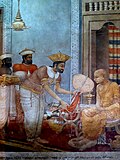
| | |[[File:The Consecration Of King Sinhala-Prince Vijaya (Detail From The Ajanta Mural Of Cave No 17).jpg|100px|Vijaya]] | ||
||'''[[Prince Vijaya|Vijaya]]''' | |||
||?<br />[[Sinhapura]]<br />son of [[Sinhabahu]], and [[Sinhasivali]] | |||
||505<br />[[Tambapanni]] | |||
||543 | |||
||505 | |||
||[[Kuveni]]<br />two children [[Pandyan dynasty|Pandu Princes]] | |||
||Founded [[Sinhala Kingdom|Kingdom]]<br />Marriage to [[Kuveni]] | |||
|- | |- | ||
| | |||''[[Upatissa (regent)|Upatissa]]''<br /><small>''(regent)''</small> | ||
||- | |||
||- | |||
||505 | |||
||504 | |||
|| | |||
||Prince Vijaya's Chief Minister | |||
|- | |- | ||
| | |||'''[[Panduvasdeva of Tambapanni|Panduvasdeva]]''' | ||
||- | |||
||- | |||
||504 | |||
||474 | |||
|| | |||
||Nephew of Vijaya | |||
|- | |- | ||
| | |||'''[[Abhaya of Tambapanni|Abhaya]]''' | ||
||- | |||
||- | |||
||474 | |||
||454 | |||
|| | |||
||Son of Panduvasdeva | |||
|- | |- | ||
| | |||''[[Prince Tissa|Tissa]]''<br /><small>''(regent)''</small> | ||
|- | ||- | ||
| | ||- | ||
|- | ||454 | ||
| | ||437 | ||
| | || | ||
| | ||Younger brother of Abhaya | ||
|} | |} | ||
== | == Ancient and early medieval Southern Indian dynasties == | ||
{{ | {{see also|History of Southern India|Tamilakam|}} | ||
=== Pandya dynasty (c. 600 BCE–1650 CE) === | |||
{| | {{main|Pandya dynasty}} | ||
====Early Pandyans==== | |||
| | {{main|Early Pandyan kingdom}} | ||
* [[Koon Pandiyan]] - ''(Earliest Known Pandyan king)'' | |||
* [[Nedunjeliyan I|Nedunj Cheliyan I]] ''(Aariyap Padai Kadantha Nedunj Cheliyan)'', he was mentioned in legend of [[Kannagi (Tamil mythology)|Kannagi]] | |||
* Pudappandiyan | |||
* Mudukudumi Paruvaludhi | |||
* [[Nedunjeliyan II|Nedunj Cheliyan II]] ''(Pasumpun Pandiyan)'' | |||
* Nan Maran | |||
* Nedunj Cheliyan III ''(Talaiyaalanganathu Seruvendra Nedunj Cheliyan)'' | |||
* Maran Valudi | |||
* Musiri Mutriya Cheliyan | |||
* Ukkirap Peruvaluthi | |||
====Middle Pandyans (c. 590–920 CE)==== | |||
* [[Kadungon]] (590–620 CE) | |||
* [[Maravarman Avani Culamani]] (c. 620–645 CE) | |||
* [[Jayantavarman]] (c. 645–670 CE) | |||
* [[Arikesari Maravarman|Arikesari Maravarman Nindraseer Nedumaaran]] (c. 670–710 CE) | |||
* [[Kochadaiyan Ranadhiran]] (710–735 CE) | |||
* [[Maravarman Rajasimha I|Arikesari Parankusa Maravarman Rajasimha I]] (735–765) | |||
* Parantaka Nedunjadaiyan (765–815) | |||
* Rasasingan II (790–800) | |||
* Varagunan I (800–830) | |||
* [[Srimara Srivallabha]] (815–862) | |||
* [[Varagunavarman II]] (862–880) | |||
* Parantaka Viranarayana (880–900) | |||
* [[Maravarman Rajasimha II]] (900–920) | |||
=== | ====Pandyans under Chola Empire (c. 920–1216 CE)==== | ||
* Sundara Pandyan I | |||
* Vira Pandyan I | |||
* Vira Pandyan II | |||
* Amarabhujanga Tivrakopa | |||
* Jatavarman Sundara Chola Pandyan | |||
* Maravarman Vikrama Chola Pandyan | |||
* Maravarman Parakrama Chola Pandyan | |||
* Jatavarman Chola Pandya | |||
* Seervallabha Manakulachala (1101–1124) | |||
* Maaravaramban Seervallaban (1132–1161) | |||
* [[Parakrama Pandyan I]] (1161–1162) | |||
* Kulasekara Pandyan III | |||
* Vira Pandyan III | |||
* Jatavarman Srivallaban (1175–1180) | |||
* [[Jatavarman Kulasekaran I]] (1190–1216) | |||
==== Pandalam dynasty (Later Pandyans) (c. 1212–1345 CE) ==== | |||
{{main|Pandalam dynasty}} | |||
* [[Parakrama Pandyan II]] (1212–1215) | |||
* [[Maravarman Sundara Pandyan]] (1216–1238) | |||
* [[Sadayavarman Kulasekaran II]] (1238–1240) | |||
| | * [[Maravarman Sundara Pandyan II]] (1238–1251) | ||
* [[Jatavarman Sundara Pandyan]] (1251–1268) | |||
* [[Maaravarman Kulasekara Pandyan I]] (1268–1308) | |||
* Sundara Pandyan IV (1309–1327) | |||
* Vira Pandyan IV (1309–1345) | |||
=== | ====Tenkasi Pandya dynasty (c. 1422–1650 CE)==== | ||
{{main| | {{main|Tenkasi Pandyas}} | ||
During the 15th century, the Pandyans lost their traditional capital city [[Madurai]] because of the Islamic and [[Madurai Nayak dynasty|Nayaks]] invasion, and were forced to move their capital to [[Tirunelveli]] in southern [[Tamilakam]] and existed there as vassals. | |||
* Cataiyavarman Parakrama Pandyan (1422–1463) | |||
* Cataiyavarman III Kulasekara Pandyan (1429–1473) | |||
* [[Azhagan Perumal Parakrama Pandyan]] (1473–1506) | |||
* Kulasekara Pandyan (1479–1499) | |||
* Cataiyavarman Civallappa Pandyan (1534–1543) | |||
* Parakrama Kulasekara Pandyan (1543–1552) | |||
| [[ | * Nelveli Maran (1552–1564) | ||
* Cataiyavarman Adiveerama Pandyan (1564–1604) | |||
* Varathunga Pandyan (1588–1612) | |||
* Varakunarama Pandyan (1613–1618) | |||
* Kollankondan (1618–1650){{citation needed|date=March 2025}} | |||
|} | |||
== | === Chera dynasty (c. 600 BCE–1530 CE) === | ||
[[Chera dynasty#Cheras from early Tamil texts|Ancient Chera kings]] | |||
[[Kongu Chera dynasty#Kongu Chera genealogy|Kongu Cheras (c. 400–844 CE)]] | |||
[[Chera dynasty#Chera Perumal genealogy|Makotai Cheras]] | |||
* | Venadu Cheras (Kulasekharas) (c. 1090–1530 CE): | ||
* | * [[Rama Varma Kulashekhara|Rama Kulasekhara]] (1090–1102) | ||
* | * Kotha Varma Marthandam (1102–1125) | ||
* | * Vira Kerala Varma I (1125–1145) | ||
* | * Kodai Kerala Varma (1145–1150) | ||
* | * Vira Ravi Varma (1145–1150) | ||
* | * Vira Kerala Varma II (1164–1167) | ||
* | * Vira Aditya Varma (1167–1173) | ||
* | * Vira Udaya Martanda Varma (1173–1192) | ||
* | * Devadaram Vira Kerala Varma III (1192–1195) | ||
* | * Vira Manikantha Rama Varma Tiruvadi (1195- ?) | ||
* | * Vira Rama Kerala Varma Tiruvadi (1209–1214) | ||
* | * Vira Ravi Kerala Varma Tiruvadi (1214–1240) | ||
* | * Vira Padmanabha Martanda Varma Tiruvadi (1240–1252) | ||
* | * Ravi Varma (1252–1313) | ||
* Vira Udaya Martanda Varma (1313–1333) | |||
* Aditya Varma Tiruvadi (1333–1335) | |||
* Vira Rama Udaya Martanda Varma Tiruvadi (1335–1342) | |||
* Vira Kerala Varma Tiruvadi (1342–1363) | |||
* Vira Martanda Varma III (1363–1366) | |||
* | * Vira Rama Martanda Varma (1366–1382) | ||
* | * Vira Ravi Varma (1383–1416) | ||
* | * Vira Ravi Ravi Varma (1416–1417) | ||
* | * Vira Kerala Martanda Varma (1383) | ||
* | * Chera Udaya Martanda Varma (1383–1444) | ||
* Vira Ravi Varma (1444–1458) | |||
* Sankhara Sri Vira Rama Martanda Varma (1458–1468) | |||
* Vira Kodai Sri Aditya Varma (1468–1484 | |||
* | * [[Vira Ravi Ravi Varma]] (1484–1503) | ||
* | * Martanda Varma, Kulasekhara Perumal (1503–1504) | ||
* | * Vira Ravi Kerala Varma, Kulasekhara Perumal (1504–1530) | ||
* | |||
* | |||
== | === Chola dynasty (c. 600 BCE–1279 CE) === | ||
{{ | ==== Ancient Chola kings (c. 600 BCE – 300 CE) ==== | ||
* Eri Oliyan Vaendhi | |||
* Maandhuvaazhi | |||
* El Mei Nannan | |||
* Keezhai Kinjuvan | |||
* Vazhisai Nannan | |||
* Mei Kiyagusi Aerru | |||
* Aai Kuzhi Agusi Aerru | |||
* Thizhagan Maandhi | |||
* Maandhi Vaelan | |||
* Aai Adumban | |||
* [[Ilamcetcenni]] | |||
* [[Karikala Chola]] | |||
* [[Nedunkilli]] | |||
* [[Nalankilli]] | |||
* [[Killivalavan]] | |||
* [[Perunarkilli]] | |||
* [[Kocengannan]] | |||
* Nalluruththiran | |||
==== [[Chola Empire#Emperors|Chola emperors (848 – 1279 AD)]] ==== | |||
=== Velir dynasties (c. 300 BCE–1200 CE) === | |||
{{main|Velirs}} | |||
Major dynasties of Velir are- | |||
* [[Vēl Pāri]] | |||
* [[Ilanji Vel]] | |||
* [[Irunkōvēl]] | |||
* [[Athiyamān]] | |||
* [[Malayamān]] | |||
* [[Malaiyamān Thirumudi Kāri]] | |||
* [[Athiyamān Nedumān Añci]] | |||
* [[Vaiyāvik Kōpperum Pēkan]] | |||
=== | === Ay dynasty (Velir) (c. 300 BCE–800 CE) === | ||
{{main|Ay dynasty}} | |||
==== Early Ay Kings ==== | |||
* [[Ay Andiran]] | |||
* [[Ay Titiyan (the Podiyil Chelvan)|Ay Titiyan]] | |||
* Ay Atiyan | |||
==== Medieval Ay Kings ==== | |||
* | * [[Chadayan Karunanthan]] | ||
* [[Karunanthadakkkan Srivallabha]] (r. 856–884 CE) | |||
* [[Vikramaditya Varaguna]] (r. 884–911 CE) | |||
*[[ | |||
*[[ | |||
=== | === Pallava dynasty (c. 275 – 897 CE) === | ||
{{Main|Pallava dynasty#Chronology}} | |||
=== Kadamba dynasties (c. 345–1310 CE) === | |||
==== Principality of Banavasi (c. 345–540 CE) ==== | |||
{{main|Kadamba dynasty}} | |||
'''Banavasi branch rulers-''' | |||
* [[Mayurasharma]] (345–365) | |||
* Kangavarma (365–390) | |||
* Bhageerath (390–415) | |||
* Raghu (415–435) | |||
* [[Kakusthavarma]] (435–455) | |||
* Santivarma (455–460) | |||
* Shiva Mandhatri (460–475) | |||
* Mrigeshavarma (475–485) | |||
* Ravivarma (485–519) | |||
* Harivarma (519–530) | |||
'''Triparvatha branch rulers-''' | |||
* Krishna Varma I (455–475) | |||
* Vishnuvarma (475–485) | |||
* Simhavarma (485–516) | |||
* [[Krishna Varma II]] (516–540) | |||
==== Principality of Goa (c. 960–1345 CE) ==== | |||
{{main|Kadambas of Goa}} | |||
* Shashthadeva I alis Kantakacharya (c. 960 CE), founder of dynasty | |||
* Nagavarma | |||
* Guhalladeva I | |||
* Shashathadeva II | |||
* Guhalladeva II (1038–1042) | |||
* Veeravarmadeva ( 1042–1054) | |||
* Jayakeshi I (1054–1080) | |||
* Guhalladeva II alias Tribhuvanamalla (1080–1125) | |||
* Vijayaditya I alias Vijayarka, (ruling prince up to 1104) | |||
* Jayakeshi II (1125–1148) | |||
* Shivachitta alis Paramadideva ( 1148–1179) | |||
* Vishnuchitta alias Vijayaditya II (1179–1187) | |||
* Jayakeshi III (1188–1216) | |||
* Vajradeva alis Shivachitta (regin?) | |||
* Sovideva alis Tribhuvanamalla (1216–1246?) | |||
* Shashthadeva III (?1246–1265) | |||
* Kamadeva (1265–1310), last known ruler of dynasty | |||
==== Principality of Hangal (c. 980–1275 CE) ==== | |||
{{main|Kadambas of Hangal}} | |||
| | |||
;known rulers are- | |||
* Chattadeva (980–1031), founder of dynasty | |||
* Kamadeva | |||
* Somadeva | |||
* Mayuravarma | |||
==== Other minor Kadamba principalities ==== | |||
;[[Kadambas of Halasi]] | |||
;Kadambas of Bankapur | |||
;Kadambas of Bayalnad | |||
;Kadambas of Nagarkhanda | |||
;Kadambas of Uchchangi | |||
;Kadambas of Bayalnadu (Vainadu) | |||
== | === Chutu dynasty of Banavasi (c. 100 BCE–200 CE) === | ||
[[Chutu dynasty#List of rulers|List of rulers of Banavasi]] | |||
=== Vishnukundina dynasty of Denduluru (c. 420–624 CE) === | |||
[[Vishnukundina dynasty#Chronology|List of rulers of Denduluru]] | |||
=== Chalukya dynasty (c. 500–1200 CE) === | |||
{{main|Chalukya dynasty|Eastern Chalukyas|Chalukyas of Vemulavada|Western Chalukya Empire}} | |||
== | {| class="wikitable" | ||
{{main| | !colspan=2|Ruler!!Born!!Reign!!Capital/<br>Ruling part!!Consort!!Death!!Notes | ||
|- style="background:#fff" | |||
|[[Jayasimha (Vatapi Chalukya dynasty)|Jayasimha I]]|| | |||
|align=center|? | |||
|align=center|500–520|| rowspan="6" |[[Badami]]|| rowspan="2" |?<br>at least one child | |||
|align=center|520||First ruler of the dynasty. | |||
|- style="background:#fff" | |||
|[[Ranaraga]]|| | |||
|align=center|?<br><small>Son of [[Jayasimha (Vatapi Chalukya dynasty)|Jayasimha I]]</small> | |||
|align=center|520–540 | |||
|align=center|540|| | |||
|- style="background:#fff" | |||
|[[Pulakeshin I]]|| | |||
|align=center|?<br><small>Son of [[Ranaraga]]</small> | |||
|align=center|540–567||Durlabhadevi<br>at least two children | |||
|align=center|567|| | |||
|- style="background:#fff" | |||
|[[Kirtivarman I]]|| | |||
| rowspan="2" align="center" |?<br><small>Sons of [[Pulakeshin I]] and Durlabhadevi</small> | |||
|align=center|567–592||?<br>at least two children | |||
|align=center|592|| | |||
|- style="background:#fff" | |||
|[[Mangalesha]]||[[File:6th century Kannada inscription in cave temple number 3 at Badami.jpg|100px]] | |||
|align=center|592–610||?<br>at least one child | |||
|align=center|610|| | |||
|- style="background:#fff" | |||
|[[Pulakeshin II]]||[[File:Pulikesin II, the Chalukhaya, receives envoys from Persia (1).jpg|100px]] | |||
|align=center|?<br><small>First son of [[Kirtivarman I]]</small> | |||
|align=center|610–642||?<br>five children | |||
|align=center|642 | |||
|rowspan="2"|Children of Kirtivarman I, divided their inheritance. | |||
|- style="background:#def" | |||
|[[Kubja Vishnuvardhana|Kubja Vishnuvardhana I]]|| | |||
|align=center|?<br><small>Second son of [[Kirtivarman I]]</small> | |||
|align=center|610–641|| rowspan="2" |[[Vengi]] ([[Eastern Chalukyas|Eastern]])||?<br>two children | |||
|align=center|641 | |||
|- style="background:#def" | |||
|[[Jayasimha I (Eastern Chalukya dynasty)|Jayasimha I]]<ref>The numbering in Eastern Chalukya is independent from the main branch of the family.</ref>|| | |||
|align=center|?<br><small>First son of [[Kubja Vishnuvardhana|Vishnuvardhana I]]</small> | |||
|align=center|641–673||? | |||
|align=center|673|| | |||
|- style="background:#fff" | |||
|[[Adityavarman (Chalukya dynasty)|Adityavarman]]|| | |||
|align=center|?<br><small>First son of [[Pulakeshin II]]</small> | |||
|align=center|642–645||[[Badami]]||?<br>one child | |||
|align=center|645 | |||
|rowspan="2"|Children of Pulakeshin II, divided their inheritance. The second son's filiation is however not certain, and based on chronology and in the name Chalukya which was adopted also by his descendants. | |||
|- style="background:#dce | |||
|[[Satyashraya (Vemulavada Chalukya dynasty)|Satyashraya]]|| | |||
|align=center|?<br><small>Second son (?) of [[Pulakeshin II]]</small> | |||
|align=center|642–675<ref>Ruling dates for the Vemulavada Chalukyas are estimated.</ref>||[[Vemulawada, Rajanna Sircilla district|Vemulavada]]||?<br>at least one child | |||
|align=center|675 | |||
|- style="background:#fff" | |||
|[[Abhinavaditya]]|| | |||
|align=center|?<br><small>Son of [[Adityavarman (Chalukya dynasty)|Adityavarman]]</small> | |||
|align=center|645–646|| rowspan="2" |[[Badami]]||? | |||
|align=center|645|| | |||
|- style="background:#fff" | |||
|[[Chandraditya (Chalukya dynasty)|Chandraditya]]|| | |||
|align=center|?<br><small>Third son of [[Pulakeshin II]]</small> | |||
|align=center|646–649||[[Vijaya-Bhattarika]]<br>one child | |||
|align=center|649|| | |||
|- style="background:#fff" | |||
|colspan="7" align="center"|<small>''Regency of [[Vijaya-Bhattarika]]'' (649–655)</small> | |||
|rowspan="2"|Regent for her minor son. She was deposed by her brother-in-law. | |||
|- style="background:#fff" | |||
|''A son of Chandraditya''|| | |||
|align=center|?<br><small>Son of [[Chandraditya (Chalukya dynasty)|Chandraditya]] and [[Vijaya-Bhattarika]]</small> | |||
|align=center|649–655|| rowspan="2" |[[Badami]]||? | |||
|align=center|655 | |||
|- style="background:#fff" | |||
|[[Vikramaditya I]]|| | |||
|align=center|?<br><small>Fourth son of [[Pulakeshin II]]</small> | |||
|align=center|655–680||Gangamahadevi<br>at least one child | |||
|align=center|680|| | |||
|- style="background:#def | |||
|[[Indra Bhattaraka]]|| | |||
|align=center|?<br><small>Second son of [[Kubja Vishnuvardhana|Vishnuvardhana I]]</small> | |||
|align=center|673|| rowspan="2" |[[Vengi]] ([[Eastern Chalukyas|Eastern]])||?<br>at least one child | |||
|align=center|673|| | |||
|- style="background:#def | |||
|[[Vishnuvardhana II]]|| | |||
|align=center|?<br><small>Son of [[Indra Bhattaraka]]</small> | |||
|align=center|673–682||?<br>at least one child | |||
|align=center|682|| | |||
|- style="background:#dce | |||
|[[Prithvipathi]]|| | |||
|align=center|?<br><small>Son of [[Satyashraya (Vemulavada Chalukya dynasty)|Satyashraya]]</small> | |||
|align=center|675–700||[[Vemulawada, Rajanna Sircilla district|Vemulavada]]||?<br>at least one child | |||
|align=center|700|| | |||
|- style="background:#fff | |||
|[[Vinayaditya of Vatapi|Vinayaditya]]|| | |||
|align=center|?<br><small>Son of [[Vikramaditya I]]</small> | |||
|align=center|680–696||[[Badami]]||?<br>at least one child | |||
|align=center|696|| | |||
|- style="background:#def | |||
|[[Mangi Yuvaraja]]|| | |||
|align=center|?<br><small>Son of [[Vishnuvardhana II]]</small> | |||
|align=center|682–706||[[Vengi]] ([[Eastern Chalukyas|Eastern]])||?<br>at least one child | |||
|align=center|706|| | |||
|- style="background:#fff | |||
|[[Vijayaditya|Vijayaditya I]]|| | |||
|align=center|?<br><small>Son of [[Vinayaditya of Vatapi|Vinayaditya]]</small> | |||
|align=center|696–733||[[Badami]]||?<br>at least one child | |||
|align=center|733|| | |||
|- style="background:#dce | |||
|[[Maharaja (Vemulavada Chalukya dynasty)|Maharaja]]|| | |||
|align=center|?<br><small>Son of [[Prithvipathi]]</small> | |||
|align=center|700–725||[[Vemulawada, Rajanna Sircilla district|Vemulavada]]||?<br>at least one child | |||
|align=center|725|| | |||
|- style="background:#def | |||
|[[Jayasimha II (Eastern Chalukya dynasty)|Jayasimha II]]|| | |||
| rowspan="3" align="center" |?<br><small>Sons of [[Vishnuvardhana II]]</small> | |||
|align=center|706–718|| rowspan="3" |[[Vengi]] ([[Eastern Chalukyas|Eastern]])|| rowspan="3" |?<br>at least one child | |||
|align=center|718|| | |||
|- style="background:#def | |||
|[[Kokkli]]|| | |||
|align=center|718–719 | |||
|align=center|719|| | |||
|- style="background:#def | |||
|[[Vishnuvardhana III]]|| | |||
|align=center|719–755 | |||
|align=center|755|| | |||
|- style="background:#dce | |||
|[[Rajaditya (Vemulavada Chalukya dynasty)|Rajaditya]]|| | |||
|align=center|?<br><small>Son of [[Maharaja (Vemulavada Chalukya dynasty)|Maharaja]]</small> | |||
|align=center|725–750||[[Vemulawada, Rajanna Sircilla district|Vemulavada]]||?<br>at least one child | |||
|align=center|750|| | |||
|- style="background:#fff | |||
|[[Vikramaditya II]]||[[File:8th century Kannada inscription on victory pillar at Pattadakal.jpg|100px]] | |||
|align=center|?<br><small>Son of [[Vijayaditya|Vijayaditya I]]</small> | |||
|align=center|733–746|| rowspan="2" |[[Badami]]|| rowspan="2" |?<br>at least one child | |||
|align=center|746|| | |||
|- style="background:#fff | |||
|[[Kirtivarman II|Kirtivarman II Rahappa]]|| | |||
|align=center|?<br><small>Son of [[Vikramaditya II]]</small> | |||
|align=center|746–757 | |||
|align=center|757|| | |||
|- style="background:#fff | |||
|colspan="8" align="center"|''Annexed to the [[Rashtrakuta dynasty|Rashtrakuta Empire]]'' | |||
|- style="background:#dce | |||
|[[Vinayaditya of Podana|Vinayaditya Yuddhamalla I]]|| | |||
|align=center|?<br><small>Son of [[Rajaditya (Vemulavada Chalukya dynasty)|Rajaditya]]</small> | |||
|align=center|750–775||[[Vemulawada, Rajanna Sircilla district|Vemulavada]]||?<br>at least one child | |||
|align=center|775|| Considered the first effectively independent ruler of Vemulavada. Vassal of the [[Rashtrakuta dynasty]]. | |||
|- style="background:#def | |||
|{{ill|Vijayaditya I Bhattaraka|uk|Віджаядітья I|lt=Vijayaditya I Bhattaraka}}|| | |||
| rowspan="2" align="center" |?<br><small>Sons of [[Vishnuvardhana II]]</small> | |||
|align=center|755–772|| rowspan="2" |[[Vengi]] ([[Eastern Chalukyas|Eastern]])||?<br>at least one child | |||
|align=center|772|| His sister Silamahadevi married [[Dhruva Dharavarsha]], ruler of the [[Rashtrakuta Empire]]. | |||
|- style="background:#def | |||
|[[Vishnuvardhana IV|Vishnuvardhana IV Vishnuraja]]|| | |||
|align=center|772–808||Silabhattarika of the [[Rashtrakuta Empire]]<br>three children | |||
|align=center|808|| Married his first cousin. | |||
|- style="background:#dce | |||
|[[Arikesari I]]|| | |||
|align=center|?<br><small>Son of [[Vinayaditya of Podana|Vinayaditya Yuddhamalla I]]</small> | |||
|align=center|775–800|| rowspan="2" |[[Vemulawada, Rajanna Sircilla district|Vemulavada]]||?<br>at least two children | |||
|align=center|800|| | |||
|- style="background:#dce | |||
|[[Narasimha I (Vemulavada Chalukya dynasty)|Narasimha I]]|| | |||
|align=center|?<br><small>Son of [[Arikesari I]]</small> | |||
|align=center|800–825||?<br>at least one child | |||
|align=center|825|| | |||
|- style="background:#def | |||
|{{ill|Vijayaditya II|uk|Віджаядітья II|lt=Vijayaditya II}}|| | |||
|align=center|?<br><small>Son of [[Vishnuvardhana IV]] and Silabhattarika of the [[Rashtrakuta Empire]]</small> | |||
|align=center|808–847||[[Vengi]] ([[Eastern Chalukyas|Eastern]])||?<br>at least one child | |||
|align=center|847|| | |||
|- style="background:#dce | |||
|[[Yuddhamalla II (Vemulavada Chalukya dynasty)|Yuddhamalla II]]|| | |||
|align=center|?<br><small>Son of [[Narasimha I (Vemulavada Chalukya dynasty)|Narasimha I]]</small> | |||
|align=center|825–850||[[Vemulawada, Rajanna Sircilla district|Vemulavada]]||?<br>at least one child | |||
|align=center|850|| | |||
|- style="background:#def | |||
|[[Vishnuvardhana V|Kali Vishnuvardhana V]]|| | |||
|align=center|?<br><small>Son of {{ill|Vijayaditya II|uk|Віджаядітья II|lt=Vijayaditya II}}</small> | |||
|align=center|847–849|| rowspan="4" |[[Vengi]] ([[Eastern Chalukyas|Eastern]])||Shilamadevi of the [[Rashtrakuta Empire]]<br>three children | |||
|align=center|849|| Married Shilamadevi, niece of Queen Silabhattarika. | |||
|- style="background:#def | |||
|[[Vijayaditya III|Gunaga Vijayaditya III]]|| | |||
| rowspan="3" align="center" |?<br><small>Sons of [[Vishnuvardhana V]] and Shilamadevi of the [[Rashtrakuta Empire]]</small> | |||
|align=center rowspan="3"|849–892|| rowspan="3" |?<br>at least one child | |||
|align=center|892 | |||
|rowspan="3"|Children of Vishnuvardhana V, ruled jointly. | |||
|- style="background:#def | |||
|[[Vikramaditya I (Eastern Chalukya dynasty)|Yuvaraja Vikramaditya I]]|| | |||
|align=center|892? | |||
|- style="background:#def | |||
|[[Yuddhamalla I]]|| | |||
|align=center|892? | |||
|- style="background:#dce | |||
|[[Baddega I|Baddega I Soladaganda]]|| | |||
|align=center|?<br><small>Son of [[Yuddhamalla II (Vemulavada Chalukya dynasty)|Yuddhamalla II]]</small> | |||
|align=center|850–895||[[Vemulawada, Rajanna Sircilla district|Vemulavada]]||?<br>at least one child | |||
|align=center|895|| | |||
|- style="background:#def | |||
|{{ill|Bhima I Dronarjuna|uk|Чалук'я Бхіма I|lt=Bhima I Dronarjuna}}|| | |||
|align=center|?<br><small>Son of [[Vikramaditya I (Eastern Chalukya dynasty)|Vikramaditya I]]</small> | |||
|align=center|892–921||[[Vengi]] ([[Eastern Chalukyas|Eastern]])||?<br>at least one child | |||
|align=center|921|| | |||
|- style="background:#dce | |||
|[[Yuddhamalla III (Vemulavada Chalukya dynasty)|Yuddhamalla III]]|| | |||
|align=center|?<br><small>Son of [[Baddega I|Baddega I Soladaganda]]</small> | |||
|align=center|895–915|| rowspan="2" |[[Vemulawada, Rajanna Sircilla district|Vemulavada]]|| rowspan="2" |?<br>at least one child | |||
|align=center|925|| | |||
|- style="background:#dce | |||
|[[Narasimha II of Vemulavada|Narasimha II]]|| | |||
|align=center|?<br><small>Son of [[Yuddhamalla III (Vemulavada Chalukya dynasty)|Yuddhamalla III]]</small> | |||
|align=center|915–930 | |||
|align=center|930|| | |||
|- style="background:#def | |||
|{{ill|Vijayaditya IV|uk|Віджаядітья IV|lt=Vijayaditya IV}}|| | |||
|align=center|?<br><small>First son of {{ill|Bhima I|uk|Чалук'я Бхіма I|lt=Bhima I}}</small> | |||
|align=center|921|| rowspan="7" |[[Vengi]] ([[Eastern Chalukyas|Eastern]])||?<br>two children | |||
|align=center|921|| Beginning of a civil war in Vengi. During the seven years of the war (921–928), six different kings sat on Vengi's throne. | |||
|- style="background:#def | |||
|[[Vishnuvardhana VI (Eastern Chalukya dynasty)|Vishnuvardhana VI]]<ref>Known alternatively as ''Amma I''.</ref>|| | |||
|align=center|?<br><small>First son of {{ill|Vijayaditya IV|uk|Віджаядітья IV|lt=Vijayaditya IV}}</small> | |||
|align=center|921–927||?<br>at least one child | |||
|align=center|927|| | |||
|- style="background:#def | |||
|[[Vijayaditya V (Eastern Chalukya dynasty)|Vijayaditya V]]|| | |||
|align=center|?<br><small>First son of [[Vishnuvardhana VI (Eastern Chalukya dynasty)|Vishnuvardhana VI]]</small> | |||
|align=center|927||? | |||
|align=center|927||Ruled for fifteen days. | |||
|- style="background:#def | |||
|[[Tala I (Eastern Chalukya dynasty)|Tala I]]|| | |||
|align=center|?<br><small>Son of [[Yuddhamalla I]]</small> | |||
|align=center|927||?<br>at least one child | |||
|align=center|927|| Ruled for one month. | |||
|- style="background:#def | |||
|{{ill|Vikramaditya II, King of Vengi|uk|Вікрамадітья II (Венга)|lt=Vikramaditya II}}|| | |||
|align=center|?<br><small>Second son of {{ill|Bhima I|uk|Чалук'я Бхіма I|lt=Bhima I}}</small> | |||
|align=center|927–928||? | |||
|align=center|928|| | |||
|- style="background:#def | |||
|[[Bhima II (Eastern Chalukya dynasty)|Bhima II]]|| | |||
|align=center|?<br><small>Second son of [[Vishnuvardhana VI (Eastern Chalukya dynasty)|Vishnuvardhana VI]]</small> | |||
|align=center|928||? | |||
|align=center|928|| | |||
|- style="background:#def | |||
|{{ill|Yuddhamalla II|uk|Юддха Малла II|lt=Yuddhamalla II}}|| | |||
|align=center|?<br><small>Son of [[Tala I (Eastern Chalukya dynasty)|Tala I]]</small> | |||
|align=center|928–935||?<br>At least one child | |||
|align=center|935||End of the war. However, the throne still moved between different branches of the family. | |||
|- style="background:#dce | |||
|[[Arikesari II]]|| | |||
|align=center|?<br><small>Son of [[Narasimha II of Vemulavada|Narasimha II]]</small> | |||
|align=center|930–941||[[Vemulawada, Rajanna Sircilla district|Vemulavada]]||?<br>at least one child | |||
|align=center|941|| | |||
|- style="background:#def | |||
|{{ill|Bhima III Vishnuvadhana VII|uk|Чалук'я Бхіма III|lt=Vishnuvardhana VII}}<ref>Alternatively known as ''Bhima III''.</ref>|| | |||
|align=center|?<br><small>Second son of {{ill|Vijayaditya IV|uk|Віджаядітья IV|lt=Vijayaditya IV}}</small> | |||
|align=center|935–947||[[Vengi]] ([[Eastern Chalukyas|Eastern]])||?<br>at least one child | |||
|align=center|947|| | |||
|- style="background:#dce | |||
|[[Bhadradeva (Vemulavada Chalukya dynasty)|Bhadradeva Baddega II]]|| | |||
| rowspan="2" align="center" |?<br><small>Sons of [[Arikesari II]]</small> | |||
|align=center|941–946 | |||
|rowspan="2"|[[Vemulawada, Rajanna Sircilla district|Vemulavada]]||?<br>at least one child | |||
|align=center|946 | |||
|rowspan="2"| Children of Arikesari II, ruled jointly. | |||
|- style="background:#dce | |||
|[[Vagaraja]]|| | |||
|align=center|941–950||?<br>at least one child | |||
|align=center|950 | |||
|- style="background:#def | |||
|{{ill|Amma II Vijayaditya VI|uk|Амма II|lt=Vijayaditya VI}}<ref>Alternatively known as ''Amma II''.</ref>|| | |||
|align=center|?<br><small>First son of [[Bhima II (Eastern Chalukya dynasty)|Bhima II]]</small> | |||
|align=center|947–970||[[Vengi]] ([[Eastern Chalukyas|Eastern]])||?<br>At least one child | |||
|align=center|970|| | |||
|- style="background:#dce | |||
|[[Arikesari III]]|| | |||
|align=center|?<br><small>Son of [[Bhadradeva (Vemulavada Chalukya dynasty)|Bhadradeva Baddega II]]</small> | |||
|align=center|950–968||[[Vemulawada, Rajanna Sircilla district|Vemulavada]]||? | |||
|align=center|968|| | |||
|- style="background:#dce | |||
|colspan="8" align="center"|''Annexed to the [[Western Chalukya Empire]]'' | |||
|- style="background:#def | |||
|[[Danarnava]]|| | |||
|align=center|?<br><small>Second son of [[Bhima II (Eastern Chalukya dynasty)|Bhima II]]</small> | |||
|align=center|970–973|| rowspan="2" |[[Vengi]] ([[Eastern Chalukyas|Eastern]])||?<br>At least one child | |||
|align=center|973|| | |||
|- style="background:#def | |||
|{{ill|Jata Choda Bhima|uk|Джата Чода Бхіма|lt=Jata Choda Bhima}}|| | |||
|align=center|? | |||
|align=center|973–999||? | |||
|align=center|999|| Non-dynastic usurper. | |||
|- style="background:#ceb | |||
|[[Tailapa II|Tailapa II Ahvamalla]]<ref>Numbered after his non-ruling great-great-grandfather Tailapa I.</ref>||[[File:Old Kannada inscription dated Shaka 913 (c.991 AD) of Kalyani (Western) Chalukya King Ahvamalla Tailapa II.JPG|100px]] | |||
|align=center|?<br><small>Son of Vikramaditya (IV) Chalukya</small> | |||
|align=center|973–997|| rowspan="2" |[[Basavakalyan|Kalyani]] ([[Western Chalukyas|Western]])||?<br>at least one child | |||
|align=center|997|| Grandson in fifth generation of a brother of [[Vikramaditya II]] of [[Badami]]. While Vengi was being taken by an usurper on the demise of the [[Rashtrakuta Empire]], Tailapa proclaimed independence from the latter and built a new empire of his own, that saw the re-emergence of the Chalukya dynasty's power. | |||
|- style="background:#ceb | |||
|[[Satyashraya]]|| | |||
|align=center|?<br><small>Son of [[Tailapa II]]</small> | |||
|align=center|997–1008||?<br>at least one child | |||
|align=center|1008|| | |||
|- style="background:#def | |||
|{{ill|Shaktivarman, King of Vengi|uk|Шакті-варман I|lt=Shaktivarman}}|| | |||
|align=center|?<br><small>First son of [[Danarnava]]</small> | |||
|align=center|999–1011||[[Vengi]] ([[Eastern Chalukyas|Eastern]])||?<br>At least one child | |||
|align=center|1011|| | |||
|- style="background:#ceb | |||
|[[Vikramaditya V]]<ref>Numbered after his great-grandfather Vikramaditya IV and an unknown or non-existent Vikramaditya III. The numbering follows Vikramaditya II of Badami.</ref>|| | |||
|align=center|?<br><small>First son of Prince Dasavarman and Princess Bhagyavati</small> | |||
|align=center|1008–1015||[[Basavakalyan|Kalyani]] ([[Western Chalukyas|Western]])||? | |||
|align=center|1015|| Paternal nephew of Satyashraya. | |||
|- style="background:#def | |||
|{{ill|Vimaladitya|uk|Вімаладітья|lt=Vimaladitya}}|| | |||
|align=center|?<br><small>Second son of [[Danarnava]]</small> | |||
|align=center|1011–1018||[[Vengi]] ([[Eastern Chalukyas|Eastern]])||Kundavai of the [[Chola Empire]]<br>one child<br><br>?<br>one child | |||
|align=center|1018|| | |||
|- style="background:#ceb | |||
|[[Jayasimha II (Western Chalukya dynasty)|Jayasimha II]]<ref>Numbered after Jayasimha I of Badami. Also known as ''Jagadhekamalla I''.</ref>||[[File:Old Kannada inscription dated Shaka 957 (c.1035 AD) of Kalyani (Western) Chalukya King Jayasimha II.JPG|100px]] | |||
|align=center|?<br><small>Second son of Prince Dasavarman and Princess Bhagyavati</small> | |||
|align=center|1015–1043||[[Basavakalyan|Kalyani]] ([[Western Chalukyas|Western]])||Suggaladevi<br>at least one child | |||
|align=center|1043|| | |||
|- style="background:#def | |||
|[[Rajaraja Narendra]]||[[File:King Rajaraja Narendra founder of rajahmundry city.jpg|100px]] | |||
|align=center|?<br><small>Son of {{ill|Vimaladitya|uk|Вімаладітья|lt=Vimaladitya}} and Kundavai of the [[Chola Empire]]</small> | |||
|align=center|1018–1031<br><br>1035–1061|| rowspan="2" |[[Vengi]] ([[Eastern Chalukyas|Eastern]])||Amangaidevi of the [[Chola Empire]]<br>one child | |||
|align=center|1061||Rajaraja had support in the throne from the Cholas, whose influence grew significantly. He supported Cholas against his cousins, the [[Western Chalukyas]]. His own son managed to succeed in the [[Chola Empire]], in 1070, as [[Kulottunga I]], beginning the [[Later Cholas]] period, in which the Chola Empire was ruled by a branch of the Eastern Chalukyas renamed Chola, which inherited Narendra's kingdom. | |||
|- style="background:#def | |||
|{{ill|Vijayaditya VII|bg|Віджаядітья VII|lt=Vijayaditya VII}}|| | |||
|align=center|?<br><small>Son of {{ill|Vimaladitya|uk|Вімаладітья|lt=Vimaladitya}}</small> | |||
|align=center|1031–1035<br><br>1061–1075||? | |||
|align=center|1075||Half-brother of Rajaraja, had support from [[Western Chalukya]]. After his death Vengi was incorporated in the [[Chola Empire]]. | |||
|- style="background:#def | |||
|colspan="8" align="center"|''Annexed to the [[Chola Empire]] (1061-1118); Annexed to the [[Western Chalukya Empire]] (since 1118)'' | |||
|- style="background:#ceb | |||
|[[Someshvara I|Someshvara I Trilokyamalla]]||[[File:Western Chalukyas of Kalyana King Somesvara I Trailokyamalla 1043-1068.jpg|100px]] | |||
|align=center|?<br><small>Son of [[Jayasimha II (Western Chalukya dynasty)|Jayasimha II]] and Suggaladevi</small> | |||
|align=center|1043–1068|| rowspan="8" |[[Basavakalyan|Kalyani]] ([[Western Chalukyas|Western]])||?<br>two children | |||
|align=center|1068|| | |||
|- style="background:#ceb | |||
|[[Someshvara II|Someshvara II Bhuvanaikamalla]]||[[File:Old Kannada inscription dated Shaka 990 (c.1068 AD) of Kalyani (Western) Chalukya King Bhuvanaikamalla Someshvara II.JPG|100px]] | |||
| rowspan="2" align="center" |?<br><small>Sons of [[Someshvara I]]</small> | |||
|align=center|1068–1076||?<br>at least one child | |||
|align=center|1076|| | |||
|- style="background:#ceb | |||
|[[Vikramaditya VI|Vikramaditya VI Tribhuvanamalla]]||[[File:Old Kannada inscription (c.1108 AD) of Kalyani (Western) Chalukya King Tribhuvanamalla Vikramaditya VI.jpg|100px]] | |||
|align=center|1076–1126||Chandaladevi<br>Kethaladevi<br>Savaladevi<br><br>at least one child | |||
|align=center|1126|| | |||
|- style="background:#ceb | |||
|[[Someshvara III]]||[[File:Old Kannada inscription (1129 AD) at Kedareshvara temple in Balligavi.JPG|100px]] | |||
|align=center|?<br><small>Son of [[Vikramaditya VI]]</small> | |||
|align=center|1126–1138||?<br>at least one child | |||
|align=center|1138|| | |||
|- style="background:#ceb | |||
|[[Jagadhekamalla II]]||[[File:Old Kannada inscription (c.1148 AD) of Kalyani (Western) Chalukya King Jagadekamalla II.JPG|100px]] | |||
|align=center|?<br><small>Son of [[Someshvara III]]</small> | |||
|align=center|1138–1151||?<br>at least one child | |||
|align=center|1151|| | |||
|- style="background:#ceb | |||
|[[Tailapa III]]|| | |||
|align=center|?<br><small>Son of [[Jagadhekamalla II]]</small> | |||
|align=center|1151–1164||?<br>at least one child | |||
|align=center|1164|| | |||
|- style="background:#ceb | |||
|[[Jagadhekamalla III]]|| | |||
|align=center|?<br><small>Son of [[Tailapa III]]</small> | |||
|align=center|1164–1183||?<br>at least one child | |||
|align=center|1183|| | |||
|- style="background:#ceb | |||
|[[Someshvara IV]]||[[File:Chalukyas of Kalyana (Western Chalukyas) Possibly King Somesvara IV Chalukya. 1181-4 1189.jpg|100px]] | |||
|align=center|?<br><small>Son of [[Jagadhekamalla III]]</small> | |||
|align=center|1183–1200||?<br>at least one child | |||
|align=center|1200|| | |||
|- style="background:#ceb | |||
|colspan="8" align="center"|''Annexed to the [[Seuna]], [[Hoysala]] and the [[Kakatiya dynasty|Kakatiya dynasties]]'' | |||
|- | |||
|} | |||
== Middle Kingdoms (c. 250s BCE – 550s CE) == | |||
{{main|Middle kingdoms of India}} | |||
=== Satavahana dynasty (c. 228 BCE – 224 CE) === | |||
{{see also|Satavahana dynasty}} | |||
[[List of Satavahana emperors]] | |||
=== Mahameghavahana dynasty of Kalinga (c. 225 BCE – 300 CE) === | |||
{{main|Mahameghavahana dynasty}} | |||
* Maharaja Vasu | |||
* Maharaja Mahamegha Vahana | |||
* Sobhanaraja | |||
* Chandraja | |||
* Ksemaraja | |||
* Vakradeva (or) Virdhharaja | |||
* [[Kharavela]] (c. 193 BCE–155 BCE)<ref>{{cite book|last=Raychaudhuri|first=Hemchandra|title=Political History Of Ancient India|year=2006|publisher=Genesis Publishing|url=https://books.google.com/books?id=h1KObc_qaXYC&q=Cheti%20Dynasty&pg=PA348|access-date=25 October 2012|page=348|isbn=9788130702919}}</ref><ref>{{cite book|title=Studies in Jaina Art and Iconography and Allied Subjects|year=1995|publisher=Abhinav Publications|pages=31|url=https://books.google.com/books?id=fETebHcHKogC&q=Mahishaka%20%20Guntupalli%20inscription&pg=PA31|author=R. T. Vyas|author2=Umakant Premanand Shah|isbn=9788170173168|access-date=12 November 2012}}</ref> | |||
* [[Kudepasiri]] Vakradeva ll | |||
* Vaduka | |||
* Galaveya | |||
* Mana-Sada | |||
* Siri-Sada | |||
* Maha-Sada | |||
* Sivamaka-Sada | |||
* Asaka-Sada | |||
===Kingdom of Kangleipak (Manipur) (c. 200s BCE –1950 CE)=== | |||
[[List of Manipuri kings]] | |||
== | ===Kuninda Kingdom (c. 2nd century BCE to 3rd century CE)=== | ||
The only known ruler of Kuninda Kingdom is: | |||
* [[Amoghabhuti]] (late 2nd to early 1st century BCE) | |||
=== Indo-Greek Kingdom (''Yavanarajya'') (c. 200 BCE – 10 CE) === | |||
[[Indo-Greek Kingdom|List of Indo-Greek Kings]] | |||
=== Indo-Scythian (''Saka'') ( c. 12 BCE – 395 CE) === | |||
[[List of Indo-Scythian dynasties and rulers]] | |||
=== Kushan dynasty (c. 1 – 375 CE) === | |||
[[Kushan Empire#Rulers|List of Kushan emperors]] | |||
=== Indo-Parthian (''Pahalava'') (c. 21 – 100 CE) === | |||
[[Indo-Parthian Kingdom#Main Indo-Parthian rulers|List of Indo-Parthian kings]] | |||
=== Indo-Sasanian Kingdom (c. 233 – 365 CE) === | |||
[[Kushano-Sasanian Kingdom#Main Kushano-Sassanid rulers|List of Indo-Sasanian kings]] | |||
* | === Alchon Huns (''Huna'') (c. 400 – 670 CE) === | ||
* | [[Alchon Huns#Rulers|List of Alchon Hun Kings]] | ||
* | |||
* | === Chutu dynasty of Banavasi (c. 100 BCE–200 CE) === | ||
[[Chutu dynasty#List of rulers|Kings of Banavasi]] | |||
===Khokhra (Nagvanshi) chieftaincy (c. 64–1952 CE)=== | |||
[[Khokhra chieftaincy#Rulers|List of Nagvanshi chiefs]] | |||
=== Naga Kingdom of Padmavati (c. 170–350 CE) === | |||
[[Nagas of Padmavati#Chronology|Kings of Padmavati]] | |||
=== Chandra dynasty of Samatata (c. 202–1050 CE) === | |||
[[Chandra dynasty#History|Rulers of Samatata]] | |||
=== Kingdom of Abhira (c. 203–370 CE) === | |||
{{main|Abhira dynasty}} | |||
* Abhira Sivadatta | |||
* Sakasena alias Saka Satakrni | |||
* [[Ishwarsena|Abhira Ishwarsena]] alias ''Mahaksatrapa'' Isvaradatta | |||
* Abhira Vashishthiputra Vasusena | |||
=== Principality of Khoh (c. 221–1028 CE) === | |||
[[Khoh#List of rulers|Prince of Khoh]] | |||
=== Second Magadha Empire (c. 240 – 750 CE) === | |||
{{main|Gupta Empire|Later Gupta dynasty}} | |||
[[List of Gupta emperors]] | |||
[[Later Gupta dynasty|Later Gupta rulers]] | |||
=== Vakataka dynasty (c. 250–500 CE) === | |||
* | [[Vakataka dynasty#Family tree|Vakataka family tree]] | ||
* | |||
* | === Aulikara Kingdom of Malwa (c. 300 – 550 CE) === | ||
* | [[Aulikaras#List of rulers|List of monarchs of Malwa (Aulikara dynasty)]] | ||
* | |||
* | ===Kingdom of Kamarupa (c. 350–650 CE)=== | ||
* | [[Kamarupa Kingdom#Political History|Kings of Kamarupa]] | ||
* | |||
* | === Western Ganga of Talakad (c. 350–1424 CE) === | ||
* | [[Western Ganga dynasty#History|Rulers of Talakad]] | ||
* | |||
=== Eastern Ganga of Kalinga (c. 493-1947 CE) === | |||
[[Eastern Ganga dynasty#List of rulers|Eastern Ganga of Kalinga]] | |||
==== Other minor Ganga states ==== | |||
===== Principality of Gudari Kataka ===== | |||
{{Main|Gudari, Rayagada}} | |||
* [[ | |||
* [[ | According to Gangavansucharitam written in sixteenth or seventeenth century, ''Bhanu Deva IV also known as Kajjala Bhanu'' founded a new small princedom in southern Odisha at [[Gudari, Rayagada|Gudari]] in modern [[Rayagada district|Rayagada]] district after he was toppled from power by his general Kapilendra Deva.<ref>{{Cite web|url=http://shodhganga.inflibnet.ac.in/bitstream/10603/119409/15/15_chapter%206.pdf|title=The Historical Value of Gangavamsanucharita Champu|website=www.shodhganga.inflibnet.ac.in|access-date=22 September 2018}}</ref> | ||
* Kajjala Bhanu (or Bhanu Deva IV) | |||
* Svarna Bhanu | |||
* Kalasandha Deva | |||
* Chudanga Deva | |||
* Harimani Deva | |||
* Narasimha Deva | |||
* Ananta Deva | |||
* Padmanabha Deva | |||
* Pitambara Deva | |||
* Vasudeva | |||
* Purrushottama Anangabhima Deva (or Bhima Deva) | |||
===== Principality of Chikiti (c. 881–1950 CE) ===== | |||
[[Chikiti#List of rulers|Prince of Chikiti]] | |||
===== Parlakhemundi Estate#Rulers (c. 1309–1950) ===== | |||
[[Parlakhemundi Estate#Rulers|Zamindars of Parlakhemundi]] | |||
=== Traikutaka dynasty of Aparanta (c. 370–520 CE) === | |||
[[Traikutaka dynasty#Traikutaka rulers|Rulers of Aparanta]] | |||
=== Maitraka dynasty of Vallabhi (c. 475–776 CE) === | |||
[[Maitraka dynasty#List of rulers|Kings of Vallabhi]] | |||
===Rai Kingdom of Sindh (c. 489–632 CE)=== | |||
[[Rai dynasty#Rulers|Kings of Sindh (Rai)]] | |||
=== Kabul Shahi Kingdom (c. 500–1026 CE) === | |||
In Kabul Shahi Kingdom two dynasties ruled (both were [[Hindu]] dynasties): | |||
* [[Turk Shahi]] (c. 500–850 CE) | |||
* [[Hindu Shahi]] (c. 850–1026 CE) | |||
=== Pushyabhuti/Vardhan dynasty (c. 500 – 647 CE) === | |||
[[Pushyabhuti dynasty#List of rulers|List of Vardhan kings]] | |||
== | === Jaintia Kingdom (c. 525–1835 CE) === | ||
[[Jaintia Kingdom#Rulers|Rulers of Jantia]] | |||
== Early Medieval Period (c. 550s CE – c. 1200s CE) == | |||
* | === Gauda Kingdom (c. 590 – 626 CE) === | ||
{{Main|Gauda Kingdom}} | |||
* [[Shashanka]] (590–625 CE), first recorded independent king of [[Bengal]], created the first unified political entity in [[Bengal]] | |||
* [[ | * [[Manava (king)|Manava]] (625–626 CE), ruled for 8 months before being conquered by [[Harshavardhana]] and [[Bhaskarvarman]] | ||
== | === Pala dynasty of Bengal (c. 750 – 1174 CE) === | ||
{{main| | {{main|Pala Empire}} | ||
{{List of Pala rulers}} | |||
=== Kalachuri dynasties (c. 550 – 1225 CE) === | |||
== | ==== Kingdom of Malwa (Early Kalachuris) (c. 550 – 625 CE) ==== | ||
[[Kalachuris of Mahishmati|Kings of Malwa (Kalachuri)]] | |||
=== | ==== Kalachuri dynasty of Tripuri/Chedi (''Later Kalachuris'') (c. 675 – 1212 CE) ==== | ||
{{main| | {{main|Kalachuris of Tripuri}} | ||
;Rulers- | |||
* | * Vamaraja-deva (675–700 CE), founder of dynasty | ||
* Shankaragana I (750–775 CE) | |||
* Lakshmana-raja I (825–850 CE) | |||
''( | * Kokalla I (850–890 CE); his younger son established the '''[[Kalachuris of Ratnapura|Ratnapura Kalachuri branch]]''' | ||
( | * Shankaragana II (890–910 CE), alias Mugdhatunga | ||
* | * Balaharsha (910–915 CE) | ||
* | * Yuvaraja-deva I (915–945 CE) | ||
* [[ | * Lakshmana-raja II (945–970 CE) | ||
* [[Shankaragana III]] (970–980 CE) | |||
* | * [[Yuvarajadeva II|Yuvaraja-deva II]] (980–990 CE) | ||
* | * [[Kokalla II]] (990–1015 CE) | ||
* [[Gangeyadeva|Gangeya-deva]] (1015–1041 CE) | |||
* | * [[Lakshmikarna|Lakshmi-karna]] (1041–1073 CE), alias Karna | ||
* | * [[Yashahkarna|Yashah-karna]] (1073–1123 CE) | ||
* | * [[Gayakarna|Gaya-karna]] (1123–1153 CE) | ||
* [[Narasimha (Kalachuri dynasty)|Nara-simha]] (1153–1163 CE) | |||
* [[Jayasimha (Kalachuri dynasty)|Jaya-simha]] (1163–1188 CE) | |||
* [[Vijayasimha|Vijaya-simha]] (1188–1210 CE) | |||
* [[Trailokyamalla (Kalachuri dynasty)|Trailokya-malla]] (c. 1210– at least 1212 CE), last ruler<ref>{{cite book |author=V. V. Mirashi |title=Bhavabhuti |url=https://books.google.com/books?id=hLGgZOzTYzsC&pg=PA376 |date=1974 |publisher=Motilal Banarsidass |isbn=978-81-208-1180-5}}</ref> | |||
=== | ==== Kalachuri dynasty of Ratnapura (c. 1000 – 1225 CE) ==== | ||
{{main|Kalachuris of Ratnapura}} | |||
* | The following is a list of the Ratnapura Kalachuri rulers, with estimated period of their reigns:<ref>{{cite book |author=P. C. Roy |chapter=The Coinage of the Kalachuris of Ratnapura |title=The Coinage of Northern India |chapter-url=https://books.google.com/books?id=f2Et2zZGJPUC&pg=PA18 |year=1980 |publisher=Abhinav Publications |isbn=978-81-7017-122-5}}</ref> | ||
* | * Kalinga-raja (1000–1020 CE), founder of dynasty | ||
* | * Kamala-raja (1020–1045 CE) | ||
* | * Ratna-raja (1045–1065 CE), alias Ratna-deva I | ||
* | * Prithvi-deva I (1065–1090 CE), alias Prithvisha | ||
* [[ | * Jajalla-deva I (1090–1120 CE) (declared independence) | ||
* | * [[Ratnadeva II|Ratna-Deva II]] (1120–1135 CE) | ||
* | * [[Prithvi-deva II]] (1135–1165 CE) | ||
* | * Jajalla-deva II (1165–1168 CE) | ||
* | * Jagad-deva (1168–1178 CE) | ||
* | * Ratna-deva III (1178–1200 CE) | ||
* | * Pratapa-malla (1200–1225 CE) | ||
* Parmardi Dev (governor of [[Eastern Ganga dynasty|Eastern Gangas]]) | |||
=== | ==== Kalachuri dynasty of Kalyani (''Southern Kalachuris'') (c. 1130 – 1184 CE) ==== | ||
{{main|Kalachuris of Kalyani}} | |||
;Rulers- | |||
* [[Bijjala II]] (1130–1167), proclaimed independence from [[Western Chalukya Empire|Kalyani Chalukyas]] in 1162 CE | |||
* Sovideva (1168–1176) | |||
* Mallugi, overthrown by his brother Sankama | |||
* Sankama (1176–1180) | |||
* Ahavamalla (1180–83) | |||
* Singhana (1183–84), last ruler | |||
=== Patola/Gilgit Shahi dynasty (c. 550 – 750 CE) === | |||
{{main|Patola Shahis}} | |||
==='' | ;Regin of known rulers is disputed-<ref>{{cite web |last1=von Hinüber |first1=Oskar |title=Bronzes of the Ancient Buddhist Kingdom of Gilgit |url=https://www.metmuseum.org/metmedia/video/collections/asian/bronzes-of-ancient-gilgit |website=www.metmuseum.org}}</ref><ref>{{cite web |title=Metropolitan Museum of Art |url=https://www.metmuseum.org/art/collection/search/76445 |website=www.metmuseum.org}}</ref> | ||
* Somana (Mid 6th century CE) | |||
* Vajraditayanandin (585–605 CE) | |||
* Vikramadityanandin (605–625 CE) | |||
* Surendravikramadityanandin (625–644 or 654 CE) | |||
* Navasurendrāditya-nandin (644 or 654–685 CE) | |||
* Jayamaṅgalavikramāditya-nandin (685–710 CE) | |||
* Nandivikramadityanandin (710–715 CE) | |||
* ''Su-fu-che-li-chi-li-ni'' (name by foreign sources) (715–720 CE) | |||
* Surendradityanandin (720–740 or 750 CE), last known ruler | |||
=== Gurjara-Pratihara Empire (c. 550 – 1036 CE) === | |||
{{main|Gurjara-Pratihara dynasty}} | |||
=== | ==== Pratiharas of Mandavyapura (Mandor) (c. 550 – 860 CE) ==== | ||
{{main|Pratiharas of Mandavyapura}} | |||
[[R. C. Majumdar]], on the other hand, assumed a period of 25 years for each generation, and placed him in c. 550 CE. The following is a list of the dynasty's rulers ([[IAST]] names in brackets) and estimates of their reigns, assuming a period of 25 years. | |||
* Harichandra (Haricandra) alias Rohilladhi (r. c. 550 CE), founder of dynasty | |||
* | * Rajilla (r. c. 575 CE) | ||
( | * Narabhatta (Narabhaṭa) alias Pellapelli (r. c. 600 CE) | ||
* | * Nagabhata (Nāgabhaṭa) alias Nahada (r. c. 625 CE) | ||
( | * Tata (Tāta) and Bhoja (r. c. 650 CE) | ||
* | * Yashovardhana (Yaśovardhana) (r. c. 675 CE) | ||
* | * Chanduka (Canduka) (r. c. 700 CE) | ||
* | * Shiluka (Śīluka) alias Silluka (r. c. 725 CE) | ||
( | * Jhota (r. c. 750 CE) | ||
* | * Bhilladitya alias Bhilluka (r. c. 775 CE) | ||
( | * Kakka (r. c. 800 CE) | ||
* | * Bauka (Bāuka) (r. c. 825 CE) | ||
* | * Kakkuka (r. c. 861 CE), last ruler | ||
( | |||
* | |||
* | |||
* | |||
== | ==== Imperial Pratiharas of Kannauj (c. 730 – 1036 CE) ==== | ||
{{ | {{main|Gurjara-Pratihara dynasty}} | ||
= | ;List of rulers– | ||
{| class="wikitable" | |||
|+List of Imperial Gurjara-Pratihara dynasty rulers | |||
! Serial No. | |||
! Ruler | |||
! Reign (CE) | |||
|- | |||
|1 | |||
|[[Nagabhata I]] | |||
|730–760 | |||
|- | |||
|2 | |||
|[[Kakustha (Gurjara-Pratihara dynasty)|Kakustha]] and [[Devaraja (Gurjara-Pratihara dynasty)|Devaraja]] | |||
|760–780 | |||
|- | |||
|3 | |||
|[[Vatsaraja]] | |||
|780–800 | |||
|- | |||
|4 | |||
|[[Nagabhata II]] | |||
|800–833 | |||
|- | |||
|5 | |||
|[[Ramabhadra]] | |||
|833–836 | |||
|- | |||
|6 | |||
|[[Mihira Bhoja]] or Bhoja I | |||
|836–885 | |||
|- | |||
|7 | |||
|[[Mahendrapala I]] | |||
|885–910 | |||
|- | |||
|8 | |||
|[[Bhoja II (Gurjara-Pratihara dynasty)|Bhoja II]] | |||
|910–913 | |||
|- | |||
|9 | |||
|[[Mahipala I]] | |||
|913–944 | |||
|- | |||
|10 | |||
|[[Mahendrapala II]] | |||
|944–948 | |||
|- | |||
|11 | |||
|Devapala | |||
|948–954 | |||
|- | |||
|12 | |||
|Vinayakapala | |||
|954–955 | |||
|- | |||
|13 | |||
|Mahipala II | |||
|955–956 | |||
|- | |||
|14 | |||
|Vijayapala II | |||
|956–960 | |||
|- | |||
|15 | |||
|Rajapala | |||
|960–1018 | |||
|- | |||
|16 | |||
|Trilochanapala | |||
|1018–1027 | |||
|- | |||
|17 | |||
|[[Yasahpala (king)|Yasahpala]] | |||
|1024–1036 | |||
|- | |||
|} | |||
== | ====Other Pratihara Branches==== | ||
;Baddoch Branch (c. 600 – 700 CE) | |||
Known Baddoch rulers are- | |||
* [[Dhaddha]] 1 (600–627) | |||
* Dhaddha 2 (627–655) | |||
* [[Jaibhatta]] (655–700) | |||
;Rajogarh Branch | |||
Badegujar were rulers of [[Rajogarh]] | |||
* [[Parmeshver Manthandev]], (885–915) | |||
* No records found after Parmeshver Manthandev | |||
* [[ | |||
* | |||
=== | === Chahamana (Chauhan) dynasties (c. 551 – 1315 CE) === | ||
* [[ | ;The ruling dynasties belonging to the Chauhan clan included– | ||
* [[Chahamanas of Shakambhari]] (Chauhans of Ajmer) (c. 551 – 1194 CE) | |||
* [[ | * [[Chahamanas of Naddula]] (Chauhans of Nadol) (c. 950 – 1197 CE) | ||
* [[Chahamanas of Jalor]] (c. 1160 – 1311 CE), branched off from the Chahamanas of Naddula | |||
* [[ | * [[Chahamanas of Ranastambhapura]] (c. 1192 – 1301 CE), branched off from the Chahamanas of Shakambhari | ||
* [[ | * [[Sirohi State|Chahamanas of Chandravati and Abu]] ([[Sirohi State|Kingdom of Sirohi]]) (c. 1311 – 1949 CE) | ||
* [[ | * Chahamanas of Lata | ||
* Chahamanas of Dholpur | |||
* Chahamanas of Partabgarh | |||
* | * [[Hada Chauhan|Hada Chauhan kingdoms]] of [[Hadoti|Hadoti region]] are– | ||
* | ** [[Bundi State|Kingdom of Bundi]] (c. 1342 – 1949 CE) | ||
* | ** [[Kota State|Kingdom of Kota]] (c. 1579 – 1948 CE) | ||
* [[ | ** [[Jhalawar State|Kingdom of Jhalawar]] (c. 1838 – 1949 CE), branched off from the [[Kota State|Kingdom of Kota]] in 1838 CE. | ||
* | |||
* [[ | |||
* | |||
* [[ | |||
* | |||
* [[ | |||
== | ==== Chahamanas of Sambhar Ajmer and Delhi (c. 551 – 1194 CE) ==== | ||
{{ | {{main|Chahamanas of Shakambhari}} | ||
=== | Following is a list of Chahamana rulers of [[Sambhar Lake Town|Shakambhari]], [[Ajmer]] and [[Delhi]] with approximate period of reign, as estimated historian by R. B. Singh:<ref>{{cite book |author=R. B. Singh |year=1964 |title=History of the Chāhamānas |publisher=Nand Kishore & Sons |url=https://books.google.com/books?id=TKs9AAAAIAAJ |oclc=11038728 |pages=51–70}}</ref> | ||
{|style=" | {| style="width:100%;" class="wikitable" | ||
! | ! style="background:#f0dc88; width:5%;"|Serial no. | ||
! style="background:#f0dc88; width:17%;"| Regnal names | |||
! | ! style="background:#f0dc88; width:17%;"| Reign (CE) | ||
! | |||
|- | |- | ||
| | |1 | ||
| | |[[Chauhan Dynasty|Chahamana]] | ||
| | |(mythical) | ||
|- | |- | ||
|| | |2 | ||
||- | |[[Vasudeva (Chahamana dynasty)|Vasu-deva]] | ||
||- | |c. 551 CE (disputed) | ||
|| | |- | ||
|| | |3 | ||
|| | |[[Samantaraja|Samanta-raja]] | ||
|| | |684–709 | ||
|- | |||
|4 | |||
|[[Naradeva|Nara-deva]] | |||
|709–721 | |||
|- | |||
|5 | |||
|[[Ajayaraja I|Ajaya-raja I]] | |||
|721–734 | |||
|- | |||
|6 | |||
|[[Vigraharaja I|Vigraha-raja I]] | |||
|734–759 | |||
|- | |- | ||
|| | |7 | ||
| | |[[Chandraraja I|Chandra-raja I]] | ||
|759–771 | |||
|- | |- | ||
|| | |8 | ||
| | |[[Gopendraraja|Gopendra-raja]] | ||
|771–784 | |||
|- | |- | ||
||| | |9 | ||
||- | |[[Durlabharaja I|Durlabha-raja I]] | ||
||- | |784–809 | ||
|| | |- | ||
|| | |10 | ||
|| | |[[Govindaraja I|Govinda-raja I]] alias ''Guvaka I'' | ||
|| | |809–836 | ||
| | |- | ||
|11 | |||
|[[Chandraraja II|Chandra-raja II]] | |||
|836–863 | |||
|- | |||
|12 | |||
|[[Govindaraja II]] alias ''Guvaka II'' | |||
|863–890 | |||
|- | |||
|13 | |||
|[[Chandanaraja|Chandana-raja]] | |||
|890–917 | |||
|- | |||
|14 | |||
|[[Vakpatiraja I|Vakpati-raja]] | |||
|917–944 | |||
|- | |||
|15 | |||
|[[Simharaja|Simha-raja]] | |||
|944–971 | |||
|- | |||
|16 | |||
|[[Vigraharaja II|Vigraha-raja II]] | |||
|971–998 | |||
|- | |||
|17 | |||
|[[Durlabharaja II|Durlabha-raja II]] | |||
|998–1012 | |||
|- | |||
|18 | |||
|[[Govindaraja III|Govinda-raja III]] | |||
|1012–1026 | |||
|- | |||
|19 | |||
|[[Vakpatiraja II|Vakpati-raja II]] | |||
|1026–1040 | |||
|- | |||
|20 | |||
|[[Viryarama]] | |||
|1040 (few months) | |||
|- | |||
|21 | |||
|[[Chamundaraja (Chahamana dynasty)|Chamunda-raja]] | |||
|1040–1065 | |||
|- | |||
|22 | |||
|[[Durlabharaja III|Durlabha-raja III]] alias ''Duśala'' | |||
|1065–1070 | |||
|- | |||
|23 | |||
|[[Vigraharaja III|Vigraha-raja III]] alias ''Visala'' | |||
|1070–1090 | |||
|- | |||
|24 | |||
|[[Prithviraja I|Prithvi-raja I]] | |||
|1090–1110 | |||
|- | |||
|25 | |||
|[[Ajayaraja II|Ajaya-raja II]] | |||
|1110–1135 | |||
|- | |||
|26 | |||
|[[Arnoraja|Arno-raja]] alias ''Ana'' | |||
|1135–1150 | |||
|- | |||
|27 | |||
|[[Jagaddeva (Chahamana dynasty)|Jagad-deva]] | |||
|1150 | |||
|- | |||
|28 | |||
|[[Vigraharaja IV|Vigraha-raja IV]] alias ''Visaladeva'' | |||
|1150–1164 | |||
|- | |||
|29 | |||
|[[Aparagangeya|Apara-gangeya]] | |||
|1164–1165 | |||
|- | |||
|30 | |||
|[[Prithviraja II|Prithvi-raja II]] | |||
|1165–1169 | |||
|- | |||
|31 | |||
|[[Someshvara (Chahamana dynasty)|Someshvara]] | |||
|1169–1178 | |||
|- | |||
|32 | |||
|[[Prithviraja III]] '''''Rai Pithora''''' | |||
|1177–1192 | |||
|- | |||
|33 | |||
|[[Govindaraja IV|Govinda-raja IV]] | |||
|1192–1193 | |||
|- | |||
|34 | |||
|[[Hariraja|Hari-raja]] | |||
|1193–1194 | |||
|- | |||
|} | |||
==== Chahamanas of Naddula (c. 950 – 1197 CE) ==== | |||
{{main|Chahamanas of Naddula}} | |||
Following is a list of Chahmana rulers of Naddula, with approximate period of reign, as estimated by R. B. Singh: | |||
{| class="wikitable" | {| class="wikitable" | ||
| | |+List of Chauhan rulers of Naddula | ||
!Serial no. | |||
!Kings | |||
!Reign (CE) | |||
|- | |||
|1 | |||
|[[Lakshmana (Chahamana dynasty)|Lakshmana]] | |||
|950–982 | |||
|- | |||
| | |||
|[[ | |||
| | |||
|- | |- | ||
| | |2 | ||
|[[Shobhita]] | |||
|982–986 | |||
| | |||
|- | |- | ||
|3 | |3 | ||
| | |[[Baliraja]] | ||
| | |986–990 | ||
|- | |- | ||
|4 | |4 | ||
| | |[[Vigrahapala (Chahamana dynasty)|Vigrahapala]] | ||
| | |990–994 | ||
| | |||
|- | |- | ||
|5 | |5 | ||
| | |[[Mahindu|Mahindra]] | ||
| | |994–1015 | ||
| | |||
|- | |- | ||
|6 | |6 | ||
| | |[[Ashvapala]] | ||
| | |1015–1019 | ||
|- | |- | ||
|7 | |7 | ||
| | |[[Ahila]] | ||
| | |1019–1024 | ||
|- | |- | ||
|8 | |8 | ||
| | |[[Anahilla]] | ||
| | |1024–1055 | ||
|- | |- | ||
|9 | |9 | ||
| | |[[Balaprasada]] | ||
| | |1055–1070 | ||
|- | |- | ||
|10 | |10 | ||
| | |[[Jendraraja]] | ||
| | |1070–1080 | ||
|- | |- | ||
|11 | |11 | ||
| | |[[Prithvipala]] | ||
| | |1080–1090 | ||
|- | |- | ||
|12 | |12 | ||
| | |[[Jojalladeva]] | ||
| | |1090–1110 | ||
|- | |- | ||
|13 | |13 | ||
| | |[[Asharaja]] | ||
| | |1110–1119 | ||
|- | |- | ||
|14 | |14 | ||
| | |[[Ratnapala (Chahamana dynasty)|Ratnapala]] | ||
| | |1119–1132 | ||
| | |||
|- | |- | ||
|15 | |15 | ||
| | |[[Rayapala]] | ||
| | |1132–1145 | ||
|- | |- | ||
|16 | |16 | ||
| | |[[Katukaraja]] | ||
| | |1145–1148 | ||
|- | |- | ||
|17 | |17 | ||
| | |[[Alhanadeva]] | ||
| | |1148–1163 | ||
|- | |- | ||
|18 | |18 | ||
| | |[[Kelhanadeva]] | ||
| | |1163–1193 | ||
|- | |- | ||
|19 | |19 | ||
| | |[[Jayatasimha]] | ||
| | |1193–1197 | ||
| | |- | ||
|} | |||
==== Chahamanas of Jalor (c. 1160 – 1311 CE) ==== | |||
{{main|Chahamanas of Jalor}} | |||
The Chahamana rulers of the Jalor branch, with their estimated periods of reign, are as follows:<ref>{{cite book |author=Ashok Kumar Srivastava |year=1979 |title=The Chahamanas of Jalor |publisher=Sahitya Sansar Prakashan |url=https://archive.org/details/in.ernet.dli.2015.547206 |page=xvi |oclc=12737199}}</ref> | |||
[[Viramadeva|Virama-deva]] (1311 CE) was last ruler of dynasty, crowned during the [[Alauddin Khalji's conquest of Jalore|Siege of Jalore]], but died 2{{frac|1|2}} days later.<ref>{{cite book |author=Dasharatha Sharma |author-link=Dasharatha Sharma |year=1975 |orig-year=First published 1959 |title=Early Chauhān Dynasties |edition=2nd |url=https://books.google.com/books?id=n4gcAAAAMAAJ |publisher=S. Chand / Motilal Banarsidass |page=169 |isbn=978-0-8426-0618-9}}</ref>{{sfn|Ashok Kumar Srivastava|1979|p=53}} | |||
{| class="wikitable" | |||
|+List of Chauhan rulers of Jalor | |||
!Serial no. | |||
!Kings | |||
!Reign (CE) | |||
|- | |||
|1 | |||
|[[Kirtipala|Kirti-pala]] | |||
|1160–1182 | |||
|- | |- | ||
| | |2 | ||
| | |[[Samarasimha|Samara-simha]] | ||
| | |1182–1204 | ||
| | |||
|- | |- | ||
|3 | |3 | ||
| | |[[Udayasimha|Udaya-simha]] | ||
|1204–1257 | |||
|- | |- | ||
| | |4 | ||
| | |[[Chachigadeva|Chachiga-deva]] | ||
| | |1257–1282 | ||
| | |||
|- | |- | ||
| | |5 | ||
| | |[[Samantasimha (Chahamana)|Samanta-simha]] | ||
| | |1282–1305 | ||
| | |||
|- | |- | ||
| | |6 | ||
| | |[[Kanhadadeva|Kanhada-deva]] | ||
| | |1292–1311 | ||
| | |||
|- | |- | ||
| | |7 | ||
| | |[[Viramadeva|Virama-deva]] | ||
|1311 | |||
| | |} | ||
| | |||
| | ==== Chahamanas of Ranastambhapura (c. 1192 – 1301 CE) ==== | ||
{{main|Chahamanas of Ranastambhapura}} | |||
| | {| class="wikitable" | ||
|+List of Chauhan rulers of Ranastambhapura | |||
| | !Serial no. | ||
!Kings | |||
!Reign (CE) | |||
| | |||
|- | |- | ||
|1 | |1 | ||
|[[ | |[[Govindaraja IV|Govinda-raja]] | ||
| | |1192 | ||
|- | |- | ||
|2 | |2 | ||
| | |Balhana-deva | ||
| | | | ||
|- | |- | ||
|3 | |3 | ||
| | |Prahlada-deva | ||
| | | | ||
|- | |- | ||
|4 | |4 | ||
| | |Viranarayana | ||
| | | | ||
|- | |- | ||
|5 | |5 | ||
| | |Vagabhata | ||
| | | | ||
| | |- | ||
| | |6 | ||
|Jaitra-simha | |||
| | |||
|- | |||
|7 | |||
|Shakti-deva | |||
| | |||
|- | |||
|8 | |||
|[[Hammiradeva|Hammira-deva]] | |||
|1283–1311 | |||
|} | |||
=== Kingdom of Mewar (c. 566 – 1947 CE) === | |||
{{main|Kingdom of Mewar}} | |||
In the 6th century, three different Guhila dynasties are known to have ruled in present-day [[Rajasthan]]: | |||
# Guhilas of [[Nagda]]-[[Ahar]]– most important branch and future ruling dynasty of Mewar. | |||
# Guhilas of Kishkindha (modern [[Kalyanpur, Rajasthan|Kalyanpur]]) | |||
# Guhilas of Dhavagarta (modern [[Dhor]]) | |||
== | ==== Guhila dynasty (c. 566 – 1303 CE) ==== | ||
{{main| | {{main|Guhila dynasty|Gahlot}} | ||
{| class="wikitable" | {| class="wikitable" | ||
| | |+List of Guhila dynasty rulers | ||
!Nu. | |||
!King (Rawal) | |||
!Reign (CE) | |||
|- | |- | ||
|[[ | |1 | ||
|[[Guhila dynasty|Rawal Guhil]] | |||
|566–586 | |||
|- | |- | ||
| | |2 | ||
|Rawal Bhoj | |||
|586–606 | |||
|- | |||
|3 | |||
|Rawal Mahendra I | |||
|606–626 | |||
|- | |||
|4 | |||
|Rawal Naga (Nagaditya) | |||
|626–646 | |||
|- | |||
|5 | |||
|Rawal Shiladitya | |||
|646–661 | |||
|- | |||
|6 | |||
|Rawal Aprajeet | |||
|661–688 | |||
|- | |||
|7 | |||
|Rawal Mahendra II | |||
|688–716 | |||
|- | |||
|8 | |||
|[[Bappa Rawal]] | |||
|728–753 | |||
|- | |||
|9 | |||
|Rawal Khuman I | |||
|753–773 | |||
|- | |||
|10 | |||
|Rawal Mattat | |||
|773–793 | |||
|- | |||
|11 | |||
|Rawal Bhartri Bhatt I | |||
|793–813 | |||
|- | |||
|12 | |||
|Rawal Sinh | |||
|813–828 | |||
|- | |||
|13 | |||
|Rawal Khuman II | |||
|828–853 | |||
|- | |||
|14 | |||
|Rawal Mahayak | |||
|853–878 | |||
|- | |||
|15 | |||
|Rawal Khuman III | |||
|878–926 | |||
|- | |- | ||
|16 | |||
|Rawal Bhartri Bhatt II | |||
|926–951 | |||
|- | |- | ||
| | |17 | ||
|Rawal Allat | |||
|951–971 | |||
|- | |- | ||
| | |18 | ||
|Rawal Narwahan | |||
|971–973 | |||
|- | |- | ||
| | |19 | ||
|Rawal Saliwahan | |||
|973–977 | |||
|- | |- | ||
| | |20 | ||
|Rawal Shakti Kumar | |||
|977–993 | |||
|- | |- | ||
| | |21 | ||
|Rawal Amba Prasad | |||
|993–1007 | |||
|- | |- | ||
| | |22 | ||
|Rawal Shuchivarma | |||
|1007–1021 | |||
|- | |- | ||
| | |23 | ||
|Rawal Narvarma | |||
|1021–1035 | |||
|- | |||
|24 | |||
|Rawal Keertivarma | |||
|1035–1051 | |||
|- | |||
|25 | |||
|Rawal Yograj | |||
|1051–1068 | |||
|- | |||
|26 | |||
|Rawal Vairath | |||
|1068–1088 | |||
|- | |||
|27 | |||
|Rawal Hanspal | |||
|1088–1103 | |||
|- | |- | ||
| | |28 | ||
|Rawal Vair Singh | |||
|1103–1107 | |||
|- | |- | ||
| | |29 | ||
|Rawal Vijai Singh | |||
|1107–1116 | |||
|- | |- | ||
| | |30 | ||
|Rawal Ari Singh I | |||
|1116–1138 | |||
|- | |- | ||
| | |31 | ||
|Rawal Chaudh Singh | |||
|1138–1148 | |||
|- | |- | ||
| | |32 | ||
|Rawal Vikram Singh | |||
|1148–1158 | |||
|- | |- | ||
| | |33 | ||
|Rawal Ran Singh | |||
|1158–1168 | |||
|- | |||
| colspan="4" |'''Post-split Rawal branch rulers''' | |||
|- | |- | ||
| | |34 | ||
|Rawal Khshem Singh | |||
|1168–1172 | |||
|- | |||
|35 | |||
|Rawal Samant Singh | |||
|1172–1179 | |||
|- | |||
|36 | |||
|Rawal Kumar Singh | |||
|1179–1191 | |||
|- | |||
|37 | |||
|Rawal Mathan Singh | |||
|1191–1211 | |||
|- | |||
|38 | |||
|Rawal Padam Singh | |||
|1211–1213 | |||
|- | |||
|39 | |||
|[[Jaitrasimha|Rawal Jaitra Singh]] | |||
|1213–1252 | |||
|- | |||
|40 | |||
|[[Tejasimha|Rawal Tej Singh]] | |||
|1252–1273 | |||
|- | |||
|41 | |||
|[[Rawal Samarasimha|Rawal Samar Singh]] | |||
|1273–1302 | |||
|- | |||
|42 | |||
|[[Ratnasimha|Rawal Ratan Singh]] | |||
|1302–1303 | |||
|- | |- | ||
|} | |} | ||
== | ==== Branching of Guhil dynasty ==== | ||
During reign of Rawal Ran Singh (1158–1168), the Guhil dynasty got divided into two branches. | |||
;First (Rawal Branch) | |||
Rawal Khshem Singh (1168–1172), son of Ran Singh, ruled over Mewar by building Rawal Branch. | |||
;Second (Rana Branch) | |||
Rahapa, the second son of Ran Singh started the Rana Branch by establishing [[Sisoda]] bases. Later [[Hammir Singh]] of Sisoda base started main Sisodia or Mewar dynasty in 1326 CE. | |||
== | ==== Rana branch rulers (c. 1168 – 1326 CE) ==== | ||
"Rahapa", a son of Ranasimha alias Karna, established the Rana branch. According to the 1652 Eklingji inscription, Rahapa's successors were: | |||
{| class="wikitable" | |||
|+List of Rana branch rulers | |||
!Nu. | |||
!King (Rana) | |||
!Reign (CE) | |||
|- | |||
|1 | |||
{ | |Rahapa/Karna | ||
|1168 CE | |||
|- | |||
|2 | |||
|Narapati | |||
| | |||
|- | |||
|3 | |||
|Dinakara | |||
| | |||
|- | |||
|4 | |||
|Jasakarna | |||
| | |||
|- | |||
|5 | |||
|Nagapala | |||
| | |||
|- | |||
|6 | |||
|Karnapala | |||
| | |||
|- | |||
|7 | |||
|Bhuvanasimha | |||
| | |||
|- | |||
|8 | |||
|Bhimasimha | |||
| | |||
|- | |||
|9 | |||
|Jayasimha | |||
| | |||
|- | |||
|10 | |||
|Lakhanasimha | |||
| | |||
|- | |||
|11 | |||
|Arisimha | |||
| | |||
|- | |||
|12 | |||
|[[Hammir Singh]] | |||
|1326 CE | |||
|- | |||
|} | |||
|- | |||
| | |||
| | |||
| | |||
|- | |||
| | |||
| | |||
| | |||
|- | |||
| | |||
| | |||
| | |||
|- | |||
| | |||
| | |||
| | |||
|- | |||
| | |||
| | |||
|- | |||
| | |||
| | |||
|- | |||
| | |||
| | |||
| | |||
|- | |||
| | |||
| | |||
| | |||
|- | |||
| | |||
| | |||
| | |||
|- | |||
| | |||
| | |||
|- | |||
| | |||
| | |||
| | |||
|- | |||
| | |||
|[[ | |||
| | |||
|- | |||
| | |||
==== Sisodia dynasty (c. 1326 – 1947 CE) ==== | |||
{{Main|Sisodia dynasty|List of ranas of Mewar}} | |||
= | {| class="wikitable" | ||
|+ | |||
!Picture | |||
!King (Maharana) | |||
!Reign | |||
|- | |||
| | |||
|[[Hammir Singh]] | |||
|1326–1364 | |||
|- | |||
| | |||
|[[Kshetra Singh]] | |||
|1364–1382 | |||
|- | |||
| | |||
|[[Lakha Singh]] | |||
|1382–1421 | |||
|- | |||
|[[File:Rana Mokal Singh.jpg|100px]] | |||
|[[Mokal Singh]] | |||
|1421–1433 | |||
|- | |||
|[[File:Kumbha of Mewar.jpg|100px]] | |||
|[[Rana Kumbha]] | |||
|1433–1468 | |||
|- | |||
| | |||
|[[Udai Singh I]] | |||
|1468–1473 | |||
|- | |||
| | |||
|[[Rana Raimal]] | |||
|1473–1508 | |||
|- | |||
|[[File:Depiction of king Rana Sanga.jpg|100px]] | |||
|[[Rana Sanga]] | |||
|1508–1527 | |||
|- | |||
| | |||
|[[Ratan Singh II]] | |||
|1528–1531 | |||
|- | |||
== | | | ||
|[[Vikramaditya Singh (Maharana)|Vikramaditya Singh]] | |||
|1531–1536 | |||
|- | |||
| | |||
|[[Vanvir Singh]] | |||
|1536–1540 | |||
|- | |||
|[[File:Rana-udai-singh-ii.jpg|100px]] | |||
|[[Udai Singh II]] | |||
|1540–1572 | |||
|- | |||
|[[File:RajaRaviVarma MaharanaPratap.jpg|100px]] | |||
|[[Maharana Pratap]] | |||
|1572–1597 | |||
|- | |||
|[[File:Raja Ravi Varma, Maharana Amar Singh - I.jpg|100px]] | |||
|[[Amar Singh I]] | |||
|1597–1620 | |||
|- | |||
|[[File:Karan Singh.jpg|100px]] | |||
|[[Karan Singh II]] | |||
|1620–1628 | |||
|- | |||
|[[File:Jagat Singh I.jpg|100px]] | |||
|[[Jagat Singh I]] | |||
|1628–1652 | |||
|- | |||
|[[File:Painting of Maharana Raj Singh - I (1652 - 80).jpg|100px]] | |||
|[[Raj Singh I]] | |||
|1652–1680 | |||
|- | |||
|[[File:Raja Ravi Varma, Maharana Jai Singh.jpg|100px]] | |||
|[[Jai Singh of Mewar|Jai Singh]] | |||
|1680–1698 | |||
|- | |||
|[[File:Maharana Amar Singh II.jpg|100px]] | |||
|[[Amar Singh II]] | |||
|1698–1710 | |||
|- | |||
|[[File:Maharana Sangram Singh Riding a Prize Stallion.jpg|100px]] | |||
|[[Sangram Singh II]] | |||
|1710–173 | |||
|- | |||
|[[File:Maharana Jagat Singh II.jpg|100px]] | |||
|[[Jagat Singh II]] | |||
|1734–1751 | |||
|- | |||
|[[File:Brooklyn Museum - Maharaja Pratap Singh II of Mewar Hunting Boar.jpg|100px]] | |||
|[[Pratap Singh II]] | |||
|1751–1754 | |||
|- | |||
|[[File:Equestrian portrait of Maharana Raj Singh II.jpg|100px]] | |||
|[[Raj Singh II]] | |||
|1754–1762 | |||
|- | |||
|[[File:Mewar Maharana Ari Singh.jpg|100px]] | |||
|[[Ari Singh II]] | |||
|1762–1772 | |||
|- | |||
| | |||
|[[Hamir Singh II]] | |||
|1772–1778 | |||
|- | |||
|[[File:Bhim Singh of Mewar.jpg|100px]] | |||
|[[Bhim Singh of Mewar|Bhim Singh]] | |||
|1778–1828 | |||
|- | |||
|[[File:Maharana Jawan Singh.jpg|100px]] | |||
|[[Jawan Singh]] | |||
|1828–1838 | |||
|- | |||
| | |||
|[[Sardar Singh]] | |||
|1838–1842 | |||
|- | |||
|[[File:Portrait of Sarup Singh with attendants (after William Carpenter). Udaipur, 1851, City Palace Museum, Udaipur. (cropped).jpg|100px]] | |||
|[[Swarup Singh of Udaipur|Swarup Singh]] | |||
|1842–1861 | |||
|- | |||
|[[File:Maharana Shambhu Singh throwing a javelin, By Tara, Mewar 1866.jpg|100px]] | |||
|[[Shambhu Singh]] | |||
|1861–1874 | |||
|- | |||
|[[File:Maharana Sajjan Singh.jpg|100px]] | |||
|[[Sajjan Singh of Udaipur|Sajjan Singh]] | |||
|1874–1884 | |||
|- | |||
|[[File:Maharana Fateh Singh of Udaipur.jpg|100px]] | |||
|[[Fateh Singh of Udaipur and Mewar|Fateh Singh]] | |||
|1884–1930 | |||
|- | |||
|[[File:Maharana Bhupal Singh.jpg|100px]] | |||
|[[Bhupal Singh]] | |||
|1930–1948<br><br><small>1948-1955<br>(titular)</small> | |||
|- | |||
| | |||
| colspan="3" align=center" |'''Titular Maharanas''' | |||
|-style="background:#eee | |||
|[[File:Maharana of Udaipur Bhagwat Singh at Lake Palace on Lake Pichola in India.jpg|100px]] | |||
|''[[Bhagwat Singh Mewar|Bhagwat Singh]]'' | |||
|1955–1984 | |||
|-style="background:#eee | |||
|[[File:The 76th Maharana of Mewar, Shri Mahendra Singh Mewar.jpg|100px]] | |||
|''[[Mahendra Singh Mewar|Mahendra Singh]]'' | |||
|1984–2024 | |||
|-style="background:#eee | |||
|[[File:Vishvaraj Singh Mewar (cropped).jpg|100px]] | |||
|''[[Vishvaraj Singh Mewar|Vishvaraj Singh]]'' | |||
|2024–present | |||
|} | |||
* | ===Karkota dynasty of Kashmir (c. 625–855 CE)=== | ||
* | {{main|Karkota dynasty|Kashmir}} | ||
* | * Durlabhavardhana (625–662), (founder of the dynasty) | ||
* [[ | * Durlabhaka or Pratipaditya (662–712) | ||
* Chandrapeeda or Varnaditya (712–720) | |||
* | * Tarapida or Udayaditya (720–724) | ||
* | * [[Lalitaditya Muktapida]] (724–760), (built the famous [[Martand Sun Temple]] in [[Kashmir]]) | ||
* Kuvalayaditya (760–761) | |||
* Vajraditya or Bapyayika or Lalitapida (761–768) | |||
* Prithivyapida I (768–772) | |||
* Sangramapida (772–779) | |||
* Jayapida (also Pandit and poet) (779–813) | |||
* Lalitapida (813–825) | |||
* Sangramapida II (825–832) | |||
* Chipyata-Jayapida (832–885), (last ruler of dynasty) | |||
;Other puppet rulers under [[Utpala dynasty]] are: | |||
* Ajitapida | |||
* Anangapida | |||
* Utpalapida | |||
* Sukhavarma | |||
=== | ===Chacha dynasty of Sindh (c. 632–724 CE)=== | ||
{{ | {{main|Brahman dynasty of Sindh}} | ||
The known rulers of the Brahman dynasty are:<ref>{{cite book |last1=Wink |first1=André |author-link=André Wink |year=1996 |orig-year=First published 1990 |title=Al-Hind: The Making of the Indo-Islamic World |volume=I |edition=3rd |publisher=BRILL |pages=152–153 |isbn=978-90-04-09249-5}}</ref> | |||
* [[Chach of Aror|Chach]] (632–671 CE) | |||
* [[Chandar of Sindh|Chandar]] (671–679 CE) | |||
* [[Dahir of Aror|Dahir]] (679–712 CE) | |||
;Under the [[Umayyad Caliphate]]: | |||
* Dahirsiya (679–709 CE) from [[Brahmanabad]] | |||
* Hullishāh (712–724 CE) | |||
* Shishah (until 724 CE) | |||
===Mlechchha dynasty of Kamarupa (650–900 CE)=== | |||
{{main|Mlechchha dynasty|Kamarupa}} | |||
* | * Salastamba (650–670), founder of dynasty | ||
* Vijaya alias Vigrahastambha | |||
* | * Palaka | ||
* | * Kumara | ||
* | * Vajradeva | ||
* | * Harshadeva alias Harshavarman (725–745) | ||
* | * Balavarman II | ||
* | * Jivaraja | ||
* Digleswaravarman | |||
* Salambha<ref>Pralambha, read from the Tezpur plates, can be corrected to Salambha, in light of the Parbatiya plates, {{cite book |last=Sharma |first=Mukunda Manhava |year=1978 |title=Inscriptions of Ancient Assam |url=https://archive.org/details/inscriptionsofancientassammmsharmagauhatiuniversity1978c |place=Guwahati |publisher=Gauhati University |page=105}}</ref> | |||
* Harjjaravarman (815–832) | |||
* | * Vanamalavarmadeva (832–855) | ||
* | * Jayamala alias Virabahu (855–860) | ||
* | * Balavarman III (860–880) | ||
* Tyagasimha (890–900), last ruler of dynasty | |||
* | |||
* | |||
* | |||
* | |||
* | |||
=== | ===Garhwal Kingdom (c. 688–1949 CE)=== | ||
{{ | {{main|Garhwal Kingdom}} | ||
[[Mola Ram]] the 18th century painter, poet, historian and diplomat of Garhwal wrote the historical work ''Garhrajvansh Ka Itihas'' (History of the Garhwal royal dynasty) which is the only source of information about several Garhwal rulers.<ref>{{cite web |title=Kingdom that Mughals could never win |url=http://www.tribuneindia.com/news/uttarakhand/community/kingdom-that-mughals-could-never-win/199323.html |date=22 February 2016 |access-date=2018-01-29 |work=The Tribune }}</ref><ref>{{Cite book|title=International Cyclopaedia: A Library of Universal Knowledge |volume=6 |publisher=Dodd, Mead & Company|year=1885|pages=451}}</ref> | |||
{| class="wikitable" | |||
|+Rulers of Garhwal - Panwar clan of Garhwali Rajputs | |||
|No. | |||
|Name | |||
|Reign | |||
|Years Reigned | |||
|No. | |||
|Name | |||
|Reign | |||
|Years Reigned | |||
|No. | |||
|Name | |||
|Reign | |||
{ | |Years Reigned | ||
|- | |||
|1 | |||
|[[Kanak Pal]] | |||
|688–699 | |||
|11 | |||
|21 | |||
|Vikram Pal | |||
|1116–1131 | |||
|15 | |||
|41 | |||
|Vijay Pal | |||
|1426–1437 | |||
|11 | |||
|- | |||
|2 | |||
|Shyam Pal | |||
|699–725 | |||
|26 | |||
|22 | |||
|Vichitra Pal | |||
|1131–1140 | |||
|9 | |||
|42 | |||
|Sahaj Pal | |||
|1437–1473 | |||
|36 | |||
|- | |||
|3 | |||
|Pandu Pal | |||
|725–756 | |||
|31 | |||
|23 | |||
|Hans Pal | |||
|1141–1152 | |||
|11 | |||
|43 | |||
|Bahadur Shah | |||
|1473–1498 | |||
|25 | |||
|- | |||
|4 | |||
|Abhijat Pal | |||
|756–780 | |||
|24 | |||
|24 | |||
|Som Pal | |||
|1152–1159 | |||
|7 | |||
|44 | |||
|Man Shah | |||
|1498–1518 | |||
|20 | |||
|- | |||
|5 | |||
|Saugat Pal | |||
|781–800 | |||
|19 | |||
|25 | |||
|Kadil Pal | |||
|1159–1164 | |||
|5 | |||
|45 | |||
|Shyam Shah | |||
|1518–1527 | |||
|9 | |||
|- | |||
|6 | |||
|Ratna Pal | |||
|800–849 | |||
|49 | |||
|26 | |||
|Kamadev Pal | |||
|1172–1179 | |||
|7 | |||
|46 | |||
|Mahipat Shah | |||
|1527–1552 | |||
|25 | |||
|- | |||
|7 | |||
|Shali Pal | |||
|850–857 | |||
|7 | |||
|27 | |||
|Sulakshan Dev | |||
|1179–1197 | |||
|18 | |||
|47 | |||
|Prithvi Shah | |||
|1552–1614 | |||
|62 | |||
|- | |||
|8 | |||
|Vidhi Pal | |||
|858–877 | |||
|19 | |||
|28 | |||
|Lakhan Dev | |||
|1197–1220 | |||
|23 | |||
|48 | |||
|Medini Shah | |||
|1614–1660 | |||
|46 | |||
|- | |||
|9 | |||
|Madan Pal | |||
|877–894 | |||
|17 | |||
|29 | |||
|Anand Pal II | |||
|1220–1241 | |||
|21 | |||
|49 | |||
|[[Fateh Shah]] | |||
|1660–1708 | |||
|48 | |||
|- | |||
|10 | |||
|Bhakti Pal | |||
|895–919 | |||
|24 | |||
|30 | |||
|Purva Dev | |||
|1241–1260 | |||
|19 | |||
|50 | |||
|Upendra Shah | |||
|1708–1709 | |||
|1 | |||
|- | |||
|11 | |||
|Jayachand Pal | |||
|920–948 | |||
|28 | |||
|31 | |||
|Abhay Dev | |||
|1260–1267 | |||
|7 | |||
|51 | |||
|Pradip Shah | |||
|1709–1772 | |||
|63 | |||
|- | |||
|12 | |||
|Prithvi Pal | |||
|949–971 | |||
|22 | |||
|32 | |||
|Jayaram Dev | |||
|1267–1290 | |||
|23 | |||
|52 | |||
|Lalit Shah | |||
|1772–1780 | |||
|8 | |||
|- | |||
|13 | |||
|Medinisen Pal | |||
|972–995 | |||
|23 | |||
|33 | |||
|Asal Dev | |||
|1290–1299 | |||
|9 | |||
|53 | |||
|Jayakrit Shah | |||
|1780–1786 | |||
|6 | |||
|- | |||
|14 | |||
|Agasti Pal | |||
|995–1014 | |||
|19 | |||
|34 | |||
|Jagat Pal | |||
|1299–1311 | |||
|12 | |||
|54 | |||
|[[Pradyumna Shah]] | |||
|1786–1804 | |||
|18 | |||
|- | |||
|15 | |||
|Surati Pal | |||
|1015–1036 | |||
| | |||
| | |||
| | |||
| | |||
| | |||
| | |||
| | |||
| | |||
| | |||
| | |||
| | |||
| | |||
| | |||
|- | |||
| | |||
| | |||
| | |||
|21 | |21 | ||
| | |35 | ||
| | |Jit Pal | ||
| | |1311–1330 | ||
| | |19 | ||
| | |55 | ||
| | |[[Sudarshan Shah]] | ||
| | |1804–1859 | ||
|55 | |||
|- | |- | ||
| | |16 | ||
| | |Jay Pal | ||
| | |1037–1055 | ||
| | |18 | ||
|36 | |36 | ||
|Anant Pal II | |||
|1330–1358 | |||
|28 | |||
|56 | |||
|Bhawani Shah | |||
|1859–1871 | |||
|12 | |||
|- | |- | ||
| | |17 | ||
| | |Anant Pal I | ||
| | |1056–1072 | ||
|16 | |||
|37 | |||
|Ajay Pal | |||
|1358–1389 | |||
|31 | |31 | ||
| | |57 | ||
| | |Pratap Shah | ||
| | |1871–1886 | ||
|15 | |||
|- | |||
|18 | |||
|Anand Pal I | |||
|1072–1083 | |||
|11 | |11 | ||
| | |38 | ||
| | |Kalyan Shah | ||
| | |1389–1398 | ||
| | |9 | ||
| | |58 | ||
| | |Kirti Shah | ||
|1886–1913 | |||
|27 | |||
| | |||
| | |||
|- | |- | ||
|19 | |19 | ||
| | |Vibhog Pal | ||
| | |1084–1101 | ||
| | |17 | ||
| | |39 | ||
| | |Sundar Pal | ||
| | |1398–1413 | ||
| | |15 | ||
| | |59 | ||
|Narendra Shah | |||
|1913–1946 | |||
|33 | |||
|- | |- | ||
| | |20 | ||
| | |Suvayanu Pal | ||
| | |1102–1115 | ||
| | |13 | ||
| | |40 | ||
| | |Hansadev Pal | ||
| | |1413–1426 | ||
| | |13 | ||
| | |60 | ||
| | |[[Manabendra Shah]] | ||
| | |1946–1949 | ||
| | |3 | ||
|} | |||
===Mallabhum (Bishnupur) kingdom (c. 694–1947 CE)=== | |||
{{Main|Mallabhum kingdom}} | |||
Mallabhum kingdom or Bishnupur kingdom was the kingdom ruled by the [[Malla (tribe)|Malla]] kings of [[Bishnupur, Bankura|Bishnupur]], primarily in the present [[Bankura district]] in Indian state of [[West Bengal]].<ref>{{Cite web|url=https://www.britannica.com/place/Bishnupur |title=Bishnupur |quote="Mallabhum kingdom" |website=Britannica }}</ref> (also known as '''Mallabhoom'''),<ref>{{cite book |last1=Steemers |first1=Koen |title=Architecture, City, Environment: Proceedings of PLEA 2000 : July 2000 ...|publisher=James & James (Science Publishers) Ltd|isbn=1902916166|url=https://books.google.com/books?id=ee4XH1wFFFYC&q=Mallabhoom&pg=PA377|page=377|year=2000 }}</ref> | |||
{| class="wikitable" | |||
!Name of the king<ref>{{cite book |last1=Dasgupta |first1=Gautam Kumar |last2=Biswas |first2=Samira |last3=Mallik |first3=Rabiranjan |year=2009 |title=Heritage Tourism: An Anthropological Journey to Bishnupur |url=https://books.google.com/books?id=_0_o9Qj1LOEC&pg=PA18 |publisher=A Mittal Publication |pages=31–43 |isbn=978-81-8324-294-3}}</ref><ref>{{cite book|last1=Mallik|first1=Abhaya Pada|title=History of Bishnupur-Raj: An Ancient Kingdom of West Bengal|date=1921|publisher=Calcutta|pages=128–130|edition=the University of Michigan|url=https://books.google.com/books?id=QF4dAAAAMAAJ|access-date=11 March 2016}}</ref> | |||
! Reign | |||
|- | |||
|[[Adi Malla]] | |||
|694–710 | |||
|- | |- | ||
| | |[[Jay Malla]] | ||
| | |710–720 | ||
| | |- | ||
| | |Benu Malla | ||
| | |720–733 | ||
| | |- | ||
| | |[[Kinu Malla]] | ||
| | |733–742 | ||
|- | |- | ||
| | |Indra Malla | ||
| | |742–757 | ||
|- | |- | ||
|[[Kanu Malla]] | |||
|757–764 | |||
|[[ | |||
| | |||
|- | |- | ||
| | |Dha (Jhau) Malla | ||
| | |764–775 | ||
| | |- | ||
| | |[[Shur Malla]] | ||
| | |775–795 | ||
|- | |- | ||
| | |Kanak Malla | ||
| | |795–807 | ||
|- | |- | ||
| | |Kandarpa Malla | ||
| | |807–828 | ||
|- | |- | ||
| | |Sanatan Malla | ||
| | |828–841 | ||
|- | |- | ||
|[[Kharga Malla]] | |||
|841–862 | |||
|[[ | |||
| | |||
|- | |- | ||
| | |Durjan (Durjay) Malla | ||
| | |862–906 | ||
|- | |- | ||
| | |[[Yadav Malla]] | ||
| | |906–919 | ||
| | |- | ||
| | |Jagannath Malla | ||
| | |919–931 | ||
|- | |- | ||
| | |Birat Malla | ||
| | |931–946 | ||
|- | |- | ||
| | |Mahadev Malla | ||
| | |946–977 | ||
|- | |- | ||
| | |Durgadas Malla | ||
| | |977–994 | ||
| | |- | ||
| | |[[Jagat Malla]] | ||
| | |994–1007 | ||
|- | |- | ||
| | |Ananta Malla | ||
|1007–1015 | |||
|- | |- | ||
| | |Rup Malla | ||
|1015–1029 | |||
| | |||
|- | |- | ||
| | |Sundar Malla | ||
|1029–1053 | |||
| | |||
|- | |- | ||
| | |Kumud Malla | ||
| | |1053–1074 | ||
|- | |- | ||
| | |Krishna Malla | ||
|1074–1084 | |||
| | |||
|- | |- | ||
| | |Rup II (Jhap) Malla | ||
| | |1084–1097 | ||
|- | |- | ||
|[[ | |[[Prakash Malla]] | ||
| | |1097–1102 | ||
|- | |- | ||
| | |Pratap Malla | ||
| | |1102–1113 | ||
|- | |- | ||
| | |Sindur Malla | ||
|1113–1129 | |||
| | |||
|- | |- | ||
| | |Sukhomoy(Shuk) Malla | ||
| | |1129–1142 | ||
|- | |- | ||
| | |Banamali Malla | ||
| | |1142–1156 | ||
|- | |- | ||
| | |Yadu/Jadu Malla | ||
| | |1156–1167 | ||
|- | |- | ||
| | |Jiban Malla | ||
|1167–1185 | |||
| | |||
|- | |- | ||
| | |[[Ram Malla]] | ||
| | |1185–1209 | ||
|- | |- | ||
| | |Gobinda Malla | ||
|1209–1240 | |||
| | |||
|- | |- | ||
| | |[[Bhim Malla]] | ||
| | |1240–1263 | ||
|- | |- | ||
| | |Katar(Khattar) Malla | ||
| | |1263–1295 | ||
|- | |- | ||
| | |[[Prithwi Malla]] | ||
| | |1295 -1319 | ||
|- | |- | ||
| | |Tapa Malla | ||
| | |1319–1334 | ||
|- | |- | ||
|[[ | |[[Dinabandhu Malla]] | ||
| | |1334–1345 | ||
|- | |- | ||
| | |Kinu/Kanu II Malla | ||
| | |1345–1358 | ||
|- | |- | ||
| | |Shur Malla II | ||
| | |1358–1370 | ||
|- | |- | ||
| | |[[Shiv Singh Malla]] | ||
| | |1370–1407 | ||
|- | |- | ||
| | |[[Madan Malla]] | ||
| | |1407–1420 | ||
|- | |- | ||
| | |Durjan II (Durjay) Malla | ||
| | |1420–1437 | ||
|- | |- | ||
| | |Uday Malla | ||
| | |1437–1460 | ||
|- | |- | ||
|[[ | |[[Chandra Malla]] | ||
| | |1460–1501 | ||
|- | |- | ||
| | |[[Bir Malla]] | ||
| | |1501–1554 | ||
|- | |- | ||
| | |[[Dhari Malla]] | ||
| | |1554–1565 | ||
|- | |- | ||
| | |[[Bir Hambir|Hambir Malla Dev (Bir Hambir)]] | ||
|1565–1620 | |||
| | |||
|- | |- | ||
| | |[[Dhari Hambir Malla Dev]] | ||
| | |1620–1626 | ||
|- | |- | ||
| | |[[Raghunath Singha Dev]] | ||
|1626–1656 | |||
| | |||
|- | |- | ||
| | |[[Bir Singha Dev]] | ||
|1656–1682 | |||
| | |||
|- | |- | ||
|[[ | |[[Durjan Singha Dev]] | ||
| | |1682–1702 | ||
|- | |- | ||
| | |[[Raghunath Singha Dev II]] | ||
|1702–1712 | |||
| | |||
|- | |- | ||
|[[ | |[[Gopal Singha Dev]] | ||
| | |1712–1748 | ||
|- | |- | ||
| | |[[Chaitanya Singha Dev]] | ||
|1748–1801 | |||
| | |||
|- | |- | ||
|[[ | |[[Madhav Singha Dev]] | ||
| | |1801–1809 | ||
|- | |- | ||
| | |[[Gopal Singha Dev II]] | ||
|1809–1876 | |||
| | |||
|- | |- | ||
|[[ | |[[Ramkrishna Singha Dev]] | ||
| | |1876–1885 | ||
|- | |- | ||
| | |Dwhaja Moni Devi | ||
|1885–1889 | |||
| | |||
|- | |- | ||
| | |[[Nilmoni Singha Dev]] | ||
|1889–1903 | |||
| | |||
|- | |- | ||
| | |Churamoni Devi (Regency) | ||
|1903–1930 | |||
| | |||
|- | |- | ||
|[[ | |[[Kalipada Singha Thakur]] | ||
| | |1930–1947 | ||
| | |} | ||
===Chand Kingdom of Kumaon (700–1790 CE)=== | |||
| | {{main|Chand kings}} | ||
| | |||
[[Badri Datt Pandey]], in his book ''Kumaun Ka Itihaas'' lists the Chand kings as following: | |||
{|class="sortable wikitable" style="text-align:center;font-size: 11pt" | |||
|- | |- | ||
| | !width="150" rowspan="1"| King | ||
!rowspan="1"|Reign | |||
| | |||
|- | |- | ||
| | | Som Chand | ||
| 700–721 | |||
| | |||
|- | |- | ||
| | | Atm Chand | ||
| 721–740 | |||
| | |||
|- | |- | ||
| | | Purn Chand | ||
| 740–758 | |||
| | |||
|- | |- | ||
| | | Indra Chand | ||
| 758–778 | |||
| | |||
|- | |- | ||
| | | Sansar Chand | ||
| 778–813 | |||
| | |||
|- | |- | ||
| | | Sudha Chand | ||
| 813–833 | |||
| | |||
|- | |- | ||
| | | Hamir Chand | ||
| 833–856 | |||
| | |||
|- | |- | ||
| | | Vina Chand | ||
| 856–869 | |||
| | |||
|- | |- | ||
| | | Vir Chand | ||
| 1065–1080 | |||
| | |||
|- | |- | ||
| | | Rup Chand | ||
| 1080–1093 | |||
| | |||
|- | |- | ||
| | | Laxmi Chand | ||
| 1093–1113 | |||
| | |||
|- | |- | ||
| | | Dharm Chand | ||
| 1113–1121 | |||
| | |||
|- | |- | ||
| | | Karm Chand | ||
| 1121–1140 | |||
| | |||
|- | |- | ||
| | | Ballal Chand | ||
| 1140–1149 | |||
| | |||
|- | |- | ||
| | | Nami Chand | ||
| 1149–1170 | |||
| | |||
|- | |- | ||
| | | Nar Chand | ||
| 1170–1177 | |||
| | |||
|- | |- | ||
| | | Nanaki Chand | ||
| 1177–1195 | |||
| | |||
|- | |- | ||
| | | Ram Chand | ||
| 1195–1205 | |||
|- | |- | ||
| Bhishm Chand | |||
| 1205–1226 | |||
|- | |- | ||
| | | Megh Chand | ||
| | | 1226–1233 | ||
|- | |- | ||
| | | Dhyan Chand | ||
| | | 1233–1251 | ||
|- | |- | ||
| | | Parvat Chand | ||
| | | 1251–1261 | ||
|- | |- | ||
| | | Thor Chand | ||
| | | 1261–1275 | ||
|- | |- | ||
| | | Kalyan Chand II | ||
| | | 1275–1296 | ||
|- | |- | ||
| | | Trilok Chand | ||
| | | 1296–1303 | ||
|- | |- | ||
| | | Damaru Chand | ||
| | | 1303–1321 | ||
|- | |- | ||
| | | Dharm Chand | ||
| | | 1321–1344 | ||
|- | |- | ||
| | | Abhay Chand | ||
| | | 1344–1374 | ||
|- | |- | ||
| | | Garur Gyan Chand | ||
| | | 1374–1419 | ||
|- | |- | ||
| | | Harihar Chand | ||
| | | 1419–1420 | ||
|- | |- | ||
| | | Udyan Chand | ||
| | | 1420–1421 | ||
|- | |- | ||
| | | Atma Chand II | ||
| | | 1421–1422 | ||
|- | |- | ||
| | | Hari Chand II | ||
| | | 1422–1423 | ||
|- | |- | ||
| | | Vikram Chand | ||
| | | 1423–1437 | ||
|- | |- | ||
| | | Bharati Chand | ||
| | | 1437–1450 | ||
|- | |- | ||
| | | Ratna Chand | ||
| | | 1450–1488 | ||
|- | |- | ||
| | | Kirti Chand | ||
| | | 1488–1503 | ||
|- | |- | ||
| | | Pratap Chand | ||
| | | 1503–1517 | ||
|- | |- | ||
| | | Tara Chand | ||
| | | 1517–1533 | ||
|- | |- | ||
| | | Manik Chand | ||
| | | 1533–1542 | ||
|- | |- | ||
| | | Kalyan Chand III | ||
| | | 1542–1551 | ||
|- | |- | ||
| | | Purna Chand | ||
| 1551–1555 | |||
| | |||
|- | |- | ||
| | | Bhishm Chand | ||
| | | 1555–1560 | ||
|- | |- | ||
| | | Balo Kalyan Chand | ||
| | | 1560–1568 | ||
|- | |- | ||
| | | Rudra Chand | ||
| | | 1568–1597 | ||
|- | |- | ||
| | | Laxmi Chand | ||
| | | 1597–1621 | ||
|- | |- | ||
| | | Dilip Chand | ||
| | | 1621–1624 | ||
|- | |- | ||
| | | Vijay Chand | ||
| | | 1624–1625 | ||
|- | |- | ||
| | | Trimal Chand | ||
| | | 1625–1638 | ||
|- | |- | ||
| | | Baz Bahadur Chand | ||
| 1638–1678 | |||
| | |||
|- | |- | ||
| | | Udyot Chand | ||
| 1678–1698 | |||
| | |||
|- | |- | ||
| | | Gyan Chand | ||
| | | 1698–1708 | ||
|- | |- | ||
| | | Jagat Chand | ||
| | | 1708–1720 | ||
|- | |- | ||
| | | Devi Chand | ||
| | | 1720–1726 | ||
|- | |- | ||
| | | Ajit Chand | ||
| | | 1726–1729 | ||
|- | |- | ||
| | | Kalyan Chand V | ||
| | | 1729–1747 | ||
|- | |- | ||
| | | Deep Chand | ||
| | | 1747–1777 | ||
|- | |- | ||
| | | Mohan Chand | ||
| | | 1777–1779]] | ||
|- | |- | ||
| | | Pradyumn Chand | ||
| 1779–1786 | |||
| | |||
|- | |- | ||
| | | Mohan Chand | ||
| | | 1786–1788 | ||
|- | |- | ||
| | | Shiv Chand | ||
| | | 1788 | ||
|- | |- | ||
| | | Mahendra Chand | ||
| | | 1788–1790 | ||
| | |} | ||
=== Karttikeyapur (Katyur) Kingdom (700–1065 CE) === | |||
| | {{main|Katyuri kings}} | ||
The period of certain Katyuri rulers, is generally determined as below, although there is some ambiguity in respect to exact number of years ruled by each King{{sfn|Handa|2002|p=28 to 32}} | |||
| | |||
| | ;List– | ||
| | * Vasu Dev (700–849 CE) | ||
| | * Basantana Dev (850–870 CE) | ||
|- | * Kharpar Dev (870–880 CE) | ||
| | * Abhiraj Dev (880–890 CE) | ||
* Tribhuvanraj Dev (890–900 CE) | |||
* Nimbarta Dev (900–915 CE) | |||
| | * Istanga (915–930 CE) | ||
* Lalitasura Dev (930–955 CE) | |||
| | * Bhu Dev (955–970 CE) | ||
| | * Salonaditya (970–985 CE) | ||
| | * Ichchhata Dev (985–1000 CE) | ||
| | * Deshat Dev (1000–1015 CE) | ||
| | * Padmata Dev (1015–1045 CE) | ||
* Subhiksharaja Dev (1045–1060 CE) | |||
* Dham Dev (1060–1064 CE) | |||
* Bir Dev (Very short period until 1065 CE) | |||
===Varman dynasty of Kannauj (c. 725–770 CE)=== | |||
{{main|Varman dynasty of Kannauj}} | |||
* [[Yashovarman]] (c. 725–752 CE), founder of dynasty | |||
* [[Āma]] | |||
* [[Dunduka]] | |||
* [[Bhoja of Kannauj|Bhoja]] (ruled until 770 CE), last ruler of dynasty.<ref>{{cite book |last1=Sen |first1=Sailendra Nath |year=1999 |orig-year=First published 1988 |title=Ancient Indian History and Civilization |publisher=New Age International |edition=2nd |isbn=81-224-1198-3 |pages=264–668 |url=https://books.google.com/books?id=Wk4_ICH_g1EC&pg=PA246}}</ref> | |||
===Rashtrakuta Empire (c. 753–982 CE)=== | |||
{{main|Rashtrakuta Empire}} | |||
{| style="width:100%;" class="wikitable" | |||
! style="background:#f0dc88; width:5%;"|Serial no. | |||
! style="background:#f0dc88; width:17%;"| Regnal names | |||
! style="background:#f0dc88; width:17%;"|Reign | |||
! style="background:#f0dc88; width:17%;"|Notes | |||
|- | |- | ||
| | |1 | ||
| | |[[Dantidurga]] (Founder) | ||
|753–756 CE | |||
|Founder of dynasty | |||
|- | |- | ||
| | |2 | ||
| | |[[Krishna I]] | ||
|756–774 CE | |||
| | |||
|- | |- | ||
| | |3 | ||
| | |[[Govinda II]] | ||
|774–780 CE | |||
| | |||
|- | |- | ||
| | |4 | ||
| | |[[Dhruva Dharavarsha]] | ||
|780–793 CE | |||
| | |||
|- | |- | ||
| | |5 | ||
| | |[[Govinda III]] | ||
| | |793–814 CE | ||
| | |||
|- | |||
|6 | |||
|[[Amoghavarsha]] | |||
|814–878 CE | |||
| Longest reigning monarch and founded of [[Manyakheta]] city, which became the capital of the dynasty.<ref>[[Georg Bühler]], 'Pâiyalachchhî Nâmamâlâ', in Beiträge zur Kunde der Indogermanischen Sprachen, vol. 4, edited by Adalbert Bezzenberger (Göttingen, 1878) and B. J. Dośī, Pāia-lacchīnāmamāla (Prākṛta-Lakṣmināmamālā) (Bombay, 1960): v. 276</ref> | |||
|- | |- | ||
| | |7 | ||
| | |[[Krishna II]] | ||
| | |878–914 CE | ||
| | |||
|- | |- | ||
| | |8 | ||
| | |[[Indra III]] | ||
|914–929 CE | |||
| | |||
|- | |- | ||
| | |9 | ||
| | |[[Amoghavarsha II]] | ||
|929–932 CE | |||
| | |||
|- | |- | ||
| | |10 | ||
| | |[[Govinda IV]] | ||
|930–935 CE | |||
| | |||
|- | |- | ||
| | |11 | ||
| | |[[Amoghavarsha III]] | ||
|934–939 CE | |||
| | |||
|- | |- | ||
| | |12 | ||
| | |[[Krishna III]] | ||
| | |939–967 CE | ||
| | |||
|- | |- | ||
| | |13 | ||
| | |[[Khottiga Amoghavarsha]] | ||
| | |967–972 C | ||
| | |||
|- | |- | ||
| | |14 | ||
| | |[[Karka II]] or Amoghhavarsha IV | ||
| | |972–973 CE | ||
|} | | | ||
|- | |||
|15 | |||
|[[Indra IV]] (only a claimer for the lost throne.) | |||
|973–982 CE | |||
| He was the only a claimer for the lost throne. | |||
|- | |||
|} | |||
= | === Tomar dynasty of Delhi (c. 736–1151 CE) === | ||
== Tomar dynasty of Delhi (c. 736–1151 CE) == | |||
{{main|Tomara dynasty}} | {{main|Tomara dynasty}} | ||
Various historical texts provide different lists of the Tomara kings:<ref>{{cite book |editor=Alexander Cunningham |year=1871 |title=Archaeological Survey of India: Reports 1862–1884 |volume=I |url=https://books.google.com/books?id=SmgSvB5B9I4C&pg=PA149 |publisher=Archaeological Survey of India |pages=141–145 |oclc=421335527}}</ref> | Various historical texts provide different lists of the Tomara kings:<ref>{{cite book |editor=Alexander Cunningham |year=1871 |title=Archaeological Survey of India: Reports 1862–1884 |volume=I |url=https://books.google.com/books?id=SmgSvB5B9I4C&pg=PA149 |publisher=Archaeological Survey of India |pages=141–145 |oclc=421335527}}</ref> | ||
* Khadag Rai's history of [[Gwalior]] (''[[Gopanchala Akhyana|Gopācala ākhyāna]]'')<!-- retain readlink as per wikipedia guidelines to encourage growth of new article.--> names 18 Tomara kings, plus Prithvi Pala (who is probably the [[Chahamanas of Shakambhari|Chahamana]] king [[Prithviraja III]]). According to Khadag Rai, Delhi was originally ruled by the legendary king [[Vikramaditya]]. It was deserted for 792 years after his death, until Bilan Dev [Veer Mahadev or Birmaha] of Tomara dynasty re-established the city (in 736 CE). | * Khadag Rai's history of [[Gwalior]] (''[[Gopanchala Akhyana|Gopācala ākhyāna]]'')<!-- retain readlink as per wikipedia guidelines to encourage growth of new article.--> names 18 Tomara kings, plus Prithvi Pala (who is probably the [[Chahamanas of Shakambhari|Chahamana]] king [[Prithviraja III]]). According to Khadag Rai, Delhi was originally ruled by the legendary king [[Vikramaditya]]. It was deserted for 792 years after his death, until Bilan Dev [Veer Mahadev or Birmaha] of Tomara dynasty re-established the city (in 736 CE). | ||
* The Kumaon-Garhwal manuscript names only 15 rulers of "Toar" dynasty, and dates the beginning of their rule to 789 CE (846 [[Vikram Samvat]]). | * The Kumaon-Garhwal manuscript names only 15 rulers of "Toar" dynasty, and dates the beginning of their rule to 789 CE (846 [[Vikram Samvat]]). | ||
| Line 3,578: | Line 2,861: | ||
! Days | ! Days | ||
|- | |- | ||
| 1 || Ananga Pāla || Bilan Dev || || 736 || 18 || 0 || 0 | | 1 || Ananga Pāla || Bilan Dev || || 736 || 18 || 0 || 0 | ||
|- | |- | ||
| 2 || Vasu Deva || || || 754 || 19 || 1 || 18 | | 2 || Vasu Deva || || || 754 || 19 || 1 || 18 | ||
|- | |- | ||
| 3 || Gangya || Ganggeva || || 773 || 21 || 3 || 28 | | 3 || Gangya || Ganggeva || || 773 || 21 || 3 || 28 | ||
|- | |- | ||
| 4 || Prithivi Pāla (or Prithivi Malla) || Prathama || Mahi Pāla || 794 || 19 || 6 || 19 | | 4 || Prithivi Pāla (or Prithivi Malla) || Prathama || Mahi Pāla || 794 || 19 || 6 || 19 | ||
|- | |- | ||
| 5 || Jaya Deva || Saha Deva || Jadu Pāla || 814 || 20 || 7 || 28 | | 5 || Jaya Deva || Saha Deva || Jadu Pāla || 814 || 20 || 7 || 28 | ||
|- | |- | ||
| 6 || Nīra Pāla or Hira Pāla || Indrajita (I) || Nai Pāla || 834 || 14 || 4 || 9 | | 6 || Nīra Pāla or Hira Pāla || Indrajita (I) || Nai Pāla || 834 || 14 || 4 || 9 | ||
|- | |- | ||
| 7 || Udiraj (or Adereh) || Nara Pāla || Jaya Deva Pāla || 849 || 26 || 7 || 11 | | 7 || Udiraj (or Adereh) || Nara Pāla || Jaya Deva Pāla || 849 || 26 || 7 || 11 | ||
|- | |- | ||
| 8 || Vijaya (or Vacha) || Indrajita (II) || Chamra Pāla || 875 || 21 || 2 || 13 | | 8 || Vijaya (or Vacha) || Indrajita (II) || Chamra Pāla || 875 || 21 || 2 || 13 | ||
|- | |- | ||
| 9 || Biksha (or Anek) || Vacha Raja || Bibasa Pāla || 897 || 22 || 3 || 16 | | 9 || Biksha (or Anek) || Vacha Raja || Bibasa Pāla || 897 || 22 || 3 || 16 | ||
|- | |- | ||
| 10 || Rīksha Pāla || Vira Pāla || Sukla Pāla || 919 || 21 || 6 || 5 | | 10 || Rīksha Pāla || Vira Pāla || Sukla Pāla || 919 || 21 || 6 || 5 | ||
|- | |- | ||
| 11 || Sukh Pāla (or Nek Pāla) || Go-Pāla || Teja Pāla || 940 || 20 || 4 || 4 | | 11 || Sukh Pāla (or Nek Pāla) || Go-Pāla || Teja Pāla || 940 || 20 || 4 || 4 | ||
|- | |- | ||
| 12 || Go-Pāla || Tillan Dev || Mahi Pāla || 961 || 18 || 3 || 15 | | 12 || Go-Pāla || Tillan Dev || Mahi Pāla || 961 || 18 || 3 || 15 | ||
|- | |- | ||
| 13 || Sallakshana Pāla || Suvari || Sursen || 979 || 25 || 10 || 10 | | 13 || Sallakshana Pāla || Suvari || Sursen || 979 || 25 || 10 || 10 | ||
|- | |- | ||
| 14 || Jaya Pāla || Osa Pāla || Jaik Pāla || 1005 || 16 || 4 || 3 | | 14 || Jaya Pāla || Osa Pāla || Jaik Pāla || 1005 || 16 || 4 || 3 | ||
|- | |- | ||
| 15 || Kunwar Pāla || Kumara Pāla || || 1021 || 29 || 9 || 18 | | 15 || Kunwar Pāla || Kumara Pāla || || 1021 || 29 || 9 || 18 | ||
|- | |- | ||
| 16 || [[Anangpal Tomar|Ananga Pāla]] (or Anek Pāla) || Ananga Pāla || Anek Pāla || 1051 || 29 || 6 || 18 | | 16 || [[Anangpal Tomar|Ananga Pāla]] (or Anek Pāla) || Ananga Pāla || Anek Pāla || 1051 || 29 || 6 || 18 | ||
|- | |- | ||
| 17 || Vijaya Pāla (or Vijaya Sah) || Teja Pāla || Teja Pāla || 1081 || 24 || 1 || 6 | | 17 || Vijaya Pāla (or Vijaya Sah) || Teja Pāla || Teja Pāla || 1081 || 24 || 1 || 6 | ||
|- | |- | ||
| 18 || Mahi Pāla (or Mahatsal) || Mahi Pāla || Jyūn Pāla || 1105 || 25 || 2 || 23 | | 18 || Mahi Pāla (or Mahatsal) || Mahi Pāla || Jyūn Pāla || 1105 || 25 || 2 || 23 | ||
|- | |- | ||
| 19 || Akr Pāla (or Akhsal) || Mukund Pāla || Ane Pāla || 1130 || 21 || 2 || 15 | | 19 || Akr Pāla (or Akhsal) || Mukund Pāla || Ane Pāla || 1130 || 21 || 2 || 15 | ||
|- | |- | ||
| || [[Prithviraj Chauhan|Prithivi Raja (Chahamana)]] || Prithvi Pala || || 1151 || || || | | || [[Prithviraj Chauhan|Prithivi Raja (Chahamana)]] || Prithvi Pala || || 1151 || || || | ||
|} | |} | ||
Another resource tells that the son of King Mukundpal Tomar, King Prithvipal Tomar had a son named King Govind Raj Tomar ruled for 1189 to 1192 . | |||
= | ===Shilahara dynasty (765–1265 CE)=== | ||
{{main|Shilahara}} | |||
==Shilahara dynasty | |||
{{main|Shilahara}} | |||
Shilahara Kingdom was split into '''three''' branches: | Shilahara Kingdom was split into '''three''' branches: | ||
| Line 3,640: | Line 2,920: | ||
}}</ref> | }}</ref> | ||
===South Konkan branch (c. 765–1020 CE)=== | ====South Konkan branch (c. 765–1020 CE)==== | ||
;List of rulers– | ;List of rulers– | ||
| Line 3,654: | Line 2,934: | ||
# Rattaraja (995–1020 CE) | # Rattaraja (995–1020 CE) | ||
===North Konkan (Thane) branch (c. 800–1265 CE)=== | ====North Konkan (Thane) branch (c. 800–1265 CE)==== | ||
;List of rulers– | ;List of rulers– | ||
| Line 3,681: | Line 2,961: | ||
# [[Someshvara (Shilahara dynasty)|Someshvara]] (1255–1265 CE), last ruler of dynasty | # [[Someshvara (Shilahara dynasty)|Someshvara]] (1255–1265 CE), last ruler of dynasty | ||
===Kolhapur branch (c. 940–1212 CE)=== | ====Kolhapur branch (c. 940–1212 CE)==== | ||
;List of rulers– | ;List of rulers– | ||
| Line 3,701: | Line 2,981: | ||
# [[Bhoja II (Shilahara dynasty)|Bhoja II]] (1175–1212 CE) | # [[Bhoja II (Shilahara dynasty)|Bhoja II]] (1175–1212 CE) | ||
==Ayudha dynasty of Kannauj (c. 770–810 CE)== | ===Ayudha dynasty of Kannauj (c. 770–810 CE)=== | ||
{{main|Ayudha dynasty}} | {{main|Ayudha dynasty}} | ||
* Vajrayudha (770–783), founder of dynasty | |||
* Indrayudha | |||
* Chakrayudha (until 810){{sfn|Sen|1999|p=264}}<ref>{{cite web |title=Kannauj after Harsha |url=https://www.jagranjosh.com/general-knowledge/kannauj-after-harsha-1444825262-1 |website=Jagran Josh|date=14 October 2015 }}</ref> | |||
===Chandela dynasty of Jejakabhukti (c. 831–1315 CE)=== | |||
==Chandela dynasty of Jejakabhukti (c. 831–1315 CE)== | |||
{{main|Chandelas of Jejakabhukti}} | {{main|Chandelas of Jejakabhukti}} | ||
| Line 3,714: | Line 2,993: | ||
Based on epigraphic records, the historians have come up with the following list of Chandela rulers of Jejākabhukti ([[IAST]] names in brackets):<ref>{{cite book |last=Dikshit |first=R. K. |year=1976 |title=The Candellas of Jejākabhukti |url=https://books.google.com/books?id=a9j9ZJGJOV0C&pg=PA130 |publisher=Abhinav |page=25 |isbn=978-81-7017-046-4}}</ref><ref>{{cite book |last=Sullerey |first=Sushil Kumar |year=2004 |title=Chandella Art |url=https://books.google.com/books?id=Rj8RusFpYHIC&pg=PA25 |publisher=Aakar Books |page=25|isbn=978-81-87879-32-9 }}</ref> | Based on epigraphic records, the historians have come up with the following list of Chandela rulers of Jejākabhukti ([[IAST]] names in brackets):<ref>{{cite book |last=Dikshit |first=R. K. |year=1976 |title=The Candellas of Jejākabhukti |url=https://books.google.com/books?id=a9j9ZJGJOV0C&pg=PA130 |publisher=Abhinav |page=25 |isbn=978-81-7017-046-4}}</ref><ref>{{cite book |last=Sullerey |first=Sushil Kumar |year=2004 |title=Chandella Art |url=https://books.google.com/books?id=Rj8RusFpYHIC&pg=PA25 |publisher=Aakar Books |page=25|isbn=978-81-87879-32-9 }}</ref> | ||
* [[Nannuka]], (c. 831-845 CE) | * [[Nannuka]], (c. 831-845 CE) | ||
* [[Vakpati (Chandela dynasty)|Vakpati]] (Vākpati), (c. 845-865 CE) | * [[Vakpati (Chandela dynasty)|Vakpati]] (Vākpati), (c. 845-865 CE) | ||
| Line 3,723: | Line 3,001: | ||
* [[Dhanga|Dhanga-Deva]] (Dhaṅgadeva), (c. 950-999 CE)<!-- Sullerey is based on latest inscription discoveries --> | * [[Dhanga|Dhanga-Deva]] (Dhaṅgadeva), (c. 950-999 CE)<!-- Sullerey is based on latest inscription discoveries --> | ||
* [[Ganda (Chandela dynasty)|Ganda-Deva]] (Gaṇḍadeva), (c. 999-1002 CE)<!-- Sullerey is based on latest inscription discoveries --> | * [[Ganda (Chandela dynasty)|Ganda-Deva]] (Gaṇḍadeva), (c. 999-1002 CE)<!-- Sullerey is based on latest inscription discoveries --> | ||
* [[Vidyadhara (Chandela | * [[Vidyadhara (Chandela ruler)|Vidyadhara]] (Vidyādhara), (c. 1003-1035 CE)<!-- Sullerey is based on latest inscription discoveries --> | ||
* [[Vijayapala|Vijaya-Pala]] (Vijayapāla), (c. 1035-1050 CE) | * [[Vijayapala|Vijaya-Pala]] (Vijayapāla), (c. 1035-1050 CE) | ||
* [[Devavarman (Chandela dynasty)|Deva-Varman]], (c. 1050-1060 CE) | * [[Devavarman (Chandela dynasty)|Deva-Varman]], (c. 1050-1060 CE) | ||
| Line 3,730: | Line 3,008: | ||
* [[Jayavarman (Chandela dynasty)|Jaya-Varman]], (c. 1110-1120 CE) | * [[Jayavarman (Chandela dynasty)|Jaya-Varman]], (c. 1110-1120 CE) | ||
* [[Prithvivarman|Prithvi-Varman]] (Pṛthvīvarman), (c. 1120-1128 CE) | * [[Prithvivarman|Prithvi-Varman]] (Pṛthvīvarman), (c. 1120-1128 CE) | ||
* [[Madanavarman|Madana-Varman]], (c. 1128-1165 CE) | * [[Madanavarman|Madana-Varman]], (c. 1128-1165 CE) | ||
* [[Yashovarman II (Chandela dynasty)|Yasho-Varman II]] (c. 1164-65 CE); did not rule or ruled for a very short time | * [[Yashovarman II (Chandela dynasty)|Yasho-Varman II]] (c. 1164-65 CE); did not rule or ruled for a very short time | ||
* [[Paramardideva|Paramardi-Deva]], (c. 1165-1203 CE) | * [[Paramardideva|Paramardi-Deva]], (c. 1165-1203 CE) | ||
* [[Trailokyavarman|Trailokya-Varman]], (c. 1203-1245 CE) | * [[Trailokyavarman|Trailokya-Varman]], (c. 1203-1245 CE) | ||
* [[Viravarman|Vira-Varman]] (Vīravarman), (c. 1245-1285 CE) | * [[Viravarman|Vira-Varman]] (Vīravarman), (c. 1245-1285 CE) | ||
* [[Bhojavarman|Bhoja-Varman]], (c. 1285-1288 CE) | * [[Bhojavarman|Bhoja-Varman]], (c. 1285-1288 CE) | ||
* [[Hammiravarman|Hammira-Varman]] (Hammīravarman), (c. 1288-1311 CE) | * [[Hammiravarman|Hammira-Varman]] (Hammīravarman), (c. 1288-1311 CE) | ||
* Vira-Varman II (c. 1311–1315 CE) (an obscure ruler with low titles, attested by only one 1315 CE inscription)<ref>{{cite book |last=Jackson |first=Peter |author-link=Peter Jackson (historian) |year=2003 |title=The Delhi Sultanate: A Political and Military History |url=https://books.google.com/books?id=lt2tqOpVRKgC&pg=PA199 |publisher=Cambridge University Press |page=199 |isbn=978-0-521-54329-3 }}</ref> | * Vira-Varman II (c. 1311–1315 CE) (an obscure ruler with low titles, attested by only one 1315 CE inscription)<ref>{{cite book |last=Jackson |first=Peter |author-link=Peter Jackson (historian) |year=2003 |title=The Delhi Sultanate: A Political and Military History |url=https://books.google.com/books?id=lt2tqOpVRKgC&pg=PA199 |publisher=Cambridge University Press |page=199 |isbn=978-0-521-54329-3 }}</ref> | ||
==Seuna (Yadava) dynasty of Devagiri (c. 850–1334 CE)== | ===Seuna (Yadava) dynasty of Devagiri (c. 850–1334 CE)=== | ||
{{main|Seuna (Yadava) dynasty}} | {{main|Seuna (Yadava) dynasty}} | ||
* [[Dridhaprahara]] | * [[Dridhaprahara]] | ||
* Seunachandra (850–874) | * Seunachandra (850–874) | ||
| Line 3,772: | Line 3,049: | ||
* Mallugi III (1318–1334) | * Mallugi III (1318–1334) | ||
==Paramara dynasty of Malwa (c. | === Paramara dynasty of Malwa (c. 9th century to 1305 CE) === | ||
{{main|Paramara dynasty|Malwa}} | {{main|Paramara dynasty}} | ||
{{see also|List of rulers of Malwa}} | |||
According to | According to historical 'Kailash Chand Jain', "Knowledge of the early Paramara rulers from Upendra to Vairisimha is scanty; there are no records, and they are known only from later sources."<ref>{{cite book |last=Jain |first=Kailash Chand |year=1972 |title=Malwa Through the Ages, from the Earliest Times to 1305 A.D |url=https://books.google.com/books?id=_3O7q7cU7k0C&pg=PA329 |publisher=Motilal Banarsidass |pages=329 |isbn=978-81-208-0824-9}}</ref> | ||
The Paramara rulers mentioned in the various inscriptions and literary sources include: | The Paramara rulers mentioned in the various inscriptions and literary sources include: | ||
{| class="wikitable" | {| class="wikitable" | ||
! Ruler | |+List of Paramara dynasty rulers | ||
! Serial No. | |||
! Ruler | |||
! Reign (CE) | |||
|- | |- | ||
| [[ | |1 | ||
|[[Paramara dynasty#Origin|King Paramar]] | |||
|(Legendary) | |||
|- | |- | ||
| [[ | |2 | ||
|[[Paramara dynasty#Early rulers|Upendra Krishnraja]] | |||
|early 9th century | |||
|- | |- | ||
| | |3 | ||
|[[Paramara dynasty#Origin|Vairisimha (I)]] | |||
|early 9th century | |||
|- | |- | ||
| | |4 | ||
|[[Paramara dynasty#Origin|Siyaka (I)]] | |||
|mid of 9th century | |||
|- | |- | ||
| [[ | |5 | ||
|[[Paramara dynasty#Origin|Vakpatiraj (I)]] | |||
|late 9th to early 10th century | |||
|- | |- | ||
| | |6 | ||
|[[Paramara dynasty#Origin|Vairisimha (II)]] | |||
|mid of 10th century | |||
|- | |- | ||
| | |7 | ||
|[[Siyaka|Siyaka (II)]] | |||
|940–972 | |||
|- | |- | ||
| | |8 | ||
|[[Vakpati Munja|Vakpatiraj (II)]] alias ''Munja'' | |||
|972–990 | |||
|- | |- | ||
| | |9 | ||
|[[Sindhuraja]] | |||
|990–1010 | |||
|- | |- | ||
| | |10 | ||
|[[Bhoja]] | |||
|1010–1055 | |||
|- | |- | ||
| | |11 | ||
|[[Jayasimha I (Paramara dynasty)|JayasimhaI]] | |||
|1055–1070 | |||
|- | |- | ||
| | |12 | ||
|[[Udayaditya]] | |||
|1070–1086 | |||
|- | |- | ||
| | |13 | ||
|[[Lakshmadeva]] | |||
|1086–1094 | |||
|- | |||
|14 | |||
|[[Naravarman]] | |||
|1094–1133 | |||
|- | |||
|15 | |||
|[[Yashovarman (Paramara dynasty)|Yashovarman]] | |||
|1133–1142 | |||
|- | |- | ||
| | |16 | ||
|[[Jayavarman I (Paramara dynasty)|Jayavarman I]] | |||
|1142–1143 | |||
|- | |- | ||
| | |17 | ||
|''[[Interregnum]] from (1143 to 1175 CE)'' under an usurper named 'Ballala' and later the [[Solanki dynasty|Solanki king]] [[Kumarapala (Chaulukya dynasty)|Kumarapala]] | |||
|1143–1175 | |||
|- | |- | ||
| | |18 | ||
|[[Vindhyavarman]] | |||
|1175–1194 | |||
|- | |- | ||
| | |19 | ||
|[[Subhatavarman]] | |||
|1194–1209 | |||
|- | |- | ||
| | |20 | ||
|[[Arjunavarman I]] | |||
|1210–1215 | |||
|- | |- | ||
| | |21 | ||
|[[Devapala (Paramara dynasty)|Devapala]] | |||
|1215/1218–1239 | |||
|- | |- | ||
| | |22 | ||
|[[Jaitugideva]] | |||
|1239–1255 | |||
|- | |- | ||
| | |23 | ||
|[[Jayavarman II (Paramara dynasty)|Jayavarman II]] | |||
|1255–1274 | |||
|- | |- | ||
| | |24 | ||
|[[Arjunavarman II]] | |||
|1274–1285 | |||
|- | |- | ||
| | |25 | ||
|[[Bhoja II (Paramara dynasty)|Bhoja II]] | |||
|1285–1301 | |||
|- | |- | ||
| | |26 | ||
|[[Mahalakadeva]] | |||
|1301–1305 | |||
|- | |- | ||
|} | |} | ||
[[ | After death of [[Mahalakadeva]] in 1305 CE, Paramara dynasty rule was ended in [[Malwa]] region, but not in other [[Paramara dynasty#Branches and claimed descendants|Parmar states]]. | ||
== | === Utpala dynasty of Kashmir (c. 855 – 1009 CE) === | ||
{{main| | {{main|Utpala dynasty}} | ||
{| class="wikitable" | |||
! Ruler !! Reign | |||
|- | |||
| [[Avanti Varman (Utpala dynasty)|Avantivarman]] || 853/855 – 883 CE | |||
|- | |||
| [[Shankaravarman]]|| 883 – 902 CE | |||
|- | |||
| Gopalavarman || 902 – 904 CE | |||
|- | |||
| Sankata || 904 CE | |||
|- | |||
| [[Sugandha]] || 904 – 906 CE | |||
|- | |||
| Partha || 906 – 921 CE | |||
|- | |||
| Nirjitavarman || 921 – 922 CE | |||
|- | |||
| Chakravarman || 922 – 933 CE | |||
|- | |||
| Shuravarman I || 933 – 934 CE | |||
|- | |||
| Partha (2nd reign) || 934 – 935 CE | |||
|- | |||
| Chakravarman (2nd reign) || 935 CE | |||
|- | |||
| Shankaravardhana (or Shambhuvardhana) || 935 – 936 CE | |||
|- | |||
| Chakravarman (3rd reign) || 936 – 937 CE | |||
|- | |||
| Unmattavanti ("Mad Avanti") || 937 – 939 CE | |||
|- | |||
| Shuravarman II || 939 CE | |||
|- | |||
| Yashaskara-deva || 939 CE | |||
|- | |||
| Varnata || 948 CE | |||
|- | |||
| Sangramadeva (Sanggrama I) || 948 CE | |||
|- | |||
| Parvagupta || 948 – 950 CE | |||
|- | |||
| Kshemagupta || 950 – 958 CE | |||
|- | |||
| Abhimanyu II || 958 – 972 CE | |||
|- | |||
| Nandigupta || 972 – 973 CE | |||
|- | |||
| Tribhuvanagupta || 973 – 975 CE | |||
|- | |||
| Bhimagupta || 975 – 980 CE | |||
|- | |||
| [[Didda]] || 980 to 1009/1012 CE | |||
|} | |||
[[Didda]] (c. 980 – 1003 CE) placed [[Samgrāmarāja]], son of her brother on the throne, who became founder of the '''[[Lohara dynasty]]'''. | |||
=== Somavamshi dynasty (c. 882 – 1110 CE) === | |||
{{main|Somavamshi dynasty}} | |||
=== | Historian [[Krishna Chandra Panigrahi]] provides the following chronology of the later Somavamshis:<ref>{{cite book |last=Smith |first=Walter |title=The Mukteśvara Temple in Bhubaneswar |url=https://books.google.com/books?id=y0MQmNx8g2gC&pg=PA23 |year=1994 |publisher=Motilal Banarsidass |pages=23–24 |isbn=978-81-208-0793-8}}</ref> | ||
{| class="wikitable" | |||
! Name ([[IAST]]) !! Regnal name (IAST) !! Reign | |||
|- | |||
| Janmejaya I || Mahābhavagupta I || c. 882–922 | |||
|- | |||
| Yayāti I || Mahāśivagupta I (Mahashivagupta) || c. 922–955 | |||
|- | |||
| Bhīmaratha || Mahābhavagupta II || c. 955–980 | |||
|- | |||
| Dharmaratha || Mahāśivagupta II || c. 980–1005 | |||
|- | |||
| Nahuṣa (Nahusha) || Mahābhavagupta III || c. 1005–1021 | |||
|- | |||
| Yayāti II || Candihara (Chandihara) Mahāśivagupta III || c. 1025–1040 | |||
|- | |||
| Uddyotakeśarī (Uddyotakeshari) || Mahābhavagupta IV || c. 1040–1065 | |||
|- | |||
| Janmejaya II || Mahāśivagupta IV || c. 1065–1085 | |||
|- | |||
| Purañjaya || Mahābhavagupta V || c. 1085–1110 | |||
|- | |||
| Karṇadeva || Mahāśivagupta V || c. 1100–1110 | |||
|} | |||
=== Pala dynasty of Kamarupa (c. 900 – 1100 CE) === | |||
{{main|Pala dynasty (Kamarupa)}} | |||
= | {| class="wikitable" | ||
! S.nu !! King !! Reign (CE) | |||
|- | |||
| 1 || [[Brahma Pala]] || 900–920 | |||
|- | |||
| 2 || [[Ratna Pala]] || 920–960 | |||
|- | |||
| 3 || [[Indra Pala]] || 960–990 | |||
|- | |||
| 4 || [[Go Pala]] ''aka'' [[Go Pala|Gopalavarman]] || 990–1015 | |||
|- | |||
| 5 || [[Harsha Pala]] || 1015–1035 | |||
|- | |||
| 6 || [[Dharma Pala]] || 1035–1060 | |||
|- | |||
| 7 || [[Jaya Pala]] || 1075–1100 | |||
|- | |||
|} | |||
=== Paramara dynasty of Chandravati (Abu) (c. 910 – 1220 CE) === | |||
{{main|Paramaras of Chandravati}} | |||
=== | The following is a list of Paramara rulers of Chandravati, with approximate regnal years, as estimated by epigraphist H. V. Trivedi.<ref>{{cite journal |author=Dániel Balogh |title=Raṇasiṃha Revisited: A New Copper-plate Inscription of the Candrāvatī Paramāra Dynasty |journal=Journal of the Royal Asiatic Society |series=Third Series |volume=22 |issue=1 |year=2012 |page=103 |jstor=41490376}}</ref><ref>{{cite journal |author=Dániel Balogh |title=A Copperplate Land Grant by Raṇasiṃhadeva of the Candrāvatī Paramāras |journal=Acta Orientalia Academiae Scientiarum Hungaricae |volume=63 |issue=3 |year=2010 |pages=270 |doi=10.1556/AOrient.63.2010.3.3 |jstor=23659005}}</ref> The rulers are sons of their predecessors unless noted otherwise: | ||
{| class="wikitable" | |||
! Regional Name !! [[IAST]] Name !! Reign (CE) | |||
|- | |||
| Utpala-raja || Utpalarāja || c. 910–930 | |||
|- | |||
| Arnno-raja, or Aranya-raja || Arṇṇorāja, or Araṇyarāja || c. 930–950 | |||
|- | |||
| Krishna-raja || Kṛṣṇarāja || c. 950–979 | |||
|- | |||
| Dhara-varaha or Dharani-varaha || Dhāravarāha or Dharaṇīvarāha || c. 970–990 | |||
|- | |||
| Dhurbhata || Dhūrbhaṭa || c. 990–1000 | |||
|- | |||
| Mahi-pala || Mahīpāla || c. 1000–1020 | |||
|- | |||
| Dhandhuka || Dhaṃdhuka || c. 1020–1040 | |||
|- | |||
| Punya-pala or Purna-pala || Puṇyapāla or Pūrṇapāla || c. 1040–1050 | |||
|- | |||
| Danti-varmman || Daṃtivarmman || c. 1050–1060 | |||
|- | |||
| Krishna-deva, or Krishna-raja II || Kṛṣṇadeva, or Kṛṣṇarāja II || c. 1060–1090 | |||
|- | |||
| Kakkala-deva, or Kakala-deva || Kakkaladeva, or Kākaladeva || c. 1090–1115 | |||
|- | |||
| Vikrama-simha || Vikramāsiṃha || c. 1115–1145 | |||
|- | |||
| Yasho-dhavala || Yaśodhavala || c. 1145–1160 | |||
|- | |||
| Rana-simha || Raṇāsiṃha || ? | |||
|- | |||
| Dhara-varsha || Dhāravarṣa || c. 1160–1220 | |||
|} | |||
=== Kingdom of Ladakh (c. 930 – 1842 CE) === | |||
{{main|History of Ladakh}} | |||
==== Maryul dynasty of Ngari (c. 930 – 1460 CE) ==== | |||
{{main|Maryul}} | |||
;Known Maryul rulers are- | |||
* [[Lhachen Palgyigon]] (c. 930 CE) | |||
* [[Lhachen Utpala]] (c. 1110 CE) | |||
==== Namgyal dynasty (Gyalpo of Ladakh) (c. 1460 – 1842 CE) ==== | |||
{{main|Namgyal dynasty of Ladakh}} | |||
== | The kings of the Namgyal dynasty along with their periods of reign are as follows:<ref>{{cite book |last=Petech |first=Luciano |year=1977 |title=The Kingdom of Ladakh, c. 950–1842 A.D. |publisher=Instituto Italiano Per il Medio ed Estremo Oriente |pages=171–172}}</ref><ref>{{cite book|url=https://books.google.com/books?id=Z6y2E9gw5oIC|title=India-China Border Dispute: A Case Study of the Eastern Sector|first=M. L.|last=Sali|date=20 April 1998|publisher=APH Publishing|isbn=9788170249641|access-date=20 April 2018|via=Google Books}}</ref><ref>{{cite book|url=https://books.google.com/books?id=mg8My6WaWRcC|title=Rediscovery of Ladakh|first=H. N.|last=Kaul|date=20 April 1998|publisher=Indus Publishing|isbn=9788173870866|access-date=20 April 2018|via=Google Books}}</ref> | ||
{{ | * [[Lhachen Bhagan]] (c. 1460–1485) | ||
* ''Unknown ruler'' (c. 1485–1510) | |||
* Lata Jughdan (c. 1510–1535) | |||
* Kunga Namgyal I (c. 1535–1555) | |||
* Tashi Namgyal (c. 1555–1575) | |||
* Tsewang Namgyal I (c. 1575–1595) | |||
* Namgyal Gonpo (c.1595–1600) | |||
* [[Jamyang Namgyal]] (c. 1595–1616) | |||
* [[Sengge Namgyal]] (first rule, c. 1616–1623) | |||
* Norbu Namgyal (c. 1623–1624) | |||
* [[Sengge Namgyal]] (second rule, c. 1624–1642) | |||
* Deldan Namgyal (c. 1642–1694) | |||
* Delek Namgyal (c. 1680–1691) | |||
* Nyima Namgyal (c. 1694–1729) | |||
* Deskyong Namgyal (c. 1729–1739) | |||
* Phuntsog Namgyal (c. 1739–1753) | |||
* Tsewang Namgyal II (c. 1753–1782) | |||
* Tseten Namgyal (c. 1782–1802) | |||
* [[Tsepal Dondup Namgyal]] (c. 1802–1837, 1839–1840) | |||
* Kunga Namgyal II (c. 1840–1842) | |||
;Later [[Ladakh]] was conquered by [[Sikh Empire]] in 1842 CE. | |||
===Solanki dynasty (Chaulukyas of Gujarat) (c. 940–1244 CE)=== | |||
{{main|Chaulukya dynasty}} | |||
== | The Chalukya rulers of Gujarat, with approximate dates of reign, are as follows:<ref>{{cite book |author=Romila Thapar |author-link=Romila Thapar |year=2008 |title=Somanatha |url=https://books.google.com/books?id=3ZZ8T8tZc4YC&pg=PA236 |publisher=Penguin |page=236 |isbn=9780143064688}}</ref><ref>{{cite book |author=A. K. Majumdar |year=1956 |title=Chaulukyas of Gujarat |publisher=Bharatiya Vidya Bhavan |page=199 |oclc=4413150 }}</ref> | ||
{{ | * [[Mularaja]] ({{circa|940|995}}) | ||
* [[Chamundaraja (Chaulukya dynasty)|Chamundaraja]] ({{circa|996|1008}}) | |||
* [[Vallabharaja]] ({{circa|1008}}) | |||
* [[Durlabharaja (Chaulukya dynasty)|Durlabharaja]] ({{circa|1008|1022}}) | |||
* [[Bhima I]] ({{circa|1022|1064}}) | |||
* [[Karna (Chaulukya dynasty)|Karna]] ({{circa|1064|1092}}) | |||
* [[Jayasimha Siddharaja]] ({{circa|1092|1142}}) | |||
* [[Kumarapala (Chaulukya dynasty)|Kumarapala]] ({{circa|1142|1171}}) | |||
* [[Ajayapala (Chaulukya dynasty)|Ajayapala]] ({{circa|1171|1175}}) | |||
* [[Mularaja II]] ({{circa|1175|1178}}) | |||
* [[Bhima II]] ({{circa|1178|1240}}) | |||
* [[Tribhuvanapala]] ({{circa|1240|1244}}) | |||
=== Kachchhapaghata dynasty (c. 950–1150 CE) === | |||
{{ | {{main |Kachchhapaghata dynasty}} | ||
== | ====Simhapaniya (Sihoniya) and Gopadri (Gwalior) branch==== | ||
* Lakshmana (r. c. 950–975), first ruler of dynasty | |||
* Vajradaman (r. c. 975–1000) | |||
* Mangalaraja (r. c. 1000–1015) | |||
* Kirtiraja (r. c. 1015–1035) | |||
* Muladeva (r. c. 1035–1055) | |||
* Devapala (r. c. 1055–1085) | |||
* Padmapala (r. c. 1085–1090) | |||
* Mahipala (r. c. 1090–1105) | |||
* Ratnapala (r. c. 1105–1130) | |||
* Ajayapala (r. c. 1192–1194) | |||
* Sulakshanapala (r. c. 1196) | |||
====Dubkund (Dobha) branch==== | |||
* Yuvaraja (r. c. 1000) | |||
* Arjuna (r. c. 1015–1035) | |||
* Abhimanyu (r. c. 1035–1045) | |||
* Vijayapala (r. c. 1045–1070) | |||
* Vikramasimha (r. c. 1070–1100) | |||
=== | ====Nalapura (Narwar) branch==== | ||
* Gaganasimha (r. c. 1075–1090) | |||
* Sharadasimha (r. c. 1090–1105) | |||
* Virasimha (r. c. 1105–1125) | |||
* Tejaskarana (r. c. 1125–1150), last ruler of dynasty<ref>{{cite journal |author=Michael D. Willis |title=Architecture in Central India under the Kacchapaghata Rulers |url=https://zenodo.org/record/4264424 |journal=South Asian Studies |volume=12 |issue=1 |year=1996 |page=14 |doi=10.1080/02666030.1996.9628506|doi-access=free }}</ref><ref>{{cite web |url=http://www.tspasibhopal.nic.in/project/expl_Khadwaha_Ashok_nagar_mp_2009_10/temple_of_kadwaha.html |title=Exploration Of Kadwaha, District Ashoknagar, Madhya Pradesh (2009-2010) |publisher=Archaeological Survey of India (Temple Survey Project) |location=Bhopal |access-date=9 May 2016 |archive-url=https://web.archive.org/web/20160828191402/http://www.tspasibhopal.nic.in/project/expl_Khadwaha_Ashok_nagar_mp_2009_10/temple_of_kadwaha.html |archive-date=28 August 2016 |url-status=dead }}</ref> | |||
===Kachwaha dynasty (c. 966–1949 CE)=== | |||
{{main|Jaipur State}} | |||
| | {{see also|Kachhwaha|Dhundhar}} | ||
|} | |||
== | Kachwahas King Sorha Dev and [[Dulha Rao]] defeated [[Meena]] of [[Dhundhar|Dhundhar kingdom]] and established the [[Jaipur State|Kachwaha dynasty]],<ref>{{cite book |last=Prasad |first=Rajiva Nain |title=Raja Man Singh of Amber |year=1966 |pages=[https://archive.org/details/in.ernet.dli.2015.35121/page/n17 1] |url=https://archive.org/details/in.ernet.dli.2015.35121 }}</ref> which ruled for more than 1000 years & still ruling in [[Jaipur]] district of [[Rajasthan]]. | ||
====Rulers==== | |||
* 27 Dec 966 – 15 Dec 1006 Sorha Dev (d. 1006)<ref name="Prasad1966p1-3">{{harvtxt|Prasad|1966|pp=1–3}}</ref> | |||
* 15 Dec 1006 – 28 Nov 1036 [[Dulha Rao]] (d. 1036)<ref name="Prasad1966p1-3" /> | |||
* 28 Nov 1036 – 20 Apr 1039 Kakil (d. 1039)<ref name="Prasad1966p1-3" /> | |||
* 21 Apr 1039 – 28 Oct 1053 Hanu (d. 1053)<ref name="Prasad1966p1-3" /> | |||
* 28 Oct 1053 – 21 Mar 1070 Janddeo (d. 1070)<ref name="Prasad1966p1-3" /> | |||
* 22 Mar 1070 – 20 May 1094 Pajjun Rai (d. 1094)<ref name="Prasad1966p1-3" /> | |||
* 20 May 1094 – 15 Feb 1146 Malayasi (d. 1146)<ref name="Prasad1966p1-3" /> | |||
* 15 Feb 1146 – 25 Jul 1179 Vijaldeo (d. 1179)<ref name="Prasad1966p1-3" /> | |||
* 25 Jul 1179 – 16 Dec 1216 Rajdeo (d. 1216)<ref name="Prasad1966p1-3" /> | |||
* 16 Dec 1216 – 18 Oct 1276 Kilhan (d. 1276)<ref name="Prasad1966p1-3" /> | |||
* 18 Oct 1276 – 23 Jan 1317 Kuntal (d. 1317)<ref name="Prasad1966p1-3" /> | |||
* 23 Jan 1317 – 6 Nov 1366 Jonsi (d. 1366)<ref name="Prasad1966p1-3" /> | |||
* 6 Nov 1366 – 11 Feb 1388 Udaikarn (d. 1388)<ref name="Prasad1966p1-3" /> | |||
* 11 Feb 1388 – 16 Aug 1428 Narsingh (d. 1428)<ref name="Prasad1966p1-3" /> | |||
* 16 Aug 1428 – 20 Sep 1439 Banbir (d. 1439)<ref name="Prasad1966p1-3" /> | |||
* 20 Sep 1439 – 10 Dec 1467 Udharn (d. 1467)<ref name="Prasad1966p1-3" /> | |||
* 10 Dec 1467 – 17 Jan 1503 Chandrasen (d. 1503)<ref name="Prasad1966p1-3" /> | |||
* 17 Jan 1503 – 4 Nov 1527 [[Prithviraj Singh I]] (d. 1527)<ref>{{cite book |last=Sarkar |first=Jadunath |author-link=Jadunath Sarkar |year=1994 |orig-year=1984 |title=A History of Jaipur: C. 1503–1938 |url=https://books.google.com/books?id=O0oPIo9TXKcC&pg=PA31|publisher=Orient Longman |page=31 |isbn=81-250-0333-9 }}</ref> | |||
* 5 Nov 1527 – 19 Jan 1534 [[Puranmal]] (d. 1534)<ref>{{harvtxt|Sarkar|1994|p=33}}</ref> | |||
* 19 Jan 1534 – 22 Jul 1537 [[Bhim Singh of Amber|Bhim Singh]] (d. 1537) | |||
* 22 Jul 1537 – 15 May 1548 [[Ratan Singh of Amber|Ratan Singh]] (d. 1548) | |||
* 15 May 1548 – 1 June 1548 [[Askaran]] (d. 1599) | |||
* 1 Jun 1548 – 27 Jan 1574 [[Bharmal]] (d. 1574) | |||
* 27 Jan 1574 – 4 Dec 1589 [[Bhagwant Das]] (b. 1527 – d. 1589) | |||
* 4 Dec 1589 – 6 Jul 1614 [[Man Singh]] (b. 1550 – d. 1614) | |||
* 6 Jul 1614 – 13 Dec 1621 [[Bhau Singh]] (d. 1621) | |||
* 13 Dec 1621 – 28 Aug 1667 [[Jai Singh I]] (b. 1611 – d. 1667) | |||
* 10 Sep 1667 – 30 Apr 1688: [[Ram Singh I]] (b. 1640 – d. 1688) | |||
* 30 Apr 1688 – 19 Dec 1699: [[Bishan Singh]] (b. 1672 – d. 1699) | |||
* 19 Dec 1699 – 21 Sep 1743: [[Jai Singh II]] (b. 1688 – d. 1743) | |||
* 1743 – 12 Dec 1750: [[Ishvari Singh|Ishwari Singh]] (b. 1721 – d. 1750) | |||
* Dec 1750 – 6 Mar 1768: [[Madho Singh I]] (b. 1728 – d. 1768)<ref>{{harvtxt|Sarkar|1994|p=259}}</ref> | |||
* 7 Mar 1768 – 16 Apr 1778: [[Prithvi Singh II]]<ref>{{harvtxt|Sarkar|1994|p=260}}</ref> | |||
* 1778 – 1803: [[Pratap Singh of Jaipur|Pratap Singh]] (b. 1764 – d. 1803) | |||
* 1803 – 21 Nov 1818: [[Jagat Singh of Amber|Jagat Singh II]] (b. ... – d. 1818) | |||
* 22 Dec 1818 – 25 Apr 1819: [[Mohan Singh]] (regent) (b. 1809 – d. ...) | |||
* 25 Apr 1819 – 6 Feb 1835: [[Jai Singh III]] (b. 1819 – d. 1835) | |||
* Feb 1835 – 18 Sep 1880: [[Ram Singh II]] (b. 1835 – d. 1880) | |||
* 18 Sep 1880 – 7 Sep 1922: [[Madho Singh II]] (b. 1861 – d. 1922) | |||
* 7 Sep 1922 – 15 Aug 1947 (subsidiary): [[Man Singh II|Sawai Man Singh II]] (b. 1912 – d. 1970) | |||
* 15 Aug 1947 – 7 Apr 1949 (independent): [[Sawai Man Singh II]] (b. 1912 – d. 1970) | |||
He was the last ruler of Kachawa dynasty, he annexed [[Jaipur State]] with [[Dominion of India|Union of India]] in 1949 CE.<ref>Arms & Armour at the Jaipur court by Robert Elgood p.10</ref> | |||
====Titular rulers==== | |||
* 7 Apr 1949 – 24 Jun 1970: [[Man Singh II|Sawai Man Singh II]] | |||
* 24 Jun 1970 – 28 Dec 1971: [[Bhawani Singh|Sawai Bhawani Singh]] (b. 1931 – d. 2011) | |||
''Titles were abolished in 1971 according to the 26th amendment to the [[Indian Constitution]].'' | |||
* 28 Dec 1971 – 17 Apr 2011: [[Sawai Bhawani Singh]] (b. 1931 – d. 2011) | |||
* 17 Apr 2011 – present: [[Padmanabh Singh]] (b. 1998) | |||
===Hoysala Empire (c. 1000–1343 CE)=== | |||
{{main|Hoysala Empire}} | |||
* Nripa Kama (1000–1045) | |||
{{Hoysala Kings sidebar}} | |||
===Lohara dynasty of Kashmir (c. 1003–1320 CE)=== | |||
{{main|Lohara dynasty}} | |||
;List– | The '''Lohara dynasty''' were [[Hindu]] rulers of [[Kashmir]] from the [[Khasas|Khasa tribe]],{{sfn|Stein|1989b|p=433}}{{sfn|Thakur|1990|p=287}} in the northern part of the [[Indian subcontinent]], between 1003 and approximately 1320 CE. The dynasty was founded by the [[Samgramaraja]], the grandson of Khasha chief Simharaja and the nephew of the [[Utpala dynasty]] Queen [[Didda]]. | ||
* Nāgarāja, (first known ruler of dynasty) | |||
* Chaap/Cāpa | ==== First Lohara dynasty ==== | ||
* Chapilla/Cāpilla | {| class="wikitable" | ||
* Krashichalla | ! Ruler !! Reign<ref>{{cite book |last=Stein |first=Marc Aurel |year=1979 |orig-year=First published 1900 |title=Kalhana's Rajatarangini: A Chronicle of the Kings of Kasmir |url=https://books.google.com/books?id=ImBDAAAAYAAJ |volume=1 |publisher=Motilal Banarsidass |pages=133–138|isbn=9780896841017}}</ref> | ||
* Kradhichalla | !! Ascension year | ||
* Krachalla Deva (1207–1223 CE) | |- | ||
* Ashoka Challa (1223–1287) | | [[Sangramaraja]] (Samgramaraja / Kshamapati) || 25 Years|| 1003 CE | ||
* Jitari Malla | |- | ||
| Hariraja || 22 days || 1028 CE | |||
|- | |||
| [[Ananta (king)|Ananta-deva]] || 35 Years|| 1028 CE | |||
|- | |||
| Kalasha (Ranaditya II) || 26 Years|| 1063 CE | |||
|- | |||
| Utkarsha || 22 days || 1089 CE | |||
|- | |||
| [[Harsha of Kashmir|Harsha]] || 12 Years|| died in 1101 CE | |||
|} | |||
==== Second Lohara dynasty ==== | |||
* Radda (Shankharaja) | |||
* Salhana | |||
* Sussala | |||
* Bhikshachara | |||
* Sussala (2nd reign) | |||
* Jayasimha (Sinha-deva) | |||
=== Khasa Malla Kingdom (c. 10th to 14th century CE) === | |||
{{main|Khasa Malla kingdom}} | |||
The list of Khas Malla kings mentioned by [[Giuseppe Tucci]] is in the following succession up to Prithvi Malla:{{sfn|Tucci|1956|p=66}} | |||
;List– | |||
* Nāgarāja, (first known ruler of dynasty) | |||
* Chaap/Cāpa | |||
* Chapilla/Cāpilla | |||
* Krashichalla | |||
* Kradhichalla | |||
* Krachalla Deva (1207–1223 CE) | |||
* Ashoka Challa (1223–1287) | |||
* Jitari Malla | |||
* Ananda Malla | * Ananda Malla | ||
* Ripu Malla (1312–1313) | * Ripu Malla (1312–1313) | ||
| Line 4,130: | Line 3,519: | ||
* Abhaya Malla (14th century), (last ruler of dynasty) | * Abhaya Malla (14th century), (last ruler of dynasty) | ||
==Sena dynasty ( | === Naga dynasty of Kalahandi (1005 – 1947 CE) === | ||
{{main|Kalahandi State}} | |||
* Raghunath Sai (1005–1040) | |||
* Pratap Narayan Deo (1040–1072) | |||
* Birabar Deo (1072–1108) | |||
* Jugasai Deo I (1108–1142) | |||
* Udenarayan Deo (1142–1173) | |||
* Harichandra Deo (1173–1201) | |||
* Ramachandra Deo (1201–1234) | |||
* Gopinath Deo (1234–1271) | |||
* Balabhadra Deo (1271–1306 | |||
* Raghuraj Deo (1306–1337) | |||
* Rai Singh Deo I (1337–1366) | |||
* Haria Deo (1366–1400) | |||
* Jugasai Deo II (1400–1436) | |||
* Pratap Narayan Deo II (1436–1468) | |||
* Hari Rudra Deo (1468–1496) | |||
* Anku Deo (1496–1528) | |||
* Pratap Deo (1528–1564) | |||
* Raghunath Deo (1564–1594) | |||
* Biswambhar Deo (1594–1627) | |||
* Rai Singh Deo II (1627–1658) | |||
* Dusmant Deo (1658–1693) | |||
* Jugasai Deo III (1693–1721) | |||
* Khadag Rai Deo (1721–1747) | |||
* Rai Singh Deo III (1747–1771) | |||
* Purusottam Deo (1771–1796) | |||
* Jugasai Dei IV (1796–1831) | |||
* Fateh Narayan Deo (1831–1853) | |||
* Udit Pratap Deo I (1853–1881) | |||
* Raghu Keshari De (1894–1897) | |||
* [[Court of Wards (India)|Court of Wards]] (1897–1917) | |||
* Brajamohan Deo (1917–1939) | |||
* [[Pratap Keshari Deo]] (1939–1947) | |||
=== Sena dynasty of Bengal (1070 – 1230 CE) === | |||
{{main|Sena dynasty}} | {{main|Sena dynasty}} | ||
{| class="wikitable" | |||
|+List of Sena dynasty rulers | |||
! Serial No. | |||
! Ruler | |||
! Reign (CE) | |||
|- | |||
|1 | |||
==Kakatiya dynasty (1083–1323)== | |[[Hemanta Sen]] | ||
{{anchor|Kakatiya dynasty}} | |1070–1096 | ||
{{main|Kakatiya dynasty}} | |- | ||
* Beta I (1000–1030) | |2 | ||
|[[Vijay Sen]] | |||
|1096–1159 | |||
|- | |||
|3 | |||
|[[Ballal Sen]] | |||
|1159–1179 | |||
|- | |||
|4 | |||
|[[Lakshman Sen]] | |||
|1179–1206 | |||
|- | |||
|5 | |||
|[[Vishwarup Sen]] | |||
|1206–1225 | |||
|- | |||
|6 | |||
|[[Keshab Sen]] | |||
|1225–1230 | |||
|- | |||
|} | |||
===Kakatiya dynasty (1083–1323)=== | |||
{{anchor|Kakatiya dynasty}} | |||
{{main|Kakatiya dynasty}} | |||
* Beta I (1000–1030) | |||
* Prola I (1030–1075) | * Prola I (1030–1075) | ||
* Beta II (1075–1110) | * Beta II (1075–1110) | ||
* [[Prola II]] (1110–1158) | * [[Prola II]] (1110–1158) | ||
* Prataparudra I/Rudradeva I (1158–1195).[First independent | * Prataparudra I/Rudradeva I (1158–1195).[First independent ruler of this dynasty] | ||
* Mahadeva (1195–1198).[Brother of King Rudradeva] | * Mahadeva (1195–1198).[Brother of King Rudradeva] | ||
* Ganapati deva (1199–1261)[He changed capital from Hanumakonda to Orugallu(present day warangal)] | * Ganapati deva (1199–1261)[He changed capital from Hanumakonda to Orugallu(present day warangal)] | ||
| Line 4,153: | Line 3,602: | ||
* Prataparudra II/ Rudradeva II (1296–1323). [Grandson of Queen Rudrama and last ruler of this dynasty] | * Prataparudra II/ Rudradeva II (1296–1323). [Grandson of Queen Rudrama and last ruler of this dynasty] | ||
==Gahadavala dynasty ( | ===Gahadavala dynasty (1072–1237)=== | ||
{{Main | Gahadavala dynasty}} | {{Main | Gahadavala dynasty}} | ||
;List of rulers– | ;List of rulers– | ||
* [[Chandradeva]] (c. | * [[Chandradeva]] (c. 1072–1103 CE), founder of dynasty | ||
* [[Madanapala (Gahadavala dynasty)|Madanapala]] (c. 1104–1113 CE) | * [[Madanapala (Gahadavala dynasty)|Madanapala]] (c. 1104–1113 CE) | ||
* [[Govindachandra (Gahadavala dynasty)|Govindachandra]] (c. 1114–1155 CE | * [[Govindachandra (Gahadavala dynasty)|Govindachandra]] (c. 1114–1155 CE | ||
* [[Vijayachandra]] (c. 1155–1169 CE), alias Vijayapala or Malladeva | * [[Vijayachandra]] (c. 1155–1169 CE), alias Vijayapala or Malladeva | ||
* [[Jayachandra]] (c. 1170–1194 CE), called Jaichand in vernacular legends | * [[Jayachandra]] (c. 1170–1194 CE), called Jaichand in vernacular legends | ||
* [[Harishchandra (Gahadavala dynasty)|Harishchandra]] (c. | * [[Harishchandra (Gahadavala dynasty)|Harishchandra]] (c. 1194– ?? CE), | ||
* Adakkamalla (c. ?–1237 CE) last ruler of dynasty{{sfn|Sen|1999|p=272}}{{sfn|Niyogi|1959|pp=115–117}}{{sfn|Niyogi|1959|p=38}}{{sfn|Niyogi|1959|p=41}} | |||
==Karnata dynasty of Mithila ( | ===Karnata dynasty of Mithila (1097 – 1324 CE)=== | ||
{{main|Karnat dynasty}} | {{main|Karnat dynasty}} | ||
{{see also|History of Mithila}} | |||
;List of rulers–<ref>{{cite journal |last1=Hodgson |first1=B. H. |year=1835 |title=Account of a Visit to the Ruins of Simroun, once the capital of the Mithila province |journal=Journal of the Asiatic Society |volume=4 |pages=121−124 |url=https://archive.org/details/JournalOfTheAsiaticSocietyOfBengalVolIv1835}}</ref><ref>{{Cite book |url=https://books.google.com/books?id=JO4toCiJ2ecC |title=Mithilak Itihas |last=Chaudhary |first=Radhakrishna |publisher=Ram Vilas Sahu |isbn=9789380538280 |pages=70–112 |language=hi}}</ref> | |||
{| class="wikitable sortable" style="text-align: center;" | {| class="wikitable sortable" style="text-align: center;" | ||
|- | |- | ||
! S.N. !! | ! S.N. !! Ruler !! Regin | ||
|- | |- | ||
| 1 || [[Nanyadeva]] | | 1 || [[Nanyadeva]] || 1097–1147 | ||
|- | |- | ||
| 2 || [[Gangadeva]] | | 2 || [[Gangadeva]] || 1147–1187 | ||
|- | |- | ||
| 3 || [[Narsimhadeva]] | | 3 || [[Narsimhadeva]] || 1187–1227 | ||
|- | |- | ||
| 4 || [[Ramasimhadeva]] | | 4 || [[Ramasimhadeva]] || 1227–1285 | ||
|- | |- | ||
| 5 || Shaktisimhadeva | | 5 || [[Karnat dynasty|Shaktisimhadeva]] || 1285–1295 | ||
|- | |- | ||
| 6 || [[Harisimhadeva]] | | 6 || [[Harisimhadeva]] || 1295–1324 | ||
|} | |} | ||
== | ===Chutia (Sadiya) Kingdom of Assam (1187–1524 CE)=== | ||
{{ | {{main|Chutia Kingdom}} | ||
;List of rulers: | |||
* Birpal (1187–1224), founder of dynasty | |||
* Ratnadhwajpal (1224–1250) | |||
* Vijayadhwajpal (1250–1278) | |||
* Vikramadhwajpal (1278–1302) | |||
* Gauradhwajpal (1302–1322) | |||
* Sankhadhwajpal (1322–1343) | |||
* Mayuradhwajpal (1343–1361) | |||
* Jayadhwajpal (1361–1383) | |||
* Karmadhwajpal (1383–1401) | |||
* Satyanarayan (1401–1421) | |||
* Laksminarayan (1421–1439) | |||
* Dharmanarayan (1439–1458) | |||
* Pratyashnarayan (1458–1480) | |||
* Purnadhabnarayan (1480–1502) | |||
* Dharmadhajpal (1502–1522) | |||
* Nitypal (1522–1524), last ruler of dynasty | |||
== Late Medieval Period (c. 1200s CE – c. 1500s CE) == | |||
=== Delhi Sultanate (c. 1206–1526 CE) === | |||
{{main|List of rulers of the Delhi Sultanate}} | |||
====Mamluk dynasty (1206–1290 CE)==== | |||
|- | {{main|Mamluk dynasty (Delhi)}} | ||
* [[Qutb-ud-din Aibak]] (1206–1210) | |||
|- | * [[Aram Shah]] (1210–1211) | ||
* [[Iltutmish|Shams-ud-din Iltutmish]] (1211–1236) | |||
|- | * [[Rukn ud din Firuz|Rukn-ud-din Firuz]] (1236) | ||
| | * [[Razia Sultana|Raziyyat ud din Sultana]] (1236–1240) | ||
|- | * [[Muiz ud din Bahram|Muiz-ud-din Bahram]] (1240–1242) | ||
* [[Ala ud din Masud|Ala-ud-din Masud]] (1242–1246) | |||
|- | * [[Nasiruddin Mahmud (grandson of Iltutmish)|Nasir-ud-din Mahmud]] (1246–1266) | ||
* [[Ghiyas ud din Balban|Ghiyas-ud-din Balban]] (1266–1286) | |||
|- | * [[Muiz ud din Qaiqabad|Muiz-ud-din Qaiqabad]] (1286–1290) | ||
| | |||
| | ====Khalji dynasty (1290–1320 CE)==== | ||
{{main|Khalji dynasty}} | |||
| | * [[Jalal-ud-din Khalji|Jalaluddin Firuz Khalji]] (1290–1296) | ||
| | * [[Alauddin Khalji]] (1296–1316) | ||
|- | * [[Shihabuddin Omar|Shihabuddin Omar Khan Khalji]] (1316) | ||
* [[Qutbuddin Mubarak Shah|Qutbuddin Mubarak Shah Khalji]] (1316–1320) | |||
|- | |||
| | ====Tughlaq dynasty (1321–1414 CE)==== | ||
{{main|Tughlaq dynasty}} | |||
| | * [[Ghiyath al-Din Tughluq]] (1321–1325) | ||
| | * [[Muhammad bin Tughluq|Muhammad Shah Tughluq I]] (1325–1351) | ||
| | * [[Firuz Shah Tughlaq|Firuz Shah Tughluq]] (1351–1388) | ||
| | * [[Tughluq Khan|Ghiyath al-Din Tughluq II]] (1388–1389) | ||
* [[Abu Bakr Shah]] (1389–1390) | |||
* [[Nasir ud din Muhammad Shah III|Muhammad Shah Tughluq III]] (1390–1394) | |||
* [[Ala ud-din Sikandar Shah|Ala ud-din Sikandar Shah Tughluq]] (1394) | |||
| | * [[Nasir-ud-Din Mahmud Shah Tughluq|Muhammad Shah Tughuluq IV]] (1394–1413) | ||
After the invasion of [[Timur]] in 1398, the governor of [[Multan]], [[Khizr Khan]] abolished the Tughluq dynasty in 1414. | |||
| | ====Jaunpur Sultanate (1394–1479 CE)==== | ||
{{main|Jaunpur Sultanate}} | |||
* Malik Sarwar Shah (1394–1399) | |||
* Mubarak Shah (1399–1402) | |||
| | * Ibrahim Shah (1402–1440) | ||
* Mahmud Shah (1440–1457) | |||
* Muhammad Shah (1457–1458) | |||
* Hussain Shah (1458–1479) | |||
====Sayyid dynasty (1414–1451 CE)==== | |||
{{main|Sayyid dynasty}} | |||
* [[Khizr Khan]] (1414–1421) | |||
* [[Mubarak Shah (Sayyid dynasty)|Mubarak Shah]] (1421–1434) | |||
* [[Muhammad Shah (Sayyid dynasty)|Muhammad Shah]] (1434–1445) | |||
* [[Alam Shah]] (1445–1451) | |||
====Lodi dynasty (1451–1526 CE)==== | |||
{{main|Lodi dynasty}} | |||
* [[Bahlul Khan Lodi]] (1451–1489) | |||
* [[Sikandar Khan Lodi]] (1489–1517) | |||
* [[Ibrahim Khan Lodi]] (1517–1526), defeated by [[Babur]] (who replaced the [[Lodi Empire]] with the [[Mughal Empire]]) | |||
=== Kadava dynasty (c. 1216–1279 CE) === | |||
{{main|Kadava dynasty}} | |||
* Kopperunchinga I (c. 1216–1242) | |||
* Kopperunchinga II (c. 1243–1279) | |||
=== Kingdom of Marwar (c. 1226–1950 CE) === | |||
{{main|Kingdom of Marwar|Rathore dynasty}} | |||
==== Rathore dynasty of Jodhpur ==== | |||
===== Rulers from Pali & Mandore (1226–1438 CE) ===== | |||
{| class="wikitable sortable" | |||
|- | |- | ||
| | ! colspan=2 | Name | ||
! Reign began | |||
! Reign ended | |||
|- | |- | ||
| | ! 1 | ||
| Rao Siha | |||
| 1226 | |||
| 1273 | |||
|- | |- | ||
| | ! 2 | ||
| Rao Asthan | |||
| 1273 | |||
| 1292 | |||
|- | |- | ||
| | ! 3 | ||
| Rao Doohad | |||
| 1292 | |||
| 1309 | |||
|- | |- | ||
| | ! 4 | ||
| Rao Raipal | |||
| 1309 | |||
| 1313 | |||
|- | |- | ||
| | ! 5 | ||
| Rao Kanhapal | |||
| 1313 | |||
| 1323 | |||
|- | |- | ||
| | ! 6 | ||
| Rao Jalansi | |||
| 1323 | |||
| 1328 | |||
|- | |- | ||
| | ! 7 | ||
| Rao Chado | |||
| 1328 | |||
| 1344 | |||
|- | |- | ||
| | ! 8 | ||
| Rao Tida | |||
| 1344 | |||
| 1357 | |||
|- | |- | ||
| | ! 9 | ||
| Rao Kanha Dev | |||
| 1357 | |||
| 1374 | |||
|- | |- | ||
| | ! 10 | ||
| Rao Viram Dev | |||
| 1374 | |||
| 1383 | |||
|- | |- | ||
| | ! 11 | ||
| Rao Chandra | |||
|1383 | |||
|1424 | |||
|- | |- | ||
| | ! 12 | ||
| Rao Kanha | |||
| 1424 | |||
| 1427 | |||
|- | |- | ||
| | ! 13 | ||
| | | Rao [[Ranmal]] | ||
| | | 1427 | ||
| 1438 | |||
|- | |- | ||
| | |} | ||
===== Rulers from Jodhpur (1459–1950 CE) ===== | |||
{| class="wikitable sortable" | |||
|- | |- | ||
| | ! colspan=2 | Name | ||
! Reign began | |||
! Reign ended | |||
|- | |- | ||
| | ! 1 | ||
| Rao [[Jodha of Mandore|Jodha]] | |||
| 12 May 1438 | |||
| 6 April 1489 | |||
|- | |- | ||
| | ! 2 | ||
| Rao [[Satal Rathore of Marwar|Satal]] | |||
| 6 April 1489 | |||
| March 1492 | |||
|- | |- | ||
| | ! 3 | ||
| Rao [[Suja Rathore of Marwar|Suja]] | |||
| March 1492 | |||
| 2 October 1515 | |||
|- | |- | ||
| | ! 4 | ||
| Rao [[Biram Singh Rathore of Marwar|Biram Singh]] | |||
| 2 October 1515 | |||
| 8 November 1515 | |||
|- | |- | ||
| | ! 5 | ||
| Rao [[Ganga Rathore of Marwar|Ganga]] | |||
| 8 November 1515 | |||
| 9 May 1532 | |||
|- | |- | ||
| | ! 6 | ||
| [[Maldeo Rathore|Rao Maldeo]] | |||
| 9 May 1532 | |||
| 7 November 1562 | |||
|- | |- | ||
| | ! 7 | ||
| [[Rao Chandra Sen]] | |||
| 7 November 1562 | |||
| 1581 | |||
|- | |- | ||
! 8 | |||
| | | [[Udai Singh of Marwar|Raja Udai Singh]] | ||
| 4 August 1583 | |||
| 11 July 1595 | |||
|- | |- | ||
! | ! 9 | ||
| [[Sur Singh|Sawai Raja Suraj-Mal]] | |||
| 11 July 1595 | |||
| 7 September 1619 | |||
|- | |- | ||
| | ! 10 | ||
| | | [[Gaj Singh of Marwar|Maharaja Gaj Singh I]] | ||
| 7 September 1619 | |||
| 6 May 1638 | |||
|- | |- | ||
| | ! 11 | ||
| | | [[Maharaja Jaswant Singh]] | ||
| 6 May 1638 | |||
| 28 December 1678 | |||
|- | |- | ||
| | ! 12 | ||
| | | [[Ajit Singh of Marwar|Maharaja Ajit Singh]] | ||
| 19 February 1679 | |||
| 24 June 1724 | |||
|- | |- | ||
| | ! 13 | ||
| | | [[Raja Indra Singh]] | ||
| 9 June 1679 | |||
| 4 August 1679 | |||
|- | |- | ||
| | ! 14 | ||
| | | [[Abhai Singh of Marwar|Maharaja Abhai Singh]] | ||
| 24 June 1724 | |||
| 18 June 1749 | |||
|- | |- | ||
| | ! 15 | ||
| | | [[Ram Singh of Marwar|Maharaja Ram Singh]] | ||
| | | First reign | ||
| | | 18 June 1749 | ||
| | | July 1751 | ||
|- | |- | ||
| | ! 16 | ||
| | | [[Bakht Singh (Maharaja)|Maharaja Bakht Singh]] | ||
| July 1751 | |||
| 21 September 1752 | |||
|- | |- | ||
| | ! 17 | ||
| | | [[Vijay Singh of Marwar|Maharaja Vijay Singh]] | ||
| 21 September 1752 | |||
| 31 January 1753 | |||
|- | |- | ||
| | ! 18 | ||
| | | [[Ram Singh of Marwar|Maharaja Ram Singh]] | ||
| 31 January 1753 | |||
| September 1772 | |||
|- | |- | ||
| [[ | ! 19 | ||
| | | [[Vijay Singh of Marwar|Maharaja Vijay Singh]] | ||
| September 1772 | |||
| 17 July 1793 | |||
|- | |- | ||
| [[ | ! 20 | ||
| | | [[Bhim Singh of Marwar|Maharaja Bhim Singh]] | ||
| 17 July 1793 | |||
| 19 October 1803 | |||
|- | |- | ||
| | ! 21 | ||
| | | [[Man Singh of Marwar|Maharaja Man Singh]] | ||
| 19 October 1803 | |||
| 4 September 1843 | |||
|- | |- | ||
| | ! 22 | ||
| | | [[Takht Singh|Maharaja Sir Takht Singh]] | ||
| 4 September 1843 | |||
| 13 February 1873 | |||
|- | |- | ||
| | ! 23 | ||
| | | [[Jaswant Singh II|Maharaja Sir Jaswant Singh II]] | ||
| 13 February 1873 | |||
| 11 October 1895 | |||
|- | |- | ||
| | ! 24 | ||
| | | [[Sardar Singh of Jodhpur|Maharaja Sir Sardar Singh]] | ||
| 20 March 1911 | |||
|- | |- | ||
| | ! 25 | ||
| | | [[Sumer Singh of Jodhpur|Maharaja Sir Sumair Singh]] | ||
| 20 March 1911 | |||
| 3 October 1918 | |||
|- | |- | ||
! 26 | |||
| [[ | | [[Umaid Singh|Maharaja Sir Umaid Singh]] | ||
| 3 October 1918 | |||
| | | 9 June 1947 | ||
| | |||
|- | |- | ||
! 27 | |||
| [[ | | [[Hanwant Singh|Maharaja Sir Hanwant Singh]] | ||
| 9 June 1947 | |||
| 7 April 1949 | |||
|- | |- | ||
!28 | |||
|[[Gaj Singh II|(titular) Maharaja Gaj Singh II of Jodhpur]] | |||
| 26 January 1952 | |||
| Present | |||
| [[ | |||
| | |||
| 26 | |||
| | |||
|} | |} | ||
== | ===Ahom dynasty of Assam (c. 1228–1826 CE)=== | ||
{{ | {{main|Ahom dynasty}} | ||
= | {| class="wikitable" | ||
|+ The list of Swargadeos of the [[Ahom Kingdom]] | |||
|- | |||
! Years | |||
! Reign | |||
! Ahom name | |||
! Other names | |||
! succession | |||
! End of reign | |||
! Capital | |||
|- | |||
|---- | |||
| 1228–1268 | |||
| 40y | |||
| [[Sukaphaa]] | |||
| | |||
| | |||
| natural death | |||
| [[Charaideo]] | |||
|---- | |||
| 1268–1281 | |||
| 13y | |||
| [[Suteuphaa]] | |||
| | |||
| son of Sukaphaa | |||
| natural death | |||
| Charaideo | |||
|---- | |||
| 1281–1293 | |||
| 8y | |||
| [[Subinphaa]] | |||
| | |||
| son of Suteuphaa | |||
| natural death | |||
| Charaideo | |||
|---- | |||
| 1293–1332 | |||
| 39y | |||
| [[Sukhaangphaa]] | |||
| | |||
| son of Subinphaa | |||
| natural death | |||
| Charaideo | |||
|---- | |||
=== | | 1332–1364 | ||
| 32y | |||
| [[Sukhrangpha]] | |||
| | |||
| son of Sukhaangphaa | |||
| natural death | |||
| Charaideo | |||
</ref><ref>{{ | |- bgcolor="#CCFFCC" | ||
| 1364–1369 | |||
= | | 5y | ||
{{ | | Interregnum<ref>Gogoi records that Sukhrangphaa died without leaving a son and the two ministers administered the kingdom without a king for five years {{harv|Gogoi|1968|p=273}}. Gait and others do not record this {{harv|Gait|1906|p=358}}, though Baruah does {{harv|Baruah|1993|p=282}}</ref> | ||
| | |||
| | |||
| | |||
| | |||
|---- | |||
| 1369–1376 | |||
| 7y | |||
| [[Sutuphaa]] | |||
| | |||
| brother of Sukhrangphaa<ref>Sutuphaa was the younger brother of Sukhrangphaa, who was settled in a village called Lahanjing. He was invited by the Burhagohain and Borgohain to become the king and he set up his seat at Chapagurinagar {{harv|Gogoi|1968|p=273}}</ref> | |||
| assassinated<ref>Sukhramphaa was assassinated by the king of the [[Chutiya kingdom]] on a barge ride on Suffry river {{Harvcol|Gogoi|1968|p=273}}.</ref> | |||
| Charaideo | |||
|- bgcolor="#CCFFCC" | |||
| 1376–1380 | |||
| 4y | |||
| Interregnum | |||
| | |||
| | |||
| | |||
| | |||
|---- | |||
| 1380–1389 | |||
| 9y | |||
| [[Tyao Khamti]] | |||
| | |||
| brother of Sutuphaa | |||
| assassinated<ref>Sukhangphaa and his chief queen were deposed and executed by the ministers for their autocratic rule {{Harvcol|Gogoi|1968|p=274}}.</ref> | |||
= | | Charaideo | ||
{{ | |- bgcolor="#CCFFCC" | ||
| 1389–1397 | |||
| 8y | |||
| Interregnum | |||
| | |||
| | |||
| | |||
| | |||
|---- | |||
| 1397–1407 | |||
| 10y | |||
| [[Sudangphaa]] | |||
| Baamuni Konwar | |||
| son of Tyao Khaamti<ref>Sudangphaa Bamuni Konwar was born to the second queen of Tyao Khamti in a Brahmin household of Habung {{Harvcol|Gogoi|1968|pp=274–275}}.</ref> | |||
| natural death | |||
| Charagua | |||
|---- | |||
| 1407–1422 | |||
| 15y | |||
= | | [[Sujangphaa]] | ||
{{ | | | ||
| son of Sudangphaa | |||
= | | natural death | ||
{{ | | | ||
{{ | |---- | ||
| 1422–1439 | |||
| 17y | |||
| [[Suphakphaa]] | |||
| | |||
| son of Sujangpha | |||
| natural death | |||
| | |||
|---- | |||
| 1439–1488 | |||
| 49y | |||
| [[Susenphaa]] | |||
| | |||
| son of Suphakphaa | |||
| natural death | |||
| | |||
|---- | |||
| 1488–1493 | |||
| 5y | |||
| [[Suhenphaa]] | |||
| | |||
| son of Susenphaa | |||
| assassinated<ref>Suhenphaa was speared to death in his palace by a Tai-Turung chief in revenge for being accused of theft {{Harvcol|Gogoi|1968|p=282}}.</ref> | |||
| | |||
|---- | |||
| 1493–1497 | |||
| 4y | |||
| [[Supimphaa]] | |||
| | |||
| son of Suhenphaa | |||
| natural death | |||
| | |||
|----valign="top" | |||
| 1497–1539 | |||
| 42y | |||
| [[Suhungmung]] | |||
| [[Swarganarayan]],<br /> Dihingiaa Rojaa I | |||
| son of Supimphaa | |||
| assassinated<ref>Suhungmung was assassinated by a palace staff in a plot engineered by his son, Suklenmung {{Harvcol|Gogoi|1968|p=309}}.</ref> | |||
| [[Bakata]] | |||
|---- | |||
| 1539–1552 | |||
| 13y | |||
| [[Suklenmung]] | |||
| Garhgayaan Rojaa | |||
| son of Suhungmung | |||
| natural death | |||
| [[Garhgaon]] | |||
|---- | |||
| 1552–1603 | |||
| 51y | |||
| [[Sukhaamphaa]] | |||
| Khuraa Rojaa | |||
| son of Suklenmung | |||
| natural death | |||
| Garhgaon | |||
|----valign="top" | |||
| 1603–1641 | |||
| 38y | |||
| [[Susenghphaa]] | |||
| [[Prataap Singha]],<br /> Burhaa Rojaa,<br /> Buddhiswarganarayan | |||
| son of Sukhaamphaa | |||
| natural death | |||
| Garhgaon | |||
|----valign="top" | |||
| 1641–1644 | |||
| 3y | |||
| [[Suramphaa]] | |||
| Jayaditya Singha,<br /> Bhogaa Rojaa | |||
| son of Susenghphaa | |||
| deposed<ref>Suramphaa was deposed by the ministers when he insisted on burying alive a son of each minister in the tomb of his dead step-son {{Harvcol|Gogoi|1968|p=386}}. He was later murdered on the instructions of his nephew, the son of his brother and succeeding Swargadeo.</ref> | |||
| Garhgaon | |||
|----valign="top" | |||
| 1644–1648 | |||
| 4y | |||
| [[Sutingphaa]] | |||
| Noriyaa Rojaa | |||
| brother of Suramphaa | |||
| deposed<ref>Sutingphaa was a sickly king (''Noriaya Raja''), who participated in an intrigue by his chief queen to install a prince unpopular with the ministers. He was deposed and later murdered on the instructions of his son and successor king Sutamla {{Harvcol|Gogoi|1968|pp=391–392}}.</ref> | |||
| Garhgaon | |||
|----valign="top" | |||
| 1648–1663 | |||
| 15y | |||
| [[Sutamla]] | |||
| Jayadhwaj Singha,<br /> Bhoganiyaa Rojaa | |||
| son of Sutingphaa | |||
| natural death | |||
| Garhgaon/Bakata | |||
|----valign="top" | |||
| 1663–1670 | |||
| 7y | |||
| [[Supangmung]] | |||
| [[Chakradhwaj Singha]] | |||
| cousin of Sutamla<ref>Supangmung was grandson of Suleng (''Deo Raja''), the second son of [[Suhungmung]] {{Harvcol|Gogoi|1968|p=448}}.</ref> | |||
| natural death | |||
| Bakata/Garhgaon | |||
|---- | |||
| 1670–1672 | |||
| 2y | |||
| [[Sunyatphaa]] | |||
| Udayaditya Singha | |||
| brother of Supangmung<ref>The ''Maju Gohain'', the brother of Chakradhwaj Singha, became the king. {{harv|Gogoi|1968|p=470}}</ref> | |||
| deposed<ref>Udayaaditya Sinha's palace was stormed by his brother (and successor king) with a thousand-strong contingent of men led by Lasham Debera, and the king was executed the next day. Udayaaditya's religious fanaticism under the influence of a godman had made him unpopular, and the three great gohains implicitly supported this group {{Harvcol|Gogoi|1968|pp=479–482}}. This event started a very unstable nine-year period of weak kings, dominated by Debera Borbarua, [[Atan Burhagohain]] and Laluk-sola Borphukan in succession. This period ended with the accession of [[Gadadhar Singha]].</ref> | |||
| | |||
|---- | |||
| 1672–1674 | |||
| 2y | |||
| [[Suklamphaa]] | |||
| Ramadhwaj Singha | |||
| brother of Sunyatphaa | |||
| poisoned<ref>Ramadhwaj Sinha was poisoned on the instructions of Debera Borbarua when he tried to assert his authority {{Harvcol|Gogoi|1968|p=484}}.</ref> | |||
| | |||
|----valign="top" | |||
| 1674–1675 | |||
| 21d | |||
|[[Suhung]]<ref>{{Cite book|title=Ahom Language Coins of Assam|last=Deyell|first=John S.}}</ref> | |||
| Samaguria Rojaa Khamjang | |||
| Samaguria descendant of Suhungmung | |||
| deposed<ref>The Samaguria raja was deposed by Debera Borbarua, the de facto ruler, and later executed, along with his queen and her brother {{Harvcol|Gogoi|1968|p=486}}.</ref> | |||
| | |||
|----valign="top" | |||
| 1675-1675 | |||
| 24d | |||
| | |||
| [[Gobar Roja]] | |||
| great-grandson of Suhungmung<ref>Gobar Rojaa was the son of Saranga, the son of Suten, the son of [[Suhungmung]] Dihingiya Roja.</ref> | |||
| deposed<ref>Gobar Raja was deposed and executed by the ''Saraighatias'' (the commanders of Saraighat/Guwahati), led by [[Atan Burhagohain]] {{Harvcol|Gogoi|1968|pp=486–488}}. Their target was the ''de facto'' ruler, Debera Borbarua, who was also executed.</ref> | |||
| | |||
|----valign="top" | |||
| 1675–1677 | |||
| 2y | |||
|[[Sujinphaa]]<ref>After Ramdhwaj Singha, Chamaguriya Khamjang Konwar alias Shujinpha ruled only 20 days from 10 April 1674 (e.i. Lakni Kat plao (or 26th year) of 18th Taosinga Circle) and on 30 April he was killed. There after Tungkhongiya Gobar Raja rose only 12 ruled. Both were killed by the powerful minister Debera Baruah. After Gobar Raja two more Prince rose only for another 12 days who are not recorded in chronicles. The title of Suhung is suitable for Dihingia Arjun Konwar, who minted coins and ruled more than six months and the minted year 1675 is his rising year (e.i. Lakni khut ni (or 27th year) of 18th Taosinga Circle) -- (Phukan, J.N. (1987). ''Reattribution of the Coins of Suhung'')</ref> | |||
| Arjun Konwar,<br /> Dihingia Rojaa II | |||
| grandson of Pratap Singha, son of Namrupian Gohain | |||
| deposed, suicide<ref>Dihingia Arjun Konwar tried to assert control by moving against the ''de facto'' ruler, [[Atan Burhagohain]], but was routed in a skirmish. Sujinphaa was blinded and held captive when he committed suicide by striking his head against a stone {{Harvcol|Gogoi|1968|p=489}}.</ref> | |||
| | |||
|----valign="top" | |||
| 1677–1679 | |||
| 2y | |||
| [[Sudoiphaa]] | |||
| Parvatia Rojaa | |||
| great-grandson of Suhungmung<ref>Sudoiphaa was the grandson of Suhungmung's third son, Suteng {{Harvcol|Gogoi|1968|p=490}}.</ref> | |||
| deposed, killed<ref>Sudoiphaa was deposed by Laluk-sola Borphukan, who styled himself as the Burhaphukan, and later executed. [[Atan Burhagohain]], the powerful minister, had been executed earlier {{Harvcol|Gogoi|1968|pp=492–493}}.</ref> | |||
| | |||
|----valign="top" | |||
| 1679–1681 | |||
| 3y | |||
| [[Sulikphaa]] | |||
| Ratnadhwaj Singha,<br /> Loraa Rojaa | |||
| Samaguria family | |||
| deposed, killed<ref>Sulikphaa Lora Roja was deposed and then executed by [[Gadadhar Singha]] {{Harvcol|Gogoi|1968|pp=496–497}}.</ref> | |||
| | |||
|---- | |||
| 1681–1696 | |||
| 15y | |||
| [[Supaatphaa]] | |||
| [[Gadadhar Singha]] | |||
| son of Gobar Rojaa | |||
| natural death | |||
| Borkola | |||
|---- | |||
| 1696–1714 | |||
| 18y | |||
| [[Sukhrungphaa]] | |||
| [[Rudra Singha]] | |||
| son of Supaatphaa | |||
| natural death | |||
| [[Rangpur (Ahom capital)|Rangpur]] | |||
|---- | |||
| 1714–1744 | |||
| 30y | |||
| [[Sutanphaa]] | |||
| [[Siva Singha]] | |||
| son Sukhrungphaa | |||
| natural death | |||
| | |||
|---- | |||
| 1744–1751 | |||
| 7y | |||
| [[Sunenphaa]] | |||
| [[Pramatta Singha]] | |||
| brother of Sutanphaa | |||
| natural death | |||
| | |||
|---- | |||
| 1751–1769 | |||
| 18y | |||
| [[Suremphaa]] | |||
| [[Rajeswar Singha]] | |||
| brother of Sunenphaa | |||
| natural death | |||
| | |||
|---- | |||
| 1769–1780 | |||
| 11y | |||
| [[Sunyeophaa]] | |||
| [[Lakshmi Singha]] | |||
| brother of Suremphaa | |||
| natural death | |||
| | |||
|--- | |||
| 1780–1795 | |||
| 15y | |||
| [[Suhitpangphaa]] | |||
| [[Gaurinath Singha]] | |||
| son of Sunyeophaa | |||
| natural death | |||
| Jorhat | |||
|---- | |||
| 1795–1811 | |||
| 16y | |||
| [[Suklingphaa]] | |||
| [[Kamaleswar Singha]] | |||
| great-grandson of Lechai, the brother of Rudra Singha<ref>Kamaleswar Singha was installed as the king by Purnananda Burhagohain when he was still an infant. He was the son of Kadam Dighala, the son of Ayusut, the son of Lechai, the second son of [[Gadadhar Singha]]. Kadam Dighala, who could not become the king because of physical blemishes, was an important influence during the reign {{Harvcol|Baruah|1993|pp=148–150}}.</ref> | |||
| natural death, smallpox | |||
| Jorhat | |||
|----valign="top" | |||
| 1811–1818 | |||
| 7y | |||
| [[Sudingphaa]] (1) | |||
| [[Chandrakaanta Singha]] | |||
| brother of Suklingphaa | |||
| deposed<ref name="purandar-accession">Chandrakanta Singha was deposed by Ruchinath Burhagohain, mutilated and confined as a prisoner near Jorhat {{Harvcol|Baruah|1993|p=221}}. The Burhagohain choose Brajanath, a descendant of [[Suremphaa]] Pramatta Singha, as the king and coins were struck in the new king's name, but it was discovered that he had mutilations on his person and his son, Purandar Singha, was instated instead {{Harvcol|Gait|1906|p=223}}.</ref> | |||
| Jorhat | |||
|----valign="top" | |||
| 1818–1819 | |||
| 1y | |||
| | |||
| [[Purandar Singha]] (1) | |||
| descendant of Suremphaa<ref name="purandar-accession"/> | |||
| deposed<ref>Purandar Singha's forces under Jaganath Dhekial Phukan defeated the forces led by the Burmese general Kee-Woomingee (Kiamingi or Alumingi Borgohain) on 15 February 1819, but due to a strategic mistake Jorhat fell into Burmese hands. Kiamingi brought back Chandrakanta Singha and installed him the king {{Harvcol|Baruah|1993|pp=221–222}}.</ref> | |||
| Jorhat | |||
|----valign="top" | |||
| 1819–1821 | |||
| 2y | |||
| [[Sudingphaa]] (2) | |||
| [[Chandrakaanta Singha]] | |||
| | |||
| fled the capital<ref>Chandrakanta Singha fled to Guwahati when the army of [[Bagyidaw]] king of Burma, led by Mingimaha Tilwa, approached Jorhat {{Harvcol|Baruah|1993|p=223}}.</ref> | |||
| | |||
|- bgcolor="#CCFFFF" valign="top" | |||
| 1821–1822 | |||
| 1y | |||
| | |||
| [[Jogeswar Singha]] | |||
| 5th descendant of Jambor, the brother of Gadadhar Singha. Jogeswar was brother of Hemo Aideo, and was puppet of Burmese ruler<ref>Jogeshwar Singha was the brother of Hemo Aideu, one of the queens of [[Bagyidaw]]. He was installed as the king by Mingimaha Tilwa {{Harvcol|Baruah|1993|p=223}}.</ref> | |||
| removed<ref>Jogeshwar Singha was removed from all pretense of power and Mingimaha Tilwa was declared the "Raja of Assam" toward the end of June 1822 {{Harvcol|Baruah|1993|p=225}}.</ref> | |||
| | |||
|- bgcolor="#FFFF99" valign="top" | |||
| 1833–1838 | |||
| | |||
| | |||
| [[Purandar Singha]] (2)<ref>Purandar Singha was set up by the East India Company as the tributary Raja of Upper Assam {{Harvcol|Baruah|1993|p=244}}.</ref> | |||
| | |||
| | |||
| | |||
|} | |||
== | ===Vaghela dynasty (1244–1304 CE)=== | ||
{{ | {{main|Vaghela dynasty}} | ||
The sovereign Vaghela rulers include: | |||
* Visala-deva (1244–1262), founder of the dynasty | |||
* Arjuna-deva (1262–1275), son of Pratapamalla | |||
* Rama (1275), son of Arjunadeva | |||
* Saranga-deva (1275–1296), son of Arjunadeva | |||
* Karna-deva (1296–1304), son of Rama; also called Karna II to distinguish him from Karna Chaulukya. | |||
=== | ===Jaffna (Aryachakravarti) dynasty (c. 1277–1619 CE)=== | ||
{{Main|Jaffna Kingdom}} | |||
{| class="wikitable | ;List of rulers– | ||
* [[Kulasekara Cinkaiariyan]](1277–1284), founder of dynasty | |||
* [[Kulotunga Cinkaiariyan]] (1284–1292) | |||
* [[Vickrama Cinkaiariyan]] (1292–1302) | |||
* [[Varodaya Cinkaiariyan]] (1302–1325) | |||
* [[Martanda Cinkaiariyan]] (1325–1348) | |||
* [[Gunabhooshana Cinkaiariyan]] (1348–1371) | |||
* [[Virodaya Cinkaiariyan]] (1371–1380) | |||
* [[Jeyaveera Cinkaiariyan]] (1380–1410) | |||
* [[Gunaveera Cinkaiariyan]] (1410–1440) | |||
* [[Kanakasooriya Cinkaiariyan]] (1440–1450 & 1467–1478) | |||
* [[Singai Pararasasegaram]] (1478–1519) | |||
* [[Cankili I]] (1519–1561) | |||
* [[Puviraja Pandaram]] (1561–1565 & 1582–1591) | |||
* [[Kasi Nayinar Pararacacekaran]] (1565–1570) | |||
* [[Periyapillai]] (1565–1582) | |||
* [[Ethirimana Cinkam]] (1591–1617) | |||
* [[Cankili II]] Cekaracacekaran (1617–1619), last ruler of dynasty<ref>{{cite web|url=http://www.jaffnaroyalfamily.org/family_tree1.php|title=genealogy of the royal house of jaffna|access-date=16 July 2021|archive-date=28 December 2014|archive-url=https://web.archive.org/web/20141228065758/http://www.jaffnaroyalfamily.org/family_tree1.php|url-status=dead}}</ref> | |||
===Kingdom of Tripura (c. 1280–1949 CE)=== | |||
{{Main|Twipra Kingdom}} | |||
====Manikya dynasty==== | |||
{{Main|Manikya dynasty}} | |||
;List of rulers– | |||
* Ratna Manikya (1280 CE) | |||
* Pratap Manikya (1350 CE) | |||
* Mukul Manikya (1400 CE) | |||
{{Kingdom of Tripura}} | |||
On 9 September 1949, "[[Tripura Merger Agreement]]", was signed and come in effect from 15 October 1949 & [[Tripura]] became part of [[India|Indian Union]].<ref>Suresh K. Sharma, ''Documents on North-East India: Tripura'', pp. 93-95</ref> | |||
===Nayaka Kingdoms (c. 1325–1815 CE)=== | |||
{{main|Nayaka dynasties|Kingdom of Kandy}} | |||
{{see also|Musunuri Nayakas|Recherla Nayakas|Pemmasani Nayaks|Nayaks of Gingee|Nayakas of Keladi|Thanjavur Nayak kingdom|Madurai Nayak dynasty|Nayakas of Chitradurga|Nayaks of Kandy}} | |||
The Nayakas were originally military governors under the Vijayanagara Empire. It is unknown, in fact, if these founded dynasties were related, being branches of a major family, or if they were completely different families. Historians tend to group them by location. | |||
====Nayaka dynasty==== | |||
{{see also|Nayaka dynasties}} | |||
{| class="wikitable" | |||
! colspan=2 | Ruler!!Reign!!Capital | |||
|- | |||
||[[Musunuri Prolaya Nayak|Prolaya]]|| ||1323-1333||[[Warangal]]<br><small>([[Musunuri Nayakas|Musunuri line]])</small> | |||
|- | |- | ||
||[[Musunuri Kapaya Nayak|Kapaya]]||[[File:Kaapaneedu.jpg|100px]]||1333-1368||[[Warangal]]<br><small>([[Musunuri Nayakas|Musunuri line]])</small> | |||
|- | |||
|colspan="4" align=center|''Warangal annexed to Recherla'' | |||
|- | |||
||[[Singama Nayak I|Singama I]]|| ||1335-1361|| rowspan="6" |[[Rachakonda]]<br><small>([[Recherla Nayakas|Recherla line]])</small> | |||
|- | |||
||[[Anavotha Nayak I|Anavotha I]]|| ||1361-1384 | |||
|- | |||
||[[Singama Nayak II|Singama II]]|| ||1384-1399 | |||
|- | |||
||[[Anavotha Nayak II|Anavotha II]]|| ||1399-1421 | |||
|- | |||
||[[Mada Nayak|Mada]]|| ||1421-1430 | |||
|- | |- | ||
||[[Singama Nayak III|Singama III]]|| ||1430-1475 | |||
| | |||
| | |||
| | |||
| | |||
|- | |- | ||
|colspan="4" align=center|''Rachakonda annexed to [[Vijayanagara Empire]]'' | |||
| | |||
| | |||
|- | |- | ||
||[[Pemmasani Timmanayudu I|Kumaravira Timma I]]|| ||1441-1462|| rowspan="2" |[[Gandikota]]<br><small>([[Pemmasani Nayaks|Pemmasani line]])</small> | |||
| | |||
| | |||
| | |||
| | |||
|- | |- | ||
||[[Pemmasani Chennavibhudu|Chenna Vibhudu]]|| ||1462-1505 | |||
| | |-style="background: #dcf;" | ||
| | ||[[Vaiyappa Nayak|Vaiyappa]]|| ||1464-1490||[[Gingee Fort|Gingee]]<br><small>([[Nayaks of Gingee|Gingee line]])<ref>The list presented for the Gingee line follows Srinivasachari, which takes chronicles mentioned in copper plate grants into account and notes governorship of Gingee began in Saka era 1386 / CE 1464.</ref></small> | ||
| | |-style="background: #dcf;" | ||
| | ||[[Tubaki Krishnappa Nayaka|Tubaki Krishnappa]]|| ||1490-1520||[[Gingee Fort|Gingee]]<br><small>([[Nayaks of Gingee|Gingee line]])</small> | ||
|-style="background: #fec;" | |||
||[[Chauda Gowda|Chaudappa]]|| ||1499-1530||[[Keladi]]<br><small>([[Nayakas of Keladi|Keladi line]])</small> | |||
|- | |- | ||
||[[Pemmasani Ramalinga Nayudu|Ramalinga]]|| ||1505-1540||[[Gandikota]]<br><small>([[Pemmasani Nayaks|Pemmasani line]])</small> | |||
| | |-style="background: #dcf;" | ||
| | ||[[Achyutavijaya Ramachandra Nayak|Achyutavijaya Ramachandra]]|| ||1520-1540||[[Gingee Fort|Gingee]]<br><small>([[Nayaks of Gingee|Gingee line]])</small> | ||
| | |-style="background: #bec;" | ||
| | ||[[Viswanatha Nayak|Viswanatha]]||[[File:King Viswanatha Nayak1.JPG|100px]] ||1529-1564||[[Madurai]]<br><small>([[Madurai Nayak dynasty|Madurai line]])</small> | ||
|- | |-style="background: #fec;" | ||
||[[Sadashiva Nayaka|Sadashiva]]|| ||1530-1566<ref>{{cite book | url=https://books.google.com/books?id=TlnoMdZu40UC&q=bednore+nayakas&pg=PA469 | title=Sadashiva Nayaka reign | isbn=9780871843081 | access-date=30 June 2015| last1=Friedberg | first1=Arthur L. | last2=Friedberg | first2=Ira S. | year=2009 | publisher=Coin & Currency Institute }}</ref>||[[Keladi]]<br><small>([[Nayakas of Keladi|Keladi line]])</small> | |||
| | |-style="background: #eac;" | ||
| | ||[[Chevvappa Nayak|Chevappa]]|| ||1532-1580||[[Tanjore]]<br><small>([[Thanjavur Nayak kingdom|Thanjavur line]])</small> | ||
| | |||
| | |||
|- | |||
| | |||
| | |||
| | |||
| | |||
|- | |- | ||
||[[Pemmasani Bangaru Timma Nayaka|Bangaru Timma]]|| ||1540-1565||[[Gandikota]]<br><small>([[Pemmasani Nayaks|Pemmasani line]])</small> | |||
| | |-style="background: #dcf;" | ||
| | ||[[Muthialu Nayak|Muthialu]]|| ||1540-1570||[[Gingee Fort|Gingee]]<br><small>([[Nayaks of Gingee|Gingee line]])</small> | ||
| | |-style="background: #bec;" | ||
| | ||[[Krishnappa Nayaka I|Krishnappa I]]|| ||1564-1572||[[Madurai]]<br><small>([[Madurai Nayak dynasty|Madurai line]])</small> | ||
|- | |- | ||
||[[Pemmasani Narasimha Nayaka|Narasimha]]|| ||1565-1598||[[Gandikota]]<br><small>([[Pemmasani Nayaks|Pemmasani line]])</small> | |||
| | |-style="background: #fec;" | ||
| | ||[[Sankanna Nayaka I|Sankanna I]]|| ||1566-1570||[[Keladi]]<br><small>([[Nayakas of Keladi|Keladi line]])</small> | ||
| | |-style="background: #cef;" | ||
| | ||[[Timmanna Nayaka|Timanna]]|| ||1568-1589||[[Chitradurga]]<br><small>([[Nayakas of Chitradurga|Chitradurga line]])</small> | ||
|- | |-style="background: #fec;" | ||
||[[Chikka Sankanna Nayaka II|Sankanna II ''the Younger'']]<br><small>''(Chikka Sankanna)''</small>|| ||1570-1580||[[Keladi]]<br><small>([[Nayakas of Keladi|Keladi line]])</small> | |||
| | |-style="background: #dcf;" | ||
| | ||[[Venkatappa Nayak|Venkatappa]]|| ||1570-1600||[[Gingee Fort|Gingee]]<br><small>([[Nayaks of Gingee|Gingee line]])</small> | ||
| | |-style="background: #bec;" | ||
| | ||[[Virappa Nayaka|Virappa]]|| ||1572-1595||[[Madurai]]<br><small>([[Madurai Nayak dynasty|Madurai line]])</small> | ||
|- | |-style="background: #fec;" | ||
||[[Rama Raja Nayaka|Ramaraja]]|| ||1580-1586||[[Keladi]]<br><small>([[Nayakas of Keladi|Keladi line]])</small> | |||
| | |-style="background: #eac;" | ||
| | ||[[Achuthappa Nayak|Achuthappa]]|| ||1580-1614||[[Tanjore]]<br><small>([[Thanjavur Nayak kingdom|Thanjavur line]])</small> | ||
| | |-style="background: #fec;" | ||
| | ||[[Hiriya Venkatappa Nayaka I|Venkatappa I ''the Elder'']]<br><small>''(Hiriya Venkatappa)''</small>|| ||1586-1629||[[Keladi]]<br><small>([[Nayakas of Keladi|Keladi line]])</small> | ||
|-style="background: #cef;" | |||
||[[Obanna Nayaka I|Obanna-Madakari I]]|| ||1589-1602||[[Chitradurga]]<br><small>([[Nayakas of Chitradurga|Chitradurga line]])</small> | |||
|-style="background: #bec;" | |||
||[[Krishnappa Nayaka II|Krishnappa II]]|| ||1595-1601||[[Madurai]]<br><small>([[Madurai Nayak dynasty|Madurai line]])</small> | |||
|- | |||
||[[Pemmasani Timma Nayak|Timma]]|| ||1598-1623||[[Gandikota]]<br><small>([[Pemmasani Nayaks|Pemmasani line]])</small> | |||
|-style="background: #dcf;" | |||
||[[Varadappa Nayak|Varadappa]]|| ||1600-1620||[[Gingee Fort|Gingee]]<br><small>([[Nayaks of Gingee|Gingee line]])</small> | |||
|-style="background: #bec;" | |||
||[[Muthu Krishnappa Nayaka|Muthu Krishnappa]]|| ||1601-1609||[[Madurai]]<br><small>([[Madurai Nayak dynasty|Madurai line]])</small> | |||
|-style="background: #cef;" | |||
||[[Kasturi Rangappa Nayaka I|Kasturi Rangappa I]]|| ||1602-1652||[[Chitradurga]]<br><small>([[Nayakas of Chitradurga|Chitradurga line]])</small> | |||
|-style="background: #bec;" | |||
||[[Muthu Virappa Nayaka I|Muthu Virappa I]]|| ||1609-1623||[[Madurai]]<br><small>([[Madurai Nayak dynasty|Madurai line]])</small> | |||
|-style="background: #eac;" | |||
||[[Raghunatha Nayak|Raghunatha]]|| ||1614-1634||[[Tanjore]]<br><small>([[Thanjavur Nayak kingdom|Thanjavur line]])</small> | |||
|-style="background: #dcf;" | |||
||[[Appa Nayaka|Appa]]|| ||1620-1649||[[Gingee Fort|Gingee]]<br><small>([[Nayaks of Gingee|Gingee line]])</small> | |||
|-style="background: #dcf;" | |||
|colspan="4" align=center|''Gingee annexed to the [[Bijapur Sultanate]]'' | |||
|- | |||
||[[Pemmasani Chenna Timma Nayaka|Chenna Timma]]|| ||1623-1652||[[Gandikota]]<br><small>([[Pemmasani Nayaks|Pemmasani line]])</small> | |||
|-style="background: #bec;" | |||
||[[Tirumala Nayaka|Tirumala]]|| ||1623-1659||[[Madurai]]<br><small>([[Madurai Nayak dynasty|Madurai line]])</small> | |||
|-style="background: #fec;" | |||
||[[Virabhadra Nayaka|Virabhadra]]|| ||1629-1645||[[Keladi]]<br><small>([[Nayakas of Keladi|Keladi line]])</small> | |||
|-style="background: #eac;" | |||
||[[Vijaya Raghava Nayak|Vijaya Raghava]]|| ||1634-1673||[[Tanjore]]<br><small>([[Thanjavur Nayak kingdom|Thanjavur line]])</small> | |||
|-style="background: #eac;" | |||
|colspan="4" align=center|''Thanjavur annexed to the [[Maratha Empire]]'' | |||
|-style="background: #fec;" | |||
||[[Shivappa Nayaka|Shivappa]]||[[File:Shivappanayaka (cropped).jpg|100px]] ||1645-1660||[[Keladi]]<br><small>([[Nayakas of Keladi|Keladi line]])</small> | |||
|-style="background: #cef;" | |||
||[[Madakari Nayaka II|Madakari II]]|| ||1652-1674||[[Chitradurga]]<br><small>([[Nayakas of Chitradurga|Chitradurga line]])</small> | |||
|- | |- | ||
||[[Pemmasani Veera Kumara Timma Nayaka|Kumaravira Timma II]]|| ||1652-1685||[[Gandikota]]<br><small>([[Pemmasani Nayaks|Pemmasani line]])</small> | |||
| | |||
| | |||
| | |||
| | |||
|- | |||
| | |||
| | |||
|- | |- | ||
|colspan="4" align=center|''Gandikota annexed to the [[Sultanate of Golconda]]'' | |||
|-style="background: #bec;" | |||
||[[Muthu Virappa Nayaka II|Muthu Virappa II]]|| ||1659|| rowspan="2" |[[Madurai]]<br><small>([[Madurai Nayak dynasty|Madurai line]])</small> | |||
|-style="background: #bec;" | |||
||[[Chokanatha Nayaka I|Chokanatha I]]|| ||1659-1682 | |||
|-style="background: #fec;" | |||
||[[Chikka Venkatappa Nayaka II|Venkatappa II ''the Younger'']]<br><small>''(Chikka Venkatappa)''</small>|| ||1660-1662|| rowspan="4" |[[Keladi]]<br><small>([[Nayakas of Keladi|Keladi line]])</small> | |||
|-style="background: #fec;" | |||
||[[Bhadrappa Nayaka|Bhadrappa]]|| ||1662-1664 | |||
|-style="background: #fec;" | |||
||[[Somashekara Nayaka I|Somashekara I]]|| ||1664-1672 | |||
|-style="background: #fec;"|| | |||
||[[Keladi Chennamma|Chennamma]]||[[File:Details on the temple dwajasthamba - Rameshwara Temple.JPG|100px]] ||1672-1697 | |||
|-style="background: #cef;" | |||
||[[Obanna Nayaka II|Obanna II]]|| ||1674-1675|| rowspan="3" |[[Chitradurga]]<br><small>([[Nayakas of Chitradurga|Chitradurga line]])</small> | |||
|-style="background: #cef;" | |||
||[[Shoora Kantha Nayaka|Shoora Kantha]]|| ||1675-1676 | |||
|-style="background: #cef;" | |||
||[[Chikkanna Nayaka|Chikanna]]|| ||1676-1686 | |||
|-style="background: #bec;" | |||
|colspan="4" align=center|<small>''Regency of Queen [[Mangammal]] (1682-1689)''</small> | |||
|-style="background: #bec;" | |||
||[[Aranga Krishna Muthu Virappa Nayaka III|<small>''Aranga Krishna''</small><br>Muthu Virappa III]]|| ||1682-1689||[[Madurai]]<br><small>([[Madurai Nayak dynasty|Madurai line]])</small> | |||
|-style="background: #cef;" | |||
||[[Madakari Nayaka III|Madakari III]]|| ||1686-1688|| rowspan="2" |[[Chitradurga]]<br><small>([[Nayakas of Chitradurga|Chitradurga line]])</small> | |||
|-style="background: #cef;" | |||
||[[Donne Rangappa Nayaka|Donne Rangappa]]|| ||1688-1689 | |||
|-style="background: #bec;" | |||
|colspan="4" align=center|<small>''Regency of Queen [[Mangammal]] (1689-1704)''</small> | |||
|-style="background: #bec;" | |||
||[[Vijayaranga Chokanatha Nayaka II|<small>''Vijayaranga''</small><br>Chokanatha II]]|| ||1689-1732||[[Madurai]]<br><small>([[Madurai Nayak dynasty|Madurai line]])</small> | |||
|-style="background: #cef;" | |||
||[[Bharamana Nayaka|Bharamana]]|| ||1689-1721||[[Chitradurga]]<br><small>([[Nayakas of Chitradurga|Chitradurga line]])</small> | |||
|-style="background: #fec;" | |||
||[[Basavappa Nayaka|Basavappa]]|| ||1697-1714|| rowspan="2" |[[Keladi]]<br><small>([[Nayakas of Keladi|Keladi line]])</small> | |||
|-style="background: #fec;" | |||
||[[Somashekara Nayaka II|Somashekara II]]|| ||1714-1739 | |||
|-style="background: #cef;" | |||
||[[Madakari Nayaka IV|Madakari IV]]|| ||1721-1748||[[Chitradurga]]<br><small>([[Nayakas of Chitradurga|Chitradurga line]])</small> | |||
|-style="background: #bec;" | |||
||[[Meenakshi (Nayak queen)|Meenakshi]]|| ||1732-1736||[[Madurai]]<br><small>([[Madurai Nayak dynasty|Madurai line]])</small> | |||
|-style="background: #bec;" | |||
|colspan="4" align=center|''Madurai annexed to the [[Nawab of Carnatic]]'' | |||
|-style="background: #fec;" | |||
||[[Kiriya Basavappa Nayaka|Basavappa]]|| ||1739-1754||[[Keladi]]<br><small>([[Nayakas of Keladi|Keladi line]])</small> | |||
|-style="background: #ac9;" | |||
||[[Sri Vijaya Rajasinha]]|| ||1739-1747|| rowspan="2" |[[Kandy]]<br><small>([[Nayaks of Kandy|Kandy line]])</small> | |||
|-style="background: #ac9;" | |||
||[[Kirti Sri Rajasinha]]||[[File:118 King Rajasingha makes Ven Saranankara Sangharaja (19820173144).jpg|100px]] ||1747-1782 | |||
|-style="background: #cef;" | |||
||[[Kasturi Rangappa Nayaka II|Kasturi Rangappa II]]|| ||1748-1758||[[Chitradurga]]<br><small>([[Nayakas of Chitradurga|Chitradurga line]])</small> | |||
|-style="background: #fec;" | |||
||[[Chenna Basappa Nayaka|Basappa]]|| ||1754-1759||[[Keladi]]<br><small>([[Nayakas of Keladi|Keladi line]])</small> | |||
|-style="background: #cef;" | |||
||[[Madakari Nayaka|Madakari V]]|| ||1758-1779||[[Chitradurga]]<br><small>([[Nayakas of Chitradurga|Chitradurga line]])</small> | |||
|-style="background: #cef;" | |||
|colspan="4" align=center|''Chitradurga annexed to the [[Kingdom of Mysore]]'' | |||
|-style="background: #fec;" | |||
||[[Virammaji]]|| ||1759-1763||[[Keladi]]<br><small>([[Nayakas of Keladi|Keladi line]])</small> | |||
|-style="background: #fec;" | |||
|colspan="4" align=center|''Keladi annexed to the [[Kingdom of Mysore]]'' | |||
|-style="background: #ac9;" | |||
||[[Sri Rajadhi Rajasinha of Kandy|Sri Rajadhi Rajasinha]]||[[File:Sri Rajadhi Raja Sinha, King of Kandy, on his throne.jpg|100px]] ||1782-1798|| rowspan="2" |[[Kandy]]<br><small>([[Nayaks of Kandy|Kandy line]])</small> | |||
|-style="background: #ac9;" | |||
||[[Sri Vikrama Rajasinha]]||[[File:Sri Vikrama Rajasinha.jpg|100px]] ||1798-1815<ref>{{cite book |last=Somasekhara Sarma |first=Mallampalli |year=1946 |title=History of the Reddi Kingdoms (Circa. 1325 A.D., to circa. 144B A.D.) |url=https://archive.org/details/in.ernet.dli.2015.32066 |publisher=Andhra University |location=Waltair |page=81}}: "How this discrepancy arose and why such a wrong account was given in the Kaluvaceru grant is a mystery which is yet to be unravelled."</ref><ref>{{cite journal |last=Rama Rao |first=M. |year=1947 |title=The Fall of Warangal and After |journal=Proceedings of the Indian History Congress |volume=10 |page=295 |jstor=44137150 |quote="It is thus impossible that Prolaya Vema could at any time have been a subordinate of the Musunuri chiefs."}}</ref> | |||
|-style="background: #ac9;" | |||
|colspan="4" align=center|''Kandy becomes a British colony'' | |||
|} | |} | ||
==== | ====Vellore Nayaka Kingdom (c. 1540–1601 CE)==== | ||
{{main|Nayaks of Vellore}} | |||
The list of nayaks are unclear. Some of the Nayaks are: | |||
* Chinna Bommi Reddy | |||
* Thimma Reddy Nayak | |||
* Lingama Nayak | |||
{| | ====Other Nayaka kingdoms==== | ||
|- | * [[Nayakas of Shorapur]] | ||
* [[Nayakas of Kalahasti]] | |||
* Nayakas of Harappanahalli | |||
* Nayakas of Gummanayakana Palya | |||
* Nayakas of Kuppam | |||
|- | * Nayakas of Rayalaseema | ||
* Nayakas of Jarimale | |||
| | * Nayakas of Gudekote | ||
| | * Nayakas of Nayakanahatti<ref>{{cite book|last=Howes|first=Jennifer|title=The Courts of Pre-colonial South India: Material Culture and Kingship|date=1 January 1998|publisher=Psychology Press|isbn=07-0071-585-1|page=28}}</ref><ref>{{cite book |last1=Rao |first1=Velcheru Narayana |last2=Shulman |first2=David |last3=Subrahmanyam |first3=Sanjay |year=1998 |title=Symbols of substance : court and state in Nayaka period Tamil Nadu |publisher=Oxford University Press |page=18}}</ref> | ||
| | |||
| | ===Reddy Kingdom (c. 1325–1448 CE)=== | ||
{{main|Reddy Kingdom}} | |||
;List of rulers– | |||
* [[Prolaya Vema Reddy]] (1325–1335), founder of dynasty | |||
* Anavota Reddy (1335–1364) | |||
* Anavema Reddy (1364–1386) | |||
* Kumaragiri Reddy (1386–1402) | |||
* Kataya Vema Reddy (1395–1414) | |||
* Allada Reddy (1414–1423) | |||
* Veerabhadra Reddy (1423–1448), last ruler of dynasty | |||
===Oiniwar (Sugauna) dynasty of Mithila (c. 1325–1526 CE)=== | |||
{{main|Oiniwar dynasty}} | |||
;List of rulers– | |||
According to historian Makhan Jha, the rulers of the Oiniwar dynasty are as follows:<ref>{{cite book|title=Anthropology of Ancient Hindu Kingdoms: A Study in Civilizational Perspective|url=https://books.google.com/books?id=A0i94Z5C8HMC&pg=PA155|first=Makhan |last=Jha|publisher=M.D. Publications Pvt. Ltd|pages=155–157|year=1997|isbn=9788175330344}}</ref> | |||
* Nath Thakur, founder of dynasty in 1325 CE | |||
* Atirupa Thakur | |||
* Vishwarupa Thakur | |||
* Govinda Thakur | |||
* Lakshman Thakur | |||
* [[Kameshwar Thakur]] | |||
* Bhogishwar Thakur, ruled for over 33 years | |||
* Ganeshwar Singh, reigned from 1355; killed by his cousins in 1371 after a long-running internecine dispute | |||
* Kirti Singh | |||
* [[Bhavasimha|Bhava Singh Deva]] | |||
* [[Devasimha|Deva Simha Singh]] | |||
* [[Shiva Simha Singh]] (or Shivasimha Rūpanārāyana), took power in 1402, missing in battle in 1406<ref name="G. Allen & Unwin-1963" /><ref>{{Cite book|last=Coomaraswamy|first=Ananda Kentish|title=Vidyāpati: Bangīya Padābali; Songs of the Love of Rādhā and Krishna.|publisher=The Old Bourne Press|year=1915|location=London}}</ref> | |||
* [[Lakhimadevi|Lakhima Devi]], chief wife of Shiva Simha Singh, ruled for 12 years from [[Raj Banauli]]. She committed [[Sati (practice)|sati]] after many years of waiting for her husband's return.<ref name="G. Allen & Unwin-1963" /><ref>{{Cite book |author=Upendra Thakur |url=https://archive.org/details/dli.ernet.505783/page/320/mode/1up |title=History of Mithila |pages=320–322|year=1956 |publisher=Mithila Institute}}</ref> | |||
* [[Padmasimha|Padma Simha Singh]], took power in 1418 and died in 1431<ref name="G. Allen & Unwin-1963">{{Cite book|title=Love Songs of Vidyāpati|publisher=G. Allen & Unwin|year=1963|location=London|translator-last=Bhattacharya|translator-first=Deben}}</ref> | |||
* [[Vishwasa Devi|Viswavasa Devi]], wife of Padma Singh, died in 1443 | |||
* Hara Singh Deva, younger brother of Deva Singh | |||
* [[King Narasimha|Nara Singh Deva]], died in 1460 | |||
* Dhir Singh Deva | |||
* [[Bhairavasimha|Bhairva Singh Deva]], died in 1515, brother of Dhir Singh Deva | |||
* Rambhadra Deva | |||
* Laxminath Singh Deva, last ruler died in 1526 CE | |||
=== Vijayanagara Empire (c. 1336–1646 CE) === | |||
{{main|Vijayanagara Empire|List of Vijayanagara emperors}} | |||
[[Vijayanagara Empire]] was ruled by four different dynasties for about 310 years on entire [[South India]].<ref>{{cite book|first=Ramchandra |last=Dhere |title=Rise of a Folk God: Vitthal of Pandharpur South Asia Research |url=https://books.google.com/books?id=jUeeAgAAQBAJ |year=2011 |publisher=Oxford University Press, 2011 |isbn=9780199777648 |pages=243}}</ref> | |||
{| style="width:100%;" class="wikitable" | |||
! style="background:#f0dc88; width:5%;"|Serial no. | |||
! style="background:#f0dc88; width:17%;"| Regnal names | |||
! style="background:#f0dc88; width:17%;"| Reign (CE) | |||
|- | |- | ||
| colspan="3" |'''[[Sangama dynasty]] rulers (1336 to 1485 CE)''' | |||
| | |- | ||
| | |1 | ||
| | |[[Harihara I]] | ||
| | |1336–1356 | ||
|- | |||
|2 | |||
|[[Bukka Raya I]] | |||
|1356–1377 | |||
|- | |||
|3 | |||
|[[Harihara II]] | |||
|1377–1404 | |||
|- | |||
|4 | |||
|[[Virupaksha Raya]] | |||
|1404–1405 | |||
|- | |- | ||
|5 | |||
| | |[[Bukka Raya II]] | ||
| | |1405–1406 | ||
|- | |- | ||
|6 | |||
| | |[[Deva Raya]] | ||
| | |1406–1422 | ||
|- | |- | ||
|7 | |||
|[[Ramachandra Raya]] | |||
| | |1422 | ||
| [[ | |||
| | |||
|- | |- | ||
|8 | |||
| [[ | |[[Vira Vijaya Bukka Raya]] | ||
|1422–1424 | |||
| | |||
|- | |- | ||
|9 | |||
| [[ | |[[Deva Raya II]] | ||
| | |1424–1446 | ||
|- | |- | ||
|10 | |||
| [[ | |[[Mallikarjuna Raya]] | ||
| | |1446–1465 | ||
|- | |- | ||
|11 | |||
| [[ | |[[Virupaksha Raya II]] | ||
| | |1465–1485 | ||
|- | |||
|12 | |||
|[[Praudha Raya]] | |||
|1485 | |||
|- | |||
| colspan="3" |'''[[Saluva dynasty]] rulers (1485 to 1505 CE)''' | |||
|- | |- | ||
|13 | |||
|[[Saluva Narasimha Deva Raya]] | |||
|1485–1491 | |||
| 13 | |||
| [[ | |||
| | |||
|- | |- | ||
|14 | |||
|[[ | |[[Thimma Bhupala]] | ||
| | |1491 | ||
| | |- | ||
| | |15 | ||
| | |[[Narasimha Raya II]] | ||
|1491–1505 | |||
|- | |||
| colspan="3" |'''[[Tuluva dynasty]] rulers (1491 to 1570 CE)''' | |||
|- | |||
|16 | |||
|[[Tuluva Narasa Nayaka]] | |||
|1491–1503 | |||
|- | |||
|17 | |||
|[[Viranarasimha Raya]] | |||
|1503–1509 | |||
|- | |||
|18 | |||
|[[Krishnadevaraya]] | |||
|1509–1529 | |||
|- | |||
|19 | |||
|[[Achyuta Deva Raya]] | |||
|1529–1542 | |||
|- | |||
|20 | |||
|[[Sadasiva Raya]] | |||
|1542–1570 | |||
|- | |||
| colspan="3" |'''[[Aravidu dynasty]] rulers (1542 to 1646 CE)''' | |||
|- | |||
|21 | |||
|[[Aliya Rama Raya]] | |||
|1542–1565 | |||
|- | |||
|22 | |||
|[[Tirumala Deva Raya]] | |||
|1565–1572 | |||
|- | |||
|23 | |||
|[[Sriranga Deva Raya]] | |||
|1572–1586 | |||
|- | |||
|24 | |||
|[[Venkatapati Deva Raya]] | |||
|1586–1614 | |||
|- | |||
|25 | |||
|[[Sriranga II]] | |||
|1614–1617 | |||
|- | |||
|26 | |||
|[[Rama Deva Raya]] | |||
|1617–1632 | |||
|- | |||
|27 | |||
|[[Peda Venkata Raya]] | |||
|1632–1642 | |||
|- | |||
|28 | |||
|[[Sriranga III]] | |||
|1642–1646/1652 | |||
|- | |||
|} | |||
== | ===Bahmani Sultanate (c. 1347–1527 CE)=== | ||
{{main| | {{main|Bahmani Sultanate}} | ||
* [[Ala-ud-Din Bahman Shah]] (1347–1358) | |||
* [[Mohammed Shah I|Muhammad Shah I]] (1358–1375) | |||
* Ala ud din Mujahid Shah (1375–1378) | |||
* Daud Shah I (1378) | |||
* Muhammad Shah II (1378–1397) | |||
* Ghiyas ud din Tahmatan Shah (1397) | |||
* Shams ud din Daud Shah II (1397) | |||
* [[Taj ud-Din Firuz Shah]] (1397–1422) | |||
* [[Ahmad Shah I Wali]] (1422–1435), established his capital at [[Bidar]] | |||
* Ala ud din Ahmad Shah II (1436–1458) | |||
* Ala ud din [[Humayun Shah]] (1458–1461) | |||
* [[Nizam-Ud-Din Ahmad III]] (1461–1463) | |||
* [[Muhammad Shah III Lashkari]] (1463–1482) | |||
* [[Mahmood Shah Bahmani II]](1482–1518) | |||
* Ahmad Shah IV (1518–1521) | |||
* Ala ud din Shah (1521–1522) | |||
* [[Waliullah Shah]] (1522–1524) | |||
* [[Kalimullah Shah]] (1524–1527) | |||
=== | === Bengal Sultanate (c. 1357–1576 CE) === | ||
{{ | {{Main|Bengal Sultanate}} | ||
=== Malwa Sultanate (c. 1392–1562 CE) === | |||
{{main|Malwa Sultanate}} | |||
;Ghoris (1390–1436 CE) | |||
* Dilavar Khan Husain (1390–1405) | |||
* [[Hoshang Shah|Alp Khan Hushang]] (1405–1435) | |||
* Ghazni Khan Muhammad (1435–1436) | |||
* Masud Khan (1436) | |||
;Khaljis (1436–1535 CE) | |||
* [[ | * [[Mahmud Shah I]] (1436–1469) | ||
* [[ | * [[Ghiyath Shah]] (1469–1500) | ||
* | * Nasr Shah (1500–1511) | ||
* [[ | * [[Mahmud Shah II]] (1511–1530) | ||
=== | ===Baro-Bhuyan kingdoms (c. 1365–1632 CE)=== | ||
{{main| | {{main|Baro-Bhuyan}} | ||
;List of Kingdoms and their rulers are: | |||
====Baro-Bhuyan of Assam (1365–1440 CE)==== | |||
* Sasanka (Arimatta) (1365–1385 CE) | |||
* Gajanka (1385–1400 CE) | |||
* Sukranka (1400–1415 CE) | |||
* Mriganka (1415–1440 CE) | |||
=== | ====Baro-Bhuyan of Bengal (1576–1632 CE)==== | ||
* [[Isa Khan]] | |||
* [[Musa Khan (Bengal Ruler)]] | |||
* [[Masum Khan]] | |||
=== Tomara dynasty of Gwalior (c. 1375–1523 CE) === | |||
{{main|Tomaras of Gwalior}} | |||
=== | The Tomara rulers of [[Gwalior]] include the following.<ref>{{cite book |author=Kalyan Kumar Chakravarty |year=1984 |title=Gwalior Fort: art, culture, and history |url=https://books.google.com/books?id=WihuAAAAMAAJ |publisher=Arnold-Heinemann |pages=98–116 |isbn=978-0-391-03223-1}}</ref><ref>{{cite book |author=B. D. Misra |year=1993 |title=Forts and fortresses of Gwalior and its hinterland |url=https://books.google.com/books?id=lihuAAAAMAAJ |publisher=Manohar |pages=27–46 |isbn=978-81-7304-047-4 }}</ref> | ||
{{ | |||
{| class="wikitable" | |||
! Name in dynasty's inscriptions ([[IAST]]) !! Reign !! Names in Muslim chronicles and vernacular literature | |||
|- | |||
| Vīrasiṃha-deva || 1375–1400 CE or (c. 1394–1400 CE) || Virsingh Dev, Bir Singh Tomar, Bar Singh (in Yahya's writings), Har Singh (in [[`Abd al-Qadir Bada'uni|Badauni]]'s writings), Nar Singh (in [[Firishta]]'s and Nizamuddin's writings).<ref>{{cite book |author=Kishori Saran Lal |year=1963 |title=Twilight of the Sultanate |url=https://books.google.com/books?id=E8QeAAAAMAAJ |publisher=Asia Publishing House |page=6 |oclc=500687579}}</ref> | |||
|- | |||
=== | | Uddharaṇa-deva || 1400–1402 CE || Uddharan Dev, Usaran or Adharan (in Khadagrai's writings)<ref>{{cite journal |author=Sant Lal Katare |title=Two Gangolatal, Gwalior, Inscriptions of the Tomara Kings of Gwalior |journal=Journal of the Oriental Institute |volume=XXIII |url=https://books.google.com/books?id=KGBjAAAAMAAJ |year=1975 |publisher=Oriental Institute, Maharajah Sayajirao University |page=346}}</ref> | ||
{{ | |- | ||
| Virāma-deva || 1402–1423 CE || Viram Dev, Biram Deo (in Yahya's writings), Baram Deo (in [[Firishta]]'s writings) | |||
|- | |||
| Gaṇapati-deva || 1423–1425 CE || Ganpati Dev | |||
|- | |||
| Dungarendra-deva alias Dungara-siṃha || 1425–1459 CE || Dungar Singh, Dungar Sen | |||
|- | |||
| Kirtisiṃha-deva || 1459–1480 CE || Kirti Singh Tomar | |||
|- | |||
| Kalyāṇamalla || 1480–1486 CE || Kalyanmal, Kalyan Singh | |||
|- | |||
| [[Man Singh Tomar|Māna-siṃha]] || 1486–1516 CE || Mana Sahi, Man Singh | |||
|- | |||
| Vikramāditya || 1516–1523 CE || Vikram Sahi, Vikramjit | |||
|} | |||
=== Wadiyar Kingdom of Mysore (c. 1399–1950 CE) === | |||
{{main|Kingdom of Mysore|Wadiyar dynasty}} | |||
;List of rulers: | |||
* [[Yaduraya Wodeyar]] or Raja Vijaya Raj Wodeyar (1399–1423 CE) | |||
* Hiriya Bettada [[Chamaraja Wodeyar I]] (1423–1459 CE) | |||
* [[Timmaraja Wodeyar I|Thimmaraja Wodeyar I]] (1459–1478 CE) | |||
* Hiriya [[Chamaraja Wodeyar II]] (1478–1513 CE) | |||
* Hiriya bettada [[Chamaraja Wodeyar III]] (1513–1553 CE) | |||
* [[Timmaraja Wodeyar II|Thimmaraja Wodeyar II]] (1553–1572 CE) | |||
* Bola [[Chamaraja Wodeyar IV]] (1572–1576 CE) | |||
* Bettada [[Devaraja Wodeyar]] (1576–1578 CE) | |||
* [[Raja Wodeyar I]] (1578–1617 CE) | |||
* [[Chamaraja Wodeyar V]] (1617–1637 CE) | |||
* [[Raja Wodeyar II]] (1637–1638 CE) | |||
* ''Ranadhira'' [[Kanthirava Narasaraja I|Kantheerava Narasaraja Wodeyar I]] (1638–1659 CE) | |||
* [[Dodda Kempadevaraja|Dodda Devaraja Wodeyar]] (1659–1673 CE) | |||
* [[Chikka Devaraja|Chikka Devaraja Wodeyar]] (1673–1704 CE) | |||
* [[Kanthirava Narasaraja II|Kantheerava Narasaraja Wodeyar II]] (1704–1714 CE) | |||
* [[Dodda Krishnaraja I|Dodda Krishnaraja Wodeyar I]] (1714–1732 CE) | |||
* [[Chamaraja Wodeyar VI]] (1732–1734 CE) | |||
* ''Immadi'' [[Krishnaraja Wodeyar II]] (1734–1766 CE), ruled under [[Hyder Ali]] from 1761 CE | |||
* [[Nanjaraja Wodeyar|Nanajaraja Wodeyar]] (1766–1770 CE), ruled under Hyder Ali | |||
* Bettada [[Chamaraja Wodeyar VII]] (1772–1776 CE), ruled under Hyder Ali | |||
* Khasa [[Chamaraja Wodeyar VIII]] (1776–1796 CE), ruled under Hyder Ali until 1782 CE, then under [[Tipu Sultan]] until his deposition in 1796 CE. | |||
** [[Hyder Ali]] (1761–1782 CE), usurper and '''non-dynastic''' | |||
** [[Tipu Sultan]] (1782–1799 CE), son of the previous. | |||
* ''Mummudi'' [[Mummadi Krishnaraja Wodeyar|Krishnaraja Wodeyar III]] (1799–1868 CE), Wodeyar dynasty '''restored''' | |||
* [[Chamaraja Wodeyar X]] (1868–1894 CE) | |||
* [[Maharani Kempa Nanjammani Vani Vilasa Sannidhana|Vani Vilas Sannidhana]], queen of Chamaraja Wodeyar IX served as regent from (1894 to 1902 CE) | |||
* ''Nalvadi'' [[Krishna Raja Wadiyar IV|Krishnaraja Wodeyar IV]] (1894–1940 CE) | |||
* [[Jayachamaraja Wodeyar|Jayachamaraja Wodeyar Bahadur]] (1940–1950 CE) | |||
=== Gajapati Empire (c. 1434–1541 CE) === | |||
{{main|Gajapati Empire}} | |||
= | ;Rulers– | ||
{| class="wikitable" | |||
|+ | |||
!Picture | |||
!King | |||
!Reign | |||
|- | |||
|[[File:Gajapati Kapilendradeva.jpg|100px]] | |||
|[[Kapilendra Deva]] | |||
|1434–1467 | |||
|- | |||
|[[File:Purushottam Deva Return from Kanchi Expedition.jpg|100px]] | |||
|[[Purushottama Deva]] | |||
|1467–1497 | |||
|- | |||
|[[File:Gajapati Prataprudra Deva.png|100px]] | |||
|[[Prataparudra Deva]] | |||
|1497–1540 | |||
|- | |||
| | |||
|[[Gajapati Empire|Kalua Deva]] | |||
|1540–1541 | |||
|- | |||
| | |||
|[[Gajapati Empire|Kakharua Deva]] | |||
|1541 | |||
|- | |||
|} | |||
== | === Rathore dynasty of Bikaner (c. 1465–1947 CE) === | ||
{{Main| | {{Main|Bikaner State|Rathore dynasty}} | ||
;Rulers– | |||
{ | {| class="wikitable" | ||
! colspan=2 | Name | |||
! Reign Began (in CE) | |||
! Reign Ended (in CE) | |||
|- | |||
! 1 | |||
| [[Rao Bika]] | |||
| 1465 | |||
| 1504 | |||
|- | |||
! 2 | |||
| [[Rao Narayan Singh]] | |||
| 1504 | |||
| 1505 | |||
|- | |||
! 3 | |||
| [[Rao Luna Karana]] (Lon-Karan) | |||
| 1505 | |||
| 1526 | |||
|- | |||
! 4 | |||
| [[Rao Jait Singh]] (Jetasi) | |||
| 1526 | |||
| 1542 | |||
|- | |||
! 5 | |||
| [[Rao Kalyan Mal]] | |||
| 1542 | |||
| 1574 | |||
|- | |||
! 6 | |||
| [[Rao Rai Singh I]] (Rai Rai Singh) | |||
| 1574 | |||
| 1612 | |||
|- | |||
! 7 | |||
| [[Rai Dalpat Singh]] (Dalip) | |||
| 1612 | |||
| 1613 | |||
|- | |||
! 8 | |||
| [[Rai Surat Singh Bhuratiya]] | |||
| 1613 | |||
| 1631 | |||
|- | |||
! 9 | |||
| [[Rao Karan Singh]] (Jangalpat Badhshah) | |||
| 1631 | |||
| 1667 | |||
|- | |||
! 10 | |||
| [[Anup Singh of Bikaner|Anup Singh]] | |||
| 1669 | |||
| 1698 | |||
|- | |||
! 11 | |||
| [[Rao Sarup Singh]] | |||
| 1698 | |||
| 1700 | |||
|- | |||
! 12 | |||
| [[Rao Sujan Singh]] | |||
| 1700 | |||
| 1735 | |||
|- | |||
! 13 | |||
| [[Rao Zorawar Singh]] | |||
| 1735 | |||
| 1746 | |||
|- | |||
! 14 | |||
| [[Rao Gaj Singh]] | |||
| 1746 | |||
| 1787 | |||
|- | |||
! 15 | |||
| [[Rao Rai Singh II]] (Raj Singh) | |||
| 1787 | |||
| 1787 | |||
|- | |||
! 16 | |||
| [[Rao Pratap Singh]] | |||
| 1787 | |||
| 1787 | |||
|- | |||
! 17 | |||
| [[Rao Surat Singh]] | |||
| 1787 | |||
| 1828 | |||
|- | |||
! 18 | |||
| [[Rao Ratan Singh]] | |||
| 1828 | |||
| 1851 | |||
|- | |||
! 19 | |||
| [[Rao Sardar Singh]] | |||
| 1851 | |||
| 1872 | |||
|- | |||
! 20 | |||
| [[Dungar Singh]] | |||
| 1872 | |||
| 1887 | |||
|- | |||
! 21 | |||
| [[Ganga Singh]] | |||
| 1887 | |||
| 1943 | |||
|- | |||
! 22 | |||
| [[Sadul Singh of Bikaner|Sadul Singh]] | |||
| 1943 | |||
| 1947 | |||
|- | |||
! 23 | |||
| [[Maharaja Karni Singh|Karni Singh]] | |||
| 1947 | |||
| 1971 | |||
|- | |||
|} | |||
=== Deccan Sultanates (c. 1490–1686 CE) === | |||
{{main|Deccan Sultanates}} | |||
{{main| | |||
=== | ====Barid Shahi dynasty (1490–1619 CE)==== | ||
{{main| | {{main|Bidar Sultanate}} | ||
* [[Qasim Barid I]] 1490–1504 | |||
* [[Amir Barid I]] 1504–1542 | |||
* [[ | * [[Ali Barid Shah I]] 1542–1580 | ||
* [[ | * [[Ibrahim Barid Shah]] 1580–1587 | ||
* [[ | * [[Qasim Barid Shah II]] 1587–1591 | ||
* [[ | * [[Ali Barid Shah II]] 1591 | ||
* [[ | * [[Amir Barid Shah II]] 1591–1601 | ||
* [[Mirza Ali Barid Shah III]] 1601–1609 | |||
* [[Amir Barid Shah III]] 1609–1619 | |||
=== | ====Imad Shahi dynasty (1490–1572 CE)==== | ||
{{main| | {{main|Berar sultanate}} | ||
* [[Fathullah Imad-ul-Mulk]] (1490–1504) | |||
* [[Aladdin Imad Shah]] (1504–1530) | |||
* [[Darya Imad Shah]] (1530–1562) | |||
* [[Burhan Imad Shah]] (1562–1574) | |||
* [[Tufal Khan]] 1574 | |||
====Adil Shahi dynasty (1490–1686 CE)==== | |||
{{main|Adil Shahi dynasty}} | |||
* [[Yusuf Adil Shah]] (1490–1511) | |||
* [[Ismail Adil Shah]] (1511–1534) | |||
* [[Mallu Adil Shah]] (1534) | |||
* [[Ibrahim Adil Shah I]] (1534–1558) | |||
* [[Ali Adil Shah I]] (1558–1579) | |||
* [[Ibrahim Adil Shah II]] (1580–1627) | |||
* [[Mohammed Adil Shah, Sultan of Bijapur]] (1627–1657) | |||
* [[Ali Adil Shah II]] (1657–1672) | |||
* [[Sikandar Adil Shah]] (1672–1686) | |||
==== | ====Nizam Shahi dynasty (1490–1636 CE)==== | ||
{{main|Ahmadnagar Sultanate}} | |||
==== | * [[Malik Ahmad Nizam Shah I]] 1490–1510 | ||
* [[ | * [[Burhan Shah I|Burhan Nizam Shah I]] 1510–1553 | ||
* [[ | * [[Hussain Nizam Shah I]] 1553–1565 | ||
* | * [[Murtaza Nizam Shah I]] 1565–1588 | ||
* [[ | * [[Hussain Nizam Shah II]] 1588–1589 | ||
* [[Ismail Nizam Shah]] 1589–1591 | |||
* [[Burhan Nizam Shah II]] 1591–1595 | |||
* [[Ibrahim Nizam Shah]] 1595–1596 | |||
* [[Malik Ahmad Nizam Shah II]] 1596 | |||
* [[Bahadur Nizam Shah]] 1596–1600 | |||
* [[Murtaza Nizam Shah II]] 1600–1610 | |||
* [[Burhan Nizam Shah III]] 1610–1631 | |||
* [[Hussain Nizam Shah III]] 1631–1633 | |||
* [[Murtaza Nizam Shah III]] 1633–1636 | |||
====Qutb Shahi dynasty (1518–1686 CE)==== | |||
{{main|Qutb Shahi dynasty}} | |||
* [[Sultan Quli Qutbl Mulk]] (1518–1543) | |||
* [[Jamsheed Quli Qutb Shah]] (1543–1550) | |||
* [[Subhan Quli Qutb Shah]] (1550) | |||
* [[Ibrahim Quli Qutb Shah Wali|Ibrahim Quli Qutub Shah]] (1550–1580) | |||
* [[Muhammad Quli Qutb Shah]] (1580–1612) | |||
* [[Sultan Muhammad Qutb Shah]] (1612–1626) | |||
* [[Abdullah Qutb Shah]] (1626–1672) | |||
* [[Abul Hasan Qutb Shah]] (1672–1686) | |||
== | === Gatti Mudalis of Taramangalam (c. 15th–17th century CE) === | ||
{{main| | {{main|Gatti Mudalis|Taramangalam}} | ||
;List of known rulers– | |||
* Vanagamudi Gatti | |||
* Immudi Gatti | |||
* Gatti Mudali | |||
== Early Modern Period (c. 1500s CE – 1850s CE) == | |||
== | ===Kingdom of Cochin (c. 1503–1948 CE)=== | ||
[[Kingdom of Cochin#List of Maharajas of Cochin|List of Maharajas of Cochin]] | |||
=== Koch Kingdom (c. 1515–1949 CE) === | |||
[[Koch dynasty#Branches|List of Maharajas of Koch]] | |||
=== | === Mughal Empire (c. 1526–1857 CE) === | ||
[[List of emperors of the Mughal Empire]] | |||
===Sur Empire (c. 1540–1555 CE)=== | |||
[[Sur Empire#List of rulers of the Sur Empire|List of rulers of the Sur Empire]] | |||
=== | ===Gajapati of Odisha=== | ||
[[Bhoi dynasty#Gajapati of Odisha|Lists of Gajapatis]] | |||
=== Khurda Kingdom === | |||
[[Bhoi dynasty#Khurda kingdom|List of rulers of Khurda]] | |||
== | === Kingdom of Sikkim (c. 1642–1975 CE) === | ||
[[Chogyal#Chogyal kings of Sikkim|List of Chogyals of Sikkim]] | |||
=== Maratha Empire (c. 1674–1818 CE) === | |||
{{main|List of Maratha rulers|List of Maratha dynasties and states}} | |||
[[Bhonsle dynasty#List of Members|List of Chhatrapatis of the Marathas]] | |||
== | ==== Thanjavur Maratha kingdom (c. 1674–1855 CE) ==== | ||
[[Thanjavur Maratha kingdom#List of Rulers|List of Thanjavur Maratha rulers]] | |||
=== | ====The Peshwas (c. 1713–1858 CE)==== | ||
[[Peshwa#List of Peshwas|List of Peshwas]] | |||
==== Baroda State (c. 1721–1947 CE) ==== | |||
[[Gaekwad dynasty#Gaikwad Maharajas of Baroda|List of Maharajas of Baroda]] | |||
====Gwalior State (c. 1731–1947 CE)==== | |||
[[Scindia#Shinde Maharajas of Ujjain and Gwalior|List of Maharajas of Ujjain and Gwalior]] | |||
=== | ==== Indore State (c. 1731–1948 CE) ==== | ||
[[House of Holkar|List of Maharajas of Indore]] | |||
=== | === Kingdom of Bengal (c. 1717–1757 CE) === | ||
{{Main|Nawabs of Bengal}} | |||
List of rulers- | |||
* | * [[Murshid Quli Khan|Nawab Murshid Quli Khan]] (1717–1727), first ruler | ||
* [[ | * [[Shuja-ud-Din Muhammad Khan|Nawab Shuja Ud Din Muhammad Khan]] (1727–1739) | ||
* [[ | * [[Sarfaraz Khan|Nawab Sarfaraz Khan]] (1739–1740) | ||
* | * [[Alivardi Khan|Nawab Alivardi Khan]] (1740–1756) | ||
* [[ | * [[Siraj-ud-Daulah|Nawab Siraj-ud-Daulah]] (1756–1757), last ruler | ||
== | === Sinsinwar Jat Kingdom of Bharatpur and Deeg (c. 1683–1947 CE) === | ||
{{ | {{Main|Bharatpur State}} | ||
;List of | ;List of rulers | ||
{{Sinsinwar Jat}} | |||
== | === Pudukkottai Kingdom (c. 1686–1948 CE) === | ||
{{ | {{main|Pudukkottai state}} | ||
{{ | |||
;Rulers- | |||
* [[Raghunatha Raya Tondaiman]] (1686–1730), first ruler | |||
* [[Vijaya Raghunatha Raya Tondaiman I]] (1730–1769) | |||
* [[Raya Raghunatha Tondaiman]] (1769–1789) | |||
* [[Vijaya Raghunatha Tondaiman]] (December 1789–1 February 1807) | |||
* [[Vijaya Raghunatha Raya Tondaiman II]] (1 February 1807–June 1825) | |||
* [[Raghunatha Tondaiman]] (June 1825–13 July 1839) | |||
* [[Ramachandra Tondaiman]] (13 July 1839 – 15 April 1886) | |||
* [[Martanda Bhairava Tondaiman]] (15 April 1886 – 28 May 1928) | |||
* [[Rajagopala Tondaiman]] (28 October 1928 – 15 August 1947), last ruler | |||
=== Sivaganga Kingdom (c. 1725–1947 CE) === | |||
{{main|Sivaganga estate}} | |||
;Rulers–<ref>K. R. Venkatarama Ayyar, Sri Brihadamba State Press, 1938, ''A Manual of the Pudukkóttai State'', p.720</ref> | |||
* Muthu Vijaya Raghunatha Periyavudaya Thevar (1725–1750), founder of kingdom | |||
* Muthu Vaduganatha Periyavudaya Thevar (1750–1780) | |||
* [[Velu Nachiyar]] (1780–1790) | |||
* [[Vellacci]] (1790–1793) | |||
* Vangam Periya Udaya Thevar (1793–1801), last independent ruler | |||
;[[Zamindar]] under [[British rule]] (1803–1947) | |||
=== Kingdom of Travancore (c. 1729–1949 CE) === | |||
{{main|Travancore}} | |||
;Rulers– | |||
* [[Marthanda Varma]] (1729–1758 CE), founder of kingdom | |||
* [[Dharma Raja]] (1758–1798 CE) | |||
* [[Balarama Varma]] (1798–1810CE) | |||
* [[Gowri Lakshmi Bayi]] (1810–1815 CE) | |||
* [[Gowri Parvati Bayi]] (1815–1829 CE) | |||
* [[Swathi Thirunal]] (1829–1846 CE) | |||
* [[Uthram Thirunal]] (1846–1860 CE) | |||
* [[Ayilyam Thirunal]] (1860–1880 CE) | |||
* [[Visakham Thirunal]] (1880–1885 CE) | |||
* [[Moolam Thirunal]] (1885–1924 CE) | |||
* [[Sethu Lakshmi Bayi]] (1924–1931 CE) | |||
* [[Chithira Thirunal]] (1931–1949 CE), last ruler | |||
=== Newalkar dynasty of Jhansi (c. 1769–1858 CE) === | |||
{{main|Newalkar|Jhansi State}} | |||
;List of rulers– | ;List of rulers– | ||
{| | * Raghunath Rao (1769–1796) | ||
* Shiv Hari Rao (1796–1811) | |||
* Ramchandra Rao (1811–1835) | |||
* Raghunath Rao III (1835–1838) | |||
|- | * Sakku Bai Rao (1838–1839) | ||
! | * [[Gangadhar Rao]] (1843–1853) | ||
| [[ | * [[Rani Lakshmi Bai]] as regent of [[Anand Rao|Damodar Rao]] of Jhansi (21 November 1853 – 10 March 1854, 4 June 1857 – 4/5 April 1858)<ref>{{cite book|url=https://books.google.com/books?id=x3BzmTdQLioC&pg=PA227|title=Women Rulers Throughout the Ages: An Illustrated Guide|author1=Guida M. Jackson|author2=Guida Myrl Jackson-Laufer|publisher=ABC-CLIO|year=1999|page=227|isbn=9781576070918}}</ref> | ||
=== Phulkian Dynasty of Punjab (c. 1763–1947) === | |||
[[Phulkian dynasty]] | |||
[[Maharaja of Patiala]] | |||
[[Nabha State]] | |||
[[Jind State]] | |||
===Sikh Empire (c. 1801–1849 CE)=== | |||
[[Sikh Empire#List of rulers|Maharaja of Punjab]] | |||
=== Smaller Muslim polities === | |||
* [[Hyderabad State]] | |||
* [[Nawab of Awadh]] | |||
* [[Nawab of Bengal]] | |||
* [[Kingdom of Mysore]] | |||
** [[Hyder Ali]] | |||
** [[Tipu Sultan]] | |||
=== Dogra dynasty of Kashmir and Jammu (c. 1846–1952 CE) === | |||
[[Dogra dynasty#History of the Jamwal rulers|Maharaja of Kashmir and Jammu]] | |||
== Modern India (c. 1850s onwards) == | |||
=== Indian Empire (1858–1947 CE) === | |||
{{main|British Raj|Emperor of India}} | |||
{| class="wikitable" style="text-align: center;" | |||
!Portrait | |||
!Name | |||
!Birth | |||
!Reign | |||
!Death | |||
!Consort | |||
![[Delhi Durbar|Imperial Durbar]] | |||
![[Royal House]] | |||
|- | |- | ||
|[[File:Heinrich von Angeli (1840-1925) - Queen Victoria (1819-1901) - RCIN 403405 - Royal Collection.jpg|180x180px]] | |||
| [[ | |[[Queen Victoria|Victoria]] | ||
| | |24 May 1819 | ||
| | |1 May 1876 – 22 January 1901 | ||
|22 January 1901 | |||
|''None''{{efn|Victoria's husband [[Prince Albert of Saxe-Coburg and Gotha|Prince Albert]] died on 14 December 1861.}} | |||
|[[Delhi Durbar#Durbar of 1877|1 January 1877]]<br>(''represented by [[Robert Bulwer-Lytton, 1st Earl of Lytton|Lord Lytton]]'') | |||
|[[House of Hanover|Hanover]] | |||
|- | |- | ||
|[[File:King Edward VII by Sir (Samuel) Luke Fildes.jpg|169x169px]] | |||
| [[ | |{{Nowrap|[[Edward VII]]}} | ||
| | |9 November 1841 | ||
| | |22 January 1901 – 6 May 1910 | ||
|6 May 1910 | |||
|[[File:Sir Samuel Luke Fildes (1843-1927) - Queen Alexandra (1844-1925) - RCIN 404554 - Royal Collection.jpg|122x122px]] | |||
[[Alexandra of Denmark]] | |||
|[[Delhi Durbar#Durbar of 1903|1 January 1903]]<br>(''represented by [[George Curzon, 1st Marquess Curzon of Kedleston|Lord Curzon]]'') | |||
|[[House of Saxe-Coburg and Gotha|Saxe-Coburg and Gotha]] | |||
|- | |- | ||
|[[File:King George V 1911.jpg|169x169px]] | |||
| [[ | |[[George V]] | ||
| | |3 June 1865 | ||
| | |6 May 1910 – 20 January 1936 | ||
|20 January 1936 | |||
|[[File:Queen Mary by William Llewellyn.jpg|117x117px]] | |||
[[Mary of Teck]] | |||
|[[Delhi Durbar#Durbar of 1911|12 December 1911]] | |||
|Saxe-Coburg and Gotha<br>{{small|(1910–1917)}}<br><hr />[[House of Windsor|Windsor]]<br>{{small|(1917–1936)}} | |||
|- | |- | ||
|[[File:His Majesty King Edward VIII in Garter Robes (cropped).jpg|169x169px]] | |||
|{{Nowrap|[[Edward VIII]]}} | |||
|23 June 1894 | |||
|20 January 1936 – 11 December 1936 | |||
|28 May 1972 | |||
|''None'' | |||
|''None''{{efn|[[Abdication of Edward VIII|Edward VIII abdicated]] after less than one year of reign.}} | |||
|Windsor | |||
|- | |- | ||
|[[File:King George VI.jpg|169x169px]] | |||
| [[ | |[[George VI]] | ||
| | |14 December 1895 | ||
| | |11 December 1936 – 15 August 1947<ref name="George VI">George VI retained the title "[[Emperor of India]]" until 22 June 1948.</ref> | ||
|6 February 1952 | |||
|[[File:Queen Elizabeth Bowes Lyon in Coronation Robes by Sir Gerald Kelly.jpg|117x117px]] | |||
[[Elizabeth Bowes-Lyon]] | |||
|''None''{{efn|A durbar was deemed expensive and impractical due to [[Poverty in India#Poverty prevalence and estimates|poverty]] and demands for [[Indian independence movement|independence]].<ref>{{Citation|last=Vickers|first=Hugo|title=Elizabeth: The Queen Mother|publisher=Arrow Books/Random House|year=2006|page=175|isbn=978-0-09-947662-7}}</ref>}} | |||
|Windsor | |||
|} | |||
=== Dominion of India (1947–1950 CE) === | |||
{{main|Dominion of India|List of heads of state of India#Monarch of India (1947–1950)}} | |||
{| class="wikitable" style="text-align: center;" | |||
!Portrait | |||
!Name | |||
!Birth | |||
!Reign | |||
!Death | |||
!Consort | |||
![[Royal House]] | |||
|- | |- | ||
|[[File:King George VI.jpg|170x170px]] | |||
|[[George VI]] | |||
| [[ | |14 December 1895 | ||
|15 August 1947 – 26 January 1950<ref name="George VI"/> | |||
|6 February 1952 | |||
|[[File:Queen Elizabeth Bowes Lyon in Coronation Robes by Sir Gerald Kelly.jpg|117x117px]] | |||
[[Elizabeth Bowes-Lyon]] | |||
|Windsor | |||
|} | |||
== See also == | |||
* [[Greater India]] | |||
| | * [[History of India]] | ||
* [[History of Hinduism]] | |||
* [[Middle kingdoms of India]] | |||
* [[Timeline of Indian history]] | |||
* [[List of wars involving India]] | |||
* [[Pottery in the Indian subcontinent]] | |||
* [[Outline of South Asian history]] | |||
* [[History of Republic of India (1947–present)]] | |||
| [[ | |||
| | |||
| | |||
== | |||
* [[ | |||
* [[ | |||
* [[ | |||
* [[ | |||
* [[ | |||
* [[ | |||
* [[ | |||
* [[ | |||
* [[ | |||
=== Other lists of monarchs === | |||
* [[List of Tamil monarchs]] | |||
* [[List of rulers of Assam]] | |||
* [[List of rulers of Malwa]] | |||
* [[List of rulers of Bengal]] | |||
* [[List of rulers of Odisha]] | |||
* [[List of rulers of India]] | |||
* [[Lists of ancient kings]] | |||
* [[List of heads of state of India]] | |||
* [[ | * [[List of Manipuri kings]] | ||
* [[List of monarchs of Kashmir]] | |||
* [[Legendary early Chola kings]] | |||
* [[List of monarchs of Magadha]] | |||
* [[Puru and Yadu Dynasties|List of Lunar dynasty kings]] | |||
* [[List of Ikshvaku dynasty kings in Hinduism|List of Solar dynasty kings]] | |||
* [[ | * [[List of Jat dynasties and states]] | ||
* [[List of Rajput dynasties and states]] | |||
* [[List of Brahmin dynasties and states]] | |||
* [[List of Jain states and dynasties]] | |||
* [[List of Maratha dynasties and states]] | |||
* [[List of rulers of the Delhi Sultanate]] | |||
* [[List of dynasties and rulers of Rajasthan]] | |||
* [[ | |||
* [[ | |||
* [[ | |||
* [[ | |||
* | |||
* | |||
* [[ | |||
* [[ | |||
* [[ | |||
* [[ | |||
* [[List of | |||
* [[List of | |||
* [[List of | |||
* [[List of rulers of | |||
* [[List of rulers of | |||
* [[List of Rajput dynasties and states]] | * [[List of Rajput dynasties and states]] | ||
* [[List of Hindu empires and dynasties]] | * [[List of Hindu empires and dynasties]] | ||
* [[Mahisapala dynasty|List of Ahir Dynasties and rulers]] | |||
==Notes== | ==Notes== | ||
{{reflist|group=nb}} | {{reflist|group=nb}} | ||
{{notelist}} | |||
==References== | ==References== | ||
| Line 6,158: | Line 5,348: | ||
===Books=== | ===Books=== | ||
*{{citation | last = Gnyawali| first = Surya Bikram | title = The Malla Kings of Western Nepal | journal = Regmi Research Series | volume = 3 | issue = 12 | pages = 265–268 | date = 1 December 1971 | orig-year = 1962 | url = http://himalaya.socanth.cam.ac.uk/collections/journals/regmi/pdf/Regmi_03.pdf| access-date = }} | * {{cite book |last=Baruah |first=S. L. |title=Last Days of Ahom Monarchy |publisher=Munshiram Manoharlal |location=New Delhi |year=1993 |oclc=31777697}} | ||
*{{cite book |last1=Handa |first1=O. C. (Omacanda) |title=History of Uttaranchal |url= https://books.google.com/books?id=7_Ct9gzvkDQC |year=2002 |publisher= Indus Publishing |location=New Delhi |isbn=9788173871344}} | * {{cite book |last=Gait |first=Edward A. |title=A History of Assam |url=https://archive.org/details/ahistoryassam01gaitgoog |publisher=Thacker, Spink & Co |location=Calcutta |year=1906}} | ||
* {{citation | last = Gnyawali| first = Surya Bikram | title = The Malla Kings of Western Nepal | journal = Regmi Research Series | volume = 3 | issue = 12 | pages = 265–268 | date = 1 December 1971 | orig-year = 1962 | url = http://himalaya.socanth.cam.ac.uk/collections/journals/regmi/pdf/Regmi_03.pdf| access-date = }} | |||
* {{cite book |last=Gogoi |first=Padmeshwar |title=The Tai and the Tai kingdoms |publisher=Gauhati University |year=1968 |oclc=199460}} | |||
* {{cite book |last1=Handa |first1=O. C. (Omacanda) |title=History of Uttaranchal |url= https://books.google.com/books?id=7_Ct9gzvkDQC |year=2002 |publisher= Indus Publishing |location=New Delhi |isbn=9788173871344}} | |||
* {{cite book |first=Roma |last=Niyogi |title=The History of the Gāhaḍavāla Dynasty |publisher=Oriental |year=1959 |url=https://books.google.com/books?id=EJQBAAAAMAAJ |oclc=5386449 }} | |||
* {{cite book|last1=Pande|first1=Badri Datt|author-link=Badri Datt Pandey|title=History of Kumaun : English version of "Kumaun ka itihas"|date=1993|publisher=Shyam Prakashan|location=[[Almora]]|isbn=81-85865-01-9}} | * {{cite book|last1=Pande|first1=Badri Datt|author-link=Badri Datt Pandey|title=History of Kumaun : English version of "Kumaun ka itihas"|date=1993|publisher=Shyam Prakashan|location=[[Almora]]|isbn=81-85865-01-9}} | ||
*{{cite book |first=Mark Aurel |last=Stein |author-link=Mark Aurel Stein |title=Kalhana's Rajatarangini: a chronicle of the kings of Kasmir, Volume 1 |edition=Reprinted |publisher=Motilal Banarsidass |year=1989a |orig-year=1900 |isbn=978-81-208-0369-5 |url=https://books.google.com/books?id=-dfT2D8mnukC |access-date=2011-07-11}} | * {{cite book |first=Ram Vallabh |last=Somani |url=https://books.google.com/books?id=NcIBAAAAMAAJ |title=History of Mewar, from Earliest Times to 1751 A.D. |publisher=Mateshwari |year=1976 |oclc=2929852 }} | ||
*{{cite book |first=Mark Aurel |last=Stein |title=Kalhana's Rajatarangini: a chronicle of the kings of Kasmir, Volume 2 |edition=Reprinted |publisher=Motilal Banarsidass |year=1989b |orig-year=1900 |isbn=978-81-208-0370-1 |url=https://books.google.com/books?id=KzxTkI9iAxkC |access-date=2011-07-10}} | * {{cite book |first=Mark Aurel |last=Stein |author-link=Mark Aurel Stein |title=Kalhana's Rajatarangini: a chronicle of the kings of Kasmir, Volume 1 |edition=Reprinted |publisher=Motilal Banarsidass |year=1989a |orig-year=1900 |isbn=978-81-208-0369-5 |url=https://books.google.com/books?id=-dfT2D8mnukC |access-date=2011-07-11}} | ||
* {{cite book |first=Mark Aurel |last=Stein |title=Kalhana's Rajatarangini: a chronicle of the kings of Kasmir, Volume 2 |edition=Reprinted |publisher=Motilal Banarsidass |year=1989b |orig-year=1900 |isbn=978-81-208-0370-1 |url=https://books.google.com/books?id=KzxTkI9iAxkC |access-date=2011-07-10}} | |||
* {{cite book |last=Thakur |first=Laxman S. |chapter=The Khaśas: An Early Indian Tribe |editor=K. K. Kusuman |title=A Panorama of Indian Culture: Professor A. Sreedhara Menon Felicitation Volume |chapter-url=https://books.google.com/books?id=z4JqgSUSXDsC&pg=PA287 |year=1990 |publisher=Mittal Publications |isbn=978-81-7099-214-1 |pages=285–293}} | * {{cite book |last=Thakur |first=Laxman S. |chapter=The Khaśas: An Early Indian Tribe |editor=K. K. Kusuman |title=A Panorama of Indian Culture: Professor A. Sreedhara Menon Felicitation Volume |chapter-url=https://books.google.com/books?id=z4JqgSUSXDsC&pg=PA287 |year=1990 |publisher=Mittal Publications |isbn=978-81-7099-214-1 |pages=285–293}} | ||
*{{ | * {{cite book |last=Tucci |first=Giuseppe |title=Preliminary Report on Two Scientific Expeditions in Nepal |publisher=David Brown Book Company |year=1956 |url=https://archive.org/details/in.gov.ignca.6480/}} [https://knowledgekart.in/blog/list-of-indian-kings-serial-wise-for-upsc/ List of Indian Kings Serial Wise] | ||
{{Middle kingdoms of India}} | {{Middle kingdoms of India}} | ||
{{list of lists | | {{list of lists | monarchs | listcat=Lists of Indian monarchs}} | ||
{{DEFAULTSORT:India, | {{DEFAULTSORT:India, monarchs}} | ||
[[Category:Indian monarchs|*]] | |||
[[Category:Indian | [[Category:India history-related lists|monarchs]] | ||
[[Category:India history-related lists| | |||
Revision as of 02:57, 19 March 2026
This article is a list of the various dynasties and monarchs that have ruled in the Indian subcontinent and it is one of several lists of incumbents.
.svg)
The earliest Indian rulers are known from epigraphical sources found in archeological inscriptions on Ashokan edicts[1][2] written in Pali language and using brahmi script. They are also known from the literary sources like Sanskrit literature, Jain literature and Buddhist literature in context of literary sources. Archaeological sources include archeological remains in Indian subcontinent which give many details about earlier kingdoms, monarchs, and their interactions with each other.
Early types of historic documentation include metal coins with an indication of the ruler, or at least the dynasty, at the time. These Punch-marked coins were issued around 600s BCE and are found in abundance from the Maurya Empire in 300s BCE. There are also stone inscriptions and documentary records from foreign cultures from around this time. The main imperial or quasi-imperial rulers of North India are fairly clear from this point on, but many local rulers, and the situation in the Deccan and South India has less clear stone inscriptions from early centuries. Main sources of South Indian history is Sangam Literature dated from 300s BCE. Time period of ancient Indian rulers is speculative, or at least uncertain.
Vedic India (c. 2000s – 200s BCE)
Kingdom of Magadha
Kingdom of Kashmir
Gandhara Kingdom (c. 1500 – 518 BCE)
Kuru Kingdom (c. 1200 – 345 BCE)
Kingdom of Avanti (c. 1100 – 400 BCE)
- Maharaj Adarsh
- Maharaj Ayu
- Maharaj Nahusha
- Maharaj Yayati
- Maharaj Yadu
- Sahasrajit
- Satajit
- Mahahaya, Renuhaya and Haihaya (the founder of Haihaya Kingdom). (Contemporary to Suryavanshi king Mandhatri)
- Dharma was the son of Haihaya.
- Netra
- Kunti
- Sohanji
- Mahishman was the founder of Mahishmati on the banks of River Narmada.
- Bhadrasenaka (Bhadrasena) (Contemporary to Suryavanshi king Trishanku)
- Durmada (Contemporary to Suryavanshi king Harischandra)
- Durdama
- Bhima
- Samhata
- Kanaka
- Dhanaka
- Krtavirya, Krtagni, Krtavarma and Krtauja. (Contemporary to Suryavanshi king Rohitashva)
- Sahasrabahu Kartavirya Arjuna was the son of Krtavirya who ruled 88 years and was finally killed by Lord Parashurama.
- Jayadhwaja, Vrshabha, Madhu and Urujit were left by Parshurama and 995 others were killed by Lord Parashurama. Pajanya was adopted by Kroshta king Devamidha
- Talajangha (Contemporary to Suryavanshi king Asita)
- Vithihotra (Contemporary to Suryavanshi king Sagara)
- Madhu
- Vrshni
Videha (c. 1100 – 700 BCE)
- Videgha Mathava - Founder of Videha
- Nimi - Earliest ancestor of Janaka Dynasty
- Mithi - First Janaka and founder of Mithila
- Udavasu - Second Janaka
- Nandivardhana - Third Janaka
- Suketu - Fourth Janaka
- Devarata Janaka - Fifth Janaka
- Brihadvrata
- Mahavira
- Sudhriti
- Dristaketu
- Haryasva
- Maru
- Pratindhaka
- Kritiratha
- Devamidha
- Vibhuta
- Mahidhrata
- Kirtirata
- Mahorama
- Svarnorama
- Hrasvaroma
- Seeradhvaja (father of Sita in Ramayana) - Twenty first Janaka
- Bhaanumaan
- Shatadyumna
- Shuchi
- Oorjanaamaa
- Kriti
- Anjana
- Kurujit
- Arishtanemi
- Shrutaayu
- Supaarshva
- Srinjaya
- Kshemaavee
- Anenaa
- Bhaumaratha
- Satyaratha
- Upagu
- Upagupta
- Svaagata
- Svaananda
- Suvarchaa
- Supaarshwa
- Subhaasha
- Sushruta
- Jaya
- Vijaya
- Rita
- Sunaya
- Veetahavya
- Dhriti
- Bahulashva
- Kriti
Apart from the above list of Janakas, there more Janakas mentioned in different texts
Kalinga Kingdom (c. 1100 – 261 BCE)
Kosala Kingdom (c. 1100 – 345 BCE)
Kings of Kosala:[3]
- Brihadbala
- Brihatkshaya
- Urukriya
- Vatsavyuha
- Prativyoma
- Bhaanu
- Divakara
- Veer Sahadeva
- Brihadashva
- Bhanuratha
- Pratitashva
- Supratika
- Marudeva
- Sunakshatra
- Pushkara
- Antariksha
- Suvarna
- Bruhadaraaj
- Kritanjaya
- Ranajjaya
- Sanjaya Mahakoshala or Jayasena
- Prasenajit
- Virudhaka
- Sumitra
Panchala Kingdom (c. 1100 BCE – 350 CE)
Kings of Panchala:
- Rishin
- Brihadbhanu, (son of Brihadvasu)
- Brihatkaya
- Puranjaya
- Riksha
- Bramhyaswa
- Aramyaswa
- Mudgala, Yavinara, Pratiswan, Maharaja Kampilya - (founder of Kampilya capital of Panchala Kingdom)
- Sranjaya, (son of Aramyaswa)
- Dritimana
- Drdhanemi
- Sarvasena, (founder of Ujjain Kingdom)
- Mitra
- Rukmaratha
- Suparswa
- Sumathi
- Sannatimana
- Krta
- Pijavana
- Somadutta
- Jantuvahana
- Badhrayaswa
- Brihadhishu
- Brihadhanu
- Brihadkarma
- Jayaratha
- Visvajit
- Seinyajit
- Nepavirya, (after this King's name the country was named Nepaldesh)
- Samara
- Sadashva
- Ruchiraswa
- Pruthusena
- Prapti
- Prthaswa
- Sukrthi
- Vibhiraja
- Anuha
- Bramhadatta II
- Vishwaksena
- Dandasena
- Durmukha
- Durbuddhi
- Dharbhya
- Divodasa
- Sivana I
- Mitrayu
- Maitrayana
- Soma
- Sivana II
- Sadasana
- Sahadeva
- Somaka, (Somaka's eldest son was Sugandakrthu and youngest was Prishata. But in a war all sons died and Prishata Survived and became the king of Panchala)
- Prishati, (son of Somaka)
- Drupada, (son of Prishata)
- Dhrishtadyumna, (was the son of Drupada, Draupadi and Shikhandi were the daughters of Drupada)
- Keśin Dālbhya
- Pravahana Jaivali
- Achyuta, (last known ruler of Panchala Kingdom which was defeated in c. 350 CE by Gupta ruler Samudragupta.)
Anga Kingdom (c. 1100 – 530 BCE)
Kings of Anga:
- Maharaj Anga - (founder of the kingdom and son of King Bali)
- Romapada
- Brihadratha
- Angaraj Karna
- Vrishaketu - (son of Karna)
- Tamralipta
- Lomapada
- Chitraratha
- Vrihadratha
- Vasuhoma
- Dhatarattha
- Dhadivahana
- Brahmadatta - (last king of Anga kingdom)
Kamboja Kingdom (c. 700 – 200 BCE)
Kings of Kamboja:
- Kamatha
- Chandravarma Kamboja
- Kamatha Kamboja
- Prapaksha Kamboja
- Sudakshina Kamboja
- Srindra Varmana Kamboj
Shakya Republic (c. 7th to 5th century BCE)
Rulers of Shakya:
Later Shakya Republic was conquered by Virudhaka of Kosala.
Kingdom of Tambapanni (c. 543 – 437 BCE)
| Portrait | Name | Birth | Death | Reign (BCE) | Marriages | Claim | |
|---|---|---|---|---|---|---|---|
| Start | End | ||||||
.jpg)
|
Vijaya | ? Sinhapura son of Sinhabahu, and Sinhasivali |
505 Tambapanni |
543 | 505 | Kuveni two children Pandu Princes |
Founded Kingdom Marriage to Kuveni |
| Upatissa (regent) |
- | - | 505 | 504 | Prince Vijaya's Chief Minister | ||
| Panduvasdeva | - | - | 504 | 474 | Nephew of Vijaya | ||
| Abhaya | - | - | 474 | 454 | Son of Panduvasdeva | ||
| Tissa (regent) |
- | - | 454 | 437 | Younger brother of Abhaya | ||
Ancient and early medieval Southern Indian dynasties
Pandya dynasty (c. 600 BCE–1650 CE)
Early Pandyans
- Koon Pandiyan - (Earliest Known Pandyan king)
- Nedunj Cheliyan I (Aariyap Padai Kadantha Nedunj Cheliyan), he was mentioned in legend of Kannagi
- Pudappandiyan
- Mudukudumi Paruvaludhi
- Nedunj Cheliyan II (Pasumpun Pandiyan)
- Nan Maran
- Nedunj Cheliyan III (Talaiyaalanganathu Seruvendra Nedunj Cheliyan)
- Maran Valudi
- Musiri Mutriya Cheliyan
- Ukkirap Peruvaluthi
Middle Pandyans (c. 590–920 CE)
- Kadungon (590–620 CE)
- Maravarman Avani Culamani (c. 620–645 CE)
- Jayantavarman (c. 645–670 CE)
- Arikesari Maravarman Nindraseer Nedumaaran (c. 670–710 CE)
- Kochadaiyan Ranadhiran (710–735 CE)
- Arikesari Parankusa Maravarman Rajasimha I (735–765)
- Parantaka Nedunjadaiyan (765–815)
- Rasasingan II (790–800)
- Varagunan I (800–830)
- Srimara Srivallabha (815–862)
- Varagunavarman II (862–880)
- Parantaka Viranarayana (880–900)
- Maravarman Rajasimha II (900–920)
Pandyans under Chola Empire (c. 920–1216 CE)
- Sundara Pandyan I
- Vira Pandyan I
- Vira Pandyan II
- Amarabhujanga Tivrakopa
- Jatavarman Sundara Chola Pandyan
- Maravarman Vikrama Chola Pandyan
- Maravarman Parakrama Chola Pandyan
- Jatavarman Chola Pandya
- Seervallabha Manakulachala (1101–1124)
- Maaravaramban Seervallaban (1132–1161)
- Parakrama Pandyan I (1161–1162)
- Kulasekara Pandyan III
- Vira Pandyan III
- Jatavarman Srivallaban (1175–1180)
- Jatavarman Kulasekaran I (1190–1216)
Pandalam dynasty (Later Pandyans) (c. 1212–1345 CE)
- Parakrama Pandyan II (1212–1215)
- Maravarman Sundara Pandyan (1216–1238)
- Sadayavarman Kulasekaran II (1238–1240)
- Maravarman Sundara Pandyan II (1238–1251)
- Jatavarman Sundara Pandyan (1251–1268)
- Maaravarman Kulasekara Pandyan I (1268–1308)
- Sundara Pandyan IV (1309–1327)
- Vira Pandyan IV (1309–1345)
Tenkasi Pandya dynasty (c. 1422–1650 CE)
During the 15th century, the Pandyans lost their traditional capital city Madurai because of the Islamic and Nayaks invasion, and were forced to move their capital to Tirunelveli in southern Tamilakam and existed there as vassals.
- Cataiyavarman Parakrama Pandyan (1422–1463)
- Cataiyavarman III Kulasekara Pandyan (1429–1473)
- Azhagan Perumal Parakrama Pandyan (1473–1506)
- Kulasekara Pandyan (1479–1499)
- Cataiyavarman Civallappa Pandyan (1534–1543)
- Parakrama Kulasekara Pandyan (1543–1552)
- Nelveli Maran (1552–1564)
- Cataiyavarman Adiveerama Pandyan (1564–1604)
- Varathunga Pandyan (1588–1612)
- Varakunarama Pandyan (1613–1618)
- Kollankondan (1618–1650)[citation needed]
Chera dynasty (c. 600 BCE–1530 CE)
Venadu Cheras (Kulasekharas) (c. 1090–1530 CE):
- Rama Kulasekhara (1090–1102)
- Kotha Varma Marthandam (1102–1125)
- Vira Kerala Varma I (1125–1145)
- Kodai Kerala Varma (1145–1150)
- Vira Ravi Varma (1145–1150)
- Vira Kerala Varma II (1164–1167)
- Vira Aditya Varma (1167–1173)
- Vira Udaya Martanda Varma (1173–1192)
- Devadaram Vira Kerala Varma III (1192–1195)
- Vira Manikantha Rama Varma Tiruvadi (1195- ?)
- Vira Rama Kerala Varma Tiruvadi (1209–1214)
- Vira Ravi Kerala Varma Tiruvadi (1214–1240)
- Vira Padmanabha Martanda Varma Tiruvadi (1240–1252)
- Ravi Varma (1252–1313)
- Vira Udaya Martanda Varma (1313–1333)
- Aditya Varma Tiruvadi (1333–1335)
- Vira Rama Udaya Martanda Varma Tiruvadi (1335–1342)
- Vira Kerala Varma Tiruvadi (1342–1363)
- Vira Martanda Varma III (1363–1366)
- Vira Rama Martanda Varma (1366–1382)
- Vira Ravi Varma (1383–1416)
- Vira Ravi Ravi Varma (1416–1417)
- Vira Kerala Martanda Varma (1383)
- Chera Udaya Martanda Varma (1383–1444)
- Vira Ravi Varma (1444–1458)
- Sankhara Sri Vira Rama Martanda Varma (1458–1468)
- Vira Kodai Sri Aditya Varma (1468–1484
- Vira Ravi Ravi Varma (1484–1503)
- Martanda Varma, Kulasekhara Perumal (1503–1504)
- Vira Ravi Kerala Varma, Kulasekhara Perumal (1504–1530)
Chola dynasty (c. 600 BCE–1279 CE)
Ancient Chola kings (c. 600 BCE – 300 CE)
- Eri Oliyan Vaendhi
- Maandhuvaazhi
- El Mei Nannan
- Keezhai Kinjuvan
- Vazhisai Nannan
- Mei Kiyagusi Aerru
- Aai Kuzhi Agusi Aerru
- Thizhagan Maandhi
- Maandhi Vaelan
- Aai Adumban
- Ilamcetcenni
- Karikala Chola
- Nedunkilli
- Nalankilli
- Killivalavan
- Perunarkilli
- Kocengannan
- Nalluruththiran
Chola emperors (848 – 1279 AD)
Velir dynasties (c. 300 BCE–1200 CE)
Major dynasties of Velir are-
- Vēl Pāri
- Ilanji Vel
- Irunkōvēl
- Athiyamān
- Malayamān
- Malaiyamān Thirumudi Kāri
- Athiyamān Nedumān Añci
- Vaiyāvik Kōpperum Pēkan
Ay dynasty (Velir) (c. 300 BCE–800 CE)
Early Ay Kings
- Ay Andiran
- Ay Titiyan
- Ay Atiyan
Medieval Ay Kings
- Chadayan Karunanthan
- Karunanthadakkkan Srivallabha (r. 856–884 CE)
- Vikramaditya Varaguna (r. 884–911 CE)
Pallava dynasty (c. 275 – 897 CE)
Kadamba dynasties (c. 345–1310 CE)
Banavasi branch rulers-
- Mayurasharma (345–365)
- Kangavarma (365–390)
- Bhageerath (390–415)
- Raghu (415–435)
- Kakusthavarma (435–455)
- Santivarma (455–460)
- Shiva Mandhatri (460–475)
- Mrigeshavarma (475–485)
- Ravivarma (485–519)
- Harivarma (519–530)
Triparvatha branch rulers-
- Krishna Varma I (455–475)
- Vishnuvarma (475–485)
- Simhavarma (485–516)
- Krishna Varma II (516–540)
Principality of Goa (c. 960–1345 CE)
- Shashthadeva I alis Kantakacharya (c. 960 CE), founder of dynasty
- Nagavarma
- Guhalladeva I
- Shashathadeva II
- Guhalladeva II (1038–1042)
- Veeravarmadeva ( 1042–1054)
- Jayakeshi I (1054–1080)
- Guhalladeva II alias Tribhuvanamalla (1080–1125)
- Vijayaditya I alias Vijayarka, (ruling prince up to 1104)
- Jayakeshi II (1125–1148)
- Shivachitta alis Paramadideva ( 1148–1179)
- Vishnuchitta alias Vijayaditya II (1179–1187)
- Jayakeshi III (1188–1216)
- Vajradeva alis Shivachitta (regin?)
- Sovideva alis Tribhuvanamalla (1216–1246?)
- Shashthadeva III (?1246–1265)
- Kamadeva (1265–1310), last known ruler of dynasty
Principality of Hangal (c. 980–1275 CE)
- known rulers are-
- Chattadeva (980–1031), founder of dynasty
- Kamadeva
- Somadeva
- Mayuravarma
Other minor Kadamba principalities
- Kadambas of Halasi
- Kadambas of Bankapur
- Kadambas of Bayalnad
- Kadambas of Nagarkhanda
- Kadambas of Uchchangi
- Kadambas of Bayalnadu (Vainadu)
Vishnukundina dynasty of Denduluru (c. 420–624 CE)
Chalukya dynasty (c. 500–1200 CE)
| Ruler | Born | Reign | Capital/ Ruling part |
Consort | Death | Notes | |
|---|---|---|---|---|---|---|---|
| Jayasimha I | ? | 500–520 | Badami | ? at least one child |
520 | First ruler of the dynasty. | |
| Ranaraga | ? Son of Jayasimha I |
520–540 | 540 | ||||
| Pulakeshin I | ? Son of Ranaraga |
540–567 | Durlabhadevi at least two children |
567 | |||
| Kirtivarman I | ? Sons of Pulakeshin I and Durlabhadevi |
567–592 | ? at least two children |
592 | |||
| Mangalesha | 
|
592–610 | ? at least one child |
610 | |||
| Pulakeshin II | .jpg)
|
? First son of Kirtivarman I |
610–642 | ? five children |
642 | Children of Kirtivarman I, divided their inheritance. | |
| Kubja Vishnuvardhana I | ? Second son of Kirtivarman I |
610–641 | Vengi (Eastern) | ? two children |
641 | ||
| Jayasimha I[4] | ? First son of Vishnuvardhana I |
641–673 | ? | 673 | |||
| Adityavarman | ? First son of Pulakeshin II |
642–645 | Badami | ? one child |
645 | Children of Pulakeshin II, divided their inheritance. The second son's filiation is however not certain, and based on chronology and in the name Chalukya which was adopted also by his descendants. | |
| Satyashraya | ? Second son (?) of Pulakeshin II |
642–675[5] | Vemulavada | ? at least one child |
675 | ||
| Abhinavaditya | ? Son of Adityavarman |
645–646 | Badami | ? | 645 | ||
| Chandraditya | ? Third son of Pulakeshin II |
646–649 | Vijaya-Bhattarika one child |
649 | |||
| Regency of Vijaya-Bhattarika (649–655) | Regent for her minor son. She was deposed by her brother-in-law. | ||||||
| A son of Chandraditya | ? Son of Chandraditya and Vijaya-Bhattarika |
649–655 | Badami | ? | 655 | ||
| Vikramaditya I | ? Fourth son of Pulakeshin II |
655–680 | Gangamahadevi at least one child |
680 | |||
| Indra Bhattaraka | ? Second son of Vishnuvardhana I |
673 | Vengi (Eastern) | ? at least one child |
673 | ||
| Vishnuvardhana II | ? Son of Indra Bhattaraka |
673–682 | ? at least one child |
682 | |||
| Prithvipathi | ? Son of Satyashraya |
675–700 | Vemulavada | ? at least one child |
700 | ||
| Vinayaditya | ? Son of Vikramaditya I |
680–696 | Badami | ? at least one child |
696 | ||
| Mangi Yuvaraja | ? Son of Vishnuvardhana II |
682–706 | Vengi (Eastern) | ? at least one child |
706 | ||
| Vijayaditya I | ? Son of Vinayaditya |
696–733 | Badami | ? at least one child |
733 | ||
| Maharaja | ? Son of Prithvipathi |
700–725 | Vemulavada | ? at least one child |
725 | ||
| Jayasimha II | ? Sons of Vishnuvardhana II |
706–718 | Vengi (Eastern) | ? at least one child |
718 | ||
| Kokkli | 718–719 | 719 | |||||
| Vishnuvardhana III | 719–755 | 755 | |||||
| Rajaditya | ? Son of Maharaja |
725–750 | Vemulavada | ? at least one child |
750 | ||
| Vikramaditya II | 
|
? Son of Vijayaditya I |
733–746 | Badami | ? at least one child |
746 | |
| Kirtivarman II Rahappa | ? Son of Vikramaditya II |
746–757 | 757 | ||||
| Annexed to the Rashtrakuta Empire | |||||||
| Vinayaditya Yuddhamalla I | ? Son of Rajaditya |
750–775 | Vemulavada | ? at least one child |
775 | Considered the first effectively independent ruler of Vemulavada. Vassal of the Rashtrakuta dynasty. | |
| Vijayaditya I Bhattaraka | ? Sons of Vishnuvardhana II |
755–772 | Vengi (Eastern) | ? at least one child |
772 | His sister Silamahadevi married Dhruva Dharavarsha, ruler of the Rashtrakuta Empire. | |
| Vishnuvardhana IV Vishnuraja | 772–808 | Silabhattarika of the Rashtrakuta Empire three children |
808 | Married his first cousin. | |||
| Arikesari I | ? Son of Vinayaditya Yuddhamalla I |
775–800 | Vemulavada | ? at least two children |
800 | ||
| Narasimha I | ? Son of Arikesari I |
800–825 | ? at least one child |
825 | |||
| Vijayaditya II | ? Son of Vishnuvardhana IV and Silabhattarika of the Rashtrakuta Empire |
808–847 | Vengi (Eastern) | ? at least one child |
847 | ||
| Yuddhamalla II | ? Son of Narasimha I |
825–850 | Vemulavada | ? at least one child |
850 | ||
| Kali Vishnuvardhana V | ? Son of Vijayaditya II |
847–849 | Vengi (Eastern) | Shilamadevi of the Rashtrakuta Empire three children |
849 | Married Shilamadevi, niece of Queen Silabhattarika. | |
| Gunaga Vijayaditya III | ? Sons of Vishnuvardhana V and Shilamadevi of the Rashtrakuta Empire |
849–892 | ? at least one child |
892 | Children of Vishnuvardhana V, ruled jointly. | ||
| Yuvaraja Vikramaditya I | 892? | ||||||
| Yuddhamalla I | 892? | ||||||
| Baddega I Soladaganda | ? Son of Yuddhamalla II |
850–895 | Vemulavada | ? at least one child |
895 | ||
| Bhima I Dronarjuna | ? Son of Vikramaditya I |
892–921 | Vengi (Eastern) | ? at least one child |
921 | ||
| Yuddhamalla III | ? Son of Baddega I Soladaganda |
895–915 | Vemulavada | ? at least one child |
925 | ||
| Narasimha II | ? Son of Yuddhamalla III |
915–930 | 930 | ||||
| Vijayaditya IV | ? First son of Bhima I |
921 | Vengi (Eastern) | ? two children |
921 | Beginning of a civil war in Vengi. During the seven years of the war (921–928), six different kings sat on Vengi's throne. | |
| Vishnuvardhana VI[6] | ? First son of Vijayaditya IV |
921–927 | ? at least one child |
927 | |||
| Vijayaditya V | ? First son of Vishnuvardhana VI |
927 | ? | 927 | Ruled for fifteen days. | ||
| Tala I | ? Son of Yuddhamalla I |
927 | ? at least one child |
927 | Ruled for one month. | ||
| Vikramaditya II | ? Second son of Bhima I |
927–928 | ? | 928 | |||
| Bhima II | ? Second son of Vishnuvardhana VI |
928 | ? | 928 | |||
| Yuddhamalla II | ? Son of Tala I |
928–935 | ? At least one child |
935 | End of the war. However, the throne still moved between different branches of the family. | ||
| Arikesari II | ? Son of Narasimha II |
930–941 | Vemulavada | ? at least one child |
941 | ||
| Vishnuvardhana VII[7] | ? Second son of Vijayaditya IV |
935–947 | Vengi (Eastern) | ? at least one child |
947 | ||
| Bhadradeva Baddega II | ? Sons of Arikesari II |
941–946 | Vemulavada | ? at least one child |
946 | Children of Arikesari II, ruled jointly. | |
| Vagaraja | 941–950 | ? at least one child |
950 | ||||
| Vijayaditya VI[8] | ? First son of Bhima II |
947–970 | Vengi (Eastern) | ? At least one child |
970 | ||
| Arikesari III | ? Son of Bhadradeva Baddega II |
950–968 | Vemulavada | ? | 968 | ||
| Annexed to the Western Chalukya Empire | |||||||
| Danarnava | ? Second son of Bhima II |
970–973 | Vengi (Eastern) | ? At least one child |
973 | ||
| Jata Choda Bhima | ? | 973–999 | ? | 999 | Non-dynastic usurper. | ||
| Tailapa II Ahvamalla[9] | _of_Kalyani_(Western)_Chalukya_King_Ahvamalla_Tailapa_II.JPG)
|
? Son of Vikramaditya (IV) Chalukya |
973–997 | Kalyani (Western) | ? at least one child |
997 | Grandson in fifth generation of a brother of Vikramaditya II of Badami. While Vengi was being taken by an usurper on the demise of the Rashtrakuta Empire, Tailapa proclaimed independence from the latter and built a new empire of his own, that saw the re-emergence of the Chalukya dynasty's power. |
| Satyashraya | ? Son of Tailapa II |
997–1008 | ? at least one child |
1008 | |||
| Shaktivarman | ? First son of Danarnava |
999–1011 | Vengi (Eastern) | ? At least one child |
1011 | ||
| Vikramaditya V[10] | ? First son of Prince Dasavarman and Princess Bhagyavati |
1008–1015 | Kalyani (Western) | ? | 1015 | Paternal nephew of Satyashraya. | |
| Vimaladitya | ? Second son of Danarnava |
1011–1018 | Vengi (Eastern) | Kundavai of the Chola Empire one child ? one child |
1018 | ||
| Jayasimha II[11] | _of_Kalyani_(Western)_Chalukya_King_Jayasimha_II.JPG)
|
? Second son of Prince Dasavarman and Princess Bhagyavati |
1015–1043 | Kalyani (Western) | Suggaladevi at least one child |
1043 | |
| Rajaraja Narendra | 
|
? Son of Vimaladitya and Kundavai of the Chola Empire |
1018–1031 1035–1061 |
Vengi (Eastern) | Amangaidevi of the Chola Empire one child |
1061 | Rajaraja had support in the throne from the Cholas, whose influence grew significantly. He supported Cholas against his cousins, the Western Chalukyas. His own son managed to succeed in the Chola Empire, in 1070, as Kulottunga I, beginning the Later Cholas period, in which the Chola Empire was ruled by a branch of the Eastern Chalukyas renamed Chola, which inherited Narendra's kingdom. |
| Vijayaditya VII | ? Son of Vimaladitya |
1031–1035 1061–1075 |
? | 1075 | Half-brother of Rajaraja, had support from Western Chalukya. After his death Vengi was incorporated in the Chola Empire. | ||
| Annexed to the Chola Empire (1061-1118); Annexed to the Western Chalukya Empire (since 1118) | |||||||
| Someshvara I Trilokyamalla | 
|
? Son of Jayasimha II and Suggaladevi |
1043–1068 | Kalyani (Western) | ? two children |
1068 | |
| Someshvara II Bhuvanaikamalla | _of_Kalyani_(Western)_Chalukya_King_Bhuvanaikamalla_Someshvara_II.JPG)
|
? Sons of Someshvara I |
1068–1076 | ? at least one child |
1076 | ||
| Vikramaditya VI Tribhuvanamalla | _of_Kalyani_(Western)_Chalukya_King_Tribhuvanamalla_Vikramaditya_VI.jpg)
|
1076–1126 | Chandaladevi Kethaladevi Savaladevi at least one child |
1126 | |||
| Someshvara III | _at_Kedareshvara_temple_in_Balligavi.JPG)
|
? Son of Vikramaditya VI |
1126–1138 | ? at least one child |
1138 | ||
| Jagadhekamalla II | _of_Kalyani_(Western)_Chalukya_King_Jagadekamalla_II.JPG)
|
? Son of Someshvara III |
1138–1151 | ? at least one child |
1151 | ||
| Tailapa III | ? Son of Jagadhekamalla II |
1151–1164 | ? at least one child |
1164 | |||
| Jagadhekamalla III | ? Son of Tailapa III |
1164–1183 | ? at least one child |
1183 | |||
| Someshvara IV | _Possibly_King_Somesvara_IV_Chalukya._1181-4_1189.jpg)
|
? Son of Jagadhekamalla III |
1183–1200 | ? at least one child |
1200 | ||
| Annexed to the Seuna, Hoysala and the Kakatiya dynasties | |||||||
Middle Kingdoms (c. 250s BCE – 550s CE)
Satavahana dynasty (c. 228 BCE – 224 CE)
Mahameghavahana dynasty of Kalinga (c. 225 BCE – 300 CE)
- Maharaja Vasu
- Maharaja Mahamegha Vahana
- Sobhanaraja
- Chandraja
- Ksemaraja
- Vakradeva (or) Virdhharaja
- Kharavela (c. 193 BCE–155 BCE)[12][13]
- Kudepasiri Vakradeva ll
- Vaduka
- Galaveya
- Mana-Sada
- Siri-Sada
- Maha-Sada
- Sivamaka-Sada
- Asaka-Sada
Kingdom of Kangleipak (Manipur) (c. 200s BCE –1950 CE)
Kuninda Kingdom (c. 2nd century BCE to 3rd century CE)
The only known ruler of Kuninda Kingdom is:
- Amoghabhuti (late 2nd to early 1st century BCE)
Indo-Greek Kingdom (Yavanarajya) (c. 200 BCE – 10 CE)
Indo-Scythian (Saka) ( c. 12 BCE – 395 CE)
List of Indo-Scythian dynasties and rulers
Kushan dynasty (c. 1 – 375 CE)
Indo-Parthian (Pahalava) (c. 21 – 100 CE)
Indo-Sasanian Kingdom (c. 233 – 365 CE)
Alchon Huns (Huna) (c. 400 – 670 CE)
Khokhra (Nagvanshi) chieftaincy (c. 64–1952 CE)
Naga Kingdom of Padmavati (c. 170–350 CE)
Chandra dynasty of Samatata (c. 202–1050 CE)
Kingdom of Abhira (c. 203–370 CE)
- Abhira Sivadatta
- Sakasena alias Saka Satakrni
- Abhira Ishwarsena alias Mahaksatrapa Isvaradatta
- Abhira Vashishthiputra Vasusena
Principality of Khoh (c. 221–1028 CE)
Second Magadha Empire (c. 240 – 750 CE)
List of Gupta emperors Later Gupta rulers
Vakataka dynasty (c. 250–500 CE)
Aulikara Kingdom of Malwa (c. 300 – 550 CE)
List of monarchs of Malwa (Aulikara dynasty)
Kingdom of Kamarupa (c. 350–650 CE)
Western Ganga of Talakad (c. 350–1424 CE)
Eastern Ganga of Kalinga (c. 493-1947 CE)
Other minor Ganga states
Principality of Gudari Kataka
According to Gangavansucharitam written in sixteenth or seventeenth century, Bhanu Deva IV also known as Kajjala Bhanu founded a new small princedom in southern Odisha at Gudari in modern Rayagada district after he was toppled from power by his general Kapilendra Deva.[14]
- Kajjala Bhanu (or Bhanu Deva IV)
- Svarna Bhanu
- Kalasandha Deva
- Chudanga Deva
- Harimani Deva
- Narasimha Deva
- Ananta Deva
- Padmanabha Deva
- Pitambara Deva
- Vasudeva
- Purrushottama Anangabhima Deva (or Bhima Deva)
Principality of Chikiti (c. 881–1950 CE)
Parlakhemundi Estate#Rulers (c. 1309–1950)
Traikutaka dynasty of Aparanta (c. 370–520 CE)
Maitraka dynasty of Vallabhi (c. 475–776 CE)
Rai Kingdom of Sindh (c. 489–632 CE)
Kabul Shahi Kingdom (c. 500–1026 CE)
In Kabul Shahi Kingdom two dynasties ruled (both were Hindu dynasties):
- Turk Shahi (c. 500–850 CE)
- Hindu Shahi (c. 850–1026 CE)
Pushyabhuti/Vardhan dynasty (c. 500 – 647 CE)
Jaintia Kingdom (c. 525–1835 CE)
Early Medieval Period (c. 550s CE – c. 1200s CE)
Gauda Kingdom (c. 590 – 626 CE)
- Shashanka (590–625 CE), first recorded independent king of Bengal, created the first unified political entity in Bengal
- Manava (625–626 CE), ruled for 8 months before being conquered by Harshavardhana and Bhaskarvarman
Pala dynasty of Bengal (c. 750 – 1174 CE)
Kalachuri dynasties (c. 550 – 1225 CE)
Kingdom of Malwa (Early Kalachuris) (c. 550 – 625 CE)
Kalachuri dynasty of Tripuri/Chedi (Later Kalachuris) (c. 675 – 1212 CE)
- Rulers-
- Vamaraja-deva (675–700 CE), founder of dynasty
- Shankaragana I (750–775 CE)
- Lakshmana-raja I (825–850 CE)
- Kokalla I (850–890 CE); his younger son established the Ratnapura Kalachuri branch
- Shankaragana II (890–910 CE), alias Mugdhatunga
- Balaharsha (910–915 CE)
- Yuvaraja-deva I (915–945 CE)
- Lakshmana-raja II (945–970 CE)
- Shankaragana III (970–980 CE)
- Yuvaraja-deva II (980–990 CE)
- Kokalla II (990–1015 CE)
- Gangeya-deva (1015–1041 CE)
- Lakshmi-karna (1041–1073 CE), alias Karna
- Yashah-karna (1073–1123 CE)
- Gaya-karna (1123–1153 CE)
- Nara-simha (1153–1163 CE)
- Jaya-simha (1163–1188 CE)
- Vijaya-simha (1188–1210 CE)
- Trailokya-malla (c. 1210– at least 1212 CE), last ruler[15]
Kalachuri dynasty of Ratnapura (c. 1000 – 1225 CE)
The following is a list of the Ratnapura Kalachuri rulers, with estimated period of their reigns:[16]
- Kalinga-raja (1000–1020 CE), founder of dynasty
- Kamala-raja (1020–1045 CE)
- Ratna-raja (1045–1065 CE), alias Ratna-deva I
- Prithvi-deva I (1065–1090 CE), alias Prithvisha
- Jajalla-deva I (1090–1120 CE) (declared independence)
- Ratna-Deva II (1120–1135 CE)
- Prithvi-deva II (1135–1165 CE)
- Jajalla-deva II (1165–1168 CE)
- Jagad-deva (1168–1178 CE)
- Ratna-deva III (1178–1200 CE)
- Pratapa-malla (1200–1225 CE)
- Parmardi Dev (governor of Eastern Gangas)
Kalachuri dynasty of Kalyani (Southern Kalachuris) (c. 1130 – 1184 CE)
- Rulers-
- Bijjala II (1130–1167), proclaimed independence from Kalyani Chalukyas in 1162 CE
- Sovideva (1168–1176)
- Mallugi, overthrown by his brother Sankama
- Sankama (1176–1180)
- Ahavamalla (1180–83)
- Singhana (1183–84), last ruler
Patola/Gilgit Shahi dynasty (c. 550 – 750 CE)
- Somana (Mid 6th century CE)
- Vajraditayanandin (585–605 CE)
- Vikramadityanandin (605–625 CE)
- Surendravikramadityanandin (625–644 or 654 CE)
- Navasurendrāditya-nandin (644 or 654–685 CE)
- Jayamaṅgalavikramāditya-nandin (685–710 CE)
- Nandivikramadityanandin (710–715 CE)
- Su-fu-che-li-chi-li-ni (name by foreign sources) (715–720 CE)
- Surendradityanandin (720–740 or 750 CE), last known ruler
Gurjara-Pratihara Empire (c. 550 – 1036 CE)
Pratiharas of Mandavyapura (Mandor) (c. 550 – 860 CE)
R. C. Majumdar, on the other hand, assumed a period of 25 years for each generation, and placed him in c. 550 CE. The following is a list of the dynasty's rulers (IAST names in brackets) and estimates of their reigns, assuming a period of 25 years.
- Harichandra (Haricandra) alias Rohilladhi (r. c. 550 CE), founder of dynasty
- Rajilla (r. c. 575 CE)
- Narabhatta (Narabhaṭa) alias Pellapelli (r. c. 600 CE)
- Nagabhata (Nāgabhaṭa) alias Nahada (r. c. 625 CE)
- Tata (Tāta) and Bhoja (r. c. 650 CE)
- Yashovardhana (Yaśovardhana) (r. c. 675 CE)
- Chanduka (Canduka) (r. c. 700 CE)
- Shiluka (Śīluka) alias Silluka (r. c. 725 CE)
- Jhota (r. c. 750 CE)
- Bhilladitya alias Bhilluka (r. c. 775 CE)
- Kakka (r. c. 800 CE)
- Bauka (Bāuka) (r. c. 825 CE)
- Kakkuka (r. c. 861 CE), last ruler
Imperial Pratiharas of Kannauj (c. 730 – 1036 CE)
- List of rulers–
| Serial No. | Ruler | Reign (CE) |
|---|---|---|
| 1 | Nagabhata I | 730–760 |
| 2 | Kakustha and Devaraja | 760–780 |
| 3 | Vatsaraja | 780–800 |
| 4 | Nagabhata II | 800–833 |
| 5 | Ramabhadra | 833–836 |
| 6 | Mihira Bhoja or Bhoja I | 836–885 |
| 7 | Mahendrapala I | 885–910 |
| 8 | Bhoja II | 910–913 |
| 9 | Mahipala I | 913–944 |
| 10 | Mahendrapala II | 944–948 |
| 11 | Devapala | 948–954 |
| 12 | Vinayakapala | 954–955 |
| 13 | Mahipala II | 955–956 |
| 14 | Vijayapala II | 956–960 |
| 15 | Rajapala | 960–1018 |
| 16 | Trilochanapala | 1018–1027 |
| 17 | Yasahpala | 1024–1036 |
Other Pratihara Branches
- Baddoch Branch (c. 600 – 700 CE)
Known Baddoch rulers are-
- Rajogarh Branch
Badegujar were rulers of Rajogarh
- Parmeshver Manthandev, (885–915)
- No records found after Parmeshver Manthandev
Chahamana (Chauhan) dynasties (c. 551 – 1315 CE)
- The ruling dynasties belonging to the Chauhan clan included–
- Chahamanas of Shakambhari (Chauhans of Ajmer) (c. 551 – 1194 CE)
- Chahamanas of Naddula (Chauhans of Nadol) (c. 950 – 1197 CE)
- Chahamanas of Jalor (c. 1160 – 1311 CE), branched off from the Chahamanas of Naddula
- Chahamanas of Ranastambhapura (c. 1192 – 1301 CE), branched off from the Chahamanas of Shakambhari
- Chahamanas of Chandravati and Abu (Kingdom of Sirohi) (c. 1311 – 1949 CE)
- Chahamanas of Lata
- Chahamanas of Dholpur
- Chahamanas of Partabgarh
- Hada Chauhan kingdoms of Hadoti region are–
- Kingdom of Bundi (c. 1342 – 1949 CE)
- Kingdom of Kota (c. 1579 – 1948 CE)
- Kingdom of Jhalawar (c. 1838 – 1949 CE), branched off from the Kingdom of Kota in 1838 CE.
Chahamanas of Sambhar Ajmer and Delhi (c. 551 – 1194 CE)
Following is a list of Chahamana rulers of Shakambhari, Ajmer and Delhi with approximate period of reign, as estimated historian by R. B. Singh:[19]
| Serial no. | Regnal names | Reign (CE) |
|---|---|---|
| 1 | Chahamana | (mythical) |
| 2 | Vasu-deva | c. 551 CE (disputed) |
| 3 | Samanta-raja | 684–709 |
| 4 | Nara-deva | 709–721 |
| 5 | Ajaya-raja I | 721–734 |
| 6 | Vigraha-raja I | 734–759 |
| 7 | Chandra-raja I | 759–771 |
| 8 | Gopendra-raja | 771–784 |
| 9 | Durlabha-raja I | 784–809 |
| 10 | Govinda-raja I alias Guvaka I | 809–836 |
| 11 | Chandra-raja II | 836–863 |
| 12 | Govindaraja II alias Guvaka II | 863–890 |
| 13 | Chandana-raja | 890–917 |
| 14 | Vakpati-raja | 917–944 |
| 15 | Simha-raja | 944–971 |
| 16 | Vigraha-raja II | 971–998 |
| 17 | Durlabha-raja II | 998–1012 |
| 18 | Govinda-raja III | 1012–1026 |
| 19 | Vakpati-raja II | 1026–1040 |
| 20 | Viryarama | 1040 (few months) |
| 21 | Chamunda-raja | 1040–1065 |
| 22 | Durlabha-raja III alias Duśala | 1065–1070 |
| 23 | Vigraha-raja III alias Visala | 1070–1090 |
| 24 | Prithvi-raja I | 1090–1110 |
| 25 | Ajaya-raja II | 1110–1135 |
| 26 | Arno-raja alias Ana | 1135–1150 |
| 27 | Jagad-deva | 1150 |
| 28 | Vigraha-raja IV alias Visaladeva | 1150–1164 |
| 29 | Apara-gangeya | 1164–1165 |
| 30 | Prithvi-raja II | 1165–1169 |
| 31 | Someshvara | 1169–1178 |
| 32 | Prithviraja III Rai Pithora | 1177–1192 |
| 33 | Govinda-raja IV | 1192–1193 |
| 34 | Hari-raja | 1193–1194 |
Chahamanas of Naddula (c. 950 – 1197 CE)
Following is a list of Chahmana rulers of Naddula, with approximate period of reign, as estimated by R. B. Singh:
| Serial no. | Kings | Reign (CE) |
|---|---|---|
| 1 | Lakshmana | 950–982 |
| 2 | Shobhita | 982–986 |
| 3 | Baliraja | 986–990 |
| 4 | Vigrahapala | 990–994 |
| 5 | Mahindra | 994–1015 |
| 6 | Ashvapala | 1015–1019 |
| 7 | Ahila | 1019–1024 |
| 8 | Anahilla | 1024–1055 |
| 9 | Balaprasada | 1055–1070 |
| 10 | Jendraraja | 1070–1080 |
| 11 | Prithvipala | 1080–1090 |
| 12 | Jojalladeva | 1090–1110 |
| 13 | Asharaja | 1110–1119 |
| 14 | Ratnapala | 1119–1132 |
| 15 | Rayapala | 1132–1145 |
| 16 | Katukaraja | 1145–1148 |
| 17 | Alhanadeva | 1148–1163 |
| 18 | Kelhanadeva | 1163–1193 |
| 19 | Jayatasimha | 1193–1197 |
Chahamanas of Jalor (c. 1160 – 1311 CE)
The Chahamana rulers of the Jalor branch, with their estimated periods of reign, are as follows:[20]
Virama-deva (1311 CE) was last ruler of dynasty, crowned during the Siege of Jalore, but died 21⁄2 days later.[21][22]
| Serial no. | Kings | Reign (CE) |
|---|---|---|
| 1 | Kirti-pala | 1160–1182 |
| 2 | Samara-simha | 1182–1204 |
| 3 | Udaya-simha | 1204–1257 |
| 4 | Chachiga-deva | 1257–1282 |
| 5 | Samanta-simha | 1282–1305 |
| 6 | Kanhada-deva | 1292–1311 |
| 7 | Virama-deva | 1311 |
Chahamanas of Ranastambhapura (c. 1192 – 1301 CE)
| Serial no. | Kings | Reign (CE) |
|---|---|---|
| 1 | Govinda-raja | 1192 |
| 2 | Balhana-deva | |
| 3 | Prahlada-deva | |
| 4 | Viranarayana | |
| 5 | Vagabhata | |
| 6 | Jaitra-simha | |
| 7 | Shakti-deva | |
| 8 | Hammira-deva | 1283–1311 |
Kingdom of Mewar (c. 566 – 1947 CE)
In the 6th century, three different Guhila dynasties are known to have ruled in present-day Rajasthan:
- Guhilas of Nagda-Ahar– most important branch and future ruling dynasty of Mewar.
- Guhilas of Kishkindha (modern Kalyanpur)
- Guhilas of Dhavagarta (modern Dhor)
Guhila dynasty (c. 566 – 1303 CE)
| Nu. | King (Rawal) | Reign (CE) | |
|---|---|---|---|
| 1 | Rawal Guhil | 566–586 | |
| 2 | Rawal Bhoj | 586–606 | |
| 3 | Rawal Mahendra I | 606–626 | |
| 4 | Rawal Naga (Nagaditya) | 626–646 | |
| 5 | Rawal Shiladitya | 646–661 | |
| 6 | Rawal Aprajeet | 661–688 | |
| 7 | Rawal Mahendra II | 688–716 | |
| 8 | Bappa Rawal | 728–753 | |
| 9 | Rawal Khuman I | 753–773 | |
| 10 | Rawal Mattat | 773–793 | |
| 11 | Rawal Bhartri Bhatt I | 793–813 | |
| 12 | Rawal Sinh | 813–828 | |
| 13 | Rawal Khuman II | 828–853 | |
| 14 | Rawal Mahayak | 853–878 | |
| 15 | Rawal Khuman III | 878–926 | |
| 16 | Rawal Bhartri Bhatt II | 926–951 | |
| 17 | Rawal Allat | 951–971 | |
| 18 | Rawal Narwahan | 971–973 | |
| 19 | Rawal Saliwahan | 973–977 | |
| 20 | Rawal Shakti Kumar | 977–993 | |
| 21 | Rawal Amba Prasad | 993–1007 | |
| 22 | Rawal Shuchivarma | 1007–1021 | |
| 23 | Rawal Narvarma | 1021–1035 | |
| 24 | Rawal Keertivarma | 1035–1051 | |
| 25 | Rawal Yograj | 1051–1068 | |
| 26 | Rawal Vairath | 1068–1088 | |
| 27 | Rawal Hanspal | 1088–1103 | |
| 28 | Rawal Vair Singh | 1103–1107 | |
| 29 | Rawal Vijai Singh | 1107–1116 | |
| 30 | Rawal Ari Singh I | 1116–1138 | |
| 31 | Rawal Chaudh Singh | 1138–1148 | |
| 32 | Rawal Vikram Singh | 1148–1158 | |
| 33 | Rawal Ran Singh | 1158–1168 | |
| Post-split Rawal branch rulers | |||
| 34 | Rawal Khshem Singh | 1168–1172 | |
| 35 | Rawal Samant Singh | 1172–1179 | |
| 36 | Rawal Kumar Singh | 1179–1191 | |
| 37 | Rawal Mathan Singh | 1191–1211 | |
| 38 | Rawal Padam Singh | 1211–1213 | |
| 39 | Rawal Jaitra Singh | 1213–1252 | |
| 40 | Rawal Tej Singh | 1252–1273 | |
| 41 | Rawal Samar Singh | 1273–1302 | |
| 42 | Rawal Ratan Singh | 1302–1303 | |
Branching of Guhil dynasty
During reign of Rawal Ran Singh (1158–1168), the Guhil dynasty got divided into two branches.
- First (Rawal Branch)
Rawal Khshem Singh (1168–1172), son of Ran Singh, ruled over Mewar by building Rawal Branch.
- Second (Rana Branch)
Rahapa, the second son of Ran Singh started the Rana Branch by establishing Sisoda bases. Later Hammir Singh of Sisoda base started main Sisodia or Mewar dynasty in 1326 CE.
Rana branch rulers (c. 1168 – 1326 CE)
"Rahapa", a son of Ranasimha alias Karna, established the Rana branch. According to the 1652 Eklingji inscription, Rahapa's successors were:
| Nu. | King (Rana) | Reign (CE) |
|---|---|---|
| 1 | Rahapa/Karna | 1168 CE |
| 2 | Narapati | |
| 3 | Dinakara | |
| 4 | Jasakarna | |
| 5 | Nagapala | |
| 6 | Karnapala | |
| 7 | Bhuvanasimha | |
| 8 | Bhimasimha | |
| 9 | Jayasimha | |
| 10 | Lakhanasimha | |
| 11 | Arisimha | |
| 12 | Hammir Singh | 1326 CE |
Sisodia dynasty (c. 1326 – 1947 CE)
| Picture | King (Maharana) | Reign | |
|---|---|---|---|
| Hammir Singh | 1326–1364 | ||
| Kshetra Singh | 1364–1382 | ||
| Lakha Singh | 1382–1421 | ||

|
Mokal Singh | 1421–1433 | |

|
Rana Kumbha | 1433–1468 | |
| Udai Singh I | 1468–1473 | ||
| Rana Raimal | 1473–1508 | ||

|
Rana Sanga | 1508–1527 | |
| Ratan Singh II | 1528–1531 | ||
| Vikramaditya Singh | 1531–1536 | ||
| Vanvir Singh | 1536–1540 | ||

|
Udai Singh II | 1540–1572 | |

|
Maharana Pratap | 1572–1597 | |

|
Amar Singh I | 1597–1620 | |

|
Karan Singh II | 1620–1628 | |

|
Jagat Singh I | 1628–1652 | |
.jpg)
|
Raj Singh I | 1652–1680 | |

|
Jai Singh | 1680–1698 | |

|
Amar Singh II | 1698–1710 | |

|
Sangram Singh II | 1710–173 | |

|
Jagat Singh II | 1734–1751 | |

|
Pratap Singh II | 1751–1754 | |

|
Raj Singh II | 1754–1762 | |

|
Ari Singh II | 1762–1772 | |
| Hamir Singh II | 1772–1778 | ||

|
Bhim Singh | 1778–1828 | |

|
Jawan Singh | 1828–1838 | |
| Sardar Singh | 1838–1842 | ||
._Udaipur,_1851,_City_Palace_Museum,_Udaipur._(cropped).jpg)
|
Swarup Singh | 1842–1861 | |

|
Shambhu Singh | 1861–1874 | |

|
Sajjan Singh | 1874–1884 | |

|
Fateh Singh | 1884–1930 | |

|
Bhupal Singh | 1930–1948 1948-1955 (titular) | |
| Titular Maharanas | |||

|
Bhagwat Singh | 1955–1984 | |

|
Mahendra Singh | 1984–2024 | |
.jpg)
|
Vishvaraj Singh | 2024–present | |
Karkota dynasty of Kashmir (c. 625–855 CE)
- Durlabhavardhana (625–662), (founder of the dynasty)
- Durlabhaka or Pratipaditya (662–712)
- Chandrapeeda or Varnaditya (712–720)
- Tarapida or Udayaditya (720–724)
- Lalitaditya Muktapida (724–760), (built the famous Martand Sun Temple in Kashmir)
- Kuvalayaditya (760–761)
- Vajraditya or Bapyayika or Lalitapida (761–768)
- Prithivyapida I (768–772)
- Sangramapida (772–779)
- Jayapida (also Pandit and poet) (779–813)
- Lalitapida (813–825)
- Sangramapida II (825–832)
- Chipyata-Jayapida (832–885), (last ruler of dynasty)
- Other puppet rulers under Utpala dynasty are
- Ajitapida
- Anangapida
- Utpalapida
- Sukhavarma
Chacha dynasty of Sindh (c. 632–724 CE)
The known rulers of the Brahman dynasty are:[23]
- Under the Umayyad Caliphate
- Dahirsiya (679–709 CE) from Brahmanabad
- Hullishāh (712–724 CE)
- Shishah (until 724 CE)
Mlechchha dynasty of Kamarupa (650–900 CE)
- Salastamba (650–670), founder of dynasty
- Vijaya alias Vigrahastambha
- Palaka
- Kumara
- Vajradeva
- Harshadeva alias Harshavarman (725–745)
- Balavarman II
- Jivaraja
- Digleswaravarman
- Salambha[24]
- Harjjaravarman (815–832)
- Vanamalavarmadeva (832–855)
- Jayamala alias Virabahu (855–860)
- Balavarman III (860–880)
- Tyagasimha (890–900), last ruler of dynasty
Garhwal Kingdom (c. 688–1949 CE)
Mola Ram the 18th century painter, poet, historian and diplomat of Garhwal wrote the historical work Garhrajvansh Ka Itihas (History of the Garhwal royal dynasty) which is the only source of information about several Garhwal rulers.[25][26]
| No. | Name | Reign | Years Reigned | No. | Name | Reign | Years Reigned | No. | Name | Reign | Years Reigned |
| 1 | Kanak Pal | 688–699 | 11 | 21 | Vikram Pal | 1116–1131 | 15 | 41 | Vijay Pal | 1426–1437 | 11 |
| 2 | Shyam Pal | 699–725 | 26 | 22 | Vichitra Pal | 1131–1140 | 9 | 42 | Sahaj Pal | 1437–1473 | 36 |
| 3 | Pandu Pal | 725–756 | 31 | 23 | Hans Pal | 1141–1152 | 11 | 43 | Bahadur Shah | 1473–1498 | 25 |
| 4 | Abhijat Pal | 756–780 | 24 | 24 | Som Pal | 1152–1159 | 7 | 44 | Man Shah | 1498–1518 | 20 |
| 5 | Saugat Pal | 781–800 | 19 | 25 | Kadil Pal | 1159–1164 | 5 | 45 | Shyam Shah | 1518–1527 | 9 |
| 6 | Ratna Pal | 800–849 | 49 | 26 | Kamadev Pal | 1172–1179 | 7 | 46 | Mahipat Shah | 1527–1552 | 25 |
| 7 | Shali Pal | 850–857 | 7 | 27 | Sulakshan Dev | 1179–1197 | 18 | 47 | Prithvi Shah | 1552–1614 | 62 |
| 8 | Vidhi Pal | 858–877 | 19 | 28 | Lakhan Dev | 1197–1220 | 23 | 48 | Medini Shah | 1614–1660 | 46 |
| 9 | Madan Pal | 877–894 | 17 | 29 | Anand Pal II | 1220–1241 | 21 | 49 | Fateh Shah | 1660–1708 | 48 |
| 10 | Bhakti Pal | 895–919 | 24 | 30 | Purva Dev | 1241–1260 | 19 | 50 | Upendra Shah | 1708–1709 | 1 |
| 11 | Jayachand Pal | 920–948 | 28 | 31 | Abhay Dev | 1260–1267 | 7 | 51 | Pradip Shah | 1709–1772 | 63 |
| 12 | Prithvi Pal | 949–971 | 22 | 32 | Jayaram Dev | 1267–1290 | 23 | 52 | Lalit Shah | 1772–1780 | 8 |
| 13 | Medinisen Pal | 972–995 | 23 | 33 | Asal Dev | 1290–1299 | 9 | 53 | Jayakrit Shah | 1780–1786 | 6 |
| 14 | Agasti Pal | 995–1014 | 19 | 34 | Jagat Pal | 1299–1311 | 12 | 54 | Pradyumna Shah | 1786–1804 | 18 |
| 15 | Surati Pal | 1015–1036 | 21 | 35 | Jit Pal | 1311–1330 | 19 | 55 | Sudarshan Shah | 1804–1859 | 55 |
| 16 | Jay Pal | 1037–1055 | 18 | 36 | Anant Pal II | 1330–1358 | 28 | 56 | Bhawani Shah | 1859–1871 | 12 |
| 17 | Anant Pal I | 1056–1072 | 16 | 37 | Ajay Pal | 1358–1389 | 31 | 57 | Pratap Shah | 1871–1886 | 15 |
| 18 | Anand Pal I | 1072–1083 | 11 | 38 | Kalyan Shah | 1389–1398 | 9 | 58 | Kirti Shah | 1886–1913 | 27 |
| 19 | Vibhog Pal | 1084–1101 | 17 | 39 | Sundar Pal | 1398–1413 | 15 | 59 | Narendra Shah | 1913–1946 | 33 |
| 20 | Suvayanu Pal | 1102–1115 | 13 | 40 | Hansadev Pal | 1413–1426 | 13 | 60 | Manabendra Shah | 1946–1949 | 3 |
Mallabhum (Bishnupur) kingdom (c. 694–1947 CE)
Mallabhum kingdom or Bishnupur kingdom was the kingdom ruled by the Malla kings of Bishnupur, primarily in the present Bankura district in Indian state of West Bengal.[27] (also known as Mallabhoom),[28]
| Name of the king[29][30] | Reign |
|---|---|
| Adi Malla | 694–710 |
| Jay Malla | 710–720 |
| Benu Malla | 720–733 |
| Kinu Malla | 733–742 |
| Indra Malla | 742–757 |
| Kanu Malla | 757–764 |
| Dha (Jhau) Malla | 764–775 |
| Shur Malla | 775–795 |
| Kanak Malla | 795–807 |
| Kandarpa Malla | 807–828 |
| Sanatan Malla | 828–841 |
| Kharga Malla | 841–862 |
| Durjan (Durjay) Malla | 862–906 |
| Yadav Malla | 906–919 |
| Jagannath Malla | 919–931 |
| Birat Malla | 931–946 |
| Mahadev Malla | 946–977 |
| Durgadas Malla | 977–994 |
| Jagat Malla | 994–1007 |
| Ananta Malla | 1007–1015 |
| Rup Malla | 1015–1029 |
| Sundar Malla | 1029–1053 |
| Kumud Malla | 1053–1074 |
| Krishna Malla | 1074–1084 |
| Rup II (Jhap) Malla | 1084–1097 |
| Prakash Malla | 1097–1102 |
| Pratap Malla | 1102–1113 |
| Sindur Malla | 1113–1129 |
| Sukhomoy(Shuk) Malla | 1129–1142 |
| Banamali Malla | 1142–1156 |
| Yadu/Jadu Malla | 1156–1167 |
| Jiban Malla | 1167–1185 |
| Ram Malla | 1185–1209 |
| Gobinda Malla | 1209–1240 |
| Bhim Malla | 1240–1263 |
| Katar(Khattar) Malla | 1263–1295 |
| Prithwi Malla | 1295 -1319 |
| Tapa Malla | 1319–1334 |
| Dinabandhu Malla | 1334–1345 |
| Kinu/Kanu II Malla | 1345–1358 |
| Shur Malla II | 1358–1370 |
| Shiv Singh Malla | 1370–1407 |
| Madan Malla | 1407–1420 |
| Durjan II (Durjay) Malla | 1420–1437 |
| Uday Malla | 1437–1460 |
| Chandra Malla | 1460–1501 |
| Bir Malla | 1501–1554 |
| Dhari Malla | 1554–1565 |
| Hambir Malla Dev (Bir Hambir) | 1565–1620 |
| Dhari Hambir Malla Dev | 1620–1626 |
| Raghunath Singha Dev | 1626–1656 |
| Bir Singha Dev | 1656–1682 |
| Durjan Singha Dev | 1682–1702 |
| Raghunath Singha Dev II | 1702–1712 |
| Gopal Singha Dev | 1712–1748 |
| Chaitanya Singha Dev | 1748–1801 |
| Madhav Singha Dev | 1801–1809 |
| Gopal Singha Dev II | 1809–1876 |
| Ramkrishna Singha Dev | 1876–1885 |
| Dwhaja Moni Devi | 1885–1889 |
| Nilmoni Singha Dev | 1889–1903 |
| Churamoni Devi (Regency) | 1903–1930 |
| Kalipada Singha Thakur | 1930–1947 |
Chand Kingdom of Kumaon (700–1790 CE)
Badri Datt Pandey, in his book Kumaun Ka Itihaas lists the Chand kings as following:
| King | Reign |
|---|---|
| Som Chand | 700–721 |
| Atm Chand | 721–740 |
| Purn Chand | 740–758 |
| Indra Chand | 758–778 |
| Sansar Chand | 778–813 |
| Sudha Chand | 813–833 |
| Hamir Chand | 833–856 |
| Vina Chand | 856–869 |
| Vir Chand | 1065–1080 |
| Rup Chand | 1080–1093 |
| Laxmi Chand | 1093–1113 |
| Dharm Chand | 1113–1121 |
| Karm Chand | 1121–1140 |
| Ballal Chand | 1140–1149 |
| Nami Chand | 1149–1170 |
| Nar Chand | 1170–1177 |
| Nanaki Chand | 1177–1195 |
| Ram Chand | 1195–1205 |
| Bhishm Chand | 1205–1226 |
| Megh Chand | 1226–1233 |
| Dhyan Chand | 1233–1251 |
| Parvat Chand | 1251–1261 |
| Thor Chand | 1261–1275 |
| Kalyan Chand II | 1275–1296 |
| Trilok Chand | 1296–1303 |
| Damaru Chand | 1303–1321 |
| Dharm Chand | 1321–1344 |
| Abhay Chand | 1344–1374 |
| Garur Gyan Chand | 1374–1419 |
| Harihar Chand | 1419–1420 |
| Udyan Chand | 1420–1421 |
| Atma Chand II | 1421–1422 |
| Hari Chand II | 1422–1423 |
| Vikram Chand | 1423–1437 |
| Bharati Chand | 1437–1450 |
| Ratna Chand | 1450–1488 |
| Kirti Chand | 1488–1503 |
| Pratap Chand | 1503–1517 |
| Tara Chand | 1517–1533 |
| Manik Chand | 1533–1542 |
| Kalyan Chand III | 1542–1551 |
| Purna Chand | 1551–1555 |
| Bhishm Chand | 1555–1560 |
| Balo Kalyan Chand | 1560–1568 |
| Rudra Chand | 1568–1597 |
| Laxmi Chand | 1597–1621 |
| Dilip Chand | 1621–1624 |
| Vijay Chand | 1624–1625 |
| Trimal Chand | 1625–1638 |
| Baz Bahadur Chand | 1638–1678 |
| Udyot Chand | 1678–1698 |
| Gyan Chand | 1698–1708 |
| Jagat Chand | 1708–1720 |
| Devi Chand | 1720–1726 |
| Ajit Chand | 1726–1729 |
| Kalyan Chand V | 1729–1747 |
| Deep Chand | 1747–1777 |
| Mohan Chand | 1777–1779]] |
| Pradyumn Chand | 1779–1786 |
| Mohan Chand | 1786–1788 |
| Shiv Chand | 1788 |
| Mahendra Chand | 1788–1790 |
Karttikeyapur (Katyur) Kingdom (700–1065 CE)
The period of certain Katyuri rulers, is generally determined as below, although there is some ambiguity in respect to exact number of years ruled by each King[31]
- List–
- Vasu Dev (700–849 CE)
- Basantana Dev (850–870 CE)
- Kharpar Dev (870–880 CE)
- Abhiraj Dev (880–890 CE)
- Tribhuvanraj Dev (890–900 CE)
- Nimbarta Dev (900–915 CE)
- Istanga (915–930 CE)
- Lalitasura Dev (930–955 CE)
- Bhu Dev (955–970 CE)
- Salonaditya (970–985 CE)
- Ichchhata Dev (985–1000 CE)
- Deshat Dev (1000–1015 CE)
- Padmata Dev (1015–1045 CE)
- Subhiksharaja Dev (1045–1060 CE)
- Dham Dev (1060–1064 CE)
- Bir Dev (Very short period until 1065 CE)
Varman dynasty of Kannauj (c. 725–770 CE)
- Yashovarman (c. 725–752 CE), founder of dynasty
- Āma
- Dunduka
- Bhoja (ruled until 770 CE), last ruler of dynasty.[32]
Rashtrakuta Empire (c. 753–982 CE)
| Serial no. | Regnal names | Reign | Notes |
|---|---|---|---|
| 1 | Dantidurga (Founder) | 753–756 CE | Founder of dynasty |
| 2 | Krishna I | 756–774 CE | |
| 3 | Govinda II | 774–780 CE | |
| 4 | Dhruva Dharavarsha | 780–793 CE | |
| 5 | Govinda III | 793–814 CE | |
| 6 | Amoghavarsha | 814–878 CE | Longest reigning monarch and founded of Manyakheta city, which became the capital of the dynasty.[33] |
| 7 | Krishna II | 878–914 CE | |
| 8 | Indra III | 914–929 CE | |
| 9 | Amoghavarsha II | 929–932 CE | |
| 10 | Govinda IV | 930–935 CE | |
| 11 | Amoghavarsha III | 934–939 CE | |
| 12 | Krishna III | 939–967 CE | |
| 13 | Khottiga Amoghavarsha | 967–972 C | |
| 14 | Karka II or Amoghhavarsha IV | 972–973 CE | |
| 15 | Indra IV (only a claimer for the lost throne.) | 973–982 CE | He was the only a claimer for the lost throne. |
Tomar dynasty of Delhi (c. 736–1151 CE)
Various historical texts provide different lists of the Tomara kings:[34]
- Khadag Rai's history of Gwalior (Gopācala ākhyāna) names 18 Tomara kings, plus Prithvi Pala (who is probably the Chahamana king Prithviraja III). According to Khadag Rai, Delhi was originally ruled by the legendary king Vikramaditya. It was deserted for 792 years after his death, until Bilan Dev [Veer Mahadev or Birmaha] of Tomara dynasty re-established the city (in 736 CE).
- The Kumaon-Garhwal manuscript names only 15 rulers of "Toar" dynasty, and dates the beginning of their rule to 789 CE (846 Vikram Samvat).
- Abul Fazl's Ain-i-Akbari (Bikaner manuscript, edited by Syed Ahmad Khan) names 19 Tomara kings. It places the first Tomara king in 372 CE (429 Vikram Samvat). It might be possible that the era mentioned in the original source used by Abul Fazl was Gupta era, which starts from 318 to 319 CE; Abul Fazl might have mistaken this era to be Vikrama Samvat. If this is true, then the first Tomara king can be dated to 747 CE (429+318), which is better aligned with the other sources.
As stated earlier, the historians doubt the claim that the Tomaras established Delhi in 736 CE.[35]
| # | Abul Fazl's Ain-i-Akbari / Bikaner manuscript | Gwalior manuscript of Khadag Rai | Kumaon-Garhwal manuscript | Ascension year in CE (according to Gwalior manuscript) | Length of reign | ||
|---|---|---|---|---|---|---|---|
| Years | Months | Days | |||||
| 1 | Ananga Pāla | Bilan Dev | 736 | 18 | 0 | 0 | |
| 2 | Vasu Deva | 754 | 19 | 1 | 18 | ||
| 3 | Gangya | Ganggeva | 773 | 21 | 3 | 28 | |
| 4 | Prithivi Pāla (or Prithivi Malla) | Prathama | Mahi Pāla | 794 | 19 | 6 | 19 |
| 5 | Jaya Deva | Saha Deva | Jadu Pāla | 814 | 20 | 7 | 28 |
| 6 | Nīra Pāla or Hira Pāla | Indrajita (I) | Nai Pāla | 834 | 14 | 4 | 9 |
| 7 | Udiraj (or Adereh) | Nara Pāla | Jaya Deva Pāla | 849 | 26 | 7 | 11 |
| 8 | Vijaya (or Vacha) | Indrajita (II) | Chamra Pāla | 875 | 21 | 2 | 13 |
| 9 | Biksha (or Anek) | Vacha Raja | Bibasa Pāla | 897 | 22 | 3 | 16 |
| 10 | Rīksha Pāla | Vira Pāla | Sukla Pāla | 919 | 21 | 6 | 5 |
| 11 | Sukh Pāla (or Nek Pāla) | Go-Pāla | Teja Pāla | 940 | 20 | 4 | 4 |
| 12 | Go-Pāla | Tillan Dev | Mahi Pāla | 961 | 18 | 3 | 15 |
| 13 | Sallakshana Pāla | Suvari | Sursen | 979 | 25 | 10 | 10 |
| 14 | Jaya Pāla | Osa Pāla | Jaik Pāla | 1005 | 16 | 4 | 3 |
| 15 | Kunwar Pāla | Kumara Pāla | 1021 | 29 | 9 | 18 | |
| 16 | Ananga Pāla (or Anek Pāla) | Ananga Pāla | Anek Pāla | 1051 | 29 | 6 | 18 |
| 17 | Vijaya Pāla (or Vijaya Sah) | Teja Pāla | Teja Pāla | 1081 | 24 | 1 | 6 |
| 18 | Mahi Pāla (or Mahatsal) | Mahi Pāla | Jyūn Pāla | 1105 | 25 | 2 | 23 |
| 19 | Akr Pāla (or Akhsal) | Mukund Pāla | Ane Pāla | 1130 | 21 | 2 | 15 |
| Prithivi Raja (Chahamana) | Prithvi Pala | 1151 | |||||
Another resource tells that the son of King Mukundpal Tomar, King Prithvipal Tomar had a son named King Govind Raj Tomar ruled for 1189 to 1192 .
Shilahara dynasty (765–1265 CE)
Shilahara Kingdom was split into three branches:
- First branch ruled North Konkan
- Second branch ruled South Konkan (between 765 and 1029 CE)
- Third branch ruled in modern districts of Kolhapur, Satara and Belgaum (between 940 and 1215 CE) after which they were overwhelmed by the Yadavas.[38]
South Konkan branch (c. 765–1020 CE)
- List of rulers–
- Sanaphulla (765–795 CE)
- Dhammayira (795–820 CE)
- Aiyaparaja (820–845 CE)
- Avasara I (845–870 CE)
- Adityavarma (870–895 CE)
- Avasara II (895–920 CE)
- Indraraja (920–945 CE)
- Bhima (945–970 CE)
- Avasara III (970–995 CE)
- Rattaraja (995–1020 CE)
North Konkan (Thane) branch (c. 800–1265 CE)
- List of rulers–
- Kapardin I (800–825 CE)
- Pullashakti (825–850 CE)
- Kapardin II (850–880 CE)
- Vappuvanna (880–910 CE)
- Jhanjha (910–930 CE)
- Goggiraja (930–945 CE)
- Vajjada I (945–965 CE)
- Chhadvaideva (965–975 CE)
- Aparajita (975–1010 CE)
- Vajjada II (1010–1015 CE)
- Arikesarin (1015–1022 CE)
- Chhittaraja (1022–1035 CE)
- Nagarjuna (1035–1045 CE)
- Mummuniraja (1045–1070 CE)
- Ananta Deva I (1070–1127 CE)
- Aparaditya I (1127–1148 CE)
- Haripaladeva (1148–1155 CE)
- Mallikarjuna (1155–1170 CE)
- Aparaditya II ( 1170–1197 CE)
- Ananta Deva II (1198–1200 CE)
- Keshideva II (1200–1245 CE)
- Ananta Deva III (1245–1255 CE)
- Someshvara (1255–1265 CE), last ruler of dynasty
Kolhapur branch (c. 940–1212 CE)
- List of rulers–
- Jatiga I (940–960 CE)
- Naivarman (960–980 CE)
- Chandra (980–1000 CE)
- Jatiga II (1000–1020 CE)
- Gonka (1020–1050 CE)
- Guhala I (1050 CE)
- Kirtiraja (1050 CE)
- Chandraditya (1050 CE)
- Marsimha (1050–1075 CE)
- Guhala II (1075–1085 CE)
- Bhoja I (1085–1100 CE)
- Ballala (1100–1108 CE)
- Gonka II (1108 CE)
- Gandaraditya I (1108–1138 CE)
- Vijayaditya I (1138–1175 CE)
- Bhoja II (1175–1212 CE)
Ayudha dynasty of Kannauj (c. 770–810 CE)
Chandela dynasty of Jejakabhukti (c. 831–1315 CE)
The Chandelas of Jejakabhukti were a dynasty in Central India. They ruled much of the Bundelkhand region (then called Jejakabhukti) between the 9th and the 13th centuries.
Based on epigraphic records, the historians have come up with the following list of Chandela rulers of Jejākabhukti (IAST names in brackets):[41][42]
- Nannuka, (c. 831-845 CE)
- Vakpati (Vākpati), (c. 845-865 CE)
- Jayashakti (Jayaśakti) and Vijayashakti (Vijayaśakti), (c. 865-885 CE)
- Rahila (Rāhila), (c. 885-905 CE)
- Shri Harsha (Śri Harśa), (c. 905-925 CE)
- Yasho-Varman (Yaśovarman), (c. 925-950 CE)
- Dhanga-Deva (Dhaṅgadeva), (c. 950-999 CE)
- Ganda-Deva (Gaṇḍadeva), (c. 999-1002 CE)
- Vidyadhara (Vidyādhara), (c. 1003-1035 CE)
- Vijaya-Pala (Vijayapāla), (c. 1035-1050 CE)
- Deva-Varman, (c. 1050-1060 CE)
- Kirtti-Varman (Kīrtivarman), (c. 1060-1100 CE)
- Sallakshana-Varman (Sallakṣaṇavarman), (c. 1100-1110 CE)
- Jaya-Varman, (c. 1110-1120 CE)
- Prithvi-Varman (Pṛthvīvarman), (c. 1120-1128 CE)
- Madana-Varman, (c. 1128-1165 CE)
- Yasho-Varman II (c. 1164-65 CE); did not rule or ruled for a very short time
- Paramardi-Deva, (c. 1165-1203 CE)
- Trailokya-Varman, (c. 1203-1245 CE)
- Vira-Varman (Vīravarman), (c. 1245-1285 CE)
- Bhoja-Varman, (c. 1285-1288 CE)
- Hammira-Varman (Hammīravarman), (c. 1288-1311 CE)
- Vira-Varman II (c. 1311–1315 CE) (an obscure ruler with low titles, attested by only one 1315 CE inscription)[43]
Seuna (Yadava) dynasty of Devagiri (c. 850–1334 CE)
- Dridhaprahara
- Seunachandra (850–874)
- Dhadiyappa (874–900)
- Bhillama I (900–925)
- Vadugi (Vaddiga) (950–974)
- Dhadiyappa II (974–975)
- Bhillama II (975–1005)
- Vesugi I (1005–1020)
- Bhillama III (1020–1055)
- Vesugi II (1055–1068)
- Bhillama III (1068)
- Seunachandra II (1068–1085)
- Airamadeva (1085–1115)
- Singhana I (1115–1145)
- Mallugi I (1145–1150)
- Amaragangeyya (1150–1160)
- Govindaraja (1160)
- Amara Mallugi II (1160–1165)
- Kaliya Ballala (1165–1173)
- Bhillama V (1173–1192), proclaimed independence from Kalyani Chalukya
- Jaitugi I (1192–1200)
- Singhana II (1200–1247)
- Kannara (1247–1261)
- Mahadeva (1261–1271)
- Amana (1271)
- Ramachandra (1271–1312)
- Singhana III (1312–1313)
- Harapaladeva (1313–1318)
- Mallugi III (1318–1334)
Paramara dynasty of Malwa (c. 9th century to 1305 CE)
According to historical 'Kailash Chand Jain', "Knowledge of the early Paramara rulers from Upendra to Vairisimha is scanty; there are no records, and they are known only from later sources."[44] The Paramara rulers mentioned in the various inscriptions and literary sources include:
| Serial No. | Ruler | Reign (CE) |
|---|---|---|
| 1 | King Paramar | (Legendary) |
| 2 | Upendra Krishnraja | early 9th century |
| 3 | Vairisimha (I) | early 9th century |
| 4 | Siyaka (I) | mid of 9th century |
| 5 | Vakpatiraj (I) | late 9th to early 10th century |
| 6 | Vairisimha (II) | mid of 10th century |
| 7 | Siyaka (II) | 940–972 |
| 8 | Vakpatiraj (II) alias Munja | 972–990 |
| 9 | Sindhuraja | 990–1010 |
| 10 | Bhoja | 1010–1055 |
| 11 | JayasimhaI | 1055–1070 |
| 12 | Udayaditya | 1070–1086 |
| 13 | Lakshmadeva | 1086–1094 |
| 14 | Naravarman | 1094–1133 |
| 15 | Yashovarman | 1133–1142 |
| 16 | Jayavarman I | 1142–1143 |
| 17 | Interregnum from (1143 to 1175 CE) under an usurper named 'Ballala' and later the Solanki king Kumarapala | 1143–1175 |
| 18 | Vindhyavarman | 1175–1194 |
| 19 | Subhatavarman | 1194–1209 |
| 20 | Arjunavarman I | 1210–1215 |
| 21 | Devapala | 1215/1218–1239 |
| 22 | Jaitugideva | 1239–1255 |
| 23 | Jayavarman II | 1255–1274 |
| 24 | Arjunavarman II | 1274–1285 |
| 25 | Bhoja II | 1285–1301 |
| 26 | Mahalakadeva | 1301–1305 |
After death of Mahalakadeva in 1305 CE, Paramara dynasty rule was ended in Malwa region, but not in other Parmar states.
Utpala dynasty of Kashmir (c. 855 – 1009 CE)
| Ruler | Reign |
|---|---|
| Avantivarman | 853/855 – 883 CE |
| Shankaravarman | 883 – 902 CE |
| Gopalavarman | 902 – 904 CE |
| Sankata | 904 CE |
| Sugandha | 904 – 906 CE |
| Partha | 906 – 921 CE |
| Nirjitavarman | 921 – 922 CE |
| Chakravarman | 922 – 933 CE |
| Shuravarman I | 933 – 934 CE |
| Partha (2nd reign) | 934 – 935 CE |
| Chakravarman (2nd reign) | 935 CE |
| Shankaravardhana (or Shambhuvardhana) | 935 – 936 CE |
| Chakravarman (3rd reign) | 936 – 937 CE |
| Unmattavanti ("Mad Avanti") | 937 – 939 CE |
| Shuravarman II | 939 CE |
| Yashaskara-deva | 939 CE |
| Varnata | 948 CE |
| Sangramadeva (Sanggrama I) | 948 CE |
| Parvagupta | 948 – 950 CE |
| Kshemagupta | 950 – 958 CE |
| Abhimanyu II | 958 – 972 CE |
| Nandigupta | 972 – 973 CE |
| Tribhuvanagupta | 973 – 975 CE |
| Bhimagupta | 975 – 980 CE |
| Didda | 980 to 1009/1012 CE |
Didda (c. 980 – 1003 CE) placed Samgrāmarāja, son of her brother on the throne, who became founder of the Lohara dynasty.
Somavamshi dynasty (c. 882 – 1110 CE)
Historian Krishna Chandra Panigrahi provides the following chronology of the later Somavamshis:[45]
| Name (IAST) | Regnal name (IAST) | Reign |
|---|---|---|
| Janmejaya I | Mahābhavagupta I | c. 882–922 |
| Yayāti I | Mahāśivagupta I (Mahashivagupta) | c. 922–955 |
| Bhīmaratha | Mahābhavagupta II | c. 955–980 |
| Dharmaratha | Mahāśivagupta II | c. 980–1005 |
| Nahuṣa (Nahusha) | Mahābhavagupta III | c. 1005–1021 |
| Yayāti II | Candihara (Chandihara) Mahāśivagupta III | c. 1025–1040 |
| Uddyotakeśarī (Uddyotakeshari) | Mahābhavagupta IV | c. 1040–1065 |
| Janmejaya II | Mahāśivagupta IV | c. 1065–1085 |
| Purañjaya | Mahābhavagupta V | c. 1085–1110 |
| Karṇadeva | Mahāśivagupta V | c. 1100–1110 |
Pala dynasty of Kamarupa (c. 900 – 1100 CE)
| S.nu | King | Reign (CE) |
|---|---|---|
| 1 | Brahma Pala | 900–920 |
| 2 | Ratna Pala | 920–960 |
| 3 | Indra Pala | 960–990 |
| 4 | Go Pala aka Gopalavarman | 990–1015 |
| 5 | Harsha Pala | 1015–1035 |
| 6 | Dharma Pala | 1035–1060 |
| 7 | Jaya Pala | 1075–1100 |
Paramara dynasty of Chandravati (Abu) (c. 910 – 1220 CE)
The following is a list of Paramara rulers of Chandravati, with approximate regnal years, as estimated by epigraphist H. V. Trivedi.[46][47] The rulers are sons of their predecessors unless noted otherwise:
| Regional Name | IAST Name | Reign (CE) |
|---|---|---|
| Utpala-raja | Utpalarāja | c. 910–930 |
| Arnno-raja, or Aranya-raja | Arṇṇorāja, or Araṇyarāja | c. 930–950 |
| Krishna-raja | Kṛṣṇarāja | c. 950–979 |
| Dhara-varaha or Dharani-varaha | Dhāravarāha or Dharaṇīvarāha | c. 970–990 |
| Dhurbhata | Dhūrbhaṭa | c. 990–1000 |
| Mahi-pala | Mahīpāla | c. 1000–1020 |
| Dhandhuka | Dhaṃdhuka | c. 1020–1040 |
| Punya-pala or Purna-pala | Puṇyapāla or Pūrṇapāla | c. 1040–1050 |
| Danti-varmman | Daṃtivarmman | c. 1050–1060 |
| Krishna-deva, or Krishna-raja II | Kṛṣṇadeva, or Kṛṣṇarāja II | c. 1060–1090 |
| Kakkala-deva, or Kakala-deva | Kakkaladeva, or Kākaladeva | c. 1090–1115 |
| Vikrama-simha | Vikramāsiṃha | c. 1115–1145 |
| Yasho-dhavala | Yaśodhavala | c. 1145–1160 |
| Rana-simha | Raṇāsiṃha | ? |
| Dhara-varsha | Dhāravarṣa | c. 1160–1220 |
Kingdom of Ladakh (c. 930 – 1842 CE)
Maryul dynasty of Ngari (c. 930 – 1460 CE)
- Known Maryul rulers are-
- Lhachen Palgyigon (c. 930 CE)
- Lhachen Utpala (c. 1110 CE)
Namgyal dynasty (Gyalpo of Ladakh) (c. 1460 – 1842 CE)
The kings of the Namgyal dynasty along with their periods of reign are as follows:[48][49][50]
- Lhachen Bhagan (c. 1460–1485)
- Unknown ruler (c. 1485–1510)
- Lata Jughdan (c. 1510–1535)
- Kunga Namgyal I (c. 1535–1555)
- Tashi Namgyal (c. 1555–1575)
- Tsewang Namgyal I (c. 1575–1595)
- Namgyal Gonpo (c.1595–1600)
- Jamyang Namgyal (c. 1595–1616)
- Sengge Namgyal (first rule, c. 1616–1623)
- Norbu Namgyal (c. 1623–1624)
- Sengge Namgyal (second rule, c. 1624–1642)
- Deldan Namgyal (c. 1642–1694)
- Delek Namgyal (c. 1680–1691)
- Nyima Namgyal (c. 1694–1729)
- Deskyong Namgyal (c. 1729–1739)
- Phuntsog Namgyal (c. 1739–1753)
- Tsewang Namgyal II (c. 1753–1782)
- Tseten Namgyal (c. 1782–1802)
- Tsepal Dondup Namgyal (c. 1802–1837, 1839–1840)
- Kunga Namgyal II (c. 1840–1842)
- Later Ladakh was conquered by Sikh Empire in 1842 CE.
Solanki dynasty (Chaulukyas of Gujarat) (c. 940–1244 CE)
The Chalukya rulers of Gujarat, with approximate dates of reign, are as follows:[51][52]
- Mularaja (c. 940 – c. 995)
- Chamundaraja (c. 996 – c. 1008)
- Vallabharaja (c. 1008)
- Durlabharaja (c. 1008 – c. 1022)
- Bhima I (c. 1022 – c. 1064)
- Karna (c. 1064 – c. 1092)
- Jayasimha Siddharaja (c. 1092 – c. 1142)
- Kumarapala (c. 1142 – c. 1171)
- Ajayapala (c. 1171 – c. 1175)
- Mularaja II (c. 1175 – c. 1178)
- Bhima II (c. 1178 – c. 1240)
- Tribhuvanapala (c. 1240 – c. 1244)
Kachchhapaghata dynasty (c. 950–1150 CE)
Simhapaniya (Sihoniya) and Gopadri (Gwalior) branch
- Lakshmana (r. c. 950–975), first ruler of dynasty
- Vajradaman (r. c. 975–1000)
- Mangalaraja (r. c. 1000–1015)
- Kirtiraja (r. c. 1015–1035)
- Muladeva (r. c. 1035–1055)
- Devapala (r. c. 1055–1085)
- Padmapala (r. c. 1085–1090)
- Mahipala (r. c. 1090–1105)
- Ratnapala (r. c. 1105–1130)
- Ajayapala (r. c. 1192–1194)
- Sulakshanapala (r. c. 1196)
Dubkund (Dobha) branch
- Yuvaraja (r. c. 1000)
- Arjuna (r. c. 1015–1035)
- Abhimanyu (r. c. 1035–1045)
- Vijayapala (r. c. 1045–1070)
- Vikramasimha (r. c. 1070–1100)
Nalapura (Narwar) branch
- Gaganasimha (r. c. 1075–1090)
- Sharadasimha (r. c. 1090–1105)
- Virasimha (r. c. 1105–1125)
- Tejaskarana (r. c. 1125–1150), last ruler of dynasty[53][54]
Kachwaha dynasty (c. 966–1949 CE)
Kachwahas King Sorha Dev and Dulha Rao defeated Meena of Dhundhar kingdom and established the Kachwaha dynasty,[55] which ruled for more than 1000 years & still ruling in Jaipur district of Rajasthan.
Rulers
- 27 Dec 966 – 15 Dec 1006 Sorha Dev (d. 1006)[56]
- 15 Dec 1006 – 28 Nov 1036 Dulha Rao (d. 1036)[56]
- 28 Nov 1036 – 20 Apr 1039 Kakil (d. 1039)[56]
- 21 Apr 1039 – 28 Oct 1053 Hanu (d. 1053)[56]
- 28 Oct 1053 – 21 Mar 1070 Janddeo (d. 1070)[56]
- 22 Mar 1070 – 20 May 1094 Pajjun Rai (d. 1094)[56]
- 20 May 1094 – 15 Feb 1146 Malayasi (d. 1146)[56]
- 15 Feb 1146 – 25 Jul 1179 Vijaldeo (d. 1179)[56]
- 25 Jul 1179 – 16 Dec 1216 Rajdeo (d. 1216)[56]
- 16 Dec 1216 – 18 Oct 1276 Kilhan (d. 1276)[56]
- 18 Oct 1276 – 23 Jan 1317 Kuntal (d. 1317)[56]
- 23 Jan 1317 – 6 Nov 1366 Jonsi (d. 1366)[56]
- 6 Nov 1366 – 11 Feb 1388 Udaikarn (d. 1388)[56]
- 11 Feb 1388 – 16 Aug 1428 Narsingh (d. 1428)[56]
- 16 Aug 1428 – 20 Sep 1439 Banbir (d. 1439)[56]
- 20 Sep 1439 – 10 Dec 1467 Udharn (d. 1467)[56]
- 10 Dec 1467 – 17 Jan 1503 Chandrasen (d. 1503)[56]
- 17 Jan 1503 – 4 Nov 1527 Prithviraj Singh I (d. 1527)[57]
- 5 Nov 1527 – 19 Jan 1534 Puranmal (d. 1534)[58]
- 19 Jan 1534 – 22 Jul 1537 Bhim Singh (d. 1537)
- 22 Jul 1537 – 15 May 1548 Ratan Singh (d. 1548)
- 15 May 1548 – 1 June 1548 Askaran (d. 1599)
- 1 Jun 1548 – 27 Jan 1574 Bharmal (d. 1574)
- 27 Jan 1574 – 4 Dec 1589 Bhagwant Das (b. 1527 – d. 1589)
- 4 Dec 1589 – 6 Jul 1614 Man Singh (b. 1550 – d. 1614)
- 6 Jul 1614 – 13 Dec 1621 Bhau Singh (d. 1621)
- 13 Dec 1621 – 28 Aug 1667 Jai Singh I (b. 1611 – d. 1667)
- 10 Sep 1667 – 30 Apr 1688: Ram Singh I (b. 1640 – d. 1688)
- 30 Apr 1688 – 19 Dec 1699: Bishan Singh (b. 1672 – d. 1699)
- 19 Dec 1699 – 21 Sep 1743: Jai Singh II (b. 1688 – d. 1743)
- 1743 – 12 Dec 1750: Ishwari Singh (b. 1721 – d. 1750)
- Dec 1750 – 6 Mar 1768: Madho Singh I (b. 1728 – d. 1768)[59]
- 7 Mar 1768 – 16 Apr 1778: Prithvi Singh II[60]
- 1778 – 1803: Pratap Singh (b. 1764 – d. 1803)
- 1803 – 21 Nov 1818: Jagat Singh II (b. ... – d. 1818)
- 22 Dec 1818 – 25 Apr 1819: Mohan Singh (regent) (b. 1809 – d. ...)
- 25 Apr 1819 – 6 Feb 1835: Jai Singh III (b. 1819 – d. 1835)
- Feb 1835 – 18 Sep 1880: Ram Singh II (b. 1835 – d. 1880)
- 18 Sep 1880 – 7 Sep 1922: Madho Singh II (b. 1861 – d. 1922)
- 7 Sep 1922 – 15 Aug 1947 (subsidiary): Sawai Man Singh II (b. 1912 – d. 1970)
- 15 Aug 1947 – 7 Apr 1949 (independent): Sawai Man Singh II (b. 1912 – d. 1970)
He was the last ruler of Kachawa dynasty, he annexed Jaipur State with Union of India in 1949 CE.[61]
Titular rulers
- 7 Apr 1949 – 24 Jun 1970: Sawai Man Singh II
- 24 Jun 1970 – 28 Dec 1971: Sawai Bhawani Singh (b. 1931 – d. 2011)
Titles were abolished in 1971 according to the 26th amendment to the Indian Constitution.
- 28 Dec 1971 – 17 Apr 2011: Sawai Bhawani Singh (b. 1931 – d. 2011)
- 17 Apr 2011 – present: Padmanabh Singh (b. 1998)
Hoysala Empire (c. 1000–1343 CE)
- Nripa Kama (1000–1045)
Template:Hoysala Kings sidebar
Lohara dynasty of Kashmir (c. 1003–1320 CE)
The Lohara dynasty were Hindu rulers of Kashmir from the Khasa tribe,[62][63] in the northern part of the Indian subcontinent, between 1003 and approximately 1320 CE. The dynasty was founded by the Samgramaraja, the grandson of Khasha chief Simharaja and the nephew of the Utpala dynasty Queen Didda.
First Lohara dynasty
| Ruler | Reign[64] | ! Ascension year |
|---|---|---|
| Sangramaraja (Samgramaraja / Kshamapati) | 25 Years | 1003 CE |
| Hariraja | 22 days | 1028 CE |
| Ananta-deva | 35 Years | 1028 CE |
| Kalasha (Ranaditya II) | 26 Years | 1063 CE |
| Utkarsha | 22 days | 1089 CE |
| Harsha | 12 Years | died in 1101 CE |
Second Lohara dynasty
- Radda (Shankharaja)
- Salhana
- Sussala
- Bhikshachara
- Sussala (2nd reign)
- Jayasimha (Sinha-deva)
Khasa Malla Kingdom (c. 10th to 14th century CE)
The list of Khas Malla kings mentioned by Giuseppe Tucci is in the following succession up to Prithvi Malla:[65]
- List–
- Nāgarāja, (first known ruler of dynasty)
- Chaap/Cāpa
- Chapilla/Cāpilla
- Krashichalla
- Kradhichalla
- Krachalla Deva (1207–1223 CE)
- Ashoka Challa (1223–1287)
- Jitari Malla
- Ananda Malla
- Ripu Malla (1312–1313)
- Sangrama Malla
- Aditya Malla
- Kalyana Malla
- Pratapa Malla
- Punya Malla
- Prithvi Malla
- Abhaya Malla (14th century), (last ruler of dynasty)
Naga dynasty of Kalahandi (1005 – 1947 CE)
- Raghunath Sai (1005–1040)
- Pratap Narayan Deo (1040–1072)
- Birabar Deo (1072–1108)
- Jugasai Deo I (1108–1142)
- Udenarayan Deo (1142–1173)
- Harichandra Deo (1173–1201)
- Ramachandra Deo (1201–1234)
- Gopinath Deo (1234–1271)
- Balabhadra Deo (1271–1306
- Raghuraj Deo (1306–1337)
- Rai Singh Deo I (1337–1366)
- Haria Deo (1366–1400)
- Jugasai Deo II (1400–1436)
- Pratap Narayan Deo II (1436–1468)
- Hari Rudra Deo (1468–1496)
- Anku Deo (1496–1528)
- Pratap Deo (1528–1564)
- Raghunath Deo (1564–1594)
- Biswambhar Deo (1594–1627)
- Rai Singh Deo II (1627–1658)
- Dusmant Deo (1658–1693)
- Jugasai Deo III (1693–1721)
- Khadag Rai Deo (1721–1747)
- Rai Singh Deo III (1747–1771)
- Purusottam Deo (1771–1796)
- Jugasai Dei IV (1796–1831)
- Fateh Narayan Deo (1831–1853)
- Udit Pratap Deo I (1853–1881)
- Raghu Keshari De (1894–1897)
- Court of Wards (1897–1917)
- Brajamohan Deo (1917–1939)
- Pratap Keshari Deo (1939–1947)
Sena dynasty of Bengal (1070 – 1230 CE)
| Serial No. | Ruler | Reign (CE) |
|---|---|---|
| 1 | Hemanta Sen | 1070–1096 |
| 2 | Vijay Sen | 1096–1159 |
| 3 | Ballal Sen | 1159–1179 |
| 4 | Lakshman Sen | 1179–1206 |
| 5 | Vishwarup Sen | 1206–1225 |
| 6 | Keshab Sen | 1225–1230 |
Kakatiya dynasty (1083–1323)
- Beta I (1000–1030)
- Prola I (1030–1075)
- Beta II (1075–1110)
- Prola II (1110–1158)
- Prataparudra I/Rudradeva I (1158–1195).[First independent ruler of this dynasty]
- Mahadeva (1195–1198).[Brother of King Rudradeva]
- Ganapati deva (1199–1261)[He changed capital from Hanumakonda to Orugallu(present day warangal)]
- Rudrama Devi (1262–1296)[Only woman ruler of this dynasty]
- Prataparudra II/ Rudradeva II (1296–1323). [Grandson of Queen Rudrama and last ruler of this dynasty]
Gahadavala dynasty (1072–1237)
- List of rulers–
- Chandradeva (c. 1072–1103 CE), founder of dynasty
- Madanapala (c. 1104–1113 CE)
- Govindachandra (c. 1114–1155 CE
- Vijayachandra (c. 1155–1169 CE), alias Vijayapala or Malladeva
- Jayachandra (c. 1170–1194 CE), called Jaichand in vernacular legends
- Harishchandra (c. 1194– ?? CE),
- Adakkamalla (c. ?–1237 CE) last ruler of dynasty[66][67][68][69]
Karnata dynasty of Mithila (1097 – 1324 CE)
| S.N. | Ruler | Regin |
|---|---|---|
| 1 | Nanyadeva | 1097–1147 |
| 2 | Gangadeva | 1147–1187 |
| 3 | Narsimhadeva | 1187–1227 |
| 4 | Ramasimhadeva | 1227–1285 |
| 5 | Shaktisimhadeva | 1285–1295 |
| 6 | Harisimhadeva | 1295–1324 |
Chutia (Sadiya) Kingdom of Assam (1187–1524 CE)
- List of rulers
- Birpal (1187–1224), founder of dynasty
- Ratnadhwajpal (1224–1250)
- Vijayadhwajpal (1250–1278)
- Vikramadhwajpal (1278–1302)
- Gauradhwajpal (1302–1322)
- Sankhadhwajpal (1322–1343)
- Mayuradhwajpal (1343–1361)
- Jayadhwajpal (1361–1383)
- Karmadhwajpal (1383–1401)
- Satyanarayan (1401–1421)
- Laksminarayan (1421–1439)
- Dharmanarayan (1439–1458)
- Pratyashnarayan (1458–1480)
- Purnadhabnarayan (1480–1502)
- Dharmadhajpal (1502–1522)
- Nitypal (1522–1524), last ruler of dynasty
Late Medieval Period (c. 1200s CE – c. 1500s CE)
Delhi Sultanate (c. 1206–1526 CE)
Mamluk dynasty (1206–1290 CE)
- Qutb-ud-din Aibak (1206–1210)
- Aram Shah (1210–1211)
- Shams-ud-din Iltutmish (1211–1236)
- Rukn-ud-din Firuz (1236)
- Raziyyat ud din Sultana (1236–1240)
- Muiz-ud-din Bahram (1240–1242)
- Ala-ud-din Masud (1242–1246)
- Nasir-ud-din Mahmud (1246–1266)
- Ghiyas-ud-din Balban (1266–1286)
- Muiz-ud-din Qaiqabad (1286–1290)
Khalji dynasty (1290–1320 CE)
- Jalaluddin Firuz Khalji (1290–1296)
- Alauddin Khalji (1296–1316)
- Shihabuddin Omar Khan Khalji (1316)
- Qutbuddin Mubarak Shah Khalji (1316–1320)
Tughlaq dynasty (1321–1414 CE)
- Ghiyath al-Din Tughluq (1321–1325)
- Muhammad Shah Tughluq I (1325–1351)
- Firuz Shah Tughluq (1351–1388)
- Ghiyath al-Din Tughluq II (1388–1389)
- Abu Bakr Shah (1389–1390)
- Muhammad Shah Tughluq III (1390–1394)
- Ala ud-din Sikandar Shah Tughluq (1394)
- Muhammad Shah Tughuluq IV (1394–1413)
After the invasion of Timur in 1398, the governor of Multan, Khizr Khan abolished the Tughluq dynasty in 1414.
Jaunpur Sultanate (1394–1479 CE)
- Malik Sarwar Shah (1394–1399)
- Mubarak Shah (1399–1402)
- Ibrahim Shah (1402–1440)
- Mahmud Shah (1440–1457)
- Muhammad Shah (1457–1458)
- Hussain Shah (1458–1479)
Sayyid dynasty (1414–1451 CE)
- Khizr Khan (1414–1421)
- Mubarak Shah (1421–1434)
- Muhammad Shah (1434–1445)
- Alam Shah (1445–1451)
Lodi dynasty (1451–1526 CE)
- Bahlul Khan Lodi (1451–1489)
- Sikandar Khan Lodi (1489–1517)
- Ibrahim Khan Lodi (1517–1526), defeated by Babur (who replaced the Lodi Empire with the Mughal Empire)
Kadava dynasty (c. 1216–1279 CE)
- Kopperunchinga I (c. 1216–1242)
- Kopperunchinga II (c. 1243–1279)
Kingdom of Marwar (c. 1226–1950 CE)
Rathore dynasty of Jodhpur
Rulers from Pali & Mandore (1226–1438 CE)
| Name | Reign began | Reign ended | |
|---|---|---|---|
| 1 | Rao Siha | 1226 | 1273 |
| 2 | Rao Asthan | 1273 | 1292 |
| 3 | Rao Doohad | 1292 | 1309 |
| 4 | Rao Raipal | 1309 | 1313 |
| 5 | Rao Kanhapal | 1313 | 1323 |
| 6 | Rao Jalansi | 1323 | 1328 |
| 7 | Rao Chado | 1328 | 1344 |
| 8 | Rao Tida | 1344 | 1357 |
| 9 | Rao Kanha Dev | 1357 | 1374 |
| 10 | Rao Viram Dev | 1374 | 1383 |
| 11 | Rao Chandra | 1383 | 1424 |
| 12 | Rao Kanha | 1424 | 1427 |
| 13 | Rao Ranmal | 1427 | 1438 |
Rulers from Jodhpur (1459–1950 CE)
| Name | Reign began | Reign ended | ||
|---|---|---|---|---|
| 1 | Rao Jodha | 12 May 1438 | 6 April 1489 | |
| 2 | Rao Satal | 6 April 1489 | March 1492 | |
| 3 | Rao Suja | March 1492 | 2 October 1515 | |
| 4 | Rao Biram Singh | 2 October 1515 | 8 November 1515 | |
| 5 | Rao Ganga | 8 November 1515 | 9 May 1532 | |
| 6 | Rao Maldeo | 9 May 1532 | 7 November 1562 | |
| 7 | Rao Chandra Sen | 7 November 1562 | 1581 | |
| 8 | Raja Udai Singh | 4 August 1583 | 11 July 1595 | |
| 9 | Sawai Raja Suraj-Mal | 11 July 1595 | 7 September 1619 | |
| 10 | Maharaja Gaj Singh I | 7 September 1619 | 6 May 1638 | |
| 11 | Maharaja Jaswant Singh | 6 May 1638 | 28 December 1678 | |
| 12 | Maharaja Ajit Singh | 19 February 1679 | 24 June 1724 | |
| 13 | Raja Indra Singh | 9 June 1679 | 4 August 1679 | |
| 14 | Maharaja Abhai Singh | 24 June 1724 | 18 June 1749 | |
| 15 | Maharaja Ram Singh | First reign | 18 June 1749 | July 1751 |
| 16 | Maharaja Bakht Singh | July 1751 | 21 September 1752 | |
| 17 | Maharaja Vijay Singh | 21 September 1752 | 31 January 1753 | |
| 18 | Maharaja Ram Singh | 31 January 1753 | September 1772 | |
| 19 | Maharaja Vijay Singh | September 1772 | 17 July 1793 | |
| 20 | Maharaja Bhim Singh | 17 July 1793 | 19 October 1803 | |
| 21 | Maharaja Man Singh | 19 October 1803 | 4 September 1843 | |
| 22 | Maharaja Sir Takht Singh | 4 September 1843 | 13 February 1873 | |
| 23 | Maharaja Sir Jaswant Singh II | 13 February 1873 | 11 October 1895 | |
| 24 | Maharaja Sir Sardar Singh | 20 March 1911 | ||
| 25 | Maharaja Sir Sumair Singh | 20 March 1911 | 3 October 1918 | |
| 26 | Maharaja Sir Umaid Singh | 3 October 1918 | 9 June 1947 | |
| 27 | Maharaja Sir Hanwant Singh | 9 June 1947 | 7 April 1949 | |
| 28 | (titular) Maharaja Gaj Singh II of Jodhpur | 26 January 1952 | Present | |
Ahom dynasty of Assam (c. 1228–1826 CE)
| Years | Reign | Ahom name | Other names | succession | End of reign | Capital |
|---|---|---|---|---|---|---|
| 1228–1268 | 40y | Sukaphaa | natural death | Charaideo | ||
| 1268–1281 | 13y | Suteuphaa | son of Sukaphaa | natural death | Charaideo | |
| 1281–1293 | 8y | Subinphaa | son of Suteuphaa | natural death | Charaideo | |
| 1293–1332 | 39y | Sukhaangphaa | son of Subinphaa | natural death | Charaideo | |
| 1332–1364 | 32y | Sukhrangpha | son of Sukhaangphaa | natural death | Charaideo | |
| 1364–1369 | 5y | Interregnum[72] | ||||
| 1369–1376 | 7y | Sutuphaa | brother of Sukhrangphaa[73] | assassinated[74] | Charaideo | |
| 1376–1380 | 4y | Interregnum | ||||
| 1380–1389 | 9y | Tyao Khamti | brother of Sutuphaa | assassinated[75] | Charaideo | |
| 1389–1397 | 8y | Interregnum | ||||
| 1397–1407 | 10y | Sudangphaa | Baamuni Konwar | son of Tyao Khaamti[76] | natural death | Charagua |
| 1407–1422 | 15y | Sujangphaa | son of Sudangphaa | natural death | ||
| 1422–1439 | 17y | Suphakphaa | son of Sujangpha | natural death | ||
| 1439–1488 | 49y | Susenphaa | son of Suphakphaa | natural death | ||
| 1488–1493 | 5y | Suhenphaa | son of Susenphaa | assassinated[77] | ||
| 1493–1497 | 4y | Supimphaa | son of Suhenphaa | natural death | ||
| 1497–1539 | 42y | Suhungmung | Swarganarayan, Dihingiaa Rojaa I |
son of Supimphaa | assassinated[78] | Bakata |
| 1539–1552 | 13y | Suklenmung | Garhgayaan Rojaa | son of Suhungmung | natural death | Garhgaon |
| 1552–1603 | 51y | Sukhaamphaa | Khuraa Rojaa | son of Suklenmung | natural death | Garhgaon |
| 1603–1641 | 38y | Susenghphaa | Prataap Singha, Burhaa Rojaa, Buddhiswarganarayan |
son of Sukhaamphaa | natural death | Garhgaon |
| 1641–1644 | 3y | Suramphaa | Jayaditya Singha, Bhogaa Rojaa |
son of Susenghphaa | deposed[79] | Garhgaon |
| 1644–1648 | 4y | Sutingphaa | Noriyaa Rojaa | brother of Suramphaa | deposed[80] | Garhgaon |
| 1648–1663 | 15y | Sutamla | Jayadhwaj Singha, Bhoganiyaa Rojaa |
son of Sutingphaa | natural death | Garhgaon/Bakata |
| 1663–1670 | 7y | Supangmung | Chakradhwaj Singha | cousin of Sutamla[81] | natural death | Bakata/Garhgaon |
| 1670–1672 | 2y | Sunyatphaa | Udayaditya Singha | brother of Supangmung[82] | deposed[83] | |
| 1672–1674 | 2y | Suklamphaa | Ramadhwaj Singha | brother of Sunyatphaa | poisoned[84] | |
| 1674–1675 | 21d | Suhung[85] | Samaguria Rojaa Khamjang | Samaguria descendant of Suhungmung | deposed[86] | |
| 1675-1675 | 24d | Gobar Roja | great-grandson of Suhungmung[87] | deposed[88] | ||
| 1675–1677 | 2y | Sujinphaa[89] | Arjun Konwar, Dihingia Rojaa II |
grandson of Pratap Singha, son of Namrupian Gohain | deposed, suicide[90] | |
| 1677–1679 | 2y | Sudoiphaa | Parvatia Rojaa | great-grandson of Suhungmung[91] | deposed, killed[92] | |
| 1679–1681 | 3y | Sulikphaa | Ratnadhwaj Singha, Loraa Rojaa |
Samaguria family | deposed, killed[93] | |
| 1681–1696 | 15y | Supaatphaa | Gadadhar Singha | son of Gobar Rojaa | natural death | Borkola |
| 1696–1714 | 18y | Sukhrungphaa | Rudra Singha | son of Supaatphaa | natural death | Rangpur |
| 1714–1744 | 30y | Sutanphaa | Siva Singha | son Sukhrungphaa | natural death | |
| 1744–1751 | 7y | Sunenphaa | Pramatta Singha | brother of Sutanphaa | natural death | |
| 1751–1769 | 18y | Suremphaa | Rajeswar Singha | brother of Sunenphaa | natural death | |
| 1769–1780 | 11y | Sunyeophaa | Lakshmi Singha | brother of Suremphaa | natural death | |
| 1780–1795 | 15y | Suhitpangphaa | Gaurinath Singha | son of Sunyeophaa | natural death | Jorhat |
| 1795–1811 | 16y | Suklingphaa | Kamaleswar Singha | great-grandson of Lechai, the brother of Rudra Singha[94] | natural death, smallpox | Jorhat |
| 1811–1818 | 7y | Sudingphaa (1) | Chandrakaanta Singha | brother of Suklingphaa | deposed[95] | Jorhat |
| 1818–1819 | 1y | Purandar Singha (1) | descendant of Suremphaa[95] | deposed[96] | Jorhat | |
| 1819–1821 | 2y | Sudingphaa (2) | Chandrakaanta Singha | fled the capital[97] | ||
| 1821–1822 | 1y | Jogeswar Singha | 5th descendant of Jambor, the brother of Gadadhar Singha. Jogeswar was brother of Hemo Aideo, and was puppet of Burmese ruler[98] | removed[99] | ||
| 1833–1838 | Purandar Singha (2)[100] |
Vaghela dynasty (1244–1304 CE)
The sovereign Vaghela rulers include:
- Visala-deva (1244–1262), founder of the dynasty
- Arjuna-deva (1262–1275), son of Pratapamalla
- Rama (1275), son of Arjunadeva
- Saranga-deva (1275–1296), son of Arjunadeva
- Karna-deva (1296–1304), son of Rama; also called Karna II to distinguish him from Karna Chaulukya.
Jaffna (Aryachakravarti) dynasty (c. 1277–1619 CE)
- List of rulers–
- Kulasekara Cinkaiariyan(1277–1284), founder of dynasty
- Kulotunga Cinkaiariyan (1284–1292)
- Vickrama Cinkaiariyan (1292–1302)
- Varodaya Cinkaiariyan (1302–1325)
- Martanda Cinkaiariyan (1325–1348)
- Gunabhooshana Cinkaiariyan (1348–1371)
- Virodaya Cinkaiariyan (1371–1380)
- Jeyaveera Cinkaiariyan (1380–1410)
- Gunaveera Cinkaiariyan (1410–1440)
- Kanakasooriya Cinkaiariyan (1440–1450 & 1467–1478)
- Singai Pararasasegaram (1478–1519)
- Cankili I (1519–1561)
- Puviraja Pandaram (1561–1565 & 1582–1591)
- Kasi Nayinar Pararacacekaran (1565–1570)
- Periyapillai (1565–1582)
- Ethirimana Cinkam (1591–1617)
- Cankili II Cekaracacekaran (1617–1619), last ruler of dynasty[101]
Kingdom of Tripura (c. 1280–1949 CE)
Manikya dynasty
- List of rulers–
- Ratna Manikya (1280 CE)
- Pratap Manikya (1350 CE)
- Mukul Manikya (1400 CE)
On 9 September 1949, "Tripura Merger Agreement", was signed and come in effect from 15 October 1949 & Tripura became part of Indian Union.[102]
Nayaka Kingdoms (c. 1325–1815 CE)
The Nayakas were originally military governors under the Vijayanagara Empire. It is unknown, in fact, if these founded dynasties were related, being branches of a major family, or if they were completely different families. Historians tend to group them by location.
Nayaka dynasty
| Ruler | Reign | Capital | |
|---|---|---|---|
| Prolaya | 1323-1333 | Warangal (Musunuri line) | |
| Kapaya |  |
1333-1368 | Warangal (Musunuri line) |
| Warangal annexed to Recherla | |||
| Singama I | 1335-1361 | Rachakonda (Recherla line) | |
| Anavotha I | 1361-1384 | ||
| Singama II | 1384-1399 | ||
| Anavotha II | 1399-1421 | ||
| Mada | 1421-1430 | ||
| Singama III | 1430-1475 | ||
| Rachakonda annexed to Vijayanagara Empire | |||
| Kumaravira Timma I | 1441-1462 | Gandikota (Pemmasani line) | |
| Chenna Vibhudu | 1462-1505 | ||
| Vaiyappa | 1464-1490 | Gingee (Gingee line)[103] | |
| Tubaki Krishnappa | 1490-1520 | Gingee (Gingee line) | |
| Chaudappa | 1499-1530 | Keladi (Keladi line) | |
| Ramalinga | 1505-1540 | Gandikota (Pemmasani line) | |
| Achyutavijaya Ramachandra | 1520-1540 | Gingee (Gingee line) | |
| Viswanatha |  |
1529-1564 | Madurai (Madurai line) |
| Sadashiva | 1530-1566[104] | Keladi (Keladi line) | |
| Chevappa | 1532-1580 | Tanjore (Thanjavur line) | |
| Bangaru Timma | 1540-1565 | Gandikota (Pemmasani line) | |
| Muthialu | 1540-1570 | Gingee (Gingee line) | |
| Krishnappa I | 1564-1572 | Madurai (Madurai line) | |
| Narasimha | 1565-1598 | Gandikota (Pemmasani line) | |
| Sankanna I | 1566-1570 | Keladi (Keladi line) | |
| Timanna | 1568-1589 | Chitradurga (Chitradurga line) | |
| Sankanna II the Younger (Chikka Sankanna) |
1570-1580 | Keladi (Keladi line) | |
| Venkatappa | 1570-1600 | Gingee (Gingee line) | |
| Virappa | 1572-1595 | Madurai (Madurai line) | |
| Ramaraja | 1580-1586 | Keladi (Keladi line) | |
| Achuthappa | 1580-1614 | Tanjore (Thanjavur line) | |
| Venkatappa I the Elder (Hiriya Venkatappa) |
1586-1629 | Keladi (Keladi line) | |
| Obanna-Madakari I | 1589-1602 | Chitradurga (Chitradurga line) | |
| Krishnappa II | 1595-1601 | Madurai (Madurai line) | |
| Timma | 1598-1623 | Gandikota (Pemmasani line) | |
| Varadappa | 1600-1620 | Gingee (Gingee line) | |
| Muthu Krishnappa | 1601-1609 | Madurai (Madurai line) | |
| Kasturi Rangappa I | 1602-1652 | Chitradurga (Chitradurga line) | |
| Muthu Virappa I | 1609-1623 | Madurai (Madurai line) | |
| Raghunatha | 1614-1634 | Tanjore (Thanjavur line) | |
| Appa | 1620-1649 | Gingee (Gingee line) | |
| Gingee annexed to the Bijapur Sultanate | |||
| Chenna Timma | 1623-1652 | Gandikota (Pemmasani line) | |
| Tirumala | 1623-1659 | Madurai (Madurai line) | |
| Virabhadra | 1629-1645 | Keladi (Keladi line) | |
| Vijaya Raghava | 1634-1673 | Tanjore (Thanjavur line) | |
| Thanjavur annexed to the Maratha Empire | |||
| Shivappa | .jpg) |
1645-1660 | Keladi (Keladi line) |
| Madakari II | 1652-1674 | Chitradurga (Chitradurga line) | |
| Kumaravira Timma II | 1652-1685 | Gandikota (Pemmasani line) | |
| Gandikota annexed to the Sultanate of Golconda | |||
| Muthu Virappa II | 1659 | Madurai (Madurai line) | |
| Chokanatha I | 1659-1682 | ||
| Venkatappa II the Younger (Chikka Venkatappa) |
1660-1662 | Keladi (Keladi line) | |
| Bhadrappa | 1662-1664 | ||
| Somashekara I | 1664-1672 | ||
| Chennamma |  |
1672-1697 | |
| Obanna II | 1674-1675 | Chitradurga (Chitradurga line) | |
| Shoora Kantha | 1675-1676 | ||
| Chikanna | 1676-1686 | ||
| Regency of Queen Mangammal (1682-1689) | |||
| Aranga Krishna Muthu Virappa III |
1682-1689 | Madurai (Madurai line) | |
| Madakari III | 1686-1688 | Chitradurga (Chitradurga line) | |
| Donne Rangappa | 1688-1689 | ||
| Regency of Queen Mangammal (1689-1704) | |||
| Vijayaranga Chokanatha II |
1689-1732 | Madurai (Madurai line) | |
| Bharamana | 1689-1721 | Chitradurga (Chitradurga line) | |
| Basavappa | 1697-1714 | Keladi (Keladi line) | |
| Somashekara II | 1714-1739 | ||
| Madakari IV | 1721-1748 | Chitradurga (Chitradurga line) | |
| Meenakshi | 1732-1736 | Madurai (Madurai line) | |
| Madurai annexed to the Nawab of Carnatic | |||
| Basavappa | 1739-1754 | Keladi (Keladi line) | |
| Sri Vijaya Rajasinha | 1739-1747 | Kandy (Kandy line) | |
| Kirti Sri Rajasinha | .jpg) |
1747-1782 | |
| Kasturi Rangappa II | 1748-1758 | Chitradurga (Chitradurga line) | |
| Basappa | 1754-1759 | Keladi (Keladi line) | |
| Madakari V | 1758-1779 | Chitradurga (Chitradurga line) | |
| Chitradurga annexed to the Kingdom of Mysore | |||
| Virammaji | 1759-1763 | Keladi (Keladi line) | |
| Keladi annexed to the Kingdom of Mysore | |||
| Sri Rajadhi Rajasinha |  |
1782-1798 | Kandy (Kandy line) |
| Sri Vikrama Rajasinha |  |
1798-1815[105][106] | |
| Kandy becomes a British colony | |||
Vellore Nayaka Kingdom (c. 1540–1601 CE)
The list of nayaks are unclear. Some of the Nayaks are:
- Chinna Bommi Reddy
- Thimma Reddy Nayak
- Lingama Nayak
Other Nayaka kingdoms
- Nayakas of Shorapur
- Nayakas of Kalahasti
- Nayakas of Harappanahalli
- Nayakas of Gummanayakana Palya
- Nayakas of Kuppam
- Nayakas of Rayalaseema
- Nayakas of Jarimale
- Nayakas of Gudekote
- Nayakas of Nayakanahatti[107][108]
Reddy Kingdom (c. 1325–1448 CE)
- List of rulers–
- Prolaya Vema Reddy (1325–1335), founder of dynasty
- Anavota Reddy (1335–1364)
- Anavema Reddy (1364–1386)
- Kumaragiri Reddy (1386–1402)
- Kataya Vema Reddy (1395–1414)
- Allada Reddy (1414–1423)
- Veerabhadra Reddy (1423–1448), last ruler of dynasty
Oiniwar (Sugauna) dynasty of Mithila (c. 1325–1526 CE)
- List of rulers–
According to historian Makhan Jha, the rulers of the Oiniwar dynasty are as follows:[109]
- Nath Thakur, founder of dynasty in 1325 CE
- Atirupa Thakur
- Vishwarupa Thakur
- Govinda Thakur
- Lakshman Thakur
- Kameshwar Thakur
- Bhogishwar Thakur, ruled for over 33 years
- Ganeshwar Singh, reigned from 1355; killed by his cousins in 1371 after a long-running internecine dispute
- Kirti Singh
- Bhava Singh Deva
- Deva Simha Singh
- Shiva Simha Singh (or Shivasimha Rūpanārāyana), took power in 1402, missing in battle in 1406[110][111]
- Lakhima Devi, chief wife of Shiva Simha Singh, ruled for 12 years from Raj Banauli. She committed sati after many years of waiting for her husband's return.[110][112]
- Padma Simha Singh, took power in 1418 and died in 1431[110]
- Viswavasa Devi, wife of Padma Singh, died in 1443
- Hara Singh Deva, younger brother of Deva Singh
- Nara Singh Deva, died in 1460
- Dhir Singh Deva
- Bhairva Singh Deva, died in 1515, brother of Dhir Singh Deva
- Rambhadra Deva
- Laxminath Singh Deva, last ruler died in 1526 CE
Vijayanagara Empire (c. 1336–1646 CE)
Vijayanagara Empire was ruled by four different dynasties for about 310 years on entire South India.[113]
| Serial no. | Regnal names | Reign (CE) |
|---|---|---|
| Sangama dynasty rulers (1336 to 1485 CE) | ||
| 1 | Harihara I | 1336–1356 |
| 2 | Bukka Raya I | 1356–1377 |
| 3 | Harihara II | 1377–1404 |
| 4 | Virupaksha Raya | 1404–1405 |
| 5 | Bukka Raya II | 1405–1406 |
| 6 | Deva Raya | 1406–1422 |
| 7 | Ramachandra Raya | 1422 |
| 8 | Vira Vijaya Bukka Raya | 1422–1424 |
| 9 | Deva Raya II | 1424–1446 |
| 10 | Mallikarjuna Raya | 1446–1465 |
| 11 | Virupaksha Raya II | 1465–1485 |
| 12 | Praudha Raya | 1485 |
| Saluva dynasty rulers (1485 to 1505 CE) | ||
| 13 | Saluva Narasimha Deva Raya | 1485–1491 |
| 14 | Thimma Bhupala | 1491 |
| 15 | Narasimha Raya II | 1491–1505 |
| Tuluva dynasty rulers (1491 to 1570 CE) | ||
| 16 | Tuluva Narasa Nayaka | 1491–1503 |
| 17 | Viranarasimha Raya | 1503–1509 |
| 18 | Krishnadevaraya | 1509–1529 |
| 19 | Achyuta Deva Raya | 1529–1542 |
| 20 | Sadasiva Raya | 1542–1570 |
| Aravidu dynasty rulers (1542 to 1646 CE) | ||
| 21 | Aliya Rama Raya | 1542–1565 |
| 22 | Tirumala Deva Raya | 1565–1572 |
| 23 | Sriranga Deva Raya | 1572–1586 |
| 24 | Venkatapati Deva Raya | 1586–1614 |
| 25 | Sriranga II | 1614–1617 |
| 26 | Rama Deva Raya | 1617–1632 |
| 27 | Peda Venkata Raya | 1632–1642 |
| 28 | Sriranga III | 1642–1646/1652 |
Bahmani Sultanate (c. 1347–1527 CE)
- Ala-ud-Din Bahman Shah (1347–1358)
- Muhammad Shah I (1358–1375)
- Ala ud din Mujahid Shah (1375–1378)
- Daud Shah I (1378)
- Muhammad Shah II (1378–1397)
- Ghiyas ud din Tahmatan Shah (1397)
- Shams ud din Daud Shah II (1397)
- Taj ud-Din Firuz Shah (1397–1422)
- Ahmad Shah I Wali (1422–1435), established his capital at Bidar
- Ala ud din Ahmad Shah II (1436–1458)
- Ala ud din Humayun Shah (1458–1461)
- Nizam-Ud-Din Ahmad III (1461–1463)
- Muhammad Shah III Lashkari (1463–1482)
- Mahmood Shah Bahmani II(1482–1518)
- Ahmad Shah IV (1518–1521)
- Ala ud din Shah (1521–1522)
- Waliullah Shah (1522–1524)
- Kalimullah Shah (1524–1527)
Bengal Sultanate (c. 1357–1576 CE)
Malwa Sultanate (c. 1392–1562 CE)
- Ghoris (1390–1436 CE)
- Dilavar Khan Husain (1390–1405)
- Alp Khan Hushang (1405–1435)
- Ghazni Khan Muhammad (1435–1436)
- Masud Khan (1436)
- Khaljis (1436–1535 CE)
- Mahmud Shah I (1436–1469)
- Ghiyath Shah (1469–1500)
- Nasr Shah (1500–1511)
- Mahmud Shah II (1511–1530)
Baro-Bhuyan kingdoms (c. 1365–1632 CE)
- List of Kingdoms and their rulers are
Baro-Bhuyan of Assam (1365–1440 CE)
- Sasanka (Arimatta) (1365–1385 CE)
- Gajanka (1385–1400 CE)
- Sukranka (1400–1415 CE)
- Mriganka (1415–1440 CE)
Baro-Bhuyan of Bengal (1576–1632 CE)
Tomara dynasty of Gwalior (c. 1375–1523 CE)
The Tomara rulers of Gwalior include the following.[114][115]
| Name in dynasty's inscriptions (IAST) | Reign | Names in Muslim chronicles and vernacular literature |
|---|---|---|
| Vīrasiṃha-deva | 1375–1400 CE or (c. 1394–1400 CE) | Virsingh Dev, Bir Singh Tomar, Bar Singh (in Yahya's writings), Har Singh (in Badauni's writings), Nar Singh (in Firishta's and Nizamuddin's writings).[116] |
| Uddharaṇa-deva | 1400–1402 CE | Uddharan Dev, Usaran or Adharan (in Khadagrai's writings)[117] |
| Virāma-deva | 1402–1423 CE | Viram Dev, Biram Deo (in Yahya's writings), Baram Deo (in Firishta's writings) |
| Gaṇapati-deva | 1423–1425 CE | Ganpati Dev |
| Dungarendra-deva alias Dungara-siṃha | 1425–1459 CE | Dungar Singh, Dungar Sen |
| Kirtisiṃha-deva | 1459–1480 CE | Kirti Singh Tomar |
| Kalyāṇamalla | 1480–1486 CE | Kalyanmal, Kalyan Singh |
| Māna-siṃha | 1486–1516 CE | Mana Sahi, Man Singh |
| Vikramāditya | 1516–1523 CE | Vikram Sahi, Vikramjit |
Wadiyar Kingdom of Mysore (c. 1399–1950 CE)
- List of rulers
- Yaduraya Wodeyar or Raja Vijaya Raj Wodeyar (1399–1423 CE)
- Hiriya Bettada Chamaraja Wodeyar I (1423–1459 CE)
- Thimmaraja Wodeyar I (1459–1478 CE)
- Hiriya Chamaraja Wodeyar II (1478–1513 CE)
- Hiriya bettada Chamaraja Wodeyar III (1513–1553 CE)
- Thimmaraja Wodeyar II (1553–1572 CE)
- Bola Chamaraja Wodeyar IV (1572–1576 CE)
- Bettada Devaraja Wodeyar (1576–1578 CE)
- Raja Wodeyar I (1578–1617 CE)
- Chamaraja Wodeyar V (1617–1637 CE)
- Raja Wodeyar II (1637–1638 CE)
- Ranadhira Kantheerava Narasaraja Wodeyar I (1638–1659 CE)
- Dodda Devaraja Wodeyar (1659–1673 CE)
- Chikka Devaraja Wodeyar (1673–1704 CE)
- Kantheerava Narasaraja Wodeyar II (1704–1714 CE)
- Dodda Krishnaraja Wodeyar I (1714–1732 CE)
- Chamaraja Wodeyar VI (1732–1734 CE)
- Immadi Krishnaraja Wodeyar II (1734–1766 CE), ruled under Hyder Ali from 1761 CE
- Nanajaraja Wodeyar (1766–1770 CE), ruled under Hyder Ali
- Bettada Chamaraja Wodeyar VII (1772–1776 CE), ruled under Hyder Ali
- Khasa Chamaraja Wodeyar VIII (1776–1796 CE), ruled under Hyder Ali until 1782 CE, then under Tipu Sultan until his deposition in 1796 CE.
- Hyder Ali (1761–1782 CE), usurper and non-dynastic
- Tipu Sultan (1782–1799 CE), son of the previous.
- Mummudi Krishnaraja Wodeyar III (1799–1868 CE), Wodeyar dynasty restored
- Chamaraja Wodeyar X (1868–1894 CE)
- Vani Vilas Sannidhana, queen of Chamaraja Wodeyar IX served as regent from (1894 to 1902 CE)
- Nalvadi Krishnaraja Wodeyar IV (1894–1940 CE)
- Jayachamaraja Wodeyar Bahadur (1940–1950 CE)
Gajapati Empire (c. 1434–1541 CE)
- Rulers–
| Picture | King | Reign |
|---|---|---|

|
Kapilendra Deva | 1434–1467 |

|
Purushottama Deva | 1467–1497 |

|
Prataparudra Deva | 1497–1540 |
| Kalua Deva | 1540–1541 | |
| Kakharua Deva | 1541 |
Rathore dynasty of Bikaner (c. 1465–1947 CE)
- Rulers–
| Name | Reign Began (in CE) | Reign Ended (in CE) | |
|---|---|---|---|
| 1 | Rao Bika | 1465 | 1504 |
| 2 | Rao Narayan Singh | 1504 | 1505 |
| 3 | Rao Luna Karana (Lon-Karan) | 1505 | 1526 |
| 4 | Rao Jait Singh (Jetasi) | 1526 | 1542 |
| 5 | Rao Kalyan Mal | 1542 | 1574 |
| 6 | Rao Rai Singh I (Rai Rai Singh) | 1574 | 1612 |
| 7 | Rai Dalpat Singh (Dalip) | 1612 | 1613 |
| 8 | Rai Surat Singh Bhuratiya | 1613 | 1631 |
| 9 | Rao Karan Singh (Jangalpat Badhshah) | 1631 | 1667 |
| 10 | Anup Singh | 1669 | 1698 |
| 11 | Rao Sarup Singh | 1698 | 1700 |
| 12 | Rao Sujan Singh | 1700 | 1735 |
| 13 | Rao Zorawar Singh | 1735 | 1746 |
| 14 | Rao Gaj Singh | 1746 | 1787 |
| 15 | Rao Rai Singh II (Raj Singh) | 1787 | 1787 |
| 16 | Rao Pratap Singh | 1787 | 1787 |
| 17 | Rao Surat Singh | 1787 | 1828 |
| 18 | Rao Ratan Singh | 1828 | 1851 |
| 19 | Rao Sardar Singh | 1851 | 1872 |
| 20 | Dungar Singh | 1872 | 1887 |
| 21 | Ganga Singh | 1887 | 1943 |
| 22 | Sadul Singh | 1943 | 1947 |
| 23 | Karni Singh | 1947 | 1971 |
Deccan Sultanates (c. 1490–1686 CE)
Barid Shahi dynasty (1490–1619 CE)
- Qasim Barid I 1490–1504
- Amir Barid I 1504–1542
- Ali Barid Shah I 1542–1580
- Ibrahim Barid Shah 1580–1587
- Qasim Barid Shah II 1587–1591
- Ali Barid Shah II 1591
- Amir Barid Shah II 1591–1601
- Mirza Ali Barid Shah III 1601–1609
- Amir Barid Shah III 1609–1619
Imad Shahi dynasty (1490–1572 CE)
- Fathullah Imad-ul-Mulk (1490–1504)
- Aladdin Imad Shah (1504–1530)
- Darya Imad Shah (1530–1562)
- Burhan Imad Shah (1562–1574)
- Tufal Khan 1574
Adil Shahi dynasty (1490–1686 CE)
- Yusuf Adil Shah (1490–1511)
- Ismail Adil Shah (1511–1534)
- Mallu Adil Shah (1534)
- Ibrahim Adil Shah I (1534–1558)
- Ali Adil Shah I (1558–1579)
- Ibrahim Adil Shah II (1580–1627)
- Mohammed Adil Shah, Sultan of Bijapur (1627–1657)
- Ali Adil Shah II (1657–1672)
- Sikandar Adil Shah (1672–1686)
Nizam Shahi dynasty (1490–1636 CE)
- Malik Ahmad Nizam Shah I 1490–1510
- Burhan Nizam Shah I 1510–1553
- Hussain Nizam Shah I 1553–1565
- Murtaza Nizam Shah I 1565–1588
- Hussain Nizam Shah II 1588–1589
- Ismail Nizam Shah 1589–1591
- Burhan Nizam Shah II 1591–1595
- Ibrahim Nizam Shah 1595–1596
- Malik Ahmad Nizam Shah II 1596
- Bahadur Nizam Shah 1596–1600
- Murtaza Nizam Shah II 1600–1610
- Burhan Nizam Shah III 1610–1631
- Hussain Nizam Shah III 1631–1633
- Murtaza Nizam Shah III 1633–1636
Qutb Shahi dynasty (1518–1686 CE)
- Sultan Quli Qutbl Mulk (1518–1543)
- Jamsheed Quli Qutb Shah (1543–1550)
- Subhan Quli Qutb Shah (1550)
- Ibrahim Quli Qutub Shah (1550–1580)
- Muhammad Quli Qutb Shah (1580–1612)
- Sultan Muhammad Qutb Shah (1612–1626)
- Abdullah Qutb Shah (1626–1672)
- Abul Hasan Qutb Shah (1672–1686)
Gatti Mudalis of Taramangalam (c. 15th–17th century CE)
- List of known rulers–
- Vanagamudi Gatti
- Immudi Gatti
- Gatti Mudali
Early Modern Period (c. 1500s CE – 1850s CE)
Kingdom of Cochin (c. 1503–1948 CE)
Koch Kingdom (c. 1515–1949 CE)
Mughal Empire (c. 1526–1857 CE)
List of emperors of the Mughal Empire
Sur Empire (c. 1540–1555 CE)
List of rulers of the Sur Empire
Gajapati of Odisha
Khurda Kingdom
Kingdom of Sikkim (c. 1642–1975 CE)
Maratha Empire (c. 1674–1818 CE)
List of Chhatrapatis of the Marathas
Thanjavur Maratha kingdom (c. 1674–1855 CE)
List of Thanjavur Maratha rulers
The Peshwas (c. 1713–1858 CE)
Baroda State (c. 1721–1947 CE)
Gwalior State (c. 1731–1947 CE)
List of Maharajas of Ujjain and Gwalior
Indore State (c. 1731–1948 CE)
Kingdom of Bengal (c. 1717–1757 CE)
List of rulers-
- Nawab Murshid Quli Khan (1717–1727), first ruler
- Nawab Shuja Ud Din Muhammad Khan (1727–1739)
- Nawab Sarfaraz Khan (1739–1740)
- Nawab Alivardi Khan (1740–1756)
- Nawab Siraj-ud-Daulah (1756–1757), last ruler
Sinsinwar Jat Kingdom of Bharatpur and Deeg (c. 1683–1947 CE)
- List of rulers
Pudukkottai Kingdom (c. 1686–1948 CE)
- Rulers-
- Raghunatha Raya Tondaiman (1686–1730), first ruler
- Vijaya Raghunatha Raya Tondaiman I (1730–1769)
- Raya Raghunatha Tondaiman (1769–1789)
- Vijaya Raghunatha Tondaiman (December 1789–1 February 1807)
- Vijaya Raghunatha Raya Tondaiman II (1 February 1807–June 1825)
- Raghunatha Tondaiman (June 1825–13 July 1839)
- Ramachandra Tondaiman (13 July 1839 – 15 April 1886)
- Martanda Bhairava Tondaiman (15 April 1886 – 28 May 1928)
- Rajagopala Tondaiman (28 October 1928 – 15 August 1947), last ruler
Sivaganga Kingdom (c. 1725–1947 CE)
- Rulers–[118]
- Muthu Vijaya Raghunatha Periyavudaya Thevar (1725–1750), founder of kingdom
- Muthu Vaduganatha Periyavudaya Thevar (1750–1780)
- Velu Nachiyar (1780–1790)
- Vellacci (1790–1793)
- Vangam Periya Udaya Thevar (1793–1801), last independent ruler
- Zamindar under British rule (1803–1947)
Kingdom of Travancore (c. 1729–1949 CE)
- Rulers–
- Marthanda Varma (1729–1758 CE), founder of kingdom
- Dharma Raja (1758–1798 CE)
- Balarama Varma (1798–1810CE)
- Gowri Lakshmi Bayi (1810–1815 CE)
- Gowri Parvati Bayi (1815–1829 CE)
- Swathi Thirunal (1829–1846 CE)
- Uthram Thirunal (1846–1860 CE)
- Ayilyam Thirunal (1860–1880 CE)
- Visakham Thirunal (1880–1885 CE)
- Moolam Thirunal (1885–1924 CE)
- Sethu Lakshmi Bayi (1924–1931 CE)
- Chithira Thirunal (1931–1949 CE), last ruler
Newalkar dynasty of Jhansi (c. 1769–1858 CE)
- List of rulers–
- Raghunath Rao (1769–1796)
- Shiv Hari Rao (1796–1811)
- Ramchandra Rao (1811–1835)
- Raghunath Rao III (1835–1838)
- Sakku Bai Rao (1838–1839)
- Gangadhar Rao (1843–1853)
- Rani Lakshmi Bai as regent of Damodar Rao of Jhansi (21 November 1853 – 10 March 1854, 4 June 1857 – 4/5 April 1858)[119]
Phulkian Dynasty of Punjab (c. 1763–1947)
Sikh Empire (c. 1801–1849 CE)
Smaller Muslim polities
Dogra dynasty of Kashmir and Jammu (c. 1846–1952 CE)
Modern India (c. 1850s onwards)
Indian Empire (1858–1947 CE)
| Portrait | Name | Birth | Reign | Death | Consort | Imperial Durbar | Royal House |
|---|---|---|---|---|---|---|---|
_-_Queen_Victoria_(1819-1901)_-_RCIN_403405_-_Royal_Collection.jpg)
|
Victoria | 24 May 1819 | 1 May 1876 – 22 January 1901 | 22 January 1901 | None[lower-alpha 1] | 1 January 1877 (represented by Lord Lytton) |
Hanover |
_Luke_Fildes.jpg)
|
Edward VII | 9 November 1841 | 22 January 1901 – 6 May 1910 | 6 May 1910 | _-_Queen_Alexandra_(1844-1925)_-_RCIN_404554_-_Royal_Collection.jpg)
|
1 January 1903 (represented by Lord Curzon) |
Saxe-Coburg and Gotha |

|
George V | 3 June 1865 | 6 May 1910 – 20 January 1936 | 20 January 1936 | 
|
12 December 1911 | Saxe-Coburg and Gotha (1910–1917) Windsor (1917–1936) |
| File:His Majesty King Edward VIII in Garter Robes (cropped).jpg | Edward VIII | 23 June 1894 | 20 January 1936 – 11 December 1936 | 28 May 1972 | None | None[lower-alpha 2] | Windsor |

|
George VI | 14 December 1895 | 11 December 1936 – 15 August 1947[120] | 6 February 1952 | 
|
None[lower-alpha 3] | Windsor |
.jpg)
Dominion of India (1947–1950 CE)
| Portrait | Name | Birth | Reign | Death | Consort | Royal House |
|---|---|---|---|---|---|---|
|
|
George VI | 14 December 1895 | 15 August 1947 – 26 January 1950[120] | 6 February 1952 |
|
Windsor |
See also
- Greater India
- History of India
- History of Hinduism
- Middle kingdoms of India
- Timeline of Indian history
- List of wars involving India
- Pottery in the Indian subcontinent
- Outline of South Asian history
- History of Republic of India (1947–present)
Other lists of monarchs
- List of Tamil monarchs
- List of rulers of Assam
- List of rulers of Malwa
- List of rulers of Bengal
- List of rulers of Odisha
- List of rulers of India
- Lists of ancient kings
- List of heads of state of India
- List of Manipuri kings
- List of monarchs of Kashmir
- Legendary early Chola kings
- List of monarchs of Magadha
- List of Lunar dynasty kings
- List of Solar dynasty kings
- List of Jat dynasties and states
- List of Rajput dynasties and states
- List of Brahmin dynasties and states
- List of Jain states and dynasties
- List of Maratha dynasties and states
- List of rulers of the Delhi Sultanate
- List of dynasties and rulers of Rajasthan
- List of Rajput dynasties and states
- List of Hindu empires and dynasties
- List of Ahir Dynasties and rulers
Notes
- ↑ Victoria's husband Prince Albert died on 14 December 1861.
- ↑ Edward VIII abdicated after less than one year of reign.
- ↑ A durbar was deemed expensive and impractical due to poverty and demands for independence.[121]
References
- ↑ Cunningham, Alexander (1877). Inscriptions of Asoka.
- ↑ Inscriptions of Asoka de D.C. Sircar p.30
- ↑ Misra, V.S. (2007). Ancient Indian Dynasties, Mumbai: Bharatiya Vidya Bhavan, ISBN 81-7276-413-8, pp.283-8, 384
- ↑ The numbering in Eastern Chalukya is independent from the main branch of the family.
- ↑ Ruling dates for the Vemulavada Chalukyas are estimated.
- ↑ Known alternatively as Amma I.
- ↑ Alternatively known as Bhima III.
- ↑ Alternatively known as Amma II.
- ↑ Numbered after his non-ruling great-great-grandfather Tailapa I.
- ↑ Numbered after his great-grandfather Vikramaditya IV and an unknown or non-existent Vikramaditya III. The numbering follows Vikramaditya II of Badami.
- ↑ Numbered after Jayasimha I of Badami. Also known as Jagadhekamalla I.
- ↑ Raychaudhuri, Hemchandra (2006). Political History Of Ancient India. Genesis Publishing. p. 348. ISBN 9788130702919. Retrieved 25 October 2012.
- ↑ R. T. Vyas; Umakant Premanand Shah (1995). Studies in Jaina Art and Iconography and Allied Subjects. Abhinav Publications. p. 31. ISBN 9788170173168. Retrieved 12 November 2012.
- ↑ "The Historical Value of Gangavamsanucharita Champu" (PDF). www.shodhganga.inflibnet.ac.in. Retrieved 22 September 2018.
- ↑ V. V. Mirashi (1974). Bhavabhuti. Motilal Banarsidass. ISBN 978-81-208-1180-5.
- ↑ P. C. Roy (1980). "The Coinage of the Kalachuris of Ratnapura". The Coinage of Northern India. Abhinav Publications. ISBN 978-81-7017-122-5.
- ↑ von Hinüber, Oskar. "Bronzes of the Ancient Buddhist Kingdom of Gilgit". www.metmuseum.org.
- ↑ "Metropolitan Museum of Art". www.metmuseum.org.
- ↑ R. B. Singh (1964). History of the Chāhamānas. Nand Kishore & Sons. pp. 51–70. OCLC 11038728.
- ↑ Ashok Kumar Srivastava (1979). The Chahamanas of Jalor. Sahitya Sansar Prakashan. p. xvi. OCLC 12737199.
- ↑ Dasharatha Sharma (1975) [First published 1959]. Early Chauhān Dynasties (2nd ed.). S. Chand / Motilal Banarsidass. p. 169. ISBN 978-0-8426-0618-9.
- ↑ Ashok Kumar Srivastava 1979, p. 53.
- ↑ Wink, André (1996) [First published 1990]. Al-Hind: The Making of the Indo-Islamic World. Vol. I (3rd ed.). BRILL. pp. 152–153. ISBN 978-90-04-09249-5.
- ↑ Pralambha, read from the Tezpur plates, can be corrected to Salambha, in light of the Parbatiya plates, Sharma, Mukunda Manhava (1978). Inscriptions of Ancient Assam. Guwahati: Gauhati University. p. 105.
- ↑ "Kingdom that Mughals could never win". The Tribune. 22 February 2016. Retrieved 29 January 2018.
- ↑ International Cyclopaedia: A Library of Universal Knowledge. Vol. 6. Dodd, Mead & Company. 1885. p. 451.
- ↑ "Bishnupur". Britannica.
Mallabhum kingdom
- ↑ Steemers, Koen (2000). Architecture, City, Environment: Proceedings of PLEA 2000 : July 2000 ... James & James (Science Publishers) Ltd. p. 377. ISBN 1902916166.
- ↑ Dasgupta, Gautam Kumar; Biswas, Samira; Mallik, Rabiranjan (2009). Heritage Tourism: An Anthropological Journey to Bishnupur. A Mittal Publication. pp. 31–43. ISBN 978-81-8324-294-3.
- ↑ Mallik, Abhaya Pada (1921). History of Bishnupur-Raj: An Ancient Kingdom of West Bengal (the University of Michigan ed.). Calcutta. pp. 128–130. Retrieved 11 March 2016.
- ↑ Handa 2002, p. 28 to 32.
- ↑ Sen, Sailendra Nath (1999) [First published 1988]. Ancient Indian History and Civilization (2nd ed.). New Age International. pp. 264–668. ISBN 81-224-1198-3.
- ↑ Georg Bühler, 'Pâiyalachchhî Nâmamâlâ', in Beiträge zur Kunde der Indogermanischen Sprachen, vol. 4, edited by Adalbert Bezzenberger (Göttingen, 1878) and B. J. Dośī, Pāia-lacchīnāmamāla (Prākṛta-Lakṣmināmamālā) (Bombay, 1960): v. 276
- ↑ Alexander Cunningham, ed. (1871). Archaeological Survey of India: Reports 1862–1884. Vol. I. Archaeological Survey of India. pp. 141–145. OCLC 421335527.
- ↑ D. C. Ganguly (1981). R. S. Sharma (ed.). A Comprehensive History of India (A. D. 300–985). Vol. 3, Part 1. Indian History Congress / Orient Longmans. p. 704.
- ↑ Alexander Cunningham 1871, p. 149.
- ↑ Jagbir Singh (2002). The Jat Rulers of Upper Doab: Three Centuries of Aligarh Jat Nobility. Aavishkar. p. 28. ISBN 978-81-7910-016-5.
- ↑ "Nasik History - Ancient Period". State Government of Maharashtra. Archived from the original on 29 April 2005. Retrieved 14 October 2006.
- ↑ Sen 1999, p. 264.
- ↑ "Kannauj after Harsha". Jagran Josh. 14 October 2015.
- ↑ Dikshit, R. K. (1976). The Candellas of Jejākabhukti. Abhinav. p. 25. ISBN 978-81-7017-046-4.
- ↑ Sullerey, Sushil Kumar (2004). Chandella Art. Aakar Books. p. 25. ISBN 978-81-87879-32-9.
- ↑ Jackson, Peter (2003). The Delhi Sultanate: A Political and Military History. Cambridge University Press. p. 199. ISBN 978-0-521-54329-3.
- ↑ Jain, Kailash Chand (1972). Malwa Through the Ages, from the Earliest Times to 1305 A.D. Motilal Banarsidass. p. 329. ISBN 978-81-208-0824-9.
- ↑ Smith, Walter (1994). The Mukteśvara Temple in Bhubaneswar. Motilal Banarsidass. pp. 23–24. ISBN 978-81-208-0793-8.
- ↑ Dániel Balogh (2012). "Raṇasiṃha Revisited: A New Copper-plate Inscription of the Candrāvatī Paramāra Dynasty". Journal of the Royal Asiatic Society. Third Series. 22 (1): 103. JSTOR 41490376.
- ↑ Dániel Balogh (2010). "A Copperplate Land Grant by Raṇasiṃhadeva of the Candrāvatī Paramāras". Acta Orientalia Academiae Scientiarum Hungaricae. 63 (3): 270. doi:10.1556/AOrient.63.2010.3.3. JSTOR 23659005.
- ↑ Petech, Luciano (1977). The Kingdom of Ladakh, c. 950–1842 A.D. Instituto Italiano Per il Medio ed Estremo Oriente. pp. 171–172.
- ↑ Sali, M. L. (20 April 1998). India-China Border Dispute: A Case Study of the Eastern Sector. APH Publishing. ISBN 9788170249641. Retrieved 20 April 2018 – via Google Books.
- ↑ Kaul, H. N. (20 April 1998). Rediscovery of Ladakh. Indus Publishing. ISBN 9788173870866. Retrieved 20 April 2018 – via Google Books.
- ↑ Romila Thapar (2008). Somanatha. Penguin. p. 236. ISBN 9780143064688.
- ↑ A. K. Majumdar (1956). Chaulukyas of Gujarat. Bharatiya Vidya Bhavan. p. 199. OCLC 4413150.
- ↑ Michael D. Willis (1996). "Architecture in Central India under the Kacchapaghata Rulers". South Asian Studies. 12 (1): 14. doi:10.1080/02666030.1996.9628506.
- ↑ "Exploration Of Kadwaha, District Ashoknagar, Madhya Pradesh (2009-2010)". Bhopal: Archaeological Survey of India (Temple Survey Project). Archived from the original on 28 August 2016. Retrieved 9 May 2016.
- ↑ Prasad, Rajiva Nain (1966). Raja Man Singh of Amber. pp. 1.
- ↑ 56.00 56.01 56.02 56.03 56.04 56.05 56.06 56.07 56.08 56.09 56.10 56.11 56.12 56.13 56.14 56.15 56.16 Prasad (1966, pp. 1–3)
- ↑ Sarkar, Jadunath (1994) [1984]. A History of Jaipur: C. 1503–1938. Orient Longman. p. 31. ISBN 81-250-0333-9.
- ↑ Sarkar (1994, p. 33)
- ↑ Sarkar (1994, p. 259)
- ↑ Sarkar (1994, p. 260)
- ↑ Arms & Armour at the Jaipur court by Robert Elgood p.10
- ↑ Stein 1989b, p. 433.
- ↑ Thakur 1990, p. 287.
- ↑ Stein, Marc Aurel (1979) [First published 1900]. Kalhana's Rajatarangini: A Chronicle of the Kings of Kasmir. Vol. 1. Motilal Banarsidass. pp. 133–138. ISBN 9780896841017.
- ↑ Tucci 1956, p. 66.
- ↑ Sen 1999, p. 272.
- ↑ Niyogi 1959, pp. 115–117.
- ↑ Niyogi 1959, p. 38.
- ↑ Niyogi 1959, p. 41.
- ↑ Hodgson, B. H. (1835). "Account of a Visit to the Ruins of Simroun, once the capital of the Mithila province". Journal of the Asiatic Society. 4: 121−124.
- ↑ Chaudhary, Radhakrishna. Mithilak Itihas (in हिन्दी). Ram Vilas Sahu. pp. 70–112. ISBN 9789380538280.
- ↑ Gogoi records that Sukhrangphaa died without leaving a son and the two ministers administered the kingdom without a king for five years (Gogoi 1968, p. 273). Gait and others do not record this (Gait 1906, p. 358), though Baruah does (Baruah 1993, p. 282)
- ↑ Sutuphaa was the younger brother of Sukhrangphaa, who was settled in a village called Lahanjing. He was invited by the Burhagohain and Borgohain to become the king and he set up his seat at Chapagurinagar (Gogoi 1968, p. 273)
- ↑ Sukhramphaa was assassinated by the king of the Chutiya kingdom on a barge ride on Suffry river (Gogoi 1968:273).
- ↑ Sukhangphaa and his chief queen were deposed and executed by the ministers for their autocratic rule (Gogoi 1968:274).
- ↑ Sudangphaa Bamuni Konwar was born to the second queen of Tyao Khamti in a Brahmin household of Habung (Gogoi 1968:274–275).
- ↑ Suhenphaa was speared to death in his palace by a Tai-Turung chief in revenge for being accused of theft (Gogoi 1968:282).
- ↑ Suhungmung was assassinated by a palace staff in a plot engineered by his son, Suklenmung (Gogoi 1968:309).
- ↑ Suramphaa was deposed by the ministers when he insisted on burying alive a son of each minister in the tomb of his dead step-son (Gogoi 1968:386). He was later murdered on the instructions of his nephew, the son of his brother and succeeding Swargadeo.
- ↑ Sutingphaa was a sickly king (Noriaya Raja), who participated in an intrigue by his chief queen to install a prince unpopular with the ministers. He was deposed and later murdered on the instructions of his son and successor king Sutamla (Gogoi 1968:391–392).
- ↑ Supangmung was grandson of Suleng (Deo Raja), the second son of Suhungmung (Gogoi 1968:448).
- ↑ The Maju Gohain, the brother of Chakradhwaj Singha, became the king. (Gogoi 1968, p. 470)
- ↑ Udayaaditya Sinha's palace was stormed by his brother (and successor king) with a thousand-strong contingent of men led by Lasham Debera, and the king was executed the next day. Udayaaditya's religious fanaticism under the influence of a godman had made him unpopular, and the three great gohains implicitly supported this group (Gogoi 1968:479–482). This event started a very unstable nine-year period of weak kings, dominated by Debera Borbarua, Atan Burhagohain and Laluk-sola Borphukan in succession. This period ended with the accession of Gadadhar Singha.
- ↑ Ramadhwaj Sinha was poisoned on the instructions of Debera Borbarua when he tried to assert his authority (Gogoi 1968:484).
- ↑ Deyell, John S. Ahom Language Coins of Assam.
- ↑ The Samaguria raja was deposed by Debera Borbarua, the de facto ruler, and later executed, along with his queen and her brother (Gogoi 1968:486).
- ↑ Gobar Rojaa was the son of Saranga, the son of Suten, the son of Suhungmung Dihingiya Roja.
- ↑ Gobar Raja was deposed and executed by the Saraighatias (the commanders of Saraighat/Guwahati), led by Atan Burhagohain (Gogoi 1968:486–488). Their target was the de facto ruler, Debera Borbarua, who was also executed.
- ↑ After Ramdhwaj Singha, Chamaguriya Khamjang Konwar alias Shujinpha ruled only 20 days from 10 April 1674 (e.i. Lakni Kat plao (or 26th year) of 18th Taosinga Circle) and on 30 April he was killed. There after Tungkhongiya Gobar Raja rose only 12 ruled. Both were killed by the powerful minister Debera Baruah. After Gobar Raja two more Prince rose only for another 12 days who are not recorded in chronicles. The title of Suhung is suitable for Dihingia Arjun Konwar, who minted coins and ruled more than six months and the minted year 1675 is his rising year (e.i. Lakni khut ni (or 27th year) of 18th Taosinga Circle) -- (Phukan, J.N. (1987). Reattribution of the Coins of Suhung)
- ↑ Dihingia Arjun Konwar tried to assert control by moving against the de facto ruler, Atan Burhagohain, but was routed in a skirmish. Sujinphaa was blinded and held captive when he committed suicide by striking his head against a stone (Gogoi 1968:489).
- ↑ Sudoiphaa was the grandson of Suhungmung's third son, Suteng (Gogoi 1968:490).
- ↑ Sudoiphaa was deposed by Laluk-sola Borphukan, who styled himself as the Burhaphukan, and later executed. Atan Burhagohain, the powerful minister, had been executed earlier (Gogoi 1968:492–493).
- ↑ Sulikphaa Lora Roja was deposed and then executed by Gadadhar Singha (Gogoi 1968:496–497).
- ↑ Kamaleswar Singha was installed as the king by Purnananda Burhagohain when he was still an infant. He was the son of Kadam Dighala, the son of Ayusut, the son of Lechai, the second son of Gadadhar Singha. Kadam Dighala, who could not become the king because of physical blemishes, was an important influence during the reign (Baruah 1993:148–150).
- ↑ 95.0 95.1 Chandrakanta Singha was deposed by Ruchinath Burhagohain, mutilated and confined as a prisoner near Jorhat (Baruah 1993:221). The Burhagohain choose Brajanath, a descendant of Suremphaa Pramatta Singha, as the king and coins were struck in the new king's name, but it was discovered that he had mutilations on his person and his son, Purandar Singha, was instated instead (Gait 1906:223).
- ↑ Purandar Singha's forces under Jaganath Dhekial Phukan defeated the forces led by the Burmese general Kee-Woomingee (Kiamingi or Alumingi Borgohain) on 15 February 1819, but due to a strategic mistake Jorhat fell into Burmese hands. Kiamingi brought back Chandrakanta Singha and installed him the king (Baruah 1993:221–222).
- ↑ Chandrakanta Singha fled to Guwahati when the army of Bagyidaw king of Burma, led by Mingimaha Tilwa, approached Jorhat (Baruah 1993:223).
- ↑ Jogeshwar Singha was the brother of Hemo Aideu, one of the queens of Bagyidaw. He was installed as the king by Mingimaha Tilwa (Baruah 1993:223).
- ↑ Jogeshwar Singha was removed from all pretense of power and Mingimaha Tilwa was declared the "Raja of Assam" toward the end of June 1822 (Baruah 1993:225).
- ↑ Purandar Singha was set up by the East India Company as the tributary Raja of Upper Assam (Baruah 1993:244).
- ↑ "genealogy of the royal house of jaffna". Archived from the original on 28 December 2014. Retrieved 16 July 2021.
- ↑ Suresh K. Sharma, Documents on North-East India: Tripura, pp. 93-95
- ↑ The list presented for the Gingee line follows Srinivasachari, which takes chronicles mentioned in copper plate grants into account and notes governorship of Gingee began in Saka era 1386 / CE 1464.
- ↑ Friedberg, Arthur L.; Friedberg, Ira S. (2009). Sadashiva Nayaka reign. Coin & Currency Institute. ISBN 9780871843081. Retrieved 30 June 2015.
- ↑ Somasekhara Sarma, Mallampalli (1946). History of the Reddi Kingdoms (Circa. 1325 A.D., to circa. 144B A.D.). Waltair: Andhra University. p. 81.: "How this discrepancy arose and why such a wrong account was given in the Kaluvaceru grant is a mystery which is yet to be unravelled."
- ↑ Rama Rao, M. (1947). "The Fall of Warangal and After". Proceedings of the Indian History Congress. 10: 295. JSTOR 44137150.
It is thus impossible that Prolaya Vema could at any time have been a subordinate of the Musunuri chiefs.
- ↑ Howes, Jennifer (1 January 1998). The Courts of Pre-colonial South India: Material Culture and Kingship. Psychology Press. p. 28. ISBN 07-0071-585-1.
- ↑ Rao, Velcheru Narayana; Shulman, David; Subrahmanyam, Sanjay (1998). Symbols of substance : court and state in Nayaka period Tamil Nadu. Oxford University Press. p. 18.
- ↑ Jha, Makhan (1997). Anthropology of Ancient Hindu Kingdoms: A Study in Civilizational Perspective. M.D. Publications Pvt. Ltd. pp. 155–157. ISBN 9788175330344.
- ↑ 110.0 110.1 110.2 Love Songs of Vidyāpati. Translated by Bhattacharya, Deben. London: G. Allen & Unwin. 1963.
- ↑ Coomaraswamy, Ananda Kentish (1915). Vidyāpati: Bangīya Padābali; Songs of the Love of Rādhā and Krishna. London: The Old Bourne Press.
- ↑ Upendra Thakur (1956). History of Mithila. Mithila Institute. pp. 320–322.
- ↑ Dhere, Ramchandra (2011). Rise of a Folk God: Vitthal of Pandharpur South Asia Research. Oxford University Press, 2011. p. 243. ISBN 9780199777648.
- ↑ Kalyan Kumar Chakravarty (1984). Gwalior Fort: art, culture, and history. Arnold-Heinemann. pp. 98–116. ISBN 978-0-391-03223-1.
- ↑ B. D. Misra (1993). Forts and fortresses of Gwalior and its hinterland. Manohar. pp. 27–46. ISBN 978-81-7304-047-4.
- ↑ Kishori Saran Lal (1963). Twilight of the Sultanate. Asia Publishing House. p. 6. OCLC 500687579.
- ↑ Sant Lal Katare (1975). "Two Gangolatal, Gwalior, Inscriptions of the Tomara Kings of Gwalior". Journal of the Oriental Institute. XXIII. Oriental Institute, Maharajah Sayajirao University: 346.
- ↑ K. R. Venkatarama Ayyar, Sri Brihadamba State Press, 1938, A Manual of the Pudukkóttai State, p.720
- ↑ Guida M. Jackson; Guida Myrl Jackson-Laufer (1999). Women Rulers Throughout the Ages: An Illustrated Guide. ABC-CLIO. p. 227. ISBN 9781576070918.
- ↑ 120.0 120.1 George VI retained the title "Emperor of India" until 22 June 1948.
- ↑ Vickers, Hugo (2006), Elizabeth: The Queen Mother, Arrow Books/Random House, p. 175, ISBN 978-0-09-947662-7
Books
- Baruah, S. L. (1993). Last Days of Ahom Monarchy. New Delhi: Munshiram Manoharlal. OCLC 31777697.
- Gait, Edward A. (1906). A History of Assam. Calcutta: Thacker, Spink & Co.
- Gnyawali, Surya Bikram (1 December 1971) [1962], "The Malla Kings of Western Nepal" (PDF), Regmi Research Series, 3 (12): 265–268
- Gogoi, Padmeshwar (1968). The Tai and the Tai kingdoms. Gauhati University. OCLC 199460.
- Handa, O. C. (Omacanda) (2002). History of Uttaranchal. New Delhi: Indus Publishing. ISBN 9788173871344.
- Niyogi, Roma (1959). The History of the Gāhaḍavāla Dynasty. Oriental. OCLC 5386449.
- Pande, Badri Datt (1993). History of Kumaun : English version of "Kumaun ka itihas". Almora: Shyam Prakashan. ISBN 81-85865-01-9.
- Somani, Ram Vallabh (1976). History of Mewar, from Earliest Times to 1751 A.D. Mateshwari. OCLC 2929852.
- Stein, Mark Aurel (1989a) [1900]. Kalhana's Rajatarangini: a chronicle of the kings of Kasmir, Volume 1 (Reprinted ed.). Motilal Banarsidass. ISBN 978-81-208-0369-5. Retrieved 11 July 2011.
- Stein, Mark Aurel (1989b) [1900]. Kalhana's Rajatarangini: a chronicle of the kings of Kasmir, Volume 2 (Reprinted ed.). Motilal Banarsidass. ISBN 978-81-208-0370-1. Retrieved 10 July 2011.
- Thakur, Laxman S. (1990). "The Khaśas: An Early Indian Tribe". In K. K. Kusuman (ed.). A Panorama of Indian Culture: Professor A. Sreedhara Menon Felicitation Volume. Mittal Publications. pp. 285–293. ISBN 978-81-7099-214-1.
- Tucci, Giuseppe (1956). Preliminary Report on Two Scientific Expeditions in Nepal. David Brown Book Company. List of Indian Kings Serial Wise
| |||||||||||||||||||||||||||||||||||||||||||||||||||||||||||||||||||||||||||||||||||||||||||||||||||||||||||||||||||||||||||||||||||||||||||||||||||||||||||||||||||||||||||
 |
This article includes a monarchs-related list of lists. |