
No edit summary |
Lucie45F0227 (talk | contribs) m page fix |
||
| Line 1: | Line 1: | ||
{{Use dmy dates|date= | {{Short description|Branch of Sasanian Persians ruling Bactria (c. 230–365)}} | ||
{{Use dmy dates|date=June 2025}} | |||
{{Infobox Former Country | {{Infobox Former Country | ||
|native_name | | native_name = ''Kushanshahr'' | ||
|conventional_long_name = Kushano-Sasanian Kingdom | | conventional_long_name = Kushano-Sasanian Kingdom | ||
|common_name | | common_name = Kushano-Sasanian Kingdom | ||
|era | | era = [[Late Antiquity]] | ||
|government_type | | government_type = [[Feudal monarchy]] | ||
|year_start | | year_start = c. 230 CE | ||
|year_end | | year_end = c. 365 CE | ||
|event_start | | event_start = | ||
|date_start | | date_start = 230 CE | ||
|event1 | | event1 = | ||
|date_event1 | | date_event1 = | ||
|event_end | | event_end = | ||
|date_end | | date_end = | ||
|p1 | | p1 = Kushan Empire | ||
| | | p2 = Paratarajas | ||
| | | s1 = Kidarites | ||
| s2 = Gupta Empire | |||
| | | today = [[Pakistan]]<br/>[[Afghanistan]]<br/>[[Turkmenistan]] | ||
| | | image_flag = | ||
| flag_type = | |||
| image_coat = | |||
| symbol_type = | |||
| image_map = Map of the Kushano-Sasanian Kingdom.svg | |||
| image_map_caption = Map of the domains governed by the Kushano-Sasanian Kingdom | |||
| image_map_size = 300 | |||
| capital = [[Balkh]] | |||
| common_languages = [[Middle Persian]]<br />[[Bactrian language|Bactrian]] | |||
| religion = [[Buddhism]]<br />[[Zoroastrianism]]<br />[[Hinduism]] | |||
| currency = | |||
| title_leader = [[Kushanshah]] | |||
| leader1 = [[Ardashir I Kushanshah]] | |||
| year_leader11 = 330-365 | |||
| leader11 = [[Varahran Kushanshah]] | |||
| year_leader1 = 233-245 | |||
| stat_year1 = c. 230 CE | |||
| stat_area1 = | |||
| stat_pop1 = | |||
| | |||
| | |||
| | |||
|capital | |||
|common_languages | |||
|religion | |||
|currency | |||
|title_leader | |||
|leader1 | |||
|year_leader1 | |||
|stat_year1 | |||
|stat_area1 | |||
|stat_pop1 | |||
}} | }} | ||
'''Kushano-Sasanian Kingdom''' | The '''Kushano-Sasanian Kingdom''' or the '''Indo-Sasanian Kingdom'''<ref>{{Cite book |last=Wink |first=André |url=https://books.google.com/books?id=g2m7_R5P2oAC&pg=PA174 |title=Al-Hind, the Making of the Indo-Islamic World: Early Medieval India and the Expansion of Islam 7Th-11th Centuries |date=2002 |publisher=BRILL |isbn=978-0-391-04173-8 |language=en}}</ref> was a polity established by the [[Sasanian Empire]] in [[Bactria]] during the 3rd and 4th centuries. The Sasanian Empire captured the provinces of [[Sogdia]], [[Bactria]] and [[Gandhara]] from the declining [[Kushan Empire]] [[Sasanian–Kushan Wars|following a series of wars]] in 225 CE.<ref name="CHI"/> The local Sasanian governors then went on to take the title of [[Kushanshah]] (KΟÞANΟ ÞAΟ ''or Koshano Shao'' in the [[Bactrian language]]<ref>{{cite journal |last1=Rezakhani |first1=Khodadad |title=From the Kushans to the Western Turks |journal=King of the Seven Climes |year=2021 |page=204 |url=https://www.academia.edu/32671225|url-access=registration |language=en}}</ref>) or "King of the Kushans", and to mint coins.<ref name="CHI"/> They are sometimes considered as forming a "sub-kingdom" inside the Sasanian Empire.<ref name="Maas">The Cambridge Companion to the Age of Attila, Michael Maas, Cambridge University Press, 2014 [https://books.google.com/books?id=e0dcBAAAQBAJ&pg=PA284 p.284 ff]</ref> | ||
This administration continued until 360–370,<ref name="CHI"/> when the Kushano-Sasanians lost much of their domains to the invading [[Kidarites]]; the remainder was incorporated into the Sasanian Empire proper.{{sfn|Rezakhani|2017b|p=83}} Later, the Kidarites were in turn displaced by the [[Hephthalites]].<ref name="SSS">Sasanian Seals and Sealings, Rika Gyselen, Peeters Publishers, 2007, [https://books.google.com/books?id=RjWAXVYNIzkC&pg=PA1 p.1]</ref> | |||
A rebellion of [[Hormizd I Kushanshah]] ( | The Kushanshahs are mainly known through their coins. Their coins were minted at [[Kabul]], [[Balkh]], [[Herat]], and [[Merv]], attesting the extent of their realm.<ref name="EI"/> | ||
A rebellion of [[Hormizd I Kushanshah]] (277–286 CE), who issued coins with the title ''Kushan-shahanshah'' ("King of kings of the Kushans"), seems to have occurred against contemporary emperor [[Bahram II]] (276–293 CE) of the Sasanian Empire, but failed.<ref name="CHI"/> | |||
==History== | ==History== | ||
[[File:Hormizd I Kushanshah portrait.jpg|thumb|upright|Portrait of Kushano-Sasanian ruler [[Hormizd I Kushanshah]] (c. 277-286 CE) in [[Kushan]] style.]] | [[File:Hormizd I Kushanshah portrait.jpg|thumb|upright|Portrait of Kushano-Sasanian ruler [[Hormizd I Kushanshah]] (c. 277-286 CE) in [[Kushan Empire|Kushan]] style.]] | ||
The Sassanids, shortly after victory over the [[Parthian Empire|Parthians]], extended their dominion into [[Bactria]] during the reign of [[Ardashir I]] around 230 CE, then further to the eastern parts of their empire in western [[Pakistan]] during the reign of his son [[Shapur I]] (240–270). Thus the Kushans lost their western territory (including [[Bactria]] and [[Gandhara]]) to the rule of Sassanid nobles named [[Kushanshahs]] or "Kings of the Kushans". The farthest extent of the Kushano-Sasanians to the east appears to have been Gandhara, and they apparently did not cross the [[Indus River]], since almost none of their coinage has been found in the city of [[Taxila]] just beyond the Indus.<ref name="AG">{{cite book |last1=Ghosh |first1=Amalananda |title=Taxila |date=1965 |publisher=CUP Archive |pages=790–791 |url=https://books.google.com/books?id=0NA3AAAAIAAJ&pg=PA787 |language=en}}</ref> | |||
The Kushano-Sasanians under [[Hormizd I Kushanshah]] seem to have led a rebellion against contemporary emperor [[Bahram II]] (276-293 CE) of the Sasanian Empire, but failed.<ref name="CHI">The Cambridge History of Iran, Volume 3, E. Yarshater [https://books.google.com/books?id=Ko_RafMSGLkC&pg=PA209 p.209 ff]</ref> According to the ''[[Panegyrici Latini]]'' (3rd-4th century CE), there was a rebellion of a certain Ormis (Ormisdas) against his brother [[Bahram II]], and Ormis was supported by the people of Saccis ([[Sakastan]]).<ref name="EI">[http://www.iranicaonline.org/articles/hormozd-kusansah Encyclopedia Iranica]</ref> Hormizd I Kushanshah issued coins with the title ''Kushanshahanshah'' ("King of kings of the Kushans"),<ref name="CNG Coins">[https://www.cngcoins.com/Coin.aspx?CoinID=76467 CNG Coins]</ref> probably in defiance of imperial Sasanian rule.<ref name="CHI"/> | |||
Around 325, [[Shapur II]] was directly in charge of the southern part of the territory, while in the north the Kushanshahs maintained their rule. Important finds of Sasanian coinage beyond the Indus in the city of [[Taxila]] only start with the reigns of [[Shapur II]] (r.309-379) and [[Shapur III]] (r.383-388), suggesting that the expansion of Sasanian control beyond the Indus was the result of the wars of Shapur II "with the Chionites and Kushans" in 350-358 as described by [[Ammianus Marcellinus]].<ref name="AG"/> They probably maintained control until the rise of the [[Kidarites]] under their ruler [[Kidara]].<ref name="AG"/> | Around 325, [[Shapur II]] was directly in charge of the southern part of the territory, while in the north the Kushanshahs maintained their rule. Important finds of Sasanian coinage beyond the Indus in the city of [[Taxila]] only start with the reigns of [[Shapur II]] (r.309-379) and [[Shapur III]] (r.383-388), suggesting that the expansion of Sasanian control beyond the Indus was the result of the wars of Shapur II "with the Chionites and Kushans" in 350-358 as described by [[Ammianus Marcellinus]].<ref name="AG"/> They probably maintained control until the rise of the [[Kidarites]] under their ruler [[Kidara]].<ref name="AG"/> | ||
The decline of the Kushans and their defeat by the Kushano-Sasanians and the Sasanians, was followed by the rise of the [[Kidarites]] and then the [[Hephthalites]] ([[Alchon Huns]]) who in turn conquered Bactria and Gandhara and went as far as central India. They were later followed by [[Turk Shahi]] and then the [[Hindu Shahi]], until the arrival of Muslims to north-western parts of India. | The decline of the Kushans and their defeat by the Kushano-Sasanians and the Sasanians, was followed by the rise of the [[Kidarites]] and then the [[Hephthalites]] ([[Alchon Huns]]) who in turn conquered Bactria and Gandhara and went as far as central India. They were later followed by [[Turk Shahi]] and then the [[Hindu Shahi]], until the arrival of Muslims to north-western parts of India. | ||
== | ==Religious influences== | ||
[[File:BahramITheIndoSasanian.jpg|thumb|300px|Coin of the last Kushano-Sasanian ruler [[Bahram Kushanshah]] (circa 350-365 CE) in [[Kushan Empire|Kushan]] style.<br /> | |||
''Obv:'' Bahram with characteristic headdress.<br /> | |||
''Rev:'' [[Shiva]] with [[Nandi (Hinduism)|Nandi]] in Kushan style.]] | |||
Coins depicting [[Shiva]] and [[Nandi (Hinduism)|Nandi]] have been discovered, indicating a strong influence of [[Hinduism]]. | |||
The prophet [[Mani (prophet)|Mani]] (210–276), founder of [[Manichaeism]], followed the Sasanian expansion to the east, which exposed him to the thriving [[Buddhist]] culture of [[Gandhara]]. He is said to have visited [[Bamyan City|Bamiyan]], where several religious paintings are attributed to him, and is believed to have lived and taught for some time. He is also related to have sailed to the [[Indus Valley]] area (now in [[Pakistan]]) in 240 or 241 and converted a Buddhist king, the [[Turan]] Shah of India.<ref name="ReferenceA">[[Richard Foltz]], ''Religions of the Silk Road'', New York: Palgrave Macmillan, 2010</ref> | |||
[[ | |||
On that occasion, various Buddhist influences seem to have permeated Manichaeism: "Buddhist influences were significant in the formation of Mani's religious thought. The transmigration of souls became a Manichaean belief, and the quadripartite structure of the Manichaean community, divided between male and female monks (the 'elect') and lay follower (the 'hearers') who supported them, appears to be based on that of the Buddhist [[sangha]]".<ref name="ReferenceA"/> | |||
The cult of [[Mithra]] also flourished and Mithra was regarded as a divine protector of Kushano-Sasanian rulers.{{sfn|Dani|Litvinsky|2006|p=109}} | |||
==Coinage== | ==Coinage== | ||
The Kushano-Sassanids created an extensive coinage with legend in [[Brāhmī script|Brahmi]], [[Pahlavi script|Pahlavi]] or [[Bactrian language|Bactrian]], sometimes inspired from Kushan coinage, and sometimes more clearly Sassanid. | The Kushano-Sassanids created an extensive coinage with legend in [[Brāhmī script|Brahmi]], [[Pahlavi script|Pahlavi]] or [[Bactrian language|Bactrian]], sometimes inspired from Kushan coinage, and sometimes more clearly Sassanid. | ||
The obverse of the coin usually depicts the ruler with elaborate headdress and on the reverse either a [[ | The obverse of the coin usually depicts the ruler with elaborate headdress and on the reverse either a [[fire temple]] or Shiva with Nandi. | ||
<gallery widths="150px" heights="75px" perrow="6"> | <gallery widths="150px" heights="75px" perrow="6"> | ||
File:KUSHANO-SASANIANS Ardashir I Kushanshah Circa AD 230-250.jpg|Kushano-Sasanian ruler [[Ardashir I Kushanshah]], circa 230-250 CE. [[Merv]] mint. | File:KUSHANO-SASANIANS Ardashir I Kushanshah Circa AD 230-250.jpg|Kushano-Sasanian ruler [[Ardashir I Kushanshah]], circa 230-250 CE. [[Merv]] mint. | ||
File:Ardashir I Kushanshah in the name of Vasudeva circa 230-245 CE.jpg|[[Ardashir I Kushanshah]] in the name of [[Kushan]] ruler [[Vasudeva I]], circa 230-245 CE.<ref>[https://www.cngcoins.com/Coin.aspx?CoinID=17299# CNG Coins]</ref> | File:Ardashir I Kushanshah in the name of Vasudeva circa 230-245 CE.jpg|[[Ardashir I Kushanshah]] in the name of [[Kushan Empire|Kushan]] ruler [[Vasudeva I]], circa 230-245 CE.<ref>[https://www.cngcoins.com/Coin.aspx?CoinID=17299# CNG Coins]</ref> | ||
File:Hormizd I Kushanshah Merv mint.jpg|[[Hormizd I Kushanshah]] with mention of [[Ahura Mazda|Mazda]] and [[Anahita]]. [[Merv]] mint.<ref name="CNG Coins"/> | File:Hormizd I Kushanshah Merv mint.jpg|[[Hormizd I Kushanshah]] with mention of [[Ahura Mazda|Mazda]] and [[Anahita]]. [[Merv]] mint.<ref name="CNG Coins"/> | ||
Image:Indo-SassanianCoinage.jpg|Indo-Sassanid coin. | Image:Indo-SassanianCoinage.jpg|Indo-Sassanid coin. | ||
Image:Indo-SassanianCoin.jpg|A gold Indo-Sassanid coin. | Image:Indo-SassanianCoin.jpg|A gold Indo-Sassanid coin. | ||
</gallery> | </gallery> | ||
==Kushano-Sasanian art== | ==Kushano-Sasanian art== | ||
| Line 113: | Line 87: | ||
<gallery widths="200px" heights="200px" perrow="4"> | <gallery widths="200px" heights="200px" perrow="4"> | ||
File:Kushano-Sasanian footed cup with medallion 3rd-4th century CE Bactria Metropolitan Museum of Art.jpg | File:Kushano-Sasanian footed cup with medallion 3rd-4th century CE Bactria Metropolitan Museum of Art.jpg|Kushano-Sasanian footed cup with medallion, 3rd-4th century CE, Bactria, [[Metropolitan Museum of Art]].<ref>{{cite web|title=Metropolitan Museum of Art|url=https://www.metmuseum.org/art/collection/search/328670|website=www.metmuseum.org}}</ref> | ||
File:Silverplate with investiture scene. Sasanian 4th century CE, possibly Afghanistan. Middle East, 52 Ancient Iran - 28174064678.jpg|Possible Kushano-Sasanian plate, excavated in [[Rawalpindi]], [[Pakistan]], 350-400 CE.<ref>For the precise date: {{cite book |last1=Sundermann |first1=Werner |last2=Hintze |first2=Almut |last3=Blois |first3=François de |title=Exegisti Monumenta: Festschrift in Honour of Nicholas Sims-Williams |publisher=Otto Harrassowitz Verlag |isbn=978-3-447-05937-4 |page=284, note 14 |url=https://books.google.com/books?id=b3gOdaiXNKkC&pg=PA218 |language=en}}</ref> [[British Museum]] 124093.<ref>{{cite web|title=Plate British Museum|url=https://www.britishmuseum.org/collection/object/W_1897-1231-188|website=The British Museum|language=en}}</ref><ref>{{cite book|last1=Sims|first1=Vice-President Eleanor G.|last2=Sims|first2=Eleanor|last3=Marshak|first3=Boris Ilʹich|last4=Grube|first4=Ernst J.|last5=I|first5=Boris Marshak|title=Peerless Images: Persian Painting and Its Sources|publisher=Yale University Press|isbn=978-0-300-09038-3|page=13|url=https://books.google.com/books?id=XUyajzkDJ50C&pg=PA13|language=en}}</ref> | File:Silverplate with investiture scene. Sasanian 4th century CE, possibly Afghanistan. Middle East, 52 Ancient Iran - 28174064678.jpg|Possible Kushano-Sasanian plate, excavated in [[Rawalpindi]], [[Pakistan]], 350-400 CE.<ref>For the precise date: {{cite book |last1=Sundermann |first1=Werner |last2=Hintze |first2=Almut |last3=Blois |first3=François de |title=Exegisti Monumenta: Festschrift in Honour of Nicholas Sims-Williams |year=2009 |publisher=Otto Harrassowitz Verlag |isbn=978-3-447-05937-4 |page=284, note 14 |url=https://books.google.com/books?id=b3gOdaiXNKkC&pg=PA218 |language=en}}</ref> [[British Museum]] 124093.<ref>{{cite web|title=Plate British Museum|url=https://www.britishmuseum.org/collection/object/W_1897-1231-188|website=The British Museum|language=en}}</ref><ref>{{cite book|last1=Sims|first1=Vice-President Eleanor G.|last2=Sims|first2=Eleanor|last3=Marshak|first3=Boris Ilʹich|last4=Grube|first4=Ernst J.|last5=I|first5=Boris Marshak|title=Peerless Images: Persian Painting and Its Sources|date=January 2002 |publisher=Yale University Press|isbn=978-0-300-09038-3|page=13|url=https://books.google.com/books?id=XUyajzkDJ50C&pg=PA13|language=en}}</ref> | ||
File:Head of a Male Figure Kushano-Sasanian period Gandhara region 4th-5th century CE Terracotta (823151389).jpg|Terracotta head of a male figure, Kushano-Sasanian period, Gandhara region, 4th-5th century CE | File:Head of a Male Figure Kushano-Sasanian period Gandhara region 4th-5th century CE Terracotta (823151389).jpg|Terracotta head of a male figure, Kushano-Sasanian period, Gandhara region, 4th-5th century CE | ||
Sasanian Gilt Silver Plate, from Northern Wei 504 CE tomb.jpg|A probable Kushano-Sasanian plate with hunting scene, found in the 504 CE tomb of [[Feng Hetu]] in [[China]]. [[Shanxi Museum]]. It is dated the 3rd-4th century CE, and was probably manufactured in northern Afghanistan.<ref name="iranicaonline_org">{{cite web |last1=Carter |first1=M.L. |title=Encyclopaedia Iranica |url=https://www.iranicaonline.org/articles/chinese-iranian-xiv |website=iranicaonline.org|quote=A gilt silver plate depicting a princely boar hunt, excavated from a tomb near Datong dated to 504 CE, is close to early Sasanian royal hunting plates in style and technical aspects, but diverges enough to suggest a Bactrian origin dating from the era of the Kushano-Sasanian rule (ca. 275-350 CE)}}</ref><ref name="PH">{{cite journal |last1=HARPER |first1=PRUDENCE O. |title=An Iranian Silver Vessel from the Tomb of Feng Hetu |journal=Bulletin of the Asia Institute |date=1990 |volume=4 |pages=51–59 |jstor=24048350 |url=https://www.jstor.org/stable/24048350 |issn=0890-4464}}</ref><ref>{{cite book |last1=Watt |first1=James C. Y. |title=China: Dawn of a Golden Age, 200-750 AD |date=2004 |publisher=Metropolitan Museum of Art |isbn=978-1-58839-126-1 |pages=152–153 |url=https://books.google.com/books?id=JbdS-R3y72MC&pg=PA152 |language=en}}</ref> | |||
</gallery> | </gallery> | ||
===Artistic influences=== | ===Artistic influences=== | ||
The example of Sassanid art was influential on Kushan art, and this influence remained active for several centuries in the northwest South Asia. | [[File:VishnuGandhara.JPG|thumb|''[[Vishnu Nicolo Seal]]'': Kushano-Sasanian or [[Kidarite]] prince worshipping [[Vishnu]] or [[Vāsudeva]], with Bactrian inscription. Found in [[Khyber Pakhtunkhwa]], [[Pakistan]]. 4th century CE. [[British Museum]].<ref>{{cite web|title=Seal British Museum|url=https://www.britishmuseum.org/collection/object/A_1892-1103-98|website=The British Museum|language=en}}</ref><ref>"a Sasanian prince is represented adoring before the Indian god Vishnu" in {{cite book|last1=Herzfeld|first1=Ernst|title=Kushano-Sasanian Coins|year=1930 |publisher=Government of India central publication branch|page=16|url=https://books.google.com/books?id=x2FBAQAAIAAJ&pg=PA16|language=en}}</ref><ref>{{cite journal|journal=[[South Asia Bulletin]]|title=South Asia Bulletin: Volume 27, Issue 2 |date=2007|quote-page=478|url=https://books.google.com/books?id=BuMUAQAAIAAJ|publisher=University of California, Los Angeles|quote=A seal inscribed in Bactrian , fourth to fifth century AD , shows a Kushano - Sasanian or Kidarite official worshipping Vishnu : Pierfrancesco Callieri , Seals and Sealings from the North - West of the Indian Subcontinent and Afghanistan.}}</ref>]] | ||
The example of Sassanid art was influential on [[Kushan art]], and this influence remained active for several centuries in the northwest South Asia. Plates seemingly belonging to the art of the Kushano-Sasanians have also been found in [[Northern Wei]] tombs in [[China]], such as [[:File:Sasanian Gilt Silver Plate, from Northern Wei 504 CE tomb.jpg|a plate depicting a boar hunt]] found in the 504 CE tomb of [[Feng Hetu]].<ref name="iranicaonline_org" /> | |||
==Main Kushano-Sassanid rulers== | |||
The following Kushanshahs were:{{sfn|Rezakhani|2017b|p=78}} | |||
* [[Ardashir I Kushanshah]] (230–245) | |||
* [[Peroz I Kushanshah]] (245–275) | |||
* [[Hormizd I Kushanshah]] (275–300) | |||
* [[Hormizd II Kushanshah]] (300–303) | |||
* [[Peroz II Kushanshah]] (303–330) | |||
* [[Varahran Kushanshah]] (330–365) | |||
==See also== | ==See also== | ||
| Line 139: | Line 119: | ||
* {{cite book |last1=Cribb |first1=Joe |author-link=Joe Cribb| editor-last1 = Rienjang | editor-first1 = Wannaporn | editor-last2 = Stewart| editor-first2 = Peter |title=Problems of Chronology in Gandhāran Art: Proceedings of the First International Workshop of the Gandhāra Connections Project, University of Oxford, 23rd-24th March, 2017 |isbn=978-1-78491-855-2 |date=2018 |publisher=University of Oxford The Classical Art Research Centre Archaeopress |url=https://archive.org/details/ProblemsOfChronologyInGandharanArt/page/n27}} {{free access}} | * {{cite book |last1=Cribb |first1=Joe |author-link=Joe Cribb| editor-last1 = Rienjang | editor-first1 = Wannaporn | editor-last2 = Stewart| editor-first2 = Peter |title=Problems of Chronology in Gandhāran Art: Proceedings of the First International Workshop of the Gandhāra Connections Project, University of Oxford, 23rd-24th March, 2017 |isbn=978-1-78491-855-2 |date=2018 |publisher=University of Oxford The Classical Art Research Centre Archaeopress |url=https://archive.org/details/ProblemsOfChronologyInGandharanArt/page/n27}} {{free access}} | ||
* {{cite journal |last1=Cribb|first1=Joe|editor-last = Alram | editor-first = M. | title=The Kidarites, the numismatic evidence.pdf |journal= Coins, Art and Chronology Ii, Edited by M. Alram et al|date=2010 |pages=91–146|publisher= Coins, Art and Chronology II|url=https://www.academia.edu/38112559}} {{free access}} | * {{cite journal |last1=Cribb|first1=Joe|editor-last = Alram | editor-first = M. | title=The Kidarites, the numismatic evidence.pdf |journal= Coins, Art and Chronology Ii, Edited by M. Alram et al|date=2010 |pages=91–146|publisher= Coins, Art and Chronology II|url=https://www.academia.edu/38112559}} {{free access}} | ||
* {{Cite book |chapter=The Kushano-Sasanian kingdom |first1=A.H. |last1=Dani |first2=B.A. |last2=Litvinsky |pages=103–118 |title=History of Civilizations of Central Asia |volume=III: The crossroads of civilizations: A.D. 250 to 750 |editor-first1=B. A. |editor-last1=Litvinsky |editor-first2=Zhang |editor-last2=Guand-Da |editor-first3=R. Shabani |editor-last3=Samghabadi |publisher=UNESCO |year=2006 |isbn=978-9231032110 }} | |||
* {{cite book |first1=Touraj |last1=Daryaee|first2=Khodadad|last2=Rezakhani|editor1-last=Daryaee |editor1-first=Touraj |title=King of the Seven Climes: A History of the Ancient Iranian World (3000 BCE - 651 CE) |date=2017a |publisher=UCI Jordan Center for Persian Studies |chapter=The Sasanian Empire|pages=1–236|isbn=978-0-692-86440-1 | * {{cite book |first1=Touraj |last1=Daryaee|first2=Khodadad|last2=Rezakhani|editor1-last=Daryaee |editor1-first=Touraj |title=King of the Seven Climes: A History of the Ancient Iranian World (3000 BCE - 651 CE) |date=2017a |publisher=UCI Jordan Center for Persian Studies |chapter=The Sasanian Empire|pages=1–236|isbn=978-0-692-86440-1 | ||
|chapter-url=https://books.google.com/books?id=unTjswEACAAJ}} | |chapter-url=https://books.google.com/books?id=unTjswEACAAJ}} | ||
| Line 144: | Line 125: | ||
* {{cite book|last1=Rapp|first1=Stephen H.|title=The Sasanian World through Georgian Eyes: Caucasia and the Iranian Commonwealth in Late Antique Georgian Literature|date=2014|publisher=Ashgate Publishing, Ltd.| location = London|isbn=978-1-4724-2552-2 |url=https://books.google.com/books?id=T8VIBQAAQBAJ&q=rapp+inscription+kartir}} | * {{cite book|last1=Rapp|first1=Stephen H.|title=The Sasanian World through Georgian Eyes: Caucasia and the Iranian Commonwealth in Late Antique Georgian Literature|date=2014|publisher=Ashgate Publishing, Ltd.| location = London|isbn=978-1-4724-2552-2 |url=https://books.google.com/books?id=T8VIBQAAQBAJ&q=rapp+inscription+kartir}} | ||
* {{cite book | title = ReOrienting the Sasanians: East Iran in Late Antiquity | year = 2017b | publisher = Edinburgh University Press | last = Rezakhani | first = Khodadad | chapter = East Iran in Late Antiquity| pages = 1–256 | isbn = 978-1-4744-0030-5 | jstor = 10.3366/j.ctt1g04zr8 }} {{registration required}} | * {{cite book | title = ReOrienting the Sasanians: East Iran in Late Antiquity | year = 2017b | publisher = Edinburgh University Press | last = Rezakhani | first = Khodadad | chapter = East Iran in Late Antiquity| pages = 1–256 | isbn = 978-1-4744-0030-5 | jstor = 10.3366/j.ctt1g04zr8 }} {{registration required}} | ||
* {{cite book |last1=Rypka |first1=Jan |last2=Jahn |first2=Karl |title=History of Iranian literature |date=1968 |publisher=D. Reidel |url=https://books.google.com/books?id=Y_9jAAAAMAAJ |language=en}} | * {{cite book |last1=Rypka |first1=Jan |last2=Jahn |first2=Karl |title=History of Iranian literature |date=1968 |publisher=D. Reidel |isbn=9789401034791 |url=https://books.google.com/books?id=Y_9jAAAAMAAJ |language=en}} | ||
* {{cite book |last=Sastri|first=Nilakanta|title=A Comprehensive History of India: The Mauryas & Satavahanas |date=1957 |publisher=Orient Longmans |page=246 |url=https://books.google.com/books?id=dRmDAAAAIAAJ |language=en}} | * {{cite book |last=Sastri|first=Nilakanta|title=A Comprehensive History of India: The Mauryas & Satavahanas |date=1957 |publisher=Orient Longmans |page=246 |isbn=9788170070030 |url=https://books.google.com/books?id=dRmDAAAAIAAJ |language=en}} | ||
* {{cite encyclopedia | article = Kushanshahs i. History | last = Vaissière | first = Étienne de La |author-link=Étienne de la Vaissière | url = http://www.iranicaonline.org/articles/kushanshahs-01 | encyclopedia = Encyclopaedia Iranica | year = 2016 }} | * {{cite encyclopedia | article = Kushanshahs i. History | last = Vaissière | first = Étienne de La |author-link=Étienne de la Vaissière | url = http://www.iranicaonline.org/articles/kushanshahs-01 | encyclopedia = Encyclopaedia Iranica | year = 2016 }} | ||
* {{cite encyclopedia | article = Ardašīr I i. History | last = Wiesehöfer | first = Joseph | url = http://www.iranicaonline.org/articles/ardasir-i | encyclopedia = Encyclopaedia Iranica, Vol. II, Fasc. 4 | pages = 371–376 | year = 1986 }} | * {{cite encyclopedia | article = Ardašīr I i. History | last = Wiesehöfer | first = Joseph | url = http://www.iranicaonline.org/articles/ardasir-i | encyclopedia = Encyclopaedia Iranica, Vol. II, Fasc. 4 | pages = 371–376 | year = 1986 }} | ||
==External links== | ==External links== | ||
* [https://web.archive.org/web/20050828050211/http://grifterrec.com/coins/kushanshah/kushanshah.html Coins of the Kushano-Sassanids] | * [https://web.archive.org/web/20050828050211/http://grifterrec.com/coins/kushanshah/kushanshah.html Coins of the Kushano-Sassanids] (archived) | ||
{{Central Asian history}} | {{Central Asian history}} | ||
{{Middle kingdoms of India}} | {{Middle kingdoms of India}} | ||
{{Sassanid Provinces}} | {{Sassanid Provinces}} | ||
| Line 161: | Line 141: | ||
[[Category:Ancient history of Afghanistan]] | [[Category:Ancient history of Afghanistan]] | ||
[[Category:Sasanian Empire]] | [[Category:Sasanian Empire]] | ||
[[Category:Kushan Empire]] | |||
[[Category:States and territories disestablished in the 4th century]] | |||
Latest revision as of 03:30, 9 March 2026
Kushano-Sasanian Kingdom Kushanshahr | |||||||||||||
|---|---|---|---|---|---|---|---|---|---|---|---|---|---|
| c. 230 CE–c. 365 CE | |||||||||||||
 Map of the domains governed by the Kushano-Sasanian Kingdom | |||||||||||||
| Capital | Balkh | ||||||||||||
| Common languages | Middle Persian Bactrian | ||||||||||||
| Religion | Buddhism Zoroastrianism Hinduism | ||||||||||||
| Government | Feudal monarchy | ||||||||||||
| Kushanshah | |||||||||||||
• 233-245 | Ardashir I Kushanshah | ||||||||||||
• 330-365 | Varahran Kushanshah | ||||||||||||
| Historical era | Late Antiquity | ||||||||||||
• Established | 230 CE c. 230 CE | ||||||||||||
• Disestablished | c. 365 CE | ||||||||||||
| |||||||||||||
| Today part of | Pakistan Afghanistan Turkmenistan | ||||||||||||

The Kushano-Sasanian Kingdom or the Indo-Sasanian Kingdom[1] was a polity established by the Sasanian Empire in Bactria during the 3rd and 4th centuries. The Sasanian Empire captured the provinces of Sogdia, Bactria and Gandhara from the declining Kushan Empire following a series of wars in 225 CE.[2] The local Sasanian governors then went on to take the title of Kushanshah (KΟÞANΟ ÞAΟ or Koshano Shao in the Bactrian language[3]) or "King of the Kushans", and to mint coins.[2] They are sometimes considered as forming a "sub-kingdom" inside the Sasanian Empire.[4]
This administration continued until 360–370,[2] when the Kushano-Sasanians lost much of their domains to the invading Kidarites; the remainder was incorporated into the Sasanian Empire proper.[5] Later, the Kidarites were in turn displaced by the Hephthalites.[6]
The Kushanshahs are mainly known through their coins. Their coins were minted at Kabul, Balkh, Herat, and Merv, attesting the extent of their realm.[7]
A rebellion of Hormizd I Kushanshah (277–286 CE), who issued coins with the title Kushan-shahanshah ("King of kings of the Kushans"), seems to have occurred against contemporary emperor Bahram II (276–293 CE) of the Sasanian Empire, but failed.[2]
History[edit | edit source]

The Sassanids, shortly after victory over the Parthians, extended their dominion into Bactria during the reign of Ardashir I around 230 CE, then further to the eastern parts of their empire in western Pakistan during the reign of his son Shapur I (240–270). Thus the Kushans lost their western territory (including Bactria and Gandhara) to the rule of Sassanid nobles named Kushanshahs or "Kings of the Kushans". The farthest extent of the Kushano-Sasanians to the east appears to have been Gandhara, and they apparently did not cross the Indus River, since almost none of their coinage has been found in the city of Taxila just beyond the Indus.[8]
The Kushano-Sasanians under Hormizd I Kushanshah seem to have led a rebellion against contemporary emperor Bahram II (276-293 CE) of the Sasanian Empire, but failed.[2] According to the Panegyrici Latini (3rd-4th century CE), there was a rebellion of a certain Ormis (Ormisdas) against his brother Bahram II, and Ormis was supported by the people of Saccis (Sakastan).[7] Hormizd I Kushanshah issued coins with the title Kushanshahanshah ("King of kings of the Kushans"),[9] probably in defiance of imperial Sasanian rule.[2]
Around 325, Shapur II was directly in charge of the southern part of the territory, while in the north the Kushanshahs maintained their rule. Important finds of Sasanian coinage beyond the Indus in the city of Taxila only start with the reigns of Shapur II (r.309-379) and Shapur III (r.383-388), suggesting that the expansion of Sasanian control beyond the Indus was the result of the wars of Shapur II "with the Chionites and Kushans" in 350-358 as described by Ammianus Marcellinus.[8] They probably maintained control until the rise of the Kidarites under their ruler Kidara.[8]
The decline of the Kushans and their defeat by the Kushano-Sasanians and the Sasanians, was followed by the rise of the Kidarites and then the Hephthalites (Alchon Huns) who in turn conquered Bactria and Gandhara and went as far as central India. They were later followed by Turk Shahi and then the Hindu Shahi, until the arrival of Muslims to north-western parts of India.
Religious influences[edit | edit source]

Obv: Bahram with characteristic headdress.
Rev: Shiva with Nandi in Kushan style.
Coins depicting Shiva and Nandi have been discovered, indicating a strong influence of Hinduism.
The prophet Mani (210–276), founder of Manichaeism, followed the Sasanian expansion to the east, which exposed him to the thriving Buddhist culture of Gandhara. He is said to have visited Bamiyan, where several religious paintings are attributed to him, and is believed to have lived and taught for some time. He is also related to have sailed to the Indus Valley area (now in Pakistan) in 240 or 241 and converted a Buddhist king, the Turan Shah of India.[10]
On that occasion, various Buddhist influences seem to have permeated Manichaeism: "Buddhist influences were significant in the formation of Mani's religious thought. The transmigration of souls became a Manichaean belief, and the quadripartite structure of the Manichaean community, divided between male and female monks (the 'elect') and lay follower (the 'hearers') who supported them, appears to be based on that of the Buddhist sangha".[10]
The cult of Mithra also flourished and Mithra was regarded as a divine protector of Kushano-Sasanian rulers.[11]
Coinage[edit | edit source]
The Kushano-Sassanids created an extensive coinage with legend in Brahmi, Pahlavi or Bactrian, sometimes inspired from Kushan coinage, and sometimes more clearly Sassanid.
The obverse of the coin usually depicts the ruler with elaborate headdress and on the reverse either a fire temple or Shiva with Nandi.
-
 Kushano-Sasanian ruler Ardashir I Kushanshah, circa 230-250 CE. Merv mint.
 -
![Ardashir I Kushanshah in the name of Kushan ruler Vasudeva I, circa 230-245 CE.[12]](https://upload.wikimedia.org/wikipedia/commons/9/9a/Ardashir_I_Kushanshah_in_the_name_of_Vasudeva_circa_230-245_CE.jpg)
-
![Hormizd I Kushanshah with mention of Mazda and Anahita. Merv mint.[9]](https://upload.wikimedia.org/wikipedia/commons/8/83/Hormizd_I_Kushanshah_Merv_mint.jpg)
-
 Indo-Sassanid coin.
 -
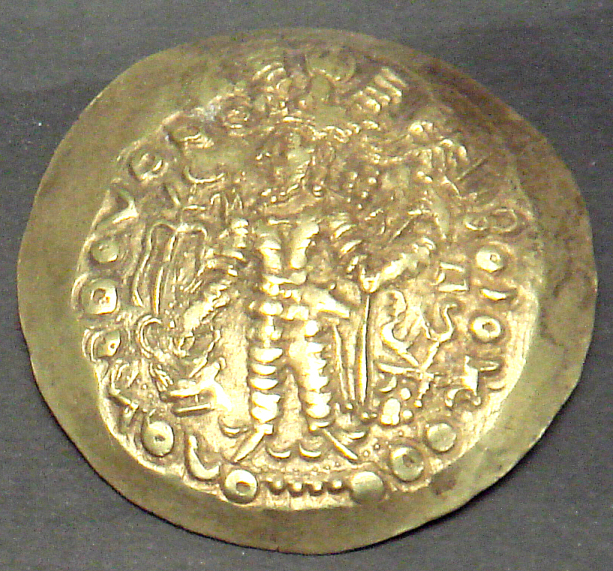 A gold Indo-Sassanid coin.

![Ardashir I Kushanshah in the name of Kushan ruler Vasudeva I, circa 230-245 CE.[12]](/wiki/File:Ardashir_I_Kushanshah_in_the_name_of_Vasudeva_circa_230-245_CE.jpg)
![Hormizd I Kushanshah with mention of Mazda and Anahita. Merv mint.[9]](/wiki/File:Hormizd_I_Kushanshah_Merv_mint.jpg)


Kushano-Sasanian art[edit | edit source]
The Indo-Sassanids traded goods such as silverware and textiles depicting the Sassanid emperors engaged in hunting or administering justice.
-
![Kushano-Sasanian footed cup with medallion, 3rd-4th century CE, Bactria, Metropolitan Museum of Art.[13]](https://upload.wikimedia.org/wikipedia/commons/1/12/Kushano-Sasanian_footed_cup_with_medallion_3rd-4th_century_CE_Bactria_Metropolitan_Museum_of_Art.jpg) Kushano-Sasanian footed cup with medallion, 3rd-4th century CE, Bactria, Metropolitan Museum of Art.[13]
Kushano-Sasanian footed cup with medallion, 3rd-4th century CE, Bactria, Metropolitan Museum of Art.[13] -
![Possible Kushano-Sasanian plate, excavated in Rawalpindi, Pakistan, 350-400 CE.[14] British Museum 124093.[15][16]](https://upload.wikimedia.org/wikipedia/commons/9/9a/Silverplate_with_investiture_scene._Sasanian_4th_century_CE%2C_possibly_Afghanistan._Middle_East%2C_52_Ancient_Iran_-_28174064678.jpg) Possible Kushano-Sasanian plate, excavated in Rawalpindi, Pakistan, 350-400 CE.[14] British Museum 124093.[15][16]
Possible Kushano-Sasanian plate, excavated in Rawalpindi, Pakistan, 350-400 CE.[14] British Museum 124093.[15][16] -
 Terracotta head of a male figure, Kushano-Sasanian period, Gandhara region, 4th-5th century CE
 -
![A probable Kushano-Sasanian plate with hunting scene, found in the 504 CE tomb of Feng Hetu in China. Shanxi Museum. It is dated the 3rd-4th century CE, and was probably manufactured in northern Afghanistan.[17][18][19]](https://upload.wikimedia.org/wikipedia/commons/8/82/Sasanian_Gilt_Silver_Plate%2C_from_Northern_Wei_504_CE_tomb.jpg)
![Kushano-Sasanian footed cup with medallion, 3rd-4th century CE, Bactria, Metropolitan Museum of Art.[13]](/wiki/File:Kushano-Sasanian_footed_cup_with_medallion_3rd-4th_century_CE_Bactria_Metropolitan_Museum_of_Art.jpg)
![Possible Kushano-Sasanian plate, excavated in Rawalpindi, Pakistan, 350-400 CE.[14] British Museum 124093.[15][16]](/wiki/File:Silverplate_with_investiture_scene._Sasanian_4th_century_CE,_possibly_Afghanistan._Middle_East,_52_Ancient_Iran_-_28174064678.jpg)
.jpg)
![A probable Kushano-Sasanian plate with hunting scene, found in the 504 CE tomb of Feng Hetu in China. Shanxi Museum. It is dated the 3rd-4th century CE, and was probably manufactured in northern Afghanistan.[17][18][19]](/wiki/File:Sasanian_Gilt_Silver_Plate,_from_Northern_Wei_504_CE_tomb.jpg)
Artistic influences[edit | edit source]

The example of Sassanid art was influential on Kushan art, and this influence remained active for several centuries in the northwest South Asia. Plates seemingly belonging to the art of the Kushano-Sasanians have also been found in Northern Wei tombs in China, such as a plate depicting a boar hunt found in the 504 CE tomb of Feng Hetu.[17]
Main Kushano-Sassanid rulers[edit | edit source]
The following Kushanshahs were:[23]
- Ardashir I Kushanshah (230–245)
- Peroz I Kushanshah (245–275)
- Hormizd I Kushanshah (275–300)
- Hormizd II Kushanshah (300–303)
- Peroz II Kushanshah (303–330)
- Varahran Kushanshah (330–365)
See also[edit | edit source]
Template:History of Afghanistan
| Outline of South Asian history |
|---|
_without_national_boundaries.svg) |
References[edit | edit source]
- ↑ Wink, André (2002). Al-Hind, the Making of the Indo-Islamic World: Early Medieval India and the Expansion of Islam 7Th-11th Centuries. BRILL. ISBN 978-0-391-04173-8.
- ↑ 2.0 2.1 2.2 2.3 2.4 2.5 The Cambridge History of Iran, Volume 3, E. Yarshater p.209 ff
- ↑ Rezakhani, Khodadad (2021). "From the Kushans to the Western Turks". King of the Seven Climes: 204.
- ↑ The Cambridge Companion to the Age of Attila, Michael Maas, Cambridge University Press, 2014 p.284 ff
- ↑ Rezakhani 2017b, p. 83.
- ↑ Sasanian Seals and Sealings, Rika Gyselen, Peeters Publishers, 2007, p.1
- ↑ 7.0 7.1 Encyclopedia Iranica
- ↑ 8.0 8.1 8.2 Ghosh, Amalananda (1965). Taxila. CUP Archive. pp. 790–791.
- ↑ 9.0 9.1 CNG Coins
- ↑ 10.0 10.1 Richard Foltz, Religions of the Silk Road, New York: Palgrave Macmillan, 2010
- ↑ Dani & Litvinsky 2006, p. 109.
- ↑ CNG Coins
- ↑ "Metropolitan Museum of Art". www.metmuseum.org.
- ↑ For the precise date: Sundermann, Werner; Hintze, Almut; Blois, François de (2009). Exegisti Monumenta: Festschrift in Honour of Nicholas Sims-Williams. Otto Harrassowitz Verlag. p. 284, note 14. ISBN 978-3-447-05937-4.
- ↑ "Plate British Museum". The British Museum.
- ↑ Sims, Vice-President Eleanor G.; Sims, Eleanor; Marshak, Boris Ilʹich; Grube, Ernst J.; I, Boris Marshak (January 2002). Peerless Images: Persian Painting and Its Sources. Yale University Press. p. 13. ISBN 978-0-300-09038-3.
- ↑ 17.0 17.1 Carter, M.L. "Encyclopaedia Iranica". iranicaonline.org.
A gilt silver plate depicting a princely boar hunt, excavated from a tomb near Datong dated to 504 CE, is close to early Sasanian royal hunting plates in style and technical aspects, but diverges enough to suggest a Bactrian origin dating from the era of the Kushano-Sasanian rule (ca. 275-350 CE)
- ↑ HARPER, PRUDENCE O. (1990). "An Iranian Silver Vessel from the Tomb of Feng Hetu". Bulletin of the Asia Institute. 4: 51–59. ISSN 0890-4464. JSTOR 24048350.
- ↑ Watt, James C. Y. (2004). China: Dawn of a Golden Age, 200-750 AD. Metropolitan Museum of Art. pp. 152–153. ISBN 978-1-58839-126-1.
- ↑ "Seal British Museum". The British Museum.
- ↑ "a Sasanian prince is represented adoring before the Indian god Vishnu" in Herzfeld, Ernst (1930). Kushano-Sasanian Coins. Government of India central publication branch. p. 16.
- ↑ "South Asia Bulletin: Volume 27, Issue 2". South Asia Bulletin. University of California, Los Angeles. 2007. p. 478:
A seal inscribed in Bactrian , fourth to fifth century AD , shows a Kushano - Sasanian or Kidarite official worshipping Vishnu : Pierfrancesco Callieri , Seals and Sealings from the North - West of the Indian Subcontinent and Afghanistan.
- ↑ Rezakhani 2017b, p. 78.
Sources[edit | edit source]
- Cribb, Joe (2018). Rienjang, Wannaporn; Stewart, Peter (eds.). Problems of Chronology in Gandhāran Art: Proceedings of the First International Workshop of the Gandhāra Connections Project, University of Oxford, 23rd-24th March, 2017. University of Oxford The Classical Art Research Centre Archaeopress. ISBN 978-1-78491-855-2. Template:Free access
- Cribb, Joe (2010). Alram, M. (ed.). "The Kidarites, the numismatic evidence.pdf". Coins, Art and Chronology Ii, Edited by M. Alram et al. Coins, Art and Chronology II: 91–146. Template:Free access
- Dani, A.H.; Litvinsky, B.A. (2006). "The Kushano-Sasanian kingdom". In Litvinsky, B. A.; Guand-Da, Zhang; Samghabadi, R. Shabani (eds.). History of Civilizations of Central Asia. Vol. III: The crossroads of civilizations: A.D. 250 to 750. UNESCO. pp. 103–118. ISBN 978-9231032110.
- Daryaee, Touraj; Rezakhani, Khodadad (2017a). "The Sasanian Empire". In Daryaee, Touraj (ed.). King of the Seven Climes: A History of the Ancient Iranian World (3000 BCE - 651 CE). UCI Jordan Center for Persian Studies. pp. 1–236. ISBN 978-0-692-86440-1.
- Payne, Richard (2016). "The Making of Turan: The Fall and Transformation of the Iranian East in Late Antiquity". Journal of Late Antiquity. 9. Baltimore: Johns Hopkins University Press: 4–41. doi:10.1353/jla.2016.0011. S2CID 156673274. Template:Free access
- Rapp, Stephen H. (2014). The Sasanian World through Georgian Eyes: Caucasia and the Iranian Commonwealth in Late Antique Georgian Literature. London: Ashgate Publishing, Ltd. ISBN 978-1-4724-2552-2.
- Rezakhani, Khodadad (2017b). "East Iran in Late Antiquity". ReOrienting the Sasanians: East Iran in Late Antiquity. Edinburgh University Press. pp. 1–256. ISBN 978-1-4744-0030-5. JSTOR 10.3366/j.ctt1g04zr8. Template:Registration required
- Rypka, Jan; Jahn, Karl (1968). History of Iranian literature. D. Reidel. ISBN 9789401034791.
- Sastri, Nilakanta (1957). A Comprehensive History of India: The Mauryas & Satavahanas. Orient Longmans. p. 246. ISBN 9788170070030.
- Vaissière, Étienne de La (2016). "Kushanshahs i. History". Encyclopaedia Iranica.
- Wiesehöfer, Joseph (1986). "Ardašīr I i. History". Encyclopaedia Iranica, Vol. II, Fasc. 4. pp. 371–376.
External links[edit | edit source]
- Coins of the Kushano-Sassanids (archived)
Provinces of the Sasanian Empire | ||
|---|---|---|
|  | |
* indicates short living provinces | ||
| Dynasty |  | |
|---|---|---|
| Culture | ||
| Military and wars | ||
| Descendants | ||
| Related | ||
