


imported>Indielov |
m small enhanced content after review additionally and added references per standard format |
||
| Line 31: | Line 31: | ||
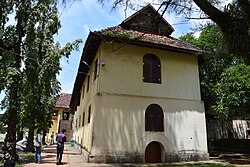
[[File:Mattancherry Palace DSC 0912.JPG|right|thumb|200px|Mattancherry Palace, back side]] | [[File:Mattancherry Palace DSC 0912.JPG|right|thumb|200px|Mattancherry Palace, back side]] | ||
The '''Mattancherry Palace''' is a | The '''Mattancherry Palace''' is a palace popularly known as the '''Dutch Palace''', in [[Mattancherry]], [[Kochi, India|Kochi]], in the [[India]]n [[States and territories of India|state]] of [[Kerala]] which features [[Kerala murals]] depicting portraits and exhibits of the [[Rajas of Kochi]]. The palace was included in the [[List of World Heritage Sites in India#Tentative list of Heritage sites|tentative list]] of [[UNESCO]] [[World Heritage Sites]].<ref>{{cite web|url=https://whc.unesco.org/en/tentativelists/5573/|title=Mattanchery Palace, Ernakulam, Kerala|website=whc.unesco.org}}</ref> Despite the name ''Dutch Palace'', the palace was built by the [[Portuguese Empire]] as a gift to the [[Kingdom of Cochin]]. | ||
==History== | ==History== | ||
The | The palace was built and gifted by the Portuguese as a present to the king of Cochin, around 1545.<ref name="min-tour">{{cite web|url=https://www.incredibleindia.org/content/incredible-india-v2/en/destinations/kochi/listicles/heritage-sites-in-kochi.html|title=Heritage Sites in Kochi|work=[[Incredible India]]|publisher=[[Ministry of Tourism (India)]]|language=en|access-date=2020-05-19}}</ref> It was built to appease the king after they plundered a temple nearby.<ref name = "Archaeology">''Archaeological Museum, Cochin'', published by Archaeological Survey of India</ref><ref name="Webindia">{{cite web|url=http://www.webindia123.com/monuments/palaces/dutch.htm |title=Mattancherry Palace |access-date=2008-01-20 |publisher=webindia.123 |url-status=dead |archive-url=https://web.archive.org/web/20080102230819/http://www.webindia123.com/monuments/palaces/dutch.htm |archive-date=2008-01-02 }}</ref> | ||
The landing of [[Vasco da Gama]], the Portuguese explorer at [[Kappad]] in 1498 was welcomed by the Kochi rulers. | The landing of [[Vasco da Gama]], the Portuguese explorer, at [[Kappad]] in 1498 was welcomed by the Kochi rulers. The Portuguese were given exclusive right to construct factories and they repulsed the repeated attacks of the [[Saamoothiri|Zamorians]], and the Cochin Rajas practically became vassals of the Portuguese. The influence of the Portuguese was supplanted by the Dutch, and they took over Mattancherry in 1663.<ref name = "Archaeology"/> Subsequently, the area was taken over by [[Hyder Ali]] and still later by the [[British East India Company]]. | ||
== | ==Architecture== | ||
The palace is a quadrangular structure built in [[Nālukettu]] style, the traditional Kerala style of architecture, with a courtyard in the middle | [[File:Mattancherry_palace_at_night.jpg|thumb|Mattancherry palace at night]] | ||
The palace is a quadrangular structure built in [[Nālukettu]] style, the traditional Kerala style of architecture, with a courtyard in the middle. Certain elements of architecture, as for example the nature of its arches and the proportion of its chambers are indicative of European influence in basic Nālukettu style.<ref name = "Archaeology"/><ref name = "Webindia"/> | |||
==Murals== | ==Murals== | ||
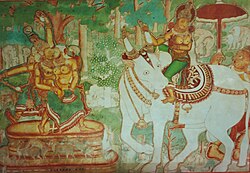
[[File:Mattancherry palace murals.jpg|thumb|Several murals depicting Hindu religious art adorn the walls of the | [[File:Mattancherry palace murals.jpg|thumb|Several murals depicting Hindu religious art adorn the walls of the palace.]] | ||
There a large number of murals on the walls of the palace, executed in the traditions of Hindu temple art, which are religious, decorative and stylised. The murals have been painted in rich warm colours in [[tempera]] technique.<ref name = "Archaeology"/> | |||
==Other exhibits== | ==Other exhibits== | ||
Portraits of the Rajas of Cochin, from 1864 onwards, are displayed in what was once the Coronation Hall. These were painted by local artists in western style. The ceiling of the hall is decorated with floral designs in woodcraft. | Portraits of the Rajas of Cochin, from 1864 onwards, are displayed in what was once the Coronation Hall. These were painted by local artists in the western style. The ceiling of the hall is decorated with floral designs in woodcraft. Amongst the other exhibits in the palace are an ivory palanquin, a [[howdah]], royal umbrellas, ceremonial dress used by the royalty, coins, stamps and drawings.<ref name = "Archaeology"/> | ||
Amongst the other exhibits in the palace are an ivory palanquin, a [[howdah]], royal umbrellas, ceremonial dress used by the royalty, coins, stamps and drawings | |||
==Restoration== | ==Restoration== | ||
In 1951, | In 1951, the palace was restored and declared a [[Government of India|central government]] protected monument. The palace underwent a second restoration by the [[Archaeological Survey of India]]. The work which started in 2007 was completed by 2009.<ref>{{cite web | url = http://www.hinduonnet.com/thehindu/mp/2007/09/17/stories/2007091750930100.htm | ||
| archive-url = https://archive.today/20130103114718/http://www.hinduonnet.com/thehindu/mp/2007/09/17/stories/2007091750930100.htm | |||
| url-status = usurped | |||
| archive-date = 3 January 2013 | |||
|title = Back to the Dutch Palace again| access-date = 2008-01-20 | last =Abraham | first = Tanya | work = Metro Plus Kochi | publisher = The Hindu, 17 September 2007}}</ref> | |title = Back to the Dutch Palace again| access-date = 2008-01-20 | last =Abraham | first = Tanya | work = Metro Plus Kochi | publisher = The Hindu, 17 September 2007}}</ref> | ||
==References== | ==References== | ||
| Line 84: | Line 72: | ||
[[Category:1555 establishments in India]] | [[Category:1555 establishments in India]] | ||
[[Category:Mattancherry]] | [[Category:Mattancherry]] | ||
[[Category:World Heritage Tentative List for India]] | |||
Latest revision as of 17:05, 4 May 2024
| Mattancherry Palace | |
|---|---|
 | |
| Location | Kochi, Kerala, India |
| Coordinates | 9°57′29″N 76°15′32″E / 9.958°N 76.259°E |
| Built | 1545[1] |
  Location in Kerala, India | |

The Mattancherry Palace is a palace popularly known as the Dutch Palace, in Mattancherry, Kochi, in the Indian state of Kerala which features Kerala murals depicting portraits and exhibits of the Rajas of Kochi. The palace was included in the tentative list of UNESCO World Heritage Sites.[2] Despite the name Dutch Palace, the palace was built by the Portuguese Empire as a gift to the Kingdom of Cochin.
History[edit | edit source]
The palace was built and gifted by the Portuguese as a present to the king of Cochin, around 1545.[1] It was built to appease the king after they plundered a temple nearby.[3][4] The landing of Vasco da Gama, the Portuguese explorer, at Kappad in 1498 was welcomed by the Kochi rulers. The Portuguese were given exclusive right to construct factories and they repulsed the repeated attacks of the Zamorians, and the Cochin Rajas practically became vassals of the Portuguese. The influence of the Portuguese was supplanted by the Dutch, and they took over Mattancherry in 1663.[3] Subsequently, the area was taken over by Hyder Ali and still later by the British East India Company.
Architecture[edit | edit source]

The palace is a quadrangular structure built in Nālukettu style, the traditional Kerala style of architecture, with a courtyard in the middle. Certain elements of architecture, as for example the nature of its arches and the proportion of its chambers are indicative of European influence in basic Nālukettu style.[3][4]
Murals[edit | edit source]

There a large number of murals on the walls of the palace, executed in the traditions of Hindu temple art, which are religious, decorative and stylised. The murals have been painted in rich warm colours in tempera technique.[3]
Other exhibits[edit | edit source]
Portraits of the Rajas of Cochin, from 1864 onwards, are displayed in what was once the Coronation Hall. These were painted by local artists in the western style. The ceiling of the hall is decorated with floral designs in woodcraft. Amongst the other exhibits in the palace are an ivory palanquin, a howdah, royal umbrellas, ceremonial dress used by the royalty, coins, stamps and drawings.[3]
Restoration[edit | edit source]
In 1951, the palace was restored and declared a central government protected monument. The palace underwent a second restoration by the Archaeological Survey of India. The work which started in 2007 was completed by 2009.[5]
References[edit | edit source]
- ↑ 1.0 1.1 "Heritage Sites in Kochi". Incredible India. Ministry of Tourism (India). Retrieved 19 May 2020.
- ↑ "Mattanchery Palace, Ernakulam, Kerala". whc.unesco.org.
- ↑ 3.0 3.1 3.2 3.3 3.4 Archaeological Museum, Cochin, published by Archaeological Survey of India
- ↑ 4.0 4.1 "Mattancherry Palace". webindia.123. Archived from the original on 2 January 2008. Retrieved 20 January 2008.
- ↑ Abraham, Tanya. "Back to the Dutch Palace again". Metro Plus Kochi. The Hindu, 17 September 2007. Retrieved 20 January 2008.
{{cite web}}: CS1 maint: deprecated archival service (link)


