




robot: Create/upgrade articles. If there is a mistake please report on my talk page. |
No edit summary |
||
| Line 1: | Line 1: | ||
{{Short description|Discus weapon used by | {{Short description|Discus weapon used by Vishnu}} | ||
{{ | {{for|people named Sudarshana|Sudarshana (name)}} | ||
| | [[File:Chakra at Ashta Laxmi Devalayam 01 (cropped).jpg|thumb|Iconography of the Sudarshana Chakra upon a temple wall]] | ||
In [[Hindu mythology]], the '''Sudarshana Chakra''' ({{Langx|sa|सुदर्शनचक्र}}) is a [[divine]] spinning disc, attributed to [[Vishnu]].<ref>{{Cite book |last=Dalal |first=Roshen |url=https://books.google.com/books?id=zrk0AwAAQBAJ&dq=sudarshana+chakra+hinduism&pg=PT1184 |title=Hinduism: An Alphabetical Guide |date=2014-04-18 |publisher=Penguin UK |isbn=978-81-8475-277-9 |pages=1184 |language=en}}</ref> The Sudarshana Chakra is generally portrayed on the right rear hand of the [[Chaturbhuja|four hands]] of Vishnu, who also holds the [[Panchajanya]] (conch), the [[Kaumodaki]] (mace), and the [[Padma (Vishnu)|Padma]] (lotus).<ref>{{cite book|title=India through the ages|url=https://archive.org/details/indiathroughages00mada|last=Gopal|first=Madan|year= 1990| page= [https://archive.org/details/indiathroughages00mada/page/80 80]|editor=K.S. Gautam|publisher=Publication Division, Ministry of Information and Broadcasting, Government of India}}</ref> | |||
| | |||
| | |||
| | |||
| | |||
| | |||
}} | |||
'' | In the ''[[Rigveda]]'', the Sudarshana Chakra is stated to be Vishnu's symbol as the wheel of time.<ref>{{Cite book |last=Jakimowicz |first=Marta |url=https://books.google.com/books?id=j9c1AAAAIAAJ&q=sudarshana+chakra+wheel+of+time |title=Metamorphoses of Indian Gods |date=1988 |publisher=Seagull Books |isbn=978-81-7046-029-9 |pages=1988 |language=en}}</ref> The disc later emerged as an [[ayudhapurusha]] (an anthropomorphic form), representing a fierce aspect of [[Vishnu]], used for the destruction of demons. As an ''ayudhapurusha'', the deity is known as ''Chakraperumal'', ''Chakratalvar'', ''Chakradhara,'' or ''Chakrapani''. | ||
{{Vaishnavism}} | |||
==Etymology== | ==Etymology== | ||
The word ''Sudarshana'' is derived from two Sanskrit words – ''Su''(सु) meaning "good/auspicious" and ''[[Darshana]]'' | The word ''Sudarshana'' is derived from two Sanskrit words – ''Su'' ({{lang|sa|सु}}) meaning "good/auspicious" and ''[[Darshana]]'' ({{lang|sa|दर्शन}}) meaning "vision". In the Monier-Williams dictionary the word Chakra is derived from the root {{lang|sa|क्रम्}} (''kram'') or {{lang|sa|ऋत्}} (''rt'') or {{lang|sa|क्रि}} (''kri'') and refers among many meanings, to the wheel of a [[carriage]], wheel of the sun's chariot or [[metaphorically]] to the [[wheel of time]].<ref>Monier Monier-Williams (1871). A Sanskrit-English Dictionary, p. 310.</ref><ref>{{cite encyclopedia |veditors= Monier-Williams, Leumann E, Cappeller C |title= Chakra |encyclopedia= A Sanskrit-English Dictionary: Etymologically and Philologically Arranged with Special Reference to Cognate Indo-European Languages, p. 380. |year= 2002|publisher= Motilal Banarsidass Publications |isbn= 9788120831056 |url= https://books.google.com/books?id=zUezTfym7CAC&q=cakra+monier+williams&pg=PA381 }}</ref> In [[Tamil language|Tamil]], the Sudarshana Chakra is also known as Chakratalvar (disc-devotee).<ref>{{Cite book |last=Krishna |first=Nanditha |url=https://books.google.com/books?id=gp1IDwAAQBAJ&dq=Chakratalvar&pg=PT60 |title=Hinduism and Nature |date=2017-12-26 |publisher=Penguin Random House India Private Limited |isbn=978-93-87326-54-5 |pages=60 |language=en}}</ref> | ||
==Literature == | |||
===Rigveda=== | |||
[[File:Chakrapani perumal kumbakonam.png|200px|thumb|Artistic representation of Chakrapani Perumal worshiped in [[Tamil Nadu]].]] | |||
The [[Rigveda]] mentions the Sudarshana Chakra as a symbol of Vishnu, and as the wheel of time.<ref>{{cite book|title=Indian Art: A history of Indian art from the earliest times up to the third century A.D, Volume 1 of Indian Art|last=Agarwala|first=Vasudeva Sharana |year= 1965| page= 101|publisher=Prithivi Prakashan}}</ref> | |||
===Mahabharata=== | |||
The [[Mahabharata]] features the spinning disc as a weapon of [[Krishna]], identified with Vishnu. The deity beheads [[Shishupala]] with the Sudarshana Chakra at the [[Rajasuya|rajasuya yajna]] of Emperor [[Yudhishthira]]. He also employs it during the fourteenth day of the [[Kurukshetra War]] to obscure the sun. The [[Kaurava]]s are deceived, allowing [[Arjuna]] to slay [[Jayadratha]], avenging the death of his [[Abhimanyu|son]]. | |||
===Ramayana=== | |||
The [[Ramayana]] states that the Sudarshana Chakra was created by the divine architect, [[Vishvakarma]]. Vishnu slays a [[Danava (Hinduism)|danava]] named Hayagriva on top of a mountain named Chakravana, seizing the disc from him. | |||
===Ahirbudhnya Samhita=== | |||
The [[Ahirbudhnya Samhita]] ({{Langx|sa|अहिर्बुध्न्यसंहिता}}, {{IAST3|Ahiburdhnyasaṃhitā}}) is a [[Hinduism|Hindu]] [[Vaishnavism|Vaishnava]] text belonging to the [[Pancharatra]] tradition. It is a [[Tantra|Tantrika]] composition, composed possibly over several centuries within the 1st millennium CE, most probably at 200 CE.<ref name=burley>{{cite book |last= Burley |first= Mikel |author-link=Mikel Burley |year= 2007|title= Classical Samkhya and Yoga: An Indian Metaphysics of Experience| volume= 3 of Routledge Hindu Studies Series |url= https://books.google.com/books?id=K3B9AgAAQBAJ&q=ahirbudhnya&pg=PA21 |publisher= Routledge |pages= 21–22, 27–28 |isbn= 978-1134159789 }}</ref> Ahirbudhnya Saṃhita literally means a compendium (''samhita'') of the serpent-from-the-depths (from ''ahi'' for serpent and ''budhna'' for bottom/root).<ref name=burley/><ref name=sukumari>[[Sukumari Bhattacharji]], (1988). The Indian Theogony: A Comparative Study of Indian Mythology from the Vedas to the Purāṇas, p.150. CUP Archive</ref> | |||
In the ''Ahirbudhnya Samhita'', [[Vishnu]] emanated in 39 different forms.<ref>Muralidhar Mohanty, (2003). Origin and development of Viṣṇu cult, p.105. Pratibha Prakashan. {{ISBN|8177020633}}</ref> The Samhita is characteristic for its concept of Sudarshana. It provides mantras for Sudarshana, and details the method of worship of the multi-armed Sudarshana. Its chapters include explanations on the origin of ''astras'' (weapons), ''anga'' (mantras), [[Vyuha]]s, sounds, and diseases, how to make Sudarshana Purusha appear, how to resist divine weapons and black magic, and provides method for making and worshipping the Sudarshana Yantra. The ''Ahirbudhnya Samhita'' is the source of Taraka Mantra, Narasimhanustubha Mantra, three occult alphabets, Sashtitantra and select astra mantras. It also mentions the [[Purusha Sukta]]. The four Vyuhas in this samhita are [[Vasudeva]], [[Samkarshana]], [[Pradyumna]] and [[Aniruddha]].<ref>Bahadur Chand Chhabra, 2008. Findings in Indian archaeology, p.21. Sundeep Prakashan. {{ISBN|8185067767}}</ref> | |||
===Puranas=== | |||
The [[Puranas]] also state the Sudarshana Chakra was made by [[Vishvakarma]], featuring a legend regarding its origin: Vishvakarma's daughter, [[Sanjna|Sanjña]], was married to the sun god, [[Surya]]. However, due to her consort's blazing light and heat, she could not approach him. When she informed her father regarding this, Vishvakarma diminished the brilliance of the sun so that his daughter could be with him. From the splendour of the [[Surya|Sun]], Vishvakarma produced three divine objects: the aerial vehicle [[Pushpaka Vimana]], the [[Trishula]] of [[Shiva]], and the Sudarshana Chakra of [[Vishnu]].<ref>{{Cite book |last=Krishnan |first=S. A. |url=https://books.google.com/books?id=pimrEAAAQBAJ&dq=vishwakarma+surya&pg=PT11 |title=Devas and Kings: Short Stories from Hindu Puranas |date=2023-02-02 |publisher=SA Krishnan |pages=11 |language=en}}</ref> | |||
Following the self-immolation of [[Sati (Hindu goddess)|Sati]] in the Daksha yajna, a grieving [[Shiva]] carried around her lifeless body, and was inconsolable. To liberate him from his anguish, Vishnu employed Sudarshana Chakra to cut the corpse of [[Sati (goddess)|Sati]] into fifty-one pieces. The fifty-one parts of the goddess' body are believed to have scattered across the earth, venerated as the [[Shakta pithas]]. | |||
{{Citation needed|date=October 2025}} | |||
== | Vishnu granted King [[Ambarisha]] the boon of the Sudarshana Chakra to reward him for his devotion.<ref>{{Cite book |last=Vaswani |first=J. P. |url=https://books.google.com/books?id=ePNvEAAAQBAJ&dq=vishnu+ambarisha+chakra&pg=PT114 |title=Stories with a difference from the Bhagavata Purana |date=2019-06-20 |publisher=Gita Publishing House |isbn=978-93-86004-23-9 |pages=114 |language=en}}</ref> | ||
The Sudarshana Chakra was also used to behead [[Rahu]] and cut the celestial [[Mount Mandara|Mandara mountain]] during the [[Samudra manthan|Samudra Manthana]].<ref>{{Cite book |last=Sinha |first=Purnendu Narayana |url=https://books.google.com/books?id=GIBBAAAAYAAJ&dq=churning+of+the+ocean+bhagavata+purana&pg=PA169 |title=A Study of the Bhagavata Purana: Or, Esoteric Hinduism |date=1901 |publisher=Freeman & Company, Limited |pages=172 |language=en}}</ref> | |||
==Historical representations== | ==Historical representations== | ||
[[File:Vrishni coin.png|thumb|upright=1.25|A Vrishni silver coin from Alexander Cunningham's ''Coins of Ancient India: From the Earliest Times Down to the Seventh Century'' (1891)]] | |||
[[File:Vrishni coin.png|thumb|upright=1.25|A Vrishni silver coin from Alexander Cunningham's ''Coins of Ancient India: From the Earliest Times Down to the Seventh Century'' (1891)]]The chakra is found in the coins of many tribes with the word ''gana'' and the name of the tribe inscribed on them.<ref name=nandita/> Early historical evidence of the Sudarshana-Chakra is found in a rare tribal [[Vrishni]] silver coin with the legend ''Vṛishṇi-rājaṅṅya-gaṇasya-trātasya'' which P.L.Gupta thought was possibly jointly issued by the gana (tribal confederation) after the Vrishnis formed a confederation with the Rajanya tribe. However, there is no conclusive proof so far. Discovered by Cunningham, and currently placed in the British Museum, the silver coin is witness to the political existence of the Vrishnis.<ref>{{cite book |last= Handa|first= Devendra |year= 2007|title= Tribal Coins of Ancient India|publisher= Aryan Books International|page= 140 }}</ref><ref>{{cite book |last= Cunningham |first= Alexander |year= 1891 |title= Coins of Ancient India: From the Earliest Times Down to the Seventh Century|url= https://archive.org/stream/coinsancientind00cunngoog#page/n97/mode/2up |page= 70 |author-link= Alexander Cunningham}}</ref> It is dated to around 1st century BCE.<ref name=nandita/> Vrishni copper coins dated to later time were found in Punjab. Another example of coins inscribed with the chakra are the Taxila coins of the 2nd century BCE with a sixteen-spoked wheel.<ref name=nandita/> | The chakra is found in the coins of many tribes with the word ''gana'' and the name of the tribe inscribed on them.<ref name=nandita/> Early historical evidence of the Sudarshana-Chakra is found in a rare tribal [[Vrishni]] silver coin with the legend ''Vṛishṇi-rājaṅṅya-gaṇasya-trātasya'' which P. L. Gupta thought was possibly jointly issued by the gana (tribal confederation) after the Vrishnis formed a confederation with the Rajanya tribe. However, there is no conclusive proof so far. Discovered by Cunningham, and currently placed in the British Museum, the silver coin is witness to the political existence of the Vrishnis.<ref>{{cite book |last= Handa|first= Devendra |year= 2007|title= Tribal Coins of Ancient India|publisher= Aryan Books International|page= 140 }}</ref><ref>{{cite book |last= Cunningham |first= Alexander |year= 1891 |title= Coins of Ancient India: From the Earliest Times Down to the Seventh Century|url= https://archive.org/stream/coinsancientind00cunngoog#page/n97/mode/2up |page= 70 |author-link= Alexander Cunningham}}</ref> It is dated to around 1st century BCE.<ref name=nandita/> Vrishni copper coins dated to later time were found in Punjab. Another example of coins inscribed with the chakra are the Taxila coins of the 2nd century BCE with a sixteen-spoked wheel.<ref name=nandita/> | ||
A coin dated to 180 BCE, with an image of Vasudeva-Krishna, was found in the Greco-Bactrian city of [[Ai-Khanoum]] in the Kunduz area of Afghanistan, minted by [[Agathocles of Bactria]].<ref>{{cite book |last= Joshi |first= Nilakanth Purushottam |year= 1979 |title= Iconography of Balarāma | page=22 |url= https://books.google.com/books?id=5vd-lKzyFg0C&pg=PA22 |publisher= Abhinav Publications|isbn= 9788170171072 }}</ref><ref>{{cite book |last= Sagar |first= Krishna Chandra |year= 1992 |title= Foreign Influence on Ancient India |publisher= Northern Book Centre|page= 94 |isbn= 8172110286}}</ref> In Nepal, Jaya Cakravartindra Malla of Kathmandu issued a coin with the chakra.<ref>{{cite journal |author=<!--Staff writer(s); no by-line.--> |year= 1908 |title= Jaya Cakravartindra Malla |journal= Journal of the Royal Asiatic Society of Great Britain and Ireland |pages= 702 | publisher= Cambridge University Press }}</ref> | A coin dated to 180 BCE, with an image of Vasudeva-Krishna, was found in the Greco-Bactrian city of [[Ai-Khanoum]] in the Kunduz area of Afghanistan, minted by [[Agathocles of Bactria]].<ref>{{cite book |last= Joshi |first= Nilakanth Purushottam |year= 1979 |title= Iconography of Balarāma | page=22 |url= https://books.google.com/books?id=5vd-lKzyFg0C&pg=PA22 |publisher= Abhinav Publications|isbn= 9788170171072 }}</ref><ref>{{cite book |last= Sagar |first= Krishna Chandra |year= 1992 |title= Foreign Influence on Ancient India |publisher= Northern Book Centre|page= 94 |isbn= 8172110286}}</ref> In Nepal, Jaya Cakravartindra Malla of Kathmandu issued a coin with the chakra.<ref>{{cite journal |author=<!--Staff writer(s); no by-line.--> |year= 1908 |title= Jaya Cakravartindra Malla |journal= Journal of the Royal Asiatic Society of Great Britain and Ireland |pages= 702 | publisher= Cambridge University Press }}</ref> | ||
| Line 38: | Line 45: | ||
Among the only two types of Chakra-vikrama coins known so far, there is one gold coin in which Vishnu is depicted as the Chakra-purusha. Though Chandragupta II issued coins with the epithet ''vikrama'', due to the presence of the kalpavriksha on the reverse it has not been possible to ascribe it to him.<ref>{{cite book |last= Bajpai |first= K.D |year= 2004|title= Indian Numismatic Studies|publisher= Abhinav Publications|page= 151|isbn= 8170170354}}</ref><ref>{{cite book |last= Agrawal|first= Ashvini |year= 1989|title= Rise and Fall of the Imperial Guptas|publisher= Motilal Banarsidass Publications|page= 23|isbn= 8120805925 }}</ref> | Among the only two types of Chakra-vikrama coins known so far, there is one gold coin in which Vishnu is depicted as the Chakra-purusha. Though Chandragupta II issued coins with the epithet ''vikrama'', due to the presence of the kalpavriksha on the reverse it has not been possible to ascribe it to him.<ref>{{cite book |last= Bajpai |first= K.D |year= 2004|title= Indian Numismatic Studies|publisher= Abhinav Publications|page= 151|isbn= 8170170354}}</ref><ref>{{cite book |last= Agrawal|first= Ashvini |year= 1989|title= Rise and Fall of the Imperial Guptas|publisher= Motilal Banarsidass Publications|page= 23|isbn= 8120805925 }}</ref> | ||
== | ==Anthropomorphic form== | ||
[[File:Chakra ayudhapurusha.jpg|thumb|Sudarshana Chakra depicted as Chakratalvar who is an [[ayudhapurusha]] and a fierce aspect of his owner Vishnu]] | [[File:Chakra ayudhapurusha.jpg|thumb|Sudarshana Chakra depicted as Chakratalvar who is an [[ayudhapurusha]] and a fierce aspect of his owner Vishnu]] | ||
The anthropomorphic form of Sudarshana can be traced from discoid weapons of ancient India to his esoteric multi-armed images in the medieval period in which the Chakra served the supreme deity (Vishnu) as his faithful attendants.<ref name="hflam">{{cite book|last1=von Stietencron|first1=Heinrich|url=https://books.google.com/books?id=kgpLBpUCufwC&q=cakra+discoid+medieval+sudarsana+wheel+of+time&pg=PA97|title=Epic and Purāṇic bibliography: A-R|last2=Flamm|first2=Peter|publisher=Otto Harrassowitz Verlag|year=1992|isbn=3447030283|author1-link=Heinrich von Stietencron|author2-link=Peter Flamm}}</ref> While the two-armed Chakra-Purusha was humanistic, the medieval multi-armed Sudarshana (known as Chakraperumal or | The anthropomorphic form of Sudarshana can be traced from discoid weapons of ancient India to his esoteric multi-armed images in the medieval period in which the Chakra served the supreme deity (Vishnu) as his faithful attendants.<ref name="hflam">{{cite book|last1=von Stietencron|first1=Heinrich|url=https://books.google.com/books?id=kgpLBpUCufwC&q=cakra+discoid+medieval+sudarsana+wheel+of+time&pg=PA97|title=Epic and Purāṇic bibliography: A-R|last2=Flamm|first2=Peter|publisher=Otto Harrassowitz Verlag|year=1992|isbn=3447030283|author1-link=Heinrich von Stietencron|author2-link=Peter Flamm}}</ref> While the two-armed Chakra-Purusha was humanistic, the medieval multi-armed Sudarshana (known as Chakraperumal or Chakrathalvar) was speculatively regarded as an impersonal manifestation of destructive forces in the universe; that, in its final aspect, combined the flaming weapon and the wheel of time which destroys the [[universe]].<ref name="hflam" /><ref name="begley">Wayne Edison Begley. (1973). Viṣṇu's flaming wheel: the iconography of the Sudarśana-cakra, pp. 18, 48, 65–66, 76–77. Volume 27 of Monographs on archaeology and fine arts. New York University Press</ref> | ||
The rise of Tantrism aided the development of the anthropomorphic personification of the chakra as the active aspect of Vishnu with few sculptures of the [[Pala Empire|Pala era]] bearing witness to the development,<ref name="doshi" /> with the chakra in this manner possibly associated with the [[Vrishni]]s.<ref name="nandita" /> However, the worship of Sudarshana as a quasi-independent deity concentrated with the power of Vishnu in its entirety is a phenomenon of the southern part of India; with idols, texts and inscriptions surfacing from the 13th century onwards and increasing in large numbers only after the 15th century.<ref name="doshi" /> | The rise of Tantrism aided the development of the anthropomorphic personification of the chakra as the active aspect of Vishnu with few sculptures of the [[Pala Empire|Pala era]] bearing witness to the development,<ref name="doshi" /> with the chakra in this manner possibly associated with the [[Vrishni]]s.<ref name="nandita" /> However, the worship of Sudarshana as a quasi-independent deity concentrated with the power of Vishnu in its entirety is a phenomenon of the southern part of India; with idols, texts and inscriptions surfacing from the 13th century onwards and increasing in large numbers only after the 15th century.<ref name="doshi" /> | ||
The ''Chakra Purusha'' in [[Pancharatra]] texts has either four, six, eight, sixteen, or thirty-two hands,<ref name=parimoo>{{cite book |last=Parimoo |first= Ratan |year= 2000 |title= Essays in New Art History: Text. Volume 1 of Essays in New Art History: Studies in Indian Sculpture : Regional Genres and Interpretations |publisher= Books & Books |pages= 146–148 |isbn= 8185016615 }}</ref> with double-sided images of multi-armed Sudarshana on one side and [[Narasimha]] on other side (called Sudarshana-Narasimha in Pancharatra) within a circular rim, sometimes in dancing posture found in Gaya area datable to 6th and 8th centuries.<ref name=orissa>The Orissa Historical Research Journal, Volume 31, p. 90. Superintendent of Research and Museum, Orissa State Museum, 1985.</ref> Unique images of Chakra Purusha, one with Varaha in Rajgir possibly dating to the 7th century, | The ''Chakra Purusha'' in [[Pancharatra]] texts has either four, six, eight, sixteen, or thirty-two hands,<ref name=parimoo>{{cite book |last=Parimoo |first= Ratan |year= 2000 |title= Essays in New Art History: Text. Volume 1 of Essays in New Art History: Studies in Indian Sculpture : Regional Genres and Interpretations |publisher= Books & Books |pages= 146–148 |isbn= 8185016615 }}</ref> with double-sided images of multi-armed Sudarshana on one side and [[Narasimha]] on other side (called Sudarshana-Narasimha in Pancharatra) within a circular rim, sometimes in dancing posture found in Gaya area datable to 6th and 8th centuries.<ref name=orissa>The Orissa Historical Research Journal, Volume 31, p. 90. Superintendent of Research and Museum, Orissa State Museum, 1985.</ref> Unique images of Chakra Purusha, one with Varaha in Rajgir possibly dating to the 7th century, | ||
<ref>Frederick M. Asher, 2008. Bodh Gaya: Monumental legacy, p. 90. Oxford University Press</ref> and another from Aphsad (Bihar) detailing a fine personification dating to 672 CE have been found.<ref>Col Ved Prakash, (2007). Encyclopaedia of North-East India, Volume 1, p. 375. Atlantic Publishers & Distributors. {{ISBN|8126907037}} [https://books.google.com | <ref>Frederick M. Asher, 2008. Bodh Gaya: Monumental legacy, p. 90. Oxford University Press</ref> and another from Aphsad (Bihar) detailing a fine personification dating to 672 CE have been found.<ref>Col Ved Prakash, (2007). Encyclopaedia of North-East India, Volume 1, p. 375. Atlantic Publishers & Distributors. {{ISBN|8126907037}} [https://books.google.com/books?id=Ic4UCdaxbHIC&dq=Chakrapurusha+from+Aphsad&pg=PA375]</ref><ref>See: http://vmis.in/ArchiveCategories/collection_gallery_zoom?id=491&search=1&index=30876&searchstring=india</ref> | ||
While the chakra is ancient, with the emergence of the anthropomorphic forms of ''chakra'' and ''shankha'' traceable in the north and east of India as the ''Chakra-Purusha'' and ''Shanka-Purusha''; in the south of India, the Nayak period popularized the personified images of Sudarshana with the flames. In the Kilmavilangai cave is an archaic rock-cut structure in which an image of Vishnu has been hallowed out, holding the Shanka and Chakra, without flames.<ref>{{cite book |last=Jouveau-Dubreuil |first= G |year= 1994 |title= Pallava Antiquities |url= https://books.google.com/books?id=QbYKPXQ3DaAC&q=tindivanam+cave+of+perumal+chakra+without+flames&pg=PA56 |publisher= Asian Educational Services|page= 46 |isbn= 8120605713 }}</ref><ref>{{cite web |url= http://www.cpreecenvis.nic.in/Database/KilmavilangaiCaveTemple_2942.aspx |title= Kilmavilangai Cave Temple |author=<!--Not stated--> |access-date= 31 March 2017 }}</ref> At this point, the Chakrapurusha with the flames had not been conceived in the south of India. The threat of invasions from the north was a national emergency during which the rulers sought out the [[Ahirbudhnya Samhita]], which prescribes that the king should resolve the threat by making and worshiping images of Sudarshana.<ref name=begley/> | While the chakra is ancient, with the emergence of the anthropomorphic forms of ''chakra'' and ''shankha'' traceable in the north and east of India as the ''Chakra-Purusha'' and ''Shanka-Purusha''; in the south of India, the Nayak period popularized the personified images of Sudarshana with the flames. In the Kilmavilangai cave is an archaic rock-cut structure in which an image of Vishnu has been hallowed out, holding the Shanka and Chakra, without flames.<ref>{{cite book |last=Jouveau-Dubreuil |first= G |year= 1994 |title= Pallava Antiquities |url= https://books.google.com/books?id=QbYKPXQ3DaAC&q=tindivanam+cave+of+perumal+chakra+without+flames&pg=PA56 |publisher= Asian Educational Services|page= 46 |isbn= 8120605713 }}</ref><ref>{{cite web |url= http://www.cpreecenvis.nic.in/Database/KilmavilangaiCaveTemple_2942.aspx |title= Kilmavilangai Cave Temple |author=<!--Not stated--> |access-date= 31 March 2017 }}</ref> At this point, the Chakrapurusha with the flames had not been conceived in the south of India. The threat of invasions from the north was a national emergency during which the rulers sought out the [[Ahirbudhnya Samhita]], which prescribes that the king should resolve the threat by making and worshiping images of Sudarshana.<ref name=begley/> | ||
Though similar motives | Though similar motives contributed to the installation of images of Sudarshana during the [[Vijayanagara Empire|Vijayanagara period]], there was a wider distribution of the cult during the [[Nayak dynasty|Nayak period]], with Sudarshana's images set up in temples ranging from small, out-of-the-way temples to large temples of importance.<ref>Wayne Edison Begley (1973). Viṣṇu's flaming wheel: the iconography of the Sudarśana-cakra, p. 77. [https://books.google.com.sg/books?id=m33WAAAAMAAJ&dq=Ahirbudhnya-Samhita+Nayak+Sudarsana&focus=searchwithinvolume&q="attempt+to+resolve"] Volume 27 of Monographs on archaeology and fine arts. New York University Press</ref> Though political turmoil resulted in the disintegration of the [[Vijayanagara Empire]], the construction and refurbishing of temples did not cease; with the Nayak period continuing with their architectural enterprises, which Begley and Nilakantha Sastri note "reflected the rulers' awareness of their responsibilities in the preservation and development of all that remained of [[Hinduism]]. | ||
The worship of Sudarshana Chakra is found in the Vedic and in the tantric cults. In the [[Garuda Purana|Garuda purana]], the chakra was also invoked in tantric rites.<ref name=nandita>Nanditha Krishna, (1980). The Art and Iconography of Vishnu-Narayana, p. 51.</ref> The tantric cult of Sudarshana was to empower the king to defeat his enemies in the shortest time possible.<ref name=doshi>Saryu Doshi, (1998). Treasures of Indian art: Germany's tribute to India's cultural heritage, p. 68. The National Museum of India.</ref> Sudarshana's hair, depicted as tongues of flames flaring high forming a nimbus, bordering the rim of the | The worship of Sudarshana Chakra is found in the Vedic and in the tantric cults. In the [[Garuda Purana|Garuda purana]], the chakra was also invoked in tantric rites.<ref name=nandita>Nanditha Krishna, (1980). The Art and Iconography of Vishnu-Narayana, p. 51.</ref> The tantric cult of Sudarshana was to empower the king to defeat his enemies in the shortest time possible.<ref name=doshi>Saryu Doshi, (1998). Treasures of Indian art: Germany's tribute to India's cultural heritage, p. 68. The National Museum of India.</ref> Sudarshana's hair, depicted as tongues of flames flaring high forming a nimbus, bordering the rim of the disc and surrounding the deity in a circle of rays (Prabha-mandala) are a depiction of the deity's destructive energy.<ref name=doshi/> | ||
==Representation== | ==Representation== | ||
[[File:The Hindu God Vishnu LACMA M.70.5.1 Chakra (cropped).jpg|thumb|Chakra in a 13th century metal Vishnu icon]] | [[File:The Hindu God Vishnu LACMA M.70.5.1 Chakra (cropped).jpg|thumb|Chakra in a 13th-century-CE metal Vishnu icon]] | ||
[[File:Sudarshana Chakra at Asian Civilisations Museum.jpg|alt=Sudarshana Chakra at Asian Civilisations Museum.|thumb|An 18th-century bronze representation of the Sudarshana Chakra at [[Asian Civilisations Museum]], Singapore.]] | |||
===Philosophy=== | ===Philosophy=== | ||
Various [[Pancharatra]] texts describe the Sudarshan chakra as prana, Maya, kriya, shakti, bhava, unmera, udyama and saṃkalpa.<ref name=nandita/> In the [[Ahirbudhnya Samhita|Ahirbudhanya Samhita]] of the [[Pancharatra]], on bondage and liberation, the soul is represented as belonging to ''bhuti-shakti'' (made of 2 parts, viz., time (''bhuti'') and shakti (''maya'' | Various [[Pancharatra]] texts describe the Sudarshan chakra as prana, Maya, kriya, shakti, bhava, unmera, udyama and saṃkalpa.<ref name=nandita/> In the [[Ahirbudhnya Samhita|Ahirbudhanya Samhita]] of the [[Pancharatra]], on bondage and liberation, the soul is represented as belonging to ''bhuti-shakti'' (made of 2 parts, viz., time (''bhuti'') and shakti (''maya'') which passes through rebirths until it is reborn in its own natural form which is liberated; with the reason and object of samsara remaining a mystery. Samsara is represented as the 'play' of God even though God in the Samhita's representation is the perfect one with no desire to play. The beginning and the end of the play is effected through Sudarshana, who in the [[Ahirbudhnya Samhita|Ahirbudhanya Samhita]] is the will of the omnipotent, omniscient, omnipresent God. The Sudarshana manifests in 5 main ways to wit the 5 Shaktis, which are creation, preservation, destruction, obstruction, and obscuration; to free the soul from taints and fetters which produce ''vasanas'' causing new births; so as to make the soul return to her natural form and condition which she shares with the supreme lord, namely, omnipotence, omniscience, omnipresence.<ref name= otto>{{cite book |last= Otto |first= Schrader |year= 1916 |title= Introduction to the Pancaratra and the Ahirbudhnya Samhita|url= https://archive.org/details/introductiontoth020344mbp |pages=[https://archive.org/details/introductiontoth020344mbp/page/n123 114]–115, 135 |author-link= Otto Schrader (philologist)}}</ref> | ||
===Weapon=== | ===Weapon=== | ||
According to the [[Ahirbudhnya Samhita|Ahirbudhanya Samhita]], "Vishnu, in the form of Chakra, was held as the ideal of worship for kings desirous of obtaining universal sovereignty",<ref>Wayne Edison Begley (1973). Viṣṇu's flaming wheel: the iconography of the Sudarśana-cakra, p. 48. Volume 27 of Monographs on archeology and fine arts. New York University Press</ref> a concept associated with the [[Bhagavata]] | According to the [[Ahirbudhnya Samhita|Ahirbudhanya Samhita]], "Vishnu, in the form of Chakra, was held as the ideal of worship for kings desirous of obtaining universal sovereignty",<ref>Wayne Edison Begley (1973). Viṣṇu's flaming wheel: the iconography of the Sudarśana-cakra, p. 48. Volume 27 of Monographs on archeology and fine arts. New York University Press</ref> a concept associated with the [[Bhagavata]] tradition in the Puranas, a religious condition traceable to the Gupta period,<ref>Śrīrāma Goyala, (1967). A history of the Imperial Guptas, p. 137. Central Book Depot.</ref> which also led to the [[chakravartin]] concept.<ref name=begley/> The concept of universal sovereignty possibly facilitated the syncretism of [[Krishna]] and [[Vishnu]] and reciprocally reinforced their military power and heroic exploits; with the kshatriya hero, [[Krishna]] preserving order in the phenomenal world while the composite [[Vishnu]] is the creator and upholder of the universe supporting all existence.<ref name=begley/> Begley notes the evolution of the anthropomorphic iconography of Sudarshana, beginning from early expansion of the Bhagavata sect thus: | ||
<blockquote> "In contrast to the relatively simple religious function of the Cakra-Purusa, the iconographic role of the medieval Sudarsana-Purusa of South India was exceedingly complex. The medieval Sudarsana was conceived as a terrifying deity of destruction, for whose worship special tantric rituals were devised. The iconographic conception of Sudarsana as an esoteric agent of destruction constitutes a reassertion of the original militaristic connotation of the cakra".<ref name=begley/></blockquote> | |||
An early scriptural reference in obtaining the 'grace of Sudarshana' through building a temple for him can be found in the [[Ahirbudhnya Samhita|Ahirbudhanya Samhita]], in the story of [[Kushadhwaja|Kushadhvaja]], a king of the Janakas, who felt possessed by the devil causing him various ills, due to a sin from his past life in killing a righteous king. His guru advises him to build the temple, following which he performs propitiatory rites for 10 days upon which he is cured.<ref name= otto/> However, the multi-armed Sudarsana as a horrific figure with numerous weapons standing on a flaming wheel comes from southern Indian iconography with the earliest example of the South Indian Sudarsana image being a small eight-armed bronze image from the 13th century.<ref name=begley/> | An early scriptural reference in obtaining the 'grace of Sudarshana' through building a temple for him can be found in the [[Ahirbudhnya Samhita|Ahirbudhanya Samhita]], in the story of [[Kushadhwaja|Kushadhvaja]], a king of the Janakas, who felt possessed by the devil causing him various ills, due to a sin from his past life in killing a righteous king. His guru advises him to build the temple, following which he performs propitiatory rites for 10 days upon which he is cured.<ref name="otto" /> However, the multi-armed Sudarsana as a horrific figure with numerous weapons standing on a flaming wheel comes from southern Indian iconography with the earliest example of the South Indian Sudarsana image being a small eight-armed bronze image from the 13th century.<ref name="begley" /> | ||
==Worship== | ==Worship== | ||
{{ | {{More citations needed section|date=April 2024}}Though Chakraperumal or Chakratalvar shrines (''sannidhis'') are found inside Vishnu's temples, there are very few temples dedicated to Chakraperumal alone as the main deity ([[moolavar]]): | ||
Though Chakraperumal or Chakratalvar shrines (''sannidhis'') are found inside Vishnu's temples, there are very few temples dedicated to Chakraperumal alone as the main deity ([[moolavar]]): | |||
* Sri Sudarshana Bhagavan Temple, [[Nagamangala]] | * Sri Sudarshana Bhagavan Temple, [[Nagamangala]] | ||
* [[Chakrapani Temple, Kumbakonam]] | * [[Chakrapani Temple, Kumbakonam]] – located on the banks of the Chakra Bathing Ghat of the [[Kaveri]] river. Here, the god is Chakra Rājan and his consort is Vijayavalli. | ||
*[[Jagannath Temple, Puri]], where [[Jagannath]] (a form of Vishnu-Krishna), [[Subhadra]], [[Balarama|Balabhadra]] and Sudarshana are the main deities. | *[[Jagannath Temple, Puri]], where [[Jagannath]] (a form of Vishnu-Krishna), [[Subhadra]], [[Balarama|Balabhadra]] and Sudarshana are the main deities. | ||
*The temple of Chakraperumal in [[Gingee]] on the banks of [[Sankaraparani River|Varahanadi]] is now defunct<ref name="srinivasachari">{{cite book|last=C.S|first=Srinivasachari|url=https://archive.org/stream/historyofgingeea035396mbp/historyofgingeea035396mbp_djvu.txt|title=History Of Gingee And Its Rulers|year=1943}}</ref> | *The temple of Chakraperumal in [[Gingee]] on the banks of [[Sankaraparani River|Varahanadi]] is now defunct<ref name="srinivasachari">{{cite book|last=C.S|first=Srinivasachari|url=https://archive.org/stream/historyofgingeea035396mbp/historyofgingeea035396mbp_djvu.txt|title=History Of Gingee And Its Rulers|year=1943}}</ref> | ||
The icons of Chakra Perumal are generally built in the Vijayanagar style. There are two forms of Chakraperumal, one with 16 arms and another with 8 arms. The one with 16 arms is considered the god of destruction and is rarely found. The Chakraperumal shrine inside the [[Simhachalam Temple]] is home to the rare 16-armed form. The one with 8 arms is benevolent and is the form generally found in Vishnu's temples. Chakraperumal was deified an avatar of Vishnu himself,<ref>{{cite web |url= http://www.thehindu.com/todays-paper/tp-national/tp-andhrapradesh/vijayanagara-period-statues-saved-from-rusting/article3128838.ece |title= Vijayanagara period statues saved from rusting |author=Jayaraj Manepalli |date= 5 May 2006 |access-date= 28 March | In Kerala, Sudharsana Chakra is worshiped both directly and in the form of Shatrughna, one of four sons of King Dasharatha, and brother to Lord Rama, considered an avatar of Sudharsana Moorthy. | ||
As Sudharsana Moorthy | |||
* Alathiyur Pavelikkara Narayanathu Kavu Sudarshana Temple, Triprangode, Malappuram. A rare sudarshana temple complex in Kerala dedicated to [[Lord Sudarshana]]. Along with the main deity, Badrakali, Shastha and naga are worshipped here. The temple is also the paradevatha of mangalassery. | |||
* [[Thuravoor, Cherthala|Thuravoor]] Sree Narasimha Moorthy Temple, [[Alappuzha district|Alappuzha]]- One of the rare temple complexes in Kerala, where two sanctum sanctorums are situated within a single Nalambalam (temple structure), one of the sanctums in dedicated to Lord Narasimha and the other to Maha Sudarsana Moorthy. The Sudarsana Moorthy Temple is believed to be 1300 years old. | |||
* [[Sreevallabha Temple|Sreevallabha Temple, Thiruvalla, Pathanamthitta]] - One of the oldest and largest temples in Kerala and one of the 108 [[Divya Desam]]s, Sudharsana Moorthy is worshipped along with Sreevallabha in this temple. The temple for Sudarshana Chakra was built by Sreedevi Antherjanam of Sankramangalathu Illam, and was rebuilt by Queen Cherumthevi in 59 BC. | |||
* Thrichakrapuram Temple, Puthanchira- The main deity is Sudharsana Moorthy. In the morning, the deity is worshiped as the fierce Maha Sudharsana Moorthy, and in the evening as the calmer Sudharsana Moorthy. The evening pujas are conducted without incense lamps and bells, in the form of hand gestures. Although worship is for Lord Vishnu as Sudarshana Moorthy, as the temple's legend is connected to Lord Shiva, the crescent moon is the main ornament attached to the idol. | |||
* Ayyarvattom Sree Maha Sudharshana Temple, Eravannur, Kozhikode | |||
* Pallikkara Sri Mahavishnu Sudharsana Temple, Kozhikode | |||
As Shatrughna avatar | |||
* [[Payammal Shatrughna Temple|Payammal Sree Shatrughna Swami Temple]], Thrissur | |||
* Methiri Sree Sathrughnaswamy Temple, Kottayam | |||
* Nedungaattu Sree Shatrugna Swami Temple(Mammalassery), Ernakulam | |||
* Naranathu Shatrughna Swami Temple, Malappuram | |||
* Payam Sri Mahavishu (Shatrughna) Temple, Kannur | |||
* Sree Shatrughna Swami Temple, Kalkulam, Kuthannur, Palakkad | |||
The icons of Chakra Perumal are generally built in the Vijayanagar style. There are two forms of Chakraperumal, one with 16 arms and another with 8 arms. The one with 16 arms is considered the god of destruction and is rarely found. The Chakraperumal shrine inside the [[Simhachalam Temple]] is home to the rare 16-armed form. The one with 8 arms is benevolent and is the form generally found in Vishnu's temples. Chakraperumal was deified an avatar of Vishnu himself,<ref>{{cite web |url= http://www.thehindu.com/todays-paper/tp-national/tp-andhrapradesh/vijayanagara-period-statues-saved-from-rusting/article3128838.ece |title= Vijayanagara period statues saved from rusting |author=Jayaraj Manepalli |website= [[The Hindu]] |date= 5 May 2006 |access-date= 28 March 2017}}</ref> with the [[Ahirbudhnya Samhita]] identifying the Chakra-Purusha with Vishnu himself, stating ''Chakrarupi svayam Harih''.<ref>Swati Chakraborty, (1986). Socio-religious and cultural study of the ancient Indian coins, p. 102</ref> | |||
The Simhachalam Temple follows the ritual of ''Baliharana'' or purification ceremony. Sudarshana or Chakraperumal is the ''bali bera'' (icon that accepts sacrifices, as a representative of the chief deity) of [[Narasimha]],<ref name=ks>Sundaram, K. (1969). The Simhachalam Temple, pp. 42, 115. Published by the Simhachalam Devasthanam.</ref> where he stands with 16 arms holding emblems of Vishnu with a circular background halo.<ref name=ks/> In ''Baliharana'', Chakraperumal is taken to a ''yajnasala'' where a ''[[yajna]]'' (sacrifice) is performed | The Simhachalam Temple follows the ritual of ''Baliharana'' or purification ceremony. Sudarshana or Chakraperumal is the ''bali bera'' (icon that accepts sacrifices, as a representative of the chief deity) of [[Narasimha]],<ref name=ks>Sundaram, K. (1969). The Simhachalam Temple, pp. 42, 115. Published by the Simhachalam Devasthanam.</ref> where he stands with 16 arms holding emblems of Vishnu with a circular background halo.<ref name=ks/> In ''Baliharana'', Chakraperumal is taken to a ''yajnasala'' where a ''[[yajna]]'' (sacrifice) is performed, wherein cooked rice with ghee is offered while due murti mantras are chanted, along with the Vishnu Sukta and Purusha Sukta. Then he is taken on a palanquin around the temple with the remaining food offered to the guardian spirits of the temple.<ref name=ks/> | ||
Other temples with shrines to Sudarshana Chakra are [[Thiruevvul|Veeraraghava Swamy Temple]], Thiruevvul; [[Ranganathaswamy Temple, Srirangapatna]]; [[Thirumohoor Kalamegaperumal temple]], [[Madurai]]; [[Varadharaja Perumal Temple, Kanchipuram|Varadharaja Perumal Temple]], [[Kanchipuram]] | Other temples with shrines to Sudarshana Chakra are [[Thiruevvul|Veeraraghava Swamy Temple]], Thiruevvul; [[Ranganathaswamy Temple, Srirangapatna]]; [[Thirumohoor Kalamegaperumal temple]], [[Madurai]]; and [[Varadharaja Perumal Temple, Kanchipuram|Varadharaja Perumal Temple]], [[Kanchipuram]]. | ||
The ''Sudarshana [[homa (ritual)|homa]]m'' is performed by invoking Sudarshana along with his consort Vijayavalli into the sacrificial fire. This ''homam'' is very popular in [[South India]]. | The ''Sudarshana [[homa (ritual)|homa]]m'' is performed by invoking Sudarshana along with his consort Vijayavalli into the sacrificial fire. This ''homam'' is very popular in [[South India]]. | ||
==See also== | ==See also== | ||
*[[Narayanastra]] | |||
*[[Ayudhapurusha]] | *[[Ayudhapurusha]] | ||
*[[Ahirbudhnya Samhita]] | *[[Ahirbudhnya Samhita]] | ||
| Line 105: | Line 129: | ||
[[Category:Deities of Jagannath]] | [[Category:Deities of Jagannath]] | ||
[[Category:Forms of Vishnu]] | [[Category:Forms of Vishnu]] | ||
[[Category:Weapons of Vishnu]] | |||
Latest revision as of 19:54, 28 March 2026
.jpg)
In Hindu mythology, the Sudarshana Chakra (Sanskrit: सुदर्शनचक्र) is a divine spinning disc, attributed to Vishnu.[1] The Sudarshana Chakra is generally portrayed on the right rear hand of the four hands of Vishnu, who also holds the Panchajanya (conch), the Kaumodaki (mace), and the Padma (lotus).[2]
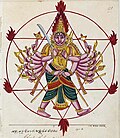
In the Rigveda, the Sudarshana Chakra is stated to be Vishnu's symbol as the wheel of time.[3] The disc later emerged as an ayudhapurusha (an anthropomorphic form), representing a fierce aspect of Vishnu, used for the destruction of demons. As an ayudhapurusha, the deity is known as Chakraperumal, Chakratalvar, Chakradhara, or Chakrapani.
| Part of a series on |
| Vaishnavism |
|---|
 |
 Hinduism portal Hinduism portal |
Etymology[edit | edit source]
The word Sudarshana is derived from two Sanskrit words – Su (सु) meaning "good/auspicious" and Darshana (दर्शन) meaning "vision". In the Monier-Williams dictionary the word Chakra is derived from the root क्रम् (kram) or ऋत् (rt) or क्रि (kri) and refers among many meanings, to the wheel of a carriage, wheel of the sun's chariot or metaphorically to the wheel of time.[4][5] In Tamil, the Sudarshana Chakra is also known as Chakratalvar (disc-devotee).[6]
Literature[edit | edit source]
Rigveda[edit | edit source]

The Rigveda mentions the Sudarshana Chakra as a symbol of Vishnu, and as the wheel of time.[7]
Mahabharata[edit | edit source]
The Mahabharata features the spinning disc as a weapon of Krishna, identified with Vishnu. The deity beheads Shishupala with the Sudarshana Chakra at the rajasuya yajna of Emperor Yudhishthira. He also employs it during the fourteenth day of the Kurukshetra War to obscure the sun. The Kauravas are deceived, allowing Arjuna to slay Jayadratha, avenging the death of his son.
Ramayana[edit | edit source]
The Ramayana states that the Sudarshana Chakra was created by the divine architect, Vishvakarma. Vishnu slays a danava named Hayagriva on top of a mountain named Chakravana, seizing the disc from him.
Ahirbudhnya Samhita[edit | edit source]
The Ahirbudhnya Samhita (Sanskrit: अहिर्बुध्न्यसंहिता, IAST: Ahiburdhnyasaṃhitā) is a Hindu Vaishnava text belonging to the Pancharatra tradition. It is a Tantrika composition, composed possibly over several centuries within the 1st millennium CE, most probably at 200 CE.[8] Ahirbudhnya Saṃhita literally means a compendium (samhita) of the serpent-from-the-depths (from ahi for serpent and budhna for bottom/root).[8][9]
In the Ahirbudhnya Samhita, Vishnu emanated in 39 different forms.[10] The Samhita is characteristic for its concept of Sudarshana. It provides mantras for Sudarshana, and details the method of worship of the multi-armed Sudarshana. Its chapters include explanations on the origin of astras (weapons), anga (mantras), Vyuhas, sounds, and diseases, how to make Sudarshana Purusha appear, how to resist divine weapons and black magic, and provides method for making and worshipping the Sudarshana Yantra. The Ahirbudhnya Samhita is the source of Taraka Mantra, Narasimhanustubha Mantra, three occult alphabets, Sashtitantra and select astra mantras. It also mentions the Purusha Sukta. The four Vyuhas in this samhita are Vasudeva, Samkarshana, Pradyumna and Aniruddha.[11]
Puranas[edit | edit source]
The Puranas also state the Sudarshana Chakra was made by Vishvakarma, featuring a legend regarding its origin: Vishvakarma's daughter, Sanjña, was married to the sun god, Surya. However, due to her consort's blazing light and heat, she could not approach him. When she informed her father regarding this, Vishvakarma diminished the brilliance of the sun so that his daughter could be with him. From the splendour of the Sun, Vishvakarma produced three divine objects: the aerial vehicle Pushpaka Vimana, the Trishula of Shiva, and the Sudarshana Chakra of Vishnu.[12]
Following the self-immolation of Sati in the Daksha yajna, a grieving Shiva carried around her lifeless body, and was inconsolable. To liberate him from his anguish, Vishnu employed Sudarshana Chakra to cut the corpse of Sati into fifty-one pieces. The fifty-one parts of the goddess' body are believed to have scattered across the earth, venerated as the Shakta pithas.[citation needed]
Vishnu granted King Ambarisha the boon of the Sudarshana Chakra to reward him for his devotion.[13]
The Sudarshana Chakra was also used to behead Rahu and cut the celestial Mandara mountain during the Samudra Manthana.[14]
Historical representations[edit | edit source]

The chakra is found in the coins of many tribes with the word gana and the name of the tribe inscribed on them.[15] Early historical evidence of the Sudarshana-Chakra is found in a rare tribal Vrishni silver coin with the legend Vṛishṇi-rājaṅṅya-gaṇasya-trātasya which P. L. Gupta thought was possibly jointly issued by the gana (tribal confederation) after the Vrishnis formed a confederation with the Rajanya tribe. However, there is no conclusive proof so far. Discovered by Cunningham, and currently placed in the British Museum, the silver coin is witness to the political existence of the Vrishnis.[16][17] It is dated to around 1st century BCE.[15] Vrishni copper coins dated to later time were found in Punjab. Another example of coins inscribed with the chakra are the Taxila coins of the 2nd century BCE with a sixteen-spoked wheel.[15]
A coin dated to 180 BCE, with an image of Vasudeva-Krishna, was found in the Greco-Bactrian city of Ai-Khanoum in the Kunduz area of Afghanistan, minted by Agathocles of Bactria.[18][19] In Nepal, Jaya Cakravartindra Malla of Kathmandu issued a coin with the chakra.[20]
Among the only two types of Chakra-vikrama coins known so far, there is one gold coin in which Vishnu is depicted as the Chakra-purusha. Though Chandragupta II issued coins with the epithet vikrama, due to the presence of the kalpavriksha on the reverse it has not been possible to ascribe it to him.[21][22]
Anthropomorphic form[edit | edit source]

The anthropomorphic form of Sudarshana can be traced from discoid weapons of ancient India to his esoteric multi-armed images in the medieval period in which the Chakra served the supreme deity (Vishnu) as his faithful attendants.[23] While the two-armed Chakra-Purusha was humanistic, the medieval multi-armed Sudarshana (known as Chakraperumal or Chakrathalvar) was speculatively regarded as an impersonal manifestation of destructive forces in the universe; that, in its final aspect, combined the flaming weapon and the wheel of time which destroys the universe.[23][24]
The rise of Tantrism aided the development of the anthropomorphic personification of the chakra as the active aspect of Vishnu with few sculptures of the Pala era bearing witness to the development,[25] with the chakra in this manner possibly associated with the Vrishnis.[15] However, the worship of Sudarshana as a quasi-independent deity concentrated with the power of Vishnu in its entirety is a phenomenon of the southern part of India; with idols, texts and inscriptions surfacing from the 13th century onwards and increasing in large numbers only after the 15th century.[25]
The Chakra Purusha in Pancharatra texts has either four, six, eight, sixteen, or thirty-two hands,[26] with double-sided images of multi-armed Sudarshana on one side and Narasimha on other side (called Sudarshana-Narasimha in Pancharatra) within a circular rim, sometimes in dancing posture found in Gaya area datable to 6th and 8th centuries.[27] Unique images of Chakra Purusha, one with Varaha in Rajgir possibly dating to the 7th century, [28] and another from Aphsad (Bihar) detailing a fine personification dating to 672 CE have been found.[29][30]
While the chakra is ancient, with the emergence of the anthropomorphic forms of chakra and shankha traceable in the north and east of India as the Chakra-Purusha and Shanka-Purusha; in the south of India, the Nayak period popularized the personified images of Sudarshana with the flames. In the Kilmavilangai cave is an archaic rock-cut structure in which an image of Vishnu has been hallowed out, holding the Shanka and Chakra, without flames.[31][32] At this point, the Chakrapurusha with the flames had not been conceived in the south of India. The threat of invasions from the north was a national emergency during which the rulers sought out the Ahirbudhnya Samhita, which prescribes that the king should resolve the threat by making and worshiping images of Sudarshana.[24]
Though similar motives contributed to the installation of images of Sudarshana during the Vijayanagara period, there was a wider distribution of the cult during the Nayak period, with Sudarshana's images set up in temples ranging from small, out-of-the-way temples to large temples of importance.[33] Though political turmoil resulted in the disintegration of the Vijayanagara Empire, the construction and refurbishing of temples did not cease; with the Nayak period continuing with their architectural enterprises, which Begley and Nilakantha Sastri note "reflected the rulers' awareness of their responsibilities in the preservation and development of all that remained of Hinduism.
The worship of Sudarshana Chakra is found in the Vedic and in the tantric cults. In the Garuda purana, the chakra was also invoked in tantric rites.[15] The tantric cult of Sudarshana was to empower the king to defeat his enemies in the shortest time possible.[25] Sudarshana's hair, depicted as tongues of flames flaring high forming a nimbus, bordering the rim of the disc and surrounding the deity in a circle of rays (Prabha-mandala) are a depiction of the deity's destructive energy.[25]
Representation[edit | edit source]
.jpg)

Philosophy[edit | edit source]
Various Pancharatra texts describe the Sudarshan chakra as prana, Maya, kriya, shakti, bhava, unmera, udyama and saṃkalpa.[15] In the Ahirbudhanya Samhita of the Pancharatra, on bondage and liberation, the soul is represented as belonging to bhuti-shakti (made of 2 parts, viz., time (bhuti) and shakti (maya) which passes through rebirths until it is reborn in its own natural form which is liberated; with the reason and object of samsara remaining a mystery. Samsara is represented as the 'play' of God even though God in the Samhita's representation is the perfect one with no desire to play. The beginning and the end of the play is effected through Sudarshana, who in the Ahirbudhanya Samhita is the will of the omnipotent, omniscient, omnipresent God. The Sudarshana manifests in 5 main ways to wit the 5 Shaktis, which are creation, preservation, destruction, obstruction, and obscuration; to free the soul from taints and fetters which produce vasanas causing new births; so as to make the soul return to her natural form and condition which she shares with the supreme lord, namely, omnipotence, omniscience, omnipresence.[34]
Weapon[edit | edit source]
According to the Ahirbudhanya Samhita, "Vishnu, in the form of Chakra, was held as the ideal of worship for kings desirous of obtaining universal sovereignty",[35] a concept associated with the Bhagavata tradition in the Puranas, a religious condition traceable to the Gupta period,[36] which also led to the chakravartin concept.[24] The concept of universal sovereignty possibly facilitated the syncretism of Krishna and Vishnu and reciprocally reinforced their military power and heroic exploits; with the kshatriya hero, Krishna preserving order in the phenomenal world while the composite Vishnu is the creator and upholder of the universe supporting all existence.[24] Begley notes the evolution of the anthropomorphic iconography of Sudarshana, beginning from early expansion of the Bhagavata sect thus:
"In contrast to the relatively simple religious function of the Cakra-Purusa, the iconographic role of the medieval Sudarsana-Purusa of South India was exceedingly complex. The medieval Sudarsana was conceived as a terrifying deity of destruction, for whose worship special tantric rituals were devised. The iconographic conception of Sudarsana as an esoteric agent of destruction constitutes a reassertion of the original militaristic connotation of the cakra".[24]
An early scriptural reference in obtaining the 'grace of Sudarshana' through building a temple for him can be found in the Ahirbudhanya Samhita, in the story of Kushadhvaja, a king of the Janakas, who felt possessed by the devil causing him various ills, due to a sin from his past life in killing a righteous king. His guru advises him to build the temple, following which he performs propitiatory rites for 10 days upon which he is cured.[34] However, the multi-armed Sudarsana as a horrific figure with numerous weapons standing on a flaming wheel comes from southern Indian iconography with the earliest example of the South Indian Sudarsana image being a small eight-armed bronze image from the 13th century.[24]
Worship[edit | edit source]
 | This section needs more citations. (April 2024) |
Though Chakraperumal or Chakratalvar shrines (sannidhis) are found inside Vishnu's temples, there are very few temples dedicated to Chakraperumal alone as the main deity (moolavar):
- Sri Sudarshana Bhagavan Temple, Nagamangala
- Chakrapani Temple, Kumbakonam – located on the banks of the Chakra Bathing Ghat of the Kaveri river. Here, the god is Chakra Rājan and his consort is Vijayavalli.
- Jagannath Temple, Puri, where Jagannath (a form of Vishnu-Krishna), Subhadra, Balabhadra and Sudarshana are the main deities.
- The temple of Chakraperumal in Gingee on the banks of Varahanadi is now defunct[37]
In Kerala, Sudharsana Chakra is worshiped both directly and in the form of Shatrughna, one of four sons of King Dasharatha, and brother to Lord Rama, considered an avatar of Sudharsana Moorthy.
As Sudharsana Moorthy
- Alathiyur Pavelikkara Narayanathu Kavu Sudarshana Temple, Triprangode, Malappuram. A rare sudarshana temple complex in Kerala dedicated to Lord Sudarshana. Along with the main deity, Badrakali, Shastha and naga are worshipped here. The temple is also the paradevatha of mangalassery.
- Thuravoor Sree Narasimha Moorthy Temple, Alappuzha- One of the rare temple complexes in Kerala, where two sanctum sanctorums are situated within a single Nalambalam (temple structure), one of the sanctums in dedicated to Lord Narasimha and the other to Maha Sudarsana Moorthy. The Sudarsana Moorthy Temple is believed to be 1300 years old.
- Sreevallabha Temple, Thiruvalla, Pathanamthitta - One of the oldest and largest temples in Kerala and one of the 108 Divya Desams, Sudharsana Moorthy is worshipped along with Sreevallabha in this temple. The temple for Sudarshana Chakra was built by Sreedevi Antherjanam of Sankramangalathu Illam, and was rebuilt by Queen Cherumthevi in 59 BC.
- Thrichakrapuram Temple, Puthanchira- The main deity is Sudharsana Moorthy. In the morning, the deity is worshiped as the fierce Maha Sudharsana Moorthy, and in the evening as the calmer Sudharsana Moorthy. The evening pujas are conducted without incense lamps and bells, in the form of hand gestures. Although worship is for Lord Vishnu as Sudarshana Moorthy, as the temple's legend is connected to Lord Shiva, the crescent moon is the main ornament attached to the idol.
- Ayyarvattom Sree Maha Sudharshana Temple, Eravannur, Kozhikode
- Pallikkara Sri Mahavishnu Sudharsana Temple, Kozhikode
As Shatrughna avatar
- Payammal Sree Shatrughna Swami Temple, Thrissur
- Methiri Sree Sathrughnaswamy Temple, Kottayam
- Nedungaattu Sree Shatrugna Swami Temple(Mammalassery), Ernakulam
- Naranathu Shatrughna Swami Temple, Malappuram
- Payam Sri Mahavishu (Shatrughna) Temple, Kannur
- Sree Shatrughna Swami Temple, Kalkulam, Kuthannur, Palakkad
The icons of Chakra Perumal are generally built in the Vijayanagar style. There are two forms of Chakraperumal, one with 16 arms and another with 8 arms. The one with 16 arms is considered the god of destruction and is rarely found. The Chakraperumal shrine inside the Simhachalam Temple is home to the rare 16-armed form. The one with 8 arms is benevolent and is the form generally found in Vishnu's temples. Chakraperumal was deified an avatar of Vishnu himself,[38] with the Ahirbudhnya Samhita identifying the Chakra-Purusha with Vishnu himself, stating Chakrarupi svayam Harih.[39]
The Simhachalam Temple follows the ritual of Baliharana or purification ceremony. Sudarshana or Chakraperumal is the bali bera (icon that accepts sacrifices, as a representative of the chief deity) of Narasimha,[40] where he stands with 16 arms holding emblems of Vishnu with a circular background halo.[40] In Baliharana, Chakraperumal is taken to a yajnasala where a yajna (sacrifice) is performed, wherein cooked rice with ghee is offered while due murti mantras are chanted, along with the Vishnu Sukta and Purusha Sukta. Then he is taken on a palanquin around the temple with the remaining food offered to the guardian spirits of the temple.[40]
Other temples with shrines to Sudarshana Chakra are Veeraraghava Swamy Temple, Thiruevvul; Ranganathaswamy Temple, Srirangapatna; Thirumohoor Kalamegaperumal temple, Madurai; and Varadharaja Perumal Temple, Kanchipuram.
The Sudarshana homam is performed by invoking Sudarshana along with his consort Vijayavalli into the sacrificial fire. This homam is very popular in South India.
See also[edit | edit source]
- Narayanastra
- Ayudhapurusha
- Ahirbudhnya Samhita
- Panchajanya
- Chakram
- Chakri dynasty of Thailand, named after this weapon.
- Sampo
Further reading[edit | edit source]
- Vishnu's Flaming Wheel: The Iconography of the Sudarsana-Cakra (New York, 1973) by W. E. Begley
References[edit | edit source]
- ↑ Dalal, Roshen (2014-04-18). Hinduism: An Alphabetical Guide. Penguin UK. p. 1184. ISBN 978-81-8475-277-9.
- ↑ Gopal, Madan (1990). K.S. Gautam (ed.). India through the ages. Publication Division, Ministry of Information and Broadcasting, Government of India. p. 80.
- ↑ Jakimowicz, Marta (1988). Metamorphoses of Indian Gods. Seagull Books. p. 1988. ISBN 978-81-7046-029-9.
- ↑ Monier Monier-Williams (1871). A Sanskrit-English Dictionary, p. 310.
- ↑ Monier-Williams, Leumann E, Cappeller C, eds. (2002). "Chakra". A Sanskrit-English Dictionary: Etymologically and Philologically Arranged with Special Reference to Cognate Indo-European Languages, p. 380. Motilal Banarsidass Publications. ISBN 9788120831056.
- ↑ Krishna, Nanditha (2017-12-26). Hinduism and Nature. Penguin Random House India Private Limited. p. 60. ISBN 978-93-87326-54-5.
- ↑ Agarwala, Vasudeva Sharana (1965). Indian Art: A history of Indian art from the earliest times up to the third century A.D, Volume 1 of Indian Art. Prithivi Prakashan. p. 101.
- ↑ 8.0 8.1 Burley, Mikel (2007). Classical Samkhya and Yoga: An Indian Metaphysics of Experience. Vol. 3 of Routledge Hindu Studies Series. Routledge. pp. 21–22, 27–28. ISBN 978-1134159789.
- ↑ Sukumari Bhattacharji, (1988). The Indian Theogony: A Comparative Study of Indian Mythology from the Vedas to the Purāṇas, p.150. CUP Archive
- ↑ Muralidhar Mohanty, (2003). Origin and development of Viṣṇu cult, p.105. Pratibha Prakashan. ISBN 8177020633
- ↑ Bahadur Chand Chhabra, 2008. Findings in Indian archaeology, p.21. Sundeep Prakashan. ISBN 8185067767
- ↑ Krishnan, S. A. (2023-02-02). Devas and Kings: Short Stories from Hindu Puranas. SA Krishnan. p. 11.
- ↑ Vaswani, J. P. (2019-06-20). Stories with a difference from the Bhagavata Purana. Gita Publishing House. p. 114. ISBN 978-93-86004-23-9.
- ↑ Sinha, Purnendu Narayana (1901). A Study of the Bhagavata Purana: Or, Esoteric Hinduism. Freeman & Company, Limited. p. 172.
- ↑ 15.0 15.1 15.2 15.3 15.4 15.5 Nanditha Krishna, (1980). The Art and Iconography of Vishnu-Narayana, p. 51.
- ↑ Handa, Devendra (2007). Tribal Coins of Ancient India. Aryan Books International. p. 140.
- ↑ Cunningham, Alexander (1891). Coins of Ancient India: From the Earliest Times Down to the Seventh Century. p. 70.
- ↑ Joshi, Nilakanth Purushottam (1979). Iconography of Balarāma. Abhinav Publications. p. 22. ISBN 9788170171072.
- ↑ Sagar, Krishna Chandra (1992). Foreign Influence on Ancient India. Northern Book Centre. p. 94. ISBN 8172110286.
- ↑ "Jaya Cakravartindra Malla". Journal of the Royal Asiatic Society of Great Britain and Ireland. Cambridge University Press: 702. 1908.
- ↑ Bajpai, K.D (2004). Indian Numismatic Studies. Abhinav Publications. p. 151. ISBN 8170170354.
- ↑ Agrawal, Ashvini (1989). Rise and Fall of the Imperial Guptas. Motilal Banarsidass Publications. p. 23. ISBN 8120805925.
- ↑ 23.0 23.1 von Stietencron, Heinrich; Flamm, Peter (1992). Epic and Purāṇic bibliography: A-R. Otto Harrassowitz Verlag. ISBN 3447030283.
- ↑ 24.0 24.1 24.2 24.3 24.4 24.5 Wayne Edison Begley. (1973). Viṣṇu's flaming wheel: the iconography of the Sudarśana-cakra, pp. 18, 48, 65–66, 76–77. Volume 27 of Monographs on archaeology and fine arts. New York University Press
- ↑ 25.0 25.1 25.2 25.3 Saryu Doshi, (1998). Treasures of Indian art: Germany's tribute to India's cultural heritage, p. 68. The National Museum of India.
- ↑ Parimoo, Ratan (2000). Essays in New Art History: Text. Volume 1 of Essays in New Art History: Studies in Indian Sculpture : Regional Genres and Interpretations. Books & Books. pp. 146–148. ISBN 8185016615.
- ↑ The Orissa Historical Research Journal, Volume 31, p. 90. Superintendent of Research and Museum, Orissa State Museum, 1985.
- ↑ Frederick M. Asher, 2008. Bodh Gaya: Monumental legacy, p. 90. Oxford University Press
- ↑ Col Ved Prakash, (2007). Encyclopaedia of North-East India, Volume 1, p. 375. Atlantic Publishers & Distributors. ISBN 8126907037 [1]
- ↑ See: http://vmis.in/ArchiveCategories/collection_gallery_zoom?id=491&search=1&index=30876&searchstring=india
- ↑ Jouveau-Dubreuil, G (1994). Pallava Antiquities. Asian Educational Services. p. 46. ISBN 8120605713.
- ↑ "Kilmavilangai Cave Temple". Retrieved 31 March 2017.
- ↑ Wayne Edison Begley (1973). Viṣṇu's flaming wheel: the iconography of the Sudarśana-cakra, p. 77. "attempt+to+resolve" Volume 27 of Monographs on archaeology and fine arts. New York University Press
- ↑ 34.0 34.1 Otto, Schrader (1916). Introduction to the Pancaratra and the Ahirbudhnya Samhita. pp. 114–115, 135.
- ↑ Wayne Edison Begley (1973). Viṣṇu's flaming wheel: the iconography of the Sudarśana-cakra, p. 48. Volume 27 of Monographs on archeology and fine arts. New York University Press
- ↑ Śrīrāma Goyala, (1967). A history of the Imperial Guptas, p. 137. Central Book Depot.
- ↑ C.S, Srinivasachari (1943). History Of Gingee And Its Rulers.
- ↑ Jayaraj Manepalli (5 May 2006). "Vijayanagara period statues saved from rusting". The Hindu. Retrieved 28 March 2017.
- ↑ Swati Chakraborty, (1986). Socio-religious and cultural study of the ancient Indian coins, p. 102
- ↑ 40.0 40.1 40.2 Sundaram, K. (1969). The Simhachalam Temple, pp. 42, 115. Published by the Simhachalam Devasthanam.
Jagannath worship | |||||||
|---|---|---|---|---|---|---|---|
| Deities |  | ||||||
| Temples |
| ||||||
| Festivals | |||||||
| Texts | |||||||
| Devotees | |||||||
| See also | |||||||

Hindu deities and texts | ||
|---|---|---|
| Gods |  | |
| Goddesses | ||
| Other deities | ||
| Texts | ||