

m Removing protection template from an unprotected page |
m Removed empty portal template using script |
||
| (One intermediate revision by one other user not shown) | |||
| Line 1: | Line 1: | ||
{{Short description| | {{Short description|Founder and first guru of Sikhism (1469–1539)}} | ||
{{EngvarB|date=November 2015}} | {{EngvarB|date=November 2015}} | ||
| Line 9: | Line 9: | ||
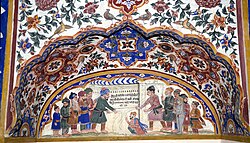
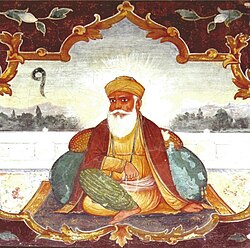
| caption = 19th-century [[mural]] painting from [[Gurdwara Baba Atal]] depicting Nanak | | caption = 19th-century [[mural]] painting from [[Gurdwara Baba Atal]] depicting Nanak | ||
| birth_name = Nanak | | birth_name = Nanak | ||
| birth_date = {{ | | birth_date = 15 April 1469 or [[Kartik Purnima|Katak Pooranmashi]] according to Sikh tradition{{sfn|Gupta|1984|p=49}} | ||
| birth_place = Rāi Bhoi Kī Talvaṇḍī, [[Delhi Sultanate]] <br> {{small|(present-day [[Nankana Sahib]], [[Punjab, Pakistan|Punjab]], [[Pakistan]])}} | | birth_place = Rāi Bhoi Kī Talvaṇḍī, [[Delhi Sultanate]] <br> {{small|(present-day [[Nankana Sahib]], [[Punjab, Pakistan|Punjab]], [[Pakistan]])}} | ||
| death_date = {{Death-date and age|22 September 1539|15 April 1469}} | | death_date = {{Death-date and age|22 September 1539|15 April 1469}} | ||
| Line 17: | Line 17: | ||
| successor = [[Guru Angad]] | | successor = [[Guru Angad]] | ||
| parents = [[Mehta Kalu]] and [[Mata Tripta]] | | parents = [[Mehta Kalu]] and [[Mata Tripta]] | ||
| spouse = Mata Sulakhani | | spouse = [[Mata Sulakhni|Mata Sulakhani]] | ||
| children = [[Sri Chand]] | | children = [[Sri Chand]]<br>[[Lakhmi Das]] | ||
| religion = [[Sikhism]] | | religion = [[Sikhism]] | ||
| location = [[Kartarpur, Pakistan|Kartarpur]] | | location = [[Kartarpur, Pakistan|Kartarpur]] | ||
| Line 36: | Line 36: | ||
=== Birth === | === Birth === | ||
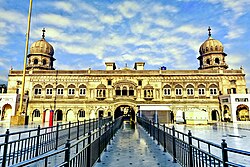
[[File:The Entrance of Janam Asthan-2.jpg|thumb|200px|left|The [[Gurdwara Janam Asthan]] in [[Nankana Sahib]], Pakistan, commemorates the site where Nanak is believed to have been born.]]{{See also|Guru Nanak Gurpurab}} | [[File:The Entrance of Janam Asthan-2.jpg|thumb|200px|left|The [[Gurdwara Janam Asthan]] in [[Nankana Sahib]], Pakistan, commemorates the site where Nanak is believed to have been born.]]{{See also|Guru Nanak Gurpurab}} | ||
Nanak was born on 15 April 1469 at Rāi Bhoi Kī Talvaṇḍī village (present-day [[Nankana Sahib]], [[Punjab, Pakistan|Punjab]], Pakistan) in the [[ | Nanak was born on 15 April 1469 at Rāi Bhoi Kī Talvaṇḍī village (present-day [[Nankana Sahib]], [[Punjab, Pakistan|Punjab]], Pakistan) in the [[Lahore]] province of the [[Delhi Sultanate]],{{sfn|Singh|2006|pp=12–13}}{{sfn|Grewal|1998|p=6}} although according to one tradition, he was born in the Indian month of [[Kartik (month)|Kārtik]] or November, known as [[Kattak]] in Punjabi.{{sfn|Gupta|1984|p=49}} | ||
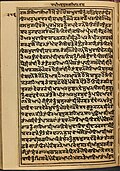
Most ''[[janamsakhis]]'' ({{Lang-pa|ਜਨਮਸਾਖੀ|lit=birth stories|label=none}}), or traditional biographies of Nanak, mention that he was born on the third day of the [[shukla paksha|bright lunar fortnight]], in the [[Vaisakha|Baisakh]] month (April) of [[Vikram Samvat|Samvat]] 1526.{{sfn|Gupta|1984|p=49}} These include the ''[[Janamsakhis#Editions|Puratan]]'' ('traditional' or 'ancient') ''janamsakhi'', [[Janamsakhis#The Miharban Janam-sakhi|''Miharban'' ''janamsakhi'']], ''[[Janamsakhis#Bhai Mani Singh’s Janamsakhi|Gyan-ratanavali]]'' by [[Bhai Mani Singh]], and the ''Vilayat Vali janamsakhi''.{{sfn|Gupta|1984|p=50}} The Sikh records state that Nanak died on the 10th day of the [[Ashvin|Asauj]] month of Samvat 1596 (22 September 1539 CE), at the age of 70 years, 5 months, and 7 days. This further suggests that he was born in the month of Vaisakh (April), not Kattak (November).{{sfn|Gupta|1984|p=54}} | Most ''[[janamsakhis]]'' ({{Lang-pa|ਜਨਮਸਾਖੀ|lit=birth stories|label=none}}), or traditional biographies of Nanak, mention that he was born on the third day of the [[shukla paksha|bright lunar fortnight]], in the [[Vaisakha|Baisakh]] month (April) of [[Vikram Samvat|Samvat]] 1526.{{sfn|Gupta|1984|p=49}} These include the ''[[Janamsakhis#Editions|Puratan]]'' ('traditional' or 'ancient') ''janamsakhi'', [[Janamsakhis#The Miharban Janam-sakhi|''Miharban'' ''janamsakhi'']], ''[[Janamsakhis#Bhai Mani Singh’s Janamsakhi|Gyan-ratanavali]]'' by [[Bhai Mani Singh]], and the ''Vilayat Vali janamsakhi''.{{sfn|Gupta|1984|p=50}} Gurbilas Patashahi 6, written 1718, also attributed to Bhai Mani Singh contradicts Mani Singh’s Janamsakhi as it instead says Guru Nanak was born on the full moon of Katak.<ref name=":1">{{Cite book |last=Singh |first=Dr. Trilochan |url=http://ignca.nic.in/Asi_data/48740.pdf |title=Guru Nanak: Founder of Sikhism: A Biography |pages=489-491}}</ref> The Sikh records state that Nanak died on the 10th day of the [[Ashvin|Asauj]] month of Samvat 1596 (22 September 1539 CE), at the age of 70 years, 5 months, and 7 days. This further suggests that he was born in the month of Vaisakh (April), not Kattak (November).{{sfn|Gupta|1984|p=54}} | ||
==== Kattak birthdate ==== | ==== Kattak birthdate ==== | ||
| Line 44: | Line 44: | ||
In as late as 1815, during the reign of [[Ranjit Singh]], the festival commemorating Nanak's birthday was held in April at the place of his birth, known by then as [[Nankana Sahib]].{{sfn|Gupta|1984|p=50}} However, the anniversary of Nanak's birth—the [[Guru Nanak Gurpurab|Gurpurab]] (''[[guru|gur]]'' + {{Lang-pa|purab|lit=celebration|label=none|italic=yes}})—subsequently came to be celebrated on the full moon day of the Kattak month in November. The earliest record of such a celebration in Nankana Sahib is from 1868 CE.{{sfn|Gupta|1984|p=52}} | In as late as 1815, during the reign of [[Ranjit Singh]], the festival commemorating Nanak's birthday was held in April at the place of his birth, known by then as [[Nankana Sahib]].{{sfn|Gupta|1984|p=50}} However, the anniversary of Nanak's birth—the [[Guru Nanak Gurpurab|Gurpurab]] (''[[guru|gur]]'' + {{Lang-pa|purab|lit=celebration|label=none|italic=yes}})—subsequently came to be celebrated on the full moon day of the Kattak month in November. The earliest record of such a celebration in Nankana Sahib is from 1868 CE.{{sfn|Gupta|1984|p=52}} | ||
There may be several reasons for the adoption of the Kattak birthdate by the Sikh community. For one, it may have been the date of Nanak's [[enlightenment (spiritual)|enlightenment]] or "spiritual birth" in 1496, as suggested by the ''[[Dabestan-e Mazaheb]]''. | There may be several reasons for the adoption of the Kattak birthdate by the Sikh community. For one, it may have been the date of Nanak's [[enlightenment (spiritual)|enlightenment]] or "spiritual birth" in 1496, as suggested by the ''[[Dabestan-e Mazaheb]]''.{{Citation needed|date=May 2023}} | ||
The | Some of the sources that support the Katak birthday incident: | ||
The Bala Janamasakhi supports the Kattak birth tradition. It is the only Janamsakhi that does. [[Bhai Bala]] is said to have obtained Nanak's horoscope from Nanak's uncle Lalu, according to which, Nanak was born on a date corresponding to 20 October 1469 CE. However, this janamsakhi was written by Handalis—a sect of Sikhs who followed a Sikh-convert known as Handal—attempting to depict the founder as superior to Nanak.{{sfn|Gupta|1984|pp=50–51}} According to a superstition prevailing in contemporary [[North India|northern India]], a child born in the Kattak month was believed to be weak and unlucky, hence why the work states that Nanak was born in that month.{{sfn|Gupta|1984|pp=50–51}} | |||
[[Bhai Gurdas]], having written on a full-moon-day of the Kattak month several decades after Nanak's death, mentions that Nanak had "obtained omniscience" on the same day, and it was now the author's turn to "get divine light."{{sfn|Gupta|1984|pp=53–54}} | [[Bhai Gurdas]], having written on a full-moon-day of the Kattak month several decades after Nanak's death, mentions that Nanak had "obtained omniscience" on the same day, and it was now the author's turn to "get divine light."{{sfn|Gupta|1984|pp=53–54}} | ||
According to eyewitness Sikh chronicles, known as [[Bhat Vahis|Bhatt Vahis]], Guru Nanak was born on the full moon of Katak.<ref name=":0">{{Cite book |last=Bindra |first=Pritpal Singh |title=Guru Kian Sakhian Tales of the Sikh Gurus |pages=78}}</ref> | |||
Gurbilas Patashahi 6 written 1718<ref>{{Cite web |title=Gurbilas Chhevian Patashahi |url=https://www.thesikhencyclopedia.com/sikh-scriptures-and-literature/eighteenth-century-literature/gukbilas-chhevin-patshahi/}}</ref> attributed to Bhai Mani Singh says Guru Nanak was born on the full moon of Katak.<ref name=":1" /> | |||
Meham Parkash written in 1776 also says Guru Nanak was born on the full moon of Katak.<ref name=":1" /> | |||
Kesar Singh Chibber’s Bansavalinama Dasan Patashahia Ka meaning genealogy of the ten emperors, written in 1769,<ref>{{Cite web |date=2000-12-19 |title=BANSAVALINAMA DASAN PATSHAHIAN KA - The Sikh Encyclopedia |url=https://www.thesikhencyclopedia.com/sikh-scriptures-and-literature/eighteenth-century-literature/bansavalinama-dasan-patshahian-ka/ |access-date=2023-04-01 |language=en-US}}</ref> says Guru Nanak was born on the full moon of Katak as well.<ref name=":1" /> | |||
Gurpurnali written in 1727 and Guru Tegh Bahadur Malwe da Safar written in 1716 both mention Guru Nanank being born on the full moon of Katak.<ref name=":1" /> | |||
Nanak Chandrodaya Sanskrit Janamsakhi from 1797 and Janam Sakhi Baba Nanak by Sant Das Chibber from the 18th century both mention Guru Nanak being born on the full moon of katak.<ref name=":1" /> | |||
Gurpur Parkash Granth written by Sant Ren Singh based on a granth written by [[Binod Singh]] states Guru Nanak was born on the full moon of Katak.<ref>{{Cite book |last=Singh |first=Ren |url=https://sikhbookclub.com/Book/Sri-Gur-Pur-Prakash-Part-1 |title=Gurpur Parkash}}</ref> | |||
According to [[Max Arthur Macauliffe]] (1909), a Hindu festival held in the 19th century on [[Kartik Purnima]] in [[Amritsar]] attracted a large number of Sikhs. The Sikh community leader [[Gyani|Giani]] Sant Singh did not like this, thus starting a festival at the Sikh shrine of the [[Golden Temple]] on the same day, presenting it as the birth anniversary celebration of Guru Nanak.{{sfn|Macauliffe|1909|p=[[s:Page:The Sikh Religion, its gurus, sacred writings and authors Vol 1.djvu/90|lxxiv]]}} | According to [[Max Arthur Macauliffe]] (1909), a Hindu festival held in the 19th century on [[Kartik Purnima]] in [[Amritsar]] attracted a large number of Sikhs. The Sikh community leader [[Gyani|Giani]] Sant Singh did not like this, thus starting a festival at the Sikh shrine of the [[Golden Temple]] on the same day, presenting it as the birth anniversary celebration of Guru Nanak.{{sfn|Macauliffe|1909|p=[[s:Page:The Sikh Religion, its gurus, sacred writings and authors Vol 1.djvu/90|lxxiv]]}} | ||
| Line 59: | Line 75: | ||
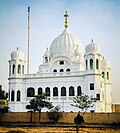
According to Sikh traditions, the birth and early years of Nanak's life were marked with many events that demonstrated that Nanak had been blessed with divine grace.{{sfn|BBC: Religions|2011}} Commentaries on his life give details of his blossoming awareness from a young age. For instance, at the age of five, Nanak is said to have voiced interest in divine subjects. At age seven, his father enrolled him at the village school, as per custom.{{sfn|Macauliffe|2004}} Notable lore recounts that, as a child, Nanak astonished his teacher by describing the implicit symbolism of the [[aleph|first letter of the alphabet]], resembling the mathematical version of one, as denoting the unity or oneness of God.{{sfn|Cunningham|1853|pp=37–38}} Other stories of his childhood refer to strange and miraculous events about Nanak, such as the one witnessed by [[Rai Bular Bhatti|Rai Bular]], in which the sleeping child's head was shaded from the harsh sunlight by, in one account, by the stationary shadow of a tree{{citation needed|date=July 2020}} or, in another, by a venomous cobra.{{sfn|Singh|1984|p=18}} [[File:Kartarpur Guru Nanak.jpg|thumb|[[Gurdwara Darbar Sahib Kartar Pur]] in [[Narowal]], Pakistan, marks the site where Guru Nanak is said to have died.{{sfn|Singh|2000}} ]] | According to Sikh traditions, the birth and early years of Nanak's life were marked with many events that demonstrated that Nanak had been blessed with divine grace.{{sfn|BBC: Religions|2011}} Commentaries on his life give details of his blossoming awareness from a young age. For instance, at the age of five, Nanak is said to have voiced interest in divine subjects. At age seven, his father enrolled him at the village school, as per custom.{{sfn|Macauliffe|2004}} Notable lore recounts that, as a child, Nanak astonished his teacher by describing the implicit symbolism of the [[aleph|first letter of the alphabet]], resembling the mathematical version of one, as denoting the unity or oneness of God.{{sfn|Cunningham|1853|pp=37–38}} Other stories of his childhood refer to strange and miraculous events about Nanak, such as the one witnessed by [[Rai Bular Bhatti|Rai Bular]], in which the sleeping child's head was shaded from the harsh sunlight by, in one account, by the stationary shadow of a tree{{citation needed|date=July 2020}} or, in another, by a venomous cobra.{{sfn|Singh|1984|p=18}} [[File:Kartarpur Guru Nanak.jpg|thumb|[[Gurdwara Darbar Sahib Kartar Pur]] in [[Narowal]], Pakistan, marks the site where Guru Nanak is said to have died.{{sfn|Singh|2000}} ]] | ||
[[Bebe Nanaki|Nanaki]], Nanak's only sister, was five years older than him. In 1475, she married and moved to [[Sultanpur Lodhi|Sultanpur]].{{citation needed|date=July 2020}} Jai Ram, Nanaki's husband, was employed at a ''modikhana'' (a storehouse for revenues collected in non-cash form), in the service of the [[Delhi Sultanate]]'s [[ | [[Bebe Nanaki|Nanaki]], Nanak's only sister, was five years older than him. In 1475, she married and moved to [[Sultanpur Lodhi|Sultanpur]].{{citation needed|date=July 2020}} Jai Ram, Nanaki's husband, was employed at a ''modikhana'' (a storehouse for revenues collected in non-cash form), in the service of the [[Delhi Sultanate]]'s [[Lahore]] governor [[Daulat Khan Lodi|Daulat Khan]], at which Ram would help Nanak get a job.{{sfn|Grewal|1998|p=7}} Nanak moved to Sultanpur, and started working at the modikhana around the age of 16.{{citation needed|date=July 2020}} | ||
As a young man,{{efn-lr|name=Macauliffe-marriage|Macauliffe (1909) notes that, according to the [[Janamsakhis#Bhai Mani Singh’s Janamsakhi|''janamsakhi of Mani Singh'']], Nanak was married at the age of 14, not 18. "It is related in the Janamsakhi which bears the name of Mani Singh, that Nanak was married at the age of fourteen" ([[wikisource:Page:The Sikh Religion, its gurus, sacred writings and authors Vol 1.djvu/114|p. 18]]) Subsequent janamsakhis, however, claim that Nanak was married later, after he moved to Sultanpur ([[wikisource:Page:The Sikh Religion, its gurus, sacred writings and authors Vol 1.djvu/125|p. 29]]).}} | As a young man,{{efn-lr|name=Macauliffe-marriage|Macauliffe (1909) notes that, according to the [[Janamsakhis#Bhai Mani Singh’s Janamsakhi|''janamsakhi of Mani Singh'']], Nanak was married at the age of 14, not 18. "It is related in the Janamsakhi which bears the name of Mani Singh, that Nanak was married at the age of fourteen" ([[wikisource:Page:The Sikh Religion, its gurus, sacred writings and authors Vol 1.djvu/114|p. 18]]) Subsequent janamsakhis, however, claim that Nanak was married later, after he moved to Sultanpur ([[wikisource:Page:The Sikh Religion, its gurus, sacred writings and authors Vol 1.djvu/125|p. 29]]).}} Nanak married [[Mata Sulakhni|Sulakhani]], daughter of Mūl Chand (aka Mula){{efn-lr|name=Macauliffe-marriage2|"He was betrothed to Sulakhani, daughter of Mula, a resident of Batala in the present district of Gurdaspur." (Macauliffe 1909, [[wikisource:The Sikh Religion/Volume 1/Life of Guru Nanak#19|p.19]]).}}{{efn-lr|name=Grewal-p6|"As a young man Nanak was married to Sulakhni, a daughter of Mula, a native of the newly founded town of [[Batala]] who had come there from his village, Pakho dī Randhawi, on the left bank of the river [[Ravi River|Ravi]]. Mula belonged to the subcaste [[Chona (caste)|Chona]] which was less important than even the subcaste [[Bedi clan|Bedi]].". {{harv|Grewal|1998|p=6}}}} and Chando Raṇi.{{citation needed|date=July 2020}} They were married on 24 September 1487, in the town of [[Batala]],{{sfn|Macauliffe|2004|p=19}} and would go on to have two sons, [[Sri Chand]] and [[Lakhmi Das|Lakhmi Chand]]{{sfn|Grewal|1998|p=7}} (or Lakhmi Das).{{efn-lr|Trumpp (1877) transliterates the names of Nanak's children from the [[Janamsakhis#Editions|''Colebrooke'' ''janamsakhi'']] as "''Sirī-čand''" and "''Lakhmī-dās''", rather than "''Lakhmī-čand''" (pp. [[iarchive:in.ernet.dli.2015.69690/page/n17|iii]], [[iarchive:in.ernet.dli.2015.69690/page/n21|viii]]). Macauliffe (1909, [[wikisource:Page:The Sikh Religion, its gurus, sacred writings and authors Vol 1.djvu/125|p. 29]]) also gives their names as Sri Chand and Lakhmi Das.}}{{sfn|Trumpp|1877}} Nanak lived in Sultanpur until c. 1500,{{sfn|Grewal|1998|p=7}} which would be a formative time for him, as the ''puratan'' [[Janamsakhis|''janamsakhi'']] suggests, and in his numerous allusions to governmental structure in his hymns, most likely gained at this time.{{sfn|Cole|Sambhi|1978|p=[https://archive.org/details/sikhs00cole/age/9 9]}} | ||
Nanak married Sulakhani, daughter of Mūl Chand (aka Mula){{efn-lr|name=Macauliffe-marriage2|"He was betrothed to Sulakhani, daughter of Mula, a resident of Batala in the present district of Gurdaspur." (Macauliffe 1909, [[wikisource:The Sikh Religion/Volume 1/Life of Guru Nanak#19|p.19]]).}}{{efn-lr|name=Grewal-p6|"As a young man Nanak was married to Sulakhni, a daughter of Mula, a native of the newly founded town of [[Batala]] who had come there from his village, Pakho dī Randhawi, on the left bank of the river [[Ravi River|Ravi]]. Mula belonged to the subcaste [[Chona (caste)|Chona]] which was less important than even the subcaste [[Bedi clan|Bedi]].". {{harv|Grewal|1998|p=6}}}} | |||
and Chando Raṇi.{{citation needed|date=July 2020}} | |||
They were married on 24 September 1487, in the town of [[Batala]],{{sfn|Macauliffe|2004|p=19}} and would go on to have two sons, [[Sri Chand]] and Lakhmi Chand{{sfn|Grewal|1998|p=7}} (or Lakhmi Das).{{efn-lr|Trumpp (1877) transliterates the names of Nanak's children from the [[Janamsakhis#Editions|''Colebrooke'' ''janamsakhi'']] as "''Sirī-čand''" and "''Lakhmī-dās''", rather than "''Lakhmī-čand''" (pp. [[iarchive:in.ernet.dli.2015.69690/page/n17|iii]], [[iarchive:in.ernet.dli.2015.69690/page/n21|viii]]). Macauliffe (1909, [[wikisource:Page:The Sikh Religion, its gurus, sacred writings and authors Vol 1.djvu/125|p. 29]]) also gives their names as Sri Chand and Lakhmi Das.}}{{sfn|Trumpp|1877}} Nanak lived in Sultanpur until c. 1500,{{sfn|Grewal|1998|p=7}} which would be a formative time for him, as the ''puratan'' [[Janamsakhis|''janamsakhi'']] suggests, and in his numerous allusions to governmental structure in his hymns, most likely gained at this time.{{sfn|Cole|Sambhi|1978|p=[https://archive.org/details/sikhs00cole/age/9 9]}} | |||
=== Final years === | === Final years === | ||
| Line 70: | Line 83: | ||
Around the age of 55, Nanak settled in [[Kartarpur, Pakistan|Kartarpur]], living there until his death in September 1539. During this period, he went on short journeys to the [[Nath]] [[yogi]] centre of Achal, and the Sufi centres of [[Pakpattan]] and [[Multan]]. By the time of his death, Nanak had acquired several followers in the [[Punjab|Punjab region]], although it is hard to estimate their number based on the extant historical evidence.{{sfn|Grewal|1998|p=8}} The followers of Nanak were called ''Kartārīs'' (meaning 'the people who belonged to the village of Kartarpur') by others.<ref>{{Cite journal |last=Singh |first=Pashaura |date=2021-04-03 |title=Ideological basis in the formation of the Shiromani Gurdwara Prabandhak Committee and the Shiromani Akali Dal: exploring the concept of Guru-Panth |url=https://www.tandfonline.com/doi/full/10.1080/17448727.2021.1873656 |journal=Sikh Formations |language=en |volume=17 |issue=1–2 |pages=16–33 |doi=10.1080/17448727.2021.1873656 |s2cid=234146387 |issn=1744-8727 |quote=Unsurprisingly, Guru Nanak’s followers were frequently referred to as Kartārīs, the people who belonged to the village of Kartarpur (Singh 2006, 106 & 129, n. 4).}}</ref> | Around the age of 55, Nanak settled in [[Kartarpur, Pakistan|Kartarpur]], living there until his death in September 1539. During this period, he went on short journeys to the [[Nath]] [[yogi]] centre of Achal, and the Sufi centres of [[Pakpattan]] and [[Multan]]. By the time of his death, Nanak had acquired several followers in the [[Punjab|Punjab region]], although it is hard to estimate their number based on the extant historical evidence.{{sfn|Grewal|1998|p=8}} The followers of Nanak were called ''Kartārīs'' (meaning 'the people who belonged to the village of Kartarpur') by others.<ref>{{Cite journal |last=Singh |first=Pashaura |date=2021-04-03 |title=Ideological basis in the formation of the Shiromani Gurdwara Prabandhak Committee and the Shiromani Akali Dal: exploring the concept of Guru-Panth |url=https://www.tandfonline.com/doi/full/10.1080/17448727.2021.1873656 |journal=Sikh Formations |language=en |volume=17 |issue=1–2 |pages=16–33 |doi=10.1080/17448727.2021.1873656 |s2cid=234146387 |issn=1744-8727 |quote=Unsurprisingly, Guru Nanak’s followers were frequently referred to as Kartārīs, the people who belonged to the village of Kartarpur (Singh 2006, 106 & 129, n. 4).}}</ref> | ||
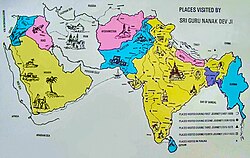
Nanak appointed Bhai Lehna as the successor [[Guru]], renaming him as [[Guru Angad|Guru ''Angad'']], meaning "one's very own" or "part of you". Shortly after proclaiming his successor, Nanak died on 22 September 1539 in [[Kartarpur, Pakistan|Kartarpur]], at the age of 70. According to Sikh [[hagiography]], his body was never found. When the quarreling Hindus and Muslims tugged at the sheet covering his body, they found instead a heap of flowers—and so Nanak’s simple faith would, in course of time, flower into a religion, beset by its own contradictions and customary practices.<ref>{{Cite web|url=https://southasia.ucla.edu/religions/gurus-saints/guru-nanak/|title=Guru Nanak|website=MANAS}}</ref>[[File:SriGuruNanak'sTravels.jpg|thumb|The four Udasis and other locations visited by Guru Nanak]] | |||
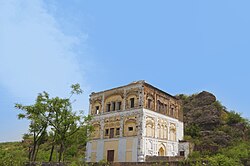
[[File:A Sikh Monument in Rohtas by Usman Ghani.jpg|thumb|The abandoned [[Gurudwara Chowa Sahib]], located near the [[Rohtas Fort]] in [[Pakistan]], commemorates the site where Guru Nanak is popularly believed to have created a water-spring during one of his ''udasis.''{{sfn|Singh|Kapur|2004|p=174}} ]] | [[File:A Sikh Monument in Rohtas by Usman Ghani.jpg|thumb|The abandoned [[Gurudwara Chowa Sahib]], located near the [[Rohtas Fort]] in [[Pakistan]], commemorates the site where Guru Nanak is popularly believed to have created a water-spring during one of his ''udasis.''{{sfn|Singh|Kapur|2004|p=174}} ]] | ||
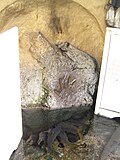
[[File:PunjaSahib.jpg|thumb|Guru Nanak's handprint is believed to be preserved on a boulder at the [[Gurdwara Panja Sahib]] in [[Hasan Abdal]], Pakistan.]] | [[File:PunjaSahib.jpg|thumb|Guru Nanak's handprint is believed to be preserved on a boulder at the [[Gurdwara Panja Sahib]] in [[Hasan Abdal]], Pakistan.]] | ||
| Line 79: | Line 92: | ||
During first quarter of the 16th century, Nanak went on long ''udasiya'' ('journeys') for spiritual pursuits. A verse authored by him states that he visited several places in "''nau-khand''" ('the nine regions of the earth'), presumably the major Hindu and Muslim pilgrimage centres.{{sfn|Grewal|1998|p=7}} | During first quarter of the 16th century, Nanak went on long ''udasiya'' ('journeys') for spiritual pursuits. A verse authored by him states that he visited several places in "''nau-khand''" ('the nine regions of the earth'), presumably the major Hindu and Muslim pilgrimage centres.{{sfn|Grewal|1998|p=7}} | ||
Some modern accounts state that he visited [[Tibet]], most of [[South Asia]], and [[Arabian Peninsula|Arabia]], starting in 1496 at age 27, when he left his family for a thirty-year period.{{sfn|BBC: Religions|2011}}{{sfn|Dilgeer|2008}}{{sfn|Johal|2011|pp=125, note 1}} These claims include Nanak's visit to [[Mount Meru|Mount Sumeru]] of [[Hindu mythology|Indian mythology]], as well as [[Mecca]], [[Baghdad]], Achal Batala, and [[Multan]], where he would debate religious ideas with opposing groups.{{sfn|Callewaert|Snell|1994|pp=26–7}} These stories became widely popular in the 19th and 20th century, and exist in many versions.{{sfn|Lorenzen|1995}}{{sfn|Callewaert|Snell|1994|pp=26–7}} | Some modern accounts state that he visited [[Tibet]], most of [[South Asia]], and [[Arabian Peninsula|Arabia]], starting in 1496 at age 27, when he left his family for a thirty-year period.{{sfn|BBC: Religions|2011}}{{sfn|Dilgeer|2008}}{{sfn|Johal|2011|pp=125, note 1}} These claims include Nanak's visit to [[Mount Meru|Mount Sumeru]] of [[Hindu mythology|Indian mythology]], as well as [[Mecca]], [[Baghdad]], [[Batala|Achal Batala]], and [[Multan]], where he would debate religious ideas with opposing groups.{{sfn|Callewaert|Snell|1994|pp=26–7}} These stories became widely popular in the 19th and 20th century, and exist in many versions.{{sfn|Lorenzen|1995}}{{sfn|Callewaert|Snell|1994|pp=26–7}} | ||
In 1508, Nanak visited the [[Sylhet region]] in [[Bengal]].{{cn|date=January 2021}} The ''janamsakhis'' suggest that Nanak visited the [[Ram Janmabhoomi]] temple in [[Ayodhya]] in 1510–11 CE.{{sfn|Garg|2019}} | In 1508, Nanak visited the [[Sylhet region]] in [[Bengal]].{{cn|date=January 2021}} The ''janamsakhis'' suggest that Nanak visited the [[Ram Janmabhoomi]] temple in [[Ayodhya]] in 1510–11 CE.{{sfn|Garg|2019}} | ||
The Baghdad inscription remains the basis of writing by Indian scholars that Guru Nanak journeyed in the Middle East, with some claiming he visited [[Jerusalem]], [[Mecca]], [[Vatican City|Vatican]], [[Azerbaijan]] and [[Sudan]].{{sfn|Gulati|2008|pp=316–319}} | The Baghdad inscription remains the basis of writing by Indian scholars that Guru Nanak journeyed in the Middle East, with some claiming he visited [[Jerusalem]], [[Mecca]], [[Vatican City|Vatican]], [[Azerbaijan]] and [[Sudan (region)|Sudan]].{{sfn|Gulati|2008|pp=316–319}} | ||
=== Disputes === | === Disputes === | ||
| Line 90: | Line 103: | ||
Some of the stories about Guru Nanak's extensive travels first appear in the 19th-century ''Puratan'' janamsakhi, though even this version does not mention Nanak's travel to Baghdad.{{sfn|Callewaert|Snell|1994|pp=26–7}} Such embellishments and insertion of new stories, according to Callewaert and Snell (1993), closely parallel claims of miracles by [[Pir (Sufism)|Islamic ''pirs'']] found in Sufi ''[[tadhkirah (disambiguation)|tadhkirah]]s'' of the same era, giving reason to believe that these legends may have been written in a competition.{{sfn|McLeod|2007|pp=42–44}}{{sfn|Callewaert|Snell|1994|pp=26–7}} | Some of the stories about Guru Nanak's extensive travels first appear in the 19th-century ''Puratan'' janamsakhi, though even this version does not mention Nanak's travel to Baghdad.{{sfn|Callewaert|Snell|1994|pp=26–7}} Such embellishments and insertion of new stories, according to Callewaert and Snell (1993), closely parallel claims of miracles by [[Pir (Sufism)|Islamic ''pirs'']] found in Sufi ''[[tadhkirah (disambiguation)|tadhkirah]]s'' of the same era, giving reason to believe that these legends may have been written in a competition.{{sfn|McLeod|2007|pp=42–44}}{{sfn|Callewaert|Snell|1994|pp=26–7}} | ||
Another source of dispute has been the Baghdad stone, bearing an inscription{{clarify|date=January 2021}} in a Turkish script. Some interpret the inscription as saying ''Baba Nanak Fakir'' was there in 1511–1512; others read it as saying 1521–1522 (and that he lived in the Middle East for 11 years away from his family). Others, particularly Western scholars, argue that the stone inscription is from the 19th century and the stone is not a reliable evidence that | Another source of dispute has been the Baghdad stone, bearing an inscription{{clarify|date=January 2021}} in a Turkish script. Some interpret the inscription as saying ''Baba Nanak Fakir'' was there in 1511–1512; others read it as saying 1521–1522 (and that he lived in the Middle East for 11 years away from his family). Others, particularly Western scholars, argue that the stone inscription is from the 19th century and the stone is not a reliable evidence that Nanak visited Baghdad in early 16th century.{{sfn|Ménage|1979|pp=16–21}} Moreover, beyond the stone, no evidence or mention of his journey in the Middle East has been found in any other Middle Eastern textual or [[Epigraphy|epigraphical]] records. Claims have been asserted of additional inscriptions, but no one has been able to locate and verify them.{{sfn|McLeod|2004|pp=127–31}} | ||
Novel claims about his travels, as well as claims such as | Novel claims about his travels, as well as claims such as his body vanishing after his death, are also found in later versions and these are similar to the miracle stories in Sufi literature about their ''pirs''. Other direct and indirect borrowings in the Sikh ''janamsakhis'' relating to legends around his journeys are from [[Indian epic poetry|Hindu epics]] and ''[[puranas]],'' and [[Buddhism|Buddhist]] [[Jataka tales|Jataka stories]].{{sfn|Lorenzen|1995}}{{sfn|Oberoi|1994|p=55}}{{sfn|Callewaert|Snell|1994|pp=27–30}} [[File:Bhai Mani Singh's Janamsakhi.jpg|thumb|left|[[Bhai Mani Singh]]'s ''Janamsakhi'']] | ||
== Posthumous biographies == | == Posthumous biographies == | ||
{{more citations needed section|date=April 2017}} | {{more citations needed section|date=April 2017}} | ||
The earliest biographical sources on Nanak's life recognised today are the ''[[janamsakhis]]'' ('birth stories'), which recount the circumstances of | The earliest biographical sources on Nanak's life recognised today are the ''[[janamsakhis]]'' ('birth stories'), which recount the circumstances of his birth in extended detail. | ||
''Gyan-ratanavali'' is the janamsakhi attributed to [[Bhai Mani Singh]], a disciple of [[Guru Gobind Singh]] who was approached by some Sikhs with a request that he should prepare an authentic account of | ''Gyan-ratanavali'' is the janamsakhi attributed to [[Bhai Mani Singh]], a disciple of [[Guru Gobind Singh]]{{Clarify|reason=Is a comma missing here?|date=May 2023}} who was approached by some Sikhs with a request that he should prepare an authentic account of Nanak's life. As such, it is said that Bhai Mani Singh wrote his story with the express intention of correcting [[Heresy|heretical]] accounts of Nanak. | ||
One popular janamsakhi was allegedly written by | One popular janamsakhi was allegedly written by [[Bhai Bala]], a close companion of Nanak. However, the writing style and language employed have left scholars, such as [[Max Arthur Macauliffe]], certain that they were composed after his death.{{sfn|Macauliffe|2004}} According to such scholars, there are good reasons to doubt the claim that the author was a close companion of Guru Nanak and accompanied him on many of his travels. | ||
[[Bhai Gurdas]], a scribe of the [[Guru Granth Sahib]], also wrote about Nanak's life in his ''vars'' ('odes'), which were compiled some time after Nanak's life, though are less detailed than the janamsakhis. | [[Bhai Gurdas]], a scribe of the [[Guru Granth Sahib]], also wrote about Nanak's life in his ''vars'' ('odes'), which were compiled some time after Nanak's life, though are less detailed than the janamsakhis. | ||
== Teachings and legacy == | == Teachings and legacy == | ||
[[File:Fresco of Guru Nanak from | [[File:Fresco of Guru Nanak from above the entrance of the Baoli Sahib located in Goindwal.jpg|alt=|thumb|260x260px|[[Fresco]] of Guru Nanak from Baoli Sahib, [[Goindval|Goindwal]]]] | ||
Nanak's teachings can be found in the Sikh scripture [[Guru Granth Sahib]], as a collection of verses recorded in [[Gurmukhi]]. | Nanak's teachings can be found in the Sikh scripture [[Guru Granth Sahib]], as a collection of verses recorded in [[Gurmukhi]].{{Citation needed|date=May 2023}} | ||
There are three competing theories on | There are three competing theories on Nanak's teachings.{{sfn|Mandair|2013|pp=131–34}} The first, according to Cole and Sambhi (1995, 1997), based on the [[Hagiography|hagiographical]] ''[[Janamsakhis]]'',{{sfn|Cole|Sambhi|1995|pp=9–12}} states that Nanak's teachings and [[Sikhism]] were revelations from God, and not a social protest movement, nor an attempt to reconcile [[Hinduism]] and [[Islam]] in the 15th century.{{sfn|Cole|Sambhi|1997|p=71}} | ||
The second theory states that Nanak was a [[Guru]], not a prophet. According to Singha (2009):{{sfn|Singha|2009a|p=104}} <blockquote>Sikhism does not subscribe to the theory of [[incarnation]] or the concept of [[prophet]] hood. But it has a pivotal concept of Guru. He is not an incarnation of God, not even a prophet. He is an illumined soul.</blockquote> | The second theory states that Nanak was a [[Guru]], not a prophet. According to Singha (2009):{{sfn|Singha|2009a|p=104}} <blockquote>Sikhism does not subscribe to the theory of [[incarnation]] or the concept of [[prophet]] hood. But it has a pivotal concept of Guru. He is not an incarnation of God, not even a prophet. He is an illumined soul.</blockquote> | ||
The third theory is that Guru Nanak is the incarnation of God. This has been supported by many Sikhs including [[Bhai Gurdas]], [[Vir Singh (writer)|Bhai Vir Singh]], Santhok Singh and is supported by the Guru Granth Sahib. Bhai Gurdas says:<ref>{{Cite web |title=Vaaran Bhai Gurdas:- Vaar1-Pauri17-ਜੁਗ ਗਰਦੀ-Anachy of the agesਵਾਰਾਂ ਭਾਈ ਗੁਰਦਾਸ; :-SearchGurbani.com |url=http://www.searchgurbani.com/bhai-gurdas-vaaran/vaar/1/pauri/17/line/1 |access-date=2022-03-24 |website=www.searchgurbani.com |language=en}}</ref> | The third theory is that Guru Nanak is the incarnation of God. This has been supported by many Sikhs including [[Bhai Gurdas]], [[Vir Singh (writer)|Bhai Vir Singh]], [[Kavi Santokh Singh|Santhok Singh]] and is supported by the Guru Granth Sahib.{{Citation needed|date=May 2023}} Bhai Gurdas says:<ref>{{Cite web |title=Vaaran Bhai Gurdas:- Vaar1-Pauri17-ਜੁਗ ਗਰਦੀ-Anachy of the agesਵਾਰਾਂ ਭਾਈ ਗੁਰਦਾਸ; :-SearchGurbani.com |url=http://www.searchgurbani.com/bhai-gurdas-vaaran/vaar/1/pauri/17/line/1 |access-date=2022-03-24 |website=www.searchgurbani.com |language=en}}</ref> | ||
<blockquote> | <blockquote> | ||
| Line 117: | Line 130: | ||
The Guru and God are one; He is the true master and the whole world craves for Him.</blockquote> | The Guru and God are one; He is the true master and the whole world craves for Him.</blockquote> | ||
Additionally in the Guru Granth Sahib it is stated:<ref>{{Cite web |title=Ang 306 of Guru Granth Sahib Ji - SikhiToTheMax |url=https://www.sikhitothemax.org/ang?ang=306&source=G |access-date=2022-03-24 |website=www.sikhitothemax.org |language=en}}</ref> | Additionally, in the Guru Granth Sahib, it is stated:<ref>{{Cite web |title=Ang 306 of Guru Granth Sahib Ji - SikhiToTheMax |url=https://www.sikhitothemax.org/ang?ang=306&source=G |access-date=2022-03-24 |website=www.sikhitothemax.org |language=en}}</ref> | ||
<blockquote> | <blockquote> | ||
| Line 131: | Line 144: | ||
The Guru is God, and God is the Guru, O Nanak; there is no difference between the two, O Siblings of Destiny. ||4||1||8||</blockquote> | The Guru is God, and God is the Guru, O Nanak; there is no difference between the two, O Siblings of Destiny. ||4||1||8||</blockquote> | ||
The hagiographical ''Janamsakhis'' were not written by Nanak, but by later followers without regard for historical accuracy, containing numerous legends and myths created to show respect for Nanak.{{sfn|Singh|2011|pp=2–8}} In Sikhism, the term ''revelation'', as Cole and Sambhi clarify, is not limited to the teachings of Nanak. Rather, they include all [[Sikh gurus|Sikh Gurus]], as well as the words of men and women from Nanak's past, present, and future, who possess divine knowledge intuitively through meditation. The Sikh revelations include the words of non-Sikh [[bhagat|''bhagats'']] (Hindu devotees), some who lived and died before the birth of Nanak, and whose teachings are part of the Sikh scriptures.{{sfn|Cole|Sambhi|1995|pp=46, 52–3, 95–6, 159}} | The hagiographical ''Janamsakhis'' were not written by Nanak, but by later followers without regard for historical accuracy, containing numerous legends and myths created to show respect for Nanak.{{sfn|Singh|2011|pp=2–8}} In Sikhism, the term ''revelation'', as Cole and Sambhi clarify, is not limited to the teachings of Nanak. Rather, they include all [[Sikh gurus|Sikh Gurus]], as well as the words of men and women from Nanak's past, present, and future, who possess divine knowledge intuitively through meditation. The Sikh revelations include the words of non-Sikh [[bhagat|''bhagats'']] (Hindu & Muslim devotees), some who lived and died before the birth of Nanak, and whose teachings are part of the Sikh scriptures.{{sfn|Cole|Sambhi|1995|pp=46, 52–3, 95–6, 159}} | ||
The [[Adi-Granth|Adi Granth]] and successive Sikh Gurus repeatedly emphasised, suggests Mandair (2013), that Sikhism is "not about hearing voices from God, but it is about changing the nature of the human mind, and anyone can achieve direct experience and spiritual perfection at any time."{{sfn|Mandair|2013|pp=131–34}} | The [[Adi-Granth|Adi Granth]] and successive Sikh Gurus repeatedly emphasised, suggests Mandair (2013), that Sikhism is "not about hearing voices from God, but it is about changing the nature of the human mind, and anyone can achieve direct experience and spiritual perfection at any time."{{sfn|Mandair|2013|pp=131–34}} Nanak emphasised that all human beings can have direct access to God without rituals or priests.{{sfn|BBC: Religions|2011}} | ||
The concept of man as elaborated by | The concept of man as elaborated by Nanak, states Mandair (2009), refines and negates the "[[Monotheism|monotheistic]] concept of self/God," where "monotheism becomes almost redundant in the movement and crossings of love."{{sfn|Mandair|2009|pp=372–73}} The goal of man, taught the Sikh Gurus, is to end all dualities of "self and other, I and not-I," attaining the "attendant balance of separation-fusion, self-other, action-inaction, attachment-detachment, in the course of daily life."{{sfn|Mandair|2009|pp=372–73}} | ||
Nanak, and other Sikh Gurus emphasised ''[[bhakti]]'' ('love', 'devotion', or 'worship'), and taught that the spiritual life and secular householder life are intertwined.{{sfn|Nayar|Sandhu|2007|p=106}} In the Sikh perspective, the everyday world is part of an infinite reality, where increased spiritual awareness leads to increased and vibrant participation in the everyday world.{{sfn|Kaur|2004|p=530}} Nanak described living an "active, creative, and practical life" of "truthfulness, fidelity, self-control and purity" as being higher than the [[metaphysics|metaphysical]] truth.{{sfn|Marwha|2006|p=205}} | |||
Through popular tradition, Nanak's teaching is understood to be practised in three ways:{{sfn|McLeod|2009|pp=139–40}} | Through popular tradition, Nanak's teaching is understood to be practised in three ways:{{sfn|McLeod|2009|pp=139–40}} | ||
| Line 146: | Line 159: | ||
=== Legacy === | === Legacy === | ||
Nanak is the founder of [[Sikhism]].{{sfn|Cole|Sambhi|1978|pp=[https://archive.org/details/sikhs00cole/age/9 9–10]}}{{sfn|Moreno|Colino|2010|p=207}} The fundamental beliefs of Sikhism, articulated in the sacred scripture [[Guru Granth Sahib]], include faith and meditation on the name of the one creator; unity of all humankind; engaging in [[selfless service]], striving for social justice for the [[Sarbat da bhala|benefit and prosperity of all]]; and honest conduct and livelihood while living a householder's life.{{sfn|Kalsi|2007|pp=41–50}}{{sfn|Cole|Sambhi|1995|p=200}}{{sfn|Teece|2004|p=4}} | |||
The Guru Granth Sahib is worshipped as the supreme authority of Sikhism and is considered the final and perpetual guru of Sikhism. As the first guru of Sikhism, | The Guru Granth Sahib is worshipped as the supreme authority of Sikhism and is considered the final and perpetual guru of Sikhism. As the first guru of Sikhism, Nanak contributed a total of 974 hymns to the book.{{sfn|Shackle|Mandair|2013|pp=xviii–xix}} | ||
== Influences == | == Influences == | ||
Many Sikhs believe that | [[File:Miniature painting of Guru Nanak listening to musicians, circa 1680.jpg|thumb|Miniature painting of Guru Nanak listening to musicians, circa 1680]] | ||
Many Sikhs believe that Nanak's message was divinely revealed, as his own words in [[Guru Granth Sahib]] state that his teachings are as he has received them from the Creator Himself. The critical event of his life in [[Sultanpur Lodhi|Sultanpur]], in which he returned after three days with enlightenment, also supports this belief.{{sfn|Singh|1982|pp=12, 18}}{{failed verification|date=July 2020}} | |||
Many modern historians give weight to his teachings' linkage with the pre-existing ''[[bhakti]]'',{{sfn|Lorenzen|1995|pp=1–2}} [[Sant (religion)|''sant'']],{{efn-lr|"In its earliest stage Sikhism was clearly a movement within the Hindu tradition; Nanak was raised a Hindu and eventually belonged to the Sant tradition of northern India." {{harv|McLeod|2019}}}} and ''[[wali]]'' of Hindu/Islamic tradition.{{sfn|Fenech|2014}} Scholars state that in its origins, | Many modern historians give weight to his teachings' linkage with the pre-existing ''[[bhakti]]'',{{sfn|Lorenzen|1995|pp=1–2}} [[Sant (religion)|''sant'']],{{efn-lr|"In its earliest stage Sikhism was clearly a movement within the Hindu tradition; Nanak was raised a Hindu and eventually belonged to the Sant tradition of northern India." {{harv|McLeod|2019}}}} and ''[[wali]]'' of Hindu/Islamic tradition.{{sfn|Fenech|2014}} Scholars state that in its origins, Nanak and Sikhism were influenced by the ''nirguni'' ('formless God') tradition of the [[Bhakti movement]] in medieval India.{{efn-lr|name=David Lorenzen 1995 pages 1–2|"Historically, Sikh religion derives from this [[Bhajan|nirguni]] current of bhakti religion." {{harv|Lorenzen|1995|pp=1–2}}}} However, some historians do not see evidence of Sikhism as simply an extension of the Bhakti movement.{{sfn|Singha|2009b|p=8}}{{sfn|Grewal|1998|pp=28–}} Sikhism, for instance, disagreed with some views of Bhakti saints [[Kabir]] and [[Ravidas]].{{sfn|Singha|2009b|p=8}}{{sfn|Pruthi|2004|pp=202–03}} | ||
The roots of the Sikh tradition are perhaps in the [[Sant (religion)|sant]]-tradition of India whose ideology grew to become the Bhakti tradition.{{efn-lr|name=Louis Fenech 2014 page 35|"Technically this would place the Sikh community's origins at a much further remove than 1469, perhaps to the dawning of the Sant movement, which possesses clear affinities to Guru Nanak's thought sometime in the tenth century. The predominant ideology of the Sant ''[[Guru–shishya tradition|parampara]]'' in turn corresponds in many respects to the much wider devotional Bhakti tradition in northern India." {{harv|Fenech|2014|p=35}}}} Fenech (2014) suggests that:{{sfn|Fenech|2014}} <blockquote>Indic mythology permeates the Sikh sacred canon, the ''Guru Granth Sahib'' and the secondary canon, the ''[[Dasam Granth]]'' and adds delicate nuance and substance to the sacred symbolic universe of the Sikhs of today and of their past ancestors.{{efn-lr|"Few Sikhs would mention these Indic texts and ideologies in the same breadth as the Sikh tradition, let alone trace elements of their tradition to this chronological and ideological point, '''despite the fact''' that the Indic mythology permeates the Sikh sacred canon, the ''Guru Granth Sahib'' and the secondary canon, the ''Dasam Granth'',<ref>Rinehart 2011</ref> and adds delicate nuance and substance to the sacred symbolic universe of the Sikhs of today and of their past ancestors." {{harv|Fenech|2014|p=36}}}} | The roots of the Sikh tradition are perhaps in the [[Sant (religion)|sant]]-tradition of India whose ideology grew to become the Bhakti tradition.{{efn-lr|name=Louis Fenech 2014 page 35|"Technically this would place the Sikh community's origins at a much further remove than 1469, perhaps to the dawning of the Sant movement, which possesses clear affinities to Guru Nanak's thought sometime in the tenth century. The predominant ideology of the Sant ''[[Guru–shishya tradition|parampara]]'' in turn corresponds in many respects to the much wider devotional Bhakti tradition in northern India." {{harv|Fenech|2014|p=35}}}} Fenech (2014) suggests that:{{sfn|Fenech|2014}} <blockquote>Indic mythology permeates the Sikh sacred canon, the ''Guru Granth Sahib'' and the secondary canon, the ''[[Dasam Granth]]'' and adds delicate nuance and substance to the sacred symbolic universe of the Sikhs of today and of their past ancestors.{{efn-lr|"Few Sikhs would mention these Indic texts and ideologies in the same breadth as the Sikh tradition, let alone trace elements of their tradition to this chronological and ideological point, '''despite the fact''' that the Indic mythology permeates the Sikh sacred canon, the ''Guru Granth Sahib'' and the secondary canon, the ''Dasam Granth'',<ref>Rinehart 2011</ref> and adds delicate nuance and substance to the sacred symbolic universe of the Sikhs of today and of their past ancestors." {{harv|Fenech|2014|p=36}}}} | ||
| Line 160: | Line 174: | ||
==In the Bahá'í Faith== | ==In the Bahá'í Faith== | ||
{{See also|Baháʼí Faith in India}} | {{See also|Baháʼí Faith in India}} | ||
In a letter, dated 27 October 1985, to the [[Spiritual Assembly|National Spiritual Assembly of the Bahá'ís of India]], the [[Universal House of Justice]] stated that | In a letter, dated 27 October 1985, to the [[Spiritual Assembly|National Spiritual Assembly of the Bahá'ís of India]], the [[Universal House of Justice]] stated that Nanak was endowed with a "saintly character" and that he was:{{sfn|Sarwal|1996}} <blockquote>...inspired to reconcile the religions of Hinduism and Islám, the followers of which religions had been in violent conflict.... The Bahá'ís thus view Guru Nanak as a 'saint of the highest order'.</blockquote> | ||
==In Hinduism== | ==In Hinduism== | ||
[[File:Mural of Guru Nanak from Sui Simbli temple in Jammu.jpg|thumb|Mural of Guru Nanak from a [[Hindu temple]] in [[Jammu division|Jammu]]]] | [[File:Mural of Guru Nanak from Sui Simbli temple in Jammu.jpg|thumb|Mural of Guru Nanak from a [[Hindu temple]] in [[Jammu division|Jammu]]]] | ||
Nanak is highly influential amongst [[Sindhi Hindus]], the majority of whom follow [[Nanakpanthi]] teachings. <ref>{{Cite web|url=https://www.thefridaytimes.com/2018/04/13/nanakpanthi-saints-of-sindh/|title=Nanakpanthi Saints of Sindh|first=Zulfiqar Ali|last=Kalhoro|date=13 April 2018}}</ref><ref>{{Cite journal|url=https://www.academia.edu/41323099|title=Inderjeet Singh (2017). Sindhi Hindus & Nanakpanthis in Pakistan. Abstracts of Sikh Studies, Vol. XIX, No.4. p35-43|first=Inderjeet|last=Singh|date=1 October 2017|journal=Abstracts of Sikh Studies|via=www.academia.edu}}</ref> | |||
==In popular culture== | ==In popular culture== | ||
* A Punjabi movie was released in 2015 named ''[[Nanak Shah Fakir]]'', which is based on the life of | * A Punjabi movie was released in 2015 named ''[[Nanak Shah Fakir]]'', which is based on the life of Nanak, directed by Sartaj Singh Pannu{{Citation needed|date=May 2023}} | ||
* ''[[Allegory: A Tapestry of Guru Nanak's Travels]]'' is a 2021–22 docuseries about | * ''[[Allegory: A Tapestry of Guru Nanak's Travels]]'' is a 2021–22 docuseries about Nanak's travels in nine different countries{{Citation needed|date=May 2023}} | ||
==Places visited== | ==Places visited== | ||
{{More citations needed|section|date=May 2023}} | |||
===Uttarakhand=== | ===Uttarakhand=== | ||
| Line 185: | Line 200: | ||
===Delhi=== | ===Delhi=== | ||
* [[Gurdwara Nanak Piao]], [[Delhi]] | * [[Gurdwara Nanak Piao]], [[Delhi]] | ||
* Gurudwara Majnu Ka Tila, [[Delhi]]<ref>{{cite news |title=A Gurdwara steeped in history |url=http://timesofindia.indiatimes.com/life-style/A-Gurdwara-steeped-in-history/articleshow/10552745.cms |work=The Times of India |date=25 Mar 2012}}</ref> | * Gurudwara Majnu Ka Tila, [[Delhi]]<ref>{{cite news |title=A Gurdwara steeped in history |url=http://timesofindia.indiatimes.com/life-style/A-Gurdwara-steeped-in-history/articleshow/10552745.cms |work=The Times of India |date=25 Mar 2012}}</ref>{{Better source needed|reason=The current source is insufficiently reliable ([[WP:NOTRS]]).|date=May 2023}} | ||
===Gujarat=== | ===Gujarat=== | ||
| Line 205: | Line 220: | ||
* [[Dera Baba Nanak]] | * [[Dera Baba Nanak]] | ||
* Gurudwara Manji Sahib, [[Kiratpur Sahib]] | * Gurudwara Manji Sahib, [[Kiratpur Sahib]] | ||
* [[Batala|Achal Batala]] | * [[Batala|Achal Batala]]<ref>{{cite book |date=1993 |title=The Sikh Review, Volume 41, Issues 469–480 |publisher=Sikh Cultural Centre |page=14 }}</ref> | ||
===Sikkim=== | ===Sikkim=== | ||
| Line 248: | Line 263: | ||
== See also == | == See also == | ||
* [[Fatehabad, Punjab]] | * [[Fatehabad, Punjab]] | ||
* [[List of places named after Guru Nanak Dev]] | * [[List of places named after Guru Nanak Dev]] | ||
* [[Bebe Nanaki]] | * [[Bebe Nanaki]] | ||
== Notes == | == Notes == | ||
{{notelist-lr}} | {{notelist-lr}} | ||
== | == References == | ||
{{Reflist|22em}} | {{Reflist|22em}} | ||
== Bibliography == | === Bibliography === | ||
{{refbegin|30em}} | {{refbegin|30em}} | ||
*{{cite web| title = Bhai Gurdas Vaaran | *{{cite web| title = Bhai Gurdas Vaaran | ||
| Line 606: | Line 619: | ||
{{refend}} | {{refend}} | ||
== | == Further reading == | ||
* [[Sahib Singh|Singh, Sahib]]. ''Guru Nanak Dev and His Teachings''. | * [[Sahib Singh|Singh, Sahib]]. ''Guru Nanak Dev and His Teachings''. | ||
*{{Cite book|last1=Singh|first1=Shamsher|title=[[Life of Guru Nanak Through Pictures]]|last2=Virdi|first2=Narendra Singh|publisher=Modern Sahit Academy|others=[[Phulan Rani]]|year=1969}} | * {{Cite book|last1=Singh|first1=Shamsher|title=[[Life of Guru Nanak Through Pictures]]|last2=Virdi|first2=Narendra Singh|publisher=Modern Sahit Academy|others=[[Phulan Rani]]|year=1969}} | ||
== External links == | |||
* | * | ||
{{s-start}} | {{s-start}} | ||
| Line 621: | Line 634: | ||
}} | }} | ||
{{s-end}} | {{s-end}} | ||
{{Navboxes|list= | |||
{{Writers of Guru Granth Sahib}} | {{Writers of Guru Granth Sahib}} | ||
{{Sikhism}} | {{Sikhism}} | ||
{{Indian philosophy}} | {{Indian philosophy}} | ||
}} | |||
{{Authority control}} | {{Authority control}} | ||
Latest revision as of 05:21, 14 August 2023
Guru Nanak | |
|---|---|
 19th-century mural painting from Gurdwara Baba Atal depicting Nanak | |
| Personal | |
| Born | Nanak 15 April 1469 or Katak Pooranmashi according to Sikh tradition[1] |
| Died | 22 September 1539 (aged 70) |
| Resting place | Gurdwara Darbar Sahib Kartarpur, Kartarpur, Pakistan |
| Religion | Sikhism |
| Spouse | Mata Sulakhani |
| Children | Sri Chand Lakhmi Das |
| Parents | Mehta Kalu and Mata Tripta |
| Known for | Founder of Sikhism |
| Other names | First Master Peer Balagdaan (in Afghanistan)[2] Nanakachryaya (in Sri Lanka)[3] Nanak Lama (in Tibet)[4] Guru Rinpoche (in Sikkim and Bhutan)[5] Nanak Rishi (in Nepal)[6] Nanak Peer (in Iraq)[7] Vali Hindi (in Saudi Arabia)[8] Nanak Vali (in Egypt)[9] Nanak Kadamdar (in Russia)[10] Baba Foosa (in China)[11] |
| Signature |  |
| Religious career | |
| Based in | Kartarpur |
| Successor | Guru Angad |
| Part of a series on |
| Sikhism |
|---|
 |
Gurū Nānak (15 April 1469 – 22 September 1539; Gurmukhi: ਗੁਰੂ ਨਾਨਕ; pronunciation: [gʊɾuː naːnəkᵊ],  pronunciation), also referred to as Bābā Nānak ('father Nānak'),[12] was the founder of Sikhism and is the first of the ten Sikh Gurus. His birth is celebrated worldwide as Guru Nanak Gurpurab on Katak Pooranmashi ('full-moon of Kattak'), i.e. October–November.
Nanak is said to have travelled far and wide across Asia teaching people the message of ik onkar (ੴ, 'one God'), who dwells in every one of his creations and constitutes the eternal Truth.[13] With this concept, he would set up a unique spiritual, social, and political platform based on equality, fraternal love, goodness, and virtue.[14][15][16]
Nanak's words are registered in the form of 974 poetic hymns, or shabda, in the holy text of Sikhism, the Guru Granth Sahib, with some of the major prayers being the Japji Sahib (jap, 'to recite'; ji and sahib are suffixes signifying respect); the Asa di Var ('ballad of hope'); and the Sidh Gosht ('discussion with the Siddhas'). It is part of Sikh religious belief that the spirit of Nanak's sanctity, divinity, and religious authority had descended upon each of the nine subsequent Gurus when the Guruship was devolved on to them.
Biography[edit | edit source]
Birth[edit | edit source]

Nanak was born on 15 April 1469 at Rāi Bhoi Kī Talvaṇḍī village (present-day Nankana Sahib, Punjab, Pakistan) in the Lahore province of the Delhi Sultanate,[17][18] although according to one tradition, he was born in the Indian month of Kārtik or November, known as Kattak in Punjabi.[1]
Most janamsakhis (ਜਨਮਸਾਖੀ, 'birth stories'), or traditional biographies of Nanak, mention that he was born on the third day of the bright lunar fortnight, in the Baisakh month (April) of Samvat 1526.[1] These include the Puratan ('traditional' or 'ancient') janamsakhi, Miharban janamsakhi, Gyan-ratanavali by Bhai Mani Singh, and the Vilayat Vali janamsakhi.[19] Gurbilas Patashahi 6, written 1718, also attributed to Bhai Mani Singh contradicts Mani Singh’s Janamsakhi as it instead says Guru Nanak was born on the full moon of Katak.[20] The Sikh records state that Nanak died on the 10th day of the Asauj month of Samvat 1596 (22 September 1539 CE), at the age of 70 years, 5 months, and 7 days. This further suggests that he was born in the month of Vaisakh (April), not Kattak (November).[21]
Kattak birthdate[edit | edit source]
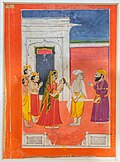
_13.jpg)
In as late as 1815, during the reign of Ranjit Singh, the festival commemorating Nanak's birthday was held in April at the place of his birth, known by then as Nankana Sahib.[19] However, the anniversary of Nanak's birth—the Gurpurab (gur + purab, 'celebration')—subsequently came to be celebrated on the full moon day of the Kattak month in November. The earliest record of such a celebration in Nankana Sahib is from 1868 CE.[22]
There may be several reasons for the adoption of the Kattak birthdate by the Sikh community. For one, it may have been the date of Nanak's enlightenment or "spiritual birth" in 1496, as suggested by the Dabestan-e Mazaheb.[citation needed]
Some of the sources that support the Katak birthday incident:
The Bala Janamasakhi supports the Kattak birth tradition. It is the only Janamsakhi that does. Bhai Bala is said to have obtained Nanak's horoscope from Nanak's uncle Lalu, according to which, Nanak was born on a date corresponding to 20 October 1469 CE. However, this janamsakhi was written by Handalis—a sect of Sikhs who followed a Sikh-convert known as Handal—attempting to depict the founder as superior to Nanak.[23] According to a superstition prevailing in contemporary northern India, a child born in the Kattak month was believed to be weak and unlucky, hence why the work states that Nanak was born in that month.[23]
Bhai Gurdas, having written on a full-moon-day of the Kattak month several decades after Nanak's death, mentions that Nanak had "obtained omniscience" on the same day, and it was now the author's turn to "get divine light."[24]
According to eyewitness Sikh chronicles, known as Bhatt Vahis, Guru Nanak was born on the full moon of Katak.[25]
Gurbilas Patashahi 6 written 1718[26] attributed to Bhai Mani Singh says Guru Nanak was born on the full moon of Katak.[20]
Meham Parkash written in 1776 also says Guru Nanak was born on the full moon of Katak.[20]
Kesar Singh Chibber’s Bansavalinama Dasan Patashahia Ka meaning genealogy of the ten emperors, written in 1769,[27] says Guru Nanak was born on the full moon of Katak as well.[20]
Gurpurnali written in 1727 and Guru Tegh Bahadur Malwe da Safar written in 1716 both mention Guru Nanank being born on the full moon of Katak.[20]
Nanak Chandrodaya Sanskrit Janamsakhi from 1797 and Janam Sakhi Baba Nanak by Sant Das Chibber from the 18th century both mention Guru Nanak being born on the full moon of katak.[20]
Gurpur Parkash Granth written by Sant Ren Singh based on a granth written by Binod Singh states Guru Nanak was born on the full moon of Katak.[28]
According to Max Arthur Macauliffe (1909), a Hindu festival held in the 19th century on Kartik Purnima in Amritsar attracted a large number of Sikhs. The Sikh community leader Giani Sant Singh did not like this, thus starting a festival at the Sikh shrine of the Golden Temple on the same day, presenting it as the birth anniversary celebration of Guru Nanak.[29]
Macauliffe also notes that Vaisakh (March–April) already saw a number of important festivals—such as Holi, Rama Navami, and Vaisakhi—therefore people would be busy in agricultural activities after the harvest festival of Baisakhi. Therefore, holding Nanak's birth anniversary celebrations immediately after Vaisakhi would have resulted in thin attendance, and therefore, smaller donations for the Sikh shrines. On the other hand, by the Kattak full moon day, the major Hindu festival of Diwali was already over, and the peasants—who had surplus cash from crop sales—were able to donate generously.[30]
Family and early life[edit | edit source]
Nanak's parents, including father Kalyan Chand Das Bedi (commonly shortened to Mehta Kalu) and mother Mata Tripta,[31] were both Hindu Khatris and employed as merchants.[32][33] His father, in particular, was the local patwari (accountant) for crop revenue in the village of Talwandi.[34]
According to Sikh traditions, the birth and early years of Nanak's life were marked with many events that demonstrated that Nanak had been blessed with divine grace.[35] Commentaries on his life give details of his blossoming awareness from a young age. For instance, at the age of five, Nanak is said to have voiced interest in divine subjects. At age seven, his father enrolled him at the village school, as per custom.[36] Notable lore recounts that, as a child, Nanak astonished his teacher by describing the implicit symbolism of the first letter of the alphabet, resembling the mathematical version of one, as denoting the unity or oneness of God.[37] Other stories of his childhood refer to strange and miraculous events about Nanak, such as the one witnessed by Rai Bular, in which the sleeping child's head was shaded from the harsh sunlight by, in one account, by the stationary shadow of a tree[citation needed] or, in another, by a venomous cobra.[38]

Nanaki, Nanak's only sister, was five years older than him. In 1475, she married and moved to Sultanpur.[citation needed] Jai Ram, Nanaki's husband, was employed at a modikhana (a storehouse for revenues collected in non-cash form), in the service of the Delhi Sultanate's Lahore governor Daulat Khan, at which Ram would help Nanak get a job.[40] Nanak moved to Sultanpur, and started working at the modikhana around the age of 16.[citation needed]
As a young man,[lower-roman 1] Nanak married Sulakhani, daughter of Mūl Chand (aka Mula)[lower-roman 2][lower-roman 3] and Chando Raṇi.[citation needed] They were married on 24 September 1487, in the town of Batala,[41] and would go on to have two sons, Sri Chand and Lakhmi Chand[40] (or Lakhmi Das).[lower-roman 4][42] Nanak lived in Sultanpur until c. 1500,[40] which would be a formative time for him, as the puratan janamsakhi suggests, and in his numerous allusions to governmental structure in his hymns, most likely gained at this time.[43]
Final years[edit | edit source]

Around the age of 55, Nanak settled in Kartarpur, living there until his death in September 1539. During this period, he went on short journeys to the Nath yogi centre of Achal, and the Sufi centres of Pakpattan and Multan. By the time of his death, Nanak had acquired several followers in the Punjab region, although it is hard to estimate their number based on the extant historical evidence.[44] The followers of Nanak were called Kartārīs (meaning 'the people who belonged to the village of Kartarpur') by others.[45]
Nanak appointed Bhai Lehna as the successor Guru, renaming him as Guru Angad, meaning "one's very own" or "part of you". Shortly after proclaiming his successor, Nanak died on 22 September 1539 in Kartarpur, at the age of 70. According to Sikh hagiography, his body was never found. When the quarreling Hindus and Muslims tugged at the sheet covering his body, they found instead a heap of flowers—and so Nanak’s simple faith would, in course of time, flower into a religion, beset by its own contradictions and customary practices.[46]


Odysseys (Udasis)[edit | edit source]
During first quarter of the 16th century, Nanak went on long udasiya ('journeys') for spiritual pursuits. A verse authored by him states that he visited several places in "nau-khand" ('the nine regions of the earth'), presumably the major Hindu and Muslim pilgrimage centres.[40]
Some modern accounts state that he visited Tibet, most of South Asia, and Arabia, starting in 1496 at age 27, when he left his family for a thirty-year period.[35][48][49] These claims include Nanak's visit to Mount Sumeru of Indian mythology, as well as Mecca, Baghdad, Achal Batala, and Multan, where he would debate religious ideas with opposing groups.[50] These stories became widely popular in the 19th and 20th century, and exist in many versions.[51][50]
In 1508, Nanak visited the Sylhet region in Bengal.[citation needed] The janamsakhis suggest that Nanak visited the Ram Janmabhoomi temple in Ayodhya in 1510–11 CE.[52]
The Baghdad inscription remains the basis of writing by Indian scholars that Guru Nanak journeyed in the Middle East, with some claiming he visited Jerusalem, Mecca, Vatican, Azerbaijan and Sudan.[53]
Disputes[edit | edit source]
The hagiographic details are a subject of dispute, with modern scholarship questioning the details and authenticity of many claims. For example, Callewaert and Snell (1994) state that early Sikh texts do not contain such stories.[50] From when the travel stories first appear in hagiographic accounts of Guru Nanak, centuries after his death, they continue to become more sophisticated as time goes on, with the late phase Puratan version describing four missionary journeys, which differ from the Miharban version.[50][54]
Some of the stories about Guru Nanak's extensive travels first appear in the 19th-century Puratan janamsakhi, though even this version does not mention Nanak's travel to Baghdad.[50] Such embellishments and insertion of new stories, according to Callewaert and Snell (1993), closely parallel claims of miracles by Islamic pirs found in Sufi tadhkirahs of the same era, giving reason to believe that these legends may have been written in a competition.[55][50]
Another source of dispute has been the Baghdad stone, bearing an inscription[clarification needed] in a Turkish script. Some interpret the inscription as saying Baba Nanak Fakir was there in 1511–1512; others read it as saying 1521–1522 (and that he lived in the Middle East for 11 years away from his family). Others, particularly Western scholars, argue that the stone inscription is from the 19th century and the stone is not a reliable evidence that Nanak visited Baghdad in early 16th century.[56] Moreover, beyond the stone, no evidence or mention of his journey in the Middle East has been found in any other Middle Eastern textual or epigraphical records. Claims have been asserted of additional inscriptions, but no one has been able to locate and verify them.[57]
Novel claims about his travels, as well as claims such as his body vanishing after his death, are also found in later versions and these are similar to the miracle stories in Sufi literature about their pirs. Other direct and indirect borrowings in the Sikh janamsakhis relating to legends around his journeys are from Hindu epics and puranas, and Buddhist Jataka stories.[51][58][59]

Posthumous biographies[edit | edit source]
 | This section needs more citations. (April 2017) |
The earliest biographical sources on Nanak's life recognised today are the janamsakhis ('birth stories'), which recount the circumstances of his birth in extended detail.
Gyan-ratanavali is the janamsakhi attributed to Bhai Mani Singh, a disciple of Guru Gobind Singh[clarification needed] who was approached by some Sikhs with a request that he should prepare an authentic account of Nanak's life. As such, it is said that Bhai Mani Singh wrote his story with the express intention of correcting heretical accounts of Nanak.
One popular janamsakhi was allegedly written by Bhai Bala, a close companion of Nanak. However, the writing style and language employed have left scholars, such as Max Arthur Macauliffe, certain that they were composed after his death.[36] According to such scholars, there are good reasons to doubt the claim that the author was a close companion of Guru Nanak and accompanied him on many of his travels.
Bhai Gurdas, a scribe of the Guru Granth Sahib, also wrote about Nanak's life in his vars ('odes'), which were compiled some time after Nanak's life, though are less detailed than the janamsakhis.
Teachings and legacy[edit | edit source]

Nanak's teachings can be found in the Sikh scripture Guru Granth Sahib, as a collection of verses recorded in Gurmukhi.[citation needed]
There are three competing theories on Nanak's teachings.[60] The first, according to Cole and Sambhi (1995, 1997), based on the hagiographical Janamsakhis,[61] states that Nanak's teachings and Sikhism were revelations from God, and not a social protest movement, nor an attempt to reconcile Hinduism and Islam in the 15th century.[62]
The second theory states that Nanak was a Guru, not a prophet. According to Singha (2009):[63]
Sikhism does not subscribe to the theory of incarnation or the concept of prophet hood. But it has a pivotal concept of Guru. He is not an incarnation of God, not even a prophet. He is an illumined soul.
The third theory is that Guru Nanak is the incarnation of God. This has been supported by many Sikhs including Bhai Gurdas, Bhai Vir Singh, Santhok Singh and is supported by the Guru Granth Sahib.[citation needed] Bhai Gurdas says:[64]
ਗੁਰ ਪਰਮੇਸਰੁ ਇਕੁ ਹੈ ਸਚਾ ਸਾਹੁ ਜਗਤੁ ਵਣਜਾਰਾ।
The Guru and God are one; He is the true master and the whole world craves for Him.
Additionally, in the Guru Granth Sahib, it is stated:[65]
ਨਾਨਕ ਸੇਵਾ ਕਰਹੁ ਹਰਿ ਗੁਰ ਸਫਲ ਦਰਸਨ ਕੀ ਫਿਰਿ ਲੇਖਾ ਮੰਗੈ ਨ ਕੋਈ ॥੨॥
O Nanak, serve the Guru, the Lord Incarnate; the Blessed Vision of His Darshan is profitable, and in the end, you shall not be called to account. ||2||
Guru Ram Das says:[66]
ਗੁਰ ਗੋਵਿੰਦੁ ਗੋੁਵਿੰਦੁ ਗੁਰੂ ਹੈ ਨਾਨਕ ਭੇਦੁ ਨ ਭਾਈ ॥੪॥੧॥੮॥
The Guru is God, and God is the Guru, O Nanak; there is no difference between the two, O Siblings of Destiny. ||4||1||8||
The hagiographical Janamsakhis were not written by Nanak, but by later followers without regard for historical accuracy, containing numerous legends and myths created to show respect for Nanak.[67] In Sikhism, the term revelation, as Cole and Sambhi clarify, is not limited to the teachings of Nanak. Rather, they include all Sikh Gurus, as well as the words of men and women from Nanak's past, present, and future, who possess divine knowledge intuitively through meditation. The Sikh revelations include the words of non-Sikh bhagats (Hindu & Muslim devotees), some who lived and died before the birth of Nanak, and whose teachings are part of the Sikh scriptures.[68]
The Adi Granth and successive Sikh Gurus repeatedly emphasised, suggests Mandair (2013), that Sikhism is "not about hearing voices from God, but it is about changing the nature of the human mind, and anyone can achieve direct experience and spiritual perfection at any time."[60] Nanak emphasised that all human beings can have direct access to God without rituals or priests.[35]
The concept of man as elaborated by Nanak, states Mandair (2009), refines and negates the "monotheistic concept of self/God," where "monotheism becomes almost redundant in the movement and crossings of love."[69] The goal of man, taught the Sikh Gurus, is to end all dualities of "self and other, I and not-I," attaining the "attendant balance of separation-fusion, self-other, action-inaction, attachment-detachment, in the course of daily life."[69]
Nanak, and other Sikh Gurus emphasised bhakti ('love', 'devotion', or 'worship'), and taught that the spiritual life and secular householder life are intertwined.[70] In the Sikh perspective, the everyday world is part of an infinite reality, where increased spiritual awareness leads to increased and vibrant participation in the everyday world.[71] Nanak described living an "active, creative, and practical life" of "truthfulness, fidelity, self-control and purity" as being higher than the metaphysical truth.[72]
Through popular tradition, Nanak's teaching is understood to be practised in three ways:[73]
- Vand Shhako (ਵੰਡ ਛਕੋ, 'share & consume'): Share with others, help those who are in need, so you may eat together;
- Kirat Karo ('work honestly'): Earn an honest living, without exploitation or fraud; and
- Naam Japo (ਨਾਮ ਜਪੋ, 'recite His name'): Meditate on God's name, so to feel His presence and control the five thieves of the human personality.
Legacy[edit | edit source]
Nanak is the founder of Sikhism.[74][75] The fundamental beliefs of Sikhism, articulated in the sacred scripture Guru Granth Sahib, include faith and meditation on the name of the one creator; unity of all humankind; engaging in selfless service, striving for social justice for the benefit and prosperity of all; and honest conduct and livelihood while living a householder's life.[76][77][78]
The Guru Granth Sahib is worshipped as the supreme authority of Sikhism and is considered the final and perpetual guru of Sikhism. As the first guru of Sikhism, Nanak contributed a total of 974 hymns to the book.[79]
Influences[edit | edit source]

Many Sikhs believe that Nanak's message was divinely revealed, as his own words in Guru Granth Sahib state that his teachings are as he has received them from the Creator Himself. The critical event of his life in Sultanpur, in which he returned after three days with enlightenment, also supports this belief.[80][failed verification]
Many modern historians give weight to his teachings' linkage with the pre-existing bhakti,[81] sant,[lower-roman 5] and wali of Hindu/Islamic tradition.[82] Scholars state that in its origins, Nanak and Sikhism were influenced by the nirguni ('formless God') tradition of the Bhakti movement in medieval India.[lower-roman 6] However, some historians do not see evidence of Sikhism as simply an extension of the Bhakti movement.[83][84] Sikhism, for instance, disagreed with some views of Bhakti saints Kabir and Ravidas.[83][85]
The roots of the Sikh tradition are perhaps in the sant-tradition of India whose ideology grew to become the Bhakti tradition.[lower-roman 7] Fenech (2014) suggests that:[82]
Indic mythology permeates the Sikh sacred canon, the Guru Granth Sahib and the secondary canon, the Dasam Granth and adds delicate nuance and substance to the sacred symbolic universe of the Sikhs of today and of their past ancestors.[lower-roman 8]
In the Bahá'í Faith[edit | edit source]
In a letter, dated 27 October 1985, to the National Spiritual Assembly of the Bahá'ís of India, the Universal House of Justice stated that Nanak was endowed with a "saintly character" and that he was:[87]
...inspired to reconcile the religions of Hinduism and Islám, the followers of which religions had been in violent conflict.... The Bahá'ís thus view Guru Nanak as a 'saint of the highest order'.
In Hinduism[edit | edit source]

Nanak is highly influential amongst Sindhi Hindus, the majority of whom follow Nanakpanthi teachings. [88][89]
In popular culture[edit | edit source]
- A Punjabi movie was released in 2015 named Nanak Shah Fakir, which is based on the life of Nanak, directed by Sartaj Singh Pannu[citation needed]
- Allegory: A Tapestry of Guru Nanak's Travels is a 2021–22 docuseries about Nanak's travels in nine different countries[citation needed]
Places visited[edit | edit source]
| This section needs more citations. (May 2023) |
Uttarakhand[edit | edit source]
Andhra Pradesh[edit | edit source]
- Gurudwara Pehli Patshahi Guntur, Andhra Pradesh
Bihar[edit | edit source]
Delhi[edit | edit source]
- Gurdwara Nanak Piao, Delhi
- Gurudwara Majnu Ka Tila, Delhi[90][better source needed]
Gujarat[edit | edit source]
- Gurdwara Pehli Patshahi, Lakhpat, Gujarat
Haryana[edit | edit source]
Jammu and Kashmir[edit | edit source]
Punjab[edit | edit source]
- Gurudwara Shri Ber Sahib, Sultanpur Lodhi
- Gurudwara Shri Hatt Sahib, Sultanpur Lodhi
- Gurudwara Shri Kothri Sahib, Sultanpur Lodhi
- Gurudwara Shri Guru Ka Bagh, Sultanpur Lodhi
- Gurudwara Shri Sant Ghat, Sultanpur Lodhi
- Gurudwara Shri Antaryamta, Sultanpur Lodhi
- Dera Baba Nanak
- Gurudwara Manji Sahib, Kiratpur Sahib
- Achal Batala[91]
Sikkim[edit | edit source]
- Gurudwara Nanak Lama, Chungthang, Sikkim
- Gurudongmar Lake
Odisha[edit | edit source]
- Gurdwara Guru Nanak Datan Sahib, Cuttack, Odisha
- Gurdwara Bauli Math Sahib, Puri, Odisha
Pakistan[edit | edit source]
- Nankana Sahib
- Gurdwara Darbar Sahib Kartarpur, Kartarpur
- Gurdwara Sacha Sauda, Farooqabad
- Sultanpur Lodhi
- Gurdwara Rori Sahib, Gujranwala
- Gurdwara Beri Sahib, Sialkot
- Gurdwara Panja Sahib, Hasan Abdal
- Gurudwara Chowa Sahib, Rohtas Fort
- Narowal
Bangladesh[edit | edit source]
Afghanistan[edit | edit source]
Iran[edit | edit source]
- Gurudwara Pehli Patshahi, Mashhad
Iraq[edit | edit source]
Sri Lanka[edit | edit source]
- Gurudwara Pehli Patshahi Batticaloa
- Koti, now known as Kotikawatta
Saudi Arabia[edit | edit source]
See also[edit | edit source]
Notes[edit | edit source]
- ↑ Macauliffe (1909) notes that, according to the janamsakhi of Mani Singh, Nanak was married at the age of 14, not 18. "It is related in the Janamsakhi which bears the name of Mani Singh, that Nanak was married at the age of fourteen" (p. 18) Subsequent janamsakhis, however, claim that Nanak was married later, after he moved to Sultanpur (p. 29).
- ↑ "He was betrothed to Sulakhani, daughter of Mula, a resident of Batala in the present district of Gurdaspur." (Macauliffe 1909, p.19).
- ↑ "As a young man Nanak was married to Sulakhni, a daughter of Mula, a native of the newly founded town of Batala who had come there from his village, Pakho dī Randhawi, on the left bank of the river Ravi. Mula belonged to the subcaste Chona which was less important than even the subcaste Bedi.". (Grewal 1998, p. 6)
- ↑ Trumpp (1877) transliterates the names of Nanak's children from the Colebrooke janamsakhi as "Sirī-čand" and "Lakhmī-dās", rather than "Lakhmī-čand" (pp. iii, viii). Macauliffe (1909, p. 29) also gives their names as Sri Chand and Lakhmi Das.
- ↑ "In its earliest stage Sikhism was clearly a movement within the Hindu tradition; Nanak was raised a Hindu and eventually belonged to the Sant tradition of northern India." (McLeod 2019)
- ↑ "Historically, Sikh religion derives from this nirguni current of bhakti religion." (Lorenzen 1995, pp. 1–2)
- ↑ "Technically this would place the Sikh community's origins at a much further remove than 1469, perhaps to the dawning of the Sant movement, which possesses clear affinities to Guru Nanak's thought sometime in the tenth century. The predominant ideology of the Sant parampara in turn corresponds in many respects to the much wider devotional Bhakti tradition in northern India." (Fenech 2014, p. 35)
- ↑ "Few Sikhs would mention these Indic texts and ideologies in the same breadth as the Sikh tradition, let alone trace elements of their tradition to this chronological and ideological point, despite the fact that the Indic mythology permeates the Sikh sacred canon, the Guru Granth Sahib and the secondary canon, the Dasam Granth,[86] and adds delicate nuance and substance to the sacred symbolic universe of the Sikhs of today and of their past ancestors." (Fenech 2014, p. 36)
References[edit | edit source]
- ↑ 1.0 1.1 1.2 Gupta 1984, p. 49.
- ↑ Service, Tribune News. "Booklet on Guru Nanak Dev's teachings released". Tribuneindia News Service.
Rare is a saint who has travelled and preached as widely as Guru Nanak Dev. He was known as Nanakachraya in Sri Lanka, Nanak Lama in Tibet, Guru Rimpochea in Sikkim, Nanak Rishi in Nepal, Nanak Peer in Baghdad, Wali Hind in Mecca, Nanak Vali in Misar, Nanak Kadamdar in Russia, Baba Nanak in Iraq, Peer Balagdaan in Mazahar Sharif and Baba Foosa in China, said Dr S S Sibia, director of Sibia Medical Centre.
- ↑ Baker, Janet (2 October 2019). "Guru Nanak: 550th birth anniversary of Sikhism's founder: Phoenix Art Museum, The Khanuja Family Sikh Art Gallery, 17 August 2019–29 March 2020". Sikh Formations. 15 (3–4): 499. doi:10.1080/17448727.2019.1685641. S2CID 210494526.
- ↑ Baker, Janet (2 October 2019). "Guru Nanak: 550th birth anniversary of Sikhism's founder: Phoenix Art Museum, The Khanuja Family Sikh Art Gallery, 17 August 2019–29 March 2020". Sikh Formations. 15 (3–4): 499. doi:10.1080/17448727.2019.1685641. S2CID 210494526.
- ↑ Baker, Janet (2 October 2019). "Guru Nanak: 550th birth anniversary of Sikhism's founder: Phoenix Art Museum, The Khanuja Family Sikh Art Gallery, 17 August 2019–29 March 2020". Sikh Formations. 15 (3–4): 499. doi:10.1080/17448727.2019.1685641. S2CID 210494526.
- ↑ Baker, Janet (2 October 2019). "Guru Nanak: 550th birth anniversary of Sikhism's founder: Phoenix Art Museum, The Khanuja Family Sikh Art Gallery, 17 August 2019–29 March 2020". Sikh Formations. 15 (3–4): 499. doi:10.1080/17448727.2019.1685641. S2CID 210494526.
- ↑ Baker, Janet (2 October 2019). "Guru Nanak: 550th birth anniversary of Sikhism's founder: Phoenix Art Museum, The Khanuja Family Sikh Art Gallery, 17 August 2019–29 March 2020". Sikh Formations. 15 (3–4): 499. doi:10.1080/17448727.2019.1685641. S2CID 210494526.
- ↑ Baker, Janet (2 October 2019). "Guru Nanak: 550th birth anniversary of Sikhism's founder: Phoenix Art Museum, The Khanuja Family Sikh Art Gallery, 17 August 2019–29 March 2020". Sikh Formations. 15 (3–4): 499. doi:10.1080/17448727.2019.1685641. S2CID 210494526.
- ↑ Baker, Janet (2 October 2019). "Guru Nanak: 550th birth anniversary of Sikhism's founder: Phoenix Art Museum, The Khanuja Family Sikh Art Gallery, 17 August 2019–29 March 2020". Sikh Formations. 15 (3–4): 499. doi:10.1080/17448727.2019.1685641. S2CID 210494526.
- ↑ Baker, Janet (2 October 2019). "Guru Nanak: 550th birth anniversary of Sikhism's founder: Phoenix Art Museum, The Khanuja Family Sikh Art Gallery, 17 August 2019–29 March 2020". Sikh Formations. 15 (3–4): 499. doi:10.1080/17448727.2019.1685641. S2CID 210494526.
- ↑ Baker, Janet (2 October 2019). "Guru Nanak: 550th birth anniversary of Sikhism's founder: Phoenix Art Museum, The Khanuja Family Sikh Art Gallery, 17 August 2019–29 March 2020". Sikh Formations. 15 (3–4): 499. doi:10.1080/17448727.2019.1685641. S2CID 210494526.
- ↑ Hayer 1988, p. 14.
- ↑ Sidhu 2009, p. 26.
- ↑ Khorana 1991, p. 214.
- ↑ Prasoon 2007.
- ↑ Singh 2006, pp. 12–13.
- ↑ Grewal 1998, p. 6.
- ↑ 19.0 19.1 Gupta 1984, p. 50.
- ↑ 20.0 20.1 20.2 20.3 20.4 20.5 Singh, Dr. Trilochan. Guru Nanak: Founder of Sikhism: A Biography (PDF). pp. 489–491.
- ↑ Gupta 1984, p. 54.
- ↑ Gupta 1984, p. 52.
- ↑ 23.0 23.1 Gupta 1984, pp. 50–51.
- ↑ Gupta 1984, pp. 53–54.
- ↑ Bindra, Pritpal Singh. Guru Kian Sakhian Tales of the Sikh Gurus. p. 78.
- ↑ "Gurbilas Chhevian Patashahi".
- ↑ "BANSAVALINAMA DASAN PATSHAHIAN KA - The Sikh Encyclopedia". 19 December 2000. Retrieved 1 April 2023.
- ↑ Singh, Ren. Gurpur Parkash.
- ↑ Gupta 1984, pp. 51–52.
- ↑ SGPC: Guru Nanak Sahib.
- ↑ Singha 2009a, p. 125.
- ↑ McLeod 2009, p. 86.
- ↑ Nankana: Rai Bular Bhatti.
- ↑ 35.0 35.1 35.2 BBC: Religions 2011.
- ↑ 36.0 36.1 Macauliffe 2004.
- ↑ Cunningham 1853, pp. 37–38.
- ↑ Singh 1984, p. 18.
- ↑ Singh 2000.
- ↑ 40.0 40.1 40.2 40.3 Grewal 1998, p. 7.
- ↑ Macauliffe 2004, p. 19.
- ↑ Trumpp 1877.
- ↑ Cole & Sambhi 1978, p. 9.
- ↑ Grewal 1998, p. 8.
- ↑ Singh, Pashaura (3 April 2021). "Ideological basis in the formation of the Shiromani Gurdwara Prabandhak Committee and the Shiromani Akali Dal: exploring the concept of Guru-Panth". Sikh Formations. 17 (1–2): 16–33. doi:10.1080/17448727.2021.1873656. ISSN 1744-8727. S2CID 234146387.
Unsurprisingly, Guru Nanak's followers were frequently referred to as Kartārīs, the people who belonged to the village of Kartarpur (Singh 2006, 106 & 129, n. 4).
- ↑ "Guru Nanak". MANAS.
- ↑ Singh & Kapur 2004, p. 174.
- ↑ Dilgeer 2008.
- ↑ Johal 2011, pp. 125, note 1.
- ↑ 50.0 50.1 50.2 50.3 50.4 50.5 Callewaert & Snell 1994, pp. 26–7.
- ↑ 51.0 51.1 Lorenzen 1995.
- ↑ Garg 2019.
- ↑ Gulati 2008, pp. 316–319.
- ↑ Lorenzen 1995, pp. 41–2.
- ↑ McLeod 2007, pp. 42–44.
- ↑ Ménage 1979, pp. 16–21.
- ↑ McLeod 2004, pp. 127–31.
- ↑ Oberoi 1994, p. 55.
- ↑ Callewaert & Snell 1994, pp. 27–30.
- ↑ 60.0 60.1 Mandair 2013, pp. 131–34.
- ↑ Cole & Sambhi 1995, pp. 9–12.
- ↑ Cole & Sambhi 1997, p. 71.
- ↑ Singha 2009a, p. 104.
- ↑ "Vaaran Bhai Gurdas:- Vaar1-Pauri17-ਜੁਗ ਗਰਦੀ-Anachy of the agesਵਾਰਾਂ ਭਾਈ ਗੁਰਦਾਸ; :-SearchGurbani.com". www.searchgurbani.com. Retrieved 24 March 2022.
- ↑ "Ang 306 of Guru Granth Sahib Ji - SikhiToTheMax". www.sikhitothemax.org. Retrieved 24 March 2022.
- ↑ "Sri Guru Granth Sahib Ji -: Ang : 442 -: ਸ਼੍ਰੀ ਗੁਰੂ ਗ੍ਰੰਥ ਸਾਹਿਬ ਜੀ :- SearchGurbani.com". www.searchgurbani.com. Retrieved 24 March 2022.
- ↑ Singh 2011, pp. 2–8.
- ↑ Cole & Sambhi 1995, pp. 46, 52–3, 95–6, 159.
- ↑ 69.0 69.1 Mandair 2009, pp. 372–73.
- ↑ Nayar & Sandhu 2007, p. 106.
- ↑ Kaur 2004, p. 530.
- ↑ Marwha 2006, p. 205.
- ↑ McLeod 2009, pp. 139–40.
- ↑ Cole & Sambhi 1978, pp. 9–10.
- ↑ Moreno & Colino 2010, p. 207.
- ↑ Kalsi 2007, pp. 41–50.
- ↑ Cole & Sambhi 1995, p. 200.
- ↑ Teece 2004, p. 4.
- ↑ Shackle & Mandair 2013, pp. xviii–xix.
- ↑ Singh 1982, pp. 12, 18.
- ↑ Lorenzen 1995, pp. 1–2.
- ↑ 82.0 82.1 Fenech 2014.
- ↑ 83.0 83.1 Singha 2009b, p. 8.
- ↑ Grewal 1998, pp. 28–.
- ↑ Pruthi 2004, pp. 202–03.
- ↑ Rinehart 2011
- ↑ Sarwal 1996.
- ↑ Kalhoro, Zulfiqar Ali (13 April 2018). "Nanakpanthi Saints of Sindh".
- ↑ Singh, Inderjeet (1 October 2017). "Inderjeet Singh (2017). Sindhi Hindus & Nanakpanthis in Pakistan. Abstracts of Sikh Studies, Vol. XIX, No.4. p35-43". Abstracts of Sikh Studies – via www.academia.edu.
- ↑ "A Gurdwara steeped in history". The Times of India. 25 March 2012.
- ↑ The Sikh Review, Volume 41, Issues 469–480. Sikh Cultural Centre. 1993. p. 14.
Bibliography[edit | edit source]
- "Bhai Gurdas Vaaran". Search Gurbani. Retrieved 1 December 2012.
- Callewaert, Winand M.; Snell, Rupert (1994). According to Tradition: Hagiographical Writing in India. Otto Harrassowitz Verlag. ISBN 978-3-447-03524-8.
- Cole, William Owen; Sambhi, Piara Singh (1978). The Sikhs: Their Religious Beliefs and Practices. London: Routledge & Kegan Paul. pp. 9–10. ISBN 0-7100-8842-6.
- Cole, William Owen; Sambhi, Piara Singh (1995) [First published 1978]. The Sikhs: Their Religious Beliefs and Practices. Sussex Academic Press. ISBN 978-189872313-4.
- Cole, William Owen; Sambhi, Piara Singh (1997). A Popular Dictionary of Sikhism: Sikh Religion and Philosophy). Taylor & Francis. p. 71. ISBN 0-203-98609-1.
- Cunningham, Joseph Davey (1853). A History of the Sikhs. London: John Murray. pp. 37–38.
- Dilgeer, Harjinder Singh (2008). Sikh Twareekh. Belgium: The Sikh University Press.
- Fenech, Louise E. (2014). Singh, P.; Fenech, L. E. (eds.). The Oxford Handbook of Sikh Studies. Oxford University Press. ISBN 978-019969930-8.
- "The First Master Guru Nanak (1469 - 1539)". Sikhs.org. Retrieved 9 August 2009.
- Garg, Abhinav (12 November 2019). "How Guru Nanak played a 'role' in Ayodhya verdict". The Times of India.
- Grewal, J. S. (1998) [First published 1990]. "The Sikhs of the Punjab". In Johnson, Gordon; Bayly, C. A.; Richards, John F. (eds.). The New Cambridge History of India (pbk ed.). Cambridge: Cambridge University Press. ISBN 978-0-521-63764-0.
- Gulati, Mahinder N. (2008). Comparative Religious And Philosophies: Anthropomorphlsm And Divinity. Atlantic Publishers. pp. 316–319. ISBN 978-81-269-0902-5.
- Gupta, Hari Ram (1984). History of the Sikhs: The Sikh Gurus, 1469-1708. Munshiram Manoharlal. ISBN 978-81-215-0276-4.
- "Guru Nanak Sahib | Ten Gurus". Amritsar: SGPC. Archived from the original on 18 February 2012. Retrieved 9 August 2009.
- Hayer, Tara (1988). Economic History of Sikhs: Sikh Impact. Vol. 1. Surrey, BC: Indo-Canadian Publishers. p. 14.
- Johal, Jagbir (2011). Sikhism Today. Bloomsbury Academic. p. 125, note 1. ISBN 978-1-84706-272-7.
- Kalsi, Sewa Singh (2007) [First published 1999]. Sikhism. Simple Guides. pp. 41–50. ISBN 978-1-85733-436-4.
- Kaur, Nikky-Guninder Singh (2004). Sundararajan, K. R. (ed.). Hindu Spirituality: Postclassical and Modern. Motilal Banarsidass. p. 530. ISBN 81-208-1937-3.
- Khorana, Meena (1991). The Indian Subcontinent in Literature for Children and Young Adults: An Annotated Bibliography of English-language Books. Greenwood Publishing Group. p. 214. ISBN 978-0-313-25489-5.
- "The Legacy Of Rai Bular Bhatti". Nankana.com. Archived from the original on 16 June 2013. Retrieved 9 August 2009.
- Lorenzen, David N. (1995). Bhakti Religion in North India: Community Identity and Political Action. Albany: State University of New York Press. ISBN 978-0-7914-2025-6.
- Macauliffe, Max Arthur (1909). The Sikh Religion, Its Gurus, Sacred Writings and Authors. Vol. 1. Oxford University Press.
- Macauliffe, Max Arthur (2004) [First published 1909]. The Sikh Religion – Its Gurus, Sacred Writings and Authors. India: Low Price Publications. ISBN 81-86142-31-2.
- Mandair, Arvind-Pal Singh (2009). Religion and the Specter of the West – Sikhism, India, Postcoloniality and the Politics of Translation. Columbia University Press. pp. 372–73. ISBN 978-0-231-14724-8.
- Mandair, Arvind-Pal Singh (2013). Sikhism: A Guide for the Perplexed. Bloomsbury Academic. pp. 131–34. ISBN 978-144110231-7.
- Marwha, Sonali Bhatt (2006). Colors of Truth, Religion Self and Emotions. New Delhi: Concept Publishing Company. p. 205. ISBN 81-8069-268-X.
- McLeod, W. H. (2004). Sikhs and Sikhism: Comprising Guru Nanak and the Sikh Religion, Early Sikh Tradition, The Evolution of the Sikh Community, Who is a Sikh?. Oxford University Press. pp. 127–31. ISBN 978-0-19-566892-6.
- McLeod, W. H. (2007). Essays in Sikh History, Tradition and Society. Oxford University Press. pp. 42–44. ISBN 978-0-19-568274-8.
- McLeod, W. H. (2009). The A to Z of Sikhism. Scarecrow Press. ISBN 978-0-8108-6828-1.
- McLeod, William Hewat (2019) [First published 1998]. "Sikhism". Encyclopædia Britannica.
- Ménage, V. L. (1979). "The "Gurū Nānak" Inscription at Baghdad". Journal of the Royal Asiatic Society of Great Britain and Ireland. 111 (1). Cambridge: 16–21. doi:10.1017/S0035869X00134999. JSTOR 25210997. S2CID 163324791.
- Moreno, Luis; Colino, César (2010). Diversity and Unity in Federal Countries. McGill Queen University Press. p. 207. ISBN 978-0-7735-9087-8.
- Nayar, Kamal Elizabeth; Sandhu, Jaswinder Singh (2007). The Socially Involved Renunciate – Guru Nanaks Discourse to Nath Yogi's. New York: State University of New York Press. p. 106. ISBN 978-0-7914-7950-6.
- Oberoi, Harjot (1994). The Construction of Religious Boundaries: Culture, Identity, and Diversity in the Sikh Tradition. University of Chicago Press. p. 55. ISBN 978-0-226-61593-6.
- Prasoon, Shrikant (2007). Knowing Guru Nanak. Pustak Mahal. ISBN 978-81-223-0980-5.
- Pruthi, R. K. (2004). Sikhism and Indian Civilization. New Delhi: Discovery Publishing House. pp. 202–03. ISBN 978-81-7141-879-4.
- Sarwal, Anil (1996). "Guru Nanak and Miracles". Miracles in Religion: A Study of the miraculous in religion in context of the Bahá'í Faith. Lucknow: Royale Publishers.
- Shackle, Christopher; Mandair, Arvind (2013). Teachings of the Sikh Gurus: Selections from the Sikh Scriptures. Routledge. pp. xviii–xix. ISBN 978-1-136-45108-9.
- Sidhu, Dawinder (2009). Civil Rights in Wartime: The Post-9/11 Sikh Experience. Ashgate Publishing. p. 26. ISBN 978-1-4094-9691-5.
- "Sikhism: Guru Nanak". BBC. 7 October 2011.
- Singh, H. S. (2000). The Encyclopedia of Sikhism. Hemkunt Press. ISBN 978-81-7010-301-1.
- Singh, Harbans (1982). Berkeley Lectures on Sikhism. Berkeley: University of California. pp. 12, 18. ISBN 978-817304067-2.
- Singh, Kartar (1984). Life Story Of Nanak. New Delhi: Hemkunt Press. p. 18. ISBN 978-81-7010-162-8.
- Singh, Khushwant (2006). The Illustrated History of the Sikhs. India: Oxford University Press. pp. 12–13. ISBN 0-19-567747-1.
- Singh, Kirapala; Kapur, Prithipala (2004). Janamsakhi tradition: an analytical study. Singh Brothers. p. 174. ISBN 9788172053116.
- Singh, Nikky-Guninder Kaur (2011). Sikhism: An Introduction. I. B. Tauris. pp. 2–8. ISBN 978-184885321-8.
- Singha, H. S. (2009a) [First published 2000]. The Encyclopedia of Sikhism. New Delhi: Hemkunt Publishers. p. 104. ISBN 978-81-7010-301-1.
- Singha, H. S. (2009b). Sikhism: A Complete Introduction. New Delhi: Hemkunt Press. p. 8. ISBN 978-81-7010-245-8.
- Teece, Geoff (2004). Sikhism: Religion in Focus. Black Rabbit Books. p. 4. ISBN 978-1-58340-469-0.
- Trumpp, Ernest (1877). Adi Granth, or The Holy Scriptures Of The Sikhs; translated from the original Gurmukhī. London: W. H. Allen & Co. and N. Trübner – via Internet Archive.
Further reading[edit | edit source]
- Singh, Sahib. Guru Nanak Dev and His Teachings.
- Singh, Shamsher; Virdi, Narendra Singh (1969). Life of Guru Nanak Through Pictures. Phulan Rani. Modern Sahit Academy.
External links[edit | edit source]
| Preceded by — |
Sikh Guru 20 August 1507 – 7 September 1539 |
Succeeded by Guru Angad |
- Pages using the JsonConfig extension
- Pages with plain IPA
- Pages using Lang-xx templates
- Articles needing additional references from April 2017
- Articles needing additional references from May 2023
- 1469 births
- 1539 deaths
- 15th-century religious leaders
- Founders of religions
- History of Punjab
- History of Sikhism
- Miracle workers
- People from Nankana Sahib District
- Punjab
- Punjabi people
- Sikh gurus