





>Shaan Vinoth No edit summary |
->Shyamal |
||
| Line 3: | Line 3: | ||
{{Use dmy dates|date=May 2014}} | {{Use dmy dates|date=May 2014}} | ||
{{Infobox protected area | {{Infobox protected area | ||
| name = | | name = Anaimalai Tiger Reserve | ||
| alt_name = Indira Gandhi Wildlife Sanctuary | | alt_name = Indira Gandhi Wildlife Sanctuary and National Park | ||
| iucn_category = IV | | iucn_category = IV | ||
| photo = | | photo =Uday Kiran Elephants quarrel.jpg | ||
| photo_caption = Asian elephants in Anamalai Tiger Reserve | |||
| photo_width = | | photo_width = | ||
| map = India Tamil Nadu | | map = India Tamil Nadu | ||
| map_alt = | | map_alt = | ||
| Line 17: | Line 16: | ||
| nearest_city = | | nearest_city = | ||
| coordinates = {{coords|10.4170|N|77.0567|E|display=inline, title}} | | coordinates = {{coords|10.4170|N|77.0567|E|display=inline, title}} | ||
| established = 1976<ref name="IGWSNP">{{cite web | title = Indira Gandhi Wildlife Sanctuary & National Park | publisher = Tamil Nadu Forest Department | url = http://www.forests.tn.nic.in/WildBiodiversity/np_ignp.html | access-date = 6 September 2007 | url-status = dead | archive-url = https://web.archive.org/web/20071102053921/http://www.forests.tn.nic.in/WildBiodiversity/np_ignp.html | archive-date = 2 November 2007 | df = dmy-all }}</ref><ref name="sen">{{cite web |url=http://www.kolkatabirds.com/south/topslip.htm |title=Top Slip | | established = 1976<ref name="IGWSNP">{{cite web | title = Indira Gandhi Wildlife Sanctuary & National Park | publisher = Tamil Nadu Forest Department | url = http://www.forests.tn.nic.in/WildBiodiversity/np_ignp.html | access-date = 6 September 2007 | url-status = dead | archive-url = https://web.archive.org/web/20071102053921/http://www.forests.tn.nic.in/WildBiodiversity/np_ignp.html | archive-date = 2 November 2007 | df = dmy-all }}</ref><ref name="sen">{{cite web |url=http://www.kolkatabirds.com/south/topslip.htm |title=Top Slip Indira Gandhi National Park |last=Sen |first=Sumit K |work=Birds of India |publisher=Sumit K Sen |access-date=4 December 2009 |location=Kolkata |archive-url=https://web.archive.org/web/20100131222314/http://www.kolkatabirds.com/south/topslip.htm |archive-date=31 January 2010 |url-status=dead |df=dmy-all}}</ref> | ||
| visitation_num = | | visitation_num = | ||
| visitation_year = | | visitation_year = | ||
| governing_body = | | governing_body =Tamil Nadu Forest Department | ||
| world_heritage_site = | | world_heritage_site = | ||
| url = | | url =http://www.forests.tn.gov.in/ | ||
}}''' | }} | ||
'''Anaimalai Tiger Reserve''', earlier known as '''Indira Gandhi Wildlife Sanctuary and National Park''' and as Anaimalai Wildlife Sanctuary, is a [[Protected areas of India|protected area]] in the [[Anaimalai Hills]] of [[Pollachi]] and [[Valparai]] taluks of [[Coimbatore District]] and [[Udumalaipettai taluk]] in [[Tiruppur district|Tiruppur District]], Tamil Nadu, India. The Tamil Nadu Environment and Forests Department by a notification dated 27 June 2007,<ref>Tamil Nadu Government Gazette, Part II—Section 2, No. II(2)/EF/333/2007, dated 27 June 2007, page 240.</ref> declared an extent of 958.59 km<sup>2</sup> that encompassed the erstwhile IGWLS&NP or Anaimalai Wildlife Sanctuary, as Anaimalai Tiger Reserve under the [[Wildlife Protection Act, 1972]]. According to the [[National Tiger Conservation Authority]], the Reserve presently includes a core area of 958.59 km<sup>2</sup> and buffer/peripheral area of 521.28 km<sup>2</sup> forming a total area of 1479.87 km<sup>2</sup>.<ref>{{Cite web|url=http://projecttiger.nic.in/Ntcamap/108_1_32_mapdetails.aspx|title=Aanaimalai Tiger Reserve|date=29 June 2017|website=National Tiger Conservation Authority|access-date=2 July 2017}}{{dead link|date=August 2017|bot=medic}}{{cbignore|bot=medic}}</ref> | |||
==Etymology== | ==Etymology== | ||
The park is named after former Prime Minister of India [[Indira Gandhi]] who visited the park on 7 October 1961. The main tourist facilities are located in the northeast corner of the park at "[[Topslip]]", so named because of the local 19th century practice of sliding [[timber]] logs down the hills from here.<ref name="ngc"/> | The park is named after former Prime Minister of India [[Indira Gandhi]] who visited the park on 7 October 1961. The main tourist facilities are located in the northeast corner of the park at "[[Topslip]]", so named because of the local 19th century practice of sliding [[timber]] logs down the hills from here.<ref name="ngc">National Geographic Channel, OFF THE BEATEN TRACK, Indira Gandhi National Park | ||
[https://web.archive.org/web/20051215120010/http://www.nationalgeographic.co.in/explore/otbt/igandhi_national_park.asp]</ref> | |||
==History== | ==History== | ||
{{Maplink|from=Anamalai_Tiger_Reserve.map|type=shape |frame=yes|zoom=9|frame-lat=10.4|frame-long=77.1|stroke-width=1|frame-align=right |text=Boundary of the Anamalai Tiger Reserve}} | |||
By the mid-1800s, large tracts of [[Valparai]] plateau in the Anamalais were under intense tea or coffee [[plantation]]s after [[deforestation]] of the natural forests. By 1866 two-thirds of the plantations were owned by Europeans and the remaining by Indians from coastal towns. Since most native inhabitants either refused to work or were inefficient workers, labour for plantations was brought from the plains of Tamil Nadu to clear forests and grow coffee. | By the mid-1800s, large tracts of [[Valparai]] plateau in the Anamalais were under intense tea or coffee [[plantation]]s after [[deforestation]] of the natural forests. By 1866 two-thirds of the plantations were owned by Europeans and the remaining by Indians from coastal towns. Since most native inhabitants either refused to work or were inefficient workers, labour for plantations was brought from the plains of Tamil Nadu to clear forests and grow coffee. | ||
Some parts of the forest however were reserved for timber including large areas around Top Slip. This part of the Western Ghats, under the [[Madras Presidency]] were exploited extensively for teak which was supplied to the [[Bombay Dockyard]] for [[Indian maritime history#British Raj -- Modern Period|shipbuilding]] and later for [[railroad tie]]s.<ref name=indiannavy> | Some parts of the forest however were reserved for timber including large areas around Top Slip. This part of the Western Ghats, under the [[Madras Presidency]] were exploited extensively for teak which was supplied to the [[Bombay Dockyard]] for [[Indian maritime history#British Raj -- Modern Period|shipbuilding]] and later for [[railroad tie]]s.<ref name=indiannavy>{{cite web |title=Bombay Dock |work=Early History (Indian Navy) |publisher=National Informatics Center |author=Government of India |access-date=14 March 2012 |url=http://indiannavy.nic.in/history.htm#Bombay%20Dock |url-status=dead |archive-url=https://web.archive.org/web/20100310172325/http://indiannavy.nic.in/history.htm |archive-date=10 March 2010 |df=dmy-all}}</ref> | ||
{{ | |||
}}</ref> | |||
In 1855, this area came under [[sustainable forest management]] for teak plantations by the pioneering efforts [[Douglas Hamilton]] and [[Hugh Cleghorn (forester)|H. F. Cleghorn]] of the new [[Tamil Nadu Forest Department]]. In the early 1900s, protection of the | In 1855, this area came under [[sustainable forest management]] for teak plantations by the pioneering efforts [[Douglas Hamilton]] and [[Hugh Cleghorn (forester)|H. F. Cleghorn]] of the new [[Tamil Nadu Forest Department]]. In the early 1900s, protection of the Karian shola was also ensured.<ref name="NCTA">{{cite book |title=Status of the Tigers, Co-predators, and Prey in India |author1=Jhala Y.V. |author2=Qureshi, Q. |author3=Gopal, R. |author4=Sinha, P.R. |year=2011 |publisher=National Tiger Conservation Authority, Govt. of India and Wildlife Institute of India |place=New Delhi, Dehradun |access-date=13 March 2012 |url=http://www.projecttiger.nic.in/whtsnew/Tiger_Status_oct_2010.pdf |url-status=dead |archive-date=20 January 2012 |archive-url=https://web.archive.org/web/20120120232451/http://www.projecttiger.nic.in/whtsnew/Tiger_Status_oct_2010.pdf }}</ref> | ||
{{cite | |||
}}</ref> | |||
The area was notified as Anaimalai [[Protected areas of Tamil Nadu#Wildlife Sanctuaries|Wildlife Sanctuary]] in 1974. of its unique habitats at 3 places – Karian Shola, Grass hills, Manjampatti Valley were notified as a National Park in 1989. The {{convert|108|km2|sqmi}} National Park is the core area of the {{convert|958|km2|sqmi}} Indira Gandhi Wildlife Sanctuary.<ref name="IGWSNP"/> IGWS was declared a [[Project Tiger]] [[Tiger reserves of India|tiger reserve]] in 2008. | The area was notified as Anaimalai [[Protected areas of Tamil Nadu#Wildlife Sanctuaries|Wildlife Sanctuary]] in 1974. of its unique habitats at 3 places – Karian Shola, Grass hills, Manjampatti Valley were notified as a National Park in 1989. The {{convert|108|km2|sqmi}} National Park is the core area of the {{convert|958|km2|sqmi}} Indira Gandhi Wildlife Sanctuary.<ref name="IGWSNP"/> IGWS was declared a [[Project Tiger]] [[Tiger reserves of India|tiger reserve]] in 2008. | ||
| Line 64: | Line 43: | ||
|url=http://www.wii.gov.in/download/volume3(ACA).pdf | |url=http://www.wii.gov.in/download/volume3(ACA).pdf | ||
|archive-url=https://web.archive.org/web/20051215212843/http://www.wii.gov.in/download/volume3(ACA).pdf | |archive-url=https://web.archive.org/web/20051215212843/http://www.wii.gov.in/download/volume3(ACA).pdf | ||
|url-status=dead | |url-status=dead |archive-date=2005-12-15 | ||
|author=Sajeev T.K. |title=Management of Forests in India for Biological Diversity and Forest Productivity- A New Perspective |publisher=WII-USDA Forest Service Collaborative Project Grant No. FG-In-780 (In-FS-120) | |||
|work=Volume III Anaimalai Conservation Area (ACA) |pages=169–190 |display-authors=etal }}</ref> | |||
|author=Sajeev T.K. | |||
|work=Volume III Anaimalai Conservation Area (ACA) | |||
[[File:Indira Gandhi NP.jpg|thumb|IGWS&NP, Grass Hills area, Konalar Hut {{coord|10|19|22|N|77|04|17|E}}]] | [[File:Indira Gandhi NP.jpg|thumb|IGWS&NP, Grass Hills area, Konalar Hut {{coord|10|19|22|N|77|04|17|E}}]] | ||
| Line 182: | Line 65: | ||
This tiger reserve, together with the several other contiguous protected forest and grassland habitats, is the core of the Parambikulum-Indira Gandhi tiger habitat landscape complex, with tiger occupancy area of about {{convert|3253|km2|abbr=on}} and an estimated [[metapopulation]] of 42 tigers.<ref name="NCTA"/> | This tiger reserve, together with the several other contiguous protected forest and grassland habitats, is the core of the Parambikulum-Indira Gandhi tiger habitat landscape complex, with tiger occupancy area of about {{convert|3253|km2|abbr=on}} and an estimated [[metapopulation]] of 42 tigers.<ref name="NCTA"/> | ||
==Geography== | |||
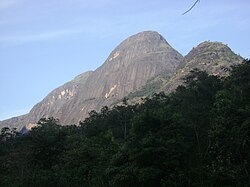
[[File:Jambu Malai 2.JPG|thumb|Jambu Malai]] | |||
Mean annual rainfall is between {{cvt|500|mm}} in the south western fringes and {{convert|4500|mm}} on the north east. | |||
This Sanctuary is an important [[drainage basin|watershed]] for the agricultural economy and power supply in other parts of Tamil Nadu. Major reservoirs like [[Parambikulam Wildlife Sanctuary#Geography|Parambikulam Reservoir]], [[Aliyar Reservoir]], [[Thirumoorthy hills|Thirumurthi Reservoir]], [[Aliyar Reservoir#Hydrography|Upper Aliyar Reservoir]], [[Kadambarai]], [[Sholayar Dam]] and [[Amaravathi Dam]] are fed by the perennial rivers which originate from the Sanctuary.<ref name="IGWSNP"/> | |||
{{Unreferenced section|date=November 2021}} | |||
The sanctuary has six administrative ranges; | |||
*[[Pollachi]]: a southern suburban town of [[Coimbatore]], its range headquarters at Anaimalai Farm: {{cvt|109.72|km2}} | |||
*[[Valparai]] Water Falls: {{cvt|171.5|km2}} | |||
* Ulandy Top Slip: {{cvt|75.93|km2}} | |||
* [[Amaravathi Reservoir]]: Amaravathi Nagar: {{cvt|172.5|km2}} | |||
* [[Udumalpet]]: {{cvt|290.18|km2}}. | |||
IGWLS is adjacent to [[Parambikulam Wildlife Sanctuary]] to the west. The core area of [[Manjampatti Valley]] is a {{cvt|110|km2}}with a [[drainage basin]] at the eastern end of the park. Manjampatti Valley is contiguous with [[Chinnar Wildlife Sanctuary]] to the south and the proposed [[Palani Hills Wildlife Sanctuary and National Park]] to the east. The National park enters [[Ernakulam district]] and [[Idukki district]] of Kerala (the [[Pooyamkutty]] forest), from the tribal settlement of [[Edamalakudy|Edamalakudy, Idukki]]. | |||
Elevation ranges between {{cvt|340|m}} and {{cvt|2513|m}}. | |||
==Flora== | |||
[[File:Anamalai TR - panoramio.jpg|thumb|Dry deciduous forest in Anamalai Tiger Reserve]] | |||
[[File:Safari @ Anamalai Tiger Reserve - panoramio (3).jpg|thumb|Moist deciduous forest]] | |||
The park is home to a wide variety of [[flora (plants)|flora]] typical of the southern [[Western Ghats]]. There are over 2000 plant species, of which about 400 species are of prime medicinal value. The diverse topography and rainfall gradient allow a wide variety of vegetation comprising a mix of natural and human-made habitats. The former includes [[tropical and subtropical moist broadleaf forests]] and [[East Deccan dry evergreen forests]], montane [[shola]]-grassland, [[tropical and subtropical dry broadleaf forest]], [[Deccan thorn scrub forests]] and [[marsh]]es.{{cn|date=November 2021}} | |||
[[South Western Ghats montane rain forests]] occur at higher elevations and are interspersed with montane grasslands, forming the shola-grassland complex. Much of the original forest now contains introduced [[teak]] [[plantation]]s. [[Bamboo]] stands and [[reed bed]]s occur in the natural forests. Tree cover is provided by ''[[Hopea parviflora]]'', ''[[Mesua ferrea]]'', ''[[Calophyllum tomentosum]]'', ''[[Vateria indica]]'', ''[[Cullenia]] excelsa'' and ''[[Mangifera indica]]'', [[Persea#Classification|Machilus macrantha]], ''[[Alstonia scholaris]]'', [[Tetradium|Evodia meliaefolia]], ''[[Ailanthus]]'' and ''[[Bombax ceiba]]'' and ''[[Eucalyptus grandis]]''. The area is home to ''[[Podocarpus]] wallichianus'', a rare south Indian species of conifer.<ref name="IGWSNP"/> | |||
==Fauna== | |||
{{Unreferenced section|date=October 2021}} | |||
[[File:Leopard in Anaimalai Tiger Reserve JEG2388 (cropped).jpg|thumb|Leopard in Anamalai]] | |||
[[File:Lion-tailed Macaque DSC8107.jpg|thumb|Young lion-tailed macaque]] | |||
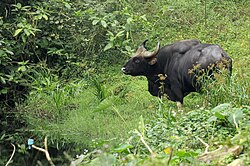
[[File:Gaur and WTKingfisher.JPG|thumb|Gaur and white-throated kingfisher]] | |||
[[Threatened species]] of [[mammal]]s in the Anamalai Tiger Reserve include [[Bengal tiger]], [[Indian elephant]], [[Indian leopard]], [[dhole]], [[Nilgiri tahr]] and [[lion-tailed macaque]], [[Indian brown mongoose]], [[gaur]], [[Malabar spiny dormouse]], [[Nilgiri langur]], [[rusty-spotted cat]], [[sambar (deer)|sambar deer]], [[sloth bear]] and [[smooth-coated otter]], [[Indian giant squirrel]], [[Indian leopard]] and [[Indian pangolin]]. | |||
Animals of [[least concern]] here include: [[golden jackal]], [[leopard cat]], [[jungle cat]], [[chital]], [[Indian muntjac]], [[Indian spotted chevrotain]], [[wild boar]], [[gray langur]], [[bonnet macaque]], [[Asian palm civet]], [[small Indian civet]], [[Indian grey mongoose]], [[striped-necked mongoose]], [[ruddy mongoose]], [[grey slender loris]], [[Indian giant squirrel]], [[Indian crested porcupine]], [[Indian pangolin]], [[Indian porcupine]] and [[Indian palm squirrel]]. | |||
Over 250 species of birds have been identified in the park. Some of the most important groups are [[cormorant]]s, [[duck]]s, [[teal]], [[darter]], [[partridge]], [[quail]], [[jungle fowl]], [[Galloperdix|spurfowl]], [[Indian peafowl]], [[parakeet]]s, [[hornbill]]s, [[Megalaimidae|Asian barbets]], [[drongo]]s, [[Old World oriole|oriole]]s, [[shrike]]s, [[warbler]]s, [[Old World flycatcher]]s, [[woodpecker]]s, [[leafbird]], [[trogon]]s, [[kingfisher]]s, [[stork]]s, [[egret]]s, [[Lesser fish eagle]]s, [[hawk eagle]]s, [[Harrier (bird)|harriers]], [[falcon]]s, [[Kite (bird)|kite]]s, [[owl]]s and [[nightjar]]s. It is also home to the near-threatened [[great Indian hornbill]]. | |||
It is home to 15 of 16 species of [[Endemic birds of South Asia#Species endemic to the Western Ghats and associated hills|birds endemic to the Western Ghats]]. | |||
Amphibians and Reptiles include many rare and endemic forms. Some endemic amphibians are the ancient and elusive [[purple frog]], [[Indirana phrynoderma|toad skinned frog]], [[Indirana leptodactyla|thin-legged leaping frog]] and [[Micrixalus silvaticus|forest torrent frog]], [[Micrixalus gadgili|Gadgil's torrent frog]]s, [[Rhacophorus pseudomalabaricus|Anaimalai flying frog]], [[Rhacophoridae|bush frog]]s and [[caecilian]] such as the [[Uraeotyphlus]]. Reptiles include the [[Python molurus|Indian rock python]], [[king cobra]]s, [[Bengal monitor]]s, [[Trimeresurus malabaricus|Malabar pit viper]]s, [[Trimeresurus macrolepis|Large-scaled green pit viper]]s, [[Hebius beddomei|Nilgiri keelback]]s, some 20 species of curious little [[Uropeltidae|shield tail snake]]s, [[Calotes grandisquamis|large-scaled forest lizard]]s, [[Calotes nemoricola|Nilgiri forest lizard]], [[Draco dussumieri|flying lizard]]s, [[Ristella]] skinks [[Vijayachelys silvatica|forest cane turtle]]s, and [[Travancore tortoise]]s. | |||
315 species of [[butterflies]] belonging to five families have been identified in the [[Anaimalai Hills]]. 44 are endemic to the Western Ghats.<ref>Discover Wild – Care for the Anamalais, retrieved 14 May 2007 [http://www.discoverwild.org/igwls.html the INDIRA GANDHI WILDLIFE SANCTUARY & NATIONAL PARK] {{webarchive|url=https://web.archive.org/web/20070928100317/http://www.discoverwild.org/igwls.html |date=28 September 2007 }}</ref> | |||
==Tribal Communities== | |||
The IGWS has significant anthropological diversity with more than 4600 [[Adivasi]] people from six tribes of [[indigenous people]] living in 34 settlements. The tribes are the [[List of Scheduled Tribes in India|Kadars]], [[List of Scheduled Tribes in India#Tamil Nadu|Malasar]]s, [[Paliyan|Pulaiyar]]s, [[Mudugar]]s and the [[List of Scheduled Tribes in India#Tamil Nadu|Eravallan]] (Eravalar).<ref name="Kaadars">{{cite web |title=Tribes of the Anamalais |work=Discover Wild – Care for the Anamalais |url=http://www.discoverwild.org/tribes.html#kaadars |access-date=14 May 2007 |archive-url=https://web.archive.org/web/20110726000425/http://www.discoverwild.org/tribes.html#kaadars | |||
|archive-date=26 July 2011 |url-status=dead}}</ref><ref name="Sajeev2">{{cite report |author=Sajeev, T.K. |title=Management of Forests in India for Biological Diversity and Forest Productivity- A New Perspective |publisher=WII-USDA Forest Service Collaborative Project Grant No. FG-In-780 (In-FS-120) |work=Volume III Anaimalai Conservation Area (ACA) | |||
|pages=169–190 |display-authors=etal |url=http://www.wii.gov.in/download/volume3(ACA).pdf | |||
|archive-url=https://web.archive.org/web/20051215212843/http://www.wii.gov.in/download/volume3(ACA).pdf | |||
|url-status=dead |archive-date=2005-12-15}}</ref> | |||
===Kozhikamudhi Elephant Camp=== | ===Kozhikamudhi Elephant Camp=== | ||
[[File:Indira Gandhi WS & NP.jpg|thumb|Tourists with Kumki elephant from Kozhikamudhi Elephant Camp after Elephant Pongal at Top Slip]] | [[File:Indira Gandhi WS & NP.jpg|thumb|Tourists with Kumki elephant from Kozhikamudhi Elephant Camp after Elephant Pongal at Top Slip]] | ||
In 1997, annual celebration of Elephant [[Pongal (festival)|Pongal]] at Top Slip was begun. For Pongal, several decorated elephants stand in front of the Pongal pot to mark the commencement of the celebration. The elephants are fed [[Jaggery#In South Asia|chakkarai]] pongal, banana and sugarcane while lined up behind a barricade, so tourists can have a close look. In 2011, Elephant Pongal was celebrated on 18 January.<ref name="VS"> | |||
{{citation | {{citation | ||
|url=http://www.hindu.com/2011/01/19/stories/2011011962930200.htm | |url=http://www.hindu.com/2011/01/19/stories/2011011962930200.htm | ||
| Line 196: | Line 125: | ||
|access-date=10 February 2011 | |access-date=10 February 2011 | ||
}}</ref> | }}</ref> | ||
== References == | == References == | ||
{{Reflist | {{Reflist}} | ||
== External links == | == External links == | ||
{{Commons category|Anamalai Tiger Reserve}} | {{Commons category|Anamalai Tiger Reserve}} | ||
{{National Parks of India}} | |||
{{Protected areas of Tamil Nadu}} | {{Protected areas of Tamil Nadu}} | ||
{{Coimbatore district}} | {{Coimbatore district}} | ||
Latest revision as of 18:50, 27 November 2021
| Anaimalai Tiger Reserve | |
|---|---|
| Indira Gandhi Wildlife Sanctuary and National Park | |
IUCN category IV (habitat/species management area) | |
 Asian elephants in Anamalai Tiger Reserve | |
  Location in Tamil Nadu, India | |
| Location | Coimbatore District, Tamil Nadu, India |
| Coordinates | 10°25′01″N 77°03′24″E / 10.4170°N 77.0567°E |
| Established | 1976[1][2] |
| Governing body | Tamil Nadu Forest Department |
| www | |
Anaimalai Tiger Reserve, earlier known as Indira Gandhi Wildlife Sanctuary and National Park and as Anaimalai Wildlife Sanctuary, is a protected area in the Anaimalai Hills of Pollachi and Valparai taluks of Coimbatore District and Udumalaipettai taluk in Tiruppur District, Tamil Nadu, India. The Tamil Nadu Environment and Forests Department by a notification dated 27 June 2007,[3] declared an extent of 958.59 km2 that encompassed the erstwhile IGWLS&NP or Anaimalai Wildlife Sanctuary, as Anaimalai Tiger Reserve under the Wildlife Protection Act, 1972. According to the National Tiger Conservation Authority, the Reserve presently includes a core area of 958.59 km2 and buffer/peripheral area of 521.28 km2 forming a total area of 1479.87 km2.[4]
Etymology[edit | edit source]
The park is named after former Prime Minister of India Indira Gandhi who visited the park on 7 October 1961. The main tourist facilities are located in the northeast corner of the park at "Topslip", so named because of the local 19th century practice of sliding timber logs down the hills from here.[5]
History[edit | edit source]
By the mid-1800s, large tracts of Valparai plateau in the Anamalais were under intense tea or coffee plantations after deforestation of the natural forests. By 1866 two-thirds of the plantations were owned by Europeans and the remaining by Indians from coastal towns. Since most native inhabitants either refused to work or were inefficient workers, labour for plantations was brought from the plains of Tamil Nadu to clear forests and grow coffee.
Some parts of the forest however were reserved for timber including large areas around Top Slip. This part of the Western Ghats, under the Madras Presidency were exploited extensively for teak which was supplied to the Bombay Dockyard for shipbuilding and later for railroad ties.[6]
In 1855, this area came under sustainable forest management for teak plantations by the pioneering efforts Douglas Hamilton and H. F. Cleghorn of the new Tamil Nadu Forest Department. In the early 1900s, protection of the Karian shola was also ensured.[7]
The area was notified as Anaimalai Wildlife Sanctuary in 1974. of its unique habitats at 3 places – Karian Shola, Grass hills, Manjampatti Valley were notified as a National Park in 1989. The 108 square kilometres (42 sq mi) National Park is the core area of the 958 square kilometres (370 sq mi) Indira Gandhi Wildlife Sanctuary.[1] IGWS was declared a Project Tiger tiger reserve in 2008.
The Park and the Sanctuary is under consideration by UNESCO as part of The Western Ghats World Heritage Site.[8] The Sanctuary and the Palni Hills in Dindigul District form the Aanaimalai Conservation Area.[9]

The Steering Committee of Project Tiger granted approval in principle to inclusion of Indira Gandhi WLS and NP under Project Tiger in 2005.[10] IGWS was declared a Project Tiger sanctuary in 2008.[11] Continuance of 'Project Tiger' in Anamalai Tiger Reserve for FY 2010/11, at the cost of ₹ 23,547,000 was approved by the National Tiger Conservation Authority on 31 August 2010.[12]
This tiger reserve, together with the several other contiguous protected forest and grassland habitats, is the core of the Parambikulum-Indira Gandhi tiger habitat landscape complex, with tiger occupancy area of about 3,253 km2 (1,256 sq mi) and an estimated metapopulation of 42 tigers.[7]
Geography[edit | edit source]

Mean annual rainfall is between 500 mm (20 in) in the south western fringes and 4,500 millimetres (180 in) on the north east. This Sanctuary is an important watershed for the agricultural economy and power supply in other parts of Tamil Nadu. Major reservoirs like Parambikulam Reservoir, Aliyar Reservoir, Thirumurthi Reservoir, Upper Aliyar Reservoir, Kadambarai, Sholayar Dam and Amaravathi Dam are fed by the perennial rivers which originate from the Sanctuary.[1]
 |
The sanctuary has six administrative ranges;
- Pollachi: a southern suburban town of Coimbatore, its range headquarters at Anaimalai Farm: 109.72 km2 (42.36 sq mi)
- Valparai Water Falls: 171.5 km2 (66.2 sq mi)
- Ulandy Top Slip: 75.93 km2 (29.32 sq mi)
- Amaravathi Reservoir: Amaravathi Nagar: 172.5 km2 (66.6 sq mi)
- Udumalpet: 290.18 km2 (112.04 sq mi).
IGWLS is adjacent to Parambikulam Wildlife Sanctuary to the west. The core area of Manjampatti Valley is a 110 km2 (42 sq mi)with a drainage basin at the eastern end of the park. Manjampatti Valley is contiguous with Chinnar Wildlife Sanctuary to the south and the proposed Palani Hills Wildlife Sanctuary and National Park to the east. The National park enters Ernakulam district and Idukki district of Kerala (the Pooyamkutty forest), from the tribal settlement of Edamalakudy, Idukki. Elevation ranges between 340 m (1,120 ft) and 2,513 m (8,245 ft).
Flora[edit | edit source]

.jpg)
The park is home to a wide variety of flora typical of the southern Western Ghats. There are over 2000 plant species, of which about 400 species are of prime medicinal value. The diverse topography and rainfall gradient allow a wide variety of vegetation comprising a mix of natural and human-made habitats. The former includes tropical and subtropical moist broadleaf forests and East Deccan dry evergreen forests, montane shola-grassland, tropical and subtropical dry broadleaf forest, Deccan thorn scrub forests and marshes.[citation needed]
South Western Ghats montane rain forests occur at higher elevations and are interspersed with montane grasslands, forming the shola-grassland complex. Much of the original forest now contains introduced teak plantations. Bamboo stands and reed beds occur in the natural forests. Tree cover is provided by Hopea parviflora, Mesua ferrea, Calophyllum tomentosum, Vateria indica, Cullenia excelsa and Mangifera indica, Machilus macrantha, Alstonia scholaris, Evodia meliaefolia, Ailanthus and Bombax ceiba and Eucalyptus grandis. The area is home to Podocarpus wallichianus, a rare south Indian species of conifer.[1]
Fauna[edit | edit source]
|
.jpg)


Threatened species of mammals in the Anamalai Tiger Reserve include Bengal tiger, Indian elephant, Indian leopard, dhole, Nilgiri tahr and lion-tailed macaque, Indian brown mongoose, gaur, Malabar spiny dormouse, Nilgiri langur, rusty-spotted cat, sambar deer, sloth bear and smooth-coated otter, Indian giant squirrel, Indian leopard and Indian pangolin.
Animals of least concern here include: golden jackal, leopard cat, jungle cat, chital, Indian muntjac, Indian spotted chevrotain, wild boar, gray langur, bonnet macaque, Asian palm civet, small Indian civet, Indian grey mongoose, striped-necked mongoose, ruddy mongoose, grey slender loris, Indian giant squirrel, Indian crested porcupine, Indian pangolin, Indian porcupine and Indian palm squirrel.
Over 250 species of birds have been identified in the park. Some of the most important groups are cormorants, ducks, teal, darter, partridge, quail, jungle fowl, spurfowl, Indian peafowl, parakeets, hornbills, Asian barbets, drongos, orioles, shrikes, warblers, Old World flycatchers, woodpeckers, leafbird, trogons, kingfishers, storks, egrets, Lesser fish eagles, hawk eagles, harriers, falcons, kites, owls and nightjars. It is also home to the near-threatened great Indian hornbill.
It is home to 15 of 16 species of birds endemic to the Western Ghats.
Amphibians and Reptiles include many rare and endemic forms. Some endemic amphibians are the ancient and elusive purple frog, toad skinned frog, thin-legged leaping frog and forest torrent frog, Gadgil's torrent frogs, Anaimalai flying frog, bush frogs and caecilian such as the Uraeotyphlus. Reptiles include the Indian rock python, king cobras, Bengal monitors, Malabar pit vipers, Large-scaled green pit vipers, Nilgiri keelbacks, some 20 species of curious little shield tail snakes, large-scaled forest lizards, Nilgiri forest lizard, flying lizards, Ristella skinks forest cane turtles, and Travancore tortoises.
315 species of butterflies belonging to five families have been identified in the Anaimalai Hills. 44 are endemic to the Western Ghats.[13]
Tribal Communities[edit | edit source]
The IGWS has significant anthropological diversity with more than 4600 Adivasi people from six tribes of indigenous people living in 34 settlements. The tribes are the Kadars, Malasars, Pulaiyars, Mudugars and the Eravallan (Eravalar).[14][15]
Kozhikamudhi Elephant Camp[edit | edit source]

In 1997, annual celebration of Elephant Pongal at Top Slip was begun. For Pongal, several decorated elephants stand in front of the Pongal pot to mark the commencement of the celebration. The elephants are fed chakkarai pongal, banana and sugarcane while lined up behind a barricade, so tourists can have a close look. In 2011, Elephant Pongal was celebrated on 18 January.[16]
References[edit | edit source]
- ↑ 1.0 1.1 1.2 1.3 "Indira Gandhi Wildlife Sanctuary & National Park". Tamil Nadu Forest Department. Archived from the original on 2 November 2007. Retrieved 6 September 2007.
- ↑ Sen, Sumit K. "Top Slip Indira Gandhi National Park". Birds of India. Kolkata: Sumit K Sen. Archived from the original on 31 January 2010. Retrieved 4 December 2009.
- ↑ Tamil Nadu Government Gazette, Part II—Section 2, No. II(2)/EF/333/2007, dated 27 June 2007, page 240.
- ↑ "Aanaimalai Tiger Reserve". National Tiger Conservation Authority. 29 June 2017. Retrieved 2 July 2017.[dead link]
- ↑ National Geographic Channel, OFF THE BEATEN TRACK, Indira Gandhi National Park [1]
- ↑ 7.0 7.1 Jhala Y.V.; Qureshi, Q.; Gopal, R.; Sinha, P.R. (2011). Status of the Tigers, Co-predators, and Prey in India (PDF). New Delhi, Dehradun: National Tiger Conservation Authority, Govt. of India and Wildlife Institute of India. Archived from the original (PDF) on 20 January 2012. Retrieved 13 March 2012.
- ↑ UNESCO, World Heritage sites, Tentative lists, Western Ghats sub cluster, Anamalai, 2007. [2]
- ↑ Sajeev T.K.; et al., "Management of Forests in India for Biological Diversity and Forest Productivity- A New Perspective" (PDF), Volume III Anaimalai Conservation Area (ACA), WII-USDA Forest Service Collaborative Project Grant No. FG-In-780 (In-FS-120), pp. 169–190, archived from the original (PDF) on 15 December 2005
- ↑ Protected Area Update (Oct. 2005) "New Tiger Reserves" (No. 57) p.17 [3] Archived 17 October 2006 at the Wayback Machine
- ↑ "Eight New Tiger Reserves". Press Release. Ministry of Environment and Forests, Press Information Bureau, Govt. of India. 13 November 2008. Retrieved 31 October 2009.
- ↑ Dr. Rajesh Gopal, APCCF (PT) and Member Secretary (NTCA) (31 August 2010), "Centrally Sponsored Plan Scheme 'Project Tiger' Administrative Approval for funds release to Anamalai Tiger Reserve, Tamil Nadu during 2010–11." (PDF), No. 4-1(32)/2010-PT, New Delhi: National Tiger Conservation Authority, archived from the original (PDF) on 6 January 2011, retrieved 2 February 2011
- ↑ Discover Wild – Care for the Anamalais, retrieved 14 May 2007 the INDIRA GANDHI WILDLIFE SANCTUARY & NATIONAL PARK Archived 28 September 2007 at the Wayback Machine
- ↑ "Tribes of the Anamalais". Discover Wild – Care for the Anamalais. Archived from the original on 26 July 2011. Retrieved 14 May 2007.
- ↑ Sajeev, T.K.; et al. Management of Forests in India for Biological Diversity and Forest Productivity- A New Perspective (PDF). Volume III Anaimalai Conservation Area (ACA) (Report). WII-USDA Forest Service Collaborative Project Grant No. FG-In-780 (In-FS-120). pp. 169–190. Archived from the original (PDF) on 15 December 2005.
- ↑ V.S. Palaniappan (19 January 2011), "Jumbos in all majesty at Top Slip", The Hindu, Chennai, archived from the original on 23 January 2011, retrieved 10 February 2011
External links[edit | edit source]

| District Headquarters |  --> --> | |
|---|---|---|
| Country | ||
| State | ||
| Region | ||
| Taluks | ||
| Municipal Corporations | ||
| Municipalities | ||
| Rivers | ||
| History | ||
| Places of interest |
| |
| Universities | ||
- Pages using the JsonConfig extension
- IUCN Category IV
- Articles needing additional references from November 2021
- Articles needing additional references from October 2021
- Tiger reserves of India
- National parks in Tamil Nadu
- Coimbatore district
- Wildlife sanctuaries in Tamil Nadu
- Protected areas established in 1976
- 1976 establishments in Tamil Nadu
- Geography of Coimbatore
- Monuments and memorials to Indira Gandhi
- South Western Ghats moist deciduous forests
- Wildlife sanctuaries of the Western Ghats
- South Western Ghats montane rain forests