


.png) | |
| Date | 26 August 2026–present |
|---|---|
| Location |
|
| Coordinates | 28°18′N 85°30′E / 28.3°N 85.5°E[1][2] |
| Type | Ice avalanche or glacier collapse |
| Cause | Under investigation |
| Deaths | 750+[lower-alpha 1] |
| Non-fatal injuries | 1,473+ (in Nepal)[4] |
| Missing | 3,044+[lower-alpha 2] |
| Property damage | Nepal: रु200 billion+ (USD $1.3 billion+) China: TBD |
On the morning of 26 August 2026, a series of flash floods and mudslides along a 72 km (45 mi)[7] stretch of the Trishuli River[lower-alpha 3] struck dozens of settlements in Nepal's Rasuwa, Nuwakot, Dhading, Gorkha, Tanahun, Nawalparasi, and Chitwan districts. It completely destroyed the Gyirong Port complex on the China–Nepal border,[8] which was the major gateway for trade and tourism between the countries. The flood carried the bodies of some victims 240 km (150 mi) away in neighboring India.
At least 734 deaths and 2,498 missing were confirmed in Nepal with an additional 16 dead and 546 missing in the Tibet Autonomous Region of China.[3][5] Authorities have issued flood warnings for communities along rivers in the Nepali districts of Rasuwa, Nuwakot, Dhading, Gorkha, Tanahun, Nawalparasi, and Chitwan.[9]
The precipitating geological event, thought to have been a glacier collapse near Langtang Lirung in the Himalayas, caused a tremor with a magnitude of 5.2 that was detected by seismometers worldwide.[10][11]
Background[edit | edit source]
Geography and history[edit | edit source]
The Trishuli River[lower-alpha 3] is joined by the Lhende Khola (also known as Lende River or Donglin Tsangpo in Lhasa Tibetan), which originates in Gyirong County, Tibet Autonomous Region, China, before entering Nepal. It then flows past Dhunche, downstream from which it forms part of the Trishuli River system.[12][13]
The flash floods and mudslides occurred around the China–Nepal border crossing at Gyirong Port, a strategic border crossing connecting Nepal's Rasuwa District and Gyirong County. The crossing saw large daily traffic from trading and tourism, especially the pilgrimage tour to Mount Kailash, a holy site in Bon, Buddhism, Hinduism, Jainism, and Sikhism.[14]
Since 1900, dozens of floods have occurred near the border between Nepal and China.[15] Langtang Lirung, near the site of the 2026 landslide, experienced a major glacier collapse/debris avalanche triggered by the April and May 2015 Nepal earthquakes. The landslide in the Langtang valley destroyed and buried several villages, killing over 350 people.[16] A July 2025 flood caused by a glacial lake outburst washed away the bridge at the border crossing.[17][18]
Gallery[edit | edit source]
-
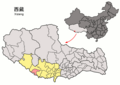
- Gyirong County (pink)
- Shigatse (yellow)
- Tibet Autonomous Region (light grey)
- People's Republic of China (dark grey)
-

-

-
 Trishuli River (left) and the Lhende Khola (right) in 2013
.png)


Climate change[edit | edit source]
Climate change contributes to the melting of permafrost, which in turn increases the likelihood of glacier collapses. Alton C. Byers, a senior research associate at the Institute of Arctic and Alpine Research at the University of Colorado at Boulder, said: "Permafrost has been the cryospheric glue that’s held the rock and the ice and the glaciers together for millennia, and now we're getting increasing evidence that it's being weakened by warming trends."[15]
Some scientists have not directly attributed the disaster to climate change, noting more proximate causes.[15] However, other scientists have noted that climate change probably played a role by contributing to the likelihood of this event occurring.[19][20][21][22] The 2026 disaster was compared to a glacier melt disaster in Peru in 1941 that killed 5,000 people.[23]
Chinese construction activities[edit | edit source]
It has also been reported that the flash floods were likely caused by Chinese construction activities along the Nepal–Tibet border, which contributed to ecological damage.[24]
Early warning systems[edit | edit source]
At the time of the disaster, Chinese and Nepali scientists had maintained a flash flood early warning system for years, which the South China Morning Post credited with consistently preventing casualties.[25] The system proved incapable of detecting the August 2026 disaster in time as the water level monitors were optimised for detecting monsoon floods or perennial floods.[26] Upstream monitoring stations in Nepal were swept away by the flooding before alerts could be sent.[27] A senior fellow at the Stimson Center remarked that the affected region was a monitoring "blind spot" that was paid little attention by geologists.[26]
Cause[edit | edit source]
Authorities have not yet determined a definitive cause of the flood, as the weather was clear at the time of the incident. Nepal's foreign minister Shisir Khanal initially said that an earthquake triggered an avalanche which caused the flooding.[28] However, later analysis by the United States Geological Survey (USGS) indicated that the seismic signal did not precede the collapse but was rather generated by the collapse itself, meaning it was not a tectonic earthquake.[29] Other early analyses suspected a glacial lake outburst flood (GLOF).[30][31]
A seismic event measuring Ms5.2 occurred at 02:52 UTC (08:37 NPT; 10:52 CST) and was centred just north of Langtang Lirung, a mountain in Langtang National Park.[32] The USGS' analysis of long-period seismic waves demonstrated, however, that they were consistent with a glacier collapse, not an earthquake.[33] The GFZ Helmholtz Centre for Geosciences (GFZ), in Potsdam, Germany, recorded an event measuring Mw5.7 that was consistent with a landslide with a timestamp identical to the USGS.[1] A second landslide event was identified by USGS three hours after the first by analyzing low-frequency seismic waves. The second landslide was recorded as a Ms 4.2 seismic event.[34]
Seven minutes after (vis. 2026 Nepal floods timeline) the seismic event, a surveillance camera[35][36][37] captured floodwaters destroying the Gyirong Port border crossing.[38][39] Such was the scale and speed of the flood, the leading hypothesis of geomorphologists is that the collapsed portion of an unnamed glacier fell thousands of feet[40] and melted from the velocity and friction of the impact. The meltwater and rocks then displaced the river in the valley below the glacier.[41][42]

There were indications of heavy water flow almost immediately after the seismic waves were detected. The combination of the two near-simultaneous signals, and review of the first satellite imagery, led researchers to conclude that a glacier located some 64 kilometres (40 mi) north of Kathmandu and some 15 km (9.3 mi) east of where the flood was first noticed, measuring 610 metres (2,000 ft) in width may have fallen 1,200 metres (4,000 ft),[19][43] in what is known as a glacier collapse (also called an ice avalanche).[44][45] According to Daniel Shugar, a geologist at the University of Calgary in Canada who had reviewed satellite imagery after the event:[46]
It looks like a glacier in the area basically snapped off in a clean break, allowing it to fall just over a vertical kilometer to the valley bottom.
Satellite images and seismology confirm a glacier collapsed,[47][48] which itself is a likely result of destabilisation by tectonic uplift and climate warming.[49] Compared to GLOFs, glacier collapse floods are less frequent in the region, but more destructive.[50] The collapsed glacial material was believed to have originated from an altitude of 5,200–5,400 m (17,100–17,700 ft)[51] and had a size of around 100,000,000–200,000,000 m3 (3.5×10⁹–7.1×10⁹ cu ft).[52] It then moved north-westwards before shifting west.[19]
Risk of second flood[edit | edit source]
On 27 August, Chinese authorities warned that a barrier lake with a volume of 2,000,000 m3 (71,000,000 cu ft) had formed near the confluence of the Chhochen Khola and Purepu Tsangpo rivers, adding that the possibility of a breach was high due to an expected water inflow of 3,000,000 m3 (110,000,000 cu ft) until 30 August.[53] The lake overflowed slightly on 28 August, prompting Chinese authorities to briefly pause rescue operations and warn about the potential for additional flooding.[54][55] The barrier lake slowly drained out, with parts of the lake bed visible by 29 August.[56]
Casualties[edit | edit source]
According to Nepal's National Disaster Risk Reduction and Management Authority (NDRRMA), at least 675 people died,[3] 1,473 were injured[4] and 2,498 were missing in Nepal.[5] As of 29 August 2026, 589 foreign nationals are among the missing.[3]
Among those missing are 288 Indian nationals, 127 Nepali tourists, 90 Americans,[5] 53 Ukrainians, 51 Malaysians, 35 Australians and 33 UK nationals (as of 26 August 2026).[57][58] The Chinese Ministry of Foreign Affairs reported nearly 100 Chinese citizens in Nepal missing.[29][59] Australia's foreign minister said at least 34 of the missing are pilgrims.[29][60] The Canadian government reported that 32 citizens are missing.[61] The South Korean Foreign Ministry reported 9 citizens working at a hydropower plant construction site went missing.[62] At least 28 police officers, 13 Armed Police Force personnel, 44 Nepali Army personnel, 15 customs office employees, and 4 immigration office employees were reported missing.[63] The Independent Power Producers’ Association, Nepal (IPPAN) said 934 people involved in 11 hydropower projects also went missing.[64]
China Central Television reported 16 fatalities and 546 missing,[3] including 260 foreigners, in Gyirong County, Tibet Autonomous Region.[29][65][66]
The International Federation of Red Cross and Red Crescent Societies estimated that 93,000 people were impacted by the floods.[67]
The flood carried the bodies of some victims 240 km (150 mi) away,[68] with bodies recovered as far downstream as Nawalparasi District in Nepal[69] and Kushinagar and Maharajganj districts in Uttar Pradesh, India.[4]
Damage[edit | edit source]
It was estimated that the resulting debris traveled at a speed of around 50 m/s (180 km/h; 110 mph),[70] while analysis of satellite images suggests that the flow reached up to 80 km (50 mi) downstream, with discolorations caused by the flood reaching an elevation of 800 m (2,600 ft) in a valley some 7 km (4.3 mi) from the origin.[71] Following the flood, more than 1.5 m (4 ft 11 in) of silt was deposited in the main disaster zone.[72]
Floodwaters reached settlements as high as 80 metres (270 ft) above the river 150 level.[73] In Nepal, residential areas and infrastructure, including roads, sustained extensive damage.[65][74] The districts of Rasuwa, Nuwakot, Dhading, Gorkha, and Chitwan were impacted by the flooding.[75] In Nuwakot, floodwater entered areas including Timure, Dhunche, Mailung, Syafrubesi, Betrawati, Trishuli, and Devighat.[73][74] A preliminary estimate by the Nepal government reported that the floods caused Rs 200 billion in damages.[6] Director of the Roads Department Bijaya Jaishi reported an initial estimate of Rs 15 billion in road and bridge infrastructure had been damaged,[76] affecting 41 bridges and 42 km (26 mi) of road.[76][6] A road connecting Syafrubesi and Rasuwagadhi, which was under reconstruction after damage from flooding in 2025, was further damaged.[76] A bridge connected to Trishuli Bazaar was swept away.[77] A section of the Prithvi Highway from Baireni to Mugling was blocked until 28 August.[78] Around 1,200 people from at least three villages were displaced.[29] The rural municipality offices in Gosaikunda Rural Municipality and Uttargaya Rural Municipality were washed away.[79]
The education ministry said at least 20 schools were damaged in Rasuwa, Nuwakot and Dhading districts.[80] Damage to electricity generation, transmission, and distribution infrastructure disrupted supplies in affected areas. The Nepal Electricity Authority (NEA) said that six major hydropower and transmission facilities had been damaged. These included Rasuwagadhi, Chilime, Trishuli 3A, the Trishuli 3B Hub 220 kV substation, Trishuli Hydropower Station, and Devighat Hydropower Station.[81] The NEA reported that damage to energy infrastructure had removed an estimated 431 megawatts of electricity off of the grid and that projects under construction with a total capacity of 470 megawatts were damaged.[6] The Rasuwagadhi customs office was destroyed,[73] while more than 300 vehicles queuing up at the site were swept away.[82]
In China, road access, communications and electricity supply to the Gyirong Port area were cut off by the flood,[83][84] affecting a section of China National Highway 216.[85] Chinese rescue workers who reached the area on 28 August confirmed that the border crossing complex was destroyed, with one describing the scene as "nothing but ruins".[86] Around 80 trucks were stranded in Kyirong after flooding destroyed about 5 km (3.1 mi) of road running from the town to Rasuwagadhi.[87]
Response[edit | edit source]
Nepal[edit | edit source]
The Government of Nepal mobilised the Nepali Army, Armed Police Force, and Nepal Police, supported by helicopters and medical teams, to conduct search, rescue, and relief operations.[88][89] More than 10,000 security personnel were deployed to assist rescue efforts,[90] including 4,200 from the army,[91] 4,200 from the APF,[92] and 4,800 from the Nepal Police.[92] The Council of Ministers declared the area a disaster-hit zone for three months under the Disaster Risk Reduction and Management Act, 2074 (2017).[93][94] The government also offered free medical treatment for those injured and financial assistance to families who lost members.[95][93] On 27 August, Prime Minister Balen Shah arrived in Nuwakot District to monitor the situation.[96] The Prime Minister's Natural Disaster Relief Fund was launched by the government, raising over रू 5,440,000,000 by 29 August.[97] Shah and his cabinet also pledged to donate one month's salary to the said fund.[98]
Nepali officials reported that over 3,700 people had been rescued.[99] As hospitals and morgues in affected areas reached full capacity, injured survivors and deceased bodies were transferred to other locations including Bhairahawa, Bharatpur, Butwal, Gorkha, Kathmandu, Nawalparasi, Palpa, and Pokhara.[100] At least 675 bodies were recovered.[101] Due to a lack of cold storage, many unidentified bodies were temporarily buried until they could be identified.[102] Displaced persons camps were set up in Trishuli Bazar, while residents reported looting in houses with very few police officers to maintain order.[103]
Following the flooding, the Nepal Roads Department began installing bailey bridges to replace collapsed bridges.[76] The Nepal Army delivered eight tonnes of relief supplies to Rasuwa by 27 August.[104] The government launched a psychosocial counseling and telemedicine services program for migrant workers and impacted families.[105] The Ministry of Foreign Affairs initially turned down offers from several countries to send their search-and-rescue teams to support relief operations, citing mismanagement and poor coordination from the joint rescue effort following the 2015 earthquake as the main reason for the decision.[106] However, the Nepalese government allowed for the entry of experts from India, China, Australia and South Korea for help in tunnel rescues, DNA testing and forensic examinations.[107] It also requested heavy-lift cargo drones from international partners to deliver relief supplies to isolated mountain regions.[108]
On 29 August, the NDRRMA said that over 18,700 rescuers have been deployed to help with the search operation.[4]
China[edit | edit source]
CCP general secretary Xi Jinping called for continued efforts to locate missing people and improvements to disaster monitoring and warning systems.[109][110] The government of the Tibet Autonomous Region mobilized nearly 800 emergency workers and 150 vehicles as well as sniffer dogs and speed boats to help the rescue efforts.[111] Units of the People's Armed Police Force,[112] the People's Liberation Army and rescue teams from neighboring Sichuan province were deployed to assist in rescue operations.[113][67] The National Fire and Rescue Administration also sent 681 personal and 13 rescue dogs, while the Ministry of Emergency Management sent 60 personnel.[114] Two people were rescued at Gyirong Port. Access to the site was hampered by the accumulation of debris about 3 km (1.9 mi) upstream.[115] Chinese state media reported that 499 residents and 555 tourists had been evacuated from the area in Tibet.[67] Premier Li Qiang arrived in Gyirong on 26 August.[116][29] The China Meteorological Administration set up portable automatic weather stations in Gyirong Port.[117] The China National Space Administration stated that it coordinated and mobilized satellite resources to perform emergency imaging of the impacted area.[118] The CCP stated that it would provide emergency supplies and cash assistance to Nepal.[119][120] The Ministry of Emergency Management deployed tunnel experts to aid rescue efforts at a hydropower station tunnel in Nepal.[3]
Censorship of the disaster[edit | edit source]
Videos of the disaster taken by locals in Tibet were censored on Chinese social media platforms. On the state-run flagship news bulletin Xinwen Lianbo, only a single still-frame shot from CCTV footage of the disaster was shown.[121][122] China tightly controls information in Tibet, foreign journalists are generally unable to enter the region except on government-supervised trips, and Tibetans can face punishment for speaking to journalists.[121][123] Chinese state media carried several broadcasts about the disaster and sent journalists to the affected area, although reports focused mainly on rescue efforts rather than the extent of the devastation.[123] Several foreign journalists said that Chinese authorities denied their requests to visit the affected areas following the disaster. The Chinese foreign ministry cited difficulties reaching the area and the possibility of further disasters.[124] ABC News reported that several smaller Chinese state-media outlets initially published interviews with witnesses, but that the articles were removed within hours.[124] Restrictions on independent reporting made the extent of the damage and the number of casualties on the Tibetan side difficult to verify.[123][125]
Other countries[edit | edit source]
|
|
|---|---|
 Australia Australia
|
Australia announced it would provide A$5,000,000 in aid for communities affected by the floods, with A$2,000,000 donated towards the World Food Programme, A$2,000,000 towards the Australian Humanitarian Partnership, and A$2,000,000 towards the Emergency Action Alliance.[126][120] |
 Bangladesh Bangladesh |
Foreign Minister Khalilur Rahman spoke with his Nepalese counterpart Shisir Khanal on 27 August, conveying Bangladesh's condolences and Prime Minister Tarique Rahman's personal condolence message to Nepalese prime minister Balen Shah. Rahman said that Bangladesh was ready to provide support as required by Nepal, while Khanal thanked Bangladesh for its solidarity and said that Nepal was assessing the damage and would communicate its specific needs.[127][128][129] The Ministry of Disaster Management and Relief sent tents, mosquito nets, packets of dry food, torch lights, shovels, sleeping bags, water containers and body bags to the flood-affected areas of Nepal.[130][131] A minute of silence was observed in the Jatiya Sangsad for the deceased victims of the floods.[132] |
 Canada Canada |
Foreign Affairs Minister Anita Anand and Secretary of State (International Development) Randeep Sarai announced C$5,000,000 in humanitarian assistance funding to support emergency relief efforts in Nepal, to be delivered through UN, Red Cross and Canadian NGO partners. Canada also offered to deploy relief supplies from its emergency stockpiles via the Canadian Red Cross and deployed five consular officials to Kathmandu to assist Canadians in the region.[133] |
 India India |
On 27 August, Prime Minister Narendra Modi spoke to his Nepalese counterpart, Balen Shah, to offer humanitarian assistance and aid.[134] The Ministry of External Affairs sent a team of rescuers and medical personnel.[135][136] By 29 August, India had sent 62 tonnes of disaster relief supplies in three airlifts.[120] |
 Japan Japan |
The Japanese government, under the Japan International Cooperation Agency (JICA), agreed to send disaster relief supplies including tents, blankets, jerrycans, plastic sheets, and sleeping pads to Nepal to help in its response.[137][138] The supplies were brought to Kathmandu via plane from a JICA warehouse in Singapore.[137] |
 Malaysia Malaysia |
The Malaysian government and Ministry of Defence are prepared to send rescue teams consisting of Malaysian Armed Forces and Special Malaysia Disaster Assistance and Rescue Team personnel to assist the search and rescue efforts.[139][140] The Ministry of Foreign Affairs is coordinating with their Nepali and Chinese counterparts to locate 55 missing Malaysians.[141] |
 Pakistan Pakistan |
Prime Minister Shehbaz Sharif spoke with Nepali prime minister Balen Shah and dispatched emergency relief assistance teams to Nepal.[142] |
 Philippines Philippines |
President Bongbong Marcos offered his condolences to Nepal.[143] The Philippine government, through its embassy in New Delhi and honorary consulate in Kathmandu, where reportedly working with Nepalese authorities to provide assistance to Filipinos affected by the disaster.[144] |
 Singapore Singapore |
The Singaporean government agreed to send US$100,000 to the Singapore Red Cross Society already helping in the disaster relief response in Nepal.[145][146] The disaster relief team, which was deployed from the Singapore High Commission in New Delhi, was primarily involved in providing consular assistance for affected Singaporeans and their families.[147] Singaporean Prime Minister Lawrence Wong and Foreign Minister Vivian Balakrishnan both commented on assistance efforts being made.[147] |
 South Korea South Korea |
South Korea dispatched a response team and sent US$1,000,000 in humanitarian assistance to Nepal.[148] South Korean conglomerate Doosan Group, involved in the construction of Rasuwa's Upper Trishuli-1 hydropower station, pledged US$5,000,000 in aid.[149] |
 Sri Lanka Sri Lanka |
President Anura Kumara Dissanayake directed the government of Sri Lanka to provide US$1,000,000 to Nepal to support humanitarian and relief efforts.[150] |
 United Arab Emirates United Arab Emirates
|
The United Arab Emirates allocated US$10,000,000 in humanitarian assistance to Nepal.[120][151] |
 United Kingdom United Kingdom |
Prime Minister Andy Burnham and King Charles III expressed solidarity with Nepal.[152] The United Kingdom pledged £5,000,000 in aid and offered a search-and-rescue team to assist.[148] |
 United States United States |
The United States Department of State stated that it would send a disaster response advisor and provide US$3,600,000 in assistance.[84] |
 Vietnam Vietnam |
General secretary of the communist party Tô Lâm, prime minister Lê Minh Hưng, chairman of the national assembly Trần Thanh Mẫn, permanent member of the secretariat Trần Cẩm Tú, minister of foreign affairs Lê Hoài Trung, and Vietnamese Fatherland Front chairwoman Bùi Thị Minh Hoài all extended their condolences to their counterparts in China and Nepal.[153] |
International organizations[edit | edit source]
The International Charter Space and Major Disasters, which provides for widespread albeit contingent humanitarian satellite coverage, is activated.[154] UN secretary-general António Guterres stated that United Nations teams and partners were sending supplies and personnel to support the Nepal government-led response.[77][84] The UN Central Emergency Response Fund released US$2,000,000 to assist with medical care, shelter and water.[29] The International Federation of Red Cross and Red Crescent Societies released CHF 1,000,000 in assistance.[148] The World Health Organization dispatched essential emergency medical supplies and released US$150,000 in funds..[148] Médecins Sans Frontières sent an emergency team to Nepal.[148] The European Union allocated €2,000,000 in humanitarian relief and activated its Copernicus satellite surveillance system to aid recovery efforts.[155][130] The Asian Development Bank issued a grant of US$5,000,000 for humanitarian assistance.[156] Welthungerhilfe provided €2,000,000 from its emergency relief fund.[120] The Humanitarian OpenStreetMap Team, in coordination with the Nepal government, launched a program to map buildings and roads from satellite images to help responders identify affected locations.[157]
See also[edit | edit source]
- Timeline of the 2026 Nepal floods
- List of flash floods
- List of deadliest floods
- Madan Ashrit Highway disaster, landslide which occurred near the Trishuli river
- Other flash floods that involve land/mudslides
- Other major avalanche/glacial collapse
- Other major mass movements in the vicinity
- Tsergo Ri landslide, one of the Earth's largest known mass movements, ca. 10 km to the south-east, prehistoric
Notes[edit | edit source]
References[edit | edit source]
- ↑ 1.0 1.1 "Nepal-China Border Region (Landslide)". GFZ Helmholtz Centre for Geosciences. Retrieved 28 August 2026.
- ↑ "M 5.2 Landslide - 55 km NW of Kodāri̇̄, Nepal". United States Geological Survey.
- ↑ 3.0 3.1 3.2 3.3 3.4 3.5 3.6 3.7 Clayton, Freddie (29 August 2026). "Nepal flood death toll rises to 734 as nearly 2,500 remain missing". NBC News. Retrieved 30 August 2026.
- ↑ 4.0 4.1 4.2 4.3 Whitehead, Jamie; Pandey, Manish; Nepali, with reporting from BBC; Kathmandu, Azadeh Moshiri in; Beijing, Laura Bicker in (28 August 2026). "Nepal-Tibet floods: China suspends rescue efforts at border due to risk of second flood – follow live". BBC News. Retrieved 28 August 2026.
- ↑ 5.0 5.1 5.2 5.3 Haworth, Jon; Fahrney, Megan (28 August 2026). "Hundreds dead as over 2,000 remain missing in massive Nepal-Tibet flood". ABC News. Retrieved 28 August 2026.
- ↑ 6.0 6.1 6.2 6.3 Dev Bhattarai, Kamal (27 August 2026). "The aftermath of Nepal's deadly flash flood". The Annapurna Express. Retrieved 27 August 2026.
- ↑ "Maps and Images Show the Devastation in Nepal's Flooding". The New York Times. 27 August 2026. Archived from the original on 26 August 2026. Retrieved 27 August 2026.
- ↑ Sharma, Gopal; Bajracharya, Sahana; Chitrakar, Navesh (27 August 2026). "Hundreds killed and more than 1,000 missing after Himalayan flood". Reuters. Retrieved 29 August 2026.
- ↑ "Nepal floods: What is MSF doing and how can I help?". Médecins Sans Frontieres. Retrieved 27 August 2026.
- ↑ "Extreme flooding in China and Nepal". GFZ. 27 August 2026. Retrieved 29 August 2026.
- ↑ "26 agosto 2026: la frana in Nepal e l'analisi dei sismogrammi" [26 August 2026: the landslide in Nepal and the analysis of seismograms]. INGVterremoti (in italiano). 27 August 2026. Retrieved 29 August 2026.
- ↑ "रसुवामा भीषण बाढी, मुग्लिङसम्म सतर्कता" [Heavy flood in Rasuwa, alert up to Muglin] (in नेपाली). BBC. 26 August 2026. Archived from the original on 27 August 2026. Retrieved 26 August 2026.
- ↑ Goldsmith, Adam; Atkinson, Simon (27 August 2026). "Two teenagers, 13 and 14, among 33 UK nationals missing in Nepal floods". BBC. Archived from the original on 27 August 2026. Retrieved 27 August 2026.
- ↑ Hernández, María Teresa (28 August 2026). "What to know about the Mount Kailash pilgrimage site after floods in Nepal and Tibet". Associated Press. Archived from the original on 27 August 2026. Retrieved 27 August 2026.
- ↑ 15.0 15.1 15.2 Joselow, Maxine; Sands, Leo (27 August 2026). "Climate Change Raises Risk of Disasters Like Nepal Floods". The New York Times. ISSN 0362-4331. Retrieved 27 August 2026.
- ↑ Lacroix, Pascal (2016). "Landslides triggered by the Gorkha earthquake in the Langtang valley, volumes and initiation processes". Earth, Planets and Space. 68 (48) 46. Bibcode:2016EP&S...68...46L. doi:10.1186/s40623-016-0423-3.
- ↑ Sharma, Gopal (10 July 2025). "Tibetan glacial lake drainage triggered deadly flood in Nepal, climate body says". Reuters. Retrieved 29 August 2026.
- ↑ Pandey, Upendra Raj (27 August 2026). "Bhotekoshi flood: What happened in Himalayas and what comes next?". The Kathmandu Post. Retrieved 29 August 2026.
- ↑ 19.0 19.1 19.2 "What we know about deadly Nepal-Tibet floods". BBC. 28 August 2026. Retrieved 28 August 2026.
- ↑ Laura Paddison; Angela Fritz; Ivana Kottasová (26 August 2026). "What we know — and don't know — about what cause the Nepal flood wave". CNN. Retrieved 28 August 2026.
- ↑ Wong, Tessa (28 August 2026). "Collapsed glacier likely caused devastating Nepal-Tibet floods, scientists say". BBC. Retrieved 28 August 2026.
- ↑ Berger, Ava; Hadid, Diaa; Simon, Julia (28 August 2026). "A melting glacier contributed to the deadly Nepal floods. We can expect more like this". NPR. Retrieved 28 August 2026.
- ↑ "The world's deadliest glacier disasters". Reuters. 28 August 2026. Retrieved 29 August 2026.
- ↑ "Did China's Tibet Construction Cause Nepal Flood Fury? Most Likely". 27 August 2026 – via The Statesman.
- ↑ Zhang, Tong (27 August 2026). "China, Nepal built an early warning system for melting glaciers. Does it work?". South China Morning Post. Retrieved 27 August 2026.
- ↑ 26.0 26.1 Sands, Leo; Ghimire, Binod (27 August 2026). "Speed of Nepal's Flash Floods Likely Overwhelmed Warning System, Experts Say". The New York Times. ISSN 0362-4331. Retrieved 27 August 2026.
- ↑ Anand, Dibyesh (28 August 2026). "Nepal floods: China's strict control of Tibet makes it harder to prepare for Himalayan disasters". The Conversation. doi:10.64628/AB.gyrxfjtka. Retrieved 28 August 2026.
- ↑ "Flash flood hits Rasuwa, damages hydropower projects and markets". The Kathmandu Post. 26 August 2026. Archived from the original on 27 August 2026. Retrieved 26 August 2026.
- ↑ 29.0 29.1 29.2 29.3 29.4 29.5 29.6 "Catastrophic floods kill over 360 in Nepal and Tibet, with more than 1,400 missing". Associated Press. 26 August 2026. Archived from the original on 27 August 2026. Retrieved 26 August 2026.
- ↑ "Ice avalanche, debris lake may have triggered Bhotekoshi flood". The Kathmandu Post. 26 August 2026. Archived from the original on 27 August 2026. Retrieved 26 August 2026.
- ↑ "What triggered the catastrophic flood on the Nepal-Tibet border?". Reuters. 26 August 2026. Archived from the original on 27 August 2026. Retrieved 26 August 2026.
- ↑ ANSS. "M 5.2 Landslide – 55 km NW of Kodāri̇̄, Nepal 2026". Comprehensive Catalog. U.S. Geological Survey. Retrieved 26 August 2026.
- ↑ Henson, Bob (28 August 2026). "The worrying climate link to Nepal's avalanche and flood catastrophe". Yale Climate Connections. Retrieved 30 August 2026.
- ↑ ANSS. "M 4.2 Landslide – 55 km NW of Kodāri̇̄, Nepal 2026". Comprehensive Catalog. U.S. Geological Survey.
- ↑ "西藏吉隆县遭受泥石流灾害 造成人员伤亡、失联 亲历游客:听到轰鸣声 泥浆夹杂树木和铁皮 流速很快" [Mudslide Hits Jilong County, Tibet, Causing Casualties and Missing Persons; Eyewitness Account: "We Heard a Roaring Sound; Mud Mixed with Trees and Sheet Metal Was Rushing Down at High Speed"]. Ifeng (in 中文). Retrieved 29 August 2026.
- ↑ "How do newly released 3D images explain the Gyirong mudslide?". China Central Television. 29 August 2026. Retrieved 29 August 2026.
- ↑ DC, Ram Kumar (27 August 2026). "How the Bhotekoshi flood unfolded over 10 hours". The Kathmandu Post. Retrieved 29 August 2026.
- ↑ "Hunderte Einheimische und Touristen nach Sturzflut in Nepal vermisst" [Hundreds of Locals and Tourists Missing After Flash Flood in Nepal]. Der Spiegel (in Deutsch). 26 August 2026. ISSN 2195-1349. Archived from the original on 27 August 2026. Retrieved 27 August 2026.
- ↑ Lee, Liz; Bajracharya, Sahana; Chitrakar, Navesh (26 August 2026). "Devastating flash flood on Nepal-Tibet border kills nine, hundreds of tourists missing". The Weather Network. Retrieved 27 August 2026.
- ↑ Berger, Ava; Hadid, Diaa; Simon, Julia (28 August 2026). "A melting glacier contributed to the deadly Nepal floods. We can expect more like this". NPR. Retrieved 29 August 2026.
- ↑ Lahiri, Tripti; Pokharel, Krishna (26 August 2026). "Hundreds Missing, 157 Dead, as Likely Ice-Rock Cascade Triggers Floods in Nepal and Tibet". The Wall Street Journal. Archived from the original on 27 August 2026. Retrieved 29 August 2026.
- ↑ Ellis-Petersen, Hannah; Pokharel, Gaurav; Jones, Sam; Hawkins, Amy (27 August 2026). "Race to get aid into Nepal and Tibet amid warnings flood lake could burst". The Guardian. Retrieved 29 August 2026.
- ↑ "Glacier collapse may have triggered deadly Nepal flash flood, experts say". Tuoi Tre. 27 August 2026. Retrieved 27 August 2026.
- ↑ Le Page, Michael (26 August 2026). "A glacier collapse is most likely cause of the Nepal disaster". New Scientist. Archived from the original on 26 August 2026. Retrieved 27 August 2026.
- ↑ Sands, Leo (26 August 2026). "Deadly Nepal Flood May Have Been Caused by 'Ice Avalanche,' Scientists Say". The New York Times. ISSN 0362-4331. Archived from the original on 27 August 2026. Retrieved 26 August 2026.
The deadly flooding in Nepal on Wednesday was likely set off at least in part by an enormous chunk of ice snapping off a glacier and cascading thousands of feet to the valley below, according to an initial assessment by a group of geologists and glaciologists. The phenomenon is known as an ice avalanche. On Wednesday, a chunk of ice with a width of about 2,000 feet snapped cleanly off the glacier, Dr. Shugar said, sending a mixture of ice and water to the valley floor. By his assessment, the chunk of ice fell from an altitude of around 17,000 feet, dropping almost 4,000 feet.
- ↑ Sands, Leo (26 August 2026). "Deadly Nepal Flood May Have Been Caused by Ice Snapping Off Glacier, Scientists Say". The New York Times. ISSN 0362-4331. Retrieved 29 August 2026.
- ↑ Rowlatt, Justin (27 August 2026). "Did climate change contribute to the glacier collapse?". BBC. Retrieved 29 August 2026.
- ↑ Ireland, Olivia; Moore, Henry (27 August 2026). "What we know about deadly Nepal-Tibet floods". BBC News. Archived from the original on 27 August 2026. Retrieved 27 August 2026.
- ↑ Wong, Tessa (27 August 2026). "Collapsed glacier likely caused devastating Nepal-Tibet floods, scientists say". BBC News. Archived from the original on 27 August 2026. Retrieved 27 August 2026.
- ↑ "西藏吉隆泥石流原因查明:尼泊尔境内高山冰崩" [Cause of Gyirong, Tibet mudslides found: high-altitude glacier collapse in Nepal]. Xinhua. 27 August 2026. Retrieved 28 August 2026.
- ↑ "Explainer: How the mudslide along China-Nepal border happened?". Xinhua. 28 August 2026. Retrieved 28 August 2026.
- ↑ Poudel, Subeksha (28 August 2026). "What triggered the Rasuwa flood? Scientists piece together a complex chain of events". Kathmandu Post. Retrieved 28 August 2026.
- ↑ "New barrier lake in Nepal raises fresh flood threat, China warns". The Kathmandu Post. 27 August 2026. Archived from the original on 27 August 2026. Retrieved 27 August 2026.
- ↑ Muzaffar, Maroosha (28 August 2026). "China warns that barrier lake bursting its banks could cause second flash flood". The Independent. Retrieved 30 August 2026.
- ↑ Lee, Liz (28 August 2026). "China resumes rescue work after assessing upstream lake conditions". Reuters. Retrieved 29 August 2026.
- ↑ Lee, Liz; Zhang, Yukun (29 August 2026). "Risk of lake burst near China-Nepal disaster site wanes". Reuters. Retrieved 29 August 2026.
- ↑ "Nepal flash floods: Hundreds missing and scores dead". BBC News. 26 August 2026.
- ↑ "हालसम्म सम्पर्क बाहिर रहेका पर्यटकको सङ्ख्या ६४४, कुन देशका कति?" [As of now, the number of tourists who have been out of contact is 644; how many from each country?]. BBC News नेपाली (in नेपाली). 27 August 2026. Retrieved 27 August 2026.
- ↑ "People from more than 30 countries are missing after the flash floods in Nepal and China". AP News. 27 August 2026. Archived from the original on 27 August 2026. Retrieved 27 August 2026.
- ↑ "Anthony Albanese says 34 Australians among hundreds of people missing in deadly Nepal flash floods". The Guardian. 27 August 2026. ISSN 0261-3077. Retrieved 27 August 2026.
- ↑ "Number of Canadians missing in Nepal-Tibet floods rises to 32: minister". Global News. Retrieved 29 August 2026.
- ↑ Oh, Seok-min (27 August 2026). "(LEAD) Gov't sends emergency response team to Nepal over 9 missing S. Koreans after massive floods". Yonhap News. Retrieved 27 August 2026.
- ↑ "Bhotekoshi flash flood: 258 bodies recovered". The Himalayan Times. 27 August 2026. Archived from the original on 27 August 2026. Retrieved 27 August 2026.
- ↑ "Hundreds feared trapped in hydropower tunnels after Bhotekoshi flood". Nepal News. 29 August 2026. Retrieved 29 August 2026.
- ↑ 65.0 65.1 Sharma, Gopal (26 August 2026). "Nepal flash flood kills eight; damages roads, power projects". Reuters. Retrieved 26 August 2026.
- ↑ 受尼泊爾泥石流波及 西藏3死265人失聯 [Three Dead and 265 Missing in Tibet Following Nepal Mudslides]. am730 (in 中文). 26 August 2026. Retrieved 26 August 2026.
- ↑ 67.0 67.1 67.2 Ormiston, Simon (28 August 2026). "At least 579 dead and 1,924 missing after Nepal-Tibet floods". Euronews. Retrieved 28 August 2026.
- ↑ Lahiri, Tripti; Pokharel, Krishna (27 August 2026). "How Devastating Floods Created High in the Himalayas Swept Through Nepal and China". Wall Street Journal – via www.wsj.com.
- ↑ "Nepal struggles to store and identify bodies carried downstream by devastating flood". The Kathmandu Post. 28 August 2026. Retrieved 28 August 2026.
- ↑ "Glacier collapse triggers mudslide hitting border port in China's Xizang: expert". Xinhua. 27 August 2026. Retrieved 27 August 2026.
- ↑ "Expert: Impact of mudslides extends 80 km downstream in Nepal". NHK. 27 August 2026. Retrieved 27 August 2026.
- ↑ "Explainer: What challenges await rescuers in China's Xizang border mudslide?". Xinhua. 28 August 2026. Retrieved 28 August 2026.
- ↑ 73.0 73.1 73.2 Prasai, Kamal; Gautam, Dinesh (26 August 2026). "Rasuwa flood leaves trail of destruction from Rasuwagadhi to Bidur". Online Khabar. Retrieved 26 August 2026.
- ↑ 74.0 74.1 "Flood Damages Property in Nuwakot Due to Rasuwa Border Overflow". Ratopati. 26 August 2026. Retrieved 26 August 2026.
- ↑ "भोटेकोशी-त्रिशूली बाढी : सम्पर्कविहीनको सङ्ख्या ८२६, कसरी गरिँदैछ तथ्याङ्क सङ्कलन" ['826 people unaccounted for after flood', how data is being collected]. BBC News नेपाली (in नेपाली). 27 August 2026. Retrieved 27 August 2026.
- ↑ 76.0 76.1 76.2 76.3 "रसुवा बाढी : सडक र पुलमा रु १५ अर्बभन्दा बढीको क्षति भएको प्रारम्भिक आकलन" [Initial assessment: Floods cause over Rs 15 billion in damage to roads and bridges]. BBC News नेपाली (in नेपाली). 26 August 2026. Retrieved 27 August 2026.
- ↑ 77.0 77.1 Dahal, Phanindra; Bicker, Laura (26 August 2026). "Hundreds missing and 98 dead as flash flood hits Nepal-Tibet border". BBC News. Archived from the original on 26 August 2026. Retrieved 26 August 2026.
- ↑ "Washed-out bridges force flood-hit communities to rely on choppers". The Kathmandu Post. 29 August 2026. Retrieved 29 August 2026.
- ↑ "Floods wipe out local governments' ability to lead rescue, relief". The Kathmandu Post. 29 August 2026. Retrieved 29 August 2026.
- ↑ "20 schools in three districts damaged by Wednesday's floods". The Kathmandu Post. 27 August 2026. Retrieved 27 August 2026.
- ↑ "Rasuwa flood damages 6 major hydropower, transmission facilities, disrupts power supply". Nepal News. Kathmandu. 26 August 2026. Retrieved 26 August 2026.
- ↑ "Flood death toll continues to rise as Nepal reels from one of its worst disasters in years". The Kathmandu Post. 27 August 2026. Archived from the original on 27 August 2026. Retrieved 27 August 2026.
- ↑ "西藏多方力量赶赴吉隆口岸救援" [Rescue Teams from Various Sectors in Tibet Rush to the Gyirong Port for Rescue Operations] (in 中文). Xinhua. 26 August 2026. Retrieved 26 August 2026.
- ↑ 84.0 84.1 84.2 Sharma, Gopal; Bajracharya, Sahana; Chitrakar, Navesh (26 August 2026). "Rescuers search for survivors after devastating Nepal flood". Reuters. Retrieved 27 August 2026.
- ↑ "China Focus: Rescuers conduct sweeping search at mudslide-stricken Gyirong Port". Xinhua. 29 August 2026. Retrieved 29 August 2026.
- ↑ "Chinese rescuers find 'nothing but ruins' at border crossing as Nepal seeks help to ID and store the dead". The Guardian. Reuters. 29 August 2026. ISSN 0261-3077. Retrieved 29 August 2026.
- ↑ "Eighty container drivers stranded in Kerung plead for repatriation". The Kathmandu Post. 28 August 2026. Retrieved 28 August 2026.
- ↑ "Flood leaves parts of Rasuwa and Nuwakot cut off". OnlineKhabar. 26 August 2026. Retrieved 26 August 2026.
- ↑ "Rasuwa flashflood: NA teams, two choppers deployed for search, rescue". The Rising Nepal. 26 August 2026. Retrieved 26 August 2026.
- ↑ "Nepal-China border flash floods kill at least 633". NHK. 29 August 2026. Retrieved 29 August 2026.
- ↑ Walsh, Aoife (27 August 2026). "Rescuers race to find survivors after Himalayan floods kill at least 300". The Washington Post. ISSN 0190-8286. Retrieved 27 August 2026.
- ↑ 92.0 92.1 "Nepal flood rescuers battle treacherous terrain and shortages to find the missing". The Kathmandu Post. 29 August 2026. Retrieved 29 August 2026.
- ↑ 93.0 93.1 "Cabinet declares flood-hit areas disaster zones for three months". The Himalayan Times. 26 August 2026. Archived from the original on 27 August 2026. Retrieved 27 August 2026.
- ↑ "Disaster Risk Reduction and Management Act, 2074 (2017)". UNEP Law and Environment Assistance Platform. Retrieved 27 August 2026.
- ↑ "Government orders free treatment, emergency aid for Rasuwa flood victims". The Kathmandu Post. 26 August 2026. Archived from the original on 27 August 2026. Retrieved 27 August 2026.
- ↑ "Balendra Shah heads to flood-hit Nuwakot to assess damage". The Kathmandu Post. 27 August 2026. Archived from the original on 27 August 2026. Retrieved 27 August 2026.
- ↑ "Over Rs 5 billion deposited in PM Disaster Relief Fund". The Rising Nepal. 29 August 2026. Retrieved 29 August 2026.
- ↑ "Cabinet members to donate a month's salary to disaster relief fund". The Kathmandu Post. 28 August 2026. Retrieved 28 August 2026.
- ↑ Hornung, Lisa (28 August 2026). "Nepal flash flood death toll up to 579, with more than 1,900 missing". UPI. Retrieved 28 August 2026.
- ↑ Kumar Paudel, Ramesh; Pariyar, Deepak; Paudel, Nabin; Adhikari, Poshnath (28 August 2026). "Nepal struggles to store and identify bodies carried downstream by devastating flood". The Kathmandu Post. Retrieved 29 August 2026.
- ↑ "Nepal will preserve DNA before burial of unidentified flood victims, PM says". The Kathmandu Post. 29 August 2026. Retrieved 29 August 2026.
- ↑ Chaulagain, Pusparaj (29 August 2026). "Why is the govt temporarily burying unidentified bodies recovered from Rasuwa floods?". OnlineKhabar. Retrieved 29 August 2026.
- ↑ "Flood survivors face a second crisis as medicines, water run short". The Kathmandu Post. 29 August 2026. Retrieved 29 August 2026.
- ↑ "Eight tonnes of relief supplies sent to Rasuwa flood-hit areas". The Himalayan Times. 27 August 2026. Archived from the original on 27 August 2026. Retrieved 27 August 2026.
- ↑ "Psychosocial, telemedicine services launched for Bhote Koshi flood-affected families". Nepal News. Retrieved 27 August 2026.
- ↑ Giri, Anil (27 August 2026). "Nepal declines foreign rescue teams, says its own security agencies can handle operation". The Kathmandu Post. Retrieved 27 August 2026.
- ↑ "Nepal agrees to foreign help for flood rescue". The Kathmandu Post. 29 August 2026. Retrieved 29 August 2026.
- ↑ "Nepal has not rejected foreign rescue aid, says foreign minister". The Kathmandu Post. 29 August 2026. Retrieved 29 August 2026.
- ↑ 习近平对西藏日喀则市吉隆县遭受泥石流灾害作出重要指示 [Xi Jinping Issues Important Instructions Regarding the Mudslide Disaster in Jilong County, Shigatse City, Tibet]. Xinhua News Agency (in 中文(中国大陆)). 26 August 2026. Archived from the original on 26 August 2026. Retrieved 26 August 2026.
- ↑ "Hundreds missing and many feared dead after massive flash flood hits Nepal-China border". CNN. 26 August 2026. Retrieved 26 August 2026.
- ↑ "Search for missing after Nepal-Tibet floods kill 165". France 24. 26 August 2026. Retrieved 27 August 2026.
- ↑ "China Focus: Rescue operations continue as death toll from mudslide rises". Xinhua. 29 August 2026. Retrieved 29 August 2026.
- ↑ "PLA sends group to coordinate rescue efforts in mudslide-hit county in SW China's Xizang". Xinhua. 26 August 2026. Retrieved 27 August 2026.
- ↑ "Rescuers push deeper into mudslide-hit areas at Xizang border port: emergency management official". Xinhua. 29 August 2026. Retrieved 29 August 2026.
- ↑ "Rescuers arrive at mudslide-hit border port in SW China's Xizang". Xinhua. 27 August 2026. Retrieved 27 August 2026.
- ↑ 受习近平总书记委托,李强抵达西藏吉隆指导抢险救灾工作 [Entrusted by General Secretary Xi Jinping, Li Qiang arrived in Gyirong, Tibet, to guide the disaster relief work]. Xinhua News Agency (in 中文(中国大陆)). 27 August 2026. Retrieved 27 August 2026.
- ↑ "Weather monitoring, early warning stepped up for rescue at mudslide-hit Xizang port". Xinhua. 29 August 2026. Retrieved 29 August 2026.
- ↑ "China Deploys National Data Centers for Disaster Relief in Nepal-China Border Region". Ratopati (in Nepali). 29 August 2026. Retrieved 29 August 2026.
{{cite web}}: CS1 maint: unrecognized language (link) - ↑ "China to provide emergency aid to disaster-hit areas in Nepal". OnlineKhabar. 28 August 2026. Retrieved 29 August 2026.
- ↑ 120.0 120.1 120.2 120.3 120.4 "India leads global aid rush to flash flood hit Nepal". Hindustan Times. 29 August 2026. Retrieved 29 August 2026.
- ↑ 121.0 121.1 Kuo, Lily (27 August 2026). "China's Information Control Could Hamper Flood Rescue Efforts in Tibet". The New York Times.
- ↑ Bicker, Laura (28 August 2026). "Footage of Tibet floods isn't being shown in China - and we know little about victims there". BBC News.
- ↑ 123.0 123.1 123.2 Hawkins, Amy (28 August 2026). "Chinese control of information hampers assessment of Tibet flood damage". The Guardian.
- ↑ 124.0 124.1 Horn, Allyson (29 August 2026). "Tibet flooding videos surface and then disappear in China". ABC News.
- ↑ Anand, Dibyesh (28 August 2026). "Nepal floods: China's strict control of Tibet makes it harder to prepare for Himalayan disasters". The Conversation.
- ↑ "Thousands search as survivors fear 'everyone is gone' after Nepal-Tibet floods". ABC News. 28 August 2026. Retrieved 29 August 2026.
- ↑ "Foreign Minister Dr. Khalilur Rahman called Nepalese Foreign Minister, Mr. Shisir Khanal on the recent tragic floods in Nepal". Ministry of Foreign Affairs, Bangladesh. 27 August 2026. Retrieved 27 August 2026.
- ↑ "Bangladesh offers support to flood-hit Nepal". The Daily Star. 27 August 2026. Retrieved 27 August 2026.
- ↑ "Bangladesh offers Nepal all possible assistance: Khalilur". Bangladesh Sangbad Sangstha. 27 August 2026. Retrieved 27 August 2026.
- ↑ 130.0 130.1 "Nepal-Tibet disaster: what we know". France 24. 27 August 2026. Retrieved 27 August 2026.
- ↑ https://www.newagebd.net/post/foreign-affairs/311351/bangladesh-to-send-tents-dry-food-for-nepal-flood-victims
- ↑ "নেপালের বন্যায় হতাহতদের স্মরণে সংসদে শোক প্রস্তাব, সহায়তার বার্তা জানাল বাংলাদেশ". Daily Ittefaq (in Bengali). 27 August 2026.
- ↑ "Canada provides funding for humanitarian response to devastation caused by severe flash floods and landslides along Nepal-China border". Canada.ca. Global Affairs Canada. 28 August 2026. Retrieved 29 August 2026.
- ↑ "PM Narendra Modi speaks to Nepal PM Balen, offers all assistance, India airlifts relief material". The Indian Express. 27 August 2026. Retrieved 29 August 2026.
- ↑ "Nepal reverses stand, agrees to India, China, Australia and South Korea rescue teams after diplomatic pressure". ThePrint. 29 August 2026. Retrieved 29 August 2026.
- ↑ "11 Member team from India arrives in Nepal to aid rescue relief ops". ThePrint. 29 August 2026. Retrieved 29 August 2026.
- ↑ 137.0 137.1 "Emergency Assistance to Nepal in Response to the Flash Flood". Japan International Cooperation Agency. 28 August 2026. Retrieved 29 August 2026.
- ↑ "Emergency Assistance to Nepal in Response to the Flash Flood" (Press release). Ministry of Foreign Affairs (Japan). 28 August 2026. Retrieved 29 August 2026.
- ↑ Nizam, Fuad (27 August 2026). "Army ready to assist in flood-hit Nepal". New Straits Times.
- ↑ "Anwar: Malaysia coordinating aid to Nepal, may deploy Smart elite rescuers". Malay Mail. 28 August 2026.
- ↑ "36 Malaysians reported safe in Tibet, 2 in Nepal". Free Malaysia Today. 28 August 2026.
- ↑ "Pakistan sending emergency aid to Nepal after catastrophic floods kill over 500". Arab News PK. 28 August 2026. Retrieved 28 August 2026.
- ↑ "Marcos offers condolences to Nepal after deadly floods". The Philippine Star. 27 August 2026. Retrieved 29 August 2026.
- ↑ Gita-Carlos, Ruth Abbey (28 August 2026). "Gov't ready to assist Filipinos affected by Nepal floods – Palace". Philippine News Agency. Retrieved 29 August 2026.
- ↑ Wong, Calista (28 August 2026). "Nepal-Tibet floods: S'pore to contribute $127,000 to Singapore Red Cross fund-raising efforts". The Straits Times. Singapore. Retrieved 29 August 2026.
- ↑ "Singapore's Humanitarian Assistance for communities affected by floods along Nepal-China border" (Press release). Ministry of Foreign Affairs (Singapore). 28 August 2026. Retrieved 29 August 2026.
- ↑ 147.0 147.1 "Singapore deploys crisis response team to Nepal". Channel NewsAsia. Singapore. Retrieved 29 August 2026.
- ↑ 148.0 148.1 148.2 148.3 148.4 "Global aid heads to Nepal after devastating flash flood". Reuters. 27 August 2026. Retrieved 27 August 2026.
- ↑ Sung-mi, Ahn (27 August 2026). "Doosan Group to provide $5m in Nepal flood relief". The Korea Herald. Retrieved 28 August 2026.
- ↑ "Sri Lanka extends USD 1 million humanitarian assistance to Nepal". Ada Derana. Retrieved 27 August 2026.
- ↑ "UAE announces $10 million aid for Nepal flood, landslide victims". República. 8 August 2024. Retrieved 29 August 2026.
- ↑ Hall, Rachel; Badshah, Nadeem; Casey-Rerhaye, Amelia (27 August 2026). "Search is on for at least 33 Britons missing after flash floods in Nepal and Tibet". The Guardian. ISSN 0261-3077. Retrieved 29 August 2026.
- ↑ "Vietnam sends condolences to China, Nepal over natural disasters". VietnamPlus. Hanoi, Vietnam. 27 August 2026. Retrieved 29 August 2026.
- ↑ "Flood in Nepal – Charter Activations & The International Charter: Space And Major Disasters". disasterscharter.org.
- ↑ "EU provides €2 million for Nepal flood relief". Deutsche Presse-Agentur. 28 August 2026. Retrieved 28 August 2026 – via Yahoo News.
- ↑ "भोटेकोशी बाढी : एडिबीको ७६ करोडको 'रेस्क्यु फन्ड'" [Bhotekoshi flood: ADB's 'rescue fund' of Rs 760 million]. Nepal Press (in नेपाली). Retrieved 28 August 2026.
- ↑ Pant, Shashwat (29 August 2026). "Want to help Nepal's flood response? Map buildings from home". OnlineKhabar. Retrieved 29 August 2026.
External links[edit | edit source]
- Flood in Nepal – Charter Activations | The International Charter: Space And Major Disasters ESA satellite imagery
Template:2026 floods Template:Deadliest meteorological events in 2026
- Pages using the JsonConfig extension
- Articles using Cite anss
- 2026 disasters in Nepal
- 2020s in Tibet
- 2026 disasters in China
- 2026 floods in Asia
- August 2026 in China
- August 2026 in Nepal
- China–Nepal border
- Filmed deaths during natural disasters
- Flash floods
- Floods in China
- Floods in Nepal
- History of Bagmati Province
- Natural disasters in Tibet
- Nuwakot District
- Rasuwa District
- Landslides in 2026