

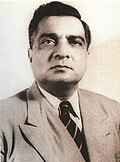


| President of Pakistan | |
|---|---|
| صدرِ پاکستان s̤adr-e Pākistān | |
 | |
 | |
| Head of state of the Islamic Republic of Pakistan Executive branch of the Government of Pakistan | |
| Style | Honourable President (formal) His Excellency[1] (diplomatic) Mr President (informal) |
| Type | Head of state Commander-in-chief |
| Residence | Aiwan-e-Sadr |
| Seat | Islamabad |
| Appointer | Electoral College |
| Term length | Five years, renewable once consecutively |
| Constituting instrument | Constitution of Pakistan (1973) |
| Precursor | Monarch of Pakistan |
| Inaugural holder | Iskander Mirza |
| Formation | 23 March 1956 |
| Succession | Line of succession |
| Deputy | Chairman of the Senate |
| Salary | ₨847,000 per month[2][3] |
| Website | President of Pakistan |
.jpg)
 |
|---|
| This article is part of a series on the politics and government of Pakistan |

.svg)
|
President of Pakistan serves as the head of state of the Islamic Republic of Pakistan, functioning as the nominal head of the executive and federal parliament, the first citizen of the country, and supreme commander of the Pakistan Armed Forces. The current President, Asif Ali Zardari, assumed office on 10 March 2024 as the 14th holder of this position. As the ceremonial head of the federation, the President is constitutionally bound to act on the advice of the Prime Minister and federal cabinet.
However, in practical terms, the Army Chief is widely considered to exercise ultimate authority over all political positions in Pakistan.[4]
The presidential office was established upon Pakistan's declaration as an Islamic Republic on 23 March 1956, with Major General Iskander Mirza, then serving Governor-General, assuming the inaugural presidency. Following the 1958 coup d'état, the prime minister's office was abolished, rendering the Presidency the country's most powerful position. This authority was further consolidated when the 1962 Constitution established Pakistan as a Presidential Republic, concentrating all executive powers in the President.
The 1973 Constitution subsequently introduced parliamentary democracy, reducing the presidency to a ceremonial role. However, the 1977 military takeover reversed these democratic reforms. The 8th Amendment transformed Pakistan into a semi-presidential republic, with executive power shared between the President and Prime Minister during the 1985-2010 period. The 18th Amendment in 2010 restored parliamentary democracy and reinstated the presidency's ceremonial nature.
Constitutionally, the President cannot directly administer the government; executive authority is exercised on their behalf by the Prime Minister, who maintains regular briefings on domestic and foreign policy matters as well as legislative proposals. The Constitution, however, vests the President with powers including pardons, reprieves, and military command, though senior military appointments require presidential action based on Prime Minister consultation and approval.
The President is indirectly elected by the Electoral College for a five-year term, with constitutional requirements mandating Muslim citizenship and minimum age of forty-five years. The President resides in Islamabad's Aiwan-e-Sadar (President's House). In the President's absence, the Senate Chairman exercises presidential responsibilities until either the President resumes office or the next officeholder is elected.
Fourteen individuals have held the presidency since its inception, with Iskander Ali Mirza serving as the first President from 23 March 1956 to 25 October 1958, followed by fourteen subsequent officeholders, with Asif Ali Zardari currently serving from 10 March 2024.
References
- ↑ Gupta, K. R., ed. (2006). India-Pakistan relations with special reference to Kashmir. New Delhi: Atlantic Publ. and Distributors. ISBN 8126906723.
- ↑ "Govt wants to double president's salary". The Express Tribune. 29 May 2018.
- ↑ "Data" (PDF). www.na.gov.pk. Retrieved 9 June 2020.
- ↑ Jonko, Anushree (11 November 2025). "Pakistan Puts Asim Munir's Army Above State: What It Means". NDTV.