

















Chennai
Madras | |
|---|---|
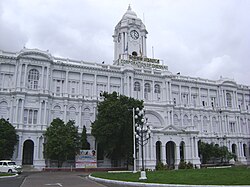
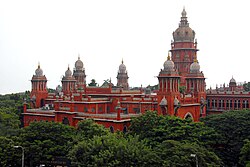
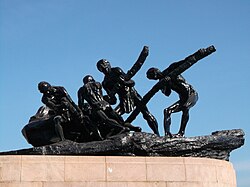
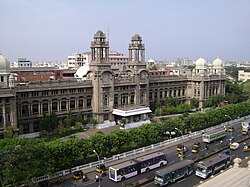
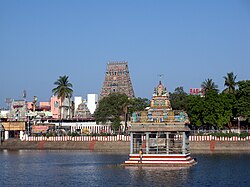
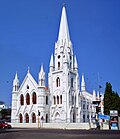
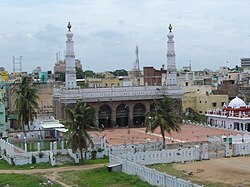
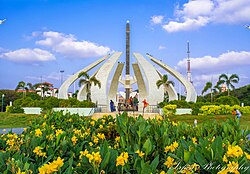
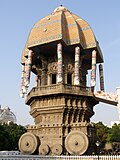
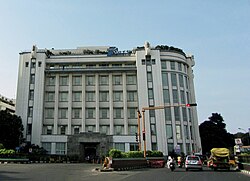
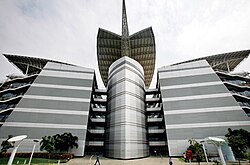
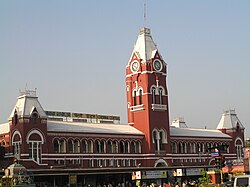
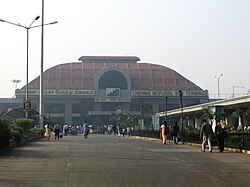
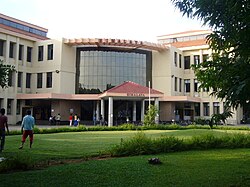
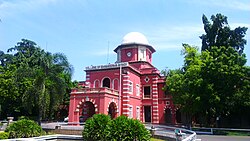
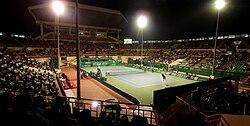
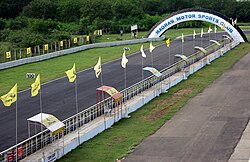
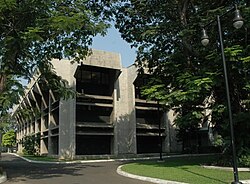
Clockwise from top: Chennai Central railway station; the Triumph of Labour; the Marina; South Chennai skyline; Ripon Building; and Parthasarathy Temple | |
| Nickname(s): | |
 Location in Chennai Metropolitan Area  Location in Tamil Nadu  Location in India  Location in Asia .svg) Location in Earth | |
| Coordinates: Template:Wikidatacoord | |
| Country |  India India |
| State | Tamil Nadu |
| Region | Coromandel |
| District | Chennai district[lower-alpha 1] |
| Former name | Madras |
| Established | 1639 |
| Government | |
| • Type | Municipal Corporation |
| • Body | Greater Chennai Corporation |
| • Mayor | Priya R. |
| Area | |
| • Metropolis | 1,189 km2 (459.0755 sq mi) |
| • Metro | 5,904 km2 (2,279.547 sq mi) |
| Elevation | 7 m (23 ft) |
| Population | |
| • Metropolis | 12,395,000 |
| • Rank | 6th |
| • Density | 10,000/km2 (27,000/sq mi) |
| • Metro | 8,653,521 8,917,749 (Extended UA)[19] |
| • Metro rank | 4th |
| Demonym(s) | Chennaiite Chennaikaran (male), Chennaikari (female) |
| Languages | |
| • Official | Tamil |
| Time zone | UTC+05:30 (IST) |
| Pincode(s) | 600xxx |
| Area code | +91-44 |
| Vehicle registration | TN-01 to TN-14, TN-18, TN-22, TN-85 |
| GDP (PPP) | 58.6-86 billion[23][24][25][26] |
| Website | Chennai Corporation |
| |


Chennai (/ˈtʃɛnaɪ/ ( listen), Tamil: [ˈt͡ɕenːaɪ̯]), formerly known as Madras,[upper-alpha 1] is the capital city of Tamil Nadu, the southernmost Indian state. It is the state's primate city both in area and population and is located on the Coromandel Coast of the Bay of Bengal. According to the 2011 Indian census, Chennai is the sixth-most populous city in India and forms the fourth-most populous urban agglomeration. Incorporated in 1866, the Greater Chennai Corporation is the oldest municipal corporation of India and the second oldest in the world after London.
Historically, Chennai and surroundings were part of the Chola, Pandya, Pallava and Vijayanagara kingdoms for many centuries. The coastal land, which then contained the fishing village Madrasapattinam, was purchased by the British East India Company from the Nayak ruler Damarla Chennapa Nayaka, in the 17th century. The British garrison established the Madras city and port, and built Fort St. George—the first British fortress in India—which the French won over briefly in 1746, before becoming the winter capital of the Madras Presidency, a colonial province of the British Raj in the Indian subcontinent. After India gained its independence in 1947, Madras continued as the capital city of the Madras State and present-day Tamil Nadu. The city was officially renamed as Chennai in 1996.
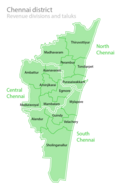
The city is coterminous with Chennai district, which together with the adjoining suburbs constitutes the Chennai Metropolitan Area,[note 1] the 36th-largest urban area in the world by population[28] and one of the largest metropolitan economies of India. As the traditional and de facto gateway of South India,[1][2][3][4] Chennai is among the most-visited Indian cities by foreigners. It was ranked the 43rd most-visited city in the world in 2015 and 36th in 2019.[29][30] The Quality of Living Survey rates it as India's safest city.[31] Chennai attracts 45 percent of health tourists visiting India, and 30 to 40 percent of domestic health tourists.[32] As such, it is termed "India's health capital".[33][34] Chennai has the fifth-largest urban economy,[35] and had the third-largest expatriate population in India.[36][37]
Ranked as a beta-level city in the Global Cities Index,[38] Chennai was dubbed India's best city by India Today in 2014.[39][40] It was named the "hottest" city (city worth visiting and worth living in for long term) by the BBC in 2015, citing its amalgam of both modern and traditional values.[41] It was the only South Asian city to feature on National Geographic's "Top 10 food cities" in 2015,[42] and ranked ninth on Lonely Planet's best cosmopolitan cities of the world.[43] In October 2017, Chennai was added to the UNESCO Creative Cities Network (UCCN) list for its rich musical tradition.[44] Chennai hosts more than one-third of India's automobile industry, and is a major film production center, home to the Tamil film industry.
Etymology
The name Chennai was derived from the name of Damarla Mudirasa Chennappa Nayakudu, father of Damarla Venkatapathy Nayak, a Nayak ruler who served as a general under Venkata III of the Vijayanagara Empire from whom the British East India Company acquired the town in 1639.[45][46] As such, the city's name is of Telugu language origin.[47][48][49] The first official use of the name Chennai is said to be in a sale deed, dated August 1639, to Francis Day of the East India Company, even before[50] the Chennakesava Perumal Temple was built in 1646,[51] while some scholars argue to the contrary.[52]
The name Madras is also of native origin, and has been shown to have been in use before the British established a presence in India.[53] A Vijayanagara-era inscription dated to the year 1367 that mentions the port of Mādarasanpattanam, along with other small ports on the east coast, was discovered in 2015 and it was theorised that the aforementioned port is the fishing port of Royapuram.[54] According to some sources, Madras is derived from Madraspattinam, a fishing village north of Fort St George.[55] However, it is uncertain whether the name was in use before the arrival of Europeans.[56] British military mapmakers believed Madras was originally Mundir-raj or Mundiraj, which was the name of a Telugu community, Mudiraj, who were the native inhabitants of the city.[57][58]
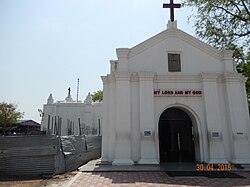
There are also suggestions that it may have originated from the Portuguese phrase Mãe de Deus or Madre de Dios, which means "mother of God", due to Portuguese influence on the port city, specifically referring to a Church of St. Mary.[59]
In August 1996, the Government of Tamil Nadu officially changed the name from Madras to Chennai. At that time many Indian cities underwent a change of name.[60][61] However, the name Madras continues in occasional use for the city,[62] as well as for places named after the city such as University of Madras, IIT Madras, Madras Institute of Technology, Madras Medical College, Madras Veterinary College, Madras Christian College.
History


Stone age implements have been found near Pallavaram in Chennai. According to the Archaeological Survey of India (ASI), Pallavaram was a megalithic cultural establishment, and pre-historic communities resided in the settlement.[63]
The region around Chennai has served as an important administrative, military, and economic centre for many centuries. During the 1st century CE, a poet and weaver named Thiruvalluvar lived in the town of Mylapore (a neighbourhood of present Chennai).[64] From the 1st–12th century the region of present Tamil Nadu and parts of South India was ruled by the Cholas.[65]
The Pallavas of Kanchi built the areas of Mahabalipuram and Pallavaram during the reign of Mahendravarman I. They also defeated several kingdoms including the Cheras, Cholas and Pandyas who ruled over the area before their arrival. Sculpted caves and paintings have been identified from that period.[66] Ancient coins dating to around 500 BCE have also been unearthed from the city and its surrounding areas. A portion of these findings belonged to the Vijayanagara Empire, which ruled the region during the medieval period.[67]
The Portuguese first arrived in 1522 and built a port called São Tomé after the Christian apostle, St. Thomas, who is believed to have preached in the area between 52 and 70 CE. In 1612, the Dutch established themselves near Pulicat, north of Chennai.[68]
On 20 August 1639 Francis Day of the East India Company along with the Nayak of Kalahasti Damarla Chennappa Nayakudu, travelled to the Chandragiri palace for an audience with the Vijayanager Emperor Peda Venkata Raya.[69] Day was seeking to obtain a grant for land on the Coromandel coast on which the company could build a factory and warehouse for their trading activities. He was successful in obtaining the lease of a strip of land about 10 km (6 mi) long and 1.6 km (1 mi) inland in return for a yearly sum of five hundred lakh pagodas.[70][71][72] On 22 August, he secured the land grant from local Nayak (Damarla Venkatadri Nayaka and his younger brother Aiyappa Nayaka of Poonamallee).[73][74] The region was then formerly a fishing village known as "Madraspatnam".[67] A year later, the Company built Fort St. George, the first major English settlement in India,[75] which became the nucleus of the growing colonial city and urban Chennai, grew around this Fort.[76] Post independence the fort housed the Tamil Nadu Assembly until the new Secretariat building was opened in 2010, but shortly afterwards it was again moved back to Fort St. George, due to a change in the Government.[77]
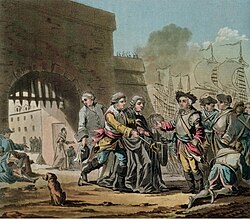
In 1746, Fort St. George and Madras were captured by the French under General La Bourdonnais, the Governor of Mauritius, who plundered the town and its outlying villages.[68] The British regained control in 1749 through the Treaty of Aix-la-Chapelle and strengthened the town's fortress wall to withstand further attacks from the French and Hyder Ali, the Sultan of Mysore.[78] They resisted a French siege attempt in 1759.[79] In 1769 the city was threatened by Mysore and the British were defeated by Hyder Ali, after which the Treaty of Madras ended the war.[80] By the 18th century, the British had conquered most of the region around Tamil Nadu and the northern modern–day states of Andhra Pradesh and Karnataka, establishing the Madras Presidency with Madras as the capital.[81]
.jpg)
Gradually, the city grew into a major naval base and became the central administrative centre for the British in South India.[82] The city served as the baseline for the Great Trigonometrical Survey of India started on 10 April 1802.[83] With the advent of railways in India in the 19th century, the thriving urban centre was connected to other important cities such as Bombay and Calcutta, promoting increased communication and trade with the hinterland.[84] Sir Arthur Lawley was Governor of Madras from 1906 to 1911 and promoted modern agriculture, industry, railways, education, the arts and more democratic governance.[85] The Governor lived in Government House, Fort St George, and had a country home at Guindy, with access to a golf course, hockey pitches, riding stables and the Guindy Horse Racing Track.[86][87] In the First World War as Red Cross Commissioner in Mesopotamia, he looked after the welfare of Indian soldiers.[88] Madras was the only Indian city to be attacked by the Central Powers during World War I,[89] when an oil depot was shelled by the German light cruiser Template:SMS on 22 September 1914, as it raided shipping lanes in the Indian Ocean, causing disruption to shipping.[90]
After India gained its independence in 1947, the city became the capital of Madras State, which was renamed as Tamil Nadu in 1969.[91] The violent agitations of 1965 against the compulsory imposition of Hindi and in support of English in India in the state marked a major shift in the political dynamics of the city and eventually it had a big impact on the whole state. Because of Madras and its people, English was not abolished as an official language, and remains an official language of India alongside Hindi.[92] On 17 July 1996, the city known as Madras was officially renamed Chennai, in line with what was then a nationwide trend to using less Anglicised names.[93] On 26 December 2004, an Indian Ocean tsunami lashed the shores of Chennai, killing 206 people in Chennai and permanently altering the coastline.[94][95] The 2015 Chennai Floods submerged major portions of the city, killing 269 people and resulting in damages of ₹86.4 billion (US$1 billion).[96][97][98]
Environment
Geography
.jpg)
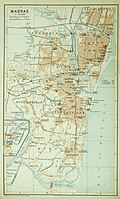
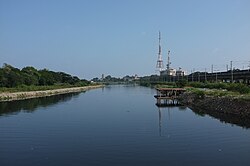
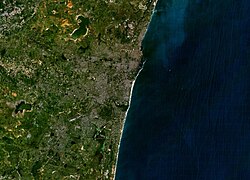
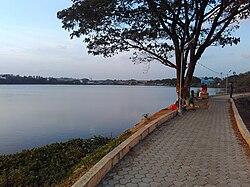
Chennai is located on the south–eastern coast of India in the north–eastern part of Tamil Nadu on a flat coastal plain known as the Eastern Coastal Plains. Its average elevation is around 6.7 m (22 ft),[99] and its highest point is 60 m (200 ft).[100] Chennai is 2,184 km (1,357 mi) south of Delhi, 1,337 km (831 mi) southeast of Mumbai, and 1,707 km (1,061 mi) southwest of Kolkata by road. Two major rivers flow through Chennai, the Cooum River (or Koovam) through the centre and the Adyar River to the south. A third river, the Kortalaiyar, travels through the northern fringes of the city before draining into the Bay of Bengal, at Ennore. The estuary of this river is heavily polluted with effluents released by the industries in the region.[101] Adyar and Cooum rivers are heavily polluted with effluents and waste from domestic and commercial sources, the Coumm being so heavily polluted it is regarded as the city's eyesore.[102][103] A protected estuary on the Adyar forms a natural habitat for several species of birds and animals.[104] The Buckingham Canal, 4 km (2.5 mi) inland, runs parallel to the coast, linking the two rivers. The Otteri Nullah, an east–west stream, runs through north Chennai and meets the Buckingham Canal at Basin Bridge. Several lakes of varying size are located on the western fringes of the city. Some areas of the city have the problem of excess iron content in groundwater.[105]

Chennai's soil is mostly clay, shale and sandstone.[106] Clay underlies most of the city, chiefly Manali, Kolathur, Maduravoyal, K. K. Nagar, Tambaram, Mudichur, Pallavaram Semmencherry, Alapakkam, Vyasarpadi and Anna Nagar. Sandy areas are found along the river banks and coasts, and include areas such as Tiruvottiyur, George Town, Madhavaram, New Washermanpet, Chepauk, Mylapore, Porur, Adyar, Besant Nagar and Uthandi. In these areas, rainwater runoff percolates quickly through the soil. Areas having hard rock surface include Guindy, Nanganallur, Pallikaranai, Alandur, Jaladampet, Velachery, Adambakkam and a part of Saidapet and Perungudi.[107][108] The ground water table in Chennai is at 4–5 m below ground in most of the areas,[108] which was considerably improved and maintained through the mandatory rain water harvesting system.[109] Of the 24.87 km coastline of the city, 3.08 km experiences erosion, with sand accretion along the shoreline can be noticed at the Marina beach and the area between the Ennore Port and Kosasthalaiyar river.[110]
Geology
Chennai is classified as being in Seismic Zone III, indicating a moderate risk of damage from earthquakes.<ref>{{cite news |last=John |first=Ekatha Ann |title=
- ↑ 1.0 1.1 Cite error: Invalid
<ref>tag; no text was provided for refs namedOT_ScorchingHot - ↑ 2.0 2.1 Cite error: Invalid
<ref>tag; no text was provided for refs namedOI_TourismDay2018 - ↑ 3.0 3.1 Cite error: Invalid
<ref>tag; no text was provided for refs namedNational_Unwrapped - ↑ 4.0 4.1 Cite error: Invalid
<ref>tag; no text was provided for refs namedOI_Turns375 - ↑ Cite error: Invalid
<ref>tag; no text was provided for refs namedUSDept1997 - ↑ Cite error: Invalid
<ref>tag; no text was provided for refs namedDevonshire - ↑ Cite error: Invalid
<ref>tag; no text was provided for refs namedUSITC - ↑ Cite error: Invalid
<ref>tag; no text was provided for refs namedEcoNews - ↑ Cite error: Invalid
<ref>tag; no text was provided for refs namedCityGetsMostForeignTourists - ↑ Cite error: Invalid
<ref>tag; no text was provided for refs namedHealth capital - ↑ Cite error: Invalid
<ref>tag; no text was provided for refs namedHamid2012 - ↑ Cite error: Invalid
<ref>tag; no text was provided for refs namedKamath2000 - ↑ "Chennai: PhaseII" (PDF). Archived from the original (PDF) on 24 April 2014. Retrieved 24 April 2014.
- ↑ "Chennai Expansion Could Be Tricky, Suggests History". The New Indian Express. Archived from the original on 7 November 2020. Retrieved 30 May 2017.
- ↑ "About Greater Chennai Corporation". Official Website of Greater Chennai Corporation. Archived from the original on 2 June 2015. Retrieved 25 January 2010.Balasubramanian, Harini. "Chennai Metropolitan Area Set To Get Second-Biggest In India". www.proptiger.com. Retrieved 13 November 2022.
- ↑ "Chennai Metropolitan Area to become larger by over 1,000 villages". The New Indian Express. Retrieved 13 November 2022.
- ↑ "Chennai Metropolitan Authority orders expansion of city; 1225 villages to be added". The Indian Express. 26 October 2022. Retrieved 13 November 2022.
- ↑ Demographia World Urban Areas (PDF). Demographia. 2022. p. 21.
- ↑ "India Stats: Million plus cities in India as per Census 2011". Press Information Bureau, Mumbai. National Informatics Centre. Archived from the original on 30 June 2015. Retrieved 20 August 2015.
- ↑ Cite error: Invalid
<ref>tag; no text was provided for refs namedGreater Chennai Corporation unveiled - ↑ "About Greater Chennai Corporation". Official Website of Greater Chennai Corporation. Archived from the original on 2 June 2015. Retrieved 27 June 2019.
- ↑ "Tamil Nādu (India): State, Major Agglomerations & Cities – Population Statistics in Maps and Charts". City population.de. Retrieved 13 October 2015.
- ↑ "Richest Cities Of India". businessworld.in / Brookings. Retrieved 23 March 2022.
- ↑ "Global city GDP rankings 2008-2025". PwC. Archived from the original on 4 May 2011. Retrieved 16 December 2009.
- ↑ "The Most Dynamic Cities of 2025". Foreign Policy. Archived from the original on 28 August 2012. Retrieved 24 August 2012.
- ↑ Raghavan, T.C.A. Sharad (28 January 2015). "Linking urban India to drive growth". livemint. Retrieved 17 June 2015.
- ↑ Jones, Daniel (2003) [1917], Peter Roach; James Hartmann; Jane Setter (eds.), English Pronouncing Dictionary, Cambridge: Cambridge University Press, ISBN 3-12-539683-2
- ↑ "UN Demographic Urban Areas". UN stats. Retrieved 12 October 2015.
- ↑ Bremner, Caroline. "Top 100 City Destinations Ranking" (PDF). Euromonitor International. Archived (PDF) from the original on 23 December 2019. Retrieved 9 August 2016.
- ↑ Yasmeen, Rabia. "Top 100 city destinations" (PDF). Euromonitor International. Archived (PDF) from the original on 24 February 2021.
- ↑ Lakshmi, K. (25 February 2016). "Chennai rated the safest city in India". The Hindu. Archived from the original on 8 November 2020. Retrieved 19 April 2016.
- ↑ "Chennai – India's Health Capital". India Health Visit. Archived from the original on 18 August 2021. Retrieved 1 September 2012.
- ↑ "The quality of air you breathe in Chennai is worse than in Delhi". The Hindu. Archived from the original on 8 November 2020. Retrieved 15 July 2015.
- ↑ Ramakrishnan, Deepa H. (19 June 2019). "Chennai's air quality takes a turn for the worse". The Hindu. ISSN 0971-751X. Archived from the original on 25 February 2021. Retrieved 17 August 2019.
- ↑ Cite error: Invalid
<ref>tag; no text was provided for refs namedgdp - ↑ "Growing expat community favour cluster accomodation [sic]". The Economic Times. 15 January 2009. Archived from the original on 16 July 2018. Retrieved 29 December 2012.
- ↑ "India – exploring an Asian giant". The Guardian. February 2013.
- ↑ "Global cities index 2015". A.T. Kearney. Archived from the original on 23 September 2015. Retrieved 16 May 2015.
- ↑ "India Today Best City Awards 2014: Chennai bags top honour". India Today.
- ↑ "Alpha, Beta and Gamma cities". Classification of Cities. Spotted by Locals. Retrieved 4 April 2015.
- ↑ Lindsey Galloway. "The best places to live this year". BBC.com Travel.
- ↑ "Top 10 food cities". National Geographic. 22 January 2015. Archived from the original on 9 March 2021. Retrieved 12 October 2015.
- ↑ "Chennai named 9th best cosmopolitan city in the world". The Hindu. Archived from the original on 30 July 2020. Retrieved 12 October 2015.
- ↑ "Chennai is now part of UNESCO's 'creative cities network'". The Hindu. Archived from the original on 12 January 2021. Retrieved 11 November 2017.
- ↑ "District Profile, Chennai". Government of Tamil Nadu. Archived from the original on 14 January 2016. Retrieved 27 November 2015.
- ↑ C S Srinivasachari (1939). History of the City of Madrae third-largest economys. P_Varadachary_And_co. pp. 63–69.
- ↑ "Origin And Foundation of Madras | TLPMS". tlpms.in. Archived from the original on 2 September 2018. Retrieved 10 January 2017.
- ↑ "| TLPMS". tlpms.in. Archived from the original on 10 February 2017. Retrieved 10 January 2017.
- ↑ S. Muthiah (2008). Madras, Chennai: A 400-year Record of the First City of Modern India. Palaniappa Brothers. ISBN 978-81-8379-468-8.
- ↑ "District Profile – Chennai". District Administration, Chennai. Archived from the original on 4 November 2012. Retrieved 28 December 2012.
- ↑ Muthiah, S. (4 March 2012). "The 'Town Temple' resurrected". The Hindu. Chennai, India. Archived from the original on 7 March 2012.
- ↑ thmmn. "Face behind the name". The Hindu. Archived from the original on 15 August 2002. Retrieved 7 March 2018.
- ↑ Krishnamachari, Suganthy (21 August 2014). "Madras is not alien". The Hindu. Archived from the original on 19 January 2021 – via www.thehindu.com.
- ↑ Krishnamachari, Suganthy (21 August 2014). "Madras is not alien". The Hindu. No. Friday Review. Archived from the original on 19 January 2021. Retrieved 19 December 2015.
- ↑ The Geography of India: Sacred and Historic Places. Britannica Educational Publishing. 2011. ISBN 978-1-61530-202-4.
- ↑ Kurian, Nimi (31 August 2007). "Young World: And the city grew". The Hindu. Archived from the original on 1 October 2007. Retrieved 28 December 2012.
- ↑ "MUDIRAJ BUILT CITIES". mudiraja.com. Archived from the original on 21 March 2019. Retrieved 18 March 2019.
- ↑ F. H., Scott (1853). Routes in the Peninsula of India: Comprising the Whole of the Madras Presidency and Portions of the Adjacent Territories of Bengal and Bombay. Pharoah and Co., Athenaeum Press. p. iv.
- ↑ "Origin of the Name Madras". Corporation of Madras. Archived from the original on 21 September 2010. Retrieved 25 January 2012.
- ↑ Tharoor, Shashi (6 September 2002). "In India's name game, cities are the big losers". International Herald Tribune. Archived from the original on 14 January 2021. Retrieved 28 December 2012.
- ↑ Special Correspondent (23 September 2005). "Walkout in State Assembly". The Hindu. Archived from the original on 11 April 2006. Retrieved 28 December 2012.
{{cite news}}:|author=has generic name (help) - ↑ Kalpana (2003) Madras: The Architectural Heritage
Muthiah (2004), Madras Rediscovered
Ali (2005), Madras on Rainy Days
Ashok & Balasubramanian (2005) Chennai latté: a Madras brew
Chandrasekhar, Government Museum (2006) The wild ferns of Madras city and its immediate neighbourhood
Maracayyā (2008), Madras: Tracing the Growth of the City since 1639
Barlow (2009) The Story of Madras
Muthiah (2011) A Madras Miscellany: A Decade of People, Places & Potpourri - ↑ "Road workers stumble upon ancient grinding stone in Pallavaram". The Times of India. 19 September 2010. Archived from the original on 7 April 2021. Retrieved 28 December 2012.
- ↑ Awakening Indians to India (Hard Bound). Central Chinmaya Mission Trust. 2008. p. 215. ISBN 978-81-7597-433-3.[permanent dead link]
- ↑ Pat Chapman (2007). India: Food & Cooking: The Ultimate Book on Indian Cuisine. Replika Press Pvt. Ltd. p. 21. ISBN 978-1-84537-619-2. Archived from the original on 20 March 2015.
- ↑ Alain Daniélou; Kenneth Hurry (2003). A brief history of India. Alain Daniélou. p. 173. ISBN 978-1-59477-794-3.
- ↑ 67.0 67.1 R., Vaidyanadhan (31 August 2009). "Chennai Coins-the Vijayanagara Connection". The Hindu. Archived from the original on 26 August 2013. Retrieved 28 December 2012.
- ↑ 68.0 68.1 "Chennai History". Corporation of Chennai. Archived from the original on 21 September 2010. Retrieved 28 December 2012.
- ↑ Velcheru Narayana Rao, David Shulman, Sanjay Subrahmanyam (1998). Symbols of substance : court and state in Nayaka period Tamilnadu. Oxford : Oxford University Press, Delhi. p. xix, 349 p., [16] p. of plates : ill., maps ; 22 cm. ISBN 0-19-564399-2.
{{cite book}}: CS1 maint: multiple names: authors list (link) - ↑ Heras, H. (1 July 1927). "South India Under The Vijayanagar Empire Vol. 1" – via Internet Archive.
- ↑ "Welcome to Greater Chennai Corporation". www.chennaicorporation.gov.in. Archived from the original on 21 September 2010. Retrieved 25 January 2012.
- ↑ James Talboys Wheeler, India Under British Rule; From the Foundation of the East India Company, TheClassics.us (12 September 2013), ISBN 978-1230394978
- ↑ Thilakavathy, M.; Maya, R. K. (5 June 2019). FACETS OF CONTEMPORARY HISTORY. MJP Publisher. p. 583.
- ↑ Frykenberg, Robert Eric (26 June 2008). Christianity in India: From Beginnings to the Present. OUP Oxford. ISBN 9780198263777.
- ↑ Roberts J. M. (1997). A short history of the world. Helicon publishing Ltd. p. 277. ISBN 978-0-19-511504-8.
- ↑ Wagret, Paul (1977). Nagel's encyclopedia-guide. India, Nepal. Geneva: Nagel Publishers. p. 556. ISBN 978-2-8263-0023-6. OCLC 4202160.
- ↑ City Bureau (22 March 2010). "All eyes on new Assembly-Secretariat Complex". The Hindu. Archived from the original on 31 August 2011. Retrieved 28 December 2012.
- ↑ Spencer C. Tucker (2010). A global chronology of conflict. ABC—CLIO. p. 756. ISBN 978-1-85109-667-1.
- ↑ S., Muthiah (21 November 2010). "Madras Miscellany - When Pondy was wasted". The Hindu. Archived from the original on 3 December 2010. Retrieved 28 December 2012.
- ↑ Radhey Shyam Chaurasia (2002). History of Modern India:1707 A.D. to 2000 A.D. Atlantic Publishers and Distributors. p. 94. ISBN 978-81-269-0085-5.
- ↑ "Madras Presidency". Britannica. Retrieved 12 October 2015.
- ↑ Cite error: Invalid
<ref>tag; no text was provided for refs namedsouthasia - ↑ Gill, B. (2001); "THE BIG MAN. Surveying Sir George Everest", in: Professional Surveyor Magazine, Vol. 21 Nr 2. Retrieved online Archived 10 February 2017 at the Wayback Machine 8 March 2016.
- ↑ Bret Wallach (2005). Understanding the cultural landscape. The Guilford Press. p. 195. ISBN 978-1-59385-119-4.
- ↑ "Lawley, Sir Arthur (1860–1932)". Biography of Arthur Lawley. National Centre of Biography, Australian National University. Archived from the original on 23 October 2020. Retrieved 12 October 2015.
- ↑ Sir Arthur Lawley, Eloquent Knight Errant, Chapter 6. Catastrophe, Conspiracy, Celebration. The Benefits of Empire, Lady Lawley Cottage (Western Australian Red Cross) 2008 iBook
- ↑ Notes on the Administration of Sir Arthur Lawley, Governor of Madras, 1906–1911. Madras Government Press, 1912
- ↑ A Message from Mesopotamia, Sir Arthur Lawley, Hodder and Stoughton, London. 1917.
- ↑ Hodge, Carl Cavanagh (2008). Encyclopedia of the age of imperialism, 1800–1914. Greenwood Publishing Group. p. 446. ISBN 978-0-313-04341-3.
- ↑ J W Bond; Arnold Wright (1914). Southern India: Its History, People, Commerce and Industrial resources. Foreign and Colonial Compiling and Publishing Company, London. pp. 51–52. ISBN 81-206-1344-9.
- ↑ "Madras Renamed Tamil Nadu". Hubert Herald. Archived from the original on 11 September 2019. Retrieved 12 October 2015.
- ↑ V. Shoba (14 August 2011). "Chennai says it in Hindi". The Indian Express. Archived from the original on 15 June 2013. Retrieved 28 December 2012.
- ↑ "Madras renamed Chennai". mapsofindia.com. 17 July 2013. Retrieved 12 October 2015.
- ↑ Altaff, K; J Sugumaran, Maryland S Naveed (10 July 2005). "Impact of tsunami on meiofauna of Marina beach, Chennai, India" (PDF). Current Science. 89 (1). Archived from the original (PDF) on 22 January 2013. Retrieved 28 December 2012.
- ↑ Mohanty, Ashutosh. "Impact of Tsunami in India". Expressindia. Archived from the original on 15 January 2013. Retrieved 28 December 2012.
- ↑ "Tamil Nadu government pegs flood damage at Rs 8,481 crore, CM Jayalalithaa writes to PM Modi". DNA. 23 November 2015. Archived from the original on 7 September 2020.
- ↑ "Tamil Nadu's deadly rains hit industries hard". Deccan Herald. 30 November 2015. Archived from the original on 7 September 2020. Retrieved 1 December 2015.
- ↑ "Chennai rains: Death toll crosses 260, Home Minister says situation 'very alarming'". The Indian Express. 2 December 2015. Archived from the original on 8 November 2020.
- ↑ "Geographical and physical features". Chennai District. Archived from the original on 30 July 2013. Retrieved 28 December 2012.
- ↑ Pulikesi, M; P. Baskaralingam, D. Elango, V.N. Rayudu, V. Ramamurthi, S. Sivanesan (25 August 2006). "Air quality monitoring in Chennai, India, in the summer of 2005". Journal of Hazardous Materials. 136 (3): 589–596. doi:10.1016/j.jhazmat.2005.12.039. PMID 16442714.
Chennai is fairly low–lying, its highest point being only 300 m (980 ft) above sea level is a rugged barren hill opposite to the Airport called Pallavapuram Hill.
{{cite journal}}: CS1 maint: multiple names: authors list (link) - ↑ "Welcome to University of Madras – 154 years of Excellence". Unom.ac.in. 2 February 2012. Retrieved 10 June 2013.
- ↑ "Adyar River pollution". The Hindu. Archived from the original on 30 July 2020. Retrieved 12 October 2015.
- ↑ "Couvum River pollution". The Times of India. Archived from the original on 10 March 2021. Retrieved 12 October 2015.
- ↑ S. Theodore Baskaran (2008). "Chapter 2: Wildlife". In S. Muthiah (ed.). Madras, Chennai: A 400-year Record of the First City of Modern India, Volume 1. Palaniappa Brothers. p. 55. ISBN 978-81-8379-468-8. Retrieved 28 December 2012.
- ↑ K, Lakshmi (13 July 2004). "It's no cola, it's the water supplied in Korattur". The Hindu. Archived from the original on 27 January 2005. Retrieved 28 December 2012.
- ↑ "Practices and Practitioners". Centre for Science and Environment. Retrieved 28 December 2012.
- ↑ "Quality of groundwater better this year". The Times of India. 29 January 2011. Archived from the original on 26 April 2019. Retrieved 28 December 2012.
- ↑ 108.0 108.1 Lakshmi, K. (28 August 2012). "Tardy monsoon: Chennai water table rises only marginally". The Hindu. Chennai. Archived from the original on 22 September 2020. Retrieved 28 December 2012.
- ↑ Susheela Raghavan; Indira Narayanan (2008). "Chapter 1: Geography". In S.Muthiah (ed.). Madras, Chennai: A 400-year Record of the First City of Modern India, Volume 1. Palaniappa Brothers. p. 13. ISBN 978-81-8379-468-8.
- ↑ Lakshmi, K. (10 November 2018). "T.N. lost 41% shoreline to erosion: study". The Hindu. Chennai: Kasturi & Sons. Archived from the original on 29 November 2020. Retrieved 10 November 2018.
Cite error: <ref> tags exist for a group named "upper-alpha", but no corresponding <references group="upper-alpha"/> tag was found
Cite error: <ref> tags exist for a group named "note", but no corresponding <references group="note"/> tag was found