








| Tenzin Gyatso | |
|---|---|
 The Dalai Lama in 2012 | |
| 14th Dalai Lama | |
| Reign | 22 February 1940 – present |
| Predecessor | Thubten Gyatso |
| Regent | Lobsang Sangay as Sikyong (political functions)
previously Kalön Tripas
|
| Head of state of the Central Tibetan Administration | |
| In office | 1959–2012 |
| Predecessor | Office established |
| Successor | Lobsang Sangay (as Sikyong) |
| Director of the Preparatory Committee for the Tibet Autonomous Region | |
| In office | 1956–1959 |
| Predecessor | Office established |
| Successor | 10th Panchen Lama (acting) |
| 1st, 2nd Vice Chairman of the Standing Committee of the National People's Congress of the People's Republic of China | |
| In office | 15 September 1954 – 21 December 1964 Exile to India in March 1959 |
| Born | Lhamo Thondup 6 July 1935 Taktser, Amdo, Tibet[1][2] |
| Father | Choekyong Tsering |
| Mother | Diki Tsering |
| Religion | Tibetan Buddhism (Gelug school) |
| Signature |  |
| Part of a series on |
| Tibetan Buddhism |
|---|
 |
The 14th Dalai Lama[note 1] (spiritual name Jetsun Jamphel Ngawang Lobsang Yeshe Tenzin Gyatso, known as Tenzin Gyatso; born Lhamo Dhondup),[note 2] known as Gyalwa Rinpoche to the Tibetan people, is the current Dalai Lama, the highest spiritual leader of Tibet, and a retired political leader of Tibet.[3] Born on 6 July 1935, or in the Tibetan calendar, in the Wood-Pig Year, 5th month, 5th day,[4] he is considered a living Bodhisattva; specifically, an emanation of Avalokiteśvara. He is also the leader of the Gelug school, the newest school of Tibetan Buddhism,[5] formally headed by the Ganden Tripa. The central government of Tibet, the Ganden Phodrang, invested the Dalai Lama with temporal duties until his exile in 1959.[6][7] On April 29, 1959, the Dalai Lama established the independent Tibetan government in exile, the Central Tibetan Administration, in the north Indian hill station of Mussoorie, which then moved in May 1960 to Dharamsala, where he resides. He retired as political head in 2011 to make way for a democratic government.[8][9][10]
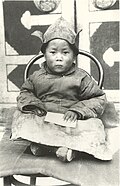
The 14th Dalai Lama was born to a farming family, in Taktser (Hongya in Chinese), in Amdo province (Qinghai in Chinese), northeastern Tibet.[1][2] He was selected as the tulku of the 13th Dalai Lama in 1937 and formally recognized as the 14th Dalai Lama in a public declaration near the town of Bumchen in 1939.[11] As with the recognition process for the 13th Dalai Lama, a Golden Urn selection process was not used.[12][13][14][15] His enthronement ceremony as the Dalai Lama was held in Lhasa on 22 February 1940 and he eventually assumed full temporal (political) duties on 17 November 1950, at the age of 15, after the People's Republic of China's occupation of Tibet.[11] The Tibetan government administered the historic Tibetan regions of Ü-Tsang, Kham and Amdo, and "In the course of Tibet's 2000-year history, the country came under a degree of foreign influence only for short periods of time in the thirteenth and eighteenth centuries."[16]
During the 1959 Tibetan uprising, the Dalai Lama escaped to India, where he currently lives in exile while remaining the most important spiritual leader of Tibet. The Dalai Lama advocates for the welfare of Tibetans while continuing to call for the Middle Way Approach to negotiations with China for the autonomy of Tibet and the protection of Tibetan culture, including for the religious rights of Tibetans.
The Dalai Lama also meets with other world leaders, religious leaders, philosophers and scientists, and travels worldwide giving Tibetan Buddhist teachings. His work includes focus on the environment, economics, women's rights, nonviolence, interfaith dialogue, physics, astronomy, Buddhism and science, cognitive neuroscience,[17][18][19] reproductive health and sexuality.
Along with his teachings on Tibetan Mahayana and Vajrayana Buddhism, the Dalai Lama's Kalachakra teachings and initiations are international events.
He is the chief Patron of the Maha Bodhi Society of India, conferred upon him at the 2008 Annual General Meeting of the Maha Bodhi Society of India.[20]
The Dalai Lama is a recipient of the Nobel Peace Prize awarded in 1989, and the US Congressional Gold Medal in 2006. Time magazine named the Dalai Lama one of the "Children of Mahatma Gandhi" and Gandhi's spiritual heir to nonviolence.[21][22]
Early life and background
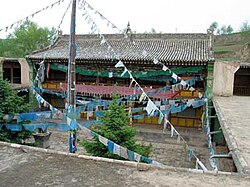
Lhamo Thondup[23] was born on 6 July 1935 to a farming and horse trading family in the small hamlet of Taktser,[note 3] or Chija Tagtser[28] (Chinese: 红崖村; pinyin: Hóngyá Cūn; lit. 'Redcliff Village'), at the edge of the traditional Tibetan region of Amdo in Qinghai Province.[24] He was one of seven siblings to survive childhood. The eldest was his sister Tsering Dolma, eighteen years his senior. His eldest brother, Thupten Jigme Norbu, had been recognised at the age of eight as the reincarnation of the high Lama Taktser Rinpoche. His sister, Jetsun Pema, spent most of her adult life on the Tibetan Children's Villages project. The Dalai Lama has said that his first language was "a broken Xining language which was (a dialect of) the Chinese language", a form of Central Plains Mandarin, and his family speak neither Amdo Tibetan nor Lhasa Tibetan.[29][30][31]

Following reported signs and visions, three search teams were sent out to the north-east, the east, and the south-east to locate the new incarnation when the boy who was to become the 14th Dalai Lama was about two years old.[32] Sir Basil Gould, British delegate to Lhasa in 1936, related his account of the north-eastern team to Sir Charles Alfred Bell, former British resident in Lhasa and friend of the 13th Dalai Lama. Amongst other omens, the head of the embalmed body of the thirteenth Dalai Lama, at first facing south-east, had turned to face the north-east, indicating, it was interpreted, the direction in which his successor would be found. The Regent, Reting Rinpoche, shortly afterwards had a vision at the sacred lake of Lhamo La-tso which he interpreted as Amdo being the region to search. This vision was also interpreted to refer to a large monastery with a gilded roof and turquoise tiles, and a twisting path from it to a hill to the east, opposite which stood a small house with distinctive eaves. The team, led by Kewtsang Rinpoche, went first to meet the Panchen Lama, who had been stuck in Jyekundo, in northern Kham.[32] The Panchen Lama had been investigating births of unusual children in the area ever since the death of the 13th Dalai Lama.[33] He gave Kewtsang the names of three boys whom he had discovered and identified as candidates. Within a year the Panchen Lama had died. Two of his three candidates were crossed off the list but the third, a "fearless" child, the most promising, was from Taktser village, which, as in the vision, was on a hill, at the end of a trail leading to Taktser from the great Kumbum Monastery with its gilded, turquoise roof. There they found a house, as interpreted from the vision—the house where Lhamo Thondup lived.[32][33]
The 14th Dalai Lama claims that at the time, the village of Taktser stood right on the "real border" between the region of Amdo and China.[34] When the team visited, posing as pilgrims, its leader, a Sera Lama, pretended to be the servant and sat separately in the kitchen. He held an old mala that had belonged to the 13th Dalai Lama, and the boy Lhamo Dhondup, aged two, approached and asked for it. The monk said "if you know who I am, you can have it." The child said "Sera Lama, Sera Lama" and spoke with him in a Lhasa accent, in a dialect the boy's mother could not understand. The next time the party returned to the house, they revealed their real purpose and asked permission to subject the boy to certain tests. One test consisted of showing him various pairs of objects, one of which had belonged to the 13th Dalai Lama and one which had not. In every case, he chose the Dalai Lama's own objects and rejected the others.[35]

From 1936 the Hui 'Ma Clique' Muslim warlord Ma Bufang ruled Qinghai as its governor under the nominal authority of the Republic of China central government.[36] According to an interview with the 14th Dalai Lama, in the 1930s, Ma Bufang had seized this north-east corner of Amdo in the name of Chiang Kai-shek's weak government and incorporated it into the Chinese province of Qinghai.[37] Before going to Taktser, Kewtsang had gone to Ma Bufang to pay his respects.[33] When Ma Bufang heard a candidate had been found in Taktser, he had the family brought to him in Xining.[38] He first demanded proof that the boy was the Dalai Lama, but the Lhasa government, though informed by Kewtsang that this was the one, told Kewtsang to say he had to go to Lhasa for further tests with other candidates. They knew that if he was declared to be the Dalai Lama, the Chinese government would insist on sending a large army escort with him, which would then stay in Lhasa and refuse to budge.[39] Ma Bufang, together with Kumbum Monastery, then refused to allow him to depart unless he was declared to be the Dalai Lama, but withdrew this demand in return for 100,000 Chinese dollars ransom in silver to be shared amongst them, to let them go to Lhasa.[39][40] Kewtsang managed to raise this, but the family was only allowed to move from Xining to Kumbum when a further demand was made for another 330,000 dollars ransom: one hundred thousand each for government officials, the commander-in-chief, and the Kumbum Monastery; twenty thousand for the escort; and only ten thousand for Ma Bufang himself, he said.[41]
Two years of diplomatic wrangling followed before it was accepted by Lhasa that the ransom had to be paid to avoid the Chinese getting involved and escorting him to Lhasa with a large army.[42] Meanwhile, the boy was kept at Kumbum where two of his brothers were already studying as monks and recognised incarnate lamas.[43] The payment of 300,000 silver dollars was then advanced by Muslim traders en route to Mecca in a large caravan via Lhasa. They paid Ma Bufang on behalf of the Tibetan government against promissory notes to be redeemed, with interest, in Lhasa.[43][44] The 20,000-dollar fee for an escort was dropped, since the Muslim merchants invited them to join their caravan for protection; Ma Bufang sent 20 of his soldiers with them and was paid from both sides since the Chinese government granted him another 50,000 dollars for the expenses of the journey. Furthermore, the Indian government helped the Tibetans raise the ransom funds by affording them import concessions.[44]
Released from Kumbum, on 21 July 1939 the party travelled across Tibet on a journey to Lhasa in the large Muslim caravan with Lhamo Thondup, now 4 years old, riding with his brother Lobsang in a special palanquin carried by two mules, two years after being discovered. As soon as they were out of Ma Bufang's area, he was officially declared to be the 14th Dalai Lama by the Central Government of Tibet, and after ten weeks of travel he arrived in Lhasa on 8 October 1939.[45] The ordination (pabbajja) and giving of the monastic name of Tenzin Gyatso were handled by Reting Rinpoche. There was very limited Chinese involvement at this time.[46]
Tibetan Buddhists normally refer to him as Yishin Norbu (Wish-Fulfilling Gem), Kyabgon (Saviour), or just Kundun (Presence). His devotees, as well as much of the Western world, often call him His Holiness the Dalai Lama, the style employed on the Dalai Lama's website. According to the Dalai Lama, he had a succession of tutors in Tibet including Reting Rinpoche, Tathag Rinpoche, Ling Rinpoche and lastly Trijang Rinpoche, who became junior tutor when he was nineteen.[47] At the age of 11 he met the Austrian mountaineer Heinrich Harrer, who became his videographer and tutor about the world outside Lhasa. The two remained friends until Harrer's death in 2006.[48]
In 1959, at the age of 23, he took his final examination at Lhasa's Jokhang Temple during the annual Monlam or Prayer Festival.[note 4] He passed with honours and was awarded the Lharampa degree, the highest-level geshe degree, roughly equivalent to a doctorate in Buddhist philosophy.[50][51]
Life as the Dalai Lama
Personal meditation practice
The Dalai Lama uses various meditation techniques, including analytic meditation.[52] He has said that the aim of meditation is "to maintain a very full state of alertness and mindfulness, and then try to see the natural state of your consciousness."[53]
Social stances
Abortion
The Dalai Lama has said that, from the perspective of the Buddhist precepts, abortion is an act of killing.[54] He has also clarified that in certain cases abortion could be considered ethically acceptable "if the unborn child will be retarded or if the birth will create serious problems for the parent", which could only be determined on a case-by-case basis.[55]
Democracy, nonviolence, religious harmony, and Tibet's relationship with India

The Dalai Lama says that he is active in spreading India's message of nonviolence and religious harmony throughout the world. "I am the messenger of India's ancient thoughts the world over." He has said that democracy has deep roots in India. He says he considers India the master and Tibet its disciple, as great scholars went from India to Tibet to teach Buddhism. He has noted that millions of people lost their lives in violence and the economies of many countries were ruined due to conflicts in the 20th century. "Let the 21st century be a century of tolerance and dialogue."[56]
The Dalai Lama has also critiqued proselytization and certain types of conversion, believing the practices to be contrary to the fundamental ideas of religious harmony and spiritual practice.[57][58][59][60] He has stated that "It’s very important that our religious traditions live in harmony with one another and I don’t think proselytizing contributes to this. Just as fighting and killing in the name of religion are very sad, it’s not appropriate to use religion as a ground or a means for defeating others."[61] In particular, he has critiqued Christian approaches to conversion in Asia, stating that he has "come across situations where serving the people is a cover for proselytization."[62] The Dalai Lama has labeled such practices counter to the "message of Christ" and has emphasized that such individuals "practice conversion like a kind of war against peoples and cultures."[63] In a statement with Hindu religious leaders, he expressed that he opposes "conversions by any religious tradition using various methods of enticement."[64]
In 1993, the Dalai Lama attended the World Conference on Human Rights and made a speech titled "Human Rights and Universal Responsibility".[65]
In 2001, in response to a question from a Seattle schoolgirl, the Dalai Lama said that it is permissible to shoot someone in self-defense (if the person was "trying to kill you") and he emphasized that the shot should not be fatal.[66]
In 2013, the Dalai Lama criticised Buddhist monks' attacks on Muslims in Myanmar and rejected violence by Buddhists, saying: "Buddha always teaches us about forgiveness, tolerance, compassion. If from one corner of your mind, some emotion makes you want to hit, or want to kill, then please remember Buddha's faith. ... All problems must be solved through dialogue, through talk. The use of violence is outdated, and never solves problems."[67] In May 2013, he said "Really, killing people in the name of religion is unthinkable, very sad."[68] In May 2015, the Dalai Lama called on Myanmar's Nobel Peace Prize winner Aung San Suu Kyi to do more to help the Rohingya Muslims in Myanmar, said that he had urged Suu Kyi to address the Rohingyas' plight in two previous private meetings and had been rebuffed.[69]
In 2017, after Chinese dissident and Nobel Peace Prize laureate Liu Xiaobo died of organ failure while in Chinese government custody, the Dalai Lama said he was "deeply saddened" and that he believed that Liu's "unceasing efforts in the cause of freedom will bear fruit before long."[70]
In October 2020, the Dalai Lama stated that he did not support Tibetan independence and hoped to visit China as a Nobel Prize winner. He said "I prefer the concept of a 'republic' in the People's Republic of China. In the concept of republic, ethnic minorities are like Tibetans, The Mongols, Manchus, and Xinjiang Uyghurs, we can live in harmony".[71]
Diet and animal welfare
People think of animals as if they were vegetables, and that is not right. We have to change the way people think about animals. I encourage the Tibetan people and all people to move toward a vegetarian diet that doesn't cause suffering.
— Dalai Lama[72]
The Dalai Lama advocates compassion for animals and frequently urges people to try vegetarianism or at least reduce their consumption of meat. In Tibet, where historically meat was the most common food, most monks historically have been omnivores, including the Dalai Lamas. The Fourteenth Dalai Lama was raised in a meat-eating family but converted to vegetarianism after arriving in India, where vegetables are much more easily available and vegetarianism is widespread.[73] He spent many years as a vegetarian, but after contracting hepatitis in India and suffering from weakness, his doctors told him to return to eating meat which he now does twice a week.[74] This attracted public attention when, during a visit to the White House, he was offered a vegetarian menu but declined by replying, as he is known to do on occasion when dining in the company of non-vegetarians, "I'm a Tibetan monk, not a vegetarian".[75] His own home kitchen, however, is completely vegetarian.[76]
Economics and political stance
The Dalai Lama has referred to himself as a Marxist and has articulated criticisms of capitalism.[77][78][79]
I am not only a socialist but also a bit leftist, a communist. In terms of social economy theory, I am a Marxist. I think I am farther to the left than the Chinese leaders. [Bursts out laughing.] They are capitalists.[77]
He reports hearing of communism when he was very young, but only in the context of the destruction of Communist Mongolia. It was only when he went on his trip to Beijing that he learned about Marxist theory from his interpreter Baba Phuntsog Wangyal.[80] At that time, he reports, "I was so attracted to Marxism, I even expressed my wish to become a Communist Party member", citing his favorite concepts of self-sufficiency and equal distribution of wealth. He does not believe that China implemented "true Marxist policy",[81] and thinks the historical communist states such as the Soviet Union "were far more concerned with their narrow national interests than with the Workers' International".[82] Moreover, he believes one flaw of historically "Marxist regimes" is that they place too much emphasis on destroying the ruling class, and not enough on compassion.[82] He finds Marxism superior to capitalism, believing the latter is only concerned with "how to make profits", whereas the former has "moral ethics".[83] Stating in 1993:
Of all the modern economic theories, the economic system of Marxism is founded on moral principles, while capitalism is concerned only with gain and profitability. Marxism is concerned with the distribution of wealth on an equal basis and the equitable utilisation of the means of production. It is also concerned with the fate of the working classes—that is, the majority—as well as with the fate of those who are underprivileged and in need, and Marxism cares about the victims of minority-imposed exploitation. For those reasons the system appeals to me, and it seems fair. I just recently read an article in a paper where His Holiness the Pope also pointed out some positive aspects of Marxism.[78][82]
Environment
The Dalai Lama is outspoken in his concerns about environmental problems, frequently giving public talks on themes related to the environment. He has pointed out that many rivers in Asia originate in Tibet, and that the melting of Himalayan glaciers could affect the countries in which the rivers flow.[84] He acknowledged official Chinese laws against deforestation in Tibet, but lamented they can be ignored due to possible corruption.[85] He was quoted as saying "ecology should be part of our daily life";[86] personally, he takes showers instead of baths, and turns lights off when he leaves a room.[84] Around 2005, he started campaigning for wildlife conservation, including by issuing a religious ruling against wearing tiger and leopard skins as garments.[87][88] The Dalai Lama supports the anti-whaling position in the whaling controversy, but has criticized the activities of groups such as the Sea Shepherd Conservation Society (which carries out acts of what it calls aggressive nonviolence against property).[89] Before the 2009 United Nations Climate Change Conference, he urged national leaders to put aside domestic concerns and take collective action against climate change.[90]
Sexuality
A monk since childhood, the Dalai Lama has said that sex offers fleeting satisfaction and leads to trouble later, while chastity offers a better life and "more independence, more freedom".[91] He has said that problems arising from conjugal life sometimes even lead to suicide or murder.[92] He has asserted that all religions have the same view about adultery.[93]
In his discussions of the traditional Buddhist view on appropriate sexual behavior, he explains the concept of "right organ in the right object at the right time", which historically has been interpreted as indicating that oral, manual and anal sex (both homosexual and heterosexual) are not appropriate in Buddhism or for Buddhists. However, he also says that in modern times all common, consensual sexual practices that do not cause harm to others are ethically acceptable and that society should accept and respect people who are gay or transgender from a secular point of view.[94] In a 1994 interview with OUT Magazine, the Dalai Lama clarified his personal opinion on the matter by saying, "If someone comes to me and asks whether homosexuality is okay or not, I will ask 'What is your companion's opinion?' If you both agree, then I think I would say, 'If two males or two females voluntarily agree to have mutual satisfaction without further implication of harming others, then it is okay.'"[95] However, when interviewed by Canadian TV news anchor Evan Solomon on CBC News: Sunday about whether homosexuality is acceptable in Buddhism, the Dalai Lama responded that "it is sexual misconduct".[96]
In his 1996 book Beyond Dogma, he described a traditional Buddhist definition of an appropriate sexual act as follows: "A sexual act is deemed proper when the couples use the organs intended for sexual intercourse and nothing else ... Homosexuality, whether it is between men or between women, is not improper in itself. What is improper is the use of organs already defined as inappropriate for sexual contact."[97] He elaborated in 1997, explaining that the basis of that teaching was unknown to him. He also conveyed his own "willingness to consider the possibility that some of the teachings may be specific to a particular cultural and historic context".[98]
In 2006, the Dalai Lama has expressed concern at "reports of violence and discrimination against" LGBT people and urged "respect, tolerance and the full recognition of human rights for all".[99]
Women's rights
In 2007, he said that the next Dalai Lama could possibly be a woman: "If a woman reveals herself as more useful the lama could very well be reincarnated in this form."[100]
In 2009, on gender equality and sexism, the Dalai Lama proclaimed at the National Civil Rights Museum in Memphis, Tennessee: "I call myself a feminist. Isn't that what you call someone who fights for women's rights?" He also said that by nature, women are more compassionate "based on their biology and ability to nurture and birth children". He called on women to "lead and create a more compassionate world", citing the good works of nurses and mothers.[101]
At a 2014 appearance at the Tata Institute of Social Sciences in Mumbai, the Dalai Lama said, "Since women have been shown to be more sensitive to others' suffering, their leadership may be more effective."[102]
In 2015, he said in a BBC interview that if a female succeeded him, "that female must be attractive, otherwise it is not much use," and when asked if he was joking, replied, "No. True!" He followed with a joke about his current success being due to his own appearance.[103]
Health
In 2013, at the Culture of Compassion event in Derry, Northern Ireland, the Dalai Lama said that "Warm-heartedness is a key factor for healthy individuals, healthy families and healthy communities."[104]
Response to COVID-19
In a 2020 statement in Time magazine on the COVID-19 pandemic, the Dalai Lama said that the pandemic must be combated with compassion, empirical science, prayer, and the courage of healthcare workers. He emphasized "emotional disarmament" (seeing things with a clear and realistic perspective, without fear or rage) and wrote: "The outbreak of this terrible coronavirus has shown that what happens to one person can soon affect every other being. But it also reminds us that a compassionate or constructive act – whether working in hospitals or just observing social distancing – has the potential to help many."[105][106]
Immigration
In September 2018, speaking at a conference in Malmö, Sweden home to a large immigrant population, the Dalai Lama said "I think Europe belongs to the Europeans", but also that Europe was "morally responsible" for helping "a refugee really facing danger against their life". He stated that Europe has a responsibility to refugees to "receive them, help them, educate them", but that they should aim to return to their places of origin and that "they ultimately should rebuild their own country".[107][108]
Speaking to German reporters in 2016, the Dalai Lama said there are "too many" refugees in Europe, adding that "Europe, for example Germany, cannot become an Arab country." He also said that "Germany is Germany".[109][110]
Retirement and succession plans
In May 2011, the Dalai Lama retired from the Central Tibetan Administration.[111]
In September 2011, the Dalai Lama issued the following statement concerning his succession and reincarnation:
When I am about ninety I will consult the high Lamas of the Tibetan Buddhist traditions, the Tibetan public, and other concerned people who follow Tibetan Buddhism, and re-evaluate whether the institution of the Dalai Lama should continue or not. On that basis we will take a decision. If it is decided that the reincarnation of the Dalai Lama should continue and there is a need for the Fifteenth Dalai Lama to be recognized, responsibility for doing so will primarily rest on the concerned officers of the Dalai Lama's Gaden Phodrang Trust. They should consult the various heads of the Tibetan Buddhist traditions and the reliable oath-bound Dharma Protectors who are linked inseparably to the lineage of the Dalai Lamas. They should seek advice and direction from these concerned beings and carry out the procedures of search and recognition in accordance with past tradition. I shall leave clear written instructions about this. Bear in mind that, apart from the reincarnation recognized through such legitimate methods, no recognition or acceptance should be given to a candidate chosen for political ends by anyone, including those in the People's Republic of China.[112][113]
In October 2011, the Dalai Lama repeated his statement in an interview with Canadian CTV News. He added that Chinese laws banning the selection of successors based on reincarnation will not impact his decisions. "Naturally my next life is entirely up to me. No one else. And also this is not a political matter," he said in the interview. The Dalai Lama also added that he has not decided on whether he would reincarnate or be the last Dalai Lama.[114]
In an interview with the German newspaper Welt am Sonntag published on 7 September 2014 the Dalai Lama stated "the institution of the Dalai Lama has served its purpose", and that "We had a Dalai Lama for almost five centuries. The 14th Dalai Lama now is very popular. Let us then finish with a popular Dalai Lama."[115]
Gyatso has also expressed fear that the Chinese government would manipulate any reincarnation selection in order to choose a successor that would go along with their political goals.[116] In response the Chinese government implied that it would select another Dalai Lama regardless of his decision.[117]
CIA Tibetan program
In October 1998, the Dalai Lama's administration acknowledged that it received $1.7 million a year in the 1960s from the U.S. government through a Central Intelligence Agency program.[118] When asked by CIA officer John Kenneth Knaus in 1995 to comment on the CIA Tibetan program, the Dalai Lama replied that though it helped the morale of those resisting the Chinese, "thousands of lives were lost in the resistance" and further, that "the U.S. Government had involved itself in his country's affairs not to help Tibet but only as a Cold War tactic to challenge the Chinese."[119]
His administration's reception of CIA funding has become one of the grounds for some state-run Chinese newspapers to discredit him along with the Tibetan independence movement.
In his autobiography Freedom in Exile, the Dalai Lama criticized the CIA again for supporting the Tibetan independence movement "not because they (the CIA) cared about Tibetan independence, but as part of their worldwide efforts to destabilize all communist governments".[120]
In 1999, the Dalai Lama said that the CIA Tibetan program had been harmful for Tibet because it was primarily aimed at serving American interests, and "once the American policy toward China changed, they stopped their help."[121]
Criticism
Ties to India

The Chinese press has criticized the Dalai Lama for his close ties with India. His 2010 remarks at the International Buddhist Conference in Gujarat saying that he was "Tibetan in appearance, but an Indian in spirituality" and referral to himself as a "son of India" in particular led the People's Daily to opine, "Since the Dalai Lama deems himself an Indian rather than Chinese, then why is he entitled to represent the voice of the Tibetan people?"[122] Dhundup Gyalpo of the Tibet Sun replied that Tibetan religion could be traced back to Nalanda in India, and that Tibetans have no connection to Chinese "apart ... from a handful of culinary dishes".[123] The People's Daily stressed the links between Chinese Buddhism and Tibetan Buddhism had accused the Dalai Lama of "betraying southern Tibet to India".[122] In 2008, the Dalai Lama said for the first time that the territory India claims and administers as part of Arunachal Pradesh is part of India, citing the disputed 1914 Simla Accord.[124]
Shugden controversy
The Dorje Shugden Controversy reappeared in the Gelug school by the publication of the Yellow Book in 1976, containing stories about wrathful acts of Dorje Shugden against Gelugpas who also practiced Nyingma teachings. In response, the 14th Dalai Lama, a Gelugpa himself and advocate of an "inclusive" approach to the teachings of Tibetan Buddhism,[125][126] started to speak out against the practice of Dorje Shugden in 1978.[127]
The controversy has attracted attention in the West because of demonstrations held in 2008 and 2014 by Dorje Shugden practitioners. A 2015 Reuters investigation determined "that the religious sect behind the protests has the backing of the Communist Party" and that the "group has emerged as an instrument in Beijing's long campaign to undermine support for the Dalai Lama".[128] After the Reuters investigation revealed that China backs it, the Shugden group halted operations and disbanded.[129]
Gedhun Choekyi Nyima
In April 2018, the Dalai Lama confirmed the official Chinese claims about Gedhun Choekyi Nyima by saying that he knew from "reliable sources" that the Panchen Lama he had recognized was alive and receiving normal education. He said he hoped that the Chinese-recognised Panchen Lama (Gyaincain Norbu) studied well under the guidance of a good teacher, adding that there were instances in Tibetan Buddhist tradition, of a reincarnated lama taking more than one manifestation.[130][131]
Public image
.jpg)

The Dalai Lama places highly in global surveys of the world's most admired men, ranking with Pope Francis as among the world's religious leaders cited as the most admired.[132][133]
The Dalai Lama's appeal is variously ascribed to his charismatic personality, international fascination with Buddhism, his universalist values, and international sympathy for the Tibetans.[134] In the 1990s, many films were released by the American film industry about Tibet, including biopics of the Dalai Lama. This is attributed to both the Dalai Lama's 1989 Nobel Peace Prize as well as to the euphoria following the Fall of Communism. The most notable films, Kundun and Seven Years in Tibet (both released in 1997), portrayed "an idyllic pre-1950 Tibet, with a smiling, soft-spoken Dalai Lama at the helm – a Dalai Lama sworn to non-violence": portrayals the Chinese government decried as ahistorical.[135]
The Dalai Lama has his own pages on Twitter,[136] Facebook,[137] and Instagram.[138]
.jpg)
The Dalai Lama has tried to mobilize international support for Tibetan activities.[139] The Dalai Lama has been successful in gaining Western support for himself and the cause of greater Tibetan autonomy, including vocal support from numerous Hollywood celebrities, most notably the actors Richard Gere and Steven Seagal, as well as lawmakers from several major countries.[140] Photos of the Dalai Lama were banned after March 1959 Lhasa protests until after the end of the Cultural Revolution in 1976. In 1996 the Chinese Communist Party once again reinstated the total prohibition of any photo of the 14th Dalai Lama. According to the Tibet Information Network, "authorities in Tibet have begun banning photographs of the exiled Dalai Lama in monasteries and public places, according to reports from a monitoring group and a Tibetan newspaper. Plainclothes police went to hotels and restaurants in Lhasa, the Tibetan capital, on 22 and 23 April and ordered Tibetans to remove pictures of the Dalai Lama ..."[141] The ban continues in many locations throughout Tibet today.
In the media
The 14th Dalai Lama has appeared in several non-fiction films including:
- 10 Questions for the Dalai Lama (2006, documentary)
- Dalai Lama Renaissance (2007, documentary)
- The Sun Behind the Clouds (2010)
- Bringing Tibet Home (2013)
- Monk with a Camera (2014, documentary)
- Dalai Lama Awakening (2014)
- Compassion in Action (2014)
He has been depicted as a character in various other movies and television programs including:
- Kundun, 1997 film directed by Martin Scorsese
- Seven Years in Tibet, 1997 film starring Brad Pitt and David Thewlis
- Klovn "Dalai Lama" Season 1, Episode 4 (2005)
- Red Dwarf episode "Meltdown" (1991)[142]
- Song of Tibet, 2000 film directed by Xie Fei.
- The Great Escape "14th Dalai Lama" (2018) on Epic
- "Dalai Lama", episode of the Indian television series Mega Icons (2019-20) on National Geographic.[143]
The Dalai Lama was featured on 5 March 2017, episode of the HBO late-night talk show Last Week Tonight, in which host John Oliver conducted a comedic interview with the Dalai Lama, focusing on the topics of Tibetan sovereignty, Tibetan self-immolations, and his succession plans.[144][relevant?]
A biographical graphic novel, Man of Peace, also envisaging the Dalai Lama's return to Tibet, was published by Tibet House US.[145][146] The Extraordinary Life of His Holiness the Fourteenth Dalai Lama: An Illuminated Journey, illustrations and text by artist Rima Fujita, narrated by the Dalai Lama, was published by Simon and Schuster in 2021.[147]
Awards and honours


The Dalai Lama has received numerous awards and honors worldwide over his spiritual and political career.[148][149][150] After the Tiananmen Square protests of 1989, the Norwegian Nobel Committee awarded him the 1989 Nobel Peace Prize.[151] The Committee officially gave the prize to the Dalai Lama for "the struggle of the liberation of Tibet and the efforts for a peaceful resolution"[152] and "in part a tribute to the memory of Mahatma Gandhi"[153] although the president of the committee also said that the prize was intended to put pressure on China,[154] which was reportedly infuriated that the award was given to a separatist.[151]
In 1959, he received the Ramon Magsaysay Award for Community Leadership;[155] in 1994, the Freedom Medal from the Roosevelt Institute;[156] and in 2005, the Christmas Humphreys Award from the Buddhist Society in the United Kingdom.
In 2006, he became one of only six people ever to be granted Honorary Citizenship of Canada. In February 2007, the Dalai Lama was named Presidential Distinguished Professor at Emory University in Atlanta, Georgia, the first time he accepted a university appointment.[157]
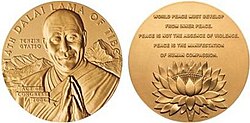
In 2007, the Dalai Lama received the Congressional Gold Medal, the highest civilian award bestowed by American lawmakers.[158] The Chinese government declared this would have "an extremely serious impact" on relations with the United States.[159]
In 2012, the Dalai Lama was awarded the Templeton Prize.[160] He donated the prize money to the charity Save the Children.[161]
Publications
- My Land and My People: The Autobiography of His Holiness the Dalai Lama. Ed. David Howarth. Weidenfeld and Nicolson, 1962. ISBN 978-0446674218
- Deity Yoga: In Action and Performance Tantras. Ed. and trans. Jeffrey Hopkins. Snow Lion, 1987. ISBN 978-0-93793-850-8
- Tantra in Tibet. Co-authored with Tsong-kha-pa, Jeffrey Hopkins. Snow Lion, 1987. ISBN 978-0-93793-849-2
- The Dalai Lama at Harvard. Ed. and trans. Jeffrey Hopkins. Snow Lion, 1988. ISBN 978-0-93793-871-3
- Freedom in Exile: The Autobiography of the Dalai Lama, London: Little, Brown and Co., 1990, ISBN 978-0-349-10462-1
- My Tibet, co-authored with photographer Galen Rowell, 1990, ISBN 978-0-520-08948-8
- The Path to Enlightenment. Ed. and trans. Glenn H. Mullin. Snow Lion, 1994. ISBN 978-1-55939-032-3
- Essential Teachings, North Atlantic Books, 1995, ISBN 1556431929
- The World of Tibetan Buddhism, translated by Geshe Thupten Jinpa, foreword by Richard Gere, Wisdom Publications, 1995, ISBN 0-86171-100-9
- Tibetan Portrait: The Power of Compassion, photographs by Phil Borges with sayings by Tenzin Gyatso, 1996, ISBN 978-0-8478-1957-7
- Healing Anger: The Power of Patience from a Buddhist Perspective. Trans. Thupten Jinpa. Ithaca, NY: Snow Lion, 1997, ISBN 978-1-55939-073-6
- The Gelug/Kagyü Tradition of Mahamudra, co-authored with Alexander Berzin. Ithaca, NY: Snow Lion Publications, 1997, ISBN 978-1-55939-072-9
- The Art of Happiness, co-authored with Howard C. Cutler, M.D., Riverhead Books, 1998, ISBN 978-0-9656682-9-3
- The Good Heart: A Buddhist Perspective on the Teachings of Jesus, translated by Geshe Thupten Jinpa, Wisdom Publications, 1998, ISBN 978-0-86171-138-3
- Kalachakra Tantra: Rite of Initiation, edited by Jeffrey Hopkins, Wisdom Publications, 1999, ISBN 978-0-86171-151-2
- MindScience: An East–West Dialogue, with contributions by Herbert Benson, Daniel Goleman, Robert Thurman, and Howard Gardner, Wisdom Publications, 1999, ISBN 978-0-86171-066-9
- The Power of Buddhism, co-authored with Jean-Claude Carrière, 1999, ISBN 978-0-7171-2803-7
- Opening the Eye of New Awareness, Translated by Donald S. Lopez, Jr., Wisdom Publications, 1999, ISBN 978-0-86171-155-0
- Ethics for the New Millennium, Riverhead Books, 1999, ISBN 978-1-57322-883-1
- Consciousness at the Crossroads. Ed. Zara Houshmand, Robert B. Livingston, B. Alan Wallace. Trans. Thupten Jinpa, B. Alan Wallace. Snow Lion, 1999. ISBN 978-1-55939-127-6
- Ancient Wisdom, Modern World: Ethics for the New Millennium, Little, Brown/Abacus Press, 2000, ISBN 978-0-349-11443-9
- Dzogchen: Heart Essence of the Great Perfection, translated by Geshe Thupten Jinpa and Richard Barron, Snow Lion Publications, 2000, ISBN 978-1-55939-219-8
- The Meaning of Life: Buddhist Perspectives on Cause and Effect, Translated by Jeffrey Hopkins, Wisdom Publications, 2000, ISBN 978-0-86171-173-4
- Answers: Discussions with Western Buddhists. Ed. and trans. Jose Cabezon. Snow Lion, 2001. ISBN 978-1-55939-162-7
- The Compassionate Life, Wisdom Publications, 2001, ISBN 978-0-86171-378-3
- Violence and Compassion: Dialogues on Life Today, with Jean-Claude Carriere, Doubleday, 2001, ISBN 978-0-385-50144-6
- Imagine All the People: A Conversation with the Dalai Lama on Money, Politics, and Life as it Could Be, Coauthored with Fabien Ouaki, Wisdom Publications, 2001, ISBN 978-0-86171-150-5
- An Open Heart, edited by Nicholas Vreeland; Little, Brown; 2001, ISBN 978-0-316-98979-4
- The Heart of Compassion: A Practical Approach to a Meaningful Life, Twin Lakes, Wisconsin: Lotus Press, 2002, ISBN 978-0-940985-36-0
- Sleeping, Dreaming, and Dying, edited by Francisco Varela, Wisdom Publications, 2002, ISBN 978-0-86171-123-9
- Essence of the Heart Sutra: The Dalai Lama's Heart of Wisdom Teachings, edited by Geshe Thupten Jinpa, Wisdom Publications, 2002, ISBN 978-0-86171-284-7
- The Pocket Dalai Lama. Ed. Mary Craig. Shambhala Pocket Classics, 2002. ISBN 978-1-59030-001-5
- The Buddhism of Tibet. Ed. and trans. Jeffrey Hopkins, Anne C. Klein. Snow Lion, 2002. ISBN 978-1-55939-185-6
- The Art of Happiness at Work, co-authored with Howard C. Cutler, M.D., Riverhead, 2003, ISBN 978-1-59448-054-6
- Stages of Meditation (commentary on the Bhāvanākrama). Trans. Ven. Geshe Lobsang Jordhen, Losang Choephel Ganchenpa, Jeremy Russell. Snow Lion, 2003. ISBN 978-1-55939-197-9
- Der Weg des Herzens. Gewaltlosigkeit und Dialog zwischen den Religionen (The Path of the Heart: Non-violence and the Dialogue among Religions), co-authored with Eugen Drewermann, PhD, Patmos Verlag, 2003, ISBN 978-3-491-69078-3
- The Path to Bliss. Ed. and trans. Thupten Jinpa, Christine Cox. Snow Lion, 2003. ISBN 978-1-55939-190-0
- How to Practice: The Way to a Meaningful Life, translated and edited by Jeffrey Hopkins, 2003, ISBN 978-0-7434-5336-3
- The Wisdom of Forgiveness: Intimate Conversations and Journeys, coauthored with Victor Chan, Riverbed Books, 2004, ISBN 978-1-57322-277-8
- The New Physics and Cosmology: Dialogues with the Dalai Lama, edited by Arthur Zajonc, with contributions by David Finkelstein, George Greenstein, Piet Hut, Tu Wei-ming, Anton Zeilinger, B. Alan Wallace and Thupten Jinpa, Oxford University Press, 2004, ISBN 978-0-19-515994-3
- Dzogchen: The Heart Essence of the Great Perfection. Ed. Patrick Gaffney. Trans. Thupten Jinpa, Richard Barron (Chokyi Nyima). Snow Lion, 2004. ISBN 978-1-55939-219-8
- Practicing Wisdom: The Perfection of Shantideva's Bodhisattva Way, translated by Geshe Thupten Jinpa, Wisdom Publications, 2004, ISBN 978-0-86171-182-6
- Lighting the Way. Snow Lion, 2005. ISBN 978-1-55939-228-0
- The Universe in a Single Atom: The Convergence of Science and Spirituality, Morgan Road Books, 2005, ISBN 978-0-7679-2066-7
- How to Expand Love: Widening the Circle of Loving Relationships, translated and edited by Jeffrey Hopkins, Atria Books, 2005, ISBN 978-0-7432-6968-1
- Living Wisdom with His Holiness the Dalai Lama, with Don Farber, Sounds True, 2006, ISBN 978-1-59179-457-8
- Mind in Comfort and Ease: The Vision of Enlightenment in the Great Perfection. Ed. Patrick Gaffney. Trans. Matthieu Ricard, Richard Barron and Adam Pearcey. Wisdom Publications, 2007, ISBN 978-0-86171-493-3
- How to See Yourself as You Really Are, translated and edited by Jeffrey Hopkins, 2007, ISBN 978-0-7432-9045-6
- The Leader's Way, co-authored with Laurens van den Muyzenberg, Nicholas Brealey Publishing, 2008, ISBN 978-1-85788-511-8
- My Spiritual Autobiography compiled by Sofia Stril-Rever from speeches and interviews of the 14th Dalai Lama, 2009, ISBN 9781846042423
- Beyond Religion: Ethics for a Whole World, Mariner Books, 2012, ISBN 054784428X
- The Wisdom of Compassion: Stories of Remarkable Encounters and Timeless Insights, coauthored with Victor Chan, Riverhead Books, 2012, ISBN 978-0-55216923-3
- My Appeal to the World, presented by Sofia Stril-Rever, translated from the French by Sebastian Houssiaux, Tibet House US, 2015, ISBN 978-0-9670115-6-1
- The Book of Joy: Lasting Happiness in a Changing World, coauthored by Archbishop Desmond Tutu, 2016, ISBN 978-0-67007-016-9
- Behind the Smile: The Hidden Side of the Dalai Lama, by Maxime Vivas (author), translated from the French book Not So Zen, Long River Press 2013, ISBN 978-1592651405
Discography
- Inner World (2020)
Notes
- ↑ US: /ˈdɑːlaɪ ˈlɑːmə/, UK: /ˈdælaɪ ˈlɑːmə/
- ↑ Tibetan: ལྷ་མོ་དོན་འགྲུབ།, Wylie: Lha-mo Don-'grub, ZYPY: Lhamo Tönzhub, Lhasa dialect: Template:IPA-bo; simplified Chinese: 拉莫顿珠; traditional Chinese: 拉莫頓珠; pinyin: Lāmò Dùnzhū
- ↑ At the time of Tenzin Gyatso's birth, Taktser was a town located in the Chinese province of Tsinghai (Qinghai) and was controlled by Ma Lin, a warlord allied with Chiang Kai-shek and appointed as governor of Qinghai Province by the Kuomintang.[24][25][26][27]
- ↑ It has been noted that one of the examining debate partners of His Holiness the 14th Dalai Lama was Kyabje Choden Rinpoche of Sera monastery (Jey College), who debated with His Holiness on the topic of the two truths doctrine (Wylie: bden pa gnyis).[49]
References
Citations
- ↑ 1.0 1.1 "Brief Biography". DalaiLama.com. Retrieved 13 June 2020.
- ↑ 2.0 2.1 "A Brief Biography of His Holiness the Dalai Lama". fmpt.org. Archived from the original on 30 June 2020. Retrieved 14 June 2020.
- ↑ "His Holiness the Dalai Lama Speaks to Tibetan Students in Delhi". Office of His Holiness the Dalai Lama. 26 January 2015. Retrieved 28 March 2021.
- ↑ "Chronology of Events". Office of His Holiness the Dalai Lama. Retrieved 28 March 2021.
- ↑ Van Schaik, Sam (2011). Tibet: A History. Yale University Press. p. 129. ISBN 978-0-300-15404-7.
- ↑ Buswell, Robert E.; Lopez, Donald S., Jr. (2013). The Princeton dictionary of Buddhism. Princeton: Princeton University Press. ISBN 9781400848058. Entries on "Dalai Lama" and "Dga' ldan pho brang".
- ↑ "Definition of Dalai Lama in English". Oxford Dictionaries. Retrieved 2 May 2015.
The spiritual head of Tibetan Buddhism and, until the establishment of Chinese communist rule, the spiritual and temporal ruler of Tibet
- ↑ "Life in exile". britannica.com. Encyclopaedia Britannica. Retrieved 2 April 2021.
- ↑ Yardley, Jim; Wong, Edward (10 March 2011). "Dalai Lama Gives Up Political Role". The New York Times. Retrieved 2 April 2021.
- ↑ "About Central Tibetan Administration". tibet.net/. Central Tibetan Administration. Retrieved 2 April 2021.
- ↑ 11.0 11.1 "Chronology of Events". The 14th Dalai Lama of Tibet. Office of the Dalai Lama. Retrieved 29 April 2015.
- ↑ Melvyn C. Goldstein (18 June 1991). A History of Modern Tibet, 1913–1951: The Demise of the Lamaist State. University of California Press. pp. 328 ff. ISBN 978-0-520-91176-5.
- ↑ "Report to Wu Zhongxin from the Regent Reting Rinpoche Regarding the Process of Searching and Recognizing the Thirteenth Dalai lama's Reincarnated Soul Boy as well as the Request for an Exemption to Drawing Lots – – The Reincarnation of Living Buddhas". www.livingbuddha.us.com.
- ↑ "The National Government's Decree on the Special Approval of Recognizing Lhamo Thondup as the Fourteenth Dalai Lama with an Exemption of Drawing Lots and the Appropriation of the Expenditure for His Enthronement – – The Reincarnation of Living Buddhas". www.livingbuddha.us.com.
- ↑ "Beijing: Dalai Lama's Reincarnation Must Comply with Chinese Laws".
- ↑ van Pragg, Walt; C. Van, Michael (1 March 1988). "The Legal Status of Tibet". Cultural Survival Quarterly Magazine (12–1). Retrieved 19 June 2021.
- ↑ Davidson, Richard J.; Lutz, Antoine (1 January 2008). "Buddha's Brain: Neuroplasticity and Meditation". IEEE Signal Process Magazine. 25 (1): 174–176. doi:10.1109/msp.2008.4431873. PMC 2944261. PMID 20871742.
- ↑ Koch, Christof (1 July 2013). "Neuroscientists and the Dalai Lama Swap Insights on Meditation". Scientific American. Retrieved 5 May 2021.
- ↑ Foley, Ryan J. (14 May 2010). "Scientist, Dalai Lama Share Research Effort". NBC News. Associated Press. Retrieved 5 May 2021.
- ↑ Sep 28, Ratnottama Sengupta | TNN |; 2008; Ist, 04:30. "Now, Hindus can't head Mahabodhi Society | Kolkata News - Times of India". The Times of India. Retrieved 16 February 2021.
{{cite web}}:|last2=has numeric name (help)CS1 maint: numeric names: authors list (link) - ↑ "The Children of Gandhi" (excerpt). Time. 31 December 1999. Archived from the original on 5 October 2013.
- ↑ "Congressional Gold Medal Recipients". history.house.gov. United States House of Representatives. Retrieved 22 October 2019.
- ↑ Thondup, Gyalo; Thurston, Anne F. (2015). The Noodle Maker of Kalimpong: The Untold Story of My Struggle for Tibet. Gurgaon: Random House Publishers India Private Limited. p. 20. ISBN 978-81-8400-387-1.
Lama Thubten named my new brother Lhamo Thondup.
- ↑ 24.0 24.1 Thomas Laird, The Story of Tibet. Conversations with the Dalai Lama, Grove Press: New York, 2006.
- ↑ Li, T.T. Historical Status of Tibet, Columbia University Press, p. 179.
- ↑ Bell, Charles, "Portrait of the Dalai Lama", p. 399.
- ↑ Goldstein, Melvyn C. Goldstein, A history of modern Tibet, pp. 315–317.
- ↑ A 60-Point Commentary on the Chinese Government Publication: A Collection of Historical Archives of Tibet, DIIR Publications, Dharamsala, November 2008: "Chija Tagtser born holy precious child Lhamo Dhondup ... the holy reincarnate child in Chija Tagtser."
- ↑ Thomas Laird, The Story of Tibet: Conversations With the Dalai Lama, p. 262 (2007) "At that time in my village", he said, "we spoke a broken Chinese. As a child, I spoke Chinese first, but it was a broken Xining language which was (a dialect of) the Chinese language." "So your first language", I responded, "was a broken Chinese regional dialect, which we might call Xining Chinese. It was not Tibetan. You learned Tibetan when you came to Lhasa." "Yes", he answered, "that is correct ..."
- ↑ The economist, Volume 390, Issues 8618–8624. Economist Newspaper Ltd. 2009. p. 144.
- ↑ Politically incorrect tourism, The Economist, 26 February 2009: "When the Dalai Lama was born, the region, regarded by Tibetans as part of Amdo, a province of their historic homeland, was under the control of a Muslim warlord, Ma Bufang. The Dalai Lama and his family didn't learn Tibetan until they moved to Lhasa in 1939."
- ↑ 32.0 32.1 32.2 Bell 1946, p. 397.
- ↑ 33.0 33.1 33.2 Laird 2006, p. 265.
- ↑ Laird 2006, pp. 262–263.
- ↑ Laird 2006, pp. 265–266.
- ↑ Piper Rae Gaubatz (1996). Beyond the Great Wall: urban form and transformation on the Chinese frontiers. Stanford University Press. p. 36. ISBN 0-8047-2399-0. Retrieved 28 June 2010.
- ↑ Laird 2006, p. 262.
- ↑ Mullin 2001, p. 459.
- ↑ 39.0 39.1 Bell 1946, p. 398.
- ↑ Richardson 1984, p. 152.
- ↑ Bell 1946, pp. 398–399.
- ↑ Richardson 1984, pp. 152–153.
- ↑ 43.0 43.1 Laird 2006, p. 267.
- ↑ 44.0 44.1 Richardson 1984, p. 153.
- ↑ Laird 2006, pp. 268–269.
- ↑ Banyan (19 March 2015). "The Golden Urn: Even China Accepts That Only the Dalai Lama Can Legitimise Its Rule in Tibet". The Economist. Retrieved 29 September 2017.
- ↑ Lama, Dalai (1990). Freedom in Exile: The Autobiography of the Dalai Lama (1st ed.). New York, NY: HarperCollins. p. 18. ISBN 0-06-039116-2.
- ↑ Peter Graves (host) (26 April 2005). Dalai Lama: Soul of Tibet. A&E Television Networks. Event occurs at 08:00.
- ↑ "Debating with the Dalai Lama".
- ↑ "Profile: The Dalai Lama". BBC News. 25 February 2009. Retrieved 31 December 2009.
- ↑ Marcello, Patricia Cronin (2003). The Dalai Lama: A Biography. Greenwood Press. ISBN 978-0-313-32207-5. Retrieved 5 December 2010.
- ↑ "Dalai Lama on Analytic Meditation And How It Helps Cultivate Positivity".
- ↑ "The Dalai Lama Reveals How to Practice Meditation Properly – Hack Spirit". 3 May 2017.
- ↑ Gary Stivers Dalai Lama meets Idaho’s religious leaders, sunvalleyonline.com, 15 September 2005
- ↑ Claudia Dreifus (28 November 1993). "The New York Times Interview with the Dalai Lama". The New York Times. Archived from the original on 30 April 2009. Retrieved 31 March 2009.
- ↑ I'm messenger of India's ancient thoughts: Dalai Lama, I'm messenger of India's ancient thoughts: The Dalai Lama – Hindustan Times, Dalai Lama Story Page – USATODAY.com Archived 3 October 2012 at the Wayback Machine, Canada Tibet Committee|Newsroom|WTN "I'm messenger of India's ancient thoughts": Dalai Lama; 14 November 2009; Itanagar. Indian Express Newspaper; Hindustan Times Newspaper; PTI News; Dalai Lama Quotes Page – USATODAY.com; Official website; Signs of change emanating within China: Dalai Lama; By Shoumojit Banerjee; 27 May 2010; The Hindu newspaper
- ↑ Lama, The 14th Dalai (30 June 2021). "Teaching Requested by Asian Buddhists — Day…". The 14th Dalai Lama. Retrieved 30 June 2021.
{{cite web}}: CS1 maint: numeric names: authors list (link) - ↑ Lama, The 14th Dalai (30 June 2021). "The Office of His Holiness The Dalai Lama". The 14th Dalai Lama. Retrieved 30 June 2021.
{{cite web}}: CS1 maint: numeric names: authors list (link) - ↑ "The Dalai Lama Speaks Out Against Fashionable Buddhism in Europe". www2.kenyon.edu. Retrieved 30 June 2021.
- ↑ News, A. B. C. "Dalai Lama Criticizes Proselytizing". ABC News. Retrieved 30 June 2021.
{{cite web}}:|last=has generic name (help) - ↑ Lama, The 14th Dalai (30 June 2021). "Teaching Requested by Asian Buddhists — Day Two". The 14th Dalai Lama. Retrieved 30 June 2021.
{{cite web}}: CS1 maint: numeric names: authors list (link) - ↑ Lama, The 14th Dalai (30 June 2021). "First Day of Teaching for Asians". The 14th Dalai Lama. Retrieved 30 June 2021.
{{cite web}}: CS1 maint: numeric names: authors list (link) - ↑ "The Dalai Lama Speaks Out Against Fashionable Buddhism in Europe". www2.kenyon.edu. Retrieved 30 June 2021.
- ↑ News, A. B. C. "Dalai Lama Criticizes Proselytizing". ABC News. Retrieved 30 June 2021.
{{cite web}}:|last=has generic name (help) - ↑ Yeshe, Jamphel. "Address by His Holiness The XIV Dalai Lama of Tibet To the United Nations World Conference on Human Rights". Retrieved 10 October 2014.
- ↑ Bernton, Hal (15 May 2001). "Dalai Lama urges students to shape the world". Archives.seattletimes.nwsource.com. Retrieved 2 May 2010.
- ↑ Lila, Muhammad (22 April 2013). "International Dalai Lama Pleads for Myanmar Monks to End Violence Amid Damning Rights Report". ABC News. Dharamshala. Retrieved 19 June 2015.
- ↑ "Dalai Lama decries Buddhist attacks on Muslims in Myanmar". Reuters. 7 May 2013. Retrieved 12 October 2013.
- ↑ "Dalai Lama presses Aung San Suu Kyi over Rohingya migrants". BBC. 28 May 2015.
- ↑ "His Holiness the Dalai Lama Deeply Saddened by Liu Xiaobo's Passing…". The 14th Dalai Lama. 18 July 2017.
- ↑ Xia, Xiaohua. "The Dalai Lama emphasizes that he does not support Tibetan independence and hopes to visit China as a Nobel Prize winner". RFA. Archived from the original on 2 October 2020. Retrieved 2 October 2020.
- ↑ "Universal Compassion Movement". Universalcompassion.org. 25 November 2010. Retrieved 17 July 2013.
- ↑ Edelstein, Sari (2013). Food Science, An Ecological Approach. Jones & Bartlett Publishers. ISBN 978-1-4496-0344-1.
- ↑ Kristof, Nicholas (16 July 2015). "Dalai Lama Gets Mischievous". The New York Times. Retrieved 22 August 2019.
- ↑ Iyer, Pico (2008). The Open Road: The Global Journey of the Fourteenth Dalai Lama. Knopf Publishing Group. p. 203. ISBN 9781408806920.
- ↑ "H.H. Dalai Lama". Shabkar.org. Retrieved 17 July 2013.
- ↑ 77.0 77.1 "The (Justifiably) Angry Marxist: An interview with the Dalai Lama". Tricycle: The Buddhist Review. Retrieved 6 September 2013.
- ↑ 78.0 78.1 Of course the Dalai Lama's a Marxist by Ed Halliwell, The Guardian, 20 June 2011
- ↑ Catherine Phillips (15 January 2015). ‘I Am Marxist’ Says Dalai Lama. Newsweek. Retrieved 16 January 2015.
- ↑ Dalai Lama (30 March 2014). "Condolence Message from His Holiness the Dalai Lama at the Passing Away of Baba Phuntsog Wangyal". Archived from the original on 8 April 2014. Retrieved 3 May 2014.
- ↑ 14th Dalai Lama (27 September 1999). "Long Trek to Exile For Tibet's Apostle". Vol. 154, no. 12. Time. Retrieved 29 August 2010.
{{cite news}}: CS1 maint: numeric names: authors list (link) - ↑ 82.0 82.1 82.2 "Tibet and China, Marxism, Nonviolence". Hhdl.dharmakara.net. Retrieved 2 May 2010.
- ↑ "'Marxist' Dalai Lama criticises capitalism". The Sunday Telegraph. London. 20 May 2010. Retrieved 28 August 2010.
- ↑ 84.0 84.1 Morgan, Joyce (1 December 2009). "Think global before local: Dalai Lama". The Sydney Morning Herald. Retrieved 28 August 2010.
- ↑ "Dalai Lama bemoans deforestation of Tibet". Agence France-Presse. 21 November 2007. Retrieved 28 August 2010.
- ↑ "His Holiness the Dalai Lama's Address to the University at Buffalo". 19 September 2006. Retrieved 2 May 2010.
- ↑ "Dalai Lama Campaigns to End Wildlife Trade". ENS. 8 April 2005.
- ↑ Justin Huggler (18 February 2006). "Reports Fur Flies Over Tiger Plight". The New Zealand Herald. Archived from the original on 13 October 2007.
- ↑ "Dalai Lama Reminds Anti-Whaling Activists to Be Non-Violent". Tokyo. Environment News Service. 23 June 2010. Retrieved 28 August 2010.
- ↑ Perry, Michael (30 November 2009). "Dalai Lama says climate change needs global action". Reuters. Sydney. Retrieved 28 August 2010.
- ↑ "Dalai Lama: Sex spells trouble". News24.com. 28 November 2008. Archived from the original on 2 January 2017. Retrieved 1 January 2017.
- ↑ GMT 2 (29 November 2008). "Sexual intercourse spells trouble, says Dalai Lama". The Telegraph. London. Retrieved 2 May 2010.
{{cite news}}: CS1 maint: numeric names: authors list (link) - ↑ "The Dalai Lama comments on Tiger Woods' scandal". FOX Sports. 20 February 2010. Archived from the original on 5 May 2010. Retrieved 9 May 2010.
- ↑ "Buddhism and homosexuality". religioustolerance.org.
- ↑ OUT Magazine February/March 1994
- ↑ Shaheen, James (13 July 2009). "Gay Marriage: What Would Buddha Do?". HuffPost.
- ↑ Beyond Dogma by the Dalai Lama
- ↑ "Dalai Lama Urges 'Respect, Compassion, and Full Human Rights for All', including Gays". Conkin, Dennis. Bay Area Reporter, 19 June 1997.
- ↑ "His Holiness The Dalai Lama Issues Statement in Support of Human Rights of Lesbian, Gay, Bisexual and Transgender People" (Press release). Geneva: International Lesbian and Gay Association (ILGA). 3 April 2006. Archived from the original on 23 June 2013. Retrieved 20 November 2013.
- ↑ Spencer, Richard (7 December 2007). "Dalai Lama says successor could be a woman". The Telegraph. London. Retrieved 19 November 2010.
- ↑ "Tamara Conniff: The Dalai Lama Proclaims Himself a Feminist: Day Two of Peace and Music in Memphis". HuffPost. 23 September 2009. Retrieved 17 July 2013.
- ↑ "Secular Ethics for Higher Education". HIS HOLINESS The 14th DALAI LAMA of TIBET. THE OFFICE OF HIS HOLINESS THE DALAI LAMA. Retrieved 13 August 2018.
- ↑ "Dalai Lama Says If Successor Is Female, She Must Be Very Attractive". Tricycle: The Buddhist Review. 22 September 2015. Retrieved 24 September 2015.
- ↑ "Dalai Lama 'Culture of Compassion' Talk: Key To Good Health Is 'Peace of Mind' (VIDEO)". HuffPost. 18 April 2013.
- ↑ 'Prayer Is Not Enough.' The Dalai Lama on Why We Need to Fight Coronavirus With Compassion 14 April 2020, time.com, accessed 10 May 2021
- ↑ https://timesofindia.indiatimes.com/readersblog/tribhuvandarbari/statement-by-the-dalai-lama-on-covid-19-tribhuvan-darbari-11255/[dead link]
- ↑ "Dalai Lama says 'Europe belongs to Europeans'". 12 September 2018.
- ↑ "Dalai Lama says 'Europe belongs to Europeans'". 13 September 2018.
- ↑ Bearak, Max. "The Dalai Lama says 'too many' refugees are going to Germany". facebook.com via The Washington Post.
- ↑ Bearak, Max (31 May 2016). "Migrant crisis: Dalai Lama says Germany 'cannot become an Arab country'". The Sydney Morning Herald.
- ↑ "His Holiness the Dalai Lama's Remarks on Retirement – March 19th, 2011". 19 March 2011. Retrieved 14 September 2014.
- ↑ Statement of His Holiness the Fourteenth Dalai Lama, Tenzin Gyatso, on the Issue of His Reincarnation Archived 4 February 2013 at the Wayback Machine Website of His Holiness the 14th Dalai Lama of Tibet 24 September 2011.
- ↑ Tatlow, Didi Kirsten (15 October 2011). "Dalai Lama Keeps Firm Grip on Reins of Succession". The New York Times. Retrieved 29 March 2021.
- ↑ "CTV Exclusive: Dalai Lama will choose successor". CTV. 3 October 2011. Archived from the original on 6 October 2014. Retrieved 27 June 2014.
- ↑ "Dalai Lama says successor not required". Aljazeera. 7 September 2014. Retrieved 9 September 2014.
- ↑ Woodhead, Linda; Partridge, Christopher H.; Kawanami, Hiroko (2016). Religions in the modern world : traditions and transformations (3rd ed.). Abingdon, Oxon. ISBN 9780415858809. OCLC 916409066.
{{cite book}}: CS1 maint: location missing publisher (link) - ↑ "China Will Make the Dalai Lama Reincarnate Whether He Likes It or Not". The Wire. 10 September 2014. Retrieved 12 September 2014.
- ↑ "World News Briefs; Dalai Lama Group Says It Got Money From C.I.A." The New York Times. 2 October 1998.
- ↑ William Blum (2006). Rogue State: A Guide to the World's Only Superpower. Zed Books. Archived from the original on 21 March 2008. Retrieved 2 May 2010.
- ↑ Mann, Jim (15 September 1998). "CIA Gave Aid to Tibetan Exiles in '60s, Files Show". Los Angeles Times. Retrieved 8 September 2013.
In his 1990 autobiography, 'Freedom in Exile', the Dalai Lama explained that his two brothers made contact with the CIA during a trip to India in 1956. The CIA agreed to help, 'not because they cared about Tibetan independence, but as part of their worldwide efforts to destabilize all Communist governments', the Dalai Lama wrote.
- ↑ Jonathan Mirsky (9 April 2013). "Tibet: The CIA's Cancelled War". The New York Review of Books.
- ↑ 122.0 122.1 "A look at the Dalai Lama's ridiculous Indian heart". China Tibet Information Center. 22 January 2010. Archived from the original on 9 October 2011. Retrieved 17 August 2010.
- ↑ Gyalpo, Dhundup (9 February 2010). "Why is the Dalai Lama "son of India"?". Dharamshala: Tibet Sun. Archived from the original on 17 July 2011. Retrieved 18 August 2010.
- ↑ "Tawang is part of India: Dalai Lama". TNN. 4 June 2008. Retrieved 4 June 2008.
- ↑ Mills 2003.
- ↑ Kay 2004.
- ↑ Kay 2004, p. 47.
- ↑ Lague, David. Mooney, Paul. and Lim, Benjamin Kang. (21 December 2015). "China co-opts a Buddhist sect in global effort to smear Dalai Lama". Reuters. Retrieved 21 December 2015.
- ↑ David Lague; Stephanie Nebehay (11 March 2016). "Buddhist group leading global anti-Dalai Lama protests disbands". Reuters. Geneva, Switzerland: Reuters. Retrieved 12 March 2016.
The Buddhist group leading a global campaign of harassment against the Dalai Lama has called off its demonstrations and disbanded, according to a statement on its website. The announcement comes after a Reuters investigation revealed in December that China's ruling Communist Party backs the Buddhist religious sect behind the protests that have confronted the Dalai Lama in almost every country he visits. Reuters found that the sect had become a key instrument in China's campaign to discredit the Tibetan spiritual leader.
- ↑ 11th Panchen Lama alive, receiving education: Dalai Lama, The Statesman, 25 April 2018: "Tibetan spiritual leader Dalai Lama on Wednesday said 11th Panchen Lama Gedhun Choekyi Nyima "according to reliable source is alive and receiving normal education". Talking to the media at Gaggal Airport in Kangra district after returning from four-day Delhi visit, Lama hoped that the official Panchen Lama studies well under the guidance of a good teacher. "Then the Panchen Lama, which I recognised sometime back, there was no news, but then according to reliable information, he is still alive and receiving normal education. So we will see," he said. He said there are instances in Tibetan Buddhist tradition, "where a reincarnated lama took more than one manifestation"."
- ↑ Dr. Andrea Galli, Dalai Lama and the Panchen Lama quarrel: The way for rapprochement with China, Modern Diplomacy, 9 May 2018.
- ↑ Regina A. Corso (29 May 2013). "The Dalai Lama, President Obama and Pope Francis at Highest Levels of Popularity in U.S. and Five Largest European Countries". New York: Harris, A Nielsen Company. Archived from the original on 5 April 2015. Retrieved 1 May 2015.
- ↑ Matthew Smith (22 September 2020). "World's most admired 2020". YouGov.
- ↑ Anand, Dibyesh (15 December 2010). "The Next Dalai Lama: China has a choice". The Guardian. London. Retrieved 19 December 2010.
- ↑ Buckley, Michael (2006). Tibet (2 ed.). Bradt Travel Guides. p. 35. ISBN 978-1-84162-164-7. Retrieved 5 December 2010.
- ↑ "Dalai Lama". Twitter.com.
- ↑ "Dalai Lama". Facebook.com. Retrieved 17 July 2013.
- ↑ "Dalai Lama: Instagram". Retrieved 14 July 2015.
- ↑ Fisher, D., Shahghasemi, E. & Heisey, D. R. (2009). A Comparative Rhetorical Analysis of the 1 4th Dalai Lama, Tenzin Gyatso. Midwest CIES 2009 Conference, Ohio, U.S.A.
- ↑ Interview with CBC News, 16 April 2004
- ↑ "Photos of Dalai Lama Banned in Monasteries Across Tibet – tribunedigital-chicagotribune". 22 March 2016. Archived from the original on 22 March 2016. Retrieved 28 July 2017.
- ↑ ""Red Dwarf" Meltdown (TV Episode 1991)".
- ↑ "Mega Icons Season 1 Episode 5". Disney+ Hotstar.
- ↑ LastWeekTonight (5 March 2017), Dalai Lama: Last Week Tonight with John Oliver (HBO), retrieved 7 September 2017
- ↑ "Man of Peace Graphic Novel". tibethouse.us. Tibet House US. Retrieved 28 March 2021.
- ↑ Samphel, Thubten (9 February 2018). "Review: Man of Peace – The Illustrated Story of the Dalai Lama of Tibet". Hindustan Times. Retrieved 22 October 2019.
- ↑ "The Extraordinary Life of His Holiness the Fourteenth Dalai Lama, An Illuminated Journey". simonandschuster.com. Simon and Schuster. Retrieved 6 July 2021.
- ↑ "Award & Honors 1957 - 1999". dalailama.com. Office of His Holiness the Dalai Lama. Retrieved 28 March 2021.
- ↑ "Awards & Honors 2000 - Present". dalailama.com. Office of His Holiness the Dala Lama. Retrieved 28 March 2021.
- ↑ "List of awards". Replay.waybackmachine.org. Archived from the original on 27 March 2009. Retrieved 17 July 2013.
- ↑ 151.0 151.1 Cherian, John (November 2010). "Not so noble". Vol. 27, no. 23. Frontline. Archived from the original on 10 September 2012.
- ↑ "Presentation Speech by Egil Aarvik, Chairman of the Norwegian Nobel Committee". Nobelprize.org. Retrieved 2 May 2010.
- ↑ "Mahatma Gandhi, the Missing Laureate". Nobelprize.org. Retrieved 12 March 2014.
- ↑ "The Nobel Peace Prize goes astray". China Internet Information Center. 19 October 2010. Retrieved 19 December 2010.
- ↑ "1959 Ramon Magsaysay Award for Community Leadership – Dalai Lama". Replay.waybackmachine.org. 5 January 2009. Archived from the original on 5 January 2009. Retrieved 17 July 2013.
- ↑ "Four Freedoms Awards". Roosevelt Institute. Archived from the original on 25 March 2015. Retrieved 23 September 2015.
- ↑ "Dalai Lama named Emory distinguished professor". News.emory.edu. Archived from the original on 5 October 2008. Retrieved 2 May 2010.
- ↑ Knowlton, Brian (18 October 2007). "Bush and Congress Honor Dalai Lama". The New York Times. Retrieved 9 January 2013.
- ↑ Haberman, Clyde (19 October 2007). "A Hubbub Over a Visit by the Dalai Lama? Not in New York". The New York Times. Retrieved 2 April 2019.
- ↑ "Dalai Lama Wins 2012 Templeton Prize". Philanthropy News Daily. 30 March 2012. Retrieved 30 March 2012.
- ↑ "Dalai Lama gives Templeton Prize money to Indian charity". 14 May 2010.
Sources
- Craig, Mary. Kundun: A Biography of the Family of the Dalai Lama (1997) Counterpoint. Calcutta. ISBN 978-1-887178-64-8.
- Bell, Sir Charles (1946). Portrait of the Dalai Lama Wm. Collins, London, 1st edition. (1987) Wisdom Publications, London. ISBN 086171055X.
- Iyer, Pico. The Open Road: The Global Journey of the Fourteenth Dalai Lama (2008) Alfred A. Knopf, Inc. ISBN 978-0-307-38755-4
- Kay, David N. (2004). Tibetan and Zen Buddhism in Britain: Transplantation, development and adaptation. London: Routledge Curzon. pp. 44–52. ISBN 0-415-29765-6.
- Knaus, Robert Kenneth. Orphans of the Cold War: America and the Tibetan Struggle for Survival (1999) PublicAffairs. ISBN 978-1-891620-18-8.
- Laird, Thomas (2006). The Story of Tibet : Conversations with the Dalai Lama (1st ed.). New York: Grove Press. ISBN 978-0-8021-1827-1.
- Mills, Martin A. (2003), This turbulent priest: contesting religious rights and the state in the Tibetan Shugden controversy. In: Human Rights in Global Perspective, Routledge, ISBN 0-415-30410-5
- Mullin, Glenn H. (2001). The Fourteen Dalai Lamas: A Sacred Legacy of Reincarnation, pp. 452–515. Clear Light Publishers. Santa Fe, New Mexico. ISBN 978-1-57416-092-5.
- Richardson, Hugh E. (1984). Tibet & Its History. 1st edition 1962. 2nd edition, Revised and Updated. Shambhala Publications, Boston. ISBN 978-0-87773-376-8 (pbk).
- Shakya, Tsering. The Dragon in the Land of Snows (1999) Columbia University Press. ISBN 978-0-231-11814-9.
- United States. Congressional-Executive Commission on China. The Dalai Lama: What He Means for Tibetans Today: Roundtable before the Congressional-Executive Commission on China, One Hundred Twelfth Congress, First Session, 13 July 2011. Washington, D.C.: U.S. G.P.O., 2012.
External links
{{URL|example.com|optional display text}}- Teachings by the Dalai Lama
- Photographs of the Dalai Lama's visit to UC Santa Cruz, October 1979 from the UC Santa Cruz Library's Digital Collections
- Appearances on C-SPAN
- Quotes by the Dalai Lama
14th Dalai Lama Born: 6 July 1935
| ||
| Buddhist titles | ||
|---|---|---|
| Preceded by Thubten Gyatso |
Dalai Lama 1935–present Recognised in 1937; enthroned in 1940 |
Incumbent Heir: 15th Dalai Lama |
| Political offices | ||
| Preceded by Ngawang Sungrab Thutob Regent |
Ruler of Tibet 1950–1959 Part of the People's Republic of China from 1951 |
fled to India during the 1959 rebellion |
| New office | Director of the Preparatory Committee for the Tibet Autonomous Region 1956–1959 |
Succeeded by Choekyi Gyaltsen, 10th Panchen Erdeni as Acting Director |
| New office | Head of state of the Central Tibetan Administration 1959–2012 |
Succeeded by Lobsang Sangay as Sikyong |
| Awards and achievements | ||
| Preceded by United Nations Peacekeeping Forces |
Laureate of the Nobel Peace Prize 1989 |
Succeeded by Mikhail Gorbachev |


- Pages using the JsonConfig extension
- 14th Dalai Lama
- 1935 births
- 20th-century lamas
- 20th-century philosophers
- 20th-century Tibetan people
- 21st-century philosophers
- 21st-century Tibetan people
- Buddhist and Christian interfaith dialogue
- Buddhist socialism
- Buddhist feminists
- Buddhist monks from Tibet
- Buddhist pacifists
- Scholars of Buddhism from Tibet
- Civil rights activists
- Dalai Lamas
- Dorje Shugden controversy
- Humanitarians
- Living people
- Male feminists
- Tibetan Marxists
- Marxist feminists
- Congressional Gold Medal recipients
- Nautilus Book Award winners
- Nobel Peace Prize laureates
- Tibetan Nobel laureates
- Nobel laureates of the People's Republic of China
- Vice Chairpersons of the National People's Congress
- Nonviolence advocates
- People from Kangra, Himachal Pradesh
- People from Haidong
- Ramon Magsaysay Award winners
- Tibetan activists
- Tibetan dissidents
- Tibetan Buddhists from Tibet
- Tibet freedom activists
- Tibetan feminists
- Tibetan pacifists
- Templeton Prize laureates
- People associated with animal welfare and rights
- 21st-century Buddhist monks
- 21st-century lamas
- Tibetan refugees
- Tibetan emigrants to India
- World War II political leaders