


Adarshatva (talk | contribs) No edit summary Tags: Mobile edit Mobile web edit Advanced mobile edit |
Adarshatva (talk | contribs) Tags: Mobile edit Mobile web edit Advanced mobile edit |
||
| Line 58: | Line 58: | ||
From 1955 to 1970, the [[One Unit Scheme|One Unit policy]] consolidated the administrative structure into only two provinces – [[East Pakistan|East]] and [[West Pakistan]]. [[East Pakistan]] retained the same divisions as [[East Bengal]] previously possessed, while [[West Pakistan]] progressively gained seven new divisions to supplement the original six divisions. The [[Baluchistan States Union]] was reorganised into [[Kalat Division]], while the former [[Baluchistan (Chief Commissioner's Province)|Baluchistan Chief Commissioner's Province]] became [[Quetta Division]]. The princely State of [[Khairpur (princely state)|Khairpur]], combined with portions of [[Hyderabad division]], formed [[Sukkur Division|Khairpur Division]]. The former [[Bahawalpur (princely state)|princely state of Bahawalpur]] was established as [[Bahawalpur Division]], thereby joining [[West Punjab]]. In 1959, the [[Federal Capital Territory (Pakistan)|Federal Capital Territory]] was absorbed into [[West Pakistan]], and in 1960, it was merged with the district of [[Lasbela (princely state)|Las Bela]] to create the [[Karachi Division|Karachi-Bela Division]]. In 1969, the princely states of [[Kingdom of Chitral|Chitral]], [[Dir (princely state)|Dir]] and [[Swat (princely state)|Swat]] were incorporated into [[West Pakistan]] as the [[Malakand Division]], with Saidu serving as the divisional headquarters. Khairpur division was abolished in 1975 and replaced with [[Sukkur Division]]. In 1980, Sukkur division was bifurcated to establish [[Larkana division]]. [[Mirpurkhas division]] was created in 1990 through the bifurcation of [[Hyderabad division]]. | From 1955 to 1970, the [[One Unit Scheme|One Unit policy]] consolidated the administrative structure into only two provinces – [[East Pakistan|East]] and [[West Pakistan]]. [[East Pakistan]] retained the same divisions as [[East Bengal]] previously possessed, while [[West Pakistan]] progressively gained seven new divisions to supplement the original six divisions. The [[Baluchistan States Union]] was reorganised into [[Kalat Division]], while the former [[Baluchistan (Chief Commissioner's Province)|Baluchistan Chief Commissioner's Province]] became [[Quetta Division]]. The princely State of [[Khairpur (princely state)|Khairpur]], combined with portions of [[Hyderabad division]], formed [[Sukkur Division|Khairpur Division]]. The former [[Bahawalpur (princely state)|princely state of Bahawalpur]] was established as [[Bahawalpur Division]], thereby joining [[West Punjab]]. In 1959, the [[Federal Capital Territory (Pakistan)|Federal Capital Territory]] was absorbed into [[West Pakistan]], and in 1960, it was merged with the district of [[Lasbela (princely state)|Las Bela]] to create the [[Karachi Division|Karachi-Bela Division]]. In 1969, the princely states of [[Kingdom of Chitral|Chitral]], [[Dir (princely state)|Dir]] and [[Swat (princely state)|Swat]] were incorporated into [[West Pakistan]] as the [[Malakand Division]], with Saidu serving as the divisional headquarters. Khairpur division was abolished in 1975 and replaced with [[Sukkur Division]]. In 1980, Sukkur division was bifurcated to establish [[Larkana division]]. [[Mirpurkhas division]] was created in 1990 through the bifurcation of [[Hyderabad division]]. | ||
== Current divisions by administrative units == | |||
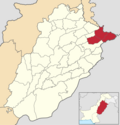
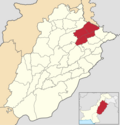
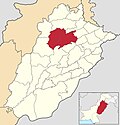
The current administrative structure of Pakistan comprises 37 divisions in total, distributed across five provinces and two Pakistan-administered regions of Kashmir. Within the four provinces, there are 31 divisions: [[Balochistan, Pakistan|Balochistan]] contains 8 divisions, [[Khyber Pakhtunkhwa]] has 7 divisions, [[Punjab, Pakistan|Punjab]] features 10 divisions, and [[Sindh]] encompasses 6 divisions. These divisions are accompanied by their respective population figures as recorded in the Census of Pakistan 2023.<ref>{{cite web |title=Households, Populations, Household Size and Annual Growth Rate {{!}} Balochistan |url=https://www.pbs.gov.pk/sites/default/files/population/2023/Balochistan.pdf |website=pbs.gov.pk |publisher=[[Pakistan Bureau Statistics]] |access-date=8 May 2025}}</ref><ref>{{cite web |title=Households, Populations, Household Size and Annual Growth Rate {{!}} Punjab |url=https://www.pbs.gov.pk/sites/default/files/population/2023/Punjab.pdf |website=pbs.gov.pk |publisher=Pakistan Bureau Statistics |access-date=8 May 2025}}</ref><ref>{{cite web |title=Households, Populations, Household Size and Annual Growth Rate {{!}} Khyber Pakhtunkhwa |url=https://www.pbs.gov.pk/sites/default/files/population/2023/KP.pdf |website=pbs.gov.pk |publisher=Pakistan Bureau Statistics |access-date=8 May 2025}}</ref><ref>{{cite web |title=Households, Populations, Household Size and Annual Growth Rate {{!}} Sindh |url=https://www.pbs.gov.pk/sites/default/files/population/2023/Sindh.pdf |website=pbs.gov.pk |publisher=Pakistan Bureau Statistics |access-date=8 May 2025}}</ref> | |||
The 6 divisions located in [[Pakistan-occupied Kashmir]]. | |||
=== Provinces === | |||
==== Balochistan ==== | |||
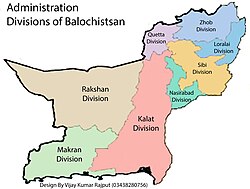
[[File:Divisions of Balochistan.jpg|thumb|Eight divisions of the Province of Balochistan]] | |||
{{Excerpt|Divisions of Balochistan#List of divisions}} | |||
==== Khyber Pakhtunkhwa ==== | |||
[[File:Districts of Khyber Pakhtunkhwa, Pakistan with district names- in 2022 by Vijay Kumar.jpg|thumb|Colours correspond to Divisions of the Province of Khyber Pakhtunkhwa]] | |||
{{Excerpt|Divisions of Khyber Pakhtunkhwa#List of divisions}} | |||
==== Punjab ==== | |||
This section is an excerpt from [[Divisions of Punjab, Pakistan|Divisions of Punjab, Pakistan § List of divisions by population over the years.]] | |||
{{static row numbers}} | |||
{| class="wikitable sortable static-row-numbers static-row-header-hash" style="text-align:center" | |||
|- | |||
! Name | |||
! Headquarters | |||
! Districts | |||
! Area | |||
(km<sup>2</sup>)<ref name=":0" /> | |||
!Population (2023)<ref name=":0">{{Cite web |title=Literacy Rate, Enrollment, and Out of School Population by Sex and Rural/Urban: Census 2023 - Punjab Province |url=https://www.pbs.gov.pk/sites/default/files/population/2023/tables/table_12_punjab_province.pdf |archive-url=https://web.archive.org/web/20250930200632/https://www.pbs.gov.pk/sites/default/files/population/2023/tables/table_12_punjab_province.pdf |archive-date=2025-09-30 |access-date= |website=www.pbs.gov.pk}}</ref> | |||
!Population Density (2023)<ref name=":0" /> | |||
!Literacy | |||
rate (2023)<ref name=":0" /> | |||
! Map | |||
|- | |||
| style="text-align:center;" |[[Bahawalpur Division|Bahawalpur]]<ref>{{Cite web|url=https://lgcd.punjab.gov.pk/tma_bwp|title=TMA Bahawalpur Division {{!}} Local Government and Community Development|website=lgcd.punjab.gov.pk|access-date=2019-04-05}}</ref> | |||
| style="text-align:center;" |[[Bahawalpur]] | |||
| style="text-align:center;" | | |||
* [[Bahawalpur District|Bahawalpur]] | |||
* [[Bahawalnagar District|Bahawalnagar]] | |||
* [[Rahim Yar Khan District|Rahim Yar Khan]] | |||
| 45,588 | |||
|13,400,009 | |||
| 293.94/km<sup>2</sup> | |||
|52.13% | |||
| style="text-align:left;" |[[File:Pakistan_-_Punjab_-_Bahawalpur_(division).svg|center|234x234px]] | |||
|- | |||
| style="text-align:center;" |[[Dera Ghazi Khan Division|Dera Ghazi Khan]]<ref>{{Cite web|url=https://lgcd.punjab.gov.pk/tma_dgkhan|title=TMA Dera Ghazi Khan Division {{!}} Local Government and Community Development|website=lgcd.punjab.gov.pk|access-date=2019-04-05}}</ref> | |||
| style="text-align:center;" |[[Dera Ghazi Khan]] | |||
| style="text-align:center;" | | |||
* [[Dera Ghazi Khan District|Dera Ghazi Khan]] | |||
* [[Layyah District|Layyah]] | |||
* [[Muzaffargarh District|Muzaffargarh]] | |||
* [[Rajanpur District|Rajanpur]] | |||
* [[Taunsa District|Taunsa]] | |||
* [[Kot Addu District|Kot Addu]] | |||
| 38,778 | |||
|12,892,465 | |||
| 332.47/km<sup>2</sup> | |||
|48.00% | |||
| style="text-align:left;" |[[File:Pakistan_-_Punjab_-_Dera_Ghazi_Khan_(division).svg|center|234x234px]] | |||
|- | |||
| style="text-align:center;" |[[Faisalabad Division|Faisalabad]]<ref>{{Cite web|url=https://lgcd.punjab.gov.pk/tma_faisalabad|title=TMA Faisalabad Division {{!}} Local Government and Community Development|website=lgcd.punjab.gov.pk|access-date=2019-04-05}}</ref> | |||
| style="text-align:center;" |[[Faisalabad]] | |||
| style="text-align:center;" | | |||
* [[Faisalabad District|Faisalabad]] | |||
* [[Chiniot District|Chiniot]] | |||
* [[Toba Tek Singh District|Toba Tek Singh]] | |||
* [[Jhang District|Jhang]] | |||
| 17,918 | |||
|16,228,526 | |||
| 905.71/km<sup>2</sup> | |||
|68.80% | |||
| style="text-align:left;" |[[File:Pakistan_-_Punjab_-_Faisalabad_(division).svg|center|234x234px]] | |||
|- | |||
| style="text-align:center;" |[[Gujranwala Division|Gujranwala]]<ref>{{Cite web|url=https://lgcd.punjab.gov.pk/Gujranwala_Division|title=Gujranwala Division {{!}} Local Government and Community Development|website=lgcd.punjab.gov.pk|access-date=2019-04-05}}</ref> | |||
| style="text-align:center;" |[[Gujranwala]] | |||
| style="text-align:center;" | | |||
* [[Gujranwala District|Gujranwala]] | |||
* [[Narowal District|Narowal]] | |||
* [[Sialkot District|Sialkot]] | |||
| 7,779 | |||
|11,416,686 | |||
| 937.11/km<sup>2</sup> | |||
|76.41% | |||
| style="text-align:left;" |[[File:Pakistan - Punjab - Gujranwala (division) (2022).png|center|234x234px]] | |||
|- | |||
| style="text-align:center;" |[[Gujrat Division|Gujrat]]<ref>{{Cite web|url=https://lgcd.punjab.gov.pk/Gujrat_Division|title=Gujrat Division {{!}} Local Government and Community Development|website=lgcd.punjab.gov.pk|access-date=2019-04-05}}</ref> | |||
| style="text-align:center;" |[[Gujrat, Pakistan|Gujrat]] | |||
| style="text-align:center;" | | |||
* [[Gujrat District|Gujrat]] | |||
* [[Hafizabad District|Hafizabad]] | |||
* [[Mandi Bahauddin District|Mandi Bahauddin]] | |||
* [[Wazirabad District|Wazirabad]] | |||
| 9,438 | |||
|7,362,182 | |||
|670/km<sup>2</sup> | |||
|76.41% | |||
| style="text-align:left;" |[[File:Pakistan - Punjab - Gujrat (division).png|center|234x234px]] | |||
|- | |||
| style="text-align:center;" |[[Lahore Division|Lahore]]<ref>{{Cite web|url=https://lgcd.punjab.gov.pk/Lahore_Division|title=Lahore Division {{!}} Local Government and Community Development|website=lgcd.punjab.gov.pk|access-date=2019-04-05|archive-date=2021-07-09|archive-url=https://web.archive.org/web/20210709185319/https://lgcd.punjab.gov.pk/Lahore_Division|url-status=dead}}</ref> | |||
| style="text-align:center;" |[[Lahore]] | |||
| style="text-align:center;" | | |||
* [[Lahore District|Lahore]] | |||
* [[Kasur District|Kasur]] | |||
* [[Nankana Sahib District|Nankana Sahib]] | |||
* [[Sheikhupura District|Sheikhupura]] | |||
| 11,727 | |||
|22,772,710 | |||
| 1941.90/km<sup>2</sup> | |||
|73.63% | |||
| style="text-align:left;" |[[File:Pakistan_-_Punjab_-_Lahore_(division).svg|center|234x234px]] | |||
|- | |||
| style="text-align:center;" |[[Multan Division|Multan]]<ref>{{Cite web|url=https://lgcd.punjab.gov.pk/Multan_Division|title=Multan Division {{!}} Local Government and Community Development|website=lgcd.punjab.gov.pk|access-date=2019-04-05}}</ref> | |||
| style="text-align:center;" |[[Multan]] | |||
| style="text-align:center;" | | |||
* [[Multan District|Multan]] | |||
* [[Lodhran District|Lodhran]] | |||
* [[Khanewal District|Khanewal]] | |||
* [[Vehari District|Vehari]] | |||
| 15,211 | |||
|14,085,102 | |||
| 925.98/km<sup>2</sup> | |||
|59.43% | |||
| style="text-align:left;" |[[File:Pakistan_-_Punjab_-_Multan_(division).svg|center|234x234px]] | |||
|- | |||
| style="text-align:center;" |[[Rawalpindi Division|Rawalpindi]]<ref>{{Cite web|url=https://lgcd.punjab.gov.pk/tma_rawalpindi|title=TMA Rawalpindi Division {{!}} Local Government and Community Development|website=lgcd.punjab.gov.pk|access-date=2019-04-05}}</ref> | |||
| style="text-align:center;" |[[Rawalpindi]] | |||
| style="text-align:center;" | | |||
* [[Rawalpindi District|Rawalpindi]] | |||
* [[Jhelum District|Jhelum]] | |||
* [[Chakwal District|Chakwal]] | |||
* [[Attock District|Attock]] | |||
* [[Murree District|Murree]] | |||
* [[Talagang District|Talagang]] | |||
| 18,823 | |||
|10,804,250 | |||
| 574.50 | |||
|79.9% | |||
| style="text-align:left;" |[[File:Pakistan_-_Punjab_-_Rawalpindi_(division).svg|center|234x234px]] | |||
|- | |||
| style="text-align:center;" |[[Sahiwal Division|Sahiwal]]<ref>{{Cite web|url=https://lgcd.punjab.gov.pk/Sahiwal_Division|title=Sahiwal Division {{!}} Local Government and Community Development|website=lgcd.punjab.gov.pk|access-date=2019-04-05}}</ref> | |||
| style="text-align:center;" |[[Sahiwal]] | |||
| style="text-align:center;" | | |||
* [[Sahiwal District|Sahiwal]] | |||
* [[Pakpattan District|Pakpattan]] | |||
* [[Okara District|Okara]] | |||
| 10,302 | |||
|8,533,471 | |||
| 828.33/km<sup>2</sup> | |||
|61.02% | |||
| style="text-align:left;" |[[File:Pakistan_-_Punjab_-_Sahiwal_(division).svg|center|234x234px]] | |||
|- | |||
| style="text-align:center;" |[[Sargodha Division|Sargodha]]<ref>{{Cite web|url=https://lgcd.punjab.gov.pk/Sargodha_Division|title=Sargodha Division {{!}} Local Government and Community Development|website=lgcd.punjab.gov.pk|access-date=2019-04-05}}</ref> | |||
| style="text-align:center;" |[[Sargodha]] | |||
| style="text-align:center;" | | |||
* [[Sargodha District|Sargodha]] | |||
* [[Bhakkar District|Bhakkar]] | |||
* [[Khushab District|Khushab]] | |||
* [[Mianwali District|Mianwali]] | |||
| 26,360 | |||
|9,591,275 | |||
| 263.86/km<sup>2</sup> | |||
|63.19% | |||
| style="text-align:left;" |[[File:Sargodha division as 2023.jpg|center|234x234px]] | |||
|} | |||
==== Sindh ==== | |||
{{Excerpt|Divisions of Sindh#List of the Divisions by area, population, density, literacy rate etc.}} | |||
=== Pakistan-oocupied Kashmir === | |||
{| class="wikitable sortable" style="margin:auto;" | |||
! colspan="6" | Divisions of [[Azad Kashmir|Azad Jammu & Kashmir]] | |||
|- | |||
!Division||Area (km<sup>2</sup>)||Population<br />1998 Census||Population<br />2017 Census | |||
!Population<br />2023 Census||Capital | |||
|- | |||
|[[Mirpur Division|Mirpur]]||align="right"|4,388||align="right"|1,198,249||align="right"|1,651,018 | |||
|N/A||[[Mirpur, Azad Kashmir|Mirpur]] | |||
|- | |||
|[[Muzaffarabad Division|Muzaffarabad]]||align="right"|6,117||align="right"|745,733||align="right"|1,072,150 | |||
|N/A||[[Muzaffarabad, Pakistan|Muzaffarabad]] | |||
|- | |||
|[[Poonch Division|Poonch]]||align="right"|2,792||align="right"|1,028,541||align="right"|1,322,198 | |||
|N/A||[[Rawalakot]] | |||
|- | |||
! colspan="6" | Divisions of [[Gilgit-Baltistan]] | |||
|- | |||
!Division||Area (km<sup>2</sup>)||Population<br />1998 Census||Population<br />2017 Census | |||
!Population<br />2023 Census||Capital | |||
|- | |||
|[[Gilgit Division|Gilgit]]||-|| N/A|| N/A | |||
|N/A|| [[Gilgit]] | |||
|- | |||
|[[Baltistan Division|Baltistan]]||-|| N/A|| N/A | |||
|N/A||[[Skardu]] | |||
|- | |||
|[[Diamer Division|Diamer]]||-|| N/A|| N/A | |||
|N/A||[[Chilas]] | |||
|} | |||
==Notes and References== | ==Notes and References== | ||
===Notes=== | ===Notes=== | ||
Revision as of 13:51, 14 July 2026
| Divisions of Pakistan पाकिस्तान के प्रभाग | |
|---|---|
| Also known as: پاکستان کے ڈویژن[A 1] | |
 Map of divisions of Pakistan | |
| Category | Second-level administrative division |
| Location | Islamic Republic of Pakistan |
| Number | 37 (as of 2024) |
| Government | Divisional government |
| Subdivisions | Districts Tehsils Union councils |
 |
|---|
| This article is part of a series on the politics and government of Pakistan |

.svg)
|
The administrative units of Pakistan comprise four provinces, two territories in the Kashmir region, and a capital territory. The provinces and territories are further subdivided into 37 divisions, which are subsequently divided into districts, tehsils, and finally union councils. The division system was abolished in 2000 but was subsequently restored in 2008.
These divisions do not encompass the Islamabad Capital Territory. The formerly Federally Administered Tribal Areas (FATA), which previously held the same administrative status as provinces, were merged into Khyber Pakhtunkhwa province and incorporated into neighbouring divisions within that province in 2018.
History
The administrative divisions constituted an integral tier of government from colonial times, with the Governor's provinces of British India being subdivided into divisions, which were further divided into districts. At the time of creation in 1947, the new nation of Pakistan comprised two geographically separated wings – eastern and western. Three of Pakistan's provinces were subdivided into ten administrative divisions. The single province in the eastern wing, East Bengal, comprised four divisions – Chittagong, Dacca, Khulna and Rajshahi. West Punjab province contained four divisions – Lahore, Multan, Rawalpindi, and Sargodha. The North-West Frontier Province (as it was then known) had two divisions – Dera Ismail Khan and Peshawar. Most of the former Sind Province became Hyderabad Division. The majority of divisions were named after their respective divisional capitals, though some exceptions existed.
From 1955 to 1970, the One Unit policy consolidated the administrative structure into only two provinces – East and West Pakistan. East Pakistan retained the same divisions as East Bengal previously possessed, while West Pakistan progressively gained seven new divisions to supplement the original six divisions. The Baluchistan States Union was reorganised into Kalat Division, while the former Baluchistan Chief Commissioner's Province became Quetta Division. The princely State of Khairpur, combined with portions of Hyderabad division, formed Khairpur Division. The former princely state of Bahawalpur was established as Bahawalpur Division, thereby joining West Punjab. In 1959, the Federal Capital Territory was absorbed into West Pakistan, and in 1960, it was merged with the district of Las Bela to create the Karachi-Bela Division. In 1969, the princely states of Chitral, Dir and Swat were incorporated into West Pakistan as the Malakand Division, with Saidu serving as the divisional headquarters. Khairpur division was abolished in 1975 and replaced with Sukkur Division. In 1980, Sukkur division was bifurcated to establish Larkana division. Mirpurkhas division was created in 1990 through the bifurcation of Hyderabad division.
Current divisions by administrative units
The current administrative structure of Pakistan comprises 37 divisions in total, distributed across five provinces and two Pakistan-administered regions of Kashmir. Within the four provinces, there are 31 divisions: Balochistan contains 8 divisions, Khyber Pakhtunkhwa has 7 divisions, Punjab features 10 divisions, and Sindh encompasses 6 divisions. These divisions are accompanied by their respective population figures as recorded in the Census of Pakistan 2023.[1][2][3][4] The 6 divisions located in Pakistan-occupied Kashmir.
Provinces
Balochistan

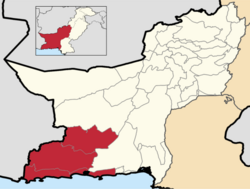
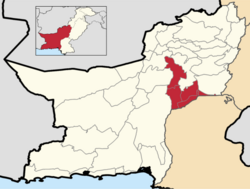
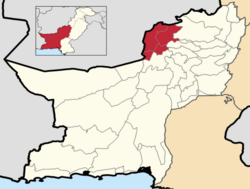
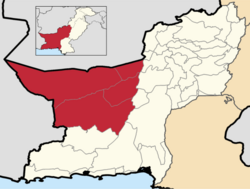
In Pakistan, the division is the administrative unit, which is higher in hierarchy than a district, but lower in hierarchy than a province.
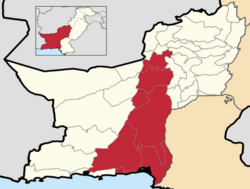
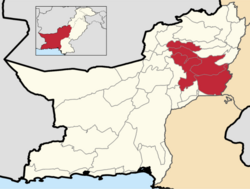
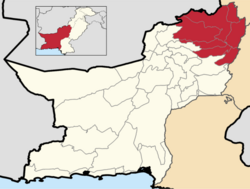
| Division[5] | Districts[5][6] | Area[5] | Population (2023)[5] | Population Density (2023)[5] | Literacy rate (2023)[5] | Map | Capital |
|---|---|---|---|---|---|---|---|
| Khuzdar Division | 41,208 km2 (15,910 sq mi) | 1,547,812 | 37.5/km2 | 39.39% |  |
Khuzdar | |
| Lasbela Division | 44,463 km2 (17,167 sq mi) | 859,935 | 19.3/km2 | 39.05% | |
Lasbela | |
| Loralai Division | 17,047 km2 (6,582 sq mi) | 1,073,686 | 62.98/km2 | 43.89% |  |
Loralai | |
| Zhob Division | 27,128 km2 (10,474 sq mi) | 957,579 | 34.19/km2 | 34.33% |  |
Zhob | |
| Makuran Division | 52,067 km2 (20,103 sq mi) | 1,875,872 | 36.03/km2 | 47.69% |  |
Turbat | |
| Naseerabad Division | 9,447 km2 (3,648 sq mi) | 1,601,347 | 169.5/km2 | 34.23% |  |
Dera Murad Jamali | |
| Quetta Division | 9,434 km2 (3,642 sq mi) | 2,908,763 | 308.3/km2 | 51.68% |  |
Quetta | |
| Pishin Division | 11,112 km2 (4,290 sq mi) | 1,663,671 | 292.55/km2 | 51.68% | |
Pishin | |
| Rakhshan Division | 98,596 km2 (38,068 sq mi) | 940,001 | 10.55/km2 | 36.84% |  |
Kharan | |
| Koh-e-Sulaiman Division | 14,963 km2 (5,777 sq mi) | 635,552 | 42.47/km2 | 34.70% | |
Rakhni | |
| Sevi Division | 15,934 km2 (6,152 sq mi) | 1,046,548 | 34.0/km2 | 34.70% | |
Sibi |
Khyber Pakhtunkhwa

In Pakistan, the division is the administrative unit which is higher than a district, but lower than a province. Divisions and are separated by color on the map.
| Division | Districts[7][8][9] | Population (2023)[7] | Area[7] | Population Density (2023)[7] | Literacy (2023)[7] | Map |
|---|---|---|---|---|---|---|
| Bannu Division | 3,092,078 | 9,975 km2 (3,851 sq mi) | 309.98/km2 | 42.11% | 
| |
| Dera Ismail Khan Division | 3,188,779 | 18,854 km2 (7,280 sq mi) | 169.13/km2 | 41.73% | 
| |
| Hazara Division | 6,188,736 | 17,064 km2 (6,588 sq mi) | 362.68/km2 | 60.95% | 
| |
| Kohat Division | 3,752,436 | 12,377 km2 (4,779 sq mi) | 303.18/km2 | 50.89% | 
| |
| Malakand Division | 9,959,399 | 31,162 km2 (12,032 sq mi) | 319.6/km2 | 47.51% | 
| |
| Mardan Division | 4,639,498 | 3,175 km2 (1,226 sq mi) | 1461.26/km2 | 56.90% | 
| |
| Peshawar Division | 10,035,171 | 9,134 km2 (3,527 sq mi) | 1098.66/km2 | 51.32% | 
|
Punjab
This section is an excerpt from Divisions of Punjab, Pakistan § List of divisions by population over the years.
| Name | Headquarters | Districts | Area
(km2)[10] |
Population (2023)[10] | Population Density (2023)[10] | Literacy
rate (2023)[10] |
Map |
|---|---|---|---|---|---|---|---|
| Bahawalpur[11] | Bahawalpur | 45,588 | 13,400,009 | 293.94/km2 | 52.13% | .svg) | |
| Dera Ghazi Khan[12] | Dera Ghazi Khan | 38,778 | 12,892,465 | 332.47/km2 | 48.00% | .svg) | |
| Faisalabad[13] | Faisalabad | 17,918 | 16,228,526 | 905.71/km2 | 68.80% | .svg) | |
| Gujranwala[14] | Gujranwala | 7,779 | 11,416,686 | 937.11/km2 | 76.41% | _(2022).png) | |
| Gujrat[15] | Gujrat | 9,438 | 7,362,182 | 670/km2 | 76.41% | .png) | |
| Lahore[16] | Lahore | 11,727 | 22,772,710 | 1941.90/km2 | 73.63% | .svg) | |
| Multan[17] | Multan | 15,211 | 14,085,102 | 925.98/km2 | 59.43% | .svg) | |
| Rawalpindi[18] | Rawalpindi | 18,823 | 10,804,250 | 574.50 | 79.9% | .svg) | |
| Sahiwal[19] | Sahiwal | 10,302 | 8,533,471 | 828.33/km2 | 61.02% | .svg) | |
| Sargodha[20] | Sargodha | 26,360 | 9,591,275 | 263.86/km2 | 63.19% |  |
Sindh
| Name | Headquarter | Districts | Area
(km2)[21] |
Population (2023)[21] | Pop. Density (2023)[21] | Literacy rate (2023)[21] | Map |
|---|---|---|---|---|---|---|---|
| Hyderabad Division | Hyderabad | 48,670 | 1,16,59,246 | 239.56/km2 | 45.38% | .svg) | |
| Karachi Division | Karachi | 3,527 | 2,03,82,881 | 5,779.10/km2 | 75.11% | .svg) | |
| Larkana Division | Larkana | 15,213 | 70,93,706 | 466.29/km2 | 44.53% | .svg) | |
| Mirpur Khas Division | Mirpur Khas | 28,170 | 46,19,624 | 153.99/km2 | 40.41% | .svg) | |
| Shaheed Benazirabad Division | Nawabshah | 18,176 | 59,30,649 | 326.29/km2 | 49.91% | .svg) | |
| Sukkur Division | Sukkur | 27,158 | 60,10,041 | 221.30/km2 | 59.72% | .svg) |
Pakistan-oocupied Kashmir
| Divisions of Azad Jammu & Kashmir | |||||
|---|---|---|---|---|---|
| Division | Area (km2) | Population 1998 Census |
Population 2017 Census |
Population 2023 Census |
Capital |
| Mirpur | 4,388 | 1,198,249 | 1,651,018 | N/A | Mirpur |
| Muzaffarabad | 6,117 | 745,733 | 1,072,150 | N/A | Muzaffarabad |
| Poonch | 2,792 | 1,028,541 | 1,322,198 | N/A | Rawalakot |
| Divisions of Gilgit-Baltistan | |||||
| Division | Area (km2) | Population 1998 Census |
Population 2017 Census |
Population 2023 Census |
Capital |
| Gilgit | - | N/A | N/A | N/A | Gilgit |
| Baltistan | - | N/A | N/A | N/A | Skardu |
| Diamer | - | N/A | N/A | N/A | Chilas |
Notes and References
Notes
- ↑ पाकिस्तान के डिवीज़न्
References
- ↑ "Households, Populations, Household Size and Annual Growth Rate | Balochistan" (PDF). pbs.gov.pk. Pakistan Bureau Statistics. Retrieved 8 May 2025.
- ↑ "Households, Populations, Household Size and Annual Growth Rate | Punjab" (PDF). pbs.gov.pk. Pakistan Bureau Statistics. Retrieved 8 May 2025.
- ↑ "Households, Populations, Household Size and Annual Growth Rate | Khyber Pakhtunkhwa" (PDF). pbs.gov.pk. Pakistan Bureau Statistics. Retrieved 8 May 2025.
- ↑ "Households, Populations, Household Size and Annual Growth Rate | Sindh" (PDF). pbs.gov.pk. Pakistan Bureau Statistics. Retrieved 8 May 2025.
- ↑ 5.0 5.1 5.2 5.3 5.4 5.5 "Table 12: Literacy Rate, Enrolment And Out Of School Population By Sex And Rural/Urban 2023" (PDF).
- ↑ "Provincial cabinet approves three new districts". www.nation.com. Retrieved 2023-07-03.
- ↑ 7.0 7.1 7.2 7.3 7.4 "Literacy Rate, Enrollment, and Out of School Population by Sex and Rural/Urban: Census 2023 - Punjab Province" (PDF). www.pbs.gov.pk. Archived from the original (PDF) on 2025-09-30.
- ↑ "KP govt notifies new divisions following FATA merger". Pakistan Today. 20 July 2018. Archived from the original on 2 July 2020. Retrieved 2 July 2020.
- ↑ "KP Districts". kp.gov.pk. Retrieved 2022-05-13.
- ↑ 10.0 10.1 10.2 10.3 "Literacy Rate, Enrollment, and Out of School Population by Sex and Rural/Urban: Census 2023 - Punjab Province" (PDF). www.pbs.gov.pk. Archived from the original (PDF) on 2025-09-30.
- ↑ "TMA Bahawalpur Division | Local Government and Community Development". lgcd.punjab.gov.pk. Retrieved 2019-04-05.
- ↑ "TMA Dera Ghazi Khan Division | Local Government and Community Development". lgcd.punjab.gov.pk. Retrieved 2019-04-05.
- ↑ "TMA Faisalabad Division | Local Government and Community Development". lgcd.punjab.gov.pk. Retrieved 2019-04-05.
- ↑ "Gujranwala Division | Local Government and Community Development". lgcd.punjab.gov.pk. Retrieved 2019-04-05.
- ↑ "Gujrat Division | Local Government and Community Development". lgcd.punjab.gov.pk. Retrieved 2019-04-05.
- ↑ "Lahore Division | Local Government and Community Development". lgcd.punjab.gov.pk. Archived from the original on 2021-07-09. Retrieved 2019-04-05.
- ↑ "Multan Division | Local Government and Community Development". lgcd.punjab.gov.pk. Retrieved 2019-04-05.
- ↑ "TMA Rawalpindi Division | Local Government and Community Development". lgcd.punjab.gov.pk. Retrieved 2019-04-05.
- ↑ "Sahiwal Division | Local Government and Community Development". lgcd.punjab.gov.pk. Retrieved 2019-04-05.
- ↑ "Sargodha Division | Local Government and Community Development". lgcd.punjab.gov.pk. Retrieved 2019-04-05.
- ↑ 21.0 21.1 21.2 21.3 "Population 2023 tables sindh" (PDF).