


imported>Ira Leviton Copy editing. |
cleanup |
||
| Line 1: | Line 1: | ||
{{Short description|Tamil wonder- | {{Short description|Tamil wonder-workers and sages}} | ||
{{Use dmy dates|date=August 2020}} | {{Use dmy dates|date=August 2020}} | ||
{{Use Indian English|date=August 2020}} | {{Use Indian English|date=August 2020}} | ||
| Line 5: | Line 5: | ||
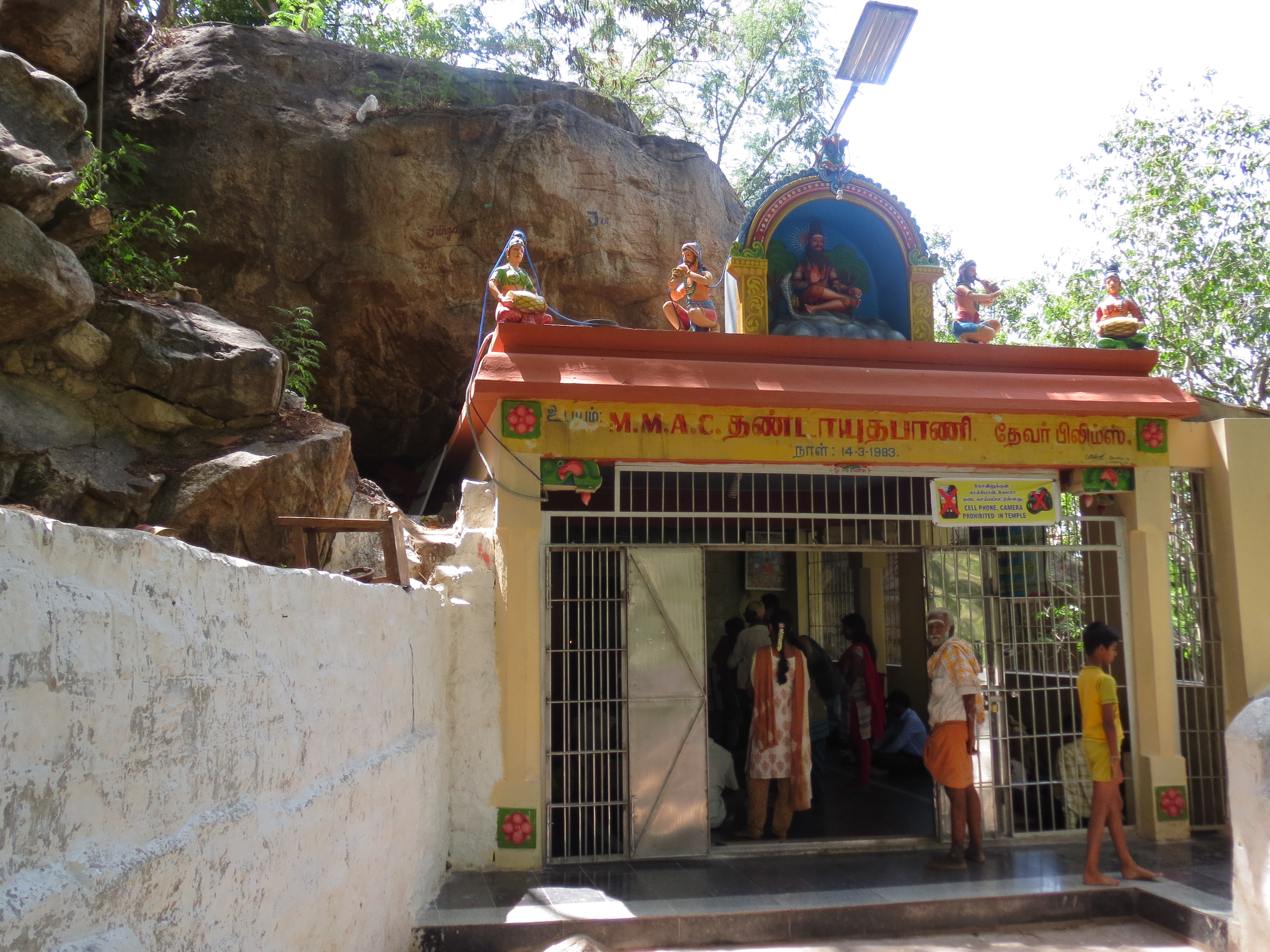
[[File:Pambatti siddhar sannidhi.jpg|thumb|[[Pambatti Siddhar]] Sannidhi at [[Marudamalai]] Temple]] | [[File:Pambatti siddhar sannidhi.jpg|thumb|[[Pambatti Siddhar]] Sannidhi at [[Marudamalai]] Temple]] | ||
The '''Siddhar''' (Tamil: | The '''Siddhar''' ([[Tamil language|Tamil]]<!--சித்தர் hidden per WP:INDICSCRIPT--> <small>(romanized)</small> ''cittar''; from [[Sanskrit]] ''[[siddha]]'')<ref>{{cite book |title=Tamil Lexicon |publisher=[[University of Madras]] |pages=1410 |url=https://dsal.uchicago.edu/cgi-bin/app/tamil-lex_query.py?page=1410}}</ref> in [[Tamils|Tamil]] tradition is a perfected individual who has attained spiritual powers called ''[[siddhi]]''. | ||
Historically, Siddhar also refers to the people who were early age wandering adepts that dominated ancient Tamil teaching and philosophy. | Historically, Siddhar also refers to the people who were early-age wandering adepts that dominated ancient Tamil teaching and philosophy. They were knowledgeable in science, technology, astronomy, literature, fine arts, music, drama, and dance and provided solutions to common people's illnesses and advice for their future.<ref>{{cite book|title=Meditation Revolution: A History and Theology of the Siddha Yoga Lineage|year=2000|publisher=Motilal Banarsidass|isbn=9788120816480}}</ref> Some of their ideologies are considered to have originated during the [[First Sangam]] period.<ref>{{cite book|last=S. Cunjithapatham|first=M. Arunachalam|title=Musical tradition of Tamilnadu|year=1989|publisher=International Society for the Investigation of Ancient Civilizations|pages=11}}</ref><ref>{{cite book|title=Journal of Indian history, Volume 38|year=1960|publisher=Dept. of History, University of Kerala}}</ref><ref>{{cite book|last=Weiss|first=Richard|title=Recipes for Immortality : Healing, Religion, and Community in South India: Healing, Religion, and Community in South India|year=2009|publisher=Oxford University Press|isbn=9780199715008|page=80}}</ref> | ||
==Practice== | ==Practice== | ||
Siddhars were typically | Siddhars were typically scientists, saints, doctors, alchemists, and mystics all in one. They wrote their findings in the form of Tamil poems on [[Palm-leaf manuscript|palm leaf manuscripts]]. They typically believe in [[Monotheism|one god]], but there are some Siddhars who believe in polytheism. These are still owned by some families in Tamil Nadu and handed down through the generations, as well as being kept in universities in India, Germany, Great Britain, and the United States.<ref>{{cite web|author=V. Jayaram |url=http://www.hinduwebsite.com/hinduism/essays/siddhas.asp |title=Study of siddhas |publisher=Hinduwebsite.com |access-date=2013-06-22}}</ref> | ||
In this way, Siddhars developed the native [[Siddha medicine]] system. A rustic form of healing that is similar to Siddha medicine has since been practiced by experienced elders in the villages of Tamil Nadu. This is referred to as '' | In this way, Siddhars developed the native [[Siddha medicine]] system. A rustic form of healing that is similar to Siddha medicine has since been practiced by experienced elders in the villages of Tamil Nadu. This is referred to as ''pātti vaittiyam'' (grandmother's medicine), ''nāttu maruntu'' (folk medicine), and ''mūlikai maruttuvam'' (herbal medicine). | ||
Siddhars are also believed to be the founders of [[ | Siddhars are also believed to be the founders of [[varma kalai]] - a martial art for self-defense and medical treatment at the same time with the application of pressure points.<ref>{{Cite book |last=Cruz |first=Edmund A. |url=https://books.google.com/books?id=OCJiDwAAQBAJ&dq=varma+kalai+pressure&pg=PT68 |title=Health, Longevity and the Martial Arts |date=2018-06-16 |publisher=AuthorHouse |isbn=978-1-5462-3979-6 |language=en}}</ref> | ||
Tamil Siddhars were the first to develop pulse-reading ( | Tamil Siddhars were the first to develop pulse-reading (''naadi paarththal'' in Tamil) to identify the origin of diseases. | ||
Siddhars have | According to regional belief, the Siddhars are said to have resided for many ages upon a mountain called [[Sathuragiri Hills|Sathuragiri]], near the [[Thanippara|Thanipparai]] village in Tamil Nadu. | ||
== Siddhars == | == Siddhars == | ||
The [[Abithana Chintamani]] encyclopedia states that the Siddhars are of the 18 persons listed below, but | The [[Abithana Chintamani]] encyclopedia states that the Siddhars are of the 18 persons listed below, but [[Agastya]] states that there are many who precede and follow these. | ||
===The 18 Siddhars=== | ===The 18 Siddhars=== | ||
[[File:Mahan Sri Karuvurar.jpg|thumb| | [[File:Mahan Sri Karuvurar.jpg|thumb|''[[Murti]]'' of Karuvurar]] | ||
There are 18 | There are 18 Siddhars in the Tamil Siddha tradition:<ref>{{Cite book |last=Pillai |first=M. S. Purnalingam |url=https://books.google.com/books?id=QIeqvcai5XQC&pg=PA264 |title=Tamil Literature |date=1994 |publisher=Asian Educational Services |isbn=978-81-206-0955-6 |pages=264 |language=en}}</ref><ref>{{Cite book |last=Venkataramaiah |first=K. M. |url=https://books.google.com/books?id=2pAMAQAAMAAJ |title=A Handbook of Tamil Nadu |date=1996 |publisher=International School of Dravidian Linguistics |isbn=978-81-85692-20-3 |pages=139 |language=en}}</ref> | ||
# [[Nandi ( | # [[Nandi (Hinduism)|Nandi]] | ||
# [[Tirumular]] | # [[Tirumular]] | ||
# [[Agastya]] | # [[Agastya]] | ||
# Kamalamuni | # [[Kalangi Nathar]] <ref>{{Cite web |last=Salem District |first=Government of Tamilnadu |title=Temples |url=https://salem.nic.in/tourism/temples/#:~:text=Kalangi%20Siddhar%20is%20one%20among,on%20the%20way%20to%20EIampillai.}}</ref> (identified with Kamalamuni and/or [[Confucius]]) | ||
# [[Patanjali]] | # [[Patanjali]] | ||
# [[Korakkar]] | # [[Korakkar]] | ||
# Sundaranandar | # {{ill|Sundaranandar|ta|சுந்தரானந்தர்}} | ||
# Konganar | # {{ill|Konganar|ta|கொங்கணர்}} | ||
# | # {{ill|Sattaimuni|ta|சட்டைமுனி}} | ||
# | # Vanmikar ([[Valmiki]]) | ||
# Ramadevar | # {{ill|Ramadevar|ta|இராமதேவ சித்தர்}} | ||
# | # [[Dhanvantari]] | ||
# [[ | # [[Idaikaadar]] | ||
# Machamuni | # Machamuni (identified with [[Matsyendranatha]]) | ||
# [[Karuvurar | # [[Karuvurar]] | ||
# [[Bogar]] | # [[Bogar]] (identified with [[Laozi]]<ref name="Bhoganathar">{{cite web | title=Siddha Bhoganāthar: An Oceanic Life Story |url=http://palani.org/bhogar-biography.htm | website=palani.org}}</ref>) | ||
# [[Pambatti Siddhar]] | # [[Pambatti Siddhar|Pambatti]] | ||
# Kuthambai | # {{ill|Kuthambai|ta|குதம்பைச்சித்தர்}} | ||
Apart from the 18 | Apart from the 18 Siddhars listed above, there is another list of 18 Siddhars who represent the 9 Navagrahas (with two Siddhars representing each Navagraha). All navagraha doshas and pariharams are performed to the Siddhars as Siddhar Velvi (Siddhar havan). The details of the 18 Siddhars who represent the 9 Navagrahas are as follows:{{Uncited|date=April 2024}} | ||
# Sivavakkiyar - Moon | |||
# Kambili - Moon | |||
# Bhogar - Mars | |||
# Kagabhujanga - Jupiter | |||
# Sri Pullipani Siddhar - Mars | |||
# Sattaimuni - Kethu | |||
# Sri Agapai Siddhar - Jupiter | |||
# Alugani - Rahu | |||
# Kudambai - Kethu | |||
# Vallalar - Mercury | |||
# Edaikaddar - Mercury | |||
# Pattinathar - Sun | |||
# Kaduvelli - Sun | |||
# Kanjamalai - Venus | |||
# Sennimalai - Venus | |||
# Kapilar - Saturn | |||
# Karuvurar - Saturn | |||
# Pampatti - Rahu | |||
== | == Eight Perfections == | ||
<!--{{Copying within Wikipedia|Siddhi}}--> | |||
{{Hinduism|state=autocollapsed}} | |||
Siddhars are believed to have had both major and minor powers that are described in detail in various yogic and religious texts.<ref>Thirumandiram 668</ref><ref name="Subramuniyaswami">{{Cite book |last=Subramuniyaswami |first=Sivaya |url=https://archive.org/details/dancingwithsivah00subr_0 |title=Glossary - Siddhi |publisher=Himalayan Academy |year=1997 |isbn=978-0945497974 |location=USA |id=Search: Siddhi}}</ref> | |||
* ''Aṇimā'': the ability to reduce one's body to the size of an atom. | |||
* ''Mahimā'': the ability to expand one's body to an infinitely large size. | |||
* ''Laghimā'': the ability to become weightless or lighter than air. | |||
* ''Garimā'': the ability to become heavy or dense. | |||
* ''Prāpti'': the ability to realize whatever one desires. | |||
* ''Prākāmya'': the ability to access any place in the world. | |||
* ''Īśiṭva'': the ability to control all material elements or natural forces. | |||
* ''Vaśiṭva'': the ability to force influence upon anyone. | |||
These eight are the [[Siddhi#Eight primary siddhis|Great Siddhis (Ashtama siddhis)]], or Great Perfections. | |||
These eight are the [[Siddhi#Eight primary siddhis|Great Siddhis (Ashtama siddhis)]], or Great Perfections. | |||
==See also== | ==See also== | ||
* [[Abithana Chintamani]] | * [[Abithana Chintamani]] | ||
* [[Avvaiyar]] | * [[Avvaiyar (Sangam poet)]] | ||
* [[Ayyavazhi mythology]] | * [[Ayyavazhi mythology]] | ||
* [[Bogar]] | * [[Bogar]] | ||
| Line 94: | Line 92: | ||
* [[Nayanars]] | * [[Nayanars]] | ||
* [[Siddha]] | * [[Siddha]] | ||
* [[Tirumandhiram]] | * [[Tirumandhiram|Tirumantiram]] | ||
==Notes and references== | ==Notes and references== | ||
{{reflist}} | {{reflist}} | ||
[[Category:Tamil-language literature]] | [[Category:Tamil-language literature]] | ||
[[Category:Tamil Hindu saints|*]] | [[Category:Tamil Hindu saints|*]] | ||
[[Category:Tamil Hindu literature]] | |||
Latest revision as of 13:56, 13 March 2026


The Siddhar (Tamil (romanized) cittar; from Sanskrit siddha)[1] in Tamil tradition is a perfected individual who has attained spiritual powers called siddhi.
Historically, Siddhar also refers to the people who were early-age wandering adepts that dominated ancient Tamil teaching and philosophy. They were knowledgeable in science, technology, astronomy, literature, fine arts, music, drama, and dance and provided solutions to common people's illnesses and advice for their future.[2] Some of their ideologies are considered to have originated during the First Sangam period.[3][4][5]
Practice[edit | edit source]
Siddhars were typically scientists, saints, doctors, alchemists, and mystics all in one. They wrote their findings in the form of Tamil poems on palm leaf manuscripts. They typically believe in one god, but there are some Siddhars who believe in polytheism. These are still owned by some families in Tamil Nadu and handed down through the generations, as well as being kept in universities in India, Germany, Great Britain, and the United States.[6]
In this way, Siddhars developed the native Siddha medicine system. A rustic form of healing that is similar to Siddha medicine has since been practiced by experienced elders in the villages of Tamil Nadu. This is referred to as pātti vaittiyam (grandmother's medicine), nāttu maruntu (folk medicine), and mūlikai maruttuvam (herbal medicine).
Siddhars are also believed to be the founders of varma kalai - a martial art for self-defense and medical treatment at the same time with the application of pressure points.[7]
Tamil Siddhars were the first to develop pulse-reading (naadi paarththal in Tamil) to identify the origin of diseases.
According to regional belief, the Siddhars are said to have resided for many ages upon a mountain called Sathuragiri, near the Thanipparai village in Tamil Nadu.
Siddhars[edit | edit source]
The Abithana Chintamani encyclopedia states that the Siddhars are of the 18 persons listed below, but Agastya states that there are many who precede and follow these.
The 18 Siddhars[edit | edit source]

There are 18 Siddhars in the Tamil Siddha tradition:[8][9]
- Nandi
- Tirumular
- Agastya
- Kalangi Nathar [10] (identified with Kamalamuni and/or Confucius)
- Patanjali
- Korakkar
- Sundaranandar
- Konganar
- Sattaimuni
- Vanmikar (Valmiki)
- Ramadevar
- Dhanvantari
- Idaikaadar
- Machamuni (identified with Matsyendranatha)
- Karuvurar
- Bogar (identified with Laozi[11])
- Pambatti
- Kuthambai
Apart from the 18 Siddhars listed above, there is another list of 18 Siddhars who represent the 9 Navagrahas (with two Siddhars representing each Navagraha). All navagraha doshas and pariharams are performed to the Siddhars as Siddhar Velvi (Siddhar havan). The details of the 18 Siddhars who represent the 9 Navagrahas are as follows:Template:Uncited
- Sivavakkiyar - Moon
- Kambili - Moon
- Bhogar - Mars
- Kagabhujanga - Jupiter
- Sri Pullipani Siddhar - Mars
- Sattaimuni - Kethu
- Sri Agapai Siddhar - Jupiter
- Alugani - Rahu
- Kudambai - Kethu
- Vallalar - Mercury
- Edaikaddar - Mercury
- Pattinathar - Sun
- Kaduvelli - Sun
- Kanjamalai - Venus
- Sennimalai - Venus
- Kapilar - Saturn
- Karuvurar - Saturn
- Pampatti - Rahu
Eight Perfections[edit | edit source]
| Part of a series on |
| Hinduism |
|---|
 |


Siddhars are believed to have had both major and minor powers that are described in detail in various yogic and religious texts.[12][13]
- Aṇimā: the ability to reduce one's body to the size of an atom.
- Mahimā: the ability to expand one's body to an infinitely large size.
- Laghimā: the ability to become weightless or lighter than air.
- Garimā: the ability to become heavy or dense.
- Prāpti: the ability to realize whatever one desires.
- Prākāmya: the ability to access any place in the world.
- Īśiṭva: the ability to control all material elements or natural forces.
- Vaśiṭva: the ability to force influence upon anyone.
These eight are the Great Siddhis (Ashtama siddhis), or Great Perfections.
See also[edit | edit source]
- Abithana Chintamani
- Avvaiyar (Sangam poet)
- Ayyavazhi mythology
- Bogar
- Mahasiddha
- Maruttuvar community
- Nayanars
- Siddha
- Tirumantiram
Notes and references[edit | edit source]
- ↑ Tamil Lexicon. University of Madras. p. 1410.
- ↑ Meditation Revolution: A History and Theology of the Siddha Yoga Lineage. Motilal Banarsidass. 2000. ISBN 9788120816480.
- ↑ S. Cunjithapatham, M. Arunachalam (1989). Musical tradition of Tamilnadu. International Society for the Investigation of Ancient Civilizations. p. 11.
- ↑ Journal of Indian history, Volume 38. Dept. of History, University of Kerala. 1960.
- ↑ Weiss, Richard (2009). Recipes for Immortality : Healing, Religion, and Community in South India: Healing, Religion, and Community in South India. Oxford University Press. p. 80. ISBN 9780199715008.
- ↑ V. Jayaram. "Study of siddhas". Hinduwebsite.com. Retrieved 22 June 2013.
- ↑ Cruz, Edmund A. (16 June 2018). Health, Longevity and the Martial Arts. AuthorHouse. ISBN 978-1-5462-3979-6.
- ↑ Pillai, M. S. Purnalingam (1994). Tamil Literature. Asian Educational Services. p. 264. ISBN 978-81-206-0955-6.
- ↑ Venkataramaiah, K. M. (1996). A Handbook of Tamil Nadu. International School of Dravidian Linguistics. p. 139. ISBN 978-81-85692-20-3.
- ↑ Salem District, Government of Tamilnadu. "Temples".
- ↑ "Siddha Bhoganāthar: An Oceanic Life Story". palani.org.
- ↑ Thirumandiram 668
- ↑ Subramuniyaswami, Sivaya (1997). Glossary - Siddhi. USA: Himalayan Academy. ISBN 978-0945497974. Search: Siddhi.