


->Trappist the monk m →Career: Cite newspaper The Times: replace/delete deprecated parameters; |
expanded citations for clarity and fixed typos |
||
| Line 1: | Line 1: | ||
{{Short description|British member of the Indian Civil Service and Liberal Party politician}} | {{Short description|British member of the Indian Civil Service and Liberal Party politician}} | ||
{{About|the member of the Indian Civil Service|his first cousin once removed|Henry Cotton (judge)}} | |||
{{Use dmy dates|date=November 2019}} | {{Use dmy dates|date=November 2019}} | ||
{{Use Indian English|date=October 2019}} | {{Use Indian English|date=October 2019}} | ||
{{Infobox person | {{Infobox person | ||
| honorific_suffix = {{postnominals|country=GBR|size=100%|KCSI}} | | honorific_suffix = {{postnominals|country=GBR|size=100%|KCSI}} | ||
| honorific_prefix = | | honorific_prefix = Sir | ||
| name | | name = Henry John Stedman Cotton | ||
| image | | image = Henry Cotton.jpg | ||
| image_size = | | image_size = | ||
| caption | | caption = | ||
| birth_date | | birth_date = 13 September 1845 | ||
| birth_place = [[Kumbakonam]] | | birth_place = [[Kumbakonam]], British India | ||
| death_date | | death_date = 22 October 1915 | ||
| death_place = | | death_place = [[St John's Wood]], London, United Kingdom | ||
| occupation | | occupation = civil servant, Member of Parliament, Author | ||
| spouse | | spouse = Mary, Lady Cotton (née Ryan) | ||
| alma_mater = [[Magdalen College, Oxford]]<br>[[King's College London]] | | alma_mater = [[Magdalen College, Oxford]]<br />[[King's College London]] | ||
| party | | party = [[Liberal Party (UK)|Liberal Party]] | ||
}} | }} | ||
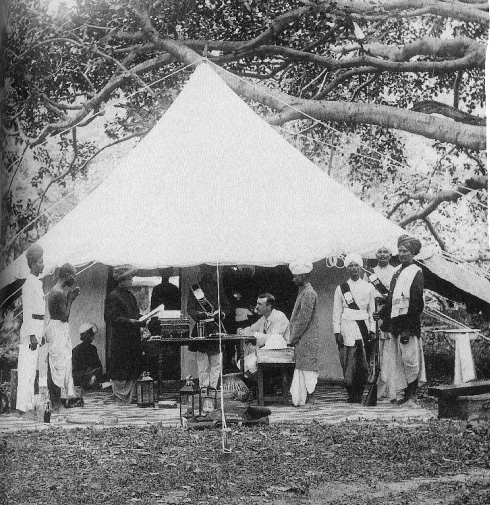
[[File:Henry cotton.jpg|thumb|250px|Henry Cotton dispensing justice in Bengal]] | [[File:Henry cotton.jpg|thumb|250px|Henry Cotton dispensing justice in Bengal]] | ||
'''Sir Henry John Stedman Cotton''', {{postnominals|country=GBR|size=100%|KCSI}} (13 September 1845 – 22 October 1915<ref>{{cite web |url=http://www.leighrayment.com/commons/Ncommons3.htm |title=Historical list of MPs: constituencies beginning with "N", part 3 |work=Leigh Rayment's House of Commons pages |access-date=8 January 2010 |archive-url=https://web.archive.org/web/20170407065925/http://www.leighrayment.com/commons/Ncommons3.htm |archive-date=7 April 2017 | '''Sir Henry John Stedman Cotton''', {{postnominals|country=GBR|size=100%|KCSI}} (13 September 1845 – 22 October 1915<ref>{{cite web |url=http://www.leighrayment.com/commons/Ncommons3.htm |title=Historical list of MPs: constituencies beginning with "N", part 3 |work=Leigh Rayment's House of Commons pages |access-date=8 January 2010 |url-status=usurped |archive-url=https://web.archive.org/web/20170407065925/http://www.leighrayment.com/commons/Ncommons3.htm |archive-date=7 April 2017}}</ref>) had a long career in the [[Indian Civil Service]], during which he was sympathetic to Indian nationalism and labourers in Assam's tea plantations. He was elected the president of the [[Indian National Congress]] in 1904 at the height of [[Partition of Bengal (1905)|the Bengal partition]]. After returning to England, he served as a [[Liberal Party (UK)|Liberal Party]] Member of Parliament (MP) for [[Nottingham East (UK Parliament constituency)|Nottingham East]] from [[1906 United Kingdom general election|1906]] to [[January 1910 United Kingdom general election|January 1910]]. | ||
==Early life== | ==Early life== | ||
Henry was born in 1845 in the city of [[Kumbakonam]] in the [[Madras]] region of India,<ref name=":0">{{Cite web |title=Past Party Presidents (1885 - 2010): Sir Henry Cotton |url=https://inc.in/leadership/past-party-presidents/sir-henry-cotton |access-date=2025-05-24 |website=Indian National Congress |language=en}}</ref> to Indian-born parents of English descent, Joseph John Cotton (1813–1867) and Susan Jessie Minchin (1823–1888). | |||
The British man of letters [[James S. Cotton]] was his brother. | |||
He became the Chief Commissioner of Assam in 1897, from which post he retired in 1902. | |||
Through his paternal great-grandfather [[Joseph Cotton (mariner)|Joseph Cotton]] (1745–1825), Henry John Stedman Cotton was a [[cousin|first cousin once removed]] of both the judge [[Henry Cotton (judge)|Henry Cotton]] (his godfather, who he was named after<ref name="memories" />) and of the African explorer [[William Cotton Oswell]].<ref>{{cite web |url=http://www.halhed.com/t4r/relationship.php?altprimarypersonID=I3072&secondpersonID=I7564&maxrels=1&disallowspouses=0&generations=15&tree=tree1&primarypersonID=I3072 |title=Relationship Calculator: Henry John Stedman Cotton relationship to Henry Cotton |work=Halhed genealogy & family trees |access-date=19 February 2011 |url-status=dead |archive-url=https://web.archive.org/web/20111007181010/http://www.halhed.com/t4r/relationship.php?altprimarypersonID=I3072&secondpersonID=I7564&maxrels=1&disallowspouses=0&generations=15&tree=tree1&primarypersonID=I3072 |archive-date=7 October 2011}}</ref><ref>{{cite web |url=http://www.halhed.com/t4r/relationship.php?altprimarypersonID=I3072&savedpersonID=I&secondpersonID=I2171&maxrels=1&disallowspouses=0&generations=15&tree=tree1&primarypersonID=I3072 |title=Relationship Calculator: Henry John Stedman Cotton relationship to William Cotton Oswell |work=Halhed genealogy & family trees |access-date=19 February 2011 |url-status=dead |archive-url=https://web.archive.org/web/20111007181021/http://www.halhed.com/t4r/relationship.php?altprimarypersonID=I3072&savedpersonID=I&secondpersonID=I2171&maxrels=1&disallowspouses=0&generations=15&tree=tree1&primarypersonID=I3072 |archive-date=7 October 2011}}</ref> The British man of letters [[James S. Cotton]] was his brother. | |||
In 1848, he left India to be educated in England. He entered [[Magdalen College School, Oxford|Magdalen College School]] in 1856, [[Brighton College]] in 1859, and [[King's College London]] in 1861. After his graduation from college, he took and passed the Indian Civil Service Examination. | In 1848, he left India to be educated in England. He entered [[Magdalen College School, Oxford|Magdalen College School]] in 1856, [[Brighton College]] in 1859, and [[King's College London]] in 1861. After his graduation from college, he took and passed the Indian Civil Service Examination. | ||
==Career== | ==Career== | ||
Cotton joined the [[Indian Civil Service]] in [[Bengal Presidency]], arriving in India in 1867.<ref name=":0" /> His first posting was at [[Midnapore]], where his immediate superior was Sir [[Sir William Herschel, 2nd Baronet|William James Herschel]], then the local magistrate. His eldest son [[H. E. A. Cotton|Evan]] was born in that city in 1868.<ref name="memories" /> | |||
He later served in [[Chuadanga District|Chuadanga]], where he witnessed the great flood of 1871. In 1872 he was posted to [[Kolkata|Calcutta]], and in 1873 he was appointed Assistant Secretary to the Bengal Government by [[George Campbell (1824–1892)|Sir George Campbell]], and later worked under [[Sir Richard Temple, 1st Baronet|Sir Richard Temple]]. In 1878 he became magistrate and collector at [[Chittagong]]; in 1880 he became Senior Secretary to the Board of Revenue in Bengal. He later became Revenue Secretary to Government, Financial and Municipal Secretary, and then a member of the Bengal Legislative Council. | |||
In 1885 he was appointed a fellow of the [[University of Calcutta]] and was elected unopposed to the [[Kolkata Municipal Corporation|Calcutta Municipal Corporation]]. In the same year, he published his book, ''New India or India in Transition.''<ref name=":0" /> Cotton eventually rose to be [[Chief Commissioner]] of [[Colonial Assam|Assam]] (1896 to 1902), during which time he experienced the [[1897 Assam earthquake]]. The Viceroy, [[George Curzon, 1st Marquess Curzon of Kedleston|Lord Curzon]], visited Assam in March 1900, and in an address afterwards praised Cotton's "effort and interest in the province", but was otherways unusually careful not to promise much in his speeches during the visit.<ref>{{Cite newspaper The Times |title=The Viceroy's visit to Assam |date=14 March 1900 |page=5 |issue=36089}}</ref> | |||
Cotton | In 1901 when Cotton recommended an increase in the wages for the tea plantation workers, the [[Indian Tea Association]] campaigned heavily against him in the Anglo-Indian press and lobbied to create trouble for him with his superiors. This eventually marred his prospects in the [[Indian Civil Services]]. Nevertheless, he undertook some corrective administrative measures based on inspections of the province's plantations.{{sfn|Behal|2014|p=127}} | ||
[[Cotton College, Guwahati]], the oldest institute of higher education in Assam and all of [[Northeast India]] was established in 1901 by Cotton. | |||
Cotton supported [[Home Rule Movement|Indian Home Rule]] and got into serious trouble when he advocated the cause in his 1885 book ''New India, or India in Transition'' (revised edition 1907). | == Post-retirement == | ||
As he retired, he was appointed a Knight Commander of the [[Order of the Star of India]] (KCSI) in the [[1902 Coronation Honours]] list published on 26 June 1902,<ref>{{Cite newspaper The Times |title=The Coronation Honours |date=26 June 1902 |page=5 |issue=36804}}</ref><ref>{{London Gazette |issue= 27448 |supp=y |page=4197 |date= 26 June 1902}}</ref> and invested as such by King [[Edward VII]] at [[Buckingham Palace]] on 24 October 1902.<ref>{{Cite newspaper The Times |title=Court Circular |date=25 October 1902 |page=8 |issue=36908}}</ref> | |||
[[File:Indian National Congress 1904.jpg|thumb|Some of the [[Indian National Congress|Indian National Congress']] 1904 participants. Cotton is seated in the front row, fourth from the left. Taken from his book, ''Indian and home memories'' (1911).]] | |||
Cotton supported [[Home Rule Movement|Indian Home Rule]] and got into serious trouble when he advocated the cause in his 1885 book ''New India, or India in Transition'' (revised edition 1907). He returned to India at the height of [[Partition of Bengal (1905)|partition of Bengal]] in 1904. He presided over the twentieth session of the [[Indian National Congress]] at [[Mumbai|Bombay]].<ref>{{cite web |title=Indian National Congress Session and its President |url=http://www.congress.org.in/congress-sessions.php |url-status=usurped |archive-url=https://web.archive.org/web/20090408202217/http://www.congress.org.in/congress-sessions.php |archive-date=8 April 2009 |access-date=24 February 2010 |publisher=AICC, New Delhi}}</ref> His presidential address showcased his deep understanding of Indian struggles under colonial rule. He recognised the INC's vital role in shaping the history and character of India.<ref>{{Cite web |title=Sir Henry Cotton's contribution to Freedom Struggle |url=https://indianculture.gov.in/digital-district-repository/district-repository/sir-henry-cottons-contribution-freedom-struggle |access-date=24 May 2025 |website=Indian Culture, an initiative of Ministry of Culture}}</ref> Under his presidency, the INC organised a conference on the partition in Calcutta. He traced the history of partition to 1891, when it was first discussed until 1897 when he was the Chief Commission of Assam. When [[British rule in the Lushai Hills|the Lushai Hills]] was transferred to Assam, he argued, the matter was dropped. In his opinion the governments of Assam and Bengal never proposed partition, and it was a motion "spontaneously and uninvited from the Government of India itself."<ref name=":0" /> As such, he led the opposition to Lord Curzon's [[British expedition to Tibet|invasion of Tibet]] and [[Partition of Bengal (1905)|partition of Bengal]]. | |||
On his return to England, Cotton was elected [[Liberal Party (UK)|Liberal Party]] | On his return to England, Cotton was elected [[Liberal Party (UK)|Liberal Party]] Member of Parliament (MP) for [[Nottingham East (UK Parliament constituency)|Nottingham East]] in [[1906 United Kingdom general election|1906]]. He joined the India group in the House of Commons,<ref name=":0" /> a radical pro-Indian parliamentary group, and criticised his own government's actions in India. Already in poor health, he was narrowly defeated in his attempt for re-election in 1910. | ||
==Personal life== | ==Personal life== | ||
[[File:Mary_Lady_Cotton.png|thumb|right|250px|Mary, Lady Cotton (née Ryan), photographed by [[Julia Margaret Cameron]].]] | [[File:Mary_Lady_Cotton.png|thumb|right|250px|Mary, Lady Cotton (née Ryan), photographed by [[Julia Margaret Cameron]].]] | ||
In 1867 in [[Freshwater | In 1867 in [[Freshwater, Isle of Wight]], Cotton married Mary Ryan (1848–1914). They had four children: [[H. E. A. Cotton|Evan]] (1868–1939), Julian James Cotton (1869–1927), Mary Cotton (b. 1873), and Albert Louis Cotton (1874–1936).<ref name="halhed" /> | ||
Cotton met and married Ryan having seen a picture of her taken by pioneering photographer [[Julia Margaret Cameron]]. Ryan had been partly raised by Cameron, who found her as a child begging on [[Putney Heath]].<ref>{{cite news|last1=Higgins|first1=Charlotte|title=Julia Margaret Cameron: soft-focus photographer with an iron will|url=https://www.theguardian.com/artanddesign/2015/sep/22/julia-margaret-cameron-victorian-portrait-photographer-exhibitions|access-date=25 July 2016|work=The Guardian|date=22 September 2015}}</ref> The couple were photographed together by Cameron, in costume as Romeo and Juliet, on their wedding day. | |||
He was an active writer and activist on behalf of Indian rights until the end of his life, despite ill health and financial difficulties. In 1911 he published his memoirs, ''Indian and Home Memories''. Sir Henry Cotton died at his home in [[St John's Wood]], London, in October 1915. | Two of his sons, [[Evan Cotton|Evan]] and Julian, also made careers in the civil service in India. Cotton's grandson, Sir John Cotton (1909–2002), was Ambassador to the Congo Republic and Burundi and the last of six generations of Cottons to serve in colonial administration in India.<ref>{{cite news|title=Obituary: Sir John Cotton|url=https://www.telegraph.co.uk/news/obituaries/1383640/Sir-John-Cotton.html|access-date=25 July 2016|work=The Telegraph}}</ref> | ||
He was an active writer and activist on behalf of Indian rights until the end of his life, despite ill health and financial difficulties. In 1885 he wrote New India or India in transition. It was aimed to draw attention of the ruling class for policy making in view of the great social, political and religious changes that were taking place in India at the time. In 1911 he published his memoirs, ''Indian and Home Memories''. Sir Henry Cotton died at his home in [[St John's Wood]], London, in October 1915. | |||
== References == | == References == | ||
<references> | |||
<ref name="halhed">{{cite web|url=http://www.halhed.com/t4r/getperson.php?personID=I3072&tree=tree1|work=Halhed genealogy & family trees|title=Henry John Stedman Cotton 1845 - 1915|access-date=19 February 2011|url-status=dead|archive-url=https://web.archive.org/web/20111007180636/http://www.halhed.com/t4r/getperson.php?personID=I3072&tree=tree1|archive-date=7 October 2011}}</ref> | <ref name="halhed">{{cite web|url=http://www.halhed.com/t4r/getperson.php?personID=I3072&tree=tree1|work=Halhed genealogy & family trees|title=Henry John Stedman Cotton 1845 - 1915|access-date=19 February 2011|url-status=dead|archive-url=https://web.archive.org/web/20111007180636/http://www.halhed.com/t4r/getperson.php?personID=I3072&tree=tree1|archive-date=7 October 2011}}</ref> | ||
<ref name="memories">{{cite book|url=https://archive.org/stream/indianhomememori00cottuoft/indianhomememori00cottuoft_djvu.txt|title=Indian & Home Memories|author=Sir Henry Cotton|publisher=T. Fisher Unwin|location=London|year=1911|access-date=20 February 2011}}</ref> | <ref name="memories">{{cite book|url=https://archive.org/stream/indianhomememori00cottuoft/indianhomememori00cottuoft_djvu.txt|title=Indian & Home Memories|author=Sir Henry Cotton|publisher=T. Fisher Unwin|location=London|year=1911|access-date=20 February 2011}}</ref> | ||
</references> | |||
}} | ==Bibliography== | ||
* {{Cite book|last=Behal|first=Rana P.|title=One Hundred Years of Solitude: Political Economy of Tea Plantations in Colonial Assam|year=2014|location=New Delhi|publisher=Tulika Books|language=en|ref={{harvid|Behal|2014}}}} | |||
== External links == | == External links == | ||
| Line 69: | Line 80: | ||
{{s-par|uk}} | {{s-par|uk}} | ||
{{succession box | {{succession box | ||
| title = | | title = Member of Parliament for [[Nottingham East (UK Parliament constituency)|Nottingham East]] | ||
| years = [[1906 United Kingdom general election|1906]] – [[January 1910 United Kingdom general election|January 1910]] | | years = [[1906 United Kingdom general election|1906]] – [[January 1910 United Kingdom general election|January 1910]] | ||
| before = [[Edward Bond (politician)|Edward Bond]] | | before = [[Edward Bond (politician)|Edward Bond]] | ||
| Line 80: | Line 91: | ||
{{Authority control}} | {{Authority control}} | ||
{{DEFAULTSORT:Cotton, Henry | {{DEFAULTSORT:Cotton, Henry}} | ||
[[Category:1845 births]] | [[Category:1845 births]] | ||
[[Category:1915 deaths]] | [[Category:1915 deaths]] | ||
| Line 91: | Line 102: | ||
[[Category:Knights Commander of the Order of the Star of India]] | [[Category:Knights Commander of the Order of the Star of India]] | ||
[[Category:Indian Civil Service (British India) officers]] | [[Category:Indian Civil Service (British India) officers]] | ||
[[Category:Nathaniel Cotton family]] | [[Category:Nathaniel Cotton family|Henry]] | ||
Latest revision as of 20:13, 27 February 2026
Sir Henry John Stedman Cotton | |
|---|---|
 | |
| Born | 13 September 1845 Kumbakonam, British India |
| Died | 22 October 1915 St John's Wood, London, United Kingdom |
| Alma mater | Magdalen College, Oxford King's College London |
| Occupation | civil servant, Member of Parliament, Author |
| Political party | Liberal Party |
| Spouse(s) | Mary, Lady Cotton (née Ryan) |

Sir Henry John Stedman Cotton, KCSI (13 September 1845 – 22 October 1915[1]) had a long career in the Indian Civil Service, during which he was sympathetic to Indian nationalism and labourers in Assam's tea plantations. He was elected the president of the Indian National Congress in 1904 at the height of the Bengal partition. After returning to England, he served as a Liberal Party Member of Parliament (MP) for Nottingham East from 1906 to January 1910.
Early life[edit | edit source]
Henry was born in 1845 in the city of Kumbakonam in the Madras region of India,[2] to Indian-born parents of English descent, Joseph John Cotton (1813–1867) and Susan Jessie Minchin (1823–1888).
He became the Chief Commissioner of Assam in 1897, from which post he retired in 1902.
Through his paternal great-grandfather Joseph Cotton (1745–1825), Henry John Stedman Cotton was a first cousin once removed of both the judge Henry Cotton (his godfather, who he was named after[3]) and of the African explorer William Cotton Oswell.[4][5] The British man of letters James S. Cotton was his brother.
In 1848, he left India to be educated in England. He entered Magdalen College School in 1856, Brighton College in 1859, and King's College London in 1861. After his graduation from college, he took and passed the Indian Civil Service Examination.
Career[edit | edit source]
Cotton joined the Indian Civil Service in Bengal Presidency, arriving in India in 1867.[2] His first posting was at Midnapore, where his immediate superior was Sir William James Herschel, then the local magistrate. His eldest son Evan was born in that city in 1868.[3]
He later served in Chuadanga, where he witnessed the great flood of 1871. In 1872 he was posted to Calcutta, and in 1873 he was appointed Assistant Secretary to the Bengal Government by Sir George Campbell, and later worked under Sir Richard Temple. In 1878 he became magistrate and collector at Chittagong; in 1880 he became Senior Secretary to the Board of Revenue in Bengal. He later became Revenue Secretary to Government, Financial and Municipal Secretary, and then a member of the Bengal Legislative Council.
In 1885 he was appointed a fellow of the University of Calcutta and was elected unopposed to the Calcutta Municipal Corporation. In the same year, he published his book, New India or India in Transition.[2] Cotton eventually rose to be Chief Commissioner of Assam (1896 to 1902), during which time he experienced the 1897 Assam earthquake. The Viceroy, Lord Curzon, visited Assam in March 1900, and in an address afterwards praised Cotton's "effort and interest in the province", but was otherways unusually careful not to promise much in his speeches during the visit.[6]
In 1901 when Cotton recommended an increase in the wages for the tea plantation workers, the Indian Tea Association campaigned heavily against him in the Anglo-Indian press and lobbied to create trouble for him with his superiors. This eventually marred his prospects in the Indian Civil Services. Nevertheless, he undertook some corrective administrative measures based on inspections of the province's plantations.[7]
Cotton College, Guwahati, the oldest institute of higher education in Assam and all of Northeast India was established in 1901 by Cotton.
Post-retirement[edit | edit source]
As he retired, he was appointed a Knight Commander of the Order of the Star of India (KCSI) in the 1902 Coronation Honours list published on 26 June 1902,[8][9] and invested as such by King Edward VII at Buckingham Palace on 24 October 1902.[10]

Cotton supported Indian Home Rule and got into serious trouble when he advocated the cause in his 1885 book New India, or India in Transition (revised edition 1907). He returned to India at the height of partition of Bengal in 1904. He presided over the twentieth session of the Indian National Congress at Bombay.[11] His presidential address showcased his deep understanding of Indian struggles under colonial rule. He recognised the INC's vital role in shaping the history and character of India.[12] Under his presidency, the INC organised a conference on the partition in Calcutta. He traced the history of partition to 1891, when it was first discussed until 1897 when he was the Chief Commission of Assam. When the Lushai Hills was transferred to Assam, he argued, the matter was dropped. In his opinion the governments of Assam and Bengal never proposed partition, and it was a motion "spontaneously and uninvited from the Government of India itself."[2] As such, he led the opposition to Lord Curzon's invasion of Tibet and partition of Bengal.
On his return to England, Cotton was elected Liberal Party Member of Parliament (MP) for Nottingham East in 1906. He joined the India group in the House of Commons,[2] a radical pro-Indian parliamentary group, and criticised his own government's actions in India. Already in poor health, he was narrowly defeated in his attempt for re-election in 1910.
Personal life[edit | edit source]

In 1867 in Freshwater, Isle of Wight, Cotton married Mary Ryan (1848–1914). They had four children: Evan (1868–1939), Julian James Cotton (1869–1927), Mary Cotton (b. 1873), and Albert Louis Cotton (1874–1936).[13]
Cotton met and married Ryan having seen a picture of her taken by pioneering photographer Julia Margaret Cameron. Ryan had been partly raised by Cameron, who found her as a child begging on Putney Heath.[14] The couple were photographed together by Cameron, in costume as Romeo and Juliet, on their wedding day.
Two of his sons, Evan and Julian, also made careers in the civil service in India. Cotton's grandson, Sir John Cotton (1909–2002), was Ambassador to the Congo Republic and Burundi and the last of six generations of Cottons to serve in colonial administration in India.[15]
He was an active writer and activist on behalf of Indian rights until the end of his life, despite ill health and financial difficulties. In 1885 he wrote New India or India in transition. It was aimed to draw attention of the ruling class for policy making in view of the great social, political and religious changes that were taking place in India at the time. In 1911 he published his memoirs, Indian and Home Memories. Sir Henry Cotton died at his home in St John's Wood, London, in October 1915.
References[edit | edit source]
- ↑ "Historical list of MPs: constituencies beginning with "N", part 3". Leigh Rayment's House of Commons pages. Archived from the original on 7 April 2017. Retrieved 8 January 2010.
- ↑ 2.0 2.1 2.2 2.3 2.4 "Past Party Presidents (1885 - 2010): Sir Henry Cotton". Indian National Congress. Retrieved 24 May 2025.
- ↑ 3.0 3.1 Sir Henry Cotton (1911). Indian & Home Memories. London: T. Fisher Unwin. Retrieved 20 February 2011.
- ↑ "Relationship Calculator: Henry John Stedman Cotton relationship to Henry Cotton". Halhed genealogy & family trees. Archived from the original on 7 October 2011. Retrieved 19 February 2011.
- ↑ "Relationship Calculator: Henry John Stedman Cotton relationship to William Cotton Oswell". Halhed genealogy & family trees. Archived from the original on 7 October 2011. Retrieved 19 February 2011.
- ↑ "The Viceroy's visit to Assam". The Times. No. 36089. London. 14 March 1900. p. 5.
- ↑ Behal 2014, p. 127.
- ↑ "The Coronation Honours". The Times. No. 36804. London. 26 June 1902. p. 5.
- ↑ "No. 27448". The London Gazette (Supplement). 26 June 1902. p. 4197.
- ↑ "Court Circular". The Times. No. 36908. London. 25 October 1902. p. 8.
- ↑ "Indian National Congress Session and its President". AICC, New Delhi. Archived from the original on 8 April 2009. Retrieved 24 February 2010.
- ↑ "Sir Henry Cotton's contribution to Freedom Struggle". Indian Culture, an initiative of Ministry of Culture. Retrieved 24 May 2025.
- ↑ "Henry John Stedman Cotton 1845 - 1915". Halhed genealogy & family trees. Archived from the original on 7 October 2011. Retrieved 19 February 2011.
- ↑ Higgins, Charlotte (22 September 2015). "Julia Margaret Cameron: soft-focus photographer with an iron will". The Guardian. Retrieved 25 July 2016.
- ↑ "Obituary: Sir John Cotton". The Telegraph. Retrieved 25 July 2016.
Bibliography[edit | edit source]
- Behal, Rana P. (2014). One Hundred Years of Solitude: Political Economy of Tea Plantations in Colonial Assam. New Delhi: Tulika Books.
{{cite book}}: CS1 maint: ref duplicates default (link)
External links[edit | edit source]
- Hansard 1803–2005: contributions in Parliament by Edward Bond
| Government offices | ||
|---|---|---|
| Preceded by William Erskine Ward |
Chief Commissioner of Assam 1896–1902 |
Succeeded by Sir Bampfylde Fuller |
| Unrecognised parameter | ||
| Preceded by Edward Bond |
Member of Parliament for Nottingham East 1906 – January 1910 |
Succeeded by James Morrison |
