WikiDwarfBOT (talk | contribs) Cleanup: Source modification. Information added. |
Mere Mentor (talk | contribs) No edit summary |
||
| Line 1: | Line 1: | ||
{{Short description| | {{Short description|Maharani of Indore from 1767 to 1795}} | ||
{{pp-pc}} | |||
{{Multiple issues| | |||
{{More citations needed|date=February 2024}} | |||
{{Copy edit|date=September 2025}} | |||
}} | |||
{{Use Indian English |date=March 2013}} | {{Use Indian English |date=March 2013}} | ||
{{Use dmy dates|date= | {{Use dmy dates|date=December 2025}} | ||
{{Infobox royalty | {{Infobox royalty | ||
| type = Noble | | type = Noble | ||
| name = | | name = Ahilyabai Holkar | ||
| title = | | title = | ||
| image = | | image = Ahilya Bai Holkar 2025 stamp of India.jpg | ||
| caption = Ahilyabai Holkar on a | | caption = Ahilyabai Holkar on a 2025 stamp of India | ||
| reign = {{nowrap|1 December 1767 – 13 August 1795}} | | reign = {{nowrap|1 December 1767 – 13 August 1795}} | ||
| coronation = 11 December 1767 | | coronation = 11 December 1767 | ||
| succession = [[ | | succession = [[Maharani]] of [[Indore State|Indore]] | ||
| predecessor = [[Malhar Rao Holkar]] | | predecessor = [[Malhar Rao Holkar]] | ||
| successor = [[Tukoji Rao Holkar]] | | successor = [[Tukoji Rao Holkar]] | ||
| spouse = [[Khanderao | | succession1 = Regent of Indore | ||
| issue = [[Male Rao Holkar]] (son)<br>Muktabai (daughter) | | reign-type1 = Regency | ||
| reign1 = 20 May 1766 – 5 April 1767 | |||
| regent1 = [[Malhar Rao Holkar II]] | |||
| reg-type1 = Subedar | |||
| spouse = [[Khanderao Holkar]] | |||
| issue = [[Male Rao Holkar]] (son)<br />Muktabai (daughter) | |||
| issue-link = | | issue-link = | ||
| full name = Ahilya Bai Sahiba Holkar | | full name = Ahilya Bai Sahiba Holkar | ||
| house = [[Holkar| | | house = [[House of Holkar|Holkar]] | ||
| father = Mankoji Shinde | | father = Mankoji Shinde | ||
| mother = Sushila Shinde | | mother = Sushila Shinde | ||
| birth_date = {{Birth date |df=yes|1725|5|31}} | | birth_date = {{Birth date |df=yes|1725|5|31}} | ||
| birth_place = [[Chondi]], [[Maratha Empire]] (present-day [[ | | birth_place = [[Chondi]], [[Maratha Empire]]<br /> (present-day [[Ahmednagar district]], [[Maharashtra]], [[India]]) | ||
| death_date = {{Death date and age|1795|8|13|1725|5|31|df=y}} | | death_date = {{Death date and age|1795|8|13|1725|5|31|df=y}} | ||
| death_place = [[Indore]], [[Maratha Empire | | death_place = [[Rajwada]], [[Indore]], [[Indore State]], Maratha Empire <br /> (present-day, [[Madhya Pradesh]], India) | ||
| religion = [[Hinduism]] | | religion = [[Hinduism]] | ||
}} | }} | ||
''' | '''Ahilyabai Holkar''' ({{IPA|mr|əɦɪljɑbaɪ}}; 31 May 1725 – 13 August 1795),<ref>{{Cite book|url=https://books.google.com/books?id=hqE8AAAAIAAJ&q=Ahilyabai+Holkar+Ahilya&pg=PA63|title=Madhya Pradesh District Gazetteers: Hoshangabad|last=Pradesh (India)|first=Madhya|date=1827|publisher=Government Central Press|pages=64|language=en}}</ref> also spelled '''Ahalya Bai''',<ref>{{Cite book |last=Chaurasia |first=R. S. |url=https://books.google.com/books?id=D_v3Y7hns8QC&pg=PA57 |title=History of the Marathas |date=2004|page=57|publisher=Atlantic Publishers & Dist |isbn=978-81-269-0394-8 |language=en}}</ref> was the [[Rajamata]] and later the ruling queen of [[Indore State|Indore]] within the [[Maratha Empire]]. She established [[Maheshwar]] (in [[Madhya Pradesh]]) as the seat of the [[Holkar Dynasty]].<ref name="DAUniv">{{cite web |date= |title=Rani Ahilyabai Holkar |url=https://www.dauniv.ac.in/ahilyabai |publisher=University of Indore}}</ref> She is renowned for good governance, [[social welfare]], and humanitarian work along with religious, educational, and cultural advancements.<ref>{{Cite book |last1=Baillie |first1=Joanna |url=http://archive.org/details/ahalyabaeepoem00bailrich |title=Ahalya Baee: a poem |last2=Spottiswoodes & Shaw. (1849) bkp CU-BANC |date=1849 |publisher=London, Printed for private circulation [Spottiswoodes and Shaw] |others=University of California Libraries}}</ref> She contributed to the growth of [[Architecture of India|Indian architecture]] through the commission of various [[temple]]s, [[Ghat]]s, and [[Dharamshala (type of building)|Dharmshalas]]. Ahilyabai's ''[[Matha]]'', or charitable endowments, spread across India.<ref name="b1">{{Cite book |last=Thombre P.v. |url=http://archive.org/details/in.ernet.dli.2015.199825 |title=Karanataka Devi Shree Ahilyabai Holkar |date=2007 |pages=34–35}}</ref><ref>{{Cite web |title=Devi Ahilya Vishwavidyalaya, Indore |url=https://www.dauniv.ac.in/ahilyabai#:~:text=Rani%20Ahilyabai%20was%20a%20great,%20the%20Patil%20of%20the%20village. |access-date=31 July 2024 |website=www.dauniv.ac.in}}</ref> She is remembered as a ''[[Sadhu|Sadhvi]]'', or holy woman. | ||
After the deaths of her husband [[Khanderao Holkar]], father-in-law [[Malhar Rao Holkar]], and son [[Male Rao Holkar]], Ahilyabai undertook the affairs of the [[House of Holkar|Holkar dynasty]]. She defended Indore against invasions and personally led armies into battle, with her brother-in-law [[Tukoji Rao Holkar]] serving as her military commander.<ref name="DAUniv" /> | |||
==Early life and marriage== | |||
Ahilyabai was born into a [[Marathi people|Marathi]] [[Dhangar]] family to Mankoji Shinde and Sushila Shinde in [[Maharashtra]] in the village of Chandi, now [[Ahilyanagar district]]. Her father was a descendant of a respected [[Gadaria people|Gadaria caste]] family. Mankoji Shinde served as the [[Patil (title)|Patil]] of the village.<ref name=":0">{{Cite book |last=Khanolkar |first=D.D. |url=https://books.google.com/books?id=6aU4AAAAIAAJ&q=Mankoji+Sindhia,+a+scion+of+a+respectable+Dhangar |title=Marathwada University Journal – Volumes 17–18 |date=1979 |publisher=Marathwada University |page=67 |language=en}}</ref><ref name=":4">{{Cite book |last=Bhattacharya |first=Sabyasachi |url=https://books.google.com/books?id=f-jBIp3iWdEC&dq=ahilyabai+holkar+dhangar&pg=PA40 |title=Education and the Disprivileged Nineteenth and Twentieth Century India |date=2002 |publisher=Orient BlackSwan |isbn=9788125021926 |page=40 |language=en}}</ref> Ahilyabai had five brothers and was first educated at home. | |||
Ahilyabai rose to prominence when [[Malhar Rao Holkar]], a commander in the army of Maratha [[Peshwa]] [[Baji Rao I]] and ruler of [[Malwa]], stopped in Chandi on his way to [[Pune]] and saw her at a temple service. Impressed by the child's piety and character, Malhar advised his son, Khandojee, to marry her. They were wed in 1733 when he was nine or ten and she was seven or eight.<ref name=":6">{{Cite book |last=Thombre P.v. |url=http://archive.org/details/in.ernet.dli.2015.199825 |title=Karanataka Devi Shree Ahilyabai Holkar |date=2007 |pages=3}}</ref> They had a son, Maloji Holkar, in 1745 and a daughter, Muktabai Holkar, in 1748.{{citation needed|date=May 2025}} | |||
== Family's rise to prominence == | |||
By the time of Ahilyabai's marriage, her father-in-law [[Malhar Rao Holkar]] had already risen from a childhood of shepherding to ruling as [[Subahdar]] over a territory comprising thirty parganas yielding high revenues. From 1748, Malhar Rao's power in [[Malwa]] allowed him to play kingmaker in northern and central India and by 1750, he was the ''[[de facto]]'' ruler of the [[Maratha Confederacy]]. He regularly received grants, including [[Chauth|monetary tributes]], land, and [[Patil (title)|noble titles]], from the Peshwa government in recognition of his service to the empire.<ref>{{Cite web |title=A Divinely Gifted Queen Of Immortal Fame: Devi Ahilyabai Holkar |url=http://ahilyabaiholkar.blogspot.com/2014/04/a-divinely-gifted-queen-of-immortal.html |access-date=31 July 2024 |language=en}}</ref> His land lay north of the Narmadha on both sides of Sahyadri.<ref name="b1" /> In 1751, he successfully mediated a major land agreement between the Peshwa and [[Mughal Empire|Mughal]] emperor [[Ahmad Shah Bahadur]] and by 1753, he was considered indispensable.<ref>{{Cite book |last=Thombre P.v. |url=http://archive.org/details/in.ernet.dli.2015.199825 |title=Karanataka Devi Shree Ahilyabai Holkar |date=2007 |pages=2}}</ref> | |||
== | == Education and military expertise == | ||
Starting in 1754, Malhar Rao kept Ahilyabai actively involved in [[diplomacy]] debates, matters of the kingdom's finances, and other problems of both the [[Mughal Empire]] and the [[Peshwa]].<ref>{{Cite book |last=Thombre P.v. |url=http://archive.org/details/in.ernet.dli.2015.199825 |title=Karanataka Devi Shree Ahilyabai Holkar |date=2007 |pages=4}}</ref> Throughout her married life, she was brought up by her mother-in-law, [[Gautama Bai Holkar]], who is credited for teaching Ahilyabai to have proper values. She trained her in administration, accounts, and politics and, in 1759, gave Ahilyabai her ''[[Jagir|khasgi]]'', or [[land grant]].<ref>{{Cite journal|last=Nagrale|first=N.N.|title=Ahilyabai and Her Benevolent Administration |year=1979|url=https://www.jstor.org/stable/44142013|journal=Proceedings of the Indian History Congress|volume=40 |pages=700–706 |jstor=44142013 |access-date=2 June 2023}}</ref><ref>{{Cite journal|last=Abhang|first=C.J.|title=The Religious Policy of the Marathas in Malwa |url=https://www.jstor.org/stable/26906264|journal=Proceedings of the Indian History Congress|year=2018 |volume=79 |pages=323–328 |jstor=26906264 |access-date=2 June 2023}}</ref> | |||
Ahilyabai's trust from her father-in-law and her military expertise are both demonstrated by a 1765 letter he wrote her during an invasion of [[Punjab]] by a [[Durrani Empire]]-[[Rohilla dynasty]] coalition led by Emperor [[Ahmad Shah Durrani]]. Malhar Rao, who was fighting in Delhi, commanded her to take heavy artillery on a military expedition to [[Gwalior]] and attack [[Gohad Fort|the fort at Gohad]]:<blockquote>"''...proceed to Gwalior after crossing the Chambal. You may halt there for four or five days. You should keep your big artillery and arrange for its ammunition as much as possible... The big artillery should be kept at Gwalior and you should proceed further after making proper arrangements for {{notatypo|i|t's}} expenses for a month. On the march you should arrange for military posts to be located for protection of the road."''</blockquote> Ahilbayai's attack was successful.<ref>{{Cite book |last=Thombre P.v. |url=http://archive.org/details/in.ernet.dli.2015.199825 |title=LIFE AND LIFE'S-WORK OF SHREE DEVI AHILYA BAI HOLKAR |date=2007 |pages=4 |trans-title=HOLKAR STATE HISTORY VOL. I}}</ref> | |||
In 1754, | == Khanderao's death and aftermath == | ||
In 1754, Khanderao and Malhar Rao, acting on orders from Mughal Grand Vizier [[Ghazi ud-Din Khan Feroze Jung III]], laid siege to the fort at [[Kumher]], then held by [[Jat people|Jat]] Raja [[Suraj Mal]]. Suraj Mal had sided with [[Safdar Jang]], another Mughal vazier who had rebelled against the emperor. Khanderao was inspecting his troops in an open [[Litter (vehicle)#In Asia|palanquin]] when he was killed by [[Round shot|cannon fire]].<ref>{{cite web |last1=Holkar |first1=Madhusudan Rao |date=16 March 2021 |title=Khande Rao Holkar ki 267 vi Punytithi (17 March ) |url=https://historyofbharat.com/khande-rao-holkar-ki-276-vi-punytithi-17-march/ |url-status=dead |archive-url=https://web.archive.org/web/20220727054500/https://historyofbharat.com/khande-rao-holkar-ki-276-vi-punytithi-17-march/ |archive-date=27 July 2022 |access-date=27 July 2022 |website=historyofbharat.com/ |publisher=Madhusudan Rao Holkar}}</ref> | |||
Devastated by Khanderao's death, Alhiyabai announced she would commit ''[[Sati (practice)|sati]]'', ritualistic suicide on his [[pyre|funeral pyre]]. Her dismayed subjects begged her to reconsider but she explained that she felt ''sati'' was the only way she could fulfill her husband's promise to accompany her all her life. Her father-in-law Malhar Rao begged:<blockquote>''"Daughter, my son left me whom I raised with a hope that he would support me in my old age. Now, will you also leave me, an old man, alone to be drowned in the fathomless ocean? ... Will you also leave me without any support? Still, if you don't want to change your mind, let me die first."''<ref name="kr2">{{cite book |author=Anne Feldhaus |url=https://books.google.com/books?id=1YSU9Qp9w0MC&pg=PA184 |title=Images of Women in Maharashtrian Literature and Religion |date=21 March 1996 |publisher=SUNY Press |isbn=978-0-7914-2838-2 |pages=184–}}</ref></blockquote> | |||
[[ | |||
[[ | |||
This convinced her to choose to live and Malhar Rao thereupon began to train her in military affairs.<ref name="DAUniv" /><ref name="ahilyabaiholkar.com">{{Cite web |date=2 May 2020 |title=Ahilyabai Holkar Information in English {{!}} Ahilyabai Holkar |url=https://ahilyabaiholkar.com/ahilyabai-holkar/ |access-date=3 May 2020 |language=en-US}}{{Dead link|date=February 2022|bot=InternetArchiveBot|fix-attempted=yes}}</ref> He died on 20 May 1766 in Alampur.<ref>{{Cite book |last=Thombre P.v. |url=http://archive.org/details/in.ernet.dli.2015.199825 |title=Karanataka Devi Shree Ahilyabai Holkar |date=2007 |pages=9}}</ref> | |||
== Reign == | |||
[[File:Maheshwar Fort - Exterior 03.jpg|thumb|[[Maheshwar]] Fort]] | |||
On 23 August 1766, Ahilyabai's only son, [[Male Rao Holkar]], became ruler of Indore at the age of 21 when he received investiture from the [[Peshwa]]. Male Rao had reigned for just over six months when he died on 5 April 1767.{{citation needed|date=May 2025}} Malhar Rao's adopted son [[Tukoji Rao Holkar]] was then made [[Subahdar]] on the payment of a large tribute of [[Indian rupee]]s and Ahilyabai became the ''de facto'' ruler.<ref>{{Cite book |last=Thombre P.v. |url=http://archive.org/details/in.ernet.dli.2015.199825 |title=LIFE AND LIFE'S-WORK OF SHREE DEVI AHILYA BAI HOLKAR |date=2007 |pages=11–12 |trans-title=HOLKAR STATE HISTORY VOL. I}}</ref> | |||
Historical records show that groups from neighboring states, particularly the [[Chundawat]] clan of [[Jaipur]], rebelled during this transfer of power, taking advantage of both Tukoji Rao's absence from the region and the widespread devastation wrought by the [[Third Battle of Panipat]] and its aftermath. Ahilyabai led Maratha armies against these rebellions and, despite a lack of resources and aid, won every battle.<ref>{{Cite book |last=Thombre P.v. |url=http://archive.org/details/in.ernet.dli.2015.199825 |title=HOLKAR STATE HISTORY VOL. I LIFE AND LIFE'S-WORK OF SHREE DEVI AHILYA BAI HOLKAR |date=2007 |pages=13}}</ref><ref name="kr3">{{cite book |url=https://books.google.com/books?id=_0RpUoGiou4C&pg=PA60 |title=Omkareshwar and Maheshwar: Travel Guide |publisher=Goodearth Publications |year=2011 |isbn=978-93-80262-24-6 |pages=60–}}</ref><ref name="kr4">{{cite book |author1=R. V. Solomon |url=https://books.google.com/books?id=47sfj8DUwNgC&pg=PA70 |title=Indian States: A Biographical, Historical, and Administrative Survey |author2=J. W. Bond |publisher=Asian Educational Services |year=2006 |isbn=978-81-206-1965-4 |pages=70–}}</ref> | |||
=== | In 1791, Ahilyabai's son-in-law, Yeshwantrao Fanse, died and her daughter Muktabai committed ''sati'' on his funeral pyre.<ref>{{Cite book |last=Thombre P.v. |url=http://archive.org/details/in.ernet.dli.2015.199825 |title=LIFE AND LIFE'S-WORK OF SHREE DEVI AHILYA BAI HOLKAR |date=2007 |pages=64 |trans-title=HOLKAR STATE HISTORY VOL. I}}</ref> | ||
==Administration== | |||
In those times, the state's administration was two-sided, [[Military administration|military]] and [[Civil authority|civil]]. The military side was again bifurcated, [[Tukojirao Holkar|Tukoji Rao Holkar]] was the [[Subedar]], and he had to serve Maratha. Devi Ahilyabai was outspoken, proclaiming her power by declaring, "''I am the daughter-in-law of Malhar Rao''". The [[Saranjamdar]] system established by Malhar Rao was efficient and was recognized by the [[Peshwa|Puna]] authorities. Saranjamdar was a "camp within a camp" complete by itself. The state records involuntarily reveal the diplomatic and administrative skills exhibited by Devi.<ref>{{Cite book |last=Thombre P.v. |url=http://archive.org/details/in.ernet.dli.2015.199825 |title=LIFE AND LIFE'S-WORK OF SHREE DEVI AHILYA BAI HOLKAR |date=2007 |pages=95 |trans-title=HOLKAR STATE HISTORY VOL. I}}</ref> Justice administration <ref>{{Cite book |last=Thombre P.v. |url=http://archive.org/details/in.ernet.dli.2015.199825 |title=LIFE AND LIFE'S-WORK OF SHREE DEVI AHILYA BAI HOLKAR |date=2007 |pages=23–24 |trans-title=HOLKAR STATE HISTORY VOL. I}}</ref> was soft but speedy, practical yet spiritual, restraining yet re-forming. | |||
=== | She transformed [[Indore]] into a progressive city, and built industries<ref name=":1">{{cite web |title=Maheshwar Textile Industry |url=https://heritagehackathon.weebly.com/maheshwar-textile-industry.html}}</ref> and [[University|universities]].<ref name=":2">{{Cite web |title=Devi Ahilya Vishwavidyalaya, Indore |url=https://www.dauniv.ac.in/ |access-date=30 July 2024 |website=www.dauniv.ac.in}}</ref> The government of India issued a stamp on 25 August 1996 in celebration of the 200th death anniversary.<ref name=":3">{{Cite web |title=Death Bicentenary of Ahilyabai Holkar (click for stamp information) ::: 1996–1997 » Commemorative Stamps » Stamps |url=http://www.indianphilatelics.com/stamps/commemorative-stamps/1996-1997/item/11192-death-bicentenary-of-ahilyabai-holkar-click-for-stamp-information.html |access-date=30 July 2024 |website=www.indianphilatelics.com}}</ref> The Indore airport is named after [[Devi Ahilya Bai Holkar Airport]]. The city of Indore named the university [[Devi Ahilya Vishwavidyalaya]]. Not merely in her State but indeed in other parts of India she is credited with promoting activities including repair and additions to several famous temples such as [[Kashi Vishwanath Temple|Kashi Viswanath Mandir]] at [[Varanasi]], [[Somnath temple|Gouri Somnath Mandir]] at Chola and the construction of the famous [[Dashashwamedh Ghat]] at [[Varanasi|Banaras]]. | ||
Ahilyabai | |||
== Charities and endowments == | |||
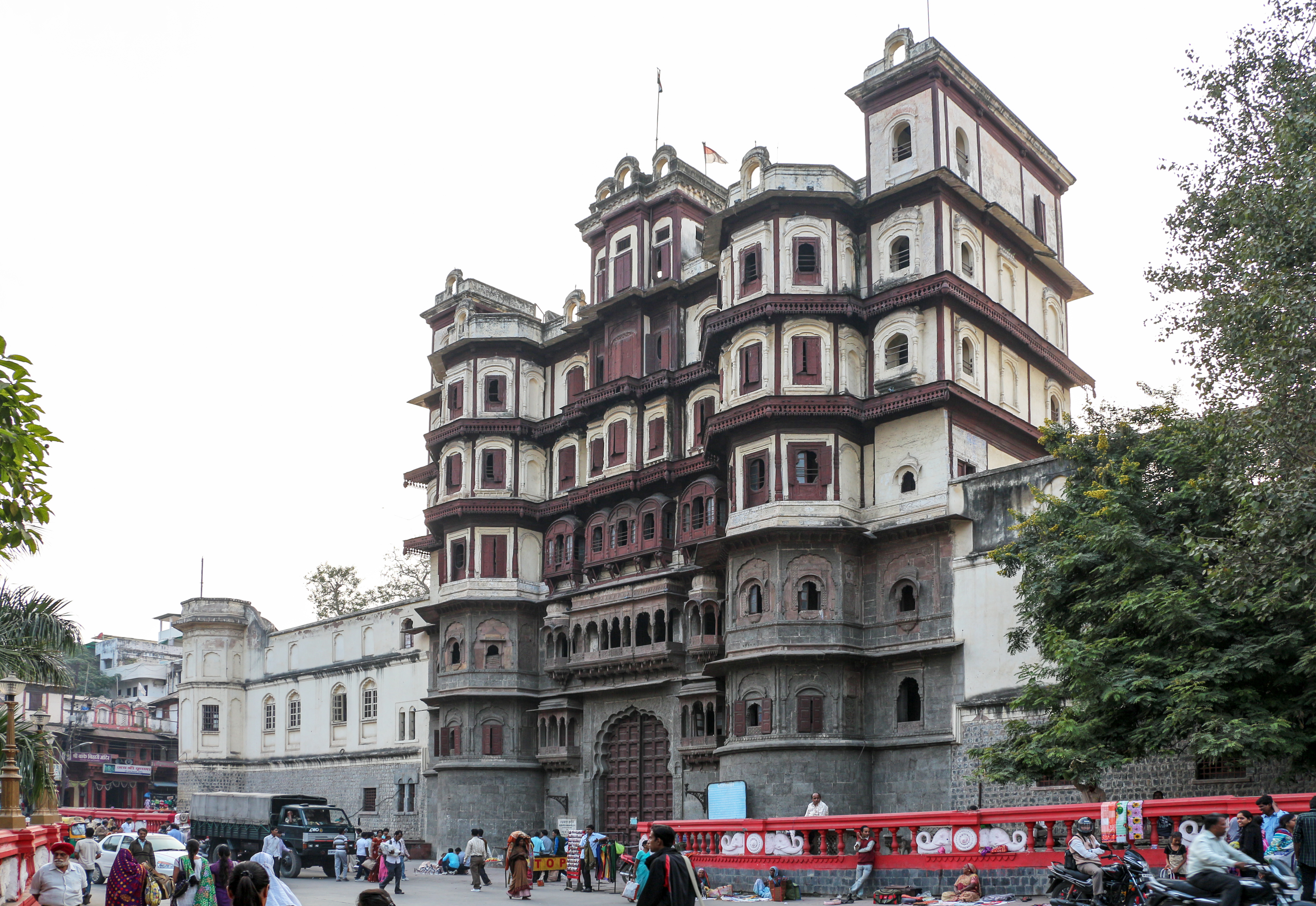
[[File:Rajwada Palace, Indore.jpg|thumb|The [[Rajwada|Rajwada Palace]] was the official residence of the [[House of Holkar|Holkar]]s during the reign of Ahilyabai. ]] | |||
The Holkar family was known for avoiding using public cash to meet their personal and family expenses. They possessed their personal funds, which they had accumulated through their private property. Ahilyabai inherited personal funds estimated at sixteen crores rupees at that time. Ahilyabai donated money from her personal resources to charity.<ref>{{cite book |author=Arvind Javlekar |url=https://books.google.com/books?id=voYn9a1EBkIC |title=Lokmata Ahilyabai |date=2002 |publisher=Ocean Books |isbn=978-81-88322-08-4 |page=62}}</ref> The charities of the Devi Ahilyabai in her territory as well as throughout the Bharata Kanda are too well known. A well-documented account of the expenditure can be found in the "Devasthan classification list 1923 by the Holkar government".<ref>{{Cite journal |last=Abhang |first=C.J. |date=2018 |title=The Religious Policy of the Marathas in Malwa |url=https://www.jstor.org/stable/26906264 |journal=Proceedings of the Indian History Congress |volume=79 |pages=323–328 |jstor=26906264 |issn=2249-1937}}</ref> The Holkar government appointed a "Devastahan officer" who travelled far and wide and collected information on the spot.<ref>{{Cite web | title=Archived copy | url=https://censusindia.gov.in/nada/index.php/catalog/28391/download/31573/20_1921_HOL.pdf | archive-url=https://web.archive.org/web/20240731095345/https://censusindia.gov.in/nada/index.php/catalog/28391/download/31573/20_1921_HOL.pdf | archive-date=2024-07-31}}</ref> | |||
The arrangements made by Devi Ahilya at all the sacred were shown in the below table | |||
'''Charities connected with the Jyotir-Lingas<ref>{{Cite book |last=Thombre P.v. |url=http://archive.org/details/in.ernet.dli.2015.199825 |title=LIFE AND LIFE'S-WORK OF SHREE DEVI AHILYA BAI HOLKAR |date=2007 |pages=34 |trans-title=HOLKAR STATE HISTORY VOL. I}}</ref>''' | |||
{| class="wikitable" | |||
| colspan="5" | | |||
|- | |||
|'''Sl No''' | |||
|'''Name of the Linga''' | |||
|'''Geographical''' | |||
'''situation.''' | |||
|'''Description of''' | |||
'''charity.''' | |||
|'''Authority for''' | |||
'''statement.''' | |||
|- | |||
|1 | |||
|[[Somnath Temple|Shree Somanath]] | |||
|Kathiawad, on the sea side. | |||
|In 1786 A. D. The idol was re-installed | |||
|Maheshwar Durbar Batmipatre. | |||
Part II, P.87 | |||
|- | |||
|2 | |||
|[[Mallikarjuna Temple, Srisailam|Shree Mallikarjuna]] | |||
|Dist. Karnul Madras Presidency. | |||
|Temple was built. | |||
|State Record. | |||
|- | |||
|3 | |||
|[[Omkareshwar Temple|Shree Omkareshwar]] | |||
|Central India (on the Narbada bank.) | |||
|House for Drums, Flower-garden, Palanquin, Boat, | |||
Silver-idol | |||
|State Record. | |||
|- | |||
|4 | |||
|Shree Vaijnath | |||
|Nizam's State | |||
|In 1784 A. D. The temple was re-built. | |||
|Bharat Itihasa Shanshodliak Mandal Report | |||
Shak 1834, Bhadrapad Number. | |||
|- | |||
|5 | |||
|[[Nageshvara Jyotirlinga|Shree Nageshwar]] | |||
|Nizam's State | |||
|In 1784 A, D. | |||
Annual payment of Rs. 81/- for 1 worship. | |||
|State Record. | |||
|- | |||
|6 | |||
|[[Kashi Vishwanath Temple|Shree Vishwanath]] | |||
|Benares | |||
|(1) [[Manikarnika Ghat|Mankarnikaghat]] | |||
(2) Re-installation of Kashi- Vishwanath. | |||
(3) 6 Private temples. | |||
(4) Temple of the Ganges and 3 temples on the Ghat. | |||
(5) Shree Tarkeshwar temple. | |||
(6) [[Dashashwamedh Ghat]] | |||
(7) Female Mankarnika Ghat | |||
(8) Dharmashala Rameshwar | |||
(9) Dharmashala Kapildhara | |||
(10) 9 Private Bungalows | |||
(11) Garden-field | |||
(12) Plinth on Shitala Ghat | |||
(13) Dharmashala Uttar Kashi | |||
(14) Establishment of Bramha-puri | |||
|State Record. | |||
|- | |||
|7 | |||
|[[Trimbakeshwar Shiva Temple|Shree Trimbakeshwar]] | |||
|Nasik District. | |||
|Bridge of Kushawarta-Ghat | |||
|State Record. | |||
|- | |||
|8 | |||
|[[Grishneshwar Temple|Shree Grishneshwar]] | |||
|Verul Nizam's State | |||
|Re-built Shivalaya Tirth. | |||
|Bharat I.S.M. R. Shak 1838, | |||
|- | |||
|9 | |||
|[[Mahabaleshwar Temple, Gokarna|Shree Gokarna]] | |||
|On the Western sea. Madras Presidency. | |||
|(1) Alms-House. | |||
|State Record. | |||
|- | |||
|10 | |||
|[[Mahakaleshwar Jyotirlinga|Shree Mahakaleshwar]] | |||
|[[Ujjain]] (Central India) | |||
|Worship of the Linga on the Mahashivratra night, and food distribution on the day following. | |||
|State Record. | |||
|- | |||
|11 | |||
|[[Ramanathaswamy Temple|Shree Rameshwar]] | |||
|Madras Presidency. | |||
|Alms-House. Wells. Shree Radha-Krishna temple. | |||
|State Record. | |||
|- | |||
|12 | |||
|[[Bhimashankar Temple|Shree Bhima-Shankar]] | |||
|Bombay Presidency. | |||
|Alms-House, | |||
|State Record. | |||
|} | |||
== Sapta Puri and Char Dham == | |||
''[[Sapta Puri]]'' (seven cities) and ''[[Char Dham]]'' (four quarters) were looked up eventually by Hindus of all castes and creeds in worship and pilgrimage.<ref>{{Cite book |last=Thombre P.v. |url=http://archive.org/details/in.ernet.dli.2015.199825 |title=LIFE AND LIFE'S-WORK OF SHREE DEVI AHILYA BAI HOLKAR |date=2007 |pages=36 |trans-title=HOLKAR STATE HISTORY VOL. I |chapter=CHAPTER VI.The Devi's Administration ( continued ) Charities and endowments.}}</ref> | |||
[[Dwarka]]: she built a [[Almshouse]] | |||
[[Ujjain|Ujjain(Avantika)]]: she built four Mandir and a charitable building | |||
== | [[Kanchipuram]]: [[Ganges|Ganga]] water annually sent | ||
[[Mathura]]: she built a Mandir 2 Ghat and one charitable building | |||
[[Ayodhya]]: She built 4 Ram Mandir and 3 charitable buildings | |||
[[Haridwar|Haridwar(Maya)]]: a Ghat and a charitable house | |||
[[Varanasi]]: Refer the above table | |||
=== [[Char Dham]]a – four quadrants of Aryavarta === | |||
[[Badrinath]]: 5 Dharmashalas and eight charity buildings | |||
[[Jagannath|Jagnath (Puri)]]: A temple, Almhouse and garden land | |||
== Conclusion == | |||
Here we see the various charities of Devi Ahilyabai extending throughout the length and breadth of [[Bharatakhanda]]. In the book ''HOLKAR STATE HISTORY VOL. II Life and Life's-Work of Devi Shree Ahilyabai ( 1725–1795 A. D.)''page 42 there are worship expenses<ref>{{Cite book |last=Thombre P.v. |url=http://archive.org/details/in.ernet.dli.2015.199825 |title=LIFE AND LIFE'S-WORK OF SHREE DEVI AHILYA BAI HOLKAR |date=2007 |pages=42 |trans-title=HOLKAR STATE HISTORY VOL. I}}</ref> | |||
Various temples Ghats and rest houses built during her time exhibit Indian architecture and the various features of different schools. They became so many training grounds for young Indian architecture. Not only in her territory but throughout the whole of India. The aspects of Devi Ahilyabai charity reveal and resuscitation of Thirthas and Kshetras.<gallery> | |||
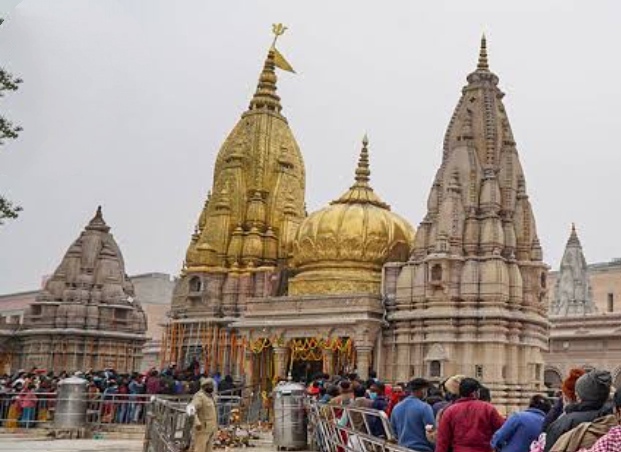
File:Kashi Vishwanath.jpg|Current [[Kashi Vishwanath Temple]] built by Ahilyabai in 1780. | |||
File:Vishnupadh Temple.jpg|The current structure of [[Vishnupad Temple, Gaya|Vishnupad Temple]], Gaya, Bihar is built by Maharani Ahilyabai Holkar in 1787 | |||
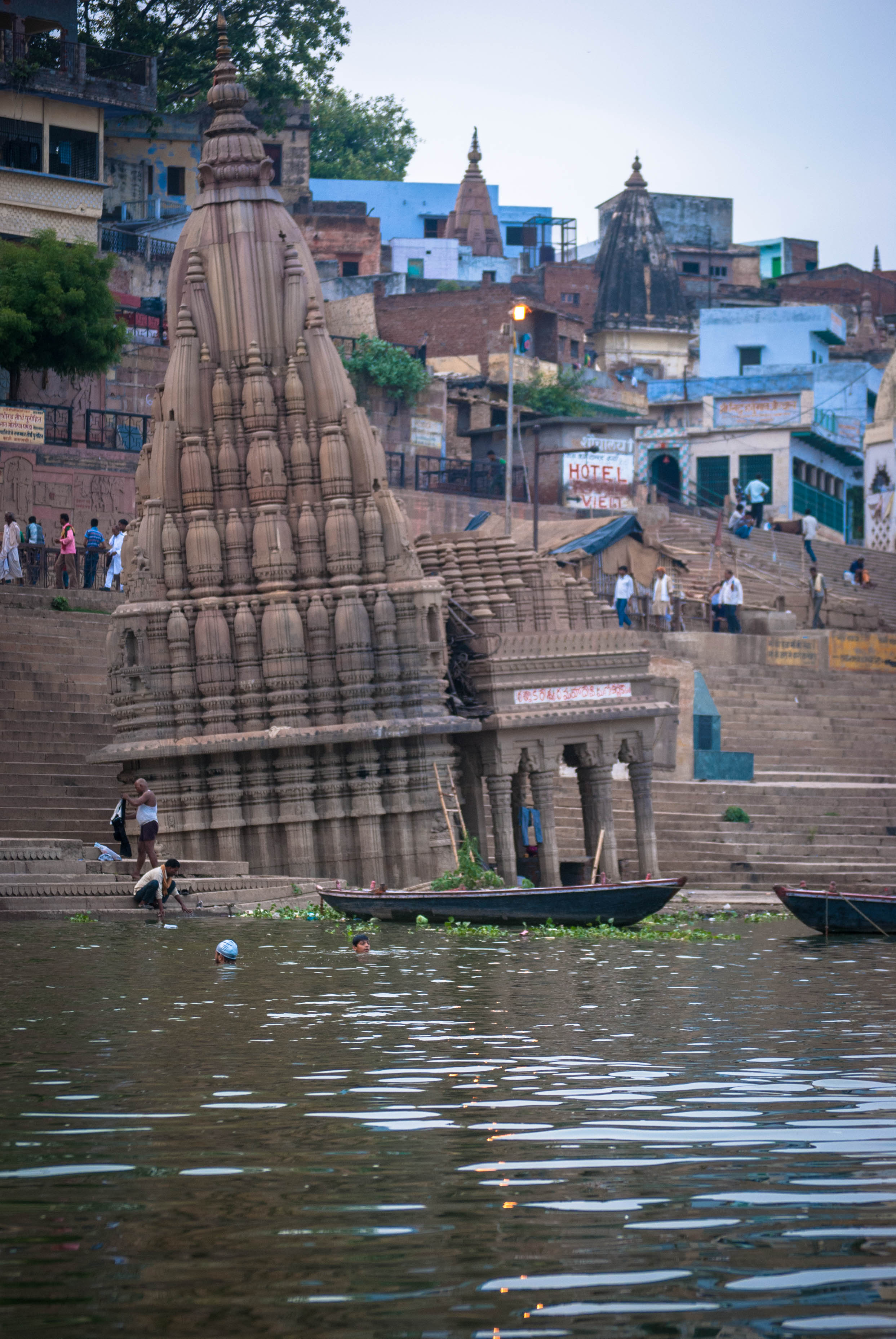
File:Ahilya Ghat by the Ganges, Varanasi.jpg|Ahilya Ghat, [[Varanasi]] | |||
File:Manikarnika Ghat, Varanasi, Uttar Pradesh, India (2011) 3.jpg|[[Manikarnika Ghat]] in varanasi | |||
File:Ahilya Status Rajwada Indore 2014.jpg | |||
File:16 sacred deeds of ahilyabai holkar in india (16673642718).jpg | |||
File:Stamp of India - 1975 - Colnect 372806 - Ahilyabai Holkar 1725-1795 Chhatri at Maheshwar.jpeg | |||
File:Guj21 Somnath Temple built by Ahilya Bai Holkar.jpg | |||
File:Matri-rin Temple in Varanasi.jpg | |||
</gallery> | |||
== | ==Death== | ||
Ahilyabai died on 13 August 1795 at age 70. She was succeeded by her commander-in-chief and brother-in-law, [[Tukoji Rao Holkar]], who abdicated the throne in 1797 in favour of his son Kashi Rao Holkar. | |||
==Legacy== | |||
{{over-quotation|section|date=July 2024}} | |||
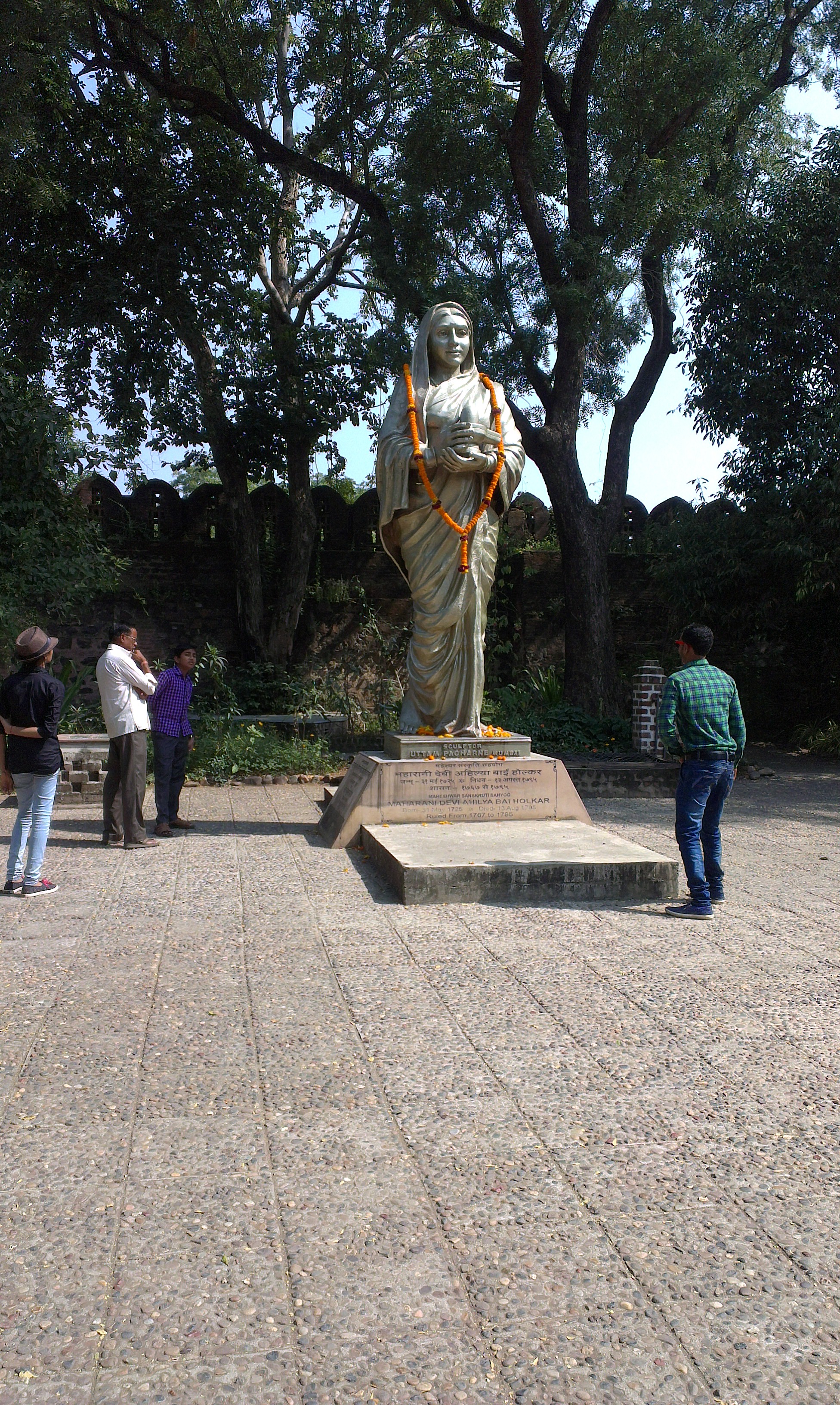
[[File: Statue of Ahilybai Holkar, Maheshwar.jpg|thumb|Statue of Ahilybai Holkar, [[Maheshwar]], [[Madhya Pradesh]]]] | [[File: Statue of Ahilybai Holkar, Maheshwar.jpg|thumb|Statue of Ahilybai Holkar, [[Maheshwar]], [[Madhya Pradesh]]]] | ||
{{Blockquote|text="The reign of Ahilyabai, of Indore in central India, lasted for thirty years. This has become almost legendary as a period during which perfect order and good government prevailed and the people prospered. She was a very able ruler and organizer, highly respected during her lifetime, and considered as a saint by a grateful people after her death."|author=Jawaharlal Nehru|source=''The Discovery of India'' (1946)<ref>Jawaharlal Nehru (1946) ''[[The Discovery of India]]''. Meridian Books. p. 304. {{ISBN|978-0-19-562359-8}}</ref>}} | {{Blockquote|text="The reign of Ahilyabai, of Indore in central India, lasted for thirty years. This has become almost legendary as a period during which perfect order and good government prevailed and the people prospered. She was a very able ruler and organizer, highly respected during her lifetime, and considered as a saint by a grateful people after her death."|author=[[Jawaharlal Nehru]]|source=''The Discovery of India'' (1946)<ref>Jawaharlal Nehru (1946) ''[[The Discovery of India]]''. Meridian Books. p. 304. {{ISBN|978-0-19-562359-8}}</ref>}} | ||
{{Blockquote| | {{Blockquote| | ||
text="For thirty years her reign of peace,<br>The land in blessing did increase;<br>And she was blessed by every tongue,<br>By stern and gentle, old and young.<br>Yea, even the children at their mother's feet,<br>Are taught such homely rhyming to repeat.<br>In latter days from Brahma came,<br>To rule our land, a noble Dame,<br>Kind was her heart and bright her fame,<br>And Ahilya was her honored name."| | text="For thirty years her reign of peace,<br />The land in blessing did increase;<br />And she was blessed by every tongue,<br />By stern and gentle, old and young.<br />Yea, even the children at their mother's feet,<br />Are taught such homely rhyming to repeat.<br />In latter days from Brahma came,<br />To rule our land, a noble Dame,<br />Kind was her heart and bright her fame,<br />And Ahilya was her honored name."| | ||
author=Joanna Baillie|source=''English Poem'' (1849)}} | author=Joanna Baillie|source=''English Poem'' (1849)}} | ||
Collecting oral memories of | Collecting oral memories of hers in the 1820s, [[John Malcolm|Sir John Malcolm]], the British official most directly concerned with the 'settlement' of central India, seems to have become deeply enamored of her. | ||
{{Blockquote|text="Ahilyabai's extraordinary ability won her the regard of her subjects and of the other [[Maratha | |||
{{Blockquote|text="Ahilyabai's extraordinary ability won her the regard of her subjects and of the other [[Maratha Empire|Maratha chiefs]], including Nana Phadnavis. With the natives of Malwa ... her name is sainted and she has styled an avatar or Incarnation of the Divinity. In the soberest view that can be taken of her character, she certainly appears, within her limited sphere, to have been one of the purest and most exemplary rulers that ever existed."|author=[[John Malcolm]]|source=''A Memoir of Central India'' <ref>Malcolm, J., A Memoir of Central India, quoted in {{cite book|author=John Keay|title=India: A History|url=https://books.google.com/books?id=3aeQqmcXBhoC|year=2000|publisher=Grove Press|isbn=978-0-8021-3797-5|page=407}}</ref>}} | |||
{{blockquote | text = "This great ruler in Indore encouraged all within her realm to do their best, Merchants produced their finest clothes, trade flourished, the farmers were at peace and oppression ceased, for each case that came to the queen's notice was dealt with severely. She loved to see her people prosper, and to watch the fine cities grow, and to watch that her subjects were not afraid to display their wealth, lest the ruler should snatch it from them. Far and wide the roads were planted with shady trees, and wells were made, and rest-houses for travelers. The poor, the homeless, the orphaned were all helped according to their needs. The Bhils who had long been the torment of all caravans were routed from their mountain fastnesses and persuaded to settle down as honest farmers. Hindu and Musalman alike revered the famous Queen and prayed for her long life. Her last great sorrow was when her daughter became a Sati upon the death of Yashwantrao Phanse. Ahalya Bai was seventy years old when her long and splendid life closed. Indore long mourned its noble Queen, happy had been her reign, and her memory is cherished with deep reverence unto this day." | author=[[Annie Besant]]<ref>{{cite book|author=Annie Besant|title=Children of the Motherland|url=https://books.google.com/books?id=8VLatAEACAAJ|date= 2018|publisher=CHIZINE PUBN|isbn=978-1-377-17734-2|pages=290–291}}</ref>}} | {{blockquote | text = "This great ruler in Indore encouraged all within her realm to do their best, Merchants produced their finest clothes, trade flourished, the farmers were at peace and oppression ceased, for each case that came to the queen's notice was dealt with severely. She loved to see her people prosper, and to watch the fine cities grow, and to watch that her subjects were not afraid to display their wealth, lest the ruler should snatch it from them. Far and wide the roads were planted with shady trees, and wells were made, and rest-houses for travelers. The poor, the homeless, the orphaned were all helped according to their needs. The Bhils who had long been the torment of all caravans were routed from their mountain fastnesses and persuaded to settle down as honest farmers. Hindu and Musalman alike revered the famous Queen and prayed for her long life. Her last great sorrow was when her daughter became a Sati upon the death of Yashwantrao Phanse. Ahalya Bai was seventy years old when her long and splendid life closed. Indore long mourned its noble Queen, happy had been her reign, and her memory is cherished with deep reverence unto this day." | author=[[Annie Besant]]<ref>{{cite book|author=Annie Besant|title=Children of the Motherland|url=https://books.google.com/books?id=8VLatAEACAAJ|date= 2018|publisher=CHIZINE PUBN|isbn=978-1-377-17734-2|pages=290–291}}</ref>}} | ||
| Line 100: | Line 241: | ||
{{blockquote | text ="From the original papers and letters, it becomes clear that she was the first-class politician, and that was why she readily extended her support to [[Mahadji Shinde]]. I have no hesitation in saying that without the support of Ahilyabai, Mahadji would never have gained so much importance in the politics of northern India."| author=Historian Judunath Sarkar}} | {{blockquote | text ="From the original papers and letters, it becomes clear that she was the first-class politician, and that was why she readily extended her support to [[Mahadji Shinde]]. I have no hesitation in saying that without the support of Ahilyabai, Mahadji would never have gained so much importance in the politics of northern India."| author=Historian Judunath Sarkar}} | ||
{{blockquote| text="Definitely no woman and no ruler are like Ahilyabai Holkar."| author = [[Nizam of Hyderabad]]}} | {{blockquote| text="Definitely no woman and no ruler are like Ahilyabai Holkar."| author = [[Nizam of Hyderabad]]{{Which|date=February 2024}}}} | ||
{{blockquote| text = "It reveals beyond doubt that all ideal virtues described by [[Plato]] and Bhattacharya were present in her personalities like Dilip, Janak, Shri Ram, Shri Krishna, and Yudhishthir. After thorough scrutiny of the long history of the world, we find only one personality of Lokmata Devi Ahilya that represents an absolutely ideal ruler." | author= Arvind Javlekar<ref>{{cite book|author=Arvind Javlekar|title=Lokmata Ahilyabai|url=https://books.google.com/books?id=voYn9a1EBkIC|date=2002|publisher=Ocean Books|isbn=978-81-88322-08-4|page=140}}</ref>}} | {{blockquote| text = "It reveals beyond doubt that all ideal virtues described by [[Plato]] and Bhattacharya were present in her personalities like Dilip, Janak, Shri Ram, Shri Krishna, and Yudhishthir. After thorough scrutiny of the long history of the world, we find only one personality of Lokmata Devi Ahilya that represents an absolutely ideal ruler." | author= Arvind Javlekar<ref>{{cite book|author=Arvind Javlekar|title=Lokmata Ahilyabai|url=https://books.google.com/books?id=voYn9a1EBkIC|date=2002|publisher=Ocean Books|isbn=978-81-88322-08-4|page=140}}</ref>}} | ||
[[John Keay]] called her 'The Philosopher Queen', a reference perhaps to the '[[Philosopher king]]' [[Bhoja|Bhoj]]. | [[John Keay]] called her 'The Philosopher Queen', a reference perhaps to the '[[Philosopher king]]' [[Bhoja|Bhoj]]. | ||
{{blockquote|"Ahilyabai Holkar, the 'philosopher-queen' of Malwa, had evidently been an acute observer of the wider political scene. In a letter to the Peshwa in 1772, she had warned against association with the British and likened their embrace to a bear-hug: "Other beasts, like tigers, can be killed by might or contrivance, but to kill a bear it is very difficult. It will die only if you kill it straight in the face, Or else, once caught in its powerful hold, the bear will kill its prey by tickling. Such is the way of the English. And in view of this, it is difficult to triumph over them."|author=[[John Keay]]| source = ''India: A History'' (2000)<ref>{{cite book|author=John Keay|title=India: A History|url=https://books.google.com/books?id=3aeQqmcXBhoC|year=2000|publisher=Grove Press|isbn=978-0-8021-3797-5|page=425}}</ref>}} | {{blockquote|"Ahilyabai Holkar, the 'philosopher-queen' of Malwa, had evidently been an acute observer of the wider political scene. In a letter to the Peshwa in 1772, she had warned against association with the British and likened their embrace to a bear-hug: "Other beasts, like tigers, can be killed by might or contrivance, but to kill a bear it is very difficult. It will die only if you kill it straight in the face, Or else, once caught in its powerful hold, the bear will kill its prey by tickling. Such is the way of the English. And in view of this, it is difficult to triumph over them."|author=[[John Keay]]| source = ''India: A History'' (2000)<ref>{{cite book|author=John Keay|title=India: A History|url=https://books.google.com/books?id=3aeQqmcXBhoC|year=2000|publisher=Grove Press|isbn=978-0-8021-3797-5|page=425}}</ref>}} | ||
{{blockquote|text="The Great [[Maratha]] lady who affords the noblest example of wisdom, goodness, and virtue. [[Akbar]] is among male sovereigns, and Ahilyabai is among female sovereigns".|author= An English writer quoted in the book ''Ahilya Bai Holkar'' by Khadpekar<ref>Quote of an English writer given in the book ''Ahilya Bai Holkar'' by Khadpekar</ref>}} | {{blockquote|text="The Great [[Maratha]] lady who affords the noblest example of wisdom, goodness, and virtue. [[Akbar]] is among male sovereigns, and Ahilyabai is among female sovereigns".|author= An English writer quoted in the book ''Ahilya Bai Holkar'' by Khadpekar<ref>Quote of an English writer given in the book ''Ahilya Bai Holkar'' by Khadpekar</ref>}} | ||
A [[commemorative stamp]] was issued in her honour on 25 August 1996 by the [[Republic of India]].<ref>{{cite web|url=http://www.indianpost.com/viewstamp.php/Alpha/A/AHILYABAI%20HOLKAR | | A [[commemorative stamp]] was issued in her honour on 25 August 1996 by the [[Republic of India]].<ref>{{cite web |date=25 August 1996 |title=Ahilyabai Holkar |url=http://www.indianpost.com/viewstamp.php/Alpha/A/AHILYABAI%20HOLKAR |access-date=17 September 2012 |publisher=Indianpost.com}}</ref> | ||
= | As a tribute to the great ruler, Indore international airport has been named [[Devi Ahilyabai Holkar Airport|Devi Ahilyabai Airport]]. Similarly, Indore university has been renamed as [[Devi Ahilya Vishwavidyalaya]].<ref name="DAUniv" /> | ||
On 13 March 2024, the Maharashtra state government approved the renaming of [[Ahmednagar|Ahmadnagar]] to Ahilyanagar.<ref>{{Cite news |last=Banerjee |first=Shoumojit |date=13 March 2024 |title=Maharashtra's Ahmednagar to be officially called 'Ahilyanagar' |url=https://www.thehindu.com/news/national/other-states/maharashtras-ahmednagar-to-be-officially-called-ahilyanagar/article67947010.ece |access-date=13 March 2024 |work=The Hindu |language=en-IN |issn=0971-751X}}</ref> | |||
[[ | |||
==In popular culture== | ==In popular culture== | ||
* Former Lok Sabha Speaker [[Sumitra Mahajan]] has written a book "Matoshree" based on the life of Ahilyadevi Holkar<ref>{{Cite book |last=Mahajan |first=Sumitra |url=https://books.google.com/books?id=ISs6DwAAQBAJ |title=Matoshree: Matoshree: सुमित्रा महाजन's Tale of Motherhood and Legacy |date=19 January 2021 |publisher=Prabhat Prakashan |isbn=978-93-5266-133-6 |language=hi}}</ref> | |||
* A film titled Devi Ahilyabai was produced in 2002 featuring [[Mallika Prasad]] as Devi Ahilyabai, [[Shabana Azmi]] as Harkubai (Khanda Rani, Malhar Rao Holkar's wife) and also including [[Sadashiv Amrapurkar]] as Malhar Rao Holkar, Ahilyabai's father in law.<ref>{{cite web |url=http://www.nfdcindia.com/view_film.php?film_id=150&categories_id=5 |title=NFDC: Cinemas of India |publisher=Nfdcindia.com |access-date=17 September 2012 |archive-date=13 October 2008 |archive-url=https://web.archive.org/web/20081013172437/http://www.nfdcindia.com/view_film.php?film_id=150&categories_id=5 |url-status=dead }}</ref><ref>{{Cite AV media |url=https://www.youtube.com/watch?v=3lQLofQNN7U |title="DEVI" AHILYABAI Full Movie {{!}} Watch on EPIC ON |date=5 January 2022 |last=EPIC ON |access-date=31 July 2024 |via=YouTube}}</ref> | |||
* Former Lok Sabha Speaker [[Sumitra Mahajan]] has written a book "Matoshree" based on the life of Ahilyadevi Holkar. | * In [[Thane]] City in [[Maharashtra]], a children's park has been named as 'Ahilyadevi Holkar Udyan' after her. Also, a road has been named after her in the same city.<ref>{{Cite AV media |url=https://www.youtube.com/watch?v=MGqQjWsVkVo |title=Ahilyabai Holkar Udhyan /अहिल्याबाई होळकर उद्यान/ Katraj Pune |date=13 December 2022 |last=Dr. Pritam V. Misale |access-date=1 August 2024 |via=YouTube}}</ref> | ||
* A film titled Devi | * The airport at [[Indore]] is named [[Devi Ahilya Bai Holkar Airport|Devi Ahilyabai Holkar Airport]] in her honor. | ||
* In [[Thane]] City in [[Maharashtra]], a children's park has been named as 'Ahilyadevi Holkar Udyan' after her. Also, a road has been named after her in the same city. | |||
* The airport at [[Indore]] is named [[Devi Ahilya Bai Holkar Airport]] in her honor. | |||
* There are two universities named Devi Ahilya Vishwa Vidyalaya in Indore, [[Madhya Pradesh]], and [[University of Solapur|Punyashlok Ahilyadevi Holkar Solapur University]] in Solapur, [[Maharashtra]]. | * There are two universities named Devi Ahilya Vishwa Vidyalaya in Indore, [[Madhya Pradesh]], and [[University of Solapur|Punyashlok Ahilyadevi Holkar Solapur University]] in Solapur, [[Maharashtra]]. | ||
* In 2006, a statue of Ahilyabai | * In 2006, a statue of Ahilyabai was unveiled on the premises of the Parliament Library Building by Vice-president [[Bhairon Singh Shekhawat]].<ref>{{Cite web| title=The Journal of Parliamentary Information | date=December 2006 | url=https://eparlib.nic.in/bitstream/123456789/764099/1/jpi_december_2006.pdf | archive-url=https://web.archive.org/web/20241201014256/https://eparlib.nic.in/bitstream/123456789/764099/1/jpi_december_2006.pdf | archive-date=2024-12-01}}</ref> | ||
* In the 1994 [[Hindi]] TV series ''[[The Great Maratha]]'', Ahilyabai's character was portrayed by [[Mrinal Kulkarni]]. | * In the 1994 [[Hindi]] TV series ''[[The Great Maratha]]'', Ahilyabai's character was portrayed by [[Mrinal Kulkarni]].<ref>{{Citation |title=The Great Maratha |date=1 February 1994 |type=Action, Biography, Drama |url=https://www.imdb.com/title/tt2451878/ |access-date=1 August 2024 |others=Irrfan Khan, Mrinal Kulkarni, Mukesh Khanna}}</ref> | ||
* In 2016, a TV serial titled ''Punyashlok Ahilybai Holkar'' aired on [[Colors Marathi]] starring Urmila Kothare as Ahilybai. | * In 2016, a TV serial titled ''Awaaz: Punyashlok Ahilybai Holkar'' aired on [[Colors Marathi]] starring Urmila Kothare as Ahilybai. | ||
* In 2021, a TV | * The [[State Highway 15 (West Bengal)]] has been renamed as Ahilyabai Road.{{citation needed|date=August 2024}} | ||
* | * In 2021, a Hindi TV series titled [[Punyashlok Ahilyabai]] aired on Sony TV, starring [[Aetashaa Sansgiri]] as Ahilyabai and Aditi Jaltare as a young Ahilyabai. | ||
* Government Medical College in Baramati(Maharashtra) and Auraiya(Uttar Pradesh) has been named after her.<ref>{{Cite web |date=23 May 2025 |title=Auraiya medical college to be named after Ahilyabai: Yogi |url=https://www.hindustantimes.com/cities/lucknow-news/auraiya-medical-college-to-be-named-after-ahilyabai-yogi-101747935446411.html |access-date=10 August 2025 |website=Hindustan Times |language=en}}</ref><ref>{{Cite web |last=संगई |first=मिलिंद |date=31 May 2023 |title=Baramati : शासकीय वैद्यकीय महाविद्यालयाचे पुण्यश्लोक अहिल्यादेवी होळकर शासकीय वैद्यकीय महाविदयालय होणार नामकरण |url=https://www.esakal.com/pune/baramati-government-medical-college-punyashlok-ahilyadevi-holkar-government-medical-college-nomenclature-pjp78 |access-date=10 August 2025 |website=Marathi News Esakal |language=Mr}}</ref> | |||
* Government Engineering College in Mainpuri is named as Lokmata Devi Ahilya bai Holkar Rajkiya Engineering College,Mainpuri after her.<ref>{{Cite web |date=28 June 2025 |title=Five engineering colleges renamed after icons, deities |url=https://www.hindustantimes.com/cities/lucknow-news/five-engineering-colleges-renamed-after-icons-deities-101751122209003.html |access-date=10 August 2025 |website=Hindustan Times |language=en}}</ref> | |||
* Ahilyabai Holkar Stadium, Ramghat Road, Aligarh (Uttar Pradesh)<ref>{{Cite web |date=28 June 2025 |title=स्टेडियम की सिल्वर जुबली पर सबसे बड़ा आयोजन|url=https://www.amarujala.com/uttar-pradesh/aligarh/Aligarh-14652-6 |access-date=28 August 2013 |website=Hindustan Times |language=hi}}</ref> | |||
==References== | ==References== | ||
| Line 150: | Line 282: | ||
; In [[Marathi language|Marathi]] | ; In [[Marathi language|Marathi]] | ||
* List of [https://ahilyabaiholkar.in/shop/ahilyabai-holkar-books/ '''Ahilyabai | * List of [https://ahilyabaiholkar.in/shop/ahilyabai-holkar-books/ '''Ahilyabai Books in Marathi'''] - AhilyaStore | ||
* ''Punyashlok Ahilya'' by R.W.Tikore-Kumthewale | * ''Punyashlok Ahilya'' by R.W.Tikore-Kumthewale | ||
* ''Ahilyabai'' by Hiralal Sharma | * ''Ahilyabai'' by Hiralal Sharma | ||
| Line 157: | Line 289: | ||
*[https://ahilyabaiholkar.in/dyat-adyant-ahilyabai-holkar-book-on-ahilyabai-holkar/ ''Dnyat Adnyat Ahilyabai Holakar'' by Vinaya Khadapekar] | *[https://ahilyabaiholkar.in/dyat-adyant-ahilyabai-holkar-book-on-ahilyabai-holkar/ ''Dnyat Adnyat Ahilyabai Holakar'' by Vinaya Khadapekar] | ||
* ''Pal Samaaj on Samaaj'' | * ''Pal Samaaj on Samaaj'' | ||
* ''Matoshree" by Sumitra Mahajan | * ''Matoshree" by Sumitra Mahajan'' | ||
==External links== | ==External links== | ||
* | * {{commons category-inline}} | ||
* [http://www.indiatogether.org/manushi/issue124/holkar.htm Ahilyadevi Holkar: A Magnificent Ruler, Saintly Administrator] | * [http://www.indiatogether.org/manushi/issue124/holkar.htm Ahilyadevi Holkar: A Magnificent Ruler, Saintly Administrator] | ||
*https://ahilyabaiholkar.in/ | * {{official website|https://ahilyabaiholkar.in/}} | ||
{{MarathaEmpire}} | {{MarathaEmpire}} | ||
| Line 171: | Line 303: | ||
[[Category:1725 births]] | [[Category:1725 births]] | ||
[[Category:1795 deaths]] | [[Category:1795 deaths]] | ||
[[Category:Indian queens regnant]] | |||
[[Category:Indian queens | |||
[[Category:Indian women in war]] | [[Category:Indian women in war]] | ||
[[Category:Women in 18th-century warfare]] | [[Category:Women in 18th-century warfare]] | ||
[[Category:People from Indore]] | |||
[[Category:People from | |||
[[Category:People from Khargone]] | [[Category:People from Khargone]] | ||
[[Category:Indian female royalty]] | [[Category:Indian female royalty]] | ||
[[Category:18th-century women rulers]] | [[Category:18th-century women rulers]] | ||
[[Category:18th-century regents]] | |||
[[Category:Marathi people]] | [[Category:Marathi people]] | ||
[[Category:People from Ahmednagar district]] | [[Category:People from Ahmednagar district]] | ||
[[Category:Maharajas of Indore | [[Category:Maharajas of Indore State]] | ||
[[Category:Women from the Maratha Empire]] | |||
[[Category:Women | |||
[[Category:Queen mothers]] | [[Category:Queen mothers]] | ||
[[Category:Holkar]] | [[Category:Holkar]] | ||
[[Category:18th-century Indian women]] | [[Category:18th-century Indian women]] | ||
[[Category:18th-century Indian | [[Category:18th-century Indian royalty]] | ||
Latest revision as of 11:29, 22 March 2026
Lua error in Module:Effective_protection_level at line 16: attempt to index field 'FlaggedRevs' (a nil value).
 | This article has multiple issues. Please help improve it or discuss these issues on the talk page. (Learn how and when to remove these template messages)
|


| Ahilyabai Holkar | |||||
|---|---|---|---|---|---|
 Ahilyabai Holkar on a 2025 stamp of India | |||||
| Maharani of Indore | |||||
| Reign | 1 December 1767 – 13 August 1795 | ||||
| Coronation | 11 December 1767 | ||||
| Predecessor | Malhar Rao Holkar | ||||
| Successor | Tukoji Rao Holkar | ||||
| Regent of Indore | |||||
| Regency | 20 May 1766 – 5 April 1767 | ||||
| Subedar | Malhar Rao Holkar II | ||||
| Born | 31 May 1725 Chondi, Maratha Empire (present-day Ahmednagar district, Maharashtra, India) | ||||
| Died | 13 August 1795 (aged 70) Rajwada, Indore, Indore State, Maratha Empire (present-day, Madhya Pradesh, India) | ||||
| Spouse | Khanderao Holkar | ||||
| Issue | Male Rao Holkar (son) Muktabai (daughter) | ||||
| |||||
| House | Holkar | ||||
| Father | Mankoji Shinde | ||||
| Mother | Sushila Shinde | ||||
| Religion | Hinduism | ||||
Ahilyabai Holkar (mr; 31 May 1725 – 13 August 1795),[1] also spelled Ahalya Bai,[2] was the Rajamata and later the ruling queen of Indore within the Maratha Empire. She established Maheshwar (in Madhya Pradesh) as the seat of the Holkar Dynasty.[3] She is renowned for good governance, social welfare, and humanitarian work along with religious, educational, and cultural advancements.[4] She contributed to the growth of Indian architecture through the commission of various temples, Ghats, and Dharmshalas. Ahilyabai's Matha, or charitable endowments, spread across India.[5][6] She is remembered as a Sadhvi, or holy woman.
After the deaths of her husband Khanderao Holkar, father-in-law Malhar Rao Holkar, and son Male Rao Holkar, Ahilyabai undertook the affairs of the Holkar dynasty. She defended Indore against invasions and personally led armies into battle, with her brother-in-law Tukoji Rao Holkar serving as her military commander.[3]
Early life and marriage[edit | edit source]
Ahilyabai was born into a Marathi Dhangar family to Mankoji Shinde and Sushila Shinde in Maharashtra in the village of Chandi, now Ahilyanagar district. Her father was a descendant of a respected Gadaria caste family. Mankoji Shinde served as the Patil of the village.[7][8] Ahilyabai had five brothers and was first educated at home.
Ahilyabai rose to prominence when Malhar Rao Holkar, a commander in the army of Maratha Peshwa Baji Rao I and ruler of Malwa, stopped in Chandi on his way to Pune and saw her at a temple service. Impressed by the child's piety and character, Malhar advised his son, Khandojee, to marry her. They were wed in 1733 when he was nine or ten and she was seven or eight.[9] They had a son, Maloji Holkar, in 1745 and a daughter, Muktabai Holkar, in 1748.[citation needed]
Family's rise to prominence[edit | edit source]
By the time of Ahilyabai's marriage, her father-in-law Malhar Rao Holkar had already risen from a childhood of shepherding to ruling as Subahdar over a territory comprising thirty parganas yielding high revenues. From 1748, Malhar Rao's power in Malwa allowed him to play kingmaker in northern and central India and by 1750, he was the de facto ruler of the Maratha Confederacy. He regularly received grants, including monetary tributes, land, and noble titles, from the Peshwa government in recognition of his service to the empire.[10] His land lay north of the Narmadha on both sides of Sahyadri.[5] In 1751, he successfully mediated a major land agreement between the Peshwa and Mughal emperor Ahmad Shah Bahadur and by 1753, he was considered indispensable.[11]
Education and military expertise[edit | edit source]
Starting in 1754, Malhar Rao kept Ahilyabai actively involved in diplomacy debates, matters of the kingdom's finances, and other problems of both the Mughal Empire and the Peshwa.[12] Throughout her married life, she was brought up by her mother-in-law, Gautama Bai Holkar, who is credited for teaching Ahilyabai to have proper values. She trained her in administration, accounts, and politics and, in 1759, gave Ahilyabai her khasgi, or land grant.[13][14]
Ahilyabai's trust from her father-in-law and her military expertise are both demonstrated by a 1765 letter he wrote her during an invasion of Punjab by a Durrani Empire-Rohilla dynasty coalition led by Emperor Ahmad Shah Durrani. Malhar Rao, who was fighting in Delhi, commanded her to take heavy artillery on a military expedition to Gwalior and attack the fort at Gohad:
"...proceed to Gwalior after crossing the Chambal. You may halt there for four or five days. You should keep your big artillery and arrange for its ammunition as much as possible... The big artillery should be kept at Gwalior and you should proceed further after making proper arrangements for it's expenses for a month. On the march you should arrange for military posts to be located for protection of the road."
Ahilbayai's attack was successful.[15]
Khanderao's death and aftermath[edit | edit source]
In 1754, Khanderao and Malhar Rao, acting on orders from Mughal Grand Vizier Ghazi ud-Din Khan Feroze Jung III, laid siege to the fort at Kumher, then held by Jat Raja Suraj Mal. Suraj Mal had sided with Safdar Jang, another Mughal vazier who had rebelled against the emperor. Khanderao was inspecting his troops in an open palanquin when he was killed by cannon fire.[16]
Devastated by Khanderao's death, Alhiyabai announced she would commit sati, ritualistic suicide on his funeral pyre. Her dismayed subjects begged her to reconsider but she explained that she felt sati was the only way she could fulfill her husband's promise to accompany her all her life. Her father-in-law Malhar Rao begged:
"Daughter, my son left me whom I raised with a hope that he would support me in my old age. Now, will you also leave me, an old man, alone to be drowned in the fathomless ocean? ... Will you also leave me without any support? Still, if you don't want to change your mind, let me die first."[17]
This convinced her to choose to live and Malhar Rao thereupon began to train her in military affairs.[3][18] He died on 20 May 1766 in Alampur.[19]
Reign[edit | edit source]

On 23 August 1766, Ahilyabai's only son, Male Rao Holkar, became ruler of Indore at the age of 21 when he received investiture from the Peshwa. Male Rao had reigned for just over six months when he died on 5 April 1767.[citation needed] Malhar Rao's adopted son Tukoji Rao Holkar was then made Subahdar on the payment of a large tribute of Indian rupees and Ahilyabai became the de facto ruler.[20]
Historical records show that groups from neighboring states, particularly the Chundawat clan of Jaipur, rebelled during this transfer of power, taking advantage of both Tukoji Rao's absence from the region and the widespread devastation wrought by the Third Battle of Panipat and its aftermath. Ahilyabai led Maratha armies against these rebellions and, despite a lack of resources and aid, won every battle.[21][22][23]
In 1791, Ahilyabai's son-in-law, Yeshwantrao Fanse, died and her daughter Muktabai committed sati on his funeral pyre.[24]
Administration[edit | edit source]
In those times, the state's administration was two-sided, military and civil. The military side was again bifurcated, Tukoji Rao Holkar was the Subedar, and he had to serve Maratha. Devi Ahilyabai was outspoken, proclaiming her power by declaring, "I am the daughter-in-law of Malhar Rao". The Saranjamdar system established by Malhar Rao was efficient and was recognized by the Puna authorities. Saranjamdar was a "camp within a camp" complete by itself. The state records involuntarily reveal the diplomatic and administrative skills exhibited by Devi.[25] Justice administration [26] was soft but speedy, practical yet spiritual, restraining yet re-forming.
She transformed Indore into a progressive city, and built industries[27] and universities.[28] The government of India issued a stamp on 25 August 1996 in celebration of the 200th death anniversary.[29] The Indore airport is named after Devi Ahilya Bai Holkar Airport. The city of Indore named the university Devi Ahilya Vishwavidyalaya. Not merely in her State but indeed in other parts of India she is credited with promoting activities including repair and additions to several famous temples such as Kashi Viswanath Mandir at Varanasi, Gouri Somnath Mandir at Chola and the construction of the famous Dashashwamedh Ghat at Banaras.
Charities and endowments[edit | edit source]

The Holkar family was known for avoiding using public cash to meet their personal and family expenses. They possessed their personal funds, which they had accumulated through their private property. Ahilyabai inherited personal funds estimated at sixteen crores rupees at that time. Ahilyabai donated money from her personal resources to charity.[30] The charities of the Devi Ahilyabai in her territory as well as throughout the Bharata Kanda are too well known. A well-documented account of the expenditure can be found in the "Devasthan classification list 1923 by the Holkar government".[31] The Holkar government appointed a "Devastahan officer" who travelled far and wide and collected information on the spot.[32]
The arrangements made by Devi Ahilya at all the sacred were shown in the below table
Charities connected with the Jyotir-Lingas[33]
| Sl No | Name of the Linga | Geographical
situation. |
Description of
charity. |
Authority for
statement. |
| 1 | Shree Somanath | Kathiawad, on the sea side. | In 1786 A. D. The idol was re-installed | Maheshwar Durbar Batmipatre.
Part II, P.87 |
| 2 | Shree Mallikarjuna | Dist. Karnul Madras Presidency. | Temple was built. | State Record. |
| 3 | Shree Omkareshwar | Central India (on the Narbada bank.) | House for Drums, Flower-garden, Palanquin, Boat,
Silver-idol |
State Record. |
| 4 | Shree Vaijnath | Nizam's State | In 1784 A. D. The temple was re-built. | Bharat Itihasa Shanshodliak Mandal Report
Shak 1834, Bhadrapad Number. |
| 5 | Shree Nageshwar | Nizam's State | In 1784 A, D.
Annual payment of Rs. 81/- for 1 worship. |
State Record. |
| 6 | Shree Vishwanath | Benares | (1) Mankarnikaghat
(2) Re-installation of Kashi- Vishwanath. (3) 6 Private temples. (4) Temple of the Ganges and 3 temples on the Ghat. (5) Shree Tarkeshwar temple. (6) Dashashwamedh Ghat (7) Female Mankarnika Ghat (8) Dharmashala Rameshwar (9) Dharmashala Kapildhara (10) 9 Private Bungalows (11) Garden-field (12) Plinth on Shitala Ghat (13) Dharmashala Uttar Kashi (14) Establishment of Bramha-puri |
State Record. |
| 7 | Shree Trimbakeshwar | Nasik District. | Bridge of Kushawarta-Ghat | State Record. |
| 8 | Shree Grishneshwar | Verul Nizam's State | Re-built Shivalaya Tirth. | Bharat I.S.M. R. Shak 1838, |
| 9 | Shree Gokarna | On the Western sea. Madras Presidency. | (1) Alms-House. | State Record. |
| 10 | Shree Mahakaleshwar | Ujjain (Central India) | Worship of the Linga on the Mahashivratra night, and food distribution on the day following. | State Record. |
| 11 | Shree Rameshwar | Madras Presidency. | Alms-House. Wells. Shree Radha-Krishna temple. | State Record. |
| 12 | Shree Bhima-Shankar | Bombay Presidency. | Alms-House, | State Record. |
Sapta Puri and Char Dham[edit | edit source]
Sapta Puri (seven cities) and Char Dham (four quarters) were looked up eventually by Hindus of all castes and creeds in worship and pilgrimage.[34]
Ujjain(Avantika): she built four Mandir and a charitable building
Kanchipuram: Ganga water annually sent
Mathura: she built a Mandir 2 Ghat and one charitable building
Ayodhya: She built 4 Ram Mandir and 3 charitable buildings
Haridwar(Maya): a Ghat and a charitable house
Varanasi: Refer the above table
Char Dhama – four quadrants of Aryavarta[edit | edit source]
Badrinath: 5 Dharmashalas and eight charity buildings
Jagnath (Puri): A temple, Almhouse and garden land
Conclusion[edit | edit source]
Here we see the various charities of Devi Ahilyabai extending throughout the length and breadth of Bharatakhanda. In the book HOLKAR STATE HISTORY VOL. II Life and Life's-Work of Devi Shree Ahilyabai ( 1725–1795 A. D.)page 42 there are worship expenses[35]
Various temples Ghats and rest houses built during her time exhibit Indian architecture and the various features of different schools. They became so many training grounds for young Indian architecture. Not only in her territory but throughout the whole of India. The aspects of Devi Ahilyabai charity reveal and resuscitation of Thirthas and Kshetras.
-
 Current Kashi Vishwanath Temple built by Ahilyabai in 1780.
 -
 The current structure of Vishnupad Temple, Gaya, Bihar is built by Maharani Ahilyabai Holkar in 1787
 -
 Ahilya Ghat, Varanasi
 -
 Manikarnika Ghat in varanasi
 -

-

-

-

-


_3.jpg)

.jpg)


Death[edit | edit source]
Ahilyabai died on 13 August 1795 at age 70. She was succeeded by her commander-in-chief and brother-in-law, Tukoji Rao Holkar, who abdicated the throne in 1797 in favour of his son Kashi Rao Holkar.
Legacy[edit | edit source]
 | This section contains too many or overly lengthy quotations for an encyclopedic entry. (July 2024) |

"The reign of Ahilyabai, of Indore in central India, lasted for thirty years. This has become almost legendary as a period during which perfect order and good government prevailed and the people prospered. She was a very able ruler and organizer, highly respected during her lifetime, and considered as a saint by a grateful people after her death."
— Jawaharlal Nehru, The Discovery of India (1946)[36]
"For thirty years her reign of peace,
The land in blessing did increase;
And she was blessed by every tongue,
By stern and gentle, old and young.
Yea, even the children at their mother's feet,
Are taught such homely rhyming to repeat.
In latter days from Brahma came,
To rule our land, a noble Dame,
Kind was her heart and bright her fame,
And Ahilya was her honored name."— Joanna Baillie, English Poem (1849)
Collecting oral memories of hers in the 1820s, Sir John Malcolm, the British official most directly concerned with the 'settlement' of central India, seems to have become deeply enamored of her.
"Ahilyabai's extraordinary ability won her the regard of her subjects and of the other Maratha chiefs, including Nana Phadnavis. With the natives of Malwa ... her name is sainted and she has styled an avatar or Incarnation of the Divinity. In the soberest view that can be taken of her character, she certainly appears, within her limited sphere, to have been one of the purest and most exemplary rulers that ever existed."
— John Malcolm, A Memoir of Central India [37]
"This great ruler in Indore encouraged all within her realm to do their best, Merchants produced their finest clothes, trade flourished, the farmers were at peace and oppression ceased, for each case that came to the queen's notice was dealt with severely. She loved to see her people prosper, and to watch the fine cities grow, and to watch that her subjects were not afraid to display their wealth, lest the ruler should snatch it from them. Far and wide the roads were planted with shady trees, and wells were made, and rest-houses for travelers. The poor, the homeless, the orphaned were all helped according to their needs. The Bhils who had long been the torment of all caravans were routed from their mountain fastnesses and persuaded to settle down as honest farmers. Hindu and Musalman alike revered the famous Queen and prayed for her long life. Her last great sorrow was when her daughter became a Sati upon the death of Yashwantrao Phanse. Ahalya Bai was seventy years old when her long and splendid life closed. Indore long mourned its noble Queen, happy had been her reign, and her memory is cherished with deep reverence unto this day."
"From the original papers and letters, it becomes clear that she was the first-class politician, and that was why she readily extended her support to Mahadji Shinde. I have no hesitation in saying that without the support of Ahilyabai, Mahadji would never have gained so much importance in the politics of northern India."
— Historian Judunath Sarkar
"Definitely no woman and no ruler are like Ahilyabai Holkar."
"It reveals beyond doubt that all ideal virtues described by Plato and Bhattacharya were present in her personalities like Dilip, Janak, Shri Ram, Shri Krishna, and Yudhishthir. After thorough scrutiny of the long history of the world, we find only one personality of Lokmata Devi Ahilya that represents an absolutely ideal ruler."
— Arvind Javlekar[39]
John Keay called her 'The Philosopher Queen', a reference perhaps to the 'Philosopher king' Bhoj.
"Ahilyabai Holkar, the 'philosopher-queen' of Malwa, had evidently been an acute observer of the wider political scene. In a letter to the Peshwa in 1772, she had warned against association with the British and likened their embrace to a bear-hug: "Other beasts, like tigers, can be killed by might or contrivance, but to kill a bear it is very difficult. It will die only if you kill it straight in the face, Or else, once caught in its powerful hold, the bear will kill its prey by tickling. Such is the way of the English. And in view of this, it is difficult to triumph over them."
"The Great Maratha lady who affords the noblest example of wisdom, goodness, and virtue. Akbar is among male sovereigns, and Ahilyabai is among female sovereigns".
— An English writer quoted in the book Ahilya Bai Holkar by Khadpekar[41]
A commemorative stamp was issued in her honour on 25 August 1996 by the Republic of India.[42]
As a tribute to the great ruler, Indore international airport has been named Devi Ahilyabai Airport. Similarly, Indore university has been renamed as Devi Ahilya Vishwavidyalaya.[3]
On 13 March 2024, the Maharashtra state government approved the renaming of Ahmadnagar to Ahilyanagar.[43]
In popular culture[edit | edit source]
- Former Lok Sabha Speaker Sumitra Mahajan has written a book "Matoshree" based on the life of Ahilyadevi Holkar[44]
- A film titled Devi Ahilyabai was produced in 2002 featuring Mallika Prasad as Devi Ahilyabai, Shabana Azmi as Harkubai (Khanda Rani, Malhar Rao Holkar's wife) and also including Sadashiv Amrapurkar as Malhar Rao Holkar, Ahilyabai's father in law.[45][46]
- In Thane City in Maharashtra, a children's park has been named as 'Ahilyadevi Holkar Udyan' after her. Also, a road has been named after her in the same city.[47]
- The airport at Indore is named Devi Ahilyabai Holkar Airport in her honor.
- There are two universities named Devi Ahilya Vishwa Vidyalaya in Indore, Madhya Pradesh, and Punyashlok Ahilyadevi Holkar Solapur University in Solapur, Maharashtra.
- In 2006, a statue of Ahilyabai was unveiled on the premises of the Parliament Library Building by Vice-president Bhairon Singh Shekhawat.[48]
- In the 1994 Hindi TV series The Great Maratha, Ahilyabai's character was portrayed by Mrinal Kulkarni.[49]
- In 2016, a TV serial titled Awaaz: Punyashlok Ahilybai Holkar aired on Colors Marathi starring Urmila Kothare as Ahilybai.
- The State Highway 15 (West Bengal) has been renamed as Ahilyabai Road.[citation needed]
- In 2021, a Hindi TV series titled Punyashlok Ahilyabai aired on Sony TV, starring Aetashaa Sansgiri as Ahilyabai and Aditi Jaltare as a young Ahilyabai.
- Government Medical College in Baramati(Maharashtra) and Auraiya(Uttar Pradesh) has been named after her.[50][51]
- Government Engineering College in Mainpuri is named as Lokmata Devi Ahilya bai Holkar Rajkiya Engineering College,Mainpuri after her.[52]
- Ahilyabai Holkar Stadium, Ramghat Road, Aligarh (Uttar Pradesh)[53]
References[edit | edit source]
- ↑ Pradesh (India), Madhya (1827). Madhya Pradesh District Gazetteers: Hoshangabad. Government Central Press. p. 64.
- ↑ Chaurasia, R. S. (2004). History of the Marathas. Atlantic Publishers & Dist. p. 57. ISBN 978-81-269-0394-8.
- ↑ 3.0 3.1 3.2 3.3 "Rani Ahilyabai Holkar". University of Indore.
- ↑ Baillie, Joanna; Spottiswoodes & Shaw. (1849) bkp CU-BANC (1849). Ahalya Baee: a poem. University of California Libraries. London, Printed for private circulation [Spottiswoodes and Shaw].
{{cite book}}: CS1 maint: numeric names: authors list (link) - ↑ 5.0 5.1 Thombre P.v. (2007). Karanataka Devi Shree Ahilyabai Holkar. pp. 34–35.
- ↑ "Devi Ahilya Vishwavidyalaya, Indore". www.dauniv.ac.in. Retrieved 31 July 2024.
- ↑ Khanolkar, D.D. (1979). Marathwada University Journal – Volumes 17–18. Marathwada University. p. 67.
- ↑ Bhattacharya, Sabyasachi (2002). Education and the Disprivileged Nineteenth and Twentieth Century India. Orient BlackSwan. p. 40. ISBN 9788125021926.
- ↑ Thombre P.v. (2007). Karanataka Devi Shree Ahilyabai Holkar. p. 3.
- ↑ "A Divinely Gifted Queen Of Immortal Fame: Devi Ahilyabai Holkar". Retrieved 31 July 2024.
- ↑ Thombre P.v. (2007). Karanataka Devi Shree Ahilyabai Holkar. p. 2.
- ↑ Thombre P.v. (2007). Karanataka Devi Shree Ahilyabai Holkar. p. 4.
- ↑ Nagrale, N.N. (1979). "Ahilyabai and Her Benevolent Administration". Proceedings of the Indian History Congress. 40: 700–706. JSTOR 44142013. Retrieved 2 June 2023.
- ↑ Abhang, C.J. (2018). "The Religious Policy of the Marathas in Malwa". Proceedings of the Indian History Congress. 79: 323–328. JSTOR 26906264. Retrieved 2 June 2023.
- ↑ Thombre P.v. (2007). LIFE AND LIFE'S-WORK OF SHREE DEVI AHILYA BAI HOLKAR [HOLKAR STATE HISTORY VOL. I]. p. 4.
- ↑ Holkar, Madhusudan Rao (16 March 2021). "Khande Rao Holkar ki 267 vi Punytithi (17 March )". historyofbharat.com/. Madhusudan Rao Holkar. Archived from the original on 27 July 2022. Retrieved 27 July 2022.
- ↑ Anne Feldhaus (21 March 1996). Images of Women in Maharashtrian Literature and Religion. SUNY Press. pp. 184–. ISBN 978-0-7914-2838-2.
- ↑ "Ahilyabai Holkar Information in English | Ahilyabai Holkar". 2 May 2020. Retrieved 3 May 2020.[permanent dead link]
- ↑ Thombre P.v. (2007). Karanataka Devi Shree Ahilyabai Holkar. p. 9.
- ↑ Thombre P.v. (2007). LIFE AND LIFE'S-WORK OF SHREE DEVI AHILYA BAI HOLKAR [HOLKAR STATE HISTORY VOL. I]. pp. 11–12.
- ↑ Thombre P.v. (2007). HOLKAR STATE HISTORY VOL. I LIFE AND LIFE'S-WORK OF SHREE DEVI AHILYA BAI HOLKAR. p. 13.
- ↑ Omkareshwar and Maheshwar: Travel Guide. Goodearth Publications. 2011. pp. 60–. ISBN 978-93-80262-24-6.
- ↑ R. V. Solomon; J. W. Bond (2006). Indian States: A Biographical, Historical, and Administrative Survey. Asian Educational Services. pp. 70–. ISBN 978-81-206-1965-4.
- ↑ Thombre P.v. (2007). LIFE AND LIFE'S-WORK OF SHREE DEVI AHILYA BAI HOLKAR [HOLKAR STATE HISTORY VOL. I]. p. 64.
- ↑ Thombre P.v. (2007). LIFE AND LIFE'S-WORK OF SHREE DEVI AHILYA BAI HOLKAR [HOLKAR STATE HISTORY VOL. I]. p. 95.
- ↑ Thombre P.v. (2007). LIFE AND LIFE'S-WORK OF SHREE DEVI AHILYA BAI HOLKAR [HOLKAR STATE HISTORY VOL. I]. pp. 23–24.
- ↑ "Maheshwar Textile Industry".
- ↑ "Devi Ahilya Vishwavidyalaya, Indore". www.dauniv.ac.in. Retrieved 30 July 2024.
- ↑ "Death Bicentenary of Ahilyabai Holkar (click for stamp information) ::: 1996–1997 » Commemorative Stamps » Stamps". www.indianphilatelics.com. Retrieved 30 July 2024.
- ↑ Arvind Javlekar (2002). Lokmata Ahilyabai. Ocean Books. p. 62. ISBN 978-81-88322-08-4.
- ↑ Abhang, C.J. (2018). "The Religious Policy of the Marathas in Malwa". Proceedings of the Indian History Congress. 79: 323–328. ISSN 2249-1937. JSTOR 26906264.
- ↑ "Archived copy" (PDF). Archived from the original (PDF) on 31 July 2024.
{{cite web}}: CS1 maint: archived copy as title (link) - ↑ Thombre P.v. (2007). LIFE AND LIFE'S-WORK OF SHREE DEVI AHILYA BAI HOLKAR [HOLKAR STATE HISTORY VOL. I]. p. 34.
- ↑ Thombre P.v. (2007). "CHAPTER VI.The Devi's Administration ( continued ) Charities and endowments.". LIFE AND LIFE'S-WORK OF SHREE DEVI AHILYA BAI HOLKAR [HOLKAR STATE HISTORY VOL. I]. p. 36.
- ↑ Thombre P.v. (2007). LIFE AND LIFE'S-WORK OF SHREE DEVI AHILYA BAI HOLKAR [HOLKAR STATE HISTORY VOL. I]. p. 42.
- ↑ Jawaharlal Nehru (1946) The Discovery of India. Meridian Books. p. 304. ISBN 978-0-19-562359-8
- ↑ Malcolm, J., A Memoir of Central India, quoted in John Keay (2000). India: A History. Grove Press. p. 407. ISBN 978-0-8021-3797-5.
- ↑ Annie Besant (2018). Children of the Motherland. CHIZINE PUBN. pp. 290–291. ISBN 978-1-377-17734-2.
- ↑ Arvind Javlekar (2002). Lokmata Ahilyabai. Ocean Books. p. 140. ISBN 978-81-88322-08-4.
- ↑ John Keay (2000). India: A History. Grove Press. p. 425. ISBN 978-0-8021-3797-5.
- ↑ Quote of an English writer given in the book Ahilya Bai Holkar by Khadpekar
- ↑ "Ahilyabai Holkar". Indianpost.com. 25 August 1996. Retrieved 17 September 2012.
- ↑ Banerjee, Shoumojit (13 March 2024). "Maharashtra's Ahmednagar to be officially called 'Ahilyanagar'". The Hindu. ISSN 0971-751X. Retrieved 13 March 2024.
- ↑ Mahajan, Sumitra (19 January 2021). Matoshree: Matoshree: सुमित्रा महाजन's Tale of Motherhood and Legacy (in हिन्दी). Prabhat Prakashan. ISBN 978-93-5266-133-6.
- ↑ "NFDC: Cinemas of India". Nfdcindia.com. Archived from the original on 13 October 2008. Retrieved 17 September 2012.
- ↑ EPIC ON (5 January 2022). "DEVI" AHILYABAI Full Movie | Watch on EPIC ON. Retrieved 31 July 2024 – via YouTube.
- ↑ Dr. Pritam V. Misale (13 December 2022). Ahilyabai Holkar Udhyan /अहिल्याबाई होळकर उद्यान/ Katraj Pune. Retrieved 1 August 2024 – via YouTube.
- ↑ "The Journal of Parliamentary Information" (PDF). December 2006. Archived from the original (PDF) on 1 December 2024.
- ↑ The Great Maratha (Action, Biography, Drama), Irrfan Khan, Mrinal Kulkarni, Mukesh Khanna, 1 February 1994, retrieved 1 August 2024
{{citation}}: CS1 maint: others (link) - ↑ "Auraiya medical college to be named after Ahilyabai: Yogi". Hindustan Times. 23 May 2025. Retrieved 10 August 2025.
- ↑ संगई, मिलिंद (31 May 2023). "Baramati : शासकीय वैद्यकीय महाविद्यालयाचे पुण्यश्लोक अहिल्यादेवी होळकर शासकीय वैद्यकीय महाविदयालय होणार नामकरण". Marathi News Esakal (in मराठी). Retrieved 10 August 2025.
- ↑ "Five engineering colleges renamed after icons, deities". Hindustan Times. 28 June 2025. Retrieved 10 August 2025.
- ↑ "स्टेडियम की सिल्वर जुबली पर सबसे बड़ा आयोजन". Hindustan Times (in हिन्दी). 28 June 2025. Retrieved 28 August 2013.
Works cited[edit | edit source]
- Boda, Sharon La (1994). International Dictionary of Historic Places: Asia and Oceania. Taylor & Francis. ISBN 9781884964046.
- Martin, Robert Montgomery (2012). The History, Antiquities, Topography, and Statistics of Eastern India: In Relation to Their Geology, Mineralogy, Botany, Agriculture, Commerce, Manufactures, Fine Arts, Population, Religion, Education, Statistics, Etc. Cambridge University Press. ISBN 9781108046503.
Further reading[edit | edit source]
- In Marathi
- List of Ahilyabai Books in Marathi - AhilyaStore
- Punyashlok Ahilya by R.W.Tikore-Kumthewale
- Ahilyabai by Hiralal Sharma
- Ahilyabai Charitra by Purshottam
- Ahilyabai Charitra by Mukund Vaman Barve
- Dnyat Adnyat Ahilyabai Holakar by Vinaya Khadapekar
- Pal Samaaj on Samaaj
- Matoshree" by Sumitra Mahajan