

robot: Update article (please report if you notice any mistake or error in this edit) |
adjust formatting |
||
| Line 1: | Line 1: | ||
{{Indian cuisine}} | |||
{{Culture of India}} | |||
{{About|the culinary history of the [[Indian subcontinent]] with [[India]] in focus prior to the [[partition of India]] in 1947|the modern Republic of India|Indian cuisine|[[Pakistan]] and [[Bangladesh]] in focus|Pakistani cuisine|and|Bangladeshi cuisine}} | {{About|the culinary history of the [[Indian subcontinent]] with [[India]] in focus prior to the [[partition of India]] in 1947|the modern Republic of India|Indian cuisine|[[Pakistan]] and [[Bangladesh]] in focus|Pakistani cuisine|and|Bangladeshi cuisine}} | ||
{{ | {{Short description|none}} | ||
The '''history of Indian cuisine''' consists of [[ | The '''history of Indian cuisine''' consists of cuisine of the [[Indian subcontinent]], which is rich and diverse. The diverse climate in the region, ranging from deep tropical to alpine, has also helped considerably broaden the set of ingredients readily available to the many schools of cookery in India. In many cases, food has become a marker of religious and social identity, with varying taboos and preferences (for instance, a segment of the [[Jainism|Jain]] population consume no roots or subterranean vegetable; see [[Jain vegetarianism]]) which has also driven these groups to innovate extensively with the food sources that are deemed acceptable. | ||
One strong influence over Indian foods is the longstanding [[vegetarianism]] within sections of [[ | One strong influence over Indian foods is the longstanding [[vegetarianism]] within sections of [[Hinduism|Hindu]] and [[Jainism|Jain]] communities. At 31%, slightly less than a third of Indians are vegetarians.<ref name="JT_Thakrar_2007-04-22">{{cite news |url=http://search.japantimes.co.jp/cgi-bin/fl20070422x4.html |title=Japanese warm to real curries and more |work=[[The Japan Times]] |last=Thakrar |first=Raju |date=22 April 2007 |access-date=2007-04-23}}</ref> | ||
==Historic developments== | ==Historic developments== | ||
Indian cuisine reflects an [[History of India|8,000-year history]] of various groups and cultures interacting with the [[Indian subcontinent]], leading to diversity of flavours and regional cuisines found in modern-day India. Later, trade with British and [[Portuguese people|Portuguese]] influence added to the already diverse Indian cuisine.<ref name="Dubey2011">{{cite book |author=Krishna Gopal Dubey |url=https://books.google.com/books?id=_xiwkbgJbSQC |title=The Indian Cuisine |publisher=PHI Learning Pvt. Ltd. |year=2011 |isbn=978-81-203-4170-8 |access-date=2 June 2012}}</ref><ref name="Achaya">{{cite book |author=K T Achaya |url=https://books.google.com/books?id=bk9RHRCqZOkC |title=The Story of Our Food |publisher=Universities Press |year=2003 |isbn=9788173712937 |access-date=18 June 2015}}</ref> | |||
===Prehistory and Indus Valley Civilization exchanges with Sumeria and Mesopotamia=== | ===Prehistory and Indus Valley Civilization exchanges with Sumeria and Mesopotamia=== | ||
{{See also|Meluhha|Indus–Mesopotamia relations|Indian maritime history}} | {{See also|Meluhha|Indus–Mesopotamia relations|Indian maritime history}} | ||
After 9000 BCE, a first period of indirect contacts between [[Fertile Crescent]] and [[Indus Valley Civilization|Indus Valley]] (IV) seems to have occurred as a consequence of the [[Neolithic Revolution]] and the diffusion of agriculture.{{refn|group=note|According to [[Ahmad Hasan Dani]], professor emeritus at [[Quaid-e-Azam University]], [[Islamabad]], the discovery of Mehrgarh "changed the entire concept of the Indus civilisation […] There we have the whole sequence, right from the beginning of settled village life.", ref "Chandler 34–42"}} Around 7000 BCE, agriculture spread from the Fertile Crescent to the Indus Valley, and wheat and barley began to be grown. [[Sesame]] | After 9000 BCE, a first period of indirect contacts between [[Fertile Crescent]] and [[Indus Valley Civilization|Indus Valley]] (IV) seems to have occurred as a consequence of the [[Neolithic Revolution]] and the diffusion of agriculture.{{refn|group=note|According to [[Ahmad Hasan Dani]], professor emeritus at [[Quaid-e-Azam University]], [[Islamabad]], the discovery of Mehrgarh "changed the entire concept of the Indus civilisation […] There we have the whole sequence, right from the beginning of settled village life.", ref "Chandler 34–42"}} Around 7000 BCE, agriculture spread from the Fertile Crescent to the Indus Valley, and wheat and barley began to be grown. [[Sesame]] and [[zebu|humped cattle]] were domesticated in the local farming communities.<ref>{{citation |last=Diamond |first=Jared |title=Guns, Germs And Steel |url=https://books.google.com/books?id=_BrB7kg19RgC |year=2013 |publisher=Random House |isbn=978-1-4481-8020-2 |page=101}}</ref> Mehrgarh is one of the earliest sites with evidence of farming and herding in South Asia.<ref>UNESCO World Heritage. 2004. [https://whc.unesco.org/en/tentativelists/1876/"]. ''Archaeological Site of Mehrgarh''</ref><ref>Hirst, K. Kris. 2005. [http://archaeology.about.com/od/mterms/g/mehrgarh.htm "Mehrgarh"] {{Webarchive|url=https://web.archive.org/web/20170118071157/http://archaeology.about.com/od/mterms/g/mehrgarh.htm |date=2017-01-18 }}. '' Guide to Archaeology''</ref><!-- **START OF NOTE** -->{{refn|group=note|name="Bhirrana"|Excavations at [[Bhirrana]], Haryana, in India between 2006 and 2009, by archaeologist K.N. Dikshit, provided six artefacts, including "relatively advanced pottery," so-called [[Hakra]] ware, which were dated at a time bracket between 7380 and 6201 BCE.<ref name="indusmilleniumold">{{Cite web|url=http://www.globalpost.com/dispatch/news/regions/asia-pacific/india/121116/indus-civilization-2000-years-old-archaeologists|title=Archaeologists confirm Indian civilization is 2000 years older than previously believed |work=GlobalPost |date=16 November 2012 }}</ref><ref name="milleniumold">{{cite web|url=http://www.hindustantimes.com/newdelhi/indus-valley-2-000-years-older-than-thought/article1-954601.aspx|archive-url=https://web.archive.org/web/20150209053815/http://www.hindustantimes.com/newdelhi/indus-valley-2-000-years-older-than-thought/article1-954601.aspx|url-status=dead|archive-date=February 9, 2015|title=Indus Valley 2,000 years older than thought|date=2012-11-04}}</ref><ref>{{Cite news|url=https://timesofindia.indiatimes.com/india/Indus-era-8000-years-old-not-5500-ended-because-of-weaker-monsoon/articleshow/52485332.cms|title=Indus era 8,000 years old, not 5,500; ended because of weaker monsoon | India News - Times of India|website=The Times of India|date=29 May 2016 }}</ref><ref name="oldestbhirranna">{{cite web | title=History What their lives reveal| url=http://www.livemint.com/Leisure/ljfXtPZHUSi5eG8Di1n9YO/History--What-their-lives-reveal.html | date=2013-01-04 }}</ref> These dates compete with Mehrgarh for being the oldest site for cultural remains in the area.<ref name="oldest">{{cite news | title=Haryana's Bhirrana oldest Harappan site, Rakhigarhi Asia's largest: ASI | url=http://timesofindia.indiatimes.com/city/chandigarh/Haryanas-Bhirrana-oldest-Harappan-site-Rakhigarhi-Asias-largest-ASI/articleshow/46926693.cms |newspaper=The Times of India |date=15 April 2015}}</ref><br /><br /> Yet, Dikshit and Mani clarify that this time-bracket concerns only charcoal samples, which were radio-carbon dated at respectively 7570–7180 BCE (sample 2481) and 6689–6201 BCE (sample 2333).<ref>{{cite journal |last=Dikshit |first=K.N. |year=2013 |title=Origin of Early Harappan Cultures in the Sarasvati Valley: Recent Archaeological Evidence and Radiometric Dates |url=http://server2.docfoc.com/uploads/Z2015/11/21/vESLakMBYz/45a03572f94e7a873d7c350293cca188.pdf |url-status=dead |journal=Journal of Indian Ocean Archaeology |issue=9 |pages=131–132 |issn=0974-1747 |archive-url=https://web.archive.org/web/20170118032736/http://server2.docfoc.com/uploads/Z2015/11/21/vESLakMBYz/45a03572f94e7a873d7c350293cca188.pdf |archive-date=2017-01-18}}</ref><ref>{{cite journal |last=Mani |first=B.R. |year=2008 |title=Kashmir Neolithic and Early Harappan: A Linkage |url=http://archaeology.up.nic.in/doc/kneh_brm.pdf |url-status=dead |journal=Pragdhara |volume=18 |page=237 |issn=0973-5003 |archive-url=https://web.archive.org/web/20170118050909/http://archaeology.up.nic.in/doc/kneh_brm.pdf | archive-date=2017-01-18 |access-date=2017-01-17}}</ref> Dikshit further writes that the earliest phase concerns 14 shallow dwelling-pits which "could accommodate about 3–4 people."{{sfn|Dikshit|2013|p=129}} According to Dikshit, in the lowest level of these pits wheel-made Hakra Ware was found which was "not well finished,"{{sfn|Dikshit|2013|p=129}} together with other wares.{{sfn|Dikshit|2013|p=130}}}}<!-- **END OF NOTE** --> | ||
By 3000 BCE, [[turmeric]], [[cardamom]], [[black pepper]] and [[Mustard plant|mustard]] were harvested in India.<ref>{{Cite web |url=http://www.menumagazine.co.uk/book/dawnofhistory.html |title=Curry, Spice & All Things Nice: Dawn of History | By 3000 BCE, [[turmeric]], [[cardamom]], [[black pepper]] and [[Mustard plant|mustard]] were harvested in India.<ref>{{Cite web |url=http://www.menumagazine.co.uk/book/dawnofhistory.html |title=Curry, Spice & All Things Nice: Dawn of History |access-date=2008-06-08 |archive-url=https://web.archive.org/web/20110720170653/http://www.menumagazine.co.uk/book/dawnofhistory.html |archive-date=2011-07-20 |url-status=dead }}</ref><ref>{{Cite magazine |url=https://slate.com/human-interest/2013/01/indus-civilization-food-how-scientists-are-figuring-out-what-curry-was-like-4500-years-ago.html|title=Where Did Curry Come From?|first=Andrew|last=Lawler|date=January 29, 2013|magazine=Slate}}</ref> | ||
From Around 2350 BCE the evidence for imports from the Indus to [[Ur]] in [[Mesopotamia]] have been found, as well as [[Clove]] heads which are thought to originate from the [[Moluccas]] in [[Maritime Southeast Asia]] were found in a 2nd millennium BC site in [[Terqa]].<ref name="JR14">{{cite book |last1=Reade |first1=Julian E. |title=The Indus-Mesopotamia relationship reconsidered (Gs Elisabeth During Caspers) |date=2008 |publisher=Archaeopress |isbn=978-1-4073-0312-3 |pages=14–17 |url=https://www.academia.edu/28245304 |language=en}}</ref> [[Akkadian Empire]] records mention timber, carnelian and ivory as being imported from [[Meluhha]] by Meluhhan ships, Meluhha being generally considered as the Mesopotamian name for the Indus Valley Civilization.<ref name="JMI">{{cite book |last1=McIntosh |first1=Jane |title=The Ancient Indus Valley: New Perspectives |date=2008 |publisher=ABC-CLIO |isbn=9781576079072 |pages=182–190 |url=https://books.google.com/books?id=1AJO2A-CbccC&pg=PA189 |language=en}}</ref><ref name="NATC">{{cite journal |last1=Burton |first1=James H. |last2=Price |first2=T. Douglas |last3=Kenoyer |first3=J. Mark |title=A new approach to tracking connections between the Indus Valley and Mesopotamia: initial results of strontium isotope analyses from Harappa and Ur |journal=Journal of Archaeological Science |volume=40 |issue=5 |pages=2286–2297 |url=https://www.academia.edu/3511650 |language=en |issn=0305-4403}}</ref><ref>"The wide distribution of lower Indus Valley seals and other artifacts from the Persian Gulf to Shortughaï in the Amu Darya/ Oxus River valley in Badakhshan (northeastern Afghanistan) demonstrates long-distance maritime and overland trade connections until ca. 1800 BCE." in {{cite book |last1=Neelis |first1=Jason |title=Early Buddhist Transmission and Trade Networks: Mobility and Exchange within and beyond the Northwestern Borderlands of South Asia |date=2011 |publisher=Brill |isbn=9789004194588 |pages=94–95 |url=https://brill.com/view/title/18172 |language=en}}</ref> | From Around 2350 BCE the evidence for imports from the Indus to [[Ur]] in [[Mesopotamia]] have been found, as well as [[Clove]] heads which are thought to originate from the [[Moluccas]] in [[Maritime Southeast Asia]] were found in a 2nd millennium BC site in [[Terqa]].<ref name="JR14">{{cite book |last1=Reade |first1=Julian E. |title=The Indus-Mesopotamia relationship reconsidered (Gs Elisabeth During Caspers) |date=2008 |publisher=Archaeopress |isbn=978-1-4073-0312-3 |pages=14–17 |url=https://www.academia.edu/28245304 |language=en}}</ref> [[Akkadian Empire]] records mention timber, carnelian and ivory as being imported from [[Meluhha]] by Meluhhan ships, Meluhha being generally considered as the Mesopotamian name for the Indus Valley Civilization.<ref name="JMI">{{cite book |last1=McIntosh |first1=Jane |title=The Ancient Indus Valley: New Perspectives |date=2008 |publisher=ABC-CLIO |isbn=9781576079072 |pages=182–190 |url=https://books.google.com/books?id=1AJO2A-CbccC&pg=PA189 |language=en}}</ref><ref name="NATC">{{cite journal |last1=Burton |first1=James H. |last2=Price |first2=T. Douglas |last3=Kenoyer |first3=J. Mark |title=A new approach to tracking connections between the Indus Valley and Mesopotamia: initial results of strontium isotope analyses from Harappa and Ur |journal=Journal of Archaeological Science |date=January 2013 |volume=40 |issue=5 |pages=2286–2297 |doi=10.1016/j.jas.2012.12.040 |bibcode=2013JArSc..40.2286K |url=https://www.academia.edu/3511650 |language=en |issn=0305-4403}}</ref><ref>"The wide distribution of lower Indus Valley seals and other artifacts from the Persian Gulf to Shortughaï in the Amu Darya/ Oxus River valley in Badakhshan (northeastern Afghanistan) demonstrates long-distance maritime and overland trade connections until ca. 1800 BCE." in {{cite book |last1=Neelis |first1=Jason |title=Early Buddhist Transmission and Trade Networks: Mobility and Exchange within and beyond the Northwestern Borderlands of South Asia |date=2011 |publisher=Brill |isbn=9789004194588 |pages=94–95 |url=https://brill.com/view/title/18172 |language=en}}</ref> | ||
===Vedic and vegetarian Buddhist exchanges with Roman empire and influence on Southeast Asia=== | ===Vedic and vegetarian Buddhist exchanges with Roman empire and influence on Southeast Asia=== | ||
{{anchor | Vedic | Hindu }} | {{anchor | Vedic | Hindu }} | ||
{{Main | Ayurveda | Buddhist vegetarianism | Indian Ocean trade | Silk Road | Indo-Roman trade relations | History of Indian influence on Southeast Asia | l6 = Indian influence on Southeast Asia | Filipino_cuisine#Indianised | l7= Indian influence on Filipino cuisine }} | {{Main | Ayurveda | Buddhist vegetarianism | Indian Ocean trade | Silk Road | Indo-Roman trade relations | History of Indian influence on Southeast Asia | l6 = Indian influence on Southeast Asia | Filipino_cuisine#Indianised | l7= Indian influence on Filipino cuisine }} | ||
The ancient [[Hindu]] text ''[[Mahabharata]]'' mentions rice and vegetable cooked together, and the word "pulao" or "pallao" is used to refer to the dish in ancient [[Sanskrit]] works, such as [[Yājñavalkya Smṛti]].<ref name="KTAchaya1994">{{cite book |author=K. T. Achaya |author-link=K. T. Achaya |title=Indian food: a historical companion |url=https://books.google.com/books?id=-cFcH2ZHWLcC |year=1994 |publisher=Oxford University Press |page=11|isbn=978-0-19-562845-6 }}</ref> [[Ayurveda]], ancient Indian system of wellness, deals with holistic approach to | The ancient [[Hindu]] text ''[[Mahabharata]]'' mentions rice and vegetable cooked together, and the word "pulao" or "pallao" is used to refer to the dish in ancient [[Sanskrit]] works, such as [[Yājñavalkya Smṛti]].<ref name="KTAchaya1994">{{cite book |author=K. T. Achaya |author-link=K. T. Achaya |title=Indian food: a historical companion |url=https://books.google.com/books?id=-cFcH2ZHWLcC |year=1994 |publisher=Oxford University Press |page=11|isbn=978-0-19-562845-6 }}</ref> [[Ayurveda]], ancient Indian system of wellness, deals with holistic approach to wellness, and it includes food, [[Dhyana in Hinduism|dhyana]] {meditation} and [[yoga]]. | ||
[[Thai cuisine]] was [[History of Indian influence on Southeast Asia#Thailand|influenced]] by [[Indian cuisine]] as recorded by the Thai monk [[Buddhadasa]] Bhikku in his writing ‘India's Benevolence to Thailand’. He wrote that Thai people learned how to use [[Ayurveda|spices]] in their food in various ways from Indians. Thais also obtained the methods of making [[Ayurveda|herbal medicines]] (Ayurveda) from the Indians. Some plants like sarabhi of family [[Clusiaceae|Guttiferae]], kanika or [[Parijata|harsinghar]], phikun or ''[[Mimusops elengi]]'' and bunnak or the [[Mesua ferrea|rose chestnut]] etc. were brought from India.<ref name="indthai">{{Cite web|url=https://www.esamskriti.com/essay-chapters.aspx?sectionname=History&subsectionname=Indian-Influence-Abroad&topicname=Historical-Ties-India-And-Thailand&chapter=1|title=Historical Ties India and Thailand|website= | [[Thai cuisine]] was [[History of Indian influence on Southeast Asia#Thailand|influenced]] by [[Indian cuisine]] as recorded by the Thai monk [[Buddhadasa]] Bhikku in his writing ‘India's Benevolence to Thailand’. He wrote that Thai people learned how to use [[Ayurveda|spices]] in their food in various ways from Indians. Thais also obtained the methods of making [[Ayurveda|herbal medicines]] (Ayurveda) from the Indians. Some plants like sarabhi of family [[Clusiaceae|Guttiferae]], kanika or [[Parijata|harsinghar]], phikun or ''[[Mimusops elengi]]'' and bunnak or the [[Mesua ferrea|rose chestnut]] etc. were brought from India.<ref name="indthai">{{Cite web|url=https://www.esamskriti.com/essay-chapters.aspx?sectionname=History&subsectionname=Indian-Influence-Abroad&topicname=Historical-Ties-India-And-Thailand&chapter=1|title=Historical Ties India and Thailand|website=esamskriti.com}}</ref> | ||
[[Filipino cuisine]], found throughout the [[Philippines]] archipelago, has been [[History of the Philippines#Indianised|historically influenced by the Indian cuisine]].<ref name=influ1>{{cite book |title=The Philippine cookbook |last=Alejandro |first=Reynaldo |year=1985 |publisher=Penguin |location=New York, New York |isbn=978-0-399-51144-8 |pages=12–14 |url=https://books.google.com/books?id=HUaDoUF0tRwC&q=%22Philippine%20Cuisine%22%20influences&pg=PA12 |access-date=30 June 2011 }}<br />{{cite book |title=Philippines Country Study Guide |year=2007 |publisher=Int'l Business Publications |isbn=978-1-4330-3970-6 |page=111 | [[Filipino cuisine]], found throughout the [[Philippines]] archipelago, has been [[History of the Philippines#Indianised|historically influenced by the Indian cuisine]].<ref name=influ1>{{cite book |title=The Philippine cookbook |last=Alejandro |first=Reynaldo |year=1985 |publisher=Penguin |location=New York, New York |isbn=978-0-399-51144-8 |pages=12–14 |url=https://books.google.com/books?id=HUaDoUF0tRwC&q=%22Philippine%20Cuisine%22%20influences&pg=PA12 |access-date=30 June 2011 }}<br />{{cite book |title=Philippines Country Study Guide |year=2007 |publisher=Int'l Business Publications |isbn=978-1-4330-3970-6 |page=111 |quote=Throughout the centuries, the islands have incorporated the cuisine of the early Malay settlers, Arab and Chinese traders, and Spanish and American colonizers along with other Oriental and Occidental accent and flavours. }}<br />[http://www.balitapinoy.net/philippine_cuisine.html "Philippine Cuisine."] {{Webarchive|url=https://web.archive.org/web/20110616135618/http://www.balitapinoy.net/philippine_cuisine.html |date=2011-06-16 }} [http://www.balitapinoy.net Balitapinoy.net] {{Webarchive|url=https://web.archive.org/web/20110723022526/http://www.balitapinoy.net/ |date=2011-07-23 }}. Retrieved July 2011.<br />{{cite news |last=Morgolis |first=Jason |date=6 February 2014 |title=Why is it so hard to find a good Filipino restaurant? |url=http://www.pri.org/stories/2014-02-06/why-it-so-hard-find-good-filipino-restaurant#comments |newspaper=Public Radio International |access-date=17 December 2014 |quote=Philippine food has Chinese, Malaysian, Spanish and American influences — all cultures that have shaped the Philippines. }}</ref> | ||
===Cuisine exchange with Central Asian and Islamic world=== | ===Cuisine exchange with Central Asian and Islamic world=== | ||
{{Expand section|date=November 2019}} | {{Expand section|date=November 2019}} | ||
{{ see also | Central Asians in | {{ see also | Central Asians in ancient Indian literature }} | ||
Later, arrivals from [[Arabia]], | Later, arrivals from [[Arabia]], Central Asia,<ref>[http://indianfood.about.com/od/thebasics/p/northindia.htm ''The Cuisine of North India''] {{Webarchive|url=https://web.archive.org/web/20201127014402/https://www.thespruceeats.com/cuisine-of-north-india-1957883 |date=2020-11-27 }}, about.com</ref> and centuries of trade relations and cultural exchange resulted in a significant influence on each region's cuisines, such as the adoption of the ''[[tandoor]]'' in Middle East which had originated in northwestern India.<ref name="Civitello2011">{{cite book|last=Civitello|first=Linda|title=Cuisine and Culture: A History of Food and People|url=https://books.google.com/books?id=CwRE0HIIyWkC&pg=PA267|access-date=4 June 2012|date=29 March 2011|publisher=John Wiley & Sons|isbn=978-0-470-40371-6|page=267}}</ref> | ||
===Cuisine exchange during European colonial period=== | ===Cuisine exchange during European colonial period=== | ||
| Line 42: | Line 39: | ||
{{ see also | Colonial India | Portuguese India | British raj | Chronology of European exploration of Asia | l4= European exploration of Asia | Girmityas }} | {{ see also | Colonial India | Portuguese India | British raj | Chronology of European exploration of Asia | l4= European exploration of Asia | Girmityas }} | ||
The [[Portuguese India|Portuguese]] and [[British India|British]] during their rule introduced cooking techniques such as baking, and foods from the [[New World]] and Europe. The [[New World crops|new-world vegetables]] popular in cuisine from the Indian subcontinent include [[tomato]], [[potato]], [[sweet potatoes]], [[peanut]]s, [[Squash (plant)|squash]], and [[Capsicum|chilli]]. Most New world vegetables such as sweet potatoes, potatoes, [[Amaranth]], peanuts and [[cassava]] based [[Sago]] are allowed on Hindu fasting days. Cauliflower was introduced by the British in 1822.<ref name="Gopalakrishnan2007">{{cite book|author=T. R. Gopalakrishnan|title=Vegetable Crops|url=https://books.google.com/books?id=-mTUBjSyo_UC&pg=PA209|year=2007|publisher=New India Publishing|isbn=978-81-89422-41-7|pages=209–}}</ref> In the late 18th/early 19th century, an autobiography of a Scottish [[Robert Lindsay (Sylhet)|Robert Lindsay]] mentions a [[Sylhetis|Sylheti]] man called Saeed Ullah cooking a curry for Lindsay's family. This is possibly the oldest record of Indian cuisine in the | The [[Portuguese India|Portuguese]] and [[British India|British]] during their rule introduced cooking techniques such as baking, and foods from the [[New World]] and Europe. The [[New World crops|new-world vegetables]] popular in cuisine from the Indian subcontinent include [[tomato]], [[potato]], [[sweet potatoes]], [[peanut]]s, [[Squash (plant)|squash]], and [[Capsicum|chilli]]. Most New world vegetables such as sweet potatoes, potatoes, [[Amaranth]], peanuts and [[cassava]] based [[Sago]] are allowed on Hindu fasting days. Cauliflower was introduced by the British in 1822.<ref name="Gopalakrishnan2007">{{cite book|author=T. R. Gopalakrishnan|title=Vegetable Crops|url=https://books.google.com/books?id=-mTUBjSyo_UC&pg=PA209|year=2007|publisher=New India Publishing|isbn=978-81-89422-41-7|pages=209–}}</ref> In the late 18th/early 19th century, an autobiography of a Scottish [[Robert Lindsay (Sylhet)|Robert Lindsay]] mentions a [[Sylhetis|Sylheti]] man called Saeed Ullah cooking a curry for Lindsay's family. This is possibly the oldest record of Indian cuisine in the United Kingdom.<ref name="star">{{cite news|url=http://archive.thedailystar.net/magazine/2008/12/02/history.htm|title=Down the Surma - Origins of the Diaspora|author=Syed Zain Al-Mahmood|newspaper=[[Daily Star (Bangladesh)|Daily Star]]|date=19 December 2008|volume=7|issue=49|language=en|access-date=1 May 2019|archive-date=9 November 2021|archive-url=https://web.archive.org/web/20211109173600/http://archive.thedailystar.net/magazine/2008/12/02/history.htm|url-status=dead}}</ref><ref name=autobio>>{{cite book |author=Robert Lindsay |author-link=Robert Lindsay (Sylhet) |title=Lives of the Lindsays, or, A memoir of the House of Crawford and Balcarres |volume=4 |chapter=Anecdotes of an Indian life: Chapter VII |url=https://digital.nls.uk/95568541 |location=Wigan |publisher=C. S. Simms |page=99}}</ref> | ||
== | ==Contemporary developments== | ||
{{see also|Greater India|Indosphere|Indianization of Southeast Asia|History of Indian influence on Southeast Asia}} | |||
In 2019, according to data released by United Nations, 17.5 million of [[Non-resident Indian and Overseas Citizen of India|overseas Indians]] formed the world's largest [[diaspora]], including 3.4 million in UAE, 2.7 million in USA, and 2.4 million in Saudi Arabia.<ref name="etdata1">[https://economictimes.indiatimes.com/nri/forex-and-remittance/with-78-billion-india-still-highest-overseas-remittance-receiver/articleshow/72271170.cms With $78 billion, India still highest overseas remittance receiver], ''The Economic Times'', 28 November 2019.</ref> Indian migration has spread the culinary traditions of the subcontinent throughout the world. These cuisines have been adapted to local tastes, and have also affected local cuisines. [[Curry]]'s international appeal has been compared to that of [[pizza]].<ref>{{cite news |last=Collingham |first=Lizzie |author-link=Lizzie Collingham |date=1 February 2006 |title=Curry |url=https://www.nytimes.com/2006/02/01/books/01grim.html |access-date=5 May 2010 |work=[[The New York Times Book Review]]}}</ref> Indian tandoor dishes such as ''[[chicken tikka]]'' enjoy widespread popularity.<ref>{{cite web |title=Tandoori Village Restaurant Brisbane |url=http://www.asiarooms.com/travel-guide/australia/brisbane/what-where-to-eat/indian-restaurants-in-brisbane/tandoori-village-restaurant-brisbane.html |url-status=usurped |archive-url=https://web.archive.org/web/20080527152720/http://www.asiarooms.com/travel-guide/australia/brisbane/what-where-to-eat/indian-restaurants-in-brisbane/tandoori-village-restaurant-brisbane.html |archive-date=May 27, 2008 |publisher=AsiaRooms.com}}</ref> | |||
=== | The UK's first Indian restaurant, the [[Hindoostanee Coffee House]], opened in 1810.<ref name="BBC">{{cite news |date=29 September 2005 |title=Curry house founder is honoured |url=https://news.bbc.co.uk/2/hi/uk_news/england/london/4290124.stm |access-date=21 March 2012 |publisher=[[BBC]]}}</ref><ref>{{cite web |title=[ARCHIVED CONTENT] Food Standards Agency – Curry factfile |url=http://www.food.gov.uk/news/newsarchive/2003/nov/curryfacts |url-status=dead |archive-url=https://web.archive.org/web/20101014074850/http://www.food.gov.uk/news/newsarchive/2003/nov/curryfacts |archive-date=2010-10-14 |access-date=2019-11-29 |work=food.gov.uk |publisher=Food Standards Agency}}</ref> By 2003, there were as many as 10,000 restaurants serving Indian cuisine in England and [[Wales]] alone; 90% of Indian restaurants in the UK are run by [[British Bangladeshis]].<ref>{{Cite news |last=Akbar |first=Ahsan |date=2021-03-21 |title=From kala bhuna to shatkora curry – let's all get a taste for Bangladesh |url=https://www.theguardian.com/world/2021/mar/21/from-kala-bhuna-to-shatkora-curry-lets-all-get-a-taste-for-bangladesh |access-date=2024-08-30 |work=The Observer |language=en-GB |issn=0029-7712}}</ref> According to Britain's [[Food Standards Agency]], the Indian food industry in the United Kingdom is worth 3.2 billion [[Pound sterling|pounds]], accounts for two-thirds of all eating out and serves about 2.5 million customers every week.<ref>{{Cite web |title=Food Standards Agency – Curry factfile |url=http://www.food.gov.uk/news/newsarchive/2003/nov/curryfacts |url-status=dead |archive-url=https://web.archive.org/web/20101014074850/http://www.food.gov.uk/news/newsarchive/2003/nov/curryfacts |archive-date=2010-10-14 |access-date=2019-11-29}}</ref> A survey by ''[[The Washington Post]]'' in 2007 stated that more than 1,200 Indian food products had been introduced into the United States since 2000.<ref>{{cite news |last=Bhide |first=Monica |date=24 January 2007 |title=Tikka in No Time |url=https://www.washingtonpost.com/wp-dyn/content/article/2007/01/23/AR2007012300296_pf.html |access-date=4 June 2012 |newspaper=[[The Washington Post]]}}</ref> | ||
Indian cuisine is very popular in Southeast Asia, due to the strong Hindu and Buddhist cultural influence in the region. Indian cuisine has had considerable influence on Malaysian cooking styles<ref name="vegvoyages.com">{{cite web |title=Nasi, Kari, Biryani & Mee |url=http://www.vegvoyages.com/food.htm |url-status=dead |archive-url=https://web.archive.org/web/20090628154725/http://www.vegvoyages.com/food.htm |archive-date=28 June 2009 |access-date=23 June 2009 |publisher=Veg Voyages}}</ref> and also enjoys popularity in Singapore.<ref>{{cite web |date=20 February 2007 |title=Indian food gains popularity during Chinese New Year |url=http://www.hindustandainik.com/news/181_1933405,001100020009.htm |url-status=dead |archive-url=https://web.archive.org/web/20081121145158/http://hindustandainik.com/news/181_1933405,001100020009.htm |archive-date=21 November 2008 |df=dmy-all}}</ref><ref>{{cite web |last=Then |first=Viviane |title=Go India: Curry, my love? |url=http://www.streetdirectory.com/restaurants/singapore/reviews/restaurant-Go_India-1000000999.php}}</ref> There are numerous North and South Indian restaurants in Singapore, mostly in [[Little India, Singapore|Little India]]. Singapore is also known for [[fusion cuisine]] combining traditional [[Singaporean cuisine]] with Indian influences. Fish head curry, for example, is a local creation. Indian influence on [[Malay cuisine]] dates to the 19th century.<ref>{{cite web |title=About Food in Malaysia |url=http://www.travellersworldwide.com/11-malaysia/11-malaysia-food.htm |url-status=dead |archive-url=https://web.archive.org/web/20120621152707/http://www.travellersworldwide.com/11-malaysia/11-malaysia-food.htm |archive-date=21 June 2012 |access-date=1 July 2012 |publisher=Travellers Worldwide |df=dmy-all}}</ref> Other cuisines which borrow inspiration from Indian cooking styles include [[Cambodian cuisine|Cambodian]], [[Lao cuisine|Lao]], [[Filipino cuisine|Filipino]], [[Vietnamese cuisine|Vietnamese]], [[Indonesian cuisine|Indonesian]], [[Thai cuisine|Thai]], and [[Burmese cuisine|Burmese]] cuisines. The spread of vegetarianism in other parts of Asia is often credited to Hindu and Buddhist practices.<ref name="Corum2000">{{cite book |author=Ann Kondo Corum |url=https://books.google.com/books?id=RI9BPVDH8HsC&pg=PA174 |title=Ethnic Foods of Hawai'i |date=1 May 2000 |publisher=Bess Press |isbn=978-1-57306-117-9 |pages=174– |access-date=4 June 2012}}</ref> | |||
= | A 2019 research paper by US economist [[Joel Waldfogel]], based on travel data from [[TripAdvisor]], affirmed India's [[soft power]] which ranked Indian cuisine fourth most popular. Italian, Japanese & Chinese food being top 3. Indian cuisine is especially most popular in United Kingdom, South Korea, Thailand, Japan, Germany, France and US.<ref name="Indiafood1">[https://theprint.in/world/indian-food-fourth-most-popular-in-the-world-a-study-of-cuisine-trade-finds/283119/ Indian food fourth most popular in the world, a study of cuisine trade finds], [[ThePrint]], 29 August 2019.</ref> In another 2019 survey of 25,000 people cross 34 countries, the largest fans of India cuisine who have tried it are the Indians (93%), British (84%), Singaporeans (77%), Norwegians (75%), Australians (74%), French (71%), Finnish (71%), Malaysians (70%), Indonesians (49%), Vietnamese (44%), Thai (27%), and mainland Chinese (26%).<ref name="asianage1">[https://www.asianage.com/business/in-other-news/140319/indian-cuisine-ranks-among-worlds-top-10.html Indian cuisine ranks among world’s Top 10], [[Asian Age]], 14 March 2019.</ref> | ||
The popularity of Indian cuisine has been attributed to a large number of distinct diaspora and fusion Indian cuisines such as [[Indian Chinese cuisine]],<ref name="Mannur">{{cite book |author=Anita Mannur |url=https://books.google.com/books?id=bLbG-5tWKlEC&pg=PA233 |title=Culinary Fictions: Food in South Asian Diasporic Culture |publisher=Temple University Press |year=2004 |isbn=978-1-4399-0078-9 |page=233 |access-date=21 July 2012}}</ref><ref name="Banerjee">{{cite book |author=Himadri Banerjee |url=https://books.google.com/books?id=cSTEOx_Lw9MC&pg=PA132 |title=Calcutta Mosaic: Essays and Interviews on the Minority Communities of Calcutta |publisher=Anthem Press |year=2009 |isbn=978-81-905835-5-8 |page=132 |access-date=21 July 2012}}</ref><ref name="Deshpande">{{cite news |last=Deshpande |first=Shubada |date=25 October 1999 |title=Fare for the Desi Dragon |url=http://www.rediff.com/news/1999/oct/25us3.htm |access-date=2012-07-21 |work=[[Rediff.com]]}}</ref> [[Malaysian Indian cuisine]], [[Indian Singaporean cuisine]] (based on Tamil cuisine),<ref>{{Cite web |title=Home |url=http://www.bestindianfoodcatering.com/ |website=Best Indian Food Catering}}</ref> and [[Anglo-Indian cuisine]] (developed during the British Raj in India with adoption of western dishes with Indian ingredients).<ref name="Davidson">{{cite book |author=Davidson, Alan |title=[[The Oxford Companion to Food]] |publisher=[[Oxford University Press]] |year=2014 |isbn=978-0-19-967733-7 |editor=Tom Jaine |edition=3rd |location=Oxford |pages=21–22}}</ref><ref>{{cite web |title=Sustainable shore – October recipe – Year of Food and Drink 2015 – National Library of Scotland |url=http://www.nls.uk/year-of-food-and-drink/october |work=nls.uk |access-date=2019-11-29 |archive-date=2016-03-04 |archive-url=https://web.archive.org/web/20160304093413/http://www.nls.uk/year-of-food-and-drink/october |url-status=dead }}</ref><ref>{{cite journal |last1=Roy |first1=Modhumita |date=7 August 2010 |title=Some Like It Hot: Class, Gender and Empire in the Making of Mulligatawny Soup |journal=Economic and Political Weekly |volume=45 |issue=32 |pages=66–75 |jstor=20764390}}</ref><ref>{{cite web |title=Cooking under the Raj |url=http://www.india-seminar.com/2006/566/566_david_housego.htm |access-date=30 January 2008}}</ref> | |||
==Gallery== | ==Gallery== | ||
<gallery widths="200" heights="200"> | <gallery widths="200" heights="200"> | ||
Bhang eaters before two huts (6124556163).jpg|[[Bhang]] eaters from India c. 1790. Bhang is an [[cannabis edible|edible preparation]] of [[cannabis (drug)|cannabis]] native to the [[Indian subcontinent]]. It has been used in food and drink as early as 1000 BCE by [[Hindu]]s in [[ancient India]].<ref>{{cite | Bhang eaters before two huts (6124556163).jpg|[[Bhang]] eaters from India c. 1790. Bhang is an [[cannabis edible|edible preparation]] of [[cannabis (drug)|cannabis]] native to the [[Indian subcontinent]]. It has been used in food and drink as early as 1000 BCE by [[Hindu]]s in [[ancient India]].<ref>{{cite magazine |url=https://www.vice.com/en/article/httpmunchies-vice-comarticlesthe-bhang-lassi-is-how-hindus-drink-themselves-high-for-shiva/ |title=The Bhang Lassi Is How Hindus Drink Themselves High for Shiva |author=Staelens, Stefanie |magazine=Vice |access-date=August 10, 2017}}</ref> | ||
Nimmatnama-i Nasiruddin-Shahi 283.jpg|A page from the ''[[Nimatnama-i-Nasiruddin-Shahi]]'', book of delicacies and recipes. It documents the fine art of making [[kheer]]. | Nimmatnama-i Nasiruddin-Shahi 283.jpg|A page from the ''[[Nimatnama-i-Nasiruddin-Shahi]]'', book of delicacies and recipes. It documents the fine art of making [[kheer]]. | ||
Sweets 1.jpg|[[Medieval India]]n Manuscript Nimatnama-i-Nasiruddin-Shahi (''circa'' 16th century) showing [[samosa]]s being served. | Sweets 1.jpg|[[Medieval India]]n Manuscript Nimatnama-i-Nasiruddin-Shahi (''circa'' 16th century) showing [[samosa]]s being served. | ||
| Line 82: | Line 64: | ||
* [[Indian cookbooks]] | * [[Indian cookbooks]] | ||
* [[Ayurveda]] | * [[Ayurveda]] | ||
==References== | ==References== | ||
| Line 92: | Line 73: | ||
{{Cuisines}} | {{Cuisines}} | ||
{{Portal bar|Food|History}} | |||
{{DEFAULTSORT:History Of Indian Cuisine}} | {{DEFAULTSORT:History Of Indian Cuisine}} | ||
[[Category:History of Indian cuisine| ]] | [[Category:History of Indian cuisine| ]] | ||
[[Category:History of Pakistani cuisine]] | [[Category:History of Pakistani cuisine]] | ||
[[Category:History of food and drink | [[Category:History of food and drink]] | ||
[[Category:South Asian cuisine]] | [[Category:South Asian cuisine]] | ||
Latest revision as of 20:55, 23 February 2026
| This article is part of the series on |
| Indian cuisine |
|---|
 |

| Part of a series on the |
| Culture of India |
|---|
 |
The history of Indian cuisine consists of cuisine of the Indian subcontinent, which is rich and diverse. The diverse climate in the region, ranging from deep tropical to alpine, has also helped considerably broaden the set of ingredients readily available to the many schools of cookery in India. In many cases, food has become a marker of religious and social identity, with varying taboos and preferences (for instance, a segment of the Jain population consume no roots or subterranean vegetable; see Jain vegetarianism) which has also driven these groups to innovate extensively with the food sources that are deemed acceptable.
One strong influence over Indian foods is the longstanding vegetarianism within sections of Hindu and Jain communities. At 31%, slightly less than a third of Indians are vegetarians.[1]
Historic developments[edit | edit source]
Indian cuisine reflects an 8,000-year history of various groups and cultures interacting with the Indian subcontinent, leading to diversity of flavours and regional cuisines found in modern-day India. Later, trade with British and Portuguese influence added to the already diverse Indian cuisine.[2][3]
Prehistory and Indus Valley Civilization exchanges with Sumeria and Mesopotamia[edit | edit source]
After 9000 BCE, a first period of indirect contacts between Fertile Crescent and Indus Valley (IV) seems to have occurred as a consequence of the Neolithic Revolution and the diffusion of agriculture.[note 1] Around 7000 BCE, agriculture spread from the Fertile Crescent to the Indus Valley, and wheat and barley began to be grown. Sesame and humped cattle were domesticated in the local farming communities.[4] Mehrgarh is one of the earliest sites with evidence of farming and herding in South Asia.[5][6][note 2]
By 3000 BCE, turmeric, cardamom, black pepper and mustard were harvested in India.[16][17]
From Around 2350 BCE the evidence for imports from the Indus to Ur in Mesopotamia have been found, as well as Clove heads which are thought to originate from the Moluccas in Maritime Southeast Asia were found in a 2nd millennium BC site in Terqa.[18] Akkadian Empire records mention timber, carnelian and ivory as being imported from Meluhha by Meluhhan ships, Meluhha being generally considered as the Mesopotamian name for the Indus Valley Civilization.[19][20][21]
Vedic and vegetarian Buddhist exchanges with Roman empire and influence on Southeast Asia[edit | edit source]
The ancient Hindu text Mahabharata mentions rice and vegetable cooked together, and the word "pulao" or "pallao" is used to refer to the dish in ancient Sanskrit works, such as Yājñavalkya Smṛti.[22] Ayurveda, ancient Indian system of wellness, deals with holistic approach to wellness, and it includes food, dhyana {meditation} and yoga.
Thai cuisine was influenced by Indian cuisine as recorded by the Thai monk Buddhadasa Bhikku in his writing ‘India's Benevolence to Thailand’. He wrote that Thai people learned how to use spices in their food in various ways from Indians. Thais also obtained the methods of making herbal medicines (Ayurveda) from the Indians. Some plants like sarabhi of family Guttiferae, kanika or harsinghar, phikun or Mimusops elengi and bunnak or the rose chestnut etc. were brought from India.[23]
Filipino cuisine, found throughout the Philippines archipelago, has been historically influenced by the Indian cuisine.[24]
Cuisine exchange with Central Asian and Islamic world[edit | edit source]
![[icon]](/wiki/File:Wiki_letter_w_cropped.svg) | This section needs expansion. You can help by adding to it. (November 2019) |
Later, arrivals from Arabia, Central Asia,[25] and centuries of trade relations and cultural exchange resulted in a significant influence on each region's cuisines, such as the adoption of the tandoor in Middle East which had originated in northwestern India.[26]
Cuisine exchange during European colonial period[edit | edit source]
| This section needs expansion. You can help by adding to it. (November 2019) |
The Portuguese and British during their rule introduced cooking techniques such as baking, and foods from the New World and Europe. The new-world vegetables popular in cuisine from the Indian subcontinent include tomato, potato, sweet potatoes, peanuts, squash, and chilli. Most New world vegetables such as sweet potatoes, potatoes, Amaranth, peanuts and cassava based Sago are allowed on Hindu fasting days. Cauliflower was introduced by the British in 1822.[27] In the late 18th/early 19th century, an autobiography of a Scottish Robert Lindsay mentions a Sylheti man called Saeed Ullah cooking a curry for Lindsay's family. This is possibly the oldest record of Indian cuisine in the United Kingdom.[28][29]
Contemporary developments[edit | edit source]
In 2019, according to data released by United Nations, 17.5 million of overseas Indians formed the world's largest diaspora, including 3.4 million in UAE, 2.7 million in USA, and 2.4 million in Saudi Arabia.[30] Indian migration has spread the culinary traditions of the subcontinent throughout the world. These cuisines have been adapted to local tastes, and have also affected local cuisines. Curry's international appeal has been compared to that of pizza.[31] Indian tandoor dishes such as chicken tikka enjoy widespread popularity.[32]
The UK's first Indian restaurant, the Hindoostanee Coffee House, opened in 1810.[33][34] By 2003, there were as many as 10,000 restaurants serving Indian cuisine in England and Wales alone; 90% of Indian restaurants in the UK are run by British Bangladeshis.[35] According to Britain's Food Standards Agency, the Indian food industry in the United Kingdom is worth 3.2 billion pounds, accounts for two-thirds of all eating out and serves about 2.5 million customers every week.[36] A survey by The Washington Post in 2007 stated that more than 1,200 Indian food products had been introduced into the United States since 2000.[37]
Indian cuisine is very popular in Southeast Asia, due to the strong Hindu and Buddhist cultural influence in the region. Indian cuisine has had considerable influence on Malaysian cooking styles[38] and also enjoys popularity in Singapore.[39][40] There are numerous North and South Indian restaurants in Singapore, mostly in Little India. Singapore is also known for fusion cuisine combining traditional Singaporean cuisine with Indian influences. Fish head curry, for example, is a local creation. Indian influence on Malay cuisine dates to the 19th century.[41] Other cuisines which borrow inspiration from Indian cooking styles include Cambodian, Lao, Filipino, Vietnamese, Indonesian, Thai, and Burmese cuisines. The spread of vegetarianism in other parts of Asia is often credited to Hindu and Buddhist practices.[42]
A 2019 research paper by US economist Joel Waldfogel, based on travel data from TripAdvisor, affirmed India's soft power which ranked Indian cuisine fourth most popular. Italian, Japanese & Chinese food being top 3. Indian cuisine is especially most popular in United Kingdom, South Korea, Thailand, Japan, Germany, France and US.[43] In another 2019 survey of 25,000 people cross 34 countries, the largest fans of India cuisine who have tried it are the Indians (93%), British (84%), Singaporeans (77%), Norwegians (75%), Australians (74%), French (71%), Finnish (71%), Malaysians (70%), Indonesians (49%), Vietnamese (44%), Thai (27%), and mainland Chinese (26%).[44]
The popularity of Indian cuisine has been attributed to a large number of distinct diaspora and fusion Indian cuisines such as Indian Chinese cuisine,[45][46][47] Malaysian Indian cuisine, Indian Singaporean cuisine (based on Tamil cuisine),[48] and Anglo-Indian cuisine (developed during the British Raj in India with adoption of western dishes with Indian ingredients).[49][50][51][52]
Gallery[edit | edit source]
-
![Bhang eaters from India c. 1790. Bhang is an edible preparation of cannabis native to the Indian subcontinent. It has been used in food and drink as early as 1000 BCE by Hindus in ancient India.[53]](/w/images/smartcommons/thumbs/commons/b/b4/Bhang_eaters_before_two_huts_%286124556163%29.jpg/200px-Bhang_eaters_before_two_huts_%286124556163%29.jpg) Bhang eaters from India c. 1790. Bhang is an edible preparation of cannabis native to the Indian subcontinent. It has been used in food and drink as early as 1000 BCE by Hindus in ancient India.[53]
Bhang eaters from India c. 1790. Bhang is an edible preparation of cannabis native to the Indian subcontinent. It has been used in food and drink as early as 1000 BCE by Hindus in ancient India.[53] -
 A page from the Nimatnama-i-Nasiruddin-Shahi, book of delicacies and recipes. It documents the fine art of making kheer.
 -
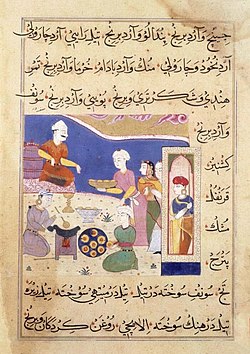 Medieval Indian Manuscript Nimatnama-i-Nasiruddin-Shahi (circa 16th century) showing samosas being served.
![Bhang eaters from India c. 1790. Bhang is an edible preparation of cannabis native to the Indian subcontinent. It has been used in food and drink as early as 1000 BCE by Hindus in ancient India.[53]](/wiki/File:Bhang_eaters_before_two_huts_(6124556163).jpg)


See also[edit | edit source]
References[edit | edit source]
Notes[edit | edit source]
- ↑ According to Ahmad Hasan Dani, professor emeritus at Quaid-e-Azam University, Islamabad, the discovery of Mehrgarh "changed the entire concept of the Indus civilisation […] There we have the whole sequence, right from the beginning of settled village life.", ref "Chandler 34–42"
- ↑ Excavations at Bhirrana, Haryana, in India between 2006 and 2009, by archaeologist K.N. Dikshit, provided six artefacts, including "relatively advanced pottery," so-called Hakra ware, which were dated at a time bracket between 7380 and 6201 BCE.[7][8][9][10] These dates compete with Mehrgarh for being the oldest site for cultural remains in the area.[11]
Yet, Dikshit and Mani clarify that this time-bracket concerns only charcoal samples, which were radio-carbon dated at respectively 7570–7180 BCE (sample 2481) and 6689–6201 BCE (sample 2333).[12][13] Dikshit further writes that the earliest phase concerns 14 shallow dwelling-pits which "could accommodate about 3–4 people."[14] According to Dikshit, in the lowest level of these pits wheel-made Hakra Ware was found which was "not well finished,"[14] together with other wares.[15]
Citations[edit | edit source]
- ↑ Thakrar, Raju (22 April 2007). "Japanese warm to real curries and more". The Japan Times. Retrieved 2007-04-23.
- ↑ Krishna Gopal Dubey (2011). The Indian Cuisine. PHI Learning Pvt. Ltd. ISBN 978-81-203-4170-8. Retrieved 2 June 2012.
- ↑ K T Achaya (2003). The Story of Our Food. Universities Press. ISBN 9788173712937. Retrieved 18 June 2015.
- ↑ Diamond, Jared (2013), Guns, Germs And Steel, Random House, p. 101, ISBN 978-1-4481-8020-2
- ↑ UNESCO World Heritage. 2004. ". Archaeological Site of Mehrgarh
- ↑ Hirst, K. Kris. 2005. "Mehrgarh" Archived 2017-01-18 at the Wayback Machine. Guide to Archaeology
- ↑ "Archaeologists confirm Indian civilization is 2000 years older than previously believed". GlobalPost. 16 November 2012.
- ↑ "Indus Valley 2,000 years older than thought". 2012-11-04. Archived from the original on February 9, 2015.
- ↑ "Indus era 8,000 years old, not 5,500; ended because of weaker monsoon | India News - Times of India". The Times of India. 29 May 2016.
- ↑ "History What their lives reveal". 2013-01-04.
- ↑ "Haryana's Bhirrana oldest Harappan site, Rakhigarhi Asia's largest: ASI". The Times of India. 15 April 2015.
- ↑ Dikshit, K.N. (2013). "Origin of Early Harappan Cultures in the Sarasvati Valley: Recent Archaeological Evidence and Radiometric Dates" (PDF). Journal of Indian Ocean Archaeology (9): 131–132. ISSN 0974-1747. Archived from the original (PDF) on 2017-01-18.
- ↑ Mani, B.R. (2008). "Kashmir Neolithic and Early Harappan: A Linkage" (PDF). Pragdhara. 18: 237. ISSN 0973-5003. Archived from the original (PDF) on 2017-01-18. Retrieved 2017-01-17.
- ↑ 14.0 14.1 Dikshit 2013, p. 129.
- ↑ Dikshit 2013, p. 130.
- ↑ "Curry, Spice & All Things Nice: Dawn of History". Archived from the original on 2011-07-20. Retrieved 2008-06-08.
- ↑ Lawler, Andrew (January 29, 2013). "Where Did Curry Come From?". Slate.
- ↑ Reade, Julian E. (2008). The Indus-Mesopotamia relationship reconsidered (Gs Elisabeth During Caspers). Archaeopress. pp. 14–17. ISBN 978-1-4073-0312-3.
- ↑ McIntosh, Jane (2008). The Ancient Indus Valley: New Perspectives. ABC-CLIO. pp. 182–190. ISBN 9781576079072.
- ↑ Burton, James H.; Price, T. Douglas; Kenoyer, J. Mark (January 2013). "A new approach to tracking connections between the Indus Valley and Mesopotamia: initial results of strontium isotope analyses from Harappa and Ur". Journal of Archaeological Science. 40 (5): 2286–2297. Bibcode:2013JArSc..40.2286K. doi:10.1016/j.jas.2012.12.040. ISSN 0305-4403.
- ↑ "The wide distribution of lower Indus Valley seals and other artifacts from the Persian Gulf to Shortughaï in the Amu Darya/ Oxus River valley in Badakhshan (northeastern Afghanistan) demonstrates long-distance maritime and overland trade connections until ca. 1800 BCE." in Neelis, Jason (2011). Early Buddhist Transmission and Trade Networks: Mobility and Exchange within and beyond the Northwestern Borderlands of South Asia. Brill. pp. 94–95. ISBN 9789004194588.
- ↑ K. T. Achaya (1994). Indian food: a historical companion. Oxford University Press. p. 11. ISBN 978-0-19-562845-6.
- ↑ "Historical Ties India and Thailand". esamskriti.com.
- ↑ Alejandro, Reynaldo (1985). The Philippine cookbook. New York, New York: Penguin. pp. 12–14. ISBN 978-0-399-51144-8. Retrieved 30 June 2011.
Philippines Country Study Guide. Int'l Business Publications. 2007. p. 111. ISBN 978-1-4330-3970-6.Throughout the centuries, the islands have incorporated the cuisine of the early Malay settlers, Arab and Chinese traders, and Spanish and American colonizers along with other Oriental and Occidental accent and flavours.
"Philippine Cuisine." Archived 2011-06-16 at the Wayback Machine Balitapinoy.net Archived 2011-07-23 at the Wayback Machine. Retrieved July 2011.
Morgolis, Jason (6 February 2014). "Why is it so hard to find a good Filipino restaurant?". Public Radio International. Retrieved 17 December 2014.Philippine food has Chinese, Malaysian, Spanish and American influences — all cultures that have shaped the Philippines.
- ↑ The Cuisine of North India Archived 2020-11-27 at the Wayback Machine, about.com
- ↑ Civitello, Linda (29 March 2011). Cuisine and Culture: A History of Food and People. John Wiley & Sons. p. 267. ISBN 978-0-470-40371-6. Retrieved 4 June 2012.
- ↑ T. R. Gopalakrishnan (2007). Vegetable Crops. New India Publishing. pp. 209–. ISBN 978-81-89422-41-7.
- ↑ Syed Zain Al-Mahmood (19 December 2008). "Down the Surma - Origins of the Diaspora". Daily Star. Vol. 7, no. 49. Archived from the original on 9 November 2021. Retrieved 1 May 2019.
- ↑ >Robert Lindsay. "Anecdotes of an Indian life: Chapter VII". Lives of the Lindsays, or, A memoir of the House of Crawford and Balcarres. Vol. 4. Wigan: C. S. Simms. p. 99.
- ↑ With $78 billion, India still highest overseas remittance receiver, The Economic Times, 28 November 2019.
- ↑ Collingham, Lizzie (1 February 2006). "Curry". The New York Times Book Review. Retrieved 5 May 2010.
- ↑ "Tandoori Village Restaurant Brisbane". AsiaRooms.com. Archived from the original on May 27, 2008.
- ↑ "Curry house founder is honoured". BBC. 29 September 2005. Retrieved 21 March 2012.
- ↑ "[ARCHIVED CONTENT] Food Standards Agency – Curry factfile". food.gov.uk. Food Standards Agency. Archived from the original on 2010-10-14. Retrieved 2019-11-29.
- ↑ Akbar, Ahsan (2021-03-21). "From kala bhuna to shatkora curry – let's all get a taste for Bangladesh". The Observer. ISSN 0029-7712. Retrieved 2024-08-30.
- ↑ "Food Standards Agency – Curry factfile". Archived from the original on 2010-10-14. Retrieved 2019-11-29.
- ↑ Bhide, Monica (24 January 2007). "Tikka in No Time". The Washington Post. Retrieved 4 June 2012.
- ↑ "Nasi, Kari, Biryani & Mee". Veg Voyages. Archived from the original on 28 June 2009. Retrieved 23 June 2009.
- ↑ "Indian food gains popularity during Chinese New Year". 20 February 2007. Archived from the original on 21 November 2008.
- ↑ Then, Viviane. "Go India: Curry, my love?".
- ↑ "About Food in Malaysia". Travellers Worldwide. Archived from the original on 21 June 2012. Retrieved 1 July 2012.
- ↑ Ann Kondo Corum (1 May 2000). Ethnic Foods of Hawai'i. Bess Press. pp. 174–. ISBN 978-1-57306-117-9. Retrieved 4 June 2012.
- ↑ Indian food fourth most popular in the world, a study of cuisine trade finds, ThePrint, 29 August 2019.
- ↑ Indian cuisine ranks among world’s Top 10, Asian Age, 14 March 2019.
- ↑ Anita Mannur (2004). Culinary Fictions: Food in South Asian Diasporic Culture. Temple University Press. p. 233. ISBN 978-1-4399-0078-9. Retrieved 21 July 2012.
- ↑ Himadri Banerjee (2009). Calcutta Mosaic: Essays and Interviews on the Minority Communities of Calcutta. Anthem Press. p. 132. ISBN 978-81-905835-5-8. Retrieved 21 July 2012.
- ↑ Deshpande, Shubada (25 October 1999). "Fare for the Desi Dragon". Rediff.com. Retrieved 2012-07-21.
- ↑ "Home". Best Indian Food Catering.
- ↑ Davidson, Alan (2014). Tom Jaine (ed.). The Oxford Companion to Food (3rd ed.). Oxford: Oxford University Press. pp. 21–22. ISBN 978-0-19-967733-7.
- ↑ "Sustainable shore – October recipe – Year of Food and Drink 2015 – National Library of Scotland". nls.uk. Archived from the original on 2016-03-04. Retrieved 2019-11-29.
- ↑ Roy, Modhumita (7 August 2010). "Some Like It Hot: Class, Gender and Empire in the Making of Mulligatawny Soup". Economic and Political Weekly. 45 (32): 66–75. JSTOR 20764390.
- ↑ "Cooking under the Raj". Retrieved 30 January 2008.
- ↑ Staelens, Stefanie. "The Bhang Lassi Is How Hindus Drink Themselves High for Shiva". Vice. Retrieved August 10, 2017.


