imported>Jprg1966 |
fix lead per standard format per standard format |
||
| Line 1: | Line 1: | ||
{{Short description| | {{Short description|UNESCO heritage site in West Bengal, India}} | ||
{{For|the University in | {{For|the University in Shantiniketan|Visva-Bharati University}} | ||
{{Use dmy dates|date=June 2018}} | {{Use dmy dates|date=June 2018}} | ||
{{Use Indian English|date=June 2018}} | {{Use Indian English|date=June 2018}} | ||
<!-- See [[Wikipedia:WikiProject Indian cities]] for details --> | <!-- See [[Wikipedia:WikiProject Indian cities]] for details --> | ||
{{Infobox settlement | {{Infobox settlement | ||
| name | | name = Shantiniketan | ||
| other_name = Bolpur | |||
| settlement_type = Neighbourhood | |||
| image_skyline = Shantiniketan Bari of Rabindranath Tagore.jpg | |||
| other_name | | image_alt = | ||
| settlement_type | | image_caption = Shantiniketan Griha | ||
| image_skyline | | nickname = | ||
| image_alt | | image_map = | ||
| image_caption | | map_alt = | ||
| nickname | | map_caption = | ||
| image_map | | pushpin_map = India West Bengal | ||
| map_alt | | pushpin_map_alt = | ||
| map_caption | | pushpin_map_caption = | ||
| pushpin_map | | pushpin_label_position = left | ||
| pushpin_map_alt | | coordinates = {{coord|23.68|N|87.68|E|display=inline,title}} | ||
| pushpin_map_caption | | subdivision_type = Country | ||
| pushpin_label_position | | subdivision_name = India | ||
| coordinates | | subdivision_type1 = [[States and territories of India|State]] | ||
| subdivision_type | | subdivision_type2 = [[List of districts of India|District]] | ||
| subdivision_name | | subdivision_name1 = [[West Bengal]] | ||
| subdivision_type1 | | subdivision_name2 = [[Birbhum District|Birbhum]] | ||
| subdivision_type2 | | established_title = <!-- Established --> | ||
| subdivision_name1 | | established_date = | ||
| subdivision_name2 | | founder = | ||
| established_title | | demographics_type1 = Languages | ||
| established_date | | demographics1_title1 = Official | ||
| founder | | demographics1_info1 = [[Bengali language|Bengali]], [[English language|English]] | ||
| demographics_type1 | | timezone1 = [[Indian Standard Time|IST]] | ||
| demographics1_title1 | | utc_offset1 = +5:30 | ||
| demographics1_info1 | | postal_code_type = [[Postal Index Number|PIN]] | ||
| timezone1 | | postal_code = 731204 (Bolpur)<br/>731235 (Santiniketan)<br/>731236 (Sriniketan) | ||
| utc_offset1 | | area_code = +91 03463 | ||
| postal_code_type | | area_code_type = Telephone/[[Subscriber Trunk Dialling|STD]] code | ||
| postal_code | | registration_plate = | ||
| area_code | | elevation_m = 30 | ||
| area_code_type | | blank1_name_sec1 = [[Lok Sabha]] constituency | ||
| registration_plate | | blank1_info_sec1 = [[Bolpur (Lok Sabha constituency)|Bolpur]] | ||
| elevation_m | | blank2_name_sec1 = [[Vidhan Sabha]] constituency | ||
| blank1_name_sec1 | | blank2_info_sec1 = [[Bolpur (Vidhan Sabha constituency)|Bolpur]] | ||
| blank1_info_sec1 | | footnotes = | ||
| blank2_name_sec1 | | blank_info_sec2 = | ||
| blank2_info_sec1 | | module = {{Infobox UNESCO World Heritage Site | ||
| footnotes | |child = yes | ||
|Official_name = Santiniketan | |||
|ID = 1375 | |||
|Year = 2023 | |||
|Criteria = Cultural: (iv)(vi) | |||
}} | }} | ||
}} | |||
'''Shantiniketan''' (IPA: [[Help:IPA/Bengali|[ʃantiniketɔn]]]) is a [[neighbourhood]] of [[Bolpur]] town in the [[Bolpur subdivision]] of [[Birbhum district]] in [[West Bengal]], [[India]], approximately 152 km north of [[Kolkata]]. It was established by [[Debendranath Tagore]], and later expanded by his son, [[Rabindranath Tagore]] whose vision became what is now a university town with the creation of [[Visva-Bharati]].<ref name="Santiniketan">Pearson, WW.: ''Santiniketan Bolpur School of Rabindranath Tagore'', illustrations by [[Mukul Dey]], The Macmillan Company, 1916</ref> It is also the birthplace of Indian [[List of Nobel laureates|Nobel Laureate]] [[Amartya Sen]], who was also an alumnus of the school. | |||
It was inscribed on the [[UNESCO]] [[World Heritage Site|World Heritage List]] by the World Heritage Committee in 2023.<ref>{{Cite web |last= |first= |title=Santiniketan |url=https://whc.unesco.org/en/list/1375/ |url-status=live |archive-url=https://web.archive.org/web/20230920110348/https://whc.unesco.org/en/list/1375/ |archive-date=2023-09-20 |access-date=2023-09-21 |website=UNESCO World Heritage Centre |language=en}}</ref> | |||
==History== | ==History== | ||
In 1863, [[Debendranath Tagore]] took on permanent lease {{convert|20|acre|m2}} of land, with two {{ | In 1863, [[Debendranath Tagore]] took on permanent lease {{convert|20|acre|m2}} of land, with two {{transliteration|bn|chhatim}} ([[Alstonia scholaris]]) trees, at an annual payment of Rs. 5, from Bhuban Mohan Sinha, the [[talukdar]] in Raipur, Birbhum. He built a guest house there and named it ''Shantiniketan'' (the abode of peace). Gradually, the whole area came to be known as Shantiniketan.<ref name="intro">Basak, Tapan Kumar, ''Rabindranath-Santiniketan-Sriniketan (An Introduction)'', p. 2, B.B.Publication</ref> | ||
[[File:Upasana Griha - Northern View - Santiniketan 2014-06-29 5299.JPG|thumb|left|Upasana Griha, the glass prayer hall Devendranath built]] | |||
[[Binoy Ghosh]] says that [[Bolpur]] was a small place in the middle of the 19th century. It grew as Shantiniketan grew. A certain portion of Bolpur was a part of the ''[[zamindari]]'' of the Sinha family of Raipur. Bhuban Mohan Sinha had developed a small village in the Bolpur area and named it Bhubandanga. It was just opposite Shantiniketan | [[Binoy Ghosh]] says that [[Bolpur]] was a small place in the middle of the 19th century. It grew as Shantiniketan grew. A certain portion of Bolpur was a part of the ''[[zamindari]]'' of the Sinha family of Raipur. Bhuban Mohan Sinha had developed a small village in the Bolpur area and named it Bhubandanga. It was just opposite Shantiniketan in those days. Bhubandanga was the den of a gang of notorious dacoits, who had no compunction in killing people. It led to a situation of conflict and confrontation, but the leader of the gang, ultimately, surrendered to Debendranath, and they started helping him in developing the area. There was a {{transliteration|bn|chhatim}} tree under which Debendranath used to meditate. Inspired by [[The Crystal Palace]] built originally in [[Hyde Park, London]], to house the [[Great Exhibition]] of 1851 and later relocated, Debendranath constructed a 60-foot × 30-foot hall for [[Brahmo Samaj|Brahmo]] prayers. The roof was tiled and the floor had white marble, but the rest of the structure was made of glass. From its earliest days, it was a great attraction for people from all around.<ref name=binoyghosh>Ghosh, Binoy, ''Paschim Banger Sanskriti''. It has now been listed in UNESCO in 2023. {{in lang|bn}}, part I, 1976 edition, pages 299-304, Prakash Bhaban, Kolkata</ref> | ||
Rabindranath Tagore first visited Shantiniketan on 27 January 1878 when he was 17 years old. In 1888, Debendranath dedicated the entire property for the establishment of a Brahmavidyalaya through a trust deed. In 1901, Rabindranath started a Brahmacharyaashrama and it came to be known as [[Patha Bhavana, Santiniketan|Patha Bhavana]] from 1925.<ref name=binoyghosh/><ref name=history>{{cite web | url = https://www.visvabharati.ac.in/History.html | title = Visva Bharati| work= History| publisher = Visva Bharati |access-date = 25 July 2019}}</ref> In 1913, Rabindranath Tagore won the [[Nobel Prize in Literature]].<ref>{{Citation|last=Hjärne |first=H<!--arald-->.|publication-date=10 December 1913|year=1913|title=The Nobel Prize in Literature 1913: Rabindranath Tagore—Award Ceremony Speech|publisher=[[Nobel Foundation]]|url=https://nobelprize.org/nobel_prizes/literature/laureates/1913/press.html|access-date=25 July 2019<!--|quote=Tagore's ''Gitanjali: Song Offerings'' (1912), a collection of religious poems, was one of his works that especially attracted the attention of the selecting critics.-->}}</ref> It was a new feather in the cap of the [[Tagore family]] which was the leading family contributing to the enrichment of life and society in Bengal in many fields of activity over a long period of time.<ref>Deb, Chitra, ''Jorasanko and the Thakur Family'', Pages 64-65, in ''Calcutta: The Living City'', Volume I, edited by Sukanta Chaudhuri, Oxford University Press.</ref> The environment at [[Jorasanko Thakur Bari]], one of the bases of the Tagore family in Kolkata, was filled with literature, music, painting, and theatre.<ref>'' Jorasanko and the Thakur Family'' by Chitra Deb in ''Calcutta, the Living City'', edited by Sukanta Chaudhuri, Vol I, page 66</ref> Founded in 1921 by Rabindranath Tagore, [[Visva-Bharati University|Visva Bharati]] was declared to be a [[Central University (India)|central university]] and an institute of national importance, in 1951.<ref>{{cite web | url = https://www.visvabharati.ac.in/Visva_Bharati.html | title = Visva Bharati| work= About Visva-Bharati| publisher = Visva Bharati |access-date = 25 July 2019}}</ref> | |||
== | ==Topography== | ||
{{OSM Location map | {{OSM Location map | ||
| width=400| height=300| zoom=10 | | width=400| height=300| zoom=10 | ||
| Line 84: | Line 93: | ||
===Location=== | ===Location=== | ||
Shantiniketan is situated at {{coord|23.68|N|87.68|E|}}.<ref>[ | Shantiniketan is situated at {{coord|23.68|N|87.68|E|}}.<ref>[https://www.fallingrain.com/world/IN/28/Shanti_Niketan.html Falling Rain Genomics, Inc - Santiniketan]</ref> at an average elevation of 56 metres (187 feet). | ||
The area is flanked on two sides by the rivers, the [[Ajay River|Ajay]] and the [[Kopai River|Kopai]]. Santiniketan earlier had an extensive forest cover, but substantial soil erosion gave certain areas a barren look, the resulting phenomenon is locally known as ''[[khoai]]''. However, as a result of the consistent efforts by botanists, plants and trees from all over India flourish in parts of the town. Although the overall environment of the surrounding areas have changed with time, the core area of Santiniketan has retained its closeness with nature.<ref>{{cite web |title=Santiniketan |url= | The area is flanked on two sides by the rivers, the [[Ajay River|Ajay]] and the [[Kopai River|Kopai]]. Santiniketan earlier had an extensive forest cover, but substantial soil erosion gave certain areas a barren look, the resulting phenomenon is locally known as ''[[khoai]]''. However, as a result of the consistent efforts by botanists, plants and trees from all over India flourish in parts of the town. Although the overall environment of the surrounding areas have changed with time, the core area of Santiniketan has retained its closeness with nature.<ref>{{cite web |title=Santiniketan |url=https://www.visvabharati.ac.in/Santiniketan.html}}</ref> | ||
<small>Note: The map alongside presents some of the notable locations in the area. All places marked in the map are linked in the larger full screen map.</small> | <small>Note: The map alongside presents some of the notable locations in the area. All places marked in the map are linked in the larger full screen map.</small> | ||
| Line 95: | Line 104: | ||
As per the ''Human Development Report'' for Birbhum in 2009, Santiniketan attracted 1.2 million tourists annually.<ref>{{cite web |url=http://www.wbpspm.gov.in/HumanDevelopment/DHDR|title=District Human Development Report: Birbhum, Chapter IV: Economic Opportunities and Security of Livelihood |work=Page 100: Tourism |publisher=Development & Planning Department, Government of West Bengal, 2009 |access-date=25 July 2019}}</ref> | As per the ''Human Development Report'' for Birbhum in 2009, Santiniketan attracted 1.2 million tourists annually.<ref>{{cite web |url=http://www.wbpspm.gov.in/HumanDevelopment/DHDR|title=District Human Development Report: Birbhum, Chapter IV: Economic Opportunities and Security of Livelihood |work=Page 100: Tourism |publisher=Development & Planning Department, Government of West Bengal, 2009 |access-date=25 July 2019}}</ref> | ||
Rabindra Bhavana, founded in 1942, just after the death of the poet, is the focal point of Visva Bharati. It has a museum, archives, library and other units. It houses a major part of Rabindranath's manuscripts, correspondence, paintings and sketches, 40,000 volumes of books and 12,000 volumes of bound journals, photographs and numerous items associated with the poet's life. It is generally one of the first points of interest for anybody visiting Santiniketan.<ref>{{cite web |url= | Rabindra Bhavana, founded in 1942, just after the death of the poet, is the focal point of Visva Bharati. It has a museum, archives, library and other units. It houses a major part of Rabindranath's manuscripts, correspondence, paintings and sketches, 40,000 volumes of books and 12,000 volumes of bound journals, photographs and numerous items associated with the poet's life. It is generally one of the first points of interest for anybody visiting Santiniketan.<ref>{{cite web |url=https://www.visvabharati.ac.in/RabindraBhavana.html |title=Visva Bharati |work=Rabindra Bhavana|access-date=25 July 2019}}</ref> It was established by the poet's son, [[Rathindranath Tagore]], as a memorial museum and research centre for Tagore studies.<ref>{{cite web |url=https://www.visvabharati.ac.in/CampusMap.html|title=Visva Bharati complex, Ravindra Bhavana|work=Campus Map |publisher=Visva Bharati |access-date=3 August 2019}}</ref> | ||
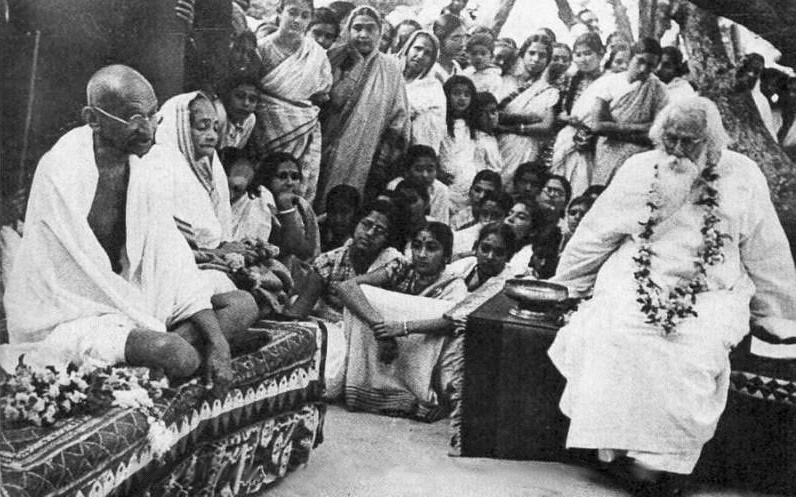
[[File:Gandhi-Tagore.jpg|upright|300px|thumb|[[Rabindranath Tagore]] with [[Mahatma Gandhi]] and [[Kasturba Gandhi]] at Santiniketan in 1940]] | [[File:Gandhi-Tagore.jpg|upright|300px|thumb|[[Rabindranath Tagore]] with [[Mahatma Gandhi]] and [[Kasturba Gandhi]] at Santiniketan in 1940]] | ||
The Uttarayana Complex, which lies in the northern portion of the town and is located next to Rabindra Bhavana, features a collection of five houses built by Rabindranath – ''Udayan'', ''Shyamali'', ''Konark'', ''Udichi'' and ''Punascha''. The gardens in the Uttarayan complex were planned and laid out by Rathindranath. ''Shyamali'' and ''Konark'' are mud houses. ''Shyamali'' was an experiment. The visual perspective was based on the [[Borobudur]] style. The entire outside wall was decorated with beautiful relief work by [[Kala Bhavana]] students under the guidance of [[Nandalal Bose]]. The [[Santal people|Santals]] on either side of the main door and on the eastern corner were by [[Ramkinkar Baij]]. [[Mahatma Gandhi]] and [[Kasturba Gandhi]] stayed in the house as guests. ''Udayan'' is the most imposing house in the Uttarayan complex. It is meant for important guests visiting Santiniketan. Each suite in ''Udayan'' is on a different level which gives this house its individuality.<ref name=unesco>{{cite web |title=Santiniketan |url=https://whc.unesco.org/en/tentativelists/5495 |publisher=UNESCO World Heritage Centre |language=en}}</ref> In 2013, Visva Bharati opened a museum ''Guha Ghar'', in the Uttarayan complex, in memory of Rathindranath Tagore.<ref>{{cite web |url=https://www.jagranjosh.com/current-affairs/museum-and-book-dedicated-to-rathindranath-tagore-son-of-rabindranath-tagore-launched-1372666226-1|title =Museum and book in memory of Rathindranath Tagore, son of Rabindranath Tagore |publisher=Jagran Josh, 1 July 2013 |access-date= 26 July 2019}}</ref><ref>{{cite web |title=Museum for 'unsung' Tagore son |url=https://www.telegraphindia.com | The Uttarayana Complex, which lies in the northern portion of the town and is located next to Rabindra Bhavana, features a collection of five houses built by Rabindranath – ''Udayan'', ''Shyamali'', ''Konark'', ''Udichi'' and ''Punascha''. The gardens in the Uttarayan complex were planned and laid out by Rathindranath. ''Shyamali'' and ''Konark'' are mud houses. ''Shyamali'' was an experiment. The visual perspective was based on the [[Borobudur]] style. The entire outside wall was decorated with beautiful relief work by [[Kala Bhavana]] students under the guidance of [[Nandalal Bose]]. The [[Santal people|Santals]] on either side of the main door and on the eastern corner were by [[Ramkinkar Baij]]. [[Mahatma Gandhi]] and [[Kasturba Gandhi]] stayed in the house as guests. ''Udayan'' is the most imposing house in the Uttarayan complex. It is meant for important guests visiting Santiniketan. Each suite in ''Udayan'' is on a different level which gives this house its individuality.<ref name=unesco>{{cite web |title=Santiniketan |url=https://whc.unesco.org/en/tentativelists/5495 |publisher=UNESCO World Heritage Centre |language=en}}</ref> In 2013, Visva Bharati opened a museum ''Guha Ghar'', in the Uttarayan complex, in memory of Rathindranath Tagore.<ref>{{cite web |url=https://www.jagranjosh.com/current-affairs/museum-and-book-dedicated-to-rathindranath-tagore-son-of-rabindranath-tagore-launched-1372666226-1|title =Museum and book in memory of Rathindranath Tagore, son of Rabindranath Tagore |publisher=Jagran Josh, 1 July 2013 |access-date= 26 July 2019}}</ref><ref>{{cite web |title=Museum for 'unsung' Tagore son |url=https://www.telegraphindia.com/west-bengal/museum-for-unsung-tagore-son/cid/1574118 |work=[[The Telegraph (Calcutta)|The Telegraph]] |access-date= 26 July 2019 |date=1 April 2013}}</ref> | ||
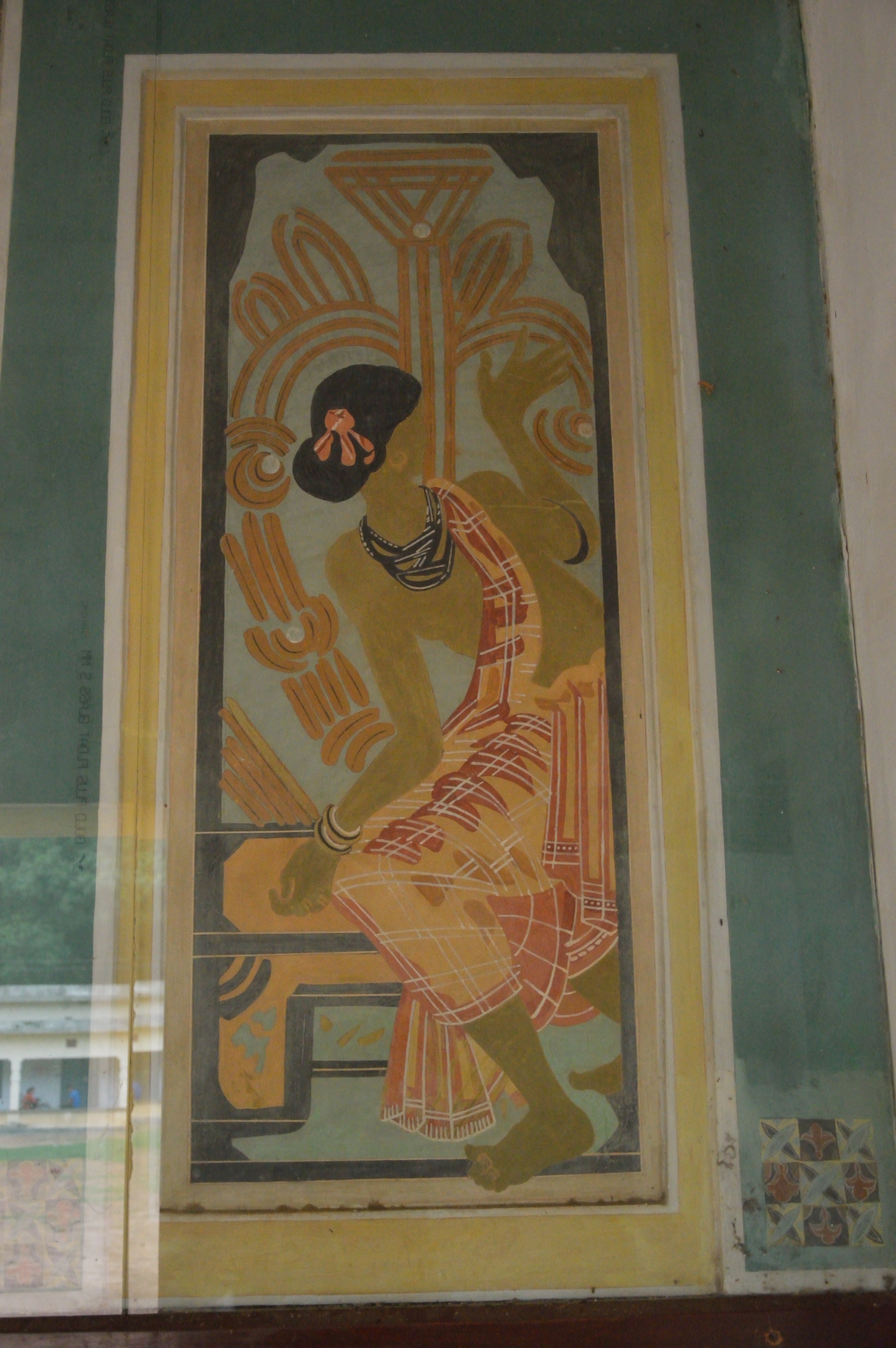
[[File:Mural - Nandalal Bose - Santiniketan 2014-06-29 5547.JPG|200px|thumb|left|Mural by [[Nandalal Bose]]]] | [[File:Mural - Nandalal Bose - Santiniketan 2014-06-29 5547.JPG|200px|thumb|left|Mural by [[Nandalal Bose]]]] | ||
| Line 117: | Line 126: | ||
time we see her,<br/> | time we see her,<br/> | ||
for she is our own, the darling of our<br/> | for she is our own, the darling of our<br/> | ||
hearts. | hearts. | ||
| author = '''Rabindranath Tagore''' | | author = '''Rabindranath Tagore''' | ||
| source = <ref>{{cite web | url = https://www.thebetterindia.com/66627/santiniketan-rabindranath-tagore-bengal/| title = Exploring Tagore's Santiniketan, an abode of Learning Unlike Any in the world|work= Travel Tales| publisher = The Better India |access-date = 5 August 2019}}</ref> | | source = <ref>{{cite web | url = https://www.thebetterindia.com/66627/santiniketan-rabindranath-tagore-bengal/| title = Exploring Tagore's Santiniketan, an abode of Learning Unlike Any in the world|work= Travel Tales| publisher = The Better India |access-date = 5 August 2019}}</ref> | ||
| Line 124: | Line 133: | ||
}} | }} | ||
Shantiniketan was founded and developed by members of the [[Tagore family]]. It was founded by Debendranath Tagore.<ref name="intro"/> Rabindranath Tagore wrote many of his literary classics at Santiniketan.<ref>{{cite web | url = https://gradestack.com/CBSE-Class-8th-Complete/Civilising-the-Native-/Tagore-s-Santiniketan/14841-2939-2495-study-wtw| title = Tagore's Santiniketan |work=Tagore’s idea of education | publisher = Grade Stak |access-date = 5 August 2019}}</ref> His son, Rathindranath Tagore was one of the first five students at the ''Brahmacharya asrama'' at Santiniketan.<ref>{{Cite web|url= | Shantiniketan was founded and developed by members of the [[Tagore family]]. It was founded by Debendranath Tagore.<ref name="intro"/> Rabindranath Tagore wrote many of his literary classics at Santiniketan.<ref>{{cite web | url = https://gradestack.com/CBSE-Class-8th-Complete/Civilising-the-Native-/Tagore-s-Santiniketan/14841-2939-2495-study-wtw| archive-url = https://web.archive.org/web/20151122053906/http://gradestack.com/CBSE-Class-8th-Complete/Civilising-the-Native-/Tagore-s-Santiniketan/14841-2939-2495-study-wtw| url-status = usurped| archive-date = 22 November 2015| title = Tagore's Santiniketan |work=Tagore’s idea of education | publisher = Grade Stak |access-date = 5 August 2019}}</ref> His son, Rathindranath Tagore was one of the first five students at the ''Brahmacharya asrama'' at Santiniketan.<ref>{{Cite web|url=https://www.visvabharati.ac.in/RathindranathTagore.html|title=Rathindranath Tagore|website=www.visvabharati.ac.in|access-date=5 August 2019}}</ref> After the death of his father in 1941, Rathindranath took over the burden of all responsibilities at Santiniketan. When Visva Bharati was made a central university in 1951, Rathindranath was appointed its first vice-chancellor.<ref name=unesco/><ref name=history/> | ||
[[Pratima Devi (painter)|Pratima Devi]], Rathindranath's wife, had active links with Visva Bharati from a very young age. She lived in Santinketan till her death in 1969.<ref>{{Cite web|url= | [[Pratima Devi (painter)|Pratima Devi]], Rathindranath's wife, had active links with Visva Bharati from a very young age. She lived in Santinketan till her death in 1969.<ref>{{Cite web|url=https://www.visvabharati.ac.in/PratimaDevi.html|title=Pratima Devi (1893-1969)|publisher=Visva-Bharati|access-date=4 August 2019}}</ref> | ||
Mira Devi, Rabindranath's youngest daughter, after her failed marriage, lived in ''Malancha'' built for her in the Ashrama complex in 1926. She died at Santiniketan in 1969. [[Krishna Kripalani]], husband of Nandita (Buri), daughter of Mira Devi, taught at Santiniketan for nearly 15 years, beginning 1933. Krishna Kripalani's biography of Tagore was amongst the best ever written.<ref>{{cite web | url = | Mira Devi, Rabindranath's youngest daughter, after her failed marriage, lived in ''Malancha'' built for her in the Ashrama complex in 1926. She died at Santiniketan in 1969. [[Krishna Kripalani]], husband of Nandita (Buri), daughter of Mira Devi, taught at Santiniketan for nearly 15 years, beginning 1933. Krishna Kripalani's biography of Tagore was amongst the best ever written.<ref>{{cite web | url = https://sesquicentinnial.blogspot.com/2013/03/marriage-of-nandita-daughter-of-mira.html| title = Marriage of Nandita (daughter of Mira), grand daughter of Rabindranath | publisher = Smarak Grantha |access-date = 5 August 2019}}</ref><ref name=unesco/> | ||
[[Dwijendranath Tagore]], Rabindranath's eldest brother, spent the last twenty years of his life at Santiniketan.<ref name="Dutta">Dutta, Hirendranath, ''Santiniketaner Ek Jug'', {{in lang|bn}}, pp27-32, Viswa Bharati Granthan Vighag, {{ISBN|81-7522-329-4}}.</ref> He lived in ''Dwaijaviram'' in the Ashrama complex.<ref name=unesco/> | [[Dwijendranath Tagore]], Rabindranath's eldest brother, spent the last twenty years of his life at Santiniketan.<ref name="Dutta">Dutta, Hirendranath, ''Santiniketaner Ek Jug'', {{in lang|bn}}, pp27-32, Viswa Bharati Granthan Vighag, {{ISBN|81-7522-329-4}}.</ref> He lived in ''Dwaijaviram'' in the Ashrama complex.<ref name=unesco/> | ||
[[Dinendranath Tagore]], Dwijendranath's grandson, was principal of Sangit Bhavana in its earliest years.<ref>{{cite web | url = | [[Dinendranath Tagore]], Dwijendranath's grandson, was principal of Sangit Bhavana in its earliest years.<ref>{{cite web | url = https://www.visvabharati.ac.in/DinendranathTagore.html| title = Dinendranath Tagore | publisher = Visva Bharati |access-date = 3 August 2019}}</ref> ''Dinantika'', built in 1939, housed the ''Cha chakra'', where staff members of Visva Bharati met over a cup of tea for meetings and relaxation.<ref name=unesco/> | ||
[[Indira Devi Chaudhurani]], daughter of [[Satyendranath Tagore]], started living in Santiniketan in 1941 and took charge of Sangit Bhavana. She was acting vice-chancellor for a short period.<ref>{{Cite web|url= | [[Indira Devi Chaudhurani]], daughter of [[Satyendranath Tagore]], started living in Santiniketan in 1941 and took charge of Sangit Bhavana. She was acting vice-chancellor for a short period.<ref>{{Cite web|url= https://www.visvabharati.ac.in/IndiradeviChaudhurani.html|title= Indiradevi Choudhrani |publisher=Visva-Bharati|access-date=4 August 2019}}</ref> | ||
Supriyo Tagore, great grandson of Satyendranath, was a student of Patha Bhavana and Visva Bharati University before going abroad to complete his education. He retired as the longest serving principal of Patha Bhavana. He now runs Sisu Tirtha, an institution for orphans mainly from the economically disadvantaged tribals, near Santiniketan. His son, Sudripta, with wide-ranging experience in the field of education, is also engaged in setting up a school, at Ruppur near Santiniketan, embodying the ideas of Rabindranath.<ref>{{cite web | url = https://timesofindia.indiatimes.com/city/kolkata/Being-Rabindranath-Tagore/articleshow/20377102.cms| title = Being Rabindranath Tagore|first= Jhimli|last= Mukherjee Pandey| publisher = The Times of India, 1 June 203 |access-date = 26 July 2019}}</ref><ref>{{cite web | url = https://www.outlookindia.com/magazine/story/at-home-with-tagore/232686| title = At Home With Tagore | publisher = Outlook, 2 October 2006 |access-date = 26 July 2019}}</ref><ref>{{cite web | url = https://punemirror.indiatimes.com/others/sunday-read/another-tagore-legacy/articleshow/64241439.cms | title = Another Tagore Legacy | publisher = Pune Mirror, 20 May 2018 | Supriyo Tagore, great-grandson of Satyendranath, was a student of Patha Bhavana and Visva Bharati University before going abroad to complete his education. He retired as the longest serving principal of Patha Bhavana. He now runs Sisu Tirtha, an institution for orphans mainly from the economically disadvantaged tribals, near Santiniketan. His son, Sudripta, with wide-ranging experience in the field of education, is also engaged in setting up a school, at Ruppur near Santiniketan, embodying the ideas of Rabindranath.<ref>{{cite web | url = https://timesofindia.indiatimes.com/city/kolkata/Being-Rabindranath-Tagore/articleshow/20377102.cms| title = Being Rabindranath Tagore|first= Jhimli|last= Mukherjee Pandey| publisher = The Times of India, 1 June 203 |access-date = 26 July 2019}}</ref><ref>{{cite web | url = https://www.outlookindia.com/magazine/story/at-home-with-tagore/232686| title = At Home With Tagore | publisher = Outlook, 2 October 2006 |access-date = 26 July 2019}}</ref><ref>{{cite web | url = https://punemirror.indiatimes.com/others/sunday-read/another-tagore-legacy/articleshow/64241439.cms | title = Another Tagore Legacy | publisher = Pune Mirror, 20 May 2018 | access-date = 26 July 2019 | archive-date = 4 August 2019 | archive-url = https://web.archive.org/web/20190804053631/https://punemirror.indiatimes.com/others/sunday-read/another-tagore-legacy/articleshow/64241439.cms | url-status = dead }}</ref> | ||
==Photo gallery== | ==Photo gallery== | ||
| Line 144: | Line 153: | ||
File:Kalo Bari - Santiniketan 2014-06-29 5346.JPG|Kalo Bari – the house built with mud and coal tar. Click on the pic to enlarge for a glimpse of the wall decoration. | File:Kalo Bari - Santiniketan 2014-06-29 5346.JPG|Kalo Bari – the house built with mud and coal tar. Click on the pic to enlarge for a glimpse of the wall decoration. | ||
File:Toran with Bell - Ghantatala - Gour Prangan - Santiniketan 2014-06-29 5563.JPG|Ghantatala – the bell stand | File:Toran with Bell - Ghantatala - Gour Prangan - Santiniketan 2014-06-29 5563.JPG|Ghantatala – the bell stand | ||
File:Santiniketan Upasana Griha at Bolpur in Birbhum.jpg|Upasana Griha at Santiniketan | |||
</gallery> | </gallery> | ||
| Line 152: | Line 162: | ||
==Transport== | ==Transport== | ||
[[Bolpur Shantiniketan railway station]] is well connected with [[Sealdah Railway Station]], [[Howrah Station]], [[Kolkata Railway Station]], [[Malda Town]], [[New Jalpaiguri]] etc of [[West Bengal]] & [[Guwahati Railway Station]] of [[Assam]]. | [[Bolpur Shantiniketan railway station]] is well connected with [[Sealdah Railway Station]], [[Howrah Station]], [[Kolkata Railway Station]], [[Malda Town]], [[New Jalpaiguri]] etc. of [[West Bengal]] & [[Guwahati Railway Station]] of [[Assam]]. | ||
There is direct AC Volvo bus service of WBTC from [[Kolkata]] to Bolpur Shantiniketan (Kolkata-Bolpur-Suri & Suri-Bolpur-Kolkata). | There is direct AC Volvo bus service of WBTC from [[Kolkata]] to Bolpur Shantiniketan (Kolkata-Bolpur-Suri & Suri-Bolpur-Kolkata). | ||
| Line 158: | Line 168: | ||
Bus and private cars are available from [[Kolkata]] (outstation cab service of [[Ola Cabs]], [[Uber]] from Kolkata), Durgapur City Centre Bus Stop, Katwa, Berhampore and soon from [[Santragachi Railway Station]] in [[Howrah]]. | Bus and private cars are available from [[Kolkata]] (outstation cab service of [[Ola Cabs]], [[Uber]] from Kolkata), Durgapur City Centre Bus Stop, Katwa, Berhampore and soon from [[Santragachi Railway Station]] in [[Howrah]]. | ||
== | ==About Visva Bharati== | ||
Shantiniketan is a university town with varied educational facilities. At the school level are [[Patha Bhavana, Santiniketan|Patha Bhavana]] and [[Siksha Satra]]. Apart from a number of courses in humanities, science and education, [[Visva-Bharati]] offers a range of music, dance and art courses and lays emphasis on language courses. Sangit Bhavana offers courses in Rabindra Sangit, Hindustani classical vocal, sitar, esraj, tabla, pakhawaj, Kathakali dance and Manipuri dance. [[Kala Bhavana]] offers courses in painting, mural, sculpture, graphic art, design (textiles/ ceramics) and history of art. The university offers specialised 4-year courses in Persian, Tibetan, Chinese and Japanese. Bhasa Bhavana offers undergraduate and post-graduate courses in Arabic & Persian, Bengali, Chinese, Hindi, Indo-Tibetan, Japanese, Odia, Santali and Sanskrit. Vidya Bhavana offers 1-year courses in Arabic, Bengali, Chinese, French, German, Hindi, Italian, Japanese, Marathi, Odia, Pali, Persian, Russian, Sanskrit, Santali, Tamil, Tibetan and Urdu. It also offers 2-year courses in Arabic, Assamese, Bengali, Chinese, French, German, Hindi, Italian, Japanese, Marathi, Odia, Pali, Persian, Russian, Sanskrit, Santali, Tamil, Tibetan and Urdu. There are certificate courses in leather craft, book binding & hand-made packaging, batik work and hand-made paper making. | Shantiniketan is a university town with varied educational facilities. At the school level are [[Patha Bhavana, Santiniketan|Patha Bhavana]] and [[Siksha Satra]]. Apart from a number of courses in humanities, science and education, [[Visva-Bharati]] offers a range of music, dance and art courses and lays emphasis on language courses. Sangit Bhavana offers courses in Rabindra Sangit, Hindustani classical vocal, sitar, esraj, tabla, pakhawaj, Kathakali dance and Manipuri dance. [[Kala Bhavana]] offers courses in painting, mural, sculpture, graphic art, design (textiles/ ceramics) and history of art. The university offers specialised 4-year courses in Persian, Tibetan, Chinese and Japanese. Bhasa Bhavana offers undergraduate and post-graduate courses in Arabic & Persian, Bengali, Chinese, Hindi, Indo-Tibetan, Japanese, Odia, Santali and Sanskrit. Vidya Bhavana offers 1-year courses in Arabic, Bengali, Chinese, French, German, Hindi, Italian, Japanese, Marathi, Odia, Pali, Persian, Russian, Sanskrit, Santali, Tamil, Tibetan and Urdu. It also offers 2-year courses in Arabic, Assamese, Bengali, Chinese, French, German, Hindi, Italian, Japanese, Marathi, Odia, Pali, Persian, Russian, Sanskrit, Santali, Tamil, Tibetan and Urdu. There are certificate courses in leather craft, book binding & hand-made packaging, batik work and hand-made paper making. Shantiniketan offers courses in the field of agriculture and rural development. Only a selective list is presented here to give an idea of the range of courses offered.<ref>{{cite web | url = https://www.visvabharati.ac.in/BachelorDegree.html | title = Visva Bharat|work=Bachelor Degree | publisher = Visva Bharati |access-date = 26 July 2019}}</ref><ref>{{cite web | url =https://www.visvabharati.ac.in/PostgraduateSyllabus.html | title = Visva Bharat|work= Syllabus for Post Graduate courses | publisher = Visva Bharati |access-date = 26 July 2019}}</ref> | ||
==Culture== | ==Culture== | ||
| Line 165: | Line 175: | ||
==Poush Mela== | ==Poush Mela== | ||
In Birbhum district, the [[Fairs in Birbhum|fairs]] (''mela'' in Bengali) are spread right across the district and are thought of as an extension of the concept of markets, a place of not only trade and business but also a meeting place of people and an arena for cultural exchange. The largest and most notable fair is the ''[[Poush Mela]]'' held at Santiniketan for three days from 7 [[Poush]].<ref name=paschim1>Mukhopadhyay, Aditya, ''Birbhumer Mela'', ''Paschim Banga'', Birbhum Special Issue, pp. 203–214, (in Bengali), February 2006, Information and Culture Dept., Government of West Bengal</ref> [[Devendranath Tagore]] with twenty followers accepted the [[Brahmo Samaj|Brahmo]] creed from [[Ram Chandra Vidyabagish]] on 21 December 1843 (7 Poush 1250 according to the Bengali calendar). This was the basis of ''Poush Utsav'' (the Festival of Poush) at Santiniketan<ref name="Basak">Basak, Tapan Kumar, ''Rabindranath-Santiniketan-Sriniketan (An Introduction)'', p. 36, B.B.Publication</ref> | In Birbhum district, the [[Fairs in Birbhum|fairs]] (''mela'' in Bengali) are spread right across the district and are thought of as an extension of the concept of markets, a place of not only trade and business but also a meeting place of people and an arena for cultural exchange. The largest and most notable fair is the ''[[Poush Mela]]'' held at Santiniketan for three days from 7 [[Poush]].<ref name=paschim1>Mukhopadhyay, Aditya, ''Birbhumer Mela'', ''Paschim Banga'', Birbhum Special Issue, pp. 203–214, (in Bengali), February 2006, Information and Culture Dept., Government of West Bengal</ref> [[Devendranath Tagore]] with twenty followers accepted the [[Brahmo Samaj|Brahmo]] creed from [[Ram Chandra Vidyabagish]] on 21 December 1843 (7 Poush 1250 according to the Bengali calendar). This was the basis of ''Poush Utsav'' (the Festival of Poush) at Santiniketan.<ref name="Basak">Basak, Tapan Kumar, ''Rabindranath-Santiniketan-Sriniketan (An Introduction)'', p. 36, B.B.Publication</ref> | ||
==Festivals at Shantiniketan== | ==Festivals at Shantiniketan== | ||
In Shantiniketan, seasonal changes bring their own colors and beauties with various festivals. The emphasis in organising these festivals is on traditional Indian forms and rituals. Numerous festivals range from ''Basanta Utsav'' and ''Barsha Mangal'' to ''Maghotsav'' and ''Rabindra Jayanti''.<ref name=festival>{{cite web | url = http://www.bolpur-santiniketan.com/| title = Welcome to Bolpur Santiniketan| publisher = Bolpur-Santiketan.com |access-date = 26 July 2019}}</ref> | In Shantiniketan, seasonal changes bring their own colors and beauties with various festivals. The emphasis in organising these festivals is on traditional Indian forms and rituals. Numerous festivals range from ''Basanta Utsav'' and ''Barsha Mangal'' to ''Maghotsav'' and ''Rabindra Jayanti''.<ref name="festival">{{cite web | url = http://www.bolpur-santiniketan.com/| title = Welcome to Bolpur Santiniketan| publisher = Bolpur-Santiketan.com |access-date = 26 July 2019}}</ref> | ||
[[Holi]], the festival of colours, is celebrated in its own style at Santiniketan – it is called ''Basanta Utsav'' and welcomes the arrival of spring. The programme starts from the morning with singing and dancing to Tagore's tunes by the students and ends with spreading coloured powders (called ‘[[Gulal|abir]]’) and expression of festive wishes. After the formal Visva Bharati programme, other programmes follow. ''Barsha Mangal'' is celebrated with cultural programmes in July–August. ''Ananda Bazar'' is a fair for handicrafts by the students, held on Mahalaya day. Prior to leaving for the puja vacations students celebrate ''Sharad Utsav''. To celebrate the birthday of Rabindranath Thakur, the birth anniversary of the poet's son with a small mela held in Sriniketan called "Rathindra Mela" by the students of the institute. ''Nandan Mela'' marks Nandalal Bose's birth anniversary (on 1–2 December) and is a special attraction for art lovers. ''Briksharopan'' and ''Halkarshan'' emphasise man's closeness to nature and are held on 22-23 [[Shraavana]] (August). ''[[Maghotsab of Brahma Samaj|Maghotsab]]'', celebrating the founding of the Brahmo Samaj, is held on 11 [[Magh (Bengali calendar)|Magh]] (towards the end of January). Various anniversaries and cultural programmes are organised throughout the year. 25 [[Baisakh]] (7-8 May) is the birthday of Rabindranath Tagore but his birth anniversary is celebrated along with and subsequent to the [[Pahela Baishakh|Bengali New Year]] (mid April onwards).<ref name=festival/> | |||
[[Holi]], the festival of colours, is celebrated in its own style at Santiniketan – it is called ''Basanta Utsav'' and welcomes the arrival of spring. The programme starts from the morning with singing and dancing to Tagore's tunes by the students and ends with spreading coloured powders (called ‘[[Gulal|abir]]’) and expression of festive wishes. After the formal Visva Bharati programme, other programmes follow. ''Barsha Mangal'' is celebrated with cultural programmes in July–August. ''Ananda Bazar'' is a fair for handicrafts by the students, held on Mahalaya day. Prior to leaving for the puja vacations students celebrate ''Sharad Utsav''. ''Nandan Mela'' marks Nandalal Bose's birth anniversary (on 1–2 December) and is a special attraction for art lovers. ''Briksharopan'' and ''Halkarshan'' emphasise man's closeness to nature and are held on 22-23 [[Shraavana]] (August). ''[[Maghotsab of Brahma Samaj|Maghotsab]]'', celebrating the founding of the Brahmo Samaj, is held on 11 [[Magh (Bengali calendar)|Magh]] (towards the end of January). Various anniversaries and cultural programmes are organised throughout the year. 25 [[Baisakh]] (7-8 May) is the birthday of Rabindranath Tagore but his birth anniversary is celebrated along with and subsequent to the [[Pahela Baishakh|Bengali New Year]] (mid April onwards).<ref name=festival/> | |||
==Sinha Sadan== | ==Sinha Sadan== | ||
| Line 181: | Line 190: | ||
==Ballabhpur Wildlife Sanctuary== | ==Ballabhpur Wildlife Sanctuary== | ||
[[Ballabhpur Wildlife Sanctuary]] is located 3 km from Shantiniketan and is popular as Deer Park. Established in 1977, it was a [[khoai]] area affected by soil erosion. It is now a large wooded area with herds of deer and makes a natural bird sanctuary.<ref>{{cite web | url = | [[Ballabhpur Wildlife Sanctuary]] is located 3 km from Shantiniketan and is popular as Deer Park. Established in 1977, it was a [[khoai]] area affected by soil erosion. It is now a large wooded area with herds of deer and makes a natural bird sanctuary.<ref>{{cite web | url = https://www.bolpur-santiniketan.com/sightseeing/ballavpur-wildlife-sanctuary-deerpark/ | title = Ballabhpur Wildlife Sanctuary (Deer Park) | publisher = Bolpur-Santiniketan.com |access-date = 26 July 2019}}</ref> | ||
==Amar Kutir== | ==Amar Kutir== | ||
| Line 187: | Line 196: | ||
== Sonajhuri haat == | == Sonajhuri haat == | ||
Every Saturday, one can visit the ''haat'' (or market) at Sonajhuri, close to Shantiniketan. This is a village market and one can buy local handicrafts | Every Saturday and Sunday, one can visit the ''haat'' (or market) at Sonajhuri, close to Shantiniketan. This is a village market and one can buy local handicrafts and listen to folk music sung by tribal groups . Sonajhuri haat is a great place to see and collect wooden crafts, [[terracotta]] crafts, raw metal ornaments, [[dhokra]] art and local made clothes. It is an excellent place to experience the local culture of Shantiniketan.{{citation needed|date=September 2019}} | ||
==Around Santiniketan picture gallery== | ==Around Santiniketan picture gallery== | ||
| Line 202: | Line 211: | ||
==Further reading== | ==Further reading== | ||
* [[UNESCO]]: [https://whc.unesco.org/en/tentativelists/5495 Santiniketan] (on the Tentative List since 2010) | * [[UNESCO]]: [https://whc.unesco.org/en/tentativelists/5495 Santiniketan] (on the Tentative List since 2010) | ||
*[https://santiniketantravelguide.com/what-to-see-in-santiniketan/ Places to visit in Santiniketan 2019] | *[https://santiniketantravelguide.com/what-to-see-in-santiniketan/ Places to visit in Santiniketan 2019] {{Webarchive|url=https://web.archive.org/web/20190428212144/https://santiniketantravelguide.com/what-to-see-in-santiniketan/ |date=28 April 2019 }} | ||
*[https://www.brainwareuniversity.ac.in/celebrating-tagore/page/2/ Celebrating Tagore] | |||
* | * | ||
| Line 208: | Line 218: | ||
{{Sister project links|Santiniketan}} | {{Sister project links|Santiniketan}} | ||
{{Commons category}} | {{Commons category}} | ||
* {{Wikivoyage | * {{Wikivoyage inline}} with local area map | ||
{{Bengal Renaissance}} | {{Bengal Renaissance}} | ||
{{Santiniketan}} | {{Santiniketan}} | ||
{{World Heritage Sites in India}} | |||
{{Birbhum District}} | {{Birbhum District}} | ||
{{Authority control}} | {{Authority control}} | ||
| Line 217: | Line 228: | ||
[[Category:Cities and towns in Birbhum district]] | [[Category:Cities and towns in Birbhum district]] | ||
[[Category:Tourist attractions in Birbhum district]] | [[Category:Tourist attractions in Birbhum district]] | ||
[[Category:World Heritage Sites in India]] | |||
[[Category:Santiniketan]] | |||
Latest revision as of 09:23, 27 February 2026
Shantiniketan
Bolpur | |
|---|---|
Neighbourhood | |
 Shantiniketan Griha | |
Shantiniketan is located in West Bengal  Shantiniketan | |
| Coordinates: 23°41′N 87°41′E / 23.68°N 87.68°E | |
| Country | India |
| State | West Bengal |
| District | Birbhum |
| Elevation | 30 m (100 ft) |
| Languages | |
| • Official | Bengali, English |
| Time zone | UTC+5:30 (IST) |
| PIN | 731204 (Bolpur) 731235 (Santiniketan) 731236 (Sriniketan) |
| Telephone/STD code | +91 03463 |
| Lok Sabha constituency | Bolpur |
| Vidhan Sabha constituency | Bolpur |
| Official name | Santiniketan |
| Criteria | Cultural: (iv)(vi) |
| Reference | 1375 |
| Inscription | 2023 (47th session) |
Shantiniketan (IPA: [ʃantiniketɔn]) is a neighbourhood of Bolpur town in the Bolpur subdivision of Birbhum district in West Bengal, India, approximately 152 km north of Kolkata. It was established by Debendranath Tagore, and later expanded by his son, Rabindranath Tagore whose vision became what is now a university town with the creation of Visva-Bharati.[1] It is also the birthplace of Indian Nobel Laureate Amartya Sen, who was also an alumnus of the school.
It was inscribed on the UNESCO World Heritage List by the World Heritage Committee in 2023.[2]
History[edit | edit source]
In 1863, Debendranath Tagore took on permanent lease 20 acres (81,000 m2) of land, with two chhatim (Alstonia scholaris) trees, at an annual payment of Rs. 5, from Bhuban Mohan Sinha, the talukdar in Raipur, Birbhum. He built a guest house there and named it Shantiniketan (the abode of peace). Gradually, the whole area came to be known as Shantiniketan.[3]

Binoy Ghosh says that Bolpur was a small place in the middle of the 19th century. It grew as Shantiniketan grew. A certain portion of Bolpur was a part of the zamindari of the Sinha family of Raipur. Bhuban Mohan Sinha had developed a small village in the Bolpur area and named it Bhubandanga. It was just opposite Shantiniketan in those days. Bhubandanga was the den of a gang of notorious dacoits, who had no compunction in killing people. It led to a situation of conflict and confrontation, but the leader of the gang, ultimately, surrendered to Debendranath, and they started helping him in developing the area. There was a chhatim tree under which Debendranath used to meditate. Inspired by The Crystal Palace built originally in Hyde Park, London, to house the Great Exhibition of 1851 and later relocated, Debendranath constructed a 60-foot × 30-foot hall for Brahmo prayers. The roof was tiled and the floor had white marble, but the rest of the structure was made of glass. From its earliest days, it was a great attraction for people from all around.[4]
Rabindranath Tagore first visited Shantiniketan on 27 January 1878 when he was 17 years old. In 1888, Debendranath dedicated the entire property for the establishment of a Brahmavidyalaya through a trust deed. In 1901, Rabindranath started a Brahmacharyaashrama and it came to be known as Patha Bhavana from 1925.[4][5] In 1913, Rabindranath Tagore won the Nobel Prize in Literature.[6] It was a new feather in the cap of the Tagore family which was the leading family contributing to the enrichment of life and society in Bengal in many fields of activity over a long period of time.[7] The environment at Jorasanko Thakur Bari, one of the bases of the Tagore family in Kolkata, was filled with literature, music, painting, and theatre.[8] Founded in 1921 by Rabindranath Tagore, Visva Bharati was declared to be a central university and an institute of national importance, in 1951.[9]
Topography[edit | edit source]
Lua error in Module:OSM_Location_map at line 1984: attempt to index field 'wikibase' (a nil value).
Location[edit | edit source]
Shantiniketan is situated at 23°41′N 87°41′E / 23.68°N 87.68°E.[10] at an average elevation of 56 metres (187 feet).
The area is flanked on two sides by the rivers, the Ajay and the Kopai. Santiniketan earlier had an extensive forest cover, but substantial soil erosion gave certain areas a barren look, the resulting phenomenon is locally known as khoai. However, as a result of the consistent efforts by botanists, plants and trees from all over India flourish in parts of the town. Although the overall environment of the surrounding areas have changed with time, the core area of Santiniketan has retained its closeness with nature.[11]
Note: The map alongside presents some of the notable locations in the area. All places marked in the map are linked in the larger full screen map.
In the 2011 census, Santiniketan is not identified as a separate place. In the map of Bolpur-Sriniketan CD block on page 718 of District Census Handbook Birbhum (Part A), the area occupied by Santiniketan is shown as a part of Bolpur municipal area and Sriniketan is shown as a part of Surul, a census town.
Notable places[edit | edit source]
As per the Human Development Report for Birbhum in 2009, Santiniketan attracted 1.2 million tourists annually.[12]
Rabindra Bhavana, founded in 1942, just after the death of the poet, is the focal point of Visva Bharati. It has a museum, archives, library and other units. It houses a major part of Rabindranath's manuscripts, correspondence, paintings and sketches, 40,000 volumes of books and 12,000 volumes of bound journals, photographs and numerous items associated with the poet's life. It is generally one of the first points of interest for anybody visiting Santiniketan.[13] It was established by the poet's son, Rathindranath Tagore, as a memorial museum and research centre for Tagore studies.[14]

The Uttarayana Complex, which lies in the northern portion of the town and is located next to Rabindra Bhavana, features a collection of five houses built by Rabindranath – Udayan, Shyamali, Konark, Udichi and Punascha. The gardens in the Uttarayan complex were planned and laid out by Rathindranath. Shyamali and Konark are mud houses. Shyamali was an experiment. The visual perspective was based on the Borobudur style. The entire outside wall was decorated with beautiful relief work by Kala Bhavana students under the guidance of Nandalal Bose. The Santals on either side of the main door and on the eastern corner were by Ramkinkar Baij. Mahatma Gandhi and Kasturba Gandhi stayed in the house as guests. Udayan is the most imposing house in the Uttarayan complex. It is meant for important guests visiting Santiniketan. Each suite in Udayan is on a different level which gives this house its individuality.[15] In 2013, Visva Bharati opened a museum Guha Ghar, in the Uttarayan complex, in memory of Rathindranath Tagore.[16][17]

The Ashram Complex is the oldest area of Santiniketan, where Debendranath built the Santiniketan Griha and the beautiful stained glass prayer hall, in the second half of the 19th century. Patha Bhavana came up after Rabindranath started residing in Santiniketan. It has beautiful frescoes by Nandalal Bose. Natun Bari was built in 1902 for residential purposes. Kalo Bari is a unique structure of mud and coal tar and profusely decorated. There are numerous other houses: Dehali, Santoshalaya, Singha Sadan, Dwijaviram, Dinantika, Taladwaj, Chaitya, Ghantatala, Panthasala, Ratan Kuthi, Malancha and others – each with an interesting story that makes it historically relevant.[15]

Visva Bharati was established as a centre for culture with the objective of exploring the arts, language, humanities, music etc. Specialised institutes came up in different fields: Cheena Bhavana, Hindi Bhavana, Kala Bhavana, Sangit Bhavana, Bhasa Bhavana, Nippon Bhavana, Bangladesh Bhavana and others. Many of these institutes with myriad structures have been decorated by illustrious artists.[15]
"The landscape of Shantiniketan is dotted with sculptures by Ramkinkar Baij (1906–1980), larger-than-life figures of Santals who were in reality part of the landscape. A Santal family, complete with dog, a group of workers running along at the call of the mill, their clothes flying in the air, a thresher, all situated along the main road. When Ramkinkar created Sujata, an elongated figure of one of the disciples of Buddha, he placed it just a little distance from the seated Buddha. Nandalal planted Eucalyptus saplings in the area, knowing that one day these tall trees would be a perfect setting to Ramkinkar's Sujata. It was Nandalal Bose, who created an environment where art would be a part of life and the children of Santiniketan have grown absorbing these beautiful monuments as they have the oxygen in the air."[15]
The Tagore family at Shantiniketan[edit | edit source]
She is our own, the darling of our hearts,
Santiniketan.
In the shadows of her trees we meet
in the freedom of her open sky.
Our dreams are rocked in her arms.
Her face is a fresh wonder of love every
time we see her,
for she is our own, the darling of our
hearts.
— Rabindranath Tagore, [18]
Shantiniketan was founded and developed by members of the Tagore family. It was founded by Debendranath Tagore.[3] Rabindranath Tagore wrote many of his literary classics at Santiniketan.[19] His son, Rathindranath Tagore was one of the first five students at the Brahmacharya asrama at Santiniketan.[20] After the death of his father in 1941, Rathindranath took over the burden of all responsibilities at Santiniketan. When Visva Bharati was made a central university in 1951, Rathindranath was appointed its first vice-chancellor.[15][5]
Pratima Devi, Rathindranath's wife, had active links with Visva Bharati from a very young age. She lived in Santinketan till her death in 1969.[21]
Mira Devi, Rabindranath's youngest daughter, after her failed marriage, lived in Malancha built for her in the Ashrama complex in 1926. She died at Santiniketan in 1969. Krishna Kripalani, husband of Nandita (Buri), daughter of Mira Devi, taught at Santiniketan for nearly 15 years, beginning 1933. Krishna Kripalani's biography of Tagore was amongst the best ever written.[22][15]
Dwijendranath Tagore, Rabindranath's eldest brother, spent the last twenty years of his life at Santiniketan.[23] He lived in Dwaijaviram in the Ashrama complex.[15]
Dinendranath Tagore, Dwijendranath's grandson, was principal of Sangit Bhavana in its earliest years.[24] Dinantika, built in 1939, housed the Cha chakra, where staff members of Visva Bharati met over a cup of tea for meetings and relaxation.[15]
Indira Devi Chaudhurani, daughter of Satyendranath Tagore, started living in Santiniketan in 1941 and took charge of Sangit Bhavana. She was acting vice-chancellor for a short period.[25]
Supriyo Tagore, great-grandson of Satyendranath, was a student of Patha Bhavana and Visva Bharati University before going abroad to complete his education. He retired as the longest serving principal of Patha Bhavana. He now runs Sisu Tirtha, an institution for orphans mainly from the economically disadvantaged tribals, near Santiniketan. His son, Sudripta, with wide-ranging experience in the field of education, is also engaged in setting up a school, at Ruppur near Santiniketan, embodying the ideas of Rabindranath.[26][27][28]
Photo gallery[edit | edit source]
-
 Santiniketan Griha
 -
 Santal family by Ramkinkar Baij
 -
 Kalo Bari – the house built with mud and coal tar. Click on the pic to enlarge for a glimpse of the wall decoration.
 -
 Ghantatala – the bell stand
 -
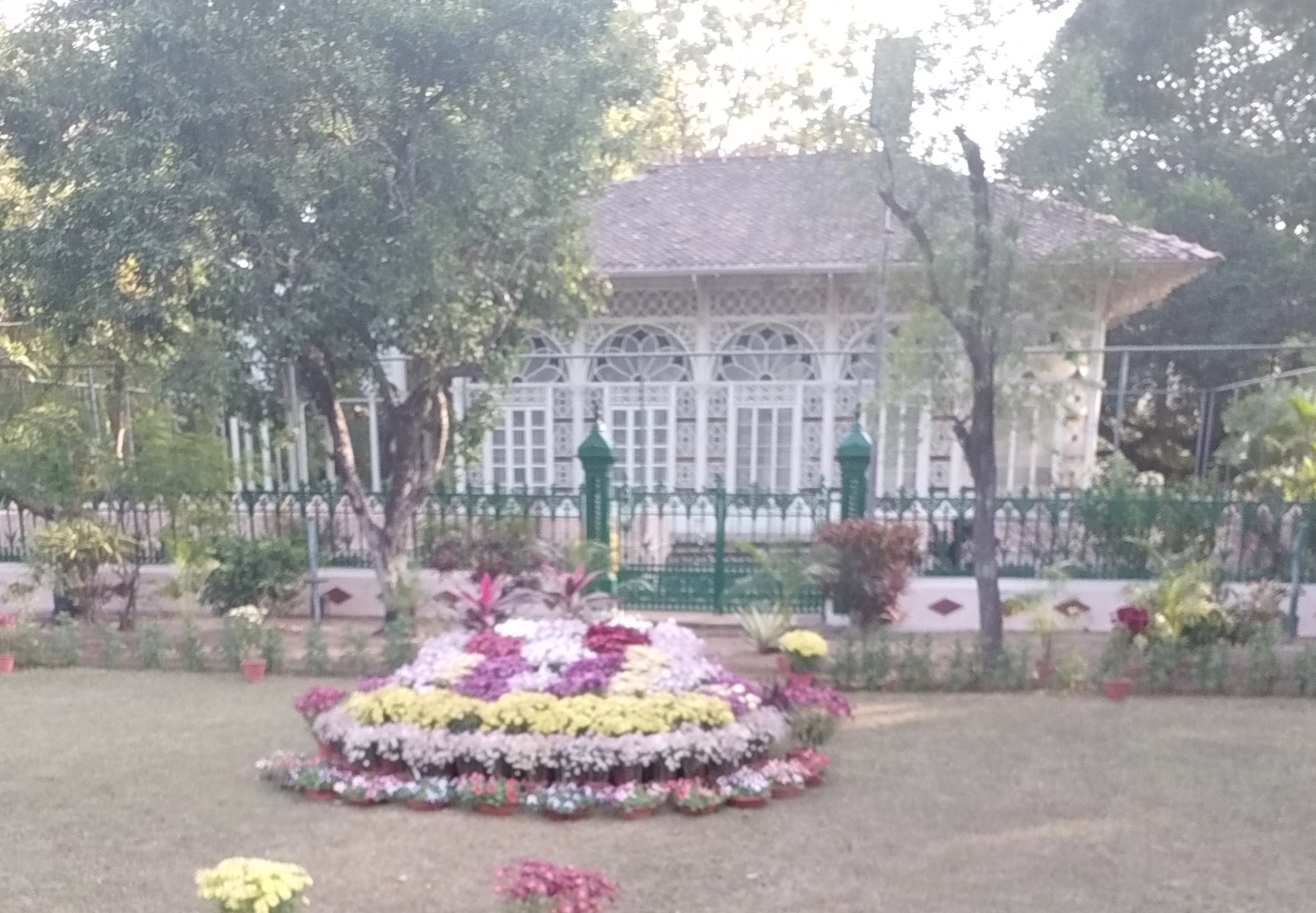 Upasana Griha at Santiniketan


Climate[edit | edit source]
The climate of Shantiniketan is moderately warm, with summer temperatures at around 35-42 °C (maximum) and winter at 10-15 °C (minimum). Summer is felt for three months, March, April and May. December, January and February are the winter months. June, July, August and September see heavy rainfall, these four months are known as monsoon (rainy season). Shantiniketan saw its highest temperature rising 47.0 °C, on 10 June 1966. The lowest temperature ever recorded is 4.9 °C, on 9 January 2013. The annual average temperature is 26.2 °C. About 1480mm of rain falls per year, with 76 days seeing the rain. The area is classified as an "Aw" (tropical savanna climate) under the Köppen Climate Classification. Template:Shantiniketan weatherbox
Transport[edit | edit source]
Bolpur Shantiniketan railway station is well connected with Sealdah Railway Station, Howrah Station, Kolkata Railway Station, Malda Town, New Jalpaiguri etc. of West Bengal & Guwahati Railway Station of Assam.
There is direct AC Volvo bus service of WBTC from Kolkata to Bolpur Shantiniketan (Kolkata-Bolpur-Suri & Suri-Bolpur-Kolkata).
Bus and private cars are available from Kolkata (outstation cab service of Ola Cabs, Uber from Kolkata), Durgapur City Centre Bus Stop, Katwa, Berhampore and soon from Santragachi Railway Station in Howrah.
About Visva Bharati[edit | edit source]
Shantiniketan is a university town with varied educational facilities. At the school level are Patha Bhavana and Siksha Satra. Apart from a number of courses in humanities, science and education, Visva-Bharati offers a range of music, dance and art courses and lays emphasis on language courses. Sangit Bhavana offers courses in Rabindra Sangit, Hindustani classical vocal, sitar, esraj, tabla, pakhawaj, Kathakali dance and Manipuri dance. Kala Bhavana offers courses in painting, mural, sculpture, graphic art, design (textiles/ ceramics) and history of art. The university offers specialised 4-year courses in Persian, Tibetan, Chinese and Japanese. Bhasa Bhavana offers undergraduate and post-graduate courses in Arabic & Persian, Bengali, Chinese, Hindi, Indo-Tibetan, Japanese, Odia, Santali and Sanskrit. Vidya Bhavana offers 1-year courses in Arabic, Bengali, Chinese, French, German, Hindi, Italian, Japanese, Marathi, Odia, Pali, Persian, Russian, Sanskrit, Santali, Tamil, Tibetan and Urdu. It also offers 2-year courses in Arabic, Assamese, Bengali, Chinese, French, German, Hindi, Italian, Japanese, Marathi, Odia, Pali, Persian, Russian, Sanskrit, Santali, Tamil, Tibetan and Urdu. There are certificate courses in leather craft, book binding & hand-made packaging, batik work and hand-made paper making. Shantiniketan offers courses in the field of agriculture and rural development. Only a selective list is presented here to give an idea of the range of courses offered.[29][30]
Culture[edit | edit source]
The town is known for its literary and artistic heritage, with the notable figures being Rabindranath Tagore and Nandalal Bose. In addition, the Visva Bharati also serves as Shantiniketan's cultural center.[15]
Poush Mela[edit | edit source]
In Birbhum district, the fairs (mela in Bengali) are spread right across the district and are thought of as an extension of the concept of markets, a place of not only trade and business but also a meeting place of people and an arena for cultural exchange. The largest and most notable fair is the Poush Mela held at Santiniketan for three days from 7 Poush.[31] Devendranath Tagore with twenty followers accepted the Brahmo creed from Ram Chandra Vidyabagish on 21 December 1843 (7 Poush 1250 according to the Bengali calendar). This was the basis of Poush Utsav (the Festival of Poush) at Santiniketan.[32]
Festivals at Shantiniketan[edit | edit source]
In Shantiniketan, seasonal changes bring their own colors and beauties with various festivals. The emphasis in organising these festivals is on traditional Indian forms and rituals. Numerous festivals range from Basanta Utsav and Barsha Mangal to Maghotsav and Rabindra Jayanti.[33] Holi, the festival of colours, is celebrated in its own style at Santiniketan – it is called Basanta Utsav and welcomes the arrival of spring. The programme starts from the morning with singing and dancing to Tagore's tunes by the students and ends with spreading coloured powders (called ‘abir’) and expression of festive wishes. After the formal Visva Bharati programme, other programmes follow. Barsha Mangal is celebrated with cultural programmes in July–August. Ananda Bazar is a fair for handicrafts by the students, held on Mahalaya day. Prior to leaving for the puja vacations students celebrate Sharad Utsav. To celebrate the birthday of Rabindranath Thakur, the birth anniversary of the poet's son with a small mela held in Sriniketan called "Rathindra Mela" by the students of the institute. Nandan Mela marks Nandalal Bose's birth anniversary (on 1–2 December) and is a special attraction for art lovers. Briksharopan and Halkarshan emphasise man's closeness to nature and are held on 22-23 Shraavana (August). Maghotsab, celebrating the founding of the Brahmo Samaj, is held on 11 Magh (towards the end of January). Various anniversaries and cultural programmes are organised throughout the year. 25 Baisakh (7-8 May) is the birthday of Rabindranath Tagore but his birth anniversary is celebrated along with and subsequent to the Bengali New Year (mid April onwards).[33]
Sinha Sadan[edit | edit source]
Shantiniketan was originally a part of the ancestral zamindari of the Sinha family of Raipur, Birbhum.[3] Satyendra Prasanna Sinha, 1st Baron Sinha donated for the construction of Sinha Sadan with a clock tower and bell. It was in this building that Oxford University conferred its honorary doctorate on the poet, Rabindranath Tagore.[15]
-
 Sinha Sadan
 -
 Doorway, Sinha Sadan


Ballabhpur Wildlife Sanctuary[edit | edit source]
Ballabhpur Wildlife Sanctuary is located 3 km from Shantiniketan and is popular as Deer Park. Established in 1977, it was a khoai area affected by soil erosion. It is now a large wooded area with herds of deer and makes a natural bird sanctuary.[34]
Amar Kutir[edit | edit source]
Amar Kutir (meaning: my cottage), once a place of refuge for independence movement activists has been turned into a cooperative society for the promotion of arts and crafts. It is located on the banks of the Kopai River, about 15 kilometres (9.3 mi) from the central areas of Santiniketan.[35]
Sonajhuri haat[edit | edit source]
Every Saturday and Sunday, one can visit the haat (or market) at Sonajhuri, close to Shantiniketan. This is a village market and one can buy local handicrafts and listen to folk music sung by tribal groups . Sonajhuri haat is a great place to see and collect wooden crafts, terracotta crafts, raw metal ornaments, dhokra art and local made clothes. It is an excellent place to experience the local culture of Shantiniketan.[citation needed]
Around Santiniketan picture gallery[edit | edit source]
-
 Khoai at Santiniketan
 -
 Baul performance at Sonajhuri Saturday haat
 -
 Local village hndicrafts and other items at Sonajhuri Saturday haat
 -
 Some Amar Kutir products on display


References[edit | edit source]
- ↑ Pearson, WW.: Santiniketan Bolpur School of Rabindranath Tagore, illustrations by Mukul Dey, The Macmillan Company, 1916
- ↑ "Santiniketan". UNESCO World Heritage Centre. Archived from the original on 20 September 2023. Retrieved 21 September 2023.
- ↑ 3.0 3.1 3.2 Basak, Tapan Kumar, Rabindranath-Santiniketan-Sriniketan (An Introduction), p. 2, B.B.Publication
- ↑ 4.0 4.1 Ghosh, Binoy, Paschim Banger Sanskriti. It has now been listed in UNESCO in 2023. (in Bengali), part I, 1976 edition, pages 299-304, Prakash Bhaban, Kolkata
- ↑ 5.0 5.1 "Visva Bharati". History. Visva Bharati. Retrieved 25 July 2019.
- ↑ Hjärne, H. (1913), The Nobel Prize in Literature 1913: Rabindranath Tagore—Award Ceremony Speech, Nobel Foundation (published 10 December 1913), retrieved 25 July 2019
- ↑ Deb, Chitra, Jorasanko and the Thakur Family, Pages 64-65, in Calcutta: The Living City, Volume I, edited by Sukanta Chaudhuri, Oxford University Press.
- ↑ Jorasanko and the Thakur Family by Chitra Deb in Calcutta, the Living City, edited by Sukanta Chaudhuri, Vol I, page 66
- ↑ "Visva Bharati". About Visva-Bharati. Visva Bharati. Retrieved 25 July 2019.
- ↑ Falling Rain Genomics, Inc - Santiniketan
- ↑ "Santiniketan".
- ↑ "District Human Development Report: Birbhum, Chapter IV: Economic Opportunities and Security of Livelihood". Page 100: Tourism. Development & Planning Department, Government of West Bengal, 2009. Retrieved 25 July 2019.
- ↑ "Visva Bharati". Rabindra Bhavana. Retrieved 25 July 2019.
- ↑ "Visva Bharati complex, Ravindra Bhavana". Campus Map. Visva Bharati. Retrieved 3 August 2019.
- ↑ 15.00 15.01 15.02 15.03 15.04 15.05 15.06 15.07 15.08 15.09 "Santiniketan". UNESCO World Heritage Centre.
- ↑ "Museum and book in memory of Rathindranath Tagore, son of Rabindranath Tagore". Jagran Josh, 1 July 2013. Retrieved 26 July 2019.
- ↑ "Museum for 'unsung' Tagore son". The Telegraph. 1 April 2013. Retrieved 26 July 2019.
- ↑ "Exploring Tagore's Santiniketan, an abode of Learning Unlike Any in the world". Travel Tales. The Better India. Retrieved 5 August 2019.
- ↑ "Tagore's Santiniketan". Tagore’s idea of education. Grade Stak. Archived from the original on 22 November 2015. Retrieved 5 August 2019.
- ↑ "Rathindranath Tagore". www.visvabharati.ac.in. Retrieved 5 August 2019.
- ↑ "Pratima Devi (1893-1969)". Visva-Bharati. Retrieved 4 August 2019.
- ↑ "Marriage of Nandita (daughter of Mira), grand daughter of Rabindranath". Smarak Grantha. Retrieved 5 August 2019.
- ↑ Dutta, Hirendranath, Santiniketaner Ek Jug, (in Bengali), pp27-32, Viswa Bharati Granthan Vighag, ISBN 81-7522-329-4.
- ↑ "Dinendranath Tagore". Visva Bharati. Retrieved 3 August 2019.
- ↑ "Indiradevi Choudhrani". Visva-Bharati. Retrieved 4 August 2019.
- ↑ Mukherjee Pandey, Jhimli. "Being Rabindranath Tagore". The Times of India, 1 June 203. Retrieved 26 July 2019.
- ↑ "At Home With Tagore". Outlook, 2 October 2006. Retrieved 26 July 2019.
- ↑ "Another Tagore Legacy". Pune Mirror, 20 May 2018. Archived from the original on 4 August 2019. Retrieved 26 July 2019.
- ↑ "Visva Bharat". Bachelor Degree. Visva Bharati. Retrieved 26 July 2019.
- ↑ "Visva Bharat". Syllabus for Post Graduate courses. Visva Bharati. Retrieved 26 July 2019.
- ↑ Mukhopadhyay, Aditya, Birbhumer Mela, Paschim Banga, Birbhum Special Issue, pp. 203–214, (in Bengali), February 2006, Information and Culture Dept., Government of West Bengal
- ↑ Basak, Tapan Kumar, Rabindranath-Santiniketan-Sriniketan (An Introduction), p. 36, B.B.Publication
- ↑ 33.0 33.1 "Welcome to Bolpur Santiniketan". Bolpur-Santiketan.com. Retrieved 26 July 2019.
- ↑ "Ballabhpur Wildlife Sanctuary (Deer Park)". Bolpur-Santiniketan.com. Retrieved 26 July 2019.
- ↑ "Amar Kutir". india9.com. Retrieved 26 July 2019.
Further reading[edit | edit source]
- UNESCO: Santiniketan (on the Tentative List since 2010)
- Places to visit in Santiniketan 2019 Archived 28 April 2019 at the Wayback Machine
- Celebrating Tagore
External links[edit | edit source]
- Template:Wikivoyage inline with local area map
| North |  | |
|---|---|---|
| East | ||
| Northeast | ||
| South | ||
| Central | ||
| West | ||