




Ajay Kumar (talk | contribs) Created a new article |
refine page also and fixed typos |
||
| Line 2: | Line 2: | ||
{{Use dmy dates|date=August 2020}} | {{Use dmy dates|date=August 2020}} | ||
{{Use Indian English|date=August 2020}} | {{Use Indian English|date=August 2020}} | ||
{{stack| | |||
{{Infobox Writing system | {{Infobox Writing system | ||
| name = Grantha script | |||
| altname = {{Script|Gran|𑌗𑍍𑌰𑌨𑍍𑌥}} | |||
| type = [[Abugida]] | |||
| languages = [[Tamil language|Tamil]] and [[Sanskrit Language|Sanskrit]] | |||
| time = 7th century CE – present (excluding [[Pallava script|Pallava Grantha]]) | |||
| fam1 = [[Egyptian hieroglyphs|Egyptian]] | |||
| fam2 = [[Proto-Sinaitic]] | |||
| fam3 = [[Phoenician alphabet|Phoenician]] | |||
| fam4 = [[Aramaic alphabet|Aramaic]] | |||
| fam5 = [[Brahmi script|Brahmi]] | |||
| fam6 = [[Tamil-Brahmi]] | |||
| fam7 = [[Pallava script|Pallava]] | |||
| sisters = [[Tamil script|Tamil]], [[Old Mon script|Old Mon]], [[Khmer script|Khmer]], [[Cham script|Cham]], [[Kawi script|Kawi]] | |||
| children = [[Malayalam script|Malayalam]]<br/>[[Tigalari script|Tigalari]]<br />[[Thirke]]<br />[[Saurashtra script|Saurashtra]]<br/>[[Dhives Akuru]]<br/>[[Sinhala script|Sinhala]] | |||
| sample = File:Shukla Grantha.svg | |||
| imagesize = 200px | |||
| caption = The word 'Grantha' in modern Grantha typeface | |||
| iso15924 = Gran | |||
| unicode = [https://www.unicode.org/charts/PDF/U11300.pdf U+11300–U+1137F] | |||
| note = none | |||
}} | |||
{{brahmic}} | {{brahmic}} | ||
The '''Grantha script''' ({{ | }} | ||
The '''Grantha script''' ({{Langx|sa|𑌗𑍍𑌰𑌨𑍍𑌥𑌲𑌿𑌪𑌿|granthalipi}}; {{langx|ta|கிரந்த எழுத்து|Granta eḻuttu}}; {{langx|ml|ഗ്രന്ഥലിപി|granthalipi}}) is a classical [[South India]]n [[Brahmic script]], found particularly in [[Tamil Nadu]] and [[Kerala]]. Originating from the [[Pallava script]],<ref>{{cite book |last1=Mirza |first1=Amna |last2=Gottardo |first2=Alexandra |title=Handbook of Literacy in Akshara Orthography |date=2019 |publisher=Springer International Publishing |isbn=978-3-030-05977-4|pages=329–351 |chapter-url=https://link.springer.com/chapter/10.1007/978-3-030-05977-4_17 |access-date=22 July 2024 |language=en |chapter=Learning to Read in Their Heritage Language: Hindi-English Speaking Children Reading Two Different Orthographies|doi=10.1007/978-3-030-05977-4_17 }}</ref> the Grantha script is related to [[Tamil script|Tamil]] and [[Vatteluttu]] scripts. The modern [[Malayalam script]] of Kerala is a direct descendant of the Grantha script.<ref name="salomon1998">{{cite book|author=Richard Salomon|title=Indian Epigraphy: A Guide to the Study of Inscriptions in Sanskrit, Prakrit, and the other Indo-Aryan Languages|url=https://books.google.com/books?id=XYrG07qQDxkC|year=1998|publisher=Oxford University Press|isbn=978-0-19-535666-3|pages=40–42}}</ref> The Southeast Asian and Indonesian scripts such as [[Thai script|Thai]] and [[Javanese script|Javanese]] respectively, as well as South Asian and Sri Lankan scripts such as [[Tigalari script|Tigalari]]<ref name="omniglot">{{cite web |title=Grantha alphabet for Sanskrit |url=https://www.omniglot.com/writing/grantha.htm |website=www.omniglot.com |access-date=22 July 2024}}</ref> and [[Sinhala script|Sinhalese script]]s respectively, are derived or closely related to Grantha through the early Pallava script.<ref name="Casparis1975p12">{{cite book|author=J. G. de Casparis|title=Indonesian Palaeography: A History of Writing in Indonesia from the Beginnings to C. A.D. 1500|url=https://books.google.com/books?id=cLUfAAAAIAAJ |year=1975|publisher=BRILL Academic|isbn=90-04-04172-9|pages=12–17}}</ref><ref name="HerbertMilner1989">{{cite book|author1=Patricia Herbert|author2=Anthony Crothers Milner|title=South-East Asia: Languages and Literatures : a Select Guide|url=https://books.google.com/books?id=-EqbeRzdDrsC&pg=PA127|year=1989|publisher=University of Hawaii Press|isbn=978-0-8248-1267-6|pages=127–129}}</ref><ref>{{cite book|author1=Pierre-Yves Manguin|author2=A. Mani|author3=Geoff Wade|title=Early Interactions Between South and Southeast Asia: Reflections on Cross-cultural Exchange|url=https://books.google.com/books?id=FuCYBgAAQBAJ&pg=PA306|year=2011|publisher=Institute of Southeast Asian Studies|isbn=978-981-4311-16-8|pages=283–285, 306–309}}</ref> The Pallava script or Pallava Grantha emerged in the 4th century CE and was used until the 7th century CE, in India.<ref name="griffiths">{{Cite book |last=Arlo |first=Guy |editor-first=john|editor-last=guy|author-link=Griffiths |url=https://www.academia.edu/6301451 |title=Lost Kingdoms: Hindu-Buddhist Sculpture of Early South east Asia |date=2014 |publisher=Metropolitan Museum of Art |isbn=9781588395245 |chapter=Early Indic Inscriptions of Southeast Asia |access-date=22 July 2024}}</ref><ref name="diringer">{{cite book |last1=Diringer |first1=David |title=Alphabet a key to the history of mankind |date=1948 |page=411 |url=https://archive.org/details/in.gov.ignca.1287}}</ref> This early Grantha script was used to write [[Sanskrit]] texts, inscriptions on copper plates and stones of Hindu temples and monasteries.<ref name=britgrantha/><ref name="salomon1998"/> It was also used for classical [[Manipravalam]] – a language that is a blend of Sanskrit and Tamil.<ref>{{cite book|author1=Giovanni Ciotti|author2=Hang Lin|title=Tracing Manuscripts in Time and Space through Paratexts|url=https://books.google.com/books?id=-ezCDAAAQBAJ&pg=PA62|year=2016|publisher=Walter De Gruyter|isbn=978-3-11-047901-0|pages=62–63}}</ref> From it evolved Middle Grantha by the 7th century, and Transitional Grantha by about the 8th century, which remained in use until about the 14th century. Modern Grantha has been in use since the 14th century and into the modern era, to write classical texts in Sanskrit and Dravidian languages.<ref name=britgrantha/><ref name="salomon1998"/> It is also used to chant hymns{{Clarify|reason=How do you use a script to chant?|date=October 2020}} and in traditional Vedic schools.<ref>{{Cite book|url=https://books.google.com/books?id=H3lUIIYxWkEC|title=A History of Ancient and Early Medieval India: From the Stone Age to the 12th Century|last=Singh|first=Upinder|date=2008-01-01|publisher=Pearson Education India|isbn=9788131711200|language=en}}</ref> | |||
The Tamil purist movement of the colonial era sought to purge the Grantha script from use and use the Tamil script exclusively. According to Kailasapathy, this was a part of Tamil nationalism and amounted to regional ethnic chauvinism.<ref>K. Kailasapathy (1979), [https://www.jstor.org/pss/3516775 The Tamil Purist Movement: A Re-evaluation], Social Scientist, Vol. 7, No. 10, pp. 23-27</ref> | The Tamil purist movement of the colonial era sought to purge the Grantha script from use and use the Tamil script exclusively. According to Kailasapathy, this was a part of Tamil nationalism and amounted to regional ethnic chauvinism.<ref>K. Kailasapathy (1979), [https://www.jstor.org/pss/3516775 The Tamil Purist Movement: A Re-evaluation], Social Scientist, Vol. 7, No. 10, pp. 23-27</ref> | ||
==History== | ==History== | ||
In [[Sanskrit]], ''grantha'' is literally 'a knot'.<ref> | In [[Sanskrit]], ''grantha'' is literally 'a knot'.<ref name=macdonnell>{{cite book |last1=Macdonell |first1=Arthur Anthony |title=A History of Sanskrit Literature |date=31 December 1997 |publisher=Motilal Banarsidass Publ. |isbn=978-81-208-0035-9 |page=15 |url=https://books.google.com/books?id=8wM-dNOa7fMC |access-date=22 July 2024 |language=en}}</ref> It is a word that was used for books, and the script used to write them. This stems from the practice of binding inscribed palm leaves using a length of thread held by knots. Grantha was widely used to write Sanskrit in the Tamil-speaking parts of [[South Asia]] from about the 5th century CE into modern times.<ref name=britgrantha/><ref name="salomon1998"/> | ||
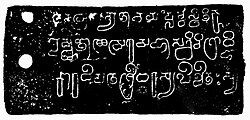
[[File:9th century Tamil Grantha script Sanskrit Chera era font.jpg|thumb | [[File:9th century Tamil Grantha script Sanskrit Chera era font.jpg|thumb|A Chera era Grantha inscription.]] | ||
The Grantha script was also historically used for writing Manipravalam, a blend of Tamil and Sanskrit which was used in the exegesis of Manipravalam texts. This evolved into a fairly complex writing system which required that Tamil words be written in the Tamil script and Sanskrit words be written in the Grantha script. By the 15th century, this had evolved to the point that both scripts would be used within the same word – if the root was derived from Sanskrit it would be written in the Grantha script, but any Tamil suffixes which were added to it would be written using the Tamil script. This system of writing went out of use when Manipravalam declined in popularity, but it was customary to use the same convention in printed editions of texts originally written in Manipravalam until the middle of the 20th century.{{citation needed|date=October 2019}} | The Grantha script was also historically used for writing Manipravalam, a blend of Tamil and Sanskrit which was used in the exegesis of Manipravalam texts. This evolved into a fairly complex writing system which required that Tamil words be written in the Tamil script and Sanskrit words be written in the Grantha script. By the 15th century, this had evolved to the point that both scripts would be used within the same word – if the root was derived from Sanskrit it would be written in the Grantha script, but any Tamil suffixes which were added to it would be written using the Tamil script. This system of writing went out of use when Manipravalam declined in popularity, but it was customary to use the same convention in printed editions of texts originally written in Manipravalam until the middle of the 20th century.{{citation needed|date=October 2019}} | ||
In modern times, the [[Tamil-Grantha script]] is used in religious contexts by Tamil-speaking [[Hindu]]s. For example, they use the script to write a child's name for the first time during the naming ceremony, for the Sanskrit portion of [[South Asian wedding card|traditional wedding cards]], and for announcements of a person's last rites. It is also used in many religious almanacs to print traditional formulaic summaries of the coming year.{{citation needed|date=October 2019}} | In modern times, the [[Tamil-Grantha script]] is used in religious contexts by Tamil-speaking [[Hindu]]s. For example, they use the script to write a child's name for the first time during the naming ceremony, for the Sanskrit portion of [[South Asian wedding card|traditional wedding cards]], and for announcements of a person's last rites. It is also used in many religious almanacs to print traditional formulaic summaries of the coming year.{{citation needed|date=October 2019}} | ||
[[File:8th Century Grantha script Sanskrit language Velvikudi Grant, LINES 8-14.jpg|thumb|upright=2.5|8th century [[Velvikudi inscription|Velvikudi grant inscription]] in the Grantha script (Sanskrit language).]] | [[File:8th Century Grantha script Sanskrit language Velvikudi Grant, LINES 8-14.jpg|thumb|upright=2.5|center|8th century [[Velvikudi inscription|Velvikudi grant inscription]] in the Grantha script (Sanskrit language).]] | ||
==Types of Grantha== | ==Types of Grantha== | ||
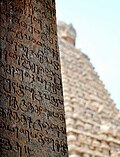
[[File: | [[File:Tanjavur Tamil Inscription2.jpg|thumb|right|Grantha inscription at Bṛhadīśvara Temple, India]] | ||
===Pallava Grantha=== | ===Pallava Grantha=== | ||
{{main|Pallava script}} | {{main|Pallava script}} | ||
An archaic and ornamental variety of Grantha is sometimes referred to as Pallava Grantha. It was used by the Pallava in some inscriptions from the 4th century CE<ref name="griffiths"/> to the 7th century CE, in India.<ref name= | An archaic and ornamental variety of Grantha is sometimes referred to as Pallava Grantha. It was used by the Pallava in some inscriptions from the 4th century CE<ref name="griffiths" /> to the 7th century CE, in India.<ref name=diringer/> Examples are the [[Mamallapuram]] [[Tiruchirapalli]] Rock Cut Cave Inscriptions and Kailasantha Inscription.{{citation needed|date=June 2020}} | ||
===Middle Grantha=== | ===Middle Grantha=== | ||
Middle | [[File:Mandakapattu Inscription.jpg|thumb|200px|7th-century inscription in Grantha script at the [[Mandagapattu Temple|Mandagapattu Hindu temple]]]] | ||
Middle Grantha first appeared in the Kuram copper plates, dating from around 675 CE, and was used until the end of the 8th century CE.<ref name=britgrantha/><ref name="diringer"/> | |||
===Transitional Grantha=== | ===Transitional Grantha=== | ||
Transitional Grantha is traceable from the 8th or 9th century CE, until around the 14th century CE.<ref name= | Transitional Grantha is traceable from the 8th or 9th century CE, until around the 14th century CE. The Tulu-Malayalam script is derivative of Transitional Grantha dating to the 8th or 9th century CE, which later split into two distinct scripts – [[Tigalari script|Tigalari]] and [[Malayalam script|Malayalam]].<ref name=britgrantha>{{cite web|url=https://www.britannica.com/topic/Grantha-alphabet |title=Grantha alphabet (writing system) – Britannica Online Encyclopedia |publisher=Britannica.com |access-date=2012-03-11}}</ref><ref name="diringer"/> | ||
===Modern Grantha=== | ===Modern Grantha=== | ||
Grantha in the present form dates from the 14th century CE. The oldest modern manuscript has been dated to the end of the 16th century CE. Two varieties are found in modern era Grantha texts: the 'Brahmanic' or square form used by Hindus, and the 'Jain' or round form used by Jains.<ref name= | Grantha in the present form dates from the 14th century CE. The oldest modern manuscript has been dated to the end of the 16th century CE. Two varieties are found in modern era Grantha texts: the 'Brahmanic' or square form used by Hindus, and the 'Jain' or round form used by Jains.<ref name=britgrantha/><ref name="diringer"/> | ||
==Modern Grantha | ==Modern Grantha== | ||
The Grantha script has evolved over time | The Grantha script has evolved over time, and shares similarities with the modern Tamil Script.<ref name=omniglot/> | ||
===Consonants=== | ===Consonants=== | ||
As | As in other [[Brahmic]] scripts Grantha consonant signs have an [[inherent vowel]], typically corresponding to {{IPA|/a/}}, so, for example, the letter {{angbr|{{Script|Gran|𑌕}}}} is pronounced {{IPA|/ka/}}. | ||
{|class="wikitable letters-teal" | |||
|+ Consonants | |||
|- | |||
|{{letter|l=ta|s=Gran|ch=𑌕|iso=ka}} | |||
|{{letter|l=ta|s=Gran|ch=𑌖|iso=kha}} | |||
|{{letter|l=ta|s=Gran|ch=𑌗|iso=ga}} | |||
|{{letter|l=ta|s=Gran|ch=𑌘|iso=gha}} | |||
|{{letter|l=ta|s=Gran|ch=𑌙|iso=ṅa}} | |||
| | |||
| | |||
| | |||
|{{letter|l=ta|s=Gran|ch=𑌹|iso=ha}} | |||
|- | |||
|{{letter|l=ta|s=Gran|ch=𑌚|iso=ca}} | |||
|{{letter|l=ta|s=Gran|ch=𑌛|iso=cha}} | |||
|{{letter|l=ta|s=Gran|ch=𑌜|iso=ja}} | |||
|{{letter|l=ta|s=Gran|ch=𑌝|iso=jha}} | |||
|{{letter|l=ta|s=Gran|ch=𑌞|iso=ña}} | |||
| colspan=2 {!} {{letter|l=ta|s=Gran|ch=𑌯|iso=ya}} | |||
|{{letter|l=ta|s=Gran|ch=𑌶|iso=śa}} | |||
| | |||
|- | |||
|{{letter|l=ta|s=Gran|ch=𑌟|iso=ṭa}} | |||
|{{letter|l=ta|s=Gran|ch=𑌠|iso=ṭha}} | |||
|{{letter|l=ta|s=Gran|ch=𑌡|iso=ḍa}} | |||
|{{letter|l=ta|s=Gran|ch=𑌢|iso=ḍha}} | |||
|{{letter|l=ta|s=Gran|ch=𑌣|iso=ṇa}} | |||
|{{letter|l=ta|s=Gran|ch=𑌰|iso=ra}} | |||
|{{letter|l=ta|s=Gran|ch=𑌳|iso=ḷa}} | |||
|{{letter|l=ta|s=Gran|ch=𑌷|iso=ṣa}} | |||
|- | |||
|{{letter|l=ta|s=Gran|ch=𑌤|iso=ta}} | |||
|{{letter|l=ta|s=Gran|ch=𑌥|iso=tha}} | |||
|{{letter|l=ta|s=Gran|ch=𑌦|iso=da}} | |||
|{{letter|l=ta|s=Gran|ch=𑌧|iso=dha}} | |||
|{{letter|l=ta|s=Gran|ch=𑌨|iso=na}} | |||
|colspan=2 {!} {{letter|l=ta|s=Gran|ch=𑌲|iso=la}} | |||
|{{letter|l=ta|s=Gran|ch=𑌸|iso=sa}} | |||
| | |||
|- | |||
|{{letter|l=ta|s=Gran|ch=𑌪|iso=pa}} | |||
|{{letter|l=ta|s=Gran|ch=𑌫|iso=pha}} | |||
|{{letter|l=ta|s=Gran|ch=𑌬|iso=ba}} | |||
|{{letter|l=ta|s=Gran|ch=𑌭|iso=bha}} | |||
|{{letter|l=ta|s=Gran|ch=𑌮|iso=ma}} | |||
|colspan=2 {!} {{letter|l=ta|s=Gran|ch=𑌵|iso=va}} | |||
| | |||
|} | |||
===Consonant clusters=== | ===Consonant clusters=== | ||
Grantha has two ways of representing consonant clusters. Sometimes, consonants in a cluster may form ligatures. | Grantha has two ways of representing consonant clusters. Sometimes, consonants in a cluster may form ligatures. | ||
{|class="wikitable letters-teal" | |||
|+ Consonant cluster ligatures | |||
|- class=letters-lo | |||
|{{letter|l=ta|s=Gran|ch=𑌕𑍍𑌷|iso=kṣa}} | |||
|{{letter|l=ta|s=Gran|ch=𑌕𑍍𑌤|iso=kta}} | |||
|{{letter|l=ta|s=Gran|ch=𑌙𑍍𑌗|iso=ṅga}} | |||
|{{letter|l=ta|s=Gran|ch=𑌜𑍍𑌞|iso=jña}} | |||
|{{letter|l=ta|s=Gran|ch=𑌞𑍍𑌚|iso=ñca}} | |||
|{{letter|l=ta|s=Gran|ch=𑌞𑍍𑌜|iso=ñja}} | |||
|{{letter|l=ta|s=Gran|ch=𑌤𑍍𑌥|iso=ttha}} | |||
|{{letter|l=ta|s=Gran|ch=𑌤𑍍𑌰|iso=tra}} | |||
|- | |||
|{{letter|l=ta|s=Gran|ch=𑌤𑍍𑌵|iso=tva}} | |||
|{{letter|l=ta|s=Gran|ch=𑌦𑍍𑌧|iso=ddha}} | |||
|{{letter|l=ta|s=Gran|ch=𑌦𑍍𑌵|iso=dva}} | |||
|{{letter|l=ta|s=Gran|ch=𑌨𑍍𑌤|iso=nta}} | |||
|{{letter|l=ta|s=Gran|ch=𑌨𑍍𑌤𑍍𑌵|iso=ntva}} | |||
|{{letter|l=ta|s=Gran|ch=𑌨𑍍𑌥|iso=ntha}} | |||
|{{letter|l=ta|s=Gran|ch=𑌨𑍍𑌦|iso=nda}} | |||
|{{letter|l=ta|s=Gran|ch=𑌨𑍍𑌧|iso=ndha}} | |||
|- | |||
|{{letter|l=ta|s=Gran|ch=𑌨𑍍𑌨|iso=nna}} | |||
|{{letter|l=ta|s=Gran|ch=𑌨𑍍𑌨𑍍|iso=nn}} | |||
|{{letter|l=ta|s=Gran|ch=𑌨𑍍𑌵|iso=nva}} | |||
|{{letter|l=ta|s=Gran|ch=𑌶𑍍𑌚|iso=śca}} | |||
|{{letter|l=ta|s=Gran|ch=𑌶𑍍𑌰|iso=śra}} | |||
|{{letter|l=ta|s=Gran|ch=𑌷𑍍𑌟|iso=ṣṭa}} | |||
|{{letter|l=ta|s=Gran|ch=𑌹𑍍𑌮|iso=hma}} | |||
|} | |||
Ligatures are normally preferred whenever they exist. If no ligatures exist, "stacked" forms of consonants are written, just as in Kannada and Telugu, with the lowest member of the stack being the only "live" consonant and the other members all being vowel-less. Note that ligatures may be used as members of stacks also. | Ligatures are normally preferred whenever they exist. If no ligatures exist, "stacked" forms of consonants are written, just as in Kannada and Telugu, with the lowest member of the stack being the only "live" consonant and the other members all being vowel-less. Note that ligatures may be used as members of stacks also. | ||
{|class="wikitable letters-teal" | |||
|+ Stacked consonants | |||
|-class=letters-nadir | |||
|{{letter|l=ta|s=Gran|ch=𑌤𑍍𑌤|iso=tta}} | |||
|{{letter|l=ta|s=Gran|ch=𑌤𑍍𑌤𑍍𑌵|iso=ttva}} | |||
|{{letter|l=ta|s=Gran|ch=𑌕𑍍𑌷𑍍𑌵|iso=kṣva}} | |||
|{{letter|l=ta|s=Gran|ch=𑌕𑍍𑌷𑍍𑌣|iso=kṣṇa}} | |||
|{{letter|l=ta|s=Gran|ch=𑌗𑍍𑌧𑍍𑌵|iso=gdhva}} | |||
|{{letter|l=ta|s=Gran|ch=𑌸𑍍𑌤𑍍𑌵|iso=stva}} | |||
|{{letter|l=ta|s=Gran|ch=𑌨𑍍𑌤𑍍𑌸|iso=ntsa}} | |||
|{{letter|l=ta|s=Gran|ch=𑌤𑍍𑌸𑍍𑌨|iso=tsna}} | |||
|} | |||
====A few special cases==== | |||
*When {{angbr|{{Script|Gran|𑌯}}}}, ''ya'' is the final consonant in a cluster, it is written as a ya-phala {{angbr|{{Script|Gran|𑍍𑌯}}}}. | |||
*When a cluster contains a non-initial {{angbr|{{Script|Gran|𑌰}}}}, ''ra'', it becomes a ''ra-vattu'', {{angbr|{{Script|Gran|𑍍𑌰}}}}.{{citation needed|date=October 2019}} | |||
*When a cluster begins with a {{angbr|{{Script|Gran|𑌰}}}}, ''ra'', it becomes a ''reph'' and is shifted to the end of the cluster. | |||
*If a cluster contains both a ''reph'' and a ''ya-phala'', the ''ya-phala'' is written last. | |||
{|class="wikitable letters-teal" | |||
|+ Consonant clusters with {{angbr|{{Script|Gran|𑍍𑌯}}}}, {{angbr|{{Script|Gran|𑍍𑌰}}}}, and ''reph''. | |||
|- class=letters-nadir | |||
|{{letter|l=ta|s=Gran|ch=𑌕𑍍𑌯|iso=kya}} | |||
|{{letter|l=ta|s=Gran|ch=𑌖𑍍𑌯|iso=khya}} | |||
|{{letter|l=ta|s=Gran|ch=𑌕𑍍𑌰|iso=kra}} | |||
|{{letter|l=ta|s=Gran|ch=𑌙𑍍𑌗𑍍𑌰|iso=ṅgra}} | |||
|{{letter|l=ta|s=Gran|ch=𑌙𑍍𑌗𑍍𑌰𑍍𑌯|iso=ṅgrya}} | |||
|{{letter|l=ta|s=Gran|ch=𑌦𑍍𑌧𑍍𑌯|iso=ddhya}} | |||
|- | |||
|{{letter|l=ta|s=Gran|ch=𑌰𑍍𑌕|iso=rka}} | |||
|{{letter|l=ta|s=Gran|ch=𑌰𑍍𑌕𑍍𑌷|iso=rkṣa}} | |||
|{{letter|l=ta|s=Gran|ch=𑌰𑍍𑌣|iso=rṇa}} | |||
|{{letter|l=ta|s=Gran|ch=𑌰𑍍𑌮|iso=rma}} | |||
|{{letter|l=ta|s=Gran|ch=𑌰𑍍𑌦𑍍𑌧|iso=rddha}} | |||
|{{letter|l=ta|s=Gran|ch=𑌰𑍍𑌦𑍍𑌵𑍍𑌯|iso=rdvya}} | |||
|} | |||
===Vowels and syllables=== | |||
Grantha includes five long vowels, five short vowels, two vocalic consonants, ṛ and ḷ which are treated as vowels and may be short or long, and two part-vowels, ''anusvara'' {{angbr|{{Script|Gran|◌𑌂}}}} ṁ and ''visarga'', {{angbr|{{Script|Gran|◌𑌃}}}} ḥ. Independent vowel letters are used for word-initial vowels. Otherwise, vowels, vocalics, and part-vowels are written as diacritics attached to consonants. Each consonant in Grantha includes an inherent vowel ''a'', so the letter {{angbr|{{Script|Gran|𑌕}}}}, for example, is pronounced ka. Adding a vowel diacritic modifies the vowel sound, so {{angbr|{{Script|Gran|𑌕}}}} plus the diacritic {{angbr|{{Script|Gran|𑌓}}}}, gives the syllable {{angbr|{{Script|Gran|𑌕𑍋}}}}, ''ko''. The absence of a vowel is marked with a [[virāma]] {{angbr|{{Script|Gran|◌𑍍}}}}, for example, {{angbr|{{Script|Gran|𑌕}}}} {{Transliteration|Gran|ISO|ka}} plus {{angbr|{{Script|Gran|◌𑍍}}}} creates an isolated consonant {{angbr|{{Script|Gran|𑌕𑍍}}}} ''k''. | |||
{| class="wikitable letters-teal" | |||
|+ Short vowels, vocalics, half vowels, diacritics, and examples with {{angbr|{{Script|Gran|𑌕}}}}, ka. | |||
|- | |||
| {{letter|l=ta|s=Gran|iso=a|ch=𑌅}} | |||
| {{letter|l=ta|s=Gran|iso=i|ch=𑌇}} | |||
| {{letter|l=ta|s=Gran|iso=u|ch=𑌉}} | |||
| {{letter|l=ta|s=Gran|iso=ṛ|ch=𑌋}} | |||
| {{letter|l=ta|s=Gran|iso=ḷ|ch=𑌌}} | |||
| {{letter|l=ta|s=Gran|iso=e|ch=𑌏}} | |||
| {{letter|l=ta|s=Gran|iso=o|ch=𑌓}} | |||
| {{letter|ch=◌|note={{noteTag|name=virama|group=vowels|The ''virama'' has no independent form because it is not a vowel. It is a diacritic that ''suppresses'' a letter's inherent vowel, leaving an isolated consonant.}}}} | |||
| {{letter|ch=◌|note={{noteTag|name=anusvara|group=vowels|The ''anusvara'' and ''visarga'' have no independent forms because they can only modify a syllable's vowel.}}}} | |||
| {{letter|ch=◌|note={{noteTag|name=anusvara|group=vowels}}}} | |||
|- | |||
| {{letter|ch=◌|note={{noteTag|name=a|group=vowels|The vowel ''a'' has no corresponding diacritic since every consonant carries an inherent ''a''.}}}} | |||
| {{letter|l=ta|s=Gran|ch=◌𑌿}} | |||
| {{letter|l=ta|s=Gran|ch=◌𑍁}} | |||
| {{letter|l=ta|s=Gran|ch=◌𑍃}} | |||
| {{letter|l=ta|s=Gran|ch=◌𑍢}} | |||
| {{letter|l=ta|s=Gran|ch=◌𑍇}} | |||
| {{letter|l=ta|s=Gran|ch=◌𑍋}} | |||
| {{letter|l=ta|s=Gran|ch=◌𑍍}} | |||
|{{letter|l=ta|s=Gran|ch=𑌂|iso=ṁ}} | |||
|{{letter|l=ta|s=Gran|ch=𑌃|iso=ḥ}} | |||
|- | |||
| {{letter|l=ta|s=Gran|iso=ka|ch=𑌕}} | |||
| {{letter|l=ta|s=Gran|iso=ki|ch=𑌕𑌿}} | |||
| {{letter|l=ta|s=Gran|iso=ku|ch=𑌕𑍁}} | |||
| {{letter|l=ta|s=Gran|iso=kṛ|ch=𑌕𑍃}} | |||
| {{letter|l=ta|s=Gran|iso=kḷ|ch=𑌕𑍢}} | |||
| {{letter|l=ta|s=Gran|iso=ke|ch=𑌕𑍇}} | |||
| {{letter|l=ta|s=Gran|iso=ko|ch=𑌕𑍋}} | |||
| {{letter|l=ta|s=Gran|iso=k|ch=𑌕𑍍}} | |||
|{{letter|l=ta|s=Gran|ch=𑌕𑌂|iso=kaṁ}} | |||
|{{letter|l=ta|s=Gran|ch=𑌕𑌃|iso=kaḥ}} | |||
|} | |||
{{noteFoot|group=vowels}} | |||
{| class="wikitable letters-teal" | |||
|+ Long vowels, their diacritics, and examples with {{angbr|{{Script|Gran|𑌮}}}}, ma. | |||
|- | |||
! scope=col {!} {{letter|l=ta|s=Gran|iso=ā|ch=𑌆}} | |||
! scope=col {!} {{letter|l=ta|s=Gran|iso=ī|ch=𑌈}} | |||
! scope=col {!} {{letter|l=ta|s=Gran||iso=ū|ch=𑌊}} | |||
! scope=col {!} {{letter|l=ta|s=Gran|iso=ṝ|ch=𑍠}} | |||
! scope=col {!} {{letter|l=ta|s=Gran|iso=ḹ|ch=𑍡}} | |||
! scope=col {!} {{letter|l=ta|s=Gran|iso=ai|ch=𑌐}} | |||
! scope=col {!} {{letter|l=ta|s=Gran|iso=au|ch=𑌔}} | |||
|- class=letters-lo | |||
| {{letter|l=ta|s=Gran|ch=◌𑌾}} | |||
| {{letter|l=ta|s=Gran|ch=◌𑍀}} | |||
| {{letter|l=ta|s=Gran|ch=◌𑍂}} | |||
| {{letter|l=ta|s=Gran|ch=◌𑍄}} | |||
| {{letter|l=ta|s=Gran|ch=◌𑍣}} | |||
| {{letter|l=ta|s=Gran|ch=◌𑍈}} | |||
| {{letter|l=ta|s=Gran|ch=◌𑍌}} | |||
|- class=letters-lo | |||
| {{letter|l=ta|s=Gran|iso=mā|ch=𑌮𑌾}} | |||
| {{letter|l=ta|s=Gran|iso=mī|ch=𑌮𑍀}} | |||
| {{letter|l=ta|s=Gran||iso=mū|ch=𑌮𑍂}} | |||
| {{letter|l=ta|s=Gran|iso=mṝ|ch=𑌮𑍄}} | |||
| {{letter|l=ta|s=Gran|iso=mḹ|ch=𑌮𑍣}} | |||
| {{letter|l=ta|s=Gran|iso=mai|ch=𑌮𑍈}} | |||
| {{letter|l=ta|s=Gran|iso=mau|ch=𑌮𑍌}} | |||
|} | |||
There are a few [[typographical ligature|ligatures]] of consonants with vowel [[diacritic]]s and of consonants with ''virāma''. | |||
[[ | |||
{| class="wikitable letters-teal" | |||
| {{letter|l=ta|s=Gran|iso=ṭi|tops=𑌟+ ◌𑌿|ch=𑌟𑌿}} | |||
| {{letter|l=ta|s=Gran|iso=ṭī|tops=𑌟+ ◌𑍀|ch=𑌟𑍀}} | |||
| {{letter|l=ta|s=Gran|iso=ḷī|tops=𑌳+ ◌𑍀|ch=𑌳𑍀}} | |||
| {{letter|l=ta|s=Gran|iso=ṭ|tops=𑌟 + ◌𑍍|ch=𑌟𑍍}} | |||
| {{letter|l=ta|s=Gran|iso=t|tops=𑌤 + ◌𑍍|ch=𑌤𑍍}} | |||
| {{letter|l=ta|s=Gran|iso=n|tops=𑌨+ ◌𑍍|ch=𑌨𑍍}} | |||
| {{letter|l=ta|s=Gran|iso=m|tops=𑌮 + ◌𑍍|ch=𑌮𑍍}} | |||
|} | |||
=== | ===Numerals=== | ||
{| class="wikitable letters-teal" | |||
|- | |||
| {{letter|l=ta|s=Gran|top=0|ch=௦}} | |||
| {{letter|l=ta|s=Gran|top=1|ch=௧}} | |||
| {{letter|l=ta|s=Gran|top=2|ch=௨}} | |||
| {{letter|l=ta|s=Gran|top=3|ch=௩}} | |||
| {{letter|l=ta|s=Gran|top=4|ch=௪}} | |||
| {{letter|l=ta|s=Gran|top=5|ch=௫}} | |||
| {{letter|l=ta|s=Gran|top=6|ch=௬}} | |||
| {{letter|l=ta|s=Gran|top=7|ch=௭}} | |||
| {{letter|l=ta|s=Gran|top=8|ch=௮}} | |||
| {{letter|l=ta|s=Gran|top=9|ch=௯}} | |||
== | |} | ||
=== | [[File:Tamil-Palm-1 (cropped).JPG|thumb|upright=1.4|A palm leaf manuscript in Sanskrit written in Grantha script.]] | ||
[[File:1863 CE palm leaf manuscript, Jaiminiya Aranyaka Gana, Samaveda (unidentified layer of texts), Sanskrit, Southern Grantha script, Malayali scribe Kecavan, sample ii.jpg|thumb|upright=1.4|A Grantha script on palm leaf copy of the [[Samaveda]], a Sanskrit Vedic text.]] | |||
=== | ===Sample text=== | ||
;Sanskrit in Grantha Script | |||
{{lang|sa|{{Script|Gran|𑌸𑌰𑍍𑌵𑍇 𑌮𑌾𑌨𑌵𑌾𑌃 𑌸𑍍𑌵𑌤𑌨𑍍𑌤𑍍𑌰𑌾𑌃 𑌸𑌮𑍁𑌤𑍍𑌪𑌨𑍍𑌨𑌾𑌃 𑌵𑌰𑍍𑌤𑌨𑍍𑌤𑍇 𑌅𑌪𑌿 𑌚, 𑌗𑍌𑌰𑌵𑌦𑍃𑌶𑌾 𑌅𑌧𑌿𑌕𑌾𑌰𑌦𑍃𑌶𑌾 𑌚 𑌸𑌮𑌾𑌨𑌾𑌃 𑌏𑌵 𑌵𑌰𑍍𑌤𑌨𑍍𑌤𑍇। 𑌏𑌤𑍇 𑌸𑌰𑍍𑌵𑍇 𑌚𑍇𑌤𑌨𑌾-𑌤𑌰𑍍𑌕-𑌶𑌕𑍍𑌤𑌿𑌭𑍍𑌯𑌾𑌂 𑌸𑍁𑌸𑌮𑍍𑌪𑌨𑍍𑌨𑌾𑌃 𑌸𑌨𑍍𑌤𑌿। 𑌅𑌪𑌿 𑌚, 𑌸𑌰𑍍𑌵𑍇𑌽𑌪𑌿 𑌬𑌨𑍍𑌧𑍁𑌤𑍍𑌵-𑌭𑌾𑌵𑌨𑌯𑌾 𑌪𑌰𑌸𑍍𑌪𑌰𑌂 𑌵𑍍𑌯𑌵𑌹𑌰𑌨𑍍𑌤𑍁।}}}}<ref>{{cite web |title=Universal Declaration of Human Rights - Sanskrit (Grantha) |url=http://efele.net/udhr/d/udhr_san_gran.html |website=UDHR in XML Project |access-date=27 May 2024}}</ref> | |||
;Latin script transliteration | |||
{{lang|sa|sarve mānavāḥ svatantrāḥ samutpannāḥ vartante api ca, gauravadr̥śā adhikāradr̥śā ca samānāḥ eva vartante. ete sarve cetanā-tarka-śaktibhyāṁ susampannāḥ santi. api ca, sarve´pi bandhutva-bhāvanayā parasparaṁ vyavaharantu.}}<ref>{{cite web |title=Grantha alphabet for Sanskrit |url=https://www.omniglot.com/writing/grantha.htm |website=www.omniglot.com |access-date=27 May 2024 |ref=omni}}</ref> | |||
;English | |||
All human beings are born free and equal in dignity and rights. They are endowed with reason and conscience and should act towards one another in a spirit of brotherhood. | |||
(Article 1 of the [[Universal Declaration of Human Rights]]) | |||
==Comparison with other South Indian and Sri Lankan scripts== | |||
{{plain row headers}} | |||
{| class="wikitable plain-row-headers" | |||
|+ Comparison of some Grantha letters with [[Malayalam script|Malayalam]], [[Sinhalese script|Sinhalese]], and [[Tamil script|Tamil]] | |||
|- class="letters-teal" | |||
! scope="row" |Grantha | |||
|{{letter|ch=𑌕|l=ta|s=Gran|top=ka}} | |||
|{{letter|ch=𑌙|l=ta|s=Gran|top=ṅa}} | |||
|{{letter|ch=𑌚|l=ta|s=Gran|top=ca}} | |||
|{{letter|ch=𑌞|l=ta|s=Gran|top=ña}} | |||
|{{letter|ch=𑌟|l=ta|s=Gran|top=ṭa}} | |||
|{{letter|ch=𑌣|l=ta|s=Gran|top=ṇa}} | |||
|{{letter|ch=𑌤|l=ta|s=Gran|top=ta}} | |||
|{{letter|ch=𑌨|l=ta|s=Gran|top=na}} | |||
|{{letter|ch=𑌪|l=ta|s=Gran|top=pa}} | |||
|{{letter|ch=𑌮|l=ta|s=Gran|top=ma}} | |||
|- class="letters-green" | |||
! scope="row" |Malayalam | |||
|{{letter|ch=ക|l=ml|s=Mlym}} | |||
|{{letter|ch=ങ|l=ml|s=Mlym}} | |||
|{{letter|ch=ച|l=ml|s=Mlym}} | |||
|{{letter|ch=ഞ|l=ml|s=Mlym}} | |||
|{{letter|ch=ട|l=ml|s=Mlym}} | |||
|{{letter|ch=ണ|l=ml|s=Mlym}} | |||
|{{letter|ch=ത|l=ml|s=Mlym}} | |||
|{{letter|ch=ന|l=ml|s=Mlym}} | |||
|{{letter|ch=പ|l=ml|s=Mlym}} | |||
|{{letter|ch=മ|l=ml|s=Mlym}} | |||
|- class="letters-orange" | |||
! scope="row" |Sinhalese | |||
|{{letter|ch=ක|l=si|s=Sinh}} | |||
|{{letter|ch=ඞ|l=si|s=Sinh}} | |||
|{{letter|ch=ච|l=si|s=Sinh}} | |||
|{{letter|ch=ඤ|l=si|s=Sinh}} | |||
|{{letter|ch=ට|l=si|s=Sinh}} | |||
|{{letter|ch=ණ|l=si|s=Sinh}} | |||
|{{letter|ch=ත|l=si|s=Sinh}} | |||
|{{letter|ch=න|l=si|s=Sinh}} | |||
|{{letter|ch=ප|l=si|s=Sinh}} | |||
|{{letter|ch=ම|l=si|s=Sinh}} | |||
|- | |||
! scope="row" |Tamil | |||
|{{letter|ch=க|l=ta|s=Taml}} | |||
|{{letter|ch=ங|l=ta|s=Taml}} | |||
|{{letter|ch=ச|l=ta|s=Taml}} | |||
|{{letter|ch=ஞ|l=ta|s=Taml}} | |||
|{{letter|ch=ட|l=ta|s=Taml}} | |||
|{{letter|ch=ண|l=ta|s=Taml}} | |||
|{{letter|ch=த|l=ta|s=Taml}} | |||
|{{letter|ch=ந|l=ta|s=Taml}} | |||
|{{letter|ch=ப|l=ta|s=Taml}} | |||
|{{letter|ch=ம|l=ta|s=Taml}} | |||
|} | |||
==Unicode== | ==Unicode== | ||
| Line 152: | Line 357: | ||
==Notes== | ==Notes== | ||
{{Reflist}} | {{Reflist}} | ||
==References== | ==References== | ||
| Line 165: | Line 363: | ||
==External links== | ==External links== | ||
{{Commons category |Grantha script}} | |||
* [http://www.ancientscripts.com/grantha.html Quick facts about Grantha at AncientScripts.com] | * [http://www.ancientscripts.com/grantha.html Quick facts about Grantha at AncientScripts.com] | ||
* [http://www.omniglot.com/writing/grantha.htm Article at Omniglot] | * [http://www.omniglot.com/writing/grantha.htm Article at Omniglot] | ||
Latest revision as of 01:26, 20 February 2026
| Grantha script 𑌗𑍍𑌰𑌨𑍍𑌥 | |
|---|---|
 The word 'Grantha' in modern Grantha typeface | |
| Script type | |
Time period | 7th century CE – present (excluding Pallava Grantha) |
| Languages | Tamil and Sanskrit |
| Related scripts | |
Parent systems | |
Child systems | Malayalam Tigalari Thirke Saurashtra Dhives Akuru Sinhala |
Sister systems | Tamil, Old Mon, Khmer, Cham, Kawi |
| ISO 15924 | |
| ISO 15924 | Gran, , Grantha |
| Unicode | |
Unicode alias | Grantha |
| U+11300–U+1137F | |
| Brahmic scripts |
|---|
| The Brahmic script and its descendants |
The Grantha script (Sanskrit: 𑌗𑍍𑌰𑌨𑍍𑌥𑌲𑌿𑌪𑌿, romanized: granthalipi; Tamil: கிரந்த எழுத்து, romanized: Granta eḻuttu; Malayalam: ഗ്രന്ഥലിപി, romanized: granthalipi) is a classical South Indian Brahmic script, found particularly in Tamil Nadu and Kerala. Originating from the Pallava script,[1] the Grantha script is related to Tamil and Vatteluttu scripts. The modern Malayalam script of Kerala is a direct descendant of the Grantha script.[2] The Southeast Asian and Indonesian scripts such as Thai and Javanese respectively, as well as South Asian and Sri Lankan scripts such as Tigalari[3] and Sinhalese scripts respectively, are derived or closely related to Grantha through the early Pallava script.[4][5][6] The Pallava script or Pallava Grantha emerged in the 4th century CE and was used until the 7th century CE, in India.[7][8] This early Grantha script was used to write Sanskrit texts, inscriptions on copper plates and stones of Hindu temples and monasteries.[9][2] It was also used for classical Manipravalam – a language that is a blend of Sanskrit and Tamil.[10] From it evolved Middle Grantha by the 7th century, and Transitional Grantha by about the 8th century, which remained in use until about the 14th century. Modern Grantha has been in use since the 14th century and into the modern era, to write classical texts in Sanskrit and Dravidian languages.[9][2] It is also used to chant hymns[clarification needed] and in traditional Vedic schools.[11]
The Tamil purist movement of the colonial era sought to purge the Grantha script from use and use the Tamil script exclusively. According to Kailasapathy, this was a part of Tamil nationalism and amounted to regional ethnic chauvinism.[12]
History[edit | edit source]
In Sanskrit, grantha is literally 'a knot'.[13] It is a word that was used for books, and the script used to write them. This stems from the practice of binding inscribed palm leaves using a length of thread held by knots. Grantha was widely used to write Sanskrit in the Tamil-speaking parts of South Asia from about the 5th century CE into modern times.[9][2]

The Grantha script was also historically used for writing Manipravalam, a blend of Tamil and Sanskrit which was used in the exegesis of Manipravalam texts. This evolved into a fairly complex writing system which required that Tamil words be written in the Tamil script and Sanskrit words be written in the Grantha script. By the 15th century, this had evolved to the point that both scripts would be used within the same word – if the root was derived from Sanskrit it would be written in the Grantha script, but any Tamil suffixes which were added to it would be written using the Tamil script. This system of writing went out of use when Manipravalam declined in popularity, but it was customary to use the same convention in printed editions of texts originally written in Manipravalam until the middle of the 20th century.[citation needed]
In modern times, the Tamil-Grantha script is used in religious contexts by Tamil-speaking Hindus. For example, they use the script to write a child's name for the first time during the naming ceremony, for the Sanskrit portion of traditional wedding cards, and for announcements of a person's last rites. It is also used in many religious almanacs to print traditional formulaic summaries of the coming year.[citation needed]

Types of Grantha[edit | edit source]

Pallava Grantha[edit | edit source]
An archaic and ornamental variety of Grantha is sometimes referred to as Pallava Grantha. It was used by the Pallava in some inscriptions from the 4th century CE[7] to the 7th century CE, in India.[8] Examples are the Mamallapuram Tiruchirapalli Rock Cut Cave Inscriptions and Kailasantha Inscription.[citation needed]
Middle Grantha[edit | edit source]

Middle Grantha first appeared in the Kuram copper plates, dating from around 675 CE, and was used until the end of the 8th century CE.[9][8]
Transitional Grantha[edit | edit source]
Transitional Grantha is traceable from the 8th or 9th century CE, until around the 14th century CE. The Tulu-Malayalam script is derivative of Transitional Grantha dating to the 8th or 9th century CE, which later split into two distinct scripts – Tigalari and Malayalam.[9][8]
Modern Grantha[edit | edit source]
Grantha in the present form dates from the 14th century CE. The oldest modern manuscript has been dated to the end of the 16th century CE. Two varieties are found in modern era Grantha texts: the 'Brahmanic' or square form used by Hindus, and the 'Jain' or round form used by Jains.[9][8]
Modern Grantha[edit | edit source]
The Grantha script has evolved over time, and shares similarities with the modern Tamil Script.[3]
Consonants[edit | edit source]
As in other Brahmic scripts Grantha consonant signs have an inherent vowel, typically corresponding to /a/, so, for example, the letter ⟨𑌕⟩ is pronounced /ka/.
Consonant clusters[edit | edit source]
Grantha has two ways of representing consonant clusters. Sometimes, consonants in a cluster may form ligatures.
Ligatures are normally preferred whenever they exist. If no ligatures exist, "stacked" forms of consonants are written, just as in Kannada and Telugu, with the lowest member of the stack being the only "live" consonant and the other members all being vowel-less. Note that ligatures may be used as members of stacks also.
| Template:Letter | Template:Letter | Template:Letter | Template:Letter | Template:Letter | Template:Letter | Template:Letter | Template:Letter |
A few special cases[edit | edit source]
- When ⟨𑌯⟩, ya is the final consonant in a cluster, it is written as a ya-phala ⟨𑍍𑌯⟩.
- When a cluster contains a non-initial ⟨𑌰⟩, ra, it becomes a ra-vattu, ⟨𑍍𑌰⟩.[citation needed]
- When a cluster begins with a ⟨𑌰⟩, ra, it becomes a reph and is shifted to the end of the cluster.
- If a cluster contains both a reph and a ya-phala, the ya-phala is written last.
| Template:Letter | Template:Letter | Template:Letter | Template:Letter | Template:Letter | Template:Letter |
| Template:Letter | Template:Letter | Template:Letter | Template:Letter | Template:Letter | Template:Letter |
Vowels and syllables[edit | edit source]
Grantha includes five long vowels, five short vowels, two vocalic consonants, ṛ and ḷ which are treated as vowels and may be short or long, and two part-vowels, anusvara ⟨◌𑌂⟩ ṁ and visarga, ⟨◌𑌃⟩ ḥ. Independent vowel letters are used for word-initial vowels. Otherwise, vowels, vocalics, and part-vowels are written as diacritics attached to consonants. Each consonant in Grantha includes an inherent vowel a, so the letter ⟨𑌕⟩, for example, is pronounced ka. Adding a vowel diacritic modifies the vowel sound, so ⟨𑌕⟩ plus the diacritic ⟨𑌓⟩, gives the syllable ⟨𑌕𑍋⟩, ko. The absence of a vowel is marked with a virāma ⟨◌𑍍⟩, for example, ⟨𑌕⟩ ka plus ⟨◌𑍍⟩ creates an isolated consonant ⟨𑌕𑍍⟩ k.
| scope=col {!} Template:Letter | scope=col {!} Template:Letter | scope=col {!} Template:Letter | scope=col {!} Template:Letter | scope=col {!} Template:Letter | scope=col {!} Template:Letter | scope=col {!} Template:Letter |
|---|---|---|---|---|---|---|
| Template:Letter | Template:Letter | Template:Letter | Template:Letter | Template:Letter | Template:Letter | Template:Letter |
| Template:Letter | Template:Letter | Template:Letter | Template:Letter | Template:Letter | Template:Letter | Template:Letter |
There are a few ligatures of consonants with vowel diacritics and of consonants with virāma.
| Template:Letter | Template:Letter | Template:Letter | Template:Letter | Template:Letter | Template:Letter | Template:Letter |
Numerals[edit | edit source]
| Template:Letter | Template:Letter | Template:Letter | Template:Letter | Template:Letter | Template:Letter | Template:Letter | Template:Letter | Template:Letter | Template:Letter |
.JPG)
,_Sanskrit,_Southern_Grantha_script,_Malayali_scribe_Kecavan,_sample_ii.jpg)
Sample text[edit | edit source]
- Sanskrit in Grantha Script
𑌸𑌰𑍍𑌵𑍇 𑌮𑌾𑌨𑌵𑌾𑌃 𑌸𑍍𑌵𑌤𑌨𑍍𑌤𑍍𑌰𑌾𑌃 𑌸𑌮𑍁𑌤𑍍𑌪𑌨𑍍𑌨𑌾𑌃 𑌵𑌰𑍍𑌤𑌨𑍍𑌤𑍇 𑌅𑌪𑌿 𑌚, 𑌗𑍌𑌰𑌵𑌦𑍃𑌶𑌾 𑌅𑌧𑌿𑌕𑌾𑌰𑌦𑍃𑌶𑌾 𑌚 𑌸𑌮𑌾𑌨𑌾𑌃 𑌏𑌵 𑌵𑌰𑍍𑌤𑌨𑍍𑌤𑍇। 𑌏𑌤𑍇 𑌸𑌰𑍍𑌵𑍇 𑌚𑍇𑌤𑌨𑌾-𑌤𑌰𑍍𑌕-𑌶𑌕𑍍𑌤𑌿𑌭𑍍𑌯𑌾𑌂 𑌸𑍁𑌸𑌮𑍍𑌪𑌨𑍍𑌨𑌾𑌃 𑌸𑌨𑍍𑌤𑌿। 𑌅𑌪𑌿 𑌚, 𑌸𑌰𑍍𑌵𑍇𑌽𑌪𑌿 𑌬𑌨𑍍𑌧𑍁𑌤𑍍𑌵-𑌭𑌾𑌵𑌨𑌯𑌾 𑌪𑌰𑌸𑍍𑌪𑌰𑌂 𑌵𑍍𑌯𑌵𑌹𑌰𑌨𑍍𑌤𑍁।[14]
- Latin script transliteration
sarve mānavāḥ svatantrāḥ samutpannāḥ vartante api ca, gauravadr̥śā adhikāradr̥śā ca samānāḥ eva vartante. ete sarve cetanā-tarka-śaktibhyāṁ susampannāḥ santi. api ca, sarve´pi bandhutva-bhāvanayā parasparaṁ vyavaharantu.[15]
- English
All human beings are born free and equal in dignity and rights. They are endowed with reason and conscience and should act towards one another in a spirit of brotherhood. (Article 1 of the Universal Declaration of Human Rights)
Comparison with other South Indian and Sri Lankan scripts[edit | edit source]
Unicode[edit | edit source]
Grantha script was added to the Unicode Standard in June 2014 with the release of version 7.0. The Unicode block for Grantha is U+11300–U+1137F: Template:Unicode chart Grantha
Unification with Tamil[edit | edit source]
Some proposed to reunify Grantha and Tamil;[16][17] however, the proposal triggered discontent by some.[18][19] Considering the sensitivity involved, it was determined that the two scripts should not be unified, except for the numerals.[20]
Notes[edit | edit source]
- ↑ Mirza, Amna; Gottardo, Alexandra (2019). "Learning to Read in Their Heritage Language: Hindi-English Speaking Children Reading Two Different Orthographies". Handbook of Literacy in Akshara Orthography. Springer International Publishing. pp. 329–351. doi:10.1007/978-3-030-05977-4_17. ISBN 978-3-030-05977-4. Retrieved 22 July 2024.
- ↑ 2.0 2.1 2.2 2.3 Richard Salomon (1998). Indian Epigraphy: A Guide to the Study of Inscriptions in Sanskrit, Prakrit, and the other Indo-Aryan Languages. Oxford University Press. pp. 40–42. ISBN 978-0-19-535666-3.
- ↑ 3.0 3.1 "Grantha alphabet for Sanskrit". www.omniglot.com. Retrieved 22 July 2024.
- ↑ J. G. de Casparis (1975). Indonesian Palaeography: A History of Writing in Indonesia from the Beginnings to C. A.D. 1500. BRILL Academic. pp. 12–17. ISBN 90-04-04172-9.
- ↑ Patricia Herbert; Anthony Crothers Milner (1989). South-East Asia: Languages and Literatures : a Select Guide. University of Hawaii Press. pp. 127–129. ISBN 978-0-8248-1267-6.
- ↑ Pierre-Yves Manguin; A. Mani; Geoff Wade (2011). Early Interactions Between South and Southeast Asia: Reflections on Cross-cultural Exchange. Institute of Southeast Asian Studies. pp. 283–285, 306–309. ISBN 978-981-4311-16-8.
- ↑ 7.0 7.1 Arlo, Guy (2014). "Early Indic Inscriptions of Southeast Asia". In guy, john (ed.). Lost Kingdoms: Hindu-Buddhist Sculpture of Early South east Asia. Metropolitan Museum of Art. ISBN 9781588395245. Retrieved 22 July 2024.
- ↑ 8.0 8.1 8.2 8.3 8.4 Diringer, David (1948). Alphabet a key to the history of mankind. p. 411.
- ↑ 9.0 9.1 9.2 9.3 9.4 9.5 "Grantha alphabet (writing system) – Britannica Online Encyclopedia". Britannica.com. Retrieved 11 March 2012.
- ↑ Giovanni Ciotti; Hang Lin (2016). Tracing Manuscripts in Time and Space through Paratexts. Walter De Gruyter. pp. 62–63. ISBN 978-3-11-047901-0.
- ↑ Singh, Upinder (1 January 2008). A History of Ancient and Early Medieval India: From the Stone Age to the 12th Century. Pearson Education India. ISBN 9788131711200.
- ↑ K. Kailasapathy (1979), The Tamil Purist Movement: A Re-evaluation, Social Scientist, Vol. 7, No. 10, pp. 23-27
- ↑ Macdonell, Arthur Anthony (31 December 1997). A History of Sanskrit Literature. Motilal Banarsidass Publ. p. 15. ISBN 978-81-208-0035-9. Retrieved 22 July 2024.
- ↑ "Universal Declaration of Human Rights - Sanskrit (Grantha)". UDHR in XML Project. Retrieved 27 May 2024.
- ↑ "Grantha alphabet for Sanskrit". www.omniglot.com. Retrieved 27 May 2024.
- ↑ Sharma, Shriramana. (2010a). Proposal to encode characters for Extended Tamil.
- ↑ Sharma, Shriramana. (2010b). Follow-up to Extended Tamil proposal L2/10-256R.
- ↑ Eraiyarasan, B. (2011). Dr. B.Eraiyarasan’s comments on Tamil Unicode And Grantham proposals.
- ↑ Nalankilli, Thanjai. (2018). Attempts to "Pollute" Tamil Unicode with Grantha Characters. Tamil Tribune. Retrieved 13 May 2019 from https://web.archive.org/web/20200306030655/http://www.tamiltribune.com/18/1201.html
- ↑ Government of India. (2010). Unicode Standard for Grantha Script.
References[edit | edit source]
- Grünendahl, Reinhold. (2001). South Indian Scripts in Sanskrit Manuscripts And Prints. Wiesbaden, Germany: Harrassowitz Verlag. ISBN 3-447-04504-3
- Venugopalan, K. (1983). A primer in Grantha characters.