


Kamal Guha (talk | contribs) Bihar Buddhist sites template added |
No edit summary |
||
| Line 1: | Line 1: | ||
{{short description|Historical city in Bihar, India}} | {{short description|Historical city in Bihar, India}} | ||
{{ | {{Use Indian English|date=April 2025}} | ||
{{Use dmy dates|date= | {{Use dmy dates|date=April 2025}} | ||
{{stack| | |||
{{Infobox settlement | {{Infobox settlement | ||
| name = Bodh Gayā | | name = Bodh Gayā | ||
| native_name_lang | | native_name_lang = | ||
| other_name | | other_name = <!-- Please do not add any Indic script in this infobox, per WP:INDICSCRIPT policy. --> | ||
| settlement_type | | settlement_type = Town | ||
| image_skyline = Great Buddha Statue, Bodh Gaya.jpg | | image_skyline = {{multiple image | ||
| | | border = infobox | ||
| total_width = 300 | |||
| nickname | | image_style = | ||
| map_alt | | perrow = 1/2/2/2/1 | ||
| image1 = Mahabodhi temple at Bodhgaya in Bihar 21.jpg | |||
| caption1 = The [[Mahabodhi Temple]] | |||
| image2 = Great Buddha Statue, Bodh Gaya.jpg | |||
| caption2 = [[Great Buddha (Bodh Gaya)|Great Buddha Statue]] | |||
| image3 = 018 Bodhi Tree (9219396225).jpg | |||
| caption3 = The Bodhi Tree | |||
| image4 = Mountain of Ashram.jpg | |||
| caption4 = Mountain of Ashrams, Vindhya range Bodh Gayā | |||
| image5 = Maitreya - Bodh Gaya ASI Museum - AN - 0216.jpg | |||
| caption5 = Maitreya Buddha at [[Archaeological Survey of India|ASI Museum]] | |||
}} | |||
| nickname = | |||
| map_alt = | |||
| pushpin_map = India Bihar#India | | pushpin_map = India Bihar#India | ||
| pushpin_relief | | pushpin_relief = yes | ||
| pushpin_map_alt = | |||
| pushpin_map_alt | | pushpin_map_caption = | ||
| pushpin_map_caption | | coordinates = {{Coord|24.6950|N|84.9925|E|display=inline,title}} | ||
| coordinates | | subdivision_type = Country | ||
| subdivision_type | |||
| subdivision_name = {{flag|India}} | | subdivision_name = {{flag|India}} | ||
| subdivision_type1 | | subdivision_type1 = State | ||
| subdivision_name1 = [[Bihar]] | | subdivision_name1 = {{flagicon image|Bihar Government Banner.png}} [[Bihar]] | ||
| subdivision_type2 | | subdivision_type2 = District | ||
| subdivision_name2 = [[Gaya district|Gaya]] | | subdivision_name2 = [[Gaya district|Gaya]] | ||
| established_title | | established_title = <!-- Established --> | ||
| established_date | | established_date = | ||
| founder | | founder = | ||
| named_for | | named_for = | ||
| government_type | | government_type = | ||
| governing_body | | governing_body = | ||
| unit_pref | | unit_pref = Metric | ||
| area_footnotes | | area_footnotes = (2015){{refn|group=A|name=|Constituents of Bodh Gaya Plannina area are Bodh Gaya [[Nagar Panchayat]], 32 villages in Bodh Gaya [[Community development|CD]] block and 3 villages in [[Gaya, India|Gaya]] CD block of Gaya district.<ref>{{cite web |url=http://urban.bih.nic.in/News/NE-02-15-04-2015.pdf |script-title=ne:पत्रांक-213: ''राजगीर क्षेत्रीय आयोजना क्षेत्र'' एवं ''बोधगया आयोजना क्षेत्र'' के सीमांकन एवं घोषणा |publisher=Urban Development Housing Dept., Government of Bihar, Patna |date=15 April 2015 |access-date=18 June 2015 |archive-url=https://web.archive.org/web/20150618174436/http://urban.bih.nic.in/News/NE-02-15-04-2015.pdf |archive-date=18 June 2015 |url-status=dead}}</ref>}} | ||
| area_rank | | area_rank = | ||
| area_total_km2 | | area_total_km2 = | ||
| elevation_footnotes | | elevation_footnotes = | ||
| elevation_m | | elevation_m = | ||
| area_blank1_title | | area_blank1_title = City | ||
| area_blank1_km2 = 20.2 | |||
| area_blank1_km2 | | area_blank2_title = [[Regional planning]] | ||
| area_blank2_title | | area_blank2_km2 = 83.78 | ||
| population_total = 48,184 | |||
| area_blank2_km2 | | population_as_of = 2018 | ||
| population_total | | population_rank = | ||
| population_as_of | |||
| population_rank | |||
| population_density_km2 = auto | | population_density_km2 = auto | ||
| population_demonym = | | population_demonym = | ||
| population_note | | population_note = | ||
| demographics_type1 | | demographics_type1 = Languages | ||
| demographics1_title1 | | demographics1_title1 = Official | ||
| demographics1_info1 | | demographics1_info1 = [[Hindi]] | ||
| timezone1 | | timezone1 = [[Indian Standard Time|IST]] | ||
| utc_offset1 | | utc_offset1 = +5:30 | ||
| postal_code_type | | postal_code_type = [[Postal Index Number|PIN]] | ||
| postal_code | | postal_code = 824231 | ||
| registration_plate | | registration_plate = BR-02 | ||
| website | | website = | ||
| footnotes | | footnotes = {{reflist|group=A}} | ||
}} | |||
{{Infobox Buddhist term | |||
| title = Bodh Gayā | |||
| sa = | |||
| sa-Latn = | |||
| pi = | |||
| pi-Latn = | |||
| hi = बोधगया | |||
| hi-Latn = Bodhgayā | |||
| bn = বুদ্ধ গয়া | |||
| bn-Latn = | |||
| my = ဗုဒ္ဓဂါယာ | |||
| my-Latn = | |||
| zh = 菩提伽耶 | |||
| zh-Latn = Pútíjiāyé | |||
| ja = ブッダガヤ/仏陀伽耶 | |||
| ja-Latn = Buddagaya | |||
| jv = | |||
| jv-Latn = | |||
| kaw = | |||
| kaw-Latn = | |||
| km = ពុទ្ធគយា | |||
| km-Latn = Bŭdh Geăyéa | |||
| ko = 부다가야 | |||
| ko-Latn = Budagaya | |||
| lo = | |||
| lo-Latn = | |||
| mnw = ဗုဒ္ဓဂါယာ | |||
| mnw-Latn = | |||
| shn = | |||
| shn-Latn = | |||
| si = බුද්ධගයා | |||
| si-Latn = | |||
| ta = புத்தகயை | |||
| ta-Latn = | |||
| th = พุทธคยา / โพธคยา | |||
| th-Latn = Phutthakhaya / Phothakhaya | |||
| bo = བྱང་ཆུབ་སྙིང་པོ་ | |||
| bo-Latn = | |||
| vi = Bồ Đề Đạo Tràng | |||
| id = Bodh Gaya | |||
| kannada = | |||
| en = | |||
}} | |||
}} | }} | ||
'''Bodh Gayā''' is a religious site and place of pilgrimage associated with the [[Mahabodhi Temple]] | '''Bodh Gayā''' is a religious site and place of pilgrimage associated with the [[Mahabodhi Temple]] complex, situated in the [[Gaya district]] in the [[India]]n [[States and union territories of India|state]] of [[Bihar]]. It is famous for being the place where [[Gautama Buddha]] is said to have attained [[Enlightenment (Buddhism)|enlightenment]] ([[Pali]]: {{transliteration|pi|bodhi}}) under what became known as the [[Bodhi Tree]].<ref name=Madan>{{cite book |title=India through the ages |last=Gopal |first=Madan |year=1991 |page=176 |editor=K.S. Gautam |publisher=Publication Division, Ministry of Information and Broadcasting, Government of India}}</ref> Since antiquity, Bodh Gayā has remained the object of [[Buddhist pilgrimage sites|pilgrimage]] and veneration for [[Buddhism|Buddhists]].<ref>{{Cite journal |last=Kinnard |first=Jacob |title=When Is The Buddha Not the Buddha? The Hindu/Buddhist Battle over Bodhgayā and Its Buddha Image |journal=Journal of the American Academy of Religion |pages=817 |issn=0002-7189}}</ref> [[Archaeology|Archaeological]] finds, including sculptures, show that the site was in use by Buddhists since the [[Mauryan|Maurya]] period.<ref>{{cite book |last1=Fogelin |first1=Lars |title=An Archaeological History of Indian Buddhism |date=2015 |publisher=Oxford University Press |isbn=9780199948239 |page=195}}</ref> | ||
For Buddhists, Bodh | For Buddhists, Bodh Gayā is the most important of the four main pilgrimage sites related to the life of Gautama Buddha,<ref>{{Cite journal |title=Buddhist Pilgrimage |url=http://www.vam.ac.uk/page/b/buddhist-pilgrimage/ |journal=Asia |access-date=14 December 2019 |archive-date=27 September 2018 |archive-url=https://web.archive.org/web/20180927085509/http://www.vam.ac.uk/page/b/buddhist-pilgrimage/ |url-status=live }}</ref> the other three being [[Kushinagar]], [[Lumbini]], and [[Sarnath]]. In 2002, [[Mahabodhi Temple]], located in Bodh Gayā, became a [[UNESCO]] [[World Heritage Site]].<ref name="unesco">{{cite web |url=https://whc.unesco.org/archive/2002/whc-02-conf202-25e.pdf#decision.23.15 |format=PDF |title=Decisions adopted by the 26th Session of the World Heritage Committee |publisher=[[World Heritage Site|World Heritage Committee]] |page=62 |access-date=10 July 2006 |url-status=live |archive-url=https://web.archive.org/web/20150228043819/https://whc.unesco.org/archive/2002/whc-02-conf202-25e.pdf#decision.23.15 |archive-date=28 February 2015}}</ref> | ||
==History== | ==History== | ||
{{BuddhasHolySites}} | {{BuddhasHolySites}} | ||
Bodh Gayā is considered the holiest site in Buddhism.<ref>{{Cite web |url=http://www.buddhanet.net/e-learning/buddhistworld/bodgaya.htm |title=Holy Sites of Buddhism: Bodh Gaya – Place of Enlightenment |website=buddhanet.net |access-date=14 December 2019 |archive-date=1 September 2010 |archive-url=https://web.archive.org/web/20100901113827/http://www.buddhanet.net/e-learning/buddhistworld/bodgaya.htm |url-status=live }}</ref> Known as '''Uruvelā''' in the Buddha's time, it is by the bank of the [[Lilajan River|Lilājan River]].<ref name="auto">{{Cite book|url=https://link.springer.com/rwe/10.1007/978-94-024-0852-2_12|title=Buddhism and Jainism|first=Arvind Kumar|last=Singh|date=2 July 2017|publisher=Springer, Dordrecht|pages=241–246|via=link.springer.com|doi=10.1007/978-94-024-0852-2_12}}</ref> The first temple at the site was built by [[Maurya Empire|Maurya]] [[List of Maurya Emperors|Emperor]] [[Ashoka]].<ref>{{Cite web |url=https://whc.unesco.org/en/list/1056/ |title=Mahabodhi Temple Complex at Bodh Gaya |publisher=UNESCO World Heritage Centre |language=en |access-date=14 December 2019 |archive-date=7 December 2019 |archive-url=https://web.archive.org/web/20191207044335/http://whc.unesco.org/en/list/1056/ |url-status=live }}</ref> | |||
Bodh | Traditionally, it is believed that the Buddha was born in 563 BCE on the next Baisakhi purnima (second full moon in calendar years that do not themselves start during full moon) in [[Lumbini]], [[Nepal]]. As Siddhartha, he renounced his family at the age of 29 in 534 BCE,<ref name="Banglapedia">{{cite book |last=Barua |first=Sukomal |year=2012 |chapter=Buddha Purnima |chapter-url=http://en.banglapedia.org/index.php?title=Buddha_Purnima |editor1-last=Islam |editor1-first=Sirajul |editor1-link=Sirajul Islam |editor2-last=Jamal |editor2-first=Ahmed A. |title=Banglapedia: National Encyclopedia of Bangladesh |edition=Second |publisher=[[Asiatic Society of Bangladesh]] |url-status=live |archive-url=https://web.archive.org/web/20160508210314/http://en.banglapedia.org/index.php?title=Buddha_Purnima |archive-date=8 May 2016}}</ref><ref>{{cite web |url=https://archives.sundayobserver.lk/2012/04/22/spe03.asp |title=Spectrum | Sundayobserver.lk – Sri Lanka |publisher=Sundayobserver.lk |date=22 April 2012 |access-date=2 June 2014 |url-status=live |archive-url=https://web.archive.org/web/20141013224257/http://www.sundayobserver.lk/2012/04/22/spe03.asp |archive-date=13 October 2014}}</ref> and travelled and meditated in search of truth. After practising self-mortification for six years at Uruvela (Buddhagaya) in Gaya, he gave up that practice because it did not give him liberation. Then he discovered the [[Noble Eightfold Path]] of his own and practised it, finally reaching enlightenment: complete freedom from lust ([[Raga (Sanskrit term)|Rāga]]), hatred ([[Dvesha]]), and delusion ([[Mohā]]), also known as the [[Three poisons]]. | ||
At this point, the Buddha was abandoned by the five men who had been his companions in his earlier austerities, as all they saw was an ordinary man; mocking his well-nourished appearance, they said, "Here comes the [[mendicant]] Gautama, who has turned away from asceticism. He is certainly not worth our respect." When they reminded him of his former vows, the Buddha replied, "Austerities only confuse the mind. In the exhaustion and mental stupor to which they lead, one can no longer understand the ordinary things of life, still less the truth that lies beyond the senses. I have given up extremes of either luxury or asceticism. I have discovered the [[Middle Way]]." This is explained as the path that is neither easy (his former life as a rich prince) nor hard (living in austere conditions, practising self-denial). Hearing this, the five ascetics became the Buddha's first disciples in Deer Park, [[Sarnath]], {{convert|13|km}} northeast of [[Varanasi]].{{Citation needed|date=February 2021}} | |||
Gautama's disciples began to visit the place during the full moon in the month of [[Vesak|Vaisakh]] (April–May), as per the [[Hindu calendar]]. Over time, the place became known as Bodh Gayā, the day of enlightenment as [[Buddha Purnima]], and the tree as the Bodhi Tree. | |||
Bodh Gayā's history is documented by many inscriptions and pilgrimage accounts. Foremost among these are the accounts of the Chinese pilgrims [[Faxian]] in the 5th century and [[Xuanzang]] in the 7th century. The area was at the heart of a Buddhist civilisation for centuries, until it was [[Islamic invasion of India|conquered]] by Turkic armies in the 13th century. | |||
From the 11th to 13th centuries, Bodh Gayā was under the control of local chieftains known as the [[Pithipatis of Magadha]]. One of their rulers, Acarya Buddhasena, has been recorded as making a grant to Sri Lankan monks near the Mahabodhi temple.<ref name=Balogh2021>{{cite book |last1=Balogh |first1=Daniel |title=Pithipati Puzzles: Custodians of the Diamond Throne |date=2021 |publisher=British Museum Research Publications |pages=40–58 |isbn=9780861592289 |url=https://books.google.com/books?id=Lk0NzgEACAAJ |access-date=16 November 2021 |archive-date=12 March 2023 |archive-url=https://web.archive.org/web/20230312191219/https://books.google.com/books?id=Lk0NzgEACAAJ |url-status=live }}</ref> In the 12th century, [[Muslim]] [[Turkic peoples|Turk]] armies led by [[Delhi Sultanate]]'s [[Qutb al-Din Aibak]] and [[Bakhtiyar Khilji]] invaded and destroyed Bodh Gayā and nearby regions.<ref name=unescosite1056>{{cite web |title = Mahabodhi Temple Complex at Bodh Gaya |url = https://whc.unesco.org/pg.cfm?cid=31&id_site=1056 |publisher = UNESCO |access-date = 6 January 2015 |url-status = live |archive-url = https://web.archive.org/web/20141129103731/https://whc.unesco.org/pg.cfm?cid=31&id_site=1056 |archive-date = 29 November 2014}}</ref> | |||
== Contemporary and historic names == | |||
The place name Bodh Gayā (also known as Bauddha Gyāh, Bodhgayā, Bodhi Gayā, Bodhīmaṇḍa, Boodh Gayā, Buddha Gayā and Budh Gyā)<ref name="auto"/> came into use in the 18th century. Historically, it was known as Uruvela, Dharmāranya, Jayapura, Sambodhī ([[File:Sambodhi inscription.jpg|40px]], Saṃ + [[bodhi]], meaning 'Complete Enlightenment' in Ashoka's [[Major Rock Edict|Major Rock Edict No.8]]),<ref>{{cite book |last1=Juergensmeyer |first1=Mark |last2=Roof |first2=Wade Clark |title=Encyclopedia of Global Religion |date=2011 |publisher=SAGE Publications |isbn=9781452266565 |page=148 |url=https://books.google.com/books?id=WwJzAwAAQBAJ&pg=PA148 |language=en |access-date=6 October 2018 |archive-date=12 March 2023 |archive-url=https://web.archive.org/web/20230312191147/https://books.google.com/books?id=WwJzAwAAQBAJ&pg=PA148 |url-status=live }}</ref> Vajrāsana (the '[[Diamond Throne]]' of the Buddha), or Mahābodhī ('Great Enlightenment').<ref name="auto"/><ref>{{cite web |url=http://www.buddhanet.net/e-learning/pilgrim/pg_histbg.htm |title=A History of Bodh Gaya by Venerable S. Dhammika |publisher=Buddhanet.net |access-date=2 June 2014 |archive-date=2 February 2014 |archive-url=https://web.archive.org/web/20140202131530/http://www.buddhanet.net/e-learning/pilgrim/pg_histbg.htm |url-status=live }}</ref> Bodh Gayā's main monastery used to be called the Bodhimanda-vihāra ([[Pali]]); it is now known as the [[Mahabodhi Temple]]. | |||
==Mahabodhi Temple== | ==Mahabodhi Temple== | ||
{{Main|Mahabodhi Temple}} | {{Main|Mahabodhi Temple}} | ||
The complex, about {{convert|110|km}} from [[Patna, India|Patna]], at {{Coord|24|41|43|N|84|59|38|E|}},<ref name="nomination">{{cite web |url=https://whc.unesco.org/p_dynamic/sites/passfile.cfm?filename=1056rev&filetype=pdf&category=nominations |format=PDF |title=Information Dossier for nomination of Mahabodhi Temple Complex, Bodhgaya as a World Heritage Site |publisher=[[Government of India]] |page=4 |access-date=10 July 2006 |url-status=dead |archive-url=https://web.archive.org/web/20090210120530/https://whc.unesco.org/p_dynamic/sites/passfile.cfm?filename=1056rev&filetype=pdf&category=nominations |archive-date=10 February 2009}}</ref> contains the Mahabodhi Temple with the [[Vajrasana, Bodh Gaya|Vajrasana]] or "diamond throne" and the [[Bodhi tree]]. This tree was originally a sapling of the [[Sri Maha Bodhi]] tree in [[Sri Lanka]], itself grown from a what is claimed to be a sapling of the original Bodhi tree. | |||
The complex, | |||
contains the Mahabodhi Temple with the [[Vajrasana, Bodh Gaya|Vajrasana]] or "diamond throne" and the | |||
In approximately 250 BCE, about 200 years after the Buddha attained Enlightenment, Emperor [[Asoka]] visited Bodh | In approximately 250 BCE, about 200 years after the Buddha attained Enlightenment, Emperor [[Asoka]] visited Bodh Gayā to establish a monastery and shrine there.<ref name=unesco/> | ||
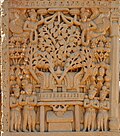
Representations of this early temple are found at [[Sanchi]], on the toraṇas of Stūpa I, dating from around 25 BCE, and on a relief carving from the stupa railing at [[Bharhut|Bhārhut]], from the early [[Shunga Empire|Shunga]] period ({{Circa|185|73 BCE}}).<ref>"[https://huntingtonarchive.org/resources/downloads/jchArticles/Part%201.pdf Sowing the Seeds of the Lotus: A Journey to the Great Pilgrimage Sites of Buddhism, Part I]" by John C. Huntington. ''Orientations'', November 1985 pg 61</ref> | Representations of this early temple are found at [[Sanchi]], on the toraṇas of Stūpa I, dating from around 25 BCE, and on a relief carving from the stupa railing at [[Bharhut|Bhārhut]], from the early [[Shunga Empire|Shunga]] period ({{Circa|185|73 BCE}}).<ref>"[https://huntingtonarchive.org/resources/downloads/jchArticles/Part%201.pdf Sowing the Seeds of the Lotus: A Journey to the Great Pilgrimage Sites of Buddhism, Part I]" by John C. Huntington. ''Orientations'', November 1985 pg 61</ref> | ||
==Other Buddhist temples== | ==Other Buddhist temples== | ||
[[ | {{gallery | ||
Kittisirimegha of [[Sri Lanka]], a contemporary of [[Samudragupta]], erected with | | Nipponji Temple Complex (47701746).jpg | Nipponji Temple | ||
| Bodhgaya (8716402933).jpg | Bangladesh Buddhist Vihara | |||
| Wat Thai Temple, Bodhgaya.jpg | [[Wat Thai Buddhagaya]] | |||
| Pal Tergar Monastery, Bodhgaya (8717524626).jpg | [[Prayer wheels]] at Tergar Monastery | |||
| Jagannath Temple (Bodhagaya), Bihar.jpg | The Hindu Jagannath temple, located near the Mahabodhi Temple | |||
| A temple complex at Bodhgaya, Bihar.jpg | A Budhhist sculpture from the Chinese Temple complex in Bodh Gayā | |||
}} | |||
Kittisirimegha of [[Sri Lanka]], a contemporary of [[Samudragupta]], erected with his permission a [[monastery|Sanghārāma]] near the Mahabodhi Temple, chiefly for the use of the Singhalese monks who went to worship the Bodhi tree. The circumstances in connection with the Sanghārāma are given by [[Xuanzang]],<ref>[[Samuel Beal|Beal]], op. cit., 133ff</ref>{{full citation needed|date=July 2024}} who describes it as he saw it. It was probably here that [[Buddhaghosa]] met the Elder Revata, who persuaded him to come to Ceylon. | |||
Several Buddhist temples and monasteries have been built by the people of [[Tibet]], [[Mongolia]], [[Nepal]], [[Japan]], [[Korea]], [[Cambodia]], [[Laos]], [[Myanmar]], [[Vietnam]], [[Sikkim]], [[Sri Lanka]], [[Taiwan]], [[Thailand]], [[Bhutan]], and [[China]] in a wide area around the Mahabodhi Temple. These buildings reflect their respective countries' architectural and decorative styles. The statue of the Buddha in the Chinese temple is 200 years old, and was brought from China. Japan's Nippon temple is shaped like a [[pagoda]]. The Myanmar (Burmese) temple is also pagoda-shaped and is reminiscent of [[Bagan]]. The [[Wat Thai Buddhagaya|Thai temple]] has a sloping, curved roof covered with golden tiles and contains a massive bronze statue of the Buddha. Next to the Thai temple is a {{convert|25|m|ft|adj=on}} statue of the Buddha within a garden that has existed for over 100 years.{{citation needed|date=January 2024}} | |||
===Sujata Stupa=== | |||
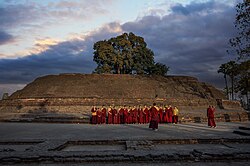
[[File:Sujata Stupa.jpg|thumb|Buddhist monks standing in front of the Sujata Stupa]] | |||
Across the [[Phalgu]] river is the [[Sujata Stupa]], in the village of [[Bakraur]]. The stupa was dedicated to the [[milkmaid]] [[Sujata (milkmaid)|Sujata]], who is said to have fed the Buddha milk and [[rice]] as he was sitting under a [[Banyan tree]], ending his seven years of fasting and [[asceticism]] and allowing him to attain [[Enlightenment in Buddhism|illumination]] through the [[Middle Way]].<ref name=prasoon07>{{cite book |last1=Prasoon |first1=Shrikant |title=Knowing Buddha: [life and teachings] |date=2007 |publisher=Hindoology Books |location=[Delhi] |isbn=9788122309638 |url=https://books.google.com/books?id=Us9wbjmvXfgC&pg=PT32 |access-date=3 September 2018 |archive-date=12 March 2023 |archive-url=https://web.archive.org/web/20230312191237/https://books.google.com/books?id=Us9wbjmvXfgC&pg=PT32 |url-status=live }}</ref><ref>{{cite book |last1=Blasi |first1=Abigail |title=Lonely Planet India |date=2017 |publisher=Lonely Planet |isbn=9781787011991 |url=https://books.google.com/books?id=yLU7DwAAQBAJ&pg=PT1251 |language=en |access-date=3 September 2018 |archive-date=12 March 2023 |archive-url=https://web.archive.org/web/20230312191213/https://books.google.com/books?id=yLU7DwAAQBAJ&pg=PT1251 |url-status=live }}</ref><ref name=dwivedi06>{{cite book |last1=Dwivedi |first1=Sunita |last2=Lama |first2=Dalai (foreword) |author-link2=14th Dalai Lama |title=Buddhist heritage sites of India |date=2006 |publisher=Rupa & Co. |location=New Delhi |isbn=8129107384}}</ref> The stupa was built in the 2nd century BCE, as confirmed by finds of black polished wares and [[punch-marked coins]] in the attending monastery.<ref name=DGS>{{cite book |last1=Geary |first1=David |last2=Sayers |first2=Matthew R. |last3=Amar |first3=Abhishek Singh |title=Cross-disciplinary Perspectives on a Contested Buddhist Site: Bodh Gaya Jataka |date=2012 |publisher=Routledge |isbn=9781136320675 |pages=35–36 |url=https://books.google.com/books?id=f56437oiblUC&pg=PA35 |language=en |access-date=3 September 2018 |archive-date=12 March 2023 |archive-url=https://web.archive.org/web/20230312191218/https://books.google.com/books?id=f56437oiblUC&pg=PA35 |url-status=live }}</ref> | |||
===Sujata Temple=== | |||
[[File:Sujata Temple - Bodh Gaya (1).jpg|thumb|Stairway to Sujata Temple, Bakraur]] | |||
The Sujata Temple, in Sujata Village in Bakrour, is a significant historical and religious site associated with the life of Siddhartha Gautama, who later became the Buddha. This temple commemorates the pivotal moment when Sujata, a village woman, offered Siddhartha a bowl of rice milk, providing him with nourishment after years of severe asceticism. This is said to have given Siddhartha the strength to pursue the Middle Path, ultimately leading to his enlightenment. The temple stands near the banks of the Niranjana River, symbolising the site where this transformative event took place. The architecturally modest Sujata Temple attracts pilgrims and tourists. The surrounding village and the serene landscape add to the temple's spiritual ambiance, making it a place of contemplation and homage. | |||
==The Great Buddha Statue== | ==The Great Buddha Statue== | ||
{{main|Great Buddha (Bodh Gaya)}} | {{main|Great Buddha (Bodh Gaya)}} | ||
An {{convert|80|ft|m|adj=on}} statue of the Buddha, known as The Great Buddha Statue, is in Bodh Gayā. It was unveiled and consecrated on 18 November 1989. The consecration ceremony was attended by the 14th Dalai Lama, who blessed the statue, the first great Buddha ever built in the history of India. Under the slogan "Spread Buddha's rays to the Whole World", Daijokyo{{clarification needed|date=January 2024}} spent seven years constructing the statue, mobilising 120,000 masons. | |||
The Great Buddha Statue | |||
Under the slogan "Spread Buddha's rays to the Whole World, | |||
==Mahabodhi Temple bombings== | ==Mahabodhi Temple bombings== | ||
{{See also|Bodh Gaya bombings}} | {{See also|Bodh Gaya bombings}} | ||
[[File:Pipal tree temple of Bodh Gaya depicted in Sanchi Stupa 1 Eastern Gateway.jpg|thumb| | [[File:Pipal tree temple of Bodh Gaya depicted in Sanchi Stupa 1 Eastern Gateway.jpg|thumb|180px|Illustration of the temple built by [[Asoka]] at Bodh Gayā around the Bodhi tree. Sculpture of the [[Satavahana]] period at [[Sanchi]], 1st century CE.]] | ||
On 7 July 2013, at around | On 7 July 2013, at around 5:15{{nbsp}}a.m., there was a low-intensity [[2013 Bodh Gaya blasts|bomb blast]] in the Mahabodhi Temple complex. This was followed by a series of nine low-intensity blasts that injured two monks, one Tibetan and one Burmese. These blasts were carried out by the Islamist terrorist organisation [[Indian Mujahideen]].<ref name=":0">{{cite news |last=Tiwari |first=Deeptiman |title=Ranchi document helps NIA crack Bodh Gaya blast case |url=http://timesofindia.indiatimes.com/india/Ranchi-document-helps-NIA-crack-Bodh-Gaya-blast-case/articleshow/25281931.cms |access-date=6 November 2013 |newspaper=The Times of India |date=6 November 2013 |archive-date=6 November 2013 |archive-url=https://web.archive.org/web/20131106102143/http://timesofindia.indiatimes.com/india/Ranchi-document-helps-NIA-crack-Bodh-Gaya-blast-case/articleshow/25281931.cms |url-status=live }}</ref><ref name="Patna terror cell">{{cite news |last=Gaikwad |first=Rahi |title=Patna terror cell behind Bodh Gaya strike too: NIA |url=http://www.thehindu.com/news/national/patna-terror-cell-behind-bodh-gaya-strike-too-nia/article5322815.ece |access-date=7 November 2013 |newspaper=The Hindu |date=7 November 2013 |author2=Yadav Anumeha |author3=Pandey Devesh |location=Patna, Ranchi, New Delhi |archive-date=9 November 2013 |archive-url=https://web.archive.org/web/20131109171957/http://www.thehindu.com/news/national/patna-terror-cell-behind-bodh-gaya-strike-too-nia/article5322815.ece |url-status=live }}</ref> Police defused two other bombs, one under the Buddha statue and one near Karmapa Temple.<ref>{{cite news |title=Serial Blasts rock Mahabodhi temple in Bodha gaya: terror attack, Center says |url=http://timesofindia.indiatimes.com/india/serial-blasts-rock-mahabodhi-temple-in-bodh-gaya-terror-attack-centre-says/articleshow/20952763.cms |access-date=7 July 2013 |newspaper=The Times of India |date=7 July 2013 |url-status=live |archive-url=https://web.archive.org/web/20130709201724/http://timesofindia.indiatimes.com/india/Serial-blasts-rock-Mahabodhi-Temple-in-Bodh-Gaya-terror-attack-Centre-says/articleshow/20952763.cms |archive-date=9 July 2013}}</ref><ref name=blast>{{cite news |title=Nine blasts in Bodh Gaya, 2 injured |url=http://www.thehindu.com/news/national/other-states/nine-blasts-in-bodh-gaya-2-injured/article4891094.ece |access-date=7 July 2013 |newspaper=The Hindu |date=7 July 2013 |url-status=live |archive-url=https://web.archive.org/web/20130710180959/http://www.thehindu.com/news/national/other-states/nine-blasts-in-bodh-gaya-2-injured/article4891094.ece |archive-date=10 July 2013}}</ref> | ||
On 1 June 2018, a special [[National Investigation Agency]] (NIA) court of [[Patna]] sentenced five suspects in the case to life imprisonment.<ref>{{cite news |title=Five sentenced to life imprisonment in Bodh Gaya serial blasts case |url=https://headlinestoday.org/national/bihar/735/five-sentenced-to-life-imprisonment-in-bodh-gaya-serial-blasts-case/ |access-date=2 June 2018 |agency=Headlines Today |archive-url=https://web.archive.org/web/20180806114437/https://headlinestoday.org/national/bihar/735/five-sentenced-to-life-imprisonment-in-bodh-gaya-serial-blasts-case/ |archive-date=6 August 2018 |url-status=dead}}</ref> | On 1 June 2018, a special [[National Investigation Agency]] (NIA) court of [[Patna]] sentenced five suspects in the case to life imprisonment.<ref>{{cite news |title=Five sentenced to life imprisonment in Bodh Gaya serial blasts case |url=https://headlinestoday.org/national/bihar/735/five-sentenced-to-life-imprisonment-in-bodh-gaya-serial-blasts-case/ |access-date=2 June 2018 |agency=Headlines Today |archive-url=https://web.archive.org/web/20180806114437/https://headlinestoday.org/national/bihar/735/five-sentenced-to-life-imprisonment-in-bodh-gaya-serial-blasts-case/ |archive-date=6 August 2018 |url-status=dead}}</ref> | ||
==Demographics== | ==Demographics== | ||
At the [[2001 Census of India|2001 census]],<ref>{{cite web |url=http://www.censusindia.net/results/town.php?stad=A&state5=999 |archive-url=https://web.archive.org/web/20040616075334/http://www.censusindia.net/results/town.php?stad=A&state5=999 |archive-date=16 June 2004 |title=Census of India 2001: Data from the 2001 Census, including cities, villages and towns (Provisional) |access-date=1 November 2008 |publisher=Census Commission of India}}</ref> Bodh Gaya had a population of 30,883. Males constitute 54% of the population and females 46%. Bodh Gaya has an average literacy rate of 51%, lower than the national average of 59.5%; with male literacy of 63% and female literacy of 38%. 8% of the population is under 6 years of age. | |||
==Transportation== | ==Transportation== | ||
{{Buddhist_pilgrimage_sites_in_India.svg}} | {{Buddhist_pilgrimage_sites_in_India.svg}} | ||
* Buses have been introduced by the [[BSTDC]] between [[Patna]] and Bodh Gaya via [[Rajgir]].<ref>{{cite web |title=BSTDC halts AC Bus Services to Bodhgaya devoid of Passengers |url=http://news.biharprabha.com/2013/08/bstdc-halts-ac-bus-services-for-bodhgaya-devoid-of-passengers/ |access-date=31 August 2013 |url-status=live |archive-url=https://web.archive.org/web/20130809172703/http://news.biharprabha.com/2013/08/bstdc-halts-ac-bus-services-for-bodhgaya-devoid-of-passengers/ |archive-date=9 August 2013}}</ref> | *Buses have been introduced by the [[BSTDC]] between [[Patna]] and Bodh Gaya via [[Rajgir]].<ref>{{cite web |title=BSTDC halts AC Bus Services to Bodhgaya devoid of Passengers |url=http://news.biharprabha.com/2013/08/bstdc-halts-ac-bus-services-for-bodhgaya-devoid-of-passengers/ |access-date=31 August 2013 |url-status=live |archive-url=https://web.archive.org/web/20130809172703/http://news.biharprabha.com/2013/08/bstdc-halts-ac-bus-services-for-bodhgaya-devoid-of-passengers/ |archive-date=9 August 2013}}</ref> | ||
*A special caravan service called Wonder on Wheel, between Patna and Bodh Gaya, has been introduced by the Bihar Tourism Department.<ref>{{cite web |title=Bihar launches Tourist Caravan Service called Wonder on Wheel |url=http://news.biharprabha.com/2013/04/bihar-launches-tourist-caravan-called-wonder-on-wheel/ |work=The Biharprabha News |url-status=live |archive-url=https://web.archive.org/web/20130501071627/http://news.biharprabha.com/2013/04/bihar-launches-tourist-caravan-called-wonder-on-wheel/ |archive-date=1 May 2013}}</ref> | *A special caravan service called Wonder on Wheel, between Patna and Bodh Gaya, has been introduced by the Bihar Tourism Department.<ref>{{cite web |title=Bihar launches Tourist Caravan Service called Wonder on Wheel |url=http://news.biharprabha.com/2013/04/bihar-launches-tourist-caravan-called-wonder-on-wheel/ |work=The Biharprabha News |url-status=live |archive-url=https://web.archive.org/web/20130501071627/http://news.biharprabha.com/2013/04/bihar-launches-tourist-caravan-called-wonder-on-wheel/ |archive-date=1 May 2013}}</ref> | ||
*[[Gaya Airport]] is | *[[Gaya Airport]] is {{convert|7|km|mi|sigfig=1}} from Bodh Gaya and about {{convert|10|km|mi|sigfig=1}} from [[Gaya Junction railway station]]. | ||
*Bodhgaya has restricted the use of [[auto rickshaw]]s, cars and buses to make the | *Bodhgaya has restricted the use of [[auto rickshaw]]s, cars, and buses to make the site more peaceful. A permit is required to use cars or buses, and the only taxi available is an [[electric rickshaw]] that is mostly noiseless. | ||
==Sister cities== | ==Sister cities== | ||
Bodh Gaya has one official [[Twin towns and sister cities|sister city]]: | Bodh Gaya has one official [[Twin towns and sister cities|sister city]]: | ||
*{{flagicon|JPN}} [[Nara Prefecture]], Japan<ref>{{cite web |title=Japan visit: Nitish proposes sister-state pact between Nara and Bodh Gaya |url=https://www.hindustantimes.com/patna/japan-visit-nitish-proposes-sister-state-pact-between-nara-and-bodh-gaya/story-1oVujmOZUl6mUTLCyylslO.html |website=hindustantimes.com |publisher=Hindustan Times |date=2018 | *{{flagicon|JPN}} [[Nara Prefecture]], Japan<ref>{{cite web |title=Japan visit: Nitish proposes sister-state pact between Nara and Bodh Gaya |url=https://www.hindustantimes.com/patna/japan-visit-nitish-proposes-sister-state-pact-between-nara-and-bodh-gaya/story-1oVujmOZUl6mUTLCyylslO.html |website=hindustantimes.com |publisher=Hindustan Times |date=22 February 2018 |access-date=8 April 2020 |archive-date=18 May 2019 |archive-url=https://web.archive.org/web/20190518112145/https://www.hindustantimes.com/patna/japan-visit-nitish-proposes-sister-state-pact-between-nara-and-bodh-gaya/story-1oVujmOZUl6mUTLCyylslO.html |url-status=dead }}</ref> | ||
==See also== | ==See also== | ||
{{Portal|India}} | |||
* [[Cetiya]] | * [[Cetiya]] | ||
* [[Bodhgaya inscription of Mahanaman]] | * [[Bodhgaya inscription of Mahanaman]] | ||
| Line 146: | Line 208: | ||
==Bibliography== | ==Bibliography== | ||
*Kinnard, Jacob N. (1998). When Is The Buddha Not the Buddha? The Hindu/Buddhist Battle over Bodhgayā and Its Buddha Image. Journal of the American Academy of Religion 66 (4), | *Kinnard, Jacob N. (1998). When Is The Buddha Not the Buddha? The Hindu/Buddhist Battle over Bodhgayā and Its Buddha Image. Journal of the American Academy of Religion 66 (4), 817–839 | ||
*Geary, David; Sayers, Matthew R; Amar, Abhishek Singh (2012). [https://books.google.com/books?id=U0_gCgAAQBAJ&dq=Mahabodhi+Society&pg=PP1 Cross-disciplinary perspectives on a contested Buddhist site: Bodh Gaya jataka]. London, New York: Routledge | *Geary, David; Sayers, Matthew R; Amar, Abhishek Singh (2012). [https://books.google.com/books?id=U0_gCgAAQBAJ&dq=Mahabodhi+Society&pg=PP1 Cross-disciplinary perspectives on a contested Buddhist site: Bodh Gaya jataka]. London, New York: Routledge | ||
==External links== | ==External links== | ||
* [http://www.buddhanet.net/bodh_gaya/menu.htm Detailed history of Bodhgaya] by Ven. S. Dhammika. | {{Sister project links|voy=yes|d= Q176767}} | ||
* [http://bstdc.bih.nic.in/bodhgaya.htm Bihar state tourism development corporation (BSTDC)] | *[http://www.buddhanet.net/bodh_gaya/menu.htm Detailed history of Bodhgaya] by Ven. S. Dhammika. | ||
* [https://www.tripadvisor.in/Attractions-g424922-Activities-Bodh_Gaya_Gaya_District_Bihar.html Places to Visit in Bodh Gaya] | *[http://bstdc.bih.nic.in/bodhgaya.htm Bihar state tourism development corporation (BSTDC)] {{Webarchive|url=https://web.archive.org/web/20070104054226/http://bstdc.bih.nic.in/BodhGaya.htm |date=4 January 2007}} | ||
*[https://www.tripadvisor.in/Attractions-g424922-Activities-Bodh_Gaya_Gaya_District_Bihar.html Places to Visit in Bodh Gaya] | |||
*[https://www.indianguidemr.com/2022/12/bodh-gaya-bihar-bodh-gaya-tourism-2022.html Photos of Mahabodhi Temple & Bodhgaya] | *[https://www.indianguidemr.com/2022/12/bodh-gaya-bihar-bodh-gaya-tourism-2022.html Photos of Mahabodhi Temple & Bodhgaya] | ||
{{RBK|31|Bodhgaya}}{{dead link|date=December 2020}} | {{RBK|31|Bodhgaya}}{{dead link|date=December 2020}} | ||
*[http://www.gayatobodhgaya.com/map.html Bodhgaya Map] | *[http://www.gayatobodhgaya.com/map.html Bodhgaya Map] | ||
{{Buddhism topics}} | {{Buddhism topics}} | ||
{{Gautama Buddha}} | {{Gautama Buddha}} | ||
| Line 166: | Line 228: | ||
[[Category:Bodh Gaya| ]] | [[Category:Bodh Gaya| ]] | ||
[[Category:Buddhist pilgrimage sites in India]] | [[Category:Buddhist pilgrimage sites in India]] | ||
[[Category:World Heritage Sites in India]] | |||
[[Category:Buddhist sites in Bihar]] | |||
[[Category:Tourist attractions in Bihar]] | [[Category:Tourist attractions in Bihar]] | ||
[[Category: | [[Category:Archaeological sites in Bihar]] | ||
[[Category: | [[Category:Historic sites in India]] | ||
[[Category:Cities and towns in Gaya district]] | [[Category:Cities and towns in Gaya district]] | ||
[[Category:Cities in Bihar]] | |||
[[Category:Populated places established in the 6th century BC]] | |||
[[Category:Religious buildings and structures destroyed in the Muslim period in the Indian subcontinent]] | |||
Revision as of 05:38, 27 March 2026
Bodh Gayā | |
|---|---|
Town | |
The Mahabodhi Temple The Bodhi Tree Mountain of Ashrams, Vindhya range Bodh Gayā Maitreya Buddha at ASI Museum | |
  Bodh Gayā  Bodh Gayā | |
| Coordinates: 24°41′42″N 84°59′33″E / 24.6950°N 84.9925°E | |
| Country |  India India |
| State |  Bihar Bihar |
| District | Gaya |
| Area (2015)[A 1] | |
| • City | 20.2 km2 (7.8 sq mi) |
| • Regional planning | 83.78 km2 (32.35 sq mi) |
| Population (2018) | |
| • Total | 48,184 |
| Languages | |
| • Official | Hindi |
| Time zone | UTC+5:30 (IST) |
| PIN | 824231 |
| Vehicle registration | BR-02 |
| |


.jpg)


| Translations of Bodh Gayā | |
|---|---|
| Bengali | বুদ্ধ গয়া |
| Burmese | ဗုဒ္ဓဂါယာ |
| Chinese | 菩提伽耶 (Pinyin: Pútíjiāyé) |
| Japanese | ブッダガヤ/仏陀伽耶 (rōmaji: Buddagaya) |
| Khmer | ពុទ្ធគយា (UNGEGN: Bŭdh Geăyéa) |
| Korean | 부다가야 (RR: Budagaya) |
| Mon | ဗုဒ္ဓဂါယာ |
| Sinhala | බුද්ධගයා |
| Tibetan | བྱང་ཆུབ་སྙིང་པོ་ |
| Tamil | புத்தகயை |
| Thai | พุทธคยา / โพธคยา (RTGS: Phutthakhaya / Phothakhaya) |
| Vietnamese | Bồ Đề Đạo Tràng |
| Indonesian | Bodh Gaya |
| Glossary of Buddhism | |
Bodh Gayā is a religious site and place of pilgrimage associated with the Mahabodhi Temple complex, situated in the Gaya district in the Indian state of Bihar. It is famous for being the place where Gautama Buddha is said to have attained enlightenment (Pali: bodhi) under what became known as the Bodhi Tree.[2] Since antiquity, Bodh Gayā has remained the object of pilgrimage and veneration for Buddhists.[3] Archaeological finds, including sculptures, show that the site was in use by Buddhists since the Maurya period.[4]
For Buddhists, Bodh Gayā is the most important of the four main pilgrimage sites related to the life of Gautama Buddha,[5] the other three being Kushinagar, Lumbini, and Sarnath. In 2002, Mahabodhi Temple, located in Bodh Gayā, became a UNESCO World Heritage Site.[6]
History
| Pilgrimage to |
| Buddha's Holy Sites |
|---|
 |
| The Four Main Sites |
| Four Additional Sites |
| Other Sites |
| Later Sites |
Bodh Gayā is considered the holiest site in Buddhism.[7] Known as Uruvelā in the Buddha's time, it is by the bank of the Lilājan River.[8] The first temple at the site was built by Maurya Emperor Ashoka.[9]
Traditionally, it is believed that the Buddha was born in 563 BCE on the next Baisakhi purnima (second full moon in calendar years that do not themselves start during full moon) in Lumbini, Nepal. As Siddhartha, he renounced his family at the age of 29 in 534 BCE,[10][11] and travelled and meditated in search of truth. After practising self-mortification for six years at Uruvela (Buddhagaya) in Gaya, he gave up that practice because it did not give him liberation. Then he discovered the Noble Eightfold Path of his own and practised it, finally reaching enlightenment: complete freedom from lust (Rāga), hatred (Dvesha), and delusion (Mohā), also known as the Three poisons.
At this point, the Buddha was abandoned by the five men who had been his companions in his earlier austerities, as all they saw was an ordinary man; mocking his well-nourished appearance, they said, "Here comes the mendicant Gautama, who has turned away from asceticism. He is certainly not worth our respect." When they reminded him of his former vows, the Buddha replied, "Austerities only confuse the mind. In the exhaustion and mental stupor to which they lead, one can no longer understand the ordinary things of life, still less the truth that lies beyond the senses. I have given up extremes of either luxury or asceticism. I have discovered the Middle Way." This is explained as the path that is neither easy (his former life as a rich prince) nor hard (living in austere conditions, practising self-denial). Hearing this, the five ascetics became the Buddha's first disciples in Deer Park, Sarnath, 13 kilometres (8.1 mi) northeast of Varanasi.[citation needed]
Gautama's disciples began to visit the place during the full moon in the month of Vaisakh (April–May), as per the Hindu calendar. Over time, the place became known as Bodh Gayā, the day of enlightenment as Buddha Purnima, and the tree as the Bodhi Tree.
Bodh Gayā's history is documented by many inscriptions and pilgrimage accounts. Foremost among these are the accounts of the Chinese pilgrims Faxian in the 5th century and Xuanzang in the 7th century. The area was at the heart of a Buddhist civilisation for centuries, until it was conquered by Turkic armies in the 13th century.
From the 11th to 13th centuries, Bodh Gayā was under the control of local chieftains known as the Pithipatis of Magadha. One of their rulers, Acarya Buddhasena, has been recorded as making a grant to Sri Lankan monks near the Mahabodhi temple.[12] In the 12th century, Muslim Turk armies led by Delhi Sultanate's Qutb al-Din Aibak and Bakhtiyar Khilji invaded and destroyed Bodh Gayā and nearby regions.[13]
Contemporary and historic names
The place name Bodh Gayā (also known as Bauddha Gyāh, Bodhgayā, Bodhi Gayā, Bodhīmaṇḍa, Boodh Gayā, Buddha Gayā and Budh Gyā)[8] came into use in the 18th century. Historically, it was known as Uruvela, Dharmāranya, Jayapura, Sambodhī ( , Saṃ + bodhi, meaning 'Complete Enlightenment' in Ashoka's Major Rock Edict No.8),[14] Vajrāsana (the 'Diamond Throne' of the Buddha), or Mahābodhī ('Great Enlightenment').[8][15] Bodh Gayā's main monastery used to be called the Bodhimanda-vihāra (Pali); it is now known as the Mahabodhi Temple.
Mahabodhi Temple
The complex, about 110 kilometres (68 mi) from Patna, at 24°41′43″N 84°59′38″E / 24.69528°N 84.99389°E,[16] contains the Mahabodhi Temple with the Vajrasana or "diamond throne" and the Bodhi tree. This tree was originally a sapling of the Sri Maha Bodhi tree in Sri Lanka, itself grown from a what is claimed to be a sapling of the original Bodhi tree.
In approximately 250 BCE, about 200 years after the Buddha attained Enlightenment, Emperor Asoka visited Bodh Gayā to establish a monastery and shrine there.[6]
Representations of this early temple are found at Sanchi, on the toraṇas of Stūpa I, dating from around 25 BCE, and on a relief carving from the stupa railing at Bhārhut, from the early Shunga period (c. 185 – c. 73 BCE).[17]
Other Buddhist temples
-
 Nipponji Temple
 -
 Bangladesh Buddhist Vihara
 -

-
 Prayer wheels at Tergar Monastery
 -
 The Hindu Jagannath temple, located near the Mahabodhi Temple
 -
 A Budhhist sculpture from the Chinese Temple complex in Bodh Gayā
.jpg)
.jpg)

.jpg)
,_Bihar.jpg)

Kittisirimegha of Sri Lanka, a contemporary of Samudragupta, erected with his permission a Sanghārāma near the Mahabodhi Temple, chiefly for the use of the Singhalese monks who went to worship the Bodhi tree. The circumstances in connection with the Sanghārāma are given by Xuanzang,[18][full citation needed] who describes it as he saw it. It was probably here that Buddhaghosa met the Elder Revata, who persuaded him to come to Ceylon.
Several Buddhist temples and monasteries have been built by the people of Tibet, Mongolia, Nepal, Japan, Korea, Cambodia, Laos, Myanmar, Vietnam, Sikkim, Sri Lanka, Taiwan, Thailand, Bhutan, and China in a wide area around the Mahabodhi Temple. These buildings reflect their respective countries' architectural and decorative styles. The statue of the Buddha in the Chinese temple is 200 years old, and was brought from China. Japan's Nippon temple is shaped like a pagoda. The Myanmar (Burmese) temple is also pagoda-shaped and is reminiscent of Bagan. The Thai temple has a sloping, curved roof covered with golden tiles and contains a massive bronze statue of the Buddha. Next to the Thai temple is a 25-metre (82 ft) statue of the Buddha within a garden that has existed for over 100 years.[citation needed]
Sujata Stupa

Across the Phalgu river is the Sujata Stupa, in the village of Bakraur. The stupa was dedicated to the milkmaid Sujata, who is said to have fed the Buddha milk and rice as he was sitting under a Banyan tree, ending his seven years of fasting and asceticism and allowing him to attain illumination through the Middle Way.[19][20][21] The stupa was built in the 2nd century BCE, as confirmed by finds of black polished wares and punch-marked coins in the attending monastery.[22]
Sujata Temple
.jpg)
The Sujata Temple, in Sujata Village in Bakrour, is a significant historical and religious site associated with the life of Siddhartha Gautama, who later became the Buddha. This temple commemorates the pivotal moment when Sujata, a village woman, offered Siddhartha a bowl of rice milk, providing him with nourishment after years of severe asceticism. This is said to have given Siddhartha the strength to pursue the Middle Path, ultimately leading to his enlightenment. The temple stands near the banks of the Niranjana River, symbolising the site where this transformative event took place. The architecturally modest Sujata Temple attracts pilgrims and tourists. The surrounding village and the serene landscape add to the temple's spiritual ambiance, making it a place of contemplation and homage.
The Great Buddha Statue
An 80-foot (24 m) statue of the Buddha, known as The Great Buddha Statue, is in Bodh Gayā. It was unveiled and consecrated on 18 November 1989. The consecration ceremony was attended by the 14th Dalai Lama, who blessed the statue, the first great Buddha ever built in the history of India. Under the slogan "Spread Buddha's rays to the Whole World", Daijokyo[clarification needed] spent seven years constructing the statue, mobilising 120,000 masons.
Mahabodhi Temple bombings

On 7 July 2013, at around 5:15 a.m., there was a low-intensity bomb blast in the Mahabodhi Temple complex. This was followed by a series of nine low-intensity blasts that injured two monks, one Tibetan and one Burmese. These blasts were carried out by the Islamist terrorist organisation Indian Mujahideen.[23][24] Police defused two other bombs, one under the Buddha statue and one near Karmapa Temple.[25][26]
On 1 June 2018, a special National Investigation Agency (NIA) court of Patna sentenced five suspects in the case to life imprisonment.[27]
Demographics
At the 2001 census,[28] Bodh Gaya had a population of 30,883. Males constitute 54% of the population and females 46%. Bodh Gaya has an average literacy rate of 51%, lower than the national average of 59.5%; with male literacy of 63% and female literacy of 38%. 8% of the population is under 6 years of age.
Transportation

- Buses have been introduced by the BSTDC between Patna and Bodh Gaya via Rajgir.[29]
- A special caravan service called Wonder on Wheel, between Patna and Bodh Gaya, has been introduced by the Bihar Tourism Department.[30]
- Gaya Airport is 7 kilometres (4 mi) from Bodh Gaya and about 10 kilometres (6 mi) from Gaya Junction railway station.
- Bodhgaya has restricted the use of auto rickshaws, cars, and buses to make the site more peaceful. A permit is required to use cars or buses, and the only taxi available is an electric rickshaw that is mostly noiseless.
Sister cities
Bodh Gaya has one official sister city:
 Nara Prefecture, Japan[31]
See also

- Cetiya
- Bodhgaya inscription of Mahanaman
- Sri Maha Bodhi
- Lumbini
- Sarnath
- Kusinagar
- Rajgir
- Bakraur
- Kurkihar hoard
- Buddhist pilgrimage
- Indian Institute of Management Bodh Gaya
References
- ↑ पत्रांक-213: राजगीर क्षेत्रीय आयोजना क्षेत्र एवं बोधगया आयोजना क्षेत्र के सीमांकन एवं घोषणा (PDF). Urban Development Housing Dept., Government of Bihar, Patna. 15 April 2015. Archived from the original (PDF) on 18 June 2015. Retrieved 18 June 2015.
- ↑ Gopal, Madan (1991). K.S. Gautam (ed.). India through the ages. Publication Division, Ministry of Information and Broadcasting, Government of India. p. 176.
- ↑ Kinnard, Jacob. "When Is The Buddha Not the Buddha? The Hindu/Buddhist Battle over Bodhgayā and Its Buddha Image". Journal of the American Academy of Religion: 817. ISSN 0002-7189.
- ↑ Fogelin, Lars (2015). An Archaeological History of Indian Buddhism. Oxford University Press. p. 195. ISBN 9780199948239.
- ↑ "Buddhist Pilgrimage". Asia. Archived from the original on 27 September 2018. Retrieved 14 December 2019.
- ↑ 6.0 6.1 "Decisions adopted by the 26th Session of the World Heritage Committee" (PDF). World Heritage Committee. p. 62. Archived (PDF) from the original on 28 February 2015. Retrieved 10 July 2006.
- ↑ "Holy Sites of Buddhism: Bodh Gaya – Place of Enlightenment". buddhanet.net. Archived from the original on 1 September 2010. Retrieved 14 December 2019.
- ↑ 8.0 8.1 8.2 Singh, Arvind Kumar (2 July 2017). Buddhism and Jainism. Springer, Dordrecht. pp. 241–246. doi:10.1007/978-94-024-0852-2_12 – via link.springer.com.
- ↑ "Mahabodhi Temple Complex at Bodh Gaya". UNESCO World Heritage Centre. Archived from the original on 7 December 2019. Retrieved 14 December 2019.
- ↑ Barua, Sukomal (2012). "Buddha Purnima". In Islam, Sirajul; Jamal, Ahmed A. (eds.). Banglapedia: National Encyclopedia of Bangladesh (Second ed.). Asiatic Society of Bangladesh. Archived from the original on 8 May 2016.
- ↑ "Spectrum | Sundayobserver.lk – Sri Lanka". Sundayobserver.lk. 22 April 2012. Archived from the original on 13 October 2014. Retrieved 2 June 2014.
- ↑ Balogh, Daniel (2021). Pithipati Puzzles: Custodians of the Diamond Throne. British Museum Research Publications. pp. 40–58. ISBN 9780861592289. Archived from the original on 12 March 2023. Retrieved 16 November 2021.
- ↑ "Mahabodhi Temple Complex at Bodh Gaya". UNESCO. Archived from the original on 29 November 2014. Retrieved 6 January 2015.
- ↑ Juergensmeyer, Mark; Roof, Wade Clark (2011). Encyclopedia of Global Religion. SAGE Publications. p. 148. ISBN 9781452266565. Archived from the original on 12 March 2023. Retrieved 6 October 2018.
- ↑ "A History of Bodh Gaya by Venerable S. Dhammika". Buddhanet.net. Archived from the original on 2 February 2014. Retrieved 2 June 2014.
- ↑ "Information Dossier for nomination of Mahabodhi Temple Complex, Bodhgaya as a World Heritage Site". Government of India. p. 4. Archived from the original (PDF) on 10 February 2009. Retrieved 10 July 2006.
- ↑ "Sowing the Seeds of the Lotus: A Journey to the Great Pilgrimage Sites of Buddhism, Part I" by John C. Huntington. Orientations, November 1985 pg 61
- ↑ Beal, op. cit., 133ff
- ↑ Prasoon, Shrikant (2007). Knowing Buddha: [life and teachings]. [Delhi]: Hindoology Books. ISBN 9788122309638. Archived from the original on 12 March 2023. Retrieved 3 September 2018.
- ↑ Blasi, Abigail (2017). Lonely Planet India. Lonely Planet. ISBN 9781787011991. Archived from the original on 12 March 2023. Retrieved 3 September 2018.
- ↑ Dwivedi, Sunita; Lama, Dalai (foreword) (2006). Buddhist heritage sites of India. New Delhi: Rupa & Co. ISBN 8129107384.
- ↑ Geary, David; Sayers, Matthew R.; Amar, Abhishek Singh (2012). Cross-disciplinary Perspectives on a Contested Buddhist Site: Bodh Gaya Jataka. Routledge. pp. 35–36. ISBN 9781136320675. Archived from the original on 12 March 2023. Retrieved 3 September 2018.
- ↑ Tiwari, Deeptiman (6 November 2013). "Ranchi document helps NIA crack Bodh Gaya blast case". The Times of India. Archived from the original on 6 November 2013. Retrieved 6 November 2013.
- ↑ Gaikwad, Rahi; Yadav Anumeha; Pandey Devesh (7 November 2013). "Patna terror cell behind Bodh Gaya strike too: NIA". The Hindu. Patna, Ranchi, New Delhi. Archived from the original on 9 November 2013. Retrieved 7 November 2013.
- ↑ "Serial Blasts rock Mahabodhi temple in Bodha gaya: terror attack, Center says". The Times of India. 7 July 2013. Archived from the original on 9 July 2013. Retrieved 7 July 2013.
- ↑ "Nine blasts in Bodh Gaya, 2 injured". The Hindu. 7 July 2013. Archived from the original on 10 July 2013. Retrieved 7 July 2013.
- ↑ "Five sentenced to life imprisonment in Bodh Gaya serial blasts case". Headlines Today. Archived from the original on 6 August 2018. Retrieved 2 June 2018.
- ↑ "Census of India 2001: Data from the 2001 Census, including cities, villages and towns (Provisional)". Census Commission of India. Archived from the original on 16 June 2004. Retrieved 1 November 2008.
- ↑ "BSTDC halts AC Bus Services to Bodhgaya devoid of Passengers". Archived from the original on 9 August 2013. Retrieved 31 August 2013.
- ↑ "Bihar launches Tourist Caravan Service called Wonder on Wheel". The Biharprabha News. Archived from the original on 1 May 2013.
- ↑ "Japan visit: Nitish proposes sister-state pact between Nara and Bodh Gaya". hindustantimes.com. Hindustan Times. 22 February 2018. Archived from the original on 18 May 2019. Retrieved 8 April 2020.
Bibliography
- Kinnard, Jacob N. (1998). When Is The Buddha Not the Buddha? The Hindu/Buddhist Battle over Bodhgayā and Its Buddha Image. Journal of the American Academy of Religion 66 (4), 817–839
- Geary, David; Sayers, Matthew R; Amar, Abhishek Singh (2012). Cross-disciplinary perspectives on a contested Buddhist site: Bodh Gaya jataka. London, New York: Routledge
External links
- Detailed history of Bodhgaya by Ven. S. Dhammika.
- Bihar state tourism development corporation (BSTDC) Archived 4 January 2007 at the Wayback Machine
- Places to Visit in Bodh Gaya
- Photos of Mahabodhi Temple & Bodhgaya


- Pages using the JsonConfig extension
- Bodh Gaya
- Buddhist pilgrimage sites in India
- World Heritage Sites in India
- Buddhist sites in Bihar
- Tourist attractions in Bihar
- Archaeological sites in Bihar
- Historic sites in India
- Cities and towns in Gaya district
- Cities in Bihar
- Populated places established in the 6th century BC
- Religious buildings and structures destroyed in the Muslim period in the Indian subcontinent