

m robot: Update article (please report if you notice any mistake or error in this edit) |
Antonioctj (talk | contribs) m general correct lead for consistency and corrected details |
||
| Line 1: | Line 1: | ||
{{Short description|Protected area in Tamil Nadu, India}} | |||
{{Use dmy dates|date=March 2017}} | {{Use dmy dates|date=March 2017}} | ||
{{Use Indian English|date=March 2017}} | {{Use Indian English|date=March 2017}} | ||
{{Infobox | {{Infobox protected area | ||
| name | | name = Vedanthangal Bird Sanctuary | ||
| | | iucn_category = IV | ||
| | | map = India Tamil Nadu#India | ||
| map_caption = Location in Map of [[Tamil Nadu]] | |||
| relief = 1 | |||
| mapframe = Yes | |||
| image = {{Photomontage | |||
| photo1a = Vedanthangal Lake.JPG | |||
| photo2a = In a Land of their own Vedanthangal.jpg | |||
| photo2b = Vedanthangal bird sanctuary Watch Tower.jpg | |||
| | | photo3a = Vedanthangal Bird Sanctuary pathway.JPG | ||
| photo3b = Vedanthangal Bird Sanctuary - Evening.JPG | |||
| foot_montage = '''Clockwise from top''': A view of the sanctuary; Watch tower in the sanctuary; Resting [[pelicans]]; Walkway inside the sanctuary; ''[[Barringtonia]]'' trees in the lake | |||
| size = 250 | |||
| position = center | |||
| | |||
| | |||
| | |||
| | |||
| | |||
| | |||
| | |||
| | |||
| | |||
| | |||
| | |||
}} | }} | ||
| image_alt = | |||
| location = [[Chengalpattu district]], [[Tamil Nadu]], India | |||
| coordinates = {{coord|12|32|44|N|79|51|21|E|display=inline,title}} | |||
| area_ha = 30 | |||
| established = 1936 | |||
| governing_body = [[Ministry of Environment and Forests]], [[Government of India]] | |||
| nearest_city = [[Kanchipuram]] | |||
| elevation = {{cvt|122|m}}<ref name="Ramsar"/> | |||
| module = {{Designation list | |||
| embed = yes | |||
| designation1 = Ramsar | |||
| designation1_offname = Vedanthangal Bird Sanctuary | |||
| designation1_date = 8 April 2022 | |||
[[ | | designation1_number = 2477<ref name="Ramsar">{{cite web|title=Vedanthangal Bird Sanctuary|work=[[Ramsar Convention|Ramsar]]|url=https://rsis.ramsar.org/RISapp/files/RISrep/IN2477RIS_2208_en.pdf|access-date=7 August 2022}}</ref>}} | ||
[[ | |||
}} | }} | ||
'''Vedanthangal Bird Sanctuary''' is a [[bird sanctuary]] in the [[Madurantakam taluk]] of the [[Chengalpattu district]] in the Indian state of [[Tamil Nadu]]. Established in 1936, it is the oldest [[List of wildlife sanctuaries of India|wildlife sanctuary in India]]. It has been designated as a protected [[Ramsar site]] since 2022. More than 40,000 birds have been recorded in the sanctuary during the migratory season every year. | |||
== | == History == | ||
[[ | The Vedanthangal freshwater lake attracts water birds, and the area was protected by the local people, who benefited from the | ||
[[ | manure-rich water from the lake. The [[guano]] of the birds increased the agriculture yield of the surrounding fields.<ref name="Ramsar"/> The area was later used as hunting grounds for [[sport hunting]] of birds by the rich in the early 17th century.<ref name="Compendium">{{cite report|url=https://tourism.gov.in/sites/default/files/2023-04/9%20Compendium%20Book_2021_Low%20%281%29%20%282%29.pdf|title=National Parks and Wildlife Sanctuaries in India|work=[[Ministry of Environment, Forest and Climate Change]], [[Government of India]]|date=November 2021|access-date=1 June 2024}}</ref> Vedanthangal literally means the 'hamlet of the hunter' in [[Tamil language]].<ref>{{cite web|url=https://dsal.uchicago.edu/cgi-bin/philologic/getobject.pl?c.13:1:9017.tamillex|title=Tamil Lexicon|work=[[University of Madras]]|access-date=1 June 2024}}</ref> Towards the end of the 18th century, locals complained to the [[District Collector]] of [[Chingleput district]] about the British soldiers shooting the birds and obtained a cowle (a written acceptance) from the collector to protect the birds.<ref>{{cite book|author=Bates, RSP|year=1931|title=Birdlife in India|publisher=[[Bombay Natural History Society]]|url=https://archive.org/stream/BirdLifeIndia/BirdlifeIndia#page/n50/mode/1up}}</ref> Due to its ecological importance, the [[British Raj|British Government]] initiated further steps to develop it into a bird sanctuary in 1798. Several accounts of the area being a breeding place for birds were published in the 19th century.<ref>{{cite journal|author=Shortt, John|year=1866|title=Account of a heronry, and breeding-place of other water-birds, in southern India|journal=Zoologist|volume=1|pages=11–16|url=https://archive.org/stream/zoologist24lond#page/11/mode/1up/}}</ref><ref>{{cite book|author=Hume, AO|title=The nests and eggs of Indian Birds. Volume 3|pages=238–239|url=https://archive.org/stream/nestseggsofindia03humerich#page/237/mode/1up|year=1889|publisher=R H Porter}}</ref> | ||
In the mid 19th century, the collector of Chingleput ordered it to be established as a protected area.<ref name="Compendium"/> It was officially declared as a [[wildlife sanctuary]] in 1936 and was the first such protected area to be established within the Indian boundaries.<ref name="Compendium"/><ref>{{cite web|title=Bio-Diversity and Wild Life in Tamil Nadu|url=http://tnenvis.nic.in/Database/SoilResources_1171.aspx|work=[[Ministry of Environment, Forest and Climate Change]], [[Government of India]]|access-date=1 June 2024|archive-date=10 April 2018|archive-url=https://web.archive.org/web/20180410055618/http://tnenvis.nic.in/Database/SoilResources_1171.aspx|url-status=live}}</ref> The surrounding wetland was declared as reserve area as per the [[Madras Forest Act, 1882]] on 4 June 1962. Subsequently, the surrounding {{cvt|5|km}} zone were declared as part of the sanctuary as per the [[Wildlife Protection Act, 1972]] in 1996 and the final notification was issued on 8 July 1998.<ref name="Ramsar"/> | |||
== | == Description == | ||
[[ | The sanctuary occupies an area of {{cvt|74|acre}} and is one of the smallest [[List of wildlife sanctuaries of India|wildlife sanctuaries in India]].<ref name="Compendium"/><ref>{{cite web|url=https://wii.gov.in/eia/wildlife_database/tamil_nadu|title=Tamil Nadu|work=[[Ministry of Environment, Forest and Climate Change]], [[Government of India]]|access-date=1 June 2024}}</ref> The sanctuary consists of many small water bodies interconnected with the main tank, located at an altitude of about {{cvt|122|m}}.<ref name="Ramsar"/> The maximum depth of the lake is {{cvt|5|m}} and it supplies water to nearly 250 acres of agricultural land in the region. The west and south sides of the lake are bordered by a long bund, whereas the northern and eastern sides extend to the agricultural lands. The area receives an average annual rainfall of {{cvt|140|cm}}, mostly from the [[north-east monsoon]].<ref>{{cite book|last1=Venkatraman G|last2=Thiyagesan K|last3=Nagarajan R|author4=Jyothinayakam, J.T.|title=Wildlife Biodiversity Conservation|url=https://books.google.com/books?id=vlx-ho5EvyoC&pg=PA93|date=1 January 2008|publisher=Daya Publishing House|isbn=978-81-7035-529-8|page=93}}</ref> There is a {{cvt|24|ft}} observation tower in the sanctuary.<ref>{{cite book|title=The Top Ten Temple Towns of India|publisher=Mark Age Publication|first=S.C.|last=Karkar|location=Kolkota|isbn=978-81-87952-12-1|year=2009|page=47}}</ref> In 2013, the lake was de-silted and new water channels were built by the [[Public Works Department]] to facilitate water supply to the lake from neighbouring water bodies.<ref name="Hindu">{{cite news|url=http://www.thehindu.com/news/cities/chennai/bird-sanctuaries-to-open-on-friday/article5361511.ece|newspaper=[[The Hindu]]|title= Bird sanctuaries to open on Friday|date=18 November 2013|access-date=1 June 2014}}</ref> | ||
''' | == Flora == | ||
The sanctuary consists of a mixture of [[tropical evergreen forest|tropical and sub-tropical]] dry [[broadleaf forest]]s interspersed with thorns and shrubs.<ref name="Ramsar"/><ref name="Compendium"/> The wetland and the surrounding areas have been subject to [[deforestation]] and over [[grazing]] from domestic livestock, which resulted in the stunted scrub vegetation. There are two distinct types of vegetation in the sanctuary. The water area mainly consists of ''[[Barringtonia acutangula]]'' and ''[[Acacia nilotica]]'' trees, most of which were planted by the [[Tamil Nadu Forest Department]] and are the main nest-supporting trees. The ''Barringtonia'' trees also serve as roosts for the non-breeding birds and safe high perches for the young lings.<ref name="Ramsar"/> In 2013, a further two lakh ''Barringtonia'' saplings were planted in the sanctuary.<ref name="Hindu"/> | |||
''' | The periphery of the tank and the tank bund consists of a number of ''[[Terminalia arjuna]]'' trees. The tank bund also consists of ''[[Streblus]]'' and ''[[Calamus (palm)|Calamus]]'' trees. There are other species such as ''[[Acacia nilotica]]'', ''[[Alangium salviifolium]]'', ''[[Albizzia lebbek]]'', ''[[Azadirachta indica]]'', ''[[Morinda tinctoria]]'', ''[[Borassus flabellifer]]'', ''[[Cassia fistula]]'', and ''[[Solanum trilobatum]]'' on the area surrounding the tank. The partly submerged scrubs around the tank provide twigs for the birds to build nests and also serve as roosting grounds.<ref name="Ramsar"/> | ||
{{ | == Fauna == | ||
| | The unique ecosystem attracts a rich diversity of birds. Nearly 40000 birds are seen in the tank during the breeding season. When the nesting birds return with the young lings, there can be over 70000 birds in a good monsoon year.<ref name="Ramsar"/><ref name="Hindu"/> The prime nesting species seen in the sanctuary are [[spot billed pelican]], [[Asian Open-billed Stork|Asian open-billed stork]], [[painted stork]], [[Indian cormorant]], [[little cormorant]], [[black-crowned night heron]], [[little egret]], [[intermediate egret]], [[grey heron]], [[glossy ibis]], [[black-headed ibis]], [[Eurasian spoonbill]], and [[Indian pond heron]].<ref name="Ramsar"/><ref>{{cite journal|author1=Santharam, V.|author2=R. K. G. Menon|year=1991|url=https://archive.org/stream/NLBW31_1112#page/n8/mode/1up|title=Observations on the water-bird populations of the Vedanthangal Bird Sanctuary|journal=Newsletter for Birdwatchers|volume=31|page=6-8}}</ref> Migratory waterbirds [[wintering]] here include [[northern pintail]], [[garganey]], [[northern shoveller]], [[black-winged stilt]], and other shorebirds and [[terns]] such as [[whiskered tern]].<ref name="Ramsar"/><ref>{{cite book|url=https://archive.org/stream/VedanthangalByM.Krishnan/KrishnanVed#page/n9/mode/2up|title=Vedanthangal|author=M. Krishnan|page=9}}</ref> [[Cattle egret]]s and [[little cormorant]]s are also seen outside the breeding season. Other terrestrial birds such as [[darter]]s, [[parakeet]]s, [[Sylvioidea|babbler]]s, [[myna]]s, [[Megalaimidae|barbet]]s, [[bee-eater]]s, [[kingfisher]]s, [[Coraciidae|roller]], [[cuckoo]], [[Old World oriole|oriole]], [[drongo]], and [[raptor (bird)|raptors]] such as [[black-winged kite]], [[brahminy kite]], [[short-toed eagle]], [[pariah kite]] have been observed in Vedanthangal. <ref name="Ramsar"/> | ||
| | |||
| | |||
}} | |||
Vedanthangal | |||
Mammals seen in the sanctuary include [[Indian jackal]], [[jungle cat]], [[wild boar]], [[black-naped hare]], [[bonnet macaque]], [[mongoose]], [[mole rat]], [[palm civet]], [[flying fox]], and [[Indian fox]]. A large number of [[fruit bats]] are also present in the [[bamboo]] trees around the lake. There are also [[reptiles]] and [[amphibians]] such as [[Water snake (disambiguation)|water snakes]], [[Indian cobra]], [[sand boa]]s, [[terrapins]], [[tortoises]], [[lizards]], and [[frogs]].<ref name="Compendium"/><ref name="Ramsar"/> | |||
[[ | |||
== Gallery == | |||
<gallery> | <gallery> | ||
File: | File:Vedanthangal Bird Sanctuary.jpg|Birds at the sanctuary | ||
File:Vedanthangal | File:Vedanthangal 4 birds.jpg|[[Spot-billed pelican]], [[painted stork]], [[little egret]] and [[open-billed stork]] | ||
File: | File:Indian Pond Heron, Vedantangal Bird Sanctuary.jpg|[[Indian pond heron]] | ||
File:Black Headed Ibis, Vedantangal Bird Sanctuary.jpg|[[Black-headed ibis]] | |||
File:Indian Golden Oriole, Vedantangal Bird Sanctuary.jpg|[[Golden oriole]] | |||
File:Asian openbill stork, Vedanthangal Bird Sanctuary.jpg|[[Open-billed stork]] | |||
File:Vedanthangal Stork Breeding.jpg|[[Spot-billed pelican]]s | |||
File:Male and female parakeet 1.jpg|[[Green parakeet]] | |||
File:Spot billed duck after swim 1.jpg|[[Spot-billed duck]] | |||
File:Darter and Ibis on a race 1.jpg|[[Darter]] and [[ibis]] | |||
File:Pond Heron and its reflection 1.jpg|[[Pond heron]] | |||
File:Egrets on a island 1.jpg|[[Eastern cattle egret]] | |||
File:Painted Stork at Vedanthangal, Chennai.jpg|[[Painted stork]] | |||
File:Pelican flight.jpg|[[Spot-billed pelican]] | |||
</gallery> | </gallery> | ||
==See also== | == See also == | ||
* [[List of birds of Tamil Nadu]] | |||
* [[List of birds of South India]] | * [[List of birds of South India]] | ||
* [[List of | * [[List of wildlife sanctuaries of India]] | ||
==References== | == References == | ||
{{Reflist}} | {{Reflist}} | ||
==External links== | == External links == | ||
{{Commons category|Vedanthangal Bird Sanctuary|position=left}} | {{Commons category|Vedanthangal Bird Sanctuary|position=left}} | ||
{{Protected areas of Tamil Nadu}} | {{Protected areas of Tamil Nadu}} | ||
{{Eastern Ghats}} | {{Eastern Ghats}} | ||
{{Ramsar sites in India}} | |||
{{Authority control}} | {{Authority control}} | ||
[[Category:Bird sanctuaries of Tamil Nadu]] | [[Category:Bird sanctuaries of Tamil Nadu]] | ||
[[Category:Important Bird Areas of India]] | [[Category:Important Bird Areas of India]] | ||
[[Category:Protected areas of Tamil Nadu]] | [[Category:Protected areas of Tamil Nadu]] | ||
[[Category:Protected areas established in 1936]] | [[Category:Protected areas established in 1936]] | ||
[[Category:1936 establishments in India]] | [[Category:1936 establishments in India]] | ||
[[Category:Ramsar sites in India]] | |||
Latest revision as of 09:24, 25 February 2026
| Vedanthangal Bird Sanctuary | |
|---|---|
IUCN category IV (habitat/species management area) | |
  Location in Map of Tamil Nadu  Vedanthangal Bird Sanctuary (India) | |
| Location | Chengalpattu district, Tamil Nadu, India |
| Nearest city | Kanchipuram |
| Coordinates | 12°32′44″N 79°51′21″E / 12.54556°N 79.85583°E |
| Area | 30 ha (74 acres) |
| Elevation | 122 m (400 ft)[1] |
| Established | 1936 |
| Governing body | Ministry of Environment and Forests, Government of India |
Vedanthangal Bird Sanctuary is a bird sanctuary in the Madurantakam taluk of the Chengalpattu district in the Indian state of Tamil Nadu. Established in 1936, it is the oldest wildlife sanctuary in India. It has been designated as a protected Ramsar site since 2022. More than 40,000 birds have been recorded in the sanctuary during the migratory season every year.
History[edit | edit source]
The Vedanthangal freshwater lake attracts water birds, and the area was protected by the local people, who benefited from the manure-rich water from the lake. The guano of the birds increased the agriculture yield of the surrounding fields.[1] The area was later used as hunting grounds for sport hunting of birds by the rich in the early 17th century.[2] Vedanthangal literally means the 'hamlet of the hunter' in Tamil language.[3] Towards the end of the 18th century, locals complained to the District Collector of Chingleput district about the British soldiers shooting the birds and obtained a cowle (a written acceptance) from the collector to protect the birds.[4] Due to its ecological importance, the British Government initiated further steps to develop it into a bird sanctuary in 1798. Several accounts of the area being a breeding place for birds were published in the 19th century.[5][6]
In the mid 19th century, the collector of Chingleput ordered it to be established as a protected area.[2] It was officially declared as a wildlife sanctuary in 1936 and was the first such protected area to be established within the Indian boundaries.[2][7] The surrounding wetland was declared as reserve area as per the Madras Forest Act, 1882 on 4 June 1962. Subsequently, the surrounding 5 km (3.1 mi) zone were declared as part of the sanctuary as per the Wildlife Protection Act, 1972 in 1996 and the final notification was issued on 8 July 1998.[1]
Description[edit | edit source]
The sanctuary occupies an area of 74 acres (30 ha) and is one of the smallest wildlife sanctuaries in India.[2][8] The sanctuary consists of many small water bodies interconnected with the main tank, located at an altitude of about 122 m (400 ft).[1] The maximum depth of the lake is 5 m (16 ft) and it supplies water to nearly 250 acres of agricultural land in the region. The west and south sides of the lake are bordered by a long bund, whereas the northern and eastern sides extend to the agricultural lands. The area receives an average annual rainfall of 140 cm (55 in), mostly from the north-east monsoon.[9] There is a 24 ft (7.3 m) observation tower in the sanctuary.[10] In 2013, the lake was de-silted and new water channels were built by the Public Works Department to facilitate water supply to the lake from neighbouring water bodies.[11]
Flora[edit | edit source]
The sanctuary consists of a mixture of tropical and sub-tropical dry broadleaf forests interspersed with thorns and shrubs.[1][2] The wetland and the surrounding areas have been subject to deforestation and over grazing from domestic livestock, which resulted in the stunted scrub vegetation. There are two distinct types of vegetation in the sanctuary. The water area mainly consists of Barringtonia acutangula and Acacia nilotica trees, most of which were planted by the Tamil Nadu Forest Department and are the main nest-supporting trees. The Barringtonia trees also serve as roosts for the non-breeding birds and safe high perches for the young lings.[1] In 2013, a further two lakh Barringtonia saplings were planted in the sanctuary.[11]
The periphery of the tank and the tank bund consists of a number of Terminalia arjuna trees. The tank bund also consists of Streblus and Calamus trees. There are other species such as Acacia nilotica, Alangium salviifolium, Albizzia lebbek, Azadirachta indica, Morinda tinctoria, Borassus flabellifer, Cassia fistula, and Solanum trilobatum on the area surrounding the tank. The partly submerged scrubs around the tank provide twigs for the birds to build nests and also serve as roosting grounds.[1]
Fauna[edit | edit source]
The unique ecosystem attracts a rich diversity of birds. Nearly 40000 birds are seen in the tank during the breeding season. When the nesting birds return with the young lings, there can be over 70000 birds in a good monsoon year.[1][11] The prime nesting species seen in the sanctuary are spot billed pelican, Asian open-billed stork, painted stork, Indian cormorant, little cormorant, black-crowned night heron, little egret, intermediate egret, grey heron, glossy ibis, black-headed ibis, Eurasian spoonbill, and Indian pond heron.[1][12] Migratory waterbirds wintering here include northern pintail, garganey, northern shoveller, black-winged stilt, and other shorebirds and terns such as whiskered tern.[1][13] Cattle egrets and little cormorants are also seen outside the breeding season. Other terrestrial birds such as darters, parakeets, babblers, mynas, barbets, bee-eaters, kingfishers, roller, cuckoo, oriole, drongo, and raptors such as black-winged kite, brahminy kite, short-toed eagle, pariah kite have been observed in Vedanthangal. [1]
Mammals seen in the sanctuary include Indian jackal, jungle cat, wild boar, black-naped hare, bonnet macaque, mongoose, mole rat, palm civet, flying fox, and Indian fox. A large number of fruit bats are also present in the bamboo trees around the lake. There are also reptiles and amphibians such as water snakes, Indian cobra, sand boas, terrapins, tortoises, lizards, and frogs.[2][1]
Gallery[edit | edit source]
-
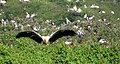 Birds at the sanctuary
 -
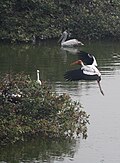
-

-

-

-

-

-

-

-

-

-

-

-
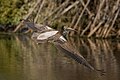


See also[edit | edit source]
References[edit | edit source]
- ↑ 1.00 1.01 1.02 1.03 1.04 1.05 1.06 1.07 1.08 1.09 1.10 1.11 1.12 "Vedanthangal Bird Sanctuary" (PDF). Ramsar. Retrieved 7 August 2022.
- ↑ 2.0 2.1 2.2 2.3 2.4 2.5 National Parks and Wildlife Sanctuaries in India (PDF). Ministry of Environment, Forest and Climate Change, Government of India (Report). November 2021. Retrieved 1 June 2024.
- ↑ "Tamil Lexicon". University of Madras. Retrieved 1 June 2024.
- ↑ Bates, RSP (1931). Birdlife in India. Bombay Natural History Society.
- ↑ Shortt, John (1866). "Account of a heronry, and breeding-place of other water-birds, in southern India". Zoologist. 1: 11–16.
- ↑ Hume, AO (1889). The nests and eggs of Indian Birds. Volume 3. R H Porter. pp. 238–239.
- ↑ "Bio-Diversity and Wild Life in Tamil Nadu". Ministry of Environment, Forest and Climate Change, Government of India. Archived from the original on 10 April 2018. Retrieved 1 June 2024.
- ↑ "Tamil Nadu". Ministry of Environment, Forest and Climate Change, Government of India. Retrieved 1 June 2024.
- ↑ Venkatraman G; Thiyagesan K; Nagarajan R; Jyothinayakam, J.T. (1 January 2008). Wildlife Biodiversity Conservation. Daya Publishing House. p. 93. ISBN 978-81-7035-529-8.
- ↑ Karkar, S.C. (2009). The Top Ten Temple Towns of India. Kolkota: Mark Age Publication. p. 47. ISBN 978-81-87952-12-1.
- ↑ 11.0 11.1 11.2 "Bird sanctuaries to open on Friday". The Hindu. 18 November 2013. Retrieved 1 June 2014.
- ↑ Santharam, V.; R. K. G. Menon (1991). "Observations on the water-bird populations of the Vedanthangal Bird Sanctuary". Newsletter for Birdwatchers. 31: 6-8.
- ↑ M. Krishnan. Vedanthangal. p. 9.