



imported>BhagyaMani →top: revised |
Rajesh Ghosh (talk | contribs) m basic update citations for clarity and fixed typos as per guidelines |
||
| Line 1: | Line 1: | ||
{{short description|National park in Rajasthan, India}} | |||
{{Use dmy dates|date=July 2018}} | {{Use dmy dates|date=July 2018}} | ||
{{Use Indian English|date=July 2018}} | {{Use Indian English|date=July 2018}} | ||
{{Infobox protected area | {{Infobox protected area | ||
| name = Ranthambore National Park | | name = Ranthambore National Park | ||
| | | image = Ranthambore National Park.JPG | ||
| map = India Rajasthan | | image_caption = | ||
| map = India Rajasthan#India | |||
| map_caption = Location in Rajasthan | |||
| relief = 1 | | relief = 1 | ||
| label = | | mapframe = Yes | ||
| label = | |||
| label_position = right | | label_position = right | ||
| iucn_category = II | | iucn_category = II | ||
| location = [[Sawai Madhopur]], [[Rajasthan]], | | mapframe-zoom = 10 | ||
| nearest_city = [[Sawai Madhopur]] | | location = [[Sawai Madhopur]], [[Rajasthan]], India | ||
| nearest_city = [[Sawai Madhopur]] | |||
| coordinates = {{coord|26.01733|N|76.50257|E|format=dms|display=inline,title}} | | coordinates = {{coord|26.01733|N|76.50257|E|format=dms|display=inline,title}} | ||
| area_km2 = 1334 | | area_km2 = 1334 | ||
| established = 1980 | | established = {{ubl|1974 (as Tiger Reserve)|1980 (as National Park)}} | ||
| website = | | website = | ||
| visitation_num = | | visitation_num = | ||
| visitation_year = | | visitation_year = | ||
| governing_body = [[Ministry of Environment and Forests]], [[Project Tiger]] | | governing_body = [[Ministry of Environment and Forests]], [[Project Tiger]] | ||
}} | }} | ||
'''Ranthambore National Park''' is a [[national park]] in [[ | '''Ranthambore National Park''' is a [[national park]] in the [[India]]n state of [[Rajasthan]]. It covers a total area of {{cvt|1,334|km2}}. It is bounded to the north by the [[Banas River]] and to the south by the [[Chambal River]]. It is named after the historic [[Ranthambore Fort]], which lies within its boundaries in [[Sawai Madhopur district]].<ref>{{Cite web |title=Ranthambore National Park |url=https://www.rajasthan.gov.in/content/raj/rajsthan/department/forest-department/en/wildlife/ranthambore-national-park.html | ||
|publisher=Government of Rajasthan |access-date=<!-- insert date -->}}</ref> | |||
== History == | == History == | ||
Ranthambore National Park was established as Sawai Madhopur Game Sanctuary in 1955, initially covering an area of {{ | Ranthambore National Park was established as the ''Sawai Madhopur Game Sanctuary'' in 1955, initially covering an area of {{cvt|282|km²}}. It was declared one of the [[Project Tiger]] reserves in 1974.<ref name=Riley2005/> It was declared a national park in 1980.{{cn|date=October 2025}} | ||
== | == Geography== | ||
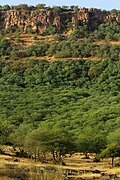
[[File: | [[File:Jungle Landscape.jpg|thumb|Landscape of Ranthambore National Park]] | ||
Ranthambore National Park covers a total area of {{cvt|1334|km2}} including the [[Kailadevi Wildlife Sanctuary]] and Sawai Man Singh Sanctuary. The core area spans approximately {{cvt|275|km2}}. It harbours dry [[deciduous]] forests and open grassy meadows at an elevation range of about {{cvt|215-505|m}}.<ref>{{cite book |date=2003 |last=Derr |first=P. G. |title=Case studies in environmental ethics |publisher=Rowman & Littlefield |location=Maryland, USA |page=17 |isbn= 0742531376}}</ref> | |||
[[ | |||
{{ | |||
[[Ranthambore Fort]] was built in the 10th century at {{ | [[Ranthambore Fort]] was built in the 10th century by [[Chahamanas of Ranastambhapura]] at {{cvt|700|ft|order=flip}} above the surrounding plain. Inside the fort are three red-stone temples devoted to [[Ganesh]], [[Shiva]] and Ramlalaji. There is a Digamber [[Jain temple]] of [[Sumatinatha]] and [[Sambhavanatha]]. The temples were constructed in the 12th and 13th centuries. Padam Talao is the largest of the many lakes in the park. A red sandstone Jogi Mahal is on the edge of the lake.<ref name=BusinessInsider2021>{{Cite news|url=https://www.businessinsider.in/thelife/article/ranthambore-national-park-features-an-excellent-variety-of-wildlife-amidst-dry-scrublands-and-fortress-ruins/articleshow/82015167.cms|title=Ranthambore National Park features an excellent variety of wildlife amidst dry scrublands and fortress ruins|work=[[Business Insider]]|date=2021|access-date=15 January 2025}}</ref> | ||
==Flora== | |||
Ranthambore National Park harbours over 300 tree species , including more than 100 of medicinal importance.<ref name=Riley2005/> | |||
The land features dense tropical dry forest, open bushland, and rocky terrain, interspersed with lakes and streams. The ecoregion includes the [[Khathiar-Gir dry deciduous forests]].<ref name=IM0206>{{WWF ecoregion |id=im0206 |name=Kathiarbar-Gir Dry Deciduous Forests |access-date=2017-02-14}}</ref> | |||
== Fauna == | |||
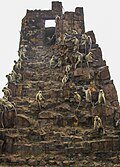
[[File: | [[File:Get Together.jpg|thumb|A group of gray langurs at Ranthambore fort]] | ||
[[File:Spotted deer in Ranthambhore Tiger Reserve.jpg|thumb|Spotted deer herd in Ranthambore National Park]] | |||
Ranthambore National Park hosts many wild animals, including [[chital]], [[Sambar deer|sambar]], [[blackbuck]], [[chinkara]], [[nilgai]], [[langur]]s, [[rhesus macaque]], [[golden jackal]], [[striped hyena]], [[jungle cat]], [[caracal]], [[leopard]], [[tiger]] and [[sloth bear]].<ref name="BusinessInsider2021"/><ref name="TimesofIndia2024">{{Cite web|url=https://timesofindia.indiatimes.com/travel/things-to-do/7-wildlife-species-you-should-look-out-for-when-in-ranthambore-national-park/articleshow/113421809.cms|title=7 wildlife species you should look out for when in Ranthambore National Park|work=[[Times of India]]|date=17 September 2024|access-date=15 January 2025}}</ref> The park hosts over 270 species of birds, including [[peafowl]], [[crested serpent eagle]], [[painted francolin]], and [[Indian paradise flycatcher]].<ref name="TimesofIndia2024"/><ref name=Riley2005>{{cite book |date=2005 |last=Riley |first=L. |title=Nature's strongholds : the world's greatest wildlife reserves |publisher=Princeton University Press |location=Princeton, USA |page=225 |isbn=9780691122199}}</ref> | |||
=== Tigers === | === Tigers === | ||
[[File:Tiger from Ranthanbore Sawai Madhopur Rajasthan India 12.10.2014.jpg|thumb|Tiger in Ranthambore National Park]] | |||
[[File:Tiger from Ranthanbore Sawai Madhopur Rajasthan India 12.10.2014.jpg|thumb| | Ranthambore is known for its [[Bengal tiger]] population. During the past few years, there has been a decline in numbers due to poaching and other reasons.<ref name="Sadhu et al., 2017">{{Cite journal |last1=Sadhu |first1=A. |last2=Jayam |first2=P. P. C. |last3=Qureshi |first3=Q. |last4=Shekhawat |first4=R. S. |last5=Sharma |first5=S. |author6-link=Yadvendradev Vikramsinh Jhala |last6=Jhala |first6=Y. V. |title=Demography of a small, isolated tiger (''Panthera tigris tigris'') population in a semi-arid region of western India |journal=BMC Zoology |volume=2 |article-number=16 |doi=10.1186/s40850-017-0025-y |date=2017 |doi-access=free}}</ref> The number of tigers was 25 in 2005 and 48 in 2013.<ref>{{cite news |title=Two more cubs spotted in Ranthambore |date=2014 |work=The Times of India |access-date=7 July 2014 |url=http://timesofindia.indiatimes.com/city/jaipur/Two-more-cubs-spotted-in-Ranthambore/articleshow/35694718.cms}}</ref> As of 2022, there were 69 tigers in the national park.<ref>{{Cite web |last=Patil |first=N. |date=2024 |title=Conservation not enough for the highly inbred Ranthambore tigers — they require genetic rescue |url=https://www.downtoearth.org.in/wildlife-biodiversity/conservation-not-enough-for-the-highly-inbred-ranthambore-tigers-they-require-genetic-rescue-95077 |access-date=2025-10-24 |work=Down To Earth}}</ref> | ||
Ranthambore is known for its | |||
== Ecosystem | == Ecosystem valuation == | ||
Economic valuation of the tiger reserve estimated that its flow benefits are worth 8.3 billion rupees (0.56 lakh/hectare) annually. Gene-pool protection services (7.11 billion), provisioning of water to the neighbouring region (115 million) and provisioning of habitat and | Economic valuation of the tiger reserve estimated that its flow benefits are worth 8.3 billion rupees (0.56 lakh/hectare) annually. Gene-pool protection services (7.11 billion), provisioning of water to the neighbouring region (115 million) and provisioning of habitat and refuge for wildlife (182 million) were some of the important services that emanated from the tiger reserve. Other services included [[nutrient cycling]] (34 million) and [[carbon sequestration|sequestration of carbon]] (69 million).<ref>{{cite web| title=Economic Valuation of Tiger Reservers in India – A value+ approach |url=http://www.iifm.ac.in/sites/default/files/Newspdf/IIFM-NTCA-REPORT.compressed-min.pdf |access-date=14 August 2016 |url-status=dead |archive-url=https://web.archive.org/web/20160826050803/http://www.iifm.ac.in/sites/default/files/Newspdf/IIFM-NTCA-REPORT.compressed-min.pdf| archive-date=26 August 2016}}</ref> | ||
== See also == | == See also == | ||
* [[Indian Council of Forestry Research and Education]] | * [[Indian Council of Forestry Research and Education]] | ||
* [[Rajiv Gandhi Regional Museum of Natural History]] | * [[Rajiv Gandhi Regional Museum of Natural History]] | ||
== References == | == References == | ||
{{Reflist}} | {{Reflist}} | ||
*Singh, V. | |||
== Further reading == | |||
*Singh, V.; Shrivastava, A. 2007. Biodiversity of Ranthambhore Tiger Reserve, Rajasthan. Scientific Publishers, Jodhpur. {{ISBN|81-7233-492-3}}. | |||
== External links == | == External links == | ||
{{National Parks of India}} | {{National Parks of India}} | ||
Revision as of 14:54, 12 March 2026
| Ranthambore National Park | |
|---|---|
  Location in Rajasthan  Ranthambore National Park (India) | |
| Location | Sawai Madhopur, Rajasthan, India |
| Nearest city | Sawai Madhopur |
| Coordinates | 26°01′02″N 76°30′09″E / 26.01733°N 76.50257°E |
| Area | 1,334 km2 (515 sq mi) |
| Established |
|
| Governing body | Ministry of Environment and Forests, Project Tiger |
Ranthambore National Park is a national park in the Indian state of Rajasthan. It covers a total area of 1,334 km2 (515 sq mi). It is bounded to the north by the Banas River and to the south by the Chambal River. It is named after the historic Ranthambore Fort, which lies within its boundaries in Sawai Madhopur district.[1]
History
Ranthambore National Park was established as the Sawai Madhopur Game Sanctuary in 1955, initially covering an area of 282 km2 (109 sq mi). It was declared one of the Project Tiger reserves in 1974.[2] It was declared a national park in 1980.[citation needed]
Geography

Ranthambore National Park covers a total area of 1,334 km2 (515 sq mi) including the Kailadevi Wildlife Sanctuary and Sawai Man Singh Sanctuary. The core area spans approximately 275 km2 (106 sq mi). It harbours dry deciduous forests and open grassy meadows at an elevation range of about 215–505 m (705–1,657 ft).[3]
Ranthambore Fort was built in the 10th century by Chahamanas of Ranastambhapura at 210 m (700 ft) above the surrounding plain. Inside the fort are three red-stone temples devoted to Ganesh, Shiva and Ramlalaji. There is a Digamber Jain temple of Sumatinatha and Sambhavanatha. The temples were constructed in the 12th and 13th centuries. Padam Talao is the largest of the many lakes in the park. A red sandstone Jogi Mahal is on the edge of the lake.[4]
Flora
Ranthambore National Park harbours over 300 tree species , including more than 100 of medicinal importance.[2] The land features dense tropical dry forest, open bushland, and rocky terrain, interspersed with lakes and streams. The ecoregion includes the Khathiar-Gir dry deciduous forests.[5]
Fauna


Ranthambore National Park hosts many wild animals, including chital, sambar, blackbuck, chinkara, nilgai, langurs, rhesus macaque, golden jackal, striped hyena, jungle cat, caracal, leopard, tiger and sloth bear.[4][6] The park hosts over 270 species of birds, including peafowl, crested serpent eagle, painted francolin, and Indian paradise flycatcher.[6][2]
Tigers

Ranthambore is known for its Bengal tiger population. During the past few years, there has been a decline in numbers due to poaching and other reasons.[7] The number of tigers was 25 in 2005 and 48 in 2013.[8] As of 2022, there were 69 tigers in the national park.[9]
Ecosystem valuation
Economic valuation of the tiger reserve estimated that its flow benefits are worth 8.3 billion rupees (0.56 lakh/hectare) annually. Gene-pool protection services (7.11 billion), provisioning of water to the neighbouring region (115 million) and provisioning of habitat and refuge for wildlife (182 million) were some of the important services that emanated from the tiger reserve. Other services included nutrient cycling (34 million) and sequestration of carbon (69 million).[10]
See also
References
- ↑ "Ranthambore National Park". Government of Rajasthan.
- ↑ 2.0 2.1 2.2 Riley, L. (2005). Nature's strongholds : the world's greatest wildlife reserves. Princeton, USA: Princeton University Press. p. 225. ISBN 9780691122199.
- ↑ Derr, P. G. (2003). Case studies in environmental ethics. Maryland, USA: Rowman & Littlefield. p. 17. ISBN 0742531376.
- ↑ 4.0 4.1 "Ranthambore National Park features an excellent variety of wildlife amidst dry scrublands and fortress ruins". Business Insider. 2021. Retrieved 15 January 2025.
- ↑ "Kathiarbar-Gir Dry Deciduous Forests". Terrestrial Ecoregions. World Wildlife Fund. Retrieved 14 February 2017.
- ↑ 6.0 6.1 "7 wildlife species you should look out for when in Ranthambore National Park". Times of India. 17 September 2024. Retrieved 15 January 2025.
- ↑ Sadhu, A.; Jayam, P. P. C.; Qureshi, Q.; Shekhawat, R. S.; Sharma, S.; Jhala, Y. V. (2017). "Demography of a small, isolated tiger (Panthera tigris tigris) population in a semi-arid region of western India". BMC Zoology. 2 16. doi:10.1186/s40850-017-0025-y.
- ↑ "Two more cubs spotted in Ranthambore". The Times of India. 2014. Retrieved 7 July 2014.
- ↑ Patil, N. (2024). "Conservation not enough for the highly inbred Ranthambore tigers — they require genetic rescue". Down To Earth. Retrieved 24 October 2025.
- ↑ "Economic Valuation of Tiger Reservers in India – A value+ approach" (PDF). Archived from the original (PDF) on 26 August 2016. Retrieved 14 August 2016.
Further reading
- Singh, V.; Shrivastava, A. 2007. Biodiversity of Ranthambhore Tiger Reserve, Rajasthan. Scientific Publishers, Jodhpur. ISBN 81-7233-492-3.
