




m Bot: Delinking broken file(s) using script (info) |
rework citations and cleaned formatting for clarity |
||
| Line 4: | Line 4: | ||
{{Use dmy dates|date=April 2020}} | {{Use dmy dates|date=April 2020}} | ||
{{Infobox former subdivision | {{Infobox former subdivision | ||
|native_name = | | native_name = | ||
|conventional_long_name = Hyderabad State | | conventional_long_name = Hyderabad State | ||
|common_name = Hyderabad State | | common_name = Hyderabad State | ||
|nation = [[India]] | | nation = [[India]] | ||
|status_text = [[States and union territories of India|State of India]] | | status_text = [[States and union territories of India|State of India]] | ||
|coordinates={{Coord|17|00|N|78|50|E|display=title}} | | coordinates = {{Coord|17|00|N|78|50|E|display=title}} | ||
|era = | | era = | ||
|year_start = 1948 | | year_start = 1948 | ||
|date_start = | | date_start = 1948-09-17 | ||
|event_start= Hyderabad State formed from [[Hyderabad State| | | event_start = Hyderabad State formed from [[Hyderabad State|Princely State of Hyderabad]] | ||
|year_end = 1956 | | year_end = 1956 | ||
|date_end = | | date_end = 1956-10-31 | ||
|event_end= | | event_end = Reorganised and renamed as [[Andhra Pradesh (1956–2014)|Andhra Pradesh]] | ||
|event1 = | | event1 = | ||
|date_event1 = | | date_event1 = | ||
|p1 = Hyderabad State | | p1 = Hyderabad State | ||
|s1 = Andhra Pradesh ( | | s1 = Andhra Pradesh (1956–2014)|Andhra Pradesh | ||
|s2 = | | s2 = Mysore State | ||
|s3 = | | s3 = Bombay State | ||
|flag_p1 = Asafia flag of Hyderabad State. | | flag_p1 = Asafia flag of Hyderabad State.svg | ||
|flag_s1 = | | flag_s1 =Emblem of Andhra Pradesh before 2014.svg | ||
|flag_s2 = | | flag_s2 = Flag of Karnataka, India.png | ||
|flag_s3 = . | | flag_s3 = Emblem of Bombay State.svg | ||
|image_flag = | | image_flag = | ||
|image_coat = Hyderabad | | image_coat = Emblem of Hyderabad State (1948–1956).svg | ||
|image_map = Hyderabad in India (1951).svg | | image_map = Hyderabad in India (1951).svg | ||
|image_map_caption = Hyderabad in India (1951) | | image_map_caption = Hyderabad in India (1951) | ||
|stat_area1 = | | stat_area1 = | ||
|stat_year1 = | | stat_year1 = | ||
|stat_pop1 = | | stat_pop1 = | ||
|today = [[Telangana]]<br>[[Maharashtra]]<br>[[Karnataka]] | | today = [[Telangana]]<br>[[Maharashtra]]<br>[[Karnataka]] | ||
|footnotes = [http://www.worldstatesmen.org/India_states.html States of India since 1947] | | footnotes = [http://www.worldstatesmen.org/India_states.html States of India since 1947] | ||
}} | }} | ||
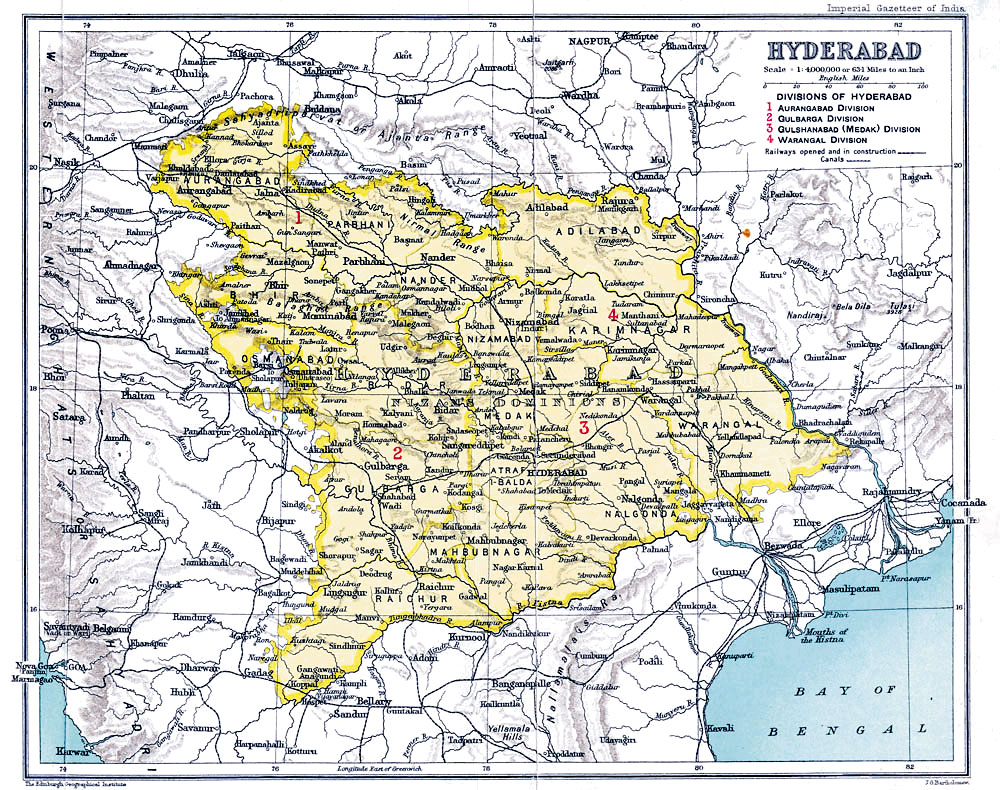
[[File:Hyderabad state from the Imperial Gazetteer of India, 1909.jpg|thumb| | [[File:Hyderabad state from the Imperial Gazetteer of India, 1909.jpg|thumb|263x263px|Hyderabad state until 1956]] | ||
'''Hyderabad State''' was a [[States and union territories of India|state]] in [[Dominion of India|Dominion]] and later [[India|Republic of India]], formed after the accession of the | '''Hyderabad State''' was a [[States and union territories of India|state]] in the [[Dominion of India|Dominion]] and later [[India|Republic of India]], formed after the accession of the [[State of Hyderabad]] into the [[Dominion of India|Union]] on 17 September 1948.<ref>{{cite web |newspaper=The Times of India |date=15 September 2019 |url=https://timesofindia.indiatimes.com/city/hyderabad/hyderabad-had-tried-nrc-71-years-ago-and-failed/articleshow/71132138.cms|title=Hyderabad had tried 'NRC' 71 years ago, and failed}}</ref> It existed from 1948 to 1956. Hyderabad State comprised present day [[Telangana]], [[Marathwada]], and [[Hyderabad-Karnataka]]. | ||
Following the [[States Reorganisation Act]], which implemented a linguistic | Following the [[States Reorganisation Act]], which implemented a linguistic reorganisation of states, the Hyderabad state was dissolved. Its different regions were merged with [[Andhra State]], [[Mysore State]] and [[Bombay State]] respectively.<ref name="sorg1956">. | ||
|url=http://www.commonlii.org/in/legis/num_act/sra1956250/ | {{cite web | ||
|title=States Reorganization Act 1956 | |url=http://www.commonlii.org/in/legis/num_act/sra1956250/ | ||
|access-date=1 July 2008 | |title=States Reorganization Act 1956 | ||
|publisher=Commonwealth Legal Information Institute | |access-date=1 July 2008 | ||
|url-status=dead | |publisher=Commonwealth Legal Information Institute | ||
|archive-url=https://web.archive.org/web/20080516123014/http://www.commonlii.org/in/legis/num_act/sra1956250/ | |url-status=dead | ||
|archive-date=16 May 2008 | |archive-url=https://web.archive.org/web/20080516123014/http://www.commonlii.org/in/legis/num_act/sra1956250/ | ||
|archive-date=16 May 2008 | |||
}}</ref> | }}</ref> | ||
[[File:ChoudharyAdressingCrowds Nehru Presence FatehMaidan.jpg|thumb|left|180px|Major General Choudhary addressing crowds at [[Fateh Maidan]] as Nehru looks on]] | |||
== | ==Annexation== | ||
{{Main| | {{Main|Annexation of Hyderabad}} | ||
{{#section:Annexation of Hyderabad|Lead}} | {{#section:Annexation of Hyderabad|Lead}} | ||
The | Following the Nizam's forces surrender on September 17, 1948, a military government headed by [[Joyanto Nath Chaudhuri|Major General J. N. Chaudhuri]] who led Operation Polo was established. A ''[[firman]]'' was issued by the Nizam on November 24, 1949 wherein he accepted henceforth the Indian Constitution to be applicable to the State of Hyderabad. The [[Instrument of Accession]] was signed by the Nizam on January 25, 1950. Later the next day, as India became a [[Republic Day (India)|Republic]] on January 26, Nizam took over as the ''[[Rajpramukh|Raj Pramukh]]''.<ref name="TimesInd1"/> | ||
== | ==Resolution at the United Nations== | ||
[[ | On September 20, 1948, during the 359th meeting of [[United Nations Security Council|Security Council]] a representative from India informed that Nizam had instructed the representative of Hyderabad decided to withdraw the complaint from Security Council. On 22 September 1948 a cable sent by Nizam to [[Secretary-General of the United Nations|Secretary General]] confirmed the same. The cable also stated that that Hyderabad delegation at United Nations ceased to have any authority to either represent [[Hyderabad State|Hyderabad]] or the Nizam. The Hyderabad delegation denied this, however on 24 September the delegation of Hyderabad confirmed the same and informed Security Council that Hyderabad State has surrendered and Government India had instructed Agents-General of Hyderabad to suspend all overseas activities.<ref>{{cite book |last= |first= |author-link= |date= |title= Yearbook of the United Nations 1948-49|url= https://cdn.un.org/unyearbook/yun/pdf/1948-49/1948-49_309.pdf|location= |publisher=[[United Nations]] |page= 299|isbn=9789210602204}}</ref> | ||
== | ==Government formation after Integration== | ||
[[File:First cabinet of Hyderabad State with the Nizam of Hyderabad, Mir Osman Ali Khan.jpg|thumb|right|205px|First cabinet of the Hyderabad State]] | |||
A military government headed by [[Joyanto Nath Chaudhuri|Major General J. N. Chaudhuri]] who led Operation Polo was established. He stayed on as Military Governor till December 1949.<ref name="TimesInd1">{{cite news|url=https://timesofindia.indiatimes.com/city/hyderabad/nizam-writ-ran-after-police-action-till-1950-accession/articleshow/103486501.cms|title=Nizam writ ran after police action till 1950 accession|publisher=[[Times of India]]|first=Syded|last=Akbar|date=2023-09-08|access-date=2024-11-07}}</ref> | |||
On 1 December 1949, the military government was dissolved and a civilian government headed by [[M. K. Vellodi]] was formed in its place. Nizam signed the [[Instrument of Accession]] with the central government on 25 January 1950 thus formally completing the annexation formalities. On next day i.e. 26 January 1950, the last [[Mir Osman Ali Khan|Nizam]] assumed his new role as the [[Rajpramukh|Raj Pramukh]].<ref name="TimesInd1"/> In March 1952, [[Burgula Ramakrishna Rao]] became the second Chief Minister of Hyderabad State and the first democratically elected Chief Minister. The last Nizam [[Mir Osman Ali Khan]] continued in his role as the head of state as ''Rajpramukh'' till 1956 when Hyderabad State was split on linguistic basis and reorganised into three states and Hyderabad as a [[States and union territories of India|State]] ceased to exist.<ref> Ian Copland, ''The Princes of India in the Endgame of Empire, 1917-1947'' (Cambridge University Press, 2002), p. x</ref> | |||
The | The state witnessed [[1952 Mulkhi Agitation (Telangana)|Mulkhi agitation in 1952]] by the locals after government jobs meant for the locals were given to non-locals.{{Citation needed|date=January 2022}} | ||
== | {|class="wikitable" | ||
|- | |||
! No | |||
= | ! Portrait | ||
! Name | |||
!colspan=2| Term of office | |||
!scope=col|Duration | |||
! Office(s) held | |||
|- align=center | |||
| 1 | |||
| [[File:Taking oath as rajpramukh.jpg|148px]] | |||
! [[Mir Osman Ali Khan]] | |||
| 26 January 1950 | |||
| 31 October 1956 | |||
| {{age in years and days|1950|01|26|1956|10|31}} | |||
| [[Rajpramukh]] | |||
|- align=center style="height: 60px;" | |||
|} | |||
{|class="wikitable" | |||
|- | |||
! No | |||
! Portrait | |||
! Name | |||
!colspan=2| Term of office | |||
!scope=col|Duration | |||
! Office(s) held | |||
|- align=center | |||
| 1 | |||
| [[File:General Jayanto Nath Chaudhuri.jpg|90px]] | |||
! [[Jayanto Nath Chaudhuri]] | |||
| 17 September 1948 | |||
| 1 December 1949 | |||
| {{age in years and days|1948|09|17|1949|12|01}} | |||
| [[Military Governor#British Empire and Commonwealth realms|Military Governor of Hyderabad]] | |||
|- align=center style="height: 60px;" | |||
|} | |||
{| class="wikitable | {|class="wikitable" | ||
|- | |- | ||
! No | ! No | ||
! Portrait | |||
! Name | ! Name | ||
!colspan=2| Term of office | !colspan=2| Term of office | ||
! | !scope=col|Duration | ||
! | ! Office(s) held | ||
|- | |- align=center | ||
| 1 | | 1 | ||
| [[M. K. Vellodi]] | | [[File:M.K.Vellodi.jpg|90px]] | ||
! [[M. K. Vellodi]] | |||
| | | 01 December 1949 | ||
| 6 March 1952 | | 6 March 1952 | ||
| | | {{age in years and days|1949|12|01|1952|03|06}} | ||
| | | Chief Minister of Hyderabad | ||
| | |- align=center style="height: 60px;" | ||
|- style="height: 60px;" | |} | ||
| 2 | {|class="wikitable" | ||
| | |- | ||
| [[File:Burgula Ramakrishna Rao, 1952.jpg| | ! No | ||
! Portrait | |||
! Name | |||
!colspan=2| Term of office | |||
!scope=col|Duration | |||
! Office(s) held | |||
|- align=center | |||
| 1 | |||
| [[File:Burgula Ramakrishna Rao, 1952.jpg|90px]] | |||
! [[Burgula Ramakrishna Rao]] | |||
| 6 March 1952 | | 6 March 1952 | ||
| 31 October 1956 | | 31 October 1956 | ||
|rowspan= | | {{age in years and days|1952|03|06|1956|10|31}} | ||
|rowspan= | | Chief Minister of Hyderabad | ||
| | |- align=center style="height: 60px;" | ||
|} | |||
==Elections== | |||
In the first [[1952 Hyderabad Legislative Assembly election|State Assembly election in India, 1952]], Dr. [[Burgula Ramakrishna Rao]] was elected Chief Minister of Hyderabad State. During this time there were violent agitations by some [[Telangana|Telanganites]] to send back bureaucrats from Madras state, and to strictly implement 'Mulki-rules' (Local jobs for locals only), which was part of Hyderabad state law since 1919.<ref name="mulki1">{{cite web |url=http://www.hinduonnet.com/2002/09/06/stories/2002090603210900.htm |title=Mulki agitation in Hyderabad state |publisher=Hinduonnet.com |access-date=9 October 2011 |archive-url=https://web.archive.org/web/20100826122139/http://www.hinduonnet.com/2002/09/06/stories/2002090603210900.htm |archive-date=26 August 2010 |url-status=usurped }}</ref> | |||
==List of districts of Hyderabad State== | |||
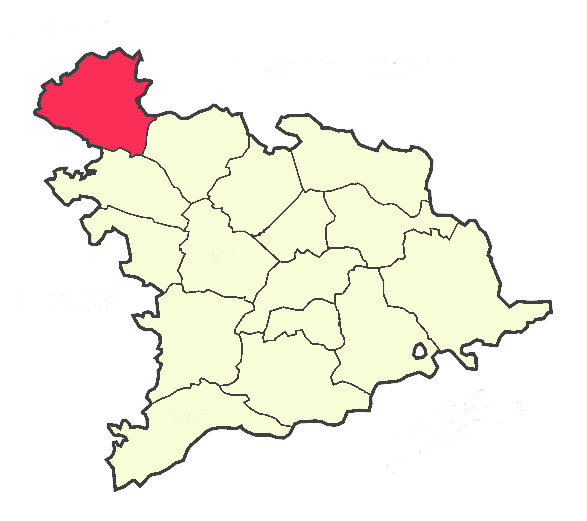
Administratively, Hyderabad State was made up of sixteen districts, grouped into four divisions:{{Citation needed|date=January 2022}}. | |||
{| class="wikitable sortable" | |||
|- | |||
! scope="col" | Official name | |||
! scope="col" | Division | |||
! scope="col" | Map | |||
|- | |||
!style="text-align:center;"|[[Aurangabad district, Maharashtra|Aurangabad]] | |||
|rowspan=4 style="text-align:center;"|[[Aurangabad Division]] | |||
|style="image-align:center;"|[[File:Aurangabad-District Hyderabad-State.png|100px]] | |||
|- | |||
!style="text-align:center;"|[[Beed District|Bhir]] | |||
|style="image-align:center;"|[[File:Bhir-District Hyderabad-State.png|100px]] | |||
|- | |||
!style="text-align:center;"|[[Nanded District|Nander]] | |||
|style="image-align:center;"|[[File:Nander-District Hyderabad-State.png|100px]] | |||
|- | |||
!style="text-align:center;"|[[Parbhani District|Parbhani]] | |||
|style="image-align:center;"|[[File:Parbhani-District Hyderabad-State.png|100px]] | |||
|- | |||
!style="text-align:center;"|[[Bidar District|Bidar]] | |||
|rowspan=4 style="text-align:center;"|[[Gulbarga Division]] | |||
|style="image-align:center;"|[[File:Bidar-District Hyderabad-State.png|100px]] | |||
|- | |||
!style="text-align:center;"|[[Gulbarga District|Gulbarga]] | |||
|style="image-align:center;"|[[File:Gulbarga-District Hyderabad-State.png|100px]] | |||
|- | |||
!style="text-align:center;"|[[Osmanabad District|Osmanabad]] | |||
|style="image-align:center;"|[[File:Osmanabad-District Hyderabad-State.png|100px]] | |||
|- | |||
!style="text-align:center;"|[[Raichur District|Raichur]] | |||
|style="image-align:center;"|[[File:Raichur-District Hyderabad-State.png|100px]] | |||
|- | |||
!style="text-align:center;"|[[Atraf-i-Baldah]] | |||
|rowspan=5 style="text-align:center;"|[[Gulshanabad Division|Gulshanabad (Medak) Division]] | |||
|style="image-align:center;"|[[File:Atraf-i-Baldah-District Hyderabad-State.png|100px]] | |||
|- | |||
!style="text-align:center;"|[[Mahbubnagar district|Mahbubnagar]] | |||
|style="image-align:center;"|[[File:Mabubnagar-District Hyderabad-State.png|100px]] | |||
|- | |||
!style="text-align:center;"|[[Medak district|Medak]] | |||
|style="image-align:center;"|[[File:Medak-District Hyderabad-State.png|100px]] | |||
|- | |||
!style="text-align:center;"|[[Nalgonda district|Nalgonda]] | |||
|style="image-align:center;"|[[File:Nalgonda-District Hyderabad-State.png|100px]] | |||
|- | |||
!style="text-align:center;"|[[Nizamabad district|Nizamabad]] | |||
|style="image-align:center;"|[[File:Nizamabad-District Hyderabad-State.png|100px]] | |||
|- | |||
!style="text-align:center;"|[[Adilabad district|Adilabad]] | |||
|rowspan=3 style="text-align:center;"|[[Warangal Division]] | |||
|style="timage-align:center;"|[[File:Adilabad-District Hyderabad-State.png|100px]] | |||
|- | |||
!style="text-align:center;"|[[Karimnagar district|Karimnagar]] | |||
|style="image-align:center;"|[[File:Karimnagar-District Hyderabad-State.png|100px]] | |||
|- | |||
!style="text-align:center;"|[[Warangal district|Warangal]] | |||
|style="image-align:center;"|[[File:Warangal-District Hyderabad-State.png|100px]] | |||
|} | |} | ||
== | ==Reorganisation on linguistic basis== | ||
[[File:Hyderabad State reorganization 1956.png|thumb|231x231px|left|1956 map showing Hyderabad state in yellowish green. After the state reorganisation in 1956, regions west of the red and blue lines merged with [[Bombay State|Bombay]] and [[Mysore State]] respectively and the remaining part ([[Telangana]]) was merged with [[Andhra State]] to form [[Andhra Pradesh (1956–2014)|Andhra Pradesh]].]] | |||
In 1956 during the [[States Reorganisation Act|reorganisation of the Indian states]] based along linguistic lines, the Telugu-speaking region of the state of Hyderabad State was merged with [[Andhra State]]. The Marathi speaking region was merged with [[Bombay State]] and Kannada speaking region with [[Mysore State]].{{Citation needed|date=January 2022}} | |||
The [[s:India States Reorganisation Commission Report Telangana Andhra|States Reorganisation Commission]] (SRC) was not in favour of an immediate merger of Telugu-speaking [[Telangana]] region of Hyderabad State with [[Andhra State]], despite their common language. Para 378 of the SRC report said ''One of the principal causes of opposition of Vishalandhra also seems to be the apprehension felt by the educationally backward people of Telangana that they may be swamped and exploited by the more advanced people of the coastal areas.{{Citation needed|date=January 2022}}'' | |||
[[Andhra State|Andhra]] and the Telugu speaking parts of Hyderabad State were merged to form [[Andhra Pradesh (1956–2014)|Andhra Pradesh]] on 1 November 1956, after providing safeguards to Telangana in the form of [[Gentlemen's agreement of Andhra Pradesh (1956)|Gentlemen's agreement]]. In June 2014, Andhra Pradesh was split and Telangana was created as a separate state. [[Hyderabad city]] remained as the joint capital of both Andhra Pradesh and Telangana for 10 years till 1st June 2024.<ref>{{Cite news|url=https://timesofindia.indiatimes.com/city/hyderabad/hyderabad-no-more-capital-of-andhra-pradesh-from-today/articleshow/110627872.cms|title=Hyderabad no more capital of Andhra Pradesh from today| last=Koride|first=Mahesh|date=2024-06-02|access-date=2024-07-19}}</ref> | |||
==Notes== | ==Notes== | ||
| Line 127: | Line 226: | ||
<ref name=ShermanLSE>{{cite journal|last1=Sherman|first1=Taylor C.|title=The integration of the princely state of Hyderabad and the making of the postcolonial state in India, 1948 – 56|journal=Indian Economic & Social History Review|volume=44|issue=4|pages=489–516|url=http://eprints.lse.ac.uk/32805/1/Sherman_Integration_princely_state_2007.pdf|date=2007|doi=10.1177/001946460704400404|s2cid=145000228}}</ref> | <ref name=ShermanLSE>{{cite journal|last1=Sherman|first1=Taylor C.|title=The integration of the princely state of Hyderabad and the making of the postcolonial state in India, 1948 – 56|journal=Indian Economic & Social History Review|volume=44|issue=4|pages=489–516|url=http://eprints.lse.ac.uk/32805/1/Sherman_Integration_princely_state_2007.pdf|date=2007|doi=10.1177/001946460704400404|s2cid=145000228}}</ref> | ||
}} | }} | ||
==Sources== | |||
* {{citation |last1=Chandra |first1=Bipan |author-link=Bipan Chandra |last2=Mukherjee |first2=Aditya |last3=Mukherjee |first3=Mridula |title=India Since Independence |url=https://books.google.com/books?id=dE9qEg-NgHMC |year=2008 |orig-year=first published 1999 |publisher=Penguin Books India |isbn=978-0-14-310409-4}} | |||
* {{citation |first=A. G. |last=Noorani |author-link=A. G. Noorani |title=The Destruction of Hyderabad |publisher=Hurst & Co |year=2014 |isbn=978-1-84904-439-4 |url=https://books.google.com/books?id=FzyKngEACAAJ}} | |||
* {{citation |first=Wilfred Cantwell |last=Smith |author-link=Wilfred Cantwell Smith |title=Hyderabad: Muslim Tragedy |journal=Middle East Journal |volume=4 |pages=27–51 |number=1 |date=January 1950 |jstor=4322137}} | |||
== Further reading == | == Further reading == | ||
| Line 136: | Line 240: | ||
{{DEFAULTSORT:Hyderabad State (1948-56)}} | {{DEFAULTSORT:Hyderabad State (1948-56)}} | ||
[[Category:States and territories established in 1948]] | [[Category:States and territories established in 1948]] | ||
[[Category:History of Telangana]] | [[Category:History of Telangana]] | ||
[[Category:History of Andhra Pradesh (1947–2014)]] | [[Category:History of Andhra Pradesh (1947–2014)]] | ||
Latest revision as of 13:21, 16 March 2026
| Hyderabad State | |||||||||||||
|---|---|---|---|---|---|---|---|---|---|---|---|---|---|
| State of India | |||||||||||||
| 1948–1956 | |||||||||||||
Coat of arms
| |||||||||||||
| Error creating thumbnail: File missing Hyderabad in India (1951) | |||||||||||||
| Area | |||||||||||||
| • Coordinates | 17°00′N 78°50′E / 17.000°N 78.833°E | ||||||||||||
| History | |||||||||||||
| History | |||||||||||||
• Hyderabad State formed from Princely State of Hyderabad | 1948-09-17 1948 | ||||||||||||
• Reorganised and renamed as Andhra Pradesh | 1956-10-31 1956 | ||||||||||||
| |||||||||||||
| Today part of | Telangana Maharashtra Karnataka | ||||||||||||
| States of India since 1947 | |||||||||||||



Hyderabad State was a state in the Dominion and later Republic of India, formed after the accession of the State of Hyderabad into the Union on 17 September 1948.[1] It existed from 1948 to 1956. Hyderabad State comprised present day Telangana, Marathwada, and Hyderabad-Karnataka.
Following the States Reorganisation Act, which implemented a linguistic reorganisation of states, the Hyderabad state was dissolved. Its different regions were merged with Andhra State, Mysore State and Bombay State respectively.[2]
Annexation[edit | edit source]
The Annexation of Hyderabad (code-named Operation Polo) was a military operation launched in September 1948 that resulted in the annexation of the princely state of Hyderabad by India, which was dubbed a "police action".[3][4][5]
At the time of partition of India in 1947, the princely states of India, who in principle had self-government within their territories, were subject to subsidiary alliances with the British, which gave control of external relations to the British. With the Indian Independence Act 1947, the British abandoned all such alliances, leaving the states with the option of opting for full independence.[6][7] However, by 1948 almost all had acceded to either India or Pakistan. One major exception was that of the wealthiest and most powerful principality, Hyderabad, where the Nizam, Mir Osman Ali Khan, Asaf Jah VII, a Muslim ruler who presided over a largely Hindu population, chose independence and hoped to maintain this with an irregular army.[8]:224 The Nizam was also beset by the Telangana rebellion, which he was unable to crush.[8]:224
In November 1947, Hyderabad signed a standstill agreement with the Dominion of India, continuing all previous arrangements except for the stationing of Indian troops in the state. India felt that the establishment of a Communist state in Hyderabad would be a threat to the country.[9][10] Nizam's power had weakened because of the Telangana Rebellion, which he could not put down. The Razakars tried to ensure that Nizam's rule was maintained, however they proved unsuccessful. On 7 September, Jawaharlal Nehru gave an ultimatum to Nizam, demanding a ban of the Razakars and the return of Indian troops to Secunderabad.[11][12][13] India invaded the state on 13 September 1948, following a crippling economic blockade and multiple attempts at destabilising the state through railway disruptions, the bombing of government buildings, and raids on border villages.[14][15][16] After the defeat of the Razakars, the Nizam signed an instrument of accession, joining India.[17][18]
The operation led to massive communal violence, at times perpetrated by the Indian Army.[19] The Sunderlal Committee, appointed by Indian prime minister Jawaharlal Nehru, concluded that between 30,000 and 40,000 people had died in total in the state, in a report which was not released until 2013.[20] Other responsible observers estimated the number of deaths to be 200,000 or higher.[21]
Following the Nizam's forces surrender on September 17, 1948, a military government headed by Major General J. N. Chaudhuri who led Operation Polo was established. A firman was issued by the Nizam on November 24, 1949 wherein he accepted henceforth the Indian Constitution to be applicable to the State of Hyderabad. The Instrument of Accession was signed by the Nizam on January 25, 1950. Later the next day, as India became a Republic on January 26, Nizam took over as the Raj Pramukh.[22]
Resolution at the United Nations[edit | edit source]
On September 20, 1948, during the 359th meeting of Security Council a representative from India informed that Nizam had instructed the representative of Hyderabad decided to withdraw the complaint from Security Council. On 22 September 1948 a cable sent by Nizam to Secretary General confirmed the same. The cable also stated that that Hyderabad delegation at United Nations ceased to have any authority to either represent Hyderabad or the Nizam. The Hyderabad delegation denied this, however on 24 September the delegation of Hyderabad confirmed the same and informed Security Council that Hyderabad State has surrendered and Government India had instructed Agents-General of Hyderabad to suspend all overseas activities.[23]
Government formation after Integration[edit | edit source]
A military government headed by Major General J. N. Chaudhuri who led Operation Polo was established. He stayed on as Military Governor till December 1949.[22] On 1 December 1949, the military government was dissolved and a civilian government headed by M. K. Vellodi was formed in its place. Nizam signed the Instrument of Accession with the central government on 25 January 1950 thus formally completing the annexation formalities. On next day i.e. 26 January 1950, the last Nizam assumed his new role as the Raj Pramukh.[22] In March 1952, Burgula Ramakrishna Rao became the second Chief Minister of Hyderabad State and the first democratically elected Chief Minister. The last Nizam Mir Osman Ali Khan continued in his role as the head of state as Rajpramukh till 1956 when Hyderabad State was split on linguistic basis and reorganised into three states and Hyderabad as a State ceased to exist.[24]
The state witnessed Mulkhi agitation in 1952 by the locals after government jobs meant for the locals were given to non-locals.[citation needed]
| No | Portrait | Name | Term of office | Duration | Office(s) held | |
|---|---|---|---|---|---|---|
| 1 | Error creating thumbnail: File missing | Mir Osman Ali Khan | 26 January 1950 | 31 October 1956 | 6 years, 279 days | Rajpramukh |
| No | Portrait | Name | Term of office | Duration | Office(s) held | |
|---|---|---|---|---|---|---|
| 1 | 
|
Jayanto Nath Chaudhuri | 17 September 1948 | 1 December 1949 | 1 year, 75 days | Military Governor of Hyderabad |
| No | Portrait | Name | Term of office | Duration | Office(s) held | |
|---|---|---|---|---|---|---|
| 1 | 
|
M. K. Vellodi | 01 December 1949 | 6 March 1952 | 2 years, 96 days | Chief Minister of Hyderabad |
| No | Portrait | Name | Term of office | Duration | Office(s) held | |
|---|---|---|---|---|---|---|
| 1 | 
|
Burgula Ramakrishna Rao | 6 March 1952 | 31 October 1956 | 4 years, 239 days | Chief Minister of Hyderabad |
Elections[edit | edit source]
In the first State Assembly election in India, 1952, Dr. Burgula Ramakrishna Rao was elected Chief Minister of Hyderabad State. During this time there were violent agitations by some Telanganites to send back bureaucrats from Madras state, and to strictly implement 'Mulki-rules' (Local jobs for locals only), which was part of Hyderabad state law since 1919.[25]
List of districts of Hyderabad State[edit | edit source]
Administratively, Hyderabad State was made up of sixteen districts, grouped into four divisions:[citation needed].


.svg)
.svg)


Reorganisation on linguistic basis[edit | edit source]

In 1956 during the reorganisation of the Indian states based along linguistic lines, the Telugu-speaking region of the state of Hyderabad State was merged with Andhra State. The Marathi speaking region was merged with Bombay State and Kannada speaking region with Mysore State.[citation needed]
The States Reorganisation Commission (SRC) was not in favour of an immediate merger of Telugu-speaking Telangana region of Hyderabad State with Andhra State, despite their common language. Para 378 of the SRC report said One of the principal causes of opposition of Vishalandhra also seems to be the apprehension felt by the educationally backward people of Telangana that they may be swamped and exploited by the more advanced people of the coastal areas.[citation needed]
Andhra and the Telugu speaking parts of Hyderabad State were merged to form Andhra Pradesh on 1 November 1956, after providing safeguards to Telangana in the form of Gentlemen's agreement. In June 2014, Andhra Pradesh was split and Telangana was created as a separate state. Hyderabad city remained as the joint capital of both Andhra Pradesh and Telangana for 10 years till 1st June 2024.[26]
Notes[edit | edit source]
References[edit | edit source]
- ↑ "Hyderabad had tried 'NRC' 71 years ago, and failed". The Times of India. 15 September 2019.
- ↑ . "States Reorganization Act 1956". Commonwealth Legal Information Institute. Archived from the original on 16 May 2008. Retrieved 1 July 2008.
- ↑ "Hyderabad had tried 'NRC' 71 years ago, and failed". The Times of India. 15 September 2019.
- ↑ "Hyderabad Police Action". Indian Army. Retrieved 13 September 2014.
- ↑ B. Cohen (2007). Kingship and Colonialism in India's Deccan: 1850–1948. Springer. pp. 159–161. ISBN 978-0-230-60344-8.
- ↑ Mehrotra, S.R. (1979). Towards Indias Freedom And Partition. Delhi: Vikash Publishing House. p. 247. Retrieved 17 August 2019.
- ↑ See Section 7 (1) (b): "the suzerainty of His Majesty over the Indian States lapses, and with it, all treaties and agreements in force at the date of the passing of this Act between His Majesty and the rulers of Indian States, all functions exercisable by His Majesty at that date with respect to Indian States, all obligations of His Majesty existing at that date towards Indian States or the rulers thereof, and all powers, rights, authority or jurisdiction exercisable by His Majesty at that date in or in relation to Indian States by treaty, grant, usage, sufferance or otherwise."
- ↑ 8.0 8.1 Barbara D. Metcalf; Thomas R. Metcalf (2006). A Concise History of India (2nd ed.). Cambridge University Press. ISBN 978-0521682251.
- ↑ "Delhi felt Razakars, communists a threat to India". Deccan Chronicle. 15 September 2018. Retrieved 4 February 2021.
- ↑ Ernst, Waltraud; Pati, Biswamoy (2007). India's Princely States: People, Princes and Colonialism. Routledge. ISBN 978-1-134-11988-2.
- ↑ Siddiqi, A. (1960). Pakistan Seeks Security. Longmans, Green, Pakistan Branch. p. 21.
- ↑ Benichou, L.D. (2000). From Autocracy to Integration: Political Developments in Hyderabad State, 1938-1948. Orient Longman. p. 231. ISBN 978-81-250-1847-6.
- ↑ Desai, V.H. (1990). Vande Mataram to Jana Gana Mana: Saga of Hyderabad Freedom Struggle. Bharatiya Vidya Bhavan. p. 142.
- ↑ Sunil Purushotham (20 March 2015). "Internal Violence: The "Police Action" in Hyderabad". Comparative Studies in Society and History. 57 (2). Cambridge University Press: 439. doi:10.1017/S0010417515000092. JSTOR 43908352. S2CID 145147551. Retrieved 13 July 2022.
- ↑ "New book on Hyderabad's Invasion, 1948's Police Action". The Milli Gazette. Retrieved 4 February 2021.
- ↑ Sherman, Taylor C. (2007). "The integration of the princely state of Hyderabad and the making of the postcolonial state in India, 1948 – 56" (PDF). Indian Economic & Social History Review. 44 (4): 489–516. doi:10.1177/001946460704400404. S2CID 145000228.
- ↑ Chandra, Mukherjee & Mukherjee 2008, p. 96.
- ↑ Apparasu, Srinivasa Rao (16 September 2022). "How Hyd merger with Union unfolded". Hindustan Times.
- ↑ Thomson, Mike (24 September 2013). "Hyderabad 1948: India's hidden massacre". BBC. Retrieved 24 September 2013.
- ↑ Noorani 2014, Appendix 15: Confidential notes attached to the Sunderlal Committee Report, pp. 372–373
- ↑ Smith 1950, p. 46.
- ↑ 22.0 22.1 22.2 Akbar, Syded (8 September 2023). "Nizam writ ran after police action till 1950 accession". Times of India. Retrieved 7 November 2024.
- ↑ Yearbook of the United Nations 1948-49 (PDF). United Nations. p. 299. ISBN 9789210602204.
- ↑ Ian Copland, The Princes of India in the Endgame of Empire, 1917-1947 (Cambridge University Press, 2002), p. x
- ↑ "Mulki agitation in Hyderabad state". Hinduonnet.com. Archived from the original on 26 August 2010. Retrieved 9 October 2011.
- ↑ Koride, Mahesh (2 June 2024). "Hyderabad no more capital of Andhra Pradesh from today". Retrieved 19 July 2024.
Sources[edit | edit source]
- Chandra, Bipan; Mukherjee, Aditya; Mukherjee, Mridula (2008) [first published 1999], India Since Independence, Penguin Books India, ISBN 978-0-14-310409-4
- Noorani, A. G. (2014), The Destruction of Hyderabad, Hurst & Co, ISBN 978-1-84904-439-4
- Smith, Wilfred Cantwell (January 1950), "Hyderabad: Muslim Tragedy", Middle East Journal, 4 (1): 27–51, JSTOR 4322137
Further reading[edit | edit source]
- Sherman, Taylor C. (2007). "The integration of the princely state of Hyderabad and the making of the postcolonial state in India, 1948 – 56" (PDF). Indian Economic & Social History Review. 44 (4): 489–516. doi:10.1177/001946460704400404. S2CID 145000228.
| Part A States |  | |
|---|---|---|
| Part B States | ||
| Part C States | ||
| Part D States | ||