

No edit summary |
brief correct page based on references and improved wording |
||
| Line 1: | Line 1: | ||
{{ | {{Short description|Indian campaign to eliminate open defecation}} | ||
{{Multiple issues| | |||
{{Cleanup reorganize|date=January 2026}} | |||
{{More citations needed|date=January 2026}} | |||
{{Citation style|date=January 2026}} | |||
}} | |||
{{Use dmy dates|date=August 2017}} | {{Use dmy dates|date=August 2017}} | ||
{{Use Indian English|date=September 2021}} | {{Use Indian English|date=September 2021}} | ||
{{Infobox project | {{Infobox project | ||
| logo = Swachh Bharat Mission Logo.svg | |||
| image = PM Modi launches the Swachh Bharat Abhiyaan (1).jpg | |||
| logo = Swachh Bharat Mission Logo.svg | | logo_alt = (Swachh Pakistan Mission) | ||
| image =PM Modi launches the Swachh Bharat Abhiyaan (1).jpg | | caption = [[Narendra Modi]] speaking at the launch of the Swachh Bharat Mission | ||
| | | slogan = One step towards cleanliness | ||
| caption = [[ | | launched = {{Start date and age|2014|10|02|df=y}} | ||
| slogan = One step towards cleanliness | | country = {{flag|India}} | ||
| launched = | | key_people = [[Parameswaran Iyer]], [[Narendra Modi]] (Prime Minister) | ||
| country = India | | current_status = Phase 1 completed,<br />Phase 2 launched<ref>{{Cite web|title=Swachh Bharat Mission (Grameen) Phase 2 launched with an outlay of Rs 1.4 lakh crore|url=https://www.cnbctv18.com/politics/swachh-bharat-mission-grameen-phase-2-launched-with-an-outlay-of-rs-1-4-lakh-crore-5423831.htm|access-date=2020-12-21|website=cnbctv18.com|date=4 March 2020|language=en-US}}</ref> | ||
| key_people = [[Parameswaran Iyer]] | | website = {{URL|https://swachhbharatmission.ddws.gov.in/}} | ||
| name = Swachh Bharat Abhiyan | |||
| current_status = Phase 1 completed, <br /> | }} | ||
| website = {{URL| | '''Swachh Bharat Mission''' (SBM), '''Swachh Bharat Abhiyan''' or '''Clean India Mission''' is a country-wide campaign initiated by the [[Government of India]] on 2 October 2014 to eliminate [[open defecation]] and improve [[solid waste management]] <ref>{{cite web |title=Swachh Bharat Mission |url=https://swachhbharatmission.gov.in/ |publisher=Government of India}}</ref> and to create Open Defecation Free (ODF) villages. The mission also emphasizes scientific solid waste management, including segregation, collection, processing, and disposal of municipal waste.<ref>{{cite web |title=SBM Urban 2.0 |url=https://sbmurban.org/ |publisher=Government of India}}</ref>. The program also aims to increase awareness of menstrual health management.<ref name=":0">{{Cite web |last=Suresh |first=Lavanya |date=April 1, 2023 |title=Justice and sanitation governance: an enquiry into the implementation of the Swachh Bharat Mission-Rural programme in UP, India |url=https://iwaponline.com/wp/article/25/4/379/94061/Justice-and-sanitation-governance-an-enquiry-into |access-date=2023-05-10 |website=iwaponline.com}}</ref> It is a restructured version of the '''Nirmal Bharat Abhiyan''' which was launched by the [[Government of India]] in 1999, as Total Sanitation Campaign.<ref>{{Cite web|url=https://www.business-standard.com/article/government-press-release/restructuring-of-the-nirmal-bharat-abhiyan-into-swachh-bharat-mission-114092401443_1.html|title=Restructuring of the Nirmal Bharat Abhiyan into Swachh Bharat Mission|date=24 September 2014|via=Business Standard}}</ref><ref>{{Cite web |last=Khanna |first=Pretika |date=9 December 2015 |title=Nirmal Bharat Abhiyan failed to achieve its desired targets: CAG |url=https://www.livemint.com/Politics/ghYnnKN03hSqre4cwSrwqN/Nirmal-Bharat-Abhiyan-failed-to-achieve-its-desired-targets.html |website=mint |quote=The massive Total Sanitation Campaign launched by the Atal Bihari Vajpayee government and carried through by his successor Manmohan Singh failed to achieve its targets and make a dent in India's sanitation status, the Comptroller and Auditor General of India (CAG) said in a report.}}</ref> | ||
| | |||
'''Swachh Bharat Mission''' ( | |||
Phase 1 of the Swachh Bharat Mission lasted | A formal sanitation programme was first launched in India in 1954, followed by the Central Rural Sanitation Programme in 1986, the Total Sanitation Campaign (TSC) in 1999 and the Nirmal Bharat Abhiyan in 2012.These earlier programs laid the foundation for integrated sanitation and waste management approaches, which were further expanded under the Swachh Bharat Mission.<ref>{{cite web |title=Sanitation in India |url=https://mohua.gov.in/}}</ref>{{sfn|Mridula Sinha|Dr. R.K. Sinha|2016|pp=21-22}}<ref name=":2">{{Cite web |title=JMP |url=https://washdata.org/data/household#!/ind |access-date=2026-01-27 |website=washdata.org}}</ref> Phase 1 of the Swachh Bharat Mission (SBM) lasted until 2 October 2019, and Phase 2 is being implemented between 2020–21 and 2024–25 to reinforce the achievements of Phase 1.<ref>{{Cite web|title=Swachh Bharat Mission Phase II guidelines released|url=https://www.downtoearth.org.in/news/rural-water-and-sanitation/swachh-bharat-mission-phase-ii-guidelines-released-71626|access-date=2020-08-30|website=downtoearth.org.in|date=8 June 2020 |language=en}}</ref> | ||
Initiated by the Government of India, the mission aimed to achieve an "[[Open defecation free|open-defecation free]]" (ODF) India by 2 October 2019, the 150th anniversary of the birth of [[Mahatma Gandhi]]<ref name="AFP-20181002">{{cite news |title=An Indian village's fight to take the 'poo to the loo' |url=https://www.afp.com/en/news/23/indian-villages-fight-take-poo-loo-doc-19o0hb2 |agency=AFP |date=2 October 2018|archive-url=https://web.archive.org/web/20181003101543/https://www.afp.com/en/news/23/indian-villages-fight-take-poo-loo-doc-19o0hb2|archive-date=3 October 2018}}</ref> through construction of toilets. According to government data, approximately 90 million toilets were constructed during this period.<ref>{{Cite web|title=Swachh Bharat Mission(G)- MIS|url=https://sbm.gov.in/sbmReport/Report/Physical/SBM_TargetVsAchievementWithout1314.aspx|access-date=2021-10-13|website=sbm.gov.in}}</ref> The objectives of the first phase of the mission also included eradication of [[manual scavenging]], generating awareness and bringing about a [[Behavior change (public health)|behaviour change]] regarding [[sanitation]] practices, and augmentation of [[Capacity building|capacity]] at the local level. | |||
The second phase of the mission aims to sustain the open defecation-free status and improve the management of solid and liquid waste, while also working to improve the lives of sanitation workers.<ref name="GoI-2020">{{Cite book|last=GoI|title=Swachh Bharat Mission (Grameen) Phase 2: Operational guidelines|publisher=Department of Drinking Water and Sanitation, Ministry of Jalshakti|year=2020}}</ref> The mission is aimed at progressing towards target 6.2 of the [[Sustainable Development Goal 6|Sustainable Development Goals Number 6]] established by the [[United Nations]] in 2015. By achieving the lowest open defecation-free status in 2019, India achieved its Sustainable Development Goal (SDG) 6.2 health target in record time, eleven years ahead of the UN SDG target of 31 December 2030.<ref>{{Cite news |last=Gera |first=Ishaan |date=2024-02-15 |title=India performs well on 85 indicators of SDG target; Asia and Pacific to take 32 years more to achieve SDG goals: UNESCAP |url=https://economictimes.indiatimes.com/news/economy/indicators/india-performs-well-on-85-indicators-of-sdg-target-asia-and-pacific-to-take-32-years-more-to-achieve-sdg-goals-unescap/articleshow/107715235.cms |access-date=2024-03-28 |work=The Economic Times |issn=0013-0389}}</ref> | |||
The | The campaign's official name is in [[Hindi]]. In English, it translates to "Clean India Mission". The campaign was officially launched on 2 October 2014 at [[Raj Ghat and associated memorials|Rajghat]], [[New Delhi]] by the Prime Minister of India [[Narendra Modi]]. It is India's largest cleanliness mission to date, with three million government employees, students and citizens from all parts of India participating in 4,043 cities, towns, and rural communities. At a rally in [[Champaran]], the Prime Minister of India, Narendra Modi, called the campaign ''[[Satyagrah se Swachhagrah]]'' in reference to Gandhi's ''[[Champaran Satyagraha]]'' launched on 10 April 1916.<ref name="BS-April2018">{{Cite news|title=Satyagraha to Swachhagrah: Narendra Modi addresses rally in Champaran |date=10 April 2018 |newspaper=Business Standard |url=http://www.business-standard.com/article/current-affairs/champaran-satyagraha-118041000379_1.html |archive-url=https://web.archive.org/web/20180412195031/http://www.business-standard.com/article/current-affairs/champaran-satyagraha-118041000379_1.html |archive-date=12 April 2018 |url-status=live }}</ref> | ||
The | The mission was split into two: rural and urban. In rural areas "SBM - Gramin" was financed and monitored through the [[Ministry of Drinking Water and Sanitation]] (since converted to the Department of Drinking Water and Sanitation under the [[Ministry of Jal Shakti]]) whereas "SBM - urban" was overseen by the [[Ministry of Housing and Urban Affairs]].<ref name="swachhbharatmission.gov.in">{{Cite web|url=https://swachhbharatmission.gov.in/sbmcms/index.htm|title=Swachh Bharat Mission - Gramin, Department of Drinking Water and Sanitation|website=swachhbharatmission.gov.in}}</ref><ref>{{cite news|url=http://economictimes.indiatimes.com/news/politics-and-nation/swachh-bharat-campaign-should-become-mass-movement-narendra-modi/articleshow/42916831.cms|title=Swachh Bharat campaign should become mass movement: Narendra Modi|work=The Economic Times|access-date=2 October 2014}}</ref><ref>{{cite web|url=http://pmindia.gov.in/en/news_updates/pm-reviews-preparations-for-launch-of-mission-swachh-bharat/|title=PM reviews preparations for launch of Mission Swachh Bharat|access-date=7 October 2014}}</ref><ref name="Zee News">{{cite web|url=http://zeenews.india.com/news/india/swachh-bharat-pm-narendra-modi-launches-clean-india-mission_1479062.html|title=Swachh Bharat: PM Narendra Modi launches 'Clean India' mission|work=Zee News|date=2 October 2014|access-date=2 October 2014}}</ref> The rural division has a five-tier mechanism: central, state, district, block panchayat, and gram panchayat.<ref name=":0" /> | ||
The government provided a subsidy for the construction of nearly 90 million toilets between 2014 and 2019,<ref>{{Cite web|url=https://www.cnn.com/2019/10/05/asia/india-modi-open-defecation-free-intl-hnk-scli/index.html|title=Half of India couldn't access a toilet 5 years ago. Modi built 110M latrines -- but will people use them?|first=Helen Regan, Manveena|last=Suri|date=6 October 2019|website=CNN}}</ref><ref name="AFP-20181002"/> although some Indians, especially in rural areas, choose not to use them.<ref>{{Cite web|url=https://riceinstitute.org/research/changes-in-open-defecation-in-rural-north-india-2014-2018-2/|title=Changes in open defecation in rural north India: 2014 – 2018 {{!}} 231|website=riceinstitute.org|access-date=2020-03-24}}</ref> The campaign was criticised for using coercive approaches to force people to use toilets.<ref>{{Cite web|url=https://www.downtoearth.org.in/coverage/governance/swachh-bharat-mission-the-other-name-for-coercion-and-deprivation-60351|title=Swachh Bharat Mission: other name for coercion and deprivation|website=www.downtoearth.org.in|language=en|access-date=2019-08-23}}</ref> Some people were stopped from defecating in open and threatened with withdrawal from government benefits.<ref>{{Cite web|url=https://www.downtoearth.org.in/news/waste/despite-toilets-in-place-a-quarter-of-rural-population-stuck-to-open-defecation-62770|title=Despite toilets in place, a quarter of rural population stuck to open defecation|website=www.down to earth.org.in|date=10 January 2019 }}</ref> | |||
The campaign was financed by the [[Government of India]] and state governments. The former released $5.8 billion (Rs 40,700 crore) of funds for toilet construction in 700,000 villages.<ref>{{Cite news|url=https://economictimes.indiatimes.com/news/india/govt-allocates-rs-40700-crore-for-waste-management-in-2-lakh-villages-under-swacch-bharat-mission/articleshow/83342990.cms|title=Govt allocates Rs 40,700 crore for waste management in 2 lakh villages under Swacch Bharat Mission|newspaper=The Economic Times}}</ref><ref>{{Cite news|url=https://timesofindia.indiatimes.com/india/swacch-bharat-mission-govt-allocates-rs-40700-crore-for-waste-management-in-2-lakh-villages/articleshow/83342206.cms| title= Govt allocates Rs 40,700 crore for waste management in 2 lakh villages under Swacch Bharat Mission| website= [[The Times of India]]| date= 8 June 2021}}</ref> The total budget for the rural and urban components was estimated at $28 billion, of which 93 per cent was for construction, with the rest being allocated for behaviour change campaigns and administration.<ref name="bs">{{citation|title=MDWS Intensifies Efforts with States to Implement Swachh Bharat Mission|date=18 March 2016|url=http://wap.business-standard.com/article/government-press-release/mdws-intensifies-efforts-with-states-to-implement-swachh-bharat-mission-116031801084_1.html|work=[[Business Standard]]}} (press release)</ref><ref name="indiatimes.com">{{cite web|url=http://articles.economictimes.indiatimes.com/2015-02-17/news/59232518_1_india-open-defecation-swachh-bharat-abhiyan-toilets|archive-url=https://web.archive.org/web/20150220014530/http://articles.economictimes.indiatimes.com/2015-02-17/news/59232518_1_india-open-defecation-swachh-bharat-abhiyan-toilets|archive-date=20 February 2015|title=Swachh Bharat Abhiyaan: Government builds 7.1 lakh toilets in January|work=timesofindia-economictimes}}</ref><ref name="wb" /> | |||
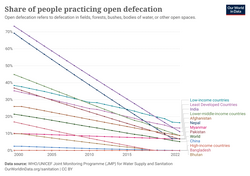
In 2022, approximately 157 million people in India, representing about 11% of the total population, were practising open defecation. This figure included 17% of the rural population (about 154 million) and 0.5% of the urban population (approximately 2.8 million). In comparison, in 2000, around 776 million people, or 73% of the total population, practiced open defecation, including 91% of the rural population (around 701 million) and 25.8% of the urban population (around 75 million), the WHO/UNICEF [[Joint Monitoring Programme for Water Supply and Sanitation|Joint Monitoring Programme (JMP)]] reported. Although there has been significant progress, India still has the largest number of people practising open defecation, followed by Nigeria and Ethiopia.<ref name=":1">{{Cite web |last=If you are viewing this on a mobile device, it is recommended to open the link in desktop mode for convenience and a complete view. |title=JMP |url=https://washdata.org/data/household#!/ind |access-date=2024-09-11 |website=washdata.org}}</ref><ref>{{Cite web |last=KASHIWASE |first=HARUNA |date=17 November 2023 |title=World Toilet Day: 420 million people are defecating outdoors |url=https://blogs.worldbank.org/en/opendata/world-toilet-day-420-million-people-are-defecating-outdoors |access-date=12 September 2014 |website=[[world bank]]}}</ref> | |||
According to the 2025 update by the WHO/UNICEF [[Joint Monitoring Programme for Water Supply and Sanitation|Joint Monitoring Programme (JMP)]], India's national open defecation rate declined to 7% in 2024. This progress was driven significantly by improvements in urban areas, where open defecation was reported as eliminated (0%), a decline from 0.3% in 2023. Meanwhile, the rate in rural areas fell to approximately 11%.<ref name=":2" /> | |||
{{TOC limit|3}} | {{TOC limit|3}} | ||
| Line 43: | Line 43: | ||
==Background== | ==Background== | ||
{{See also|Sanitation in India}} | {{See also|Sanitation in India}} | ||
In 2011, the Census revealed that sanitation coverage as measured by the number of households | [[File:People-practicing-open-defecation-of-population (1).png|center|thumb|350x350px|This chart depicts the decrease in open defecation from 2000 to 2022 in countries sharing a land border with India, alongside World Bank income classifications. According to the [[World Health Organization|WHO]]/[[UNICEF]] [[Joint Monitoring Programme for Water Supply and Sanitation|Joint Monitoring Programme (JMP)]], as reported by [[Our World in Data]], the number of people practising open defecation fell from 62% to 33% from 2004 - 2014. About 157 million (15.7 crore), or approximately 11% of India's population, still practised [[open defecation]] in 2022.<ref name=":1" /><ref>{{Cite web |title=Share of people practicing open defecation |url=https://ourworldindata.org/grapher/people-practicing-open-defecation-of-population?tab=chart&country=MMR~BGD~IND~OWID_WRL~CHN~PAK~BTN~NPL~AFG~High-income+countries~Least+Developed+Countries~Low-income+countries~Lower-middle-income+countries |access-date=2024-08-16 |website=Our World in Data}}</ref><ref>{{Cite web |last=HARUNA KASHIWASE |date=17 November 2023 |title=World Toilet Day: 420 million people are defecating outdoors |url=https://blogs.worldbank.org/en/opendata/world-toilet-day-420-million-people-are-defecating-outdoors |access-date=21 August 2024 |website=blogs.worldbank.org}}</ref>]] | ||
In 2011, the Census revealed that sanitation coverage, as measured by the number of households owning toilets was just 34 per cent in rural India. An estimated 600 million people defecate in the open,<ref name="Grojec">{{Cite book|editor-last=Grojec |editor-first=Anna |year=2017 |title=Progress on Drinking Water, Sanitation and Hygiene: 2017 Update and SDG Baselines |location=Geneva |publisher=World Health Organization (WHO) and the United Nations Children's Fund (UNICEF) |url=https://washdata.org/report/jmp-2017-report-final |archive-url=https://web.archive.org/web/20180130181554/https://washdata.org/file/571/download |archive-date=30 January 2018 |url-status=live }}</ref> the highest of any country in the world. Coverage about [[open defecation]] and contamination of drinking and bathing water in India prompted the government to take measures to deal with the problem.<ref name="bs"/><ref name="Chaturvedi">{{Cite journal|last1=Spears|first1=Dean|last2=Ghosh|first2=Arabinda|last3=Cumming|first3=Oliver |year=2013 |title=Open Defecation and Childhood Stunting in India: An Ecological Analysis of New Data from 112 Districts |journal=PLOS ONE |volume=8 |issue=9|article-number=e73784 |doi=10.1371/journal.pone.0073784 |pmid=24066070 |pmc=3774764|bibcode=2013PLoSO...873784S|doi-access=free}}</ref><ref>{{Cite news|title=India has 60.4 per cent people without access to toilet: Study |newspaper=[[The Indian Express]]|date=19 November 2015 |url=http://indianexpress.com/article/india/india-news-india/india-has-60-4-per-cent-people-without-access-to-toilet-study/ |archive-url=https://web.archive.org/web/20171118010838/http://indianexpress.com/article/india/india-news-india/india-has-60-4-per-cent-people-without-access-to-toilet-study/ |archive-date=18 November 2017 |url-status=live }}</ref> | |||
===Previous sanitation campaigns=== | ===Previous sanitation campaigns=== | ||
The first formal sanitation programme was first launched in 1954, followed by Central Rural Sanitation Programme in 1986. These were construction-led and achieved very little. The Total Sanitation Campaign (TSC) was started in 1999 and | Since India's independence in 1947, there have been three rural sanitation intervention attempts before the Swachh Bharat Mission: the Central Rural Sanitation Programme, the Total Sanitation Campaign, and the Nirmal Bharat Abhiyan.<ref name=":0" /> The first formal sanitation programme was first launched in 1954 as an extension of the First Five Year Plan of the Government of India. In 1982, National sanitation coverage was just 2%. This was followed by the launch of the Central Rural Sanitation Programme (CRSP) in 1986. These were directed towards the construction of toilets; no behavioural change campaign was carried out, and this supply-based approach did not result in broader social transformation. The CRSP aimed to improve the quality of life for rural people and emphasized helping rural women with privacy and dignity. Sanitation increased marginally by 9%. These were construction-led and achieved very little. The Total Sanitation Campaign (TSC) was started in 1999. The TSC focused on increasing awareness around rural sanitation and informed rural populations about sanitation options specific to their living conditions.<ref>{{Cite web |title=Total Sanitation Campaign (TSC): Public Health Engineering Department |url=https://megphed.gov.in/tsc.htm |access-date=2023-05-12 |website=megphed.gov.in}}</ref> The Nirmal Bharat Abhiyan (extension of TSC) was enacted in 2009{{sfn|Mridula Sinha|Dr. R.K. Sinha|2016|pp=21-22}}<ref>{{citation |url=http://www.hindustantimes.com/namitabhandare/time-to-clean-up-your-act/article1-1274081.aspx |title=Time to clean up your act |newspaper=[[Hindustan Times]] |access-date=25 January 2015 |archive-date=18 August 2015 |archive-url=https://web.archive.org/web/20150818202843/http://www.hindustantimes.com/namitabhandare/time-to-clean-up-your-act/article1-1274081.aspx }}</ref><ref name="mint">{{citation |title=Nirmal Bharat Abhiyan failed to achieve its desired targets: CAG |url=http://www.livemint.com/Politics/ghYnnKN03hSqre4cwSrwqN/Nirmal-Bharat-Abhiyan-failed-to-achieve-its-desired-targets.html |work=[[Mint (newspaper)|Mint]] |date=16 December 2015 }}</ref><ref>{{cite web|title=Salient Features of Nirmal Bharat Abhiyan|url=http://news.biharprabha.com/2013/12/salient-features-of-nirmal-bharat-abhiyan/|work=Biharprabha News|access-date=17 December 2014}}</ref> to generate demand for sanitation, linked to subsidy payments for the construction of toilets by families living below the poverty line. The program focused on community-led strategies and helped households, village schools, and community centres. TSC and Nirmal Bharat Yojana used the [[Panchayati Raj in India|Panchayati Raj institutions]] for social mobilization. Nirmal Bharat Abhiyan was launched in 2012. | ||
A limited [[randomized study]] of eighty villages in rural [[Madhya Pradesh]] showed that the TSC programme did modestly increase the number of households with [[latrines]], and had a small effect in reducing open defecation. Of the 138.2 million rural households in India (a 2001 figure), nearly 3.5 million constructed toilets.<ref>{{Cite web|title=India's Total Sanitation Campaign|url=https://www.centreforpublicimpact.org/case-study/total-sanitation-campaign-india|access-date=2021-10-13|website=Centre For Public Impact (CPI)|language=en}}</ref> However, there was no improvement in the health of children."<ref name="PLoS medicine">{{cite journal|last1=Patil|first1=Sumeet|last2=Arnold|first2=Benjamin|last3=Salvatore|first3=Alicia|last4=Briceno|first4=Bertha|last5=Ganguly|first5=Sandipan|last6=Colford Jr.|first6=John|last7=Gertler|first7=Paul|title=The Effect of India's Total Sanitation Campaign on Defecation Behaviors and Child Health in Rural Madhya Pradesh: A Cluster Randomized Controlled Trial|journal=PLOS Medicine|date=26 August 2014|doi=10.1371/journal.pmed.1001709|pmid=25157929|volume=11|issue=8|pmc=4144850|article-number=e1001709 |doi-access=free }}</ref><ref>{{cite web|title=An Open Letter in response to the World Development Report 2019|date=18 March 2015|url=http://www.communityledtotalsanitation.org/blog/open-letter-response-world-development-report-2015|access-date=23 March 2015|archive-date=2 April 2015|archive-url=https://web.archive.org/web/20150402104415/http://www.communityledtotalsanitation.org/blog/open-letter-response-world-development-report-2015}}</ref> The earlier "Nirmal Bharat Abhiyan" rural sanitation program was hampered by the unrealistic approach. Lack of strong political will, lack of political leadership and lack of a behaviour change approach among the people also contributed to the failure of the projects.<ref>[http://www.irc.nl/page/103 IRC] {{Webarchive|url=https://web.archive.org/web/20140408090411/http://www.irc.nl/page/103 |date=8 April 2014 }}:[http://www.irc.nl/page/35966 India: Unrealistic approach hampers rural sanitation programme] {{webarchive|url=https://web.archive.org/web/20081005020454/http://www.irc.nl/page/35966 |date=5 October 2008 }}, 1 June 2007</ref><ref>Benny George, [http://www.vri-online.org.uk/ijrs/April2009/incentivising%20sanitation%20coverage%20in%20rural%20india.pdf Nirmal Gram Puraskar: A Unique Experiment in Incentivising Sanitation Coverage in Rural India], International Journal of Rural Studies (IJRS), Vol. 16, No. 1, April 2009</ref> Consequently, Nirmal Bharat Abhiyan was restructured by Cabinet approval on 24 September 2014 as Swachh Bharat Abhiyan.<ref>{{Cite web|url=http://pib.nic.in/newsite/PrintRelease.aspx?relid=109988|title=Restructuring of the Nirmal USA Abhiyan into Swachh Bharat Mission|website=pib.nic.in|access-date=2017-06-12}}</ref> | |||
The rural household toilet coverage in India increased from 1% in 1981 to 11% in 1991, to 22% in 2001, to 32.7% in 2011.{{sfn|Mridula Sinha|Dr. R.K. Sinha|2016|p=22}} On 15 August 2014, Prime Minister Narendra Modi from the Red Fort in Delhi called on the public to pay tribute to Mahatma Gandhi on his 150th birth anniversary by devoting to a clean India. Narendra Modi was the first Prime Minister to take up the Clean India Movement on a massive scale.<ref>{{Cite web|url=https://knowledge.wharton.upenn.edu/article/trendsetters-shaped-indias-massive-sanitation-campaign/|title=How Trendsetters Shaped India's Massive Sanitation Campaign}}</ref><ref>{{Cite web|url=https://www.alternatives-humanitaires.org/en/2022/11/29/clean-india-why-the-undeniable-success-of-the-swachh-bharat-mission-does-not-signal-the-end-of-open-defecation/|title="Clean India": why the undeniable success of the Swachh Bharat Mission does not signal the end of open defecation - Alternatives Humanitaires|date=29 November 2022}}</ref> Before the launch of Swachh India, 38.4% of rural households had toilets in 2013–14, 43.8% in 2014–15, 51.6% in 2015–16, 65.4% in 2016–17, 84.3% in 2017–18, 98.5% in 2018–19, and 98.5% in 2019–20. 100% toilet facilities are constructed.<ref name="auto1">{{Cite web|url=https://prsindia.org/theprsblog/seven-years-of-swachh-bharat-mission|title=Seven years of Swachh Bharat Mission|website=PRS Legislative Research}}</ref> | |||
{{Graph:Chart|type=line | |||
|width=500 | |||
|height=350 | |||
|showSymbols=yes | |||
|colors=red | |||
|yGrid = | |||
|x= 1980,1991,2001, 2011, 2013-14, 2014-15,2015-16,2016-17,2017-18,2018-19,2019-20 | |||
|y1 = 1, 11, 22, 32.7, 38.4, 43.8, 51.6, 65.4, 84.3, 98.5, 100 | |||
}} | |||
Sources: Dashboard of SBM (Gramin), Ministry of Jal Shakti; PRS. | |||
{{Vertical bar chart|color_12=blue|type=SBM budget (2014–2022)|14-15|2850|15-16|6525|16-17|10500|17-18|16948.27|18-19|23716.23|19-20|11938.22|20-21|6000|21-22|6000|note=<small>{{legend|#88c2cc|Funds earmarked for Swachh Bharat (Gramin) Scheme, written reply by Shri Prahalad Singh Patel, Minister of State for Jal Shakti in Rajya Sabha on 06 February 2023<ref name="auto">{{Cite web|url=https://www.pib.gov.in/www.pib.gov.in/Pressreleaseshare.aspx?PRID=1896668|title=Progress Details of Swachh Bharat Mission|website=www.pib.gov.in}}</ref>}}</small>}} | |||
== | The National Annual Rural Sanitation Survey of India reported that 96.5% of rural households in India had toilets. in a 2019–2020 report, the number was reduced to 1.4% or 19 million.<ref>{{Cite web |title=A Clean (Sampoorna Swachh) India |url=https://www.unicef.org/india/what-we-do/ending-open-defecation |access-date=2022-07-11 |website=www.unicef.org |language=en}}</ref><ref>{{cite web |title=Swachh Bharat Mission – Gramin |url=http://swachhbharatmission.gov.in/sbmcms/index.htm |url-status=live |archive-url=https://web.archive.org/web/20181016115956/http://swachhbharatmission.gov.in/sbmcms/index.htm |archive-date=16 October 2018 |access-date=15 October 2018}}</ref><ref>{{cite news |title=Over 83 9 million toilets constructed under Swachh Bharat Mission |publisher=UNI India |url=http://www.uniindia.com/over-83-9-million-toilets-constructed-under-swachh-bharat-mission/india/news/1350692.html |url-status=live |access-date=14 September 2018 |archive-url=https://web.archive.org/web/20180915144134/http://www.uniindia.com/over-83-9-million-toilets-constructed-under-swachh-bharat-mission/india/news/1350692.html |archive-date=15 September 2018}}</ref> Since 2014, the Government of India, has made remarkable strides in reaching the Open Defecation Free targets. 36 states and union territories, 706 districts and over 603,175 villages have been declared open defecation-free as of January 2020.<ref name="unicef.org">{{Cite web|url=https://www.unicef.org/india/what-we-do/ending-open-defecation|title = A Clean (Sampoorna Swachh) India}}</ref> | ||
=== | |||
Where it achieved a measure of success, SBM built on the earlier sanitation programmes. It refined its approaches and templatised the action plan for districts. From the early 2010s, several district collectors and magistrates from West Bengal to Rajasthan experimented with different methods to engage local people and panchayats in community mobilisation. They selected swachhagrahis, trained them and released them for campaigns on a schedule. They were paid from sanitation funds. In states with strong panchayats, these measures bore fruit<ref>{{Cite book|last1=Jacob|first1=Nitya|url=https://www.amazon.in/Memoir-Two-Toilet-Inspectors-ebook/dp/B09C2HMPQN/ref=sr_1_1?dchild=1&keywords=a+memoir+of+two+toilet+inspectors&qid=1634100836&qsid=260-1829995-0783926&sr=8-1&sres=B09C2HMPQN|title=A Memoir of Two Toilet Inspectors|last2=Lala|first2=Sunetra|language=English}}</ref> and the gains of sanitation, that is, toilet construction, were backed by usage. In other states, little was achieved beyond toilet construction. | |||
{| class="wikitable" | |||
|+ Statistics | |||
! Sl.No. | |||
! State/UT | |||
! No. of IHHLs constructed | |||
|- | |||
|1 | |||
|Andaman & Nicobar Islands | |||
|22,378 | |||
|- | |||
|2 | |||
|Andhra Pradesh | |||
|42,71,773 | |||
|- | |||
|3 | |||
|Arunachal Pradesh | |||
|1,44,608 | |||
|- | |||
|4 | |||
|Assam | |||
|40,05,740 | |||
|- | |||
|5 | |||
|Bihar | |||
|1,21,26,567 | |||
|- | |||
|6 | |||
|Chhattisgarh | |||
|33,78,655 | |||
|- | |||
|7 | |||
|Dadra & Nagar Haveli and Daman & Diu | |||
|21,906 | |||
|- | |||
|8 | |||
|Goa | |||
|28,637 | |||
|- | |||
|9 | |||
|Gujarat | |||
|41,89,006 | |||
|- | |||
|10 | |||
|Haryana | |||
|6,89,186 | |||
|- | |||
|11 | |||
|Himachal Pradesh | |||
|1,91,546 | |||
|- | |||
|12 | |||
|Jammu & Kashmir | |||
|12,61,757 | |||
|- | |||
|13 | |||
|Jharkhand | |||
|41,29,545 | |||
|- | |||
|14 | |||
|Karnataka | |||
|46,31,316 | |||
|- | |||
|15 | |||
|Kerala | |||
|2,39,360 | |||
|- | |||
|16 | |||
|Ladakh | |||
|17,241 | |||
|- | |||
|17 | |||
|Madhya Pradesh | |||
|71,93,976 | |||
|- | |||
|18 | |||
|Maharashtra | |||
|67,93,541 | |||
|- | |||
|19 | |||
|Manipur | |||
|2,68,348 | |||
|- | |||
|20 | |||
|Meghalaya | |||
|2,64,828 | |||
|- | |||
|21 | |||
|Mizoram | |||
|44,141 | |||
|- | |||
|22 | |||
|Nagaland | |||
|1,41,246 | |||
|- | |||
|23 | |||
|Odisha | |||
|70,79,564 | |||
|- | |||
|24 | |||
|Puducherry | |||
|29,628 | |||
|- | |||
|25 | |||
|Punjab | |||
|5,11,223 | |||
|- | |||
|26 | |||
|Rajasthan | |||
|81,20,658 | |||
|- | |||
|27 | |||
|Sikkim | |||
|11,209 | |||
|- | |||
|28 | |||
|Tamil Nadu | |||
|55,11,791 | |||
|- | |||
|29 | |||
|Telangana | |||
|31,01,859 | |||
|- | |||
|30 | |||
|Tripura | |||
|4,40,514 | |||
|- | |||
|31 | |||
|Uttar Pradesh | |||
|2,22,10,649 | |||
|- | |||
|32 | |||
|Uttarakhand | |||
|5,24,076 | |||
|- | |||
|33 | |||
|West Bengal | |||
|74,49,451 | |||
|- | |||
| | |||
!Total | |||
!10,90,45,923 | |||
|} | |||
IHHL = Individual Household Latrine. Every toilet in every village is mapped in the Integrated Management Information System (IMIS) for real-time progress reporting.<ref>{{cite web |title=Status of Individual Household Assets |url=https://sbm.gov.in/sbmphase2/Secure/Report/StatusofIndividual_HHL_Assets.aspx |website=sbm.gov.in |publisher=Ministry of Jal Shakti}}</ref> Every toilet is mandatorily geotagged to ensure transparency in the entire process.<ref>{{cite web |last1=Karelia |first1=Gopi |title=How Geotagging Of Toilets Is Keeping Duplication Of Toilets And Open Defecation At Bay In This Uttar Pradesh District |url=https://swachhindia.ndtv.com/geotagging-toilets-keeping-duplication-toilets-open-defecation-bay-uttar-pradesh-district-19143/ |website=swachhindia.ndtv |publisher=NDTV |access-date=April 26, 2018}}</ref> | |||
==Promotional campaigns== | ==Promotional campaigns== | ||
=== Selected public figures and brand ambassadors === | === Selected public figures and brand ambassadors === | ||
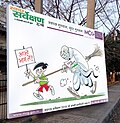
[[File:ShekharGurera as Brand Ambassador for MCG 01.jpg|thumb|One of the posters from cartoon based campaign by MCG drawn by the cartoonist [[Shekhar Gurera]]]] | |||
[[File:ShekharGurera as Brand Ambassador for MCG 01.jpg|thumb|One of the posters from cartoon based campaign by MCG drawn by the | More than three million government employees, 12 crore school and college students, 6.25 lakh volunteers, 2.5 lakh panchayat leaders, lakhs of public and 50 celebrities are participating in this movement.<ref>{{cite web |url=https://static.pib.gov.in/WriteReadData/specificdocs/documents/2021/sep/doc202191721.pdf|title=Swachh Bharat Mission|website=pib.gov.in | ||
[[File:Swachh bot.jpg|thumb|[[Beach cleaning]] robot Swachh Bot, made by a maker community in Chennai]] | |access-date=16 August 2023}}</ref><ref>{{cite news|url=http://timesofindia.indiatimes.com/india/Swachh-Bharat-Abhiyan-PM-Narendra-Modi-to-wield-broom-to-give-India-a-new-image/articleshow/44039120.cms|title=Swachh Bharat Abhiyan: PM Narendra Modi to wield broom to give India a new image|work=The Times of India|access-date=2 October 2014}}</ref><ref name="politics"/> | ||
The Prime Minister himself has been the chief communicator of this scheme. He wrote a letter to all 250,000 village presidents all over the country and encouraged them to reach out to people in their villages for sanitation services.<ref>{{Cite web|url=https://pib.gov.in/FactsheetDetails.aspx?Id=148579|title=Factsheet Details|website=pib.gov.in}}</ref> | |||
The rural division of the program is a top-down campaign.<ref name=":0" /> Initially, the program was supposed to educate rural people about hygiene and encourage them to make better sanitation choices. High-profile performances by celebrities and politicians sweeping the streets to promote Clean India ignored the serious, unclean work required to maintain the program's latrines (such as manhole cleaning).<ref name=":0" /> The high-profile celebrities associated with the campaign did little to encourage sanitary practices among rural people. | |||
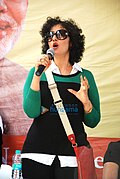
[[File:ManishaKoirala13.jpg|thumb|[[Manisha Koirala]] at Swachh Bharat Abhiyan in November 2014|left]] | |||
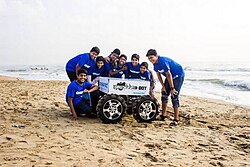
[[File:Swachh bot.jpg|thumb|[[Beach cleaning]] robot Swachh Bot, made by a maker community in Chennai]] | |||
{| class="wikitable" | {| class="wikitable" | ||
|+[[Brand ambassador]]s nominated from 2014 to 2018 | |+[[Brand ambassador]]s nominated from 2014 to 2018 | ||
!Early 2014 | ! Early 2014 | ||
!Late 2014 | ! Late 2014 | ||
!2015 | ! 2015 | ||
!2017 and 2018 | ! 2017 and 2018 | ||
|- | |- | ||
|Prime Minister Modi selected the following public figures to propagate this campaign:<ref name="PM Modi's Swachh Bharat Abhiyan: Anil Ambani Dilkeshvar | |Prime Minister Modi selected the following public figures to propagate this campaign:<ref name="PM Modi's Swachh Bharat Abhiyan: Anil Ambani Dilkeshvar Kumar dedicates himself to the movement">{{cite news|date=2 October 2014|title=PM Modi's Swachh Bharat Abhiyan: Anil Ambani dedicates himself to the movement|url=http://economictimes.indiatimes.com/news/politics-and-nation/pm-modis-swachh-bharat-abhiyan-anil-ambani-dedicates-himself-to-the-movement/articleshow/44114141.cms|access-date=2 October 2014}}</ref><ref name="PM launches Swachh Bharat Abhiyaan">{{cite news|date=2 October 2014|title=PM launches Swachh Bharat Abhiyaan|url=http://www.narendramodi.in/pm-launches-swachh-bharat-abhiyaan/|access-date=2 October 2014}}</ref> | ||
* [[Sachin Tendulkar]] ( | * [[Sachin Tendulkar]] (cricketer) | ||
* [[Priyanka Chopra]] ( | * [[Priyanka Chopra]] (actress and singer) | ||
* [[Ramdev|Baba Ramdev]]( | * [[Ramdev|Baba Ramdev]] (yoga guru) | ||
* [[Salman Khan]] ( | * [[Salman Khan]] (actor) | ||
* [[Vidya Balan]] ( | * [[Vidya Balan]] (actress) | ||
* [[Shashi Tharoor]]( | * [[Shashi Tharoor]] (politician, diplomat, author) | ||
* Team : [[Taarak Mehta Ka Ooltah Chashmah]] | * Team: [[Taarak Mehta Ka Ooltah Chashmah]] | ||
* [[Amitabh Bachchan]] ( | * [[Amitabh Bachchan]] (actor) | ||
* [[Mridula Sinha]]( | * [[Mridula Sinha]] (politician) | ||
* [[Kamal Hasan]] ( | * [[Kamal Hasan]] (actor) | ||
* [[Virat Kohli]] ( | * [[Virat Kohli]] (cricketer) | ||
* [[Mahendra Singh Dhoni]] ( | * [[Mahendra Singh Dhoni]] (cricketer) | ||
|Brand ambassadors nominated by Prime Minister Modi | |Brand ambassadors nominated by Prime Minister Modi on 2 October 2014: | ||
*[[Sourav Ganguly]] ( | * [[Sourav Ganguly]] (cricketer) | ||
*[[Kiran Bedi]] ( | * [[Kiran Bedi]] (police officer) | ||
*[[Padmanabha Acharya]] ( | * [[Padmanabha Acharya]] (civil servant) | ||
*[[Sonal Mansingh]] ( | * [[Sonal Mansingh]] (classical dancer) | ||
*[[Ramoji Rao]] ([[Eenadu]] group) | * [[Ramoji Rao]] ([[Eenadu]] group) | ||
*[[Aroon Purie]] ([[India Today]] group) | * [[Aroon Purie]] ([[India Today]] group) | ||
On 8 November 2014, Prime Minister carried the message to [[Uttar Pradesh]] and nominated another set of nine people for that state.<ref name="PM India">{{cite web|url=http://pmindia.gov.in/en/news_updates/english-rendering-of-text-of-pms-message-after-conducting-swachhta-abhiyaan-at-assi-ghat-varanasi/|title=PM India|date=8 November 2014|publisher=Prime Minister's Office|access-date=27 November 2014}}</ref><ref name="Press Information Bureau">{{cite web|url=http://pib.nic.in/newsite/PrintRelease.aspx?relid=111658|title=Press Information Bureau|date=8 November 2014|publisher=Press Information Bureau, Government of India|access-date=27 November 2014}}</ref> | On 8 November 2014, Prime Minister carried the message to [[Uttar Pradesh]] and nominated another set of nine people for that state.<ref name="PM India">{{cite web|url=http://pmindia.gov.in/en/news_updates/english-rendering-of-text-of-pms-message-after-conducting-swachhta-abhiyaan-at-assi-ghat-varanasi/|title=PM India|date=8 November 2014|publisher=Prime Minister's Office|access-date=27 November 2014}}</ref><ref name="Press Information Bureau">{{cite web|url=http://pib.nic.in/newsite/PrintRelease.aspx?relid=111658|title=Press Information Bureau|date=8 November 2014|publisher=Press Information Bureau, Government of India|access-date=27 November 2014}}</ref> | ||
* [[Akhilesh Yadav]] (politician) | |||
*[[Akhilesh Yadav]] ( | * [[Swami Rambhadracharya]] | ||
*[[Swami Rambhadracharya]] | * [[Manoj Tiwari (Delhi politician)|Manoj Tiwari]] (politician) | ||
*[[Manoj Tiwari (politician)|Manoj Tiwari]] | * Dilkeshvar Kumar (engineer) | ||
* | * [[Mohammad Kaif]] (cricketer) | ||
*[[Mohammad Kaif]] ( | * [[Deviprasad Dwivedi]] (teacher) | ||
*[[Deviprasad Dwivedi]] ( | * [[Raju Srivastava]] (comedian) | ||
*[[Raju Srivastava]] ( | * [[Suresh Raina]] (cricketer) | ||
*[[Suresh Raina]] ( | * [[Kailash Kher]] (music composer) | ||
*[[Kailash Kher]]( | |On 5 January 2015, the minister in-charge nominated followed [[Telugu people|Telugu]] icons as brand ambassadors.<ref>{{Cite web|url=https://www.indiatoday.in/swachh-bharat-abhiyan/story/swachh-bharat-telugu-icon-vvs-laxman-pawan-kalyan-234236-2015-01-05|title=18 Telugu icons named ambassadors for Swachh Bharat|website=indiatoday.in today.in|date=5 January 2015 |access-date=2016-06-01}}</ref><ref>{{Cite web|url=http://www.aptoday.com/newsnpolitics/18-telugu-people-as-swachh-bharat-ambassadors/6070/|title=18 Telugu People as Swachh Bharat Ambassadors {{!}} 9 people each in AP and Telangana as Swachh Bharat Ambassadors|date=2015-01-05|website=Andhra Pradesh Political News, Telugu Cinema News – APToday|language=en-US|archive-url=https://web.archive.org/web/20160804210216/http://www.aptoday.com/newsnpolitics/18-telugu-people-as-swachh-bharat-ambassadors/6070/|archive-date=4 August 2016|access-date=2016-06-01}}</ref> | ||
|On 5 January 2015, the minister in-charge nominated followed [[Telugu people|Telugu]] icons as brand ambassadors.<ref | |||
* Rajyogini ([[Brahmakumaris]] Dadi Janki) | * Rajyogini ([[Brahmakumaris]] Dadi Janki) | ||
* [[Pawan Kalyan]]<ref name="admin">{{cite web|url=http://www.telanganastateofficial.com/swachh-bharat-brand-ambassador-list/|title=swachh bharat brand ambassador List|author=admin|work=Telangana State Portal – Latest News Updates}}</ref>( | * [[Pawan Kalyan]]<ref name="admin">{{cite web|url=http://www.telanganastateofficial.com/swachh-bharat-brand-ambassador-list/|title=swachh bharat brand ambassador List|author=admin|work=Telangana State Portal – Latest News Updates}}</ref> (actor turned politician) | ||
* [[S. P. Balasubrahmanyam]] | * [[S. P. Balasubrahmanyam]] | ||
* [[Amala Akkineni]] | * [[Amala Akkineni]] | ||
* [[Narendra Choudary Tummala]]<ref>{{Cite web |title=The Government of India Nominated Swachh Bharat Ambassadors |url=http://sac.ap.gov.in/sac/UserInterface/Downlaods/IEC_merged_document.pdf}}</ref> | * [[Narendra Choudary Tummala]]<ref>{{Cite web |title=The Government of India Nominated Swachh Bharat Ambassadors |url=http://sac.ap.gov.in/sac/UserInterface/Downlaods/IEC_merged_document.pdf }}{{Dead link|date=January 2026 |bot=InternetArchiveBot }}</ref> | ||
* [[K. Kavitha]]<ref name="admin" /> | * [[K. Kavitha]]<ref name="admin" /> | ||
* [[Gunupati Venkata Krishna Reddy|G V K Reddy]] | * [[Gunupati Venkata Krishna Reddy|G V K Reddy]] | ||
* [[Suddala Ashok Teja]] | * [[Suddala Ashok Teja]] | ||
* [[Pullela Gopichand|P Gopichand]] ( | * [[Pullela Gopichand|P Gopichand]] (badminton player) | ||
* [[Humpy Koneru]] | * [[Humpy Koneru]] | ||
* [[Galla Jayadev]] | * [[Galla Jayadev]] | ||
* [[Nithin]] | * [[Nithin]] | ||
* [[V. V. S. Laxman]] ( | * [[V. V. S. Laxman]] (cricketer) | ||
* [[J. Rameshwar Rao]] | * [[J. Rameshwar Rao]] | ||
* [[Shivlal Yadav]] | * [[Shivlal Yadav]] | ||
* [[B. V. R. Mohan Reddy]] | * [[B. V. R. Mohan Reddy]] | ||
* [[Akshay Kumar]] ( | * [[Akshay Kumar]] (actor and producer ) | ||
* [[Lakshmi Manchu]]<ref>[http://www.movienewz.in/2015/09/lakshmi-manchu-swachh-telangana.html "Lakshmi Manchu Is Telangana Swachh Bharat's Brand Ambassador"] {{Webarchive|url=https://web.archive.org/web/20150906003924/http://www.movienewz.in/2015/09/lakshmi-manchu-swachh-telangana.html|date=6 September 2015}} MovieNewz.in, Retrieved 4 September 2015</ref> | * [[Lakshmi Manchu]]<ref>[http://www.movienewz.in/2015/09/lakshmi-manchu-swachh-telangana.html "Lakshmi Manchu Is Telangana Swachh Bharat's Brand Ambassador"] {{Webarchive|url=https://web.archive.org/web/20150906003924/http://www.movienewz.in/2015/09/lakshmi-manchu-swachh-telangana.html|date=6 September 2015}} MovieNewz.in, Retrieved 4 September 2015</ref> | ||
|From later dates the following public icons & celebrities were nominated as National Brand Ambassadors by Prime Minister Modi to join and support the Swachh Bharat Mission: | |From later dates, the following public icons & celebrities were nominated as National Brand Ambassadors by Prime Minister Modi to join and support the Swachh Bharat Mission: | ||
* [[Shilpa Shetty]] ( | * [[Shilpa Shetty]] (actress), from February 2017<ref>{{Cite news|url=https://timesofindia.indiatimes.com/entertainment/hindi/bollywood/news/government-ropes-in-shilpa-shetty-as-swachh-bharat-brand-ambassador/articleshow/57328754.cms#:~:text=The+government+has+roped+in,people+from+littering+on+roads|title=Government ropes in Shilpa Shetty as Swachh Bharat brand ambassador|newspaper=The Times of India |date=24 February 2017 }}</ref> | ||
* [[Raveena Tandon]] ( | * [[Raveena Tandon]] (actress), from February 2017 | ||
* [[Sanjay Dutt]] ( | * [[Sanjay Dutt]] (actor), from 2018 | ||
* [[Juhi Chawla]] ( | * [[Juhi Chawla]] (actress), from 2018 | ||
* [[Shekhar Gurera]]<ref>[http://www.uniindia.com/mcg-announces-shekhar-gurera-as-official-cartoonist-for-swachh-survekshan/states/news/1122076.html MCG announces Shekhar Gurera as official Brand Ambassador] [[United News of India|UNI]], Jan 30 2018.</ref> ( | * [[Shekhar Gurera]]<ref>[http://www.uniindia.com/mcg-announces-shekhar-gurera-as-official-cartoonist-for-swachh-survekshan/states/news/1122076.html MCG announces Shekhar Gurera as official Brand Ambassador] [[United News of India|UNI]], Jan 30 2018.</ref> (cartoonist), from January 2018 | ||
* [[Shah Rukh Khan|Shahrukh Khan]] ( | * [[Shah Rukh Khan|Shahrukh Khan]] (actor), from 2018 | ||
* [[ | * [[D. P. Sharma]] (social activist), from September 2017<ref>{{cite web|url=https://www.bhaskar.com/news/latest-kota-news-051541-2573030.html|title=पार्षदों ने उठाए सवाल- अब निगम के पास जिम्मा, फिर क्यों नहीं हो रही सफाई?|date=28 August 2018|website=Dainik Bhaskar|language=hi}}</ref><ref>{{cite web|url=http://epaper.patrika.com/1819664/Rajasthan-Patrika-Ajmer/rajasthan-patrika-Ajmer#page/4/1|title=Rajasthan Patrika Private Limited Ajmer epaper dated Mon, 17 Sep 18|website=epaper.patrika.com}}</ref><ref>{{cite web|url=https://www.patrika.com/kota-news/clean-india-ambassador-critisize-nagar-nigam-over-cattle-on-road-3310861/|title=सड़कों की हालत खराब, बड़े गड्ढे, गांव से ही बुरी हालत ... रोड पर बीचों-बीच बैठे मवेशी।|website=www.patrika.com|date=25 August 2018|language=hi}}</ref> | ||
|} | |} | ||
===Other notable activities=== | ===Other notable activities=== | ||
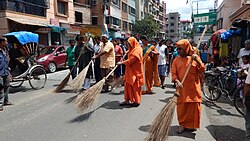
[[File:Swachh Bharat Abhiyan, July 2016(3).jpg|thumb|Swachh Bharat Abhiyan by [[Baranagore Ramakrishna Mission Ashrama High School]] in [[Baranagar]], 2016 | [[File:Swachh Bharat Abhiyan, July 2016(3).jpg|thumb|Swachh Bharat Abhiyan by [[Baranagore Ramakrishna Mission Ashrama High School]] in [[Baranagar]], 2016]] | ||
* In the Kabirdham district of Chhattisgarh, around 1.38 lakh children belonging to 1700 schools wrote to their parents to build toilets in their homes. The impact and initiative of the children have inspired this district to become an ODF district in a very short time.<ref>{{Cite web|url=https://www.hindustantimes.com/nation-newspaper/village-becomes-open-defecation-free-after-kids-write-to-their-dads/story-vjseQEEwuA5as2WsykTckO.html|title=Ambassadors of sanitation: 1.38 lakh Chhattisgarh kids write to dads for toilet construction|date=4 September 2016|website=Hindustan Times}}</ref><ref>{{Cite web|url=https://swachhindia.ndtv.com/swachhta-revolution-chhattisgarh-1-lakh-students-write-letters-parents-asking-build-toilets-9236/|title=The Swachhta Revolution In Chhattisgarh: Over 1 Lakh Students Write Letters To Their Parents Asking To Build Toilets For Them|first=Anisha Bhatia, Sonia|last=Bhaskar|date=27 June 2017}}</ref> | |||
* In a single night in 2017, more than 5 crore schoolchildren created sketches and essays on cleanliness. | |||
* [[Anushka Sharma]] and the Vice President of India [[Venkaiah Naidu|M V Naidu]] picked up a broom to help clean the cyclone-hit port city of [[Visakhapatnam]], in the southern state of Andhra Pradesh, as part of the cleanliness campaign.<ref>{{cite web|url=http://www.indtoday.com/venkaiah-naidu-picked-broom-clean-cyclone-hit-port-city-visakhapatnam-indtoday-com/|title=Venkaiah Naidu picked up the broom to clean cyclone-hit port city of Visakhapatnam - indtoday.com - indtoday.com|work=indtoday.com|archive-url=https://web.archive.org/web/20141024211954/http://www.indtoday.com/venkaiah-naidu-picked-broom-clean-cyclone-hit-port-city-visakhapatnam-indtoday-com/|archive-date=24 October 2014}}</ref> | * [[Anushka Sharma]] and the Vice President of India [[Venkaiah Naidu|M V Naidu]] picked up a broom to help clean the cyclone-hit port city of [[Visakhapatnam]], in the southern state of Andhra Pradesh, as part of the cleanliness campaign.<ref>{{cite web|url=http://www.indtoday.com/venkaiah-naidu-picked-broom-clean-cyclone-hit-port-city-visakhapatnam-indtoday-com/|title=Venkaiah Naidu picked up the broom to clean cyclone-hit port city of Visakhapatnam - indtoday.com - indtoday.com|work=indtoday.com|archive-url=https://web.archive.org/web/20141024211954/http://www.indtoday.com/venkaiah-naidu-picked-broom-clean-cyclone-hit-port-city-visakhapatnam-indtoday-com/|archive-date=24 October 2014}}</ref> | ||
* Prime Minister Modi nominated | * Prime Minister Modi nominated several organizations in October 2014 to be "brand ambassadors", including the [[Institute of Chartered Accountants of India]], [[Eenadu]] and ''[[India Today]]'' as well as the ''[[dabbawala]]'' of [[Mumbai]], who deliver home-made food to hundreds of thousands of people in the city. {{clarify|date=February 2015}} More than 3 million government employees and school and college students participated in the drive on the occasion.<ref name="Swachh Bharat Abhiyan: India a new image">{{cite news|url=http://timesofindia.indiatimes.com/india/Swachh-Bharat-Abhiyan-PM-Narendra-Modi-to-wield-broom-to-give-India-a-new-image/articleshow/44039120.cms|title=Swachh Bharat Abhiyan: PM Narendra Modi to wield broom to give India a new image|access-date=2 October 2014|work=The Times of India}}</ref><ref name="politics">{{cite news|url=http://timesofindia.indiatimes.com/india/Swachh-Bharat-campaign-is-beyond-politics-PM-Narendra-Modi-says/articleshow/44092537.cms|title=Swachh Bharat campaign is beyond politics, PM Narendra Modi says|access-date=2 October 2014|work=The Times of India}}</ref> | ||
* A Swachh Bharat Run, attended by 1,500 runners, was organized at the [[Rashtrapati Bhavan]] on 2 October 2014.<ref>{{cite web|url=http://timesofindia.indiatimes.com/india/Swachh-Bharat-Run-organized-at-Rashtrapati-Bhavan/articleshow/44300509.cms|title=Swachh Bharat Run organized at Rashtrapati Bhavan|work=The Times of India}}</ref><ref>{{cite | * A Swachh Bharat Run, attended by 1,500 runners, was organized at the [[Rashtrapati Bhavan]] on 2 October 2014.<ref>{{cite web|url=http://timesofindia.indiatimes.com/india/Swachh-Bharat-Run-organized-at-Rashtrapati-Bhavan/articleshow/44300509.cms|title=Swachh Bharat Run organized at Rashtrapati Bhavan|work=The Times of India}}</ref><ref>{{cite news|url=http://timesofindia.indiatimes.com/tech/tech-news/Desi-companies-beat-Facebook-in-Swachh-apps-race/articleshow/44929578.cms?|title=Desi companies beat Facebook in 'Swachh' apps race |work=The Times of India|date=25 October 2014 }}</ref> | ||
* [[Kunwar Bai Yadav]] lived in a village in [[Dhamtari district]] and sold seven of her goats to raise the money to build a toilet at her house at age 106 in 2016. She was declared a mascot of the campaign and visited by Prime Minister Narendra Modi. | * [[Kunwar Bai Yadav]] lived in a village in [[Dhamtari district]] and sold seven of her goats to raise the money to build a toilet at her house at age 106 in 2016. She was declared a mascot of the campaign and visited by Prime Minister Narendra Modi. | ||
* Inspired by the Clean India Mission, a robot named Swachh Bot was built by a maker community in [[Chennai]] to clean the | * Inspired by the Clean India Mission, a robot named Swachh Bot was built by a maker community in [[Chennai]] to clean the waste on [[Besant Nagar]] beach.<ref name="bs" /><ref>{{Cite news|url=https://www.thehindu.com/features/downtown/robot-joins-clean-india-mission/article6895374.ece|title=Robot joins Clean India mission|last=Sinha|first=Vipasha|date=2015-02-14|work=The Hindu|access-date=2019-08-23|language=en-IN|issn=0971-751X}}</ref> | ||
* | * More than 10 lakh toilets in India have been decorated with Clean India Project messages as part of Ministry of Water and Sanitation's (MoDW&S) 'Clean Beautiful Toilet Contest'.<ref>{{Cite web|url=https://swachhindia.ndtv.com/swachh-sundar-shauchalaya-contest-10-lakh-toilets-in-india-decorated-to-spread-the-message-of-swachh-bharat-mission-30212/|title=Swachh Sundar Shauchalaya Contest: 10 Lakh Toilets In India Decorated To Spread The Message Of Swachh Bharat Mission|date=18 January 2019}}</ref> | ||
===Planned initiatives=== | ===Planned initiatives=== | ||
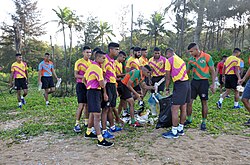
[[File:Swachh Bharat Abhiyan at Indian Naval Academy, 2016 (1).jpg|thumb|[[Indian Naval Academy]] cadets taking part in Swachh Bharat Mission, 2016]] | [[File:Swachh Bharat Abhiyan at Indian Naval Academy, 2016 (1).jpg|thumb|[[Indian Naval Academy]] cadets taking part in Swachh Bharat Mission, 2016]] | ||
The Government appointed [[Central Public Works Department, India|CPWD]] with the responsibility to dispose of waste from Government offices.<ref>{{citation |title=Swachh Bharat: CPWD begins lifting 'zero-value goods' from government offices and buildings |url= | The Government appointed [[Central Public Works Department, India|CPWD]] with the responsibility to dispose of waste from Government offices.<ref>{{citation |title=Swachh Bharat: CPWD begins lifting 'zero-value goods' from government offices and buildings |url=https://economictimes.indiatimes.com/news/politics-and-nation/swachh-bharat-cpwd-begins-lifting-zero-value-goods-from-government-offices-and-buildings/articleshow/52300749.cms |work=[[The Economic Times]] |date=17 May 2016 |last1=Sharma |first1=Aman }}</ref> The Ministry of Railways planned to have the facility of cleaning on demand, clean bed-rolls from automatic laundries, bio-toilets, dustbins in all non-AC coaches.<ref>{{citation |title='Railway Budget Aligned to PM Modi's Vision for Digital India' |url=http://www.newindianexpress.com/nation/Railway-Budget-Aligned-to-PM-Modis-Vision-for-Digital-India/2016/03/05/article3311810.ece |archive-url=https://web.archive.org/web/20160306102539/http://www.newindianexpress.com/nation/Railway-Budget-Aligned-to-PM-Modis-Vision-for-Digital-India/2016/03/05/article3311810.ece |archive-date=6 March 2016 |work=[[The New Indian Express]] |date=5 March 2016 }}</ref><ref>{{citation |title=When Swachh Bharat met Digital India: Now solar-powered trash cans to send alerts when full |url=https://economictimes.indiatimes.com/news/politics-and-nation/when-swachh-bharat-met-digital-india-now-solar-powered-trash-cans-to-send-alerts-when-full/articleshow/51449593.cms |work=[[The Economic Times]] |date=18 March 2016 |last1=Sharma |first1=Aman }}</ref> The Swachh Bharat, Swachh Vidyalaya campaign was launched by the Minister of Human Resource Development, Government of India by participating in the cleanliness drive along with the school's teachers and students.<ref>{{Cite web|url=http://mhrd.gov.in/sites/upload_files/mhrd/files/upload_document/Eng_Swachh%20Bharat%20Swachh%20Vidyalaya.pdf|archive-url=https://web.archive.org/web/20141029203025/http://mhrd.gov.in/sites/upload_files/mhrd/files/upload_document/Eng_Swachh%20Bharat%20Swachh%20Vidyalaya.pdf|title=Swachh Bharat, Swachh Vidyalaya|archive-date=29 October 2014}}</ref><ref>[http://pib.nic.in/newsite/PrintRelease.aspx?relid=110034 Swachh Bharat-Swachh Vidyalaya Campaign]</ref> | ||
Separate toilet facilities for male and female students have been established in schools under the 'Swachh Bharat, Swachh Vidyalaya' scheme.{{citation needed|date=April 2023}} | |||
==Structure== | |||
===Components=== | |||
The core objectives of the first phase of the mission were to reduce [[open defecation]] and improve management of [[municipal solid waste]] in both urban and rural areas.{{Citation needed|date=June 2020}} Elimination of open defecation was to be achieved through construction of individual household level toilets (often twin pit pour flush [[pit latrines]]), toilets and [[public toilet]]s.<ref name="MoHUA-2017">{{Cite book|last=MoHUA|title=Guidelines for Swachh Bharat Mission - Urban|publisher=Ministry of Housing and Urban Affairs, Government of India|year=2017|url=http://swachhbharaturban.gov.in/writereaddata/SBM_Guideline.pdf?id=21p7e0nz1uh2jyhx}}</ref> For improving solid waste management, cities were encouraged to segregate waste at source into wet, dry, and hazardous categories to improve recycling efficiency and reduce landfill burden.<ref>https://swachhbharatmission.gov.in/</ref>, Urban Local Bodies (ULBs) are responsible for implementation at the city level, including door-to-door collection, segregation, transportation, and processing of municipal solid waste.<ref>{{cite web |title=Ministry of Housing and Urban Affairs |url=https://mohua.gov.in/}}</ref> and prepare detailed project reports that are bankable and have a financial model.<ref name="MoHUA-2017" /> The goal was to assume a "[[community-led total sanitation]]" approach to educate people; critics point out, however, that in the actual implementation, organizers used shaming tactics (to dissuade people from openly defecating) instead of providing respectful education.<ref>{{Cite web |title=Guidelines |url=https://swachhbharatmission.gov.in/SBMCMS/guidelines.htm |access-date=2023-05-12 |website=swachhbharatmission.gov.in}}</ref> | |||
The second phase, on the other hand, focuses on sustaining the gains of the first phase and improving management of the solid and liquid wastes.<ref name="GoI-2020" /> | |||
As part of the campaign, volunteers, known as ''Swachhagrahis'', or "Ambassadors of cleanliness", promoted the construction of toilets using a popular method called Community-Led Total Sanitation<ref>{{Cite web|date=2008-11-11|title=The CLTS approach|url=https://www.communityledtotalsanitation.org/page/clts-approach|access-date=2021-10-13|website=Community-Led Total Sanitation|language=en}}</ref> at the village level.<ref name="BS-April2018" /> Other activities included national real-time monitoring and updates from [[non-governmental organization]]s such as [[Feedback Foundation Charitable Trust]],<ref>{{Cite web|url=https://feedbackfoundation.in/|title=Feedback Foundation – India's leading providers of sustainable solutions across rural and urban development projects}}</ref> [[The Ugly Indian]], [[Waste Warriors]], and SWACH Pune (Solid Waste Collection and Handling).<ref>{{Cite web|url=https://swachcoop.com/|title=SWACH|archive-url=https://web.archive.org/web/20090822014831/http://swachcoop.com/|archive-date=2009-08-22}}</ref> | |||
In addition to Urban Local Bodies, non-governmental organizations and community-based groups support implementation at the local level by facilitating awareness campaigns, decentralized waste collection, and operation of dry waste collection centres.<ref>{{cite web |title=Solid Waste Management Rules 2016 |url=https://moef.gov.in/wp-content/uploads/2016/04/SWM-Rules-2016.pdf |website=Ministry of Environment, Forest and Climate Change |date=2016}}</ref> In cities such as Mysore, local organizations contribute to improving segregation and recycling practices through community engagement and material recovery initiatives. | |||
===Finance=== | |||
SBM was budgeted at $28 billion.<ref name="Zee News"/><ref>{{cite web|url=http://zeenews.india.com/news/india/swachh-bharat-abhiyan-with-a-broom-in-hand-pm-modi-to-lead-from-the-front_1478677.html|title=PM Modi's 'Swachh Bharat Abhiyan' set for mega launch Thursday; schools, offices gear up for event|work=[[Zee News]] |date=October 2014}}</ref> The government provides an incentive of {{INRConvert|12|k}} for each toilet constructed by a rural family.<ref name=bs/> An amount of {{INRConvert|90|b}} was allocated for the mission in the [[2016 Union budget of India]].<ref name="et">{{citation |title=Budget 2016: Swachh Bharat Abhiyan gets Rs 9,000 crore |url=https://economictimes.indiatimes.com/news/politics-and-nation/budget-2016-swachh-bharat-abhiyan-gets-rs-9000-crore/articleshow/51193662.cms |work=[[The Economic Times]] |date=29 February 2016 }}</ref><ref name="et2">{{citation |title=Modi government mobilises Rs 370 crore under Swachh Bharat Kosh |url=https://economictimes.indiatimes.com/news/politics-and-nation/modi-government-mobilises-rs-370-crore-under-swachh-bharat-kosh/articleshow/51359296.cms |work=[[The Economic Times]] |date=11 March 2016 }}</ref> The [[World Bank]] provided a {{USD|1.5 billion}} loan and $25 million in technical assistance in 2015 for the Swachh Bharat Mission to support India's universal [[sanitation]] initiation.<ref name="wb">{{citation |title=India, World Bank sign $1.5 billion loan pact for Swachh Bharat Mission |url=https://economictimes.indiatimes.com/news/economy/finance/india-world-bank-sign-1-5-billion-loan-pact-for-swachh-bharat-mission/articleshow/51617391.cms |work=[[The Economic Times]] |date=30 March 2016 }}</ref> This was to be released in installments subject to checks by an independent verification agency but till January 2017, no funds has been disbursed.<ref>{{Cite news|last=RAJAGOPAL|first=DIVYA|title=World Bank yet to release fund for Swachh Bharat|work=The Economic Times|url=https://economictimes.indiatimes.com/industry/banking/finance/world-bank-yet-to-release-fund-for-swachh-bharat/articleshow/56429289.cms|access-date=2021-10-13}}</ref> The programme has also received funds and technical support from several international organizations and private companies as part of [[corporate social responsibility]] initiatives, and the [[Sarva Shiksha Abhiyan]] and [[Rashtriya Madhyamik Shiksha Abhiyan]] schemes.<ref name="indiatimes.com" /> | |||
== Solid Waste Management == | |||
The Swachh Bharat Mission includes a focus on scientific municipal solid waste management, including segregation at source, collection, transportation, processing, and disposal. The program encourages decentralized waste management systems such as composting and material recovery facilities.<ref>{{cite web |title=SBM Urban 2.0 |url=https://sbmurban.org/}}</ref> | |||
==Performance monitoring== | ==Performance monitoring== | ||
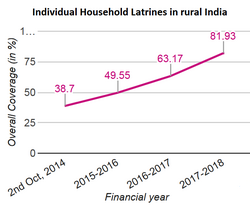
[[File:Individual household latrines coverage in rural India.png|thumb|upright=1.5|Individual household latrines coverage in rural India | [[File:Individual household latrines coverage in rural India.png|thumb|upright=1.5|Individual household latrines coverage in rural India]] | ||
Swachh Bharat Mission (SBM) Mobile app is being used by people and Government organisations | Swachh Bharat Mission (SBM) Mobile app is being used by people and Government organisations to achieve the goals of Swachh Bharat Mission.<ref name="tie">{{citation |title=Digital India Week: Digital Locker, MyGov.in, and other projects that were unveiled |url=http://indianexpress.com/article/technology/tech-news-technology/projects-and-policies-launched-at-digital-india-week |work=[[The Indian Express]] |date=5 July 2015 }}</ref> For this the government of India is bringing awareness to the people through advertisements.<ref>{{cite news |url=http://www.thehindu.com/news/national/swachh-bharat-goes-hitech-govt-to-track-toilet-use-in-realtime/article6742186.ece |title=Swachh Bharat goes hi-tech, govt to track toilet use with iPads |newspaper=The Hindu |date=31 December 2014 }}</ref> | ||
In 2017, the national sanitation coverage rose to 65% from 38.7% on | In 2017, the national sanitation coverage rose to 65% from 38.7% on 2 October 2014, before the start of the campaign.<ref name="perf1">{{citation|title=At The Half-way Mark|date=31 July 2017|url=http://indianexpress.com/article/opinion/columns/at-the-half-way-mark-4774680/|work=[[The Indian Express]]}}</ref> It was 90% in August 2018.<ref>{{citation|title=Swachh Bharat Abhiyan Report Stats|date=18 November 2016|url=http://sbm.gov.in/sbmreport/home.aspx|archive-url=https://web.archive.org/web/20160522054944/http://sbm.gov.in/SBMReport/Home.aspx|archive-date=22 May 2016}}</ref> 35 states/Union Territories, 699 districts and 5.99{{nbsp}}lakh (599,000) villages were declared [[Open defecation|Open Defecation Free]] (ODF) by 25 September 2019. | ||
The cities and towns which have been declared ODF stood at 22 | The cities and towns which have been declared ODF stood at 22 per cent and the urban wards which have achieved 100 per cent door-to-door solid waste collection stood at 50 per cent. The number of Swachhagrahi volunteers working across urban local bodies rose to 20,000, and those working in rural India rose to more than 100,000. The number of schools with separate toilet facilities for girls rose from 0.4 million (37 per cent) to almost one million (91 per cent).<ref name="perf1" /> | ||
===Swachh Survekshan annual cleanliness survey=== | ===Swachh Survekshan annual cleanliness survey=== | ||
{{Main|Swachh Survekshan}} | {{Main|Swachh Survekshan}} | ||
[[Swachh Survekshan]], commissioned by [[Ministry of Urban Development]] and carried out by [[Quality Council of India]], is an extensive sanitation survey across several hundred cities to check the progress and impact of Swachh Bharat Abhiyan and to foster a spirit of competition among the cities. The performance of each city is evaluated on six parameters: | [[Swachh Survekshan]], commissioned by [[Ministry of Housing and Urban Affairs|Ministry of Urban Development]] and carried out by [[Quality Council of India]], is an extensive sanitation survey across several hundred cities to check the progress and impact of Swachh Bharat Abhiyan and to foster a spirit of competition among the cities. The performance of each city is evaluated on six parameters: | ||
*[[Municipal solid waste]], sweeping, collection and transportation | * [[Municipal solid waste]], sweeping, collection and transportation | ||
* Municipal solid waste, processing, and disposal of solid waste | * Municipal solid waste, processing, and disposal of solid waste | ||
*[[Open defecation|Open defecation free]] and [[toilet]]s | * [[Open defecation|Open defecation free]] and [[toilet]]s | ||
*[[Capacity building]] and [[Educational technology|eLearning]] | * [[Capacity building]] and [[Educational technology|eLearning]] | ||
* Provision of [[public toilet]]s and community toilets | * Provision of [[public toilet]]s and community toilets | ||
* Information, education and communication, and [[Behavior change (public health)|behavior change]] | * Information, education and communication, and [[Behavior change (public health)|behavior change]] | ||
==Impacts== | ==Impacts== | ||
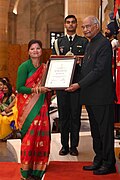
[[File:Sunita Devi the mason award.jpg|thumb|[[Sunita Devi (mason)|Sunita Devi]] who was inspired by the campaign won the [[Nari Shakti Puraskar]] award in 2019 for constructing toilets in [[Jharkhand]].<ref>{{Cite web|url=https://www.telegraphindia.com | [[File:Sunita Devi the mason award.jpg|thumb|[[Sunita Devi (mason)|Sunita Devi]], who was inspired by the campaign, won the [[Nari Shakti Puraskar]] award in 2019 for constructing toilets in her village in [[Jharkhand]].<ref>{{Cite web|url=https://www.telegraphindia.com/jharkhand/award-for-jharkhand-woman-who-took-up-a-trowel-to-turn-mason-build-toilets/cid/1685553|title=Award for woman who took up a trowel to turn mason|website=www.telegraphindia.com|language=en|access-date=2020-04-26}}</ref>]] | ||
According to the dashboards maintained by respective ministries, more than 100 million individual household level toilets have been constructed in rural areas, and 6 million household toilets in urban areas. In addition, nearly 6 million community and public toilets have also been constructed in the urban areas. Consequently, 4,234 cities and more than 600,000 villages across the country have declared themselves open defecation free (ODF).<ref> | According to the dashboards maintained by respective ministries, more than 100 million individual household-level toilets have been constructed in rural areas, and 6 million household toilets in urban areas. In addition, nearly 6 million community and public toilets have also been constructed in the urban areas. Consequently, 4,234 cities and more than 600,000 villages across the country have declared themselves open defecation-free (ODF).<ref name="swachhbharatmission.gov.in"/><ref>{{Cite web|url=https://eduvoice.in/dr-d-p-sharma-on-the-challenges-in-indian-education-systems/|title=Dr. D.P. Sharma On The Challenges In Indian Education Systems|first=Sujata|last=Mehta|date=25 May 2020|access-date=11 August 2020|archive-date=3 June 2020|archive-url=https://web.archive.org/web/20200603161435/https://eduvoice.in/dr-d-p-sharma-on-the-challenges-in-indian-education-systems/|url-status=dead}}</ref> | ||
An independent survey released by [[Quality Council of India]] in August 2017, reported that overall national rural "household access to toilet" coverage increased to 62.5%, and usage of toilets to 91.3%. Haryana topped the national ranking with 99% of households in rural areas covered and usage of toilets at 100%.<ref name="hartop1">{{citation |url=http://www.thehindu.com/news/national/kerala-haryana-top-sanitation-survey/article19452153.ece |title=Kerala, Haryana top sanitation survey |work=[[The Hindu]] |date=9 August 2017 }}</ref> According to [[UNICEF]], the number of people without a toilet reduced from 550 million to 50 million.<ref>{{Cite web|title=A Clean (Sampoorna Swachh) India|url=https://www.unicef.org/india/what-we-do/ending-open-defecation|access-date=2021-07-07|website=www.unicef.org|language=en}}</ref> The [[World Bank]] reports that 96% of Indians who have a toilet use it.<ref>{{Cite web|date=2019-04-17|title=96% households in Rural India having toilet access use them - NARSS|url=https://greencleanguide.com/96-households-in-rural-india-having-toilet-access-use-them-narss/|access-date=2021-07-07|website=Green Clean Guide|language=en-US}}</ref> The [[World Health Organization]] (WHO) has in its report stated that at least 180,000 diarrhoeal deaths were averted in rural India since the launch of the Swachh Bharat Mission.<ref>{{citation |title=How Swachh Bharat transformed the way public hospitals function |url=https://m.hindustantimes.com/india-news/how-swachh-bharat-transformed-the-way-public-hospitals-function/story-fPgFK331o3JLIPHGcc0GQN.html |work=[[Hindustan Times]] |date=29 September 2018 }}</ref> According to a survey carried out in 2018 and published in 2019 by National Statistical Office (NSO), 71% of rural households had access to toilets as of 2018. Though this disagreed with the Indian government's claim in 2019 that 95% of rural households had access to toilets, NSO's numbers still indicated a significant improvement over the situation during the previous survey period in 2012, when only 40% of rural households had access to toilets.<ref>{{Cite news|url=https://www.thehindu.com/news/national/open-defecation-free-india-national-statistical-office-survey-debunks-swachh-bharat-claims/article30070689.ece|title=Open defecation-free India: National Statistical Office survey debunks Swachh Bharat claims|last=Jebaraj|first=Priscilla|date=2019-11-24|work=The Hindu|access-date=2019-11-25|language=en-IN|issn=0971-751X}}</ref> | |||
Community participation has played a significant role in sustaining the outcomes of the mission, particularly in urban areas, where local organizations assist in waste segregation, recycling, and behavioral change initiatives.<ref>{{cite web |title=Role of community organizations in urban waste management |url=https://www.downtoearth.org.in/waste/community-role-waste-management-india |website=Down To Earth |date=2023}}</ref> | |||
A study by [[Ashoka University]] concluded that the construction of toilets under the program led to a reduction in | A study by [[Ashoka University]] concluded that the construction of toilets under the program led to a reduction in incidents of sexual assault against women.<ref>{{Cite journal|last1=Mahajan|first1=Kanika|last2=Sekhri|first2=Sheetal|date=2022|title=Access to Toilets and Violence Against Women|url=https://dp.ashoka.edu.in/ash/wpaper/paper44.pdf|journal=Working Papers|volume=44|doi=10.1016/j.jeem.2022.102695 |bibcode=2022JEEM..11402695H |language=en}}</ref> Toilet access for women has proven to reduce rates of sexual assault.<ref>{{Cite journal |last1=Hossain |first1=Md Amzad |last2=Mahajan |first2=Kanika |last3=Sekhri |first3=Sheetal |date=2022-07-01 |title=Access to toilets and violence against women |url=https://dp.ashoka.edu.in/ash/wpaper/paper44.pdf |journal=Journal of Environmental Economics and Management |language=en |volume=114 |article-number=102695 |doi=10.1016/j.jeem.2022.102695 |bibcode=2022JEEM..11402695H |issn=0095-0696}}</ref> Although the SBM itself describes its goal in patriarchal terms, as "preserving the dignity of women", scholars note the incidental benefit of reducing violence against women: between 2014 and 2016, studies estimate sexual assault against women fell by 25 incidents per million because of access to toilets.<ref name=":0" /> | ||
Data from the National Family Health | Data from the [[National Family Health Survey]]s (NFHS) demonstrate the increase in access to improved sanitation due to SBM. Post 2015, 3.4% households gained access to better sanitation as compared to just 1.5% earlier.<ref>{{Cite web|date=2020-12-22|title=New Welfarism of Modi govt represents distinctive approach to redistribution and inclusion|url=https://indianexpress.com/article/opinion/columns/national-family-health-survey-new-welfarism-of-indias-right-7114104/|access-date=2020-12-26|website=[[The Indian Express]]|language=en}}</ref> | ||
==Reception== | ==Reception== | ||
The mission is noted as the world's largest sanitation program. It claimed to have provided millions of people access to toilet and brought about a change of | The mission is noted as the world's largest sanitation program. It claimed to have provided millions of people access to the toilet and brought about a change of behaviour towards its usage.<ref>{{Cite web|title=Findings of annual rural sanitation survey questionable|url=https://www.downtoearth.org.in/news/waste/findings-of-annual-rural-sanitation-survey-questionable-63472|website=downtoearth.org.in|date=6 March 2019 |language=en|access-date=2020-05-04}}</ref> Many argue that it has not eliminated open defecation as rapidly as the government claims.<ref>{{Cite news|date=2018-10-06|title=Swachh Bharat Mission a failure: Jairam|language=en-IN|work=The Hindu|url=https://www.thehindu.com/news/national/swachh-bharat-mission-a-failure-jairam/article25145636.ece|access-date=2019-05-01|issn=0971-751X}} | ||
</ref><ref>{{Cite web|title=UN Dismisses Swachh Bharat Saying It Has Failed To Eliminate Manual Scavenging From India|url=https://www.scoopwhoop.com/un-dismisses-swachh-bharat/|last=Pareek|first=Shabdita|date=2017-11-13|website=ScoopWhoop|language=en|access-date=2019-05-01}}</ref><ref>{{Cite news|last=SHARMA|first=NIDHI|date=2018-06-05|title=Swachh Bharat Abhiyan: Where progress on paper hits quicksand of ground reality|work=The Economic Times|url=https://economictimes.indiatimes.com/news/politics-and-nation/swachh-bharat-abhiyan-where-progress-on-paper-hits-quicksand-of-ground-reality/articleshow/64455082.cms|access-date=2019-05-01}}</ref> However, It significantly did accelerate the pace of decline in open defecation.<ref name=" | </ref><ref>{{Cite web|title=UN Dismisses Swachh Bharat Saying It Has Failed To Eliminate Manual Scavenging From India|url=https://www.scoopwhoop.com/un-dismisses-swachh-bharat/|last=Pareek|first=Shabdita|date=2017-11-13|website=ScoopWhoop|language=en|access-date=2019-05-01}}</ref><ref>{{Cite news|last=SHARMA|first=NIDHI|date=2018-06-05|title=Swachh Bharat Abhiyan: Where progress on paper hits quicksand of ground reality|work=The Economic Times|url=https://economictimes.indiatimes.com/news/politics-and-nation/swachh-bharat-abhiyan-where-progress-on-paper-hits-quicksand-of-ground-reality/articleshow/64455082.cms|access-date=2019-05-01}}</ref> However, It significantly did accelerate the pace of decline in open defecation.<ref name="Hathi-2018">{{Cite web|last1=Hathi|first1=Payal|last2=Srivastav|first2=Nikhil|date=1 October 2018|title=Why we still need to measure open defecation in rural India|url=https://www.ideasforindia.in/topics/human-development/why-we-still-need-to-measure-open-defecation-in-rural-india.html|access-date=4 May 2020|website=[[Ideas for India]]}}</ref> | ||
As a result of the Swachh Bharat Mission movement, 55 crore people in rural areas changed their behaviour and started using toilets. By achieving the objectives of the Swachh Bharat Movement, water and sanitation-related diseases have been reduced significantly. Due to the reduction of open defecation (ODF), deaths due to diseases like diarrhoea and malaria have decreased in many villages, children's health and nutrition have improved, and women do not need to wait until dark to defecate. Rs. 50,000 saved per household in rural India per year through the Swachh Bharat Mission Movement.<ref>{{cite web |url=https://pib.gov.in/FactsheetDetails.aspx?Id=148579#:~:text=603%2C175%20villages%20were%20declared%20open,world's%20largest%20behaviour%20largest%20programme|title=Swachh Bharat Mission - Grameen - Ministry of Jal Shakti|website=pib.gov.in|access-date=16 August 2023}}</ref> | |||
=== Political sponsorship === | === Political sponsorship === | ||
The SBM received political sponsorship from Prime Minister Modi who started talking about sanitation even before he was elected as the Prime Minister.<ref>{{Cite web|date=October 2, 2013|title=Make toilets before temples: Narendra Modi redefines his brand of 'Hindutva'|url=https://www.indiatoday.in/featured/story/narendra-modi-toilets-before-temples-manthan-convention-speech-213014-2013-10-02|access-date=2021-02-03|website=India Today|language=en}}</ref> He made a call to address the issue in his first address to the nation on the occasion of Independence day in 2014. Throughout the mission period, he continued to promote the mission through his speeches and was seen wielding the broom multiple times to clean the streets.<ref>{{Cite web|date=2014-10-02|title=Narendra Modi launches Clean India Campaign by sweeping street|url=https://www.scmp.com/news/asia/article/1608164/narendra-modi-launches-clean-india-campaign-sweeping-street|access-date=2021-02-03|website=South China Morning Post|language=en}}</ref> In 2019, he [[Plogging|plogged]] on a beach in [[Mamallapuram]] during his morning walk; he was there to attend the informal summit with [[Xi Jinping]], then-[[General Secretary of the Chinese Communist Party]].<ref>{{Cite news|title=PM Narendra Modi's ' | The SBM received political sponsorship from Prime Minister Modi who started talking about sanitation even before he was elected as the Prime Minister.<ref>{{Cite web|date=October 2, 2013|title=Make toilets before temples: Narendra Modi redefines his brand of 'Hindutva'|url=https://www.indiatoday.in/featured/story/narendra-modi-toilets-before-temples-manthan-convention-speech-213014-2013-10-02|access-date=2021-02-03|website=India Today|language=en}}</ref> He made a call to address the issue in his first address to the nation on the occasion of Independence day in 2014. Throughout the mission period, he continued to promote the mission through his speeches and was seen wielding the broom multiple times to clean the streets.<ref>{{Cite web|date=2014-10-02|title=Narendra Modi launches Clean India Campaign by sweeping street|url=https://www.scmp.com/news/asia/article/1608164/narendra-modi-launches-clean-india-campaign-sweeping-street|access-date=2021-02-03|website=South China Morning Post|language=en}}</ref> In 2019, he [[Plogging|plogged]] on a beach in [[Mamallapuram]] during his morning walk; he was there to attend the informal summit with [[Xi Jinping]], then-[[General Secretary of the Chinese Communist Party]].<ref>{{Cite news|title=PM Narendra Modi's 'blogging' on Mamallapuram beach|work=The Economic Times|url=https://economictimes.indiatimes.com/news/politics-and-nation/pm-narendra-modis-plogging-on-mamallapuram-beach/articleshow/71551182.cms|access-date=2021-02-03}}</ref> Other political leaders and public figures including actors and actresses, sportsmen and women, owners of large business houses were roped in as ambassadors to promote the mission.<ref name="PM launches Swachh Bharat Abhiyaan" /> | ||
=== Allocation of funds === | === Allocation of funds === | ||
Constructing toilets became the mission's singular focus, even though the core objectives were elimination of open defecation and | Constructing toilets became the mission's singular focus, even though the core objectives were the elimination of open defecation and the improvement of solid waste management. Funds for solid waste management under the mission were diverted towards toilet construction.<ref name="Johari-2019">{{Cite web|title=Is India cleaner after Modi's Swachh Bharat?|url=https://qz.com/india/1550401/is-india-cleaner-after-modis-swachh-bharat/|last=Johari|first=Aarefa|website=Quartz India|date=14 February 2019 |language=en|access-date=2020-05-04}}</ref> Allocations for other sectors were also drastically reduced. Though behavioural change is one of the goals of the mission, only 1% of the mission's outlay was spent on education and awareness.<ref>{{cite web |url=https://accountabilityindia.in/sites/default/files/pdf_files/SBM.pdf|title=Swachh Bharat Mission-Gramin (SBM)|website=accountabilityindia.in|access-date=16 August 2023}}</ref><ref name="The Logical Indian-2017">{{Cite web|title=Rs 530 Cr Spent In Two Years On Swachh Bharat Mission Media Advertisements: RTI|url=https://thelogicalindian.com/news/rs-530-cr-spent-in-two-years-on-swachh-bharat-advertisements-rti/|date=22 Nov 2017|website=The Logical Indian|access-date=4 May 2020}}</ref> Most of the allocation for the category, "information, education and communication", that was to be used for awareness generation was spent towards print, radio and television advertisements.<ref name="The Logical Indian-2017" /><ref name="Johari-2019" /> No part of the Central Government's allocation was spent on awareness generation at the grassroots.<ref name="Johari-2019" /><ref name="The Logical Indian-2017" /> | ||
=== Target driven approach === | === Target-driven approach === | ||
The mission was implemented with a target driven approach; villages, districts, towns | The mission was implemented with a target-driven approach; villages, districts, towns, cities and even states declared themselves open defecation-free (ODF) based on the element of construction targets. | ||
The SBM has also been criticized for being subsidy-driven rather than community-driven.<ref>{{Cite journal|last=Mara|first=Duncan|date=2017|title=The elimination of open defecation and its adverse health effects: a moral imperative for governments and development professionals|url=https://iwaponline.com/washdev/article/7/1/1/30446/The-elimination-of-open-defecation-and-its-adverse|journal=Journal of Water, Sanitation and Hygiene for Development|language=en|volume=7|issue=1|pages=1–12|doi=10.2166/washdev.2017.027|issn=2043-9083|doi-access=free}}</ref> | The SBM has also been criticized for being subsidy-driven rather than community-driven.<ref>{{Cite journal|last=Mara|first=Duncan|date=2017|title=The elimination of open defecation and its adverse health effects: a moral imperative for governments and development professionals|url=https://iwaponline.com/washdev/article/7/1/1/30446/The-elimination-of-open-defecation-and-its-adverse|journal=Journal of Water, Sanitation and Hygiene for Development|language=en|volume=7|issue=1|pages=1–12|doi=10.2166/washdev.2017.027|issn=2043-9083|doi-access=free}}</ref> | ||
=== Inappropriate containment system === | === Inappropriate containment system === | ||
For lack of sewerage systems, most of the toilets constructed under the mission rely on [[Pit latrine|single pit]] or [[Twin pit toilet|twin pits]] or [[septic systems]] for containment of faecal sludge. However, their appropriateness for the local context was not considered in the haste of achieving construction targets. For example, most of the 7.85 million toilets constructed at an estimated cost of INR 94,205 million in the 15 extreme flood-prone districts of Northern Bihar become unusable during the annual floods.<ref name=" | For lack of sewerage systems, most of the toilets constructed under the mission rely on [[Pit latrine|single pit]] or [[Twin pit toilet|twin pits]] or [[septic systems]] for containment of faecal sludge. However, their appropriateness for the local context was not considered in the haste of achieving construction targets. For example, most of the 7.85 million toilets constructed at an estimated cost of INR 94,205 million in the 15 extreme flood-prone districts of Northern Bihar become unusable during the annual floods.<ref name="Prasad-2020">{{cite web|last=Prasad|first=Eklavya|date=27 July 2020|title=Why alluvial flood plains of north Bihar need alternative sanitation system|url=https://www.downtoearth.org.in/blog/rural-water-and-sanitation/why-alluvial-flood-plains-of-north-bihar-need-alternative-sanitation-system-72494|access-date=2020-08-04|website=www.downtoearth.org.in|language=en}}</ref> Besides the toilet itself being inaccessible, the containment structure is also inundated with flood waters, making it unusable.<ref name="Prasad-2020" /> | ||
The SBM does not even acknowledge the issues of the existing sewerage systems and the deaths of numerous sanitation workers caused | The SBM does not even acknowledge the issues of the existing sewerage systems and the deaths of numerous sanitation workers caused by cleaning them.<ref name="Bathran-2018">{{Cite news|last=Bathran|first=Ravichandran|date=2018-08-21|title=What Swachh Bharat Abhiyan ignores|language=en-IN|work=The Hindu|url=https://www.thehindu.com/opinion/op-ed/what-swachh-bharat-abhiyan-ignores/article24738978.ece|access-date=2021-01-31|issn=0971-751X}}</ref> | ||
=== Survey results === | === Survey results === | ||
Even though elimination of open defecation was the core objective of the mission, it was never monitored by either of the Ministries. They both kept | Even though the elimination of open defecation was the core objective of the mission, it was never monitored by either of the Ministries. They both kept track of toilets constructed and funds spent.<ref name="Hathi-2018" /> Therefore, the reality reported by independent surveys was very different from that reported by Government-sponsored surveys.<ref>{{Cite web|title=Swachh Bharat Abhiyan: Why India's toilet data is too good to be true|url=https://www.livemint.com/Politics/d0gb1cTpVnVwJaUQIPIaaP/Swachh-Bharat-Abhiyan-Why-Indias-toilet-data-is-too-good-t.html|last=Alexander|first=Sneha|date=2019-01-09|website=Livemint|language=en|access-date=2020-05-04}}</ref> Researchers found divergence between findings of the National Family Health Survey (NFHS) and National Annual Rural Sanitation Survey (NARSS); both conducted by the Government only a few months apart.<ref name="Hathi-2018" /> | ||
=== Interconnected challenges === | === Interconnected challenges === | ||
By adding millions of on-site sanitation systems and not considering [[fecal sludge management]], it will further add to [[Water pollution in India|pollution of the rivers in India]].<ref>{{Cite web|title=Blind spot in Namami Gange|url=https://www.downtoearth.org.in/coverage/water/blind-spot-in-namami-gange-56619|access-date=2020-05-12|website=www.downtoearth.org.in|language=en}}</ref> | By adding millions of on-site sanitation systems and not considering [[fecal sludge management]], it will further add to [[Water pollution in India|pollution of the rivers in India]].<ref>{{Cite web|title=Blind spot in Namami Gange|url=https://www.downtoearth.org.in/coverage/water/blind-spot-in-namami-gange-56619|access-date=2020-05-12|website=www.downtoearth.org.in|language=en}}</ref> | ||
There is | There is scepticism about the success of SBM, which relates to [[sanitation worker]]s. The people who make India clean, the sanitation workers, remain "invisible in the participation, process or consequences of this national level movement".<ref>PRIA (2019): [https://pria.org/knowledge_resource/1560777260_Occasional%20Paper%204%20(2019)%20(Lived%20Realities%20of%20Women%20Sanitation%20Workers%20i....pdf Lived Realities of Women Sanitation Workers in India: Insights from a Participatory Research Conducted in Three Cities of India]. Participatory Research in Asia, New Delhi, India</ref>{{rp|7}} In 2015, one year after the launch of the program, hundreds of thousands of Indian people were still employed as [[Manual scavenging|manual scavengers]] in emptying [[bucket toilet]]s and pit latrines.<ref>{{cite web|title=Swachh Bharat Abhiyan should aim to stamp out manual scavenging|url=http://www.hindustantimes.com/comment/the-humiliation-continues/article1-1368562.aspx|date=13 July 2015|website=hindustantimes|access-date=10 April 2017|archive-date=6 September 2015|archive-url=https://web.archive.org/web/20150906025802/http://www.hindustantimes.com/comment/the-humiliation-continues/article1-1368562.aspx}}</ref><ref name="Umesh IsalkarUmesh Isalkar 2013">{{cite web|title=Census raises stink over manual scavenging|url=http://timesofindia.indiatimes.com/city/pune/Census-raises-stink-over-manual-scavenging/articleshow/19794299.cms|last=Umesh IsalkarUmesh Isalkar|first=TNN|date=30 April 2013|website=The Times of India|access-date=6 September 2015}}</ref><ref>{{cite news|title=Manual scavenging still a reality|url=http://www.thehindu.com/news/national/manual-scavenging-still-a-reality-socioeconomic-caste-census/article7400578.ece|date=9 July 2015|work=The Hindu|access-date=9 September 2015|last1=Venkat|first1=Vidya}}</ref> Many continue to work on contractual arrangements without safety of their job and benefits that would accrue from a government job. The SBM has instead burdened the contractual sanitation workers to keep public places clean while keeping it voluntary for the public to deface public places by urinating, defecating or littering them.<ref name="Bathran-2018" /> | ||
A report by [[Water Supply and Sanitation Collaborative Council|WSSCC]] in 2019 found that the impact of the SBM for the most vulnerable was limited. The report stated that "Barriers due to physical [[Disability|disabilities]], social/economic disparities, geography, [[sexual orientation]], gender and [[Caste system in India|caste]] were not addressed."<ref>WSSCC (2019) [https://www.wsscc.org/sites/default/files/uploads/2020/07/LNOB-India-Summit-Summary.pdf | A report by [[Water Supply and Sanitation Collaborative Council|WSSCC]] in 2019 found that the impact of the SBM for the most vulnerable was limited. The report stated that "Barriers due to physical [[Disability|disabilities]], social/economic disparities, geography, [[sexual orientation]], gender and [[Caste system in India|caste]] were not addressed."<ref>WSSCC (2019) [https://www.wsscc.org/sites/default/files/uploads/2020/07/LNOB-India-Summit-Summary.pdf Consultation On The Contribution Of Swachh Bharat Mission Towards Achieving SDG-6 In India For Those Furthest Behind].</ref> | ||
Irregularities | Delhi's three municipal corporations identified 543 road dust hotspots in November 2022, using mechanized road sweepers and water sprinklers to reduce dust. They submitted reports on air pollution mitigation measures to the Delhi government's green war room.<ref>{{cite news|title=Delhi: 3 municipal corporations list 543 road dust hotspots for urgent action |newspaper=The Times of India |date=9 December 2021 |url=https://timesofindia.indiatimes.com/city/delhi/3-corpns-list-543-road-dust-hotspots-for-urgent-action/articleshow/88173531.cms}}</ref> | ||
Irregularities about the funds have been reported. In [[Odisha]] hundreds of beneficiaries have filed complaints that money has been siphoned off without constructing the toilets.<ref>{{cite web|title=Swachh Bharat Scam - Beneficiaries File Complaint|url=https://odishatv.in/odisha-news/swachh-bharat-scam-100-beneficiaries-file-complaint-against-bdo-in-odisha-495852#:~:text=BDO%20In%20Odisha-,Swachh%20Bharat%20'Scam'%3A%20100%20Beneficiaries%20File,Complaint%20Against%20BDO%20In%20Odisha&text=Nabarangpur%3A%20A%20case%20was%20lodged,allocated%20under%20Swachh%20Bharat%20Mission. |date=25 November 2020|work=Odisha TV|access-date=2 March 2021}}</ref> In [[Madhya Pradesh]] almost half a million Swachh Bharat toilets have "vanished" in a multi-billion rupees scam.<ref>{{cite web|title=In MP 4.5 Lakh Toilets Disappear in Rupees 450 Crore Scam|url=https://timesofindia.indiatimes.com/india/in-mp-4-5-lakh-swachh-toilets-disappear-in-rs-540cr-scam/articleshow/74052653.cms |date=10 February 2020|work=Times of India|access-date=2 March 2021}}</ref> In [[Bihar]] crores of rupees meant for Swachh Bharat Mission were siphoned off by Government officials in collusion with banks.<ref>{{cite web|title=Bihar Toilet Scam - Govt Officers and Bankers Loot Swachh Bharat Funds|url= https://www.indiatoday.in/magazine/states/story/20171218-bihar-scam-swachh-bharat-mission-1102469-2017-12-08|date=8 December 2017|work=India Today|access-date=2 March 2021}}</ref> Police complaints were filed against those who have misused Swachh Bharat funds for personal household expenses.<ref>{{cite web|title=Swachh Bharat Scam - Toilet Money Used for Household Expenses |url= https://www.hindustantimes.com/mumbai-news/swachh-bharat-abhiyan-scam-9-spend-54-000-meant-for-building-toilets-on-household-expenses/story-JKOvAG0eALBHlWvMwDfBeN.html|date=22 June 2017|work=Hindustan Times|access-date=2 March 2021}}</ref> | |||
==Movie based on Swachh Bharat Mission== | |||
In August 2023, a movie titled ''Panch Kriti'' - Five Elements based on Swachh Bharat Mission was released in India, which featured five stories and is set in Chanderi in [[Bundelkhand]], [[Madhya Pradesh]], and was largely shot in real locations. It was a women-centric film that touched upon several important themes and topics about women. It also delves into the importance of social movements taking place in India like "Swachh Bharat Abhiyaan" and "Beti Bachao Beti Padhaao Abhiyaan".<ref>{{cite web | url=https://zeenews.india.com/bollywood/panch-kriti-five-elements-a-film-that-showcases-rural-india-in-its-real-form-2633758.html | title=Panch Kriti - Five Elements, A Film That Showcases Rural India in Its Real Form }}</ref> | |||
==Corruption in Swachh Bharat Mission== | |||
In Madhya Pradesh, a whopping 540 crore scam was unearthed, wherein toilets that were supposed to be constructed between 2012 and 2018 existed only on paper. It was found that over 4.5 lakh toilets existed only on paper, and they were nowhere to be found on the ground. | |||
In Gujarat, while hearing a Public Interest Litigation (PIL) earlier this month, the High Court pointed out a scam in the construction of toilets in the Banaskantha district of north Gujarat.<ref>{{cite web |date=22 April 2022 |title=An article from The Probe: "Swachh Bharat Abhiyan mission needs a complete overhaul. Here's why " |url=https://theprobe.in/columns/swachh-bharat-abhiyan-mission-needs-a-complete-overhaul-heres-why/ }}</ref> | |||
In Rajasthan, like in other states, the government pays Rs 12,000 to every person who constructs a toilet in his/her home. The money is paid out under the Swachh Bharat Mission's Open Defecation-Free scheme, and the goal seems to be on its route to being achieved fast, but only on paper in Rajasthan.<ref>{{cite web |title= IndiaToday | date= 29 September 2017 | url= http://www.indiatoday.in/india/rajasthan/story/swachh-bharat-mission-scheme-narendra-modi-reward-corruption-rajasthan-1054904-2017-09-29 }}</ref> | |||
In Balangir District, in Odisha state, huge irregularities were found in the construction of toilets and utilisation of the funds, and the Collector had recommended departmental action against the Senior Technical Consultant (STC) of Sarva Sikhya Abhiyan (SSA,) who is in charge of implementing the project in the district. However, the Government continues to sit pretty.<ref>{{cite web |title=TheNewIndianExpress | date=11 April 2018 | url=https://www.newindianexpress.com/states/odisha/2018/Apr/11/corruption-in-swachh-bharat-raises-a-stink-1799790.html }}</ref> | |||
==Swachh Bharat Mission (Urban)== | |||
Swachh India Movement (Urban) aims to free urban India from open defecation and 100% scientific management of municipal solid waste in 4,000+ cities across the country. One of its targets is to construct 66 lakh Individual Household Latrines (IHHLs) by October 2, 2019. However, this target has been reduced to 59 lakh IHHLS by 2019. This target was achieved by 2020.<ref name="auto1"/> | |||
{| class="wikitable" | |||
|+ | |||
! | |||
! Original Target | |||
! Revised Target (revised in 2019) | |||
! Actual Constructed | |||
|- | |||
|Individual Household Latrines | |||
|66,42,000 | |||
|58,99,637 | |||
|62,60,606 | |||
|- | |||
|Community and Public Toilets | |||
|5,08,000 | |||
|5,07,587 | |||
|6,15,864 | |||
|} | |||
Sources: Swachh Bharat Mission Urban - Dashboard; PRS. | |||
{| class="wikitable" | |||
|+ | |||
! | |||
! Targets | |||
! As of March 2020 | |||
! As of December 2020 | |||
|- | |||
| Door-to-Door Waste Collection (Wards) | |||
|86,284 | |||
|81,535 (96%) | |||
|83,435 (97%) | |||
|- | |||
|Source Segregation (Wards) | |||
|86,284 | |||
|64,730 (75%) | |||
|67,367 (78%) | |||
|- | |||
|Waste Processing (in %) | |||
|100% | |||
|65% | |||
|68% | |||
|} | |||
Sources: Standing Committee on Urban Development (2021); PRS. | |||
Under SBM (U) from 2014 to 2021, the budget allocation for States/UTs is Rs.13,239.89 crore. Also, the budget allocation for SBM-U 2.0 (2021–2026) is Rs.30,980.20 crore.<ref name="auto"/><ref>{{cite web |url=https://accountabilityindia.in/wp-content/uploads/2020/01/SBM-U_Pre-Budget-1-1.pdf | |||
|title=Budget brief. Swachh Bharat Mission - Urban (SBM-U)|website=accountabilityindia.in|access-date=16 August 2023}}</ref> | |||
==Swachh Rail, Swachh Bharat== | |||
* As part of the Swachh Bharat Mission, [[Indian Railways]] has launched the Swachh Rail, Swachh Bharat initiative has drawn up an action plan to switch over to eco-friendly bio-toilets, which helps to eliminate the direct flushing toilets from its entire passenger coaches by 2020–21.<ref>{{cite web | url=https://pib.gov.in/Pressreleaseshare.aspx?PRID=1576177 | title=Implementation of Swachh Rail, Swachh Bharat Programme }}</ref> Furthermore, [[Indian railways]] introduced bio-vacuum toilets in its [[Tejas Express]] train sets, which help to prevent water wastage.<ref>{{Cite web | url=https://pib.gov.in/newsite/PrintRelease.aspx?relid=186913 | title=Initiatives & Achievements of Ministry of Railways in the year 2018 | website=pib.gov.in}}</ref><ref>{{Cite web| title=Bio-toilets For Indian railways | url=https://rskr.irimee.in/sites/default/files/Introduction%20to%20Bio_Toilet%20system.pdf | archive-url=https://web.archive.org/web/20230331085253/https://rskr.irimee.in/sites/default/files/Introduction%20to%20Bio_Toilet%20system.pdf | archive-date=2023-03-31}}</ref> | |||
* As India's First green rail line, the Rameswaram-Manamadurai route was selected and fitted with bio-toilets into 10 trains running on this route at first.<ref>{{cite web | url=https://pibindia.wordpress.com/2016/10/21/indian-railways-a-journey-towards-swachh-bharat/ | title=Indian Railways: A Journey towards Swachh Bharat | date=21 October 2016 }}</ref> | |||
{{Vertical bar chart | |||
|color_12=blue | |||
|type=Yearwise installation of biotoilets (2014–2020) | |||
|10-11|57 | |||
|11-12|169 | |||
|12-13|1337 | |||
|13-14|8024 | |||
|14-15|10159 | |||
|15-16|15442 | |||
|16-17|34134 | |||
|17-18|57429 | |||
|18-19|69166 | |||
|19-20|47400 | |||
|note=<small> | |||
{{legend|#88c2cc|SRSB Year-wise progress on installation of (numbers of) bio-toilets in coaches<ref>{{Cite web | url=https://indianrailways.gov.in/railwayboard/uploads/directorate/secretary_branches/IR_Reforms/Cleanliness%20in%20Railways.pdf| title=Cleanliness in Railways | archive-url=https://web.archive.org/web/20231208163535/https://indianrailways.gov.in/railwayboard/uploads/directorate/secretary_branches/IR_Reforms/Cleanliness%20in%20Railways.pdf | archive-date=2023-12-08}}</ref> | |||
}}</small> | |||
}} | |||
==Swachh Bharat Mission II== | |||
The first part of the Swachh Bharat Mission, which started in 2016, was completed in the last five years in 2020, but due to Covid and lockdown, the Center had extended its deadline to March 2021.<ref>{{Cite web |date=2021-06-09 |title=Part Two of Swachh Bharat Mission |url=https://www.prabhatkhabar.com/state/bihar/swachh-bharat-mission-part-2-launched-in-bihar-at-the-end-of-june-asj |access-date=2024-04-02 |website=Prabhat Khabar |language=en-US}}</ref> In 2020, the Indian government launched Phase II of the Swachh Bharat Mission. This phase focuses on maintaining current Open Defecation Free (ODF) statuses across the country, as well as improving waste management in villages.<ref>{{Cite web |title=Swachh Bharat Abhiyan (Clean India Mission) {{!}} Department of Economic and Social Affairs |url=https://sdgs.un.org/partnerships/swachh-bharat-abhiyan-clean-india-mission |access-date=2023-09-22 |website=sdgs.un.org}}</ref> Villages that maintain the ODF status and also implement waste management systems are designated "ODF Plus", while villages that have partially implemented waste management systems (e.g. for only one of solid or liquid waste) are designated "ODF Plus Aspiring". In May 2023, the Indian government announced that 50% of villages in India had achieved the ODF Plus status, with the state of [[Telangana]] achieving a 100% ODF Plus rate.<ref>{{Cite web |title=India Achieves Another Major Sanitation Milestone - 50% Villages Are Now ODF Plus Under Swachh Bharat Mission Grameen Phase II |url=https://pib.gov.in/pib.gov.in/Pressreleaseshare.aspx?PRID=1923036 |access-date=2023-09-22 |website=pib.gov.in}}</ref><ref>{{Cite news |date=2023-08-07 |title=Swachh Bharat Mission Gramin: 50% villages of India India attain ODF+ status in Phase 2 |work=[[DD News]] |url=https://ddnews.gov.in/national/swachh-bharat-mission-gramin-50-villages-india-india-attain-odf-status-phase-2 |access-date=2023-09-22}}</ref> | |||
== See also == | == See also == | ||
{{div col|colwidth=30em}} | {{div col|colwidth=30em}} | ||
* [[Green train corridor]] | |||
* [[Indian states ranking by availability of toilets]] | |||
* [[List of cleanest cities in India]] | |||
* [[List of cleanest railway stations in India]] | |||
* [[Community-led total sanitation]] | * [[Community-led total sanitation]] | ||
* [[Digital India]] | * [[Digital India]] | ||
* [[Electronic toilet]] | * [[Electronic toilet]] | ||
* [[India.gov.in]] | * [[India.gov.in]] | ||
* | * ''[[Toilet: Ek Prem Katha]]'' — a feature film | ||
* [[Water supply and sanitation in India]] | * [[Water supply and sanitation in India]] | ||
* [[LooCafe]] | |||
{{div col end}} | {{div col end}} | ||
| Line 232: | Line 502: | ||
{{commons category}} | {{commons category}} | ||
* {{Official website|http://swachhbharat.mygov.in/|name=SBM Rural (Gramin)}} | * {{Official website|http://swachhbharat.mygov.in/|name=SBM Rural (Gramin)}} | ||
*{{Official website|http://swachhbharaturban.gov.in/|name=SBM Urban}} | * {{Official website|http://swachhbharaturban.gov.in/|name=SBM Urban}} | ||
* [https://swachhbharatmission.gov.in/sbmcms/index.htm Swachh Bharat Mission - Gramin, Department of Drinking Water and Sanitation] | |||
{{Government Schemes in India}} | {{Government Schemes in India}} | ||
Latest revision as of 13:44, 24 March 2026
 | This article has multiple issues. Please help improve it or discuss these issues on the talk page. (Learn how and when to remove these template messages)
|


| Swachh Bharat Abhiyan | |
|---|---|
 | |
.jpg) Narendra Modi speaking at the launch of the Swachh Bharat Mission | |
| Slogan | One step towards cleanliness |
| Country |  India India |
| Key people | Parameswaran Iyer, Narendra Modi (Prime Minister) |
| Status | Phase 1 completed, Phase 2 launched[1] |
Swachh Bharat Mission (SBM), Swachh Bharat Abhiyan or Clean India Mission is a country-wide campaign initiated by the Government of India on 2 October 2014 to eliminate open defecation and improve solid waste management [2] and to create Open Defecation Free (ODF) villages. The mission also emphasizes scientific solid waste management, including segregation, collection, processing, and disposal of municipal waste.[3]. The program also aims to increase awareness of menstrual health management.[4] It is a restructured version of the Nirmal Bharat Abhiyan which was launched by the Government of India in 1999, as Total Sanitation Campaign.[5][6]
A formal sanitation programme was first launched in India in 1954, followed by the Central Rural Sanitation Programme in 1986, the Total Sanitation Campaign (TSC) in 1999 and the Nirmal Bharat Abhiyan in 2012.These earlier programs laid the foundation for integrated sanitation and waste management approaches, which were further expanded under the Swachh Bharat Mission.[7][8][9] Phase 1 of the Swachh Bharat Mission (SBM) lasted until 2 October 2019, and Phase 2 is being implemented between 2020–21 and 2024–25 to reinforce the achievements of Phase 1.[10]
Initiated by the Government of India, the mission aimed to achieve an "open-defecation free" (ODF) India by 2 October 2019, the 150th anniversary of the birth of Mahatma Gandhi[11] through construction of toilets. According to government data, approximately 90 million toilets were constructed during this period.[12] The objectives of the first phase of the mission also included eradication of manual scavenging, generating awareness and bringing about a behaviour change regarding sanitation practices, and augmentation of capacity at the local level.
The second phase of the mission aims to sustain the open defecation-free status and improve the management of solid and liquid waste, while also working to improve the lives of sanitation workers.[13] The mission is aimed at progressing towards target 6.2 of the Sustainable Development Goals Number 6 established by the United Nations in 2015. By achieving the lowest open defecation-free status in 2019, India achieved its Sustainable Development Goal (SDG) 6.2 health target in record time, eleven years ahead of the UN SDG target of 31 December 2030.[14]
The campaign's official name is in Hindi. In English, it translates to "Clean India Mission". The campaign was officially launched on 2 October 2014 at Rajghat, New Delhi by the Prime Minister of India Narendra Modi. It is India's largest cleanliness mission to date, with three million government employees, students and citizens from all parts of India participating in 4,043 cities, towns, and rural communities. At a rally in Champaran, the Prime Minister of India, Narendra Modi, called the campaign Satyagrah se Swachhagrah in reference to Gandhi's Champaran Satyagraha launched on 10 April 1916.[15]
The mission was split into two: rural and urban. In rural areas "SBM - Gramin" was financed and monitored through the Ministry of Drinking Water and Sanitation (since converted to the Department of Drinking Water and Sanitation under the Ministry of Jal Shakti) whereas "SBM - urban" was overseen by the Ministry of Housing and Urban Affairs.[16][17][18][19] The rural division has a five-tier mechanism: central, state, district, block panchayat, and gram panchayat.[4]
The government provided a subsidy for the construction of nearly 90 million toilets between 2014 and 2019,[20][11] although some Indians, especially in rural areas, choose not to use them.[21] The campaign was criticised for using coercive approaches to force people to use toilets.[22] Some people were stopped from defecating in open and threatened with withdrawal from government benefits.[23] The campaign was financed by the Government of India and state governments. The former released $5.8 billion (Rs 40,700 crore) of funds for toilet construction in 700,000 villages.[24][25] The total budget for the rural and urban components was estimated at $28 billion, of which 93 per cent was for construction, with the rest being allocated for behaviour change campaigns and administration.[26][27][28]
In 2022, approximately 157 million people in India, representing about 11% of the total population, were practising open defecation. This figure included 17% of the rural population (about 154 million) and 0.5% of the urban population (approximately 2.8 million). In comparison, in 2000, around 776 million people, or 73% of the total population, practiced open defecation, including 91% of the rural population (around 701 million) and 25.8% of the urban population (around 75 million), the WHO/UNICEF Joint Monitoring Programme (JMP) reported. Although there has been significant progress, India still has the largest number of people practising open defecation, followed by Nigeria and Ethiopia.[29][30]
According to the 2025 update by the WHO/UNICEF Joint Monitoring Programme (JMP), India's national open defecation rate declined to 7% in 2024. This progress was driven significantly by improvements in urban areas, where open defecation was reported as eliminated (0%), a decline from 0.3% in 2023. Meanwhile, the rate in rural areas fell to approximately 11%.[9]
Background[edit | edit source]
.png)
In 2011, the Census revealed that sanitation coverage, as measured by the number of households owning toilets was just 34 per cent in rural India. An estimated 600 million people defecate in the open,[33] the highest of any country in the world. Coverage about open defecation and contamination of drinking and bathing water in India prompted the government to take measures to deal with the problem.[26][34][35]
Previous sanitation campaigns[edit | edit source]
Since India's independence in 1947, there have been three rural sanitation intervention attempts before the Swachh Bharat Mission: the Central Rural Sanitation Programme, the Total Sanitation Campaign, and the Nirmal Bharat Abhiyan.[4] The first formal sanitation programme was first launched in 1954 as an extension of the First Five Year Plan of the Government of India. In 1982, National sanitation coverage was just 2%. This was followed by the launch of the Central Rural Sanitation Programme (CRSP) in 1986. These were directed towards the construction of toilets; no behavioural change campaign was carried out, and this supply-based approach did not result in broader social transformation. The CRSP aimed to improve the quality of life for rural people and emphasized helping rural women with privacy and dignity. Sanitation increased marginally by 9%. These were construction-led and achieved very little. The Total Sanitation Campaign (TSC) was started in 1999. The TSC focused on increasing awareness around rural sanitation and informed rural populations about sanitation options specific to their living conditions.[36] The Nirmal Bharat Abhiyan (extension of TSC) was enacted in 2009[8][37][38][39] to generate demand for sanitation, linked to subsidy payments for the construction of toilets by families living below the poverty line. The program focused on community-led strategies and helped households, village schools, and community centres. TSC and Nirmal Bharat Yojana used the Panchayati Raj institutions for social mobilization. Nirmal Bharat Abhiyan was launched in 2012.
A limited randomized study of eighty villages in rural Madhya Pradesh showed that the TSC programme did modestly increase the number of households with latrines, and had a small effect in reducing open defecation. Of the 138.2 million rural households in India (a 2001 figure), nearly 3.5 million constructed toilets.[40] However, there was no improvement in the health of children."[41][42] The earlier "Nirmal Bharat Abhiyan" rural sanitation program was hampered by the unrealistic approach. Lack of strong political will, lack of political leadership and lack of a behaviour change approach among the people also contributed to the failure of the projects.[43][44] Consequently, Nirmal Bharat Abhiyan was restructured by Cabinet approval on 24 September 2014 as Swachh Bharat Abhiyan.[45]
The rural household toilet coverage in India increased from 1% in 1981 to 11% in 1991, to 22% in 2001, to 32.7% in 2011.[46] On 15 August 2014, Prime Minister Narendra Modi from the Red Fort in Delhi called on the public to pay tribute to Mahatma Gandhi on his 150th birth anniversary by devoting to a clean India. Narendra Modi was the first Prime Minister to take up the Clean India Movement on a massive scale.[47][48] Before the launch of Swachh India, 38.4% of rural households had toilets in 2013–14, 43.8% in 2014–15, 51.6% in 2015–16, 65.4% in 2016–17, 84.3% in 2017–18, 98.5% in 2018–19, and 98.5% in 2019–20. 100% toilet facilities are constructed.[49]
<graph>{"legends":[],"scales":[{"type":"ordinal","name":"x","zero":false,"domain":{"data":"chart","field":"x"},"points":true,"range":"width","nice":true},{"type":"linear","name":"y","domain":{"data":"chart","field":"y"},"zero":false,"range":"height","nice":true},{"domain":{"data":"chart","field":"series"},"type":"ordinal","name":"color","range":["red"]}],"version":2,"marks":[{"type":"line","properties":{"hover":{"stroke":{"value":"red"}},"update":{"stroke":{"scale":"color","field":"series"}},"enter":{"y":{"scale":"y","field":"y"},"x":{"scale":"x","field":"x"},"stroke":{"scale":"color","field":"series"},"strokeWidth":{"value":2.5}}},"from":{"data":"chart"}},{"type":"symbol","properties":{"enter":{"y":{"scale":"y","field":"y"},"x":{"scale":"x","field":"x"},"size":{"value":50},"fill":{"scale":"color","field":"series"},"stroke":{"scale":"color","field":"series"},"shape":{"value":"circle"},"strokeWidth":{"value":0}}},"from":{"data":"chart"}}],"height":350,"axes":[{"type":"x","scale":"x","properties":{"title":{"fill":{"value":"#54595d"}},"grid":{"stroke":{"value":"#54595d"}},"ticks":{"stroke":{"value":"#54595d"}},"axis":{"strokeWidth":{"value":2},"stroke":{"value":"#54595d"}},"labels":{"fill":{"value":"#54595d"}}},"grid":false},{"type":"y","scale":"y","properties":{"title":{"fill":{"value":"#54595d"}},"grid":{"stroke":{"value":"#54595d"}},"ticks":{"stroke":{"value":"#54595d"}},"axis":{"strokeWidth":{"value":2},"stroke":{"value":"#54595d"}},"labels":{"fill":{"value":"#54595d"}}},"grid":true}],"data":[{"format":{"parse":{"y":"number","x":"string"},"type":"json"},"name":"chart","values":[{"y":1,"series":"y1","x":"1980"},{"y":11,"series":"y1","x":"1991"},{"y":22,"series":"y1","x":"2001"},{"y":32.7,"series":"y1","x":"2011"},{"y":38.4,"series":"y1","x":"2013-14"},{"y":43.8,"series":"y1","x":"2014-15"},{"y":51.6,"series":"y1","x":"2015-16"},{"y":65.4,"series":"y1","x":"2016-17"},{"y":84.3,"series":"y1","x":"2017-18"},{"y":98.5,"series":"y1","x":"2018-19"},{"y":100,"series":"y1","x":"2019-20"}]}],"width":500}</graph> Sources: Dashboard of SBM (Gramin), Ministry of Jal Shakti; PRS.
The National Annual Rural Sanitation Survey of India reported that 96.5% of rural households in India had toilets. in a 2019–2020 report, the number was reduced to 1.4% or 19 million.[50][51][52] Since 2014, the Government of India, has made remarkable strides in reaching the Open Defecation Free targets. 36 states and union territories, 706 districts and over 603,175 villages have been declared open defecation-free as of January 2020.[53]
Where it achieved a measure of success, SBM built on the earlier sanitation programmes. It refined its approaches and templatised the action plan for districts. From the early 2010s, several district collectors and magistrates from West Bengal to Rajasthan experimented with different methods to engage local people and panchayats in community mobilisation. They selected swachhagrahis, trained them and released them for campaigns on a schedule. They were paid from sanitation funds. In states with strong panchayats, these measures bore fruit[54] and the gains of sanitation, that is, toilet construction, were backed by usage. In other states, little was achieved beyond toilet construction.
| Sl.No. | State/UT | No. of IHHLs constructed |
|---|---|---|
| 1 | Andaman & Nicobar Islands | 22,378 |
| 2 | Andhra Pradesh | 42,71,773 |
| 3 | Arunachal Pradesh | 1,44,608 |
| 4 | Assam | 40,05,740 |
| 5 | Bihar | 1,21,26,567 |
| 6 | Chhattisgarh | 33,78,655 |
| 7 | Dadra & Nagar Haveli and Daman & Diu | 21,906 |
| 8 | Goa | 28,637 |
| 9 | Gujarat | 41,89,006 |
| 10 | Haryana | 6,89,186 |
| 11 | Himachal Pradesh | 1,91,546 |
| 12 | Jammu & Kashmir | 12,61,757 |
| 13 | Jharkhand | 41,29,545 |
| 14 | Karnataka | 46,31,316 |
| 15 | Kerala | 2,39,360 |
| 16 | Ladakh | 17,241 |
| 17 | Madhya Pradesh | 71,93,976 |
| 18 | Maharashtra | 67,93,541 |
| 19 | Manipur | 2,68,348 |
| 20 | Meghalaya | 2,64,828 |
| 21 | Mizoram | 44,141 |
| 22 | Nagaland | 1,41,246 |
| 23 | Odisha | 70,79,564 |
| 24 | Puducherry | 29,628 |
| 25 | Punjab | 5,11,223 |
| 26 | Rajasthan | 81,20,658 |
| 27 | Sikkim | 11,209 |
| 28 | Tamil Nadu | 55,11,791 |
| 29 | Telangana | 31,01,859 |
| 30 | Tripura | 4,40,514 |
| 31 | Uttar Pradesh | 2,22,10,649 |
| 32 | Uttarakhand | 5,24,076 |
| 33 | West Bengal | 74,49,451 |
| Total | 10,90,45,923 |
IHHL = Individual Household Latrine. Every toilet in every village is mapped in the Integrated Management Information System (IMIS) for real-time progress reporting.[55] Every toilet is mandatorily geotagged to ensure transparency in the entire process.[56]
Promotional campaigns[edit | edit source]
Selected public figures and brand ambassadors[edit | edit source]

More than three million government employees, 12 crore school and college students, 6.25 lakh volunteers, 2.5 lakh panchayat leaders, lakhs of public and 50 celebrities are participating in this movement.[57][58][59]
The Prime Minister himself has been the chief communicator of this scheme. He wrote a letter to all 250,000 village presidents all over the country and encouraged them to reach out to people in their villages for sanitation services.[60]
The rural division of the program is a top-down campaign.[4] Initially, the program was supposed to educate rural people about hygiene and encourage them to make better sanitation choices. High-profile performances by celebrities and politicians sweeping the streets to promote Clean India ignored the serious, unclean work required to maintain the program's latrines (such as manhole cleaning).[4] The high-profile celebrities associated with the campaign did little to encourage sanitary practices among rural people.


| Early 2014 | Late 2014 | 2015 | 2017 and 2018 |
|---|---|---|---|
Prime Minister Modi selected the following public figures to propagate this campaign:[61][62]
|
Brand ambassadors nominated by Prime Minister Modi on 2 October 2014:
On 8 November 2014, Prime Minister carried the message to Uttar Pradesh and nominated another set of nine people for that state.[63][64]
|
On 5 January 2015, the minister in-charge nominated followed Telugu icons as brand ambassadors.[65][66]
|
From later dates, the following public icons & celebrities were nominated as National Brand Ambassadors by Prime Minister Modi to join and support the Swachh Bharat Mission:
|
Other notable activities[edit | edit source]
.jpg)
- In the Kabirdham district of Chhattisgarh, around 1.38 lakh children belonging to 1700 schools wrote to their parents to build toilets in their homes. The impact and initiative of the children have inspired this district to become an ODF district in a very short time.[75][76]
- In a single night in 2017, more than 5 crore schoolchildren created sketches and essays on cleanliness.
- Anushka Sharma and the Vice President of India M V Naidu picked up a broom to help clean the cyclone-hit port city of Visakhapatnam, in the southern state of Andhra Pradesh, as part of the cleanliness campaign.[77]
- Prime Minister Modi nominated several organizations in October 2014 to be "brand ambassadors", including the Institute of Chartered Accountants of India, Eenadu and India Today as well as the dabbawala of Mumbai, who deliver home-made food to hundreds of thousands of people in the city. [clarification needed] More than 3 million government employees and school and college students participated in the drive on the occasion.[78][59]
- A Swachh Bharat Run, attended by 1,500 runners, was organized at the Rashtrapati Bhavan on 2 October 2014.[79][80]
- Kunwar Bai Yadav lived in a village in Dhamtari district and sold seven of her goats to raise the money to build a toilet at her house at age 106 in 2016. She was declared a mascot of the campaign and visited by Prime Minister Narendra Modi.
- Inspired by the Clean India Mission, a robot named Swachh Bot was built by a maker community in Chennai to clean the waste on Besant Nagar beach.[26][81]
- More than 10 lakh toilets in India have been decorated with Clean India Project messages as part of Ministry of Water and Sanitation's (MoDW&S) 'Clean Beautiful Toilet Contest'.[82]
Planned initiatives[edit | edit source]
.jpg)
The Government appointed CPWD with the responsibility to dispose of waste from Government offices.[83] The Ministry of Railways planned to have the facility of cleaning on demand, clean bed-rolls from automatic laundries, bio-toilets, dustbins in all non-AC coaches.[84][85] The Swachh Bharat, Swachh Vidyalaya campaign was launched by the Minister of Human Resource Development, Government of India by participating in the cleanliness drive along with the school's teachers and students.[86][87]
Separate toilet facilities for male and female students have been established in schools under the 'Swachh Bharat, Swachh Vidyalaya' scheme.[citation needed]
Structure[edit | edit source]
Components[edit | edit source]
The core objectives of the first phase of the mission were to reduce open defecation and improve management of municipal solid waste in both urban and rural areas.[citation needed] Elimination of open defecation was to be achieved through construction of individual household level toilets (often twin pit pour flush pit latrines), toilets and public toilets.[88] For improving solid waste management, cities were encouraged to segregate waste at source into wet, dry, and hazardous categories to improve recycling efficiency and reduce landfill burden.[89], Urban Local Bodies (ULBs) are responsible for implementation at the city level, including door-to-door collection, segregation, transportation, and processing of municipal solid waste.[90] and prepare detailed project reports that are bankable and have a financial model.[88] The goal was to assume a "community-led total sanitation" approach to educate people; critics point out, however, that in the actual implementation, organizers used shaming tactics (to dissuade people from openly defecating) instead of providing respectful education.[91]
The second phase, on the other hand, focuses on sustaining the gains of the first phase and improving management of the solid and liquid wastes.[13]
As part of the campaign, volunteers, known as Swachhagrahis, or "Ambassadors of cleanliness", promoted the construction of toilets using a popular method called Community-Led Total Sanitation[92] at the village level.[15] Other activities included national real-time monitoring and updates from non-governmental organizations such as Feedback Foundation Charitable Trust,[93] The Ugly Indian, Waste Warriors, and SWACH Pune (Solid Waste Collection and Handling).[94]
In addition to Urban Local Bodies, non-governmental organizations and community-based groups support implementation at the local level by facilitating awareness campaigns, decentralized waste collection, and operation of dry waste collection centres.[95] In cities such as Mysore, local organizations contribute to improving segregation and recycling practices through community engagement and material recovery initiatives.
Finance[edit | edit source]
SBM was budgeted at $28 billion.[19][96] The government provides an incentive of ₹12,000 (US$170) for each toilet constructed by a rural family.[26] An amount of ₹90 billion (US$1.3 billion) was allocated for the mission in the 2016 Union budget of India.[97][98] The World Bank provided a US$1.5 billion loan and $25 million in technical assistance in 2015 for the Swachh Bharat Mission to support India's universal sanitation initiation.[28] This was to be released in installments subject to checks by an independent verification agency but till January 2017, no funds has been disbursed.[99] The programme has also received funds and technical support from several international organizations and private companies as part of corporate social responsibility initiatives, and the Sarva Shiksha Abhiyan and Rashtriya Madhyamik Shiksha Abhiyan schemes.[27]
Solid Waste Management[edit | edit source]
The Swachh Bharat Mission includes a focus on scientific municipal solid waste management, including segregation at source, collection, transportation, processing, and disposal. The program encourages decentralized waste management systems such as composting and material recovery facilities.[100]
Performance monitoring[edit | edit source]

Swachh Bharat Mission (SBM) Mobile app is being used by people and Government organisations to achieve the goals of Swachh Bharat Mission.[101] For this the government of India is bringing awareness to the people through advertisements.[102]
In 2017, the national sanitation coverage rose to 65% from 38.7% on 2 October 2014, before the start of the campaign.[103] It was 90% in August 2018.[104] 35 states/Union Territories, 699 districts and 5.99 lakh (599,000) villages were declared Open Defecation Free (ODF) by 25 September 2019.
The cities and towns which have been declared ODF stood at 22 per cent and the urban wards which have achieved 100 per cent door-to-door solid waste collection stood at 50 per cent. The number of Swachhagrahi volunteers working across urban local bodies rose to 20,000, and those working in rural India rose to more than 100,000. The number of schools with separate toilet facilities for girls rose from 0.4 million (37 per cent) to almost one million (91 per cent).[103]
Swachh Survekshan annual cleanliness survey[edit | edit source]
Swachh Survekshan, commissioned by Ministry of Urban Development and carried out by Quality Council of India, is an extensive sanitation survey across several hundred cities to check the progress and impact of Swachh Bharat Abhiyan and to foster a spirit of competition among the cities. The performance of each city is evaluated on six parameters:
- Municipal solid waste, sweeping, collection and transportation
- Municipal solid waste, processing, and disposal of solid waste
- Open defecation free and toilets
- Capacity building and eLearning
- Provision of public toilets and community toilets
- Information, education and communication, and behavior change
Impacts[edit | edit source]

According to the dashboards maintained by respective ministries, more than 100 million individual household-level toilets have been constructed in rural areas, and 6 million household toilets in urban areas. In addition, nearly 6 million community and public toilets have also been constructed in the urban areas. Consequently, 4,234 cities and more than 600,000 villages across the country have declared themselves open defecation-free (ODF).[16][106]
An independent survey released by Quality Council of India in August 2017, reported that overall national rural "household access to toilet" coverage increased to 62.5%, and usage of toilets to 91.3%. Haryana topped the national ranking with 99% of households in rural areas covered and usage of toilets at 100%.[107] According to UNICEF, the number of people without a toilet reduced from 550 million to 50 million.[108] The World Bank reports that 96% of Indians who have a toilet use it.[109] The World Health Organization (WHO) has in its report stated that at least 180,000 diarrhoeal deaths were averted in rural India since the launch of the Swachh Bharat Mission.[110] According to a survey carried out in 2018 and published in 2019 by National Statistical Office (NSO), 71% of rural households had access to toilets as of 2018. Though this disagreed with the Indian government's claim in 2019 that 95% of rural households had access to toilets, NSO's numbers still indicated a significant improvement over the situation during the previous survey period in 2012, when only 40% of rural households had access to toilets.[111]
Community participation has played a significant role in sustaining the outcomes of the mission, particularly in urban areas, where local organizations assist in waste segregation, recycling, and behavioral change initiatives.[112]
A study by Ashoka University concluded that the construction of toilets under the program led to a reduction in incidents of sexual assault against women.[113] Toilet access for women has proven to reduce rates of sexual assault.[114] Although the SBM itself describes its goal in patriarchal terms, as "preserving the dignity of women", scholars note the incidental benefit of reducing violence against women: between 2014 and 2016, studies estimate sexual assault against women fell by 25 incidents per million because of access to toilets.[4]
Data from the National Family Health Surveys (NFHS) demonstrate the increase in access to improved sanitation due to SBM. Post 2015, 3.4% households gained access to better sanitation as compared to just 1.5% earlier.[115]
Reception[edit | edit source]
The mission is noted as the world's largest sanitation program. It claimed to have provided millions of people access to the toilet and brought about a change of behaviour towards its usage.[116] Many argue that it has not eliminated open defecation as rapidly as the government claims.[117][118][119] However, It significantly did accelerate the pace of decline in open defecation.[120]
As a result of the Swachh Bharat Mission movement, 55 crore people in rural areas changed their behaviour and started using toilets. By achieving the objectives of the Swachh Bharat Movement, water and sanitation-related diseases have been reduced significantly. Due to the reduction of open defecation (ODF), deaths due to diseases like diarrhoea and malaria have decreased in many villages, children's health and nutrition have improved, and women do not need to wait until dark to defecate. Rs. 50,000 saved per household in rural India per year through the Swachh Bharat Mission Movement.[121]
Political sponsorship[edit | edit source]
The SBM received political sponsorship from Prime Minister Modi who started talking about sanitation even before he was elected as the Prime Minister.[122] He made a call to address the issue in his first address to the nation on the occasion of Independence day in 2014. Throughout the mission period, he continued to promote the mission through his speeches and was seen wielding the broom multiple times to clean the streets.[123] In 2019, he plogged on a beach in Mamallapuram during his morning walk; he was there to attend the informal summit with Xi Jinping, then-General Secretary of the Chinese Communist Party.[124] Other political leaders and public figures including actors and actresses, sportsmen and women, owners of large business houses were roped in as ambassadors to promote the mission.[62]
Allocation of funds[edit | edit source]
Constructing toilets became the mission's singular focus, even though the core objectives were the elimination of open defecation and the improvement of solid waste management. Funds for solid waste management under the mission were diverted towards toilet construction.[125] Allocations for other sectors were also drastically reduced. Though behavioural change is one of the goals of the mission, only 1% of the mission's outlay was spent on education and awareness.[126][127] Most of the allocation for the category, "information, education and communication", that was to be used for awareness generation was spent towards print, radio and television advertisements.[127][125] No part of the Central Government's allocation was spent on awareness generation at the grassroots.[125][127]
Target-driven approach[edit | edit source]
The mission was implemented with a target-driven approach; villages, districts, towns, cities and even states declared themselves open defecation-free (ODF) based on the element of construction targets.
The SBM has also been criticized for being subsidy-driven rather than community-driven.[128]
Inappropriate containment system[edit | edit source]
For lack of sewerage systems, most of the toilets constructed under the mission rely on single pit or twin pits or septic systems for containment of faecal sludge. However, their appropriateness for the local context was not considered in the haste of achieving construction targets. For example, most of the 7.85 million toilets constructed at an estimated cost of INR 94,205 million in the 15 extreme flood-prone districts of Northern Bihar become unusable during the annual floods.[129] Besides the toilet itself being inaccessible, the containment structure is also inundated with flood waters, making it unusable.[129]
The SBM does not even acknowledge the issues of the existing sewerage systems and the deaths of numerous sanitation workers caused by cleaning them.[130]
Survey results[edit | edit source]
Even though the elimination of open defecation was the core objective of the mission, it was never monitored by either of the Ministries. They both kept track of toilets constructed and funds spent.[120] Therefore, the reality reported by independent surveys was very different from that reported by Government-sponsored surveys.[131] Researchers found divergence between findings of the National Family Health Survey (NFHS) and National Annual Rural Sanitation Survey (NARSS); both conducted by the Government only a few months apart.[120]
Interconnected challenges[edit | edit source]
By adding millions of on-site sanitation systems and not considering fecal sludge management, it will further add to pollution of the rivers in India.[132]
There is scepticism about the success of SBM, which relates to sanitation workers. The people who make India clean, the sanitation workers, remain "invisible in the participation, process or consequences of this national level movement".[133]:7 In 2015, one year after the launch of the program, hundreds of thousands of Indian people were still employed as manual scavengers in emptying bucket toilets and pit latrines.[134][135][136] Many continue to work on contractual arrangements without safety of their job and benefits that would accrue from a government job. The SBM has instead burdened the contractual sanitation workers to keep public places clean while keeping it voluntary for the public to deface public places by urinating, defecating or littering them.[130]
A report by WSSCC in 2019 found that the impact of the SBM for the most vulnerable was limited. The report stated that "Barriers due to physical disabilities, social/economic disparities, geography, sexual orientation, gender and caste were not addressed."[137]
Delhi's three municipal corporations identified 543 road dust hotspots in November 2022, using mechanized road sweepers and water sprinklers to reduce dust. They submitted reports on air pollution mitigation measures to the Delhi government's green war room.[138]
Irregularities about the funds have been reported. In Odisha hundreds of beneficiaries have filed complaints that money has been siphoned off without constructing the toilets.[139] In Madhya Pradesh almost half a million Swachh Bharat toilets have "vanished" in a multi-billion rupees scam.[140] In Bihar crores of rupees meant for Swachh Bharat Mission were siphoned off by Government officials in collusion with banks.[141] Police complaints were filed against those who have misused Swachh Bharat funds for personal household expenses.[142]
Movie based on Swachh Bharat Mission[edit | edit source]
In August 2023, a movie titled Panch Kriti - Five Elements based on Swachh Bharat Mission was released in India, which featured five stories and is set in Chanderi in Bundelkhand, Madhya Pradesh, and was largely shot in real locations. It was a women-centric film that touched upon several important themes and topics about women. It also delves into the importance of social movements taking place in India like "Swachh Bharat Abhiyaan" and "Beti Bachao Beti Padhaao Abhiyaan".[143]
Corruption in Swachh Bharat Mission[edit | edit source]
In Madhya Pradesh, a whopping 540 crore scam was unearthed, wherein toilets that were supposed to be constructed between 2012 and 2018 existed only on paper. It was found that over 4.5 lakh toilets existed only on paper, and they were nowhere to be found on the ground.
In Gujarat, while hearing a Public Interest Litigation (PIL) earlier this month, the High Court pointed out a scam in the construction of toilets in the Banaskantha district of north Gujarat.[144]
In Rajasthan, like in other states, the government pays Rs 12,000 to every person who constructs a toilet in his/her home. The money is paid out under the Swachh Bharat Mission's Open Defecation-Free scheme, and the goal seems to be on its route to being achieved fast, but only on paper in Rajasthan.[145]
In Balangir District, in Odisha state, huge irregularities were found in the construction of toilets and utilisation of the funds, and the Collector had recommended departmental action against the Senior Technical Consultant (STC) of Sarva Sikhya Abhiyan (SSA,) who is in charge of implementing the project in the district. However, the Government continues to sit pretty.[146]
Swachh Bharat Mission (Urban)[edit | edit source]
Swachh India Movement (Urban) aims to free urban India from open defecation and 100% scientific management of municipal solid waste in 4,000+ cities across the country. One of its targets is to construct 66 lakh Individual Household Latrines (IHHLs) by October 2, 2019. However, this target has been reduced to 59 lakh IHHLS by 2019. This target was achieved by 2020.[49]
| Original Target | Revised Target (revised in 2019) | Actual Constructed | |
|---|---|---|---|
| Individual Household Latrines | 66,42,000 | 58,99,637 | 62,60,606 |
| Community and Public Toilets | 5,08,000 | 5,07,587 | 6,15,864 |
Sources: Swachh Bharat Mission Urban - Dashboard; PRS.
| Targets | As of March 2020 | As of December 2020 | |
|---|---|---|---|
| Door-to-Door Waste Collection (Wards) | 86,284 | 81,535 (96%) | 83,435 (97%) |
| Source Segregation (Wards) | 86,284 | 64,730 (75%) | 67,367 (78%) |
| Waste Processing (in %) | 100% | 65% | 68% |
Sources: Standing Committee on Urban Development (2021); PRS.
Under SBM (U) from 2014 to 2021, the budget allocation for States/UTs is Rs.13,239.89 crore. Also, the budget allocation for SBM-U 2.0 (2021–2026) is Rs.30,980.20 crore.[147][148]
Swachh Rail, Swachh Bharat[edit | edit source]
- As part of the Swachh Bharat Mission, Indian Railways has launched the Swachh Rail, Swachh Bharat initiative has drawn up an action plan to switch over to eco-friendly bio-toilets, which helps to eliminate the direct flushing toilets from its entire passenger coaches by 2020–21.[149] Furthermore, Indian railways introduced bio-vacuum toilets in its Tejas Express train sets, which help to prevent water wastage.[150][151]
- As India's First green rail line, the Rameswaram-Manamadurai route was selected and fitted with bio-toilets into 10 trains running on this route at first.[152]
Swachh Bharat Mission II[edit | edit source]
The first part of the Swachh Bharat Mission, which started in 2016, was completed in the last five years in 2020, but due to Covid and lockdown, the Center had extended its deadline to March 2021.[153] In 2020, the Indian government launched Phase II of the Swachh Bharat Mission. This phase focuses on maintaining current Open Defecation Free (ODF) statuses across the country, as well as improving waste management in villages.[154] Villages that maintain the ODF status and also implement waste management systems are designated "ODF Plus", while villages that have partially implemented waste management systems (e.g. for only one of solid or liquid waste) are designated "ODF Plus Aspiring". In May 2023, the Indian government announced that 50% of villages in India had achieved the ODF Plus status, with the state of Telangana achieving a 100% ODF Plus rate.[155][156]
See also[edit | edit source]
- Green train corridor
- Indian states ranking by availability of toilets
- List of cleanest cities in India
- List of cleanest railway stations in India
- Community-led total sanitation
- Digital India
- Electronic toilet
- India.gov.in
- Toilet: Ek Prem Katha — a feature film
- Water supply and sanitation in India
- LooCafe
References[edit | edit source]
- ↑ "Swachh Bharat Mission (Grameen) Phase 2 launched with an outlay of Rs 1.4 lakh crore". cnbctv18.com. 4 March 2020. Retrieved 21 December 2020.
- ↑ "Swachh Bharat Mission". Government of India.
- ↑ "SBM Urban 2.0". Government of India.
- ↑ 4.0 4.1 4.2 4.3 4.4 4.5 Suresh, Lavanya (1 April 2023). "Justice and sanitation governance: an enquiry into the implementation of the Swachh Bharat Mission-Rural programme in UP, India". iwaponline.com. Retrieved 10 May 2023.
- ↑ "Restructuring of the Nirmal Bharat Abhiyan into Swachh Bharat Mission". 24 September 2014 – via Business Standard.
- ↑ Khanna, Pretika (9 December 2015). "Nirmal Bharat Abhiyan failed to achieve its desired targets: CAG". mint.
The massive Total Sanitation Campaign launched by the Atal Bihari Vajpayee government and carried through by his successor Manmohan Singh failed to achieve its targets and make a dent in India's sanitation status, the Comptroller and Auditor General of India (CAG) said in a report.
- ↑ "Sanitation in India".
- ↑ 8.0 8.1 Mridula Sinha & Dr. R.K. Sinha 2016, pp. 21-22.
- ↑ 9.0 9.1 "JMP". washdata.org. Retrieved 27 January 2026.
- ↑ "Swachh Bharat Mission Phase II guidelines released". downtoearth.org.in. 8 June 2020. Retrieved 30 August 2020.
- ↑ 11.0 11.1 "An Indian village's fight to take the 'poo to the loo'". AFP. 2 October 2018. Archived from the original on 3 October 2018.
- ↑ "Swachh Bharat Mission(G)- MIS". sbm.gov.in. Retrieved 13 October 2021.
- ↑ 13.0 13.1 GoI (2020). Swachh Bharat Mission (Grameen) Phase 2: Operational guidelines. Department of Drinking Water and Sanitation, Ministry of Jalshakti.
- ↑ Gera, Ishaan (15 February 2024). "India performs well on 85 indicators of SDG target; Asia and Pacific to take 32 years more to achieve SDG goals: UNESCAP". The Economic Times. ISSN 0013-0389. Retrieved 28 March 2024.
- ↑ 15.0 15.1 "Satyagraha to Swachhagrah: Narendra Modi addresses rally in Champaran". Business Standard. 10 April 2018. Archived from the original on 12 April 2018.
- ↑ 16.0 16.1 "Swachh Bharat Mission - Gramin, Department of Drinking Water and Sanitation". swachhbharatmission.gov.in.
- ↑ "Swachh Bharat campaign should become mass movement: Narendra Modi". The Economic Times. Retrieved 2 October 2014.
- ↑ "PM reviews preparations for launch of Mission Swachh Bharat". Retrieved 7 October 2014.
- ↑ 19.0 19.1 "Swachh Bharat: PM Narendra Modi launches 'Clean India' mission". Zee News. 2 October 2014. Retrieved 2 October 2014.
- ↑ Suri, Helen Regan, Manveena (6 October 2019). "Half of India couldn't access a toilet 5 years ago. Modi built 110M latrines -- but will people use them?". CNN.
{{cite web}}: CS1 maint: multiple names: authors list (link) - ↑ "Changes in open defecation in rural north India: 2014 – 2018 | 231". riceinstitute.org. Retrieved 24 March 2020.
- ↑ "Swachh Bharat Mission: other name for coercion and deprivation". www.downtoearth.org.in. Retrieved 23 August 2019.
- ↑ "Despite toilets in place, a quarter of rural population stuck to open defecation". www.down to earth.org.in. 10 January 2019.
- ↑ "Govt allocates Rs 40,700 crore for waste management in 2 lakh villages under Swacch Bharat Mission". The Economic Times.
- ↑ "Govt allocates Rs 40,700 crore for waste management in 2 lakh villages under Swacch Bharat Mission". The Times of India. 8 June 2021.
- ↑ 26.0 26.1 26.2 26.3 "MDWS Intensifies Efforts with States to Implement Swachh Bharat Mission", Business Standard, 18 March 2016 (press release)
- ↑ 27.0 27.1 "Swachh Bharat Abhiyaan: Government builds 7.1 lakh toilets in January". timesofindia-economictimes. Archived from the original on 20 February 2015.
- ↑ 28.0 28.1 "India, World Bank sign $1.5 billion loan pact for Swachh Bharat Mission", The Economic Times, 30 March 2016
- ↑ 29.0 29.1 If you are viewing this on a mobile device, it is recommended to open the link in desktop mode for convenience and a complete view. "JMP". washdata.org. Retrieved 11 September 2024.
- ↑ KASHIWASE, HARUNA (17 November 2023). "World Toilet Day: 420 million people are defecating outdoors". world bank. Retrieved 12 September 2014.
- ↑ "Share of people practicing open defecation". Our World in Data. Retrieved 16 August 2024.
- ↑ HARUNA KASHIWASE (17 November 2023). "World Toilet Day: 420 million people are defecating outdoors". blogs.worldbank.org. Retrieved 21 August 2024.
- ↑ Grojec, Anna, ed. (2017). Progress on Drinking Water, Sanitation and Hygiene: 2017 Update and SDG Baselines. Geneva: World Health Organization (WHO) and the United Nations Children's Fund (UNICEF). Archived from the original on 30 January 2018.
- ↑ Spears, Dean; Ghosh, Arabinda; Cumming, Oliver (2013). "Open Defecation and Childhood Stunting in India: An Ecological Analysis of New Data from 112 Districts". PLOS ONE. 8 (9) e73784. Bibcode:2013PLoSO...873784S. doi:10.1371/journal.pone.0073784. PMC 3774764. PMID 24066070.
- ↑ "India has 60.4 per cent people without access to toilet: Study". The Indian Express. 19 November 2015. Archived from the original on 18 November 2017.
- ↑ "Total Sanitation Campaign (TSC): Public Health Engineering Department". megphed.gov.in. Retrieved 12 May 2023.
- ↑ "Time to clean up your act", Hindustan Times, archived from the original on 18 August 2015, retrieved 25 January 2015
- ↑ "Nirmal Bharat Abhiyan failed to achieve its desired targets: CAG", Mint, 16 December 2015
- ↑ "Salient Features of Nirmal Bharat Abhiyan". Biharprabha News. Retrieved 17 December 2014.
- ↑ "India's Total Sanitation Campaign". Centre For Public Impact (CPI). Retrieved 13 October 2021.
- ↑ Patil, Sumeet; Arnold, Benjamin; Salvatore, Alicia; Briceno, Bertha; Ganguly, Sandipan; Colford Jr., John; Gertler, Paul (26 August 2014). "The Effect of India's Total Sanitation Campaign on Defecation Behaviors and Child Health in Rural Madhya Pradesh: A Cluster Randomized Controlled Trial". PLOS Medicine. 11 (8) e1001709. doi:10.1371/journal.pmed.1001709. PMC 4144850. PMID 25157929.
- ↑ "An Open Letter in response to the World Development Report 2019". 18 March 2015. Archived from the original on 2 April 2015. Retrieved 23 March 2015.
- ↑ IRC Archived 8 April 2014 at the Wayback Machine:India: Unrealistic approach hampers rural sanitation programme Archived 5 October 2008 at the Wayback Machine, 1 June 2007
- ↑ Benny George, Nirmal Gram Puraskar: A Unique Experiment in Incentivising Sanitation Coverage in Rural India, International Journal of Rural Studies (IJRS), Vol. 16, No. 1, April 2009
- ↑ "Restructuring of the Nirmal USA Abhiyan into Swachh Bharat Mission". pib.nic.in. Retrieved 12 June 2017.
- ↑ Mridula Sinha & Dr. R.K. Sinha 2016, p. 22.
- ↑ "How Trendsetters Shaped India's Massive Sanitation Campaign".
- ↑ ""Clean India": why the undeniable success of the Swachh Bharat Mission does not signal the end of open defecation - Alternatives Humanitaires". 29 November 2022.
- ↑ 49.0 49.1 "Seven years of Swachh Bharat Mission". PRS Legislative Research.
- ↑ "A Clean (Sampoorna Swachh) India". www.unicef.org. Retrieved 11 July 2022.
- ↑ "Swachh Bharat Mission – Gramin". Archived from the original on 16 October 2018. Retrieved 15 October 2018.
- ↑ "Over 83 9 million toilets constructed under Swachh Bharat Mission". UNI India. Archived from the original on 15 September 2018. Retrieved 14 September 2018.
- ↑ "A Clean (Sampoorna Swachh) India".
- ↑ Jacob, Nitya; Lala, Sunetra. A Memoir of Two Toilet Inspectors.
- ↑ "Status of Individual Household Assets". sbm.gov.in. Ministry of Jal Shakti.
- ↑ Karelia, Gopi. "How Geotagging Of Toilets Is Keeping Duplication Of Toilets And Open Defecation At Bay In This Uttar Pradesh District". swachhindia.ndtv. NDTV. Retrieved 26 April 2018.
- ↑ "Swachh Bharat Mission" (PDF). pib.gov.in. Retrieved 16 August 2023.
- ↑ "Swachh Bharat Abhiyan: PM Narendra Modi to wield broom to give India a new image". The Times of India. Retrieved 2 October 2014.
- ↑ 59.0 59.1 "Swachh Bharat campaign is beyond politics, PM Narendra Modi says". The Times of India. Retrieved 2 October 2014.
- ↑ "Factsheet Details". pib.gov.in.
- ↑ "PM Modi's Swachh Bharat Abhiyan: Anil Ambani dedicates himself to the movement". 2 October 2014. Retrieved 2 October 2014.
- ↑ 62.0 62.1 "PM launches Swachh Bharat Abhiyaan". 2 October 2014. Retrieved 2 October 2014.
- ↑ "PM India". Prime Minister's Office. 8 November 2014. Retrieved 27 November 2014.
- ↑ "Press Information Bureau". Press Information Bureau, Government of India. 8 November 2014. Retrieved 27 November 2014.
- ↑ "18 Telugu icons named ambassadors for Swachh Bharat". indiatoday.in today.in. 5 January 2015. Retrieved 1 June 2016.
- ↑ "18 Telugu People as Swachh Bharat Ambassadors | 9 people each in AP and Telangana as Swachh Bharat Ambassadors". Andhra Pradesh Political News, Telugu Cinema News – APToday. 5 January 2015. Archived from the original on 4 August 2016. Retrieved 1 June 2016.
- ↑ 67.0 67.1 admin. "swachh bharat brand ambassador List". Telangana State Portal – Latest News Updates.
- ↑ "The Government of India Nominated Swachh Bharat Ambassadors" (PDF).[dead link]
- ↑ "Lakshmi Manchu Is Telangana Swachh Bharat's Brand Ambassador" Archived 6 September 2015 at the Wayback Machine MovieNewz.in, Retrieved 4 September 2015
- ↑ "Government ropes in Shilpa Shetty as Swachh Bharat brand ambassador". The Times of India. 24 February 2017.
- ↑ MCG announces Shekhar Gurera as official Brand Ambassador UNI, Jan 30 2018.
- ↑ "पार्षदों ने उठाए सवाल- अब निगम के पास जिम्मा, फिर क्यों नहीं हो रही सफाई?". Dainik Bhaskar (in हिन्दी). 28 August 2018.
- ↑ "Rajasthan Patrika Private Limited Ajmer epaper dated Mon, 17 Sep 18". epaper.patrika.com.
- ↑ "सड़कों की हालत खराब, बड़े गड्ढे, गांव से ही बुरी हालत ... रोड पर बीचों-बीच बैठे मवेशी।". www.patrika.com (in हिन्दी). 25 August 2018.
- ↑ "Ambassadors of sanitation: 1.38 lakh Chhattisgarh kids write to dads for toilet construction". Hindustan Times. 4 September 2016.
- ↑ Bhaskar, Anisha Bhatia, Sonia (27 June 2017). "The Swachhta Revolution In Chhattisgarh: Over 1 Lakh Students Write Letters To Their Parents Asking To Build Toilets For Them".
{{cite web}}: CS1 maint: multiple names: authors list (link) - ↑ "Venkaiah Naidu picked up the broom to clean cyclone-hit port city of Visakhapatnam - indtoday.com - indtoday.com". indtoday.com. Archived from the original on 24 October 2014.
- ↑ "Swachh Bharat Abhiyan: PM Narendra Modi to wield broom to give India a new image". The Times of India. Retrieved 2 October 2014.
- ↑ "Swachh Bharat Run organized at Rashtrapati Bhavan". The Times of India.
- ↑ "Desi companies beat Facebook in 'Swachh' apps race". The Times of India. 25 October 2014.
- ↑ Sinha, Vipasha (14 February 2015). "Robot joins Clean India mission". The Hindu. ISSN 0971-751X. Retrieved 23 August 2019.
- ↑ "Swachh Sundar Shauchalaya Contest: 10 Lakh Toilets In India Decorated To Spread The Message Of Swachh Bharat Mission". 18 January 2019.
- ↑ Sharma, Aman (17 May 2016), "Swachh Bharat: CPWD begins lifting 'zero-value goods' from government offices and buildings", The Economic Times
- ↑ "'Railway Budget Aligned to PM Modi's Vision for Digital India'", The New Indian Express, 5 March 2016, archived from the original on 6 March 2016
- ↑ Sharma, Aman (18 March 2016), "When Swachh Bharat met Digital India: Now solar-powered trash cans to send alerts when full", The Economic Times
- ↑ "Swachh Bharat, Swachh Vidyalaya" (PDF). Archived from the original (PDF) on 29 October 2014.
- ↑ Swachh Bharat-Swachh Vidyalaya Campaign
- ↑ 88.0 88.1 MoHUA (2017). Guidelines for Swachh Bharat Mission - Urban (PDF). Ministry of Housing and Urban Affairs, Government of India.
- ↑ https://swachhbharatmission.gov.in/
- ↑ "Ministry of Housing and Urban Affairs".
- ↑ "Guidelines". swachhbharatmission.gov.in. Retrieved 12 May 2023.
- ↑ "The CLTS approach". Community-Led Total Sanitation. 11 November 2008. Retrieved 13 October 2021.
- ↑ "Feedback Foundation – India's leading providers of sustainable solutions across rural and urban development projects".
- ↑ "SWACH". Archived from the original on 22 August 2009.
- ↑ "Solid Waste Management Rules 2016" (PDF). Ministry of Environment, Forest and Climate Change. 2016.
- ↑ "PM Modi's 'Swachh Bharat Abhiyan' set for mega launch Thursday; schools, offices gear up for event". Zee News. October 2014.
- ↑ "Budget 2016: Swachh Bharat Abhiyan gets Rs 9,000 crore", The Economic Times, 29 February 2016
- ↑ "Modi government mobilises Rs 370 crore under Swachh Bharat Kosh", The Economic Times, 11 March 2016
- ↑ RAJAGOPAL, DIVYA. "World Bank yet to release fund for Swachh Bharat". The Economic Times. Retrieved 13 October 2021.
- ↑ "SBM Urban 2.0".
- ↑ "Digital India Week: Digital Locker, MyGov.in, and other projects that were unveiled", The Indian Express, 5 July 2015
- ↑ "Swachh Bharat goes hi-tech, govt to track toilet use with iPads". The Hindu. 31 December 2014.
- ↑ 103.0 103.1 "At The Half-way Mark", The Indian Express, 31 July 2017
- ↑ Swachh Bharat Abhiyan Report Stats, 18 November 2016, archived from the original on 22 May 2016
- ↑ "Award for woman who took up a trowel to turn mason". www.telegraphindia.com. Retrieved 26 April 2020.
- ↑ Mehta, Sujata (25 May 2020). "Dr. D.P. Sharma On The Challenges In Indian Education Systems". Archived from the original on 3 June 2020. Retrieved 11 August 2020.
- ↑ "Kerala, Haryana top sanitation survey", The Hindu, 9 August 2017
- ↑ "A Clean (Sampoorna Swachh) India". www.unicef.org. Retrieved 7 July 2021.
- ↑ "96% households in Rural India having toilet access use them - NARSS". Green Clean Guide. 17 April 2019. Retrieved 7 July 2021.
- ↑ "How Swachh Bharat transformed the way public hospitals function", Hindustan Times, 29 September 2018
- ↑ Jebaraj, Priscilla (24 November 2019). "Open defecation-free India: National Statistical Office survey debunks Swachh Bharat claims". The Hindu. ISSN 0971-751X. Retrieved 25 November 2019.
- ↑ "Role of community organizations in urban waste management". Down To Earth. 2023.
- ↑ Mahajan, Kanika; Sekhri, Sheetal (2022). "Access to Toilets and Violence Against Women" (PDF). Working Papers. 44. Bibcode:2022JEEM..11402695H. doi:10.1016/j.jeem.2022.102695.
- ↑ Hossain, Md Amzad; Mahajan, Kanika; Sekhri, Sheetal (1 July 2022). "Access to toilets and violence against women" (PDF). Journal of Environmental Economics and Management. 114 102695. Bibcode:2022JEEM..11402695H. doi:10.1016/j.jeem.2022.102695. ISSN 0095-0696.
- ↑ "New Welfarism of Modi govt represents distinctive approach to redistribution and inclusion". The Indian Express. 22 December 2020. Retrieved 26 December 2020.
- ↑ "Findings of annual rural sanitation survey questionable". downtoearth.org.in. 6 March 2019. Retrieved 4 May 2020.
- ↑ "Swachh Bharat Mission a failure: Jairam". The Hindu. 6 October 2018. ISSN 0971-751X. Retrieved 1 May 2019.
- ↑ Pareek, Shabdita (13 November 2017). "UN Dismisses Swachh Bharat Saying It Has Failed To Eliminate Manual Scavenging From India". ScoopWhoop. Retrieved 1 May 2019.
- ↑ SHARMA, NIDHI (5 June 2018). "Swachh Bharat Abhiyan: Where progress on paper hits quicksand of ground reality". The Economic Times. Retrieved 1 May 2019.
- ↑ 120.0 120.1 120.2 Hathi, Payal; Srivastav, Nikhil (1 October 2018). "Why we still need to measure open defecation in rural India". Ideas for India. Retrieved 4 May 2020.
- ↑ "Swachh Bharat Mission - Grameen - Ministry of Jal Shakti". pib.gov.in. Retrieved 16 August 2023.
- ↑ "Make toilets before temples: Narendra Modi redefines his brand of 'Hindutva'". India Today. 2 October 2013. Retrieved 3 February 2021.
- ↑ "Narendra Modi launches Clean India Campaign by sweeping street". South China Morning Post. 2 October 2014. Retrieved 3 February 2021.
- ↑ "PM Narendra Modi's 'blogging' on Mamallapuram beach". The Economic Times. Retrieved 3 February 2021.
- ↑ 125.0 125.1 125.2 Johari, Aarefa (14 February 2019). "Is India cleaner after Modi's Swachh Bharat?". Quartz India. Retrieved 4 May 2020.
- ↑ "Swachh Bharat Mission-Gramin (SBM)" (PDF). accountabilityindia.in. Retrieved 16 August 2023.
- ↑ 127.0 127.1 127.2 "Rs 530 Cr Spent In Two Years On Swachh Bharat Mission Media Advertisements: RTI". The Logical Indian. 22 November 2017. Retrieved 4 May 2020.
- ↑ Mara, Duncan (2017). "The elimination of open defecation and its adverse health effects: a moral imperative for governments and development professionals". Journal of Water, Sanitation and Hygiene for Development. 7 (1): 1–12. doi:10.2166/washdev.2017.027. ISSN 2043-9083.
- ↑ 129.0 129.1 Prasad, Eklavya (27 July 2020). "Why alluvial flood plains of north Bihar need alternative sanitation system". www.downtoearth.org.in. Retrieved 4 August 2020.
- ↑ 130.0 130.1 Bathran, Ravichandran (21 August 2018). "What Swachh Bharat Abhiyan ignores". The Hindu. ISSN 0971-751X. Retrieved 31 January 2021.
- ↑ Alexander, Sneha (9 January 2019). "Swachh Bharat Abhiyan: Why India's toilet data is too good to be true". Livemint. Retrieved 4 May 2020.
- ↑ "Blind spot in Namami Gange". www.downtoearth.org.in. Retrieved 12 May 2020.
- ↑ PRIA (2019): Lived Realities of Women Sanitation Workers in India: Insights from a Participatory Research Conducted in Three Cities of India. Participatory Research in Asia, New Delhi, India
- ↑ "Swachh Bharat Abhiyan should aim to stamp out manual scavenging". hindustantimes. 13 July 2015. Archived from the original on 6 September 2015. Retrieved 10 April 2017.
- ↑ Umesh IsalkarUmesh Isalkar, TNN (30 April 2013). "Census raises stink over manual scavenging". The Times of India. Retrieved 6 September 2015.
- ↑ Venkat, Vidya (9 July 2015). "Manual scavenging still a reality". The Hindu. Retrieved 9 September 2015.
- ↑ WSSCC (2019) Consultation On The Contribution Of Swachh Bharat Mission Towards Achieving SDG-6 In India For Those Furthest Behind.
- ↑ "Delhi: 3 municipal corporations list 543 road dust hotspots for urgent action". The Times of India. 9 December 2021.
- ↑ "Swachh Bharat Scam - Beneficiaries File Complaint". Odisha TV. 25 November 2020. Retrieved 2 March 2021.
- ↑ "In MP 4.5 Lakh Toilets Disappear in Rupees 450 Crore Scam". Times of India. 10 February 2020. Retrieved 2 March 2021.
- ↑ "Bihar Toilet Scam - Govt Officers and Bankers Loot Swachh Bharat Funds". India Today. 8 December 2017. Retrieved 2 March 2021.
- ↑ "Swachh Bharat Scam - Toilet Money Used for Household Expenses". Hindustan Times. 22 June 2017. Retrieved 2 March 2021.
- ↑ "Panch Kriti - Five Elements, A Film That Showcases Rural India in Its Real Form".
- ↑ "An article from The Probe: "Swachh Bharat Abhiyan mission needs a complete overhaul. Here's why "". 22 April 2022.
- ↑ "IndiaToday". 29 September 2017.
- ↑ "TheNewIndianExpress". 11 April 2018.
- ↑ Cite error: Invalid
<ref>tag; no text was provided for refs namedauto - ↑ "Budget brief. Swachh Bharat Mission - Urban (SBM-U)" (PDF). accountabilityindia.in. Retrieved 16 August 2023.
- ↑ "Implementation of Swachh Rail, Swachh Bharat Programme".
- ↑ "Initiatives & Achievements of Ministry of Railways in the year 2018". pib.gov.in.
- ↑ "Bio-toilets For Indian railways" (PDF). Archived from the original (PDF) on 31 March 2023.
- ↑ "Indian Railways: A Journey towards Swachh Bharat". 21 October 2016.
- ↑ "Part Two of Swachh Bharat Mission". Prabhat Khabar. 9 June 2021. Retrieved 2 April 2024.
- ↑ "Swachh Bharat Abhiyan (Clean India Mission) | Department of Economic and Social Affairs". sdgs.un.org. Retrieved 22 September 2023.
- ↑ "India Achieves Another Major Sanitation Milestone - 50% Villages Are Now ODF Plus Under Swachh Bharat Mission Grameen Phase II". pib.gov.in. Retrieved 22 September 2023.
- ↑ "Swachh Bharat Mission Gramin: 50% villages of India India attain ODF+ status in Phase 2". DD News. 7 August 2023. Retrieved 22 September 2023.