


>Revirvlkodlaku Undid revision 1020274902 by 3884uuuui75788 (talk) Unreferenced |
No edit summary |
||
| Line 1: | Line 1: | ||
{{short description|Peshwa of the Maratha | {{short description|Peshwa of the Maratha Empire}} | ||
{{Use dmy dates|date= | {{Use dmy dates|date=October 2025}} | ||
{{Use Indian English|date=March 2017}} | {{Use Indian English|date=March 2017}} | ||
{{ | {{Infobox officeholder | ||
| honorific_prefix = [[Peshwa|Shrimant Peshwa]]<br />Maharajadhiraj<br />Vakil-ul-Mutlaq (Regent of the Empire) | |||
|birth_date = | | name = Baji Rao II | ||
|death_date = | | honorific_suffix = | ||
| | | image = Dhakate Bajirava Saheb. Coloured lithograph, 1888. Wellcome V0045040.jpg | ||
|office = [[File:Flag of the Maratha Empire.svg|border|33x30px]] 13th [[Peshwa]] of the [[Maratha | | birth_date = {{Birth date|1775|01|10|df=y}} | ||
|termstart = December | | death_date = {{Death date and age|1851|01|28|1775|01|10|df=y}} | ||
|termend = | | office = [[File:Flag of the Maratha Empire.svg|border|33x30px]] 13th [[Peshwa]] of the [[Maratha Confederacy]] | ||
|predecessor = [[Madhavrao II]] | | termstart = 6 December 1796 | ||
| | | termend = 25 October 1802 | ||
| | | predecessor = [[Madhavrao II]] | ||
| | | successor = [[Amrut Rao]] | ||
| predecessor1 = Amrut Rao | |||
|spouse = | | successor1 = ''Position disestablished'' ([[Nana Saheb II]] as titular [[Peshwa]]) | ||
|children = [[Nana | | termstart1 = 13 May 1803 | ||
|birth_place = [[Dhar]], [[Maratha | | termend1 = 3 June 1818 | ||
|death_place = [[Bithur]] | | monarch = [[Shahu II]], [[Pratap Singh of Satara]] | ||
| spouse = Warnashi Bai | |||
| children = [[Nana Saheb Peshwa II|Nana Saheb II]] (adopted) | |||
| | | birth_place = [[Dhar]], [[Indore State]], [[Maratha Confederacy]]<br />(present-day [[Madhya Pradesh]]) | ||
| | | death_place = [[Bithoor|Bithur]], [[North-Western Provinces]], [[Company rule in India|Company India]] | ||
| order = | |||
| mother = [[Anandibai]] | |||
| father = [[Raghunath Rao]] | |||
}} | }} | ||
''' | '''Baji Rao II''' (10 January 1775 – 28 January 1851) was the 13th and last [[Peshwa]] of the [[Maratha Empire|Maratha Confederacy]]. He served from 1796 until his deposition in 1802, and again from 1803 to 1818. Initially installed as a [[Puppet ruler|nominal ruler]] by powerful Maratha nobles, Baji Rao II's authority was soon undermined by internal factionalism. Following his defeat by rival chiefs, he fled from the Maratha capital at [[Poona]] and, in 1802, signed the [[Treaty of Bassein (1802)|Treaty of Bassein]] with the [[British East India Company]]. | ||
This led to the [[Second Anglo-Maratha War]] (1803–1805), which ended with a British victory and Baji Rao II's restoration as Peshwa under British protection. In 1817, tensions with the British resurfaced when they supported the [[Gaekwad dynasty|Gaekwads]] of Baroda in a revenue dispute, prompting Baji Rao II to join other Maratha chiefs in the [[Third Anglo-Maratha War]] (1817–1818). After a series of defeats, he surrendered to the British and agreed to retire. Under the terms of his surrender, he was granted an estate at [[Bithoor|Bithur]], near [[Kanpur]], along with an annual pension. | |||
==Personal life== | ==Personal life== | ||
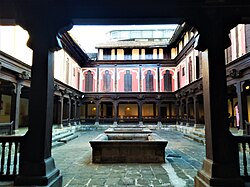
[[File: | [[File:Western courtyard of Vishrambaug Wada, Pune.jpg|thumb|Courtyard of the [[Vishrambaug Wada]], residence of Bajirao II until 1818]] | ||
Baji Rao was | |||
Baji Rao II was born on 10 January 1775 to [[Raghunathrao]], a former Peshwa, and his wife [[Anandibai]]. Raghunathrao's alliance with the British East India Company had led to the [[First Anglo-Maratha War]] (1775–1782), which concluded with the [[Treaty of Salbai]] in 1782.<ref>{{Cite web |title=Author Search Results |url=https://kalnet.kshec.kerala.gov.in/vufind/Author/Home?author=Raghunath+Rao |access-date=23 December 2024 |website=kalnet.kshec.kerala.gov.in}}</ref> At the time of Baji Rao II's birth, both of his parents were under confinement by the ruling Peshwa's council. He and his brothers spent their early years in captivity, with limited access to education and other privileges.<ref>{{Cite web |title=baji-rao-2nd |url=https://byjus.com/free-ias-prep/baji-rao-2/#:~:text=The%20erstwhile%20Peshwa%20Raghunathrao%20and,both%20of%20his%20parents%20imprisoned. |access-date=23 December 2024 |website=BYJUS}}</ref> | |||
After the death of Peshwa [[Madhavrao II]] in 1795, who left no heir, a succession crisis broke out among the Maratha nobility.<ref>{{Cite book |last=Nandakumar |first=J. |url=https://www.google.co.in/books/edition/Swa_Struggle_for_National_Selfhood_Past/beejEAAAQBAJ?hl=en&gbpv=1&dq=Madhavrao+II,+committed+suicide+in+1795&pg=PA48&printsec=frontcover |title=Swa: Struggle for National Selfhood Past, Present and Future |date=10 December 2022 |publisher=Indus Scrolls Press}}</ref> The influential general [[Daulat Rao Scindia]] and the minister [[Nana Fadnavis]] eventually installed Baji Rao II as a [[Puppet ruler|puppet]] Peshwa in 1796. His accession was controversial due to lingering suspicion surrounding his parents, who were believed by some to have been involved in the murder of Peshwa [[Narayanrao]] in 1773. As a result, Baji Rao II faced prejudice and mistrust from sections of the Maratha elite and the public.<ref>{{Cite book |last=Sampath |first=Vikram |url=https://www.google.co.in/books/edition/Tipu_Sultan/tTgxEQAAQBAJ?hl=en&gbpv=1&dq=Baji+Rao+II+as+a+puppet+Peshwa&pg=PT413&printsec=frontcover |title=Tipu Sultan: The Saga of Mysore's Interregnum (1760–1799) |date=31 October 2024 |publisher=Penguin Random House India Private Limited |isbn=978-93-6790-094-9}}</ref> | |||
Despite these challenges, contemporary accounts describe him as an able administrator who undertook developmental works in [[Poona]], though his political and military leadership was often criticized as indecisive.<ref>{{Cite book |last=Vaidya |first=S. G. |url=https://www.google.co.in/books/edition/Peshwa_Bajirao_II_and_the_Downfall_of_th/X3YBAAAAMAAJ?hl=en&gbpv=1&bsq=Baji+Rao+II+coward&dq=Baji+Rao+II+coward&printsec=frontcover |title=Peshwa Bajirao II and the Downfall of the Maratha Power |date=1976 |publisher=Pragati Prakashan}}</ref> | |||
Social reformer [[Pandita Ramabai]] later criticized Baji Rao II for allegedly marrying, at around 60 years of age, a girl said to be aged nine or ten, citing it as an example of the prevalence of child marriage among Maratha nobility.<ref>{{cite book|title=Pandita Ramabai: Life and Landmark Writings|author= Meera Kosambi|date= 22 January 2016|publisher=Routledge, Taylor and Francis Group, London and New York|page=120|isbn= 9781317334019|url=https://books.google.com/books?id=un5wCwAAQBAJ&pg=PA120|quote=[Peshwa] Bajirao II had married a girl of 9 or 10 when he was 60 and blind, to maintain the perpetual sacred fire [agnihotra]. This lady now lives in Nepal. Oh, the fate of our Indian women! Bajirao-saheb was a ruler who belonged to my caste, and he was also my kinsman. But that does not mean that I approve of his vices.}}</ref> | |||
==Holkar's conquest of Poona== | |||
After the death of [[Nana Fadnavis]] in 1800, [[Daulat Rao Sindhia|Daulat Rao Scindia]] took complete control of the Peshwa's administration.<ref>{{Cite web |title=Daulat Rao Sindhia {{!}} Maratha leader {{!}} Britannica |url=https://www.britannica.com/biography/Daulat-Rao-Sindhia |access-date=23 December 2024 |website=britannica.com}}</ref> As Scindia began consolidating power and removing rivals within the government, Baji Rao II grew increasingly concerned for his safety and sought assistance from the British Resident at Poona, Colonel William Palmer. At that time, [[Arthur Wellesley, 1st Duke of Wellington|Arthur Wellesley]] was stationed in the southern Maratha territories, having recently concluded a campaign against [[Dhondia Wagh]]. | |||
Although Baji Rao II initially hesitated to sign a treaty with the British, events in 1802 forced his hand. That year, Scindia's rival, [[Yashwant Rao Holkar]], advanced toward Poona, claiming allegiance to the Peshwa and asserting that his intention was to free the city from Scindia's dominance. Relations between Holkar and the Peshwa, however, were tense, as Baji Rao II had previously ordered the execution of Holkar's brother, [[Vithoji Rao Holkar]]. Baji Rao II requested military assistance from Scindia, who was then away from Poona. Scindia's army arrived on 22 October 1802, but on 25 October, Holkar defeated the combined forces of Scindia and the Peshwa in the [[Battle of Hadapsar]].<ref name="RM_2013">{{cite book |author=Rory Muir |url=https://books.google.com/books?id=tc4_AQAAQBAJ&pg=PA107 |title=Wellington: The Path to Victory 1769–1814 |publisher=Yale University Press |year=2013 |isbn=9780300186659 |pages=107–124}}</ref> | |||
On the morning of 25 October, before the battle, Baji Rao II had already sent preliminary terms for a treaty to the British. After Holkar's victory, the Peshwa fled from [[Hadapsar]] to [[Parvati Hill|Parvati]] and took refuge at [[Sinhagad]].<ref>{{Cite book |last=Gupta |first=Pratul C. |title=Baji Rao II and the East India Company |publisher=Humphrey Milford, Oxford University Press |year=1923 |pages=37–38}}</ref> He later travelled via the Konkan coast to [[Vasai]] (then known as Bassein), where he sought British support in [[Bombay Presidency|Bombay]].<ref name="RM_2013" /> | |||
In Poona, Holkar established a provisional administration headed by his adoptive brother, [[Amrut Rao]], who served as the nominal Peshwa.<ref name="AW_1877">{{cite book |author=Arthur Wellesley Duke of Wellington |url=https://books.google.com/books?id=gskNAAAAQAAJ&pg=PA218 |title=A Selection from the Despatches, Treaties, and Other Papers of the Marquess Wellesley, K.G., During His Government of India |publisher=Clarendon |year=1877 |page=218}}</ref> | |||
His flight from Poona and reliance on British assistance drew criticism from both contemporaries and later historians, who contrasted his actions with the military prowess of his grandfather, [[Bajirao I]].<ref>{{Cite book |last=Gupta |first=Pratul C. |title=Baji Rao II and the East India Company |publisher=Humphrey Milford, Oxford University Press |year=1923 |pages=32–33}}</ref><ref>{{Cite web |last=Ghashi |first=Saisimran |title=मराठा साम्राज्याचा अंत करणारा दूसरा बाजीराव कसा दिसायचा? पाहा दुर्मिळ फोटो |url=https://www.esakal.com/ampstories/web-story/how-second-bajirao-peshwa-looked-like-old-real-photos-historical-images-downfall-of-maratha-empire-ssg2 |access-date=22 July 2025 |website=Marathi News Esakal |language=mr |trans-title=What did Bajirao II, who ended the Maratha Empire, look like? See rare photos}}</ref> | |||
==Treaty with the British== | |||
[[File:Peshwa Baji Rao II.jpg|thumb|Bajirao II meeting with British East India Company officials |left]] | |||
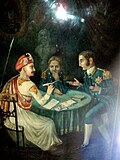
In December 1802, Baji Rao II concluded the Treaty of Bassein with the British East India Company. Under the terms of the treaty, the British agreed to reinstate him as Peshwa in exchange for the right to station a subsidiary force of 6,000 infantry, equipped with artillery and commanded by British officers, within Maratha territory. The Peshwa was required to bear the expenses of this force and to accept the appointment of a permanent British Resident at Poona.<ref name="Naravane1">{{Cite book |last=Naravane |first=M.S. |title=Battles of the Honorourable East India Company |publisher=A.P.H. Publishing Corporation |year=2014 |isbn=9788131300343 |pages=64–66}}</ref> | |||
The treaty provoked strong opposition among other Maratha chiefs, particularly Yashwant Rao Holkar and Daulat Rao Scindia, who viewed it as a violation of Maratha sovereignty. Their resistance to British involvement in Maratha affairs led to the [[Second Anglo-Maratha War]] (1803–1805).<ref name=Naravane1/> | |||
The war ended in a decisive British victory. Internal divisions within the Maratha Confederacy—especially the rivalry between the Holkars and Scindias—contributed to their defeat. Some contemporary accounts also attributed the outcome to the unreliability of Scindia's European officers, who commanded many of the imported artillery pieces in the Maratha army.<ref>{{Cite book |last=Low |first=Sir Sidney |last2=Pulling |first2=Frederick Sanders |title=The Dictionary of English History |url=https://www.google.co.in/books/edition/The_Dictionary_of_English_History/BQAHAAAAQAAJ?hl=en&gbpv=1&dq=rivalries+between+Holkars+and+Scindias&pg=PA701&printsec=frontcover |date=1884 |publisher=Cassell}}</ref><ref>{{Cite book |last=Saroop |first=Narindar |title=Gardner of Gardner's Horse, 2nd Lancers, Indian Army |url=https://www.google.co.in/books/edition/Gardner_of_Gardner_s_Horse_2nd_Lancers_I/AjKURHnitt8C?hl=en&gbpv=1&dq=rivalries+between+Holkars+and+Scindias&pg=PA36&printsec=frontcover |date=1983 |publisher=Abhinav Publications}}</ref> | |||
== | ==Third Anglo-Maratha War== | ||
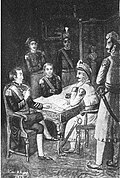
[[File:Rao Baji signing the Treaty of Vasai.jpg|thumb|Bajirao II signs the [[Treaty of Bassein (1802)|Treaty of Bassein]] in 1802.]] | |||
Raids by the [[Pindari]]s, irregular horsemen operating within Maratha territories, into British-controlled areas, ultimately led to the Third Anglo-Maratha War (1817–1818), which ended in the defeat of the [[Bhonsle]]s, [[Holkar]]s, and other Maratha chiefs.<ref>{{Cite web |title=NCERT Notes: Third Anglo-Maratha War – Causes of Marathas' Defeat [Modern Indian History for UPSC] |url=https://byjus.com/free-ias-prep/ncert-notes-third-anglo-maratha-war/ |access-date=23 December 2024 |website=BYJU'S}}</ref> | |||
In the mid-1810s, the British East India Company intervened in a financial dispute between the Peshwa and the Gaekwads of Baroda over revenue sharing. On 13 June 1817, Baji Rao II was compelled to sign the Treaty of Poona, under which he renounced claims to Gaekwad revenues and ceded significant territory to the British. The agreement effectively abolished the Peshwa's nominal suzerainty over other Maratha chiefs, formally bringing the Maratha Confederacy to an end.<ref name="MT_2008">{{cite book |author=Mohammad Tarique |title=Modern Indian History |url=https://books.google.com/books?id=DR2oAQAAQBAJ&pg=SA1-PA15 |publisher=Tata McGraw-Hill |year=2008 |isbn=978-0-07-066030-4 |pages=1.15–1.16}}</ref><ref>{{cite book |author=Gurcharn Singh Sandhu |title=The Indian Cavalry: History of the Indian Armoured Corps |url=https://books.google.com/books?id=6qTeAAAAMAAJ |year=1987 |publisher=Vision Books |isbn=978-81-7094-013-5 |page=211 }}</ref> | |||
== | On 5 November 1817, hostilities broke out when the Peshwa's forces, led by his legal adviser Mor Dixit, attacked the British Residency at [[Pune]]. The ensuing [[Battle of Khadki]] (also known as the Battle of Kirkee) resulted in a British victory.<ref name="JFR_2006">{{cite book |author=John F. Riddick |title=The History of British India: A Chronology |url=https://books.google.com/books?id=Es6x4u_g19UC&pg=PA34 |year=2006 |publisher=Greenwood Publishing Group |isbn=978-0-313-32280-8 |page=34 }}</ref> | ||
Among the Peshwa's troops were the Pinto brothers, [[Conspiracy of the Pintos|José António]] and [[Conspiracy of the Pintos|Francisco]], members of a Goan noble family who had fled [[Goa]] after participating in the [[Conspiracy of the Pintos]].<ref>{{cite web |title=Goan colonel decorated in the Maratha army |url=https://www.thegoan.net/global-goenkar/goan-colonel-decorated-in-the-maratha-army/91527.html |website=The Goan |date=18 November 2022 |access-date=16 September 2024}}</ref><ref>{{cite web |title=Noted Goans during Peshwe era in Pune – 3: Two Goans follow illustrious kin |url=https://www.thegoan.net/global-goenkar/noted-goans-during-peshwe-era-in-pune3-2-goans-follow-illustrious-kin/91809.html |website=The Goan |date=25 November 2022 |access-date=16 September 2024}}</ref> | |||
Following the defeat at Khadki, Baji Rao II's forces regrouped near Garpir on Solapur Road to intercept British reinforcements from [[Jalna, Maharashtra|Jalna]], but the defection of one of his commanders, Sardar Ghorpade Sondurkar, forced the army to withdraw.<ref>{{Cite web |title=A Short Note on Baji Rao II |url=https://unacademy.com/content/railway-exam/study-material/ancient-history-of-india/a-short-note-on-baji-rao-%E2%85%B1/ |access-date=23 December 2024 |website=Unacademy}}</ref> | |||
== | Subsequently, the Peshwa's forces captured [[Chakan Fort]] from the British. Meanwhile, the British placed Poona under the command of Colonel Burr, while [[General Joseph Smith (British Army officer)|General Joseph Smith]] pursued Baji Rao II's army. Late in December 1817, Smith's troops from [[Shirur, Maharashtra|Shirur]] engaged the Peshwa's forces at the [[Battle of Koregaon]], where his troops were repelled and forced to retreat upon learning of the approach of additional Company reinforcements.<ref>{{Cite web |title=Baji Rao II |url=https://byjus.com/free-ias-prep/baji-rao-2/#:~:text=However,%20after%20one%20of%20Baji,put%20Poona%20under%20Colonel%20Burr |access-date=23 December 2024 |website=BYJU'S}}</ref> | ||
==Surrender and retirement== | |||
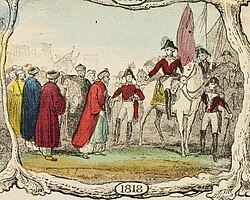
[[File:Surrender of Bajirao II.jpg|left|thumb|Surrender of Bajirao II c.1818]] | |||
[[File:Surrender of the Peishwa Bajirao II.jpg|left|thumb|Surrender of Bajirao II after the [[Third Anglo-Maratha War]] in 1818]] | |||
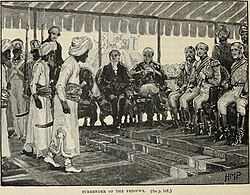
After several months of pursuit by five British columns, Baji Rao II surrendered to [[John Malcolm]] in 1818. Support from the Maratha chiefs [[Scindia]], [[Holkar]], and [[Bhosle]] did not materialize during his flight.<ref>{{Citation |title=A History of the Mahrattas |first=James Grant |last=Duff |volume=2 |publisher=H. Milford, Oxford University Press |location=London |oclc=61585379 |year=1921 |editor=[[Stephen Meredyth Edwardes]] |url=https://books.google.com/books?id=e_Pc4ZQMoy0C&q=A+history+of+the+Mahrattas,+Volume+2&pg=PA513 |page=513}} | |||
</ref> Malcolm negotiated terms allowing Baji Rao II to retain his personal fortune and receive an annual pension of £80,000–£100,000. In return, he was required to reside at a location designated by the British with his retainers, renounce all claims to his heritage, and refrain from using the title of Peshwa, although he was permitted to use the title [[Maharaja]]. The treaty was ratified by [[Francis Rawdon-Hastings, 1st Marquess of Hastings|Francis Rawdon-Hastings]], based on the assumption that Baji Rao II, then over 40 years old, would not live long.<ref>{{Cite book |last=Kerr |first=Gordon |url=https://books.google.com/books?id=07HGDQAAQBAJ |title=A Short History of India: From the Earliest Civilisations to Today's Economic Powerhouse |date=24 May 2017 |publisher=Pocket Essentials |isbn=978-1-84344-923-2}}</ref><ref>{{Cite book |last=Wheeler |first=James Talboys |url=https://books.google.com/books?id=GFvXAAAAMAAJ |title=A Short History of India and of the Frontier States of Afghanistan, Nepal, and Burma |date=1899 |publisher=Macmillan and Company}}</ref> | |||
The British selected [[Bithur]], a village on the right bank of the [[Ganges]] near [[Kanpur]], as his place of residence. The estate covered six square miles and, along with his relatives and attendants who moved from Poona, had a population of approximately 15,000. He lived in Bithur for 33 years, dying in 1851.<ref>{{Cite book |last=Paul |first=E. Jaiwant |url=https://books.google.com/books?id=65vrBAAAQBAJ |title=The Greased Cartridge: The Heroes and Villains of 1857–58 |date=1 August 2011 |publisher=Roli Books Private Limited |isbn=978-93-5194-010-4}}</ref> | |||
== | Accounts from the [[Gwalior State|Court of Gwalior]] describe Baji Rao II's life in exile. He was reportedly haunted by the ghost of [[Narayanrao Peshwa|Narayanrao]], the ninth Peshwa, who had been allegedly murdered with the complicity of Baji Rao II's parents. To address this, he consulted priests from [[Pandharpur]], a temple town on the banks of the [[Chandrabhaga River]], who performed rituals to exorcise the spirit. In gratitude, he commissioned a riverside embankment in Pandharpur, which still bears his name. After his exile to Bithur, he continued performing religious activity and rituals, including constructing temples, bathing [[ghats]], and observing fasts, as prescribed by priests in [[Varanasi]].<ref>{{Cite book |last=Thapliyāla |first=Hari Prasāda |url=https://books.google.com/books?id=Gt-1AAAAIAAJ |title=The Life and Work of Peshwa Nana Saheb: The Spirit and Force of Indian Nationalism and National Liberation Movement in India Since 1857 and Onward |date=1985 |publisher=Sahitya Kendra Prakashan}}</ref><ref>{{Cite book |url=https://books.google.com/books?id=9fovAQAAIAAJ |title=Encyclopaedia Indica: Nana Saheb and his times |date=1996 |publisher=Anmol Publications |isbn=978-81-7041-859-7}}</ref> | ||
During the [[Indian Rebellion of 1857]], after the British recaptured Kanpur under [[Henry Havelock]] and later [[James Hope Grant]], Bithur was sacked and burned. The residence of Baji Rao II and many buildings housing his extended family were destroyed. His adopted son, [[Nana Sahib|Nana Saheb II]], had already escaped by then.<ref>{{Cite book |last=Varma |first=Rakesh |url=https://books.google.com/books?id=VXzcEAAAQBAJ |title=Troll Purana: Rahu to Rahul Bharat Jodo Y |date=8 November 2023 |publisher=Notion Press |isbn=979-8-89133-738-1}}</ref> | |||
==In popular culture== | |||
[[File:Bajirao II Peshwa India.jpg|thumb|Sketch of Bajirao II|left]] | |||
The Marathi [[historical novel]]ist N. S. Inamdar wrote two novels that focus on the career of Bajirao II, presenting a perspective that contrasts with traditional historical portrayals. Inamdar depicts him as a ruler who faced personal and political challenges, including being imprisoned in childhood for a crime allegedly committed by his mother, Anandibai, and taking up the role of Peshwa without a solid understanding of politics.{{Citation needed|date=November 2025}} | |||
The first novel, ''Jhep'' (1963), is based on the life of Trimbakji Dengle, a guard of the Peshwa who rose to become his [[chief minister]] (Karbhari). Trimbakji helped Baji Rao II restore the ''Peshwai'', or Peshwa rule, after the [[Second Anglo-Maratha War]], and attempted to form a coalition with some kings to resist British rule. He was falsely implicated in the murder of Gangadhar Shastri, chief minister of the [[Gaekwad]], and arrested. The Peshwa considered starting a war to secure Trimbakji's release, but Trimbakji advised him to wait for a more opportune moment.{{citation needed|date=August 2020}} | |||
The second novel, ''Mantravegala'' (1969), serves as a continuation of ''Jhep''. While ''Jhep'' focuses primarily on Trimbakji's personal life, ''Mantravegala'' explores Baji Rao II's experiences between 1817 and 1818, encompassing the [[Third Anglo-Maratha War]]. In the novel, he is depicted as frustrated with British interference in Maratha affairs and secretly planning to resist them. He arranges the release of Trimbakji from British imprisonment without acknowledging his involvement to [[Mountstuart Elphinstone]]. During this period, some Maratha chieftains support the [[Pindaris]], who harass British territories. Baji Rao II is unable to prevent them, leading to escalation into the Anglo-Maratha conflict. The narrative portrays his early military successes and eventual defeat by the British, culminating in his exile to [[Bithur]]. Inamdar's work highlights his personal struggles, including his resentment of the British, reflections on past political decisions such as refusing to ally with [[Yashwantrao Holkar]], his sorrow over the loss of his children, and his emotional farewell to Trimbakji.<ref>{{Cite web |title=Mantrawegla – मंत्रावेगळा By N. S. Inamdar – Buy Bajirao Books Online at Sahyadri Books, Dusare Bajirao, Akhercha Bajirao |url=https://sahyadribooks.com/mantrawegla/ |access-date=23 December 2024}}</ref> | |||
== | ===Television & film=== | ||
*[[ | * In the 2001 Hindi historical drama series ''[[1857 Kranti]]'', telecasted on [[DD National]], Baji Rao II is played by [[Lalit Mohan Tiwari]].<ref>{{Cite AV media |url=https://www.imdb.com/title/tt4165066/fullcredits/?ref_=tt_cst_sm |title=1857 Kranti (TV Series) – IMDb |access-date=23 December 2024 |via=imdb.com}}</ref> | ||
*[[ | * In the 2019 Hindi film ''[[Manikarnika: The Queen of Jhansi]]'', [[Suresh Oberoi]] played the character of Baji Rao II.<ref>{{Cite AV media |url=https://www.imdb.com/title/tt6903440/characters/nm0643350 |title=Manikarnika: The Queen of Jhansi (2019) – IMDb |access-date=23 December 2024 |via=imdb.com}}</ref> | ||
==References== | ==References== | ||
| Line 80: | Line 108: | ||
{{Commons category|Baji Rao II}} | {{Commons category|Baji Rao II}} | ||
== Further reading == | ==Further reading== | ||
*Malgonkar, Manohar; ''Devil's Wind'', Orient Paperbacks, New Delhi, 1972 ({{ISBN|0-241-02176-6}}) | * Malgonkar, Manohar; ''Devil's Wind'', Orient Paperbacks, New Delhi, 1972 ({{ISBN|0-241-02176-6}}) | ||
*Vaidya, Dr. SG; ''Peshwa Bajirao II and the downfall of the Maratha power'' (5th ed.) 1976, Pragati Prakashan, Nagpur, India.{{full citation needed|date=August 2015 |reason=ISBN, page № etc. needed}} | * Vaidya, Dr. SG; ''Peshwa Bajirao II and the downfall of the Maratha power'' (5th ed.) 1976, Pragati Prakashan, Nagpur, India.{{full citation needed|date=August 2015 |reason=ISBN, page № etc. needed}} | ||
* Dr.Suman Vaidya,"Akhercha Peshwa" (Marathi) Pragati Prakashan, Nagpur {{full citation needed|date=August 2015 |reason=ISBN, page № etc. needed}} | * Dr.Suman Vaidya,"Akhercha Peshwa" (Marathi) Pragati Prakashan, Nagpur {{full citation needed|date=August 2015 |reason=ISBN, page № etc. needed}} | ||
{{s-start}} | {{s-start}} | ||
{{succession box | | {{succession box | | ||
before=[[Madhavrao II]] | | |||
title=[[Peshwa]] | | |||
years=1795–1851 | | |||
after= [[Nana Sahib]] | |||
}} | }} | ||
{{s-end}} | {{s-end}} | ||
| Line 105: | Line 133: | ||
[[Category:People from Dhar]] | [[Category:People from Dhar]] | ||
[[Category:People of the Second Anglo-Maratha War]] | [[Category:People of the Second Anglo-Maratha War]] | ||
[[Category:People | [[Category:People from the Maratha Empire]] | ||
[[Category:Marathi people]] | [[Category:Marathi people]] | ||
[[Category:19th-century Indian monarchs]] | [[Category:19th-century Indian monarchs]] | ||
[[Category:Indian Hindus]] | [[Category:Indian Hindus]] | ||
Latest revision as of 20:35, 26 March 2026
Baji Rao II | |
|---|---|
 | |
 13th Peshwa of the Maratha Confederacy 13th Peshwa of the Maratha Confederacy | |
| In office 6 December 1796 – 25 October 1802 | |
| Monarch | Shahu II, Pratap Singh of Satara |
| Preceded by | Madhavrao II |
| Succeeded by | Amrut Rao |
| In office 13 May 1803 – 3 June 1818 | |
| Preceded by | Amrut Rao |
| Succeeded by | Position disestablished (Nana Saheb II as titular Peshwa) |
| Personal details | |
| Born | 10 January 1775 Dhar, Indore State, Maratha Confederacy (present-day Madhya Pradesh) |
| Died | 28 January 1851 (aged 76) Bithur, North-Western Provinces, Company India |
| Spouse(s) | Warnashi Bai |
| Children | Nana Saheb II (adopted) |
| Parents |
|
Baji Rao II (10 January 1775 – 28 January 1851) was the 13th and last Peshwa of the Maratha Confederacy. He served from 1796 until his deposition in 1802, and again from 1803 to 1818. Initially installed as a nominal ruler by powerful Maratha nobles, Baji Rao II's authority was soon undermined by internal factionalism. Following his defeat by rival chiefs, he fled from the Maratha capital at Poona and, in 1802, signed the Treaty of Bassein with the British East India Company.
This led to the Second Anglo-Maratha War (1803–1805), which ended with a British victory and Baji Rao II's restoration as Peshwa under British protection. In 1817, tensions with the British resurfaced when they supported the Gaekwads of Baroda in a revenue dispute, prompting Baji Rao II to join other Maratha chiefs in the Third Anglo-Maratha War (1817–1818). After a series of defeats, he surrendered to the British and agreed to retire. Under the terms of his surrender, he was granted an estate at Bithur, near Kanpur, along with an annual pension.
Personal life[edit | edit source]

Baji Rao II was born on 10 January 1775 to Raghunathrao, a former Peshwa, and his wife Anandibai. Raghunathrao's alliance with the British East India Company had led to the First Anglo-Maratha War (1775–1782), which concluded with the Treaty of Salbai in 1782.[1] At the time of Baji Rao II's birth, both of his parents were under confinement by the ruling Peshwa's council. He and his brothers spent their early years in captivity, with limited access to education and other privileges.[2]
After the death of Peshwa Madhavrao II in 1795, who left no heir, a succession crisis broke out among the Maratha nobility.[3] The influential general Daulat Rao Scindia and the minister Nana Fadnavis eventually installed Baji Rao II as a puppet Peshwa in 1796. His accession was controversial due to lingering suspicion surrounding his parents, who were believed by some to have been involved in the murder of Peshwa Narayanrao in 1773. As a result, Baji Rao II faced prejudice and mistrust from sections of the Maratha elite and the public.[4]
Despite these challenges, contemporary accounts describe him as an able administrator who undertook developmental works in Poona, though his political and military leadership was often criticized as indecisive.[5]
Social reformer Pandita Ramabai later criticized Baji Rao II for allegedly marrying, at around 60 years of age, a girl said to be aged nine or ten, citing it as an example of the prevalence of child marriage among Maratha nobility.[6]
Holkar's conquest of Poona[edit | edit source]
After the death of Nana Fadnavis in 1800, Daulat Rao Scindia took complete control of the Peshwa's administration.[7] As Scindia began consolidating power and removing rivals within the government, Baji Rao II grew increasingly concerned for his safety and sought assistance from the British Resident at Poona, Colonel William Palmer. At that time, Arthur Wellesley was stationed in the southern Maratha territories, having recently concluded a campaign against Dhondia Wagh.
Although Baji Rao II initially hesitated to sign a treaty with the British, events in 1802 forced his hand. That year, Scindia's rival, Yashwant Rao Holkar, advanced toward Poona, claiming allegiance to the Peshwa and asserting that his intention was to free the city from Scindia's dominance. Relations between Holkar and the Peshwa, however, were tense, as Baji Rao II had previously ordered the execution of Holkar's brother, Vithoji Rao Holkar. Baji Rao II requested military assistance from Scindia, who was then away from Poona. Scindia's army arrived on 22 October 1802, but on 25 October, Holkar defeated the combined forces of Scindia and the Peshwa in the Battle of Hadapsar.[8]
On the morning of 25 October, before the battle, Baji Rao II had already sent preliminary terms for a treaty to the British. After Holkar's victory, the Peshwa fled from Hadapsar to Parvati and took refuge at Sinhagad.[9] He later travelled via the Konkan coast to Vasai (then known as Bassein), where he sought British support in Bombay.[8]
In Poona, Holkar established a provisional administration headed by his adoptive brother, Amrut Rao, who served as the nominal Peshwa.[10]
His flight from Poona and reliance on British assistance drew criticism from both contemporaries and later historians, who contrasted his actions with the military prowess of his grandfather, Bajirao I.[11][12]
Treaty with the British[edit | edit source]

In December 1802, Baji Rao II concluded the Treaty of Bassein with the British East India Company. Under the terms of the treaty, the British agreed to reinstate him as Peshwa in exchange for the right to station a subsidiary force of 6,000 infantry, equipped with artillery and commanded by British officers, within Maratha territory. The Peshwa was required to bear the expenses of this force and to accept the appointment of a permanent British Resident at Poona.[13]
The treaty provoked strong opposition among other Maratha chiefs, particularly Yashwant Rao Holkar and Daulat Rao Scindia, who viewed it as a violation of Maratha sovereignty. Their resistance to British involvement in Maratha affairs led to the Second Anglo-Maratha War (1803–1805).[13]
The war ended in a decisive British victory. Internal divisions within the Maratha Confederacy—especially the rivalry between the Holkars and Scindias—contributed to their defeat. Some contemporary accounts also attributed the outcome to the unreliability of Scindia's European officers, who commanded many of the imported artillery pieces in the Maratha army.[14][15]
Third Anglo-Maratha War[edit | edit source]

Raids by the Pindaris, irregular horsemen operating within Maratha territories, into British-controlled areas, ultimately led to the Third Anglo-Maratha War (1817–1818), which ended in the defeat of the Bhonsles, Holkars, and other Maratha chiefs.[16]
In the mid-1810s, the British East India Company intervened in a financial dispute between the Peshwa and the Gaekwads of Baroda over revenue sharing. On 13 June 1817, Baji Rao II was compelled to sign the Treaty of Poona, under which he renounced claims to Gaekwad revenues and ceded significant territory to the British. The agreement effectively abolished the Peshwa's nominal suzerainty over other Maratha chiefs, formally bringing the Maratha Confederacy to an end.[17][18]
On 5 November 1817, hostilities broke out when the Peshwa's forces, led by his legal adviser Mor Dixit, attacked the British Residency at Pune. The ensuing Battle of Khadki (also known as the Battle of Kirkee) resulted in a British victory.[19]
Among the Peshwa's troops were the Pinto brothers, José António and Francisco, members of a Goan noble family who had fled Goa after participating in the Conspiracy of the Pintos.[20][21]
Following the defeat at Khadki, Baji Rao II's forces regrouped near Garpir on Solapur Road to intercept British reinforcements from Jalna, but the defection of one of his commanders, Sardar Ghorpade Sondurkar, forced the army to withdraw.[22]
Subsequently, the Peshwa's forces captured Chakan Fort from the British. Meanwhile, the British placed Poona under the command of Colonel Burr, while General Joseph Smith pursued Baji Rao II's army. Late in December 1817, Smith's troops from Shirur engaged the Peshwa's forces at the Battle of Koregaon, where his troops were repelled and forced to retreat upon learning of the approach of additional Company reinforcements.[23]
Surrender and retirement[edit | edit source]


After several months of pursuit by five British columns, Baji Rao II surrendered to John Malcolm in 1818. Support from the Maratha chiefs Scindia, Holkar, and Bhosle did not materialize during his flight.[24] Malcolm negotiated terms allowing Baji Rao II to retain his personal fortune and receive an annual pension of £80,000–£100,000. In return, he was required to reside at a location designated by the British with his retainers, renounce all claims to his heritage, and refrain from using the title of Peshwa, although he was permitted to use the title Maharaja. The treaty was ratified by Francis Rawdon-Hastings, based on the assumption that Baji Rao II, then over 40 years old, would not live long.[25][26]
The British selected Bithur, a village on the right bank of the Ganges near Kanpur, as his place of residence. The estate covered six square miles and, along with his relatives and attendants who moved from Poona, had a population of approximately 15,000. He lived in Bithur for 33 years, dying in 1851.[27]
Accounts from the Court of Gwalior describe Baji Rao II's life in exile. He was reportedly haunted by the ghost of Narayanrao, the ninth Peshwa, who had been allegedly murdered with the complicity of Baji Rao II's parents. To address this, he consulted priests from Pandharpur, a temple town on the banks of the Chandrabhaga River, who performed rituals to exorcise the spirit. In gratitude, he commissioned a riverside embankment in Pandharpur, which still bears his name. After his exile to Bithur, he continued performing religious activity and rituals, including constructing temples, bathing ghats, and observing fasts, as prescribed by priests in Varanasi.[28][29]
During the Indian Rebellion of 1857, after the British recaptured Kanpur under Henry Havelock and later James Hope Grant, Bithur was sacked and burned. The residence of Baji Rao II and many buildings housing his extended family were destroyed. His adopted son, Nana Saheb II, had already escaped by then.[30]
In popular culture[edit | edit source]

The Marathi historical novelist N. S. Inamdar wrote two novels that focus on the career of Bajirao II, presenting a perspective that contrasts with traditional historical portrayals. Inamdar depicts him as a ruler who faced personal and political challenges, including being imprisoned in childhood for a crime allegedly committed by his mother, Anandibai, and taking up the role of Peshwa without a solid understanding of politics.[citation needed]
The first novel, Jhep (1963), is based on the life of Trimbakji Dengle, a guard of the Peshwa who rose to become his chief minister (Karbhari). Trimbakji helped Baji Rao II restore the Peshwai, or Peshwa rule, after the Second Anglo-Maratha War, and attempted to form a coalition with some kings to resist British rule. He was falsely implicated in the murder of Gangadhar Shastri, chief minister of the Gaekwad, and arrested. The Peshwa considered starting a war to secure Trimbakji's release, but Trimbakji advised him to wait for a more opportune moment.[citation needed]
The second novel, Mantravegala (1969), serves as a continuation of Jhep. While Jhep focuses primarily on Trimbakji's personal life, Mantravegala explores Baji Rao II's experiences between 1817 and 1818, encompassing the Third Anglo-Maratha War. In the novel, he is depicted as frustrated with British interference in Maratha affairs and secretly planning to resist them. He arranges the release of Trimbakji from British imprisonment without acknowledging his involvement to Mountstuart Elphinstone. During this period, some Maratha chieftains support the Pindaris, who harass British territories. Baji Rao II is unable to prevent them, leading to escalation into the Anglo-Maratha conflict. The narrative portrays his early military successes and eventual defeat by the British, culminating in his exile to Bithur. Inamdar's work highlights his personal struggles, including his resentment of the British, reflections on past political decisions such as refusing to ally with Yashwantrao Holkar, his sorrow over the loss of his children, and his emotional farewell to Trimbakji.[31]
Television & film[edit | edit source]
- In the 2001 Hindi historical drama series 1857 Kranti, telecasted on DD National, Baji Rao II is played by Lalit Mohan Tiwari.[32]
- In the 2019 Hindi film Manikarnika: The Queen of Jhansi, Suresh Oberoi played the character of Baji Rao II.[33]
References[edit | edit source]
- ↑ "Author Search Results". kalnet.kshec.kerala.gov.in. Retrieved 23 December 2024.
- ↑ "baji-rao-2nd". BYJUS. Retrieved 23 December 2024.
- ↑ Nandakumar, J. (10 December 2022). Swa: Struggle for National Selfhood Past, Present and Future. Indus Scrolls Press.
- ↑ Sampath, Vikram (31 October 2024). Tipu Sultan: The Saga of Mysore's Interregnum (1760–1799). Penguin Random House India Private Limited. ISBN 978-93-6790-094-9.
- ↑ Vaidya, S. G. (1976). Peshwa Bajirao II and the Downfall of the Maratha Power. Pragati Prakashan.
- ↑ Meera Kosambi (22 January 2016). Pandita Ramabai: Life and Landmark Writings. Routledge, Taylor and Francis Group, London and New York. p. 120. ISBN 9781317334019.
[Peshwa] Bajirao II had married a girl of 9 or 10 when he was 60 and blind, to maintain the perpetual sacred fire [agnihotra]. This lady now lives in Nepal. Oh, the fate of our Indian women! Bajirao-saheb was a ruler who belonged to my caste, and he was also my kinsman. But that does not mean that I approve of his vices.
- ↑ "Daulat Rao Sindhia | Maratha leader | Britannica". britannica.com. Retrieved 23 December 2024.
- ↑ 8.0 8.1 Rory Muir (2013). Wellington: The Path to Victory 1769–1814. Yale University Press. pp. 107–124. ISBN 9780300186659.
- ↑ Gupta, Pratul C. (1923). Baji Rao II and the East India Company. Humphrey Milford, Oxford University Press. pp. 37–38.
- ↑ Arthur Wellesley Duke of Wellington (1877). A Selection from the Despatches, Treaties, and Other Papers of the Marquess Wellesley, K.G., During His Government of India. Clarendon. p. 218.
- ↑ Gupta, Pratul C. (1923). Baji Rao II and the East India Company. Humphrey Milford, Oxford University Press. pp. 32–33.
- ↑ Ghashi, Saisimran. "मराठा साम्राज्याचा अंत करणारा दूसरा बाजीराव कसा दिसायचा? पाहा दुर्मिळ फोटो" [What did Bajirao II, who ended the Maratha Empire, look like? See rare photos]. Marathi News Esakal (in मराठी). Retrieved 22 July 2025.
- ↑ 13.0 13.1 Naravane, M.S. (2014). Battles of the Honorourable East India Company. A.P.H. Publishing Corporation. pp. 64–66. ISBN 9788131300343.
- ↑ Low, Sir Sidney; Pulling, Frederick Sanders (1884). The Dictionary of English History. Cassell.
- ↑ Saroop, Narindar (1983). Gardner of Gardner's Horse, 2nd Lancers, Indian Army. Abhinav Publications.
- ↑ "NCERT Notes: Third Anglo-Maratha War – Causes of Marathas' Defeat [Modern Indian History for UPSC]". BYJU'S. Retrieved 23 December 2024.
- ↑ Mohammad Tarique (2008). Modern Indian History. Tata McGraw-Hill. pp. 1.15–1.16. ISBN 978-0-07-066030-4.
- ↑ Gurcharn Singh Sandhu (1987). The Indian Cavalry: History of the Indian Armoured Corps. Vision Books. p. 211. ISBN 978-81-7094-013-5.
- ↑ John F. Riddick (2006). The History of British India: A Chronology. Greenwood Publishing Group. p. 34. ISBN 978-0-313-32280-8.
- ↑ "Goan colonel decorated in the Maratha army". The Goan. 18 November 2022. Retrieved 16 September 2024.
- ↑ "Noted Goans during Peshwe era in Pune – 3: Two Goans follow illustrious kin". The Goan. 25 November 2022. Retrieved 16 September 2024.
- ↑ "A Short Note on Baji Rao II". Unacademy. Retrieved 23 December 2024.
- ↑ "Baji Rao II". BYJU'S. Retrieved 23 December 2024.
- ↑ Duff, James Grant (1921), Stephen Meredyth Edwardes (ed.), A History of the Mahrattas, vol. 2, London: H. Milford, Oxford University Press, p. 513, OCLC 61585379
- ↑ Kerr, Gordon (24 May 2017). A Short History of India: From the Earliest Civilisations to Today's Economic Powerhouse. Pocket Essentials. ISBN 978-1-84344-923-2.
- ↑ Wheeler, James Talboys (1899). A Short History of India and of the Frontier States of Afghanistan, Nepal, and Burma. Macmillan and Company.
- ↑ Paul, E. Jaiwant (1 August 2011). The Greased Cartridge: The Heroes and Villains of 1857–58. Roli Books Private Limited. ISBN 978-93-5194-010-4.
- ↑ Thapliyāla, Hari Prasāda (1985). The Life and Work of Peshwa Nana Saheb: The Spirit and Force of Indian Nationalism and National Liberation Movement in India Since 1857 and Onward. Sahitya Kendra Prakashan.
- ↑ Encyclopaedia Indica: Nana Saheb and his times. Anmol Publications. 1996. ISBN 978-81-7041-859-7.
- ↑ Varma, Rakesh (8 November 2023). Troll Purana: Rahu to Rahul Bharat Jodo Y. Notion Press. ISBN 979-8-89133-738-1.
- ↑ "Mantrawegla – मंत्रावेगळा By N. S. Inamdar – Buy Bajirao Books Online at Sahyadri Books, Dusare Bajirao, Akhercha Bajirao". Retrieved 23 December 2024.
- ↑ 1857 Kranti (TV Series) – IMDb. Retrieved 23 December 2024 – via imdb.com.
- ↑ Manikarnika: The Queen of Jhansi (2019) – IMDb. Retrieved 23 December 2024 – via imdb.com.
Further reading[edit | edit source]
- Malgonkar, Manohar; Devil's Wind, Orient Paperbacks, New Delhi, 1972 (ISBN 0-241-02176-6)
- Vaidya, Dr. SG; Peshwa Bajirao II and the downfall of the Maratha power (5th ed.) 1976, Pragati Prakashan, Nagpur, India.[full citation needed]
- Dr.Suman Vaidya,"Akhercha Peshwa" (Marathi) Pragati Prakashan, Nagpur [full citation needed]
| Preceded by Madhavrao II |
Peshwa 1795–1851 |
Succeeded by Nana Sahib |
