

>SchreiberBike Change a "0" to an "o" - also some copy editing |
quick expanded references based on references per standard format |
||
| Line 5: | Line 5: | ||
<!--See the Table at Infobox Settlement for all fields and descriptions of usage--> | <!--See the Table at Infobox Settlement for all fields and descriptions of usage--> | ||
<!-- Basic info ----------------> | <!-- Basic info ----------------> | ||
|name = Kumartuli<!-- at least one of the first two fields must be filled in --> | |name = Kumartuli<br />কুমারটুলি<!-- at least one of the first two fields must be filled in --> | ||
|official_name = | |official_name = | ||
|other_name = | |other_name = | ||
| Line 14: | Line 14: | ||
|motto = | |motto = | ||
<!-- images and maps -----------> | <!-- images and maps -----------> | ||
|image_skyline = | |image_skyline = Idol of Maa Durga at Kumortuli.jpg | ||
|imagesize = | |imagesize = | ||
|image_caption = | |image_caption = Idol of Maa Durga at Kumortuli | ||
|image_flag = | |image_flag = | ||
|flag_size = | |flag_size = | ||
| Line 50: | Line 50: | ||
|subdivision_name3 = [[Kolkata district|Kolkata]] | |subdivision_name3 = [[Kolkata district|Kolkata]] | ||
|subdivision_type4 = [[Kolkata Metro|Metro Station]] | |subdivision_type4 = [[Kolkata Metro|Metro Station]] | ||
|subdivision_name4 = [[ | |subdivision_name4 = [[Sovabazar Sutanuti metro station|Sovabazar Sutanuti]] | ||
<!-- Smaller parts (e.g. boroughs of a city) and seat of government --> | <!-- Smaller parts (e.g. boroughs of a city) and seat of government --> | ||
|seat_type = [[Municipal Corporation]] | |seat_type = [[Municipal Corporation]] | ||
| Line 113: | Line 113: | ||
|footnotes = | |footnotes = | ||
}} | }} | ||
'''Kumortuli''' ( | '''Kumortuli''' (''Coo-more-tool-e'') ('''Kumartuli''' is a widely used misspelling and mispronunciation) is a traditional [[Pottery|potters]]' quarter in [[North Kolkata]] in [[West Bengal]], [[India]]. The city is renowned for its sculpting prowess. It not only manufactures clay idols for various festivals but also regularly exports them. | ||
==History== | ==History== | ||
| Line 135: | Line 135: | ||
}} | }} | ||
Kumortuli is located in Ward No. | Kumortuli is located in Ward No. 8 of [[Kolkata Municipal Corporation]], mostly between Rabindra Sarani (formerly Chitpur Road) and the [[Hooghly River]]. It is between Beniatola (Ahiritola) and [[Shobhabazar]].<ref>Map nos. 6 and 12, Detail Maps of 141 Wards of Kolkata, D.R.Publication and Sales Concern, 66 College Street, Kolkata – 700073</ref> In maps showing ''thanas'' or police stations in old Kolkata, Kumortuli is shown as being between [[Shyampukur]], Bartala, [[Jorasanko]], [[Jorabagan]] and [[Hooghly River]].<ref>Map on p. 16, ''Calcutta, the Living City'', Vol I.</ref> | ||
==Culture== | ==Culture== | ||
===Dhakeswari Mata Temple=== | ===Dhakeswari Mata Temple=== | ||
[[File: | [[File:Dhakeswari Mata Idol.jpg|thumb|Dhakeswari Mata Idol at Kumortuli]] | ||
Dhakeswari Mata Temple is a [[Hindu]] temple located in Kumortuli, near [[Shobhabazar|Sovabazar]], [[Kolkata]]. It is situated on the eastern bank of the [[Hooghly River]] near Kumartolly. The presiding deity of the temple is [[Durga|Devi Durga]], which was taken to Kolkata in 1947 from [[Dhakeshwari Temple|Dhakeswari Temple]] in Dhaka, Bangladesh.<ref name=":0">{{Cite news|url=https://www.anandabazar.com/calcutta/kolkatar-karcha-1.680135|title=কলকাতার কড়চা|work=Anandabazar Patrika|access-date=2018-10-03|language=bn}}</ref><ref>{{Cite news|url=https://scroll.in/roving/800806/bangladeshs-most-important-hindu-temple-has-been-witness-to-a-tumultuous-past|title=Bangladesh's most important Hindu temple has been witness to a tumultuous past|last=Daniyal|first=Shoaib|work=Scroll.in|access-date=2018-10-03|language=en-US}}</ref> | Dhakeswari Mata Temple is a [[Hindu]] temple located in Kumortuli, near [[Shobhabazar|Sovabazar]], [[Kolkata]]. It is situated on the eastern bank of the [[Hooghly River]] near Kumartolly. The presiding deity of the temple is [[Durga|Devi Durga]], which was taken to Kolkata in 1947 from [[Dhakeshwari Temple|Dhakeswari Temple]] in Dhaka, Bangladesh.<ref name=":0">{{Cite news|url=https://www.anandabazar.com/calcutta/kolkatar-karcha-1.680135|title=কলকাতার কড়চা|work=Anandabazar Patrika|access-date=2018-10-03|language=bn|archive-date=26 November 2018|archive-url=https://web.archive.org/web/20181126172128/https://www.anandabazar.com/calcutta/kolkatar-karcha-1.680135|url-status=live}}</ref><ref>{{Cite news|url=https://scroll.in/roving/800806/bangladeshs-most-important-hindu-temple-has-been-witness-to-a-tumultuous-past|title=Bangladesh's most important Hindu temple has been witness to a tumultuous past|last=Daniyal|first=Shoaib|work=Scroll.in|access-date=2018-10-03|language=en-US|archive-date=30 April 2017|archive-url=https://web.archive.org/web/20170430060556/http://scroll.in/roving/800806/bangladeshs-most-important-hindu-temple-has-been-witness-to-a-tumultuous-past|url-status=live}}</ref> | ||
The idol is 1.5 feet tall and has ten arms, which are mounted on a mythical lion in the form of Katyani Mahishasurmardini Durga. On her two sides are [[Lakshmi|Laxmi]], [[Saraswati]], [[Kartikeya|Kartik]] and [[Ganesha|Ganesh]].<ref name=":0" /> The origins of | The idol is 1.5 feet tall and has ten arms, which are mounted on a mythical lion in the form of Katyani Mahishasurmardini Durga. On her two sides are [[Lakshmi|Laxmi]], [[Saraswati]], [[Kartikeya|Kartik]] and [[Ganesha|Ganesh]].<ref name=":0" /> The origins of the [[Dhakeshwari Temple|main]] temple remain mysterious, hence many rumors preside. One rumor suggests that the wife of King [[Vijaya Sena|Bijoy Sen]] once went to the village of Langolbond to bathe. On her way back she gave birth to a son, [[Ballala Sena|Ballal Sen]].<ref>{{Cite news|url=https://www.thedailystar.net/star-weekend/heritage/temple-and-city-1212340|title=Temple and a City|date=2016-04-22|work=The Daily Star|access-date=2018-10-03|language=en|archive-date=5 October 2018|archive-url=https://web.archive.org/web/20181005092510/https://www.thedailystar.net/star-weekend/heritage/temple-and-city-1212340|url-status=live}}</ref> Later this prince became king of the [[Sena dynasty]]. After ascending to the throne, Ballal Sen built a temple to glorify his birthplace, which is known as [[Dhakeshwari Temple|Dhakeswari temple]], [[Bangladesh]].<ref>{{Cite news|url=https://www.thehindu.com/news/international/millenniumold-hindu-temple-discovered-in-bangladesh/article7214207.ece|title=Millennium-old Hindu temple discovered in Bangladesh|date=2015-05-16|work=The Hindu|access-date=2018-10-03|agency=PTI|language=en-IN|issn=0971-751X|archive-date=13 May 2017|archive-url=https://web.archive.org/web/20170513134311/http://www.thehindu.com/news/international/millenniumold-hindu-temple-discovered-in-bangladesh/article7214207.ece|url-status=live}}</ref> | ||
Ballal Sen proceeded to have vivid dreams, one of which involved the deity [[Durga]]. He dreamt that Durga was hidden within the jungle; he proceeded to discover the said deity which was concealed there. In order to celebrate this discovery, he built a temple later named ''Dhakeswari''. This explains the etymological meaning of "Dhakeswari", which means "covered or hidden deity". According to [[Bengali Hindus]] Dhakeswari is considered to be the presiding deity of [[Dhaka]], which is an incarnation or form of Goddess Durga, the [[Shakti|Adi Shakti]]. The idol of Durga is called Dhakeswari.<ref>{{Cite news|url=http://adarbepari.com/dhakeshwari-temple-dhaka|title=ঢাকেশ্বরী মন্দির, ঢাকা - আদার ব্যাপারী|date=2016-09-28|work=আদার ব্যাপারী|access-date=2018-10-03|language=en-US}}</ref> | Ballal Sen proceeded to have vivid dreams, one of which involved the deity [[Durga]]. He dreamt that Durga was hidden within the jungle; he proceeded to discover the said deity which was concealed there. In order to celebrate this discovery, he built a temple later named ''Dhakeswari''. This explains the etymological meaning of "Dhakeswari", which means "covered or hidden deity". According to [[Bengali Hindus]] Dhakeswari is considered to be the presiding deity of [[Dhaka]], which is an incarnation or form of Goddess Durga, the [[Shakti|Adi Shakti]]. The idol of Durga is called Dhakeswari.<ref>{{Cite news|url=http://adarbepari.com/dhakeshwari-temple-dhaka|title=ঢাকেশ্বরী মন্দির, ঢাকা - আদার ব্যাপারী|date=2016-09-28|work=আদার ব্যাপারী|access-date=2018-10-03|language=en-US|archive-date=8 June 2017|archive-url=https://web.archive.org/web/20170608013039/http://adarbepari.com/dhakeshwari-temple-dhaka|url-status=live}}</ref> | ||
{{Location map|India Kolkata| lat=22.6|long=88.36| width=150|caption= Location in Kolkata|label=Dhakeswari Mata Temple}} | {{Location map|India Kolkata| lat=22.6|long=88.36| width=150|caption= Location in Kolkata|label=Dhakeswari Mata Temple}} | ||
In 1947, during the [[Partition of India]], caretakers of the temple evacuated the idol from Dhaka to Calcutta, and it has remained there since.<ref name=":0" /><ref>{{Cite web|url=http://bn.banglapedia.org/index.php?title=%E0%A6%A2%E0%A6%BE%E0%A6%95%E0%A7%87%E0%A6%B6%E0%A7%8D%E0%A6%AC%E0%A6%B0%E0%A7%80_%E0%A6%AE%E0%A6%A8%E0%A7%8D%E0%A6%A6%E0%A6%BF%E0%A6%B0|title=ঢাকেশ্বরী মন্দির - বাংলাপিডিয়া|website=bn.banglapedia.org|language=bn|access-date=2018-10-03}}</ref><ref>{{cite web |title=Dhakeshwari Temple, Dhaka |url=https://sacredsites.com/asia/bangladesh/dhakeshwari_temple_dhaka.html |website=Places of Peace and Power |access-date=3 November 2018}}</ref> | In 1947, during the [[Partition of India]], caretakers of the temple evacuated the idol from Dhaka to Calcutta, and it has remained there since.<ref name=":0" /><ref>{{Cite web|url=http://bn.banglapedia.org/index.php?title=%E0%A6%A2%E0%A6%BE%E0%A6%95%E0%A7%87%E0%A6%B6%E0%A7%8D%E0%A6%AC%E0%A6%B0%E0%A7%80_%E0%A6%AE%E0%A6%A8%E0%A7%8D%E0%A6%A6%E0%A6%BF%E0%A6%B0|title=ঢাকেশ্বরী মন্দির - বাংলাপিডিয়া|website=bn.banglapedia.org|language=bn|access-date=2018-10-03|archive-date=17 April 2018|archive-url=https://web.archive.org/web/20180417213602/http://bn.banglapedia.org/index.php?title=%E0%A6%A2%E0%A6%BE%E0%A6%95%E0%A7%87%E0%A6%B6%E0%A7%8D%E0%A6%AC%E0%A6%B0%E0%A7%80_%E0%A6%AE%E0%A6%A8%E0%A7%8D%E0%A6%A6%E0%A6%BF%E0%A6%B0|url-status=live}}</ref><ref>{{cite web |title=Dhakeshwari Temple, Dhaka |url=https://sacredsites.com/asia/bangladesh/dhakeshwari_temple_dhaka.html |website=Places of Peace and Power |access-date=3 November 2018 |archive-date=4 November 2018 |archive-url=https://web.archive.org/web/20181104010355/https://sacredsites.com/asia/bangladesh/dhakeshwari_temple_dhaka.html |url-status=live }}</ref> | ||
After this, a Tiwari family from Azamgarh was appointed by the royal family to undertake daily worship of the deity. In 1946, the descendants of that family, Prallad Kishore Tiwari (or Rajendra Kishore Tiwari) transported the idol in a highly confidential aircraft to Kolkata and was re-appointed, where they still serve the goddess continuously. After taken to Kolkata, the idol spent the next two or three years being worshipped in the Debendranath Chowdhury home.<ref name=":0" /> | After this, a Tiwari family from Azamgarh was appointed by the royal family to undertake daily worship of the deity. In 1946, the descendants of that family, Prallad Kishore Tiwari (or Rajendra Kishore Tiwari) transported the idol in a highly confidential aircraft to Kolkata and was re-appointed, where they still serve the goddess continuously. After taken to Kolkata, the idol spent the next two or three years being worshipped in the Debendranath Chowdhury home.<ref name=":0" /> | ||
| Line 156: | Line 156: | ||
The Dhakeshwari devi worship is different from the traditional Durga puja of Bengal. According to the current priest of the temple, Shaktiprasad Ghosal, during Durga Puja, the goddess is worshipped in accordance with the Navratri or nine night rituals of Northern India.<ref name=":0" /> | The Dhakeshwari devi worship is different from the traditional Durga puja of Bengal. According to the current priest of the temple, Shaktiprasad Ghosal, during Durga Puja, the goddess is worshipped in accordance with the Navratri or nine night rituals of Northern India.<ref name=":0" /> | ||
== | ==Notable residents== | ||
Being close to the heart of Kolkata, Kumortuli was home to a number of renowned or famous people during the [[Bengal Renaissance]]. | Being close to the heart of Kolkata, Kumortuli was home to a number of renowned or famous people during the [[Bengal Renaissance]]. | ||
| Line 172: | Line 172: | ||
[[Sovabazar Ahiritola railway station]] and [[Bagbazar railway station]] on [[Kolkata Circular Railway]] line are the nearest stations. [[Kolkata Station]], which is one of the five major railway-terminals of [[Kolkata Metropolitan Area]], is also located nearby. | [[Sovabazar Ahiritola railway station]] and [[Bagbazar railway station]] on [[Kolkata Circular Railway]] line are the nearest stations. [[Kolkata Station]], which is one of the five major railway-terminals of [[Kolkata Metropolitan Area]], is also located nearby. | ||
== | ===Metro=== | ||
Nearest metro station is [[Sovabazar Sutanuti metro station]] and through metro, it can be easily accessed the areas of [[Dakshineswar]] and [[New Garia]] ([[Kavi Subhash metro station]]). | |||
==Gallery== | ==Gallery== | ||
<gallery> image:Kumortuli3.jpg|[[Ganesha]] clay | <gallery> | ||
image: Kumortuli4.jpg|A general view of Banamali Sarkar Street | image:Kumortuli1.jpg|[[Durga]] clay idols under preparation | ||
image: Kumortuli2.jpg|Some finished mini | image:Kumortuli3.jpg|[[Ganesha]] clay idols under preparation | ||
image: Idol making at Kumortuli17.jpg|Idol making at Kumortuli | image: Kumortuli4.jpg|A general view of [[Banamali Sarkar Street]] | ||
image:Devi Durga ready to Paint.jpg|Devi Durga ready for painting | image: Kumortuli2.jpg|Some finished mini idols of [[Lakshmi|Devi lakshmi]], [[Ganesha]], [[Jagannath]], [[Balarama]] and [[Subhadra]] are on sale at Kumortuli | ||
image: Idol making at Kumortuli17.jpg|Idol making of [[Durga|Devi Durga]] at Kumortuli | |||
image:Devi Durga ready to Paint.jpg|Face of [[Durga|Devi Durga]] ready for painting | |||
image: Idol making at Kumortuli, Kolkata4.jpg|The workshop at Kumortuli before Puja | image: Idol making at Kumortuli, Kolkata4.jpg|The workshop at Kumortuli before Puja | ||
image: Idol making at Kumortuli13.jpg|Idol of Devi Durga | image: Idol making at Kumortuli13.jpg|Idol of [[Durga|Devi Durga]] under preparation | ||
image:Idol making at Kumortuli4.jpg| | image:Idol making at Kumortuli4.jpg|Idols of [[Kali|Devi Kali]] under preparation | ||
image:Making of Kali idols, Kumortuli, 2017.jpg|Half finished Goddess Kali idol | image:Making of Kali idols, Kumortuli, 2017.jpg|Half finished Goddess Kali idol | ||
</gallery> | </gallery> | ||
== See also == | |||
* [[North Kolkata]] | |||
* [[Shobhabazar]] | |||
* [[Shobhabazar Rajbari]] | |||
==References== | ==References== | ||
Revision as of 02:24, 17 October 2025
Kumartuli কুমারটুলি | |
|---|---|
Neighbourhood in Kolkata (Calcutta) | |
 Idol of Maa Durga at Kumortuli | |
Kumartuli কুমারটুলি is located in Kolkata  Kumartuli কুমারটুলি Location in Kolkata | |
| Coordinates: 22°36′00″N 88°21′41″E / 22.6000°N 88.3614°E | |
| Country |  India India |
| State | West Bengal |
| City | Kolkata |
| District | Kolkata |
| Metro Station | Sovabazar Sutanuti |
| Municipal Corporation | Kolkata Municipal Corporation |
| KMC ward | 9 |
| Elevation | 36 ft (11 m) |
| Time zone | UTC+5:30 (IST) |
| PIN | 700005 |
| Area code | +91 33 |
| Lok Sabha constituency | Kolkata Uttar |
| Vidhan Sabha constituency | Shyampukur |
Kumortuli (Coo-more-tool-e) (Kumartuli is a widely used misspelling and mispronunciation) is a traditional potters' quarter in North Kolkata in West Bengal, India. The city is renowned for its sculpting prowess. It not only manufactures clay idols for various festivals but also regularly exports them.
History
The British colonisation of Bengal and India started following the victory of the British East India Company in the Battle of Plassey in 1757. The company decided to build new settlement Fort William at the site of the Gobindapur village. Most of the existing population shifted to Sutanuti. While such neighbourhoods as Jorasanko and Pathuriaghata became the centres of the local rich; there were other areas that were developed simultaneously.[1] The villages of Gobindapur, Sutanuti and Kalikata developed to give rise to the latter day metropolis of Calcutta.
Holwell, under orders from the directors of the British East India Company, allotted "separate districts to the Company’s workmen". These neighbourhoods in the heart of the Indian quarters acquired the work-related names – Suriparah (the place of wine sellers), Collotollah (the place of oil men), Chuttarparah (the place of carpenters), Aheeritollah (cowherd's quarters), Coomartolly (potters' quarters) and so on.[2]
Most of the artisans living in the North Kolkata neighbourhoods dwindled in numbers or even vanished, as they were pushed out of the area in the late nineteenth century by the invasion from Burrabazar.[3] In addition, Marwari businessmen virtually flushed out others from many North Kolkata localities. The potters of Kumortuli, who fashioned the clay from the river beside their home into pots to be sold at Sutanuti Bazar (later Burrabazar), managed to survive in the area. Gradually they took to making the images of gods and goddesses, worshipped in large numbers in the mansions all around and later at community pujas in the city and beyond.[4]
In 1888, one of the 25 newly organized police section houses was located in Kumartuli.[5]
Geography
Lua error in Module:OSM_Location_map at line 1984: attempt to index field 'wikibase' (a nil value).
Kumortuli is located in Ward No. 8 of Kolkata Municipal Corporation, mostly between Rabindra Sarani (formerly Chitpur Road) and the Hooghly River. It is between Beniatola (Ahiritola) and Shobhabazar.[6] In maps showing thanas or police stations in old Kolkata, Kumortuli is shown as being between Shyampukur, Bartala, Jorasanko, Jorabagan and Hooghly River.[7]
Culture
Dhakeswari Mata Temple

Dhakeswari Mata Temple is a Hindu temple located in Kumortuli, near Sovabazar, Kolkata. It is situated on the eastern bank of the Hooghly River near Kumartolly. The presiding deity of the temple is Devi Durga, which was taken to Kolkata in 1947 from Dhakeswari Temple in Dhaka, Bangladesh.[8][9]
The idol is 1.5 feet tall and has ten arms, which are mounted on a mythical lion in the form of Katyani Mahishasurmardini Durga. On her two sides are Laxmi, Saraswati, Kartik and Ganesh.[8] The origins of the main temple remain mysterious, hence many rumors preside. One rumor suggests that the wife of King Bijoy Sen once went to the village of Langolbond to bathe. On her way back she gave birth to a son, Ballal Sen.[10] Later this prince became king of the Sena dynasty. After ascending to the throne, Ballal Sen built a temple to glorify his birthplace, which is known as Dhakeswari temple, Bangladesh.[11]
Ballal Sen proceeded to have vivid dreams, one of which involved the deity Durga. He dreamt that Durga was hidden within the jungle; he proceeded to discover the said deity which was concealed there. In order to celebrate this discovery, he built a temple later named Dhakeswari. This explains the etymological meaning of "Dhakeswari", which means "covered or hidden deity". According to Bengali Hindus Dhakeswari is considered to be the presiding deity of Dhaka, which is an incarnation or form of Goddess Durga, the Adi Shakti. The idol of Durga is called Dhakeswari.[12]

In 1947, during the Partition of India, caretakers of the temple evacuated the idol from Dhaka to Calcutta, and it has remained there since.[8][13][14]
After this, a Tiwari family from Azamgarh was appointed by the royal family to undertake daily worship of the deity. In 1946, the descendants of that family, Prallad Kishore Tiwari (or Rajendra Kishore Tiwari) transported the idol in a highly confidential aircraft to Kolkata and was re-appointed, where they still serve the goddess continuously. After taken to Kolkata, the idol spent the next two or three years being worshipped in the Debendranath Chowdhury home.[8]
In 1950 the businessman Debendranath Chowdhary built the temple of the goddess in the Kumortuli area and established some of the goddess' property for her daily services.[8]
The Dhakeshwari devi worship is different from the traditional Durga puja of Bengal. According to the current priest of the temple, Shaktiprasad Ghosal, during Durga Puja, the goddess is worshipped in accordance with the Navratri or nine night rituals of Northern India.[8]
Notable residents
Being close to the heart of Kolkata, Kumortuli was home to a number of renowned or famous people during the Bengal Renaissance.
There is a road in Kumortuli named after Nandram Sen, a wealthy former resident. His wealth was accrued because of his status as the first tax collector of Kolkata, during the 1700s.[15] Gobindram Mitter, the tax collector after Nandram, lived in a large mansion on a sprawling 16-acre property during this time. His house is now known as one of the "Great Houses of Old Calcutta".[16]
Banamali Sarkar's famous house which is immortalized in Bengali rhyming proverb, was there till the 19th century. He has a winding lane named after him in Kumortuli.[17]
Transport
Rabindra Sarani passes through Kumortuli.[18]
Bus
- 43 Esplanade - Dakshineswar
Train
Sovabazar Ahiritola railway station and Bagbazar railway station on Kolkata Circular Railway line are the nearest stations. Kolkata Station, which is one of the five major railway-terminals of Kolkata Metropolitan Area, is also located nearby.
Metro
Nearest metro station is Sovabazar Sutanuti metro station and through metro, it can be easily accessed the areas of Dakshineswar and New Garia (Kavi Subhash metro station).
Gallery
-
 Durga clay idols under preparation
 -
 Ganesha clay idols under preparation
 -
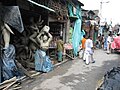 A general view of Banamali Sarkar Street
 -
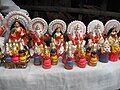 Some finished mini idols of Devi lakshmi, Ganesha, Jagannath, Balarama and Subhadra are on sale at Kumortuli
 -
 Idol making of Devi Durga at Kumortuli
 -
 Face of Devi Durga ready for painting
 -
 The workshop at Kumortuli before Puja
 -
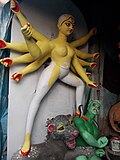 Idol of Devi Durga under preparation
 -
 Idols of Devi Kali under preparation
 -
 Half finished Goddess Kali idol


See also
References
- ↑ Cotton, H.E.A., Calcutta Old and New, 1909/1980, p. 72, General Printers and Publishers Pvt. Ltd.
- ↑ Cotton, H.E.A., pp. 282-3
- ↑ Bhattacharya, Sabyasachi, Traders and Trades in Old Calcutta, P.207, in Calcutta, the Living City, Vol I, edited by Sukanta Chaudhuri, pp 58-59, Oxford University Press, ISBN 0-19-563696-1
- ↑ Gupta, Bunny, and Chaliha, Jaya, Chitpur, in Calcutta, the Living City, Vol I, p. 27
- ↑ Nair, P.Thankappan, The Growth and Development of Old Calcutta, in Calcutta, the Living City, Vol. I, pp. 18-19, Edited by Sukanta Chaudhuri, Oxford University Press, 1995 edition.
- ↑ Map nos. 6 and 12, Detail Maps of 141 Wards of Kolkata, D.R.Publication and Sales Concern, 66 College Street, Kolkata – 700073
- ↑ Map on p. 16, Calcutta, the Living City, Vol I.
- ↑ 8.0 8.1 8.2 8.3 8.4 8.5 "কলকাতার কড়চা". Anandabazar Patrika (in Bengali). Archived from the original on 26 November 2018. Retrieved 3 October 2018.
- ↑ Daniyal, Shoaib. "Bangladesh's most important Hindu temple has been witness to a tumultuous past". Scroll.in. Archived from the original on 30 April 2017. Retrieved 3 October 2018.
- ↑ "Temple and a City". The Daily Star. 22 April 2016. Archived from the original on 5 October 2018. Retrieved 3 October 2018.
- ↑ "Millennium-old Hindu temple discovered in Bangladesh". The Hindu. PTI. 16 May 2015. ISSN 0971-751X. Archived from the original on 13 May 2017. Retrieved 3 October 2018.
- ↑ "ঢাকেশ্বরী মন্দির, ঢাকা - আদার ব্যাপারী". আদার ব্যাপারী. 28 September 2016. Archived from the original on 8 June 2017. Retrieved 3 October 2018.
- ↑ "ঢাকেশ্বরী মন্দির - বাংলাপিডিয়া". bn.banglapedia.org (in Bengali). Archived from the original on 17 April 2018. Retrieved 3 October 2018.
- ↑ "Dhakeshwari Temple, Dhaka". Places of Peace and Power. Archived from the original on 4 November 2018. Retrieved 3 November 2018.
- ↑ Cotton, H.E.A., p. 291
- ↑ Deb, Chitra, The Great Houses of Old Calcutta in Calcutta, the Living City, Vol I.
- ↑ Cotton, H.E.A., pp. 297-8
- ↑ Google maps


