








m Removed empty portal template using script |
small fix lead based on references additionally and cleaned formatting |
||
| Line 1: | Line 1: | ||
{{ | {{Short description|4th President and 9th Prime Minister of Pakistan (1928–1979)}} | ||
{{ | {{not to be confused with|text=[[Zulfiker Ali Bhutto]], the Bangladeshi politician}} | ||
{{ | {{Use Pakistani English|date=September 2025}} | ||
{{ | {{Use dmy dates|date=June 2021}} | ||
{{Infobox officeholder | {{Infobox officeholder | ||
| name = | | name = Zulfikar Ali Bhutto | ||
| | | honorific_suffix = [[Nishan-e-Pakistan|NPk]] | ||
| nickname = ''Quaid-e- | | honorific_prefix = [[His Excellency]] | ||
| native_name = {{ | | nickname = ''[[Qaid|Quaid]]-e-Awām'' ("the People's Leader")<br />''[[Shahid|Shahīd]]-e-Āzam'' ("The Great Martyr") | ||
| native_name = {{No bold|{{Script/Nastaliq|ذُو الفِقار علی بُھٹّو}}}} | |||
| image = Z A Bhutto (President of Pakistan).jpg | | image = Z A Bhutto (President of Pakistan).jpg | ||
| caption = | | caption = Official portrait, {{circa|1971}} | ||
| office = 9th [[Prime Minister of Pakistan]] | |||
| office = | | predecessor = ''Himself'' (as [[Chief Martial Law Administrator]])<br />[[Nurul Amin]] (1971) | ||
| president = [[Fazal Ilahi Chaudhry]] | |||
| president = | | successor = [[Muhammad Zia-ul-Haq]] (as Chief Martial Law Administrator)<br />[[Muhammad Khan Junejo]] (1985) | ||
| successor = [[ | | term_start = 14 August 1973 | ||
| term_start = | | term_end = 5 July 1977 | ||
| term_end = | | constituency = [[NA-194 Larkana-I|Larkana-I]] | ||
| | | office1 = 4th [[President of Pakistan]]<br />3rd [[Chief Martial Law Administrator]] | ||
| office1 = | | predecessor1 = [[Yahya Khan]] | ||
| predecessor1 = [[ | | successor1 = Fazal Ilahi Chaudhry | ||
| successor1 = [[ | | vice_president1 = Nurul Amin | ||
| | | term_start1 = 20 December 1971 | ||
| | | term_end1 = 14 August 1973 | ||
| | | constituency1 = [[NA-194 Larkana-I|Larkana-I]] | ||
| | | office2 = 1st [[Deputy Prime Minister of Pakistan]] | ||
| prime_minister2 = Nurul Amin | |||
| | | predecessor2 = ''Position established'' | ||
| | | successor2 = [[Nusrat Bhutto]] (1989)<br />{{small|(as Senior Minister)}} | ||
| | | term_start2 = 7 December 1971 | ||
| | | term_end2 = 20 December 1971 | ||
| | | constituency2 = [[NA-194 Larkana-I|Larkana-I]] | ||
| | | deputy3 = Muhammad Hanif Khan | ||
| | | office3 = 7th [[Speaker of the National Assembly of Pakistan|Speaker of the National Assembly]] | ||
| | | predecessor3 = [[Abdul Jabbar Khan (20th-century politician)|Abdul Jabbar Khan]] | ||
| | | term_start3 = 14 April 1972 | ||
| | | term_end3 = 15 August 1972 | ||
| | | successor3 = [[Fazal Ilahi Chaudhry]]{{Collapsed infobox section begin|Ministerial positions|titlestyle=border: 1px dashed lightgrey;}} | ||
| | {{Infobox officeholder |embed=yes | ||
| | | deputy5 = S. K. Dehlavi<br />[[Aziz Ahmed (civil servant)|Aziz Ahmed]]<br />S. M. Yusuf<br />{{small|([[Foreign Secretary (Pakistan)|Foreign Secretary]])}} | ||
| deputy4 = [[Sultan Mohammed Khan]]<br />Iftikhar Ali<br />Mumtaz Ali Alvie<br />[[Agha Shahi]]<br />{{small|([[Foreign Secretary (Pakistan)|Foreign Secretary]])}} | |||
| president5 = [[Ayub Khan]] | |||
| office4 = 8th and 12th [[Minister of Foreign Affairs (Pakistan)|Minister of Foreign Affairs]] | |||
| term_start5 = 15 June 1963 | |||
| term_end5 = 31 August 1966 | |||
| predecessor5 = [[Muhammad Ali Bogra]] | |||
| successor5 = [[Sharifuddin Pirzada]] | |||
| prime_minister4 = ''Himself'' | |||
| term_start4 = 20 December 1971 | | term_start4 = 20 December 1971 | ||
| term_end4 = 28 March 1977 | | term_end4 = 28 March 1977 | ||
| predecessor4 = [[Yahya Khan]] | | predecessor4 = [[Yahya Khan]] | ||
| successor4 = [[Aziz Ahmed (civil servant)|Aziz Ahmed]] | | successor4 = [[Aziz Ahmed (civil servant)|Aziz Ahmed]] | ||
| office6 = 13th [[Minister of Defence (Pakistan)|Minister of Defence]] | |||
| deputy6 = Ghias Uddin Ahmed<br />Fazal Muqeem Khan<br />[[Ghulam Ishaq Khan]]<br />{{small|([[Defence Secretary (Pakistan)|Defence Secretary]])}} | |||
| predecessor6 = [[Yahya Khan]] | |||
| successor6 = [[Muhammad Zia-ul-Haq]] | |||
| term_start6 = 20 December 1971 | |||
| term_end6 = 5 July 1977 | |||
| prime_minister6 = ''Himself'' | |||
| president8 = ''Himself'' | |||
| office7 = 17th and 19th [[Ministry of Interior (Pakistan)|Minister of Interior]] | |||
| predecessor8 = [[Abdur Rashid Khan (politician)|Abdur Rashid Khan]] | |||
| successor8 = [[Abdul Qayyum Khan]] | |||
| term_start8 = 24 December 1971 | |||
| term_end8 = 1 May 1972 | |||
| prime_minister7 = ''Himself'' | |||
| predecessor7 = [[Abdul Qayyum Khan]] | |||
| successor7 = [[Inamul Haque Khan]] | |||
| term_start7 = 13 January 1977 | |||
| term_end7 = 28 March 1977 | |||
| prime_minister9 = ''Himself'' | |||
| office9 = 12th [[Ministry of Industries and Production|Minister of Industries]] | |||
| predecessor9 = A. K. M. Hafizuddin | |||
| successor9 = Rafi Raza | |||
| term_start9 = 13 May 1972 | |||
| term_end9 = 22 October 1974 | |||
| prime_minister10 = ''Himself'' | |||
| office10 = 1st [[Ministry of Inter Provincial Coordination|Minister of Provincial Coordination]] | |||
| predecessor10 = ''Position established'' | |||
| successor10 = [[Abdul Hafeez Pirzada]] | |||
| term_start10 = 24 December 1971 | |||
| term_end10 = 6 March 1972 | |||
| office11 = 1st [[Ministry of Energy (Pakistan)|Minister of Fuel, Power and Natural Resources]] | |||
| president11 = [[Ayub Khan]] | |||
| predecessor11 = ''Position established'' | |||
| successor11 = [[Abdullah al Mahmood]] | |||
| term_start11 = 23 April 1960 | |||
| term_end11 = 4 September 1963 | |||
| president13 = [[Ayub Khan]] | |||
| office12 = 16th and 18th [[Ministry of Housing and Works (Pakistan)|Minister of Works]] | |||
| predecessor13 = K. N. Sheikh | |||
| successor13 = [[Fazlul Qadir Chaudhry]] | |||
| term_start13 = 7 September 1961 | |||
| term_end13 = 8 June 1962 | |||
| president12 = [[Ayub Khan]] | |||
| predecessor12 = [[Fazlul Qadir Chaudhry]] | |||
| successor12 = Rana Abdul Hamid | |||
| term_start12 = 31 August 1962 | |||
| term_end12 = 3 February 1963 | |||
| president15 = [[Ayub Khan]] | |||
| office14 = 14th and 17th [[Ministry of Information & Broadcasting (Pakistan)|Minister of Information and Broadcasting]] | |||
| predecessor15 = Habibur Rahman | |||
| successor15 = [[Akhter Husain]] | |||
| term_start15 = 16 January 1960 | |||
| term_end15 = 1 June 1960 | |||
| president14 = [[Ayub Khan]] | |||
| predecessor14 = [[Ayub Khan]] | |||
| successor14 = Habibur Rahman | |||
| term_start14 = 25 November 1960 | |||
| term_end14 = 10 April 1961 | |||
| president19 = [[Ayub Khan]] | |||
| office19 = 13th [[Ministry of Commerce (Pakistan)|Minister of Commerce]] | |||
| predecessor19 = [[Abdur Rashid Khan (politician)|Abdur Rashid Khan]] | |||
| successor19 = [[Md. Hafizur Rahman]] | |||
| term_start19 = 28 October 1958 | |||
| term_end19 = 16 January 1960 | |||
| president17 = [[Ayub Khan]] | |||
| office17 = [[Ministry of Kashmir Affairs and Gilgit-Baltistan|Minister of Kashmir Affairs]] | |||
| predecessor17 = [[Ayub Khan]] | |||
| successor17 = [[Akhter Husain]] | |||
| term_start17 = 23 April 1960 | |||
| term_end17 = 1 June 1960 | |||
| president18 = [[Ayub Khan]] | |||
| predecessor18 = [[Wajid Ali Khan Burki]] | |||
| successor18 = [[Habibullah Khan Marwat]] | |||
| term_start18 = 3 March 1962 | |||
| term_end18 = 8 June 1962 | |||
| president16 = [[Ayub Khan]] | |||
| office16 = 8th [[Ministry of Minorities (Pakistan)|Minister of Minority Affairs]] | |||
| predecessor16 = Habibur Rahman | |||
| successor16 = Habibur Rahman | |||
| term_start16 = 16 January 1960 | |||
| term_end16 = 23 April 1960 | |||
}} | |||
{{Collapsed infobox section end}} | |||
| module = | |||
| party = [[Pakistan People's Party]] | | party = [[Pakistan People's Party]] | ||
| | | other_party = [[Convention Muslim League]] <br /> (1962–1966)<ref>{{cite news|url=https://www.dawn.com/news/741882/the-multipurpose-muslim-league|title=The multipurpose Muslim League|date=13 August 2012|access-date=23 October 2021|work=Dawn}}</ref> | ||
| birth_date = {{birth date|1928|1|5}} | | birth_date = {{birth date|1928|1|5|df=y}} | ||
| birth_place = [[Ratodero Taluka]], [[ | | birth_place = [[Ratodero Taluka|Ratodero]], [[Sind Division|Sind]], [[Bombay Presidency]], British India | ||
| death_date = {{death date and age|1979|4|4|1928|1|5|df=y}} | | death_date = {{death date and age|1979|4|4|1928|1|5|df=y}} | ||
| death_place = [[Rawalpindi]], [[Punjab, Pakistan|Punjab]], Pakistan | | death_place = [[District Jail Rawalpindi|District Jail, Rawalpindi]], [[Punjab, Pakistan|Punjab]], Pakistan | ||
| death_cause = [[Execution by hanging]] | | death_cause = [[Execution by hanging]] | ||
| | | resting_place = [[Bhutto family mausoleum]] | ||
| | | spouse = {{marriage|[[Shireen Amir]]|1943|end=sep}}{{marriage|[[Nusrat Ispahani]]|1951}} | ||
| awards = [[File:Nishan-e-Pakistan ribbon bar.svg|45px]] [[Nishan-e-Pakistan|Grand Cross with Collar of the Order of Pakistan]] (Posthumous) | |||
| | | relatives = [[Bhutto family]] | ||
| father = [[Shah Nawaz Bhutto]] | | father = [[Shah Nawaz Bhutto]] | ||
| mother = Khursheed Begum | | mother = Khursheed Begum | ||
| children = [[Benazir Bhutto]] | | children = {{hlist|[[Benazir Bhutto|Benazir]]|[[Murtaza Bhutto|Murtaza]]|Sanam|[[Shahnawaz Bhutto|Shahnawaz]]}} | ||
| alma_mater = [[University of California, Berkeley]]<br />[[Christ Church, Oxford]] <br /> [[ | | alma_mater = [[University of Southern California]]<br />[[University of California, Berkeley]]<br />[[Christ Church, Oxford]] <br /> [[Lincoln's Inn]] | ||
| profession = | | profession = {{hlist|Barrister|diplomat|politician}} | ||
| native_name_lang = ur | |||
| office4 = [[Pakistan Peoples Party#Notable leadership|Chairperson of the Pakistan People's Party]] | |||
| term_start4 = 30 November 1967 | |||
| term_end4 = 4 April 1979 | |||
| successor4 = [[Nusrat Bhutto]] | |||
| predecessor4 = ''Position established'' | |||
| office5 = Head of the [[Bhutto family]] | |||
| term_start5 = 6 December 1965 | |||
| term_end5 = 4 April 1979 | |||
| predecessor5 = [[Nabi Bux Khan Bhutto]] | |||
| successor5 = [[Mumtaz Bhutto]] | |||
}} | |||
'''Zulfikar Ali Bhutto'''{{Efn|{{langx|ur|ذُوالفِقار علی بُھٹّو}}, {{langx|sd|ذولفقار علي ڀٽو}}; {{IPAc-en|ˈ|z|uː|l|f|iː|k|ɑː|ɹ|_|ˈ|ɑː|l|i|_|ˈ|b|u|t|oʊ}}}} {{small|[[Nishan-e-Pakistan|NPk]]}} (5 January 1928 – 4 April 1979) was a Pakistani barrister, politician and statesman who served as the fourth [[president of Pakistan]] from 1971 to 1973 and later as the ninth [[Prime Minister of Pakistan|prime minister of Pakistan]] from 1973 until his [[1977 Pakistani military coup|overthrow]] in 1977. He was also the founder and first chairman of the [[Pakistan People's Party]] (PPP) from 1967 until [[#Trial and execution|his execution]] in 1979. | |||
}} | Born in [[Sindh]] and educated at the [[University of Southern California]], [[University of California, Berkeley]] and the [[University of Oxford]], Bhutto trained as a barrister at [[Lincoln's Inn]] before entering [[Pakistani politics|politics]]. He was a cabinet member during president [[Iskandar Mirza]]'s tenure, holding various ministries during president [[Ayub Khan]]'s military rule from 1958. Bhutto became the [[Foreign Minister of Pakistan|foreign minister]] in 1963, advocating for [[Operation Gibraltar]] in [[Kashmir]], leading to the [[Indo-Pakistani War of 1965|1965 war with India]]. Following the [[Tashkent Declaration]], he was dismissed from the government. Bhutto established the PPP in 1967, focusing on a [[Left wing politics|left-wing]] and [[Socialism|socialist]] agenda, and contested the [[1970 Pakistani general election|1970 general election]], arising as the largest political party in Western Pakistan{{efn|Western Pakistan — comprising [[Azad Kashmir]], [[Balochistan, Pakistan|Balochistan]], [[Islamabad Capital Territory]], [[North-West Frontier Province|North-West Frontier]], [[Gilgit-Baltistan|Northern Areas]], [[Punjab, Pakistan|Punjab]], and [[Sindh]] — here refers to the western half of Pakistan from 1947 to 1971; not the province of [[West Pakistan]] which was dissolved in July 1970. This specific case in the 1970 election only refers to the four provinces of the [[Federation of Pakistan]] in the west — including only Balochistan, North-West Frontier, Punjab, and Sindh.}} with a landslide victory in [[Punjab, Pakistan|Punjab]] and Sindh. The [[Awami League]], victorious with a landslide in [[East Pakistan]], and the PPP were unable to agree on power transfer, leading to [[Non-cooperation movement (1971)|civil unrest]] in the east — further intensified by [[Operation Searchlight|military action]] under [[Yahya Khan]]'s military government — followed by a [[Bangladesh Liberation War|civil war]] and a [[Indo-Pakistani war of 1971|war with India]], resulting in the creation of [[Bangladesh]]. After Pakistan's [[Pakistani Instrument of Surrender|loss in the east]], Yahya resigned amidst a [[1971 Pakistan Military Officer's Revolt|military revolt against him]] and Bhutto assumed the presidency in December 1971, imposing [[State of emergency|emergency rule]] and securing a [[ceasefire]] on the [[Indo-Pakistani war of 1971#Western Front|western front]]. | ||
Bhutto secured the release of 93,000 [[Prisoners of war in the Indo-Pakistani war of 1971|prisoners of war]] through the [[Delhi Agreement]], a trilateral accord signed between India, Pakistan, and Bangladesh on 28 August 1973, and ratified only by India and Pakistan. He also reclaimed {{convert|5,000|sqmi|spell=in}} of Indian-held territory through the [[Simla Agreement]], signed between India and Pakistan in July 1972. He strengthened diplomatic ties with other [[Islamic world|Muslim countries]], as well as [[China–Pakistan relations|China]]; and recognised Bangladesh in 1974 while hosting the historic [[Islamic Summit of the Organisation of Islamic Cooperation|Islamic Summit]] in [[Lahore]] — attended by leaders from 37 Muslim countries — marking the largest gathering of top Muslim leaders in modern history.{{efn|included six [[Monarch|monarchs]], twelve [[President (government title)|presidents]], six [[Prime minister|prime ministers]], eight [[Ministry of foreign affairs|foreign ministers]], and the [[chairman of the Palestine Liberation Organization]]}} After declaring a [[state of emergency]] in [[Balochistan, Pakistan|Balochistan]] in 1973, he dismissed [[Ataullah Mengal#Political career|Ataullah Mengal's government]] and imposed '[[Governor (Pakistan)|governor’s rule]]', appointing [[Akbar Bugti]] as [[Governor of Balochistan, Pakistan|governor]] and ordering a [[1970s operation in Balochistan|military operation]] to suppress [[Insurgency in Balochistan|insurgency in the province]]. In collaboration with the [[parliamentary opposition]], Bhutto's government drafted and promulgated Pakistan’s [[Constitution of Pakistan|current constitution]] in 1973, with the approval of 97 percent of the parliament — bringing an end to emergency rule and restoring [[parliamentary democracy]] across the country, with Bhutto assuming office [[First Zulfikar Ali Bhutto government|as prime minister]]. He brought in [[Abdul Qadeer Khan]], strengthened the [[Pakistan Atomic Energy Commission]], and initiated the [[Pakistan and weapons of mass destruction|country's nuclear program]] which he regarded as a 'national priority'. Bhutto also introduced a policy of extensive [[Nationalisation in Pakistan|nationalisation]] under his socialist agenda. | |||
Despite winning the [[1977 Pakistani general election|1977 parliamentary elections]], the Peoples Party faced allegations of [[vote rigging]] by the [[Pakistan National Alliance]] (PNA), the [[Populism|populist]] opposition, sparking [[1977 Pakistan uprising|violence across the country]]. Bhutto's government reached an agreement with the opposition to hold fresh elections under a neutral [[Caretaker government of Pakistan|caretaker administration]] in October of the same year, but Bhutto was deposed two days later in a [[Operation Fair Play|military coup]] by [[Chief of Army Staff (Pakistan)|army chief]] [[Zia-ul-Haq]] on 5 July 1977. Controversially [[#Trial and execution|tried and executed]] in 1979, his trial — widely described, both in Pakistan and internationally, as a '[[judicial murder]]' — was later declared 'unfair' by the [[Supreme Court of Pakistan]] in a ''[[mea culpa]]'', following which he was posthumously awarded the [[Nishan-e-Pakistan]], the country's highest civilian award, by the [[government of Pakistan]].{{efn|[[Amnesty International]] criticized the trial for not meeting fair trial standards. The [[International Commission of Jurists]] (ICJ) in [[Geneva]] issued a report in 1979 stating that the trial before the [[Lahore High Court]] and the appeal in the [[Supreme Court of Pakistan|Supreme Court]] “did not measure up to the requirements of a fair trial".}}{{efn|Bhutto's execution prompted widespread international concern and criticism. | |||
*Leaders of several Western countries — including U.S. President [[Jimmy Carter]], British Prime Minister [[James Callaghan]], French President [[Valéry Giscard d’Estaing]], and West German Chancellor [[Helmut Schmidt]] — had appealed to Zia-ul-Haq for clemency prior to the execution, citing doubts about the fairness of Bhutto’s trial. | |||
*Major international newspapers and broadcasters, including [[BBC]], questioned the independence of judiciary under military rule. | |||
*In the Muslim world, Saudi Arabia reportedly supported exile as an alternative and expressed regret after the execution without open condemnation, while Libya and post-revolutionary Iran openly criticized the hanging. | |||
*The prevailing international view among media, human rights organizations, and many political observers regarded Bhutto’s death as a political execution carried out under the guise of legality under military rule.}} | |||
Bhutto's legacy remains contentious, praised for [[Pakistani nationalism|nationalist]] and a [[Secularism|secular]] [[Internationalism (politics)|internationalist]] agenda, yet criticised for economic challenges, political repression and human rights abuses. He is often considered one of [[History of Pakistan|Pakistan's greatest leaders]] and referred to as the '''Quaid-e-Awām''' ("the People's Leader"). Today, Bhutto is recognised as a significant figure in [[Democracy in Pakistan|Pakistan’s democratic history]] and continues to be acknowledged across the [[List of political parties in Pakistan|country’s political spectrum]]. His party, the PPP, continues to be a significant political force in Pakistan, with his daughter [[Benazir Bhutto]] serving twice as prime minister, and his son-in-law, [[Asif Ali Zardari]], becoming president.{{Zulfiqar Ali Bhutto sidebar}} | |||
== Early life and education == | |||
Zulfikar Ali Bhutto belonged to a [[Sindhi people|Sindhi]] family; [[Owen Bennett-Jones]] writes that the family traces its ancestry back to a 9th-century [[Rajput]] prince of the [[Bhati]] clan who ruled the town of Tanot (in current-day [[Rajasthan|Rajasthan, India]]), Bhutto's ancestors later appearing in different Rajasthani chronicles in prominent roles, the family converting to Islam mostly around the 17th century before moving to Sindh.<ref>{{Cite book |last=Bennett Jones |first=Owen |title=The Bhutto dynasty |date=2020 |publisher=Yale University Press |isbn=978-0-300-25580-5 |location=New Haven London |pages=8–9}}</ref> | |||
| | |||
|publisher= | |||
| | |||
| | |||
}}</ref> | |||
Bhutto | He was born to [[Shah Nawaz Bhutto]] and Khursheed Begum near [[Larkana]].<ref>{{Cite news |url=https://muslimmirror.com/eng/from-jinnah-to-benazir-the-misunderstood-shia-sunni-relationship-of-pakistani-society/ |title=From Jinnah to Benazir: The misunderstood Shia-Sunni relationship of Pakistani society |work=Muslim Mirror |date=15 January 2020}}</ref> His father was the ''[[dewan]]'' of the [[princely state]] of [[Junagadh State|Junagadh]] and enjoyed an influential relationship with the officials of the [[British Raj]]. His mother, Khursheed Begum, was born Lakhi Bai, and had been a professional dance girl from a [[Hindus|Hindu]] family but [[Conversion to Islam|converted to Islam]] when she married Shah Nawaz. Reportedly, Shah Nawaz Bhutto had seen her dancing and had proposed, eventually marrying her.<ref>{{Cite book |last=Stanley A. Wolpert |url=http://archive.org/details/zulfibhuttoofpak00wolp |title=Zulfi Bhutto of Pakistan |date=1993 |publisher=Oxford University Press |others=Internet Archive |isbn=978-0-19-507661-5}}</ref> Zulfikar was their third child — the first, Sikandar Ali, had died from pneumonia at age seven in 1914, and the second, Imdad Ali, died of [[cirrhosis]] at age 39 in 1953.<ref name="EB">{{cite web |title=Zulfikar Ali Bhutto |url=https://www.britannica.com/biography/Zulfikar-Ali-Bhutto |access-date=9 September 2020 |website=Encyclopedia Britannica |language=en}}</ref> | ||
| | |||
| | |||
}}</ref> | |||
As a young boy, Bhutto moved to [[Worli Seaface]] in [[Bombay]], where he studied at the [[Cathedral and John Connon School]] and later at [[St. Xavier's College, Mumbai]]. He then also became an activist in the [[Pakistan Movement]]. In 1943, his marriage was arranged with Shireen Amir Begum.<ref name="Benazir – a profile">{{cite book |title=Benazir – a profile |last=Chitkara |first=M.G. |date=1996 |publisher=APH Publ. Corp. |isbn=978-8170247524 |location=New Delhi |page=69}}</ref> In 1947, Bhutto was admitted to the [[University of Southern California]] to study political science.<ref name="PPP archived">{{cite web |year=2011 |title=Pakistan Peoples Party (PPP) |url=http://www.ppp.org.pk/history.html |url-status=dead |archive-url=https://web.archive.org/web/20131028193421/http://www.ppp.org.pk/history.html |archive-date=28 October 2013 |website=Pakistan Peoples Party}}</ref> | |||
In 1949, as a | In 1949, as a junior, Bhutto transferred to the [[University of California, Berkeley]] from the [[University of Southern California]], where he earned a B.A. (honours) degree in political science in 1950.<ref name="PPP1">{{cite web |author=Pakistan Peoples Party |year=2011 |title=Pakistan Peoples Party (PPP) |url=http://www.ppp.org.pk/history.html |url-status=dead |archive-url=https://web.archive.org/web/20131028193421/http://www.ppp.org.pk/history.html |archive-date=28 October 2013 |access-date=15 April 2001 |website=PPP |publisher=PPP medial Cell |df=dmy-all}}</ref> A year later on 8 September 1951, he married a woman of Iranian Kurdish origin—Nusrat Ispahani, popularly known as [[Begum Nusrat Bhutto]]. During his studies at the [[University of California, Berkeley]], Bhutto became interested in the theories of socialism, delivering a series of lectures on their feasibility in Islamic countries. During this time, Bhutto's father played a controversial role in the affairs of Junagadh. Coming to power in a palace coup, he secured the accession of his state to Pakistan, which was ultimately negated by Indian intervention in December 1947.<ref name="RJ">{{Cite book |last=Gandhi |first=Rajmohan |url=https://archive.org/details/patellife00rajm |title=Patel: A Life |publisher=Navajivan |year=1991 |location=India |pages=[https://archive.org/details/patellife00rajm/page/291 291]–93 |id=ASIN B0006EYQ 0A |author-link=Rajmohan Gandhi}}</ref> In June 1950, Bhutto travelled to the United Kingdom to study law at [[Christ Church, Oxford]] and received a [[Bachelor of Arts|BA]] in [[jurisprudence]], followed by an LLM degree in law and an M.Sc. (honours) degree in political science.<ref name="PPP1" /> Upon finishing his studies, he served as a lecturer in international law at the [[University of Southampton]] in 1952, and he was called to the bar at [[Lincoln's Inn]] in 1953.<ref>{{cite book |last=Sinha |first=Kamaleshwar |date=1972 |title=Zulfikar Ali Bhutto: Six Steps to Summit |url=https://books.google.com/books?id=fX4dAAAAMAAJ&q=%22He+later+joined+the+Lincoln%27s+Inn%22 |location=Delhi, India |publisher=Indian School Supply Depot |pages=40, 49 |via=[[Google Books]]}}</ref> | ||
== Political career == | == Political career == | ||
In 1957, Bhutto became the youngest member of Pakistan's delegation to the United Nations. He addressed the [[UN Sixth Committee on Aggression]] that October and led Pakistan's delegation to the first [[UN Conference on the Law of the Sea]] in 1958. That year, Bhutto became Pakistan's youngest cabinet minister, taking up the reins of the [[Ministry of Commerce (Pakistan)|Ministry of Commerce]] by President [[Iskander Mirza]], pre-''[[1958 Pakistani coup d'état|coup d'état]]'' government.<ref name=" | In 1957, Bhutto became the youngest member of Pakistan's delegation to the United Nations. He addressed the [[UN Sixth Committee on Aggression]] that October and led Pakistan's delegation to the first [[UN Conference on the Law of the Sea]] in 1958. That year, Bhutto became Pakistan's youngest cabinet minister, taking up the reins of the [[Ministry of Commerce (Pakistan)|Ministry of Commerce]] by President [[Iskander Mirza]], pre-''[[1958 Pakistani coup d'état|coup d'état]]'' government.<ref name="PPP1" /> Bhutto became a trusted ally and advisor of Ayub Khan, rising in influence and power despite his youth and relative inexperience. Bhutto was a junior minister in Ayub Khan administration at the time of signing the [[Indus Water Treaty|Indus Waters Treaty]] with India in 1960 and was not part of the negotiating team. Bhutto was against this treaty due to yielding too much of water resources to India. Later he vehemently talked publicly against the IWT during his campaign against Ayub Khan regime. Bhutto negotiated an [[Pakistan Oilfields|oil-exploration agreement]] with the Soviet Union in 1961, which agreed to provide economic and technical aid to Pakistan.{{citation needed|date=April 2019}} | ||
=== Foreign Minister === | === Foreign Minister === | ||
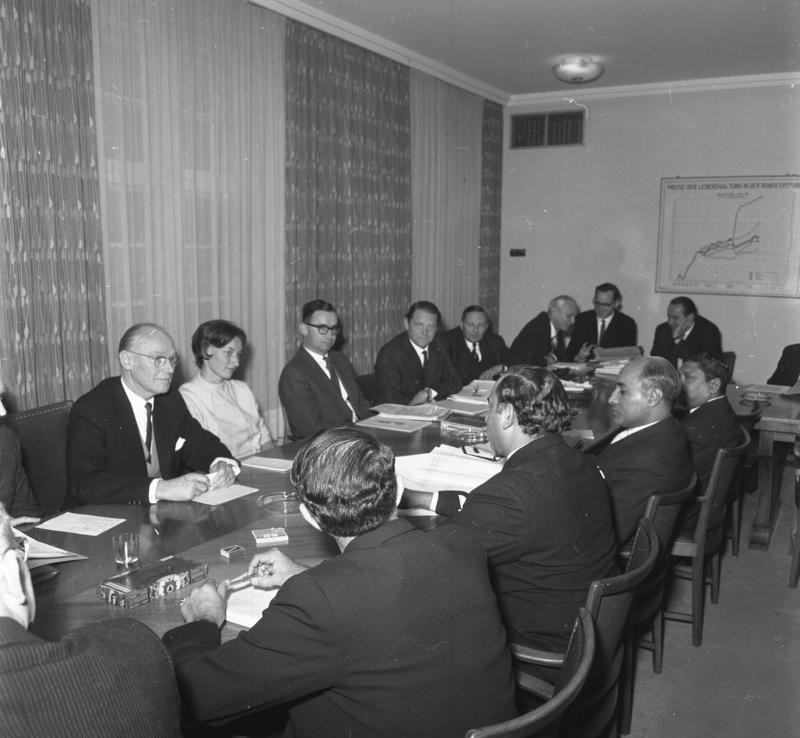
[[File:Bundesarchiv B 145 Bild-F012027-0005, Bonn, BMWi, Westrick empfängt Minister Bhutto.jpg|thumb|Foreign Minister Bhutto meets West German officials in [[Bonn]], 1965]] | [[File:Bundesarchiv B 145 Bild-F012027-0005, Bonn, BMWi, Westrick empfängt Minister Bhutto.jpg|thumb|Foreign Minister Bhutto meets West German officials in [[Bonn]], 1965]] | ||
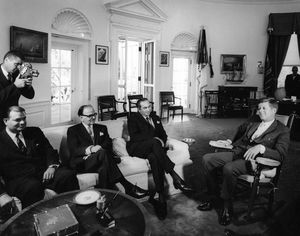
[[File:Meeting between Zulfiqar Ali Bhutto and JFK.jpg|thumb|Meeting between Zulfiqar Ali Bhutto and [[John F. Kennedy]]]] | [[File:Meeting between Zulfiqar Ali Bhutto and JFK.jpg|thumb|Meeting between Zulfiqar Ali Bhutto and [[John F. Kennedy]]]] | ||
Bhutto | [[File:Prince Philip in Lahore Feb 1959.jpg|thumb|Bhutto with [[Prince Philip, Duke of Edinburgh|Prince Philip]] of the [[United Kingdom]] at the [[Shalimar Gardens, Lahore|Shalimar Gardens]] in [[Lahore]], 1959]] | ||
Bhutto, a [[Pakistani nationalist]] and [[socialist]],<ref name="Fay Willey with Loren Jenkins">{{cite web |url=http://pakteahouse.net/2011/04/07/the-ghost-of-bhutto/ |title=The Ghost of Bhutto |last1=Willey, Fay |last2=Jenkins, Loren |date=16 April 1979 |name-list-style= |access-date=26 January 2012 |archive-date=12 November 2019 |archive-url=https://web.archive.org/web/20191112170550/http://pakteahouse.net/2011/04/07/the-ghost-of-bhutto/ |url-status=dead}}</ref> held distinctive views on the democracy required in Pakistan. Upon becoming foreign minister in 1963, his socialist stance led to a [[One-China policy|close relationship]] with neighboring China, challenging the prevailing acceptance of [[Taiwan]] as the legitimate government of China when [[Two Chinas|two governments each claimed to be "China"]].<ref name="The Times Group of India">{{Cite news |url=http://www.timesofbombay.com/tag/zulfikar-ali-bhutto/ |title=Dealing with a Superpower by Zulfiqar Ali Bhutto |last=Suraiya |first=Jug |date=14 May 2011 |work=[[Bombay Times]] |access-date=29 July 2011 |publisher=The Times Group of India |author-link=Jug Suraiya |archive-date=28 October 2013 |archive-url=https://web.archive.org/web/20131028084314/http://www.timesofbombay.com/tag/zulfikar-ali-bhutto/ |url-status=dead }}</ref> In 1964, the Soviet Union and its [[Soviet bloc|satellite states]] [[Sino-Soviet split|broke off]] relations with Beijing over ideological differences, with only [[Albania]] and Pakistan supporting the People's Republic of China. Bhutto staunchly supported Beijing in the UN and the [[United Nation Security Council|UNSC]], while also maintaining connections with the United States.<ref name="Government of China and Government of Pakistan">{{Cite AV media |url=https://www.youtube.com/watch?v=Jzr7cd8jdJw | archive-url=https://ghostarchive.org/varchive/youtube/20211030/Jzr7cd8jdJw| archive-date=2021-10-30|title=Zulfiqar Ali Bhutto speaks in support of China for membership of United Nations |last=Government Officials |publisher=Government of China and Pakistan Government |year=1962 |place=Beijing, People's Republic of China |medium=Television Production}}{{cbignore}}</ref> | |||
Bhutto's strong advocacy for closer ties with China drew criticism from the United States, with President [[Lyndon B. Johnson]] cautioning him about potential repercussions on congressional support for aid to Pakistan.<ref>H. W. Brands, ''The Foreign Policies of Lyndon Johnson: Beyond Vietnam'', Texas A&M University Press (1999), p. 171 {{ISBN|089096873X}}</ref> Bhutto, known for his demagogic speeches, led the [[Ministry of Foreign Affairs (Pakistan)|foreign ministry]] assertively, rapidly gaining national prominence. During a visit to [[Beijing]], Bhutto and his staff received a warm welcome from the Chinese leadership, including [[Mao Zedong]].<ref name="Government of China and Pakistan" /> Bhutto contributed to negotiating trade and military agreements between Pakistan and China, fostering collaboration on various military and industrial projects.<ref name="Government of China and Pakistan">{{Cite AV media |url=https://www.youtube.com/watch?v=0OkQnLbGV80 | archive-url=https://ghostarchive.org/varchive/youtube/20211030/0OkQnLbGV80| archive-date=2021-10-30|title=Zulfiqar Ali Bhutto's historic visit to China |last=Government Officials |publisher=Government of China and Pakistan |year=1962 |place=Beijing, People's Republic of China |medium=Television Production}}{{cbignore}}</ref> | |||
Bhutto signed the [[Sino-Pakistan Boundary Agreement]] on 2 March 1963, transferring 750 square kilometers of territory from [[Gilgit Baltistan]] to Chinese control.<ref>{{Cite journal |title=The Sino-Pakistan boundary agreement |journal=Lamb, A. (1964). "The Sino-Pakistani Boundary Agreement of 2 March 1963". Australian Outlook, 18(3), 299–312|doi=10.1080/10357716408444182 }}</ref> Bhutto embraced [[Non-Aligned Movement|non-alignment]], making Pakistan an influential member in non-aligned organisations. Advocating [[Ummah|pan-Islamic unity]], Bhutto developed closer relations with Indonesia and Saudi Arabia. Bhutto significantly transformed Pakistan's pro-West foreign policy. While maintaining a role in the [[Southeast Asia Treaty Organization]] and the [[Central Treaty Organization]], Bhutto asserted an independent foreign policy for Pakistan, free from [[Pakistan–United States relations|U.S. influence]]. Bhutto also visited [[Poland]] in 1962, establishing diplomatic relations and fostering mutual cooperation, reaching out to the [[Polish people in Pakistan|Polish community in Pakistan]].<ref>{{cite web |url=http://www.warsawvoice.pl/WVpage/pages/article.php/14298/article |title=Friendly Relations: Pakistan and Poland |last=Hancock |first=Ewa |date=21 March 2007 |website=Eva Hancock |publisher=Warsaw Voice |format=JPG |access-date=25 June 2011}}</ref> Using [[Pakistan Air Force]]'s Brigadier-General [[Władysław Turowicz]], Bhutto initiated military and economic links between Pakistan and Poland.<ref>{{cite web |url=http://www.mofa.go.jp/about/hq/record/14th.html |title=Pakistan in Europe |date=21 March 2007 |publisher=Ministry of Foreign Affairs |format=JPG |access-date=25 June 2011}}</ref> | |||
In 1962, as territorial differences escalated between India and China, Beijing considered staging [[Sino-Indian War|an invasion]] in northern Indian territories. Premier [[Zhou Enlai]] and Mao invited Pakistan to join the raid to reclaim the [[State of Jammu and Kashmir]] from India. Bhutto supported the plan, but Ayub opposed it due to fears of Indian retaliation.<ref name="The Times Group of India" /> Instead, Ayub proposed a "joint defense union" with India, shocking Bhutto, who felt Ayub Khan lacked understanding of international affairs. Bhutto, aware of China's restraint from criticising Pakistan despite its membership in anti-communist western alliances, criticised the U.S. for providing military aid to India during and after the 1962 Sino-Indian War, seen as a breach of Pakistan's alliance with the United States.<ref name="USCS3">{{Cite news |url=http://countrystudies.us/pakistan/18.htm |title=Ayub Khan |last=US Country Studies |access-date=7 November 2006 |format=PHP}}</ref> | |||
On Bhutto's counsel, Ayub Khan launched [[Operation Gibraltar]] in an attempt to [[Kashmir conflict|"liberate"]] Kashmir. The operation failed, leading to the [[Indo-Pakistani War of 1965]].<ref name="The Times Group of India" /> This war followed brief skirmishes between March and August 1965 in the [[Rann of Kutch]], Jammu and Kashmir, and Punjab. Bhutto joined Ayub in Uzbekistan to negotiate a [[Tashkent Declaration|peace treaty]] with Indian prime minister [[Lal Bahadur Shastri]]. Ayub and Shastri agreed to exchange prisoners of war and withdraw respective forces to pre-war boundaries. The agreement, deeply unpopular in Pakistan, caused significant political unrest against Ayub's regime. Bhutto's criticism of the final agreement created a major rift with Ayub. Initially denying rumors, Bhutto resigned in June 1966, expressing strong opposition to Ayub's regime.<ref name="USCS3"/> | |||
During his term, Bhutto formulated aggressive geostrategic and foreign policies against India.<ref name="Federation of American Scientists (FAS)">{{cite web |url=http://www.nuclearweaponarchive.org/Pakistan/PakOrigin.html |title=Historical Background: Zulfikar Ali Bhutto |last=Sublettle |first=Carey |date=15 October 1965 |website=Nuclear weapons archives |publisher=Federation of American Scientists (FAS) |access-date=25 June 2011}}</ref> In 1965, Bhutto received information from his friend [[Munir Ahmad Khan]] about the status of [[India and weapons of mass destruction|India's nuclear program]]. Bhutto stated, "Pakistan will fight, fight for a thousand years. If India builds the (atom) bomb, Pakistan will eat grass or leaves, even go hungry, but we (Pakistan) will get one of our own (atom bomb).... We (Pakistan) have no other choice!" In his 1969 book ''The Myth of Independence,'' Bhutto argued for the necessity of Pakistan acquiring a fission weapon and starting a deterrence program to stand up to industrialised states and a nuclear-armed India. He developed a manifesto outlining the program's development and selected Munir Ahmad Khan to lead it.<ref name="Federation of American Scientists (FAS)" /> | |||
== Creation of the Pakistan People's Party == | |||
After resigning as foreign minister, large crowds gathered to hear Bhutto's speech upon his arrival in Lahore on 21 June 1967. Riding a wave of anger against Ayub, Bhutto traveled across Pakistan, delivering political speeches. In October 1966, Bhutto explicitly outlined the beliefs of his new party: "Islam is our faith, democracy is our policy, socialism is our economy. All power to the people."<ref name="USCS2">{{Cite news |url=http://countrystudies.us/pakistan/19.htm |title=Yahya Khan and Bangladesh |last=US Country Studies |access-date=7 November 2006 |format=PHP}}</ref> | |||
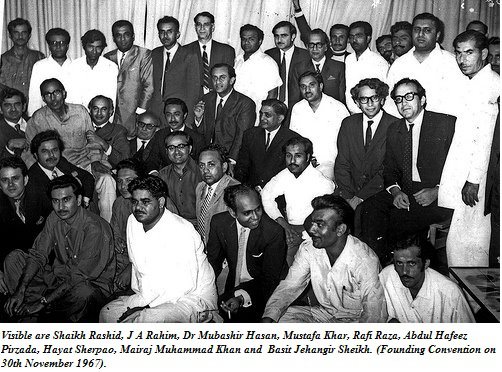
[[File:Founding Convention.jpg|thumb|At the Lahore residence of Mubashir Hassan, On 30 November 1967|left|243x243px]] | |||
[[File:Pakistan Peoples Party Flag with arrow.png|thumb|171x171px|<small>Pakistan People's Party flag, commonly used.</small>]] | |||
[[File:Asghar Khan Visits Bhutto in Larkana,1968-69.jpg|thumb|right|[[Asghar Khan]] (right) visits Zulfikar Ali Bhutto who was on house arrest in [[Larkana]], circa 1968-69]] | |||
On 30 November 1967, at the Lahore residence of [[Mubashir Hassan]], a gathering including Bhutto, political activist Sufi Nazar Muhammad Khan, Bengali communist [[Jalaludin Abdur Rahim|J. A. Rahim]], and [[Basit Jehangir Sheikh]] founded the [[Pakistan Peoples Party]] (PPP), establishing a strong base in Punjab, Sindh, and among the [[Muhajir (Urdu-speaking people)|Muhajirs]].<ref name="Professor">Hassan, Mubashir (2000). ''The Mirage of Power: An Inquiry into the Bhutto Years, 1971–1977''. [[Oxford University Press]]; {{ISBN|0-19-579300-5}}.</ref> | |||
Mubashir Hassan, an engineering professor at [[UET Lahore]], played a pivotal role in the success and rise of Bhutto. Under Hassan's guidance and Bhutto's leadership, the PPP became part of the pro-democracy movement involving diverse political parties from all across Pakistan. PPP activists staged large protests and strikes in different parts of the country, increasing pressure on Ayub to resign.<ref name="Professor"/> | |||
[[Asghar Khan]] recalls Bhutto asking him to join his party, the [[Pakistan Peoples Party]] (PPP). Asghar Khan declined, stating he had no interest in politics. After Dr. Hassan and Bhutto's arrest on 12 November 1968, Asghar Khan held a press conference in Lahore on 17 November 1968. Asghar Khan led protests calling for Bhutto's release, which ultimately led to his freedom and grew so close to Bhutto that many saw him as a potential successor.<ref>{{cite book|url=https://books.google.com/books?id=ZwGIDAAAQBAJ&q=asghar%20khan%20committee|page=265|title=Military, State and Society in Pakistan|year=2000|publisher=Palgrave Macmillan UK|first=Hasan Askari|last=Rizvi|isbn=978-0-230-59904-8 }}</ref><ref>{{cite book|url=https://books.google.com/books?id=PZ62tP_5a2AC&q=asghar%20|title=Mission with a Difference|year=1985|first1=(R) Lt Gen KN|last1=Kathpalia|page=16|publisher=Lancer Publishers }}</ref><ref>{{cite book|url=https://books.google.com/books?id=wsnwF5v_RO0C&q=Air%20Marshal%20Asghar|title=The International Who's Who, 1974-75|year=1975|publisher=Taylor & Francis |isbn=978-0-900362-72-9 }}</ref><ref>{{cite book|title=My Political Struggle|year=2008|first=Asghar|last=Khan|publisher=[[Oxford University Press]]|pages=3, 4, 5, 6, 34, 501, 502}}</ref><ref>{{cite web|url=https://www.youtube.com/watch?v=i6TIagGt_rA&ab_channel=DunyaNews|title=Air Marshal(R) Asghar Khan|date=15 February 2010|publisher=Dunya Tv}}</ref><ref>{{cite news|url=https://www.dawn.com/news/1381149|date=6 January 2018|title=Asghar Khan: A soldier and an idealist politician|publisher=[[Dawn (newspaper)|Dawn]]}}</ref> After his release, Bhutto, joined by key leaders of PPP, attended the Round Table Conference called by Ayub Khan in [[Rawalpindi]] but refused to accept Ayub's continuation in office and [[Sheikh Mujibur Rahman]]'s [[Six point movement]] for regional autonomy.<ref name="Professor"/> | |||
== | === 1970 elections === | ||
[[File:Ali Bhutto Karachi 1969.jpg|thumb|Bhutto in [[Karachi]] in 1969.]] | |||
[[ | Following Ayub's resignation, his successor, General [[Yahya Khan]], promised to hold [[1970 Pakistani general election|parliamentary elections]] on 7 December 1970. Under Bhutto's leadership, the democratic [[Socialism in Pakistan|socialists]], leftists, and [[Marxism|Marxist]]-[[Communism in Pakistan|communists]] gathered and united into one [[party platform]] for the first time in Pakistan's history. The Socialist-Communist bloc, under Bhutto's leadership, intensified its support in Muhajir and poor farming communities in West Pakistan, working through educating people to cast their vote for their better future.<ref name="Professor" /> Gathering and uniting the scattered socialist-communist groups in one single center was considered Bhutto's greatest political achievement and as a result, Bhutto's party and other leftists won a large number of seats from constituencies in West-Pakistan.<ref name="USCS2" /> However, Sheikh Mujib's [[Awami League]] won an absolute majority in the legislature, receiving more than twice as many votes as Bhutto's PPP. Bhutto strongly refused to accept an Awami League government and infamously threatened to "''break the legs''" of any elected PPP member who dared to attend the inaugural session of the [[National Assembly of Pakistan|National Assembly]]. On 17 January 1971, President Yahya visited Bhutto at his baronial family estate, Al-Murtaza, in Larkana, Sindh, accompanied by Lt. General S. G. M. Pirzada, Principal Staff Officer to President Yahya, and General Abdul Hamid Khan, Commander-in-Chief of the Pakistan Army and Deputy Chief [[Martial law|Martial Law]] Administrator. | ||
On 22 February 1971, the generals in West Pakistan took a decision allegedly to crush the Awami League and its supporters. Capitalising on West Pakistani fears of [[East Pakistan]]i separatism, Bhutto demanded that Sheikh Mujibur Rahman form a coalition with the PPP. And at some stage proposed "''idhar hum, udhar tum''", meaning he should govern the West and Mujib should Govern the East. President Yahya postponed the meeting of the national assembly which fueled a popular movement in East Pakistan. Amidst popular outrage in East Pakistan, on 7 March 1971, Sheikh Mujib called the Bengalis to join the struggle for "[[Bangladesh]]". According to historical references and a report published by the leading Pakistani newspaper [[The Nation (Pakistani newspaper)|''The Nation'']], "Mujib no longer believed in Pakistan and is determined to make Bangladesh". Many also believed that Bhutto wanted power in the West even at the expense of the separation of the East.<ref name="The Nation">{{Cite news |url=https://www.nation.com.pk/16-Dec-2011/ayub-yahya-bhutto-mujib-played-part |title=Ayub, Yahya, Bhutto, Mujib played part |last=Ashraf Mumtaz |date=16 December 2011 |work=The Nation |type=Interview |access-date=24 February 2012 |url-status=live |archive-url=https://web.archive.org/web/20120222224108/http://www.nation.com.pk/pakistan-news-newspaper-daily-english-online/politics/16-Dec-2011/Ayub-Yahya-Bhutto-Mujib-played-part |archive-date=22 February 2012}}</ref> However, Mujib still kept doors open for some sort of settlement in his speech of 7 March. | |||
=== Fall of East Pakistan === | |||
Yahya started a negotiating conference in Dhaka, presumably to reach a settlement between Bhutto and Mujib. The discussion was expected to be "fruitful" until the president left for [[West Pakistan]] on the evening of 25 March. On that night of 25 March 1971, the army initiated [[Operation Searchlight]], which had been planned by the military junta of Yahya Khan, presumably to suppress political activities and movements by the Bengalis. Mujib was arrested and imprisoned in West Pakistan. Genocide and atrocities by the military against the Bengali population were alleged during the operation.<ref name="SelectiveGenocide">Blood, Archer, [http://www.gwu.edu/~nsarchiv/NSAEBB/NSAEBB79/BEBB1.pdf Transcript of Selective Genocide Telex], Department of State, United States</ref><ref>{{cite book |last=Jalal |first=Ayesha |url=https://books.google.com/books?id=87VnBAAAQBAJ&pg=PA179 |title=The Struggle for Pakistan: A Muslim Homeland and Global Politics |year=2014 |publisher=Harvard University Press |isbn=978-0-674-74499-8}}</ref><ref>{{cite web |title=Six-point Programme |url=http://en.banglapedia.org/index.php?title=Six-point_Programme |website=Banglapedia}}</ref> | |||
[[File:Zulfikar Ali Bhutto 1971.jpg|thumb|Bhutto in 1971]] | [[File:Zulfikar Ali Bhutto 1971.jpg|thumb|Bhutto in 1971]] | ||
Bhutto stayed in [[Dhaka | Bhutto stayed in [[Dhaka]] on the night of 25 March and commented that Pakistan had been saved by the army before leaving on the 26th. While supportive of the army's actions and working to rally international support, Bhutto distanced himself from the Yahya Khan regime and began to criticise Yahya Khan for mishandling the situation.<ref name="Jang News Group">{{Cite newsgroup |url=http://www.jang.com.pk/jang/apr2011-daily/18-04-2011/col5.htm |title=Bhutto, Sheikh Mujib, and United States |last=Mir, Hamid |date=18 April 2011 |newsgroup=www.jang.com.pk |archive-url=https://web.archive.org/web/20160304193138/http://jang.com.pk/jang/apr2011-daily/18-04-2011/col5.htm |archive-date=4 March 2016 |access-date=15 December 2018 |url-status=dead}}</ref> He refused to accept Yahya Khan's scheme to appoint Bengali politician [[Nurul Amin]] as prime minister, with Bhutto as deputy prime minister.<ref name="Jang News Group" /> Soon after Bhutto's refusal and continuous resentment toward General Yahya Khan's mishandling of the situation, Khan ordered Military Police to arrest Bhutto on charges of [[treason]], quite similar to Mujib.<ref name="Jang News Group" /> Bhutto was imprisoned in the [[Adiala Jail]] along with Mujib, where he was set to face the charges.<ref name="Jang News Group" /> The army crackdown on the [[Bengalis]] of East Pakistan fueled an armed resistance by the [[Mukti Bahini|Mukti-Bahini (a guerrilla force formed for the campaign of an independent Bangladesh and trained by the Indian army)]]. Pakistan launched an air attack on India in the western border that resulted in the Indian intervention in East Pakistan, which led to the very bitter defeat of Pakistani forces, who surrendered on 16 December 1971. Consequently, [[Bangladesh|the state of People's Republic of Bangladesh]] was born, and Bhutto and others condemned Yahya Khan for failing to protect Pakistan's unity.<ref name="Jang News Group" /> Isolated, Yahya Khan resigned on 20 December and transferred power to Bhutto, who became president, commander-in-chief, and the first civilian chief martial law administrator.<ref name="USCS2" /> | ||
Bhutto was the country's first civilian chief martial law administrator since 1958, as well as the country's first civilian president.<ref name="USCS2" /> With Bhutto assuming | Bhutto was the country's first civilian chief martial law administrator since 1958, as well as the country's first civilian president.<ref name="USCS2" /> With Bhutto assuming control, the leftists and democratic socialists entered the country's politics and later emerged as power players in the country's politics. And, for the first time in the country's history, the leftists and democratic socialists had a chance to administer the country with the popular vote and widely approved exclusive mandate, given to them by the West's population in the 1970s elections.<ref name="USCS2" /> | ||
In a reference written by [[Kuldip Nayar]] in his book | In a reference written by [[Kuldip Nayar]] in his book ''Scoop! Inside Stories from the Partition to the Present'', Nayar noted that "Bhutto's releasing of Mujib did not mean anything to Pakistan's policy as in [sic] if there was [sic] no liberation war."<ref name="HarperCollins (1 October 2006)">{{Cite book |url=http://www.thedailystar.net/forum/2006/december/bhuttonmujib.htm |title=Scoop! : Inside Stories from Partition to the Present |last=Nayar |first=Kuldip |year=2006 |publisher=HarperCollins |isbn=978-81-7223-643-4 |location=United Kingdom |pages=213 pages}}</ref> Bhutto's policy, and even as of today, the policy of Pakistan continues to state that "she will continue to fight for the honor and integrity of Pakistan. East Pakistan is an inseparable and unseverable part of Pakistan".<ref name="HarperCollins (1 October 2006)" /> | ||
== | == Leader of Pakistan (1971–1977) == | ||
<blockquote>My dear countrymen, my dear friends, my dear students, labourers, peasants... those who fought for Pakistan... We are facing the worst crisis in our country's life, a deadly crisis. We have to pick up the pieces, very small pieces, but we will make a new Pakistan, a prosperous and progressive Pakistan, a Pakistan free of exploitation, a Pakistan envisaged by the [[Quaid-e-Azam]].<ref>{{cite web |url=http://www.ppp.org.pk/life_legacy.html |title=The Legacy |last=PPP |url-status=dead |archive-url=http://webarchive.loc.gov/all/20110707205707/http://www.ppp.org.pk/life_legacy.html |archive-date=7 July 2011 |access-date=30 November | === Presidency (1971-1973) === | ||
A [[Pakistan International Airlines]] flight was sent to fetch Bhutto from New York City, where he was presenting Pakistan's case before the [[United Nations Security Council]] on the East Pakistan Crisis. Bhutto returned home on 18 December 1971. On 20 December, he was taken to the President House in Rawalpindi, where he took over two positions from Yahya Khan, one as president and the other as the first civilian Chief Martial Law Administrator. Thus, he was the first civilian Chief Martial Law Administrator of the dismembered Pakistan. By the time Bhutto had assumed control of what remained of Pakistan, the nation was completely isolated, angered, and demoralised. Bhutto addressing the nation through radio and television said:<blockquote>My dear countrymen, my dear friends, my dear students, labourers, peasants... those who fought for Pakistan... We are facing the worst crisis in our country's life, a deadly crisis. We have to pick up the pieces, very small pieces, but we will make a new Pakistan, a prosperous and progressive Pakistan, a Pakistan free of exploitation, a Pakistan envisaged by the [[Quaid-e-Azam]].<ref>{{cite web |url=http://www.ppp.org.pk/life_legacy.html |title=The Legacy |last=PPP |url-status=dead |archive-url=http://webarchive.loc.gov/all/20110707205707/http://www.ppp.org.pk/life_legacy.html |archive-date=7 July 2011 |access-date=30 November 2011}}</ref></blockquote> | |||
[[File:NixonBhutto1973.jpg|thumb|[[Richard Nixon]] and Bhutto in 1973]] | [[File:NixonBhutto1973.jpg|thumb|[[Richard Nixon]] and Bhutto in 1973]] | ||
As president, Bhutto faced mounting challenges on both internal and foreign fronts. The trauma was severe in Pakistan, a psychological setback and emotional breakdown for Pakistan. The [[two-nation theory]]—the theoretical basis for the creation of Pakistan—lay discredited, and Pakistan's foreign policy collapsed when no moral support was found anywhere, including long-standing allies such as the U.S. and China. However, this is disputed even by Bangladeshi academics who insist that the two-nation theory was not discredited.<ref>{{cite journal |last1=Hossain |first1=A. A. |title=Islamic Resurgence in Bangladesh's Culture and Politics: Origins, Dynamics and Implications |journal=Journal of Islamic Studies |date=1 May 2012 |volume=23 |issue=2 |pages=165–198 |doi=10.1093/jis/ets042}}</ref> Since her creation, the physical and moral existence of Pakistan was in great danger. On the internal front, [[Baloch nationalism|Baloch]], [[Sindhi nationalism|Sindhi]], [[Punjabi nationalism|Punjabi]], and [[Pashtun nationalism]]s were at their peak, calling for their independence from Pakistan. Finding it difficult to keep Pakistan united, Bhutto launched full-fledged intelligence and military operations to stamp out any separatist movements. By the end of 1978, these nationalist organisations were brutally quelled by Pakistan Armed Forces.<ref name="Atlantic">{{Cite magazine |last=Langewiesche |first=William |date=November 2005 |title=The Wrath of Khan |url=https://www.theatlantic.com/magazine/archive/2005/11/the-wrath-of-khan/4333/3/ |magazine=The Atlantic}}</ref> | |||
Bhutto immediately placed Yahya Khan under house arrest, brokered a ceasefire, and ordered the release of Mujib, who was being held prisoner by the Pakistan Army. To implement this, Bhutto overturned the verdict of Mujib's earlier court-martial trial, in which Brigadier [[Rahimuddin Khan]] had sentenced him to death. Bhutto aimed to prevent East Pakistan's secession through dialogue and sought to create [[Bangladesh–Pakistan Confederation|a loose confederation]] within the framework of one Pakistan. [[Stanley Wolpert]] writes that he sent Mujib to a bungalow in [[Rawalpindi]], where Mujib swore upon the [[Quran]] to retire and hand over the nation to him. Bhutto also offered him 50,000, which Mujib declined.<ref>{{Cite book |last=Wolpert |first=Stanley |title=Zulfiqar Bhutto of Pakistan |page=224}}{{ISBN?}}</ref> Mujib informed Bhutto that he would make this decision once he arrived in Bangladesh. On 8 January, he was flown to London, from where he was taken to [[Delhi]], where [[Indira Gandhi]] and her cabinet greeted him. From there, he was taken to [[Dhaka]], as a direct flight to Bangladesh was not possible. There, he delivered a speech at the [[Suhrawardy Udyan|Ramna Racecourse]], completely rejecting Bhutto's offer and severing ties with West Pakistan, saying, "You live in peace and let us live in peace."<ref>{{Cite web |date=2023-12-10 |title=A leaf from history: Mujib begins a new life – Newspaper – dawn.com |url=https://www.dawn.com/news/725363/a-leaf-from-history-mujib-begins-a-new-life |archive-url=https://web.archive.org/web/20231210203125/https://www.dawn.com/news/725363/a-leaf-from-history-mujib-begins-a-new-life |url-status=dead |archive-date=2023-12-10 |access-date=2025-02-09 }}</ref> | |||
Appointing a new cabinet, Bhutto appointed Lieutenant-General [[Gul Hasan]] as [[Commander-in-Chief of the Pakistan Army]] in 20 December 1971. On 2 January 1972 Bhutto announced the nationalisation of all major industries, including iron and steel, automobiles, heavy engineering, heavy electricals, petrochemicals, cement, and public utilities.<ref name="USCS">{{cite news |author=US Country Studies |url=http://countrystudies.us/pakistan/20.htm |title=Zulfikar Ali Bhutto |format=PHP |access-date=7 November 2006}}</ref> Bhutto had named his economic policies [[Islamic socialism|Islamic Socialism]] or as he called "Mussawat-e Muhammadi".<ref>{{Cite book |last1=Belokrenitskil |first1=V. IA. |title=A Political History of Pakistan, 1947–2007 |last2=Moskalenko |first2=Vladimir Nikolayevich |pages=215}}</ref> 31 industries across 10 sectors were nationalised including 13 banks, 10 shipping companies, 26 Vegetable Oil Companies,<ref>{{Cite journal |last=Burki |first=Shahid Javed |date=December 1974 |title=Politics of Decisionmaking During the Bhutto Period |url=https://www.jstor.org/stable/2643205 |journal=Asian Survey |volume=14 |issue=12 |pages=1134–1135 |doi=10.2307/2643205 |jstor=2643205}}</ref> Two petroleum companies<ref>{{Cite web |date=2022-06-12 |title=People who own greatest amount of wealth – Newspaper – dawn.com |url=https://www.dawn.com/news/279413/people-who-own-greatest-amount-of-wealth |archive-url=https://web.archive.org/web/20220612101236/https://www.dawn.com/news/279413/people-who-own-greatest-amount-of-wealth |url-status=dead |archive-date=2022-06-12 |access-date=2025-02-09 }}</ref> and 43 insurance companies which were tied together into [[State Life|State Life Insurance Corporation of Pakistan]].<ref>{{Cite book |last1=Belokrenitskil |first1=V. IA. |title=Political History of Pakistan, 1947–2007 |last2=Moskalenko |first2=Vladimir Nikolayevich |page=215}}</ref> Ayub Khan's [[Ghandhara Industries Limited|Ghandhara Industries]], Sharif owned [[Ittefaq Group|Ittefaq Foundry]], National Bank of Pakistan and [[Habib Bank Limited]] were also nationalised. This wave of nationalisation didn't effect textile production light and food industries.<ref>{{Cite book |last1=Belokrenitskil |first1=V. IA. |title=The Political History of Pakistan, 1947–2007 |last2=Moskalenko |first2=Vladimir Nikolayevich |page=214}}</ref> In addition to foreign owned companies, Such as the British Attock Petroleum Company and American owned Esso Fertilizers.<ref>{{Cite news |last=Times |first=Malcolm W. Browne Special to The New York |date=1972-01-03 |title=Pakistan Orders Nationalization of 10 Industries |url=https://www.nytimes.com/1972/01/03/archives/pakistan-orders-nationalization-of-10-industries-bhutto-moves-to.html |access-date=2025-02-09 |work=The New York Times |language=en-US |issn=0362-4331}}</ref> | |||
| author = US Country Studies|url=http://countrystudies.us/pakistan/20.htm| title = Zulfikar Ali Bhutto| format = PHP| access-date =7 November | |||
Bhutto visited India to meet Prime Minister [[Indira Gandhi]] and negotiated a formal peace agreement and the release of 93,000 Pakistani [[prisoners of war]]. The two leaders signed the [[Simla Agreement]], which committed both nations to establish a new-yet-temporary [[Line of Control]] in Kashmir and obligated them to resolve disputes peacefully through bilateral talks.<ref name="USCS" /> Bhutto also promised to hold a future summit for the peaceful resolution of the Kashmir dispute and pledged to recognise Bangladesh. Although he secured the release of Pakistani soldiers held by India, Bhutto was criticised by many in Pakistan for allegedly making too many concessions to India. It is theorised that Bhutto feared his downfall if he could not secure the release of Pakistani soldiers and the return of territory occupied by Indian forces.<ref>{{Cite book |url=https://archive.org/details/indiralifeofindi00fran/page/346 |title=Indira: The Life of Indira Nehru Gandhi |last=Frank |first=Katherine |publisher=Houghton Mifflin |year=2002 |isbn=978-0-395-73097-3 |location= | In June 1972, Bhutto visited India to meet Prime Minister [[Indira Gandhi]] and negotiated a formal peace agreement and the release of 93,000 Pakistani [[prisoners of war]]. The two leaders signed the [[Simla Agreement]], which committed both nations to establish a new-yet-temporary [[Line of Control]] in Kashmir and obligated them to resolve disputes peacefully through bilateral talks.<ref name="USCS" /> Bhutto also promised to hold a future summit for the peaceful resolution of the Kashmir dispute and pledged to recognise Bangladesh. Although he secured the release of Pakistani soldiers held by India, Bhutto was criticised by many in Pakistan for allegedly making too many concessions to India. It is theorised that Bhutto feared his downfall if he could not secure the release of Pakistani soldiers and the return of territory occupied by Indian forces.<ref>{{Cite book |url=https://archive.org/details/indiralifeofindi00fran/page/346 |title=Indira: The Life of Indira Nehru Gandhi |last=Frank |first=Katherine |publisher=Houghton Mifflin |year=2002 |isbn=978-0-395-73097-3 |location=US |pages=[https://archive.org/details/indiralifeofindi00fran/page/346 346–347] |author-link=Katherine Frank (biographer)}}</ref> Bhutto established an atomic power development program and inaugurated the first Pakistani [[atomic reactor]], built in collaboration with Canada in [[Karachi]] on 28 November. On 30 March, 59 military officers were arrested by army troops for allegedly plotting a coup against Bhutto, who appointed then-Brigadier [[Muhammad Zia-ul-Haq]] to head a military tribunal to investigate and try the suspects. The National Assembly approved the [[Constitution of Pakistan|new 1973 Constitution]], which Bhutto signed into effect on 12 April. The constitution proclaimed an "[[Islamic Republic]]" in Pakistan with a parliamentary form of government.{{citation needed|date=May 2025}} On 10 August, Bhutto turned over the post of president to [[Fazal Ilahi Chaudhry]], assuming the office of prime minister instead.<ref name="USCS" /> | ||
[[Sharif al Mujahid]] has argued that, as the appeal of socialist rhetoric declined, Bhutto increasingly turned to [[Symbols of Islam|Islamic symbolism]] and policies to mobilize public support. His government liberalized the ''[[Hajj]]'' policy, sponsored renovations at major [[Dargah|Sufi shrines]] in Pakistan, and made frequent public displays of religious devotion, including visits to shrines and highly publicized pilgrimages abroad. Bhutto also emphasized Pakistan’s Islamic identity in foreign policy by strengthening ties with Muslim-majority countries and convening the 1974 Islamic Summit in Lahore following the [[Yom Kippur War|1973 Arab-Israeli War]], where a commemorative monument was erected. He publicly presented himself as a proponent of Islamic solidarity and Muslim unity, particularly during the later stages of his political career. Bhutto's Pan-Islamic approach would become clear during the [[1977 Pakistani general election|1977 election]].<ref>{{Cite book |last=Mujahid |first=Sharif al |title=Ideology of Pakistan |date=2001 |publisher=Islamic Research Institute |isbn=978-969-408-223-3 |edition=2nd |location=Islamabad |pages=99}}</ref> | |||
==== Nuclear weapons program ==== | |||
{{Main|National Command Authority (Pakistan)#National Command Authority (Pakistan)|l1 = Atomic Command Authority (ATA)|Joint Chiefs of Staff Committee|Pakistan and weapons of mass destruction}} | |||
{{further|Project-706|Minimum Credible Deterrence (Pakistan)}} | {{further|Project-706|Minimum Credible Deterrence (Pakistan)}} | ||
[[File:Fpbutto.jpg|thumb|left|Bhutto meeting with Iranian [[Monarch|Empress]] [[Farah Pahlavi]], 1972]] | [[File:Fpbutto.jpg|thumb|left|Bhutto meeting with Iranian [[Monarch|Empress]] [[Farah Pahlavi]], 1972]] | ||
Bhutto, the founder of Pakistan's atomic bomb program, earned the title "Father of Nuclear Deterrence" due to his administration and aggressive leadership of this program.<ref name="Atlantic" /><ref name="International Institute for Strategic Studies through the 2006 dossier. Initial research and publishing was done by The News International of Pakistan">{{cite web |url=http://www.iiss.org/whats-new/iiss-in-the-press/press-coverage-2007/may-2007/bhutto-was-father-of-pakistani-bomb/?locale=en |title=Bhutto was father of Pakistan's Atom Bomb Programme |first=(IISS) |last=International Institute for Strategic Studies |author-link=International Institute for Strategic Studies |date=3 May 2006 |website=2006 Dossier of the International Institute for Strategic Studies |publisher=International Institute for Strategic Studies through the 2006 dossier. Initial research and publishing was done by The News International of Pakistan |quote=''Dr. [[Abdul Qadeer Khan]] is not the father of the Pakistan atom bomb project. It is [Zulfikar Ali] Bhutto!. Focusing on the efforts of Bhutto since 1958, when he became a minister in the Ayub cabinet. Surprisingly, the dossier has paid rich tributes to the services of Bhutto for developing the nuclear programme. The dossier, in a chapter on Pakistan's nuclear programme and imports, reveals that Dr AQ Khan can only be accorded many epithets, including "founder of Pakistan uranium enrichment programme".''The First 2006 dossier published by the International Institute for Strategic Studies (IISS) |access-date=13 April 2011 |archive-date=14 March 2012 |archive-url=https://web.archive.org/web/20120314025504/http://www.iiss.org/whats-new/iiss-in-the-press/press-coverage-2007/may-2007/bhutto-was-father-of-pakistani-bomb/?locale=en |url-status=dead }}</ref><ref>{{Cite book |title=Long Road to Chagai |last=Rehman |first=Shahid-ur |publisher=Printwise Publications |year=1999 |isbn=978-969-8500-00-9 |edition=1st |volume=1 |location=Islamabad, Islamabad Capital Territory |pages=21–23}}</ref> Bhutto's interest in nuclear technology began during his college years in the United States, attending a political science course discussing the political impact of the U.S.'s first nuclear test, [[Trinity (nuclear test)|''Trinity'']], on global politics.<ref name="Printwise Publications" /> | |||
While at Berkeley, Bhutto witnessed the public panic when the Soviet Union first exploded their bomb, codenamed [[RDS-1|''First Lightning'']] in 1949, prompting the U.S. government to launch their research on [[Thermonuclear weapon|'hydrogen' bombs]].<ref name="Printwise Publications" /> However, in 1958, as Minister for Fuel, [[Ministry of Water and Power (Pakistan)|Power]], and [[Ministry of Environment (Pakistan)|National Resources]], Bhutto played a key role in setting up the [[Pakistan Atomic Energy Commission]] (PAEC) administrative research bodies and institutes.<ref name="International Institute for Strategic Studies through the last 2007 dossier" /> Soon, Bhutto offered a technical post to Munir Ahmad Khan in PAEC in 1958 and lobbied for Abdus Salam to be appointed as Science Adviser in 1960.<ref name="International Institute for Strategic Studies through the last 2007 dossier" /> Before being elevated to [[Foreign Minister of Pakistan|Foreign Minister]], Bhutto directed funds for key research in nuclear weapons and related science.<ref name="International Institute for Strategic Studies through the last 2007 dossier" /> | |||
In October 1965, as the foreign minister, Bhutto visited Vienna, where nuclear engineer [[Munir Ahmad Khan]] held a senior technical post at the [[IAEA]]. Munir Khan briefed him on the status of the [[Indian nuclear programme]] and the options for Pakistan to develop its own nuclear capability. Both agreed on the necessity for Pakistan to establish a nuclear deterrent against India. Although Munir Khan had failed to convince Ayub Khan, Bhutto assured him, "''Don't worry, our turn will come''." Shortly after the 1965 war, Bhutto declared at a press conference, "''Even if we have to eat grass, we will make a nuclear bomb. We have no other choice''," observing India's progress toward developing the bomb.<ref name="Federation of American Scientists (FAS)" /> In 1965, Bhutto advocated for Salam, successfully appointing him as the head of Pakistan's delegation at the IAEA, and assisted Salam in lobbying for nuclear power plants.<ref name="International Institute for Strategic Studies through the last 2007 dossier" /> In November 1972, Bhutto advised Salam to travel to the United States to avoid the war and encouraged him to return with key literature on [[History of nuclear weapons|nuclear weapons history]]. By the end of December 1972, Salam returned to Pakistan with suitcases loaded with literature on the ''[[Manhattan Project]]''. In 1974, Bhutto initiated a more aggressive diplomatic offensive on the United States and the Western world over nuclear issues. Writing to world and Western leaders, Bhutto conveyed: | |||
{{blockquote|text=Pakistan was exposed to a kind of "nuclear threat and blackmail" unparalleled elsewhere.... If the world's community failed to provide political insurance to Pakistan and other countries against nuclear blackmail, these countries would be constrained to launch atomic bomb programs of their own!... Assurances provided by the United Nations were not 'Enough!'... |sign=Zulfikar Ali Bhutto, <small>statement written in ''Eating Grass''</small>|source=source<ref name="Stanford University Press">{{Cite book |chapter-url=https://books.google.com/books?id=yGgrNAsKZjEC&pg=PA100 |title=Eating grass: the making of the Pakistani bomb |last=Khan |first=Feroz Hassan |date=2012 |publisher=Stanford University Press |isbn=978-0-8047-7601-1 |location=Stanford, California |pages=119–120 |chapter=The Route to Nuclear Ambition}}</ref>}} | |||
Roughly two weeks after the [[Indo-Pakistani war of 1971|1971 winter war]], on 20 January 1972, Bhutto convened a conference of nuclear scientists and engineers at [[Multan]].{{Citation needed|date=August 2013}} While at the Multan meeting, scientists wondered why the President, who had much on his hands in those trying days, was paying so much attention to scientists and engineers in the nuclear field. At the meeting, Bhutto slowly discussed the recent war and the country's future, emphasising the great mortal danger the country faced. As the academicians listened carefully, Bhutto stated, "Look, we're going to have the [[Atom bomb|bomb]]". He asked them, "Can you give it to me? And how long will it take to make a bomb?"{{Citation needed|date=August 2013}} | |||
{{blockquote|text=If Pakistan restricts or suspends her [[Pakistan and weapons of mass destruction|nuclear deterrence]], it would not only enable India to [[Nuclear blackmail|blackmail]] Pakistan with her [[Indian nuclear programme|nuclear advantage]] | Before the 1970s, nuclear deterrence was well-established under the government of [[Huseyn Shaheed Suhrawardy]], but it was entirely peaceful and dedicated to [[Nuclear power in Pakistan|civilian power needs]]. Bhutto, in his book ''The Myth of Independence'' in 1969, wrote:{{blockquote|text=If Pakistan restricts or suspends her [[Pakistan and weapons of mass destruction|nuclear deterrence]], it would not only enable India to [[Nuclear blackmail|blackmail]] Pakistan with her [[Indian nuclear programme|nuclear advantage]] but would impose a crippling limitation on the development of Pakistan's [[Science in Pakistan|science and technology]].... Our problem in its essence is how to obtain such a weapon in time before the crisis begins...|sign=Zulfikar Ali Bhutto<ref>{{Cite book |title=The Myth of Independence |last=Bhutto |first=Zulfikar Ali |publisher=Oxford University Press |year=1969 |page=153}}</ref> }} | ||
After India's nuclear | After India's nuclear test—codenamed [[Pokhran-I|''Smiling Buddha'']]—in May 1974, Bhutto sensed and saw this test as the final anticipation for Pakistan's death.<ref name="Atlantic" /> In a press conference held shortly after India's nuclear test, Bhutto said, "India's nuclear program is designed to intimidate Pakistan and establish "hegemony in the subcontinent".<ref>{{cite web |url=http://www.nti.org/e_research/profiles/Pakistan/Nuclear/chronology_1974.html |title=The Nuclear Threat Initiative (NTI), United States |url-status=dead |archive-url=https://web.archive.org/web/20110918040826/http://www.nti.org/e_research/profiles/Pakistan/Nuclear/chronology_1974.html |archive-date=18 September 2011}}</ref> Despite Pakistan's limited financial resources, Bhutto was so enthusiastic about the nuclear energy project that he is reported to have said "Pakistanis will eat grass but make a nuclear bomb".<ref>Siddiqi, Shahid R. (14 February 2010) [https://web.archive.org/web/20101125165337/http://news.dawn.com/wps/wcm/connect/dawn-content-library/dawn/in-paper-magazine/encounter/how-safe-are-pakistans-nuclear-assets-420 How safe are Pakistan's nuclear assets], Dawn newspaper</ref> | ||
The | The militarisation of the Pakistan Atomic Energy Commission was initiated on 20 January 1972 and, in its initial years, was implemented by Pakistan Army's [[Chief of Army Staff (Pakistan)|Chief of Army Staff]] General [[General Tikka Khan and East Pakistan|Tikka Khan]]. The [[Karachi Nuclear Power Plant]] (KANUPP-I) was inaugurated by Bhutto during his role as the president of Pakistan at the end of 1972.<ref name="International Institute for Strategic Studies through the last 2007 dossier">{{cite web |url=http://www.iiss.org/whats-new/iiss-in-the-press/press-coverage-2007/may-2007/bhutto-not-khan-was-the-father-of-pak-bomb/?locale=en |title=Bhutto, not A. Q. Khan, was the Father of Pak nuke programme |last=Fitzpatrick |first=Mark |date=3 May 2007 |website=2007 Final Dossier of the International Institute for Strategic Studies |publisher=International Institute for Strategic Studies through the last 2007 dossier. Initial research and publishing was done by the Directorate-General for the News Intelligence of Pakistan's Jang Media Cell |quote=''Dr Abdul Q. Khan, a metallurgical engineer, is not the Father of the Pakistan bomb. It is Zulfi Ali Bhutto. Dr A.Q. Khan should only be accorded many epithets, including "founder of Pakistan uranium enrichment programme"...''The News International, pp. 1–6 |access-date=2 October 2011 |archive-date=29 March 2012 |archive-url=https://web.archive.org/web/20120329031537/http://www.iiss.org/whats-new/iiss-in-the-press/press-coverage-2007/may-2007/bhutto-not-khan-was-the-father-of-pak-bomb/?locale=en |url-status=dead}}</ref> The nuclear weapons program was set up loosely based on the Manhattan Project of the 1940s under the administrative control of Bhutto.<ref name="Printwise Publications">{{Cite book |title=Long Road to Chagai |last=Rehman |first=Shahid-ur |publisher=Printwise Publications |year=1999 |isbn=978-969-8500-00-9 |edition=1st |volume=1 |location=Islamabad, Islamabad Capital Territory |pages=55–101 |chapter=5 The Theoretical Physics Group: A Cue to Manhattan Project?}}</ref> | ||
Senior academic scientists had direct access to Bhutto, who kept him informed about every inch of the development. Bhutto's Science Advisor, [[Abdus Salam]]'s office was also set up in Bhutto's prime minister secretariat. On Bhutto's request, Salam had established and led the Theoretical Physics Group (TPG) that marked the beginning of the nuclear deterrent program. The TPG designed and developed the nuclear weapons as well as the entire program.<ref name="Printwise Publications" /> Later, Munir Ahmad Khan had him personally approved the budget for the development of the programme.<ref name="Printwise Publications" /> | |||
Wanting a capable administrator, Bhutto sought Lieutenant-General [[Rahimuddin Khan]] to chair the commission, which Rahimuddin declined, in 1971.<ref>[[Maulana Kausar Niazi|Niazi, Maulana Kausar]] (1991) [http://bhutto.org/Acrobat/Last%20Dayf%20of%20Premier%20Bhutto.pdf ''Last Days of Premier Bhutto''] {{Webarchive|url=https://web.archive.org/web/20171018084903/http://www.bhutto.org/Acrobat/Last%20Dayf%20of%20Premier%20Bhutto.pdf |date=18 October 2017 }}. p. 61</ref> Instead, in January 1972, Bhutto chose a U.S.-trained [[Nuclear engineering|nuclear engineer]], Munir Khan, as chairman of the Pakistan Atomic Energy Commission (PAEC). Bhutto realised he wanted an administrator who understood the scientific and economic needs of this technologically ambitious program. Since 1965, Munir Khan had developed an extremely close and trusted relationship with Bhutto, and even after his death, Benazir and Murtaza Bhutto were instructed by their father to keep in touch with Munir Khan. In the spring of 1976, [[Kahuta Research Laboratories|Kahuta Research Facility]], then known as [[Engineering Research Laboratories]] (ERL), as part of codename ''[[Project-706]]'', was also established by Bhutto and brought under nuclear scientist [[Abdul Qadeer Khan]] and the [[Pakistan Army Corps of Engineers]]' [[Lieutenant-General]] [[Zahid Ali Akbar Khan|Zahid Ali Akbar]].<ref name="Printwise Publications" /> | |||
Because Pakistan, under Bhutto, was not a signatory or party to the [[Nuclear Non-Proliferation Treaty]] (NPT), the [[Nuclear Suppliers Group]] (NSG), [[Commissariat à l'énergie atomique]] (CEA), and [[British Nuclear Fuels]] (BNFL) had immediately cancelled fuel reprocessing plant projects with PAEC. According to [[Maulana Kausar Niazi|Causar Nyäzie]], the Pakistan Atomic Energy Commission officials had misled Bhutto, and he embarked on a long journey to try to obtain a nuclear fuel reprocessing plant from France.<ref name="Maulana Kausar Niazi and Sani Panwjar">[[Maulana Kausar Niazi|Niazi, Maulana Kausar]] (1991) [http://bhutto.org/Acrobat/Last%20Dayf%20of%20Premier%20Bhutto.pdf ''Last Days of Premier Bhutto''] {{Webarchive|url=https://web.archive.org/web/20171018084903/http://www.bhutto.org/Acrobat/Last%20Dayf%20of%20Premier%20Bhutto.pdf |date=18 October 2017 }}. Chapter 9: The Reprocessing Plant—The Inside Story</ref> It was on the advice of A. Q. Khan that no fuel existed to reprocess and urged Bhutto to follow his pursuit of uranium enrichment.<ref name="Maulana Kausar Niazi and Sani Panwjar" /> Bhutto tried to show he was still interested in that expensive route and was relieved when Kissinger persuaded the French to cancel the deal.<ref name="Maulana Kausar Niazi and Sani Panwjar" /> Bhutto had trusted Munir Ahmad Khan's plans to develop the programme ingeniously, and the mainstream goal of showing such interest in the French reprocessing plant was to give time to PAEC scientists to gain expertise in building its own reprocessing plants. By the time France's CEA cancelled the project, the PAEC had acquired 95% of the detailed plans of the plant and materials.<ref name="Atlantic" /> | |||
Munir Ahmad Khan and [[Ishfaq Ahmad]] believed that, since PAEC had acquired most of the detailed plans, work, and materials, the PAEC, based on that 95% work, could build the plutonium reprocessing reactors on its own. Pakistan should stick to its original plan, the plutonium route.<ref name="Atlantic" /> Bhutto did not disagree but saw an advantage in establishing another parallel programme, the uranium enrichment programme under Abdul Qadeer Khan.<ref name="Atlantic" /> Both Munir Khan and Ahmed had shown their concern over Abdul Qadeer Khan's suspected activities, but Bhutto backed Khan when Bhutto maintained that: "No less than any other nation did what Abdul Qadeer Khan (is) doing; the Soviets and Chinese; the British and the French; the Indians and the Israelis; stole the nuclear weapons designs previously in the past and no one questioned them but rather tend to be quiet. We are not stealing what they (illegally) stole in the past (as referring the nuclear weapon designs) but we're taking a small machine which is not useful for making the atomic bomb but for a fuel".<ref name="Printwise Publications" /> International pressure was difficult to counter at that time, and Bhutto, with the help of Munir Ahmad Khan and Aziz Ahmed, tackled the intense heated criticism and diplomatic war with the United States at numerous fronts—while the progress on nuclear weapons remained highly classified.<ref name="Printwise Publications" /><ref name="Dawn Newspapers">{{Cite news |url=http://www.dawn.com/2011/07/27/us-lobbied-to-stop-pakistan-nuclear-drive-documents.html |title=US lobbied to stop Pakistan nuclear drive: documents |date=27 July 2011 |work=AFP |url-status=dead |archive-url=https://web.archive.org/web/20110727073505/http://www.dawn.com/2011/07/27/us-lobbied-to-stop-pakistan-nuclear-drive-documents.html |archive-date=27 July 2011 |location=Pakistan}}</ref> | |||
During this pressure, Aziz Ahmed played a significant role by convincing the consortium industries to sell and export sensitive electronic components before the United States could approach them and try to prevent the consortium industries from exporting such equipment and components.<ref name="Printwise Publications" /> Bhutto slowly reversed and thwarted the United States' any attempt to infiltrate the programme as he had expelled many of the [[Henry A. Byroade|American diplomatic officials]] in the country, under ''Operation Sun Rise'', authorised by Bhutto under [[ISI (Pakistan)|''ISI'']].<ref name="Printwise Publications" /> On the other hand, Bhutto intensified his staunch support and blindly backed Abdul Qadeer Khan to quietly bring the [[Urenco]]'s weapon-grade technology to Pakistan, keeping the Kahuta Laboratories hidden from the outside world.<ref name="Printwise Publications" /> Regional rivals such as India and the Soviet Union had no basic intelligence on Pakistan's [[Kahuta Project|nuclear energy project]] during the 1970s, and Bhutto's intensified clandestine efforts seemed to pay off in 1978 when the programme was fully matured.<ref name="Printwise Publications" /> | |||
In a thesis presented in ''The Myth of Independence'', Bhutto argued that nuclear weapons would enable India to deploy its [[Indian Air Force|Air Force]] warplanes with small [[Battlefield range ballistic missile|battlefield nuclear devices]] against the Pakistan Army cantonments, armoured and infantry columns, PAF bases, and nuclear and military industrial facilities.<ref name="Oxford University Press">[[#Bhutto|Bhutto]], pp. 159–359</ref> The Indian Air Force would not face adverse reactions from the world community as long as civilian casualties could be minimised. This strategy aimed to lead India to defeat Pakistan, compel its armed forces into a humiliating surrender, and annex the [[Northern Areas]] of Pakistan and [[Azad Kashmir]]. Subsequently, India would partition Pakistan into smaller states based on ethnic divisions, marking the resolution of the "Pakistan problem" once and for all.<ref name="Oxford University Press" /> | |||
By the time Bhutto was ousted, this crash programme had fully matured in terms of technical development and scientific efforts.<ref name="Printwise Publications" /> By 1977, PAEC and KRL had constructed their uranium enrichment and plutonium reprocessing plants, and the selection for test sites at [[Chagai Hills]] was completed by the PAEC.{{citation needed|date=August 2023}} In 1977, the PAEC's Theoretical Physics Group had completed the design of the first fission weapon, and KRL scientists succeeded in [[electromagnetic isotope separation]] of Uranium fissile isotopes.{{citation needed|date=October 2023}} Despite this, little progress had been made in the development of weapons, and Pakistan's nuclear arsenal was actually created during General Zia-ul-Haq's military regime, overseen by several Naval admirals, Army and Air Force generals, including [[Ghulam Ishaq Khan]]. In 1983, Bhutto's decision was posthumously vindicated when PAEC conducted a cold test near Kirana Hills, evidently made from non-fissioned plutonium. Recent press speculation suggests that Dr. Khan's uranium enrichment designs were exchanged with the Chinese for [[uranium hexafluoride]] (UF<sub>6</sub>) and some highly enriched weapons-grade uranium. Later, this weapons-grade uranium was offered back to the Chinese as the Pakistanis used their own materials.<ref name="Maulana Kausar Niazi and Sani Panwjar" /> | |||
Bhutto was | |||
=== Constitutional reforms === | {{blockquote|We (Pakistan)...know that (Israel) and (South Africa) have full nuclear capability — a Christian, Jewish and Hindu civilization have this [nuclear] capability ... the Islamic civilization is without it, but the situation (is) about to change!...|sign=Zulfikar Ali Bhutto—<small>called for a test from his jail cell, 1978</small><ref>{{cite web|url=http://nuclearweaponarchive.org/Pakistan/PakTests.html|title=Pakistan's Nuclear Weapons Program—1998: The Year of Testing|website=nuclearweaponarchive.org}}</ref>}} | ||
=== Prime Minister (1973-1977) === | |||
{{History of Pakistan}}{{See also|First Zulfikar Ali Bhutto government|Second Zulfikar Ali Bhutto government}} | |||
Bhutto was sworn in as the prime minister of the country on 14 August 1973, after securing 108 votes in a house of 146 members. [[Fazal Ilahi Chaudhry]] was elected as the president under the new constitution.<ref name="Constitution">[[#Raza|Raza]], pp. 15–17</ref> During his five years of government, the Bhutto administration implemented extensive reforms at every level of governance.<ref name="bhutto.org">{{cite web |url=http://www.bhutto.org/1976_speech6.php |title=Prime Minister's address to the nation over the radio and television networks on December 20, 1975 |publisher=Bhutto.org |access-date=20 April 2013 |archive-date=16 June 2013 |archive-url=https://web.archive.org/web/20130616184758/http://www.bhutto.org/1976_speech6.php |url-status=dead}}</ref> Capital and Western reforms initiated and built in 1947 were transformed and replaced with a [[socialist]] system throughout the 1970s. Bhutto's policies were perceived as people-friendly but failed to yield long-lasting effects, and civil disorder against Bhutto began to escalate in 1977.<ref name="bhutto.org" /> | |||
==== Constitutional reforms ==== | |||
{{See also|Constitution of Pakistan}} | {{See also|Constitution of Pakistan}} | ||
Bhutto is considered the main architect of 1973 constitution as part of his vision to | Bhutto is considered the main architect of the 1973 constitution as part of his vision to lead Pakistan toward parliamentary democracy.<ref name="''The Nation'' and M.A. Malik">{{cite news |last=Malik |first=M.A. |title=PPP sticks to revolutionary culture |work=The Nation |date=2 October 2011 |url=https://www.nation.com.pk/02-Oct-2011/ppp-sticks-to-revolutionary-culture |url-status=live |archive-url=https://web.archive.org/web/20111016221148/http://nation.com.pk/pakistan-news-newspaper-daily-english-online/Opinions/Columns/02-Oct-2011/PPP-sticks-to-revolutionary-culture |archive-date=16 October 2011 |access-date=16 October 2011 |quote="Zulfiqar Ali Bhutto, besides lifting Pakistan from the ashes after the Dhaka debacle and giving the first-ever consensus constitution to the country, revolution through his politics wedded to the emancipation of the downtrodden masses by giving them a voice and introducing radical changes in the economic sphere for their benefit".... ''M.A. Malik, The Nation''}}</ref> One of the major achievements in Bhutto's life was the drafting of Pakistan's first-ever consensus constitution for the country.<ref name="''The Nation'' and M.A. Malik" /> Bhutto supervised the promulgation of the 1973 constitution, triggering an unstoppable constitutional revolution through his politics wedded to the emancipation of the downtrodden masses, giving them a voice in Parliament and introducing radical changes in the economic sphere for their benefit.<ref name="''The Nation'' and M.A. Malik" /> | ||
During his | During his time in office, the government carried out seven major amendments to the 1973 Constitution.<ref>''Zulfikar Ali Bhutto: An architect of New Pakistan, From Chaos to Stability and The Constitution'', pp. 5–14</ref> The First Amendment led to Pakistan's recognition of and diplomatic ties with Bangladesh.<ref name="Constitution" /> The Second Amendment in the constitution declared the [[Ahmadis]] as non-Muslims and defined the term non-Muslim.<ref name="Constitution" /><ref>{{cite web |url=http://www.pakistani.org/pakistan/constitution/amendments/2amendment.html |title=Constitution (Second Amendment) Act, 1974 |access-date=30 May 2010}}</ref> The rights of the detained were limited under the Third Amendment, while the powers and jurisdiction of the courts for providing relief to political opponents were curtailed under the Fourth Amendment. The Fifth Amendment, passed on 15 September 1976, focused on curtailing the power and jurisdiction of the Judiciary. This amendment was highly criticised by lawyers and political leaders. The main provision of the Sixth Amendment extended the term of the Chief Justices of the Supreme Court and the High Courts beyond the age of retirement. This amendment was made in the Constitution to favour the then Chief Justice of the Supreme Court, who was supposed to be a friend of Bhutto.<ref name="Constitution" /> | ||
=== Industrial reforms === | ==== Industrial reforms ==== | ||
The Bhutto government | The Bhutto government implemented a series of reforms in the industrial sector, focusing on nationalisation and improving workers' rights.<ref name="The Reforms">[[#Raza|Raza]], pp. 17–20</ref> The initial phase, in 1972, involved the nationalisation of basic industries such as steel, chemical, and cement.<ref name="The Reforms" /> A significant move occurred on 1 January 1974, when Bhutto nationalised all banks.<ref name="The Reforms" /> The final step in this sequence was the nationalisation of all flour, rice, and cotton mills across the country. However, this nationalisation process didn't meet Bhutto's expectations and faced challenges. Many nationalised units were small businesses that didn't qualify as industrial units, leading to adverse consequences for numerous small businessmen and traders who were either ruined, displaced, or left unemployed. In hindsight, nationalisation resulted in significant losses to both the national treasury and the people of Pakistan.<ref name="The Reforms" /> | ||
The Bhutto government established | The Bhutto government established an extensive network of both rural and urban schools, including approximately 6,500 elementary schools, 900 middle schools, 407 high schools, 51 intermediate colleges, and 21 junior colleges.<ref name="bhutto.org" /> Departing from the Western education system, Bhutto returned most literature to the Western world and encouraged local academicians to publish books in their respective fields. Although these local books were made more affordable to the public, these reforms stirred controversy. Bhutto's government mandated the inclusion of [[Islamic studies|Islamic]] and [[Pakistan studies]] in school curricula. Book banks were introduced in most institutions, and over 400,000 copies of textbooks were supplied to students.<ref name="bhutto.org" /> | ||
Bhutto is credited | Bhutto is credited with establishing the world-class [[Quaid-e-Azam University]] and [[Allama Iqbal Open University]] in Islamabad in 1974, along with founding Gomal University in Dera Ismail Khan in 1973. During his tenure as foreign minister, he collaborated with Abdus Salam in 1967 to set up the Institute of Theoretical Physics. As prime minister, Bhutto made groundbreaking efforts to enhance the education system, founding the [[Allama Iqbal Medical College]] in 1975.<ref name="Allama Iqbal Medical University">{{cite news |url=http://ilm.com.pk/reviews/university-reviews/allama-iqbal-medical-college-lahore/ |title=Allama Iqbal Medical University |last=University Press |newspaper=Pakistan Education News, Universities Admission Scholarships, and Results |date=17 August 2019 |publisher=Allama Iqbal Medical University}}</ref> | ||
In 1974, with Abdus Salam's assistance, Bhutto authorised the [[International Nathiagali Summer College on Physics|International Nathiagali Summer College on Contemporary Physics]] (INSC) at Nathiagali. To this day, the INSC conference continues to be held in Pakistan, attracting thousands of scientists worldwide to interact with Pakistan's academic community. In 1976, Bhutto established the [[Pakistan Engineering Council|Engineering Council]], [[Pakistan Institute of Physics|Institute of Theoretical Physics]], [[Pakistan Academy of Letters]], and Cadet College Razmak in North Waziristan. Additionally, he inaugurated four new universities in Multan, Bahawalpur, and Khairpur. The People's Open University, another innovative venture, commenced operations in Islamabad. The government's Education Policy included fee remission and the provision of numerous scholarships for higher education to the children of low-paid employees. After the 1977 election, plans were in place to add seven thousand new hostel seats to the existing accommodation. In 1975, Bhutto acknowledged the challenges and shortcomings faced by college students in many existing hostels. Consequently, he directed the provision of fans, water coolers, and pay telephones in each hostel as quickly as physically possible.<ref name="bhutto.org" /> | |||
=== Land, flood and agriculture reforms === | ==== Land, flood, and agriculture reforms ==== | ||
During his | During his tenure as prime minister, several land reforms were introduced.<ref name="The Reforms" /> The significant land reforms included the reduction of land ceilings and the introduction of tenancy security for tenant farmers.<ref name="The Reforms" /> The land ceiling was fixed at {{convert|150|acre|km2}} of irrigated land and {{convert|300|acre|km2}} of non-irrigated land. Another step that Bhutto took was to democratise Pakistan's Civil Service.<ref name="The Reforms" /> In [[Balochistan]], the pernicious practice of Shishak and Sardari System was abolished. In 1976, the Bhutto government established the Federal Flood Commission (FFC), tasked with preparing national flood protection plans, flood forecasting, and research to harness floodwater.<ref name="Dawn News Papers, 2010/08/24">{{Cite news |url=http://www.dawn.com/2010/08/24/mind-boggling-hard-heartedness.html |title=Mind-boggling hard-heartedness |last=Qureshi, Ali Ahmed |date=24 August 2010 |work=Dawn News |url-status=dead |archive-url=https://web.archive.org/web/20101120160524/http://www.dawn.com/2010/08/24/mind-boggling-hard-heartedness.html |archive-date=20 November 2010}}</ref><ref name="Tribune Express, 2010">{{Cite news |url=http://tribune.com.pk/story/39915/floods-in-pakistan--institutional-failures/ |title=The Floods in Pakistan – institutional failures |last=Arshad H Abbasi |date=17 August 2010 |work=Tribune Express, 2010 |access-date=12 January 2012}}</ref> Bhutto later went on to upgrade a number of dams and barrages built in [[Sindh Province]]. | ||
Bhutto | Bhutto strongly advocated empowering small farmers, asserting that a weak and demoralised farming community would jeopardise Pakistan's agricultural strength. He believed that farmers needed to feel psychologically secure for the country to achieve self-sufficiency in food.<ref name="Japanese State Television" /> Consequently, the Bhutto government launched programmes to lead the country towards self-sufficiency in [[Rice huller|rice hulling]], [[Sugar mills|sugar milling]], and wheat husking industries.<ref name="Japanese State Television">{{cite web |url=http://www.bhutto.org/interview22.php |title=Japanese TV interview with Bhutto |last=Asa |first=Akiro Mayashot |website=4 March 1973 |publisher=Japanese State Television |access-date=12 January 2012 |archive-date=16 June 2013 |archive-url=https://web.archive.org/web/20130616165150/http://www.bhutto.org/interview22.php |url-status=dead }}</ref> Bhutto's government increased control over rice hulling, sugar mills, and wheat husking factories, initially believing that public sector involvement would diminish the influence of multinational corporations and prevent monopolies. The government sponsored schemes to address waterlogging and salinity issues.<ref name="Japanese State Television" /> Tax exceptions were introduced for small landowners to promote agricultural growth.<ref name="Japanese State Television" /> While his nationalisation of Sindh-based industries benefited the poor, it caused discontent among influential feudal lords.{{cn|date=June 2025}} | ||
==== Economic policy ==== | |||
{{Main|Nationalization in Pakistan}} | {{Main|Nationalization in Pakistan}} | ||
Bhutto's | Bhutto implemented [[socialist economics]] while working to prevent any further division of the country. Major heavy mechanical, chemical, and electrical engineering industries were immediately nationalised by Bhutto, and all of the industries came under direct control of government. Industries, such as [[Karachi Electric Supply Corporation]] (KSEC), were under complete government control with no private influence in KESC decision. Bhutto abandoned Ayub Khan's [[Capitalism|state capitalism]] policies and introduced socialist policies in a move to reduce income inequality. Bhutto also established the [[Port Qasim]], [[Pakistan Steel Mills]], the Heavy Mechanical Complex (HMC), and several cement factories.<ref name="The Reforms" /><ref name="Sustainable Development Policy Institute" /> However, the growth rate of the economy relative to that of the 1960s when East Pakistan was still part of Pakistan and large generous [[Foreign aid to Pakistan|aid]] from the United States declined after the [[1973 oil crisis|global oil crises]] in 1973, which also had a negative impact on the economy.<ref name="International Journal for Socialist Renewal" /> Despite the initiatives undertaken by Bhutto's government to boost the country's economy, the economical growth remained at an equilibrium level.<ref name="The Reforms" /> But Bhutto's policy largely benefited the poor and working class when the level of absolute poverty was sharply reduced, with the percentage of the population estimated to be living in absolute poverty falling from 46.5% by the end of 1979–80, under General Zia-ul-Haq's military rule, to 30.8%.<ref name="The Reforms" /><ref>[[#Raza|Raza]], pp. 21–28</ref> The land reform programme provided increased economic support to landless tenants, and development spending was substantially increased, particularly on health and education, in both rural and urban areas, and provided "material support" to rural wage workers, landless peasants, and urban wage workers.<ref name="The Reforms" /><ref>Butt, Muhammad Shoaib and Bandara, Jayatilleke S. (2008) [http://www.gbv.de/dms/zbw/568395328.pdf ''Trade liberalization and regional disparity in Pakistan'']. Taylor & Francis. {{ISBN|0203887182}}</ref> | ||
[[File:Zulfikar Ali Bhutto.jpg|left|thumb|214x214px|Prime Minister Zulfikar Ali Bhutto]] | |||
Bhutto's nationalisation policies aimed to empower workers, giving them control over the means of production and protecting small businesses.<ref name="Irfan Siddiqui and the Jang News Group" /> However, economic historians argued that the nationalisation program initially affected small industries and had devastating effects on Pakistan's economy, diminishing Bhutto's credibility.<ref name="Irfan Siddiqui and the Jang News Group">{{cite web |url=http://www.jang.com.pk/jang/sep2011-daily/22-09-2011/col1.htm |title=The wavey economy |last=Siddiqui |first=Irfan |website=Irfan Siddiqui |publisher=Irfan Siddiqui and the Jang News Group |language=ur |archive-url=https://web.archive.org/web/20110922131319/http://www.jang.com.pk/jang/sep2011-daily/22-09-2011/col1.htm |archive-date=22 September 2011 |access-date=22 September 2011}}</ref> Conservative critics believed the nationalisation policies damaged investor confidence, and [[government corruption]] in nationalised industries grew, although no serious corruption cases were ever proven against Bhutto by the military junta.<ref name="Irfan Siddiqui and the Jang News Group" /> In 1974, Bhutto maintained that foreign companies and industries in Pakistan were exempt from nationalisation policies, and his government would welcome foreign investment to establish factories.<ref name="Peter Grubbve, editor in Chief of Stern">{{cite web |url=http://www.bhutto.org/interviews.php |title=Peter Grubbve interviewing Bhutto |last=Grubbve |first=Peter |year=1972 |website=[[Stern (magazine)|Stern]] |access-date=9 January 2012 |archive-date=28 March 2012 |archive-url=https://web.archive.org/web/20120328062317/http://www.bhutto.org/interviews.php |url-status=dead }}</ref> Commenting on his policies in 1973, Bhutto told a group of investors from the Lahore Chamber of Commerce and Industry (LCCI) that "activity of the public sector or state sector prevents the concentration of economic power in a few hands and protects small and medium entrepreneurs from the clutches of giant enterprises and vested interests."<ref name="International Journal for Socialist Renewal">{{cite web |url=http://links.org.au/node/278 |title=Pakistan—Social and economic crisis: background and perspectives: The civilian rule of Zulfiqar Ali Bhutto |last=Tariq |first=Farooq |publisher=International Journal for Socialist Renewal}}</ref> | |||
Bhutto's | Bhutto's departure from certain socialist policies greatly displeased his democratic socialist alliance and many in the [[Pakistan Peoples Party]]. Notably, [[Malik Meraj Khalid]] and other colleagues, resigned from Bhutto and left for the Soviet Union.<ref name="Carnegie Endowment for International Peace (July 2005)">{{Cite book |url=https://books.google.com/books?id=nYppZ_dEjdIC&q=Pakistan:Between+Mosque+and+Military |title=Pakistan:Between Mosque and Military; §From Islamic Republic to Islamic State |last=Haqqani |first=Hussain |publisher=Carnegie Endowment for International Peace |year=2005 |isbn=978-0-87003-214-1 |location=United States |pages=395 }}</ref> Ongoing disagreements eventually led to the collapse of the government's socialist alliance, which later united with the secular [[Tehrik-e-Istiqlal|Independence Movement]] led by [[Asghar Khan]].<ref name="Carnegie Endowment for International Peace (July 2005)"/> | ||
As part of his investment policies, Bhutto | As part of his investment policies, Bhutto established the [[National Development Finance Corporation]] (NDFC) in July 1973, with an initial government investment of 100 million [[Pakistani rupee|PRs]]. Initially aimed at financing public sector industrial enterprises, its charter was later modified to provide finance to the private sector as well. The NDFC is currently the largest development finance institution in Pakistan, engaging in diversified activities in industrial financing and investment banking. Forty-two projects financed by NDFC have contributed Rs. 10,761 million to Pakistan's GDP, generating Rs. 690 million in after-tax profits and creating 40,465 jobs. By the mid-1990s, NDFC had a pool of resources amounting to US$878 million. The Bhutto government increased the level of investment, both private and public, in the economy from less than Rs. 7,000 million in 1971–72 to more than Rs. 17,000 million in 1974–75. | ||
=== Banking and Export expansion === | ===== Banking and Export expansion ===== | ||
{{Main|Banking in Pakistan}} | {{Main|Banking in Pakistan}} | ||
Banking reforms were introduced to provide more opportunities to small farmers and | Banking reforms were introduced to provide more opportunities to small farmers and businesses, such as mandating that 70% of institutional lending should be for small landholders of 12.5 acres or less—a revolutionary idea at a time when banks primarily served privileged classes.<ref name="International Journal for Socialist Renewal" /> The number of bank branches increased by 75% from December 1971 to November 1976, rising from 3,295 to 5,727.<ref name="Sustainable Development Policy Institute" /> This move by Bhutto was one of the most radical, expanding bank infrastructure to cover all towns and villages with a population of 5,000, following the nationalisation of banks.<ref name="Sustainable Development Policy Institute">{{cite web |url=http://richpaki.tripod.com/bhutto.htm |title=Bhutto's Nationalization |website=Robber Barons, researcher at the Sustainable Development Policy Institute |publisher=Sustainable Development Policy Institute |quote=The Bhutto government's credit allocation policy made it mandatory on banks to divert credit into areas which otherwise would not have received credit under normal commercial banking. The rationing of credit might look unreasonable in 1997 but it was revolutionary, considering the situation in 1977 when banks were serving only industrial clients of a privileged class... Robber Barons}}</ref> | ||
By end of | By the end of Bhutto's government, the concentration of wealth had declined compared to the height of the Ayub Khan era when 22 families owned 66% of industrial capital and controlled banking and 97% of insurance.<ref name="International Journal for Socialist Renewal"/> | ||
Measures taken in the first few months of 1972 set a new framework for the revival of the economy. The diversion of trade from East Pakistan to international markets was completed within a short period. By 1974, exports exceeded one billion dollars, showing a 60% increase over the combined exports of East and West Pakistan before separation | Measures taken in the first few months of 1972 set a new framework for the revival of the economy. The diversion of trade from East Pakistan to international markets was completed within a short period. By 1974, exports exceeded one billion dollars, showing a 60% increase over the combined exports of East and West Pakistan before separation. This growth was achieved and benefited from during the major [[1973 oil crisis]] and in the middle of a global recession. The national income of Pakistan increased by 15%, and industrial production rose by as much as 20% in four years.<ref name="bhutto.org" /> | ||
<ref name=" | |||
=== Balochistan === | ==== Balochistan ==== | ||
{{Main|1970s Operation in Balochistan}} | |||
[[File:Gul Khan Nasir, Ghaus Bakhsh Bizenjo, Zulfiqar Ali Bhutto, Khair Bakhsh Marri and Ataullah Mengal.jpg|thumb|Bhutto with Baloch leaders and government officials at the [[Governor's House, Quetta|Governor's House]] in [[Quetta]]]] | |||
Following the secession of East Pakistan, calls for the independence of [[Balochistan (Pakistan)|Balochistan]] by [[Baloch nationalists]] grew immensely. Surveying the political instability, Bhutto's central government sacked two provincial governments within six months, arrested the two chief ministers, two governors, and forty-four [[National Assembly of Pakistan|MNAs]] and [[Members of Parliament|MPAs]], obtained an order from the [[Supreme Court of Pakistan|Supreme Court]] banning the [[National Awami Party|National People's Party]] on the recommendation of [[Akbar Bugti]], and charged everyone with high treason to be tried by a specially constituted [[Hyderabad tribunal]] of hand-picked judges.<ref name="PPP">{{cite web | |||
|url=http://www.ppp.org.pk/history.html | |||
Following the secession of East Pakistan, calls for the independence of [[Balochistan (Pakistan)|Balochistan]] by [[Baloch | |title=Pakistan Peoples Party (PPP) | ||
|accessdate=15 April 2001 | |||
|author=Pakistan Peoples Party | |||
|year= 2011 | |||
|work=PPP | |||
|publisher=PPP medial Cell | |||
|quote=. | |||
}}</ref> | |||
In January 1973, Bhutto ordered the Pakistan Armed Forces to suppress a rising insurgency in the province of Balochistan. He dismissed the governments in Balochistan and the [[Khyber Pakhtunkhwa|North-West Frontier Province]] once more.<ref name="USCS" /> Following the alleged [[Arms discovery in Iraqi Embassy (Pakistan)|discovery of Iraqi arms in Islamabad]] in February 1973, Bhutto dissolved the [[Provincial Assembly of Balochistan]]. The operation, under General [[Tikka Khan]], soon took shape in a five-year conflict with the [[Balochistan Liberation Army|Baloch separatists]]. The sporadic fighting between the [[insurgency]] and the army started in 1973 with the largest confrontation taking place in September 1974. Later on, Pakistan Navy, under Vice-Admiral Patrick Julius Simpson, also jumped | In January 1973, Bhutto ordered the Pakistan Armed Forces to suppress a rising insurgency in the province of Balochistan. He dismissed the governments in Balochistan and the [[Khyber Pakhtunkhwa|North-West Frontier Province]] once more.<ref name="USCS" /> Following the alleged [[Arms discovery in Iraqi Embassy (Pakistan)|discovery of Iraqi arms in Islamabad]] in February 1973, Bhutto dissolved the [[Provincial Assembly of Balochistan]]. The operation, under General [[Tikka Khan]], soon took shape in a five-year conflict with the [[Balochistan Liberation Army|Baloch separatists]]. The sporadic fighting between the [[insurgency]] and the army started in 1973, with the largest confrontation taking place in September 1974. Later on, Pakistan Navy, under Vice-Admiral Patrick Julius Simpson, also jumped into the conflict as it had applied naval blockades to Balochistan's port. The Navy began its separate operations to seize the shipments sent to aid Baloch separatists. Pakistan Air Force also launched air operations, and with the support of navy and army, the air force had pounded the mountainous hidden havens of the Separatists. The [[Iranian military]], also fearing a spread of the greater Baloch resistance in Iran, aided the Pakistani military as well.<ref>{{Cite news |url=http://news.bbc.co.uk/1/hi/world/south_asia/4182151.stm |title=Pakistan risks new battlefront |date=17 January 2005 |work=BBC News |access-date=8 April 2006}}</ref> Among Iran's contributions were 30 [[Huey cobra]] attack helicopters and $200 million in aid.<ref>[https://web.archive.org/web/20120622233047/http://www.balochwarna.com/modules/mastop_publish/?tac=Baluchistan%2C_2006 Waiting for the Worst: Baluchistan, 2006]. balochwarna.com</ref> | ||
==== Iraqi intervention ==== | ===== Iraqi intervention ===== | ||
{{Main|Arms discovery in Iraqi Embassy (Pakistan)}} | {{Main|Arms discovery in Iraqi Embassy (Pakistan)}} | ||
[[Iraq under Saddam Hussein|Iraq]] under Sunni President [[Saddam Hussein]] sent Iraqi-made weapons to Pakistan's warm water ports.<ref name="Summary Publishing ltd.">{{Cite book |title=Study of Revenge: The First World Trade Center Attack and Saddam Hussein's War Against America |last=Laurie Mylroie |publisher=Summary Publishing ltd. |year=2005 |isbn=978-0-8447-4169-7 |location=United States}}</ref> Pakistan's navy mounted an effective blockade.<ref name="Selig Harrison">{{Cite book |title=In Afghanistan's Shadow: Baluch Nationalism and Soviet Temptation |last=Selig Harrison |year=2005 |publisher=Selig Harrison |isbn=978-1-4128-0469-1}}</ref> Saddam's government provided support for Baloch separatists in Pakistan, hoping their conflict would spread to rival Iran.<ref name="Summary Publishing ltd." /> In 1973, Iraq provided the Balochs with conventional arms, and it opened an office for the Baluchistan Liberation Front (BLF) in Baghdad. This operation was supposed to be covert, but in 1973, the operation was exposed by [[Military Intelligence of Pakistan|M.I.]] when senior separatist leader [[Akbar Bugti]] defected to Bhutto, revealing a series of arms stored in the Iraqi Embassy.<ref name="Summary Publishing ltd." /> | |||
=== | On the midnight of 9 February 1973, Bhutto launched an operation to seize control of the Iraqi Embassy, and preparation for the siege was hastily prepared. The operation was highly risky, and a wrong step could have started a war between the two countries. The operation was carefully analysed and at 00:00 hrs (12:00 am), the [[Special Service Group|SSG Division]] accompanied by [[Pakistan Army Rangers|Army Rangers]] stormed the Embassy. [[Pakistan Army Corps of Military Police|Military Police]] arrested the Iraqi Ambassador, the military attaché, and Iraq's diplomatic staff.<ref name="Summary Publishing ltd." /> Following the incident, authorities discovered 300 Soviet sub-machine guns with 50,000 rounds of ammunition and a large amount of money that was to be distributed amongst Baloch separatist groups. Bhutto was angered and frustrated. Without demanding an explanation, he ordered the Military Police to immediately expel the Iraqi Ambassador and his staff as [[persona non grata]] on the first available flight. The government announced the Iraqi plan to further dismember the country, and Bhutto's successful diplomatic offensive against Iraq isolated Saddam internationally with global condemnation.<ref name="Summary Publishing ltd." /> This incident caused Pakistan to support Iran during the [[Iran–Iraq War]] in the 1980s.<ref name="Summary Publishing ltd." /> | ||
==== Passport reforms ==== | |||
The Bhutto government granted the right of a [[Pakistani passport|passport]] to every citizen of Pakistan, facilitating millions of skilled and non-skilled Pakistanis to seek employment in Gulf countries through a series of bilateral agreements.<ref name="''The Nation'' and M.A. Malik" /> From [[Khyber Pakhtunkhwa]], alone, 35,000 workers were given the opportunity to work in the [[United Arab Emirates]] and [[Saudi Arabia]].<ref name="''The Nation'' and M.A. Malik" /> Bhutto utilised the [[Pakistani community of London]] to [[Lobbying group|lobby]] and influence [[European Union|European governments]] to improve the rights of expatriate Pakistani communities in Europe.<ref name="British Broadcasting Corporation">{{cite web |url=https://www.youtube.com/watch?v=y9sbq6dnggs | archive-url=https://ghostarchive.org/varchive/youtube/20211030/y9sbq6dnggs| archive-date=2021-10-30|title=Bhutto's Visit to the United Kingdom|work=Pakistan Television | date=4 July 2009|publisher=PTV}}{{cbignore}}</ref> The remittances from overseas Pakistanis, now totaling around $US25 billion per annum, constitute a dependable source of foreign exchange for Pakistan.<ref name="''The Nation'' and M.A. Malik" /> | |||
=== | ==== Labour policy and social security ==== | ||
Bhutto's government implemented comprehensive labour reforms, introducing conditions on worker dismissals and establishing Labour Courts for swift grievance redressal. A scheme for workers' participation in management was introduced, ensuring 20% participation at the factory level. The government abolished workers' contribution to the Social Security Fund, shifting the burden to employers. Compensation rates under the Worker's Compensation Act were increased.<ref name="bhutto.org" /> | |||
In 1972, the government initially provided old age benefits through group insurance, enhanced compensation rates, and gratuity. To address immediate needs, a pension scheme was introduced, offering Rs. 75 per month after retirement at 55 for men and 50 for women with 15 years of insurable employment. This applied to establishments employing ten or more workers with monthly wages up to Rs. 1,000, including benefits for skilled workers invalid after five years of insurable employment. Contrary to the Western model, Bhutto's government aimed to relieve workers of the financial burden, funding the scheme through a 5% contribution from employers based on the wage bill.<ref name="bhutto.org" /> | |||
==== Foreign policy ==== | |||
{{main|Foreign policy of Pakistan}} | |||
{{See also|List of international presidential trips made by Zulfikar Ali Bhutto}} | |||
After assuming power, Bhutto aimed to diversify Pakistan's relations, leading to its exit from [[CENTO]] and [[SEATO]]. He strengthened [[Arab–Pakistan relations|Arab relations]] and developed [[China–Pakistan relations|Sino-Pakistani relations]].<ref name="Times of Bombay">{{cite news |url=http://www.timesofbombay.com/?tag=zulfikar-ali-bhutto |title=India's twin obsessions: China and Pakistan |date=15 October 2010 |work=Times of Bombay |access-date=28 April 2011 |archive-date=28 October 2013 |archive-url=https://web.archive.org/web/20131028095801/http://www.timesofbombay.com/?tag=zulfikar-ali-bhutto |url-status=dead }}</ref> Bhutto believed in an independent Foreign Policy, distinct from Western influence, particularly the United States' [[sphere of influence]].<ref name="PPPUSA">{{cite web |url=http://www.pppusa.org/zabhutto.htm |title=Zulfikar Ali Bhutto: The Legacy of Zuli Bhutto |website=PPPUSA |access-date=28 April 2011 |archive-date=26 September 2013 |archive-url=https://web.archive.org/web/20130926073458/http://www.pppusa.org/zabhutto.htm |url-status=dead }}</ref> With Bhutto as foreign minister and prime minister, Pakistan and Iran formed a special relationship, as Iran provided military assistance.<ref name="PPPUSA" /> | |||
[[File:NixonBhutto1973.jpg|thumb|Bhutto with U.S. president [[Richard Nixon]], 1973]] | |||
Sino-Pakistani relations were immensely improved, and Pakistan, under Bhutto, had built a strategic relationship with the People's Republic of China, when PRC was isolated.<ref name="Times of Bombay" /> In 1974, Bhutto hosted the second [[Organisation of the Islamic Cooperation|Organisation of the Islamic Conference]] (OIC) in 1974 where he delegated and invited leaders from the [[Muslim world]] to [[Lahore]], [[Punjab, Pakistan|Punjab Province]] of Pakistan.<ref name="Sharmila Faruqui">{{cite news |author=[[Sharmila Farooqi]], Member of [[Provincial Assembly of Sindh|PAS]] |year=2011 |title=ZA Bhutto – architect of a new Pakistan |website=Sharmila Farooqi, member of Sindh Provincial Assembly of Pakistan |publisher=Sharmila Faruqui |url=http://www.dailytimes.com.pk/default.asp?page=2011\04\04\story_4-4-2011_pg7_27 |access-date=15 April 2001 |quote=''Muhammad Ali Jinnah was the maker of Pakistan, Zulfikar Ali Bhutto was the architect of Pakistan''.}}</ref> Bhutto was a strong advocate of Afro-Asian Solidarity and had cemented ties with Afro-Asian and Islamic countries and by 1976 had emerged as the Leader of the Third World.<ref>{{cite web |url=http://ariftx.tripod.com/z_a_bhutto.html |title=Z.A. Bhutto |publisher=Ariftx.tripod.com |access-date=9 December 2012}}</ref> | |||
[[File:Leone Bhutto 1973.jpg|thumb|Bhutto with Italian president [[Giovanni Leone]], 1973]] | |||
Bhutto pursued a peace agreement, the [[Simla Agreement]], with [[Indira Gandhi]], the premier of India. He successfully brought back 93,000 [[Prisoners of War|P.O.Ws]] to Pakistan and secured {{convert|5000|sqmi|km2|abbr=on}} held by India without compromising on the Kashmir stance or recognising Bangladesh, which were key Indian demands.<ref name="Sharmila Faruqui" /> Negotiating with a power that had dismembered the country was a significant challenge for Bhutto, but he smoothly convinced India to return the territory and the POWs to Pakistan.<ref name="M.P Ajithkumar">{{cite web |url=http://www.peacekashmir.org/views-articles/2011/0607-secret-of-shimla-agreement.htm |title=Secret of Shimla Agreement |last=Ajithkumar |first=M P |website=M P Ajithkumar (Lecturer in History, Sanathana Dharma College, Alappuzha) |publisher=M.P Ajithkumar |access-date=27 October 2011 |archive-date=25 April 2013 |archive-url=https://web.archive.org/web/20130425113144/http://www.peacekashmir.org/views-articles/2011/0607-secret-of-shimla-agreement.htm |url-status=dead }}</ref> Before the conference, Bhutto and his colleagues thoroughly prepared, considering that the [[Arab League|Arabs]] had not succeeded in regaining [[Golan Heights|territory lost]] in the [[Six-Day War|1967 war]] with Israel.<ref name="M.P Ajithkumar" /> Bhutto understood that capturing land does not attract the same [[United Nations|international attention]] as the plight of prisoners.<ref name="M.P Ajithkumar" /> According to Benazir Bhutto, Bhutto demanded control of the territory in the first stage of the Agreement, surprising and shocking the Indian delegation.<ref name="M.P Ajithkumar" /> From Bhutto's perspective, the POW problem was more of a [[Humanitarian crisis|humanitarian problem]] that could be addressed at any time, but the [[Territorial claim|territorial problem]] could become integrated into India over time.<ref name="M.P Ajithkumar" /> Indian premier Gandhi was stunned and astonished at Bhutto's demand but eventually agreed to give the territory back to Bhutto in the first stage of the agreement after Bhutto negotiated with economic packages.<ref name="M.P Ajithkumar" /> Bhutto's knowledge and intellectualism impressed Gandhi personally, making this agreement, with Pakistan paying a small price, one of Bhutto's most significant diplomatic successes.<ref name="M.P Ajithkumar" /> | |||
Bhutto | Bhutto's extensive knowledge, intelligence, and keen awareness of [[post-World War II]] and the [[Manhattan Project|nuclear history]] enabled him to shape foreign policy, resulting in unparalleled unity in Pakistan's foreign policy history.<ref name="The Dawn News Archives" /> Elements of his policy were continued by successive governments, playing a vital role in world politics.<ref name="The Dawn News Archives" /> In 1974, Bhutto and his Foreign Minister Aziz Ahmed brought a [[U.N. resolution]], recommending the establishment of a nuclear-weapon-free zone in South Asia. They aggressively criticised the Indian nuclear program. While Abdul Qadeer Khan was tasked with acquiring gas-centrifuge technology through [[atomic proliferation]], the resolution's goal was achieved when Bhutto put India on the [[Defensive fighting position|defensive]] and promoted Pakistan as a [[Nuclear Proliferation Treaty|non-proliferationist]].<ref name="The Dawn News Archives" /><ref name="Sharmila Faruqui" /> | ||
=== | ===== East Asia ===== | ||
Since the 1960s, Bhutto had been anti-SEATO and preferred a non-aligned policy.<ref name="Routledge Publications">{{Cite book |url=https://books.google.com/books?id=-jGTWbHC8gwC&q=zulfikar+ali+bhutto+and+north+korea&pg=PA76 |title=Pakistan-Japan Relations: Continuity §Convergence and Divergence (1971–1977) |last=Malik |first=Ahmad Rashid |publisher=Routledge Publications |year=2009 |isbn=978-0-203-89149-0 |location=United States, Canada, and Pakistan |pages=145–190}}</ref> Soon after assuming office, Bhutto took a lengthy foreign trip to Southeast Asia, seeking closer relations with [[Vietnam]], Thailand, [[Laos]], Burma, and [[North Korea]]. His policy largely followed tight relations with China, normalised relationships with the Soviet Union, built an Islamic bloc, and advocated the creation of a new economic alliance benefiting third and second world countries.<ref name="Routledge Publications" /> | |||
All of these initiatives and implications had disastrous effects on Japan, prompting Japan to oppose Bhutto, although Bhutto was a great admirer of Japan, even though Japan was not a constituent part of Bhutto's foreign policy.<ref name="Routledge Publications" /> In the 1970s, Japan made several attempts to get close to Bhutto, sending its military officials, scientists, and parliamentary delegations to Pakistan.<ref name="Routledge Publications" /> Hence Japan went far by condemning India for carrying out a nuclear test, ''Smiling Buddha'', in 1974, and publicly supported Pakistan's non-nuclear weapon policy and pledged to build several new [[nuclear power plants]].<ref name="Routledge Publications" /> In 1970, Bhutto advised Japan not to be a party to NPT, but Japan signed it but later regretted not being properly progressed.<ref>{{Cite book |title=Pakistan-Japan Relations: Continuity §Japanese reaction to Indian bomb |last=Malik |first=Ahmad Rashid |publisher=Routledge Publications |year=2009 |isbn=978-0-203-89149-0 |location=United States, Canada, and Pakistan |pages=145–190}}</ref> | |||
Bhutto | |||
In Bhutto's view, Japan had been under the United States' influence, and a much bigger role of Japan in Asia would only benefit American interests in the region.<ref name="Routledge Publications" /> By the 1970s, Japan completely lost its momentum in Pakistan as Pakistan followed a strict independent policy.<ref name="Routledge Publications" /> Bhutto envisioned Pakistan's new policy as benefiting economic relations rather than the military alliance, which also affected Japan's impact on Pakistan. However, much of the foreign policy efforts were reverted by General Zia-ul-Haq, and ties were finally restored after Bhutto's execution.<ref name="Routledge Publications" /> | |||
==== | ===== Arab world and Israel ===== | ||
[[File:OIC Leaders in Shalimar Gardens, Lahore.jpg|thumb|Bhutto with other Muslim leaders at the [[Organisation of Islamic Cooperation]] summit in Lahore, February 1974]] | |||
Bhutto sought to improve Pakistan's ties with the Arab world and sided with the Arab world during the Arab-Israeli conflict.<ref name="The Dawn News Archives">{{Cite news |url=http://archives.dawn.com/archives/31374 |title=Bhutto's foreign policy legacy |last=Khan |first=Iqbal Ahmad |date=5 April 2009 |work=The Dawn News Archives |access-date=27 October 2011}}</ref> [[Colonel Gaddafi]] of former [[Libya under Gaddafi|Socialist Libya]] considered Bhutto one of his greatest inspirations and was said to be very fond of Bhutto's intellectualism.<ref name="The Dawn News Archives" /> In 1973, during the [[Yom Kippur War]], Pakistan's relations with the Arab world represented a watershed.<ref name="The Dawn News Archives" /> In both Pakistan and the Arab world, Pakistan's swift, unconditional, and forthright offer of assistance to the Arab states was deeply appreciated.<ref name="The Dawn News Archives" /> | |||
In 1974, pressured by other Muslim nations, Pakistan eventually recognised Bangladesh as [[Sheikh Mujibur Rahman|Mujib]] stated he would only go to the OIC conference in Lahore if Pakistan recognised Bangladesh.<ref name="The Dawn News Archives" /><ref>Hagerty, Devin T. (2005) ''South Asia in world politics'', Rowman & Littlefield. {{ISBN|0742525872}}. p. 73.</ref> Pakistan established full diplomatic relations with Bangladesh on 18 January 1976, and relations improved in the following decades.<ref name="PPPUSA" /> Bhutto aided the [[Syrian Air Force|Syrian]] and [[Egyptian Air Force]] by sending the [[Pakistan Air Force]] and [[Pakistan Navy|Navy]]'s top fighter pilots, where they flew combat missions against Israel. However, Iraq did not benefit from Bhutto's policies.<ref>{{Cite web |date=2015-03-19 |title=50 years on: Memories of the 1973 Arab-Israeli Conflict | |||
|url=https://tribune.com.pk/story/855837/50-years-on-memories-of-the-1973-arab-israeli-conflict |access-date=2025-10-15 |website=Tribune PK |language=en-us}}</ref> | |||
===== United States and Soviet Union ===== | |||
==== United States and Soviet Union ==== | |||
{{Main|Pakistan–United States relations|Pakistan–Soviet Union relations}} | {{Main|Pakistan–United States relations|Pakistan–Soviet Union relations}} | ||
In 1974, India carried out a nuclear test, codenamed ''[[Smiling Buddha]]'', near Pakistan's eastern border. Bhutto unsuccessfully lobbied for the United States to impose economic sanctions on India. However, at the request of Bhutto, Pakistan's ambassador to the United States convened a meeting with Secretary of State [[Henry Kissinger]]. Kissinger told Pakistan's ambassador to Washington that the test is "''a fait accompli and that Pakistan would have to learn to live with it''", although he was aware this was "a little rough" on the Pakistanis.<ref name="historycommons.com">{{cite web |title=Zulfikar Ali Bhutto |url=http://www.historycommons.org/entity.jsp?entity=zulfikar_ali_bhutto_1 |url-status=dead |archive-url=https://web.archive.org/web/20110615184345/http://www.historycommons.org/entity.jsp?entity=zulfikar_ali_bhutto_1 |archive-date=15 June 2011 |access-date=28 April 2011 |publisher=History Commons}}</ref> In 1976, ties were further strained as Bhutto had continued to administer the research on weapons, and in 1976, in a meeting with Bhutto and Kissinger, Kissinger had told Bhutto, "that if you [Bhutto] do not cancel, modify, or postpone the Reprocessing Plant Agreement, we will make a horrible example of you".<ref name="Zee News" /> The meeting was ended by Bhutto as he had replied: For my country's sake, for the sake of the people of Pakistan, I did not succumb to that blackmailing and threats.<ref name="Zee News">{{Cite news |url=http://www.zeenews.com/news698531.html |title=Zulfikar Bhutto had blamed US for his 'horrible' fate |date=8 April 2011 |access-date=28 April 2011 |publisher=Zee News}}</ref> | |||
After this meeting, Bhutto intensified Pakistan's foreign policy towards a more neutral stance, aligning with the [[Movement of Non-Aligned Countries]], and sought to develop relations with both the Soviet Union and the United States. Bhutto was keenly aware of [[Foreign relations of the UK|Great Britain's policy]] of "[[divide and rule]]" and [[Foreign policy of the United States|American policy]] of "unite and rule."<ref name="Times of Bombay" /> In 1974, Bhutto, as prime minister, visited the Soviet Union.<ref>{{Cite news |date=1974-10-27 |title=BHUTTO REBUFFED ON MOSCOW VISIT (Published 1974) |url=https://www.nytimes.com/1974/10/27/archives/bhutto-rebuffed-on-moscow-visit-setback-is-seen.html |access-date=2025-09-21 |language=en}}</ref> Prime Minister Bhutto deliberately worked to improve relations with the Soviet Union and the [[Communist bloc]].<ref>{{Cite web |last=Naeem |first=Fatimah |date=2023-07-25 |title=Foreign Policy of Zulfikar Ali Bhutto |url=https://www.paradigmshift.com.pk/zulfikar-ali-bhutto-foreign-policy/ |access-date=2025-09-21 |website=Paradigm Shift |language=en-US}}</ref> The foundation stone for [[Pakistan Steel Mills]] was laid on 30 December 1973 by Bhutto. The Soviet Union sent advisors and experts to supervise the construction of the mega-project.<ref name="Pakistan Steel Mills">{{cite web |url=http://www.paksteel.com.pk/organ_our_history.html |title=Pakistan Steel: Our History |website=Pakistan Steel Mills |access-date=29 December 2016}}</ref> | |||
Though [[Richard Nixon]] maintained amicable relations with Bhutto, [[Pakistan–United States relations|Pakistan's ties with the United States]] soured during Jimmy Carter's presidency as the US opposed Pakistan's nuclear program.<ref name="Times of Bombay" /><ref name="Abdul Ghafoor Bugari and Sani Penhwar, Member of Parliament">{{cite book |last=Bhurgri |first=Abdul Ghafoor |author-link=Abdul Ghafoor Bhurgri |year=2002 |title=Zulfikar Ali Bhutto, the falcon of Pakistan |url=https://www.scribd.com/panhwar/d/8087285-Zulfikar-Ali-Bhutto-The-Falcon-of-Pakistan |location=Karachi |publisher=SZABIST |isbn=978-969-8666-01-9 |access-date=26 January 2012 |archive-url=https://web.archive.org/web/20130928054656/http://www.scribd.com/doc/8087285/Zulfikar-Ali-Bhutto-The-Falcon-of-Pakistan |archive-date=28 September 2013}}</ref> Carter intensified the embargo on Pakistan and exerted pressure through the [[United States Ambassador to Pakistan]], Brigadier-General [[Henry A. Byroade|Henry Byroade]].<ref name="Abdul Ghafoor Bugari and Sani Penhwar, Member of Parliament" /> Bhutto's socialist orientation irked the United States, concerned about losing Pakistan as an ally in the Cold War.<ref name="Abdul Ghafoor Bugari and Sani Penhwar, Member of Parliament" /> When Carter was [[1976 United States presidential election|elected in 1976]], he declared in his inaugural speech his intent to pursue a nuclear weapons ban.<ref name="Abdul Ghafoor Bugari and Sani Penhwar, Member of Parliament" /> With Carter's election, Bhutto lost the connections to the [[U.S. government|United States administration]] that he had enjoyed during Nixon's term. Despite Carter's embargo on Pakistan, Bhutto persisted in acquiring materials for Pakistan's [[Pakistan and Nuclear Weapons|atomic bomb project]], ultimately contributing to the breakdown of the [[Strategic Arms Limitation Talks]].<ref name="Abdul Ghafoor Bugari and Sani Penhwar, Member of Parliament" /> | |||
==== Afghanistan and | ===== Afghanistan ===== | ||
[[File:Zulfiqar with Afghan King Zahir Shah.png|thumb|Zulfiqar with Afghan King [[Mohammed Zahir Shah|Zahir Shah]]]] | |||
In 1972, Bhutto initially attempted to forge friendly ties with Afghanistan, but these efforts were rebuffed in 1973.<ref name="books.google.co.uk" /> By 1974, Afghanistan covertly engaged in Pakistan's [[Khyber Pakhtunkhwa]], causing increasing concern for Bhutto's government.<ref name="Pakistan Defence Journal" /> Afghan President [[Mohammed Daoud Khan|Dawood Khan]]'s controversial [[Pashtunistan|Pashtunisation]] policies led to gruesome violence and civil disturbances in Pakistan.<ref name="Pakistan Defence Journal">{{cite web |url=http://www.defencejournal.com/2001/apr/babar.htm |title=Remembering our Warriors: Major-General Baber and Bhutto's Operation Cyclone |last=Amin |first=Abdul Hameed |year=2001 |website=Pakistan Military Consortium and Directorate for the Military History Research (DMHR) |publisher=Pakistan Defence Journal |url-status=dead |archive-url=https://web.archive.org/web/20160428172353/http://www.defencejournal.com/2001/apr/babar.htm |archive-date=28 April 2016 |access-date=3 April 2011}}</ref> The ISI highlighted President Daud's support for anti-Pakistan militants, including backing Baloch separatists in the [[Balochistan conflict#Afghanistan|conflict]].<ref>{{Cite web |date=2025-03-15 |title=Foreign Involvement In Balochistan After Bhutto's 1973 Crackdown |url=https://thefridaytimes.com/15-Mar-2025/foreign-involvement-in-balochistan-after-bhutto-s-1973-crackdown |access-date=2025-09-21 |website=The Friday Times |language=en}}</ref> Consequently, Bhutto's government opted to retaliate, launching a covert counter-operation in 1974 under Major-General [[Naseerullah Babar]], then Director-General of the [[Military Intelligence of Pakistan|M.I.]] Directorate-General for Western Fronts (DGWI).<ref name="Pakistan Defence Journal" /> General Babar deemed it an excellent idea, with a significant impact on Afghanistan.<ref name="Pakistan Defence Journal" /> The operation aimed to arm Islamic fundamentalists and instigate attacks across Afghanistan.<ref name="Pakistan Defence Journal" /> In 1974, Bhutto authorised a covert operation in [[Kabul]], where the Pakistan Air Force, [[Air Intelligence of Pakistan|AI]], and the [[ISI (Pakistan)|''ISI'']] successfully extradited [[Burhanuddin Rabbani]], [[Jan Mohammad Khan]], [[Gulbadin Hekmatyar]], and [[Ahmad Shah Massoud]] to [[Peshawar]]. Fearful of Rabbani's potential assassination, this move took place amid heightened tensions.<ref>{{cite web |url=http://www.jang.com.pk/jang/sep2011-daily/22-09-2011/col6.htm |title=Master Rabbani's Mistake |last=Mir |first=Hamid |author-link=Hamid Mir |date=22 September 2011 |publisher=jang.com.pk |language=ur |url-status=dead |archive-url=https://web.archive.org/web/20110922131358/http://jang.com.pk/jang/sep2011-daily/22-09-2011/col6.htm |archive-date=22 September 2011 |access-date=22 September 2011}}</ref> | |||
By the end of 1974, Bhutto had given final authorisation for a covert operation to train Afghan mujaheddin, ultimately proving successful.<ref>{{cite web |url=http://www.paklinks.com/gs/pakistan-affairs/162348-afghanistan-and-pakistan-relations-the-timeline.html |title=Time line of Pakistan Afghanistan relations |date=2 October 2004 |publisher=Paklinks.com |url-status=dead |archive-url=https://archive.today/20120909094718/http://www.paklinks.com/gs/pakistan-affairs/162348-afghanistan-and-pakistan-relations-the-timeline.html |archive-date=9 September 2012 |access-date=9 December 2012}}</ref><ref name="Hoodbhoy">{{cite magazine |last=Hoodbhoy |first=Pervez Amerali |author-link=Pervaiz Hoodbhoy |date=23 January 2011 |title=Pakistan's nuclear bayonet |url=http://www.dawn.com/2011/02/16/herald-exclusive-pakistans-nuclear-bayonet.html |magazine=[[The Herald (Pakistan)|The Herald]] |publisher=Dawn Group of Newspapers |access-date=9 September 2011}}</ref><ref name="Sharmila Faruqui" /><ref name="Deposed Pakistani PM is executed">{{cite news |date=4 April 1979 |title=Deposed Pakistani PM is executed |publisher=[[BBC News]] |url=http://news.bbc.co.uk/onthisday/hi/dates/stories/april/4/newsid_2459000/2459507.stm |access-date=28 December 2007 |quote=sentenced to death for the murder of a political opponent}}</ref> | |||
By 1976 Daud | By 1976, Daud grew concerned about his country's overdependence on the Soviet Union and the rising insurgency. Bhutto's three-day state visit to Afghanistan in June 1976 was followed by Daud Khan's five-day visit to Pakistan in August 1976. An agreement on the resumption of air communications between Afghanistan and Pakistan was reached on 2 March 1977, signaling improved relations.<ref>{{cite web |url=http://www.paklinks.com/gs/pakistan-affairs/162348-afghanistan-and-pakistan-relations-the-timeline.html |title=Afghanistan & Pakistan Relations. The Timeline |date=2 October 2004 |publisher=Paklinks.com |url-status=dead |archive-url=https://archive.today/20120909094718/http://www.paklinks.com/gs/pakistan-affairs/162348-afghanistan-and-pakistan-relations-the-timeline.html |archive-date=9 September 2012 |access-date=9 December 2012}}</ref> Bhutto and Daud exchanged official visits to pressure Afghanistan to accept the [[Durand Line]] as the permanent border.<ref name="books.google.co.uk">{{Cite book |url=https://books.google.com/books?id=2vOQT18zlWUC&pg=PA31 |title=Pakistan's Security after Zia |last=Wirsing |first=Robert |date=1991 |publisher=Palgrave Macmillan |isbn=978-0-312-06067-1}}</ref> However, these developments were interrupted by Bhutto's removal and Daud Khan's overthrow in a military coup shortly after.<ref name="books.google.co.uk" /> Western experts considered Bhutto's policy astute in addressing the border question, increasing pressure on Afghanistan and likely contributing to the Afghan government's move towards accommodation. Deputy Afghan Foreign Minister Abdul Samad Ghaus also admitted that, before the compromise, Afghanistan had been heavily involved inside Pakistan.<ref name="books.google.co.uk" /> | ||
== Downfall and overthrow == | |||
=== Popular unrest === | === Popular unrest === | ||
{{Main|Hyderabad tribunal}} | {{Main|Hyderabad tribunal}} | ||
{{Further|Federal Security Force}} | {{Further|Federal Security Force}} | ||
Bhutto faced mounting criticism and growing unpopularity during his term. Initially targeting opposition leader [[Abdul Wali Khan]] and his [[National Awami Party]] (NAP), a [[democratic socialist]] party, the socialist and [[communist]] masses under Bhutto's leadership began to disintegrate. Despite ideological similarities, clashes between them became increasingly farcical. The federal government ousted the NAP provincial government in Balochistan for alleged secessionist activities,<ref>{{Cite news |url=http://www.bitsonline.net/eqbal/articles_by_eqbal_view.asp?id=12&cid=3 |title=Militarism and the State Pakistan: Military Intervention |last=Ahmed |first=Eqbal |date=October 1977 |work=[[Le Monde diplomatique]] |archive-url=https://web.archive.org/web/20070930011814/http://www.bitsonline.net/eqbal/articles_by_eqbal_view.asp?id=12&cid=3 |archive-date=30 September 2007 |via=Articles by Eqbal Ahmed}}</ref> leading to the ban on the NAP. Subsequently, much of the NAP top leadership was arrested, following the killing of Bhutto's confidant [[Hayat Khan Sherpao]] in a Peshawar bomb blast. Chief Justice [[Hamoodur Rahman]] also died of a cardiac arrest while in office. Between 1974 and 1976, many of Bhutto's original members left due to political differences or natural causes. In 1974, Bhutto's trusted Science Advisor [[Abdus Salam]] left Pakistan when Parliament declared Ahmadis as non-Muslims. Salam's departure slowed down nuclear weapons research as Dr. [[Mubashir Hassan]], now Bhutto's appointed Science Advisor, focused more on politics than scientific research. Many civil bureaucrats and military officers loyal to Bhutto were replaced by new faces, leaving Bhutto with new advisers and collaborators.<ref name="Ouster">{{Cite web |url=http://www.storyofpakistan.com/articletext.asp?artid=A143 |title=Ouster of Zulfikar Ali Bhutto |website=Story of Pakistan |access-date=7 November 2006 |archive-date=4 November 2011 |archive-url=https://web.archive.org/web/20111104094239/http://www.storyofpakistan.com/articletext.asp?artid=A143 |url-status=dead }}</ref> | |||
Dissidence grew within the PPP, and the murder of dissident leader [[Ahmed Raza Kasuri]]'s father triggered public outrage and intra-party hostility. Bhutto faced accusations of masterminding the crime. Prominent PPP leaders, including [[Ghulam Mustafa Khar]], former governor of Punjab, openly condemned Bhutto, urging protests against his regime.<ref name="Ouster" /> The political crisis in the North-West Frontier Province and Balochistan escalated, with civil liberties suspended. An estimated 100,000 deployed troops faced accusations of human rights abuses and large-scale civilian casualties.<ref name="USCS" /> | |||
On 8 January 1977, the opposition coalesced into the [[Pakistan National Alliance]] (PNA),<ref name="USCS" /> a nine-party coalition against Bhutto's government. Despite Bhutto calling for fresh elections, the PNA failed to secure a clear majority and disputed the results, accusing their opponents of rigging the election. Claiming that 40 seats in the national assembly were rigged, the dissidents boycotted the provincial elections, leading to low voter turnout. The PNA declared the newly elected Bhutto government illegitimate, with hard-line Islamist leaders like [[Maulana Maududi]] calling for Bhutto's overthrow.<ref name="Ouster" /> Bhutto's Science Advisor, Mubashir Hassan, feared a possible coup and unsuccessfully attempted to reach an agreement with the PNA.<ref>Hassan, Mubashir (2000). ''The Mirage of Power: An Inquiry into the Bhutto Years, 1971–1977''. [[Oxford University Press]]. {{ISBN|0-19-579300-5}}. "The Final Days of Socialism in Pakistan", pp. 296 ff.</ref> A crackdown on the conservative [[Pakistan Muslim League]] followed, initiated by Bhutto's government.<ref name="People">{{cite web |url=http://jang.com.pk/jang/jul2011-daily/30-07-2011/col2.htm |title=People's Party and Lahore |year=2011 |url-status=dead |archive-url=https://web.archive.org/web/20160304190922/http://jang.com.pk/jang/jul2011-daily/30-07-2011/col2.htm |archive-date=4 March 2016 |access-date=15 December 2018}}</ref> | |||
The president of the [[Awami National Party|People's National Party]] and former [[Leader of the Opposition (Pakistan)|Leader of the Opposition]], [[Khan Abdul Wali Khan]], viewed Bhutto's actions as his last stand against the PNA, leaving Bhutto and his colleagues isolated.<ref name="wikiquote">{{cite web |url=http://en.wikiquote.org/wiki/Zulfikar_Ali_Bhutto |title=There is one possible grave for two people ... let us see who gets in first |access-date=29 December 2016}}</ref>{{failed verification|date=December 2016}} In a public seminar, Vali Khan quoted, "There is one possible grave for two people ... let us see who gets in first."<ref name="wikiquote" /> The [[Federal Security Force]] allegedly arrested or extrajudicially killed members of the Muslim League, leading to protest and civil unrest in [[Lahore]], resulting in the People's Party losing administrative control over the city.<ref name="People" /> | |||
=== Military coup === | === Military coup === | ||
{{See also|Operation Fair Play}} | {{See also|Operation Fair Play}} | ||
On 5 July 1977 the | On 3 July 1977, General [[Khalid Mahmud Arif]] secretly met with Bhutto, revealing that a coup was being planned in the General Combatant Headquarters (GHQ).<ref name="Carnegie Endowment for International Peace (July 2005)" /> General Arif urged Bhutto to "rush the negotiation with the PNA before it's too late."<ref name="Carnegie Endowment for International Peace (July 2005)" /> Growing political and civil disorder led Bhutto to engage in talks with PNA leaders, resulting in an agreement to dissolve the assemblies and hold fresh elections under a government of national unity.<ref>Mazari, Sherbaz (2000) ''A Journey into disillusionment''. Oxford University Press. {{ISBN|0195790766}}</ref> However, on 5 July 1977, Bhutto and his cabinet members were arrested by troops under the command of General Zia.<ref name="USCS" /> Despite Bhutto reaching an agreement with the opposition, the coup took place on the pretext of unrest.<ref name="People" /> | ||
[[File:General Muhammad Zia-Ul-Haq.jpg|thumb|193x193px|[[Muhammad Zia-ul-Haq|Zia-ul-Haq]], military general, perpetrator of the [[1977 Pakistani military coup|1977 military coup]]]] | |||
Bhutto had intelligence within the Army, and officers like Major-General [[Tajammul Hussain Malik|Tajamül Hussain Malik]] remained loyal to him until the end.<ref name="People" /> Nevertheless, General Zia-ul-Haq initiated a training program with officers from the [[Special Air Service]] (SAS).<ref name="People" /> Many of Bhutto's loyal officers were ordered to attend the first course.<ref name="People" /> Senior officers' classes were delayed until midnight, and none were allowed to leave until late in the evening before the coup, during which arrangements were made.<ref name="People" /> | |||
General Zia declared martial law, suspended the constitution, dissolved all assemblies, and promised elections within ninety days. Zia ordered the arrest of senior PPP and PNA leaders but assured elections in October. Bhutto was released on 29 July and received a warm welcome from supporters in Larkana. He toured Pakistan, delivering speeches to large crowds and planning his political comeback. Bhutto was arrested again on 3 September and released on bail on 13 September. Fearing another arrest, he appointed his wife, [[Nusrat Bhutto|Nusrat]], as president of the Pakistan People's Party. Bhutto was imprisoned on 16 September, and many PPP leaders, including Mubashir Hassan, were arrested and disqualified from contesting elections. Observers noted that when Bhutto was removed from power in July 1977, thousands of Pakistanis cheered and celebrated.<ref name="Pakistan Herald (Published in Dawn News)">{{Cite news |url=http://www.pakistanherald.com/Articles/Living-with-Bhuttoand8217s-ghost-1529 |title=Living to Bhutto's Ghost |last=Husain, Irfan |date=4 April 2009 |work=Pakistan Herald |access-date=25 December 2012 |archive-date=30 March 2013 |archive-url=https://web.archive.org/web/20130330054534/http://www.pakistanherald.com/Articles/Living-with-Bhuttoand8217s-ghost-1529 |url-status=dead}}</ref> | |||
On | == Trial and execution == | ||
On 5 July 1977, General [[Muhammad Zia-ul-Haq]] led a military coup, removing Bhutto from power and detaining him for a month. Zia promised new elections within 90 days but continuously postponed them, asserting that Bhutto's party wouldn't return to power if he participated.<ref>{{Cite web |title=Zia Establishes Martial Law in Pakistan {{!}} Research Starters {{!}} EBSCO Research |url=https://www.ebsco.com/ |access-date=2025-09-21 |website=EBSCO |language=en}}</ref><ref>{{Cite news |date=1977-10-02 |title=Gen. Zia Cancels Vote in Pakistan Set for Oct. 18 (Published 1977) |url=https://www.nytimes.com/1977/10/02/archives/gen-zia-cancels-vote-in-pakistan-set-for-oct-18-general-zia-cancels.html |access-date=2025-09-03 |language=en}}</ref> | |||
Bhutto | Upon release, Bhutto toured the country, addressing adulatory crowds of PPP supporters. Banned from train travel due to delays caused by these gatherings, Bhutto's last visit to [[Multan]] marked a turning point. Despite administration efforts to block the gathering, the crowd's size led to disorder, providing a pretext for Bhutto's arrest, claiming it was necessary for his safety.<ref>{{Cite web |last=Aziz |first=Shaikh |date=2014-05-25 |title=A leaf from history: Bhutto nabbed |url=http://www.dawn.com/news/1108023 |access-date=2025-09-21 |website=Dawn |language=en}}</ref> | ||
On 3 September, Bhutto was arrested again, charged with authorising the murder of [[Muhammad Ahmed Khan Kasuri|Nawab Muhammad Ahmed Khan Kasuri]] in March 1974.<ref>{{Cite book |url=https://archive.org/details/indiralifeofindi00fran/page/438 |title=Indira: The Life of Indira Nehru Gandhi |last=Frank |first=Katherine |publisher=Houghton Mifflin |year=2002 |isbn=978-0-395-73097-3 |location=US |page=[https://archive.org/details/indiralifeofindi00fran/page/438 438] |author-link=Katherine Frank (biographer)}}</ref> The charges were deemed "questionable" by some scholars, including [[Vali Nasr]].<ref>Nasr, Vali, ''The Shia Revival'', Norton, (2006), p. 89</ref> A politician, [[Ahmed Raza Kasuri]], claimed he was the target of the attack orchestrated by Bhutto.<ref name="Clark-injustice-NYT-14-2-1979">{{cite news |last1=Clark |first1=Ramsey |title=Injustice Against Bhutto In 2 Courts |work=The New York Times |url=https://www.nytimes.com/1979/02/14/archives/injustice-against-bhutto-in-2-courts.html |access-date=25 July 2023 |date=14 February 1979}}</ref> Bhutto's wife, [[Nusrat Bhutto]], assembled a defense team, securing his release after ten days due to contradictory evidence. However, Bhutto was arrested again under martial law, leading to the cancellation of upcoming elections.<ref>{{Cite web |title=Historical Documents - Office of the Historian |url=https://history.state.gov/historicaldocuments/frus1977-80v19/d258 |access-date=2025-09-21 |website=history.state.gov}}</ref> | |||
Bhutto | Arraigned before the [[Lahore High Court]], Bhutto was denied a lower court appeal level. The trial, lasting five months, began on 24 October 1977, with key witness testimony from Masood Mahmood, director general of the [[Federal Security Force (Pakistan)|Federal Security Force.]] Irregularities, alleged torture, and inconsistent confessions marred the trial.<ref name="Chowk.com">{{cite web |url=http://www.chowk.com/Views/History/Judicial-Murder-of-a-Prime-Minister |title=Judicial Murder of a Prime Minister |last=Aqil |first=Tariq |date=7 December 2004 |publisher=Chowk.com |url-status=dead |archive-url=https://web.archive.org/web/20120903040459/http://www.chowk.com/Views/History/Judicial-Murder-of-a-Prime-Minister |archive-date=3 September 2012}}</ref> Former [[U.S. Attorney General]] [[Ramsey Clark]] observed numerous irregularities and lack of corroborating evidence.<ref>{{Cite book |title=Mirage of Power§ Zulfi Bhutto: a man lives within enemies |last=Hassan |first=Mubashir |publisher=The Oxford University Press |year=2000}}</ref> When Bhutto began testifying on 25 January 1978, Chief Justice [[Maulvi Mushtaq Hussain|Maulvi Mushtaq]], presiding over the trial, closed the courtroom to observers. Bhutto, alleging bias, demanded a retrial, but the court refused.<ref name="Chowk.com"/> | ||
When Bhutto began | |||
=== Death sentence and appeal === | === Death sentence and appeal === | ||
[[File:Mausoleum of Zulfikar Ali Bhutto and Benazir Bhutto.jpg|thumb|[[Mausoleum of Zulfikar Ali Bhutto]] and other Bhutto family members in Garhi Khuda Bakhsh, Sindh]] | {{ anchor |Death}}[[File:Mausoleum of Zulfikar Ali Bhutto and Benazir Bhutto.jpg|thumb|The [[Mausoleum of Zulfikar Ali Bhutto]] and other Bhutto family members in Garhi Khuda Bakhsh, Sindh]] | ||
On 18 March 1978, Bhutto was | On 18 March 1978, Bhutto was pronounced guilty of murder and was sentenced to death.<ref>{{cite web |title=Pakistan Sentences Bhutto to Death For Murder Plot |url=https://www.nytimes.com/1978/03/18/archives/pakistan-sentences-bhutto-to-death-for-murder-plot-pakistan.html |website=The New York Times |date=18 March 1978}}</ref><ref>PLD 1978 Lahore 523 (Criminal Original Case No. 60 of 1977)</ref><ref name="Fakhar Zaman and Pakistan Peoples Party">{{cite web |url=https://docs.google.com/viewer?a=v&q=cache:8-F45KofrfAJ:ppp.org.au/Downloads/chronology.pdf+abdul+hafiz+pirzada+zulfiqar+ali+bhutto&hl=en&gl=us&pid=bl&srcid=ADGEESgtRU8K1jr6GLjLTZ-aBe8Bci9mwF17RuhqiAI4THyLpKswkT2jucoZtAqlCnDMqvgzT14uY8rkTnSYgubG7FuUADQtKoqONcCMD39ZCPipfH3eT9e_x9GO1bmiVAfmYbYjHGR3&sig=AHIEtbTUmfHU2M4VvhMBgWWGExvp0BFBXA |title=Pakistan Peoples Party: A Past and Present |last=Zaman |first=Fakhar |website=Fakhar Zaman |publisher=Fakhar Zaman and Pakistan Peoples Party's Media Research Cell Directorate |format=Google docs |access-date=18 July 2011}}</ref> Bhutto's former Legal Minister, [[Abdul Hafiz Pirzada]] petitioned the Supreme Court for the release of Bhutto's Science Adviser, Mubashir Hassan, and to review Bhutto's death sentence based on the split decision.<ref name="Fakhar Zaman and Pakistan Peoples Party" /> The Supreme Court denied Hassan's release because he was held by Military Police, but the court agreed to hear the arguments.<ref name="Fakhar Zaman and Pakistan Peoples Party" /> After 12 days of proceedings, the Supreme Court concluded that the president of Pakistan can change a death sentence into life imprisonment.<ref name="Fakhar Zaman and Pakistan Peoples Party" /> Pirzada filed an application to then-chief martial law administrator.<ref name="Fakhar Zaman and Pakistan Peoples Party" /> However, General Zia-ul-Haq did not act immediately and claimed that the application had gone missing.<ref name="Fakhar Zaman and Pakistan Peoples Party" /> | ||
Devastated, Pirzada relayed the news to Bhutto, disclosing General Zia-ul-Haq's intentions.<ref name="Fakhar Zaman and Pakistan Peoples Party" /> Consequently, Bhutto chose not to pursue an appeal.<ref name="Fakhar Zaman and Pakistan Peoples Party" /> As he was transferred to a cell in [[Rawalpindi]] central jail, his family appealed on his behalf, leading to a Supreme Court hearing in May. Bhutto was granted one week to prepare, issuing a comprehensive rejoinder to the charges, although Zia impeded its publication. Chief Justice [[S. Anwarul Haq]] adjourned the court until the end of July 1978, purportedly because five of the nine appeal court judges were inclined to overturn the Lahore verdict, with one pro-Bhutto judge set to retire in July.{{citation needed|date=March 2025}} | |||
Chief Justice S. Anwarul Haq | Chief Justice S. Anwarul Haq, despite his close ties to Zia, presided over the trial and even served as Acting President when Zia was abroad. Bhutto's legal team successfully secured his right to conduct his own defense before the Supreme Court. On 18 December 1978, Bhutto appeared in public before a crowded courtroom in Rawalpindi. Having spent 9 months on death row, he had allegedly endured 25 days without fresh water at that point. Bhutto addressed the court for four days, delivering his statements without the aid of notes.{{citation needed|date=March 2025}} | ||
{{quote box |quote = I did not kill that man. My God is aware of it. I am big enough to admit if I had done it, that admission would have been less of an ordeal and humiliation than this barbarous trial which no self respecting man can endure. I am a Muslim. A Muslim's fate is in the hands of God Almighty. I can face Him with a clear conscience and tell Him that I rebuilt His Islamic State of Pakistan from ashes into a respectable Nation. I am entirely at peace with my conscience in this black hole of Kot Lakhpat. I am not afraid of death. You have seen what fires I have passed through.|author= — Zulfikar Ali Bhutto, ''My Dearest Daughter: A letter from Death Cell''|source=<ref>[http://www.bhutto.org/Acrobat/Dearest_Daughter%5B1%5D.pdf ''My Dearest Daughter: A letter from the Death Cell'' (2007)] {{Webarchive|url=https://web.archive.org/web/20110905131659/http://www.bhutto.org/Acrobat/Dearest_Daughter%5B1%5D.pdf |date=5 September 2011 }} My Dearest Daughter: A letter from the Death Cell (2007)</ref>|bgcolor= #F5FFFA | {{quote box |quote = I did not kill that man. My God is aware of it. I am big enough to admit if I had done it, that admission would have been less of an ordeal and humiliation than this barbarous trial which no self respecting man can endure. I am a Muslim. A Muslim's fate is in the hands of God Almighty. I can face Him with a clear conscience and tell Him that I rebuilt His Islamic State of Pakistan from ashes into a respectable Nation. I am entirely at peace with my conscience in this black hole of Kot Lakhpat. I am not afraid of death. You have seen what fires I have passed through.|author= — Zulfikar Ali Bhutto, ''My Dearest Daughter: A letter from the Death Cell''|source=<ref>[http://www.bhutto.org/Acrobat/Dearest_Daughter%5B1%5D.pdf ''My Dearest Daughter: A letter from the Death Cell'' (2007)] {{Webarchive|url=https://web.archive.org/web/20110905131659/http://www.bhutto.org/Acrobat/Dearest_Daughter%5B1%5D.pdf |date=5 September 2011 }} My Dearest Daughter: A letter from the Death Cell (2007)</ref>|bgcolor= #F5FFFA }} | ||
}} | |||
The appeal | The appeal concluded on 23 December 1978. On 6 February 1979, the Supreme Court voted 4–3, delivering a guilty verdict.<ref>[http://nasirlawsite.com/historic/pld79.htm PLD 1979 SC 53] (Criminal Appeal No. 11 of 1978)</ref> Bhutto's defender, Ramsey Clark, noted that during the appeal, "not one witness was re‐examined, nor did the court rectify" what he called "the glaring defects of the lower court's proceedings." Clark also highlighted that two of the Supreme Court's nine justices were absent from the decision, both showing signs of having been forced to not participate. One judge who had earlier remarked that he would not succumb to pressure retired in the fall of 1978 even though judicial propriety demanded that his leaving the Court be deferred until the conclusion of the case. The other judge was prevented from sitting in the Court from November because of an illness pronounced by a government‐appointed medical board.<ref name="Clark-injustice-NYT-14-2-1979"/> If they had been present and voted not guilty in a 5–4 decision, Bhutto would have gone free. The Bhutto family had seven days to appeal, and the court granted a stay of execution while studying the petition. Appeals for clemency arrived from many heads of state by 24 February 1979 when the next court hearing began, but Zia dismissed them as "trade union activity" among politicians.{{citation needed|date=March 2025}} | ||
On 24 March 1979 the Supreme Court dismissed the appeal | On 24 March 1979, the Supreme Court dismissed the appeal, and Zia upheld the death sentence. Bhutto was hanged at [[Central Jail Rawalpindi]] on 4 April 1979,<ref>{{cite news |title=Bhutto Hanged In Pakistan Jail For Murder Plot |url=https://www.nytimes.com/1979/04/04/archives/bhutto-hanged-in-pakistan-jail-for-murder-plot-body-is-reportedly.html |work=The New York Times |date=4 April 1979}}</ref> after enduring severe torture in jail, leading to vomiting and intense chest pain,<ref>{{Cite web |first=Inderjit|last=Badhwar|title=Zulfikar Ali Bhutto narrates the torture he suffered in his death cell |url=https://www.indiatoday.in/magazine/international/story/19810615-zulfikar-ali-bhutto-narrates-the-torture-he-suffered-in-his-death-cell-805971-2014-02-24 |access-date=2022-07-06 |date=15 June 1981|website=[[India Today]] |language=en}}</ref> and he was laid to rest at his [[Bhutto family mausoleum|family mausoleum]] in [[Garhi Khuda Baksh]].<ref name="Deposed Pakistani PM is executed" /><ref>Pakistan, Zia and after. ''Abhinav Publications''. 1989. pp. 20–35. {{ISBN|978-81-7017-253-6}}.</ref><ref>{{cite web |author=Blood, Peter |year=1994 |title=Pakistan – Zia-ul-Haq |url=http://countrystudies.us/pakistan/21.htm |access-date=28 December 2007 |website=Pakistan: A [[Library of Congress Country Studies|Country Study]] |publisher=Washington: GPO for the Library of Congress |quote=... hanging ... Bhutto for complicity in the murder of a political opponent...}}</ref> | ||
During his imprisonment, Bhutto's children [[Murtaza Bhutto|Murtaza]] and Benazir worked | During his imprisonment, Bhutto's children [[Murtaza Bhutto|Murtaza]] and Benazir worked tirelessly to garner international support for their father's release.<ref name="Tahir Khalil, special correspondent to the Middle East Evens (Text only in Urdu)">{{cite web |url=http://jang.com.pk/jang/oct2011-daily/21-10-2011/main.htm |title=Gaddafi made an enormest effort for Bhutto's release |last=Khalil |first=Tahier |website=Tahir Khalil of Jang Media Group |publisher=Tahir Khalil, special correspondent to the Middle East Evens (Text only in Urdu) |url-status=dead |archive-url=https://web.archive.org/web/20111021164217/http://jang.com.pk/jang/oct2011-daily/21-10-2011/main.htm |archive-date=21 October 2011 |access-date=21 October 2011}}</ref> [[Libya]]'s [[Muammar Gaddafi|Colonel Gaddafi]] dispatched his Prime Minister [[Abdessalam Jalloud|Abdus Salam Jalloud]] on an urgent mission to Pakistan for talks with the military establishment to secure Bhutto's release.<ref name="Tahir Khalil, special correspondent to the Middle East Evens (Text only in Urdu)" /> In a press conference, Jalloud revealed that Gaddafi had proposed to exile Bhutto to Libya, and the [[Air transports of heads of state and government|Presidential aircraft]] awaited Bhutto at the [[Islamabad International Airport]].<ref name="Tahir Khalil, special correspondent to the Middle East Evens (Text only in Urdu)" /> However, after a week at the airport, General Zia rejected Jalloud's request and upheld the death sentence.<ref name="Tahir Khalil, special correspondent to the Middle East Evens (Text only in Urdu)" /> Bhutto's execution shocked much of the [[Muslim world]].<ref name="Tahir Khalil, special correspondent to the Middle East Evens (Text only in Urdu)" /> In his final speech before being hanged, Bhutto's last words were: "Oh Lord, help me for... I am innocent".<ref>{{cite web |url=https://www.youtube.com/watch?v=XMvL1W_Jgz8 | archive-url=https://ghostarchive.org/varchive/youtube/20211030/XMvL1W_Jgz8| archive-date=2021-10-30|title=Bhutto's Last Words | website=YouTube| date=13 December 2010|access-date=4 January 2012}}{{cbignore}}</ref> | ||
=== Re-opening of the Bhutto trial === | === Re-opening of the Bhutto trial === | ||
On 2 April 2011, 32 years after Bhutto's trial and execution, the [[Pakistan Peoples Party|PPP]] (the [[ruling party]] at that time) filed a petition at the [[Supreme Court of Pakistan | On 2 April 2011, 32 years after Bhutto's trial and execution, the [[Pakistan Peoples Party|PPP]] (the [[ruling party]] at that time) filed a petition at the [[Supreme Court of Pakistan]] (SCP) to reopen Bhutto's trial. Senior journalist [[Iftikhar Ahmad (journalist)|Iftikhar Ahmad]] aired a series of televised interviews on ''[[Geo News]]'' with those who played significant and often controversial roles in Bhutto's death. Prime Minister [[Yusuf Raza Gilani]]'s [[Gillani ministry|cabinet]] organised a legal team to seek the reopening of the trial.<ref>{{cite web |url=http://www.hurriyetdailynews.com/n.php?n=pakistan8217s-cabinet-seeks-to-reopen-bhutto8217s-murder-case-2011-03-29 |title=Cabinet to seek to re-open the case |date=29 March 2011 |website=Hürriyet Daily News |url-status=dead |archive-url=https://web.archive.org/web/20111109033813/http://www.hurriyetdailynews.com/n.php?n=pakistan8217s-cabinet-seeks-to-reopen-bhutto8217s-murder-case-2011-03-29 |archive-date=9 November 2011 |access-date=9 December 2012}}</ref> President [[Asif Ali Zardari]] consented to the resulting presidential order under Article 186 of the Constitution, and the Supreme Court took up the petition on 13 April 2011.<ref>[[Constitution of Pakistan|Article 186(a) in the Part VII – The Judicature, Constitution of Pakistan]]</ref> Chief Justice [[Iftikhar Chaudhry]] eventually presided over the three-judge bench (expanded with law experts from [[Administrative units of Pakistan|four provinces]] of Pakistan), while [[Law Minister of Pakistan|Minister of Law]] [[Babar Awan]] counseled Bhutto's case.<ref>{{Cite news |url=http://www.dawn.com/2011/04/13/awan-quits-his-ministerial-post-to-counsel-zab-case.html |title=CJ likely to appoint 10 amici curiae in ZAB reference |date=13 April 2011 |work=Dawn |url-status=dead |archive-url=https://web.archive.org/web/20110418221630/http://www.dawn.com/2011/04/13/awan-quits-his-ministerial-post-to-counsel-zab-case.html |archive-date=18 April 2011}}</ref> | ||
Immediately, [[Babar Awan]] resigned from his position as [[Law Minister of Pakistan|Law Minister]], opting to leave the [[Ministry of Justice (Pakistan)|Justice Ministry]] entirely to independently counsel Bhutto's case. Chief Justice [[Iftikhar Chaudhry]] commended this move by the senior PPP leadership, labeling it as "historic" in his noting remarks.<ref>{{Cite news |url=http://www.thenews.com.pk/NewsDetail.aspx?ID=14074 |title=Babar Awan resigns to plead Bhutto case |date=13 April 2011 |work=The News International |access-date=13 April 2011 |archive-date=16 April 2011 |archive-url=https://web.archive.org/web/20110416203407/http://thenews.com.pk/NewsDetail.aspx?ID=14074 |url-status=dead }}</ref> In a significant development, the Supreme Court transferred the decision on the legal status of Bhutto's execution to a larger bench yet to be formed.<ref>{{cite web |url=http://www.thenewstribe.com/2011/04/14/zab-case-sc-decides-to-form-new-bench/ |title=ZAB case: SC decides to form new bench |date=14 April 2011 |publisher=The News Tribe |access-date=20 April 2013 |archive-date=22 October 2013 |archive-url=https://web.archive.org/web/20131022044054/http://www.thenewstribe.com/2011/04/14/zab-case-sc-decides-to-form-new-bench/ |url-status=usurped }}</ref> | |||
Following a series of hearings at the Supreme Court, the case was adjourned and eventually dismissed after the PPP sanctioned the suspension of Babar Awan on 2 May 2012.<ref>[http://pakistanconstitutionlaw.com/order-in-bhutto-reference-case/ Order], 17 January 2012 (Reference No. 1 of 2011)</ref> | |||
On 6 March 2024, a nine-member SCP bench, headed by [[Chief Justice of Pakistan]], [[Qazi Faez Isa]], in response to the presidential reference provided an opinion that Bhutto was not provided a fair trial as mentioned in Article 4 and 9 of the [[Constitution of Pakistan]].<ref>{{Cite web |title=Reference by the President of Islamic Republic of Pakistan Under Article 186 of the Constitution to revisit the case of Zulfiqar Ali Bhutto reported as PLD 1979 SC Page 38-53 |url=https://www.supremecourt.gov.pk/downloads_judgements/reference_1_2011_06mar2024.pdf}}</ref> | |||
== Personal life == | == Personal life == | ||
In 1943, he entered into his first marriage with his cousin Shireen Amir Begum, from whom he later separated. On 8 September 1951, Zulfiquar Ali Bhutto married [[Nusrat Ispahani]], also known as Begum Nusrat Bhutto, of [[Kurds in Iran|Iranian Kurdish]] origin in [[Karachi]]. Their first child, [[Benazir Bhutto|Benazir]], was born in 1953, followed by [[Murtaza Bhutto|Murtaza]] in 1954, Sanam in 1957, and [[Shahnawaz Bhutto|Shahnawaz]] in 1958.<ref name="auto">{{cite web|url=https://www.indiatoday.in/magazine/neighbours/pakistan/story/19771231-husna-sheikh-zulfikar-ali-bhuttos-secret-wife-823982-2014-05-12|title=Husna Sheikh: Zulfikar Ali Bhutto's secret wife|author=Outubuddin |date=31 December 1977 |website=India Today |access-date=28 April 2020}}</ref> | |||
== | == Reception and legacy == | ||
{{See also|:Category:Cultural depictions of Zulfikar Ali Bhutto}} | |||
[[File:Foundation Stone Gomal University ZABhutto.jpg|thumb|right| The [[Cornerstone|foundation stone]] was laid by [[Gomal University]] in honour of Bhutto.]] | |||
Bhutto remains a complex and debated figure in [[Pakistan]]. While lauded for his nationalism, he faced criticism for suppressing political opponents. In 1971, when he assumed control, Pakistan was in disarray after a brutal civil war.<ref name="Dr. Anwar Syed, and Daily times">{{Cite news |url=http://www.dailytimes.com.pk/default.asp?page=2011\04\12\story_12-4-2011_pg3_2 |title=Analysis: The legacy of Zulfikar Ali Bhutto |last=Syed, PhD |first=Anwar |date=12 April 2011 |work=Daily Times}}</ref> Critics blamed his socialist policies for economic setbacks, but Bhutto argued he addressed inequality from previous regimes.<ref name="Professor" /> | |||
Bhutto | Controversially, some attribute Bhutto for the [[Bangladesh Liberation War]]. General [[Muhammad Zia-ul-Haq|Zia-ul-Haq]] released General [[Yahya Khan]] in 1977, who accused Bhutto of breaking Pakistan in 1971.<ref name="Professor" /><ref>{{Cite news |url=http://www.probenewsmagazine.com/index.php?index=2&contentId=5049 |title=Bhutto broke Pakistan, not Mujib |last=Halim |first=Parvez |date=9 March 2011 |work=Probe News Magazine |access-date=26 March 2010 |url-status=usurped |archive-url=https://web.archive.org/web/20120324203948/http://www.probenewsmagazine.com/index.php?index=2&contentId=5049 |archive-date=24 March 2012}}</ref> Bhutto also faces criticism for human-rights abuses in Baluchistan.<ref name="USCS" /> | ||
Bhutto is | Internationally, Bhutto is viewed positively as a secular [[Internationalism (politics)|internationalist]]. Despite domestic criticism, he remains Pakistan's most popular leader.<ref name="USCS" /> Bhutto successfully united parties for the 1973 constitution and pursued nuclear weapons, earning him the title of the father of Pakistan's nuclear program.<ref name="Dr. Anwar Syed, and Daily times" /><ref name="International Institute for Strategic Studies through the last 2007 dossier" /><ref name="Atlantic" /> | ||
Bhutto | While his legacy is contested, Bhutto is hailed for his accomplishments. Some, like former statesman [[Roedad Khan]], commend his early achievements but note a decline later on.<ref>{{cite web |url=http://www.defencejournal.com/dec98/pakdream.htm |title=Pakistan A Dream Gone Sour |last=Khan |first=Roedad |access-date=27 January 2012 |archive-date=11 February 2012 |archive-url=https://web.archive.org/web/20120211052647/http://www.defencejournal.com/dec98/pakdream.htm |url-status=dead }}</ref> His family, active in politics, faced tragedy with the assassinations of [[Benazir Bhutto]] in 2007 and [[Murtaza Bhutto]] in 1996.<ref>{{Cite news |date=2015-10-03 |title=Who killed Murtaza Bhutto? |url=https://indianexpress.com/article/opinion/columns/who-killed-murtaza-bhutto/ |access-date=2023-05-10 |work=The Indian Express |type=Opinion |language=en}}</ref><ref>{{Cite web |title=Tragedy continues to stalk Bhutto clan with mysterious death of Shahnawaz in Cannes |url=https://www.indiatoday.in/magazine/international/story/19850815-tragedy-continues-to-stalk-bhutto-clan-with-mysterious-death-of-shahnawaz-in-cannes-770286-2013-12-29 |access-date=2023-05-10 |website=India Today |date=30 December 2013 |language=en}}</ref> | ||
Despite criticisms, Bhutto remains a revered figure in Pakistan's collective memory, symbolising influence in public, scientific, and political spheres.<ref name="Pakistan Herald (Published in Dawn News)" /> His family continues its political legacy, with [[Bilawal Bhutto Zardari]] serving as the [[Foreign Minister of Pakistan]] from April 2022 to August 2023. | |||
==Honours== | |||
* {{flag|Pakistan}}: Grand Cross with Collar of the [[Nishan-e-Pakistan|Order of Pakistan]] (awarded posthumously in March 2025)<ref>{{Cite web |last=iftikhar |first=usama |date=2025-03-23 |title=Shaheed Zulfiqar Ali Bhutto honoured with Nishan-e-Pakistan posthumously |url=https://tribune.com.pk/story/2535982/shaheed-zulfiqar-ali-bhutto-honoured-with-nishan-e-pakistan-posthumously?amp=1 |access-date=2025-05-21 |website=The Express Tribune |language=en}}</ref><ref>{{Cite web |last= |first= |date=2025-03-23 |title=Zulfikar Ali Bhutto posthumously honoured with highest civil award |url=https://arynews.tv/zulfikar-ali-bhutto-posthumously-honoured-highest-civil-award/amp/ |access-date=2025-05-21 |website=ARY NEWS |language=en-US}}</ref> | |||
=== Eponyms === | === Eponyms === | ||
* [[Shaheed Zulfiqar Ali Bhutto Institute of Science and Technology]], | These institutions stand as tributes to Bhutto's legacy: | ||
* [[ZA Bhutto Agricultural College]], | * [[Shaheed Zulfiqar Ali Bhutto Institute of Science and Technology]], Karachi, Sindh. | ||
* [[Zulfiqarabad]], a planned city in | * [[ZA Bhutto Agricultural College]], Larkana, Sindh. | ||
* [[Zulfiqarabad]], a planned city in Larkana District, named in memory of Bhutto. | |||
== Books == | == Books == | ||
| Line 411: | Line 489: | ||
* ''Peace-Keeping by the United Nations'', Pakistan Publishing House, Karachi, 1967 | * ''Peace-Keeping by the United Nations'', Pakistan Publishing House, Karachi, 1967 | ||
* ''Political Situation in Pakistan'', Veshasher Prakashan, New Delhi, 1968 | * ''Political Situation in Pakistan'', Veshasher Prakashan, New Delhi, 1968 | ||
* ''The Myth of Independence'', Oxford University Press, Karachi and Lahore, 1969 | * ''[[The Myth of Independence]]'', Oxford University Press, Karachi and Lahore, 1969 | ||
* ''The Great Tragedy'', Pakistan People's Party, Karachi, 1971 | * ''The Great Tragedy'', Pakistan People's Party, Karachi, 1971 | ||
* ''Marching Towards Democracy'', (collections of speeches), 1972 | * ''Marching Towards Democracy'', (collections of speeches), 1972 | ||
| Line 417: | Line 495: | ||
* ''The Third World: New Directions'', Quartet Books, London, 1977 | * ''The Third World: New Directions'', Quartet Books, London, 1977 | ||
* ''My Pakistan'', Biswin Sadi Publications, New Delhi, 1979 | * ''My Pakistan'', Biswin Sadi Publications, New Delhi, 1979 | ||
* ''If I | * ''[[If I Am Assassinated]]'', Vikas, New Delhi, 1979 [http://bhutto.org/Acrobat/If-I-am-assassinated-by-Shaheed-Bhutto.pdf on-line] {{Webarchive|url=https://web.archive.org/web/20171018061925/http://www.bhutto.org/Acrobat/If-I-am-assassinated-by-Shaheed-Bhutto.pdf |date=18 October 2017 }} | ||
* ''My Execution'', Musawaat Weekly International, London, 1980 | * ''My Execution'', Musawaat Weekly International, London, 1980 | ||
* ''New Directions'', Narmara Publishers, London, 1980 | * ''New Directions'', Narmara Publishers, London, 1980 | ||
| Line 423: | Line 501: | ||
== See also == | == See also == | ||
{{Portal|Pakistan|Socialism}} | |||
* [[Ghinwa Bhutto]] | * [[Ghinwa Bhutto]] | ||
* [[Nusrat Bhutto]] | * [[Nusrat Bhutto]] | ||
* [[List of presidents of Pakistan]] | * [[List of presidents of Pakistan]] | ||
| Line 431: | Line 508: | ||
* [[Movement for the Restoration of Democracy]] | * [[Movement for the Restoration of Democracy]] | ||
{{Clear}} | {{Clear}} | ||
== Notes == | |||
{{Notelist}} | |||
== References == | == References == | ||
| Line 442: | Line 522: | ||
{{Commons category}} | {{Commons category}} | ||
{{Wikiquote}} | {{Wikiquote}} | ||
{{Wikisource|Author:Zulfiqar Ali Bhutto}} | |||
* [http://bhutto.org/ Official web site of Zulfikar Ali Bhutto] | * [http://bhutto.org/ Official web site of Zulfikar Ali Bhutto] | ||
* [http://storyofpakistan.com/person.asp?perid=P019 Biography with brief video clip from TV address on 18 November 1970] | * [http://storyofpakistan.com/person.asp?perid=P019 Biography with brief video clip from TV address on 18 November 1970] | ||
* [https://sanipanhwar.com/Manifestos%20of%20Pakistan%20Peoples%20Party%201970%20and%201977.pdf Manifestos of Pakistan Peoples Party 1970 & 1977] {{Webarchive|url=https://web.archive.org/web/20231010225920/https://sanipanhwar.com/Manifestos%20of%20Pakistan%20Peoples%20Party%201970%20and%201977.pdf |date=10 October 2023 }} | |||
* [https://encyclopediasindhiana.org/article.php?Dflt=ذوالفقار%20علي%20ڀٽو%20شهيد Zulfikar Ali Bhutto] at ''[[Encyclopedia Sindhiana]]'' | * [https://encyclopediasindhiana.org/article.php?Dflt=ذوالفقار%20علي%20ڀٽو%20شهيد Zulfikar Ali Bhutto] at ''[[Encyclopedia Sindhiana]]'' | ||
* {{YouTube|nglYzGOQpyQ|Farewell speech to the UN Security Council on 15 December 1971}} | * {{YouTube|nglYzGOQpyQ|Farewell speech to the UN Security Council on 15 December 1971}} | ||
| Line 476: | Line 558: | ||
{{s-aft|after=[[Abdul Qayyum Khan]]}} | {{s-aft|after=[[Abdul Qayyum Khan]]}} | ||
|- | |- | ||
{{s-bef|before=[[Abdul Jabbar Khan]]}} | {{s-bef|before=[[Abdul Jabbar Khan (20th-century politician)|Abdul Jabbar Khan]]}} | ||
{{s-ttl|title=[[Speaker of the National Assembly of Pakistan|Speaker of the National Assembly]]|years=1972–1973}} | {{s-ttl|title=[[Speaker of the National Assembly of Pakistan|Speaker of the National Assembly]]|years=1972–1973}} | ||
{{s-aft|after=[[Fazal Ilahi Chaudhry]]}} | {{s-aft|after=[[Fazal Ilahi Chaudhry]]}} | ||
| Line 489: | Line 571: | ||
{{s-end}} | {{s-end}} | ||
{{Government of Prime minister Zulfikar Ali Bhutto}}{{Navboxes|list1={{Bhuttoism}} | {{Government of Prime minister Zulfikar Ali Bhutto}}{{Navboxes|list1={{Bhuttoism}} | ||
{{Pakistan Peoples Party}} | |||
{{Socialism in Pakistan}} | {{Socialism in Pakistan}} | ||
{{Presidents of Pakistan}} | {{Presidents of Pakistan}} | ||
| Line 509: | Line 592: | ||
[[Category:Cathedral and John Connon School alumni]] | [[Category:Cathedral and John Connon School alumni]] | ||
[[Category:Causes and prelude of the Bangladesh Liberation War]] | [[Category:Causes and prelude of the Bangladesh Liberation War]] | ||
[[Category: | [[Category:Ministers of defence of Pakistan]] | ||
[[Category:Executed Pakistani people]] | [[Category:Executed Pakistani people]] | ||
[[Category:Executed people from Larkana]] | [[Category:Executed people from Larkana]] | ||
[[Category:Executed presidents]] | [[Category:Executed presidents]] | ||
[[Category:Executed prime ministers]] | [[Category:Executed prime ministers]] | ||
[[Category: | [[Category:Pakistani MNAs 1972–1977]] | ||
[[Category:Interior | [[Category:Pakistani MNAs 1977]] | ||
[[Category:Ministers for foreign affairs of Pakistan]] | |||
[[Category:Interior ministers of Pakistan]] | |||
[[Category:Members of Lincoln's Inn]] | [[Category:Members of Lincoln's Inn]] | ||
[[Category:Nuclear history of Pakistan]] | [[Category:Nuclear history of Pakistan]] | ||
| Line 521: | Line 606: | ||
[[Category:Pakistan People's Party politicians]] | [[Category:Pakistan People's Party politicians]] | ||
[[Category:Pakistani democracy activists]] | [[Category:Pakistani democracy activists]] | ||
[[Category:Pakistani people convicted of murder]] | [[Category:Pakistani people convicted of murder]] | ||
[[Category:Pakistani socialists]] | [[Category:Pakistani socialists]] | ||
| Line 529: | Line 613: | ||
[[Category:People from Larkana District]] | [[Category:People from Larkana District]] | ||
[[Category:Presidents of Pakistan]] | [[Category:Presidents of Pakistan]] | ||
[[Category:Prime | [[Category:Prime ministers of Pakistan]] | ||
[[Category:Members of the Pakistan Philosophical Congress]] | [[Category:Members of the Pakistan Philosophical Congress]] | ||
[[Category:Project-706]] | [[Category:Project-706]] | ||
[[Category:Sindhi people]] | [[Category:Sindhi people]] | ||
[[Category:Kutchi people]] | |||
[[Category:Speakers of the National Assembly of Pakistan]] | [[Category:Speakers of the National Assembly of Pakistan]] | ||
[[Category:Trials in Pakistan]] | [[Category:Trials in Pakistan]] | ||
| Line 541: | Line 626: | ||
[[Category:Recipients of Hilal-i-Pakistan]] | [[Category:Recipients of Hilal-i-Pakistan]] | ||
[[Category:Muslim socialists]] | [[Category:Muslim socialists]] | ||
[[Category:Heads of government who were later imprisoned]] | [[Category:Heads of state and government who were later imprisoned]] | ||
[[Category: | [[Category:Military coups in Pakistan]] | ||
[[Category: | [[Category:Inmates of Central Jail Rawalpindi]] | ||
[[Category:Parents of prime ministers of Pakistan]] | |||
Latest revision as of 11:21, 29 March 2026
Zulfikar Ali Bhutto | |||||||||||||||||||||||||||||||||||||||||||||||||||||||||||||||||||||||||||||||||||||||||||||||||||||||||||||||||||||||||||
|---|---|---|---|---|---|---|---|---|---|---|---|---|---|---|---|---|---|---|---|---|---|---|---|---|---|---|---|---|---|---|---|---|---|---|---|---|---|---|---|---|---|---|---|---|---|---|---|---|---|---|---|---|---|---|---|---|---|---|---|---|---|---|---|---|---|---|---|---|---|---|---|---|---|---|---|---|---|---|---|---|---|---|---|---|---|---|---|---|---|---|---|---|---|---|---|---|---|---|---|---|---|---|---|---|---|---|---|---|---|---|---|---|---|---|---|---|---|---|---|---|---|---|---|
.jpg) Official portrait, c. 1971 | |||||||||||||||||||||||||||||||||||||||||||||||||||||||||||||||||||||||||||||||||||||||||||||||||||||||||||||||||||||||||||
| 9th Prime Minister of Pakistan | |||||||||||||||||||||||||||||||||||||||||||||||||||||||||||||||||||||||||||||||||||||||||||||||||||||||||||||||||||||||||||
| In office 14 August 1973 – 5 July 1977 | |||||||||||||||||||||||||||||||||||||||||||||||||||||||||||||||||||||||||||||||||||||||||||||||||||||||||||||||||||||||||||
| President | Fazal Ilahi Chaudhry | ||||||||||||||||||||||||||||||||||||||||||||||||||||||||||||||||||||||||||||||||||||||||||||||||||||||||||||||||||||||||||
| Preceded by | Himself (as Chief Martial Law Administrator) Nurul Amin (1971) | ||||||||||||||||||||||||||||||||||||||||||||||||||||||||||||||||||||||||||||||||||||||||||||||||||||||||||||||||||||||||||
| Succeeded by | Muhammad Zia-ul-Haq (as Chief Martial Law Administrator) Muhammad Khan Junejo (1985) | ||||||||||||||||||||||||||||||||||||||||||||||||||||||||||||||||||||||||||||||||||||||||||||||||||||||||||||||||||||||||||
| Constituency | Larkana-I | ||||||||||||||||||||||||||||||||||||||||||||||||||||||||||||||||||||||||||||||||||||||||||||||||||||||||||||||||||||||||||
| 4th President of Pakistan 3rd Chief Martial Law Administrator | |||||||||||||||||||||||||||||||||||||||||||||||||||||||||||||||||||||||||||||||||||||||||||||||||||||||||||||||||||||||||||
| In office 20 December 1971 – 14 August 1973 | |||||||||||||||||||||||||||||||||||||||||||||||||||||||||||||||||||||||||||||||||||||||||||||||||||||||||||||||||||||||||||
| Preceded by | Yahya Khan | ||||||||||||||||||||||||||||||||||||||||||||||||||||||||||||||||||||||||||||||||||||||||||||||||||||||||||||||||||||||||||
| Succeeded by | Fazal Ilahi Chaudhry | ||||||||||||||||||||||||||||||||||||||||||||||||||||||||||||||||||||||||||||||||||||||||||||||||||||||||||||||||||||||||||
| Constituency | Larkana-I | ||||||||||||||||||||||||||||||||||||||||||||||||||||||||||||||||||||||||||||||||||||||||||||||||||||||||||||||||||||||||||
| 1st Deputy Prime Minister of Pakistan | |||||||||||||||||||||||||||||||||||||||||||||||||||||||||||||||||||||||||||||||||||||||||||||||||||||||||||||||||||||||||||
| In office 7 December 1971 – 20 December 1971 | |||||||||||||||||||||||||||||||||||||||||||||||||||||||||||||||||||||||||||||||||||||||||||||||||||||||||||||||||||||||||||
| Preceded by | Position established | ||||||||||||||||||||||||||||||||||||||||||||||||||||||||||||||||||||||||||||||||||||||||||||||||||||||||||||||||||||||||||
| Succeeded by | Nusrat Bhutto (1989) (as Senior Minister) | ||||||||||||||||||||||||||||||||||||||||||||||||||||||||||||||||||||||||||||||||||||||||||||||||||||||||||||||||||||||||||
| Constituency | Larkana-I | ||||||||||||||||||||||||||||||||||||||||||||||||||||||||||||||||||||||||||||||||||||||||||||||||||||||||||||||||||||||||||
| 7th Speaker of the National Assembly | |||||||||||||||||||||||||||||||||||||||||||||||||||||||||||||||||||||||||||||||||||||||||||||||||||||||||||||||||||||||||||
| In office 14 April 1972 – 15 August 1972 | |||||||||||||||||||||||||||||||||||||||||||||||||||||||||||||||||||||||||||||||||||||||||||||||||||||||||||||||||||||||||||
| Deputy | Muhammad Hanif Khan | ||||||||||||||||||||||||||||||||||||||||||||||||||||||||||||||||||||||||||||||||||||||||||||||||||||||||||||||||||||||||||
| Preceded by | Abdul Jabbar Khan | ||||||||||||||||||||||||||||||||||||||||||||||||||||||||||||||||||||||||||||||||||||||||||||||||||||||||||||||||||||||||||
| Succeeded by | Fazal Ilahi Chaudhry | ||||||||||||||||||||||||||||||||||||||||||||||||||||||||||||||||||||||||||||||||||||||||||||||||||||||||||||||||||||||||||
| |||||||||||||||||||||||||||||||||||||||||||||||||||||||||||||||||||||||||||||||||||||||||||||||||||||||||||||||||||||||||||
| Chairperson of the Pakistan People's Party | |||||||||||||||||||||||||||||||||||||||||||||||||||||||||||||||||||||||||||||||||||||||||||||||||||||||||||||||||||||||||||
| In office 30 November 1967 – 4 April 1979 | |||||||||||||||||||||||||||||||||||||||||||||||||||||||||||||||||||||||||||||||||||||||||||||||||||||||||||||||||||||||||||
| Preceded by | Position established | ||||||||||||||||||||||||||||||||||||||||||||||||||||||||||||||||||||||||||||||||||||||||||||||||||||||||||||||||||||||||||
| Succeeded by | Nusrat Bhutto | ||||||||||||||||||||||||||||||||||||||||||||||||||||||||||||||||||||||||||||||||||||||||||||||||||||||||||||||||||||||||||
| Head of the Bhutto family | |||||||||||||||||||||||||||||||||||||||||||||||||||||||||||||||||||||||||||||||||||||||||||||||||||||||||||||||||||||||||||
| In office 6 December 1965 – 4 April 1979 | |||||||||||||||||||||||||||||||||||||||||||||||||||||||||||||||||||||||||||||||||||||||||||||||||||||||||||||||||||||||||||
| Preceded by | Nabi Bux Khan Bhutto | ||||||||||||||||||||||||||||||||||||||||||||||||||||||||||||||||||||||||||||||||||||||||||||||||||||||||||||||||||||||||||
| Succeeded by | Mumtaz Bhutto | ||||||||||||||||||||||||||||||||||||||||||||||||||||||||||||||||||||||||||||||||||||||||||||||||||||||||||||||||||||||||||
| Personal details | |||||||||||||||||||||||||||||||||||||||||||||||||||||||||||||||||||||||||||||||||||||||||||||||||||||||||||||||||||||||||||
| Born | 5 January 1928 Ratodero, Sind, Bombay Presidency, British India | ||||||||||||||||||||||||||||||||||||||||||||||||||||||||||||||||||||||||||||||||||||||||||||||||||||||||||||||||||||||||||
| Died | 4 April 1979 (aged 51) District Jail, Rawalpindi, Punjab, Pakistan | ||||||||||||||||||||||||||||||||||||||||||||||||||||||||||||||||||||||||||||||||||||||||||||||||||||||||||||||||||||||||||
| Cause of death | Execution by hanging | ||||||||||||||||||||||||||||||||||||||||||||||||||||||||||||||||||||||||||||||||||||||||||||||||||||||||||||||||||||||||||
| Resting place | Bhutto family mausoleum | ||||||||||||||||||||||||||||||||||||||||||||||||||||||||||||||||||||||||||||||||||||||||||||||||||||||||||||||||||||||||||
| Political party | Pakistan People's Party | ||||||||||||||||||||||||||||||||||||||||||||||||||||||||||||||||||||||||||||||||||||||||||||||||||||||||||||||||||||||||||
| Spouse(s) |
( m. 1951) | ||||||||||||||||||||||||||||||||||||||||||||||||||||||||||||||||||||||||||||||||||||||||||||||||||||||||||||||||||||||||||
| Children | |||||||||||||||||||||||||||||||||||||||||||||||||||||||||||||||||||||||||||||||||||||||||||||||||||||||||||||||||||||||||||
| Parents |
| ||||||||||||||||||||||||||||||||||||||||||||||||||||||||||||||||||||||||||||||||||||||||||||||||||||||||||||||||||||||||||
| Relatives | Bhutto family | ||||||||||||||||||||||||||||||||||||||||||||||||||||||||||||||||||||||||||||||||||||||||||||||||||||||||||||||||||||||||||
| Alma mater | University of Southern California University of California, Berkeley Christ Church, Oxford Lincoln's Inn | ||||||||||||||||||||||||||||||||||||||||||||||||||||||||||||||||||||||||||||||||||||||||||||||||||||||||||||||||||||||||||
| Profession |
| ||||||||||||||||||||||||||||||||||||||||||||||||||||||||||||||||||||||||||||||||||||||||||||||||||||||||||||||||||||||||||
| Awards |  Grand Cross with Collar of the Order of Pakistan (Posthumous) Grand Cross with Collar of the Order of Pakistan (Posthumous) | ||||||||||||||||||||||||||||||||||||||||||||||||||||||||||||||||||||||||||||||||||||||||||||||||||||||||||||||||||||||||||
| Nickname(s) | Quaid-e-Awām ("the People's Leader") Shahīd-e-Āzam ("The Great Martyr") | ||||||||||||||||||||||||||||||||||||||||||||||||||||||||||||||||||||||||||||||||||||||||||||||||||||||||||||||||||||||||||
Zulfikar Ali Bhutto[lower-alpha 1] NPk (5 January 1928 – 4 April 1979) was a Pakistani barrister, politician and statesman who served as the fourth president of Pakistan from 1971 to 1973 and later as the ninth prime minister of Pakistan from 1973 until his overthrow in 1977. He was also the founder and first chairman of the Pakistan People's Party (PPP) from 1967 until his execution in 1979.
Born in Sindh and educated at the University of Southern California, University of California, Berkeley and the University of Oxford, Bhutto trained as a barrister at Lincoln's Inn before entering politics. He was a cabinet member during president Iskandar Mirza's tenure, holding various ministries during president Ayub Khan's military rule from 1958. Bhutto became the foreign minister in 1963, advocating for Operation Gibraltar in Kashmir, leading to the 1965 war with India. Following the Tashkent Declaration, he was dismissed from the government. Bhutto established the PPP in 1967, focusing on a left-wing and socialist agenda, and contested the 1970 general election, arising as the largest political party in Western Pakistan[lower-alpha 2] with a landslide victory in Punjab and Sindh. The Awami League, victorious with a landslide in East Pakistan, and the PPP were unable to agree on power transfer, leading to civil unrest in the east — further intensified by military action under Yahya Khan's military government — followed by a civil war and a war with India, resulting in the creation of Bangladesh. After Pakistan's loss in the east, Yahya resigned amidst a military revolt against him and Bhutto assumed the presidency in December 1971, imposing emergency rule and securing a ceasefire on the western front.
Bhutto secured the release of 93,000 prisoners of war through the Delhi Agreement, a trilateral accord signed between India, Pakistan, and Bangladesh on 28 August 1973, and ratified only by India and Pakistan. He also reclaimed 5,000 square miles (13,000 km2)* of Indian-held territory through the Simla Agreement, signed between India and Pakistan in July 1972. He strengthened diplomatic ties with other Muslim countries, as well as China; and recognised Bangladesh in 1974 while hosting the historic Islamic Summit in Lahore — attended by leaders from 37 Muslim countries — marking the largest gathering of top Muslim leaders in modern history.[lower-alpha 3] After declaring a state of emergency in Balochistan in 1973, he dismissed Ataullah Mengal's government and imposed 'governor’s rule', appointing Akbar Bugti as governor and ordering a military operation to suppress insurgency in the province. In collaboration with the parliamentary opposition, Bhutto's government drafted and promulgated Pakistan’s current constitution in 1973, with the approval of 97 percent of the parliament — bringing an end to emergency rule and restoring parliamentary democracy across the country, with Bhutto assuming office as prime minister. He brought in Abdul Qadeer Khan, strengthened the Pakistan Atomic Energy Commission, and initiated the country's nuclear program which he regarded as a 'national priority'. Bhutto also introduced a policy of extensive nationalisation under his socialist agenda.
Despite winning the 1977 parliamentary elections, the Peoples Party faced allegations of vote rigging by the Pakistan National Alliance (PNA), the populist opposition, sparking violence across the country. Bhutto's government reached an agreement with the opposition to hold fresh elections under a neutral caretaker administration in October of the same year, but Bhutto was deposed two days later in a military coup by army chief Zia-ul-Haq on 5 July 1977. Controversially tried and executed in 1979, his trial — widely described, both in Pakistan and internationally, as a 'judicial murder' — was later declared 'unfair' by the Supreme Court of Pakistan in a mea culpa, following which he was posthumously awarded the Nishan-e-Pakistan, the country's highest civilian award, by the government of Pakistan.[lower-alpha 4][lower-alpha 5]
Bhutto's legacy remains contentious, praised for nationalist and a secular internationalist agenda, yet criticised for economic challenges, political repression and human rights abuses. He is often considered one of Pakistan's greatest leaders and referred to as the Quaid-e-Awām ("the People's Leader"). Today, Bhutto is recognised as a significant figure in Pakistan’s democratic history and continues to be acknowledged across the country’s political spectrum. His party, the PPP, continues to be a significant political force in Pakistan, with his daughter Benazir Bhutto serving twice as prime minister, and his son-in-law, Asif Ali Zardari, becoming president.Template:Zulfiqar Ali Bhutto sidebar
Early life and education[edit | edit source]
Zulfikar Ali Bhutto belonged to a Sindhi family; Owen Bennett-Jones writes that the family traces its ancestry back to a 9th-century Rajput prince of the Bhati clan who ruled the town of Tanot (in current-day Rajasthan, India), Bhutto's ancestors later appearing in different Rajasthani chronicles in prominent roles, the family converting to Islam mostly around the 17th century before moving to Sindh.[2]
He was born to Shah Nawaz Bhutto and Khursheed Begum near Larkana.[3] His father was the dewan of the princely state of Junagadh and enjoyed an influential relationship with the officials of the British Raj. His mother, Khursheed Begum, was born Lakhi Bai, and had been a professional dance girl from a Hindu family but converted to Islam when she married Shah Nawaz. Reportedly, Shah Nawaz Bhutto had seen her dancing and had proposed, eventually marrying her.[4] Zulfikar was their third child — the first, Sikandar Ali, had died from pneumonia at age seven in 1914, and the second, Imdad Ali, died of cirrhosis at age 39 in 1953.[5]
As a young boy, Bhutto moved to Worli Seaface in Bombay, where he studied at the Cathedral and John Connon School and later at St. Xavier's College, Mumbai. He then also became an activist in the Pakistan Movement. In 1943, his marriage was arranged with Shireen Amir Begum.[6] In 1947, Bhutto was admitted to the University of Southern California to study political science.[7]
In 1949, as a junior, Bhutto transferred to the University of California, Berkeley from the University of Southern California, where he earned a B.A. (honours) degree in political science in 1950.[8] A year later on 8 September 1951, he married a woman of Iranian Kurdish origin—Nusrat Ispahani, popularly known as Begum Nusrat Bhutto. During his studies at the University of California, Berkeley, Bhutto became interested in the theories of socialism, delivering a series of lectures on their feasibility in Islamic countries. During this time, Bhutto's father played a controversial role in the affairs of Junagadh. Coming to power in a palace coup, he secured the accession of his state to Pakistan, which was ultimately negated by Indian intervention in December 1947.[9] In June 1950, Bhutto travelled to the United Kingdom to study law at Christ Church, Oxford and received a BA in jurisprudence, followed by an LLM degree in law and an M.Sc. (honours) degree in political science.[8] Upon finishing his studies, he served as a lecturer in international law at the University of Southampton in 1952, and he was called to the bar at Lincoln's Inn in 1953.[10]
Political career[edit | edit source]
In 1957, Bhutto became the youngest member of Pakistan's delegation to the United Nations. He addressed the UN Sixth Committee on Aggression that October and led Pakistan's delegation to the first UN Conference on the Law of the Sea in 1958. That year, Bhutto became Pakistan's youngest cabinet minister, taking up the reins of the Ministry of Commerce by President Iskander Mirza, pre-coup d'état government.[8] Bhutto became a trusted ally and advisor of Ayub Khan, rising in influence and power despite his youth and relative inexperience. Bhutto was a junior minister in Ayub Khan administration at the time of signing the Indus Waters Treaty with India in 1960 and was not part of the negotiating team. Bhutto was against this treaty due to yielding too much of water resources to India. Later he vehemently talked publicly against the IWT during his campaign against Ayub Khan regime. Bhutto negotiated an oil-exploration agreement with the Soviet Union in 1961, which agreed to provide economic and technical aid to Pakistan.[citation needed]
Foreign Minister[edit | edit source]


Bhutto, a Pakistani nationalist and socialist,[11] held distinctive views on the democracy required in Pakistan. Upon becoming foreign minister in 1963, his socialist stance led to a close relationship with neighboring China, challenging the prevailing acceptance of Taiwan as the legitimate government of China when two governments each claimed to be "China".[12] In 1964, the Soviet Union and its satellite states broke off relations with Beijing over ideological differences, with only Albania and Pakistan supporting the People's Republic of China. Bhutto staunchly supported Beijing in the UN and the UNSC, while also maintaining connections with the United States.[13]
Bhutto's strong advocacy for closer ties with China drew criticism from the United States, with President Lyndon B. Johnson cautioning him about potential repercussions on congressional support for aid to Pakistan.[14] Bhutto, known for his demagogic speeches, led the foreign ministry assertively, rapidly gaining national prominence. During a visit to Beijing, Bhutto and his staff received a warm welcome from the Chinese leadership, including Mao Zedong.[15] Bhutto contributed to negotiating trade and military agreements between Pakistan and China, fostering collaboration on various military and industrial projects.[15]
Bhutto signed the Sino-Pakistan Boundary Agreement on 2 March 1963, transferring 750 square kilometers of territory from Gilgit Baltistan to Chinese control.[16] Bhutto embraced non-alignment, making Pakistan an influential member in non-aligned organisations. Advocating pan-Islamic unity, Bhutto developed closer relations with Indonesia and Saudi Arabia. Bhutto significantly transformed Pakistan's pro-West foreign policy. While maintaining a role in the Southeast Asia Treaty Organization and the Central Treaty Organization, Bhutto asserted an independent foreign policy for Pakistan, free from U.S. influence. Bhutto also visited Poland in 1962, establishing diplomatic relations and fostering mutual cooperation, reaching out to the Polish community in Pakistan.[17] Using Pakistan Air Force's Brigadier-General Władysław Turowicz, Bhutto initiated military and economic links between Pakistan and Poland.[18]
In 1962, as territorial differences escalated between India and China, Beijing considered staging an invasion in northern Indian territories. Premier Zhou Enlai and Mao invited Pakistan to join the raid to reclaim the State of Jammu and Kashmir from India. Bhutto supported the plan, but Ayub opposed it due to fears of Indian retaliation.[12] Instead, Ayub proposed a "joint defense union" with India, shocking Bhutto, who felt Ayub Khan lacked understanding of international affairs. Bhutto, aware of China's restraint from criticising Pakistan despite its membership in anti-communist western alliances, criticised the U.S. for providing military aid to India during and after the 1962 Sino-Indian War, seen as a breach of Pakistan's alliance with the United States.[19]
On Bhutto's counsel, Ayub Khan launched Operation Gibraltar in an attempt to "liberate" Kashmir. The operation failed, leading to the Indo-Pakistani War of 1965.[12] This war followed brief skirmishes between March and August 1965 in the Rann of Kutch, Jammu and Kashmir, and Punjab. Bhutto joined Ayub in Uzbekistan to negotiate a peace treaty with Indian prime minister Lal Bahadur Shastri. Ayub and Shastri agreed to exchange prisoners of war and withdraw respective forces to pre-war boundaries. The agreement, deeply unpopular in Pakistan, caused significant political unrest against Ayub's regime. Bhutto's criticism of the final agreement created a major rift with Ayub. Initially denying rumors, Bhutto resigned in June 1966, expressing strong opposition to Ayub's regime.[19]
During his term, Bhutto formulated aggressive geostrategic and foreign policies against India.[20] In 1965, Bhutto received information from his friend Munir Ahmad Khan about the status of India's nuclear program. Bhutto stated, "Pakistan will fight, fight for a thousand years. If India builds the (atom) bomb, Pakistan will eat grass or leaves, even go hungry, but we (Pakistan) will get one of our own (atom bomb).... We (Pakistan) have no other choice!" In his 1969 book The Myth of Independence, Bhutto argued for the necessity of Pakistan acquiring a fission weapon and starting a deterrence program to stand up to industrialised states and a nuclear-armed India. He developed a manifesto outlining the program's development and selected Munir Ahmad Khan to lead it.[20]
Creation of the Pakistan People's Party[edit | edit source]
After resigning as foreign minister, large crowds gathered to hear Bhutto's speech upon his arrival in Lahore on 21 June 1967. Riding a wave of anger against Ayub, Bhutto traveled across Pakistan, delivering political speeches. In October 1966, Bhutto explicitly outlined the beliefs of his new party: "Islam is our faith, democracy is our policy, socialism is our economy. All power to the people."[21]


On 30 November 1967, at the Lahore residence of Mubashir Hassan, a gathering including Bhutto, political activist Sufi Nazar Muhammad Khan, Bengali communist J. A. Rahim, and Basit Jehangir Sheikh founded the Pakistan Peoples Party (PPP), establishing a strong base in Punjab, Sindh, and among the Muhajirs.[22]
Mubashir Hassan, an engineering professor at UET Lahore, played a pivotal role in the success and rise of Bhutto. Under Hassan's guidance and Bhutto's leadership, the PPP became part of the pro-democracy movement involving diverse political parties from all across Pakistan. PPP activists staged large protests and strikes in different parts of the country, increasing pressure on Ayub to resign.[22]
Asghar Khan recalls Bhutto asking him to join his party, the Pakistan Peoples Party (PPP). Asghar Khan declined, stating he had no interest in politics. After Dr. Hassan and Bhutto's arrest on 12 November 1968, Asghar Khan held a press conference in Lahore on 17 November 1968. Asghar Khan led protests calling for Bhutto's release, which ultimately led to his freedom and grew so close to Bhutto that many saw him as a potential successor.[23][24][25][26][27][28] After his release, Bhutto, joined by key leaders of PPP, attended the Round Table Conference called by Ayub Khan in Rawalpindi but refused to accept Ayub's continuation in office and Sheikh Mujibur Rahman's Six point movement for regional autonomy.[22]
1970 elections[edit | edit source]

Following Ayub's resignation, his successor, General Yahya Khan, promised to hold parliamentary elections on 7 December 1970. Under Bhutto's leadership, the democratic socialists, leftists, and Marxist-communists gathered and united into one party platform for the first time in Pakistan's history. The Socialist-Communist bloc, under Bhutto's leadership, intensified its support in Muhajir and poor farming communities in West Pakistan, working through educating people to cast their vote for their better future.[22] Gathering and uniting the scattered socialist-communist groups in one single center was considered Bhutto's greatest political achievement and as a result, Bhutto's party and other leftists won a large number of seats from constituencies in West-Pakistan.[21] However, Sheikh Mujib's Awami League won an absolute majority in the legislature, receiving more than twice as many votes as Bhutto's PPP. Bhutto strongly refused to accept an Awami League government and infamously threatened to "break the legs" of any elected PPP member who dared to attend the inaugural session of the National Assembly. On 17 January 1971, President Yahya visited Bhutto at his baronial family estate, Al-Murtaza, in Larkana, Sindh, accompanied by Lt. General S. G. M. Pirzada, Principal Staff Officer to President Yahya, and General Abdul Hamid Khan, Commander-in-Chief of the Pakistan Army and Deputy Chief Martial Law Administrator.
On 22 February 1971, the generals in West Pakistan took a decision allegedly to crush the Awami League and its supporters. Capitalising on West Pakistani fears of East Pakistani separatism, Bhutto demanded that Sheikh Mujibur Rahman form a coalition with the PPP. And at some stage proposed "idhar hum, udhar tum", meaning he should govern the West and Mujib should Govern the East. President Yahya postponed the meeting of the national assembly which fueled a popular movement in East Pakistan. Amidst popular outrage in East Pakistan, on 7 March 1971, Sheikh Mujib called the Bengalis to join the struggle for "Bangladesh". According to historical references and a report published by the leading Pakistani newspaper The Nation, "Mujib no longer believed in Pakistan and is determined to make Bangladesh". Many also believed that Bhutto wanted power in the West even at the expense of the separation of the East.[29] However, Mujib still kept doors open for some sort of settlement in his speech of 7 March.
Fall of East Pakistan[edit | edit source]
Yahya started a negotiating conference in Dhaka, presumably to reach a settlement between Bhutto and Mujib. The discussion was expected to be "fruitful" until the president left for West Pakistan on the evening of 25 March. On that night of 25 March 1971, the army initiated Operation Searchlight, which had been planned by the military junta of Yahya Khan, presumably to suppress political activities and movements by the Bengalis. Mujib was arrested and imprisoned in West Pakistan. Genocide and atrocities by the military against the Bengali population were alleged during the operation.[30][31][32]

Bhutto stayed in Dhaka on the night of 25 March and commented that Pakistan had been saved by the army before leaving on the 26th. While supportive of the army's actions and working to rally international support, Bhutto distanced himself from the Yahya Khan regime and began to criticise Yahya Khan for mishandling the situation.[33] He refused to accept Yahya Khan's scheme to appoint Bengali politician Nurul Amin as prime minister, with Bhutto as deputy prime minister.[33] Soon after Bhutto's refusal and continuous resentment toward General Yahya Khan's mishandling of the situation, Khan ordered Military Police to arrest Bhutto on charges of treason, quite similar to Mujib.[33] Bhutto was imprisoned in the Adiala Jail along with Mujib, where he was set to face the charges.[33] The army crackdown on the Bengalis of East Pakistan fueled an armed resistance by the Mukti-Bahini (a guerrilla force formed for the campaign of an independent Bangladesh and trained by the Indian army). Pakistan launched an air attack on India in the western border that resulted in the Indian intervention in East Pakistan, which led to the very bitter defeat of Pakistani forces, who surrendered on 16 December 1971. Consequently, the state of People's Republic of Bangladesh was born, and Bhutto and others condemned Yahya Khan for failing to protect Pakistan's unity.[33] Isolated, Yahya Khan resigned on 20 December and transferred power to Bhutto, who became president, commander-in-chief, and the first civilian chief martial law administrator.[21]
Bhutto was the country's first civilian chief martial law administrator since 1958, as well as the country's first civilian president.[21] With Bhutto assuming control, the leftists and democratic socialists entered the country's politics and later emerged as power players in the country's politics. And, for the first time in the country's history, the leftists and democratic socialists had a chance to administer the country with the popular vote and widely approved exclusive mandate, given to them by the West's population in the 1970s elections.[21]
In a reference written by Kuldip Nayar in his book Scoop! Inside Stories from the Partition to the Present, Nayar noted that "Bhutto's releasing of Mujib did not mean anything to Pakistan's policy as in [sic] if there was [sic] no liberation war."[34] Bhutto's policy, and even as of today, the policy of Pakistan continues to state that "she will continue to fight for the honor and integrity of Pakistan. East Pakistan is an inseparable and unseverable part of Pakistan".[34]
Leader of Pakistan (1971–1977)[edit | edit source]
Presidency (1971-1973)[edit | edit source]
A Pakistan International Airlines flight was sent to fetch Bhutto from New York City, where he was presenting Pakistan's case before the United Nations Security Council on the East Pakistan Crisis. Bhutto returned home on 18 December 1971. On 20 December, he was taken to the President House in Rawalpindi, where he took over two positions from Yahya Khan, one as president and the other as the first civilian Chief Martial Law Administrator. Thus, he was the first civilian Chief Martial Law Administrator of the dismembered Pakistan. By the time Bhutto had assumed control of what remained of Pakistan, the nation was completely isolated, angered, and demoralised. Bhutto addressing the nation through radio and television said:
My dear countrymen, my dear friends, my dear students, labourers, peasants... those who fought for Pakistan... We are facing the worst crisis in our country's life, a deadly crisis. We have to pick up the pieces, very small pieces, but we will make a new Pakistan, a prosperous and progressive Pakistan, a Pakistan free of exploitation, a Pakistan envisaged by the Quaid-e-Azam.[35]

As president, Bhutto faced mounting challenges on both internal and foreign fronts. The trauma was severe in Pakistan, a psychological setback and emotional breakdown for Pakistan. The two-nation theory—the theoretical basis for the creation of Pakistan—lay discredited, and Pakistan's foreign policy collapsed when no moral support was found anywhere, including long-standing allies such as the U.S. and China. However, this is disputed even by Bangladeshi academics who insist that the two-nation theory was not discredited.[36] Since her creation, the physical and moral existence of Pakistan was in great danger. On the internal front, Baloch, Sindhi, Punjabi, and Pashtun nationalisms were at their peak, calling for their independence from Pakistan. Finding it difficult to keep Pakistan united, Bhutto launched full-fledged intelligence and military operations to stamp out any separatist movements. By the end of 1978, these nationalist organisations were brutally quelled by Pakistan Armed Forces.[37]
Bhutto immediately placed Yahya Khan under house arrest, brokered a ceasefire, and ordered the release of Mujib, who was being held prisoner by the Pakistan Army. To implement this, Bhutto overturned the verdict of Mujib's earlier court-martial trial, in which Brigadier Rahimuddin Khan had sentenced him to death. Bhutto aimed to prevent East Pakistan's secession through dialogue and sought to create a loose confederation within the framework of one Pakistan. Stanley Wolpert writes that he sent Mujib to a bungalow in Rawalpindi, where Mujib swore upon the Quran to retire and hand over the nation to him. Bhutto also offered him 50,000, which Mujib declined.[38] Mujib informed Bhutto that he would make this decision once he arrived in Bangladesh. On 8 January, he was flown to London, from where he was taken to Delhi, where Indira Gandhi and her cabinet greeted him. From there, he was taken to Dhaka, as a direct flight to Bangladesh was not possible. There, he delivered a speech at the Ramna Racecourse, completely rejecting Bhutto's offer and severing ties with West Pakistan, saying, "You live in peace and let us live in peace."[39]
Appointing a new cabinet, Bhutto appointed Lieutenant-General Gul Hasan as Commander-in-Chief of the Pakistan Army in 20 December 1971. On 2 January 1972 Bhutto announced the nationalisation of all major industries, including iron and steel, automobiles, heavy engineering, heavy electricals, petrochemicals, cement, and public utilities.[40] Bhutto had named his economic policies Islamic Socialism or as he called "Mussawat-e Muhammadi".[41] 31 industries across 10 sectors were nationalised including 13 banks, 10 shipping companies, 26 Vegetable Oil Companies,[42] Two petroleum companies[43] and 43 insurance companies which were tied together into State Life Insurance Corporation of Pakistan.[44] Ayub Khan's Ghandhara Industries, Sharif owned Ittefaq Foundry, National Bank of Pakistan and Habib Bank Limited were also nationalised. This wave of nationalisation didn't effect textile production light and food industries.[45] In addition to foreign owned companies, Such as the British Attock Petroleum Company and American owned Esso Fertilizers.[46]
In June 1972, Bhutto visited India to meet Prime Minister Indira Gandhi and negotiated a formal peace agreement and the release of 93,000 Pakistani prisoners of war. The two leaders signed the Simla Agreement, which committed both nations to establish a new-yet-temporary Line of Control in Kashmir and obligated them to resolve disputes peacefully through bilateral talks.[40] Bhutto also promised to hold a future summit for the peaceful resolution of the Kashmir dispute and pledged to recognise Bangladesh. Although he secured the release of Pakistani soldiers held by India, Bhutto was criticised by many in Pakistan for allegedly making too many concessions to India. It is theorised that Bhutto feared his downfall if he could not secure the release of Pakistani soldiers and the return of territory occupied by Indian forces.[47] Bhutto established an atomic power development program and inaugurated the first Pakistani atomic reactor, built in collaboration with Canada in Karachi on 28 November. On 30 March, 59 military officers were arrested by army troops for allegedly plotting a coup against Bhutto, who appointed then-Brigadier Muhammad Zia-ul-Haq to head a military tribunal to investigate and try the suspects. The National Assembly approved the new 1973 Constitution, which Bhutto signed into effect on 12 April. The constitution proclaimed an "Islamic Republic" in Pakistan with a parliamentary form of government.[citation needed] On 10 August, Bhutto turned over the post of president to Fazal Ilahi Chaudhry, assuming the office of prime minister instead.[40]
Sharif al Mujahid has argued that, as the appeal of socialist rhetoric declined, Bhutto increasingly turned to Islamic symbolism and policies to mobilize public support. His government liberalized the Hajj policy, sponsored renovations at major Sufi shrines in Pakistan, and made frequent public displays of religious devotion, including visits to shrines and highly publicized pilgrimages abroad. Bhutto also emphasized Pakistan’s Islamic identity in foreign policy by strengthening ties with Muslim-majority countries and convening the 1974 Islamic Summit in Lahore following the 1973 Arab-Israeli War, where a commemorative monument was erected. He publicly presented himself as a proponent of Islamic solidarity and Muslim unity, particularly during the later stages of his political career. Bhutto's Pan-Islamic approach would become clear during the 1977 election.[48]
Nuclear weapons program[edit | edit source]

Bhutto, the founder of Pakistan's atomic bomb program, earned the title "Father of Nuclear Deterrence" due to his administration and aggressive leadership of this program.[37][49][50] Bhutto's interest in nuclear technology began during his college years in the United States, attending a political science course discussing the political impact of the U.S.'s first nuclear test, Trinity, on global politics.[51]
While at Berkeley, Bhutto witnessed the public panic when the Soviet Union first exploded their bomb, codenamed First Lightning in 1949, prompting the U.S. government to launch their research on 'hydrogen' bombs.[51] However, in 1958, as Minister for Fuel, Power, and National Resources, Bhutto played a key role in setting up the Pakistan Atomic Energy Commission (PAEC) administrative research bodies and institutes.[52] Soon, Bhutto offered a technical post to Munir Ahmad Khan in PAEC in 1958 and lobbied for Abdus Salam to be appointed as Science Adviser in 1960.[52] Before being elevated to Foreign Minister, Bhutto directed funds for key research in nuclear weapons and related science.[52]
In October 1965, as the foreign minister, Bhutto visited Vienna, where nuclear engineer Munir Ahmad Khan held a senior technical post at the IAEA. Munir Khan briefed him on the status of the Indian nuclear programme and the options for Pakistan to develop its own nuclear capability. Both agreed on the necessity for Pakistan to establish a nuclear deterrent against India. Although Munir Khan had failed to convince Ayub Khan, Bhutto assured him, "Don't worry, our turn will come." Shortly after the 1965 war, Bhutto declared at a press conference, "Even if we have to eat grass, we will make a nuclear bomb. We have no other choice," observing India's progress toward developing the bomb.[20] In 1965, Bhutto advocated for Salam, successfully appointing him as the head of Pakistan's delegation at the IAEA, and assisted Salam in lobbying for nuclear power plants.[52] In November 1972, Bhutto advised Salam to travel to the United States to avoid the war and encouraged him to return with key literature on nuclear weapons history. By the end of December 1972, Salam returned to Pakistan with suitcases loaded with literature on the Manhattan Project. In 1974, Bhutto initiated a more aggressive diplomatic offensive on the United States and the Western world over nuclear issues. Writing to world and Western leaders, Bhutto conveyed:
Pakistan was exposed to a kind of "nuclear threat and blackmail" unparalleled elsewhere.... If the world's community failed to provide political insurance to Pakistan and other countries against nuclear blackmail, these countries would be constrained to launch atomic bomb programs of their own!... Assurances provided by the United Nations were not 'Enough!'...
— Zulfikar Ali Bhutto, statement written in Eating Grass, source[53]
Roughly two weeks after the 1971 winter war, on 20 January 1972, Bhutto convened a conference of nuclear scientists and engineers at Multan.[citation needed] While at the Multan meeting, scientists wondered why the President, who had much on his hands in those trying days, was paying so much attention to scientists and engineers in the nuclear field. At the meeting, Bhutto slowly discussed the recent war and the country's future, emphasising the great mortal danger the country faced. As the academicians listened carefully, Bhutto stated, "Look, we're going to have the bomb". He asked them, "Can you give it to me? And how long will it take to make a bomb?"[citation needed]
Before the 1970s, nuclear deterrence was well-established under the government of Huseyn Shaheed Suhrawardy, but it was entirely peaceful and dedicated to civilian power needs. Bhutto, in his book The Myth of Independence in 1969, wrote:
If Pakistan restricts or suspends her nuclear deterrence, it would not only enable India to blackmail Pakistan with her nuclear advantage but would impose a crippling limitation on the development of Pakistan's science and technology.... Our problem in its essence is how to obtain such a weapon in time before the crisis begins...
— Zulfikar Ali Bhutto[54]
After India's nuclear test—codenamed Smiling Buddha—in May 1974, Bhutto sensed and saw this test as the final anticipation for Pakistan's death.[37] In a press conference held shortly after India's nuclear test, Bhutto said, "India's nuclear program is designed to intimidate Pakistan and establish "hegemony in the subcontinent".[55] Despite Pakistan's limited financial resources, Bhutto was so enthusiastic about the nuclear energy project that he is reported to have said "Pakistanis will eat grass but make a nuclear bomb".[56]
The militarisation of the Pakistan Atomic Energy Commission was initiated on 20 January 1972 and, in its initial years, was implemented by Pakistan Army's Chief of Army Staff General Tikka Khan. The Karachi Nuclear Power Plant (KANUPP-I) was inaugurated by Bhutto during his role as the president of Pakistan at the end of 1972.[52] The nuclear weapons program was set up loosely based on the Manhattan Project of the 1940s under the administrative control of Bhutto.[51]
Senior academic scientists had direct access to Bhutto, who kept him informed about every inch of the development. Bhutto's Science Advisor, Abdus Salam's office was also set up in Bhutto's prime minister secretariat. On Bhutto's request, Salam had established and led the Theoretical Physics Group (TPG) that marked the beginning of the nuclear deterrent program. The TPG designed and developed the nuclear weapons as well as the entire program.[51] Later, Munir Ahmad Khan had him personally approved the budget for the development of the programme.[51]
Wanting a capable administrator, Bhutto sought Lieutenant-General Rahimuddin Khan to chair the commission, which Rahimuddin declined, in 1971.[57] Instead, in January 1972, Bhutto chose a U.S.-trained nuclear engineer, Munir Khan, as chairman of the Pakistan Atomic Energy Commission (PAEC). Bhutto realised he wanted an administrator who understood the scientific and economic needs of this technologically ambitious program. Since 1965, Munir Khan had developed an extremely close and trusted relationship with Bhutto, and even after his death, Benazir and Murtaza Bhutto were instructed by their father to keep in touch with Munir Khan. In the spring of 1976, Kahuta Research Facility, then known as Engineering Research Laboratories (ERL), as part of codename Project-706, was also established by Bhutto and brought under nuclear scientist Abdul Qadeer Khan and the Pakistan Army Corps of Engineers' Lieutenant-General Zahid Ali Akbar.[51]
Because Pakistan, under Bhutto, was not a signatory or party to the Nuclear Non-Proliferation Treaty (NPT), the Nuclear Suppliers Group (NSG), Commissariat à l'énergie atomique (CEA), and British Nuclear Fuels (BNFL) had immediately cancelled fuel reprocessing plant projects with PAEC. According to Causar Nyäzie, the Pakistan Atomic Energy Commission officials had misled Bhutto, and he embarked on a long journey to try to obtain a nuclear fuel reprocessing plant from France.[58] It was on the advice of A. Q. Khan that no fuel existed to reprocess and urged Bhutto to follow his pursuit of uranium enrichment.[58] Bhutto tried to show he was still interested in that expensive route and was relieved when Kissinger persuaded the French to cancel the deal.[58] Bhutto had trusted Munir Ahmad Khan's plans to develop the programme ingeniously, and the mainstream goal of showing such interest in the French reprocessing plant was to give time to PAEC scientists to gain expertise in building its own reprocessing plants. By the time France's CEA cancelled the project, the PAEC had acquired 95% of the detailed plans of the plant and materials.[37]
Munir Ahmad Khan and Ishfaq Ahmad believed that, since PAEC had acquired most of the detailed plans, work, and materials, the PAEC, based on that 95% work, could build the plutonium reprocessing reactors on its own. Pakistan should stick to its original plan, the plutonium route.[37] Bhutto did not disagree but saw an advantage in establishing another parallel programme, the uranium enrichment programme under Abdul Qadeer Khan.[37] Both Munir Khan and Ahmed had shown their concern over Abdul Qadeer Khan's suspected activities, but Bhutto backed Khan when Bhutto maintained that: "No less than any other nation did what Abdul Qadeer Khan (is) doing; the Soviets and Chinese; the British and the French; the Indians and the Israelis; stole the nuclear weapons designs previously in the past and no one questioned them but rather tend to be quiet. We are not stealing what they (illegally) stole in the past (as referring the nuclear weapon designs) but we're taking a small machine which is not useful for making the atomic bomb but for a fuel".[51] International pressure was difficult to counter at that time, and Bhutto, with the help of Munir Ahmad Khan and Aziz Ahmed, tackled the intense heated criticism and diplomatic war with the United States at numerous fronts—while the progress on nuclear weapons remained highly classified.[51][59]
During this pressure, Aziz Ahmed played a significant role by convincing the consortium industries to sell and export sensitive electronic components before the United States could approach them and try to prevent the consortium industries from exporting such equipment and components.[51] Bhutto slowly reversed and thwarted the United States' any attempt to infiltrate the programme as he had expelled many of the American diplomatic officials in the country, under Operation Sun Rise, authorised by Bhutto under ISI.[51] On the other hand, Bhutto intensified his staunch support and blindly backed Abdul Qadeer Khan to quietly bring the Urenco's weapon-grade technology to Pakistan, keeping the Kahuta Laboratories hidden from the outside world.[51] Regional rivals such as India and the Soviet Union had no basic intelligence on Pakistan's nuclear energy project during the 1970s, and Bhutto's intensified clandestine efforts seemed to pay off in 1978 when the programme was fully matured.[51]
In a thesis presented in The Myth of Independence, Bhutto argued that nuclear weapons would enable India to deploy its Air Force warplanes with small battlefield nuclear devices against the Pakistan Army cantonments, armoured and infantry columns, PAF bases, and nuclear and military industrial facilities.[60] The Indian Air Force would not face adverse reactions from the world community as long as civilian casualties could be minimised. This strategy aimed to lead India to defeat Pakistan, compel its armed forces into a humiliating surrender, and annex the Northern Areas of Pakistan and Azad Kashmir. Subsequently, India would partition Pakistan into smaller states based on ethnic divisions, marking the resolution of the "Pakistan problem" once and for all.[60]
By the time Bhutto was ousted, this crash programme had fully matured in terms of technical development and scientific efforts.[51] By 1977, PAEC and KRL had constructed their uranium enrichment and plutonium reprocessing plants, and the selection for test sites at Chagai Hills was completed by the PAEC.[citation needed] In 1977, the PAEC's Theoretical Physics Group had completed the design of the first fission weapon, and KRL scientists succeeded in electromagnetic isotope separation of Uranium fissile isotopes.[citation needed] Despite this, little progress had been made in the development of weapons, and Pakistan's nuclear arsenal was actually created during General Zia-ul-Haq's military regime, overseen by several Naval admirals, Army and Air Force generals, including Ghulam Ishaq Khan. In 1983, Bhutto's decision was posthumously vindicated when PAEC conducted a cold test near Kirana Hills, evidently made from non-fissioned plutonium. Recent press speculation suggests that Dr. Khan's uranium enrichment designs were exchanged with the Chinese for uranium hexafluoride (UF6) and some highly enriched weapons-grade uranium. Later, this weapons-grade uranium was offered back to the Chinese as the Pakistanis used their own materials.[58]
We (Pakistan)...know that (Israel) and (South Africa) have full nuclear capability — a Christian, Jewish and Hindu civilization have this [nuclear] capability ... the Islamic civilization is without it, but the situation (is) about to change!...
— Zulfikar Ali Bhutto—called for a test from his jail cell, 1978[61]
Prime Minister (1973-1977)[edit | edit source]
Bhutto was sworn in as the prime minister of the country on 14 August 1973, after securing 108 votes in a house of 146 members. Fazal Ilahi Chaudhry was elected as the president under the new constitution.[62] During his five years of government, the Bhutto administration implemented extensive reforms at every level of governance.[63] Capital and Western reforms initiated and built in 1947 were transformed and replaced with a socialist system throughout the 1970s. Bhutto's policies were perceived as people-friendly but failed to yield long-lasting effects, and civil disorder against Bhutto began to escalate in 1977.[63]
Constitutional reforms[edit | edit source]
Bhutto is considered the main architect of the 1973 constitution as part of his vision to lead Pakistan toward parliamentary democracy.[64] One of the major achievements in Bhutto's life was the drafting of Pakistan's first-ever consensus constitution for the country.[64] Bhutto supervised the promulgation of the 1973 constitution, triggering an unstoppable constitutional revolution through his politics wedded to the emancipation of the downtrodden masses, giving them a voice in Parliament and introducing radical changes in the economic sphere for their benefit.[64]
During his time in office, the government carried out seven major amendments to the 1973 Constitution.[65] The First Amendment led to Pakistan's recognition of and diplomatic ties with Bangladesh.[62] The Second Amendment in the constitution declared the Ahmadis as non-Muslims and defined the term non-Muslim.[62][66] The rights of the detained were limited under the Third Amendment, while the powers and jurisdiction of the courts for providing relief to political opponents were curtailed under the Fourth Amendment. The Fifth Amendment, passed on 15 September 1976, focused on curtailing the power and jurisdiction of the Judiciary. This amendment was highly criticised by lawyers and political leaders. The main provision of the Sixth Amendment extended the term of the Chief Justices of the Supreme Court and the High Courts beyond the age of retirement. This amendment was made in the Constitution to favour the then Chief Justice of the Supreme Court, who was supposed to be a friend of Bhutto.[62]
Industrial reforms[edit | edit source]
The Bhutto government implemented a series of reforms in the industrial sector, focusing on nationalisation and improving workers' rights.[67] The initial phase, in 1972, involved the nationalisation of basic industries such as steel, chemical, and cement.[67] A significant move occurred on 1 January 1974, when Bhutto nationalised all banks.[67] The final step in this sequence was the nationalisation of all flour, rice, and cotton mills across the country. However, this nationalisation process didn't meet Bhutto's expectations and faced challenges. Many nationalised units were small businesses that didn't qualify as industrial units, leading to adverse consequences for numerous small businessmen and traders who were either ruined, displaced, or left unemployed. In hindsight, nationalisation resulted in significant losses to both the national treasury and the people of Pakistan.[67]
The Bhutto government established an extensive network of both rural and urban schools, including approximately 6,500 elementary schools, 900 middle schools, 407 high schools, 51 intermediate colleges, and 21 junior colleges.[63] Departing from the Western education system, Bhutto returned most literature to the Western world and encouraged local academicians to publish books in their respective fields. Although these local books were made more affordable to the public, these reforms stirred controversy. Bhutto's government mandated the inclusion of Islamic and Pakistan studies in school curricula. Book banks were introduced in most institutions, and over 400,000 copies of textbooks were supplied to students.[63]
Bhutto is credited with establishing the world-class Quaid-e-Azam University and Allama Iqbal Open University in Islamabad in 1974, along with founding Gomal University in Dera Ismail Khan in 1973. During his tenure as foreign minister, he collaborated with Abdus Salam in 1967 to set up the Institute of Theoretical Physics. As prime minister, Bhutto made groundbreaking efforts to enhance the education system, founding the Allama Iqbal Medical College in 1975.[68]
In 1974, with Abdus Salam's assistance, Bhutto authorised the International Nathiagali Summer College on Contemporary Physics (INSC) at Nathiagali. To this day, the INSC conference continues to be held in Pakistan, attracting thousands of scientists worldwide to interact with Pakistan's academic community. In 1976, Bhutto established the Engineering Council, Institute of Theoretical Physics, Pakistan Academy of Letters, and Cadet College Razmak in North Waziristan. Additionally, he inaugurated four new universities in Multan, Bahawalpur, and Khairpur. The People's Open University, another innovative venture, commenced operations in Islamabad. The government's Education Policy included fee remission and the provision of numerous scholarships for higher education to the children of low-paid employees. After the 1977 election, plans were in place to add seven thousand new hostel seats to the existing accommodation. In 1975, Bhutto acknowledged the challenges and shortcomings faced by college students in many existing hostels. Consequently, he directed the provision of fans, water coolers, and pay telephones in each hostel as quickly as physically possible.[63]
Land, flood, and agriculture reforms[edit | edit source]
During his tenure as prime minister, several land reforms were introduced.[67] The significant land reforms included the reduction of land ceilings and the introduction of tenancy security for tenant farmers.[67] The land ceiling was fixed at 150 acres (0.61 km2) of irrigated land and 300 acres (1.2 km2) of non-irrigated land. Another step that Bhutto took was to democratise Pakistan's Civil Service.[67] In Balochistan, the pernicious practice of Shishak and Sardari System was abolished. In 1976, the Bhutto government established the Federal Flood Commission (FFC), tasked with preparing national flood protection plans, flood forecasting, and research to harness floodwater.[69][70] Bhutto later went on to upgrade a number of dams and barrages built in Sindh Province.
Bhutto strongly advocated empowering small farmers, asserting that a weak and demoralised farming community would jeopardise Pakistan's agricultural strength. He believed that farmers needed to feel psychologically secure for the country to achieve self-sufficiency in food.[71] Consequently, the Bhutto government launched programmes to lead the country towards self-sufficiency in rice hulling, sugar milling, and wheat husking industries.[71] Bhutto's government increased control over rice hulling, sugar mills, and wheat husking factories, initially believing that public sector involvement would diminish the influence of multinational corporations and prevent monopolies. The government sponsored schemes to address waterlogging and salinity issues.[71] Tax exceptions were introduced for small landowners to promote agricultural growth.[71] While his nationalisation of Sindh-based industries benefited the poor, it caused discontent among influential feudal lords.[citation needed]
Economic policy[edit | edit source]
Bhutto implemented socialist economics while working to prevent any further division of the country. Major heavy mechanical, chemical, and electrical engineering industries were immediately nationalised by Bhutto, and all of the industries came under direct control of government. Industries, such as Karachi Electric Supply Corporation (KSEC), were under complete government control with no private influence in KESC decision. Bhutto abandoned Ayub Khan's state capitalism policies and introduced socialist policies in a move to reduce income inequality. Bhutto also established the Port Qasim, Pakistan Steel Mills, the Heavy Mechanical Complex (HMC), and several cement factories.[67][72] However, the growth rate of the economy relative to that of the 1960s when East Pakistan was still part of Pakistan and large generous aid from the United States declined after the global oil crises in 1973, which also had a negative impact on the economy.[73] Despite the initiatives undertaken by Bhutto's government to boost the country's economy, the economical growth remained at an equilibrium level.[67] But Bhutto's policy largely benefited the poor and working class when the level of absolute poverty was sharply reduced, with the percentage of the population estimated to be living in absolute poverty falling from 46.5% by the end of 1979–80, under General Zia-ul-Haq's military rule, to 30.8%.[67][74] The land reform programme provided increased economic support to landless tenants, and development spending was substantially increased, particularly on health and education, in both rural and urban areas, and provided "material support" to rural wage workers, landless peasants, and urban wage workers.[67][75]

Bhutto's nationalisation policies aimed to empower workers, giving them control over the means of production and protecting small businesses.[76] However, economic historians argued that the nationalisation program initially affected small industries and had devastating effects on Pakistan's economy, diminishing Bhutto's credibility.[76] Conservative critics believed the nationalisation policies damaged investor confidence, and government corruption in nationalised industries grew, although no serious corruption cases were ever proven against Bhutto by the military junta.[76] In 1974, Bhutto maintained that foreign companies and industries in Pakistan were exempt from nationalisation policies, and his government would welcome foreign investment to establish factories.[77] Commenting on his policies in 1973, Bhutto told a group of investors from the Lahore Chamber of Commerce and Industry (LCCI) that "activity of the public sector or state sector prevents the concentration of economic power in a few hands and protects small and medium entrepreneurs from the clutches of giant enterprises and vested interests."[73]
Bhutto's departure from certain socialist policies greatly displeased his democratic socialist alliance and many in the Pakistan Peoples Party. Notably, Malik Meraj Khalid and other colleagues, resigned from Bhutto and left for the Soviet Union.[78] Ongoing disagreements eventually led to the collapse of the government's socialist alliance, which later united with the secular Independence Movement led by Asghar Khan.[78]
As part of his investment policies, Bhutto established the National Development Finance Corporation (NDFC) in July 1973, with an initial government investment of 100 million PRs. Initially aimed at financing public sector industrial enterprises, its charter was later modified to provide finance to the private sector as well. The NDFC is currently the largest development finance institution in Pakistan, engaging in diversified activities in industrial financing and investment banking. Forty-two projects financed by NDFC have contributed Rs. 10,761 million to Pakistan's GDP, generating Rs. 690 million in after-tax profits and creating 40,465 jobs. By the mid-1990s, NDFC had a pool of resources amounting to US$878 million. The Bhutto government increased the level of investment, both private and public, in the economy from less than Rs. 7,000 million in 1971–72 to more than Rs. 17,000 million in 1974–75.
Banking and Export expansion[edit | edit source]
Banking reforms were introduced to provide more opportunities to small farmers and businesses, such as mandating that 70% of institutional lending should be for small landholders of 12.5 acres or less—a revolutionary idea at a time when banks primarily served privileged classes.[73] The number of bank branches increased by 75% from December 1971 to November 1976, rising from 3,295 to 5,727.[72] This move by Bhutto was one of the most radical, expanding bank infrastructure to cover all towns and villages with a population of 5,000, following the nationalisation of banks.[72]
By the end of Bhutto's government, the concentration of wealth had declined compared to the height of the Ayub Khan era when 22 families owned 66% of industrial capital and controlled banking and 97% of insurance.[73]
Measures taken in the first few months of 1972 set a new framework for the revival of the economy. The diversion of trade from East Pakistan to international markets was completed within a short period. By 1974, exports exceeded one billion dollars, showing a 60% increase over the combined exports of East and West Pakistan before separation. This growth was achieved and benefited from during the major 1973 oil crisis and in the middle of a global recession. The national income of Pakistan increased by 15%, and industrial production rose by as much as 20% in four years.[63]
Balochistan[edit | edit source]

Following the secession of East Pakistan, calls for the independence of Balochistan by Baloch nationalists grew immensely. Surveying the political instability, Bhutto's central government sacked two provincial governments within six months, arrested the two chief ministers, two governors, and forty-four MNAs and MPAs, obtained an order from the Supreme Court banning the National People's Party on the recommendation of Akbar Bugti, and charged everyone with high treason to be tried by a specially constituted Hyderabad tribunal of hand-picked judges.[79]
In January 1973, Bhutto ordered the Pakistan Armed Forces to suppress a rising insurgency in the province of Balochistan. He dismissed the governments in Balochistan and the North-West Frontier Province once more.[40] Following the alleged discovery of Iraqi arms in Islamabad in February 1973, Bhutto dissolved the Provincial Assembly of Balochistan. The operation, under General Tikka Khan, soon took shape in a five-year conflict with the Baloch separatists. The sporadic fighting between the insurgency and the army started in 1973, with the largest confrontation taking place in September 1974. Later on, Pakistan Navy, under Vice-Admiral Patrick Julius Simpson, also jumped into the conflict as it had applied naval blockades to Balochistan's port. The Navy began its separate operations to seize the shipments sent to aid Baloch separatists. Pakistan Air Force also launched air operations, and with the support of navy and army, the air force had pounded the mountainous hidden havens of the Separatists. The Iranian military, also fearing a spread of the greater Baloch resistance in Iran, aided the Pakistani military as well.[80] Among Iran's contributions were 30 Huey cobra attack helicopters and $200 million in aid.[81]
Iraqi intervention[edit | edit source]
Iraq under Sunni President Saddam Hussein sent Iraqi-made weapons to Pakistan's warm water ports.[82] Pakistan's navy mounted an effective blockade.[83] Saddam's government provided support for Baloch separatists in Pakistan, hoping their conflict would spread to rival Iran.[82] In 1973, Iraq provided the Balochs with conventional arms, and it opened an office for the Baluchistan Liberation Front (BLF) in Baghdad. This operation was supposed to be covert, but in 1973, the operation was exposed by M.I. when senior separatist leader Akbar Bugti defected to Bhutto, revealing a series of arms stored in the Iraqi Embassy.[82]
On the midnight of 9 February 1973, Bhutto launched an operation to seize control of the Iraqi Embassy, and preparation for the siege was hastily prepared. The operation was highly risky, and a wrong step could have started a war between the two countries. The operation was carefully analysed and at 00:00 hrs (12:00 am), the SSG Division accompanied by Army Rangers stormed the Embassy. Military Police arrested the Iraqi Ambassador, the military attaché, and Iraq's diplomatic staff.[82] Following the incident, authorities discovered 300 Soviet sub-machine guns with 50,000 rounds of ammunition and a large amount of money that was to be distributed amongst Baloch separatist groups. Bhutto was angered and frustrated. Without demanding an explanation, he ordered the Military Police to immediately expel the Iraqi Ambassador and his staff as persona non grata on the first available flight. The government announced the Iraqi plan to further dismember the country, and Bhutto's successful diplomatic offensive against Iraq isolated Saddam internationally with global condemnation.[82] This incident caused Pakistan to support Iran during the Iran–Iraq War in the 1980s.[82]
Passport reforms[edit | edit source]
The Bhutto government granted the right of a passport to every citizen of Pakistan, facilitating millions of skilled and non-skilled Pakistanis to seek employment in Gulf countries through a series of bilateral agreements.[64] From Khyber Pakhtunkhwa, alone, 35,000 workers were given the opportunity to work in the United Arab Emirates and Saudi Arabia.[64] Bhutto utilised the Pakistani community of London to lobby and influence European governments to improve the rights of expatriate Pakistani communities in Europe.[84] The remittances from overseas Pakistanis, now totaling around $US25 billion per annum, constitute a dependable source of foreign exchange for Pakistan.[64]
Labour policy and social security[edit | edit source]
Bhutto's government implemented comprehensive labour reforms, introducing conditions on worker dismissals and establishing Labour Courts for swift grievance redressal. A scheme for workers' participation in management was introduced, ensuring 20% participation at the factory level. The government abolished workers' contribution to the Social Security Fund, shifting the burden to employers. Compensation rates under the Worker's Compensation Act were increased.[63]
In 1972, the government initially provided old age benefits through group insurance, enhanced compensation rates, and gratuity. To address immediate needs, a pension scheme was introduced, offering Rs. 75 per month after retirement at 55 for men and 50 for women with 15 years of insurable employment. This applied to establishments employing ten or more workers with monthly wages up to Rs. 1,000, including benefits for skilled workers invalid after five years of insurable employment. Contrary to the Western model, Bhutto's government aimed to relieve workers of the financial burden, funding the scheme through a 5% contribution from employers based on the wage bill.[63]
Foreign policy[edit | edit source]
After assuming power, Bhutto aimed to diversify Pakistan's relations, leading to its exit from CENTO and SEATO. He strengthened Arab relations and developed Sino-Pakistani relations.[85] Bhutto believed in an independent Foreign Policy, distinct from Western influence, particularly the United States' sphere of influence.[86] With Bhutto as foreign minister and prime minister, Pakistan and Iran formed a special relationship, as Iran provided military assistance.[86]
Sino-Pakistani relations were immensely improved, and Pakistan, under Bhutto, had built a strategic relationship with the People's Republic of China, when PRC was isolated.[85] In 1974, Bhutto hosted the second Organisation of the Islamic Conference (OIC) in 1974 where he delegated and invited leaders from the Muslim world to Lahore, Punjab Province of Pakistan.[87] Bhutto was a strong advocate of Afro-Asian Solidarity and had cemented ties with Afro-Asian and Islamic countries and by 1976 had emerged as the Leader of the Third World.[88]

Bhutto pursued a peace agreement, the Simla Agreement, with Indira Gandhi, the premier of India. He successfully brought back 93,000 P.O.Ws to Pakistan and secured 5,000 sq mi (13,000 km2) held by India without compromising on the Kashmir stance or recognising Bangladesh, which were key Indian demands.[87] Negotiating with a power that had dismembered the country was a significant challenge for Bhutto, but he smoothly convinced India to return the territory and the POWs to Pakistan.[89] Before the conference, Bhutto and his colleagues thoroughly prepared, considering that the Arabs had not succeeded in regaining territory lost in the 1967 war with Israel.[89] Bhutto understood that capturing land does not attract the same international attention as the plight of prisoners.[89] According to Benazir Bhutto, Bhutto demanded control of the territory in the first stage of the Agreement, surprising and shocking the Indian delegation.[89] From Bhutto's perspective, the POW problem was more of a humanitarian problem that could be addressed at any time, but the territorial problem could become integrated into India over time.[89] Indian premier Gandhi was stunned and astonished at Bhutto's demand but eventually agreed to give the territory back to Bhutto in the first stage of the agreement after Bhutto negotiated with economic packages.[89] Bhutto's knowledge and intellectualism impressed Gandhi personally, making this agreement, with Pakistan paying a small price, one of Bhutto's most significant diplomatic successes.[89]
Bhutto's extensive knowledge, intelligence, and keen awareness of post-World War II and the nuclear history enabled him to shape foreign policy, resulting in unparalleled unity in Pakistan's foreign policy history.[90] Elements of his policy were continued by successive governments, playing a vital role in world politics.[90] In 1974, Bhutto and his Foreign Minister Aziz Ahmed brought a U.N. resolution, recommending the establishment of a nuclear-weapon-free zone in South Asia. They aggressively criticised the Indian nuclear program. While Abdul Qadeer Khan was tasked with acquiring gas-centrifuge technology through atomic proliferation, the resolution's goal was achieved when Bhutto put India on the defensive and promoted Pakistan as a non-proliferationist.[90][87]
East Asia[edit | edit source]
Since the 1960s, Bhutto had been anti-SEATO and preferred a non-aligned policy.[91] Soon after assuming office, Bhutto took a lengthy foreign trip to Southeast Asia, seeking closer relations with Vietnam, Thailand, Laos, Burma, and North Korea. His policy largely followed tight relations with China, normalised relationships with the Soviet Union, built an Islamic bloc, and advocated the creation of a new economic alliance benefiting third and second world countries.[91]
All of these initiatives and implications had disastrous effects on Japan, prompting Japan to oppose Bhutto, although Bhutto was a great admirer of Japan, even though Japan was not a constituent part of Bhutto's foreign policy.[91] In the 1970s, Japan made several attempts to get close to Bhutto, sending its military officials, scientists, and parliamentary delegations to Pakistan.[91] Hence Japan went far by condemning India for carrying out a nuclear test, Smiling Buddha, in 1974, and publicly supported Pakistan's non-nuclear weapon policy and pledged to build several new nuclear power plants.[91] In 1970, Bhutto advised Japan not to be a party to NPT, but Japan signed it but later regretted not being properly progressed.[92]
In Bhutto's view, Japan had been under the United States' influence, and a much bigger role of Japan in Asia would only benefit American interests in the region.[91] By the 1970s, Japan completely lost its momentum in Pakistan as Pakistan followed a strict independent policy.[91] Bhutto envisioned Pakistan's new policy as benefiting economic relations rather than the military alliance, which also affected Japan's impact on Pakistan. However, much of the foreign policy efforts were reverted by General Zia-ul-Haq, and ties were finally restored after Bhutto's execution.[91]
Arab world and Israel[edit | edit source]

Bhutto sought to improve Pakistan's ties with the Arab world and sided with the Arab world during the Arab-Israeli conflict.[90] Colonel Gaddafi of former Socialist Libya considered Bhutto one of his greatest inspirations and was said to be very fond of Bhutto's intellectualism.[90] In 1973, during the Yom Kippur War, Pakistan's relations with the Arab world represented a watershed.[90] In both Pakistan and the Arab world, Pakistan's swift, unconditional, and forthright offer of assistance to the Arab states was deeply appreciated.[90] In 1974, pressured by other Muslim nations, Pakistan eventually recognised Bangladesh as Mujib stated he would only go to the OIC conference in Lahore if Pakistan recognised Bangladesh.[90][93] Pakistan established full diplomatic relations with Bangladesh on 18 January 1976, and relations improved in the following decades.[86] Bhutto aided the Syrian and Egyptian Air Force by sending the Pakistan Air Force and Navy's top fighter pilots, where they flew combat missions against Israel. However, Iraq did not benefit from Bhutto's policies.[94]
United States and Soviet Union[edit | edit source]
In 1974, India carried out a nuclear test, codenamed Smiling Buddha, near Pakistan's eastern border. Bhutto unsuccessfully lobbied for the United States to impose economic sanctions on India. However, at the request of Bhutto, Pakistan's ambassador to the United States convened a meeting with Secretary of State Henry Kissinger. Kissinger told Pakistan's ambassador to Washington that the test is "a fait accompli and that Pakistan would have to learn to live with it", although he was aware this was "a little rough" on the Pakistanis.[95] In 1976, ties were further strained as Bhutto had continued to administer the research on weapons, and in 1976, in a meeting with Bhutto and Kissinger, Kissinger had told Bhutto, "that if you [Bhutto] do not cancel, modify, or postpone the Reprocessing Plant Agreement, we will make a horrible example of you".[96] The meeting was ended by Bhutto as he had replied: For my country's sake, for the sake of the people of Pakistan, I did not succumb to that blackmailing and threats.[96]
After this meeting, Bhutto intensified Pakistan's foreign policy towards a more neutral stance, aligning with the Movement of Non-Aligned Countries, and sought to develop relations with both the Soviet Union and the United States. Bhutto was keenly aware of Great Britain's policy of "divide and rule" and American policy of "unite and rule."[85] In 1974, Bhutto, as prime minister, visited the Soviet Union.[97] Prime Minister Bhutto deliberately worked to improve relations with the Soviet Union and the Communist bloc.[98] The foundation stone for Pakistan Steel Mills was laid on 30 December 1973 by Bhutto. The Soviet Union sent advisors and experts to supervise the construction of the mega-project.[99]
Though Richard Nixon maintained amicable relations with Bhutto, Pakistan's ties with the United States soured during Jimmy Carter's presidency as the US opposed Pakistan's nuclear program.[85][100] Carter intensified the embargo on Pakistan and exerted pressure through the United States Ambassador to Pakistan, Brigadier-General Henry Byroade.[100] Bhutto's socialist orientation irked the United States, concerned about losing Pakistan as an ally in the Cold War.[100] When Carter was elected in 1976, he declared in his inaugural speech his intent to pursue a nuclear weapons ban.[100] With Carter's election, Bhutto lost the connections to the United States administration that he had enjoyed during Nixon's term. Despite Carter's embargo on Pakistan, Bhutto persisted in acquiring materials for Pakistan's atomic bomb project, ultimately contributing to the breakdown of the Strategic Arms Limitation Talks.[100]
Afghanistan[edit | edit source]

In 1972, Bhutto initially attempted to forge friendly ties with Afghanistan, but these efforts were rebuffed in 1973.[101] By 1974, Afghanistan covertly engaged in Pakistan's Khyber Pakhtunkhwa, causing increasing concern for Bhutto's government.[102] Afghan President Dawood Khan's controversial Pashtunisation policies led to gruesome violence and civil disturbances in Pakistan.[102] The ISI highlighted President Daud's support for anti-Pakistan militants, including backing Baloch separatists in the conflict.[103] Consequently, Bhutto's government opted to retaliate, launching a covert counter-operation in 1974 under Major-General Naseerullah Babar, then Director-General of the M.I. Directorate-General for Western Fronts (DGWI).[102] General Babar deemed it an excellent idea, with a significant impact on Afghanistan.[102] The operation aimed to arm Islamic fundamentalists and instigate attacks across Afghanistan.[102] In 1974, Bhutto authorised a covert operation in Kabul, where the Pakistan Air Force, AI, and the ISI successfully extradited Burhanuddin Rabbani, Jan Mohammad Khan, Gulbadin Hekmatyar, and Ahmad Shah Massoud to Peshawar. Fearful of Rabbani's potential assassination, this move took place amid heightened tensions.[104]
By the end of 1974, Bhutto had given final authorisation for a covert operation to train Afghan mujaheddin, ultimately proving successful.[105][106][87][107]
By 1976, Daud grew concerned about his country's overdependence on the Soviet Union and the rising insurgency. Bhutto's three-day state visit to Afghanistan in June 1976 was followed by Daud Khan's five-day visit to Pakistan in August 1976. An agreement on the resumption of air communications between Afghanistan and Pakistan was reached on 2 March 1977, signaling improved relations.[108] Bhutto and Daud exchanged official visits to pressure Afghanistan to accept the Durand Line as the permanent border.[101] However, these developments were interrupted by Bhutto's removal and Daud Khan's overthrow in a military coup shortly after.[101] Western experts considered Bhutto's policy astute in addressing the border question, increasing pressure on Afghanistan and likely contributing to the Afghan government's move towards accommodation. Deputy Afghan Foreign Minister Abdul Samad Ghaus also admitted that, before the compromise, Afghanistan had been heavily involved inside Pakistan.[101]
Downfall and overthrow[edit | edit source]
Popular unrest[edit | edit source]
Bhutto faced mounting criticism and growing unpopularity during his term. Initially targeting opposition leader Abdul Wali Khan and his National Awami Party (NAP), a democratic socialist party, the socialist and communist masses under Bhutto's leadership began to disintegrate. Despite ideological similarities, clashes between them became increasingly farcical. The federal government ousted the NAP provincial government in Balochistan for alleged secessionist activities,[109] leading to the ban on the NAP. Subsequently, much of the NAP top leadership was arrested, following the killing of Bhutto's confidant Hayat Khan Sherpao in a Peshawar bomb blast. Chief Justice Hamoodur Rahman also died of a cardiac arrest while in office. Between 1974 and 1976, many of Bhutto's original members left due to political differences or natural causes. In 1974, Bhutto's trusted Science Advisor Abdus Salam left Pakistan when Parliament declared Ahmadis as non-Muslims. Salam's departure slowed down nuclear weapons research as Dr. Mubashir Hassan, now Bhutto's appointed Science Advisor, focused more on politics than scientific research. Many civil bureaucrats and military officers loyal to Bhutto were replaced by new faces, leaving Bhutto with new advisers and collaborators.[110]
Dissidence grew within the PPP, and the murder of dissident leader Ahmed Raza Kasuri's father triggered public outrage and intra-party hostility. Bhutto faced accusations of masterminding the crime. Prominent PPP leaders, including Ghulam Mustafa Khar, former governor of Punjab, openly condemned Bhutto, urging protests against his regime.[110] The political crisis in the North-West Frontier Province and Balochistan escalated, with civil liberties suspended. An estimated 100,000 deployed troops faced accusations of human rights abuses and large-scale civilian casualties.[40]
On 8 January 1977, the opposition coalesced into the Pakistan National Alliance (PNA),[40] a nine-party coalition against Bhutto's government. Despite Bhutto calling for fresh elections, the PNA failed to secure a clear majority and disputed the results, accusing their opponents of rigging the election. Claiming that 40 seats in the national assembly were rigged, the dissidents boycotted the provincial elections, leading to low voter turnout. The PNA declared the newly elected Bhutto government illegitimate, with hard-line Islamist leaders like Maulana Maududi calling for Bhutto's overthrow.[110] Bhutto's Science Advisor, Mubashir Hassan, feared a possible coup and unsuccessfully attempted to reach an agreement with the PNA.[111] A crackdown on the conservative Pakistan Muslim League followed, initiated by Bhutto's government.[112]
The president of the People's National Party and former Leader of the Opposition, Khan Abdul Wali Khan, viewed Bhutto's actions as his last stand against the PNA, leaving Bhutto and his colleagues isolated.[113][failed verification] In a public seminar, Vali Khan quoted, "There is one possible grave for two people ... let us see who gets in first."[113] The Federal Security Force allegedly arrested or extrajudicially killed members of the Muslim League, leading to protest and civil unrest in Lahore, resulting in the People's Party losing administrative control over the city.[112]
Military coup[edit | edit source]
On 3 July 1977, General Khalid Mahmud Arif secretly met with Bhutto, revealing that a coup was being planned in the General Combatant Headquarters (GHQ).[78] General Arif urged Bhutto to "rush the negotiation with the PNA before it's too late."[78] Growing political and civil disorder led Bhutto to engage in talks with PNA leaders, resulting in an agreement to dissolve the assemblies and hold fresh elections under a government of national unity.[114] However, on 5 July 1977, Bhutto and his cabinet members were arrested by troops under the command of General Zia.[40] Despite Bhutto reaching an agreement with the opposition, the coup took place on the pretext of unrest.[112]

Bhutto had intelligence within the Army, and officers like Major-General Tajamül Hussain Malik remained loyal to him until the end.[112] Nevertheless, General Zia-ul-Haq initiated a training program with officers from the Special Air Service (SAS).[112] Many of Bhutto's loyal officers were ordered to attend the first course.[112] Senior officers' classes were delayed until midnight, and none were allowed to leave until late in the evening before the coup, during which arrangements were made.[112]
General Zia declared martial law, suspended the constitution, dissolved all assemblies, and promised elections within ninety days. Zia ordered the arrest of senior PPP and PNA leaders but assured elections in October. Bhutto was released on 29 July and received a warm welcome from supporters in Larkana. He toured Pakistan, delivering speeches to large crowds and planning his political comeback. Bhutto was arrested again on 3 September and released on bail on 13 September. Fearing another arrest, he appointed his wife, Nusrat, as president of the Pakistan People's Party. Bhutto was imprisoned on 16 September, and many PPP leaders, including Mubashir Hassan, were arrested and disqualified from contesting elections. Observers noted that when Bhutto was removed from power in July 1977, thousands of Pakistanis cheered and celebrated.[115]
Trial and execution[edit | edit source]
On 5 July 1977, General Muhammad Zia-ul-Haq led a military coup, removing Bhutto from power and detaining him for a month. Zia promised new elections within 90 days but continuously postponed them, asserting that Bhutto's party wouldn't return to power if he participated.[116][117]
Upon release, Bhutto toured the country, addressing adulatory crowds of PPP supporters. Banned from train travel due to delays caused by these gatherings, Bhutto's last visit to Multan marked a turning point. Despite administration efforts to block the gathering, the crowd's size led to disorder, providing a pretext for Bhutto's arrest, claiming it was necessary for his safety.[118]
On 3 September, Bhutto was arrested again, charged with authorising the murder of Nawab Muhammad Ahmed Khan Kasuri in March 1974.[119] The charges were deemed "questionable" by some scholars, including Vali Nasr.[120] A politician, Ahmed Raza Kasuri, claimed he was the target of the attack orchestrated by Bhutto.[121] Bhutto's wife, Nusrat Bhutto, assembled a defense team, securing his release after ten days due to contradictory evidence. However, Bhutto was arrested again under martial law, leading to the cancellation of upcoming elections.[122]
Arraigned before the Lahore High Court, Bhutto was denied a lower court appeal level. The trial, lasting five months, began on 24 October 1977, with key witness testimony from Masood Mahmood, director general of the Federal Security Force. Irregularities, alleged torture, and inconsistent confessions marred the trial.[123] Former U.S. Attorney General Ramsey Clark observed numerous irregularities and lack of corroborating evidence.[124] When Bhutto began testifying on 25 January 1978, Chief Justice Maulvi Mushtaq, presiding over the trial, closed the courtroom to observers. Bhutto, alleging bias, demanded a retrial, but the court refused.[123]
Death sentence and appeal[edit | edit source]

On 18 March 1978, Bhutto was pronounced guilty of murder and was sentenced to death.[125][126][127] Bhutto's former Legal Minister, Abdul Hafiz Pirzada petitioned the Supreme Court for the release of Bhutto's Science Adviser, Mubashir Hassan, and to review Bhutto's death sentence based on the split decision.[127] The Supreme Court denied Hassan's release because he was held by Military Police, but the court agreed to hear the arguments.[127] After 12 days of proceedings, the Supreme Court concluded that the president of Pakistan can change a death sentence into life imprisonment.[127] Pirzada filed an application to then-chief martial law administrator.[127] However, General Zia-ul-Haq did not act immediately and claimed that the application had gone missing.[127]
Devastated, Pirzada relayed the news to Bhutto, disclosing General Zia-ul-Haq's intentions.[127] Consequently, Bhutto chose not to pursue an appeal.[127] As he was transferred to a cell in Rawalpindi central jail, his family appealed on his behalf, leading to a Supreme Court hearing in May. Bhutto was granted one week to prepare, issuing a comprehensive rejoinder to the charges, although Zia impeded its publication. Chief Justice S. Anwarul Haq adjourned the court until the end of July 1978, purportedly because five of the nine appeal court judges were inclined to overturn the Lahore verdict, with one pro-Bhutto judge set to retire in July.[citation needed]
Chief Justice S. Anwarul Haq, despite his close ties to Zia, presided over the trial and even served as Acting President when Zia was abroad. Bhutto's legal team successfully secured his right to conduct his own defense before the Supreme Court. On 18 December 1978, Bhutto appeared in public before a crowded courtroom in Rawalpindi. Having spent 9 months on death row, he had allegedly endured 25 days without fresh water at that point. Bhutto addressed the court for four days, delivering his statements without the aid of notes.[citation needed]
— Zulfikar Ali Bhutto, My Dearest Daughter: A letter from the Death Cell, [128]
The appeal concluded on 23 December 1978. On 6 February 1979, the Supreme Court voted 4–3, delivering a guilty verdict.[129] Bhutto's defender, Ramsey Clark, noted that during the appeal, "not one witness was re‐examined, nor did the court rectify" what he called "the glaring defects of the lower court's proceedings." Clark also highlighted that two of the Supreme Court's nine justices were absent from the decision, both showing signs of having been forced to not participate. One judge who had earlier remarked that he would not succumb to pressure retired in the fall of 1978 even though judicial propriety demanded that his leaving the Court be deferred until the conclusion of the case. The other judge was prevented from sitting in the Court from November because of an illness pronounced by a government‐appointed medical board.[121] If they had been present and voted not guilty in a 5–4 decision, Bhutto would have gone free. The Bhutto family had seven days to appeal, and the court granted a stay of execution while studying the petition. Appeals for clemency arrived from many heads of state by 24 February 1979 when the next court hearing began, but Zia dismissed them as "trade union activity" among politicians.[citation needed]
On 24 March 1979, the Supreme Court dismissed the appeal, and Zia upheld the death sentence. Bhutto was hanged at Central Jail Rawalpindi on 4 April 1979,[130] after enduring severe torture in jail, leading to vomiting and intense chest pain,[131] and he was laid to rest at his family mausoleum in Garhi Khuda Baksh.[107][132][133]
During his imprisonment, Bhutto's children Murtaza and Benazir worked tirelessly to garner international support for their father's release.[134] Libya's Colonel Gaddafi dispatched his Prime Minister Abdus Salam Jalloud on an urgent mission to Pakistan for talks with the military establishment to secure Bhutto's release.[134] In a press conference, Jalloud revealed that Gaddafi had proposed to exile Bhutto to Libya, and the Presidential aircraft awaited Bhutto at the Islamabad International Airport.[134] However, after a week at the airport, General Zia rejected Jalloud's request and upheld the death sentence.[134] Bhutto's execution shocked much of the Muslim world.[134] In his final speech before being hanged, Bhutto's last words were: "Oh Lord, help me for... I am innocent".[135]
Re-opening of the Bhutto trial[edit | edit source]
On 2 April 2011, 32 years after Bhutto's trial and execution, the PPP (the ruling party at that time) filed a petition at the Supreme Court of Pakistan (SCP) to reopen Bhutto's trial. Senior journalist Iftikhar Ahmad aired a series of televised interviews on Geo News with those who played significant and often controversial roles in Bhutto's death. Prime Minister Yusuf Raza Gilani's cabinet organised a legal team to seek the reopening of the trial.[136] President Asif Ali Zardari consented to the resulting presidential order under Article 186 of the Constitution, and the Supreme Court took up the petition on 13 April 2011.[137] Chief Justice Iftikhar Chaudhry eventually presided over the three-judge bench (expanded with law experts from four provinces of Pakistan), while Minister of Law Babar Awan counseled Bhutto's case.[138]
Immediately, Babar Awan resigned from his position as Law Minister, opting to leave the Justice Ministry entirely to independently counsel Bhutto's case. Chief Justice Iftikhar Chaudhry commended this move by the senior PPP leadership, labeling it as "historic" in his noting remarks.[139] In a significant development, the Supreme Court transferred the decision on the legal status of Bhutto's execution to a larger bench yet to be formed.[140]
Following a series of hearings at the Supreme Court, the case was adjourned and eventually dismissed after the PPP sanctioned the suspension of Babar Awan on 2 May 2012.[141]
On 6 March 2024, a nine-member SCP bench, headed by Chief Justice of Pakistan, Qazi Faez Isa, in response to the presidential reference provided an opinion that Bhutto was not provided a fair trial as mentioned in Article 4 and 9 of the Constitution of Pakistan.[142]
Personal life[edit | edit source]
In 1943, he entered into his first marriage with his cousin Shireen Amir Begum, from whom he later separated. On 8 September 1951, Zulfiquar Ali Bhutto married Nusrat Ispahani, also known as Begum Nusrat Bhutto, of Iranian Kurdish origin in Karachi. Their first child, Benazir, was born in 1953, followed by Murtaza in 1954, Sanam in 1957, and Shahnawaz in 1958.[143]
Reception and legacy[edit | edit source]

Bhutto remains a complex and debated figure in Pakistan. While lauded for his nationalism, he faced criticism for suppressing political opponents. In 1971, when he assumed control, Pakistan was in disarray after a brutal civil war.[144] Critics blamed his socialist policies for economic setbacks, but Bhutto argued he addressed inequality from previous regimes.[22]
Controversially, some attribute Bhutto for the Bangladesh Liberation War. General Zia-ul-Haq released General Yahya Khan in 1977, who accused Bhutto of breaking Pakistan in 1971.[22][145] Bhutto also faces criticism for human-rights abuses in Baluchistan.[40]
Internationally, Bhutto is viewed positively as a secular internationalist. Despite domestic criticism, he remains Pakistan's most popular leader.[40] Bhutto successfully united parties for the 1973 constitution and pursued nuclear weapons, earning him the title of the father of Pakistan's nuclear program.[144][52][37]
While his legacy is contested, Bhutto is hailed for his accomplishments. Some, like former statesman Roedad Khan, commend his early achievements but note a decline later on.[146] His family, active in politics, faced tragedy with the assassinations of Benazir Bhutto in 2007 and Murtaza Bhutto in 1996.[147][148]
Despite criticisms, Bhutto remains a revered figure in Pakistan's collective memory, symbolising influence in public, scientific, and political spheres.[115] His family continues its political legacy, with Bilawal Bhutto Zardari serving as the Foreign Minister of Pakistan from April 2022 to August 2023.
Honours[edit | edit source]
 Pakistan: Grand Cross with Collar of the Order of Pakistan (awarded posthumously in March 2025)[149][150]
Eponyms[edit | edit source]
These institutions stand as tributes to Bhutto's legacy:
- Shaheed Zulfiqar Ali Bhutto Institute of Science and Technology, Karachi, Sindh.
- ZA Bhutto Agricultural College, Larkana, Sindh.
- Zulfiqarabad, a planned city in Larkana District, named in memory of Bhutto.
Books[edit | edit source]
- Peace-Keeping by the United Nations, Pakistan Publishing House, Karachi, 1967
- Political Situation in Pakistan, Veshasher Prakashan, New Delhi, 1968
- The Myth of Independence, Oxford University Press, Karachi and Lahore, 1969
- The Great Tragedy, Pakistan People's Party, Karachi, 1971
- Marching Towards Democracy, (collections of speeches), 1972
- Politics of the People (speeches, statements and articles), 1948–1971
- The Third World: New Directions, Quartet Books, London, 1977
- My Pakistan, Biswin Sadi Publications, New Delhi, 1979
- If I Am Assassinated, Vikas, New Delhi, 1979 on-line Archived 18 October 2017 at the Wayback Machine
- My Execution, Musawaat Weekly International, London, 1980
- New Directions, Narmara Publishers, London, 1980
See also[edit | edit source]
- Ghinwa Bhutto
- Nusrat Bhutto
- List of presidents of Pakistan
- List of prime ministers of Pakistan
- Movement for the Restoration of Democracy
Notes[edit | edit source]
- ↑ Script error: The function "langx" does not exist., Script error: The function "langx" does not exist.; /ˈzuːlfiːkɑːr ˈɑːli ˈbutoʊ/
- ↑ Western Pakistan — comprising Azad Kashmir, Balochistan, Islamabad Capital Territory, North-West Frontier, Northern Areas, Punjab, and Sindh — here refers to the western half of Pakistan from 1947 to 1971; not the province of West Pakistan which was dissolved in July 1970. This specific case in the 1970 election only refers to the four provinces of the Federation of Pakistan in the west — including only Balochistan, North-West Frontier, Punjab, and Sindh.
- ↑ included six monarchs, twelve presidents, six prime ministers, eight foreign ministers, and the chairman of the Palestine Liberation Organization
- ↑ Amnesty International criticized the trial for not meeting fair trial standards. The International Commission of Jurists (ICJ) in Geneva issued a report in 1979 stating that the trial before the Lahore High Court and the appeal in the Supreme Court “did not measure up to the requirements of a fair trial".
- ↑ Bhutto's execution prompted widespread international concern and criticism.
- Leaders of several Western countries — including U.S. President Jimmy Carter, British Prime Minister James Callaghan, French President Valéry Giscard d’Estaing, and West German Chancellor Helmut Schmidt — had appealed to Zia-ul-Haq for clemency prior to the execution, citing doubts about the fairness of Bhutto’s trial.
- Major international newspapers and broadcasters, including BBC, questioned the independence of judiciary under military rule.
- In the Muslim world, Saudi Arabia reportedly supported exile as an alternative and expressed regret after the execution without open condemnation, while Libya and post-revolutionary Iran openly criticized the hanging.
- The prevailing international view among media, human rights organizations, and many political observers regarded Bhutto’s death as a political execution carried out under the guise of legality under military rule.
References[edit | edit source]
- ↑ "The multipurpose Muslim League". Dawn. 13 August 2012. Retrieved 23 October 2021.
- ↑ Bennett Jones, Owen (2020). The Bhutto dynasty. New Haven London: Yale University Press. pp. 8–9. ISBN 978-0-300-25580-5.
- ↑ "From Jinnah to Benazir: The misunderstood Shia-Sunni relationship of Pakistani society". Muslim Mirror. 15 January 2020.
- ↑ Stanley A. Wolpert (1993). Zulfi Bhutto of Pakistan. Internet Archive. Oxford University Press. ISBN 978-0-19-507661-5.
- ↑ "Zulfikar Ali Bhutto". Encyclopedia Britannica. Retrieved 9 September 2020.
- ↑ Chitkara, M.G. (1996). Benazir – a profile. New Delhi: APH Publ. Corp. p. 69. ISBN 978-8170247524.
- ↑ "Pakistan Peoples Party (PPP)". Pakistan Peoples Party. 2011. Archived from the original on 28 October 2013.
- ↑ 8.0 8.1 8.2 Pakistan Peoples Party (2011). "Pakistan Peoples Party (PPP)". PPP. PPP medial Cell. Archived from the original on 28 October 2013. Retrieved 15 April 2001.
- ↑ Gandhi, Rajmohan (1991). Patel: A Life. India: Navajivan. pp. 291–93. ASIN B0006EYQ 0A.
- ↑ Sinha, Kamaleshwar (1972). Zulfikar Ali Bhutto: Six Steps to Summit. Delhi, India: Indian School Supply Depot. pp. 40, 49 – via Google Books.
- ↑ Willey, Fay; Jenkins, Loren (16 April 1979). "The Ghost of Bhutto". Archived from the original on 12 November 2019. Retrieved 26 January 2012.
- ↑ 12.0 12.1 12.2 Suraiya, Jug (14 May 2011). "Dealing with a Superpower by Zulfiqar Ali Bhutto". Bombay Times. The Times Group of India. Archived from the original on 28 October 2013. Retrieved 29 July 2011.
- ↑ Government Officials (1962). Zulfiqar Ali Bhutto speaks in support of China for membership of United Nations (Television Production). Beijing, People's Republic of China: Government of China and Pakistan Government. Archived from the original on 30 October 2021.
- ↑ H. W. Brands, The Foreign Policies of Lyndon Johnson: Beyond Vietnam, Texas A&M University Press (1999), p. 171 ISBN 089096873X
- ↑ 15.0 15.1 Government Officials (1962). Zulfiqar Ali Bhutto's historic visit to China (Television Production). Beijing, People's Republic of China: Government of China and Pakistan. Archived from the original on 30 October 2021.
- ↑ "The Sino-Pakistan boundary agreement". Lamb, A. (1964). "The Sino-Pakistani Boundary Agreement of 2 March 1963". Australian Outlook, 18(3), 299–312. doi:10.1080/10357716408444182.
- ↑ Hancock, Ewa (21 March 2007). "Friendly Relations: Pakistan and Poland" (JPG). Eva Hancock. Warsaw Voice. Retrieved 25 June 2011.
- ↑ "Pakistan in Europe" (JPG). Ministry of Foreign Affairs. 21 March 2007. Retrieved 25 June 2011.
- ↑ 19.0 19.1 US Country Studies. "Ayub Khan" (PHP). Retrieved 7 November 2006.
- ↑ 20.0 20.1 20.2 Sublettle, Carey (15 October 1965). "Historical Background: Zulfikar Ali Bhutto". Nuclear weapons archives. Federation of American Scientists (FAS). Retrieved 25 June 2011.
- ↑ 21.0 21.1 21.2 21.3 21.4 US Country Studies. "Yahya Khan and Bangladesh" (PHP). Retrieved 7 November 2006.
- ↑ 22.0 22.1 22.2 22.3 22.4 22.5 Hassan, Mubashir (2000). The Mirage of Power: An Inquiry into the Bhutto Years, 1971–1977. Oxford University Press; ISBN 0-19-579300-5.
- ↑ Rizvi, Hasan Askari (2000). Military, State and Society in Pakistan. Palgrave Macmillan UK. p. 265. ISBN 978-0-230-59904-8.
- ↑ Kathpalia, (R) Lt Gen KN (1985). Mission with a Difference. Lancer Publishers. p. 16.
- ↑ The International Who's Who, 1974-75. Taylor & Francis. 1975. ISBN 978-0-900362-72-9.
- ↑ Khan, Asghar (2008). My Political Struggle. Oxford University Press. pp. 3, 4, 5, 6, 34, 501, 502.
- ↑ "Air Marshal(R) Asghar Khan". Dunya Tv. 15 February 2010.
- ↑ "Asghar Khan: A soldier and an idealist politician". Dawn. 6 January 2018.
- ↑ Ashraf Mumtaz (16 December 2011). "Ayub, Yahya, Bhutto, Mujib played part". The Nation (Interview). Archived from the original on 22 February 2012. Retrieved 24 February 2012.
- ↑ Blood, Archer, Transcript of Selective Genocide Telex, Department of State, United States
- ↑ Jalal, Ayesha (2014). The Struggle for Pakistan: A Muslim Homeland and Global Politics. Harvard University Press. ISBN 978-0-674-74499-8.
- ↑ "Six-point Programme". Banglapedia.
- ↑ 33.0 33.1 33.2 33.3 33.4 Mir, Hamid (18 April 2011). "Bhutto, Sheikh Mujib, and United States". Newsgroup: www.jang.com.pk. Archived from the original on 4 March 2016. Retrieved 15 December 2018.
- ↑ 34.0 34.1 Nayar, Kuldip (2006). Scoop! : Inside Stories from Partition to the Present. United Kingdom: HarperCollins. pp. 213 pages. ISBN 978-81-7223-643-4.
- ↑ PPP. "The Legacy". Archived from the original on 7 July 2011. Retrieved 30 November 2011.
- ↑ Hossain, A. A. (1 May 2012). "Islamic Resurgence in Bangladesh's Culture and Politics: Origins, Dynamics and Implications". Journal of Islamic Studies. 23 (2): 165–198. doi:10.1093/jis/ets042.
- ↑ 37.0 37.1 37.2 37.3 37.4 37.5 37.6 Langewiesche, William (November 2005). "The Wrath of Khan". The Atlantic.
- ↑ Wolpert, Stanley. Zulfiqar Bhutto of Pakistan. p. 224.[ISBN missing]
- ↑ "A leaf from history: Mujib begins a new life – Newspaper – dawn.com". 10 December 2023. Archived from the original on 10 December 2023. Retrieved 9 February 2025.
- ↑ 40.0 40.1 40.2 40.3 40.4 40.5 40.6 40.7 40.8 US Country Studies. "Zulfikar Ali Bhutto" (PHP). Retrieved 7 November 2006.
- ↑ Belokrenitskil, V. IA.; Moskalenko, Vladimir Nikolayevich. A Political History of Pakistan, 1947–2007. p. 215.
- ↑ Burki, Shahid Javed (December 1974). "Politics of Decisionmaking During the Bhutto Period". Asian Survey. 14 (12): 1134–1135. doi:10.2307/2643205. JSTOR 2643205.
- ↑ "People who own greatest amount of wealth – Newspaper – dawn.com". 12 June 2022. Archived from the original on 12 June 2022. Retrieved 9 February 2025.
- ↑ Belokrenitskil, V. IA.; Moskalenko, Vladimir Nikolayevich. Political History of Pakistan, 1947–2007. p. 215.
- ↑ Belokrenitskil, V. IA.; Moskalenko, Vladimir Nikolayevich. The Political History of Pakistan, 1947–2007. p. 214.
- ↑ Times, Malcolm W. Browne Special to The New York (3 January 1972). "Pakistan Orders Nationalization of 10 Industries". The New York Times. ISSN 0362-4331. Retrieved 9 February 2025.
- ↑ Frank, Katherine (2002). Indira: The Life of Indira Nehru Gandhi. US: Houghton Mifflin. pp. 346–347. ISBN 978-0-395-73097-3.
- ↑ Mujahid, Sharif al (2001). Ideology of Pakistan (2nd ed.). Islamabad: Islamic Research Institute. p. 99. ISBN 978-969-408-223-3.
- ↑ International Institute for Strategic Studies, (IISS) (3 May 2006). "Bhutto was father of Pakistan's Atom Bomb Programme". 2006 Dossier of the International Institute for Strategic Studies. International Institute for Strategic Studies through the 2006 dossier. Initial research and publishing was done by The News International of Pakistan. Archived from the original on 14 March 2012. Retrieved 13 April 2011.
Dr. Abdul Qadeer Khan is not the father of the Pakistan atom bomb project. It is [Zulfikar Ali] Bhutto!. Focusing on the efforts of Bhutto since 1958, when he became a minister in the Ayub cabinet. Surprisingly, the dossier has paid rich tributes to the services of Bhutto for developing the nuclear programme. The dossier, in a chapter on Pakistan's nuclear programme and imports, reveals that Dr AQ Khan can only be accorded many epithets, including "founder of Pakistan uranium enrichment programme".The First 2006 dossier published by the International Institute for Strategic Studies (IISS)
- ↑ Rehman, Shahid-ur (1999). Long Road to Chagai. Vol. 1 (1st ed.). Islamabad, Islamabad Capital Territory: Printwise Publications. pp. 21–23. ISBN 978-969-8500-00-9.
- ↑ 51.00 51.01 51.02 51.03 51.04 51.05 51.06 51.07 51.08 51.09 51.10 51.11 51.12 Rehman, Shahid-ur (1999). "5 The Theoretical Physics Group: A Cue to Manhattan Project?". Long Road to Chagai. Vol. 1 (1st ed.). Islamabad, Islamabad Capital Territory: Printwise Publications. pp. 55–101. ISBN 978-969-8500-00-9.
- ↑ 52.0 52.1 52.2 52.3 52.4 52.5 Fitzpatrick, Mark (3 May 2007). "Bhutto, not A. Q. Khan, was the Father of Pak nuke programme". 2007 Final Dossier of the International Institute for Strategic Studies. International Institute for Strategic Studies through the last 2007 dossier. Initial research and publishing was done by the Directorate-General for the News Intelligence of Pakistan's Jang Media Cell. Archived from the original on 29 March 2012. Retrieved 2 October 2011.
Dr Abdul Q. Khan, a metallurgical engineer, is not the Father of the Pakistan bomb. It is Zulfi Ali Bhutto. Dr A.Q. Khan should only be accorded many epithets, including "founder of Pakistan uranium enrichment programme"...The News International, pp. 1–6
- ↑ Khan, Feroz Hassan (2012). "The Route to Nuclear Ambition". Eating grass: the making of the Pakistani bomb. Stanford, California: Stanford University Press. pp. 119–120. ISBN 978-0-8047-7601-1.
- ↑ Bhutto, Zulfikar Ali (1969). The Myth of Independence. Oxford University Press. p. 153.
- ↑ "The Nuclear Threat Initiative (NTI), United States". Archived from the original on 18 September 2011.
- ↑ Siddiqi, Shahid R. (14 February 2010) How safe are Pakistan's nuclear assets, Dawn newspaper
- ↑ Niazi, Maulana Kausar (1991) Last Days of Premier Bhutto Archived 18 October 2017 at the Wayback Machine. p. 61
- ↑ 58.0 58.1 58.2 58.3 Niazi, Maulana Kausar (1991) Last Days of Premier Bhutto Archived 18 October 2017 at the Wayback Machine. Chapter 9: The Reprocessing Plant—The Inside Story
- ↑ "US lobbied to stop Pakistan nuclear drive: documents". AFP. Pakistan. 27 July 2011. Archived from the original on 27 July 2011.
- ↑ 60.0 60.1 Bhutto, pp. 159–359
- ↑ "Pakistan's Nuclear Weapons Program—1998: The Year of Testing". nuclearweaponarchive.org.
- ↑ 62.0 62.1 62.2 62.3 Raza, pp. 15–17
- ↑ 63.0 63.1 63.2 63.3 63.4 63.5 63.6 63.7 "Prime Minister's address to the nation over the radio and television networks on December 20, 1975". Bhutto.org. Archived from the original on 16 June 2013. Retrieved 20 April 2013.
- ↑ 64.0 64.1 64.2 64.3 64.4 64.5 Malik, M.A. (2 October 2011). "PPP sticks to revolutionary culture". The Nation. Archived from the original on 16 October 2011. Retrieved 16 October 2011.
"Zulfiqar Ali Bhutto, besides lifting Pakistan from the ashes after the Dhaka debacle and giving the first-ever consensus constitution to the country, revolution through his politics wedded to the emancipation of the downtrodden masses by giving them a voice and introducing radical changes in the economic sphere for their benefit".... M.A. Malik, The Nation
- ↑ Zulfikar Ali Bhutto: An architect of New Pakistan, From Chaos to Stability and The Constitution, pp. 5–14
- ↑ "Constitution (Second Amendment) Act, 1974". Retrieved 30 May 2010.
- ↑ 67.00 67.01 67.02 67.03 67.04 67.05 67.06 67.07 67.08 67.09 67.10 Raza, pp. 17–20
- ↑ University Press (17 August 2019). "Allama Iqbal Medical University". Pakistan Education News, Universities Admission Scholarships, and Results. Allama Iqbal Medical University.
- ↑ Qureshi, Ali Ahmed (24 August 2010). "Mind-boggling hard-heartedness". Dawn News. Archived from the original on 20 November 2010.
- ↑ Arshad H Abbasi (17 August 2010). "The Floods in Pakistan – institutional failures". Tribune Express, 2010. Retrieved 12 January 2012.
- ↑ 71.0 71.1 71.2 71.3 Asa, Akiro Mayashot. "Japanese TV interview with Bhutto". 4 March 1973. Japanese State Television. Archived from the original on 16 June 2013. Retrieved 12 January 2012.
- ↑ 72.0 72.1 72.2 "Bhutto's Nationalization". Robber Barons, researcher at the Sustainable Development Policy Institute. Sustainable Development Policy Institute.
The Bhutto government's credit allocation policy made it mandatory on banks to divert credit into areas which otherwise would not have received credit under normal commercial banking. The rationing of credit might look unreasonable in 1997 but it was revolutionary, considering the situation in 1977 when banks were serving only industrial clients of a privileged class... Robber Barons
- ↑ 73.0 73.1 73.2 73.3 Tariq, Farooq. "Pakistan—Social and economic crisis: background and perspectives: The civilian rule of Zulfiqar Ali Bhutto". International Journal for Socialist Renewal.
- ↑ Raza, pp. 21–28
- ↑ Butt, Muhammad Shoaib and Bandara, Jayatilleke S. (2008) Trade liberalization and regional disparity in Pakistan. Taylor & Francis. ISBN 0203887182
- ↑ 76.0 76.1 76.2 Siddiqui, Irfan. "The wavey economy". Irfan Siddiqui (in اردو). Irfan Siddiqui and the Jang News Group. Archived from the original on 22 September 2011. Retrieved 22 September 2011.
- ↑ Grubbve, Peter (1972). "Peter Grubbve interviewing Bhutto". Stern. Archived from the original on 28 March 2012. Retrieved 9 January 2012.
- ↑ 78.0 78.1 78.2 78.3 Haqqani, Hussain (2005). Pakistan:Between Mosque and Military; §From Islamic Republic to Islamic State. United States: Carnegie Endowment for International Peace. p. 395. ISBN 978-0-87003-214-1.
- ↑ Pakistan Peoples Party (2011). "Pakistan Peoples Party (PPP)". PPP. PPP medial Cell. Retrieved 15 April 2001.
.
- ↑ "Pakistan risks new battlefront". BBC News. 17 January 2005. Retrieved 8 April 2006.
- ↑ Waiting for the Worst: Baluchistan, 2006. balochwarna.com
- ↑ 82.0 82.1 82.2 82.3 82.4 82.5 Laurie Mylroie (2005). Study of Revenge: The First World Trade Center Attack and Saddam Hussein's War Against America. United States: Summary Publishing ltd. ISBN 978-0-8447-4169-7.
- ↑ Selig Harrison (2005). In Afghanistan's Shadow: Baluch Nationalism and Soviet Temptation. Selig Harrison. ISBN 978-1-4128-0469-1.
- ↑ "Bhutto's Visit to the United Kingdom". Pakistan Television. PTV. 4 July 2009. Archived from the original on 30 October 2021.
- ↑ 85.0 85.1 85.2 85.3 "India's twin obsessions: China and Pakistan". Times of Bombay. 15 October 2010. Archived from the original on 28 October 2013. Retrieved 28 April 2011.
- ↑ 86.0 86.1 86.2 "Zulfikar Ali Bhutto: The Legacy of Zuli Bhutto". PPPUSA. Archived from the original on 26 September 2013. Retrieved 28 April 2011.
- ↑ 87.0 87.1 87.2 87.3 Sharmila Farooqi, Member of PAS (2011). "ZA Bhutto – architect of a new Pakistan". Sharmila Farooqi, member of Sindh Provincial Assembly of Pakistan. Sharmila Faruqui. Retrieved 15 April 2001.
Muhammad Ali Jinnah was the maker of Pakistan, Zulfikar Ali Bhutto was the architect of Pakistan.
- ↑ "Z.A. Bhutto". Ariftx.tripod.com. Retrieved 9 December 2012.
- ↑ 89.0 89.1 89.2 89.3 89.4 89.5 89.6 Ajithkumar, M P. "Secret of Shimla Agreement". M P Ajithkumar (Lecturer in History, Sanathana Dharma College, Alappuzha). M.P Ajithkumar. Archived from the original on 25 April 2013. Retrieved 27 October 2011.
- ↑ 90.0 90.1 90.2 90.3 90.4 90.5 90.6 90.7 Khan, Iqbal Ahmad (5 April 2009). "Bhutto's foreign policy legacy". The Dawn News Archives. Retrieved 27 October 2011.
- ↑ 91.0 91.1 91.2 91.3 91.4 91.5 91.6 91.7 Malik, Ahmad Rashid (2009). Pakistan-Japan Relations: Continuity §Convergence and Divergence (1971–1977). United States, Canada, and Pakistan: Routledge Publications. pp. 145–190. ISBN 978-0-203-89149-0.
- ↑ Malik, Ahmad Rashid (2009). Pakistan-Japan Relations: Continuity §Japanese reaction to Indian bomb. United States, Canada, and Pakistan: Routledge Publications. pp. 145–190. ISBN 978-0-203-89149-0.
- ↑ Hagerty, Devin T. (2005) South Asia in world politics, Rowman & Littlefield. ISBN 0742525872. p. 73.
- ↑ "50 years on: Memories of the 1973 Arab-Israeli Conflict". Tribune PK. 19 March 2015. Retrieved 15 October 2025.
- ↑ "Zulfikar Ali Bhutto". History Commons. Archived from the original on 15 June 2011. Retrieved 28 April 2011.
- ↑ 96.0 96.1 "Zulfikar Bhutto had blamed US for his 'horrible' fate". Zee News. 8 April 2011. Retrieved 28 April 2011.
- ↑ "BHUTTO REBUFFED ON MOSCOW VISIT (Published 1974)". 27 October 1974. Retrieved 21 September 2025.
- ↑ Naeem, Fatimah (25 July 2023). "Foreign Policy of Zulfikar Ali Bhutto". Paradigm Shift. Retrieved 21 September 2025.
- ↑ "Pakistan Steel: Our History". Pakistan Steel Mills. Retrieved 29 December 2016.
- ↑ 100.0 100.1 100.2 100.3 100.4 Bhurgri, Abdul Ghafoor (2002). Zulfikar Ali Bhutto, the falcon of Pakistan. Karachi: SZABIST. ISBN 978-969-8666-01-9. Archived from the original on 28 September 2013. Retrieved 26 January 2012.
- ↑ 101.0 101.1 101.2 101.3 Wirsing, Robert (1991). Pakistan's Security after Zia. Palgrave Macmillan. ISBN 978-0-312-06067-1.
- ↑ 102.0 102.1 102.2 102.3 102.4 Amin, Abdul Hameed (2001). "Remembering our Warriors: Major-General Baber and Bhutto's Operation Cyclone". Pakistan Military Consortium and Directorate for the Military History Research (DMHR). Pakistan Defence Journal. Archived from the original on 28 April 2016. Retrieved 3 April 2011.
- ↑ "Foreign Involvement In Balochistan After Bhutto's 1973 Crackdown". The Friday Times. 15 March 2025. Retrieved 21 September 2025.
- ↑ Mir, Hamid (22 September 2011). "Master Rabbani's Mistake" (in اردو). jang.com.pk. Archived from the original on 22 September 2011. Retrieved 22 September 2011.
- ↑ "Time line of Pakistan Afghanistan relations". Paklinks.com. 2 October 2004. Retrieved 9 December 2012.
{{cite web}}: CS1 maint: deprecated archival service (link) - ↑ Hoodbhoy, Pervez Amerali (23 January 2011). "Pakistan's nuclear bayonet". The Herald. Dawn Group of Newspapers. Retrieved 9 September 2011.
- ↑ 107.0 107.1 "Deposed Pakistani PM is executed". BBC News. 4 April 1979. Retrieved 28 December 2007.
sentenced to death for the murder of a political opponent
- ↑ "Afghanistan & Pakistan Relations. The Timeline". Paklinks.com. 2 October 2004. Retrieved 9 December 2012.
{{cite web}}: CS1 maint: deprecated archival service (link) - ↑ Ahmed, Eqbal (October 1977). "Militarism and the State Pakistan: Military Intervention". Le Monde diplomatique. Archived from the original on 30 September 2007 – via Articles by Eqbal Ahmed.
- ↑ 110.0 110.1 110.2 "Ouster of Zulfikar Ali Bhutto". Story of Pakistan. Archived from the original on 4 November 2011. Retrieved 7 November 2006.
- ↑ Hassan, Mubashir (2000). The Mirage of Power: An Inquiry into the Bhutto Years, 1971–1977. Oxford University Press. ISBN 0-19-579300-5. "The Final Days of Socialism in Pakistan", pp. 296 ff.
- ↑ 112.0 112.1 112.2 112.3 112.4 112.5 112.6 "People's Party and Lahore". 2011. Archived from the original on 4 March 2016. Retrieved 15 December 2018.
- ↑ 113.0 113.1 "There is one possible grave for two people ... let us see who gets in first". Retrieved 29 December 2016.
- ↑ Mazari, Sherbaz (2000) A Journey into disillusionment. Oxford University Press. ISBN 0195790766
- ↑ 115.0 115.1 Husain, Irfan (4 April 2009). "Living to Bhutto's Ghost". Pakistan Herald. Archived from the original on 30 March 2013. Retrieved 25 December 2012.
- ↑ "Zia Establishes Martial Law in Pakistan | Research Starters | EBSCO Research". EBSCO. Retrieved 21 September 2025.
- ↑ "Gen. Zia Cancels Vote in Pakistan Set for Oct. 18 (Published 1977)". 2 October 1977. Retrieved 3 September 2025.
- ↑ Aziz, Shaikh (25 May 2014). "A leaf from history: Bhutto nabbed". Dawn. Retrieved 21 September 2025.
- ↑ Frank, Katherine (2002). Indira: The Life of Indira Nehru Gandhi. US: Houghton Mifflin. p. 438. ISBN 978-0-395-73097-3.
- ↑ Nasr, Vali, The Shia Revival, Norton, (2006), p. 89
- ↑ 121.0 121.1 Clark, Ramsey (14 February 1979). "Injustice Against Bhutto In 2 Courts". The New York Times. Retrieved 25 July 2023.
- ↑ "Historical Documents - Office of the Historian". history.state.gov. Retrieved 21 September 2025.
- ↑ 123.0 123.1 Aqil, Tariq (7 December 2004). "Judicial Murder of a Prime Minister". Chowk.com. Archived from the original on 3 September 2012.
- ↑ Hassan, Mubashir (2000). Mirage of Power§ Zulfi Bhutto: a man lives within enemies. The Oxford University Press.
- ↑ "Pakistan Sentences Bhutto to Death For Murder Plot". The New York Times. 18 March 1978.
- ↑ PLD 1978 Lahore 523 (Criminal Original Case No. 60 of 1977)
- ↑ 127.0 127.1 127.2 127.3 127.4 127.5 127.6 127.7 Zaman, Fakhar. "Pakistan Peoples Party: A Past and Present" (Google docs). Fakhar Zaman. Fakhar Zaman and Pakistan Peoples Party's Media Research Cell Directorate. Retrieved 18 July 2011.
- ↑ My Dearest Daughter: A letter from the Death Cell (2007) Archived 5 September 2011 at the Wayback Machine My Dearest Daughter: A letter from the Death Cell (2007)
- ↑ PLD 1979 SC 53 (Criminal Appeal No. 11 of 1978)
- ↑ "Bhutto Hanged In Pakistan Jail For Murder Plot". The New York Times. 4 April 1979.
- ↑ Badhwar, Inderjit (15 June 1981). "Zulfikar Ali Bhutto narrates the torture he suffered in his death cell". India Today. Retrieved 6 July 2022.
- ↑ Pakistan, Zia and after. Abhinav Publications. 1989. pp. 20–35. ISBN 978-81-7017-253-6.
- ↑ Blood, Peter (1994). "Pakistan – Zia-ul-Haq". Pakistan: A Country Study. Washington: GPO for the Library of Congress. Retrieved 28 December 2007.
... hanging ... Bhutto for complicity in the murder of a political opponent...
- ↑ 134.0 134.1 134.2 134.3 134.4 Khalil, Tahier. "Gaddafi made an enormest effort for Bhutto's release". Tahir Khalil of Jang Media Group. Tahir Khalil, special correspondent to the Middle East Evens (Text only in Urdu). Archived from the original on 21 October 2011. Retrieved 21 October 2011.
- ↑ "Bhutto's Last Words". YouTube. 13 December 2010. Archived from the original on 30 October 2021. Retrieved 4 January 2012.
- ↑ "Cabinet to seek to re-open the case". Hürriyet Daily News. 29 March 2011. Archived from the original on 9 November 2011. Retrieved 9 December 2012.
- ↑ Article 186(a) in the Part VII – The Judicature, Constitution of Pakistan
- ↑ "CJ likely to appoint 10 amici curiae in ZAB reference". Dawn. 13 April 2011. Archived from the original on 18 April 2011.
- ↑ "Babar Awan resigns to plead Bhutto case". The News International. 13 April 2011. Archived from the original on 16 April 2011. Retrieved 13 April 2011.
- ↑ "ZAB case: SC decides to form new bench". The News Tribe. 14 April 2011. Archived from the original on 22 October 2013. Retrieved 20 April 2013.
- ↑ Order, 17 January 2012 (Reference No. 1 of 2011)
- ↑ "Reference by the President of Islamic Republic of Pakistan Under Article 186 of the Constitution to revisit the case of Zulfiqar Ali Bhutto reported as PLD 1979 SC Page 38-53" (PDF).
- ↑ Outubuddin (31 December 1977). "Husna Sheikh: Zulfikar Ali Bhutto's secret wife". India Today. Retrieved 28 April 2020.
- ↑ 144.0 144.1 Syed, PhD, Anwar (12 April 2011). "Analysis: The legacy of Zulfikar Ali Bhutto". Daily Times.
- ↑ Halim, Parvez (9 March 2011). "Bhutto broke Pakistan, not Mujib". Probe News Magazine. Archived from the original on 24 March 2012. Retrieved 26 March 2010.
- ↑ Khan, Roedad. "Pakistan A Dream Gone Sour". Archived from the original on 11 February 2012. Retrieved 27 January 2012.
- ↑ "Who killed Murtaza Bhutto?". The Indian Express (Opinion). 3 October 2015. Retrieved 10 May 2023.
- ↑ "Tragedy continues to stalk Bhutto clan with mysterious death of Shahnawaz in Cannes". India Today. 30 December 2013. Retrieved 10 May 2023.
- ↑ iftikhar, usama (23 March 2025). "Shaheed Zulfiqar Ali Bhutto honoured with Nishan-e-Pakistan posthumously". The Express Tribune. Retrieved 21 May 2025.
- ↑ "Zulfikar Ali Bhutto posthumously honoured with highest civil award". ARY NEWS. 23 March 2025. Retrieved 21 May 2025.
Bibliography[edit | edit source]
- Bhutto, Zulfikar Ali (1969). The Myth of Independence. Oxford University Press.
- Raza, Syed Rasul (2008). Zulfiqar Ali Bhutto; The Architect of New Pakistan. Karachi, Sindh Province, Pakistan: Printwise publication. ISBN 978-969-8500-00-9.
External links[edit | edit source]
- Official web site of Zulfikar Ali Bhutto
- Biography with brief video clip from TV address on 18 November 1970
- Manifestos of Pakistan Peoples Party 1970 & 1977 Archived 10 October 2023 at the Wayback Machine
- Zulfikar Ali Bhutto at Encyclopedia Sindhiana
- Farewell speech to the UN Security Council on 15 December 1971 at YouTube
- Interview of Zulfikar Ali Bhutto at YouTube
| Party political offices | ||
|---|---|---|
| New office | Leader of the Pakistan Peoples Party 1967–1979 |
Succeeded by Nusrat Bhutto |
| Political offices | ||
| Preceded by Muhammad Ali Bogra |
Minister of Foreign Affairs 1963–1966 |
Succeeded by Sharifuddin Pirzada |
| Preceded by Yahya Khan |
President of Pakistan 1971–1973 |
Succeeded by Fazal Ilahi Chaudhry |
| Chief Martial Law Administrator 1971–1973 |
Succeeded by Muhammad Zia-ul-Haq | |
| Minister of Foreign Affairs 1971–1977 |
Succeeded by Aziz Ahmed | |
| Minister of Defence 1971–1977 |
Succeeded by Muhammad Zia-ul-Haq | |
| Preceded by Sardar Abdur Rashid Khan |
Minister of the Interior 1971–1972 |
Succeeded by Abdul Qayyum Khan |
| Preceded by Abdul Jabbar Khan |
Speaker of the National Assembly 1972–1973 |
Succeeded by Fazal Ilahi Chaudhry |
| Preceded by Nurul Amin |
Prime Minister of Pakistan 1973–1977 |
Succeeded by Muhammad Khan Junejo |
| Preceded by Abdul Qayyum Khan |
Minister of the Interior 1977 |
Succeeded by Inamul Haq Khan |
Template:Government of Prime minister Zulfikar Ali Bhutto
