

>Rdp060707 m Reverted edits by 2401:4900:5C35:A9A5:71F0:F241:3E80:A5A4 (talk) to last revision by 27.57.88.1: nonconstructive edits |
typo fix |
||
| Line 1: | Line 1: | ||
{{Short description|Ethnic group of Indian subcontinent}} | |||
{{Other uses|Garo (disambiguation){{!}}Garo}} | {{Other uses|Garo (disambiguation){{!}}Garo}} | ||
{{ | {{Multiple issues|{{Tone|date=April 2017}} | ||
{{ | {{More citations needed|date=April 2025}}}} | ||
{{Use Indian English|date=February 2025}} | |||
{{ | {{Use dmy dates|date=February 2025}} | ||
{{ | |||
{{Infobox ethnic group | {{Infobox ethnic group | ||
| group = '''Garo''' | | group = '''Garo''' | ||
| image = GARO TRADITIONAL DRESS-9.jpg | | native_name = A∙chik | ||
| image_caption = A Garo couple in traditional | | native_name_lang = A∙chikku | ||
| pop = 1.1 million (2011) | | image = GARO TRADITIONAL DRESS-9.jpg | ||
| region1 = {{flag|India}} | | image_caption = A Garo couple in traditional attire | ||
| pop1 = 997,716 | | pop = 1.1 million ({{Circa|2011}}) | ||
| ref1 = <ref>{{cite web|title=A-11 Individual Scheduled Tribe Primary Census Abstract Data and its Appendix|url=http://www.censusindia.gov.in/2011census/PCA/ST.html|website=censusindia.gov.in|publisher=Government of India|access-date=28 October 2017}}</ref> | | popplace = [[India]]{{*}}[[Bangladesh]] | ||
| region2 = * [[Meghalaya]] | | region1 = {{flag|India}} | ||
| pop2 = 821,026 | | pop1 = 997,716 | ||
| region3 = * [[Assam]] | | ref1 = <ref>{{cite web|title=A-11 Individual Scheduled Tribe Primary Census Abstract Data and its Appendix|url=http://www.censusindia.gov.in/2011census/PCA/ST.html|website=censusindia.gov.in|publisher=Government of India|access-date=28 October 2017}}</ref> | ||
| pop3 = 136,077 | | region2 = {{*}}[[Meghalaya]] | ||
| region4 = * [[Tripura]] | | pop2 = 821,026 | ||
| pop4 = 12,952 | | region3 = {{*}}[[Assam]] | ||
| region5 = {{flag|Bangladesh}} | | pop3 = 136,077 | ||
| pop5 = 120,000 | | region4 = {{*}}[[Tripura]] | ||
| ref5 = <ref>{{cite web|title=Garo|url=https://www.ethnologue.com/language/grt|website=Ethnologue|publisher=SIL International|access-date=28 October 2017}}</ref> | | pop4 = 12,952 | ||
| languages = [[Garo language|Garo]] | | region5 = {{flag|Bangladesh}} | ||
| religions = [[Christianity]], | | pop5 = 120,000 | ||
| related = [[Bodo-Kachari peoples]], [[ | | ref5 = <ref>{{cite web|title=Garo|url=https://www.ethnologue.com/language/grt|website=Ethnologue|publisher=SIL International|access-date=28 October 2017}}</ref> | ||
| languages = [[Garo language|Garo]] (A∙chikku) | |||
| religions = Majority ~ [[Christianity]] (90%)<ref>{{cite web | url=https://theprint.in/features/missionary-is-not-a-popular-word-in-india-but-in-the-khasi-hills-it-holds-a-different-meaning/751501/ | title=Missionary is not a very popular word in India. But in the Khasi hills, it holds a different meaning in their culture. | website=[[ThePrint]] | date=16 October 2021 }}</ref><br/> Minority ~ [[Songsarek religion|Songsarek]], [[Hinduism]] (40% in [[Bangladesh]]),<ref>{{Cite web |last=Chakma |first=Sheeladitya |title=A CASE STUDY ON THE GARO ETHNIC PEOPLE OF THE SAL (Shorea robusta) FORESTS IN BANGLADESH |url=https://www.researchgate.net/publication/265291382}}</ref> [[Animism]] | |||
| related = [[Bodo-Kachari peoples|Bodo-Kachari groups]]; [[Boro people|Boro]], [[Hajong people|Hajong]], [[Rabha people|Rabha]], [[Koch people|Koch]], [[Dimasa people|Dimasa]], [[Tripuri people|Tripuri]], [[Konyak people]], other [[Tibeto-Burmese|Tibeto Burman]] peoples | |||
}} | }} | ||
The '''Garo people''' are a [[Tibeto-Burmese|Tibeto-Burman]] [[ethnic group]] who live mostly in the [[Northeast India]]n state of [[Meghalaya]], with a smaller number in neighbouring [[Bangladesh]].<ref>{{Cite web |date=4 October 2018 |title=5 facts you must know about the Garo Tribe of Meghalaya |url=https://thenortheasttoday.com/tntvideos/features/5-facts-you-must-know-about-the-garo-tribe-of-meghalaya/cid2513940.htm |access-date=31 December 2023 |website=thenortheasttoday.com |language=en-IN}} "The Garos are a [[Tibeto-Burman languages|Tibeto-Burman]] ethnic group in Meghalaya also known as the A·chik Mande (literally hill people) or simply A·chik or Mande."</ref><ref>{{Cite journal |last1=R. Marak |first1=Silba |last2=Sharma |first2=Dwijen |date=11 September 2023 |title=Funeral Rites of the Garos: Unveiling Cultural Assimilation Amidst Christian Influence |url=https://ejournal.uinsgd.ac.id/index.php/jcrt/article/view/354 |journal=Journal of Contemporary Rituals and Traditions |volume=1 |issue=2 |pages=55–66 |doi=10.15575/jcrt.354 |issn=2988-5884 |doi-access=free}}</ref> They are the second-largest indigenous people in Meghalaya after the [[Khasi people|Khasi]] and comprise about a third of the local population. They are also found in the Mymensingh Division including Jamalpur, Sherpur, and Mymensingh districts of [[Bangladesh]]. | |||
== Etymology == | |||
Historically, the name Garo was used for a large number of different peoples living on the southern bank of [[Brahmaputra River]], but now refers primarily to those who call themselves '''A∙chik Mande''' (literally "[[Hill tribes of Northeast India|hill people]]," from ''A∙chik'' "bite soil" and ''mande'' "people") or simply '''A∙chik''' or '''Mande''', with the name "Garo" now being used by outsiders as an [[exonym]].<ref name=":0">[http://meghalaya.nic.in/culture/people.htm Official Homepage of Meghalaya State of India] {{webarchive|url=https://web.archive.org/web/20080308175546/http://meghalaya.nic.in/culture/people.htm |date=8 March 2008}}</ref> | |||
==History== | |||
According to oral tradition, the Garo people first migrated to the Garo Hills from [[Tibet]] (referred to as Tibotgre) around 400 BC, under the leadership of Jappa Jalimpa, Sukpa, and Bongepa, crossing the [[Brahmaputra River]] (Songdu Chibima) and temporarily settling in the river valley. The Garo finally settled down in Garo Hills (East-West Garo Hills), finding providence and security in this uncharted territory and claiming it as their own. Records of the tribe by expanding [[Mughal Empire|Mughal]] armies and by East India Company officials in what is now Bangladesh wrote of the warlike nature of the people. | |||
The earliest written records about the Garo date from around 1800, and were described by officials of the East India Company as follows: "... looked upon as bloodthirsty savages, who inhabited a tract of hills covered with almost impenetrable jungle, the climate of which was considered so deadly as to make it impossible for a white man to live there. The Garo had the reputation of being fierce headhunters, the social status of a man being decided by the number of heads he owned".<ref>Playfair 76-77.</ref> | |||
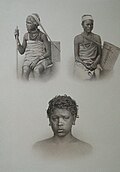
[[File:Garo Women and head of Garo Boy.jpg|thumb|Garo women and a Garo boy]] | |||
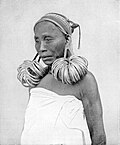
[[File:Garo | [[File:A Garo woman.jpg|thumb|A Garo woman, 1912]] | ||
In December 1872, the Government of India dispatched a military expedition to the Garo Hills to establish control over the region. The campaign was conducted from three sides – south, east, and west. The Garo warriors (''matgriks'') confronted them at the Battle of Rongrenggre, equipped with spears, swords, and shields. Inevitably, the Garo were defeated in the battle, lacking the guns or mortars of the army.{{citation needed|date=December 2022}} | |||
By the early 1900s, the [[American Baptist Mission]] was active in the area, working from [[Tura, Meghalaya]].<ref>Playfair vi.</ref> | |||
Two early histories of the Garo people were written by [[District magistrate|deputy commissioner for Eastern Bengal and Assam]] Major A. Playfair, ''The Garos'' (1909), and by Sinha T.C., ''The Psyche of Garos'' (1955). | |||
==Geographical distribution== | |||
The Garo are mainly distributed over the [[Garo Hills]], [[Khasi Hills]], Ri-Bhoi districts in [[Meghalaya]], [[Kamrup Rural district|Kamrup]], [[Goalpara district|Goalpara]], [[Sivasagar]], and [[Karbi Anglong]] districts of [[Assam]], in India. In Bangladesh, lesser numbers are found in [[Tangail District|Tangail]], [[Jamalpur District|Jamalpur]], [[Sherpur District|Sherpur]], [[Mymensingh District|Mymensingh]], [[Netrokona District|Netrokona]], [[Sunamganj District|Sunamganj]], [[Sylhet District|Sylhet]] and [[Gazipur District|Gazipur]] with the highest concentration in [[Haluaghat Upazila]] and [[Dhobaura Upazila|Dhobaura]] of [[Mymensingh district]], [[Durgapur Upazila, Netrokona|Durgapur upazila]] and [[Kalmakanda Upazila|Kalmakanda upazila]] of [[Netrokona district]], [[Nalitabari Upazila|Nalitabari upazila]] and [[Jhenaigati Upazila|Jhenaigati upazila]] of Sherpur and [[Madhupur Upazila|Madhupur upazila]] of [[Tangail district]].<ref>{{Cite web |title=Garo, The - Banglapedia |url=https://en.banglapedia.org/index.php/Garo,_The |access-date=23 February 2024 |website=en.banglapedia.org |language=en}}</ref> | |||
A majority of Garo village or locality names end with -''gre''. For example, Dakopgre, Cherangre, Goeragre, Simsanggre, etc. There are also names with the ending -'' para'', e.g. Salmanpara, Asipara, Marakapara, etc. ''Para'' is a corruption of -''bra'', which was the result of a census error. Similarly, the village name Asipara is a corruption of the historical place name Asibra. However, the village is listed in census and government records under the name Asipara. This replacement of original names can be seen as a threat to Garo's cultural identity. | |||
It is estimated that the total Garo population in Meghalaya, Assam, Nagaland, Tripura, West Bengal, Canada, the US, Europe, Australia, and Bangladesh combined is more than 1 million.<ref>[http://www.ethnologue.com/language/grt 'Garo'] in Lewis, M. Paul, Gary F. Simons, and Charles D. Fennig (eds.). 2013. ''[[Ethnologue]]: Languages of the World'', 17th edition. Dallas, Texas: SIL International: 889,000 in India (2001 census), 120,000 in Bangladesh (2005). Population total all countries: 1,009,000.</ref> | |||
Garo is also found scattered in the Indian state of [[Tripura]]. The recorded Garo population was around 6,000 in 1971.<ref>Gan-Chaudhuri, Jagadis. ''Tripura: The Land and its People''. (Delhi: Leeladevi Publications, 1980) p. 10</ref> | |||
Garo form minority groups in [[Cooch Behar district|Cooch Behar]], [[Jalpaiguri district|Jalpaiguri]], [[Darjeeling district|Darjeeling]] and [[West Dinajpur district|West Dinajpur]] of [[West Bengal]], as well as in [[Nagaland]]. The present generation of Garo forming minority groups in these states of India does not generally speak their ethnic language any longer.{{citation needed|date=September 2020}} | |||
Garo also forms small communities in various other parts of the world including Canada, America, Australia, and the United Kingdom.{{citation needed|date=September 2020}} | |||
=== | ==Religion== | ||
Today, most Garos in India follow [[Christianity]]<ref>{{cite web|title=People of Meghalaya|url=http://shillong.com/content/people-meghalaya|access-date=3 May 2012|archive-url=https://web.archive.org/web/20171108110212/http://shillong.com/content/people-meghalaya|archive-date=8 November 2017|url-status=dead}}</ref> with a few practicing the traditional Garo animist religion, [[Songsarek religion|Songsarek]]. The latter includes deities who must be appeased with rituals, ceremonies, and [[animal sacrifice]]s to ensure the welfare of the tribe.<ref>{{Cite book |last=Marak |first=Paulinus R. |url=https://catalog.hathitrust.org/Record/005256265 |title=The Garo tribal religion: beliefs and practices |date=2005 |publisher=Anshah Pub. House |isbn=978-81-8364-002-2 |location=Delhi}}</ref> | |||
[[Ramke W. Momin]] was the first Christian Garo member and was born in [[Goalpara district]] in the 1830s.{{Citation needed|date=March 2025}} | |||
{| | In Bangladesh, 56.02% of Garos consider themselves practitioners of Christianity, while of the remaining population, most are practitioners of Songsarek.<ref>{{Cite web |title=A CASE STUDY ON THE GARO ETHNIC PEOPLE OF THE SAL (Shorea robusta) FORESTS IN BANGLADESH |url=https://www.researchgate.net/publication/265291382 |archive-url=https://web.archive.org/web/20241208073028/https://www.researchgate.net/publication/265291382_A_CASE_STUDY_ON_THE_GARO_ETHNIC_PEOPLE_OF_THE_SAL_Shorea_robusta_FORESTS_IN_BANGLADESH |archive-date=8 December 2024 |access-date=2025-03-21 |website=ResearchGate |language=en |url-status=live }}</ref> | ||
|- | |||
|- | |||
In India, a small percentage of the Garo population practices Buddhism, estimated at 0.40%. | |||
The | The term "Dakbewal" is often used to describe Garo culture.{{citation needed|date=September 2020}} In 2000, the group called "Risi Jilma" was founded to safeguard the ancient Garo Songsarek religion. Seeing the Songsarek population in decline, youth from the Dadenggiri subdivision of [[Garo Hills]] felt the need to preserve the Songsarek culture. The Rishi Jilma group is active in about 480 villages in and around Garo Hills. | ||
== | ==Language== | ||
{{main|Garo language}} | |||
The | [[File:Garo elderly man sings traditional song 2.webm|thumb|left|Garo man singing a folk song in Garo language at [[Ramgarh Upazila|Ramgarh]], [[Khagrachhari District|Khagrachori]]]] | ||
The [[Garo language]] belongs to the [[Tibeto-Burman]] [[language family]]. Brief lists of Garo words were compiled by [[East India Company]] officials in 1800, and Garo acquired a Latin-based writing system in the late 19th century. This system was devised by American Baptist missionaries, based on a northeastern dialect of Garo.{{citation needed|date=September 2020}} A·beng or Am·beng, Matabeng, Atong, Me·gam, Matchi, Dual [Matchi-Dual], Ruga, Chibok, Chisak, Gara, Gan·ching [Gara-Gan·ching], A·we etc are few among the dialects of Garo people. The first translation of the Garo Bible was published in 1924 and the official language in schools and government offices is now [[Indian English|English]].{{citation needed|date=September 2020}} | |||
==Social structure== | |||
The Garo are one of the few remaining [[matrilineal]] societies in the world, and Garo individuals take their clan titles from their mothers. Traditionally, the youngest daughter (''nokmechik'') inherits [[property]] from her mother. Sons leave their parents' house at puberty and are trained in the village bachelor dormitory (''nokpante''). After getting married, the man lives in his wife's house. | |||
In Garo tradition, the house where unmarried male youths live is called Nokpante. Traditionally, women were forbidden from entering the Nokpante, and any woman who broke this rule was considered tainted or "marang nangjok." However, this taboo is less common in the present day.{{citation needed|date=September 2020}} | |||
Despite the matrilineal nature of Garo society, it can not accurately be described as matriarchal. While the property is owned by women, the governing of society and domestic affairs and the management of the property is carried out by men.{{citation needed|date=September 2020}} | |||
While Garo people have traditional names,<ref>{{Cite web |url=http://www-personal.umich.edu/~rburling/MandeNames.html |title=An academic study about personal names in Garo villages |access-date=29 February 2008 |archive-date=1 November 2015 |archive-url=https://web.archive.org/web/20151101012234/http://www-personal.umich.edu/~rburling/MandeNames.html |url-status=dead }}</ref> modern Garo culture has been greatly influenced by Christianity.{{citation needed|date=September 2020}} | |||
=== Marriage === | |||
In Garo society, marriage is traditionally arranged, with a strong emphasis on clan exogamy, meaning individuals marry outside their own clan. A distinctive practice among the Garo is "marriage by capture," known as "Chawarisikka," where the prospective groom is captured by the bride's family, symbolising the union. After marriage, the husband typically resides in his wife's household, reflecting the matrilineal nature of Garo society. | |||
The Garo | ==Culture== | ||
=== Clothing === | |||
The traditional dress of Garo Women is Dakmanda, Dakshari. But in the present day, jeans, Sari, T-shirts, and pajamas are also worn. By contrast, Garo men wear jeans, T-shirts, and shirts. | |||
=== Ornaments === | |||
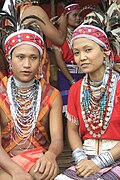
[[File:GARO_TRADITIONAL_DRESS-4.jpg|thumb|Garo men and women in traditional attire]] | |||
Both men and women enjoy adorning themselves with ornaments: | |||
*'' Nadongbi'' or ''sisa'' – made of a brass ring worn in the lobe of the ear | |||
*'' Nadirong'' – brass ring worn in the upper part of the ear | |||
*'' Natapsi'' – the string of beads worn in the upper part of the ear | |||
*'' Jaksan'' – bangles of different materials and sizes | |||
*'' Ripok'' – necklaces made of long barrel-shaped beads of cornelian or red glass while some are made of brass or silver and are worn on special occasions | |||
*'' Jaksil'' – elbow ring is worn by rich men on Gana ceremonies | |||
The dresses of Meghalaya worn by the Garo tribe vary depending on the place of residence of the people. Women who belong to remote villages in the Garo hills wear an eking, a small cloth worn around the waist. | |||
*'' Penta'' – a small piece of ivory struck into the upper part of the ear projecting upwards, parallel to the side of the head | |||
*'' Seng·ki'' – waistband consisting of several rows of conch shells, worn by women | |||
*'' Pilne'' – head ornament wore by women during dances | |||
*''Penta'' – small piece of ivory struck into the upper part of the ear projecting upwards parallel to the side of the head | |||
*''Seng·ki'' – waistband consisting of several rows of conch | |||
*''Pilne'' – head ornament | |||
''' | === Weapons === | ||
One of the principal Garo weapons is a two-edged [[sword]] called ''mil·am'' made of a single piece of iron from hilt to point. There is a cross-bar between the hilt and the blade where a bunch of ox's tail hair is attached. Other types of weapons include [[shield]], [[spear]], [[bow and arrow]], [[axe]], [[dagger]], etc. | |||
=== Cuisine === | |||
The staple Garo food is [[rice]]. ''Kochu'' ([[taro]]), [[millet]], [[maize]], and [[tapioca]] are important substitutes for rice in times when it becomes scarce.<ref>{{cite book |last1=Marak |first1=Queenbala |author-link=Queenbala Marak| year=2014 |title=Food Politics: Studying Food, Identity and Difference among the Garos |publisher=Cambridge Scholars Publishing |pages=69–70 |isbn=978-1-4438-5710-9}}</ref> Other foods such as ''kochu'', dried fish, bamboo shoots, sorrell, sweet potato, pumpkin, gourd, and banana are also popular.<ref>{{cite book |last1=Marak |first1=Queenbala | author-link=Queenbala Marak |year=2014 |title=Food Politics: Studying Food, Identity and Difference among the Garos |publisher=Cambridge Scholars Publishing |pages=67–68 |isbn=978-1-4438-5710-9}}</ref> | |||
The Garo have traditionally used a kind of potash in curries, which is obtained by burning dry pieces of [[cooking plantain|plantain]] stems or young bamboo, known locally as ''kalchi'' or ''katchi''. After these stems are burnt, the ashes are collected and dipped in water; these ashes are then strained in conical shapes in a bamboo strainer. However, [[cooking soda]] is more commonly used as a replacement for this 'ash water' by Garo nowadays. | |||
Garo are known to ferment a special type of rice to create a liquor named "Minil Bichi". This 'country liquor' plays an important role in the life of the Garo.{{citation needed|date=September 2020}} | |||
The sacred drink of the Garos is Chu. Garo children are given it to drink at birth, and visiting guests are traditionally offered it as well.<ref>{{cite web |url=https://travelifeweb.com/life/chu-the-holy-wine-of-garo-society/ |title=Chu: The Holy wine of Garo society | Travelife}}</ref> | |||
==Festivals== | ==Festivals== | ||
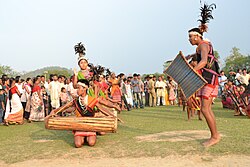
[[File:Wangala Dance.1.JPG|thumb|right|Garo people performing on [[Wangala]] festival]] | |||
Most Garo festivals are based on the agricultural cycle of crops. The harvesting festival ''[[Wangala]]'' is the biggest celebration of the tribe happening in the month of October or November every year. It is the thanksgiving after harvest in | Most Garo festivals are based on the agricultural cycle of crops. The harvesting festival ''[[Wangala]]'' is the biggest celebration of the tribe happening in the month of October or November every year. It is the thanksgiving after harvest in honour of the god ''Saljong'', provider of nature's bounties. | ||
Other festivals include ''Gal·mak Goa'', ''Agalmaka'', etc. | Other festivals include ''Gal·mak Goa'', ''Agalmaka'', etc.{{citation needed|date=September 2020}} | ||
=== Asanang Wangala === | === Asanang Wangala === | ||
The '100-drum festival' is held in Asanang near [[Tura, Meghalaya|Tura]] in the [[West Garo Hills]], Meghalaya, India usually in October or November. Thousands of people, especially young people, gather at Asanang and celebrate Wangala. Garo girls known as ''nomil'' and boys ''(pante'') take part in 'Wangala' festivals. The ''pantes'' beat a kind of long drum called ''dama'' in groups and play bamboo flutes. The nominals with colourful costumes dance to the tune of ''dama'' and folk songs in a circle. | |||
===Dhaka Wangala=== | |||
The Wangala festival is held by Garo in [[Dhaka]] every year, usually in November or December. It is estimated that 30,000 Garo are living in Dhaka, and this festival is one way that they can be seen to preserve Garo Culture and traditions.{{citation needed|date=September 2020}} For the Wangala festival, Garo travels from every corner of the city to the Lalmatia Housing Society ground to gather and celebrate. Approximately 10,000 people attend the celebration.{{citation needed|date=September 2020}} It is a vibrantly colourful rally with traditional dress, and drum performances. Speeches from special guests are also a highlight of the festival. The AMUA for Misi Saljon takes place by the original Kamal from villages. Display stalls are arranged with traditional food, dresses, and other materials. There is also amSouvenir publication from the Nokma Parishad where the Prime Minister's Message is included. It is a festival of great significance for the Garo in Dhaka. | |||
===Christmas=== | ===Christmas=== | ||
Though | Though Christmas is a religious celebration, December is a great season of celebration in Garo Hills. In the first week of December, the town of [[Tura, India|Tura]] and all other smaller towns are illuminated with lights. This celebration features worship, dance, merry-making, grand feasts, and social visits goes on till 10 January. People from all religions and sections take part in the Christmas celebration. In December 2003 the tallest Christmas tree in the world was erected at Dobasipara, Tura by the Baptist boys of Dobasipara. Its height was 119.3 feet, covered by BBC and widely broadcast on television. The tree was decorated with 16,319 coloured light bulbs; it took about 14 days to complete the decoration. | ||
===Ahaia Winter Festival=== | ===Ahaia Winter Festival=== | ||
The annual festival, conceptualised in 2008, is aimed to promote and brand this part of the region as a popular tourist destination by giving an opportunity for the local people to showcase their skills and expertise. The three-day fest features a gala event with carnival, cultural show, food festival, rock concert, wine festival, angling competition, ethnic wear competition, children's fancy dress, DJ Nite, exhibitions, | The annual festival, conceptualised in 2008, is aimed to promote and brand this part of the region as a popular tourist destination by giving an opportunity for the local people to showcase their skills and expertise. The three-day fest features a gala event with a carnival, cultural show, food festival, rock concert, wine festival, angling competition, ethnic wear competition, children's fancy dress, DJ Nite, exhibitions, house, and other games. The entry forms for carnival and other events are available at the Tourist Office, [[Tura, India|Tura]]. | ||
==== Simsang Festival ==== | ==== Simsang Festival ==== | ||
It was first started in 2006 in Williamnagar, Meghalaya. Simsang festival was known as Winter festival before and it promotes the talents of the local people. It also promotes the local bands and the exhibition | It was first started in 2006 in Williamnagar, Meghalaya. Simsang festival was known as the Winter festival before and it promotes the talents of the local people. It also promotes the local bands and the exhibition of handcrafts made by local people. It also promotes the indigenous games of Garo. | ||
== | ==Notable people== | ||
===India=== | |||
* [[Limison D. Sangma]], politician | |||
* [[Thomas A. Sangma]], politician | |||
* [[Rupa M. Marak]], politician | |||
* [[Mehtab Sangma]], politician | |||
* [[Gilbertson Sangma]], India international footballer. | |||
* [[Agatha Sangma]], politician. | |||
* [[Conrad Sangma|Conrad K Sangma]], politician. | |||
* [[Numal Momin]], Deputy Speaker of the Assam Legislative Assembly since 2021. | |||
* [[James Sangma|James Pangsang K Sangma]], politician. | |||
* [[Martin Danggo|Martin Danggo Marak]], politician. | |||
* [[Mukul Sangma|Mukul M. Sangma]], politician. | |||
* [[P. A. Sangma|Purno A. Sangma]], politician. | |||
* [[Pa Togan Sangma|Pa Togan Nengminja Sangma]], freedom fighter. | |||
* [[Ramke W. Momin]], educationist and philosopher. | |||
* [[S. C. Marak]], politician. | |||
* [[Sanford Marak]], politician. | |||
* [[Timothy Shira|Timothy D Shira]], politician. | |||
* [[Williamson A. Sangma]], politician. | |||
* [[Saleng A. Sangma]], politician | |||
== | ===Bangladesh=== | ||
* [[Jewel Areng]], politician. | |||
* [[Debinash Sangma]], Pakistan international footballer. | |||
* [[Maria Manda]], Bangladesh women's international footballer. | |||
* [[Promode Mankin]], politician. | |||
* [[Sheuli Azim]], Bangladesh women's international footballer. | |||
= | |||
* [[Jewel Areng]], | |||
* [[ | |||
* [[ | |||
* [[ | |||
* [[ | |||
==References== | ==References== | ||
===Notes=== | |||
{{reflist}} | {{reflist}} | ||
===Bibliography=== | |||
* | *{{cite book |first=A. |last=Playfair |title=The Garos |location=London |publisher=Nutt |year=1909 |url=https://books.google.com/books?id=dSPTxAEACAAJ}} | ||
*"Two new Mymensingh MPs take oath". The Independent. Retrieved 14 February 2018. | *"Two new Mymensingh MPs take oath". The Independent. Retrieved 14 February 2018. | ||
*"Awami League's Jewel Areng, Nazim Uddin win Mymensingh constituencies in by-elections". bdnews24.com. Retrieved 14 February 2018. | *"Awami League's Jewel Areng, Nazim Uddin win Mymensingh constituencies in by-elections". bdnews24.com. Retrieved 14 February 2018. | ||
*"Mymensingh, a tribal Catholic elected to Parliament". asianews.it. Retrieved 14 February 2018. | *"Mymensingh, a tribal Catholic elected to Parliament". asianews. it. Retrieved 14 February 2018. | ||
*"AL nominates Jewel, Nazim for M'singh by-polls". banglanews24.com. Retrieved 14 February 2018. | *"AL nominates Jewel, Nazim for M'singh by-polls". banglanews24.com. Retrieved 14 February 2018. | ||
*Indigenous Literature: Building a bridge between cultures | * {{cite news |title=Indigenous Literature: Building a bridge between cultures |url=https://www.thedailystar.net/city/news/indigenous-literature-building-bridge-between-cultures-1703185 |work=The Daily Star |date=17 February 2019}} | ||
*Times (2016-11-01). "Garo Icon Ramke W Momin's grave to be memorialized". Meghalaya Times. Retrieved 2019-10-14. | *Times (2016-11-01). "Garo Icon Ramke W Momin's grave to be memorialized". Meghalaya Times. Retrieved 2019-10-14. | ||
*Sangma, MS (15 October 2019). "Ramke W Momin A search for truth" (PDF). NEHU. | *Sangma, MS (15 October 2019). "Ramke W Momin A search for truth" (PDF). NEHU. | ||
* "Congress outsmarted in Meghalaya, Conrad Sangma to be sworn | * "Congress outsmarted in Meghalaya, Conrad Sangma to be sworn on March 6". The Hindu. 4 March 2018. Archived from the original on 4 March 2018. Retrieved 5 March 2018. | ||
== Further reading == | |||
* {{cite book |last1=Ghosh |first1=A. |last2=Ganguly |first2=P. |date=2026 |chapter=Articulating Culture Through Oral Narratives: Documenting the Transformational Myths of the Garo Community of Tripura and Assam |editor1=S. N. Dhumal |editor2=T. V. Banekar |title=Whispers of Forgotten Tales |series=Performance Studies & Cultural Discourse in South Asia |volume=7 |publisher=Springer |location=Singapore |pages=21-32 |doi=10.1007/978-981-95-5973-2_2}} | |||
==External links== | ==External links== | ||
| Line 279: | Line 200: | ||
* http://westgarohills.gov.in/culture.html | * http://westgarohills.gov.in/culture.html | ||
* [https://www.imdb.com/title/tt0432361/ Still The Children Are Here (brief documentary of a Garo neighbourhood in Sadolpara, interior Garo Hills)] | * [https://www.imdb.com/title/tt0432361/ Still The Children Are Here (brief documentary of a Garo neighbourhood in Sadolpara, interior Garo Hills)] | ||
{{Scheduled tribes of India}} | {{Scheduled tribes of India}} | ||
{{Hill tribes of Northeast India}} | {{Hill tribes of Northeast India}} | ||
{{Ethnic groups in Bangladesh}} | |||
{{Authority control}} | {{Authority control}} | ||
{{DEFAULTSORT:Garo | {{DEFAULTSORT:Garo people}} | ||
[[Category:Ethnic groups in | [[Category:Ethnic groups in Northeast India]] | ||
[[Category:Bodo-Kachari]] | [[Category:Bodo-Kachari]] | ||
[[Category:Headhunting]] | [[Category:Headhunting]] | ||
[[Category:Tribes of Meghalaya]] | [[Category:Tribes of Meghalaya]] | ||
[[Category:Scheduled Tribes of Meghalaya]] | [[Category:Scheduled Tribes of Meghalaya]] | ||
[[Category:Scheduled Tribes of Assam]] | |||
[[Category:Scheduled Tribes of Mizoram]] | [[Category:Scheduled Tribes of Mizoram]] | ||
[[Category:Scheduled Tribes of Nagaland]] | [[Category:Scheduled Tribes of Nagaland]] | ||
[[Category:Ethnic groups in Bangladesh]] | |||
[[Category:Ethnic groups in South Asia]] | [[Category:Ethnic groups in South Asia]] | ||
[[Category:Garo people| ]] | |||
[[Category:Tribes of India]] | |||
Latest revision as of 16:09, 26 March 2026
 | This article has multiple issues. Please help improve it or discuss these issues on the talk page. (Learn how and when to remove these template messages)
|


A∙chik | |
|---|---|
 A Garo couple in traditional attire | |
| Total population | |
| 1.1 million (c. 2011) | |
| Regions with significant populations | |
| India • Bangladesh | |
 India India | 997,716[1] |
| • Meghalaya | 821,026 |
| • Assam | 136,077 |
| • Tripura | 12,952 |
 Bangladesh Bangladesh | 120,000[2] |
| Languages | |
| Garo (A∙chikku) | |
| Religion | |
| Majority ~ Christianity (90%)[3] Minority ~ Songsarek, Hinduism (40% in Bangladesh),[4] Animism | |
| Related ethnic groups | |
| Bodo-Kachari groups; Boro, Hajong, Rabha, Koch, Dimasa, Tripuri, Konyak people, other Tibeto Burman peoples | |
The Garo people are a Tibeto-Burman ethnic group who live mostly in the Northeast Indian state of Meghalaya, with a smaller number in neighbouring Bangladesh.[5][6] They are the second-largest indigenous people in Meghalaya after the Khasi and comprise about a third of the local population. They are also found in the Mymensingh Division including Jamalpur, Sherpur, and Mymensingh districts of Bangladesh.
Etymology[edit | edit source]
Historically, the name Garo was used for a large number of different peoples living on the southern bank of Brahmaputra River, but now refers primarily to those who call themselves A∙chik Mande (literally "hill people," from A∙chik "bite soil" and mande "people") or simply A∙chik or Mande, with the name "Garo" now being used by outsiders as an exonym.[7]
History[edit | edit source]
According to oral tradition, the Garo people first migrated to the Garo Hills from Tibet (referred to as Tibotgre) around 400 BC, under the leadership of Jappa Jalimpa, Sukpa, and Bongepa, crossing the Brahmaputra River (Songdu Chibima) and temporarily settling in the river valley. The Garo finally settled down in Garo Hills (East-West Garo Hills), finding providence and security in this uncharted territory and claiming it as their own. Records of the tribe by expanding Mughal armies and by East India Company officials in what is now Bangladesh wrote of the warlike nature of the people. The earliest written records about the Garo date from around 1800, and were described by officials of the East India Company as follows: "... looked upon as bloodthirsty savages, who inhabited a tract of hills covered with almost impenetrable jungle, the climate of which was considered so deadly as to make it impossible for a white man to live there. The Garo had the reputation of being fierce headhunters, the social status of a man being decided by the number of heads he owned".[8]


In December 1872, the Government of India dispatched a military expedition to the Garo Hills to establish control over the region. The campaign was conducted from three sides – south, east, and west. The Garo warriors (matgriks) confronted them at the Battle of Rongrenggre, equipped with spears, swords, and shields. Inevitably, the Garo were defeated in the battle, lacking the guns or mortars of the army.[citation needed]
By the early 1900s, the American Baptist Mission was active in the area, working from Tura, Meghalaya.[9]
Two early histories of the Garo people were written by deputy commissioner for Eastern Bengal and Assam Major A. Playfair, The Garos (1909), and by Sinha T.C., The Psyche of Garos (1955).
Geographical distribution[edit | edit source]
The Garo are mainly distributed over the Garo Hills, Khasi Hills, Ri-Bhoi districts in Meghalaya, Kamrup, Goalpara, Sivasagar, and Karbi Anglong districts of Assam, in India. In Bangladesh, lesser numbers are found in Tangail, Jamalpur, Sherpur, Mymensingh, Netrokona, Sunamganj, Sylhet and Gazipur with the highest concentration in Haluaghat Upazila and Dhobaura of Mymensingh district, Durgapur upazila and Kalmakanda upazila of Netrokona district, Nalitabari upazila and Jhenaigati upazila of Sherpur and Madhupur upazila of Tangail district.[10] A majority of Garo village or locality names end with -gre. For example, Dakopgre, Cherangre, Goeragre, Simsanggre, etc. There are also names with the ending - para, e.g. Salmanpara, Asipara, Marakapara, etc. Para is a corruption of -bra, which was the result of a census error. Similarly, the village name Asipara is a corruption of the historical place name Asibra. However, the village is listed in census and government records under the name Asipara. This replacement of original names can be seen as a threat to Garo's cultural identity.
It is estimated that the total Garo population in Meghalaya, Assam, Nagaland, Tripura, West Bengal, Canada, the US, Europe, Australia, and Bangladesh combined is more than 1 million.[11]
Garo is also found scattered in the Indian state of Tripura. The recorded Garo population was around 6,000 in 1971.[12]
Garo form minority groups in Cooch Behar, Jalpaiguri, Darjeeling and West Dinajpur of West Bengal, as well as in Nagaland. The present generation of Garo forming minority groups in these states of India does not generally speak their ethnic language any longer.[citation needed]
Garo also forms small communities in various other parts of the world including Canada, America, Australia, and the United Kingdom.[citation needed]
Religion[edit | edit source]
Today, most Garos in India follow Christianity[13] with a few practicing the traditional Garo animist religion, Songsarek. The latter includes deities who must be appeased with rituals, ceremonies, and animal sacrifices to ensure the welfare of the tribe.[14]
Ramke W. Momin was the first Christian Garo member and was born in Goalpara district in the 1830s.[citation needed]
In Bangladesh, 56.02% of Garos consider themselves practitioners of Christianity, while of the remaining population, most are practitioners of Songsarek.[15]
In India, a small percentage of the Garo population practices Buddhism, estimated at 0.40%.
The term "Dakbewal" is often used to describe Garo culture.[citation needed] In 2000, the group called "Risi Jilma" was founded to safeguard the ancient Garo Songsarek religion. Seeing the Songsarek population in decline, youth from the Dadenggiri subdivision of Garo Hills felt the need to preserve the Songsarek culture. The Rishi Jilma group is active in about 480 villages in and around Garo Hills.
Language[edit | edit source]
The Garo language belongs to the Tibeto-Burman language family. Brief lists of Garo words were compiled by East India Company officials in 1800, and Garo acquired a Latin-based writing system in the late 19th century. This system was devised by American Baptist missionaries, based on a northeastern dialect of Garo.[citation needed] A·beng or Am·beng, Matabeng, Atong, Me·gam, Matchi, Dual [Matchi-Dual], Ruga, Chibok, Chisak, Gara, Gan·ching [Gara-Gan·ching], A·we etc are few among the dialects of Garo people. The first translation of the Garo Bible was published in 1924 and the official language in schools and government offices is now English.[citation needed]
Social structure[edit | edit source]
The Garo are one of the few remaining matrilineal societies in the world, and Garo individuals take their clan titles from their mothers. Traditionally, the youngest daughter (nokmechik) inherits property from her mother. Sons leave their parents' house at puberty and are trained in the village bachelor dormitory (nokpante). After getting married, the man lives in his wife's house.
In Garo tradition, the house where unmarried male youths live is called Nokpante. Traditionally, women were forbidden from entering the Nokpante, and any woman who broke this rule was considered tainted or "marang nangjok." However, this taboo is less common in the present day.[citation needed]
Despite the matrilineal nature of Garo society, it can not accurately be described as matriarchal. While the property is owned by women, the governing of society and domestic affairs and the management of the property is carried out by men.[citation needed]
While Garo people have traditional names,[16] modern Garo culture has been greatly influenced by Christianity.[citation needed]
Marriage[edit | edit source]
In Garo society, marriage is traditionally arranged, with a strong emphasis on clan exogamy, meaning individuals marry outside their own clan. A distinctive practice among the Garo is "marriage by capture," known as "Chawarisikka," where the prospective groom is captured by the bride's family, symbolising the union. After marriage, the husband typically resides in his wife's household, reflecting the matrilineal nature of Garo society.
Culture[edit | edit source]
Clothing[edit | edit source]
The traditional dress of Garo Women is Dakmanda, Dakshari. But in the present day, jeans, Sari, T-shirts, and pajamas are also worn. By contrast, Garo men wear jeans, T-shirts, and shirts.
Ornaments[edit | edit source]

Both men and women enjoy adorning themselves with ornaments:
- Nadongbi or sisa – made of a brass ring worn in the lobe of the ear
- Nadirong – brass ring worn in the upper part of the ear
- Natapsi – the string of beads worn in the upper part of the ear
- Jaksan – bangles of different materials and sizes
- Ripok – necklaces made of long barrel-shaped beads of cornelian or red glass while some are made of brass or silver and are worn on special occasions
- Jaksil – elbow ring is worn by rich men on Gana ceremonies
The dresses of Meghalaya worn by the Garo tribe vary depending on the place of residence of the people. Women who belong to remote villages in the Garo hills wear an eking, a small cloth worn around the waist.
- Penta – a small piece of ivory struck into the upper part of the ear projecting upwards, parallel to the side of the head
- Seng·ki – waistband consisting of several rows of conch shells, worn by women
- Pilne – head ornament wore by women during dances
Weapons[edit | edit source]
One of the principal Garo weapons is a two-edged sword called mil·am made of a single piece of iron from hilt to point. There is a cross-bar between the hilt and the blade where a bunch of ox's tail hair is attached. Other types of weapons include shield, spear, bow and arrow, axe, dagger, etc.
Cuisine[edit | edit source]
The staple Garo food is rice. Kochu (taro), millet, maize, and tapioca are important substitutes for rice in times when it becomes scarce.[17] Other foods such as kochu, dried fish, bamboo shoots, sorrell, sweet potato, pumpkin, gourd, and banana are also popular.[18]
The Garo have traditionally used a kind of potash in curries, which is obtained by burning dry pieces of plantain stems or young bamboo, known locally as kalchi or katchi. After these stems are burnt, the ashes are collected and dipped in water; these ashes are then strained in conical shapes in a bamboo strainer. However, cooking soda is more commonly used as a replacement for this 'ash water' by Garo nowadays.
Garo are known to ferment a special type of rice to create a liquor named "Minil Bichi". This 'country liquor' plays an important role in the life of the Garo.[citation needed]
The sacred drink of the Garos is Chu. Garo children are given it to drink at birth, and visiting guests are traditionally offered it as well.[19]
Festivals[edit | edit source]

Most Garo festivals are based on the agricultural cycle of crops. The harvesting festival Wangala is the biggest celebration of the tribe happening in the month of October or November every year. It is the thanksgiving after harvest in honour of the god Saljong, provider of nature's bounties.
Other festivals include Gal·mak Goa, Agalmaka, etc.[citation needed]
Asanang Wangala[edit | edit source]
The '100-drum festival' is held in Asanang near Tura in the West Garo Hills, Meghalaya, India usually in October or November. Thousands of people, especially young people, gather at Asanang and celebrate Wangala. Garo girls known as nomil and boys (pante) take part in 'Wangala' festivals. The pantes beat a kind of long drum called dama in groups and play bamboo flutes. The nominals with colourful costumes dance to the tune of dama and folk songs in a circle.
Dhaka Wangala[edit | edit source]
The Wangala festival is held by Garo in Dhaka every year, usually in November or December. It is estimated that 30,000 Garo are living in Dhaka, and this festival is one way that they can be seen to preserve Garo Culture and traditions.[citation needed] For the Wangala festival, Garo travels from every corner of the city to the Lalmatia Housing Society ground to gather and celebrate. Approximately 10,000 people attend the celebration.[citation needed] It is a vibrantly colourful rally with traditional dress, and drum performances. Speeches from special guests are also a highlight of the festival. The AMUA for Misi Saljon takes place by the original Kamal from villages. Display stalls are arranged with traditional food, dresses, and other materials. There is also amSouvenir publication from the Nokma Parishad where the Prime Minister's Message is included. It is a festival of great significance for the Garo in Dhaka.
Christmas[edit | edit source]
Though Christmas is a religious celebration, December is a great season of celebration in Garo Hills. In the first week of December, the town of Tura and all other smaller towns are illuminated with lights. This celebration features worship, dance, merry-making, grand feasts, and social visits goes on till 10 January. People from all religions and sections take part in the Christmas celebration. In December 2003 the tallest Christmas tree in the world was erected at Dobasipara, Tura by the Baptist boys of Dobasipara. Its height was 119.3 feet, covered by BBC and widely broadcast on television. The tree was decorated with 16,319 coloured light bulbs; it took about 14 days to complete the decoration.
Ahaia Winter Festival[edit | edit source]
The annual festival, conceptualised in 2008, is aimed to promote and brand this part of the region as a popular tourist destination by giving an opportunity for the local people to showcase their skills and expertise. The three-day fest features a gala event with a carnival, cultural show, food festival, rock concert, wine festival, angling competition, ethnic wear competition, children's fancy dress, DJ Nite, exhibitions, house, and other games. The entry forms for carnival and other events are available at the Tourist Office, Tura.
Simsang Festival[edit | edit source]
It was first started in 2006 in Williamnagar, Meghalaya. Simsang festival was known as the Winter festival before and it promotes the talents of the local people. It also promotes the local bands and the exhibition of handcrafts made by local people. It also promotes the indigenous games of Garo.
Notable people[edit | edit source]
India[edit | edit source]
- Limison D. Sangma, politician
- Thomas A. Sangma, politician
- Rupa M. Marak, politician
- Mehtab Sangma, politician
- Gilbertson Sangma, India international footballer.
- Agatha Sangma, politician.
- Conrad K Sangma, politician.
- Numal Momin, Deputy Speaker of the Assam Legislative Assembly since 2021.
- James Pangsang K Sangma, politician.
- Martin Danggo Marak, politician.
- Mukul M. Sangma, politician.
- Purno A. Sangma, politician.
- Pa Togan Nengminja Sangma, freedom fighter.
- Ramke W. Momin, educationist and philosopher.
- S. C. Marak, politician.
- Sanford Marak, politician.
- Timothy D Shira, politician.
- Williamson A. Sangma, politician.
- Saleng A. Sangma, politician
Bangladesh[edit | edit source]
- Jewel Areng, politician.
- Debinash Sangma, Pakistan international footballer.
- Maria Manda, Bangladesh women's international footballer.
- Promode Mankin, politician.
- Sheuli Azim, Bangladesh women's international footballer.
References[edit | edit source]
Notes[edit | edit source]
- ↑ "A-11 Individual Scheduled Tribe Primary Census Abstract Data and its Appendix". censusindia.gov.in. Government of India. Retrieved 28 October 2017.
- ↑ "Garo". Ethnologue. SIL International. Retrieved 28 October 2017.
- ↑ "Missionary is not a very popular word in India. But in the Khasi hills, it holds a different meaning in their culture". ThePrint. 16 October 2021.
- ↑ Chakma, Sheeladitya. "A CASE STUDY ON THE GARO ETHNIC PEOPLE OF THE SAL (Shorea robusta) FORESTS IN BANGLADESH".
- ↑ "5 facts you must know about the Garo Tribe of Meghalaya". thenortheasttoday.com. 4 October 2018. Retrieved 31 December 2023. "The Garos are a Tibeto-Burman ethnic group in Meghalaya also known as the A·chik Mande (literally hill people) or simply A·chik or Mande."
- ↑ R. Marak, Silba; Sharma, Dwijen (11 September 2023). "Funeral Rites of the Garos: Unveiling Cultural Assimilation Amidst Christian Influence". Journal of Contemporary Rituals and Traditions. 1 (2): 55–66. doi:10.15575/jcrt.354. ISSN 2988-5884.
- ↑ Official Homepage of Meghalaya State of India Archived 8 March 2008 at the Wayback Machine
- ↑ Playfair 76-77.
- ↑ Playfair vi.
- ↑ "Garo, The - Banglapedia". en.banglapedia.org. Retrieved 23 February 2024.
- ↑ 'Garo' in Lewis, M. Paul, Gary F. Simons, and Charles D. Fennig (eds.). 2013. Ethnologue: Languages of the World, 17th edition. Dallas, Texas: SIL International: 889,000 in India (2001 census), 120,000 in Bangladesh (2005). Population total all countries: 1,009,000.
- ↑ Gan-Chaudhuri, Jagadis. Tripura: The Land and its People. (Delhi: Leeladevi Publications, 1980) p. 10
- ↑ "People of Meghalaya". Archived from the original on 8 November 2017. Retrieved 3 May 2012.
- ↑ Marak, Paulinus R. (2005). The Garo tribal religion: beliefs and practices. Delhi: Anshah Pub. House. ISBN 978-81-8364-002-2.
- ↑ "A CASE STUDY ON THE GARO ETHNIC PEOPLE OF THE SAL (Shorea robusta) FORESTS IN BANGLADESH". ResearchGate. Archived from the original on 8 December 2024. Retrieved 21 March 2025.
- ↑ "An academic study about personal names in Garo villages". Archived from the original on 1 November 2015. Retrieved 29 February 2008.
- ↑ Marak, Queenbala (2014). Food Politics: Studying Food, Identity and Difference among the Garos. Cambridge Scholars Publishing. pp. 69–70. ISBN 978-1-4438-5710-9.
- ↑ Marak, Queenbala (2014). Food Politics: Studying Food, Identity and Difference among the Garos. Cambridge Scholars Publishing. pp. 67–68. ISBN 978-1-4438-5710-9.
- ↑ "Chu: The Holy wine of Garo society | Travelife".
Bibliography[edit | edit source]
- Playfair, A. (1909). The Garos. London: Nutt.
- "Two new Mymensingh MPs take oath". The Independent. Retrieved 14 February 2018.
- "Awami League's Jewel Areng, Nazim Uddin win Mymensingh constituencies in by-elections". bdnews24.com. Retrieved 14 February 2018.
- "Mymensingh, a tribal Catholic elected to Parliament". asianews. it. Retrieved 14 February 2018.
- "AL nominates Jewel, Nazim for M'singh by-polls". banglanews24.com. Retrieved 14 February 2018.
- "Indigenous Literature: Building a bridge between cultures". The Daily Star. 17 February 2019.
- Times (2016-11-01). "Garo Icon Ramke W Momin's grave to be memorialized". Meghalaya Times. Retrieved 2019-10-14.
- Sangma, MS (15 October 2019). "Ramke W Momin A search for truth" (PDF). NEHU.
- "Congress outsmarted in Meghalaya, Conrad Sangma to be sworn on March 6". The Hindu. 4 March 2018. Archived from the original on 4 March 2018. Retrieved 5 March 2018.
Further reading[edit | edit source]
- Ghosh, A.; Ganguly, P. (2026). "Articulating Culture Through Oral Narratives: Documenting the Transformational Myths of the Garo Community of Tripura and Assam". In S. N. Dhumal; T. V. Banekar (eds.). Whispers of Forgotten Tales. Performance Studies & Cultural Discourse in South Asia. Vol. 7. Singapore: Springer. pp. 21–32. doi:10.1007/978-981-95-5973-2_2.
External links[edit | edit source]
- Official site of Meghalaya State of India
- A Garo, Mande Adivasi: Dance Performance Art in Bangladesh
- East Garo Hills District: The people
- West Garo Hills District official website: The people - Garos
- South Garo Hills District official website - People and Culture
- Ethnologue entry for Garo
- http://westgarohills.gov.in/culture.html
- Still The Children Are Here (brief documentary of a Garo neighbourhood in Sadolpara, interior Garo Hills)

- Pages using the JsonConfig extension
- Articles needing style editing
- Articles needing additional references from April 2025
- Ethnic groups in Northeast India
- Bodo-Kachari
- Headhunting
- Tribes of Meghalaya
- Scheduled Tribes of Meghalaya
- Scheduled Tribes of Assam
- Scheduled Tribes of Mizoram
- Scheduled Tribes of Nagaland
- Ethnic groups in Bangladesh
- Ethnic groups in South Asia
- Garo people
- Tribes of India