



CleanupBot (talk | contribs) m clean up |
m refine information additionally |
||
| Line 1: | Line 1: | ||
{{Short description|Man-lion avatar of Hindu god Vishnu}} | {{Short description|Man-lion and the fourth avatar of Hindu god Vishnu}} | ||
{{other uses}} | {{other uses}} | ||
{{Use Indian English|date=March 2017}} | {{Use Indian English|date=March 2017}}{{Use dmy dates|date=September 2023}} | ||
{{Use dmy dates|date= | {{Infobox deity<!--Bharatpedia:WikiProject Hindu mythology--> | ||
{{Infobox deity<!-- | |||
| type = Hindu | | type = Hindu | ||
| member_of = [[Dashavatara]] | | member_of = [[Dashavatara]] | ||
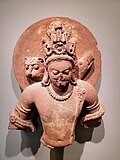
| image = Yoga | | image = South India, late Chola Period - Yoga Narashimha, Vishnu in his Man-Lion Avatar - 1973.187 - Cleveland Museum of Art.tif | ||
| caption = Yoga- | | caption = A sculpture of Yoga-Narsimha, South India, late Chola period | ||
| name = Narasimha | | name = Narasimha | ||
| Devanagari = | | Devanagari = | ||
| Sanskrit_transliteration = | | Sanskrit_transliteration = | ||
| affiliation = [[Vaishnavism]] | | affiliation = {{Unbulletedlist|[[Vaishnavism]]|[[Avatar]] of [[Vishnu]]|[[Dashavatara]]|[[Lakshmi Narasimha]]|[[Nava Narasimha]]}} | ||
| weapon = [[Sudarshana Chakra]], [[Kaumodaki]] | | weapon = [[Claw]]s, [[Sudarshana Chakra]] (discus), [[Kaumodaki]] (mace) | ||
| god_of = God of Protection, Destruction, [[Yoga]] and [[Kāla|Kala]] (Time); The Destroyer of Evil and Fear | | god_of = God of Protection, Destruction, [[Yoga]] and [[Kāla|Kala]] (Time); The Destroyer of Evil and Fear | ||
| festivals = [[Narasimha Jayanti]], [[Holi]] | | festivals = [[Narasimha Jayanti]], [[Holi]] | ||
| consort = [[Lakshmi]] | | consort = [[Lakshmi]]<ref>{{Cite book |last1=Mallik |first1=Anupama |url=https://books.google.com/books?id=SsRTDwAAQBAJ&dq=lakshmi+narasimha+lap&pg=PA183 |title=Digital Hampi: Preserving Indian Cultural Heritage |last2=Chaudhury |first2=Santanu |last3=Chandru |first3=Vijay |last4=Srinivasan |first4=Sharada |date=2018-03-31 |publisher=Springer |isbn=978-981-10-5738-0 |pages=183 |language=en}}</ref> | ||
| abode = | | abode = | ||
| mantra = ugraṃ vīraṃ mahāviṣṇuṃ jvalantaṃ sarvatomukham {{!}} | |||
nṛsiṃhaṃ bhīṣaṇaṃ bhadraṃ mṛtyumṛtyuṃ namāmyaham {{!}}{{!}} | |||
}} | }} | ||
{{Infobox royalty | {{Infobox royalty | ||
| Line 25: | Line 27: | ||
{{Vaishnavism}} | {{Vaishnavism}} | ||
'''Narasimha''' ({{ | '''Narasimha''' ({{langx|sa|नरसिंह|lit=man-lion}}, {{IAST3|Narasiṃha}}, or {{langx|sa|नृसिंह}}, {{IAST3|Nṛsiṃha}}),<!--Do not remove, WP:INDICSCRIPT doesn't apply to WikiProject Hinduism--> is a [[Hindu deities|deity]] in [[Hinduism]], revered as the fourth of the ten principal avatars ([[Dashavatara]]) of the god [[Vishnu]].<ref>{{Cite book |last=Blurton |first=T. Richard |title=Hindu art |date=1993 |publisher=Harvard University Press |isbn=0-674-39188-8 |location=Cambridge, Mass. |pages=123 |oclc=25833896}}</ref> Depicted with a human torso and a lion's head and claws, Narasimha is venerated as a fierce protector who destroys evil and safeguards his devotees. He is most widely known for protecting his devotee [[Prahlada]] and for slaying the tyrannical demon king [[Hiranyakashipu]].'''<ref name="Williams2008p223">{{cite book |author=George M. Williams |url=https://books.google.com/books?id=N7LOZfwCDpEC&pg=PA223 |title=Handbook of Hindu Mythology |publisher=Oxford University Press |year=2008 |isbn=978-0-19-533261-2 |page=223}}</ref><ref>{{cite book |author=Gavin D. Flood |url=https://archive.org/details/introductiontohi0000floo |title=An Introduction to Hinduism |publisher=Cambridge University Press |year=1996 |isbn=978-0-521-43878-0 |page=[https://archive.org/details/introductiontohi0000floo/page/111 111] |url-access=registration}}</ref>''' | ||
According to [[Hindu scriptures|Hindu texts]], Hiranyakashipu, the elder brother of [[Hiranyaksha]]—who was killed earlier by Vishnu's [[Varaha]] avatar—received a boon from the creator god [[Brahma]] that made him nearly invulnerable. The conditions of the boon prevented his death by man or beast, indoors or outdoors, during day or night, on earth or in the sky, and not by any weapon. Empowered by this, Hiranyakashipu persecuted Vishnu’s devotees, including his own son Prahlada. To circumvent the boon, Vishnu incarnated as Narasimha—neither man nor animal—and killed Hiranyakashipu at twilight, on a palace threshold, placing him on his lap and tearing him apart with his claws.<ref name="dalal2010p262">{{cite book |author=Roshen Dalal |url=https://books.google.com/books?id=pNmfdAKFpkQC&pg=PA262 |title=The Religions of India: A Concise Guide to Nine Major Faiths |publisher=Penguin Books |year=2010 |isbn=978-0-14-341517-6 |page=148}}</ref><ref name="Williams2008p223" /><ref name="Krishna2009p50">{{cite book |author=Nanditha Krishna |url=https://books.google.com/books?id=f9cSlaLMlgEC&pg=PA50 |title=The Book of Vishnu |publisher=Penguin Books |year=2009 |isbn=978-0-14-306762-7 |pages=50–53}}</ref><ref>Steven J. Rosen, ''Narasiṁha Avatar, The Half-Man/Half-Lion Incarnation'', p5</ref> | |||
Narasimha | Narasimha holds a central place in the Vishnu-centric [[Vaishnavism|Vaishnava]] theology, iconography, and devotional traditions, particularly within the [[Vaikhanasa]], [[Sri Vaishnavism|Sri Vaishnava]] and [[Sadh Vaishnavism|Sadha]] sects.<ref>{{cite book |author1=Farley P. Richmond |url=https://books.google.com/books?id=OroCOEqkVg4C |title=Indian Theatre: Traditions of Performance |author2=Darius L. Swann |author3=Phillip B. Zarrilli |publisher=Motilal Banarsidass |year=1993 |isbn=978-81-208-0981-9 |pages=127 with footnote 1}}</ref> He is portrayed in a range of [[Murti#Types|forms]], from fierce (''ugra'') to serene (''saumya''), and in certain Vaishnava interpretations, he is also worshipped as Yoga-Narasimha, the god of [[yoga]],{{Sfn|Soifer|1991|p=102}}{{Sfn|Soifer|1991|p=92}} and as the god of destruction, who destroys the entire universe through ''[[Pralaya]]''. Early representations have been found at archaeological sites in [[Uttar Pradesh]] and [[Andhra Pradesh]], such as [[Mathura]], and are dated between the 2nd and 4th centuries CE.<ref name="merister292">{{cite journal |last=Meister |first=Michael W. |year=1996 |title=Man and Man-Lion: The Philadelphia Narasimha |journal=Artibus Asiae |volume=56 |issue=3/4 |pages=291–301 with footnotes |doi=10.2307/3250120 |jstor=3250120}}</ref> Important pilgrimage sites dedicated to Narasimha include [[Ahobilam]] in Andhra Pradesh, where [[Nava Narasimha]]–nine forms of the deity–are venerated.<ref>{{cite book |author=Rangachar Vasantha |url=https://books.google.com/books?id=aFDkAAAAMAAJ |title=The Nārāyaṇasvāmi Temple at Mēlkōṭe: An Archaeological and Historical Study |publisher=Directorate of Archaeology and Museums |year=1991 |page=9 |quote=The layout of this matha is almost like that of the Parakāla - matha above described. Here too in the central shrine are kept a few bronze [[murti]]s, including that of Lakshmi Narasimha, the presiding deity of that matha.}}</ref> | ||
He is honored in various temples, scriptures, performance traditions, and festivals, including [[Holi]].<ref name="dalal2010p262" />{{sfn|Soifer|1991}} The annual festival [[Narasimha Jayanti]], observed on the 14th day of the Hindu month of [[Vaishakha|Vaisakha]] (April–May), commemorates the deity’s appearance to protect Prahlada and defeat Hiranyakashipu. | |||
==Etymology== | ==Etymology== | ||
[[File:The God Vishnu in Three Incarnations. Northern India (Mathura), Gupta period, mid-5th century AD. Boston Museum.jpg|thumb| | [[File:The God Vishnu in Three Incarnations. Northern India (Mathura), Gupta period, mid-5th century AD. Boston Museum.jpg|thumb|Vishnu and his [[avatar]]as (''[[Vaikuntha Chaturmurti]]''): Depicting Vishnu as [[Krishna]] and Rama, Narasimha (lion), and [[Varaha]] (boar). [[Art of Mathura]], mid-5th century CE. [[Museum of Fine Arts, Boston|Boston Museum]].<ref name="CS">For English summary, see page 80 {{cite journal |last1=Schmid |first1=Charlotte |title=Les Vaikuṇṭha gupta de Mathura : Viṣṇu ou Kṛṣṇa? |journal=Arts Asiatiques |date=1997 |volume=52 |pages=60–88 |doi=10.3406/arasi.1997.1401 |url=https://www.persee.fr/doc/arasi_0004-3958_1997_num_52_1_1401}}</ref>]] | ||
In Sanskrit, the word ''Narasimha'' consists of two words "nara" which means man, and "simha" which means lion, referring to | In Sanskrit, the word ''Narasimha'' consists of two words "nara" which means man, and "simha" which means lion, referring to the man-lion avatara of Vishnu.<ref name="Williams2008p223"/><ref name="dalal2010p262"/> | ||
His other names are ''Agnilochana'' ({{lang|sa|अग्निलोचन}}) – the one who has fiery eyes, ''Bhairavadambara'' ({{lang|sa|भैरवडम्बर}}) – the one who causes terror by roaring, ''Karala'' ({{lang|sa|कराल}}) – the one who has a wide mouth and projecting teeth, ''Hiranyakashipumardana'' ({{lang|sa|हिरण्यकषिपुमर्दान}}) – the one who killed Hiranyakashipu, ''Nakhastra'' ({{lang|sa|नखास्त्र}}) – the one for whom nails are his weapons, ''Simhavadana'' ({{lang|sa|सिंहवदन}}) – the one who has a lion face and ''Simha'' ({{lang|sa|सिंह}}) – the one who is a lion.<ref>{{Cite web|url=https://www.speakingtree.in/allslides/eight-sacred-names-of-narsimha-the-great-protector|title=Eight sacred names of Lord Narsimha to remove the fear|website=www.speakingtree.in|access-date=8 January 2020}}</ref> | |||
==Texts== | ==Texts== | ||
[[File:0101821 Kevala Narasimha Temple, Ramtek Maharashtra 149.jpg|thumb|Narasimha, 5th century, [[Ramtek Kevala Narasimha temple inscription|Ramtek Kevala Narasimha temple.]]]] | [[File:0101821 Kevala Narasimha Temple, Ramtek Maharashtra 149.jpg|thumb|Narasimha, 5th century, [[Ramtek Kevala Narasimha temple inscription|Ramtek Kevala Narasimha temple.]]]] | ||
===Vedas=== | ===Vedas=== | ||
Verse 1.154.2 of the ''[[Rigveda]]'' (15th century BCE to the 10th century BCE) describes Vishnu as a fearful prowling beast. This verse depicts Vishnu as a powerful and terrifying Mrga, or animal, ruling over the earth with his three steps. Many interpret this as referring to a lion, and thus a precursor to the Narasimha story.<ref>H.H. Wilson (1866) Rig Veda (Translation and Commentary), [https://www.wisdomlib.org/hinduism/book/rig-veda-english-translation/d/doc830647.html]</ref> | |||
The full story of Indra killing Namuci is found in ''[[Shatapatha Brahmana]]'' (7th - 6th century BCE) of the ''[[Yajurveda]]'' in chapter 12.7.3. Other references to Narasimha are found in the Vedic texts Vajaseneyi Samhita 10.34, Pancavimsa Brahmana 12.6.8 and Taittiriya Brahmana 1.7.1.6.{{sfn|Soifer|1991|pp=37–39}} | |||
====The story of Indra killing Namuci ==== | |||
Narasimha has the same story as Indra killing Namuci in the Vedas.{{sfn|Soifer|1991|pp=37–39}}<ref>{{cite journal | last=Bloomfield | first=Maurice | title=Contributions to the Interpretation of the Veda | journal=Journal of the American Oriental Society | publisher=American Oriental Society | volume=15 | year=1893 | doi=10.2307/592353 | pages=143–156| jstor=592353 }}</ref> [[Indra]] is the [[dharma|dharmic]] King of Heaven of the [[Deva (Hinduism)|Devas]] and [[Devi]]s who commands lightning, thunder, rain and rivers, while Namuci is a deceptive demon [[Asura]] in competition for power. Namuci tells peace to Indra, which Indra accepts. He demands Indra to promise that he will neither try to kill him with his "palm of the hand nor with the fist", neither in day nor in night, neither with "anything that is dry" nor with "anything that is wet". Indra agrees.{{sfn|Soifer|1991|pp=37–39}}<ref>{{cite journal | last=Fowler | first=Murray | title=The Role of Surā in the Myth of Namuci | journal=Journal of the American Oriental Society | publisher=American Oriental Society | volume=62 | issue=1 | year=1942 | doi=10.2307/594098 | pages=36–40| jstor=594098 }}</ref> | |||
After | After the deal is done, Namuci carries away all that nourishes the gods and goddesses: the Soma drink, the essence of food and the strength of Indra. The leader of the gods and goddesses finds himself conflicted and feels bound by his promise. Indra then meets [[Saraswati|Sarasvati]] (goddess of knowledge) and the [[Ashvins|Ashvinas]].{{sfn|Soifer|1991|pp=37–39}} They reply they will deal with Namuci, get it all back, if Indra agrees to share his powers, the essence of food and the Soma drink with them. Indra agrees. The gods and the goddess then come up with a creative plan. They pour out a foam of water with a thunderbolt, and Indra takes a thunderbolt in his hand and Indra kills Namuci in evening.{{sfn|Soifer|1991|pp=37–39}} | ||
According to Deborah Soifer, the | After Namuci is killed, the gods and goddesses get all the powers back, but discover that Namuci had drunk the Soma already. The good was thus now mixed with his evil of his blood, which they did not want to drink. So, they extract the good out from the evil. Thus, good returns to the gods and goddesses, the evil is destroyed.{{sfn|Soifer|1991|pp=37–39}} | ||
According to Deborah Soifer, this story is the same as the story of Narasimha, it has the same plot, the same "neither-nor" constraints, and the same creative powers of the good kills and destroys the evil. Further, the [[Sanskrit]] words and phrasing such as "neither palm nor fist" and "neither day nor night" in the later Hindu texts is the same as in the [[Vedas|Vedic]] texts. This suggests a link and continuity between the Vedic story of Indra killing Namuci and the story of Narasimha killing Hiranyakashipu in the Puranas.{{sfn|Soifer|1991|pp=37–39}} According to Walter Ruben, both stories along with several other stories in ancient and medieval texts reflect the Indian Subcontinental tradition of killing and destroying despots and tyrants who abuse power.<ref>Walter Ruben (1968), [https://www.jstor.org/stable/41694231 Fighting against despotes in old Indian literature], Annals of the Bhandarkar Oriental Research Institute, Vol. 48/49, Golden Jubilee, Volume 1917-1967 (1968), pp. 111-118</ref> | |||
===Puranas=== | ===Puranas=== | ||
Vishnu as Narasimha is mentioned in a variety of [[Puranas]], in 17 Puranas, Vishnu as Narasimha mentioned.<ref>Steven J. Rosen, ''Narasimha, The Half-Man - Half-Lion Incarnation of Vishnu'', p1</ref> The Valmiki Ramayana (7.24), [[Harivamsa]] (41 & 3.41-47), [[Vishnu Purana]] (1.16-20), [[Bhagavata Purana]] (Canto 7),<ref>{{cite book|author1=Ravi M. Gupta|author2=Kenneth R. Valpey|title=The Bhagavata Purana: Sacred Text and Living Tradition|url=https://books.google.com/books?id=eEPfrzAwO0sC |year=2013|publisher=Columbia University Press|isbn=978-0-231-53147-4|pages=21–23, 32–35}}</ref> [[Agni Purana]] (4.2-3), [[Brahmanda Purana]] (2.5.3-29), [[Vayu Purana]] (67.61-66), [[Brahma Purana]] (213.44-79), [[Vishnudharmottara Purana]] (1.54), [[Kurma Purana]] (1.15.18-72), [[Matsya Purana]] (161-163), [[Padma Purana]] (5.42), [[Shiva Purana]] (2.5.43 & 3.10-12), [[Linga Purana]] (1.95-96) and [[Skanda Purana]] (2.18.60-130) all mention Vishnu as Narasimha.<ref>{{cite book|author=David Leeming|title=A Dictionary of Asian Mythology|url=https://books.google.com/books?id=QRwgAQAAQBAJ |year=2001|publisher=Oxford University Press|isbn=978-0-19-512053-0|pages=125–126}}</ref><ref>{{cite book|author=S. M. Srinivasa Chari|title=Vaiṣṇavism: Its Philosophy, Theology, and Religious Discipline |url=https://books.google.com/books?id=evmiLInyxBMC |year=1994|publisher=Motilal Banarsidass|isbn=978-81-208-1098-3|pages=35–38}}</ref> In all these Puranas, Narasimha is described as the God of Destruction, who does destruction at the time of [[Pralaya]] and described as [[Kāla|Kala]].{{Sfn|Soifer|1991|p=102}} Narasimha is also described as having three eyes just like [[Shiva]] and does destruction with fire coming from his third eye.{{Sfn|Soifer|1991|p=92}} | |||
== | === Sangam literature === | ||
The '''' | The ''[[Paripāṭal|Paripatal]]'' (Dated between 300 BCE to 300 CE) ({{langx|ta|பரிபாடல்}}, meaning ''the paripatal-metre anthology'') is a classical [[Tamil language|Tamil]] poetic work and traditionally the fifth of the [[Eight Anthologies]] (''Ettutokai'') in [[Sangam literature]].{{sfn|Kamil Zvelebil|1973|pp=123–124}} [[Kamil Zvelebil]] states that the hymns dedicated to [[Vishnu]] and [[Kartikeya|Murugan]] has branded the Paripatal as a [[Sanskrit]] plagiat within the so-called Sangam texts.<ref>{{cite book | url=https://books.google.com/books?id=OQ33i496MsIC&pg=PA48 | title=Tamil Literature | isbn=9783447015820 | last1=Zvelebil | first1=Kamil | date=25 September 1974 | publisher=Otto Harrassowitz Verlag }}</ref> | ||
''' | '''Narasimha in Paripadal''' | ||
<poem> | <poem> | ||
O Lord with faultless red eyes! | O Lord with faultless red eyes! With | ||
burning hatred in his | burning hatred in his mind and drying up the sandal paste on his chest, [[Hiranyakashipu]], the evil king, fought with his son [[Prahlada]] for singing your praises, causing on him great shock. Prahlada was not worried about Hiranyakashipu who deserved disrespect. You placed Prahlada’s away because of your love for him. You attacked and caught [[Hiranyakashipu]] with your great strength, catching his mountain-like chest as drums of deities roared like thunder. You disemboweled and killed Hiranyakashipu alive with your claws and wore Hiranyakashipu's organs as a garland and threw Hiranyakashipu's organs away, along with broken pieces of a pillar which you blasted and came out, as Narasimha. | ||
sandal paste on his chest, [[Hiranyakashipu | |||
praises, | |||
disrespect. | |||
because of your love for him. | |||
[[Hiranyakashipu | |||
mountain-like chest as drums roared like thunder. | |||
You | |||
'' | ''Paripadal, poem 4, Verses 10 - 21''<ref name="ReferenceF">{{cite web | url=https://sangamtranslationsbyvaidehi.com/ettuthokai-paripadal/ | title=Ettuthokai – Paripādal | date=19 May 2022 }}</ref> | ||
</poem> | </poem> | ||
===Other texts=== | ===Other texts=== | ||
Narasimha is also found in and is the focus of ''[[Nrisimha Tapaniya Upanishad]]''.<ref>{{cite book|last= Deussen|first=Paul| title=Sixty Upanishads of the Veda|url=https://books.google.com/books?id=XYepeIGUY0gC&pg=PA809|year= 1997|publisher= Motilal Banarsidass |isbn= 978-81-208-1467-7| pages=809–858}}</ref><ref>{{cite book|author=S. M. Srinivasa Chari|title=Vaiṣṇavism: Its Philosophy, Theology, and Religious Discipline |url=https://books.google.com/books?id=evmiLInyxBMC |year=1994|publisher=Motilal Banarsidass|isbn=978-81-208-1098-3|pages=132–134}}</ref> | Narasimha is also found in and is the focus of ''[[Nrisimha Tapaniya Upanishad|Narasimha Tapaniya Upanishad]]''.<ref>{{cite book|last= Deussen|first=Paul| title=Sixty Upanishads of the Veda|url=https://books.google.com/books?id=XYepeIGUY0gC&pg=PA809|year= 1997|publisher= Motilal Banarsidass |isbn= 978-81-208-1467-7| pages=809–858}}</ref><ref>{{cite book|author=S. M. Srinivasa Chari|title=Vaiṣṇavism: Its Philosophy, Theology, and Religious Discipline |url=https://books.google.com/books?id=evmiLInyxBMC |year=1994|publisher=Motilal Banarsidass|isbn=978-81-208-1098-3|pages=132–134}}</ref> | ||
== | ==Legends== | ||
=== | ===Prahlada legend=== | ||
[[File:Narasimha Disemboweling Hiranyakashipu, Folio from a Bhagavata Purana (Ancient Stories of the Lord) LACMA M.82.42.8 (1 of 5).jpg|thumb|Narasimha | [[File:Narasimha Disemboweling Hiranyakashipu, Folio from a Bhagavata Purana (Ancient Stories of the Lord) LACMA M.82.42.8 (1 of 5).jpg|thumb|Narasimha disemboweling and killing Hiranyakashipu, manuscript folio from Bhagavata Purana, 1760 CE - 1770 CE.]] | ||
The Bhagavata | The Bhagavata Purana says that Vishnu, in his previous avatara as [[Varaha]], killed the evil demon [[Hiranyaksha]]. The elder brother of Hiranyaksha, demon king [[Hiranyakashipu]], hated Vishnu and wanted revenge.<ref name="dalal2010p148">{{cite book |author=Roshen Dalal |url=https://books.google.com/books?id=pNmfdAKFpkQC&pg=PA148 |title=The Religions of India: A Concise Guide to Nine Major Faiths |publisher=Penguin Books |year=2010 |isbn=978-0-14-341517-6 |page=148}}</ref> Hiranyakashipu undertakes prolonged and severe austerities in an effort to achieve immortality and universal sovereignty.<ref>{{cite book |last1=Gupta |first1=Ravi M. |last2=Valpey |first2=Kenneth R. |title=The Bhāgavata Purāṇa: Sacred Text and Living Tradition |publisher=Columbia University Press |location=New York |year=2013 |isbn=978-0-231-14998-3 |pages=24–25}}</ref> Moved by the intensity of these austerities, Brahma grants Hiranyakashipu a series of protective boons providing assurance that he cannot be killed: | ||
* by any creature, human or animal; | |||
* inside or outside; | |||
* during day or night; | |||
* on the ground or in the sky; | |||
* by weapons or by any created being.<ref name="GuptaValpey25">{{cite book |last1=Gupta |first1=Ravi M. |last2=Valpey |first2=Kenneth R. |title=The Bhāgavata Purāṇa: Sacred Text and Living Tradition |publisher=Columbia University Press |year=2013 |isbn=978-0-231-14998-3 |page=25}}</ref> | |||
Hiranyakashipu, once powerful and invincible with the new boon, began to persecute those who were devotees of Vishnu. Hiranyakashipu had a son, [[Prahlada]], who disagreed and rebelled against his father. Prahlada became a devotee of Vishnu. This angered Hiranyakashipu, who tried to kill the boy but with each attempt, Prahlada was protected by Vishnu's mystical power. When asked, Prahlada refused to acknowledge his father as the supreme lord of the universe and said that Vishnu is [[omnipresent]]. | |||
Hiranyakashipu pointed to a nearby pillar and asked if 'his Vishnu' is in it and said to his son Prahlada, "O most unfortunate Prahlada, you have always described a supreme being other than me, a supreme being who is above everything, who is the controller of everyone, and who is all-pervading. But where is He? If He is everywhere, then why is He not present before me in this pillar?" Prahlada then answered, "He was, He is, He will be." | |||
Hiranyakashipu, unable to contain his anger, struck the pillar with his mace. Following a tumultuous sound, Vishnu, in the form of Narasimha, emerged from it and attacked Hiranyakashipu in defense of Prahlada. The form of Narsimha was chosen to avoid the boon granted to Hiranyakashipu by [[Brahma]]. According to the boon, Hiranyakashipu could not be killed by a human, deity, or animal. Narasimha, being part-human and part-lion, was none of these. He confronted Hiranyakashipu at twilight (neither day nor night), on the threshold of a courtyard (neither indoors nor outdoors), and placed him on his lap (neither earth nor space). Using his sharp fingernails (neither [[animate]] nor [[wikt:inanimate|inanimate]]) as weapons, he disemboweled and killed Hiranyakashipu.<ref name=":0">{{Cite web |title=HariHarji |url=http://hariharji.blogspot.com/2008_09_14_archive.html |access-date=8 January 2020 |website=hariharji.blogspot.com}}</ref> | |||
Seeing that Narasimha was in rage, Brahma, [[Shiva]] and all of the other gods and goddesses sent Prahlada to pacify him. Prahlada prayed to Narasimha, and Ugra Narasimha became the peaceful Soumya Narasimha.<ref>{{cite book |last1=Vishwananda |first1=Paramahamsa Sri Swami |title=The Essence of Shreemad Bhagavatam: A Seven-Day Journey to Love |date=2017 |publisher=Bhakti Marga Publications |isbn=978-3-940381-71-2 |page=374 |url=https://books.google.com/books?id=EJ3JDwAAQBAJ&pg=PT374 |language=en}}</ref><ref>{{cite book |last1=Vishwananda |first1=Sri Swami |title=Just Love: The Essence of Everything, Volume 3 |date=2019 |publisher=BoD – Books on Demand |isbn=978-3-96343-046-6 |page=75 |url=https://books.google.com/books?id=_MnHDwAAQBAJ&pg=PA75 |language=en}}</ref><ref>{{cite book |last1=Krishnan |first1=S. A. |title=Prahlad and Holika: The Narasimha Avatar |date=2017 |publisher=SA Krishnan |page=30 |url=https://books.google.com/books?id=3617DwAAQBAJ&pg=PA30 |language=en}}</ref> | |||
The Kurma Purana describes the preceding battle between the [[Vishnu]] and demonic forces in which he destroys the powerful weapons of asuras and asuris and kills the asuras and asuris. According to Soifer, it describes how Prahlada's brothers and sisters, headed by Anuhrada and thousands of other demons, were all led to the valley of death by the man-lion (who was Vishnu as Narasimha) and killed.{{sfn|Soifer|1991|p=85 |loc=K.P.1.15.70}} The same episode occurs in the ''Matsya Purana'', several chapters after Narasimha disemboweled and killed Hiranyakashipu.{{sfn|Soifer|1991}} | |||
==Iconography== | ==Iconography== | ||
[[File:Narasimha by Raja Ravi Varma.jpg|thumb|Painting | [[File:Narasimha by Raja Ravi Varma.jpg|thumb| Narasimha slays Hiranyakashipu. Painting by [[Raja Ravi Varma]]]] | ||
Narasimha | Narasimha has a lion face with clawed fingers fused with a human body. He is coming out of a pillar signifying that he is everywhere, in everything, in everyone. Some temples such as at [[Ahobilam]], [[Andhra Pradesh]], the iconography is more extensive, and includes nine other icons of Narasimha:<ref name="dalal2010p262"/> | ||
*Prahladavarada: blessing Prahlada | *Prahladavarada Narasimha: Narasimha blessing Prahlada. | ||
* | *Yogananda Narasimha: Narasimha as serene and peaceful, teaching yoga. | ||
*Guha | *Guha Narasimha: Narasimha in a pillar of Hiranyakashipu's palace to disembowel and kill Hiranyakashipu. | ||
* | *Ugra Narasimha: Narasimha disemboweling and killing Hiranyakashipu. | ||
*Vira | *Vira Narasimha: Narasimha killing all asuras and asuris. | ||
* | *[[Lakshmi Narasimha]]: Vishnu as Narasimha with Lakshmi as Kanakavalli. | ||
*Jvala | *Jvala Narasimha: Narasimha emitting flames of power. | ||
*Sarvatomukha | *Sarvatomukha Narasimha: Narasimha with a powerful face. | ||
*Bhishana | *Bhishana Narasimha: A ferocious form of Narasimha. | ||
*Bhadra | *Bhadra Narasimha: Blessing form of Narasimha. | ||
*Mrityormrityu | *Mrityormrityu Narasimha: Narasimha destroying death of Prahlada by disemboweling and killing Hiranyakashipu. | ||
The earliest known iconography of Narasimha is variously dated to between the 2nd and the 4th-century CE, and these have been found in Uttar Pradesh, Madhya Pradesh and Andhra Pradesh.<ref name=merister292/> Most images and temples of Narasimha are found in the peninsular region of India, but important ancient and medieval archeological sites containing Narasimha icons are also found as [[Vaikuntha Chaturmurti]] in Kashmir and [[Khajuraho temples]],<ref>{{cite book|author=Alexandra Anna Enrica van der Geer|title=Animals in Stone: Indian Mammals Sculptured Through Time|url=https://books.google.com/books?id=oQ3quxh9gsgC |year=2008|publisher=BRILL Academic|isbn=978-90-04-16819-0|pages=404–407}}</ref> while single face versions are found in [[Garhwa]] and [[Mathura]] (Uttar Pradesh) and in [[Ellora Caves]] (Maharashtra).<ref name="dalal2010p262"/> Other major temples with notable icons of Narasimha are found in Himachal Pradesh, Madhya Pradesh, Maharashtra, Odisha, Andhra Pradesh, Tamil Nadu and the [[Vijayanagara Empire]] ruins in Karnataka.<ref name="dalal2010p262"/> Some of the oldest surviving Hindu temples, such as those found in [[Tigawa]] and [[Eran]] (Madhya Pradesh), dated to early 5th-century, include Narasimha along with other avatars of Vishnu.<ref name=merister292/> The [[Thuravoor, Cherthala|Thuravoor Temple]] is the most important shrine to Narasimha in Kerala; the form of Narasimha there is known as '' | The earliest known iconography of Narasimha is variously dated to between the 2nd and the 4th-century CE, and these have been found in Uttar Pradesh, Madhya Pradesh and Andhra Pradesh.<ref name=merister292/> Most images and temples of Narasimha are found in the peninsular region of India, but important ancient and medieval archeological sites containing Narasimha icons are also found as [[Vaikuntha Chaturmurti]] in Kashmir and [[Khajuraho temples]],<ref>{{cite book|author=Alexandra Anna Enrica van der Geer|title=Animals in Stone: Indian Mammals Sculptured Through Time|url=https://books.google.com/books?id=oQ3quxh9gsgC |year=2008|publisher=BRILL Academic|isbn=978-90-04-16819-0|pages=404–407}}</ref> while single face versions are found in [[Garhwa]] and [[Mathura]] (Uttar Pradesh) and in [[Ellora Caves]] (Maharashtra).<ref name="dalal2010p262"/> Other major temples with notable icons of Narasimha are found in Himachal Pradesh, Madhya Pradesh, Maharashtra, Odisha, Andhra Pradesh, Tamil Nadu and the [[Vijayanagara Empire]] ruins in Karnataka.<ref name="dalal2010p262"/> Some of the oldest surviving Hindu temples, such as those found in [[Tigawa|Tigava]] and [[Eran]] (Madhya Pradesh), dated to early 5th-century, include Narasimha along with other avatars of Vishnu.<ref name=merister292/> The [[Thuravoor, Cherthala|Thuravoor Temple]] is the most important shrine to Narasimha in Kerala; the form of Narasimha there is known as ''Vatakanappan''.[[File:Narasimha statue at National Museum, New Delhi.jpg|thumb|A Statue of Narasimha disemboweling and killing Hiranyakashipu]] | ||
==Significance== | ==Significance== | ||
[[File:Narasimha Musée Guimet 2697.jpg|thumbnail|right|Narasimha, [[Chola]] period, 12th -13th century, [[Tamil Nadu]]. from Museum | [[File:Narasimha Musée Guimet 2697.jpg|thumbnail|right|Narasimha, [[Chola]] period, 12th - 13th century CE, [[Tamil Nadu]]. from [[Guimet Museum]], Paris.]] | ||
Narasimha is a significant iconic symbol of creative resistance, hope against odds, victory over persecution, and destruction of evil. He is the destructor of not only external evil, but also one's own inner evil of "body, speech, and mind" states Pratapaditya Pal.<ref>{{cite book|author= Pratapaditya Pal|title=Indian Sculpture: Circa 500 B.C.-A.D. 700|url= https://archive.org/details/indiansculpturec00losa |url-access= registration|year=1986|publisher= University of California Press|isbn=978-0-520-05991-7|pages=[https://archive.org/details/indiansculpturec00losa/page/42 42]–43}}</ref> | Narasimha is a significant iconic symbol of creative resistance, hope against odds, victory over persecution, and destruction of evil. He is the destructor of not only external evil, but also one's own inner evil of "body, speech, and mind" states Pratapaditya Pal.<ref>{{cite book|author= Pratapaditya Pal|title=Indian Sculpture: Circa 500 B.C.-A.D. 700|url= https://archive.org/details/indiansculpturec00losa |url-access= registration|year=1986|publisher= University of California Press|isbn=978-0-520-05991-7|pages=[https://archive.org/details/indiansculpturec00losa/page/42 42]–43}}</ref> | ||
In | In Indian Subcontinental art – sculptures, bronzes and paintings – Vishnu's incarnation as Narasimha is one of the most chosen incarnations in Dashavatara of Vishnu and amongst all [[Dashavatara]] of Vishnu, Narasimha is popular. | ||
Narasimha is worshipped across Telangana and Andhra Pradesh States in numerous forms.<ref>{{cite journal|last1=Vemsani|first1=Lavanya|title=Narasimha, The Supreme Deity of Andhra Pradesh: Tradition and Innovation in Hinduism- An Examination of the Temple Myths, Folk Stories, and Popular Culture|journal=Journal of Contemporary Religion|date=2009|volume=24|issue=1|pages=35–52|url=https://www.academia.edu/231458|doi=10.1080/13537900802630489|s2cid=143495199}}</ref> Although, it is common that each of the temples contain depictions of Narasimha in more than one form, Ahobilam contains nine temples of Narasimha dedicated to the nine forms of Narasimha. | Narasimha is worshipped across Telangana and Andhra Pradesh States in numerous forms.<ref>{{cite journal|last1=Vemsani|first1=Lavanya|title=Narasimha, The Supreme Deity of Andhra Pradesh: Tradition and Innovation in Hinduism- An Examination of the Temple Myths, Folk Stories, and Popular Culture|journal=Journal of Contemporary Religion|date=2009|volume=24|issue=1|pages=35–52|url=https://www.academia.edu/231458|doi=10.1080/13537900802630489|s2cid=143495199}}</ref> Although, it is common that each of the temples contain depictions of Narasimha in more than one form, Ahobilam contains nine temples of Narasimha dedicated to the nine forms of Narasimha. Statues of Narasimha disemboweling and killing Hiranyakashipu are common, and this image of Narasimha disemboweling and killing Hiranyakashipu is commonly worshipped in temples, and it is drawn. | ||
There exists a [[matha]] (monastery) dedicated to him by the name of [[Parakala Matha]] at [[Mysore|Mysuru]] in the [[Sri Vaishnavism|Sri Vaishnava]] tradition. There is also [[Ahobila mutt]], another Srivaishnava matha that primarily worships Narasimha, and controls [[Ahobilam]], [[Thiruvallur]], Pulamboothangudi, and Aadanur temples. Kshetras for Narasimha include [[Ahobilam]] where [[Lakshmi Narasimha]] and [[Nava Narasimha]]s are worshiped.<ref>{{cite book |author=Rangachar Vasantha |url=https://books.google.com/books?id=aFDkAAAAMAAJ |title=The Nārāyaṇasvāmi Temple at Mēlkōṭe: An Archaeological and Historical Study |publisher=Directorate of Archaeology and Museums |year=1991 |page=9 |quote=The layout of this matha is almost like that of the Parakāla - matha above described. Here too in the central shrine are kept a few bronze [[murti]]s, including that of Lakshmi Narasimha, the presiding deity of that matha.}}</ref> | |||
===Coins, inscriptions and terracotta=== | ===Coins, inscriptions and terracotta=== | ||
Narasimha is influential in the 5th-century CE, when various Gupta Empire rulers minted coins with his images or sponsored inscriptions that associated the powers of Narasimha with their own. The rulers thus showed their rule as someone like Narasimha who killed and destroyed evil.<ref>{{cite book|author=Daniel E Bassuk|title=Incarnation in Hinduism and Christianity: The Myth of the God-Man|url= https://books.google.com/books?id=k3iwCwAAQBAJ |year=1987|publisher=Palgrave Macmillan|isbn=978-1-349-08642-9|pages=27–28}}</ref> Some of the coins of the Kushan era show Narasimha, showing his influence.<ref>Emilia Smagur 92015), Vaishnavite Influences in the Kushan Coinage, ''Notae Numismaticae. Zapiski numizmatyczne'', Issue 10, pages 63-85</ref> | |||
Some of the oldest Narasimha terracotta artworks have been dated to about the 2nd century CE, such as those discovered in Kaushambi.<ref>{{cite book|author1=Los Angeles County Museum of Art|author2=Pratapaditya Pal|title=Indian Sculpture: Circa 500 B.C.-A.D. 700|url=https://archive.org/details/indiansculpturec00losa |url-access=registration|year=1986|publisher=University of California Press|isbn=978-0-520-05991-7|page=[https://archive.org/details/indiansculpturec00losa/page/192 192]}}</ref> A nearly complete, exquisitely carved standing Narasimha statue, wearing a ''pancha'', with personified attributes near him has been found at the Mathura archeological site and is dated to the 6th century CE.<ref>{{cite book|author1=Los Angeles County Museum of Art|author2=Pratapaditya Pal|title=Indian Sculpture: Circa 500 B.C.-A.D. 700|url=https://archive.org/details/indiansculpturec00losa |url-access=registration|year=1986|publisher=University of California Press|isbn=978-0-520-05991-7|pages= [https://archive.org/details/indiansculpturec00losa/page/252 252]–253}}</ref> | |||
=== | In Andhra Pradesh, one of the earliest depictions dates to the 4th century CE at Kondamotu in [[coastal Andhra]].<ref>{{Cite book |last=Verghese |first=Anila |url=https://books.google.com/books?id=zyluAAAAMAAJ |title=Religious Traditions at Vijayanagara, as Revealed Through Its Monuments |date=1995 |publisher=Manohar |isbn=978-81-7304-086-3 |pages=39 |language=en}}</ref><ref>{{Cite book |last=Elgood |first=Heather |url=https://books.google.com/books?id=tAcF8RgbtZ0C&q=Kondamotu+narasimha+oldest |title=Hinduism and the Religious Arts |date=1 April 2000 |publisher=Bloomsbury Publishing |isbn=978-0-8264-9865-6 |pages=60 |language=en}}</ref> A panel dating to third-fourth century CE shows a full theriomorphic squatting lion with two extra human arms behind his shoulders holding a conch and a discus. This lion, flanked by [[Vrishni heroes|five heroes (''Viras'')]], is Narasimha.<ref>Abdul Waheed Khan, ''An Early Sculpture of Narasimha'', Andhra Pradesh Government Archaeological Series 16, Hyderabad: Government of Andhra Pradesh, 1964.</ref> Standing cult images of Narasimha from the early Gupta period, survive from temples at Tigowa and Eran.<ref>Alexander Cunningham, Archaeological Survey of India, Annual Reports IX (1873-75), p.47</ref> These sculptures are two-armed, long maned, frontal, wearing only a lower garment, and with no demon-figure of Hiranyakashipu. Statues of Narasimha disemboweling and killing Hiranyakasipu survive from slightly later Gupta-period temples: one at Madhia and one from a temple-doorway now set into the Kurma Matha at Nachna, both dated to the late fifth or early sixth century CE.<ref name="Michael W. Meiste 1996 pp. 291-301">Michael W. Meiste, ''Man and Man-Lion: The Philadelphia Narasiṁha'', Artibus Asiae, Vol. 56, No. 3/4 (1996), pp. 291–301</ref> | ||
An image of Narasimha supposedly dating to second-third century CE sculpted at [[Mathura]] was acquired by the Philadelphia Museum of Art in 1987. It was described by Stella Kramrisch, the former Philadelphia Museum of Art's Indian curator, as "''perhaps the earliest image of Narasimha as yet known''".<ref name="Michael W. Meiste 1996 pp. 291-301" /> This figure depicts a furled brow, fangs, and lolling tongue is same as later images of Narasimha, but the idol's robe, simplicity, and stance set it apart. On Narasimha's chest under his upper garment appears the suggestion of an amulet, which Stella Kramrisch associated with Vishnu's cognizance, the Kaustubha jewel. This upper garment flows over both shoulders; but below Hiranyakasipu, the demon-figure placed horizontally across Narasimha's body, a twisted waist-band suggests a separate garment covering the legs. The Hiranyakashipu's hair streams behind him, catching his head against Narasimha's right knee. He wears a simple single strand of beads. His body is caught and held down. His face is pushed down. His eyes face away below from the face of Vishnu. Hiranyakashipu is caught and pulled down as Narasimha disembowels and kills him. His organs are disemboweled and fall over his right side. In [[Matsya Purana]] it is shown Narasimha disemboweled and killed Hiranyakashipu as a plaiter of straw mats shreds his reeds".<ref name="Michael W. Meiste 1996 pp. 291-301" /> Based on the [[Gandhara]] style of robe worn by the idol, Michael Meiste altered the date of the image to fourth century CE.<ref name="Michael W. Meiste 1996 pp. 291-301" /> | |||
An image of Narasimha, dating to the 9th century CE, was found on the northern slope of Mount Ijo, at Prambanan, Indonesia.<ref>[[Jan Fontein]], et al. (1990). The sculpture of Indonesia, p. 145</ref> Images of Trivikrama and Varāha avatāras were also found at Prambanan, Indonesia. Vishnu and His avataras have iconographic differences characteristic of the art of central Java. This includes physiognomy of central Java, an exaggerated volume of garment, and some elaboration of the jewelry. This decorative scheme once formulated became, with very little modification, an accepted norm for sculptures throughout the Central Javanese period (circa 730–930 CE). Despite the iconographic peculiarities, the stylistic antecedents of the Java sculptures can be traced back to Indian carvings as the Chalukya and Pallava images of the 6th–7th centuries CE.<ref>Debjani Paul (1978) ''Deity or Deified King? Reflections on a Unique Vaiṣṇavite Sculpture from Java', Artibus Asiae, Vol. 40, No. 4 (1978), pp. 311–333.''</ref> | |||
===Performance arts=== | |||
The story of Narasimha disemboweling and killing Hiranyakashipu is a part of various [[Indian classical dance]] repertoire. For example, [[Kathakali]] theatre has included the story of Narasimha disemboweling and killing Hiranyakashipu in battle, and performances of ''Prahlada Charitam'' with Narasimha has been one of the popular performances in [[Kerala]].<ref>{{cite book|author= Philip Zarrilly|title=The Kathakali Complex: Performance & Structure|url= https://books.google.com/books?id=CjwYysH2ZQIC |year=1984 |publisher= Abhinav Publications|isbn= 978-81-7017-187-4|pages=160–161, 202–212, xxxvi (Figure 12)}}</ref> Similarly, the [[Bhagavata Mela]] dance-drama performance arts of Tamil Nadu traditionally celebrate the annual Narasimha Jayanti festival by performing the story within regional Narasimha temples.<ref>{{cite book|author1=Farley P. Richmond|author2=Darius L. Swann|author3=Phillip B. Zarrilli|title=Indian Theatre: Traditions of Performance|url=https://books.google.com/books?id=OroCOEqkVg4C |year=1993|publisher=Motilal Banarsidass|isbn=978-81-208-0981-9|pages=140, 172–173}}</ref> | |||
== Notable temples == | |||
===India=== | ===India=== | ||
====[[Andhra Pradesh]]==== | ====[[Andhra Pradesh]]==== | ||
* [[Lakshmi Narasimha | * [[Varaha Lakshmi Narasimha temple, Simhachalam]]. | ||
* [[Lakshmi Narasimha Temple, Mangalagiri | * [[Ahobilam|Ahobila Nava Narasimha Swamy temples]]. | ||
* [[Lakshmi Narasimha Temple, Mangalagiri]], [[Mangalagiri]]. | |||
* [[Vedadri Narasimha Temple]], [[Vedadri]] | * [[Vedadri Narasimha Temple]], [[Vedadri]]. | ||
* Penchalakona Narasimha temple | |||
* | |||
====[[Karnataka]]==== | ====[[Karnataka]]==== | ||
* [[Guru Narasimha Temple, Saligrama|Guru Narasimha Temple]], [[Saligrama]] | * [[Guru Narasimha Temple, Saligrama|Guru Narasimha Temple, Saligma]], [[Saligrama|Saligra]]. | ||
* [[Narasimha Jharni | * [[Narasimha Jharni]], [[Bidar]]. | ||
* [[Yoganarasimha Temple, Devarayanadurga | * [[Yoganarasimha Temple, Devarayanadurga]], [[Devarayanadurga]]. | ||
* [[ | * [[Yoga Narasimha Temple]], [[Melukote]]. | ||
* [[Lakshmi Narasimha Temple, Bhadravati]], [[Bhadravati, Karnataka]]. | |||
* [[Lakshminarasimha Temple, Javagal]], [[Hassan, Karnataka]]. | |||
* [[Lakshminarasimha Temple, Haranhalli]], [[Hassan, Karnataka]]. | |||
* [[Seebi Narasimhaswamy Temple, Seebi]], [[Tumkur, Karnataka]]. | |||
====[[Kerala]]==== | ====[[Kerala]]==== | ||
* [[ | In Kerala, there is at least one temple dedicated to Narasimha in each of its 14 districts. Notable ones are: | ||
* [[ | * [[Sri Lakshmi Narasimha Temple, Thalassery]], [[Thalassery]], [[Kannur district]]. | ||
* [[Kozha Sree Narasimhaswami Temple]], [[Kottayam district]]. | |||
* [[Sri Narasimhamoorthy Temple]], [[Chelakkara]], [[Thrissur District]]. | |||
[[ | |||
====[[Odisha]]==== | ====[[Odisha]]==== | ||
* [[Narasimha Temple, Bhubaneswar | * [[Narasimha Temple, Bhubaneswar]], [[Bhubaneswar]]. | ||
* [[Narasimha Temple, Puri]], [[Puri]] | * [[Narasimha Temple, Puri]], [[Puri]]. | ||
====[[Tamil Nadu]]==== | ====[[Tamil Nadu]]==== | ||
* [[ | * [[Yoga Narasimha Temple]], [[Sholinghur]] | ||
* [[ | * [[Narasimhaswamy Temple, Namakkal|Namakkal Narasimha Temple]], [[Namakkal]]. | ||
* [[ | * [[Narasingam Yoga Narasimha Perumal Temple]]. | ||
* [[ | * [[Yoga Narasimha Swamy Temple]], [[Karur]] | ||
====[[Telangana]]==== | ====[[Telangana]]==== | ||
* [[Hare Krishna Golden Temple]] | * [[Hare Krishna Golden Temple]]. | ||
* [[Lakshmi Narasimha Temple, Yadadri | * [[Lakshmi Narasimha Temple, Yadadri]], [[Yadadri]]. | ||
* [[Lakshmi Narasimha Temple, Dharmapuri]]. | |||
====[[West Bengal]]==== | |||
* [[Temple of the Vedic Planetarium, Mayapur]], [[Nabadwip]]. | |||
==Notable Shrine/Ruins== | |||
====[[ | ===India=== | ||
* [[ | ====[[Karnataka]]==== | ||
* Burnt shrine restored with largest monolith (6.7 metres (22 ft)) of Yoga-Narasimha, Bhagwati Lakshmi idol removed post arson attempt., [[Hampi]] | |||
===Pakistan=== | |||
Ruins of [[Prahladpuri Temple]] | |||
====[[ | == Notable Matha == | ||
===India=== | |||
====[[Andhra Pradesh]]==== | |||
[[Ahobila Matha]] | |||
== See also == | == See also == | ||
* ''[[Narasinha Avatar]]'' | * ''[[Narasinha Avatar|Narasimha Avatara]]'' | ||
* [[Narasimha Purana]] | * [[Narasimha Purana]] | ||
* [[Narasimha Satakam]] | * [[Narasimha Satakam]] | ||
* [[Ramtek Kevala Narasimha temple inscription]] | * [[Ramtek Kevala Narasimha temple inscription|Ramateka Kevala Narasimha temple inscription]] | ||
* [[Kangla Sha]] | * [[Kangla Sha]] | ||
* [[ | * [[Nongshāba|Nongashaba]] | ||
* [[ | * [[Mahavatar Narasimha]] (2024 Hindi film) | ||
==References== | ==References== | ||
| Line 222: | Line 214: | ||
== External links == | == External links == | ||
{{commons category|Narasimha}} | {{commons category|Narasimha}} | ||
*[https://www.jstor.org/stable/29756820 Iconography and Symbolism of | *[https://www.jstor.org/stable/29756820 Iconography and Symbolism of Panchamukha Narasimha], R. Kalidos (1987) | ||
{{VishnuAvatars}} | {{VishnuAvatars}} | ||
{{Authority control}} | {{Authority control}} | ||
[[Category:Narasimha| ]] | |||
[[Category:Avatars of Vishnu]] | [[Category:Avatars of Vishnu]] | ||
[[Category:Lion gods]] | [[Category:Lion gods]] | ||
[[Category:Animals in Hinduism]] | [[Category:Animals in Hinduism]] | ||
[[Category:Akilattirattu Ammanai]] | [[Category:Akilattirattu Ammanai]] | ||
[[Category:Ayyavazhi mythology]] | [[Category:Ayyavazhi mythology]] | ||
[[Category:Mythological human–animal hybrids]] | |||
[[Category:Heroes in Hindu mythology]] | |||
Latest revision as of 05:41, 4 February 2026
| Narasimha | |
|---|---|
| Member of Dashavatara | |
| Error creating thumbnail: File with dimensions greater than 12.5 MP A sculpture of Yoga-Narsimha, South India, late Chola period | |
| Affiliation | |
| Mantra | ugraṃ vīraṃ mahāviṣṇuṃ jvalantaṃ sarvatomukham | nṛsiṃhaṃ bhīṣaṇaṃ bhadraṃ mṛtyumṛtyuṃ namāmyaham || |
| Weapon | Claws, Sudarshana Chakra (discus), Kaumodaki (mace) |
| Festivals | Narasimha Jayanti, Holi |
| Consort | Lakshmi[1] |
| Dashavatara Sequence | |
|---|---|
| Predecessor | Varaha |
| Successor | Vamana |
| Part of a series on |
| Vaishnavism |
|---|
 |
 Hinduism portal Hinduism portal |
Narasimha (Sanskrit: नरसिंह, lit. 'man-lion', IAST: Narasiṃha, or Sanskrit: नृसिंह, IAST: Nṛsiṃha), is a deity in Hinduism, revered as the fourth of the ten principal avatars (Dashavatara) of the god Vishnu.[2] Depicted with a human torso and a lion's head and claws, Narasimha is venerated as a fierce protector who destroys evil and safeguards his devotees. He is most widely known for protecting his devotee Prahlada and for slaying the tyrannical demon king Hiranyakashipu.[3][4]
According to Hindu texts, Hiranyakashipu, the elder brother of Hiranyaksha—who was killed earlier by Vishnu's Varaha avatar—received a boon from the creator god Brahma that made him nearly invulnerable. The conditions of the boon prevented his death by man or beast, indoors or outdoors, during day or night, on earth or in the sky, and not by any weapon. Empowered by this, Hiranyakashipu persecuted Vishnu’s devotees, including his own son Prahlada. To circumvent the boon, Vishnu incarnated as Narasimha—neither man nor animal—and killed Hiranyakashipu at twilight, on a palace threshold, placing him on his lap and tearing him apart with his claws.[5][3][6][7]
Narasimha holds a central place in the Vishnu-centric Vaishnava theology, iconography, and devotional traditions, particularly within the Vaikhanasa, Sri Vaishnava and Sadha sects.[8] He is portrayed in a range of forms, from fierce (ugra) to serene (saumya), and in certain Vaishnava interpretations, he is also worshipped as Yoga-Narasimha, the god of yoga,[9][10] and as the god of destruction, who destroys the entire universe through Pralaya. Early representations have been found at archaeological sites in Uttar Pradesh and Andhra Pradesh, such as Mathura, and are dated between the 2nd and 4th centuries CE.[11] Important pilgrimage sites dedicated to Narasimha include Ahobilam in Andhra Pradesh, where Nava Narasimha–nine forms of the deity–are venerated.[12]
He is honored in various temples, scriptures, performance traditions, and festivals, including Holi.[5][13] The annual festival Narasimha Jayanti, observed on the 14th day of the Hindu month of Vaisakha (April–May), commemorates the deity’s appearance to protect Prahlada and defeat Hiranyakashipu.
Etymology[edit | edit source]
,_Gupta_period,_mid-5th_century_AD._Boston_Museum.jpg)
In Sanskrit, the word Narasimha consists of two words "nara" which means man, and "simha" which means lion, referring to the man-lion avatara of Vishnu.[3][5]
His other names are Agnilochana (अग्निलोचन) – the one who has fiery eyes, Bhairavadambara (भैरवडम्बर) – the one who causes terror by roaring, Karala (कराल) – the one who has a wide mouth and projecting teeth, Hiranyakashipumardana (हिरण्यकषिपुमर्दान) – the one who killed Hiranyakashipu, Nakhastra (नखास्त्र) – the one for whom nails are his weapons, Simhavadana (सिंहवदन) – the one who has a lion face and Simha (सिंह) – the one who is a lion.[15]
Texts[edit | edit source]

Vedas[edit | edit source]
Verse 1.154.2 of the Rigveda (15th century BCE to the 10th century BCE) describes Vishnu as a fearful prowling beast. This verse depicts Vishnu as a powerful and terrifying Mrga, or animal, ruling over the earth with his three steps. Many interpret this as referring to a lion, and thus a precursor to the Narasimha story.[16]
The full story of Indra killing Namuci is found in Shatapatha Brahmana (7th - 6th century BCE) of the Yajurveda in chapter 12.7.3. Other references to Narasimha are found in the Vedic texts Vajaseneyi Samhita 10.34, Pancavimsa Brahmana 12.6.8 and Taittiriya Brahmana 1.7.1.6.[17]
The story of Indra killing Namuci[edit | edit source]
Narasimha has the same story as Indra killing Namuci in the Vedas.[17][18] Indra is the dharmic King of Heaven of the Devas and Devis who commands lightning, thunder, rain and rivers, while Namuci is a deceptive demon Asura in competition for power. Namuci tells peace to Indra, which Indra accepts. He demands Indra to promise that he will neither try to kill him with his "palm of the hand nor with the fist", neither in day nor in night, neither with "anything that is dry" nor with "anything that is wet". Indra agrees.[17][19]
After the deal is done, Namuci carries away all that nourishes the gods and goddesses: the Soma drink, the essence of food and the strength of Indra. The leader of the gods and goddesses finds himself conflicted and feels bound by his promise. Indra then meets Sarasvati (goddess of knowledge) and the Ashvinas.[17] They reply they will deal with Namuci, get it all back, if Indra agrees to share his powers, the essence of food and the Soma drink with them. Indra agrees. The gods and the goddess then come up with a creative plan. They pour out a foam of water with a thunderbolt, and Indra takes a thunderbolt in his hand and Indra kills Namuci in evening.[17]
After Namuci is killed, the gods and goddesses get all the powers back, but discover that Namuci had drunk the Soma already. The good was thus now mixed with his evil of his blood, which they did not want to drink. So, they extract the good out from the evil. Thus, good returns to the gods and goddesses, the evil is destroyed.[17]
According to Deborah Soifer, this story is the same as the story of Narasimha, it has the same plot, the same "neither-nor" constraints, and the same creative powers of the good kills and destroys the evil. Further, the Sanskrit words and phrasing such as "neither palm nor fist" and "neither day nor night" in the later Hindu texts is the same as in the Vedic texts. This suggests a link and continuity between the Vedic story of Indra killing Namuci and the story of Narasimha killing Hiranyakashipu in the Puranas.[17] According to Walter Ruben, both stories along with several other stories in ancient and medieval texts reflect the Indian Subcontinental tradition of killing and destroying despots and tyrants who abuse power.[20]
Puranas[edit | edit source]
Vishnu as Narasimha is mentioned in a variety of Puranas, in 17 Puranas, Vishnu as Narasimha mentioned.[21] The Valmiki Ramayana (7.24), Harivamsa (41 & 3.41-47), Vishnu Purana (1.16-20), Bhagavata Purana (Canto 7),[22] Agni Purana (4.2-3), Brahmanda Purana (2.5.3-29), Vayu Purana (67.61-66), Brahma Purana (213.44-79), Vishnudharmottara Purana (1.54), Kurma Purana (1.15.18-72), Matsya Purana (161-163), Padma Purana (5.42), Shiva Purana (2.5.43 & 3.10-12), Linga Purana (1.95-96) and Skanda Purana (2.18.60-130) all mention Vishnu as Narasimha.[23][24] In all these Puranas, Narasimha is described as the God of Destruction, who does destruction at the time of Pralaya and described as Kala.[9] Narasimha is also described as having three eyes just like Shiva and does destruction with fire coming from his third eye.[10]
Sangam literature[edit | edit source]
The Paripatal (Dated between 300 BCE to 300 CE) (Tamil: பரிபாடல், meaning the paripatal-metre anthology) is a classical Tamil poetic work and traditionally the fifth of the Eight Anthologies (Ettutokai) in Sangam literature.[25] Kamil Zvelebil states that the hymns dedicated to Vishnu and Murugan has branded the Paripatal as a Sanskrit plagiat within the so-called Sangam texts.[26]
Narasimha in Paripadal
O Lord with faultless red eyes! With
burning hatred in his mind and drying up the sandal paste on his chest, Hiranyakashipu, the evil king, fought with his son Prahlada for singing your praises, causing on him great shock. Prahlada was not worried about Hiranyakashipu who deserved disrespect. You placed Prahlada’s away because of your love for him. You attacked and caught Hiranyakashipu with your great strength, catching his mountain-like chest as drums of deities roared like thunder. You disemboweled and killed Hiranyakashipu alive with your claws and wore Hiranyakashipu's organs as a garland and threw Hiranyakashipu's organs away, along with broken pieces of a pillar which you blasted and came out, as Narasimha.
Paripadal, poem 4, Verses 10 - 21[27]
Other texts[edit | edit source]
Narasimha is also found in and is the focus of Narasimha Tapaniya Upanishad.[28][29]
Legends[edit | edit source]
Prahlada legend[edit | edit source]
_LACMA_M.82.42.8_(1_of_5).jpg)
The Bhagavata Purana says that Vishnu, in his previous avatara as Varaha, killed the evil demon Hiranyaksha. The elder brother of Hiranyaksha, demon king Hiranyakashipu, hated Vishnu and wanted revenge.[30] Hiranyakashipu undertakes prolonged and severe austerities in an effort to achieve immortality and universal sovereignty.[31] Moved by the intensity of these austerities, Brahma grants Hiranyakashipu a series of protective boons providing assurance that he cannot be killed:
- by any creature, human or animal;
- inside or outside;
- during day or night;
- on the ground or in the sky;
- by weapons or by any created being.[32]
Hiranyakashipu, once powerful and invincible with the new boon, began to persecute those who were devotees of Vishnu. Hiranyakashipu had a son, Prahlada, who disagreed and rebelled against his father. Prahlada became a devotee of Vishnu. This angered Hiranyakashipu, who tried to kill the boy but with each attempt, Prahlada was protected by Vishnu's mystical power. When asked, Prahlada refused to acknowledge his father as the supreme lord of the universe and said that Vishnu is omnipresent.
Hiranyakashipu pointed to a nearby pillar and asked if 'his Vishnu' is in it and said to his son Prahlada, "O most unfortunate Prahlada, you have always described a supreme being other than me, a supreme being who is above everything, who is the controller of everyone, and who is all-pervading. But where is He? If He is everywhere, then why is He not present before me in this pillar?" Prahlada then answered, "He was, He is, He will be."
Hiranyakashipu, unable to contain his anger, struck the pillar with his mace. Following a tumultuous sound, Vishnu, in the form of Narasimha, emerged from it and attacked Hiranyakashipu in defense of Prahlada. The form of Narsimha was chosen to avoid the boon granted to Hiranyakashipu by Brahma. According to the boon, Hiranyakashipu could not be killed by a human, deity, or animal. Narasimha, being part-human and part-lion, was none of these. He confronted Hiranyakashipu at twilight (neither day nor night), on the threshold of a courtyard (neither indoors nor outdoors), and placed him on his lap (neither earth nor space). Using his sharp fingernails (neither animate nor inanimate) as weapons, he disemboweled and killed Hiranyakashipu.[33]
Seeing that Narasimha was in rage, Brahma, Shiva and all of the other gods and goddesses sent Prahlada to pacify him. Prahlada prayed to Narasimha, and Ugra Narasimha became the peaceful Soumya Narasimha.[34][35][36]
The Kurma Purana describes the preceding battle between the Vishnu and demonic forces in which he destroys the powerful weapons of asuras and asuris and kills the asuras and asuris. According to Soifer, it describes how Prahlada's brothers and sisters, headed by Anuhrada and thousands of other demons, were all led to the valley of death by the man-lion (who was Vishnu as Narasimha) and killed.[37] The same episode occurs in the Matsya Purana, several chapters after Narasimha disemboweled and killed Hiranyakashipu.[13]
Iconography[edit | edit source]

Narasimha has a lion face with clawed fingers fused with a human body. He is coming out of a pillar signifying that he is everywhere, in everything, in everyone. Some temples such as at Ahobilam, Andhra Pradesh, the iconography is more extensive, and includes nine other icons of Narasimha:[5]
- Prahladavarada Narasimha: Narasimha blessing Prahlada.
- Yogananda Narasimha: Narasimha as serene and peaceful, teaching yoga.
- Guha Narasimha: Narasimha in a pillar of Hiranyakashipu's palace to disembowel and kill Hiranyakashipu.
- Ugra Narasimha: Narasimha disemboweling and killing Hiranyakashipu.
- Vira Narasimha: Narasimha killing all asuras and asuris.
- Lakshmi Narasimha: Vishnu as Narasimha with Lakshmi as Kanakavalli.
- Jvala Narasimha: Narasimha emitting flames of power.
- Sarvatomukha Narasimha: Narasimha with a powerful face.
- Bhishana Narasimha: A ferocious form of Narasimha.
- Bhadra Narasimha: Blessing form of Narasimha.
- Mrityormrityu Narasimha: Narasimha destroying death of Prahlada by disemboweling and killing Hiranyakashipu.
The earliest known iconography of Narasimha is variously dated to between the 2nd and the 4th-century CE, and these have been found in Uttar Pradesh, Madhya Pradesh and Andhra Pradesh.[11] Most images and temples of Narasimha are found in the peninsular region of India, but important ancient and medieval archeological sites containing Narasimha icons are also found as Vaikuntha Chaturmurti in Kashmir and Khajuraho temples,[38] while single face versions are found in Garhwa and Mathura (Uttar Pradesh) and in Ellora Caves (Maharashtra).[5] Other major temples with notable icons of Narasimha are found in Himachal Pradesh, Madhya Pradesh, Maharashtra, Odisha, Andhra Pradesh, Tamil Nadu and the Vijayanagara Empire ruins in Karnataka.[5] Some of the oldest surviving Hindu temples, such as those found in Tigava and Eran (Madhya Pradesh), dated to early 5th-century, include Narasimha along with other avatars of Vishnu.[11] The Thuravoor Temple is the most important shrine to Narasimha in Kerala; the form of Narasimha there is known as Vatakanappan.

Significance[edit | edit source]

Narasimha is a significant iconic symbol of creative resistance, hope against odds, victory over persecution, and destruction of evil. He is the destructor of not only external evil, but also one's own inner evil of "body, speech, and mind" states Pratapaditya Pal.[39]
In Indian Subcontinental art – sculptures, bronzes and paintings – Vishnu's incarnation as Narasimha is one of the most chosen incarnations in Dashavatara of Vishnu and amongst all Dashavatara of Vishnu, Narasimha is popular.
Narasimha is worshipped across Telangana and Andhra Pradesh States in numerous forms.[40] Although, it is common that each of the temples contain depictions of Narasimha in more than one form, Ahobilam contains nine temples of Narasimha dedicated to the nine forms of Narasimha. Statues of Narasimha disemboweling and killing Hiranyakashipu are common, and this image of Narasimha disemboweling and killing Hiranyakashipu is commonly worshipped in temples, and it is drawn.
There exists a matha (monastery) dedicated to him by the name of Parakala Matha at Mysuru in the Sri Vaishnava tradition. There is also Ahobila mutt, another Srivaishnava matha that primarily worships Narasimha, and controls Ahobilam, Thiruvallur, Pulamboothangudi, and Aadanur temples. Kshetras for Narasimha include Ahobilam where Lakshmi Narasimha and Nava Narasimhas are worshiped.[41]
Coins, inscriptions and terracotta[edit | edit source]
Narasimha is influential in the 5th-century CE, when various Gupta Empire rulers minted coins with his images or sponsored inscriptions that associated the powers of Narasimha with their own. The rulers thus showed their rule as someone like Narasimha who killed and destroyed evil.[42] Some of the coins of the Kushan era show Narasimha, showing his influence.[43]
Some of the oldest Narasimha terracotta artworks have been dated to about the 2nd century CE, such as those discovered in Kaushambi.[44] A nearly complete, exquisitely carved standing Narasimha statue, wearing a pancha, with personified attributes near him has been found at the Mathura archeological site and is dated to the 6th century CE.[45]
In Andhra Pradesh, one of the earliest depictions dates to the 4th century CE at Kondamotu in coastal Andhra.[46][47] A panel dating to third-fourth century CE shows a full theriomorphic squatting lion with two extra human arms behind his shoulders holding a conch and a discus. This lion, flanked by five heroes (Viras), is Narasimha.[48] Standing cult images of Narasimha from the early Gupta period, survive from temples at Tigowa and Eran.[49] These sculptures are two-armed, long maned, frontal, wearing only a lower garment, and with no demon-figure of Hiranyakashipu. Statues of Narasimha disemboweling and killing Hiranyakasipu survive from slightly later Gupta-period temples: one at Madhia and one from a temple-doorway now set into the Kurma Matha at Nachna, both dated to the late fifth or early sixth century CE.[50]
An image of Narasimha supposedly dating to second-third century CE sculpted at Mathura was acquired by the Philadelphia Museum of Art in 1987. It was described by Stella Kramrisch, the former Philadelphia Museum of Art's Indian curator, as "perhaps the earliest image of Narasimha as yet known".[50] This figure depicts a furled brow, fangs, and lolling tongue is same as later images of Narasimha, but the idol's robe, simplicity, and stance set it apart. On Narasimha's chest under his upper garment appears the suggestion of an amulet, which Stella Kramrisch associated with Vishnu's cognizance, the Kaustubha jewel. This upper garment flows over both shoulders; but below Hiranyakasipu, the demon-figure placed horizontally across Narasimha's body, a twisted waist-band suggests a separate garment covering the legs. The Hiranyakashipu's hair streams behind him, catching his head against Narasimha's right knee. He wears a simple single strand of beads. His body is caught and held down. His face is pushed down. His eyes face away below from the face of Vishnu. Hiranyakashipu is caught and pulled down as Narasimha disembowels and kills him. His organs are disemboweled and fall over his right side. In Matsya Purana it is shown Narasimha disemboweled and killed Hiranyakashipu as a plaiter of straw mats shreds his reeds".[50] Based on the Gandhara style of robe worn by the idol, Michael Meiste altered the date of the image to fourth century CE.[50]
An image of Narasimha, dating to the 9th century CE, was found on the northern slope of Mount Ijo, at Prambanan, Indonesia.[51] Images of Trivikrama and Varāha avatāras were also found at Prambanan, Indonesia. Vishnu and His avataras have iconographic differences characteristic of the art of central Java. This includes physiognomy of central Java, an exaggerated volume of garment, and some elaboration of the jewelry. This decorative scheme once formulated became, with very little modification, an accepted norm for sculptures throughout the Central Javanese period (circa 730–930 CE). Despite the iconographic peculiarities, the stylistic antecedents of the Java sculptures can be traced back to Indian carvings as the Chalukya and Pallava images of the 6th–7th centuries CE.[52]
Performance arts[edit | edit source]
The story of Narasimha disemboweling and killing Hiranyakashipu is a part of various Indian classical dance repertoire. For example, Kathakali theatre has included the story of Narasimha disemboweling and killing Hiranyakashipu in battle, and performances of Prahlada Charitam with Narasimha has been one of the popular performances in Kerala.[53] Similarly, the Bhagavata Mela dance-drama performance arts of Tamil Nadu traditionally celebrate the annual Narasimha Jayanti festival by performing the story within regional Narasimha temples.[54]
Notable temples[edit | edit source]
India[edit | edit source]
Andhra Pradesh[edit | edit source]
- Varaha Lakshmi Narasimha temple, Simhachalam.
- Ahobila Nava Narasimha Swamy temples.
- Lakshmi Narasimha Temple, Mangalagiri, Mangalagiri.
- Vedadri Narasimha Temple, Vedadri.
- Penchalakona Narasimha temple
Karnataka[edit | edit source]
- Guru Narasimha Temple, Saligma, Saligra.
- Narasimha Jharni, Bidar.
- Yoganarasimha Temple, Devarayanadurga, Devarayanadurga.
- Yoga Narasimha Temple, Melukote.
- Lakshmi Narasimha Temple, Bhadravati, Bhadravati, Karnataka.
- Lakshminarasimha Temple, Javagal, Hassan, Karnataka.
- Lakshminarasimha Temple, Haranhalli, Hassan, Karnataka.
- Seebi Narasimhaswamy Temple, Seebi, Tumkur, Karnataka.
Kerala[edit | edit source]
In Kerala, there is at least one temple dedicated to Narasimha in each of its 14 districts. Notable ones are:
- Sri Lakshmi Narasimha Temple, Thalassery, Thalassery, Kannur district.
- Kozha Sree Narasimhaswami Temple, Kottayam district.
- Sri Narasimhamoorthy Temple, Chelakkara, Thrissur District.
Odisha[edit | edit source]
Tamil Nadu[edit | edit source]
- Yoga Narasimha Temple, Sholinghur
- Namakkal Narasimha Temple, Namakkal.
- Narasingam Yoga Narasimha Perumal Temple.
- Yoga Narasimha Swamy Temple, Karur
Telangana[edit | edit source]
- Hare Krishna Golden Temple.
- Lakshmi Narasimha Temple, Yadadri, Yadadri.
- Lakshmi Narasimha Temple, Dharmapuri.
West Bengal[edit | edit source]
Notable Shrine/Ruins[edit | edit source]
India[edit | edit source]
Karnataka[edit | edit source]
- Burnt shrine restored with largest monolith (6.7 metres (22 ft)) of Yoga-Narasimha, Bhagwati Lakshmi idol removed post arson attempt., Hampi
Pakistan[edit | edit source]
Ruins of Prahladpuri Temple
Notable Matha[edit | edit source]
India[edit | edit source]
Andhra Pradesh[edit | edit source]
See also[edit | edit source]
- Narasimha Avatara
- Narasimha Purana
- Narasimha Satakam
- Ramateka Kevala Narasimha temple inscription
- Kangla Sha
- Nongashaba
- Mahavatar Narasimha (2024 Hindi film)
References[edit | edit source]
- ↑ Mallik, Anupama; Chaudhury, Santanu; Chandru, Vijay; Srinivasan, Sharada (31 March 2018). Digital Hampi: Preserving Indian Cultural Heritage. Springer. p. 183. ISBN 978-981-10-5738-0.
- ↑ Blurton, T. Richard (1993). Hindu art. Cambridge, Mass.: Harvard University Press. p. 123. ISBN 0-674-39188-8. OCLC 25833896.
- ↑ 3.0 3.1 3.2 George M. Williams (2008). Handbook of Hindu Mythology. Oxford University Press. p. 223. ISBN 978-0-19-533261-2.
- ↑ Gavin D. Flood (1996). An Introduction to Hinduism. Cambridge University Press. p. 111. ISBN 978-0-521-43878-0.
- ↑ 5.0 5.1 5.2 5.3 5.4 5.5 Roshen Dalal (2010). The Religions of India: A Concise Guide to Nine Major Faiths. Penguin Books. p. 148. ISBN 978-0-14-341517-6.
- ↑ Nanditha Krishna (2009). The Book of Vishnu. Penguin Books. pp. 50–53. ISBN 978-0-14-306762-7.
- ↑ Steven J. Rosen, Narasiṁha Avatar, The Half-Man/Half-Lion Incarnation, p5
- ↑ Farley P. Richmond; Darius L. Swann; Phillip B. Zarrilli (1993). Indian Theatre: Traditions of Performance. Motilal Banarsidass. pp. 127 with footnote 1. ISBN 978-81-208-0981-9.
- ↑ 9.0 9.1 Soifer 1991, p. 102.
- ↑ 10.0 10.1 Soifer 1991, p. 92.
- ↑ 11.0 11.1 11.2 Meister, Michael W. (1996). "Man and Man-Lion: The Philadelphia Narasimha". Artibus Asiae. 56 (3/4): 291–301 with footnotes. doi:10.2307/3250120. JSTOR 3250120.
- ↑ Rangachar Vasantha (1991). The Nārāyaṇasvāmi Temple at Mēlkōṭe: An Archaeological and Historical Study. Directorate of Archaeology and Museums. p. 9.
The layout of this matha is almost like that of the Parakāla - matha above described. Here too in the central shrine are kept a few bronze murtis, including that of Lakshmi Narasimha, the presiding deity of that matha.
- ↑ 13.0 13.1 Soifer 1991.
- ↑ For English summary, see page 80 Schmid, Charlotte (1997). "Les Vaikuṇṭha gupta de Mathura : Viṣṇu ou Kṛṣṇa?". Arts Asiatiques. 52: 60–88. doi:10.3406/arasi.1997.1401.
- ↑ "Eight sacred names of Lord Narsimha to remove the fear". www.speakingtree.in. Retrieved 8 January 2020.
- ↑ H.H. Wilson (1866) Rig Veda (Translation and Commentary), [1]
- ↑ 17.0 17.1 17.2 17.3 17.4 17.5 17.6 Soifer 1991, pp. 37–39.
- ↑ Bloomfield, Maurice (1893). "Contributions to the Interpretation of the Veda". Journal of the American Oriental Society. 15. American Oriental Society: 143–156. doi:10.2307/592353. JSTOR 592353.
- ↑ Fowler, Murray (1942). "The Role of Surā in the Myth of Namuci". Journal of the American Oriental Society. 62 (1). American Oriental Society: 36–40. doi:10.2307/594098. JSTOR 594098.
- ↑ Walter Ruben (1968), Fighting against despotes in old Indian literature, Annals of the Bhandarkar Oriental Research Institute, Vol. 48/49, Golden Jubilee, Volume 1917-1967 (1968), pp. 111-118
- ↑ Steven J. Rosen, Narasimha, The Half-Man - Half-Lion Incarnation of Vishnu, p1
- ↑ Ravi M. Gupta; Kenneth R. Valpey (2013). The Bhagavata Purana: Sacred Text and Living Tradition. Columbia University Press. pp. 21–23, 32–35. ISBN 978-0-231-53147-4.
- ↑ David Leeming (2001). A Dictionary of Asian Mythology. Oxford University Press. pp. 125–126. ISBN 978-0-19-512053-0.
- ↑ S. M. Srinivasa Chari (1994). Vaiṣṇavism: Its Philosophy, Theology, and Religious Discipline. Motilal Banarsidass. pp. 35–38. ISBN 978-81-208-1098-3.
- ↑ Kamil Zvelebil 1973, pp. 123–124.
- ↑ Zvelebil, Kamil (25 September 1974). Tamil Literature. Otto Harrassowitz Verlag. ISBN 9783447015820.
- ↑ "Ettuthokai – Paripādal". 19 May 2022.
- ↑ Deussen, Paul (1997). Sixty Upanishads of the Veda. Motilal Banarsidass. pp. 809–858. ISBN 978-81-208-1467-7.
- ↑ S. M. Srinivasa Chari (1994). Vaiṣṇavism: Its Philosophy, Theology, and Religious Discipline. Motilal Banarsidass. pp. 132–134. ISBN 978-81-208-1098-3.
- ↑ Roshen Dalal (2010). The Religions of India: A Concise Guide to Nine Major Faiths. Penguin Books. p. 148. ISBN 978-0-14-341517-6.
- ↑ Gupta, Ravi M.; Valpey, Kenneth R. (2013). The Bhāgavata Purāṇa: Sacred Text and Living Tradition. New York: Columbia University Press. pp. 24–25. ISBN 978-0-231-14998-3.
- ↑ Gupta, Ravi M.; Valpey, Kenneth R. (2013). The Bhāgavata Purāṇa: Sacred Text and Living Tradition. Columbia University Press. p. 25. ISBN 978-0-231-14998-3.
- ↑ "HariHarji". hariharji.blogspot.com. Retrieved 8 January 2020.
- ↑ Vishwananda, Paramahamsa Sri Swami (2017). The Essence of Shreemad Bhagavatam: A Seven-Day Journey to Love. Bhakti Marga Publications. p. 374. ISBN 978-3-940381-71-2.
- ↑ Vishwananda, Sri Swami (2019). Just Love: The Essence of Everything, Volume 3. BoD – Books on Demand. p. 75. ISBN 978-3-96343-046-6.
- ↑ Krishnan, S. A. (2017). Prahlad and Holika: The Narasimha Avatar. SA Krishnan. p. 30.
- ↑ Soifer 1991, p. 85, K.P.1.15.70.
- ↑ Alexandra Anna Enrica van der Geer (2008). Animals in Stone: Indian Mammals Sculptured Through Time. BRILL Academic. pp. 404–407. ISBN 978-90-04-16819-0.
- ↑ Pratapaditya Pal (1986). Indian Sculpture: Circa 500 B.C.-A.D. 700. University of California Press. pp. 42–43. ISBN 978-0-520-05991-7.
- ↑ Vemsani, Lavanya (2009). "Narasimha, The Supreme Deity of Andhra Pradesh: Tradition and Innovation in Hinduism- An Examination of the Temple Myths, Folk Stories, and Popular Culture". Journal of Contemporary Religion. 24 (1): 35–52. doi:10.1080/13537900802630489. S2CID 143495199.
- ↑ Rangachar Vasantha (1991). The Nārāyaṇasvāmi Temple at Mēlkōṭe: An Archaeological and Historical Study. Directorate of Archaeology and Museums. p. 9.
The layout of this matha is almost like that of the Parakāla - matha above described. Here too in the central shrine are kept a few bronze murtis, including that of Lakshmi Narasimha, the presiding deity of that matha.
- ↑ Daniel E Bassuk (1987). Incarnation in Hinduism and Christianity: The Myth of the God-Man. Palgrave Macmillan. pp. 27–28. ISBN 978-1-349-08642-9.
- ↑ Emilia Smagur 92015), Vaishnavite Influences in the Kushan Coinage, Notae Numismaticae. Zapiski numizmatyczne, Issue 10, pages 63-85
- ↑ Los Angeles County Museum of Art; Pratapaditya Pal (1986). Indian Sculpture: Circa 500 B.C.-A.D. 700. University of California Press. p. 192. ISBN 978-0-520-05991-7.
- ↑ Los Angeles County Museum of Art; Pratapaditya Pal (1986). Indian Sculpture: Circa 500 B.C.-A.D. 700. University of California Press. pp. 252–253. ISBN 978-0-520-05991-7.
- ↑ Verghese, Anila (1995). Religious Traditions at Vijayanagara, as Revealed Through Its Monuments. Manohar. p. 39. ISBN 978-81-7304-086-3.
- ↑ Elgood, Heather (1 April 2000). Hinduism and the Religious Arts. Bloomsbury Publishing. p. 60. ISBN 978-0-8264-9865-6.
- ↑ Abdul Waheed Khan, An Early Sculpture of Narasimha, Andhra Pradesh Government Archaeological Series 16, Hyderabad: Government of Andhra Pradesh, 1964.
- ↑ Alexander Cunningham, Archaeological Survey of India, Annual Reports IX (1873-75), p.47
- ↑ 50.0 50.1 50.2 50.3 Michael W. Meiste, Man and Man-Lion: The Philadelphia Narasiṁha, Artibus Asiae, Vol. 56, No. 3/4 (1996), pp. 291–301
- ↑ Jan Fontein, et al. (1990). The sculpture of Indonesia, p. 145
- ↑ Debjani Paul (1978) Deity or Deified King? Reflections on a Unique Vaiṣṇavite Sculpture from Java', Artibus Asiae, Vol. 40, No. 4 (1978), pp. 311–333.
- ↑ Philip Zarrilly (1984). The Kathakali Complex: Performance & Structure. Abhinav Publications. pp. 160–161, 202–212, xxxvi (Figure 12). ISBN 978-81-7017-187-4.
- ↑ Farley P. Richmond; Darius L. Swann; Phillip B. Zarrilli (1993). Indian Theatre: Traditions of Performance. Motilal Banarsidass. pp. 140, 172–173. ISBN 978-81-208-0981-9.
Bibliography[edit | edit source]
- Soifer, Deborah A. (1991). The Myths of Narasimha and Vamana: Two Avatars in Cosmological Perspective. SUNY Press. ISBN 9780791407998.
External links[edit | edit source]
- Iconography and Symbolism of Panchamukha Narasimha, R. Kalidos (1987)
| Dashavatara (for example)1 |  | |
|---|---|---|
| Other avatars | ||
1 The list of the "ten avatars" varies regionally. Two substitutions[clarification needed] involve Balarama, Krishna, and Buddha. Krishna is almost always included; in exceptions, he is considered the source of all avatars. | ||