



m Removed empty portal template using script |
DesignersX (talk | contribs) add references to improve readability and updated info as per guidelines |
||
| Line 1: | Line 1: | ||
{{Short description|Overview of Indian missile systems}} | {{Short description|Overview of Indian missile systems}} | ||
{{Use Indian English|date=November | {{Use Indian English|date=November 2019}} | ||
{{Use dmy dates|date=November | {{Use dmy dates|date=November 2019}} | ||
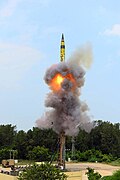
India has studied, produced and used various strategic and tactical missile systems since its independence. Decades long projects have realised development of all types of missile systems including ballistic, cruise, anti-ship, air-defence, air-to-air and anti-missile systems. India is one of seven countries in the world with [[intercontinental ballistic missile]]s (ICBMs) and one of four countries with [[anti-ballistic missile]] systems. Since 2016, India has been a member of [[Missile Technology Control Regime]] (MTCR). | India has studied, produced and used various strategic and tactical missile systems since its independence. Decades long projects have realised development of all types of missile systems including ballistic, cruise, anti-ship, air-defence, air-to-air and anti-missile systems. India is one of seven countries in the world with [[intercontinental ballistic missile]]s (ICBMs) and one of four countries with [[anti-ballistic missile]] systems. Since 2016, India has been a member of [[Missile Technology Control Regime]] (MTCR). | ||
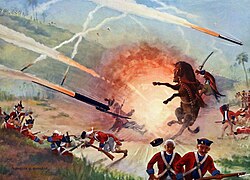
The use of rockets for warfare in India has been recorded in as early as the 18th century. [[Mysorean rockets]] were the first iron-cased rockets in world that were successfully deployed for military use. Mysore's conflict with [[East India Company]] exposed British to the technology leading to development of [[Congreve rockets]] and introduction of rocketry in Europe.<ref name="Riper2007">{{cite book|author=A. Bowdoin Van Riper|title=Rockets and Missiles: The Life Story of a Technology|url=https://books.google.com/books?id=k8CxJeFzCdQC&pg=PA14|date=29 October 2007|publisher=JHU Press|isbn=978-0-8018-8792-5|pages=14–}}</ref> | The use of rockets for warfare in India has been recorded in as early as the 18th century. [[Mysorean rockets]] were the first iron-cased rockets in world that were successfully deployed for military use. Mysore's conflict with [[East India Company]] exposed British to the technology leading to development of [[Congreve rockets]] and introduction of rocketry in Europe.<ref name="Riper2007">{{cite book|author=A. Bowdoin Van Riper|title=Rockets and Missiles: The Life Story of a Technology|url=https://books.google.com/books?id=k8CxJeFzCdQC&pg=PA14|date=29 October 2007|publisher=JHU Press|isbn=978-0-8018-8792-5|pages=14–}}</ref> | ||
Research in missile technology resumed again after India's independence along with the [[India and weapons of mass destruction|weapons of mass destruction]]. Development of nuclear weapons was followed by various missile programs in 70s with development of various ballistic, cruise, surface to air, anti- ballistic missile and orbital launch systems. India [[Smiling Buddha|conducted its first nuclear test]] and initiated with [[Project Devil]] as an attempt to reverse engineer Soviet surface to air missile [[SA-2 Guideline]] and [[Project Valiant]] to develop an [[intercontinental ballistic missile]]. However, it could not succeed and experience gained led to development of [[Prithvi (missile)|Prithvi]] series of short range ballistic | Research in missile technology resumed again after India's independence along with the [[India and weapons of mass destruction|weapons of mass destruction]]. Development of nuclear weapons was followed by various missile programs in 70s with development of various ballistic, cruise, surface-to-air, anti- ballistic missile and orbital launch systems. India [[Smiling Buddha|conducted its first nuclear test]] and initiated with [[Project Devil]] as an attempt to reverse engineer Soviet surface-to-air missile [[SA-2 Guideline]] and [[Project Valiant]] to develop an [[intercontinental ballistic missile]]. However, it could not succeed and experience gained led to development of [[Prithvi (missile)|Prithvi]] series of short-range ballistic missiles.<ref>{{cite web |url=http://www.time4education.com/briefcase/Articles-from-MBAMag/National/Defence%20Forces%20of%20India%20-%20Part%20III.pdf |title=Defence Forces of India (Part III) |date=August 2005 |publisher=time4education.com |access-date=2009-07-17}}</ref><ref name=IDR>{{cite journal |title=Strategic Missiles |last=Vishwakarma |first=Arun S. |journal=Indian Defence Review |volume=22 |issue=1 |url=http://www.indiandefencereview.com/articles/04-06-07/Strategic-Missiles.html |access-date=2009-07-17}}</ref> In early 80s, India conducted [[SLV-3|its first successful orbital launch]]<ref name="Silver">{{cite web|last=Subramanian|first=T.S.|title=Silver jubilee of the first successful SLV-3|url=http://www.frontline.in/static/html/fl2217/stories/20050826002609000.htm|website=Frontiline|access-date=8 February 2018|archive-url=https://web.archive.org/web/20180208012252/http://www.frontline.in/static/html/fl2217/stories/20050826002609000.htm|archive-date=8 February 2018}}</ref> and synchronized its research institutions under [[Integrated Guided Missile Development Program|IGMDP]] and successfully developed a series of strategic missile systems.<ref name="brahmos-site-igmdp">{{cite web | ||
|title =Integrated Guided Missile Development Program | |title =Integrated Guided Missile Development Program | ||
|url =http://brahmos.com/content.php?id=10&sid=25 | |url =http://brahmos.com/content.php?id=10&sid=25 | ||
| Line 16: | Line 16: | ||
}}</ref> The project began in early 1980s and ended in 2008, after these strategic missiles were successfully developed. The last major missile developed under the program was the [[Agni 3]] intermediate-range ballistic missile which was successfully tested on 9 July 2007. Since then, India has developed, tested, operationalized, and is developing several missile systems that are limited to only a handful of countries including [[List of ICBMs|ICBMs]], [[Anti-satellite weapon|ASATs]], [[Submarine-launched ballistic missile|SLBMs]] and [[Hypersonic flight|hypersonic]] weapon systems. Threats posed by enemy missile systems led to the pursuit of [[Indian Ballistic Missile Defense Programme]]. | }}</ref> The project began in early 1980s and ended in 2008, after these strategic missiles were successfully developed. The last major missile developed under the program was the [[Agni 3]] intermediate-range ballistic missile which was successfully tested on 9 July 2007. Since then, India has developed, tested, operationalized, and is developing several missile systems that are limited to only a handful of countries including [[List of ICBMs|ICBMs]], [[Anti-satellite weapon|ASATs]], [[Submarine-launched ballistic missile|SLBMs]] and [[Hypersonic flight|hypersonic]] weapon systems. Threats posed by enemy missile systems led to the pursuit of [[Indian Ballistic Missile Defense Programme]]. | ||
In 2017, India produced most of defined [[MTCR]] defined missile technologies required to be integrated to produce most missile systems.<ref name="MTCR 2017">{{Cite web|title=MTCR Annex Handbook - 2017 Edition|url=http://mtcr.info/wordpress/wp-content/uploads/2017/10/MTCR-Handbook-2017-INDEXED-FINAL-Digital.pdf|access-date=November 5, 2019|publisher=[[Missile Technology Control Regime]]}}</ref> As per [[G. Satheesh Reddy|G Satheesh Reddy]], India achieved complete self reliance in missile technology.<ref>{{Cite web |date=22 September 2021 |title=India is completely 'atmanirbhar' in missile technology: DRDO chairman G Satheesh Reddy |url=https://english.mathrubhumi.com/news/india/drdo-1.6025244 |access-date=2022-06-05 |website=Mathrubhumi |language=en}}</ref> | In 2017, India produced most of defined [[MTCR]] defined missile technologies required to be integrated to produce most missile systems.<ref name="MTCR 2017">{{Cite web|title=MTCR Annex Handbook - 2017 Edition|url=http://mtcr.info/wordpress/wp-content/uploads/2017/10/MTCR-Handbook-2017-INDEXED-FINAL-Digital.pdf|access-date=November 5, 2019|publisher=[[Missile Technology Control Regime]]}}</ref> As per [[G. Satheesh Reddy|G Satheesh Reddy]], India achieved complete self reliance in missile technology.<ref>{{Cite web |date=22 September 2021 |title=India is completely 'atmanirbhar' in missile technology: DRDO chairman G Satheesh Reddy |url=https://english.mathrubhumi.com/news/india/drdo-1.6025244 |access-date=2022-06-05 |website=Mathrubhumi |language=en}}</ref> | ||
== History == | == History == | ||
| Line 30: | Line 30: | ||
The phase-I of missile program was limited to development of a [[DRDO Anti Tank Missile|first generation]] [[anti-tank guided missile]] (ATGM) by DRDO. Liquid fuel rocket engines based on Soviet missile system SA-2 were developed. Despite the overall failure of DRDO to develop a reliable ATGM, Indian laboratories had established facilities useful for machining and fabricating various parts of missile systems including gyroscopes, actuators, silver oxide-zinc | The phase-I of missile program was limited to development of a [[DRDO Anti Tank Missile|first generation]] [[anti-tank guided missile]] (ATGM) by DRDO. Liquid fuel rocket engines based on Soviet missile system SA-2 were developed. Despite the overall failure of DRDO to develop a reliable ATGM, Indian laboratories had established facilities useful for machining and fabricating various parts of missile systems including gyroscopes, actuators, silver oxide-zinc | ||
batteries, booster and sustainer motors, air frame hard- | batteries, booster and sustainer motors, air frame hard- | ||
ware such as fiberglass wings, ground launcher | ware such as fiberglass wings, ground launcher mechanisms, and wire spool winding and reeling mechanisms. India later excepted the French offer to produce [[SS.11|SS-11B]] anti-tank guided missiles in 1970s. In another phase initiated in 1970s, [[Project Devil]] to reverse engineer Soviet [[SA-2 Guideline]] and [[Project Valiant]] to develop an [[Inter-continental ballistic missile]] too ended up with limited success but imparting experience and facilities for further research on missiles and [[Launch vehicle|space rockets]]. DRDO simultaneously focused on building a guidance package – an essential part of a long-range missile that determines its path and accuracy to hit a target. A platform-based inertial navigation system (INS) was developed and tested, on board an Avro aircraft, in 1974–75. Subsequently, an INS was built for both missiles and an aircraft, and this was tested in 1979 on board a Canberra aircraft.{{sfn|Kampani|2003|pp=53-54}}<ref name="Odishareview" /> Decade of 1980s witnessed India gaining significant grounds in rocket technology and various technology demonstration programs began which became the basis of modern rocket systems in India. [[Defence Research and Development Laboratory|DRDL]] had developed competencies in the fields of propulsion, navigation and manufacture of materials. [[Indian Space Research Organisation]] had successfully tested India's first orbital rocket [[SLV-3]] in 1980 whose first stage was used in Agni-TD ballistic missile for technological demonstration of [[Agni (missile)|Agni missile family]]. This subsequently led to the birth of the [[Integrated Guided Missile Development Program]] and [[Abdul Kalam|Dr. Abdul Kalam]], who had previously been the project director for the SLV-3 programme at [[ISRO]], was inducted as the DRDL Director in 1983 to conceive and lead it. He decided that DRDL would pursue multiple projects in this area simultaneously. Thus, four projects were born under the [[IGMDP]]; Short-range surface-to-surface missile (code-named [[Prithvi (missile)|Prithvi]]), Short-range low-level surface-to-air missile (code-named [[Trishul missile|Trishul]]), Medium-range surface-to-air missile (code-named [[Akash (missile)|Akash]]) and Third-generation anti-tank missile (code-named [[Nag (missile)|Nag]]).{{sfn|Kampani|2003|pp=56}} | ||
The [[Agni (missile)|Agni missile]] was initially conceived in the [[IGMDP]] as a technology demonstrator project in the form of a re-entry vehicle, and was later upgraded to a ballistic missile with different ranges.<ref>{{cite web | The [[Agni (missile)|Agni missile]] was initially conceived in the [[IGMDP]] as a technology demonstrator project in the form of a re-entry vehicle, and was later upgraded to a ballistic missile with different ranges.<ref>{{cite web | ||
| Line 56: | Line 55: | ||
}}</ref> | }}</ref> | ||
The fourth phase of India's missile program stretched from mid-1990s to early 21st century | The fourth phase of India's missile program stretched from mid-1990s to early 21st century. The phase has witnessed limited series production of DRDO's missiles and their deployment in battlefields. DRDO further embarked on programs in developing submarine-launched ballistic missile [[Sagarika (missile)|Sagarika]], cruise missiles [[BrahMos]], naval variant of Prithvi [[Dhanush (missile)|Dhanush]]. Spanning from 1970s to 2000s, India's missile programs have transitioned into a self-sustaining character.{{sfn|Kampani|2003|pp=67}} Over the period from then, India has made improvements in technology of its missile systems and has produced many missile systems including ICBMs, [[anti-ballistic missile]]s, [[air-to-air missile]]s, [[cruise missile]]s and other systems. | ||
=== Diplomatic and technological hurdles === | === Diplomatic and technological hurdles === | ||
| Line 75: | Line 74: | ||
|location=India | |location=India | ||
|date=17 November 2011 | |date=17 November 2011 | ||
|url= | |url=https://timesofindia.indiatimes.com/india/Eyeing-China-India-to-enter-ICBM-club-in-3-months/articleshow/10761860.cms | ||
|archive-url=https://web.archive.org/web/20120419150207/http://articles.timesofindia.indiatimes.com/2011-11-17/india/30409335_1_agni-v-agni-iv-agni-programme-director | |archive-url=https://web.archive.org/web/20120419150207/http://articles.timesofindia.indiatimes.com/2011-11-17/india/30409335_1_agni-v-agni-iv-agni-programme-director | ||
|url-status= | |url-status=live | ||
|archive-date=19 April 2012 | |archive-date=19 April 2012 | ||
|newspaper=[[The Times of India]] | |newspaper=[[The Times of India]] | ||
| Line 87: | Line 86: | ||
==== DRDO Anti Tank Missile ==== | ==== DRDO Anti Tank Missile ==== | ||
{{Main|DRDO Anti Tank Missile}} | {{Main|DRDO Anti Tank Missile}} | ||
In 1959, Indian agencies conducted feasibility study to develop a first generation wire guided [[anti-tank missile]].DRDO Anti Tank Missile.<ref name="fi">{{cite web |last1=Joseph |first1=P. Chacko |title=The first ATM |url=http://frontierindia.net/the-first-atm |website=Frontier India |date=19 August 2007 |archive-url=https://web.archive.org/web/20120612165617/http://frontierindia.net/the-first-atm |archive-date=12 June 2012 |access-date=20 July 2021 |url-status=dead}}</ref> The [[Sino-Indian war]] in 1962 induced the government to fund the project.<ref>{{cite news |title=CASS India |url=http://www.cassindia.com/inner_page.php?task=research&&id=131 |access-date=20 June 2018 |work=CASS-India}}</ref><ref>{{cite book |last1=Parthasarathi |first1=A. |title=Technology at the Core: Science & Technology with Indira Gandhi |date=2007 |publisher=Pearson Education India |isbn=9788131701706 |url=https://books.google.com/books?id=BrRN4qlR1AsC&pg=PA170 |language=en}}</ref> Designing and wind tunnel tests went on to develop an ATGM of a range of 0.5 to 2 km with flight speed of about 90 m/s.<ref name="fi"/> The missile was terminated eventually in 1969 once Indian army upgraded its requirements of an ATGM of range from 1.6 km to 2 km.<ref name="fi"/><ref>{{cite book |last1=Ramarao |first1=Dr Prahlada |title=Build Up to Blast Off: DRDL 1962 to 1982 |date=2016 |publisher=Frontier India Technology |isbn=9789385699047 |page=63 |url=https://books.google.com/books?id=J1vzDAAAQBAJ&pg=PA63 |language=en}}</ref> | |||
In 1959, Indian agencies conducted feasibility study to develop a first generation wire guided [[anti-tank missile]].DRDO Anti Tank Missile.<ref name="fi">{{cite web |last1=Joseph |first1=P. Chacko |title=The first ATM |url=http://frontierindia.net/the-first-atm |website=Frontier India |date=19 August 2007 |archive-url=https://web.archive.org/web/20120612165617/http://frontierindia.net/the-first-atm |archive-date=12 June 2012 |access-date=20 July 2021 |url-status=dead}}</ref> [[Sino-Indian war]] in 1962 induced the government to fund the project.<ref>{{cite news |title=CASS India |url=http://www.cassindia.com/inner_page.php?task=research&&id=131 |access-date=20 June 2018 |work=CASS-India}}</ref><ref>{{cite book |last1=Parthasarathi |first1=A. |title=Technology at the Core: Science & Technology with Indira Gandhi |date=2007 |publisher=Pearson Education India |isbn=9788131701706 |url=https://books.google.com/books?id=BrRN4qlR1AsC&pg=PA170 |language=en}}</ref> Designing and wind tunnel tests went on to develop an ATGM of a range of 0.5 to 2 km with flight speed of about 90 m/s.<ref name="fi"/> The missile was terminated eventually in 1969 once Indian army upgraded its requirements of an ATGM of range from 1.6 km to 2 km.<ref name="fi"/><ref>{{cite book |last1=Ramarao |first1=Dr Prahlada |title=Build Up to Blast Off: DRDL 1962 to 1982 |date=2016 |publisher=Frontier India Technology |isbn=9789385699047 |page=63 |url=https://books.google.com/books?id=J1vzDAAAQBAJ&pg=PA63 |language=en}}</ref> | |||
==== Project Devil: Surface to Air Missile ==== | ==== Project Devil: Surface to Air Missile ==== | ||
{{main|Project Devil}} | {{main|Project Devil}} | ||
The aim of Project Devil was to reverse engineer Soviet [[SA-2 Guideline]] missile to produce an indigenous short range [[surface to air missile]]. The program initially waned in favour of [[Project Valiant]] but was revived later after 1974. Although DRDL had developed and tested various systems for the missile, it later | The aim of Project Devil was to reverse engineer the Soviet [[SA-2 Guideline]] missile to produce an indigenous short-range [[surface to air missile|surface-to-air missile]]. The program initially waned in favour of [[Project Valiant]] but was revived later after 1974. Although DRDL had developed and tested various systems for the missile, it was later completely cancelled in 1980 due to disputes between officials and technologies were utilised in other missile programs.<ref name=NTI>{{cite web|url=http://www.nti.org/e_research/profiles/India/Missile/1769_1975.html |title=Missile Facilities, Defense Research & Development Laboratory |author=James Martin Center for Nonproliferation Studies, [[Monterey Institute of International Studies]] |publisher=Nuclear Threat Initiative |access-date=2021-07-20 |url-status=dead |archive-url=https://web.archive.org/web/20090413035750/http://www.nti.org/e_research/profiles/India/Missile/1769_1975.html |archive-date=April 13, 2009}}</ref><ref name="ipcs_2512">{{cite web |url=http://www.ipcs.org/article_details.php?articleNo=2512 |title=Sagarika: A Feather in India's Defense Hat |date=8 March 2008 |publisher=Institute of Peace and Conflict Studies |last=Khan |first=M. Shamsur Rabb |access-date=2021-07-20}}</ref> | ||
==== Project Valiant: Intercontinental Ballistic Missile ==== | ==== Project Valiant: Intercontinental Ballistic Missile ==== | ||
{{main|Project Valiant}} | {{main|Project Valiant}} | ||
'''Project Valiant''' was one of two early [[Liquid-fuel rocket|liquid-fuelled missile]] projects developed by India, along with [[Project Devil]] in the 1970s. The goal of Project Valiant was to produce an [[Intercontinental ballistic missile|ICBM]] with 30 tonne engines and a range of {{cvt|8000|km}}. Valiant missile was envisaged as an 85 tonnes liquid fueled three-staged ICBM. The missile although could reach near the stages of grounding testing, DRDO's interest in program waned due to internal disputes. [[ISRO]] was later approached with an offer to use missile for civilian uses which they declined leading to overall closure of the project.<ref>{{cite book |title=South Asia's Nuclear Security Dilemma: India, Pakistan, and China |first=Lowell |last=Dittmer |publisher=M.E. Sharpe |year=2005 |isbn=0-7656-1419-7 |page=54}}</ref><ref name="ipcs_2512"/><ref name=IDR/> Although discontinued in 1974 without achieving full success, Project Valiant, like [[Guided Missiles of India#Project Devil|Project Devil]], helped in the development of the [[Prithvi (missile)|Prithvi]] missile in the 1980s.<ref>{{cite news |last=Bidwai |first= Praful |date=July 17, 2006 |work=[[The Daily Star (Bangladesh)|The Daily Star]] |volume=5 |number=760 |url=http://www.thedailystar.net/2006/07/17/d607171502138.htm |title=After the Agni-III crash |access-date=2009-07-17}}</ref> Though never reached fruition, the projects were important precursors to the [[Prithvi (missile)|Prithvi]] missile developed in the 1980s.<ref>{{cite web |url=http://www.time4education.com/briefcase/Articles-from-MBAMag/National/Defence%20Forces%20of%20India%20-%20Part%20III.pdf |title=Defence Forces of India (Part III) |date=August 2005 |publisher=[[Triumphant Institute of Management Education]] |access-date=2021-07-19}}</ref> | '''Project Valiant''' was one of two early [[Liquid-fuel rocket|liquid-fuelled missile]] projects developed by India, along with [[Project Devil]] in the 1970s. The goal of Project Valiant was to produce an [[Intercontinental ballistic missile|ICBM]] with 30 tonne engines and a range of {{cvt|8000|km}}. Valiant missile was envisaged as an 85 tonnes liquid fueled three-staged ICBM. The missile although could reach near the stages of grounding testing, DRDO's interest in program waned due to internal disputes. [[ISRO]] was later approached with an offer to use missile for civilian uses which they declined leading to overall closure of the project.<ref>{{cite book |title=South Asia's Nuclear Security Dilemma: India, Pakistan, and China |first=Lowell |last=Dittmer |publisher=M.E. Sharpe |year=2005 |isbn=0-7656-1419-7 |page=54}}</ref><ref name="ipcs_2512"/><ref name=IDR/> Although discontinued in 1974 without achieving full success, Project Valiant, like [[Guided Missiles of India#Project Devil: Surface to Air Missile|Project Devil]], helped in the development of the [[Prithvi (missile)|Prithvi]] missile in the 1980s.<ref>{{cite news |last=Bidwai |first= Praful |date=July 17, 2006 |work=[[The Daily Star (Bangladesh)|The Daily Star]] |volume=5 |number=760 |url=http://www.thedailystar.net/2006/07/17/d607171502138.htm |title=After the Agni-III crash |access-date=2009-07-17}}</ref> Though never reached fruition, the projects were important precursors to the [[Prithvi (missile)|Prithvi]] missile developed in the 1980s.<ref>{{cite web |url=http://www.time4education.com/briefcase/Articles-from-MBAMag/National/Defence%20Forces%20of%20India%20-%20Part%20III.pdf |title=Defence Forces of India (Part III) |date=August 2005 |publisher=[[Triumphant Institute of Management Education]] |access-date=2021-07-19}}</ref> | ||
==== Trishul ==== | ==== Trishul ==== | ||
{{main|Trishul (missile)}} | {{main|Trishul (missile)}} | ||
Trishul was a short range surface to air missile to be used against low flying and [[sea-skimming]] targets. The range of the missile is 12 km and is fitted with a 15 kg warhead. The overall weight of the missile is 130 kg. Due to delay in development time and various deficiencies, Trishul could never enter production and service beyond testing and was substituted by Israeli [[Barak 1]] missile. The project was officially closed in 2008 and DRDO embarked on more surface to air missile programs later.<ref name="TOI">{{cite news|url= | Trishul was a short-range surface-to-air missile to be used against low flying and [[sea-skimming]] targets. The range of the missile is 12 km and is fitted with a 15 kg warhead. The overall weight of the missile is 130 kg. Due to delay in development time and various deficiencies, Trishul could never enter production and service beyond testing and was substituted by Israeli [[Barak 1]] missile. The project was officially closed in 2008 and DRDO embarked on more surface-to-air missile programs later.<ref name="TOI">{{cite news|url=https://timesofindia.indiatimes.com/india/Govt-announces-closure-of-work-on-Trishul-missile/articleshow/2819873.cms|title=Govt announces closure of work on Trishul missile|date=27 February 2008|publisher=Times of India}}</ref> | ||
=== Successful and ongoing programs === | === Successful and ongoing programs === | ||
==== Integrated Guided Missile Development Program ==== | ==== Integrated Guided Missile Development Program ==== | ||
{{main|Integrated Guided Missile Development Program}} | {{main|Integrated Guided Missile Development Program}} | ||
The '''Integrated Guided Missile Development Program''' (IGMDP) was a [[Ministry of Defence (India)]] programme for the research and development of a comprehensive range of missiles. The program was managed by the [[Defence Research and Development Organisation]] (DRDO) and [[Ordnance Factories Board]] in partnership with other Indian government research organisations. The program envisaged development of five strategic systems. [[Prithvi (missile)|Prithvi series]] of short ranged ballistic missiles, [[Trishul (missile)|Trishul]] low altitude, short range surface to air missile, [[Akash (missile)|Akash]] medium range surface to air missile and [[Nag (missile)|Nag]] third generation anti-tank guided missile followed by [[Agni (missile)|Agni series]] of medium and long range ballistic missiles.<ref name="brahmos-site-igmdp"/>{{sfn|Kampani|2003|pp=56-58}} The project began in early 1980s and ended in 2008 after these strategic missiles were successfully developed. The last major missile developed under the program was the [[Agni 3]] intermediate-range ballistic missile which was successfully tested on 9 July 2007.<ref>{{cite news | The '''Integrated Guided Missile Development Program''' (IGMDP) was a [[Ministry of Defence (India)]] programme for the research and development of a comprehensive range of missiles. The program was managed by the [[Defence Research and Development Organisation]] (DRDO) and [[Ordnance Factories Board]] in partnership with other Indian government research organisations. The program envisaged development of five strategic systems. [[Prithvi (missile)|Prithvi series]] of short ranged ballistic missiles, [[Trishul (missile)|Trishul]] low altitude, short-range surface-to-air missile, [[Akash (missile)|Akash]] medium-range surface-to-air missile and [[Nag (missile)|Nag]] third generation anti-tank guided missile followed by [[Agni (missile)|Agni series]] of medium and long-range ballistic missiles.<ref name="brahmos-site-igmdp"/>{{sfn|Kampani|2003|pp=56-58}} The project began in early 1980s and ended in 2008 after these strategic missiles were successfully developed. The last major missile developed under the program was the [[Agni 3]] intermediate-range ballistic missile which was successfully tested on 9 July 2007.<ref>{{cite news | ||
|title=Agni III Launched Successfully | |title=Agni III Launched Successfully | ||
|newspaper=Press Information Bureau, Government of India | |newspaper=Press Information Bureau, Government of India | ||
| Line 130: | Line 128: | ||
==== Akash ==== | ==== Akash ==== | ||
{{main|Akash (missile)|Akash-NG}} | {{main|Akash (missile)|Akash-NG}} | ||
Akash is a medium-range mobile [[surface-to-air missile]] system developed by the [[Defence Research and Development Organisation]] ([[DRDO]]), [[Ordnance Factories Board]] and [[Bharat Electronics Limited]] (BEL) in India.<ref name=ak>{{Cite web|url= | Akash is a medium-range mobile [[surface-to-air missile]] system developed by the [[Defence Research and Development Organisation]] ([[DRDO]]), [[Ordnance Factories Board]] and [[Bharat Electronics Limited]] (BEL) in India.<ref name=ak>{{Cite web|url=http://www.akashsam.com/akashmissile.htm|archiveurl=https://web.archive.org/web/20121228145415/http://www.akashsam.com/akashmissile.htm|url-status=usurped|title=Akashsam|archivedate=28 December 2012|website=akashsam.com}}</ref><ref>{{cite book |author=Journal of Electronic Defense Staff |title= International Electronic Countermeasures Handbook |publisher= Artech House |year= 2004 |isbn=1-58053-898-3|chapter=Guided Threat Systems|page=115}}</ref> The missile system can target aircraft, cruise missiles, air to surface missiles and ballistic missiles up to 30 km to 60 km away, at altitudes up to 18,000 m.<ref>{{Cite web|url=http://www.asiantribune.com/oldsite/show_news.php?id=12250|title=Asian tribune: Upgraded version of 'Aakash' test fired; By Hemanta Kumar Rout}}</ref><ref>{{Cite web|url=https://indianexpress.com/article/india/india-others/akash-missile-successfully-test-fired-for-second-day/|archiveurl=https://web.archive.org/web/20150706133433/http://indianexpress.com/article/india/india-others/akash-missile-successfully-test-fired-for-second-day/|url-status=dead|title=Akash missile successfully test fired for second day|date=18 November 2014|archivedate=6 July 2015}}</ref><ref>{{cite web|url=http://www.ndtv.com/india-news/india-successfully-test-fires-medium-range-akash-missile-579358|title=India Successfully Test Fires Medium-Range Akash Missile|website=ndtv.com|access-date=26 July 2016|url-status=live|archive-url=https://web.archive.org/web/20160812154859/http://www.ndtv.com/india-news/india-successfully-test-fires-medium-range-akash-missile-579358|archive-date=12 August 2016}}</ref><ref>{{cite web |url=https://timesofindia.indiatimes.com/india/Nuclear-capable-Akash-missile-test-fired/articleshow/2620568.cms |title=Nuclear-capable Akash missile test fired |access-date=29 May 2012 |url-status=live |archive-url=https://web.archive.org/web/20170827221431/http://www.thehindu.com/todays-paper/tp-national/more-akash-systems-for-army/article18620841.ece |work=[[The Times of India]] |archive-date=27 August 2017}} Nuclear-capable Akash missile test fired</ref> Variants like Akash-1S and [[Akash-NG]] have longer ranges, higher accuracy, higher mobility and lower reaction time.<ref>{{Cite web|url=https://www.mynation.com/india-news/drdo-successfully-tests-akash-mk-1s-6-features-that-make-it-a-potent-missile-ps7gk9|title=DRDO successfully tests AKASH MK-1S: 6 features that make it a potent missile|website=Asianet News Network Pvt Ltd|access-date=2019-11-17}}</ref><ref>{{Cite web|url=https://www.oneindia.com/india/next-generation-akash-ng-add-new-diamension-india-s-air-dence-capabilities-2817050.html|title=Next generation Akash-NG to add new diamension to India's air defence capabilities|last=SV|first=Vikas|date=2018-12-04|website=oneindia|language=en|access-date=2019-11-17}}</ref> | ||
==== Anti-tank missiles ==== | ==== Anti-tank missiles ==== | ||
{{main|Nag (missile)}} | {{main|Nag (missile)}} | ||
Nag, also referred as Prospina, is the currently serving third generation "[[Fire-and-forget]]" [[anti-tank guided missile]] developed under the [[Integrated Guided Missile Development Program]] (IGMDP). Nag has been developed at a cost of {{INRConvert|3|b|1}}.<ref name="nag induction">[ | Nag, also referred as Prospina, is the currently serving third generation "[[Fire-and-forget]]" [[anti-tank guided missile]] developed under the [[Integrated Guided Missile Development Program]] (IGMDP). Nag has been developed at a cost of {{INRConvert|3|b|1}}.<ref name="nag induction">[https://timesofindia.indiatimes.com/Nag_anti-tank_missile_back_in_reckoning/articleshow/3225233.cms Nag anti-tank missile back in reckoning]</ref> Nag has an operational range from 500 m to {{cvt|20|km}} and first shot hit probability exceeding 90%.<ref>{{Cite web|url=https://www.ibtimes.co.in/drdo-successfully-tests-nag-8-facts-about-indias-deadly-anti-tank-missile-762351|title=DRDO successfully tests NAG: 8 facts about India's deadly anti-tank missile|last=KVN|first=Rohit|date=2018-03-01|website=International Business Times, India Edition|language=en|access-date=2019-09-14}}</ref> Nag also has its [[MPATGM|man-portable]], [[Nag (missile)#HELINA, Dhruvastra|helicopter mounted]], [[Nag (missile)#SANT|Stand-off]] and [[NAMICA|IFV mounted versions]].<ref>{{Cite web|url=https://www.ibtimes.co.in/drdo-successfully-tests-nag-8-facts-about-indias-deadly-anti-tank-missile-762351|title=DRDO successfully tests NAG: 8 facts about India's deadly anti-tank missile|last=KVN|first=Rohit|date=2018-03-01|website=International Business Times, India Edition|language=en|access-date=2021-07-20}}</ref> | ||
Besides Nag, [[Bharat Dynamics Limited|BDL]]'s [[Amogha missile|Amogha series]] is currently undergoing trials and will have land-attack, man-portable and air launched variants.<ref>{{Cite news|title=Bharat Heavy Dynamics test fires indigenous anti-tank missile - The Economic Times|url=http://economictimes.indiatimes.com/news/defence/bharat-heavy-dynamics-test-fires-indigenous-anti-tank-missile/articleshow/48975211.cms|website=The Economic Times|accessdate=2021-07-20}}</ref><ref>{{Cite web|title=Bharat Heavy Dynamics Test Fires Indigenous Anti-tank Missile|url=http://www.newindianexpress.com/cities/hyderabad/Bharat-Heavy-Dynamics-Test-Fires-Indigenous-Anti-tank-Missile/2015/09/15/article3029806.ece|website=The New Indian Express|accessdate=2021-07-20}}</ref> [[Armament Research and Development Establishment]] (ARDE) is testing a laser guided, tank gun launched [[SAMHO (missile)|SAMHO]] missile able to destroy tanks and low flying helicopters.<ref>{{Cite news | Besides Nag, [[Bharat Dynamics Limited|BDL]]'s [[Amogha missile|Amogha series]] is currently undergoing trials and will have land-attack, man-portable and air-launched variants.<ref>{{Cite news|title=Bharat Heavy Dynamics test fires indigenous anti-tank missile - The Economic Times|url=http://economictimes.indiatimes.com/news/defence/bharat-heavy-dynamics-test-fires-indigenous-anti-tank-missile/articleshow/48975211.cms|website=The Economic Times|accessdate=2021-07-20}}</ref><ref>{{Cite web|title=Bharat Heavy Dynamics Test Fires Indigenous Anti-tank Missile|url=http://www.newindianexpress.com/cities/hyderabad/Bharat-Heavy-Dynamics-Test-Fires-Indigenous-Anti-tank-Missile/2015/09/15/article3029806.ece|archive-url=https://web.archive.org/web/20150923195104/http://www.newindianexpress.com/cities/hyderabad/Bharat-Heavy-Dynamics-Test-Fires-Indigenous-Anti-tank-Missile/2015/09/15/article3029806.ece|url-status=dead|archive-date=23 September 2015|website=The New Indian Express|accessdate=2021-07-20}}</ref> [[Armament Research and Development Establishment]] (ARDE) is testing a laser-guided, tank gun-launched [[SAMHO (missile)|SAMHO]] missile able to destroy tanks and low-flying helicopters.<ref>{{Cite news|date=2020-09-23|title=DRDO test fires laser guided anti-tank missile|language=en-IN|work=The Hindu|url=https://www.thehindu.com/news/national/drdo-successfully-test-fires-laser-guided-anti-tank-guided-missile/article32676820.ece|access-date=2021-07-20|issn=0971-751X}}</ref> Besides state-run programmes, Indian private firms have been emerging with ATGM systems. | ||
==== Tactical ballistic missiles ==== | ==== Tactical ballistic missiles ==== | ||
| Line 142: | Line 140: | ||
Prithvi missiles were tactical [[Surface-to-surface missile|surface-to-surface]] short-range [[ballistic missile]]s (SRBM) and were first ballistic missiles to be developed and enter service in India. It goes from Prithvi-I (SS-150) with {{cvt|150|km}} range to Prithvi-II (SS-250) and Prithvi-III (SS-350) with ranges of up to {{cvt|350|km}}.<ref>{{Cite web|url=http://cns.miis.edu/research/india/indiach2.htm|archiveurl=http://webarchive.loc.gov/all/20011202044243/http://cns.miis.edu/research/india/indiach2.htm|url-status=dead|title=Centre for Non Proliferation Studies Archive, ''accessed'' 20 July 2021|archivedate=2 December 2001}}</ref> Dhanush or navalised Prithvi is a system consisting of a stabilisation platform (Bow) and the Missile (Arrow). It is intended for the Indian Navy, to be fired from ships against other ships or land targets. Dhanush can fire modified versions of Prithvi-II or Prithvi-III with ranges high as {{cvt|750|km}}.<ref>{{Cite news|date=2015-11-26|title=Indian Navy successfully test fires Dhanush missile: All you need to know|url=https://www.indiatoday.in/education-today/gk-current-affairs/story/dhanush-274471-2015-11-26|newspaper=India Today|access-date=2021-07-20}}</ref> | Prithvi missiles were tactical [[Surface-to-surface missile|surface-to-surface]] short-range [[ballistic missile]]s (SRBM) and were first ballistic missiles to be developed and enter service in India. It goes from Prithvi-I (SS-150) with {{cvt|150|km}} range to Prithvi-II (SS-250) and Prithvi-III (SS-350) with ranges of up to {{cvt|350|km}}.<ref>{{Cite web|url=http://cns.miis.edu/research/india/indiach2.htm|archiveurl=http://webarchive.loc.gov/all/20011202044243/http://cns.miis.edu/research/india/indiach2.htm|url-status=dead|title=Centre for Non Proliferation Studies Archive, ''accessed'' 20 July 2021|archivedate=2 December 2001}}</ref> Dhanush or navalised Prithvi is a system consisting of a stabilisation platform (Bow) and the Missile (Arrow). It is intended for the Indian Navy, to be fired from ships against other ships or land targets. Dhanush can fire modified versions of Prithvi-II or Prithvi-III with ranges high as {{cvt|750|km}}.<ref>{{Cite news|date=2015-11-26|title=Indian Navy successfully test fires Dhanush missile: All you need to know|url=https://www.indiatoday.in/education-today/gk-current-affairs/story/dhanush-274471-2015-11-26|newspaper=India Today|access-date=2021-07-20}}</ref> | ||
Solid fueled [[Prahaar (missile)|Prahar]] and [[Prahaar (missile)#Pranash|Pranash]] are being tested to replace existing Prithvi missiles.<ref>{{cite news|title=Prithvi missiles to be replaced by more-capable Prahar: DRDO|url=https://timesofindia.indiatimes.com/india/Prithvi-missiles-to-be-replaced-by-more-capable-Prahar-DRDO/articleshow/20852827.cms|work=The Times of India|agency=Press Trust of India|date=1 July 2013|language=en|access-date=16 February 2018|archive-url=https://web.archive.org/web/20180605231209/https://timesofindia.indiatimes.com/india/Prithvi-missiles-to-be-replaced-by-more-capable-Prahar-DRDO/articleshow/20852827.cms|archive-date=5 June 2018|url-status=live}}</ref> Export variant "Pragati" was exhibited in [[South Korea]] in 2013 but didn't receive any orders.<ref>{{cite news|title=India develops new surface-to-surface missile 'Pragati'|url= | Solid fueled [[Prahaar (missile)|Prahar]] and [[Prahaar (missile)#Pranash|Pranash]] are being tested to replace existing Prithvi missiles.<ref>{{cite news|title=Prithvi missiles to be replaced by more-capable Prahar: DRDO|url=https://timesofindia.indiatimes.com/india/Prithvi-missiles-to-be-replaced-by-more-capable-Prahar-DRDO/articleshow/20852827.cms|work=The Times of India|agency=Press Trust of India|date=1 July 2013|language=en|access-date=16 February 2018|archive-url=https://web.archive.org/web/20180605231209/https://timesofindia.indiatimes.com/india/Prithvi-missiles-to-be-replaced-by-more-capable-Prahar-DRDO/articleshow/20852827.cms|archive-date=5 June 2018|url-status=live}}</ref> Export variant "Pragati" was exhibited in [[South Korea]] in 2013 but didn't receive any orders.<ref>{{cite news|title=India develops new surface-to-surface missile 'Pragati'|url=https://www.indiatoday.in/india/story/pragati-drdo-army-south-korea-akash-adex-2013-215884-2013-10-28|access-date=20 July 2021|newspaper=India Today|date=29 October 2013|archive-url=https://web.archive.org/web/20131203004415/http://indiatoday.intoday.in/story/pragati-drdo-army-south-korea-akash-adex-2013/1/320800.html|archive-date=3 December 2013|url-status=live}}</ref><ref>{{cite web|last=Rout|first=Hemant Kumar|url=https://www.newindianexpress.com/states/odisha/2014/nov/05/tactical-missile-pragati-readied-for-export-678975.html|title=Tactical Missile Pragati Readied for Export|work=The New Indian Express|date=5 November 2014|access-date=20 July 2021|archive-url=https://web.archive.org/web/20180217082607/http://www.newindianexpress.com/states/odisha/2014/nov/05/Tactical-Missile-Pragati-Readied-for-Export-678975.html|archive-date=17 February 2018|url-status=live}}</ref> [[Pralay (missile)|Pralay]] is another battlefield range ballistic missile with better range being developed from [[Prithvi Defence Vehicle|PDV]] anti-ballistic missile.<ref name="tnie-8sep18">{{cite news |last1=Rout |first1=Hemant Kumar |title=Pralay set for maiden launch |url=https://www.newindianexpress.com/states/odisha/2018/sep/08/pralay-set-for-maiden-launch-1869189.html |work=The New Indian Express |date=8 September 2018}}</ref> | ||
==== Agni series and Surya ==== | ==== Agni series and Surya ==== | ||
{{main|Agni (missile)}} | {{main|Agni (missile)}} | ||
[[File:Agni-V flight test on 3 July 2018 (3).jpg|thumb|Agni-V ICBM]] | [[File:Agni-V flight test on 3 July 2018 (3).jpg|thumb|Agni-V ICBM]] | ||
The Agni missile series began as a "Re-Entry Vehicle" project (later rechristened as Agni Technology Demonstrator) in the [[IGMDP]]. It subsequently gave rise to the series of India's [[Medium range ballistic missile|medium | The Agni missile series began as a "Re-Entry Vehicle" project (later rechristened as Agni Technology Demonstrator) in the [[IGMDP]]. It subsequently gave rise to the series of India's [[Medium range ballistic missile|medium]]-range, [[Intermediate range ballistic missile|intermediate]]-range and [[ICBM|intercontinental]] ballistic missiles. [[Agni-I]], [[Agni-II]] and [[Agni-III]] missiles were developed under the [[Integrated Guided Missile Development Program]].<ref name="brahmos-site-igmdp"/> | ||
Longer range [[Agni-IV]] and [[Agni-V]] with intercontinental ranges and [[MIRV]] emerged in early 2010s as separate projects.<ref>{{cite news |last=Pandit |first=Rajat |url=https://timesofindia.indiatimes.com/india/with-china-in-mind-agni-v-test-scheduled-for-december/articleshow/8719806.cms |newspaper=The Times of India |title=With China in mind, Agni-V test scheduled for Feb 2011 |date=4 June 2011 |access-date=20 July 2021}}</ref> | |||
[[Agni-P]], an upgraded successor of [[Agni-I]] and [[Agni-II]], was tested in 2021 with ability to carry [[maneuverable reentry vehicle]] (MaRV). Agni-P has improved propellant, navigation and guided systems and reportedly can be used as an [[ASBM]] against [[aircraft carriers]].<ref>{{Cite web|date=2021-07-02|title=China takes notice of India's test of 'carrier killer' Agni-P ballistic missile|url=https://theshillongtimes.com/2021/07/02/china-takes-notice-of-indias-test-of-carrier-killer-agni-p-ballistic-missile/|access-date=2021-07-20|website=The Shillong Times|language=en-US}}</ref> | |||
[[Agni- | [[Agni-VI]] is another [[Intercontinental ballistic missile]] reported to be in rudimentary stages of development by India, and until May 2012 was not officially confirmed by either the Government of India or the DRDO.<ref name=IBN>{{cite news|title=Agni-VI with 10000 km range to be ready by 2014 |url=http://ibnlive.in.com/news/agnivi-with-10000-km-range-to-be-ready-by-2014/260699-3.html |archive-url=https://web.archive.org/web/20120525093035/http://ibnlive.in.com/news/agnivi-with-10000-km-range-to-be-ready-by-2014/260699-3.html |url-status=dead |archive-date=25 May 2012 |newspaper=IBNLive |date=24 May 2012 |access-date=12 September 2013}}</ref> Reportedly, it will be able to be launched from submarines or from land and to strike a target of over {{convert|10000|km|mi|abbr=on}}<ref name=IBN/> with [[Multiple independently targetable reentry vehicle|MIRV]]-ed warheads.<ref name=DN474>{{cite news |title=DRDO Lab Develops Detonator for Nuclear Capable Agni-V Missile As It Gets Ready For Launch |url=http://www.defencenow.com/news/474/drdo-lab-develops-detonator-for-nuclear-capable-agni-v-missile-as-it-gets-ready-for-launch.html |newspaper=Defence Now |date=17 January 2012 |url-status=dead |archive-url=https://web.archive.org/web/20120122074527/http://www.defencenow.com/news/474/drdo-lab-develops-detonator-for-nuclear-capable-agni-v-missile-as-it-gets-ready-for-launch.html |archive-date=22 January 2012 |df=dmy-all}}</ref> Top DRDO scientists have previously asserted that India has almost all the equipment and technology needed to develop ICBMs, "but where the warhead should go or what the range should be will have to be a political call".<ref name=HT708062>{{cite news |last=Singh |first=Rahul |date=11 June 2011 |title=Air chief PV Naik in favour of flexing missile power |url=http://www.hindustantimes.com/India-news/NewDelhi/Air-chief-PV-Naik-in-favour-of-flexing-missile-power/Article1-708062.aspx |newspaper=Hindustan Times |location=New Delhi, India |access-date=31 May 2012 |url-status=dead |archive-url=https://web.archive.org/web/20120627030253/http://www.hindustantimes.com/India-news/NewDelhi/air-chief-pv-naik-in-favour-of-flexing-missile-power/Article1-708062.aspx |archive-date=27 June 2012 |df=dmy-all}}</ref> In 1995 in a report published by magazine Nonproliferation review, DRDO was working on an ICBM called [[Surya (missile)|Surya]] with a range of {{cvt|12000-16000|km}}. Although, the actual status of missile always remained unknown in public domain.<ref name=":0">{{Cite web|url=https://www.drdo.gov.in/drdo/pub/npc/2017/november/din-17november2017.pdf|title=Is India developing a 12,000 kms range missile - Surya?|date=2017-11-17|access-date=2021-07-20}}</ref> Sources have speculated that Agni-VI might be Surya under new codename.<ref name=tnie>{{Cite web|url=https://www.newindianexpress.com/states/odisha/2013/sep/18/stage-set-for-longer-range-surya-517597.html|title=Stage set for longer range Surya|last=|first=|date=18 September 2013|website=The New Indian Express|access-date=2021-07-20}}</ref> | ||
Later, Agni-V would go on to acquire MIRV capabilities <ref>{{Cite news |title=China deployed research vessel to 'keep eye’ on Agni-5 test from Indian shores |url=https://timesofindia.indiatimes.com/india/china-deployed-vessel-to-keep-eye-on-agni-5-test-from-indian-shores/articleshow/108411759.cms |access-date=2024-03-12 |work=The Times of India |issn=0971-8257}}</ref><ref>{{Cite web |date=2024-03-11 |title=China nervous as India conducts Agni-V missile test, sends spy vessel to Bay of Bengal |url=https://www.firstpost.com/world/china-nervous-as-india-conducts-agni-v-missile-test-sends-spy-vessel-to-bay-of-bengal-13747746.html |access-date=2024-03-12 |website=Firstpost |language=en-us}}</ref> | |||
==== K series ==== | ==== K series ==== | ||
{{main|K Missile family}} | {{main|K Missile family}} | ||
K (named after [[Abdul Kalam]]) are [[submarine-launched ballistic missiles]] (SLBM) of India. SLBM variants of Agni missiles meant to arm India's [[nuclear submarines]], their ranges vary from medium-range [[Sagarika (missile)|K-15]] to intercontinental range [[K-6 (missile)]].<ref>{{cite news|title=India activates 'secret' undersea missile|url=http://www.newindianexpress.com/thesundaystandard/India-activates-secret-undersea-missile/2013/08/11/article1728237.ece|access-date=20 July 2021|newspaper=The New Indian Express|date=11 August | K (named after [[Abdul Kalam]]) are [[submarine-launched ballistic missiles]] (SLBM) of India. SLBM variants of Agni missiles meant to arm India's [[nuclear submarines]], their ranges vary from medium-range [[Sagarika (missile)|K-15]] to intercontinental range [[K-6 (missile)]].<ref>{{cite news|title=India activates 'secret' undersea missile|url=http://www.newindianexpress.com/thesundaystandard/India-activates-secret-undersea-missile/2013/08/11/article1728237.ece|archive-url=https://web.archive.org/web/20130814112620/http://newindianexpress.com/thesundaystandard/India-activates-secret-undersea-missile/2013/08/11/article1728237.ece|url-status=dead|archive-date=14 August 2013|access-date=20 July 2021|newspaper=The New Indian Express|date=11 August 2013}}</ref> | ||
The [[Shaurya missile]] is a land attack variant of [[Sagarika (missile)|K-15 missile]]. The missile has a hypersonic speed and a hybrid ballistic-cruise trajectory.<ref name=a1>{{cite web|url=http://www.expressindia.com/latest-news/India-successfully-test-fires-Shaurya-missile/384746/|title=India successfully test fires 'Shaurya' missile|publisher=expressindia.com|date=12 November | The [[Shaurya missile]] is a land attack variant of [[Sagarika (missile)|K-15 missile]]. The missile has a hypersonic speed and a hybrid ballistic-cruise trajectory.<ref name=a1>{{cite web|url=http://www.expressindia.com/latest-news/India-successfully-test-fires-Shaurya-missile/384746/|title=India successfully test fires 'Shaurya' missile|publisher=expressindia.com|date=12 November 2008|access-date=8 June 2012|archive-date=16 September 2012|archive-url=https://web.archive.org/web/20120916081502/http://www.expressindia.com/latest-news/India-successfully-test-fires-Shaurya-missile/384746/|url-status=dead}}</ref> | ||
==== BrahMos ==== | ==== BrahMos ==== | ||
{{main|BrahMos|BrahMos II}} | {{main|BrahMos|BrahMos II}} | ||
BrahMos (also known as PJ-10) are supersonic to hypersonic [[cruise missiles]] developed in collaboration between India and Russia. BrahMos have land attack, ship and submarine launched and air launched versions and are the fastest cruise missiles in world in operation. The existing versions of missiles include supersonic [[land-attack missile|land-attack]], [[Anti-ship missile|anti-ship]] ship launched versions meanwhile longer range, hypersonic and [[Air launched cruise missile|air launched]] versions are under development.<ref>{{cite news|url=https://thediplomat.com/2017/03/india-test-fires-supersonic-cruise-missile/ |title=India Test Fires Supersonic Cruise Missile |first=Franz-Stefan |last=Gady |work=The Diplomat |access-date=19 March 2017|language=en-US|url-status=live|archive-url=https://web.archive.org/web/20170320053552/https://thediplomat.com/2017/03/india-test-fires-supersonic-cruise-missile/|archive-date=20 March 2017|df=dmy-all}}</ref><ref name=brahmos2_official>{{cite web|title=India, Russia to develop new hypersonic cruise missile :: BrahMos.com|url=http://www.brahmos.com/newscenter.php?newsid=102|publisher=brahmos.com Official Website of Brahmos|access-date=23 February 2012|url-status=dead|archive-url=https://web.archive.org/web/20101212050609/http://brahmos.com/newscenter.php?newsid=102|archive-date=12 December 2010|df=dmy-all}}</ref> | BrahMos (also known as PJ-10) are supersonic to hypersonic [[cruise missiles]] developed in collaboration between India and Russia. BrahMos have land attack, ship and submarine-launched and air-launched versions and are the fastest cruise missiles in world in operation. The existing versions of missiles include supersonic [[land-attack missile|land-attack]], [[Anti-ship missile|anti-ship]] ship-launched versions meanwhile longer range, hypersonic and [[Air launched cruise missile|air-launched]] versions are under development.<ref>{{cite news|url=https://thediplomat.com/2017/03/india-test-fires-supersonic-cruise-missile/ |title=India Test Fires Supersonic Cruise Missile |first=Franz-Stefan |last=Gady |work=The Diplomat |access-date=19 March 2017|language=en-US|url-status=live|archive-url=https://web.archive.org/web/20170320053552/https://thediplomat.com/2017/03/india-test-fires-supersonic-cruise-missile/|archive-date=20 March 2017|df=dmy-all}}</ref><ref name=brahmos2_official>{{cite web|title=India, Russia to develop new hypersonic cruise missile :: BrahMos.com|url=http://www.brahmos.com/newscenter.php?newsid=102|publisher=brahmos.com Official Website of Brahmos|access-date=23 February 2012|url-status=dead|archive-url=https://web.archive.org/web/20101212050609/http://brahmos.com/newscenter.php?newsid=102|archive-date=12 December 2010|df=dmy-all}}</ref> | ||
==== Other cruise missile programs ==== | ==== Other cruise missile programs ==== | ||
{{main|Nirbhay}} | {{main|Nirbhay}} | ||
[[Nirbhay]] is the Indian long range | [[Nirbhay]] is the Indian long-range subsonic cruise missile under development and testing, expecting its air and submarine-launched version after trials. It was successfully test fired for second time from Balasore Orissa. | ||
Able to travel at speed of 0.6-0.9 mach. However, its test on 12 October 2020 failed due to a technical snag. It has succeeded in other tests before and has been approved for limited production in 2020. An upgraded version of the missile is reportedly under development. It is currently deployed on [[Line of Actual Control|LAC]] in limited numbers since 2020 due to [[2020 China-India standoff]].<ref name="nirbhaylac">{{Cite web|date=2020-09-29|title=LAC standoff: India deploys long-range missile Nirbhay to tackle Chinese threat|url=https://zeenews.india.com/india/lac-standoff-india-deploys-long-range-missile-nirbhay-to-tackle-chinese-threat-2313199.html|access-date=2021-07-21|website=Zee News|language=en}}</ref><ref>{{Cite web|title=Nirbhay subsonic cruise missile develops technical snag during trial|url=https://www.newindianexpress.com/nation/2020/oct/12/nirbhay-subsonic-cruise-missile-develops-technical-snag-during-trial-2209279.html|access-date=2021-07-21|website=The New Indian Express}}</ref> | Able to travel at speed of 0.6-0.9 mach. However, its test on 12 October 2020 failed due to a technical snag. It has succeeded in other tests before and has been approved for limited production in 2020. An upgraded version of the missile is reportedly under development. It is currently deployed on [[Line of Actual Control|LAC]] in limited numbers since 2020 due to [[2020 China-India standoff]].<ref name="nirbhaylac">{{Cite web|date=2020-09-29|title=LAC standoff: India deploys long-range missile Nirbhay to tackle Chinese threat|url=https://zeenews.india.com/india/lac-standoff-india-deploys-long-range-missile-nirbhay-to-tackle-chinese-threat-2313199.html|access-date=2021-07-21|website=Zee News|language=en}}</ref><ref>{{Cite web|title=Nirbhay subsonic cruise missile develops technical snag during trial|url=https://www.newindianexpress.com/nation/2020/oct/12/nirbhay-subsonic-cruise-missile-develops-technical-snag-during-trial-2209279.html|access-date=2021-07-21|website=The New Indian Express}}</ref> | ||
| Line 181: | Line 181: | ||
|url=http://www.domain-b.com/aero/mil_avi/miss_muni/20100112_agni_missiles_oneView.html | |url=http://www.domain-b.com/aero/mil_avi/miss_muni/20100112_agni_missiles_oneView.html | ||
|access-date=31 May 2012 | |access-date=31 May 2012 | ||
}}</ref> The current version in service has a range from {{cvt|10|km}} to {{cvt|110|km}} similar to [[AIM-120 AMRAAM]] while versions up to {{cvt|350|km}} and intermediate ranges are being developed.<ref name=":1">{{cite news |last1=Pandit |first1=Rajat |title=Astra air combat missile to be soon tested from Tejas fighter |url=https://timesofindia.indiatimes.com/india/astra-air-combat-missile-to-be-soon-tested-from-tejas-fighter/articleshow/79357258.cms |access-date=21 July 2021 |agency=TNN |publisher=Times of India |date=23 October | }}</ref> The current version in service has a range from {{cvt|10|km}} to {{cvt|110|km}} similar to [[AIM-120 AMRAAM]] while versions up to {{cvt|350|km}} and intermediate ranges are being developed.<ref name=":1">{{cite news |last1=Pandit |first1=Rajat |title=Astra air combat missile to be soon tested from Tejas fighter |url=https://timesofindia.indiatimes.com/india/astra-air-combat-missile-to-be-soon-tested-from-tejas-fighter/articleshow/79357258.cms |access-date=21 July 2021 |agency=TNN |publisher=Times of India |date=23 October 2020}}</ref> | ||
A surface to air missile variant [[VL-SRSAM]] has also been developed from Astra to replace Indian navy's [[Barak 1]] missiTN1 With supplementary [[Akash (missile)|Akash]] missile systems along, it forms a surface to air missile system similar to American [[NASAMS|NASAM 2]].<ref name=":1"/> | A surface-to-air missile variant [[VL-SRSAM]] has also been developed from Astra to replace Indian navy's [[Barak 1]] missiTN1 With supplementary [[Akash (missile)|Akash]] missile systems along, it forms a surface-to-air missile system similar to American [[NASAMS|NASAM 2]].<ref name=":1"/> | ||
==== Indian Ballistic Missile Defence Programme ==== | ==== Indian Ballistic Missile Defence Programme ==== | ||
{{main|Indian Ballistic Missile Defence Programme}} | {{main|Indian Ballistic Missile Defence Programme}} | ||
[[File:Advanced Air Defence interceptor test on 28 December 2017.jpg|thumb|AAD anti-ballistic missile]] | [[File:Advanced Air Defence interceptor test on 28 December 2017.jpg|thumb|AAD anti-ballistic missile]] | ||
In wake of missile threats from China and Pakistan, the development of [[anti-ballistic missiles]] began in the late 1990s. The program consists of multiple phases and components. Phase-I of program is a double-tiered system consisting of two land and sea-based [[Anti-ballistic missile|interceptor missiles]], namely the Prithvi Air Defence (PAD) missile for high altitude interception, and the Advanced Air Defence (AAD) Missile for lower altitude interception. The two-tiered shield should be able to intercept any incoming missile launched from 5,000 kilometres away.<ref>{{cite web |url=https://www.google.com/hostednews/afp/article/ALeqM5hF8vr43UZ29RmlnKWgtpAmQs81Lg |title=India tests interceptor missile |date=6 March 2009 |access-date=6 December 2012 |archive-url=https://web.archive.org/web/20090310155431/https://www.google.com/hostednews/afp/article/ALeqM5hF8vr43UZ29RmlnKWgtpAmQs81Lg |archive-date=10 March 2009 |url-status= | In wake of missile threats from China and Pakistan, the development of [[anti-ballistic missiles]] began in the late 1990s. The program consists of multiple phases and components. Phase-I of program is a double-tiered system consisting of two land and sea-based [[Anti-ballistic missile|interceptor missiles]], namely the Prithvi Air Defence (PAD) missile for high altitude interception, and the Advanced Air Defence (AAD) Missile for lower altitude interception. The two-tiered shield should be able to intercept any incoming missile launched from 5,000 kilometres away.<ref>{{cite web |url=https://www.google.com/hostednews/afp/article/ALeqM5hF8vr43UZ29RmlnKWgtpAmQs81Lg |title=India tests interceptor missile |date=6 March 2009 |access-date=6 December 2012 |archive-url=https://web.archive.org/web/20090310155431/https://www.google.com/hostednews/afp/article/ALeqM5hF8vr43UZ29RmlnKWgtpAmQs81Lg |archive-date=10 March 2009 |url-status=dead}}</ref> The system also includes an overlapping network of early warning and tracking radars, as well as command and control posts.<ref name="TOI1">{{cite web|title=India's Ballistic Missile Defence system: All you need to know - Times of India|url=https://timesofindia.indiatimes.com/india/indias-ballistic-missile-defence-system-all-you-need-to-know/articleshow/57105516.cms|website=The Times of India|access-date=12 February 2017|archive-url=https://web.archive.org/web/20170212223318/http://timesofindia.indiatimes.com/india/indias-ballistic-missile-defence-system-all-you-need-to-know/articleshow/57105516.cms|archive-date=12 February 2017|url-status=live}}</ref> Phase-I is awaiting government's approval for installation over national capital.<ref>{{Cite web|url=https://theprint.in/defence/indias-ballistic-missile-shield-ready-iaf-drdo-to-seek-govt-nod-to-protect-delhi/345853/|title=India's ballistic missile shield ready, IAF & DRDO to seek govt nod to protect Delhi|last=Philip|first=Snehesh Alex|date=2020-01-08|website=ThePrint|language=en-US|access-date=2021-07-21}}</ref> Phase-II would include more potent AD-1 and AD-2 anti-ballistic missiles capable of engaging without [[IRBM]]s, [[ICBM]]s and hypersonic cruise missiles. Prithvi Defence Vehicle (PDV) Mk. 1 and II are also under trials to intercept missiles at higher altitude and longer ranges and replace existing PAD.<ref>{{cite news|url=https://odishasuntimes.com/india-test-fires-high-speed-interceptor-missile-off-odisha-coast/|title=India test fires high speed interceptor missile off Odisha coast|access-date=21 July 2021|archive-url=https://web.archive.org/web/20190212190430/https://odishasuntimes.com/india-test-fires-high-speed-interceptor-missile-off-odisha-coast/|archive-date=12 February 2019|url-status=usurped}}</ref> PDV Mk. 2 has also demonstrated [[Mission Shakti|anti-satellite capability]].<ref>{{Cite web|url=https://www.janes.com/article/94168/defexpo-2020-drdo-says-asat-weapon-system-is-ready-for-further-limited-production|title=Defexpo 2020: DRDO says ASAT weapon system is 'ready for further limited production' {{!}} Jane's 360|website=www.janes.com|access-date=2021-07-21}}</ref> | ||
==== Other systems ==== | ==== Other systems ==== | ||
| Line 199: | Line 199: | ||
|archive-date=10 February 2012 | |archive-date=10 February 2012 | ||
|df =dmy-all | |df =dmy-all | ||
}}</ref> India has developed an Anti-Radiation Missile (ARM) that will help to destroy enemy [[Early warning systems|advance warning systems]]. This was named as Rudram-1, with a range of 100–250 km.<ref>{{Cite web|url=https://www.hindustantimes.com/india-news/india-test-fires-rudram-1-its-first-anti-radiation-missile-to-take-down-enemy-radars/story-SYP6qWQOXmZrK7ViSPG54K.html|title=India test-fires Rudram 1, its first anti-radiation missile to kill enemy radars|date=9 October | }}</ref> India has developed an Anti-Radiation Missile (ARM) that will help to destroy enemy [[Early warning systems|advance warning systems]]. This was named as Rudram-1, with a range of 100–250 km.<ref>{{Cite web|url=https://www.hindustantimes.com/india-news/india-test-fires-rudram-1-its-first-anti-radiation-missile-to-take-down-enemy-radars/story-SYP6qWQOXmZrK7ViSPG54K.html|title=India test-fires Rudram 1, its first anti-radiation missile to kill enemy radars|date=9 October 2020}}</ref> Production of the ARM is being done on a priority basis by the [[Defence Research and Development Laboratory]] (DRDL), which specialises in missile development. | ||
Such missiles can be mounted on the [[Sukhoi Su-30 MKI]] fighter planes.<ref>{{cite news | Such missiles can be mounted on the [[Sukhoi Su-30 MKI]] fighter planes.<ref>{{cite news | ||
|title=India developing anti-radar missile | |title=India developing anti-radar missile | ||
| Line 209: | Line 209: | ||
== List of guided missiles == | == List of guided missiles == | ||
{{Dynamic list|date=December | {{Main|List of Indian military missiles}} | ||
{{Dynamic list|date=December 2019}} | |||
=== Air to air === | === Air to air === | ||
| Line 219: | Line 220: | ||
! Speed | ! Speed | ||
! Warhead | ! Warhead | ||
! Introduction | ! Introduction | ||
! Status | ! Status | ||
! Ref | !Ref | ||
|- | |- | ||
| rowspan="3" | [[Astra (missile)]] | | rowspan="3" | [[Astra (missile)]] | ||
| Line 238: | Line 240: | ||
| [[Fragmentation (weaponry)|High-explosive pre-fragmented warhead]] | | [[Fragmentation (weaponry)|High-explosive pre-fragmented warhead]] | ||
| TBD | | TBD | ||
| In | | In trials | ||
|<ref name="auto">{{Cite web|url=https://timesofindia.indiatimes.com/india/15-years-on-drdos-supersonic-missile-ready-for-iaf-fighters/articleshow/71355843.cms|title=15 years on, DRDO's supersonic missile ready for IAF fighters|last=Pandit|first=Rajat|date=29 September 2019|website=The Times of India|language=en}}</ref><ref name="jdw-6may14">{{cite news|last1=Udoshi|first1=Rahul|title=India successfully tests home-grown Astra AAM |url=http://www.janes.com/article/37521/india-successfully-tests-home-grown-astra-aam |work=[[IHS Jane's Defence Weekly]]|publisher=[[Jane's Information Group]]|date=6 May 2014 |archive-url=https://web.archive.org/web/20140517051207/http://www.janes.com/article/37521/india-successfully-tests-home-grown-astra-aam|archive-date=17 May | |<ref name="auto">{{Cite web|url=https://timesofindia.indiatimes.com/india/15-years-on-drdos-supersonic-missile-ready-for-iaf-fighters/articleshow/71355843.cms|title=15 years on, DRDO's supersonic missile ready for IAF fighters|last=Pandit|first=Rajat|date=29 September 2019|website=The Times of India|language=en}}</ref><ref name="jdw-6may14">{{cite news|last1=Udoshi|first1=Rahul|title=India successfully tests home-grown Astra AAM |url=http://www.janes.com/article/37521/india-successfully-tests-home-grown-astra-aam |work=[[IHS Jane's Defence Weekly]]|publisher=[[Jane's Information Group]]|date=6 May 2014 |archive-url=https://web.archive.org/web/20140517051207/http://www.janes.com/article/37521/india-successfully-tests-home-grown-astra-aam|archive-date=17 May 2014}}</ref><ref name="jmr-apr11">{{cite journal|last1=Hewson|first1=Robert|title=Astra redesign paves way for ramjet AAM|journal=Jane's Missiles and Rockets|date=April 2011|volume=15|issue=4|page=3|publisher=[[Jane's Information Group]]|location=Coulsdon}}</ref> | ||
|- | |- | ||
| Astra Mk3 | | Astra Mk3 | ||
| Line 246: | Line 248: | ||
| [[Fragmentation (weaponry)|High-explosive pre-fragmented warhead]] | | [[Fragmentation (weaponry)|High-explosive pre-fragmented warhead]] | ||
| TBD | | TBD | ||
| In | | In trials | ||
|<ref name="auto"/> | |<ref name="auto"/> | ||
|- | |- | ||
| Line 255: | Line 257: | ||
|High-explosive fragmentated directional warhead | |High-explosive fragmentated directional warhead | ||
|2007 | |2007 | ||
|In | |In Service | ||
|<ref name="DT">{{citation |title=Missiles in the Asia Pacific |url=http://www.ausairpower.net/DT-Missile-Survey-May-05.pdf |journal=Defence Today |publisher=Strike Publications |location=Amberley, Queensland |date=May 2005 |page=67 |url-status=dead |archive-url=https://web.archive.org/web/20090126154153/http://ausairpower.net/DT-Missile-Survey-May-05.pdf |archive-date=26 January 2009 |df=dmy-all}}</ref> | |<ref name="DT">{{citation |title=Missiles in the Asia Pacific |url=http://www.ausairpower.net/DT-Missile-Survey-May-05.pdf |journal=Defence Today |publisher=Strike Publications |location=Amberley, Queensland |date=May 2005 |page=67 |url-status=dead |archive-url=https://web.archive.org/web/20090126154153/http://ausairpower.net/DT-Missile-Survey-May-05.pdf |archive-date=26 January 2009 |df=dmy-all}}</ref> | ||
|- | |- | ||
| Line 261: | Line 263: | ||
| Technology demonstration testbed for future [[beyond visual range missile]] [[air-to-air missile]] | | Technology demonstration testbed for future [[beyond visual range missile]] [[air-to-air missile]] | ||
| {{cvt|350|km}} | | {{cvt|350|km}} | ||
| Mach 4.5<ref>{{Cite web | | | Mach 4.5<ref>{{Cite web |author=News9 Staff |date=2022-04-14 |title=Solid Fuel Ducted Ramjet: All you need to know about SFDR |url=https://www.news9live.com/knowledge/solid-fuel-ducted-ramjet-all-you-need-to-know-about-sfdr-164677 |access-date=2022-05-21 |website=NEWS9LIVE |language=en}}</ref> | ||
| | | | ||
| TBD | | TBD | ||
| | | In trials | ||
| <ref name=pib2>{{Cite web|url=https://pib.gov.in/newsite/PrintRelease.aspx?relid=188278|title=Successful Flight Test of SFDR|date=8 February 2019|website=[[Press Information Bureau|Press Information Bureau, Government of India]]|access-date=2019-11-14}}</ref><ref name=drdo>{{Cite journal|date=2017|title=DRDO Annual Report 2017|url=https://www.drdo.gov.in/drdo/pub/ebooks/drdo-annual-report-2017/mobile/index.html#p=91|journal=[[Defence Research and Development Organisation]]|pages=79}}</ref> | | <ref name=pib2>{{Cite web|url=https://pib.gov.in/newsite/PrintRelease.aspx?relid=188278|title=Successful Flight Test of SFDR|date=8 February 2019|website=[[Press Information Bureau|Press Information Bureau, Government of India]]|access-date=2019-11-14}}</ref><ref name=drdo>{{Cite journal|date=2017|title=DRDO Annual Report 2017|url=https://www.drdo.gov.in/drdo/pub/ebooks/drdo-annual-report-2017/mobile/index.html#p=91|journal=[[Defence Research and Development Organisation]]|pages=79}}</ref> | ||
|- | |- | ||
| colspan="2" | [[MICA (missile)]] | | colspan="2" | [[MICA (missile)]] | ||
|[[Beyond-visual-range missile|beyond visual range]] [[air-to-air missile]] | |[[Beyond-visual-range missile|beyond visual range]] [[air-to-air missile]] | ||
|500 m to 60 km | |500 m to 60 km | ||
|Mach 4 | |Mach 4 | ||
| | | | ||
| | |2012 | ||
|In | |In service | ||
|<ref>{{Cite web |last=Staff |first=Basictell Editorial |title=Missiles Of India - List of Important Indian Missiles |url=https://www. | |<ref>{{Cite web |last=Staff |first=Basictell Editorial |title=Missiles Of India - List of Important Indian Missiles |url= "Hand in Hand with Indian Air Force" https://www.sps-aviation.com/story/?id=1395}}</ref> | ||
|} | |} | ||
=== Anti-radiation === | === Anti-radiation === | ||
{| class="wikitable sortable" style="text-align:Centre" | {| class="wikitable sortable" style="text-align:Centre" | ||
! Name | ! Name | ||
! Type | ! Type | ||
| Line 288: | Line 289: | ||
! Ref | ! Ref | ||
|- | |- | ||
|[[Rudram-1]] | |||
| [[ | | [[Anti-radiation missile]] | ||
| {{cvt| | | {{cvt|150|km}}<ref>{{Cite web |date=2020-10-09 |title=India test-fires Rudram 1, its first anti-radiation missile to kill enemy radars |url=https://www.hindustantimes.com/india-news/india-test-fires-rudram-1-its-first-anti-radiation-missile-to-take-down-enemy-radars/story-SYP6qWQOXmZrK7ViSPG54K.html |access-date=2022-05-21 |website=Hindustan Times |language=en}}</ref> | ||
| Conventional | | Conventional | ||
| | | 2022 | ||
| | | In service | ||
| <ref>{{cite news |last1=Pandit |first1=Rajat |title=India tests new anti-radiation missile to destroy enemy radars |url=https://timesofindia.indiatimes.com/india/india-tests-new-anti-radiation-missile-to-destroy-enemy-radars/articleshow/67676064.cms |work=The Times of India |date=24 January 2022}}</ref> | | <ref>{{cite news |last1=Pandit |first1=Rajat |title=India tests new anti-radiation missile to destroy enemy radars |url=https://timesofindia.indiatimes.com/india/india-tests-new-anti-radiation-missile-to-destroy-enemy-radars/articleshow/67676064.cms |work=The Times of India |date=24 January 2019}}</ref> | ||
|- | |||
|[[Rudram (missile)|Rudram-2]] | |||
|[[Air-to-surface missile|Air to surface]] anti-radiation missile | |||
|300 km (190 mi) | |||
|Conventional | |||
|TBD | |||
|Under development | |||
|<ref>{{Cite web |last=Sharma |first=Ritu |date=2023-07-25 |title='Super Killer' In Ukraine War, India Gets Its Own Anti-Radiation Missile That Can Be Fired From Both French & Russian Jets |url=https://www.eurasiantimes.com/super-killer-in-ukraine-war-india-gets-its-own-anti-radiation/ |access-date=2024-02-01 |website=Latest Asian, Middle-East, EurAsian, Indian News |language=en-US}}</ref> | |||
|- | |||
|[[Rudram (missile)|Rudram-3]] | |||
|Air to surface missile | |||
|550 km (340 mi) | |||
|Conventional | |||
|TBD | |||
|Under development | |||
|<ref>{{Cite news |date=2022-10-06 |title=IAF to arm more Sukhois with BrahMos missiles, even as plan afoot to upgrade entire fleet indigenously |url=https://timesofindia.indiatimes.com/india/iaf-to-arm-more-sukhois-with-brahmos-missiles-even-as-plan-afoot-to-upgrade-entire-fleet-indigenously/articleshow/94670805.cms |access-date=2024-02-01 |work=The Times of India |issn=0971-8257}}</ref> | |||
|} | |} | ||
| Line 316: | Line 333: | ||
| Unknown | | Unknown | ||
| Being tested | | Being tested | ||
| <ref>{{Cite web|url=https://themirk.com/india-enters-the-elite-club-successfully-shot-down-low-orbit-satellite/|title=India Enters the Elite Club: Successfully Shot Down Low Orbit Satellite |last=Solanki|first=Lalit|date=2019-03-27|website=The Mirk|language=en-US|access-date=2019-11-22}}</ref> | | <ref>{{Cite web|url=https://themirk.com/india-enters-the-elite-club-successfully-shot-down-low-orbit-satellite/|title=India Enters the Elite Club: Successfully Shot Down Low Orbit Satellite|last=Solanki|first=Lalit|date=2019-03-27|website=The Mirk|language=en-US|access-date=2019-11-22|archive-date=28 March 2019|archive-url=https://web.archive.org/web/20190328134405/https://themirk.com/india-enters-the-elite-club-successfully-shot-down-low-orbit-satellite/|url-status=dead}}</ref> | ||
|} | |} | ||
| Line 331: | Line 348: | ||
|- | |- | ||
| colspan="2" | [[NASM-SR]] | | colspan="2" | [[NASM-SR]] | ||
| Short range anti-ship missile | | Short-range anti-ship missile | ||
| 55+ km | | 55+ km | ||
| Conventional or nuclear 100 kg | | Conventional or nuclear 100 kg | ||
| TBD | | TBD | ||
| In user trials | | In user trials | ||
| <ref name="43rd standing committee">{{Cite press release|title=43 standing committee on defence - DEMANDS FOR GRANTS|url=http://164.100.47.193/lsscommittee/Defence/16_Defence_43.pdf|agency=[[Lok Sabha]]|date=March 2018|access-date=November 24, | | <ref name="43rd standing committee">{{Cite press release|title=43 standing committee on defence - DEMANDS FOR GRANTS|url=http://164.100.47.193/lsscommittee/Defence/16_Defence_43.pdf|agency=[[Lok Sabha]]|date=March 2018|access-date=November 24, 2019}}</ref><ref name="Man Aman Singh Chhina">{{Cite news|author=Man Aman Singh Chhina|date=May 21, 2022|title=Explained: Why the anti-ship missile tested by the Navy matters|url=https://indianexpress.com/article/explained/navy-anti-ship-missile-significance-explained-7928016/|newspaper=The Indian Express|location=Chandigarh|accessdate=May 31, 2022}}</ref> | ||
| | | | ||
|- | |- | ||
| colspan="2" | [[Naval anti ship missile -MR]] | | colspan="2" | [[Naval anti ship missile -MR]] | ||
| Medium range anti-ship missile | | Medium-range anti-ship missile | ||
| | | 150–250 km | ||
| Conventional 150 kg | | Conventional 150 kg | ||
| TBD | | TBD | ||
| In development | | In development | ||
| <ref name="43rd standing committee" | | <ref name="43rd standing committee"/><ref name="Man Aman Singh Chhina"/> | ||
|- | |- | ||
|[[BrahMos]] | |[[BrahMos]] | ||
|Brahmos-A | |Brahmos-A | ||
|Anti-ship cruise missile | |Anti-ship cruise missile | ||
| | |400 km | ||
|Conventional or nuclear | |Conventional or nuclear | ||
| | | | ||
| Line 387: | Line 404: | ||
! Status | ! Status | ||
! Ref | ! Ref | ||
|- | |- | ||
| rowspan="4" | [[Nag (missile)]] | | rowspan="4" | [[Nag (missile)]] | ||
| Line 413: | Line 422: | ||
|- | |- | ||
| [[Nag (missile)#HeliNa|Stand off Anti-Tank missile]] | | [[Nag (missile)#HeliNa|Stand off Anti-Tank missile]] | ||
| [[Standoff missile|Standoff]] | | [[Standoff missile|Standoff]] air-launched [[Anti-tank guided missile|ATGM]] | ||
| {{cvt|20|km}} | | {{cvt|20|km}} | ||
| TBD | | TBD | ||
| Line 428: | Line 437: | ||
| rowspan="3" | [[Amogha missile]] | | rowspan="3" | [[Amogha missile]] | ||
| [[Amogha missile|Amogha-1]] | | [[Amogha missile|Amogha-1]] | ||
| Second generation anti-tank guided missile | | Second-generation anti-tank guided missile | ||
| {{cvt|2.8|km}} | | {{cvt|2.8|km}} | ||
| [[High-explosive anti-tank|HEAT]] | | [[High-explosive anti-tank|HEAT]] | ||
| Line 452: | Line 461: | ||
|- | |- | ||
| colspan="2" | [[SAMHO (missile)|SAMHO]] | | colspan="2" | [[SAMHO (missile)|SAMHO]] | ||
| Cannon launched [[ATGM]] | | Cannon-launched [[ATGM]] | ||
| {{cvt|5|km}} | | {{cvt|5|km}} | ||
| [[Tandem-charge|Tandem]] [[High-explosive anti-tank|HEAT]] | | [[Tandem-charge|Tandem]] [[High-explosive anti-tank|HEAT]] | ||
| Line 477: | Line 486: | ||
| Conventional or nuclear | | Conventional or nuclear | ||
| 1994 | | 1994 | ||
| | | Being withdrawn by 2030 | ||
| <ref>{{Cite web|url=http://cns.miis.edu/research/india/indiach2.htm|archiveurl=http://webarchive.loc.gov/all/20011202044243/http://cns.miis.edu/research/india/indiach2.htm|url-status=dead|title=Centre for Non Proliferation Studies Archive, ''accessed'' 18 October 2006|archivedate=2 December 2001}}</ref> | | <ref>{{Cite web|url=http://cns.miis.edu/research/india/indiach2.htm|archiveurl=http://webarchive.loc.gov/all/20011202044243/http://cns.miis.edu/research/india/indiach2.htm|url-status=dead|title=Centre for Non Proliferation Studies Archive, ''accessed'' 18 October 2006|archivedate=2 December 2001}}</ref> | ||
|- | |- | ||
| [[Prithvi (missile)#Prithvi II|Prithvi-II (SS-250)]] | | [[Prithvi (missile)#Prithvi II|Prithvi-II (SS-250)]] | ||
| [[Surface-to-surface missile|surface-to-surface]] [[short range ballistic missile]] | | [[Surface-to-surface missile|surface-to-surface]] [[short range ballistic missile|short-range ballistic missile]] | ||
| {{cvt|250|to|350|km}} | | {{cvt|250|to|350|km}} | ||
| Conventional or nuclear | | Conventional or nuclear | ||
| 2003 | | 2003 | ||
| | | Being withdrawn by 2030 | ||
| <ref>{{Cite web|url=http://indianexpress.com/article/india/india-news-india/india-successfully-test-fires-indigenously-developed-prithvi-ii-missile-2806807/|title=India successfully test fires indigenously developed Prithvi-II missile|date=2016-05-18|access-date=2019-11-14}}</ref> | | <ref>{{Cite web|url=http://indianexpress.com/article/india/india-news-india/india-successfully-test-fires-indigenously-developed-prithvi-ii-missile-2806807/|title=India successfully test fires indigenously developed Prithvi-II missile|date=2016-05-18|access-date=2019-11-14}}</ref> | ||
|- | |- | ||
| [[Prithvi (missile)#Prithvi III|Prithvi-III (SS-350)]] | | [[Prithvi (missile)#Prithvi III|Prithvi-III (SS-350)]] | ||
| [[Surface-to-surface missile|surface-to-surface]] [[ short-range ballistic missile]] | | [[Surface-to-surface missile|surface-to-surface]] [[short-range ballistic missile]] | ||
| {{cvt|350|to|600|km}} | | {{cvt|350|to|600|km}} | ||
| Conventional or nuclear | | Conventional or nuclear | ||
| 2004 | | 2004 | ||
| In | | In Service | ||
| <ref name="nrdc.org">{{cite web |url=http://www.nrdc.org/nuclear/nudb/datab20.asp |title=Nuclear Data - Table of Indian Nuclear Forces, 2002 |publisher=NRDC |access-date=2019-11-14}}</ref> | | <ref name="nrdc.org">{{cite web |url=http://www.nrdc.org/nuclear/nudb/datab20.asp |title=Nuclear Data - Table of Indian Nuclear Forces, 2002 |publisher=NRDC |access-date=2019-11-14}}</ref> | ||
|- | |- | ||
| [[Prithvi (missile)#Dhanush (missile)|Dhanush]] | | [[Prithvi (missile)#Dhanush (missile)|Dhanush]] | ||
| [[Surface-to-surface missile|surface-to-surface]] [[ | | [[Surface-to-surface missile|surface-to-surface]] [[anti-ship ballistic missile]] | ||
| {{cvt|350|to|750|km}} | | {{cvt|350|to|750|km}} | ||
| Conventional or nuclear | | Conventional or nuclear | ||
| 2018 | | 2018 | ||
| In | | In Service | ||
| <ref name="IndiaTodayDhanush">{{cite news|title=Indian Navy successfully test fires Dhanush missile: All you need to know|url=http://m.indiatoday.in/education/story/dhanush/1/531950.html|access-date=14 November 2019|publisher=India Today}}</ref> | | <ref name="IndiaTodayDhanush">{{cite news|title=Indian Navy successfully test fires Dhanush missile: All you need to know|url=http://m.indiatoday.in/education/story/dhanush/1/531950.html|access-date=14 November 2019|publisher=India Today|archive-date=1 December 2017|archive-url=https://web.archive.org/web/20171201030555/http://m.indiatoday.in/education/story/dhanush/1/531950.html|url-status=dead}}</ref> | ||
|- | |- | ||
| rowspan="7" | [[Agni (missile)]] | | rowspan="7" | [[Agni (missile)]] | ||
| [[Agni-I]] | | [[Agni-I]] | ||
| [[Surface-to-surface missile|surface-to-surface]] [[ medium range ballistic missile]] | | [[Surface-to-surface missile|surface-to-surface]] [[medium range ballistic missile|medium-range ballistic missile]] | ||
| {{cvt|900|to|1200|km}} | | {{cvt|900|to|1200|km}} | ||
| Conventional or nuclear | | Conventional or nuclear | ||
| 2002 | | 2002 | ||
| In | | In Service | ||
| <ref name=frontline20020202>{{cite news|last=Subramanian|first=T.S.|title=The significance of Agni-I|access-date=14 November 2019|work=Frontline|url=http://www.frontline.in/static/html/fl1903/19031300.htm|date=2 February | | <ref name=frontline20020202>{{cite news|last=Subramanian|first=T.S.|title=The significance of Agni-I|access-date=14 November 2019|work=Frontline|url=http://www.frontline.in/static/html/fl1903/19031300.htm|date=2 February 2002}}</ref> | ||
|- | |- | ||
| [[Agni-P]] | | [[Agni-P]] | ||
| [[Surface-to-surface missile|surface-to-surface]] [[ medium range ballistic missile]] | | [[Surface-to-surface missile|surface-to-surface]] [[medium range ballistic missile|medium-range ballistic missile]] | ||
| {{cvt|1000|to|2000|km}} | | {{cvt|1000|to|2000|km}} | ||
| Conventional or nuclear | | Conventional or nuclear | ||
| | | 2021 | ||
| In development | | In development | ||
| <ref>{{cite news |url =https://www.drishtiias.com/daily-updates/daily-news-analysis/agni-p-prime |title=Agni-P (Prime)|website=Dristi IAS|language=en|access-date=2021-07-01}}</ref> | | <ref>{{cite news |url =https://www.drishtiias.com/daily-updates/daily-news-analysis/agni-p-prime |title=Agni-P (Prime)|website=Dristi IAS|language=en|access-date=2021-07-01}}</ref> | ||
|- | |- | ||
| [[Agni-II]] | | [[Agni-II]] | ||
| [[Surface-to-surface missile|surface-to-surface]] [[ medium range ballistic missile]] | | [[Surface-to-surface missile|surface-to-surface]] [[medium range ballistic missile|medium-range ballistic missile]] | ||
| {{cvt|2,000|to|3500|km}} | | {{cvt|2,000|to|3500|km}} | ||
| Conventional or nuclear | | Conventional or nuclear | ||
| 2010 | | 2010 | ||
| In | | In Service | ||
| <ref name="thehindu1">{{cite news| url=http://www.thehindu.com/news/national/article431917.ece |location=Chennai, India |work=The Hindu |title=Agni-II missile test-fired successfully |date=17 May 2010 |first=Y. |last=Mallikarjun}}</ref> | | <ref name="thehindu1">{{cite news| url=http://www.thehindu.com/news/national/article431917.ece |location=Chennai, India |work=The Hindu |title=Agni-II missile test-fired successfully |date=17 May 2010 |first=Y. |last=Mallikarjun}}</ref> | ||
|- | |- | ||
| [[Agni-III]] | | [[Agni-III]] | ||
| [[Surface-to-surface missile|surface-to-surface]] [[ intermediate range ballistic missile]] | | [[Surface-to-surface missile|surface-to-surface]] [[intermediate range ballistic missile|intermediate-range ballistic missile]] | ||
| {{cvt|3,500|to|5000|km}} | | {{cvt|3,500|to|5000|km}} | ||
| Conventional or nuclear | | Conventional or nuclear | ||
| 2011 | | 2011 | ||
| In | | In Service | ||
| <ref name=nasic-20170601>{{cite report |page=25 |url= | | <ref name=nasic-20170601>{{cite report |page=25 |url=https://www.nasic.af.mil/LinkClick.aspx?fileticket=F2VLcKSmCTE%3d&portalid=19 |title=Ballistic and Cruise Missile Threat |id=NASIC-1031-0985-17 |publisher=Defense Intelligence Ballistic Missile Analysis Committee |date=June 2017 |access-date=14 November 2019}}</ref> | ||
|- | |- | ||
| [[Agni-IV]] | | [[Agni-IV]] | ||
| [[Surface-to-surface missile|surface-to-surface]] [[ intermediate range ballistic missile]] | | [[Surface-to-surface missile|surface-to-surface]] [[intermediate range ballistic missile|intermediate-range ballistic missile]] | ||
| {{cvt|4000|km}} | | {{cvt|4000|km}} | ||
| Conventional or nuclear | | Conventional or nuclear | ||
| 2014 | | 2014 | ||
| In | | In Service | ||
| <ref>{{cite journal |title=Indian nuclear forces, 2017 |first1=Hans M.|last1=Kristensen|first2=Robert S.|last2=Norris|journal=Bulletin of the Atomic Scientists|volume=73|issue=4|pages=205–209|doi=10.1080/00963402.2017.1337998|year=2017|bibcode=2017BuAtS..73d.205K|doi-access=free}}</ref> | | <ref>{{cite journal |title=Indian nuclear forces, 2017 |first1=Hans M.|last1=Kristensen|first2=Robert S.|last2=Norris|journal=Bulletin of the Atomic Scientists|volume=73|issue=4|pages=205–209|doi=10.1080/00963402.2017.1337998|year=2017|bibcode=2017BuAtS..73d.205K|doi-access=free}}</ref> | ||
|- | |- | ||
| [[Agni-V]] | | [[Agni-V]] | ||
| [[Surface-to-surface missile|surface-to-surface]] [[ intercontinental ballistic missile]] | | [[Surface-to-surface missile|surface-to-surface]] [[intercontinental ballistic missile]] | ||
| {{cvt|5,500|to|8000|km}} | | {{cvt|5,500|to|8000|km}} | ||
| Conventional or nuclear | | Conventional or nuclear | ||
| 2018 | | 2018 | ||
| In | | In Service | ||
| <ref name=ndtv>{{Cite web|url=https://www.ndtv.com/india-news/indias-most-potent-missile-agni-v-to-be-inducted-soon-1876035|title=Agni V Missile That Can Reach Chinese Cities To Be Inducted Soon: Sources|agency=[[Press Trust of India]]|date=1 July 2018|website=[[NDTV]]|url-status=live|archive-url=https://web.archive.org/web/20190820033413/https://www.ndtv.com/india-news/indias-most-potent-missile-agni-v-to-be-inducted-soon-1876035|archive-date=20 August 2019|access-date=2019-10-19}}</ref> | | <ref name=ndtv>{{Cite web|url=https://www.ndtv.com/india-news/indias-most-potent-missile-agni-v-to-be-inducted-soon-1876035|title=Agni V Missile That Can Reach Chinese Cities To Be Inducted Soon: Sources|agency=[[Press Trust of India]]|date=1 July 2018|website=[[NDTV]]|url-status=live|archive-url=https://web.archive.org/web/20190820033413/https://www.ndtv.com/india-news/indias-most-potent-missile-agni-v-to-be-inducted-soon-1876035|archive-date=20 August 2019|access-date=2019-10-19}}</ref> | ||
|- | |- | ||
| [[Agni-VI]] | | [[Agni-VI]] | ||
| [[Surface-to-surface missile|surface-to-surface]] [[ intercontinental ballistic missile]] | | [[Surface-to-surface missile|surface-to-surface]] [[intercontinental ballistic missile]] | ||
| {{cvt|12000 | | {{cvt|10000 to 12000|km}} | ||
| Conventional or nuclear | | Conventional or nuclear | ||
| TBD | | TBD | ||
| In development | | In development | ||
| <ref name=intv4f>{{cite news|title=Get ready for Agni-VI, which can deliver 4 to 6 warheads 12000 km away|url=http://www.indiatvnews.com/news/india/get-ready-for-agni-vi-which-can-deliver-to-warheads-km-20043.html|access-date=14 November 2019|newspaper=India TV|date=4 February | | <ref name=intv4f>{{cite news|title=Get ready for Agni-VI, which can deliver 4 to 6 warheads 12000 km away|url=http://www.indiatvnews.com/news/india/get-ready-for-agni-vi-which-can-deliver-to-warheads-km-20043.html|access-date=14 November 2019|newspaper=India TV|date=4 February 2013}}</ref> | ||
|- | |- | ||
| colspan="2" | [[Surya missile]] | | colspan="2" | [[Surya missile]] | ||
| [[Surface-to-surface missile|surface-to-surface]] [[ intercontinental ballistic missile]] | | [[Surface-to-surface missile|surface-to-surface]] [[intercontinental ballistic missile]] | ||
| {{cvt|16000|km}} | | {{cvt|16000|km}} | ||
| Conventional or nuclear | | Conventional or nuclear | ||
| Line 571: | Line 580: | ||
| rowspan="4" | [[K missile family]] | | rowspan="4" | [[K missile family]] | ||
| [[Sagarika (missile)|K-15 (Sagarika)]] | | [[Sagarika (missile)|K-15 (Sagarika)]] | ||
| short range [[submarine launched ballistic missile]] | | short-range [[submarine launched ballistic missile|submarine-launched ballistic missile]] | ||
| {{cvt|750|km}} | | {{cvt|750|km}} | ||
| Conventional or nuclear | | Conventional or nuclear | ||
| 2018 | | 2018 | ||
| In | | In Service | ||
| <ref name=operational>{{Cite web|url= | | <ref name=operational>{{Cite web|url=https://www.newindianexpress.com/specials/2018/aug/19/nuke-capable-submarine-launched-missile-operationalised-india-in-select-triad-club-1859992.html|title=Nuke-capable submarine-launched missile operationalised, India in select triad club|date=19 August 2018|website=[[The New Indian Express]]|access-date=2019-11-14}}</ref> | ||
|- | |- | ||
| [[K-4 (missile)|K-4]] | | [[K-4 (missile)|K-4]] | ||
| medium range [[submarine launched ballistic missile]] | | medium-range [[submarine launched ballistic missile|submarine-launched ballistic missile]] | ||
| {{cvt|3500|km}} | | {{cvt|3500|km}} | ||
| Conventional or nuclear | | Conventional or nuclear | ||
| | | 2024 | ||
| In | | In Service | ||
| <ref>{{Cite web|url=http://www.indiandefensenews.in/2019/10/submarine-launched-ballistic-missile.html|title=Submarine Launched Ballistic Missile (SLBM) K-4 Test Imminent|access-date=2019-11-14}}</ref> | | <ref>{{Cite web|url=http://www.indiandefensenews.in/2019/10/submarine-launched-ballistic-missile.html|title=Submarine Launched Ballistic Missile (SLBM) K-4 Test Imminent|access-date=2019-11-14}}</ref> | ||
|- | |- | ||
| [[K-5 (ballistic missile)|K-5]] | | [[K-5 (ballistic missile)|K-5]] | ||
| intermediate range [[submarine launched ballistic missile]] (IR-SLBM) | | intermediate-range [[submarine launched ballistic missile|submarine-launched ballistic missile]] (IR-SLBM) | ||
| {{cvt|5000|km}} | | {{cvt|5000|km}} | ||
| Conventional or nuclear | | Conventional or nuclear | ||
| TBD | | TBD | ||
| In development | | In development | ||
| <ref name="IndiaToday2017">{{Cite news|url=https://www.indiatoday.in/magazine/the-big-story/story/20171218-india-ballistic-missile-submarine-k-6-submarine-launched-drdo-1102085-2017-12-10|title=A peek into India's top secret and costliest defence project, nuclear submarines|last=Unnithan|first=Sandeep|date=December 10, 2017|newspaper=[[India Today]]|access-date=22 October 2019|url-status=live|archive-url=https://web.archive.org/web/20190420153431/https://www.indiatoday.in/magazine/the-big-story/story/20171218-india-ballistic-missile-submarine-k-6-submarine-launched-drdo-1102085-2017-12-10|archive-date=20 April | | <ref name="IndiaToday2017">{{Cite news|url=https://www.indiatoday.in/magazine/the-big-story/story/20171218-india-ballistic-missile-submarine-k-6-submarine-launched-drdo-1102085-2017-12-10|title=A peek into India's top secret and costliest defence project, nuclear submarines|last=Unnithan|first=Sandeep|date=December 10, 2017|newspaper=[[India Today]]|access-date=22 October 2019|url-status=live|archive-url=https://web.archive.org/web/20190420153431/https://www.indiatoday.in/magazine/the-big-story/story/20171218-india-ballistic-missile-submarine-k-6-submarine-launched-drdo-1102085-2017-12-10|archive-date=20 April 2019}}</ref> | ||
|- | |- | ||
| [[K-6 (missile)|K-6]] | | [[K-6 (missile)|K-6]] | ||
| intercontinental [[submarine launched ballistic missile]] (IC-SLBM) | | intercontinental [[submarine launched ballistic missile|submarine-launched ballistic missile]] (IC-SLBM) | ||
| {{cvt|6000 to 8000|km}} | | {{cvt|6000 to 8000|km}} | ||
| Conventional or nuclear | | Conventional or nuclear | ||
| Line 617: | Line 626: | ||
| {{n/a}}<br/>(For export) | | {{n/a}}<br/>(For export) | ||
| In development | | In development | ||
| <ref>{{cite news|title=India develops new surface-to-surface missile 'Pragati'|url= | | <ref>{{cite news|title=India develops new surface-to-surface missile 'Pragati'|url=https://www.indiatoday.in/india/story/pragati-drdo-army-south-korea-akash-adex-2013-215884-2013-10-28|access-date=28 November 2013|newspaper=India Today|date=29 October 2013|archive-url=https://web.archive.org/web/20131203004415/http://indiatoday.intoday.in/story/pragati-drdo-army-south-korea-akash-adex-2013/1/320800.html|archive-date=3 December 2013|url-status=live}}</ref><ref>{{cite web|last=Rout|first=Hemant Kumar|url=https://www.newindianexpress.com/states/odisha/2014/nov/05/tactical-missile-pragati-readied-for-export-678975.html|title=Tactical Missile Pragati Readied for Export|work=The New Indian Express|date=5 November 2014|access-date=14 November 2019|archive-url=https://web.archive.org/web/20180217082607/http://www.newindianexpress.com/states/odisha/2014/nov/05/Tactical-Missile-Pragati-Readied-for-Export-678975.html|archive-date=17 February 2018|url-status=live}}</ref> | ||
|- | |- | ||
| [[Prahaar (missile)#Pranash|Pranash]] | | [[Prahaar (missile)#Pranash|Pranash]] | ||
| Line 628: | Line 637: | ||
|- | |- | ||
| colspan="2" | [[Pralay (missile)|Pralay]] | | colspan="2" | [[Pralay (missile)|Pralay]] | ||
| [[Surface-to-surface missile|surface-to-surface]] [[short range ballistic missile]] (SRBM) | | [[Surface-to-surface missile|surface-to-surface]] [[short range ballistic missile|short-range ballistic missile]] (SRBM) | ||
| {{cvt|500|km}} | | {{cvt|500|km}} | ||
| Conventional | | Conventional | ||
| TBD | | TBD | ||
| In | | In service | ||
| <ref name="scd-report30">{{cite web|title=Thirtieth Report on ''Demands for Grants of the Ministry of Defence for the year 2017-18 pertaining to Revenue Budget of Ordnance Factories, Defence Research and Development Organisation, DGQA and NCC (Demand No. 20)''|url=https://eparlib.nic.in/bitstream/123456789/65189/1/16_Defence_30.pdf|publisher=Lok Sabha Secretariat|location=New Delhi|page=59|date=9 March | | <ref name="scd-report30">{{cite web|title=Thirtieth Report on ''Demands for Grants of the Ministry of Defence for the year 2017-18 pertaining to Revenue Budget of Ordnance Factories, Defence Research and Development Organisation, DGQA and NCC (Demand No. 20)''|url=https://eparlib.nic.in/bitstream/123456789/65189/1/16_Defence_30.pdf|publisher=Lok Sabha Secretariat|location=New Delhi|page=59|date=9 March 2017}}</ref> | ||
|} | |} | ||
| Line 650: | Line 659: | ||
| rowspan="8" | [[BrahMos]] | | rowspan="8" | [[BrahMos]] | ||
| rowspan="2" | BrahMos Block I | | rowspan="2" | BrahMos Block I | ||
| Supersonic | | Supersonic ship-launched anti-ship / land-attack cruise missile | ||
| {{cvt|290|km}} | | {{cvt|290|km}} | ||
| rowspan="8" | Mach 3 | | rowspan="8" | Mach 3 | ||
| Line 658: | Line 667: | ||
| rowspan="8" | <ref name="ainonline19April18">[https://www.ainonline.com/aviation-news/defense/2018-04-19/india-displays-big-missiles-defense-show India Displays Big Missiles at Defense Show]. ''Aviation International News''. 19 April 2018.</ref> | | rowspan="8" | <ref name="ainonline19April18">[https://www.ainonline.com/aviation-news/defense/2018-04-19/india-displays-big-missiles-defense-show India Displays Big Missiles at Defense Show]. ''Aviation International News''. 19 April 2018.</ref> | ||
|- | |- | ||
| Supersonic | | Supersonic land-launched land-attack / anti-ship cruise missile | ||
| {{cvt|290|km}} | | {{cvt|290|km}} | ||
| 2008/2010 | | 2008/2010 | ||
| Line 664: | Line 673: | ||
|- | |- | ||
| BrahMos Block II | | BrahMos Block II | ||
| Supersonic | | Supersonic land-launched land-attack cruise missile | ||
| {{cvt|290|km}} | | {{cvt|290|km}} | ||
| 2012 | | 2012 | ||
| Line 670: | Line 679: | ||
|- | |- | ||
| BrahMos Block III | | BrahMos Block III | ||
| Supersonic | | Supersonic land-launched land-attack cruise missile | ||
| {{cvt|290|km}} | | {{cvt|290|km}} | ||
| 2013 | | 2013 | ||
| Line 676: | Line 685: | ||
|- | |- | ||
| BrahMos-A | | BrahMos-A | ||
| Supersonic | | Supersonic air-launched land-attack / anti-ship cruise missile | ||
| {{cvt|400|km}} | | {{cvt|400|km}} | ||
| 2020 | | 2020 | ||
| In service | | In service | ||
|- | |- | ||
| Submarine launched BrahMos | | Submarine-launched BrahMos | ||
| Supersonic | | Supersonic submarine-launched anti-ship / land-attack cruise missile | ||
| {{cvt|290|km}} | | {{cvt|290|km}} | ||
| 2013 | | 2013 | ||
| Line 715: | Line 724: | ||
| 2019 | | 2019 | ||
| In service | | In service | ||
| <ref>{{Cite news|url=https://www.thehindu.com/news/national/other-states/sub-sonic-cruise-missile-nirbhay-successfully-test-fired/article26849032.ece|title=Sub-sonic cruise missile 'Nirbhay' successfully test-fired|date=2019-04-16|work=The Hindu|access-date=2019-11-24 | | <ref>{{Cite news|url=https://www.thehindu.com/news/national/other-states/sub-sonic-cruise-missile-nirbhay-successfully-test-fired/article26849032.ece|title=Sub-sonic cruise missile 'Nirbhay' successfully test-fired|date=2019-04-16|work=The Hindu|access-date=2019-11-24|language=en-IN|issn=0971-751X}}</ref><ref name="nirbhaylac"/> | ||
|} | |} | ||
=== Surface to air === | === Surface-to-air === | ||
{| class="wikitable sortable" style="text-align:centre" | {| class="wikitable sortable" style="text-align:centre" | ||
! Family | ! Family | ||
| Line 732: | Line 741: | ||
|- | |- | ||
| colspan="2" | [[VSHORAD (India)]] | | colspan="2" | [[VSHORAD (India)]] | ||
| Very | | Very short-range [[surface to air missile|surface-to-air missile]] | ||
| {{cvt|6|km}} | | {{cvt|6|km}} | ||
| {{cvt|3.5| km}} | | {{cvt|3.5| km}} | ||
| Line 739: | Line 748: | ||
| | | | ||
| In development trials | | In development trials | ||
| <ref> {{Cite news |last=Peri |first=Dinakar |date=2022-04-02 |title=Army inducts Russian MANPADS |language=en-IN |work=The Hindu |url=https://www.thehindu.com/news/national/army-inducts-igla-s-shoulder-fired-air-defence-systems-from-russia/article65284695.ece |access-date=2022-11-14 |issn=0971-751X}} </ref> | | <ref>{{Cite news |last=Peri |first=Dinakar |date=2022-04-02 |title=Army inducts Russian MANPADS |language=en-IN |work=The Hindu |url=https://www.thehindu.com/news/national/army-inducts-igla-s-shoulder-fired-air-defence-systems-from-russia/article65284695.ece |access-date=2022-11-14 |issn=0971-751X}}</ref> | ||
|- | |- | ||
| colspan="2" | [[Trishul (missile)]] | | colspan="2" | [[Trishul (missile)]] | ||
| Short range [[surface to air missile]] | | Short-range [[surface to air missile|surface-to-air missile]] | ||
| {{cvt|9|km}} | | {{cvt|9|km}} | ||
| | | | ||
| Line 753: | Line 762: | ||
| rowspan="3" | [[Akash (missile)]] | | rowspan="3" | [[Akash (missile)]] | ||
| Akash Mk I | | Akash Mk I | ||
| rowspan="3" | Medium range [[surface to air missile]] | | rowspan="3" | Medium-range [[surface to air missile|surface-to-air missile]] | ||
| {{cvt|30|km}} | | {{cvt|30|km}} | ||
| {{cvt|18|km}} | | {{cvt|18|km}} | ||
| Line 760: | Line 769: | ||
| 2009 | | 2009 | ||
| In service | | In service | ||
| <ref name="aviation week">{{cite news|url=http://web02.aviationweek.com/aw/generic/story_generic.jsp?topicName=india&id=news/awx/2011/03/25/awx_03_25_2011_p0-301846.xml&headline=Indian%20Army%20Orders%20Akash%20Missile%20System|title=Indian Army Orders Akash Missile System|publisher=Aviation Week|date=25 March 2011|access-date=28 May 2012|url-status=dead|archive-url=https://web.archive.org/web/20170827221431/http://www.thehindu.com/todays-paper/tp-national/more-akash-systems-for-army/article18620841.ece|archive-date=27 August | | <ref name="aviation week">{{cite news|url=http://web02.aviationweek.com/aw/generic/story_generic.jsp?topicName=india&id=news/awx/2011/03/25/awx_03_25_2011_p0-301846.xml&headline=Indian%20Army%20Orders%20Akash%20Missile%20System|title=Indian Army Orders Akash Missile System|publisher=Aviation Week|date=25 March 2011|access-date=28 May 2012|url-status=dead|archive-url=https://web.archive.org/web/20170827221431/http://www.thehindu.com/todays-paper/tp-national/more-akash-systems-for-army/article18620841.ece|archive-date=27 August 2017}}</ref> | ||
|- | |- | ||
| Akash Mk II | | Akash Mk II | ||
| Line 779: | Line 788: | ||
|- | |- | ||
| colspan="2" | [[Maitri (missile)]] | | colspan="2" | [[Maitri (missile)]] | ||
| Quick reaction surface to air missile | | Quick reaction surface-to-air missile | ||
| {{cvt|30|km}} | | {{cvt|30|km}} | ||
| | | | ||
| Line 789: | Line 798: | ||
|- | |- | ||
| colspan="2" | [[QRSAM]] | | colspan="2" | [[QRSAM]] | ||
| Quick reaction surface to air missile | | Quick reaction surface-to-air missile | ||
| {{cvt|30|km}} | | {{cvt|30|km}} | ||
| {{cvt|10|km}} | | {{cvt|10|km}} | ||
| Line 796: | Line 805: | ||
| 2022 | | 2022 | ||
| Being inducted | | Being inducted | ||
| <ref name="jdw-6jun17">{{Cite web|last=Bedi|first=Rahul|url=http://www.janes.com/article/71161/indian-drdo-designed-qrsam-successfully-tested|title=Indian DRDO-designed QRSAM successfully tested|date=6 June 2017|work=IHS Jane's Defence Weekly|publisher=Jane's Information Group|archive-url=https://web.archive.org/web/20170606141337/http://www.janes.com/article/71161/indian-drdo-designed-qrsam-successfully-tested|archive-date=6 June | | <ref name="jdw-6jun17">{{Cite web|last=Bedi|first=Rahul|url=http://www.janes.com/article/71161/indian-drdo-designed-qrsam-successfully-tested|title=Indian DRDO-designed QRSAM successfully tested|date=6 June 2017|work=IHS Jane's Defence Weekly|publisher=Jane's Information Group|archive-url=https://web.archive.org/web/20170606141337/http://www.janes.com/article/71161/indian-drdo-designed-qrsam-successfully-tested|archive-date=6 June 2017}}</ref> | ||
|- | |- | ||
| colspan="2" | [[VL-SRSAM]] | | colspan="2" | [[VL-SRSAM]] | ||
| Short range surface to air missile | | Short-range surface-to-air missile | ||
| {{cvt|50|km}} | | {{cvt|50|km}} | ||
| | | | ||
| Line 809: | Line 818: | ||
|- | |- | ||
| colspan="2" | [[SAMAR Air Defence System]] | | colspan="2" | [[SAMAR Air Defence System]] | ||
| Short range surface to air missile | | Short-range surface-to-air missile | ||
| {{cvt|12-40|km}} | | {{cvt|12-40|km}} | ||
| | | | ||
| Line 816: | Line 825: | ||
| | | | ||
| In use | | In use | ||
|<ref> {{Cite web |last=Satam |first=Parth |date=2022-10-23 |title=Indian 'Jugaad'! IAF Converts Obsolete Russian Air-To-Air Missiles Into Surface-To-Air Systems; Experts Perplexed |url=https://eurasiantimes.com/indian-jugaad-iaf-converts-obsolete-russian-air-to-air-missiles/ |access-date=2022-11-16 |website=Latest Asian, Middle-East, EurAsian, Indian News |language=en-US}} </ref><ref>{{Cite web |title=IAF's SAMAR Air Defence System |url=https://www.indiandefensenews.in/2022/11/iafs-samar-air-defence-system.html |access-date=2022-11-16}} </ref> | |<ref>{{Cite web |last=Satam |first=Parth |date=2022-10-23 |title=Indian 'Jugaad'! IAF Converts Obsolete Russian Air-To-Air Missiles Into Surface-To-Air Systems; Experts Perplexed |url=https://eurasiantimes.com/indian-jugaad-iaf-converts-obsolete-russian-air-to-air-missiles/ |access-date=2022-11-16 |website=Latest Asian, Middle-East, EurAsian, Indian News |language=en-US}}</ref><ref>{{Cite web |title=IAF's SAMAR Air Defence System |url=https://www.indiandefensenews.in/2022/11/iafs-samar-air-defence-system.html |access-date=2022-11-16}}</ref> | ||
|- | |- | ||
| rowspan="2" | [[Barak 8]] | | rowspan="2" | [[Barak 8]] | ||
| MRSAM | | MRSAM | ||
| Medium range [[surface to air missile]] | | Medium-range [[surface to air missile|surface-to-air missile]] | ||
| 70 km | | 70 km | ||
(43 mi) | (43 mi) | ||
| Line 828: | Line 837: | ||
| 2020 | | 2020 | ||
| In service | | In service | ||
| <ref>{{Cite news|url= | | <ref>{{Cite news|url=https://timesofindia.indiatimes.com/india/boost-to-armys-air-power-to-get-medium-range-missile-by-2020/articleshow/60244300.cms|title=Boost to Army's air power; to get medium range missile by 2020 - Times of India|work=The Times of India|access-date=2019-11-24|url-status=live|archive-url=https://web.archive.org/web/20170827221431/http://www.thehindu.com/todays-paper/tp-national/more-akash-systems-for-army/article18620841.ece|archive-date=2017-08-27}}</ref> | ||
|- | |- | ||
| LRSAM | | LRSAM | ||
| Long range [[surface to air missile]] | | Long-range [[surface to air missile|surface-to-air missile]] | ||
| 100 km | | 100 km | ||
(62 mi) | (62 mi) | ||
| Line 838: | Line 847: | ||
| 2019 | | 2019 | ||
| In service | | In service | ||
| <ref name="janes.com">{{cite web|url=http://www.janes.com/article/53532/iai-en-route-to-extended-range-barak-8er|title=IAI en route to extended range Barak-8ER - IHS Jane's 360|access-date=24 November 2019|url-status=live|archive-url=https://web.archive.org/web/20160808031154/http://www.janes.com/article/53532/iai-en-route-to-extended-range-barak-8er|archive-date=8 August | | <ref name="janes.com">{{cite web|url=http://www.janes.com/article/53532/iai-en-route-to-extended-range-barak-8er|title=IAI en route to extended range Barak-8ER - IHS Jane's 360|access-date=24 November 2019|url-status=live|archive-url=https://web.archive.org/web/20160808031154/http://www.janes.com/article/53532/iai-en-route-to-extended-range-barak-8er|archive-date=8 August 2016}}</ref> | ||
|- | |- | ||
| | | colspan="2" | ER-SAM | ||
| | | Extended-range [[surface to air missile|surface-to-air missile]] | ||
| | | {{cvt|250|km}} | ||
| | |||
| | |||
| | |||
| | | | ||
| | | | ||
| High explosive | |||
| TBD | |||
| In development | |||
| | | | ||
|- | |- | ||
| colspan="2" | [[XRSAM|XR-SAM]] | | colspan="2" | [[XRSAM|XR-SAM]] | ||
| Long range [[surface to air missile]] | | Long-range [[surface to air missile|surface-to-air missile]] | ||
| {{cvt| | | {{cvt|400|km}} | ||
| | | | ||
| | | | ||
| Line 859: | Line 867: | ||
| TBD | | TBD | ||
| In development | | In development | ||
| <ref>{{Cite web|title=Technologies and Products|url=http://14.143.90.243/drdo/technology-cluster-links/labs-products-detail/2107/182|work=Defence Research and Development Laboratory (DRDL)|access-date=2019-12-25}}</ref><ref>{{Cite news|author=U Sudhakar Reddy|title=DRDO reveals 350km XRSAM missile details|url=https:// | | <ref>{{Cite web|title=Technologies and Products|url=http://14.143.90.243/drdo/technology-cluster-links/labs-products-detail/2107/182|work=Defence Research and Development Laboratory (DRDL)|access-date=2019-12-25|archive-date=25 December 2019|archive-url=https://web.archive.org/web/20191225020403/http://14.143.90.243/drdo/technology-cluster-links/labs-products-detail/2107/182|url-status=dead}}</ref><ref>{{Cite news|author=U Sudhakar Reddy|title=DRDO reveals 350km XRSAM missile details|url=https://timesofindia.indiatimes.com/city/hyderabad/drdo-reveals-350km-xrsam-missile-details/articleshow/73001348.cms|newspaper=The Times of India|date=2019-12-28|access-date=2020-01-06}}</ref> | ||
|} | |} | ||
| Line 879: | Line 887: | ||
| Exo-atmospheric [[anti-ballistic missile]] | | Exo-atmospheric [[anti-ballistic missile]] | ||
| {{cvt|300|km}}-{{cvt|2000|km}} | | {{cvt|300|km}}-{{cvt|2000|km}} | ||
| {{cvt|50|km}}-{{cvt|180|km}}<ref>{{cite news |last1=Sagar |first1=Pradip R |title=Explained: | | {{cvt|50|km}}-{{cvt|180|km}}<ref name="The Week">{{cite news |last1=Sagar |first1=Pradip R |title=Explained: India's Ballistic Missile Defence programme, developed by DRDO |url=https://www.theweek.in/news/india/2021/09/11/explained-indias-ballistic-missile-defence-programme-developed-by-drdo.html |access-date=4 November 2022 |publisher=The Week |date=11 September 2021}}</ref> | ||
| Mach 5+ | | Mach 5+ | ||
| [[Proximity fuze]] | | [[Proximity fuze]] | ||
| 2006 | | 2006 | ||
| Being inducted | | Being inducted | ||
| <ref>[http://www.space.com/spacenews/archive07/indbmd_0129.html India Plans Second Anti-Ballistic-Missile Test in June] {{webarchive |url=https://web.archive.org/web/20090711191002/http://www.space.com/spacenews/archive07/indbmd_0129.html |date=11 July | | <ref>[http://www.space.com/spacenews/archive07/indbmd_0129.html India Plans Second Anti-Ballistic-Missile Test in June] {{webarchive |url=https://web.archive.org/web/20090711191002/http://www.space.com/spacenews/archive07/indbmd_0129.html |date=11 July 2009}}''The interceptor rocket has a liquid-fuelled first stage that uses two propellants and oxidisers, and a solid-fuel second stage with a gas thruster that can turn the rocket at more than five Gs. The missile carries sensors to guide it to its target.''</ref> | ||
|- | |- | ||
| [[Advanced Air Defence]] | | [[Advanced Air Defence]] | ||
| Endo-atmospheric [[anti-ballistic missile]] | | Endo-atmospheric [[anti-ballistic missile]] | ||
| {{cvt|150|km}} | | {{cvt|150|km}} | ||
| {{cvt|15|km}}-{{cvt|40|km}}<ref | | {{cvt|15|km}}-{{cvt|40|km}}<ref name="The Week"/> | ||
| Mach 4.5 | | Mach 4.5 | ||
| [[Hit-to-kill]] | | [[Hit-to-kill]] | ||
| Line 896: | Line 904: | ||
| <ref>{{cite web |url=http://www.hindu.com/2007/12/07/stories/2007120761241800.htm |title=Interceptor missile scores 'direct hit' |date=7 December 2007 |access-date=24 November 2019 |archive-url=https://web.archive.org/web/20121026072530/http://www.hindu.com/2007/12/07/stories/2007120761241800.htm |archive-date=26 October 2012 |work=[[The Hindu]] |url-status=dead}}</ref> | | <ref>{{cite web |url=http://www.hindu.com/2007/12/07/stories/2007120761241800.htm |title=Interceptor missile scores 'direct hit' |date=7 December 2007 |access-date=24 November 2019 |archive-url=https://web.archive.org/web/20121026072530/http://www.hindu.com/2007/12/07/stories/2007120761241800.htm |archive-date=26 October 2012 |work=[[The Hindu]] |url-status=dead}}</ref> | ||
|- | |- | ||
| [[Indian Ballistic Missile Defence Programme#Prithvi Defence Vehicle|Prithvi Defence Vehicle]] | | [[Indian Ballistic Missile Defence Programme#Prithvi Defence Vehicle|Prithvi Defence Vehicle]]{{Broken anchor|date=2024-07-25|bot=User:Cewbot/log/20201008/configuration|target_link=Indian Ballistic Missile Defence Programme#Prithvi Defence Vehicle|reason= The anchor (Prithvi Defence Vehicle) [[Special:Diff/925045377|has been deleted]].}} | ||
| Exo-atmospheric [[anti-ballistic missile]] | | Exo-atmospheric [[anti-ballistic missile]] | ||
| {{cvt|2000|km}} | | {{cvt|2000|km}} | ||
| Line 904: | Line 912: | ||
| 2019 | | 2019 | ||
| In trials | | In trials | ||
| <ref>{{cite news|url=https://odishasuntimes.com/india-test-fires-high-speed-interceptor-missile-off-odisha-coast/|title=India test fires high speed interceptor missile off Odisha coast|access-date=24 November 2019|archive-url=https://web.archive.org/web/20190212190430/https://odishasuntimes.com/india-test-fires-high-speed-interceptor-missile-off-odisha-coast/|archive-date=12 February 2019|url-status= | | <ref>{{cite news|url=https://odishasuntimes.com/india-test-fires-high-speed-interceptor-missile-off-odisha-coast/|title=India test fires high speed interceptor missile off Odisha coast|access-date=24 November 2019|archive-url=https://web.archive.org/web/20190212190430/https://odishasuntimes.com/india-test-fires-high-speed-interceptor-missile-off-odisha-coast/|archive-date=12 February 2019|url-status=usurped}}</ref> | ||
|- | |- | ||
| rowspan="3" | Phase II of [[Indian Ballistic Missile Defence Programme]] | | rowspan="3" | Phase II of [[Indian Ballistic Missile Defence Programme]] | ||
| Line 999: | Line 1,007: | ||
| <ref name="pib.nic.in">{{cite web|url=http://pib.nic.in/newsite/PrintRelease.aspx?relid=157988|url-status=live|archive-url=https://web.archive.org/web/20170827222003/http://pib.nic.in/newsite/PrintRelease.aspx?relid=157988|archive-date=27 August 2017|df=dmy-all|title=Pinaka Rocket}}</ref> | | <ref name="pib.nic.in">{{cite web|url=http://pib.nic.in/newsite/PrintRelease.aspx?relid=157988|url-status=live|archive-url=https://web.archive.org/web/20170827222003/http://pib.nic.in/newsite/PrintRelease.aspx?relid=157988|archive-date=27 August 2017|df=dmy-all|title=Pinaka Rocket}}</ref> | ||
|- | |- | ||
| colspan="2" | Indian long range MRL | | colspan="2" | Indian long-range MRL | ||
| [[Multiple rocket launcher]] | | [[Multiple rocket launcher]] | ||
| {{cvt|120|km}} | | {{cvt|120|km}} | ||
| Line 1,006: | Line 1,014: | ||
| TBD | | TBD | ||
| In development | | In development | ||
| <ref>{{cite web|url=http://www.janes.com/news/defence/systems/jmr/jmr100628_2_n.shtml|title=Global Defence Systems - News and Headlines - IHS Jane's 360|access-date=24 November | | <ref>{{cite web|url=http://www.janes.com/news/defence/systems/jmr/jmr100628_2_n.shtml|title=Global Defence Systems - News and Headlines - IHS Jane's 360|access-date=24 November 2019}}</ref> | ||
|- | |- | ||
|} | |} | ||
| Line 1,029: | Line 1,037: | ||
==See also== | ==See also== | ||
{{Portal|India}} | |||
* [[Indian Armed Forces]] | * [[Indian Armed Forces]] | ||
| Line 1,050: | Line 1,058: | ||
==External links== | ==External links== | ||
*[ | *[https://timesofindia.indiatimes.com/india/Desi-defence-showpieces-powered-by-videshi-parts/articleshow/28720189.cms Desi defence showpieces powered by videshi parts] | ||
* [http://www.ibtl.in/news/opinion/2029/drdo-indias-lumbering-dinosaur/ DRDO India's lumbering dinosaur] | * [http://www.ibtl.in/news/opinion/2029/drdo-indias-lumbering-dinosaur/ DRDO India's lumbering dinosaur] | ||
Latest revision as of 22:35, 27 January 2026
India has studied, produced and used various strategic and tactical missile systems since its independence. Decades long projects have realised development of all types of missile systems including ballistic, cruise, anti-ship, air-defence, air-to-air and anti-missile systems. India is one of seven countries in the world with intercontinental ballistic missiles (ICBMs) and one of four countries with anti-ballistic missile systems. Since 2016, India has been a member of Missile Technology Control Regime (MTCR).
The use of rockets for warfare in India has been recorded in as early as the 18th century. Mysorean rockets were the first iron-cased rockets in world that were successfully deployed for military use. Mysore's conflict with East India Company exposed British to the technology leading to development of Congreve rockets and introduction of rocketry in Europe.[1]
Research in missile technology resumed again after India's independence along with the weapons of mass destruction. Development of nuclear weapons was followed by various missile programs in 70s with development of various ballistic, cruise, surface-to-air, anti- ballistic missile and orbital launch systems. India conducted its first nuclear test and initiated with Project Devil as an attempt to reverse engineer Soviet surface-to-air missile SA-2 Guideline and Project Valiant to develop an intercontinental ballistic missile. However, it could not succeed and experience gained led to development of Prithvi series of short-range ballistic missiles.[2][3] In early 80s, India conducted its first successful orbital launch[4] and synchronized its research institutions under IGMDP and successfully developed a series of strategic missile systems.[5] The project began in early 1980s and ended in 2008, after these strategic missiles were successfully developed. The last major missile developed under the program was the Agni 3 intermediate-range ballistic missile which was successfully tested on 9 July 2007. Since then, India has developed, tested, operationalized, and is developing several missile systems that are limited to only a handful of countries including ICBMs, ASATs, SLBMs and hypersonic weapon systems. Threats posed by enemy missile systems led to the pursuit of Indian Ballistic Missile Defense Programme.
In 2017, India produced most of defined MTCR defined missile technologies required to be integrated to produce most missile systems.[6] As per G Satheesh Reddy, India achieved complete self reliance in missile technology.[7]
History[edit | edit source]
Kingdom of Mysore[edit | edit source]

Mysorean rockets were the first iron-cased rockets that were successfully deployed for military use. Kingdom of Mysore utilised them effectively in the conflicts against the British East India Company. In addition, wheeled rocket launchers capable of launching five to ten rockets almost simultaneously were used in war. These rockets were re-engineered as Congreve rockets by British opening the door of development of advanced rocketry further in Europe.[1]
Post-independence[edit | edit source]
Indian government constituted a teamd Special Weapons Development Team in 1958 to study guided missile systems.[8]
The phase-I of missile program was limited to development of a first generation anti-tank guided missile (ATGM) by DRDO. Liquid fuel rocket engines based on Soviet missile system SA-2 were developed. Despite the overall failure of DRDO to develop a reliable ATGM, Indian laboratories had established facilities useful for machining and fabricating various parts of missile systems including gyroscopes, actuators, silver oxide-zinc batteries, booster and sustainer motors, air frame hard- ware such as fiberglass wings, ground launcher mechanisms, and wire spool winding and reeling mechanisms. India later excepted the French offer to produce SS-11B anti-tank guided missiles in 1970s. In another phase initiated in 1970s, Project Devil to reverse engineer Soviet SA-2 Guideline and Project Valiant to develop an Inter-continental ballistic missile too ended up with limited success but imparting experience and facilities for further research on missiles and space rockets. DRDO simultaneously focused on building a guidance package – an essential part of a long-range missile that determines its path and accuracy to hit a target. A platform-based inertial navigation system (INS) was developed and tested, on board an Avro aircraft, in 1974–75. Subsequently, an INS was built for both missiles and an aircraft, and this was tested in 1979 on board a Canberra aircraft.[9][8] Decade of 1980s witnessed India gaining significant grounds in rocket technology and various technology demonstration programs began which became the basis of modern rocket systems in India. DRDL had developed competencies in the fields of propulsion, navigation and manufacture of materials. Indian Space Research Organisation had successfully tested India's first orbital rocket SLV-3 in 1980 whose first stage was used in Agni-TD ballistic missile for technological demonstration of Agni missile family. This subsequently led to the birth of the Integrated Guided Missile Development Program and Dr. Abdul Kalam, who had previously been the project director for the SLV-3 programme at ISRO, was inducted as the DRDL Director in 1983 to conceive and lead it. He decided that DRDL would pursue multiple projects in this area simultaneously. Thus, four projects were born under the IGMDP; Short-range surface-to-surface missile (code-named Prithvi), Short-range low-level surface-to-air missile (code-named Trishul), Medium-range surface-to-air missile (code-named Akash) and Third-generation anti-tank missile (code-named Nag).[10]
The Agni missile was initially conceived in the IGMDP as a technology demonstrator project in the form of a re-entry vehicle, and was later upgraded to a ballistic missile with different ranges.[11] As part of this program, the Interim Test Range at Balasore in Orissa was also developed for missile testing.[12]
The fourth phase of India's missile program stretched from mid-1990s to early 21st century. The phase has witnessed limited series production of DRDO's missiles and their deployment in battlefields. DRDO further embarked on programs in developing submarine-launched ballistic missile Sagarika, cruise missiles BrahMos, naval variant of Prithvi Dhanush. Spanning from 1970s to 2000s, India's missile programs have transitioned into a self-sustaining character.[13] Over the period from then, India has made improvements in technology of its missile systems and has produced many missile systems including ICBMs, anti-ballistic missiles, air-to-air missiles, cruise missiles and other systems.
Diplomatic and technological hurdles[edit | edit source]
After India test-fired the first Prithvi missile in 1988, and the Agni missile in 1989, the Missile Technology Control Regime (then an informal grouping established in 1987 by Canada, France, Germany, Italy, Japan, the United Kingdom and the United States) decided to restrict access to any technology that would help India in its missile development program. Some of the major technology which was denied, included:
- phase shifters for the phased array radars for Akash (denied by the USA).
- magnesium alloy used in Prithvi's wings (denied by Germany).
- servo-valves needed for the electro-hydraulic control systems of Agni and Prithvi.
- gyroscopes and accelerometers (denied by France).
- processors – Intel said it would not give India chips for the computers used in Prithvi and Agni.
To counter the MTCR, the IGMDP team formed a consortium of DRDO laboratories, industries and academic institutions to build these sub-systems, components and materials. Though this slowed down the progress of the program, India successfully developed indigenously all the restricted components denied to it by the MTCR.[12]
In 2011, the DRDO Chief V K Saraswat had stated that "indigenous content" in India's strategic missiles had gone up to such a level, with ring-laser gyros, composite rocket motors, micro-navigation systems etc., that "no technology control regime" could derail them any longer.[14]
Missile Programs and Series[edit | edit source]
Abandoned programs[edit | edit source]
DRDO Anti Tank Missile[edit | edit source]
In 1959, Indian agencies conducted feasibility study to develop a first generation wire guided anti-tank missile.DRDO Anti Tank Missile.[15] The Sino-Indian war in 1962 induced the government to fund the project.[16][17] Designing and wind tunnel tests went on to develop an ATGM of a range of 0.5 to 2 km with flight speed of about 90 m/s.[15] The missile was terminated eventually in 1969 once Indian army upgraded its requirements of an ATGM of range from 1.6 km to 2 km.[15][18]
Project Devil: Surface to Air Missile[edit | edit source]
The aim of Project Devil was to reverse engineer the Soviet SA-2 Guideline missile to produce an indigenous short-range surface-to-air missile. The program initially waned in favour of Project Valiant but was revived later after 1974. Although DRDL had developed and tested various systems for the missile, it was later completely cancelled in 1980 due to disputes between officials and technologies were utilised in other missile programs.[19][20]
Project Valiant: Intercontinental Ballistic Missile[edit | edit source]
Project Valiant was one of two early liquid-fuelled missile projects developed by India, along with Project Devil in the 1970s. The goal of Project Valiant was to produce an ICBM with 30 tonne engines and a range of 8,000 km (5,000 mi). Valiant missile was envisaged as an 85 tonnes liquid fueled three-staged ICBM. The missile although could reach near the stages of grounding testing, DRDO's interest in program waned due to internal disputes. ISRO was later approached with an offer to use missile for civilian uses which they declined leading to overall closure of the project.[21][20][3] Although discontinued in 1974 without achieving full success, Project Valiant, like Project Devil, helped in the development of the Prithvi missile in the 1980s.[22] Though never reached fruition, the projects were important precursors to the Prithvi missile developed in the 1980s.[23]
Trishul[edit | edit source]
Trishul was a short-range surface-to-air missile to be used against low flying and sea-skimming targets. The range of the missile is 12 km and is fitted with a 15 kg warhead. The overall weight of the missile is 130 kg. Due to delay in development time and various deficiencies, Trishul could never enter production and service beyond testing and was substituted by Israeli Barak 1 missile. The project was officially closed in 2008 and DRDO embarked on more surface-to-air missile programs later.[24]
Successful and ongoing programs[edit | edit source]
Integrated Guided Missile Development Program[edit | edit source]
The Integrated Guided Missile Development Program (IGMDP) was a Ministry of Defence (India) programme for the research and development of a comprehensive range of missiles. The program was managed by the Defence Research and Development Organisation (DRDO) and Ordnance Factories Board in partnership with other Indian government research organisations. The program envisaged development of five strategic systems. Prithvi series of short ranged ballistic missiles, Trishul low altitude, short-range surface-to-air missile, Akash medium-range surface-to-air missile and Nag third generation anti-tank guided missile followed by Agni series of medium and long-range ballistic missiles.[5][25] The project began in early 1980s and ended in 2008 after these strategic missiles were successfully developed. The last major missile developed under the program was the Agni 3 intermediate-range ballistic missile which was successfully tested on 9 July 2007.[26]
On 8 January 2008, the DRDO formally announced the successful completion of the IGMDP.[5] It added that the strategic integrated guided missile program was completed with its design objectives achieved since most of the missiles in the program had been developed and inducted by the Indian armed forces.[27]
Further variants of Prithvi missile, Akash-NG, Agni-IV, Agni-V, Agni-VI and Agni based K missile family went ahead later as independent projects.
Akash[edit | edit source]
Akash is a medium-range mobile surface-to-air missile system developed by the Defence Research and Development Organisation (DRDO), Ordnance Factories Board and Bharat Electronics Limited (BEL) in India.[28][29] The missile system can target aircraft, cruise missiles, air to surface missiles and ballistic missiles up to 30 km to 60 km away, at altitudes up to 18,000 m.[30][31][32][33] Variants like Akash-1S and Akash-NG have longer ranges, higher accuracy, higher mobility and lower reaction time.[34][35]
Anti-tank missiles[edit | edit source]
Nag, also referred as Prospina, is the currently serving third generation "Fire-and-forget" anti-tank guided missile developed under the Integrated Guided Missile Development Program (IGMDP). Nag has been developed at a cost of ₹3 billion (US$42.1 million).[36] Nag has an operational range from 500 m to 20 km (12 mi) and first shot hit probability exceeding 90%.[37] Nag also has its man-portable, helicopter mounted, Stand-off and IFV mounted versions.[38]
Besides Nag, BDL's Amogha series is currently undergoing trials and will have land-attack, man-portable and air-launched variants.[39][40] Armament Research and Development Establishment (ARDE) is testing a laser-guided, tank gun-launched SAMHO missile able to destroy tanks and low-flying helicopters.[41] Besides state-run programmes, Indian private firms have been emerging with ATGM systems.
Tactical ballistic missiles[edit | edit source]
Prithvi missiles were tactical surface-to-surface short-range ballistic missiles (SRBM) and were first ballistic missiles to be developed and enter service in India. It goes from Prithvi-I (SS-150) with 150 km (93 mi) range to Prithvi-II (SS-250) and Prithvi-III (SS-350) with ranges of up to 350 km (220 mi).[42] Dhanush or navalised Prithvi is a system consisting of a stabilisation platform (Bow) and the Missile (Arrow). It is intended for the Indian Navy, to be fired from ships against other ships or land targets. Dhanush can fire modified versions of Prithvi-II or Prithvi-III with ranges high as 750 km (470 mi).[43]
Solid fueled Prahar and Pranash are being tested to replace existing Prithvi missiles.[44] Export variant "Pragati" was exhibited in South Korea in 2013 but didn't receive any orders.[45][46] Pralay is another battlefield range ballistic missile with better range being developed from PDV anti-ballistic missile.[47]
Agni series and Surya[edit | edit source]
.jpg)
The Agni missile series began as a "Re-Entry Vehicle" project (later rechristened as Agni Technology Demonstrator) in the IGMDP. It subsequently gave rise to the series of India's medium-range, intermediate-range and intercontinental ballistic missiles. Agni-I, Agni-II and Agni-III missiles were developed under the Integrated Guided Missile Development Program.[5]
Longer range Agni-IV and Agni-V with intercontinental ranges and MIRV emerged in early 2010s as separate projects.[48]
Agni-P, an upgraded successor of Agni-I and Agni-II, was tested in 2021 with ability to carry maneuverable reentry vehicle (MaRV). Agni-P has improved propellant, navigation and guided systems and reportedly can be used as an ASBM against aircraft carriers.[49]
Agni-VI is another Intercontinental ballistic missile reported to be in rudimentary stages of development by India, and until May 2012 was not officially confirmed by either the Government of India or the DRDO.[50] Reportedly, it will be able to be launched from submarines or from land and to strike a target of over 10,000 km (6,200 mi)[50] with MIRV-ed warheads.[51] Top DRDO scientists have previously asserted that India has almost all the equipment and technology needed to develop ICBMs, "but where the warhead should go or what the range should be will have to be a political call".[52] In 1995 in a report published by magazine Nonproliferation review, DRDO was working on an ICBM called Surya with a range of 12,000–16,000 km (7,500–9,900 mi). Although, the actual status of missile always remained unknown in public domain.[53] Sources have speculated that Agni-VI might be Surya under new codename.[54]
Later, Agni-V would go on to acquire MIRV capabilities [55][56]
K series[edit | edit source]
K (named after Abdul Kalam) are submarine-launched ballistic missiles (SLBM) of India. SLBM variants of Agni missiles meant to arm India's nuclear submarines, their ranges vary from medium-range K-15 to intercontinental range K-6 (missile).[57]
The Shaurya missile is a land attack variant of K-15 missile. The missile has a hypersonic speed and a hybrid ballistic-cruise trajectory.[58]
BrahMos[edit | edit source]
BrahMos (also known as PJ-10) are supersonic to hypersonic cruise missiles developed in collaboration between India and Russia. BrahMos have land attack, ship and submarine-launched and air-launched versions and are the fastest cruise missiles in world in operation. The existing versions of missiles include supersonic land-attack, anti-ship ship-launched versions meanwhile longer range, hypersonic and air-launched versions are under development.[59][60]
Other cruise missile programs[edit | edit source]
Nirbhay is the Indian long-range subsonic cruise missile under development and testing, expecting its air and submarine-launched version after trials. It was successfully test fired for second time from Balasore Orissa. Able to travel at speed of 0.6-0.9 mach. However, its test on 12 October 2020 failed due to a technical snag. It has succeeded in other tests before and has been approved for limited production in 2020. An upgraded version of the missile is reportedly under development. It is currently deployed on LAC in limited numbers since 2020 due to 2020 China-India standoff.[61][62]
Nirbhay project is now technically closed after completing six developmental trials. The next phase of tests will happen from April 2020 under a new name called Indigenous Technology Cruise Missile (ITCM). It will include Short Turbo Fan Engine (STFE) developed by Gas Turbine Research Establishment (GTRE) and a Radio-frequency (RF) seeker from Research Centre Imarat (RCI). A separate air-launched variant and submarine-launched variant is under active development. Several cruise missile systems are expected to be introduced from experience gained with Nirbhay.[63]
Astra[edit | edit source]
Astra are India's fifth-generation beyond-visual-range active radar homing air-to-air missile series.[64] The current version in service has a range from 10 km (6.2 mi) to 110 km (68 mi) similar to AIM-120 AMRAAM while versions up to 350 km (220 mi) and intermediate ranges are being developed.[65]
A surface-to-air missile variant VL-SRSAM has also been developed from Astra to replace Indian navy's Barak 1 missiTN1 With supplementary Akash missile systems along, it forms a surface-to-air missile system similar to American NASAM 2.[65]
Indian Ballistic Missile Defence Programme[edit | edit source]

In wake of missile threats from China and Pakistan, the development of anti-ballistic missiles began in the late 1990s. The program consists of multiple phases and components. Phase-I of program is a double-tiered system consisting of two land and sea-based interceptor missiles, namely the Prithvi Air Defence (PAD) missile for high altitude interception, and the Advanced Air Defence (AAD) Missile for lower altitude interception. The two-tiered shield should be able to intercept any incoming missile launched from 5,000 kilometres away.[66] The system also includes an overlapping network of early warning and tracking radars, as well as command and control posts.[67] Phase-I is awaiting government's approval for installation over national capital.[68] Phase-II would include more potent AD-1 and AD-2 anti-ballistic missiles capable of engaging without IRBMs, ICBMs and hypersonic cruise missiles. Prithvi Defence Vehicle (PDV) Mk. 1 and II are also under trials to intercept missiles at higher altitude and longer ranges and replace existing PAD.[69] PDV Mk. 2 has also demonstrated anti-satellite capability.[70]
Other systems[edit | edit source]
Hypersonic Technology Demonstrator Vehicle (HSTDV) is a technology demonstrator aimed to demonstrate autonomous flight of a Scramjet Integrated Vehicle using ethylene. The technology is expected to become the basis of India's hypersonic missiles and aircraft in future.[71] India has developed an Anti-Radiation Missile (ARM) that will help to destroy enemy advance warning systems. This was named as Rudram-1, with a range of 100–250 km.[72] Production of the ARM is being done on a priority basis by the Defence Research and Development Laboratory (DRDL), which specialises in missile development. Such missiles can be mounted on the Sukhoi Su-30 MKI fighter planes.[73]
List of guided missiles[edit | edit source]
Air to air[edit | edit source]
| Family | Name | Type | Maximum range | Speed | Warhead | Introduction | Status | Ref |
|---|---|---|---|---|---|---|---|---|
| Astra (missile) | Astra Mk1 | active radar homing beyond visual range air-to-air missile | 110 km (68 mi) | Mach 4.5 | High-explosive pre-fragmented warhead | 2018 | In Service | [74][75] |
| Astra Mk2 | active radar homing beyond visual range air-to-air missile | 160 km (99 mi) | High-explosive pre-fragmented warhead | TBD | In trials | [76][77][78] | ||
| Astra Mk3 | active radar homing beyond visual range air-to-air missile | 350 km (220 mi) | High-explosive pre-fragmented warhead | TBD | In trials | [76] | ||
| Novator KS-172 | beyond visual range air-to-air missile | 200 to 300 km (120 to 190 mi) | Mach 3.3 | High-explosive fragmentated directional warhead | 2007 | In Service | [79] | |
| Solid Fuel Ducted Ramjet | Technology demonstration testbed for future beyond visual range missile air-to-air missile | 350 km (220 mi) | Mach 4.5[80] | TBD | In trials | [81][82] | ||
| MICA (missile) | beyond visual range air-to-air missile | 500 m to 60 km | Mach 4 | 2012 | In service | [83] | ||
Anti-radiation[edit | edit source]
| Name | Type | Maximum range | Warhead | Introduction | Status | Ref |
|---|---|---|---|---|---|---|
| Rudram-1 | Anti-radiation missile | 150 km (93 mi)[84] | Conventional | 2022 | In service | [85] |
| Rudram-2 | Air to surface anti-radiation missile | 300 km (190 mi) | Conventional | TBD | Under development | [86] |
| Rudram-3 | Air to surface missile | 550 km (340 mi) | Conventional | TBD | Under development | [87] |
Anti-satellite[edit | edit source]

| Family | Name | Type | Interception altitude | Warhead | Introduction | Status | Ref |
|---|---|---|---|---|---|---|---|
| Prithvi Defence Vehicle Mark II | Exo-atmospheric Hit-to-kill anti-ballistic missile | 1,200 km (750 mi) | Kinetic kill vehicle | Unknown | Being tested | [88] | |
Anti-ship[edit | edit source]
| Family | Name | Type | Maximum range | Warhead | Introduction | Status | Ref | |
|---|---|---|---|---|---|---|---|---|
| NASM-SR | Short-range anti-ship missile | 55+ km | Conventional or nuclear 100 kg | TBD | In user trials | [89][90] | ||
| Naval anti ship missile -MR | Medium-range anti-ship missile | 150–250 km | Conventional 150 kg | TBD | In development | [89][90] | ||
| BrahMos | Brahmos-A | Anti-ship cruise missile | 400 km | Conventional or nuclear | In Service | |||
Anti-submarine[edit | edit source]
| Family | Name | Type | Maximum range | Warhead | Introduction | Status | Ref |
|---|---|---|---|---|---|---|---|
| SMART | Long-range anti-submarine missile | 643+ km | Conventional 50 kg | TBD | In development | [91] | |
Anti-tank[edit | edit source]
| Family | Name | Type | Maximum range | Warhead | Introduction | Status | Ref |
|---|---|---|---|---|---|---|---|
| Nag (missile) | Prospina | Third generation land-attack ATGM | 4 km (2.5 mi) | Tandem-charge high-explosive anti-tank | 2016 | In service | [92] |
| HeliNa/Dhruvastra | Air-launched ATGM | 10 km (6.2 mi) | TBD | Being Inducted | [93] | ||
| Stand off Anti-Tank missile | Standoff air-launched ATGM | 20 km (12 mi) | TBD | Development trials | [94] | ||
| MPATGM | Man-portable anti-tank missile | 2.5 km (1.6 mi) | TBD | Developmental trials | [95] | ||
| Amogha missile | Amogha-1 | Second-generation anti-tank guided missile | 2.8 km (1.7 mi) | HEAT | TBD | Developmental trials | [96] |
| Air-launched Amogha | Air-launched anti-tank missile | HEAT | TBD | Proposed | [97] | ||
| Man portable Amogha | Man-portable anti-tank missile | HEAT | TBD | Proposed | [97] | ||
| SAMHO | Cannon-launched ATGM | 5 km (3.1 mi) | Tandem HEAT | TBD | Developmental trials | [98][99][100] | |
Ballistic[edit | edit source]
| Family | Name | Type | Maximum range | Warhead | Introduction | Status | Ref |
|---|---|---|---|---|---|---|---|
| Prithvi (missile) | Prithvi-I (SS-150) | surface-to-surface tactical ballistic missile | 150 km (93 mi) | Conventional or nuclear | 1994 | Being withdrawn by 2030 | [101] |
| Prithvi-II (SS-250) | surface-to-surface short-range ballistic missile | 250 to 350 km (160 to 220 mi) | Conventional or nuclear | 2003 | Being withdrawn by 2030 | [102] | |
| Prithvi-III (SS-350) | surface-to-surface short-range ballistic missile | 350 to 600 km (220 to 370 mi) | Conventional or nuclear | 2004 | In Service | [103] | |
| Dhanush | surface-to-surface anti-ship ballistic missile | 350 to 750 km (220 to 470 mi) | Conventional or nuclear | 2018 | In Service | [104] | |
| Agni (missile) | Agni-I | surface-to-surface medium-range ballistic missile | 900 to 1,200 km (560 to 750 mi) | Conventional or nuclear | 2002 | In Service | [105] |
| Agni-P | surface-to-surface medium-range ballistic missile | 1,000 to 2,000 km (620 to 1,240 mi) | Conventional or nuclear | 2021 | In development | [106] | |
| Agni-II | surface-to-surface medium-range ballistic missile | 2,000 to 3,500 km (1,200 to 2,200 mi) | Conventional or nuclear | 2010 | In Service | [107] | |
| Agni-III | surface-to-surface intermediate-range ballistic missile | 3,500 to 5,000 km (2,200 to 3,100 mi) | Conventional or nuclear | 2011 | In Service | [108] | |
| Agni-IV | surface-to-surface intermediate-range ballistic missile | 4,000 km (2,500 mi) | Conventional or nuclear | 2014 | In Service | [109] | |
| Agni-V | surface-to-surface intercontinental ballistic missile | 5,500 to 8,000 km (3,400 to 5,000 mi) | Conventional or nuclear | 2018 | In Service | [110] | |
| Agni-VI | surface-to-surface intercontinental ballistic missile | 10,000 to 12,000 km (6,200 to 7,500 mi) | Conventional or nuclear | TBD | In development | [111] | |
| Surya missile | surface-to-surface intercontinental ballistic missile | 16,000 km (9,900 mi) | Conventional or nuclear | Unknown | Unconfirmed | [112] | |
| K missile family | K-15 (Sagarika) | short-range submarine-launched ballistic missile | 750 km (470 mi) | Conventional or nuclear | 2018 | In Service | [113] |
| K-4 | medium-range submarine-launched ballistic missile | 3,500 km (2,200 mi) | Conventional or nuclear | 2024 | In Service | [114] | |
| K-5 | intermediate-range submarine-launched ballistic missile (IR-SLBM) | 5,000 km (3,100 mi) | Conventional or nuclear | TBD | In development | [115] | |
| K-6 | intercontinental submarine-launched ballistic missile (IC-SLBM) | 6,000 to 8,000 km (3,700 to 5,000 mi) | Conventional or nuclear | TBD | In development | [115] | |
| Prahaar | Prahaar | surface-to-surface tactical ballistic missile | 150 km (93 mi) | Conventional or nuclear | TBD | In trials | [116] |
| Pragati | surface-to-surface tactical ballistic missile | 170 km (110 mi) | Conventional | N/A (For export) |
In development | [117][118] | |
| Pranash | surface-to-surface tactical ballistic missile | 200 km (120 mi) | Conventional | TBD | In development | [119] | |
| Pralay | surface-to-surface short-range ballistic missile (SRBM) | 500 km (310 mi) | Conventional | TBD | In service | [120] | |
Cruise[edit | edit source]
| Family | Name | Type | Maximum range | Speed | Warhead | Introduction | Status | Ref |
|---|---|---|---|---|---|---|---|---|
| BrahMos | BrahMos Block I | Supersonic ship-launched anti-ship / land-attack cruise missile | 290 km (180 mi) | Mach 3 | Conventional or nuclear | 2007 | In service | [121] |
| Supersonic land-launched land-attack / anti-ship cruise missile | 290 km (180 mi) | 2008/2010 | In service | |||||
| BrahMos Block II | Supersonic land-launched land-attack cruise missile | 290 km (180 mi) | 2012 | In service | ||||
| BrahMos Block III | Supersonic land-launched land-attack cruise missile | 290 km (180 mi) | 2013 | In service | ||||
| BrahMos-A | Supersonic air-launched land-attack / anti-ship cruise missile | 400 km (250 mi) | 2020 | In service | ||||
| Submarine-launched BrahMos | Supersonic submarine-launched anti-ship / land-attack cruise missile | 290 km (180 mi) | 2013 | In service | ||||
| BrahMos ER | Multi-platform multirole supersonic cruise missile | 600 km (370 mi) | 2022 | In service | ||||
| BrahMos NG | Multi-platform multirole supersonic cruise missile | 290 km (180 mi) | TBD | In development | ||||
| BrahMos-II | Hypersonic cruise missile | 600–1,000 km (370–620 mi) | Mach 8 | Conventional or nuclear | TBD | In development | [60] | |
| Nirbhay (missile) | Subsonic land-attack cruise missile | 1,000–1,500 km (620–930 mi) | Mach 0.9 | Conventional or nuclear | 2019 | In service | [122][61] | |
Surface-to-air[edit | edit source]
| Family | Name | Type | Maximum range | Interception altitude | Speed | Warhead | Introduction | Status | Ref |
|---|---|---|---|---|---|---|---|---|---|
| VSHORAD (India) | Very short-range surface-to-air missile | 6 km (3.7 mi) | 3.5 km (2.2 mi) | Mach 1.5 | High explosive | In development trials | [123] | ||
| Trishul (missile) | Short-range surface-to-air missile | 9 km (5.6 mi) | Mach 1+ | High explosive | 1983 | Retired | [24] | ||
| Akash (missile) | Akash Mk I | Medium-range surface-to-air missile | 30 km (19 mi) | 18 km (11 mi) | Mach 2.8-3.5 | High-explosive, pre-fragmented warhead | 2009 | In service | [124] |
| Akash Mk II | 40 km (25 mi) | 20 km (12 mi) | High-explosive, pre-fragmented warhead | TBA | Developmental trials | [125] | |||
| Akash-NG | 70 km (43 mi) | 20 km (12 mi) | High-explosive, pre-fragmented warhead | TBA | Developmental trials | [126][127][128] | |||
| Maitri (missile) | Quick reaction surface-to-air missile | 30 km (19 mi) | The proposal has been shelved and superseded by the QRSAM and VL-SRSAM missiles for the use of the Indian Army and Indian Navy respectively. | ||||||
| QRSAM | Quick reaction surface-to-air missile | 30 km (19 mi) | 10 km (6.2 mi) | 2022 | Being inducted | [129] | |||
| VL-SRSAM | Short-range surface-to-air missile | 50 km (31 mi) | High-explosive, pre-fragmented warhead | Being tested | [130] | ||||
| SAMAR Air Defence System | Short-range surface-to-air missile | 12–40 km (7.5–24.9 mi) | High-explosive, pre-fragmented warhead | In use | [131][132] | ||||
| Barak 8 | MRSAM | Medium-range surface-to-air missile | 70 km
(43 mi) |
16 km (9.9 mi) | Mach 2+ | Proximity censor based | 2020 | In service | [133] |
| LRSAM | Long-range surface-to-air missile | 100 km
(62 mi) |
16 km (9.9 mi) | Proximity censor based | 2019 | In service | [134] | ||
| ER-SAM | Extended-range surface-to-air missile | 250 km (160 mi) | High explosive | TBD | In development | ||||
| XR-SAM | Long-range surface-to-air missile | 400 km (250 mi) | High explosive | TBD | In development | [135][136] | |||
Ballistic Missile Defence[edit | edit source]
| Family | Name | Type | Maximum range | Interception altitude | Speed | Warhead | Introduction | Status | Ref |
|---|---|---|---|---|---|---|---|---|---|
| Phase I of Indian Ballistic Missile Defence Programme | Prithvi Air Defence | Exo-atmospheric anti-ballistic missile | 300 km (190 mi)-2,000 km (1,200 mi) | 50 km (31 mi)-180 km (110 mi)[137] | Mach 5+ | Proximity fuze | 2006 | Being inducted | [138] |
| Advanced Air Defence | Endo-atmospheric anti-ballistic missile | 150 km (93 mi) | 15 km (9.3 mi)-40 km (25 mi)[137] | Mach 4.5 | Hit-to-kill | 2007 | Being inducted | [139] | |
| Prithvi Defence Vehicle[broken anchor] | Exo-atmospheric anti-ballistic missile | 2,000 km (1,200 mi) | 150 km (93 mi) | Hit-to-kill | 2019 | In trials | [140] | ||
| Phase II of Indian Ballistic Missile Defence Programme | Prithvi Defence Vehicle Mark-II | Exo-atmospheric anti-ballistic missile | 1,200 km (750 mi) | Hit-to-kill | TBD | Developmental trials | [141] | ||
| AD-1 | Anti-ballistic missile | 5,000 km (3,100 mi)[142] | TBA | Hit-to-kill | TBD | In development | [143][144] | ||
| AD-2 | Anti-ballistic missile | TBA | TBA | Hit-to-kill | TBD | In development |
Other systems[edit | edit source]
| Family | Name | Type | Maximum range | Speed | Warhead | Introduction | Status | Ref |
|---|---|---|---|---|---|---|---|---|
| K missile family | Shaurya (missile) | Hypersonic surface to surface tactical missile | 700 km (430 mi) | Mach 7.5 | Conventional or nuclear | 2011 | In service | [145] |
| Hypersonic Technology Demonstrator Vehicle | Testbed for development of hypersonic systems | Mach 12 | N/A | 2019 | Being tested | [146] | ||
Guided and unguided rocket systems[edit | edit source]
| Family | Name | Type | Maximum range | Speed | Warhead | Introduction | Status | Ref |
|---|---|---|---|---|---|---|---|---|
| Pinaka multi-barrel rocket launcher | Pinaka Mk I | Multiple rocket launcher | 40 km (25 mi) | Various | 1998 | In service | [147] | |
| Pinaka Mk II/Guided Pinaka | 90 km (56 mi) | Various | TBA | In trials | [148] | |||
| Indian long-range MRL | Multiple rocket launcher | 120 km (75 mi) | Various | TBD | In development | [149] | ||
Research and development organisations[edit | edit source]
Current missile research and development in India happens under the Defence Research and Development Laboratory (DRDL), and a group of laboratories collectively called the Missile Complex Laboratories.[150]
- Interim Test Range
- Bharat Dynamics Limited Manufactures the missile and also has an associated R&D lab
- Composite Products Development Centre
- Defence Metallurgical Research Laboratory Develops materials for defence and space usage
- Dr APJ Abdul Kalam Missile Complex Houses following 3 laboratories:
- Advanced Systems Laboratory Research and development on motors, jet vanes and structures for launch vehicles and missiles
- Research Centre Imarat (Develops navigation and electromechanical actuation systems)
- Defence Research and Development Laboratory (DRDL) famous for its contributions to Integrated Guided Missile Development Programme (IGMDP). Develops mission control software and among other missile related technologies.
- High Energy Materials Research Laboratory Develops propellant and explosives.
- Missile Complex Laboratories (These laboratories were earlier part of the DRDL or set up under them, but all are now independent entities)
- Missile Systems Quality Assurance Agency
- Vehicle Research and Development Establishment Develops missile launchers
- HTNP Industries Develops Hypersonic missile warheads (Nuclear capable and non nuclear capable)[151]
See also[edit | edit source]

- Indian Armed Forces
- India-China Border Roads
- Indian Human Spaceflight Programme
- Indian weapons of mass destruction
- Indian military satellites
Notes and references[edit | edit source]
Citations[edit | edit source]
- Kampani, Gaurav (2003). "Stakeholders in the Indian Strategic Missile Program" (PDF). Non-proliferation Review. 10 (3). James Martin Center for Non-Proliferation Studies: 48–70 – via Middlebury Institute of International Studies at Monterey.
References[edit | edit source]
- ↑ 1.0 1.1 A. Bowdoin Van Riper (29 October 2007). Rockets and Missiles: The Life Story of a Technology. JHU Press. pp. 14–. ISBN 978-0-8018-8792-5.
- ↑ "Defence Forces of India (Part III)" (PDF). time4education.com. August 2005. Retrieved 17 July 2009.
- ↑ 3.0 3.1 Vishwakarma, Arun S. "Strategic Missiles". Indian Defence Review. 22 (1). Retrieved 17 July 2009.
- ↑ Subramanian, T.S. "Silver jubilee of the first successful SLV-3". Frontiline. Archived from the original on 8 February 2018. Retrieved 8 February 2018.
- ↑ 5.0 5.1 5.2 5.3 "Integrated Guided Missile Development Program". Archived from the original on 21 March 2012. Retrieved 9 June 2012.
- ↑ "MTCR Annex Handbook - 2017 Edition" (PDF). Missile Technology Control Regime. Retrieved 5 November 2019.
- ↑ "India is completely 'atmanirbhar' in missile technology: DRDO chairman G Satheesh Reddy". Mathrubhumi. 22 September 2021. Retrieved 5 June 2022.
- ↑ Kampani 2003, pp. 53-54.
- ↑ Kampani 2003, pp. 56.
- ↑ "Integrated Guided Missile Development Program". Archived from the original on 21 March 2012. Retrieved 7 June 2012.
- ↑ 12.0 12.1 Subramanian, T. S. (31 January 2009). "Missile shield". Frontline. India. Archived from the original on 7 February 2013. Retrieved 31 May 2012.
- ↑ Kampani 2003, pp. 67.
- ↑ Pandit, Rajat (17 November 2011). "Eyeing China, India to enter ICBM club in 3 months". The Times of India. India. Archived from the original on 19 April 2012. Retrieved 31 May 2012.
- ↑ 15.0 15.1 15.2 Joseph, P. Chacko (19 August 2007). "The first ATM". Frontier India. Archived from the original on 12 June 2012. Retrieved 20 July 2021.
- ↑ "CASS India". CASS-India. Retrieved 20 June 2018.
- ↑ Parthasarathi, A. (2007). Technology at the Core: Science & Technology with Indira Gandhi. Pearson Education India. ISBN 9788131701706.
- ↑ Ramarao, Dr Prahlada (2016). Build Up to Blast Off: DRDL 1962 to 1982. Frontier India Technology. p. 63. ISBN 9789385699047.
- ↑ James Martin Center for Nonproliferation Studies, Monterey Institute of International Studies. "Missile Facilities, Defense Research & Development Laboratory". Nuclear Threat Initiative. Archived from the original on 13 April 2009. Retrieved 20 July 2021.
- ↑ 20.0 20.1 Khan, M. Shamsur Rabb (8 March 2008). "Sagarika: A Feather in India's Defense Hat". Institute of Peace and Conflict Studies. Retrieved 20 July 2021.
- ↑ Dittmer, Lowell (2005). South Asia's Nuclear Security Dilemma: India, Pakistan, and China. M.E. Sharpe. p. 54. ISBN 0-7656-1419-7.
- ↑ Bidwai, Praful (17 July 2006). "After the Agni-III crash". The Daily Star. Vol. 5, no. 760. Retrieved 17 July 2009.
- ↑ "Defence Forces of India (Part III)" (PDF). Triumphant Institute of Management Education. August 2005. Retrieved 19 July 2021.
- ↑ 24.0 24.1 "Govt announces closure of work on Trishul missile". Times of India. 27 February 2008.
- ↑ Kampani 2003, pp. 56-58.
- ↑ "Agni III Launched Successfully". Press Information Bureau, Government of India. New Delhi, India. 12 April 2007. Retrieved 9 June 2012.
- ↑ "India scraps integrated guided missile programme". The Hindu. Chennai, India. 9 January 2008. Archived from the original on 4 November 2012. Retrieved 9 June 2012.
- ↑ "Akashsam". akashsam.com. Archived from the original on 28 December 2012.
- ↑ Journal of Electronic Defense Staff (2004). "Guided Threat Systems". International Electronic Countermeasures Handbook. Artech House. p. 115. ISBN 1-58053-898-3.
- ↑ "Asian tribune: Upgraded version of 'Aakash' test fired; By Hemanta Kumar Rout".
- ↑ "Akash missile successfully test fired for second day". 18 November 2014. Archived from the original on 6 July 2015.
- ↑ "India Successfully Test Fires Medium-Range Akash Missile". ndtv.com. Archived from the original on 12 August 2016. Retrieved 26 July 2016.
- ↑ "Nuclear-capable Akash missile test fired". The Times of India. Archived from the original on 27 August 2017. Retrieved 29 May 2012. Nuclear-capable Akash missile test fired
- ↑ "DRDO successfully tests AKASH MK-1S: 6 features that make it a potent missile". Asianet News Network Pvt Ltd. Retrieved 17 November 2019.
- ↑ SV, Vikas (4 December 2018). "Next generation Akash-NG to add new diamension to India's air defence capabilities". oneindia. Retrieved 17 November 2019.
- ↑ Nag anti-tank missile back in reckoning
- ↑ KVN, Rohit (1 March 2018). "DRDO successfully tests NAG: 8 facts about India's deadly anti-tank missile". International Business Times, India Edition. Retrieved 14 September 2019.
- ↑ KVN, Rohit (1 March 2018). "DRDO successfully tests NAG: 8 facts about India's deadly anti-tank missile". International Business Times, India Edition. Retrieved 20 July 2021.
- ↑ "Bharat Heavy Dynamics test fires indigenous anti-tank missile - The Economic Times". The Economic Times. Retrieved 20 July 2021.
- ↑ "Bharat Heavy Dynamics Test Fires Indigenous Anti-tank Missile". The New Indian Express. Archived from the original on 23 September 2015. Retrieved 20 July 2021.
- ↑ "DRDO test fires laser guided anti-tank missile". The Hindu. 23 September 2020. ISSN 0971-751X. Retrieved 20 July 2021.
- ↑ "Centre for Non Proliferation Studies Archive, accessed 20 July 2021". Archived from the original on 2 December 2001.
- ↑ "Indian Navy successfully test fires Dhanush missile: All you need to know". India Today. 26 November 2015. Retrieved 20 July 2021.
- ↑ "Prithvi missiles to be replaced by more-capable Prahar: DRDO". The Times of India. Press Trust of India. 1 July 2013. Archived from the original on 5 June 2018. Retrieved 16 February 2018.
- ↑ "India develops new surface-to-surface missile 'Pragati'". India Today. 29 October 2013. Archived from the original on 3 December 2013. Retrieved 20 July 2021.
- ↑ Rout, Hemant Kumar (5 November 2014). "Tactical Missile Pragati Readied for Export". The New Indian Express. Archived from the original on 17 February 2018. Retrieved 20 July 2021.
- ↑ Rout, Hemant Kumar (8 September 2018). "Pralay set for maiden launch". The New Indian Express.
- ↑ Pandit, Rajat (4 June 2011). "With China in mind, Agni-V test scheduled for Feb 2011". The Times of India. Retrieved 20 July 2021.
- ↑ "China takes notice of India's test of 'carrier killer' Agni-P ballistic missile". The Shillong Times. 2 July 2021. Retrieved 20 July 2021.
- ↑ 50.0 50.1 "Agni-VI with 10000 km range to be ready by 2014". IBNLive. 24 May 2012. Archived from the original on 25 May 2012. Retrieved 12 September 2013.
- ↑ "DRDO Lab Develops Detonator for Nuclear Capable Agni-V Missile As It Gets Ready For Launch". Defence Now. 17 January 2012. Archived from the original on 22 January 2012.
- ↑ Singh, Rahul (11 June 2011). "Air chief PV Naik in favour of flexing missile power". Hindustan Times. New Delhi, India. Archived from the original on 27 June 2012. Retrieved 31 May 2012.
- ↑ "Is India developing a 12,000 kms range missile - Surya?" (PDF). 17 November 2017. Retrieved 20 July 2021.
- ↑ "Stage set for longer range Surya". The New Indian Express. 18 September 2013. Retrieved 20 July 2021.
- ↑ "China deployed research vessel to 'keep eye' on Agni-5 test from Indian shores". The Times of India. ISSN 0971-8257. Retrieved 12 March 2024.
- ↑ "China nervous as India conducts Agni-V missile test, sends spy vessel to Bay of Bengal". Firstpost. 11 March 2024. Retrieved 12 March 2024.
- ↑ "India activates 'secret' undersea missile". The New Indian Express. 11 August 2013. Archived from the original on 14 August 2013. Retrieved 20 July 2021.
- ↑ "India successfully test fires 'Shaurya' missile". expressindia.com. 12 November 2008. Archived from the original on 16 September 2012. Retrieved 8 June 2012.
- ↑ Gady, Franz-Stefan. "India Test Fires Supersonic Cruise Missile". The Diplomat. Archived from the original on 20 March 2017. Retrieved 19 March 2017.
- ↑ 60.0 60.1 "India, Russia to develop new hypersonic cruise missile :: BrahMos.com". brahmos.com Official Website of Brahmos. Archived from the original on 12 December 2010. Retrieved 23 February 2012.
- ↑ 61.0 61.1 "LAC standoff: India deploys long-range missile Nirbhay to tackle Chinese threat". Zee News. 29 September 2020. Retrieved 21 July 2021.
- ↑ "Nirbhay subsonic cruise missile develops technical snag during trial". The New Indian Express. Retrieved 21 July 2021.
- ↑ "India set to develop long range, land attack cruise missile". OnManorama. Retrieved 6 February 2020.
- ↑ "Astra BVRAAM more complex than Agni missiles". Domain-B. Balasore. 31 August 1998. Retrieved 31 May 2012.
- ↑ 65.0 65.1 Pandit, Rajat (23 October 2020). "Astra air combat missile to be soon tested from Tejas fighter". Times of India. TNN. Retrieved 21 July 2021.
- ↑ "India tests interceptor missile". 6 March 2009. Archived from the original on 10 March 2009. Retrieved 6 December 2012.
- ↑ "India's Ballistic Missile Defence system: All you need to know - Times of India". The Times of India. Archived from the original on 12 February 2017. Retrieved 12 February 2017.
- ↑ Philip, Snehesh Alex (8 January 2020). "India's ballistic missile shield ready, IAF & DRDO to seek govt nod to protect Delhi". ThePrint. Retrieved 21 July 2021.
- ↑ "India test fires high speed interceptor missile off Odisha coast". Archived from the original on 12 February 2019. Retrieved 21 July 2021.
- ↑ "Defexpo 2020: DRDO says ASAT weapon system is 'ready for further limited production' | Jane's 360". www.janes.com. Retrieved 21 July 2021.
- ↑ "DRDL: Areas of Work". Archived from the original on 10 February 2012. Retrieved 31 May 2012.
- ↑ "India test-fires Rudram 1, its first anti-radiation missile to kill enemy radars". 9 October 2020.
- ↑ "India developing anti-radar missile". The Hindu. 30 April 2012. Retrieved 31 May 2012.
- ↑ "Indigenously developed air-to-air missile Astra successfully test fired". Hindustan Times. Press Trust of India. 26 September 2018.
- ↑ "Indigenously developed air-to-air missile Astra successfully test fired". Financial Express. Indian Express Limited. 3 October 2018.
- ↑ 76.0 76.1 Pandit, Rajat (29 September 2019). "15 years on, DRDO's supersonic missile ready for IAF fighters". The Times of India.
- ↑ Udoshi, Rahul (6 May 2014). "India successfully tests home-grown Astra AAM". IHS Jane's Defence Weekly. Jane's Information Group. Archived from the original on 17 May 2014.
- ↑ Hewson, Robert (April 2011). "Astra redesign paves way for ramjet AAM". Jane's Missiles and Rockets. 15 (4). Coulsdon: Jane's Information Group: 3.
- ↑ "Missiles in the Asia Pacific" (PDF), Defence Today, Amberley, Queensland: Strike Publications: 67, May 2005, archived from the original (PDF) on 26 January 2009
- ↑ News9 Staff (14 April 2022). "Solid Fuel Ducted Ramjet: All you need to know about SFDR". NEWS9LIVE. Retrieved 21 May 2022.
{{cite web}}: CS1 maint: numeric names: authors list (link) - ↑ "Successful Flight Test of SFDR". Press Information Bureau, Government of India. 8 February 2019. Retrieved 14 November 2019.
- ↑ "DRDO Annual Report 2017". Defence Research and Development Organisation: 79. 2017.
- ↑ Staff, Basictell Editorial. ["Hand in Hand with Indian Air Force" https://www.sps-aviation.com/story/?id=1395 "Missiles Of India - List of Important Indian Missiles"].
{{cite web}}: Check|url=value (help) - ↑ "India test-fires Rudram 1, its first anti-radiation missile to kill enemy radars". Hindustan Times. 9 October 2020. Retrieved 21 May 2022.
- ↑ Pandit, Rajat (24 January 2019). "India tests new anti-radiation missile to destroy enemy radars". The Times of India.
- ↑ Sharma, Ritu (25 July 2023). "'Super Killer' In Ukraine War, India Gets Its Own Anti-Radiation Missile That Can Be Fired From Both French & Russian Jets". Latest Asian, Middle-East, EurAsian, Indian News. Retrieved 1 February 2024.
- ↑ "IAF to arm more Sukhois with BrahMos missiles, even as plan afoot to upgrade entire fleet indigenously". The Times of India. 6 October 2022. ISSN 0971-8257. Retrieved 1 February 2024.
- ↑ Solanki, Lalit (27 March 2019). "India Enters the Elite Club: Successfully Shot Down Low Orbit Satellite". The Mirk. Archived from the original on 28 March 2019. Retrieved 22 November 2019.
- ↑ 89.0 89.1 "43 standing committee on defence - DEMANDS FOR GRANTS" (PDF) (Press release). Lok Sabha. March 2018. Retrieved 24 November 2019.
- ↑ 90.0 90.1 Man Aman Singh Chhina (21 May 2022). "Explained: Why the anti-ship missile tested by the Navy matters". The Indian Express. Chandigarh. Retrieved 31 May 2022.
- ↑ Lendon, Brad (7 October 2020). "India tests long-range anti-submarine missile". CNN. Retrieved 29 January 2022.
- ↑ "India's Nag ATGM ready for series production, says MoD". Jane's 360. Retrieved 14 November 2019.
- ↑ "Indigenous anti-tank guided missile system HELINA successfully flight tested". The Times of India. 23 August 2018. Retrieved 14 November 2019.
- ↑ "Upgraded SANT missile successfully flight tested - Times of India". The Times of India. Retrieved 14 November 2019.
- ↑ Reporter (11 September 2019). "DRDO successfully tests indigenous anti-tank missile". The Hindu. ISSN 0971-751X. Retrieved 14 November 2019.
- ↑ "Anti-tank guided missile test-fired". The Hindu. 16 September 2015. ISSN 0971-751X. Retrieved 14 November 2019.
- ↑ 97.0 97.1 "Bharat Heavy Dynamics test fires indigenous anti-tank missile - The Economic Times". The Economic Times. Retrieved 14 November 2019.
- ↑ "Cannon launched laser-guided missile test today". The New Indian Express. 28 January 2013. Retrieved 14 November 2019.
- ↑ "India test fires cannon launched laser-guided missile". The New Indian Express. 29 January 2013. Retrieved 14 November 2019.
- ↑ "Cannon Launched Missile Development Programme(CLMDP)". drdo.gov.in. Retrieved 6 January 2020.
- ↑ "Centre for Non Proliferation Studies Archive, accessed 18 October 2006". Archived from the original on 2 December 2001.
- ↑ "India successfully test fires indigenously developed Prithvi-II missile". 18 May 2016. Retrieved 14 November 2019.
- ↑ "Nuclear Data - Table of Indian Nuclear Forces, 2002". NRDC. Retrieved 14 November 2019.
- ↑ "Indian Navy successfully test fires Dhanush missile: All you need to know". India Today. Archived from the original on 1 December 2017. Retrieved 14 November 2019.
- ↑ Subramanian, T.S. (2 February 2002). "The significance of Agni-I". Frontline. Retrieved 14 November 2019.
- ↑ "Agni-P (Prime)". Dristi IAS. Retrieved 1 July 2021.
- ↑ Mallikarjun, Y. (17 May 2010). "Agni-II missile test-fired successfully". The Hindu. Chennai, India.
- ↑ Ballistic and Cruise Missile Threat (Report). Defense Intelligence Ballistic Missile Analysis Committee. June 2017. p. 25. NASIC-1031-0985-17. Retrieved 14 November 2019.
- ↑ Kristensen, Hans M.; Norris, Robert S. (2017). "Indian nuclear forces, 2017". Bulletin of the Atomic Scientists. 73 (4): 205–209. Bibcode:2017BuAtS..73d.205K. doi:10.1080/00963402.2017.1337998.
- ↑ "Agni V Missile That Can Reach Chinese Cities To Be Inducted Soon: Sources". NDTV. Press Trust of India. 1 July 2018. Archived from the original on 20 August 2019. Retrieved 19 October 2019.
- ↑ "Get ready for Agni-VI, which can deliver 4 to 6 warheads 12000 km away". India TV. 4 February 2013. Retrieved 14 November 2019.
- ↑ Surya ICBM. Retrieved 14 November 2019.
- ↑ "Nuke-capable submarine-launched missile operationalised, India in select triad club". The New Indian Express. 19 August 2018. Retrieved 14 November 2019.
- ↑ "Submarine Launched Ballistic Missile (SLBM) K-4 Test Imminent". Retrieved 14 November 2019.
- ↑ 115.0 115.1 Unnithan, Sandeep (10 December 2017). "A peek into India's top secret and costliest defence project, nuclear submarines". India Today. Archived from the original on 20 April 2019. Retrieved 22 October 2019.
- ↑ "Prithvi missiles to be replaced by more-capable Prahar: DRDO". The Times of India. PTI. 1 July 2013. Archived from the original on 5 June 2018. Retrieved 16 February 2018.
- ↑ "India develops new surface-to-surface missile 'Pragati'". India Today. 29 October 2013. Archived from the original on 3 December 2013. Retrieved 28 November 2013.
- ↑ Rout, Hemant Kumar (5 November 2014). "Tactical Missile Pragati Readied for Export". The New Indian Express. Archived from the original on 17 February 2018. Retrieved 14 November 2019.
- ↑ "India to develop 200-km range tactical ballistic missile". Hindustan Times. 6 February 2020. Retrieved 12 February 2020.
- ↑ "Thirtieth Report on Demands for Grants of the Ministry of Defence for the year 2017-18 pertaining to Revenue Budget of Ordnance Factories, Defence Research and Development Organisation, DGQA and NCC (Demand No. 20)" (PDF). New Delhi: Lok Sabha Secretariat. 9 March 2017. p. 59.
- ↑ India Displays Big Missiles at Defense Show. Aviation International News. 19 April 2018.
- ↑ "Sub-sonic cruise missile 'Nirbhay' successfully test-fired". The Hindu. 16 April 2019. ISSN 0971-751X. Retrieved 24 November 2019.
- ↑ Peri, Dinakar (2 April 2022). "Army inducts Russian MANPADS". The Hindu. ISSN 0971-751X. Retrieved 14 November 2022.
- ↑ "Indian Army Orders Akash Missile System". Aviation Week. 25 March 2011. Archived from the original on 27 August 2017. Retrieved 28 May 2012.
- ↑ "New version of Akash missile test-fired successfully". The Hindu. 27 May 2019. ISSN 0971-751X. Retrieved 24 November 2019.
- ↑ "DRDO Projects". Ministry of Defence. 3 February 2017. Retrieved 24 November 2019 – via Press Information Bureau.
- ↑ SV, Vikas (4 December 2018). "Next generation Akash-NG to add new diamension to India's air defence capabilities". oneindia. Retrieved 24 November 2019.
- ↑ Negi, Manjeet (26 January 2021). "Odisha: DRDO conducts successful maiden launch of Akash-NG Missile". India Today. Retrieved 17 February 2021.
- ↑ Bedi, Rahul (6 June 2017). "Indian DRDO-designed QRSAM successfully tested". IHS Jane's Defence Weekly. Jane's Information Group. Archived from the original on 6 June 2017.
- ↑ "DRDO successfully launches VL-SRSAM twice". The Times of India. Retrieved 22 February 2021.
- ↑ Satam, Parth (23 October 2022). "Indian 'Jugaad'! IAF Converts Obsolete Russian Air-To-Air Missiles Into Surface-To-Air Systems; Experts Perplexed". Latest Asian, Middle-East, EurAsian, Indian News. Retrieved 16 November 2022.
- ↑ "IAF's SAMAR Air Defence System". Retrieved 16 November 2022.
- ↑ "Boost to Army's air power; to get medium range missile by 2020 - Times of India". The Times of India. Archived from the original on 27 August 2017. Retrieved 24 November 2019.
- ↑ "IAI en route to extended range Barak-8ER - IHS Jane's 360". Archived from the original on 8 August 2016. Retrieved 24 November 2019.
- ↑ "Technologies and Products". Defence Research and Development Laboratory (DRDL). Archived from the original on 25 December 2019. Retrieved 25 December 2019.
- ↑ U Sudhakar Reddy (28 December 2019). "DRDO reveals 350km XRSAM missile details". The Times of India. Retrieved 6 January 2020.
- ↑ 137.0 137.1 Sagar, Pradip R (11 September 2021). "Explained: India's Ballistic Missile Defence programme, developed by DRDO". The Week. Retrieved 4 November 2022.
- ↑ India Plans Second Anti-Ballistic-Missile Test in June Archived 11 July 2009 at the Wayback MachineThe interceptor rocket has a liquid-fuelled first stage that uses two propellants and oxidisers, and a solid-fuel second stage with a gas thruster that can turn the rocket at more than five Gs. The missile carries sensors to guide it to its target.
- ↑ "Interceptor missile scores 'direct hit'". The Hindu. 7 December 2007. Archived from the original on 26 October 2012. Retrieved 24 November 2019.
- ↑ "India test fires high speed interceptor missile off Odisha coast". Archived from the original on 12 February 2019. Retrieved 24 November 2019.
- ↑ "India's DRDO reveals additional details of recent ASAT missile test". Jane’s 360. Retrieved 24 November 2019.
- ↑ Negi, Manjeet (4 November 2022). "India can destroy enemy missiles fired at it from 5000 km away, says DRDO". India Today. Retrieved 4 November 2022.
- ↑ "India Developing Defence System For More Capable Missiles: Senior Officer". NDTV.com.
- ↑ "Interview - Secretary, department of defence R&D and chairman, Defence Research and Development Organisation, Dr G. Satheesh Reddy". Force India. 12 August 2019. Retrieved 24 November 2019.
- ↑ Subramanian, T.S. (20 December 2008 – 2 January 2009). "Missile success". Frontline. Vol. 25, no. 26. The Hindu Group. ISSN 0970-1710.
- ↑ Subramanian, T.S. (9 May 2008). "DRDO developing hypersonic missile". The Hindu. Chennai, India. Archived from the original on 13 May 2008. Retrieved 24 November 2019.
- ↑ "Pinaka Multibarrel Rocket Launcher". Archived from the original on 23 December 2014. Retrieved 24 November 2019.
- ↑ "Pinaka Rocket". Archived from the original on 27 August 2017.
- ↑ "Global Defence Systems - News and Headlines - IHS Jane's 360". Retrieved 24 November 2019.
- ↑ "DRDO: Historical Background". Archived from the original on 10 February 2012. Retrieved 31 May 2012.
- ↑ "Profile". www.startupindia.gov.in.
Notes[edit | edit source]
External links[edit | edit source]
Defence Research and Development Organisation Laboratories | |
|---|---|
| Aeronautical Systems | |
| Armament & Combat Engineering Systems | |
| Electronics and Communication Systems | |
| Life Sciences | |
| Micro Electronic Devices, Computational Systems & Cyber Systems | |
| Missiles and Strategic Systems | |
| Naval Systems and Materials | |
| Human Resources | |
| System Analysis & Modelling | |
| Corporate Directorates |
|
| Research Boards |
|
| DRDO Young Scientist Laboratories |
|
| Other Related Body/Institute | |
