


m formatting fix |
|||
| Line 1: | Line 1: | ||
{{ | {{short description|Ethnic group}} | ||
{{Use dmy dates|date= | {{Citation style|date=February 2026}} | ||
{{See also|Nepalis in Japan|Burmese people in Japan|Sri Lankans in Japan}} | |||
{{Use British English|date=August 2017}} | |||
{{Use dmy dates|date=February 2026}} | |||
{{Infobox ethnic group | {{Infobox ethnic group | ||
| group = Indians in Japan | | group = Indians in Japan | ||
| image = | | image = Indian Color Flowers at Indian Water Fountain.jpg | ||
| population = | | population = 53,974 (in December 2024) Indian nationals<ref name="toukei_ichiran_touroku">{{cite web | url=https://www.moj.go.jp/isa/policies/statistics/toukei_ichiran_touroku.html | title=【在留外国人統計(旧登録外国人統計)統計表】 {{pipe}} 出入国在留管理庁 }}</ref><ref name="令和5年6月末現在における在留外国人数について">[https://www.moj.go.jp/isa/publications/press/13_00052.html 令和6年末現在における在留外国人数について]</ref> | ||
| popplace = | | genealogy = | ||
| langs = {{hlist|[[Indian English|English]]|[[Japanese language|Japanese]]<br>'''Indian languages''':<br>[[Hindi]]|[[Marathi language|Marathi]]|[[Tamil language|Tamil]]|[[Malayalam]]|[[Punjabi language|Punjabi]]|[[Bengali language|Bengali]]|Other [[languages of India]]<ref name="Azuma2008p258">{{harvnb|Azuma|2008|p=[https://books.google.com/books?id=39lJz_L4MdUC&pg=PA258 258]}}; she lists the religions and languages in alphabetical order therein</ref>}} | | popplace = [[Tokyo]], [[Kobe]], [[Yokohama]] | ||
| rels = {{hlist|[[ | | langs = {{hlist|[[Indian English|English]]|[[Japanese language|Japanese]]<br />'''Indian languages''':<br />[[Hindi]]|[[Marathi language|Marathi]]|[[Kannada language|Kannada]]|[[Telugu language|Telugu]]|[[Tamil language|Tamil]]|[[Malayalam]]|[[Punjabi language|Punjabi]]|[[Bengali language|Bengali]]|[[Meitei language|Manipuri]]|[[Gujarati language|Gujarati]]|Other [[languages of India]]<ref name="Azuma2008p258">{{harvnb|Azuma|2008|p=[https://books.google.com/books?id=39lJz_L4MdUC&pg=PA258 258]}}; she lists the religions and languages in alphabetical order therein</ref>}} | ||
| native_name = | | rels = {{hlist|[[Hinduism in Japan|Hinduism]]|[[Buddhism in Japan|Buddhism]]|[[Christianity]]|[[Jainism]]|[[Sikhism]]|[[Islam]]<ref name="Azuma2008p258" />|}} | ||
| native_name = जापान में भारतीय<br>日本にいるインド人 | |||
| native_name_lang = | | native_name_lang = | ||
| related_groups = | | related_groups = | ||
}} | }} | ||
'''Indians in Japan''' consist of those with Japanese citizenship and those with foreign citizenship. | |||
As of early 2026, there are approximately 55,000 Indian nationals residing in Japan.<ref name="ISA_2024">"Number of Foreign Residents as of the End of 2024," Immigration Services Agency of Japan, March 2025.</ref> Within Japan's total foreign population of nearly 4 million, India ranks as the 12th largest immigrant group overall, trailing significantly behind Nepal (approx. 273,000) but remaining larger than the populations of Pakistan and Bangladesh.<ref name="JapanTimes_2025">"Foreign residents in Japan hit record 3.95 million," The Japan Times, 10 October 2025.</ref><ref name="ISA_June2025">"Statistics on Foreign Residents," Immigration Services Agency of Japan, October 2025.</ref> | |||
The | The demographic is uniquely defined by its high concentration of highly skilled professionals in the IT and engineering sectors; a bilateral 2025 action plan aims to further expand this footprint by targeting the recruitment of 50,000 additional skilled Indian workers by 2030.<ref name="MEA_ActionPlan">"Action Plan for India-Japan Human Resource Exchange," Ministry of External Affairs, India, 29 August 2025.</ref> | ||
Since unification, Japan’s perception of India has evolved from a mythical "Heavenly Abode" (Tenjiku) during the Edo period to a modern strategic anchor, resulting in a foreign policy that prioritizes India as a vital democratic partner for regional stability in the Indo-Pacific.<ref name="Horimoto2018">Horimoto, T. (2018). ''India-Japan Relations in the New Era''. Taylor & Francis. ISBN 978-0429423581.</ref><ref name="Taniguchi2020">Taniguchi, T. (2020). "The Evolution of Japan-India Relations: From Tenjiku to a Strategic Partnership." ''Journal of Asian Affairs'', 12(2).</ref> As of 2026 the Japanese government views India as an indispensable strategic partner and its most promising economic destination, focusing on a "Free and Open Indo-Pacific" while actively recruiting high-skilled Indian talent to address domestic labor shortages.<ref>{{Cite web |title=Japan-India Relations (Basic Data)|url=https://www.mofa.go.jp/region/asia-paci/india/index.html|access-date=7 February 2026|publisher=Ministry of Foreign Affairs of Japan}}</ref> | |||
Public opinion in Japan toward India is characterized by a high degree of strategic trust and growing cultural affinity. According to a Pew Research Center survey conducted in 2025, a majority of Japanese respondents hold a favorable view of India, with favorability particularly high among younger adults (under 35) and men, who show double-digit leads in positive sentiment over older demographics and women, respectively.<ref name="Pew2025">{{cite web |last1=Gubbala |first1=Sneha |last2=Prozorovsky |first2=Andrew |date=13 August 2025 |title=How people in 24 countries view India |url=https://www.pewresearch.org/short-reads/2025/08/13/how-people-in-24-countries-view-india/ |publisher=Pew Research Center}}</ref> | |||
== | == Etymology == | ||
Historically, in populations influenced by Chinese characters such as the Japanese, they referred to [[India]] as ''[[Tenjiku]]'' ({{langx|label=none|ja|天竺}}). Consequently, people of Indian origin were occasionally referred to as ''Tenjiku-jin'' ({{langx|label=none|ja|天竺人}}), though this term is now considered archaic and restricted to classical literature or religious contexts.<ref name="Sen2015">{{cite book |last=Sen |first=Tansen |title=Buddhism, Diplomacy, and Trade: The Realignment of India–China Relations, 600–1400 |publisher=Rowman & Littlefield |year=2015 |isbn=978-1442254725 |page=45}}</ref> In modern [[Japanese language|Japanese]], the standard endonym for an Indian person is ''Indo-jin'' ({{langx|label=none|ja|インド人}}), composed of the [[katakana]] for "India" ({{langx|label=none|ja|インド}}) and the [[Kanji]] suffix for "person" ({{langx|label=none|ja|人}}).<ref name="Gottlieb2005">{{cite book |last=Gottlieb |first=Nanette |title=Language and Society in Japan |publisher=Cambridge University Press |year=2005 |isbn=978-0521532846 |page=124}}</ref> | |||
The term ''[[Zainichi]] Indo-jin'' ({{langx|label=none|ja|在日インド人}}, lit. "Indian person staying in Japan") is frequently utilized in government statistics and sociological studies to distinguish the resident diaspora from short-term visitors.<ref name="Kudo2015">{{cite journal |last=Kudo |first=Masako |year=2015 |title=Negotiating Identity and Belonging: Indian IT Professionals in Japan |journal=Contemporary Japan |volume=27 |issue=1 |pages=35–52 |doi=10.1515/cj-2015-0003}}</ref> | |||
In the broader context of [[Southeast Asia]], the term "Indian" often functions as a [[pan-ethnic]] label that encompasses all individuals of South Asian descent, including [[Nepalis in Japan|Nepalis]], [[Sri Lankans in Japan|Sri Lankans]], and other South Asians, for example the [[Indian Indonesians]].<ref name="Amrith2013">{{cite book |last=Amrith |first=Sunil S. |title=Crossing the Bay of Bengal: The Furies of Nature and the Fortunes of Migrants |publisher=Harvard University Press |year=2013 |isbn=978-0674724839 |pages=120–125}}</ref> This linguistic pattern is particularly evident in the use of the term [[Kling (word)|Keling]] in [[Malaysia]] and [[Indonesia]], or [[Khaek]] ({{langx|th|แขก}}) in [[Thailand]]; while these terms are etymologically linked to "India" or "guests," they historically applied to the entire [[Indian subcontinent]].<ref name="Thompson2003">{{cite journal |last=Thompson |first=Eric C. |year=2003 |title=Malay Identities over Time |journal=Journal of Southeast Asian Studies |volume=34 |issue=3 |pages=433–450}}</ref> Japanese government administration generally maintains sharper distinctions between South Asian nationalities. Nevertheless, in casual social settings or when referring to South Asian cuisine (such as "Indian curry" shops), the term is frequently used as a [[metonym]] for the diverse South Asian community, many of whom—particularly Nepalis—operate a significant portion of the "Indian" restaurants in Japan.<ref name="Ito2016">{{cite news |last=Ito |first=Masami |date=14 May 2016 |title=The changing face of Tokyo's Indian restaurants |url=https://www.japantimes.co.jp/ |work=The Japan Times}}</ref> | |||
== History == | |||
=== Ancient === | |||
Evidence for indirect contact between India and Japan dates back to the transition from the Late Jōmon to the early Yayoi period, when the expansion of Austronesian maritime networks began linking the South Asia to the East Asia<ref>Theodore, G. (2014). ''The Maritime Silk Road: A History of Early Chinese Seafaring''. McFarland. p. 84.</ref>. Starting from the initial expansion in 3000 BCE, Austronesian groups eventually established settlements in [[Kyushu]], [[Ryukyu Islands]], along the coasts of southeastern India and [[Sri Lanka]], facilitating the transfer of maritime technology and crops across the [[Indian Ocean]].<ref name="Anderson2010">{{cite book |last1=Anderson |first1=Atholl |title=The Global Origins and Development of Seafaring |date=2010 |publisher=Cambridge University Press |isbn=978-0521191241 |pages=238–240}}</ref><ref name="Fuller2011">{{cite journal |last1=Fuller |first1=Dorian |date=2011 |title=Across the Indian Ocean: the settlement of Madagascar and the movement of plants and animals |journal=Antiquity |volume=85 |issue=329 |pages=544–558 |doi=10.1017/S0003598X00067934 }}</ref> This maratime route is evidenced by the arrival of specialized prestige goods, such as etched carnelian and Indo-Pacific glass beads, which were manufactured in Indian workshops like Arikamedu and transported via Austronesian "relay trade" through the Thai-Malay Peninsula to the Japanese archipelago<ref>Kumar, A. (2009). ''Globalizing the Prehistory of Japan: Language, Genes and Ritual''. Routledge. pp. 45–47.</ref>. Some scholars further argue that the sudden introduction of wet-rice agriculture and bronze metallurgy in Japan was catalyzed by these southern maritime routes, which moved technology from the Austroasiatic and Austronesian spheres of influence toward the Ryukyu Islands and Kyushu<ref>Sen, T. (2003). ''Buddhism, Diplomacy, and Trade: The Realignment of Sino-Indian Relations, 600-1400''. University of Hawaii Press. p. 112.</ref>. Early interactions are theorized to have occurred at maritime hubs along the Thai-Malay Peninsula.<ref>Theodore, G. (2014). ''The Maritime Silk Road: A History of Early Chinese Seafaring''. McFarland. p. 84.</ref> | |||
The Himalayas, Arakan Mountains and Patkai Range formed a significant geographic land barrier between modern-day South Asia and East Asia that historically restricted overland contact.<ref>{{cite book |last=Myint-U |first=Thant |title=Where China Meets India: Burma and the New Crossroads of Asia |publisher=Farrar, Straus and Giroux |year=2011 |isbn=978-0374163426 |pages=78–81}}</ref> Following the 1st century [[Common Era|CE]], a complex series of indirect [[Silk Road|relay trade routes]] emerged between [[Ancient India|India]] and [[History of China|China]] through Central Asia and the vast arid expanses of Western China, that added to the existing more direct maratime trade routes.<ref name="Sen2003">{{cite book |last=Sen |first=Tansen |title=Buddhism, Diplomacy, and Trade: The Realignment of Sino-Indian Relations, 600-1400 |date=2003 |publisher=University of Hawaii Press |isbn=978-0824825935}}</ref><ref name="Beckwith2009">{{cite book |last=Beckwith |first=Christopher I. |title=Empires of the Silk Road: A History of Central Eurasia from the Bronze Age to the Present |date=2009 |publisher=Princeton University Press |isbn=978-0691135892 |pages=70–75}}</ref> The arduous nature of traversing these desert and distant regions was famously written into the 16th-century Chinese novel by Wu Cheng'en ''[[Journey to the West]]''.<ref name="Wriggins2004">{{cite book |last=Wriggins |first=Sally Hovey |title=The Silk Road Journey with Xuanzang |date=2004 |publisher=Westview Press |isbn=978-0813365992 |pages=15–22}}</ref><ref name="Kumbier2006">{{cite journal |last=Kumbier |first=Alana |date=2006 |title=The Narrative of the Silk Road |journal=The Journal of Asian Studies |volume=65 |issue=3 |pages=611–613}}</ref> The introduction of [[Buddhism in Japan]] is often attributed to the [[Kudara]] (Baekje) mission in the 6th century; however, historical scholarship increasingly emphasizes the role of the [[Maritime Silk Road]] in connecting Japan with Southeast Asian Buddhist centers; archaeological finds of Southeast Asian-style votive tablets and the influence of Indian Srivijayan artistic motifs in early Japanese statuary suggest a "Southern Route" of influence that bypassed the continental path.<ref>{{cite book |last=Ishige |first=Naomichi |title=The History and Culture of Japanese Food |year=2001}}</ref> This maritime network facilitated the exchange of [[Esoteric Buddhism|esoteric texts]] and ritual objects between the Japanese archipelago and the Buddhist polities of [[Mainland Southeast Asia|Indochina]] and the [[Malay Archipelago|East Indies]].<ref>{{cite book |last=Hosking |first=Richard |title=A Dictionary of Japanese Food: Ingredients & Culture |year=1995}}</ref> While the land-based routes have historically received more scholarly attention due to reasons such as the greater accessibility of archaeological sites, modern economic historians argue that the maritime routes were actually more significant in terms of trade volume and cultural exchange.<ref name="Frankopan2015">{{cite book |last=Frankopan |first=Peter |title=The Silk Roads: A New History of the World |publisher=Knopf |year=2015 |isbn=978-1101946329}}</ref><ref name="UNESCOMaritime">{{cite web |title=Maritime Silk Road |url=https://en.unesco.org/silkroad/content/maritime-silk-road |accessdate=20 May 2024 |website=UNESCO Silk Roads Programme}}</ref><ref>Sen, T. (2003). Buddhism, Diplomacy, and Trade: The Realignment of India-China Relations, 600–1400. University of Hawaii Press.</ref><ref>Hourani, G. F. (1995). Arab Seafaring in the Indian Ocean in Ancient and Early Medieval Times. Princeton University Press.</ref> | |||
These early connections laid the foundation for more formal exchanges, such as the 8th-century arrival of the Indian monk Bodhisena to consecrate the Great Buddha at Tōdai-ji<ref>Sen, T. (2003). ''Buddhism, Diplomacy, and Trade: The Realignment of Sino-Indian Relations, 600-1400''. University of Hawaii Press. p. 112.</ref>. Bodhisena did not travel as a solitary figure; rather, he arrived in Japan in 736 CE as part of a massive diplomatic entourage of nearly 600 people carried aboard four imperial Kentōshi ships<ref>Theodore, G. (2014). ''The Maritime Silk Road: A History of Early Chinese Seafaring''. McFarland. p. 84.</ref>. His immediate retinue included religious disciples, monks, and scholars, and even brought a troupe of musicians to introduce Southeast Asian performing arts to the Nara court.<ref>Kumar, A. (2009). ''Globalizing the Prehistory of Japan: Language, Genes and Ritual''. Routledge. pp. 45–47.</ref> This large-scale mission included not only clergy but also diplomats, servants, and specialized craftsmen, facilitating a broad transfer of South Asian and Southeast Asian material culture directly into the Japanese capital<ref>Sen, T. (2003). ''Buddhism, Diplomacy, and Trade: The Realignment of Sino-Indian Relations, 600-1400''. University of Hawaii Press. p. 112.</ref>. This collective mission was instrumental in the cultural landscape of the Nara period, as the group brought with them South Asian and Southeast Asian music, dance, and ritual expertise that were showcased during the "eye-opening" ceremony of the Great Buddha at Tōdai-ji in 752 CE<ref>Kumar, A. (2009). ''Globalizing the Prehistory of Japan: Language, Genes and Ritual''. Routledge. pp. 45–47.</ref>. | |||
=== Colonialism, Sakoku and Pax Britannica === | |||
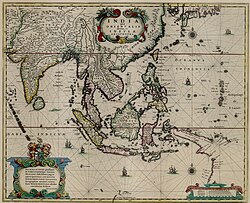
[[File:B26055978I - India quae Orientalis dicitur, et insvlae adiacentes.jpg|thumb|Portuguese colonial voyage to Japan|316x316px]]The establishment of the [[Nanban trade]] route between the [[Portuguese India|Estado da Índia]] and Japan led to a significant demographic exchange, characterized by the movement of South Asians to the port of [[Nagasaki]]. Portuguese [[Carrack|carracks]] operating from [[Goa]], [[Portuguese Ceylon|Ceylon]] and [[Malacca]] were frequently manned by "[[Lascar|Lascars]]"—sailors recruited from South Asia.<ref>{{cite book |last=Oka |first=Mihoko |title=The Voyage of Kanmon: Portuguese Business in the Venture to Japan |publisher=Brill |year=2021 |isbn=978-9004461017}}</ref> During the 16th and 17th centuries, Indian contact with Japan was largely facilitated through the maritime network of Portuguese India, particularly via the trading hub of Goa.<ref>Subrahmanyam, Sanjay. The Portuguese Empire in Asia, 1500-1700: A Political and Economic History. Longman, 1993.</ref> Indian sailors, soldiers, and merchants, collectively referred to by the Portuguese as lascars or banian (merchants), accompanied Portuguese carracks traveling the Nanban trade route between Goa and Nagasaki.<ref>Clulow, Adam. The Company and the Shogun: The Dutch Encounter with Tokugawa Japan. Columbia University Press, 2014.</ref> This presence is prominently documented in 16th-century [[Nanban art]], where dark-skinned South Asians are depicted alongside Portuguese merchants and Jesuit missionaries walking the streets of Nagasaki.<ref>{{cite journal |last=Leupp |first=Gary P. |year=1995 |title=Images of Black People in Late Medieval and Early Modern Japan |journal=Japan Forum |volume=7 |issue=1 |pages=1–13 |doi=10.1080/09555809508721524}}</ref> These Indian participants were integral to the transfer of commodities and cultural practices between the two regions, often acting as intermediaries in transactions involving Indian textiles, spices, and Portuguese firearms.<ref>Shastry, Bhagamandala S. Goa-Kanara Portuguese Relations, 1498-1763. Xavier Centre of Historical Research, 2000.</ref> Small numbers of these individuals settled permanently in the city, integrating into the local Christian community until the implementation of the [[Sakoku]] edicts in the 1630s, which forced the expulsion of most foreign residents to [[Macau]].<ref>{{cite book |last=Boxer |first=C.R. |title=The Christian Century in Japan, 1549–1650 |publisher=University of California Press |year=1951 |pages=232–235}}</ref> | |||
Following the expulsion of the Portuguese, the [[Dutch East India Company]] (VOC) became the sole European entity permitted to trade with Japan, operating from the island of [[Dejima]] in [[Nagasaki]]. During the 17th century, the Dutch East India Company (VOC) managed its trade route between India and Japan from its administrative headquarters in [[Batavia, Dutch East Indies|Batavia]], utilizing Dejima in Nagasaki harbor as its exclusive trading post in Japan from 1641.<ref>Boxer, C. R. The Dutch in Japan, 1600–1858. Oxford University Press, 1968.</ref>This trade was supported by an extensive intra-Asian network where [[Dutch Ceylon]] and the [[Coromandel Coast]] played pivotal roles as suppliers of cinnamon and textiles. <ref>{{cite book |last=Ames |first=Glenn J. |title=The Globe Encompassed: The Age of European Discovery, 1500-1700 |publisher=Pearson |year=2008 |isbn=978-0131933880}}</ref> The VOC's maritime operations relied heavily on [[Lascar]] sailors and domestic workers recruited from South Asia. While the high-ranking officials on Dejima were European, Japanese woodblock prints known as [[Nagasaki-e]] frequently depict Dutch merchants accompanied by South East Asian and South Asian attendants and servants.<ref>{{cite book |last=Viallé |first=Cynthia |title=The Deshima Diaries: Marginalia 1700-1740 |publisher=Japan Historical Society |year=2005 |pages=45–52}}</ref> These individuals formed a transient but consistent South Asian presence in Nagasaki throughout the [[Edo period]], though they were strictly confined to the island of Dejima under the [[Tokugawa Shogunate]]'s maritime restrictions.<ref>{{cite journal |last=Goodman |first=Grant K. |year=2000 |title=Japan and the Dutch 1600-1853 |journal=Routledge |doi=10.4324/9781315028088 |isbn=978-1-136-83229-1 }}</ref> | |||
Following the end of [[Sakoku]] and the opening of Japanese ports to international trade, the expansion of the [[British Raj]]'s maritime influence in the late 19th century facilitated the establishment of a robust trade corridor connecting [[South Asia]] with the Japanese [[Treaty ports]], most notably [[Nagasaki]] and [[Kobe]]. Driven by the exchange of raw Indian cotton for Japanese manufactured goods, this route relied heavily on [[Lascar]] labor—seamen recruited from the Indian subcontinent to man the steamships.<ref name="Ebrey2006">Ebrey, P. B. (2006). ''East Asia: A Cultural, Social, and Political History''. Houghton Mifflin.</ref> These vessels frequently departed from [[British Ceylon]], integrating the island's tea and gemstone exports into the broader East Asian trade network.<ref name="Metcalf2007">Metcalf, T. R. (2007). ''Imperial Connections: India in the Indian Ocean Arena, 1860–1920''. University of California Press.</ref> While many sailors returned home, a small number of South Asian merchants and maritime workers settled permanently in Nagasaki. This fledgling diaspora established some of the earliest South Asian cultural footprints in Japan, serving as essential intermediaries in the trans-Pacific shipping industry and forming the bedrock of the region's international merchant community.<ref name="Marker2012">Marker, J. (2012). "Lascars and the Making of the Global Port City." ''Journal of Maritime History'', 24(1), 12-34.</ref> The history of modern Indian settlement in Japan goes back more than a century. As early as 1872, a few Indian businessmen and their families had settled in [[Yokohama]] as well as [[Okinawa Prefecture|Okinawa]].<ref name="Singhvi">{{harvnb|Singhvi|2000|p=283}}</ref> In 1891, [[Tata Group|Tata]], then a small trading firm, established a branch in [[Kobe]].<ref>{{harvnb|Minamino|Sawa|2005|p=5}}</ref> By 1901, Japanese government statistics recorded 30 people from [[British India]] living in Japan.<ref>{{harvnb|Minamino|Sawa|2005|p=4}}</ref> Local statistics of the [[Hyōgo Prefecture]] government showed 59 Indians living in the prefecture in 1905, among whom all but one were men.<ref name="Minamino">{{harvnb|Minamino|Sawa|2005|p=6}}</ref> | |||
=== Imperial Japan onwards === | |||
After the destruction wreaked on Yokohama in the [[1923 Great Kantō earthquake]], the Indian traders there migrated to Kobe; from then on, Kobe became the center of Japan's Indian community's growth.<ref>{{harvnb|Sawa|Minamino|2007|p=15}}</ref>[[File:Pacific War - Southern Asia 1942 - Map.jpg|thumb|300x300px|Japanese operation in South Asia in 1942. Nagumo's forces are shown at the bottom of the map.]]By 1939, on the eve of [[World War II]], the number of Indians in Hyōgo Prefecture had reached 632. However, due to British sanctions against Japan and the 1941 halt of shipping between Japan and their homeland, many closed their shops and left; by 1942, there were only 114 remaining.<ref>{{harvnb|Minamino|Sawa|2005|p=7}}</ref> | |||
India was considered an important potential colony for Greater East Asia Co-Prosperity. Indians in Malaya (modern day Malaysia and Singapore) were often treated more favorably by the Japanese due to the importance of India in the global war plans of the Greater East Asia Co-Prosperity Sphere. In comparison, Chinese were sidelined due to the ongoing war between Chinese and Japanese forces in China.<ref>{{Cite thesis |title=JAPANESE RACIAL POLICY IN MALAYA AND SINGAPORE DURING THE JAPANESE OCCUPATION : ITS IMPACT ON NATIONAL INTEGRATION |url=https://scholarbank.nus.edu.sg/handle/10635/174882 |date=1998 |degree=Thesis |first=KEIKO |last=SOEDA}}</ref> | |||
Prior to 1990, the Indian community in Japan remained centred in the [[Kobe]] area. However, after 1990, the numbers in Tokyo began to show a sharp increase.<ref name="Azuma">{{harvnb|Azuma|2008|p=256}}</ref> Migrants who arrived in the 1990s included industrial trainees sent by [[Automotive industry in Japan|Japanese car manufacturers]] which had set up factories in India.<ref>{{harvnb|Azuma|2008|p=258}}</ref> IT professionals and their families also came to Tokyo, settling primarily in [[Setagaya, Tokyo|Setagaya]] and [[Minato, Tokyo|Minato]] wards.<ref>{{harvnb|Sawa|Minamino|2007|p=66}}</ref> | |||
In 2016, the two sides signed the "Manufacturing Skill Transfer Promotion Programme" agreement for training 30,000 people over 10 years. In 2021, Japan and India signed an agreement to allow Indian citizens to obtain the specified skilled visa, which allows Indians to work in several fields including nursing, industrial machinery, shipbuilding, aviation, agriculture and the food services industry.<ref name="hindustantimes.com">{{Cite web |date=18 January 2021 |title=India, Japan sign agreement to give skilled Indian workers access to Japanese job market |url=https://www.hindustantimes.com/india-news/india-japan-sign-agreement-to-give-skilled-indian-workers-access-to-japanese-job-market-101610982197561.html |access-date=17 March 2024 |website=Hindustan Times}}</ref>\ | |||
The Japanese Ministry of Foreign Affairs (MOFA) has noted that India is viewed by the public as an "indispensable partner" for regional security, particularly within the framework of the "Free and Open Indo-Pacific."<ref name="MOFA2026">{{cite web |date=16 January 2026 |title=India and Japan: A New Golden Chapter in a Mutually Complementary Relationship |url=https://www.mofa.go.jp/s_sa/sw/in/pageite_000001_00009.html |publisher=Ministry of Foreign Affairs of Japan}}</ref> This sentiment is reinforced by economic data; for instance, the Japan Bank for International Cooperation (JBIC) has ranked India as the most promising destination for overseas business expansion for four consecutive years as of 2026.<ref name="MOFA2026" /> While strategic alignment remains the primary driver of India's popularity, cultural interest is also rising, with bilateral initiatives aiming to facilitate the exchange of 500,000 personnel over five years to deepen people-to-people ties.<ref name="JointStatement2025">{{cite web |date=29 August 2025 |title=15th India-Japan Annual Summit Joint Statement |url=https://www.mea.gov.in/bilateral-documents.htm?dtl/40062 |publisher=Ministry of External Affairs, India}}</ref> | |||
== Business and employment == | |||
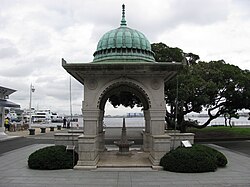
[[File:Indian drinking fountain 01.jpg|thumb|The Indian Water Fountain in [[Yamashita Park]], [[Yokohama]] was donated by the local Indian community to remember those who perished in the [[1923 Great Kanto Earthquake]], including more than 90 Indians.|171x171px]]Indians in Japan largely fill more professional roles due to a combination of the language barrier and lower salaries for the specified skilled visa, for which there are only 434 Indians. There are far more students.<ref>{{Cite web |title=India unlikely to solve Japan's labor shortage |url=https://asia.nikkei.com/Spotlight/Comment/India-unlikely-to-solve-Japan-s-labor-shortage |access-date=29 March 2024 |website=Nikkei Asia |language=en-GB}}</ref> The first batch of construction workers from India arrived in Japan in December 2019.<ref>{{Cite web |last=Koshi |first=Luke |date=4 December 2019 |title=1st batch of construction workers from India arrives in Japan on paid internship program |url=https://www.thenewsminute.com/news/1st-batch-construction-workers-india-arrives-japan-paid-internship-program-113483 |access-date=29 March 2024 |website=The News Minute |language=en}}</ref> | |||
Indians represent a growing and notable influence in the world of IT.<ref>{{Cite journal |last=D'Costa |first=Anthony P. |date=April 2013 |title=Positioning Indian emigration to Japan: the case of the IT industry |url=http://journals.sagepub.com/doi/10.1080/21632324.2013.773153 |journal=Migration and Development |language=en |volume=2 |issue=1 |pages=16–36 |doi=10.1080/21632324.2013.773153 |issn=2163-2324|url-access=subscription }}</ref> {{As of|2000}}, there were also around 800 Indians working in the IT industry in Japan, up from 120 in 1993.<ref name="Singhvi_a">{{harvnb|Singhvi|2000|p=284}}</ref> Kenichi Yoshida, a director of the Softbridge Solutions Japan Co., stated in late 2009 that the Indian engineers are becoming the backbone of Japan's IT industry and that "it is important for Japanese industry to work together with the India."<ref>{{cite news|title=FOCUS: Indian engineers becoming backbone of Japan's IT|url=http://home.kyodo.co.jp/modules/fstStory/index.php?storyid=469103|newspaper=[[Kyodo News]]|location=[[Minato, Tokyo]]|date=9 November 2009|access-date=6 November 2009}}{{dead link|date=January 2020 |bot=InternetArchiveBot |fix-attempted=yes }}</ref><ref>{{cite news|title=Backbone of Japan's IT industry? Indian engineers!|url=http://business.rediff.com/report/2009/nov/06/indian-engineers-becoming-backbone-of-japan-it-industry.htm|newspaper=[[Rediff.com]]|location=[[Mumbai]]|date=6 November 2009|access-date=6 November 2009}}</ref> Japan has been increasingly looking to India as a source for IT workers and talent.<ref>{{Cite web |last=Singh |first=Supriya |date=12 July 2022 |title=Japanese tech titans looking for Indian solution to talent crunch |url=https://www.japantimes.co.jp/news/2022/07/12/business/india-japan-tech-solutions/ |access-date=29 March 2024 |website=The Japan Times |language=en}}</ref> | |||
Another 870 Indians were employed as [[Indian cuisine|cooks]].<ref name="Singhvi_a" /> | |||
Japan also become the new destination for Indian nurses in 2023, with salaries that are over eight times higher than those found in India.<ref>{{Cite news |last=Perappadan |first=Bindu Shajan |date=30 July 2023 |title=Japan is now the new work destination for Indian nurses |url=https://www.thehindu.com/news/national/japan-is-now-the-new-work-destination-for-indian-nurses/article67138554.ece |access-date=29 March 2024 |work=The Hindu |language=en-IN |issn=0971-751X}}</ref> Many Indian nurses in Japan come from the private sector because private hospitals in India often offer lower salaries than government hospitals.<ref>{{Cite web |title=International Nurse Migration from India: Time to Say Goodbye?(Yuko TSUJITA) |url=https://www.ide.go.jp/English/ResearchColumns/Columns/2023/tsujita_yuko.html |access-date=29 March 2024 |website=Institute of Developing Economies |language=ja}}</ref> Indian nurses working in Japan can save over 1 lakh per month.<ref>{{Cite web |last=Bureau |first=HRK News |date=31 July 2023 |title=Indian nurses seek Japan as their latest work destination |url=https://www.hrkatha.com/news/indian-nurses-seek-japan-as-their-latest-work-destination/ |access-date=29 March 2024 |website=HR Katha |language=en-US}}</ref> | |||
Others are engaged in trading, importing the Indian handicrafts, garments, precious stones, and marine products, and exporting Japanese electronic goods, textiles, automotive parts, and jewellery.<ref name="Singhvi" /> | |||
== Communities == | |||
[[File:Mahatma Gandhi Bust Nishi Kasai.jpg|alt=Mahatma Gandhi Bust Nishi Kasai|thumb|Mahatma Gandhi Bust in Nishi Kasai|265x265px]][[File:Kobe Jain temple.jpg|thumb|Kobe Jain Temple|227x227px]] | |||
[[File:Mahatma Gandhi bust in Hiroshima City.jpg|alt=Mahatma Gandhi bust in Hiroshima, Japan|thumb|225x225px|Mahatma Gandhi bust in [[Hiroshima]], Japan]] | |||
=== Tokyo === | |||
{{As of|2018}} 3,758 people of Indian ancestry, about 10% of the people of Indian origin in Japan and about 30% of the people of Indian origin in Tokyo Metropolis, reside in [[Edogawa, Tokyo]]. The {{ill|Nishikasai|ja|西葛西}} area of Edogawa Ward has a high concentration of Indian origin families. The Indian community increased when engineers came to Japan to fix the [[Y2K bug]]. Indian people settled in Nishikasai due to the proximity to the [[Tokyo Metro Tozai Line]], which connects to their places of employment.<ref name="IkedaTsukuru">{{Cite web|date=20 May 2018|title=Tokyo's Nishikasai a second home for Indians in Japan|url=https://www.thestatesman.com/world/tokyos-nishikasai-second-home-indians-japan-1502638470.html|access-date=19 March 2021|last=Ikeda|first=Tsukuru|newspaper=[[The Statesman (India)|The Statesman]]|place=[[Kolkata]]|language=en-IN}}</ref> India International School of Japan (IISJ) and [[Global Indian International School Tokyo]] caters to the Indian expatriate community.<ref name="IkedaTsukuru" /> | |||
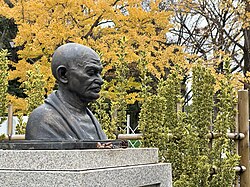
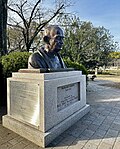
A bust of Mahatma Gandhi was installed in Nitta No. 6 Park in the Nishi-Kasai area of Edogawa City, Tokyo, as a gift from the Government of India and a symbol of Japan–India friendship and goodwill.<ref name=":3">{{Cite web |date=28 July 2024 |title=EAM Jaishankar unveils bust of Mahatma Gandhi in Tokyo |url=https://www.hindustantimes.com/india-news/eam-jaishankar-unveils-bust-of-mahatma-gandhi-in-tokyo-101722152139695.html |access-date=3 January 2026 |website=Hindustan Times |language=en}}</ref> The bronze sculpture, including its pedestal, stands approximately 1.8 m high and 0.6 m wide, and was created by Indian sculptor Naresh Kumawat.{{Citation needed|date=January 2026}} The unveiling ceremony took place on 28 July 2024, attended by India’s Minister of External Affairs [[S. Jaishankar]], India’s Ambassador to Japan [[Sibi George]], and Edogawa Ward Mayor Takeshi Saito, among others.<ref name=":3" /> | |||
=== Kobe === | |||
The Indian community in Kobe has developed primarily since the late 20th century, as professionals, traders, and business owners from India settled in the Kansai region. Kobe’s role as an international port city and its proximity to Osaka made it an attractive location for commerce, manufacturing, and information technology-related work. Over time, a small but stable Indian population emerged, supported by community organizations, cultural associations, and religious institutions, reflecting the broader pattern of Indian migration to western Japan.<ref>{{Cite web |date=5 June 2023 |title=FEATURE: Indian community in Kobe built by those who fled 1923 Kanto quake |url=https://english.kyodonews.net/articles/-/41691 |access-date=3 January 2026 |website=Japan Wire by KYODO NEWS |language=en|archive-url=https://web.archive.org/web/20250820041205/https://english.kyodonews.net/articles/-/41691|archive-date=20 August 2025}}</ref> | |||
=== Hiroshima === | |||
The Indian community in Hiroshima, though small (a few hundred residents including professionals, students, and families), remains active through groups like the Japan-India Association of Hiroshima. In May 2023, during the G7 Summit in Japan, Prime Minister Narendra Modi unveiled a bronze bust of Mahatma Gandhi in Hiroshima, gifted by India as a symbol of friendship, peace, and non-violence. Crafted by artist Ram Vanji Sutar, the sculpture stands near the Peace Memorial Park, embodying Gandhian ideals in a city scarred by the atomic bombing.<ref>{{Cite news |date=2023-05-20 |title=PM Modi unveils Mahatma Gandhi's bust in Hiroshima, site of world's first nuclear attack |url=https://economictimes.indiatimes.com/news/india/pm-modi-unveils-mahatma-gandhis-bust-in-hiroshima-site-of-worlds-first-nuclear-attack/articleshow/100373067.cms?from=mdr |access-date=2026-03-01 |work=The Economic Times |issn=0013-0389}}</ref> | |||
== Cuisine == | |||
[[File:Mumbaipalaceindianresttokyo.jpg|thumb|150px|An Indian restaurant in Tokyo]]The majority of the Indian restaurants in Japan are a "fusion" of Nepali and Indian cuisine, who are by far the largest South Asian ethnic group in Japan, but many restaurants are also run by Indians and Sri Lankans, the latter of whom number around 35,000 and make the third largest South Asian ethnic group after Nepalis and Indians.<ref name=":1">{{Cite web |title=在留外国人統計(旧登録外国人統計) 在留外国人統計 月次 2023年6月 {{!}} ファイル {{!}} 統計データを探す |url=https://www.e-stat.go.jp/stat-search/files?page=1&layout=datalist&toukei=00250012&tstat=000001018034&cycle=1&year=20230&month=12040606&tclass1=000001060399 |access-date=17 March 2024 |website=政府統計の総合窓口 |language=ja}}</ref><ref>{{Cite journal |last=KHAREL |first=Dipesh |date=16 May 2022 |title=Vulnerability and Pathways to Precarity: How COVID-19 Has Affected Japan's Nepali Immigrants |url=https://doi.org/10.1093/ssjj/jyac007 |journal=Social Science Japan Journal |volume=25 |issue=2 |pages=229–246 |doi=10.1093/ssjj/jyac007 |issn=1369-1465|url-access=subscription }}</ref> | |||
=== Historical and Cultural Exchange === | |||
The culinary relationship between India and Japan was historically characterized by the indirect transmission of dietary philosophies and ingredients via the spread of [[Buddhism]] and maritime trade.<ref name="Sen20032">{{cite book |last=Sen |first=Tansen |title=Buddhism, Diplomacy, and Trade: The Realignment of Sino-Indian Relations, 600-1400 |year=2003}}</ref> Imperial decrees by [[Emperor Tenmu]] in 675 CE that prohibited the consumption of meat.<ref name="Ishige20012">{{cite book |last=Ishige |first=Naomichi |title=The History and Culture of Japanese Food |year=2001}}</ref> This period saw the development of ''[[Shojin ryori]]'', a sophisticated Japanese temple cuisine rooted in Indian [[Ayurveda|Ayurvedic]] principles of balance and the "Rule of Five".<ref name="Hosking19952">{{cite book |last=Hosking |first=Richard |title=A Dictionary of Japanese Food: Ingredients & Culture |year=1995}}</ref> While direct trade of "[[canoe plants]]" like the [[coconut]] was primarily limited to [[Austronesian peoples|Austronesian]] routes between Southeast Asia and coastal India, spiritual and medicinal items such as [[black pepper]] and [[sugar]] reached Japan as rare luxuries during the [[Nara period]], often brought through the entourage of [[Bodhisena]], who presided over the dedication of the [[Daibutsu]] at [[Tōdai-ji]].<ref name="Coaldrake19912">{{cite book |last=Coaldrake |first=William H. |title=The Way of the Gods: Ancient History of Japan |year=1991}}</ref> | |||
== Religion == | |||
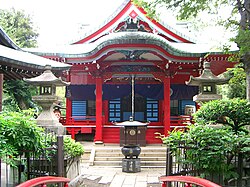
[[File:INOKASHIRA1.jpg|thumb|230x230px|Benzaiten shrine, [[Inokashira Park]]]] | |||
===Hinduism=== | |||
{{empty section|date=June 2025}} | |||
=== Jainism === | |||
{{Main|Jainism in Japan}} | |||
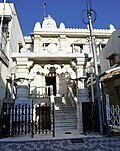
Indians in Japan speak a number of different languages and follow various religions; there is little correlation between religion or language and profession, except in the case of the Jains, many of whom work in the jewellery industry.<ref>{{harvnb|Azuma|2008|p=259}}</ref> The Jains are generally concentrated around Okachi-machi in [[Taitō, Tokyo]].<ref name="Azuma_a">{{harvnb|Azuma|2008|p=262}}</ref> | |||
=== Sikhism === | |||
There are Sikh [[gurudwaras]] in both Kobe and Tokyo; the latter is of more recent provenance, having been founded in 1999 in the basement of an office building.<ref>{{harvnb|Azuma|2008|p=264}}</ref> Some Sikhs employed as unskilled labourers in small and medium enterprises had to [[Sehajdhari|cut their hair short]] and remove [[dastar|their turbans]] in violation of the principle of ''[[Kesh (Sikhism)|kesh]]'', because their employers are unfamiliar with their customs and [[religious discrimination|do not give them any latitude]] in their style of dress. They consider this as just a temporary adaptation to Japanese society. However, this practise is not common among Sikhs in skilled professions such as IT.<ref>{{harvnb|Azuma|2008|pp=263–264}}</ref> | There are Sikh [[gurudwaras]] in both Kobe and Tokyo; the latter is of more recent provenance, having been founded in 1999 in the basement of an office building.<ref>{{harvnb|Azuma|2008|p=264}}</ref> Some Sikhs employed as unskilled labourers in small and medium enterprises had to [[Sehajdhari|cut their hair short]] and remove [[dastar|their turbans]] in violation of the principle of ''[[Kesh (Sikhism)|kesh]]'', because their employers are unfamiliar with their customs and [[religious discrimination|do not give them any latitude]] in their style of dress. They consider this as just a temporary adaptation to Japanese society. However, this practise is not common among Sikhs in skilled professions such as IT.<ref>{{harvnb|Azuma|2008|pp=263–264}}</ref> | ||
== Education == | |||
==Education== | |||
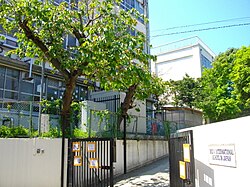
[[File:India International School in Japan, Tokyo.JPG|thumb|left|[[India International School in Japan, Tokyo]]]] | [[File:India International School in Japan, Tokyo.JPG|thumb|left|[[India International School in Japan, Tokyo]]]] | ||
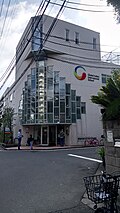
[[File:Globalindianschooltokyo.jpg|thumb|150px|right|[[Global Indian International School, Tokyo Campus]]]] | [[File:Globalindianschooltokyo.jpg|thumb|150px|right|[[Global Indian International School, Tokyo Campus]]]] | ||
Indians who send their children to school in Japan generally select English-medium schools. | Indians who send their children to school in Japan generally select English-medium schools. | ||
The first Indian-specific school, [[India International School in Japan]], was established in 2004 in Tokyo's [[Koto, Tokyo|Koto]] ward at the initiative of some of the old trading families based in Tokyo and Yokohama.<ref name="Sawa_a">{{harvnb|Sawa|Minamino|2007|p=21}}</ref> | |||
The [[Global Indian International School]], a Singapore-based school, has operated [[Global Indian International School, Tokyo Campus|a branch in Tokyo]] since 2006, and plans to open another in [[Yokohama]] in 2008.<ref name="Sawa">{{harvnb|Sawa|Minamino|2007|p=19}}</ref> They follow the Indian [[Central Board of Secondary Education]] curriculum. Other migrants leave their children behind in their native states, either with grandparents or at the boarding schools, in order to avoid interrupting their education.<ref name="Sawa_a" /> | |||
==Notable people== | Jeevarani "Rani Sanku" Angelina<ref>"{{usurped|1=[https://web.archive.org/web/20150309051805/http://www.angelsenglish.com/about/history.html History]}}." Little Angels International School. Retrieved on 9 March 2015.</ref> established the Little Angels International School (now [[Musashi International School Tokyo]]), which caters to Japanese students.<ref name=Fackler>{{cite news|last=Fackler|first=Martin|url=http://www.angelsenglish.com/about/MediaC/Nytimes.pdf|title=Losing an Edge, Japanese Envy India's Schools|work=[[The New York Times]]|date=2 January 2008|access-date=9 March 2015|url-status=usurped|archive-url=https://web.archive.org/web/20150309142533/http://www.angelsenglish.com/about/MediaC/Nytimes.pdf|archive-date=9 March 2015|quote=Unlike other Indian schools, Ms. Angelina said, Little Angels was intended primarily for Japanese children, to meet the need she had found when she sent her sons to Japanese kindergarten.}}</ref> | ||
{{multiple image|perrow=2|total_width=200|caption_align=center | |||
| align | == Tourism == | ||
| background color = | The leading motivations for Indian tourists to Japan are eating Japanese cuisine, sightseeing, shopping, walking around and experiencing Japanese culture and history.<ref>{{Cite web |title=Japan: leading travel motivations of Indian tourists 2022 |url=https://www.statista.com/statistics/1069696/japan-leading-travel-motivations-indian-tourists/ |access-date=17 March 2024 |website=Statista |language=en}}</ref> March 2024 marked the highest ever number yet of inbound tourists from India to Japan.<ref>{{Cite web |title=訪日外客数(2024年3月推計値){{pipe}}JNTO(日本政府観光局) |url=https://www.jnto.go.jp/news/press/20240417_monthly.html |access-date=7 May 2024 |website=日本政府観光局(JNTO) - Japan National Tourism Organization |language=ja}}</ref> Indian films have periodically used Japan as a filming backdrop, the most iconic being [[Love in Tokyo|Love in Tokyo (1966)]], [[Youngistaan|Youngistaan (2014)]] and [[Tamasha (2015 film)|Tamasha (2015)]]. | ||
| title = | |||
| image1 = Arata.JPG|caption1={{font|size=110%|text=[[Arata Izumi | == Community organizations and activists == | ||
[[File:India Club in Kobe.jpeg|alt=India Club in Kobe|thumb|India Club in Kobe]] | |||
| image3 = TC Blau-Wiess 2009.jpg|caption3={{font|size=110%|text=[[Anastasia Malhotra]]}} | One of the earliest Indian community organisations, the Oriental Club, was established in 1904 in Kobe; it changed its name to The India Club in 1913, and continued operating up to the present day. More were founded in the 1930s, including the Indian-dominated Silk Merchants' Association, the Indian Social Society, and the Indian Chamber of Commerce.<ref name="Minamino" /> In 2000, Indian expatriates living in [[Edogawa, Tokyo]], founded the Indian Community of Edogawa.<ref name="Azuma_a" /> Others include the Indian Community Activities Tokyo, whose [[Diwali]] celebration draws 2,500 participants, as well as the Indian Merchants Association of Yokohama.<ref name="Singhvi_a" /> In 2017, the All-Japan Association of Indians (AJAI) was established with support from several Indian associations in Japan, with a singular focus on serving the community through welfare activities.{{cn|date=January 2026}} | ||
| footer | |||
Jagmohan Chandrani, head of the Edogawa Indian Association, want to increase the amount of Indians in Japan in the future, and views Nishi-Kasai as a model for all neighbourhoods in the future. He says the future of Japan is cosmopolitan.<ref>{{Cite news |title=Nishi-Kasai's Little India is a model of expat integration {{!}} The Asahi Shimbun: Breaking News, Japan News and Analysis |url=https://www.asahi.com/ajw/articles/14966281 |archive-url=https://web.archive.org/web/20240420050627/https://www.asahi.com/ajw/articles/14966281 |archive-date=20 April 2024 |access-date=12 May 2025 |work=The Asahi Shimbun |language=en-US |url-status=live }}</ref> | |||
Lekh Juneja, is the chairman and CEO of Kameda Seika, and he advocates for increasing immigration to Japan. He criticise Japanese mindset and culture. He doesn't think it's enough that an employee only speaks or write Japanese.<ref>{{Cite web |last=Sturdee |first=Simon |date=15 December 2024 |title=Indian-born CEO of Japanese company says nation needs immigration to thrive |url=https://www.japantimes.co.jp/business/2024/12/15/companies/india-born-kameda-ceo/ |access-date=12 May 2025 |website=The Japan Times |language=en}}</ref> | |||
Yogendra 'Yogi' Puranik, the first person of Indian origin to be elected to office in Japan, says that Japanese people will have to change in order to adapt to an increasing number of foreigners.<ref>{{Cite web |date=12 May 2025 |title=Yogendra 'Yogi' Puranik: The first Indian voice in Tokyo politics |work=Japan Up Close |url=https://japanupclose.web-japan.org/culture/c20200228_1.html}}</ref> | |||
== Other == | |||
=== Domestic violence === | |||
An article in the ''[[Japan Times]]'' complained that patriarchy perpetuates among Indian immigrants to Japan, whereas Indian women may feel more empowered in societies such as Berlin, Germany.<ref>{{Cite web |last=Wadhwa |first=Megha |date=3 January 2024 |title=How patriarchy perpetuates among Tokyo's Indian migrants |url=https://www.japantimes.co.jp/commentary/2024/01/03/japan/indian-migrants-women-tokyo-berlin/ |access-date=20 March 2024 |website=The Japan Times |language=en}}</ref> As in the native Japanese culture, many Indian women to Japan rarely stay for career advancement, but rather prefer staying to become a housewife.<ref name="academic.oup.com2">{{Cite journal |last1=Christopher |first1=Stephen |date=2022 |title=Indian Migrants in Tokyo: A Study of Socio-Cultural, Religious, and Working Worlds |url=https://academic.oup.com/ssjj/article/25/1/197/6448825 |journal=Social Science Japan Journal |volume=25 |pages=197–200 |doi=10.1093/ssjj/jyab044 |access-date=20 March 2024 |doi-access=free}}</ref> | |||
=== Illegal immigration === | |||
A number of people born in Japan to asylum seekers or illegal immigrants have reported being told to return to India.<ref>{{Cite news |title=Japan forces a harsh choice on children of migrant families |url=https://www.reuters.com/investigates/special-report/japan-detention-children/}}</ref> | |||
=== Racism === | |||
There have been complaints about facing Islamophobia and racial profiling.<ref name="academic.oup.com2" /> Islam is considered a foreign culture within the framework of Japanese multiculturalism and is treated as such by most Japanese people. Large scale opposition to Muslim migration began in the 1990s, albeit targeting those from the Middle East, and Iranians and Pakistanis in particular.<ref>{{Cite journal |last=Yamashita |first=Yoko |date=January 2022 |title=Islam and Muslims in "non-religious" Japan: caught in between prejudice against Islam and performative tolerance |journal=International Journal of Asian Studies |language=en |volume=19 |issue=1 |pages=81–97 |doi=10.1017/S1479591421000012 |issn=1479-5914 |doi-access=free}}</ref> In early 2024 an Indian, along with a Black American and Pakistani, sued the Japanese government for racial discrimination; "There's a very strong image that 'foreigner' equals 'criminal'," Pakistan-born Syed Zain told Japanese reporters.<ref>{{Cite web |title=India, Pak, US-Born Residents Sue Japan Government Over Alleged Racial Profiling |url=https://www.ndtv.com/world-news/india-pak-us-born-residents-sue-japan-government-over-alleged-racial-profiling-4964207 |access-date=29 May 2024 |website=NDTV.com}}</ref> | |||
== Notable people == | |||
{{multiple image | |||
| perrow = 2 | |||
| total_width = 200 | |||
| caption_align = center | |||
| align = right | |||
| background color = | |||
| title = | |||
| image1 = Arata.JPG | |||
| caption1 = {{font|size=110%|text=[[Arata Izumi]]}} | |||
| image3 = TC Blau-Wiess 2009.jpg | |||
| caption3 = {{font|size=110%|text=[[Anastasia Malhotra]]}} | |||
| footer = | |||
}} | }} | ||
* [[Anastasia Malhotra]], professional tennis player (Indian-British/Greek-British father) | |||
* [[Anastasia Malhotra]], professional tennis player | * [[Arata Izumi]], football player (Indian father) | ||
* [[Bodhisena]], Buddhist scholar and monk | |||
* [[Priyanka Yoshikawa]], fashion model | |||
* [[Sarbjit Singh Chadha]], enka singer | |||
* [[Yogendra Puranik]], politician and civil services officer | |||
* [[Ryuko Hira]], investor | |||
* [[Jaideep Singh]], boxer | |||
* [[Annu Mari]], actress | * [[Annu Mari]], actress | ||
==See also== | == See also == | ||
* [[ | * [[Indian diaspora]] | ||
* [[India–Japan relations]] | * [[India–Japan relations]] | ||
* [[Japanese–Manipuri cultural relations]] | |||
* [[Hinduism in Japan]] | * [[Hinduism in Japan]] | ||
* [[Buddhism in Japan]] | |||
* [[Japanese people in India]] | * [[Japanese people in India]] | ||
* [[Nepalis in Japan]] | |||
* [[Indians in Thailand]] | |||
==Notes== | == Notes == | ||
{{reflist|3}} | {{reflist|3}} | ||
==Sources== | == Sources == | ||
* Wadhwa, Megha (2021), ''Indian Migrants in Tokyo: A Study of Social, Cultural and Religious Worlds, London,'' NewYork: Routledge, 2021, https://www.routledge.com/Indian-Migrants-in-Tokyo-A-Study-of-Socio-Cultural-Religious-and-Working/Wadhwa/p/book/9780367569990 | |||
* {{citation|last=Waterhouse|first=David|year=1991|chapter=Where did Toragaku come from?|editor-last=Marett|editor-first=Allan|title=Musica Asiatica|volume=6|pages=73–94|publication-place=Cambridge|publisher=Cambridge University Press|isbn=978-0-521-39050-7|doi=10.1017/CBO9780511896071.006}} | * {{citation|last=Waterhouse|first=David|year=1991|chapter=Where did Toragaku come from?|editor-last=Marett|editor-first=Allan|title=Musica Asiatica|volume=6|pages=73–94|publication-place=Cambridge|publisher=Cambridge University Press|isbn=978-0-521-39050-7|doi=10.1017/CBO9780511896071.006}} | ||
* {{citation|last=Singhvi |first=L. M. |chapter=Asia-Pacific Region |pages=273–288 |title=Report of the High Level Committee on the Indian Diaspora |publisher=Ministry of External Affairs |publication-place=New Delhi |chapter-url=http://indiandiaspora.nic.in/diasporapdf/chapter8.pdf |year=2000 |url-status=dead |archive-url=https://web.archive.org/web/20120206063957/http://indiandiaspora.nic.in/diasporapdf/chapter8.pdf |archive-date=6 February 2012 | * {{citation|last=Singhvi |first=L. M. |chapter=Asia-Pacific Region |pages=273–288 |title=Report of the High Level Committee on the Indian Diaspora |publisher=Ministry of External Affairs |publication-place=New Delhi |chapter-url=http://indiandiaspora.nic.in/diasporapdf/chapter8.pdf |year=2000 |url-status=dead |archive-url=https://web.archive.org/web/20120206063957/http://indiandiaspora.nic.in/diasporapdf/chapter8.pdf |archive-date=6 February 2012}} | ||
* {{citation|script-title=ja:在日インド人社会の変遷--定住地神戸を事例として |trans-title=Changes in Indian society in | * {{citation|script-title=ja:在日インド人社会の変遷--定住地神戸を事例として |trans-title=Changes in Indian society in Japan—focused on the case of Kobe residents |language=ja |last1=Minamino |first1=Takeshi |first2=Munenori |last2=Sawa |url=http://www.lib.kobe-u.ac.jp/repository/90000944.pdf |access-date=25 September 2009 |pages=4–15 |year=2005 |script-journal=ja:兵庫地理 |volume=50 |url-status=dead |archive-url=https://web.archive.org/web/20151208021125/http://www.lib.kobe-u.ac.jp/repository/90000944.pdf |archive-date=8 December 2015 }} | ||
* {{citation|last1=Sawa|first1=Munenori|last2=Minamino|first2=Takeshi|title=Emerging of An Indian Community in Tokyo: A Case Study of Nishikasai|journal=The Indian Geographical Journal|volume=82|issue=1|pages=7–26|year=2007|url=http://www.lib.kobe-u.ac.jp/repository/90000733.pdf}} | * {{citation|last1=Sawa|first1=Munenori|last2=Minamino|first2=Takeshi|title=Emerging of An Indian Community in Tokyo: A Case Study of Nishikasai|journal=The Indian Geographical Journal|volume=82|issue=1|pages=7–26|year=2007|url=http://www.lib.kobe-u.ac.jp/repository/90000733.pdf|access-date=28 September 2009|archive-date=22 December 2021|archive-url=https://web.archive.org/web/20211222044734/http://www.lib.kobe-u.ac.jp/repository/90000733.pdf|url-status=dead}} | ||
* {{citation|year=2008|chapter=Indians in Tokyo and its vicinity|last=Azuma|first=Masako|pages=255–269|title=Rising India and Indian communities in East Asia|editor-first=K.|editor-last=Kesavapany|editor2-first=A.|editor2-last=Mani|editor3-first=Palanisamy|editor3-last=Ramasamy|publisher=Institute of Southeast Asian Studies|isbn=978-981-230-799-6}} | * {{citation|year=2008|chapter=Indians in Tokyo and its vicinity|last=Azuma|first=Masako|pages=255–269|title=Rising India and Indian communities in East Asia|editor-first=K.|editor-last=Kesavapany|editor2-first=A.|editor2-last=Mani|editor3-first=Palanisamy|editor3-last=Ramasamy|publisher=Institute of Southeast Asian Studies|isbn=978-981-230-799-6}} | ||
==Further reading== | == Further reading == | ||
* {{cite book|last=Eston|first=Elizabeth|year=2019|title=Rash Behari Bose: The Father of the Indian National Army, Vols 1-6|url=https://www.amazon.in/dp/B07QMVG6GX/|publisher=Tenraidou}} | * {{cite book|last=Eston|first=Elizabeth|year=2019|title=Rash Behari Bose: The Father of the Indian National Army, Vols 1-6|url=https://www.amazon.in/dp/B07QMVG6GX/|publisher=Tenraidou}} | ||
* {{cite journal|last1=Green|first1=Nile|title=Shared infrastructures, informational asymmetries: Persians and Indians in Japan, c.1890–1930|journal=Journal of Global History|volume=8|issue=3|year=2013|pages=414–435|issn=1740-0228|doi=10.1017/S1740022813000351|s2cid=162765204}} | * {{cite journal|last1=Green|first1=Nile|title=Shared infrastructures, informational asymmetries: Persians and Indians in Japan, c.1890–1930|journal=Journal of Global History|volume=8|issue=3|year=2013|pages=414–435|issn=1740-0228|doi=10.1017/S1740022813000351|s2cid=162765204}} | ||
* {{citation|editor-last=Yamashita|editor-first=Kiyomi|script-title=ja:エスニック・ワールド:世界と日本のエスニック社会 |trans-title=Ethnic World: Global and Japanese ethnic societies |script-chapter=ja:日本のインド人社会 |chapter=Indian society in Japan|last=Sawa|first=Munenori| date=April 2008 |isbn=978-4-7503-2758-7|publisher=Akashi Shoten|oclc=226814973}} | * {{citation|editor-last=Yamashita|editor-first=Kiyomi|script-title=ja:エスニック・ワールド:世界と日本のエスニック社会 |trans-title=Ethnic World: Global and Japanese ethnic societies |script-chapter=ja:日本のインド人社会 |chapter=Indian society in Japan|last=Sawa|first=Munenori| date=April 2008 |isbn=978-4-7503-2758-7|publisher=Akashi Shoten|oclc=226814973}} | ||
* {{citation|url=http://www.lib.kobe-u.ac.jp/repository/kaken/K0001496.pdf|script-title=ja:グローバリゼーション下のディアスポラ | * {{citation|url=http://www.lib.kobe-u.ac.jp/repository/kaken/K0001496.pdf|script-title=ja:グローバリゼーション下のディアスポラ —在日インド人のネットワークとコミュニティ|trans-title=Diaspora under globalisation: Networks and community of Indians in Japan|date=October 2008|series=院人間発達環境学研究科報告書|publisher=Kobe University|volume=13680081|last=Sawa|first=Munenori|access-date=28 September 2009|archive-date=3 June 2022|archive-url=https://web.archive.org/web/20220603234349/http://www.lib.kobe-u.ac.jp/repository/kaken/K0001496.pdf|url-status=dead}} | ||
== External links == | |||
*{{Commons category-inline|Japanese people of Indian descent}} | |||
{{ | {{Ethnic groups in Japan}} | ||
{{ | {{Indian diaspora}} | ||
[[Category:Ethnic groups in Japan]] | [[Category:Ethnic groups in Japan]] | ||
[[Category:Indian | [[Category:Indian diaspora in Japan|*]] | ||
[[Category: | [[Category:Asian diaspora in Japan]] | ||
Latest revision as of 23:52, 1 March 2026
 | This article has an unclear citation style. |
जापान में भारतीय 日本にいるインド人 | |
|---|---|
 | |
| Total population | |
| 53,974 (in December 2024) Indian nationals[1][2] | |
| Regions with significant populations | |
| Tokyo, Kobe, Yokohama | |
| Languages | |
| Religion | |
Indians in Japan consist of those with Japanese citizenship and those with foreign citizenship.
As of early 2026, there are approximately 55,000 Indian nationals residing in Japan.[4] Within Japan's total foreign population of nearly 4 million, India ranks as the 12th largest immigrant group overall, trailing significantly behind Nepal (approx. 273,000) but remaining larger than the populations of Pakistan and Bangladesh.[5][6]
The demographic is uniquely defined by its high concentration of highly skilled professionals in the IT and engineering sectors; a bilateral 2025 action plan aims to further expand this footprint by targeting the recruitment of 50,000 additional skilled Indian workers by 2030.[7]
Since unification, Japan’s perception of India has evolved from a mythical "Heavenly Abode" (Tenjiku) during the Edo period to a modern strategic anchor, resulting in a foreign policy that prioritizes India as a vital democratic partner for regional stability in the Indo-Pacific.[8][9] As of 2026 the Japanese government views India as an indispensable strategic partner and its most promising economic destination, focusing on a "Free and Open Indo-Pacific" while actively recruiting high-skilled Indian talent to address domestic labor shortages.[10]
Public opinion in Japan toward India is characterized by a high degree of strategic trust and growing cultural affinity. According to a Pew Research Center survey conducted in 2025, a majority of Japanese respondents hold a favorable view of India, with favorability particularly high among younger adults (under 35) and men, who show double-digit leads in positive sentiment over older demographics and women, respectively.[11]
Etymology[edit | edit source]
Historically, in populations influenced by Chinese characters such as the Japanese, they referred to India as Tenjiku (天竺). Consequently, people of Indian origin were occasionally referred to as Tenjiku-jin (天竺人), though this term is now considered archaic and restricted to classical literature or religious contexts.[12] In modern Japanese, the standard endonym for an Indian person is Indo-jin (インド人), composed of the katakana for "India" (インド) and the Kanji suffix for "person" (人).[13]
The term Zainichi Indo-jin (在日インド人, lit. "Indian person staying in Japan") is frequently utilized in government statistics and sociological studies to distinguish the resident diaspora from short-term visitors.[14]
In the broader context of Southeast Asia, the term "Indian" often functions as a pan-ethnic label that encompasses all individuals of South Asian descent, including Nepalis, Sri Lankans, and other South Asians, for example the Indian Indonesians.[15] This linguistic pattern is particularly evident in the use of the term Keling in Malaysia and Indonesia, or Khaek (Thai: แขก) in Thailand; while these terms are etymologically linked to "India" or "guests," they historically applied to the entire Indian subcontinent.[16] Japanese government administration generally maintains sharper distinctions between South Asian nationalities. Nevertheless, in casual social settings or when referring to South Asian cuisine (such as "Indian curry" shops), the term is frequently used as a metonym for the diverse South Asian community, many of whom—particularly Nepalis—operate a significant portion of the "Indian" restaurants in Japan.[17]
History[edit | edit source]
Ancient[edit | edit source]
Evidence for indirect contact between India and Japan dates back to the transition from the Late Jōmon to the early Yayoi period, when the expansion of Austronesian maritime networks began linking the South Asia to the East Asia[18]. Starting from the initial expansion in 3000 BCE, Austronesian groups eventually established settlements in Kyushu, Ryukyu Islands, along the coasts of southeastern India and Sri Lanka, facilitating the transfer of maritime technology and crops across the Indian Ocean.[19][20] This maratime route is evidenced by the arrival of specialized prestige goods, such as etched carnelian and Indo-Pacific glass beads, which were manufactured in Indian workshops like Arikamedu and transported via Austronesian "relay trade" through the Thai-Malay Peninsula to the Japanese archipelago[21]. Some scholars further argue that the sudden introduction of wet-rice agriculture and bronze metallurgy in Japan was catalyzed by these southern maritime routes, which moved technology from the Austroasiatic and Austronesian spheres of influence toward the Ryukyu Islands and Kyushu[22]. Early interactions are theorized to have occurred at maritime hubs along the Thai-Malay Peninsula.[23]
The Himalayas, Arakan Mountains and Patkai Range formed a significant geographic land barrier between modern-day South Asia and East Asia that historically restricted overland contact.[24] Following the 1st century CE, a complex series of indirect relay trade routes emerged between India and China through Central Asia and the vast arid expanses of Western China, that added to the existing more direct maratime trade routes.[25][26] The arduous nature of traversing these desert and distant regions was famously written into the 16th-century Chinese novel by Wu Cheng'en Journey to the West.[27][28] The introduction of Buddhism in Japan is often attributed to the Kudara (Baekje) mission in the 6th century; however, historical scholarship increasingly emphasizes the role of the Maritime Silk Road in connecting Japan with Southeast Asian Buddhist centers; archaeological finds of Southeast Asian-style votive tablets and the influence of Indian Srivijayan artistic motifs in early Japanese statuary suggest a "Southern Route" of influence that bypassed the continental path.[29] This maritime network facilitated the exchange of esoteric texts and ritual objects between the Japanese archipelago and the Buddhist polities of Indochina and the East Indies.[30] While the land-based routes have historically received more scholarly attention due to reasons such as the greater accessibility of archaeological sites, modern economic historians argue that the maritime routes were actually more significant in terms of trade volume and cultural exchange.[31][32][33][34]
These early connections laid the foundation for more formal exchanges, such as the 8th-century arrival of the Indian monk Bodhisena to consecrate the Great Buddha at Tōdai-ji[35]. Bodhisena did not travel as a solitary figure; rather, he arrived in Japan in 736 CE as part of a massive diplomatic entourage of nearly 600 people carried aboard four imperial Kentōshi ships[36]. His immediate retinue included religious disciples, monks, and scholars, and even brought a troupe of musicians to introduce Southeast Asian performing arts to the Nara court.[37] This large-scale mission included not only clergy but also diplomats, servants, and specialized craftsmen, facilitating a broad transfer of South Asian and Southeast Asian material culture directly into the Japanese capital[38]. This collective mission was instrumental in the cultural landscape of the Nara period, as the group brought with them South Asian and Southeast Asian music, dance, and ritual expertise that were showcased during the "eye-opening" ceremony of the Great Buddha at Tōdai-ji in 752 CE[39].
Colonialism, Sakoku and Pax Britannica[edit | edit source]

The establishment of the Nanban trade route between the Estado da Índia and Japan led to a significant demographic exchange, characterized by the movement of South Asians to the port of Nagasaki. Portuguese carracks operating from Goa, Ceylon and Malacca were frequently manned by "Lascars"—sailors recruited from South Asia.[40] During the 16th and 17th centuries, Indian contact with Japan was largely facilitated through the maritime network of Portuguese India, particularly via the trading hub of Goa.[41] Indian sailors, soldiers, and merchants, collectively referred to by the Portuguese as lascars or banian (merchants), accompanied Portuguese carracks traveling the Nanban trade route between Goa and Nagasaki.[42] This presence is prominently documented in 16th-century Nanban art, where dark-skinned South Asians are depicted alongside Portuguese merchants and Jesuit missionaries walking the streets of Nagasaki.[43] These Indian participants were integral to the transfer of commodities and cultural practices between the two regions, often acting as intermediaries in transactions involving Indian textiles, spices, and Portuguese firearms.[44] Small numbers of these individuals settled permanently in the city, integrating into the local Christian community until the implementation of the Sakoku edicts in the 1630s, which forced the expulsion of most foreign residents to Macau.[45]
Following the expulsion of the Portuguese, the Dutch East India Company (VOC) became the sole European entity permitted to trade with Japan, operating from the island of Dejima in Nagasaki. During the 17th century, the Dutch East India Company (VOC) managed its trade route between India and Japan from its administrative headquarters in Batavia, utilizing Dejima in Nagasaki harbor as its exclusive trading post in Japan from 1641.[46]This trade was supported by an extensive intra-Asian network where Dutch Ceylon and the Coromandel Coast played pivotal roles as suppliers of cinnamon and textiles. [47] The VOC's maritime operations relied heavily on Lascar sailors and domestic workers recruited from South Asia. While the high-ranking officials on Dejima were European, Japanese woodblock prints known as Nagasaki-e frequently depict Dutch merchants accompanied by South East Asian and South Asian attendants and servants.[48] These individuals formed a transient but consistent South Asian presence in Nagasaki throughout the Edo period, though they were strictly confined to the island of Dejima under the Tokugawa Shogunate's maritime restrictions.[49]
Following the end of Sakoku and the opening of Japanese ports to international trade, the expansion of the British Raj's maritime influence in the late 19th century facilitated the establishment of a robust trade corridor connecting South Asia with the Japanese Treaty ports, most notably Nagasaki and Kobe. Driven by the exchange of raw Indian cotton for Japanese manufactured goods, this route relied heavily on Lascar labor—seamen recruited from the Indian subcontinent to man the steamships.[50] These vessels frequently departed from British Ceylon, integrating the island's tea and gemstone exports into the broader East Asian trade network.[51] While many sailors returned home, a small number of South Asian merchants and maritime workers settled permanently in Nagasaki. This fledgling diaspora established some of the earliest South Asian cultural footprints in Japan, serving as essential intermediaries in the trans-Pacific shipping industry and forming the bedrock of the region's international merchant community.[52] The history of modern Indian settlement in Japan goes back more than a century. As early as 1872, a few Indian businessmen and their families had settled in Yokohama as well as Okinawa.[53] In 1891, Tata, then a small trading firm, established a branch in Kobe.[54] By 1901, Japanese government statistics recorded 30 people from British India living in Japan.[55] Local statistics of the Hyōgo Prefecture government showed 59 Indians living in the prefecture in 1905, among whom all but one were men.[56]
Imperial Japan onwards[edit | edit source]
After the destruction wreaked on Yokohama in the 1923 Great Kantō earthquake, the Indian traders there migrated to Kobe; from then on, Kobe became the center of Japan's Indian community's growth.[57]

By 1939, on the eve of World War II, the number of Indians in Hyōgo Prefecture had reached 632. However, due to British sanctions against Japan and the 1941 halt of shipping between Japan and their homeland, many closed their shops and left; by 1942, there were only 114 remaining.[58]
India was considered an important potential colony for Greater East Asia Co-Prosperity. Indians in Malaya (modern day Malaysia and Singapore) were often treated more favorably by the Japanese due to the importance of India in the global war plans of the Greater East Asia Co-Prosperity Sphere. In comparison, Chinese were sidelined due to the ongoing war between Chinese and Japanese forces in China.[59]
Prior to 1990, the Indian community in Japan remained centred in the Kobe area. However, after 1990, the numbers in Tokyo began to show a sharp increase.[60] Migrants who arrived in the 1990s included industrial trainees sent by Japanese car manufacturers which had set up factories in India.[61] IT professionals and their families also came to Tokyo, settling primarily in Setagaya and Minato wards.[62]
In 2016, the two sides signed the "Manufacturing Skill Transfer Promotion Programme" agreement for training 30,000 people over 10 years. In 2021, Japan and India signed an agreement to allow Indian citizens to obtain the specified skilled visa, which allows Indians to work in several fields including nursing, industrial machinery, shipbuilding, aviation, agriculture and the food services industry.[63]\
The Japanese Ministry of Foreign Affairs (MOFA) has noted that India is viewed by the public as an "indispensable partner" for regional security, particularly within the framework of the "Free and Open Indo-Pacific."[64] This sentiment is reinforced by economic data; for instance, the Japan Bank for International Cooperation (JBIC) has ranked India as the most promising destination for overseas business expansion for four consecutive years as of 2026.[64] While strategic alignment remains the primary driver of India's popularity, cultural interest is also rising, with bilateral initiatives aiming to facilitate the exchange of 500,000 personnel over five years to deepen people-to-people ties.[65]
Business and employment[edit | edit source]

Indians in Japan largely fill more professional roles due to a combination of the language barrier and lower salaries for the specified skilled visa, for which there are only 434 Indians. There are far more students.[66] The first batch of construction workers from India arrived in Japan in December 2019.[67]
Indians represent a growing and notable influence in the world of IT.[68] As of 2000[update], there were also around 800 Indians working in the IT industry in Japan, up from 120 in 1993.[69] Kenichi Yoshida, a director of the Softbridge Solutions Japan Co., stated in late 2009 that the Indian engineers are becoming the backbone of Japan's IT industry and that "it is important for Japanese industry to work together with the India."[70][71] Japan has been increasingly looking to India as a source for IT workers and talent.[72]
Another 870 Indians were employed as cooks.[69]
Japan also become the new destination for Indian nurses in 2023, with salaries that are over eight times higher than those found in India.[73] Many Indian nurses in Japan come from the private sector because private hospitals in India often offer lower salaries than government hospitals.[74] Indian nurses working in Japan can save over 1 lakh per month.[75]
Others are engaged in trading, importing the Indian handicrafts, garments, precious stones, and marine products, and exporting Japanese electronic goods, textiles, automotive parts, and jewellery.[53]
Communities[edit | edit source]


Tokyo[edit | edit source]
As of 2018[update] 3,758 people of Indian ancestry, about 10% of the people of Indian origin in Japan and about 30% of the people of Indian origin in Tokyo Metropolis, reside in Edogawa, Tokyo. The Nishikasai area of Edogawa Ward has a high concentration of Indian origin families. The Indian community increased when engineers came to Japan to fix the Y2K bug. Indian people settled in Nishikasai due to the proximity to the Tokyo Metro Tozai Line, which connects to their places of employment.[76] India International School of Japan (IISJ) and Global Indian International School Tokyo caters to the Indian expatriate community.[76]
A bust of Mahatma Gandhi was installed in Nitta No. 6 Park in the Nishi-Kasai area of Edogawa City, Tokyo, as a gift from the Government of India and a symbol of Japan–India friendship and goodwill.[77] The bronze sculpture, including its pedestal, stands approximately 1.8 m high and 0.6 m wide, and was created by Indian sculptor Naresh Kumawat.[citation needed] The unveiling ceremony took place on 28 July 2024, attended by India’s Minister of External Affairs S. Jaishankar, India’s Ambassador to Japan Sibi George, and Edogawa Ward Mayor Takeshi Saito, among others.[77]
Kobe[edit | edit source]
The Indian community in Kobe has developed primarily since the late 20th century, as professionals, traders, and business owners from India settled in the Kansai region. Kobe’s role as an international port city and its proximity to Osaka made it an attractive location for commerce, manufacturing, and information technology-related work. Over time, a small but stable Indian population emerged, supported by community organizations, cultural associations, and religious institutions, reflecting the broader pattern of Indian migration to western Japan.[78]
Hiroshima[edit | edit source]
The Indian community in Hiroshima, though small (a few hundred residents including professionals, students, and families), remains active through groups like the Japan-India Association of Hiroshima. In May 2023, during the G7 Summit in Japan, Prime Minister Narendra Modi unveiled a bronze bust of Mahatma Gandhi in Hiroshima, gifted by India as a symbol of friendship, peace, and non-violence. Crafted by artist Ram Vanji Sutar, the sculpture stands near the Peace Memorial Park, embodying Gandhian ideals in a city scarred by the atomic bombing.[79]
Cuisine[edit | edit source]

The majority of the Indian restaurants in Japan are a "fusion" of Nepali and Indian cuisine, who are by far the largest South Asian ethnic group in Japan, but many restaurants are also run by Indians and Sri Lankans, the latter of whom number around 35,000 and make the third largest South Asian ethnic group after Nepalis and Indians.[80][81]
Historical and Cultural Exchange[edit | edit source]
The culinary relationship between India and Japan was historically characterized by the indirect transmission of dietary philosophies and ingredients via the spread of Buddhism and maritime trade.[82] Imperial decrees by Emperor Tenmu in 675 CE that prohibited the consumption of meat.[83] This period saw the development of Shojin ryori, a sophisticated Japanese temple cuisine rooted in Indian Ayurvedic principles of balance and the "Rule of Five".[84] While direct trade of "canoe plants" like the coconut was primarily limited to Austronesian routes between Southeast Asia and coastal India, spiritual and medicinal items such as black pepper and sugar reached Japan as rare luxuries during the Nara period, often brought through the entourage of Bodhisena, who presided over the dedication of the Daibutsu at Tōdai-ji.[85]
Religion[edit | edit source]

Hinduism[edit | edit source]
![[icon]](/wiki/File:Wiki_letter_w_cropped.svg) | This section is empty. You can help by adding to it. (June 2025) |
Jainism[edit | edit source]
Indians in Japan speak a number of different languages and follow various religions; there is little correlation between religion or language and profession, except in the case of the Jains, many of whom work in the jewellery industry.[86] The Jains are generally concentrated around Okachi-machi in Taitō, Tokyo.[87]
Sikhism[edit | edit source]
There are Sikh gurudwaras in both Kobe and Tokyo; the latter is of more recent provenance, having been founded in 1999 in the basement of an office building.[88] Some Sikhs employed as unskilled labourers in small and medium enterprises had to cut their hair short and remove their turbans in violation of the principle of kesh, because their employers are unfamiliar with their customs and do not give them any latitude in their style of dress. They consider this as just a temporary adaptation to Japanese society. However, this practise is not common among Sikhs in skilled professions such as IT.[89]
Education[edit | edit source]


Indians who send their children to school in Japan generally select English-medium schools.
The first Indian-specific school, India International School in Japan, was established in 2004 in Tokyo's Koto ward at the initiative of some of the old trading families based in Tokyo and Yokohama.[90]
The Global Indian International School, a Singapore-based school, has operated a branch in Tokyo since 2006, and plans to open another in Yokohama in 2008.[91] They follow the Indian Central Board of Secondary Education curriculum. Other migrants leave their children behind in their native states, either with grandparents or at the boarding schools, in order to avoid interrupting their education.[90]
Jeevarani "Rani Sanku" Angelina[92] established the Little Angels International School (now Musashi International School Tokyo), which caters to Japanese students.[93]
Tourism[edit | edit source]
The leading motivations for Indian tourists to Japan are eating Japanese cuisine, sightseeing, shopping, walking around and experiencing Japanese culture and history.[94] March 2024 marked the highest ever number yet of inbound tourists from India to Japan.[95] Indian films have periodically used Japan as a filming backdrop, the most iconic being Love in Tokyo (1966), Youngistaan (2014) and Tamasha (2015).
Community organizations and activists[edit | edit source]

One of the earliest Indian community organisations, the Oriental Club, was established in 1904 in Kobe; it changed its name to The India Club in 1913, and continued operating up to the present day. More were founded in the 1930s, including the Indian-dominated Silk Merchants' Association, the Indian Social Society, and the Indian Chamber of Commerce.[56] In 2000, Indian expatriates living in Edogawa, Tokyo, founded the Indian Community of Edogawa.[87] Others include the Indian Community Activities Tokyo, whose Diwali celebration draws 2,500 participants, as well as the Indian Merchants Association of Yokohama.[69] In 2017, the All-Japan Association of Indians (AJAI) was established with support from several Indian associations in Japan, with a singular focus on serving the community through welfare activities.[citation needed]
Jagmohan Chandrani, head of the Edogawa Indian Association, want to increase the amount of Indians in Japan in the future, and views Nishi-Kasai as a model for all neighbourhoods in the future. He says the future of Japan is cosmopolitan.[96]
Lekh Juneja, is the chairman and CEO of Kameda Seika, and he advocates for increasing immigration to Japan. He criticise Japanese mindset and culture. He doesn't think it's enough that an employee only speaks or write Japanese.[97]
Yogendra 'Yogi' Puranik, the first person of Indian origin to be elected to office in Japan, says that Japanese people will have to change in order to adapt to an increasing number of foreigners.[98]
Other[edit | edit source]
Domestic violence[edit | edit source]
An article in the Japan Times complained that patriarchy perpetuates among Indian immigrants to Japan, whereas Indian women may feel more empowered in societies such as Berlin, Germany.[99] As in the native Japanese culture, many Indian women to Japan rarely stay for career advancement, but rather prefer staying to become a housewife.[100]
Illegal immigration[edit | edit source]
A number of people born in Japan to asylum seekers or illegal immigrants have reported being told to return to India.[101]
Racism[edit | edit source]
There have been complaints about facing Islamophobia and racial profiling.[100] Islam is considered a foreign culture within the framework of Japanese multiculturalism and is treated as such by most Japanese people. Large scale opposition to Muslim migration began in the 1990s, albeit targeting those from the Middle East, and Iranians and Pakistanis in particular.[102] In early 2024 an Indian, along with a Black American and Pakistani, sued the Japanese government for racial discrimination; "There's a very strong image that 'foreigner' equals 'criminal'," Pakistan-born Syed Zain told Japanese reporters.[103]
Notable people[edit | edit source]


- Anastasia Malhotra, professional tennis player (Indian-British/Greek-British father)
- Arata Izumi, football player (Indian father)
- Bodhisena, Buddhist scholar and monk
- Priyanka Yoshikawa, fashion model
- Sarbjit Singh Chadha, enka singer
- Yogendra Puranik, politician and civil services officer
- Ryuko Hira, investor
- Jaideep Singh, boxer
- Annu Mari, actress
See also[edit | edit source]
- Indian diaspora
- India–Japan relations
- Japanese–Manipuri cultural relations
- Hinduism in Japan
- Buddhism in Japan
- Japanese people in India
- Nepalis in Japan
- Indians in Thailand
Notes[edit | edit source]
- ↑ "【在留外国人統計(旧登録外国人統計)統計表】 | 出入国在留管理庁".
- ↑ 令和6年末現在における在留外国人数について
- ↑ 3.0 3.1 Azuma 2008, p. 258; she lists the religions and languages in alphabetical order therein
- ↑ "Number of Foreign Residents as of the End of 2024," Immigration Services Agency of Japan, March 2025.
- ↑ "Foreign residents in Japan hit record 3.95 million," The Japan Times, 10 October 2025.
- ↑ "Statistics on Foreign Residents," Immigration Services Agency of Japan, October 2025.
- ↑ "Action Plan for India-Japan Human Resource Exchange," Ministry of External Affairs, India, 29 August 2025.
- ↑ Horimoto, T. (2018). India-Japan Relations in the New Era. Taylor & Francis. ISBN 978-0429423581.
- ↑ Taniguchi, T. (2020). "The Evolution of Japan-India Relations: From Tenjiku to a Strategic Partnership." Journal of Asian Affairs, 12(2).
- ↑ "Japan-India Relations (Basic Data)". Ministry of Foreign Affairs of Japan. Retrieved 7 February 2026.
- ↑ Gubbala, Sneha; Prozorovsky, Andrew (13 August 2025). "How people in 24 countries view India". Pew Research Center.
- ↑ Sen, Tansen (2015). Buddhism, Diplomacy, and Trade: The Realignment of India–China Relations, 600–1400. Rowman & Littlefield. p. 45. ISBN 978-1442254725.
- ↑ Gottlieb, Nanette (2005). Language and Society in Japan. Cambridge University Press. p. 124. ISBN 978-0521532846.
- ↑ Kudo, Masako (2015). "Negotiating Identity and Belonging: Indian IT Professionals in Japan". Contemporary Japan. 27 (1): 35–52. doi:10.1515/cj-2015-0003.
- ↑ Amrith, Sunil S. (2013). Crossing the Bay of Bengal: The Furies of Nature and the Fortunes of Migrants. Harvard University Press. pp. 120–125. ISBN 978-0674724839.
- ↑ Thompson, Eric C. (2003). "Malay Identities over Time". Journal of Southeast Asian Studies. 34 (3): 433–450.
- ↑ Ito, Masami (14 May 2016). "The changing face of Tokyo's Indian restaurants". The Japan Times.
- ↑ Theodore, G. (2014). The Maritime Silk Road: A History of Early Chinese Seafaring. McFarland. p. 84.
- ↑ Anderson, Atholl (2010). The Global Origins and Development of Seafaring. Cambridge University Press. pp. 238–240. ISBN 978-0521191241.
- ↑ Fuller, Dorian (2011). "Across the Indian Ocean: the settlement of Madagascar and the movement of plants and animals". Antiquity. 85 (329): 544–558. doi:10.1017/S0003598X00067934.
- ↑ Kumar, A. (2009). Globalizing the Prehistory of Japan: Language, Genes and Ritual. Routledge. pp. 45–47.
- ↑ Sen, T. (2003). Buddhism, Diplomacy, and Trade: The Realignment of Sino-Indian Relations, 600-1400. University of Hawaii Press. p. 112.
- ↑ Theodore, G. (2014). The Maritime Silk Road: A History of Early Chinese Seafaring. McFarland. p. 84.
- ↑ Myint-U, Thant (2011). Where China Meets India: Burma and the New Crossroads of Asia. Farrar, Straus and Giroux. pp. 78–81. ISBN 978-0374163426.
- ↑ Sen, Tansen (2003). Buddhism, Diplomacy, and Trade: The Realignment of Sino-Indian Relations, 600-1400. University of Hawaii Press. ISBN 978-0824825935.
- ↑ Beckwith, Christopher I. (2009). Empires of the Silk Road: A History of Central Eurasia from the Bronze Age to the Present. Princeton University Press. pp. 70–75. ISBN 978-0691135892.
- ↑ Wriggins, Sally Hovey (2004). The Silk Road Journey with Xuanzang. Westview Press. pp. 15–22. ISBN 978-0813365992.
- ↑ Kumbier, Alana (2006). "The Narrative of the Silk Road". The Journal of Asian Studies. 65 (3): 611–613.
- ↑ Ishige, Naomichi (2001). The History and Culture of Japanese Food.
- ↑ Hosking, Richard (1995). A Dictionary of Japanese Food: Ingredients & Culture.
- ↑ Frankopan, Peter (2015). The Silk Roads: A New History of the World. Knopf. ISBN 978-1101946329.
- ↑ "Maritime Silk Road". UNESCO Silk Roads Programme. Retrieved 20 May 2024.
- ↑ Sen, T. (2003). Buddhism, Diplomacy, and Trade: The Realignment of India-China Relations, 600–1400. University of Hawaii Press.
- ↑ Hourani, G. F. (1995). Arab Seafaring in the Indian Ocean in Ancient and Early Medieval Times. Princeton University Press.
- ↑ Sen, T. (2003). Buddhism, Diplomacy, and Trade: The Realignment of Sino-Indian Relations, 600-1400. University of Hawaii Press. p. 112.
- ↑ Theodore, G. (2014). The Maritime Silk Road: A History of Early Chinese Seafaring. McFarland. p. 84.
- ↑ Kumar, A. (2009). Globalizing the Prehistory of Japan: Language, Genes and Ritual. Routledge. pp. 45–47.
- ↑ Sen, T. (2003). Buddhism, Diplomacy, and Trade: The Realignment of Sino-Indian Relations, 600-1400. University of Hawaii Press. p. 112.
- ↑ Kumar, A. (2009). Globalizing the Prehistory of Japan: Language, Genes and Ritual. Routledge. pp. 45–47.
- ↑ Oka, Mihoko (2021). The Voyage of Kanmon: Portuguese Business in the Venture to Japan. Brill. ISBN 978-9004461017.
- ↑ Subrahmanyam, Sanjay. The Portuguese Empire in Asia, 1500-1700: A Political and Economic History. Longman, 1993.
- ↑ Clulow, Adam. The Company and the Shogun: The Dutch Encounter with Tokugawa Japan. Columbia University Press, 2014.
- ↑ Leupp, Gary P. (1995). "Images of Black People in Late Medieval and Early Modern Japan". Japan Forum. 7 (1): 1–13. doi:10.1080/09555809508721524.
- ↑ Shastry, Bhagamandala S. Goa-Kanara Portuguese Relations, 1498-1763. Xavier Centre of Historical Research, 2000.
- ↑ Boxer, C.R. (1951). The Christian Century in Japan, 1549–1650. University of California Press. pp. 232–235.
- ↑ Boxer, C. R. The Dutch in Japan, 1600–1858. Oxford University Press, 1968.
- ↑ Ames, Glenn J. (2008). The Globe Encompassed: The Age of European Discovery, 1500-1700. Pearson. ISBN 978-0131933880.
- ↑ Viallé, Cynthia (2005). The Deshima Diaries: Marginalia 1700-1740. Japan Historical Society. pp. 45–52.
- ↑ Goodman, Grant K. (2000). "Japan and the Dutch 1600-1853". Routledge. doi:10.4324/9781315028088. ISBN 978-1-136-83229-1.
- ↑ Ebrey, P. B. (2006). East Asia: A Cultural, Social, and Political History. Houghton Mifflin.
- ↑ Metcalf, T. R. (2007). Imperial Connections: India in the Indian Ocean Arena, 1860–1920. University of California Press.
- ↑ Marker, J. (2012). "Lascars and the Making of the Global Port City." Journal of Maritime History, 24(1), 12-34.
- ↑ 53.0 53.1 Singhvi 2000, p. 283
- ↑ Minamino & Sawa 2005, p. 5
- ↑ Minamino & Sawa 2005, p. 4
- ↑ 56.0 56.1 Minamino & Sawa 2005, p. 6
- ↑ Sawa & Minamino 2007, p. 15
- ↑ Minamino & Sawa 2005, p. 7
- ↑ SOEDA, KEIKO (1998). JAPANESE RACIAL POLICY IN MALAYA AND SINGAPORE DURING THE JAPANESE OCCUPATION : ITS IMPACT ON NATIONAL INTEGRATION (Thesis thesis).
- ↑ Azuma 2008, p. 256
- ↑ Azuma 2008, p. 258
- ↑ Sawa & Minamino 2007, p. 66
- ↑ "India, Japan sign agreement to give skilled Indian workers access to Japanese job market". Hindustan Times. 18 January 2021. Retrieved 17 March 2024.
- ↑ 64.0 64.1 "India and Japan: A New Golden Chapter in a Mutually Complementary Relationship". Ministry of Foreign Affairs of Japan. 16 January 2026.
- ↑ "15th India-Japan Annual Summit Joint Statement". Ministry of External Affairs, India. 29 August 2025.
- ↑ "India unlikely to solve Japan's labor shortage". Nikkei Asia. Retrieved 29 March 2024.
- ↑ Koshi, Luke (4 December 2019). "1st batch of construction workers from India arrives in Japan on paid internship program". The News Minute. Retrieved 29 March 2024.
- ↑ D'Costa, Anthony P. (April 2013). "Positioning Indian emigration to Japan: the case of the IT industry". Migration and Development. 2 (1): 16–36. doi:10.1080/21632324.2013.773153. ISSN 2163-2324.
- ↑ 69.0 69.1 69.2 Singhvi 2000, p. 284
- ↑ "FOCUS: Indian engineers becoming backbone of Japan's IT". Kyodo News. Minato, Tokyo. 9 November 2009. Retrieved 6 November 2009.[permanent dead link]
- ↑ "Backbone of Japan's IT industry? Indian engineers!". Rediff.com. Mumbai. 6 November 2009. Retrieved 6 November 2009.
- ↑ Singh, Supriya (12 July 2022). "Japanese tech titans looking for Indian solution to talent crunch". The Japan Times. Retrieved 29 March 2024.
- ↑ Perappadan, Bindu Shajan (30 July 2023). "Japan is now the new work destination for Indian nurses". The Hindu. ISSN 0971-751X. Retrieved 29 March 2024.
- ↑ "International Nurse Migration from India: Time to Say Goodbye?(Yuko TSUJITA)". Institute of Developing Economies (in 日本語). Retrieved 29 March 2024.
- ↑ Bureau, HRK News (31 July 2023). "Indian nurses seek Japan as their latest work destination". HR Katha. Retrieved 29 March 2024.
{{cite web}}:|last=has generic name (help) - ↑ 76.0 76.1 Ikeda, Tsukuru (20 May 2018). "Tokyo's Nishikasai a second home for Indians in Japan". The Statesman. Kolkata. Retrieved 19 March 2021.
- ↑ 77.0 77.1 "EAM Jaishankar unveils bust of Mahatma Gandhi in Tokyo". Hindustan Times. 28 July 2024. Retrieved 3 January 2026.
- ↑ "FEATURE: Indian community in Kobe built by those who fled 1923 Kanto quake". Japan Wire by KYODO NEWS. 5 June 2023. Archived from the original on 20 August 2025. Retrieved 3 January 2026.
- ↑ "PM Modi unveils Mahatma Gandhi's bust in Hiroshima, site of world's first nuclear attack". The Economic Times. 20 May 2023. ISSN 0013-0389. Retrieved 1 March 2026.
- ↑ "在留外国人統計(旧登録外国人統計) 在留外国人統計 月次 2023年6月 | ファイル | 統計データを探す". 政府統計の総合窓口 (in 日本語). Retrieved 17 March 2024.
- ↑ KHAREL, Dipesh (16 May 2022). "Vulnerability and Pathways to Precarity: How COVID-19 Has Affected Japan's Nepali Immigrants". Social Science Japan Journal. 25 (2): 229–246. doi:10.1093/ssjj/jyac007. ISSN 1369-1465.
- ↑ Sen, Tansen (2003). Buddhism, Diplomacy, and Trade: The Realignment of Sino-Indian Relations, 600-1400.
- ↑ Ishige, Naomichi (2001). The History and Culture of Japanese Food.
- ↑ Hosking, Richard (1995). A Dictionary of Japanese Food: Ingredients & Culture.
- ↑ Coaldrake, William H. (1991). The Way of the Gods: Ancient History of Japan.
- ↑ Azuma 2008, p. 259
- ↑ 87.0 87.1 Azuma 2008, p. 262
- ↑ Azuma 2008, p. 264
- ↑ Azuma 2008, pp. 263–264
- ↑ 90.0 90.1 Sawa & Minamino 2007, p. 21
- ↑ Sawa & Minamino 2007, p. 19
- ↑ "History[usurped]." Little Angels International School. Retrieved on 9 March 2015.
- ↑ Fackler, Martin (2 January 2008). "Losing an Edge, Japanese Envy India's Schools" (PDF). The New York Times. Archived from the original on 9 March 2015. Retrieved 9 March 2015.
Unlike other Indian schools, Ms. Angelina said, Little Angels was intended primarily for Japanese children, to meet the need she had found when she sent her sons to Japanese kindergarten.
- ↑ "Japan: leading travel motivations of Indian tourists 2022". Statista. Retrieved 17 March 2024.
- ↑ "訪日外客数(2024年3月推計値)|JNTO(日本政府観光局)". 日本政府観光局(JNTO) - Japan National Tourism Organization (in 日本語). Retrieved 7 May 2024.
- ↑ "Nishi-Kasai's Little India is a model of expat integration | The Asahi Shimbun: Breaking News, Japan News and Analysis". The Asahi Shimbun. Archived from the original on 20 April 2024. Retrieved 12 May 2025.
- ↑ Sturdee, Simon (15 December 2024). "Indian-born CEO of Japanese company says nation needs immigration to thrive". The Japan Times. Retrieved 12 May 2025.
- ↑ "Yogendra 'Yogi' Puranik: The first Indian voice in Tokyo politics". Japan Up Close. 12 May 2025.
- ↑ Wadhwa, Megha (3 January 2024). "How patriarchy perpetuates among Tokyo's Indian migrants". The Japan Times. Retrieved 20 March 2024.
- ↑ 100.0 100.1 Christopher, Stephen (2022). "Indian Migrants in Tokyo: A Study of Socio-Cultural, Religious, and Working Worlds". Social Science Japan Journal. 25: 197–200. doi:10.1093/ssjj/jyab044. Retrieved 20 March 2024.
- ↑ "Japan forces a harsh choice on children of migrant families".
- ↑ Yamashita, Yoko (January 2022). "Islam and Muslims in "non-religious" Japan: caught in between prejudice against Islam and performative tolerance". International Journal of Asian Studies. 19 (1): 81–97. doi:10.1017/S1479591421000012. ISSN 1479-5914.
- ↑ "India, Pak, US-Born Residents Sue Japan Government Over Alleged Racial Profiling". NDTV.com. Retrieved 29 May 2024.
Sources[edit | edit source]
- Wadhwa, Megha (2021), Indian Migrants in Tokyo: A Study of Social, Cultural and Religious Worlds, London, NewYork: Routledge, 2021, https://www.routledge.com/Indian-Migrants-in-Tokyo-A-Study-of-Socio-Cultural-Religious-and-Working/Wadhwa/p/book/9780367569990
- Waterhouse, David (1991), "Where did Toragaku come from?", in Marett, Allan (ed.), Musica Asiatica, vol. 6, Cambridge: Cambridge University Press, pp. 73–94, doi:10.1017/CBO9780511896071.006, ISBN 978-0-521-39050-7
- Singhvi, L. M. (2000), "Asia-Pacific Region" (PDF), Report of the High Level Committee on the Indian Diaspora, New Delhi: Ministry of External Affairs, pp. 273–288, archived from the original (PDF) on 6 February 2012
- Minamino, Takeshi; Sawa, Munenori (2005), 在日インド人社会の変遷--定住地神戸を事例として [Changes in Indian society in Japan—focused on the case of Kobe residents] (PDF), 兵庫地理 (in 日本語), vol. 50, pp. 4–15, archived from the original (PDF) on 8 December 2015, retrieved 25 September 2009
- Sawa, Munenori; Minamino, Takeshi (2007), "Emerging of An Indian Community in Tokyo: A Case Study of Nishikasai" (PDF), The Indian Geographical Journal, 82 (1): 7–26, archived from the original (PDF) on 22 December 2021, retrieved 28 September 2009
- Azuma, Masako (2008), "Indians in Tokyo and its vicinity", in Kesavapany, K.; Mani, A.; Ramasamy, Palanisamy (eds.), Rising India and Indian communities in East Asia, Institute of Southeast Asian Studies, pp. 255–269, ISBN 978-981-230-799-6
Further reading[edit | edit source]
- Eston, Elizabeth (2019). Rash Behari Bose: The Father of the Indian National Army, Vols 1-6. Tenraidou.
- Green, Nile (2013). "Shared infrastructures, informational asymmetries: Persians and Indians in Japan, c.1890–1930". Journal of Global History. 8 (3): 414–435. doi:10.1017/S1740022813000351. ISSN 1740-0228. S2CID 162765204.
- Sawa, Munenori (April 2008), "Indian society in Japan" 日本のインド人社会, in Yamashita, Kiyomi (ed.), エスニック・ワールド:世界と日本のエスニック社会 [Ethnic World: Global and Japanese ethnic societies], Akashi Shoten, ISBN 978-4-7503-2758-7, OCLC 226814973
- Sawa, Munenori (October 2008), グローバリゼーション下のディアスポラ —在日インド人のネットワークとコミュニティ [Diaspora under globalisation: Networks and community of Indians in Japan] (PDF), 院人間発達環境学研究科報告書, vol. 13680081, Kobe University, archived from the original (PDF) on 3 June 2022, retrieved 28 September 2009
External links[edit | edit source]
Template:Ethnic groups in Japan
| Africa |
| ||||||||
|---|---|---|---|---|---|---|---|---|---|
| Americas |
| ||||||||
| Asia |
| ||||||||
| Europe |
| ||||||||
| Oceania |
| ||||||||
| See also |
| ||||||||
| |||||||||
