

>Kridha added URL in source. |
adjust structure and corrected details per standard format |
||
| Line 1: | Line 1: | ||
{{Short description|Milkmaids of Braj | {{Short description|Milkmaids of Braj associated with Hindu god Krishna}} | ||
{{other uses | {{about|the milkmaids|other uses|Gopi (disambiguation) }} | ||
[[ | {{redirect |Gopa|other uses|Gopa (disambiguation) }} | ||
{{Infobox deity <!--Bharatpedia:WikiProject Hinduism--> | |||
| type = Hindu | |||
| name = Gopis | |||
| other_names = Krishnasakhi, Krishnapreyasi | |||
| image = Krishna with gopis.jpg | |||
| caption = [[Krishna]] with gopis in the forest of [[Braj]], a [[Pahari painting]] by [[Manaku]], c. 1730 | |||
| Sanskrit_transliteration = Gopi | |||
| Devanagari = गोपी | |||
| affiliation = [[Avatar]] of [[Radha]],<ref>{{cite book|title=Holy People of the World: A Cross-cultural Encyclopedia |url=https://books.google.com/books?id=H5cQH17-HnMC&q=Gopis+incarnations+radha |author=Phyllis G. Jestice |publisher=ABC-CLIO |year=2004 |pages=316–317 |isbn=1576073556}}</ref> [[Krishnaism]], [[Vaishnavism]] | |||
| abode = [[Goloka]], [[Vrindavan]], [[Barsana]] | |||
| texts = [[Brahma Vaivarta Purana]], [[Garga Samhita (Vaishnavite text)|Garga Samhita]], [[Gita Govinda]], [[Bhagavata Purana]], [[Tiruppavai]] | |||
| birth_place = [[Braj]] | |||
| consort = [[Krishna]] | |||
| festivals = [[Sharad Purnima]], [[Kartik Purnima]], [[Holi]], [[Lathmar Holi]] | |||
| gender = Female | |||
| venerated_in = [[Radha Vallabh Sampradaya]], [[Nimbarka Sampradaya]], [[Gaudiya Vaishnavism]], [[Pushtimarg]] | |||
| temple = Ashtasakhi Temple in [[Vrindavan]] | |||
| region = [[Braj|Braj region]] | |||
}} | |||
{{Vaishnavism}} | |||
'''Gopi''' ({{langx|sa|गोपी}}, {{IAST3|Gopī}}) or '''Gopika''' in [[Hinduism]] are commonly referred to the group of milkmaids of the [[Braj]] region in India. They are regarded by Hindus as the consorts and devotees of [[Krishna]] and are venerated for their unconditional love and devotion (''[[Bhakti]]'') to him as described in ''[[Bhagavata Purana]]'' and other [[Puranas|Puranic]] literature.<ref>{{Cite journal |last=Walters |first=Holly |date=2016-12-01 |title=Playing God: Participant Frameworks in the Ras Lilas of Krishna |url=https://www.utpjournals.press/doi/abs/10.3138/jrpc.28.2-3.3611 |journal=The Journal of Religion and Popular Culture |volume=28 |issue=2–3 |pages=135–144 |doi=10.3138/jrpc.28.2-3.3611 |s2cid=192161968 |issn=1703-289X |url-access=subscription }}{{Dead link|date=February 2026 |bot=InternetArchiveBot }}</ref> Gopis are often considered as the expansion of [[Radha]], the chief consort of Krishna.<ref>{{Cite book |last=Jestice |first=Phyllis G. |year=2004 |url=https://books.google.com/books?id=H5cQH17-HnMC&dq=Gopis+incarnations+radha&pg=PA316 |title=Holy People of the World: A Cross-cultural Encyclopedia |publisher=ABC-CLIO |isbn=978-1-57607-355-1 |pages=316–317 |language=en}}</ref><ref>{{Cite book |last=Hawley |first=John Stratton |url=https://books.google.com/books?id=NHdZH-d2xM4C&q=radha+&pg=PA17 |title=At Play with Krishna: Pilgrimage Dramas from Brindavan |date=1992 |publisher=Motilal Banarsidass Publ. |isbn=978-81-208-0945-1 |pages=17 |language=en |quote="Radha expresses herself in the multiple forms of gopis"}}</ref><ref>{{Cite book |url=https://archive.org/details/brahma-vaivarta-purana-gitapress-hindi/page/n44/mode/1up |title=ब्रह्मवैवर्त पुराण |trans-title=Brahma Vaivarta Purana |publisher=Gitapress |pages=35 |language=hi}}</ref> The [[Raslila]] of gopis with Krishna has inspired various traditional performance art forms and literatures.<ref>{{Cite book |last=Mohapatra |first=J. |url=https://books.google.com/books?id=UdpzAgAAQBAJ&dq=worship+radha&pg=PA164 |title=Wellness In Indian Festivals & Rituals |date=2013 |publisher=Partridge Publishing |isbn=978-1-4828-1690-7 |pages=164 |language=en}}</ref> | |||
[[ | '''Gopi''' ({{langx|sa|गोपी}}, {{IAST3|Gopī}}) when used as a male name of Indian origin is a short form of the name '''Gopala Krishna''', literally translates to "cow-protector Krishna" or "Krishna the cowherd". While traditionally used for both genders, it's more commonly used as a male name, especially within the Indian diaspora and communities. | ||
According to Indian philosopher [[Jiva Goswami]], gopis are considered as the eternal beloved and manifestations of the internal spiritual potency of Krishna. Among the gopis, [[Radha]] is the chief gopi and is the personification of the bliss potency (''hladini [[shakti]]'') of Krishna.<ref>{{Cite journal |last=Mohanty |first=Prafulla Kumar |date=2003 |title=Mask and Creative Symbolisation in Contemporary Oriya Literature : Krishna, Radha and Ahalya |url=https://www.jstor.org/stable/23341400 |journal=Indian Literature |volume=47 |issue=2 (214) |pages=181–189 |jstor=23341400 |issn=0019-5804}}</ref> She alone manifests the stage of ''mahabhava,'' or supreme love for Krishna, and holds a place of particularly high reverence and importance in a number of religious traditions.<ref>{{Cite book|last=Francis Bryant|first=Edwin|url=https://books.google.com/books?id=HVDqCkW1WpUC&dq=The+six+sandarbhas+of+Jiva+Gosvami&pg=PA373|title=Krishna: A Sourcebook|publisher=Oxford University Press|year=2007|isbn=978-019-514891-6|location=United States of America|pages=382}}</ref> | |||
== Etymology == | |||
'''Gopi''' (गोपी) is a [[Sanskrit]] word originating from the word Gopa. In [[Hinduism]], the name ''Gopika'' or ''Gopi'' is especially used to refer the milkmaids of [[Braj]] region.<ref>{{Cite journal |last=Walters |first=Holly |date=2016-12-01 |title=Playing God: Participant Frameworks in the Ras Lilas of Krishna |url=https://www.utpjournals.press/doi/abs/10.3138/jrpc.28.2-3.3611 |journal=The Journal of Religion and Popular Culture |volume=28 |issue=2–3 |pages=135–144 |doi=10.3138/jrpc.28.2-3.3611 |s2cid=192161968 |issn=1703-289X |url-access=subscription }}{{Dead link|date=February 2026 |bot=InternetArchiveBot }}</ref> The word Gopis in the plural refers to the group of cowherd women who possess devotion toward Krishna. When it is used in the singular ("Gopi"), it generally refers to Radha, who was the Krishna's favourite gopi.<ref name=":1">{{Cite book |last=Schweig |first=Graham M. |title=Krishna : a sourcebook |date=2007 |publisher=Oxford University Press |isbn=978-0-19-972431-4 |editor-last=Bryant |editor-first=Edwin |location=Oxford |pages=448–450 |chapter=Chapter 18: The Divine Feminine in the Theology of Krishna |oclc=181731713}}</ref> | |||
==Prominent gopis== | ==Prominent gopis== | ||
The prominent ''gopis'' of [[Vrindavan]] are total 108 in numbers. They share the eternal intimate friendship with [[Radha Krishna]]. No one can equal or exceed the love they bear for the divine couple.<ref>{{cite web | url=http://www.vrindavan.de/gopis.htm | title=Gopis }}</ref> Out of 108 gopis, the primary eight gopis are considered as the foremost of [[Krishna]]'s devotees after goddess [[Radharani]] who is considered as the chief of gopis. Their names are as follows:<ref name=":0">{{Cite book |last=Ph.D |first=Lavanya Vemsani |url=https://books.google.com/books?id=4fw2DAAAQBAJ&q=Barsana-+Krishna+in+History%2C+Thought%2C+and+Culture+An+Encyclopedia+of+the+Hindu+Lord+of+Many+Names&pg=PP1 |title=Krishna in History, Thought, and Culture: An Encyclopedia of the Hindu Lord of Many Names: An Encyclopedia of the Hindu Lord of Many Names |date=2016-06-13 |publisher=ABC-CLIO |isbn=978-1-61069-211-3 |location=United States of America |pages=107–108 |language=en}}</ref> | |||
The '' | * [[Radha]] (Chief gopi, Krishna's favourite) | ||
* [[Lalita (gopi)]] | *[[Lalita (gopi)|Lalita]] | ||
* Vishakha | * Vishakha | ||
* Champakalata | * Champakalata | ||
* Chitra | * Chitra | ||
* Tungavidya | * Tungavidya | ||
* Indulekha | * Indulekha | ||
* Rangadevi | * Rangadevi | ||
* Sudevi | * Sudevi | ||
All the eight primary gopis are together called as the '''''[[Ashtasakhi|Ashtasakhi's]]''''' (eight friends) of Radha and Krishna. | |||
==Unconditional love== | ==Unconditional love== | ||
According to Hindu Vaishnava theology, the stories concerning the gopis are said to exemplify ''[[Suddha-bhakti]]'' which is described as 'the highest form of unconditional love for God | [[File:Unknown (Indian) - Krishna, Radha and Gopis - 71.333 - Detroit Institute of Arts.jpg|thumb|[[Radha Krishna]] with gopis]] | ||
According to Hindu Vaishnava theology, the stories concerning the gopis are said to exemplify ''[[Suddha-bhakti]]'' which is described as 'the highest form of unconditional love for God (Krishna). Their spontaneous and unwavering devotion is described in depth in the later chapters of the [[Bhagavata Purana]], within Krishna's Vrindavan pastimes and also in the stories of the sage [[Uddhava]].<ref name=":0" /> | |||
For Vaishnava traditions, the most important representation of the gopis' love and devotion for Krishna is a story in the Bhagavata Purana (10.29-33) by the name of ''Rasa Lila Panchadhyaya'', which translates as "the five chapters on the story of the rasa dance". The ''bhakti'' or devotion that the gopis express in this story is believed by the [[Chaitanya Mahaprabhu|Chaitanya]] tradition to exemplify the highest form of ''bhakti''. In the story, Krishna's flute music attracts the gopis' attention, making them leave behind their families and homes so that they can enjoy devotion of Krishna<ref name=":1" />:<blockquote>Upon hearing that sweet music, | |||
their passion for him swelling, | |||
The young women of Braj whose | |||
minds were captured by Krishna, | |||
Unaware of one another, | |||
ran off toward the place | |||
Where their beloved was waiting, | |||
with their earrings swinging wildly (Bhagavata Purana 10.29.4)</blockquote> | |||
== Gallery == | |||
<gallery> | |||
File:The Gopis Plead with Krishna to Return Their Clothing Folio from a Bhagavata Purana (Ancient Stories of Lord Vishnu) series. 1610 Metmuseum.jpg|1610 painting of Krishna stealing clothes of Gopis | |||
File:Bodleian Library Indian paintings MS. Douce Or. a.3 fol31r.jpg|Krishna and Gopis, 18th century watercolour in the [[Bodleian Library]] | |||
File:India, Rajasthan, Jaipur, 19th century - Krishna and Gopis - 1946.359 - Cleveland Museum of Art.tif|19th century Rajasthan painting depicting Krishna and Gopis | |||
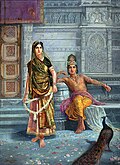
File:Radha and Krishna by DHURANDHAR MV.jpg|Gopika [[Radha]] with Gopal [[Krishna]], a 1915 painting | |||
File:Krishna dances in the Raslila with the Gopis.jpg|[[Raslila]] of Krishna with [[Radha]] and gopis | |||
File:Gopi Talab Dwarka during Dwaraka DWARASPDB 2015 (19).jpg|Gopi Talab dedicated to gopis in [[Dwarka]] | |||
</gallery> | |||
== See also == | == See also == | ||
*[[Ashtasakhi]] | |||
*[[Raslila]] | |||
*[[Chaitanya Mahaprabhu]] | *[[Chaitanya Mahaprabhu]] | ||
*[[Gita Govinda]] | *[[Gita Govinda]] | ||
*[[ | *[[Lalita Sakhi]] | ||
==References== | ==References== | ||
| Line 39: | Line 88: | ||
== External links == | == External links == | ||
{{commons category|Gopis}} | {{commons category|Gopis}} | ||
*[http://www.vrindavan.de/vrindavana.htm The Residents of Eternal Vrindavana] | *[http://www.vrindavan.de/vrindavana.htm The Residents of Eternal Vrindavana] | ||
*[https://web.archive.org/web/20040906103532/http://naturalnirvana.com/Braja-Mandala/Braja-Spiritual/Gopis.htm The Eight Main Gopis | *[https://web.archive.org/web/20040906103532/http://naturalnirvana.com/Braja-Mandala/Braja-Spiritual/Gopis.htm The Eight Main Gopis (Ashtasakhi)] | ||
*[https://web.archive.org/web/20060524113034/http://www.mayapur.info/main/deity_pictures.html Deity Gallery: Radha-Madhava | *[https://web.archive.org/web/20060524113034/http://www.mayapur.info/main/deity_pictures.html Deity Gallery: Radha-Madhava and the Eight Gopis] | ||
*[https://web.archive.org/web/20050922091541/http://www.yogapitha.org/BrajYogaPitha.htm Diagram of the Yoga Pitha in Vrindavana] | *[https://web.archive.org/web/20050922091541/http://www.yogapitha.org/BrajYogaPitha.htm Diagram of the Yoga Pitha in Vrindavana] | ||
*[https://iskcondwarka.org/blogs/untold-facts-of-lord-krishna-and-radha/ Srimati Radharani and other Personalities] | *[https://iskcondwarka.org/blogs/untold-facts-of-lord-krishna-and-radha/ Srimati Radharani and other Personalities] | ||
* [http://www.ashtasakhimandir.org/ Shree Radha Raasbihiari Ashtasakhi Temple, Vrindavan] | |||
{{HinduMythology}} | {{HinduMythology}} | ||
| Line 50: | Line 100: | ||
[[Category:Culture of Uttar Pradesh]] | [[Category:Culture of Uttar Pradesh]] | ||
[[Category:Consorts of Krishna]] | [[Category:Consorts of Krishna]] | ||
[[Category:Regional Hindu goddesses]] | |||
[[Category:Hindu given names]] | |||
Revision as of 08:20, 18 February 2026
| Gopis | |
|---|---|
 | |
| Other names | Krishnasakhi, Krishnapreyasi |
| Devanagari | गोपी |
| Sanskrit transliteration | Gopi |
| Venerated in | Radha Vallabh Sampradaya, Nimbarka Sampradaya, Gaudiya Vaishnavism, Pushtimarg |
| Affiliation | Avatar of Radha,[1] Krishnaism, Vaishnavism |
| Abode | Goloka, Vrindavan, Barsana |
| Texts | Brahma Vaivarta Purana, Garga Samhita, Gita Govinda, Bhagavata Purana, Tiruppavai |
| Gender | Female |
| Region | Braj region |
| Temple | Ashtasakhi Temple in Vrindavan |
| Festivals | Sharad Purnima, Kartik Purnima, Holi, Lathmar Holi |
| Personal information | |
| Born | |
| Consort | Krishna |
| Part of a series on |
| Vaishnavism |
|---|
 |
 Hinduism portal Hinduism portal |
Gopi (Sanskrit: गोपी, IAST: Gopī) or Gopika in Hinduism are commonly referred to the group of milkmaids of the Braj region in India. They are regarded by Hindus as the consorts and devotees of Krishna and are venerated for their unconditional love and devotion (Bhakti) to him as described in Bhagavata Purana and other Puranic literature.[2] Gopis are often considered as the expansion of Radha, the chief consort of Krishna.[3][4][5] The Raslila of gopis with Krishna has inspired various traditional performance art forms and literatures.[6]
Gopi (Sanskrit: गोपी, IAST: Gopī) when used as a male name of Indian origin is a short form of the name Gopala Krishna, literally translates to "cow-protector Krishna" or "Krishna the cowherd". While traditionally used for both genders, it's more commonly used as a male name, especially within the Indian diaspora and communities.
According to Indian philosopher Jiva Goswami, gopis are considered as the eternal beloved and manifestations of the internal spiritual potency of Krishna. Among the gopis, Radha is the chief gopi and is the personification of the bliss potency (hladini shakti) of Krishna.[7] She alone manifests the stage of mahabhava, or supreme love for Krishna, and holds a place of particularly high reverence and importance in a number of religious traditions.[8]
Etymology
Gopi (गोपी) is a Sanskrit word originating from the word Gopa. In Hinduism, the name Gopika or Gopi is especially used to refer the milkmaids of Braj region.[9] The word Gopis in the plural refers to the group of cowherd women who possess devotion toward Krishna. When it is used in the singular ("Gopi"), it generally refers to Radha, who was the Krishna's favourite gopi.[10]
Prominent gopis
The prominent gopis of Vrindavan are total 108 in numbers. They share the eternal intimate friendship with Radha Krishna. No one can equal or exceed the love they bear for the divine couple.[11] Out of 108 gopis, the primary eight gopis are considered as the foremost of Krishna's devotees after goddess Radharani who is considered as the chief of gopis. Their names are as follows:[12]
- Radha (Chief gopi, Krishna's favourite)
- Lalita
- Vishakha
- Champakalata
- Chitra
- Tungavidya
- Indulekha
- Rangadevi
- Sudevi
All the eight primary gopis are together called as the Ashtasakhi's (eight friends) of Radha and Krishna.
Unconditional love
_-_Krishna,_Radha_and_Gopis_-_71.333_-_Detroit_Institute_of_Arts.jpg)
According to Hindu Vaishnava theology, the stories concerning the gopis are said to exemplify Suddha-bhakti which is described as 'the highest form of unconditional love for God (Krishna). Their spontaneous and unwavering devotion is described in depth in the later chapters of the Bhagavata Purana, within Krishna's Vrindavan pastimes and also in the stories of the sage Uddhava.[12]
For Vaishnava traditions, the most important representation of the gopis' love and devotion for Krishna is a story in the Bhagavata Purana (10.29-33) by the name of Rasa Lila Panchadhyaya, which translates as "the five chapters on the story of the rasa dance". The bhakti or devotion that the gopis express in this story is believed by the Chaitanya tradition to exemplify the highest form of bhakti. In the story, Krishna's flute music attracts the gopis' attention, making them leave behind their families and homes so that they can enjoy devotion of Krishna[10]:
Upon hearing that sweet music,
their passion for him swelling,
The young women of Braj whose
minds were captured by Krishna,
Unaware of one another,
ran off toward the place
Where their beloved was waiting,
with their earrings swinging wildly (Bhagavata Purana 10.29.4)
Gallery
-
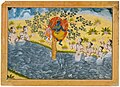 1610 painting of Krishna stealing clothes of Gopis
 -
 Krishna and Gopis, 18th century watercolour in the Bodleian Library
 -
19th century Rajasthan painting depicting Krishna and Gopis
-
-

-
 Gopi Talab dedicated to gopis in Dwarka
_series._1610_Metmuseum.jpg)


.jpg)
See also
References
- ↑ Phyllis G. Jestice (2004). Holy People of the World: A Cross-cultural Encyclopedia. ABC-CLIO. pp. 316–317. ISBN 1576073556.
- ↑ Walters, Holly (2016-12-01). "Playing God: Participant Frameworks in the Ras Lilas of Krishna". The Journal of Religion and Popular Culture. 28 (2–3): 135–144. doi:10.3138/jrpc.28.2-3.3611. ISSN 1703-289X. S2CID 192161968.[dead link]
- ↑ Jestice, Phyllis G. (2004). Holy People of the World: A Cross-cultural Encyclopedia. ABC-CLIO. pp. 316–317. ISBN 978-1-57607-355-1.
- ↑ Hawley, John Stratton (1992). At Play with Krishna: Pilgrimage Dramas from Brindavan. Motilal Banarsidass Publ. p. 17. ISBN 978-81-208-0945-1.
Radha expresses herself in the multiple forms of gopis
- ↑ ब्रह्मवैवर्त पुराण [Brahma Vaivarta Purana] (in हिन्दी). Gitapress. p. 35.
- ↑ Mohapatra, J. (2013). Wellness In Indian Festivals & Rituals. Partridge Publishing. p. 164. ISBN 978-1-4828-1690-7.
- ↑ Mohanty, Prafulla Kumar (2003). "Mask and Creative Symbolisation in Contemporary Oriya Literature : Krishna, Radha and Ahalya". Indian Literature. 47 (2 (214)): 181–189. ISSN 0019-5804. JSTOR 23341400.
- ↑ Francis Bryant, Edwin (2007). Krishna: A Sourcebook. United States of America: Oxford University Press. p. 382. ISBN 978-019-514891-6.
- ↑ Walters, Holly (2016-12-01). "Playing God: Participant Frameworks in the Ras Lilas of Krishna". The Journal of Religion and Popular Culture. 28 (2–3): 135–144. doi:10.3138/jrpc.28.2-3.3611. ISSN 1703-289X. S2CID 192161968.[dead link]
- ↑ 10.0 10.1 Schweig, Graham M. (2007). "Chapter 18: The Divine Feminine in the Theology of Krishna". In Bryant, Edwin (ed.). Krishna : a sourcebook. Oxford: Oxford University Press. pp. 448–450. ISBN 978-0-19-972431-4. OCLC 181731713.
- ↑ "Gopis".
- ↑ 12.0 12.1 Ph.D, Lavanya Vemsani (2016-06-13). Krishna in History, Thought, and Culture: An Encyclopedia of the Hindu Lord of Many Names: An Encyclopedia of the Hindu Lord of Many Names. United States of America: ABC-CLIO. pp. 107–108. ISBN 978-1-61069-211-3.
External links
- The Residents of Eternal Vrindavana
- The Eight Main Gopis (Ashtasakhi)
- Deity Gallery: Radha-Madhava and the Eight Gopis
- Diagram of the Yoga Pitha in Vrindavana
- Srimati Radharani and other Personalities
- Shree Radha Raasbihiari Ashtasakhi Temple, Vrindavan
Hindu deities and texts | ||
|---|---|---|
| Gods |  | |
| Goddesses | ||
| Other deities | ||
| Texts | ||