

m Removed empty portal template using script |
m Improved article clarity and structure |
||
| Line 1: | Line 1: | ||
{{Short description|Plucked string instrument}} | {{Short description|Plucked Hindustani string instrument}} | ||
{{Other uses}} | {{Other uses}} | ||
{{More citations needed|date=April 2021}} | {{More citations needed|date=April 2021}} | ||
| Line 5: | Line 5: | ||
| name = Rudra veena | | name = Rudra veena | ||
| image = Rudraveena1.JPG | | image = Rudraveena1.JPG | ||
| image_capt = Rudra veena | |||
| background = string | | background = string | ||
| names = Rudra | | names = Rudra vīnā, Been, Bin | ||
| classification = String instrument | | classification = String instrument | ||
| hornbostel_sachs = [[List of musical instruments by Hornbostel–Sachs number: 311.222|311.222]] | | hornbostel_sachs = [[List of musical instruments by Hornbostel–Sachs number: 311.222|311.222]] | ||
| hornbostel_sachs_desc = | | hornbostel_sachs_desc = [[stick zither]] | ||
| inventors = | | inventors = | ||
| musicians = [[Asit Kumar Banerjee]] | | musicians = {{Bulleted list | ||
| builders = | |[[Asit Kumar Banerjee]] | ||
| developed = | |[[Bahauddin Dagar]] (born 1970) | ||
|[[Zia Mohiuddin Dagar]] (1929–1990) | |||
|Shamsuddin Faridi Desai (1938-2011) | |||
|[[Hindraj Divekar]] (1954–2019) | |||
|[[Jyoti Hegde]] | |||
|[[Asad Ali Khan]] (1937–2011) | |||
|[[Bande Ali Khan]] (1826–1890) | |||
|[[Naubat Khan]] | |||
|[[Omrao Khan]] | |||
|[[Rajab Ali Khan]] | |||
|[[Wazir Khan (Rampur)|Wazir Khan]] | |||
|[[Dattatreya Rama Rao Parvatikar|Dattatreya Parvatikar]] (1916–1990) | |||
|[[Bindu Madhav Pathak]] (1935–2004) | |||
|[[Carsten Wicke]] (born 1970) | |||
}} | |||
| builders = | |||
| developed = | |||
| range = | | range = | ||
| articles = [[Veena]], [[Saraswati veena]], [[Vichitra veena]], [[Chitra veena]], [[Pinaka | | articles = [[Veena]], [[Saraswati veena]], [[Vichitra veena]], [[Chitra veena]], [[Pinaka veena]], [[Alapini veena]] | ||
}} | }} | ||
The ''''' | The '''''rudra veena''''' ({{langx|sa|रुद्र वीणा}}) (also spelled '''''rudraveena'''''<ref>{{Cite web|url=https://www.thehindu.com/features/friday-review/music/jyoti-hegde-the-first-female-rudraveena-artist/article7919310.ece|title=Mastering the king of instruments|first=Sowjanya|last=Peddi|date=26 November 2015|access-date=1 December 2021|website=Thehindu.com}}</ref> or '''''rudra vīnā'''''<ref name="collections.nmmusd.org">{{Cite web|url=http://collections.nmmusd.org/India/5267Bin/Bin5267.html|title=Stick Zither with Gourd Resonators (Rudra Vina or Bin), Northern India, at the National Music Museum|website=Collections.nmmusd.org|access-date=1 December 2021}}</ref>), also called the '''''bīn''''' in North India,<ref name="Grove">{{Cite Grove | ||
| last1 = Dick | first1 = Alastair | | last1 = Dick | first1 = Alastair|author1-link=Richard Widdess | ||
| last2 = Widdess | first2 = Richard | | last2 = Widdess | first2 = Richard | ||
| last3 = Bruguière | first3 = Philippe | | last3 = Bruguière | first3 = Philippe | ||
| last4 = Geekie | first4 = Gordon | | last4 = Geekie | first4 = Gordon | ||
| | | title = Vīṇā [veena] | ||
| date = 29 October 2019 | | date = 29 October 2019 | ||
| doi = 10.1093/omo/9781561592630.013.90000347354 | | doi = 10.1093/omo/9781561592630.013.90000347354 | ||
}}{{subscription}}</ref> is a large plucked [[string instrument]] used in [[Hindustani classical music|Hindustani music]], especially [[dhrupad]].<ref name="collections.nmmusd.org"/> It is one of the major types of ''[[veena]]'' played in Indian classical music, notable for its deep bass resonance.<ref name=":1">{{Cite news|url=https://www.tribuneindia.com/2000/20000414/art-trib.htm|title=Rudra veena – re-emerging from oblivion|author=Vandana Shukla|date=14 April 2000|newspaper=[[The Tribune (India)|The Tribune]]|location=Chandigarh, India|access-date=28 July 2025}}</ref> Oral tradition ascribes the instrument to [[Shiva]], the principal deity within Hinduism. | |||
The rudra veena is seen in temple architecture predating the [[Mughal Empire|Mughals]]. It is also mentioned in court records as early as the reign of [[Zayn al-Abidin the Great|Zain-ul Abidin]] (1418–1470),<ref name="Grove" /> and attained particular importance among [[Mughal Empire|Mughal]] court musicians.<ref name="Grove" /> Before [[Indian Independence Act 1947|independence]], rudra veena players, as dhrupad practitioners, were supported by the [[princely state]]s; after independence and the [[political integration of India]], this traditional patronage system ended.<ref name="Darbar">{{Cite web|url=https://www.darbar.org/article/bahauddin-dagar-interview|title=Ustad Bahauddin Dagar interview: 'Dhrupad – flourishing branches, dwindling roots?'|website=Darbar.org|access-date=1 December 2021}}</ref> With the end of this traditional support, dhrupad's popularity in India declined, as did the popularity of the rudra veena.<ref name="Darbar" /> However, in recent years, the rudra veena has seen a resurgence in popularity, driven at least partly by interest among non-Indian musicians.<ref name="Darbar" /><ref name="Outlook">{{cite web| url = https://www.outlookindia.com/website/story/what-is-the-future-of-ancient-rudra-veena-in-hindustani-classical/303139| title = What is the future of ancient rudra veena in Hindustani classical?| date = 17 October 2017}}</ref> | |||
The rudra veena is mentioned in court records as early as the reign of [[ | |||
==Names and etymology== | ==Names and etymology== | ||
The name "rudra veena" comes from [[Rudra]], | The name "rudra veena" comes from [[Rudra]], an epithet of [[Shiva]]; ''rudra vina'' means "the veena of Shiva"<ref name="Grove" /> (compare [[Saraswati veena]]).<ref name="Grove" /> | ||
The North Indian vernacular name "bīn" (sometimes written "bīṇ") is derived from the preexisting root "veena," the term generally used today to refer to a number of South Asian stringed instruments.<ref name="Grove" /> While the origins of "veena" are obscure, one possible derivation is from a pre-Aryan root meaning "bamboo" (possibly Dravidian, as in the Tamil veṟam, "cane," or South Indian bamboo flute, the [[venu]]), a reference to early stick or tube zithers<ref name="Grove" />—as seen in the modern bīn, whose central ''dandi'' tube is still sometimes made from bamboo.<ref name="collections.nmmusd.org"/> | The North Indian vernacular name "bīn" (sometimes written "bīṇ") is derived from the preexisting root "veena," the term generally used today to refer to a number of South Asian stringed instruments.<ref name="Grove" /> While the origins of "veena" are obscure, one possible derivation is from a pre-Aryan root meaning "bamboo" (possibly Dravidian, as in the Tamil veṟam, "cane," or South Indian bamboo flute, the [[venu]]), a reference to early stick or tube zithers<ref name="Grove" />—as seen in the modern bīn, whose central ''dandi'' tube is still sometimes made from bamboo.<ref name="collections.nmmusd.org"/> | ||
==Form and construction== | ==Form and construction== | ||
The rudra veena is classified either as a [[stick zither]]<ref name="collections.nmmusd.org"/> or [[tube zither]]<ref>{{cite web |last1=Knight |first1=Roderick |title=The Knight Revision of | The rudra veena is classified either as a [[stick zither]]<ref name="collections.nmmusd.org"/> or [[tube zither]]<ref>{{cite web |last1=Knight |first1=Roderick |title=The Knight Revision of Hornbostel–Sachs: a new look at musical instrument classification |url=http://www2.oberlin.edu/faculty/rknight/Organology/KnightRev2015.pdf |access-date=13 July 2021 |page=23}}</ref><ref name=":0">{{Cite AV media notes |title=Raga Yaman |first=Renaud |last=Brizard |others=Ustad [[Zia Mohiuddin Dagar]] |date=2018 |type=Sleeve notes |publisher=Ideologic Organ/Editions Mego}}</ref> in the [[Hornbostel–Sachs]] classification system. The veena's body (''dandi'') is a tube of [[bamboo]] or [[teak]] between {{convert|137|and|158|cm|in|abbr=on}} long, attached to two large ''tumba'' [[Resonator (instrument)|resonators]] made from [[calabash]] gourds.<ref name="Grove" /><ref name=":0" /> The ''tumba''s on a rudra veena are around {{convert|34|to|37|cm|in|abbr=on}} in diameter; while veena players once attached ''tumba''s to the ''dandi'' with leather thongs, modern instruments use brass screw tubes to attach the ''tumba''s.<ref name="Grove" /> | ||
Traditionally, the bottom end of the ''dandi'', where the strings attach below the bridge (''jawari''), is finished with a peacock carving.<ref name="Grove" /> This peacock carving is hollow, to enhance the resonance of the instrument.<ref name=":2">Koch, Lars-Christian (direction). ''Rudra vina: der Bau eines nordindischen Saiteninstruments in der Tradition von Kanailal & Bros'' [''Rudra veena: manufacturing of an Indian string instrument in the tradition of Kanailal & Bros''] (DVD) (in English with German and English subtitles). Berlin: Ethnologisches Museum, Staatliche Museen Preussischer Kulturbesitz. 2007. [[OCLC (identifier)|OCLC]] 662735435.</ref> This hollow opens into the tube of the ''dandi'', and is covered directly by the main ''jawari''.<ref name=":2" /> The other end of the instrument, holding most or all of the pegs, is finished with a carved [[makara]].<ref name=":2" /> Like the peacock at the other end and the ''dandi'' tube connecting them, the makara [[Tuning mechanisms for stringed instruments|pegbox]] is also hollow.<ref name=":2" /> | Traditionally, the bottom end of the ''dandi'', where the strings attach below the bridge (''jawari''), is finished with a peacock carving.<ref name="Grove" /> This peacock carving is hollow, to enhance the resonance of the instrument.<ref name=":2">Koch, Lars-Christian (direction). ''Rudra vina: der Bau eines nordindischen Saiteninstruments in der Tradition von Kanailal & Bros'' [''Rudra veena: manufacturing of an Indian string instrument in the tradition of Kanailal & Bros''] (DVD) (in English with German and English subtitles). Berlin: Ethnologisches Museum, Staatliche Museen Preussischer Kulturbesitz. 2007. [[OCLC (identifier)|OCLC]] 662735435.</ref> This hollow opens into the tube of the ''dandi'', and is covered directly by the main ''jawari''.<ref name=":2" /> The other end of the instrument, holding most or all of the pegs, is finished with a carved [[makara]].<ref name=":2" /> Like the peacock at the other end and the ''dandi'' tube connecting them, the makara [[Tuning mechanisms for stringed instruments|pegbox]] is also hollow.<ref name=":2" /> | ||
[[File:Rudraveena.JPG|left|thumb| | [[File:Rudraveena.JPG|left|thumb|upright=1.3|Dagar-vani rudra veena, showing the frets, dandi, carved peacock and makara, and tumbas]] | ||
The rudra veena has twenty-one to twenty-four moveable frets (''parda'') on top of the ''dandi''.<ref name="Grove" /><ref name="Darbar" /><ref name=":0" /> These frets are made of thin plates of brass with flat tops but curved wooden bases to match the shape of the ''dandi'', each about two to four centimeters (0. | The rudra veena has twenty-one to twenty-four moveable frets (''parda'') on top of the ''dandi''.<ref name="Grove" /><ref name="Darbar" /><ref name=":0" /> These frets are made of thin plates of brass with flat tops but curved wooden bases to match the shape of the ''dandi'', each about two to four centimeters (0.75–1.5 inches) high.<ref name="Grove" /><ref name="Outlook" /> While these frets were once attached to the instrument with wax, contemporary veena players use waxed flax ties to attach the frets.<ref name=":0" /><ref name=":1" /><ref name="Grove" /> This allows for players to adjust the frets to the individual microtones (''[[Shruti (music)|shruti]]'') of a [[raga]].<ref name=":0" /> By pulling the string up or down alongside the fret, the veena player can bend the pitch ([[meend]]) by as much as a fifth.<ref name="Grove" /> | ||
A modern rudra veena has a total of seven or eight strings: four main melody strings, two or three ''chikari'' strings (which are used in rhythmic sections of the rag to delineate or emphasize the pulse, or [[Tala (music)|taal]]), and one drone (''laraj'') string.<ref name="Grove" /><ref name=":0" /> These strings are made of steel or bronze, and run from the pegs (and over the nut if coming from the pegbox) down to the peacock, passing over the ''jawari'' near the peacock.<ref name=":2" /> A rudra veena will have three ''jawari''; a main one covering an opening on the hollow peacock, and two smaller ones on the sides of the peacock, supporting the ''chikari'' and drone strings.<ref name=":2" /> These ''jawari'' and other strings supports are traditionally made of [[Sambar deer|Sambar stag]] [[antler]]; however, India has banned trade in Sambar deer antler since 1995, due to the deer's declining population and vulnerable status.<ref name=":2" /><ref>Timmins, R.J.; Kawanishi, K.; Giman, B.; Lynam, A.J.; Chan, B.; Steinmetz, R.; Baral, H. S.; Samba Kumar, N. (2015). "''Rusa unicolor''". ''[[IUCN Red List|IUCN Red List of Threatened Species]]''. '''2015''': e.T41790A85628124.</ref> Strings are tuned by turning the ebony pegs to tighten or loosen the strings; the antler string supports can be moved for fine tuning.<ref name=":2" /> | A modern rudra veena has a total of seven or eight strings: four main melody strings, two or three ''chikari'' strings (which are used in rhythmic sections of the rag to delineate or emphasize the pulse, or [[Tala (music)|taal]]), and one drone (''laraj'') string.<ref name="Grove" /><ref name=":0" /> These strings are made of steel or bronze, and run from the pegs (and over the nut if coming from the pegbox) down to the peacock, passing over the ''jawari'' near the peacock.<ref name=":2" /> A rudra veena will have three ''jawari''; a main one covering an opening on the hollow peacock, and two smaller ones on the sides of the peacock, supporting the ''chikari'' and drone strings.<ref name=":2" /> These ''jawari'' and other strings supports are traditionally made of [[Sambar deer|Sambar stag]] [[antler]]; however, India has banned trade in Sambar deer antler since 1995, due to the deer's declining population and vulnerable status.<ref name=":2" /><ref>Timmins, R. J.; Kawanishi, K.; Giman, B.; Lynam, A. J.; Chan, B.; Steinmetz, R.; Baral, H. S.; Samba Kumar, N. (2015). "''Rusa unicolor''". ''[[IUCN Red List|IUCN Red List of Threatened Species]]''. '''2015''': e.T41790A85628124.</ref> Strings are tuned by turning the ebony pegs to tighten or loosen the strings; the antler string supports can be moved for fine tuning.<ref name=":2" /> | ||
Unlike European stringed instruments, where strings are almost always tuned to the same notes on all instruments—a modern [[cello]], for example, will usually have its open strings tuned to [[Scientific pitch notation|C<sub>2</sub>]] (two [[octave]]s below [[middle C]]), followed by G<sub>2</sub>, D<sub>3</sub>, and then A<sub>3</sub>—the rudra veena follows Hindustani classical practice of a [[Svara#Seven svaras and solfège (sargam)|movable root note or tonic]] ([[Movable do solfege|moveable do]]). The four melody strings are tuned to the ''[[Svara#Seven svaras and solfège (sargam)|ma]]'' a fifth below the tonic; the tonic (''sa''); the ''pa'' a fifth above the tonic; and the ''sa'' an octave above the tonic.<ref name="Grove" /><ref name=":1" /> Thus, if the lowest ''ma'' string was tuned to D<sub>2</sub>, then the four melody strings would be tuned to D<sub>2</sub>, A<sub>2</sub>, E<sub>3</sub>, and A<sub>3</sub>; if the lowest ''ma'' string was instead tuned to | Unlike European stringed instruments, where strings are almost always tuned to the same notes on all instruments—a modern [[cello]], for example, will usually have its open strings tuned to [[Scientific pitch notation|C<sub>2</sub>]] (two [[octave]]s below [[middle C]]), followed by G<sub>2</sub>, D<sub>3</sub>, and then A<sub>3</sub>—the rudra veena follows Hindustani classical practice of a [[Svara#Seven svaras and solfège (sargam)|movable root note or tonic]] ([[Movable do solfege|moveable do]]). The four melody strings are tuned to the ''[[Svara#Seven svaras and solfège (sargam)|ma]]'' a fifth below the tonic; the tonic (''sa''); the ''pa'' a fifth above the tonic; and the ''sa'' an octave above the tonic.<ref name="Grove" /><ref name=":1" /> Thus, if the lowest ''ma'' string was tuned to D<sub>2</sub>, then the four melody strings would be tuned to D<sub>2</sub>, A<sub>2</sub>, E<sub>3</sub>, and A<sub>3</sub>; if the lowest ''ma'' string was instead tuned to B{{music|flat}}<sub>1</sub>, then the four melody strings would be tuned to B{{music|flat}}<sub>1</sub>, F<sub>2</sub>, C<sub>3</sub>, and F<sub>3</sub><ref name="Grove" /> | ||
==History== | ==History== | ||
Its origin is undated; however the instrument is known to be ancient enough and is linked to [[Shiva]].<ref>{{Cite book|url=https://books.google.com/books?id=IRmXx21YVkAC&dq=rudra+veena+origin&pg=PA33|title=Rudra Veena: An Ancient String Musical Instrument|first1=Hindraj|last1=Divekar|first2=Robin D.|last2=Tribhuwan|date=December 5, 2001|publisher=Discovery Publishing House|isbn=978-81-7141-581-6 |via=Google Books}}</ref> | |||
The ''rudra veena'' declined in popularity in part due to the introduction in the early 19th century of the ''[[surbahar]]'', which allowed [[sitar]]ists to more easily present the ''[[alap]]'' sections of slow ''[[dhrupad]]''-style [[raga]]s. In the 20th century, [[Zia Mohiuddin Dagar]] modified and redesigned the rudra veena to use bigger gourds, a thicker tube (''dandi''), thicker steel playing strings (0.45–0.47 mm) and closed ''javari that''. This produced a soft and deep sound when plucked without the use of any [[plectrum]] (''mizrab''). The instrument was further modified as the shruti veena by [[Lalmani Misra]] to establish Bharat's ''Shadja Gram'' and obtain the 22 ''shruti''s.<ref>{{Cite web|url=https://omenad.net/articles/shrutiveena.htm|title=Shruti Veena|website=Omenad.net|access-date=19 April 2021}}</ref> | |||
==Gallery== | ==Gallery== | ||
<gallery> | <gallery> | ||
File:Ranganathaswamy Temple, Srirangam si0563.jpg|Maiden playing the vina. [[Ranganathaswamy Temple, Srirangam#Shrines|Venugopala Shrine]] of [[Ranganathaswamy Temple, Srirangam|Ranganatha Temple]], [[Srirangam]]. Early 17th century. | File:Ranganathaswamy Temple, Srirangam si0563.jpg|Maiden playing the vina. [[Ranganathaswamy Temple, Srirangam#Shrines|Venugopala Shrine]] of [[Ranganathaswamy Temple, Srirangam|Ranganatha Temple]], [[Srirangam]]. Early 17th century. | ||
File:20191207 Jagdish Temple, Udaipur, 0609 7008.jpg|[[Jagdish Temple, Udaipur]], 1651 A.D. Vina resembling rudra veena. | |||
File:Work of Ustad Mansur, British Museum.jpg|Ca. 1605. Portrait of [[Naubat Khan]] by [[Ustad Mansur]], Mughal School ca. 1605, [[British Museum]], London.<ref name="Wade1998">{{cite book|author=Bonnie C. Wade|title=Imaging Sound: An Ethnomusicological Study of Music, Art, and Culture in Mughal India |url=https://archive.org/details/imagingsoundethn0000wade |url-access=registration|date=January 1998|publisher=University of Chicago Press|isbn=978-0-226-86841-7|page=[https://archive.org/details/imagingsoundethn0000wade/page/119 119]}}</ref> The instrument is depicted with two strings. | File:Work of Ustad Mansur, British Museum.jpg|Ca. 1605. Portrait of [[Naubat Khan]] by [[Ustad Mansur]], Mughal School ca. 1605, [[British Museum]], London.<ref name="Wade1998">{{cite book|author=Bonnie C. Wade|title=Imaging Sound: An Ethnomusicological Study of Music, Art, and Culture in Mughal India |url=https://archive.org/details/imagingsoundethn0000wade |url-access=registration|date=January 1998|publisher=University of Chicago Press|isbn=978-0-226-86841-7|page=[https://archive.org/details/imagingsoundethn0000wade/page/119 119]}}</ref> The instrument is depicted with two strings. | ||
File:Naubat Khan Kalawant inscribed.Museum of Fine Arts Boston.jpg|Naubat Khan Kalawant playing a three-stringed rudra veena. | File:Naubat Khan Kalawant inscribed.Museum of Fine Arts Boston.jpg|Naubat Khan Kalawant playing a three-stringed rudra veena. | ||
File:Cropped image from Kedar Ragini, painting by Ruknuddin 1690-1695.jpg|1690-1696 C.E. Man playing rudra veena | File:Cropped image from Kedar Ragini, painting by Ruknuddin 1690-1695.jpg|1690-1696 C.E. Man playing rudra veena | ||
File:Saraswati with bīn on white bird.jpg|Ca. 1700. Saraswati riding a white bird and holding a northern style bīn (rudra vīnā). The instrument is depicted with four strings. | File:Saraswati with bīn on white bird.jpg|Ca. 1700. Saraswati riding a white bird and holding a northern style bīn (rudra vīnā). The instrument is depicted with four strings. | ||
File:Frans Balthazar Solvyns, "Qaplious ou bin, instrument de musique hindou", from "Illustrations de Les Hindous", volume 2 plate 23.jpg|1808-1812. Illustration of a bīn, labeled "qaplious". At the time, the instrument illustrated was fretless; similar to the [[pinaka vina]], it used a stick to slide on the string and | File:Frans Balthazar Solvyns, "Qaplious ou bin, instrument de musique hindou", from "Illustrations de Les Hindous", volume 2 plate 23.jpg|1808-1812. Illustration of a bīn, labeled "qaplious". At the time, the instrument illustrated was fretless; similar to the [[pinaka vina]], it used a stick to slide on the string and choose notes. | ||
File:Miyan Himmat Khan Kalawant playing a bin, page from the Tasrih al-aqvam, by Ghulam Ali Khan.png|1825. Miyan Himmat Khan Kalawant playing a bin, page from the Tasrih al-aqvam. The bin has four main strings that could be fretted and two side strings. | File:Miyan Himmat Khan Kalawant playing a bin, page from the Tasrih al-aqvam, by Ghulam Ali Khan.png|1825. Miyan Himmat Khan Kalawant playing a bin, page from the Tasrih al-aqvam. The bin has four main strings that could be fretted and two side strings. | ||
File:A Bin Player, by William Gibb, from Music and Musical Instruments of India and the Deccan by C R Day.jpg|1891. ''A Bin Player'', by [[William Gibb (artist)|William Gibb]]. The instrument depicted had four main strings that could be fretted and three side strings. | File:A Bin Player, by William Gibb, from Music and Musical Instruments of India and the Deccan by C R Day.jpg|1891. ''A Bin Player'', by [[William Gibb (artist)|William Gibb]]. The instrument depicted had four main strings that could be fretted and three side strings. | ||
File:Bird on rudra veena, string holder, Metropolitan Museum of Art.png|Bird on rudra veena, string holder. | File:Bird on rudra veena, string holder, Metropolitan Museum of Art.png|Bird on rudra veena, string holder. | ||
File:Swami parvatikar playing rudra veena (14170870218).jpg|Veena Maharaj [[Dattatreya Rama Rao Parvatikar]] ( | File:Swami parvatikar playing rudra veena (14170870218).jpg|Veena Maharaj [[Dattatreya Rama Rao Parvatikar]] (1916–1990) playing the Rudra veena | ||
File:Asad Ali Khan.jpg|Ustad [[Asad Ali Khan]] playing the Rudra veena in traditional style | File:Asad Ali Khan.jpg|Ustad [[Asad Ali Khan]] playing the Rudra veena in traditional style | ||
File:Dagar.ogv|Video. A rudra veena or bīn is played by [[Bahauddin Dagar|Mohi Baha'ud-din Dagar]] in dagarbani style. | File:Dagar.ogv|Video. A rudra veena or bīn is played by [[Bahauddin Dagar|Mohi Baha'ud-din Dagar]] in dagarbani style. | ||
| Line 74: | Line 85: | ||
==See also== | ==See also== | ||
{{Portal|India|Music}} | |||
*[[Mohan | *[[Mohan veena]] | ||
== References == | == References == | ||
| Line 81: | Line 92: | ||
== External links == | == External links == | ||
* {{Commons category-inline}} | |||
* | |||
{{Indian musical instruments}} | {{Indian musical instruments}} | ||
Latest revision as of 07:56, 20 February 2026
 | This article needs more citations. (April 2021) |
 Rudra veena | |
| String instrument | |
|---|---|
| Other names | Rudra vīnā, Been, Bin |
| Classification | String instrument |
| Hornbostel–Sachs classification | 311.222 (stick zither) |
| Musicians | |
| |
| More articles or information | |
| Veena, Saraswati veena, Vichitra veena, Chitra veena, Pinaka veena, Alapini veena | |
The rudra veena (Sanskrit: रुद्र वीणा) (also spelled rudraveena[1] or rudra vīnā[2]), also called the bīn in North India,[3] is a large plucked string instrument used in Hindustani music, especially dhrupad.[2] It is one of the major types of veena played in Indian classical music, notable for its deep bass resonance.[4] Oral tradition ascribes the instrument to Shiva, the principal deity within Hinduism.
The rudra veena is seen in temple architecture predating the Mughals. It is also mentioned in court records as early as the reign of Zain-ul Abidin (1418–1470),[3] and attained particular importance among Mughal court musicians.[3] Before independence, rudra veena players, as dhrupad practitioners, were supported by the princely states; after independence and the political integration of India, this traditional patronage system ended.[5] With the end of this traditional support, dhrupad's popularity in India declined, as did the popularity of the rudra veena.[5] However, in recent years, the rudra veena has seen a resurgence in popularity, driven at least partly by interest among non-Indian musicians.[5][6]
Names and etymology[edit | edit source]
The name "rudra veena" comes from Rudra, an epithet of Shiva; rudra vina means "the veena of Shiva"[3] (compare Saraswati veena).[3]
The North Indian vernacular name "bīn" (sometimes written "bīṇ") is derived from the preexisting root "veena," the term generally used today to refer to a number of South Asian stringed instruments.[3] While the origins of "veena" are obscure, one possible derivation is from a pre-Aryan root meaning "bamboo" (possibly Dravidian, as in the Tamil veṟam, "cane," or South Indian bamboo flute, the venu), a reference to early stick or tube zithers[3]—as seen in the modern bīn, whose central dandi tube is still sometimes made from bamboo.[2]
Form and construction[edit | edit source]
The rudra veena is classified either as a stick zither[2] or tube zither[7][8] in the Hornbostel–Sachs classification system. The veena's body (dandi) is a tube of bamboo or teak between 137 and 158 cm (54 and 62 in) long, attached to two large tumba resonators made from calabash gourds.[3][8] The tumbas on a rudra veena are around 34 to 37 cm (13 to 15 in) in diameter; while veena players once attached tumbas to the dandi with leather thongs, modern instruments use brass screw tubes to attach the tumbas.[3]
Traditionally, the bottom end of the dandi, where the strings attach below the bridge (jawari), is finished with a peacock carving.[3] This peacock carving is hollow, to enhance the resonance of the instrument.[9] This hollow opens into the tube of the dandi, and is covered directly by the main jawari.[9] The other end of the instrument, holding most or all of the pegs, is finished with a carved makara.[9] Like the peacock at the other end and the dandi tube connecting them, the makara pegbox is also hollow.[9]

The rudra veena has twenty-one to twenty-four moveable frets (parda) on top of the dandi.[3][5][8] These frets are made of thin plates of brass with flat tops but curved wooden bases to match the shape of the dandi, each about two to four centimeters (0.75–1.5 inches) high.[3][6] While these frets were once attached to the instrument with wax, contemporary veena players use waxed flax ties to attach the frets.[8][4][3] This allows for players to adjust the frets to the individual microtones (shruti) of a raga.[8] By pulling the string up or down alongside the fret, the veena player can bend the pitch (meend) by as much as a fifth.[3]
A modern rudra veena has a total of seven or eight strings: four main melody strings, two or three chikari strings (which are used in rhythmic sections of the rag to delineate or emphasize the pulse, or taal), and one drone (laraj) string.[3][8] These strings are made of steel or bronze, and run from the pegs (and over the nut if coming from the pegbox) down to the peacock, passing over the jawari near the peacock.[9] A rudra veena will have three jawari; a main one covering an opening on the hollow peacock, and two smaller ones on the sides of the peacock, supporting the chikari and drone strings.[9] These jawari and other strings supports are traditionally made of Sambar stag antler; however, India has banned trade in Sambar deer antler since 1995, due to the deer's declining population and vulnerable status.[9][10] Strings are tuned by turning the ebony pegs to tighten or loosen the strings; the antler string supports can be moved for fine tuning.[9]
Unlike European stringed instruments, where strings are almost always tuned to the same notes on all instruments—a modern cello, for example, will usually have its open strings tuned to C2 (two octaves below middle C), followed by G2, D3, and then A3—the rudra veena follows Hindustani classical practice of a movable root note or tonic (moveable do). The four melody strings are tuned to the ma a fifth below the tonic; the tonic (sa); the pa a fifth above the tonic; and the sa an octave above the tonic.[3][4] Thus, if the lowest ma string was tuned to D2, then the four melody strings would be tuned to D2, A2, E3, and A3; if the lowest ma string was instead tuned to B♭1, then the four melody strings would be tuned to B♭1, F2, C3, and F3[3]
History[edit | edit source]
Its origin is undated; however the instrument is known to be ancient enough and is linked to Shiva.[11] The rudra veena declined in popularity in part due to the introduction in the early 19th century of the surbahar, which allowed sitarists to more easily present the alap sections of slow dhrupad-style ragas. In the 20th century, Zia Mohiuddin Dagar modified and redesigned the rudra veena to use bigger gourds, a thicker tube (dandi), thicker steel playing strings (0.45–0.47 mm) and closed javari that. This produced a soft and deep sound when plucked without the use of any plectrum (mizrab). The instrument was further modified as the shruti veena by Lalmani Misra to establish Bharat's Shadja Gram and obtain the 22 shrutis.[12]
Gallery[edit | edit source]
-

-
 Jagdish Temple, Udaipur, 1651 A.D. Vina resembling rudra veena.
 -
![Ca. 1605. Portrait of Naubat Khan by Ustad Mansur, Mughal School ca. 1605, British Museum, London.[13] The instrument is depicted with two strings.](https://upload.wikimedia.org/wikipedia/commons/2/2c/Work_of_Ustad_Mansur%2C_British_Museum.jpg?utm_source=commons.wikimedia.org&utm_campaign=imageinfo&utm_content=original) Ca. 1605. Portrait of Naubat Khan by Ustad Mansur, Mughal School ca. 1605, British Museum, London.[13] The instrument is depicted with two strings.
Ca. 1605. Portrait of Naubat Khan by Ustad Mansur, Mughal School ca. 1605, British Museum, London.[13] The instrument is depicted with two strings. -
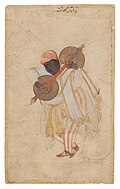 Naubat Khan Kalawant playing a three-stringed rudra veena.
 -
 1690-1696 C.E. Man playing rudra veena
 -
 Ca. 1700. Saraswati riding a white bird and holding a northern style bīn (rudra vīnā). The instrument is depicted with four strings.
 -
 1808-1812. Illustration of a bīn, labeled "qaplious". At the time, the instrument illustrated was fretless; similar to the pinaka vina, it used a stick to slide on the string and choose notes.
 -
 1825. Miyan Himmat Khan Kalawant playing a bin, page from the Tasrih al-aqvam. The bin has four main strings that could be fretted and two side strings.
 -
 1891. A Bin Player, by William Gibb. The instrument depicted had four main strings that could be fretted and three side strings.
 -
 Bird on rudra veena, string holder.
 -
 Veena Maharaj Dattatreya Rama Rao Parvatikar (1916–1990) playing the Rudra veena
 -
 Ustad Asad Ali Khan playing the Rudra veena in traditional style
 -
Video. A rudra veena or bīn is played by Mohi Baha'ud-din Dagar in dagarbani style.


![Ca. 1605. Portrait of Naubat Khan by Ustad Mansur, Mughal School ca. 1605, British Museum, London.[13] The instrument is depicted with two strings.](/wiki/File:Work_of_Ustad_Mansur,_British_Museum.jpg)


.jpg)

See also[edit | edit source]

References[edit | edit source]
- ↑ Peddi, Sowjanya (26 November 2015). "Mastering the king of instruments". Thehindu.com. Retrieved 1 December 2021.
- ↑ 2.0 2.1 2.2 2.3 "Stick Zither with Gourd Resonators (Rudra Vina or Bin), Northern India, at the National Music Museum". Collections.nmmusd.org. Retrieved 1 December 2021.
- ↑ 3.00 3.01 3.02 3.03 3.04 3.05 3.06 3.07 3.08 3.09 3.10 3.11 3.12 3.13 3.14 3.15 3.16 Dick, Alastair; Widdess, Richard; Bruguière, Philippe; Geekie, Gordon (29 October 2019). "Vīṇā [veena]". Grove Music Online (8th ed.). Oxford University Press. doi:10.1093/omo/9781561592630.013.90000347354. ISBN 978-1-56159-263-0. (subscription, Bharatlibrary access, or UK public library membership required)(subscription required)
- ↑ 4.0 4.1 4.2 Vandana Shukla (14 April 2000). "Rudra veena – re-emerging from oblivion". The Tribune. Chandigarh, India. Retrieved 28 July 2025.
- ↑ 5.0 5.1 5.2 5.3 "Ustad Bahauddin Dagar interview: 'Dhrupad – flourishing branches, dwindling roots?'". Darbar.org. Retrieved 1 December 2021.
- ↑ 6.0 6.1 "What is the future of ancient rudra veena in Hindustani classical?". 17 October 2017.
- ↑ Knight, Roderick. "The Knight Revision of Hornbostel–Sachs: a new look at musical instrument classification" (PDF). p. 23. Retrieved 13 July 2021.
- ↑ 8.0 8.1 8.2 8.3 8.4 8.5 Brizard, Renaud (2018). Raga Yaman (Sleeve notes). Ustad Zia Mohiuddin Dagar. Ideologic Organ/Editions Mego.
- ↑ 9.0 9.1 9.2 9.3 9.4 9.5 9.6 9.7 Koch, Lars-Christian (direction). Rudra vina: der Bau eines nordindischen Saiteninstruments in der Tradition von Kanailal & Bros [Rudra veena: manufacturing of an Indian string instrument in the tradition of Kanailal & Bros] (DVD) (in English with German and English subtitles). Berlin: Ethnologisches Museum, Staatliche Museen Preussischer Kulturbesitz. 2007. OCLC 662735435.
- ↑ Timmins, R. J.; Kawanishi, K.; Giman, B.; Lynam, A. J.; Chan, B.; Steinmetz, R.; Baral, H. S.; Samba Kumar, N. (2015). "Rusa unicolor". IUCN Red List of Threatened Species. 2015: e.T41790A85628124.
- ↑ Divekar, Hindraj; Tribhuwan, Robin D. (December 5, 2001). Rudra Veena: An Ancient String Musical Instrument. Discovery Publishing House. ISBN 978-81-7141-581-6 – via Google Books.
- ↑ "Shruti Veena". Omenad.net. Retrieved 19 April 2021.
- ↑ Bonnie C. Wade (January 1998). Imaging Sound: An Ethnomusicological Study of Music, Art, and Culture in Mughal India. University of Chicago Press. p. 119. ISBN 978-0-226-86841-7.
External links[edit | edit source]
| Wind (Sushir) |  | |
|---|---|---|
| Plucked Stringed (Tat) | ||
| Bowed Stringed (Vitat) | ||
| Membranous Percussion (Avanaddh) | ||
| Non-Membranous Percussion (Ghan) | ||
| Other | ||
| Historical/ possibly extinct | ||
- Pages using the JsonConfig extension
- Bharatpedia articles incorporating the Cite Grove template
- Bharatpedia articles incorporating the Cite Grove template with a doi parameter
- Articles needing additional references from April 2021
- Hindustani musical instruments
- String instruments
- Chordophones
- Indian musical instruments
- Rudra veena players