


→As dynastic capital: More cited referenced image than previous one, on checking wiki-common. Tags: Mobile edit Mobile web edit |
m small fix |
||
| Line 1: | Line 1: | ||
{{short description|Historical city in Bihar, India}} | {{short description|Historical city in Bihar, India}} | ||
{{Use Indian English|date=September 2015}} | {{Use Indian English|date=September 2015}} | ||
{{Use dmy dates|date=May 2020}} | {{Use dmy dates|date=May 2020}} | ||
| Line 12: | Line 11: | ||
| altitude_m = 53 | | altitude_m = 53 | ||
| coordinates = {{coord|25|36|45|N|85|7|42|E|display=inline,title}} | | coordinates = {{coord|25|36|45|N|85|7|42|E|display=inline,title}} | ||
| location = [[Patna district]], [[Bihar]], | | location = [[Patna district]], [[Bihar]], India | ||
| region = [[ | | region = [[India]] | ||
| length = {{convert|14.5|km|mi|abbr=on}} | | length = {{convert|14.5|km|mi|abbr=on}} | ||
| width = {{convert|2.4|km|mi|abbr=on}} | | width = {{convert|2.4|km|mi|abbr=on}} | ||
| Line 22: | Line 21: | ||
| management = [[Archaeological Survey of India]] | | management = [[Archaeological Survey of India]] | ||
}} | }} | ||
{{History of Bihar}} | |||
{{BuddhasHolySites}} | {{BuddhasHolySites}} | ||
'''Pataliputra''' ([[IAST]]: {{IAST|Pāṭaliputra}}), adjacent to modern-day [[Patna]],<ref>{{cite | '''Pataliputra''' ([[IAST]]: {{IAST|Pāṭaliputra}}), adjacent to modern-day [[Patna]], [[Bihar]],<ref>{{cite news|url=https://timesofindia.indiatimes.com/city/patna/unravelling-pataliputra/articleshow/99702402.cms?from=mdr|title=Unravelling Pataliputra|newspaper=The Times of India |date=23 April 2023 }}</ref> was a city in [[ancient India]], originally built by [[Magadha (Mahajanapada)|Magadha]] ruler [[Ajatashatru]] in 490 BCE, as a small fort ({{IAST|Pāṭaligrāma}}) near the [[Ganges]] river.<ref name="A History of India">{{Citation|last1 = Kulke |first1= Hermann|last2= Rothermund|first2= Dietmar|year= 2004|title= A History of India|publisher= 4th edition. Routledge, Pp. xii, 448|isbn= 978-0-415-32920-0}}.</ref><ref>{{cite web|url=https://theprint.in/opinion/it-took-40-yrs-to-find-first-traces-of-ashokas-pataliputra-now-we-must-find-the-rest/1766398/|title=It took 40 yrs to find first traces of Ashoka's Pataliputra. Now, we must find the rest|website=[[ThePrint]] |date=18 September 2023 }}</ref> [[Udayin]] laid the foundation of the city of Pataliputra at the confluence of two rivers, the [[Son River|Son]] and the [[Ganges]]. He shifted his capital from [[Rajgir|Rajgriha]] to Pataliputra due to the latter's central location in the empire.<ref>{{Cite book |url=https://books.google.com/books?id=1fXR99iIUuEC&q=Rajgriha+to+Pataliputra+due+to+the+latter's+central+location+in+the+empire |title=Census of India, 1981: District census handbook. A. Village & town directory ; B. Village & townwise primary census abstract |date=1984 |publisher=Controller of Publications |pages=2 |language=en}}</ref> | ||
It became the capital of major powers in ancient India, such as the [[Shaishunaga dynasty|Shishunaga Empire]] ({{Circa|413}}–345 BCE), [[Nanda Empire]] ({{Circa|460 or 420|325 BCE}}), the [[Maurya Empire]] ({{Circa|320}}–180 BCE), the [[Gupta Empire]] ({{Circa|320}}–550 CE), and the [[Pala Empire]] ({{Circa|750}}–1200 CE). During the Maurya period (see below), it became one of the [[List of largest cities throughout history|largest cities in the world]]. As per the Greek diplomat, traveler and historian [[Megasthenes]], during the [[Maurya Empire|Mauryan Empire]] ({{Circa|320}}–180 BCE) it was among the first cities in the world to have a highly efficient form of [[Self-Government|local self government]].<ref>{{cite book |last1=Schwanbeck |first1=E.A. |title=Ancient India as described by Megasthenes and Arrian (First published 1657) |date=4 October 2008 |publisher=Bibliolife |edition=23 }}</ref> | It became the capital of major powers in ancient India, such as the [[Shaishunaga dynasty|Shishunaga Empire]] ({{Circa|413}}–345 BCE), [[Nanda Empire]] ({{Circa|460 or 420|325 BCE}}), the [[Maurya Empire]] ({{Circa|320}}–180 BCE), the [[Gupta Empire]] ({{Circa|320}}–550 CE), and the [[Pala Empire]] ({{Circa|750}}–1200 CE). During the Maurya period (see below), it became one of the [[List of largest cities throughout history|largest cities in the world]]. As per the Greek diplomat, traveler and historian [[Megasthenes]], during the [[Maurya Empire|Mauryan Empire]] ({{Circa|320}}–180 BCE) it was among the first cities in the world to have a highly efficient form of [[Self-Government|local self government]].<ref>{{cite book |last1=Schwanbeck |first1=E.A. |title=Ancient India as described by Megasthenes and Arrian (First published 1657) |date=4 October 2008 |publisher=Bibliolife |edition=23 }}</ref> | ||
The location of the site was first identified in modern times in 1892 by [[Laurence Waddell]], published as ''Discovery | The location of the site was first identified in modern times in 1892 by [[Laurence Waddell]], published as ''Discovery of the Exact Site of Asoka's Classic Capital''.<ref>[https://archive.org/details/in.ernet.dli.2015.70450/page/n7/mode/2up Discovery Of The Exact Site Of Asoka's Classic Capital], 1892</ref> Extensive archaeological excavations have been made in the vicinity of modern Patna.<ref>"Patna". Encyclopædia Britannica. Encyclopædia Britannica Online. Encyclopædia Britannica Inc., 2013. Web. 13 Dec. 2013 <{{cite web |url=https://www.britannica.com/EBchecked/topic/446536/Patna |title=Patna | India |access-date=2011-01-30 |url-status=live |archive-url=https://web.archive.org/web/20111130062709/https://www.britannica.com/EBchecked/topic/446536/Patna |archive-date=30 November 2011}}>.</ref><ref>{{cite web|url=http://www.telegraphindia.com/1160204/jsp/bihar/story_67304.jsp|title=Heritage wall for Metro corridor plan|url-status=dead|archive-url=https://web.archive.org/web/20161122154335/http://www.telegraphindia.com/1160204/jsp/bihar/story_67304.jsp|archive-date=22 November 2016}}</ref> Excavations early in the 20th century around Patna revealed clear evidence of large fortification walls, including reinforcing wooden trusses.<ref>{{cite news|url=http://timesofindia.indiatimes.com/city/patna/A-relic-of-Mauryan-era/articleshow/14035973.cms|title=A relic of Mauryan era|website=[[The Times of India]] |date=12 June 2012 |url-status=live|archive-url=https://web.archive.org/web/20171127032306/https://timesofindia.indiatimes.com/city/patna/A-relic-of-Mauryan-era/articleshow/14035973.cms|archive-date=27 November 2017}}</ref><ref>[[Valerie Hansen]] ''Voyages in World History, Volume 1 to 1600, 2e, Volume 1'' pp. 69 [[Cengage Learning]], 2012</ref> | ||
==Etymology== | ==Etymology== | ||
In the [[Sanskrit]] language, "Pāṭali-" refers to the ''pāṭalī ''tree (''[[Stereospermum chelonoides|Bignonia suaveolens]]''),<ref name=MW2011>{{cite book|vauthors=|title=A Sanskrit English Dictionary: Etymologically and Philologically Arranged|edition=16th Reprint|chapter=Pāṭali|pages=615|publisher=Motilal Banarsidass Publishing House|location=New Delhi|year=2011|isbn=978-8120831056|chapter-url=https://books.google.com/books?id=8KFPBl9lLRcC&pg=PA615}}</ref> while "-putrá" (पुत्र) means "son". | In the [[Sanskrit]] language, "Pāṭali-" refers to the ''pāṭalī ''tree (''[[Stereospermum chelonoides|Bignonia suaveolens]]''),<ref name=MW2011>{{cite book|vauthors=|title=A Sanskrit English Dictionary: Etymologically and Philologically Arranged|edition=16th Reprint|chapter=Pāṭali|pages=615|publisher=Motilal Banarsidass Publishing House|location=New Delhi|year=2011|isbn=978-8120831056|chapter-url=https://books.google.com/books?id=8KFPBl9lLRcC&pg=PA615}}</ref> while "-putrá" (पुत्र) means "son". | ||
One traditional etymology<ref>[https://books.google.com/books?id=HT0TAAAAYAAJ&dq=etymology&pg=PA677 Encyclopaedia of Religion and Ethics, p.677]</ref> holds that the city was named after the plant.<ref>''Folklore'', Vol. 19, No. 3 (30 September 1908), [https://www.jstor.org/stable/1254534?seq=3 pp. 349–350] {{webarchive|url=https://web.archive.org/web/20180510201750/https://www.jstor.org/stable/1254534?seq=3 |date=10 May 2018 }}</ref> Indeed, according to the ''[[Mahāparinibbāṇa Sutta]]'' ([[Sutra|Sutta]] 16 of the ''[[Dīgha Nikāya]]''), Pāṭaliputta was the place "where the seedpods of the Pāṭali plant break open".<ref name=DN16>{{cite web|title=Mahāparinibbāṇa Sutta (DN 16), translated from the Pali by Ṭhānissaro Bhikkhu|work=[[Dīgha Nikāya]] of the [[Pali Canon]]|publisher=dhammatalks.org|year=2022|url=https://www.dhammatalks.org/suttas/DN/DN16.html|accessdate=9 October 2022}}</ref> Another tradition says that {{IAST|Pāṭaliputra}} means the son of {{IAST|Pāṭali}}, who was the daughter of a certain Raja Sudarsan.<ref>[https://books.google.com/books?id=CbsidphI1LMC&pg=PA182 Journal of Francis Buchanan (1812), p.182]</ref> As it was originally known as {{IAST|Pāṭali-grāma}} ("{{IAST|Pāṭali}} village"), some scholars believe that {{IAST|Pāṭaliputra}} is a transformation of {{IAST|Pāṭalipura}}, "{{IAST|Pāṭali}} town".<ref>''Language'', Vol. 4, No. 2 (June , 1928), [https://www.jstor.org/stable/408792 pp. 101–105] {{webarchive|url=https://web.archive.org/web/20180510201750/https://www.jstor.org/stable/408792 |date=10 May 2018 }}</ref> Pataliputra was also called ''Kusumapura'' (city of flowers). | One traditional etymology<ref>[https://books.google.com/books?id=HT0TAAAAYAAJ&dq=etymology&pg=PA677 Encyclopaedia of Religion and Ethics, p.677]</ref> holds that the city was named after the plant.<ref>''Folklore'', Vol. 19, No. 3 (30 September 1908), [https://www.jstor.org/stable/1254534?seq=3 pp. 349–350] {{webarchive|url=https://web.archive.org/web/20180510201750/https://www.jstor.org/stable/1254534?seq=3 |date=10 May 2018 }}</ref> Indeed, according to the ''[[Mahāparinibbāṇa Sutta]]'' ([[Sutra|Sutta]] 16 of the ''[[Dīgha Nikāya]]''), Pāṭaliputta was the place "where the seedpods of the Pāṭali plant break open".<ref name=DN16>{{cite web|title=Mahāparinibbāṇa Sutta (DN 16), translated from the Pali by Ṭhānissaro Bhikkhu|work=[[Dīgha Nikāya]] of the [[Pali Canon]]|publisher=dhammatalks.org|year=2022|url=https://www.dhammatalks.org/suttas/DN/DN16.html|accessdate=9 October 2022}}</ref> Another tradition says that {{IAST|Pāṭaliputra}} means the son of {{IAST|Pāṭali}}, who was the daughter of a certain Raja Sudarsan.<ref>[https://books.google.com/books?id=CbsidphI1LMC&pg=PA182 Journal of Francis Buchanan (1812), p.182]</ref> As it was originally known as {{IAST|Pāṭali-grāma}} ("{{IAST|Pāṭali}} village"), some scholars believe that {{IAST|Pāṭaliputra}} is a transformation of {{IAST|Pāṭalipura}}, "{{IAST|Pāṭali}} town".<ref>''Language'', Vol. 4, No. 2 (June, 1928), [https://www.jstor.org/stable/408792 pp. 101–105] {{webarchive|url=https://web.archive.org/web/20180510201750/https://www.jstor.org/stable/408792 |date=10 May 2018 }}</ref> Pataliputra was also called ''Kusumapura'' (city of flowers). | ||
==History== | ==History== | ||
The Pataliputra is mentioned in early Buddhist text [[Mahaparinibbana Sutta]]<ref name="DN16"/> but no mention of Pataliputra in written sources prior to the early [[Jain]] and Buddhist texts (the [[Pali Canon]] and [[Āgama (Buddhism)|Āgamas]]), where it appears as the village of Pataligrama and is omitted from a list of major cities in the region.<ref name="Early_Buddhist_Texts">{{Citation | |||
|last1 = Sujato | |last1 = Sujato | ||
|first1 = Bhikkhu | |first1 = Bhikkhu | ||
| Line 45: | Line 45: | ||
|url = https://ocbs.org/wp-content/uploads/2015/09/authenticity.pdf | |url = https://ocbs.org/wp-content/uploads/2015/09/authenticity.pdf | ||
|section = 1.1.5 | |section = 1.1.5 | ||
|url-status = | |url-status = live | ||
|archive-url = https://web.archive.org/web/20171120102236/https://ocbs.org/wp-content/uploads/2015/09/authenticity.pdf | |archive-url = https://web.archive.org/web/20171120102236/https://ocbs.org/wp-content/uploads/2015/09/authenticity.pdf | ||
|archive-date = 20 November 2017}}. | |archive-date = 20 November 2017}}. | ||
</ref> Early Buddhist sources report a city being built in the vicinity of the village towards the end of the Buddha's life; this generally agrees with archaeological evidence showing urban development occurring in the area no earlier than the 3rd or 4th Century BCE.<ref name="Early_Buddhist_Texts"/> In 303 BCE, Greek historian and ambassador [[Megasthenes]] mentioned Pataliputra as a city in his work Indika.<ref>{{cite news |last=Tripathi |first=Piyush Kumar |date=16 July 2015 |title=Realty to broaden horizon |url=http://www.telegraphindia.com/1150716/jsp/bihar/story_31789.jsp |location=Calcutta |newspaper=The Telegraph |url-status=dead |archive-url=https://web.archive.org/web/20150716095624/http://www.telegraphindia.com/1150716/jsp/bihar/story_31789.jsp |archive-date=16 July 2015}}</ref>[[Diodorus]], quoting [[Iambulus]] mention that the king of Pataliputra | </ref> Early Buddhist sources report a city being built in the vicinity of the village towards the end of the Buddha's life; this generally agrees with archaeological evidence showing urban development occurring in the area no earlier than the 3rd or 4th Century BCE.<ref name="Early_Buddhist_Texts"/> In 303 BCE, Greek historian and ambassador [[Megasthenes]] mentioned Pataliputra as a city in his work Indika.<ref>{{cite news |last=Tripathi |first=Piyush Kumar |date=16 July 2015 |title=Realty to broaden horizon |url=http://www.telegraphindia.com/1150716/jsp/bihar/story_31789.jsp |location=Calcutta |newspaper=The Telegraph |url-status=dead |archive-url=https://web.archive.org/web/20150716095624/http://www.telegraphindia.com/1150716/jsp/bihar/story_31789.jsp |archive-date=16 July 2015}}</ref> [[Diodorus]], quoting [[Iambulus]] mention that the king of Pataliputra was "friendly to the Greeks".<ref>[https://penelope.uchicago.edu/Thayer/E/Roman/Texts/Diodorus_Siculus/2B*.html#55 DIODORUS SICULUS -LIBRARY OF HISTORY-Book II, 60]</ref> | ||
The city of Pataliputra was formed by fortification of a village by [[Haryanka]] ruler [[Ajatashatru]], son of [[Bimbisara]].{{sfn|Sastri|1988|p=11}} | The city of Pataliputra was formed by fortification of a village by [[Haryanka]] ruler [[Ajatashatru]], son of [[Bimbisara]].{{sfn|Sastri|1988|p=11}} | ||
| Line 61: | Line 61: | ||
|isbn=978-0-14-013835-1 | |isbn=978-0-14-013835-1 | ||
}}. | }}. | ||
</ref>{{page needed|date=August 2016}} Situated at the confluence of the [[Ganges]], [[Gandaki River|Gandhaka]] and [[Son River|Son]] rivers, Pataliputra formed a "water fort, or ''jaldurga''".<ref>The Pearson Indian History Manual, Pearson Education India, A94.</ref> Its position helped it dominate the riverine trade of the [[Indo-Gangetic | </ref>{{page needed|date=August 2016}} Situated at the confluence of the [[Ganges]], [[Gandaki River|Gandhaka]] and [[Son River|Son]] rivers, Pataliputra formed a "water fort, or ''jaldurga''".<ref>The Pearson Indian History Manual, Pearson Education India, A94.</ref> Its position helped it dominate the riverine trade of the [[Indo-Gangetic Plain]] during [[Magadha (Mahajanapada)|Magadha]]'s early imperial period. It was a great centre of trade and commerce and attracted merchants and intellectuals, such as the famed [[Chanakya]], from all over India. | ||
Two important early Buddhist councils are recorded in early Buddhist texts as being held here, the second session of the [[Second Buddhist council]] in the [[Ashoka|reign of Ashoka]], 35 years after the first session held in [[Vaisali]] and the [[Third Buddhist council]].<ref>{{cite journal|author=Lwin, Phyu Mar| title=The Buddhist Councils: The Movement to Great Schism|journal=The Journal of International Association of Buddhist Universities | Two important early Buddhist councils are recorded in early Buddhist texts as being held here, the second session of the [[Second Buddhist council]] in the [[Ashoka|reign of Ashoka]], 35 years after the first session held in [[Vaisali]] and the [[Third Buddhist council]].<ref>{{cite journal|author=Lwin, Phyu Mar| title=The Buddhist Councils: The Movement to Great Schism|journal=The Journal of International Association of Buddhist Universities |volume=11|year=2018| issue=2| pages=303–314|url=https://so06.tci-thaijo.org/index.php/Jiabu/article/download/219925/152151 |access-date=28 August 2022}}</ref> | ||
Jain and Hindu sources identify [[Haryanka dynasty#Udayabhadra|Udayabhadra]], son of [[Ajatashatru]], as the king who first established Pataliputra as the capital of Magadha.<ref name="Early_Buddhist_Texts"/> The Sangam Tamil epic [[Akanaṉūṟu]] mentions Nanda kings ruling Pataliputra.<ref name="SangaIlakkiyam_3">{{cite book | Jain and Hindu sources identify [[Haryanka dynasty#Udayabhadra|Udayabhadra]], son of [[Ajatashatru]], as the king who first established Pataliputra as the capital of Magadha.<ref name="Early_Buddhist_Texts"/> The Sangam Tamil epic [[Akanaṉūṟu]] mentions Nanda kings ruling Pataliputra.<ref name="SangaIlakkiyam_3">{{cite book | ||
| Line 80: | Line 80: | ||
===Capital of the Maurya Empire=== | ===Capital of the Maurya Empire=== | ||
Girnar fifth [[Major Rock Edicts|Major Rock Edict]] of Ashoka mention Patliputra: | |||
{{blockquote|(M).They are occupied everywhere, both in '''Pățaliputra''' and in the outlying [......] and whatever other relatives of mine (there are).<br>(N). These Mahamatras of morality [......] whether one is eager for morality [......].<br>(0). For the following purpose has this rescript on morality been written [......]. | |||
-Major Rock Edict No.5, Girnar, [[E. Hultzsch]] translation<ref>{{Cite book|url=https://archive.org/details/dli.ministry.25989/page/n146/mode/1up|title=Inscriptions of Asoka, Vol. I|page=11|last=Hultzsch|first=E.|date=1989|publisher=Indological Book House, Varanasi}}</ref>}} | |||
[[File:Mauryan ruins of pillared hall at Kumrahar site of Pataliputra ASIEC 1912-13.jpg|thumb|left|Ruins of the pillared hall at [[Kumrahar]] site at Pataliputra]] | [[File:Mauryan ruins of pillared hall at Kumrahar site of Pataliputra ASIEC 1912-13.jpg|thumb|left|Ruins of the pillared hall at [[Kumrahar]] site at Pataliputra]] | ||
[[File:Pataliputra_capital._Department_of_Archaeology,_Government_of_India.jpg|thumb|left|The [[Pataliputra capital]], discovered at the [[Bulandi Bagh]] site. 4th-3rd c. BCE]] | [[File:Pataliputra_capital._Department_of_Archaeology,_Government_of_India.jpg|thumb|left|The [[Pataliputra capital]], discovered at the [[Bulandi Bagh]] site. 4th-3rd c. BCE]] | ||
[[File:Mauryan remains of a wooden palissade at Bulandi Bagh site of Pataliputra ASI 1926-27.jpg|thumb|left|Mauryan remains of a wooden palissade at Bulandi Bagh site]] | [[File:Mauryan remains of a wooden palissade at Bulandi Bagh site of Pataliputra ASI 1926-27.jpg|thumb|left|Mauryan remains of a wooden palissade at Bulandi Bagh site]] | ||
During the reign of Emperor [[Ashoka]] in the 3rd century BCE, it was one of the world's largest cities, with a population of about 150,000–400,000.<ref>{{cite book |title=The Rise of Man in the Gardens of Sumeria: A Biography of L.A. Waddell |first=Christine |last=Preston |publisher=Sussex Academic Press |year=2009 |page=49 |isbn=9781845193157 |url=https://books.google.com/books?id=ujn2fPCwaUAC&pg=PA49 }}</ref> The city is estimated to have had a surface of 25.5 square kilometers, and a circumference of 33.8 kilometers, and was in the shape of a parallelogram and had 64 gates (that is, approximately one gate every 500 meters).<ref>{{cite book |title=Fortified Cities of Ancient India: A Comparative Study |first=Dieter |last=Schlingloff |publisher=Anthem Press |year=2014 |page=49 |isbn=9781783083497 |url=https://books.google.com/books?id=nVeWBQAAQBAJ&pg=PA49 }}</ref> Pataliputra reached the pinnacle of prosperity when it was the capital of the great [[Maurya dynasty|Mauryan Emperors]], [[Chandragupta Maurya]] and Ashoka. The city prospered under the [[Maurya]]s and a Greek ambassador, [[Megasthenes]], resided there and left a detailed account of its splendour, referring to it as "Palibothra": | During the reign of Emperor [[Ashoka]] in the 3rd century BCE, it was one of the world's largest cities, with a population of about 150,000–400,000.<ref>{{cite book |title=The Rise of Man in the Gardens of Sumeria: A Biography of L.A. Waddell |first=Christine |last=Preston |publisher=Sussex Academic Press |year=2009 |page=49 |isbn=9781845193157 |url=https://books.google.com/books?id=ujn2fPCwaUAC&pg=PA49 }}{{Dead link|date=August 2023 |bot=InternetArchiveBot |fix-attempted=yes }}</ref> The city is estimated to have had a surface of 25.5 square kilometers, and a circumference of 33.8 kilometers, and was in the shape of a parallelogram and had 64 gates (that is, approximately one gate every 500 meters).<ref>{{cite book |title=Fortified Cities of Ancient India: A Comparative Study |first=Dieter |last=Schlingloff |publisher=Anthem Press |year=2014 |page=49 |isbn=9781783083497 |url=https://books.google.com/books?id=nVeWBQAAQBAJ&pg=PA49 }}</ref> Pataliputra reached the pinnacle of prosperity when it was the capital of the great [[Maurya dynasty|Mauryan Emperors]], [[Chandragupta Maurya]] and Ashoka. | ||
{{ | |||
{{blockquote|They surpass in power and glory every other people, not only in this quarter, but one may say in all India, their capital being Palibothra, a very large and wealthy city, after which some call the people itself the Palibothri, - nay, even the whole tract along the Ganges. Their king has in his pay a standing army of 600,000 foot-soldiers, 30,000 cavalry, and 9000 elephants : whence may be formed some conjecture as to the vastness of his resources. [[Megasthenes]], in [[Indica (Megasthenes)|Indica]]<ref>{{cite book |title=Ancient India as Described by Megasthenês and Arrian |date=1877 |publisher=Thacker, Spink |page=139 |language=en}}</ref>}} | |||
The city prospered under the [[Maurya]]s and a Greek ambassador, [[Megasthenes]], resided there and left a detailed account of its splendour, referring to it as "Palibothra": | |||
{{blockquote|[[Megasthenes]] says that on one side where it is longest this city extends ten miles in length, and that its breadth is one and threequarters miles; that the city has been surrounded with a ditch in breadth 600 feet, and in depth 45 feet; and that its wall has 570 towers and 64 gates. - [[Arrian]] "The Indica"<ref>[http://www.shsu.edu/~his_ncp/Indica.html Arrian, "The Indica"] {{webarchive|url=https://web.archive.org/web/20120525151841/http://www.shsu.edu/~his_ncp/Indica.html |date=25 May 2012 }}</ref>}} | |||
[[File:Mauryan remains of wooden palissade at Bulandi Bagh site of Pataliputra ASIEC 1912-13.jpg|thumb|Mauryan remains of a wooden palisade discovered at the [[Bulandi Bagh]] site of Pataliputra]] | [[File:Mauryan remains of wooden palissade at Bulandi Bagh site of Pataliputra ASIEC 1912-13.jpg|thumb|Mauryan remains of a wooden palisade discovered at the [[Bulandi Bagh]] site of Pataliputra]] | ||
[[File:Fa | [[File:Fa Hsien at the ruins of Asoka's palace.jpg|thumb|[[Fa-Hien]] at the ruins of Ashoka's palace in Pataliputra in the 4th century CE (artist impression)]] | ||
[[Strabo]] in his [[Geographia]] adds that the city walls were made of wood. These are thought to be the wooden palisades identified during the excavation of Patna.{{sfn|Kosmin|2014|p=42}} | [[Strabo]] in his [[Geographia]] adds that the city walls were made of wood. These are thought to be the wooden palisades identified during the excavation of Patna.{{sfn|Kosmin|2014|p=42}} | ||
{{ | {{blockquote|At the confluence of the Ganges and of another river is situated Palibothra, in length 80, and in breadth 15 [[Stadion (unit)|stadia]]. It is in the shape of a parallelogram, surrounded by a wooden wall pierced with openings through which arrows may be discharged. In front is a ditch, which serves the purpose of defence and of a sewer for the city. - [[Strabo]], "Geographia"<ref>[http://www.gutenberg.org/files/44886/44886-h/44886-h.htm Strabo Geographia Vol 3 Paragraph 36] {{webarchive|url=https://web.archive.org/web/20141116055802/http://www.gutenberg.org/files/44886/44886-h/44886-h.htm |date=16 November 2014 }}</ref>}} | ||
[[Claudius Aelianus|Aelian]], although not expressly quoting Megasthenes nor mentioning Pataliputra, described Indian palaces as superior in splendor to [[Persia]]'s [[Susa]] or [[Ecbatana]]: | [[Claudius Aelianus|Aelian]], although not expressly quoting Megasthenes nor mentioning Pataliputra, described Indian palaces as superior in splendor to [[Persia]]'s [[Susa]] or [[Ecbatana]]: | ||
{{ | {{blockquote|In the royal residences in India where the greatest of the kings of that country live, there are so many objects for admiration that neither [[Memnon (mythology)|Memnon]]'s city of [[Susa]] with all its extravagance, nor the magnificence of [[Ecbatana]] is to be compared with them. (...) In the parks, tame peacocks and pheasants are kept. - [[Claudius Aelianus|Aelian]] in "''[[Claudius Aelianus#De Natura Animalium|De Natura Animalium]]''"<ref>[https://archive.org/details/L449AelianCharacteristicsOfAnimalsIII1217 Aelian, Characteristics of animals, book XIII, Chapter 18], also quoted in The Cambridge History of India, Volume 1, p411</ref>}} | ||
Under Ashoka, most of wooden structure of Pataliputra palace may have been gradually replaced by stone.<ref>{{cite book |url=https://books.google.com/books?id=uXyftdtE1ygC&pg=PA96 |title=Asoka Mookerji Radhakumud |publisher=Motilal Banarsidass Publishing |year=1995 |page=96 |isbn=9788120805828 }}</ref> Ashoka was known to be a great builder, who may have even imported craftsmen from abroad to build royal monuments.<ref>{{cite book |title=Monuments, Power and Poverty in India: From Ashoka to the Raj |first=A. S. |last=Bhalla |publisher=I.B.Tauris |year=2015 |page=18 |isbn=9781784530877 |url=https://books.google.com/books?id=emATBwAAQBAJ&pg=PA18 }}</ref> Pataliputra palace shows decorative influences of the Achaemenid palaces and Persepolis and may have used the help of foreign craftmen.<ref>{{cite journal |url=http://jsr.usb.ac.ir/article_1659_265.html |title=The Analysis of Indian Muria Empire affected from Achaemenid's architecture art |archive-date=2 April 2015 |archive-url=https://web.archive.org/web/20150402144452/http://jsr.usb.ac.ir/article_1659_265.html |journal=Journal of Subcontinent Researches |volume=6 |issue=19 |year=2014 |pages=149–174 }}</ref> Which may be the result of the formative influence of craftsmen employed from Persia following the disintegration of the [[Achaemenid Empire]] after the conquests of [[Alexander the Great]].<ref name="auto1">{{cite book |title=The Archaeology of South Asia: From the Indus to Asoka, c.6500 BCE–200 CE |first1=Robin |last1=Coningham |first2=Ruth |last2=Young |publisher=Cambridge University Press |year=2015 |page=414 |isbn=9780521846974 |url=https://books.google.com/books?id=hB5TCgAAQBAJ&pg=PA414 }}</ref><ref>{{cite web |url=https://archive.org/details/reportonexcavat01waddgoog |title=Report on the excavations at Pātaliputra (Patna); the Palibothra of the Greeks |last=Waddell |first=L. A. (Laurence Austine) |year=1903 |publisher=Calcutta, Bengal secretariat press }}</ref> | Under Ashoka, most of wooden structure of Pataliputra palace may have been gradually replaced by stone.<ref>{{cite book |url=https://books.google.com/books?id=uXyftdtE1ygC&pg=PA96 |title=Asoka Mookerji Radhakumud |publisher=Motilal Banarsidass Publishing |year=1995 |page=96 |isbn=9788120805828 }}</ref> Ashoka was known to be a great builder, who may have even imported craftsmen from abroad to build royal monuments.<ref>{{cite book |title=Monuments, Power and Poverty in India: From Ashoka to the Raj |first=A. S. |last=Bhalla |publisher=I.B.Tauris |year=2015 |page=18 |isbn=9781784530877 |url=https://books.google.com/books?id=emATBwAAQBAJ&pg=PA18 }}</ref> Pataliputra palace shows decorative influences of the Achaemenid palaces and Persepolis and may have used the help of foreign craftmen.<ref>{{cite journal |url=http://jsr.usb.ac.ir/article_1659_265.html |title=The Analysis of Indian Muria Empire affected from Achaemenid's architecture art |archive-date=2 April 2015 |archive-url=https://web.archive.org/web/20150402144452/http://jsr.usb.ac.ir/article_1659_265.html |journal=Journal of Subcontinent Researches |volume=6 |issue=19 |year=2014 |pages=149–174 }}</ref> Which may be the result of the formative influence of craftsmen employed from Persia following the disintegration of the [[Achaemenid Empire]] after the conquests of [[Alexander the Great]].<ref name="auto1">{{cite book |title=The Archaeology of South Asia: From the Indus to Asoka, c.6500 BCE–200 CE |first1=Robin |last1=Coningham |first2=Ruth |last2=Young |publisher=Cambridge University Press |year=2015 |page=414 |isbn=9780521846974 |url=https://books.google.com/books?id=hB5TCgAAQBAJ&pg=PA414 }}</ref><ref>{{cite web |url=https://archive.org/details/reportonexcavat01waddgoog |title=Report on the excavations at Pātaliputra (Patna); the Palibothra of the Greeks |last=Waddell |first=L. A. (Laurence Austine) |year=1903 |publisher=Calcutta, Bengal secretariat press }}</ref> | ||
===Capital of later dynasties=== | ===Capital of later dynasties=== | ||
The city also became a flourishing Buddhist centre boasting a number of important monasteries. It remained the capital of the [[Gupta dynasty]] (3rd–6th centuries) and the [[Pala Dynasty]] (8th-12th centuries). When [[Faxian]] visited the city in 400 A.D, he found the people to be rich and prosperous; they practised virtue and justice.<ref>{{Cite book|last=Beal|first=Samuel|title=Si-Yu-Ki: Buddhist Records of the Western World|publisher=Trubner & Co|year=1884|location=London}}</ref> He found that the nobles and householders of the city had constructed several hospitals in which the poor of all countries, the destitute, the crippled and the diseased can get treatment. They could receive every kind of help gratuitously. Physicians would inspect the diseases, and order them food, drink, and medicines.<ref>{{Cite book|last=Beal|first=Samuel|title=Si-Yu-Ki: Buddhist Records of the Western World|year=1884|location=London}}</ref> | The city also became a flourishing Buddhist centre boasting a number of important monasteries. It remained the capital of the [[Gupta dynasty]] (3rd–6th centuries) and the [[Pala Dynasty]] (8th-12th centuries). When [[Faxian]] visited the city in 400 A.D, he found the people to be rich and prosperous; they practised virtue and justice.<ref>{{Cite book|last=Beal|first=Samuel|title=Si-Yu-Ki: Buddhist Records of the Western World|publisher=Trubner & Co|year=1884|location=London}}</ref> He found that the nobles and householders of the city had constructed several hospitals in which the poor of all countries, the destitute, the crippled and the diseased can get treatment. They could receive every kind of help gratuitously. Physicians would inspect the diseases, and order them food, drink, and medicines.<ref>{{Cite book|last=Beal|first=Samuel|title=Si-Yu-Ki: Buddhist Records of the Western World|year=1884|location=London}}</ref> | ||
===Decline=== | |||
When [[Xuanzang]] visited Pataliputra in the year 637, he found the city in ruins.<!-- Altekar and Mishra 1959, Sinha and Narain 1970, and Singh 1975 --> He wrote that the old city had been completely deserted for many years, and all that was left was a small walled town by the bank of the Ganges, home to no more than about 1,000 people.<!-- Altekar and Mishra 1959, p. 12; also Singh 1975, p. 53-4 --> According to Rajeshwar Prasad Singh, this small town had probably been built after the old city's destruction, as opposed to being a surviving part of the old town.<!-- Singh 1975, p. 53-4 --> Xuanzang wrote that most of the city's old historic buildings had been destroyed, and only their foundation walls remained.<!-- Singh 1975, p. 53 --> One building he noted in particular was an old stupa that was said to be the first of the 84,000 stupas built by Ashoka.<!-- Altekar and Mishra 1959, p. 12; also Sinha and Narain 1970, p. 4 --> Its foundation had sunken into the ground so that only the ornamental top of the dome was visible, and even that was in precarious condition, he wrote.<!-- Singh 1975, p. 57 --> Of the [[Kukkutarama|Kukkuṭārāma]] monastery on the southeast side of the city, only the foundation remained.<!-- Singh 1975, p. 57 --><ref name="Altekar and Mishra 1959">{{cite book |last1=Altekar |first1=A. S. |last2=Mishra |first2=Vijayakanta |author1-link=Anant Sadashiv Altekar |title=Report on Kumrahar Excavations: 1951-1955 |date=1959 |publisher=K. P. Jayaswal Research Institute |location=Patna |url=https://archive.org/details/in.ernet.dli.2015.105374 |access-date=4 August 2023}}</ref>{{rp|12}}<ref name="Singh 1975">{{cite journal |last1=Singh |first1=Rajeshwar Prasad |title=The Decline of Pātaliputra with Special Reference to Geographic Factors |journal=Proceedings of the Indian History Congress |date=1975 |volume=36 |pages=51–62 |jstor=44138834 |url=https://www.jstor.org/stable/44138834 |access-date=4 August 2023}}</ref>{{rp|53–4}}<ref name="Sinha and Narain 1970">{{cite book |last1=Sinha |first1=B. P. |last2=Narain |first2=Lala Aditya |author1-link=Bindeshwari Prasad Sinha |title=Pāṭaliputra Excavation, 1955-56 |date=1970 |publisher=Directorate of Archaeology and Museums, Bihar |location=Patna |url=https://books.google.com/books?id=6RRuAAAAMAAJ |access-date=4 August 2023}}</ref>{{rp|4}} | |||
Pataliputra's decline had probably begun well before Xuanzang's time.<!-- Singh 1975, various pages; Altekar and Mishra 1959, p. 12 --> At least at Kumrahar, archaeological evidence seems to suggest a gradual decline beginning in the 300s, with fewer and less elaborate structures between this period and {{circa}} 600.<!-- Singh 1975, p. 53 --> After that, there are no traces of human activity for a thousand years, and the site seems to have been abandoned.<!-- Singh 1975, p. 53 --><ref name="Singh 1975"/>{{rp|53}} | |||
One likely contributing factor was a shift in the course of the Ganges.<!-- Singh 1975, p. 56 --> As early as Faxian's visit around the year 400, he wrote that Pataliputra was one [[yojana]] (about 10 km) south of the Ganges.<!-- Singh 1975, p. 56 --> The ''[[Varaha Purana|Varāha Purāṇa]]'', from post-Gupta times, indicates that the confluence of the Gandak and the Ganges was then about 10 km north of the present location.<!-- Singh 1975, p. 56 --> Since Pataliputra derived a lot of its prosperity from river-based commerce, being separated from the river probably dampened its economy.<!-- Singh 1975, p. 56 --> A general decline in international trade toward the end of the Gupta period would have had a similar effect.<ref name="Singh 1975"/>{{rp|56}} | |||
A catastrophic flood likely also devastated the city at some point in the late 500s.<!-- Singh 1975, p. 56-7; Altekar and Mishra 1959, p. 12 --> A later Jain work, the ''[[Titlhogali Painniya]]'', records a traditional account of a disastrous flood on the Son River destroying Pataliputra at some point.<!-- Singh 1975, p. 56-7 --> This account describes this flood as happening during the month of [[Bhadra (Hindu calendar)|Bhādrapada]], or September, after 17 days and nights of heavy rain.<!-- Altekar and Mishra 1959, p. 12 --> The flooding on the Son apparently caused the Ganges to overflow as well, and Pataliputra was inundated on multiple sides.<!-- Altekar and Mishra 1959, p. 12; also Singh 1975, p. 57 --> The account describes widespread destruction in Pataliputra, although it also says that the city was rebuilt afterwards.<!-- Altekar and Mishra 1959, p. 12 --><ref name="Altekar and Mishra 1959"/>{{rp|12}}<ref name="Singh 1975"/>{{rp|56–7}} | |||
}}</ref> In a fanciful 1559 book about world geography, the Italian Caius Julius Solinus briefly mentions a powerful Indian kingdom of ''Prasia'' with a capital at Palibotra.<ref>[https://books.google.com/books?id=iz1OAAAAcAAJ Delle cose maravigliose del mondo Tradotto da Giovan Vincenzo Belprato, Count of Antwerp], by Caius Julius Solinus (Solino), 1559, page 209.</ref> Afterwards, [[Sher Shah Suri]] made Pataliputra his capital and changed the name to modern Patna. | A third possible contributing factor is deliberate destruction by invading [[Huna people|Hunas]] in the early 500s.<!-- Singh 1975, p. 54 --> A thick layer of ashes found at the 80-pillar hall at Kumrahar suggests that the building may have been destroyed by fire, possibly corroborating this theory.<!-- Singh 1975, p. 54, 7 --><ref name="Singh 1975"/>{{rp|54, 57}} | ||
===Pala dynasty=== | |||
Pataliputra seems to have recovered somewhat by the early Pala period.<!-- Kind of paraphrasing from Altekar and Mishra --> The [[Dharmapala (emperor)#epigraphs|Khalimpur plate]] of [[Dharmapala (emperor)|Dharmapala]], from the early 800s, gives a vivid description of Pataliputra as a river port and royal encampment.<!-- Altekar and Mishra 1959, p. 13 --> It describes the crowds of boats, elephants, horses, and "limitless foot-soldiers of all the kings of [[Jambudvīpa]] assembled to render homage" to Dharmapala.<!-- Altekar and Mishra 1959, p. 13 --> [[Bindeshwari Prasad Sinha|B. P. Sinha]] interpreted this inscription to mean that Pataliputra was Dharmapala's capital, but [[Anant Sadashiv Altekar|A. S. Altekar]] disputed this, saying that the inscription only refers to Pataliputra as a ''skandhāvāra'', or camp, where Dharmapala stayed while on a campaign or tour.<ref name="Altekar and Mishra 1959"/>{{rp|13}} | |||
While Pataliputra is mentioned in contemporary sources, archaeologists have not found any evidence from the Pala period at Pataliputra.<!-- Sinha and Narain, p. 5 --> At least at Kumrahar, there are no traces of human settlement until the 1600s.<ref name="Sinha and Narain 1970"/>{{rp|5, 8}} | |||
===1500s=== | |||
In a fanciful 1559 book about world geography, the Italian Caius Julius Solinus briefly mentions a powerful Indian kingdom of ''Prasia'' with a capital at Palibotra.<ref>[https://books.google.com/books?id=iz1OAAAAcAAJ Delle cose maravigliose del mondo Tradotto da Giovan Vincenzo Belprato, Count of Antwerp], by Caius Julius Solinus (Solino), 1559, page 209.</ref> Afterwards, [[Sher Shah Suri]] made Pataliputra his capital and changed the name to modern Patna. | |||
==Structure== | ==Structure== | ||
| Line 126: | Line 143: | ||
File:Magadha Expansion (6th-4th centuries BCE).png|Pataliputra served as the capital of the [[Haryanka dynasty]] and the [[Shishunaga dynasty]] of Magadha | File:Magadha Expansion (6th-4th centuries BCE).png|Pataliputra served as the capital of the [[Haryanka dynasty]] and the [[Shishunaga dynasty]] of Magadha | ||
File:Nanda Empire, c.325 BCE.png|Pataliputra served as the capital of the [[Nanda Empire]] | File:Nanda Empire, c.325 BCE.png|Pataliputra served as the capital of the [[Nanda Empire]] | ||
File:Maurya Empire c. | File:Maurya Empire, c.250 BCE 2.png|Pataliputra served as the capital of the [[Maurya Empire]] | ||
File:Sunga map.jpg|Pataliputra served as the capital of the [[Shunga Empire]] | File:Sunga map.jpg|Pataliputra served as the capital of the [[Shunga Empire]] | ||
File:GuptaEmpire300-550.png|Pataliputra served as the capital of the [[Gupta Empire]] | File:GuptaEmpire300-550.png|Pataliputra served as the capital of the [[Gupta Empire]] | ||
| Line 150: | Line 167: | ||
==See also== | ==See also== | ||
{{Portal|India}} | |||
* [[Azimabad]] | * [[Azimabad]] | ||
* [[Names of Patna]] | * [[Names of Patna]] | ||
* [[History of Patna]] | * [[History of Patna]] | ||
* [[Pataliputra Lok Sabha constituency]] | |||
==References== | ==References== | ||
| Line 163: | Line 181: | ||
==Further reading== | ==Further reading== | ||
* Bernstein, Richard (2001). ''Ultimate Journey: Retracing the Path of an Ancient Buddhist Monk (Xuanzang) who crossed Asia in Search of Enlightenment''. Alfred A. Knopf, New York. {{ISBN|0-375-40009-5}} | |||
==External links== | |||
{{Sister project links|voy=yes|d= Q389755}} | |||
{{Authority control|qid= Q389755}} | |||
{{Authority control}} | |||
{{Patna}} | {{Patna}} | ||
{{Patna Division topics}} | {{Patna Division topics}} | ||
[[Category:History of Patna]] | [[Category:History of Patna]] | ||
[[Category:Buddhist pilgrimage sites in India]] | [[Category:Buddhist pilgrimage sites in India]] | ||
[[Category:Former populated places in India]] | [[Category:Former populated places in India]] | ||
[[Category:Former | [[Category:Former capitals in India]] | ||
[[Category:Indo-Aryan archaeological sites]] | [[Category:Indo-Aryan archaeological sites]] | ||
[[Category:Ancient Indian cities]] | [[Category:Ancient Indian cities]] | ||
[[Category:Maurya Empire]] | [[Category:Maurya Empire]] | ||
[[Category:Ancient Indian archaeological sites]] | |||
Latest revision as of 04:27, 14 March 2026
 Plan of Pataliputra, compared to present-day Patna | |
  Shown within India  Pataliputra (Bihar) | |
| Alternative name | Pātaliputtā (Pāli) |
|---|---|
| Location | Patna district, Bihar, India |
| Region | India |
| Coordinates | 25°36′45″N 85°7′42″E / 25.61250°N 85.12833°E |
| Altitude | 53 m (174 ft) |
| Length | 14.5 km (9.0 mi) |
| Width | 2.4 km (1.5 mi) |
| History | |
| Builder | Ajatashatru |
| Founded | 490 BCE |
| Abandoned | Became modern Patna |
| Associated with | Haryankas, Shishunagas, Nandas, Mauryans, Shungas, Guptas, Palas |
| Management | Archaeological Survey of India |
| Part of a series on the |
| History of Bihar |
|---|
 |
| Pilgrimage to |
| Buddha's Holy Sites |
|---|
 |
| The Four Main Sites |
| Four Additional Sites |
| Other Sites |
| Later Sites |
Pataliputra (IAST: Pāṭaliputra), adjacent to modern-day Patna, Bihar,[1] was a city in ancient India, originally built by Magadha ruler Ajatashatru in 490 BCE, as a small fort (Pāṭaligrāma) near the Ganges river.[2][3] Udayin laid the foundation of the city of Pataliputra at the confluence of two rivers, the Son and the Ganges. He shifted his capital from Rajgriha to Pataliputra due to the latter's central location in the empire.[4]
It became the capital of major powers in ancient India, such as the Shishunaga Empire (c. 413–345 BCE), Nanda Empire (c. 460 or 420 – c. 325 BCE), the Maurya Empire (c. 320–180 BCE), the Gupta Empire (c. 320–550 CE), and the Pala Empire (c. 750–1200 CE). During the Maurya period (see below), it became one of the largest cities in the world. As per the Greek diplomat, traveler and historian Megasthenes, during the Mauryan Empire (c. 320–180 BCE) it was among the first cities in the world to have a highly efficient form of local self government.[5] The location of the site was first identified in modern times in 1892 by Laurence Waddell, published as Discovery of the Exact Site of Asoka's Classic Capital.[6] Extensive archaeological excavations have been made in the vicinity of modern Patna.[7][8] Excavations early in the 20th century around Patna revealed clear evidence of large fortification walls, including reinforcing wooden trusses.[9][10]
Etymology[edit | edit source]
In the Sanskrit language, "Pāṭali-" refers to the pāṭalī tree (Bignonia suaveolens),[11] while "-putrá" (पुत्र) means "son".
One traditional etymology[12] holds that the city was named after the plant.[13] Indeed, according to the Mahāparinibbāṇa Sutta (Sutta 16 of the Dīgha Nikāya), Pāṭaliputta was the place "where the seedpods of the Pāṭali plant break open".[14] Another tradition says that Pāṭaliputra means the son of Pāṭali, who was the daughter of a certain Raja Sudarsan.[15] As it was originally known as Pāṭali-grāma ("Pāṭali village"), some scholars believe that Pāṭaliputra is a transformation of Pāṭalipura, "Pāṭali town".[16] Pataliputra was also called Kusumapura (city of flowers).
History[edit | edit source]
The Pataliputra is mentioned in early Buddhist text Mahaparinibbana Sutta[14] but no mention of Pataliputra in written sources prior to the early Jain and Buddhist texts (the Pali Canon and Āgamas), where it appears as the village of Pataligrama and is omitted from a list of major cities in the region.[17] Early Buddhist sources report a city being built in the vicinity of the village towards the end of the Buddha's life; this generally agrees with archaeological evidence showing urban development occurring in the area no earlier than the 3rd or 4th Century BCE.[17] In 303 BCE, Greek historian and ambassador Megasthenes mentioned Pataliputra as a city in his work Indika.[18] Diodorus, quoting Iambulus mention that the king of Pataliputra was "friendly to the Greeks".[19]
The city of Pataliputra was formed by fortification of a village by Haryanka ruler Ajatashatru, son of Bimbisara.[20]
Its central location in north eastern India led rulers of successive dynasties to base their administrative capital here, from the Nandas, Mauryans, Shungas and the Guptas down to the Palas.[21][page needed] Situated at the confluence of the Ganges, Gandhaka and Son rivers, Pataliputra formed a "water fort, or jaldurga".[22] Its position helped it dominate the riverine trade of the Indo-Gangetic Plain during Magadha's early imperial period. It was a great centre of trade and commerce and attracted merchants and intellectuals, such as the famed Chanakya, from all over India.
Two important early Buddhist councils are recorded in early Buddhist texts as being held here, the second session of the Second Buddhist council in the reign of Ashoka, 35 years after the first session held in Vaisali and the Third Buddhist council.[23]
Jain and Hindu sources identify Udayabhadra, son of Ajatashatru, as the king who first established Pataliputra as the capital of Magadha.[17] The Sangam Tamil epic Akanaṉūṟu mentions Nanda kings ruling Pataliputra.[24][25][26]
Capital of the Maurya Empire[edit | edit source]
Girnar fifth Major Rock Edict of Ashoka mention Patliputra:
(M).They are occupied everywhere, both in Pățaliputra and in the outlying [......] and whatever other relatives of mine (there are).
(N). These Mahamatras of morality [......] whether one is eager for morality [......].
(0). For the following purpose has this rescript on morality been written [......]. -Major Rock Edict No.5, Girnar, E. Hultzsch translation[27]


During the reign of Emperor Ashoka in the 3rd century BCE, it was one of the world's largest cities, with a population of about 150,000–400,000.[28] The city is estimated to have had a surface of 25.5 square kilometers, and a circumference of 33.8 kilometers, and was in the shape of a parallelogram and had 64 gates (that is, approximately one gate every 500 meters).[29] Pataliputra reached the pinnacle of prosperity when it was the capital of the great Mauryan Emperors, Chandragupta Maurya and Ashoka.
They surpass in power and glory every other people, not only in this quarter, but one may say in all India, their capital being Palibothra, a very large and wealthy city, after which some call the people itself the Palibothri, - nay, even the whole tract along the Ganges. Their king has in his pay a standing army of 600,000 foot-soldiers, 30,000 cavalry, and 9000 elephants : whence may be formed some conjecture as to the vastness of his resources. Megasthenes, in Indica[30]
The city prospered under the Mauryas and a Greek ambassador, Megasthenes, resided there and left a detailed account of its splendour, referring to it as "Palibothra":
Megasthenes says that on one side where it is longest this city extends ten miles in length, and that its breadth is one and threequarters miles; that the city has been surrounded with a ditch in breadth 600 feet, and in depth 45 feet; and that its wall has 570 towers and 64 gates. - Arrian "The Indica"[31]


Strabo in his Geographia adds that the city walls were made of wood. These are thought to be the wooden palisades identified during the excavation of Patna.[32]
At the confluence of the Ganges and of another river is situated Palibothra, in length 80, and in breadth 15 stadia. It is in the shape of a parallelogram, surrounded by a wooden wall pierced with openings through which arrows may be discharged. In front is a ditch, which serves the purpose of defence and of a sewer for the city. - Strabo, "Geographia"[33]
Aelian, although not expressly quoting Megasthenes nor mentioning Pataliputra, described Indian palaces as superior in splendor to Persia's Susa or Ecbatana:
In the royal residences in India where the greatest of the kings of that country live, there are so many objects for admiration that neither Memnon's city of Susa with all its extravagance, nor the magnificence of Ecbatana is to be compared with them. (...) In the parks, tame peacocks and pheasants are kept. - Aelian in "De Natura Animalium"[34]
Under Ashoka, most of wooden structure of Pataliputra palace may have been gradually replaced by stone.[35] Ashoka was known to be a great builder, who may have even imported craftsmen from abroad to build royal monuments.[36] Pataliputra palace shows decorative influences of the Achaemenid palaces and Persepolis and may have used the help of foreign craftmen.[37] Which may be the result of the formative influence of craftsmen employed from Persia following the disintegration of the Achaemenid Empire after the conquests of Alexander the Great.[38][39]
Capital of later dynasties[edit | edit source]
The city also became a flourishing Buddhist centre boasting a number of important monasteries. It remained the capital of the Gupta dynasty (3rd–6th centuries) and the Pala Dynasty (8th-12th centuries). When Faxian visited the city in 400 A.D, he found the people to be rich and prosperous; they practised virtue and justice.[40] He found that the nobles and householders of the city had constructed several hospitals in which the poor of all countries, the destitute, the crippled and the diseased can get treatment. They could receive every kind of help gratuitously. Physicians would inspect the diseases, and order them food, drink, and medicines.[41]
Decline[edit | edit source]
When Xuanzang visited Pataliputra in the year 637, he found the city in ruins. He wrote that the old city had been completely deserted for many years, and all that was left was a small walled town by the bank of the Ganges, home to no more than about 1,000 people. According to Rajeshwar Prasad Singh, this small town had probably been built after the old city's destruction, as opposed to being a surviving part of the old town. Xuanzang wrote that most of the city's old historic buildings had been destroyed, and only their foundation walls remained. One building he noted in particular was an old stupa that was said to be the first of the 84,000 stupas built by Ashoka. Its foundation had sunken into the ground so that only the ornamental top of the dome was visible, and even that was in precarious condition, he wrote. Of the Kukkuṭārāma monastery on the southeast side of the city, only the foundation remained.[42]:12[43]:53–4[44]:4
Pataliputra's decline had probably begun well before Xuanzang's time. At least at Kumrahar, archaeological evidence seems to suggest a gradual decline beginning in the 300s, with fewer and less elaborate structures between this period and c. 600. After that, there are no traces of human activity for a thousand years, and the site seems to have been abandoned.[43]:53
One likely contributing factor was a shift in the course of the Ganges. As early as Faxian's visit around the year 400, he wrote that Pataliputra was one yojana (about 10 km) south of the Ganges. The Varāha Purāṇa, from post-Gupta times, indicates that the confluence of the Gandak and the Ganges was then about 10 km north of the present location. Since Pataliputra derived a lot of its prosperity from river-based commerce, being separated from the river probably dampened its economy. A general decline in international trade toward the end of the Gupta period would have had a similar effect.[43]:56
A catastrophic flood likely also devastated the city at some point in the late 500s. A later Jain work, the Titlhogali Painniya, records a traditional account of a disastrous flood on the Son River destroying Pataliputra at some point. This account describes this flood as happening during the month of Bhādrapada, or September, after 17 days and nights of heavy rain. The flooding on the Son apparently caused the Ganges to overflow as well, and Pataliputra was inundated on multiple sides. The account describes widespread destruction in Pataliputra, although it also says that the city was rebuilt afterwards.[42]:12[43]:56–7
A third possible contributing factor is deliberate destruction by invading Hunas in the early 500s. A thick layer of ashes found at the 80-pillar hall at Kumrahar suggests that the building may have been destroyed by fire, possibly corroborating this theory.[43]:54, 57
Pala dynasty[edit | edit source]
Pataliputra seems to have recovered somewhat by the early Pala period. The Khalimpur plate of Dharmapala, from the early 800s, gives a vivid description of Pataliputra as a river port and royal encampment. It describes the crowds of boats, elephants, horses, and "limitless foot-soldiers of all the kings of Jambudvīpa assembled to render homage" to Dharmapala. B. P. Sinha interpreted this inscription to mean that Pataliputra was Dharmapala's capital, but A. S. Altekar disputed this, saying that the inscription only refers to Pataliputra as a skandhāvāra, or camp, where Dharmapala stayed while on a campaign or tour.[42]:13
While Pataliputra is mentioned in contemporary sources, archaeologists have not found any evidence from the Pala period at Pataliputra. At least at Kumrahar, there are no traces of human settlement until the 1600s.[44]:5, 8
1500s[edit | edit source]
In a fanciful 1559 book about world geography, the Italian Caius Julius Solinus briefly mentions a powerful Indian kingdom of Prasia with a capital at Palibotra.[45] Afterwards, Sher Shah Suri made Pataliputra his capital and changed the name to modern Patna.
Structure[edit | edit source]

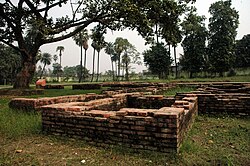
Though parts of the ancient city have been excavated, much of it still lies buried beneath modern Patna. Various locations have been excavated, including Kumhrar, Bulandi Bagh and Agam Kuan.
During the Mauryan period, the city was described as being shaped as parallelogram, approximately 2.5 kilometers (1.5 miles) wide and 15 kilometers (9 miles) long. Its wooden walls were pierced by 64 gates. Archaeological research has found remaining portions of the wooden palisade over several kilometers, but stone fortifications have not been found.[46]
Excavated sites of Pataliputra[edit | edit source]
As dynastic capital[edit | edit source]
- Pataliputra served as the capital under various Indian dynasties
-
 Pataliputra served as the capital of the Haryanka dynasty and the Shishunaga dynasty of Magadha
 -
 Pataliputra served as the capital of the Nanda Empire
 -
 Pataliputra served as the capital of the Maurya Empire
 -
Pataliputra served as the capital of the Shunga Empire
-
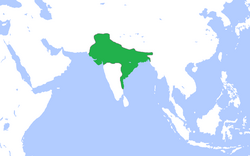 Pataliputra served as the capital of the Gupta Empire
 -
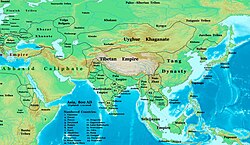 Pataliputra served as the capital of the Pala Empire
.png)


Main recovered artifacts[edit | edit source]
-
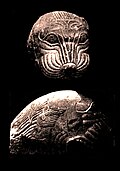 The Masarh lion, 3rd century BCE
 -
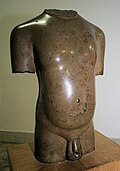
-
 Portion of pillar, found in Pataliputra.
 -
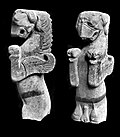 Pataliputra griffin statuette.
 -
 Winged griffin.
 -
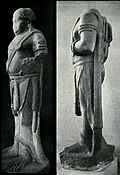 Pataliputra Yakshas, with Mauryan inscriptions.
 -
 Kumrahar coping stone with vines.
 -
 Pataliputra lotus motifs.
 -
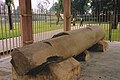 Polished pillar from Pataliputra.
 -
![Mason marks at the base of a pillar.[47]](/w/images/smartcommons/thumbs/commons/4/47/Pataliputra_pillar_mason_marks_with_rubbing.jpg/86px-Pataliputra_pillar_mason_marks_with_rubbing.jpg) Mason marks at the base of a pillar.[47]
Mason marks at the base of a pillar.[47] -
 Charriot wheel, Bulandi Bagh, Mauryan period.
 -
 Bulandi Bagh female statuette, Sunga period.
 -
 Buddhist railing, Sunga period.


![Mason marks at the base of a pillar.[47]](/wiki/File:Pataliputra_pillar_mason_marks_with_rubbing.jpg)


See also[edit | edit source]

References[edit | edit source]
- ↑ "Unravelling Pataliputra". The Times of India. 23 April 2023.
- ↑ Kulke, Hermann; Rothermund, Dietmar (2004), A History of India, 4th edition. Routledge, Pp. xii, 448, ISBN 978-0-415-32920-0.
- ↑ "It took 40 yrs to find first traces of Ashoka's Pataliputra. Now, we must find the rest". ThePrint. 18 September 2023.
- ↑ Census of India, 1981: District census handbook. A. Village & town directory ; B. Village & townwise primary census abstract. Controller of Publications. 1984. p. 2.
- ↑ Schwanbeck, E.A. (4 October 2008). Ancient India as described by Megasthenes and Arrian (First published 1657) (23 ed.). Bibliolife.
- ↑ Discovery Of The Exact Site Of Asoka's Classic Capital, 1892
- ↑ "Patna". Encyclopædia Britannica. Encyclopædia Britannica Online. Encyclopædia Britannica Inc., 2013. Web. 13 Dec. 2013 <"Patna | India". Archived from the original on 30 November 2011. Retrieved 30 January 2011.>.
- ↑ "Heritage wall for Metro corridor plan". Archived from the original on 22 November 2016.
- ↑ "A relic of Mauryan era". The Times of India. 12 June 2012. Archived from the original on 27 November 2017.
- ↑ Valerie Hansen Voyages in World History, Volume 1 to 1600, 2e, Volume 1 pp. 69 Cengage Learning, 2012
- ↑ "Pāṭali". A Sanskrit English Dictionary: Etymologically and Philologically Arranged (16th Reprint ed.). New Delhi: Motilal Banarsidass Publishing House. 2011. p. 615. ISBN 978-8120831056.
- ↑ Encyclopaedia of Religion and Ethics, p.677
- ↑ Folklore, Vol. 19, No. 3 (30 September 1908), pp. 349–350 Archived 10 May 2018 at the Wayback Machine
- ↑ 14.0 14.1 "Mahāparinibbāṇa Sutta (DN 16), translated from the Pali by Ṭhānissaro Bhikkhu". Dīgha Nikāya of the Pali Canon. dhammatalks.org. 2022. Retrieved 9 October 2022.
- ↑ Journal of Francis Buchanan (1812), p.182
- ↑ Language, Vol. 4, No. 2 (June, 1928), pp. 101–105 Archived 10 May 2018 at the Wayback Machine
- ↑ 17.0 17.1 17.2 Sujato, Bhikkhu; Bhikkhu, Brahmali, "1.1.5", The Authenticity of the Early Buddhist Texts (PDF), Oxford Center for Buddhist Studies, archived (PDF) from the original on 20 November 2017.
- ↑ Tripathi, Piyush Kumar (16 July 2015). "Realty to broaden horizon". The Telegraph. Calcutta. Archived from the original on 16 July 2015.
- ↑ DIODORUS SICULUS -LIBRARY OF HISTORY-Book II, 60
- ↑ Sastri 1988, p. 11.
- ↑ Thapar, Romilak (1990), A History of India, Volume 1, New Delhi and London: Penguin Books. Pp. 384, ISBN 978-0-14-013835-1.
- ↑ The Pearson Indian History Manual, Pearson Education India, A94.
- ↑ Lwin, Phyu Mar (2018). "The Buddhist Councils: The Movement to Great Schism". The Journal of International Association of Buddhist Universities. 11 (2): 303–314. Retrieved 28 August 2022.
- ↑ Kowmareeshwari (Ed.), S. (August 2012). Agananuru, Purananuru. Sanga Ilakkiyam (in தமிழ்). Vol. 3 (1 ed.). Chennai: Saradha Pathippagam. p. 251.
- ↑ The Song of Songs and Ancient Tamil Love Poems: Poetry and Symbolism By Abraham Mariaselvam
- ↑ Akanaṉūṟu Verses 261 and 265
- ↑ Hultzsch, E. (1989). Inscriptions of Asoka, Vol. I. Indological Book House, Varanasi. p. 11.
- ↑ Preston, Christine (2009). The Rise of Man in the Gardens of Sumeria: A Biography of L.A. Waddell. Sussex Academic Press. p. 49. ISBN 9781845193157.[permanent dead link]
- ↑ Schlingloff, Dieter (2014). Fortified Cities of Ancient India: A Comparative Study. Anthem Press. p. 49. ISBN 9781783083497.
- ↑ Ancient India as Described by Megasthenês and Arrian. Thacker, Spink. 1877. p. 139.
- ↑ Arrian, "The Indica" Archived 25 May 2012 at the Wayback Machine
- ↑ Kosmin 2014, p. 42.
- ↑ Strabo Geographia Vol 3 Paragraph 36 Archived 16 November 2014 at the Wayback Machine
- ↑ Aelian, Characteristics of animals, book XIII, Chapter 18, also quoted in The Cambridge History of India, Volume 1, p411
- ↑ Asoka Mookerji Radhakumud. Motilal Banarsidass Publishing. 1995. p. 96. ISBN 9788120805828.
- ↑ Bhalla, A. S. (2015). Monuments, Power and Poverty in India: From Ashoka to the Raj. I.B.Tauris. p. 18. ISBN 9781784530877.
- ↑ "The Analysis of Indian Muria Empire affected from Achaemenid's architecture art". Journal of Subcontinent Researches. 6 (19): 149–174. 2014. Archived from the original on 2 April 2015.
- ↑ Coningham, Robin; Young, Ruth (2015). The Archaeology of South Asia: From the Indus to Asoka, c.6500 BCE–200 CE. Cambridge University Press. p. 414. ISBN 9780521846974.
- ↑ Waddell, L. A. (Laurence Austine) (1903). "Report on the excavations at Pātaliputra (Patna); the Palibothra of the Greeks". Calcutta, Bengal secretariat press.
- ↑ Beal, Samuel (1884). Si-Yu-Ki: Buddhist Records of the Western World. London: Trubner & Co.
- ↑ Beal, Samuel (1884). Si-Yu-Ki: Buddhist Records of the Western World. London.
{{cite book}}: CS1 maint: location missing publisher (link) - ↑ 42.0 42.1 42.2 Altekar, A. S.; Mishra, Vijayakanta (1959). Report on Kumrahar Excavations: 1951-1955. Patna: K. P. Jayaswal Research Institute. Retrieved 4 August 2023.
- ↑ 43.0 43.1 43.2 43.3 43.4 Singh, Rajeshwar Prasad (1975). "The Decline of Pātaliputra with Special Reference to Geographic Factors". Proceedings of the Indian History Congress. 36: 51–62. JSTOR 44138834. Retrieved 4 August 2023.
- ↑ 44.0 44.1 Sinha, B. P.; Narain, Lala Aditya (1970). Pāṭaliputra Excavation, 1955-56. Patna: Directorate of Archaeology and Museums, Bihar. Retrieved 4 August 2023.
- ↑ Delle cose maravigliose del mondo Tradotto da Giovan Vincenzo Belprato, Count of Antwerp, by Caius Julius Solinus (Solino), 1559, page 209.
- ↑ Excavation sites in Bihar, Archaeological Survey of India, archived from the original on 28 October 2009, retrieved 13 September 2009.
- ↑ Foreign Influence on Ancient India, de Krishna Chandra Sagar p.41
Sources[edit | edit source]
- Kosmin, Paul J. (2014). The Land of the Elephant Kings: Space, Territory, and Ideology in Seleucid Empire. Harvard University Press. ISBN 978-0-674-72882-0.
- Sastri, Kallidaikurichi Aiyah Nilakanta, ed. (1988) [1967], Age of the Nandas and Mauryas (Second ed.), Delhi: Motilal Banarsidass, ISBN 978-81-208-0465-4
Further reading[edit | edit source]
- Bernstein, Richard (2001). Ultimate Journey: Retracing the Path of an Ancient Buddhist Monk (Xuanzang) who crossed Asia in Search of Enlightenment. Alfred A. Knopf, New York. ISBN 0-375-40009-5
External links[edit | edit source]


