Created by Ajay Kumar
Last edited January 31, 2026
Created a new article
 
Manish (talk | contribs)
clean up
 
Line 5: Line 5:
{{more citations needed|date=September 2015}}
{{original research|date=July 2016}}
{{Cleanup bare URLs|date=September 2022}}
}}
}}
{{EngvarB|date=March 2014}}
Line 15: Line 14:
| population = 950,000+<ref>[http://www.hindu.com/2007/10/13/stories/2007101361130300.htm Newspaper: The Hindu, Saturday, 13 Oct 2007] {{webarchive |url=https://web.archive.org/web/20071014083001/http://hindu.com/2007/10/13/stories/2007101361130300.htm |date=14 October 2007 }}</ref>
| population = 950,000+<ref>[http://www.hindu.com/2007/10/13/stories/2007101361130300.htm Newspaper: The Hindu, Saturday, 13 Oct 2007] {{webarchive |url=https://web.archive.org/web/20071014083001/http://hindu.com/2007/10/13/stories/2007101361130300.htm |date=14 October 2007 }}</ref>
| popplace = [[Tulunadu]], [[Chikkamagaluru district|Chikmagalur]] district, [[Kodagu]], [[Hassan district]], [[Uttara Kannada]], [[Persian Gulf States]]
| popplace = [[Tulunadu]], [[Chikkamagaluru district|Chikmagalur]] district, [[Kodagu]], [[Hassan district]], [[Uttara Kannada]], [[Persian Gulf States]]
| related = [[Nawayath]], [[Mappilas]], [[Labbay]]
| related = [[Nawayath]], [[Malabar Muslims|Mappilas]], [[Labbay]]
| native_name =  
| religions = [[File:Allah-green.svg|15px]] [[Islam]]
| native_name_lang=
| religions = [[Islam]]
}}
}}
{{Islam}}
{{Islam}}
{{Islam in India}}
{{Islam in India}}
The '''Beary''' (also known as '''Byari''') are a [[Dravidian peoples|Dravidian]] [[ethnic group]] concentrated along the southwest [[coast of India]], mostly in the [[Mangalore district]] of the [[south India]]n state of [[Karnataka]]. Beary are overwhelmingly [[Islam|Muslim]] and Islam has profoundly influenced their culture and identity alongside other Muslim ethnic groups of coastal India, such as ''[[Nawayath]]s'' of the [[North Canara]], [[Moplah]]s of the [[Malabar region]] and the [[Labbay]] of the [[Coromandel Coast|Coromandel]].  
The '''Beary''' (also known as '''Byari''') are a community concentrated along the southwest [[coast of India]], mostly in the [[Mangalore district]] of the [[south India]]n state of [[Karnataka]].


The Beary community of [[Tulunadu]] is one among the earliest [[Muslims|Muslim]] [[inhabitants]] of [[India]], with a clear history of more than 950 years.<ref>[[Ahmed Noori]], [[Maikala]], Preface to 1st edition (1960)</ref> One mosque, [[Masjid Zeenath Baksh]] was built in the Bunder area of [[Mangalore]] by [[Malik Deenar]], an Arab Da'ee, in 644<ref>Ichlangod B.M., Tulunada Muslimaru&nbsp;– Byari Samskruti p.19 (1997)</ref><ref>Gopalan Nair C, Moplas of [[Malabar Coast|Malabar]] p.20-21</ref><ref name="Ahmed Noori p.11">Ahmed Noori, Maikala, II edition, p.11 (1997)</ref>
The Beary community of [[Tulunadu]] is among the earliest [[Muslims|Muslim]] [[inhabitants]] of [[India]], with a clear history of more than 950 years.<ref>[[Ahmed Noori]], [[Maikala]], Preface to 1st edition (1960)</ref>


==Etymology==
==Etymology==
The word 'Beary' is said to be derived from the [[Tulu language|Tulu]] word 'Byara', which means trade or business. Since the major portion of the community was involved in business activities, particularly trading, the local Tulu speaking majority called them as Beary or Byari.<ref>Ahmed Noori, Maikala p.17 (1960)</ref>
The word ''Beary'' is said{{by whom|date=September 2023}} to be derived from the [[Tulu language|Tulu]] word ''Byara'', which means trade or business. Since the major portion of the community was involved in business activities, particularly trading, the local Tulu-speaking majority called them as Beary or Byari.<ref>Ahmed Noori, Maikala p.17 (1960)</ref>


According to the census of 1891, [[Dakshina Kannada]] had 92,449 businessmen consisting of 90,345 Bearys, 2,104 [[Nawayath]]s and 2,551 non-Muslims. This means that the district had 95,000 Individuals involved in business activities. Records prove that, towards the end of the 19th century, the percentage of Muslim traders in the district was as high as 97.3%, and hence the local [[Tuluva]]s rightly named this community as Bearys.<ref>Ichlangod B.M., Tulunada Muslimaru&nbsp;– Byari Samskruti p. 39 (1997)</ref>
Another popular theory is that the word ''Beary'' comes from [[Arabic]] word ''Bahar'' (Arabic: بحر).  ''Bahar'' means ''ocean'' and ''Bahri'' (Arabic: بحري) means ''sailor or navigator''. It is said{{by whom|date=September 2023}} that the Beary community had trade relations with Arab businessmen travelling to Coastal [[South India]], especially the coastline of [[Tulunadu]] [[Malabar Coast|Malabar]]. Inscriptions have been found in [[Barkur]] that prove Arab trade links with [[Tulunadu]].{{cn|date=September 2023}}


Another popular theory is that the word "Beary" comes from [[Arabic]] word "Bahar" (Arabic: بحر).  "Bahar" means "ocean" and "Bahri" (Arabic: بحري) means "sailor or navigator". It is said that the Beary community had trade relations with [[Arabs|Arab]] businessmen travelling to Coastal [[South India]], especially the coastline of [[Tulunadu]] [[Malabar Coast|Malabar]]. Inscriptions have been found in [[Barkur]] that proves the Arab trade links with [[Tulunadu]].
A third theory says that the word ''Beary'' is derived from the root word ''Malabar''. The Islamic [[Da'ee]], [[Malik bin Deenar]], had arrived on the coast of Malabar during the 7th century with a group of Da'ees, or Islamic propagators. A member from his group, Habeeb bin Malik travelled through Tulunadu and preached Islam. He had also built Mosques in [[Kasaragod Town|Kasaragod]], [[Mangalore]] and [[Barkur]].<ref name="Ahmed Noori p.11">Ahmed Noori, Maikala, II edition, p.11 (1997)</ref>
 
A third theory says that the word "Beary" is derived from the root word "Malabar". The great [[Islam]]ic [[Da'ee]], [[Malik bin Deenar]] had arrived on the coast of Malabar during the 7th century with a group of Da'ees, or Islamic propagators. A member from his group, Habeeb bin Malik travelled through Tulunadu and preached [[Islam]]. He had also built Mosques in [[Kasaragod Town|Kasaragod]], [[Mangalore]] and [[Barkur]].<ref name="Ahmed Noori p.11" />
 
==Geographic distribution==
The Bearys make up around 80% of the [[Dakshina Kannada]] Muslims, with others scattered in the neighbouring Districts of [[Chikkamagaluru district|Chikmagalur]], [[Shimoga]], [[Kodagu]], [[Hassan district|Hassan]] and [[Uttara Kannada]]. [[Mumbai]] and [[Goa]] also have a considerable Beary population. Also, a good number of Bearys are in the [[Persian Gulf States]] of the Middle East doing a variety of Jobs. The total Beary population numbers about 1.5 million.<ref name="The Hindu, Saturday, 13 Oct 2007">[http://www.hindu.com/2007/10/13/stories/2007101361130300.htm The Hindu, Saturday, 13 Oct 2007] {{webarchive |url=https://web.archive.org/web/20071014083001/http://hindu.com/2007/10/13/stories/2007101361130300.htm |date=14 October 2007 }}</ref>


===Other sources===
===Other sources===
There are several documents available which prove that at least 90 Years prior to the invasion of [[Muhammad bin Qasim]] in [[North India]], [[Arabs|Arab]] Muslim businessmen were thriving in the [[South India|south]]. This proves Islam was prevalent in South India much before [[Muslim conquest of India|Muslim conquerors]] came to North India. These facts are available in a research document ''Mykal'', written by [[Ahmed Noori]], who conducted a research on the Beary community in 1960.
[[Ahmed Noori]], a journalist and himself a member of the Beary community, claimed that there are several documents available which suggest that at least 90 years prior to the invasion of [[Muhammad bin Qasim]] in [[North India]], [[Hadhrami people|Hadhrami]] and [[Persians|Persian]] Muslim businessmen were thriving in the [[South India]]. This would prove that Islam was prevalent in South India much before [[Muslim conquest of India|Muslim conquerors]] came to North India.{{cn|date=September 2023}}


[[Ahmed Noori|Noori]] disputes the claim that the first Muslims came to India along with [[Alauddin Khalji]] between 1296 and 1316 AD and points out that according to renowned historian, [[Henry Miers Elliot]], (''[[The History of India as told by its own Historians]]'', Part I) the first ship bearing [[Muslims|Muslim]] travellers was seen on the Indian coast as early as 630 AD. H.G.(Hugh George) Rawlinson, in his book: ''Ancient and Medieval History of India'',<ref>{{ISBN|81-86050-79-5}} Ancient and Medieval History of India</ref> claims the first [[Arab Muslims]] settled on the Indian coast in the last part of the 7th century AD. Bartholomew also has similar things to say about the early [[Muslims|Muslim]] settlers in [[India]]. [https://archive.org/stream/in.ernet.dli.2015.281736/2015.281736.Madras-District_djvu.txt J. Sturrock in his ''Madras Districts Manuals: South Kanara''], says that [[Parsis|Parsi]] and [[Arabs|Arab]] businessmen settled in different places of the [[Malabar coast]] during the 7th century. [[Ahmed Noori]] has quoted these and other sources to validate his [[argument]] that the [[Arabs|Arab]] and other [[Settler]]s came to [[India]] much before the [[Arabs|Arab]], Turk and [[Afghans|Afghan]] conquerors came to [[North India]].
Noori disputes the claim that the first Muslims came to India along with [[Alauddin Khalji]] between 1296 and 1316 AD and points out that according to historian [[Henry Miers Elliot]], writing in 1867, the first ship bearing Muslim travellers was seen on the Indian coast as early as 630 CE. Noori also notes that [[Hugh George Rawlinson]] (1913) claimed the first [[Hadhrami people|Hadhrami Muslims]] settled on the Indian coast in the last part of the 7th century and that Bartholomew also has similar things to say about the early Muslim settlers in India, while J. Sturrock (1894) said that [[Parsis|Parsi]] and Hadhrami businessmen settled in different places of the [[Malabar coast]] during the 7th century. Noori has quoted these and other sources to validate his argument that the Arab and other settlers came to India much before the Arab, Turk and [[Afghans|Afghan]] conquerors came to North India.{{cn|date=September 2023}}
 
Dr. Susheela P. Upadhyaya,<ref>[http://www.coastaldigest.com/news/61073-eminent-linguist-dr-susheela-p-upadhyaya-no-more Eminent Linguist, Dr. Susheela P. Upadhyaya, No More.]</ref><ref>[http://www.mangaloretoday.com/main/Renowned-folk-scholar-Dr-Susheela-P-Upadhyaya-passes-away.html Renowned Folk Scholar, Dr. Susheela P. Upadhyaya, Passes Away]</ref><ref>[https://www.kannadigaworld.com/news/karavali/63450.html Sad Demise of Liberal Scholar, Dr. Susheela P. Upadhyaya.]</ref> a research scholar in [[Beary bashe]] and Beary folklore was of the opinion that the Indian west coast came under [[Islam]]ic influence long before any other part of [[India]] was influenced by [[Islam]] or [[Muslims]].<ref>Dr. Susheela P. Upadhyaya, Beary Bashe mattu Janapada Kathegalu, p. 5 (1997)</ref> Historical research also reveals that during the rule of Banga and [[Chowta dynasty (Tulu Nadu)|Chowta dynasty]] in the 16th century, Beary men had served as seamen in the [[Naval Force|naval force]]. The Chowta dynasty queen, Rani [[Abbakka]] had personally supervised the construction of dam at [[Malali]]; she had appointed Bearys for boulder work.<ref>Dr. Susheela P. Upadhyaya, Beary Bashe mattu Janapada Kathegalu, p. 7 (1997)</ref>
 
An ancient historical work&nbsp;– ''[[Keralolpathi]]''&nbsp;– reveals that a king of Malabar, ''[[Cheraman Perumal]]'', embraced [[Islam]] during the very beginning days of the advent of [[Islam]] in the [[Arab world|Arab land]]. Thus the [[Arabs]] had [[Royal Patronage|royal patronage]] to practice and propagate [[Islam]] in the [[Malabar Coast|Malabar area]]. They were also given the permission of sea trading with a [[Royal Patronage|royal patronage]]. Because of the [[Da'wah]] activities of Arab traders, many people embraced [[Islam]] and assumed better social status as [[Muslim world|Muslims]].
 
The [[Portuguese Empire|Portuguese]] lost their dominance during the rule of [[Hyder Ali]] and [[Tippu Sultan]] in [[Mysore]]. During this period the Beary [[Muslim Brotherhood|Muslims]] again received [[Royal Patronage|royal patronage]] and intensified their sea trade activities.<ref>Dr. Susheela P. Upadhyaya, Beary Bashe mattu Janapada Kathegalu, p. 9(1997)</ref>
 
==Participation in the freedom struggle==
The Bearys of the coast participated in the Indian freedom struggle against Portugal and British colonialism.<ref>[http://www.twocircles.net/2008jan23/book_review_tribute_strugglers.html The Tribute to the Strugglers]</ref> There were a number of Beary men who served in the naval force, and also as soldiers and military commanders in the army of brave queen of [[Chowta]] dynasty, Rani [[Abbakka]] ({{lang-kn|ರಾಣಿ ಅಬ್ಬಕ್ಕ}}) who ruled in the [[Ullal]] region. The Bearys had also joined the army of Nawab [[Hyder Ali]] and [[Tipu Sultan]] of [[Mysore]]. Historians and researchers have enlisted famous Beary personalities who participated in the freedom struggle of India. Many such freedom fighters were imprisoned by British, and a few died during imprisonment.
 
A sixteenth-century Arabic work of Malabar, ''Tuhfah al Mujahideen'' or ''[[Tuhafat Ul Mujahideen]]'' compiled by [[Zainuddin Makhdoom II|Shaikh Zainuddin Makhdoom II]] (grand son of Shaikh [[Zainuddin Makhdoom I]]) had motivated Malabar Muslims which had influence on Bearys of the Tulunadu as well to fight the foreign invaders. Thus the Bearys had actively participated in the freedom struggle against Portugal and British rule.
 
[[B. M. Idinabba]] was a prominent Beary freedom fighter from [[Karnataka]]. He was a member of [[Indian National Congress|Congress party]] and was elected as an MLA for three times in the Karnataka state assembly from [[Ullal]] [[constituency]]. He was one of the activists who fought for the unification of the [[Kasaragod]] district of [[Kerala]] into the [[Karnataka]] state. He has got the credit of being the first [[president (corporate title)|president]] of the Beary Sahithya Sammelana (Beary Literature Summit). He has received many prestigious awards including [[Rajyotsava Prashasti]].


==Language==
==Language==
{{Main|Beary language}}


The dialect spoken by Beary (Byaris), is known as [[Beary Bashe]].<ref>[https://www.thenewsminute.com/article/tulu-nadus-bashe-byari-language-and-its-struggle-identity-102414 Beary Language's Struggle for Identity]</ref><ref name="Upadhyaya, U. Padmanabha 1996">Upadhyaya, U. Padmanabha. Coastal Karnataka: Studies in Folkloristic and Linguistic Traditions of Dakshina Kannada Region of the Western Coast of India. Udupi: Rashtrakavi Govind Pai Samshodhana Kendra, 1996.P- '''ix''' .  {{ISBN|81-86668-06-3}} .
The language spoken by Beary community is [[Beary language|Beary]] base (language).<ref>[https://www.thenewsminute.com/article/tulu-nadus-bashe-byari-language-and-its-struggle-identity-102414 Beary Language's Struggle for Identity]</ref>
While the [[Nawayath]] Muslims of Uttara Kannada speak a dialect of [[Konkani language|Konkani]], and the [[Malabar Muslims|Mappila]] Muslims of Kerala speak [[Malayalam]] ([[Mappila Malayalam]]), [[Beary language]] is made of [[Tulu language|Tulu]] phonology and grammar with [[Malayalam]] idioms. Due to the trading role of the community, the language acquired loan words from other languages of [[Tulu language|Tulu]], [[Malayalam]], [[Kannada]] and also from Perso-Arabic sources.
This language is traditionally recognized as a dialect of Malayalam because of the similarities with [[Old Malayalam]].
The language uses [[Malayalam script|Malayalam]] and [[Kannada script|Kannada]] scripts for writing.<ref name="Upadhyaya, U. Padmanabha 1996">Upadhyaya, U. Padmanabha. Coastal Karnataka: Studies in Folkloristic and Linguistic Traditions of Dakshina Kannada Region of the Western Coast of India. Udupi: Rashtrakavi Govind Pai Samshodhana Kendra, 1996.P- '''ix''' .  {{ISBN|81-86668-06-3}} .
First All India Conference of Dravidian Linguistics, Thiruvananthapuram, 1973</ref>
While Muslims of Uttara Kannada, called [[Nawayath]]s, speak a dialect of [[Konkani language|Konkani]], and the [[Mappila]]s of Kerala speak [[Malayalam]] ([[Mappila Malayalam]]), the Bearys spoke a language made of Malayalam idioms with [[Tulu language|Tulu]] phonology and grammar.<ref name="Upadhyaya, U. Padmanabha 1996"/>
This dialect was traditionally known as Mappila Malayalam because of Bearys close contact with Mappilas.<ref name="Upadhyaya, U. Padmanabha 1996"/>
Due to vast influence of [[Tulu language|Tulu]] for centuries, it is today considered as a language, close to Malayalam and Tulu.<ref name="Upadhyaya, U. Padmanabha 1996"/>
Beary dialect is largely influenced by the Arabic language.<ref>[http://www.tamil.net/list/2000-12/msg00490.html Arabic and other language influence] {{webarchive |url=https://web.archive.org/web/20110615080525/http://www.tamil.net/list/2000-12/msg00490.html |date=15 June 2011 }}</ref> Most of the Bearys especially in coastal area still use a lot of Bearified Arabic words during their daily transactions. ''Saan, Pinhana, Gubboosu, Dabboosu, Pattir, Rakkasi, Seintaan, Kayeen,'' are the few words used in [[Beary bashe]] that have their roots in Arabic language.
==''Paunaraga'' of Maikala==
The ''Paunar Aga'' or ''Paunaraga''&nbsp;– which literally means sixteen houses&nbsp;– of high status.
Before the advent of the Portuguese, [[Maikala]] or [[Mangalore]] was one of the main centres of [[Jainism|Jains]] with many Jain ''Muts'', ''Basadis'' and also palaces. Especially the Bunder area in Maikala was dominated by rich Jain houses. The Jains who enjoyed economical and social status maintained a system known as ''Jaina Beedu'', which literally means Jain House.<ref>Ichlangod B.M., Tulunada Muslimaru&nbsp;– Byari Samskruti p.50 (1997)</ref>
Later when these Jaina Beedu were bought by Muslim merchants who used to regularly travel from Middle East for trade, they still maintained this Beedu system as status symbol. Beedu can be translated in Beary bashe as ''Aga'' which means House. The 'Paunaraga' are listed in the table below.
{| class="wikitable mw-collapsible mw-collapsed" cellpadding=0 cellspacing=0 align=left
|-
| valign=top |
'''16 Houses of Beedu'''<br />
&nbsp;1. Marfkhan Aga <br />
&nbsp;2. Beliyabbaka Aga / Doddamane <br />
&nbsp;3. Beliye Ballal Aga<br />
&nbsp;4. Cheriye Ballal Aga<br />
&nbsp;5. Beedhire Ballal Aga<br />
&nbsp;6. Pandiol Aga<br />
&nbsp;7. Arabikhan Aga{{nowrap|&nbsp;}}<br />
&nbsp;8. Kozhikkan Aga<br />
&nbsp;9. Bawukana Aga/ Kunharakana<br />
&nbsp;10. Moosarikana Aga<br />
11. Kachman Aga <br />
12. Sayirikana Aga<br />
13. Khayirikana Aga<br />
14. Bubakana Aga<br />
15. Siyalikhana Aga<br />
16. Getre Aga
|-
|}
{{nowrap|These houses enjoyed}} supreme social status amongst Bearys throughout the 19th century and treated other Bearys as second-class citizens.  The people belonging to these houses were identified as ''Agakkar'' which means the People of the House. The history of these houses has a short-lived glory that these houses enjoyed socially and economically. Many of the social customs that the people of ''Paunaraga'' observed were special to them.
The lifestyle of ''Agakkar'' of the Beary community was largely influenced by Jains. Most of the ornaments used by Agakkar was of Jain pattern and had Jain names. ''Kharjana'' is the jewel box used by both Jains and Bearys. Today some of the houses still remain in Bunder area, their surnames tell the glory they once enjoyed.


==World Beary Convention==
In April 2006, The World Beary Convention was held in Dubai under the banner ''World Beary Sammelana & Chammana 2006''.<ref>[http://www.daijiworld.com/news/news_disp.asp?n_id=20850&n_tit=Dubai%3A+World+Beary+Convention+Held World Beary Sammelana & Chammana 2006 – convention]</ref>
In April 2006, The World Beary Convention was held in Dubai ''World Beary Sammelana & Chammana 2006''.<ref>[http://www.daijiworld.com/news/news_disp.asp?n_id=20850&n_tit=Dubai%3A+World+Beary+Convention+Held World Beary Sammelana & Chammana 2006 – convention]</ref> A similar event was held in 2010.<ref>[http://www.daijiworld.com/news/news_disp.asp?n_id=75007 Dubai : World Beary Convention Kicks off in Style – 2010]</ref>
 
The word ''Chammana'' stands for felicitation. Since the organizers felicitated a few Beary dignitaries during this world convention held in Dubai, UAE, the convention is called World Beary Sammelana & Chammana 2006. The convention was also attended by several dignitaries which included Dr. B.K.Yusuf, President/Patron of Karnataka Sangha, Dubai, M.B. Abdul Rahiman, Renowned Lawyer and Notary, B.M. Farooque, managing director, Fiza Group, Shiraj Haji. Director Universal Export Tradeways. S.M. Syed Khalil, Galadai Group, Dubai, M.B. Noor Mohamed, MD. Fakruddin, managing director, Ajmal Group, Mel, Abdul Jaleel, [[Abdussalam Puthige]], Editor in Chief, [[Varthabharathi]] Kannada Daily, Haju Jamalluddin, chairman, Crescent School, Shamshudeen, P.T. Abdul Rahiman, General Secretary of Indian Islamic Centre, T.S. Shettigar, Jamalludin, Apsara Group, Dr. Viquar Azeem, Dr. Azad Moopen, Ganesh Rai, M.K. Madhavan, Kumar, Indian Association Dubai, Kanukaran Shetty, President Hotel, Prabhakar, KOD, K.P. Ahmed, Yaseen Malpe etc. Some Beary dignitaries have been facilitated during the convention.
 
===World Beary Convention & Chammana===
In April 2010, Beary hosts a 2-day event, the World Beary Convention & Mega Cultural Event&nbsp;– Chammana 2010, held during 2 and 3 April at Zabil Ball Room, Radisson Blu Hotel, Creek Side, Dubai.<ref>[http://www.daijiworld.com/news/news_disp.asp?n_id=75007 Dubai : World Beary Convention Kicks off in Style – 2010]</ref> During this convention Beary Personality of the year 2010 award was given to Mr. Mumtaz Ali, and Star of Bearys award for the year 2010 was conferred on Bajpe Zakria(AlMuzain holding group).<ref>[http://www.coastaldigest.com/index.php?option=com_content&view=article&id=4857:beary-main-page&catid=57:news-stories&Itemid=68 Dubai: Beary Fraternity comes together at the World Beary Convention – 2010]</ref>
 
Beary Chamber of Commerce and Industry
Bearys chamber of commerce & industry is a non-profit organization set up to create a network between businessmen across communities and countries. It is a union of all businessmen in order to promote and assist innovative businesses for the welfare of the community in the field of commerce and trade.
In what could be termed as a milestone in the history of Bearys, philanthropists and social workers of the community came together on October 27, 2016, to form a Bearys Chamber of Commerce and Industry (BCCI) choosing Haji S M Rasheed as the founding president of BCCI and Imthiyaz as general secretary. Having set up BCCI chapters in various parts of the Karnataka, it has moved to overseas in the year 2018 by opening BCCI chapter in Dubai UAE and Jubail chapter in the year 2019.
 
Media of the Year award was jointly awarded to [[Varthabharathi]] a renowned Kannada daily (published from Mangalore and Bangalore) and Daijiworld.com, a web based newsportal, for their contribution towards media. [[Abdussalam Puthige]], on behalf of Varta Bharti, and representatives of Daijiworld received the award from Mr. [[C. M. Ibrahim]], Former Union Minister.<ref>[http://www.daijiworld.com/news/news_disp.asp?n_id=72458 World Beary Convention in Dubai on 1, 2 April, 2010]</ref>
 
===List of periodicals brought out by Bearys===
{| class="wikitable mw-collapsible mw-collapsed"
!width="25"|No.
!width="200"|Name
!width="250"|Editor/Printer/Publisher/Owner
|-
|1|| Jyothi || Kamal Hyder(editor) owner(Mohammed sherule)
|-
|2|| Swatantra Bharata|| Kamal Hyder
|-
|3|| Antaranga|| Kamal Hyder
|-
|4|| Human Affairs|| Kamal Hyder
|-
|5|| Hamdard|| Raheem Ahmad
|-
|6|| Sadakat Post|| Raheem Ahmad
|-
|7|| Udaya Chandra|| F.H. Odeyar
|-
|8|| Nawa Shakti|| B.M.A. Rafeeq
|-
|9|| Shanti Sandesh|| Dr. M.M. Salih
|-
|10|| Divya Vani|| C.K. Hussain
|-
|11|| Musalman|| C.K. Hussain
|-
|12|| Millat|| A.T.M. Shafi
|-
|13|| Hilal|| A.T.M. Shafi
|-
|14|| Amaanat|| Abdul Raheem Haji
|-
|15|| Agni|| K.H. Hussain Mulki
|-
|16|| Bhooloka|| Abdullah Belthangady
|-
|17|| Himmat|| Ibrahim Kareem
|-
|18|| Ananta|| M.A. Raheem
|-
|19|| Apsara|| Dr. Wahab Doddamane
|-
|20|| Shikshakara Vani|| J.M. Mohammed Master
|-
|21|| Dharma Vani|| Hameed Kandak
|-
|22|| Popular|| Hameed Kandak
|-
|23|| Nawaneet|| Muhsin Haji Caup
|-
|24|| Al Misbah|| Dr. K.M. Shah Musliyar
|-
|25|| Aalamul Huda|| Dr. K.M. Shah Musliyar
|-
|26|| Sarala Patha|| Dr. K.M. Shah Musliyar
|-
|27|| Sandesha|| Abu Raihan Ahmed Noori
|-
|28|| Kitaab|| Abu Raihan Ahmed Noori
|-
|29|| The Message|| Abu Raihan Ahmed Noori
|-
|30|| Mesco Varthe|| Abul Hasan Muhammad Moulavi
|-
|31|| AL Miftaah|| B.M. Mohammed Mangalanti
|-
|32|| Al Muneer|| Saletore Aboobaker Faizi
|-
|33|| Al Ihsan|| Mohammed Ullal
|-
|34|| Tawa Nidhi|| Prof. B.M. Ichlangod
|-
|35|| Media Times|| Prof. B.M. Ichlangod
|-
|36|| Sanmarga|| [[Ibrahim Saeed]]
|-
|37|| Anupama|| M. Sadullah
|-
|38|| Al Ansar|| Haji Ibrahim Bawa <ref>{{Cite web|url=https://www.flickr.com/photos/31700872@N04/|title = 2 moilanji|date = 23 November 2008}}</ref>
|-
|39|| Moilanji|| Hamza saqafi Bantwal
|-
|40|| Pavitra Sandesha|| South Karnataka Salafi Movement Mangalore <ref>{{Cite web |url=http://www.salafiksa.org/ |title=Karnataka Salafi Foundation |access-date=4 February 2016 |archive-url=https://web.archive.org/web/20160130191618/http://www.salafiksa.org/ |archive-date=30 January 2016 |url-status=dead }}</ref>
|-
|41|| Mustaqeem|| Eden Publication
|-
|42|| Hi Puttur|| Mittur Hameed Kandak
|-
|43|| Ishara Patrike|| Ismail Shafi
|-
|44|| AL Aqsa|| T.M. Haneef Maulavi
|-
|45|| Puttur Mitra|| Ibbatulla Kadaba
|-
|46|| Pushpa Mandaara|| Aziz Bajpe
|-
|47|| Asar Vani|| Aziz Bajpe
|-
|48|| Jana Vahini|| K.M. Khaid
|-
|49|| Hoodota|| A.C.M. Saletore
|-
|50|| Firdous|| M.E Mohammed
|-
|51|| Hasiru Bhoomi|| T.H. Ibrahim Musliyar
|-
|52|| Al Qamar|| Shareef Moodabidri
|-
|53|| Kodagu Kesari|| B.A. Shamsuddin
|-
|54|| Janadesha Patrike|| U. Muhammad Nazeer
|-
|55|| Nawa Keerti||[[B. M. Idinabba]]
|-
|56|| Karawali Maruta|| Iqbal Ahmed Kuthar
|-
|57|| Encounter|| Iqbal Ahmed Kuthar
|-
|58|| Eye Special News|| Iqbal Ahmed Kuthar
|-
|59|| Lathi Charge|| Ismail Moodushedde
|-
|60|| Hello Mangalooru|| Raheem Uchil
|-
|61|| Noble Universe|| B.M. Haneef <ref>https://www.thehindu.com/features/friday-review/in-the-heart-of-kannada/article7508373.ece[Beary Poet]</ref>
|-
|62|| Islam and Science|| S.E. Abdul Rahman
|-
|63|| The Islamic Guidance|| M Anwar Bajpe
|-
|64|| Payaswini Sullia|| M.B.M. Madani
|-
|65|| Sunni Sndesha|| K.M.S. Faizi
|-
|66|| Baala Sandesha|| K.M.S. Faizi
|-
|67|| Samyukta Prabha || Mohammed Rafi
|-
|68|| Beary|| Akbar Ullal
|-
|69|| Utkarsha|| Akbar Ullal
|-
|70|| Beary Varthe|| Basheer Baikampady
|-
|71|| Beary Times|| Kuwainda Hamzatullah
|-
|72|| Kittale Naadu|| Kuwainda Hamzatullah
|-
|73|| Pernal|| Umer U.H.
|-
|74|| Indian News|| A.S. Anduka
|-
|75|| Special News|| Bawa Padrangi
|-
|76|| [[Varthabharathi]] ({{ill|ವಾತಾ೯ ಭಾರತಿ|kn|vertical-align=sup}})|| [[Abdussalam Puthige]]
|-
|77|| Mesco Varthe|| Moulavi Abul Hasan
|-
|78|| Sunnath|| M.M.Saqafi
|-
|79|| Sunni Vani|| Muhyuddeen Kamil Saqafi Thoke
|-
|80|| Madarangi|| Aboobakkar faizy
|-
|81|| Sirathe musthaqeem|| Da'wa Publications <ref>{{Cite web |url=http://www.ksajonline.com/ |title=永久脱毛は本当に安全ですか?: 永久脱毛は本当に安全ですか? |access-date=12 October 2019 |archive-url=https://web.archive.org/web/20170930162415/http://www.ksajonline.com/ |archive-date=30 September 2017 |url-status=dead }}</ref>
|-
|82|| Kusuma bala masika|| M.M.Saqafi |-
|-
|83|| Prasthootha|| K.M.Sherif
|-
|84|| Bearys of Tulunadu|| Prof.B.M. Ichlangod
|}
Some of these periodicals are still being published and reaching to the hands of a sizeable population of Tulunadu and other adjacent districts and to the Persian Gulf States.
 
===Some peculiar names of Bearys===
Typically, Muslim community people name their children for Arabic roots. But olden day Bearys had some strange names which are not seen anywhere else in the Muslim world. Although those peculiar names are now vanishing, here are some such examples:
 
''Kayiri, Sayiri, Sayirabba, Cheyya, Cheyyabba, Saunhi, Kayinhi, Sekunhi, Baduva, Mayabba, Puthabba, Hammabba, Cheyyabba, Ijjabba, Kunha, Kunhi, Bava, Bavunhi, Kunhibavu, Puttubavu, Unha, Unhi, Unhimon, Iddinabba, Podiya, Podimonu, Pallikunhi, Kunhipalli, Kidavaka, Abbu, Abbonu, Chakaka, Addiyaka (Addi), Pudiyampule''.
 
===List of the Books related to Beary culture===
{|class="wikitable mw-collapsible mw-collapsed" cellpadding=0
!width="25"|No.
!width="300"|Title
!width="200"|Author
|-
|1|| Muslims in Dakshina Kannada|| Dr. A. Wahab Doddamane
|-
|2|| English&nbsp;– Kannada&nbsp;– Beary: dictionary*<ref>{{Cite web|url=http://catalog.loc.gov/cgi-bin/Pwebrecon.cgi?DB=local&BBID=13289230&v3=1|title=LC Catalog - Legacy Catalog Retired}}</ref>|| Dr. A. Wahab Doddamane
|-
|3|| Maikala*<ref>{{Cite web|url=http://catalog.loc.gov/cgi-bin/Pwebrecon.cgi?DB=local&BBID=13732715&v3=1|title=LC Catalog - Legacy Catalog Retired}}</ref>|| Abu Raihan Ahmed Noori
|-
|4|| Beary bashe matthu Jaanapada Kathegalu*|| Dr. Susheela Upadhyaya
|-
|5|| Tulunada Muslimaru*<ref>{{Cite web|url=http://catalog.loc.gov/cgi-bin/Pwebrecon.cgi?DB=local&BBID=13401424&v3=1|title=LC Catalog - Legacy Catalog Retired}}</ref>|| Prof. B.M. Ichlangod
|-
|6|| Moilaanji*<ref>{{Cite web|url=http://catalog.loc.gov/cgi-bin/Pwebrecon.cgi?DB=local&CMD=lccn%222002302742%22&v3=1&CNT=10|title=LC Catalog - Legacy Catalog Retired}}</ref>|| Hamza Malar
|-
|7|| Beary Muslimaru|| Hamza Malar
|-
|8|| Mallige Balli (The Jasmine Shrub)|| Abdul Raheem Teekay
|-
|9|| Tharavad|| U.A. Kasim Ullal
|-
|}
*These books are available at the largest library in the world, the [[Library of Congress]] in Washington, D.C., US.


==Ornaments==
==Ornaments==
The beary women have excessive love for ornaments and uses it on every possible occasion such as ''Mangila'', ''Sunnat Mangila'', ''Appate Mangila'', ''Birnd'', ''Moilanji'' and other social gatherings. There were different types of ornaments used by beary community in past which is at the verge of vanishing today due to the cultural invasion and urbanisation. These ornaments are made out of mainly gold and silver and used for the ornamentation of head, ears, neck, waist, wrist, fingers and feet. Beary research scholars are of the opinion that Beary ornaments were largely influenced by Jain ornament patterns. The ornament storage box used by Bearys was made out of brass and other metals was also used by Jain community and was called ''Kharjana'' by both Bearys and Jains.<ref>Ichlangod B.M., Tulunada Muslimaru&nbsp;– Byari Samskruti p.76 (1997)</ref>
The beary women have a love of ornaments and use them on occasions such as ''Mangila'', ''Sunnat Mangila'', ''Appate Mangila'', ''Birnd'', ''Moilanji'' and other social gatherings. There were different types of ornaments used by the Beary community in past which is at the verge of vanishing today due to the cultural invasion and urbanisation. These ornaments are made out of mainly gold and silver and used for the ornamentation of head, ears, neck, waist, wrist, fingers and feet. Beary research scholars are of the opinion that Beary ornaments were largely influenced by Jain ornament patterns. The ornament storage box used by Bearys was made out of brass and other metals was also used by Jain community and was called ''Kharjana'' by both Bearys and Jains.<ref>Ichlangod B.M., Tulunada Muslimaru&nbsp;– Byari Samskruti p.76 (1997)</ref>{{qn|date=September 2023}}


==Cuisine==
==Cuisine==
Line 329: Line 55:
[[File:Chekkero-Appa Prepared in Thondhur..jpg|thumb|Chekkero-Appa prepared in Thondhur]]
[[File:Chekkero-Appa Prepared in Thondhur..jpg|thumb|Chekkero-Appa prepared in Thondhur]]


Beary cuisine is highly influenced by the South Indian Cuisine. Just like Mangalorean cuisine it uses a lot of [[coconut]], [[curry leaves]], ginger, chilli and spices like pepper and cardamom. Beary cuisine boasts of a special kind of [[biryani]], which is very different from the other types made elsewhere. Rice preparations, both fresh and dry fish, meat and eggs enjoy top place in Beary daily menu.
Beary cuisine is highly influenced by the South Indian cuisine. Just like Mangalorean cuisine it uses a lot of [[coconut]], [[curry leaves]], ginger, chilli and spices like pepper and cardamom. Beary cuisine includes a type of [[biryani]] which is very different from types made elsewhere. Rice preparations, both fresh and dry fish, meat and eggs feature in Beary daily menus.{{cn|date=September 2023}}


A few traditional dishes very popular amongst all the Tulu communities have unique names in Beary dialect. {{transliteration|ml|italic=no|Pindi/pinde, basale-pinde, kunhi-pinde, erchiro-pinde, bisaliyappa (bisali beetiye appa/kaltappa), tondaredo-appa (syame), guliyappa, muttere-appa, neiyappa/nei-appa, chekkero-appa, manhel elero appa, acchi-appa, daliyappa, baale-appa, pondatte-appa, sank-roli, pattir}} (a distorted version of Arabic {{transliteration|ar|fatirah}}), {{transliteration|ml|italic=no|nei pattir, pole, poo-pole (thanni-pole), pulcho-pole, vodu-pole, uppu-molavu, kanhi, methero-kanhi, nei-kanhi, kulte kanhi, manni, nombure kanchi, pirni}} are to name a few.<ref>http://www.coastaldigest.com/index.php?option=com_content&view=article&id=20165:beary-samskrithika&catid=57:news-stories&Itemid=68</ref><ref>{{Cite web |url=http://mangalorean.com/news.php?newstype=broadcast&broadcastid=220895 |title=Archived copy |access-date=7 February 2011 |archive-date=11 October 2012 |archive-url=https://web.archive.org/web/20121011175620/http://www.mangalorean.com/news.php?newstype=broadcast&broadcastid=220895 |url-status=dead }}</ref><ref>{{cite web |url=http://www.daijiworld.com/news/news_disp.asp?n_id=94915 |title=M'lore: Beary Women Present Wonderful Display of Traditional Cuisines at Kadri Park |website=www.daijiworld.com |url-status=dead |archive-url=https://web.archive.org/web/20110210064620/http://www.daijiworld.com/news/news_disp.asp?n_id=94915 |archive-date=2011-02-10}}</ref>
== Beary literature ==
The Beary Sahitya Academy is an association of [[Beary language|Beary]]-speaking people located mainly in Tulu Nadu, which includes the coastal districts of Dakshina Kannada and Udupi in Karnataka state and Kasaragod in Kerala state.{{cn|date=September 2023}} In 2022, the foundation-laying ceremony for the construction of a new building for Karnataka Beary Sahitya Academy at Thokkottu was held.
<ref name=":0">{{Cite news|url=https://timesofindia.indiatimes.com/city/mangaluru/foundation-laid-for-beary-academys-new-building/articleshow/88676468.cms|title=Foundation laid for Beary Academy's new building |newspaper=The Times of India |date=4 January 2022 }}</ref>


== Beary Literature ==
==Beary organisations==
'''Beary Sahitya Academy''' is a union of [[Beary language|Beary]] speaking people located mainly Tulu Nadu, which includes coastal districts of Dakshina Kannada & Udupi in Karnataka State and Kasaragod in Kerala state. The academy aims to give proper guidelines for empowerment of language to central government and state government and central academy. To encourage Beary language the academy established libraries and research centers for its developments.
'''Karnataka Beary Sahithya Academy'''
On January 4, 2022, the foundation laying ceremony for the construction of new building for Karnataka Beary Sahitya Academy at Thokkottu was held.
It is scheduled to be inaugurated soon.
<ref>{{Cite news|url=https://m.timesofindia.com/city/mangaluru/foundation-laid-for-beary-academys-new-building/amp_articleshow/88676468.cms|title=Foundation laid for Beary Academy's new building |newspaper=The Times of India |date=4 January 2022 }}</ref>


<ref>{{Cite web|url=https://www.daijiworld.com/news/newsDisplay.aspx?newsID=608820|title=Daijiworld|last=|first=|date=|website=Daijiworld|url-status=live|archive-url=https://web.archive.org/web/20190728101119/http://www.daijiworld.com:80/news/newsDisplay.aspx?newsID=608820 |archive-date=28 July 2019 |access-date=}}</ref>
With the establishment of Karnataka Beary Sahithya Academy, the language got formal recognition and academic status from the government of Karnataka. This led to a boom in Beary literary and cultural activities and a script was developed for the language in 2020.   


==Beary organisations==
The main motive of the Academy is to reckon the rich culture and heritage of Bearys and to cultivate and motivate the emerging young talents in the Beary community. By creating awareness of Beary culture, language and literature, the Academy aims to accomplish its goal in overall development of Beary language to build a healthy society.


Today the Beary community of coastal [[Karnataka]] is surging ahead in diverse fields like international business, education, medicine and technology. Bearys have also formed various social and cultural organisations of diversified interests.
In 2022, the foundation-laying ceremony for the construction of a new building for Karnataka Beary Sahitya Academy at Thokkottu was held.
<ref name=":0" />


===Bearys Welfare Association===
Bearys Welfare Association is based in [[Bengaluru]], the capital of [[Karnataka]] state. The association came into being on 21 March 1988 with a motive to provide a means of communication and integration, and also to provide a platform to work towards the betterment of the Beary community in all aspects of life.
In 2010, the Bearys Welfare Association, based in [[Bengaluru]], distributed 80 scholarships for the needy.<ref>[https://www.deccanherald.com/content/82714/80-students-get-scholarships-bearys.html Bearys Welfare Association's Scholarship Drive]</ref>
 
Bearys Welfare Association has organised a number of cultural programs every year right from its very inception. Beary Prakashana is its sister concern and involved in print and publication activities. It has published a number of titles on Beary culture, [[Beary bashe]], Beary history, and also on research studies on Bearys.{{citation needed|date=October 2018}}
 
In July 2010, Bearys Welfare Association distributed 80 scholarships for the needy.<ref>[https://www.deccanherald.com/content/82714/80-students-get-scholarships-bearys.html Bearys Welfare Association's Scholarship Drive]</ref>


===Bearys Welfare Forum===
Bearys Welfare Forum of [[Abu Dhabi]], popularly known as BWF is an association of Beary [[expatriate]]s in [[Abu Dhabi]], United Arab Emirates.<ref>[https://www.thenational.ae/uae/how-an-abu-dhabi-community-group-helps-people-get-married-1.737860 How an Abu Dhabi community group helps people get married.]</ref>  It does community activities and mainly community welfare activities.
The Bearys Welfare Forum (BWF) of [[Abu Dhabi]] is an association of Beary [[expatriate]]s in [[Abu Dhabi]], United Arab Emirates.<ref>[https://www.thenationalnews.com/uae/how-an-abu-dhabi-community-group-helps-people-get-married-1.737860 How an Abu Dhabi community group helps people get married.]</ref>  It was established in 2004 with an intention of working for all sections of the society. It has helped the victims of [[Communal riot]]s in [[Mangalore]] by providing medical assistance and other aids.{{cn|date=September 2023}} It  The BWF has organised several [[mass marriage]] ceremonies in [[Mangalore]].<ref>Anupama monthly, March 2008, page 28</ref><ref>[http://www.daijiworld.com/news/news_disp.asp?n_id=62550 Bearys Welfare Forum, Abu Dhabi organizes Mass Wedding Ceremony at Mangaluru.]</ref><ref>[http://www.daijiworld.com/news/newsDisplay.aspx?newsID=271078 Bearys Welfare Forum Abu Dhabi organizes 5th mass marriage ceremony.]</ref>
 
BWF was established in the year 2004 with an intention of working for all sections of the society. It has helped the victims of [[Communal riot]]s in [[Mangalore]] by providing medical assistance and other aids. The BWF gained popularity when it held [[Mass marriage]] ceremony of twelve pairs of poor and deserving youth at the Shadi Mahal of [[Mangalore]] city.<ref>Anupama monthly, March 2008, page 28</ref>
 
In July 2008, BWF felicitated [[U. T. Khader]] for his outstanding social work.<ref>[http://www.daijiworld.com/news/news_disp.asp?n_id=48969&n_tit=Mangalore%3A+Beary's+Welfare+Forum+Abu+Dhabi+Felicitates+U+T+Khader BWF Felicitates U. T. Khader at Mangalore.]</ref><ref>[http://www.daijiworld.com/news/newsDisplay.aspx?newsID=313173 Beary Welfare Forum celebrates 10th anniversary.]</ref>
 
In July 2009, Bearys Welfare Forum, [[Abu Dhabi]], organised a [[mass wedding]] [[ceremony]] at [[Milagres Church (Mangalore)|Milagres Auditorium]].  Sixteen couples were [[Solemnity|solemnised]] in marriage by Kazi Al Haj Abdulla Musliar [[Chembirika|Chembarika]].<ref>[http://www.daijiworld.com/news/news_disp.asp?n_id=62550 Bearys Welfare Forum, Abu Dhabi organizes Mass Wedding Ceremony at Mangaluru.]</ref>
 
In October 2014, Bearys Welfare Forum Abu Dhabi organized 5th [[mass marriage]] ceremony at [[Milagres Church (Mangalore)|Milagres Auditorium]] in [[Hampankatta]]. The forum had arranged weddings for 65 couples, economically backward members of the [[Muslims|Muslim]] community in the previous editions.<ref>[http://www.daijiworld.com/news/newsDisplay.aspx?newsID=271078 Bearys Welfare Forum Abu Dhabi organizes 5th mass marriage ceremony.]</ref>
 
In March 2019, Bearys Welfare Forum accorded warm farewell to Y Sudhir Kumar Shetty, who successfully served as president of [[UAE Exchange]].<ref>[https://www.daijiworld.com/news/newsDisplay.aspx?newsID=572482 Bearys Welfare Forum accords warm farewell to Y Sudhir Kumar Shetty.]</ref>


===Bearys Cultural Forum===
Bearys Cultural Forum, in the United Arab Emirates, was constituted to provide education to the people of the coastal parts of the State of Karnataka. BCF's main objective is to promote, educate and create social, cultural and educational awareness amongst the Bearys and the population of the coastal Karnataka State and the UAE. The BCF regularly conducts cultural, sports, talent search, educational activities, Career Guidance Seminars, Iftar Party, etc. every year. BCF also provides educational scholarships to students for pursuing their higher studies in the field of Medicines, Engineering, Pharmacy, Business, Nursing, Journalism, Dentistry, etc. BCF is now committed to conduct "World Beary Convention & Chammana" in Dubai, U.A.E.
Bearys Cultural Forum, in the United Arab Emirates, was constituted to provide education to the people of the coastal parts of the State of Karnataka. BCF's main objective is to promote, educate and create social, cultural and educational awareness amongst the Bearys and the population of the coastal Karnataka State and the UAE. The BCF regularly conducts cultural, sports, talent search, educational activities, Career Guidance Seminars, Iftar Party, etc. every year. BCF also provides educational scholarships to students for pursuing their higher studies in the field of Medicines, Engineering, Pharmacy, Business, Nursing, Journalism, Dentistry, etc.{{cn|date=September 2023}}


In April 2012, 'Chammana 2012' hosted by Bearys Cultural Forum, [[Dubai]], at the Radisson Blue Hotel, Dubai, attracted more than 1,200 people to its programme.<ref>[http://www.daijiworld.com/news/newsDisplay.aspx?newsID=135778 Bearys Cultural Forum Hosts Magnificent 'Chammana 2012']</ref>


In August 2018, BCF distributed scholarship to the downtrodden community.<ref>[http://www.daijiworld.com/news/newsDisplay.aspx?newsID=524623 Dubai Bearys Cultural Forum distributes scholarships to nearly 500 students.]</ref> [[B. M. Farooq]] MLC inaugurated the ceremony. Dr B K Yusuf, president of BCF presided over the function. T R Suresh, police commissioner of Mangaluru, extended his wishes. Khazi Al Haj E K Ibrahim of Krishnapura Juma Masjid offered the prayers.
In August 2018, BCF distributed scholarship to the downtrodden community.<ref>[http://www.daijiworld.com/news/newsDisplay.aspx?newsID=524623 Dubai Bearys Cultural Forum distributes scholarships to nearly 500 students.]</ref>
 
Nearly 500 merit students of [[Udupi]] and [[Dakshina Kannada district]] received the scholarship. 55 women were given the sewing machines. Students were given the merit award and also felicitated on the occasion.
 
MLCs [[Ivan D'Souza]] and K Harish Kumar, former MLA [[Mohiuddin Bava]], former MLC Captain Ganesh Karnik, registrar of Mangaluru university Dr M M Khan, managing director of Vishwas Bawa builders Abdul Rauf Puttige, president of Beary Academy Hajee Mohammed Karambar, former president B A Mohammed Hanif, working president of DKSC Hatim Kunhi, former senate member P V Mohan, JD (S) leaders M B Sadashiv, Vittal Mohammaed Kunhi, president of BCF scholarship committee M E Muloor, vice-presidents Abdul Latif Mulki and Amiruddin S I were present.
 
Patron of BCF B M Mumtaz Ali welcomed the gathering. Ibrahim Musliyar recited the Kiraath. The programme was compered by chief secretaries of BCF Dr Kaup Mohammed and Rafiq Master.
 
=== M.G Rahim (Capman Media Makers ) ===
M.G Rahim,<ref>[https://www.daijiworld.com/news/newsDisplay.aspx?newsID=533199 New Beary language feature film 'Abba']</ref>  has been active in 'Beary Movement' for the last eight years. It has felicitated Beary poets, writers and others who have come up with remarkable achievements in the society. "beary naseehath majlis", "Surmatho Kannu", "Maafi Mushkil", "Pernal nilaavu", "Moilanjipoo", "Maikalthoraja", stage programme "beary oppane kali", "beary kolkali", "pernal nilaavu", Eid special programme on coastal T.V channel yearly and films like "Abba" are some of the productions of Capman Media Makers.<ref>[http://www.daijiworld.com/news/newsDisplay.aspx?newsID=49996 Capman Media to Present 'Beary Nasihath Majlis']</ref>
 
Akshara santha harekala hajabba was awarded Padmashri on 8 November 2021 who is among the notable bearys of Dakshina Kannada.


==References==
==References==
Line 388: Line 89:
==Other sources==
==Other sources==
*Bearys of the coast, Article in ''[[Deccan Herald]]'' 12 December 1997 by B.M. Hanif.
*H.G. Rawlinson, Ancient and Medieval History of India.
*[https://archive.org/stream/in.ernet.dli.2015.281736/2015.281736.Madras-District_djvu.txt Sturrock, J., Madras District Manual. South Kanara (2 vols., Madras, 1894–1895).]
*Influence of Muslim thought on the east retrieved 21 May 2006.
*Muslims in Dakshina Kannada: a historical study up to 1947 and survey of recent developments, Author Wahab Doddamane, A.  Green Words publication. Mangalore, 1993.
*[https://archive.org/details/influenceofislam035070mbp/page/n11 Influence Of Islam On Indian Culture] by [[Tara Chand (archaeologist)|Dr. Tara Chand]].
*[http://www.kemmannu.com/index.php?action=topstory&type=5420 Dr. Susheela P. Upadhyaya.]
*[http://www.daijiworld.com/news/newsDisplay.aspx?newsID=313173 Beary Welfare Forum celebrates 10th anniversary.]


{{Indian Muslim}}
{{Indian Muslim}}


[[Category:Karnataka society]]
[[Category:Social groups of India]]
[[Category:Muslim communities of Karnataka]]
[[Category:Muslim communities of Karnataka]]
[[Category:Mangalorean society]]
[[Category:Mangalorean society]]
[[Category:Social groups of Karnataka]]
[[Category:Ethnic groups in Karnataka]]
[[Category:Iranian diaspora in Asia]]
[[Category:Hadhrami diaspora]]
[[Category:Arab diaspora in India]]

Latest revision as of 20:17, 31 January 2026


Bearys
Total population
950,000+[1]
Regions with significant populations
Tulunadu, Chikmagalur district, Kodagu, Hassan district, Uttara Kannada, Persian Gulf States
Languages
Beary
Religion
Islam
Related ethnic groups
Nawayath, Mappilas, Labbay

The Beary (also known as Byari) are a community concentrated along the southwest coast of India, mostly in the Mangalore district of the south Indian state of Karnataka.

The Beary community of Tulunadu is among the earliest Muslim inhabitants of India, with a clear history of more than 950 years.[2]

Etymology[edit | edit source]

The word Beary is said[by whom?] to be derived from the Tulu word Byara, which means trade or business. Since the major portion of the community was involved in business activities, particularly trading, the local Tulu-speaking majority called them as Beary or Byari.[3]

Another popular theory is that the word Beary comes from Arabic word Bahar (Arabic: بحر). Bahar means ocean and Bahri (Arabic: بحري) means sailor or navigator. It is said[by whom?] that the Beary community had trade relations with Arab businessmen travelling to Coastal South India, especially the coastline of Tulunadu Malabar. Inscriptions have been found in Barkur that prove Arab trade links with Tulunadu.[citation needed]

A third theory says that the word Beary is derived from the root word Malabar. The Islamic Da'ee, Malik bin Deenar, had arrived on the coast of Malabar during the 7th century with a group of Da'ees, or Islamic propagators. A member from his group, Habeeb bin Malik travelled through Tulunadu and preached Islam. He had also built Mosques in Kasaragod, Mangalore and Barkur.[4]

Other sources[edit | edit source]

Ahmed Noori, a journalist and himself a member of the Beary community, claimed that there are several documents available which suggest that at least 90 years prior to the invasion of Muhammad bin Qasim in North India, Hadhrami and Persian Muslim businessmen were thriving in the South India. This would prove that Islam was prevalent in South India much before Muslim conquerors came to North India.[citation needed]

Noori disputes the claim that the first Muslims came to India along with Alauddin Khalji between 1296 and 1316 AD and points out that according to historian Henry Miers Elliot, writing in 1867, the first ship bearing Muslim travellers was seen on the Indian coast as early as 630 CE. Noori also notes that Hugh George Rawlinson (1913) claimed the first Hadhrami Muslims settled on the Indian coast in the last part of the 7th century and that Bartholomew also has similar things to say about the early Muslim settlers in India, while J. Sturrock (1894) said that Parsi and Hadhrami businessmen settled in different places of the Malabar coast during the 7th century. Noori has quoted these and other sources to validate his argument that the Arab and other settlers came to India much before the Arab, Turk and Afghan conquerors came to North India.[citation needed]

Language[edit | edit source]

The language spoken by Beary community is Beary base (language).[5] While the Nawayath Muslims of Uttara Kannada speak a dialect of Konkani, and the Mappila Muslims of Kerala speak Malayalam (Mappila Malayalam), Beary language is made of Tulu phonology and grammar with Malayalam idioms. Due to the trading role of the community, the language acquired loan words from other languages of Tulu, Malayalam, Kannada and also from Perso-Arabic sources. This language is traditionally recognized as a dialect of Malayalam because of the similarities with Old Malayalam. The language uses Malayalam and Kannada scripts for writing.[6]

World Beary Convention[edit | edit source]

In April 2006, The World Beary Convention was held in Dubai World Beary Sammelana & Chammana 2006.[7] A similar event was held in 2010.[8]

Ornaments[edit | edit source]

The beary women have a love of ornaments and use them on occasions such as Mangila, Sunnat Mangila, Appate Mangila, Birnd, Moilanji and other social gatherings. There were different types of ornaments used by the Beary community in past which is at the verge of vanishing today due to the cultural invasion and urbanisation. These ornaments are made out of mainly gold and silver and used for the ornamentation of head, ears, neck, waist, wrist, fingers and feet. Beary research scholars are of the opinion that Beary ornaments were largely influenced by Jain ornament patterns. The ornament storage box used by Bearys was made out of brass and other metals was also used by Jain community and was called Kharjana by both Bearys and Jains.[9][need quotation to verify]

Cuisine[edit | edit source]

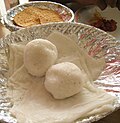
Poo-pole and pinde
Vodu-Pole on Mannudo-Vodu
Chekkero-Appa prepared in Thondhur

Beary cuisine is highly influenced by the South Indian cuisine. Just like Mangalorean cuisine it uses a lot of coconut, curry leaves, ginger, chilli and spices like pepper and cardamom. Beary cuisine includes a type of biryani which is very different from types made elsewhere. Rice preparations, both fresh and dry fish, meat and eggs feature in Beary daily menus.[citation needed]

Beary literature[edit | edit source]

The Beary Sahitya Academy is an association of Beary-speaking people located mainly in Tulu Nadu, which includes the coastal districts of Dakshina Kannada and Udupi in Karnataka state and Kasaragod in Kerala state.[citation needed] In 2022, the foundation-laying ceremony for the construction of a new building for Karnataka Beary Sahitya Academy at Thokkottu was held. [10]

Beary organisations[edit | edit source]

Karnataka Beary Sahithya Academy

With the establishment of Karnataka Beary Sahithya Academy, the language got formal recognition and academic status from the government of Karnataka. This led to a boom in Beary literary and cultural activities and a script was developed for the language in 2020.   

The main motive of the Academy is to reckon the rich culture and heritage of Bearys and to cultivate and motivate the emerging young talents in the Beary community. By creating awareness of Beary culture, language and literature, the Academy aims to accomplish its goal in overall development of Beary language to build a healthy society.

In 2022, the foundation-laying ceremony for the construction of a new building for Karnataka Beary Sahitya Academy at Thokkottu was held. [10]

Bearys Welfare Association[edit | edit source]

In 2010, the Bearys Welfare Association, based in Bengaluru, distributed 80 scholarships for the needy.[11]

Bearys Welfare Forum[edit | edit source]

The Bearys Welfare Forum (BWF) of Abu Dhabi is an association of Beary expatriates in Abu Dhabi, United Arab Emirates.[12] It was established in 2004 with an intention of working for all sections of the society. It has helped the victims of Communal riots in Mangalore by providing medical assistance and other aids.[citation needed] It The BWF has organised several mass marriage ceremonies in Mangalore.[13][14][15]

Bearys Cultural Forum[edit | edit source]

Bearys Cultural Forum, in the United Arab Emirates, was constituted to provide education to the people of the coastal parts of the State of Karnataka. BCF's main objective is to promote, educate and create social, cultural and educational awareness amongst the Bearys and the population of the coastal Karnataka State and the UAE. The BCF regularly conducts cultural, sports, talent search, educational activities, Career Guidance Seminars, Iftar Party, etc. every year. BCF also provides educational scholarships to students for pursuing their higher studies in the field of Medicines, Engineering, Pharmacy, Business, Nursing, Journalism, Dentistry, etc.[citation needed]

In April 2012, 'Chammana 2012' hosted by Bearys Cultural Forum, Dubai, at the Radisson Blue Hotel, Dubai, attracted more than 1,200 people to its programme.[16]

In August 2018, BCF distributed scholarship to the downtrodden community.[17]

References[edit | edit source]

  1. Newspaper: The Hindu, Saturday, 13 Oct 2007 Archived 14 October 2007 at the Wayback Machine
  2. Ahmed Noori, Maikala, Preface to 1st edition (1960)
  3. Ahmed Noori, Maikala p.17 (1960)
  4. Ahmed Noori, Maikala, II edition, p.11 (1997)
  5. Beary Language's Struggle for Identity
  6. Upadhyaya, U. Padmanabha. Coastal Karnataka: Studies in Folkloristic and Linguistic Traditions of Dakshina Kannada Region of the Western Coast of India. Udupi: Rashtrakavi Govind Pai Samshodhana Kendra, 1996.P- ix . ISBN 81-86668-06-3 . First All India Conference of Dravidian Linguistics, Thiruvananthapuram, 1973
  7. World Beary Sammelana & Chammana 2006 – convention
  8. Dubai : World Beary Convention Kicks off in Style – 2010
  9. Ichlangod B.M., Tulunada Muslimaru – Byari Samskruti p.76 (1997)
  10. 10.0 10.1 "Foundation laid for Beary Academy's new building". The Times of India. 4 January 2022.
  11. Bearys Welfare Association's Scholarship Drive
  12. How an Abu Dhabi community group helps people get married.
  13. Anupama monthly, March 2008, page 28
  14. Bearys Welfare Forum, Abu Dhabi organizes Mass Wedding Ceremony at Mangaluru.
  15. Bearys Welfare Forum Abu Dhabi organizes 5th mass marriage ceremony.
  16. Bearys Cultural Forum Hosts Magnificent 'Chammana 2012'
  17. Dubai Bearys Cultural Forum distributes scholarships to nearly 500 students.

Other sources[edit | edit source]

  • Bearys of the coast, Article in Deccan Herald 12 December 1997 by B.M. Hanif.
  • Muslims in Dakshina Kannada: a historical study up to 1947 and survey of recent developments, Author Wahab Doddamane, A. Green Words publication. Mangalore, 1993.