


robot: Update article |
m clean up |
||
| Line 1: | Line 1: | ||
{{Short description| | {{Short description|1998 series of Indian nuclear weapons tests}} | ||
{{Use Indian English|date=December 2016}} | {{Use Indian English|date=December 2016}} | ||
{{Use dmy dates|date=December 2016}} | {{Use dmy dates|date=December 2016}} | ||
{{Infobox Nuclear weapons test | {{Infobox Nuclear weapons test | ||
|name =Pokhran-II <br /> Operation Shakti | |||
|picture =ShaktiBomb.jpg | |||
|picture_description=''Shakti I'' prior to its detonation | |||
|country =India | |||
|test_site =[[Pokhran Test Range]], [[Rajasthan]] | |||
|coordinates ={{Coord|27|04|44|N|71|43|20|E|type:event_region:IN|display=inline,title}} | |||
|period =11–13 May 1998 | |||
|number_of_tests =3 (5 devices fired) | |||
|test_type =[[Underground nuclear testing|Underground]] | |||
|device_type =[[Nuclear fission|fission]] and [[Nuclear fusion|fusion]] | |||
|max_yield ={{convert|45|ktonTNT|lk=in}} | |||
|previous_test =[[Smiling Buddha|Pokhran-I]] | |||
}} | }} | ||
'''Pokhran-II''' (''Operation Shakti'') was a series of five [[Nuclear weapons testing|nuclear weapon tests]] conducted by India in May 1998. The bombs were detonated at the [[Indian Army]]'s [[Pokhran Test Range]] in [[Rajasthan]]. It was the second instance of nuclear testing conducted by India, after the first test, ''[[Smiling Buddha]]'', in May 1974. | |||
The | The test consisted of five detonations, the first of which was claimed to be a [[Thermonuclear weapon|two-stage fusion bomb]] while the remaining four were [[fission bomb]]s. The first three tests were [[Nuclear weapons testing#Salvo tests|carried out simultaneously]] on 11 May 1998 and the last two were detonated two days later on 13 May 1998. The tests were collectively called ''Operation Shakti'', and the five nuclear bombs were designated as ''Shakti-I'' to ''Shakti-V''. | ||
The tests achieved | The chairman of the [[Atomic Energy Commission of India]] described each of the explosions to be equivalent to several tests carried out over the years by various nations. While announcing the tests, the [[Government of India|Indian government]] declared India as a nuclear state and that the tests achieved the main objective of giving the capability to build fission bombs and thermonuclear weapons with yields up to 200 [[kilotons]]. While the Indian fission bombs have been documented, the design and development of thermonuclear weapons remains uncertain after the tests.<ref>{{cite journal |last=Kristensen |first=Hans M. |last2=Korda |first2=Matt |last3=Johns |first3=Eliana |last4=Knight |first4=Mackenzie |date=2024-09-02 |title=Indian nuclear weapons, 2024 |url=https://www.tandfonline.com/doi/full/10.1080/00963402.2024.2388470 |journal=Bulletin of the Atomic Scientists |volume=80 |issue=5 |pages=326–342 |doi=10.1080/00963402.2024.2388470 |issn=0096-3402 |access-date=2025-04-12|url-access=subscription }}</ref> | ||
As a consequence of the tests, [[United Nations Security Council Resolution 1172]] was enacted and [[economic sanction]]s were imposed by countries including Japan and the United States. | |||
== History == | |||
=== Early nuclear programme (1944–1965) === | |||
Efforts towards building a [[nuclear weapon|nuclear bomb]], infrastructure, and research on related [[Nuclear technology|technologies]] have been undertaken by India since the end of [[Second World War]].<ref name="Print">{{cite web|title=Homi Bhabha and how World War II was responsible for creating India's nuclear future|url=https://theprint.in/theprint-profile/homi-bhabha-and-how-world-war-ii-was-responsible-for-creating-indias-nuclear-future/312842/|work=[[The Print]]|date=30 October 2019|access-date=1 December 2023|archive-date=6 May 2023|archive-url=https://web.archive.org/web/20230506125313/https://theprint.in/theprint-profile/homi-bhabha-and-how-world-war-ii-was-responsible-for-creating-indias-nuclear-future/312842/|url-status=live}}</ref> The origins of [[India and weapons of mass destruction|India's nuclear programme]] go back to 1945 when [[nuclear physics|nuclear physicist]] [[Homi J. Bhabha|Homi Bhabha]] established the [[Tata Institute of Fundamental Research]] (TIFR) with the aid of [[Tata Group]]. After [[Indian Independence Act 1947|Indian independence]], the Atomic Energy Act was passed on 15 April 1948, that established the [[Indian Atomic Energy Commission]] (IAEC).<ref name="History">{{cite web|last=Sublette|first=Carey|title=Origins of Indian nuclear program|url=http://nuclearweaponarchive.org/India/IndiaOrigin.html|publisher=Nuclear weapon Archive|access-date=13 November 2011}}</ref> In 1954, [[Department of Atomic Energy (India)|Department of Atomic Energy (DAE)]] was established which was responsible for the atomic development programme and was allocated a significant amount of the defence budget in the subsequent years. In 1956, the first [[nuclear reactor]] became operational at [[Bhabha Atomic Research Centre]] (BARC), becoming the first operating reactor in Asia.<ref>{{cite press release|url=https://pib.gov.in/Pressreleaseshare.aspx?PRID=1545653|title=Apsara – U Reactor Becomes Operational at Bhabha Atomic Research Centre, Trombay|date=11 September 2018|access-date=1 December 2023|publisher=[[Government of India]]}}</ref> In 1961, India commissioned a reprocessing plant to produce [[Weapons-grade nuclear material|weapon grade plutonium]]. In 1962, India was engaged in a [[Sino-Indian War|war with China]], and with China conducting its own [[596 (nuclear test)|nuclear test in 1964]], India accelerated its development of nuclear weapons.<ref name="History"/><ref name="Print"/> | |||
== India's | With two reactors operational in the early 1960s, research progressed into the manufacture of nuclear weapons.<ref>{{cite book|last=Kumar|first=P.|title=Homi J. Bhabha: A Complete Biography: Homi J. Bhabha: A Complete Biography: Architect of India's Nuclear Program|publisher=Prabhakar Prakashan|year=2024|isbn=978-93-5562-943-2|url=https://books.google.com/books?id=VdXsEAAAQBAJ|page=1960|access-date=20 May 2024|archive-date=20 May 2024|archive-url=https://web.archive.org/web/20240520143446/https://books.google.com/books?id=VdXsEAAAQBAJ|url-status=live}}</ref><ref name="History"/> With the unexpected deaths of then [[Prime Minister of India|Prime Minister]] [[Jawaharlal Nehru|Nehru]] in 1964 and Bhabha in 1966, the programme slowed down.<ref name="Program">{{cite web|title=On to Weapons Development, 1960–67|url=http://nuclearweaponarchive.org/India/IndiaWDevelop.html|publisher=Nuclear Weapon Archive|access-date=14 January 2013|date=30 March 2001}}</ref> The incoming prime minister [[Lal Bahadur Shastri]] appointed physicist [[Vikram Sarabhai]] as the head of the nuclear programme and the direction of the programme changed towards using nuclear energy for peaceful purposes rather than military development.<ref name="Kanavi">{{cite web|last=Kanavi|first=Shivanand|title=How Indian PMs reacted to nuclear bombs|url=https://www.rediff.com/news/slide-show/slide-show-1-an-interview-with-k-subrahmanyam/20110210.htm|work=[[Rediff.com]]|access-date=2 April 2024|archive-date=15 November 2019|archive-url=https://web.archive.org/web/20191115120835/https://www.rediff.com/news/slide-show/slide-show-1-an-interview-with-k-subrahmanyam/20110210.htm|url-status=live}}</ref> | ||
=== Development of nuclear bomb and first test (1966–1972) === | |||
[[File:Trombay.jpg|thumb|APSARA reactor and plutonium reprocessing facility at [[Bhabha Atomic Research Centre|BARC]] as photographed by a US satellite on 19 February 1966]] | |||
After [[Indira Gandhi]] became [[ | After Shastri's death in 1966, [[Indira Gandhi]] became the prime minister and work on the nuclear programme resumed. The design work on the bomb proceeded under physicist [[Raja Ramanna]], who continued the nuclear weapons technology research after Bhabha's death in 1966.<ref name="Program"/> The project employed 75 scientists and progressed in secrecy.<ref name="Kanavi"/> During the [[Indo-Pakistani War of 1971|Indo-Pakistani War]], the US government sent a [[carrier battle group]] into the [[Bay of Bengal]] in an attempt to intimidate India, who were aided by the [[Soviet Union]], who responded by sending a [[submarine]] armed with [[nuclear missile]]s. The Soviet response underlined the [[Deterrence theory|deterrent value]] and significance of nuclear weapons to India.<ref>{{cite news|url=http://www.indiandefencereview.com/2010/02/arihant-the-annihilator.html|title=Arihant: the annihilator|publisher=Indian Defence Review|date=25 October 2010|access-date=8 January 2012|archive-date=13 June 2016|archive-url=https://web.archive.org/web/20160613034034/http://www.newindianexpress.com/nation/EXPRESS-EXCLUSIVE-Maiden-Test-of-Undersea-K-4-Missile-From-Arihant-Submarine/2016/04/09/article3370608.ece|url-status=live}}</ref> After India gained military and political initiative over Pakistan in the war, the work on building a nuclear device continued. The hardware began to be built in early 1972 and the Prime Minister authorised the development of a nuclear test device in September 1972.<ref>{{cite book|last=Perkovich|first=G.|title=India's Nuclear Bomb: The Impact on Global Proliferation|publisher=University of California Press|series=ACLS Humanities E-Book|year=1999|isbn=978-0-520-23210-5|page=172}}</ref> | ||
=== | On 18 May 1974, India tested a [[Nuclear weapon design#Implosion-type weapon|implosion-type]] fission device at the [[Indian Army]]'s [[Pokhran Test Range]] under the code name ''[[Smiling Buddha]]''.<ref name="Smiling Buddha">{{cite web|url=http://nuclearweaponarchive.org/India/IndiaSmiling.html|work=India's Nuclear Weapons Program|title=Smiling Buddha, 1974|publisher=Nuclear Weapon Archive}}</ref> The test was described as a [[peaceful nuclear explosion]] (PNE) and the [[nuclear yield|yield]] was estimated to be between 6 and 10 [[kiloton]]s.<ref name="Smiling Buddha"/><ref name="Pahuja">{{cite book|first=Om Parkash|last=Pahuja|title=India: A Nuclear Weapon State|url=https://books.google.com/books?id=GiI_Yt7SOA8C&pg=PT63|access-date=29 June 2012|publisher=Prabhat Prakashan|isbn=978-81-87100-69-0|pages=63–|year=2001}}</ref><ref name="Nuclear files archives">{{cite web|url=http://www.nuclearfiles.org/menu/timeline/timeline_page.php?year=1974|title=1974 Nuclear files|work=Nuclear Age Peace Foundation|publisher=Nuclear files archives|access-date=14 January 2013|archive-date=2 July 2016|archive-url=https://web.archive.org/web/20160702032049/http://www.nuclearfiles.org/menu/timeline/timeline_page.php?year=1974|url-status=dead}}</ref><ref>{{cite book|last=Bates|first=Crispin|title=Subalterns and Raj: South Asia Since 1600|year=2007|publisher=Routledge|isbn=978-0-415-21484-1|page=343}}</ref> | ||
{{Atal Bihari Vajpayee series}} | |||
=== Aftermath of nuclear tests (1973–1988) === | |||
While India continued to state that the test was for peaceful purposes, it encountered opposition from many countries. The [[Nuclear Suppliers Group]] (NSG) was formed in reaction to the Indian tests to check international [[nuclear proliferation]].<ref name="NSG">{{cite web|title=History of the NSG|url=https://www.nsg-online.org/en/about-nsg|work=Nuclear Suppliers Group|access-date=14 January 2023|archive-date=3 February 2023|archive-url=https://web.archive.org/web/20230203133606/https://www.nsg-online.org/en/about-nsg|url-status=live}}</ref> The [[Technological apartheid|technological embargo]] and sanctions affected the development of India's nuclear programme.<ref>{{cite web|title=Smiling Buddha: All about Pokhran test that made India a nuclear power|url=https://www.theindianhawk.com/2020/05/smiling-buddha-all-about-pokhran-test-that-made-india-nuclear-power.html|access-date=5 July 2020|work=The Indian Hawk|date=19 May 2020|archive-date=7 July 2020|archive-url=https://web.archive.org/web/20200707010619/https://www.theindianhawk.com/2020/05/smiling-buddha-all-about-pokhran-test-that-made-india-nuclear-power.html|url-status=live}}</ref> It was crippled by the lack of indigenous resources and dependence on imported technology on certain areas. Though India declared to the [[International Atomic Energy Agency]] (IAEA) that India's nuclear program was intended only for peaceful purposes, preliminary work on a [[nuclear fusion|fusion]] bomb was initiated.<ref name="Pause">{{cite web|title=The Long Pause: 1974–1989|url=http://nuclearweaponarchive.org/India/IndiaPause.html|publisher=Nuclear Weapon Archive|access-date=14 November 2011}}</ref> In the aftermath of the [[The Emergency (India)|state emergency]] in 1975 that resulted in the collapse of the [[Second Indira Gandhi ministry]], the programme continued under [[M.R. Srinivasan]], but made slow progress. Though the nuclear programme did not receive much attention from incoming Prime Minister [[Morarji Desai]] at first, it gained impetus when Ramanna was appointed to the [[Ministry of Defence (India)|Ministry of Defence]].<ref>{{cite book|last=Chengappa|first=Raj|title=Weapons of peace : the secret story of India's quest to be a nuclear power|year=2000|publisher=[[Harper Collins]]|location=New Delhi|isbn=81-7223-330-2|pages=219–220}}</ref> | |||
With the discovery of [[Pakistan and weapons of mass destruction|Pakistan's clandestine atomic bomb program]], India realised that it was very likely to succeed in its project in a few years. With the return of Indira Gandhi in [[1980 Indian general election|1980]], the nuclear programme gained momentum. Two new underground shafts were constructed at the Pokhran test range by 1982 and Gandhi approved further nuclear tests in 1982. But the decision was reversed owing to pressure from the United States as it might end up in [[nuclear brinksmanship]] with Pakistan and potential foreign policy implications. Work continued towards weaponizing the nuclear bomb under [[V. S. R. Arunachalam]] and the [[Integrated Guided Missile Development Programme|Indian missile programme]] was launched under [[A. P. J. Abdul Kalam]].<ref name="Pause"/> Ramanna pushed forward with a [[Enriched uranium|uranium enrichment program]] and despite the sanctions, India imported [[heavy water]] required as a [[neutron moderator]] in the [[nuclear reactors]], from countries like China, Norway and Soviet Union through a middleman. Though [[Rajiv Gandhi]], who became the Prime Minister in 1984, supported technological development and research, he was sceptical about nuclear testing as he believed it would result in further technological alienation from the developed countries. ''Dhruva'', a new reactor with a capability to produce larger quantities of weapon grade material, was commissioned at BARC in 1985. Other components for a nuclear fusion bomb were developed during the time with capabilities to air drop nuclear weapons. In late 1985, a study group commissioned by the Prime Minister outlined a plan for the production of 70 to 100 nuclear warheads and a strict no [[First use of nuclear weapons|first use]] policy.<ref name="Pause"/> | |||
=== Building towards second nuclear test (1989–1998) === | |||
In [[1989 Indian general election|1989]], [[Vishwanath Pratap Singh|V.P. Singh]] formed the [[V. P. Singh ministry|government]], which collapsed within two years and this period of instability caused a snag in the nuclear weapons programme. [[India-Pakistan Relations|Foreign relations]] between India and Pakistan severely worsened when India accused Pakistan of supporting the [[Insurgency in Jammu and Kashmir]]. During this time, the Indian Missile Program succeeded in the development of the [[Prithvi (missile)|''Prithvi'']] [[missile]]s. India decided to observe the temporary moratorium on the nuclear tests for fear of inviting international criticism.<ref name="Momentum">{{cite web|url=https://nuclearweaponarchive.org/India/IndiaMomentum.html|title=The Momentum Builds: 1989-1998|publisher=Nuclear Weapon Archive|access-date=1 December 2023}}</ref> The NSG decided in 1992 to require full-scope IAEA safeguards for any new nuclear export deals, which effectively ruled out nuclear exports to India.<ref>{{cite web|title=Nuclear Suppliers Group (NSG)|url=http://www.nti.org/e_research/official_docs/inventory/pdfs/nsg.pdf|publisher=Nuclear Threat Initiative|access-date=4 December 2011|archive-url=https://web.archive.org/web/20030503120417/http://nti.org/e_research/official_docs/inventory/pdfs/nsg.pdf|archive-date=3 May 2003|df=dmy-all}}</ref> | |||
Though India had stock-piled material and components to be able to construct a dozen nuclear fission bombs, the deliverance mechanism was still under development. With the successful testing of [[Agni missile]] and successful trials involving dropping of similar bombs without fissionable material from [[bomber aircraft]] in 1994, the weaponization became successful. With the [[Comprehensive Nuclear-Test-Ban Treaty]] under discussion and global pressure pushing India to sign, then Indian Prime Minister [[P.V. Narasimha Rao|Narasimha Rao]] ordered preparations for further nuclear tests in 1995. Based on the direction of the director of DAE [[Rajagopala Chidambaram|R. Chidambaram]], [[S. K. Sikka]] was tasked with the development of a thermo-nuclear fusion device. In August, [[Krishnamurthy Santhanam|K. Santhanam]], the chief technical adviser of DRDO, was appointed the director for carrying out the tests. While water was being pumped out of the shafts constructed more than ten years earlier, American [[Evolved Enhanced CRYSTAL|spy satellites]] picked up the signs.<ref name="Momentum"/> With pressure from [[President of the United States|US President]] [[Bill Clinton]], the test never progressed.<ref>{{cite news|publisher=CNN|title=India wants to divert attention from N-test plan|url=http://www.lib.virginia.edu/area-studies/SouthAsia/SAserials/Dawn/1996/04Jan96.html#indi|access-date=16 January 2013|newspaper=Dawn Archives|date=4 January 1996|archive-date=30 March 2020|archive-url=https://web.archive.org/web/20200330231716/http://www.lib.virginia.edu/area-studies/SouthAsia/SAserials/Dawn/1996/04Jan96.html#indi|url-status=dead}}</ref> | |||
With Rao's term ending in 1996, the next two years saw multiple governments being formed. [[Atal Bihari Vajpayee]], who was a strong advocate of nuclear weaponization, came to power following the [[1998 Indian general election|1998 general elections]]. Vajpayee had earlier declared that if re-voted to power, his government would induct nuclear weapons and declare India's might to gather respect.<ref name="Nuclear politics">{{cite web|title=The nuclear politics: The 1998 Election|url=http://nuclearweaponarchive.org/India/IndiaShakti.html|work=Nuclear weapon archives|publisher=Nuclear politics|access-date=16 January 2013}}</ref> Soon after assuming power in March 1998, Vajpayee organized a discussion with Abdul Kalam and Chidambaram to conduct nuclear tests. On 28 March 1998, he asked to make preparations for a test.<ref>{{cite news|agency=[[Press Trust of India]]|title=Pokhran II row: Sethna slams Kalam, Iyengar says tests were done in haste|url=http://www.dnaindia.com/india/report_pokhran-ii-row-sethna-slams-kalam-iyengar-says-tests-were-done-in-haste_1286978|work=[[Daily News and Analysis]]|access-date=15 November 2011|date=September 2009|archive-date=29 March 2012|archive-url=https://web.archive.org/web/20120329184008/http://www.dnaindia.com/india/report_pokhran-ii-row-sethna-slams-kalam-iyengar-says-tests-were-done-in-haste_1286978|url-status=live}}</ref> | |||
[[ | |||
== Nuclear test == | |||
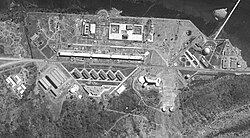
[[File:Tracking Nuclear Proliferation, India.jpg|thumb|[[Marine Corps Intelligence Activity|US Marine Intelligence]] maps showing the Indian test site in 1997]] | |||
=== Preparation === | |||
The [[Indian Intelligence Bureau]] had been aware of the capability of the United States [[Nuclear MASINT|spy satellites]] in detecting Indian test preparations. Therefore, the tests required complete secrecy and the [[List of regiments and corps of the Indian Army|58th Engineer Regiment]] of the [[Indian Army Corps of Engineers]] was tasked with preparing the test sites without being detected.<ref name="India Today">{{cite news|title=Books: Weapons of Peace—How the CIA was Fooled|work=[[India Today]]|url=http://www.india-today.com/itoday/17051999/books.html|access-date=30 October 2006|archive-url=https://web.archive.org/web/20160112002020/http://www.india-today.com/itoday/17051999/books.html|archive-date=12 January 2016|url-status=dead }}</ref> Work was mostly done during night, and equipment was returned to the original place during the day to give the impression that it was never moved. Bomb shafts were dug under camouflage netting and the dug-out sand was shaped like natural [[sand dune]]s. Cables and sensors were either covered with sand or concealed using native vegetation. A select group was involved in the detonation process with all personnel required to wear uniforms to preserve the secrecy of the tests. They were given pseudo-names and they traveled in smaller groups to avoid detection.<ref name="India Today"/><ref name="Nuclear politics" /> | |||
Scientists and engineers of BARC, the [[Atomic Minerals Directorate for Exploration and Research|Atomic Minerals Directorate for Exploration and Research (AMDER)]], and DRDO were involved in the development and assembly of the bombs. Three laboratories of the DRDO were involved in designing, testing and producing components for the bombs, including the [[detonator]]s, the implosion and high-voltage trigger systems. These were also responsible for systems engineering, aerodynamics and safety. The bombs were transported moved from BARC at 3 am on 1 May 1998 to [[Chhatrapati Shivaji Maharaj International Airport|Bombay airport]], then flown in an [[Indian Air Force]]'s [[AN-32]] aircraft to [[Jaisalmer Airport]]. It was then transported to Pokhran in an army convoy of four trucks, and this required three trips. The devices were delivered to the device preparation building, which was designated as ''Prayer Hall''.<ref name="Shakti"/> | |||
=== | === Personnel === | ||
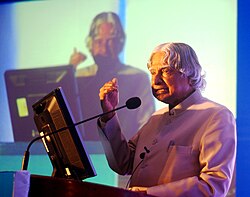
{{ | [[File:A.P.J Abdul Kalam.jpg|thumb|[[A. P. J. Abdul Kalam]] was one of the co-ordinators for the test.]] | ||
Following were the main personnel involved in the testing:<ref name="Shakti">{{cite web|url=http://nuclearweaponarchive.org/India/IndiaShakti.html|title=India's Nuclear Weapons Program—Operation Shakti: 1998|publisher=Nuclear Weapon Archive|access-date=21 July 2012}}</ref> | |||
* Chief Coordinators : | |||
** [[A.P.J. Abdul Kalam]], scientific adviser to the [[Defence Minister of India|defence minister]] and head of the [[DRDO]] | |||
** [[Rajagopala Chidambaram|R. Chidambaram]], chairman of the [[Atomic Energy Commission of India|Atomic Energy Commission]] and the [[Department of Atomic Energy]] | |||
* [[Defence Research & Development Organization]] (DRDO): | |||
** [[Krishnamurthy Santhanam|K. Santhanam]], director of test site preparations | |||
* [[Bhabha Atomic Research Centre]] (BARC) : | |||
** [[Anil Kakodkar]], director | |||
** [[S. K. Sikka|Satinder Kumar Sikka]], lead for thermonuclear weapon development | |||
** [[M. S. Ramakumar]], Director of Nuclear Fuel and Automation Manufacturing Group; lead for manufacture of nuclear components | |||
** D.D. Sood, director of Radiochemistry and Isotope Group; director of nuclear materials acquisition | |||
** S.K. Gupta, Solid State Physics and Spectroscopy Group; director of device design and assessment | |||
** G. Govindraj, associate director of Electronic and Instrumentation Group; director of field instrumentation | |||
=== Testing === | |||
[[File:A sunset on the dunes of the Great Indian Thar Desert Rajasthan India.jpg|thumb|The [[Thar Desert]] in the state of [[Rajasthan]] where the nuclear site, the [[Pokhran Test Range]], is located]] | |||
The test was organized into two groups to be fired separately, with all devices in a group fired at the same time. Five nuclear devices were tested during the operation.<ref>{{cite news|title=Forces gung-ho on N-arsenal|url=http://epaper.timesofindia.com/Repository/ml.asp?Ref=VE9JTS8yMDA5LzA4LzI4I0FyMDE1MDA|newspaper=[[The Times of India]]|access-date=21 July 2012|archive-url=https://web.archive.org/web/20130521000616/http://epaper.timesofindia.com/Repository/ml.asp?Ref=VE9JTS8yMDA5LzA4LzI4I0FyMDE1MDA|archive-date=21 May 2013|url-status=dead}}</ref><ref name="Shakti"/><ref name="PR">{{Cite journal|date=24 September 2009|title=Press Statement by Dr. Anil Kakodkar and Dr. R. Chidambaram on Pokhran-II tests|url=http://pib.nic.in/newsite/PrintRelease.aspx?relid=52814|url-status=live|journal=[[Press Information Bureau|Press Information Bureau, Government of India]]|archive-url=https://web.archive.org/web/20171024045228/http://pib.nic.in/newsite/PrintRelease.aspx?relid=52814|archive-date=24 October 2017}}</ref> | |||
<br/> | |||
Group-I: | |||
* ''Shakti I'': Two stage [[thermonuclear weapon|thermonuclear device]] with [[nuclear fusion|fusion]] boosted primary, test design yield 45 kt, but designed for up to 200 kt deployed yield | |||
* ''Shakti II'': A light-weight [[Implosion-type nuclear weapon|plutonium implosion]] [[nuclear fission|fission]] device yielding 12 kt and intended as a warhead that could be delivered by bomber or missile | |||
* ''Shakti III'': An experimental [[Implosion nuclear weapon|linear implosion]] fission device that used [[reactor-grade]] plutonium, yielding 0.3 kt | |||
Group-II: | |||
* ''Shakti IV'': A 0.5 kt experimental fission device | |||
* ''Shakti V'': A 0.2 kt [[Uranium-233|thorium/U-233]] experimental fission device | |||
An additional, sixth device (''Shakti VI'') was developed but not detonated. The first test was planned on 11 May.<ref>{{cite news|title=Spectral defence|url=https://frontline.thehindu.com/science-and-technology/article30188509.ece|access-date=23 March 2024|work=[[Frontline (magazine)|Frontline]]|archive-date=23 March 2024|archive-url=https://web.archive.org/web/20240323093429/https://frontline.thehindu.com/science-and-technology/article30188509.ece|url-status=live}}</ref> The thermonuclear device was placed in a shaft code named ''White House'', which was approximately {{convert|230|m|ft|abbr=~}} deep, the fission bomb was placed in a {{convert|150|m}} deep shaft code named ''Taj Mahal'', and the first sub-kiloton device in shaft ''Kumbhkaran''. The first three devices were placed in their respective shafts on 10 May. The first device to be placed was the sub-kiloton device, which was sealed by the army engineers by 8:30 PM. The thermonuclear device was lowered and sealed by 4 AM on the next day with the fission device being placed by 7:30 AM. The shafts were L-shaped, with a horizontal chamber used for the test devices.<ref name="Shakti"/> The timing of the tests was pursuant to the local weather conditions, and the test sequence was initiated in the afternoon. Santhanam, in-charge of the test site, handed over the site to M. Vasudev, the range safety officer, who was responsible for verifying the test indicators. After the safety clearance, the countdown system was activated and at 3:45 PM [[Indian Standard Time|IST]], the three devices were detonated simultaneously.<ref name="Shakti"/><ref name="Nuclear politics"/><ref>{{cite news|title=India releases pictures of nuclear tests|url=http://www.cnn.com/WORLD/asiapcf/9805/17/india.nuke.tests/|access-date=14 June 2015|work=[[CNN]]|date=17 May 1998|archive-date=30 March 2020|archive-url=https://web.archive.org/web/20200330231713/http://www.cnn.com/WORLD/asiapcf/9805/17/india.nuke.tests/|url-status=live}}</ref> On 13 May, at 12.21 PM IST, two sub-kiloton devices (''Shakti IV'' and ''V'') were detonated. Due to their very low yield, these explosions were not detected by any seismic station.<ref name="Nuclear politics"/><ref>{{cite journal|title=India's Pathway to Pokhran II: The Prospects and Sources of New Delhi's Nuclear Weapons Program|author=Sumit Ganguly|journal=International Security|volume=23|issue=4|date=Spring 1999|pages=148–177|jstor=2539297|doi=10.1162/isec.23.4.148|s2cid=57565560}}</ref> | |||
=== Announcement === | |||
Having tested weaponized nuclear warheads, India became the sixth country to join the [[nuclear club]].<ref name="BBC">{{cite news|title=Asia's nuclear challenge: Third World joins the nuclear club|url=http://news.bbc.co.uk/2/hi/events/asia_nuclear_crisis/analysis/92783.stm|access-date=17 January 2013|work=[[BBC News]]|date=13 May 1998|archive-date=20 October 2013|archive-url=https://web.archive.org/web/20131020185904/http://news.bbc.co.uk/2/hi/events/asia_nuclear_crisis/analysis/92783.stm|url-status=live}}</ref> Shortly after the tests, Prime Minister Vajpayee appeared before the press corps and made the following short statement: | |||
== | |||
{{cquote|Today, at 15:45 hours, India conducted three underground nuclear tests in the Pokhran range. The tests conducted today were with a fission device, a low yield device and a thermonuclear device. The measured yields are in line with expected values. Measurements have also confirmed that there was no release of radioactivity into the atmosphere. These were contained explosions like the experiment conducted in May 1974. I warmly congratulate the scientists and engineers who have carried out these successful tests.<ref>{{cite web|url=https://fas.org/news/india/1998/05/vajpayee1198.htm|title=Prime Minister's announcement of India's three underground nuclear tests|work=FAS|archive-url=https://web.archive.org/web/20020314083350/https://fas.org/news/india/1998/05/vajpayee1198.htm|access-date=31 January 2013|archive-date=14 March 2002|url-status=live}}</ref><ref>{{cite web|url=https://www.youtube.com/watch?v=xFuUKVxHOX0&t=28|title=Prime Minister's press briefing video|work=[[YouTube]]|date=13 May 2019 |access-date=24 December 2023|archive-date=24 December 2023|archive-url=https://web.archive.org/web/20231224184549/https://www.youtube.com/watch?v=xFuUKVxHOX0&t=28|url-status=live}}</ref>}} | |||
The | |||
On 13 May 1998, India declared the series of tests to be over after this.<ref name="GOI">{{cite press release|title=Planned Series of Nuclear Tests Completed|url=http://nuclearweaponarchive.org/India/Indianofficial.txt|publisher=[[Government of India]]|access-date=17 January 2013|date=13 May 1998}}</ref><ref>{{cite journal|last=Ganguly|first=Sumit|date=1999|title=India's Pathway to Pokhran II: The Prospects and Sources of New Delhi's Nuclear Weapons Program|url=https://www.jstor.org/stable/2539297|journal=International Security|volume=23|issue=4|pages=148–177|doi=10.1162/isec.23.4.148|jstor=2539297|s2cid=57565560|issn=0162-2889|access-date=25 May 2022|archive-date=25 May 2022|archive-url=https://web.archive.org/web/20220525030913/https://www.jstor.org/stable/2539297|url-status=live|url-access=subscription}}</ref> | |||
== Reactions to tests == | == Reactions to tests == | ||
=== Domestic === | |||
News of the tests were greeted with jubilation and large-scale approval by general public in India. The [[Bombay Stock Exchange]] registered significant gains. The media praised the government for its decision and advocated the development of an operational nuclear arsenal for the country's armed forces. The opposition led by [[Indian National Congress]] criticized the [[Vajpayee Government|Vajpayee administration]] for carrying out the series of nuclear tests, accusing the government of trying to use the tests for political ends rather than to enhance the country's national security.<ref>{{cite news|last=Lyon|first=David|title=India detonates two more bombs|url=http://news.bbc.co.uk/2/hi/special_report/1998/05/98/india_nuclear_testing/93111.stm|access-date=17 January 2013|work=[[BBC News]]|date=31 May 1998|archive-date=1 November 2013|archive-url=https://web.archive.org/web/20131101141730/http://news.bbc.co.uk/2/hi/special_report/1998/05/98/india_nuclear_testing/93111.stm|url-status=live}}</ref> | |||
By the time India had conducted tests, the country had a total of $44bn in loans in 1998, from the [[International Monetary Fund|IMF]] and the [[World Bank]]. The industrial sectors of the Indian economy were likely to be hurt by sanctions with the foreign companies, which had invested heavily in India, facing consequences of impending sanctions. The Indian government announced that it had factored the economic response and was willing to take the consequences.<ref>{{cite news|title=India—will sanctions bite?|url=http://news.bbc.co.uk/2/hi/events/asia_nuclear_crisis/analysis/92942.stm|work=[[BBC News]]|date=1 June 1998|access-date=1 December 2023|archive-date=30 June 2023|archive-url=https://web.archive.org/web/20230630050933/http://news.bbc.co.uk/2/hi/events/asia_nuclear_crisis/analysis/92942.stm|url-status=live}}</ref> | |||
By the time India had conducted tests, the country had a total of $44bn in loans in 1998, from the [[International Monetary Fund|IMF]] and the [[World Bank]]. | |||
== International | === International === | ||
The United States issued a statement condemning India and threatened [[economic sanctions]]. The [[US intelligence community|intelligence community]] felt humiliated for its failure to detect the preparations for the test.<ref>{{cite news|last=Weiner|first=T.|title=Nuclear anxiety: The Blunders; U.S. Blundered On Intelligence, Officials Admit|url=https://www.nytimes.com/1998/05/13/world/nuclear-anxiety-the-blunders-us-blundered-on-intelligence-officials-admit.html|newspaper=[[The New York Times]]|date=13 May 1998|access-date=1 December 2023|archive-date=9 December 2023|archive-url=https://web.archive.org/web/20231209070934/https://www.nytimes.com/1998/05/13/world/nuclear-anxiety-the-blunders-us-blundered-on-intelligence-officials-admit.html|url-status=live}}</ref> In keeping with its preferred approach to [[Foreign policy of the clinton administration|foreign policy]] in [[History of the United States (1991–present)|recent decades]], and in compliance with the [[Treaty on the Non-Proliferation of Nuclear Weapons|1994 anti-proliferation law]], the United States imposed economic sanctions on India.<ref>{{cite news|title=US imposes sanctions on India|url=http://news.bbc.co.uk/2/hi/special_report/1998/05/98/india_nuclear_testing/92797.stm|work=[[BBC News]]|date=13 May 1998|access-date=1 December 2023|archive-date=26 December 2018|archive-url=https://web.archive.org/web/20181226123705/http://news.bbc.co.uk/2/hi/special_report/1998/05/98/india_nuclear_testing/92797.stm|url-status=live}}</ref> The sanctions on India consisted of cutting off all assistance to India except humanitarian aid, banning the export of certain defense material and technologies, ending American credit and credit guarantees to India, and requiring the US to oppose lending by international financial institutions to India.<ref>{{cite news|url=http://www.cnn.com/WORLD/asiapcf/9805/13/india.us/|work=[[CNN]]|title=U.S. imposes sanctions on India|access-date=1 December 2023|archive-date=30 June 2023|archive-url=https://web.archive.org/web/20230630050930/http://www.cnn.com/WORLD/asiapcf/9805/13/india.us/|url-status=live}}</ref> The United States held talks with India over the issue of India becoming a part of the [[Comprehensive Test Ban Treaty|CTBT]] and [[Non-Proliferation Treaty|NPT]] and pressurized to [[rollback]] India's nuclear program.<ref>{{cite web|title=Clarifying India's Nascent Nuclear Doctrine|url=https://www.armscontrol.org/act/1999_12/jsde99|publisher=Arms control interview|access-date=10 June 2015|archive-date=10 June 2015|archive-url=https://web.archive.org/web/20150610130902/https://www.armscontrol.org/act/1999_12/jsde99|url-status=live}}</ref> India did not accede to the request stating that it was not consistent with her national security interest.<ref>{{cite web|last=Chandrasekharan|first=S.|title=CTBT : where does India stand?|url=http://www.southasiaanalysis.org/paper8#sthash.0vCRukPh.dpuf|work=South Asia Analysis|access-date=10 June 2015|archive-date=10 June 2015|archive-url=https://web.archive.org/web/20150610110216/http://www.southasiaanalysis.org/paper8#sthash.0vCRukPh.dpuf|url-status=usurped}}</ref> | |||
=== | China stated that it was seriously concerned about the tests which are not favorable to the peace and stability in the region and called for the international community to pressure India to cease the development of nuclear weapons.<ref>{{cite news|url=https://www.nytimes.com/1998/05/13/world/nuclear-anxiety-reaction-china-seriously-concerned-but-restrained-its-criticism.html|title=China is 'Seriously Concerned' But Restrained in Its Criticism|work=[[The New York Times]]|date=13 May 1998|access-date=1 December 2023|archive-date=20 May 2024|archive-url=https://web.archive.org/web/20240520162007/https://www.nytimes.com/1998/05/13/world/nuclear-anxiety-reaction-china-seriously-concerned-but-restrained-its-criticism.html|url-status=live}}</ref> It further rejected claims of India's stated rationale of needing nuclear capabilities to counter a Chinese threat as unfounded.<ref>{{cite web|last=Resources on India and Pakistan|title=China's Reaction to India's Nuclear Tests|url=http://cns.miis.edu/archive/country_india/china/nsacris.htm|access-date=15 May 2012|work=CNS Center for Nonproliferation Studies Monterey Institute of International Studies|date=1999|url-status=dead|archive-url=https://web.archive.org/web/20130103195522/http://cns.miis.edu/archive/country_india/china/nsacris.htm|archive-date=3 January 2013|df=dmy-all}}</ref> However, the other [[permanent members of the United Nations Security Council]]– the United Kingdom, France, and Russia refrained from making any statements condemning the tests.<ref>{{cite journal|title=Costs of Economic Sanctions: Aftermath of Pokhran II|author=Charan D. Wadhva|journal=Economic and Political Weekly|volume=33|issue=26|date=27 June 1998|pages=1604–1607|jstor=4406922}}</ref> | ||
Few other nations also imposed sanctions on India, primarily in the form of suspension of foreign aid and government-to-government credit lines. Canada criticized India's actions,<ref>{{cite news|url=http://www.thehindu.com/todays-paper/tp-features/tp-sundaymagazine/east-meets-far-east/article6365598.ece|title=East meets Far East|newspaper=[[The Hindu]]|date=31 August 2014|last1=Haidar|first1=Suhasini|access-date=14 January 2015|archive-date=28 November 2020|archive-url=https://web.archive.org/web/20201128101012/https://www.thehindu.com/todays-paper/tp-features/tp-sundaymagazine/east-meets-far-east/article6365598.ece|url-status=live}}</ref> and Japan imposed [[economic sanctions]] which included freezing all new loans and grants except for humanitarian aid.<ref>{{cite news|url=http://articles.cnn.com/2001-10-26/world/japan.sanctions_1_pakistan-sanctions-pakistan-and-india-nuclear-testing?_s=PM:asiapcf|work=[[CNN]]|title=U.S. lifts final sanctions on Pakistan|date=29 October 2001|url-status=dead|archive-url=https://web.archive.org/web/20120403005307/http://articles.cnn.com/2001-10-26/world/japan.sanctions_1_pakistan-sanctions-pakistan-and-india-nuclear-testing?_s=PM:asiapcf|archive-date=3 April 2012|df=dmy-all}}</ref> | |||
Pakistan issued a statement blaming India for instigating a [[nuclear arms race]] in the region with [[Prime Minister of Pakistan|prime minister]] [[Nawaz Sharif]] stating that his country will take appropriate action.<ref>{{cite news|last=Special Report|title=Pakistan condemns India's nuclear tests|url=http://news.bbc.co.uk/2/hi/special_report/1998/05/98/india_nuclear_testing/92841.stm|work=BBC|date=13 May 1998|access-date=1 December 2023|archive-date=1 November 2013|archive-url=https://web.archive.org/web/20131101142307/http://news.bbc.co.uk/2/hi/special_report/1998/05/98/india_nuclear_testing/92841.stm|url-status=live}}</ref> It later carried out six [[Pakistan's nuclear testing series|nuclear tests]] under the code name ''[[Chagai-I]]'' on 28 May 1998 and ''[[Chagai-II]]'' on 30 May 1998.<ref name="Nuclear politics"/> Pakistan's leading [[nuclear physicist]], [[Pervez Hoodbhoy]], held India responsible for Pakistan's nuclear test experiments.<ref>{{cite news|last=Hoodbhoy|first=Pervez Amerali|author-link=Pervaiz Hoodbhoy|title=Nuclear Bayonet|newspaper=[[The Herald (Pakistan)|The Herald]]|date=23 January 2011|url=http://www.dawn.com/2011/02/16/herald-exclusive-pakistans-nuclear-bayonet.html|access-date=1 December 2023|archive-date=18 February 2011|archive-url=https://web.archive.org/web/20110218212415/http://www.dawn.com/2011/02/16/herald-exclusive-pakistans-nuclear-bayonet.html|url-status=live}}</ref> Pakistan's tests invited similar condemnation and economic sanctions.<ref>{{cite web|url=http://cns.miis.edu/research/india/wreactpk.htm|title=cns.miis.edu|access-date=8 January 2009|archive-url=http://webarchive.loc.gov/all/20011118130330/http://cns.miis.edu/research/india/wreactpk.htm|archive-date=18 November 2001|url-status=dead}}</ref><ref>{{cite book|last1=Gertz|first1=Bill|title=Betrayal: How the Clinton Administration Undermined American Security.|date=2013|publisher=Regnery Publishing|location=[[Washington DC]]|isbn=978-1-62157-137-7|url-access=registration|url=https://archive.org/details/betrayal00bill}}</ref> On June 6, the [[UN Security Council]] adopted [[United Nations Security Council Resolution 1172|Resolution 1172]], condemning the Indian and Pakistani nuclear tests.<ref name="Sharpe">{{cite book|editor=Dittmer, L.|title=South Asia's nuclear ecurity dilemma: India, Pakistan, and China|year=2005|publisher=Sharpe|location=[[Armonk]]|isbn=978-0-7656-1419-3}}</ref> | |||
=== | == Aftermath == | ||
Though the test was carried out in an uninhabited area, the residents of the villages–Odhaniya, Chacha, Loharki, and Khetolai, which were within a five-kilometre radius, felt the effects of the test. The tremors resulted in damage to the houses, and water storage facilities in the villages. The government compensated the villagers whose houses were damaged. A later study found traces of [[radiation exposure|radiation]] in the water, soil, and vegetation. While the villagers complained of an increase in the rate of [[cancers]] and [[genetic disorders]] in the years following the explosion, it had not been established with certainty that these were due to radiation exposure.<ref>{{cite web |last=Shukla |first=Chinky |date= 1 May 2019 |title=Life at Ground Zero |url=https://caravanmagazine.in/photo-essay/documenting-effects-nuclear-testing-pokhran-residents |access-date=29 December 2025 |work=[[The Caravan]] }}</ref> | |||
== Legacy and popular culture == | |||
The Government of India declared 11 May as ''National Technology Day'' in India to commemorate the first of the five successful nuclear weapon tests that were carried out on 11 May 1998.<ref>{{cite news|title=Why May 11 be celebrated as National Technology Day? Things you should know|url=https://timesofindia.indiatimes.com/home/education/current-affairs/why-may-11-be-celebrated-as-national-technology-day-things-you-should-know/articleshow/75669853.cms|work=[[The Times of India]]|date=11 May 2020|access-date=11 May 2020|archive-date=24 May 2020|archive-url=https://web.archive.org/web/20200524165319/https://timesofindia.indiatimes.com/home/education/current-affairs/why-may-11-be-celebrated-as-national-technology-day-things-you-should-know/articleshow/75669853.cms|url-status=live}}</ref> The day is celebrated by giving awards to various individuals and industries in the field of science and technology.<ref>{{cite web|url=http://www.dst.gov.in/whats_new/press-release08/tech-day.htm|title=National technology day celebrated|agency=[[Press Information Bureau]]|date=11 May 2008|publisher=[[Department of Science and Technology (India)|Department of Science and Technology]]|access-date=9 January 2011|url-status=dead|archive-url=https://web.archive.org/web/20101215195518/http://dst.gov.in/whats_new/press-release08/tech-day.htm|archive-date=15 December 2010|df=dmy-all }}</ref> | |||
''[[Parmanu: The Story of Pokhran]]'' is a 2018 [[Bollywood]] movie was based on the nuclear tests.<ref>{{cite news|url=https://www.indiatoday.in/movies/bollywood/story/john-abraham-parmanu-poster-pokhran-nuclear-tests-1029574-2017-08-14|title=John Abraham unveils Parmanu poster: All you need to know about the story of Pokhran|last=Ghosh|first=Samrudhi|work=[[India Today]]|date=14 August 2017|access-date=11 November 2017|archive-date=24 December 2017|archive-url=https://web.archive.org/web/20171224074855/http://indiatoday.intoday.in/story/john-abraham-parmanu-poster-pokhran-nuclear-tests/1/1025701.html|url-status=live}}</ref> ''[[War and Peace (2002 film)|War and Peace]]'' is a documentary by [[Anand Patwardhan]], which details the events of the tests.<ref>{{cite web|url=http://www.tehelka.com/story_main13.asp?filename=In070205Short_is.asp|title=War and Peace hits the box office for the first time in India|work=[[Tehelka]]|date=25 June 2005|access-date=1 December 2011|archive-date=12 September 2012|archive-url=https://archive.today/20120912213520/http://www.tehelka.com/story_main13.asp?filename=In070205Short_is.asp|url-status=dead}}</ref> | |||
== See also == | == See also == | ||
* [[India and weapons of mass destruction]] | * [[India and weapons of mass destruction]] | ||
* [[Pokhran-I]] | * [[Pokhran-I]] | ||
== References == | == References == | ||
{{Reflist | {{Reflist}} | ||
}} | |||
== External links == | == External links == | ||
{{Commons category|Pokhran-II}} | {{Commons category|Pokhran-II}} | ||
{{Pokhran-II (Operation Shakti)}} | {{Pokhran-II (Operation Shakti)}} | ||
| Line 227: | Line 139: | ||
[[Category:Indian nuclear weapons testing]] | [[Category:Indian nuclear weapons testing]] | ||
[[Category:A. P. J. Abdul Kalam]] | [[Category:A. P. J. Abdul Kalam]] | ||
[[Category:May 1998 | [[Category:May 1998 in Asia]] | ||
[[Category:Nuclear history of India]] | [[Category:Nuclear history of India]] | ||
[[Category: | [[Category:Pokhran]] | ||
[[Category:Political history of India]] | [[Category:Political history of India]] | ||
[[Category:Politics of India]] | [[Category:Politics of India]] | ||
[[Category:Underground nuclear weapons testing]] | [[Category:Underground nuclear weapons testing]] | ||
[[Category:Vajpayee administration initiatives]] | [[Category:Vajpayee administration initiatives]] | ||
Revision as of 19:26, 16 February 2026
| Pokhran-II Operation Shakti | |
|---|---|
 Shakti I prior to its detonation | |
| Information | |
| Country | India |
| Test site | Pokhran Test Range, Rajasthan |
| Coordinates | 27°04′44″N 71°43′20″E / 27.07889°N 71.72222°E |
| Period | 11–13 May 1998 |
| Number of tests | 3 (5 devices fired) |
| Test type | Underground |
| Device type | fission and fusion |
| Max. yield | 45 kilotons of TNT (190 TJ) |
| Test chronology | |
Pokhran-II (Operation Shakti) was a series of five nuclear weapon tests conducted by India in May 1998. The bombs were detonated at the Indian Army's Pokhran Test Range in Rajasthan. It was the second instance of nuclear testing conducted by India, after the first test, Smiling Buddha, in May 1974.
The test consisted of five detonations, the first of which was claimed to be a two-stage fusion bomb while the remaining four were fission bombs. The first three tests were carried out simultaneously on 11 May 1998 and the last two were detonated two days later on 13 May 1998. The tests were collectively called Operation Shakti, and the five nuclear bombs were designated as Shakti-I to Shakti-V.
The chairman of the Atomic Energy Commission of India described each of the explosions to be equivalent to several tests carried out over the years by various nations. While announcing the tests, the Indian government declared India as a nuclear state and that the tests achieved the main objective of giving the capability to build fission bombs and thermonuclear weapons with yields up to 200 kilotons. While the Indian fission bombs have been documented, the design and development of thermonuclear weapons remains uncertain after the tests.[1]
As a consequence of the tests, United Nations Security Council Resolution 1172 was enacted and economic sanctions were imposed by countries including Japan and the United States.
History
Early nuclear programme (1944–1965)
Efforts towards building a nuclear bomb, infrastructure, and research on related technologies have been undertaken by India since the end of Second World War.[2] The origins of India's nuclear programme go back to 1945 when nuclear physicist Homi Bhabha established the Tata Institute of Fundamental Research (TIFR) with the aid of Tata Group. After Indian independence, the Atomic Energy Act was passed on 15 April 1948, that established the Indian Atomic Energy Commission (IAEC).[3] In 1954, Department of Atomic Energy (DAE) was established which was responsible for the atomic development programme and was allocated a significant amount of the defence budget in the subsequent years. In 1956, the first nuclear reactor became operational at Bhabha Atomic Research Centre (BARC), becoming the first operating reactor in Asia.[4] In 1961, India commissioned a reprocessing plant to produce weapon grade plutonium. In 1962, India was engaged in a war with China, and with China conducting its own nuclear test in 1964, India accelerated its development of nuclear weapons.[3][2]
With two reactors operational in the early 1960s, research progressed into the manufacture of nuclear weapons.[5][3] With the unexpected deaths of then Prime Minister Nehru in 1964 and Bhabha in 1966, the programme slowed down.[6] The incoming prime minister Lal Bahadur Shastri appointed physicist Vikram Sarabhai as the head of the nuclear programme and the direction of the programme changed towards using nuclear energy for peaceful purposes rather than military development.[7]
Development of nuclear bomb and first test (1966–1972)

After Shastri's death in 1966, Indira Gandhi became the prime minister and work on the nuclear programme resumed. The design work on the bomb proceeded under physicist Raja Ramanna, who continued the nuclear weapons technology research after Bhabha's death in 1966.[6] The project employed 75 scientists and progressed in secrecy.[7] During the Indo-Pakistani War, the US government sent a carrier battle group into the Bay of Bengal in an attempt to intimidate India, who were aided by the Soviet Union, who responded by sending a submarine armed with nuclear missiles. The Soviet response underlined the deterrent value and significance of nuclear weapons to India.[8] After India gained military and political initiative over Pakistan in the war, the work on building a nuclear device continued. The hardware began to be built in early 1972 and the Prime Minister authorised the development of a nuclear test device in September 1972.[9]
On 18 May 1974, India tested a implosion-type fission device at the Indian Army's Pokhran Test Range under the code name Smiling Buddha.[10] The test was described as a peaceful nuclear explosion (PNE) and the yield was estimated to be between 6 and 10 kilotons.[10][11][12][13]
| ||
|---|---|---|
|
Legislations
Treaties and accords
Missions and agencies
Controversies
Wars and attacks
|
||


Aftermath of nuclear tests (1973–1988)
While India continued to state that the test was for peaceful purposes, it encountered opposition from many countries. The Nuclear Suppliers Group (NSG) was formed in reaction to the Indian tests to check international nuclear proliferation.[14] The technological embargo and sanctions affected the development of India's nuclear programme.[15] It was crippled by the lack of indigenous resources and dependence on imported technology on certain areas. Though India declared to the International Atomic Energy Agency (IAEA) that India's nuclear program was intended only for peaceful purposes, preliminary work on a fusion bomb was initiated.[16] In the aftermath of the state emergency in 1975 that resulted in the collapse of the Second Indira Gandhi ministry, the programme continued under M.R. Srinivasan, but made slow progress. Though the nuclear programme did not receive much attention from incoming Prime Minister Morarji Desai at first, it gained impetus when Ramanna was appointed to the Ministry of Defence.[17]
With the discovery of Pakistan's clandestine atomic bomb program, India realised that it was very likely to succeed in its project in a few years. With the return of Indira Gandhi in 1980, the nuclear programme gained momentum. Two new underground shafts were constructed at the Pokhran test range by 1982 and Gandhi approved further nuclear tests in 1982. But the decision was reversed owing to pressure from the United States as it might end up in nuclear brinksmanship with Pakistan and potential foreign policy implications. Work continued towards weaponizing the nuclear bomb under V. S. R. Arunachalam and the Indian missile programme was launched under A. P. J. Abdul Kalam.[16] Ramanna pushed forward with a uranium enrichment program and despite the sanctions, India imported heavy water required as a neutron moderator in the nuclear reactors, from countries like China, Norway and Soviet Union through a middleman. Though Rajiv Gandhi, who became the Prime Minister in 1984, supported technological development and research, he was sceptical about nuclear testing as he believed it would result in further technological alienation from the developed countries. Dhruva, a new reactor with a capability to produce larger quantities of weapon grade material, was commissioned at BARC in 1985. Other components for a nuclear fusion bomb were developed during the time with capabilities to air drop nuclear weapons. In late 1985, a study group commissioned by the Prime Minister outlined a plan for the production of 70 to 100 nuclear warheads and a strict no first use policy.[16]
Building towards second nuclear test (1989–1998)
In 1989, V.P. Singh formed the government, which collapsed within two years and this period of instability caused a snag in the nuclear weapons programme. Foreign relations between India and Pakistan severely worsened when India accused Pakistan of supporting the Insurgency in Jammu and Kashmir. During this time, the Indian Missile Program succeeded in the development of the Prithvi missiles. India decided to observe the temporary moratorium on the nuclear tests for fear of inviting international criticism.[18] The NSG decided in 1992 to require full-scope IAEA safeguards for any new nuclear export deals, which effectively ruled out nuclear exports to India.[19]
Though India had stock-piled material and components to be able to construct a dozen nuclear fission bombs, the deliverance mechanism was still under development. With the successful testing of Agni missile and successful trials involving dropping of similar bombs without fissionable material from bomber aircraft in 1994, the weaponization became successful. With the Comprehensive Nuclear-Test-Ban Treaty under discussion and global pressure pushing India to sign, then Indian Prime Minister Narasimha Rao ordered preparations for further nuclear tests in 1995. Based on the direction of the director of DAE R. Chidambaram, S. K. Sikka was tasked with the development of a thermo-nuclear fusion device. In August, K. Santhanam, the chief technical adviser of DRDO, was appointed the director for carrying out the tests. While water was being pumped out of the shafts constructed more than ten years earlier, American spy satellites picked up the signs.[18] With pressure from US President Bill Clinton, the test never progressed.[20]
With Rao's term ending in 1996, the next two years saw multiple governments being formed. Atal Bihari Vajpayee, who was a strong advocate of nuclear weaponization, came to power following the 1998 general elections. Vajpayee had earlier declared that if re-voted to power, his government would induct nuclear weapons and declare India's might to gather respect.[21] Soon after assuming power in March 1998, Vajpayee organized a discussion with Abdul Kalam and Chidambaram to conduct nuclear tests. On 28 March 1998, he asked to make preparations for a test.[22]
Nuclear test

Preparation
The Indian Intelligence Bureau had been aware of the capability of the United States spy satellites in detecting Indian test preparations. Therefore, the tests required complete secrecy and the 58th Engineer Regiment of the Indian Army Corps of Engineers was tasked with preparing the test sites without being detected.[23] Work was mostly done during night, and equipment was returned to the original place during the day to give the impression that it was never moved. Bomb shafts were dug under camouflage netting and the dug-out sand was shaped like natural sand dunes. Cables and sensors were either covered with sand or concealed using native vegetation. A select group was involved in the detonation process with all personnel required to wear uniforms to preserve the secrecy of the tests. They were given pseudo-names and they traveled in smaller groups to avoid detection.[23][21]
Scientists and engineers of BARC, the Atomic Minerals Directorate for Exploration and Research (AMDER), and DRDO were involved in the development and assembly of the bombs. Three laboratories of the DRDO were involved in designing, testing and producing components for the bombs, including the detonators, the implosion and high-voltage trigger systems. These were also responsible for systems engineering, aerodynamics and safety. The bombs were transported moved from BARC at 3 am on 1 May 1998 to Bombay airport, then flown in an Indian Air Force's AN-32 aircraft to Jaisalmer Airport. It was then transported to Pokhran in an army convoy of four trucks, and this required three trips. The devices were delivered to the device preparation building, which was designated as Prayer Hall.[24]
Personnel

Following were the main personnel involved in the testing:[24]
- Chief Coordinators :
- A.P.J. Abdul Kalam, scientific adviser to the defence minister and head of the DRDO
- R. Chidambaram, chairman of the Atomic Energy Commission and the Department of Atomic Energy
- Defence Research & Development Organization (DRDO):
- K. Santhanam, director of test site preparations
- Bhabha Atomic Research Centre (BARC) :
- Anil Kakodkar, director
- Satinder Kumar Sikka, lead for thermonuclear weapon development
- M. S. Ramakumar, Director of Nuclear Fuel and Automation Manufacturing Group; lead for manufacture of nuclear components
- D.D. Sood, director of Radiochemistry and Isotope Group; director of nuclear materials acquisition
- S.K. Gupta, Solid State Physics and Spectroscopy Group; director of device design and assessment
- G. Govindraj, associate director of Electronic and Instrumentation Group; director of field instrumentation
Testing

The test was organized into two groups to be fired separately, with all devices in a group fired at the same time. Five nuclear devices were tested during the operation.[25][24][26]
Group-I:
- Shakti I: Two stage thermonuclear device with fusion boosted primary, test design yield 45 kt, but designed for up to 200 kt deployed yield
- Shakti II: A light-weight plutonium implosion fission device yielding 12 kt and intended as a warhead that could be delivered by bomber or missile
- Shakti III: An experimental linear implosion fission device that used reactor-grade plutonium, yielding 0.3 kt
Group-II:
- Shakti IV: A 0.5 kt experimental fission device
- Shakti V: A 0.2 kt thorium/U-233 experimental fission device
An additional, sixth device (Shakti VI) was developed but not detonated. The first test was planned on 11 May.[27] The thermonuclear device was placed in a shaft code named White House, which was approximately 230 metres [m] (750 ft) deep, the fission bomb was placed in a 150 metres (490 ft) deep shaft code named Taj Mahal, and the first sub-kiloton device in shaft Kumbhkaran. The first three devices were placed in their respective shafts on 10 May. The first device to be placed was the sub-kiloton device, which was sealed by the army engineers by 8:30 PM. The thermonuclear device was lowered and sealed by 4 AM on the next day with the fission device being placed by 7:30 AM. The shafts were L-shaped, with a horizontal chamber used for the test devices.[24] The timing of the tests was pursuant to the local weather conditions, and the test sequence was initiated in the afternoon. Santhanam, in-charge of the test site, handed over the site to M. Vasudev, the range safety officer, who was responsible for verifying the test indicators. After the safety clearance, the countdown system was activated and at 3:45 PM IST, the three devices were detonated simultaneously.[24][21][28] On 13 May, at 12.21 PM IST, two sub-kiloton devices (Shakti IV and V) were detonated. Due to their very low yield, these explosions were not detected by any seismic station.[21][29]
Announcement
Having tested weaponized nuclear warheads, India became the sixth country to join the nuclear club.[30] Shortly after the tests, Prime Minister Vajpayee appeared before the press corps and made the following short statement:
Today, at 15:45 hours, India conducted three underground nuclear tests in the Pokhran range. The tests conducted today were with a fission device, a low yield device and a thermonuclear device. The measured yields are in line with expected values. Measurements have also confirmed that there was no release of radioactivity into the atmosphere. These were contained explosions like the experiment conducted in May 1974. I warmly congratulate the scientists and engineers who have carried out these successful tests.[31][32]
On 13 May 1998, India declared the series of tests to be over after this.[33][34]
Reactions to tests
Domestic
News of the tests were greeted with jubilation and large-scale approval by general public in India. The Bombay Stock Exchange registered significant gains. The media praised the government for its decision and advocated the development of an operational nuclear arsenal for the country's armed forces. The opposition led by Indian National Congress criticized the Vajpayee administration for carrying out the series of nuclear tests, accusing the government of trying to use the tests for political ends rather than to enhance the country's national security.[35]
By the time India had conducted tests, the country had a total of $44bn in loans in 1998, from the IMF and the World Bank. The industrial sectors of the Indian economy were likely to be hurt by sanctions with the foreign companies, which had invested heavily in India, facing consequences of impending sanctions. The Indian government announced that it had factored the economic response and was willing to take the consequences.[36]
International
The United States issued a statement condemning India and threatened economic sanctions. The intelligence community felt humiliated for its failure to detect the preparations for the test.[37] In keeping with its preferred approach to foreign policy in recent decades, and in compliance with the 1994 anti-proliferation law, the United States imposed economic sanctions on India.[38] The sanctions on India consisted of cutting off all assistance to India except humanitarian aid, banning the export of certain defense material and technologies, ending American credit and credit guarantees to India, and requiring the US to oppose lending by international financial institutions to India.[39] The United States held talks with India over the issue of India becoming a part of the CTBT and NPT and pressurized to rollback India's nuclear program.[40] India did not accede to the request stating that it was not consistent with her national security interest.[41]
China stated that it was seriously concerned about the tests which are not favorable to the peace and stability in the region and called for the international community to pressure India to cease the development of nuclear weapons.[42] It further rejected claims of India's stated rationale of needing nuclear capabilities to counter a Chinese threat as unfounded.[43] However, the other permanent members of the United Nations Security Council– the United Kingdom, France, and Russia refrained from making any statements condemning the tests.[44]
Few other nations also imposed sanctions on India, primarily in the form of suspension of foreign aid and government-to-government credit lines. Canada criticized India's actions,[45] and Japan imposed economic sanctions which included freezing all new loans and grants except for humanitarian aid.[46]
Pakistan issued a statement blaming India for instigating a nuclear arms race in the region with prime minister Nawaz Sharif stating that his country will take appropriate action.[47] It later carried out six nuclear tests under the code name Chagai-I on 28 May 1998 and Chagai-II on 30 May 1998.[21] Pakistan's leading nuclear physicist, Pervez Hoodbhoy, held India responsible for Pakistan's nuclear test experiments.[48] Pakistan's tests invited similar condemnation and economic sanctions.[49][50] On June 6, the UN Security Council adopted Resolution 1172, condemning the Indian and Pakistani nuclear tests.[51]
Aftermath
Though the test was carried out in an uninhabited area, the residents of the villages–Odhaniya, Chacha, Loharki, and Khetolai, which were within a five-kilometre radius, felt the effects of the test. The tremors resulted in damage to the houses, and water storage facilities in the villages. The government compensated the villagers whose houses were damaged. A later study found traces of radiation in the water, soil, and vegetation. While the villagers complained of an increase in the rate of cancers and genetic disorders in the years following the explosion, it had not been established with certainty that these were due to radiation exposure.[52]
Legacy and popular culture
The Government of India declared 11 May as National Technology Day in India to commemorate the first of the five successful nuclear weapon tests that were carried out on 11 May 1998.[53] The day is celebrated by giving awards to various individuals and industries in the field of science and technology.[54]
Parmanu: The Story of Pokhran is a 2018 Bollywood movie was based on the nuclear tests.[55] War and Peace is a documentary by Anand Patwardhan, which details the events of the tests.[56]
See also
References
- ↑ Kristensen, Hans M.; Korda, Matt; Johns, Eliana; Knight, Mackenzie (2 September 2024). "Indian nuclear weapons, 2024". Bulletin of the Atomic Scientists. 80 (5): 326–342. doi:10.1080/00963402.2024.2388470. ISSN 0096-3402. Retrieved 12 April 2025.
- ↑ 2.0 2.1 "Homi Bhabha and how World War II was responsible for creating India's nuclear future". The Print. 30 October 2019. Archived from the original on 6 May 2023. Retrieved 1 December 2023.
- ↑ 3.0 3.1 3.2 Sublette, Carey. "Origins of Indian nuclear program". Nuclear weapon Archive. Retrieved 13 November 2011.
- ↑ "Apsara – U Reactor Becomes Operational at Bhabha Atomic Research Centre, Trombay" (Press release). Government of India. 11 September 2018. Retrieved 1 December 2023.
- ↑ Kumar, P. (2024). Homi J. Bhabha: A Complete Biography: Homi J. Bhabha: A Complete Biography: Architect of India's Nuclear Program. Prabhakar Prakashan. p. 1960. ISBN 978-93-5562-943-2. Archived from the original on 20 May 2024. Retrieved 20 May 2024.
- ↑ 6.0 6.1 "On to Weapons Development, 1960–67". Nuclear Weapon Archive. 30 March 2001. Retrieved 14 January 2013.
- ↑ "Arihant: the annihilator". Indian Defence Review. 25 October 2010. Archived from the original on 13 June 2016. Retrieved 8 January 2012.
- ↑ Perkovich, G. (1999). India's Nuclear Bomb: The Impact on Global Proliferation. ACLS Humanities E-Book. University of California Press. p. 172. ISBN 978-0-520-23210-5.
- ↑ 10.0 10.1 "Smiling Buddha, 1974". India's Nuclear Weapons Program. Nuclear Weapon Archive.
- ↑ Pahuja, Om Parkash (2001). India: A Nuclear Weapon State. Prabhat Prakashan. pp. 63–. ISBN 978-81-87100-69-0. Retrieved 29 June 2012.
- ↑ "1974 Nuclear files". Nuclear Age Peace Foundation. Nuclear files archives. Archived from the original on 2 July 2016. Retrieved 14 January 2013.
- ↑ Bates, Crispin (2007). Subalterns and Raj: South Asia Since 1600. Routledge. p. 343. ISBN 978-0-415-21484-1.
- ↑ "History of the NSG". Nuclear Suppliers Group. Archived from the original on 3 February 2023. Retrieved 14 January 2023.
- ↑ "Smiling Buddha: All about Pokhran test that made India a nuclear power". The Indian Hawk. 19 May 2020. Archived from the original on 7 July 2020. Retrieved 5 July 2020.
- ↑ 16.0 16.1 16.2 "The Long Pause: 1974–1989". Nuclear Weapon Archive. Retrieved 14 November 2011.
- ↑ Chengappa, Raj (2000). Weapons of peace : the secret story of India's quest to be a nuclear power. New Delhi: Harper Collins. pp. 219–220. ISBN 81-7223-330-2.
- ↑ 18.0 18.1 "The Momentum Builds: 1989-1998". Nuclear Weapon Archive. Retrieved 1 December 2023.
- ↑ "Nuclear Suppliers Group (NSG)" (PDF). Nuclear Threat Initiative. Archived from the original (PDF) on 3 May 2003. Retrieved 4 December 2011.
- ↑ "India wants to divert attention from N-test plan". Dawn Archives. CNN. 4 January 1996. Archived from the original on 30 March 2020. Retrieved 16 January 2013.
- ↑ 21.0 21.1 21.2 21.3 21.4 "The nuclear politics: The 1998 Election". Nuclear weapon archives. Nuclear politics. Retrieved 16 January 2013.
- ↑ "Pokhran II row: Sethna slams Kalam, Iyengar says tests were done in haste". Daily News and Analysis. Press Trust of India. September 2009. Archived from the original on 29 March 2012. Retrieved 15 November 2011.
- ↑ 23.0 23.1 "Books: Weapons of Peace—How the CIA was Fooled". India Today. Archived from the original on 12 January 2016. Retrieved 30 October 2006.
- ↑ 24.0 24.1 24.2 24.3 24.4 "India's Nuclear Weapons Program—Operation Shakti: 1998". Nuclear Weapon Archive. Retrieved 21 July 2012.
- ↑ "Forces gung-ho on N-arsenal". The Times of India. Archived from the original on 21 May 2013. Retrieved 21 July 2012.
- ↑ "Press Statement by Dr. Anil Kakodkar and Dr. R. Chidambaram on Pokhran-II tests". Press Information Bureau, Government of India. 24 September 2009. Archived from the original on 24 October 2017.
- ↑ "Spectral defence". Frontline. Archived from the original on 23 March 2024. Retrieved 23 March 2024.
- ↑ "India releases pictures of nuclear tests". CNN. 17 May 1998. Archived from the original on 30 March 2020. Retrieved 14 June 2015.
- ↑ Sumit Ganguly (Spring 1999). "India's Pathway to Pokhran II: The Prospects and Sources of New Delhi's Nuclear Weapons Program". International Security. 23 (4): 148–177. doi:10.1162/isec.23.4.148. JSTOR 2539297. S2CID 57565560.
- ↑ "Asia's nuclear challenge: Third World joins the nuclear club". BBC News. 13 May 1998. Archived from the original on 20 October 2013. Retrieved 17 January 2013.
- ↑ "Prime Minister's announcement of India's three underground nuclear tests". FAS. Archived from the original on 14 March 2002. Retrieved 31 January 2013.
- ↑ "Prime Minister's press briefing video". YouTube. 13 May 2019. Archived from the original on 24 December 2023. Retrieved 24 December 2023.
- ↑ "Planned Series of Nuclear Tests Completed" (Press release). Government of India. 13 May 1998. Retrieved 17 January 2013.
- ↑ Ganguly, Sumit (1999). "India's Pathway to Pokhran II: The Prospects and Sources of New Delhi's Nuclear Weapons Program". International Security. 23 (4): 148–177. doi:10.1162/isec.23.4.148. ISSN 0162-2889. JSTOR 2539297. S2CID 57565560. Archived from the original on 25 May 2022. Retrieved 25 May 2022.
- ↑ Lyon, David (31 May 1998). "India detonates two more bombs". BBC News. Archived from the original on 1 November 2013. Retrieved 17 January 2013.
- ↑ "India—will sanctions bite?". BBC News. 1 June 1998. Archived from the original on 30 June 2023. Retrieved 1 December 2023.
- ↑ Weiner, T. (13 May 1998). "Nuclear anxiety: The Blunders; U.S. Blundered On Intelligence, Officials Admit". The New York Times. Archived from the original on 9 December 2023. Retrieved 1 December 2023.
- ↑ "US imposes sanctions on India". BBC News. 13 May 1998. Archived from the original on 26 December 2018. Retrieved 1 December 2023.
- ↑ "U.S. imposes sanctions on India". CNN. Archived from the original on 30 June 2023. Retrieved 1 December 2023.
- ↑ "Clarifying India's Nascent Nuclear Doctrine". Arms control interview. Archived from the original on 10 June 2015. Retrieved 10 June 2015.
- ↑ Chandrasekharan, S. "CTBT : where does India stand?". South Asia Analysis. Archived from the original on 10 June 2015. Retrieved 10 June 2015.
- ↑ "China is 'Seriously Concerned' But Restrained in Its Criticism". The New York Times. 13 May 1998. Archived from the original on 20 May 2024. Retrieved 1 December 2023.
- ↑ Resources on India and Pakistan (1999). "China's Reaction to India's Nuclear Tests". CNS Center for Nonproliferation Studies Monterey Institute of International Studies. Archived from the original on 3 January 2013. Retrieved 15 May 2012.
- ↑ Charan D. Wadhva (27 June 1998). "Costs of Economic Sanctions: Aftermath of Pokhran II". Economic and Political Weekly. 33 (26): 1604–1607. JSTOR 4406922.
- ↑ Haidar, Suhasini (31 August 2014). "East meets Far East". The Hindu. Archived from the original on 28 November 2020. Retrieved 14 January 2015.
- ↑ "U.S. lifts final sanctions on Pakistan". CNN. 29 October 2001. Archived from the original on 3 April 2012.
- ↑ Special Report (13 May 1998). "Pakistan condemns India's nuclear tests". BBC. Archived from the original on 1 November 2013. Retrieved 1 December 2023.
- ↑ Hoodbhoy, Pervez Amerali (23 January 2011). "Nuclear Bayonet". The Herald. Archived from the original on 18 February 2011. Retrieved 1 December 2023.
- ↑ "cns.miis.edu". Archived from the original on 18 November 2001. Retrieved 8 January 2009.
- ↑ Gertz, Bill (2013). Betrayal: How the Clinton Administration Undermined American Security. Washington DC: Regnery Publishing. ISBN 978-1-62157-137-7.
- ↑ Dittmer, L., ed. (2005). South Asia's nuclear ecurity dilemma: India, Pakistan, and China. Armonk: Sharpe. ISBN 978-0-7656-1419-3.
- ↑ Shukla, Chinky (1 May 2019). "Life at Ground Zero". The Caravan. Retrieved 29 December 2025.
- ↑ "Why May 11 be celebrated as National Technology Day? Things you should know". The Times of India. 11 May 2020. Archived from the original on 24 May 2020. Retrieved 11 May 2020.
- ↑ "National technology day celebrated". Department of Science and Technology. Press Information Bureau. 11 May 2008. Archived from the original on 15 December 2010. Retrieved 9 January 2011.
- ↑ Ghosh, Samrudhi (14 August 2017). "John Abraham unveils Parmanu poster: All you need to know about the story of Pokhran". India Today. Archived from the original on 24 December 2017. Retrieved 11 November 2017.
- ↑ "War and Peace hits the box office for the first time in India". Tehelka. 25 June 2005. Retrieved 1 December 2011.
{{cite web}}: CS1 maint: deprecated archival service (link)
External links
- Pages using the JsonConfig extension
- 1998 in India
- 1998 in military history
- 1998 in science
- Code names
- Explosions in 1998
- Indian nuclear weapons testing
- A. P. J. Abdul Kalam
- May 1998 in Asia
- Nuclear history of India
- Pokhran
- Political history of India
- Politics of India
- Underground nuclear weapons testing
- Vajpayee administration initiatives