



WikiDwarfBOT (talk | contribs) Cleanup: Source modification. |
No edit summary |
||
| Line 1: | Line 1: | ||
{{Short description| | {{Short description|Mughal emperor from 1837 to 1857}} | ||
{{Use Indian English|date=July 2016}} | {{Use Indian English|date=July 2016}} | ||
{{Use dmy dates|date=December 2020}} | {{Use dmy dates|date=December 2020}} | ||
{{Infobox royalty | {{Infobox royalty | ||
| name | | name = Bahadur Shah Zafar<br />{{lang|fa|{{nobold|{{nq|بهادر شاہ ظفر}}}}}} | ||
| title | | title = King of Delhi<br/>[[Padishah]] | ||
| image | | image = File:Bahadur Shah II of India.jpg | ||
| caption | | caption = Portrait of Bahadur Shah II, {{Circa|1850}} | ||
| succession | | succession = [[List of emperors of the Mughal Empire|Mughal Emperor]] | ||
| reign | | reign = {{Nowrap|28 September 1837 – 21 September 1857}} | ||
| coronation | | coronation = 29 September 1837 | ||
| predecessor | | predecessor = [[Akbar II]] | ||
| successor | | successor = Position abolished | ||
| birth_date | | birth_date = {{Birth date|1775|10|24|df=yes}} | ||
| birth_place | | birth_place = [[Shahjahanabad]], [[Mughal Empire]] (present-day [[Old Delhi]], India) | ||
| death_date | | death_date = {{Death date and age|1862|11|7|1775|10|24|df=yes}} | ||
| death_place | | death_place = [[Rangoon]], [[Burma Province]], [[British Raj|British India]] (present-day [[Yangon]], [[Myanmar]]) | ||
| spouse | | spouse = {{Unbulleted list|Taj Mahal<ref name="Dalrynple2007">{{cite book | author = William Dalrynple | date = 2007 | title = Last Mughal (P/B) | publisher = Penguin Books India | pages = xv, xvi, 110, 215, 216 | isbn = 978-0-14-310243-4}}</ref>|[[Zinat Mahal]]<ref name="Dalrynple2007"/>|Sharafat Mahal<ref name="Dalrynple2007"/><ref name="w659">{{cite book | author=Punjab (India) | title=Government Records: The Delhi residency and agency records, 1807-1857 | publisher=Punjab Government Press | date=1911 | page=455}}</ref>|Akhtar Mahal<ref name="Dalrynple2007"/>|Mubarak-un-Nissa Begum<ref name="j768">{{cite book | last=Pati | first=Biswamoy | title=The Great Rebellion of 1857 in India: Exploring Transgressions, Contests and Diversities | publisher=Routledge | date=February 25, 2010 | isbn=978-1-135-22514-8 | page=151}}</ref>|Afzal-un-Nissa Khanum<ref name="w659"/>|Rahim Bakhsh Bai<ref name="Dalrynple2007"/>|Hanwa<ref name="Dalrynple2007"/>|Moti Bai<ref name="w659"/> | ||
| issue | |Khayum Bai<ref name="w659"/> | ||
|Daulat Qadam<ref name="w659"/> | |||
|Rajun Khawas<ref name="w659"/>}} | |||
| issue = {{Unbulleted list| | |||
| [[Mirza Dara Bakht]] | |||
| [[Mirza Mughal]] | |||
| [[Mirza Fath-ul-Mulk Bahadur]] | |||
| [[Mirza Khizr Sultan]] | |||
| | | [[Mirza Jawan Bakht (born 1841)|Mirza Jawan Bakht]] | ||
| [[Mirza Shah Abbas]] | |||
| [[Mirza Abu Bakr (Mughal prince)|Mirza Abu Bakr]] | |||
| [[Mirza Ulugh Tahir]] | |||
}} | }} | ||
| burial_date | | full name = Mirza Abu Zafar Siraj-ud-din Muhammad Bahadur Shah Zafar II<ref>Frances W. Pritchett, ''Nets of Awareness: Urdu Poetry and Its Critics'' (1994), p. 5</ref> | ||
| era dates = 18th & 19th centuries | |||
| regnal name = Bahadur Shah II | |||
| house = [[Mughal dynasty]] | |||
| father = [[Akbar II|Akbar Shah II]] | |||
| mother = Lal Bai<ref name="Husain2006">{{cite book | author = Syed Mahdi Husain | date = 2006 | title = Bahadur Shah Zafar and the War of 1857 in Delhi | publisher = Aakar Books | pages = 36 | isbn = 9788187879916}}</ref> | |||
| signature = Seal of Bahadur Shah II of India.png | |||
| signature_type = [[Seal (emblem)|Imperial Seal]] | |||
| religion = [[Sunni Islam]] {{small|([[Hanafi]])}} | |||
| dynasty = [[Timurid dynasty]] | |||
| module = {{Infobox military person | |||
| embed = yes | |||
| battles = [[Indian Rebellion of 1857]] | |||
}} | |||
| burial_date = 7 November 1862 | |||
| burial_place = Rangoon, Burma | | burial_place = Rangoon, Burma | ||
}} | }} | ||
'''Bahadur Shah II''' ( | '''Bahadur Shah II''' (Abu Zafar Siraj-ud-din Muhammad; 24 October 1775 – 7 November 1862), also known by his poetic title '''Bahadur Shah Zafar''' ({{langx|fa|بهادر شاه ظفر}}; ''Zafar'' {{lit|Victory}}),{{efn|{{IPA|fa|ba.hɑː.ˈduɾ ʃɑːh za.ˈfaɾ}}}} was the twentieth and last [[List of emperors of the Mughal Empire|Mughal emperor]] and an [[Urdu language|Urdu]] [[poet]]. He was a titular Emperor with his authority limited to the [[Old Delhi|Walled City of Delhi]], but was declared the [[Emperor of India]] by the forces opposing [[East India Company]] forces across the [[Indian subcontinent]] during the [[Indian Rebellion of 1857]]. Zafar was exiled to [[Yangon]] in [[British rule in Burma|British-controlled Burma]] in December 1857 by the [[East India Company]] after rebel defeat in the war, putting an end to the nearly 500-year long [[Timurid dynasty]] started by [[Timur]]. | ||
His spouse was Zeenat Mahal. He was the second son and the successor to his father, [[Akbar II]], who died in 1837.<ref name=":0">{{Cite book|title=Bahadur Shah Zafar; And the War of 1857 in Delhi|last=Husain|first=S. Mahdi|publisher=Aakar Books|year=2006}}</ref> | |||
Bahadur Shah Zafar's father, [[Akbar II]], had been imprisoned by the British and he was not his father's preferred choice as his successor. One of Akbar Shah's queens | Bahadur Shah Zafar's father, [[Akbar II]], had been imprisoned by the British and he was not his father's preferred choice as his successor. One of Akbar Shah's queens pressured him to declare her son, [[Mirza Jahangir]], as his successor.{{Citation needed|date=April 2022}} However, the [[East India Company]] exiled Jahangir after he attacked [[Archibald Seton]], their [[Resident (title)|resident]] in the [[Red Fort]],<ref name=":0" /> paving the way for Bahadur Shah to assume the throne. | ||
==Reign== | == Reign == | ||
[[File:Joppen1907India1795a.jpg|thumb|Map of India in 1795|left]] | |||
[[File:Police Chuprasi, Delhi.png|thumb|Police in Delhi during the reign of Bahadur Shah II, 1842]] | [[File:Police Chuprasi, Delhi.png|thumb|Police in Delhi during the reign of Bahadur Shah II, 1842]] | ||
{{Mughal}} | |||
Bahadur Shah Zafar | Bahadur Shah Zafar ruled over a [[Mughal Empire]] that had by the early 19th century been reduced to only the city of Delhi and the surrounding territory as far as [[Palam]].<ref>{{cite book |last=Fanshawe|first=Herbert Charles|date=2015|orig-date=1st pub. 1902|title=Delhi Past and Present|url=https://books.google.com/books?id=8rk5AQAAIAAJ|location=London|publisher=John Murray|page=4|isbn=1340665395}} | ||
</ref> The [[Maratha Confederacy|Maratha Empire]] had brought an end to the Mughal Empire in the Deccan during the 18th century and the regions of India formerly under Mughal rule had either been absorbed by the Marathas or had declared independence and become smaller kingdoms.<ref>{{Cite book|title=Advanced Study in the History of Modern India 1707–1813|last=Mehta|first=Jaswant Lal|publisher=Sterling Publishers|year=2005|pages=94}}</ref> The Marathas installed [[Shah Alam II]] in the throne in 1772, under the protection of the Maratha general [[Mahadaji Shinde]] and maintained suzerainty over Mughal affairs in Delhi. The [[East India Company]] became the dominant political and military power in mid-nineteenth century India. Outside the region controlled by the company, hundreds of kingdoms and principalities fragmented their land. The emperor was respected by the company, who provided him with a pension. The emperor permitted the company to collect taxes from Delhi and maintain a military force in it. Zafar never had any interest in statecraft or had any "imperial ambition".{{Citation needed|reason=According to whom?|date=February 2023}} After the [[Indian Rebellion of 1857]], the British exiled him from Delhi. | |||
Bahadur Shah Zafar was a noted [[Urdu poetry|Urdu poet]], having written a number of Urdu ''[[ghazal]]s''. While some part of his opus was lost or destroyed during the [[Indian Rebellion of 1857]], a large collection did survive, and was compiled into the ''Kulliyyat-i-Zafar.'' The court that he maintained was home to several renowned [[Urdu]] scholars, poets and writers including [[Ghalib|Mirza Ghalib]], [[Daagh Dehlvi]], [[Momin Khan Momin]], and [[Mohammad Ibrahim Zauq]] (who was also Bahadur Shah Zafar's mentor). | |||
'' | |||
'' | |||
=== 1857 Rebellion === | |||
As the [[Indian Rebellion of 1857]] spread, Sepoy regiments reached the [[Durbar (court)|Mughal Court]] at Delhi. | |||
==1857 Rebellion== | |||
As the [[Indian Rebellion of 1857]] spread, Sepoy regiments reached the [[Durbar (court)|Mughal Court]] at | |||
On 12 May 1857, Zafar held his first formal audience in several years.<ref>{{Citation|chapter=Altrincham|date=2007-12-01|publisher=Oxford University Press|doi=10.1093/ww/9780199540884.013.u5395|title=Who Was Who}}</ref> It was attended by several sepoys who were described as treating him "familiarly or disrespectfully".<ref name="Dalrymple, p.212">Dalrymple, ''The Last Mughal'', p. 212</ref> When the sepoys first arrived at Bahadur Shah Zafar's court, he asked them why they had come to him, because he had no means of maintaining them. Bahadur Shah Zafar's conduct was indecisive. However, he yielded to the demands of the sepoys when he was told that they would not be able to win against the East India Company without him.<ref name=":2">{{Cite journal|title=Proceedings of the April 1858 Trial of Bahadur Shah Zafar 'King of Delhi'|journal=Parliamentary Papers|volume=June 1859}}</ref> | On 12 May 1857, Zafar held his first formal audience in several years.<ref>{{Citation|chapter=Altrincham|date=2007-12-01|publisher=Oxford University Press|doi=10.1093/ww/9780199540884.013.u5395|title=Who Was Who}}</ref> It was attended by several sepoys who were described as treating him "familiarly or disrespectfully".<ref name="Dalrymple, p.212">Dalrymple, ''The Last Mughal'', p. 212</ref> When the sepoys first arrived at Bahadur Shah Zafar's court, he asked them why they had come to him, because he had no means of maintaining them. Bahadur Shah Zafar's conduct was indecisive. However, he yielded to the demands of the sepoys when he was told that they would not be able to win against the East India Company without him.<ref name=":2">{{Cite journal|title=Proceedings of the April 1858 Trial of Bahadur Shah Zafar 'King of Delhi'|journal=Parliamentary Papers|volume=June 1859}}</ref> | ||
On 16 May, sepoys and palace servants killed fifty-two Europeans who were prisoners of the palace and who were discovered hiding in the city. The executions took place under a peepul tree in front of the palace, despite Zafar's protests. The aim of the executioners | On 16 May, sepoys and palace servants killed fifty-two Europeans who were prisoners of the palace and who were discovered hiding in the city. The executions took place under a peepul tree in front of the palace, despite Zafar's protests. The aim of the executioners was to implicate him in the killings.<ref>Dalrymple, ''The Last Mughal'', p. 223</ref> Once he had joined them, Bahadur Shah II took ownership for all the actions of the mutineers. Though dismayed by the looting and disorder, he gave his public support to the rebellion. It was later believed that Bahadur Shah was not directly responsible for the massacre, but that he may have been able to prevent it, and he was therefore considered a consenting party during his trial.<ref name=":2" /> | ||
The administration of the city and its new occupying army was described as "chaotic and troublesome", which functioned "haphazardly". The Emperor nominated his eldest son, [[Mirza Mughal]], as the commander in chief of his forces. However, Mirza Mughal had little military experience and was rejected by the sepoys. The sepoys did not have any commander since each regiment refused to accept orders from someone other than their own officers. Mirza Mughal's administration extended no further than the city. Outside [[Gujjar]] herders began levying their own tolls on traffic, and it became increasingly difficult to feed the city.<ref>Dalrymple, ''The Last Mughal'', p. 145 fn</ref> | The administration of the city and its new occupying army was described as "chaotic and troublesome", which functioned "haphazardly". The Emperor nominated his eldest son, [[Mirza Mughal]], as the commander in chief of his forces. However, Mirza Mughal had little military experience and was rejected by the sepoys. The sepoys did not have any commander since each regiment refused to accept orders from someone other than their own officers. Mirza Mughal's administration extended no further than the city. Outside [[Gujjar]] herders began levying their own tolls on traffic, and it became increasingly difficult to feed the city.<ref>Dalrymple, ''The Last Mughal'', p. 145 fn</ref> | ||
| Line 87: | Line 75: | ||
During the [[Siege of Delhi]] when the victory of the British became certain, Zafar took refuge at [[Humayun's Tomb]], in an area that was then at the outskirts of Delhi. Company forces led by [[William Stephen Raikes Hodson|Major William Hodson]] surrounded the tomb and Zafar was captured on 20 September 1857. The next day, Hodson shot his sons [[Mirza Mughal]] and [[Mirza Khizr Sultan]], and grandson [[Mirza Abu Bakht]] under his own authority at the [[Khooni Darwaza]], near the [[Delhi Gate (Delhi)|Delhi Gate]] and declared Delhi to be captured. Bahadur Shah himself was taken to his wife's ''[[haveli]]'', where he was treated disrespectfully by his captors. When brought news of the executions of his sons and grandson, the former emperor was described as being so shocked and depressed that he was unable to react.<ref>{{harvtxt|Dalrymple|2009|pp=341–47}}</ref> | During the [[Siege of Delhi]] when the victory of the British became certain, Zafar took refuge at [[Humayun's Tomb]], in an area that was then at the outskirts of Delhi. Company forces led by [[William Stephen Raikes Hodson|Major William Hodson]] surrounded the tomb and Zafar was captured on 20 September 1857. The next day, Hodson shot his sons [[Mirza Mughal]] and [[Mirza Khizr Sultan]], and grandson [[Mirza Abu Bakht]] under his own authority at the [[Khooni Darwaza]], near the [[Delhi Gate (Delhi)|Delhi Gate]] and declared Delhi to be captured. Bahadur Shah himself was taken to his wife's ''[[haveli]]'', where he was treated disrespectfully by his captors. When brought news of the executions of his sons and grandson, the former emperor was described as being so shocked and depressed that he was unable to react.<ref>{{harvtxt|Dalrymple|2009|pp=341–47}}</ref> | ||
==Trial== | After Zafar's defeat, he said:<ref>{{Cite news |date=2015-05-31 |title=Exploring the last Mughal's poetry as it intertwined with his life |url=https://www.hindustantimes.com/art-and-culture/exploring-the-last-mughal-s-poetry-as-it-intertwined-with-his-life/story-4don4vBnTGNuaDT1wHhQmK.html |archive-url=https://web.archive.org/web/20240420102658/https://www.hindustantimes.com/art-and-culture/exploring-the-last-mughal-s-poetry-as-it-intertwined-with-his-life/story-4don4vBnTGNuaDT1wHhQmK.html |archive-date=20 April 2024 |access-date=2025-05-10 |work=Hindustan Times |language=en-us |url-status=live }}</ref><ref>{{Cite web |last=Sarangi |first=Shailaja |date=2021-01-09 |title=Discover Bahadur Shah Zafar's Timeless Poetry |url=https://www.prathaculturalschool.com/post/bahadur-shah-zafar-poems |access-date=2025-05-10 |website=PRATHA |language=en}}</ref> | ||
<blockquote><poem> | |||
غازیوں میں بُو رہے گی جب تلک ایمان کی | |||
تخت لندن تک چلے گی تیغ ہندوستان کی | |||
As long as there remains the scent of faith in the hearts of our Ghazis, | |||
so long shall the sword of Hindustan flash before the throne of London. | |||
</poem></blockquote> | |||
== Trial == | |||
The trial was a consequence of the Sepoy Mutiny and lasted for 21 days, had 19 hearings, 21 witnesses and over a hundred documents in Persian and Urdu, with their English translations, were produced in the court.<ref name=":3">{{Cite book|title=Justice System and Mutinies in British India|last=Bhatia|first=H.S.|pages=204}}</ref> At first the trial was suggested to be held at [[Kolkata|Calcutta]], the place where Directors of East India company used to their sittings in connection with their commercial pursuits. But instead, the Red Fort in Delhi was selected for the trial.<ref>{{Cite book|title=Trials that Changed History: From Socrates to Saddam Hussein|last=Gill|first=M.S.|page=53}}</ref> It was the first case to be tried at the Red Fort.<ref name=":4">{{Cite book|url=https://www.inter-disciplinary.net/wp-content/uploads/2011/04/karnikawpaper.pdf|title=A Symbol of State Power: Use of the Red Fort in Indian Political Trials.|last=Sharma|first=Kanika|pages=1}}</ref>{{unreliable source?|date=June 2017}} | The trial was a consequence of the Sepoy Mutiny and lasted for 21 days, had 19 hearings, 21 witnesses and over a hundred documents in Persian and Urdu, with their English translations, were produced in the court.<ref name=":3">{{Cite book|title=Justice System and Mutinies in British India|last=Bhatia|first=H.S.|pages=204}}</ref> At first the trial was suggested to be held at [[Kolkata|Calcutta]], the place where Directors of East India company used to their sittings in connection with their commercial pursuits. But instead, the Red Fort in Delhi was selected for the trial.<ref>{{Cite book|title=Trials that Changed History: From Socrates to Saddam Hussein|last=Gill|first=M.S.|page=53}}</ref> It was the first case to be tried at the Red Fort.<ref name=":4">{{Cite book|url=https://www.inter-disciplinary.net/wp-content/uploads/2011/04/karnikawpaper.pdf|title=A Symbol of State Power: Use of the Red Fort in Indian Political Trials.|last=Sharma|first=Kanika|pages=1}}</ref>{{unreliable source?|date=June 2017}} | ||
| Line 97: | Line 93: | ||
# Causing and being accessory to the murder of the Christians.|title=Proceedings of the April 1858 Trial of Bahadur Shah Zafar 'King of Delhi'}} | # Causing and being accessory to the murder of the Christians.|title=Proceedings of the April 1858 Trial of Bahadur Shah Zafar 'King of Delhi'}} | ||
On the 20th day of the trial Bahadur Shah II defended himself against these charges.<ref name=":3"/> Bahadur Shah, in his defense, stated his complete haplessness before the will of the sepoys. The sepoys apparently used to affix his seal on empty envelopes, the contents of which he was absolutely unaware. While the emperor may have been overstating his impotence before the sepoys, the fact remains that the sepoys had felt powerful enough to dictate terms to anybody.<ref>{{Cite journal|title=The Rebel Army in 1857: At the Vanguard of the War of Independence or a Tyranny of Arms?|journal=Economic and Political Weekly|volume=42}}</ref> The eighty-two-year old poet-king was harassed by the mutineers and was neither inclined to nor capable of providing any real leadership. Despite this, he was the primary accused in the trial for the rebellion.<ref name=":4" /> | On the 20th day of the trial, Bahadur Shah II defended himself against these charges.<ref name=":3"/> Bahadur Shah, in his defense, stated his complete haplessness before the will of the sepoys. The sepoys apparently used to affix his seal on empty envelopes, the contents of which he was absolutely unaware. While the emperor may have been overstating his impotence before the sepoys, the fact remains that the sepoys had felt powerful enough to dictate terms to anybody.<ref>{{Cite journal|title=The Rebel Army in 1857: At the Vanguard of the War of Independence or a Tyranny of Arms?|journal=Economic and Political Weekly|volume=42}}</ref> The eighty-two-year old poet-king was harassed by the mutineers and was neither inclined to nor capable of providing any real leadership. Despite this, he was the primary accused in the trial for the rebellion.<ref name=":4" /> | ||
Hakim [[Ahsanullah Khan]], Zafar's most trusted confidant and both his Prime Minister and personal physician, had insisted that Zafar did not involve himself in the rebellion and had surrendered himself to the British. But when Zafar ultimately did this, Hakim Ahsanullah Khan betrayed him by providing evidence against him at the trial in return for a pardon for himself.<ref>{{Cite book|title=The Last Mughal: The Fall of Delhi, 1857|last=Dalrymple|first=William|publisher=Penguin India|year=2007}}</ref> | Hakim [[Ahsanullah Khan]], Zafar's most trusted confidant and both his Prime Minister and personal physician, had insisted that Zafar did not involve himself in the rebellion and had surrendered himself to the British. But when Zafar ultimately did this, Hakim Ahsanullah Khan betrayed him by providing evidence against him at the trial in return for a pardon for himself.<ref>{{Cite book|title=The Last Mughal: The Fall of Delhi, 1857|last=Dalrymple|first=William|publisher=Penguin India|year=2007}}</ref> | ||
| Line 103: | Line 99: | ||
Respecting [[William Stephen Raikes Hodson|Hodson]]'s guarantee on his surrender, Zafar was not sentenced to death but exiled to [[Rangoon]], Burma.<ref name=":3" /> His wife [[Zeenat Mahal]] and some of the remaining members of the family accompanied him. At 4 am on 7 October 1858, Zafar along with his wives, two remaining sons began his journey towards Rangoon in bullock carts escorted by [[9th Queen's Royal Lancers#Early history|9th Lancers]] under command of Lieutenant Ommaney.<ref>{{cite book|last1=Dalrymple|first1=William|title=The Last Mughal|publisher=Penguin Books|isbn=9780143102434|year=2007}}</ref> | Respecting [[William Stephen Raikes Hodson|Hodson]]'s guarantee on his surrender, Zafar was not sentenced to death but exiled to [[Rangoon]], Burma.<ref name=":3" /> His wife [[Zeenat Mahal]] and some of the remaining members of the family accompanied him. At 4 am on 7 October 1858, Zafar along with his wives, two remaining sons began his journey towards Rangoon in bullock carts escorted by [[9th Queen's Royal Lancers#Early history|9th Lancers]] under command of Lieutenant Ommaney.<ref>{{cite book|last1=Dalrymple|first1=William|title=The Last Mughal|publisher=Penguin Books|isbn=9780143102434|year=2007}}</ref> | ||
==Death== | == Death == | ||
{{ | {{Main|Bahadur Shah Zafar grave dispute}} | ||
In 1862, at the age of 87, he | In 1862, at the age of 87, he fell ill. In October, his condition deteriorated. He was "spoon-fed on broth" but he found that difficult too by 3 November.<ref>Dalrymple, ''The Last Mughal'', p. 473</ref> On 6 November, the British Commissioner in Rangoon, Captain H. Nelson Davies, wrote that Zafar "is evidently sinking from pure desuetude and paralysis in the region of his throat". To prepare for his death, Davies commanded the collection of lime and bricks, and a spot was selected at the "back of Zafar's enclosure" for his burial. Zafar died on Friday, 7 November 1862 at 5 am. and was buried at 4 pm near the [[Shwedagon Pagoda]] at 6 Ziwaka Road, near the intersection with Shwedagon Pagoda Road, Yangon. The shrine of Bahadur Shah Zafar Dargah was built there after the restoration of his tomb on 16 February 1991.<ref>{{cite web|last1=Amaury Lorin |date=9 February 2014|title=Grave secrets of Yangon's imperial tomb|url=http://www.mmtimes.com/index.php/lifestyle/9507-grave-secrets-of-yangon-s-imperial-tomb.html|website=mmtimes.com|access-date=13 July 2014}}</ref><ref>Dalrymple, ''The Last Mughal'', p. 474</ref> Davies commenting on Zafar, described his life as "very uncertain". | ||
==Family and descendants== | == Family and descendants == | ||
[[File: Zinat Mahal Begum.png|thumb|upright|Purported photograph of [[Zeenat Mahal|Zinat Mahal Begum]], his consort]] | [[File: Zinat Mahal Begum.png|thumb|upright|Purported photograph of [[Zeenat Mahal|Zinat Mahal Begum]], his consort]] | ||
[[File: Sons of Bahadur Shah Zafar.jpg|thumb|upright|Sons of Bahadur Shah Zafar. On the left is Jawan Bakht, and on the right is Mirza Shah Abbas.]] | [[File: Sons of Bahadur Shah Zafar.jpg|thumb|upright|Sons of Bahadur Shah Zafar. On the left is Jawan Bakht, and on the right is Mirza Shah Abbas.]] | ||
| Line 126: | Line 122: | ||
*Mirza Muhammad Quwaish Bahadur | *Mirza Muhammad Quwaish Bahadur | ||
*[[Mirza Mughal]] (1817–1857) | *[[Mirza Mughal]] (1817–1857) | ||
*[[Mirza Quraish Shikoh]] (1820–c. 1889) | |||
*Mirza Farkhanda Shah Bahadur | *Mirza Farkhanda Shah Bahadur | ||
*[[Mirza Khizr Sultan]] (1834–1857) | *[[Mirza Khizr Sultan]] (1834–1857) | ||
*Mirza Bakhtavar Shah Bahadur | *Mirza Bakhtavar Shah Bahadur | ||
*Mirza Sohrab Hindi Bahadur | *[[Mirza Suhrab Hindi|Mirza Sohrab Hindi Bahadur]] | ||
*Mirza Abu Nasr | *Mirza Abu Nasr | ||
*Mirza Muhammad Bahadur | *Mirza Muhammad Bahadur | ||
| Line 137: | Line 134: | ||
*[[Mirza Jawan Bakht (Mughal)|Mirza Jawan Bakht]] (1841–1884) | *[[Mirza Jawan Bakht (Mughal)|Mirza Jawan Bakht]] (1841–1884) | ||
*[[Mirza Shah Abbas]] (1845–1910) | *[[Mirza Shah Abbas]] (1845–1910) | ||
*Muhammad Sher Shah <ref>{{cite book|title= Records of the Delhi Residency and Agency, Vol. 1| year= 1911| url=https://archive.org/details/in.gov.ignca.10807|page=455}}</ref> | |||
He had at least thirty-two daughters including: | He had at least thirty-two daughters including: | ||
| Line 144: | Line 142: | ||
*Raunaq Zamani Begum (possibly a granddaughter, d. 1930) | *Raunaq Zamani Begum (possibly a granddaughter, d. 1930) | ||
Many individuals claim to be descendants of Bahadur Shah Zafar, living in places throughout India, such as [[Hyderabad]], [[Aurangabad, Maharashtra|Aurangabad]], [[Delhi Sultanate|Delhi]], [[Bhopal]], [[Kolkata]], | Many individuals claim to be descendants of Bahadur Shah Zafar, living in places throughout India, such as [[Hyderabad]], [[Aurangabad, Maharashtra|Aurangabad]], [[Delhi Sultanate|Delhi]], [[Bhopal]], [[Kolkata]], Bihar, and [[Bengaluru]]. However, the claims are often disputed.<ref>{{cite news | url=http://www.thehindu.com/2002/12/09/stories/2002120908190500.htm | archive-url=https://web.archive.org/web/20180630141428/https://www.thehindu.com/2002/12/09/stories/2002120908190500.htm | url-status=dead | archive-date=30 June 2018 | newspaper=[[The Hindu]] | title=No Living Mughals, for now | date=9 December 2002}}</ref> | ||
==Religious beliefs== | == Religious beliefs == | ||
[[File:A panorama in 12 folds showing the procession of the Emperor Bahadur Shah to celebrate the feast of the 'Id., 1843.jpg|500px|thumb|A panorama showing the imperial procession to celebrate the feast of the ''[[Eid al-Fitr]]'', with the emperor on the elephant to the left and his sons to the right (24 October 1843)]] | [[File:A panorama in 12 folds showing the procession of the Emperor Bahadur Shah to celebrate the feast of the 'Id., 1843.jpg|500px|thumb|A panorama showing the imperial procession to celebrate the feast of the ''[[Eid al-Fitr]]'', with the emperor on the elephant to the left and his sons to the right (24 October 1843)]] | ||
{{Sufism}} | |||
Bahadur Shah Zafar was a devout [[Sufi]].<ref name="Dalrymple5" /> He was regarded as a Sufi [[pir (Sufism)|Pir]] and used to accept ''murids'' or pupils.<ref name="Dalrymple5" /> The newspaper ''Delhi Urdu Akhbaar'' described him as "one of the leading saints of the age, approved of by the divine court."<ref name="Dalrymple5" /> Before his accession, he lived like "a poor scholar and [[dervish]]", differing from his three royal brothers, Mirza Jahangir, Salim and Babur.<ref name="Dalrymple5" /> In 1828, a decade before he succeeded the throne, Major Archer said that "Zafar is a man of spare figure and stature, plainly apparelled, almost approaching to meanness."<ref name="Dalrymple5" /> His appearance is that of an indigent munshi or teacher of languages".<ref name="Dalrymple5">William Dalrymple, ''The Last Mughal'', p. 78</ref> | Bahadur Shah Zafar was a devout [[Sufi]].<ref name="Dalrymple5" /> He was regarded as a Sufi [[pir (Sufism)|Pir]] and used to accept ''murids'' or pupils.<ref name="Dalrymple5" /> The newspaper ''Delhi Urdu Akhbaar'' described him as "one of the leading saints of the age, approved of by the divine court."<ref name="Dalrymple5" /> Before his accession, he lived like "a poor scholar and [[dervish]]", differing from his three royal brothers, Mirza Jahangir, Salim and Babur.<ref name="Dalrymple5" /> In 1828, a decade before he succeeded the throne, Major Archer said that "Zafar is a man of spare figure and stature, plainly apparelled, almost approaching to meanness."<ref name="Dalrymple5" /> His appearance is that of an indigent munshi or teacher of languages".<ref name="Dalrymple5">William Dalrymple, ''The Last Mughal'', p. 78</ref> | ||
| Line 153: | Line 152: | ||
As a poet, Zafar imbibed the highest subtleties of mystical Sufi teachings.<ref name="Dalrymple5" /> He was also a believer of the magical and superstitious side of the Orthodox Sufism.<ref name="Dalrymple5" /> Like many of his followers, he believed that his position as both a Sufi pir and emperor gave him spiritual powers.<ref name="Dalrymple5" /> In an incident in which one of his followers was bitten by a snake, Zafar tried to cure him by giving a "[[Bezoar|seal of Bezoar]]" (a stone antidote to poison) and some water on which he had breathed to the man to drink.<ref name="Dalrymple1" /> | As a poet, Zafar imbibed the highest subtleties of mystical Sufi teachings.<ref name="Dalrymple5" /> He was also a believer of the magical and superstitious side of the Orthodox Sufism.<ref name="Dalrymple5" /> Like many of his followers, he believed that his position as both a Sufi pir and emperor gave him spiritual powers.<ref name="Dalrymple5" /> In an incident in which one of his followers was bitten by a snake, Zafar tried to cure him by giving a "[[Bezoar|seal of Bezoar]]" (a stone antidote to poison) and some water on which he had breathed to the man to drink.<ref name="Dalrymple1" /> | ||
The emperor had a staunch belief in ''ta'aviz'' or charms, especially as a palliative for his constant complaint of piles, or to ward off evil spells.<ref name="Dalrymple1" /> During a period of illness, he told a group of Sufi pirs that several of his wives suspected that someone had cast a spell over him.<ref name="Dalrymple1" /> He requested them to take some steps to remove all apprehension on this account. The group wrote some charms and asked the emperor to mix them in water and drink it, which would protect him from the evil. A coterie of pirs, miracle workers and Hindu astrologers were always in touch with the emperor. On their advice, he would sacrifice buffaloes and camels, buried eggs and arrested alleged black magicians, and wore a ring that | The emperor had a staunch belief in ''ta'aviz'' or charms, especially as a palliative for his constant complaint of piles, or to ward off evil spells.<ref name="Dalrymple1" /> During a period of illness, he told a group of Sufi pirs that several of his wives suspected that someone had cast a spell over him.<ref name="Dalrymple1" /> He requested them to take some steps to remove all apprehension on this account. The group wrote some charms and asked the emperor to mix them in water and drink it, which would protect him from the evil. A coterie of pirs, miracle workers and Hindu astrologers were always in touch with the emperor. On their advice, he would sacrifice buffaloes and camels, buried eggs and arrested alleged black magicians, and wore a ring that they told him would cure his indigestion. He also donated cows to the poor, elephants to the Sufi shrines and horses to the ''khadims'' or clergy of [[Jama Masjid]].<ref name="Dalrymple1">William Dalrymple, ''The Last Mughal'', p. 79</ref> | ||
In one of his verses, Zafar explicitly stated that both [[Hinduism]] and [[Islam]] shared the same essence.<ref name="Dalrymple4">William Dalrymple, ''The Last Mughal'', p. 80</ref> This philosophy was implemented by his court which embodied a multicultural composite Hindu-Islamic Mughal culture.<ref name="Dalrymple4" /> He celebrated many Hindu festivals like Rakhi, Holi, Diwali etc in the court.<ref>{{cite book|url=https://books.google.com/books?id=nUNprZiD3GsC&pg=PA38|title=Bahadur Shah Zafar and the War of 1857 in Delhi|author=Syed Mahdi Husain|page=38|publisher=Aakar Books|year=2006|isbn=9788187879916 }}</ref> Zafar was also tolerant of [[Shia Muslims]] who regained their lost influence at the Mughal court under him.<ref>{{cite book|title=Social Institutions of Shia Muslims: An Anthropological Analysis|author=Syed Kamil Hussain|publisher=Classical Publishing Company|year=1998|isbn=9788170542674|page=34}}</ref> | In one of his verses, Zafar explicitly stated that both [[Hinduism]] and [[Islam]] shared the same essence.<ref name="Dalrymple4">William Dalrymple, ''The Last Mughal'', p. 80</ref> This philosophy was implemented by his court which embodied a multicultural composite Hindu-Islamic Mughal culture.<ref name="Dalrymple4" /> He celebrated many Hindu festivals like Rakhi, Holi, Diwali etc in the court.<ref>{{cite book|url=https://books.google.com/books?id=nUNprZiD3GsC&pg=PA38|title=Bahadur Shah Zafar and the War of 1857 in Delhi|author=Syed Mahdi Husain|page=38|publisher=Aakar Books|year=2006|isbn=9788187879916 }}</ref> Zafar was also tolerant of [[Shia Muslims]] who regained their lost influence at the Mughal court under him.<ref>{{cite book|title=Social Institutions of Shia Muslims: An Anthropological Analysis|author=Syed Kamil Hussain|publisher=Classical Publishing Company|year=1998|isbn=9788170542674|page=34}}</ref> | ||
==Epitaph== | == Epitaph == | ||
He was a prolific [[Urdu]] poet and calligrapher.<ref>{{cite web|url=http://www.bl.uk/onlinegallery/onlineex/apac/addorimss/p/zoomify55361.html |title=Zoomify image: Poem composed by the Emperor Bahadhur Shah and addressed to the Governor General's Agent at Delhi February 1843. |publisher=Bl.uk |date=2003-11-30 |access-date=2012-11-13}}</ref> He wrote the following [[Ghazal]] | He was a prolific [[Urdu]] poet and calligrapher.<ref>{{cite web|url=http://www.bl.uk/onlinegallery/onlineex/apac/addorimss/p/zoomify55361.html |title=Zoomify image: Poem composed by the Emperor Bahadhur Shah and addressed to the Governor General's Agent at Delhi February 1843. |publisher=Bl.uk |date=2003-11-30 |access-date=2012-11-13}}</ref> He wrote the following [[Ghazal]] as his own epitaph. In his book, ''[[The Last Mughal]]'', [[William Dalrymple (historian)|William Dalrymple]] states that, according to Lahore scholar Imran Khan, the beginning of the verse, ''umr-e-darāz māṅg ke'' ("I asked for a long life") was not written by Zafar, and does not appear in any of the works published during Zafar's lifetime.{{citation needed|date=October 2012}} The verse was allegedly written by Simab Akbarabadi.<ref>{{cite web|url=https://mailman.rice.edu/pipermail/sasialit/2008-January/013250.html |title=<nowiki>[SASIALIT</nowiki>] bahadur shah zafar poem and its translation attempts |publisher=Mailman.rice.edu |date=2008-01-07 |access-date=2012-11-13}}</ref>{{unreliable source?|date=June 2017}} | ||
{| | {| | ||
| Line 191: | Line 190: | ||
کتنا ہے بدنصیب ظفر دفن کے لئے<br /> | کتنا ہے بدنصیب ظفر دفن کے لئے<br /> | ||
دو گز زمین بھی نہ ملی کوئے یار میں}} | دو گز زمین بھی نہ ملی کوئے یار میں}} | ||
</div><ref name="BBC">{{cite web|url=https://www.bbc. | </div><ref name="BBC">{{cite web|url=https://www.bbc.com/hindi/regionalnews/story/2007/05/printable/070510_spl_1857_zafar |title=BBC Hindi – भारत |publisher=BBC |date=1970-01-01 |access-date=2012-11-13}}</ref> | ||
| | | | ||
| Line 271: | Line 270: | ||
|} | |} | ||
==Image gallery== | == Image gallery == | ||
{{Gallery | {{Gallery | ||
|width=160 | height=170 | |width=160 | height=170 | ||
|align=center | |align=center | ||
|File:One of six figures from the Mughal emperor's ceremonial procession on the occasion of the Id..jpg | |File:One of six figures from the Mughal emperor's ceremonial procession on the occasion of the Id..jpg | ||
|One of the many [[Flags of the Mughal Empire|Alam]] (flags) of the [[Mughal Empire]] | |One of the many [[Flags of the Mughal Empire|Alam]] (flags) of the [[Mughal Empire]] | ||
|File:"Capture of the King of Delhi by Captain Hodson".jpg | |File:"Capture of the King of Delhi by Captain Hodson".jpg | ||
|Capture of the emperor and his sons by [[William Stephen Raikes Hodson|William Hodson]] at [[Humayun's tomb]] on 20 September 1857 | |Capture of the emperor and his sons by [[William Stephen Raikes Hodson|William Hodson]] at [[Humayun's tomb]] on 20 September 1857 | ||
|File:A daring seizure of King of Delhi by by Capt Henry M Hodson of Hodson's Horse.jpg | |File:A daring seizure of King of Delhi by by Capt Henry M Hodson of Hodson's Horse.jpg | ||
|"The seizure of the King of Delhi by Capt Henry M Hodson of Hodson's Horse" painted by a British artist in 1878 | |"The seizure of the King of Delhi by Capt Henry M Hodson of Hodson's Horse", painted by a British artist in 1878 | ||
| | | | ||
| | ||File:Last Mughal Emperor Bahadur Shah II with sons Mirza Jawan Bakht & Mirza Shah Abbas.jpg |Bahadur Shah II with his sons Mirza Jawan Bakht and Mirza Shah Abbas along with a British personnel while he was in exile in Burma | ||
|File:Last Mughal Emperor Bahadur Shah II with sons Mirza Jawan Bakht & Mirza Shah Abbas.jpg |Bahadur Shah II with his sons Mirza Jawan Bakht and Mirza Shah Abbas along with a British personnel while he was in exile in Burma | |||
|File:Bahadur Shah Zafar.jpg | |File:Bahadur Shah Zafar.jpg | ||
|Bahadur Shah Zafar in 1858, just after his trial and before his departure for exile in Burma | |Bahadur Shah Zafar in 1858, just after his trial and before his departure for exile in Burma | ||
|File:Autograph of His Majesty Bahadur Shah of Delhi 29th April 1844 right side.png | |File:Autograph of His Majesty Bahadur Shah of Delhi 29th April 1844 right side.png | ||
|Poem written by Zafar, dated 29 April 1844 | |Poem written by Zafar, dated 29 April 1844 | ||
|File:The Prime Minister, Dr. Manmohan Singh and his wife Smt. Gursharan Kaur pray after offering chadar at the Mazar of Bahadur Shah Zafar, in Yangon, Myanmar on May 29, 2012.jpg | |File:The Prime Minister, Dr. Manmohan Singh and his wife Smt. Gursharan Kaur pray after offering chadar at the Mazar of Bahadur Shah Zafar, in Yangon, Myanmar on May 29, 2012.jpg | ||
|[[Prime Minister of India]] [[Manmohan Singh]] | |[[Prime Minister of India]] [[Manmohan Singh]] praying at the Mazar of Bahadur Shah Zafar, in [[Yangon, Myanmar]] | ||
}} | }} | ||
==In popular culture== | == Legacy== | ||
[[File:Stamp of India - 1975 - Colnect 372815 - Birth Bicentenary Bahadur Shah Zafar 1775-1862 - Poem.jpeg|thumb|right|200px|Zafar on a 1975 stamp.]] | |||
Zafar is seen as the hero of [[Indian rebellion of 1857]].<ref name="q314">{{cite book | last=Rasheed | first=Mohd | title=Downtrodden Muslims: Brief of Communalism & Glimpses of Freedom Struggle of India | publisher=Khuda Bakhsh Oriental Library | date=1997 | url=https://books.google.com/books?id=HD8_AAAAMAAJ&q= | page=21}}</ref> In 1943, the [[Indian National Army]] paid tribute to his tomb in Rangoon.<ref name="g290">{{cite book | last=Needham | first=Anuradha | title=New Indian Cinema in Post-Independence India: The Cultural Work of Shyam Benegal's Films | publisher=Routledge | date=2013-11-26 | isbn=978-1-135-02134-4 | url=https://books.google.com/books?id=VwM3AgAAQBAJ&pg=PA195 | page=195}}</ref> In 1975, Indian government released a postal stamp in his honour.<ref name="h079">{{cite book | title=Scott's Monthly Stamp Journal | publisher=Scott Publishing Company | date=1975 | url=https://books.google.com/books?id=eYkuAAAAIAAJ| page=40}}</ref> | |||
===In popular culture === | |||
Zafar was portrayed in the play ''1857: Ek Safarnama'' set during the [[Indian Rebellion of 1857]] by [[Javed Siddiqui]]. It was staged at [[Purana Qila]], Delhi ramparts by [[Nadira Babbar]] and the [[National School of Drama]] repertory company in 2008.<ref>{{cite news |title=A little peek into history |url=http://www.hindu.com/fr/2008/05/02/stories/2008050250120300.htm|archive-url=https://web.archive.org/web/20121109020307/http://www.hindu.com/fr/2008/05/02/stories/2008050250120300.htm|url-status=dead|archive-date=9 November 2012|newspaper=[[The Hindu]] |date=2 May 2008 }}</ref> A Hindi-Urdu black-and-white movie, ''Lal Quila'' (1960), directed by [[Nanabhai Bhatt]], showcased Bahadur Shah Zafar extensively. | Zafar was portrayed in the play ''1857: Ek Safarnama'' set during the [[Indian Rebellion of 1857]] by [[Javed Siddiqui]]. It was staged at [[Purana Qila]], Delhi ramparts by [[Nadira Babbar]] and the [[National School of Drama]] repertory company in 2008.<ref>{{cite news |title=A little peek into history |url=http://www.hindu.com/fr/2008/05/02/stories/2008050250120300.htm|archive-url=https://web.archive.org/web/20121109020307/http://www.hindu.com/fr/2008/05/02/stories/2008050250120300.htm|url-status=dead|archive-date=9 November 2012|newspaper=[[The Hindu]] |date=2 May 2008 }}</ref> A Hindi-Urdu black-and-white movie, ''Lal Quila'' (1960), directed by [[Nanabhai Bhatt]], showcased Bahadur Shah Zafar extensively. | ||
===TV Serials and Films=== | ===TV Serials and Films=== | ||
A television show Bahadur Shah Zafar aired on Doordarshan in 1986. [[Ashok Kumar]] played the lead role in it. | A television show, ''Bahadur Shah Zafar'', aired on [[Doordarshan]] in 1986. [[Ashok Kumar]] played the lead role in it. | ||
In the 2001 Hindi historical drama series ''[[1857 Kranti (TV series)|1857 Kranti]]'', on [[DD National]], the character of Bahadur Shah Zafar was played by [[S. M. Zaheer]]. | In the 2001 Hindi historical drama series ''[[1857 Kranti (TV series)|1857 Kranti]]'', on [[DD National]], the character of Bahadur Shah Zafar was played by [[S. M. Zaheer]]. | ||
In the 2005 | In the 2005 [[Bollywood]] film ''[[Mangal Pandey: The Rising]]'', directed by [[Ketan Mehta]], the character of Bahadur Shah Zafar was played by [[Habib Tanveer]]. | ||
In historical series [[Bharat Ek Khoj]] which aired on [[Doordarshan]] he was portrayed by Virendra Razdan. | |||
* [[Mughal | In Gulzar's TV serial Mirza Ghalib, Zafar was played by Sudhir Dalvi | ||
== See also == | |||
* [[List of emperors of the Mughal Empire|List of Mughal Emperors]] | |||
* [[Emperor of India|Emperor/Empress of India]] | * [[Emperor of India|Emperor/Empress of India]] | ||
* [[List of Indian monarchs]] | * [[List of Indian monarchs]] | ||
| Line 311: | Line 317: | ||
* [[Shahzada Muhammad Hidayat Afshar, Ilahi Bakhsh Bahadur]] | * [[Shahzada Muhammad Hidayat Afshar, Ilahi Bakhsh Bahadur]] | ||
==References== | == Notes == | ||
{{Notelist}} | |||
== References == | |||
{{Reflist}} | {{Reflist}} | ||
==Bibliography== | == Bibliography == | ||
*[http://www.bl.uk/reshelp/findhelprestype/prdraw/asianprintsdrawings/delhibook/bahadurshah/ Portrait of Bahadur Shah in 1840s] ''The Delhi Book'' of [[Sir Thomas Metcalfe, 4th Baronet|Thomas Metcalfe]] | *[http://www.bl.uk/reshelp/findhelprestype/prdraw/asianprintsdrawings/delhibook/bahadurshah/ Portrait of Bahadur Shah in 1840s] {{Webarchive|url=https://web.archive.org/web/20151209065953/http://www.bl.uk/reshelp/findhelprestype/prdraw/asianprintsdrawings/delhibook/bahadurshah/ |date=9 December 2015 }} ''The Delhi Book'' of [[Sir Thomas Metcalfe, 4th Baronet|Thomas Metcalfe]] | ||
*{{cite book |first=William |last=Dalrymple |title=The Last Mughal: The Fall of Delhi, 1857 |url=https://books.google.com/books?id=wYW5J-jQn8QC |year=2009 |publisher=Bloomsbury Publishing |isbn=978-1-4088-0688-3}} | *{{cite book |first=William |last=Dalrymple |author-link=William Dalrymple |title=The Last Mughal: The Fall of a Dynasty, Delhi, 1857 |url=https://books.google.com/books?id=wYW5J-jQn8QC |year=2009 |publisher=Bloomsbury Publishing |isbn=978-1-4088-0688-3}} | ||
*{{cite book|title= | *{{cite book|first=Gopal|last=Das Khosla|title=The Last Mughal|url=https://books.google.com/books?id=_hVLAAAAMAAJ|year=1969|publisher=Hind Pocket Books}} | ||
*{{cite book|author= | *{{cite book |author=Garrett, H. L. O. |title=The Trial of Bahadur Shah Zafar|publisher=Roli Books |year=2007|isbn=978-8174365842}} | ||
*{{cite book| | * {{cite book|first=S. Mahdi|last=Husain |title=Bahadur Shah Zafar and the War of 1857 in Delhi |url=https://books.google.com/books?id=nUNprZiD3GsC|year=2006|publisher=Aakar Books|isbn=8187879912}} | ||
*{{cite book|author= | *{{cite book|author=Kanda, K. C.|title=Bahadur Shah Zafar and His Contemporaries: Zauq, Ghalib, Momin, Shefta: Selected Poetry|url=https://books.google.com/books?id=mD2-fatW9DAC|year=2007|publisher=Sterling Publishers Pvt. Ltd|isbn=978-81-207-3286-5}} | ||
*{{cite book| | *{{cite book|first=Pramod K.|last=Nayar |title=The Trial of Bahadur Shah Zafar|url=https://books.google.com/books?id=qWHyHgAACAAJ|year=2007|publisher=Orient Longman|isbn=978-81-250-3270-0}} | ||
*{{cite book| | *{{cite book|first=Shyam Singh|last=Shashi |title=Encyclopaedia Indica: Bahadur Shah II, The Last Mughal Emperor|year=1999|url=https://books.google.com/books?id=VfsvAQAAIAAJ|publisher=Anmol Publications|isbn=978-81-7041-859-7}} | ||
==External links== | ==External links== | ||
{{Commons category|Bahadur Shah II}} | |||
{{EB1911 poster|Bahadur Shah II.}} | |||
{{Wikiquote}} | |||
*{{IMDb name|2009103}} | *{{IMDb name|2009103}} | ||
* [http://www.bl.uk/onlinegallery/sacredtexts/podwilliamdalrymple.html Extract of talk by Zafar's biographer William Dalrymple (British Library)] | * [http://www.bl.uk/onlinegallery/sacredtexts/podwilliamdalrymple.html Extract of talk by Zafar's biographer William Dalrymple (British Library)] | ||
;Poetry | ;Poetry | ||
*[http://www.kavitakosh.org/kk/index.php?title=%E0%A4%95%E0%A4%B5%E0%A4%BF%E0%A4%AF%E0%A5%8B%E0%A4%82_%E0%A4%95%E0%A5%80_%E0%A4%B8%E0%A5%82%E0%A4%9A%E0%A5%80 Bahadur Shah Zafar at Kavita Kosh] {{in lang|hi}} | *[http://www.kavitakosh.org/kk/index.php?title=%E0%A4%95%E0%A4%B5%E0%A4%BF%E0%A4%AF%E0%A5%8B%E0%A4%82_%E0%A4%95%E0%A5%80_%E0%A4%B8%E0%A5%82%E0%A4%9A%E0%A5%80 Bahadur Shah Zafar at Kavita Kosh] {{Webarchive|url=https://web.archive.org/web/20180916093203/http://www.kavitakosh.org/kk/index.php?title=%E0%A4%95%E0%A4%B5%E0%A4%BF%E0%A4%AF%E0%A5%8B%E0%A4%82_%E0%A4%95%E0%A5%80_%E0%A4%B8%E0%A5%82%E0%A4%9A%E0%A5%80 |date=16 September 2018 }} {{in lang|hi}} | ||
* [https://web.archive.org/web/20190328080525/http://www.123shayari.com/category/bahadur-shah-zafar/ Bahadur Shah Zafar Poetry] | * [https://web.archive.org/web/20190328080525/http://www.123shayari.com/category/bahadur-shah-zafar/ Bahadur Shah Zafar Poetry] | ||
* [https://web.archive.org/web/20070709011843/http://www.kapadia.com/zaftrans.html Extracts from a book on Bahadur Shah Zafar, with details of exile and family] | * [https://web.archive.org/web/20070709011843/http://www.kapadia.com/zaftrans.html Extracts from a book on Bahadur Shah Zafar, with details of exile and family] | ||
| Line 342: | Line 351: | ||
;Descendants | ;Descendants | ||
* [ | * [https://news.bbc.co.uk/2/hi/south_asia/2185082.stm BBC Report on Bahadur Shah's possible descendants in Hyderabad] | ||
* {{usurped|[https://web.archive.org/web/20021110195943/http://www.hinduonnet.com/thehindu/mp/2002/09/12/stories/2002091200120300.htm An article on Bahadur Shah's descendants in Delhi and Hyderabad]}} | * {{usurped|[https://web.archive.org/web/20021110195943/http://www.hinduonnet.com/thehindu/mp/2002/09/12/stories/2002091200120300.htm An article on Bahadur Shah's descendants in Delhi and Hyderabad]}} | ||
* [https://web.archive.org/web/20051028114622/http://www.the-south-asian.com/May2004/last_mughals_of_india_in_hyderabad.htm Another article on Bahadur Shah's descendants in Hyderabad] | * [https://web.archive.org/web/20051028114622/http://www.the-south-asian.com/May2004/last_mughals_of_india_in_hyderabad.htm Another article on Bahadur Shah's descendants in Hyderabad] | ||
| Line 351: | Line 360: | ||
{{S-reg}} | {{S-reg}} | ||
{{S-bef|before=[[Akbar II]]}} | {{S-bef|before=[[Akbar II]]}} | ||
{{S-ttl|title=[[Mughal | {{S-ttl|title=[[List of emperors of the Mughal Empire|Mughal Emperor]]|years=1837–1857}} | ||
{{S-aft|after=[[Queen Victoria]]|as=[[ | {{S-aft|after=[[Queen Victoria]]|as=[[Empress of India]]}} | ||
{{S-end}} | {{S-end}} | ||
| Line 359: | Line 368: | ||
{{Authority control}} | {{Authority control}} | ||
{{DEFAULTSORT:Bahadur Shah | {{DEFAULTSORT:Zafar, Bahadur Shah}} | ||
[[Category:1775 births|Zafar]] | [[Category:1775 births|Zafar]] | ||
[[Category:1862 deaths|Zafar]] | [[Category:1862 deaths|Zafar]] | ||
[[Category:Mughal | [[Category:Emperors of the Mughal Empire]] | ||
[[Category:Urdu-language poets]] | [[Category:Urdu-language poets]] | ||
[[Category:People from Delhi]] | [[Category:People from Delhi]] | ||
[[Category:Revolutionaries of the Indian Rebellion of 1857]] | [[Category:Revolutionaries of the Indian Rebellion of 1857]] | ||
[[Category:Indian exiles]] | [[Category:Indian exiles]] | ||
[[Category:19th-century Indian | [[Category:19th-century Indian poets]] | ||
[[Category:Indian Sunni Muslims]] | [[Category:Indian Sunni Muslims]] | ||
[[Category:19th-century Urdu-language writers]] | [[Category:19th-century Urdu-language writers]] | ||
[[Category:Urdu-language writers from British India]] | [[Category:Urdu-language writers from British India]] | ||
[[Category:Urdu-language | [[Category:Urdu-language poets from the Mughal Empire]] | ||
[[Category:19th-century Mughal Empire people]] | |||
Latest revision as of 04:16, 10 March 2026
| Bahadur Shah Zafar بهادر شاہ ظفر | |||||||||||||
|---|---|---|---|---|---|---|---|---|---|---|---|---|---|
| King of Delhi Padishah | |||||||||||||
 Portrait of Bahadur Shah II, c. 1850 | |||||||||||||
| Mughal Emperor | |||||||||||||
| Reign | 28 September 1837 – 21 September 1857 | ||||||||||||
| Coronation | 29 September 1837 | ||||||||||||
| Predecessor | Akbar II | ||||||||||||
| Successor | Position abolished | ||||||||||||
| Born | 24 October 1775 Shahjahanabad, Mughal Empire (present-day Old Delhi, India) | ||||||||||||
| Died | 7 November 1862 (aged 87) Rangoon, Burma Province, British India (present-day Yangon, Myanmar) | ||||||||||||
| Burial | 7 November 1862 Rangoon, Burma | ||||||||||||
| Spouse | |||||||||||||
| Issue | |||||||||||||
| |||||||||||||
| House | Mughal dynasty | ||||||||||||
| Dynasty | Timurid dynasty | ||||||||||||
| Father | Akbar Shah II | ||||||||||||
| Mother | Lal Bai[5] | ||||||||||||
| Religion | Sunni Islam (Hanafi) | ||||||||||||
| Imperial Seal |  | ||||||||||||
| Military career | |||||||||||||
| Battles/wars | Indian Rebellion of 1857 | ||||||||||||
Bahadur Shah II (Abu Zafar Siraj-ud-din Muhammad; 24 October 1775 – 7 November 1862), also known by his poetic title Bahadur Shah Zafar (Persian: بهادر شاه ظفر; Zafar lit. 'Victory'),[lower-alpha 1] was the twentieth and last Mughal emperor and an Urdu poet. He was a titular Emperor with his authority limited to the Walled City of Delhi, but was declared the Emperor of India by the forces opposing East India Company forces across the Indian subcontinent during the Indian Rebellion of 1857. Zafar was exiled to Yangon in British-controlled Burma in December 1857 by the East India Company after rebel defeat in the war, putting an end to the nearly 500-year long Timurid dynasty started by Timur.
His spouse was Zeenat Mahal. He was the second son and the successor to his father, Akbar II, who died in 1837.[6]
Bahadur Shah Zafar's father, Akbar II, had been imprisoned by the British and he was not his father's preferred choice as his successor. One of Akbar Shah's queens pressured him to declare her son, Mirza Jahangir, as his successor.[citation needed] However, the East India Company exiled Jahangir after he attacked Archibald Seton, their resident in the Red Fort,[6] paving the way for Bahadur Shah to assume the throne.
Reign[edit | edit source]


| Mughal emperors | ||||||||||||||||||||||||||||||||||||||||||||||
|---|---|---|---|---|---|---|---|---|---|---|---|---|---|---|---|---|---|---|---|---|---|---|---|---|---|---|---|---|---|---|---|---|---|---|---|---|---|---|---|---|---|---|---|---|---|---|
|
||||||||||||||||||||||||||||||||||||||||||||||
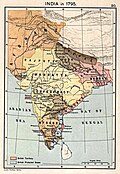
Bahadur Shah Zafar ruled over a Mughal Empire that had by the early 19th century been reduced to only the city of Delhi and the surrounding territory as far as Palam.[7] The Maratha Empire had brought an end to the Mughal Empire in the Deccan during the 18th century and the regions of India formerly under Mughal rule had either been absorbed by the Marathas or had declared independence and become smaller kingdoms.[8] The Marathas installed Shah Alam II in the throne in 1772, under the protection of the Maratha general Mahadaji Shinde and maintained suzerainty over Mughal affairs in Delhi. The East India Company became the dominant political and military power in mid-nineteenth century India. Outside the region controlled by the company, hundreds of kingdoms and principalities fragmented their land. The emperor was respected by the company, who provided him with a pension. The emperor permitted the company to collect taxes from Delhi and maintain a military force in it. Zafar never had any interest in statecraft or had any "imperial ambition".[citation needed] After the Indian Rebellion of 1857, the British exiled him from Delhi.
Bahadur Shah Zafar was a noted Urdu poet, having written a number of Urdu ghazals. While some part of his opus was lost or destroyed during the Indian Rebellion of 1857, a large collection did survive, and was compiled into the Kulliyyat-i-Zafar. The court that he maintained was home to several renowned Urdu scholars, poets and writers including Mirza Ghalib, Daagh Dehlvi, Momin Khan Momin, and Mohammad Ibrahim Zauq (who was also Bahadur Shah Zafar's mentor).
1857 Rebellion[edit | edit source]
As the Indian Rebellion of 1857 spread, Sepoy regiments reached the Mughal Court at Delhi.
On 12 May 1857, Zafar held his first formal audience in several years.[9] It was attended by several sepoys who were described as treating him "familiarly or disrespectfully".[10] When the sepoys first arrived at Bahadur Shah Zafar's court, he asked them why they had come to him, because he had no means of maintaining them. Bahadur Shah Zafar's conduct was indecisive. However, he yielded to the demands of the sepoys when he was told that they would not be able to win against the East India Company without him.[11]
On 16 May, sepoys and palace servants killed fifty-two Europeans who were prisoners of the palace and who were discovered hiding in the city. The executions took place under a peepul tree in front of the palace, despite Zafar's protests. The aim of the executioners was to implicate him in the killings.[12] Once he had joined them, Bahadur Shah II took ownership for all the actions of the mutineers. Though dismayed by the looting and disorder, he gave his public support to the rebellion. It was later believed that Bahadur Shah was not directly responsible for the massacre, but that he may have been able to prevent it, and he was therefore considered a consenting party during his trial.[11]
The administration of the city and its new occupying army was described as "chaotic and troublesome", which functioned "haphazardly". The Emperor nominated his eldest son, Mirza Mughal, as the commander in chief of his forces. However, Mirza Mughal had little military experience and was rejected by the sepoys. The sepoys did not have any commander since each regiment refused to accept orders from someone other than their own officers. Mirza Mughal's administration extended no further than the city. Outside Gujjar herders began levying their own tolls on traffic, and it became increasingly difficult to feed the city.[13]
During the Siege of Delhi when the victory of the British became certain, Zafar took refuge at Humayun's Tomb, in an area that was then at the outskirts of Delhi. Company forces led by Major William Hodson surrounded the tomb and Zafar was captured on 20 September 1857. The next day, Hodson shot his sons Mirza Mughal and Mirza Khizr Sultan, and grandson Mirza Abu Bakht under his own authority at the Khooni Darwaza, near the Delhi Gate and declared Delhi to be captured. Bahadur Shah himself was taken to his wife's haveli, where he was treated disrespectfully by his captors. When brought news of the executions of his sons and grandson, the former emperor was described as being so shocked and depressed that he was unable to react.[14]
After Zafar's defeat, he said:[15][16]
غازیوں میں بُو رہے گی جب تلک ایمان کی
تخت لندن تک چلے گی تیغ ہندوستان کی
As long as there remains the scent of faith in the hearts of our Ghazis,
so long shall the sword of Hindustan flash before the throne of London.
Trial[edit | edit source]
The trial was a consequence of the Sepoy Mutiny and lasted for 21 days, had 19 hearings, 21 witnesses and over a hundred documents in Persian and Urdu, with their English translations, were produced in the court.[17] At first the trial was suggested to be held at Calcutta, the place where Directors of East India company used to their sittings in connection with their commercial pursuits. But instead, the Red Fort in Delhi was selected for the trial.[18] It was the first case to be tried at the Red Fort.[19][unreliable source?]
Zafar was tried and charged on four counts:[20]
- Aiding and abetting the mutinies of the troops
- Encouraging and assisting divers persons in waging war against the British Government
- Assuming the sovereignty of Hindostan
- Causing and being accessory to the murder of the Christians.
— Proceedings of the April 1858 Trial of Bahadur Shah Zafar 'King of Delhi'
On the 20th day of the trial, Bahadur Shah II defended himself against these charges.[17] Bahadur Shah, in his defense, stated his complete haplessness before the will of the sepoys. The sepoys apparently used to affix his seal on empty envelopes, the contents of which he was absolutely unaware. While the emperor may have been overstating his impotence before the sepoys, the fact remains that the sepoys had felt powerful enough to dictate terms to anybody.[21] The eighty-two-year old poet-king was harassed by the mutineers and was neither inclined to nor capable of providing any real leadership. Despite this, he was the primary accused in the trial for the rebellion.[19]
Hakim Ahsanullah Khan, Zafar's most trusted confidant and both his Prime Minister and personal physician, had insisted that Zafar did not involve himself in the rebellion and had surrendered himself to the British. But when Zafar ultimately did this, Hakim Ahsanullah Khan betrayed him by providing evidence against him at the trial in return for a pardon for himself.[22]
Respecting Hodson's guarantee on his surrender, Zafar was not sentenced to death but exiled to Rangoon, Burma.[17] His wife Zeenat Mahal and some of the remaining members of the family accompanied him. At 4 am on 7 October 1858, Zafar along with his wives, two remaining sons began his journey towards Rangoon in bullock carts escorted by 9th Lancers under command of Lieutenant Ommaney.[23]
Death[edit | edit source]
In 1862, at the age of 87, he fell ill. In October, his condition deteriorated. He was "spoon-fed on broth" but he found that difficult too by 3 November.[24] On 6 November, the British Commissioner in Rangoon, Captain H. Nelson Davies, wrote that Zafar "is evidently sinking from pure desuetude and paralysis in the region of his throat". To prepare for his death, Davies commanded the collection of lime and bricks, and a spot was selected at the "back of Zafar's enclosure" for his burial. Zafar died on Friday, 7 November 1862 at 5 am. and was buried at 4 pm near the Shwedagon Pagoda at 6 Ziwaka Road, near the intersection with Shwedagon Pagoda Road, Yangon. The shrine of Bahadur Shah Zafar Dargah was built there after the restoration of his tomb on 16 February 1991.[25][26] Davies commenting on Zafar, described his life as "very uncertain".
Family and descendants[edit | edit source]


Bahadur Shah Zafar had four wives and numerous concubines. His wives were:[27]
- Begum Ashraf Mahal
- Begum Akhtar Mahal
- Begum Zeenat Mahal
- Begum Taj Mahal
He had twenty two sons including:[28]
- Mirza Dara Bakht Miran Shah (1790–1841)
- Mirza Muhammed Shahrukh Bahadur
- Mirza Kayumar Bahadur
- Mirza Fath-ul-Mulk Bahadur[29] (alias Mirza Fakhru) (1816–1856)
- Mirza Muhammad Quwaish Bahadur
- Mirza Mughal (1817–1857)
- Mirza Quraish Shikoh (1820–c. 1889)
- Mirza Farkhanda Shah Bahadur
- Mirza Khizr Sultan (1834–1857)
- Mirza Bakhtavar Shah Bahadur
- Mirza Sohrab Hindi Bahadur
- Mirza Abu Nasr
- Mirza Muhammad Bahadur
- Mirza Abdullah
- Mirza Kuchak Sultan
- Mirza Abu Bakr (1837–1857)
- Mirza Jawan Bakht (1841–1884)
- Mirza Shah Abbas (1845–1910)
- Muhammad Sher Shah [30]
He had at least thirty-two daughters including:
- Rabeya Begum
- Begum Fatima Sultan
- Kulsum Zamani Begum
- Raunaq Zamani Begum (possibly a granddaughter, d. 1930)
Many individuals claim to be descendants of Bahadur Shah Zafar, living in places throughout India, such as Hyderabad, Aurangabad, Delhi, Bhopal, Kolkata, Bihar, and Bengaluru. However, the claims are often disputed.[31]
Religious beliefs[edit | edit source]

| Part of a series on Islam Sufism |
|---|
 |
Bahadur Shah Zafar was a devout Sufi.[32] He was regarded as a Sufi Pir and used to accept murids or pupils.[32] The newspaper Delhi Urdu Akhbaar described him as "one of the leading saints of the age, approved of by the divine court."[32] Before his accession, he lived like "a poor scholar and dervish", differing from his three royal brothers, Mirza Jahangir, Salim and Babur.[32] In 1828, a decade before he succeeded the throne, Major Archer said that "Zafar is a man of spare figure and stature, plainly apparelled, almost approaching to meanness."[32] His appearance is that of an indigent munshi or teacher of languages".[32]
As a poet, Zafar imbibed the highest subtleties of mystical Sufi teachings.[32] He was also a believer of the magical and superstitious side of the Orthodox Sufism.[32] Like many of his followers, he believed that his position as both a Sufi pir and emperor gave him spiritual powers.[32] In an incident in which one of his followers was bitten by a snake, Zafar tried to cure him by giving a "seal of Bezoar" (a stone antidote to poison) and some water on which he had breathed to the man to drink.[33]
The emperor had a staunch belief in ta'aviz or charms, especially as a palliative for his constant complaint of piles, or to ward off evil spells.[33] During a period of illness, he told a group of Sufi pirs that several of his wives suspected that someone had cast a spell over him.[33] He requested them to take some steps to remove all apprehension on this account. The group wrote some charms and asked the emperor to mix them in water and drink it, which would protect him from the evil. A coterie of pirs, miracle workers and Hindu astrologers were always in touch with the emperor. On their advice, he would sacrifice buffaloes and camels, buried eggs and arrested alleged black magicians, and wore a ring that they told him would cure his indigestion. He also donated cows to the poor, elephants to the Sufi shrines and horses to the khadims or clergy of Jama Masjid.[33]
In one of his verses, Zafar explicitly stated that both Hinduism and Islam shared the same essence.[34] This philosophy was implemented by his court which embodied a multicultural composite Hindu-Islamic Mughal culture.[34] He celebrated many Hindu festivals like Rakhi, Holi, Diwali etc in the court.[35] Zafar was also tolerant of Shia Muslims who regained their lost influence at the Mughal court under him.[36]
Epitaph[edit | edit source]
He was a prolific Urdu poet and calligrapher.[37] He wrote the following Ghazal as his own epitaph. In his book, The Last Mughal, William Dalrymple states that, according to Lahore scholar Imran Khan, the beginning of the verse, umr-e-darāz māṅg ke ("I asked for a long life") was not written by Zafar, and does not appear in any of the works published during Zafar's lifetime.[citation needed] The verse was allegedly written by Simab Akbarabadi.[38][unreliable source?]
| Original Urdu | Devanagari transliteration | Roman transliteration | English translation |
|---|---|---|---|
|
لگتا نہیں ہے جی مِرا اُجڑے دیار میں |
|
|
|
Image gallery[edit | edit source]
-
 One of the many Alam (flags) of the Mughal Empire
 -
 Capture of the emperor and his sons by William Hodson at Humayun's tomb on 20 September 1857
 -
 "The seizure of the King of Delhi by Capt Henry M Hodson of Hodson's Horse", painted by a British artist in 1878
 -
 Bahadur Shah II with his sons Mirza Jawan Bakht and Mirza Shah Abbas along with a British personnel while he was in exile in Burma
 -
 Bahadur Shah Zafar in 1858, just after his trial and before his departure for exile in Burma
 -
 Poem written by Zafar, dated 29 April 1844
 -
 Prime Minister of India Manmohan Singh praying at the Mazar of Bahadur Shah Zafar, in Yangon, Myanmar


Legacy[edit | edit source]

Zafar is seen as the hero of Indian rebellion of 1857.[41] In 1943, the Indian National Army paid tribute to his tomb in Rangoon.[42] In 1975, Indian government released a postal stamp in his honour.[43]
In popular culture[edit | edit source]
Zafar was portrayed in the play 1857: Ek Safarnama set during the Indian Rebellion of 1857 by Javed Siddiqui. It was staged at Purana Qila, Delhi ramparts by Nadira Babbar and the National School of Drama repertory company in 2008.[44] A Hindi-Urdu black-and-white movie, Lal Quila (1960), directed by Nanabhai Bhatt, showcased Bahadur Shah Zafar extensively.
TV Serials and Films[edit | edit source]
A television show, Bahadur Shah Zafar, aired on Doordarshan in 1986. Ashok Kumar played the lead role in it.
In the 2001 Hindi historical drama series 1857 Kranti, on DD National, the character of Bahadur Shah Zafar was played by S. M. Zaheer.
In the 2005 Bollywood film Mangal Pandey: The Rising, directed by Ketan Mehta, the character of Bahadur Shah Zafar was played by Habib Tanveer.
In historical series Bharat Ek Khoj which aired on Doordarshan he was portrayed by Virendra Razdan.
In Gulzar's TV serial Mirza Ghalib, Zafar was played by Sudhir Dalvi
See also[edit | edit source]
- List of Mughal Emperors
- Emperor/Empress of India
- List of Indian monarchs
- List of Urdu poets
- Shahzada Muhammad Hidayat Afshar, Ilahi Bakhsh Bahadur
Notes[edit | edit source]
- ↑ Persian pronunciation: [ba.hɑː.ˈduɾ ʃɑːh za.ˈfaɾ]
References[edit | edit source]
- ↑ 1.0 1.1 1.2 1.3 1.4 1.5 William Dalrynple (2007). Last Mughal (P/B). Penguin Books India. pp. xv, xvi, 110, 215, 216. ISBN 978-0-14-310243-4.
- ↑ 2.0 2.1 2.2 2.3 2.4 2.5 Punjab (India) (1911). Government Records: The Delhi residency and agency records, 1807-1857. Punjab Government Press. p. 455.
- ↑ Pati, Biswamoy (25 February 2010). The Great Rebellion of 1857 in India: Exploring Transgressions, Contests and Diversities. Routledge. p. 151. ISBN 978-1-135-22514-8.
- ↑ Frances W. Pritchett, Nets of Awareness: Urdu Poetry and Its Critics (1994), p. 5
- ↑ Syed Mahdi Husain (2006). Bahadur Shah Zafar and the War of 1857 in Delhi. Aakar Books. p. 36. ISBN 9788187879916.
- ↑ 6.0 6.1 Husain, S. Mahdi (2006). Bahadur Shah Zafar; And the War of 1857 in Delhi. Aakar Books.
- ↑ Fanshawe, Herbert Charles (2015) [1st pub. 1902]. Delhi Past and Present. London: John Murray. p. 4. ISBN 1340665395.
- ↑ Mehta, Jaswant Lal (2005). Advanced Study in the History of Modern India 1707–1813. Sterling Publishers. p. 94.
- ↑ "Altrincham", Who Was Who, Oxford University Press, 1 December 2007, doi:10.1093/ww/9780199540884.013.u5395
- ↑ Dalrymple, The Last Mughal, p. 212
- ↑ 11.0 11.1 "Proceedings of the April 1858 Trial of Bahadur Shah Zafar 'King of Delhi'". Parliamentary Papers. June 1859.
- ↑ Dalrymple, The Last Mughal, p. 223
- ↑ Dalrymple, The Last Mughal, p. 145 fn
- ↑ Dalrymple (2009, pp. 341–47)
- ↑ "Exploring the last Mughal's poetry as it intertwined with his life". Hindustan Times. 31 May 2015. Archived from the original on 20 April 2024. Retrieved 10 May 2025.
- ↑ Sarangi, Shailaja (9 January 2021). "Discover Bahadur Shah Zafar's Timeless Poetry". PRATHA. Retrieved 10 May 2025.
- ↑ 17.0 17.1 17.2 Bhatia, H.S. Justice System and Mutinies in British India. p. 204.
- ↑ Gill, M.S. Trials that Changed History: From Socrates to Saddam Hussein. p. 53.
- ↑ 19.0 19.1 Sharma, Kanika. A Symbol of State Power: Use of the Red Fort in Indian Political Trials (PDF). p. 1.
- ↑ "Proceedings of the April 1858 Trial of Bahadur Shah Zafar 'King of Delhi'" (PDF). Parliamentary Papers. June 1859. Archived from the original (PDF) on 6 October 2016. Retrieved 2 November 2016.
- ↑ "The Rebel Army in 1857: At the Vanguard of the War of Independence or a Tyranny of Arms?". Economic and Political Weekly. 42.
- ↑ Dalrymple, William (2007). The Last Mughal: The Fall of Delhi, 1857. Penguin India.
- ↑ Dalrymple, William (2007). The Last Mughal. Penguin Books. ISBN 9780143102434.
- ↑ Dalrymple, The Last Mughal, p. 473
- ↑ Amaury Lorin (9 February 2014). "Grave secrets of Yangon's imperial tomb". mmtimes.com. Retrieved 13 July 2014.
- ↑ Dalrymple, The Last Mughal, p. 474
- ↑ Farooqi, Abdullah. "Bahadur Shah Zafar Ka Afsanae Gam". Farooqi Book Depot. Archived from the original on 9 July 2007. Retrieved 22 July 2007.
- ↑ Taimuri, Arsh (1937). Qila-e-Mu'llaa ki Jhalkiyan (Glimpses of the exalted fort). Delhi: Maktaba Jahan-numa.
- ↑ "Search the Collections | Victoria and Albert Museum". Images.vam.ac.uk. 25 August 2009. Retrieved 13 November 2012.[permanent dead link]
- ↑ Records of the Delhi Residency and Agency, Vol. 1. 1911. p. 455.
- ↑ "No Living Mughals, for now". The Hindu. 9 December 2002. Archived from the original on 30 June 2018.
- ↑ 32.0 32.1 32.2 32.3 32.4 32.5 32.6 32.7 32.8 William Dalrymple, The Last Mughal, p. 78
- ↑ 33.0 33.1 33.2 33.3 William Dalrymple, The Last Mughal, p. 79
- ↑ 34.0 34.1 William Dalrymple, The Last Mughal, p. 80
- ↑ Syed Mahdi Husain (2006). Bahadur Shah Zafar and the War of 1857 in Delhi. Aakar Books. p. 38. ISBN 9788187879916.
- ↑ Syed Kamil Hussain (1998). Social Institutions of Shia Muslims: An Anthropological Analysis. Classical Publishing Company. p. 34. ISBN 9788170542674.
- ↑ "Zoomify image: Poem composed by the Emperor Bahadhur Shah and addressed to the Governor General's Agent at Delhi February 1843". Bl.uk. 30 November 2003. Retrieved 13 November 2012.
- ↑ "[SASIALIT] bahadur shah zafar poem and its translation attempts". Mailman.rice.edu. 7 January 2008. Retrieved 13 November 2012.
- ↑ "BBC Hindi – भारत". BBC. 1 January 1970. Retrieved 13 November 2012.
- ↑ "Jee Nehein Lagta Ujrey Diyaar Mein". urdupoint.com. Retrieved 21 July 2007.
- ↑ Rasheed, Mohd (1997). Downtrodden Muslims: Brief of Communalism & Glimpses of Freedom Struggle of India. Khuda Bakhsh Oriental Library. p. 21.
- ↑ Needham, Anuradha (26 November 2013). New Indian Cinema in Post-Independence India: The Cultural Work of Shyam Benegal's Films. Routledge. p. 195. ISBN 978-1-135-02134-4.
- ↑ Scott's Monthly Stamp Journal. Scott Publishing Company. 1975. p. 40.
- ↑ "A little peek into history". The Hindu. 2 May 2008. Archived from the original on 9 November 2012.
Bibliography[edit | edit source]
- Portrait of Bahadur Shah in 1840s Archived 9 December 2015 at the Wayback Machine The Delhi Book of Thomas Metcalfe
- Dalrymple, William (2009). The Last Mughal: The Fall of a Dynasty, Delhi, 1857. Bloomsbury Publishing. ISBN 978-1-4088-0688-3.
- Das Khosla, Gopal (1969). The Last Mughal. Hind Pocket Books.
- Garrett, H. L. O. (2007). The Trial of Bahadur Shah Zafar. Roli Books. ISBN 978-8174365842.
- Husain, S. Mahdi (2006). Bahadur Shah Zafar and the War of 1857 in Delhi. Aakar Books. ISBN 8187879912.
- Kanda, K. C. (2007). Bahadur Shah Zafar and His Contemporaries: Zauq, Ghalib, Momin, Shefta: Selected Poetry. Sterling Publishers Pvt. Ltd. ISBN 978-81-207-3286-5.
- Nayar, Pramod K. (2007). The Trial of Bahadur Shah Zafar. Orient Longman. ISBN 978-81-250-3270-0.
- Shashi, Shyam Singh (1999). Encyclopaedia Indica: Bahadur Shah II, The Last Mughal Emperor. Anmol Publications. ISBN 978-81-7041-859-7.
External links[edit | edit source]
- Bahadur Shah Zafar on IMDb
- Extract of talk by Zafar's biographer William Dalrymple (British Library)
- Poetry
- Bahadur Shah Zafar at Kavita Kosh Archived 16 September 2018 at the Wayback Machine (in Hindi)
- Bahadur Shah Zafar Poetry
- Extracts from a book on Bahadur Shah Zafar, with details of exile and family
- Bahadur Shah Zafar Ghazals
- Links to further websites on Bahadur Shah Zafar
- Poetry on urdupoetry.com
- Kalaam e Zafar – Select verses (in Hindi)
- Descendants
- BBC Report on Bahadur Shah's possible descendants in Hyderabad
- An article on Bahadur Shah's descendants in Delhi and Hyderabad[usurped]
- Another article on Bahadur Shah's descendants in Hyderabad
- An article on Bahadur Shah's descendants in Kolkata
- Forgotten Empress: Sultana Beghum sells tea in Kolkata
Bahadur Shah Zafar
| ||
| Regnal titles | ||
|---|---|---|
| Preceded by Akbar II |
Mughal Emperor 1837–1857 |
Succeeded by Queen Victoria as Empress of India |
- Pages with Persian IPA
- Pages using the JsonConfig extension
- 1775 births
- 1862 deaths
- Emperors of the Mughal Empire
- Urdu-language poets
- People from Delhi
- Revolutionaries of the Indian Rebellion of 1857
- Indian exiles
- 19th-century Indian poets
- Indian Sunni Muslims
- 19th-century Urdu-language writers
- Urdu-language writers from British India
- Urdu-language poets from the Mughal Empire
- 19th-century Mughal Empire people