



->Billjones94 No edit summary |
WikiDwarfBOT (talk | contribs) Cleanup: Source modification. Information added. |
||
| Line 1: | Line 1: | ||
{{short description|Indian diplomat and politician}} | {{short description|Indian freedom fighter, diplomat and politician}} | ||
{{Use Indian English|date=December 2015}} | {{Use Indian English|date=December 2015}} | ||
{{Use dmy dates|date=September 2019}} | {{Use dmy dates|date=September 2019}} | ||
{{Infobox officeholder | {{Infobox officeholder | ||
| image = Vijaya Lakshmi Pandit | | image = Vijaya Lakshmi Pandit.jpg | ||
| honorific_prefix = [[Her Excellency]] | | honorific_prefix = [[Her Excellency]] | ||
| caption = Pandit in | | caption = Vijaya Lakshmi Pandit in 1938 | ||
| birth_date = {{birth date|df=yes|1900|08| | | birth_date = {{birth date|df=yes|1900|08|20}} | ||
| birth_place = [[Allahabad]], [[North | | birth_place = [[Allahabad]], [[North West Provinces]], [[British India]] <br>(present day), [[Uttar Pradesh]], [[India]]) | ||
| death_date = {{death date and age|df=yes|1990|12|01|1900|08|18}} | | death_date = {{death date and age|df=yes|1990|12|01|1900|08|18}} | ||
| death_place = [[Dehradun]], [[Uttar Pradesh]], [[India]] <br /> (present-day [[Uttarakhand]]) | | death_place = [[Dehradun]], [[Uttar Pradesh]], [[India]] <br /> (present-day [[Uttarakhand]]) | ||
| spouse = [[Ranjit Sitaram Pandit]] | | spouse = {{marriage| [[Ranjit Sitaram Pandit]]|1921|1944| end=died}} | ||
| children = 3, including [[Nayantara Sahgal]] | | children = 3, including [[Nayantara Sahgal]] | ||
| relatives = See [[Nehru–Gandhi family]] | | relatives = See [[Nehru–Gandhi family]] | ||
| Line 28: | Line 28: | ||
| term_end2 = 18 October 1964 | | term_end2 = 18 October 1964 | ||
| 1blankname2 = Chief Minister | | 1blankname2 = Chief Minister | ||
| 1namedata2 = [[Marotrao Kannamwar]] <br /> [[P. K. Sawant]] <br /> [[Vasantrao Naik]] | | 1namedata2 = [[Marotrao Kannamwar]] <br /> [[P. K. Sawant]] (''acting'') <br /> [[Vasantrao Naik]] | ||
| predecessor2 = [[P. Subbarayan]] | | predecessor2 = [[P. Subbarayan]] | ||
| successor2 = [[P. V. Cherian]] | | successor2 = [[P. V. Cherian]] | ||
| office3 = [[Member of | | office3 = [[Member of Parliament, Lok Sabha]] | ||
| constituency3 = [[Phulpur (Lok Sabha constituency)|Phulpur]] | | constituency3 = [[Phulpur (Lok Sabha constituency)|Phulpur]] | ||
| term3 = 1967–1971 | | term3 = 1967–1971 | ||
| Line 41: | Line 41: | ||
| year = | | year = | ||
| source = | | source = | ||
| birth_name = | | birth_name = Swarup Nehru | ||
}} | }} | ||
'''Vijaya Lakshmi Pandit''' (''[[née]]'' '''Nehru'''; 18 August 1900 – 1 December 1990) was an Indian diplomat and politician | '''Vijaya Lakshmi Pandit''' (''[[née]]'' '''Swarup''' '''Nehru''';<ref name=":0" /> 18 August 1900 – 1 December 1990) was an Indian freedom fighter, diplomat and politician. She served as the 8th [[President of the United Nations General Assembly]] from 1953 to 1954, the first woman appointed to either post. She was also the 6th [[Governor of Maharashtra]] from 1962 to 1964. Noted for her participation in the [[Indian independence movement]], she was jailed several times during the movement. | ||
Hailing from the prominent [[Nehru-Gandhi family|Nehru-Gandhi]] political family, her brother [[Jawaharlal Nehru]] was the first [[Prime Minister of India|Prime Minister]] of [[independent India]], her niece [[Indira Gandhi]] was the first female Prime Minister of India and her grand-nephew [[Rajiv Gandhi]] was the sixth and youngest Prime Minister of India. She was sent to London as India's most important diplomat after serving as India's envoy to the [[Soviet Union]], the [[United States]] and the [[United Nations]]. Her time in London offers insights into the wider context of changes in [[India–UK relations]].<ref>Rakesh Ankit, "Between Vanity and Sensitiveness: Indo–British Relations During Vijayalakshmi Pandit’s High-Commissioner (1954–61)." ''Contemporary British History'' 30.1 (2016): 20–39.</ref> | |||
==Early life== | |||
Vijaya Lakshmi's (born Swarup)<ref name=":0">{{Cite book |last=Nehru |first=Krishna |title=With No Regrets: An Autobiography |publisher=[[The John Day Company]] |year=1945 |isbn= |location=New York}}</ref> father, [[Motilal Nehru]] (1861–1931), a wealthy barrister who belonged to the [[Kashmiri Pandit]] community,{{sfn|Moraes|2008|p=4}} served twice as [[President of the Indian National Congress]] during the [[Indian Independence Movement|Independence Struggle]]. Her mother, [[Swaruprani Thussu]] (1868–1938), who came from a well-known Kashmiri Pandit family settled in [[Lahore]],<ref>Zakaria, Rafiq ''A Study of Nehru'', Times of India Press, 1960, p. 22</ref> was Motilal's second wife, the first having died in child birth. She was the second of three children; [[Jawaharlal Nehru|Jawaharlal]] was eleven years her senior (b. 1889), while her younger sister [[Krishna Hutheesing]] (b. 1907-1967) became a noted writer and authored several books on their brother. | |||
== Career == | |||
[[File:Vijaya Lakshmi Pandit 1965b.jpg|thumb|upright|Pandit in the [[Netherlands]], 1965]] | |||
[[File:Vijaya Lakshmi Pandit at The Doon School.jpg|thumb|Pandit as a Chief Guest at [[The Doon School]], Dehradun, in the 1960s.]] | |||
She | She attended the 1916 Congress session that took place in Lucknow. She was impressed by [[Sarojini Naidu]] and [[Annie Besant]].<ref name="Smith"/> | ||
In 1920, she spent time in [[Mahatma Gandhi]]'s [[Sabarmati Ashram|ashram]] close to [[Ahmedabad]]. She participated in daily chores including dairy work and spinning. She also worked in the office that used to publish ''[[Young India]]''.<ref name="Smith">{{cite book | last=Smith | first=B.G. | title=The Oxford Encyclopedia of Women in World History | publisher=Oxford University Press | series=The Oxford Encyclopedia of Women in World History | issue=v. 1 | year=2008 | isbn=978-0-19-514890-9 | url=https://books.google.com/books?id=EFI7tr9XK6EC&pg=RA2-PA406 | page=2-PA406}}</ref> | |||
[[ | Pandit was the first Indian woman to hold a cabinet post in pre-independent India. In 1936, she stood in general elections and became member of parliament by 1937 for constituency of Cawnpore Bilhaur.<ref name="helen"/> In 1937, she was elected to the provincial legislature of the [[United Provinces (1937–50)|United Provinces]] and was designated minister of local self-government and public health.<ref>{{Cite book |last=Pandit |first=Vijaya Lakshmi |chapter-url=https://archive.org/details/dli.ministry.22874/page/141/mode/2up?view=theater |title=So I became a Minister |publisher=Kitabistan |year=1939 |location=Allahabad |pages=141–143 |chapter=First Person, Singular |access-date=11 September 2022}}</ref><ref>{{Cite book |url=https://indianculture.gov.in/artefacts-museums/welcome-address-218 |title=Welcome address from Chairman of Municipal Board, Agra, to Smt. Vijaya Lakshmi Pandit honouring her as Minister of Local Self Government and Health, and highlighting the poor civic conditions of Agra |publisher=Sainik Press |year=1938 |location=Allahabad |language=Hindi |access-date=12 September 2022 |via=[[Allahabad Museum]]}}</ref> She held the latter post until 1938 and again from 1946 to 1947.<ref>{{Cite book |last=Khan |first=Abdul Majid |chapter-url=https://archive.org/details/in.ernet.dli.2015.121087/page/n153/mode/2up?view=theater |title=The Great Daughter of India |publisher=Indian Printing Works |year=1946 |location=Lahore |pages=152 |chapter=Lakshmi Resigns |access-date=12 September 2022}}</ref><ref>{{Cite book |last=Pandit |first=Vijaya Lakshmi |chapter-url=https://archive.org/details/scopeofhappiness00pand/page/200/mode/2up?view=theater |title=The Scope of Happiness: A Personal Memoir |publisher=Crown Publishers Inc. |year=1979 |isbn=0-517-53688-9 |location=New York |pages=200-201, 203, 204-205 |chapter=Interim Government |access-date=12 September 2022 |chapter-url-access=registration}}</ref> | ||
== | She spent significant time in jail for her participation in the Indian independence movement. She was jailed for 18 months from 1931 - 1933. She was jailed again for 6 months in 1940 before getting jailed in 1942 for 7 months over her participation in the [[Quit India Movement]].<ref>{{cite book | last=Bhagavan | first=M. | title=India and the Quest for One World: The Peacemakers | publisher=Palgrave Macmillan UK | series=Palgrave Macmillan Transnational History Series | year=2013 | isbn=978-1-137-34983-5 | url=https://books.google.com/books?id=jfXRAQAAQBAJ&pg=PA14 | page=14}}</ref><ref name="helen">{{cite book | last=Rappaport | first=Helen | title=Encyclopedia of Women Social Reformers | publisher=ABC-CLIO | series=Encyclopedia of Women Social Reformers | issue=v. 1 | year=2001 | isbn=978-1-57607-101-4 | url=https://books.google.com/books?id=rpuSzowmIkgC&pg=PA507 |page=507}}</ref> After her release, she helped the victims of the [[Bengal famine of 1943]] and served as president of the ''Save the Children Fund Committee'' which rescued poor children from the streets.<ref name="helen"/> | ||
Following the death of her husband in 1944, she experienced Indian inheritance laws for Hindu widows and campaigned with [[All India Women's Conference]] to bring changes to these laws.<ref name="helen"/> | |||
In 1946, she was elected to the [[Constituent Assembly of India|Constituent Assembly]] from the United Provinces.<ref>Pandit, Vijaya Lakshmi (1979). "Interim Government". ''[https://archive.org/details/scopeofhappiness00pand/page/224/mode/2up?view=theater The Scope of Happiness: A Personal Memoir]''. New York: Crown Publishers Inc. pp. 225. {{ISBN|0-517-53688-9}}. Retrieved 12 September 2022.</ref> | |||
Following India's freedom from British occupation in 1947 she entered the diplomatic service and became [[Ambassador of India to the Soviet Union|India's ambassador to the Soviet Union]] from 1947 to 1949, the United States and Mexico from 1949 to 1951, Ireland from 1955 to 1961 (during which time she was also the Indian [[High Commissioner]] to the United Kingdom), and Spain from | Following India's freedom from British occupation in 1947 she entered the diplomatic service and became [[Ambassador of India to the Soviet Union|India's ambassador to the Soviet Union]] from 1947 to 1949,<ref>{{Cite news |date=7 June 1947 |title=India's Ambassador to Moscow: Mrs. V. L. Pandit's choice certain |volume=15 |pages=1 |work=The Indian Express |issue=83 |location=Madras |url=https://news.google.com/newspapers?id=ldc-AAAAIBAJ&sjid=WkwMAAAAIBAJ&pg=7115%2C5998923 |access-date=11 September 2022}}</ref><ref>{{Cite book |url=https://www.abhilekh-patal.in/jspui/handle/123456789/1451141 |title=Appointment of Mrs. Vijaya Lakshmi Pandit as Ambassador for India in USSR and fixation of her pay and allowance |publisher=Department of External Affairs and Commonwealth Relations: External Affairs Wing |year=1947 |location=New Delhi |pages=11 |access-date=11 September 2022 |url-access=registration |via=[[National Archives of India]]}}</ref> the United States and Mexico from 1949 to 1951,<ref>{{Cite news |date=8 May 1949 |title=Woman Ambassador |volume=65 |pages=33 |work=The Pittsburgh Press |issue=316 |url=https://news.google.com/newspapers?id=1T4bAAAAIBAJ&sjid=P00EAAAAIBAJ&pg=2222%2C3493675 |access-date=11 September 2022}}</ref><ref>{{Cite book |url=https://www.abhilekh-patal.in/jspui/handle/123456789/1451087 |title=Appointment of Shrimati Vijaya Lakshmi Pandit as Ambassador in U.S.A. succession to Shri B.Rama Rau I.C.S. and fixation of her pay and allowances. Grant of Joining time to H.E., Shrimati Vijaya Lakshmi Ambassador of India in USA. Grant of free air passage to Shrimati Vijaya Lakshmi Pandit and her daughter.......... |publisher=Press Information Bureau |year=1949 |location=New Delhi |pages=33 |access-date=11 September 2022 |url-access=registration |via=[[National Archives of India]]}}</ref> Ireland from 1955 to 1961 (during which time she was also the Indian [[High Commissioner]] to the United Kingdom),<ref>{{Cite journal |last=O'Malley |first=Kate |title=Ireland and India: Post-independence Diplomacy |url=https://www.jstor.org/stable/41413198 |journal=Irish Studies in International Affairs |year=2011 |publisher=Royal Irish Academy |volume=22 |pages=152–153 |doi=10.1353/isia.2011.0004 |jstor=41413198 |access-date=12 September 2022 |via=JSTOR}}</ref> and Spain from 1956 to 1961.<ref>{{Cite book |last=Brittain |first=Vera |chapter-url=https://archive.org/details/envoyextraordina0000unse/page/134/mode/2up?view=theater |title=Envoy Extraordinary: A Study of Vijaya Lakshmi Pandit and her contribution to Modern India |publisher=George Allen & Unwin Ltd. |year=1965 |location=London |pages=135 |chapter=The Conquest of Britain |quote="Spain and India had decided in May 1956 to establish diplomatic relations at Embassy level, and now made her the first woman, and probably the first diplomat, to hold three ambassadorships simultaneously. She visited Madrid to present her credentials on October 30, 1957, and was officially photographed with General Franco." |author-link=Vera Brittain |access-date=12 September 2022 |chapter-url-access=registration}}</ref> Between 1946 and 1968, she headed the Indian delegation to the United Nations. In 1953, she became the first woman [[President of the United Nations General Assembly]]<ref>{{cite web |url=http://oxforddictionaries.com/definition/Pandit,%2BVijaya |archive-url=https://web.archive.org/web/20111026173659/http://oxforddictionaries.com/definition/Pandit%2C+Vijaya |url-status=dead |archive-date=26 October 2011 |title=Vijay Lakshmi Pandit |first=online |last=Oxford Dictionaries |access-date=2 July 2012}}</ref> (she was inducted as an honorary member of the [[Alpha Kappa Alpha]] sorority in 1978 for this accomplishment<ref>{{cite web|url=http://aka1908.com/centennial/history/index.html|title=Alpha Kappa Alpha 1978|access-date=14 December 2014|archive-url=https://web.archive.org/web/20141226064143/http://www.aka1908.com/centennial/history/index.html|archive-date=26 December 2014|url-status=dead}}</ref>). That same year she was a candidate for [[Secretary General of the United Nations]].<ref>{{cite book|title=United Nations Affairs | url=https://history.state.gov/historicaldocuments/frus1952-54v03 | series=Foreign Relations of the United States, 1952–1954 | volume=3 | editor-last=Goodwin | editor-first=Ralph R. | year=1979 | location=[[Washington D.C.]] | publisher=[[United States Government Printing Office]]|page=Document 209}}</ref> | ||
Hon. Members that Shrimati Vijaya Lakshmi Pandit has resigned her seat in the House with effect from 17 December 1954.<ref>{{cite book |title=Lok Sabha Debates Vol VII, 1954 |date=18 December 1954 |publisher=Lok Sabha Secretariat | Hon. Members that Shrimati Vijaya Lakshmi Pandit has resigned her seat in the House with effect from 17 December 1954.<ref>{{cite book |title=Lok Sabha Debates Vol VII, 1954 |date=18 December 1954 |publisher=Lok Sabha Secretariat New Delhi |pages=12 |url=https://eparlib.nic.in/bitstream/123456789/56278/1/lsd_01_08_18-12-1954.pdf}}</ref> | ||
In India, she served as [[List of governors of Maharashtra|Governor of Maharashtra]] from 1962 to 1964 | In India, she served as [[List of governors of Maharashtra|Governor of Maharashtra]] from 1962 to 1964. She returned as a member of parliament for 1964 to 1968 with her election victory in [[Phulpur, Allahabad|Phulpur]].<ref name="helen"/><ref>{{Cite book |last=Malaviya |first=Padma Kant |url=https://www.abhilekh-patal.in/jspui/handle/123456789/2687214 |title=P.K. Malaviya analyses election defeat and congratulates Mrs. Vijay Lakshmi on her victory in Phulpur Lok Sabha election |location=New Delhi |pages=1 |access-date=12 September 2022 |url-access=registration |via=[[National Archives of India]]}}</ref> Pandit was a harsh critic of [[Indira Gandhi]]'s years as Prime Minister especially after Indira had declared the [[The Emergency (India)|emergency]] in 1975.<ref name="helen"/> | ||
Pandit retired from active politics after relations between them soured. On retiring, she moved to [[Dehradun]] in the [[Doon Valley]] in the Himalayan foothills.<ref>[http://timesmachine.nytimes.com/timesmachine/1976/10/31/357037032.html?pageNumber=11 Indira Gandhi's Aunt Says She Is 'Profoundly Troubled' at Direction India Is Taking], NY Times, 31 October 1976</ref> She came out of retirement in 1977 to campaign against Indira Gandhi and helped the [[Janata Party]] win the 1977 election.<ref>[https://www.nytimes.com/1989/05/22/world/new-delhi-journal-sister-burnishes-nehru-s-image-lest-india-forget.html Sister Burnishes Nehru's Image, Lest India Forget], NY Times, 22 May 1989</ref> She was reported to have considered running for the presidency, but [[Neelam Sanjiva Reddy]] eventually ran and won the election unopposed.<ref>[http://timesmachine.nytimes.com/timesmachine/1977/05/27/356234792.html?pageNumber=8 Nehru's Sister Campaigning for Presidency of India], NY Times,</ref> | Pandit retired from active politics after relations between them soured. On retiring, she moved to [[Dehradun]] in the [[Doon Valley]] in the Himalayan foothills.<ref>[http://timesmachine.nytimes.com/timesmachine/1976/10/31/357037032.html?pageNumber=11 Indira Gandhi's Aunt Says She Is 'Profoundly Troubled' at Direction India Is Taking], NY Times, 31 October 1976</ref> She came out of retirement in 1977 to campaign against Indira Gandhi and helped the [[Janata Party]] win the 1977 election.<ref>[https://www.nytimes.com/1989/05/22/world/new-delhi-journal-sister-burnishes-nehru-s-image-lest-india-forget.html Sister Burnishes Nehru's Image, Lest India Forget], NY Times, 22 May 1989</ref> She was reported to have considered running for the presidency, but [[Neelam Sanjiva Reddy]] eventually ran and won the election unopposed.<ref>[http://timesmachine.nytimes.com/timesmachine/1977/05/27/356234792.html?pageNumber=8 Nehru's Sister Campaigning for Presidency of India], NY Times,</ref> | ||
In 1979, she was appointed the Indian representative to the [[UN Human Rights Commission]], after which she retired from public life. Her writings include ''The Evolution of India'' (1958) and ''The Scope of Happiness: A Personal Memoir'' (1979). | In 1979, she was appointed the Indian representative to the [[UN Human Rights Commission]], after which she retired from public life. Her writings include ''The Evolution of India'' (1958) and ''The Scope of Happiness: A Personal Memoir'' (1979). | ||
==Personal life== | |||
In 1921, she was married to [[Ranjit Sitaram Pandit]] (1921–1944), a successful barrister from [[Kathiawar]], [[Gujarat]] and classical scholar who translated [[Kalhana]]'s epic history [[Rajatarangini]] into English from [[Sanskrit]]. Her husband was a Maharashtrian Saraswat Brahmin, whose family hailed from village of Bambuli, on the Ratnagiri coast, in Maharashtra. He was arrested for his support of Indian independence and died in Lucknow prison in 1944, leaving behind his wife and their three daughters Chandralekha Mehta, Nayantara Sehgal and Rita Dar. | |||
She died in the year of 1990. She was survived by her daughters, Chandralekha and [[Nayantara Sahgal]]. | |||
== Academics == | == Academics == | ||
[[File:Nehru and Indira Gandhi visit Einstein.jpg|right|thumb|Vijaya Lakshmi Pandit along with Indira Gandhi and Nehru visit Albert Einstein]] | [[File:Nehru and Indira Gandhi visit Einstein.jpg|right|thumb|Vijaya Lakshmi Pandit along with Indira Gandhi and Nehru visit Albert Einstein]] | ||
She was the member of [[Aligarh Muslim University]] Executive Council.<ref>{{Cite web|url = https://www.batori.in/national/2015/12/10/nayantara-sahgal-delivers-6th-k-p-singh-memorial-lecture/|title = Nayantara Sahgal delivers 6th K P Singh Memorial Lecture|date = 10 December 2015|access-date = 10 December 2015|website = Batori|publisher = Batori.in|last = Batori|archive-url = https://web.archive.org/web/20151211063957/https://www.batori.in/national/2015/12/10/nayantara-sahgal-delivers-6th-k-p-singh-memorial-lecture/|archive-date = 11 December 2015|url-status = dead}}</ref> | She was the member of [[Aligarh Muslim University]] Executive Council.<ref>{{Cite web|url = https://www.batori.in/national/2015/12/10/nayantara-sahgal-delivers-6th-k-p-singh-memorial-lecture/|title = Nayantara Sahgal delivers 6th K P Singh Memorial Lecture|date = 10 December 2015|access-date = 10 December 2015|website = Batori|publisher = Batori.in|last = Batori|archive-url = https://web.archive.org/web/20151211063957/https://www.batori.in/national/2015/12/10/nayantara-sahgal-delivers-6th-k-p-singh-memorial-lecture/|archive-date = 11 December 2015|url-status = dead}}</ref> | ||
She was an Honorary Fellow of [[Somerville College, Oxford]], where her niece studied Modern History. A portrait of her by [[Edward Halliday]] hangs in the [[Somerville College Library]].{{ | She was an Honorary Fellow of [[Somerville College, Oxford]], where her niece studied Modern History.<ref>{{Cite book |url=https://www.abhilekh-patal.in/jspui/handle/123456789/1398954 |title=Visit of Shrimati Vijaya Lakshmi Pandit former Governor of Maharashtra to London to receive the Honorary Degree of of[sic] D.C.L. from the Oxford University - Payment of air fare from Bombay to London & back. |publisher=Ministry of External Affairs |year=1965 |location=New Delhi |pages=1–21 |access-date=11 September 2022 |url-access=registration |via=[[National Archives of India]]}}</ref> A portrait of her by [[Edward Halliday]] hangs in the [[Somerville College Library]].<ref>{{Cite web |date=11 September 2022 |title=Vijaya Lakshmi Pandit |url=https://edu.admin.ox.ac.uk/people/vijaya-lakshmi-pandit |url-status=live |website=Equality and Diversity Unit, University of Oxford}}</ref> | ||
==See also== | ==See also== | ||
*[[List of political families]] | * [[List of political families]] | ||
* [[History of Indian foreign relations]] | * [[History of Indian foreign relations]] | ||
| Line 90: | Line 98: | ||
==Further reading== | ==Further reading== | ||
* Ankit, Rakesh. "''Between Vanity and Sensitiveness'': Indo–British Relations During Vijayalakshmi Pandit's High-Commissionership (1954–61)". ''Contemporary British History'' 30:1 (2016): 20–39. {{doi|10.1080/13619462.2015.1049262}}. | * Ankit, Rakesh. "''Between Vanity and Sensitiveness'': Indo–British Relations During Vijayalakshmi Pandit's High-Commissionership (1954–61)". ''Contemporary British History'' 30:1 (2016): 20–39. {{doi|10.1080/13619462.2015.1049262}}. | ||
* {{cite book |last=Gupta |first=Indra |year=2004 |title=India's 50 Most Illustrious Women |location=New Delhi |publisher=Icon Publications |isbn= | * {{cite book |last=Gupta |first=Indra |year=2004 |title=India's 50 Most Illustrious Women |location=New Delhi |publisher=Icon Publications |isbn=81-88086-19-3 |oclc=858639936}} | ||
* Menon, Parvathi (2023). "Vijayalakshmi Pandit: Gendering and Racing against the Postcolonial Predicament" in Immi Tallgren (ed.) ''[https://global.oup.com/academic/product/portraits-of-women-in-international-law-9780198868453?cc=gb&lang=en&# Portraits of Women in International Law]'' (Oxford University Press, 2023). | |||
==External links== | ==External links== | ||
* {{Internet Archive film clip|id=gov.archives.arc.95854|description="Longines Chronoscope with Mme. Vijaya Lakshmi Pandit"}} | * {{Internet Archive film clip|id=gov.archives.arc.95854|description="Longines Chronoscope with Mme. Vijaya Lakshmi Pandit"}} | ||
| Line 102: | Line 111: | ||
{{succession box|before= none |title=[[Ambassador of India to the Soviet Union]]|years=1947–1949|after=[[Sarvepalli Radhakrishnan]]}} | {{succession box|before= none |title=[[Ambassador of India to the Soviet Union]]|years=1947–1949|after=[[Sarvepalli Radhakrishnan]]}} | ||
{{succession box|title=[[High Commission of India to the United Kingdom]]|before=[[B. G. Kher]]|after=[[M. C. Chagla]]|years=1954–1961}} | {{succession box|title=[[High Commission of India to the United Kingdom]]|before=[[B. G. Kher]]|after=[[M. C. Chagla]]|years=1954–1961}} | ||
{{s-off}} | |||
{{succession box|title=[[List of governors of Maharashtra|Governor of Maharashtra]]|before=[[P. Subbarayan]]|after=[[P. V. Cherian]]|years=1962–1964}} | {{succession box|title=[[List of governors of Maharashtra|Governor of Maharashtra]]|before=[[P. Subbarayan]]|after=[[P. V. Cherian]]|years=1962–1964}} | ||
{{s-end}} | {{s-end}} | ||
{{Presidents of the UN General Assembly}} | {{Presidents of the UN General Assembly}} | ||
{{Padma Vibhushan Awards}} | {{Padma Vibhushan Awards}} | ||
| Line 113: | Line 124: | ||
[[Category:1900 births]] | [[Category:1900 births]] | ||
[[Category:1990 deaths]] | [[Category:1990 deaths]] | ||
[[Category: | [[Category:India MPs 1952–1957]] | ||
[[Category:20th-century Indian women politicians]] | [[Category:20th-century Indian women politicians]] | ||
[[Category:20th-century Indian politicians]] | [[Category:20th-century Indian politicians]] | ||
[[Category: | [[Category:India MPs 1962–1967]] | ||
[[Category: | [[Category:India MPs 1967–1970]] | ||
[[Category:Ambassadors of India to Ireland]] | [[Category:Ambassadors of India to Ireland]] | ||
[[Category:Ambassadors of India to Mexico]] | [[Category:Ambassadors of India to Mexico]] | ||
| Line 127: | Line 138: | ||
[[Category:High Commissioners of India to the United Kingdom]] | [[Category:High Commissioners of India to the United Kingdom]] | ||
[[Category:Indian Hindus]] | [[Category:Indian Hindus]] | ||
[[Category:Kashmiri people]] | [[Category:Kashmiri people]] | ||
[[Category:Lok Sabha members from Uttar Pradesh]] | [[Category:Lok Sabha members from Uttar Pradesh]] | ||
Latest revision as of 13:44, 22 July 2023
Vijaya Lakshmi Pandit | |
|---|---|
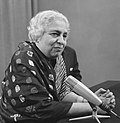
 Vijaya Lakshmi Pandit in 1938 | |
| 8th President of the United Nations General Assembly | |
| In office 15 September 1953 – 21 September 1954[1] | |
| Preceded by | Lester B. Pearson |
| Succeeded by | Eelco N. van Kleffens |
| 6th Governor of Maharashtra | |
| In office 28 November 1962 – 18 October 1964 | |
| Chief Minister | Marotrao Kannamwar P. K. Sawant (acting) Vasantrao Naik |
| Preceded by | P. Subbarayan |
| Succeeded by | P. V. Cherian |
| Member of Parliament, Lok Sabha | |
| In office 1967–1971 | |
| Preceded by | Jawaharlal Nehru |
| Succeeded by | V. P. Singh |
| Constituency | Phulpur |
| Personal details | |
| Born | Swarup Nehru 20 August 1900 Allahabad, North West Provinces, British India (present day), Uttar Pradesh, India) |
| Died | 1 December 1990 (aged 90) Dehradun, Uttar Pradesh, India (present-day Uttarakhand) |
| Political party | Indian National Congress |
| Spouse(s) | |
| Children | 3, including Nayantara Sahgal |
| Parent(s) | Pandit Motilal Nehru Swarup Rani Nehru |
| Relatives | See Nehru–Gandhi family |
| Signature |  |
Vijaya Lakshmi Pandit (née Swarup Nehru;[2] 18 August 1900 – 1 December 1990) was an Indian freedom fighter, diplomat and politician. She served as the 8th President of the United Nations General Assembly from 1953 to 1954, the first woman appointed to either post. She was also the 6th Governor of Maharashtra from 1962 to 1964. Noted for her participation in the Indian independence movement, she was jailed several times during the movement.
Hailing from the prominent Nehru-Gandhi political family, her brother Jawaharlal Nehru was the first Prime Minister of independent India, her niece Indira Gandhi was the first female Prime Minister of India and her grand-nephew Rajiv Gandhi was the sixth and youngest Prime Minister of India. She was sent to London as India's most important diplomat after serving as India's envoy to the Soviet Union, the United States and the United Nations. Her time in London offers insights into the wider context of changes in India–UK relations.[3]
Early life[edit | edit source]
Vijaya Lakshmi's (born Swarup)[2] father, Motilal Nehru (1861–1931), a wealthy barrister who belonged to the Kashmiri Pandit community,[4] served twice as President of the Indian National Congress during the Independence Struggle. Her mother, Swaruprani Thussu (1868–1938), who came from a well-known Kashmiri Pandit family settled in Lahore,[5] was Motilal's second wife, the first having died in child birth. She was the second of three children; Jawaharlal was eleven years her senior (b. 1889), while her younger sister Krishna Hutheesing (b. 1907-1967) became a noted writer and authored several books on their brother.
Career[edit | edit source]


She attended the 1916 Congress session that took place in Lucknow. She was impressed by Sarojini Naidu and Annie Besant.[6]
In 1920, she spent time in Mahatma Gandhi's ashram close to Ahmedabad. She participated in daily chores including dairy work and spinning. She also worked in the office that used to publish Young India.[6]
Pandit was the first Indian woman to hold a cabinet post in pre-independent India. In 1936, she stood in general elections and became member of parliament by 1937 for constituency of Cawnpore Bilhaur.[7] In 1937, she was elected to the provincial legislature of the United Provinces and was designated minister of local self-government and public health.[8][9] She held the latter post until 1938 and again from 1946 to 1947.[10][11]
She spent significant time in jail for her participation in the Indian independence movement. She was jailed for 18 months from 1931 - 1933. She was jailed again for 6 months in 1940 before getting jailed in 1942 for 7 months over her participation in the Quit India Movement.[12][7] After her release, she helped the victims of the Bengal famine of 1943 and served as president of the Save the Children Fund Committee which rescued poor children from the streets.[7]
Following the death of her husband in 1944, she experienced Indian inheritance laws for Hindu widows and campaigned with All India Women's Conference to bring changes to these laws.[7]
In 1946, she was elected to the Constituent Assembly from the United Provinces.[13]
Following India's freedom from British occupation in 1947 she entered the diplomatic service and became India's ambassador to the Soviet Union from 1947 to 1949,[14][15] the United States and Mexico from 1949 to 1951,[16][17] Ireland from 1955 to 1961 (during which time she was also the Indian High Commissioner to the United Kingdom),[18] and Spain from 1956 to 1961.[19] Between 1946 and 1968, she headed the Indian delegation to the United Nations. In 1953, she became the first woman President of the United Nations General Assembly[20] (she was inducted as an honorary member of the Alpha Kappa Alpha sorority in 1978 for this accomplishment[21]). That same year she was a candidate for Secretary General of the United Nations.[22]
Hon. Members that Shrimati Vijaya Lakshmi Pandit has resigned her seat in the House with effect from 17 December 1954.[23]
In India, she served as Governor of Maharashtra from 1962 to 1964. She returned as a member of parliament for 1964 to 1968 with her election victory in Phulpur.[7][24] Pandit was a harsh critic of Indira Gandhi's years as Prime Minister especially after Indira had declared the emergency in 1975.[7]
Pandit retired from active politics after relations between them soured. On retiring, she moved to Dehradun in the Doon Valley in the Himalayan foothills.[25] She came out of retirement in 1977 to campaign against Indira Gandhi and helped the Janata Party win the 1977 election.[26] She was reported to have considered running for the presidency, but Neelam Sanjiva Reddy eventually ran and won the election unopposed.[27]
In 1979, she was appointed the Indian representative to the UN Human Rights Commission, after which she retired from public life. Her writings include The Evolution of India (1958) and The Scope of Happiness: A Personal Memoir (1979).
Personal life[edit | edit source]
In 1921, she was married to Ranjit Sitaram Pandit (1921–1944), a successful barrister from Kathiawar, Gujarat and classical scholar who translated Kalhana's epic history Rajatarangini into English from Sanskrit. Her husband was a Maharashtrian Saraswat Brahmin, whose family hailed from village of Bambuli, on the Ratnagiri coast, in Maharashtra. He was arrested for his support of Indian independence and died in Lucknow prison in 1944, leaving behind his wife and their three daughters Chandralekha Mehta, Nayantara Sehgal and Rita Dar.
She died in the year of 1990. She was survived by her daughters, Chandralekha and Nayantara Sahgal.
Academics[edit | edit source]

She was the member of Aligarh Muslim University Executive Council.[28]
She was an Honorary Fellow of Somerville College, Oxford, where her niece studied Modern History.[29] A portrait of her by Edward Halliday hangs in the Somerville College Library.[30]
See also[edit | edit source]
References[edit | edit source]
- ↑ "Presidents of the General Assembly | United Nations". Wayback Machine. Archived from the original on 11 October 2012. Retrieved 22 March 2012.
- ↑ 2.0 2.1 Nehru, Krishna (1945). With No Regrets: An Autobiography. New York: The John Day Company.
- ↑ Rakesh Ankit, "Between Vanity and Sensitiveness: Indo–British Relations During Vijayalakshmi Pandit’s High-Commissioner (1954–61)." Contemporary British History 30.1 (2016): 20–39.
- ↑ Moraes 2008, p. 4.
- ↑ Zakaria, Rafiq A Study of Nehru, Times of India Press, 1960, p. 22
- ↑ 6.0 6.1 Smith, B.G. (2008). The Oxford Encyclopedia of Women in World History. The Oxford Encyclopedia of Women in World History. Oxford University Press. p. 2-PA406. ISBN 978-0-19-514890-9.
- ↑ 7.0 7.1 7.2 7.3 7.4 7.5 Rappaport, Helen (2001). Encyclopedia of Women Social Reformers. Encyclopedia of Women Social Reformers. ABC-CLIO. p. 507. ISBN 978-1-57607-101-4.
- ↑ Pandit, Vijaya Lakshmi (1939). "First Person, Singular". So I became a Minister. Allahabad: Kitabistan. pp. 141–143. Retrieved 11 September 2022.
- ↑ Welcome address from Chairman of Municipal Board, Agra, to Smt. Vijaya Lakshmi Pandit honouring her as Minister of Local Self Government and Health, and highlighting the poor civic conditions of Agra (in Hindi). Allahabad: Sainik Press. 1938. Retrieved 12 September 2022 – via Allahabad Museum.
{{cite book}}: CS1 maint: unrecognized language (link) - ↑ Khan, Abdul Majid (1946). "Lakshmi Resigns". The Great Daughter of India. Lahore: Indian Printing Works. p. 152. Retrieved 12 September 2022.
- ↑ Pandit, Vijaya Lakshmi (1979). "Interim Government". The Scope of Happiness: A Personal Memoir. New York: Crown Publishers Inc. pp. 200–201, 203, 204–205. ISBN 0-517-53688-9. Retrieved 12 September 2022.
- ↑ Bhagavan, M. (2013). India and the Quest for One World: The Peacemakers. Palgrave Macmillan Transnational History Series. Palgrave Macmillan UK. p. 14. ISBN 978-1-137-34983-5.
- ↑ Pandit, Vijaya Lakshmi (1979). "Interim Government". The Scope of Happiness: A Personal Memoir. New York: Crown Publishers Inc. pp. 225. ISBN 0-517-53688-9. Retrieved 12 September 2022.
- ↑ "India's Ambassador to Moscow: Mrs. V. L. Pandit's choice certain". The Indian Express. Vol. 15, no. 83. Madras. 7 June 1947. p. 1. Retrieved 11 September 2022.
- ↑ Appointment of Mrs. Vijaya Lakshmi Pandit as Ambassador for India in USSR and fixation of her pay and allowance. New Delhi: Department of External Affairs and Commonwealth Relations: External Affairs Wing. 1947. p. 11. Retrieved 11 September 2022 – via National Archives of India.
{{cite book}}: CS1 maint: publisher location (link) - ↑ "Woman Ambassador". The Pittsburgh Press. Vol. 65, no. 316. 8 May 1949. p. 33. Retrieved 11 September 2022.
- ↑ Appointment of Shrimati Vijaya Lakshmi Pandit as Ambassador in U.S.A. succession to Shri B.Rama Rau I.C.S. and fixation of her pay and allowances. Grant of Joining time to H.E., Shrimati Vijaya Lakshmi Ambassador of India in USA. Grant of free air passage to Shrimati Vijaya Lakshmi Pandit and her daughter.... New Delhi: Press Information Bureau. 1949. p. 33. Retrieved 11 September 2022 – via National Archives of India.
- ↑ O'Malley, Kate (2011). "Ireland and India: Post-independence Diplomacy". Irish Studies in International Affairs. 22. Royal Irish Academy: 152–153. doi:10.1353/isia.2011.0004. JSTOR 41413198. Retrieved 12 September 2022 – via JSTOR.
- ↑ Brittain, Vera (1965). "The Conquest of Britain". Envoy Extraordinary: A Study of Vijaya Lakshmi Pandit and her contribution to Modern India. London: George Allen & Unwin Ltd. p. 135. Retrieved 12 September 2022.
Spain and India had decided in May 1956 to establish diplomatic relations at Embassy level, and now made her the first woman, and probably the first diplomat, to hold three ambassadorships simultaneously. She visited Madrid to present her credentials on October 30, 1957, and was officially photographed with General Franco.
- ↑ Oxford Dictionaries, online. "Vijay Lakshmi Pandit". Archived from the original on 26 October 2011. Retrieved 2 July 2012.
- ↑ "Alpha Kappa Alpha 1978". Archived from the original on 26 December 2014. Retrieved 14 December 2014.
- ↑ Goodwin, Ralph R., ed. (1979). United Nations Affairs. Foreign Relations of the United States, 1952–1954. Vol. 3. Washington D.C.: United States Government Printing Office. p. Document 209.
- ↑ Lok Sabha Debates Vol VII, 1954 (PDF). Lok Sabha Secretariat New Delhi. 18 December 1954. p. 12.
- ↑ Malaviya, Padma Kant. P.K. Malaviya analyses election defeat and congratulates Mrs. Vijay Lakshmi on her victory in Phulpur Lok Sabha election. New Delhi. p. 1. Retrieved 12 September 2022 – via National Archives of India.
- ↑ Indira Gandhi's Aunt Says She Is 'Profoundly Troubled' at Direction India Is Taking, NY Times, 31 October 1976
- ↑ Sister Burnishes Nehru's Image, Lest India Forget, NY Times, 22 May 1989
- ↑ Nehru's Sister Campaigning for Presidency of India, NY Times,
- ↑ Batori (10 December 2015). "Nayantara Sahgal delivers 6th K P Singh Memorial Lecture". Batori. Batori.in. Archived from the original on 11 December 2015. Retrieved 10 December 2015.
- ↑ Visit of Shrimati Vijaya Lakshmi Pandit former Governor of Maharashtra to London to receive the Honorary Degree of of[sic] D.C.L. from the Oxford University - Payment of air fare from Bombay to London & back. New Delhi: Ministry of External Affairs. 1965. pp. 1–21. Retrieved 11 September 2022 – via National Archives of India.
- ↑ "Vijaya Lakshmi Pandit". Equality and Diversity Unit, University of Oxford. 11 September 2022.
{{cite web}}: CS1 maint: url-status (link)
Further reading[edit | edit source]
- Ankit, Rakesh. "Between Vanity and Sensitiveness: Indo–British Relations During Vijayalakshmi Pandit's High-Commissionership (1954–61)". Contemporary British History 30:1 (2016): 20–39. doi:10.1080/13619462.2015.1049262.
- Gupta, Indra (2004). India's 50 Most Illustrious Women. New Delhi: Icon Publications. ISBN 81-88086-19-3. OCLC 858639936.
- Menon, Parvathi (2023). "Vijayalakshmi Pandit: Gendering and Racing against the Postcolonial Predicament" in Immi Tallgren (ed.) Portraits of Women in International Law (Oxford University Press, 2023).
External links[edit | edit source]
- A film clip "Longines Chronoscope with Mme. Vijaya Lakshmi Pandit" is available for viewing at the Internet Archive
| Diplomatic posts | ||
|---|---|---|
| Preceded by Asaf Ali |
Indian Ambassador to the United States 1949–1952 |
Succeeded by Gaganvihari Lallubhai Mehta |
| Preceded by Lester B. Pearson |
President of the United Nations General Assembly 1953 |
Succeeded by Eelco N. van Kleffens |
| Preceded by none |
Ambassador of India to the Soviet Union 1947–1949 |
Succeeded by Sarvepalli Radhakrishnan |
| Preceded by B. G. Kher |
High Commission of India to the United Kingdom 1954–1961 |
Succeeded by M. C. Chagla |
| Political offices | ||
| Preceded by P. Subbarayan |
Governor of Maharashtra 1962–1964 |
Succeeded by P. V. Cherian |
Template:Presidents of the UN General Assembly


- Pages using the JsonConfig extension
- 1900 births
- 1990 deaths
- India MPs 1952–1957
- 20th-century Indian women politicians
- 20th-century Indian politicians
- India MPs 1962–1967
- India MPs 1967–1970
- Ambassadors of India to Ireland
- Ambassadors of India to Mexico
- Ambassadors of India to Spain
- Ambassadors of India to the Soviet Union
- Ambassadors of India to the United States
- Fellows of Somerville College, Oxford
- Governors of Maharashtra
- High Commissioners of India to the United Kingdom
- Indian Hindus
- Kashmiri people
- Lok Sabha members from Uttar Pradesh
- Nehru–Gandhi family
- People from Allahabad district
- Permanent Representatives of India to the United Nations
- Politicians from Allahabad
- Politicians from Dehradun
- Politicians from Lucknow
- Presidents of the United Nations General Assembly
- Prisoners and detainees of British India
- Recipients of the Padma Vibhushan in civil service
- Women in Maharashtra politics
- Women in Uttar Pradesh politics
- Women members of the Lok Sabha
- Women state cabinet ministers of India
- Women state governors of India
- Indian women ambassadors