

WikiDwarfBOT (talk | contribs) m →External links: Replace {{Source}} tag |
WikiDwarfBOT (talk | contribs) Cleanup: Information added. |
||
| Line 1: | Line 1: | ||
'''Vande Mataram | {{short description|National song of India}} | ||
{{about|the poem and song|other uses}} | |||
{{redirect|Bande Mataram|other uses|Bande Mataram (disambiguation)}} | |||
{{EngvarB|date=September 2013}} | |||
{{Use dmy dates|date=July 2020}} | |||
{{Infobox anthem | |||
| prefix = National | |||
| type = song | |||
| country = India | |||
| image = Vande Mataram - Bankim Chandra Chatterjee (Raag Desh).png | |||
| caption = Vande Mataram written by Bankim Chandra Chattterjee set to Raag Desh as performed on All India Radio | |||
| author = [[Bankim Chandra Chatterjee]] | |||
| composer = [[Hemanta Mukherjee]] (film version)<b/r> Jadunath Bhattacharya (original) | |||
| lyrics_date = ''[[Anandamath]]'' (1882) | |||
| sound = Vande Mataram on Mohan Veena.ogg | |||
| sound_title = Vande Mataram played on the [[Mohan veena]] by [[Vishwa Mohan Bhatt]] in 2017 | |||
| adopted = 24 January 1950 | |||
}} | |||
{{Indian music|expanded=National}} | |||
'''''Vande Mataram''''' ({{IAST|Vande Mātaram}}, also spelt '''''Bande Mataram'''''; {{IAST|Bônde Mātôrôm}}; {{Translation|I praise you, Motherland}}) is a poem written in [[Sanskrit]] and [[Sadhu bhasha|Sanskritised Bengali]]<ref> https://knowindia.india.gov.in/national-identity-elements/national-song.php</ref><ref>{{Cite web|title=Vande Mataram|url=http://www.mustrad.org.uk/articles/mataram.htm|access-date=2021-09-03|website=www.mustrad.org.uk}}</ref> by [[Bankim Chandra Chatterjee]] in the 1870s.<ref>{{Cite web|title=National Identity Elements - National Song - Know India: National Portal of India|url=https://knowindia.gov.in/national-identity-elements/national-song.php|archive-url=https://web.archive.org/web/20170818235841/http://knowindia.gov.in/national-identity-elements/national-song.php|url-status=dead|archive-date=18 August 2017|website=knowindia.gov.in|access-date=2021-07-24}}</ref><ref>{{Cite news|title=Vande Mataram was in Sanskrit, AG clarifies|url=https://www.thehindu.com/news/national/tamil-nadu/vande-mataram-was-in-sanskrit-ag-clarifies/article19273333.ece|newspaper=The Hindu|date=2017-07-14|access-date=2021-07-24|issn=0971-751X|language=en-IN|author=Staff Reporter}}</ref> The first two verses of the poem were adopted as the National Song of [[India]] in October 1937 by the [[Indian National Congress|Congress]].<ref name="gandhi1939vm" /><ref>{{cite book|author=Sabyasachi Bhattacharya|title=Bande Mataram, the Biography of a Song|url=https://books.google.com/books?id=cJqfAAAAMAAJ|year=2003|publisher=Penguin Books|isbn=978-0-14-303055-3|pages=17–24}}</ref><ref>{{cite book|author=S. K. BOSE|title=Bankim Chandra Chatterji|url=https://books.google.com/books?id=ytOhDQAAQBAJ&pg=PT89| year=2015|publisher= Publications Division Ministry of Information & Broadcasting|isbn =978-81-230-2269-7|pages=88–92}}</ref> | |||
The poem was first published in 1882 as part of Chatterjee's [[Bengali language|Bengali]] novel ''[[Anandmath]]''.<ref>{{cite book|author=Sabyasachi Bhattacharya|title=Bande Mataram, the Biography of a Song|url=https://books.google.com/books?id=cJqfAAAAMAAJ|year=2003|publisher=Penguin|isbn=978-0-14-303055-3|pages=1–8, 73–76, 90–99}}</ref> It is an ode to the motherland, personified as the "mother goddess" in later verses, of the people. This initially referred to [[Bengal]], with the "mother" figure therefore being [[Bangamata|Banga Mata]] (Mother Bengal), though the text does not mention this explicitly.<ref>{{Cite web|url=https://www.counterview.net/2017/08/bankims-vande-mataram-originally.html|title = Bankim's Vande Mataram originally referred to Banga Mata not Bharat Mata: Netaji's grand nephew in new book}}</ref><ref>{{Cite web|url=http://www.millenniumpost.in/sundaypost/in-retrospect/the-mother-in-bande-mataram-is-not-mother-india-235592|title=The Mother in Bande Mataram is not Mother India|date=8 April 2017}}</ref><ref>{{Cite web|url=https://scroll.in/article/833343/history-revisited-bande-mataram-was-written-as-a-song-about-bengal-not-india|title = History revisited: 'Bande Mataram' was written as a song about Bengal – not India}}</ref><ref>{{Cite web|url=https://indianexpress.com/article/explained/in-fact-bharat-mata-from-freedom-struggle-metaphor-to-patriotisms-litmus-test/|title = Bharat Mata: From freedom struggle metaphor to patriotism's litmus test|date = 21 March 2016}}</ref> Indian nationalist and philosopher [[Sri Aurobindo]] referred ''Vande Mataram'' as the "national Anthem of Bengal".<ref>[[Sri Aurobindo]] commented on his English translation of the poem, "It is difficult to translate the National Anthem of Bengal into verse in another language owing to its unique union of sweetness, simple directness and high poetic force." Cited in Bhabatosh Chatterjee (ed.), ''Bankim Chandra Chatterjee: Essays in Perspective'', Sahitya Akademi, Delhi, 1994, p. 601.</ref> | |||
[[ | |||
== | Nonetheless, the poem played a vital role in the [[Indian independence movement]]. It first gained political significance when it was recited by [[Rabindranath Tagore]] at Congress in 1896.<ref name="National Song of India">{{cite web| url=http://knowindia.gov.in/knowindia/national_symbols.php?id=12| title=National Song of India| publisher=[[Government of India]]| access-date=29 April 2008| url-status=dead| archive-url=https://web.archive.org/web/20130115003651/http://knowindia.gov.in/knowindia/national_symbols.php?id=12| archive-date=15 January 2013}}</ref><ref name=":0">{{Cite web|title=National Song|url=https://knowindia.gov.in/national-identity-elements/national-song.php|archive-url=https://web.archive.org/web/20170818235841/http://knowindia.gov.in/national-identity-elements/national-song.php|archive-date=18 August 2017|url-status=dead|website=knowindia.gov.in}}</ref><ref name="Eck2012p95">{{cite book|author=Diana L. Eck|author-link=Diana L. Eck|title=India: A Sacred Geography|url=https://books.google.com/books?id=uD_0P6gS-vMC|year=2012|publisher=New York: Random House (Harmony Books)|isbn=978-0-385-53190-0|pages=95–97}}</ref> By 1905, it had become a popular amongst political activists and freedom fighters as a marching song.<ref name="Eck2012p95" /> The song, as well as ''Anandmath'', were banned under [[British Raj|British colonial rule]] under threat of imprisonment, making its use revolutionary. The ban was ultimately overturned by the [[Government of India|Indian government]] upon [[Indian Independence Act 1947|independence]] in 1947.<ref name="Chatterji2005p71" /><ref>{{cite book|author=Aurobindo Mazumdar|title=Bande Mataram and Islam|url= https://books.google.com/books?id=4YBhMfAgxIkC&pg=PA18 |year= 2007|publisher= Mittal Publications|isbn= 978-81-8324-159-5|pages=18–22, 30–31}}</ref> | ||
=== | On 24 January 1950, the [[Constituent Assembly of India]] adopted ''Vande Mataram'' as the Republic's national song. [[President of India]] [[Rajendra Prasad]] stated that the song should be honoured equally with the national anthem of India, ''[[Jana Gana Mana]]''.<ref>{{cite web|url=https://www.india.gov.in/india-glance/national-symbols|access-date=23 January 2020|title=National Symbols | National Portal of India}}</ref> While the [[Constitution of India]] does not make reference to a "national song",<ref>{{Cite web|url=https://indianexpress.com/article/india/delhi-hc-dismisses-plea-declare-vande-mataram-national-anthem-song-5855588/|title=HC dismisses plea to declare 'Vande Mataram' as national anthem or song|date=2019-07-27|website=The Indian Express|language=en-IN|access-date=2019-11-01}}</ref><ref>{{Cite web|url=https://www.hindustantimes.com/india-news/no-concept-of-national-song-in-constitution-says-sc/story-UYFUDprZTPnLUorcQIJ6dJ.html|title=No concept of National Song in Constitution, says SC|date=2017-02-17|website=Hindustan Times|language=en|access-date=2019-11-01}}</ref> the [[Government of India|Government]] filed an ''[[affidavit]]'' at the [[Delhi High Court]] in November 2022 stating that ''Jana Gana Mana'' and ''Vande Mataram'' would “stand on the same level”, and that citizens should show equal respect to both.<ref>{{Cite web|url=https://timesofindia.indiatimes.com/india/jana-gana-vande-mataram-stand-on-same-level-govt-in-hc/articleshow/95343138.cms|title=Jana Gana & Vande Mataram ‘stand on same level’: Govt in HC|date=2022-11-07|website=Times of India|language=en|access-date=2022-11-07}}</ref> | ||
==== | The first two verses of the song make abstract reference to the "mother" and "motherland", without any religious connotation. However, later verses mention [[Hindu]] goddesses such as [[Durga]].<ref>{{cite book|author=Sabyasachi Bhattacharya|title=Bande Mataram, the Biography of a Song|url=https://books.google.com/books?id=cJqfAAAAMAAJ|year=2003|publisher=Penguin Books|isbn=978-0-14-303055-3|pages=34–37, 81}}</ref><ref>{{cite book|author=Sumathi Ramaswamy|title=The Goddess and the Nation: Mapping Mother India|url=https://books.google.com/books?id=OWfcoMnHU8gC&pg=PA125|year=2009|publisher=Duke University Press|isbn=978-0-8223-9153-1|pages=125–142}}</ref> | ||
===== Translation ===== | Unlike the national anthem, there are no rules or decorum to be observed when reciting ''Vande Mataram''.<ref>{{Cite news|url=http://timesofindia.indiatimes.com/india/No-rules-on-singing-playing-of-Bande-Mataram-Government/articleshow/55582329.cms|title=No rules on singing, playing of 'Bande Mataram': Government|newspaper=The Times of India|access-date=2017-02-12|archive-url=https://web.archive.org/web/20170212223322/http://timesofindia.indiatimes.com/india/No-rules-on-singing-playing-of-Bande-Mataram-Government/articleshow/55582329.cms|archive-date=12 February 2017|url-status=live}}</ref> | ||
Mother, I | |||
Rich with thy hurrying streams, | ==Etymology== | ||
The root of the Sanskrit word Vande is ''Vand'', which appears in ''[[Rigveda]]'' and other Vedic texts.<ref name=vandemmw/>{{refn|group=note|See, for example, Rigveda 1.27.1; Sanskrit: अश्वं न त्वा वारवन्तं '''वन्द'''ध्या अग्निं नमोभिः । सम्राजन्तमध्वराणाम् ॥१॥ [https://sa.wikisource.org/wiki/ऋग्वेद:_सूक्तं_१.२७ Wikisource]}} According to [[Monier Monier-Williams]], depending on the context, ''vand'' means "to praise, celebrate, laud, extol, to show honour, do homage, salute respectfully", or "deferentially, venerate, worship, adore", or "to offer anything respectfully to".<ref name=vandemmw>Monier Monier-Williams, [http://www.ibiblio.org/sripedia/ebooks/mw/0900/mw__0952.html English Sanskrit Dictionary with Etymology] {{Webarchive|url=https://web.archive.org/web/20170428170044/http://www.ibiblio.org/sripedia/ebooks/mw/0900/mw__0952.html |date=28 April 2017 }}, Oxford University Press, page 919</ref><ref>{{cite book|author=Bankimcandra Chatterji|title=Anandamath, or The Sacred Brotherhood|url=https://books.google.com/books?id=u4WTZkBLct0C&pg=PA244 |year=2005|publisher=Oxford University Press|isbn=978-0-19-534633-6|page=244}}</ref> The word ''Mātaram'' has Indo-European roots in ''mātár-'' (Sanskrit), ''méter'' (Greek), ''mâter'' (Latin) which mean "mother".<ref>{{cite book|author=Edward Bispham|title=Edinburgh Companion to Ancient Greece and Rome|url=https://books.google.com/books?id=eNSqBgAAQBAJ&pg=PA32 |year=2010|publisher=Edinburgh University Press|isbn=978-0-7486-2714-1|page=32}}</ref><ref>{{cite book|author1=J. P. Mallory|author2=Douglas Q. Adams|title=Encyclopedia of Indo-European Culture |url=https://books.google.com/books?id=tzU3RIV2BWIC |year=1997|publisher=Taylor & Francis|isbn=978-1-884964-98-5|pages=385–386}}</ref> | |||
Cool with | |||
==Lyrics of the song== | |||
The first two verses of ''Vande Mataram'' adopted as the "National Song" read as follows: | |||
{|style="width: 70%;" | |||
|- style="text-align: left;" | |||
<!--please do not change the vowels in this passage. If they show up in the wrong place on your computer, it's a problem with your browser, not with the article.--> | |||
!style="width: 20%;" | [[Bengali alphabet|Bengali script]]<ref>{{Cite web |url=http://www.vignanam.org/veda/vande-mataram-bengali.html |title=''Vande Mataram'' in Bengali script |access-date=1 August 2011 |archive-url=https://web.archive.org/web/20111002190121/http://www.vignanam.org/veda/vande-mataram-bengali.html |archive-date=2 October 2011 |url-status=live}}</ref> | |||
!style="width: 30%;" | [[Romanization of Bengali|Bengali phonemic transcription]] | |||
!style="width: 20%;" | [[Devanagari|Devanagari script]] | |||
!style="width: 30%;" |[[International Alphabet of Sanskrit Transliteration|IAST]] transliteration<ref name="National Song of India"/><ref>{{Cite web |url=http://www.vignanam.org/veda/vande-mataram-english.html |title=''Vande Mataram'' in Romanized Sanskrit |access-date=31 July 2011 |archive-url=https://web.archive.org/web/20111002190045/http://www.vignanam.org/veda/vande-mataram-english.html |archive-date=2 October 2011 |url-status=live}}</ref> | |||
|- | |||
|<!--please do not change the vowels in this passage. If they show up in the wrong place on your computer, it's a problem with your browser, not with the article.--><poem>বন্দে মাতরম্৷ | |||
সুজলাং সুফলাং | |||
মলয়জশীতলাম্ | |||
শস্যশ্যামলাং | |||
মাতরম্! | |||
বন্দে মাতরম্৷. | |||
শুভ্র-জ্যোৎস্না | |||
পুলকিত-যামিনীম্ | |||
ফুল্লকুসুমিত | |||
দ্রুমদলশোভিনীম্, | |||
সুহাসিনীং | |||
সুমধুরভাষিণীম্ | |||
সুখদাং বরদাং | |||
মাতরম্৷৷ | |||
বন্দে মাতরম্৷ | |||
</poem> | |||
| | |||
<poem> | |||
Bônde mātôrôm | |||
sujôlāng suphôlāng | |||
môlôyôjôshītôlām | |||
shôsyô shyāmôlāng | |||
mātôrôm | |||
bônde mātôrôm | |||
shubhrô jyotsnā | |||
pulôkitô jāminīm | |||
phullô kusumitô | |||
drumôdôlôshobhinīm | |||
suhāsinīng | |||
sumôdhurôbhāshinī | |||
sukhôdāng bôrôdāng | |||
mātôrôm | |||
bônde mātôrôm | |||
</poem> | |||
| | |||
<poem> | |||
वन्दे मातरम्। | |||
सुजलाम् सुफलाम् | |||
मलयजशीतलाम् | |||
शस्यश्यामलाम् मातरम्। | |||
वन्दे मातरम्। | |||
शुभ्रज्योत्स्नाम् | |||
पुलकितयामिनीम् | |||
फुल्लकुसुमित | |||
द्रुमदलशोभिनीम् | |||
सुहासिनीम् | |||
सुमधुर भाषिणीम् | |||
सुखदाम् वरदाम् | |||
मातरम्।। | |||
वन्दे मातरम्। | |||
</poem> | |||
| | |||
<poem> | |||
</poem> | |||
| | |||
<poem> | |||
{{IAST|vande mātaram}} | |||
{{IAST|sujalāṃ suphalāṃ}} | |||
{{IAST|malayajaśītalām}} | |||
{{IAST|śasyaśyāmalāṃ}} | |||
{{IAST|mātaram}} | |||
{{IAST|vande mātaram}} | |||
{{IAST|śubhrajyotsnām}} | |||
{{IAST|pulakitayāminīm}} | |||
{{IAST|phullakusumita }} | |||
{{IAST|drumadalaśobhinīm}} | |||
{{IAST|suhāsinīṃ}} | |||
{{IAST|sumadhura bhāṣiṇīm}} | |||
{{IAST|sukhadāṃ varadāṃ}} | |||
{{IAST|mātaram}} | |||
{{IAST|vande mātaram}}</poem> | |||
|}<!--IAST template needed to display special characters properly on IE6--> | |||
===Lyrics=== | |||
The complete original lyrics of the ''Vande Mataram'' are available at {{cite wikisource |title=Vande Mataram}}. | |||
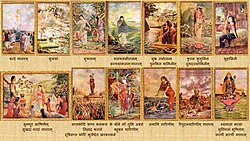
[[File:A rare painting of our national song, Vande Mataram, published in 1923.jpg|thumb|500px|left|A rare painting of Indian national song, Vande Mataram, published in 1923]] | |||
{|class="toccolours" cellpadding="15" rules="cols" | |||
!{{lang|bn|বন্দে মাতরম্}} ([[Bengali alphabet|Bengali Script]]) | |||
![[Romanisation of Bengali|Latin transliteration]] ([[International Alphabet of Sanskrit Transliteration|IAST]]) | |||
!{{lang|hi|वन्दे मातरम्}} ([[Devanagari]] transliteration) | |||
|- | |||
| | |||
{{lang|bn|<blockquote><poem> | |||
বন্দে মাতরম্ ৷ | |||
সুজলাং সুফলাং | |||
মলয়জশীতলাম্ | |||
শস্যশ্যামলাং | |||
মাতরম্ ! | |||
শুভ্র-জ্যোত্স্না-পুলকিত-যামিনীম্ | |||
ফুল্লকুসুমিত-দ্রুমদলশোভিনীম্, | |||
সুহাসিনীং সুমধুরভাষিণীম্ | |||
সুখদাং বরদাং মাতরম্ ৷৷ | |||
সপ্তকোটীকন্ঠ-কল-কল-নিনাদকরালে, | |||
দ্বিসপ্তকোটীভুজৈধৃতখরকরবালে, | |||
অবলা কেন মা এত বলে ! | |||
বহুবলধারিণীং | |||
নমামি তরিণীং | |||
রিপুদলবারিণীং | |||
মাতরম্ ৷ | |||
তুমি বিদ্যা তুমি ধর্ম্ম{{efn|sometimes transcribed as ধর্ম}} | |||
তুমি হৃদি তুমি মর্ম্ম{{efn|sometimes transcribed as মর্ম}} | |||
ত্বং হি প্রাণাঃ শরীরে ৷ | |||
বাহুতে তুমি মা শক্তি, | |||
হৃদয়ে তুমি মা ভক্তি, | |||
তোমারই প্রতিমা গড়ি মন্দিরে মন্দিরে ৷ | |||
ত্বং হি দুর্গা দশপ্রহরণধারিণী | |||
কমলা কমল-দলবিহারিণী | |||
বাণী বিদ্যাদায়িণী | |||
নমামি ত্বাং | |||
নমামি কমলাম্ | |||
অমলাং অতুলাম্, | |||
সুজলাং সুফলাং | |||
মাতরম্ | |||
বন্দে মাতরম্ | |||
শ্যামলাং সরলাং | |||
সুস্মিতাং ভূষিতাম্ | |||
ধরণীং ভরণীম্ | |||
মাতরম্ ৷ | |||
</poem></blockquote>}} | |||
| | |||
<blockquote><poem> | |||
Bande{{efn|[[Sanskrit]] transliteration "Vande"}} Mātaram. | |||
Sujalāṃ suphalām | |||
Malayajaśītalām | |||
Śasyaśyāmalām | |||
Mātaram. | |||
Śubhra-jyotsnā-pulakita-yāminī | |||
Phullakusumita-drumadalaśobhinī, | |||
Suhāsinīṃ sumadhurabhāṣinīm | |||
Sukhadāṃ baradāṃ{{efn|[[Sanskrit]] | |||
"varadāṃ"}} Mātaram. | |||
Saptakoṭīkanṭha-kala-kala-ninādakarāle | |||
Dbisaptakoṭībhujaidhṛtakharakarabāle,{{efn|[[Sanskrit]] transliteration "Dvisaptakoṭībhujaidhṛtakharakaravāle"}} | |||
Abalā{{efn|[[Sanskrit]] transliteration "Avalā"}} kena mā eta bale{{efn|[[Sanskrit]] transliteration "vale"}}! | |||
Bahubaladhārinīṃ{{efn|[[Sanskrit]] transliteration "Vahuvaladhārinīṃ"}} | |||
Namāmi tarinīṃ | |||
Ripudalabārinīṃ{{efn|[[Sanskrit]] transliteration "Ripudalavārinī"}} | |||
Mātaram. | |||
Tumi bidyā{{efn|[[Sanskrit]] transliteration "vidyā"}} tumi dharma | |||
Tumi hrṛdi tumi marma | |||
Tbaṃ{{efn|[[Sanskrit]] transliteration "Tvaṃ"}} hi prānāḥ śarīre. | |||
Bāhute{{efn|[[Sanskrit]] transliteration "Vāhute"}} tumi mā śakti, | |||
Hṛdaye tumi mā bhakti, | |||
Tomārai pratimā gaṛi mandire mandire. | |||
Tbaṃ{{efn|[[Sanskrit]] transliteration "Tvaṃ"}} hi Durgā daśapraharanadhārinī | |||
Kamalā kamala-dalabihārinī | |||
Bānī{{efn|[[Sanskrit]] transliteration "Vānī"}} bidyādāyinī{{efn|[[Sanskrit]] transliteration "vidyādāẏinī"}} | |||
Namāmi tbaṃ{{efn|[[Sanskrit]] transliteration "tvaṃ"}} | |||
Namāmi kamalām | |||
Amalāṃ atulām, | |||
Sujalāṃ suphalām | |||
Mātaram | |||
Bande{{efn|[[Sanskrit]] transliteration "Vande"}} Mātaram | |||
Śyāmalām saralām | |||
Susmitām bhūṣitām | |||
Dharanīṃ bharanīṃ | |||
Mātaram. | |||
</poem></blockquote> | |||
| | |||
{{lang|hi|<blockquote><poem> | |||
वन्दे मातरम् (وَنْدے ماتَرَم) | |||
सुजलां सुफलाम् (سُجالان٘م سُپھالام) | |||
मलयजशीतलाम् (مَلَئیْجَشِیتَلَم) | |||
शस्यश्यामलाम् (شَسْیَشِْیامَلَم) | |||
मातरम्। (ماتَرَم) | |||
शुभ्रज्योत्स्नापुलकितयामिनीम् | |||
फुल्लकुसुमितद्रुमदलशोभिनीम् | |||
सुहासिनीं सुमधुर भाषिणीम् | |||
सुखदां वरदां मातरम्।। | |||
सप्त-कोटि-कण्ठ-कल-कल-निनाद-कराले | |||
द्विसप्त-कोटि-भुजैर्धृत-खरकरवाले, | |||
अबला केन मा एत बॅले | |||
बहुबलधारिणीं | |||
नमामि तारिणीं | |||
रिपुदलवारिणीं | |||
मातरम्।। | |||
तुमि विद्या, तुमि धर्म | |||
तुमि हृदि, तुमि मर्म | |||
त्वम् हि प्राणा: शरीरे | |||
बाहुते तुमि मा शक्ति, | |||
हृदये तुमि मा भक्ति, | |||
तोमारई प्रतिमा गडी मन्दिरे-मन्दिरे।। | |||
त्वम् हि दुर्गा दशप्रहरणधारिणी | |||
कमला कमलदलविहारिणी | |||
वाणी विद्यादायिनी, | |||
नमामि त्वाम् | |||
नमामि कमलाम् | |||
अमलां अतुलाम् | |||
सुजलां सुफलाम् | |||
मातरम्।। | |||
वन्दे मातरम् | |||
श्यामलाम् सरलाम् | |||
सुस्मिताम् भूषिताम् | |||
धरणीं भरणीं | |||
मातरम्।। | |||
</poem></blockquote>}} | |||
|} | |||
==Translation== | |||
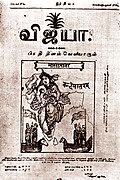
[[File:1909magazine vijaya.jpg|thumb|250px|Cover of a 1909 issue of the Tamil magazine ''Vijaya'' showing "Mother India" ([[Bharat Mata]]) with her diverse progeny and the rallying cry "Vande Mataram"]] | |||
The first translation of [[Bankim Chandra Chattopadhyay]]'s novel ''[[Anandamath]]'', including the poem ''Vande Mataram'', into English was by [[Nares Chandra Sen-Gupta]], with the fifth edition published in 1906 titled "The Abbey of Bliss".<ref name="Chatterji2005">{{cite book|author=Bankimcandra Chatterji|title=Anandamath, or The Sacred Brotherhood|url=https://books.google.com/books?id=u4WTZkBLct0C&pg=PA44|date=23 August 2005|publisher=Oxford University Press|isbn=978-0-19-534633-6|pages=44–}}</ref> | |||
Here is the translation in [[prose]] of the above two stanzas rendered by [[Sri Aurobindo|Sri Aurobindo Ghosh]]. This has also been adopted by the Government of India's national portal.<ref name="National Song of India"/> The original ''Vande Mataram'' consists of six stanzas and the translation in [[prose]] for the complete poem by [[Shri Aurobindo]] appeared in ''Karmayogin'', 20 November 1909.<ref>{{cite book|author=Aurobindo Mazumdar|title=Vande Mataram and Islam|url=https://books.google.com/books?id=4YBhMfAgxIkC&pg=PA4|year=2007|publisher=Mittal Publications|isbn=978-81-8324-159-5|pages=4–6}}</ref> | |||
<blockquote><poem> | |||
Mother, I bow to thee! | |||
Rich with thy hurrying streams, | |||
Bright with thy orchard gleams, | |||
Cool with the winds of delight, | |||
Dark fields waving, Mother of might, | |||
Mother free. | Mother free. | ||
Glory of moonlight dreams, | Glory of moonlight dreams, | ||
Over thy branches and lordly streams, | Over thy branches and lordly streams, | ||
Clad in thy blossoming trees, | Clad in thy blossoming trees, | ||
Mother, giver of ease | Mother, giver of ease, | ||
Laughing low and sweet | Laughing low and sweet, | ||
Mother I kiss thy feet, | Mother, I kiss thy feet, | ||
Speaker sweet and low | Speaker sweet and low, | ||
Mother, to thee I bow. | Mother, to thee I bow. [Verse 1] | ||
Who hath said thou art weak in thy lands, | |||
When the swords flash out in seventy million hands, | |||
And seventy million voices roar | |||
Thy dreadful name from shore to shore? | |||
With many strengths who art mighty and strong, | |||
To thee I call, Mother and Lord! | |||
Thou who savest, arise and save! | |||
To her I cry who ever her foemen drove | |||
Back from plain and Sea | |||
And shook herself free. [Verse 2] | |||
Thou art wisdom, thou art [[dharma|law]], | |||
Thou art heart, our soul, our breath | |||
Thou art love divine, the awe | |||
In our hearts that conquers death. | |||
Thine the strength that nerves the arm, | |||
Thine the beauty, thine the charm. | |||
Every image divine. | |||
In our temples is but thine. [Verse 3] | |||
Thou art | Thou art Goddess [[Durga]], Lady and Queen, | ||
Thou art | With her hands that strike and her swords of sheen, | ||
Thou art Goddess Kamala ([[Lakshmi]]), [[Lotus throne|lotus-throned]], | |||
And Goddess Vani ([[Saraswati]]), bestower of wisdom known | |||
Pure and perfect without peer, | |||
Mother lend thine ear, | |||
Rich with thy hurrying streams, | |||
Bright with thy orchard gleams, | |||
Dark of hue O candid-fair [Verse 4] | |||
In thy soul, with jewelled hair | |||
And thy glorious smile divine, | |||
Loveliest of all earthly lands, | |||
Showering wealth from well-stored hands! | |||
Mother, mother mine! | |||
Mother sweet, I bow to thee, | |||
Mother | Mother great and free! [Verse 5] | ||
</poem></blockquote> | |||
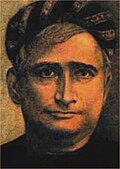
[[File:Bankim chandra chattopadhyay.jpg|thumb|right|[[Bankim Chandra Chattopadhyay]]]] | |||
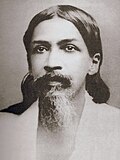
[[File:Sri aurobindo.jpg|thumb|200px|[[Sri Aurobindo Ghose]]]] | |||
< | Apart from the above [[prose]] translation, [[Sri Aurobindo]] also translated ''Vande Mataram'' into a [[verse (poetry)|verse]] form known as ''Mother, I praise thee!''.<ref name="sanyal">{{Cite web |url=http://www.sanyal.com/india/vande.html |title=Sri Aurobindo's VERSE translation of ''Vande Mataram'' |access-date=31 July 2011 |archive-url=https://web.archive.org/web/20110927012813/http://www.sanyal.com/india/vande.html |archive-date=27 September 2011 |url-status=live}}</ref> [[Sri Aurobindo]] commented on his English translation of the poem that "It is difficult to translate the National Song of India into verse in another language owing to its unique union of sweetness, simple directness and high poetic force."<ref>Bhabatosh Chatterjee (ed.), ''Bankim Chandra Chatterjee: Essays in Perspective'', Sahitya Akademi, Delhi, 1994, p. 601.</ref> | ||
==== | ===Translation into other languages=== | ||
Vande Mataram has inspired many Indian poets and has been translated into numerous Indian languages, such as Tamil, Telugu, Kannada, Odia, Malayalam, Assamese, Hindi, Marathi, Gujarati, Punjabi, Urdu and others.<ref>{{cite book|author=Aurobindo Mazumdar|title=Vande Mataram and Islam|url=https://books.google.com/books?id=4YBhMfAgxIkC&pg=PA23 |year=2007 |publisher= Mittal Publications|isbn =978-81-8324-159-5|pages=23–34}}</ref>{{refn|group=note|The Assamese version, re-translated into English, reads:<ref>{{cite book|author=Aurobindo Mazumdar|title=Vande Mataram and Islam|url=https://books.google.com/books?id=4YBhMfAgxIkC&pg=PA23 |year=2007 |publisher= Mittal Publications|isbn =978-81-8324-159-5|pages=26–27}}</ref><br>"O my own land,<br>O my dear land,<br>O my dear land,<br>A land bedecked with gentle streams,<br>A land that adorned with heavenly beauty,<br>It is such a motherland." – Lakshminath Bezbarua, Translated into English by A Mazumdar}} | |||
[[Arif Mohammad Khan]] translated Vande Mataram into Urdu.<ref>{{Cite web|url=https://www.outlookindia.com/website/story/unnecessary-and-irrelevant/232420|title=Unnecessary And Irrelevant|website=Outlook India|access-date=2019-12-30}}</ref> It can be read in Urdu ([[Devanagari]] script) as: | |||
{|class="wikitable" style="text-align:center;font-size:90%;vertical-align:top;white-space:nowrap;" | |||
|- | |||
!Devanagari script!! Perso Arabic script (original orthography) | |||
|- style="vertical-align:top; white-space:nowrap;" | |||
|<poem>तस्लीमात, माँ तस्लीमात | |||
तू भरी है मीठे पानी से | |||
फल फूलों की शादाबी से | |||
दक्खिन की ठंडी हवाओं से | |||
फसलों की सुहानी फ़िज़ाओं से | |||
तस्लीमात, माँ तस्लीमात | |||
तेरी रातें रौशन चांद से | |||
तेरी रौनक सब्ज़-ए-फ़ाम से | |||
तेरी प्यार भरी मुस्कान है | |||
तेरी मीठी बहुत ज़ुबां है | |||
तेरी बांहों में मेरी राहत है | |||
तेरे क़दमों में मेरी जन्नत है | |||
तस्लीमात, माँ तस्लीमात<ref>{{Cite web|url=https://navbharattimes.indiatimes.com/education/gk-update/urdu-translation-of-vande-matram-by-arif-mohammed-khan/articleshow/70932050.cms|title=केरल के गवर्नर बने आरिफ मोहम्मद खान, पढ़ें वंदे मातरम का उर्दू में उनका अनुवाद|website=Navbharat Times|language=hi|access-date=2019-12-30}}</ref></poem> | |||
|<poem>تسلیمات، ماں تسلیمات | |||
تُو بھری ہیں میٹھے پانی سے | |||
پھل پھولوں کی شادابی سے | |||
دکھن کی ٹھنڈی ہواؤں سے | |||
پھسلوں کی سُہانی فضاؤں سے | |||
تسلیمات، ماں تسلیمات | |||
تیری راتیں روشن چاند سے | |||
تیری رونک سبزِ فام سے | |||
تیری پیار بھری مسکان ہے | |||
تیری میٹھی بہت زُباں ہے | |||
تیری باہوں میں میری راحت ہے | |||
تیرے قدموں میں میری جنت ہے | |||
تسلیمات، ماں تسلیمات</poem> | |||
|} | |||
==History and significance== | |||
===Composition=== | |||
[[Bankim Chandra Chatterjee]] was one of the earliest graduates of the newly established [[Calcutta University]]. After his BA, he joined the [[British Raj|colonial government]] as a civil servant, becoming a Deputy Collector and later a Deputy Magistrate. Chattopadhyay was very intereste in recent events in Indian and Bengali history, particularly the [[Revolt of 1857]] and the previous century's [[Sanyasi Rebellion]].<ref name=Lipner /> Around the same time, the administration was trying to promote "[[God Save the Queen]]" as the anthem for Indian subjects, which Indian nationalists disliked. It is generally believed that the concept of ''Vande Mataram'' came to [[Bankim Chandra Chattopadhyay]] when he was still a government official, around 1876.<ref name="mustard">Suresh Chandvankar, [http://www.mustrad.org.uk/articles/mataram.htm Vande Mataram] {{Webarchive|url=https://web.archive.org/web/20060829065309/http://www.mustrad.org.uk/articles/mataram.htm |date=29 August 2006 }} (2003) at ''Musical Traditions'' (mustrad.org.uk)</ref> He wrote ''Vande Mataram'' at Chinsura (Chuchura), there is a white colour house of Adhya Family near river Hooghly (near Mallik Ghat).{{Citation needed|date=February 2015}} | |||
Chattopadhyay wrote the poem in a spontaneous session using words from [[Sanskrit]] and [[Bengali language|Bengali]]. The poem was published in Chattopadhyay's book ''[[Anandamath]]'' (pronounced ''Anondomôţh'' in Bengali) in 1882, which is set in the events of the Sannyasi Rebellion.<ref name=Lipner>{{cite book |last=Lipner |first=Julius|author-link=Julius J. Lipner |title=Anandamath |url=https://archive.org/details/anandamathorsacr00chat |url-access=limited |year=2005 |publisher=Oxford University Press |location=Oxford, UK |isbn=978-0-19-517858-6 |pages=[https://archive.org/details/anandamathorsacr00chat/page/n41 27]–59}}</ref><ref name="mustard" /> Jadunath Bhattacharya was asked to set a tune for this poem just after it was written.<ref name="mustard" /> | |||
===Indian independence movement=== | |||
[[File:Flag of India 1907 (Nationalists Flag).svg|thumb|220px|Flag of India 1907]] | |||
"''Vande Mataram''{{-"}} was one of the most popular songs of protest during the [[Indian independence movement]]. The colonial government in response banned the book and made the recital of the song in public a crime.<ref name="Chatterji2005p71">{{cite book|author=Bankimcandra Chatterji|title=Anandamath, or The Sacred Brotherhood|url=https://books.google.com/books?id=YuzkrT6WuQ0C&pg=PA71|year=2005|publisher=Oxford University Press|isbn=978-0-19-803971-6|pages=71–78}}</ref> The colonial government imprisoned many [[Indian independence movement|independence activists]] for disobeying the order, but workers and general public repeatedly violated the ban many times by gathering together in the presence of colonial officials and singing it.<ref name="Chatterji2005p71"/> Rabindranath Tagore sang ''Vande Mataram'' in 1896 at the [[Calcutta]] Congress Session held at Beadon Square. Dakhina Charan Sen sang it five years later in 1901 at another session of the Congress at [[Calcutta]]. Poet Sarala Devi Chaudurani sang the song in the [[Benares]] Congress Session in 1905. [[Lala Lajpat Rai]] started a journal called ''Vande Mataram'' from [[Lahore]].<ref name="mustard" /> [[Hiralal Sen]] made India's first political film in 1905 which ended with the chant. [[Matangini Hazra]]'s last words as she was shot to death by the [[Crown colony|Crown police]] were ''Vande Mataram''.<ref name="Local">{{cite book | last = Chakrabarty | first = Bidyut | year = 1997 | title = Local Politics and Indian Nationalism: Midnapur (1919–1944) | publisher = Manohar | location = New Delhi | page = 167 }}</ref> | |||
=== | [[File:MKGandhi.jpg|thumb|Mahatma Gandhi supported the first two verses of Vande Mataram as a national song.<ref name=gandhi1939vm>[http://www.gandhiashramsevagram.org/gandhi-literature/mahatma-gandhi-collected-works-volume-76.pdf The National Flag] {{Webarchive|url=https://web.archive.org/web/20150316183933/http://gandhiashramsevagram.org/gandhi-literature/mahatma-gandhi-collected-works-volume-76.pdf |date=16 March 2015 }}, ''The Collected Works of Mahatma Gandhi'', Volume 76, 27 June 1939, pages 68–70 with footnote 1 on page 69</ref>]] | ||
In 1907, [[Bhikaiji Cama]] (1861–1936) created the first version of India's national flag (the [[Tiranga]]) in [[Stuttgart]], Germany, in 1907. It had ''Vande Mataram'' written on it in the middle band.<ref>{{Cite web |url=http://rajyasabha.nic.in/photo/pm/p2.html |title=p2<!-- Bot generated title --> |access-date=8 February 2016 |archive-url=https://web.archive.org/web/20160306143120/http://www.rajyasabha.nic.in/photo/pm/p2.html |archive-date=6 March 2016 |url-status=dead}}</ref> | |||
= | A book titled ''Kranti Geetanjali'' published by Arya Printing Press ([[Lahore]]) and Bharatiya Press ([[Dehradun]]) in 1929 contains first two stanzas of this lyric on page 11<ref>''Kranti Geetanjali'' (Poems of Pt. Ram Prasad 'Bismil'), {{ISBN|81-7783-128-3}}.</ref> as ''Matra Vandana'' and a ghazal (Vande Mataram) composed by Bismil was also given on its back, i.e. page 12.<ref>*''Kranti Geetanjali'' {{ISBN|81-7783-128-3}}.</ref> The book written by the famous [[martyr]] of [[Kakori]] Pandit [[Ram Prasad Bismil]] was proscribed by the colonial government.{{citation needed|date=January 2021}} | ||
=== | Mahatama Gandhi supported adoption and the singing of the Vande Mataram song. In January 1946, in a speech in [[Guwahati]] ([[Assam]]), he urged that "Jai Hind should not replace Vande-mataram". He reminded everyone present that Vande-mataram was being sung since the inception of the Congress. He supported the "Jai Hind" greeting, but remanded that this greeting should not be to the exclusion of Vande Mataram. Gandhi was concerned that those who discarded Vande Mataram given the tradition of sacrifice behind it, one day would discard "Jai Hind" also.<ref>[http://www.gandhiashramsevagram.org/gandhi-literature/mahatma-gandhi-collected-works-volume-89.pdf Speech at Prayer Meeting (Guwahati, Assam)] {{Webarchive|url=https://web.archive.org/web/20150316185043/http://gandhiashramsevagram.org/gandhi-literature/mahatma-gandhi-collected-works-volume-89.pdf |date=16 March 2015 }}, ''The Collected Works of Mahatma Gandhi'', 10 January 1946, page 212</ref>{{refn|group=note|This view of Gandhi was not isolated. In another interview, he said, "a song that carried such glorious associations of sacrifice as "Vandemataram" could never be given up. It would be like discarding one’s mother. But they could certainly add a new song or songs like the one mentioned to their repertoire of national songs after due thought and discrimination."<ref>[http://www.gandhiashramsevagram.org/gandhi-literature/mahatma-gandhi-collected-works-volume-89.pdf Discussion with Political Workers] {{Webarchive|url=https://web.archive.org/web/20150316185043/http://gandhiashramsevagram.org/gandhi-literature/mahatma-gandhi-collected-works-volume-89.pdf |date=16 March 2015 }}, ''The Collected Works of Mahatma Gandhi'', 1945, page 89</ref>}} | ||
===Debate on adoption as national song of India=== | |||
Parts of the Vande Mataram was chosen as the national song in 1937 by the Indian National Congress as it pursued the independence of India from colonial rule, after a committee consisting of Maulana Azad, Jawaharlal Nehru, Subhash Bose, Acharya Deva and Rabrindanath Tagore recommended the adoption.<ref name=noorani1039>A. G. Noorani (1973), [https://www.jstor.org/stable/4362722 Vande Mataram: A Historical Lesson] {{Webarchive|url=https://web.archive.org/web/20170221011512/http://www.jstor.org/stable/4362722 |date=21 February 2017 }}, EPW, Vol. 8, No. 23 (9 Jun. 1973), pages 1039–1043</ref> The entire song was not selected by Hindu leaders in order to respect the sentiments of non-Hindus, and the gathering agreed that anyone should be free to sing an alternate "unobjectionable song" at a national gathering if they do not want to sing Vande Mataram because they find it "objectionable" for a personal reason.<ref name=noorani1039/> According to the gathered leaders, including the Nobel Laureate Rabindranath Tagore, though the first two stanzas began with an unexceptionable evocation of the beauty of the motherland, in later stanzas there are references to the Hindu goddess [[Durga]]. The Muslim League and [[Muhammad Ali Jinnah]] opposed the song. Thereafter, with the support of [[Mahatma Gandhi]] and [[Jawahar Lal Nehru]], the Indian National Congress decided to adopt only the first two stanzas as the national song to be sung at public gatherings, and other verses that included references to Durga and Lakshmi were expunged.<ref name=gandhi1939vm/><ref>{{cite book|author=Marie Cruz Gabriel|title=A Silence in the City and Other Stories|url=https://books.google.com/books?id=CiklIzcTIYUC&pg=PA238|year=1996|publisher=Orient Blackswan|isbn=978-81-250-0828-6|pages=238–240}}</ref> | |||
[[Rajendra Prasad]], who was presiding the [[Constituent Assembly]] on 24 January 1950, made the following statement which was also adopted as the final decision on the issue: | |||
{{ | <blockquote>...The composition consisting of the words and music known as Jana Gana Mana is the National Anthem of India, subject to such alterations in the words as the Government may authorise as occasion arises; and the song Vande Mataram, which has played a historic part in the struggle for Indian freedom, shall be honoured equally with Jana Gana Mana and shall have equal status with it. (Applause). I hope this will satisfy the Members. | ||
:—''Constituent Assembly of India'', Vol. XII, 24-1-1950<ref>{{Cite web | url=http://164.100.47.194/loksabha/writereaddata/cadebatefiles/C24011950.html |title = Constituent Assembly of India Debates}}</ref></blockquote> | |||
==Performances and interpretations== | |||
The poem has been set to a large number of tunes. The oldest surviving audio recordings date to 1907, and there have been more than a hundred different versions recorded throughout the 20th century. Many of these versions have employed traditional [[India|Indian]] [[Hindustani classical music|classical]] [[raga]]s. Versions of the song have been visualised on celluloid in a number of films, including ''[[Leader (1964 film)|Leader]]'', ''[[Amar Asha]]'', and ''[[Anand Math]]''. It is widely believed that the tune set for [[All India Radio]] station version was composed by [[Ravi Shankar]].<ref name="mustard" /> [[Hemant Kumar]] composed music for the song in the movie [[Anand Math]] in 1952. Many singers like [[Lata Mangeshkar]], [[K.S.Chithra]] sung made it cult classic.<ref name=red>[http://www.rediff.com/entertai/2003/jun/02dinesh.htm Pradeep Kumar] {{Webarchive|url=https://web.archive.org/web/20160303182846/http://www.rediff.com/entertai/2003/jun/02dinesh.htm |date=3 March 2016 }} ''[[Rediff.com]]''.</ref> In 2002, [[BBC World Service]] conducted an international poll to choose ten most famous songs of all time. Around 7000 songs were selected from all over the world. ''Vande Mataram'', from the movie ''[[Anand Math]]'', was ranked second.<ref>[http://www.bbc.co.uk/worldservice/us/features/topten/profiles/index.shtml The Worlds Top Ten] {{Webarchive|url=https://web.archive.org/web/20060821022652/http://www.bbc.co.uk/worldservice/us/features/topten/profiles/index.shtml |date=21 August 2006 }} — BBC World Service</ref> All India Radio's version and some other versions are in [[Desh (raga)|Desh]] [[raga]].<ref>{{cite web|url=http://www.sawf.org/newedit/edit10012001/musicarts.asp|title=Des: Tunes from the Countryside|access-date=31 May 2011|archive-url=https://web.archive.org/web/20160303170118/http://www.sawf.org/newedit/edit10012001/musicarts.asp|archive-date=3 March 2016|url-status=live}}</ref> | |||
[ | In July 2017, the Madras High Court ruled that the Vande Mataram shall be sung or played at least once a week in all schools, universities and other educational institutions of Tamil Nadu. The Court also ruled that the song should be played or sung in government offices and industrial facilities at least once a month.<ref>[http://indiatoday.intoday.in/story/vande-mataram-singing-mandatory-madras-high-court-sanskrit-bengali/1/1010253.html Madras High Court makes Vande Mataram mandatory in schools and colleges] {{Webarchive|url=https://web.archive.org/web/20170728222022/http://indiatoday.intoday.in/story/vande-mataram-singing-mandatory-madras-high-court-sanskrit-bengali/1/1010253.html |date=28 July 2017 }}, India Today (25 July 2017)</ref> | ||
{{ | ==See also== | ||
{{Portal|India}} | |||
{{col div|colwidth=30em}} | |||
* ''[[Anandmath]]''— The novel from which "Vande Mataram" gained popularity | |||
* "[[Jana Gana Mana]]"- The Indian national anthem | |||
* "[[Subh Sukh Chain]]" | |||
* [[Bangamata|Banga Mata]] | |||
* [[Bharat Mata]] | |||
* [[Jaya Bharata Jananiya Tanujate]] | |||
* [[Tamil Thai]] | |||
* [[Telugu Thalli]] | |||
* [[Telangana Thalli]] | |||
* [[Bharat Mata Ki Jai]] | |||
* [[Vande Mataram (album)|''Vande Mataram'' (album)]] | |||
* [[National Pledge (India)|National Pledge]] | |||
* [[List of Indian state anthems]] | |||
{{colend}} | |||
== | ==Notes== | ||
{{noteslist}} | |||
{{reflist|group=note}} | |||
== References == | ==References== | ||
{{ | {{Reflist}} | ||
* Sabyasachi Bhattacharya, ''Vande Mataram: The Biography of a Song'', Penguin Books, 2003, {{ISBN|978-0-14-303055-3}}. | |||
== | == Further reading == | ||
* {{Cite book |title=The Home and the World |first=Sir Rabindranath |last=Tagore |author-link=Rabindranath Tagore |others=Trans. from Bengali by Surendranath Tagore |location=London |publisher=MacMillan & Co. |year=1919 |orig-year=1916 |url=https://archive.org/details/homeandworld01unkngoog |oclc=228705970}} Bande (with a B rather than a V) Mataram plays a great part in this novel about a Bengali family. | |||
* "Vande Mataram : Biography of a Song" by Sabyasachi Bhattacharya, Publisher:Penguin, {{ISBN|9780143030553}} | |||
==External links== | |||
<!-- This section is linked from Vande Mataram --> | |||
[[ | '''Vocals''' | ||
[ | * [https://www.youtube.com/watch?v=c6PHJg9D_Sk Vande Mataram], Lata Mangeshkar in Anand Math (4:57 minutes) | ||
* [https://www.youtube.com/watch?v=0t-qE2wTshs Vande Mataram], Amruta Suresh and Abhirami Suresh (4:36 minutes) | |||
* [https://www.youtube.com/watch?v=3g8nQuX8dUg Vande Mataram], Group song (1:09 minutes) | |||
'''Debate''' | |||
* [https://web.archive.org/web/20130115003651/http://knowindia.gov.in/knowindia/national_symbols.php?id=12 "National Song" section], Official Portal of the Indian Government | |||
* [http://www.frontline.in/static/html/fl1601/16010940.htm How Secular is Vande Mataram?], AG Noorani, Frontline | |||
* [http://news.bbc.co.uk/2/hi/south_asia/5300996.stm Boycott threat over Indian song], BBC | |||
* [https://web.archive.org/web/20130501125728/http://www.outlookindia.com/full.asp?fodname=20060902&fname=vandemataram&sid=4 1937 Congress Resolution on validity of Muslim objection to this song], Outlook India | |||
{{Symbols of India}} | |||
{{Novels by Bankim Chandra Chattopadhyay}} | |||
[[Category:Indian literature]] | |||
[[Category:Indian patriotic songs]] | |||
[[Category:National symbols of India]] | |||
[[Category:Sanskrit texts]] | |||
[[Category:Bengali-language songs]] | |||
[[Category:Indian political slogans]] | |||
Revision as of 12:27, 22 July 2023
| Error creating thumbnail: File with dimensions greater than 12.5 MP Vande Mataram written by Bankim Chandra Chattterjee set to Raag Desh as performed on All India Radio | |
National song of India | |
| Lyrics | Bankim Chandra Chatterjee, Anandamath (1882) |
|---|---|
| Music | Hemanta Mukherjee (film version) Jadunath Bhattacharya (original) |
| Adopted | 24 January 1950 |
| Audio sample | |
Vande Mataram played on the Mohan veena by Vishwa Mohan Bhatt in 2017 | |
| Music of India | |
|---|---|
 A lady playing the Tanpura, c. 1735 (Rajasthan) | |
| Genres | |
Traditional
Modern | |
| Media and performance | |
| Music awards | |
| Music festivals | |
| Music media | |
| Nationalistic and patriotic songs | |
| National anthem | Jana Gana Mana |
| Regional music | |
| |
Vande Mataram (Vande Mātaram, also spelt Bande Mataram; Bônde Mātôrôm; transl. I praise you, Motherland) is a poem written in Sanskrit and Sanskritised Bengali[1][2] by Bankim Chandra Chatterjee in the 1870s.[3][4] The first two verses of the poem were adopted as the National Song of India in October 1937 by the Congress.[5][6][7]
The poem was first published in 1882 as part of Chatterjee's Bengali novel Anandmath.[8] It is an ode to the motherland, personified as the "mother goddess" in later verses, of the people. This initially referred to Bengal, with the "mother" figure therefore being Banga Mata (Mother Bengal), though the text does not mention this explicitly.[9][10][11][12] Indian nationalist and philosopher Sri Aurobindo referred Vande Mataram as the "national Anthem of Bengal".[13]
Nonetheless, the poem played a vital role in the Indian independence movement. It first gained political significance when it was recited by Rabindranath Tagore at Congress in 1896.[14][15][16] By 1905, it had become a popular amongst political activists and freedom fighters as a marching song.[16] The song, as well as Anandmath, were banned under British colonial rule under threat of imprisonment, making its use revolutionary. The ban was ultimately overturned by the Indian government upon independence in 1947.[17][18]
On 24 January 1950, the Constituent Assembly of India adopted Vande Mataram as the Republic's national song. President of India Rajendra Prasad stated that the song should be honoured equally with the national anthem of India, Jana Gana Mana.[19] While the Constitution of India does not make reference to a "national song",[20][21] the Government filed an affidavit at the Delhi High Court in November 2022 stating that Jana Gana Mana and Vande Mataram would “stand on the same level”, and that citizens should show equal respect to both.[22]
The first two verses of the song make abstract reference to the "mother" and "motherland", without any religious connotation. However, later verses mention Hindu goddesses such as Durga.[23][24]
Unlike the national anthem, there are no rules or decorum to be observed when reciting Vande Mataram.[25]
Etymology
The root of the Sanskrit word Vande is Vand, which appears in Rigveda and other Vedic texts.[26][note 1] According to Monier Monier-Williams, depending on the context, vand means "to praise, celebrate, laud, extol, to show honour, do homage, salute respectfully", or "deferentially, venerate, worship, adore", or "to offer anything respectfully to".[26][27] The word Mātaram has Indo-European roots in mātár- (Sanskrit), méter (Greek), mâter (Latin) which mean "mother".[28][29]
Lyrics of the song
The first two verses of Vande Mataram adopted as the "National Song" read as follows:
| Bengali script[30] | Bengali phonemic transcription | Devanagari script | IAST transliteration[14][31] | |
|---|---|---|---|---|
বন্দে মাতরম্৷ |
Bônde mātôrôm |
वन्दे मातरम्। |
|
vande mātaram |
Lyrics
The complete original lyrics of the Vande Mataram are available at – via Wikisource..

| বন্দে মাতরম্ (Bengali Script) | Latin transliteration (IAST) | वन्दे मातरम् (Devanagari transliteration) |
|---|---|---|
|
|
|
Translation

The first translation of Bankim Chandra Chattopadhyay's novel Anandamath, including the poem Vande Mataram, into English was by Nares Chandra Sen-Gupta, with the fifth edition published in 1906 titled "The Abbey of Bliss".[32]
Here is the translation in prose of the above two stanzas rendered by Sri Aurobindo Ghosh. This has also been adopted by the Government of India's national portal.[14] The original Vande Mataram consists of six stanzas and the translation in prose for the complete poem by Shri Aurobindo appeared in Karmayogin, 20 November 1909.[33]
Mother, I bow to thee!
Rich with thy hurrying streams,
Bright with thy orchard gleams,
Cool with the winds of delight,
Dark fields waving, Mother of might,
Mother free.
Glory of moonlight dreams,
Over thy branches and lordly streams,
Clad in thy blossoming trees,
Mother, giver of ease,
Laughing low and sweet,
Mother, I kiss thy feet,
Speaker sweet and low,
Mother, to thee I bow. [Verse 1]
Who hath said thou art weak in thy lands,
When the swords flash out in seventy million hands,
And seventy million voices roar
Thy dreadful name from shore to shore?
With many strengths who art mighty and strong,
To thee I call, Mother and Lord!
Thou who savest, arise and save!
To her I cry who ever her foemen drove
Back from plain and Sea
And shook herself free. [Verse 2]
Thou art wisdom, thou art law,
Thou art heart, our soul, our breath
Thou art love divine, the awe
In our hearts that conquers death.
Thine the strength that nerves the arm,
Thine the beauty, thine the charm.
Every image divine.
In our temples is but thine. [Verse 3]
Thou art Goddess Durga, Lady and Queen,
With her hands that strike and her swords of sheen,
Thou art Goddess Kamala (Lakshmi), lotus-throned,
And Goddess Vani (Saraswati), bestower of wisdom known
Pure and perfect without peer,
Mother lend thine ear,
Rich with thy hurrying streams,
Bright with thy orchard gleams,
Dark of hue O candid-fair [Verse 4]
In thy soul, with jewelled hair
And thy glorious smile divine,
Loveliest of all earthly lands,
Showering wealth from well-stored hands!
Mother, mother mine!
Mother sweet, I bow to thee,
Mother great and free! [Verse 5]


Apart from the above prose translation, Sri Aurobindo also translated Vande Mataram into a verse form known as Mother, I praise thee!.[34] Sri Aurobindo commented on his English translation of the poem that "It is difficult to translate the National Song of India into verse in another language owing to its unique union of sweetness, simple directness and high poetic force."[35]
Translation into other languages
Vande Mataram has inspired many Indian poets and has been translated into numerous Indian languages, such as Tamil, Telugu, Kannada, Odia, Malayalam, Assamese, Hindi, Marathi, Gujarati, Punjabi, Urdu and others.[36][note 2]
Arif Mohammad Khan translated Vande Mataram into Urdu.[38] It can be read in Urdu (Devanagari script) as:
| Devanagari script | Perso Arabic script (original orthography) |
|---|---|
तस्लीमात, माँ तस्लीमात |
تسلیمات، ماں تسلیمات |
History and significance
Composition
Bankim Chandra Chatterjee was one of the earliest graduates of the newly established Calcutta University. After his BA, he joined the colonial government as a civil servant, becoming a Deputy Collector and later a Deputy Magistrate. Chattopadhyay was very intereste in recent events in Indian and Bengali history, particularly the Revolt of 1857 and the previous century's Sanyasi Rebellion.[40] Around the same time, the administration was trying to promote "God Save the Queen" as the anthem for Indian subjects, which Indian nationalists disliked. It is generally believed that the concept of Vande Mataram came to Bankim Chandra Chattopadhyay when he was still a government official, around 1876.[41] He wrote Vande Mataram at Chinsura (Chuchura), there is a white colour house of Adhya Family near river Hooghly (near Mallik Ghat).[citation needed]
Chattopadhyay wrote the poem in a spontaneous session using words from Sanskrit and Bengali. The poem was published in Chattopadhyay's book Anandamath (pronounced Anondomôţh in Bengali) in 1882, which is set in the events of the Sannyasi Rebellion.[40][41] Jadunath Bhattacharya was asked to set a tune for this poem just after it was written.[41]
Indian independence movement
.svg)
"Vande MataramTemplate:-" was one of the most popular songs of protest during the Indian independence movement. The colonial government in response banned the book and made the recital of the song in public a crime.[17] The colonial government imprisoned many independence activists for disobeying the order, but workers and general public repeatedly violated the ban many times by gathering together in the presence of colonial officials and singing it.[17] Rabindranath Tagore sang Vande Mataram in 1896 at the Calcutta Congress Session held at Beadon Square. Dakhina Charan Sen sang it five years later in 1901 at another session of the Congress at Calcutta. Poet Sarala Devi Chaudurani sang the song in the Benares Congress Session in 1905. Lala Lajpat Rai started a journal called Vande Mataram from Lahore.[41] Hiralal Sen made India's first political film in 1905 which ended with the chant. Matangini Hazra's last words as she was shot to death by the Crown police were Vande Mataram.[42]
In 1907, Bhikaiji Cama (1861–1936) created the first version of India's national flag (the Tiranga) in Stuttgart, Germany, in 1907. It had Vande Mataram written on it in the middle band.[43]
A book titled Kranti Geetanjali published by Arya Printing Press (Lahore) and Bharatiya Press (Dehradun) in 1929 contains first two stanzas of this lyric on page 11[44] as Matra Vandana and a ghazal (Vande Mataram) composed by Bismil was also given on its back, i.e. page 12.[45] The book written by the famous martyr of Kakori Pandit Ram Prasad Bismil was proscribed by the colonial government.[citation needed]
Mahatama Gandhi supported adoption and the singing of the Vande Mataram song. In January 1946, in a speech in Guwahati (Assam), he urged that "Jai Hind should not replace Vande-mataram". He reminded everyone present that Vande-mataram was being sung since the inception of the Congress. He supported the "Jai Hind" greeting, but remanded that this greeting should not be to the exclusion of Vande Mataram. Gandhi was concerned that those who discarded Vande Mataram given the tradition of sacrifice behind it, one day would discard "Jai Hind" also.[46][note 3]
Debate on adoption as national song of India
Parts of the Vande Mataram was chosen as the national song in 1937 by the Indian National Congress as it pursued the independence of India from colonial rule, after a committee consisting of Maulana Azad, Jawaharlal Nehru, Subhash Bose, Acharya Deva and Rabrindanath Tagore recommended the adoption.[48] The entire song was not selected by Hindu leaders in order to respect the sentiments of non-Hindus, and the gathering agreed that anyone should be free to sing an alternate "unobjectionable song" at a national gathering if they do not want to sing Vande Mataram because they find it "objectionable" for a personal reason.[48] According to the gathered leaders, including the Nobel Laureate Rabindranath Tagore, though the first two stanzas began with an unexceptionable evocation of the beauty of the motherland, in later stanzas there are references to the Hindu goddess Durga. The Muslim League and Muhammad Ali Jinnah opposed the song. Thereafter, with the support of Mahatma Gandhi and Jawahar Lal Nehru, the Indian National Congress decided to adopt only the first two stanzas as the national song to be sung at public gatherings, and other verses that included references to Durga and Lakshmi were expunged.[5][49]
Rajendra Prasad, who was presiding the Constituent Assembly on 24 January 1950, made the following statement which was also adopted as the final decision on the issue:
...The composition consisting of the words and music known as Jana Gana Mana is the National Anthem of India, subject to such alterations in the words as the Government may authorise as occasion arises; and the song Vande Mataram, which has played a historic part in the struggle for Indian freedom, shall be honoured equally with Jana Gana Mana and shall have equal status with it. (Applause). I hope this will satisfy the Members.
- —Constituent Assembly of India, Vol. XII, 24-1-1950[50]
Performances and interpretations
The poem has been set to a large number of tunes. The oldest surviving audio recordings date to 1907, and there have been more than a hundred different versions recorded throughout the 20th century. Many of these versions have employed traditional Indian classical ragas. Versions of the song have been visualised on celluloid in a number of films, including Leader, Amar Asha, and Anand Math. It is widely believed that the tune set for All India Radio station version was composed by Ravi Shankar.[41] Hemant Kumar composed music for the song in the movie Anand Math in 1952. Many singers like Lata Mangeshkar, K.S.Chithra sung made it cult classic.[51] In 2002, BBC World Service conducted an international poll to choose ten most famous songs of all time. Around 7000 songs were selected from all over the world. Vande Mataram, from the movie Anand Math, was ranked second.[52] All India Radio's version and some other versions are in Desh raga.[53]
In July 2017, the Madras High Court ruled that the Vande Mataram shall be sung or played at least once a week in all schools, universities and other educational institutions of Tamil Nadu. The Court also ruled that the song should be played or sung in government offices and industrial facilities at least once a month.[54]
See also

- Anandmath— The novel from which "Vande Mataram" gained popularity
- "Jana Gana Mana"- The Indian national anthem
- "Subh Sukh Chain"
- Banga Mata
- Bharat Mata
- Jaya Bharata Jananiya Tanujate
- Tamil Thai
- Telugu Thalli
- Telangana Thalli
- Bharat Mata Ki Jai
- Vande Mataram (album)
- National Pledge
- List of Indian state anthems
Notes
- ↑ sometimes transcribed as ধর্ম
- ↑ sometimes transcribed as মর্ম
- ↑ Sanskrit transliteration "Vande"
- ↑ Sanskrit
"varadāṃ" - ↑ Sanskrit transliteration "Dvisaptakoṭībhujaidhṛtakharakaravāle"
- ↑ Sanskrit transliteration "Avalā"
- ↑ Sanskrit transliteration "vale"
- ↑ Sanskrit transliteration "Vahuvaladhārinīṃ"
- ↑ Sanskrit transliteration "Ripudalavārinī"
- ↑ Sanskrit transliteration "vidyā"
- ↑ Sanskrit transliteration "Tvaṃ"
- ↑ Sanskrit transliteration "Vāhute"
- ↑ Sanskrit transliteration "Tvaṃ"
- ↑ Sanskrit transliteration "Vānī"
- ↑ Sanskrit transliteration "vidyādāẏinī"
- ↑ Sanskrit transliteration "tvaṃ"
- ↑ Sanskrit transliteration "Vande"
- ↑ See, for example, Rigveda 1.27.1; Sanskrit: अश्वं न त्वा वारवन्तं वन्दध्या अग्निं नमोभिः । सम्राजन्तमध्वराणाम् ॥१॥ Wikisource
- ↑ The Assamese version, re-translated into English, reads:[37]
"O my own land,
O my dear land,
O my dear land,
A land bedecked with gentle streams,
A land that adorned with heavenly beauty,
It is such a motherland." – Lakshminath Bezbarua, Translated into English by A Mazumdar - ↑ This view of Gandhi was not isolated. In another interview, he said, "a song that carried such glorious associations of sacrifice as "Vandemataram" could never be given up. It would be like discarding one’s mother. But they could certainly add a new song or songs like the one mentioned to their repertoire of national songs after due thought and discrimination."[47]
References
- ↑ https://knowindia.india.gov.in/national-identity-elements/national-song.php
- ↑ "Vande Mataram". www.mustrad.org.uk. Retrieved 3 September 2021.
- ↑ "National Identity Elements - National Song - Know India: National Portal of India". knowindia.gov.in. Archived from the original on 18 August 2017. Retrieved 24 July 2021.
- ↑ Staff Reporter (14 July 2017). "Vande Mataram was in Sanskrit, AG clarifies". The Hindu. ISSN 0971-751X. Retrieved 24 July 2021.
- ↑ 5.0 5.1 5.2 The National Flag Archived 16 March 2015 at the Wayback Machine, The Collected Works of Mahatma Gandhi, Volume 76, 27 June 1939, pages 68–70 with footnote 1 on page 69
- ↑ Sabyasachi Bhattacharya (2003). Bande Mataram, the Biography of a Song. Penguin Books. pp. 17–24. ISBN 978-0-14-303055-3.
- ↑ S. K. BOSE (2015). Bankim Chandra Chatterji. Publications Division Ministry of Information & Broadcasting. pp. 88–92. ISBN 978-81-230-2269-7.
- ↑ Sabyasachi Bhattacharya (2003). Bande Mataram, the Biography of a Song. Penguin. pp. 1–8, 73–76, 90–99. ISBN 978-0-14-303055-3.
- ↑ "Bankim's Vande Mataram originally referred to Banga Mata not Bharat Mata: Netaji's grand nephew in new book".
- ↑ "The Mother in Bande Mataram is not Mother India". 8 April 2017.
- ↑ "History revisited: 'Bande Mataram' was written as a song about Bengal – not India".
- ↑ "Bharat Mata: From freedom struggle metaphor to patriotism's litmus test". 21 March 2016.
- ↑ Sri Aurobindo commented on his English translation of the poem, "It is difficult to translate the National Anthem of Bengal into verse in another language owing to its unique union of sweetness, simple directness and high poetic force." Cited in Bhabatosh Chatterjee (ed.), Bankim Chandra Chatterjee: Essays in Perspective, Sahitya Akademi, Delhi, 1994, p. 601.
- ↑ 14.0 14.1 14.2 "National Song of India". Government of India. Archived from the original on 15 January 2013. Retrieved 29 April 2008.
- ↑ "National Song". knowindia.gov.in. Archived from the original on 18 August 2017.
- ↑ 16.0 16.1 Diana L. Eck (2012). India: A Sacred Geography. New York: Random House (Harmony Books). pp. 95–97. ISBN 978-0-385-53190-0.
- ↑ 17.0 17.1 17.2 Bankimcandra Chatterji (2005). Anandamath, or The Sacred Brotherhood. Oxford University Press. pp. 71–78. ISBN 978-0-19-803971-6.
- ↑ Aurobindo Mazumdar (2007). Bande Mataram and Islam. Mittal Publications. pp. 18–22, 30–31. ISBN 978-81-8324-159-5.
- ↑ "National Symbols | National Portal of India". Retrieved 23 January 2020.
- ↑ "HC dismisses plea to declare 'Vande Mataram' as national anthem or song". The Indian Express. 27 July 2019. Retrieved 1 November 2019.
- ↑ "No concept of National Song in Constitution, says SC". Hindustan Times. 17 February 2017. Retrieved 1 November 2019.
- ↑ "Jana Gana & Vande Mataram 'stand on same level': Govt in HC". Times of India. 7 November 2022. Retrieved 7 November 2022.
- ↑ Sabyasachi Bhattacharya (2003). Bande Mataram, the Biography of a Song. Penguin Books. pp. 34–37, 81. ISBN 978-0-14-303055-3.
- ↑ Sumathi Ramaswamy (2009). The Goddess and the Nation: Mapping Mother India. Duke University Press. pp. 125–142. ISBN 978-0-8223-9153-1.
- ↑ "No rules on singing, playing of 'Bande Mataram': Government". The Times of India. Archived from the original on 12 February 2017. Retrieved 12 February 2017.
- ↑ 26.0 26.1 Monier Monier-Williams, English Sanskrit Dictionary with Etymology Archived 28 April 2017 at the Wayback Machine, Oxford University Press, page 919
- ↑ Bankimcandra Chatterji (2005). Anandamath, or The Sacred Brotherhood. Oxford University Press. p. 244. ISBN 978-0-19-534633-6.
- ↑ Edward Bispham (2010). Edinburgh Companion to Ancient Greece and Rome. Edinburgh University Press. p. 32. ISBN 978-0-7486-2714-1.
- ↑ J. P. Mallory; Douglas Q. Adams (1997). Encyclopedia of Indo-European Culture. Taylor & Francis. pp. 385–386. ISBN 978-1-884964-98-5.
- ↑ "Vande Mataram in Bengali script". Archived from the original on 2 October 2011. Retrieved 1 August 2011.
- ↑ "Vande Mataram in Romanized Sanskrit". Archived from the original on 2 October 2011. Retrieved 31 July 2011.
- ↑ Bankimcandra Chatterji (23 August 2005). Anandamath, or The Sacred Brotherhood. Oxford University Press. pp. 44–. ISBN 978-0-19-534633-6.
- ↑ Aurobindo Mazumdar (2007). Vande Mataram and Islam. Mittal Publications. pp. 4–6. ISBN 978-81-8324-159-5.
- ↑ "Sri Aurobindo's VERSE translation of Vande Mataram". Archived from the original on 27 September 2011. Retrieved 31 July 2011.
- ↑ Bhabatosh Chatterjee (ed.), Bankim Chandra Chatterjee: Essays in Perspective, Sahitya Akademi, Delhi, 1994, p. 601.
- ↑ Aurobindo Mazumdar (2007). Vande Mataram and Islam. Mittal Publications. pp. 23–34. ISBN 978-81-8324-159-5.
- ↑ Aurobindo Mazumdar (2007). Vande Mataram and Islam. Mittal Publications. pp. 26–27. ISBN 978-81-8324-159-5.
- ↑ "Unnecessary And Irrelevant". Outlook India. Retrieved 30 December 2019.
- ↑ "केरल के गवर्नर बने आरिफ मोहम्मद खान, पढ़ें वंदे मातरम का उर्दू में उनका अनुवाद". Navbharat Times (in हिन्दी). Retrieved 30 December 2019.
- ↑ 40.0 40.1 Lipner, Julius (2005). Anandamath. Oxford, UK: Oxford University Press. pp. 27–59. ISBN 978-0-19-517858-6.
- ↑ 41.0 41.1 41.2 41.3 41.4 Suresh Chandvankar, Vande Mataram Archived 29 August 2006 at the Wayback Machine (2003) at Musical Traditions (mustrad.org.uk)
- ↑ Chakrabarty, Bidyut (1997). Local Politics and Indian Nationalism: Midnapur (1919–1944). New Delhi: Manohar. p. 167.
- ↑ "p2". Archived from the original on 6 March 2016. Retrieved 8 February 2016.
- ↑ Kranti Geetanjali (Poems of Pt. Ram Prasad 'Bismil'), ISBN 81-7783-128-3.
- ↑ *Kranti Geetanjali ISBN 81-7783-128-3.
- ↑ Speech at Prayer Meeting (Guwahati, Assam) Archived 16 March 2015 at the Wayback Machine, The Collected Works of Mahatma Gandhi, 10 January 1946, page 212
- ↑ Discussion with Political Workers Archived 16 March 2015 at the Wayback Machine, The Collected Works of Mahatma Gandhi, 1945, page 89
- ↑ 48.0 48.1 A. G. Noorani (1973), Vande Mataram: A Historical Lesson Archived 21 February 2017 at the Wayback Machine, EPW, Vol. 8, No. 23 (9 Jun. 1973), pages 1039–1043
- ↑ Marie Cruz Gabriel (1996). A Silence in the City and Other Stories. Orient Blackswan. pp. 238–240. ISBN 978-81-250-0828-6.
- ↑ "Constituent Assembly of India Debates".
- ↑ Pradeep Kumar Archived 3 March 2016 at the Wayback Machine Rediff.com.
- ↑ The Worlds Top Ten Archived 21 August 2006 at the Wayback Machine — BBC World Service
- ↑ "Des: Tunes from the Countryside". Archived from the original on 3 March 2016. Retrieved 31 May 2011.
- ↑ Madras High Court makes Vande Mataram mandatory in schools and colleges Archived 28 July 2017 at the Wayback Machine, India Today (25 July 2017)
- Sabyasachi Bhattacharya, Vande Mataram: The Biography of a Song, Penguin Books, 2003, ISBN 978-0-14-303055-3.
Further reading
- Tagore, Sir Rabindranath (1919) [1916]. The Home and the World. Trans. from Bengali by Surendranath Tagore. London: MacMillan & Co. OCLC 228705970. Bande (with a B rather than a V) Mataram plays a great part in this novel about a Bengali family.
- "Vande Mataram : Biography of a Song" by Sabyasachi Bhattacharya, Publisher:Penguin, ISBN 9780143030553
External links
Vocals
- Vande Mataram, Lata Mangeshkar in Anand Math (4:57 minutes)
- Vande Mataram, Amruta Suresh and Abhirami Suresh (4:36 minutes)
- Vande Mataram, Group song (1:09 minutes)
Debate
- "National Song" section, Official Portal of the Indian Government
- How Secular is Vande Mataram?, AG Noorani, Frontline
- Boycott threat over Indian song, BBC
- 1937 Congress Resolution on validity of Muslim objection to this song, Outlook India
| Constitutional | (Flag) (National Emblem) (Motto) (National Anthem) (National Song) |   |
|---|---|---|
| Flora and Fauna | (Animal) (Bird) (Flower) (Tree) (Fruit) (Heritage animal) (Aquatic animal) (Reptile) (River) | |
| Days | ||
| Others | ||

.png)
