


No edit summary |
ImportMaster (talk | contribs) m robot: Create/update articles in Category:Hindu gods. |
||
| Line 1: | Line 1: | ||
{{short description|Four major Hindu pilgrimage sites in India}} | {{short description|Four major Hindu pilgrimage sites in India}} | ||
{{ | {{for multi|the religious sites in Nepal|Char Dham, Nepal|denomination Himalayan pilgrimage sites|Chota Char Dham}} | ||
{{EngvarB|date=April 2015}} | {{EngvarB|date=April 2015}} | ||
{{Use dmy dates|date=October 2020}} | {{Use dmy dates|date=October 2020}} | ||
{{Char Dham}} | {{Char Dham}} | ||
{{Location map+ | | {{Location map+ |India3|width=300|float=right|caption=Locations of the Char Dham |places= | ||
{{Location map~ |India |lat= 19.48|long=85.49 |label= [[Puri]]|position=right}} | {{Location map~ |India |lat= 19.48|long=85.49 |mark=Font Awesome 5 solid vihara.svg|label= [[Puri]]|position=right}} | ||
{{Location map~ |India |lat= 9.28|long=79.31 |label= [[Rameswaram]]|position=bottom}} | {{Location map~ |India |lat= 9.28|long=79.31 |mark=Font Awesome 5 solid vihara.svg|label= [[Rameswaram]]|position=bottom}} | ||
{{Location map~ |India |lat=22.23|long=68.97|label= [[ | {{Location map~ |India |lat=22.23|long=68.97|mark=Font Awesome 5 solid vihara.svg|label= [[Dwarka]]|position=bottom}} | ||
{{Location map~ |India |lat= 30.744729|long=79.4907558 |label= [[Badrinath]]|position=top}} | {{Location map~ |India |lat= 30.744729|long=79.4907558 |mark=Font Awesome 5 solid vihara.svg|label= [[Badrinath]]|position=top}} | ||
}} | }} | ||
The '''Char Dham''' (meaning: ''four abodes'') is a set of four pilgrimage sites in [[India]].<ref>{{cite web |title=Chaar Dham Yatra: A True Test of Every Hindu's Quest Towards Spiritual Enlightenment|date=20 March 2015|website=NewsGram |url=https://www.newsgram.com/chaar-dham-yatra-true-test-hindus-spiritual-enlightenment/}}</ref> It is believed that visiting these sites helps achieve [[moksha]] (salvation). The four Dhams are, [[Badrinath]], [[ | The '''Char Dham''' (meaning: ''four abodes'') is a set of four pilgrimage sites in [[India]].<ref>{{cite web |title=Chaar Dham Yatra: A True Test of Every Hindu's Quest Towards Spiritual Enlightenment |date=20 March 2015 |website=NewsGram |url= https://www.newsgram.com/chaar-dham-yatra-true-test-hindus-spiritual-enlightenment/ |archive-url= https://web.archive.org/web/20220123103404/https://www.newsgram.com/chaar-dham-yatra-true-test-hindus-spiritual-enlightenment |archive-date= 23 January 2022}}</ref> It is believed that visiting these sites helps achieve [[moksha]] (salvation). The four Dhams are, [[Badrinath]], [[Dwarka]], [[Puri]] and [[Rameswaram]]. It is believed that every Hindu should visit the ''Char Dhams'' during one's lifetime. The Char Dham as defined by [[Adi Shankara]]charya consists of four [[Hindu]] pilgrimage sites.<ref>{{Citation |last=Gwynne|first=Paul |title=World Religions in Practice: A Comparative Introduction|year=2009|publisher=Blackwell Publication |location=Oxford |isbn=978-1-4051-6702-4|url=https://books.google.com/books?id=tdsdfnfnndrfn&q=char+dham}}</ref> | ||
These main 'dhamas' are the shrines of Lord Vishnu and Rameshwaram is a shrine of lord Shiva. | |||
All the 'dhamas' are related to four epochs,(1) Dham of Satyuga- Badrinath, Uttarakhand (2) Dham of Tretayuga -Rameswaram, Tamil Nadu (3) Dham of Dwaparayuga - Dvaraka, Gujarat (4) Dham of Kaliyuga - Jagannatha Puri, Odisha. | |||
== | Another small circuit in [[Uttarakhand]] of four pilgrimage sites-[[Yamunotri]], [[Gangotri]], [[Kedarnath Temple|Kedarnath]], and [[Badrinath Temple|Badrinath]] is referred to as [[Chota Char Dham]] which is locally popular in [[North India]]. | ||
==Description== | |||
{{refimprove section|date=August 2020}} | {{refimprove section|date=August 2020}} | ||
According to Hindu belief, Badrinath became prominent when | According to Hindu belief, Badrinath became prominent when Nara-Narayana, an avatar of Vishnu, did [[Tapasya]] there. At that time that place was filled with berry trees. In the Sanskrit language, berries are called "badri", so the place was named Badrika-Vana, i.e. the forest of berries. The particular spot where the Nara-Narayana did Tapasya, a large berry tree formed covering him to save him from the rain and the sun. Local people believe that Mata Lakshmi became the berry tree to save Lord Narayana. Post-Tapasya, Narayana said, people will always take Her Name before His Name, hence Hindus always refer "Lakshmi-Narayana". It was therefore called Badri-Nath, i.e. the Lord of Berry forest. This all happened in the [[Satya Yuga]]. So Badrinath came to be known as the first Dhama. | ||
The second place, Rameswaram, got its importance in the [[Treta Yuga]] when Lord [[Rama]] built a Shiva-Lingam here and worshiped it to get the blessings of Lord [[Shiva]]. The name Rameswaram means "God of Ram | The second place, Rameswaram, got its importance in the [[Treta Yuga]] when Lord [[Rama]] built a Shiva-Lingam here and worshiped it to get the blessings of Lord [[Shiva]]. The name Rameswaram means "God of Rama". It is also believed that Bhagwan Ram footprints are imprinted there. NV.<ref>Seeger, Elizabeth, 1889-1973. (1969). The Ramayana. New York :W.R. Scott</ref> | ||
The third, | The third, Dwaraka, got its importance in the [[Dvapara Yuga]] when Lord Krishna made Dwaraka His residence instead of Mathura, His birthplace.<ref>Chakravarti Mahadev-1994-The Concept of Rudra-Śiva Through The Ages-Delhi-Motilal Banarsidass-Second Revised. {{ISBN|81-208-0053-2}}</ref> | ||
At the fourth, Puri | At the fourth, Puri, Lord Vishnu is worshiped as [[Jagannatha]], his [[Avtara]] for the current epoch i.e [[Kali Yuga]]. | ||
The four Shankaracharya | The four Shankaracharya Peetha (Seats) at the Char Dham school of Hinduism, created at least four Hindu monastic institutions. He organised the Hindu practitioners under four {{IAST|[[Matha|Maṭhas]]}} (Sanskrit: {{lang|sa|मठ}}) (institutions/monasteries), with the headquarters at [[Dvārakā]] in the West, [[Jagannatha Puri]] in the East, [[Sringeri Sharada Peetham]] in the South and [[Badrikashrama]] in the North.<ref>{{cite web|url=http://www.sanskrit.org/www/Shankara/shankar4.html |title=Sankara Acarya: 4 - Monastic Traditions |access-date=3 May 2009 |url-status=dead |archive-url=https://web.archive.org/web/20120508091224/http://www.sanskrit.org/www/Shankara/shankar4.html |archive-date=8 May 2012 }}</ref> | ||
The table below gives an overview of the four ''Amnaya Mathas'' founded by Adi Shankara, and their details.<ref>[http://www.sringerisharadapeetham.org/html/History/amnaya.html The Amnaya Peethams | Sringeri Sharada Peetham<!-- Bot generated title -->] {{webarchive |url=https://web.archive.org/web/20060626000000/http://www.sringerisharadapeetham.org/html/History/amnaya.html |date=26 June 2006 }}</ref> | The table below gives an overview of the four ''Amnaya Mathas'' founded by [[Adi Shankara]], and their details.<ref>[http://www.sringerisharadapeetham.org/html/History/amnaya.html The Amnaya Peethams | Sringeri Sharada Peetham<!-- Bot generated title -->] {{webarchive |url=https://web.archive.org/web/20060626000000/http://www.sringerisharadapeetham.org/html/History/amnaya.html |date=26 June 2006 }}</ref> | ||
{| class="wikitable" | {| class="wikitable" | ||
| Line 61: | Line 65: | ||
!North | !North | ||
|{{IAST|[[Jyotirmath|Jyotirmaṭha Pīṭhaṃ]]}} | |{{IAST|[[Jyotirmath|Jyotirmaṭha Pīṭhaṃ]]}} | ||
|{{IAST|Ayamātmā brahma (''This | |{{IAST|Ayamātmā brahma (''This self "soul" is Brahman'')}} | ||
|[[Atharva Veda]] | |[[Atharva Veda]] | ||
|Nandavala | |Nandavala | ||
|} | |} | ||
==The four associated places of the Char | ==The four associated places of the Char Dham== | ||
In the Puranas Hari (Vishnu) and Hara (Shiva) are referred as eternal friends. It is said wherever Lord Vishnu resides, Lord Shiva resides nearby. The Char Dham follows this rule. So Kedarnath is considered as the pair of Badrinath, Rama Setu is considered the pair of Rameswaram, Somnath is considered as the pair of Dwaraka. However, according to some traditions, the Char Dham are Badrinath, | In the Puranas Hari (Vishnu) and Hara (Shiva) are referred as eternal friends. It is said wherever Lord Vishnu resides, Lord Shiva resides nearby. The Char Dham follows this rule. So Kedarnath is considered as the pair of Badrinath, Rama Setu is considered the pair of Rameswaram, Somnath is considered as the pair of Dwaraka and Lingaraja is considered the pair of Jagannatha Puri. However, according to some traditions, the Char Dham are Badrinath, Ranganatha-Swami, Dwaraka and Jagannatha-Puri, all of which are Vaishnava sites, and their associated places are [[Kedarnath]], [[Rameswaram]], [[Somnath]] and [[Lingaraja Temple]], Bhubaneswar (or maybe Gupteshwar) respectively. | ||
The [[Char Dham Highway]] project is | The [[Char Dham Highway]] project is functional, many service providers offer a Char Dham Yatra by helicopter for the ease of pilgrims.<ref>{{Cite news|url=https://m.timesofindia.com/city/dehradun/why-schools-in-kedarnath-are-going-soundproof/articleshow/66211084.cms|title=Why schools in Kedarnath are going soundproof - Times of India|work=The Times of India|access-date=3 November 2018}}</ref> | ||
=== Puri === | === Puri === | ||
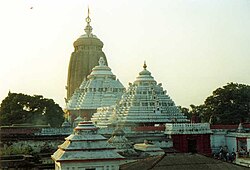
[[File:Temple-Jagannath.jpg|thumb|[[Jagannath Temple, Puri|Jagannath Temple]], [[Puri]]]] | [[File:Temple-Jagannath.jpg|thumb|[[Jagannath Temple, Puri|Jagannath Temple]], [[Puri]]]] | ||
[[Puri]] located at the east, is located in the state of [[Odisha]], India. Puri is one of the oldest cities in the eastern part of the country. It is situated on the coast of the [[Bay of Bengal]]. The main deity is Shri Krishna, celebrated as '''Lord Jagannatha'''. It is the only shrine in India, where goddess, [[Subhadra]], sister of Lord Krishna is worshipped along with her brothers, Lord Jagannatha and Lord [[Balabhadra]]. The main temple here is about 1000 years old and constructed by Raja Choda Ganga Deva and Raja Tritiya Ananga Bhima Deva. Puri is the site of the '''Govardhana Matha''', one of the four cardinal institutions or Mathas converted by [[Adi Shankaracharya]]. Pandit Nilakantha Das suggested that Jagannath was a deity of [[Jain]] origin because of the appending of ''Nath'' to many Jain [[Tirthankar]]s.<ref>{{cite book|last=Mohanty|first=Jagannath|title=Indian Culture and Education|year=2009|publisher=Deep& Deep|isbn=978-81-8450-150-6|page=5|url=https://books.google.com/books?id=3T2Ph_SmjtoC&q=nilakantha+das+jagannath&pg=PA5}}</ref> Jagannath meant the 'World personified' in the Jain context and was derived from ''Jinanath''. Evidence of the Jain terminology such as of [[Kaivalya]], which means [[moksha]] or salvation, is found in the Jagannath tradition.<ref name="Barik 2005 36">{{cite journal|last=Barik|first=P M|title=Jainism and Buddhism in Jagannath culture|journal=Orissa Review|date=July 2005|pages=36|url=http://orissa.gov.in/e-magazine/Orissareview/jul2005/engpdf/jainism_budhism_in_joga-culture.pdf|access-date=29 November 2012}}</ref> Similarly, the twenty two steps leading to the temple, called the ''Baisi Pahacha'', have been proposed as symbolic reverence for the first 22 of the 24 Tirthankaras of [[Jainism]].<ref name="Patra2011p17">{{cite book|author=Avinash Patra|title=Origin & Antiquity of the Cult of Lord Jagannath|url=https://books.google.com/books?id=RlwTCwAAQBAJ|year=2011|publisher=Oxford University Press|pages=8–10, 17–18}}</ref> | [[Puri]] located at the east, is located in the state of [[Odisha]], India. Puri is one of the oldest cities in the eastern part of the country. It is situated on the coast of the [[Bay of Bengal]]. The main deity is Shri Krishna, celebrated as '''Lord Jagannatha'''. It is the only shrine in India, where goddess, [[Subhadra]], sister of Lord Krishna is worshipped along with her brothers, Lord Jagannatha and Lord [[Balarama|Balabhadra]]. The main temple here is about 1000 years old and constructed by Raja Choda Ganga Deva and Raja Tritiya Ananga Bhima Deva. Puri is the site of the '''Govardhana Matha''', one of the four cardinal institutions or Mathas converted by [[Adi Shankaracharya]]. Pandit Nilakantha Das suggested that Jagannath was a deity of [[Jain]] origin because of the appending of ''Nath'' to many Jain [[Tirthankar]]s.<ref>{{cite book|last=Mohanty|first=Jagannath|title=Indian Culture and Education|year=2009|publisher=Deep& Deep|isbn=978-81-8450-150-6|page=5|url=https://books.google.com/books?id=3T2Ph_SmjtoC&q=nilakantha+das+jagannath&pg=PA5}}</ref> Jagannath meant the 'World personified' in the Jain context and was derived from ''Jinanath''. Evidence of the Jain terminology such as of [[Kaivalya]], which means [[moksha]] or salvation, is found in the Jagannath tradition.<ref name="Barik 2005 36">{{cite journal|last=Barik|first=P M|title=Jainism and Buddhism in Jagannath culture|journal=Orissa Review|date=July 2005|pages=36|url=http://orissa.gov.in/e-magazine/Orissareview/jul2005/engpdf/jainism_budhism_in_joga-culture.pdf|access-date=29 November 2012}}</ref> Similarly, the twenty two steps leading to the temple, called the ''Baisi Pahacha'', have been proposed as symbolic reverence for the first 22 of the 24 Tirthankaras of [[Jainism]].<ref name="Patra2011p17">{{cite book|author=Avinash Patra|title=Origin & Antiquity of the Cult of Lord Jagannath|url=https://books.google.com/books?id=RlwTCwAAQBAJ|year=2011|publisher=Oxford University Press|pages=8–10, 17–18}}</ref> | ||
According to Annirudh Das, the original Jagannath deity was influenced by Jainism and is none other than the ''Jina'' of Kalinga taken to [[Magadha]] by [[Mahapadma Nanda]].<ref>{{cite book|last=Das|first=Aniruddha|title=Jagannath and Nepal|pages=9–10}}</ref> The theory of Jain origins is supported by the Jain [[Hathigumpha inscription]]. It mentions the worship of a relic memorial in Khandagiri-Udayagiri, on the Kumara hill. This location is stated to be same as the Jagannath temple site. However, states Starza, a Jain text mentions the Jagannath shrine was restored by Jains, but the authenticity and date of this text is unclear.<ref name="Starza1993p61">{{cite book|author=O. M. Starza|title=The Jagannatha Temple at Puri: Its Architecture, Art, and Cult|url=https://books.google.com/books?id=v4bV3beb0n8C |year=1993|publisher=BRILL Academic|isbn=90-04-09673-6|pages=62–63 with footnotes}}</ref> This is the plume for Oriya people to celebrate a special day in this Dham which is known as '''[[Ratha Yatra]]''' ("Chariot Festival").<ref>''Char Dham Yatra'', by G. R. Venkatraman. Published by Bharatiya Vidya Bhavan, 1988.</ref><ref>{{Citation |last=Brockman |first=Norbert C. |title= Encyclopedia of Sacred Places |year=2011|publisher=ABC-CLIO, LLC |location=California |isbn=978-1-59884-655-3|url=https://books.google.com/books?id=ZNZ15Oow8XcC&q=char+dham&pg=PA94}}</ref> | According to Annirudh Das, the original Jagannath deity was influenced by Jainism and is none other than the ''Jina'' of Kalinga taken to [[Magadha]] by [[Mahapadma Nanda]].<ref>{{cite book|last=Das|first=Aniruddha|title=Jagannath and Nepal|pages=9–10}}</ref> The theory of Jain origins is supported by the Jain [[Hathigumpha inscription]]. It mentions the worship of a relic memorial in Khandagiri-Udayagiri, on the Kumara hill. This location is stated to be same as the Jagannath temple site. However, states Starza, a Jain text mentions the Jagannath shrine was restored by Jains, but the authenticity and date of this text is unclear.<ref name="Starza1993p61">{{cite book|author=O. M. Starza|title=The Jagannatha Temple at Puri: Its Architecture, Art, and Cult|url=https://books.google.com/books?id=v4bV3beb0n8C |year=1993|publisher=BRILL Academic|isbn=90-04-09673-6|pages=62–63 with footnotes}}</ref> This is the plume for Oriya people to celebrate a special day in this Dham which is known as '''[[Ratha Yatra]]''' ("Chariot Festival").<ref>''Char Dham Yatra'', by G. R. Venkatraman. Published by Bharatiya Vidya Bhavan, 1988.</ref><ref>{{Citation |last=Brockman |first=Norbert C. |title= Encyclopedia of Sacred Places |year=2011|publisher=ABC-CLIO, LLC |location=California |isbn=978-1-59884-655-3|url=https://books.google.com/books?id=ZNZ15Oow8XcC&q=char+dham&pg=PA94}}</ref> | ||
| Line 80: | Line 83: | ||
===Rameswaram=== | ===Rameswaram=== | ||
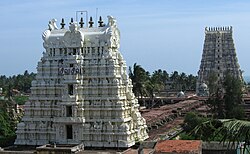
[[File:Rameswaram temple (11).jpg|thumb|[[Rameswaram Temple]], [[Rameswaram]]]] | [[File:Rameswaram temple (11).jpg|thumb|[[Rameswaram Temple]], [[Rameswaram]]]] | ||
Indian peninsula. According to legends, this is the place where [[Lord Ram]] along with his brother Laxman and devotee Hanuman built a bridge (Rama Setu) to reach Sri Lanka to rescue his wife Sita who had been abducted earlier by Ravan, the ruler of Sri Lanka. The Ramanatha Swamy Temple dedicated to Lord Shiva occupies a major area of Rameswaram. The temple is believed to have been consecrated by Shri Rama Chandra. Rameswaram is significant for the Hindus as a pilgrimage to [[Benaras]] is incomplete without a pilgrimage to Rameswaram. The presiding deity here is in the form of a [[Linga]] with the name Sri Ramanatha Swamy, it also is one of the twelve [[Jyotirlingas]]. | |||
===Dwarka === | ===Dwarka === | ||
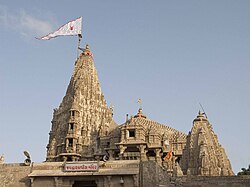
[[File:Dwarkadheesh temple.jpg|thumb|[[Dwarakadheesh Temple]], [[Dwarka]]]] | [[File:Dwarkadheesh temple.jpg|thumb|[[Dwarakadheesh Temple]], [[Dwarka]]]] | ||
[[Dwarka]] located in the west is in the state of [[Gujarat]], country India. The city derives its name from the word "''dvar''" meaning [[door]] or [[gate]] in the [[Sanskrit]] language. It is located confluence to where the Gomti River merges into the [[Arabian Sea]]. However, this river Gomti is not the same [[Gomti River]] which is a tributary of [[Ganga River]] The city lies in the westernmost part of India. The legendary city of [[Dvārakā | [[Dwarka]] located in the west is in the state of [[Gujarat]], country India. The city derives its name from the word "''dvar''" meaning [[door]] or [[gate]] in the [[Sanskrit]] language. It is located confluence to where the Gomti River merges into the [[Arabian Sea]]. However, this river Gomti is not the same [[Gomti River]] which is a tributary of [[Ganga River]] The city lies in the westernmost part of India. The legendary city of [[Dvārakā]] was the dwelling place of [[Lord Krishna]]. It is generally believed{{who|date=February 2013}} that due to damage and destruction by the sea, Dvārakā had submerged six times and modern day Dwarka is the 7th such city to be built in the area.<ref name="GoUnesco">{{cite web |last1=Santosh |first1=Urmila |title=Where Mythology Meets Reality: Sunken City Of Dwarka |url=https://www.gounesco.com/where-mythology-meets-reality-sunken-city-of-dwarka/ |website=gounesco.com |publisher=GoUNESCO |access-date=25 July 2019|date=22 November 2016 }}</ref><ref name="EconomicTimesLeg">{{cite news |last1=Shankar |first1=Kalyani |title=Legends by the sea |url=https://economictimes.indiatimes.com/magazines/travel/legends-by-the-sea/articleshow/1764244.cms |newspaper=The Economic Times |publisher=Bennett, Coleman & Co. Ltd |access-date=25 July 2019|date=15 March 2007 }}</ref>{{citation needed|date=February 2014}} | ||
===Badrinath=== | ===Badrinath=== | ||
[[File:Badrinath | [[File:Badrinath Temple, Uttarakhand (Photo- Vishwanath Negi).jpg|thumb|[[Badrinath Temple]]]] | ||
[[Badrinath]] is located in the state of [[Uttarakhand]]. It is in the Garhwal hills, on the banks of the [[Alaknanda River]]. The town lies between the Nar and Narayana mountain ranges and in the shadow of [[Nilkantha (mountain)|Nilkantha]] peak (6,560 m). | [[Badrinath]] is located in the state of [[Uttarakhand]]. It is in the Garhwal hills, on the banks of the [[Alaknanda River]]. The town lies between the Nar and Narayana mountain ranges and in the shadow of [[Nilkantha (mountain)|Nilkantha]] peak (6,560 m). | ||
There are other interesting sightseeing spots like Mana, Vyas Gufa, Maatamoorti, Charanpaduka, Bhimkund and the Mukh of the Saraswati River, within 3 km of Badrinathjee. Joshimath is situated on the slopes above the confluence of the rivers Alaknanda and Dhauliganga. Of the four Maths established by Adi Shankaracharya, '''[[Joshimath]]''' is the winter seat of Chardham. | There are other interesting sightseeing spots like Mana, Vyas Gufa, Maatamoorti, Charanpaduka, Bhimkund and the Mukh of the Saraswati River, within 3 km of Badrinathjee. Joshimath is situated on the slopes above the confluence of the rivers Alaknanda and Dhauliganga. Of the four Maths established by Adi Shankaracharya, '''[[Joshimath]]''' is the winter seat of Chardham. | ||
| Line 93: | Line 96: | ||
While the three other Dhams remain open throughout the year, '''[[Badrinath Temple|Badrinath Dham]]''' only remains open for pilgrims' darshan from April to October each year. | While the three other Dhams remain open throughout the year, '''[[Badrinath Temple|Badrinath Dham]]''' only remains open for pilgrims' darshan from April to October each year. | ||
==Chota Char Dham== | == Chota Char Dham== | ||
Another circuit of four ancient pilgrimage sites in the Indian state of [[Uttarakhand]] viz. [[Yamunotri]], [[Gangotri]], [[Kedarnath]], and [[Badrinath]] is referred to as [[Chota Char Dham]] to differentiate it from this bigger circuit of Char Dham sites. The Chota Char Dham shrines are closed in winter due to snowfall and reopen for pilgrims with the advent of summer.<ref>[https://books.google.com/books?id=T7ZHUhSEleYC&pg=PA468&dq=Char+Dham&as_brr=0 Char Dham of Garhwal] ''India'', by ffmgftfiokmdkgioftnsdtJoe Windless, Sarina Singh, James Bainbridge, Lindsay Brown, Mark Elliott, Stuart Butler. Published by Lonely Planet, 2007. {{ISBN|1-74104-308-5}}. ''Page 468''.</ref><ref>''Chardham Yatra'', by Savitri Dubey. Published by Alekh Prakashan. {{ISBN|978-81-88913-25-1}}</ref><ref>{{Cite web|url=http://www.alekhprakashan.com/Bookdesc.aspx?id=1635|archive-url=https://web.archive.org/web/20101223140101/http://www.alekhprakashan.com/Bookdesc.aspx?id=1635|url-status=dead|title=Welcome To Alekh Prakashan<!-- Bot generated title -->|archive-date=23 December 2010|access-date=11 December 2019}}</ref><ref>{{cite web|title=Char Dham and Hemkund Sahib Yatra to restart from May 2014|url=http://news.biharprabha.com/2014/04/char-dham-yatra-restarts-in-may-uttarakhand-assures-safety/|work=IANS|date=24 April 2014|publisher=news.biharprabha.com|access-date=24 April 2014}}</ref> | Another circuit of four ancient pilgrimage sites in the Indian state of [[Uttarakhand]] viz. [[Yamunotri]], [[Gangotri]], [[Kedarnath]], and [[Badrinath]] is referred to as [[Chota Char Dham]] to differentiate it from this bigger circuit of Char Dham sites. The Chota Char Dham shrines are closed in winter due to snowfall and reopen for pilgrims with the advent of summer.<ref>[https://books.google.com/books?id=T7ZHUhSEleYC&pg=PA468&dq=Char+Dham&as_brr=0 Char Dham of Garhwal] ''India'', by ffmgftfiokmdkgioftnsdtJoe Windless, Sarina Singh, James Bainbridge, Lindsay Brown, Mark Elliott, Stuart Butler. Published by Lonely Planet, 2007. {{ISBN|1-74104-308-5}}. ''Page 468''.</ref><ref>''Chardham Yatra'', by Savitri Dubey. Published by Alekh Prakashan. {{ISBN|978-81-88913-25-1}}</ref><ref>{{Cite web|url=http://www.alekhprakashan.com/Bookdesc.aspx?id=1635|archive-url=https://web.archive.org/web/20101223140101/http://www.alekhprakashan.com/Bookdesc.aspx?id=1635|url-status=dead|title=Welcome To Alekh Prakashan<!-- Bot generated title -->|archive-date=23 December 2010|access-date=11 December 2019}}</ref><ref>{{cite web|title=Char Dham and Hemkund Sahib Yatra to restart from May 2014|url=http://news.biharprabha.com/2014/04/char-dham-yatra-restarts-in-may-uttarakhand-assures-safety/|work=IANS|date=24 April 2014|publisher=news.biharprabha.com|access-date=24 April 2014}}</ref> | ||
On 23 December 2016, the Indian Prime Minister [[Narendra Modi]] inaugurated the Chardham | Brief about Chardham Temples :- | ||
1. '''[[Yamunotri]]''' :- The first shrine of Chota Chardham,this temple is dedicated to the River Yamuna (Hindu Goddess,Daughter of Sun God).It is situated in the Gharwal region of Uttarakhand State. | |||
2. '''[[Gangotri]]''' :- The temple is devoted to Goddess Ganges (the most sacred river in India). It is the second shrine of the Char Dham circuit. | |||
3. '''[[Kedarnath]]''' :- This temple is devoted to God Shiva in the form of Kedarnath (Lord of Kedar). This is one of the 12 main Jyotirlinga in India. This is the third shrine of the Char Dham circuit. | |||
4. '''[[Badrinath]]''':- This temple is dedicated to Bhagwan Vishnu in the form of Badrinath (Lord of Badri). It is also the part of the main Char Dham Circuit in India and the fourth shrine of the Chardham circuit. | |||
On 23 December 2016, the Indian Prime Minister [[Shri Narendra Modi]] inaugurated the Chardham Rajmarg Vikas Pariyojana ("Char Dham Highway Development Project") to improve connectivity between Gangotri, Yamunotri, Kedarnath and Badrinath making pilgrimages visit easier.<ref>{{Cite news |author=FE Online |date=27 December 2016 |title=Chardham highway project: PM Modi lays foundation stone in Dehradun; here's why it's special |url=http://www.financialexpress.com/india-news/chardham-mahamarg-vikas-pariyojna-highway-development-project-narendra-modi-government-all-you-want-to-know/487610/ |work=[[The Financial Express (India)|The Financial Express]] |location=Noida, Uttar Pradesh |access-date=12 August 2017}}</ref> | |||
==See also== | ==See also== | ||
* [[Chota Char Dham]] | |||
* [[Sapta Puri]] | * [[Sapta Puri]] | ||
* [[Jyotirlinga]] | * [[Jyotirlinga]] | ||
* [[Yatra# | * [[Yatra#Famous yatras|Famous Hindu yatras]] | ||
* [[Hindu pilgrimage sites in India]] | * [[Hindu pilgrimage sites in India]] | ||
* [[List of Hindu festivals]] | * [[List of Hindu festivals]] | ||
| Line 113: | Line 127: | ||
{{Reflist|30em}} | {{Reflist|30em}} | ||
== External | == External links == | ||
* | * {{official|https://badrinath-kedarnath.gov.in/}} | ||
*{{commons category-inline|Char Dham}} | *{{commons category-inline|Char Dham}} | ||
| Line 123: | Line 136: | ||
[[Category:Religious tourism in India]] | [[Category:Religious tourism in India]] | ||
[[Category:Char Dham temples]] | [[Category:Char Dham temples]] | ||
[[Category:Hindu holy cities]] | |||
[[Category:Hindu pilgrimages]] | |||
[[Category:Krishna]] | |||
[[Category:Krishna temples]] | |||
[[Category:Rama temples]] | |||
Revision as of 15:03, 5 January 2023


The Char Dham (meaning: four abodes) is a set of four pilgrimage sites in India.[1] It is believed that visiting these sites helps achieve moksha (salvation). The four Dhams are, Badrinath, Dwarka, Puri and Rameswaram. It is believed that every Hindu should visit the Char Dhams during one's lifetime. The Char Dham as defined by Adi Shankaracharya consists of four Hindu pilgrimage sites.[2] These main 'dhamas' are the shrines of Lord Vishnu and Rameshwaram is a shrine of lord Shiva. All the 'dhamas' are related to four epochs,(1) Dham of Satyuga- Badrinath, Uttarakhand (2) Dham of Tretayuga -Rameswaram, Tamil Nadu (3) Dham of Dwaparayuga - Dvaraka, Gujarat (4) Dham of Kaliyuga - Jagannatha Puri, Odisha.
Another small circuit in Uttarakhand of four pilgrimage sites-Yamunotri, Gangotri, Kedarnath, and Badrinath is referred to as Chota Char Dham which is locally popular in North India.
Description
 | This section needs more citations. (August 2020) |
According to Hindu belief, Badrinath became prominent when Nara-Narayana, an avatar of Vishnu, did Tapasya there. At that time that place was filled with berry trees. In the Sanskrit language, berries are called "badri", so the place was named Badrika-Vana, i.e. the forest of berries. The particular spot where the Nara-Narayana did Tapasya, a large berry tree formed covering him to save him from the rain and the sun. Local people believe that Mata Lakshmi became the berry tree to save Lord Narayana. Post-Tapasya, Narayana said, people will always take Her Name before His Name, hence Hindus always refer "Lakshmi-Narayana". It was therefore called Badri-Nath, i.e. the Lord of Berry forest. This all happened in the Satya Yuga. So Badrinath came to be known as the first Dhama.
The second place, Rameswaram, got its importance in the Treta Yuga when Lord Rama built a Shiva-Lingam here and worshiped it to get the blessings of Lord Shiva. The name Rameswaram means "God of Rama". It is also believed that Bhagwan Ram footprints are imprinted there. NV.[3]
The third, Dwaraka, got its importance in the Dvapara Yuga when Lord Krishna made Dwaraka His residence instead of Mathura, His birthplace.[4]
At the fourth, Puri, Lord Vishnu is worshiped as Jagannatha, his Avtara for the current epoch i.e Kali Yuga.
The four Shankaracharya Peetha (Seats) at the Char Dham school of Hinduism, created at least four Hindu monastic institutions. He organised the Hindu practitioners under four Maṭhas (Sanskrit: मठ) (institutions/monasteries), with the headquarters at Dvārakā in the West, Jagannatha Puri in the East, Sringeri Sharada Peetham in the South and Badrikashrama in the North.[5]
The table below gives an overview of the four Amnaya Mathas founded by Adi Shankara, and their details.[6]
| Shishya (lineage) |
Direction | Maṭha | Mahāvākya | Veda | Sampradaya |
|---|---|---|---|---|---|
| Padmapāda | East | Govardhana Pīṭhaṃ | Prajñānam brahma (Consciousness is Brahman) | Rig Veda | Bhogavala |
| Sureśvara | South | Sringeri Śārada Pīṭhaṃ | Aham brahmāsmi (I am Brahman) | Yajur Veda | Bhūrivala |
| Hastāmalakācārya | West | Dvāraka Pīṭhaṃ | Tattvamasi (That thou art) | Sama Veda | Kitavala |
| Toṭakācārya | North | Jyotirmaṭha Pīṭhaṃ | Ayamātmā brahma (This self "soul" is Brahman) | Atharva Veda | Nandavala |
The four associated places of the Char Dham
In the Puranas Hari (Vishnu) and Hara (Shiva) are referred as eternal friends. It is said wherever Lord Vishnu resides, Lord Shiva resides nearby. The Char Dham follows this rule. So Kedarnath is considered as the pair of Badrinath, Rama Setu is considered the pair of Rameswaram, Somnath is considered as the pair of Dwaraka and Lingaraja is considered the pair of Jagannatha Puri. However, according to some traditions, the Char Dham are Badrinath, Ranganatha-Swami, Dwaraka and Jagannatha-Puri, all of which are Vaishnava sites, and their associated places are Kedarnath, Rameswaram, Somnath and Lingaraja Temple, Bhubaneswar (or maybe Gupteshwar) respectively.
The Char Dham Highway project is functional, many service providers offer a Char Dham Yatra by helicopter for the ease of pilgrims.[7]
Puri

Puri located at the east, is located in the state of Odisha, India. Puri is one of the oldest cities in the eastern part of the country. It is situated on the coast of the Bay of Bengal. The main deity is Shri Krishna, celebrated as Lord Jagannatha. It is the only shrine in India, where goddess, Subhadra, sister of Lord Krishna is worshipped along with her brothers, Lord Jagannatha and Lord Balabhadra. The main temple here is about 1000 years old and constructed by Raja Choda Ganga Deva and Raja Tritiya Ananga Bhima Deva. Puri is the site of the Govardhana Matha, one of the four cardinal institutions or Mathas converted by Adi Shankaracharya. Pandit Nilakantha Das suggested that Jagannath was a deity of Jain origin because of the appending of Nath to many Jain Tirthankars.[8] Jagannath meant the 'World personified' in the Jain context and was derived from Jinanath. Evidence of the Jain terminology such as of Kaivalya, which means moksha or salvation, is found in the Jagannath tradition.[9] Similarly, the twenty two steps leading to the temple, called the Baisi Pahacha, have been proposed as symbolic reverence for the first 22 of the 24 Tirthankaras of Jainism.[10]
According to Annirudh Das, the original Jagannath deity was influenced by Jainism and is none other than the Jina of Kalinga taken to Magadha by Mahapadma Nanda.[11] The theory of Jain origins is supported by the Jain Hathigumpha inscription. It mentions the worship of a relic memorial in Khandagiri-Udayagiri, on the Kumara hill. This location is stated to be same as the Jagannath temple site. However, states Starza, a Jain text mentions the Jagannath shrine was restored by Jains, but the authenticity and date of this text is unclear.[12] This is the plume for Oriya people to celebrate a special day in this Dham which is known as Ratha Yatra ("Chariot Festival").[13][14]
Rameswaram
.jpg)
Indian peninsula. According to legends, this is the place where Lord Ram along with his brother Laxman and devotee Hanuman built a bridge (Rama Setu) to reach Sri Lanka to rescue his wife Sita who had been abducted earlier by Ravan, the ruler of Sri Lanka. The Ramanatha Swamy Temple dedicated to Lord Shiva occupies a major area of Rameswaram. The temple is believed to have been consecrated by Shri Rama Chandra. Rameswaram is significant for the Hindus as a pilgrimage to Benaras is incomplete without a pilgrimage to Rameswaram. The presiding deity here is in the form of a Linga with the name Sri Ramanatha Swamy, it also is one of the twelve Jyotirlingas.
Dwarka

Dwarka located in the west is in the state of Gujarat, country India. The city derives its name from the word "dvar" meaning door or gate in the Sanskrit language. It is located confluence to where the Gomti River merges into the Arabian Sea. However, this river Gomti is not the same Gomti River which is a tributary of Ganga River The city lies in the westernmost part of India. The legendary city of Dvārakā was the dwelling place of Lord Krishna. It is generally believed[who?] that due to damage and destruction by the sea, Dvārakā had submerged six times and modern day Dwarka is the 7th such city to be built in the area.[15][16][citation needed]
Badrinath
.jpg)
Badrinath is located in the state of Uttarakhand. It is in the Garhwal hills, on the banks of the Alaknanda River. The town lies between the Nar and Narayana mountain ranges and in the shadow of Nilkantha peak (6,560 m). There are other interesting sightseeing spots like Mana, Vyas Gufa, Maatamoorti, Charanpaduka, Bhimkund and the Mukh of the Saraswati River, within 3 km of Badrinathjee. Joshimath is situated on the slopes above the confluence of the rivers Alaknanda and Dhauliganga. Of the four Maths established by Adi Shankaracharya, Joshimath is the winter seat of Chardham.
While the three other Dhams remain open throughout the year, Badrinath Dham only remains open for pilgrims' darshan from April to October each year.
Chota Char Dham
Another circuit of four ancient pilgrimage sites in the Indian state of Uttarakhand viz. Yamunotri, Gangotri, Kedarnath, and Badrinath is referred to as Chota Char Dham to differentiate it from this bigger circuit of Char Dham sites. The Chota Char Dham shrines are closed in winter due to snowfall and reopen for pilgrims with the advent of summer.[17][18][19][20]
Brief about Chardham Temples :-
1. Yamunotri :- The first shrine of Chota Chardham,this temple is dedicated to the River Yamuna (Hindu Goddess,Daughter of Sun God).It is situated in the Gharwal region of Uttarakhand State.
2. Gangotri :- The temple is devoted to Goddess Ganges (the most sacred river in India). It is the second shrine of the Char Dham circuit.
3. Kedarnath :- This temple is devoted to God Shiva in the form of Kedarnath (Lord of Kedar). This is one of the 12 main Jyotirlinga in India. This is the third shrine of the Char Dham circuit.
4. Badrinath:- This temple is dedicated to Bhagwan Vishnu in the form of Badrinath (Lord of Badri). It is also the part of the main Char Dham Circuit in India and the fourth shrine of the Chardham circuit.
On 23 December 2016, the Indian Prime Minister Shri Narendra Modi inaugurated the Chardham Rajmarg Vikas Pariyojana ("Char Dham Highway Development Project") to improve connectivity between Gangotri, Yamunotri, Kedarnath and Badrinath making pilgrimages visit easier.[21]
See also
- Chota Char Dham
- Sapta Puri
- Jyotirlinga
- Famous Hindu yatras
- Hindu pilgrimage sites in India
- List of Hindu festivals
- Padayatra
- Ratha Yatra
- Tirtha
- Tirtha and Kshetra
- Chari Kshetra
References
- ↑ "Chaar Dham Yatra: A True Test of Every Hindu's Quest Towards Spiritual Enlightenment". NewsGram. 20 March 2015. Archived from the original on 23 January 2022.
- ↑ Gwynne, Paul (2009), World Religions in Practice: A Comparative Introduction, Oxford: Blackwell Publication, ISBN 978-1-4051-6702-4
- ↑ Seeger, Elizabeth, 1889-1973. (1969). The Ramayana. New York :W.R. Scott
- ↑ Chakravarti Mahadev-1994-The Concept of Rudra-Śiva Through The Ages-Delhi-Motilal Banarsidass-Second Revised. ISBN 81-208-0053-2
- ↑ "Sankara Acarya: 4 - Monastic Traditions". Archived from the original on 8 May 2012. Retrieved 3 May 2009.
- ↑ The Amnaya Peethams | Sringeri Sharada Peetham Archived 26 June 2006 at the Wayback Machine
- ↑ "Why schools in Kedarnath are going soundproof - Times of India". The Times of India. Retrieved 3 November 2018.
- ↑ Mohanty, Jagannath (2009). Indian Culture and Education. Deep& Deep. p. 5. ISBN 978-81-8450-150-6.
- ↑ Barik, P M (July 2005). "Jainism and Buddhism in Jagannath culture" (PDF). Orissa Review: 36. Retrieved 29 November 2012.
- ↑ Avinash Patra (2011). Origin & Antiquity of the Cult of Lord Jagannath. Oxford University Press. pp. 8–10, 17–18.
- ↑ Das, Aniruddha. Jagannath and Nepal. pp. 9–10.
- ↑ O. M. Starza (1993). The Jagannatha Temple at Puri: Its Architecture, Art, and Cult. BRILL Academic. pp. 62–63 with footnotes. ISBN 90-04-09673-6.
- ↑ Char Dham Yatra, by G. R. Venkatraman. Published by Bharatiya Vidya Bhavan, 1988.
- ↑ Brockman, Norbert C. (2011), Encyclopedia of Sacred Places, California: ABC-CLIO, LLC, ISBN 978-1-59884-655-3
- ↑ Santosh, Urmila (22 November 2016). "Where Mythology Meets Reality: Sunken City Of Dwarka". gounesco.com. GoUNESCO. Retrieved 25 July 2019.
- ↑ Shankar, Kalyani (15 March 2007). "Legends by the sea". The Economic Times. Bennett, Coleman & Co. Ltd. Retrieved 25 July 2019.
- ↑ Char Dham of Garhwal India, by ffmgftfiokmdkgioftnsdtJoe Windless, Sarina Singh, James Bainbridge, Lindsay Brown, Mark Elliott, Stuart Butler. Published by Lonely Planet, 2007. ISBN 1-74104-308-5. Page 468.
- ↑ Chardham Yatra, by Savitri Dubey. Published by Alekh Prakashan. ISBN 978-81-88913-25-1
- ↑ "Welcome To Alekh Prakashan". Archived from the original on 23 December 2010. Retrieved 11 December 2019.
- ↑ "Char Dham and Hemkund Sahib Yatra to restart from May 2014". IANS. news.biharprabha.com. 24 April 2014. Retrieved 24 April 2014.
- ↑ FE Online (27 December 2016). "Chardham highway project: PM Modi lays foundation stone in Dehradun; here's why it's special". The Financial Express. Noida, Uttar Pradesh. Retrieved 12 August 2017.
_name_of_the_God_as_per_the_Vedas.svg)