



imported>Redtigerxyz →top: add ref |
No edit summary |
||
| Line 1: | Line 1: | ||
{{short description|Hindu | {{short description|Hindu divine sages}} | ||
{{for|the 16th-century ruler of the Kamata Kingdom|Nara Narayan}} | {{for|the 16th-century ruler of the Kamata Kingdom|Nara Narayan}} | ||
{{EngvarB|date=March 2017}} | {{EngvarB|date=March 2017}} | ||
{{Use dmy dates|date=March 2017}} | {{Use dmy dates|date=March 2017}} | ||
{{Infobox deity<!--Wikipedia:WikiProject Hindu mythology--> | {{Infobox deity<!--Wikipedia:WikiProject Hindu mythology--> | ||
| type | | type = Hindu | ||
| image | | image = NarNarayan-Kalupur.jpg | ||
| caption | | caption = The twin form of Nara Narayana deities at the [[Swaminarayan Temple Ahmedabad]] | ||
| name | | name = Nara-Narayana | ||
| affiliation = [[Vaishnavism]] | |||
| god_of = | |||
| affiliation = [[ | | abode = [[Badrinath]] | ||
| god_of | | weapon = | ||
| abode | | mount = | ||
| weapon | | planet = | ||
| | | parents = [[Yama (Hinduism)#Identification with Dharmadeva|Dharma]] (father), [[Ahimsa]] (mother) | ||
| | |||
| | |||
}} | }} | ||
'''Naranarayana''' ({{Lang-sa|नरनारायण|translit=Naranārāyaṇa}}), also rendered '''Nara-Narayana''', is a [[Hinduism|Hindu]] duo of sage-brothers. Generally regarded to be the partial-incarnation (aṃśa-avatara)<ref>{{Cite web |last=www.wisdomlib.org |date=2013-05-15 |title=On the dialogues of Nara Nārāyaṇa [Chapter 5] |url=https://www.wisdomlib.org/hinduism/book/devi-bhagavata-purana/d/doc57169.html |access-date=2022-10-11 |website=www.wisdomlib.org |at=The two Risis named Nara and Nārāyaṇa, born of Hari’s Aṃśa |language=en}}</ref> of the preserver deity, [[Vishnu]], on earth,<ref>{{Cite book |last=Books |first=Kausiki |url=https://books.google.com/books?id=VzxKEAAAQBAJ&dq=naranarayana+vishnu&pg=PT13 |title=Garuda Purana: Achara Khanda Part 1 : English Translation only without Slokas |date=2021-07-12 |publisher=Kausiki Books |pages=13 |language=en}}</ref> Nara-Narayana are described to be the sons of [[Dharma]] and [[Ahimsa]].<ref>{{Cite book |last=Satyamayananda |first=Swami |url=https://books.google.com/books?id=1iGKDwAAQBAJ&dq=nara+narayana+sages&pg=PT132 |title=Ancient Sages |date=2019 |publisher=Advaita Ashrama (A publication branch of Ramakrishna Math, Belur Math) |isbn=978-81-7505-923-8 |pages=132 |language=en}}</ref> | |||
The Nara-Narayana | The Hindu scripture ''[[Mahabharata]]'' identifies the prince [[Arjuna]] with Nara, and the deity [[Krishna]] with Narayana.<ref>{{Cite news|date=2015-09-27|title=Twin incarnation of the Lord|language=en-IN|work=The Hindu|url=https://www.thehindu.com/features/friday-review/religion/religion-twin-incarnation-of-the-lord/article7695022.ece|access-date=2021-06-28|issn=0971-751X}}</ref> The legend of Nara-Narayana is also told in the scripture ''[[Bhagavata Purana]]''. Hindus believe that the pair dwells at [[Badrinath]], where their most important [[Badrinath Temple|temple]] stands. | ||
==Etymology== | ==Etymology== | ||
[[File:Nara narayana.jpg|230px|thumb|Narayana on the left and Nara on the right, [[Deogarh, Uttar Pradesh]], ca. 5th century AD]] | [[File:Nara narayana.jpg|230px|thumb|Narayana on the left and Nara on the right, [[Deogarh, Uttar Pradesh]], ca. 5th century AD]] | ||
The name "Nara-Narayana" can be broken into two [[Sanskrit language|Sanskrit]] terms, ''Nara'' and ''Narayana''. | The name "Nara-Narayana" can be broken into two [[Sanskrit language|Sanskrit]] terms, ''Nara'' and ''Narayana''. Nara means male being, and [[Narayana]] refers to the name of the deity. | ||
[[Monier-Williams]] dictionary says Nara is "the primeval Man or eternal Spirit pervading the universe always associated with Narayana, "son of the primeval man" | [[Monier-Williams]] dictionary says Nara is "the primeval Man or eternal Spirit pervading the universe always associated with Narayana, "son of the primeval man". In epic poetry, they are the sons of [[Dharma]] by Murti or Ahimsa, and emanations of [[Vishnu]], [[Arjuna]] being identified with Nara, and [[Krishna]] with Narayana.<ref>[http://www.sanskrit-lexicon.uni-koeln.de/cgi-bin/serveimg.pl?file=/scans/MWScan/MWScanjpg/mw0528-nabhoyoni.jpg][http://www.sanskrit-lexicon.uni-koeln.de/cgi-bin/serveimg.pl?file=/scans/MWScan/MWScanjpg/mw0529-narakapAla.jpg]</ref> | ||
== | ==Iconography== | ||
Nara-Narayana are depicted jointly or separately in images. When depicted separately, Nara is portrayed with two hands and wearing deer skin while Narayana is shown on the right in the usual form of Vishnu. | [[File:Nara-Narayana bhadrekashyam doing tapas.jpg|thumb|260x260px|Nara and Narayana performing tapas.]] | ||
Nara-Narayana are depicted jointly or separately in images. When depicted separately, Nara is portrayed with two hands and wearing deer skin, while Narayana is shown on the right in the usual form of Vishnu. Nara is supposed to be depicted as fair-complexioned, while Narayana is to be portrayed as dark-complexioned.<ref>{{Cite book |last=Satyamayananda |first=Swami |url=https://books.google.com/books?id=1iGKDwAAQBAJ&dq=nara+narayana+dark+fair&pg=PT132 |title=Ancient Sages |date=2019 |publisher=Advaita Ashrama (A publication branch of Ramakrishna Math, Belur Math) |isbn=978-81-7505-923-8 |pages=132 |language=en}}</ref> | |||
Sometimes, both of them are depicted identical to each other. They are depicted four-armed holding a mace, a discus, a conch and a lotus, resembling Vishnu. | Sometimes, both of them are depicted identical to each other. They are depicted four-armed and holding a mace, a discus, a conch, and a lotus, resembling Vishnu. | ||
== | == Legend == | ||
{{Vaishnavism}} | |||
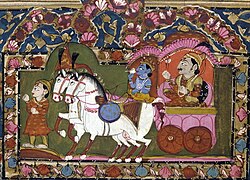
[[File:Krishna and Arjun on the chariot, Mahabharata, 18th-19th century, India.jpg|thumb|300px|[[Krishna]], [[Arjuna]] at [[Kurukshetra]]. Krishna gives the discourse of the [[Bhagavad Gita]]. 18-19th century painting. Freer Sackler Gallery.]] | [[File:Krishna and Arjun on the chariot, Mahabharata, 18th-19th century, India.jpg|thumb|300px|[[Krishna]], [[Arjuna]] at [[Kurukshetra]]. Krishna gives the discourse of the [[Bhagavad Gita]]. 18-19th century painting. Freer Sackler Gallery.]] | ||
=== Birth === | |||
According to [[Dineshchandra Sircar|D.C. Sircar]], before their incarnations as Arjuna-Krishna, the duo were born as the [[Rishi|sages]] Nara-Narayana, the latter being the son of [[Dharma]]. They travelled from the world of men to the world of [[Brahman]] and, with veneration from both the devas and the [[Gandharva|gandharvas]], existed exclusively for the destruction of [[Asura|asuras]]. [[Indra]] is described to have been assisted by Nara and Narayana in his conflict with the [[Asura|asuras]]. | |||
According to the [[Vamana Purana]], the twins were sons of [[dharma]], the son of [[Brahma]] and his wife Murti (daughter of [[Daksha]]), or Ahimsa.<ref>According to [[Vamana]] Purana, Chapter 6 - Bhandarkar p.46</ref> They live at [[Badrinath|Badrika]], performing severe austerities and meditation, for the welfare of the world and mankind. | |||
===Birth of Urvashi=== | ===Birth of Urvashi=== | ||
The [[Bhagavata Purana]] | The [[Bhagavata Purana]] narrates [[Urvashi]]'s birth from the sages Nara-Narayana.<ref>''The Goddess in India: The Five Faces of the Eternal Feminine'' By Devdutt Pattanaik, Published 2000, Inner Traditions / Bear & Company, 176 pages, {{ISBN|0-89281-807-7}} p.66</ref> Once, the sages Nara-Narayana were meditating in the holy shrine of Badrinath situated in the [[Himalayas]]. Their penances and austerities alarmed the devas, and so [[Indra]], the King of the [[Deva (Hinduism)|deva]]s, sent [[Kamadeva]], [[Rati]], [[Vasanta (Ritu)|Vasanta]] (spring), and various [[apsaras]] (nymphs) such as [[Menaka]] and [[Rambha (apsara)|Rambha]] to inspire them with erotic passion, and disturb their devotions.<ref>{{Cite web |last=www.wisdomlib.org |date=2019-01-28 |title=Story of Nārāyaṇa |url=https://www.wisdomlib.org/hinduism/compilation/puranic-encyclopaedia/d/doc241796.html |access-date=2022-10-11 |website=www.wisdomlib.org |language=en}}</ref> The sage Narayana took a flower and placed it on his thigh. Immediately, there sprung from it a beautiful nymph, whose charms far excelled those of the apsaras, and made them return to [[Svarga|heaven]], filled with shame and vexation. Narayana sent this nymph to Indra with them, and since she been produced from the thigh (Ūru in [[Sanskrit]]) of the sage, she was called [[Urvashi]]. Having sent back the apsaras, the divine sages continued to meditate.<ref>''Tales from the Puranas'' By Mahesh Sharma, pp.60-62, Diamond Pocket Books (P) Ltd.,{{ISBN|81-288-1040-5}}</ref><ref name="Vijnanananda267">{{Harvnb|Vijnanananda|2004|pp=267–272}}</ref> | ||
=== Conflict with Shiva === | |||
According to the [[Mahabharata]], Shiva's [[trishula]], after laying waste to [[Daksha yajna|Daksha's yajna]], travelled to the [[Badrinath|Badarikāśrama]], where it pierced the breast of Narayana, who had been engaged in a penance. By the force of the utterance of the sound 'Hum', produced by Narayana, the trident was subsequently ejected from his breast and returned to Shiva, who was then determined to slay the sages. Nara is stated to have plucked a blade of grass from the earth, which became an axe, and discharged it towards the destroyer deity. Shiva is described to have broken this axe.<ref>{{Cite web |last=www.wisdomlib.org |date=2019-01-28 |title=Story of Nara |url=https://www.wisdomlib.org/hinduism/compilation/puranic-encyclopaedia/d/doc241792.html |access-date=2022-10-11 |website=www.wisdomlib.org |language=en}}</ref> In [[Shaivism|Shaiva]] tradition, the sage Narayana performed great penances at the holy spot of Badarikāśrama, propitiating Shiva, and becoming invincible.<ref>{{Cite book |last=Dineschandra Sircar |url=http://archive.org/details/Sircar1971 |title=Studies In The Religious Life Of Ancient and Medieval India by Dineschandra Sircar (1971) |date=1971 |pages=23–24}}</ref> | |||
==Badrinath== | === Badrinath === | ||
[[File:Badrinath temple.jpg|thumb|260px|right|[[Badrinath temple]]]] | [[File:Badrinath temple.jpg|thumb|260px|right|[[Badrinath temple]]]] | ||
According to the Bhagavata | According to the [[Bhagavata Purana]], "There in Badrikashram ([[Badrinath]]) the Personality of Godhead ([[Vishnu]]), in his incarnation as the sages Nara and Narayana, had been undergoing great penance since time immemorial for the welfare of all living entities." (3.4.22) | ||
In [[Badrinath Temple]]'s sanctorum, to the far right side of the stone image of Badri-Vishala (or Badri-Narayana), are the images of Nara and Narayana. Also, the Nara and Narayana peaks tower over Badrinath. | |||
=== Duel against Prahlada === | |||
[[Prahlada]], the king of the asuras, once commanded his forces to accompany him to the holy [[Tirtha (Hinduism)|tirtha]] of Naimiṣa, where he hoped to see a vision of Vishnu. They went hunting along the banks of the [[Sarasvati River|Sarasvati river]]. Prahlada observed two ascetics with matted hair, bearing the bows of [[Sharanga]] and [[Gandiva|Ajagava]]. The asura king asked them why they held weapons while performing a penance, and the two ascetics responded that all those who held power were righteous in their conduct. One of the [[Rishi|rishis]] assured the king that none in the three worlds could conquer them in a duel. Prahlada rose to the challenge. Nara fired arrows upon the king with his Ajagava, but the latter was able to defeat him with his own gold-plated arrows. Prahlada employed the divine Brahmastra against Nara's Narayanastra. Seeing them neutralised in a mid-air collision, Prahlada wielded his mace against Narayana. His mace broke, and Prahlada found himself growing helpless, and sought Vishnu's assistance. Vishnu told his devotee that the Nara-Narayana brothers were invincible, as they were the sons of [[Yama (Hinduism)|Yama]], and could only be conquered in devotion rather than combat. The king left the regency to [[Andhaka]], and erected an ashrama to propitiate Nara-Narayana, and apologised for his folly.<ref>{{Cite web |last=www.wisdomlib.org |date=2019-01-28 |title=Story of Prahlāda |url=https://www.wisdomlib.org/hinduism/compilation/puranic-encyclopaedia/d/doc241839.html |access-date=2022-10-11 |website=www.wisdomlib.org |language=en}}</ref> | |||
== | === Arjuna-Krishna === | ||
[[File:Nara Narayana 1.jpg|thumb|left|200px|Nara Narayana as per Mahabharata]] | [[File:Nara Narayana 1.jpg|thumb|left|200px|Nara Narayana as per Mahabharata]] | ||
[[Arjuna]] and [[Krishna]] are often referred to as Nara-Narayana in the [[Mahabharata]],<ref>{{Cite web |title=The Mahabharata, Book 1: Adi Parva: Section I |url=https://www.sacred-texts.com/hin/m01/m01002.htm |access-date=2021-01-11 |website=www.sacred-texts.com}}</ref> and are considered reincarnations of Nara and Narayana respectively, according to the [[Devi Bhagavata Purana]].<ref name="Vijnanananda250">{{Harvnb|Vijnanananda|2004|p=250}}</ref> | |||
According to Bhandarkar, the deities of Nara-Narayana must have been very popular at the time of the composition of the [[Mahabharata]], since in the opening stanzas of various [[Mahabharata#The_18_parvas_or_books|''parvas'']] (constituent books) of the epic, obeisance is made to these two devas. In [[Vana Parva]] (12. 46, 47), Krishna says to Arjuna, "O invincible one, you are Nara and I am Hari Narayana, and we, the sages Nara-Narayana, have come to this world at the proper time.." In the same Parva, chapter 40 (verse 1); [[Shiva]] says to Arjuna — "In former birth you were Nara and with Narayana as your companion, performed austerities for thousands of years at Badari".<ref name="Bhandarkar">{{Cite web|url=https://www.sacred-texts.com/hin/m03/m03040.htm|title=The Mahabharata, Book 3: Vana Parva: Kairata Parva: Section XL|website=www.sacred-texts.com|access-date=2019-12-11}}</ref> | |||
The Mahabharata suggests that by saluting Krishna (the omniscient Narayana), his friend and the highest of all male beings Arjuna, [[Saraswati]], and [[Vyasa]], the orator, and destroying demonic possessions, and conquering the conscience, one should recite the epic Mahabharata.<ref>{{Cite web |title=Sankshipt Mahabharat Vol 1 Gita Press Gorakhpur |url=https://archive.org/details/sankshipt-mahabharat-vol-1-gita-press-gorakhpur/page/n27/mode/2up}}</ref> | |||
== | ==Veneration== | ||
In the [[Swaminarayan]] sect, Nara and Narayana, are called ''Nara-Narayana Deva''. They are believed to reside at Badrikashram and to be the prime controllers of the destiny of all beings, depending on their [[karma]]. Nara-Narayana Deva are believed to have manifested at Narayana Ghat on the banks of river [[Sabarmati]] at [[Ahmedabad]]. Therefore, their [[murti|images]] were installed by Swaminarayan at the first Swaminarayan temple, [[Shri Swaminarayan Mandir, Ahmedabad|Swaminarayan Mandir, Ahmedabad]] ([[India]]). | In the [[Swaminarayan]] sect, Nara and Narayana, are called ''Nara-Narayana Deva''. They are believed to reside at Badrikashram and to be the prime controllers of the destiny of all beings, depending on their [[karma]]. Nara-Narayana Deva are believed to have manifested at Narayana Ghat on the banks of river [[Sabarmati]] at [[Ahmedabad]]. Therefore, their [[murti|images]] were installed by Swaminarayan at the first Swaminarayan temple, [[Shri Swaminarayan Mandir, Ahmedabad|Swaminarayan Mandir, Ahmedabad]] ([[India]]). | ||
Members of this group interpret the events that took place at [[Badrinath|Badarikashram]], the abode of [[Nara Narayana]], that led to the incarnation of Swaminarayan. They believe that Narayana took birth as Swaminarayan due to a curse of sage [[Durvasa]] which he accepted at his own will. The curse led to Narayana taking the form of an avatar on Earth to destroy evil and establish ''ekantik-[[dharma]]'', religion based on morality, knowledge, detachment and devotion.<ref name="Badrikashram">{{cite web | url= http://www.swaminarayansatsang.com/library/lordswaminarayan/literaturestory.asp?StoryID=233 | title= History of Incarnation of Lord Shree Swaminarayan | url-status= dead | archive-url= https://web.archive.org/web/20090910011046/http://www.swaminarayansatsang.com/library/lordswaminarayan/literaturestory.asp?StoryID=233 | archive-date= 10 September 2009 | df= dmy-all }}</ref> | Members of this group interpret the events that took place at [[Badrinath|Badarikashram]], the abode of [[Nara Narayana]], that led to the incarnation of Swaminarayan. They believe that Narayana took birth as Swaminarayan due to a curse of sage [[Durvasa]] which he accepted at his own will. The curse led to Narayana taking the form of an avatar on Earth to destroy evil and establish ''ekantik-[[dharma]]'', religion based on morality, knowledge, detachment, and devotion.<ref name="Badrikashram">{{cite web | url= http://www.swaminarayansatsang.com/library/lordswaminarayan/literaturestory.asp?StoryID=233 | title= History of Incarnation of Lord Shree Swaminarayan | url-status= dead | archive-url= https://web.archive.org/web/20090910011046/http://www.swaminarayansatsang.com/library/lordswaminarayan/literaturestory.asp?StoryID=233 | archive-date= 10 September 2009 | df= dmy-all }}</ref> This belief is exclusive to the Swaminarayan sect. | ||
==See also== | ==See also== | ||
{{commons category|Nara Narayana}} | {{commons category|Nara Narayana}} | ||
* [[Krishna]] | |||
* [[Arjuna]] | |||
*[[Vishnu]] | *[[Vishnu]] | ||
*[[Narayana]] | *[[Narayana]] | ||
| Line 87: | Line 99: | ||
[[Category:Hindu gods]] | [[Category:Hindu gods]] | ||
[[Category: | [[Category:Avatars of Vishnu]] | ||
[[Category:Forms of Krishna]] | [[Category:Forms of Krishna]] | ||
[[Category:Divine twins]] | [[Category:Divine twins]] | ||
[[Category:Rishis]] | [[Category:Rishis]] | ||
[[Category:Swaminarayan Sampradaya]] | [[Category:Swaminarayan Sampradaya]] | ||
Latest revision as of 23:38, 26 November 2022
| Nara-Narayana | |
|---|---|
 The twin form of Nara Narayana deities at the Swaminarayan Temple Ahmedabad | |
| Affiliation | Vaishnavism |
| Abode | Badrinath |
| Parents | Dharma (father), Ahimsa (mother) |
Naranarayana (Sanskrit: नरनारायण, romanized: Naranārāyaṇa), also rendered Nara-Narayana, is a Hindu duo of sage-brothers. Generally regarded to be the partial-incarnation (aṃśa-avatara)[1] of the preserver deity, Vishnu, on earth,[2] Nara-Narayana are described to be the sons of Dharma and Ahimsa.[3]
The Hindu scripture Mahabharata identifies the prince Arjuna with Nara, and the deity Krishna with Narayana.[4] The legend of Nara-Narayana is also told in the scripture Bhagavata Purana. Hindus believe that the pair dwells at Badrinath, where their most important temple stands.
Etymology[edit | edit source]

The name "Nara-Narayana" can be broken into two Sanskrit terms, Nara and Narayana. Nara means male being, and Narayana refers to the name of the deity.
Monier-Williams dictionary says Nara is "the primeval Man or eternal Spirit pervading the universe always associated with Narayana, "son of the primeval man". In epic poetry, they are the sons of Dharma by Murti or Ahimsa, and emanations of Vishnu, Arjuna being identified with Nara, and Krishna with Narayana.[5]
Iconography[edit | edit source]

Nara-Narayana are depicted jointly or separately in images. When depicted separately, Nara is portrayed with two hands and wearing deer skin, while Narayana is shown on the right in the usual form of Vishnu. Nara is supposed to be depicted as fair-complexioned, while Narayana is to be portrayed as dark-complexioned.[6]
Sometimes, both of them are depicted identical to each other. They are depicted four-armed and holding a mace, a discus, a conch, and a lotus, resembling Vishnu.
Legend[edit | edit source]
| Part of a series on |
| Vaishnavism |
|---|
 |
 Hinduism portal Hinduism portal |

Birth[edit | edit source]
According to D.C. Sircar, before their incarnations as Arjuna-Krishna, the duo were born as the sages Nara-Narayana, the latter being the son of Dharma. They travelled from the world of men to the world of Brahman and, with veneration from both the devas and the gandharvas, existed exclusively for the destruction of asuras. Indra is described to have been assisted by Nara and Narayana in his conflict with the asuras.
According to the Vamana Purana, the twins were sons of dharma, the son of Brahma and his wife Murti (daughter of Daksha), or Ahimsa.[7] They live at Badrika, performing severe austerities and meditation, for the welfare of the world and mankind.
Birth of Urvashi[edit | edit source]
The Bhagavata Purana narrates Urvashi's birth from the sages Nara-Narayana.[8] Once, the sages Nara-Narayana were meditating in the holy shrine of Badrinath situated in the Himalayas. Their penances and austerities alarmed the devas, and so Indra, the King of the devas, sent Kamadeva, Rati, Vasanta (spring), and various apsaras (nymphs) such as Menaka and Rambha to inspire them with erotic passion, and disturb their devotions.[9] The sage Narayana took a flower and placed it on his thigh. Immediately, there sprung from it a beautiful nymph, whose charms far excelled those of the apsaras, and made them return to heaven, filled with shame and vexation. Narayana sent this nymph to Indra with them, and since she been produced from the thigh (Ūru in Sanskrit) of the sage, she was called Urvashi. Having sent back the apsaras, the divine sages continued to meditate.[10][11]
Conflict with Shiva[edit | edit source]
According to the Mahabharata, Shiva's trishula, after laying waste to Daksha's yajna, travelled to the Badarikāśrama, where it pierced the breast of Narayana, who had been engaged in a penance. By the force of the utterance of the sound 'Hum', produced by Narayana, the trident was subsequently ejected from his breast and returned to Shiva, who was then determined to slay the sages. Nara is stated to have plucked a blade of grass from the earth, which became an axe, and discharged it towards the destroyer deity. Shiva is described to have broken this axe.[12] In Shaiva tradition, the sage Narayana performed great penances at the holy spot of Badarikāśrama, propitiating Shiva, and becoming invincible.[13]
Badrinath[edit | edit source]

According to the Bhagavata Purana, "There in Badrikashram (Badrinath) the Personality of Godhead (Vishnu), in his incarnation as the sages Nara and Narayana, had been undergoing great penance since time immemorial for the welfare of all living entities." (3.4.22)
In Badrinath Temple's sanctorum, to the far right side of the stone image of Badri-Vishala (or Badri-Narayana), are the images of Nara and Narayana. Also, the Nara and Narayana peaks tower over Badrinath.
Duel against Prahlada[edit | edit source]
Prahlada, the king of the asuras, once commanded his forces to accompany him to the holy tirtha of Naimiṣa, where he hoped to see a vision of Vishnu. They went hunting along the banks of the Sarasvati river. Prahlada observed two ascetics with matted hair, bearing the bows of Sharanga and Ajagava. The asura king asked them why they held weapons while performing a penance, and the two ascetics responded that all those who held power were righteous in their conduct. One of the rishis assured the king that none in the three worlds could conquer them in a duel. Prahlada rose to the challenge. Nara fired arrows upon the king with his Ajagava, but the latter was able to defeat him with his own gold-plated arrows. Prahlada employed the divine Brahmastra against Nara's Narayanastra. Seeing them neutralised in a mid-air collision, Prahlada wielded his mace against Narayana. His mace broke, and Prahlada found himself growing helpless, and sought Vishnu's assistance. Vishnu told his devotee that the Nara-Narayana brothers were invincible, as they were the sons of Yama, and could only be conquered in devotion rather than combat. The king left the regency to Andhaka, and erected an ashrama to propitiate Nara-Narayana, and apologised for his folly.[14]
Arjuna-Krishna[edit | edit source]

Arjuna and Krishna are often referred to as Nara-Narayana in the Mahabharata,[15] and are considered reincarnations of Nara and Narayana respectively, according to the Devi Bhagavata Purana.[16]
According to Bhandarkar, the deities of Nara-Narayana must have been very popular at the time of the composition of the Mahabharata, since in the opening stanzas of various parvas (constituent books) of the epic, obeisance is made to these two devas. In Vana Parva (12. 46, 47), Krishna says to Arjuna, "O invincible one, you are Nara and I am Hari Narayana, and we, the sages Nara-Narayana, have come to this world at the proper time.." In the same Parva, chapter 40 (verse 1); Shiva says to Arjuna — "In former birth you were Nara and with Narayana as your companion, performed austerities for thousands of years at Badari".[17]
The Mahabharata suggests that by saluting Krishna (the omniscient Narayana), his friend and the highest of all male beings Arjuna, Saraswati, and Vyasa, the orator, and destroying demonic possessions, and conquering the conscience, one should recite the epic Mahabharata.[18]
Veneration[edit | edit source]
In the Swaminarayan sect, Nara and Narayana, are called Nara-Narayana Deva. They are believed to reside at Badrikashram and to be the prime controllers of the destiny of all beings, depending on their karma. Nara-Narayana Deva are believed to have manifested at Narayana Ghat on the banks of river Sabarmati at Ahmedabad. Therefore, their images were installed by Swaminarayan at the first Swaminarayan temple, Swaminarayan Mandir, Ahmedabad (India).
Members of this group interpret the events that took place at Badarikashram, the abode of Nara Narayana, that led to the incarnation of Swaminarayan. They believe that Narayana took birth as Swaminarayan due to a curse of sage Durvasa which he accepted at his own will. The curse led to Narayana taking the form of an avatar on Earth to destroy evil and establish ekantik-dharma, religion based on morality, knowledge, detachment, and devotion.[19] This belief is exclusive to the Swaminarayan sect.
See also[edit | edit source]
Notes[edit | edit source]
- ↑ www.wisdomlib.org (15 May 2013). "On the dialogues of Nara Nārāyaṇa [Chapter 5]". www.wisdomlib.org. The two Risis named Nara and Nārāyaṇa, born of Hari’s Aṃśa. Retrieved 11 October 2022.
- ↑ Books, Kausiki (12 July 2021). Garuda Purana: Achara Khanda Part 1 : English Translation only without Slokas. Kausiki Books. p. 13.
- ↑ Satyamayananda, Swami (2019). Ancient Sages. Advaita Ashrama (A publication branch of Ramakrishna Math, Belur Math). p. 132. ISBN 978-81-7505-923-8.
- ↑ "Twin incarnation of the Lord". The Hindu. 27 September 2015. ISSN 0971-751X. Retrieved 28 June 2021.
- ↑ [1][2]
- ↑ Satyamayananda, Swami (2019). Ancient Sages. Advaita Ashrama (A publication branch of Ramakrishna Math, Belur Math). p. 132. ISBN 978-81-7505-923-8.
- ↑ According to Vamana Purana, Chapter 6 - Bhandarkar p.46
- ↑ The Goddess in India: The Five Faces of the Eternal Feminine By Devdutt Pattanaik, Published 2000, Inner Traditions / Bear & Company, 176 pages, ISBN 0-89281-807-7 p.66
- ↑ www.wisdomlib.org (28 January 2019). "Story of Nārāyaṇa". www.wisdomlib.org. Retrieved 11 October 2022.
- ↑ Tales from the Puranas By Mahesh Sharma, pp.60-62, Diamond Pocket Books (P) Ltd.,ISBN 81-288-1040-5
- ↑ Vijnanananda 2004, pp. 267–272
- ↑ www.wisdomlib.org (28 January 2019). "Story of Nara". www.wisdomlib.org. Retrieved 11 October 2022.
- ↑ Dineschandra Sircar (1971). Studies In The Religious Life Of Ancient and Medieval India by Dineschandra Sircar (1971). pp. 23–24.
- ↑ www.wisdomlib.org (28 January 2019). "Story of Prahlāda". www.wisdomlib.org. Retrieved 11 October 2022.
- ↑ "The Mahabharata, Book 1: Adi Parva: Section I". www.sacred-texts.com. Retrieved 11 January 2021.
- ↑ Vijnanananda 2004, p. 250
- ↑ "The Mahabharata, Book 3: Vana Parva: Kairata Parva: Section XL". www.sacred-texts.com. Retrieved 11 December 2019.
- ↑ "Sankshipt Mahabharat Vol 1 Gita Press Gorakhpur".
- ↑ "History of Incarnation of Lord Shree Swaminarayan". Archived from the original on 10 September 2009.
![[1]](http://www.sanskrit-lexicon.uni-koeln.de/cgi-bin/serveimg.pl?file=/scans/MWScan/MWScanjpg/mw0528-nabhoyoni.jpg)
![[2]](http://www.sanskrit-lexicon.uni-koeln.de/cgi-bin/serveimg.pl?file=/scans/MWScan/MWScanjpg/mw0529-narakapAla.jpg)
References[edit | edit source]
- Bhandarkar, Ramkrishna Gopal (1995). Vaisnavism Saivism and Minor Religious Systems. Asian Educational Services. p. 238. ISBN 81-206-0122-X.
- Vijnanananda, Swami (2004). The Sri Mad Devi Bhagavatam: Books One Through Twelve Part 1. Kessinger Publishing. p. 624. ISBN 0-7661-8167-7.
- Swaminarayan Temple Cardiff - Murtis - NarNarayan Dev
External links[edit | edit source]
| Dashavatara (for example)1 |  | |
|---|---|---|
| Other avatars | ||
1 The list of the "ten avatars" varies regionally. Two substitutions[clarification needed] involve Balarama, Krishna, and Buddha. Krishna is almost always included; in exceptions, he is considered the source of all avatars. | ||
| Swaminarayan Temples (Mandirs) |  | |
|---|---|---|
| Establishments | ||
| Major Deities | ||
| Noted Saints | ||
| Scriptures and other books | ||
| Present Heads | ||
| Devotional Songs | ||
| Organisations | ||
Hindu deities and texts | ||
|---|---|---|
| Gods |  | |
| Goddesses | ||
| Other deities | ||
| Texts | ||