>Nolicmahr |
robot: Create/update articles. If there is a mistake please report on my talk page. |
||
| Line 2: | Line 2: | ||
{{Use dmy dates|date=June 2018}} | {{Use dmy dates|date=June 2018}} | ||
{{Use Indian English|date=July 2015}} | {{Use Indian English|date=July 2015}} | ||
{{Confuse|Fort | {{Confuse|Fort Kochi}} | ||
{{Infobox Historic Site | {{Infobox Historic Site | ||
| name = Fort Emmanuel (Fort Manuel)<br>Fortaleza do Cochim (Emanuel) | | name = Fort Emmanuel (Fort Manuel)<br>Fortaleza do Cochim (Emanuel) | ||
| Line 29: | Line 29: | ||
}} | }} | ||
'''Fort Emmanuel | '''Fort Emmanuel''', also known as '''Fort Manuel''', is a ruined fort located at [[Fort Kochi Beach]] in [[Kochi|Kochi (Cochin)]], [[Kerala]], [[India]].<ref name="immanuel">{{cite web|url=https://www.keralatourism.org/destination/fort-immanuel-fort-kochi/286|title=Fort Immanuel at Fort Kochi|publisher=keralatourism.org|access-date=2014-10-22}}</ref> It is a bastion of the Portuguese and a symbol of the strategic alliance between the [[Portuguese Cochin|Maharaja of Kochi]] and the [[Kingdom of Portugal]].<ref>{{Cite web|title=Fort Immanuel at Fort Kochi {{!}} Ernkulam Destinations|url=https://www.keralatourism.org/destination/fort-immanuel-fort-kochi/286|access-date=2020-08-19|website=Kerala Tourism|language=en}}</ref> Named after [[Manuel I of Portugal]], it was the first [[European Portuguese]] fort in Asia.<ref name="logan">Logan, William. ''Malabar''. District Manual. Asian Educational Services, 1887.</ref> | ||
== History == | |||
== History | |||
In September 1503 the [[Kingdom of Kochi|chief of Kochi]] granted permission to [[Afonso de Albuquerque]] to build Fort Emmanuel near the waterfront of the [[Arabian Sea]]. The construction was commenced on 26 September, and "it took the shape of a square with flanking bastions at the corners mounted with ordnance". The walls were made of double rows of coconut tree stems securely fastened together and with earth rammed firmly between; it was further protected by a wet ditch. The fort was christened on the morning of 1 October 1503 "Emmanuel", after the King of Portugal.<ref name="logan">Logan, William. ''Malabar''. District Manual. Asian Educational Services, 1887.</ref> | In September 1503 the [[Kingdom of Kochi|chief of Kochi]] granted permission to [[Afonso de Albuquerque]] to build Fort Emmanuel near the waterfront of the [[Arabian Sea]]. The construction was commenced on 26 September, and "it took the shape of a square with flanking bastions at the corners mounted with ordnance". The walls were made of double rows of coconut tree stems securely fastened together and with earth rammed firmly between; it was further protected by a wet ditch. The fort was christened on the morning of 1 October 1503 "Emmanuel", after the King of Portugal.<ref name="logan">Logan, William. ''Malabar''. District Manual. Asian Educational Services, 1887.</ref> | ||
| Line 57: | Line 55: | ||
{{Forts in India |state=expanded}} | {{Forts in India |state=expanded}} | ||
{{Forts and fortresses of the Portuguese empire}} | |||
{{Kochi|state=collapsed}} | {{Kochi|state=collapsed}} | ||
{{Tourism in Kerala}} | {{Tourism in Kerala}} | ||
Latest revision as of 00:58, 16 November 2022
| Fort Emmanuel (Fort Manuel) Fortaleza do Cochim (Emanuel) | |
|---|---|
 Watercolour painting of the fort of Cochin, with a British flag, from across the backwaters, unknown artists, around 1800 AD. | |
| Location | Fort Kochi, Kochi (Cochin), India |
| Coordinates | 9°57′59″N 76°14′21″E / 9.9663°N 76.2391°E |
| Built | 1503 |
| Architectural style(s) | Portuguese |
  Location of Fort Emmanuel (Fort Manuel) Fortaleza do Cochim (Emanuel) in Kerala | |
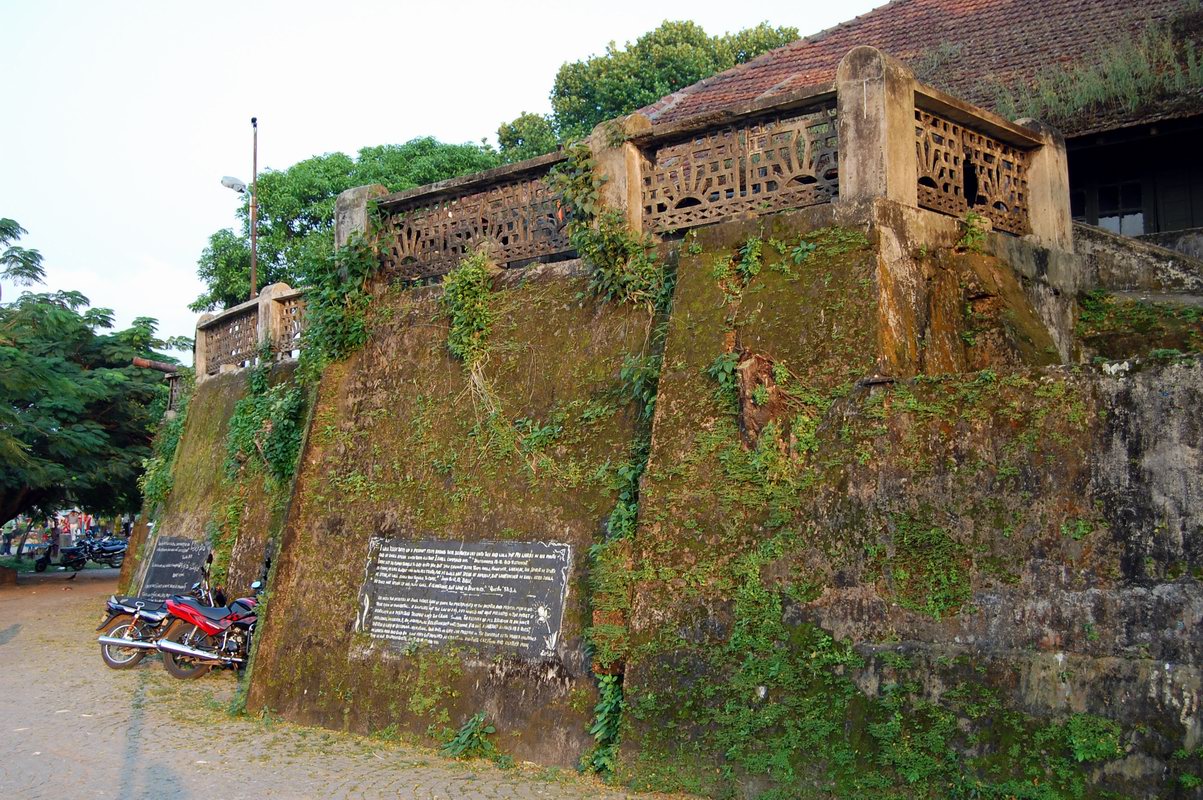
Fort Emmanuel, also known as Fort Manuel, is a ruined fort located at Fort Kochi Beach in Kochi (Cochin), Kerala, India.[1] It is a bastion of the Portuguese and a symbol of the strategic alliance between the Maharaja of Kochi and the Kingdom of Portugal.[2] Named after Manuel I of Portugal, it was the first European Portuguese fort in Asia.[3]
History[edit | edit source]
In September 1503 the chief of Kochi granted permission to Afonso de Albuquerque to build Fort Emmanuel near the waterfront of the Arabian Sea. The construction was commenced on 26 September, and "it took the shape of a square with flanking bastions at the corners mounted with ordnance". The walls were made of double rows of coconut tree stems securely fastened together and with earth rammed firmly between; it was further protected by a wet ditch. The fort was christened on the morning of 1 October 1503 "Emmanuel", after the King of Portugal.[3]
The fort was built at the water-bound region towards the south-west of the Kochi mainland. The fortifications were reinforced in 1538.[1] The Portuguese built their settlement behind the fort, including the St Francis Church. Fort Kochi remained in Portuguese possession until 1663, when the Dutch captured the territory and destroyed the Portuguese institutions. The Dutch held the fort in their possession until 1795, when the British took control by defeating the Dutch. By 1806 the Dutch, and later the British, had destroyed most of the fort walls and its bastions.[1]
In Old Kochi and alongside the Fort Kochi beach, there is a partially restored gun battery and other remains of ramparts and fortifications, which are now tourist destinations.
See also[edit | edit source]
Gallery[edit | edit source]
-
 cannon bastion located at the Fort Kochi Beach
 -

-


References[edit | edit source]
- ↑ 1.0 1.1 1.2 "Fort Immanuel at Fort Kochi". keralatourism.org. Retrieved 22 October 2014.
- ↑ "Fort Immanuel at Fort Kochi | Ernkulam Destinations". Kerala Tourism. Retrieved 19 August 2020.
- ↑ 3.0 3.1 Logan, William. Malabar. District Manual. Asian Educational Services, 1887.
External links[edit | edit source]

Template:Forts and fortresses of the Portuguese empire Template:Kochi