







>BrownHairedGirl add {{Ship classes of the Indian Navy}}, which links to this page |
No edit summary |
||
| Line 1: | Line 1: | ||
{{ | {{Short description|None}} | ||
{{Use dmy dates|date=July | {{Use dmy dates|date=July 2022}} | ||
{{Use Indian English|date=July | {{Use Indian English|date=July 2022}} | ||
[[Frigate]]s, which are naval vessels intermediate between [[corvette]]s and [[destroyer]]s,<ref name="Definition of FRIGATE">{{cite web|title=Definition of FRIGATE|url=http://www.merriam-webster.com/dictionary/frigate|website=www.merriam-webster.com|access-date=14 July | {{More citations needed|date=September 2022}} | ||
[[Frigate]]s, which are naval vessels intermediate between [[corvette]]s and [[destroyer]]s,<ref name="Definition of FRIGATE">{{cite web|title=Definition of FRIGATE|url=http://www.merriam-webster.com/dictionary/frigate|website=www.merriam-webster.com|access-date=14 July 2022}}</ref> have had a significant role in the [[naval history of India]]. Although the [[Maratha Navy]], the naval branch of the armed forces of the [[Maratha Empire]], used [[Grab (ship)|Grabs]] and [[Gallivat (boat)|Gallivats]] to project naval power,{{Sfn|Sridharan|2000|p=43}} the concept of frigates (formerly called [[Sloop-of-war|sloops]]) was introduced by the British.{{Sfn|Bhatia|2008|p=30}} {{HMIS|Clive|L79|6}}, {{HMIS|Lawrence|L83|6}} and {{HMIS|Cornwallis|L09|6}}, of the {{sclass|Aubrietia|sloop|4}}, were some of the early sloops commissioned into the [[Royal Indian Navy]] (RIN) during the 1920s. These ships later served in the Second World War. Later, in the 1930s, sloops of the {{sclass2|P|sloop|5}}, {{sclass|Anchusa|sloop|5}}, {{sclass|Hastings|sloop|5}}, {{sclass|Grimsby|sloop|5}}, and {{sclass|Black Swan|sloop|5}}{{Cn|date=September 2022}} classes were commissioned.<ref name="www.leander-project.homecall.co.uk">{{cite web|title=Steel Sloops|url=http://www.leander-project.homecall.co.uk/Sloops.html|website=www.leander-project.homecall.co.uk|access-date=15 July 2022}}</ref><ref name="WWII Frigates" /> | |||
The RIN was expanded significantly during the [[World War II|Second World War]]. | The RIN was expanded significantly during the [[World War II|Second World War]].{{Cn|date=September 2022}} The sloops {{HMIS|Sutlej|U95|6}} and {{HMIS|Jumna|U21|6}}, of the ''Black Swan'' class, took part in [[Allied invasion of Sicily|Operation Husky]], the [[Allies of World War II|Allied]] invasion of [[Sicily]].<ref name="Ref-1">{{cite web|url=http://www.wewerethere.mod.uk/wewerethere_old/inmed.html |title=The Second World War in the Mediterranean, North Africa and Italy |access-date=2016-08-04 |url-status=dead |archive-url=https://web.archive.org/web/20080124112038/http://www.wewerethere.mod.uk/wewerethere_old/inmed.html |archive-date=24 January 2008 }}</ref> In 1945, [[PNS Zulfiqar (K265)|HMIS ''Dhanush'']] and [[HMS Nadder (K392)|HMIS ''Shamsher'']], of the {{sclass2|River|frigate|4}}, were the first frigates, so-called, to be commissioned. Several frigates of the River class were also commissioned. Some of them were later transferred to Pakistan during [[Partition of India|partition]]. | ||
In the post-war period, the Indian Navy operated frigates from the {{sclass|Blackwood|frigate|5}},{{Sfn|Friedman|2008|p=14}} {{sclass|Whitby|frigate|5}},{{Sfn|Friedman|2008|pp=214–216}} {{sclass|Leopard|frigate|5}},{{Sfn|Friedman|2008|p=202}} {{sclass|Leander|frigate|5}},{{Sfn|Friedman|2008|p=13}} and {{sclass|Nilgiri|frigate|5||1972}} classes.<ref name="Indigenous Warship Building"/> The ''Nilgiri''-class frigates were the first major warships to be built in India, in association with [[Yarrow Shipbuilders]] of the [[United Kingdom]].<ref name="Indigenous Warship Building">{{cite web|author1=Lt Cdr Kalesh Mohanan|title=Indigenous Warship Building|url=http://www.indiandefencereview.com/spotlights/indigenous-warship-building/|website=Indian Defence Review|access-date=15 July 2016|date=14 December | In the post-war period, the Indian Navy operated frigates from the {{sclass|Blackwood|frigate|5}},{{Sfn|Friedman|2008|p=14}} {{sclass|Whitby|frigate|5}},{{Sfn|Friedman|2008|pp=214–216}} {{sclass|Leopard|frigate|5}},{{Sfn|Friedman|2008|p=202}} {{sclass|Leander|frigate|5}},{{Sfn|Friedman|2008|p=13}} and {{sclass|Nilgiri|frigate|5||1972}} classes.<ref name="Indigenous Warship Building"/> The ''Nilgiri''-class frigates were the first major warships to be built in India, in association with [[Yarrow Shipbuilders]] of the [[United Kingdom]].<ref name="Indigenous Warship Building">{{cite web|author1=Lt Cdr Kalesh Mohanan|title=Indigenous Warship Building|url=http://www.indiandefencereview.com/spotlights/indigenous-warship-building/|website=Indian Defence Review|access-date=15 July 2016|date=14 December 2022}}</ref> Later in the 2000s, the Indian Navy, collaborating with Russia for the first time, acquired six under Project 1135.6, designated as {{sclass|Talwar|frigate|0}}.<ref name="Launch of sixth Project 11356 Talwar Class frigate for Indian Navy."/> {{As of|2022|May}}, 12 guided-missile frigates from three different classes – {{sclass|Shivalik|frigate|5}}, ''Talwar'', and {{sclass|Brahmaputra|frigate|5}} – are operated by the Indian Navy.<ref name="Shivalik Class, Talwar Class, Kamorta Class {{!}} Indian Navy">{{cite web|title=Shivalik Class, Talwar Class, Kamorta Class|url=https://indiannavy.nic.in/content/shivalik-class-talwar-class-kamorta-class|website=www.indiannavy.nic.in|access-date=27 November 2022}}</ref><ref name="Brahmaputra Class {{!}} Indian Navy">{{cite web|title=Brahmaputra Class|url=https://indiannavy.nic.in/content/brahmaputra-class-0|website=www.indiannavy.nic.in|access-date=27 November 2022}}</ref> | ||
==Ships currently in commission== | ==Ships currently in commission== | ||
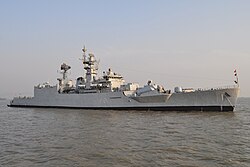
The {{sclass|Shivalik|frigate|4}} is the largest of the frigate classes presently in service {{As of|2017|February|lc=y}}.<ref name="Shivalik Class Frigates – NT" /> {{INS|Shivalik|F47|6}} is the lead ship of the class and the first [[stealth ship|stealth warship]] built by India.<ref name="Riding the waves">{{cite web|title=Riding the waves|url=http://www.rediff.com/news/2003/may/10nad.htm|website=www.rediff.com|access-date=11 July | The {{sclass|Shivalik|frigate|4}} is the largest of the frigate classes presently in service {{As of|2017|February|lc=y}}.<ref name="Shivalik Class Frigates – NT" /> {{INS|Shivalik|F47|6}} is the lead ship of the class and the first [[stealth ship|stealth warship]] built by India.<ref name="Riding the waves">{{cite web|title=Riding the waves|url=http://www.rediff.com/news/2003/may/10nad.htm|website=www.rediff.com|access-date=11 July 2022}}</ref> All three ships of this class were built by [[Mazagon Dock Limited]] in [[Mumbai]], from 2000 to 2010. With their improved stealth features and land-attack capabilities, the ''Shivalik''-class warships were originally conceived as successors to the six {{sclass|Talwar|frigate|1}}s,<ref name="Shivalik Class Frigates – NT" /> which are modified [[Krivak-class frigate#Nerei (or Krivak III)|Krivak III-class]] vessels built by Russia for the Indian Navy.{{Cn|date=September 2022}} The ''Talwar'' class was preceded by the {{sclass|Brahmaputra|frigate|1}}s, which were built by the [[Garden Reach Shipbuilders and Engineers]] in [[Kolkata]]. Three ships of this class are still in service with the Indian Navy.<ref name="Brahmaputra Class {{!}} Indian Navy"/> | ||
===''Shivalik'' class=== | ===''Shivalik'' class=== | ||
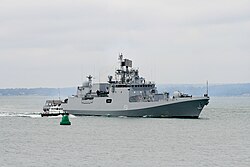
The '''''Shivalik'' class''', or '''Project 17 class''', is a class of multi-role frigates in service with the Indian Navy. They are the first stealth warships built in India.<ref name="rediff 2003">{{cite web|url=http://www.rediff.com/news/2003/may/10nad.htm |title=Riding the waves |publisher=Rediff.com |date=10 May 2003 |access-date=1 May | The '''''Shivalik'' class''', or '''Project 17 class''', is a class of multi-role frigates in service with the Indian Navy. They are the first stealth warships built in India.<ref name="rediff 2003">{{cite web|url=http://www.rediff.com/news/2003/may/10nad.htm |title=Riding the waves |publisher=Rediff.com |date=10 May 2003 |access-date=1 May 2022}}</ref> A total of three ships were built between 2000 and 2010, and all three were in commission by 2012.<ref name="Shivalik Class Frigates – NT"/> The ''Shivalik'' class, along with the seven [[Project 17A class frigate|Project 17A frigates]] being developed from them {{As of|2017|February|lc=y}}, are projected to be the principal frigates of the Indian Navy in the first half of the 21st century.<ref>[http://mod.nic.in/samachar/march15-04/html/ch9.htm "Capital Cruisers"], ''Sainik Samachar'', [[Ministry of Defence (India)]], 15 March 2004. Adm. Madhvendra Singh, Chief of Naval Staff: ''"These would be the future ships of the Indian Navy and will be of the Shivalik class"''.</ref> All ships of the class were built by Mazagon Dock Limited. The class and the ships are named after hill ranges in India.<ref name="Shivalik Class Frigates – NT"/> Originally conceived as a successor to the ''Talwar''-class frigates, the ''Shivalik''-class frigates feature improved stealth features and land-attack capabilities.<ref name="Shivalik Class Frigates – NT"/> | ||
{| class="wikitable" | {| class="wikitable" | ||
|- | |- | ||
| Line 25: | Line 26: | ||
! align= center scope=col style="text-align:left; background:#9cf;"|<div style="text-align: center;">Commissioned</div> | ! align= center scope=col style="text-align:left; background:#9cf;"|<div style="text-align: center;">Commissioned</div> | ||
|- | |- | ||
|{{INS|Shivalik|F47}}<ref name="Indian Navy: India inducts largest stealth frigate INS Shivalik">{{cite news|title=Indian Navy: India inducts largest stealth frigate INS Shivalik|url=http://www.indiastrategic.in/topstories605.htm|access-date=11 July 2016|work=India Strategic|date=May | |{{INS|Shivalik|F47}}<ref name="Indian Navy: India inducts largest stealth frigate INS Shivalik">{{cite news|title=Indian Navy: India inducts largest stealth frigate INS Shivalik|url=http://www.indiastrategic.in/topstories605.htm|access-date=11 July 2016|work=India Strategic|date=May 2022}}</ref> | ||
|[[File:Shivalik Maiden Sortie.jpg|150px]] | |[[File:Shivalik Maiden Sortie.jpg|150px]] | ||
|rowspan=3| | |rowspan=3| | ||
| Line 38: | Line 39: | ||
|11 July 2001 | |11 July 2001 | ||
|29 April 2010 | |29 April 2010 | ||
|rowspan=3|{{IND}}<ref name="Shivalik Class Frigates – NT">{{cite web|title=Shivalik Class Frigates|url=http://www.naval-technology.com/projects/shivalik-class-friga/|website=Naval Technology|access-date=11 July | |rowspan=3|{{IND}}<ref name="Shivalik Class Frigates – NT">{{cite web|title=Shivalik Class Frigates|url=http://www.naval-technology.com/projects/shivalik-class-friga/|website=Naval Technology|access-date=11 July 2022}}</ref><ref name="Shivalik Class {{!}} Indian Navy">{{cite web|title=Shivalik Class|url=https://www.indiannavy.nic.in/content/shivalik-class|website=indiannavy.nic.in|access-date=27 November 2022}}</ref> | ||
|- | |- | ||
|{{INS|Satpura|F48}}<ref name="Stealth warship INS Satpura joins navy">{{cite news|author1=Ajai Shukla|title=Stealth warship INS Satpura joins navy|url=http://www.business-standard.com/article/economy-policy/stealth-warship-ins-satpura-joins-navy-111082100002_1.html|access-date=11 July 2016|work=Business Standard|date=21 August 2001}}</ref> | |{{INS|Satpura|F48}}<ref name="Stealth warship INS Satpura joins navy">{{cite news|author1=Ajai Shukla|title=Stealth warship INS Satpura joins navy|url=http://www.business-standard.com/article/economy-policy/stealth-warship-ins-satpura-joins-navy-111082100002_1.html|access-date=11 July 2016|work=Business Standard|date=21 August 2001}}</ref> | ||
| Line 52: | Line 53: | ||
===''Talwar'' class=== | ===''Talwar'' class=== | ||
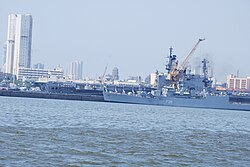
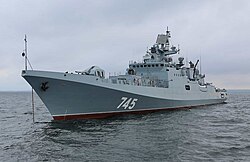
The '''''Talwar'' class''', also known as '''Project 1135.6''', is a class of [[guided-missile frigate]]s designed and built by [[Russia]] for the Indian Navy, as modified Krivak III-class frigates<ref name="Mikhailov: the contract on 3 frigates for India to be executed in 2012">{{cite web|title=Mikhailov: the contract on 3 frigates for India to be executed in 2012|url=http://rusnavy.com/news/navy/index.php?ELEMENT_ID=10509|website=rusnavy.com|access-date=23 August | The '''''Talwar'' class''', also known as '''Project 1135.6''', is a class of [[guided-missile frigate]]s designed and built by [[Russia]] for the Indian Navy, as modified Krivak III-class frigates<ref name="Mikhailov: the contract on 3 frigates for India to be executed in 2012">{{cite web|title=Mikhailov: the contract on 3 frigates for India to be executed in 2012|url=http://rusnavy.com/news/navy/index.php?ELEMENT_ID=10509|website=rusnavy.com|access-date=23 August 2022}}</ref> (the class that is also the basis of the Russian {{sclass|Admiral Grigorovich|frigate|1}}), with a number of systems of Indian design and manufacture, including anti-submarine sensors ([[sonar]]) and communications equipment.<ref name="Launch of sixth Project 11356 Talwar Class frigate for Indian Navy.">{{cite web|title=Launch of sixth Project 11356 Talwar Class frigate for Indian Navy.|url=http://articles.maritimepropulsion.com/article/Launch-of-sixth-Project-11356-Talwar-Class-frigate-for-Indian-Navy.aspx|website=maritime propulsion|access-date=23 August 2022}}</ref><ref name="India to acquire three Admiral Grigorovich-class frigates from Russia {{!}} IHS Jane's 360">{{cite web|title=India to acquire three Admiral Grigorovich-class frigates from Russia {{!}} IHS Jane's 360|url=http://www.janes.com/article/62776/india-to-acquire-three-admiral-grigorovich-class-frigates-from-russia|website=www.janes.com|access-date=23 August 2022}}</ref><ref name="India, Russia likely to sign deal for 4 stealth frigates">{{cite news|title=India, Russia likely to sign deal for 4 stealth frigates|url=http://www.thehindu.com/news/national/india-russia-likely-to-sign-deal-for-4-stealth-frigates/article8014794.ece|access-date=23 August 2016|work=The Hindu|date=22 December 2015|language=en-IN}}</ref> Each ship of this class has a displacement of 4,000 tons and speed of {{convert|30|kn|lk=in}} and is capable of accomplishing a wide variety of missions, primarily finding and eliminating enemy submarines and large surface ships. Due to the use of [[stealth ship|stealth]] technologies and a special hull design, the frigate operates with reduced [[radar cross section]] (RCS), as well as reduced electromagnetic, acoustic, and infrared signatures.<ref name="Launch of sixth Project 11356 Talwar Class frigate for Indian Navy."/> | ||
{| class="wikitable" | {| class="wikitable" | ||
| Line 66: | Line 67: | ||
! align= center scope=col style="text-align:left; background:#9cf;"|<div style="text-align: center;">Commissioned</div> | ! align= center scope=col style="text-align:left; background:#9cf;"|<div style="text-align: center;">Commissioned</div> | ||
|- | |- | ||
|{{INS|Talwar|F40}}<ref name="INS Talwar to add punch to Indian Navy">{{cite web|title=INS Talwar to add punch to Indian Navy|url=http://www.rediff.com/news/2003/jun/18ship.htm|website=www.rediff.com|access-date=11 July | |{{INS|Talwar|F40}}<ref name="INS Talwar to add punch to Indian Navy">{{cite web|title=INS Talwar to add punch to Indian Navy|url=http://www.rediff.com/news/2003/jun/18ship.htm|website=www.rediff.com|access-date=11 July 2022}}</ref> | ||
|[[File:INS Talwar - 2.jpg|150px]] | |[[File:INS Talwar - 2.jpg|150px]] | ||
|rowspan=3| | |rowspan=3| | ||
| Line 79: | Line 80: | ||
|10 March 1999 | |10 March 1999 | ||
|18 June 2003 | |18 June 2003 | ||
|rowspan=6|{{RUS}}<ref name=" | |rowspan=6|{{RUS}}<ref name="Shivalik Class, Talwar Class, Kamorta Class {{!}} Indian Navy"/> | ||
|- | |- | ||
|{{INS|Trishul|F43}}<ref name="The Hindu : INS Trishul launched in Russian waters">{{cite news|author1=Vladimir Radyuhin|title=INS Trishul launched in Russian waters|url=http://www.thehindu.com/2000/11/25/stories/0325000d.htm|work=[[The Hindu]]|date=2000-11-25|access-date=11 July | |{{INS|Trishul|F43}}<ref name="The Hindu : INS Trishul launched in Russian waters">{{cite news|author1=Vladimir Radyuhin|title=INS Trishul launched in Russian waters|url=http://www.thehindu.com/2000/11/25/stories/0325000d.htm|work=[[The Hindu]]|date=2000-11-25|access-date=11 July 2022}}{{dead link|date=April 2021|bot=medic}}{{cbignore|bot=medic}}</ref> | ||
|[[File:INS Trishul entering Jubail, Saudi Arabia.jpg|150px]] | |[[File:INS Trishul entering Jubail, Saudi Arabia.jpg|150px]] | ||
|24 September 1999 | |24 September 1999 | ||
| Line 91: | Line 92: | ||
|25 May 2001 | |25 May 2001 | ||
|- | |- | ||
|{{INS|Teg|F45}}<ref name="INS Teg to be commissioned in navy today">{{cite news|title=INS Teg to be commissioned in navy today|url=http://www.hindustantimes.com/delhi/ins-teg-to-be-commissioned-in-navy-today/story-07SeTAGDw7n4vl5hSwbWzH.html|access-date=11 July 2016|work=Hindustan Times|date=27 April | |{{INS|Teg|F45}}<ref name="INS Teg to be commissioned in navy today">{{cite news|title=INS Teg to be commissioned in navy today|url=http://www.hindustantimes.com/delhi/ins-teg-to-be-commissioned-in-navy-today/story-07SeTAGDw7n4vl5hSwbWzH.html|access-date=11 July 2016|work=Hindustan Times|date=27 April 2022}}</ref> | ||
|[[File:INS Teg approaching Port Victoria, Seychelles.JPG|150px]] | |[[File:INS Teg approaching Port Victoria, Seychelles.JPG|150px]] | ||
|rowspan=3| | |rowspan=3| | ||
| Line 111: | Line 112: | ||
|9 November 2012 | |9 November 2012 | ||
|- | |- | ||
|[[INS Trikand|INS ''Trikand'' (F51)]]<ref name="India inducts new power-packed stealth frigate INS Trikand – Times of India">{{cite news|author1=Rajat Pandit|title=India inducts new power-packed stealth frigate INS Trikand – Times of India|url=http://timesofindia.indiatimes.com/india/India-inducts-new-power-packed-stealth-frigate-INS-Trikand/articleshow/20832834.cms|access-date=11 July 2016|work=Times of India|date=29 June | |[[INS Trikand|INS ''Trikand'' (F51)]]<ref name="India inducts new power-packed stealth frigate INS Trikand – Times of India">{{cite news|author1=Rajat Pandit|title=India inducts new power-packed stealth frigate INS Trikand – Times of India|url=http://timesofindia.indiatimes.com/india/India-inducts-new-power-packed-stealth-frigate-INS-Trikand/articleshow/20832834.cms|access-date=11 July 2016|work=Times of India|date=29 June 2022}}</ref> | ||
|[[File:INS Trikand (F51)-image08.jpg|150px]] | |[[File:INS Trikand (F51)-image08.jpg|150px]] | ||
|11 June 2008 | |11 June 2008 | ||
| Line 118: | Line 119: | ||
===''Brahmaputra'' class=== | ===''Brahmaputra'' class=== | ||
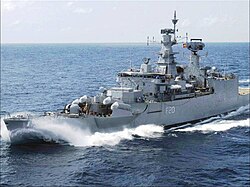
The '''''Brahmaputra''-class frigates''' (Type 16A or Project 16A) are guided-missile frigates of the Indian Navy, designed and built in India. They are an enhancement of the ''Godavari'' class, with the same displacement, 3850 tons, and length, {{convert|126|m}}, but with different configuration, armaments, and capabilities. Three ships of this class serve in the Indian Navy. The class and the ships, are named for [[Indian rivers]].<ref name="Brahmaputra Class {{!}} Indian Navy" | The '''''Brahmaputra''-class frigates''' (Type 16A or Project 16A) are guided-missile frigates of the Indian Navy, designed and built in India. They are an enhancement of the ''Godavari'' class, with the same displacement, 3850 tons, and length, {{convert|126|m}}, but with different configuration, armaments, and capabilities. Three ships of this class serve in the Indian Navy. The class and the ships, are named for [[Indian rivers]].<ref name="Brahmaputra Class {{!}} Indian Navy"/><ref name="P-16A Class / Brahmaputra Class Frigates">{{cite web|title=P-16A Class / Brahmaputra Class Frigates|url=http://www.naval-technology.com/projects/p-16a-class-brahmaputra-class-frigates/|website=Naval Technology|access-date=11 July 2022}}</ref> | ||
{| class="wikitable" | {| class="wikitable" | ||
|- | |- | ||
| Line 147: | Line 148: | ||
|[[File:INS Beas-1.jpg|150px]] | |[[File:INS Beas-1.jpg|150px]] | ||
|11 July 2005 | |11 July 2005 | ||
|} | |} | ||
| Line 176: | Line 154: | ||
===Sloops=== | ===Sloops=== | ||
A modern British '''[[sloop-of-war]]''' is a warship used for convoy defence. {{HMIS|Clive|L79|6}}, | A modern British '''[[sloop-of-war]]''' is a warship used for convoy defence. {{HMIS|Clive|L79|6}},{{HMIS|Lawrence|L83|6}} of the {{sclass|Aubrietia|sloop|4}}, were some of the early sloops commissioned into the RIN during the 1920s. These ships were also the first ships to be decommissioned. Later, sloops from the {{sclass|Black Swan|sloop|5}}, {{sclass|Grimsby|sloop|5}}, {{sclass2|P|sloop|5}}, {{sclass|Hastings|sloop|5}}, and {{sclass|Anchusa|sloop|5}} classes were commissioned. The sloops {{HMIS|Narbada|U40|6}} and {{HMIS|Godavari|U52|6}},{{citation needed|date=July 2022}} of the ''Black Swan'' class, and {{HMIS|Hindustan|U80|6}}, of the ''Hastings'' class, were transferred to Pakistan post-partition. HMIS ''Elphinstone'', of the ''Anchusa'' class, and {{HMIS|Indus|U67|6}},{{Cn|date=September 2022}} of the ''Grimsby'' class, were lost in action during the [[Second World War]]. The other sloops were subsequently scrapped after their decommissioning.<ref name="Ref-1"/> | ||
===={{sclass|Anchusa|sloop|4}}==== | ===={{sclass|Anchusa|sloop|4}}==== | ||
The twenty-eight '''''Anchusa''-class sloops''' were a small class of [[corvette]]s or convoy sloops built in 1917 and 1918 under the Emergency War Programme for the [[Royal Navy]] in the First World War, as the final part of the larger "Flower class" (which were also referred to as the "cabbage class", or "herbaceous borders"). The sloops were single-screw with triple hulls at the bows to give extra protection against loss when working as fleet sweeping vessels, or as convoy protection ships (the class was built to look like merchant ships for use as [[Q-ship]]s). HMS ''Ceanothus'' (1917) (later renamed as HMS ''Elphinstone''), transferred to the Royal Indian Marine in 1922, was the only ''Anchusa''-class sloop used by India. | The twenty-eight '''''Anchusa''-class sloops''' were a small class of [[corvette]]s or convoy sloops built in 1917 and 1918 under the Emergency War Programme for the [[Royal Navy]] in the First World War, as the final part of the larger "Flower class" (which were also referred to as the "cabbage class", or "herbaceous borders"). The sloops were single-screw with triple hulls at the bows to give extra protection against loss when working as fleet sweeping vessels, or as convoy protection ships (the class was built to look like merchant ships for use as [[Q-ship]]s). HMS ''Ceanothus'' (1917) (later renamed as HMS ''Elphinstone''), transferred to the Royal Indian Marine in 1922, was the only ''Anchusa''-class sloop used by India. | ||
{| class="wikitable" | {| class="wikitable" | ||
! align= center scope=col rowspan=2 style="text-align:left; background:#9cf;"|<div style="text-align: center;">Ship</div> | ! align= center scope=col rowspan=2 style="text-align:left; background:#9cf;"|<div style="text-align: center;">Ship</div> | ||
| Line 205: | Line 184: | ||
| | | | ||
|{{UK}} | |{{UK}} | ||
|Wrecked on the [[Nicobar Islands]] on 29 January 1925. | |Wrecked on the [[Nicobar Islands]] on 29 January 1925. | ||
|} | |} | ||
===={{sclass|Aubrietia|sloop|4}}==== | ===={{sclass|Aubrietia|sloop|4}}==== | ||
The '''''Aubrietia'' class''' was a class of twelve sloops built under the Emergency War Programme for the Royal Navy in the First World War as part of the larger [[Flower class sloop|"Flower" class]]. The Flowers were the first ships designed as [[ | The '''''Aubrietia'' class''' was a class of twelve sloops built under the Emergency War Programme for the Royal Navy in the First World War as part of the larger [[Flower-class sloop|"Flower" class]]. The Flowers were the first ships designed as [[minesweeper]]s. Like all the Flowers, the ''Aubrietia'' class were originally designed as single-screw fleet sweeping vessels, with triple hulls at the bows and an above-water magazine located aft, to give extra protection against loss from [[naval mine|mine damage]] when working. However, the greatest utility was to be as a [[convoy]] escort; and, as such, other classes took over the minesweeping role. The ''Aubrietia''s were re-classified as convoy sloops. HMIS ''Cornwallis'' of this class was used by the RIN from 1921 to 1946, when it was decommissioned. | ||
{| class="wikitable" | {| class="wikitable" | ||
! align= center scope=col rowspan=2 style="text-align:left; background:#9cf;"|<div style="text-align: center;">Ship</div> | ! align= center scope=col rowspan=2 style="text-align:left; background:#9cf;"|<div style="text-align: center;">Ship</div> | ||
| Line 233: | Line 213: | ||
|1946 | |1946 | ||
|{{UK}} | |{{UK}} | ||
|scrapped | |scrapped | ||
|} | |} | ||
===={{sclass2|P|sloop|4}}==== | ===={{sclass2|P|sloop|4}}==== | ||
The '''P class''', nominally classified as "patrol boats", was in effect a [[ship class|class]] of coastal sloops. Twenty-four ships to this design were ordered in May 1915 (numbered ''P.11'' to ''P.34''), and another thirty between February and June 1916 (numbered ''P.35'' to ''P.64''), under the Emergency War Programme<ref name="P boats of the First World War">{{cite web|title=P boats of the First World War|url=http://www.twmuseums.org.uk/engage/blog/p-boats-of-the-first-world-war-william-bartram-and-p23|website=TW Museums|access-date=23 August | The '''P class''', nominally classified as "patrol boats", was in effect a [[ship class|class]] of coastal sloops. Twenty-four ships to this design were ordered in May 1915 (numbered ''P.11'' to ''P.34''), and another thirty between February and June 1916 (numbered ''P.35'' to ''P.64''), under the Emergency War Programme<ref name="P boats of the First World War">{{cite web|title=P boats of the First World War|url=http://www.twmuseums.org.uk/engage/blog/p-boats-of-the-first-world-war-william-bartram-and-p23|website=TW Museums|access-date=23 August 2022}}</ref> for the Royal Navy in the [[World War I|First World War]]. In December 1916, ten of the latter group were altered on the stocks before launch for use as decoy Q-ships and were renumbered as '''PC-class sloops'''. Although usually not named, in 1925 ''P.38'' was given the name ''Spey'', as well as HMIS ''Baluchi'' and HMIS ''Pathan'', the two P-class sloops used by the RIN. | ||
{| class="wikitable" | {| class="wikitable" | ||
| Line 268: | Line 248: | ||
|5 August 1921 | |5 August 1921 | ||
| | | | ||
|Sunk by Italian submarine [[Brin-class submarine|''Galvani'']] on 23 June 1940. | |Sunk by Italian submarine [[Brin-class submarine|''Galvani'']] on 23 June 1940. | ||
|} | |} | ||
===={{sclass|Grimsby|sloop|4}}==== | ===={{sclass|Grimsby|sloop|4}}==== | ||
The '''''Grimsby'' class''' was a class of 13 [[sloops-of-war]] laid down between 1933 and 1940. Eight were built in the United Kingdom for the Royal Navy, four in Australia for the [[Royal Australian Navy]], and one, HMIS ''Indus'', for the RIN. | The '''''Grimsby'' class''' was a class of 13 [[sloops-of-war]] laid down between 1933 and 1940. Eight were built in the United Kingdom for the Royal Navy, four in Australia for the [[Royal Australian Navy]], and one, HMIS ''Indus'', for the RIN. | ||
{| class="wikitable" | {| class="wikitable" | ||
| Line 301: | Line 282: | ||
| | | | ||
|{{UK}} | |{{UK}} | ||
|Bombed and sunk by Japanese aircraft during the [[Burma Campaign]] on 6 April 1942. | |Bombed and sunk by Japanese aircraft during the [[Burma Campaign]] on 6 April 1942. | ||
|} | |} | ||
===={{sclass|Black Swan|sloop|4}}==== | ===={{sclass|Black Swan|sloop|4}}==== | ||
The '''''Black Swan''''' and '''Modified ''Black Swan''''' were two classes of sloops of the Royal Navy and RIN. Twelve ''Black Swan''s were launched between 1939 and 1943, including four for the RIN. Twenty-five Modified ''Black Swan''s were launched between 1942 and 1945, including two for the RIN. Several other ships were cancelled. | The '''''Black Swan''''' and '''Modified ''Black Swan''''' were two classes of sloops of the Royal Navy and RIN. Twelve ''Black Swan''s were launched between 1939 and 1943, including four for the RIN. Twenty-five Modified ''Black Swan''s were launched between 1942 and 1945, including two for the RIN. Several other ships were cancelled. | ||
{| class="wikitable" | {| class="wikitable" | ||
! align= center scope=col rowspan=2 style="text-align:left; background:#9cf;"|<div style="text-align: center;">Ship</div> | ! align= center scope=col rowspan=2 style="text-align:left; background:#9cf;"|<div style="text-align: center;">Ship</div> | ||
| Line 331: | Line 313: | ||
|30 September 1977{{Sfn|Hiranandani|2005|p=372}} | |30 September 1977{{Sfn|Hiranandani|2005|p=372}} | ||
|rowspan=6|{{UK}} | |rowspan=6|{{UK}} | ||
|scrapped | |scrapped | ||
|- | |- | ||
|{{HMIS|Jumna|U21|6}}{{efn|Renamed as INS ''Jamuna'' post republic.}} | |{{HMIS|Jumna|U21|6}}{{efn|Renamed as INS ''Jamuna'' post republic.}} | ||
| Line 337: | Line 319: | ||
|13 May 1941 | |13 May 1941 | ||
|31 December 1980{{Sfn|Hiranandani|2005|p=375}} | |31 December 1980{{Sfn|Hiranandani|2005|p=375}} | ||
|scrapped | |scrapped | ||
|- | |- | ||
|{{HMIS|Narbada|U40|6}} | |{{HMIS|Narbada|U40|6}} | ||
| Line 343: | Line 325: | ||
|29 April 1943 | |29 April 1943 | ||
|1948 | |1948 | ||
|Transferred to Pakistan post-partition and served as PNS Jhelum. | |Transferred to Pakistan post-partition and served as PNS Jhelum. | ||
|- | |- | ||
|{{HMIS|Kistna|U46|6}}{{efn|Renamed as INS ''Krisna'' post republic.}} | |{{HMIS|Kistna|U46|6}}{{efn|Renamed as INS ''Krisna'' post republic.}} | ||
| Line 349: | Line 331: | ||
|26 August 1943 | |26 August 1943 | ||
|31 December 1981{{Sfn|Hiranandani|2005|p=373}} | |31 December 1981{{Sfn|Hiranandani|2005|p=373}} | ||
|scrapped | |scrapped | ||
|- | |- | ||
|{{HMIS|Godavari|U52|6}} | |{{HMIS|Godavari|U52|6}} | ||
| Line 355: | Line 337: | ||
|28 June 1943 | |28 June 1943 | ||
|1948 | |1948 | ||
|Transferred to Pakistan post-partition and served as PNS ''Sind''. | |Transferred to Pakistan post-partition and served as PNS ''Sind''. | ||
|- | |- | ||
|{{HMIS|Sutlej|U95|6}}{{efn|Renamed as INS ''Sutlej'' post republic.}} | |{{HMIS|Sutlej|U95|6}}{{efn|Renamed as INS ''Sutlej'' post republic.}} | ||
| Line 361: | Line 343: | ||
|23 April 1941 | |23 April 1941 | ||
|31 December 1978{{Sfn|Hiranandani|2005|p=372}} | |31 December 1978{{Sfn|Hiranandani|2005|p=372}} | ||
|scrapped | |scrapped | ||
|- | |- | ||
|} | |} | ||
| Line 367: | Line 349: | ||
===={{sclass|Hastings|sloop|4}}==== | ===={{sclass|Hastings|sloop|4}}==== | ||
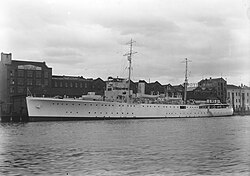
The '''''Hastings'' class''', also known as '''''Folkestone'' class''', was a class of five sloops built for the Royal Navy and the RIN in the interwar period, which went on to see service in the Second World War.<ref name="www.leander-project.homecall.co.uk"/> {{HMIS|Hindustan|L80|6}} of this class served in the RIN. | The '''''Hastings'' class''', also known as '''''Folkestone'' class''', was a class of five sloops built for the Royal Navy and the RIN in the interwar period, which went on to see service in the Second World War.<ref name="www.leander-project.homecall.co.uk"/> {{HMIS|Hindustan|L80|6}} of this class served in the RIN. | ||
{| class="wikitable" | {| class="wikitable" | ||
! align= center scope=col rowspan=2 style="text-align:left; background:#9cf;"|<div style="text-align: center;">Ship</div> | ! align= center scope=col rowspan=2 style="text-align:left; background:#9cf;"|<div style="text-align: center;">Ship</div> | ||
| Line 391: | Line 374: | ||
|1948 | |1948 | ||
|{{UK}} | |{{UK}} | ||
|Transferred to Pakistan post-partition and served as PNS ''Karsaz'' till 1960. | |Transferred to Pakistan post-partition and served as PNS ''Karsaz'' till 1960. | ||
|} | |} | ||
| Line 415: | Line 398: | ||
|rowspan=2|1947 | |rowspan=2|1947 | ||
|rowspan=2|{{UK}} | |rowspan=2|{{UK}} | ||
|scrapped | |scrapped | ||
|- | |- | ||
|{{HMIS|Lawrence|L83|6}} (U83){{efn|Previously L83.}} | |{{HMIS|Lawrence|L83|6}} (U83){{efn|Previously L83.}} | ||
|{{convert|1245|t}} | |{{convert|1245|t}} | ||
|27 December 1919 | |27 December 1919 | ||
|scrapped | |scrapped | ||
|} | |} | ||
===Frigates=== | ===Frigates=== | ||
In 1945, [[PNS Zulfiqar (K265)|HMIS ''Dhanush'']] | In 1945, [[PNS Zulfiqar (K265)|HMIS ''Dhanush'']] and [[HMS Nadder (K392)|HMIS ''Shamsher'']] of the {{sclass2|River|frigate|4}} were the first frigates commissioned into the RIN. They were later transferred to Pakistan during partition. Later, several more frigates of the River class were commissioned. Frigates of the {{sclass|Blackwood|frigate|5}}, {{sclass|Whitby|frigate|5}}, {{sclass|Leopard|frigate|5}}, ''Nilgiri'',{{Cn|date=September 2022}} {{sclass|Leander|frigate|5}}, and ''Godavari'' classes served with the Indian Navy. Of these, the ''Nilgiri''-class frigates, commissioned between 1972 and 1981, were the first home-grown frigates in Indian service. The last ship of the ''Nilgiri'' class, {{INS|Taragiri|F41|6}}, was decommissioned in 2013.<ref name="INS Taragiri bows out of service">{{cite news|title=INS Taragiri bows out of service|url=http://www.business-standard.com/article/news-ians/ins-taragiri-bows-out-of-service-113062700251_1.html|access-date=11 July 2016|work=Business Standard|date=27 June 2022}}</ref> | ||
===={{sclass2|River|frigate|4}}==== | ===={{sclass2|River|frigate|4}}==== | ||
The '''River class''' was a class of 151 frigates launched between 1941 and 1944 for use as [[anti-submarine]] convoy escorts in the [[North Atlantic]]. The majority served with the Royal Navy (RN) and [[Royal Canadian Navy]] (RCN), with some serving in other Allied navies: the Royal Australian Navy (RAN), the [[Free French Navy]] (FFN), the [[Royal Netherlands Navy]] and, post-war, the [[South African Navy]] (SAN).<ref name="WWII Frigates">{{cite web|title=WWII Frigates|url=http://www.leander-project.homecall.co.uk/Frigates.html|website=www.leander-project.homecall.co.uk|access-date=11 July | The '''River class''' was a class of 151 frigates launched between 1941 and 1944 for use as [[anti-submarine]] convoy escorts in the [[North Atlantic]]. The majority served with the Royal Navy (RN) and [[Royal Canadian Navy]] (RCN), with some serving in other Allied navies: the Royal Australian Navy (RAN), the [[Free French Navy]] (FFN), the [[Royal Netherlands Navy]] and, post-war, the [[South African Navy]] (SAN).<ref name="WWII Frigates">{{cite web|title=WWII Frigates|url=http://www.leander-project.homecall.co.uk/Frigates.html|website=www.leander-project.homecall.co.uk|access-date=11 July 2022}}</ref> Eight ships of this class served in the RIN. | ||
{| class="wikitable" | {| class="wikitable" | ||
! align= center scope=col rowspan=2 style="text-align:left; width:15%; background:#9cf;"|<div style="text-align: center;">Ship</div> | ! align= center scope=col rowspan=2 style="text-align:left; width:15%; background:#9cf;"|<div style="text-align: center;">Ship</div> | ||
| Line 443: | Line 427: | ||
|rowspan=8| | |rowspan=8| | ||
* 4 × [[QF 4 inch Mk XVI naval gun|QF {{convert|4|in|mm|adj=on|sigfig=4}} Mk.XVI guns]], twin mounts HA/LA Mk.XIX | * 4 × [[QF 4 inch Mk XVI naval gun|QF {{convert|4|in|mm|adj=on|sigfig=4}} Mk.XVI guns]], twin mounts HA/LA Mk.XIX | ||
* 3 × [[Bofors 40 mm | * 3 × [[Bofors 40 mm Automatic Gun L/60|QF {{convert|40|mm|abbr=on}} Bofors]], single mounts Mk.VII | ||
* 4 × QF {{convert|20|mm|abbr=on}} Oerlikon, twin mounts Mk.V | * 4 × QF {{convert|20|mm|abbr=on}} Oerlikon, twin mounts Mk.V | ||
* 1 × Hedgehog 24 spigot A/S projector | * 1 × Hedgehog 24 spigot A/S projector | ||
| Line 452: | Line 436: | ||
|1947 | |1947 | ||
|rowspan=8|{{UK}} | |rowspan=8|{{UK}} | ||
|Returned to the [[Royal Navy]] in April 1947. Scrapped in 1955. | |Returned to the [[Royal Navy]] in April 1947. Scrapped in 1955. | ||
|- | |- | ||
|[[List of River-class frigates|HMIS ''Kukri'' (K243)]]{{efn|Formerly HMS ''Trent''. Renamed INS ''Kukri'' post republic.}} | |[[List of River-class frigates|HMIS ''Kukri'' (K243)]]{{efn|Formerly HMS ''Trent''. Renamed INS ''Kukri'' post republic.}} | ||
| Line 458: | Line 442: | ||
|1946 | |1946 | ||
|1951 | |1951 | ||
|Converted to survey vessel and recommissioned as INS ''Investigator'' post republic. | |Converted to survey vessel and recommissioned as INS ''Investigator'' post republic. | ||
|- | |- | ||
|{{HMIS|Tir|K256}}{{efn|Formerly HMS ''Bann''. Renamed INS ''Tir'' post republic.}} | |{{HMIS|Tir|K256}}{{efn|Formerly HMS ''Bann''. Renamed INS ''Tir'' post republic.}} | ||
| Line 464: | Line 448: | ||
|3 December 1945 | |3 December 1945 | ||
|30 September 1977{{Sfn|Hiranandani|2005|p=372}} | |30 September 1977{{Sfn|Hiranandani|2005|p=372}} | ||
|scrapped | |scrapped | ||
|- | |- | ||
|[[List of River-class frigates|HMIS ''Tamar'' (K262)]]{{efn|Formerly HMS ''Aire''.}} | |[[List of River-class frigates|HMIS ''Tamar'' (K262)]]{{efn|Formerly HMS ''Aire''.}} | ||
| Line 470: | Line 454: | ||
|1946 | |1946 | ||
|December 1946 | |December 1946 | ||
|Constructive total Loss after running aground off [[Hainan Island]]. | |Constructive total Loss after running aground off [[Hainan Island]]. | ||
|- | |- | ||
|[[PNS Zulfiqar (K265)|HMIS ''Dhanush'' (K265)]]{{efn|Formerly HMS ''Deveron''.}} | |[[PNS Zulfiqar (K265)|HMIS ''Dhanush'' (K265)]]{{efn|Formerly HMS ''Deveron''.}} | ||
| Line 476: | Line 460: | ||
|1945 | |1945 | ||
|1948 | |1948 | ||
|Transferred to Pakistan and served as PNS ''Zulfiqar''. | |Transferred to Pakistan and served as PNS ''Zulfiqar''. | ||
|- | |- | ||
|[[HMCS Waskesiu (K330)|HMIS ''Hooghly'' (K330)]]{{efn|Formerly HMCS ''Waskesiu''. Renamed INS ''Hooghly'' post republic.}} | |[[HMCS Waskesiu (K330)|HMIS ''Hooghly'' (K330)]]{{efn|Formerly HMCS ''Waskesiu''. Renamed INS ''Hooghly'' post republic.}} | ||
| Line 482: | Line 466: | ||
|Purchased 1948 | |Purchased 1948 | ||
|unknown | |unknown | ||
|scrapped | |scrapped | ||
|- | |- | ||
|[[HMS Nadder (K392)|HMIS ''Shamsher'' (K392)]]{{efn|Formerly HMS ''Nadder''.}} | |[[HMS Nadder (K392)|HMIS ''Shamsher'' (K392)]]{{efn|Formerly HMS ''Nadder''.}} | ||
| Line 488: | Line 472: | ||
|1945 | |1945 | ||
|1947 | |1947 | ||
|Transferred to Pakistan and served as PNS ''Shamsher''. Scrapped in 1959. | |Transferred to Pakistan and served as PNS ''Shamsher''. Scrapped in 1959. | ||
|- | |- | ||
|[[HMCS Kokanee (K419)|HMIS ''Bengal'' (K419)]]{{efn|Formerly HMCS ''Kokanee''. Renamed INS ''Bengal'' post republic.}} | |[[HMCS Kokanee (K419)|HMIS ''Bengal'' (K419)]]{{efn|Formerly HMCS ''Kokanee''. Renamed INS ''Bengal'' post republic.}} | ||
| Line 494: | Line 478: | ||
|Purchased 1948 | |Purchased 1948 | ||
|unknown | |unknown | ||
|scrapped | |scrapped | ||
|} | |} | ||
| Line 513: | Line 497: | ||
|[[Blackwood-class frigate|INS ''Kirpan'' (F144)]] | |[[Blackwood-class frigate|INS ''Kirpan'' (F144)]] | ||
|rowspan=3| | |rowspan=3| | ||
*3 × [[Bofors 40 mm | *3 × [[Bofors 40 mm Automatic Gun L/60|{{convert|40|mm|abbr=on}} Bofors gun Mark 7]] (quarterdeck mount later removed) | ||
*2 × [[Limbo (weapon)|Limbo Mark 10]] anti-submarine mortars | *2 × [[Limbo (weapon)|Limbo Mark 10]] anti-submarine mortars | ||
|rowspan=3|{{convert|1479|t}} | |rowspan=3|{{convert|1479|t}} | ||
| Line 520: | Line 504: | ||
|18 August 1978{{Sfn|Hiranandani|2005|p=372}} | |18 August 1978{{Sfn|Hiranandani|2005|p=372}} | ||
|rowspan=3|{{UK}} | |rowspan=3|{{UK}} | ||
|Transferred to [[Indian Coast Guard]] in 1978.{{Sfn|Conway|1995|p=173}}<ref name="INS Kirpan Clydeships">{{cite web|title=Screw Steamer PHOEBE built by Abercorn Shipbuilding Co in 1876 for Pile & Co [J. C. Briggs] London, Cargo|url=http://www.clydeships.co.uk/view.php?a1PageSize=25&ship_listPage=1&ship_listPageSize=50&a1Page=1062&ref=17649&vessel=KIRPAN|website=www.clydeships.co.uk|access-date=11 July | |Transferred to [[Indian Coast Guard]] in 1978.{{Sfn|Conway|1995|p=173}}<ref name="INS Kirpan Clydeships">{{cite web|title=Screw Steamer PHOEBE built by Abercorn Shipbuilding Co in 1876 for Pile & Co [J. C. Briggs] London, Cargo|url=http://www.clydeships.co.uk/view.php?a1PageSize=25&ship_listPage=1&ship_listPageSize=50&a1Page=1062&ref=17649&vessel=KIRPAN|website=www.clydeships.co.uk|access-date=11 July 2022}}</ref> | ||
|- | |- | ||
| Line 558: | Line 542: | ||
|rowspan=2| | |rowspan=2| | ||
* 1 × [[QF 4.5 inch naval gun|twin {{convert|114|mm|abbr=on}} gun Mark 6]] | * 1 × [[QF 4.5 inch naval gun|twin {{convert|114|mm|abbr=on}} gun Mark 6]] | ||
* 1 × twin [[Bofors 40 mm | * 1 × twin [[Bofors 40 mm Automatic Gun L/60|{{convert|40|mm|abbr=on}} Bofors gun]] Mark 2 STAAG, later; 1 × single 40 mm Bofors gun Mark 7 | ||
* 2 × [[Limbo (weapon)|Limbo anti-submarine mortar]] Mark 10 | * 2 × [[Limbo (weapon)|Limbo anti-submarine mortar]] Mark 10 | ||
* 12 × {{convert|21|in|mm|adj=on|0}} anti-submarine [[torpedo tube]]s (removed or never shipped) | * 12 × {{convert|21|in|mm|adj=on|0}} anti-submarine [[torpedo tube]]s (removed or never shipped) | ||
| Line 616: | Line 600: | ||
===={{sclass|Nilgiri|frigate|4||1972}}==== | ===={{sclass|Nilgiri|frigate|4||1972}}==== | ||
The '''''Nilgiri'' class''' are updated versions of the ''Leander'' class, designed and built for the Indian Navy by Mazagon Dock Limited in Mumbai. Six ships were built between 1972 and 1981. Vessels of the class formed the 14th Frigate Squadron. The lead ship, {{INS|Nilgiri|F33|6}}, was the first major warship to be built in India, in collaboration with [[Yarrow Shipbuilders]] of the United Kingdom. The class and the ships are named for hill ranges of India. | The '''''Nilgiri'' class''' are updated versions of the ''Leander'' class, designed and built for the Indian Navy by Mazagon Dock Limited in Mumbai. Six ships were built between 1972 and 1981. Vessels of the class formed the 14th Frigate Squadron. The lead ship, {{INS|Nilgiri|F33|6}}, was the first major warship to be built in India, in collaboration with [[Yarrow Shipbuilders]] of the United Kingdom. The class and the ships are named for hill ranges of India.{{Cn|date=September 2022}} With the entry into service of the ''Shivalik'' class, the ''Nilgiri'' class has been decommissioned by the navy, five ships having been decommissioned, with [[INS Vindhyagiri (F42)|one]] having been sunk in an accident. INS ''Taragiri'' was the last ship of the class to be decommissioned, on 27 June 2013 in Mumbai, after serving 33 years in the navy.<ref name="INS Taragiri bows out of service"/> | ||
{| class="wikitable" | {| class="wikitable" | ||
! align= center scope=col rowspan=2 style="text-align:left; width:15%; background:#9cf;"|<div style="text-align: center;">Ship</div> | ! align= center scope=col rowspan=2 style="text-align:left; width:15%; background:#9cf;"|<div style="text-align: center;">Ship</div> | ||
| Line 643: | Line 627: | ||
|23 November 1974 | |23 November 1974 | ||
|6 May 2005 | |6 May 2005 | ||
|Awaiting disposal {{as of|2016|December|lc=y}}.{{Sfn|Hiranandani|2000|p=81–92}}<ref name="INS Himgiri decommissioned">{{cite news|title=INS Himgiri decommissioned|url=http://zeenews.india.com/news/nation/ins-himgiri-decommissioned_215764.html|access-date=11 July 2016|work=Zee News|date=5 May | |Awaiting disposal {{as of|2016|December|lc=y}}.{{Sfn|Hiranandani|2000|p=81–92}}<ref name="INS Himgiri decommissioned">{{cite news|title=INS Himgiri decommissioned|url=http://zeenews.india.com/news/nation/ins-himgiri-decommissioned_215764.html|access-date=11 July 2016|work=Zee News|date=5 May 2022}}</ref> | ||
|- | |- | ||
|{{INS|Udaygiri|F35}} | |{{INS|Udaygiri|F35}} | ||
| Line 687: | Line 671: | ||
*4 × [[Exocet]] surface-to-surface missiles | *4 × [[Exocet]] surface-to-surface missiles | ||
*[[Sea Wolf missile|SeaWolf]] surface-to-air missiles | *[[Sea Wolf missile|SeaWolf]] surface-to-air missiles | ||
*2 × [[Bofors 40 mm gun]]s | *2 × [[Bofors 40 mm Automatic Gun L/60|Bofors 40 mm gun]]s | ||
|{{convert|2500|t}} | |{{convert|2500|t}} | ||
|25 May 1966 | |25 May 1966 | ||
| Line 698: | Line 682: | ||
===={{sclass|Godavari|frigate|4}}==== | ===={{sclass|Godavari|frigate|4}}==== | ||
The '''''Godavari''-class frigates''' (formerly '''Type 16''' or '''Project 16''' frigates) were guided-missile frigates of the Indian Navy. The ''Godavari'' class was the first significant indigenous warship design-and-development initiative of the Indian Navy. The design is a modification of the {{sclass|Nilgiri|frigate|4||1972}}, with larger hull and updated armaments, as well as with a focus on an indigenous content of 72%. The class and the ships took their names from Indian rivers. INS ''Gomati'' was the first Indian Navy vessel to employ digital electronics in her combat data system. The ships combined Indian, Russian, and Western weapons systems.<ref name="Godavari Class {{!}} Indian Navy">{{cite web|title=Godavari Class|url=http://indiannavy.nic.in/node/1146|website=indiannavy.nic.in|access-date=11 July 2022}}</ref><ref name=BR-Godavari>{{cite web|url=http://www.bharat-rakshak.com/NAVY/Ships/Active/178-Godavari-Class.html |title=Godavari (Type 16) Class |work=Bharat-Rakshak.com |access-date=26 September 2022}}</ref> The last of the class in service, INS ''Gomati'', was decommissioned on 28 May 2022. | |||
{| class="wikitable" | {| class="wikitable" | ||
! align= center scope=col rowspan=2 style="text-align:left; background:#9cf;"|<div style="text-align: center;">Ship</div> | ! align= center scope=col rowspan=2 style="text-align:left; background:#9cf;"|<div style="text-align: center;">Ship</div> | ||
| Line 738: | Line 724: | ||
|22 March 2018 | |22 March 2018 | ||
| | | | ||
|- | |||
|{{INS|Gomati|F21}} | |||
|[[File:INS Gomati F21.jpg|150px]] | |||
|rowspan="1" | | |||
*4 × [[P-15 Termit|SS-N-2D Styx AShM]] | |||
*24 × Barak SAM (3 × 8 cell VLS units) | |||
*1 × [[AK-725]] twin-barreled {{convert|57|mm|abbr=on}} gun | |||
*4 × [[AK-630]] 6-barreled {{convert|30|mm|abbr=on}} gatling | |||
|rowspan="1" |{{convert|3850|t}} | |||
| | |||
|16 April 1988 | |||
|28 May 2022 | |||
|} | |} | ||
| Line 765: | Line 763: | ||
|{{convert|6670|t}} | |{{convert|6670|t}} | ||
|Under Construction | |Under Construction | ||
|{{IND}}<ref name="Navy seals 45,000-cr deal: seven warships – Indian Express">{{cite news|title=Navy seals 45,000-cr deal: seven warships – Indian Express|url=http://archive.indianexpress.com/news/navy-seals-45-000-cr-deal--seven-warships/479132|access-date=11 July 2016|work=archive.indianexpress.com}}</ref><ref name="MoD gives nod to 7 stealth frigates worth Rs 13,000 crore – Times of India">{{cite news|title=MoD gives nod to 7 stealth frigates worth Rs 13,000 crore – Times of India|url=http://timesofindia.indiatimes.com/india/MoD-gives-nod-to-7-stealth-frigates-worth-Rs-13000-crore/articleshow/51367348.cms|access-date=11 July 2016|work=Times of India|date=12 May | |{{IND}}<ref name="Navy seals 45,000-cr deal: seven warships – Indian Express">{{cite news|title=Navy seals 45,000-cr deal: seven warships – Indian Express|url=http://archive.indianexpress.com/news/navy-seals-45-000-cr-deal--seven-warships/479132|access-date=11 July 2016|work=archive.indianexpress.com}}</ref><ref name="MoD gives nod to 7 stealth frigates worth Rs 13,000 crore – Times of India">{{cite news|title=MoD gives nod to 7 stealth frigates worth Rs 13,000 crore – Times of India|url=http://timesofindia.indiatimes.com/india/MoD-gives-nod-to-7-stealth-frigates-worth-Rs-13000-crore/articleshow/51367348.cms|access-date=11 July 2016|work=Times of India|date=12 May 2022}}</ref> | ||
|} | |} | ||
| Line 771: | Line 769: | ||
==={{sclass|Admiral Grigorovich|frigate|4}}=== | ==={{sclass|Admiral Grigorovich|frigate|4}}=== | ||
The '''''Admiral Grigorovich'' class''' is a variant of the Russian-built ''Talwar''-class frigate in service with the Indian Navy {{As of|2017|February|lc=y}}. Six of this class were planned for service with the [[Russian Navy]], with the engines to be supplied by the Ukrainian government-owned firm [[Zorya-Mashproekt]]. Of the first batch of three frigates, two vessels are in service with Russia {{As of|2017|February|lc=y}}, with the last to be commissioned in 2016. The [[2014 Crimean crisis]] halted any further cooperation between the Russian and Ukrainian governments, leaving the second batch of three ships without engines. In August 2016, Russia agreed to sell the second batch of frigates to India. India will likely be able to acquire Ukrainian-built engines on its own. The frigates remain under construction, and it is possible the hulls could be transported to India for their final fitting-out, including the installation of their engines.<ref name= "Admiral Grigorovich">{{Cite news|title =India to acquire three Admiral Grigorovich-class frigates from Russia|url=http://www.janes.com/article/62776/india-to-acquire-three-admiral-grigorovich-class-frigates-from-russia|newspaper=IHS Jane's Defence Weekly|access-date=5 August 2016|date=4 August | The '''''Admiral Grigorovich'' class''' is a variant of the Russian-built ''Talwar''-class frigate in service with the Indian Navy {{As of|2017|February|lc=y}}. Six of this class were planned for service with the [[Russian Navy]], with the engines to be supplied by the Ukrainian government-owned firm [[Zorya-Mashproekt]]. Of the first batch of three frigates, two vessels are in service with Russia {{As of|2017|February|lc=y}}, with the last to be commissioned in 2016. The [[2014 Crimean crisis]] halted any further cooperation between the Russian and Ukrainian governments, leaving the second batch of three ships without engines. In August 2016, Russia agreed to sell the second batch of frigates to India. India will likely be able to acquire Ukrainian-built engines on its own. The frigates remain under construction, and it is possible the hulls could be transported to India for their final fitting-out, including the installation of their engines.<ref name= "Admiral Grigorovich">{{Cite news|title =India to acquire three Admiral Grigorovich-class frigates from Russia|url=http://www.janes.com/article/62776/india-to-acquire-three-admiral-grigorovich-class-frigates-from-russia|newspaper=IHS Jane's Defence Weekly|access-date=5 August 2016|date=4 August 2022}}</ref> | ||
{| class="wikitable" | {| class="wikitable" | ||
|- | |- | ||
Revision as of 18:03, 27 November 2022
 | This article needs more citations. (September 2022) |
Frigates, which are naval vessels intermediate between corvettes and destroyers,[1] have had a significant role in the naval history of India. Although the Maratha Navy, the naval branch of the armed forces of the Maratha Empire, used Grabs and Gallivats to project naval power,[2] the concept of frigates (formerly called sloops) was introduced by the British.[3] HMIS Clive, HMIS Lawrence and HMIS Cornwallis, of the class, were some of the early sloops commissioned into the Royal Indian Navy (RIN) during the 1920s. These ships later served in the Second World War. Later, in the 1930s, sloops of the [[]], [[]], [[]], [[]], and [[]][citation needed] classes were commissioned.[4][5]
The RIN was expanded significantly during the Second World War.[citation needed] The sloops HMIS Sutlej and HMIS Jumna, of the Black Swan class, took part in Operation Husky, the Allied invasion of Sicily.[6] In 1945, HMIS Dhanush and HMIS Shamsher, of the class, were the first frigates, so-called, to be commissioned. Several frigates of the River class were also commissioned. Some of them were later transferred to Pakistan during partition.
In the post-war period, the Indian Navy operated frigates from the [[]],[7] [[]],[8] [[]],[9] [[]],[10] and [[]] classes.[11] The Nilgiri-class frigates were the first major warships to be built in India, in association with Yarrow Shipbuilders of the United Kingdom.[11] Later in the 2000s, the Indian Navy, collaborating with Russia for the first time, acquired six under Project 1135.6, designated as -class.[12] As of May 2022[update], 12 guided-missile frigates from three different classes – [[]], Talwar, and [[]] – are operated by the Indian Navy.[13][14]
Ships currently in commission
The class is the largest of the frigate classes presently in service as of February 2017[update].[15] INS Shivalik is the lead ship of the class and the first stealth warship built by India.[16] All three ships of this class were built by Mazagon Dock Limited in Mumbai, from 2000 to 2010. With their improved stealth features and land-attack capabilities, the Shivalik-class warships were originally conceived as successors to the six -class frigates,[15] which are modified Krivak III-class vessels built by Russia for the Indian Navy.[citation needed] The Talwar class was preceded by the -class frigates, which were built by the Garden Reach Shipbuilders and Engineers in Kolkata. Three ships of this class are still in service with the Indian Navy.[14]
Shivalik class
The Shivalik class, or Project 17 class, is a class of multi-role frigates in service with the Indian Navy. They are the first stealth warships built in India.[17] A total of three ships were built between 2000 and 2010, and all three were in commission by 2012.[15] The Shivalik class, along with the seven Project 17A frigates being developed from them as of February 2017[update], are projected to be the principal frigates of the Indian Navy in the first half of the 21st century.[18] All ships of the class were built by Mazagon Dock Limited. The class and the ships are named after hill ranges in India.[15] Originally conceived as a successor to the Talwar-class frigates, the Shivalik-class frigates feature improved stealth features and land-attack capabilities.[15]
Ship
|
Picture
|
Armament
|
Displacement
|
Service
|
Origin
| |
|---|---|---|---|---|---|---|
Laid down
|
Commissioned
| |||||
| INS Shivalik (F47)[19] | 
|
|
6,200 tonnes (6,100 long tons; 6,800 short tons) full load[20] | 11 July 2001 | 29 April 2010 |  India[15][20] India[15][20]
|
| INS Satpura (F48)[21] | .jpg)
|
31 October 2002 | 20 August 2011 | |||
| INS Sahyadri (F49)[22] | _maneuvers_along_with_the_guided-missile_destroyer_USS_Chung-Hoon_(DDG_93)_while_conducting_a_search-and-rescue_exercise_during_Exercise_Malabar_2016.jpg)
|
17 March 2003 | 21 July 2012 | |||
Talwar class
The Talwar class, also known as Project 1135.6, is a class of guided-missile frigates designed and built by Russia for the Indian Navy, as modified Krivak III-class frigates[23] (the class that is also the basis of the Russian -class frigate), with a number of systems of Indian design and manufacture, including anti-submarine sensors (sonar) and communications equipment.[12][24][25] Each ship of this class has a displacement of 4,000 tons and speed of 30 knots (56 km/h; 35 mph) and is capable of accomplishing a wide variety of missions, primarily finding and eliminating enemy submarines and large surface ships. Due to the use of stealth technologies and a special hull design, the frigate operates with reduced radar cross section (RCS), as well as reduced electromagnetic, acoustic, and infrared signatures.[12]
Ship
|
Picture
|
Armament
|
Displacement
|
Service
|
Origin
| |
|---|---|---|---|---|---|---|
Laid down
|
Commissioned
| |||||
| INS Talwar (F40)[26] | 
|
|
4,035 tonnes (3,971 long tons; 4,448 short tons)[27] | 10 March 1999 | 18 June 2003 |  Russia[13] Russia[13]
|
| INS Trishul (F43)[28] | 
|
24 September 1999 | 24 November 2000 | |||
| INS Tabar (F44) | 
|
26 May 2000 | 25 May 2001 | |||
| INS Teg (F45)[29] | 
|
|
July 2007 | 27 April 2012 | ||
| INS Tarkash (F50)[30] | 
|
Unknown | 9 November 2012 | |||
| INS Trikand (F51)[31] | -image08.jpg)
|
11 June 2008 | 29 June 2013 | |||
Brahmaputra class
The Brahmaputra-class frigates (Type 16A or Project 16A) are guided-missile frigates of the Indian Navy, designed and built in India. They are an enhancement of the Godavari class, with the same displacement, 3850 tons, and length, 126 metres (413 ft), but with different configuration, armaments, and capabilities. Three ships of this class serve in the Indian Navy. The class and the ships, are named for Indian rivers.[14][32]
Ship
|
Picture
|
Armament
|
Displacement
|
Commissioned
|
Origin
|
|---|---|---|---|---|---|
| INS Brahmaputra (F31) | 
|
|
3,850 tonnes (3,790 long tons; 4,240 short tons) | 14 April 2000 | India[32]
|
| INS Betwa (F39) | 
|
7 July 2004 | |||
| INS Beas (F37) | 
|
11 July 2005 |
Decommissioned ships
Most of the decommissioned frigates or sloops of the Indian Navy originated in the United Kingdom.
Sloops
A modern British sloop-of-war is a warship used for convoy defence. HMIS Clive,HMIS Lawrence of the class, were some of the early sloops commissioned into the RIN during the 1920s. These ships were also the first ships to be decommissioned. Later, sloops from the [[]], [[]], [[]], [[]], and [[]] classes were commissioned. The sloops HMIS Narbada and HMIS Godavari,[citation needed] of the Black Swan class, and HMIS Hindustan, of the Hastings class, were transferred to Pakistan post-partition. HMIS Elphinstone, of the Anchusa class, and HMIS Indus,[citation needed] of the Grimsby class, were lost in action during the Second World War. The other sloops were subsequently scrapped after their decommissioning.[6]
class
The twenty-eight Anchusa-class sloops were a small class of corvettes or convoy sloops built in 1917 and 1918 under the Emergency War Programme for the Royal Navy in the First World War, as the final part of the larger "Flower class" (which were also referred to as the "cabbage class", or "herbaceous borders"). The sloops were single-screw with triple hulls at the bows to give extra protection against loss when working as fleet sweeping vessels, or as convoy protection ships (the class was built to look like merchant ships for use as Q-ships). HMS Ceanothus (1917) (later renamed as HMS Elphinstone), transferred to the Royal Indian Marine in 1922, was the only Anchusa-class sloop used by India.
Ship
|
Armament
|
Displacement
|
Service
|
Origin
|
Fate
| ||
|---|---|---|---|---|---|---|---|
Commissioned
(Royal Navy) |
Commissioned
(Royal Indian Marine) |
Decommissioned
| |||||
| HMIS Elphinstone |
|
1,290 tonnes (1,270 long tons; 1,420 short tons) | 2 June 1917 | May 1922 |  United Kingdom United Kingdom
|
Wrecked on the Nicobar Islands on 29 January 1925. | |
class
The Aubrietia class was a class of twelve sloops built under the Emergency War Programme for the Royal Navy in the First World War as part of the larger "Flower" class. The Flowers were the first ships designed as minesweepers. Like all the Flowers, the Aubrietia class were originally designed as single-screw fleet sweeping vessels, with triple hulls at the bows and an above-water magazine located aft, to give extra protection against loss from mine damage when working. However, the greatest utility was to be as a convoy escort; and, as such, other classes took over the minesweeping role. The Aubrietias were re-classified as convoy sloops. HMIS Cornwallis of this class was used by the RIN from 1921 to 1946, when it was decommissioned.
Ship
|
Armament
|
Displacement
|
Service
|
Origin
|
Fate
| ||
|---|---|---|---|---|---|---|---|
Commissioned (Royal Navy)
|
Commissioned
(Royal Indian Marine) |
Decommissioned
| |||||
| HMIS Cornwallis (U09)[lower-alpha 1] |
|
1,250 tonnes (1,230 long tons; 1,380 short tons) | 21 August 1917 | September 1921 | 1946 | United Kingdom
|
scrapped |
class
The P class, nominally classified as "patrol boats", was in effect a class of coastal sloops. Twenty-four ships to this design were ordered in May 1915 (numbered P.11 to P.34), and another thirty between February and June 1916 (numbered P.35 to P.64), under the Emergency War Programme[33] for the Royal Navy in the First World War. In December 1916, ten of the latter group were altered on the stocks before launch for use as decoy Q-ships and were renumbered as PC-class sloops. Although usually not named, in 1925 P.38 was given the name Spey, as well as HMIS Baluchi and HMIS Pathan, the two P-class sloops used by the RIN.
Ship
|
Armament
|
Displacement
|
Service
|
Origin
|
Fate
| ||
|---|---|---|---|---|---|---|---|
Commissioned (Royal Navy)
|
Commissioned
(RIN) |
Decommissioned
| |||||
| HMIS Baluchi (PC.55) |
|
613 tonnes (603 long tons; 676 short tons) | 5 May 1917 | May 1922 | 1935 | United Kingdom
|
Sold for scrapping.[33] |
| HMIS Pathan (PC.69) | 11 March 1918 | 5 August 1921 | Sunk by Italian submarine Galvani on 23 June 1940. | ||||
class
The Grimsby class was a class of 13 sloops-of-war laid down between 1933 and 1940. Eight were built in the United Kingdom for the Royal Navy, four in Australia for the Royal Australian Navy, and one, HMIS Indus, for the RIN.
Ship
|
Picture
|
Armament
|
Displacement
|
Service
|
Origin
|
Fate
| ||
|---|---|---|---|---|---|---|---|---|
Laid down
|
Commissioned
(RIN) |
Decommissioned
| ||||||
| HMIS Indus (U67) | 
|
|
1,006 tonnes (990 long tons; 1,109 short tons) | 8 December 1933[34] | 15 March 1935[34] | United Kingdom
|
Bombed and sunk by Japanese aircraft during the Burma Campaign on 6 April 1942. | |
class
The Black Swan and Modified Black Swan were two classes of sloops of the Royal Navy and RIN. Twelve Black Swans were launched between 1939 and 1943, including four for the RIN. Twenty-five Modified Black Swans were launched between 1942 and 1945, including two for the RIN. Several other ships were cancelled.
Ship
|
Armament
|
Displacement
|
Service
|
Origin
|
Fate
| ||
|---|---|---|---|---|---|---|---|
| Laid down | Commissioned (RIN) |
Decommissioned | |||||
| HMIS Cauvery[lower-alpha 2] |
|
1,350 tonnes (1,330 long tons; 1,490 short tons)[lower-alpha 3] | 28 October 1942 | 26 August 1943 | 30 September 1977[35] | United Kingdom
|
scrapped |
| HMIS Jumna[lower-alpha 4] | 20 February 1940 | 13 May 1941 | 31 December 1980[36] | scrapped | |||
| HMIS Narbada | 30 August 1941 | 29 April 1943 | 1948 | Transferred to Pakistan post-partition and served as PNS Jhelum. | |||
| HMIS Kistna[lower-alpha 5] | 14 July 1942 | 26 August 1943 | 31 December 1981[37] | scrapped | |||
| HMIS Godavari | 30 August 1941 | 28 June 1943 | 1948 | Transferred to Pakistan post-partition and served as PNS Sind. | |||
| HMIS Sutlej[lower-alpha 6] | 4 January 1940 | 23 April 1941 | 31 December 1978[35] | scrapped | |||
class
The Hastings class, also known as Folkestone class, was a class of five sloops built for the Royal Navy and the RIN in the interwar period, which went on to see service in the Second World War.[4] HMIS Hindustan of this class served in the RIN.
Ship
|
Picture
|
Armament
|
Displacement
|
Service
|
Origin
|
Fate
| ||
|---|---|---|---|---|---|---|---|---|
| Laid down | Commissioned (RIN) |
Decommissioned | ||||||
| HMIS Hindustan (L80) | .jpg)
|
|
1,210 tonnes (1,190 long tons; 1,330 short tons) | 4 September 1929 | 10 October 1930 | 1948 | United Kingdom
|
Transferred to Pakistan post-partition and served as PNS Karsaz till 1960. |
Other sloops
Ship
|
Armament
|
Displacement
|
Service
|
Origin
|
Fate
| |
|---|---|---|---|---|---|---|
| Commissioned (Royal Indian Marine) | Decommissioned | |||||
| HMIS Clive (U79}[lower-alpha 7] |
|
2,083 tonnes (2,050 long tons; 2,296 short tons) | 20 April 1920 | 1947 | United Kingdom
|
scrapped |
| HMIS Lawrence (U83)[lower-alpha 8] | 1,245 tonnes (1,225 long tons; 1,372 short tons) | 27 December 1919 | scrapped | |||
Frigates
In 1945, HMIS Dhanush and HMIS Shamsher of the class were the first frigates commissioned into the RIN. They were later transferred to Pakistan during partition. Later, several more frigates of the River class were commissioned. Frigates of the [[]], [[]], [[]], Nilgiri,[citation needed] [[]], and Godavari classes served with the Indian Navy. Of these, the Nilgiri-class frigates, commissioned between 1972 and 1981, were the first home-grown frigates in Indian service. The last ship of the Nilgiri class, INS Taragiri, was decommissioned in 2013.[38]
class
The River class was a class of 151 frigates launched between 1941 and 1944 for use as anti-submarine convoy escorts in the North Atlantic. The majority served with the Royal Navy (RN) and Royal Canadian Navy (RCN), with some serving in other Allied navies: the Royal Australian Navy (RAN), the Free French Navy (FFN), the Royal Netherlands Navy and, post-war, the South African Navy (SAN).[5] Eight ships of this class served in the RIN.
Ship
|
Armament
|
Displacement
|
Service
|
Origin
|
Fate
| ||
|---|---|---|---|---|---|---|---|
| Commissioned (Royal Navy) |
Commissioned (RIN) |
Decommissioned | |||||
| HMIS Neza (K239)[lower-alpha 9] |
|
1,390 tonnes (1,370 long tons; 1,530 short tons) | 7 May 1943 | 1946 | 1947 | United Kingdom
|
Returned to the Royal Navy in April 1947. Scrapped in 1955. |
| HMIS Kukri (K243)[lower-alpha 10] | 27 February 1943 | 1946 | 1951 | Converted to survey vessel and recommissioned as INS Investigator post republic. | |||
| HMIS Tir (K256)[lower-alpha 11] | 7 May 1943 | 3 December 1945 | 30 September 1977[35] | scrapped | |||
| HMIS Tamar (K262)[lower-alpha 12] | 28 July 1943 | 1946 | December 1946 | Constructive total Loss after running aground off Hainan Island. | |||
| HMIS Dhanush (K265)[lower-alpha 13] | 2 March 1943 | 1945 | 1948 | Transferred to Pakistan and served as PNS Zulfiqar. | |||
| HMIS Hooghly (K330)[lower-alpha 14] | 16 June 1943 | Purchased 1948 | unknown | scrapped | |||
| HMIS Shamsher (K392)[lower-alpha 15] | 20 January 1944 | 1945 | 1947 | Transferred to Pakistan and served as PNS Shamsher. Scrapped in 1959. | |||
| HMIS Bengal (K419)[lower-alpha 16] | 6 June 1944 | Purchased 1948 | unknown | scrapped | |||
class
The Type 14 Blackwood was a ship class of minimal "second-rate" anti-submarine warfare frigates. Built for the Royal Navy, to supplement the Type 12 class, during the 1950s at a time of increasing threat from the Soviet Union's submarine fleet, they served until the late 1970s. Twelve ships of this class served with the Royal Navy and a further three were built for the Indian Navy.[7]
Ship
|
Armament
|
Displacement
|
Service
|
Origin
|
Fate
| ||
|---|---|---|---|---|---|---|---|
| Laid down | Commissioned | Decommissioned | |||||
| INS Kirpan (F144) |
|
1,479 tonnes (1,456 long tons; 1,630 short tons) | 5 November 1956 | July 1959 | 18 August 1978[35] | United Kingdom
|
Transferred to Indian Coast Guard in 1978.[39][40] |
| INS Kuthar (F146) | 19 September 1957 | November 1959 | 18 August 1978[35] | Transferred to Indian Coast Guard in 1978.[39] | |||
| INS Khukri (F149) | 29 December 1955 | 16 July 1958 | Sunk in action on 9 December 1971 during 1971 Indo-Pakistani War.[39] | ||||
class
The Type 12 or Whitby class was a six-ship class of anti-submarine frigates of the British Royal Navy, which entered service late in the 1950s. They were designed in the early 1950s as first-rate ocean-going convoy escorts, in the light of experience gained during the Second World War. At the time, the Royal Navy were designing single-role escorts and the Whitbys were designed as fast convoy escorts capable of tackling high-speed submarines. However, this made the Whitbys more sophisticated and expensive to produce in large numbers in the event of a major war. Although themselves rapidly outdated, the Type 12 proved to be an excellent basis for a series of frigate designs used by the British and Commonwealth navies for the next 20 years.[8] Two ships from this class served in the Indian Navy.[41]
Ship
|
Armament
|
Displacement
|
Service
|
Origin
|
Fate
| ||
|---|---|---|---|---|---|---|---|
| Laid down | Commissioned | Decommissioned | |||||
| INS Talwar (F140) |
|
2,185 tonnes (2,150 long tons; 2,409 short tons) | 7 June 1957 | 26 April 1959 | 30 October 1985[36] | United Kingdom
|
Broken up for scrap in 1992.[41] |
| INS Trishul (F143) | 19 February 1957 | 13 January 1960 | 31 August 1992[42] | Broken up for scrap in 1996.[41] | |||
class
The Type 41 or Leopard class was a class of anti-aircraft defence frigates built for the Royal Navy (4 ships) and Indian Navy (3 ships) in the 1950s.[43]
Ship
|
Armament
|
Displacement
|
Service
|
Origin
|
Fate
| ||
|---|---|---|---|---|---|---|---|
| Laid down | Commissioned | Decommissioned | |||||
| INS Brahmaputra[lower-alpha 17] |
|
2,337 tonnes (2,300 long tons; 2,576 short tons) | 20 October 1955 | 31 March 1958 | 30 June 1986[44] | United Kingdom
|
Broken up in 1986.[43] |
| INS Beas | 29 November 1956 | 24 May 1960 | 22 December 1992[42] | Broken up in 1992.[43] | |||
| INS Betwa | 29 May 1957 | 8 December 1960 | 31 December 1991[42] | Broken up in 1991.[43] | |||
class
The Nilgiri class are updated versions of the Leander class, designed and built for the Indian Navy by Mazagon Dock Limited in Mumbai. Six ships were built between 1972 and 1981. Vessels of the class formed the 14th Frigate Squadron. The lead ship, INS Nilgiri, was the first major warship to be built in India, in collaboration with Yarrow Shipbuilders of the United Kingdom. The class and the ships are named for hill ranges of India.[citation needed] With the entry into service of the Shivalik class, the Nilgiri class has been decommissioned by the navy, five ships having been decommissioned, with one having been sunk in an accident. INS Taragiri was the last ship of the class to be decommissioned, on 27 June 2013 in Mumbai, after serving 33 years in the navy.[38]
Ship
|
Armament
|
Displacement
|
Service
|
Origin
|
Fate
| |
|---|---|---|---|---|---|---|
| Commissioned | Decommissioned | |||||
| INS Nilgiri (F33) |
|
2,682 tonnes (2,640 long tons; 2,956 short tons) | 3 June 1972 | 31 May 1996[42] | India
|
Sunk on 24 April 1997, in a test firing of a Sea Eagle anti-ship missile by a Sea Harrier Frs Mk 51 taking off from the aircraft carrier, INS Viraat.[45] |
| INS Himgiri (F34) | 23 November 1974 | 6 May 2005 | Awaiting disposal as of December 2016[update].[45][46] | |||
| INS Udaygiri (F35) | 18 February 1976 | 24 August 2007 | Awaiting disposal as of December 2016[update].[45] | |||
| INS Dunagiri (F36) | 5 May 1977 | 20 October 2010 | Awaiting disposal as of December 2016[update].[45] | |||
| INS Taragiri (F41) | 16 May 1980 | 27 June 2013 | Awaiting disposal as of December 2016[update].[45][38] | |||
| INS Vindhyagiri (F42) | 8 July 1981 | 11 June 2012 | Collided with a merchant ship while in Mumbai harbour on 30 January 2011; sank after on-board fire. Re-floated and decommissioned with full honours in 2012.[45][47] | |||
class
The Leander-class, or Type 12I frigates, comprising twenty-six vessels, was among the most numerous and long-lived classes of frigates in the modern history of the Royal Navy. The class was built in three batches between 1959 and 1973. INS Krishna, formerly HMS Andromeda, from Batch 3A, served in the Indian Navy.[48]
Ship
|
Picture[lower-alpha 18]
|
Armament
|
Displacement
|
Service
|
Origin
|
Fate
| |||
|---|---|---|---|---|---|---|---|---|---|
| Laid down | Commissioned (Royal Navy) |
Commissioned (Indian Navy) |
Decommissioned | ||||||
| INS Krishna (F46)[lower-alpha 19] | .jpg)
|
|
2,500 tonnes (2,500 long tons; 2,800 short tons) | 25 May 1966 | 2 December 1968 | 22 August 1995 | 24 May 2012 | United Kingdom
|
Awaiting disposal[49][50] |
class
The Godavari-class frigates (formerly Type 16 or Project 16 frigates) were guided-missile frigates of the Indian Navy. The Godavari class was the first significant indigenous warship design-and-development initiative of the Indian Navy. The design is a modification of the class, with larger hull and updated armaments, as well as with a focus on an indigenous content of 72%. The class and the ships took their names from Indian rivers. INS Gomati was the first Indian Navy vessel to employ digital electronics in her combat data system. The ships combined Indian, Russian, and Western weapons systems.[51][52] The last of the class in service, INS Gomati, was decommissioned on 28 May 2022.
Ship
|
Picture
|
Armament
|
Displacement
|
Service
|
Origin
|
Fate
| ||
|---|---|---|---|---|---|---|---|---|
| Laid down | Commissioned | Decommissioned | ||||||
| INS Godavari (F20) | 
|
3,600 tonnes (3,500 long tons; 4,000 short tons) | 3 November 1978 | 10 December 1983 | 23 December 2015 | India
|
Awaiting disposal[53][54] | |
| INS Ganga (F22) | .jpg)
|
|
3,850 tonnes (3,790 long tons; 4,240 short tons) | 30 December 1985 | 22 March 2018 | |||
| INS Gomati (F21) | 
|
|
3,850 tonnes (3,790 long tons; 4,240 short tons) | 16 April 1988 | 28 May 2022 | |||
Future ships
A total of eleven ships from two different projects, Project 17A and Admiral Grigorovich classes, are expected to be commissioned into the Indian Navy. Most of these ships are under construction .[55]
class
The Project 17A-class frigate is a follow-on of the Project 17 Shivalik-class frigate for the Indian Navy. A total of seven ships will be built at Mazagon Dock and GRSE. The first ship is expected to start construction by early 2017 and to be launched by 2020.[55]
No. of ships planned
|
Picture
|
Armament
|
Displacement
|
Status
|
Origin
|
|---|---|---|---|---|---|
| 5 Under Construction 2 Launched |

|
|
6,670 tonnes (6,560 long tons; 7,350 short tons) | Under Construction | India[56][57]
|
class
The Admiral Grigorovich class is a variant of the Russian-built Talwar-class frigate in service with the Indian Navy as of February 2017[update]. Six of this class were planned for service with the Russian Navy, with the engines to be supplied by the Ukrainian government-owned firm Zorya-Mashproekt. Of the first batch of three frigates, two vessels are in service with Russia as of February 2017[update], with the last to be commissioned in 2016. The 2014 Crimean crisis halted any further cooperation between the Russian and Ukrainian governments, leaving the second batch of three ships without engines. In August 2016, Russia agreed to sell the second batch of frigates to India. India will likely be able to acquire Ukrainian-built engines on its own. The frigates remain under construction, and it is possible the hulls could be transported to India for their final fitting-out, including the installation of their engines.[58]
No. of ships planned
|
Picture[lower-alpha 20]
|
Armament
|
Displacement
|
Status
|
Origin
|
|---|---|---|---|---|---|
| 4 Under construction | 
|
|
4,035 tonnes (3,971 long tons; 4,448 short tons) | Under construction[59] | Russia[58]
|
See also
- List of active Indian Navy ships
- Future of the Indian Navy
- List of ships of the Indian Navy
- List of submarines of the Indian Navy
- List of destroyers of the Indian Navy
Notes
Footnotes
- ↑ Formerly HMS Lychnis (L09).
- ↑ Renamed as INS Kaveri post republic.
- ↑ Original: 1,250 tonnes (1,230 long tons; 1,380 short tons)
- ↑ Renamed as INS Jamuna post republic.
- ↑ Renamed as INS Krisna post republic.
- ↑ Renamed as INS Sutlej post republic.
- ↑ Previously L79.
- ↑ Previously L83.
- ↑ Formerly HMS Test.
- ↑ Formerly HMS Trent. Renamed INS Kukri post republic.
- ↑ Formerly HMS Bann. Renamed INS Tir post republic.
- ↑ Formerly HMS Aire.
- ↑ Formerly HMS Deveron.
- ↑ Formerly HMCS Waskesiu. Renamed INS Hooghly post republic.
- ↑ Formerly HMS Nadder.
- ↑ Formerly HMCS Kokanee. Renamed INS Bengal post republic.
- ↑ Formerly HMS Panther.
- ↑ HMS Andromeda, 1970 (IWM).jpg—Image attribution to the Royal Navy. Re-use under the Open Government Licence by authority of The Controller of Her Majesty's Stationery Office.
- ↑ Formerly HMS Andromeda.
- ↑ Адмирал_Григорович.jpg–Image attribution to the Russian Navy (Mil.ru). This file comes from the websites (mil.ru, минобороны.рф) of the Ministry of Defence of the Russian Federation and is copyrighted. This file is licensed under the Creative Commons Attribution 4.0 Licence.
Citations
- ↑ "Definition of FRIGATE". www.merriam-webster.com. Retrieved 14 July 2022.
- ↑ Sridharan 2000, p. 43.
- ↑ Bhatia 2008, p. 30.
- ↑ 4.0 4.1 "Steel Sloops". www.leander-project.homecall.co.uk. Retrieved 15 July 2022.
- ↑ 5.0 5.1 "WWII Frigates". www.leander-project.homecall.co.uk. Retrieved 11 July 2022.
- ↑ 6.0 6.1 "The Second World War in the Mediterranean, North Africa and Italy". Archived from the original on 24 January 2008. Retrieved 4 August 2016.
- ↑ 7.0 7.1 Friedman 2008, p. 14.
- ↑ 8.0 8.1 Friedman 2008, pp. 214–216.
- ↑ Friedman 2008, p. 202.
- ↑ Friedman 2008, p. 13.
- ↑ 11.0 11.1 Lt Cdr Kalesh Mohanan (14 December 2022). "Indigenous Warship Building". Indian Defence Review. Retrieved 15 July 2016.
- ↑ 15.0 15.1 15.2 15.3 15.4 15.5 "Shivalik Class Frigates". Naval Technology. Retrieved 11 July 2022.
- ↑ "Riding the waves". www.rediff.com. Retrieved 11 July 2022.
- ↑ "Riding the waves". Rediff.com. 10 May 2003. Retrieved 1 May 2022.
- ↑ "Capital Cruisers", Sainik Samachar, Ministry of Defence (India), 15 March 2004. Adm. Madhvendra Singh, Chief of Naval Staff: "These would be the future ships of the Indian Navy and will be of the Shivalik class".
- ↑ "INS Sahyadri Commissioning July 21". Defence Now. Archived from the original on 22 April 2016. Retrieved 11 July 2016.
- ↑ "Mikhailov: the contract on 3 frigates for India to be executed in 2012". rusnavy.com. Retrieved 23 August 2022.
- ↑ "India to acquire three Admiral Grigorovich-class frigates from Russia | IHS Jane's 360". www.janes.com. Retrieved 23 August 2022.
- ↑ "India, Russia likely to sign deal for 4 stealth frigates". The Hindu. 22 December 2015. Retrieved 23 August 2016.
- ↑ "The 3rd ship for the Indian Navy was carried out by JSC Shipyard "Yantar"". Shipyard-yantar.ru. Archived from the original on 20 February 2012. Retrieved 1 February 2011.
- ↑ Vladimir Radyuhin (25 November 2000). "INS Trishul launched in Russian waters". The Hindu. Retrieved 11 July 2022.[dead link]
- ↑ Rajat Pandit (29 June 2022). "India inducts new power-packed stealth frigate INS Trikand – Times of India". Times of India. Retrieved 11 July 2016.
- ↑ 32.0 32.1 "P-16A Class / Brahmaputra Class Frigates". Naval Technology. Retrieved 11 July 2022.
- ↑ 33.0 33.1 "P boats of the First World War". TW Museums. Retrieved 23 August 2022.
- ↑ 34.0 34.1 Hague 1993, p. 60.
- ↑ 35.0 35.1 35.2 35.3 35.4 Hiranandani 2005, p. 372.
- ↑ 36.0 36.1 Hiranandani 2005, p. 375.
- ↑ Hiranandani 2005, p. 373.
- ↑ 38.0 38.1 38.2 "INS Taragiri bows out of service". Business Standard. 27 June 2022. Retrieved 11 July 2016.
- ↑ 39.0 39.1 39.2 Conway 1995, p. 173.
- ↑ "Screw Steamer PHOEBE built by Abercorn Shipbuilding Co in 1876 for Pile & Co [J. C. Briggs] London, Cargo". www.clydeships.co.uk. Retrieved 11 July 2022.
- ↑ 41.0 41.1 41.2 Singh 1992, p. 85.
- ↑ 42.0 42.1 42.2 42.3 Hiranandani 2005, p. 376.
- ↑ 43.0 43.1 43.2 43.3 Conway 1995, p. 174.
- ↑ Hiranandani 2005, p. 374.
- ↑ 45.0 45.1 45.2 45.3 45.4 45.5 Hiranandani 2000, p. 81–92.
- ↑ "INS Himgiri decommissioned". Zee News. 5 May 2022. Retrieved 11 July 2016.
- ↑ "Leander Class General Purpose Frigate (Type 12 Improved)". Archived from the original on 12 December 2006. Retrieved 12 December 2006.
- ↑ "Godavari (Type 16) Class". Bharat-Rakshak.com. Retrieved 26 September 2022.
- ↑ "India's first indigenously designed & built frigate INS Godavari to be decommissioned". Economic Times. Retrieved 11 July 2016.
- ↑ 55.0 55.1 Sengupta, Prasan K. (September 2012). "CCNS finally kickstarts Indian Navy's Project 17A". ForceIndia.com. Archived from the original on 18 February 2015. Retrieved 21 February 2015.
- ↑ "MoD gives nod to 7 stealth frigates worth Rs 13,000 crore – Times of India". Times of India. 12 May 2022. Retrieved 11 July 2016.
- ↑ 58.0 58.1 "India to acquire three Admiral Grigorovich-class frigates from Russia". IHS Jane's Defence Weekly. 4 August 2022. Retrieved 5 August 2016.
- ↑ "Goa Shipyard begins production of stealth frigates for Navy, delivery likely by 2026". The Times of India. 22 September 2020. Retrieved 13 December 2020.
References
- Bhatia, HS (2008), Military History of British India, 1607–1947 (2nd ed.), New Delhi: Deep & Deep Publications, ISBN 978-81-8450-079-0
- Conway, Robert (1995), All the World's Fighting Ships 1947–1995, Conway Maritime Press, ISBN 0-85177-605-1
- Friedman, Norman (2008), British Destroyers & Frigates: The Second World War and After (reprint ed.), Barnsley: Seaforth, ISBN 978-1-84832-015-4
- Hague, Arnold (1993). Sloops: A History of the 71 Sloops Built in Britain and Australia for the British, Australian and Indian Navies 1926–1946. Kendal, England: World Ship Society. ISBN 0-905617-67-3.
- Hiranandani, GM (2000), Transition to Triumph: History of the Indian Navy, 1965–1975, Lancer Publishers, ISBN 978-1-897829-72-1
- Hiranandani, GM (2005), Transition to Eminence: History of the Indian Navy, 1976-1990, Lancer Publishers, ISBN 81-7062-266-2
- Singh, Satyindra (1992), Blueprint to Bluewater: The Indian Navy, 1951–65, New Delhi: Lancer International, ISBN 978-81-7062-148-5
- Sridharan, K (2000), Sea: Our Saviour, New Delhi: Taylor & Francis, ISBN 978-81-224-1245-1
Further reading
- Colledge, James Joseph (2006). Ships of the Royal Navy: The Complete Record of all Fighting Ships of the Royal Navy. London: Chatham Publishing. ISBN 978-1-86176-281-8.
External links
| Commissioned ships |
|  | |||||||||||||||||||||||||||||||
|---|---|---|---|---|---|---|---|---|---|---|---|---|---|---|---|---|---|---|---|---|---|---|---|---|---|---|---|---|---|---|---|---|---|
| Decommissioned ships |
| ||||||||||||||||||||||||||||||||
| Future ships |
| ||||||||||||||||||||||||||||||||
Footnotes
| |||||||||||||||||||||||||||||||||
| Aircraft carriers |  | ||||
|---|---|---|---|---|---|
| Destroyers |
| ||||
| Frigates |
| ||||
| Corvettes |
| ||||
| Fast attack craft |
| ||||
| Nuclear submarines |
| ||||
| Conventional submarines |
| ||||
| Midget submarines | |||||
| Amphibious warfare ships |
| ||||
| Research and survey vessels |
| ||||
| Patrol craft |
| ||||
| Minesweeper |
| ||||
| Replenishment ship |
| ||||
| Tugboats |
| ||||
| Ferries |
| ||||
| Barges |
| ||||
| Torpedo recovery | |||||
| Dredgers |
| ||||
| Training |
| ||||
| |||||