


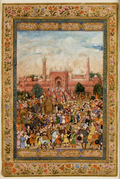


>आज़ादी mNo edit summary |
robot: Update article (please report if you notice any mistake or error in this edit) |
||
| Line 3: | Line 3: | ||
{{Use dmy dates|date=April 2020}} | {{Use dmy dates|date=April 2020}} | ||
{{Infobox royalty | {{Infobox royalty | ||
|name=Farrukhsiyar | | name = Farrukhsiyar<br>فرخ سیر | ||
|title= | | title = [[Padishah]] | ||
|image=File:The Emperor Farrukhsiyar on his balcony 1715-1719, Bibliothèque nationale de France, Paris.jpg | | image = File:The Emperor Farrukhsiyar on his balcony 1715-1719, Bibliothèque nationale de France, Paris.jpg | ||
|caption = | | caption = | ||
|succession = 10th [[Mughal emperors|Mughal Emperor]] | | succession = 10th [[Mughal emperors|Mughal Emperor]] | ||
|reign =11 January 1713 – 28 February 1719 | | reign = 11 January 1713 – 28 February 1719 | ||
|predecessor=[[Jahandar Shah]] | | predecessor = [[Jahandar Shah]] | ||
|successor=[[Rafi ud-Darajat]] | | successor = [[Rafi ud-Darajat|Rafi-ud-Darajat]] | ||
|spouse=Gauhar-un-Nissa Begum | | spouse = {{Ubl|Gauhar-un-Nissa Begum | ||
|issue= [[Badshah Begum]] | |{{marriage|[[Indira Kanwar]]<br/>|1715}} | ||
|full name=Abu'l Muzaffar Muin ud-din Muhammad Shah Farrukh-siyar Alim Akbar Sani Wala Shan Padshah-i-bahr-u-bar | |{{marriage|Bai Bhup Devi<br/>|1717}}}} | ||
| dynasty = [[Mughal | | issue = [[Badshah Begum]] | ||
|father =[[Azim-ush-Shan]] | | full name = Abu'l Muzaffar Muin ud-din Muhammad Shah Farrukh-siyar Alim Akbar Sani Wala Shan Padshah-i-bahr-u-bar | ||
|mother =Sahiba Niswan | | dynasty = [[File:Timurid.svg|25px]] [[Timurid dynasty]] | ||
|birth_date=20 August | | module = {{Infobox military person | ||
|birth_place=[[Aurangabad, Maharashtra|Aurangabad]], [[Mughal Empire]] | | embed = yes | ||
|death_date=19 April 1719 (aged | | battles = [[Siege of Gurdaspur|Siege of Gurdaspur (1715)]] <br> <br> [[Battle of Gurdas Nangal|Battle of Gurdas Nangal (1715)]] | ||
|death_place=[[Delhi]], [[Mughal Empire]] | }} | ||
|place of burial= [[Humayun's Tomb]], Delhi | | house = [[File:Imperial Seal of the Mughal Empire.svg|25px]] [[Mughal Dynasty|House of Babur]] | ||
| religion = [[Islam]] | | father = [[Azim-ush-Shan]] | ||
| mother = Sahiba Niswan | |||
| birth_date = 20 August 1683 | |||
| birth_place = [[Aurangabad, Maharashtra|Aurangabad]], [[Mughal Empire]] | |||
| death_date = 19 April 1719<br>(aged of 35) | |||
| death_place = [[Delhi]], [[Mughal Empire]] | |||
| place of burial = [[Humayun's Tomb]], Delhi | |||
| religion = [[Sunni Islam]]| | |||
}} | |||
{{Mughal}} | {{Mughal}} | ||
''' | '''Farrukhsiyar''', ({{IPA-fa|farʊx'sɪjar}}) also known as '''Shahid-i-Mazlum''' (20 August 1683{{Snd}}9 April 1719), was the tenth [[Mughal emperor]] from 1713 to 1719, after he assassinated his Uncle and Emperor, [[Jahandar Shah]].<ref name="sen2">{{Cite book |last=Sen |first=Sailendra |title=A Textbook of Medieval Indian History |publisher=Primus Books |year=2013 |isbn=978-93-80607-34-4 |pages=193}}</ref> Reportedly a handsome man who was easily swayed by his advisers, he lacked the ability, knowledge and character to rule independently. Farrukhsiyar was the son of [[Azim-ush-Shan]] (the second son of emperor [[Bahadur Shah I]]) and Sahiba Nizwan. He was assassinated by the Sayyid brothers. | ||
({{ | |||
== Early life == | == Early life == | ||
Muhammad Farrukhsiyar was born on 20 August | Muhammad Farrukhsiyar was born on 20 August 1683 (9th Ramzan 1094 [[Anno Hegirae|AH]]) in the city of [[Aurangabad, Maharashtra|Aurangabad]] on the [[Deccan plateau]]. He was the second son of [[Azim-ush-Shan]]. In 1696, Farrukhsiyar accompanied his father on his campaign to [[Bengal]]. [[Mughal emperor]] [[Aurangzeb]] recalled his grandson, Azim-ush-Shan, from Bengal in 1707 and instructed Farrukhsiyar to take charge of the province. Farrukhsiyar spent his early years in the capital city of [[Dhaka]] (in present-day [[Bangladesh]]); during the reign of his Grandfather [[Bahadur Shah I]], he moved to [[Murshidabad]] (present-day [[West Bengal]], India).{{sfn|Irvine|p=198}} | ||
In 1712 Azim-ush-Shan anticipated Bahadur Shah I's death and a struggle for power, and recalled Farrukhsiyar. He was marching past [[Patna|Azimabad]] (present-day [[Patna]], [[Bihar]], India) when he learned of the Mughal emperor's death. On 21 March Farrukhsiyar proclaimed his father's accession to the throne, issued coinage in his name and ordered ''[[khutba]]'' (public prayer).{{sfn|Irvine|p=198}} On 6 April, he learned of his father's defeat. Although the prince considered suicide, he was dissuaded by his friends from Bengal.{{sfn|Irvine|p=199}} | In 1712 Azim-ush-Shan anticipated Bahadur Shah I's death and a struggle for power, and recalled Farrukhsiyar. He was marching past [[Patna|Azimabad]] (present-day [[Patna]], [[Bihar]], India) when he learned of the Mughal emperor's death. On 21 March, Farrukhsiyar proclaimed his father's accession to the throne, issued coinage in his name and ordered ''[[khutba]]'' (public prayer).{{sfn|Irvine|p=198}} On 6 April, he learned of his father's defeat. Although the prince considered suicide, he was dissuaded by his friends from Bengal.{{sfn|Irvine|p=199}} | ||
== War of succession == | == War of succession == | ||
[[File:Farrukhsiyar receiving Husain Ali Khan ca. 1715 British Library.jpg|thumb|alt=A seated Farrukhsiyar, with an attendant behind him, receives Hussain Ali Khan|Farrukhsiyar receiving Hussain Ali Khan, ca. 1715]] | [[File:Farrukhsiyar receiving Husain Ali Khan ca. 1715 British Library.jpg|thumb|alt=A seated Farrukhsiyar, with an attendant behind him, receives Hussain Ali Khan|Farrukhsiyar receiving Hussain Ali Khan, ca. 1715]] | ||
In 1712 [[Jahandar Shah]] (Farrukhsiyar's uncle) ascended the throne of the [[Mughal empire]] by defeating Farrukhsiyar's father, Azim-ush-Shan. Farrukhsiyar wanted revenge for his father's death and was joined by Hussain Ali Khan (the ''[[subahdar]]'' of Bengal) and Abdullah Khan, his brother and the ''subahdar'' of [[Allahabad]].{{sfn|Asiatic Society of Bengal|p=273}} | In 1712, [[Jahandar Shah]] (Farrukhsiyar's uncle) ascended the throne of the [[Mughal empire]] by defeating Farrukhsiyar's father, Azim-ush-Shan. Farrukhsiyar wanted revenge for his father's death and was joined by Hussain Ali Khan (the ''[[subahdar]]'' of Bengal) and Abdullah Khan, his brother and the ''subahdar'' of [[Allahabad]].{{sfn|Asiatic Society of Bengal|p=273}} | ||
When they reached [[Allahabad]] from Azimabad, Jahandar Shah's military general Syed Abdul Ghaffar Khan Gardezi and 12,000 troops clashed with Abdullah Khan | When they reached [[Allahabad]] from Azimabad, Jahandar Shah's military general Syed Abdul Ghaffar Khan Gardezi and 12,000 troops clashed with Abdullah Khan, resulting in Abdullah retreating to the [[Allahabad Fort]]. However, Gardezi's army fled when they learned about his death. After the defeat, Jahandar Shah sent general Khwaja Ahsan Khan and his son Aazuddin. When they reached Khajwah (present-day [[Fatehpur district]], [[Uttar Pradesh]], India), they learned that Farrukhsiyar was accompanied by Hussain Ali Khan and Abdullah Khan. With Abdullah Khan commanding the [[vanguard]], Farrukhsiyar began the attack. After a night-long artillery fight, Aazuddin and Khwaja Ahsan Khan fled and the camp fell to Farrukhsiyar.{{sfn|Asiatic Society of Bengal|p=273}} | ||
On 10 January 1713 Farrukhsiyar and Jahandar Shah's forces met at Samugarh, {{convert|9|mi|km|order=flip}} east of [[Agra]] in present-day Uttar Pradesh. Jahandar Shah was defeated and imprisoned, and the following day Farrukhsiyar proclaimed himself the Mughal emperor.{{sfn|Asiatic Society of Bengal|p=274}} On 12 February | On 10 January 1713, Farrukhsiyar and Jahandar Shah's forces met at Samugarh, {{convert|9|mi|km|order=flip}} east of [[Agra]] in present-day Uttar Pradesh. Jahandar Shah was defeated and imprisoned, and the following day Farrukhsiyar proclaimed himself the Mughal emperor.{{sfn|Asiatic Society of Bengal|p=274}} On 12 February, Farrukhsiyar marched to the Mughal capital of [[Delhi]], capturing the [[Red Fort]] and the citadel. Jahandar Shah's head, mounted on a bamboo rod, was carried by an executioner on an elephant and his body was carried by another elephant.{{sfn|Irvine|p=255}} | ||
== Reign == | == Reign == | ||
| Line 73: | Line 76: | ||
=== Campaign against Sikhs and execution of Banda Bahadur === | === Campaign against Sikhs and execution of Banda Bahadur === | ||
[[ | [[Banda Singh Bahadur]] was a [[Sikh]] leader who, by early 1700, had captured parts of the [[Punjab region]].<ref name="Banda">{{cite web|title=Marathas and the English Company 1707–1800|url=http://www.san.beck.org/2-10-Marathas1707-1800.html|publisher=San Beck|access-date=18 March 2017}}</ref> Mughal emperor [[Bahadur Shah I]] failed to suppress Banda's uprising.{{sfn|Richards|p=258}}{{full citation needed|date=May 2017}} | ||
In 1714, the Sirhind ''[[faujdar]]'' (garrison commander) Zainuddin Ahmad Khan attacked the Sikhs near [[Ropar]]. In 1715, Farrukhisyar sent 20,000 troops under Qamaruddin Khan, Abdus Samad Khan and [[Zakariya Khan Bahadur]] to defeat Bahadur.<ref name="Banda" /> After an eight-month siege at [[Gurdaspur]], Bahadur surrendered after he ran out of ammunition. Bahadur and his 200 companions were arrested and brought to Delhi; he was paraded around the city of [[Sirhind]].{{sfn|Singha|p=15}} | In 1714, the Sirhind ''[[faujdar]]'' (garrison commander) Zainuddin Ahmad Khan attacked the Sikhs near [[Ropar]]. In 1715, Farrukhisyar sent 20,000 troops under Qamaruddin Khan, Abdus Samad Khan and [[Zakariya Khan Bahadur]] to defeat Bahadur.<ref name="Banda" /> After an eight-month siege at [[Gurdaspur]], Bahadur surrendered after he ran out of ammunition. Bahadur and his 200 companions were arrested and brought to Delhi; he was paraded around the city of [[Sirhind]].{{sfn|Singha|p=15}} | ||
| Line 82: | Line 85: | ||
[[File:Farrukhsiyar.jpg|thumb|alt=Painting of Farrukhsiyar smoking a hookah with a female attendant|upright|Moonlit portrait of Farrukhsiyar smoking a hookah with a female attendant]] | [[File:Farrukhsiyar.jpg|thumb|alt=Painting of Farrukhsiyar smoking a hookah with a female attendant|upright|Moonlit portrait of Farrukhsiyar smoking a hookah with a female attendant]] | ||
In 1717, Farrukhsiyar issued a ''farman'' giving the [[British East India Company]] the right to reside and trade in the Mughal Empire. They were allowed to trade freely, except for a yearly payment of 3,000 [[rupees]]. This was because [[William Hamilton (surgeon)|William Hamilton]], a surgeon associated with the company cured Farrukhsiyar of a disease.<ref>{{cite book|author1=Samaren Roy|title=Calcutta: Society and Change 1690–1990|date=May 2005|publisher=iUniverse|isbn=978-0-595-34230-3|page=29}}</ref> The company was given the right to issue ''[[Dastak (trade permit)|dastak]]'' (passes) for the movement of goods, which was misused by company officials for personal gain.<ref>{{cite book|title=History and Civics|author1=Vipul Singh, Jasmine Dhillon, Gita Shanmugavel|publisher=Pearson India|isbn=978-81-317-6320-9|page=73}}</ref> | In 1717, Farrukhsiyar issued a ''farman'' giving the [[British East India Company]] the right to reside and trade in the Mughal Empire. They were allowed to trade freely, except for a yearly payment of 3,000 [[rupees]]. This was because [[William Hamilton (surgeon)|William Hamilton]], a surgeon associated with the company cured Farrukhsiyar of a disease.<ref>{{cite book|author1=Samaren Roy|title=Calcutta: Society and Change 1690–1990|date=May 2005|publisher=iUniverse|isbn=978-0-595-34230-3|page=29}}</ref> The company was given the right to issue ''[[Dastak (trade permit)|dastak]]'' (passes) for the movement of goods, which was misused by company officials for personal gain.<ref>{{cite book|title=History and Civics|author1=Vipul Singh, Jasmine Dhillon, Gita Shanmugavel|publisher=Pearson India|isbn=978-81-317-6320-9|page=73}}</ref> | ||
[[File:Portret van Farruk Siyar te paard, RP-T-1991-5.jpg|thumb]] | |||
The ''farman'' allowed the [[East India Company|British East-India company]] to carry out duty-free trade in the [[Bengal|province of Bengal]]. They were given ''dastaks'' (passes), which were misused by the employees of the Company. They used the dastaks in their own private trade, which angered the [[Nawabs of Bengal and Murshidabad|Nawab of Bengal]], [[Alivardi Khan]]. Later on, [[Mir Qasim]] (Nawab of Bengal) abolishes the duty for the local Indian traders as well, to place them at an equal footing as the Company.<ref>{{cite book|title=Inspired History|publisher=Orient Blackswan Private Limited|isbn=978-93-86689-20-7|page=57}}</ref> | |||
=== {{anchor|Final struggle with the Syeds}}Final struggle with the Sayyids === | === {{anchor|Final struggle with the Syeds}}Final struggle with the Sayyids === | ||
| Line 96: | Line 101: | ||
The following were governors of the provinces; the governor of [[South India]] was Chin Qilich Khan, who appointed deputy governors:{{sfn|Irvine|p=261}}{{sfn|Irvine|p=262}}{{sfn|Irvine|p=263}} | The following were governors of the provinces; the governor of [[South India]] was Chin Qilich Khan, who appointed deputy governors:{{sfn|Irvine|p=261}}{{sfn|Irvine|p=262}}{{sfn|Irvine|p=263}} | ||
{| class="wikitable" | {| class="wikitable" | ||
!colspan="2"|North India | ! colspan="2" |North India | ||
!colspan="2"|South India | ! colspan="2" |South India | ||
|- | |- | ||
! Province !! Governor/Chief Minister !! Province !! Deputy governor | ! Province !! Governor/Chief Minister !! Province !! Deputy governor | ||
| Line 131: | Line 136: | ||
== Deposition == | == Deposition == | ||
[[File:Portret van de grootmogol Farrukhsiyar, RP-T-1996-76.jpg|thumb]] | |||
In 1713 the new Mughal emperor Farrukhsiyar appointed [[Ajit Singh of Marwar]] as governor of [[Thatta ]] [[Subah#List_of_Subahs_of_the_Mughal_Empire|Subah]]. Ajit Singh refused to go to the impoverished province and Farrukhsiyar sent [[Husain Ali Braha]] to subdue Ajit Singh, but also sent a private letter to Ajit Singh promising him blessings if he defeated Husain. Instead Ajit Singh chose to negotiate with Husain, accepting the governorship of Thatta with a promise for a return to Gujarat in the near future. One of the other conditions of this peace agreement was the marriage of one of the daughters of the Jodhpur Raja with the Mughal emperor. | |||
Ajit Singh later took his revenge against Farrukhsiyar on 28 February 1719.<ref>{{cite book|url=https://archive.org/details/in.ernet.dli.2015.280772|title=William Irvine|page=[https://archive.org/details/in.ernet.dli.2015.280772/page/n852 379]-418}}</ref> Ajit Singh, besieged Farrukhsiyar in the [[Red Fort]] and after a night-long battle entered the palace grounds, at first Qutb-Ul-Mulk tried to stop Ajit Singh from entering, upon which the enraged Ajit stabbed him to death and told his Rajput and Pathan soldiers to arrest Farrukhsiyar. The emperor was caught hiding in the harem with his mother, wives and daughters, he tried to resist but was caught and dragged to a small room in Tripoliya gate, where he was tortured and blinded with a needle. The old Mughal officials cried for mercy and Raja Jai singh of Jaipur and Nizam-Ul-Mulk of Hyderabad did send threats but none of them took any action. On 2nd March 1719, Rafi-Ud-Darjat was chosen from the princes and Ajit Singh and the Nawab took his hand and placed him on the peacock throne.{{sfn|Irvine|p=390}} | |||
== Personal life == | == Personal life == | ||
=== Family === | === Family === | ||
Farrukhsiyar's first wife was Fakhr- | Farrukhsiyar's first wife was Fakhr-Un-Nissa Begum, also known as Gauhar-Un-Nissa, the daughter of Mir Muhammad Taqi (known as Hasan Khan and then Sadat Khan). Taqi, from the Persian province of [[Mazandaran]], married the daughter of Masum Khan Safawi; if she was the mother of Fakhr-un-nissa, this would account for her daughter's selection as the prince's wife.{{sfn|Irvine|p=400-1}} | ||
His second wife was Bai [[Indira Kanwar]], the daughter of Maharajah Ajit Singh. {{sfn|Irvine|p=400}} She married Farrukhsiyar on 27 September 1715, during the fourth year of his reign, and they had no children. After Farrukhsiyar's deposition and death she left the imperial harem on 16 July 1719, she returned to her father with her property and lived her remaining years in Jodhpur.{{sfn|Irvine|p=401}} | His second wife was Bai [[Indira Kanwar]], the daughter of Maharajah Ajit Singh. {{sfn|Irvine|p=400}} She married Farrukhsiyar on 27 September 1715, during the fourth year of his reign, and they had no children. After Farrukhsiyar's deposition and death she left the imperial harem on 16 July 1719, she returned to her father with her property and lived her remaining years in Jodhpur.{{sfn|Irvine|p=401}} | ||
Farrukhsiyar's third wife was Bai Bhup Devi, daughter of Jaya Singh (the raja of [[Kishtwar]], who had converted to Islam and received the name of Bakhtiyar Khan). After Jaya Singh's death he was succeeded by his son, Kirat Singh. In 1717, in response to a message from the [[ | Farrukhsiyar's third wife was Bai Bhup Devi, daughter of Jaya Singh (the raja of [[Kishtwar]], who had converted to Islam and received the name of Bakhtiyar Khan). After Jaya Singh's death he was succeeded by his son, Kirat Singh. In 1717, in response to a message from the [[Mufti]] of [[Delhi]], her brother Kirat Singh sent her to Delhi with her brother Mian Muhammad Khan. Farrukhsiyar married her, and she entered the imperial harem on 3 July 1717.{{sfn|Irvine|p=401}}<ref>{{cite book|title=Proceedings – Punjab History Conference – Volumes 29-30|publisher=Punjabi University|year=1998|page=85}}</ref> | ||
=== Titles === | === Titles === | ||
His full name was Abul Muzaffer Muinuddin Muhammad Farrukhsiyar Badshah.{{sfn|Irvine|p=398}} | His full name was Abul Muzaffer Muinuddin Muhammad Farrukhsiyar Badshah.{{sfn|Irvine|p=398}} | ||
Posthumously, he was known as ''"Shahid-i-marhum"'' (the martyr received with mercy).{{sfn|Irvine|p=399}} | Posthumously, he was known as ''"Shahid-i-marhum"'' (the martyr received with mercy).{{sfn|Irvine|p=399}}{{Multiple image | ||
{{Multiple image | |||
|direction=vertical | |direction=vertical | ||
|width=180 | |width=180 | ||
|image1=Silver rupee coin of Farrukhsiyar, issue from Etawah.jpg | |image1=Silver rupee coin of Farrukhsiyar, issue from Etawah.jpg | ||
|alt1=Two sides of a silver coin | |alt1=Two sides of a silver coin | ||
|footer=Silver rupee and gold | |footer=Silver rupee and gold mohur from the reign of Farrukhsiyar | ||
|footer_align=center | |footer_align=center | ||
|image2=Gold Mohur des Farrukh Siyar.jpg | |image2=Gold Mohur des Farrukh Siyar.jpg | ||
|alt2=Two sides of a gold coin | |alt2=Two sides of a gold coin | ||
}} | }} | ||
=== Coinage === | |||
On coins issued during Farrukhsiyar's reign, the following phrase was inscribed: ''"Sikka zad az fazl-i-Haq bar sim o zar/ Padshah-i-bahr-o-bar Farrukhsiyar"'' (By the grace of the true God, struck on silver and gold, the emperor of land and sea, Farrukhsiyar).{{sfn|Irvine|p=399}} | On coins issued during Farrukhsiyar's reign, the following phrase was inscribed: ''"Sikka zad az fazl-i-Haq bar sim o zar/ Padshah-i-bahr-o-bar Farrukhsiyar"'' (By the grace of the true God, struck on silver and gold, the emperor of land and sea, Farrukhsiyar).{{sfn|Irvine|p=399}} | ||
There are 116 coins from his reign on display at the [[Lahore Museum]] and the [[Indian Museum]] in [[Kolkata]]. The coins were minted in [[Kabul]], [[Kashmir]], [[Ajmer]], [[Allahabad]], [[Bidar]] and [[Berar Subah|Berar]].{{sfn|Irvine|p=399}} | There are 116 coins from his reign on display at the [[Lahore Museum]] and the [[Indian Museum]] in [[Kolkata]]. The coins were minted in [[Kabul]], [[Kashmir]], [[Ajmer]], [[Allahabad]], [[Bidar]] and [[Berar Subah|Berar]].{{sfn|Irvine|p=399}} | ||
| Line 166: | Line 172: | ||
The town of [[Farrukhabad]] in [[Uttar Pradesh]] was also named after him. | The town of [[Farrukhabad]] in [[Uttar Pradesh]] was also named after him. | ||
== References == | |||
<references /> | |||
== | == Bibliography == | ||
{{Commons category}} | {{Commons category}} | ||
* {{citation|title=The Later Mughals|author-link=William Irvine (historian)|first=William|last=Irvine|isbn=81-7536-406-8|publisher=Low Price Publications}} | * {{citation|title=The Later Mughals|author-link=William Irvine (historian)|first=William|last=Irvine|isbn=81-7536-406-8|publisher=Low Price Publications}} | ||
| Line 181: | Line 182: | ||
* {{citation|first=H.S.|last= Singha|title=Sikh Studies, Book 6|date=1 January 2005|publisher=Hemkunt Press|isbn=978-81-7010-258-8|ref={{harvid|Singha}} }} | * {{citation|first=H.S.|last= Singha|title=Sikh Studies, Book 6|date=1 January 2005|publisher=Hemkunt Press|isbn=978-81-7010-258-8|ref={{harvid|Singha}} }} | ||
* {{citation|first=Satish|last= Chandra|author-link=Satish Chandra|title=Medieval India: From Sultanat to the Mughal Empire|date= July 2007|publisher=Har Anand Publications Pvt Ltd.|isbn=978-81-241-1269-4}} | * {{citation|first=Satish|last= Chandra|author-link=Satish Chandra|title=Medieval India: From Sultanat to the Mughal Empire|date= July 2007|publisher=Har Anand Publications Pvt Ltd.|isbn=978-81-241-1269-4}} | ||
{{s-start}} | |||
{{s-hou|[[Timurid dynasty]]||}} | |||
{{succession box|title=[[Mughal Emperor]]|before=[[Jahandar Shah]]|after=[[Rafi Ul-Darjat]]|years=1713–1719}} | |||
{{s-end}} | |||
{{Authority control}} | {{Authority control}} | ||
| Line 193: | Line 199: | ||
[[Category:People from Marathwada]] | [[Category:People from Marathwada]] | ||
[[Category:18th-century murdered monarchs]] | [[Category:18th-century murdered monarchs]] | ||
[[Category:18th-century murders in Asia]] | |||
Revision as of 00:26, 14 June 2022
| Farrukhsiyar فرخ سیر | |||||
|---|---|---|---|---|---|
| Padishah | |||||
 | |||||
| 10th Mughal Emperor | |||||
| Reign | 11 January 1713 – 28 February 1719 | ||||
| Predecessor | Jahandar Shah | ||||
| Successor | Rafi-ud-Darajat | ||||
| Born | 20 August 1683 Aurangabad, Mughal Empire | ||||
| Died | 19 April 1719 (aged of 35) Delhi, Mughal Empire | ||||
| Burial | Humayun's Tomb, Delhi | ||||
| Spouse |
| ||||
| Issue | Badshah Begum | ||||
| |||||
| House |  House of Babur House of Babur | ||||
| Dynasty |  Timurid dynasty Timurid dynasty | ||||
| Father | Azim-ush-Shan | ||||
| Mother | Sahiba Niswan | ||||
| Religion | Sunni Islam | ||||
| Military career | |||||
| Battles/wars | Siege of Gurdaspur (1715) Battle of Gurdas Nangal (1715) | ||||
| Mughal emperors | ||||||||||||||||||||||||||||||||||||||||||||||
|---|---|---|---|---|---|---|---|---|---|---|---|---|---|---|---|---|---|---|---|---|---|---|---|---|---|---|---|---|---|---|---|---|---|---|---|---|---|---|---|---|---|---|---|---|---|---|
|
||||||||||||||||||||||||||||||||||||||||||||||
Farrukhsiyar, (Template:IPA-fa) also known as Shahid-i-Mazlum (20 August 1683 – 9 April 1719), was the tenth Mughal emperor from 1713 to 1719, after he assassinated his Uncle and Emperor, Jahandar Shah.[1] Reportedly a handsome man who was easily swayed by his advisers, he lacked the ability, knowledge and character to rule independently. Farrukhsiyar was the son of Azim-ush-Shan (the second son of emperor Bahadur Shah I) and Sahiba Nizwan. He was assassinated by the Sayyid brothers.
Early life
Muhammad Farrukhsiyar was born on 20 August 1683 (9th Ramzan 1094 AH) in the city of Aurangabad on the Deccan plateau. He was the second son of Azim-ush-Shan. In 1696, Farrukhsiyar accompanied his father on his campaign to Bengal. Mughal emperor Aurangzeb recalled his grandson, Azim-ush-Shan, from Bengal in 1707 and instructed Farrukhsiyar to take charge of the province. Farrukhsiyar spent his early years in the capital city of Dhaka (in present-day Bangladesh); during the reign of his Grandfather Bahadur Shah I, he moved to Murshidabad (present-day West Bengal, India).[2]
In 1712 Azim-ush-Shan anticipated Bahadur Shah I's death and a struggle for power, and recalled Farrukhsiyar. He was marching past Azimabad (present-day Patna, Bihar, India) when he learned of the Mughal emperor's death. On 21 March, Farrukhsiyar proclaimed his father's accession to the throne, issued coinage in his name and ordered khutba (public prayer).[2] On 6 April, he learned of his father's defeat. Although the prince considered suicide, he was dissuaded by his friends from Bengal.[3]
War of succession

In 1712, Jahandar Shah (Farrukhsiyar's uncle) ascended the throne of the Mughal empire by defeating Farrukhsiyar's father, Azim-ush-Shan. Farrukhsiyar wanted revenge for his father's death and was joined by Hussain Ali Khan (the subahdar of Bengal) and Abdullah Khan, his brother and the subahdar of Allahabad.[4]
When they reached Allahabad from Azimabad, Jahandar Shah's military general Syed Abdul Ghaffar Khan Gardezi and 12,000 troops clashed with Abdullah Khan, resulting in Abdullah retreating to the Allahabad Fort. However, Gardezi's army fled when they learned about his death. After the defeat, Jahandar Shah sent general Khwaja Ahsan Khan and his son Aazuddin. When they reached Khajwah (present-day Fatehpur district, Uttar Pradesh, India), they learned that Farrukhsiyar was accompanied by Hussain Ali Khan and Abdullah Khan. With Abdullah Khan commanding the vanguard, Farrukhsiyar began the attack. After a night-long artillery fight, Aazuddin and Khwaja Ahsan Khan fled and the camp fell to Farrukhsiyar.[4]
On 10 January 1713, Farrukhsiyar and Jahandar Shah's forces met at Samugarh, 14 kilometres (9 mi) east of Agra in present-day Uttar Pradesh. Jahandar Shah was defeated and imprisoned, and the following day Farrukhsiyar proclaimed himself the Mughal emperor.[5] On 12 February, Farrukhsiyar marched to the Mughal capital of Delhi, capturing the Red Fort and the citadel. Jahandar Shah's head, mounted on a bamboo rod, was carried by an executioner on an elephant and his body was carried by another elephant.[6]
Reign
Hostility with the Sayyid brothers

Farrukhsiyar defeated Jahandar Shah with the aid of the Sayyid brothers, and one of the brothers, Abdullah Khan, wanted the post of wazir (prime minister). His demand was rejected, since the post was promised to Ghaziuddin Khan, but Farrukhsiyar offered him a post as regent under the name of wakil-e-mutlaq. Abdullah Khan refused, saying that he deserved the post of wazir since he led Farrukhsiyar's army against Jahandar Shah. Farrukhsiyar ultimately gave in to his demand, and Abdullah Khan became prime minister.[7]
According to historian William Irvine, Farrukhsiyar's close aides Mir Jumla III and Khan Dauran sowed seeds of suspicion in his mind that they might usurp him from the throne. Learning about these developments, the other Sayyid brother (Hussain Ali Khan) wrote to Abdullah: "It was clear, from the Prince's talk and the nature of his acts, that he was a man who paid no regard to claims for service performed, one void of faith, a breaker of his word and altogether without shame".[8] Hussain Ali Khan felt it necessary to act in their interests "without regard to the plans of the new sovereign".[9]

Campaign against Ajit Singh

Maharaja Ajit Singh captured Ajmer with the support of the Marwari nobles and expelled Mughal diplomats from his state. Farrukhsiyar sent Hussain Ali Khan to subjugate him. However, the anti-Sayyid brothers faction in the Mughal emperor's court compelled him to send secret letters to Ajit Singh assuring him of rewards if he defeated Hussain Ali Khan.[10] Hussain left Delhi for Ajmer on 6 January 1714, accompanied by Sarbuland Khan and Afrasyab Khan. As his army reached Sarai Sahal, Ajit Singh sent diplomats who failed to negotiate a peace. As Hussain Ali Khan advanced to Ajmer via Jodhpur, Jaiselmer and Mairtha, Ajit Singh retreated to the deserts hoping to dissuade the Mughal general from a battle. As Hussain advanced, Ajit Singh surrendered at Mairtha.[11] As a result, Mughal authority was restored in Rajasthan. Ajit Singh gave his daughter, Indira Kanwar, as a bride to Farrukhsiyar.[12] His son, Abhai Singh, was compelled to accompany him to see the Mughal emperor.[13]
Campaign against the Jats
Due to Aurangzeb's 25-year campaign on the Deccan plateau, Mughal authority weakened in North India with the rise of local rulers. Taking advantage of the situation, the Jats advanced.[14] In early 1713, Farrukhsiyar unsuccessfully sent subahdar of Agra Chabela Ram to defeat Churaman (the Jat leader). His successor, Samsamud Daulah Khan, compelled Churaman to negotiate with the Mughal emperor. Raja Bahadur Rathore accompanied him to the Mughal court, where negotiations with Farrukhsiyar failed.[15]
In September 1716 Raja Jai Singh II undertook a campaign against Churaman, who lived in Thun (in present-day Rajasthan, India). By 19 November, Jai Singh II began besieging the Thun fort.[16] In December Churaman's son, Muhkam Singh, marched from the fort and battled Jai Singh II; the Raja claimed victory. With the Mughals running out of ammunition, Syed Muzaffar Khan was ordered to bring gunpowder, rockets and mounds of lead from the arsenal at Agra.[17]
By January 1718, the siege had lasted for more than a year. With rain coming late in 1717, prices of commodities increased and Raja Jai Singh II found it difficult to continue the siege. He wrote to Farrukhsiyar for reinforcement, saying that he had overcome "many encounters" with the Jats. This failed to impress Farrukhsiyar, so Jai Singh II (via his agent in Delhi) informed Syed Abdullah that he would give three million rupees to the government and two million rupees to the minister if he championed his cause to the emperor. With negotiations between Syed Abdullah and Farrukhsiyar successful, he accepted his demands and dispatched Syed Khan Jahan to bring Churaman to the Mughal court. He also gave a farman to Raja Jai Singh II, thanking him for the siege.[18]
On 19 April 1718, Churaman was presented to Farrukhsiyar; they negotiated for peace, with Churaman accepting Mughal authority. Khan Jahan was given the title of Bahadur ("brave"). It was decided that Churaman would pay five million rupees in cash and goods to Farrukhsiyar via Syed Abdullah.[19]
Campaign against Sikhs and execution of Banda Bahadur
Banda Singh Bahadur was a Sikh leader who, by early 1700, had captured parts of the Punjab region.[20] Mughal emperor Bahadur Shah I failed to suppress Banda's uprising.[21][full citation needed]
In 1714, the Sirhind faujdar (garrison commander) Zainuddin Ahmad Khan attacked the Sikhs near Ropar. In 1715, Farrukhisyar sent 20,000 troops under Qamaruddin Khan, Abdus Samad Khan and Zakariya Khan Bahadur to defeat Bahadur.[20] After an eight-month siege at Gurdaspur, Bahadur surrendered after he ran out of ammunition. Bahadur and his 200 companions were arrested and brought to Delhi; he was paraded around the city of Sirhind.[22]
Bahadur was put into an iron cage and the remaining Sikhs were chained.[23] They were pressured to give up their faith and become Muslims.[24] Although the emperor promised to spare the Sikhs who converted to Islam, according to William Irvine "not one prisoner proved false to his faith". On their firm refusal all were ordered to be executed.[25] The Sikhs were brought to Delhi in a procession with the 780 Sikh prisoners, 2,000 Sikh heads hung on spears, and 700 cartloads of heads of slaughtered Sikhs used to terrorise the population.[26][27] When Farrukhsiyar's army reached the Red Fort, the Mughal emperor ordered Banda Bahadur, Baj Singh, Bhai Fateh Singh and his companions to be imprisoned in Tripolia.[28] After three months of confinement,[29] On 19 June 1716 Farrukhsiyar had Bahadur and his followers executed, despite the wealthy Khatris of Delhi offering money for his release.[30] Banda Singh's eyes were gouged out, his limbs were severed, his skin removed, and then he was killed.[31]
Trade concession

In 1717, Farrukhsiyar issued a farman giving the British East India Company the right to reside and trade in the Mughal Empire. They were allowed to trade freely, except for a yearly payment of 3,000 rupees. This was because William Hamilton, a surgeon associated with the company cured Farrukhsiyar of a disease.[32] The company was given the right to issue dastak (passes) for the movement of goods, which was misused by company officials for personal gain.[33]

The farman allowed the British East-India company to carry out duty-free trade in the province of Bengal. They were given dastaks (passes), which were misused by the employees of the Company. They used the dastaks in their own private trade, which angered the Nawab of Bengal, Alivardi Khan. Later on, Mir Qasim (Nawab of Bengal) abolishes the duty for the local Indian traders as well, to place them at an equal footing as the Company.[34]
Final struggle with the Sayyids
By 1715, Farrukhsiyar had given Mir Jumla III the power to sign documents on his behalf: "The word and seal of Mir Jumla are my word and seal". Mir Jumla III began approving proposals for jagirs and mansabs without consulting Syed Abdullah, the prime minister.[35] Syed Abdullah's deputy Ratan Chand accepted bribes for him to do work and was involved in revenue farming, which was forbidden by the Mughal emperor. Taking advantage of the situation, Mir Jumla III told Farrukhsiyar that the Sayyids were unfit to hold office and accused them of insubordination. Hoping to depose the brothers, Farrukhsiyar began making military preparations and increased the number of soldiers under Mir Jumla III and Khan Dauran.[36]
After Syed Hussain learned about Farrukhsiyar's plans, he felt that their position could be cemented by controlling "important provinces". He asked to be appointed viceroy of the Deccan, instead of Nizam ul Mulk; Farrukhsiyar refused, transferring him to the Deccan instead. Fearing attack by Farrukhsiyar's supporters, the brothers began making military preparations. Although Farrukhsiyar initially considered giving the task of crushing the brothers to Mohammad Amin Khan (who wanted the position of prime minister in return), he decided against it because removing him would be difficult.[37]
Arriving at the Deccan, Syed Hussain made a treaty with Maratha ruler Shahu I in February 1718. Shahu was allowed to collect sardeshmukhi in Deccan, and received the lands of Berar and Gondwana to govern. In return, Shahu agreed to pay one million rupees annually and maintain an army of 15,000 horses for the Sayyids. This agreement was reached without Farrukhsiyar's approval,[38] and he was angry when he learned about it: "It was not proper for the vile enemy to be overbearing partners in matters of revenue and government."[39]
State of the Mughal Empire
Appointments
Farrukhsiyar appointed Sayid Abdullah Khan as chief minister and placed Muhammad Baqir Mutamid Khan in charge of the Exchequer. The title of bakshi was first conferred on Hussain Ali Khan (with the titles of Umdat-ul-Mulk, Amir-ul-umara and Bahadur Firuz Jung) and then to Chin Qilich Khan and Afrasayab Khan Bahadur.[40]
The following were governors of the provinces; the governor of South India was Chin Qilich Khan, who appointed deputy governors:[41][42][43]
| North India | South India | ||
|---|---|---|---|
| Province | Governor/Chief Minister | Province | Deputy governor |
| Agra | Shams ud Daula Shah Khan-i Dauran | Berar | Iwaz Khan |
| Ajmer | Syed Muzaffar Khan Barha | Bidar | Amin Khan |
| Allahabad | Khan Jahan | Bijapur | Mansur Khan |
| Awadh | Sarbuland Khan | Burhanpur | Shukrullah Khan |
| Bengal | Farkhunda Bakht | Hyderabad | Yusuf Khan |
| Bihar | Syed Hussain Ali Khan | Karnataka | Saadatullah Khan |
| Delhi | Muhammad Yar Khan | ||
| Gujarat | Shahamat Khan | ||
| Kabul | Bahadur Nasir Jang | ||
| Kashmir | Saadat Khan | ||
| Lahore | Abdus Samad Khan | ||
| Malwa | Raja Jai Singh of Amber | ||
| Multan | Qutb-ul-Mulk | ||
| Orissa | Murshid Quli Khan | ||
Deposition

In 1713 the new Mughal emperor Farrukhsiyar appointed Ajit Singh of Marwar as governor of Thatta Subah. Ajit Singh refused to go to the impoverished province and Farrukhsiyar sent Husain Ali Braha to subdue Ajit Singh, but also sent a private letter to Ajit Singh promising him blessings if he defeated Husain. Instead Ajit Singh chose to negotiate with Husain, accepting the governorship of Thatta with a promise for a return to Gujarat in the near future. One of the other conditions of this peace agreement was the marriage of one of the daughters of the Jodhpur Raja with the Mughal emperor.
Ajit Singh later took his revenge against Farrukhsiyar on 28 February 1719.[44] Ajit Singh, besieged Farrukhsiyar in the Red Fort and after a night-long battle entered the palace grounds, at first Qutb-Ul-Mulk tried to stop Ajit Singh from entering, upon which the enraged Ajit stabbed him to death and told his Rajput and Pathan soldiers to arrest Farrukhsiyar. The emperor was caught hiding in the harem with his mother, wives and daughters, he tried to resist but was caught and dragged to a small room in Tripoliya gate, where he was tortured and blinded with a needle. The old Mughal officials cried for mercy and Raja Jai singh of Jaipur and Nizam-Ul-Mulk of Hyderabad did send threats but none of them took any action. On 2nd March 1719, Rafi-Ud-Darjat was chosen from the princes and Ajit Singh and the Nawab took his hand and placed him on the peacock throne.[45]
Personal life
Family
Farrukhsiyar's first wife was Fakhr-Un-Nissa Begum, also known as Gauhar-Un-Nissa, the daughter of Mir Muhammad Taqi (known as Hasan Khan and then Sadat Khan). Taqi, from the Persian province of Mazandaran, married the daughter of Masum Khan Safawi; if she was the mother of Fakhr-un-nissa, this would account for her daughter's selection as the prince's wife.[46]
His second wife was Bai Indira Kanwar, the daughter of Maharajah Ajit Singh. [47] She married Farrukhsiyar on 27 September 1715, during the fourth year of his reign, and they had no children. After Farrukhsiyar's deposition and death she left the imperial harem on 16 July 1719, she returned to her father with her property and lived her remaining years in Jodhpur.[48]
Farrukhsiyar's third wife was Bai Bhup Devi, daughter of Jaya Singh (the raja of Kishtwar, who had converted to Islam and received the name of Bakhtiyar Khan). After Jaya Singh's death he was succeeded by his son, Kirat Singh. In 1717, in response to a message from the Mufti of Delhi, her brother Kirat Singh sent her to Delhi with her brother Mian Muhammad Khan. Farrukhsiyar married her, and she entered the imperial harem on 3 July 1717.[48][49]
Titles
His full name was Abul Muzaffer Muinuddin Muhammad Farrukhsiyar Badshah.[50]
Posthumously, he was known as "Shahid-i-marhum" (the martyr received with mercy).[51]


Coinage
On coins issued during Farrukhsiyar's reign, the following phrase was inscribed: "Sikka zad az fazl-i-Haq bar sim o zar/ Padshah-i-bahr-o-bar Farrukhsiyar" (By the grace of the true God, struck on silver and gold, the emperor of land and sea, Farrukhsiyar).[51] There are 116 coins from his reign on display at the Lahore Museum and the Indian Museum in Kolkata. The coins were minted in Kabul, Kashmir, Ajmer, Allahabad, Bidar and Berar.[51]
Legacy
The town of Farrukhnagar in Gurgaon district, 32 kilometres (20 mi) south of Delhi, was named for him. During his reign, he built a Sheesh Mahal (palace) and a Jama Masjid (mosque) there.
The town of Farrukhabad in Uttar Pradesh was also named after him.
References
- ↑ Sen, Sailendra (2013). A Textbook of Medieval Indian History. Primus Books. p. 193. ISBN 978-93-80607-34-4.
- ↑ 2.0 2.1 Irvine, p. 198.
- ↑ Irvine, p. 199.
- ↑ 4.0 4.1 Asiatic Society of Bengal, p. 273.
- ↑ Asiatic Society of Bengal, p. 274.
- ↑ Irvine, p. 255.
- ↑ Tazkirat ul-Mulk by Yahya Khan p.122
- ↑ Irvine, p. 282.
- ↑ Irvine, p. 283.
- ↑ The Cambridge Shorter history of India p.456
- ↑ Irvine, p. 288–290.
- ↑ Fisher, p. 78.
- ↑ Irvine, p. 290.
- ↑ Irvine, p. 322.
- ↑ Irvine, p. 323.
- ↑ Irvine, p. 324.
- ↑ Irvine, p. 325.
- ↑ Irvine, p. 326.
- ↑ Irvine, p. 327.
- ↑ 20.0 20.1 "Marathas and the English Company 1707–1800". San Beck. Retrieved 18 March 2017.
- ↑ Richards, p. 258.
- ↑ Singha, p. 15.
- ↑ Duggal, Kartar (2001). Maharaja Ranjit Singh: The Last to Lay Arms. Abhinav Publications. p. 41. ISBN 9788170174103.
- ↑ Singh, Gurbaksh (1927). The Khalsa Generals. Canadian Sikh Study & Teaching Society. p. 12. ISBN 0969409249.
- ↑ Jawandha, Nahar (2010). Glimpses of Sikhism. Sanbun Publishers. p. 89. ISBN 9789380213255.
- ↑ Johar, Surinder (1987). Guru Gobind Singh. The University of Michigan: Enkay Publishers. p. 208. ISBN 9788185148045.
- ↑ Sastri, Kallidaikurichi (1978). A Comprehensive History of India: 1712–1772. The University of Michigan: Orient Longmans. p. 245.
- ↑ Singha, p. 16.
- ↑ Singh, Ganda (1935). Life of Banda Singh Bahadur: Based on Contemporary and Original Records. Sikh History Research Department. p. 229.
- ↑ Irvine, p. 319.
- ↑ Singh, Kulwant (2006). Sri Gur Panth Prakash: Episodes 1 to 81. Institute of Sikh Studies. p. 415. ISBN 9788185815282.
- ↑ Samaren Roy (May 2005). Calcutta: Society and Change 1690–1990. iUniverse. p. 29. ISBN 978-0-595-34230-3.
- ↑ Vipul Singh, Jasmine Dhillon, Gita Shanmugavel. History and Civics. Pearson India. p. 73. ISBN 978-81-317-6320-9.
{{cite book}}: CS1 maint: multiple names: authors list (link) - ↑ Inspired History. Orient Blackswan Private Limited. p. 57. ISBN 978-93-86689-20-7.
- ↑ Chandra, p. 476.
- ↑ Chandra, p. 477.
- ↑ Chandra, p. 478.
- ↑ Ram Sivasankaran (22 December 2015). The Peshwa: The Lion and the Stallion. Westland. p. 5. ISBN 978-93-85724-70-1.
- ↑ Chandra, p. 481.
- ↑ Irvine, p. 258.
- ↑ Irvine, p. 261.
- ↑ Irvine, p. 262.
- ↑ Irvine, p. 263.
- ↑ William Irvine. p. 379-418.
- ↑ Irvine, p. 390.
- ↑ Irvine, p. 400-1.
- ↑ Irvine, p. 400.
- ↑ 48.0 48.1 Irvine, p. 401.
- ↑ Proceedings – Punjab History Conference – Volumes 29-30. Punjabi University. 1998. p. 85.
- ↑ Irvine, p. 398.
- ↑ 51.0 51.1 51.2 Irvine, p. 399.
Bibliography
- Irvine, William, The Later Mughals, Low Price Publications, ISBN 81-7536-406-8
- Template:List journal
- Fisher, Michael H. (1 October 2015), A Short History of the Mughal Empire, I.B.Tauris, ISBN 978-0-85772-976-7
- Singha, H.S. (1 January 2005), Sikh Studies, Book 6, Hemkunt Press, ISBN 978-81-7010-258-8
- Chandra, Satish (July 2007), Medieval India: From Sultanat to the Mughal Empire, Har Anand Publications Pvt Ltd., ISBN 978-81-241-1269-4
Farrukhsiyar
| ||
| Preceded by Jahandar Shah |
Mughal Emperor 1713–1719 |
Succeeded by Rafi Ul-Darjat |