


>Arimaboss |
No edit summary |
||
| Line 4: | Line 4: | ||
| flag = {{flagicon|India}} {{flagicon|Trinidad and Tobago}} | | flag = {{flagicon|India}} {{flagicon|Trinidad and Tobago}} | ||
| image = East Indian Coolies in Trinidad - Project Gutenberg eText 16035.jpg | | image = East Indian Coolies in Trinidad - Project Gutenberg eText 16035.jpg | ||
| caption = Painting of Indians in Trinidad during the late 19th century | | caption = Painting of Indians in Trinidad during the late 19th century | ||
| regions = {{flag|Trinidad and Tobago}}{{nbsp|2}}470,376<br/>{{small|(plurality of the population)}}<ref>{{Cite web |url=http://indiandiaspora.nic.in/diasporapdf/chapter16.pdf|title=Archived copy|access-date=2008-01-29|archive-url=https://web.archive.org/web/20080227222826/http://indiandiaspora.nic.in/diasporapdf/chapter16.pdf|archive-date=2008-02-27|url-status=dead}}</ref> | | regions = {{flag|Trinidad and Tobago}}{{nbsp|2}}470,376 {{small|(2011 census)}}<br />{{small|(plurality of the population)}}<ref>{{Cite web |url=http://indiandiaspora.nic.in/diasporapdf/chapter16.pdf|title=Archived copy|access-date=2008-01-29|archive-url=https://web.archive.org/web/20080227222826/http://indiandiaspora.nic.in/diasporapdf/chapter16.pdf|archive-date=2008-02-27|url-status=dead}}</ref> | ||
| region1 = {{flag|United States}} | | region1 = {{flag|United States}} | ||
| pop1 = 125,000 | | pop1 = 125,000 | ||
| Line 17: | Line 17: | ||
| population = '''670,376''' | | population = '''670,376''' | ||
| popplace = | | popplace = | ||
| rels = Majority: [[File:Om.svg|15px]] [[Hinduism]]<br/>Minority: [[File: | | rels = Majority: [[File:Om.svg|15px]] [[Hinduism]]<br />Minority: [[File:AP Icon.svg|18px]] [[Christianity]] {{·}} [[File:Star and Crescent.svg|18px]] [[Islam]] {{·}} Others | ||
| langs = [[Trinidadian and Tobagonian English]]{{·}}[[Caribbean Hindustani#Trinidadian Hindustani|Trinidadian Hindustani]]{{·}}[[Hinglish]] | | langs = [[Trinidadian and Tobagonian English]]{{·}}[[Caribbean Hindustani#Trinidadian Hindustani|Trinidadian Hindustani]]{{·}} [[Hinglish]] | ||
| related = [[Indo-Caribbeans]]{{·}}[[Indo-Caribbean Americans]]{{·}}[[British Indo-Caribbean people]]{{·}}[[Indo-Guyanese]]{{·}}[[Indo-Surinamese]]{{·}}[[Indo-Jamaicans]]{{·}}[[Mauritians of Indian origin|Indo-Mauritians]]{{·}}[[Indo-Fijians]]{{·}}[[Indians in South Africa]]{{·}}[[Indian people]]{{·}} | | related = [[Indo-Caribbeans]]{{·}}[[Indo-Caribbean Americans]]{{·}}[[British Indo-Caribbean people]]{{·}}[[Indo-Guyanese]]{{·}}[[Indo-Surinamese]]{{·}}[[Indo-Jamaicans]]{{·}}[[Mauritians of Indian origin|Indo-Mauritians]]{{·}}[[Indo-Fijians]]{{·}}[[Indians in South Africa]]{{·}}[[Indian people]]{{·}}[[Non-resident Indian and person of Indian origin|Indian diaspora]] | ||
}} | }} | ||
'''Indo-Trinidadians and Tobagonians''' or ''' Indian-Trinidadians and Tobagonians''', are people of [[Non-resident Indian and person of Indian origin|Indian origin]] who are nationals of [[Trinidad and Tobago]] whose ancestors came from [[India]] and the wider [[Indian subcontinent|subcontinent]] beginning in 1845. | '''Indo-Trinidadians and Tobagonians''' or ''' Indian-Trinidadians and Tobagonians''', are people of [[Non-resident Indian and person of Indian origin|Indian origin]] who are nationals of [[Trinidad and Tobago]] whose ancestors came from [[India]] and the wider [[Indian subcontinent|subcontinent]] beginning in 1845. | ||
Indo-Trinidadians and Tobagonians are a subgroup of [[Indo-Caribbeans]], which | Indo-Trinidadians and Tobagonians are a subgroup of [[Indo-Caribbeans]], which is a subgroup of the wider [[Non-resident Indian and person of Indian origin|Indian diaspora]]. Generally, most Indians in Trinidad and Tobago can trace their ancestry back to [[northern India]], especially the [[Bhojpuri region|Bhojpur]] and [[Awadh]] region of the [[Hindi Belt]], which lies in the [[Indo-Gangetic Plain|Gangetic plains]], a plain that is located between the [[Ganga]] and [[Yamuna]] rivers and faces the mountain ranges of the [[Himalayas]] and the [[Vindhyas]]. However, some Indians may trace their ancestry to other parts of South Asia, notably [[South India|southern India]]. Indians first arrived in Trinidad and Tobago as indentured laborers through the [[Indian indenture system]] from 1845 till 1917, and some Indians and other South Asians, along with their families, later came as entrepreneurs, businesspeople, doctors, engineers, and other professional occupations beginning in the mid-20th century and continuing till present day. | ||
Indo-Trinidadians and Tobagonians are the largest ethnic group in Trinidad and Tobago, identified by the official census, about 37.6% of the population in 2011.<ref>{{Cite web |url=http://indiandiaspora.nic.in/diasporapdf/chapter16.pdf|title=Archived copy|access-date=2008-01-29|archive-url=https://web.archive.org/web/20080227222826/http://indiandiaspora.nic.in/diasporapdf/chapter16.pdf|archive-date=2008-02-27|url-status=dead}}</ref> | |||
==History== | ==History== | ||
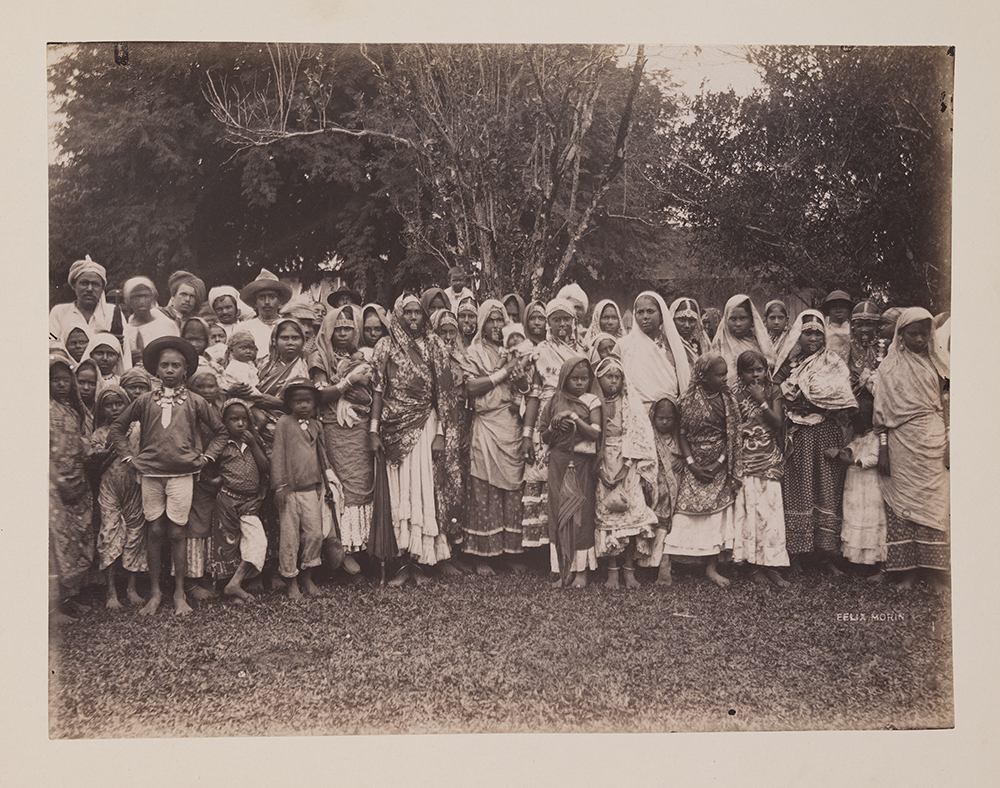
[[File:East Indian Women, Men and Children (13227675614).jpg|thumb|300px|Early Indian indentured laborers.]] | [[File:East Indian Women, Men and Children (13227675614).jpg|thumb|300px|Early Indian indentured laborers.]] | ||
In his book ''Perspectives on the Caribbean: A Reader In Culture, History, and Representation'', Philip W. Scher cites figures by Steven Vertovec, Professor of Anthropology; Of 94,135 Indian immigrants to Trinidad, between | In his book ''Perspectives on the Caribbean: A Reader In Culture, History, and Representation'', Philip W. Scher cites figures by Steven Vertovec, Professor of Anthropology; Of 94,135 Indian immigrants to Trinidad, between 1874 and 1917, 50.7 percent were from the [[North-Western Provinces]], 24.4 percent hailed from [[Oudh State]], 13.5 percent were from [[Bihar and Orissa Province|Bihar Province]] and lesser numbers from various other parts of the British Raj, such as the [[Madras Presidency]], [[Bengal Presidency]], [[Central Provinces]], [[Chota Nagpur Division]], [[Bombay Presidency]], and [[Punjab Province (British India)|Punjab Province]].<ref>Vertovec, 1992</ref> Out of 134,118 indentured labourers from India, 5,000 who left from the [[Chennai Port|Port of Madras]] distinguished themselves as "Madrasi" and the immigrants who left from the [[Port of Kolkata|Port of Calcutta]] distinguished themselves as "Kalakatiyas". However, this did not equate to their [[ethnolinguistic group]]. While, most Indians who left from the Port of Madras were [[Tamils|Tamils (Madrasis)]], not all were ethnic-Madrasis, some were [[Telugu people|Telugu]], [[Kannada people|Kannadiga]], [[Malayali]], or [[Tulu people|Tulu]], and most Indians who left from the Port of Calcutta were not ethnic-[[Bengalis|Bengalis (Kalakatiyas)]], but they were [[Bhojpuri people|Bhojpuri]] and [[Awadhi people|Awadhi]], however there were small numbers of [[Bengalis]], as well as small numbers of [[Maithils]], [[Magahi people|Magahis]], [[Bagheli]]s, [[Braj]]is, [[Bundeli]]s, [[Kannauji]]s, [[Kauravi dialect|Kauravi]]s, [[Pashtuns]], [[Nagpuri people|Nagpuris]], [[Kurukh people|Kurukhs]], [[Haryanvi people|Haryanvis]], [[Gujaratis]], [[Marwari people|Marwari]], [[Sadan people|Sadan]]s, [[Chhattisgarhi language|Chhattisgarhis]], [[Kashmiri people|Kashmiris]], [[Dogras]], [[Punjabis]], [[Marathi people|Marathis]], [[Odia people|Odia]]s, [[Garhwali people|Garhwalis]], [[Kumaoni people|Kumaonis]], [[Madheshi people|Madheshis]], [[Assamese people|Assamese]], [[Newar people|Newars]], [[Tharu people|Tharus]] and [[Khas people|Khas]] who came via the Port of Calcutta.<ref>http://library2.nalis.gov.tt/gsdl/collect/news3/index/assoc/HASH52ed.dir/doc.pdf {{Bare URL PDF|date=April 2022}}</ref><ref>{{Cite journal|url=https://www.jstor.org/stable/23050197?saml_data=eyJzYW1sVG9rZW4iOiI3NTMxMzg0MC1iY2RjLTQzMjMtOGQ5Mi1iM2IwYTRkMGU2Y2QiLCJlbWFpbCI6ImFnb2JpMDA2QGZpdS5lZHUiLCJpbnN0aXR1dGlvbklkcyI6WyI3NDlhYmIzYi1lNDIyLTRmZjUtOTM1Mi0zZWJhNzNiYzM5MjciXX0&seq=3|jstor=23050197|title=Indian Heritage in Trinidad, West Indies|last1=Jha|first1=J. C.|journal=Caribbean Quarterly|year=1973|volume=19|issue=2|pages=28–50|doi=10.1080/00086495.1973.11829152}}</ref> | ||
Indo–Trinidadian and Tobagonians has now become interchangeable with [[Indian people|Indians]] or East Indians. These were people who were escaping [[poverty in India]] and seeking employment offered by the British for jobs either as indentured labourers, workers or educated servicemen, primarily, between | Indo–Trinidadian and Tobagonians has now become interchangeable with [[Indian people|Indians]] or East Indians. These were people who were escaping [[poverty in India]] and seeking employment offered by the British for jobs either as indentured labourers, workers or educated servicemen, primarily, between 1845 and 1917.<ref>Under colonial rule, India's population provided the British Empire with a ready source of cheap and mobile labourers. Many Indians agreed to become indentured labourers to escape the widespread poverty and famine in the 19th century. Some travelled alone; others brought their families to settle in the colonies they worked in.</ref><ref>{{cite web|url=http://www.nationalarchives.gov.uk/records/research-guides/indian-indentured-labour.htm|title=Indian indentured labourers - The National Archives|website=Nationalarchives.gov.uk|access-date=17 August 2018}}</ref> | ||
The demand for Indian indentured labourers increased dramatically after the abolition of slavery in 1834. They were sent, sometimes in large numbers, to plantation colonies producing high-value crops such as sugar in Africa and the Caribbean | The demand for Indian indentured labourers increased dramatically after the abolition of slavery in 1834. They were sent, sometimes in large numbers, to plantation colonies producing high-value crops such as sugar in Africa and the Caribbean. | ||
In Trinidad some [[Chinese Trinidadian and Tobagonian|Chinese men]] had [[Chindian|Chindian children]] with dark skinned Indian women of [[Tamils|Madrasee (Tamil) origin]] and it was reported that "A few children are to be met with born of Madras and Creole parents and some also of Madras and Chinese parents - the Madrasee being the mother", by the missionary John Morton in 1876, Morton noted that it seemed strange since there were more Indian men than Indian women and that Indian women would marry Chinese men, but claimed it was most likely because the Chinese could provide amenities to the women since the Chinese owned shops and they were enticed by these.<ref>{{cite book|page=14|year=2014|access-date=June 1, 2015|publisher=Cambridge Scholars Publishing|editor1=Julitta Rydlewska |editor2=Barbara Braid|title=Unity in Diversity |volume=1: Cultural Paradigm and Personal Identity |url=https://books.google.com/books?id=WBVQBwAAQBAJ&q=some+also+of+madras+and+chinese+parents+the+madrasee+being+the+mother&pg=PA14|isbn=978-1443867290}} [http://www.cambridgescholars.com/download/sample/61376 Alt URL]</ref><ref>{{cite book|page=238|year=1995|access-date=June 1, 2015|publisher=Nycan|author=Dennison Moore|title=Origins and Development of Racial Ideology in Trinidad |url=https://books.google.com/books?id=kTV7AAAAMAAJ&q=being+mother|isbn=978-0968006009}}</ref><ref>{{cite book|pages=65–66|year=2014|access-date=June 1, 2015|publisher=NYU Press|editor1=Rebecca Chiyoko King-O'Riain |editor2=Stephen Small |editor3=Minelle Mahtani|title=Global Mixed Race|url=https://books.google.com/books?id=a0bbAgAAQBAJ&pg=PA65|archive-url=https://books.google.com/books?id=SszaAgAAQBAJ&pg=PT80&dq=some+also+of+madras+and+chinese+parents+the+madrasee+being+the+mother&hl=en&sa=X&ei=pRKTVZGPJoG--AGOr6Zo&ved=0CCMQ6AEwAQ#v=onepage&q=some%20also%20of%20madras%20and%20chinese%20parents%20the%20madrasee%20being%20the%20mother&f=false|archive-date=2014|isbn=978-0814770474}}</ref> Few Chinese women migrated to Trinidad while the majority of Chinese migrants were men. The migration of Chinese to Trinidad resulted in intermarriage between them and others.<ref>{{cite book|page=54|year=2014|access-date=June 1, 2015|publisher=NYU Press|editor1=Rebecca Chiyoko King-O'Riain |editor2=Stephen Small |editor3=Minelle Mahtani|title=Global Mixed Race|url=https://books.google.com/books?id=a0bbAgAAQBAJ&q=chinese+men+married+indian+women+trinidad&pg=PA54|isbn=978-0814770474}}</ref><ref>{{cite book|page=26|year=1992|access-date=June 1, 2015|publisher=Inprint Caribbean|edition=2|author=Adrian Curtis Bird|title=Trinidad sweet: the people, their culture, their island|url=https://books.google.com/books?id=uVMYAAAAYAAJ&q=They+intermarried+more+readily+into+other+ethnic+groups+and+produced+many+of+the+most+exotically+glamorous+results.+...+British+Guiana+moved+more+quickly+and+brought+over+20,000+Portuguese+into+their+territory.|isbn=978-0814770474}}</ref> Chinese in Trinidad became relatively open to having marital relations with other races and Indian women began having families with Chinese in the 1890s.<ref>{{cite book|page=95|year=2000|access-date=June 1, 2015|publisher=Kaisa Para Sa Kaunlaran, Incorporated|edition=2|editor=Teresita Ang See|others=International Society for the Studies of Chinese Overseas, Kaisa Para Sa Kaunlaran|title=Intercultural Relations, Cultural Transformation, and Identity: The Ethnic Chinese : Selected Papers Presented at the 1998 ISSCO Conference|url=https://books.google.com/books?id=-VhwAAAAMAAJ&q=In+comparison+with+the+South+Asian+Indians,+the+Chinese+attitudes+toward+interracial+marriages+or+unions+were+far+less+racially+exclusive+and+devoid+of+many+of+the+caste+taboos+of+the+Indians.+By+the+1+890s,+there+was+already+a+sizeable+mixed+Chinese+community.+As+in+Southeast+Asia,+many+Chinese+started+second+families+overseas+with+local+women,+some+of+whom+were+South+Asian+Indians,+as+well+as+with+Creole+women.|isbn=978-9718857212}}</ref> The situation on Trinidad enabled unprecedented autonomy in the sexual activities of Indian women and freedom.<ref>{{cite journal |last=Reddock |first=Rhoda |date= Oct 26, 1985 |title= Freedom Denied: Indian Women and Indentureship in Trinidad and Tobago, 1845-1917 |journal= Economic and Political Weekly |volume= 20 |issue= 43 |pages=WS79–WS87 nd |jstor=4374974 }}</ref> Approval of interracial marriage has slowly increased in Trinidad and Tobago and one Chinese man reported that his Indian wife did not encounter any rejection from his parents when asked in a survey. In Trinidad, Europeans and Chinese are seen as acceptable marriage partners by Indians, while marrying black men would lead to rejection of their daughters by Indian families. | In Trinidad some [[Chinese Trinidadian and Tobagonian|Chinese men]] had [[Chindian|Chindian children]] with dark skinned Indian women of [[Tamils|Madrasee (Tamil) origin]] and it was reported that "A few children are to be met with born of Madras and Creole parents and some also of Madras and Chinese parents - the Madrasee being the mother", by the missionary John Morton in 1876, Morton noted that it seemed strange since there were more Indian men than Indian women and that Indian women would marry Chinese men, but claimed it was most likely because the Chinese could provide amenities to the women since the Chinese owned shops and they were enticed by these.<ref>{{cite book|page=14|year=2014|access-date=June 1, 2015|publisher=Cambridge Scholars Publishing|editor1=Julitta Rydlewska |editor2=Barbara Braid|title=Unity in Diversity |volume=1: Cultural Paradigm and Personal Identity |url=https://books.google.com/books?id=WBVQBwAAQBAJ&q=some+also+of+madras+and+chinese+parents+the+madrasee+being+the+mother&pg=PA14|isbn=978-1443867290}} [http://www.cambridgescholars.com/download/sample/61376 Alt URL]</ref><ref>{{cite book|page=238|year=1995|access-date=June 1, 2015|publisher=Nycan|author=Dennison Moore|title=Origins and Development of Racial Ideology in Trinidad |url=https://books.google.com/books?id=kTV7AAAAMAAJ&q=being+mother|isbn=978-0968006009}}</ref><ref>{{cite book|pages=65–66|year=2014|access-date=June 1, 2015|publisher=NYU Press|editor1=Rebecca Chiyoko King-O'Riain |editor2=Stephen Small |editor3=Minelle Mahtani|title=Global Mixed Race|url=https://books.google.com/books?id=a0bbAgAAQBAJ&pg=PA65|archive-url=https://books.google.com/books?id=SszaAgAAQBAJ&pg=PT80&dq=some+also+of+madras+and+chinese+parents+the+madrasee+being+the+mother&hl=en&sa=X&ei=pRKTVZGPJoG--AGOr6Zo&ved=0CCMQ6AEwAQ#v=onepage&q=some%20also%20of%20madras%20and%20chinese%20parents%20the%20madrasee%20being%20the%20mother&f=false|archive-date=2014|isbn=978-0814770474}}</ref> Few Chinese women migrated to Trinidad while the majority of Chinese migrants were men. The migration of Chinese to Trinidad resulted in intermarriage between them and others.<ref>{{cite book|page=54|year=2014|access-date=June 1, 2015|publisher=NYU Press|editor1=Rebecca Chiyoko King-O'Riain |editor2=Stephen Small |editor3=Minelle Mahtani|title=Global Mixed Race|url=https://books.google.com/books?id=a0bbAgAAQBAJ&q=chinese+men+married+indian+women+trinidad&pg=PA54|isbn=978-0814770474}}</ref><ref>{{cite book|page=26|year=1992|access-date=June 1, 2015|publisher=Inprint Caribbean|edition=2|author=Adrian Curtis Bird|title=Trinidad sweet: the people, their culture, their island|url=https://books.google.com/books?id=uVMYAAAAYAAJ&q=They+intermarried+more+readily+into+other+ethnic+groups+and+produced+many+of+the+most+exotically+glamorous+results.+...+British+Guiana+moved+more+quickly+and+brought+over+20,000+Portuguese+into+their+territory.|isbn=978-0814770474}}</ref> Chinese in Trinidad became relatively open to having marital relations with other races and Indian women began having families with Chinese in the 1890s.<ref>{{cite book|page=95|year=2000|access-date=June 1, 2015|publisher=Kaisa Para Sa Kaunlaran, Incorporated|edition=2|editor=Teresita Ang See|others=International Society for the Studies of Chinese Overseas, Kaisa Para Sa Kaunlaran|title=Intercultural Relations, Cultural Transformation, and Identity: The Ethnic Chinese : Selected Papers Presented at the 1998 ISSCO Conference|url=https://books.google.com/books?id=-VhwAAAAMAAJ&q=In+comparison+with+the+South+Asian+Indians,+the+Chinese+attitudes+toward+interracial+marriages+or+unions+were+far+less+racially+exclusive+and+devoid+of+many+of+the+caste+taboos+of+the+Indians.+By+the+1+890s,+there+was+already+a+sizeable+mixed+Chinese+community.+As+in+Southeast+Asia,+many+Chinese+started+second+families+overseas+with+local+women,+some+of+whom+were+South+Asian+Indians,+as+well+as+with+Creole+women.|isbn=978-9718857212}}</ref> The situation on Trinidad enabled unprecedented autonomy in the sexual activities of Indian women and freedom.<ref>{{cite journal |last=Reddock |first=Rhoda |date= Oct 26, 1985 |title= Freedom Denied: Indian Women and Indentureship in Trinidad and Tobago, 1845-1917 |journal= Economic and Political Weekly |volume= 20 |issue= 43 |pages=WS79–WS87 nd |jstor=4374974 }}</ref> Approval of interracial marriage has slowly increased in Trinidad and Tobago and one Chinese man reported that his Indian wife did not encounter any rejection from his parents when asked in a survey. In Trinidad, Europeans and Chinese are seen as acceptable marriage partners by Indians, while marrying black men would lead to rejection of their daughters by Indian families.{{Citation needed|reason=Assertion of generally held attitudes in a population should be supported by a broad-based survey.|date=May 2022}} | ||
Some Indo-Trinidadian and Tobagonians can trace their ancestry to indentured labourers who immigrated to [[Guyana]], [[Jamaica]], [[Saint Vincent and the Grenadines | Some Indo-Trinidadian and Tobagonians can trace their ancestry to Indian indentured labourers who immigrated to [[Guyana]], [[Suriname]], [[Jamaica]], [[Barbados]], [[Saint Vincent and the Grenadines]], [[Saint Lucia]], [[Martinique]], [[Guadeloupe]], [[Grenada]], [[Belize]], or other colonies in the Caribbean first, and then moved to Trinidad and Tobago. Many are descendants of later immigrants from [[India]].{{Citation needed|date=May 2022}} | ||
==Religion== | ==Religion== | ||
{{ | {{Further|Hinduism in Trinidad and Tobago|Sanatan Dharma Maha Sabha|Arya Samaj in Trinidad and Tobago|Islam in Trinidad and Tobago|Presbyterian Church in Trinidad and Tobago}} | ||
According to the most recent census (2011) conducted in Trinidad and Tobago, Hinduism is the religion followed by a plurality of Indo-Trinidadians. The breakdown of religious affiliation for Indo-Trinidadians is as follows<ref>{{Cite web |url=http://cso.planning.gov.tt/sites/default/files/content/images/census/TRINIDAD%20AND%20TOBAGO%202011%20Demographic%20Report.pdf |title=Archived copy |access-date=2015-07-13 |archive-url=https:// | {{Pie chart | ||
|thumb = right | |||
|caption = Religious Makeup of Indo-Trinidadians (2011) | |||
|label1 = [[Hinduism]] | |||
|value1 = 49.54 | |||
|color1 = DarkOrange | |||
|label2 = [[Christianity]] | |||
|value2 = 25.27 | |||
|color2 = Blue | |||
|label3 = [[Islam]] | |||
|value3 = 11.64 | |||
|color3 = Green | |||
|label4 = Not Stated | |||
|value4 = 6.3 | |||
|color4 = grey | |||
|label5 = Other | |||
|value5 = 5.87 | |||
|color5 = Khaki | |||
|label6 = [[Irreligion|None]] | |||
|value6 = 1.05 | |||
|color6 = black | |||
|label7 = [[Sikhism]] | |||
|value7 = 0.07 | |||
|color7 = yellow | |||
}} | |||
According to the most recent census (2011) conducted in Trinidad and Tobago, Hinduism is the religion followed by a plurality of Indo-Trinidadians. The breakdown of religious affiliation for Indo-Trinidadians is as follows<ref>{{Cite web |url=http://cso.planning.gov.tt/sites/default/files/content/images/census/TRINIDAD%20AND%20TOBAGO%202011%20Demographic%20Report.pdf |title=Archived copy |access-date=2015-07-13 |archive-url=https://web.archive.org/web/20140508024958/http://cso.planning.gov.tt/sites/default/files/content/images/census/TRINIDAD%20AND%20TOBAGO%202011%20Demographic%20Report.pdf |archive-date=2014-05-08 |url-status=dead }}</ref> - | |||
# [[Hinduism]] - 49.54% | # [[Hinduism]] - 49.54% | ||
# [[Islam]] - 11.64% | # [[Islam]] - 11.64% | ||
| Line 47: | Line 74: | ||
# [[Presbyterians]] - 5.68% | # [[Presbyterians]] - 5.68% | ||
# None and Not Stated - 7.34% | # None and Not Stated - 7.34% | ||
The remaining 3.78% is made up of adherents of | #[[Sikhism]] - 0.07%<ref>https://www.irasroom.org/circlingindia/the-sikhs-of-trinidad</ref> | ||
The remaining 3.78% is made up of adherents of the [[Baháʼí Faith]], denominations of [[Protestant]] [[Christianity]], and [[Jainism]]. | |||
Hindus in Trinidad and Tobago are represented by several sects, organizations and entities the largest of which is the [[Sanatan Dharma Maha Sabha]], a [[Sanātanī]] Hindu organization. Other Hindu organizations and sects include SWAHA International, [[Arya Samaj in Trinidad and Tobago|Arya Samaj]], [[Chinmaya Mission]], [[Kabir panth]], [[International Society for Krishna Consciousness|ISKCON]], the [[Sathya Sai Baba movement]], [[Shirdi Sai Baba movement]], [[Ramanandi Sampradaya]], Seunariani (Sieunarini/Shiv Narayani), [[Aghor Yoga|Aughar (Aghor/Owghur)]], [[Kali|Kali Mai (Madrasi)]], [[Kaumaram|Murugan (Kaumaram)]], [[Bharat Sevashram Sangha]], [[Jagadguru Kripalu Parishat|Jagadguru Kripalu Parishat (Radha Madhav)]], [[Ganapathi Sachchidananda|Ganapathi Sachchidananda movement]], [[Divine Life Society]], [[Brahma Kumaris]], [[Ravidassia religion|Ravidas Panth]], and Blue Star. | Hindus in Trinidad and Tobago are represented by several sects, organizations and entities the largest of which is the [[Sanatan Dharma Maha Sabha]], a [[Sanātanī]] Hindu organization. Other Hindu organizations and sects include SWAHA International, [[Arya Samaj in Trinidad and Tobago|Arya Samaj]], [[Chinmaya Mission]], [[Kabir panth]], [[International Society for Krishna Consciousness|ISKCON]], the [[Sathya Sai Baba movement]], [[Shirdi Sai Baba movement]], [[Ramanandi Sampradaya]], Seunariani (Sieunarini/Siewnaraini/Shiv Narayani), [[Aghor Yoga|Aughar (Aghor/Owghur)]], [[Kali|Kali Mai (Madrasi)]], [[Kaumaram|Murugan (Kaumaram)]], [[Bharat Sevashram Sangha]], [[Jagadguru Kripalu Parishat|Jagadguru Kripalu Parishat (Radha Madhav)]], [[Ganapathi Sachchidananda|Ganapathi Sachchidananda movement]], [[Divine Life Society]], [[Brahma Kumaris]], [[Ravidassia religion|Ravidas Panth]], and Blue Star. | ||
The major Muslim organisation representing Muslims in Trinidad and Tobago is the [[Anjuman Sunnat-ul-Jamaat Association]] (ASJA) led by Yacoob Ali. Other Islamic organizations include the Trinidad Muslim League, Darul Uloom, Ummah T&T, the Muslim Federation, and Tackveeyatul Islamic Association<ref>{{Cite web |url=http://www.discover-tt.net/arts_and_culture/mosques_masjid_and_muslim_organizations.html |title=Archived copy |access-date=2015-07-13 |archive-url=https://web.archive.org/web/20150721091122/http://www.discover-tt.net/arts_and_culture/mosques_masjid_and_muslim_organizations.html |archive-date=2015-07-21 |url-status=dead }}</ref> | A majority of Indo-Trinidadian and Tobagonian Muslims are [[Sunni]], however there are notable [[Shia]] and [[Ahmadiyya]] minorities. The major Muslim organisation representing Muslims in Trinidad and Tobago is the [[Anjuman Sunnat-ul-Jamaat Association]] (ASJA) led by Yacoob Ali. Other Islamic organizations include the Trinidad Muslim League, Darul Uloom, Ummah T&T, the Muslim Federation, and the Tackveeyatul Islamic Association.<ref>{{Cite web |url=http://www.discover-tt.net/arts_and_culture/mosques_masjid_and_muslim_organizations.html |title=Archived copy |access-date=2015-07-13 |archive-url=https://web.archive.org/web/20150721091122/http://www.discover-tt.net/arts_and_culture/mosques_masjid_and_muslim_organizations.html |archive-date=2015-07-21 |url-status=dead }}</ref> | ||
==Politics== | ==Politics== | ||
Indo-Trinidadians have traditionally given their political support to parties opposed to the [[People's National Movement]] (PNM) which has historically been perceived as a Christian [[Afro–Trinidadian and Tobagonian|African]]-Creole party. Voting patterns amongst Indo-Trinidadians have also been dictated by religion where, for periods of time Muslim Indo-Trinidadians and Christian Indo-Trinidadians supported the PNM | {{multiple image |total_width=600 | ||
|title = Indo-Trinidadian and Tobagonian Political Leaders | |||
| align = center | |||
| caption_align = center | |||
| image1 = Basdeo Panday with Mikko Pyhälä (Ambassador of Finland) (cropped).jpg | |||
|caption1=[[Basdeo Panday]] | |||
|image2=Kamla Persad-Bissesar 2013.jpg | |||
|caption2=[[Kamla Persad-Bissessar]] | |||
|image3=Rudranath Capildeo.jpg | |||
|caption3=[[Rudranath Capildeo]] | |||
|image4=BhadaseSaganMaraj.jpg | |||
|caption4=[[Bhadase Sagan Maraj]] | |||
}} | |||
Most Indo-Trinidadians have traditionally given their political support to parties opposed to the [[People's National Movement]] (PNM) which has historically been perceived as a [[Christian]] [[Afro–Trinidadian and Tobagonian|African]]-[[Creole peoples#Caribbean|Creole]] party.<ref>https://ufdcimages.uflib.ufl.edu/UF/00/09/78/64/00001/democraticlaborp00malirich.pdf {{Bare URL PDF|date=March 2022}}</ref> Voting patterns amongst Indo-Trinidadians have also been dictated by religion where, for periods of time Muslim Indo-Trinidadians and non-Presbyterian Christian Indo-Trinidadians supported the PNM because the prevailing parties for Indo-Trinidadians – the [[People's Democratic Party (Trinidad and Tobago)|PDP]], [[Democratic Labour Party (Trinidad and Tobago)|DLP]], and [[United Labour Front|ULF]] were felt to be Hindu and Presbyterian Indian dominated parties.<ref>https://ufdcimages.uflib.ufl.edu/UF/00/09/78/64/00001/democraticlaborp00malirich.pdf {{Bare URL PDF|date=March 2022}}</ref> With the advent of the [[National Alliance for Reconstruction|NAR]] and then the [[United National Congress|UNC]] this polarization by religion has been on the decline however its existence is still felt with the UNC fielding a Muslim candidate in every election for the San Juan/Barataria seat since 1995 owing to the presence of a large Muslim population within this constituency. | |||
Notable Indo-Trinidadian politicians include: | Notable Indo-Trinidadian politicians include: | ||
*[[Basdeo Panday]] - 1st Prime Minister of Indo-Trinidadian descent | *[[Basdeo Panday]] - 1st Prime Minister of Indo-Trinidadian descent | ||
| Line 60: | Line 103: | ||
*[[Rudranath Capildeo]] - Leader of the Opposition at the time of independence | *[[Rudranath Capildeo]] - Leader of the Opposition at the time of independence | ||
*[[Bhadase Sagan Maraj]] - Leader of the Parliamentary wing (1958–1960) | *[[Bhadase Sagan Maraj]] - Leader of the Parliamentary wing (1958–1960) | ||
*[[Ashford Sinanan]] - Opposition Leader | *[[Ashford Sinanan]] - Opposition leader (1951-1956); West Indies Federation Opposition Leader (1958–1961) | ||
*[[Rudranath Capildeo]] - party leader (1960–1969) | *[[Rudranath Capildeo]] - party leader (1960–1969) | ||
*Stephen Maharaj - Opposition leader (1963–1965) | *Stephen Carpoondeo Maharaj - acting Opposition leader (1963–1965) | ||
*[[Simbhoonath Capildeo]] - Opposition leader (1965) | *[[Simbhoonath Capildeo]] - Opposition leader (1965) | ||
*Vernon Jamadar - Opposition leader (1965–1972); party leader (1969–1972) | *Vernon Jamadar - Opposition leader (1965–1972); party leader (1969–1972) | ||
*[[Noor Hassanali]] - 1st Muslim Head of State in the Western Hemisphere and the 1st Muslim to hold the office of President of Trinidad and Tobago (1987-1997) | *[[Noor Hassanali|Noor Mohamed Hassanali]] - 1st Muslim Head of State in the Western Hemisphere and the 1st Muslim to hold the office of President of Trinidad and Tobago (1987-1997) | ||
*[[Adrian Cola Rienzi]] - Mayor of [[San Fernando, Trinidad and Tobago|San Fernando]] and Member of the [[Legislative Council of Trinidad and Tobago|Legislative Council]] for [[Victoria County, Trinidad and Tobago|Victoria]] (1937-1944) | |||
*[[Raffique Shah]] - Opposition leader (1977-1978) | |||
*[[Winston Dookeran]] - UNC party leader (2005-2006); COP party leader (2006-2011) | |||
*[[Sarran Teelucksingh]] - Member of the [[Legislative Council of Trinidad and Tobago|Legislative Council]] for [[Caroni County|Caroni]] (1925-1946); first Indian elected to the Legislative Council, a predecessor of the Parliament of Trinidad and Tobgao | |||
==Culture== | ==Culture== | ||
Indo–Trinidadian and Tobagonians have retained their distinctive heritage and culture, while also function in a multi-racial | Indo–Trinidadian and Tobagonians have retained their distinctive heritage and culture, while also function in a multi-racial manner. The [[Languages of Indian subcontinent|South Asian languages]] of their ancestors have largely been lost, although a number of these words have entered the Trinidadian vernacular. [[India]]n movies, Indian music, and Indian cuisine have entered the mainstream culture of Trinidad and Tobago. [[Chutney music]] and [[chutney soca]] rivals [[Calypso music|calypso]] and [[soca music]] during the [[Carnival]] season. [[Diwali|Divali]], [[Eid ul-Fitr]], and [[Indian Arrival Day]] are national holidays, and [[Holi|Phagwah]], [[Maha Shivratri]], [[Hanuman Jayanti]], [[Ram Navami|Ram Naumi]], [[Sita]] Naumi, [[Navratri]], [[Vijayadashami]], [[Krishna Janmashtami]], [[Radhastami]], [[Vasant Panchami|Saraswati Jayanti]], [[Raksha Bandhan]], [[Vivaha Panchami]], [[Guru Purnima]], [[Ganesh Chaturthi]], [[Kartik Purnima|Kartik Snan]], [[Ratha Saptami]], [[Bhairava Ashtami|Kalbhairo Jayanti]], [[Mesha Sankranti]], [[Makar Sankranti]], [[Chhath]], [[Tulsi Vivah]], [[Gita Jayanti]], [[Ramadan]], [[Hosay]] ([[Day of Ashura|Ashura]]), [[Eid al-Adha]], [[Mawlid]], [[Islamic New Year]], and other [[Hindu holidays|Hindu]] and [[Muslim holidays]] are widely celebrated. | ||
===Cuisine=== | |||
====Breakfast==== | |||
A traditional Indo-Trinidadian and Tobagonian breakfast consists of ''sada [[roti]]'', a type of unleavened bread made with flour, baking powder and water. The dough is rolled out and cooked on flat, cast-iron skillet, called a ''[[Tava|tawa]]''. The cooked dough is cut into quarters and served with a variety of fried vegetables, [[tarkari]]s or chokhas.<ref>{{Cite web|title=Festival of the GIRMITIYAS Arrival Day {{!}} Indo American News|url=http://www.indoamerican-news.com/festival-of-the-girmitiyas-arrival-day/|access-date=2021-02-26}}</ref> Sometimes ''fried bake'' is eaten instead and is made using with flour, baking powder and yeast and is then fried in oil. Usually breakfast is vegetarian, however [[Dried and salted cod|salt fish]] is sometimes added. Some breakfast dishes include [[Baingan bharta|''baigan chokha'']] (roasted and mashed [[eggplant]]), ''damadol chokha''<ref>{{Cite web|title=Traditional Tomato Choka Recipe|url=https://zenhealth.net/traditional-tomato-choka-recipe/|date=2019-07-08|website=Zen Health|language=en-US|access-date=2019-10-15}}</ref> (roasted and mashed [[tomatoes]]), ''pepper chokha'' (roasted and mashed peppers), ''aloo chokha'' (boiled, roasted, and mashed [[potato]]es), ''karaili chokha'' (roasted and mashed [[Momordica charantia|bittermelon]]), ''murtani'' or ''upar ghar'' (combination of roasted and mashed eggplant, tomato, pepper, and okra), fried or [[Curry|curried]] ''bodi'' ([[long bean]]s), fried or curried aloo (potatoes), fried or curried [[okra|ochro/bhindhi]] (okra), fried or curried ''seim'' ([[Lablab|hyacinth beans]]), fried or curried ''karaili'' ([[Momordica charantia|bittermelon]]), pumpkin or ''kohra'' ''tarkari'' (pumpkin simmered with spices and seasoning), fried or curried ''saijan'' ([[Moringa oleifera|drumstick]]), fried or curried ''lauki'' ([[Calabash|bottle gourd]]), ''bhaji'' (made with young [[taro|dasheen bush (taro)]] leaves, [[spinach]] leaves, [[Moringa oleifera|saijan (drumstick)]] leaves, or [[Amaranthus spinosus|chaurai (spiny amaranth)]] leaves), and/or fried [[Plantain (cooking)|plantains]]. | |||
====Street foods==== | |||
[[File:STAPP 066 Debe Street Food Stalls (cropped).jpg|thumb|right|Food stalls in [[Debe]]]] | |||
Indo-Trinidadian and Tobagonian foods like [[doubles (food)|doubles]],<ref>{{cite web | last=Mohan | first=Neki | title=Street food of Trinidad, Tobago gains popularity in South Florida | website=WPLG | date=June 28, 2015 | url=https://www.local10.com/news/street-food-of-trinidad-tobago-gains-popularity-in-south-florida | access-date=February 9, 2018}}</ref> [[aloo pie]],<ref name="Barbados Today 2017">{{cite web|url=https://www.barbadostoday.bb/2017/09/02/food-in-true-trini-style/|title=Food in true Trini style|date=September 2, 2017|website=Barbados Today|access-date=February 9, 2018}}</ref> [[pholourie]], saheena, baiganee, [[Vada (food)|bara]], and [[kachori]] are popular street foods throughout the country and are served with various [[chutney]]s, [[South Asian pickle|achars]], and pepper sauce. [[Doubles (food)|Doubles]] is made with two ''bara''s (flat fried dough) and [[Curry|curried]] ''channa'' ([[chickpea]]s) and is served with toppings, like [[pepper sauce]], [[Kuchela (relish)|kuchela]], and [[tamarind]], [[mango]], [[Spondias dulcis|pommecythere]], [[cucumber]], [[Coconut|coconut]] and [[culantro|bandhaniya]] [[chutney]]s. It is one of the most popular breakfast foods eaten on the islands, however, it is eaten at any time throughout the day. Another Indo-Trinidadian and Tobagonian street food that is popular is [[wrap roti]], which consists of [[roti]] (usually [[paratha]] or dhalpuri) that wraps curried vegetables, curried channa (chickpeas) and aloo (potatoes), curried chicken, curried shrimp, curried goat, curried duck, curried conchs, or any other spicy fillings. The town of [[Debe]] in southern Trinidad is a popular destination for these street foods.<ref>{{cite web | url=https://www.foodienationtt.com/single-post/saheena-baiganee-and-kachori-on-the-debe-doubles-strip-in-t-t-foodie-finds | title=Saheena, Baiganee and Kachori on the Debe Doubles Strip in T&T | Foodie Finds | date=10 May 2021 }}</ref> | |||
====Festival foods==== | |||
[[File:Divali meal.JPG|thumb|180px|[[Diwali]] meal consisting of curry channa and aloo, curried mango, bhaji, [[Kadhi|karhi]], rice, mother-in-law and [[paratha]].]] | |||
Traditional [[Diwali]] and other [[List of Hindu festivals|Hindu festivals]] and prayers foods include appetizers such as [[pholourie]], saheena, baiganee, [[Vada (food)|bara]], and [[kachori]]. Main dishes include [[roti]] (most commonly dalpuri and [[paratha]]) and [[Kadhi|karhi]] and rice served with condiments such as [[South Asian pickle|achar or anchar]], [[Kuchela (relish)|kuchela]], mother-in-law (pickled vegetables), [[pepper sauce]], and dishes such as [[Curry|curried]] mango, bhaji ([[Taro|dasheen bush]] or any spinach), pumpkin or kohra tarkari (pumpkin), curry channa and aloo ([[chickpeas]] and [[potatoes]]), fried or curried ''baigan'' ([[eggplant]]), fried or curried ''bodi'' ([[long bean]]s), fried or curried ''seim'' ([[Lablab|hyacinth beans]]), curry [[Eddoe|eddoes]], curry chataigne or katahar ([[Artocarpus camansi|breadnut]]), and other [[tarkari]]es ([[vegetarian]] [[Curry|curries]]). Desserts include [[Suji ka Halwa|mohan bhog (parsad)]], [[Laapsi|lapsi]] and suhari, [[Barfi|burfi]], [[Shankarpali|khurma]], [[gulab jamun]], [[Peda|pera]], [[rasgulla]], batasa, [[gujiya]], [[Gulgula (doughnut)|gulgula]], roat, [[kheer|kheer (sweet rice)]], [[laddu]], and [[jalebi]]. It is traditionally served on a ''sohari'' (''[[Calathea lutea]]'') leaf.<ref>https://www.destinationtnt.com/events/divali/</ref> | |||
Special [[Islamic holidays|Eid]], [[Hosay]], and other Muslim festival foods include [[curry goat]], curry channa and aloo, [[seviyan (food)|sawine]], [[Barfi|burfi]], [[rasgulla]], sirnee, [[Malida|maleeda]], and [[halwa]]. | |||
====Condiments==== | |||
[[File:FOOD Kuchela.jpg|thumb|[[Kuchela (relish)|Kuchela]] jars in a supermarket.]] | |||
Indo-Trinidadians and Tobagonians accompany their meals with various condiments; these can include pepper sauces, chutneys and pickles and are often homemade. | |||
Pepper sauces are made by using [[scotch bonnet]] or other hot peppers, either minced or chopped and added to vinegar or lime or lemon juice and sometimes pickled together with carrots, sour cherries, [[bitter melon]], or [[Daikon|daikon]]. ''Mother-in-law'' is another popular condiment which is a coarsely chopped spicy medley of peppers, pimentos, carrots, bitter melon, and other spices. | |||
[[Chutney]]s are popular as well and often include [[Dillenia indica|chalta]], [[mango]], [[tamarind]], [[cucumber]], [[Spondias dulcis|pommecythère]], [[Eryngium foetidum|bandhaniya]], [[coriander|dhaniya]], [[tomato]], and [[coconut]]. They are most commonly eaten with [[Doubles (food)|doubles]], [[aloo pie]], [[saheena]], baiganee, [[kachori]], and [[pholourie]]. There are a variety of popular pickles known locally as ''[[Achaar (pickle)|achar]]'' or ''anchar'' which are commonly used. [[Kuchela (relish)|Kuchela]] a grated spicy version, usually made from mango but sometimes made from [[pommecythère]], the mango version being most popular. Other version of achars are made from mango, [[Spondias dulcis|pommecythère]], tamarind, [[Phyllanthus emblica|amla]], [[lemon]], [[Lime (fruit)|lime]], and chalta. | |||
====Sweets and Desserts==== | |||
[[List of Indian sweets and desserts|Indian sweets]] include [[kheer]] (sweet rice or ''meetha bhat''), [[seviyan (food)|sawiyan]], [[Shankarpali|khurma]], [[gulab jamoon]], [[Barfi|burfi]], roat, [[laddu]], [[jalebi]], [[halwa]], [[Suji ka Halwa|mohan bhog (parsad)]], sirnee, [[Laapsi|lapsi]] and suhari, [[rasgula]], [[gulgula sweet|gulgula]], [[rasmalai]], [[Peda|pera]], [[modak]], [[gujiya]], and batasa. | |||
===Dance=== | |||
[[Dance in India|Indian dance forms]] are prevalent among Indo-Trinidadian and Tobagonians.<ref>{{Cite journal|url=https://www.caribbean-beat.com/issue-93/rhythms-our-people|title=Rhythms of our people|first=Lisa|last=Allen-Agostini|author-link=Lisa Allen-Agostini|journal=Caribbean Beat|issue=93|date=1 September 2008|access-date=3 December 2019|archive-date=9 August 2020|archive-url=https://web.archive.org/web/20200809155237/https://www.caribbean-beat.com/issue-93/rhythms-our-people|url-status=live}}</ref> [[Kathak]], [[Odissi]], and [[Bharatanatyam]] are the most popular [[Indian classical dance|Indian classical dance forms]] in Trinidad and Tobago.<ref name="academia.edu">{{Cite journal|url=https://www.academia.edu/20207141|title=THE FILMI INFLUENCE ON EAST INDIAN DRESS AND DANCE IN TRINIDAD|first=Primnath|last=Gooptar|website=www.academia.edu|access-date=3 December 2019|archive-date=14 August 2021|archive-url=https://web.archive.org/web/20210814101717/https://www.academia.edu/20207141|url-status=live}}</ref> [[List of Indian folk dances|Indian folk dance]]s, [[Bollywood dance]]s, and [[Chutney music|chutney]] dances are also popular.<ref name="academia.edu"/> | |||
===Theatre=== | |||
[[Theatre of India|Indian theatre]] is also popular throughout Trinidad and Tobago. [[Nautanki]]s and dramas such as ''[[Harischandra|Raja Harishchandra]]'', ''[[Nala|Raja Nal]]'', ''Raja Rasalu'', ''[[Shravan|Sarwaneer (Sharwan Kumar)]]'', ''[[Inder Sabha|Indra Sabha]]'', ''[[Prahlada|Bhakt Prahalad]]'', ''[[Lorikayan]]'', ''Gopichand'', and ''[[Alha-Khand]]'' were brought by Indians to Trinidad and Tobago, however they had largely began to die out, till preservation began by Indian cultural groups.<ref>{{Cite web|url=https://www.youtube.com/watch?v=jLu0dXWslcg |archive-url=https://ghostarchive.org/varchive/youtube/20211221/jLu0dXWslcg |archive-date=2021-12-21 |url-status=live|title=TASSA THUNDER : Folk Music from India to the Caribbean|via=www.youtube.com}}{{cbignore}}</ref> ''[[Ramlila|Ramleela]]'', the drama about the life of the [[Hindu]] deity [[Rama]], is popular during the time between [[Navaratri|Sharad Navaratri]] and [[Dushera]], and ''[[Rasa Lila|Ras leela (Krishna leela)]]'', the drama about the life of the Hindu deity [[Krishna]], is popular around the time of [[Krishna Janmashtami]].<ref>{{Cite web|url=https://nationaltrust.tt/ramleela/|title=Ramleela | National Trust of Trinidad and Tobago|date=8 September 2017|access-date=3 December 2019|archive-date=28 September 2020|archive-url=https://web.archive.org/web/20200928055324/https://nationaltrust.tt/ramleela/|url-status=live}}</ref><ref>{{Cite web|url=http://www.nrctt.org/brief-history-of-ramleela-in-tt/|title=BRIEF HISTORY OF RAMLEELA IN T&T – NRCTT Inc.|access-date=20 November 2021|archive-date=20 November 2021|archive-url=https://web.archive.org/web/20211120170131/http://www.nrctt.org/brief-history-of-ramleela-in-tt/|url-status=live}}</ref><ref>{{Cite web|url=http://www.guardian.co.tt/article-6.2.453545.298d63012f|title=Ramleela on the rise|first=Trinidad|last=Guardian|website=www.guardian.co.tt}}</ref> | |||
===Influence on Trinidad and Tobago=== | ===Influence on Trinidad and Tobago=== | ||
The Indian–South Asian influence is very much noticeable in [[Trinidad and Tobago]] as they are the largest ethnic groups in the country. [[Hindu temple|Mandirs]], [[Mosque|masijids]], jhandis ([[Hinduism|Hindu]] [[prayer flag]]s), Hindu schools, Muslim schools, [[roti]] shops and stalls, puja stores, Indian groceries/markets, clothing stores and expos dot the landscape of the country. Many businesses also bear names of Indian-South Asian origin. Many towns, settlements, villages, avenues, traces, and streets in Trinidad and Tobago are named after Indian cities and people, such as Calcutta Settlement, Madras Settlement, Delhi Settlement, Jai Ramkissoon Housing Settlement, Raghoo Village, Jaraysingh, Hasnalli, Hindustan Village, Patna Village, Gandhi Village, Kandahar Village, Cawnpore (Kanpur) Village, Nepal Village, Abdul Village, Samaroo Village, Basta Hall, Gopaul Lands, Sumadh Gardens, Mohammed Ville, [[Malabar Settlement|Malabar]], Matura (Mathura), Bangladesh, Chandanagore (Chandinagar), [[Divali Nagar]], Golconda, [[Barrackpore, Trinidad and Tobago|Barrackpore]], and [[Fyzabad]].<ref>{{cite web|url=http://www.icmtt.org/index.php/information/print-resources/feature-articles/item/150-legacy-of-our-east-indian-ancestors|title=Legacy of our East Indian Ancestors, Names of Places in Trinidad of East Indian Origin - The Indian Caribbean Museum of Trinidad and Tobago|website=Icmtt.org|access-date=29 August 2017}}</ref> The holidays of [[Diwali]], [[Eid al-Fitr]], and [[Indian Arrival Day]] are [[Public holidays in Trinidad and Tobago|national holidays in Trinidad and Tobago]]. [[Caribbean Hindustani#Trinidadian Hindustani|Trinidadian Hindustani]] and [[Languages of South Asia|other South Asian languages]] has had a great influence on the [[Trinidadian English]] ''[[lingua franca]]''. Most people of South Asian descent in [[Trinidad and Tobago]] also speak a unique [[Hinglish]] [[Macaronic language|macaronic dialect]] of [[Trinidadian English]] and [[Caribbean Hindustani#Trinidadian Hindustani|Trinidadian Hindustani]] and they incorporate more Hindustani vocabulary into their Trinidadian English dialect than other ethnic groups in the country. | The Indian–South Asian influence is very much noticeable in [[Trinidad and Tobago]] as they are the largest ethnic groups in the country. [[Hindu temple|Mandirs]], [[Mosque|masijids]], jhandis ([[Hinduism|Hindu]] [[prayer flag]]s), Hindu schools, Muslim schools, [[roti]] shops and stalls, puja stores, Indian groceries/markets, and Indian clothing stores and expos dot the landscape of the country. Many businesses also bear names of Indian-South Asian origin. Many towns, settlements, villages, avenues, traces, and streets in Trinidad and Tobago are named after Indian cities and people, such as Calcutta Settlement, Madras Settlement, Delhi Settlement, Jai Ramkissoon Housing Settlement, Raghoo Village, Jaraysingh, Hasnalli, Hindustan Village, Patna Village, Gandhi Village, Kandahar Village, Cawnpore (Kanpur) Village, Nepal Village, Abdul Village, Samaroo Village, Basta Hall, Gopaul Lands, Sumadh Gardens, Mohammed Ville, [[Malabar Settlement|Malabar]], Matura (Mathura), Bangladesh, Morang Village, Chandanagore (Chandinagar), [[Divali Nagar]], Golconda, [[Barrackpore, Trinidad and Tobago|Barrackpore]], and [[Fyzabad]].<ref>{{cite web|url=http://www.icmtt.org/index.php/information/print-resources/feature-articles/item/150-legacy-of-our-east-indian-ancestors|title=Legacy of our East Indian Ancestors, Names of Places in Trinidad of East Indian Origin - The Indian Caribbean Museum of Trinidad and Tobago|website=Icmtt.org|access-date=29 August 2017}}</ref> The holidays of [[Diwali]], [[Eid al-Fitr]], and [[Indian Arrival Day]] are [[Public holidays in Trinidad and Tobago|national holidays in Trinidad and Tobago]]. [[Caribbean Hindustani#Trinidadian Hindustani|Trinidadian Hindustani]] and [[Languages of South Asia|other South Asian languages]] has had a great influence on the [[Trinidadian English]] ''[[lingua franca]]''. Most people of South Asian descent in [[Trinidad and Tobago]] also speak a unique [[Hinglish]] [[Macaronic language|macaronic dialect]] of [[Trinidadian English]] and [[Caribbean Hindustani#Trinidadian Hindustani|Trinidadian Hindustani]] and they incorporate more Hindustani vocabulary into their Trinidadian English dialect than other ethnic groups in the country. | ||
==Notable persons== | ==Notable persons== | ||
| Line 77: | Line 158: | ||
==See also== | ==See also== | ||
{{Portal|India|Trinidad and Tobago}} | |||
* [[Chutney music]] | * [[Chutney music]] | ||
* [[Chutney soca]] | * [[Chutney soca]] | ||
Revision as of 23:06, 30 June 2022
  | |
 Painting of Indians in Trinidad during the late 19th century | |
| Total population | |
|---|---|
| 670,376 | |
| Regions with significant populations | |
| Trinidad and Tobago 470,376 (2011 census) (plurality of the population)[1] | |
 United States United States | 125,000[2] |
 Canada Canada | 100,000[2] |
 United Kingdom United Kingdom | 25,000[2] |
| Languages | |
| Trinidadian and Tobagonian English · Trinidadian Hindustani · Hinglish | |
| Religion | |
Majority:  Hinduism HinduismMinority:  Christianity · Christianity ·  Islam · Others Islam · Others | |
| Related ethnic groups | |
| Indo-Caribbeans · Indo-Caribbean Americans · British Indo-Caribbean people · Indo-Guyanese · Indo-Surinamese · Indo-Jamaicans · Indo-Mauritians · Indo-Fijians · Indians in South Africa · Indian people · Indian diaspora | |
Indo-Trinidadians and Tobagonians or Indian-Trinidadians and Tobagonians, are people of Indian origin who are nationals of Trinidad and Tobago whose ancestors came from India and the wider subcontinent beginning in 1845.
Indo-Trinidadians and Tobagonians are a subgroup of Indo-Caribbeans, which is a subgroup of the wider Indian diaspora. Generally, most Indians in Trinidad and Tobago can trace their ancestry back to northern India, especially the Bhojpur and Awadh region of the Hindi Belt, which lies in the Gangetic plains, a plain that is located between the Ganga and Yamuna rivers and faces the mountain ranges of the Himalayas and the Vindhyas. However, some Indians may trace their ancestry to other parts of South Asia, notably southern India. Indians first arrived in Trinidad and Tobago as indentured laborers through the Indian indenture system from 1845 till 1917, and some Indians and other South Asians, along with their families, later came as entrepreneurs, businesspeople, doctors, engineers, and other professional occupations beginning in the mid-20th century and continuing till present day.
Indo-Trinidadians and Tobagonians are the largest ethnic group in Trinidad and Tobago, identified by the official census, about 37.6% of the population in 2011.[3]
History
.jpg)
In his book Perspectives on the Caribbean: A Reader In Culture, History, and Representation, Philip W. Scher cites figures by Steven Vertovec, Professor of Anthropology; Of 94,135 Indian immigrants to Trinidad, between 1874 and 1917, 50.7 percent were from the North-Western Provinces, 24.4 percent hailed from Oudh State, 13.5 percent were from Bihar Province and lesser numbers from various other parts of the British Raj, such as the Madras Presidency, Bengal Presidency, Central Provinces, Chota Nagpur Division, Bombay Presidency, and Punjab Province.[4] Out of 134,118 indentured labourers from India, 5,000 who left from the Port of Madras distinguished themselves as "Madrasi" and the immigrants who left from the Port of Calcutta distinguished themselves as "Kalakatiyas". However, this did not equate to their ethnolinguistic group. While, most Indians who left from the Port of Madras were Tamils (Madrasis), not all were ethnic-Madrasis, some were Telugu, Kannadiga, Malayali, or Tulu, and most Indians who left from the Port of Calcutta were not ethnic-Bengalis (Kalakatiyas), but they were Bhojpuri and Awadhi, however there were small numbers of Bengalis, as well as small numbers of Maithils, Magahis, Baghelis, Brajis, Bundelis, Kannaujis, Kauravis, Pashtuns, Nagpuris, Kurukhs, Haryanvis, Gujaratis, Marwari, Sadans, Chhattisgarhis, Kashmiris, Dogras, Punjabis, Marathis, Odias, Garhwalis, Kumaonis, Madheshis, Assamese, Newars, Tharus and Khas who came via the Port of Calcutta.[5][6]
Indo–Trinidadian and Tobagonians has now become interchangeable with Indians or East Indians. These were people who were escaping poverty in India and seeking employment offered by the British for jobs either as indentured labourers, workers or educated servicemen, primarily, between 1845 and 1917.[7][8]
The demand for Indian indentured labourers increased dramatically after the abolition of slavery in 1834. They were sent, sometimes in large numbers, to plantation colonies producing high-value crops such as sugar in Africa and the Caribbean.
In Trinidad some Chinese men had Chindian children with dark skinned Indian women of Madrasee (Tamil) origin and it was reported that "A few children are to be met with born of Madras and Creole parents and some also of Madras and Chinese parents - the Madrasee being the mother", by the missionary John Morton in 1876, Morton noted that it seemed strange since there were more Indian men than Indian women and that Indian women would marry Chinese men, but claimed it was most likely because the Chinese could provide amenities to the women since the Chinese owned shops and they were enticed by these.[9][10][11] Few Chinese women migrated to Trinidad while the majority of Chinese migrants were men. The migration of Chinese to Trinidad resulted in intermarriage between them and others.[12][13] Chinese in Trinidad became relatively open to having marital relations with other races and Indian women began having families with Chinese in the 1890s.[14] The situation on Trinidad enabled unprecedented autonomy in the sexual activities of Indian women and freedom.[15] Approval of interracial marriage has slowly increased in Trinidad and Tobago and one Chinese man reported that his Indian wife did not encounter any rejection from his parents when asked in a survey. In Trinidad, Europeans and Chinese are seen as acceptable marriage partners by Indians, while marrying black men would lead to rejection of their daughters by Indian families.[citation needed] Some Indo-Trinidadian and Tobagonians can trace their ancestry to Indian indentured labourers who immigrated to Guyana, Suriname, Jamaica, Barbados, Saint Vincent and the Grenadines, Saint Lucia, Martinique, Guadeloupe, Grenada, Belize, or other colonies in the Caribbean first, and then moved to Trinidad and Tobago. Many are descendants of later immigrants from India.[citation needed]
Religion
Religious Makeup of Indo-Trinidadians (2011)
According to the most recent census (2011) conducted in Trinidad and Tobago, Hinduism is the religion followed by a plurality of Indo-Trinidadians. The breakdown of religious affiliation for Indo-Trinidadians is as follows[16] -
- Hinduism - 49.54%
- Islam - 11.64%
- Pentecostal/Evangelical/Full Gospel - 9.67%
- Roman Catholic - 6.48%
- Other - 5.87%
- Presbyterians - 5.68%
- None and Not Stated - 7.34%
- Sikhism - 0.07%[17]
The remaining 3.78% is made up of adherents of the Baháʼí Faith, denominations of Protestant Christianity, and Jainism.
Hindus in Trinidad and Tobago are represented by several sects, organizations and entities the largest of which is the Sanatan Dharma Maha Sabha, a Sanātanī Hindu organization. Other Hindu organizations and sects include SWAHA International, Arya Samaj, Chinmaya Mission, Kabir panth, ISKCON, the Sathya Sai Baba movement, Shirdi Sai Baba movement, Ramanandi Sampradaya, Seunariani (Sieunarini/Siewnaraini/Shiv Narayani), Aughar (Aghor/Owghur), Kali Mai (Madrasi), Murugan (Kaumaram), Bharat Sevashram Sangha, Jagadguru Kripalu Parishat (Radha Madhav), Ganapathi Sachchidananda movement, Divine Life Society, Brahma Kumaris, Ravidas Panth, and Blue Star.
A majority of Indo-Trinidadian and Tobagonian Muslims are Sunni, however there are notable Shia and Ahmadiyya minorities. The major Muslim organisation representing Muslims in Trinidad and Tobago is the Anjuman Sunnat-ul-Jamaat Association (ASJA) led by Yacoob Ali. Other Islamic organizations include the Trinidad Muslim League, Darul Uloom, Ummah T&T, the Muslim Federation, and the Tackveeyatul Islamic Association.[18]
Politics
_(cropped).jpg)


Most Indo-Trinidadians have traditionally given their political support to parties opposed to the People's National Movement (PNM) which has historically been perceived as a Christian African-Creole party.[19] Voting patterns amongst Indo-Trinidadians have also been dictated by religion where, for periods of time Muslim Indo-Trinidadians and non-Presbyterian Christian Indo-Trinidadians supported the PNM because the prevailing parties for Indo-Trinidadians – the PDP, DLP, and ULF were felt to be Hindu and Presbyterian Indian dominated parties.[20] With the advent of the NAR and then the UNC this polarization by religion has been on the decline however its existence is still felt with the UNC fielding a Muslim candidate in every election for the San Juan/Barataria seat since 1995 owing to the presence of a large Muslim population within this constituency.
Notable Indo-Trinidadian politicians include:
- Basdeo Panday - 1st Prime Minister of Indo-Trinidadian descent
- Kamla Persad-Bissesar - 1st Female Prime Minister of Trinidad and Tobago
- Rudranath Capildeo - Leader of the Opposition at the time of independence
- Bhadase Sagan Maraj - Leader of the Parliamentary wing (1958–1960)
- Ashford Sinanan - Opposition leader (1951-1956); West Indies Federation Opposition Leader (1958–1961)
- Rudranath Capildeo - party leader (1960–1969)
- Stephen Carpoondeo Maharaj - acting Opposition leader (1963–1965)
- Simbhoonath Capildeo - Opposition leader (1965)
- Vernon Jamadar - Opposition leader (1965–1972); party leader (1969–1972)
- Noor Mohamed Hassanali - 1st Muslim Head of State in the Western Hemisphere and the 1st Muslim to hold the office of President of Trinidad and Tobago (1987-1997)
- Adrian Cola Rienzi - Mayor of San Fernando and Member of the Legislative Council for Victoria (1937-1944)
- Raffique Shah - Opposition leader (1977-1978)
- Winston Dookeran - UNC party leader (2005-2006); COP party leader (2006-2011)
- Sarran Teelucksingh - Member of the Legislative Council for Caroni (1925-1946); first Indian elected to the Legislative Council, a predecessor of the Parliament of Trinidad and Tobgao
Culture
Indo–Trinidadian and Tobagonians have retained their distinctive heritage and culture, while also function in a multi-racial manner. The South Asian languages of their ancestors have largely been lost, although a number of these words have entered the Trinidadian vernacular. Indian movies, Indian music, and Indian cuisine have entered the mainstream culture of Trinidad and Tobago. Chutney music and chutney soca rivals calypso and soca music during the Carnival season. Divali, Eid ul-Fitr, and Indian Arrival Day are national holidays, and Phagwah, Maha Shivratri, Hanuman Jayanti, Ram Naumi, Sita Naumi, Navratri, Vijayadashami, Krishna Janmashtami, Radhastami, Saraswati Jayanti, Raksha Bandhan, Vivaha Panchami, Guru Purnima, Ganesh Chaturthi, Kartik Snan, Ratha Saptami, Kalbhairo Jayanti, Mesha Sankranti, Makar Sankranti, Chhath, Tulsi Vivah, Gita Jayanti, Ramadan, Hosay (Ashura), Eid al-Adha, Mawlid, Islamic New Year, and other Hindu and Muslim holidays are widely celebrated.
Cuisine
Breakfast
A traditional Indo-Trinidadian and Tobagonian breakfast consists of sada roti, a type of unleavened bread made with flour, baking powder and water. The dough is rolled out and cooked on flat, cast-iron skillet, called a tawa. The cooked dough is cut into quarters and served with a variety of fried vegetables, tarkaris or chokhas.[21] Sometimes fried bake is eaten instead and is made using with flour, baking powder and yeast and is then fried in oil. Usually breakfast is vegetarian, however salt fish is sometimes added. Some breakfast dishes include baigan chokha (roasted and mashed eggplant), damadol chokha[22] (roasted and mashed tomatoes), pepper chokha (roasted and mashed peppers), aloo chokha (boiled, roasted, and mashed potatoes), karaili chokha (roasted and mashed bittermelon), murtani or upar ghar (combination of roasted and mashed eggplant, tomato, pepper, and okra), fried or curried bodi (long beans), fried or curried aloo (potatoes), fried or curried ochro/bhindhi (okra), fried or curried seim (hyacinth beans), fried or curried karaili (bittermelon), pumpkin or kohra tarkari (pumpkin simmered with spices and seasoning), fried or curried saijan (drumstick), fried or curried lauki (bottle gourd), bhaji (made with young dasheen bush (taro) leaves, spinach leaves, saijan (drumstick) leaves, or chaurai (spiny amaranth) leaves), and/or fried plantains.
Street foods
.jpg)
Indo-Trinidadian and Tobagonian foods like doubles,[23] aloo pie,[24] pholourie, saheena, baiganee, bara, and kachori are popular street foods throughout the country and are served with various chutneys, achars, and pepper sauce. Doubles is made with two baras (flat fried dough) and curried channa (chickpeas) and is served with toppings, like pepper sauce, kuchela, and tamarind, mango, pommecythere, cucumber, coconut and bandhaniya chutneys. It is one of the most popular breakfast foods eaten on the islands, however, it is eaten at any time throughout the day. Another Indo-Trinidadian and Tobagonian street food that is popular is wrap roti, which consists of roti (usually paratha or dhalpuri) that wraps curried vegetables, curried channa (chickpeas) and aloo (potatoes), curried chicken, curried shrimp, curried goat, curried duck, curried conchs, or any other spicy fillings. The town of Debe in southern Trinidad is a popular destination for these street foods.[25]
Festival foods

Traditional Diwali and other Hindu festivals and prayers foods include appetizers such as pholourie, saheena, baiganee, bara, and kachori. Main dishes include roti (most commonly dalpuri and paratha) and karhi and rice served with condiments such as achar or anchar, kuchela, mother-in-law (pickled vegetables), pepper sauce, and dishes such as curried mango, bhaji (dasheen bush or any spinach), pumpkin or kohra tarkari (pumpkin), curry channa and aloo (chickpeas and potatoes), fried or curried baigan (eggplant), fried or curried bodi (long beans), fried or curried seim (hyacinth beans), curry eddoes, curry chataigne or katahar (breadnut), and other tarkaries (vegetarian curries). Desserts include mohan bhog (parsad), lapsi and suhari, burfi, khurma, gulab jamun, pera, rasgulla, batasa, gujiya, gulgula, roat, kheer (sweet rice), laddu, and jalebi. It is traditionally served on a sohari (Calathea lutea) leaf.[26]
Special Eid, Hosay, and other Muslim festival foods include curry goat, curry channa and aloo, sawine, burfi, rasgulla, sirnee, maleeda, and halwa.
Condiments

Indo-Trinidadians and Tobagonians accompany their meals with various condiments; these can include pepper sauces, chutneys and pickles and are often homemade.
Pepper sauces are made by using scotch bonnet or other hot peppers, either minced or chopped and added to vinegar or lime or lemon juice and sometimes pickled together with carrots, sour cherries, bitter melon, or daikon. Mother-in-law is another popular condiment which is a coarsely chopped spicy medley of peppers, pimentos, carrots, bitter melon, and other spices.
Chutneys are popular as well and often include chalta, mango, tamarind, cucumber, pommecythère, bandhaniya, dhaniya, tomato, and coconut. They are most commonly eaten with doubles, aloo pie, saheena, baiganee, kachori, and pholourie. There are a variety of popular pickles known locally as achar or anchar which are commonly used. Kuchela a grated spicy version, usually made from mango but sometimes made from pommecythère, the mango version being most popular. Other version of achars are made from mango, pommecythère, tamarind, amla, lemon, lime, and chalta.
Sweets and Desserts
Indian sweets include kheer (sweet rice or meetha bhat), sawiyan, khurma, gulab jamoon, burfi, roat, laddu, jalebi, halwa, mohan bhog (parsad), sirnee, lapsi and suhari, rasgula, gulgula, rasmalai, pera, modak, gujiya, and batasa.
Dance
Indian dance forms are prevalent among Indo-Trinidadian and Tobagonians.[27] Kathak, Odissi, and Bharatanatyam are the most popular Indian classical dance forms in Trinidad and Tobago.[28] Indian folk dances, Bollywood dances, and chutney dances are also popular.[28]
Theatre
Indian theatre is also popular throughout Trinidad and Tobago. Nautankis and dramas such as Raja Harishchandra, Raja Nal, Raja Rasalu, Sarwaneer (Sharwan Kumar), Indra Sabha, Bhakt Prahalad, Lorikayan, Gopichand, and Alha-Khand were brought by Indians to Trinidad and Tobago, however they had largely began to die out, till preservation began by Indian cultural groups.[29] Ramleela, the drama about the life of the Hindu deity Rama, is popular during the time between Sharad Navaratri and Dushera, and Ras leela (Krishna leela), the drama about the life of the Hindu deity Krishna, is popular around the time of Krishna Janmashtami.[30][31][32]
Influence on Trinidad and Tobago
The Indian–South Asian influence is very much noticeable in Trinidad and Tobago as they are the largest ethnic groups in the country. Mandirs, masijids, jhandis (Hindu prayer flags), Hindu schools, Muslim schools, roti shops and stalls, puja stores, Indian groceries/markets, and Indian clothing stores and expos dot the landscape of the country. Many businesses also bear names of Indian-South Asian origin. Many towns, settlements, villages, avenues, traces, and streets in Trinidad and Tobago are named after Indian cities and people, such as Calcutta Settlement, Madras Settlement, Delhi Settlement, Jai Ramkissoon Housing Settlement, Raghoo Village, Jaraysingh, Hasnalli, Hindustan Village, Patna Village, Gandhi Village, Kandahar Village, Cawnpore (Kanpur) Village, Nepal Village, Abdul Village, Samaroo Village, Basta Hall, Gopaul Lands, Sumadh Gardens, Mohammed Ville, Malabar, Matura (Mathura), Bangladesh, Morang Village, Chandanagore (Chandinagar), Divali Nagar, Golconda, Barrackpore, and Fyzabad.[33] The holidays of Diwali, Eid al-Fitr, and Indian Arrival Day are national holidays in Trinidad and Tobago. Trinidadian Hindustani and other South Asian languages has had a great influence on the Trinidadian English lingua franca. Most people of South Asian descent in Trinidad and Tobago also speak a unique Hinglish macaronic dialect of Trinidadian English and Trinidadian Hindustani and they incorporate more Hindustani vocabulary into their Trinidadian English dialect than other ethnic groups in the country.
Notable persons
See also

- Chutney music
- Chutney soca
- History of Trinidad and Tobago
- Indian Arrival Day
- Indian indenture system
- Indo-Caribbean
- Indo-Caribbean music
- Indo-Guyanese
- Indo-Surinamese
- Pichakaree
- India–Trinidad and Tobago relations
References
- ↑ "Archived copy" (PDF). Archived from the original (PDF) on 2008-02-27. Retrieved 2008-01-29.
{{cite web}}: CS1 maint: archived copy as title (link) - ↑ 2.0 2.1 2.2 "Indo-Caribbean Times December 2007 - Kidnapping - Venezuela". Scribd. Retrieved 17 August 2018.
- ↑ "Archived copy" (PDF). Archived from the original (PDF) on 2008-02-27. Retrieved 2008-01-29.
{{cite web}}: CS1 maint: archived copy as title (link) - ↑ Vertovec, 1992
- ↑ http://library2.nalis.gov.tt/gsdl/collect/news3/index/assoc/HASH52ed.dir/doc.pdf Template:Bare URL PDF
- ↑ Jha, J. C. (1973). "Indian Heritage in Trinidad, West Indies". Caribbean Quarterly. 19 (2): 28–50. doi:10.1080/00086495.1973.11829152. JSTOR 23050197.
- ↑ Under colonial rule, India's population provided the British Empire with a ready source of cheap and mobile labourers. Many Indians agreed to become indentured labourers to escape the widespread poverty and famine in the 19th century. Some travelled alone; others brought their families to settle in the colonies they worked in.
- ↑ "Indian indentured labourers - The National Archives". Nationalarchives.gov.uk. Retrieved 17 August 2018.
- ↑ Julitta Rydlewska; Barbara Braid, eds. (2014). Unity in Diversity. Vol. 1: Cultural Paradigm and Personal Identity. Cambridge Scholars Publishing. p. 14. ISBN 978-1443867290. Retrieved June 1, 2015. Alt URL
- ↑ Dennison Moore (1995). Origins and Development of Racial Ideology in Trinidad. Nycan. p. 238. ISBN 978-0968006009. Retrieved June 1, 2015.
- ↑ Rebecca Chiyoko King-O'Riain; Stephen Small; Minelle Mahtani, eds. (2014). Global Mixed Race. NYU Press. pp. 65–66. ISBN 978-0814770474. Archived from the original on 2014. Retrieved June 1, 2015.
{{cite book}}: Check date values in:|archive-date=(help) - ↑ Rebecca Chiyoko King-O'Riain; Stephen Small; Minelle Mahtani, eds. (2014). Global Mixed Race. NYU Press. p. 54. ISBN 978-0814770474. Retrieved June 1, 2015.
- ↑ Adrian Curtis Bird (1992). Trinidad sweet: the people, their culture, their island (2 ed.). Inprint Caribbean. p. 26. ISBN 978-0814770474. Retrieved June 1, 2015.
- ↑ Teresita Ang See, ed. (2000). Intercultural Relations, Cultural Transformation, and Identity: The Ethnic Chinese : Selected Papers Presented at the 1998 ISSCO Conference. International Society for the Studies of Chinese Overseas, Kaisa Para Sa Kaunlaran (2 ed.). Kaisa Para Sa Kaunlaran, Incorporated. p. 95. ISBN 978-9718857212. Retrieved June 1, 2015.
- ↑ Reddock, Rhoda (Oct 26, 1985). "Freedom Denied: Indian Women and Indentureship in Trinidad and Tobago, 1845-1917". Economic and Political Weekly. 20 (43): WS79–WS87 nd. JSTOR 4374974.
- ↑ "Archived copy" (PDF). Archived from the original (PDF) on 2014-05-08. Retrieved 2015-07-13.
{{cite web}}: CS1 maint: archived copy as title (link) - ↑ https://www.irasroom.org/circlingindia/the-sikhs-of-trinidad
- ↑ "Archived copy". Archived from the original on 2015-07-21. Retrieved 2015-07-13.
{{cite web}}: CS1 maint: archived copy as title (link) - ↑ https://ufdcimages.uflib.ufl.edu/UF/00/09/78/64/00001/democraticlaborp00malirich.pdf Template:Bare URL PDF
- ↑ https://ufdcimages.uflib.ufl.edu/UF/00/09/78/64/00001/democraticlaborp00malirich.pdf Template:Bare URL PDF
- ↑ "Festival of the GIRMITIYAS Arrival Day | Indo American News". Retrieved 2021-02-26.
- ↑ "Traditional Tomato Choka Recipe". Zen Health. 2019-07-08. Retrieved 2019-10-15.
- ↑ Mohan, Neki (June 28, 2015). "Street food of Trinidad, Tobago gains popularity in South Florida". WPLG. Retrieved February 9, 2018.
- ↑ "Food in true Trini style". Barbados Today. September 2, 2017. Retrieved February 9, 2018.
- ↑ "Saheena, Baiganee and Kachori on the Debe Doubles Strip in T&T | Foodie Finds". 10 May 2021.
- ↑ https://www.destinationtnt.com/events/divali/
- ↑ Allen-Agostini, Lisa (1 September 2008). "Rhythms of our people". Caribbean Beat (93). Archived from the original on 9 August 2020. Retrieved 3 December 2019.
- ↑ 28.0 28.1 Gooptar, Primnath. "THE FILMI INFLUENCE ON EAST INDIAN DRESS AND DANCE IN TRINIDAD". www.academia.edu. Archived from the original on 14 August 2021. Retrieved 3 December 2019.
- ↑ "TASSA THUNDER : Folk Music from India to the Caribbean". Archived from the original on 2021-12-21 – via www.youtube.com.
- ↑ "Ramleela | National Trust of Trinidad and Tobago". 8 September 2017. Archived from the original on 28 September 2020. Retrieved 3 December 2019.
- ↑ "BRIEF HISTORY OF RAMLEELA IN T&T – NRCTT Inc". Archived from the original on 20 November 2021. Retrieved 20 November 2021.
- ↑ Guardian, Trinidad. "Ramleela on the rise". www.guardian.co.tt.
- ↑ "Legacy of our East Indian Ancestors, Names of Places in Trinidad of East Indian Origin - The Indian Caribbean Museum of Trinidad and Tobago". Icmtt.org. Retrieved 29 August 2017.
External links
| Africa |
| ||||||||
|---|---|---|---|---|---|---|---|---|---|
| Americas |
| ||||||||
| Asia |
| ||||||||
| Europe |
| ||||||||
| Oceania | |||||||||
| See also |
| ||||||||
| |||||||||
Template:Tamil diaspora Template:Ethnic groups in Trinidad and Tobago