


>Micahhadar No edit summary |
m robot: Update article (please report if you notice any mistake or error in this edit) |
||
| Line 1: | Line 1: | ||
{{short description|Hindu religious ritual of worship, a part of ''puja'', in which light is offered}} | |||
{{Other uses|Arti (disambiguation)}} | {{Other uses|Arti (disambiguation)}} | ||
{{italic title}} | {{italic title}} | ||
[[File:(1) Aarti Thali, Prayer Plate India.jpg|thumb|''Arti'' plate]] | [[File:(1) Aarti Thali, Prayer Plate India.jpg|thumb|''Arti'' plate]] | ||
'''''Arti''''' ([[Hindi]]: {{ | '''''Arti''''' ([[Hindi]]: आरती {{transliteration|hi|ISO|āratī}}) sometimes also [[Hunterian transliteration|spelled]] as ''aarti'', ''arati'', ''arathi'', ''aarati'', ''aarthi'', ''aarthy'', and ''arthy'' is a [[Hindu]] religious ritual of worship, often part of ''[[Puja (Hinduism)|puja]]'', in which [[light]] (usually from a [[flame]]) is offered to one or more [[Hindu deities|deities]]. ''Arti(s)'' also refers to the songs sung in praise of the deity, when the light is being offered. | ||
==Origin== | ==Origin== | ||
Arti is derived from the [[Sanskrit]] word {{lang|sa|आरात्रिक}} ({{transliteration|sa|ISO|ārātrika}}) which means something that removes {{transliteration|sa|ISO|rātrī}}, darkness (or light waved in darkness before an icon).<ref>[http://spokensanskrit.de/index.php?script=HK&beginning=0+&tinput=आरात्रिक+&trans=Translate&direction=AU आरात्रिक] Sanskrit English Dictionary, Germany</ref><ref>James Lochtefeld, An illustrated Encyclopedia of Hinduism, {{ISBN|0-8239-2287-1}}, page 51</ref><ref>Monier Williams Sanskrit Dictionary; Quote: ArAtrika n. the light (or the vessel containing it) which is waved at night before an icon; N. of this ceremony.</ref> A Marathi language reference says<ref>http://www.marathivishwakosh.in/index.php?option=com_content&view=article&id=4661%3A2010-11-15-06-28-12&catid=2&Itemid=3 {{Bare URL inline|date=June 2022}}</ref> it is also known as {{transliteration|sa|ISO|Mahānīrāñjanā}} ({{lang-sa|महानीराञ्जना}}).<ref>{{Cite web|url=https://wikisource.org/wiki/Page:Konkani_Viswakosh_Vol1.pdf/191|title=Page:Konkani Viswakosh Vol1.PDF/191 - Wikisource}}</ref> | |||
''Arti'' is said to have descended from the [[Historical Vedic religion|Vedic]] concept of fire rituals, or ''homa''. In the traditional ''arti'' ceremony, the flower represents the earth (solidity), the water and accompanying handkerchief correspond with the water element (liquidity), the ghee or oil lamp represents the fire component (heat), the peacock fan conveys the precious quality of air (movement), and the yak-tail fan represents the subtle form of ether (space). The incense represents a purified state of mind, and one's "intelligence" is offered through the adherence to rules of timing and order of offerings. Thus, one's entire existence and all facets of material creation are symbolically offered to the Lord via the ''arti'' ceremony.<ref>Rosen, Steven (2006). ''Essential Hinduism''. Praeger Publishers. | ''Arti'' is said to have descended from the [[Historical Vedic religion|Vedic]] concept of fire rituals, or ''[[Yajna|homa/yajna]]''. In the traditional ''arti'' ceremony, the flower represents the earth (solidity), the water and accompanying handkerchief correspond with the water element (liquidity), the ghee or oil lamp represents the fire component (heat), the peacock fan conveys the precious quality of air (movement), and the yak-tail fan represents the subtle form of ether (space). The incense represents a purified state of mind, and one's "intelligence" is offered through the adherence to rules of timing and order of offerings. Thus, one's entire existence and all facets of material creation are symbolically offered to the Lord via the ''arti'' ceremony.<ref>Rosen, Steven (2006). ''Essential Hinduism''. Praeger Publishers. {{page needed|date=September 2021}} {{ISBN|0-275-99006-0}}</ref> The word may also refer to the traditional Hindu devotional song that is sung during the ritual. | ||
==Practice== | ==Practice== | ||
''Arti'' can | ''Arti'' can range from simple acts of worship to extravagant rituals, but always includes [[Navratra Akhand Jyoti|jyot]] (flame or light). It is sometimes performed one to five times daily, and usually at the end of a ''[[Puja (Hinduism)|puja]]'' and [[bhajan]] session (in northern India). It is performed during almost all Hindu ceremonies and occasions. It involves the circulating of an "''arti'' plate" or "''arti'' lamp" around a person or deity and is generally accompanied by the congregation singing songs in praise of that deva or person - many versions exist. In most versions the plate, lamp, or flame represents the power of the deity. The priest circulates the plate or lamp to all those present. They cup their down-turned hands over the flame and then raise their palms to their forehead – the blessing has now been passed to the devotee. | ||
The ''arti'' plate is generally made of metal, usually silver, bronze or copper. On it must repose a lamp made of kneaded flour, mud or metal, filled with oil or ghee. One or more cotton wicks (always an odd number) are put into the oil and then lighted, or camphor is burnt instead. The plate may also contain flowers, incense and akshata (rice).<ref>Akshata: (Sanskrit) "Unbroken." Unmilled, uncooked rice, often mixed with turmeric, offered as a sacred substance during ''puja'', or in blessings for individuals at weddings and other ceremonies. This, the very best food, is the finest offering a devotee can give to God or a wife can give to her husband.</ref> In some temples, a plate is not used and the priest holds the ghee lamp in his hand when offering it to the Deities. | The ''arti'' plate is generally made of metal, usually silver, bronze or copper. On it must repose a lamp made of kneaded flour, mud or metal, filled with oil or ghee. One or more cotton wicks (always an odd number) are put into the oil and then lighted, or camphor is burnt instead. The plate may also contain flowers, incense and akshata (rice).<ref>Akshata: (Sanskrit) "Unbroken." Unmilled, uncooked rice, often mixed with turmeric, offered as a sacred substance during ''puja'', or in blessings for individuals at weddings and other ceremonies. This, the very best food, is the finest offering a devotee can give to God or a wife can give to her husband.</ref> In some temples, a plate is not used and the priest holds the ghee lamp in his hand when offering it to the Deities. | ||
The purpose of performing ''arti'' is the waving of lighted wicks before the deities in a spirit of humility and gratitude, wherein faithful followers become immersed in god's divine form. It symbolises the [[Mahābhūta|five elements]]: | The purpose of performing ''arti'' is the waving of lighted wicks before the deities in a spirit of humility and gratitude, wherein faithful followers become immersed in god's divine form. It symbolises the [[Mahābhūta|five elements]]: | ||
# Space ({{ | # Space ({{transliteration|sa|hunterian|akash}}) | ||
# Wind ({{ | # Wind ({{transliteration|sa|hunterian|vayu}}) | ||
# Fire ({{ | # Fire ({{transliteration|sa|hunterian|agni}}) | ||
# Water ({{ | # Water ({{transliteration|sa|hunterian|jal}}) | ||
# Earth ({{ | # Earth ({{transliteration|sa|hunterian|prithvi}}) | ||
Community ''arti'' is performed in the mandir; however, devotees also perform it in their homes. | Community ''arti'' is performed in the mandir; however, devotees also perform it in their homes. | ||
| Line 31: | Line 31: | ||
''Arti'' can be an expression of many things including love, benevolence, gratitude, prayers, or desires depending on the object it is done to/ for. For example, it can be a form of respect when performed to elders, prayers when performed to deities, or hope when performed for homes or vehicles. Emotions and prayers are often silent while doing ''arti'', but this is determined by the person carrying out the ritual or the holiday involved. It's also believed that goodwill and luck can be taken through symbolic hand movements over the flame.<ref>{{cite news|url=https://aajtak.intoday.in/story/what-is-the-rules-and-significance-of-doing-aarti-tpra-1-1019315.html|title='Rules and significance of Aarti|work=Indiatoday|access-date=2020-03-24}}</ref> | ''Arti'' can be an expression of many things including love, benevolence, gratitude, prayers, or desires depending on the object it is done to/ for. For example, it can be a form of respect when performed to elders, prayers when performed to deities, or hope when performed for homes or vehicles. Emotions and prayers are often silent while doing ''arti'', but this is determined by the person carrying out the ritual or the holiday involved. It's also believed that goodwill and luck can be taken through symbolic hand movements over the flame.<ref>{{cite news|url=https://aajtak.intoday.in/story/what-is-the-rules-and-significance-of-doing-aarti-tpra-1-1019315.html|title='Rules and significance of Aarti|work=Indiatoday|access-date=2020-03-24}}</ref> | ||
When ''arti'' is performed, the performer faces the deity of god (or divine element, e.g. Ganges river) and concentrates on the form of god by looking into the eyes of the deity (it is said that eyes are the windows to the soul) to get immersed. The flame of the ''arti'' illuminates the various parts of the deity so that the performer and onlookers may better see and concentrate on the form. ''Arti'' is waved in circular fashion, in clockwise manner around the deity. After every circle (or second or third circle), when ''arti'' has reached the bottom (6–8 o'clock position), the performer waves it backwards while remaining in the bottom (4–6 o'clock position) and then continues waving it in clockwise fashion. The idea here is that ''arti'' represents our daily activities, which revolves around god, a center of our life. Looking at god while performing ''arti'' reminds the performer (and the attendees of the ''arti'') to keep god at the center of all activities and reinforces the understanding that routine worldly activities are secondary in importance. This understanding would give the believers strength to withstand the unexpected grief and keeps them humble and remindful of god during happy moments. Apart from worldly activities ''arti'' also represents one's self - thus, ''arti'' signifies that one is peripheral to godhead or divinity. This would keep one's ego down and help one remain humble in spite of high social and economic rank. A third commonly held understanding of the ritual is that ''arti'' serves as a reminder to stay vigilant so that the forces of material pleasures and desires cannot overcome the individual. Just as the lighted wick provides light and chases away darkness, the vigilance of an individual can keep away the influence of the material world.<ref name="rosen">Rosen, Steven. Essential Hinduism. 1st. Westport: Praeger Publishers, 2006.</ref> | When ''arti'' is performed, the performer faces the deity of god (or divine element, e.g. Ganges river) and concentrates on the form of god by looking into the eyes of the deity (it is said that eyes are the windows to the soul) to get immersed. The flame of the ''arti'' illuminates the various parts of the deity so that the performer and onlookers may better see and concentrate on the form. ''Arti'' is waved in circular fashion, in clockwise manner around the deity. After every circle (or second or third circle), when ''arti'' has reached the bottom (6–8 o'clock position), the performer waves it backwards while remaining in the bottom (4–6 o'clock position) and then continues waving it in clockwise fashion. The idea here is that ''arti'' represents our daily activities, which revolves around god, a center of our life. Looking at god while performing ''arti'' reminds the performer (and the attendees of the ''arti'') to keep god at the center of all activities and reinforces the understanding that routine worldly activities are secondary in importance. This understanding would give the believers strength to withstand the unexpected grief and keeps them humble and remindful of god during happy moments. Apart from worldly activities ''arti'' also represents one's self - thus, ''arti'' signifies that one is peripheral to godhead or divinity. This would keep one's ego down and help one remain humble in spite of high social and economic rank. A third commonly held understanding of the ritual is that ''arti'' serves as a reminder to stay vigilant so that the forces of material pleasures and desires cannot overcome the individual. Just as the lighted wick provides light and chases away darkness, the vigilance of an individual can keep away the influence of the material world.<ref name="rosen">Rosen, Steven. Essential Hinduism. 1st. Westport: Praeger Publishers, 2006. {{page needed|date=September 2021}}</ref> | ||
''Arti'' is not only limited to god. ''Arti'' can performed not only to all forms of life, but also inanimate objects which help in progress of the culture. This is exemplified by performer of the ''arti'' waving ''arti'' to all the devotees as the ''arti'' comes to the end – signifying that everyone has a part of god within that the performer respects and bows down to. It is also a common practice to perform ''arti'' to inanimate objects like vehicles, electronics etc. at least when a Hindu starts using it, just as a gesture of showing respect and praying that this object would help one excel in the work one would use it for. It is similar to the ritual of doing auspicious red mark(s) using ''kanku'' (''kumkum'') and rice. | ''Arti'' is not only limited to god. ''Arti'' can performed not only to all forms of life, but also inanimate objects which help in progress of the culture. This is exemplified by performer of the ''arti'' waving ''arti'' to all the devotees as the ''arti'' comes to the end – signifying that everyone has a part of god within that the performer respects and bows down to. It is also a common practice to perform ''arti'' to inanimate objects like vehicles, electronics etc. at least when a Hindu starts using it, just as a gesture of showing respect and praying that this object would help one excel in the work one would use it for. It is similar to the ritual of doing auspicious red mark(s) using ''kanku'' (''kumkum'') and rice. | ||
| Line 37: | Line 37: | ||
==''Arti'' songs== | ==''Arti'' songs== | ||
[[File:Aarti-dance-bangalore-2009.jpg|thumb|''Arti'' dance in Bangalore, 2009.]] | [[File:Aarti-dance-bangalore-2009.jpg|thumb|''Arti'' dance in Bangalore, 2009.]] | ||
Hinduism has a long tradition of ''arti'' songs, simply referred to as ''arti'', sung as an accompaniment to the ritual of ''arti''. It primarily eulogizes | Hinduism has a long tradition of ''arti'' songs, simply referred to as ''arti'', sung as an accompaniment to the ritual of ''arti''. It primarily eulogizes the deity that the ritual is being offered to, and several sects have their own versions of the common ''arti'' songs that are often sung on chorus at various temples, during evening and morning artis. Sometimes they also contain snippets of information on the life of the deity. | ||
The most commonly sung ''arti'' is that which is dedicated to all deities | The most commonly sung ''arti'' is that which is dedicated to all deities called [[Jai Jagdish Hare|Om Jai Jagdish Hare]], known as "the universal ''arti''". Other arti's are used for other deities as well such as Om Jai Shiv omkara, Om Jai Lakshmi mata, Om Jai Ambe gauri, Om Jai Adya Shakti, Om Jai Saraswati Mata, Om Jai Gange Mata, Om Jai Tulsi Mata and Om Jai Surya Bhagvaan. In [[Ganesha]] worship, the ''arti'' "[[Sukhakarta Dukhaharta]]" is popular in Maharashtra. | ||
In [[Swaminarayan]] Mandirs, [[Jai Sadguru Swami]] is the ''arti'' that is sung. In most temples in India, ''arti'' is performed at least twice a day, after the ceremonial ''[[Puja (Hinduism)|puja]]'', which is the time when the largest number of devotees congregates. | In [[Swaminarayan]] Mandirs, [[Jai Sadguru Swami]] is the ''arti'' that is sung. In most temples in India, ''arti'' is performed at least twice a day, after the ceremonial ''[[Puja (Hinduism)|puja]]'', which is the time when the largest number of devotees congregates. | ||
| Line 46: | Line 46: | ||
In Sikhism the ''arti'' sung is [[Gagan mein thaal]]. | In Sikhism the ''arti'' sung is [[Gagan mein thaal]]. | ||
==''Arti'' in Gaudiya Vaishnavism== | ==''Arti'' in Gaudiya Vaishnavism== | ||
| Line 64: | Line 61: | ||
==''Arti'' dance in Durga ''puja''== | ==''Arti'' dance in Durga ''puja''== | ||
{{See also|Natyashastra}} | {{See also|Natyashastra}} | ||
During the Bengali festival [[Durga puja|Durga ''puja'']] ritual drummers – ''[[dhaki]]s,'' carrying large leather-strung ''[[Dhak (instrument)|dhak]]'', show off their skills during ritual dance worships called ''arti'' or ''Dhunuchi dance''.<ref>{{cite book|last=Gupta|first=Shobhna|title=Dances of India|year=2002|publisher=Har-Anand Publications Pvt Ltd|location=New Delhi|isbn=9788124108666|page=71}}</ref> | During the Bengali festival [[Durga puja|Durga ''puja'']] ritual drummers – ''[[dhaki]]s,'' carrying large leather-strung ''[[Dhak (instrument)|dhak]]'s'', show off their skills during ritual dance worships called ''arti'' or ''Dhunuchi dance''.<ref>{{cite book|last=Gupta|first=Shobhna|title=Dances of India|year=2002|publisher=Har-Anand Publications Pvt Ltd|location=New Delhi|isbn=9788124108666|page=71}}</ref> | ||
==''Arti'' in Sikhism== | ==''Arti'' in Sikhism== | ||
| Line 84: | Line 81: | ||
==External links== | ==External links== | ||
{{Commons category|Aarti}} | {{Commons category|Aarti}} | ||
* [https://archive. | * [https://archive.today/20130414072731/http://www.bhujmandir.org/library/read/articles/aarti Article about Aarti] | ||
* [https://web.archive.org/web/20090623073553/http://www.godandguru.com/artis/index.html 30 Hindu Deities Aarti] | * [https://web.archive.org/web/20090623073553/http://www.godandguru.com/artis/index.html 30 Hindu Deities Aarti] | ||
* [https://web.archive.org/web/20060111090050/http://www.atmajyoti.org/vi_india_videos.asp Ganges Arati Video] QuickTime streaming video of worship of the [[Ganges]] in [[Haridwar]] | * [https://web.archive.org/web/20060111090050/http://www.atmajyoti.org/vi_india_videos.asp Ganges Arati Video] QuickTime streaming video of worship of the [[Ganges]] in [[Haridwar]] | ||
*[https://web.archive.org/web/20181015152943/https://www.houseofgod.co/entity/aarti Aarti of all Hindu god] | *[https://web.archive.org/web/20181015152943/https://www.houseofgod.co/entity/aarti Aarti of all Hindu god] | ||
{{Worship in Hinduism}} | {{Worship in Hinduism}} | ||
Revision as of 01:31, 28 June 2022
_Aarti_Thali,_Prayer_Plate_India.jpg)
Arti (Hindi: आरती āratī) sometimes also spelled as aarti, arati, arathi, aarati, aarthi, aarthy, and arthy is a Hindu religious ritual of worship, often part of puja, in which light (usually from a flame) is offered to one or more deities. Arti(s) also refers to the songs sung in praise of the deity, when the light is being offered.
Origin
Arti is derived from the Sanskrit word आरात्रिक (ārātrika) which means something that removes rātrī, darkness (or light waved in darkness before an icon).[1][2][3] A Marathi language reference says[4] it is also known as Mahānīrāñjanā (Sanskrit: महानीराञ्जना).[5]
Arti is said to have descended from the Vedic concept of fire rituals, or homa/yajna. In the traditional arti ceremony, the flower represents the earth (solidity), the water and accompanying handkerchief correspond with the water element (liquidity), the ghee or oil lamp represents the fire component (heat), the peacock fan conveys the precious quality of air (movement), and the yak-tail fan represents the subtle form of ether (space). The incense represents a purified state of mind, and one's "intelligence" is offered through the adherence to rules of timing and order of offerings. Thus, one's entire existence and all facets of material creation are symbolically offered to the Lord via the arti ceremony.[6] The word may also refer to the traditional Hindu devotional song that is sung during the ritual.
Practice
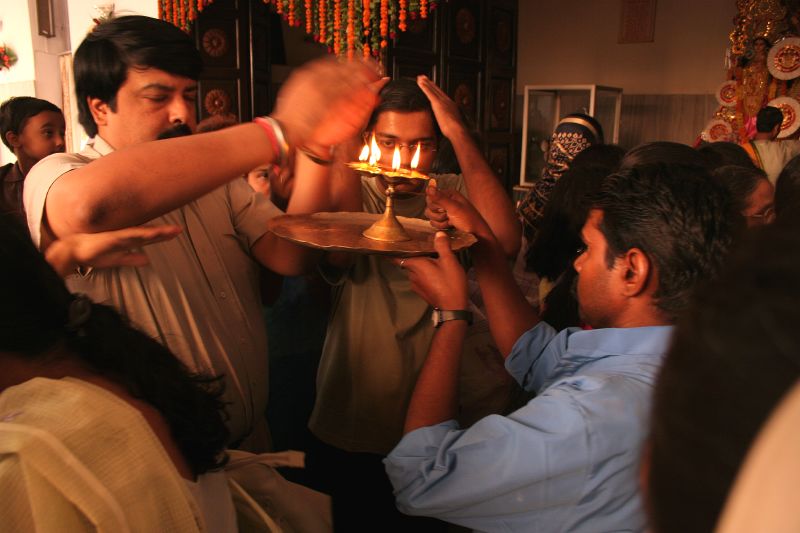
Arti can range from simple acts of worship to extravagant rituals, but always includes jyot (flame or light). It is sometimes performed one to five times daily, and usually at the end of a puja and bhajan session (in northern India). It is performed during almost all Hindu ceremonies and occasions. It involves the circulating of an "arti plate" or "arti lamp" around a person or deity and is generally accompanied by the congregation singing songs in praise of that deva or person - many versions exist. In most versions the plate, lamp, or flame represents the power of the deity. The priest circulates the plate or lamp to all those present. They cup their down-turned hands over the flame and then raise their palms to their forehead – the blessing has now been passed to the devotee.
The arti plate is generally made of metal, usually silver, bronze or copper. On it must repose a lamp made of kneaded flour, mud or metal, filled with oil or ghee. One or more cotton wicks (always an odd number) are put into the oil and then lighted, or camphor is burnt instead. The plate may also contain flowers, incense and akshata (rice).[7] In some temples, a plate is not used and the priest holds the ghee lamp in his hand when offering it to the Deities.
The purpose of performing arti is the waving of lighted wicks before the deities in a spirit of humility and gratitude, wherein faithful followers become immersed in god's divine form. It symbolises the five elements:
- Space (akash)
- Wind (vayu)
- Fire (agni)
- Water (jal)
- Earth (prithvi)
Community arti is performed in the mandir; however, devotees also perform it in their homes.
Significance

| Part of a series on |
| Hinduism |
|---|
 |


Arti can be an expression of many things including love, benevolence, gratitude, prayers, or desires depending on the object it is done to/ for. For example, it can be a form of respect when performed to elders, prayers when performed to deities, or hope when performed for homes or vehicles. Emotions and prayers are often silent while doing arti, but this is determined by the person carrying out the ritual or the holiday involved. It's also believed that goodwill and luck can be taken through symbolic hand movements over the flame.[8]
When arti is performed, the performer faces the deity of god (or divine element, e.g. Ganges river) and concentrates on the form of god by looking into the eyes of the deity (it is said that eyes are the windows to the soul) to get immersed. The flame of the arti illuminates the various parts of the deity so that the performer and onlookers may better see and concentrate on the form. Arti is waved in circular fashion, in clockwise manner around the deity. After every circle (or second or third circle), when arti has reached the bottom (6–8 o'clock position), the performer waves it backwards while remaining in the bottom (4–6 o'clock position) and then continues waving it in clockwise fashion. The idea here is that arti represents our daily activities, which revolves around god, a center of our life. Looking at god while performing arti reminds the performer (and the attendees of the arti) to keep god at the center of all activities and reinforces the understanding that routine worldly activities are secondary in importance. This understanding would give the believers strength to withstand the unexpected grief and keeps them humble and remindful of god during happy moments. Apart from worldly activities arti also represents one's self - thus, arti signifies that one is peripheral to godhead or divinity. This would keep one's ego down and help one remain humble in spite of high social and economic rank. A third commonly held understanding of the ritual is that arti serves as a reminder to stay vigilant so that the forces of material pleasures and desires cannot overcome the individual. Just as the lighted wick provides light and chases away darkness, the vigilance of an individual can keep away the influence of the material world.[9]
Arti is not only limited to god. Arti can performed not only to all forms of life, but also inanimate objects which help in progress of the culture. This is exemplified by performer of the arti waving arti to all the devotees as the arti comes to the end – signifying that everyone has a part of god within that the performer respects and bows down to. It is also a common practice to perform arti to inanimate objects like vehicles, electronics etc. at least when a Hindu starts using it, just as a gesture of showing respect and praying that this object would help one excel in the work one would use it for. It is similar to the ritual of doing auspicious red mark(s) using kanku (kumkum) and rice.
Arti songs

Hinduism has a long tradition of arti songs, simply referred to as arti, sung as an accompaniment to the ritual of arti. It primarily eulogizes the deity that the ritual is being offered to, and several sects have their own versions of the common arti songs that are often sung on chorus at various temples, during evening and morning artis. Sometimes they also contain snippets of information on the life of the deity.
The most commonly sung arti is that which is dedicated to all deities called Om Jai Jagdish Hare, known as "the universal arti". Other arti's are used for other deities as well such as Om Jai Shiv omkara, Om Jai Lakshmi mata, Om Jai Ambe gauri, Om Jai Adya Shakti, Om Jai Saraswati Mata, Om Jai Gange Mata, Om Jai Tulsi Mata and Om Jai Surya Bhagvaan. In Ganesha worship, the arti "Sukhakarta Dukhaharta" is popular in Maharashtra.
In Swaminarayan Mandirs, Jai Sadguru Swami is the arti that is sung. In most temples in India, arti is performed at least twice a day, after the ceremonial puja, which is the time when the largest number of devotees congregates.
In Pushtimarg Havelis, arti is performed by a sole mukhiyaji (priest) while "Haveli Sangit" (kirtan) is being sung. Devotees only watch the arti being done and do not get to take a major part in it. During bhajan or utsavs (festivals) celebrated at home, "Jai Jai Shree Yamuna" is sung while devotees perform arti. It is said that Sandhya arti is done to see if Lord Shrinathji had gotten hurt while playing outside because it is performed after sundown.
In Sikhism the arti sung is Gagan mein thaal.

_(8471357705).jpg)
In Gaudiya Vaishnavism, arti refers to the whole puja ritual, of which offering the lamp is only one part. A shankha (conch) is blown to start the arti, then an odd number of incense sticks are offered to the deity. The lamp is offered next, and then circulated among the devotees. A conch is then filled with water, and offered; the water is then poured into a sprinkler and sprinkled over the devotees. A cloth and flowers are then offered, and the flowers are circulated to the devotees, who sniff them. The deity is then fanned with a camara whisk, and a peacock fan in hot countries.
Arti dance in Durga puja
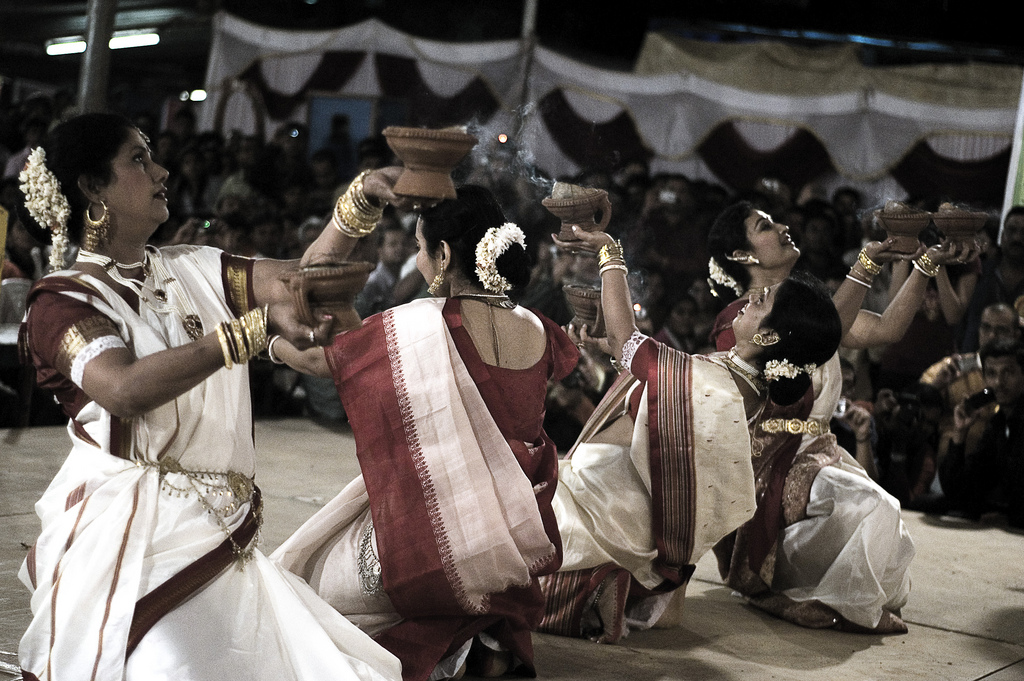
During the Bengali festival Durga puja ritual drummers – dhakis, carrying large leather-strung dhak's, show off their skills during ritual dance worships called arti or Dhunuchi dance.[10]
Arti in Sikhism
Amritsari Sikhs have not been performing arti as Hindus perform, but instead sing arti kirtan, which are a few shabads from Guru Nanak, Ravidas and other Bhagats/Gurus. Nihangs recite Aarta before arti which includes some more shabads from the Dasam Granth and Sarabloh Granth. According to them, arti is the arti of divine wisdom, which is in form of Guru Granth Sahib. The concept is similar to bowing before Guru Granth Sahib on knees. Nihangs perform Aarti similar to how Hindus do (using lamps, incense, flowers, bells, conch shells at specific parts of the ceremony)
See also
Notes
- ↑ आरात्रिक Sanskrit English Dictionary, Germany
- ↑ James Lochtefeld, An illustrated Encyclopedia of Hinduism, ISBN 0-8239-2287-1, page 51
- ↑ Monier Williams Sanskrit Dictionary; Quote: ArAtrika n. the light (or the vessel containing it) which is waved at night before an icon; N. of this ceremony.
- ↑ http://www.marathivishwakosh.in/index.php?option=com_content&view=article&id=4661%3A2010-11-15-06-28-12&catid=2&Itemid=3 [bare URL]
- ↑ "Page:Konkani Viswakosh Vol1.PDF/191 - Wikisource".
- ↑ Rosen, Steven (2006). Essential Hinduism. Praeger Publishers. [page needed] ISBN 0-275-99006-0
- ↑ Akshata: (Sanskrit) "Unbroken." Unmilled, uncooked rice, often mixed with turmeric, offered as a sacred substance during puja, or in blessings for individuals at weddings and other ceremonies. This, the very best food, is the finest offering a devotee can give to God or a wife can give to her husband.
- ↑ "'Rules and significance of Aarti". Indiatoday. Retrieved 2020-03-24.
- ↑ Rosen, Steven. Essential Hinduism. 1st. Westport: Praeger Publishers, 2006. [page needed]
- ↑ Gupta, Shobhna (2002). Dances of India. New Delhi: Har-Anand Publications Pvt Ltd. p. 71. ISBN 9788124108666.
External links
- Article about Aarti
- 30 Hindu Deities Aarti
- Ganges Arati Video QuickTime streaming video of worship of the Ganges in Haridwar
- Aarti of all Hindu god