



No edit summary |
|||
| Line 1: | Line 1: | ||
{{ | {{Short description|None}} | ||
{{cleanup lang|date=March 2021}} | {{cleanup lang|date=March 2021}} | ||
{{expand list|date=June 2016}} | {{expand list|date=June 2016}} | ||
| Line 6: | Line 6: | ||
== Andhra Pradesh == | == Andhra Pradesh == | ||
The ''Sutradhari'' (సూత్రధారి) is the most important actor in a [[Yakshagana]], and plays multiple characters. Yakshaganam evolved into [[Harikatha]], and they are considered synonymous. Their dances are similar; one person plays from excerpts from [[Palkuriki Somanatha]], [[Srinatha]], and others. Harikatha consists of ''samvaadam'' (సంవాదం; discussion), ''padyam'' (పద్యం; poetry), and ''daruvu'' (దరువు; rhythm). It typically begins with "భక్తజనులారా! వినండి హరికథ! వినగ వేడుక గలిగే" ("O devotees! Listen to this Harikatha and be delighted!") Those involved in ''Harikatha Kalakshepam'' (హరికథా కాలక్షేపం) are known as ''Harikatha Dasu'' (హరికథ దాసు) or ''Harikatha Bhagavatar'' (హరికథ భాగవతార్). In [[Andhra Pradesh]], the first Harikatha artist is believed to be have been [[Gokulapati Koormanathakavi]] (గోకులపాటి కూర్మనాథకవి) from the state's northern districts, who wrote and popularised the [[Mrityunjaya Vilaasam]] (మృత్యుంజయ విలాసం).<ref>{{Cite web|title=Twitter|url=https://mobile.twitter.com/tuxnani/status/1142746367749545986|access-date=2020-10-25|website=mobile.twitter.com}}{{Unreliable source|date=March 2021}} | The ''Sutradhari'' (సూత్రధారి) is the most important actor in a [[Yakshagana]], and plays multiple characters. Yakshaganam evolved into [[Harikatha]], and they are considered synonymous. Their dances are similar; one person plays from excerpts from [[Palkuriki Somanatha]], [[Srinatha]], and others. Harikatha consists of ''samvaadam'' (సంవాదం; discussion), ''padyam'' (పద్యం; poetry), and ''daruvu'' (దరువు; rhythm). It typically begins with "భక్తజనులారా! వినండి హరికథ! వినగ వేడుక గలిగే" ("O devotees! Listen to this Harikatha and be delighted!") Those involved in ''Harikatha Kalakshepam'' (హరికథా కాలక్షేపం) are known as ''Harikatha Dasu'' (హరికథ దాసు) or ''Harikatha Bhagavatar'' (హరికథ భాగవతార్). In [[Andhra Pradesh]], the first Harikatha artist is believed to be have been [[Gokulapati Koormanathakavi]] (గోకులపాటి కూర్మనాథకవి) from the state's northern districts, who wrote and popularised the [[Mrityunjaya Vilaasam]] (మృత్యుంజయ విలాసం).<ref>{{Cite web|title=Twitter|url=https://mobile.twitter.com/tuxnani/status/1142746367749545986|access-date=2020-10-25|website=mobile.twitter.com}}</ref>{{Unreliable source?|date=March 2021}} | ||
==Arunachal Pradesh== | ==Arunachal Pradesh== | ||
| Line 34: | Line 34: | ||
|[[Bardo Chham]] | |[[Bardo Chham]] | ||
|| | || | ||
|} | |}(Rikhampada))/ | ||
==Assam== | ==Assam== | ||
| Line 41: | Line 41: | ||
* [[Bagurumba]] | * [[Bagurumba]] | ||
* Bhortal dance | * Bhortal dance | ||
* Baidima<ref>{{Cite web |title=Dimasa Traditional Dance - BAIDIMA |url=http://bododimasaarchive.org/digital-heritage/dimasa-traditional-dance-baidima#:~:text=Baidima%20is%20a%20cultural%20folk,the%20harvesting%20festival%2C%20Busu%20festival. |website=bododimasaarchive}}</ref> | |||
* Goalini | * Goalini | ||
* [[Jhumair|Jhumur]] | * [[Jhumair|Jhumur]] | ||
* [[Gumrag]] | * [[Gumrag]] | ||
* Oja pali | |||
==Bihar== | ==Bihar== | ||
| Line 65: | Line 67: | ||
*[[Dhalo]] | *[[Dhalo]] | ||
*[[Fugdi]] in a Goan folk dance performed by the women in the [[Konkan]] region during the Hindu religious festivals [[Ganesh Chaturthi]] and [[Vrata]] or near the end of other dances, such as [[Dhalo]].<ref>{{cite web|url=http://www.goatourism.gov.in/culture/folk-dances|title=Department of Tourism, Government of Goa, India - Goan Folk Dances and Art Forms|website=www.goatourism.gov.in|access-date=29 March 2018}}</ref><ref>{{cite web |url=http://www.goa-holidays.info/Dances_Goa.htm |title=Archived copy |access-date=2013-01-09 |url-status=dead |archive-url=https://web.archive.org/web/20130111115314/http://www.goa-holidays.info/Dances_Goa.htm |archive-date=2013-01-11 }}</ref> | *[[Fugdi]] in a Goan folk dance performed by the women in the [[Konkan]] region during the Hindu religious festivals [[Ganesh Chaturthi]] and [[Vrata]] or near the end of other dances, such as [[Dhalo]].<ref>{{cite web|url=http://www.goatourism.gov.in/culture/folk-dances|title=Department of Tourism, Government of Goa, India - Goan Folk Dances and Art Forms|website=www.goatourism.gov.in|access-date=29 March 2018}}</ref><ref>{{cite web |url=http://www.goa-holidays.info/Dances_Goa.htm |title=Archived copy |access-date=2013-01-09 |url-status=dead |archive-url=https://web.archive.org/web/20130111115314/http://www.goa-holidays.info/Dances_Goa.htm |archive-date=2013-01-11 }}</ref> | ||
*[[Khol]]{{ | *[[Khol]]{{citation needed|date=March 2021}} | ||
*[[Mussoll]] | *[[Mussoll]] | ||
Samayi Nrutya | Samayi Nrutya | ||
| Line 105: | Line 107: | ||
** Khoria dance | ** Khoria dance | ||
** Loor dance | ** Loor dance | ||
** [Khoria] | |||
{{Div col end}} | {{Div col end}} | ||
| Line 111: | Line 114: | ||
*[[Veeragase]] is performed by women. Based on Hindu mythology, it is performed during festivals primarily during the Hindu months of [[Shravana]] and [[Kartika (month)|Karthika]]. | *[[Veeragase]] is performed by women. Based on Hindu mythology, it is performed during festivals primarily during the Hindu months of [[Shravana]] and [[Kartika (month)|Karthika]]. | ||
*[[Hulivesha]] is performed by men in the coastal region. The dancers are painted like tigers and perform like angry tigers. | *[[Hulivesha]] is performed by men in the coastal region. The dancers are painted like tigers and perform like angry tigers. | ||
*[[Kangilu]], Mandal community spiritual dance. | |||
*[[Yakshgana]], the state dance, has a number of forms which vary from region to region. | *[[Yakshgana]], the state dance, has a number of forms which vary from region to region. | ||
*[[Dollu Kunitha]] is a drum dance. | *[[Dollu Kunitha]] is a drum dance. | ||
| Line 121: | Line 125: | ||
==Jammu and Kashmir== | ==Jammu and Kashmir== | ||
{{Unreferenced section|date=January 2021}} | {{Unreferenced section|date=January 2021}} | ||
The Jammu and Kashmir region is blessed with natural and cultural beauty. The Union Territory of Jammu and Kashmir has many folk dances performed on different occasions. | The Jammu and Kashmir region is blessed with natural and cultural beauty. The Union Territory of Jammu and Kashmir has many folk dances performed on different occasions. | ||
The main folk dance performed in the Jammu region are- Kud Dance, Chajja Dance, Crow Dance, Dogri Bhangra etc. | The main folk dance performed in the Jammu region are- Kud Dance, Chajja Dance, Crow Dance, Dogri Bhangra etc. | ||
[[Dumhal]] is a ceremonial dance performed by men of the [[Wattal]] tribe. Dancers wear long, colourful robes and tall, conical caps studded with beads and shells. They move in a procession, carrying a banner. The banner is buried and the men dance, forming a circle, accompanied by singing and a drum. | [[Dumhal]] is a ceremonial dance performed by men of the [[Wattal]] tribe. Dancers wear long, colourful robes and tall, conical caps studded with beads and shells. They move in a procession, carrying a banner. The banner is buried and the men dance, forming a circle, accompanied by singing and a drum. | ||
| Line 136: | Line 140: | ||
*Paika is a martial dance. | *Paika is a martial dance. | ||
*[[Chhau dance]] is a semi-classical Indian dance with folk traditions which originated in the eastern states of Jharkhand, West Bengal, and Odisha. It has three styles, named for the locations where they are performed: Purulia Chau in Bengal, Seraikella Chau in Jharkhand, and Mayurbhanj Chau in Odisha. | *[[Chhau dance]] is a semi-classical Indian dance with folk traditions which originated in the eastern states of Jharkhand, West Bengal, and Odisha. It has three styles, named for the locations where they are performed: Purulia Chau in Bengal, Seraikella Chau in Jharkhand, and Mayurbhanj Chau in Odisha. | ||
*[[Firkal dance|Firkal]] is a martial dance, performed in some parts of Jharkhand and Odisha. | |||
==Kerala== | ==Kerala== | ||
| Line 142: | Line 147: | ||
*[[Margamkali]] is performed by the state's Syrian Christians, primarily by women during marriage ceremonies. | *[[Margamkali]] is performed by the state's Syrian Christians, primarily by women during marriage ceremonies. | ||
*[[Oppana]], another Muslim dance, is usually a bridal group dance performed the day before the wedding and is particularly popular on the [[Malabar Coast]]. Young female relatives of the bride sing and dance around her, clapping their hands. | *[[Oppana]], another Muslim dance, is usually a bridal group dance performed the day before the wedding and is particularly popular on the [[Malabar Coast]]. Young female relatives of the bride sing and dance around her, clapping their hands. | ||
*[[Theyyam]] is a form of ritual dance worship. ''Theyyam'' is derived from the Malayalam ''Daivam'' (god), and the dance is part of ritual, music, painting, sculpture, and literature. It is performed to worship the goddess Kali, often by men from the [[scheduled castes and tribes]] who have inherited the right to perform it.<ref>{{Cite web|last=KeralaTourism.Holiday|date=2019-11-20|title=Theyyam Festival — A Complete guide about Theyyam festival in Kerala|url=https://medium.com/@incrediblekerala2018/theyyam-festival-a-complete-guide-about-theyyam-festival-in-kerala-8f305e2e92f0|access-date=2021-01-30|website=Medium|language=en}}</ref> | *[[Theyyam]] is a form of ritual dance worship. ''Theyyam'' is derived from the Malayalam ''Daivam'' (god), and the dance is part of ritual, music, painting, sculpture, and literature. It is performed to worship the goddess Kali, often by men from the [[scheduled castes and tribes]] who have inherited the right to perform it.<ref>{{Cite web|last=KeralaTourism.Holiday|date=2019-11-20|title=Theyyam Festival — A Complete guide about Theyyam festival in Kerala|url=https://medium.com/@incrediblekerala2018/theyyam-festival-a-complete-guide-about-theyyam-festival-in-kerala-8f305e2e92f0|access-date=2021-01-30|website=Medium|language=en}}</ref> | ||
*[[Thirayattam]], performed in northern Kerala, is part of theatre, music, satire, face and body painting, masking, martial art, and ritual. It is performed in [[South Malabar]]'s ''kaavukal'' (sacred groves) and village shrines.<ref>"Thirayattam" ( Folklore Text-Malayalam), | *[[Thirayattam]], performed in northern Kerala, is part of theatre, music, satire, face and body painting, masking, martial art, and ritual. It is performed in [[South Malabar]]'s ''kaavukal'' (sacred groves) and village shrines.<ref>"Thirayattam" ( Folklore Text-Malayalam), State Institute of Language, Kerala, {{ISBN|978-81-200-4294-0}}</ref><ref>{{cite web|url=http://www.thirayattam.com/home.html|title=Thirayattam|website=www.thirayattam.com|access-date=29 March 2018}}</ref> | ||
*[[Thitambu Nritham]] is primarily performed by the [[Nambudiri]]s of northern Kerala.<ref>{{cite web|url=http://www.wonderfulkerala.com/kerala-dances.html|title=Kerala Dance,Dances of Kerala,Dance Form of Kerala,Dances in Kerela,Kerala in India Travel Tours|website=www.wonderfulkerala.com|access-date=29 March 2018}}</ref> | *[[Thitambu Nritham]] is primarily performed by the [[Nambudiri]]s of northern Kerala.<ref>{{cite web|url=http://www.wonderfulkerala.com/kerala-dances.html|title=Kerala Dance, Dances of Kerala, Dance Form of Kerala, Dances in Kerela, Kerala in India Travel Tours|website=www.wonderfulkerala.com|access-date=29 March 2018}}</ref> | ||
*[[Ottan Thullal]] ("to jump about playfully") emerged during the 18th century and is a solo performance combining dance and recitation of tales from the [[Puranas]] in verse. | *[[Ottan Thullal]] ("to jump about playfully") emerged during the 18th century and is a solo performance combining dance and recitation of tales from the [[Puranas]] in verse. | ||
*Mohiniyattam is also a form of dance. | *Mohiniyattam is also a form of dance. | ||
| Line 169: | Line 173: | ||
==Odisha== | ==Odisha== | ||
{{Main article|Folk dance forms of Odisha}} | {{Main article|Folk dance forms of Odisha}} | ||
===Laudi Khela=== | ===Laudi Khela=== | ||
Laudi Khela, traditionally performed by young [[Gopal (caste)|Gopal]] men during the Dola festival, has been waning in popularity.<ref>{{cite web |last1=Nanda |first1=Kanhu |title=Odihsa's folk dance 'Laudi Khela' during Dola fest loses its fame and charm |url=https://www.odishaviews.com/odihsas-folk-dance-laudi-khela-during-dola-fest-loses-its-fame-and-charm/ |website=Odisha Views |access-date=12 March 2021 |date=6 April 2013}}</ref> | Laudi Khela, traditionally performed by young [[Gopal (caste)|Gopal]] men during the Dola festival, has been waning in popularity.<ref>{{cite web |last1=Nanda |first1=Kanhu |title=Odihsa's folk dance 'Laudi Khela' during Dola fest loses its fame and charm |url=https://www.odishaviews.com/odihsas-folk-dance-laudi-khela-during-dola-fest-loses-its-fame-and-charm/ |website=Odisha Views |access-date=12 March 2021 |date=6 April 2013}}</ref> | ||
| Line 203: | Line 208: | ||
==Rajasthan== | ==Rajasthan== | ||
GHOOMAR DANCE | |||
[[Ghoomar]] is a traditional women's dance in [[Rajasthan]] and [[Haryana]]. It is performed by groups of women in swirling skirts, accompanied by men and women singing. The dance gets its name from ''ghoomna'', the spinning which displays the colourful, flowing ''ghaghara'' (the long Rajasthani skirt).<ref>{{cite web |title=Ghoomar |url=https://www.india9.com/i9show/-Rajasthan/Ghoomar-26321.htm |website=India9 |access-date=13 March 2021 |archive-url=https://web.archive.org/web/20190402061625/https://www.india9.com/i9show/-Rajasthan/Ghoomar-26321.htm |archive-date=2 April 2019 |url-status=live}}</ref> | [[Ghoomar]] is a traditional women's dance in [[Rajasthan]] and [[Haryana]]. It is performed by groups of women in swirling skirts, accompanied by men and women singing. The dance gets its name from ''ghoomna'', the spinning which displays the colourful, flowing ''ghaghara'' (the long Rajasthani skirt).<ref>{{cite web |title=Ghoomar |url=https://www.india9.com/i9show/-Rajasthan/Ghoomar-26321.htm |website=India9 |access-date=13 March 2021 |archive-url=https://web.archive.org/web/20190402061625/https://www.india9.com/i9show/-Rajasthan/Ghoomar-26321.htm |archive-date=2 April 2019 |url-status=live}}</ref> | ||
| Line 270: | Line 275: | ||
=== Folk Dance === | === Folk Dance === | ||
| | | | ||
=== Classical Dance === | === Classical Dance === | ||
|- | |- | ||
| | | | ||
'''1.''' | |||
'''1.''' | |||
| | |||
'''Himachal Pradesh''' | '''Himachal Pradesh''' | ||
|'''''Kinnauri,Thoda,Jhora, Jhali''''', Chharhi, Dhaman, Chhapeli, Mahasu, Dangi, Chamba, Thali, Jhainta, Daf, Stick dance . | |'''''Kinnauri, Thoda, Jhora, Jhali''''', Chharhi, Dhaman, Chhapeli, Mahasu, Dangi, Chamba, Thali, Jhainta, Daf, Stick dance . | ||
| | | | ||
|- | |- | ||
| | | | ||
'''2.''' | |||
'''2.''' | |||
| | |||
'''Uttarakhand''' | '''Uttarakhand''' | ||
| | | | ||
'''''Chappeli,'''''Gadhwali, Kumayuni, Kajari, Jhora, Raslila etc. | '''''Chappeli,'''''Gadhwali, Kumayuni, Kajari, Jhora, Raslila etc. | ||
| | | | ||
|- | |- | ||
| | | | ||
'''3.''' | '''3.''' | ||
| | | | ||
'''Punjab''' | '''Punjab''' | ||
| | | | ||
'''''Bhangra, Giddha, Daff,''''' Dhaman, Bhand, Naqual. | |||
'''''Bhangra, Giddha, Daff,''''' Dhaman, Bhand,Naqual. | |||
| | | | ||
|- | |- | ||
| | | | ||
'''4.''' | '''4.''' | ||
| | | | ||
'''Haryana''' | '''Haryana''' | ||
| | | | ||
Jhumar, Phag Dance, Daph, Dhamal, Loor, Gugga, Khor, Gagor . | Jhumar, Phag Dance, Daph, Dhamal, Loor, Gugga, Khor, Gagor . | ||
| | | | ||
|- | |- | ||
|'''5.''' | |'''5.''' | ||
| | | | ||
'''Uttar Pradesh''' | '''Uttar Pradesh''' | ||
| | | | ||
'''''Nautanki,''''' Raslila, Kajri, Jhora, Chappeli, Jaita. | '''''Nautanki,''''' Raslila, Kajri, Jhora, Chappeli, Jaita. | ||
| | | | ||
'''Kathak''' | '''Kathak''' | ||
|- | |- | ||
| | | | ||
'''6.''' | '''6.''' | ||
| | | | ||
'''Rajasthan''' | '''Rajasthan''' | ||
| | | | ||
'''''Ghoomar, Suisini, kalbeliya,''''' Chakri, Ganagor, Jhulan Leela, Jhuma, Suisini, Ghapal, Panihari, Ginad etc. | |||
'''''Ghoomar,Suisini,kalbeliya,''''' Chakri, Ganagor, Jhulan Leela, Jhuma, Suisini, Ghapal, Panihari, Ginad etc. | |||
| | | | ||
|- | |- | ||
| | | | ||
'''7.''' | '''7.''' | ||
| | | | ||
'''Gujrat''' | '''Gujrat''' | ||
| | | | ||
'''''Garba, Dandiya Ras, Bhavai,''''' Tippani Juriun, Bhavai. | |||
'''''Garba, Dandiya Ras,Bhavai,''''' Tippani Juriun, Bhavai. | |||
| | | | ||
|- | |- | ||
| | | | ||
'''8.''' | '''8.''' | ||
| | | | ||
'''Maharashtra''' | '''Maharashtra''' | ||
| | | | ||
'''''Lavani,''''' Nakata, Koli, Lezim, Gafa, Dahikala Dasavtar or Bohada, Tamasha, Mauni, Powara, Gouricha . | '''''Lavani,''''' Nakata, Koli, Lezim, Gafa, Dahikala Dasavtar or Bohada, Tamasha, Mauni, Powara, Gouricha . | ||
| | | | ||
|- | |- | ||
| | | | ||
'''9.''' | '''9.''' | ||
| | | | ||
'''Madhya Pradesh''' | '''Madhya Pradesh''' | ||
| | | | ||
'''''Tertali, Maanch, Matki''''', Aada, Khada Nach, Phulpati, Grida Dance, Selalarki, Selabhadoni, Jawara etc. | |||
'''''Tertali,Maanch,Matki''''', Aada, Khada Nach, Phulpati, Grida Dance, Selalarki, Selabhadoni, Jawara etc. | |||
| | | | ||
|- | |- | ||
| | | | ||
'''10.''' | '''10.''' | ||
| | | | ||
'''Chhattisgarh''' | '''Chhattisgarh''' | ||
| | | | ||
'''''Gaur Maria,''''' Panthi, Raut Nacha, Pandwani, Vedamati, Kapalik, Chandaini, Bharthari Charit, | '''''Gaur Maria,''''' Panthi, Raut Nacha, Pandwani, Vedamati, Kapalik, Chandaini, Bharthari Charit, | ||
Goudi, Karma, Jhumar, Dagla, Pali, Tapali, Navrani, Diwari, Mundari ,Jhumar | Goudi, Karma, Jhumar, Dagla, Pali, Tapali, Navrani, Diwari, Mundari, Jhumar. | ||
| | | | ||
|- | |- | ||
| | | | ||
'''11.''' | '''11.''' | ||
| | | | ||
'''Jharkhand''' | '''Jharkhand''' | ||
| | | | ||
'''''Karma Munda, Karma,''''' Agni, Jhumar, Janani Jhumar, Mardana Jhumar, Paika, Phagua, Chhanu, Sarahul, Jat-Jatin, Karma, Danga, Bidesia, Sohrai, Hunta Dance, Mundari Dance, Sarhul, Barao, Jhitka, Danga, Domkach, Ghora Naach. | |||
'''''Karma Munda,Karma,''''' Agni, Jhumar, Janani Jhumar, Mardana Jhumar, Paika, Phagua, Chhanu, Sarahul, Jat-Jatin, Karma, Danga, Bidesia, Sohrai,Hunta Dance, Mundari Dance, Sarhul, Barao, Jhitka, Danga, Domkach, Ghora Naach. | |||
| | | | ||
|- | |- | ||
| | | | ||
'''12.''' | '''12.''' | ||
| | | | ||
'''Bihar''' | '''Bihar''' | ||
| | | | ||
'''''Jata-Jatin,''''' Bakho-Bakhain, Panwariya, Sama-Chakwa, Bidesia, Jatra . | '''''Jata-Jatin,''''' Bakho-Bakhain, Panwariya, Sama-Chakwa, Bidesia, Jatra . | ||
| | | | ||
|- | |- | ||
| | | | ||
'''13.''' | '''13.''' | ||
| | | | ||
'''West Bengal''' | '''West Bengal''' | ||
|Alkap, Kathi, Gambhira, Dhali, Jatra, Baul, Marasia, Mahal, Keertan | |'''Purulia Chhau''', Alkap, Kathi, Gambhira, Dhali, Jatra, Baul, Marasia, Mahal, Keertan,Santhali Dance, Mundari dance, Gambhira, Gajan, Chaibari Nritya | ||
| | | | ||
|- | |- | ||
| | | | ||
'''14.''' | '''14.''' | ||
| | | | ||
'''Sikkim''' | '''Sikkim''' | ||
| | | | ||
'''''Chu Faat, Yak Chaam''''' Sikmari, Singhi Chaam or the Snow Lion, Yak Chaam, Denzong Gnenha, Tashi Yangku | |||
'''''Chu Faat,Yak Chaam''''' Sikmari, Singhi Chaam or the Snow Lion, Yak Chaam, Denzong Gnenha, Tashi Yangku | |||
Khukuri Naach, Chutkey Naach, Maruni Dance. | Khukuri Naach, Chutkey Naach, Maruni Dance. | ||
| Line 450: | Line 405: | ||
| | | | ||
|- | |- | ||
| | | | ||
'''15.''' | '''15.''' | ||
| | | | ||
'''Meghalaya''' | '''Meghalaya''' | ||
| | | | ||
Laho, Baala, Ka Shad Suk Mynsiem, Nongkrem, | Laho, Baala, Ka Shad Suk Mynsiem, Nongkrem, | ||
| | | | ||
|- | |- | ||
| | | | ||
'''16.''' | '''16.''' | ||
| | | | ||
'''Assam''' | '''Assam''' | ||
| | | | ||
'''''Bihu,''''' Bichhua, Natpuja, Maharas, Kaligopal, Bagurumba, Naga dance, Khel Gopal. | '''''Bihu,''''' Bichhua, Natpuja, Maharas, Kaligopal, Bagurumba, Naga dance, Khel Gopal. | ||
Tabal Chongli, Canoe, Jhumura Hobjanai etc. | Tabal Chongli, Canoe, Jhumura Hobjanai etc. | ||
| | | | ||
'''Sattriya''' | '''Sattriya''' | ||
|- | |- | ||
| | | | ||
'''17.''' | '''17.''' | ||
| | | | ||
'''Arunachal Pradesh''' | '''Arunachal Pradesh''' | ||
| | | | ||
'''''Chham''''', Mask dance (Mukhauta Nritya), War dance. | |||
'''''Chham''''' ,Mask dance (Mukhauta Nritya), War dance. | |||
Buiya, Chalo, Wancho, Pasi Kongki, Ponung, Popir, Bardo . | Buiya, Chalo, Wancho, Pasi Kongki, Ponung, Popir, Bardo . | ||
| Line 495: | Line 437: | ||
| | | | ||
|- | |- | ||
| | | | ||
'''18.''' | '''18.''' | ||
| | | | ||
'''Nagaland''' | '''Nagaland''' | ||
| | | | ||
Chong, Khaiva, Lim, Nuralim, | Chong, Khaiva, Lim, Nuralim, | ||
| Line 510: | Line 448: | ||
| | | | ||
|- | |- | ||
| | | | ||
'''19.''' | '''19.''' | ||
| | | | ||
'''Manipur''' | '''Manipur''' | ||
| | | | ||
'''''Thang Ta, Lai Haraoba, Pung Cholom,''''' Rakhal, Nat Rash, Maha Rash, Raukhat, Dol Cholam, Khamba Thaibi, Nupa Dance, Raslila, Khubak Ishei, Lhou Sha. | |||
| | |||
| | |||
'''Manipuri''' | '''Manipuri''' | ||
|- | |- | ||
| | | | ||
'''20.''' | '''20.''' | ||
| | | | ||
'''Mizoram''' | '''Mizoram''' | ||
| | | | ||
'''''Cheraw Dance,''''' Khuallam, Chailam, Sawlakin, Chawnglaizawn, Zangtalam, Par Lam, Sarlamkai/ Solakia, Tlanglam, Khanatm, Pakhupila, Cherokan | |||
'''''Cheraw Dance,''''' Khuallam, Chailam, Sawlakin, Chawnglaizawn, Zangtalam,Par Lam, Sarlamkai/ Solakia, Tlanglam, Khanatm, Pakhupila, Cherokan | |||
| | | | ||
|- | |- | ||
| | | | ||
'''21.''' | '''21.''' | ||
| | | | ||
'''Tripura''' | '''Tripura''' | ||
| | | | ||
'''''Hojagiri''''' | '''''Hojagiri''''' | ||
| | | | ||
|- | |- | ||
| | | | ||
'''22.''' | '''22.''' | ||
| | | | ||
'''Odisha''' | '''Odisha''' | ||
| | | | ||
'''''Ghumara, Ranappa,'''''Savari, Ghumara, Painka, Munari, Chhau, Chadya Dandanata, Savari, Painka, Munari | |||
| | |||
| | |||
'''Odissi''' | '''Odissi''' | ||
|- | |- | ||
| | | | ||
'''23.''' | '''23.''' | ||
| | | | ||
'''Andra Pradesh''' | '''Andra Pradesh''' | ||
| | | | ||
Ghantamardala, (Ottam Thedal, Mohiniattam, Kummi, Siddhi, Madhuri, Chhadi. Vilasini Natyam, Bhamakalpam, Veeranatyam, Dappu, Tappeta Gullu, Lambadi, Dhimsa, Kolattam. Butta Bommalu. | Ghantamardala, (Ottam Thedal, Mohiniattam, Kummi, Siddhi, Madhuri, Chhadi. Vilasini Natyam, Bhamakalpam, Veeranatyam, Dappu, Tappeta Gullu, Lambadi, Dhimsa, Kolattam. Butta Bommalu. | ||
| | | | ||
'''Kuchipudi''' | '''Kuchipudi''' | ||
|- | |- | ||
| | | | ||
'''24.''' | '''24.''' | ||
| | | | ||
'''Karnataka''' | '''Karnataka''' | ||
| | | | ||
'''''Yakshagana,''''' Huttari, Suggi, Kunitha, Karga, Lambi | '''''Yakshagana,''''' Huttari, Suggi, Kunitha, Karga, Lambi | ||
| | | | ||
|- | |- | ||
| | | | ||
'''25.''' | '''25.''' | ||
| | | | ||
'''Goa''' | '''Goa''' | ||
|'''''Fugdi, Dhalo, Kunbi, Dhangar,''''' Mandi, Jhagor, Khol, Dakni, Tarangamel, Shigmo, Ghode, Modni, Samayi nrutya, Jagar, Ranmale,amayi nrutya,Tonnya mell. | |'''''Fugdi, Dhalo, Kunbi, Dhangar,''''' Mandi, Jhagor, Khol, Dakni, Tarangamel, Shigmo, Ghode, Modni, Samayi nrutya, Jagar, Ranmale, amayi nrutya, Tonnya mell. | ||
| | | | ||
|- | |- | ||
|'''26.''' | |'''26.''' | ||
|'''Telangana''' | |'''Telangana''' | ||
|'''''Perini Shivatandavam,Keisabadi''''' | |'''''Perini Shivatandavam, Keisabadi''''' | ||
| | | | ||
|- | |- | ||
| Line 613: | Line 522: | ||
'''Kerala''' | '''Kerala''' | ||
| | | | ||
'''''Ottam Thulal,''''' Kaikottikali, Tappatikali, Kali Auttam. | '''''Ottam Thulal,''''' Kaikottikali, Tappatikali, Kali Auttam. | ||
| | | | ||
| Line 625: | Line 532: | ||
'''Tamil Nadu''' | '''Tamil Nadu''' | ||
| | | | ||
'''''Karagam''''', Kumi, Kolattam, Kavadi | |||
'''''Karagam''''',Kumi, Kolattam, Kavadi | |||
| | | | ||
'''Bharatnatyam''' | '''Bharatnatyam''' | ||
|} | |} | ||
| Line 636: | Line 541: | ||
==See also== | ==See also== | ||
* [[Dance in India]] | * [[Dance in India]] | ||
* [[Folk dances of Sourashtra]] | |||
* [[List of Indian classical dance and music events]] | * [[List of Indian classical dance and music events]] | ||
* [[Indian classical dance]] | * [[Indian classical dance]] | ||
Revision as of 19:42, 24 April 2022
 | This article or section should specify the language of its non-English content, using {{lang}}, {{transliteration}} for transliterated languages, and {{IPA}} for phonetic transcriptions, with an appropriate ISO 639 code. Bharatpedia's multilingual support templates may also be used. (March 2021) |
Indian folk dances,[1] which typically consist of a few simple steps, are performed throughout the world to celebrate a new season, childbirth, weddings, festivals, and other social occasions. In some Indian folk dances, men and women perform separately; in others, they dance together. On most occasions, the dancers will sing accompanied by musicians. Most folk dances have intricately-designed costumes. Although a number of structured, ancient folk and tribal dances exist, many others are evolving.
Andhra Pradesh
The Sutradhari (సూత్రధారి) is the most important actor in a Yakshagana, and plays multiple characters. Yakshaganam evolved into Harikatha, and they are considered synonymous. Their dances are similar; one person plays from excerpts from Palkuriki Somanatha, Srinatha, and others. Harikatha consists of samvaadam (సంవాదం; discussion), padyam (పద్యం; poetry), and daruvu (దరువు; rhythm). It typically begins with "భక్తజనులారా! వినండి హరికథ! వినగ వేడుక గలిగే" ("O devotees! Listen to this Harikatha and be delighted!") Those involved in Harikatha Kalakshepam (హరికథా కాలక్షేపం) are known as Harikatha Dasu (హరికథ దాసు) or Harikatha Bhagavatar (హరికథ భాగవతార్). In Andhra Pradesh, the first Harikatha artist is believed to be have been Gokulapati Koormanathakavi (గోకులపాటి కూర్మనాథకవి) from the state's northern districts, who wrote and popularised the Mrityunjaya Vilaasam (మృత్యుంజయ విలాసం).[2][unreliable source?]
Arunachal Pradesh
| Dance | Community |
|---|---|
| Aji Lamu | Monpa |
| Chalo[3] | Nocte |
| Hiirii Khaniing | Apatani |
| Lion and peacock dance | Monpa |
| Pasi Kongki | Adi |
| Ponung | Adi |
| Popir | Adi |
| Buiya[4] | Mishmi[5] |
| Wancho | |
| Bardo Chham |
(Rikhampada))/
Assam

Bihar
- Bidesiya is a form of dance-drama that is believed to have been created by Bhikhari Thakur, a barber with a passion for drama.[9] It deals with social issues and conflict between traditional and modern, rich and poor.
- Domkach is performed in the bridegroom's house by women during a marriage ceremony.
- Phagua is a dance and also a type of folk song performed during Holi.
- Jat-Jatin is the most popular folk dance of North Bihar, especially in the Mithila and Koshi regions. It is performed by a man and a woman; the man is going far away to work. The dance reflects poverty and sorrow.
- Jhijhiya is sung and danced during a drought as a prayer to Indra for rain. Its music is usually a singer, a harmonium and a drum.
- Jhumri is similar to Gujarat's Garba.
- Kajri is popular in Bihar's Bhojpuri-speaking region. It often describes a woman's longing for her lover as the black monsoon cloud hangs in the summer sky, and is sung during the rainy season.
- Painki evokes the infantry's agility, courage, and excitement. Danced on flat ground, it highlights the dancers' weapon-handling ability.
- Sohar is sung and danced by women to celebrate the birth of a child.
Chhattisgarh
 |
Raut Nacha is a traditional folk dance usually done by Yadavs, a caste which considers itself descendants of Krishna, as an expression of worship. Performed for Dev Udhni Ekadashi (the gods' awakening after a brief rest), it resembles Krishna's raslila.
Goa
- Deknni
- Dhalo
- Fugdi in a Goan folk dance performed by the women in the Konkan region during the Hindu religious festivals Ganesh Chaturthi and Vrata or near the end of other dances, such as Dhalo.[10][11]
- Khol[citation needed]
- Mussoll
Samayi Nrutya
Gujarat

- Dandiya Raas is an energetic, vibrant dance which originated in Gujarat. Often called the "stick dance" because it uses polished sticks (dandiya), it represents a mock fight between the goddess Durga and the demon king Mahishasura. It is nicknamed "the sword dance" because the dandiya represent Durga's swords and are struck together.[12][13] The combination of garba and raas has become popular at the collegiate level in the United States, and garba-raas competitions are increasing in number. Popular competitions include Dandia Dhamaka,[14] Raas Chaos,[15] Garba With Attitude, Dandia on Fire, and Maryland Masti.[16]
- Garba is customarily performed by both sexes, and sometimes includes the stick dance. With circular movements and rhythmic clapping, it is often performed during Navratri. Its name comes from garbha deep, which means "light in the inner temple" or "lamp in a perforated earthen pot" (often used in the dance).[12][17]
- The Tippani dance originated in the Chorwad region of Saurashtra. Working women take a wooden rod (sometimes tipped with iron at one end) and beat the floor with it.[18]
- The Padhar dance is performed by the Padhar community.
Himachal Pradesh
Nati is the traditional dance of Himachal Pradesh's Sirmaur, Kullu and Shimla districts. The dance is listed in Guinness World Records as having "the greatest number of people attending and participating in a Nati dance lesson at a single venue".[19][20][21]
Haryana
Dances in Haryana include:[22][23]
- Theatrical
- Saang: Pioneering artists were Baje Bhagat, Dayachand Mayna and Lakhmi Chand.
- Ragini
- Devotional
- Seasonal
- Legendary courage
- Love and romance
- Ceremonial
- Dhamal dance
- Ghoomar
- Jhoomar
- Khoria dance
- Loor dance
- [Khoria]
Karnataka
|
- Veeragase is performed by women. Based on Hindu mythology, it is performed during festivals primarily during the Hindu months of Shravana and Karthika.
- Hulivesha is performed by men in the coastal region. The dancers are painted like tigers and perform like angry tigers.
- Kangilu, Mandal community spiritual dance.
- Yakshgana, the state dance, has a number of forms which vary from region to region.
- Dollu Kunitha is a drum dance.
- Kolata
- Bharatnatyam is performed in the Mysuru region.
- Kamsale, performed by devotees of Male Madeshwara on pilgrimages to the Biligiriranga Hills, is popular throughout the state.
- Lavani is performed in the northern border regions.
- Buta Kola (spirit worship) is usually practiced at night.
Jammu and Kashmir
|
The Jammu and Kashmir region is blessed with natural and cultural beauty. The Union Territory of Jammu and Kashmir has many folk dances performed on different occasions.
The main folk dance performed in the Jammu region are- Kud Dance, Chajja Dance, Crow Dance, Dogri Bhangra etc.
Dumhal is a ceremonial dance performed by men of the Wattal tribe. Dancers wear long, colourful robes and tall, conical caps studded with beads and shells. They move in a procession, carrying a banner. The banner is buried and the men dance, forming a circle, accompanied by singing and a drum.
Jharkhand
- Jhumar is a popular dance, performed during the harvest season and its festival.
- Mardana Jhumair, a Nagpuri dance, is primarily performed by men.
- Janani Jhumair is a Nagpuri dance mainly performed by women.
- Domkach is a dance performed during a marriage ceremony by the bride and groom's family.
- Lahasua is performed by men and women, accompanied by a dhol.
- Fagua is performed during the festival of Holi.[24]
- Paika is a martial dance.
- Chhau dance is a semi-classical Indian dance with folk traditions which originated in the eastern states of Jharkhand, West Bengal, and Odisha. It has three styles, named for the locations where they are performed: Purulia Chau in Bengal, Seraikella Chau in Jharkhand, and Mayurbhanj Chau in Odisha.
- Firkal is a martial dance, performed in some parts of Jharkhand and Odisha.
Kerala
.JPG)
- Duffmuttu is performed by the Muslim community. Originated by the Arabs, it is accompanied by Arabic music. The name Duffmuttu is attributed to a drum known as a daff or tap.
- Margamkali is performed by the state's Syrian Christians, primarily by women during marriage ceremonies.
- Oppana, another Muslim dance, is usually a bridal group dance performed the day before the wedding and is particularly popular on the Malabar Coast. Young female relatives of the bride sing and dance around her, clapping their hands.
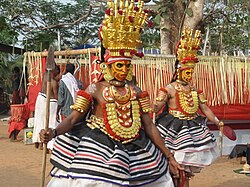
- Theyyam is a form of ritual dance worship. Theyyam is derived from the Malayalam Daivam (god), and the dance is part of ritual, music, painting, sculpture, and literature. It is performed to worship the goddess Kali, often by men from the scheduled castes and tribes who have inherited the right to perform it.[25]
- Thirayattam, performed in northern Kerala, is part of theatre, music, satire, face and body painting, masking, martial art, and ritual. It is performed in South Malabar's kaavukal (sacred groves) and village shrines.[26][27]
- Thitambu Nritham is primarily performed by the Nambudiris of northern Kerala.[28]
- Ottan Thullal ("to jump about playfully") emerged during the 18th century and is a solo performance combining dance and recitation of tales from the Puranas in verse.
- Mohiniyattam is also a form of dance.
Madhya Pradesh

- Grida dance - Performed when the rabi crops are in bloom, the dance continues from morning to evening by village groups. It has three phases:
- Sela – Slow, stiff foot movements
- Selalarki – The foot movements become faster.
- Selabhadoni – As the tempo accelerates, hands and legs move vigorously.[29]
- The Matki dance is performed in the Malwa region, primarily for weddings. A veiled woman performs the dance with an earthen pot (matki) balanced on her head, sometimes joined by other women. Variations are the Aada and Khada Nach.[30]
- The Phulpati dance is performed by semi-rural, unmarried women in celebration of nature.[31]
- Tertali is a ritual dance performed by the Kamar tribe. It is generally performed by two or three veiled women who sit on the ground, sometimes with small swords clenched in their teeth and an ornamental pot on their heads. Manjira (small, metal cymbals) are tied to the body – primarily to the legs – and the dancers rhythmically strike them with a hand-held cymbal, accompanied by drums and singing.[32]
Maharashtra
- Pavri Nach (or Tarpha Nach) is a Kokna tribal dance performed in the hills of north-western Maharashtra, accompanied by the tarpha or pavri: a wind instrument made from a dried gourd.[33]
- Lavani is a combination of traditional song and dance which is performed to the dholki drum. Noted for its powerful rhythm and eroticism, Lavani has contributed to the development of Marathi folk theatre.[34] In Maharashtra and southern Madhya Pradesh, it is performed by women wearing nine-yard-long saris.[35] The songs are sung at a quick tempo.[35]
Nagaland
Chang Lo (also known as Sua Lua) is performed by the Chang Naga of Nagaland, originally to celebrate victory in war. It is presently a part of community celebrations, such as Poanglem, a three-day festival preceding the harvest. Costumes include the traditional Naga warrior and female finery.[36]
Odisha
Laudi Khela
Laudi Khela, traditionally performed by young Gopal men during the Dola festival, has been waning in popularity.[37]
Bagha Nacha
Bagha Nacha, a tiger dance, is performed during festivals. Male dancers paint their skin with yellow and black stripes, like a tiger, and attach a tail.[38]
Ghumra
Ghumra dance, originally performed during wars to encourage soldiers, is accompanied by a drum and is popular in Kalahandi district.
Karma dance
The Sambalpuri karma dance is performed during the harvest festival of Karma in the month of Bhadra.[39]
Jhumair
Jhumair is performed in northern and western Odisha during festivals and the harvest season.[39]
Keisabadi
Keisabadi, performed by men, is based on the story of Radha and Krishna and accompanied by singing in Sambalpuri.
Puducherry
Garadi, a well-known dance in Puducherry, is performed at festivals. Its origin is a product of mythology; when Rama (hero of the epic Ramayana) defeated Ravana, the vanars (monkeys) danced to celebrate his victory. Garadi is usually performed for five to eight hours. Dancers wear vanar masks, carry sticks and wear ten chiming anjali (iron rings) as they dance, accompanied by singing and two large ramadolu drums.[40]
Punjab
Bhangra
Bhangra is one of Punjab's most popular dances, and has become part of Asian culture. Originally associated with Sikh farmers celebrating the harvest and accompanied by a dhol, bhangra is now danced at any celebration with a variety of instruments; a number of regional variations exist.[41]
Giddha
Giddha, danced by women in colourful costumes, is derived from ring dancing and includes the singing of couplets (known as bolliyan) in Punjabi.[42] Malwai Giddha is danced by men in Malwa.
Kikkli
Kikkli is performed by two colourfully-dressed girls who hold crossed hands and twirl each other in a circle (balancing their positions), accompanied by folk songs.[43]
Rajasthan
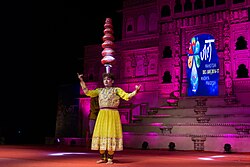
GHOOMAR DANCE Ghoomar is a traditional women's dance in Rajasthan and Haryana. It is performed by groups of women in swirling skirts, accompanied by men and women singing. The dance gets its name from ghoomna, the spinning which displays the colourful, flowing ghaghara (the long Rajasthani skirt).[44]
Kalbelia
The Kalbelia dance is performed by women in black, swirling skirts (as snakes), accompanied by male snake charmers playing beens and other instruments. The Kalbelia folk songs and dances were added to UNESCO's Representative List of the Intangible Cultural Heritage of Humanity in 2010.[45]
Kachchhi Ghodi
The Kachchhi Ghodi dance is primarily performed in the Shekhawati region of north-eastern Rajasthan. The costumed horse and bandit dancers have mock fights while a singer narrates tales of local bandits. It is performed during weddings and other social occasions.[46]
Sikkim
Maruni, also popular in Nepal, Darjeeling, Assam, Bhutan and Myanmar, is accompanied by musicians playing the Naumati Baja.[47]
Tamil Nadu
Parai Attam or Thappattam

Parai Attam is a Tamil dance which is accompanied by a parai drum.[48]
Kummi
Kummi, one of Tamil Nadu's oldest folk dances, is accompanied by hand-clapping rather than musical instruments. Women form a circle and dance; one sings, with the other dancers taking turns. A number of varieties exist. Kummi is danced at festivals and other special occasions.[49]
Karakattam
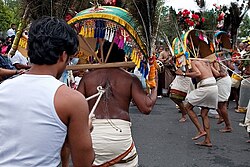
Karakattam is danced to praise Mariamman, the Hindu rain goddess. Dancers balance pots of water on their heads. There are two types of Karakattam. Aatta Karagam is danced with decorated pots on the dancers' heads and symbolises joy and happiness; Sakthi Karagam is danced in temples to praise Mariamman. Drums, singing and pipe instruments accompany the dancers.[50]
Mayilattam
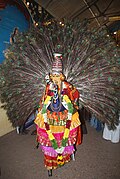
Mayilattam, or the peacock dance, is performed by girls dressed as peacocks at village festivals. Similar dances are Kaalai Attam (bull dance), Karadi Attam (bear dance), and Aali Aattam (demon dance) which are performed in the villages during village get-togethers. Vedala Aattam is danced in a demon mask.[51]
Snake dance
Snakes are viewed as protectors. The snake dance is performed by girls dressed in a costume designed like a snake-skin. The dancers move like a snake, making quick biting movements with their head and hands; raised hands, held together, resemble the head of a snake.[51]
Oyilattam
Although Oyilattam (dance of beauty) was traditionally performed by men, women have also begun dancing. Participants wearing ankle bells dance in a row, with musical accompaniment; the row lengthens as dancers join in. Oyilattam is most popular in the southern districts and the Kongu Nadu region, and the dance has a variety of styles.[51]
Puliyattam
Puliyattam is a tiger dance in which young men paint their bodies and costume themselves as tigers, dancing to drums. The dancers sometimes pretend to capture a goat. A popular dance, Puliyattam is performed during temple festivals.[51]
Poikal Kudirai Attam
Poikal attam is known as the false-leg dance. Dancers are attached to a dummy horse at the waist, with the dancer's two legs and their body prop resembling a rider on a horse. The dance illustrates stories from popular folklore.[52]
Bommalattam
Bommalattams (puppet shows) are held in every village during festivals and fairs. Many kinds of puppets (such as cloth, wood, and leather), and they are manipulated with strings or wires. The puppeteers stand behind a screen, and the puppets are in front; the stories are from the puranas, epics, and folklore.[53]
Theru Koothu
Theru Koothu is normally performed by men in an intersection during village festivals in the months of Panguni and Aadi. The performance consists of story-telling, dialogues, songs, and dance. Its stories are taken from the puranas, epics such as the Ramayana and the Mahabharata, and local folklore. The play begins in the late evening, and lasts for several hours. Theru Koothu is popular in northern Tamil Nadu.[54]
Telangana
Perini Shivatandavam or Perini Thandavam is an ancient dance form which has been recently revived.[55]
Tripura
Hojagiri is danced by the Tripuri reang(Bru) clan in Tripura. Four to eight women dance acrobatically, while men provide most of the music; the women sing in chorus. The dancers twist and turn, sometimes dancing on an earthen pitcher or balancing a bottle on their heads with a lighted lamp on it.[56]
Uttar Pradesh
The Raslila, danced in North India (primarily Uttar Pradesh), is based on the life of Krishna. Individuals and groups dance, accompanied by singing, chants and instruments. The audience claps and sings along, and the length of each performance varies.[57]
West Bengal
- Gambhira originated among the Hindu community of Malda, West Bengal. After the partition of India, Chapai Nawabganj District in Rajshahi became its centre.[58] Gambhira has undergone many changes in terms of the theme and style of its presentation. Muslims also became custodians of the dance, which became an integral part of their culture. Gambhira's themes include contemporary social problems and human weakness.
- Bengal, especially in Rajshahi, Murshidabad and Malda district and Jharkhand's Rajmahal hills. The song-and-dance performance is associated with the mid-April Gajan Shiva festival. The largely-improvised performances, presented on an open stage late at night under lantern light, feature ribald humour and audience participation. Each Alkap group consists of ten to twelve performers led by a sorkar (master). It includes two or three young male chhokras, one or two gayen (singers).[59]
- Domni, performed in Malda district, begins with prayers. Its dances are known as nachari or lachari. The plays are extracts from small events of everyday life, presented satirically. Due to social changes, domni is waning in popularity.
- Dhunuchi nritya is danced during the Durga Puja at Dussehra. Women and men wear traditional Bengali dress and dance with a mud pot filled with burnt coconut shavings in praise of Durga.
State Wise List Of Indian Folk Dance
| SL No. |
State Name |
Folk Dance |
Classical Dance |
|
1. |
Himachal Pradesh |
Kinnauri, Thoda, Jhora, Jhali, Chharhi, Dhaman, Chhapeli, Mahasu, Dangi, Chamba, Thali, Jhainta, Daf, Stick dance . | |
|
2. |
Uttarakhand |
Chappeli,Gadhwali, Kumayuni, Kajari, Jhora, Raslila etc. |
|
|
3. |
Punjab |
Bhangra, Giddha, Daff, Dhaman, Bhand, Naqual.
|
|
|
4. |
Haryana |
Jhumar, Phag Dance, Daph, Dhamal, Loor, Gugga, Khor, Gagor . |
|
| 5. |
Uttar Pradesh |
Nautanki, Raslila, Kajri, Jhora, Chappeli, Jaita. |
Kathak |
|
6. |
Rajasthan |
Ghoomar, Suisini, kalbeliya, Chakri, Ganagor, Jhulan Leela, Jhuma, Suisini, Ghapal, Panihari, Ginad etc. |
|
|
7. |
Gujrat |
Garba, Dandiya Ras, Bhavai, Tippani Juriun, Bhavai. |
|
|
8. |
Maharashtra |
Lavani, Nakata, Koli, Lezim, Gafa, Dahikala Dasavtar or Bohada, Tamasha, Mauni, Powara, Gouricha . |
|
|
9. |
Madhya Pradesh |
Tertali, Maanch, Matki, Aada, Khada Nach, Phulpati, Grida Dance, Selalarki, Selabhadoni, Jawara etc. |
|
|
10. |
Chhattisgarh |
Gaur Maria, Panthi, Raut Nacha, Pandwani, Vedamati, Kapalik, Chandaini, Bharthari Charit, Goudi, Karma, Jhumar, Dagla, Pali, Tapali, Navrani, Diwari, Mundari, Jhumar. |
|
|
11. |
Jharkhand |
Karma Munda, Karma, Agni, Jhumar, Janani Jhumar, Mardana Jhumar, Paika, Phagua, Chhanu, Sarahul, Jat-Jatin, Karma, Danga, Bidesia, Sohrai, Hunta Dance, Mundari Dance, Sarhul, Barao, Jhitka, Danga, Domkach, Ghora Naach. |
|
|
12. |
Bihar |
Jata-Jatin, Bakho-Bakhain, Panwariya, Sama-Chakwa, Bidesia, Jatra . |
|
|
13. |
West Bengal |
Purulia Chhau, Alkap, Kathi, Gambhira, Dhali, Jatra, Baul, Marasia, Mahal, Keertan,Santhali Dance, Mundari dance, Gambhira, Gajan, Chaibari Nritya | |
|
14. |
Sikkim |
Chu Faat, Yak Chaam Sikmari, Singhi Chaam or the Snow Lion, Yak Chaam, Denzong Gnenha, Tashi Yangku Khukuri Naach, Chutkey Naach, Maruni Dance. |
|
|
15. |
Meghalaya |
Laho, Baala, Ka Shad Suk Mynsiem, Nongkrem, |
|
|
16. |
Assam |
Bihu, Bichhua, Natpuja, Maharas, Kaligopal, Bagurumba, Naga dance, Khel Gopal. Tabal Chongli, Canoe, Jhumura Hobjanai etc. |
Sattriya |
|
17. |
Arunachal Pradesh |
Chham, Mask dance (Mukhauta Nritya), War dance. Buiya, Chalo, Wancho, Pasi Kongki, Ponung, Popir, Bardo . |
|
|
18. |
Nagaland |
Chong, Khaiva, Lim, Nuralim, Bamboo Dance, Temangnetin, Hetaleulee.Rangma, Zeliang, Nsuirolians, Gethinglim |
|
|
19. |
Manipur |
Thang Ta, Lai Haraoba, Pung Cholom, Rakhal, Nat Rash, Maha Rash, Raukhat, Dol Cholam, Khamba Thaibi, Nupa Dance, Raslila, Khubak Ishei, Lhou Sha. |
Manipuri |
|
20. |
Mizoram |
Cheraw Dance, Khuallam, Chailam, Sawlakin, Chawnglaizawn, Zangtalam, Par Lam, Sarlamkai/ Solakia, Tlanglam, Khanatm, Pakhupila, Cherokan |
|
|
21. |
Tripura |
Hojagiri |
|
|
22. |
Odisha |
Ghumara, Ranappa,Savari, Ghumara, Painka, Munari, Chhau, Chadya Dandanata, Savari, Painka, Munari |
Odissi |
|
23. |
Andra Pradesh |
Ghantamardala, (Ottam Thedal, Mohiniattam, Kummi, Siddhi, Madhuri, Chhadi. Vilasini Natyam, Bhamakalpam, Veeranatyam, Dappu, Tappeta Gullu, Lambadi, Dhimsa, Kolattam. Butta Bommalu. |
Kuchipudi |
|
24. |
Karnataka |
Yakshagana, Huttari, Suggi, Kunitha, Karga, Lambi |
|
|
25. |
Goa |
Fugdi, Dhalo, Kunbi, Dhangar, Mandi, Jhagor, Khol, Dakni, Tarangamel, Shigmo, Ghode, Modni, Samayi nrutya, Jagar, Ranmale, amayi nrutya, Tonnya mell. | |
| 26. | Telangana | Perini Shivatandavam, Keisabadi | |
|
27. |
Kerala |
Ottam Thulal, Kaikottikali, Tappatikali, Kali Auttam. |
Kathakali, Mohiniyattam |
|
28. |
Tamil Nadu |
Karagam, Kumi, Kolattam, Kavadi |
Bharatnatyam |
See also
- Dance in India
- Folk dances of Sourashtra
- List of Indian classical dance and music events
- Indian classical dance
References
- ↑ Chahar, Dharmendra (28 January 2018). "A complete list of folk and tribal dance in India". Retrieved 30 April 2018.
- ↑ "Twitter". mobile.twitter.com. Retrieved 2020-10-25.
- ↑ "Chalo Loku Festival of Arunachal | Fairs and Festivals of Arunachal Pradesh".
- ↑ Bhatt, S. C. (2005). Land and people of Indian states and union territories : (In 36 volumes). 3. Arunachal Pradesh. ISBN 9788178353593.
- ↑ "Buiya Dance of Digaru Mishmi". 14 February 2009.
- ↑ Sharma, Aparna (2013). "From Springtime Erotics to Micro-nationalism: Altering Landscapes and Sentiments of the Assamese Bihu Dance in North-East India". In Blandford, Steve (ed.). Theatre & Performance in Small Nations. Briston, England and Chicago, IL: Intellect Books. pp. 185–197. ISBN 9781841507859.
- ↑ Barua, Maan (2009-08-01). "Ecological Basis of the Bihu Festival of Assam". Folklore. 120 (2): 213–223. doi:10.1080/00155870902969400. ISSN 0015-587X. S2CID 162337950.
- ↑ "Dimasa Traditional Dance - BAIDIMA". bododimasaarchive.
- ↑ "Bidesia - Folk Dance Drama From Bihar". August 26, 2020.
- ↑ "Department of Tourism, Government of Goa, India - Goan Folk Dances and Art Forms". www.goatourism.gov.in. Retrieved 29 March 2018.
- ↑ "Archived copy". Archived from the original on 2013-01-11. Retrieved 2013-01-09.
{{cite web}}: CS1 maint: archived copy as title (link) - ↑ 12.0 12.1 "Dances of gujarat". Best on Health.[permanent dead link]
- ↑ "Dandiya / Dandiya Sticks". Indian Wedding. Archived from the original on 2008-03-09.
- ↑ "Dandia Dhamaka Website". Archived from the original on 2009-03-03.
- ↑ "Raas Chaos Website".
- ↑ "Competitions". DesiDanceTeams.
- ↑ "Arts". WEBINDIA123.
- ↑ "Tippani Dance in India". india9.com. Retrieved 29 March 2018.
- ↑ "Kullu nati gets Guinness world record certificate | Chandigarh News - Times of India". The Times of India. Retrieved 2021-02-11.
- ↑ "Largest Nati dance lesson". Guinness World Records. Retrieved 2021-02-11.
- ↑ "Kullu Nati folk dance of Himachal Pradesh registered in Guinness Book of World Records". India News, Breaking News | India.com. 2016-01-12. Retrieved 2021-02-11.
- ↑ "Journal of Punjab Studies - Centre for Sikh and Punjab Studies - UC Santa Barbara". www.global.ucsb.edu. Archived from the original on 3 March 2016. Retrieved 4 December 2017.
- ↑ Sachchidananda Encyclopaedic Profile of Indian Tribes Volume 1 - 1996 817141298X p416.
- ↑ "Welcome :: Jharkhand Tourism Development Corporation Ltd". tourism.jharkhand.gov.in.
- ↑ KeralaTourism.Holiday (2019-11-20). "Theyyam Festival — A Complete guide about Theyyam festival in Kerala". Medium. Retrieved 2021-01-30.
- ↑ "Thirayattam" ( Folklore Text-Malayalam), State Institute of Language, Kerala, ISBN 978-81-200-4294-0
- ↑ "Thirayattam". www.thirayattam.com. Retrieved 29 March 2018.
- ↑ "Kerala Dance, Dances of Kerala, Dance Form of Kerala, Dances in Kerela, Kerala in India Travel Tours". www.wonderfulkerala.com. Retrieved 29 March 2018.
- ↑ "Grida Dance". India9. Archived from the original on 25 September 2017. Retrieved 12 March 2021.
- ↑ "Matki Dance". India9. Archived from the original on 27 March 2019. Retrieved 12 March 2021.
- ↑ "Phulpati Dance". India9. Archived from the original on 4 March 2016. Retrieved 12 March 2021.
- ↑ "Tertali Dance". India9. Archived from the original on 6 April 2019. Retrieved 12 March 2021.
- ↑ "Indian Dances". Webonautics. Archived from the original on 2 March 2020. Retrieved 12 March 2021.
- ↑ "Decoding the lavani: A symposium in the city will look into the history of the performance art". Hindustan Times. 2016-12-02. Retrieved 2021-01-28.
- ↑ 35.0 35.1 "In pandemic, Lavani dancers are reclaiming the performing art form". The Indian Express. 2021-01-06. Retrieved 2021-01-28.
- ↑ "Folk Dances". Archived from the original on 2 March 2020. Retrieved 12 March 2021.
- ↑ Nanda, Kanhu (6 April 2013). "Odihsa's folk dance 'Laudi Khela' during Dola fest loses its fame and charm". Odisha Views. Retrieved 12 March 2021.
- ↑ "10 Unique Dance Forms Of Odisha Which Are Spectacular In Their Distinctive Ways". My City Links. 15 September 2016. Retrieved 13 March 2021.
- ↑ 39.0 39.1 "Orissa". Eastern Zonal Cultural Centre. Archived from the original on 20 May 2012. Retrieved 13 March 2021.
- ↑ "Garadi Dance". India9. Archived from the original on 20 January 2021. Retrieved 13 March 2021.
- ↑ "Bhangra History". Gurdeep Pandher of Yukon. Retrieved 13 March 2021.
- ↑ "Giddha". Utsavpedia. Retrieved 13 March 2021.
- ↑ "Dances of Punjab". Retrieved 13 March 2021.
{{cite web}}: CS1 maint: deprecated archival service (link) - ↑ "Ghoomar". India9. Archived from the original on 2 April 2019. Retrieved 13 March 2021.
- ↑ "Kalbelia folk songs and dances of Rajasthan". Intangible Cultural Heritage. UNESCO. Retrieved 13 March 2021.
- ↑ "Dance". Discovered India. Archived from the original on 9 April 2015. Retrieved 13 March 2021.
- ↑ Nepal, Anand. "Musical instruments in Panche Baja and Naumati Baja – traditional Nepali music". Xnepali. Retrieved 14 March 2021.
- ↑ Latagajanan, Nikhil (1 August 2019). "The Sound of the Fury: How an ancient art form became a symbol of resistance". The Caravan. Retrieved 14 March 2021.
- ↑ "Kummi". Know India. Archived from the original on 29 July 2009. Retrieved 14 March 2021.
- ↑ Abraham, Sonu (12 February 2014). "A Cure for The Drought: Rain Dance". Tamil Nadu. Archived from the original on 28 August 2018. Retrieved 14 March 2021.
- ↑ 51.0 51.1 51.2 51.3 "Folk Dances of Tamil Nadu". Carnatica. Archived from the original on 9 March 2021. Retrieved 14 March 2021.
- ↑ "Poikkal Kuthirai Aatam - Tamilnadu". Tamilnadu.com. 11 December 2012.
- ↑ "Bommalattam Tamilnadu". Tamilnadu.com. 28 November 2012.
{{cite web}}: CS1 maint: deprecated archival service (link) - ↑ "Therukoothu". Tamilnadu.com. 16 February 2013.
{{cite web}}: CS1 maint: deprecated archival service (link) - ↑ "Telangana Natyam, Perini dance in temples across State". The Hindu. Chennai, India. 16 October 2010. Archived from the original on 20 October 2010.
- ↑ "Hojagiri Dance". Archived from the original on 6 August 2020. Retrieved 16 March 2021.
- ↑ "Rāslīlā". Britannica.com. Retrieved 16 March 2021.
- ↑ Hasan, Rabiul (20 June 2009). "Mango festival and cultural programme in Chapainawabganj". The Daily Star (Bangladesh). Retrieved 16 March 2021.
- ↑ "Alkap Gan". Banglapedia. Retrieved 16 March 2021.
- ↑ "State Wise Folk Dance Of India PDF || Folk Dance of Indian State - IndJobAspirant.in". Retrieved 2021-07-31.