



imported>KylieTastic m Reverted 1 edit by 115.99.111.148 (talk) to last revision by DaxServer |
->Chris the speller m replaced: Iyengar.He → Iyengar. He (2); cap |
||
| Line 1: | Line 1: | ||
{{short description|Eighth | {{short description|Eighth president of India}} | ||
{{redirect|R. Venkataraman|the Indian cricketer|R. Venkataraman (Indian cricketer)}} | {{redirect|R. Venkataraman|the Indian cricketer|R. Venkataraman (Indian cricketer)}} | ||
{{Indian patronymic|Venkataraman|Ramaswamy}} | {{Indian patronymic|Venkataraman|Ramaswamy}} | ||
| Line 10: | Line 10: | ||
| office = 8th [[President of India]] | | office = 8th [[President of India]] | ||
| primeminister = [[Rajiv Gandhi]]<br />[[V. P. Singh]]<br />[[Chandra Shekhar]]<br />[[P. V. Narasimha Rao]] | | primeminister = [[Rajiv Gandhi]]<br />[[V. P. Singh]]<br />[[Chandra Shekhar]]<br />[[P. V. Narasimha Rao]] | ||
| vicepresident = | | vicepresident = Shankar Dayal Sharma | ||
| term_start = 25 July 1987 | | term_start = 25 July 1987 | ||
| term_end = 25 July 1992 | | term_end = 25 July 1992 | ||
| Line 42: | Line 42: | ||
| birth_name = Ramaswamy Venkataraman | | birth_name = Ramaswamy Venkataraman | ||
| birth_date = {{birth date|df=yes|1910|12|4}} | | birth_date = {{birth date|df=yes|1910|12|4}} | ||
| birth_place = [[Rajamadam | | birth_place = [[Rajamadam]], [[Madras Presidency]], [[British Raj|British India]]<br />(now in [[Tamil Nadu]], [[India]]) | ||
| death_date = {{death date and age|df=yes|2009|1|27|1910|12|4}} | | death_date = {{death date and age|df=yes|2009|1|27|1910|12|4}} | ||
| death_place = [[New Delhi]], [[India]] | | death_place = [[New Delhi]], [[India]] | ||
| Line 52: | Line 52: | ||
| signature = Ramaswamy Venkataraman's Autograph.jpg | | signature = Ramaswamy Venkataraman's Autograph.jpg | ||
}} | }} | ||
'''Ramaswamy Venkataraman''' ({{audio|Rsv.ogg|pronunciation}}, 4 December 1910{{spaced ndash}}27 January 2009)<ref>{{cite book|author=Encyclopaedia Britannica, Inc.|title=Encyclopaedia Britannica Almanac 2010|url=https://books.google.com/books?id=kd2bAAAAQBAJ&pg=PA87|date=1 January 2010|publisher=Encyclopaedia Britannica, Inc.|isbn=978-1-61535-329-3|pages=87–}}</ref><ref>Vinay Kumar (28 January 2009) [https://web.archive.org/web/20091205191739/http://www.hinduonnet.com/2009/01/28/stories/2009012861430100.htm R. Venkataraman passes away]. ''The Hindu''</ref> was an Indian lawyer, Indian independence activist and politician who served as a Union Minister and as the eighth [[ | '''Ramaswamy Venkataraman''' ({{audio|Rsv.ogg|pronunciation}}, 4 December 1910{{spaced ndash}}27 January 2009)<ref>{{cite book|author=Encyclopaedia Britannica, Inc.|title=Encyclopaedia Britannica Almanac 2010|url=https://books.google.com/books?id=kd2bAAAAQBAJ&pg=PA87|date=1 January 2010|publisher=Encyclopaedia Britannica, Inc.|isbn=978-1-61535-329-3|pages=87–}}</ref><ref>Vinay Kumar (28 January 2009) [https://web.archive.org/web/20091205191739/http://www.hinduonnet.com/2009/01/28/stories/2009012861430100.htm R. Venkataraman passes away]. ''The Hindu''</ref> was an Indian lawyer, Indian independence activist and politician who served as a Union Minister and as the eighth [[president of India]].<ref>{{cite web|url=http://pastpresidentsofindia.indiapress.org/venkat.html |title=Shri Ramaswami Venkataraman – R.Venkataraman – Past President of India |publisher=Pastpresidentsofindia.indiapress.org |access-date=13 September 2012}}</ref> | ||
Venkataraman was born in [[Rajamadam]] village in [[Tanjore District (Madras Presidency)|Tanjore district, Madras Presidency]]. He studied law and practised in the [[Madras High Court]] and the [[Supreme Court of India]]. In his young age, he was an activist of the [[Indian independence movement]] and participated in the [[Quit India Movement]]. He was appointed as the member of the Constituent Assembly and the provisional cabinet. He was elected to the Lok Sabha four times and served as Union Finance Minister and Defence Minister. In 1984, he was elected as the seventh [[vice president of India]] and in 1987, he became the eighth President of India and served from 1987 to 1992. He also served as a State minister under [[K. Kamaraj]] and [[M. Bhaktavatsalam]].<ref name="Members Bioprofile">{{Cite web|title=Members Bioprofile|url=http://loksabhaph.nic.in/writereaddata/biodata_1_12/1095.htm|access-date=2020-09-18|website=loksabhaph.nic.in}}</ref> | |||
Venkataraman was born in [[Rajamadam]] village in [[Tanjore District (Madras Presidency)|Tanjore district, Madras Presidency]]. He studied law and practised in the [[Madras High Court]] and the [[Supreme Court of India]]. In his young age, he was an activist of the [[Indian independence movement]] and participated in the [[Quit India Movement]]. He was appointed as the member of the Constituent Assembly and the provisional cabinet. He was elected to the Lok Sabha four times and served as Union Finance Minister and Defence Minister. In 1984, he was elected as the | |||
==Early life== | ==Early life== | ||
Venkataraman was born in Rajamadam village near in [[Pattukottai]], near [[Tanjore district]] in [[Tamil Nadu]] in an [[Iyer]] family.. He had a close friend in Rajamadam village named as Rajamadam Kannan Iyengar.He had his school education in Govt Boys Higher Secondary School, Pattukottai & Undergraduation in [[National College, Tiruchirappalli]].<ref name="Gandhi">{{Cite news|last=Gandhi|first=Gopalkrishna|date=2010-12-04|title=The value of decency|language=en-IN|work=The Hindu|url=https://www.thehindu.com/opinion/op-ed/The-value-of-decency/article15579183.ece|access-date=2020-09-18|issn=0971-751X}}</ref> | Venkataraman was born in Rajamadam village near in [[Pattukottai]], near [[Tanjore district]] in [[Tamil Nadu]] in an [[Iyer]] family.. He had a close friend in Rajamadam village named as Rajamadam Kannan Iyengar. He had his school education in Govt Boys Higher Secondary School, Pattukottai & Undergraduation in [[National College, Tiruchirappalli]].<ref name="Gandhi">{{Cite news|last=Gandhi|first=Gopalkrishna|date=2010-12-04|title=The value of decency|language=en-IN|work=The Hindu|url=https://www.thehindu.com/opinion/op-ed/The-value-of-decency/article15579183.ece|access-date=2020-09-18|issn=0971-751X}}</ref> | ||
Educated locally and in the city of [[Madras]] (now [[Chennai]]), Venkataraman obtained his master's degree in economics from [[Loyola College, Chennai|Loyola College]], [[Madras]]. He later qualified in Law from the Law College, Madras. Venkataraman was enrolled in the [[Madras High Court]] in 1935 and in the Supreme Court in 1951.<ref>[https://web.archive.org/web/20090129214547/http://hindu.com/2009/01/28/stories/2009012861861400.htm Venkataraman presided over the change to era of coalitions] ''[[The Hindu]]'', 28 January 2009.</ref> | Educated locally and in the city of [[Madras]] (now [[Chennai]]), Venkataraman obtained his master's degree in economics from [[Loyola College, Chennai|Loyola College]], [[Madras]]. He later qualified in Law from the Law College, Madras. Venkataraman was enrolled in the [[Madras High Court]] in 1935 and in the Supreme Court in 1951.<ref>[https://web.archive.org/web/20090129214547/http://hindu.com/2009/01/28/stories/2009012861861400.htm Venkataraman presided over the change to era of coalitions] ''[[The Hindu]]'', 28 January 2009.</ref> | ||
| Line 71: | Line 70: | ||
===As Minister of Industries=== | ===As Minister of Industries=== | ||
Venkataraman was appointed a Member of the Union Planning Commission in 1967 and was entrusted the subjects of Industry, Labour, power, Transport, Communications, Railways. He held that office until 1971. In 1977, Venkataraman was elected to the Lok Sabha from Madras (South) Constituency and served as an Opposition Member of Parliament and Chairman of the Public Accounts Committee.<ref>{{Cite web|title=Former President R. Venkataraman Passes Away|url=https://www.outlookindia.com/newswire/story/former-president-r-venkataraman-passes-away/652721|access-date=2020-09-18|website=www.outlookindia.com/}}</ref> | Venkataraman was appointed as a Member of the Union Planning Commission in 1967 and was entrusted the subjects of Industry, Labour, power, Transport, Communications, Railways. He held that office until 1971. In 1977, Venkataraman was elected to the Lok Sabha from Madras (South) Constituency and served as an Opposition Member of Parliament and Chairman of the Public Accounts Committee.<ref>{{Cite web|title=Former President R. Venkataraman Passes Away|url=https://www.outlookindia.com/newswire/story/former-president-r-venkataraman-passes-away/652721|access-date=2020-09-18|website=www.outlookindia.com/}}</ref> | ||
Venkataraman was also, variously, a member of the Political Affairs Committee and the Economic Affairs Committee of the Union Cabinet; Governor, [[International Monetary Fund]], the [[International Bank for Reconstruction and Development]], and the [[Asian Development Bank]]. Venkataraman was a Delegate to the United Nations General Assembly in 1953, 1955, 1956, 1958, 1959, 1960 and 1961. He was Leader of the Indian Delegation to the 42nd Session of the International Labour Conference at Geneva (1958) and represented India in the Inter Parliamentary Conference in Vienna (1978). He was a member of the United Nations Administrative Tribunal from 1955 to 1979 and was its President from 1968 to 1979.<ref>{{Cite web|title=R. Venkataraman Biography - Ramaswamy Venkataraman Profile, Childhood, Life, Timeline|url=https://www.iloveindia.com/indian-heroes/r-venkataraman.html|access-date=2020-09-18|website=www.iloveindia.com}}</ref><ref>{{Cite news|last1=Hazarika|first1=Sanjoy|last2=Times|first2=Special To the New York|date=1987-07-17|title=MAN IN THE NEWS; INDIA'S MILD NEW PRESIDENT: Ramaswamy Venkataraman|language=en-US|work=The New York Times|url=https://www.nytimes.com/1987/07/17/world/man-in-the-news-india-s-mild-new-president-ramaswamy-venkataraman.html|access-date=2020-09-18|issn=0362-4331}}</ref> | Venkataraman was also, variously, a member of the Political Affairs Committee and the Economic Affairs Committee of the Union Cabinet; Governor, [[International Monetary Fund]], the [[International Bank for Reconstruction and Development]], and the [[Asian Development Bank]]. Venkataraman was a Delegate to the United Nations General Assembly in 1953, 1955, 1956, 1958, 1959, 1960 and 1961. He was Leader of the Indian Delegation to the 42nd Session of the International Labour Conference at Geneva (1958) and represented India in the Inter Parliamentary Conference in Vienna (1978). He was a member of the United Nations Administrative Tribunal from 1955 to 1979 and was its President from 1968 to 1979.<ref>{{Cite web|title=R. Venkataraman Biography - Ramaswamy Venkataraman Profile, Childhood, Life, Timeline|url=https://www.iloveindia.com/indian-heroes/r-venkataraman.html|access-date=2020-09-18|website=www.iloveindia.com}}</ref><ref>{{Cite news|last1=Hazarika|first1=Sanjoy|last2=Times|first2=Special To the New York|date=1987-07-17|title=MAN IN THE NEWS; INDIA'S MILD NEW PRESIDENT: Ramaswamy Venkataraman|language=en-US|work=The New York Times|url=https://www.nytimes.com/1987/07/17/world/man-in-the-news-india-s-mild-new-president-ramaswamy-venkataraman.html|access-date=2020-09-18|issn=0362-4331}}</ref> | ||
| Line 84: | Line 83: | ||
==Honours and accolades== | ==Honours and accolades== | ||
Venkataraman received the Doctorate of Law (Honoris Causa) from the University of Madras. He is an Honorary Fellow, Madras Medical College; a Doctor of Social Sciences, University of Roorkee; Doctor of Law (Honoris Causa) from the University of Burdwan. He was awarded The Tamra Patra for participation in the freedom struggle, the Soviet Land Prize for his travelogue on [[K. Kamaraj]]'s visit to the Socialist countries. He was the recipient of a Souvenir from the Secretary-General of the United Nations for distinguished service as President of the U.N. Administrative Tribunal. The title of "Sat Seva Ratna" was conferred on him by the Sankaracharya of Kancheepuram.He was a devotee of the [[Paramacharya]] of Kanchi.<ref>{{Cite web|title=July 16, 1987: Venkataraman elected Indian President|url=https://gulfnews.com/today-history/july-16-1987-venkataraman-elected-indian-president-1.2059225|access-date=2020-09-18|website=gulfnews.com|language=en}}</ref><ref name="Gandhi"/> | Venkataraman received the Doctorate of Law (Honoris Causa) from the University of Madras. He is an Honorary Fellow, Madras Medical College; a Doctor of Social Sciences, University of Roorkee; Doctor of Law (Honoris Causa) from the University of Burdwan. He was awarded The Tamra Patra for participation in the freedom struggle, the Soviet Land Prize for his travelogue on [[K. Kamaraj]]'s visit to the Socialist countries. He was the recipient of a Souvenir from the Secretary-General of the United Nations for distinguished service as President of the U.N. Administrative Tribunal. The title of "Sat Seva Ratna" was conferred on him by the Sankaracharya of Kancheepuram. He was a devotee of the [[Paramacharya]] of Kanchi.<ref>{{Cite web|title=July 16, 1987: Venkataraman elected Indian President|url=https://gulfnews.com/today-history/july-16-1987-venkataraman-elected-indian-president-1.2059225|access-date=2020-09-18|website=gulfnews.com|language=en}}</ref><ref name="Gandhi"/> | ||
==Illness and death== | ==Illness and death== | ||
Revision as of 10:04, 21 December 2021
Ramaswamy Venkataraman | |
|---|---|
.jpg) President Venkataraman | |
| 8th President of India | |
| In office 25 July 1987 – 25 July 1992 | |
| Prime Minister | Rajiv Gandhi V. P. Singh Chandra Shekhar P. V. Narasimha Rao |
| Vice President | Shankar Dayal Sharma |
| Preceded by | Zail Singh |
| Succeeded by | Shankar Dayal Sharma |
| 7th Vice President of India | |
| In office 31 August 1984 – 24 July 1987 | |
| President | Zail Singh |
| Prime Minister | Indira Gandhi Rajiv Gandhi |
| Preceded by | Mohammad Hidayatullah |
| Succeeded by | Shankar Dayal Sharma |
| Minister of Home Affairs | |
| In office 22 June 1982 – 2 September 1982 | |
| Prime Minister | Indira Gandhi |
| Preceded by | Zail Singh |
| Succeeded by | Prakash Chandra Sethi |
| Minister of Defence | |
| In office 15 January 1982 – 2 August 1984 | |
| Prime Minister | Indira Gandhi |
| Preceded by | Indira Gandhi |
| Succeeded by | Shankarrao Chavan |
| Minister of Finance | |
| In office 14 January 1980 – 15 January 1982 | |
| Prime Minister | Indira Gandhi |
| Preceded by | Hemvati Nandan Bahuguna |
| Succeeded by | Pranab Mukherjee |
| Personal details | |
| Born | Ramaswamy Venkataraman 4 December 1910 Rajamadam, Madras Presidency, British India (now in Tamil Nadu, India) |
| Died | 27 January 2009 (aged 98) New Delhi, India |
| Political party | Indian National Congress |
| Spouse(s) | Janaki Venkataraman |
| Children | 3 |
| Alma mater | Loyola College, University of Madras |
| Profession | |
| Signature |  |
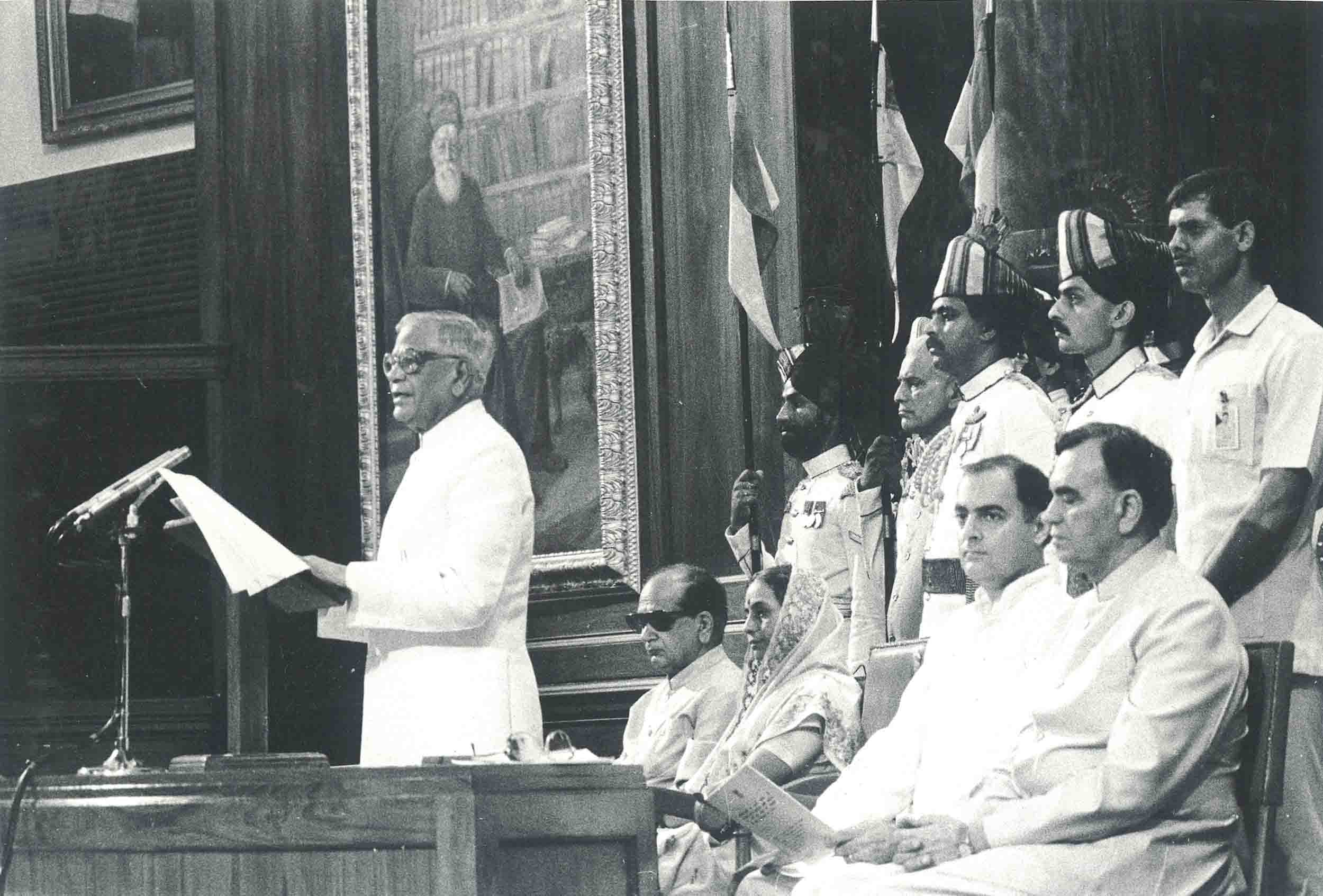
Ramaswamy Venkataraman ( pronunciation (help·info), 4 December 1910 – 27 January 2009)[1][2] was an Indian lawyer, Indian independence activist and politician who served as a Union Minister and as the eighth president of India.[3]
Venkataraman was born in Rajamadam village in Tanjore district, Madras Presidency. He studied law and practised in the Madras High Court and the Supreme Court of India. In his young age, he was an activist of the Indian independence movement and participated in the Quit India Movement. He was appointed as the member of the Constituent Assembly and the provisional cabinet. He was elected to the Lok Sabha four times and served as Union Finance Minister and Defence Minister. In 1984, he was elected as the seventh vice president of India and in 1987, he became the eighth President of India and served from 1987 to 1992. He also served as a State minister under K. Kamaraj and M. Bhaktavatsalam.[4]
pronunciation (help·info), 4 December 1910 – 27 January 2009)[1][2] was an Indian lawyer, Indian independence activist and politician who served as a Union Minister and as the eighth president of India.[3]
Venkataraman was born in Rajamadam village in Tanjore district, Madras Presidency. He studied law and practised in the Madras High Court and the Supreme Court of India. In his young age, he was an activist of the Indian independence movement and participated in the Quit India Movement. He was appointed as the member of the Constituent Assembly and the provisional cabinet. He was elected to the Lok Sabha four times and served as Union Finance Minister and Defence Minister. In 1984, he was elected as the seventh vice president of India and in 1987, he became the eighth President of India and served from 1987 to 1992. He also served as a State minister under K. Kamaraj and M. Bhaktavatsalam.[4]
Early life
Venkataraman was born in Rajamadam village near in Pattukottai, near Tanjore district in Tamil Nadu in an Iyer family.. He had a close friend in Rajamadam village named as Rajamadam Kannan Iyengar. He had his school education in Govt Boys Higher Secondary School, Pattukottai & Undergraduation in National College, Tiruchirappalli.[5]
Educated locally and in the city of Madras (now Chennai), Venkataraman obtained his master's degree in economics from Loyola College, Madras. He later qualified in Law from the Law College, Madras. Venkataraman was enrolled in the Madras High Court in 1935 and in the Supreme Court in 1951.[6]
While practising law, Venkataraman was drawn into the movement for India's freedom from Britain's colonial subjugation. His active participation in the Indian National Congress's celebrated resistance to the British Government, the Quit India Movement of 1942, resulted in his detention for two years under the Defence of India Rules. Venkataraman's interest in the law continued during this period. In 1946, when the transfer of power from British to Indian hands was imminent, the Government of India included him in the panel of lawyers sent to Malaya and Singapore to defend Indian nationals charged with offences of collaboration during the Japanese occupation of those two places. In the years 1947 to 1950, Venkataraman served as Secretary of the Madras Provincial Bar Federation.[7]
Political career
Law and trade activity led to Venkataraman's increasing association with politics. He was a member of constituent assembly that drafted India's constitution. In 1950, he was elected to free India's Provisional Parliament (1950–1952) and to the First Parliament (1952–1957). During his term of legislative activity, Venkataraman attended the 1952 Session of the Metal Trades Committee of International Labour Organisation as a workers' delegate. He was a member of the Indian Parliamentary Delegation to the Commonwealth Parliamentary Conference in New Zealand. Venkataraman was also Secretary to the Congress Parliamentary Party in 1953–1954.[8][4]
Although re-elected to Parliament in 1957, Venkataraman resigned his seat in the Lok Sabha to join the State Government of Madras as a Minister. There Shri Venkataraman held the portfolios of Industries, Labour, Cooperation, Power, Transport and Commercial Taxes from 1957 to 1967. During this time, he was also Leader of the Upper House, namely, the Madras Legislative Council.[9]
As Minister of Industries
Venkataraman was appointed as a Member of the Union Planning Commission in 1967 and was entrusted the subjects of Industry, Labour, power, Transport, Communications, Railways. He held that office until 1971. In 1977, Venkataraman was elected to the Lok Sabha from Madras (South) Constituency and served as an Opposition Member of Parliament and Chairman of the Public Accounts Committee.[10]
Venkataraman was also, variously, a member of the Political Affairs Committee and the Economic Affairs Committee of the Union Cabinet; Governor, International Monetary Fund, the International Bank for Reconstruction and Development, and the Asian Development Bank. Venkataraman was a Delegate to the United Nations General Assembly in 1953, 1955, 1956, 1958, 1959, 1960 and 1961. He was Leader of the Indian Delegation to the 42nd Session of the International Labour Conference at Geneva (1958) and represented India in the Inter Parliamentary Conference in Vienna (1978). He was a member of the United Nations Administrative Tribunal from 1955 to 1979 and was its President from 1968 to 1979.[11][12]
As Minister of Defence
In 1980, Venkataraman was re-elected to the Lok Sabha and was appointed Union Minister of Finance in the Government headed by Smt. Indira Gandhi. He was later appointed Union Minister of Defence, here he is credited for initiating India's missile programme, he shifted A P J Abdul Kalam from space programme to the missile programme, and consolidated the entire missile system, naming it as Integrated Guided Missile Development Program.[13][14]
President and Vice President of India
| Presidential styles of Ramaswamy Venkataraman | |
|---|---|
  | |
| Spoken style | President R. Venkataraman |
| Alternative style | Mr. President |
Later he was to serve as Vice-President of India and then as a President of India starting 1987, where he worked with four prime ministers, and appointed three of them: V P Singh, Chandra Shekhar and P V Narasimha Rao, during his five-year term, which saw the advent of coalition politics in India. His successor S D Sharma was the only other Indian President in 20th Century to work with four prime ministers and appoint three of them.[15][16]

Honours and accolades
Venkataraman received the Doctorate of Law (Honoris Causa) from the University of Madras. He is an Honorary Fellow, Madras Medical College; a Doctor of Social Sciences, University of Roorkee; Doctor of Law (Honoris Causa) from the University of Burdwan. He was awarded The Tamra Patra for participation in the freedom struggle, the Soviet Land Prize for his travelogue on K. Kamaraj's visit to the Socialist countries. He was the recipient of a Souvenir from the Secretary-General of the United Nations for distinguished service as President of the U.N. Administrative Tribunal. The title of "Sat Seva Ratna" was conferred on him by the Sankaracharya of Kancheepuram. He was a devotee of the Paramacharya of Kanchi.[18][5]
Illness and death
On 12 January 2009, Venkataraman was admitted to the Army Hospital (Research and Referral ) with complaints of Urosepsis (sepsis caused by a urinary tract infection).[19] His condition grew critical on 20 January, when he was detected with low blood pressure and E. coli tract infection.
Venkataraman died at the Army Hospital (was Research and Referral) New Delhi on 27 January 2009 at 14:30 IST[19] due to multiple organ failure at the age of 98.[20] Since he died on the day after Republic Day, some programmes coinciding it were cancelled to mark the respect towards the late former President. He was cremated with full state honours at Ekta Sthal near Raj Ghat. President Pratibha Patil, Vice President Mohammad Hamid Ansari, Prime Minister Manmohan Singh and various other leaders condoled his death.
Books by Venkataraman
- Role of Planning in Industrial Development, by Ramaswami Venkataraman. Published by Govt. of India Press, 1969.
- The Role of a Private Member of Parliament, by Ramaswami Venkataraman. Published by Harold Laski Institute of Political Science, 1986.
- My Presidential Years – R Venkataraman, by R Venkataraman. 1995. HarperCollins/Indus. ISBN 81-7223-202-0.
- R. Venkataraman on Contemporary Issues, by Ramaswami Venkataraman, K. Venkatasubramanian. Published by Variant Communications, 1996.
- Relevance of Gandhi: And Other Essays, by K Swaminathan, Ramaswami Venkataraman. Published by Gandhigram Trust, 1998.
Books on R. Venkataraman
- President R. Venkataraman, by Nand Gopal Chaudhry. Published by Manas Publications, 1987. ISBN 81-7049-018-9.
- The Great Humanist Ramaswami Venkataraman, by Attar Chand. Published by Gian Pub. House, 1987. ISBN 81-212-0106-3.
- So May India be Great: Selected Speeches and Writings of President R. Venkataraman, by Ramaswami Venkataraman. Published by Publication Division, Ministry of Information and Broadcasting, Govt. of India, 1990.
- Selected Speeches, 1984–87, 10 September 1984 – 14 May 1987: 10 September 1984 – 14 May 1987, by Ramaswami Venkataraman. Published by Publications Division, Ministry of Information and Broadcasting, Govt. of India, 1991.
- President R. Venkataraman Selected Speeches: July 1987 – December 1989., by Ramaswami Venkataraman. Published by Publications Division, Ministry of Information and Broadcasting, Govt. of India, 1991.
References
- ↑ Encyclopaedia Britannica, Inc. (1 January 2010). Encyclopaedia Britannica Almanac 2010. Encyclopaedia Britannica, Inc. pp. 87–. ISBN 978-1-61535-329-3.
- ↑ Vinay Kumar (28 January 2009) R. Venkataraman passes away. The Hindu
- ↑ "Shri Ramaswami Venkataraman – R.Venkataraman – Past President of India". Pastpresidentsofindia.indiapress.org. Retrieved 13 September 2012.
- ↑ 4.0 4.1 "Members Bioprofile". loksabhaph.nic.in. Retrieved 18 September 2020.
- ↑ 5.0 5.1 Gandhi, Gopalkrishna (4 December 2010). "The value of decency". The Hindu. ISSN 0971-751X. Retrieved 18 September 2020.
- ↑ Venkataraman presided over the change to era of coalitions The Hindu, 28 January 2009.
- ↑ "July 16, 1987: Venkataraman elected Indian President". gulfnews.com. Retrieved 18 September 2020.
- ↑ Grewal, Kairvy (27 January 2020). "R Venkataraman — President who stuck by rulebook to guide India through troublesome times". ThePrint. Retrieved 18 September 2020.
- ↑ DelhiDecember 4, India Today Web Desk New; January 27, 2015UPDATED; Ist, 2016 10:42. "Remembering R. Venkataraman: 10 facts about the eighth President of India". India Today. Retrieved 18 September 2020.
{{cite web}}:|first2=has generic name (help);|first3=has numeric name (help)CS1 maint: numeric names: authors list (link) - ↑ "Former President R. Venkataraman Passes Away". www.outlookindia.com/. Retrieved 18 September 2020.
- ↑ "R. Venkataraman Biography - Ramaswamy Venkataraman Profile, Childhood, Life, Timeline". www.iloveindia.com. Retrieved 18 September 2020.
- ↑ Hazarika, Sanjoy; Times, Special To the New York (17 July 1987). "MAN IN THE NEWS; INDIA'S MILD NEW PRESIDENT: Ramaswamy Venkataraman". The New York Times. ISSN 0362-4331. Retrieved 18 September 2020.
- ↑ Venkataraman responsible for shaping missile programme: Kalam The Hindu, 27 January 2009.
- ↑ Ministry of Defence (India)
- ↑ Former President Venkataraman passes away The Times of India, 28 January 2009.
- ↑ Former President R Venkataraman passes away Indian Express, 27 January 2009.
- ↑ "DETAILS OF MEDIA PERSONS ACCOMPANYING THE PRESIDENT IN HIS/HER VISITS ABROAD SINCE 1947 TO 2012" (PDF). The President's Secretariat. Archived from the original (PDF) on 17 August 2013. Retrieved 5 June 2013.
- ↑ "July 16, 1987: Venkataraman elected Indian President". gulfnews.com. Retrieved 18 September 2020.
- ↑ 19.0 19.1 "Former President R Venkataraman dies". NDTV. Archived from the original on 31 January 2009.
- ↑ "Former President Venkataraman dead". Sindh Today. 27 January 2009.
{{cite news}}: CS1 maint: deprecated archival service (link)
Further reading
- "Ramaswamy Venkataraman:Eighth President of India". The Times. 30 January 2009.
External links
- Late R.Venkatraman's Journey
- maintained by RV Foundation, a Trust founded by him and administered by the family.

