






m 1 revision imported |
>WereSpielChequers c/e |
||
| Line 1: | Line 1: | ||
{{short description|Overview of the national symbols of India}} | |||
{{ | {{use dmy dates|date=February 2019}} | ||
{{use Indian English|date=February 2019}} | |||
[[File:Flag of India, New Delhi.jpg|thumb|260x260px|Flag of India]] | |||
[[ | The [[Republic of India]] has several official '''[[national symbol]]s''' including a historical document, a flag, an emblem, an anthem, a memorial tower as well as several national heroes. The design of the national flag was officially adopted by the Constituent Assembly just before independence, on 22 July in 1947.<ref name="Flbag">{{cite web | url = http://knowindia.gov.in/knowindia/national_symbols.php?id=2 | title = National Flag | publisher=[[Government of India]] | access-date=3 March 2014 }}</ref> Other symbols that were designated on various occasions include the national animal, bird, fruit and tree.<ref>{{cite web |url = http://knowindia.gov.in/national-identity-elements |title=National Identity Elements of India |website=knowindia.gov.in }}</ref> | ||
== List of National and Official Symbols of India == | |||
{| class="wikitable sortable mw-collapsible" | |||
{| class="wikitable sortable" | |+ | ||
!Symbol | |||
!Name | |||
!Image | |||
!References | |||
|- | |- | ||
|'''[[List of countries and dependencies and their capitals in native languages|Official Name]]''' | |||
|'''[[Names of India in its official languages|Republic of India]]''' | |||
[[Hindi language|Hindi]]: भारत गणराज्य ''(Bhārat Gaṇarājya)'' | |||
| | |||
| '''[[List of countries and dependencies and their capitals in native languages|Official | |||
| '''[[Names of India in its official languages|Republic of India]]''' | |||
| | |||
| | | | ||
|- | |- | ||
| '''[[National | | '''[[National Flag]]''' | ||
| | | [[Flag of India|'''National Flag of India''']] | ||
| [[ | Hindi: तिरंगा (Tiraṅgā) | ||
| | | align="center" | [[File:Flag of India.svg|160x160px]] | ||
| A horizontal rectangular [[Tricolour (flag)|tricolour]] with equally sized [[Saffron (color)#Deep saffron|deep saffron]] at the top, [[white]] in the middle and [[Variations of green#India green|India green]] at the bottom. In the center is a [[navy blue]] wheel with twenty-four spokes, known as the [[Ashoka Chakra]]. The flag is based on the [[Swaraj flag]] designed by [[Pingali Venkayya]].<ref name="Flbag" /> | |||
|- | |- | ||
| '''[[National emblem]]''' | |'''[[National emblem|National Emblem]]''' | ||
| '''[[State Emblem of India]]''' ''( | |||
| [[ | '''&''' | ||
| <ref | |||
'''[[List of national mottos|National Motto]]''' | |||
|'''[[State Emblem of India]]''' ''([[Lion Capital of Ashoka]])'' | |||
'''[[Satyameva Jayate|"Satyameva Jayate"]]''' [[Sanskrit language|Sanskrit]]: "''सत्यमेव जयते "("Truth Alone Triumphs")'' | |||
| align="center" | [[File:Emblem of India.svg|163x163px]] | |||
| An adaptation of [[Lion Capital of Ashoka]] at [[Sarnath]] was adopted as the [[National Emblem of India|National Emblem]] of [[India]] on 26 January 1950, the day India became a [[republic]]. Forming an integral part of the emblem is the motto inscribed below the abacus in [[Devanagari]] script: "Satyameva Jayate" (English: Truth Alone Triumphs), a quote taken from [[Mundaka Upanishad]], the concluding part of the sacred Hindu Vedas.<ref>{{cite web|title=State Emblem|url=http://knowindia.gov.in/knowindia/national_symbols.php?id=9|url-status=dead|archive-url=https://web.archive.org/web/20160303205815/http://knowindia.gov.in/knowindia/national_symbols.php?id=9|archive-date=3 March 2016|access-date=3 April 2012|publisher=[[Government of India]]}}</ref> | |||
|- | |- | ||
| '''[[List of national | |'''[[List of national anthems|National Anthem]]''' | ||
| ''' [[ | |'''[[Jana Gana Mana]]''' ''("Thou Art the Ruler of the Minds of All People")'' | ||
| [[ | | align="center" | [[File:Jana Gana Mana sheet music.jpg|174x174px]][[File:Jana_Gana_Mana_instrumental.ogg|center|120x120px|Jana Gana Mana]] | ||
| | | '''''Jana Gana Mana''''' is the [[national anthem]] of [[India]]. It was originally composed as [[Bharoto Bhagyo Bidhata]] in [[Bengali language|Bengali]] by polymath [[Rabindranath Tagore]]. The first stanza of the song [[Bharoto Bhagyo Bidhata]] was adopted by the [[Constituent Assembly of India]] as the National Anthem on 24 January 1950. | ||
|- | |- | ||
| '''[[List of national anthems|National | |'''[[List of national anthems|National Song]]''' | ||
| '''[[ | |'''[[Vande Mataram]]''' ''("I bow to thee, O Mother!")'' | ||
| [[File: | | align="center" | [[File:Vande Mataram - Bankim Chandra Chatterjee (Raag Desh).png|172x172px]] | ||
| | | Vande Mataram is a [[Sanskrit language|Sanskrit]] poem written by [[Bankim Chandra Chattopadhyay|Bankim Chandra Chatterjee]] which he included in his 1882 [[Bengali language|Bengali]] novel ''[[Anandamath]]''. The poem was first sung by [[Rabindranath Tagore]] at the 1896 session of the [[Indian National Congress]]. The first two verses of the song were adopted as the National Song of India On 24 January 1950 by the [[Constituent Assembly of India]]. | ||
|- | |- | ||
| '''[[List of national | |'''[[List of national days|National Days]]''' | ||
| '''[[ | |'''[[Independence Day (India)|Independence Day]]''', | ||
'''[[Republic Day (India)|Republic Day]]''', | |||
| | |||
'''[[Gandhi Jayanti]]''' | |||
| align="center" | [[File:National days of india.jpg|160x160px]] | |||
|26 January Republic Day, adoption of the Constitution of India in 1950 15 August Independence from the British Empire in 1947 2 October Gandhi Jayanti, birth anniversary of Father of the Nation | |||
|- | |- | ||
| '''[[ | |'''[[Oath of Allegiance]]''' | ||
| | |[[National Pledge (India)|'''National Pledge''']] | ||
| [[ | | align="center" | [[File:National Pledge of India.png|160x160px]] | ||
| <ref>{{cite | |It was written in [[Telugu language|Telugu]] by [[Pydimarri Venkata Subba Rao]] in 1962. Central Advisory Board on Education directed that the pledge to be sung in Schools and that this practice to be introduced by 26 January 1965.<ref name="BiswasAgrawal1986">{{cite book|last1=Biswas|first1=Arabinda|url=https://books.google.com/books?id=vKsVPua_E6sC&pg=PA140|title=Development of education in India: a historical survey of educational documents before and after independence|last2=Agrawal|first2=S. P.|date=1 January 1986|publisher=Concept Publishing Company|isbn=978-81-7022-066-4|page=140|access-date=27 January 2012}}</ref> It is commonly recited by Indians in unison at public events, especially in schools, and during the [[Independence Day (India)|Independence Day]] and [[Republic Day (India)|Republic Day]] celebrations. | ||
|- | |- | ||
| '''[[List of circulating currencies|National | |'''[[List of circulating currencies|National Currency]]''' | ||
| '''[[Indian rupee]]''' ''("₹, INR")'' | |'''[[Indian rupee|Indian Rupee]]''' ''("₹, INR")'' | ||
| [[ | | align="center" | [[File:Indian Rupee symbol.svg|103x103px]] | ||
| | | [[Indian rupee]] (ISO code: INR) is the official currency of the Republic of India. The issuance of the currency is controlled by the [[Reserve Bank of India]]. The [[Indian rupee sign|Indian rupee symbol]] is derived from the Devanagari consonant "र" (ra) and the Latin letter "R" was adopted in 2010. According to [[Udaya Kumar (designer)|Udaya Kumar]], its designer, the design is based on the Indian tricolour. | ||
|- | |- | ||
| '''National | |'''National Calendar''' | ||
| '''[[Indian national calendar]]''' | |'''[[Indian national calendar|Indian National Calendar]]''' | ||
| [[ | | align="center" | [[File:Indian national calendar.jpg|160x160px]] | ||
| | | The '''Indian national calendar''', sometimes called the '''Shalivahana Shaka calendar'''. It is used, alongside the [[Gregorian calendar]], by ''[[The Gazette of India]]'', in news broadcasts by [[All India Radio]] and in calendars and communications issued by the [[Government of India]]. | ||
|- | |- | ||
| ''' | |'''National Cockade''' | ||
| '''[[ | |'''[[Cockade|Indian Cockade]]''' | ||
| align="center" | [[File:National Cockade of India.svg|160x160px]] | |||
| A '''cockade''' is a knot of ribbons, or other circular- or oval-shaped symbol of distinctive colours which is usually worn on a [[hat]]. | |||
|- | |- | ||
| '''National | |'''[[List of national animals|National Animal]]''' | ||
| '''[[ | |'''[[Tiger]]''' [[Tiger|(''Panthera tigris'']]) | ||
| [[File: | | align="center" | [[File:Royal Bengal Tiger at New Delhi.jpg|160x160px]] | ||
| | | The T'''iger or Panthera tigris species''' has a | ||
subspecies called Bengal Tiger. It is a form of a specific population of the ''[[Panthera tigris tigris]]'' subspecies that is native to the [[Indian subcontinent]]. | |||
|- | |- | ||
| '''[[List of national animals|National | |'''[[List of national animals|National Heritage Animal]]''' | ||
| '''[[ | |'''[[Indian elephant|Indian Elephant]]''' [[Indian elephant|(''Elephas maximus indicus'')]] | ||
| [[File: | | align="center" | [[File:Elephas maximus (Bandipur).jpg|160x160px]] | ||
| <ref | | Indian elephant is the national heritage animal of India since 22 October 2010. India's Environment Ministry has declared the elephant a National Heritage Animal in order to increase protective measures for the country's nearly 29,000 elephants."Declaring it the National Heritage Animal will give it due place as emblem of ecological sensitivity. It will also mark recognition for its centrality in our plural cultures, traditions and oral lore," the task force wrote in its report.<ref>{{cite web|date=22 October 2010|title=India Gives Elephants 'National Heritage Animal' Status|url=http://www.ens-newswire.com/ens/oct2010/2010-10-22-03.html|access-date=27 October 2018|website=[[Environment News Service]]}}</ref> | ||
|- | |- | ||
| '''[[List of national animals|National | |'''[[List of national animals|National Aquatic Animal]]''' | ||
| ''' | |[[Ganges river dolphin|'''Ganges River Dolphin''' (''Platanista gangetica'')]] | ||
| [[ | | align="center" | [[File:The magnificent Ganges River Dolphin.jpg|160x160px]] | ||
| The '''South Asian river dolphin''' (''Platanista gangetica'') is an endangered freshwater or [[river dolphin]] found in the region of [[Indian subcontinent]], which is split into two subspecies, the Ganges river dolphin and the Indus river dolphin. The Ganges river dolphin is primarily found in the [[Ganges]] and [[Brahmaputra River|Brahmaputra]] Rivers and their tributaries in [[India]], [[Bangladesh]], and [[Nepal]], while the Indus river dolphin is now found only in the main channel of the [[Indus River]] in [[Pakistan]] and River [[Beas]] (a tributary of the Indus) in [[Punjab, India|Punjab]] in India.The Ganges river dolphin has been recognized by the government of India as its [[List of national animals|National Aquatic Animal]] | |||
|- | |- | ||
| '''[[List of national animals|National | |'''[[List of national animals|National Reptile]]''' | ||
| '''[[ | |'''[[King cobra|King Cobra]]''' [[King cobra|(''Ophiophagus hanna'')]] | ||
| [[ | | align="center" | [[File:King Cobra 25.jpg|160x160px]] | ||
| | |King cobra is the national reptile of India. It is considered a sacred animal in Indian culture. | ||
|- | |- | ||
| '''[[List of national | |'''[[List of national flowers|National Flower]]''' | ||
| | | | ||
[ | |||
'''Lotus''' NATIONALFLOWER''']<ref>{{cite Flowe | |||
<nowiki>| align="center" |</nowiki> | Lotus (Nelumbo Nucifera Gaertn) is the National Flower of India. It is a sacred flowimmemorial.er and occupies a unique position in the art and mythology of ancient India and has been an auspicious symbol of Indian culture since time | |||
“ | |||
<nowiki>|</nowiki>'''[[List of national trees|National Tree]]''' | |||
|[[Ficus benghalensis|'''Indian''' '''Banyan''' (''Ficus benghalensis'')]] | |||
| ''' | | align="center" | [[File:The great banyan tree.jpg|160x160px]] | ||
| [[ | | Indian banyan (''[[Ficus bengalensis]]'') root themselves to form new trees and grow over large areas. Because of this characteristic and its longevity, this tree is considered immortal and is an integral part of the myths and legends of India.<nowiki><ref></nowiki>{{cite web|title=National Tree|url=http://knowindia.gov.in/knowindia/national_symbols.php?id=5|url-status=dead|archive-url=https://web.archive.org/web/20130122081829/http://www.knowindia.gov.in/knowindia/national_symbols.php?id=5|archive-date=22 January 2013|access-date=3 April 2012|publisher=[[Government of India]]|df=dmy-all}}</ref><ref>{{Cite web|last=Gahlot|first=Indrajit|date=2014-09-05|title=Destination Of The Week : Banyan Tree amritsar|url=https://nevertiredoftravelling.wordpress.com/2014/09/05/destination-of-the-week-banyan-tree-amritsar/|access-date=2021-01-31|website=Never Tired of Travelling|language=en}}</ref>''' | ||
| <ref>{{cite | | | ||
| | |||
|- | |- | ||
| '''[[List of national | |'''[[List of national birds|National Bird]]''' | ||
| '''[[ | |'''[[Indian peacock|Indian Peacock]]''' [[Indian peacock|(''Pavo cristatus'')]] | ||
| [[File: | | align="center" | [[File:Pfau imponierend.jpg|160x160px]] | ||
| <ref>{{cite web|title=National | |Indian peacock (''[[Pavo cristatus]]'') is designated as the national bird of India. A bird indigenous to the subcontinent, the peacock represents the unity of vivid colours and finds references in Indian culture.<ref>{{cite web|title=National Bird|url=http://knowindia.gov.in/knowindia/national_symbols.php?id=3|url-status=dead|archive-url=https://web.archive.org/web/20130115003741/http://knowindia.gov.in/knowindia/national_symbols.php?id=3|archive-date=15 January 2013|access-date=3 April 2012|publisher=[[Government of India]]|df=dmy-all}}</ref> On 1 February 1963, The Government of India had decided to have the Peacock as the national bird of India. | ||
|- | |- | ||
| '''[[List of national fruits|National | |'''[[List of national fruits|National Fruit]]''' | ||
| '''[[Mango]]''' | |'''[[Mango]]''' | ||
| [[File: | | align="center" | [[File:Mangifera indica (Manguier 4).jpg|160x160px]] | ||
| | | Mango (''[[Mangifera indica]]'') originated in India and the country is home to more than 100 varieties of the fruit. Mango is referred to as the King of Fruits. <ref>{{cite web|title=National Fruit|url=http://knowindia.gov.in/knowindia/national_symbols.php?id=13|url-status=dead|archive-url=https://web.archive.org/web/20130122081811/http://www.knowindia.gov.in/knowindia/national_symbols.php?id=13|archive-date=22 January 2013|access-date=3 April 2012|publisher=[[Government of India]]|df=dmy-all}}</ref> | ||
</ref> | |||
|- | |- | ||
| '''National | |'''National River''' | ||
| '''[[ | |'''[[Ganga]]''' | ||
| [[ | | align="center" | [[File:Dashawamedha Ghat in Varanasi 1.jpg|160x160px]] | ||
| | | The Ganges is a lifeline to millions who live along its course. It is a sacred river and worshipped as the goddess ''[[Ganges in Hinduism|Ganga]]'' in [[Hinduism]]. It has been important historically; many former provincial or imperial capitals (such as [[Prayagraj]], [[Dhaka]], [[Baharampur]], [[Bikrampur]], [[Kampilya]], [[Kannauj]], [[Kara (Kaushambi)|Kara]], [[Varanasi|Kashi]], [[Kolkata]], [[Murshidabad]], [[Munger]], [[Patliputra]], and [[Sonargaon]]) have been located on its banks. | ||
|} | |} | ||
== See also == | |||
* [[List of Indian state symbols]] | |||
== | == References == | ||
{{Reflist}} | |||
== | == External links == | ||
{{ | {{Commons|National Symbols of India}} | ||
* [http://knowindia.gov.in/knowindia/national_symbols.php National Symbols]. [[Know India Programme]]. | |||
* [http://india.gov.in/india-glance/national-symbols National Symbols]. [[Govt. of India]] Official website. | |||
https://www.adda247.com/defence-jobs/what-is-the-national-animal-of-india/ | |||
{{-}} | |||
{{Symbols of India}} | |||
{{Asia topic|National symbols of}} | |||
{{Portal bar|India}} | |||
[[Category:National symbols of India| ]] | [[Category:National symbols of India| ]] | ||
Revision as of 03:44, 3 November 2021

The Republic of India has several official national symbols including a historical document, a flag, an emblem, an anthem, a memorial tower as well as several national heroes. The design of the national flag was officially adopted by the Constituent Assembly just before independence, on 22 July in 1947.[1] Other symbols that were designated on various occasions include the national animal, bird, fruit and tree.[2]
List of National and Official Symbols of India
| Symbol | Name | Image | References |
|---|---|---|---|
| Official Name | Republic of India
Hindi: भारत गणराज्य (Bhārat Gaṇarājya) |
||
| National Flag | National Flag of India
Hindi: तिरंगा (Tiraṅgā) |

|
A horizontal rectangular tricolour with equally sized deep saffron at the top, white in the middle and India green at the bottom. In the center is a navy blue wheel with twenty-four spokes, known as the Ashoka Chakra. The flag is based on the Swaraj flag designed by Pingali Venkayya.[1] |
| National Emblem
& |
State Emblem of India (Lion Capital of Ashoka)
"Satyameva Jayate" Sanskrit: "सत्यमेव जयते "("Truth Alone Triumphs") |

|
An adaptation of Lion Capital of Ashoka at Sarnath was adopted as the National Emblem of India on 26 January 1950, the day India became a republic. Forming an integral part of the emblem is the motto inscribed below the abacus in Devanagari script: "Satyameva Jayate" (English: Truth Alone Triumphs), a quote taken from Mundaka Upanishad, the concluding part of the sacred Hindu Vedas.[3] |
| National Anthem | Jana Gana Mana ("Thou Art the Ruler of the Minds of All People") |  |
Jana Gana Mana is the national anthem of India. It was originally composed as Bharoto Bhagyo Bidhata in Bengali by polymath Rabindranath Tagore. The first stanza of the song Bharoto Bhagyo Bidhata was adopted by the Constituent Assembly of India as the National Anthem on 24 January 1950. |
| National Song | Vande Mataram ("I bow to thee, O Mother!") | Error creating thumbnail: File with dimensions greater than 12.5 MP | Vande Mataram is a Sanskrit poem written by Bankim Chandra Chatterjee which he included in his 1882 Bengali novel Anandamath. The poem was first sung by Rabindranath Tagore at the 1896 session of the Indian National Congress. The first two verses of the song were adopted as the National Song of India On 24 January 1950 by the Constituent Assembly of India. |
| National Days | Independence Day, | 
|
26 January Republic Day, adoption of the Constitution of India in 1950 15 August Independence from the British Empire in 1947 2 October Gandhi Jayanti, birth anniversary of Father of the Nation |
| Oath of Allegiance | National Pledge | 
|
It was written in Telugu by Pydimarri Venkata Subba Rao in 1962. Central Advisory Board on Education directed that the pledge to be sung in Schools and that this practice to be introduced by 26 January 1965.[4] It is commonly recited by Indians in unison at public events, especially in schools, and during the Independence Day and Republic Day celebrations. |
| National Currency | Indian Rupee ("₹, INR") | 
|
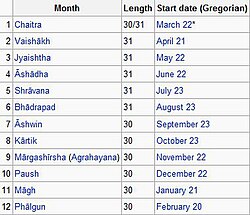
Indian rupee (ISO code: INR) is the official currency of the Republic of India. The issuance of the currency is controlled by the Reserve Bank of India. The Indian rupee symbol is derived from the Devanagari consonant "र" (ra) and the Latin letter "R" was adopted in 2010. According to Udaya Kumar, its designer, the design is based on the Indian tricolour. |
| National Calendar | Indian National Calendar | 
|
The Indian national calendar, sometimes called the Shalivahana Shaka calendar. It is used, alongside the Gregorian calendar, by The Gazette of India, in news broadcasts by All India Radio and in calendars and communications issued by the Government of India. |
| National Cockade | Indian Cockade | 
|
A cockade is a knot of ribbons, or other circular- or oval-shaped symbol of distinctive colours which is usually worn on a hat. |
| National Animal | Tiger (Panthera tigris) | 
|
The Tiger or Panthera tigris species has a
subspecies called Bengal Tiger. It is a form of a specific population of the Panthera tigris tigris subspecies that is native to the Indian subcontinent. |
| National Heritage Animal | Indian Elephant (Elephas maximus indicus) | .jpg)
|
Indian elephant is the national heritage animal of India since 22 October 2010. India's Environment Ministry has declared the elephant a National Heritage Animal in order to increase protective measures for the country's nearly 29,000 elephants."Declaring it the National Heritage Animal will give it due place as emblem of ecological sensitivity. It will also mark recognition for its centrality in our plural cultures, traditions and oral lore," the task force wrote in its report.[5] |
| National Aquatic Animal | Ganges River Dolphin (Platanista gangetica) | File:The magnificent Ganges River Dolphin.jpg | The South Asian river dolphin (Platanista gangetica) is an endangered freshwater or river dolphin found in the region of Indian subcontinent, which is split into two subspecies, the Ganges river dolphin and the Indus river dolphin. The Ganges river dolphin is primarily found in the Ganges and Brahmaputra Rivers and their tributaries in India, Bangladesh, and Nepal, while the Indus river dolphin is now found only in the main channel of the Indus River in Pakistan and River Beas (a tributary of the Indus) in Punjab in India.The Ganges river dolphin has been recognized by the government of India as its National Aquatic Animal |
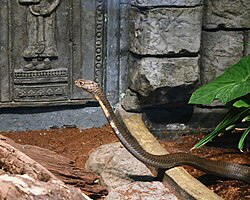
| National Reptile | King Cobra (Ophiophagus hanna) | 
|
King cobra is the national reptile of India. It is considered a sacred animal in Indian culture. |
| National Flower | |||
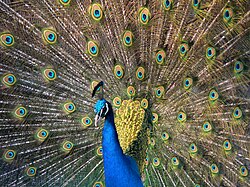
| National Bird | Indian Peacock (Pavo cristatus) | 
|
Indian peacock (Pavo cristatus) is designated as the national bird of India. A bird indigenous to the subcontinent, the peacock represents the unity of vivid colours and finds references in Indian culture.[8] On 1 February 1963, The Government of India had decided to have the Peacock as the national bird of India. |
| National Fruit | Mango | .jpg)
|
Mango (Mangifera indica) originated in India and the country is home to more than 100 varieties of the fruit. Mango is referred to as the King of Fruits. [9] |
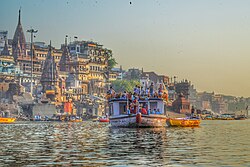
| National River | Ganga | 
|
The Ganges is a lifeline to millions who live along its course. It is a sacred river and worshipped as the goddess Ganga in Hinduism. It has been important historically; many former provincial or imperial capitals (such as Prayagraj, Dhaka, Baharampur, Bikrampur, Kampilya, Kannauj, Kara, Kashi, Kolkata, Murshidabad, Munger, Patliputra, and Sonargaon) have been located on its banks. |
See also
References
- ↑ 1.0 1.1 "National Flag". Government of India. Retrieved 3 March 2014.
- ↑ "National Identity Elements of India". knowindia.gov.in.
- ↑ "State Emblem". Government of India. Archived from the original on 3 March 2016. Retrieved 3 April 2012.
- ↑ Biswas, Arabinda; Agrawal, S. P. (1 January 1986). Development of education in India: a historical survey of educational documents before and after independence. Concept Publishing Company. p. 140. ISBN 978-81-7022-066-4. Retrieved 27 January 2012.
- ↑ "India Gives Elephants 'National Heritage Animal' Status". Environment News Service. 22 October 2010. Retrieved 27 October 2018.
- ↑ {{cite Flowe
| align="center" | | Lotus (Nelumbo Nucifera Gaertn) is the National Flower of India. It is a sacred flowimmemorial.er and occupies a unique position in the art and mythology of ancient India and has been an auspicious symbol of Indian culture since time
“
|National Tree
|Indian Banyan (Ficus benghalensis)
| align="center" |
 | Indian banyan (Ficus bengalensis) root themselves to form new trees and grow over large areas. Because of this characteristic and its longevity, this tree is considered immortal and is an integral part of the myths and legends of India.<ref>"National Tree". Government of India. Archived from the original on 22 January 2013. Retrieved 3 April 2012.
- ↑ Gahlot, Indrajit (5 September 2014). "Destination Of The Week : Banyan Tree amritsar". Never Tired of Travelling. Retrieved 31 January 2021.
- ↑ "National Bird". Government of India. Archived from the original on 15 January 2013. Retrieved 3 April 2012.
- ↑ "National Fruit". Government of India. Archived from the original on 22 January 2013. Retrieved 3 April 2012.

External links
- National Symbols. Know India Programme.
- National Symbols. Govt. of India Official website.
https://www.adda247.com/defence-jobs/what-is-the-national-animal-of-india/
| Constitutional | (Flag) (National Emblem) (Motto) (National Anthem) (National Song) | |
|---|---|---|
| Flora and Fauna | (Animal) (Bird) (Flower) (Tree) (Fruit) (Heritage animal) (Aquatic animal) (Reptile) (River) | |
| Days | ||
| Others | ||


.png)
