

imported>AnomieBOT m Dating maintenance tags: {{Clarify}} |
>Fparnon m "scan" changed to "swan" |
||
| Line 3: | Line 3: | ||
[[File:Hamsa, Goose or Swan.jpg|thumb|upright=1.65|Hamsa is thought to refer to the [[bar-headed goose]] found in India (left) or a species of swan.<ref name=monier/>]] | [[File:Hamsa, Goose or Swan.jpg|thumb|upright=1.65|Hamsa is thought to refer to the [[bar-headed goose]] found in India (left) or a species of swan.<ref name=monier/>]] | ||
The '''hamsa''' ([[Sanskrit]]: हंस, ''{{IAST|haṃsa}}'' or ''hansa'') is an [[aquatic bird|aquatic]] [[migratory bird]], referred to in ancient Sanskrit texts which various scholars have interpreted as being based on the [[goose]], the [[swan]],<ref name="jones">{{cite book|first=Lindsay |last=Jones |year=2005|title= | The '''hamsa''' ([[Sanskrit]]: हंस, ''{{IAST|haṃsa}}'' or ''hansa'') is an [[aquatic bird|aquatic]] [[migratory bird]], referred to in ancient Sanskrit texts which various scholars have interpreted as being based on the [[goose]], the [[swan]],<ref name="jones">{{cite book|first=Lindsay |last=Jones |year=2005|title=Encyclopedia of religion, Volume 13|publisher= Macmillan Reference| isbn= 978-0028657332|page=8894|quote= In Hindu iconography the swan personifies Brahman-Atman, the transcendent yet immanent ground of being, the Self.}}</ref> or even the [[flamingo]].<ref name="monier"/><ref name="cush">{{cite book|first=Denise|last= Cush |year=2007|title= Encyclopedia of Hinduism| publisher= Routledge|isbn=978-0415556231| page= 697}}</ref> Its image is used in [[Indian culture|Indian]] and [[Culture of Southeast Asia|Southeast Asian culture]] as a spiritual symbol and a decorative element. It is also used in a metaphorical sense with the bird attributed with the mythical ability to extract milk from a mixture of milk and water or good from evil. In [[Hindu iconography]], ''hamsa'' is the [[vahana]] (or ''vehicle'') of [[Brahma]], [[Gayatri]], [[Saraswati]], and [[Vishvakarma]].<ref name=cush/> | ||
{{Contains special characters|Indic}} | {{Contains special characters|Indic}} | ||
== Identification == | == Identification == | ||
Asian language professor [[Monier Williams]] translates the term from Sanskrit as "a goose, gander, swan, flamingo (or other aquatic bird, considered as a bird of passage [migratory bird] ...)."<ref name="monier">[[Monier Monier-Williams]], Monier Williams Sanskrit Dictionary, [http://www.ibiblio.org/sripedia/ebooks/mw/1300/mw__1319.html हंस, Hamsa], [[University of Cologne]], Germany, {{ISBN|978-8120615090}}, page 1286</ref> The word is also used for a mythical or poetical bird with knowledge.{{ | Asian language professor [[Monier Williams]] translates the term from Sanskrit as "a goose, gander, swan, flamingo (or other aquatic bird, considered as a bird of passage [migratory bird] ...)."<ref name="monier">[[Monier Monier-Williams]], Monier Williams Sanskrit Dictionary, [http://www.ibiblio.org/sripedia/ebooks/mw/1300/mw__1319.html हंस, Hamsa], [[University of Cologne]], Germany, {{ISBN|978-8120615090}}, page 1286</ref> The word is also used for a mythical or poetical bird with knowledge.{{citation needed|date=August 2021}}<!-- for the with knowledge bit - perhaps the ability to judge or discriminate --> In the [[Rig Veda]], it is the bird which is able to separate [[Soma (drink)|Soma]] from water, when mixed; in later Indian literature, the bird separates milk from water when mixed.<ref name=monier/> In Indian philosophical literature, ''hamsa'' represents the individual soul or spirit (typified by the pure sunlight-white like color of a goose or swan), or the "Universal Soul or Supreme Spirit".<ref name=monier/> | ||
The word ''Hamsa'' is [[cognate]] with Latin "(h)anser", Greek "χήν", German "Gans", English "goose", Spanish "ganso" and Russian "гусь".<ref>J. Pokorny, [[Indogermanisches etymologisches Wörterbuch]]. *''[http://indo-european.info/pokorny-etymological-dictionary/index.htm#ĝhan-s.htm ĝhan-s-]''</ref> | The word ''Hamsa'' is [[cognate]] with Latin "(h)anser", Greek "χήν", German "Gans", English "goose", Spanish "ganso" and Russian "гусь".<ref>J. Pokorny, [[Indogermanisches etymologisches Wörterbuch]]. *''[http://indo-european.info/pokorny-etymological-dictionary/index.htm#ĝhan-s.htm ĝhan-s-]''</ref> | ||
==Swan or goose controversy== | ==Swan or goose controversy== | ||
Jean Vogel, in 1952, questioned if ''hamsa'' is indeed a swan, because according to Dutch ornithologists [[George Junge]] and [[Eduard Daniël van Oort|E.D. van Oort]] he consulted, swans were rare in modern India while [[Bar-headed goose|bar-headed geese]] ([[Anser indicus | Jean Vogel, in 1952, questioned if ''hamsa'' is indeed a swan, because according to Dutch ornithologists [[George Junge]] and [[Eduard Daniël van Oort|E.D. van Oort]] he consulted, swans were rare in modern India while [[Bar-headed goose|bar-headed geese]] (''[[Anser indicus]]'') were common.<ref name=vogel/> According to Vogel, Western and Indian scholars may have preferred translating ''hamsa'' from Sanskrit to swan as the indigenous goose appears plump while the swan (and, Vogel adds, the flamingo) appears more graceful.<ref name=vogel>{{cite book|first=Jean P.|last= Vogel| url=https://archive.org/details/TheGooseInIndianLiteratureAndArt |title=The Goose in Indian Literature and Art (Arts & Letters, Vol. XXVII, 1952|edition= Reprint|place= Leiden|year= 1962|pages= 1–2}}</ref> | ||
{{multiple image | {{multiple image | ||
| Line 21: | Line 21: | ||
| footer = Brahma on a ''hamsa'' shown in a Himachal Pradesh painting (left, c. 1700 CE); in a South Indian painting (right, c. 1825 CE). | | footer = Brahma on a ''hamsa'' shown in a Himachal Pradesh painting (left, c. 1700 CE); in a South Indian painting (right, c. 1825 CE). | ||
}} | }} | ||
Some{{who|date=August 2021}} have criticised Vogel's view as being over-reliant on artistic representations from south India and Sri Lanka, where the white swan is rare.{{Citation needed|date=August 2021}} American ornithologist [[Paul Johnsgard]], in 2010, stated that mute swans ([[Mute swan|Cygnus Olor]]) do migrate to the northwestern Himalayan region of India every winter, migrating some 1000 miles each way.<ref>[http://digitalcommons.unl.edu/cgi/viewcontent.cgi?article=1004&context=biosciducksgeeseswans Ducks, Geese, and Swans of the World] Paul Johnsgard (2010), University of Nebraska-Lincoln, page 29-31</ref> Similarly, the British ornithologist [[Peter Scott]], in his ''Key to the Wildfowl of the World'' (1957),{{Update inline|date=August 2021}} states that northwestern India is one of the winter migration homes for mute | Some{{who|date=August 2021}} have criticised Vogel's view as being over-reliant on artistic representations from south India and Sri Lanka, where the white swan is rare.{{Citation needed|date=August 2021}} American ornithologist [[Paul Johnsgard]], in 2010, stated that mute swans ([[Mute swan|Cygnus Olor]]) do migrate to the northwestern Himalayan region of India every winter, migrating some 1000 miles each way.<ref>[http://digitalcommons.unl.edu/cgi/viewcontent.cgi?article=1004&context=biosciducksgeeseswans Ducks, Geese, and Swans of the World] Paul Johnsgard (2010), University of Nebraska-Lincoln, page 29-31</ref> Similarly, the British ornithologist [[Peter Scott]], in his ''Key to the Wildfowl of the World'' (1957),{{Update inline|date=August 2021}} states that northwestern India is one of the winter migration homes for mute swans, the others being [[Korea]] and the [[Black Sea]].<ref>Peter Scott (1957), Key to the Wildfowl of the World, Collins, Plate II, {{ISBN|978-0002201100}}, {{oclc|867723645}}</ref> Grewal, Harvey and Pfister, in 2003, state that the mute swan is "a [[Vagrancy (biology)|vagrant]] mainly in Pakistan but also northwestern India" and include a map marking their distribution.<ref>Grewal, Harvey and Pfister (2003), ''A Photographic Guide to the Birds of India'', [[Princeton University Press]], {{ISBN|978-0691114965}}, page 58</ref> Asad Rahmani and Zafar-ul Islam, in their 2009 book, describe the three species of swans and 39 species of ducks and geese found in India.<ref>Asad Rahmani and M. Zafar-ul Islam (2009), ''[https://books.google.com/books?id=9EhVPgAACAAJ Ducks, Geese And Swans of India]'', Oxford University Press and IBCN, {{ISBN|9780198060338}}, Chapters 5–7</ref> | ||
Dave stated, "the present position according to Hume is that Swans do not occur anywhere within Indian limits outside the Himalayas except in the extreme North-West", and suggested that they were perhaps more common in the "hoary past."<ref>Dave:423.</ref> | Dave stated, "the present position according to Hume is that Swans do not occur anywhere within Indian limits outside the Himalayas except in the extreme North-West", and suggested that they were perhaps more common in the "hoary past."<ref>Dave:423.</ref> | ||
The Sanskrit and [[Pali language | The Sanskrit and [[Pali language]]s, both have alternate words for goose such as ''Jalapada'', ''Dhamara'', ''Cakragki'', ''Majjugamana'', ''Shvetagaruta'' and others.<ref>Maung Tin, ''[http://www.myanmarnet.net/nibbana/books/pali-pmtin.pdf Pali English Dictionary], British Burma Press'', Cornell University Archives</ref><ref>Monier Monier-Williams, ''[http://www.sanskrit-lexicon.uni-koeln.de/scans/MWScan/tamil/index.html Monier Williams Sanskrit Dictionary]''. See ''Goose'', [[University of Cologne]], Germany, {{ISBN|978-8120615090}}</ref>{{Non sequitur|date=August 2021}} | ||
The hymns of [[Rigveda]], verses in Hindu epics and Puranas, as well as other early Indian texts, states KN Dave, mention a variety of birds with the root of ''hamsa'' (हंस), such as Maha-hamsa, Raj-hamsa, Kal-hamsa and others. These should be identified as members of the [[Anatidae]] family, namely swans, geese or ducks.<ref name=dave422/> This identification is based on the details provided in the Sanskrit texts about the changes in plumage over the bird's life, described call, migratory habits, courtship rituals and flying patterns.<ref name=dave422>KN Dave (2005), ''Birds in Sanskrit Literature'', Motilal Banarsidass, ISBN 978-8120818422, pages 422-447 with footnotes</ref> Specific examples where ''"hamsa''" should be interpreted as "swan" include hymns 1.163, 3.8, 4.45, 8.35, 9.32 and others in the ''Rigveda'', verse 7.339 of ''Ramayana manjari'', chapter 30.56 of ''Skanda Purana'', chapter 101.27 of the ''Padma Purana'', and others. Dave also lists examples of Indian texts where "''hamsa''" should be interpreted as "goose". Some Sanskrit texts, states Dave, distinguish between ''"hamsa''" and ''"kadamb''", the former according to him being a swan and the latter a bar-headed goose.<ref name=dave422/> | The hymns of [[Rigveda]], verses in Hindu epics and Puranas, as well as other early Indian texts, states KN Dave, mention a variety of birds with the root of ''hamsa'' (हंस), such as Maha-hamsa, Raj-hamsa, Kal-hamsa and others. These should be identified as members of the [[Anatidae]] family, namely swans, geese or ducks.<ref name=dave422/> This identification is based on the details provided in the Sanskrit texts about the changes in plumage over the bird's life, described call, migratory habits, courtship rituals and flying patterns.<ref name=dave422>KN Dave (2005), ''Birds in Sanskrit Literature'', Motilal Banarsidass, ISBN 978-8120818422, pages 422-447 with footnotes</ref> Specific examples where ''"hamsa''" should be interpreted as "swan" include hymns 1.163, 3.8, 4.45, 8.35, 9.32 and others in the ''Rigveda'', verse 7.339 of ''Ramayana manjari'', chapter 30.56 of ''Skanda Purana'', chapter 101.27 of the ''Padma Purana'', and others. Dave also lists examples of Indian texts where "''hamsa''" should be interpreted as "goose". Some Sanskrit texts, states Dave, distinguish between ''"hamsa''" and ''"kadamb''", the former according to him being a swan and the latter a bar-headed goose.<ref name=dave422/> | ||
[[File:1720 CE Brahma on hamsa, Pahari school of chitra, Mankot Himachal Pradesh.jpg|thumb|left|A painting of Brahma on ''a hamsa'', from Jammu-west Himachal Pradesh region, 1720 CE, now at the [[Ashmolean Museum]].]] | [[File:1720 CE Brahma on hamsa, Pahari school of chitra, Mankot Himachal Pradesh.jpg|thumb|left|A painting of Brahma on ''a hamsa'', from Jammu-west Himachal Pradesh region, 1720 CE, now at the [[Ashmolean Museum]].]] | ||
The Indian ornithologist [[Salim Ali]] stated in his Azad Memorial Lecture of 1979 that Sanskrit names for birds were based on their calls, coloration, habits, gait, method of feeding or other observed traits. However, these are sometimes difficult to assign unambiguously to species. He mentions 4th to 5th-century [[Kalidasa]]'s poem about Lake Manasa. This Manasa, assumes Salim Ali, is [[Lake Manasarovar]] and then states that the ''hamsa'' birds therein should be interpreted as bar-headed geese that do migrate over the Himalayas from Tibet.<ref>{{cite book|author=Salim Ali |title=Bird study in India: Its history and its importance |url=https://archive.org/details/AzadMemorialBirds/page/n22/mode/1up/| year=1979| publisher=ICCR|place=New Delhi}}</ref> Alex McKay states that Lake Manasa is a mythical lake and there is no evidence that any Indian author or poet before the 13th-century wrote about and identified the real lake in Tibet called Lake Manasarovar. The historic Sanskrit and [[Prakrit]] literature of India does not mention the location of the mythical lake Manasa that they consider the natural abode of the ''hamsa''. Further, they do not identify this mythical lake in the poems or legends to be Lake Manasarovar in Tibet.<ref>Alex McKay (2013). Pilgrimage in Tibet. Taylor and Francis, {ISBN| 9781315027180}}, pp. 165–174</ref><ref>Alex McKay (2015), Kailas Histories, Brill Academic, pp. 375–379 with footnotes</ref><ref>For examples of Kalidasa poem where Hamsa and the mythical lake Manasa is mentioned, see: Kālidāsa (Transl: Chintaman Ramchandra Devadhar, 2006), ''The Vikramorvaśīyam of Kālidāsa'', Motilal Banarsidass, pp. 111–112</ref> | The Indian ornithologist [[Salim Ali]] stated in his Azad Memorial Lecture of 1979 that Sanskrit names for birds were based on their calls, coloration, habits, gait, method of feeding or other observed traits. However, these are sometimes difficult to assign unambiguously to species. He mentions 4th to 5th-century [[Kalidasa]]'s poem about Lake Manasa. This Manasa, assumes Salim Ali, is [[Lake Manasarovar]] and then states that the ''hamsa'' birds therein should be interpreted as bar-headed geese that do migrate over the Himalayas from Tibet.<ref>{{cite book|author=Salim Ali |title=Bird study in India: Its history and its importance |url=https://archive.org/details/AzadMemorialBirds/page/n22/mode/1up/| year=1979| publisher=ICCR|place=New Delhi}}</ref> Alex McKay states that Lake Manasa is a mythical lake and there is no evidence that any Indian author or poet before the 13th-century wrote about and identified the real lake in Tibet called Lake Manasarovar. The historic Sanskrit and [[Prakrit]] literature of India does not mention the location of the mythical lake Manasa that they consider the natural abode of the ''hamsa''. Further, they do not identify this mythical lake in the poems or legends to be Lake Manasarovar in Tibet.<ref>Alex McKay (2013). Pilgrimage in Tibet. Taylor and Francis, {{ISBN| 9781315027180}}, pp. 165–174</ref><ref>Alex McKay (2015), Kailas Histories, Brill Academic, pp. 375–379 with footnotes</ref><ref>For examples of Kalidasa poem where Hamsa and the mythical lake Manasa is mentioned, see: Kālidāsa (Transl: Chintaman Ramchandra Devadhar, 2006), ''The Vikramorvaśīyam of Kālidāsa'', Motilal Banarsidass, pp. 111–112</ref> | ||
[[Ethnoornithology|Ethno-ornithologists]] Sonia Tidemann and Andrew Gosler in ''Ethno-ornithology: Birds, Indigenous Peoples, Culture and Society'' state that ''hamsa'' has been identified as "swans" in early Indian texts, and that titles such as Raja-hamsa were applied to [[Asceticism|ascetics]] and holy-men in Indian culture because ancient Hindu and Buddhist stories ascribed the ability to separate good from evil to the ''hamsa''.<ref name="Tidemannp145">{{cite book | | [[Ethnoornithology|Ethno-ornithologists]] Sonia Tidemann and Andrew Gosler in ''Ethno-ornithology: Birds, Indigenous Peoples, Culture and Society'' state that ''hamsa'' has been identified as "swans" in early Indian texts, and that titles such as Raja-hamsa were applied to [[Asceticism|ascetics]] and holy-men in Indian culture because ancient Hindu and Buddhist stories ascribed the ability to separate good from evil to the ''hamsa''.<ref name="Tidemannp145">{{cite book | last1=Tidemann | first1=Sonia C. | last2=Gosler | first2=Andrew | title=Ethno-ornithology: Birds, Indigenous Peoples, Culture and Society | publisher=Taylor & Francis | year=2012 | isbn=978-1-136-54383-8 | url=https://books.google.com/books?id=k9n5DFxOnjIC&pg=PA145 | pages=145–146}}</ref> | ||
The birds painted at the [[Ajanta Caves]] in central India ([[Maharashtra]]) on the Hamsa Jataka, as well as those in [[Sanchi]] resemble a swan (and a series of swans in one panel), states the [[art historian]] [[C. Sivaramamurti]]. These early Buddhist arts can be dated between the 3rd century BCE and 5th century CE.<ref name="Sivaramamurti1974">{{cite book | last=Sivaramamurti | first=C. | title=Birds and Animals in Indian Sculpture | publisher=National Museum | year=1974 | url=https://books.google. | The birds painted at the [[Ajanta Caves]] in central India ([[Maharashtra]]) on the Hamsa Jataka, as well as those in [[Sanchi]] resemble a swan (and a series of swans in one panel), states the [[art historian]] [[C. Sivaramamurti]]. These early Buddhist arts can be dated between the 3rd century BCE and 5th century CE.<ref name="Sivaramamurti1974">{{cite book | last=Sivaramamurti | first=C. | title=Birds and Animals in Indian Sculpture | publisher=National Museum | year=1974 | url=https://books.google.com/books?id=wn1QAAAAMAAJ | pages=62–67, with Figures 64a, 64b, 68}}</ref> The text of the Jataka itself clearly describes white swans that are like clouds in a blue sky.{{citation needed|date=August 2021}} | ||
According to Nandhita Krishna, the ''hamsa'' in the early north Indian tradition is best identified as a swan as the mythical symbol of wisdom. However, the ''hamsa'' became a popular motif included in temple artwork, [[Textile printing|textile prints]] and other artworks. It became a highly stylized mythical bird, with a plump body and short neck, along with flowery beak and tail, one that looks more like a goose.<ref name="Krishna2014"/> | According to Nandhita Krishna, the ''hamsa'' in the early north Indian tradition is best identified as a swan as the mythical symbol of wisdom. However, the ''hamsa'' became a popular motif included in temple artwork, [[Textile printing|textile prints]] and other artworks. It became a highly stylized mythical bird, with a plump body and short neck, along with flowery beak and tail, one that looks more like a goose.<ref name="Krishna2014"/> | ||
| Line 66: | Line 66: | ||
Hamsa, or hansa, are part of Indian mythology. ''Arayanna'', or heavenly hamsa (swans), are said to live in ''Manasasaras'' in the [[Himalayas]].<ref name=george/> They are mentioned in the Hindu epic, the [[Ramayana]].<ref name=george/> Hamsa, the swan, is part of the mythical love story of Nala and [[Damayanti]], where it carries the stories, historical information and messages between the two strangers.<ref name=george>George Williams (2001), Handbook of Hindu Mythology, {{ISBN|978-1576071069}}, pages 58-59</ref> | Hamsa, or hansa, are part of Indian mythology. ''Arayanna'', or heavenly hamsa (swans), are said to live in ''Manasasaras'' in the [[Himalayas]].<ref name=george/> They are mentioned in the Hindu epic, the [[Ramayana]].<ref name=george/> Hamsa, the swan, is part of the mythical love story of Nala and [[Damayanti]], where it carries the stories, historical information and messages between the two strangers.<ref name=george>George Williams (2001), Handbook of Hindu Mythology, {{ISBN|978-1576071069}}, pages 58-59</ref> | ||
In Indian mythology, it is said to eat pearls and separate milk from water from a mixture of the two.<ref>Helen Myers (1999), Music of Hindu Trinidad: Songs from the India Diaspora, University of Chicago Press, {{ISBN|978-0226554532}}, page 4</ref> Charles Lanman states that the references to ''hamsa'' being able to separate or discriminate is used primarily in a metaphorical sense in Sanskrit poetry. This likely has some basis in mythology or nature. One possibility is the belief that the milk refers to the sap exuded from the stems of lotuses (''kshira''). The other, states Lanman, is that "the swan, goose, duck and flamingo have a series of [[Lamellae (zoology)|lamellae]] which serve as a sieve for straining their food from the water that they take in". Thus, it may be referring to the bird's ability to extract the nourishing part from a mixture.<ref>{{Cite journal|last=Lanman|first=Charles R.|date=1898|title=The Milk-Drinking Haṅsas of Sanskrit Poetry|url=https://www.jstor.org/stable/592478|journal=Journal of the American Oriental Society|volume=19|pages=151–158|doi=10.2307/592478|issn=0003-0279}}</ref> | In Indian mythology, it is said to eat pearls and separate milk from water from a mixture of the two.<ref>Helen Myers (1999), Music of Hindu Trinidad: Songs from the India Diaspora, University of Chicago Press, {{ISBN|978-0226554532}}, page 4</ref> Charles Lanman states that the references to ''hamsa'' being able to separate or discriminate is used primarily in a metaphorical sense in Sanskrit poetry. This likely has some basis in mythology or nature. One possibility is the belief that the milk refers to the sap exuded from the stems of lotuses (''kshira''). The other, states Lanman, is that "the swan, goose, duck and flamingo have a series of [[Lamellae (zoology)|lamellae]] which serve as a sieve for straining their food from the water that they take in". Thus, it may be referring to the bird's ability to extract the nourishing part from a mixture.<ref>{{Cite journal|last=Lanman|first=Charles R.|date=1898|title=The Milk-Drinking Haṅsas of Sanskrit Poetry|url=https://www.jstor.org/stable/592478|journal=Journal of the American Oriental Society|volume=19|pages=151–158|doi=10.2307/592478|jstor=592478|issn=0003-0279}}</ref> | ||
[[File:Tile with hamsa bird, inner court of the Palace of Panduvasnuvara, central Sri Lanka, 12th century AD, terracotta - Linden-Museum - Stuttgart, Germany - DSC03737.jpg|thumb|A tile with a hamsa bird with flowery tail from Sri Lanka, c. 12th century CE]] | [[File:Tile with hamsa bird, inner court of the Palace of Panduvasnuvara, central Sri Lanka, 12th century AD, terracotta - Linden-Museum - Stuttgart, Germany - DSC03737.jpg|thumb|A tile with a hamsa bird with flowery tail from Sri Lanka, c. 12th century CE]] | ||
==Buddhism== | ==Buddhism== | ||
The hamsa was also used extensively in the art of [[Gandhara]], in conjunction with images of the [[Shakyamuni Buddha]]. Nandhita Krishna translates this as swan, in the Gandharan context.<ref name="Krishna2014">{{cite book | last=Krishna | first=N. | title=Sacred Animals of India | publisher=Penguin Books | year=2014 | isbn=978-81-8475-182-6 | url=https://books.google.com/books?id=DF_af8_547EC | chapter=Swan}}</ref> Martin Lerner and Steven Kossak identify a 2nd-century BCE Gandharan relief now in the collection of the [[Metropolitan Museum of Art]] (New York, item 1987.142.212) that shows a swan with a rider.<ref name="Lerner">{{cite book | | The hamsa was also used extensively in the art of [[Gandhara]], in conjunction with images of the [[Shakyamuni Buddha]]. Nandhita Krishna translates this as swan, in the Gandharan context.<ref name="Krishna2014">{{cite book | last=Krishna | first=N. | title=Sacred Animals of India | publisher=Penguin Books | year=2014 | isbn=978-81-8475-182-6 | url=https://books.google.com/books?id=DF_af8_547EC | chapter=Swan}}</ref> Martin Lerner and Steven Kossak identify a 2nd-century BCE Gandharan relief now in the collection of the [[Metropolitan Museum of Art]] (New York, item 1987.142.212) that shows a swan with a rider.<ref name="Lerner">{{cite book | last1=Lerner | first1=M. | last2=Kossak | first2=S. | title=The Lotus Transcendent: Indian and Southeast Asian Art from the Samuel Eilenberg Collection | publisher=Metropolitan Museum of Art | year=1991 | isbn=978-0-87099-613-9 | url=https://books.google.com/books?id=KVoKd9vDSxsC | page=62}}</ref> | ||
The hamsa is deemed sacred in the [[Buddhism]], as a symbol of wisdom.<ref name="Krishna2014"/><ref name="Gasparini">{{cite book | last=Gasparini | first=M. | title=Transcending Patterns: Silk Road Cultural and Artistic Interactions through Central Asian Textile Images | publisher=University of Hawai'i Press | series=Perspectives on the Global Past | year=2019 | isbn=978-0-8248-7798-9 | url=https://books.google.com/books?id=8FvGDwAAQBAJ | pages=111–112}}</ref> Some scholars such as Donald Swearer translate it as swan,<ref name="Swearer">{{cite book | last=Swearer | first=D.K. | title=Becoming the Buddha: The Ritual of Image Consecration in Thailand | publisher=Princeton University Press | series=Buddhisms: A Princeton University Press Series | year=2020 | isbn=978-0-691-21602-7 | url=https://books.google.com/books?id=Ql3sDwAAQBAJ | pages=56–58}}</ref> others such as Thien Chou as goose.<ref name="Chau">{{cite book | | The hamsa is deemed sacred in the [[Buddhism]], as a symbol of wisdom.<ref name="Krishna2014"/><ref name="Gasparini">{{cite book | last=Gasparini | first=M. | title=Transcending Patterns: Silk Road Cultural and Artistic Interactions through Central Asian Textile Images | publisher=University of Hawai'i Press | series=Perspectives on the Global Past | year=2019 | isbn=978-0-8248-7798-9 | url=https://books.google.com/books?id=8FvGDwAAQBAJ | pages=111–112}}</ref> Some scholars such as Donald Swearer translate it as swan,<ref name="Swearer">{{cite book | last=Swearer | first=D.K. | title=Becoming the Buddha: The Ritual of Image Consecration in Thailand | publisher=Princeton University Press | series=Buddhisms: A Princeton University Press Series | year=2020 | isbn=978-0-691-21602-7 | url=https://books.google.com/books?id=Ql3sDwAAQBAJ | pages=56–58}}</ref> others such as Thien Chou as goose.<ref name="Chau">{{cite book | last1=Châu | first1=T. | last2=Boin-Webb | first2=S. | title=The Literature of the Personalists of Early Buddhism | publisher=Motilal Banarsidass Publishers | series=Buddhist traditions | year=1999 | isbn=978-81-208-1622-0 | url=https://books.google.com/books?id=ENiK2quJcyYC&pg=PA22 | page=22}}</ref> In historic [[Art of Nepal|Nepalese art]], hamsa are either sketched as a swan or goose-like bird, while in historic [[Tibetan artwork]] it appears as goose-like bird likely reflecting the Indian region from where the Tibetan monks borrowed their iconography.<ref name="Gasparini"/> | ||
== Contemporary usage == | == Contemporary usage == | ||
The name in other languages in which it is culturally important are [[Hindi]]: ''hans'', [[Telugu language|Telugu]]: హంస, ''hamsa'' [[Tamil language|Tamil]]: ''அன்னப்பறவை''; {{lang-km|ហង្ស}}, ''hong''; {{lang-my|ဟင်္သာ}}, {{IPA-my|hɪ́ɰ̃θà|IPA}}, and commonly spelt ''hintha'' or ''hinthar''; {{lang-mnw|ဟံသာ (ၜိုပ်)}}, {{IPA-mnw|hɔŋsa | The name in other languages in which it is culturally important are [[Hindi]]: ''hans'', [[Telugu language|Telugu]]: హంస, ''hamsa'' [[Tamil language|Tamil]]: ''அன்னப்பறவை''; {{lang-km|ហង្ស}}, ''hong''; {{lang-my|ဟင်္သာ}}, {{IPA-my|hɪ́ɰ̃θà|IPA}}, and commonly spelt ''hintha'' or ''hinthar''; {{lang-mnw|ဟံသာ (ၜိုပ်)}}, {{IPA-mnw|hɔŋsa}} or ''hongsa''; [[Shan language|Shan]]: {{my|ႁင်းသႃႇ}}, {{IPA-shn|haŋ˦ sʰaː˨}} or ''hangsa''; [[Thai language|Thai]]: ''hong'' (หงส์), {{IPA-th|hǒŋ}}; [[Malay language|Malay]]: ''angsa'' (اڠسا). | ||
The hintha (equivalent to hamsa) is widely depicted in [[Burmese art]], considered to be a [[ruddy shelduck]] in its culture, and has been adopted as the symbol of the [[Mon people]].<ref>Sylvia Fraser-Lu (1994), Burmese Crafts: Past and Present, Oxford University Press, {{ISBN|978-0195886085}}, page 116</ref><ref>Robert Reid and Michael Grosberg (2005), Myanma (Burma), {{ISBN|978-1740596954}}, page 140</ref> In parts of [[Myanmar]], the ''hintha'' iconography is more like a hen than a duck, reflecting the local fauna.<ref>Pascal Christel (2020), Splendour of Buddhism in Burma, Patridge Singapore, {{ISBN|9781543758177}}, pages 79–84 with figures</ref> | The hintha (equivalent to hamsa) is widely depicted in [[Burmese art]], considered to be a [[ruddy shelduck]] in its culture, and has been adopted as the symbol of the [[Mon people]].<ref>Sylvia Fraser-Lu (1994), Burmese Crafts: Past and Present, Oxford University Press, {{ISBN|978-0195886085}}, page 116</ref><ref>Robert Reid and Michael Grosberg (2005), Myanma (Burma), {{ISBN|978-1740596954}}, page 140</ref> In parts of [[Myanmar]], the ''hintha'' iconography is more like a hen than a duck, reflecting the local fauna.<ref>Pascal Christel (2020), Splendour of Buddhism in Burma, Patridge Singapore, {{ISBN|9781543758177}}, pages 79–84 with figures</ref> | ||
Revision as of 08:54, 11 October 2021

The hamsa (Sanskrit: हंस, haṃsa or hansa) is an aquatic migratory bird, referred to in ancient Sanskrit texts which various scholars have interpreted as being based on the goose, the swan,[2] or even the flamingo.[1][3] Its image is used in Indian and Southeast Asian culture as a spiritual symbol and a decorative element. It is also used in a metaphorical sense with the bird attributed with the mythical ability to extract milk from a mixture of milk and water or good from evil. In Hindu iconography, hamsa is the vahana (or vehicle) of Brahma, Gayatri, Saraswati, and Vishvakarma.[3]

Identification
Asian language professor Monier Williams translates the term from Sanskrit as "a goose, gander, swan, flamingo (or other aquatic bird, considered as a bird of passage [migratory bird] ...)."[1] The word is also used for a mythical or poetical bird with knowledge.[citation needed] In the Rig Veda, it is the bird which is able to separate Soma from water, when mixed; in later Indian literature, the bird separates milk from water when mixed.[1] In Indian philosophical literature, hamsa represents the individual soul or spirit (typified by the pure sunlight-white like color of a goose or swan), or the "Universal Soul or Supreme Spirit".[1]
The word Hamsa is cognate with Latin "(h)anser", Greek "χήν", German "Gans", English "goose", Spanish "ganso" and Russian "гусь".[4]
Swan or goose controversy
Jean Vogel, in 1952, questioned if hamsa is indeed a swan, because according to Dutch ornithologists George Junge and E.D. van Oort he consulted, swans were rare in modern India while bar-headed geese (Anser indicus) were common.[5] According to Vogel, Western and Indian scholars may have preferred translating hamsa from Sanskrit to swan as the indigenous goose appears plump while the swan (and, Vogel adds, the flamingo) appears more graceful.[5]


Some[who?] have criticised Vogel's view as being over-reliant on artistic representations from south India and Sri Lanka, where the white swan is rare.[citation needed] American ornithologist Paul Johnsgard, in 2010, stated that mute swans (Cygnus Olor) do migrate to the northwestern Himalayan region of India every winter, migrating some 1000 miles each way.[6] Similarly, the British ornithologist Peter Scott, in his Key to the Wildfowl of the World (1957),[needs update] states that northwestern India is one of the winter migration homes for mute swans, the others being Korea and the Black Sea.[7] Grewal, Harvey and Pfister, in 2003, state that the mute swan is "a vagrant mainly in Pakistan but also northwestern India" and include a map marking their distribution.[8] Asad Rahmani and Zafar-ul Islam, in their 2009 book, describe the three species of swans and 39 species of ducks and geese found in India.[9]
Dave stated, "the present position according to Hume is that Swans do not occur anywhere within Indian limits outside the Himalayas except in the extreme North-West", and suggested that they were perhaps more common in the "hoary past."[10]
The Sanskrit and Pali languages, both have alternate words for goose such as Jalapada, Dhamara, Cakragki, Majjugamana, Shvetagaruta and others.[11][12][non sequitur]
The hymns of Rigveda, verses in Hindu epics and Puranas, as well as other early Indian texts, states KN Dave, mention a variety of birds with the root of hamsa (हंस), such as Maha-hamsa, Raj-hamsa, Kal-hamsa and others. These should be identified as members of the Anatidae family, namely swans, geese or ducks.[13] This identification is based on the details provided in the Sanskrit texts about the changes in plumage over the bird's life, described call, migratory habits, courtship rituals and flying patterns.[13] Specific examples where "hamsa" should be interpreted as "swan" include hymns 1.163, 3.8, 4.45, 8.35, 9.32 and others in the Rigveda, verse 7.339 of Ramayana manjari, chapter 30.56 of Skanda Purana, chapter 101.27 of the Padma Purana, and others. Dave also lists examples of Indian texts where "hamsa" should be interpreted as "goose". Some Sanskrit texts, states Dave, distinguish between "hamsa" and "kadamb", the former according to him being a swan and the latter a bar-headed goose.[13]

The Indian ornithologist Salim Ali stated in his Azad Memorial Lecture of 1979 that Sanskrit names for birds were based on their calls, coloration, habits, gait, method of feeding or other observed traits. However, these are sometimes difficult to assign unambiguously to species. He mentions 4th to 5th-century Kalidasa's poem about Lake Manasa. This Manasa, assumes Salim Ali, is Lake Manasarovar and then states that the hamsa birds therein should be interpreted as bar-headed geese that do migrate over the Himalayas from Tibet.[14] Alex McKay states that Lake Manasa is a mythical lake and there is no evidence that any Indian author or poet before the 13th-century wrote about and identified the real lake in Tibet called Lake Manasarovar. The historic Sanskrit and Prakrit literature of India does not mention the location of the mythical lake Manasa that they consider the natural abode of the hamsa. Further, they do not identify this mythical lake in the poems or legends to be Lake Manasarovar in Tibet.[15][16][17]
Ethno-ornithologists Sonia Tidemann and Andrew Gosler in Ethno-ornithology: Birds, Indigenous Peoples, Culture and Society state that hamsa has been identified as "swans" in early Indian texts, and that titles such as Raja-hamsa were applied to ascetics and holy-men in Indian culture because ancient Hindu and Buddhist stories ascribed the ability to separate good from evil to the hamsa.[18]
The birds painted at the Ajanta Caves in central India (Maharashtra) on the Hamsa Jataka, as well as those in Sanchi resemble a swan (and a series of swans in one panel), states the art historian C. Sivaramamurti. These early Buddhist arts can be dated between the 3rd century BCE and 5th century CE.[19] The text of the Jataka itself clearly describes white swans that are like clouds in a blue sky.[citation needed]
According to Nandhita Krishna, the hamsa in the early north Indian tradition is best identified as a swan as the mythical symbol of wisdom. However, the hamsa became a popular motif included in temple artwork, textile prints and other artworks. It became a highly stylized mythical bird, with a plump body and short neck, along with flowery beak and tail, one that looks more like a goose.[20]
In Hinduism
The hamsa is often identified with the Supreme Spirit, Ultimate Reality or Brahman in Hinduism.[2] The flight of the hamsa symbolizes moksha, the release from the cycle of birth, death, and. reincarnation known as samsara.[21][22]
The hamsa is also the vahana of Saraswati – the goddess of knowledge and creative arts, and her husband Brahma – the god with powers of creation, in Hindu trinity and his other wife Gayatri - the goddess of vedas (vedmata), one of Adi shakti.[clarification needed][3][21]
Paramahamsa
In view of the association of the hamsa with several attributes as indicated above, Hindu rishis (sages) and sadhus (Hindu ascetic or holy person) have been given the title of paramahamsa, that is, the supreme hamsa. It connotes a particular person who has reached a high level of spirituality.[23][24]
For example, Paramahamsa Upanishad calls that yogi a Paramahamsa who is neither opinionated nor affected by defamation, nor jealous, not a show off, is humble, and is oblivious to all the human frailties. He is immune to the existence of his body, which he treats as a corpse. He is beyond false pretensions and lives realizing the Brahman. In chapter 3, the Paramahamsa Upanishad states that the one who understands the difference between "staff of knowledge" and "staff of wood", is a Paramahamsa.[24]
He does not fear pain, nor longs for pleasure.
He forsakes love. He is not attached to the pleasant, nor to the unpleasant.
He does not hate. He does not rejoice.
Firmly fixed in knowledge, his Self is content, well-established within.
He is called the true Yogin. He is a knower.
His consciousness is permeated with that, the perfect bliss.
That Brahman I am, he knows it. He has that goal achieved.
Mythology
Hamsa, or hansa, are part of Indian mythology. Arayanna, or heavenly hamsa (swans), are said to live in Manasasaras in the Himalayas.[27] They are mentioned in the Hindu epic, the Ramayana.[27] Hamsa, the swan, is part of the mythical love story of Nala and Damayanti, where it carries the stories, historical information and messages between the two strangers.[27]
In Indian mythology, it is said to eat pearls and separate milk from water from a mixture of the two.[28] Charles Lanman states that the references to hamsa being able to separate or discriminate is used primarily in a metaphorical sense in Sanskrit poetry. This likely has some basis in mythology or nature. One possibility is the belief that the milk refers to the sap exuded from the stems of lotuses (kshira). The other, states Lanman, is that "the swan, goose, duck and flamingo have a series of lamellae which serve as a sieve for straining their food from the water that they take in". Thus, it may be referring to the bird's ability to extract the nourishing part from a mixture.[29]

Buddhism
The hamsa was also used extensively in the art of Gandhara, in conjunction with images of the Shakyamuni Buddha. Nandhita Krishna translates this as swan, in the Gandharan context.[20] Martin Lerner and Steven Kossak identify a 2nd-century BCE Gandharan relief now in the collection of the Metropolitan Museum of Art (New York, item 1987.142.212) that shows a swan with a rider.[30]
The hamsa is deemed sacred in the Buddhism, as a symbol of wisdom.[20][31] Some scholars such as Donald Swearer translate it as swan,[32] others such as Thien Chou as goose.[33] In historic Nepalese art, hamsa are either sketched as a swan or goose-like bird, while in historic Tibetan artwork it appears as goose-like bird likely reflecting the Indian region from where the Tibetan monks borrowed their iconography.[31]
Contemporary usage
The name in other languages in which it is culturally important are Hindi: hans, Telugu: హంస, hamsa Tamil: அன்னப்பறவை; Template:Lang-km, hong; Burmese: ဟင်္သာ, IPA: [hɪ́ɰ̃θà], and commonly spelt hintha or hinthar; Template:Lang-mnw, Template:IPA-mnw or hongsa; Shan: ႁင်းသႃႇ, Template:IPA-shn or hangsa; Thai: hong (หงส์), Thai pronunciation: [hǒŋ]; Malay: angsa (اڠسا).
The hintha (equivalent to hamsa) is widely depicted in Burmese art, considered to be a ruddy shelduck in its culture, and has been adopted as the symbol of the Mon people.[34][35] In parts of Myanmar, the hintha iconography is more like a hen than a duck, reflecting the local fauna.[36]
Gallery
-
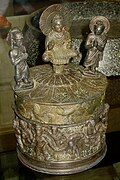 Hamsa border on the Kanishka casket, 2nd century CE
 -
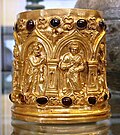 Hamsa birds between the architectural spires on the Bimaran casket, 1st century CE
 -
 Saraswati with a hamsa (c. 1895, British Library)
 -
 Sarasvati with a hamsa (19th-century, British Library)
 -
 Sarasvati and a hamsa (Kerala tile)
 -
A hamsa with the goddess Saraswati (Indian painting, 19th century)
-
The Goddess Saraswati riding a hamsa (Indonesian sculpture, 20th century)
-
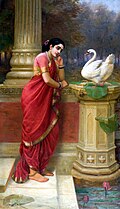 Hamsa talking to Damayanti as depicted by Raja Ravi Varma (19th century)
 -
 Hongsa (Hamsa) icon of the Mon region, Myanmar


References
- ↑ 1.0 1.1 1.2 1.3 1.4 Monier Monier-Williams, Monier Williams Sanskrit Dictionary, हंस, Hamsa, University of Cologne, Germany, ISBN 978-8120615090, page 1286
- ↑ 2.0 2.1 Jones, Lindsay (2005). Encyclopedia of religion, Volume 13. Macmillan Reference. p. 8894. ISBN 978-0028657332.
In Hindu iconography the swan personifies Brahman-Atman, the transcendent yet immanent ground of being, the Self.
- ↑ 3.0 3.1 3.2 Cush, Denise (2007). Encyclopedia of Hinduism. Routledge. p. 697. ISBN 978-0415556231.
- ↑ J. Pokorny, Indogermanisches etymologisches Wörterbuch. *ĝhan-s-
- ↑ 5.0 5.1 Vogel, Jean P. (1962). The Goose in Indian Literature and Art (Arts & Letters, Vol. XXVII, 1952 (Reprint ed.). Leiden. pp. 1–2.
{{cite book}}: CS1 maint: location missing publisher (link) - ↑ Ducks, Geese, and Swans of the World Paul Johnsgard (2010), University of Nebraska-Lincoln, page 29-31
- ↑ Peter Scott (1957), Key to the Wildfowl of the World, Collins, Plate II, ISBN 978-0002201100, OCLC 867723645
- ↑ Grewal, Harvey and Pfister (2003), A Photographic Guide to the Birds of India, Princeton University Press, ISBN 978-0691114965, page 58
- ↑ Asad Rahmani and M. Zafar-ul Islam (2009), Ducks, Geese And Swans of India, Oxford University Press and IBCN, ISBN 9780198060338, Chapters 5–7
- ↑ Dave:423.
- ↑ Maung Tin, Pali English Dictionary, British Burma Press, Cornell University Archives
- ↑ Monier Monier-Williams, Monier Williams Sanskrit Dictionary. See Goose, University of Cologne, Germany, ISBN 978-8120615090
- ↑ 13.0 13.1 13.2 KN Dave (2005), Birds in Sanskrit Literature, Motilal Banarsidass, ISBN 978-8120818422, pages 422-447 with footnotes
- ↑ Salim Ali (1979). Bird study in India: Its history and its importance. New Delhi: ICCR.
- ↑ Alex McKay (2013). Pilgrimage in Tibet. Taylor and Francis, ISBN 9781315027180, pp. 165–174
- ↑ Alex McKay (2015), Kailas Histories, Brill Academic, pp. 375–379 with footnotes
- ↑ For examples of Kalidasa poem where Hamsa and the mythical lake Manasa is mentioned, see: Kālidāsa (Transl: Chintaman Ramchandra Devadhar, 2006), The Vikramorvaśīyam of Kālidāsa, Motilal Banarsidass, pp. 111–112
- ↑ Tidemann, Sonia C.; Gosler, Andrew (2012). Ethno-ornithology: Birds, Indigenous Peoples, Culture and Society. Taylor & Francis. pp. 145–146. ISBN 978-1-136-54383-8.
- ↑ Sivaramamurti, C. (1974). Birds and Animals in Indian Sculpture. National Museum. pp. 62–67, with Figures 64a, 64b, 68.
- ↑ 20.0 20.1 20.2 Krishna, N. (2014). "Swan". Sacred Animals of India. Penguin Books. ISBN 978-81-8475-182-6.
- ↑ 21.0 21.1 John Bowker (1998), Picturing God, Series Editor: Jean Holm, Bloomsbury Academic, ISBN 978-1855671010, pp 99-101
- ↑ Richard Leviton (2011), Hierophantic Landscapes, ISBN 978-1462054145, pp 543
- ↑ Deussen 1997, pp. 717-720.
- ↑ 24.0 24.1 24.2 Olivelle 1992, pp. 137-140.
- ↑ Deussen 1997, pp. 753-755.
- ↑ "परमहंसोपनिषत्". sanskritdocuments.org. p. ॥ ४॥, verse 4. Retrieved 7 January 2016.
- ↑ 27.0 27.1 27.2 George Williams (2001), Handbook of Hindu Mythology, ISBN 978-1576071069, pages 58-59
- ↑ Helen Myers (1999), Music of Hindu Trinidad: Songs from the India Diaspora, University of Chicago Press, ISBN 978-0226554532, page 4
- ↑ Lanman, Charles R. (1898). "The Milk-Drinking Haṅsas of Sanskrit Poetry". Journal of the American Oriental Society. 19: 151–158. doi:10.2307/592478. ISSN 0003-0279. JSTOR 592478.
- ↑ Lerner, M.; Kossak, S. (1991). The Lotus Transcendent: Indian and Southeast Asian Art from the Samuel Eilenberg Collection. Metropolitan Museum of Art. p. 62. ISBN 978-0-87099-613-9.
- ↑ 31.0 31.1 Gasparini, M. (2019). Transcending Patterns: Silk Road Cultural and Artistic Interactions through Central Asian Textile Images. Perspectives on the Global Past. University of Hawai'i Press. pp. 111–112. ISBN 978-0-8248-7798-9.
- ↑ Swearer, D.K. (2020). Becoming the Buddha: The Ritual of Image Consecration in Thailand. Buddhisms: A Princeton University Press Series. Princeton University Press. pp. 56–58. ISBN 978-0-691-21602-7.
- ↑ Châu, T.; Boin-Webb, S. (1999). The Literature of the Personalists of Early Buddhism. Buddhist traditions. Motilal Banarsidass Publishers. p. 22. ISBN 978-81-208-1622-0.
- ↑ Sylvia Fraser-Lu (1994), Burmese Crafts: Past and Present, Oxford University Press, ISBN 978-0195886085, page 116
- ↑ Robert Reid and Michael Grosberg (2005), Myanma (Burma), ISBN 978-1740596954, page 140
- ↑ Pascal Christel (2020), Splendour of Buddhism in Burma, Patridge Singapore, ISBN 9781543758177, pages 79–84 with figures
- Dictionary of Hindu Lore and Legend (ISBN 0-500-51088-1) by Anna Dallapiccola
- Deussen, Paul (1997). Sixty Upanishads of the Veda. Motilal Banarsidass. ISBN 978-8120814677.
- Olivelle, Patrick (1992). The Samnyasa Upanisads. Oxford University Press. ISBN 978-0195070453.
| Philosophy |
|  | |||||||||||||||
|---|---|---|---|---|---|---|---|---|---|---|---|---|---|---|---|---|---|
| Texts |
| ||||||||||||||||
| Deities |
| ||||||||||||||||
| Practices |
| ||||||||||||||||
| Related | |||||||||||||||||


