

No edit summary Tags: Mobile edit Mobile web edit |
No edit summary Tags: Mobile edit Mobile web edit |
||
| Line 1: | Line 1: | ||
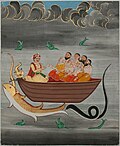
'''Rishi''' is a | [[File:Manu and Saptarishi.jpg|250x250px|thumb|A late 18th century painting of [[Saptarishi]] and Manu from [[Jaipur]], [[Rajasthan]].]] | ||
'''''Rishi''''' ([[Sanskrit]]: ऋषि, {{IAST3|ṛṣi}}) is a term for an accomplished and enlightened person. They find mentions in various Hindu Vedic texts. Rishis are believed to have composed hymns of the [[Vedas]]. Post-Vedic tradition of [[Hinduism]] regards the rishis as "great [[yogi]]s" or "sages" who after intense meditation ([[Tapas (Sanskrit)|tapas]]) realized the supreme truth and eternal knowledge, which they composed into hymns.<ref name=scharfe13>Hartmut Scharfe (2002), Handbook of Oriental Studies, BRILL Academic, {{ISBN|978-9004125568}}, pages 13–15</ref> The term appears in [[Pali]] literature as Ishi and in Buddhism, they can be either [[Buddhahood|Buddhas]], [[Pratyekabuddha|Paccekabuddhas]], [[Arhat|Arahats]] or a [[Buddhist monasticism|monk]] of high rank. | |||
==Etymology== | |||
According to Indian tradition, the word may be derived from two different meanings of the root 'rsh' ({{IAST|ṛṣ}}). Sanskrit grammarians<ref>''cf.'' Commentary on ''[[Unadi-Sutra]]'',{{by whom|date=October 2017}}{{year needed|date=October 2017}} iv, 119</ref> derive this word from the second meaning: "to go, to move".<ref>Dhātupāṭha of Pānini, xxviii). V. S. Apte</ref> V. S. Apte<ref>V. S. Apte (Sanskrit-Hindi Kosh, 1890, reprint 1997 by Motilāl Banārasidās Publishers, Delhi)</ref> gives this particular meaning and derivation, and [[Monier-Williams]]<ref name="Williams">{{Citation | |||
| last =Monier-Williams | |||
| first =Monier | |||
| author-link =Monier Monier-Williams | |||
| year =1899 | |||
| title =A Sanskrit-English Dictionary | |||
| place =Delhi | |||
| publisher=Motilal Banarsidass | |||
| url =http://www.ibiblio.org/sripedia/ebooks/mw/ | |||
| page = 226 | |||
}}</ref> also gives the same, with some qualification. | |||
= | Another form of this root means "to flow, to move near by flowing". (All the meanings and derivations cited above are based upon ''Sanskrit English Dictionary'' of Monier-Williams).<ref name="Williams" /> Monier-Williams also quotes Tārānātha who compiled the great (Sanskrit-to-Sanskrit) dictionary named "ṛṣati jñānena saṃsāra-pāram" (i.e., "one who reaches beyond this mundane world by means of spiritual knowledge"). | ||
[[ | More than a century ago, Monier-Williams tentatively suggested a derivation from ''{{IAST|drś}}'' "to see".<ref>http://flaez.ch/cgi-bin/mw.pl?query=RSi</ref> Monier-Williams also quotes the Hibernian (Irish) form ''arsan'' (a sage, a man old in wisdom) and ''arrach'' (old, ancient, aged) as related to ''rishi''. Monier-Williams also conjectures that the root ''drish'' (to see) might have given rise to an obsolete root ''rish'' meaning "to see". | ||
{{ | |||
However, the root has a close [[Avestan]] cognate ''ərəšiš''<ref>[[Yasna]] 31.5; cf. 40.4</ref> "an [[Religious ecstasy|ecstatic]]" (see also [[Yurodivy]], [[Vates]]). Yet the Indo-European dictionary of [[Julius Pokorny]] connects the word to a PIE root ''{{PIE|*h<sub>3</sub>er-s}}'' meaning "rise, protrude", in the sense of "excellent" and thus cognate with [[Ṛta]] and [[wikt:rightness|right]] and [[Asha]]. In Sanskrit, forms of the root ''rish'' become ''arsh-'' in many words, (e.g., ''arsh'') | |||
Modern etymological explanations such as by [[Manfred Mayrhofer]] in his ''Etymological Dictionary''<ref>''Etymologisches Wörterbuch des Altindoarischen'', Heidelberg 1986, I 261</ref> leave the case open, and do not prefer a connection to ''{{IAST|ṛṣ}}'' "pour, flow" ([[PIE]] ''{{PIE|*h<sub>1</sub>ers}}''), rather one with German ''rasen'' "to be ecstatic, be in a different state of mind" (and perhaps Lithuanian ''aršus''). | |||
==In Hindu texts== | |||
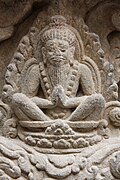
[[File:Rishi.jpg|thumb|A temple relief showing a Rishi.]] | |||
In the [[Vedas]], the word denotes an inspired poet of Vedic hymns.<ref name=scharfe13/> In particular, Ṛṣi refers to the authors of the hymns of the [[Rigveda]]. Some of the earliest lists of ''Rishi'' are found in Jaiminiya Brahmana verse 2.218 and [[Brihadaranyaka Upanishad]] verse 2.2.4.<ref name=jmcdaniel309>Justin McDaniel (2013), This Hindu holy man is a Thai Buddhist, South East Asia Research, Volume 21, Number 2, page 309, 303-321</ref> | |||
Post-Vedic tradition regards the Rishis as "sages" or [[saint]]s, constituting a peculiar class of divine human beings in the early mythical system, as distinct from [[Asura]]s, [[Deva (Hinduism)|Deva]]s and mortal men. [[Swami Vivekananda]] described "Rishi"s as ''Mantra-drashtas'' or "the seers of thought". He told— "The truth came to the Rishis of India — the Mantra-drashtâs, the seers of thought — and will come to all Rishis in the future, not to talkers, not to book-swallowers, not to scholars, not to philologists, but to seers of thought."<ref name="Swami Vivekananda on Rishis">{{cite web|title=Swami Vivekananda on Rishis|url=http://www.swamivivekanandaquotes.org/2014/03/swami-vivekanandas-quotes-on-rishis-and-sages.html|publisher=Swami Vivekananda Quotes|access-date=12 April 2014}}</ref> | |||
The notable female [https://web.archive.org/web/20150810021917/http://www.speakingtree.in/spiritual-blogs/masters/philosophy/rshik-s-of-the-rgveda-214571 rishikas] who contributed to the composition of the Vedic scriptures are: | |||
The [[Rig Veda]] mentions Romasha, [[Lopamudra]], [[Apala]], [[Kadru]], Visvavara, [[Ghosha]], [[Juhu]], Vagambhrini, Paulomi, [[Yami]], [[Indrani]], [[Savitri and Satyavan|Savitri]] and [[Devayani]]. | |||
The [[Sama Veda]] adds Nodha, Akrishtabhasha, Sikatanivavari and Gaupayana. | |||
In [[Mahabharata]] 12, on the other hand, there is the post-Vedic list of [[Marichi|Marīci]], [[Atri]], [[Angiras (sage)|Angiras]], [[Pulaha]], [[Kratu]], [[Pulastya]] and [[Vashista]]. The Mahābhārata list explicitly refers to the saptarshis of the first [[manvantara]]<ref name="Williams" /> and not to those of the present manvantara. Each manvantara had a unique set of saptarshi. In Harivamsha 417ff, the names of the Rishis of each manvantara are enumerated. | |||
In addition to the Sapta{{IAST|rṣi}}, there are other classifications of sages. In descending order of precedence, they are [[Brahmarshi]], [[Maharshi]], [[Rajarshi]]. Deva{{IAST|rṣi}}, Param{{IAST|rṣi}}, Shruta{{IAST|rṣi}} and Kānda{{IAST|rṣi}} are added in Manusmriti iv-94 and xi-236 and in two dramas of Kālidasa. | |||
The Chaturvarga-Chintāmani of Hemādri puts '{{IAST|riṣi}}' at the seventh place in the eightfold division of Brāhmanas. [[Amarakosha]]<ref>Amarakosha (2.7.41–42)</ref> (the famous Sanskrit synonym lexicon compiled by Amarasimha) mentions seven types of {{IAST|riṣi}}s : Shrutarshi, Kāndarshi, Paramarshi, Maharshi, Rājarshi, Brahmarshi and Devarshi. Amarakosha strictly distinguishes Rishi from other types of sages, such as sanyāsi, {{IAST|bhikṣu}}, parivrājaka, tapasvi, muni, brahmachāri, yati, etc. | |||
== In Buddhist texts == | |||
The term Rishi found mentions throughout the [[Buddhist texts]]. In [[Pali]], they are called as "Isi"s. A Rishi can be referred to a Buddha, Paccekabuddha, Arhat or monk of high rank. In [[Pāli Canon|Buddhist Pali literature]], [[Gautama Buddha|Buddha]] is called many times as "Mahesi"(Pali; Sanskrit: Maharṣi; meaning the greatest sage).<ref>{{Cite web|last=www.wisdomlib.org|date=2014-08-03|title=Maheshi, Mahesi, Māheśī, Maheśī: 4 definitions|url=https://www.wisdomlib.org/definition/maheshi|access-date=2021-04-12|website=www.wisdomlib.org}}</ref>themselves can be called as Rishis. The Isigili Sutta in [[Pāli Canon|Pali Canon]], mentions the name of Five hundred Rishis (Paccekabuddhas). The Buddhist text, [[Mahamayuri|Mahamayuri Tantra]], written during 1–3rd centuries CE, mentions Rishis throughout [[Jambudvipa]] (modern day [[India]], [[Pakistan]], [[Afghanistan]], [[Bangladesh]], [[Nepal]]) and invokes them for the protection of the [[Buddhism|Buddhadharma]].<ref>[https://mahamayurividyarajni.wordpress.com/2012/06/10/mahamayuri/ Translated into English by Cheng Yew Chung based on Amoghavajra’s Chinese Translation (Taisho Volume 19, Number 982) ]</ref> | |||
Many [[Jataka tales|Jatakas]] also mentions various Rishis. The Naḷinikā Jātaka (Jā 526) introduces a [[Bodhisattva|past life of the Buddha]], a Rishi(Isi), living alone in the Himālayas. His son, who was also a Rishi, his name was [[Rishyasringa|Isisiṅga]] ([[Pali]]; Sanskrit:''Ṛṣyaśṛṅga''). The Agastya Jataka(Sanskrit; Pali: Akitta Jataka) story, mentions [[Bodhisattva]], named Agastya(Sanskrit; Pali: Akkhata) as Rishi. | |||
==Rishi in Indonesia and Khmer temples== | |||
Most medieval era [[Candi of Indonesia|Hindu temples of Java]], [[Indonesia]] show Rishi [[Agastya]] statues or reliefs, usually guarding the southern side of [[Shaivite]] temples.<ref name=jmcdaniel309/> Some examples include [[Candi Sambisari]] and the Prambanan temple near [[Yogyakarta]].<ref>Maud Girard-Geslan et al (1997), Art of Southeast Asia, Harry Abrams, Paris, page 350</ref> | |||
==Ruesi in Cambodia, Thailand, Myanmar and Laos== | |||
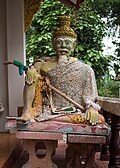
[[File:2013 Wat Suan Tan 02.jpg|thumb|A statue of a Ruesi at Wat Suan Tan in [[Nan, Thailand]]]] | |||
'''Ruesi''' (sanskrit: ''ṛṣi'', {{lang-km|តាឥសី}}, {{lang-th|ฤๅษี}}, {{lang-lo|ລືສີ}}) is a [[hermit]] [[List of types of spiritual teachers|sage]], the equivalent of Rishi in [[India]]. In [[Myanmar]], there are some known as ရေသ့ ''Rase''.{{citation needed|date=October 2017}} Rishi Akkhata(Pali; Sanskrit: Agastya), known as Phra Reusi Akkhot in [[Thailand]], is an important Ruesi in [[Southeast Asia]], as in the [[Jataka tales|Buddhist Jataka scriptures]], this Ruesi is mentioned as the [[Bodhisattva|bodhisatta]] and practiced his ascetism in [[Sri Lanka]] and [[Southeast Asia]].<ref name="jmcdaniel309" /> Veneration of Ruesis is a notable practice in [[Buddhism in Southeast Asia|Southeast Asian Buddhism]]. The name "Rishi" (pronounced "ruesi") is also the basis of one of the letters of the [[Thai alphabet]], ''so reu-si'' ({{lang-th|ษ ฤๅษี}}). | |||
==Other uses== | |||
Rishi is also a male given name, and less commonly a Brahmin last name. | |||
In [[Carnatic music]], "Rishi" is the seventh ''chakra'' (group) of [[Melakarta]] [[raga]]s. The names of ''chakras'' are based on the numbers associated with each name. In this case, there are [[Saptarishi|seven rishis]] and hence the 7th ''chakra'' is "Rishi".<ref name="sim">''South Indian Music'' Book III, by Prof. P Sambamoorthy, Published 1973, The Indian Music Publishing House</ref><ref name="ragas">''Ragas in Carnatic music'' by Dr. S. Bhagyalekshmy, Pub. 1990, CBH Publications</ref> | |||
The descendant families of these Rishis, refer to their ancestral lineage through their family "[[gotra]]". This is a common practice among the Brahmin sects of the current Hindu society. | |||
== See also == | |||
{{col div|colwidth=20em}} | |||
*[[Devarishi]] | |||
*[[Saptarishi]] | |||
*[[Rishi Panchami]] | |||
*[[Rishikas]] | |||
*[[Sadhu]] | |||
*[[Sennin]] | |||
*[[Rishabha (Hinduism)]] | |||
*[[Rishabhanatha]] | |||
*[[Pravaras]] | |||
*[[Ataptatanu]] | |||
*[[Sramana]] | |||
*[[Apaurusheyatva]] | |||
*[[Yogi]] | |||
*[[Yogini]] | |||
*[[Kavi (disambiguation)|Kavi]]<!--intentional link to DAB page--> | |||
*[[Rishu]] | |||
*[[Vijjadhara]] | |||
*[[Weizza]] | |||
*[[Xian (Taoism)|Xian]] | |||
*[[Rōshi]] | |||
{{colend}} | |||
==Notes== | |||
{{Reflist|2}} | |||
==References== | |||
*{{Citation | |||
| last =Apte | |||
| first =Vaman Shivram | |||
| year =1965 | |||
| title =The Practical Sanskrit-English Dictionary | |||
| edition =Fourth Revised and Enlarged | |||
| place =New Delhi | |||
| publisher=Motilal Banarsidass | |||
| isbn =978-81-208-0567-5 | |||
}} | |||
*{{Citation | |||
| last =Apte | |||
| first =Vaman Shivram | |||
| year =1966 | |||
| title =Sanskrit-Hindi {{IAST|Koṣa}} | |||
| edition =Reprint 1997 | |||
| place =New Delhi | |||
| publisher=Motilal Banarsidass | |||
}} | |||
*{{Citation | |||
| last=Chopra | |||
| first=Deepak | |||
| year=2006 | |||
| title=Life After Death: The Burden of Proof | |||
| place=Boston | |||
| publisher=Harmony Books | |||
| edition=first | |||
}} | |||
*{{Citation | |||
| last=Kosambi | |||
| first=D. D. | |||
| year=1956 | |||
| title=An Introduction to the Study of Indian History | |||
| place=Bombay | |||
| publisher=Popular Prakashan Pvt Ltd, 35c Tardeo Road, Popular Press Bldg, Bombay-400034 | |||
| edition=Second | |||
}} | |||
*{{Citation | |||
| last=Śāstri | |||
| first=Hargovind | |||
| year=1978 | |||
| title={{IAST|Amarkoṣa}} with Hindi commentary | |||
| place=Vārānasi | |||
| publisher=Chowkhambā Sanskrit Series Office | |||
}} | |||
==Further reading== | |||
*[http://www.speakingtree.in/public/spiritual-blogs/masters/philosophy/rshik-s-of-the-rgveda-214571 Rishikas of the Rigveda] | |||
==External links== | |||
*{{Wiktionary-inline}} | |||
*{{Commons category-inline}} | |||
{{Rishis of Hindu mythology}} | |||
{{Rigveda}} | |||
{{Authority control}} | |||
[[Category:Rishis| ]] | |||
[[Category:Titles and occupations in Hinduism]] | |||
[[Category:Thai folklore]] | |||
{{en-Wikipedia}} | |||
Revision as of 18:27, 4 August 2021

Rishi (Sanskrit: ऋषि, IAST: ṛṣi) is a term for an accomplished and enlightened person. They find mentions in various Hindu Vedic texts. Rishis are believed to have composed hymns of the Vedas. Post-Vedic tradition of Hinduism regards the rishis as "great yogis" or "sages" who after intense meditation (tapas) realized the supreme truth and eternal knowledge, which they composed into hymns.[1] The term appears in Pali literature as Ishi and in Buddhism, they can be either Buddhas, Paccekabuddhas, Arahats or a monk of high rank.
Etymology
According to Indian tradition, the word may be derived from two different meanings of the root 'rsh' (ṛṣ). Sanskrit grammarians[2] derive this word from the second meaning: "to go, to move".[3] V. S. Apte[4] gives this particular meaning and derivation, and Monier-Williams[5] also gives the same, with some qualification.
Another form of this root means "to flow, to move near by flowing". (All the meanings and derivations cited above are based upon Sanskrit English Dictionary of Monier-Williams).[5] Monier-Williams also quotes Tārānātha who compiled the great (Sanskrit-to-Sanskrit) dictionary named "ṛṣati jñānena saṃsāra-pāram" (i.e., "one who reaches beyond this mundane world by means of spiritual knowledge").
More than a century ago, Monier-Williams tentatively suggested a derivation from drś "to see".[6] Monier-Williams also quotes the Hibernian (Irish) form arsan (a sage, a man old in wisdom) and arrach (old, ancient, aged) as related to rishi. Monier-Williams also conjectures that the root drish (to see) might have given rise to an obsolete root rish meaning "to see".
However, the root has a close Avestan cognate ərəšiš[7] "an ecstatic" (see also Yurodivy, Vates). Yet the Indo-European dictionary of Julius Pokorny connects the word to a PIE root Template:PIE meaning "rise, protrude", in the sense of "excellent" and thus cognate with Ṛta and right and Asha. In Sanskrit, forms of the root rish become arsh- in many words, (e.g., arsh)
Modern etymological explanations such as by Manfred Mayrhofer in his Etymological Dictionary[8] leave the case open, and do not prefer a connection to ṛṣ "pour, flow" (PIE Template:PIE), rather one with German rasen "to be ecstatic, be in a different state of mind" (and perhaps Lithuanian aršus).
In Hindu texts

In the Vedas, the word denotes an inspired poet of Vedic hymns.[1] In particular, Ṛṣi refers to the authors of the hymns of the Rigveda. Some of the earliest lists of Rishi are found in Jaiminiya Brahmana verse 2.218 and Brihadaranyaka Upanishad verse 2.2.4.[9]
Post-Vedic tradition regards the Rishis as "sages" or saints, constituting a peculiar class of divine human beings in the early mythical system, as distinct from Asuras, Devas and mortal men. Swami Vivekananda described "Rishi"s as Mantra-drashtas or "the seers of thought". He told— "The truth came to the Rishis of India — the Mantra-drashtâs, the seers of thought — and will come to all Rishis in the future, not to talkers, not to book-swallowers, not to scholars, not to philologists, but to seers of thought."[10]
The notable female rishikas who contributed to the composition of the Vedic scriptures are: The Rig Veda mentions Romasha, Lopamudra, Apala, Kadru, Visvavara, Ghosha, Juhu, Vagambhrini, Paulomi, Yami, Indrani, Savitri and Devayani. The Sama Veda adds Nodha, Akrishtabhasha, Sikatanivavari and Gaupayana.
In Mahabharata 12, on the other hand, there is the post-Vedic list of Marīci, Atri, Angiras, Pulaha, Kratu, Pulastya and Vashista. The Mahābhārata list explicitly refers to the saptarshis of the first manvantara[5] and not to those of the present manvantara. Each manvantara had a unique set of saptarshi. In Harivamsha 417ff, the names of the Rishis of each manvantara are enumerated.
In addition to the Saptarṣi, there are other classifications of sages. In descending order of precedence, they are Brahmarshi, Maharshi, Rajarshi. Devarṣi, Paramrṣi, Shrutarṣi and Kāndarṣi are added in Manusmriti iv-94 and xi-236 and in two dramas of Kālidasa.
The Chaturvarga-Chintāmani of Hemādri puts 'riṣi' at the seventh place in the eightfold division of Brāhmanas. Amarakosha[11] (the famous Sanskrit synonym lexicon compiled by Amarasimha) mentions seven types of riṣis : Shrutarshi, Kāndarshi, Paramarshi, Maharshi, Rājarshi, Brahmarshi and Devarshi. Amarakosha strictly distinguishes Rishi from other types of sages, such as sanyāsi, bhikṣu, parivrājaka, tapasvi, muni, brahmachāri, yati, etc.
In Buddhist texts
The term Rishi found mentions throughout the Buddhist texts. In Pali, they are called as "Isi"s. A Rishi can be referred to a Buddha, Paccekabuddha, Arhat or monk of high rank. In Buddhist Pali literature, Buddha is called many times as "Mahesi"(Pali; Sanskrit: Maharṣi; meaning the greatest sage).[12]themselves can be called as Rishis. The Isigili Sutta in Pali Canon, mentions the name of Five hundred Rishis (Paccekabuddhas). The Buddhist text, Mahamayuri Tantra, written during 1–3rd centuries CE, mentions Rishis throughout Jambudvipa (modern day India, Pakistan, Afghanistan, Bangladesh, Nepal) and invokes them for the protection of the Buddhadharma.[13]
Many Jatakas also mentions various Rishis. The Naḷinikā Jātaka (Jā 526) introduces a past life of the Buddha, a Rishi(Isi), living alone in the Himālayas. His son, who was also a Rishi, his name was Isisiṅga (Pali; Sanskrit:Ṛṣyaśṛṅga). The Agastya Jataka(Sanskrit; Pali: Akitta Jataka) story, mentions Bodhisattva, named Agastya(Sanskrit; Pali: Akkhata) as Rishi.
Rishi in Indonesia and Khmer temples
Most medieval era Hindu temples of Java, Indonesia show Rishi Agastya statues or reliefs, usually guarding the southern side of Shaivite temples.[9] Some examples include Candi Sambisari and the Prambanan temple near Yogyakarta.[14]
Ruesi in Cambodia, Thailand, Myanmar and Laos

Ruesi (sanskrit: ṛṣi, Template:Lang-km, Thai: ฤๅษี, Template:Lang-lo) is a hermit sage, the equivalent of Rishi in India. In Myanmar, there are some known as ရေသ့ Rase.[citation needed] Rishi Akkhata(Pali; Sanskrit: Agastya), known as Phra Reusi Akkhot in Thailand, is an important Ruesi in Southeast Asia, as in the Buddhist Jataka scriptures, this Ruesi is mentioned as the bodhisatta and practiced his ascetism in Sri Lanka and Southeast Asia.[9] Veneration of Ruesis is a notable practice in Southeast Asian Buddhism. The name "Rishi" (pronounced "ruesi") is also the basis of one of the letters of the Thai alphabet, so reu-si (Thai: ษ ฤๅษี).
Other uses
Rishi is also a male given name, and less commonly a Brahmin last name.
In Carnatic music, "Rishi" is the seventh chakra (group) of Melakarta ragas. The names of chakras are based on the numbers associated with each name. In this case, there are seven rishis and hence the 7th chakra is "Rishi".[15][16]
The descendant families of these Rishis, refer to their ancestral lineage through their family "gotra". This is a common practice among the Brahmin sects of the current Hindu society.
See also
Notes
- ↑ 1.0 1.1 Hartmut Scharfe (2002), Handbook of Oriental Studies, BRILL Academic, ISBN 978-9004125568, pages 13–15
- ↑ cf. Commentary on Unadi-Sutra,[by whom?][year needed] iv, 119
- ↑ Dhātupāṭha of Pānini, xxviii). V. S. Apte
- ↑ V. S. Apte (Sanskrit-Hindi Kosh, 1890, reprint 1997 by Motilāl Banārasidās Publishers, Delhi)
- ↑ 5.0 5.1 5.2 Monier-Williams, Monier (1899), A Sanskrit-English Dictionary, Delhi: Motilal Banarsidass, p. 226
- ↑ http://flaez.ch/cgi-bin/mw.pl?query=RSi
- ↑ Yasna 31.5; cf. 40.4
- ↑ Etymologisches Wörterbuch des Altindoarischen, Heidelberg 1986, I 261
- ↑ 9.0 9.1 9.2 Justin McDaniel (2013), This Hindu holy man is a Thai Buddhist, South East Asia Research, Volume 21, Number 2, page 309, 303-321
- ↑ "Swami Vivekananda on Rishis". Swami Vivekananda Quotes. Retrieved 12 April 2014.
- ↑ Amarakosha (2.7.41–42)
- ↑ www.wisdomlib.org (2014-08-03). "Maheshi, Mahesi, Māheśī, Maheśī: 4 definitions". www.wisdomlib.org. Retrieved 2021-04-12.
- ↑ Translated into English by Cheng Yew Chung based on Amoghavajra’s Chinese Translation (Taisho Volume 19, Number 982)
- ↑ Maud Girard-Geslan et al (1997), Art of Southeast Asia, Harry Abrams, Paris, page 350
- ↑ South Indian Music Book III, by Prof. P Sambamoorthy, Published 1973, The Indian Music Publishing House
- ↑ Ragas in Carnatic music by Dr. S. Bhagyalekshmy, Pub. 1990, CBH Publications
References
- Apte, Vaman Shivram (1965), The Practical Sanskrit-English Dictionary (Fourth Revised and Enlarged ed.), New Delhi: Motilal Banarsidass, ISBN 978-81-208-0567-5
- Apte, Vaman Shivram (1966), Sanskrit-Hindi Koṣa (Reprint 1997 ed.), New Delhi: Motilal Banarsidass
- Chopra, Deepak (2006), Life After Death: The Burden of Proof (first ed.), Boston: Harmony Books
- Kosambi, D. D. (1956), An Introduction to the Study of Indian History (Second ed.), Bombay: Popular Prakashan Pvt Ltd, 35c Tardeo Road, Popular Press Bldg, Bombay-400034
- Śāstri, Hargovind (1978), Amarkoṣa with Hindi commentary, Vārānasi: Chowkhambā Sanskrit Series Office