


Adarshatva (talk | contribs) Tags: Mobile edit Mobile web edit Advanced mobile edit |
Adarshatva (talk | contribs) No edit summary Tags: Mobile edit Mobile web edit Advanced mobile edit |
||
| Line 54: | Line 54: | ||
These divisions do not encompass the [[Islamabad Capital Territory]]. The formerly [[Federally Administered Tribal Areas]] (FATA), which previously held the same administrative status as provinces, were merged into [[Khyber Pakhtunkhwa]] province and incorporated into neighbouring divisions within that province in 2018. | These divisions do not encompass the [[Islamabad Capital Territory]]. The formerly [[Federally Administered Tribal Areas]] (FATA), which previously held the same administrative status as provinces, were merged into [[Khyber Pakhtunkhwa]] province and incorporated into neighbouring divisions within that province in 2018. | ||
==History== | |||
The administrative divisions constituted an integral tier of government from colonial times, with the Governor's provinces of British India being subdivided into divisions, which were further divided into districts. At the time of creation in 1947, the new nation of Pakistan comprised two geographically separated wings – [[East Pakistan|eastern]] and [[West Pakistan|western]]. Three of Pakistan's provinces were subdivided into ten administrative divisions. The single province in the eastern wing, [[East Bengal]], comprised four divisions – [[Chittagong Division|Chittagong]], [[Dhaka Division|Dacca]], [[Khulna Division|Khulna]] and [[Rajshahi Division|Rajshahi]]. [[West Punjab]] province contained four divisions – [[Lahore Division|Lahore]], [[Multan Division|Multan]], [[Rawalpindi Division|Rawalpindi]], and [[Sargodha Division|Sargodha]]. The [[North-West Frontier Province]] (as it was then known) had two divisions – [[Dera Ismail Khan Division|Dera Ismail Khan]] and [[Peshawar Division|Peshawar]]. Most of the former [[Sind Province (1936-1955|Sind Province]] became [[Hyderabad Division]]. The majority of divisions were named after their respective divisional capitals, though some exceptions existed. | |||
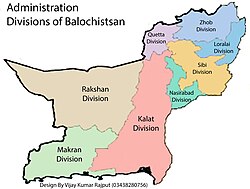
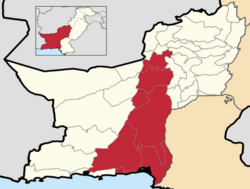
From 1955 to 1970, the [[One Unit Scheme|One Unit policy]] consolidated the administrative structure into only two provinces – [[East Pakistan|East]] and [[West Pakistan]]. [[East Pakistan]] retained the same divisions as [[East Bengal]] previously possessed, while [[West Pakistan]] progressively gained seven new divisions to supplement the original six divisions. The [[Baluchistan States Union]] was reorganised into [[Kalat Division]], while the former [[Baluchistan (Chief Commissioner's Province)|Baluchistan Chief Commissioner's Province]] became [[Quetta Division]]. The princely State of [[Khairpur (princely state)|Khairpur]], combined with portions of [[Hyderabad division]], formed [[Sukkur Division|Khairpur Division]]. The former [[Bahawalpur (princely state)|princely state of Bahawalpur]] was established as [[Bahawalpur Division]], thereby joining [[West Punjab]]. In 1959, the [[Federal Capital Territory (Pakistan)|Federal Capital Territory]] was absorbed into [[West Pakistan]], and in 1960, it was merged with the district of [[Lasbela (princely state)|Las Bela]] to create the [[Karachi Division|Karachi-Bela Division]]. In 1969, the princely states of [[Kingdom of Chitral|Chitral]], [[Dir (princely state)|Dir]] and [[Swat (princely state)|Swat]] were incorporated into [[West Pakistan]] as the [[Malakand Division]], with Saidu serving as the divisional headquarters. Khairpur division was abolished in 1975 and replaced with [[Sukkur Division]]. In 1980, Sukkur division was bifurcated to establish [[Larkana division]]. [[Mirpurkhas division]] was created in 1990 through the bifurcation of [[Hyderabad division]]. | |||
==Notes and References== | ==Notes and References== | ||
===Notes=== | ===Notes=== | ||
Revision as of 13:39, 14 July 2026
| Divisions of Pakistan पाकिस्तान के प्रभाग | |
|---|---|
| Also known as: پاکستان کے ڈویژن[A 1] | |
 Map of divisions of Pakistan | |
| Category | Second-level administrative division |
| Location | Islamic Republic of Pakistan |
| Number | 37 (as of 2024) |
| Government | Divisional government |
| Subdivisions | Districts Tehsils Union councils |
 |
|---|
| This article is part of a series on the politics and government of Pakistan |

.svg)
|
The administrative units of Pakistan comprise four provinces, two territories in the Kashmir region, and a capital territory. The provinces and territories are further subdivided into 37 divisions, which are subsequently divided into districts, tehsils, and finally union councils. The division system was abolished in 2000 but was subsequently restored in 2008.
These divisions do not encompass the Islamabad Capital Territory. The formerly Federally Administered Tribal Areas (FATA), which previously held the same administrative status as provinces, were merged into Khyber Pakhtunkhwa province and incorporated into neighbouring divisions within that province in 2018.
History
The administrative divisions constituted an integral tier of government from colonial times, with the Governor's provinces of British India being subdivided into divisions, which were further divided into districts. At the time of creation in 1947, the new nation of Pakistan comprised two geographically separated wings – eastern and western. Three of Pakistan's provinces were subdivided into ten administrative divisions. The single province in the eastern wing, East Bengal, comprised four divisions – Chittagong, Dacca, Khulna and Rajshahi. West Punjab province contained four divisions – Lahore, Multan, Rawalpindi, and Sargodha. The North-West Frontier Province (as it was then known) had two divisions – Dera Ismail Khan and Peshawar. Most of the former Sind Province became Hyderabad Division. The majority of divisions were named after their respective divisional capitals, though some exceptions existed.
From 1955 to 1970, the One Unit policy consolidated the administrative structure into only two provinces – East and West Pakistan. East Pakistan retained the same divisions as East Bengal previously possessed, while West Pakistan progressively gained seven new divisions to supplement the original six divisions. The Baluchistan States Union was reorganised into Kalat Division, while the former Baluchistan Chief Commissioner's Province became Quetta Division. The princely State of Khairpur, combined with portions of Hyderabad division, formed Khairpur Division. The former princely state of Bahawalpur was established as Bahawalpur Division, thereby joining West Punjab. In 1959, the Federal Capital Territory was absorbed into West Pakistan, and in 1960, it was merged with the district of Las Bela to create the Karachi-Bela Division. In 1969, the princely states of Chitral, Dir and Swat were incorporated into West Pakistan as the Malakand Division, with Saidu serving as the divisional headquarters. Khairpur division was abolished in 1975 and replaced with Sukkur Division. In 1980, Sukkur division was bifurcated to establish Larkana division. Mirpurkhas division was created in 1990 through the bifurcation of Hyderabad division.
Notes and References
Notes
- ↑ पाकिस्तान के डिवीज़न्